EP4345222A1 - System and method for bowel movement detection - Google Patents
System and method for bowel movement detection Download PDFInfo
- Publication number
- EP4345222A1 EP4345222A1 EP22198589.8A EP22198589A EP4345222A1 EP 4345222 A1 EP4345222 A1 EP 4345222A1 EP 22198589 A EP22198589 A EP 22198589A EP 4345222 A1 EP4345222 A1 EP 4345222A1
- Authority
- EP
- European Patent Office
- Prior art keywords
- measurement data
- module
- user
- physiological parameter
- parameter measurement
- Prior art date
- Legal status (The legal status is an assumption and is not a legal conclusion. Google has not performed a legal analysis and makes no representation as to the accuracy of the status listed.)
- Granted
Links
Images




Classifications
-
- A—HUMAN NECESSITIES
- A61—MEDICAL OR VETERINARY SCIENCE; HYGIENE
- A61B—DIAGNOSIS; SURGERY; IDENTIFICATION
- A61B5/00—Measuring for diagnostic purposes; Identification of persons
- A61B5/68—Arrangements of detecting, measuring or recording means, e.g. sensors, in relation to patient
- A61B5/6887—Arrangements of detecting, measuring or recording means, e.g. sensors, in relation to patient mounted on external non-worn devices, e.g. non-medical devices
- A61B5/6891—Furniture
-
- A—HUMAN NECESSITIES
- A47—FURNITURE; DOMESTIC ARTICLES OR APPLIANCES; COFFEE MILLS; SPICE MILLS; SUCTION CLEANERS IN GENERAL
- A47K—SANITARY EQUIPMENT; ACCESSORIES THEREFOR, e.g. TOILET ACCESSORIES
- A47K13/00—Seats or covers for all kinds of closets
- A47K13/24—Parts or details not covered in, or of interest apart from, groups A47K13/02 - A47K13/22
-
- A—HUMAN NECESSITIES
- A61—MEDICAL OR VETERINARY SCIENCE; HYGIENE
- A61B—DIAGNOSIS; SURGERY; IDENTIFICATION
- A61B5/00—Measuring for diagnostic purposes; Identification of persons
- A61B5/0002—Remote monitoring of patients using telemetry, e.g. transmission of vital signals via a communication network
- A61B5/0015—Remote monitoring of patients using telemetry, e.g. transmission of vital signals via a communication network characterised by features of the telemetry system
- A61B5/0022—Monitoring a patient using a global network, e.g. telephone networks, internet
-
- A—HUMAN NECESSITIES
- A61—MEDICAL OR VETERINARY SCIENCE; HYGIENE
- A61B—DIAGNOSIS; SURGERY; IDENTIFICATION
- A61B5/00—Measuring for diagnostic purposes; Identification of persons
- A61B5/02—Detecting, measuring or recording for evaluating the cardiovascular system, e.g. pulse, heart rate, blood pressure or blood flow
- A61B5/024—Measuring pulse rate or heart rate
- A61B5/02416—Measuring pulse rate or heart rate using photoplethysmograph signals, e.g. generated by infrared radiation
-
- A—HUMAN NECESSITIES
- A61—MEDICAL OR VETERINARY SCIENCE; HYGIENE
- A61B—DIAGNOSIS; SURGERY; IDENTIFICATION
- A61B5/00—Measuring for diagnostic purposes; Identification of persons
- A61B5/05—Detecting, measuring or recording for diagnosis by means of electric currents or magnetic fields; Measuring using microwaves or radio waves
- A61B5/053—Measuring electrical impedance or conductance of a portion of the body
-
- A—HUMAN NECESSITIES
- A61—MEDICAL OR VETERINARY SCIENCE; HYGIENE
- A61B—DIAGNOSIS; SURGERY; IDENTIFICATION
- A61B5/00—Measuring for diagnostic purposes; Identification of persons
- A61B5/117—Identification of persons
- A61B5/1171—Identification of persons based on the shapes or appearances of their bodies or parts thereof
- A61B5/1172—Identification of persons based on the shapes or appearances of their bodies or parts thereof using fingerprinting
-
- A—HUMAN NECESSITIES
- A61—MEDICAL OR VETERINARY SCIENCE; HYGIENE
- A61B—DIAGNOSIS; SURGERY; IDENTIFICATION
- A61B5/00—Measuring for diagnostic purposes; Identification of persons
- A61B5/117—Identification of persons
- A61B5/1171—Identification of persons based on the shapes or appearances of their bodies or parts thereof
- A61B5/1176—Recognition of faces
-
- A—HUMAN NECESSITIES
- A61—MEDICAL OR VETERINARY SCIENCE; HYGIENE
- A61B—DIAGNOSIS; SURGERY; IDENTIFICATION
- A61B5/00—Measuring for diagnostic purposes; Identification of persons
- A61B5/20—Measuring for diagnostic purposes; Identification of persons for measuring urological functions restricted to the evaluation of the urinary system
- A61B5/207—Sensing devices adapted to collect urine
- A61B5/208—Sensing devices adapted to collect urine adapted to determine urine quantity, e.g. flow, volume
-
- A—HUMAN NECESSITIES
- A61—MEDICAL OR VETERINARY SCIENCE; HYGIENE
- A61B—DIAGNOSIS; SURGERY; IDENTIFICATION
- A61B5/00—Measuring for diagnostic purposes; Identification of persons
- A61B5/24—Detecting, measuring or recording bioelectric or biomagnetic signals of the body or parts thereof
- A61B5/25—Bioelectric electrodes therefor
- A61B5/279—Bioelectric electrodes therefor specially adapted for particular uses
- A61B5/28—Bioelectric electrodes therefor specially adapted for particular uses for electrocardiography [ECG]
- A61B5/282—Holders for multiple electrodes
-
- A—HUMAN NECESSITIES
- A61—MEDICAL OR VETERINARY SCIENCE; HYGIENE
- A61B—DIAGNOSIS; SURGERY; IDENTIFICATION
- A61B5/00—Measuring for diagnostic purposes; Identification of persons
- A61B5/72—Signal processing specially adapted for physiological signals or for diagnostic purposes
- A61B5/7221—Determining signal validity, reliability or quality
-
- A—HUMAN NECESSITIES
- A61—MEDICAL OR VETERINARY SCIENCE; HYGIENE
- A61B—DIAGNOSIS; SURGERY; IDENTIFICATION
- A61B5/00—Measuring for diagnostic purposes; Identification of persons
- A61B5/42—Detecting, measuring or recording for evaluating the gastrointestinal, the endocrine or the exocrine systems
- A61B5/4222—Evaluating particular parts, e.g. particular organs
- A61B5/4255—Intestines, colon or appendix
Definitions
- the invention relates to noninvasive measurement and/or acquisition of physiological parameters, especially for detecting a bowel movement and/or urination, and for characterizing excrement or faeces in terms of a firmness level.
- human excreta is a common source of information that may provide insight into the person's health.
- an obstipation may be considered as a sign of an underlying or chronic illness, and a detection of obstipation may assist with diagnosis of said illness.
- a detection of obstipation is relevant in settings where the person has difficulty in conveying the situation.
- the document US 2020/0100725 A1 discloses a toilet system for health diagnosis that performs visual recordings of excrement, e.g. via a camera or a video camera, for collecting data, e.g. color, volume, or consistency, of the excrement produced by bowel movements of an individual.
- an object of the invention is to provide a system, a smart toilet and a method for bowel movement detection that address the aforementioned limitations in order to facilitate noninvasive and unobtrusive detection and monitoring of bowel movement health.
- a system for bowel movement detection comprises a sensor module configured to generate one or more physiological parameter measurement data of a user and a timestamp associated with the one or more physiological parameter measurement data.
- the system further comprises a signal processing module configured to receive the one or more physiological parameter measurement data and further to correlate the one or more physiological parameter measurement data using the associated timestamp in order to detect at least one bowel movement segment and/or an urination process of the user.
- the one or more physiological parameter measurement data comprise at least one electrocardiogram (ECG) measurement data and at least one bio-impedance (BioZ) measurement data of the user.
- ECG electrocardiogram
- BioZ bio-impedance
- the signal processing module may perform further processing of the measurement data before or after the correlation.
- the further processing of the measurement data may comprise pre-processing such as filtering, motion artefact removal and signal quality assessment, time-domain analysis, frequency-domain analysis, linear regression, physiological parameter estimation, and the like.
- the timestamp associated to the one or more physiological parameter measurement data may comprise a sequence of characters or encoded information that may identify a measurement session or event or instant.
- the timestamp may comprise digital information regarding a date and/or a time, especially accurate to a small fraction of a second, attached to the digital measured data.
- a single or a string of data corresponding to ECG measurements and a single or a string of data corresponding to BioZ measurements may be correlated using the associated timestamp if the measurements are performed simultaneously in one measurement session or event or instant, since the timestamp associated to the measurements may depict identical or similar date and/or time information when the measurements are being carried out.
- the invention proposes an unobtrusive technique for detecting bowel movements and/or urination.
- the invention facilitates noninvasive acquisition of different physiological signals, such as but not limited to blood oxygen saturation, heart rate, respiration and cardiac output, blood pressure, temperature, and bio-impedance.
- a fusion and/or a correlation of the different physiological data can be performed in order to determine a bowel movement, e.g. via estimating stress or strain or lack thereof from the fused or correlated data during a bowel movement.
- the invention proposes a noninvasive detection of an urination process, and further to differentiate between a bowel movement process and an urination process of the user based on the different physiological signals, e.g. via detecting a change in measured bio-impedance due to a change in urine volume in bladder.
- the signal processing module is further configured to compare the correlation of the one or more physiological parameter measurement data with a reference correlation of the one or more physiological parameter measurement data corresponding to an excrement firmness scale, preferably a Bristol stool scale, and further to determine a firmness level of excrement during the at least one bowel movement segment.
- an excrement firmness scale preferably a Bristol stool scale
- the different levels of the Bristol stool chart may be categorized using previously collected physiological data and/or reference physiological data and/or correlations with annotated recordings and/or patterns of the physiological signals, thereby forming a reference database, which can be used for the comparison and/or for the firmness level detection of the excrement during the bowel movement.
- a reference correlation of ECG data and BioZ data may be generated based on the different levels, i.e. stool firmness levels, of the Bristol stool chart.
- a reference correlation of the ECG data and BioZ data may be generated for a bowel movement resulting in faeces in form of separate hard lumps (severe constipation), faeces in form of a smooth sausage (normal), or faeces with liquid consistency (diarrhea).
- the measured ECG data and the measured BioZ data may be correlated and the correlated data obtained therefrom may be compared with the reference correlation.
- the reference database can be generated and/or stored correspond to a specific user of the system.
- a firmness level of the excrement can be determined or classified without any visual assessment of the excrement.
- the sensor module comprises at least two source electrodes configured to excite from at least two different measurement locations on the user, and at least two receiver electrodes configured to respectively measure response from the at least two different measurement locations, especially to generate the at least one ECG measurement data and/or the at least one BioZ measurement data.
- a tetrapolar or four-electrode measurement technique is facilitated which improves the measurement quality as well as the sensitivity and accuracy of the measured signals.
- the at least two source electrodes and/or the at least two receiver electrodes are multiplexed based on a time division and/or a frequency division multiplexing technique.
- a frequency division can be implemented for parallel acquisition of the ECG data (low frequency) and the BioZ data (high frequency), which facilitates a high flexibility in terms of measurement and performance.
- the one or more physiological parameter measurement data further comprise at least one weight measurement data.
- the signal processing module is further configured to determine a mass of excrement based on the at least one weight measurement data during the at least one bowel movement segment. Additionally or alternatively, the signal processing module is further configured to determine a volume of urine based on the at least one weight measurement data during the urination process.
- a bowel movement or an urination process may result in reduction of weight of a user, especially noticeable during the urination process or in severe diarrhea condition due to loss of body water.
- the weight measurement data may comprise body weight measurements of the user, for instance, consecutively measured at different times during the measurement session or event or instant, especially including body weight measurements before and after the bowel movement and/or the urination process.
- the weight measurement data can be effectively used to determine or estimate the mass of excrement when a bowel movement is detected.
- the weight measurement data can be effectively used to determine or estimate the amount or volume of urine produced, especially when no bowel movement is detected.
- the one or more physiological parameter measurement data further comprise at least one photoplethysmography (PPG) measurement data.
- the sensor module comprises at least one further electrode configured to excite and/or measure response from at least one further measurement location on the user, especially to generate the at least one PPG measurement data.
- the PPG measurement data may correspond to the perfusion of blood to the dermis and subcutaneous tissue of the skin, especially during each cardiac cycle, where each cardiac cycle appears as a peak.
- the PPG electrode may illuminate the skin with a light and may accordingly measure the amount of light either transmitted or reflected.
- an effective correlation can be performed to determine bowel movements, e.g. by means of the assessment of heart rate and blood pressure especially during a bowel movement segment.
- the system further comprises a user detection module, e.g. comprising a biometric sensor, whereby the signal processing module is configured to obtain a user detection signal comprising at least one user parameter from the user detection module.
- the at least one user parameter comprises one or more biometric attributes of the user including fingerprints, facial images, iris, and voice.
- the user detection module is configured to detect the user based on the one or more physiological parameter measurement data.
- the user detection module may perform an ECG-based human identification by extracting ECG traits or features from measured ECG signals and comparing the extracted ECG traits or features with reference ECG signals, e.g. previously measured and stored ECG signals, thereby generating the user detection signal.
- the system may comprise a sleep/wake-up control module configured to turn on or turn off the sensor module at least based on the user detection signal.
- the sleep/wake-up control module can be implemented as a separate module or can be implemented within the user detection module, which may additionally generate a sleep/wake-up signal to turn on or turn off the sensor module.
- a sleep/wake-up function for the sensor module can be enabled, which may advantageously increase the lifespan of the embedded sensors.
- the signal processing module is configured to generate measurement sessions based on the timestamp associated with the one or more physiological parameter measurement data, and further to assign the measurement sessions to the user detection signal and/or to the user.
- a measurement session may include the initiation of the measurements, e.g. initiating the sensors, measurement data acquisition from the sensors, measurement data transmission to external peripherals, and the processing of the measurement data.
- user-specific measurement and/or detection can be performed.
- the signal processing module is configured to assess a signal quality of the one or more physiological parameter measurement data with respect to a pre-defined threshold and further to correlate the one or more physiological parameter measurement data based on the assessed signal quality.
- the quality of the detected signal can be determined based on one or more signal traits, such as but not limited to signal-to-noise ratio (SNR), peak-to-peak interval, and amplitude, of the detected signal during the physiological parameter measurements. Additionally or alternatively, the quality of the detected signal can be determined based on the known signal quality indices for physiological parameters including but not limited to perfusion, kurtosis, and skewness.
- SNR signal-to-noise ratio
- peak-to-peak interval peak-to-peak interval
- amplitude amplitude
- the signal processing module may be configured to generate an alert signal based on the quality of the measurement data.
- the alert signal may comprise a tone and/or a text notification and/or a voice announcement.
- the signal processing module may detect a linear translation in the positioning of the user based on the quality of the measurement data, and may notify the user via the alert signal whether the user positioning is needed to be amended.
- a feedback to the user regarding any anomalies during the measurement is also incorporated.
- the system further comprises a communication module comprising at least one of a ZigBee module, a Bluetooth module, a Wi-Fi module, a GPRS module, or an NB-IoT module, whereby the communication module is configured to transmit the one or more physiological parameter measurement data wirelessly.
- a communication module comprising at least one of a ZigBee module, a Bluetooth module, a Wi-Fi module, a GPRS module, or an NB-IoT module, whereby the communication module is configured to transmit the one or more physiological parameter measurement data wirelessly.
- the signal processing module further comprises at least one of a ZigBee module, a Bluetooth module, a Wi-Fi module, a GPRS module, or an NB-IoT module, whereby the signal processing module is further configured to receive the one or more physiological parameter measurement data wirelessly, especially from the communication module.
- the physiological measurement data can be collected and can be further processed in a flexible manner.
- the signal processing module and the communication module can be integrated as a single entity, whereby the measurement data acquisition and processing can be done by said single entity either simultaneously or sequentially.
- a smart toilet or a smart toilet system comprises the system according to the first aspect of the invention.
- the smart toilet comprises a toilet seat comprising at least one sensor module and at least one communication module, and a remote device comprising at least one signal processing module.
- the sensor module is arranged on an upper surface of the toilet seat for contacting the user sitting on the toilet seat, especially for facilitating a physical contact and/or a near optical contact with the skin/tissue of the user.
- the present invention discloses a prospect of embedding the system into static objects, such as the smart toilet, in order to facilitate passive acquisition of physiological parameters in a casual manner, especially to detect bowel movements and/or urination.
- the remote device is a wireless remote device, e.g. smartphones, computers, personal digital assistants, or external signal processing/analysis devices.
- the remote device may be a cloud-based device, e.g. a cloud server, and the signal processing module may be implemented in the cloud-based device.
- the at least two source electrodes of the sensor module are arranged on the upper surface of the toilet seat to act as a left leg source electrode and a right leg source electrode.
- the at least two receiver electrodes of the sensor module are arranged on the upper surface of the toilet seat to act as a left leg receiver electrode and a right leg receiver electrode.
- a high sensitivity and accuracy of the measured signals can be ensured.
- a method for bowel movement detection comprises a step of generating one or more physiological parameter measurement data of a user and a timestamp associated with the one or more physiological parameter measurement data.
- the method further comprises a step of correlating the one or more physiological parameter measurement data using the associated timestamp in order to detect at least one bowel movement segment and/or an urination process of the user.
- the one or more physiological parameter measurement data comprise at least one electrocardiogram measurement data and at least one bio-impedance measurement data of the user.
- the method further comprises a step of comparing the correlation of the one or more physiological parameter measurement data with a reference correlation of the one or more physiological parameter measurement data corresponding to an excrement firmness scale, preferably a Bristol stool scale. Moreover, the method comprises a step of determining a firmness level of excrement during the at least one bowel movement segment.
- the method according to the third aspect corresponds to the system according to the first aspect and its implementation forms. Accordingly, the method according to the third aspect achieves the same advantages and effects as the system of the first aspect and its respective implementation forms.
- the system 100 comprises a sensor module or a sensor arrangement or a sensor assembly 101 comprising one or more load sensors or weight sensors 101 1 , one or more PPG sensor 101 2 , one or more ECG sensor 101 3 , and one or more BioZ sensor 101 4 .
- the sensor module 101 comprises one load sensors 101 1 , one PPG sensor 101 2 , one ECG sensor 101 3 , and one BioZ sensor 101 4 .
- the sensor module 101 may comprise additional sensors, e.g. one or more temperature sensors such as IR or UV temperature sensors, to generate additional physiological signals.
- the sensors may be arranged in an array of may be sparsely arranged based on the application of the system 101.
- the system 101 further comprises a communication module (COMM) or interface 102 that is operably coupled to the sensor module 101, especially coupled to the sensors 101 1 -101 4 , and may collect the respective physiological signals from the sensors 101 1 -101 4 , preferably simultaneously.
- the communication module 102 may then transmit the collected physiological signals wirelessly over a wireless communication link, e.g. over the communication link 104.
- the sensor module 101 including the sensors 101 1 -101 4 , and the communication module 103 may be collectively referred as a sensor system 103.
- the system 100 moreover comprises a signal processing module (PROC) 105 that is coupled to the sensor system 103, especially wirelessly.
- the signal processing module 105 may receive the physiological signals from the communication module 102 via a wireless communication link, e.g. via the communication link 104.
- the signal processing module 105 may comprise or be a processor, a microcontroller, a signal processing device, or a combination thereof.
- the signal processing module 105 may further comprise a memory (not shown) to store the received physiological signals and/or further processed results, e.g. a correlation.
- the communication module 102 and the signal processing module 105 can be implemented as a single integrated module, especially within the sensor system 103.
- the integrated module may perform the data acquisition and processing within the system 100 and may transmit the processed results and/or feedback to a remote device (e.g. a smartphone or a personal computer) or a remote system (e.g. a cloud system).
- a remote device e.g. a smartphone or a personal computer
- a remote system e.g. a cloud system
- the sensor module 101 may generate the physiological signals from a user of the system 100, especially while the user having a bowel movement or attempting to have a bowel movement, along with timestamps associated with said physiological signals.
- the load sensor 101 1 may generate a weight signal with a timestamp
- the PPG sensor 101 2 may generate a PPG signal with a timestamp
- the ECG sensor 101 3 may generate an ECG signal with a timestamp
- the BioZ sensor 101 4 may generate a BioZ signal with a timestamp.
- the communication module 102 may read out the data from the sensors 101 1 -101 4 , and may transmit the data along with the associated timestamp to the signal processing module 105 via the wireless link 104.
- the signal processing module 105 may receive the data and the associated timestamp and may correlate the data using the associated timestamp to detect one or more bowel movement segments, especially by detecting a pattern of strain and/or relief from the physiological signals.
- the signal processing module 105 may further correlate the data using the associated timestamp to detect an urination process, especially by detecting a change in the measured bio-impedance and/or weight.
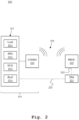
- a second exemplary embodiment of the system 200 according to the first aspect of the invention is illustrated.
- the system 200 differs from the system 100 in that the system 200 additionally comprises a user detection module (DM) or a user identification module or a user identifier 201.
- DM user detection module
- a user identification module or a user identifier 201.
- the user detection module 201 is operably coupled to the signal processing module 105, where the coupling between the user detection module 201 and the signal processing module 105 is exemplarily illustrated by the dashed line 202.
- the user detection module 201 may be further coupled to the sensor system 103, especially to the sensor module 101, where the coupling is exemplarily illustrated by the dashed line 203.
- the sensor module 101, the communication module 102, and the signal processing module 105 of the system 200 correspond to the sensor module 101, the communication module 102, and the signal processing module 105 of the system 100, respectively.
- the user detection module 201 may comprise a biometric sensor and may generate a user detection signal 202 corresponding to a user of the system 200.
- the signal processing module 105 may obtain the user detection signal 202 from the user detection module 201, may generate measurement sessions based on the timestamp associated with the physiological signals, and may assign the measurement sessions to the user based on the user detection signal 202.
- the user detection module 201 may detect the user based on the measured physiological signals, thereby generating the user detection signal 202. For instance, the user detection module 201 may detect the user by performing an ECG-based human identification and/or PPG-based human identification and/or weight-based human identification and/or bio-impedance-based human identification. In this regard, the user detection module 201 may extract useful traits or features from the measured physiological signals and may compare with a reference database, e.g. comprising a historical assortment of traits or features corresponding to the physiological parameters.
- a reference database e.g. comprising a historical assortment of traits or features corresponding to the physiological parameters.
- the system 200 may comprise a sleep/wake-up control module that may receive a further user detection signal 203 from the user detection module 201, and may turn on or turn off the sensor system 103, especially the sensor module 101, based on the user detection signal 203.
- the sleep/wake-up control module may be implemented within the sensor system 103, or within the signal processing module 105 or within the user detection module 201 or as a separate module. In the case of an externally implemented module, it may generate a remote (e.g. wireless) sleep/wake-up signal to turn on or turn off the sensor module 101.
- FIG. 3 a third exemplary embodiment of the system 300 according to the first aspect of the invention is illustrated.
- the system 300 additionally comprises a support member 301 with an accommodation groove 302, whereby the sensor system 103 may be embedded within the support member 301, especially positioned in the accommodation groove 302.
- the support member 301 can be a part of a seat, a bed, a wristwatch, an armband, and so on.
- the accommodation groove 302 may be formed such that the sensor system 103, especially the sensor module 101, positioned in the accommodation groove 302 can make near physical and/or optical contact with the skin/tissue of a user of the system 300.
- the system 300 additionally comprises a remote device (RD) 303 that comprises the signal processing module 105, and may optionally comprise the user detection module 201.
- the remote device 303 may comprise or be a wireless remote device, e.g. smartphones, computers, personal digital assistants, or external signal processing/analysis devices.
- the remote device 303 may comprise or be a cloud-based device, e.g. a cloud server.
- the remote device 303 may communicate with the support member 301, especially with the communication module 102 of the sensor system 103, via the communication link 104.
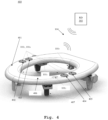
- FIG. 4 an exemplary embodiment of a smart toilet 400 according to the second aspect of the invention is illustrated.
- the smart toilet 400 comprises a toilet seat 401 comprising the sensor system 103, and the remote device 303 comprising the signal processing module 105 and optionally the user detection module 201.
- the sensor module 101 may be sparsely distributed throughout the toilet seat 401 so as to make physical and/or optical contacts to selective parts of the body of the user.
- the load sensors 101 1 may be distributed, preferably evenly distributed, along a bottom surface of the toilet seat 401 to facilitate a high precision in weight measurements.
- the PPG sensors 101 2 may be arranged on an upper surface 406 of the toilet seat 401 for contacting a tissue of the user sitting on the toilet seat 401.
- the temperature sensors 101 5 may be arranged at a back end of the toilet seat 401.
- the ECG sensors 101 3 and the BioZ sensors 101 4 may be arranged at the upper surface of the toilet seat 401.
- the upper surface of the toilet seat 401 may be provided with a first source electrode 402 and a second source electrode 404, especially arranged to act as a right leg source electrode and a left leg source electrode, respectively.
- the upper surface of the toilet seat 401 may be further provided with a first receiver electrode 403 and a second receiver electrode 405, especially arranged to act as a right leg receiver electrode and a left leg receiver electrode, respectively.
- the source electrodes 402, 404 and the receiver electrodes 403, 405 may contact the respective body parts of the user to generate ECG and BioZ signals.
- the source electrodes 402, 404 and the receiver electrodes 403, 405 may be multiplexed (e.g. frequency division) for parallel acquisition of the ECG signals (low frequency) and the BioZ signals (high frequency).
- the toilet seat 401 may comprise one or more fixation clamps 407 for fixation of the toilet seat 401 on a toilet.
- the user may be detected by the user detection module 201 and the sensors 101 1 -101 4 may be turned on accordingly, and the sensors 101 1 -101 4 may generate the physiological signals along with timestamps associated to said physiological signals.
- the load sensors 101 1 may generate weight signals with associated timestamps
- the PPG sensors 101 2 may generate PPG signals with associated timestamps
- the ECG sensors 101 3 may generate ECG signals with associated timestamp
- the BioZ sensors 101 4 may generate BioZ signals with associated timestamps
- the temperature sensor 101 5 may generate temperature signals with associated timestamps.
- the communication module 102 may read out the signals from the sensors 101 1 -101 5 , and may transmit the signals along with the associated timestamps to the remote device 303, especially to the signal processing module 105, via the wireless link 104.
- the signal processing module 105 may receive the signals and the associated timestamps and may correlate the signals using the associated timestamps to detect one or more bowel movement segments, especially by detecting a pattern of strain and/or relief from the physiological signals.
- the signal processing module 105 may also determine the mass or volume of excreta, especially by correlating the weight signals with other physiological signals. For example, if one bowel movement segment is detected and a change in weight signal is detected during said bowel movement segment, the delta or change in weight signal may correspond to the mass of the excrement.
- the signal processing module 105 may also determine the amount or volume of urine, especially by correlating the weight signals with other physiological signals, e.g. bio-impedance. For example, if no bowel movement segment is detected and a change in weight signal is detected during this event, the delta or change in weight signal may correspond to the volume of the urine released. As such, in addition to the detection of a bowel movement, the system 400 may detect an urination act or process.
- other physiological signals e.g. bio-impedance
- FIG. 5 an exemplary graph of measured BioZ data over time is illustrated.
- the horizontal axis denotes time in seconds and the vertical axis denotes BioZ in ohm.
- the BioZ data may correspond to a BioZ measurement performed by the system 400, especially by passing a high frequency electric current from the right leg source electrode 402, through the adjoined muscle, to the left leg source electrode 404, or vice versa, and by measuring the response via the right leg receiver electrode 403 and the left leg receiver electrode 405, or vice versa.
- a muscle contraction can be observed at the dips in the graph, e.g. at 501, and a muscle relaxation can be observed at the peaks, e.g. at 502.
- the BioZ signals over time provide sufficient insight to detect a stress or strain as well as a relief or relaxation, and thereby can be used as a correlation factor for detecting bowel movements.
- exemplary graphs of measured heart rate, pulse arrival time, and blood pressure are illustrated over time.
- the graph 601 shows heart rate (HR) over time, where the horizontal axis denotes the time in seconds and the vertical axis denotes the heart rate in beats per minute, especially measured from the PPG signals 612 1 (e.g. the number of systolic peaks in PPG signals per minute) and also from the ECG signals 612 2 (e.g. intervals between two successive QRS complexes in ECG signals).
- HR heart rate
- the graph 602 shows pulse arrival time (PAT) over time, where the horizontal axis denotes the time in seconds and the vertical axis denotes the pulse arrival time 622, especially obtained by correlating and by extracting temporal features between the ECG signals 612 2 and the PPG signals 612 1 .
- PAT pulse arrival time
- the graph 603 shows blood pressure (BP) over time, where the horizontal axis denotes the time in seconds and the vertical axis denotes blood pressure 632 in mmHg, especially estimated from the pulse arrival time 622 of graph 602.
- BP blood pressure
- the inverse relationship between the pulse arrival time and the blood pressure e.g. an increment in arterial elastic modulus decreases pulse arrival time, however in turn increases as blood pressure increases, and the technique to estimate blood pressure based on pulse arrival time are well known and therefore will not be described in detail.
- a correlation between different physiological parameters or signals can provide sufficient insight to detect stress or strain as well as relaxation, especially during a bowel movement, and therefore one or more bowel movement segments can be detected only by looking at the physiological parameters and/or their correlation.
- an increment in the blood pressure 632 may indicate a contraction or stress for passing excrement during a bowel movement and a decrement in the blood pressure 632 may indicate a relaxation.
- a segment 621 shows the identical behavior in pulse arrival time 622, albeit inversely due to the inverse relationship between the pulse arrival time 622 and the blood pressure 632.
- a segment 611 also shows the behavior in PPG signals 612 1 and ECG signals 612 2 .
- a correlation between blood pressure measurements high blood pressure during bowel movement and low blood pressure during relaxation, which may also be extracted from PPG and/or ECG measurements
- BioZ measurements dips in BioZ indicating muscle contraction during bowel movement and peaks in BioZ during relaxation
- a measurement session may be initiated.
- the system 100, 200, 300 or the smart toilet 400 may detect a user, e.g. via the user detection module 201, and may turn on the sensors 101 1 -101 5 to initiate measurements.
- the measured physiological signals with associated timestamp may be collected, e.g. the communication module 102 may collect the measurements and may transmit to the signal detection module 105.
- a signal quality check may be performed on the measured physiological signals.
- the quality of the measured signals may be determined based on one or more signal traits, such as but not limited to SNR, peak-to-peak interval, and amplitude, of the measured signal during the physiological signal measurements. Additionally or alternatively, the quality of the measured signal may be determined based on the known signal quality indices for physiological parameters including but not limited to perfusion, kurtosis, and skewness.
- measured physiological signals with good signal quality may be selected or inputted.
- the communication module 102 may perform the signal quality check and accordingly may transmit only the measured physiological signals with good signal quality to the signal processing module 105.
- the signal processing module 105 may perform the signal quality check and only consider the measured physiological signals with good signal quality for further processing.
- the measured physiological signals with good signal quality may be further processed to detect a bowel movement or defecation and/or urination.
- the signal processing module 105 may correlate the measured physiological signals with good signal quality to identify stress and/or relieve acts or processes corresponding to one or more bowel movement or defecation segments, and may further detect a delta or change in weight during one.
- the signal processing module 105 may detect a delta or change in weight along with a change in a physiological parameter, e.g. bio-impedance, when no bowel movement or defecation is being detected, thereby detecting an urination act or process.
- the session may be stored, e.g. by the signal processing module 105 into the associated memory, and the number of urination sessions as well as the number of total sessions may be updated in a step 707. Afterwards, the session may be terminated in a consecutive step 710.
- a process for determining a firmness level of excrement may be performed in a step 708.
- the signal processing module 105 may perform the process for determining a firmness level of excrement.
- a Bristol stool scale or any other suitable scales known in the art especially the levels according to the Bristol stool scale, may be categorized using previously collected physiological data and/or reference physiological data and/or correlations with annotated recordings and/or patterns of the physiological signals in order to design a reference database.
- a reference correlation and/or patterns of blood pressure changes i.e. ECG and/or PPG
- BioZ changes i.e. BioZ changes
- weight changes can be pre-defined and be pre-assigned to a stool firmness level of Bristol stool scale, particularly to at least three stool firmness levels including diarrhea, normal, and constipated.
- the reference database may be used for the comparison, and accordingly for the firmness level detection of the excrement during the defecation.
- the reference database, especially the reference correlation may be generated for the particular user and/or may be assigned to the particular user.
- the reference database, especially the reference correlation may be updated and/or amended for different users, e.g. by means of user provided annotations.
- the session may be stored, e.g. by the signal processing module 105 into the associated memory, and the number of defecation sessions as well as the number of total sessions may be updated. Afterwards, the session may be terminated in a consecutive step 710.
- a first step 801 one or more physiological parameter measurement data of a user along with a timestamp associated with the one or more physiological parameter measurement data are generated.
- the one or more physiological parameter measurement data are correlated using the associated timestamp in order to detect at least one bowel movement segment and/or an urination process of the user.
- the correlation of the one or more physiological parameter measurement data is compared with a reference correlation of the one or more physiological parameter measurement data corresponding to an excrement firmness scale.
- a firmness level of excrement is determined during the at least one bowel movement segment.
Landscapes
- Health & Medical Sciences (AREA)
- Life Sciences & Earth Sciences (AREA)
- Engineering & Computer Science (AREA)
- Public Health (AREA)
- General Health & Medical Sciences (AREA)
- Pathology (AREA)
- Biomedical Technology (AREA)
- Heart & Thoracic Surgery (AREA)
- Medical Informatics (AREA)
- Molecular Biology (AREA)
- Surgery (AREA)
- Animal Behavior & Ethology (AREA)
- Physics & Mathematics (AREA)
- Biophysics (AREA)
- Veterinary Medicine (AREA)
- Physiology (AREA)
- Cardiology (AREA)
- Urology & Nephrology (AREA)
- Nuclear Medicine, Radiotherapy & Molecular Imaging (AREA)
- Radiology & Medical Imaging (AREA)
- Computer Networks & Wireless Communication (AREA)
- Artificial Intelligence (AREA)
- Computer Vision & Pattern Recognition (AREA)
- Psychiatry (AREA)
- Signal Processing (AREA)
- Measuring And Recording Apparatus For Diagnosis (AREA)
Abstract
Description
- The invention relates to noninvasive measurement and/or acquisition of physiological parameters, especially for detecting a bowel movement and/or urination, and for characterizing excrement or faeces in terms of a firmness level.
- Generally, human excreta is a common source of information that may provide insight into the person's health. Particularly, an obstipation may be considered as a sign of an underlying or chronic illness, and a detection of obstipation may assist with diagnosis of said illness. Moreover, a detection of obstipation is relevant in settings where the person has difficulty in conveying the situation.
- At present, diagnosis of obstipation relies on self-reporting from the person, which may lead to blood tests and/or further physical examinations. In most cases, the investigation of the excrement requires the harvesting of a sample, either a physical sample or a digital sample, e.g. via a camera, and the processing of the sample generally requires extensive technical expertise. Moreover, the use of a camera may be considered as an invasion of privacy.
- For example, the document
US 2020/0100725 A1 discloses a toilet system for health diagnosis that performs visual recordings of excrement, e.g. via a camera or a video camera, for collecting data, e.g. color, volume, or consistency, of the excrement produced by bowel movements of an individual. - Accordingly, an object of the invention is to provide a system, a smart toilet and a method for bowel movement detection that address the aforementioned limitations in order to facilitate noninvasive and unobtrusive detection and monitoring of bowel movement health.
- The object is solved by the features of the first independent claim for the system, the claims for the smart toilet and by the features of the second independent claim for the method. The dependent claims contain further developments.
- According to a first aspect of the invention, a system for bowel movement detection is provided. The system comprises a sensor module configured to generate one or more physiological parameter measurement data of a user and a timestamp associated with the one or more physiological parameter measurement data. The system further comprises a signal processing module configured to receive the one or more physiological parameter measurement data and further to correlate the one or more physiological parameter measurement data using the associated timestamp in order to detect at least one bowel movement segment and/or an urination process of the user.
- In this regard, the one or more physiological parameter measurement data comprise at least one electrocardiogram (ECG) measurement data and at least one bio-impedance (BioZ) measurement data of the user. The signal processing module may perform further processing of the measurement data before or after the correlation. The further processing of the measurement data may comprise pre-processing such as filtering, motion artefact removal and signal quality assessment, time-domain analysis, frequency-domain analysis, linear regression, physiological parameter estimation, and the like.
- The timestamp associated to the one or more physiological parameter measurement data may comprise a sequence of characters or encoded information that may identify a measurement session or event or instant. Preferably, the timestamp may comprise digital information regarding a date and/or a time, especially accurate to a small fraction of a second, attached to the digital measured data.
- For example, a single or a string of data corresponding to ECG measurements and a single or a string of data corresponding to BioZ measurements may be correlated using the associated timestamp if the measurements are performed simultaneously in one measurement session or event or instant, since the timestamp associated to the measurements may depict identical or similar date and/or time information when the measurements are being carried out.
- Therefore, the invention proposes an unobtrusive technique for detecting bowel movements and/or urination. Especially, the invention facilitates noninvasive acquisition of different physiological signals, such as but not limited to blood oxygen saturation, heart rate, respiration and cardiac output, blood pressure, temperature, and bio-impedance. Advantageously, a fusion and/or a correlation of the different physiological data can be performed in order to determine a bowel movement, e.g. via estimating stress or strain or lack thereof from the fused or correlated data during a bowel movement.
- Further advantageously, the invention proposes a noninvasive detection of an urination process, and further to differentiate between a bowel movement process and an urination process of the user based on the different physiological signals, e.g. via detecting a change in measured bio-impedance due to a change in urine volume in bladder.
- Preferably, the signal processing module is further configured to compare the correlation of the one or more physiological parameter measurement data with a reference correlation of the one or more physiological parameter measurement data corresponding to an excrement firmness scale, preferably a Bristol stool scale, and further to determine a firmness level of excrement during the at least one bowel movement segment.
- For instance, the different levels of the Bristol stool chart may be categorized using previously collected physiological data and/or reference physiological data and/or correlations with annotated recordings and/or patterns of the physiological signals, thereby forming a reference database, which can be used for the comparison and/or for the firmness level detection of the excrement during the bowel movement.
- In this regard, a reference correlation of ECG data and BioZ data may be generated based on the different levels, i.e. stool firmness levels, of the Bristol stool chart. For example, a reference correlation of the ECG data and BioZ data may be generated for a bowel movement resulting in faeces in form of separate hard lumps (severe constipation), faeces in form of a smooth sausage (normal), or faeces with liquid consistency (diarrhea). Afterwards, the measured ECG data and the measured BioZ data may be correlated and the correlated data obtained therefrom may be compared with the reference correlation.
- Moreover, the reference database, especially the reference correlation, can be generated and/or stored correspond to a specific user of the system. Advantageously, a firmness level of the excrement can be determined or classified without any visual assessment of the excrement.
- Preferably, the sensor module comprises at least two source electrodes configured to excite from at least two different measurement locations on the user, and at least two receiver electrodes configured to respectively measure response from the at least two different measurement locations, especially to generate the at least one ECG measurement data and/or the at least one BioZ measurement data. Advantageously, a tetrapolar or four-electrode measurement technique is facilitated which improves the measurement quality as well as the sensitivity and accuracy of the measured signals.
- Preferably, the at least two source electrodes and/or the at least two receiver electrodes are multiplexed based on a time division and/or a frequency division multiplexing technique. For instance, a frequency division can be implemented for parallel acquisition of the ECG data (low frequency) and the BioZ data (high frequency), which facilitates a high flexibility in terms of measurement and performance.
- Preferably, the one or more physiological parameter measurement data further comprise at least one weight measurement data. In this regard, the signal processing module is further configured to determine a mass of excrement based on the at least one weight measurement data during the at least one bowel movement segment. Additionally or alternatively, the signal processing module is further configured to determine a volume of urine based on the at least one weight measurement data during the urination process.
- For instance, a bowel movement or an urination process may result in reduction of weight of a user, especially noticeable during the urination process or in severe diarrhea condition due to loss of body water. The weight measurement data may comprise body weight measurements of the user, for instance, consecutively measured at different times during the measurement session or event or instant, especially including body weight measurements before and after the bowel movement and/or the urination process.
- Advantageously, the weight measurement data can be effectively used to determine or estimate the mass of excrement when a bowel movement is detected. An average mass of the faeces weights about a quarter pound to one pound, which can be detected form the weight measurement data effectively. Additionally, the weight measurement data can be effectively used to determine or estimate the amount or volume of urine produced, especially when no bowel movement is detected.
- Preferably, the one or more physiological parameter measurement data further comprise at least one photoplethysmography (PPG) measurement data. In this regard, the sensor module comprises at least one further electrode configured to excite and/or measure response from at least one further measurement location on the user, especially to generate the at least one PPG measurement data.
- The PPG measurement data may correspond to the perfusion of blood to the dermis and subcutaneous tissue of the skin, especially during each cardiac cycle, where each cardiac cycle appears as a peak. The PPG electrode may illuminate the skin with a light and may accordingly measure the amount of light either transmitted or reflected.
- Advantageously, an effective correlation can be performed to determine bowel movements, e.g. by means of the assessment of heart rate and blood pressure especially during a bowel movement segment.
- Preferably, the system further comprises a user detection module, e.g. comprising a biometric sensor, whereby the signal processing module is configured to obtain a user detection signal comprising at least one user parameter from the user detection module. In this regard, the at least one user parameter comprises one or more biometric attributes of the user including fingerprints, facial images, iris, and voice.
- Additionally or alternatively, the user detection module is configured to detect the user based on the one or more physiological parameter measurement data. For example, the user detection module may perform an ECG-based human identification by extracting ECG traits or features from measured ECG signals and comparing the extracted ECG traits or features with reference ECG signals, e.g. previously measured and stored ECG signals, thereby generating the user detection signal.
- For example, the system may comprise a sleep/wake-up control module configured to turn on or turn off the sensor module at least based on the user detection signal. The sleep/wake-up control module can be implemented as a separate module or can be implemented within the user detection module, which may additionally generate a sleep/wake-up signal to turn on or turn off the sensor module. Thus, a sleep/wake-up function for the sensor module can be enabled, which may advantageously increase the lifespan of the embedded sensors.
- Preferably, the signal processing module is configured to generate measurement sessions based on the timestamp associated with the one or more physiological parameter measurement data, and further to assign the measurement sessions to the user detection signal and/or to the user. In this regard, a measurement session may include the initiation of the measurements, e.g. initiating the sensors, measurement data acquisition from the sensors, measurement data transmission to external peripherals, and the processing of the measurement data. Advantageously, user-specific measurement and/or detection can be performed.
- Preferably, the signal processing module is configured to assess a signal quality of the one or more physiological parameter measurement data with respect to a pre-defined threshold and further to correlate the one or more physiological parameter measurement data based on the assessed signal quality.
- In this regard, the quality of the detected signal can be determined based on one or more signal traits, such as but not limited to signal-to-noise ratio (SNR), peak-to-peak interval, and amplitude, of the detected signal during the physiological parameter measurements. Additionally or alternatively, the quality of the detected signal can be determined based on the known signal quality indices for physiological parameters including but not limited to perfusion, kurtosis, and skewness.
- Preferably, the signal processing module may be configured to generate an alert signal based on the quality of the measurement data. In this regard, the alert signal may comprise a tone and/or a text notification and/or a voice announcement. For instance, the signal processing module may detect a linear translation in the positioning of the user based on the quality of the measurement data, and may notify the user via the alert signal whether the user positioning is needed to be amended. Advantageously, a feedback to the user regarding any anomalies during the measurement is also incorporated.
- Preferably, the system further comprises a communication module comprising at least one of a ZigBee module, a Bluetooth module, a Wi-Fi module, a GPRS module, or an NB-IoT module, whereby the communication module is configured to transmit the one or more physiological parameter measurement data wirelessly.
- Additionally or alternatively, the signal processing module further comprises at least one of a ZigBee module, a Bluetooth module, a Wi-Fi module, a GPRS module, or an NB-IoT module, whereby the signal processing module is further configured to receive the one or more physiological parameter measurement data wirelessly, especially from the communication module. Advantageously, the physiological measurement data can be collected and can be further processed in a flexible manner.
- Further alternatively, the signal processing module and the communication module can be integrated as a single entity, whereby the measurement data acquisition and processing can be done by said single entity either simultaneously or sequentially.
- According to a second aspect of the invention, a smart toilet or a smart toilet system is provided that comprises the system according to the first aspect of the invention. In this regard, the smart toilet comprises a toilet seat comprising at least one sensor module and at least one communication module, and a remote device comprising at least one signal processing module. Preferably, the sensor module is arranged on an upper surface of the toilet seat for contacting the user sitting on the toilet seat, especially for facilitating a physical contact and/or a near optical contact with the skin/tissue of the user.
- Advantageously, the present invention discloses a prospect of embedding the system into static objects, such as the smart toilet, in order to facilitate passive acquisition of physiological parameters in a casual manner, especially to detect bowel movements and/or urination.
- Preferably, the remote device is a wireless remote device, e.g. smartphones, computers, personal digital assistants, or external signal processing/analysis devices.
- Additionally or alternatively, the remote device may be a cloud-based device, e.g. a cloud server, and the signal processing module may be implemented in the cloud-based device.
- Preferably, the at least two source electrodes of the sensor module are arranged on the upper surface of the toilet seat to act as a left leg source electrode and a right leg source electrode. In addition, the at least two receiver electrodes of the sensor module are arranged on the upper surface of the toilet seat to act as a left leg receiver electrode and a right leg receiver electrode. Advantageously, a high sensitivity and accuracy of the measured signals can be ensured.
- According to a third aspect of the invention, a method for bowel movement detection is provided. The method comprises a step of generating one or more physiological parameter measurement data of a user and a timestamp associated with the one or more physiological parameter measurement data. The method further comprises a step of correlating the one or more physiological parameter measurement data using the associated timestamp in order to detect at least one bowel movement segment and/or an urination process of the user. In this regard, the one or more physiological parameter measurement data comprise at least one electrocardiogram measurement data and at least one bio-impedance measurement data of the user.
- Preferably, the method further comprises a step of comparing the correlation of the one or more physiological parameter measurement data with a reference correlation of the one or more physiological parameter measurement data corresponding to an excrement firmness scale, preferably a Bristol stool scale. Moreover, the method comprises a step of determining a firmness level of excrement during the at least one bowel movement segment.
- It is to be noted that the method according to the third aspect corresponds to the system according to the first aspect and its implementation forms. Accordingly, the method according to the third aspect achieves the same advantages and effects as the system of the first aspect and its respective implementation forms.
- Exemplary embodiments of the invention are now further explained with respect to the drawings by way of example only, and not for limitation. In the drawings:
- Fig. 1
- shows a first exemplary embodiment of the system according to the first aspect of the invention;
- Fig. 2
- shows a second exemplary embodiment of the system according to the first aspect of the invention;
- Fig. 3
- shows a third exemplary embodiment of the system according to the first aspect of the invention;
- Fig. 4
- shows an exemplary embodiment of the smart toilet according to the second aspect of the invention;
- Fig. 5
- shows an exemplary graph of measured bio-impedance data over time;
- Fig. 6
- shows exemplary graphs of measured heart rate, pulse arrival time, and blood pressure over time;
- Fig. 7
- shows an exemplary flow diagram for processing the measured physiological data; and
- Fig. 8
- shows an exemplary embodiment of the method according to the third aspect of the invention.
- Reference will now be made in detail to the embodiments of the present invention, examples of which are illustrated in the accompanying drawings. However, the following embodiments of the present invention may be variously modified and the range of the present invention is not limited by the following embodiments. Reference signs for similar entities in different embodiments are partially omitted.
- In
Fig. 1 , a first exemplary embodiment of thesystem 100 according to the first aspect of the invention is illustrated. Thesystem 100 comprises a sensor module or a sensor arrangement or asensor assembly 101 comprising one or more load sensors orweight sensors 1011, one ormore PPG sensor 1012, one ormore ECG sensor 1013, and one or moreBioZ sensor 1014. Exemplarily, thesensor module 101 comprises oneload sensors 1011, onePPG sensor 1012, oneECG sensor 1013, and oneBioZ sensor 1014. - Although not shown in this example, the
sensor module 101 may comprise additional sensors, e.g. one or more temperature sensors such as IR or UV temperature sensors, to generate additional physiological signals. The sensors may be arranged in an array of may be sparsely arranged based on the application of thesystem 101. - The
system 101 further comprises a communication module (COMM) orinterface 102 that is operably coupled to thesensor module 101, especially coupled to the sensors 1011-1014, and may collect the respective physiological signals from the sensors 1011-1014, preferably simultaneously. Thecommunication module 102 may then transmit the collected physiological signals wirelessly over a wireless communication link, e.g. over thecommunication link 104. Thesensor module 101 including the sensors 1011-1014, and thecommunication module 103 may be collectively referred as asensor system 103. - The
system 100 moreover comprises a signal processing module (PROC) 105 that is coupled to thesensor system 103, especially wirelessly. For instance, thesignal processing module 105 may receive the physiological signals from thecommunication module 102 via a wireless communication link, e.g. via thecommunication link 104. Thesignal processing module 105 may comprise or be a processor, a microcontroller, a signal processing device, or a combination thereof. Thesignal processing module 105 may further comprise a memory (not shown) to store the received physiological signals and/or further processed results, e.g. a correlation. - Alternatively, the
communication module 102 and thesignal processing module 105 can be implemented as a single integrated module, especially within thesensor system 103. In this regard, the integrated module may perform the data acquisition and processing within thesystem 100 and may transmit the processed results and/or feedback to a remote device (e.g. a smartphone or a personal computer) or a remote system (e.g. a cloud system). - For instance, the
sensor module 101 may generate the physiological signals from a user of thesystem 100, especially while the user having a bowel movement or attempting to have a bowel movement, along with timestamps associated with said physiological signals. Exemplarily theload sensor 1011 may generate a weight signal with a timestamp, thePPG sensor 1012 may generate a PPG signal with a timestamp, theECG sensor 1013 may generate an ECG signal with a timestamp, and theBioZ sensor 1014 may generate a BioZ signal with a timestamp. - Accordingly, the
communication module 102 may read out the data from the sensors 1011-1014, and may transmit the data along with the associated timestamp to thesignal processing module 105 via thewireless link 104. Thesignal processing module 105 may receive the data and the associated timestamp and may correlate the data using the associated timestamp to detect one or more bowel movement segments, especially by detecting a pattern of strain and/or relief from the physiological signals. Thesignal processing module 105 may further correlate the data using the associated timestamp to detect an urination process, especially by detecting a change in the measured bio-impedance and/or weight. - In
Fig. 2 , a second exemplary embodiment of thesystem 200 according to the first aspect of the invention is illustrated. Thesystem 200 differs from thesystem 100 in that thesystem 200 additionally comprises a user detection module (DM) or a user identification module or auser identifier 201. - The
user detection module 201 is operably coupled to thesignal processing module 105, where the coupling between theuser detection module 201 and thesignal processing module 105 is exemplarily illustrated by the dashedline 202. Theuser detection module 201 may be further coupled to thesensor system 103, especially to thesensor module 101, where the coupling is exemplarily illustrated by the dashedline 203. - The
sensor module 101, thecommunication module 102, and thesignal processing module 105 of thesystem 200 correspond to thesensor module 101, thecommunication module 102, and thesignal processing module 105 of thesystem 100, respectively. - The
user detection module 201 may comprise a biometric sensor and may generate auser detection signal 202 corresponding to a user of thesystem 200. Thesignal processing module 105 may obtain theuser detection signal 202 from theuser detection module 201, may generate measurement sessions based on the timestamp associated with the physiological signals, and may assign the measurement sessions to the user based on theuser detection signal 202. - Alternatively, the
user detection module 201 may detect the user based on the measured physiological signals, thereby generating theuser detection signal 202. For instance, theuser detection module 201 may detect the user by performing an ECG-based human identification and/or PPG-based human identification and/or weight-based human identification and/or bio-impedance-based human identification. In this regard, theuser detection module 201 may extract useful traits or features from the measured physiological signals and may compare with a reference database, e.g. comprising a historical assortment of traits or features corresponding to the physiological parameters. - Although not shown, the
system 200 may comprise a sleep/wake-up control module that may receive a furtheruser detection signal 203 from theuser detection module 201, and may turn on or turn off thesensor system 103, especially thesensor module 101, based on theuser detection signal 203. The sleep/wake-up control module may be implemented within thesensor system 103, or within thesignal processing module 105 or within theuser detection module 201 or as a separate module. In the case of an externally implemented module, it may generate a remote (e.g. wireless) sleep/wake-up signal to turn on or turn off thesensor module 101. - In
Fig. 3 , a third exemplary embodiment of thesystem 300 according to the first aspect of the invention is illustrated. Thesystem 300 additionally comprises asupport member 301 with anaccommodation groove 302, whereby thesensor system 103 may be embedded within thesupport member 301, especially positioned in theaccommodation groove 302. - The
support member 301 can be a part of a seat, a bed, a wristwatch, an armband, and so on. Theaccommodation groove 302 may be formed such that thesensor system 103, especially thesensor module 101, positioned in theaccommodation groove 302 can make near physical and/or optical contact with the skin/tissue of a user of thesystem 300. - The
system 300 additionally comprises a remote device (RD) 303 that comprises thesignal processing module 105, and may optionally comprise theuser detection module 201. The remote device 303 may comprise or be a wireless remote device, e.g. smartphones, computers, personal digital assistants, or external signal processing/analysis devices. - Additionally or alternatively, the remote device 303 may comprise or be a cloud-based device, e.g. a cloud server. The remote device 303 may communicate with the
support member 301, especially with thecommunication module 102 of thesensor system 103, via thecommunication link 104. - In
Fig. 4 , an exemplary embodiment of asmart toilet 400 according to the second aspect of the invention is illustrated. Thesmart toilet 400 comprises atoilet seat 401 comprising thesensor system 103, and the remote device 303 comprising thesignal processing module 105 and optionally theuser detection module 201. - For instance, the
sensor module 101 may be sparsely distributed throughout thetoilet seat 401 so as to make physical and/or optical contacts to selective parts of the body of the user. Exemplarily, theload sensors 1011 may be distributed, preferably evenly distributed, along a bottom surface of thetoilet seat 401 to facilitate a high precision in weight measurements. ThePPG sensors 1012 may be arranged on anupper surface 406 of thetoilet seat 401 for contacting a tissue of the user sitting on thetoilet seat 401. Thetemperature sensors 1015 may be arranged at a back end of thetoilet seat 401. - Moreover, the
ECG sensors 1013 and theBioZ sensors 1014 may be arranged at the upper surface of thetoilet seat 401. In this regard, the upper surface of thetoilet seat 401 may be provided with afirst source electrode 402 and asecond source electrode 404, especially arranged to act as a right leg source electrode and a left leg source electrode, respectively. The upper surface of thetoilet seat 401 may be further provided with afirst receiver electrode 403 and asecond receiver electrode 405, especially arranged to act as a right leg receiver electrode and a left leg receiver electrode, respectively. - The
source electrodes receiver electrodes source electrodes receiver electrodes toilet seat 401 may comprise one or more fixation clamps 407 for fixation of thetoilet seat 401 on a toilet. - For instance, while having a bowel movement or attempting to have a bowel movement, the user may be detected by the
user detection module 201 and the sensors 1011-1014 may be turned on accordingly, and the sensors 1011-1014 may generate the physiological signals along with timestamps associated to said physiological signals. Exemplarily theload sensors 1011 may generate weight signals with associated timestamps, thePPG sensors 1012 may generate PPG signals with associated timestamps, theECG sensors 1013 may generate ECG signals with associated timestamp, theBioZ sensors 1014 may generate BioZ signals with associated timestamps, and thetemperature sensor 1015 may generate temperature signals with associated timestamps. - Accordingly, the
communication module 102 may read out the signals from the sensors 1011-1015, and may transmit the signals along with the associated timestamps to the remote device 303, especially to thesignal processing module 105, via thewireless link 104. Thesignal processing module 105 may receive the signals and the associated timestamps and may correlate the signals using the associated timestamps to detect one or more bowel movement segments, especially by detecting a pattern of strain and/or relief from the physiological signals. - The
signal processing module 105 may also determine the mass or volume of excreta, especially by correlating the weight signals with other physiological signals. For example, if one bowel movement segment is detected and a change in weight signal is detected during said bowel movement segment, the delta or change in weight signal may correspond to the mass of the excrement. - Furthermore, the
signal processing module 105 may also determine the amount or volume of urine, especially by correlating the weight signals with other physiological signals, e.g. bio-impedance. For example, if no bowel movement segment is detected and a change in weight signal is detected during this event, the delta or change in weight signal may correspond to the volume of the urine released. As such, in addition to the detection of a bowel movement, thesystem 400 may detect an urination act or process. - In
Fig. 5 , an exemplary graph of measured BioZ data over time is illustrated. The horizontal axis denotes time in seconds and the vertical axis denotes BioZ in ohm. The BioZ data may correspond to a BioZ measurement performed by thesystem 400, especially by passing a high frequency electric current from the rightleg source electrode 402, through the adjoined muscle, to the leftleg source electrode 404, or vice versa, and by measuring the response via the rightleg receiver electrode 403 and the leftleg receiver electrode 405, or vice versa. - From the graph, a muscle contraction can be observed at the dips in the graph, e.g. at 501, and a muscle relaxation can be observed at the peaks, e.g. at 502. As such, the BioZ signals over time provide sufficient insight to detect a stress or strain as well as a relief or relaxation, and thereby can be used as a correlation factor for detecting bowel movements.
- In
Fig. 6 , exemplary graphs of measured heart rate, pulse arrival time, and blood pressure are illustrated over time. Particularly, thegraph 601 shows heart rate (HR) over time, where the horizontal axis denotes the time in seconds and the vertical axis denotes the heart rate in beats per minute, especially measured from the PPG signals 6121 (e.g. the number of systolic peaks in PPG signals per minute) and also from the ECG signals 6122 (e.g. intervals between two successive QRS complexes in ECG signals). - Furthermore, the
graph 602 shows pulse arrival time (PAT) over time, where the horizontal axis denotes the time in seconds and the vertical axis denotes thepulse arrival time 622, especially obtained by correlating and by extracting temporal features between the ECG signals 6122 and the PPG signals 6121. - Moreover, the
graph 603 shows blood pressure (BP) over time, where the horizontal axis denotes the time in seconds and the vertical axis denotesblood pressure 632 in mmHg, especially estimated from thepulse arrival time 622 ofgraph 602. The inverse relationship between the pulse arrival time and the blood pressure, e.g. an increment in arterial elastic modulus decreases pulse arrival time, however in turn increases as blood pressure increases, and the technique to estimate blood pressure based on pulse arrival time are well known and therefore will not be described in detail. - Accordingly, a correlation between different physiological parameters or signals can provide sufficient insight to detect stress or strain as well as relaxation, especially during a bowel movement, and therefore one or more bowel movement segments can be detected only by looking at the physiological parameters and/or their correlation.
- For instance, during a
segment 631 ongraph 603, an increment in theblood pressure 632 may indicate a contraction or stress for passing excrement during a bowel movement and a decrement in theblood pressure 632 may indicate a relaxation. Similarly, ingraph 602, asegment 621 shows the identical behavior inpulse arrival time 622, albeit inversely due to the inverse relationship between thepulse arrival time 622 and theblood pressure 632. Moreover, asegment 611 also shows the behavior in PPG signals 6121 and ECG signals 6122. - For example, a correlation between blood pressure measurements (high blood pressure during bowel movement and low blood pressure during relaxation, which may also be extracted from PPG and/or ECG measurements), and BioZ measurements (dips in BioZ indicating muscle contraction during bowel movement and peaks in BioZ during relaxation) may be effectively utilized to detect a bowel movement, as well as one or more bowel movement segments.
- In
Fig. 7 , an exemplary flow diagram 700 for processing the measured physiological data is illustrated. In astep 701, a measurement session may be initiated. In this regard, thesystem smart toilet 400 may detect a user, e.g. via theuser detection module 201, and may turn on the sensors 1011-1015 to initiate measurements. - In a
further step 702, the measured physiological signals with associated timestamp may be collected, e.g. thecommunication module 102 may collect the measurements and may transmit to thesignal detection module 105. - In a
further step 703, a signal quality check may be performed on the measured physiological signals. The quality of the measured signals may be determined based on one or more signal traits, such as but not limited to SNR, peak-to-peak interval, and amplitude, of the measured signal during the physiological signal measurements. Additionally or alternatively, the quality of the measured signal may be determined based on the known signal quality indices for physiological parameters including but not limited to perfusion, kurtosis, and skewness. - In a
further step 704, measured physiological signals with good signal quality may be selected or inputted. For example, thecommunication module 102 may perform the signal quality check and accordingly may transmit only the measured physiological signals with good signal quality to thesignal processing module 105. Alternatively, thesignal processing module 105 may perform the signal quality check and only consider the measured physiological signals with good signal quality for further processing. - In a
further step 705, the measured physiological signals with good signal quality may be further processed to detect a bowel movement or defecation and/or urination. For instance, thesignal processing module 105 may correlate the measured physiological signals with good signal quality to identify stress and/or relieve acts or processes corresponding to one or more bowel movement or defecation segments, and may further detect a delta or change in weight during one. Alternatively, thesignal processing module 105 may detect a delta or change in weight along with a change in a physiological parameter, e.g. bio-impedance, when no bowel movement or defecation is being detected, thereby detecting an urination act or process. - Upon detecting an urination act or process, i.e. no defecation detected by the
system smart toilet 400, the session may be stored, e.g. by thesignal processing module 105 into the associated memory, and the number of urination sessions as well as the number of total sessions may be updated in astep 707. Afterwards, the session may be terminated in aconsecutive step 710. - However, upon detecting defecation, a process for determining a firmness level of excrement may be performed in a
step 708. For instance, thesignal processing module 105 may perform the process for determining a firmness level of excrement. In this regard, a Bristol stool scale or any other suitable scales known in the art, especially the levels according to the Bristol stool scale, may be categorized using previously collected physiological data and/or reference physiological data and/or correlations with annotated recordings and/or patterns of the physiological signals in order to design a reference database. - For example, a reference correlation and/or patterns of blood pressure changes (i.e. ECG and/or PPG), BioZ changes, and/or weight changes can be pre-defined and be pre-assigned to a stool firmness level of Bristol stool scale, particularly to at least three stool firmness levels including diarrhea, normal, and constipated.
- Upon performing a correlation of the measured physiological signals, the reference database may be used for the comparison, and accordingly for the firmness level detection of the excrement during the defecation. Moreover, the reference database, especially the reference correlation, may be generated for the particular user and/or may be assigned to the particular user. Alternatively, the reference database, especially the reference correlation, may be updated and/or amended for different users, e.g. by means of user provided annotations.
- In a
further step 709, especially after detection defecation and the firmness level of excrement during defecation, the session may be stored, e.g. by thesignal processing module 105 into the associated memory, and the number of defecation sessions as well as the number of total sessions may be updated. Afterwards, the session may be terminated in aconsecutive step 710. - In
Fig. 8 , an exemplary embodiment of themethod 800 according to the third aspect of the invention is illustrated. In afirst step 801, one or more physiological parameter measurement data of a user along with a timestamp associated with the one or more physiological parameter measurement data are generated. In asecond step 802, the one or more physiological parameter measurement data are correlated using the associated timestamp in order to detect at least one bowel movement segment and/or an urination process of the user. In athird step 803, the correlation of the one or more physiological parameter measurement data is compared with a reference correlation of the one or more physiological parameter measurement data corresponding to an excrement firmness scale. In afourth step 804, a firmness level of excrement is determined during the at least one bowel movement segment. - It is important to note that, in the description as well as in the claims, the word "coupled" implies that the elements may be directly connected together or may be coupled through one or more intervening elements. Furthermore, the word "comprising" does not exclude other elements or steps and the indefinite article "a" or "an" does not exclude a plurality. A single element or other unit may fulfill the functions of several entities or items recited in the claims. Moreover, the description with regard to any of the aspects is also relevant with regard to the other aspects of the invention.
- Although the invention has been illustrated and described with respect to one or more implementations, equivalent alterations and modifications will occur to others skilled in the art upon the reading and understanding of this specification and the annexed drawings. In addition, while a particular feature of the invention may have been disclosed with respect to only one of several implementations, such feature may be combined with one or more other features of the other implementations as may be desired and advantageous for any given or particular application.
Claims (15)
- A system (100, 200) for bowel movement detection comprising:a sensor module (101) configured to generate one or more physiological parameter measurement data of a user and a timestamp associated with the one or more physiological parameter measurement data, anda signal processing module (105) configured to receive the one or more physiological parameter measurement data and further to correlate the one or more physiological parameter measurement data using the associated timestamp in order to detect at least one bowel movement segment and/or an urination process of the user,wherein the one or more physiological parameter measurement data comprise at least one electrocardiogram measurement data and at least one bio-impedance measurement data of the user.
- The system according to claim 1,
wherein the signal processing module (105) is further configured to compare the correlation of the one or more physiological parameter measurement data with a reference correlation of the one or more physiological parameter measurement data corresponding to a excrement firmness scale, preferably a Bristol stool scale, and further to determine a firmness level of excrement during the at least one bowel movement segment. - The system according to claim 1 or 2,
wherein the sensor module (101) comprises at least two source electrodes (402, 404) configured to excite from at least two different measurement locations on the user, and at least two receiver electrodes (403, 405) configured to respectively measure response from the at least two different measurement locations, especially to generate the at least one electrocardiogram measurement data and/or the at least one bio-impedance measurement data. - The system according to claim 3,
wherein the at least two source electrodes (402, 404) and/or the at least two receiver electrodes (403, 405) are multiplexed based on a time division and/or a frequency division multiplexing technique. - The system according to any of claims 1 to 4,wherein the one or more physiological parameter measurement data further comprise at least one weight measurement data, andwherein the signal processing module (105) is further configured to determine a mass of excrement based on the at least one weight measurement data during the at least one bowel movement segment, and/orwherein the signal processing module (105) is further configured to determine a volume of urine based on the at least one weight measurement data during the urination process.
- The system according to any of claims 1 to 5,wherein the one or more physiological parameter measurement data further comprise at least one photoplethysmography measurement data, andwherein the sensor module (101) comprises at least one further electrode (406) configured to excite and/or measure response from at least one further measurement location on the user, especially to generate the at least one photoplethysmography measurement data.
- The system according to any of claims 1 to 6,wherein the system further comprises a user detection module (201), whereby the signal processing module (105) is configured to obtain a user detection signal (202) comprising at least one user parameter from the user detection module (201), andwherein the at least one user parameter comprises one or more biometric attributes of the user including fingerprints, facial images, iris, and voice, and/or wherein the user detection module (201) is configured to detect the user based on the one or more physiological parameter measurement data.
- The system according to claim 7,
wherein the signal processing module (105) is configured to generate measurement sessions based on the timestamp associated with the one or more physiological parameter measurement data, and further to assign the measurement sessions to the user detection signal (202) and/or to the user. - The system according to any of claims 1 to 8,
wherein the signal processing module (105) is configured to assess a signal quality of the one or more physiological parameter measurement data with respect to a pre-defined threshold and further to correlate the one or more physiological parameter measurement data based on the assessed signal quality. - The system according to any of claims 1 to 9,
wherein the system further comprises a communication module (102) comprising at least one of a ZigBee module, a Bluetooth module, a Wi-Fi module, a GPRS module, or an NB-IoT module, whereby the communication module (102) is configured to transmit the one or more physiological parameter measurement data wirelessly. - The system according to claim 10,
wherein the signal processing module (105) further comprises at least one of a ZigBee module, a Bluetooth module, a Wi-Fi module, a GPRS module, or an NB-IoT module, whereby the signal processing module (105) is further configured to receive the one or more physiological parameter measurement data wirelessly, especially from the communication module. - A smart toilet (400) comprising a system according to any of claims 1 to 11 with:a toilet seat (401) comprising at least one sensor module (101) and at least one communication module (102) according to any of claims 1 to 11, anda remote device (303) comprising at least one signal processing module (105) according to any of claims 1 to 11, wherein the sensor module (101) is arranged on an upper surface of the toilet seat (401) for contacting the user sitting on the toilet seat.
- The smart toilet according to claim 12,
wherein the at least two source electrodes (402, 404) of the sensor module (101) are arranged on the upper surface of the toilet seat (401) to act as a left leg source electrode and a right leg source electrode, and the at least two receiver electrodes (403, 405) of the sensor module (101) are arranged on the upper surface of the toilet seat (401) to act as a left leg receiver electrode and a right leg receiver electrode. - A method (800) for bowel movement detection comprising:generating (801) one or more physiological parameter measurement data of a user and a timestamp associated with the one or more physiological parameter measurement data, andcorrelating (802) the one or more physiological parameter measurement data using the associated timestamp in order to detect at least one bowel movement segment and/or an urination process of the user,wherein the one or more physiological parameter measurement data comprise at least one electrocardiogram measurement data and at least one bio-impedance measurement data of the user.
- The method according to claim 14, further comprising:
comparing (803) the correlation of the one or more physiological parameter measurement data with a reference correlation of the one or more physiological parameter measurement data corresponding to a excrement firmness scale, preferably a Bristol stool scale, and
determining (804) a firmness level of excrement during the at least one bowel movement segment.
Priority Applications (1)
| Application Number | Priority Date | Filing Date | Title |
|---|---|---|---|
| EP22198589.8A EP4345222B1 (en) | 2022-09-29 | 2022-09-29 | System and method for bowel movement detection |
Applications Claiming Priority (1)
| Application Number | Priority Date | Filing Date | Title |
|---|---|---|---|
| EP22198589.8A EP4345222B1 (en) | 2022-09-29 | 2022-09-29 | System and method for bowel movement detection |
Publications (2)
| Publication Number | Publication Date |
|---|---|
| EP4345222A1 true EP4345222A1 (en) | 2024-04-03 |
| EP4345222B1 EP4345222B1 (en) | 2026-01-07 |
Family
ID=83505820
Family Applications (1)
| Application Number | Title | Priority Date | Filing Date |
|---|---|---|---|
| EP22198589.8A Active EP4345222B1 (en) | 2022-09-29 | 2022-09-29 | System and method for bowel movement detection |
Country Status (1)
| Country | Link |
|---|---|
| EP (1) | EP4345222B1 (en) |
Cited By (1)
| Publication number | Priority date | Publication date | Assignee | Title |
|---|---|---|---|---|
| CN121176888A (en) * | 2025-11-24 | 2025-12-23 | 四川省医学科学院·四川省人民医院 | A method and system for assessing fecal hardness in assisted defecation systems |
Citations (6)
| Publication number | Priority date | Publication date | Assignee | Title |
|---|---|---|---|---|
| US20160374619A1 (en) * | 2015-06-23 | 2016-12-29 | Rochester Institute Of Technology | Apparatus, System and Method for Medical Analyses of Seated Individual |
| US20180078191A1 (en) * | 2016-09-20 | 2018-03-22 | David R. Hall | Medical Toilet for Collecting and Analyzing Multiple Metrics |
| CN110693455A (en) * | 2019-09-30 | 2020-01-17 | 嘉兴爱的科技有限公司 | A toilet seat with health detection function |
| US20200100725A1 (en) | 2018-09-30 | 2020-04-02 | Jared TEMANSON | Toilet sense system for health diagnostics |
| EP3906844A1 (en) * | 2020-05-06 | 2021-11-10 | Oli - Sistemas Sanitarios, S.A. | Method and system for biomedical assessment in sanitation facilities |
| US20220074918A1 (en) * | 2020-09-04 | 2022-03-10 | Medic, Inc. | Toilet Tracking Timing of Excreta Events |
-
2022
- 2022-09-29 EP EP22198589.8A patent/EP4345222B1/en active Active
Patent Citations (6)
| Publication number | Priority date | Publication date | Assignee | Title |
|---|---|---|---|---|
| US20160374619A1 (en) * | 2015-06-23 | 2016-12-29 | Rochester Institute Of Technology | Apparatus, System and Method for Medical Analyses of Seated Individual |
| US20180078191A1 (en) * | 2016-09-20 | 2018-03-22 | David R. Hall | Medical Toilet for Collecting and Analyzing Multiple Metrics |
| US20200100725A1 (en) | 2018-09-30 | 2020-04-02 | Jared TEMANSON | Toilet sense system for health diagnostics |
| CN110693455A (en) * | 2019-09-30 | 2020-01-17 | 嘉兴爱的科技有限公司 | A toilet seat with health detection function |
| EP3906844A1 (en) * | 2020-05-06 | 2021-11-10 | Oli - Sistemas Sanitarios, S.A. | Method and system for biomedical assessment in sanitation facilities |
| US20220074918A1 (en) * | 2020-09-04 | 2022-03-10 | Medic, Inc. | Toilet Tracking Timing of Excreta Events |
Cited By (1)
| Publication number | Priority date | Publication date | Assignee | Title |
|---|---|---|---|---|
| CN121176888A (en) * | 2025-11-24 | 2025-12-23 | 四川省医学科学院·四川省人民医院 | A method and system for assessing fecal hardness in assisted defecation systems |
Also Published As
| Publication number | Publication date |
|---|---|
| EP4345222B1 (en) | 2026-01-07 |
Similar Documents
| Publication | Publication Date | Title |
|---|---|---|
| Ibrahim et al. | Cuffless blood pressure monitoring from a wristband with calibration-free algorithms for sensing location based on bio-impedance sensor array and autoencoder | |
| JP7261811B2 (en) | Systems and methods for non-invasive determination of blood pressure lowering based on trained predictive models | |
| US20240221948A1 (en) | Systems and methods of analyte measurement analysis | |
| CN107920758B (en) | Method, device and computer program for determining blood pressure values | |
| US12226236B2 (en) | Systems and methods of analyte measurement analysis | |
| US9801558B2 (en) | Detection and monitoring of abdominal aortic aneurysm | |
| Ashouri et al. | Automatic detection of seismocardiogram sensor misplacement for robust pre-ejection period estimation in unsupervised settings | |
| JP6310401B2 (en) | Method, system and computer program for processing a signal representing a physiological rhythm | |
| CN112545469A (en) | Health state trends to coincide patient condition | |
| US11284842B2 (en) | Method of assessing the reliability of a blood pressure measurement and an apparatus for implementing the same | |
| EP3417771A1 (en) | A method for monitoring blood pressure, and a device thereof | |
| CN112272534A (en) | Method and apparatus for estimating trends in blood pressure surrogates | |
| CN108403101A (en) | A kind of model training method and device, the method and device for measuring blood pressure | |
| JP6670376B2 (en) | A method and apparatus for estimating the aortic pulse transit time (aortic PTT) from time differences measured between a plurality of reference points on a ballistocardiogram (BCG wave). | |
| EP4345222B1 (en) | System and method for bowel movement detection | |
| WO2016185931A1 (en) | Biological-information measurement device | |
| Marques et al. | A real time, wearable ECG and blood pressure monitoring system | |
| CN112786185B (en) | Blood pressure health state acquisition method, device and system | |
| CN105326482B (en) | Method and apparatus for recording physiological signals | |
| Zhu et al. | RingBP: Towards Continuous, Comfortable, and Generalized Blood Pressure Monitoring Using a Smart Ring | |
| Shao et al. | A unified calibration paradigm for a better cuffless blood pressure estimation with modes of elastic tube and vascular elasticity | |
| JP7692130B1 (en) | Method for extracting abnormal waveforms in a portable electrocardiogram measuring device | |
| KR20250124701A (en) | Method for estimating vital information | |
| KR20250126494A (en) | Appratus for estimating vital information using accumulated vital information and calibration performed at different times and method for estimating vital information using the same | |
| De Alwis et al. | Correction factor estimation for a parametric model between pulse transit time and systolic blood pressure, for non-invasive blood pressure estimation |
Legal Events
| Date | Code | Title | Description |
|---|---|---|---|
| PUAI | Public reference made under article 153(3) epc to a published international application that has entered the european phase |
Free format text: ORIGINAL CODE: 0009012 |
|
| STAA | Information on the status of an ep patent application or granted ep patent |
Free format text: STATUS: THE APPLICATION HAS BEEN PUBLISHED |
|
| AK | Designated contracting states |
Kind code of ref document: A1 Designated state(s): AL AT BE BG CH CY CZ DE DK EE ES FI FR GB GR HR HU IE IS IT LI LT LU LV MC MK MT NL NO PL PT RO RS SE SI SK SM TR |
|
| STAA | Information on the status of an ep patent application or granted ep patent |
Free format text: STATUS: REQUEST FOR EXAMINATION WAS MADE |
|
| 17P | Request for examination filed |
Effective date: 20240726 |
|
| RBV | Designated contracting states (corrected) |
Designated state(s): AL AT BE BG CH CY CZ DE DK EE ES FI FR GB GR HR HU IE IS IT LI LT LU LV MC MK MT NL NO PL PT RO RS SE SI SK SM TR |
|
| GRAP | Despatch of communication of intention to grant a patent |
Free format text: ORIGINAL CODE: EPIDOSNIGR1 |
|
| STAA | Information on the status of an ep patent application or granted ep patent |
Free format text: STATUS: GRANT OF PATENT IS INTENDED |
|
| INTG | Intention to grant announced |
Effective date: 20251001 |
|
| RIN1 | Information on inventor provided before grant (corrected) |
Inventor name: WENTINK, EVA Inventor name: TOUROLLE, DUNCAN Inventor name: BAX-WITTEVEEN, JOLANDA Inventor name: VAN KRAAIJ, ALEX Inventor name: VERBIEST, VERA |
|
| GRAS | Grant fee paid |
Free format text: ORIGINAL CODE: EPIDOSNIGR3 |
|
| GRAA | (expected) grant |
Free format text: ORIGINAL CODE: 0009210 |
|
| STAA | Information on the status of an ep patent application or granted ep patent |
Free format text: STATUS: THE PATENT HAS BEEN GRANTED |
|
| AK | Designated contracting states |
Kind code of ref document: B1 Designated state(s): AL AT BE BG CH CY CZ DE DK EE ES FI FR GB GR HR HU IE IS IT LI LT LU LV MC MK MT NL NO PL PT RO RS SE SI SK SM TR |
|
| REG | Reference to a national code |
Ref country code: CH Ref legal event code: F10 Free format text: ST27 STATUS EVENT CODE: U-0-0-F10-F00 (AS PROVIDED BY THE NATIONAL OFFICE) Effective date: 20260107 Ref country code: GB Ref legal event code: FG4D |
|
| REG | Reference to a national code |
Ref country code: DE Ref legal event code: R096 Ref document number: 602022028303 Country of ref document: DE |
|
| REG | Reference to a national code |
Ref country code: IE Ref legal event code: FG4D |
|
| P01 | Opt-out of the competence of the unified patent court (upc) registered |
Free format text: CASE NUMBER: UPC_APP_0004250_4345222/2026 Effective date: 20260205 |
|
| REG | Reference to a national code |
Ref country code: NL Ref legal event code: FP |