EP4343059A1 - Tissue machine - Google Patents
Tissue machine Download PDFInfo
- Publication number
- EP4343059A1 EP4343059A1 EP22196454.7A EP22196454A EP4343059A1 EP 4343059 A1 EP4343059 A1 EP 4343059A1 EP 22196454 A EP22196454 A EP 22196454A EP 4343059 A1 EP4343059 A1 EP 4343059A1
- Authority
- EP
- European Patent Office
- Prior art keywords
- fabric
- tissue
- section
- air drying
- spiral
- Prior art date
- Legal status (The legal status is an assumption and is not a legal conclusion. Google has not performed a legal analysis and makes no representation as to the accuracy of the status listed.)
- Pending
Links
- 239000004744 fabric Substances 0.000 claims abstract description 100
- 238000007605 air drying Methods 0.000 claims abstract description 35
- 238000000576 coating method Methods 0.000 claims abstract description 8
- 239000011248 coating agent Substances 0.000 claims abstract description 6
- 239000000835 fiber Substances 0.000 claims description 4
- 229920000139 polyethylene terephthalate Polymers 0.000 claims description 4
- 239000004734 Polyphenylene sulfide Substances 0.000 claims description 3
- 229920000069 polyphenylene sulfide Polymers 0.000 claims description 3
- 239000000725 suspension Substances 0.000 claims description 3
- 239000002759 woven fabric Substances 0.000 description 6
- 230000035699 permeability Effects 0.000 description 4
- 238000000465 moulding Methods 0.000 description 3
- 239000000047 product Substances 0.000 description 3
- 238000004088 simulation Methods 0.000 description 3
- 230000008901 benefit Effects 0.000 description 2
- 239000000463 material Substances 0.000 description 2
- 229920013632 Ryton Polymers 0.000 description 1
- 239000004736 Ryton® Substances 0.000 description 1
- 238000007664 blowing Methods 0.000 description 1
- 238000006243 chemical reaction Methods 0.000 description 1
- 230000001419 dependent effect Effects 0.000 description 1
- 239000012467 final product Substances 0.000 description 1
- 238000009434 installation Methods 0.000 description 1
- 238000003475 lamination Methods 0.000 description 1
- 238000004519 manufacturing process Methods 0.000 description 1
- 238000007639 printing Methods 0.000 description 1
- 230000032258 transport Effects 0.000 description 1
- 238000004804 winding Methods 0.000 description 1
Images

Classifications
-
- D—TEXTILES; PAPER
- D21—PAPER-MAKING; PRODUCTION OF CELLULOSE
- D21F—PAPER-MAKING MACHINES; METHODS OF PRODUCING PAPER THEREON
- D21F5/00—Dryer section of machines for making continuous webs of paper
- D21F5/18—Drying webs by hot air
- D21F5/182—Drying webs by hot air through perforated cylinders
-
- D—TEXTILES; PAPER
- D21—PAPER-MAKING; PRODUCTION OF CELLULOSE
- D21F—PAPER-MAKING MACHINES; METHODS OF PRODUCING PAPER THEREON
- D21F1/00—Wet end of machines for making continuous webs of paper
- D21F1/0027—Screen-cloths
- D21F1/0072—Link belts
-
- D—TEXTILES; PAPER
- D21—PAPER-MAKING; PRODUCTION OF CELLULOSE
- D21F—PAPER-MAKING MACHINES; METHODS OF PRODUCING PAPER THEREON
- D21F11/00—Processes for making continuous lengths of paper, or of cardboard, or of wet web for fibre board production, on paper-making machines
- D21F11/14—Making cellulose wadding, filter or blotting paper
-
- D—TEXTILES; PAPER
- D21—PAPER-MAKING; PRODUCTION OF CELLULOSE
- D21F—PAPER-MAKING MACHINES; METHODS OF PRODUCING PAPER THEREON
- D21F5/00—Dryer section of machines for making continuous webs of paper
- D21F5/18—Drying webs by hot air
- D21F5/181—Drying webs by hot air on Yankee cylinder
-
- D—TEXTILES; PAPER
- D21—PAPER-MAKING; PRODUCTION OF CELLULOSE
- D21F—PAPER-MAKING MACHINES; METHODS OF PRODUCING PAPER THEREON
- D21F9/00—Complete machines for making continuous webs of paper
- D21F9/003—Complete machines for making continuous webs of paper of the twin-wire type
Definitions
- the present invention concerns a machine for making tissue, comprising: a forming section with a fabric for dewatering and transporting a nascent tissue web; a through air drying section with at least one through air drying unit; and a Yankee section with a Yankee cylinder, wherein the through air drying section comprises a TAD fabric for taking over the tissue web from the fabric of the forming section, and for transporting the tissue web through the at least one through air drying unit towards the Yankee section.
- TAD machines are generally known in the art.
- the TAD fabric is usually a woven fabric. It may be woven in such a way that its tissue facing side is structured to impart a visible texture into the tissue product.
- other kinds than woven fabrics can be used as some kind a base fabric which base fabric than has coatings or imprints on its tissue facing side to texture the tissue product.
- the coatings or imprints or the like on the tissue facing side are difficult to apply onto the base fabric in such a manner that it will not detach or deform too much over time. This holds especially true if the tissue web is transported on the TAD fabric also through a pressure nip, e.g. a nip formed by a press roll and the Yankee cylinder.
- tissue that is produced on such machines is not bad, the market is looking for improved properties in tissue and towel production relating to softness, bulk, handfeel (flexability), absorbency and both wet and dry tensile strength relative to the basis weight of the final sheet and number of plies (layers) in the final product.
- tissue makers for unique structures which can give them a benefit against competition and differentiate themselves in the market place, both with appearance of the sheet as well as its final functionality.
- the present invention aims to solve or at least mitigate these problems. This aim is achieved by the teaching of the independent claims.
- the dependent claims describe advantageous further embodiments of the present invention.
- TAD fabric is constructed as a spiral link fabric which spiral link fabric is free of any coating or the like.
- spiral link fabric is very good suitable to be used as TAD fabric in a TAD machine.
- the spiral link fabric provides a unique structure with exceptional pocket depth to form a tissue sheet beyond traditional woven fabric structures. Furthermore, the spiral is an extremely stable structure in both the machine direction and cross machine direction and can be stronger in overall strength relative to woven structures. Last but not least, the spirals can be quickly seamed together enabling a quicker and safer installation and startup of the spiral link fabric.
- the forming section comprises a twin-wire former with two converging fabrics forming a gap for receiving fiber suspension ejected from a headbox.
- the two converging fabrics may both be woven fabrics, wherein at least the fabric that transports the nascent tissue web to the TAD fabric may be a structured fabric. Sometimes these fabrics are referred to as forming fabric and as molding fabric.
- the through air drying section comprises two through air drying units, more preferably exactly two through air drying units. That way the tissue web can be dried in a very efficient manner.
- the spiral link fabric provides a contact area of between 15% and 25% for the tissue web.
- the tissue facing side of the spiral link fabric may be sanded.
- flat yarns may be used, having for example a flattened (oval) or even a substantially rectangular cross section.
- the spiral link fabric can comprise stuffer yarns inserted into the open spaces formed by links of coils. Much higher permeabilities can be achieved with spiral link fabrics compared to most woven fabric structures with a comparable density.
- the stuffer yarns can be of different numbers and sizes and can either completely or partially fill the space.
- This stuffer yarn located in the center of the pairs of spiral coils can be customized as a backing surface at which the tissue web is formed inside the spacing of the loops. This can be done with either flat or round monofilaments, and can be either put in every coil or some combination, such as in every other, every third, etc.
- the spirals are preferably produced out of heat resisting, thermally stable materials.
- Good results are attainably if the spirals of the spiral link fabric are made from polyphenylene sulfide. This material is also called PPS and traded e.g. under the trade mark "Ryton".
- the spirals of the spiral link fabric can be made from polyethylenterephthalat, also called PET.
- PET is hydrolysis-stabilized.
- the spirals of the spiral link fabric comprise a spiral coil diameter of between 0.50mm and 0.60mm, preferably approximately 0.55mm.
- the spirals of the spiral link fabric comprise a spiral coil diameter of between 0.65mm and 0.75mm, preferably approximately 0.70mm.
- the spirals of the spiral link fabric comprise a spiral coil diameter of between 0.85mm and 0.95mm, preferably approximately 0.90mm.
- the basic idea of the present invention may also be formulated slightly differently, namely as using of a spiral link fabric, which spiral link fabric is free of any coating or the like, as a TAD fabric in a TAD machine for making tissue, the TAD machine comprising: a forming section with a fabric for dewatering and transporting a nascent tissue web; a through air drying section with at least one through air drying unit; and a Yankee section with a Yankee cylinder, wherein the through air drying section comprises the TAD fabric for taking over the tissue web from the fabric of the forming section, and for transporting the tissue web through the at least one through air drying unit towards the Yankee section.
- FIG. 1 shows an exemplary embodiment of a tissue machine 10 according to the present invention.
- the tissue machine comprises a forming section 20, a through air drying section 30 and a Yankee section 40. Furthermore, behind the Yankee section 40 there may be provided a winding section 50 to wind the final tissue web. The further converting of the tissue web can be done offline in a separate machine.
- the forming section 20 is provided as a so-called twin wire former. It comprises two fabrics 22 and 24, wherein the first fabric 22 is sometimes also referred to as forming fabric and the second fabric 24 as molding fabric. Usually, these fabrics 22 and 24 are woven fabrics, made from warp yarns and intersecting weft yarns.
- the first fabric 22 is moving counterclockwise in figure 1
- the second fabric 24 is moving clockwise. Both fabrics 22 and 24 form a converging gap into which a fiber suspension is injected by a headbox 26. The nascent tissue web is further dewatered on the second fabric 24. At the same time it is transported on the second fabric 24 towards the through air drying section 30.
- the through air drying section 30 comprises two through air dryer units, namely a first through air dryer unit 32 and a second through air drying unit 34.
- Each of the two through air dryer units 32 and 34 comprises a through air drying cylinder and a through air drying hood to dry the tissue web by blowing hot air therethrough.
- the tissue web coming from the forming section 20 is transferred from the second fabric 24 to a TAD fabric 36 will be described in more detail below with reference to figures 2-5 .
- the TAD fabric 36 moves counterclockwise in figure 1 transporting the tissue web through the two through air drying units 32 and 34 towards the Yankee section 40.
- the Yankee section 40 comprises a Yankee cylinder and a Yankee hood.
- the TAD fabric 36 transfers the tissue web directly onto an outer surface of the Yankee cylinder 42.
- some kind of pressure nip is formed between a pressing roll inside the loop of the TAD fabric 36 and the Yankee cylinder 42.
- the pressing roll may be a roll that provides an extended nip, such as a shoe press roll.
- the tissue web is further dried in a known manner before it is reeled-up in the winder section 50 for further transportation and/or conversion.
- FIG. 2 shows a part of a first embodiment of a TAD fabric 36 used in the tissue machine 10 of figure 1 .
- the TAD fabric 36 is a spiral link fabric which spiral link fabric is free of any coating or the like. "The like” is to be understood here in a broad sense also comprising staple fibers, printings, laminations, etc.
- the TAD fabric 36 is basically made up from yarns in the form of spiral coils 37 and from substantially straight hinge yarns 38 that connect the spiral coils 37.
- the TAD fabric 36 additionally comprises stuffer yarns 39. The stuffer yarns 39 are inserted into the open spaces formed by the spiral coils 37.
- the permeability of the TAD fabric 36 can be adjusted to a given value.
- the stuffer yarns 39 are substantially flat, located in the center of each open space and they fill substantially the full space. However, different numbers and sizes can be used and the stuffer yarns also my partially fill the space.
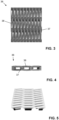
- Figures 3 to 4 refer to a part of a second embodiment of the TAD fabric 36 used in the tissue machine 10 of figure 1 , where figure 3 represents a top view thereof, figure 4 represents a side view thereof and figure 5 represents a simulation result of the contact area of the part of the second embodiment of the TAD fabric 36 from figures 3 and 4 .
- figure 3 represents a top view thereof
- figure 4 represents a side view thereof
- figure 5 represents a simulation result of the contact area of the part of the second embodiment of the TAD fabric 36 from figures 3 and 4 .
- the same or similar elements have the same reference signs and it is referred to the above description.
- the second embodiment does not comprise any stuffer yarns. Therefore, there permeability of the second embodiment is rather high. From the simulation shown in figure 5 it can be derived that the contact area of the tissue facing side, i.e. the upper side in figure 5 , has a contact area of about 19%. Furthermore, in this embodiment the potential caliper is 1.97mm.
Landscapes
- Paper (AREA)
Abstract
Description
- The present invention concerns a machine for making tissue, comprising: a forming section with a fabric for dewatering and transporting a nascent tissue web; a through air drying section with at least one through air drying unit; and a Yankee section with a Yankee cylinder, wherein the through air drying section comprises a TAD fabric for taking over the tissue web from the fabric of the forming section, and for transporting the tissue web through the at least one through air drying unit towards the Yankee section.
- Such machines, also sometimes merely called TAD machines, are generally known in the art. Just as an example, reference is made to patent application
WO 93/22498 A1 - Even though the tissue that is produced on such machines is not bad, the market is looking for improved properties in tissue and towel production relating to softness, bulk, handfeel (flexability), absorbency and both wet and dry tensile strength relative to the basis weight of the final sheet and number of plies (layers) in the final product. Moreover, there is a constant demand from tissue makers for unique structures which can give them a benefit against competition and differentiate themselves in the market place, both with appearance of the sheet as well as its final functionality.
- The present invention aims to solve or at least mitigate these problems. This aim is achieved by the teaching of the independent claims. The dependent claims describe advantageous further embodiments of the present invention.
- In particular, these problems are solved or at least mitigated by a generic tissue machine of the kind described above, wherein the TAD fabric is constructed as a spiral link fabric which spiral link fabric is free of any coating or the like.
- It is the merit of the inventor to have found out that such a "pure" spiral link fabric is very good suitable to be used as TAD fabric in a TAD machine. The spiral link fabric provides a unique structure with exceptional pocket depth to form a tissue sheet beyond traditional woven fabric structures. Furthermore, the spiral is an extremely stable structure in both the machine direction and cross machine direction and can be stronger in overall strength relative to woven structures. Last but not least, the spirals can be quickly seamed together enabling a quicker and safer installation and startup of the spiral link fabric.
- Preferably, the forming section comprises a twin-wire former with two converging fabrics forming a gap for receiving fiber suspension ejected from a headbox. However, other known types of forming sections are possible, but less preferred. The two converging fabrics may both be woven fabrics, wherein at least the fabric that transports the nascent tissue web to the TAD fabric may be a structured fabric. Sometimes these fabrics are referred to as forming fabric and as molding fabric.
- In a preferred embodiment of the invention, the through air drying section comprises two through air drying units, more preferably exactly two through air drying units. That way the tissue web can be dried in a very efficient manner.
- Trials have shown that particularly good results can be achieved if the spiral link fabric provides a contact area of between 15% and 25% for the tissue web. To achieve such a high contact area, the tissue facing side of the spiral link fabric may be sanded. Alternatively or additionally, instead of yarns having a basically round cross section to form the coils of the spiral link fabric, flat yarns may be used, having for example a flattened (oval) or even a substantially rectangular cross section.
- Another advantage of using a spiral link fabric as TAD fabric is that a wide range of permeability can be adjusted quite easily. To achieve this, the spiral link fabric can comprise stuffer yarns inserted into the open spaces formed by links of coils. Much higher permeabilities can be achieved with spiral link fabrics compared to most woven fabric structures with a comparable density. The stuffer yarns can be of different numbers and sizes and can either completely or partially fill the space. This stuffer yarn located in the center of the pairs of spiral coils can be customized as a backing surface at which the tissue web is formed inside the spacing of the loops. This can be done with either flat or round monofilaments, and can be either put in every coil or some combination, such as in every other, every third, etc.
- For this kind of application, the spirals are preferably produced out of heat resisting, thermally stable materials. Good results are attainably if the spirals of the spiral link fabric are made from polyphenylene sulfide. This material is also called PPS and traded e.g. under the trade mark "Ryton". Alternatively, the spirals of the spiral link fabric can be made from polyethylenterephthalat, also called PET. Preferably, the PET is hydrolysis-stabilized.
- Depending upon the final demand of the tissue product, different variations as to the diameters of the spiral coils can be chosen. In a first preferred embodiment of the present invention, the spirals of the spiral link fabric comprise a spiral coil diameter of between 0.50mm and 0.60mm, preferably approximately 0.55mm. In a second preferred embodiment of the present invention, the spirals of the spiral link fabric comprise a spiral coil diameter of between 0.65mm and 0.75mm, preferably approximately 0.70mm. And in a third preferred embodiment of the present invention, the spirals of the spiral link fabric comprise a spiral coil diameter of between 0.85mm and 0.95mm, preferably approximately 0.90mm.
- The basic idea of the present invention may also be formulated slightly differently, namely as using of a spiral link fabric, which spiral link fabric is free of any coating or the like, as a TAD fabric in a TAD machine for making tissue, the TAD machine comprising: a forming section with a fabric for dewatering and transporting a nascent tissue web; a through air drying section with at least one through air drying unit; and a Yankee section with a Yankee cylinder, wherein the through air drying section comprises the TAD fabric for taking over the tissue web from the fabric of the forming section, and for transporting the tissue web through the at least one through air drying unit towards the Yankee section.
- Now, the present invention, or preferred embodiments thereof, are described with reference to the following schematic drawings:
- Fig. 1:
- shows a tissue machine according to the present invention;
- Fig. 2:
- shows a part of a first embodiment of a TAD fabric used in the tissue machine of
figure 1 ; - Fig. 3:
- is a top view of a part of a second embodiment of the TAD fabric used in the tissue machine of
figure 1 ; - Fig. 4:
- is a side view of the part of the second embodiment of the TAD fabric from
figure 3 ; and - Fig. 5:
- shows a simulation result of the contact area of the part of the second embodiment of the TAD fabric from
figures 3 and 4 . -
Figure 1 shows an exemplary embodiment of atissue machine 10 according to the present invention. The tissue machine comprises a formingsection 20, a throughair drying section 30 and a Yankeesection 40. Furthermore, behind the Yankeesection 40 there may be provided awinding section 50 to wind the final tissue web. The further converting of the tissue web can be done offline in a separate machine. - In the present example, the forming
section 20 is provided as a so-called twin wire former. It comprises twofabrics first fabric 22 is sometimes also referred to as forming fabric and thesecond fabric 24 as molding fabric. Usually, thesefabrics tissue machine 10 is running thefirst fabric 22 is moving counterclockwise infigure 1 , while thesecond fabric 24 is moving clockwise. Bothfabrics headbox 26. The nascent tissue web is further dewatered on thesecond fabric 24. At the same time it is transported on thesecond fabric 24 towards the throughair drying section 30. - In this exemplary embodiment the through
air drying section 30 comprises two through air dryer units, namely a first through air dryer unit 32 and a second throughair drying unit 34. Each of the two throughair dryer units 32 and 34 comprises a through air drying cylinder and a through air drying hood to dry the tissue web by blowing hot air therethrough. The tissue web coming from the formingsection 20 is transferred from thesecond fabric 24 to aTAD fabric 36 will be described in more detail below with reference tofigures 2-5 . In use, theTAD fabric 36 moves counterclockwise infigure 1 transporting the tissue web through the two throughair drying units 32 and 34 towards theYankee section 40. TheYankee section 40 comprises a Yankee cylinder and a Yankee hood. In this exemplary embodiment, theTAD fabric 36 transfers the tissue web directly onto an outer surface of theYankee cylinder 42. Thus, some kind of pressure nip is formed between a pressing roll inside the loop of theTAD fabric 36 and theYankee cylinder 42. The pressing roll may be a roll that provides an extended nip, such as a shoe press roll. - In the
Yankee section 40 the tissue web is further dried in a known manner before it is reeled-up in thewinder section 50 for further transportation and/or conversion. -
Figure 2 shows a part of a first embodiment of aTAD fabric 36 used in thetissue machine 10 offigure 1 . According to the present invention theTAD fabric 36 is a spiral link fabric which spiral link fabric is free of any coating or the like. "The like" is to be understood here in a broad sense also comprising staple fibers, printings, laminations, etc. TheTAD fabric 36 is basically made up from yarns in the form of spiral coils 37 and from substantiallystraight hinge yarns 38 that connect the spiral coils 37. In this first embodiment offigure 2 , theTAD fabric 36 additionally comprisesstuffer yarns 39. Thestuffer yarns 39 are inserted into the open spaces formed by the spiral coils 37. With suchstuffer yarns 39 the permeability of theTAD fabric 36 can be adjusted to a given value. In this embodiment, thestuffer yarns 39 are substantially flat, located in the center of each open space and they fill substantially the full space. However, different numbers and sizes can be used and the stuffer yarns also my partially fill the space. -
Figures 3 to 4 refer to a part of a second embodiment of theTAD fabric 36 used in thetissue machine 10 offigure 1 , wherefigure 3 represents a top view thereof,figure 4 represents a side view thereof andfigure 5 represents a simulation result of the contact area of the part of the second embodiment of theTAD fabric 36 fromfigures 3 and 4 . In the following, only the differences between the first embodiment offigure 2 and the second embodiment according tofigures 3 to 4 are described. The same or similar elements have the same reference signs and it is referred to the above description. - The main difference between these two embodiments is that the second embodiment does not comprise any stuffer yarns. Therefore, there permeability of the second embodiment is rather high. From the simulation shown in
figure 5 it can be derived that the contact area of the tissue facing side, i.e. the upper side infigure 5 , has a contact area of about 19%. Furthermore, in this embodiment the potential caliper is 1.97mm. -
- 10
- tissue machine
- 20
- forming section
- 22
- first fabric (forming fabric)
- 24
- second fabric (molding fabric)
- 26
- headbox
- 30
- through air drying section
- 32
- first through air drying unit
- 34
- second through air drying unit
- 36
- TAD fabric
- 37
- spiral coils
- 38
- hinge yarns
- 39
- stuffer yarns
- 40
- Yankee section
- 42
- Yankee cylinder
- 44
- Yankee hood
- 50
- winder section
Claims (10)
- A machine (10) for making tissue, comprising:- a forming section (20) with a fabric (24) for dewatering and transporting a nascent tissue web;- a through air drying section (20) with at least one through air drying unit (32, 34); and- a Yankee section (40) with a Yankee cylinder (40),wherein the through air drying section (30) comprises a TAD fabric (36) for taking over the tissue web from the fabric (24) of the forming section (20), and for transporting the tissue web through the at least one through air drying unit (32, 34) towards the Yankee section (40),
characterized in that the TAD fabric (36) is constructed as a spiral link fabric (36) which spiral link fabric is free of any coating or the like. - Tissue machine (10) according to claim 1,
characterized in that the forming section (20) comprises a twin-wire former with two converging fabrics (22, 24) forming a gap for receiving fiber suspension ejected from a headbox (26). - Tissue machine (10) according to claim 1 or 2,
characterized in that the through air drying section (30) comprises two through air drying units (32, 34). - Tissue machine (10) according to any of the preceding claims.
characterized in that the spiral link fabric (36) provides a contact area of between 15% and 25% for the tissue web. - Tissue machine (10) according to any of the preceding claims,
characterized in that the spiral link fabric (36) comprises stuffer yarns (39) inserted into the open spaces formed by links of coils (37). - Tissue machine (10) according to any of the preceding claims,
characterized in that that the spiral coils (37) of the spiral link fabric (36) are made from polyphenylene sulfide or Polyethylenterephthalat. - Tissue machine (10) according to any of the preceding claims,
characterized in that the spiral coils (37) of the spiral link fabric (36) comprise a spiral coil diameter of between 0.50mm and 0.60mm, preferably approximately 0.55mm. - Tissue machine (10) according to any of the preceding claims,
characterized in that the spiral coils of the spiral link fabric (36) comprise a spiral coil diameter of between 0.65mm and 0.75mm, preferably approximately 0.70mm. - Tissue machine (10) according to any of the preceding claims,
characterized in that the spiral coils (37) of the spiral link fabric (36) comprise a spiral coil diameter of between 0.85mm and 0.95mm, preferably approximately 0.90mm. - Use of a spiral link fabric (36), which spiral link fabric (36) is free of any coating or the like, as a TAD fabric in a TAD machine for making tissue, the TAD machine comprising:- a forming section (20) with a fabric (20) for dewatering and transporting a nascent tissue web;- a through air drying section (30) with at least one through air drying unit (32, 34); and- a Yankee section (40) with a Yankee cylinder (42),wherein the through air drying section (30) comprises the TAD fabric (36) for taking over the tissue web from the fabric (24) of the forming section (20), and for transporting the tissue web through the at least one through air drying unit (32, 34) towards the Yankee section (40).
Priority Applications (4)
| Application Number | Priority Date | Filing Date | Title |
|---|---|---|---|
| EP22196454.7A EP4343059A1 (en) | 2022-09-20 | 2022-09-20 | Tissue machine |
| PCT/EP2023/067566 WO2024028002A1 (en) | 2022-08-02 | 2023-06-28 | Tissue machine |
| CN202380055554.9A CN119546817A (en) | 2022-08-02 | 2023-06-28 | Tissue paper machine |
| US19/043,673 US20250179735A1 (en) | 2022-08-02 | 2025-02-03 | Tissue machine and method of using a spiral link fabric in the tissue machine |
Applications Claiming Priority (1)
| Application Number | Priority Date | Filing Date | Title |
|---|---|---|---|
| EP22196454.7A EP4343059A1 (en) | 2022-09-20 | 2022-09-20 | Tissue machine |
Publications (1)
| Publication Number | Publication Date |
|---|---|
| EP4343059A1 true EP4343059A1 (en) | 2024-03-27 |
Family
ID=83398465
Family Applications (1)
| Application Number | Title | Priority Date | Filing Date |
|---|---|---|---|
| EP22196454.7A Pending EP4343059A1 (en) | 2022-08-02 | 2022-09-20 | Tissue machine |
Country Status (1)
| Country | Link |
|---|---|
| EP (1) | EP4343059A1 (en) |
Citations (4)
| Publication number | Priority date | Publication date | Assignee | Title |
|---|---|---|---|---|
| WO1993022498A1 (en) | 1992-04-23 | 1993-11-11 | Valmet-Karlstad Ab | A method of rebuilding a conventional tissue machine to a tad machine, and an improved c-wrap type twin wire former suitable for use therein |
| US6066390A (en) * | 1998-03-09 | 2000-05-23 | Wangner Systems Corporation | Low permeability spiral fabric |
| US20070251660A1 (en) * | 2006-04-28 | 2007-11-01 | Voith Paper Patent Gmbh | Dewatering tissue press fabric for an atmos system and press section of a paper machine using the dewatering fabric |
| WO2019133875A1 (en) * | 2017-12-29 | 2019-07-04 | Kimberly-Clark Worldwide, Inc. | Three-dimensional papermaking belt |
-
2022
- 2022-09-20 EP EP22196454.7A patent/EP4343059A1/en active Pending
Patent Citations (4)
| Publication number | Priority date | Publication date | Assignee | Title |
|---|---|---|---|---|
| WO1993022498A1 (en) | 1992-04-23 | 1993-11-11 | Valmet-Karlstad Ab | A method of rebuilding a conventional tissue machine to a tad machine, and an improved c-wrap type twin wire former suitable for use therein |
| US6066390A (en) * | 1998-03-09 | 2000-05-23 | Wangner Systems Corporation | Low permeability spiral fabric |
| US20070251660A1 (en) * | 2006-04-28 | 2007-11-01 | Voith Paper Patent Gmbh | Dewatering tissue press fabric for an atmos system and press section of a paper machine using the dewatering fabric |
| WO2019133875A1 (en) * | 2017-12-29 | 2019-07-04 | Kimberly-Clark Worldwide, Inc. | Three-dimensional papermaking belt |
Similar Documents
| Publication | Publication Date | Title |
|---|---|---|
| US7300554B2 (en) | Textured surface of a tissue forming fabric to generate bulk, cross directional tensile, absorbency, and softness in a sheet of paper | |
| KR100336143B1 (en) | Triple-Layer Paper Fabric with Improved Fiber Support | |
| KR101129557B1 (en) | Multi-layer forming fabrics with packing yarns | |
| CN100385067C (en) | Fabrics with binding yarns | |
| US7624766B2 (en) | Warped stitched papermaker's forming fabric | |
| US7059360B1 (en) | Double layer forming fabric with paired warp binder yarns | |
| CN100385065C (en) | Multi-layer forming fabric with paired top layer wefts and additional middle layer wefts | |
| US7008512B2 (en) | Fabric with three vertically stacked wefts with twinned forming wefts | |
| US7604025B2 (en) | Forming fabric having offset binding warps | |
| US7118651B2 (en) | Press felt | |
| CA2250308A1 (en) | Woven soft-faced press fabric | |
| US20250179735A1 (en) | Tissue machine and method of using a spiral link fabric in the tissue machine | |
| US8480857B2 (en) | Structured fabric for use in a papermaking machine and the fibrous web produced thereon | |
| EP1507041B1 (en) | Papermachine fabric seaming | |
| CN101180433B (en) | Multilayer paper machine fabric having cross machine direction yarns made of a material which counters edge curing and method for forming the paper machine fabric |
Legal Events
| Date | Code | Title | Description |
|---|---|---|---|
| PUAI | Public reference made under article 153(3) epc to a published international application that has entered the european phase |
Free format text: ORIGINAL CODE: 0009012 |
|
| STAA | Information on the status of an ep patent application or granted ep patent |
Free format text: STATUS: THE APPLICATION HAS BEEN PUBLISHED |
|
| AK | Designated contracting states |
Kind code of ref document: A1 Designated state(s): AL AT BE BG CH CY CZ DE DK EE ES FI FR GB GR HR HU IE IS IT LI LT LU LV MC MK MT NL NO PL PT RO RS SE SI SK SM TR |
|
| STAA | Information on the status of an ep patent application or granted ep patent |
Free format text: STATUS: REQUEST FOR EXAMINATION WAS MADE |
|
| 17P | Request for examination filed |
Effective date: 20240927 |
|
| RBV | Designated contracting states (corrected) |
Designated state(s): AL AT BE BG CH CY CZ DE DK EE ES FI FR GB GR HR HU IE IS IT LI LT LU LV MC MK MT NL NO PL PT RO RS SE SI SK SM TR |