EP4343052A2 - Method for producing a textile with local enhancement and textile with local enhancement - Google Patents
Method for producing a textile with local enhancement and textile with local enhancement Download PDFInfo
- Publication number
- EP4343052A2 EP4343052A2 EP23197240.7A EP23197240A EP4343052A2 EP 4343052 A2 EP4343052 A2 EP 4343052A2 EP 23197240 A EP23197240 A EP 23197240A EP 4343052 A2 EP4343052 A2 EP 4343052A2
- Authority
- EP
- European Patent Office
- Prior art keywords
- local enhancement
- precut
- textile fabric
- local
- stabilizing film
- Prior art date
- Legal status (The legal status is an assumption and is not a legal conclusion. Google has not performed a legal analysis and makes no representation as to the accuracy of the status listed.)
- Pending
Links
Images

Classifications
-
- D—TEXTILES; PAPER
- D06—TREATMENT OF TEXTILES OR THE LIKE; LAUNDERING; FLEXIBLE MATERIALS NOT OTHERWISE PROVIDED FOR
- D06M—TREATMENT, NOT PROVIDED FOR ELSEWHERE IN CLASS D06, OF FIBRES, THREADS, YARNS, FABRICS, FEATHERS OR FIBROUS GOODS MADE FROM SUCH MATERIALS
- D06M23/00—Treatment of fibres, threads, yarns, fabrics or fibrous goods made from such materials, characterised by the process
- D06M23/16—Processes for the non-uniform application of treating agents, e.g. one-sided treatment; Differential treatment
-
- A—HUMAN NECESSITIES
- A41—WEARING APPAREL
- A41D—OUTERWEAR; PROTECTIVE GARMENTS; ACCESSORIES
- A41D27/00—Details of garments or of their making
- A41D27/08—Trimmings; Ornaments
Definitions
- textiles with local enhancements such as printed or lighting patterns, which are to be created at distinct and well-defined positions of the fabric obtained from previous processing steps.
- the problem of the invention is to provide a method for producing a textile fabric with local enhancement that allows for a more precise dimensional specification of the local enhancement and to provide a textile fabric with more precisely located local enhancement.
- the local enhancement is applied to the textile fabric at locations located within precut positions (i.e. predefined areas, which may also be called precut area, of the textile fabric panel or roll that is manufactured that will be used when the fabric is attached to a final product, especially during automated serial production of such products) that are spaced-apart from each other by a distance which may or may not be variable.
- precut positions i.e. predefined areas, which may also be called precut area, of the textile fabric panel or roll that is manufactured that will be used when the fabric is attached to a final product, especially during automated serial production of such products
- An essential feature of this invention is that prior to the application of the local enhancement, a protective stabilizing film is applied to the textile fabric at least in parts of the regions of the textile fabric that are located between two subsequent precut positions.
- any kind of non stretchable film with a glue layer on one side can be used as protective stabilizing film.
- films from the familly of PET (Polyether-terephtalat), PP (Polypropylen), PC (Polycarbonat) can be used, but potentially other kinds of 2D protective areas like textile or non-woven with a glue layer on one side, or other kind of sprayable, laminable fluid material that hardened and become a peallable film after a drying or reti-culation (curring) step may be suited for this purpose.
- this protective stabilizing film is applied to the entire surface of the textile roll.
- the protective stabilizing film is applied only outside of precut positions. This can provide adequate positional stabilization while avoiding any interference with the application of the local enhancements. Even better positional stabilization can be obtained, however, if the protective stabilizing film is (also) applied inside of precut positions with the exception of areas of the precut positions in which local enhancement is applied.
- the protective stabilizing film can also be applied first to the entire side of the textile fabric on which the local enhancement is performed and subsequently removed at least from areas in which local enhancement is applied prior to the application of the local enhancement.
- local area without protective stabilizing film on which local enhancement is performed can by achieved using a mask that locally prevents the material to be applied on the textile surface.
- the protective stabilizing film is laminated onto the textile fabric using a press or rollers.
- the location of the precut position is monitored with physical indexation, a camera monitoring system and/or a laser monitoring system.
- the local enhancement can be created by addition of material, like printed inks, local enduction of plastics or rubbers or welding of pattern pieces.
- the local enhancement may also be created by surface modification, e.g. brought about by cutting or etching with a laser or UV radiation, heat radiation or conduction, sandblasting, application of chemical agents or mechanically using blades and/or tools.
- Positional control may be improved even further if the fabric is fabricated with stiffer mesh areas that are created at the border of and/or inside the precut positions.
- the textile fabric of the invention is produced by the method according to the invention.
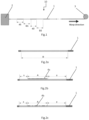
- Figure 1 shows s schematic overview over a production line 10 for producing a textile fabric 1 with local enhancement.
- a textile manufacturing machine 2 provides the textile fabric 1, typically from yarns which have been created from fibers as an output. This fabric is moved in the warp direction indicated by the double arrow, e.g. pulled by a motorized axis which winds the final product to a textile roll 3, thus inducing a well-defined strain on the textile fabric.
- future precut areas D1, D2 comprising the local enhancement that are separated by a separation distance d1,d2 are prepared at defined positions of the length of the fabric that forms the textile roll 3.
- the thus defined positional information allows a further machine (not shown) which processes the textile roll 3 and applies the precut areas including the local enhancement in a reproducible way to the product for which the fabric with the local enhancement is used. More specifically, in this way it can be achieved that the local enhancement is oriented in an identical way for each product produced by this further machine.
- Fig. 2a shows a cross section through the fabric 1 of a single future precut area D.
- the side facing upwards in figures 2a-c and Figures 3a-c is the A-side, i.e. the side of the fabric that will be visible on the final product, whereas the side facing downwards in these figures if the B-side, i.e. the side of the fabric that will not be visible on the final product.
- a local enhancement 4a, 4b is added at some position of the production line 10.
- the local enhancement 4a is based on the addition of material within the precut area, as is the case, e.g., when printing techniques are used to create the local enhancement 4a.
- a local enhancement 4b is created without material addition, but rather by removing material, which can be realized, e.g. by application of laser radiation, UV radiation, sandblasting or plasma treatment. Of course, it is also possible to create a local enhancement using a mixture of techniques based on addition and removal of material, respectively.
- FIGs 3a to 3c illustrate subsequent intermediate stages during execution of an embodiment of the invention.
- a cross section of a single future precut area or precut position D of the textile fabric 1 is shown after a protective stabilizing film 5 has been formed on the A-side, which is the side that is visible in the final product. This can be done by laminating using rollers or a press in a processing step after the manufacturing machine 2 has finished processing the textile fabric 1.
- the protective stabilizing film 5 is then removed at least in the areas A, B, where the local enhancements 4a, 4b are to be applied, which leads to the intermediate product shown in figure 3b .
- the local enhancements 4a, 4b are applied, leading to the intermediate product illustrated in figure 3c .
- the stabilizing protective film 5 limits strains that are induced during the application process effectively and thus achieves significantly improved positional stability of the local enhancements 4a, 4b.
- the stabilizing protective film 5 may be removed, e.g. peeled off.
Landscapes
- Engineering & Computer Science (AREA)
- Textile Engineering (AREA)
- Treatment Of Fiber Materials (AREA)
- Woven Fabrics (AREA)
Abstract
Description
- In many cases, it is desired to use textiles with local enhancements, such as printed or lighting patterns, which are to be created at distinct and well-defined positions of the fabric obtained from previous processing steps.
- However, bearing in mind that most textiles are easily deformable, interactions that are necessary to create the local enhancement can expose the fabric to stress and induce local strains which in turn lead to distortion and deformation of the fabric and thus reduce the precision of the dimensional specification of the local enhancement on the final product.
- Accordingly, the problem of the invention is to provide a method for producing a textile fabric with local enhancement that allows for a more precise dimensional specification of the local enhancement and to provide a textile fabric with more precisely located local enhancement.
- This problem is solved by a method for producing a textile fabric with local enhancement that allows for a more precise dimensional specification of the local enhancement with the features of
claim 1 and a textile fabric with the features of claim 11. - According to the method for producing a textile fabric with local enhancement according to this invention, the local enhancement is applied to the textile fabric at locations located within precut positions (i.e. predefined areas, which may also be called precut area, of the textile fabric panel or roll that is manufactured that will be used when the fabric is attached to a final product, especially during automated serial production of such products) that are spaced-apart from each other by a distance which may or may not be variable.
- An essential feature of this invention is that prior to the application of the local enhancement, a protective stabilizing film is applied to the textile fabric at least in parts of the regions of the textile fabric that are located between two subsequent precut positions.
- Potentially and preferrably any kind of non stretchable film with a glue layer on one side can be used as protective stabilizing film. E.g., films from the familly of PET (Polyether-terephtalat), PP (Polypropylen), PC (Polycarbonat) can be used, but potentially other kinds of 2D protective areas like textile or non-woven with a glue layer on one side, or other kind of sprayable, laminable fluid material that hardened and become a peallable film after a drying or reti-culation (curring) step may be suited for this purpose.
- Preferably, this protective stabilizing film is applied to the entire surface of the textile roll.
- According to a preferred embodiment of the method, wherein a complete removal of the protective stabilizing film is performed after completion of the application of the local enhancement.
- According to a variant, the protective stabilizing film is applied only outside of precut positions. This can provide adequate positional stabilization while avoiding any interference with the application of the local enhancements. Even better positional stabilization can be obtained, however, if the protective stabilizing film is (also) applied inside of precut positions with the exception of areas of the precut positions in which local enhancement is applied.
- The protective stabilizing film can also be applied first to the entire side of the textile fabric on which the local enhancement is performed and subsequently removed at least from areas in which local enhancement is applied prior to the application of the local enhancement.
- In case of using a fluid applicable material that is hardened and becomes pealable after a certain drying/curring time, local area without protective stabilizing film on which local enhancement is performed, can by achieved using a mask that locally prevents the material to be applied on the textile surface.
- According to an advantageous embodiment of the method, the protective stabilizing film is laminated onto the textile fabric using a press or rollers.
- To obtain optimal positional information, according to a preferred embodiment of the method the location of the precut position is monitored with physical indexation, a camera monitoring system and/or a laser monitoring system.
- The local enhancement can be created by addition of material, like printed inks, local enduction of plastics or rubbers or welding of pattern pieces.
- Alternatively or additionally, in other embodiments the local enhancement may also be created by surface modification, e.g. brought about by cutting or etching with a laser or UV radiation, heat radiation or conduction, sandblasting, application of chemical agents or mechanically using blades and/or tools.
- Positional control may be improved even further if the fabric is fabricated with stiffer mesh areas that are created at the border of and/or inside the precut positions.
- The textile fabric of the invention is produced by the method according to the invention.
- Next, the invention is explained using figures that illustrate specific embodiments of the invention. The figures show:
- Fig. 1
- A schematic overview over a production line for producing a fabric with local enhancement,
- Fig. 2a
- a cross section of a single future precut area,
- Fig. 2b
- an example for a local enhancement based on the addition of material within the precut area,
- Fig. 2c
- an example for a local enhancement based on a surface treatment,
- Fig. 3a
- a cross section of a single future precut area as obtained after a first intermediate step of an embodiment of the invention,
- Fig. 3b
- a cross section of a single future precut area as obtained after a second intermediate step of an embodiment of the invention, and
- Fig. 3c
- a cross section of a single future precut area as obtained after a third intermediate step of an embodiment of the invention.
-
Figure 1 shows s schematic overview over aproduction line 10 for producing atextile fabric 1 with local enhancement. Atextile manufacturing machine 2 provides thetextile fabric 1, typically from yarns which have been created from fibers as an output. This fabric is moved in the warp direction indicated by the double arrow, e.g. pulled by a motorized axis which winds the final product to atextile roll 3, thus inducing a well-defined strain on the textile fabric. - Especially if the
textile roll 3 is to be processed automatically, future precut areas D1, D2 comprising the local enhancement that are separated by a separation distance d1,d2 are prepared at defined positions of the length of the fabric that forms thetextile roll 3. The thus defined positional information allows a further machine (not shown) which processes thetextile roll 3 and applies the precut areas including the local enhancement in a reproducible way to the product for which the fabric with the local enhancement is used. More specifically, in this way it can be achieved that the local enhancement is oriented in an identical way for each product produced by this further machine. -
Fig. 2a shows a cross section through thefabric 1 of a single future precut area D. The side facing upwards infigures 2a-c andFigures 3a-c is the A-side, i.e. the side of the fabric that will be visible on the final product, whereas the side facing downwards in these figures if the B-side, i.e. the side of the fabric that will not be visible on the final product. - As shown in
Figure 2b and 2c , in a defined area A, which is located within the future precut D, more precisely beginning at a distance x from its left boundary and ending at a distance y from its right boundary, alocal enhancement production line 10. Infigure 2b , thelocal enhancement 4a is based on the addition of material within the precut area, as is the case, e.g., when printing techniques are used to create thelocal enhancement 4a. Infigure 2c , alocal enhancement 4b is created without material addition, but rather by removing material, which can be realized, e.g. by application of laser radiation, UV radiation, sandblasting or plasma treatment. Of course, it is also possible to create a local enhancement using a mixture of techniques based on addition and removal of material, respectively. -
Figures 3a to 3c illustrate subsequent intermediate stages during execution of an embodiment of the invention. InFig. 3a , a cross section of a single future precut area or precut position D of thetextile fabric 1 is shown after a protective stabilizingfilm 5 has been formed on the A-side, which is the side that is visible in the final product. This can be done by laminating using rollers or a press in a processing step after themanufacturing machine 2 has finished processing thetextile fabric 1. - In order to prevent any adverse interference with the application of the
local enhancements film 5 is then removed at least in the areas A, B, where thelocal enhancements figure 3b . - Then, the
local enhancements figure 3c . During this application, the stabilizingprotective film 5 limits strains that are induced during the application process effectively and thus achieves significantly improved positional stability of thelocal enhancements - Subsequently, the stabilizing
protective film 5 may be removed, e.g. peeled off. -
- 1
- textile fabric
- 2
- manufacturing machine
- 3
- roll
- 4a, 4b
- local enhancement
- 5
- protective stabilizing film
- 10
- production line
- A, B
- area
- D, D1, D2
- precut positon
- d1, d2, x, y
- distance
Claims (15)
- A method for producing a textile fabric (1) with local enhancement (4a, 4b), wherein the local enhancement is applied to the textile fabric (1) at locations located within precut positions (D, D1, D2) that are spaced-apart from each other by a distance (d1, d2) which may or may not be variable,
characterized in that prior to the application of the local enhancement (4a, 4b), a protective stabilizing film (5) is applied to the textile fabric (1) at least in parts of the regions of the textile fabric (1) that are located between two subsequent precut positions (D, D1, D2). - The method according to claim 1, wherein the protective stabilizing film (5) is formed using a material chosen from the family of PET (Polyetherterephtalates), PP (Polypropylenes) or PC (Polycarbonat).
- The method according to claim 1, wherein the protective stabilizing film (5) is formed using a textile or non-woven layer.
- The method according to claim 1, wherein the protective stabilizing film (5) is formed using a sprayable, laminable fluid material that is hardened and becomes a peallable film after a drying or reticulation (curring) step.
- The method according to claim 4, wherein a local area without protective stabilizing film on which local enhancement is performed is created by using a mask that locally prevent the material to be applied on the textile surface.
- The method according to one of claims 1 to 5, wherein a complete removal of the protective stabilizing film (5) is performed after completion of the application of the local enhancements (4a, 4b).
- The method according to one of claims 1 to 6, wherein the protective stabilizing film (5) is applied only outside of precut positions (D, D1, D2).
- The method according to one of claims 1 to 6, wherein the protective stabilizing film (5) is applied inside of precut positions (D, D1, D2), but not in areas (A,B) of the precut positions (D, D1, D2) in which local enhancements (4a, 4b) are applied.
- The method according to one of claims 1 to 4, wherein the protective stabilizing film (5) is applied to the entire side of the textile fabric (1) on which the local enhancement (4a, 4b) is performed and subsequently removed at least from areas (A, B) in which local enhancement (4a, 4b) is applied prior to the application of the local enhancement (4a, 4b).
- The method according to one of claims 1 to 9, wherein the protective stabilizing film (5) is laminated onto the textile fabric (1) using a press or rollers.
- The method according to one of claims 1 to 10, wherein the position of the precut position (D, D1, D2) is monitored with physical indexation, a camera monitoring system and/or a laser monitoring system.
- The method according to one of claims 1 to 11, wherein the local enhancement (4a, 4b) is created by addition of material.
- The method according to one of claims 1 to 11, wherein the local enhancement (4a, 4b) is created by surface modification.
- The method according to one of claims 1 to 13, wherein the textile fabric (1) is fabricated with stiffer mesh areas that are created at the border of and/or inside the precut positions (D, D1, D2).
- A textile fabric (1) produced by the method according to one of claims 1 to 14.
Applications Claiming Priority (1)
| Application Number | Priority Date | Filing Date | Title |
|---|---|---|---|
| US202263408632P | 2022-09-21 | 2022-09-21 |
Publications (2)
| Publication Number | Publication Date |
|---|---|
| EP4343052A2 true EP4343052A2 (en) | 2024-03-27 |
| EP4343052A3 EP4343052A3 (en) | 2024-04-17 |
Family
ID=88021126
Family Applications (2)
| Application Number | Title | Priority Date | Filing Date |
|---|---|---|---|
| EP23197240.7A Pending EP4343052A3 (en) | 2022-09-21 | 2023-09-13 | Method for producing a textile with local enhancement and textile with local enhancement |
| EP23197241.5A Pending EP4343053A3 (en) | 2022-09-21 | 2023-09-13 | Method for producing a textile with local enhancement and textile with local enhancement |
Family Applications After (1)
| Application Number | Title | Priority Date | Filing Date |
|---|---|---|---|
| EP23197241.5A Pending EP4343053A3 (en) | 2022-09-21 | 2023-09-13 | Method for producing a textile with local enhancement and textile with local enhancement |
Country Status (2)
| Country | Link |
|---|---|
| EP (2) | EP4343052A3 (en) |
| CN (2) | CN117738010A (en) |
Family Cites Families (9)
| Publication number | Priority date | Publication date | Assignee | Title |
|---|---|---|---|---|
| US5878645A (en) * | 1997-09-12 | 1999-03-09 | Streit; Carl | Accordion fold curtains and method of manufacture |
| US20040050506A1 (en) * | 2002-07-31 | 2004-03-18 | Gerd Haiber | Decorative hanging fabric panels with integrated stiffend areas |
| US7100941B2 (en) * | 2003-02-24 | 2006-09-05 | Collins & Aikman | Pre-weakening of fabric covered airbag doors |
| EP2239139B1 (en) * | 2009-04-10 | 2013-03-20 | Procraft Development B.V. | Composite stencils and methods of making composite stencils |
| JP6134222B2 (en) * | 2013-07-26 | 2017-05-24 | 日本ダム株式会社 | Manufacturing method of cloth emblem base material |
| GB2539508A (en) * | 2015-06-19 | 2016-12-21 | Dst Innovations Ltd | A method for making patterned conductive textiles |
| CN110582409A (en) * | 2017-01-17 | 2019-12-17 | 塞奇机动车内饰股份有限公司 | Rotary Screen Pattern Printing of Polyurethane Resin on Textiles |
| EP3354453B1 (en) * | 2017-01-26 | 2020-09-23 | Autoneum Management AG | Acoustic carpet for vehicles |
| CN209135547U (en) * | 2018-11-22 | 2019-07-23 | 深圳市娜尔思时装有限公司 | A kind of crimped stamp moulding clothes |
-
2023
- 2023-09-13 EP EP23197240.7A patent/EP4343052A3/en active Pending
- 2023-09-13 EP EP23197241.5A patent/EP4343053A3/en active Pending
- 2023-09-21 CN CN202311219578.1A patent/CN117738010A/en active Pending
- 2023-09-21 CN CN202311227375.7A patent/CN117738011A/en active Pending
Also Published As
| Publication number | Publication date |
|---|---|
| EP4343053A2 (en) | 2024-03-27 |
| CN117738010A (en) | 2024-03-22 |
| EP4343053A3 (en) | 2024-04-17 |
| EP4343052A3 (en) | 2024-04-17 |
| CN117738011A (en) | 2024-03-22 |
Similar Documents
| Publication | Publication Date | Title |
|---|---|---|
| EP2058108B1 (en) | Patterned roll for casting a patterned surface onto an opaque web | |
| JP6439202B2 (en) | How to transfer embossing foil decorative section | |
| DE102012224359B4 (en) | Process for producing stamps for devices for plasmonic nanolithography | |
| EP2262648A2 (en) | Method for producing a film element | |
| EP0999583A2 (en) | Increasing stability of a substrate by a supporting element | |
| US20140373350A1 (en) | Method for the Production of a Circuit Board Involving the Removal of a Subregion thereof, and Use of such a Method | |
| EP4343053A2 (en) | Method for producing a textile with local enhancement and textile with local enhancement | |
| KR101704587B1 (en) | How to implement a complex pattern and complex pattern implemented sheet | |
| CN111188008A (en) | Metal mask strip, metal mask plate and manufacturing method thereof, and glass photomask | |
| JP5086876B2 (en) | Half-cut processing method, flexible die and rotary processing apparatus for processing target sheet | |
| DE69831392T2 (en) | Production method of electronic components and apparatus for the production of thin layers | |
| JP2001260168A (en) | Method for manufacturing protective panel for display window of electronic instrument | |
| EP0338625B1 (en) | Method of manufacturing a shear plate for a dry-shaver | |
| EP0596390B1 (en) | Die plate for the production of carton box blanks | |
| EP3408143B1 (en) | Method for manufacturing a retro-reflecting vehicle number plate, retro-reflecting vehicle number plate, and device for implementing the method | |
| KR101685316B1 (en) | Molding assembly, molding assembly manufacturing device, and method for manufacturing molding assembly | |
| KR102067706B1 (en) | Method for manufacturing bearing shield for motors | |
| CN113347782A (en) | Reinforced steel sheet strip and processing method thereof | |
| TWI849866B (en) | Method for manufacturing screen printing plate component | |
| JP6104585B2 (en) | Non-mounting label printing processing small winding device and non-mounting label printing processing small winding method | |
| KR960009772B1 (en) | Manufacturing method of cover for file | |
| EP3422584B1 (en) | Method for producing a spatially formed surface protection element for electronic devices | |
| CN109270787B (en) | Method for weakening edge traces of photoetching pattern | |
| JPH06269862A (en) | Precision two-dimensional plastic working method for material with rectangular cross-section | |
| GB2639290A (en) | Method of manufacturing a vehicle registration plate blank |
Legal Events
| Date | Code | Title | Description |
|---|---|---|---|
| PUAI | Public reference made under article 153(3) epc to a published international application that has entered the european phase |
Free format text: ORIGINAL CODE: 0009012 |
|
| STAA | Information on the status of an ep patent application or granted ep patent |
Free format text: STATUS: THE APPLICATION HAS BEEN PUBLISHED |
|
| PUAL | Search report despatched |
Free format text: ORIGINAL CODE: 0009013 |
|
| AK | Designated contracting states |
Kind code of ref document: A2 Designated state(s): AL AT BE BG CH CY CZ DE DK EE ES FI FR GB GR HR HU IE IS IT LI LT LU LV MC ME MK MT NL NO PL PT RO RS SE SI SK SM TR |
|
| AK | Designated contracting states |
Kind code of ref document: A3 Designated state(s): AL AT BE BG CH CY CZ DE DK EE ES FI FR GB GR HR HU IE IS IT LI LT LU LV MC ME MK MT NL NO PL PT RO RS SE SI SK SM TR |
|
| RIC1 | Information provided on ipc code assigned before grant |
Ipc: A41D 27/00 20060101ALI20240313BHEP Ipc: D06M 23/16 20060101AFI20240313BHEP |
|
| STAA | Information on the status of an ep patent application or granted ep patent |
Free format text: STATUS: REQUEST FOR EXAMINATION WAS MADE |
|
| 17P | Request for examination filed |
Effective date: 20241015 |
|
| RBV | Designated contracting states (corrected) |
Designated state(s): AL AT BE BG CH CY CZ DE DK EE ES FI FR GB GR HR HU IE IS IT LI LT LU LV MC ME MK MT NL NO PL PT RO RS SE SI SK SM TR |
|
| P01 | Opt-out of the competence of the unified patent court (upc) registered |
Free format text: CASE NUMBER: UPC_APP_0003361_4343052/2026 Effective date: 20260130 |
|
| RAP3 | Party data changed (applicant data changed or rights of an application transferred) |
Owner name: MOTHERSON INNOVATIONS COMPANY LIMITED |