EP4342887A1 - Method for preparing cyclic sulfonic acid ester derivative compound - Google Patents
Method for preparing cyclic sulfonic acid ester derivative compound Download PDFInfo
- Publication number
- EP4342887A1 EP4342887A1 EP23737461.6A EP23737461A EP4342887A1 EP 4342887 A1 EP4342887 A1 EP 4342887A1 EP 23737461 A EP23737461 A EP 23737461A EP 4342887 A1 EP4342887 A1 EP 4342887A1
- Authority
- EP
- European Patent Office
- Prior art keywords
- formula
- compound represented
- sulfonic acid
- ester derivative
- acid ester
- Prior art date
- Legal status (The legal status is an assumption and is not a legal conclusion. Google has not performed a legal analysis and makes no representation as to the accuracy of the status listed.)
- Granted
Links
Images

Classifications
-
- C—CHEMISTRY; METALLURGY
- C07—ORGANIC CHEMISTRY
- C07D—HETEROCYCLIC COMPOUNDS
- C07D327/00—Heterocyclic compounds containing rings having oxygen and sulfur atoms as the only ring hetero atoms
- C07D327/02—Heterocyclic compounds containing rings having oxygen and sulfur atoms as the only ring hetero atoms one oxygen atom and one sulfur atom
- C07D327/04—Five-membered rings
-
- C—CHEMISTRY; METALLURGY
- C07—ORGANIC CHEMISTRY
- C07C—ACYCLIC OR CARBOCYCLIC COMPOUNDS
- C07C327/00—Thiocarboxylic acids
- C07C327/36—Esters of dithiocarboxylic acids
-
- C—CHEMISTRY; METALLURGY
- C07—ORGANIC CHEMISTRY
- C07D—HETEROCYCLIC COMPOUNDS
- C07D327/00—Heterocyclic compounds containing rings having oxygen and sulfur atoms as the only ring hetero atoms
- C07D327/02—Heterocyclic compounds containing rings having oxygen and sulfur atoms as the only ring hetero atoms one oxygen atom and one sulfur atom
- C07D327/06—Six-membered rings
Definitions
- the present invention relates to a method for preparing a cyclic sulfonic acid ester derivative compound.
- 1,3-propane sultone and 1,4-butane sultone are known as useful compounds as non-aqueous electrolyte additives in lithium secondary batteries.
- 1,3-propane sultone, and 1,4-butane sultone have problems such as toxicity issues, gas generation, and stability, and thus, studies on cyclic sulfonic acid ester derivative compounds that can be used as non-aqueous electrolyte additives are being actively conducted.
- a cyclic sulfonic acid ester derivative compound in which a substituent containing a hydroxy group is introduced at the gamma position of 1,3-propane sultone (the position of carbon next to oxygen in a ring structure) or a cyclic sulfonic acid ester derivative compound in which a substituent containing a hydroxy group is introduced at the delta position of 1,4-butane sultone (the position of carbon next to oxygen in a ring structure) is used as a non-aqueous electrolyte additive in a lithium secondary battery
- an electrode-electrolyte interface that is stable at high temperatures and has low resistance may be formed to improve the lifespan properties of the lithium secondary battery.
- the cyclic sulfonic acid ester derivative compound is prepared by, for example, a) a hydrosulfonation reaction and b) a dehydration reaction of 3-butene-1,2-diol.
- a sulfonate which is a hydrosulfonation reaction product of 3-butene-1,2-diol
- the overall yield is as low as less than 50% due to the purification issue in the process a) and the reactivity issue in the process b), and there is a problem in that a product is obtained in a black tar form (a black gum form).
- An aspect of the present invention is to improve the manufacturing process, yield, product properties, and the like of a cyclic sulfonic acid ester derivative compound.
- the present invention relates to a method for preparing a cyclic sulfonic acid ester derivative compound, wherein the method includes (A) reacting a compound represented by Formula 1 below with a thioacetic acid to prepare a compound represented by Formula 2 below, and (B) subjecting the compound represented by Formula 2 below to an oxidative cyclization reaction to prepare a compound represented by Formula 3.
- a substituent in the substituted alkyl group may be deuterium, a halogen group, a hydroxy group, a -COOR group (wherein R is an unsubstituted C 1 -C 6 alkyl group), a -SO 2 NR' 2 group (wherein R' is hydrogen or an unsubstituted C 1 -C 6 alkyl group), a cyano group, or a straight or branched C 1 -C 6 alkoxyl group.
- the R 1 to R 8 may each independently be hydrogen, or an unsubstituted C 1 -C 6 alkyl group. Specifically, the R 1 to R 8 may all be hydrogen in terms of each of synthesis and structural stability.
- the compound represented by Formula 3 above may be a compound represented by Formula a or b below.
- the step (A) is a step in which a double bond of the compound represented by Formula 1 above and a thioacetic acid react (i.e., a thiol-ene reaction between a terminal alkene and thioacetic acid) to form a thioacetate intermediate.
- a thioacetic acid react i.e., a thiol-ene reaction between a terminal alkene and thioacetic acid
- the equivalent ratio of the compound represented by Formula 1 above to the thioacetic acid above may be 1:1 to 1:3, specifically 1:1 to 1:2.5, more specifically 1:1 to 1:2.
- a conversion rate of 99% or higher (a rate at which the compound represented by Formula 1 is converted to the compound represented by Formula 2) may be achieved without the generation of other identifiable by-products.
- the step (A) may be performed under an acid catalyst to promote proton transfer on the reaction mechanism.
- the acid catalyst may be, for example, trifluoroacetic acid (TFA), hydrochloric acid (HCl), sulfuric acid (H 2 SO 4 ), or the like.
- the step (A) may be performed in a polar aprotic solvent to facilitate the generation of a radical intermediate in an appropriate amount.
- the polar aprotic solvent may be one or more of dichloromethane, chloroform, 1,2-dichloroethane, or acetonitrile.
- the radical intermediate is effectively generated without causing the solvent to participate in the reaction.
- the step (A) may be performed at a temperature of 20°C to 40°C, specifically at a temperature of 30°C to 40°C.
- the reaction speed of the step (A) may be fast, and a thioacetate intermediate (the compound represented by Formula 2) may not be decomposed.
- the step (A) may be performed for 2 hours to 8 hours to maximize the reaction conversion rate while preventing the thioacetate intermediate from decomposing.
- the step (B) is a step in which an oxidization agent is introduced to the compound represented by Formula 2, which is a reaction intermediate, to cause an oxidative cyclization reaction to occur, thereby forming a compound represented by Formula 3.
- the step (B) may be performed under an acid catalyst to maintain a pH that promotes an oxidation reaction.
- the acid catalyst in the step (B) may be added in an amount of 3 equivalents or more with respect to 1 equivalent of the compound represented by Formula 2 above.
- the acid catalyst in the step (B) is, for example, HCl
- the acid catalyst may act as an acid catalyst and also a Cl - source.
- the step (B) may be performed in a polar protic solvent to secure the solubility of the compound represented by Formula 2 above.
- the polar protic solvent may be one or more of distilled water, methanol, ethanol, propanol, or isopropanol.
- the reaction may proceed in a uniform phase of the compound (a reactant) represented by Formula 2 above, the oxidization agent, and the acid catalyst.
- the oxidative cyclization reaction may be performed under one or more oxidization agents selected from H 2 O 2 , HOCl, NCS, NBS, or KHSO 5 ⁇ 0.5KHSO 4 ⁇ 0.5K 2 SO 4 .
- the step (B) may be performed at a temperature of 0°C to 25°C, specifically at a temperature of 0°C to 15°C.
- an excessive oxidation reaction caused by the oxidization agent may be controlled to ensure reaction safety.
- the step (B) may be performed while controlling the temperature as follows. Specifically, in the step (B), the temperature is maintained at 0°C to 10°C when introducing the oxidization agent, and after the introduction of the oxidization agent is completed, the oxidative cyclization reaction may be performed at a temperature of 0°C to 25°C.
- the step (B) may be performed for 4 hours to 24 hours to maximize the yield within a range for preventing isomerization of the compound (a product) represented by Formula 3.
- the oxidization agent is added in excess, and after the reaction is completed, sodium sulfite (Na 2 SO 3 ) may be introduced in order to quench the remaining oxidization agent. Through the quenching, the risk of explosion of the remaining oxidization agent may be prevented.
- Example 1 and Comparative Example 1 After confirming that the thioacetate intermediate or the sulfonate intermediate was exhausted to TLC in Example 1 and Comparative Example 1, respectively, 0.05 ml of the solution in which the reaction was completed was taken and diluted with 0.45 ml of DMSO-d6, followed by obtaining a 1 H-NMR spectrum using a nuclear magnetic resonance spectrometer (B500 Bruker Avace Neo, Bruker Co.), which is shown in FIG. 1 and FIG. 2 , respectively.
- a nuclear magnetic resonance spectrometer B500 Bruker Avace Neo, Bruker Co.
- the peaks at 2.897 ppm and 2.738 pp in NMR of Comparative Example are the peaks of residual DMF.
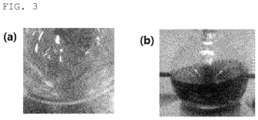
- FIG. 3 which confirms the properties of a product
- FIG. 3(a) is a digital camera photograph of the compound prepared in Example 1 and represented by Formula a
- FIG. 3(b) is a digital camera photograph of the compound prepared in Comparative Example 1 and represented by Formula a
- the properties (color purity) of the compound are improved.
Landscapes
- Chemical & Material Sciences (AREA)
- Organic Chemistry (AREA)
- Organic Low-Molecular-Weight Compounds And Preparation Thereof (AREA)
Abstract
Description
- This application claims the benefit of
Korean Patent Application No. 10-2022-0003553, filed on January 10, 2022 - The present invention relates to a method for preparing a cyclic sulfonic acid ester derivative compound.
- 1,3-propane sultone and 1,4-butane sultone are known as useful compounds as non-aqueous electrolyte additives in lithium secondary batteries. However, 1,3-propane sultone, and 1,4-butane sultone have problems such as toxicity issues, gas generation, and stability, and thus, studies on cyclic sulfonic acid ester derivative compounds that can be used as non-aqueous electrolyte additives are being actively conducted. For example, when a cyclic sulfonic acid ester derivative compound in which a substituent containing a hydroxy group is introduced at the gamma position of 1,3-propane sultone (the position of carbon next to oxygen in a ring structure) or a cyclic sulfonic acid ester derivative compound in which a substituent containing a hydroxy group is introduced at the delta position of 1,4-butane sultone (the position of carbon next to oxygen in a ring structure) is used as a non-aqueous electrolyte additive in a lithium secondary battery, an electrode-electrolyte interface that is stable at high temperatures and has low resistance may be formed to improve the lifespan properties of the lithium secondary battery.
- Meanwhile, the cyclic sulfonic acid ester derivative compound is prepared by, for example, a) a hydrosulfonation reaction and b) a dehydration reaction of 3-butene-1,2-diol. However, it is difficult to purify a sulfonate, which is a hydrosulfonation reaction product of 3-butene-1,2-diol, from an inorganic salt by-product, and there is a problem in that a corrosive gas is generated by SOCl2 used in the dehydration reaction. In addition, the overall yield is as low as less than 50% due to the purification issue in the process a) and the reactivity issue in the process b), and there is a problem in that a product is obtained in a black tar form (a black gum form).
- Therefore, there is a need for research on a method for preparing a cyclic sulfonic acid ester derivative compound that can address the above-described problems.
- An aspect of the present invention is to improve the manufacturing process, yield, product properties, and the like of a cyclic sulfonic acid ester derivative compound.
- According to an aspect of the present invention, there is provided a method for preparing a cyclic sulfonic acid ester derivative compound.
- (1) The present invention provides a method for preparing a cyclic sulfonic acid ester derivative compound, wherein the method includes (A) reacting a compound represented by Formula 1 below and a thioacetic acid to prepare a compound represented by Formula 2 below, and (B) subjecting the compound represented by Formula 2 above to an oxidative cyclization reaction to prepare a compound represented by Formula 3 below.


- m is 0 or 1, and
- R1 to R8 are each independently hydrogen, or a substituted or unsubstituted C1-C10 alkyl group.
- (2) In (1) above, the present invention provides a method for preparing a cyclic sulfonic acid ester derivative compound, wherein the equivalent ratio of the compound represented by Formula 1 above to the thioacetic acid is 1:1 to 1:3.
- (3) In (1) or (2) above, the present invention provides a method for preparing a cyclic sulfonic acid ester derivative compound, wherein the step (A) is performed under an acid catalyst.
- (4) In any one of (1) to (3) above, the present invention provides a method for preparing a cyclic sulfonic acid ester derivative compound, wherein the step (A) is performed in a polar aprotic solvent.
- (5) In (4) above, the present invention provides a method for preparing a cyclic sulfonic acid ester derivative compound, wherein the polar aprotic solvent is one or more of dichloromethane, chloroform, 1,2-dichloroethane, or acetonitrile.
- (6) In any one of (1) to (5) above, the present invention provides a method for preparing a cyclic sulfonic acid ester derivative compound, wherein the step (A) is performed at a temperature of 20°C to 40°C.
- (7) In any one of (1) to (6) above, the present invention provides a method for preparing a cyclic sulfonic acid ester derivative compound, wherein the step (B) is performed under an acid catalyst.
- (8) In any one of (1) to (7) above, the present invention provides a method for preparing a cyclic sulfonic acid ester derivative compound, wherein the step (B) is performed in a polar protic solvent.
- (9) In (8) above, the present invention provides a method for preparing a cyclic sulfonic acid ester derivative compound, wherein the polar protic solvent is one or more of distilled water, methanol, ethanol, propanol, or isopropanol.
- (10) In any one of (1) to (9) above, the present invention provides a method for preparing a cyclic sulfonic acid ester derivative compound, wherein in the step (B), the oxidative cyclization reaction is performed under one or more oxidization agents selected from H2O2, HOCl, NCS, NBS, or KHSO5·0.5KHSO4·0.5K2SO4.
- (11) In any one of (1) to (10) above, the present invention provides a method for preparing a cyclic sulfonic acid ester derivative compound, wherein the step (B) is performed at a temperature of 0°C to 25°C.
- According to the present invention, it is possible to improve a preparation process of cyclic sulfonic acid ester derivative compounds, improve yields, and obtain products with improved properties.
-
-
FIG. 1 is a 1H-NMR spectrum of a product prepared in Example 1. -
FIG. 2 is a 1H-NMR spectrum of a product prepared in Comparative Example 1. -
FIG. 3(a) is a digital camera photograph of a compound represented by Formula a and prepared in Example 1, andFIG. 3(b) is a digital camera photograph of a compound represented by Formula a and prepared in Comparative Example 1. - Hereinafter, the present invention will be described in more detail to facilitate understanding of the present invention. In this case, it will be understood that words or terms used in the specification and claims shall not be interpreted as having the meaning defined in commonly used dictionaries. It will be further understood that the words or terms should be interpreted as having a meaning that is consistent with their meaning in the context of the relevant art and the technical idea of the invention, based on the principle that an inventor may properly define the meaning of the words or terms to best explain the invention.
- The present invention relates to a method for preparing a cyclic sulfonic acid ester derivative compound, wherein the method includes (A) reacting a compound represented by Formula 1 below with a thioacetic acid to prepare a compound represented by Formula 2 below, and
(B) subjecting the compound represented by Formula 2 below to an oxidative cyclization reaction to prepare a compound represented by Formula 3.


- In Formula 1 to Formula 3,
- m is 0 or 1, and
- R1 to R8 are each independently hydrogen, or a substituted or unsubstituted C1-C10 alkyl group.
- In the present invention, a substituent in the substituted alkyl group may be deuterium, a halogen group, a hydroxy group, a -COOR group (wherein R is an unsubstituted C1-C6 alkyl group), a -SO2NR'2 group (wherein R' is hydrogen or an unsubstituted C1-C6 alkyl group), a cyano group, or a straight or branched C1-C6 alkoxyl group.
- In terms of ease of synthesis of Formula 3 above, the R1 to R8 may each independently be hydrogen, or an unsubstituted C1-C6 alkyl group. Specifically, the R1 to R8 may all be hydrogen in terms of each of synthesis and structural stability.
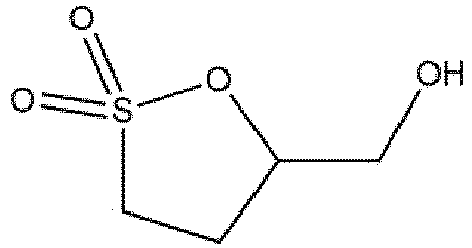
- The compound represented by Formula 3 above may be a compound represented by Formula a or b below.


- Hereinafter, each step of the method for preparing a cyclic sulfonic acid ester derivative compound will be described in detail.
- The step (A) is a step in which a double bond of the compound represented by Formula 1 above and a thioacetic acid react (i.e., a thiol-ene reaction between a terminal alkene and thioacetic acid) to form a thioacetate intermediate.
- According to the present invention, the equivalent ratio of the compound represented by Formula 1 above to the thioacetic acid above may be 1:1 to 1:3, specifically 1:1 to 1:2.5, more specifically 1:1 to 1:2. When the equivalent ratio of the compound represented by Formula 1 above and the thioacetic acid above is within the above range, a conversion rate of 99% or higher (a rate at which the compound represented by Formula 1 is converted to the compound represented by Formula 2) may be achieved without the generation of other identifiable by-products.
- According to the present invention, the step (A) may be performed under an acid catalyst to promote proton transfer on the reaction mechanism. The acid catalyst may be, for example, trifluoroacetic acid (TFA), hydrochloric acid (HCl), sulfuric acid (H2SO4), or the like.
- According to the present invention, the step (A) may be performed in a polar aprotic solvent to facilitate the generation of a radical intermediate in an appropriate amount.
- According to the present invention, the polar aprotic solvent may be one or more of dichloromethane, chloroform, 1,2-dichloroethane, or acetonitrile. In this case, there is an advantage in that the radical intermediate is effectively generated without causing the solvent to participate in the reaction.
- According to the present invention, the step (A) may be performed at a temperature of 20°C to 40°C, specifically at a temperature of 30°C to 40°C. In this case, the reaction speed of the step (A) may be fast, and a thioacetate intermediate (the compound represented by Formula 2) may not be decomposed.
- The step (A) may be performed for 2 hours to 8 hours to maximize the reaction conversion rate while preventing the thioacetate intermediate from decomposing.
- The step (B) is a step in which an oxidization agent is introduced to the compound represented by Formula 2, which is a reaction intermediate, to cause an oxidative cyclization reaction to occur, thereby forming a compound represented by Formula 3.
- According to the present invention, the step (B) may be performed under an acid catalyst to maintain a pH that promotes an oxidation reaction. The acid catalyst in the step (B) may be added in an amount of 3 equivalents or more with respect to 1 equivalent of the compound represented by Formula 2 above. When the acid catalyst in the step (B) is, for example, HCl, the acid catalyst may act as an acid catalyst and also a Cl- source.
- According to the present invention, the step (B) may be performed in a polar protic solvent to secure the solubility of the compound represented by Formula 2 above.
- According to the present invention, the polar protic solvent may be one or more of distilled water, methanol, ethanol, propanol, or isopropanol. In this case, the reaction may proceed in a uniform phase of the compound (a reactant) represented by Formula 2 above, the oxidization agent, and the acid catalyst.
- According to the present invention, in the step (B), the oxidative cyclization reaction may be performed under one or more oxidization agents selected from H2O2, HOCl, NCS, NBS, or KHSO5·0.5KHSO4·0.5K2SO4.
- According to the present invention, the step (B) may be performed at a temperature of 0°C to 25°C, specifically at a temperature of 0°C to 15°C. In this case, an excessive oxidation reaction caused by the oxidization agent may be controlled to ensure reaction safety.
- In order to prevent side reactions (e.g., a decomposition reaction of an oxidization agent itself, etc.) caused by the oxidization agent, the step (B) may be performed while controlling the temperature as follows. Specifically, in the step (B), the temperature is maintained at 0°C to 10°C when introducing the oxidization agent, and after the introduction of the oxidization agent is completed, the oxidative cyclization reaction may be performed at a temperature of 0°C to 25°C.
- The step (B) may be performed for 4 hours to 24 hours to maximize the yield within a range for preventing isomerization of the compound (a product) represented by Formula 3.
- Meanwhile, in the step (B), the oxidization agent is added in excess, and after the reaction is completed, sodium sulfite (Na2SO3) may be introduced in order to quench the remaining oxidization agent. Through the quenching, the risk of explosion of the remaining oxidization agent may be prevented.
- Hereinafter, embodiments of the present invention will be described in detail so that those skilled in the art may easily carry out the present invention. However, the present invention may be embodied in many different forms, and is not limited to the embodiments set forth herein.
-

- 52.8 g (1 equivalent) of 3-butene-1,2-diol, 91.3 g (2 equivalents) of thioacetic acid, 34.2 g (0.5 equivalents) of trifluoroacetic acid (TFA), and 100 ml of dichloromethane were introduced to a round-bottomed flask and reacted while being refluxed for 5 hours. Volatile organic substances were removed by vacuum to obtain 93.9 g (yield: 95.3%) of a thioacetate intermediate (S-(3,4-dihydroxybutyl)-1-yl thioacetate) in the form of a pale yellow liquid.
- 42 g of the thioacetate intermediate and 100 ml of MeOH were introduced to a new round-bottomed flask (hereinafter, a reactor), and then cooled to 0°C. While maintaining the temperature inside the reactor at 0°C, 68 ml of an aqueous solution of HCl having a concentration of 35 mass% was slowly added to the reactor, and then 84 ml of an aqueous solution of H2O2 having a concentration of 30 mass% was slowly added thereto. After the introduction of the H2O2 aqueous solution was completed, the mixture was stirred and reacted at 0°C for 4 hours, and then after the temperature was elevated to 25°C, the mixture was stirred and reacted at 25°C for 4 hours, followed by introducing 15 g of Na2SO3 thereto and the mixture was stirred for an additional 1 hour. A product was extracted with 200 ml of ethyl acetate (an organic layer was separated), and the product was further extracted from an aqueous layer (3 times with 100 ml of ethyl acetate). After collecting the organic layer, moisture was removed with MgSO4 and distilled under reduced pressure to obtain 26.3 g (yield: 76.7) of the compound represented by Formula a in the form of a colorless solution.
-

- 20 g of 3-butene-1,2-diol and 90 ml of deionized (DI) water were added to a round-bottomed flask, and then while the mixture was vigorously stirred at 65°C, a Na2S2O5 aqueous solution (a solution in which 59.4 g of Na2S2O5 was dissolved in 100 ml of deionized water) neutralized with NaOH (20 g) was introduced thereto over 5 minutes. During the stirring, the pH was maintained between 7.3 and 7.6 using a 6M H2SO4 aqueous solution. When 3-butene-1,2-diol was exhausted, the solvent was removed by distillation under reduced pressure. 250 ml of MeOH was introduced to a white solid residue and the mixture was stirred for 2 hours. An insoluble inorganic substance was filtered out, and a solid inorganic salt was washed with 2500 ml of MeOH. A filtrate was distilled under reduced pressure to obtain 42 g (yield: 94%, purity: 55%) of a sulfonate intermediate (3,4-dihydroxybutane-1-sulfonic acid sodium salt) mixed with an inorganic salt.
- 1.9 g of the sulfonate intermediate was dispersed in 10 ml of a chloroform solution, and then 0.08 ml (0.1 equivalents) of DMF was introduced thereto. 1.5 ml (2 equivalents) of SOCl2 was added dropwise at room temperature, and then stirred at 55°C for 8 hours. After the reaction was completed, a reaction solution was cooled to room temperature, filtered to remove a solid by-product, and the filtrate was concentrated by distillation under reduced pressure. 10 ml of methanol and 0.8 ml of a 12M HCl were introduced to the concentrated solution at 0°C, and the mixture was stirred for 2 hours, hydrolyzed, and then distilled under reduced pressure to remove the solvent. An unpurified product was dissolved in dichloromethane (DCM), and 2 g of Celite was introduced thereto and stirred for 30 minutes, and after the celite was filter-treated, a filtrate was concentrated to obtain 0.55 g (yield: 36%) of the compound represented by Formula a in a black gum form.
- After confirming that the thioacetate intermediate or the sulfonate intermediate was exhausted to TLC in Example 1 and Comparative Example 1, respectively, 0.05 ml of the solution in which the reaction was completed was taken and diluted with 0.45 ml of DMSO-d6, followed by obtaining a 1H-NMR spectrum using a nuclear magnetic resonance spectrometer (B500 Bruker Avace Neo, Bruker Co.), which is shown in
FIG. 1 and FIG. 2 , respectively. - Through the 1H-NMR spectrum, it was confirmed that the compound represented by Formula a was prepared in both Example 1 and Comparative Example 1, and in the case of Example 1, it was confirmed that the yield of the compound represented by Formula was 76.7%, which was higher than the yield (36%) in the case of Comparative Example 1.
- From the above, it can be seen that when a cyclic sulfonic acid ester derivative compound is prepared by the preparation method according to the present invention, the yield is improved.
- For reference, the peaks at 2.897 ppm and 2.738 pp in NMR of Comparative Example are the peaks of residual DMF.
- In addition, referring to
FIG. 3 which confirms the properties of a product (FIG. 3(a) is a digital camera photograph of the compound prepared in Example 1 and represented by Formula a, andFIG. 3(b) is a digital camera photograph of the compound prepared in Comparative Example 1 and represented by Formula a), it can be seen that when a cyclic sulfonic acid ester derivative compound is prepared by the preparation method according to the present invention, the properties (color purity) of the compound are improved.
Claims (11)
- A method for preparing a cyclic sulfonic acid ester derivative compound, the method comprising:step (A) reacting a compound represented by Formula 1 below with thioacetic acid to prepare a compound represented by Formula 2 below; andstep (B) subjecting the compound represented by Formula 2 below to an oxidative cyclization reaction to prepare a compound represented by Formula 3 below:


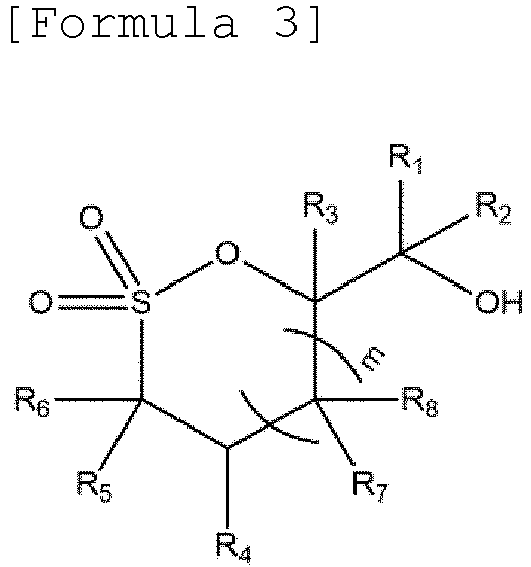 m is 0 or 1, andR1 to R8 are each independently hydrogen, or a substituted or unsubstituted C1-C10 alkyl group.
 - The method of claim 1, wherein an equivalent ratio of the compound represented by Formula 1 to the thioacetic acid is 1:1 to 1:3.
- The method of claim 1, wherein the step (A) is performed under an acid catalyst.
- The method of claim 1, wherein the step (A) is performed in a polar aprotic solvent.
- The method of claim 4, wherein the polar aprotic solvent is one or more of dichloromethane, chloroform, 1,2-dichloroethane, or acetonitrile.
- The method of claim 1, wherein the step (A) is performed at a temperature of 20°C to 40°C.
- The method of claim 1, wherein the step (B) is performed under an acid catalyst.
- The method of claim 1, wherein the step (B) is performed in a polar protic solvent.
- The method of claim 8, wherein the polar protic solvent is one or more of distilled water, methanol, ethanol, propanol, or isopropanol.
- The method of claim 1, wherein in the step (B), the oxidative cyclization reaction is performed under one or more oxidization agents selected from H2O2, HOCl, NCS, NBS, or KHSO5·0.5KHSO4·0.5K2SO4.
- The method of claim 1, wherein the step (B) is performed at a temperature of 0°C to 25°C.
Applications Claiming Priority (2)
| Application Number | Priority Date | Filing Date | Title |
|---|---|---|---|
| KR1020220003553A KR102940072B1 (en) | 2022-01-10 | 2022-01-10 | Manufacturing method of cyclic sulfonic acid ester derivative compound |
| PCT/KR2023/000350 WO2023132713A1 (en) | 2022-01-10 | 2023-01-09 | Method for preparing cyclic sulfonic acid ester derivative compound |
Publications (3)
| Publication Number | Publication Date |
|---|---|
| EP4342887A1 true EP4342887A1 (en) | 2024-03-27 |
| EP4342887A4 EP4342887A4 (en) | 2024-11-20 |
| EP4342887B1 EP4342887B1 (en) | 2025-12-31 |
Family
ID=87074051
Family Applications (1)
| Application Number | Title | Priority Date | Filing Date |
|---|---|---|---|
| EP23737461.6A Active EP4342887B1 (en) | 2022-01-10 | 2023-01-09 | METHOD FOR THE PREPARATION OF A CYCLICAL SULFONIC ACID ESTER DERIVATIVE COMPOUND |
Country Status (6)
| Country | Link |
|---|---|
| US (1) | US20240300915A1 (en) |
| EP (1) | EP4342887B1 (en) |
| JP (1) | JP7722781B2 (en) |
| KR (1) | KR102940072B1 (en) |
| CN (1) | CN117561243A (en) |
| WO (1) | WO2023132713A1 (en) |
Family Cites Families (10)
| Publication number | Priority date | Publication date | Assignee | Title |
|---|---|---|---|---|
| KR100977626B1 (en) * | 2008-01-09 | 2010-08-23 | 동부정밀화학 주식회사 | Method for producing 1,3-prop-1-ene sultone |
| EP2463281B1 (en) * | 2009-08-04 | 2014-10-22 | Wako Pure Chemical Industries, Ltd. | Method for producing cyclic sulfonic acid ester and intermediate thereof |
| ES2425294B1 (en) * | 2012-03-09 | 2014-09-02 | Consejo Superior De Investigaciones Científicas (Csic) | Compounds derived from sulforaphane, method of obtaining and its medical, food and cosmetic use |
| JP6261947B2 (en) | 2012-11-15 | 2018-01-17 | 住友化学株式会社 | Resist composition and method for producing resist pattern |
| KR101777474B1 (en) * | 2015-12-07 | 2017-09-11 | 에스티팜 주식회사 | A method for preparing 1,3-prop-1-ene sultone |
| JP7139330B2 (en) * | 2016-12-01 | 2022-09-20 | プロメガ コーポレイション | Cell-impermeable coelenterazine analog |
| US11061326B2 (en) * | 2017-09-29 | 2021-07-13 | Tokyo Ohka Kogyo Co., Ltd. | Chemical amplification type positive photosensitive resin composition, a photosensitive dry film, a method for producing a photosensitive dry film, a method for producing a patterned resist film, a method of manufacturing a template with a substrate, and a method of manufacturing a plated shaped product, and a Mercapto compound |
| KR102779079B1 (en) * | 2020-02-28 | 2025-03-11 | 주식회사 엘지에너지솔루션 | Additives for non-aqueous electrolyte, non-aqueous electrolyte and lithium secondary battery comprsing the same |
| KR102911940B1 (en) * | 2020-05-22 | 2026-01-13 | 주식회사 엘지에너지솔루션 | Additives for non-aqueous electrolyte, non-aqueous electrolyte and lithium secondary battery comprsing the same |
| KR102894237B1 (en) * | 2021-03-25 | 2025-12-03 | 주식회사 엘지화학 | Compounds, non-aqueous electrolyte comprising thereof and lithium secondary battery comprising the same |
-
2022
- 2022-01-10 KR KR1020220003553A patent/KR102940072B1/en active Active
-
2023
- 2023-01-09 US US18/574,536 patent/US20240300915A1/en active Pending
- 2023-01-09 WO PCT/KR2023/000350 patent/WO2023132713A1/en not_active Ceased
- 2023-01-09 EP EP23737461.6A patent/EP4342887B1/en active Active
- 2023-01-09 CN CN202380012466.0A patent/CN117561243A/en active Pending
- 2023-01-09 JP JP2024515492A patent/JP7722781B2/en active Active
Also Published As
| Publication number | Publication date |
|---|---|
| KR20230108133A (en) | 2023-07-18 |
| KR102940072B1 (en) | 2026-03-17 |
| EP4342887B1 (en) | 2025-12-31 |
| JP2024533405A (en) | 2024-09-12 |
| EP4342887A4 (en) | 2024-11-20 |
| US20240300915A1 (en) | 2024-09-12 |
| CN117561243A (en) | 2024-02-13 |
| JP7722781B2 (en) | 2025-08-13 |
| WO2023132713A1 (en) | 2023-07-13 |
Similar Documents
| Publication | Publication Date | Title |
|---|---|---|
| KR20090061023A (en) | Method for producing sulfonic acid ester | |
| CN111116429B (en) | Method for synthesizing alkali metal trifluoromethanesulfonate or alkali metal methanesulfonate | |
| JP2010159242A (en) | Fluorine-containing n-alkylsulfonylimide compound and method for producing the same, and method for producing ionic compound | |
| US12215091B2 (en) | Method for producing methylene disulfonate compound | |
| EP4342887B1 (en) | METHOD FOR THE PREPARATION OF A CYCLICAL SULFONIC ACID ESTER DERIVATIVE COMPOUND | |
| CN115285951B (en) | Preparation method and application of bis (fluorosulfonyl) imide salt electrolyte | |
| KR101687374B1 (en) | Method for producing difluorosulfonyl imide or its salt | |
| JP6190876B2 (en) | Bicyclic aromatic anion salts for LI ion batteries | |
| KR20190118525A (en) | Method for preparing lithium bis(fluorosulfonyl) imide | |
| KR101673535B1 (en) | Method for producing trifluoromethanesulfonyl imide or its salt | |
| KR100977626B1 (en) | Method for producing 1,3-prop-1-ene sultone | |
| CN115784945B (en) | Preparation method of diperoxy alkyl sulfonyl imide salt | |
| KR101529507B1 (en) | Di(aminoguanidium) 4,4',5,5'-tetranitro-2,2'-biimidazole, and preparation method thereof | |
| Padilla et al. | Ion radicals. 39. Reactions of 10-methyl-and 10-phenylphenothiazine cation radical perchlorates with ketones | |
| CN114853645B (en) | A preparation process of sodium polydisulfide dipropane sulfonate | |
| KR20230108134A (en) | Manufacturing method of cyclic sulfonic acid ester derivative compound | |
| PL122665B1 (en) | Process for preparing novel dienones of narvedine type and their derivatives | |
| KR860001995B1 (en) | Method for preparing urea derivatives from thiourea derivatives | |
| JP7722779B2 (en) | Compounds and methods for producing the same | |
| Nenajdenko et al. | A novel method for the oxidation of thiophenes. Synthesis of thiophene 1, 1-dioxides containing electron-withdrawing substituents | |
| CN110911749B (en) | High-voltage lithium ion battery electrolyte, additive and preparation method of additive | |
| US12595174B2 (en) | Method for producing the pentazolate anion using a hypervalent iodine oxidant | |
| US4294970A (en) | Oxidation of alpha-alkylated, benzyl-substituted 2-thiopyridine 1-oxides | |
| CN121248656A (en) | Cyclic carbonate silicate compound, preparation method and application | |
| CN119143642A (en) | Polydithio-dipropyl sulfonate and preparation method thereof |
Legal Events
| Date | Code | Title | Description |
|---|---|---|---|
| STAA | Information on the status of an ep patent application or granted ep patent |
Free format text: STATUS: THE INTERNATIONAL PUBLICATION HAS BEEN MADE |
|
| PUAI | Public reference made under article 153(3) epc to a published international application that has entered the european phase |
Free format text: ORIGINAL CODE: 0009012 |
|
| STAA | Information on the status of an ep patent application or granted ep patent |
Free format text: STATUS: REQUEST FOR EXAMINATION WAS MADE |
|
| 17P | Request for examination filed |
Effective date: 20231219 |
|
| AK | Designated contracting states |
Kind code of ref document: A1 Designated state(s): AL AT BE BG CH CY CZ DE DK EE ES FI FR GB GR HR HU IE IS IT LI LT LU LV MC ME MK MT NL NO PL PT RO RS SE SI SK SM TR |
|
| A4 | Supplementary search report drawn up and despatched |
Effective date: 20241022 |
|
| RIC1 | Information provided on ipc code assigned before grant |
Ipc: C07D 327/06 20060101ALI20241016BHEP Ipc: C07D 327/04 20060101AFI20241016BHEP |
|
| DAV | Request for validation of the european patent (deleted) | ||
| DAX | Request for extension of the european patent (deleted) | ||
| GRAP | Despatch of communication of intention to grant a patent |
Free format text: ORIGINAL CODE: EPIDOSNIGR1 |
|
| STAA | Information on the status of an ep patent application or granted ep patent |
Free format text: STATUS: GRANT OF PATENT IS INTENDED |
|
| INTG | Intention to grant announced |
Effective date: 20251007 |
|
| GRAS | Grant fee paid |
Free format text: ORIGINAL CODE: EPIDOSNIGR3 |
|
| GRAA | (expected) grant |
Free format text: ORIGINAL CODE: 0009210 |
|
| STAA | Information on the status of an ep patent application or granted ep patent |
Free format text: STATUS: THE PATENT HAS BEEN GRANTED |
|
| AK | Designated contracting states |
Kind code of ref document: B1 Designated state(s): AL AT BE BG CH CY CZ DE DK EE ES FI FR GB GR HR HU IE IS IT LI LT LU LV MC ME MK MT NL NO PL PT RO RS SE SI SK SM TR |
|
| REG | Reference to a national code |
Ref country code: CH Ref legal event code: F10 Free format text: ST27 STATUS EVENT CODE: U-0-0-F10-F00 (AS PROVIDED BY THE NATIONAL OFFICE) Effective date: 20251231 Ref country code: GB Ref legal event code: FG4D |
|
| REG | Reference to a national code |
Ref country code: DE Ref legal event code: R096 Ref document number: 602023010509 Country of ref document: DE |
|
| REG | Reference to a national code |
Ref country code: IE Ref legal event code: FG4D |
|
| REG | Reference to a national code |
Ref country code: LT Ref legal event code: MG9D |
|
| PG25 | Lapsed in a contracting state [announced via postgrant information from national office to epo] |
Ref country code: NO Free format text: LAPSE BECAUSE OF FAILURE TO SUBMIT A TRANSLATION OF THE DESCRIPTION OR TO PAY THE FEE WITHIN THE PRESCRIBED TIME-LIMIT Effective date: 20260331 |
|
| PGFP | Annual fee paid to national office [announced via postgrant information from national office to epo] |
Ref country code: DE Payment date: 20260120 Year of fee payment: 4 |
|
| PG25 | Lapsed in a contracting state [announced via postgrant information from national office to epo] |
Ref country code: FI Free format text: LAPSE BECAUSE OF FAILURE TO SUBMIT A TRANSLATION OF THE DESCRIPTION OR TO PAY THE FEE WITHIN THE PRESCRIBED TIME-LIMIT Effective date: 20251231 Ref country code: HR Free format text: LAPSE BECAUSE OF FAILURE TO SUBMIT A TRANSLATION OF THE DESCRIPTION OR TO PAY THE FEE WITHIN THE PRESCRIBED TIME-LIMIT Effective date: 20251231 |
|
| PGFP | Annual fee paid to national office [announced via postgrant information from national office to epo] |
Ref country code: AT Payment date: 20260301 Year of fee payment: 4 |
|
| PG25 | Lapsed in a contracting state [announced via postgrant information from national office to epo] |
Ref country code: RS Free format text: LAPSE BECAUSE OF FAILURE TO SUBMIT A TRANSLATION OF THE DESCRIPTION OR TO PAY THE FEE WITHIN THE PRESCRIBED TIME-LIMIT Effective date: 20260331 |
|
| PG25 | Lapsed in a contracting state [announced via postgrant information from national office to epo] |
Ref country code: LV Free format text: LAPSE BECAUSE OF FAILURE TO SUBMIT A TRANSLATION OF THE DESCRIPTION OR TO PAY THE FEE WITHIN THE PRESCRIBED TIME-LIMIT Effective date: 20251231 |
|
| PG25 | Lapsed in a contracting state [announced via postgrant information from national office to epo] |
Ref country code: BG Free format text: LAPSE BECAUSE OF FAILURE TO SUBMIT A TRANSLATION OF THE DESCRIPTION OR TO PAY THE FEE WITHIN THE PRESCRIBED TIME-LIMIT Effective date: 20251231 |
|
| REG | Reference to a national code |
Ref country code: NL Ref legal event code: MP Effective date: 20251231 |