EP4339740A1 - Controller, control method, and wearable tracking system - Google Patents
Controller, control method, and wearable tracking system Download PDFInfo
- Publication number
- EP4339740A1 EP4339740A1 EP22196636.9A EP22196636A EP4339740A1 EP 4339740 A1 EP4339740 A1 EP 4339740A1 EP 22196636 A EP22196636 A EP 22196636A EP 4339740 A1 EP4339740 A1 EP 4339740A1
- Authority
- EP
- European Patent Office
- Prior art keywords
- camera
- data
- sensor
- user
- wearing part
- Prior art date
- Legal status (The legal status is an assumption and is not a legal conclusion. Google has not performed a legal analysis and makes no representation as to the accuracy of the status listed.)
- Pending
Links
Images


Classifications
-
- G—PHYSICS
- G06—COMPUTING OR CALCULATING; COUNTING
- G06T—IMAGE DATA PROCESSING OR GENERATION, IN GENERAL
- G06T7/00—Image analysis
- G06T7/70—Determining position or orientation of objects or cameras
-
- G—PHYSICS
- G06—COMPUTING OR CALCULATING; COUNTING
- G06F—ELECTRIC DIGITAL DATA PROCESSING
- G06F3/00—Input arrangements for transferring data to be processed into a form capable of being handled by the computer; Output arrangements for transferring data from processing unit to output unit, e.g. interface arrangements
- G06F3/01—Input arrangements or combined input and output arrangements for interaction between user and computer
- G06F3/011—Arrangements for interaction with the human body, e.g. for user immersion in virtual reality
- G06F3/014—Hand-worn input/output arrangements, e.g. data gloves
-
- G—PHYSICS
- G06—COMPUTING OR CALCULATING; COUNTING
- G06F—ELECTRIC DIGITAL DATA PROCESSING
- G06F3/00—Input arrangements for transferring data to be processed into a form capable of being handled by the computer; Output arrangements for transferring data from processing unit to output unit, e.g. interface arrangements
- G06F3/01—Input arrangements or combined input and output arrangements for interaction between user and computer
- G06F3/011—Arrangements for interaction with the human body, e.g. for user immersion in virtual reality
-
- G—PHYSICS
- G01—MEASURING; TESTING
- G01C—MEASURING DISTANCES, LEVELS OR BEARINGS; SURVEYING; NAVIGATION; GYROSCOPIC INSTRUMENTS; PHOTOGRAMMETRY OR VIDEOGRAMMETRY
- G01C21/00—Navigation; Navigational instruments not provided for in groups G01C1/00 - G01C19/00
- G01C21/10—Navigation; Navigational instruments not provided for in groups G01C1/00 - G01C19/00 by using measurements of speed or acceleration
- G01C21/12—Navigation; Navigational instruments not provided for in groups G01C1/00 - G01C19/00 by using measurements of speed or acceleration executed aboard the object being navigated; Dead reckoning
- G01C21/16—Navigation; Navigational instruments not provided for in groups G01C1/00 - G01C19/00 by using measurements of speed or acceleration executed aboard the object being navigated; Dead reckoning by integrating acceleration or speed, i.e. inertial navigation
- G01C21/165—Navigation; Navigational instruments not provided for in groups G01C1/00 - G01C19/00 by using measurements of speed or acceleration executed aboard the object being navigated; Dead reckoning by integrating acceleration or speed, i.e. inertial navigation combined with non-inertial navigation instruments
- G01C21/1656—Navigation; Navigational instruments not provided for in groups G01C1/00 - G01C19/00 by using measurements of speed or acceleration executed aboard the object being navigated; Dead reckoning by integrating acceleration or speed, i.e. inertial navigation combined with non-inertial navigation instruments with passive imaging devices, e.g. cameras
-
- G—PHYSICS
- G06—COMPUTING OR CALCULATING; COUNTING
- G06F—ELECTRIC DIGITAL DATA PROCESSING
- G06F3/00—Input arrangements for transferring data to be processed into a form capable of being handled by the computer; Output arrangements for transferring data from processing unit to output unit, e.g. interface arrangements
- G06F3/01—Input arrangements or combined input and output arrangements for interaction between user and computer
- G06F3/017—Gesture based interaction, e.g. based on a set of recognized hand gestures
-
- G—PHYSICS
- G06—COMPUTING OR CALCULATING; COUNTING
- G06T—IMAGE DATA PROCESSING OR GENERATION, IN GENERAL
- G06T7/00—Image analysis
- G06T7/20—Analysis of motion
- G06T7/277—Analysis of motion involving stochastic approaches, e.g. using Kalman filters
-
- G—PHYSICS
- G06—COMPUTING OR CALCULATING; COUNTING
- G06T—IMAGE DATA PROCESSING OR GENERATION, IN GENERAL
- G06T2207/00—Indexing scheme for image analysis or image enhancement
- G06T2207/20—Special algorithmic details
- G06T2207/20212—Image combination
- G06T2207/20221—Image fusion; Image merging
-
- G—PHYSICS
- G06—COMPUTING OR CALCULATING; COUNTING
- G06T—IMAGE DATA PROCESSING OR GENERATION, IN GENERAL
- G06T2207/00—Indexing scheme for image analysis or image enhancement
- G06T2207/30—Subject of image; Context of image processing
- G06T2207/30196—Human being; Person
Definitions
- the disclosure relates to a controller; particularly, the disclosure relates to a controller, a control method, and a wearable tracking system.
- AR augmented reality
- VR virtual reality
- the disclosure is direct to a controller, a control method, and a wearable tracking system, so as to improve tracking the position of a wearable device.
- a controller is provided.
- the controller is adapted to determine a position conversion relationship between a predetermined position of a body part of a user and a tracking position of a wearing part of the user.
- the wearing part is where a wearable device is disposed on the user.
- the controller is configured to: obtain a camera data of a previous moment from a camera, wherein the camera data includes an image of the wearable device; obtain a sensor data of the previous moment from a sensor of the wearable device; determine the position conversion relationship based on the camera data of the previous moment and the sensor data of the previous moment; and output a fusion data of the wearing part of a current moment based on the position conversion relationship.
- a control method for a wearable device includes: obtaining a camera data of a previous moment from a camera, wherein the camera data includes an image of the wearable device; obtaining a sensor data of the previous moment from a sensor of the wearable device; determining a position conversion relationship based on the camera data of the previous moment and the sensor data of the previous moment, wherein the position conversion relationship indicates a relationship between a predetermined position of a body part of a user and a tracking position of a wearing part of the user and the wearing part is where the wearable device is disposed on the user; and outputting a fusion data of the wearing part of a current moment based on the position conversion relationship.
- a wearable tracking system includes a camera, a wearable device, and a controller.
- the camera is configured to obtain a camera data of a previous moment, wherein the camera data includes an image of the wearable device.
- the wearable device includes a sensor.
- the sensor is configured to obtain a sensor data of a previous moment.
- the controller is configured to: determine a position conversion relationship based on the camera data of the previous moment and the sensor data of the previous moment, wherein the position conversion relationship indicates a relationship between a predetermined position of a body part of a user and a tracking position of a wearing part of the user and the wearing part is where the wearable device is disposed on the user; and output a fusion data of the wearing part of a current moment based on the position conversion relationship.
- the controller, the control method, and the wearable tracking system of the disclosure since the position conversion relationship is determined, the fusion data based on the reflects the user's operation more precisely and thereby improving the user experience.
- Coupled may refer to any direct or indirect connection means.
- first device may be directly connected to the second device, or the first device may be indirectly connected through other devices or certain connection means to be connected to the second device.
- first, second, and similar terms mentioned throughout the whole specification of the present application are merely used to name discrete elements or to differentiate among different embodiments or ranges. Therefore, the terms should not be regarded as limiting an upper limit or a lower limit of the quantity of the elements and should not be used to limit the arrangement sequence of elements.
- AR augmented reality
- VR virtual reality
- some of the devices require the user to hold a control device on the hand to perform operations, which is not so intuitive.
- some of the devices use a camera to capture the user's behavior, which require the user to stay in the field of view (FOV) of the camera. Otherwise, when the user stays in the blind spot of the camera, the device will lose the tracking of the user. Therefore, how to make the user more easy and intuitive to interact with the virtual elements has been a goal that the people skilled in the art want to improve.
- FOV field of view
- FIG. 1 is a schematic diagram of a wearable tracking system according to an embodiment of the disclosure.
- a wearable tracking system 100 includes a controller 110, a camera 120, and a sensor 130.
- the sensor 130 is included in a wearable device WD configured to disposed on a wearing part of a user.
- the wearing part may be at least one limb of the user.
- the wearing part may be at least one finger of the user, and this disclosure is not limited thereto.
- the controller 110 includes, for example, a microcontroller unit (MCU), a central processing unit (CPU), a microprocessor, a digital signal processor (DSP), a programmable controller, a programmable logic device (PLD), other similar devices, or a combination of these devices.
- MCU microcontroller unit
- CPU central processing unit
- DSP digital signal processor
- PLD programmable logic device
- each of functions of the controller 110 may be achieved as multiple program codes.
- the program codes are stored in a memory, and executed by the controller 110.
- each of the functions of the controller 110 may be achieved as one or more circuits.
- the disclosure does not limit the use of software or hardware to achieve the functions of the controller 110.
- the controller 110 may be disposed on a wearable head-mounted display (HMD), wearable glasses (e.g., AR/VR goggles), an electronic device, other similar devices, or a combination of these devices.
- HMD wearable head-mounted display
- wearable glasses e.g., AR/VR goggles
- an electronic device other similar devices, or a combination of these devices.
- the disclosure is not limited thereto.
- the camera 120 includes, for example, a complementary metal oxide semiconductor (CMOS) camera or a charge coupled device (CCD) camera, and the auxiliary light unit comprises an infrared irradiation unit.
- CMOS complementary metal oxide semiconductor
- CCD charge coupled device
- the camera 120 may be disposed on a wearable head-mounted display (HMD), wearable glasses (e.g., AR/VR goggles), an electronic device, other similar devices, or a combination of these devices. This disclosure is not limited thereto.
- the sensor 130 includes, for example, an inertial measurement unit (IMU), an accelerometer, a gyroscope, other similar devices, or a combination of these devices.
- IMU inertial measurement unit
- the sensor data SD includes an inertial measurement value of the wearing part of the wearable device WD.
- the inertial measurement value includes changes in six degrees of freedom (DOF) and the six degrees of freedom comprises three translation values corresponding to three perpendicular axes and three rotation values corresponding to the three perpendicular axes.
- DOF degrees of freedom
- the inertial measurement value includes three linear accelerations and three angular accelerations.
- this disclosure is not limited thereto.
- the wearable device WD includes, for example, a ring device, a wristband device, a bracelet device, an anklet device, a belt device, other similar devices, or a combination of these devices. This disclosure is not limited thereto.
- the controller 110 is configured to communicate with the camera 120 and the sensor 130 through either wired communication or wireless communication. That is, the controller 110 is operatively coupled to the camera 120 and the sensor 130. In one embodiment, the controller 110, camera 120, and the sensor 130 may be disposed on separate device. However, in one embodiment, the controller 110 may be integrated with the camera 120 or the sensor 130. That is, this disclosure does not limit the controller is separate from or integrated with the camera 120 and/or the sensor 130.
- the controller 110 is adapted to determine a position conversion relationship between a predetermined position of a body part of the user and a tracking position of the wearing part of the user. That is, the controller 110 is configured to convert the predetermined position to the tracking position or to convert the tracking position to the predetermined position based on the position conversion relationship.
- the position conversion relationship indicates a relationship between a predetermined position of a body part of a user and a tracking position of a wearing part of the user.
- the camera 120 is configured to obtain the camera data CD of a previous moment (e.g., time T-1).
- the camera data CD may include an image of the wearable device WD.
- the sensor 130 is configured to obtain the sensor data SD of the previous moment.
- the controller 110 is configured to obtain the camera data CD of the previous moment and the sensor data SD of the previous moment. Based on the camera data CD and the sensor data SD, the controller 110 is configured to determine the position conversion relationship based on the camera data CD of the previous moment and the sensor data SD of the previous moment. Further, the controller 110 is configured to output the fusion data FD of the wearing part of a current moment (e.g., time T) based on the position conversion relationship.
- the controller 110 is able to determine the user's operation (behavior) based on not only the camera data CD of the camera 120, but also the sensor data SD of the sensor 130. That is, while the user stays in the blind spot of the camera 120, the controller 110 is still able to determine the user's operation based the fusion data FD.
- a camera frequency of the camera data CD may be slower than a sensor frequency of the sensor data.
- the camera frequency is 30 frame per second (FPS) and the sensor frequency is 500fps, but this disclosure is not limited thereto. Since the sensor frequency is higher than the camera frequency, the fusion data may have a fusion frequency higher than the camera frequency. Therefore, the frequency of the fusion frequency may be improved and the size of wearable device WD may be reduced, thereby improving the convenience and comfort of wearing the wearable device WD.
- FIG. 2 is a schematic diagram of a wearable device disposed on a wearing part of a user according to an embodiment of the disclosure.
- a scenario 200 of FIG. 2 shows that a wearable device may be disposed on different knuckles or difference fingers of the user. Due to the length of the fingers of different users are different from each other, the position conversion relationships from the predetermined position of the body part (e.g., the wrist) to the tracking position of the wearing part of the wearable device WD vary from person to person. In other words, while different users are request to perform a same operation (e.g., certain movement), the variation in displacement or angle may vary from person to person.
- the variation in displacement or angle still varies while the wearable device WD is disposed on different body parts.
- the user may wear the wearable device WD on at least one of knuckle F1-1, knuckle F2-1, knuckle F2-2, knuckle F3-2, knuckle F4-3, and knuckle 5-3 of different fingers, thereby changing the detected data of the camera 120 or sensor 130.
- the wearing part of the user is not a rigid body, a sliding of the wearable device WD may happen when the user performs operation. While the sliding of the wearable device WD happens, the detected data of the camera 120 or sensor 130 also changes.
- the wearing part of the wearable device WD it is necessary to determine where the wearing part of the wearable device WD. Once the wearing part of the wearable device WD is determined, the result would be the same while different users perform a same operation and thereby improving the user experience.
- FIG. 3 is a schematic diagram of a wearable device disposed on a wearing part of a user according to an embodiment of the disclosure.
- a scenario 300 of FIG. 3 shows that the wearing part of the wearable device WD may be determined by analyzing each body part of the user respectively.
- each body part of the user may be analyzed based on the camera data CD of the camera 120.
- each body part of the user may be analyzed based on the sensor data SD of the sensor 130.
- each body part of the user may be analyzed based on the camera data CD of the camera and the sensor data SD of the sensor 130. That is, this disclosure does not limit how the location of the wearing part is determined.
- each body part of the user may be analyzed based on the camera data CD of the sensor 120.
- a plurality of camera images C1-2, C2-3, C4-3, C5-1 may be obtained by the camera 120.
- the controller 110 is configured to analyze the plurality of camera images C1-2, C2-3, C4-3, C5-1 based on image recognition technology to determine where the wearable device WD is disposed on. Further, the controller 110 is configured to analyze the plurality of camera images C1-2, C2-3, C4-3, C5-1 based on image recognition technology to determine whether a sliding of the wearable device SD happens or not.
- the controller 110 is configured to determine a camera-identified position of the wearing part (of the previous moment) as the tracking position. In other words, the controller determines that the wearable device is disposed on the third knuckle of the index finger. Based on the tracking position (i.e., camera-identified position) and the predetermined position (e.g., wrist), the controller 110 is further configured to determine the position conversion relationship to output the fusion data FD which indicating (reflecting / corresponding to) the user's operation.
- the controller 110 is configured to notify the user to perform a certain (predetermined) posture (e.g., making a gesture of "five" with the hand).
- the camera 120 is configured to obtain a posture image of the user with the predetermined posture and the camera data CD includes the posture image.
- the controller 110 is configured to determine the camera-identified position of the wearing part (of the previous moment) as the tracking position based on the posture image. Further, the controller is configured to determine the position conversion relationship based on the predetermined position and the tracking position. That is, the controller 110 may be configured to notify the user to perform a predetermined posture before determining the location of the wearing part of the wearable device WD to increase the efficiency of identification.
- the controller 110 may be configured to determine the location of the wearing part of the wearable device without notifying the user to perform a certain posture. This disclosure is not limited thereto.
- the controller 110 is configured to notify the user to perform a sequence of predetermined posture sequence (e.g., making the gestures of "one" to "five” with the hand).
- the camera 120 is configured to obtain a plurality of posture sequence images of the user performing the predetermined posture sequence. Based on the plurality of posture sequence images, the controller 110 is configured to determine the tracking position and then to determine the position conversion relationship to output the fusion data FD which indicating (reflecting / corresponding to) the user's operation.
- the controller 110 may be configured to determine a sensor-identified position of the wearing part (of the previous moment) as the tracking position based on the sensor data SD. Also, the controller 110 may be configured to notify the user to perform a predetermined posture before determining the tracking position based on the sensor data SD to increase the efficiency of identification.
- the sensor data may include a posture parameter of the user with a predetermined posture.
- the posture parameter may include the inertial measurement value of the wearing part of the wearable device WD while the user is with the predetermined posture.
- the controller 110 may be configured to determine a camera-identified position of the wearing part (of the previous moment) based on the camera data CD and a sensor-identified position of the wearing part (of the previous moment) based on the sensor data SD at the same time. Further, the controller 110 is configured to determine the tracking position of the wearing part based on the camera-identified position of the camera data CD and the sensor-identified position of the sensor data SD. In one embodiment, the tracking position is determined by obtaining a fusion position (of the previous moment) by fusing the camera data CD and the sensor data SD based on a Kalman filter. Furthermore, the controller 110 is configured to determine the position conversion relationship based on the predetermined position and the tracking position and then to obtain the fusion data of the current moment which indicating (reflecting / corresponding to) the user's operation based on the position conversion relationship.
- the controller 110 may be configured to notify the user to perform a predetermined posture or a sequence of predetermined posture sequence before determining the tracking position based on the camera data CD and the sensor data SD to increase the efficiency of identification.
- the specific processes thereof can be seen with reference to the aforementioned embodiments of determining the tracking position, while the details are not redundantly described seriatim herein.
- the fusion data FD would reflect the user's operation more precisely and thereby improving the user experience.
- FIG. 4 is a schematic flowchart of a control method according to an embodiment of the disclosure.
- the control method 400 includes step S410, step S420, step S430, step S440, step S450, and step S460.
- the camera data CD is obtained by the camera 120.
- the pose of the user is identified by the controller 110 based on the camera data CD and the user pose is obtain for the next step S430.
- the controller 110 is configured to determine whether the tracking position is initialized or not. That is, the controller 110 determines that whether there is an initial position of the location of the wearable device WD or not.
- the controller 110 is further determine the tracking position of the wearable device WD based on the camera data CD and the user pose. In other words, the controller 110 locates where the wearable device WD is based on the camera data CD and the user pose.
- the tracking position is determined as the initial data (or initial position) and is the initial data is further outputted.
- the sensor data SD is obtained by the sensor 130.
- the controller 110 is further configured to fine-tune the tracking position by fusing the camera data CD and the sensor data SD based on a Kalman filter.
- the fusion data FD is then obtained by the controller 110 based on the fine-tuned tracking position and the position conversion relationship. Therefore, the fusion data FD would reflect the user's operation more precisely and thereby improving the user experience.
- FIG. 5A is a schematic diagram of a tracking the user according to an embodiment of the disclosure.
- a scenario 500A of FIG. 5A shows that tracking the hand of the user based on the camera 120.
- the hand of the user may perform an operation. Specifically, from the one moment before the previous moment (e.g., time T-2) to the previous moment (e.g., time T-1), the hand of the user moves from a first position to a second position. Then, from the previous moment (e.g., time T-1) to the current (time T), the hand of the user moves form the second position to a third position.
- the controller 110 may be configured to obtain the third position by extrapolating based on the first position and the second position.
- the controller is configured to determine a camera-predicted position as a predicted position 501A of the current moment by an extrapolation based on the camera data CD of the two previous consecutive moments (e.g., time T-2 and time T-1). It is noted that, in the condition that the hand of the user moves along a same direction, the predicted position 501A may be accurate. However, in the condition that the hand of the user does not move along a same direction, the predicted position 501A may not be accurate.
- FIG. 5B is a schematic diagram of a tracking the user according to an embodiment of the disclosure.
- a scenario 500B of FIG. 5B shows that tracking the hand of the user based on the camera 120 and the sensor 130.
- the wearable device WD is disposed on the wearing part of the user and the sensor 130 is included in the wearable device WD.
- the camera data CD of the previous moment is obtained by the camera 120 and the sensor data SD of the previous moment is obtained by the sensor 130.
- the controller is configured to determine a camera-predicted position of the current moment by an extrapolation.
- the sensor data SD may include an acceleration value or a displacement value of the hand of the user of the previous moment.
- the controller 110 is configured to determine a sensor-predicted position of the wearing part of the current moment. Further, the controller 110 is configured to obtain a fusion-predicted position of the current moment as a predicted position 501B by fusing the camera-predicted position and the sensor-predicted position based on a Kalman filter. For example, when the hand of the user tends to stop from a moving or tends to change a direction of a movement, a deceleration (negative acceleration value) may be detected in the sensor data SD.
- the controller 110 is configured to obtain a fusion-predicted position as the predicted position 501B, which is more acute than the predicted position 501A based on only the camera data. Furthermore, the controller is configured to obtain the fusion data of the current moment based on the fusion-predicted position and the position conversion relationship. Therefore, since the position conversion relationship is determined based on not only the camera data CD but also the sensor data, the fusion data FD would reflect the user's operation more precisely and thereby improving the user experience.
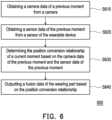
- FIG. 6 is a schematic flowchart of a control method according to an embodiment of the disclosure.
- the control method 600 includes step S610. step 620, step 630 and step 640.
- the camera data CD of a previous moment is obtained from the camera 120.
- the sensor data SD of the previous moment is obtained from the sensor 130.
- a position conversion relationship of a current moment is determined based on the camera data CD of the previous moment and the sensor data SD of the previous moment.
- the fusion data FD of the wearing part is outputted based on the position conversion relationship. In this manner, the fusion data FD would reflect the user's operation more precisely and thereby improving the user experience.
- the controller, the control method, and the wearable tracking system of the disclosure since the tracking position of the wearing part where the wearable device is disposed is determined, the fusion data reflects the user's operation more precisely and thereby improving the user experience. Further, the size of wearable device may be reduced, thereby improving the convenience and comfort of wearing the wearable device.
Landscapes
- Engineering & Computer Science (AREA)
- Theoretical Computer Science (AREA)
- General Engineering & Computer Science (AREA)
- Physics & Mathematics (AREA)
- General Physics & Mathematics (AREA)
- Radar, Positioning & Navigation (AREA)
- Remote Sensing (AREA)
- Human Computer Interaction (AREA)
- Computer Vision & Pattern Recognition (AREA)
- Automation & Control Theory (AREA)
- Multimedia (AREA)
- User Interface Of Digital Computer (AREA)
- Closed-Circuit Television Systems (AREA)
Abstract
A controller is provided. The controller is adapted to determine a position conversion relationship between a predetermined position of a body part of a user and a tracking position of a wearing part of the user. The wearing part is where a wearable device is disposed on the user. The controller is configured to: obtain a camera data of a previous moment from a camera, wherein the camera data comprises an image of a wearable device; obtain a sensor data of the previous moment from a sensor of the wearable device; determine the position conversion relationship based on the camera data of the previous moment and the sensor data of the previous moment; and output a fusion data of the wearing part of a current moment based on the position conversion relationship.
Description
- The disclosure relates to a controller; particularly, the disclosure relates to a controller, a control method, and a wearable tracking system.
- In order to bring an immersive experience to user, various technologies, such as augmented reality (AR) and virtual reality (VR), are constantly being developed. AR technology allows users to bring virtual elements to the real-world. VR technology allows users to enter a whole new virtual world to experience a different life. However, these types of devices are usually bulky and difficult to use.
- The disclosure is direct to a controller, a control method, and a wearable tracking system, so as to improve tracking the position of a wearable device.
- In this disclosure, a controller is provided. The controller is adapted to determine a position conversion relationship between a predetermined position of a body part of a user and a tracking position of a wearing part of the user. The wearing part is where a wearable device is disposed on the user. The controller is configured to: obtain a camera data of a previous moment from a camera, wherein the camera data includes an image of the wearable device; obtain a sensor data of the previous moment from a sensor of the wearable device; determine the position conversion relationship based on the camera data of the previous moment and the sensor data of the previous moment; and output a fusion data of the wearing part of a current moment based on the position conversion relationship.
- In this disclosure, a control method for a wearable device is provided. The control method for a wearable device includes: obtaining a camera data of a previous moment from a camera, wherein the camera data includes an image of the wearable device; obtaining a sensor data of the previous moment from a sensor of the wearable device; determining a position conversion relationship based on the camera data of the previous moment and the sensor data of the previous moment, wherein the position conversion relationship indicates a relationship between a predetermined position of a body part of a user and a tracking position of a wearing part of the user and the wearing part is where the wearable device is disposed on the user; and outputting a fusion data of the wearing part of a current moment based on the position conversion relationship.
- In this disclosure, a wearable tracking system is provided. The wearable tracking system, includes a camera, a wearable device, and a controller. The camera is configured to obtain a camera data of a previous moment, wherein the camera data includes an image of the wearable device. The wearable device includes a sensor. The sensor is configured to obtain a sensor data of a previous moment. The controller is configured to: determine a position conversion relationship based on the camera data of the previous moment and the sensor data of the previous moment, wherein the position conversion relationship indicates a relationship between a predetermined position of a body part of a user and a tracking position of a wearing part of the user and the wearing part is where the wearable device is disposed on the user; and output a fusion data of the wearing part of a current moment based on the position conversion relationship.
- Based on the above, according to the controller, the control method, and the wearable tracking system of the disclosure, since the position conversion relationship is determined, the fusion data based on the reflects the user's operation more precisely and thereby improving the user experience.
- To make the aforementioned more comprehensible, several embodiments accompanied with drawings are described in detail as follows.
- The accompanying drawings are included to provide a further understanding of the disclosure, and are incorporated in and constitute a part of this specification. The drawings illustrate exemplary embodiments of the disclosure and, together with the description, serve to explain the principles of the disclosure.
-
FIG. 1 is a schematic diagram of a wearable tracking system according to an embodiment of the disclosure. -
FIG. 2 is a schematic diagram of a wearable device disposed on a wearing part of a user according to an embodiment of the disclosure. -
FIG. 3 is a schematic diagram of a wearable device disposed on a wearing part of a user according to an embodiment of the disclosure. -
FIG. 4 is a schematic flowchart of a control method according to an embodiment of the disclosure. -
FIG. 5A is a schematic diagram of a tracking the user according to an embodiment of the disclosure. -
FIG. 5B is a schematic diagram of a tracking the user according to an embodiment of the disclosure. -
FIG. 6 is a schematic flowchart of a control method according to an embodiment of the disclosure. - Reference will now be made in detail to the exemplary embodiments of the disclosure, examples of which are illustrated in the accompanying drawings. Whenever possible, the same reference numbers are used in the drawings and the description to refer to the same or like components.
- Certain terms are used throughout the specification and appended claims of the disclosure to refer to specific components. Those skilled in the art should understand that electronic device manufacturers may refer to the same components by different names. This article does not intend to distinguish those components with the same function but different names. In the following description and rights request, the words such as "comprise" and "include" are open-ended terms, and should be explained as "including but not limited to...".
- The term "coupling (or connection)" used throughout the whole specification of the present application (including the appended claims) may refer to any direct or indirect connection means. For example, if the text describes that a first device is coupled (or connected) to a second device, it should be interpreted that the first device may be directly connected to the second device, or the first device may be indirectly connected through other devices or certain connection means to be connected to the second device. The terms "first", "second", and similar terms mentioned throughout the whole specification of the present application (including the appended claims) are merely used to name discrete elements or to differentiate among different embodiments or ranges. Therefore, the terms should not be regarded as limiting an upper limit or a lower limit of the quantity of the elements and should not be used to limit the arrangement sequence of elements. In addition, wherever possible, elements/components/steps using the same reference numerals in the drawings and the embodiments represent the same or similar parts. Reference may be mutually made to related descriptions of elements/components/steps using the same reference numerals or using the same terms in different embodiments.
- It should be noted that in the following embodiments, the technical features of several different embodiments may be replaced, recombined, and mixed without departing from the spirit of the disclosure to complete other embodiments. As long as the features of each embodiment do not violate the spirit of the disclosure or conflict with each other, they may be mixed and used together arbitrarily.
- In order to bring an immersive experience to user, various technologies, such as augmented reality (AR) and virtual reality (VR), are constantly being developed. AR technology allows users to bring virtual elements to the real-world. VR technology allows users to enter a whole new virtual world to experience a different life. However, these types of devices are usually bulky and difficult to use.
- For example, some of the devices require the user to hold a control device on the hand to perform operations, which is not so intuitive. In addition, some of the devices use a camera to capture the user's behavior, which require the user to stay in the field of view (FOV) of the camera. Otherwise, when the user stays in the blind spot of the camera, the device will lose the tracking of the user. Therefore, how to make the user more easy and intuitive to interact with the virtual elements has been a goal that the people skilled in the art want to improve.
-
FIG. 1 is a schematic diagram of a wearable tracking system according to an embodiment of the disclosure. With reference toFig. 1 , in one embodiment, awearable tracking system 100 includes acontroller 110, acamera 120, and asensor 130. Thesensor 130 is included in a wearable device WD configured to disposed on a wearing part of a user. In one embodiment, the wearing part may be at least one limb of the user. In another embodiment, the wearing part may be at least one finger of the user, and this disclosure is not limited thereto. - In one embodiment, the
controller 110 includes, for example, a microcontroller unit (MCU), a central processing unit (CPU), a microprocessor, a digital signal processor (DSP), a programmable controller, a programmable logic device (PLD), other similar devices, or a combination of these devices. The disclosure is not limited thereto. In addition, in an embodiment, each of functions of thecontroller 110 may be achieved as multiple program codes. The program codes are stored in a memory, and executed by thecontroller 110. Alternatively, in an embodiment, each of the functions of thecontroller 110 may be achieved as one or more circuits. The disclosure does not limit the use of software or hardware to achieve the functions of thecontroller 110. In one embodiment, thecontroller 110 may be disposed on a wearable head-mounted display (HMD), wearable glasses (e.g., AR/VR goggles), an electronic device, other similar devices, or a combination of these devices. However, the disclosure is not limited thereto. - In one embodiment, the
camera 120 includes, for example, a complementary metal oxide semiconductor (CMOS) camera or a charge coupled device (CCD) camera, and the auxiliary light unit comprises an infrared irradiation unit. However, this disclosure is not limited thereto. In one embodiment, thecamera 120 may be disposed on a wearable head-mounted display (HMD), wearable glasses (e.g., AR/VR goggles), an electronic device, other similar devices, or a combination of these devices. This disclosure is not limited thereto. - In one embodiment, the
sensor 130 includes, for example, an inertial measurement unit (IMU), an accelerometer, a gyroscope, other similar devices, or a combination of these devices. This disclosure is not limited thereto. That is, the sensor data SD includes an inertial measurement value of the wearing part of the wearable device WD. In one embodiment, the inertial measurement value includes changes in six degrees of freedom (DOF) and the six degrees of freedom comprises three translation values corresponding to three perpendicular axes and three rotation values corresponding to the three perpendicular axes. In other words, the inertial measurement value includes three linear accelerations and three angular accelerations. However, this disclosure is not limited thereto. - In one embodiment, the wearable device WD includes, for example, a ring device, a wristband device, a bracelet device, an anklet device, a belt device, other similar devices, or a combination of these devices. This disclosure is not limited thereto.
- In one embodiment, the
controller 110 is configured to communicate with thecamera 120 and thesensor 130 through either wired communication or wireless communication. That is, thecontroller 110 is operatively coupled to thecamera 120 and thesensor 130. In one embodiment, thecontroller 110,camera 120, and thesensor 130 may be disposed on separate device. However, in one embodiment, thecontroller 110 may be integrated with thecamera 120 or thesensor 130. That is, this disclosure does not limit the controller is separate from or integrated with thecamera 120 and/or thesensor 130. - In one embodiment, the
controller 110 is adapted to determine a position conversion relationship between a predetermined position of a body part of the user and a tracking position of the wearing part of the user. That is, thecontroller 110 is configured to convert the predetermined position to the tracking position or to convert the tracking position to the predetermined position based on the position conversion relationship. In other words, the position conversion relationship indicates a relationship between a predetermined position of a body part of a user and a tracking position of a wearing part of the user. - In addition, the
camera 120 is configured to obtain the camera data CD of a previous moment (e.g., time T-1). The camera data CD may include an image of the wearable device WD. Thesensor 130 is configured to obtain the sensor data SD of the previous moment. Thecontroller 110 is configured to obtain the camera data CD of the previous moment and the sensor data SD of the previous moment. Based on the camera data CD and the sensor data SD, thecontroller 110 is configured to determine the position conversion relationship based on the camera data CD of the previous moment and the sensor data SD of the previous moment. Further, thecontroller 110 is configured to output the fusion data FD of the wearing part of a current moment (e.g., time T) based on the position conversion relationship. - In this manner, the
controller 110 is able to determine the user's operation (behavior) based on not only the camera data CD of thecamera 120, but also the sensor data SD of thesensor 130. That is, while the user stays in the blind spot of thecamera 120, thecontroller 110 is still able to determine the user's operation based the fusion data FD. In addition, a camera frequency of the camera data CD may be slower than a sensor frequency of the sensor data. In one embodiment, the camera frequency is 30 frame per second (FPS) and the sensor frequency is 500fps, but this disclosure is not limited thereto. Since the sensor frequency is higher than the camera frequency, the fusion data may have a fusion frequency higher than the camera frequency. Therefore, the frequency of the fusion frequency may be improved and the size of wearable device WD may be reduced, thereby improving the convenience and comfort of wearing the wearable device WD. -
FIG. 2 is a schematic diagram of a wearable device disposed on a wearing part of a user according to an embodiment of the disclosure. With reference toFIG. 1 to FIG. 2 , ascenario 200 ofFIG. 2 shows that a wearable device may be disposed on different knuckles or difference fingers of the user. Due to the length of the fingers of different users are different from each other, the position conversion relationships from the predetermined position of the body part (e.g., the wrist) to the tracking position of the wearing part of the wearable device WD vary from person to person. In other words, while different users are request to perform a same operation (e.g., certain movement), the variation in displacement or angle may vary from person to person. - In addition, even if the same operation is performed by one same user, the variation in displacement or angle still varies while the wearable device WD is disposed on different body parts. For example, the user may wear the wearable device WD on at least one of knuckle F1-1, knuckle F2-1, knuckle F2-2, knuckle F3-2, knuckle F4-3, and knuckle 5-3 of different fingers, thereby changing the detected data of the
camera 120 orsensor 130. Further, since the wearing part of the user is not a rigid body, a sliding of the wearable device WD may happen when the user performs operation. While the sliding of the wearable device WD happens, the detected data of thecamera 120 orsensor 130 also changes. - Therefore, in order to improve the accuracy of the camera data CD and the sensor data SD, it is necessary to determine where the wearing part of the wearable device WD. Once the wearing part of the wearable device WD is determined, the result would be the same while different users perform a same operation and thereby improving the user experience.
-
FIG. 3 is a schematic diagram of a wearable device disposed on a wearing part of a user according to an embodiment of the disclosure. With reference toFIG. 1 to FIG. 3 , ascenario 300 ofFIG. 3 shows that the wearing part of the wearable device WD may be determined by analyzing each body part of the user respectively. In one embodiment, each body part of the user may be analyzed based on the camera data CD of thecamera 120. In another embodiment, each body part of the user may be analyzed based on the sensor data SD of thesensor 130. In yet another embodiment, each body part of the user may be analyzed based on the camera data CD of the camera and the sensor data SD of thesensor 130. That is, this disclosure does not limit how the location of the wearing part is determined. - In this embodiment, each body part of the user may be analyzed based on the camera data CD of the
sensor 120. For example, a plurality of camera images C1-2, C2-3, C4-3, C5-1 may be obtained by thecamera 120. Thecontroller 110 is configured to analyze the plurality of camera images C1-2, C2-3, C4-3, C5-1 based on image recognition technology to determine where the wearable device WD is disposed on. Further, thecontroller 110 is configured to analyze the plurality of camera images C1-2, C2-3, C4-3, C5-1 based on image recognition technology to determine whether a sliding of the wearable device SD happens or not. In this embodiment, based on the camera image C2-3, thecontroller 110 is configured to determine a camera-identified position of the wearing part (of the previous moment) as the tracking position. In other words, the controller determines that the wearable device is disposed on the third knuckle of the index finger. Based on the tracking position (i.e., camera-identified position) and the predetermined position (e.g., wrist), thecontroller 110 is further configured to determine the position conversion relationship to output the fusion data FD which indicating (reflecting / corresponding to) the user's operation. - In one embodiment, the
controller 110 is configured to notify the user to perform a certain (predetermined) posture (e.g., making a gesture of "five" with the hand). Thecamera 120 is configured to obtain a posture image of the user with the predetermined posture and the camera data CD includes the posture image. Thecontroller 110 is configured to determine the camera-identified position of the wearing part (of the previous moment) as the tracking position based on the posture image. Further, the controller is configured to determine the position conversion relationship based on the predetermined position and the tracking position. That is, thecontroller 110 may be configured to notify the user to perform a predetermined posture before determining the location of the wearing part of the wearable device WD to increase the efficiency of identification. However, in another embodiment, thecontroller 110 may be configured to determine the location of the wearing part of the wearable device without notifying the user to perform a certain posture. This disclosure is not limited thereto. - In one embodiment, the
controller 110 is configured to notify the user to perform a sequence of predetermined posture sequence (e.g., making the gestures of "one" to "five" with the hand). Thecamera 120 is configured to obtain a plurality of posture sequence images of the user performing the predetermined posture sequence. Based on the plurality of posture sequence images, thecontroller 110 is configured to determine the tracking position and then to determine the position conversion relationship to output the fusion data FD which indicating (reflecting / corresponding to) the user's operation. - Other than determining the tracking position based on the camera data CD, in one embodiment, the
controller 110 may be configured to determine a sensor-identified position of the wearing part (of the previous moment) as the tracking position based on the sensor data SD. Also, thecontroller 110 may be configured to notify the user to perform a predetermined posture before determining the tracking position based on the sensor data SD to increase the efficiency of identification. In one embodiment, the sensor data may include a posture parameter of the user with a predetermined posture. The posture parameter may include the inertial measurement value of the wearing part of the wearable device WD while the user is with the predetermined posture. The specific processes thereof can be seen with reference to the embodiments of determining the tracking position based on the camera data CD, while the details are not redundantly described seriatim herein. - Moreover, other than determining the tracking position based on only the camera data CD or the sensor data SD, the
controller 110 may be configured to determine a camera-identified position of the wearing part (of the previous moment) based on the camera data CD and a sensor-identified position of the wearing part (of the previous moment) based on the sensor data SD at the same time. Further, thecontroller 110 is configured to determine the tracking position of the wearing part based on the camera-identified position of the camera data CD and the sensor-identified position of the sensor data SD. In one embodiment, the tracking position is determined by obtaining a fusion position (of the previous moment) by fusing the camera data CD and the sensor data SD based on a Kalman filter. Furthermore, thecontroller 110 is configured to determine the position conversion relationship based on the predetermined position and the tracking position and then to obtain the fusion data of the current moment which indicating (reflecting / corresponding to) the user's operation based on the position conversion relationship. - Similarly, the
controller 110 may be configured to notify the user to perform a predetermined posture or a sequence of predetermined posture sequence before determining the tracking position based on the camera data CD and the sensor data SD to increase the efficiency of identification. The specific processes thereof can be seen with reference to the aforementioned embodiments of determining the tracking position, while the details are not redundantly described seriatim herein. - Therefore, since tracking position of the wearing part of the wearable device WD is determined, the fusion data FD would reflect the user's operation more precisely and thereby improving the user experience.
-
FIG. 4 is a schematic flowchart of a control method according to an embodiment of the disclosure. With reference toFIG. 1 to FIG. 4 , in one embodiment, thecontrol method 400 includes step S410, step S420, step S430, step S440, step S450, and step S460. - In the step S410, the camera data CD is obtained by the
camera 120. In the step S420, the pose of the user is identified by thecontroller 110 based on the camera data CD and the user pose is obtain for the next step S430. In the step S430, thecontroller 110 is configured to determine whether the tracking position is initialized or not. That is, thecontroller 110 determines that whether there is an initial position of the location of the wearable device WD or not. - In the step S440, if the initial position of the location of the wearable device WD is not found, the
controller 110 is further determine the tracking position of the wearable device WD based on the camera data CD and the user pose. In other words, thecontroller 110 locates where the wearable device WD is based on the camera data CD and the user pose. The tracking position is determined as the initial data (or initial position) and is the initial data is further outputted. - In the step S450, the sensor data SD is obtained by the
sensor 130. In the step S460, if the initial position of the location of the wearable device WD is found, thecontroller 110 is further configured to fine-tune the tracking position by fusing the camera data CD and the sensor data SD based on a Kalman filter. The fusion data FD is then obtained by thecontroller 110 based on the fine-tuned tracking position and the position conversion relationship. Therefore, the fusion data FD would reflect the user's operation more precisely and thereby improving the user experience. -
FIG. 5A is a schematic diagram of a tracking the user according to an embodiment of the disclosure. With reference toFIG. 1 to FIG. 5A , ascenario 500A ofFIG. 5A shows that tracking the hand of the user based on thecamera 120. In this embodiment, from two previous consecutive moments (e.g., time T-2 and time T-1) to the current moment (e.g., time T), the hand of the user may perform an operation. Specifically, from the one moment before the previous moment (e.g., time T-2) to the previous moment (e.g., time T-1), the hand of the user moves from a first position to a second position. Then, from the previous moment (e.g., time T-1) to the current (time T), the hand of the user moves form the second position to a third position. - In this embodiment, the
controller 110 may be configured to obtain the third position by extrapolating based on the first position and the second position. In other words, the controller is configured to determine a camera-predicted position as a predictedposition 501A of the current moment by an extrapolation based on the camera data CD of the two previous consecutive moments (e.g., time T-2 and time T-1). It is noted that, in the condition that the hand of the user moves along a same direction, the predictedposition 501A may be accurate. However, in the condition that the hand of the user does not move along a same direction, the predictedposition 501A may not be accurate. -
FIG. 5B is a schematic diagram of a tracking the user according to an embodiment of the disclosure. With reference toFIG. 1 to FIG. 5A , ascenario 500B ofFIG. 5B shows that tracking the hand of the user based on thecamera 120 and thesensor 130. In this embodiment, the wearable device WD is disposed on the wearing part of the user and thesensor 130 is included in the wearable device WD. At the previous moment (e.g., time T-1), the camera data CD of the previous moment is obtained by thecamera 120 and the sensor data SD of the previous moment is obtained by thesensor 130. Based on the camera data CD, the controller is configured to determine a camera-predicted position of the current moment by an extrapolation. The sensor data SD may include an acceleration value or a displacement value of the hand of the user of the previous moment. Based on the sensor data SD (e.g., the acceleration value or the displacement value), thecontroller 110 is configured to determine a sensor-predicted position of the wearing part of the current moment. Further, thecontroller 110 is configured to obtain a fusion-predicted position of the current moment as a predictedposition 501B by fusing the camera-predicted position and the sensor-predicted position based on a Kalman filter. For example, when the hand of the user tends to stop from a moving or tends to change a direction of a movement, a deceleration (negative acceleration value) may be detected in the sensor data SD. Based on fusing the camera data CD and the sensor data SD, thecontroller 110 is configured to obtain a fusion-predicted position as the predictedposition 501B, which is more acute than the predictedposition 501A based on only the camera data. Furthermore, the controller is configured to obtain the fusion data of the current moment based on the fusion-predicted position and the position conversion relationship. Therefore, since the position conversion relationship is determined based on not only the camera data CD but also the sensor data, the fusion data FD would reflect the user's operation more precisely and thereby improving the user experience. -
FIG. 6 is a schematic flowchart of a control method according to an embodiment of the disclosure. With reference toFIG. 1 andFIG. 6 , thecontrol method 600 includes step S610. step 620, step 630 and step 640. - In the step S610, the camera data CD of a previous moment is obtained from the
camera 120. In the step S620, the sensor data SD of the previous moment is obtained from thesensor 130. In the step S630, a position conversion relationship of a current moment is determined based on the camera data CD of the previous moment and the sensor data SD of the previous moment. In the step S640, the fusion data FD of the wearing part is outputted based on the position conversion relationship. In this manner, the fusion data FD would reflect the user's operation more precisely and thereby improving the user experience. - In summary, according to the controller, the control method, and the wearable tracking system of the disclosure, since the tracking position of the wearing part where the wearable device is disposed is determined, the fusion data reflects the user's operation more precisely and thereby improving the user experience. Further, the size of wearable device may be reduced, thereby improving the convenience and comfort of wearing the wearable device.
- It will be apparent to those skilled in the art that various modifications and variations can be made to the disclosed embodiments without departing from the scope or spirit of the disclosure. In view of the foregoing, it is intended that the disclosure covers modifications and variations provided that they fall within the scope of the following claims and their equivalents.
Claims (15)
- A controller, adapted to determine a position conversion relationship between a predetermined position of a body part of a user and a tracking position of a wearing part of the user, wherein the wearing part is where a wearable device is disposed on the user and the controller is configured to:obtain a camera data of a previous moment from a camera, wherein the camera data comprises an image of the wearable device;obtain a sensor data of the previous moment from a sensor of the wearable device; determine the position conversion relationship based on the camera data of the previous moment and the sensor data of the previous moment; andoutput a fusion data of the wearing part of a current moment based on the position conversion relationship.
- The controller according to claim 1, wherein the controller is further configured to:determine a camera-identified position of the wearing part of the previous moment as the tracking position based on the camera data; anddetermine the position conversion relationship based on the predetermined position and the tracking position.
- The controller according to claim 1, wherein the controller is further configured to:determine a sensor-identified position of the wearing part of the previous moment as the tracking position based on the sensor data; anddetermine the position conversion relationship based on the predetermined position and the tracking position.
- The controller according to claim 1, wherein the controller is further configured to:determine a camera-identified position of the wearing part of the previous moment based on the camera data;determine a sensor-identified position of the wearing part of the previous moment based on the sensor data;determine the tracking position of the wearing part based on the camera-identified position and the sensor-identified position; anddetermine the position conversion relationship based on the predetermined position and the tracking position.
- The controller according to claim 1, wherein the camera data comprises a posture image of the user with a predetermined posture and the controller is further configured to:determine a camera-identified position of the wearing part of the previous moment as the tracking position based on the posture image; anddetermine the position conversion relationship based on the predetermined position and the tracking position.
- The controller according to claim 1, wherein the sensor data comprises a posture parameter of the user with a predetermined posture and the controller is further configured to:determine a sensor-identified position of the wearing part of the previous moment as the tracking position based on the posture parameter; anddetermine the position conversion relationship based on the predetermined position and the tracking position.
- The controller according to claim 1, wherein the camera data comprises a posture image of the user with a predetermined posture, the sensor data comprises a posture parameter of the user with a predetermined posture, and the controller is further configured to:determine a camera-identified position of the wearing part of the previous moment based on the posture image;determine a sensor-identified position of the wearing part of the previous moment based on the posture parameter;determine the tracking position of the wearing part based on the camera-identified position and the sensor-identified position; anddetermine the position conversion relationship based on the predetermined position and the tracking position.
- The controller according to claim 1, wherein the controller is further configured to:obtain a fusion position of the previous moment as the tracking position by fusing the camera data and the sensor data based on a Kalman filter;determine the position conversion relationship based on the predetermined position and the tracking position; andobtain the fusion data of the current moment based on the position conversion relationship.
- The controller according to claim 1, wherein the controller is further configured to:determine a camera-predicted position of the wearing part of the current moment by an extrapolation based on the camera data;determine a sensor-predicted position of the wearing part of the current moment based on an acceleration value or displacement value of the sensor data;obtain a fusion-predicted position of the current moment by fusing the camera-predicted position and the sensor-predicted position based on a Kalman filter; andobtain the fusion data of the current moment based on the fusion-predicted position and the position conversion relationship.
- A control method for a wearable device, comprising:obtaining a camera data of a previous moment from a camera, wherein the camera data comprises an image of the wearable device;obtaining a sensor data of the previous moment from a sensor of the wearable device;determining a position conversion relationship based on the camera data of the previous moment and the sensor data of the previous moment, wherein the position conversion relationship indicates a relationship between a predetermined position of a body part of a user and a tracking position of a wearing part of the user and the wearing part is where the wearable device is disposed on the user; andoutputting a fusion data of the wearing part of a current moment based on the position conversion relationship.
- The control method for the wearable device according to claim 10, further comprising:determining a camera-identified position of the wearing part of the previous moment based on the camera data;determining a sensor-identified position of the wearing part of the previous moment based on the sensor data;determining the tracking position of the wearing part based on the camera-identified position and the sensor-identified position; anddetermining the position conversion relationship based on the predetermined position and the tracking position.
- The control method for the wearable device according to claim 10, further comprising:obtaining a posture image of the user with a predetermined posture from the camera data;determining a camera-identified position of the wearing part of the previous moment as the tracking position based on the posture image; anddetermining the position conversion relationship based on the predetermined position and the tracking position.
- The control method for the wearable device according to claim 10, further comprising:obtaining a posture image of the user with a predetermined posture from the camera data;obtaining a posture parameter of the user with the predetermined posture from the sensor data;determining a camera-identified position of the wearing part of the previous moment based on the posture image;determining a sensor-identified position of the wearing part of the previous moment based on the posture parameter;determining the tracking position of the wearing part based on the camera-identified position and the sensor-identified position; anddetermining the position conversion relationship based on the predetermined position and the tracking position.
- The control method for the wearable device according to claim 10, further comprising:obtaining a fusion position of the previous moment as the tracking position by fusing the camera data and the sensor data based on a Kalman filter;determining the position conversion relationship based on the predetermined position and the tracking position; andobtaining the fusion data of the current moment based on the position conversion relationship.
- A wearable tracking system, comprising:a camera, configured to obtain a camera data of a previous moment, wherein the camera data comprises an image of a wearable device;the wearable device, comprising a sensor, wherein the sensor is configured to obtain a sensor data of the previous moment; anda controller, wherein the controller is configured to:determine a position conversion relationship based on the camera data of the previous moment and the sensor data of the previous moment, wherein the position conversion relationship indicates a relationship between a predetermined position of a body part of a user and a tracking position of a wearing part of the user and the wearing part is where the wearable device is disposed on the user; andoutput a fusion data of the wearing part of a current moment based on the position conversion relationship.
Applications Claiming Priority (1)
| Application Number | Priority Date | Filing Date | Title |
|---|---|---|---|
| US17/945,118 US20240095942A1 (en) | 2022-09-15 | 2022-09-15 | Controller, control method, and wearable tracking system |
Publications (1)
| Publication Number | Publication Date |
|---|---|
| EP4339740A1 true EP4339740A1 (en) | 2024-03-20 |
Family
ID=83398196
Family Applications (1)
| Application Number | Title | Priority Date | Filing Date |
|---|---|---|---|
| EP22196636.9A Pending EP4339740A1 (en) | 2022-09-15 | 2022-09-20 | Controller, control method, and wearable tracking system |
Country Status (4)
| Country | Link |
|---|---|
| US (1) | US20240095942A1 (en) |
| EP (1) | EP4339740A1 (en) |
| CN (1) | CN117707328A (en) |
| TW (1) | TWI854351B (en) |
Citations (7)
| Publication number | Priority date | Publication date | Assignee | Title |
|---|---|---|---|---|
| US20080091373A1 (en) * | 2006-07-31 | 2008-04-17 | University Of New Brunswick | Method for calibrating sensor positions in a human movement measurement and analysis system |
| US20190212359A1 (en) * | 2018-01-11 | 2019-07-11 | Finch Technologies Ltd. | Correction of Accumulated Errors in Inertial Measurement Units Attached to a User |
| US20190369715A1 (en) * | 2018-06-01 | 2019-12-05 | Finch Technologies Ltd. | Motion Predictions of Overlapping Kinematic Chains of a Skeleton Model used to Control a Computer System |
| US20200033937A1 (en) * | 2018-07-25 | 2020-01-30 | Finch Technologies Ltd. | Calibration of Measurement Units in Alignment with a Skeleton Model to Control a Computer System |
| US20200371584A1 (en) * | 2019-05-22 | 2020-11-26 | Facebook Technologies, Llc | Synchronization of magnetic sensor sampling frequency for body pose tracking in artificial reality systems |
| US20210089162A1 (en) * | 2019-09-19 | 2021-03-25 | Finch Technologies Ltd. | Calibration of inertial measurement units in alignment with a skeleton model to control a computer system based on determination of orientation of an inertial measurement unit from an image of a portion of a user |
| WO2023019077A1 (en) * | 2021-08-10 | 2023-02-16 | Qualcomm Incorporated | Electronic device for tracking objects |
Family Cites Families (14)
| Publication number | Priority date | Publication date | Assignee | Title |
|---|---|---|---|---|
| EP3193238A4 (en) * | 2014-09-10 | 2018-07-18 | Sony Corporation | Detection device, detection method, control device, and control method |
| US10634778B2 (en) * | 2014-10-21 | 2020-04-28 | Texas Instruments Incorporated | Camera assisted tracking of objects in a radar system |
| US10365712B2 (en) * | 2016-05-17 | 2019-07-30 | Google Llc | Object tracking in a head mounted reference frame in an augmented and/or virtual reality environment |
| US10088902B2 (en) * | 2016-11-01 | 2018-10-02 | Oculus Vr, Llc | Fiducial rings in virtual reality |
| US10996742B2 (en) * | 2017-10-17 | 2021-05-04 | Logitech Europe S.A. | Input device for AR/VR applications |
| US10572002B2 (en) * | 2018-03-13 | 2020-02-25 | Facebook Technologies, Llc | Distributed artificial reality system with contextualized hand tracking |
| US10579099B2 (en) * | 2018-04-30 | 2020-03-03 | Apple Inc. | Expandable ring device |
| WO2019226691A1 (en) * | 2018-05-22 | 2019-11-28 | Magic Leap, Inc. | Transmodal input fusion for a wearable system |
| CN110825234A (en) * | 2019-11-11 | 2020-02-21 | 江南大学 | Projection type augmented reality tracking display method and system for industrial scene |
| US11422619B2 (en) * | 2020-09-01 | 2022-08-23 | Htc Corporation | Tracking method and tracking system |
| US11601776B2 (en) * | 2020-12-18 | 2023-03-07 | Qualcomm Incorporated | Smart hybrid rendering for augmented reality/virtual reality audio |
| JP7468871B2 (en) * | 2021-03-08 | 2024-04-16 | 国立大学法人 東京大学 | 3D position acquisition method and device |
| US20230011082A1 (en) * | 2021-07-07 | 2023-01-12 | Finch Technologies Ltd. | Combine Orientation Tracking Techniques of Different Data Rates to Generate Inputs to a Computing System |
| KR20230100472A (en) * | 2021-12-28 | 2023-07-05 | 삼성전자주식회사 | An augmented reality device for obtaining position information of joints of user's hand and a method for operating the same |
-
2022
- 2022-09-15 US US17/945,118 patent/US20240095942A1/en active Pending
- 2022-09-20 EP EP22196636.9A patent/EP4339740A1/en active Pending
- 2022-11-09 TW TW111142696A patent/TWI854351B/en active
- 2022-11-15 CN CN202211437654.1A patent/CN117707328A/en active Pending
Patent Citations (7)
| Publication number | Priority date | Publication date | Assignee | Title |
|---|---|---|---|---|
| US20080091373A1 (en) * | 2006-07-31 | 2008-04-17 | University Of New Brunswick | Method for calibrating sensor positions in a human movement measurement and analysis system |
| US20190212359A1 (en) * | 2018-01-11 | 2019-07-11 | Finch Technologies Ltd. | Correction of Accumulated Errors in Inertial Measurement Units Attached to a User |
| US20190369715A1 (en) * | 2018-06-01 | 2019-12-05 | Finch Technologies Ltd. | Motion Predictions of Overlapping Kinematic Chains of a Skeleton Model used to Control a Computer System |
| US20200033937A1 (en) * | 2018-07-25 | 2020-01-30 | Finch Technologies Ltd. | Calibration of Measurement Units in Alignment with a Skeleton Model to Control a Computer System |
| US20200371584A1 (en) * | 2019-05-22 | 2020-11-26 | Facebook Technologies, Llc | Synchronization of magnetic sensor sampling frequency for body pose tracking in artificial reality systems |
| US20210089162A1 (en) * | 2019-09-19 | 2021-03-25 | Finch Technologies Ltd. | Calibration of inertial measurement units in alignment with a skeleton model to control a computer system based on determination of orientation of an inertial measurement unit from an image of a portion of a user |
| WO2023019077A1 (en) * | 2021-08-10 | 2023-02-16 | Qualcomm Incorporated | Electronic device for tracking objects |
Also Published As
| Publication number | Publication date |
|---|---|
| US20240095942A1 (en) | 2024-03-21 |
| TW202414170A (en) | 2024-04-01 |
| TWI854351B (en) | 2024-09-01 |
| CN117707328A (en) | 2024-03-15 |
Similar Documents
| Publication | Publication Date | Title |
|---|---|---|
| JP7117451B2 (en) | Information Display Device Using Gaze and Gesture | |
| US11231786B1 (en) | Methods and apparatus for using the human body as an input device | |
| CN104272225B (en) | Information processing device, information processing method | |
| US10942576B2 (en) | Techniques for real object and hand representation in virtual reality content | |
| EP4276591B1 (en) | Interaction method, electronic device, and interaction system | |
| US20180329209A1 (en) | Methods and systems of smart eyeglasses | |
| US10976863B1 (en) | Calibration of inertial measurement units in alignment with a skeleton model to control a computer system based on determination of orientation of an inertial measurement unit from an image of a portion of a user | |
| Ketabdar et al. | Pingu: A new miniature wearable device for ubiquitous computing environments | |
| KR102522142B1 (en) | Wearable augmented reality device that inputs operation signal using a two-handed gesture and method of operating a wearable augmented reality device using a two-handed gesture | |
| US20190356838A1 (en) | Systems, devices, and methods for a wearable electronic device having a selfie camera | |
| EP4533221A1 (en) | Systems for interpreting thumb movements of in-air hand gestures for controlling user interfaces based on spatial orientations of a user's hand, and method of use thereof | |
| EP4339740A1 (en) | Controller, control method, and wearable tracking system | |
| CN115715405A (en) | Hand posture estimation method, mobile device, head-mounted display and system | |
| KR20240044327A (en) | Control device, control method, and computer-readable storage medium | |
| CN119888138A (en) | Tracking system and method | |
| TWI874171B (en) | Hand tracking device, system, and method | |
| CN109891364B (en) | Information processing apparatus, method, and program | |
| EP4462232A1 (en) | System and method for interacting with extended reality environment | |
| EP4310637B1 (en) | System and method for remotely controlling extended reality by virtual mouse | |
| US11983321B1 (en) | Hand-free haptic feedback system and method | |
| KR102539045B1 (en) | Dashboard control apparatus and method for wearable augmented reality device | |
| US12592020B2 (en) | Tracking system, tracking method, and self-tracking tracker | |
| JP6754329B2 (en) | Image display device, head-mounted display, information display device, display processing method and program | |
| US12399562B2 (en) | System and method for interacting with extended reality environment | |
| US20240231488A9 (en) | Ray casting system and method |
Legal Events
| Date | Code | Title | Description |
|---|---|---|---|
| PUAI | Public reference made under article 153(3) epc to a published international application that has entered the european phase |
Free format text: ORIGINAL CODE: 0009012 |
|
| STAA | Information on the status of an ep patent application or granted ep patent |
Free format text: STATUS: REQUEST FOR EXAMINATION WAS MADE |
|
| 17P | Request for examination filed |
Effective date: 20220920 |
|
| AK | Designated contracting states |
Kind code of ref document: A1 Designated state(s): AL AT BE BG CH CY CZ DE DK EE ES FI FR GB GR HR HU IE IS IT LI LT LU LV MC MK MT NL NO PL PT RO RS SE SI SK SM TR |
|
| RBV | Designated contracting states (corrected) |
Designated state(s): AL AT BE BG CH CY CZ DE DK EE ES FI FR GB GR HR HU IE IS IT LI LT LU LV MC MK MT NL NO PL PT RO RS SE SI SK SM TR |