EP4339311A1 - Ore crushing method and pellet production method - Google Patents
Ore crushing method and pellet production method Download PDFInfo
- Publication number
- EP4339311A1 EP4339311A1 EP22819846.1A EP22819846A EP4339311A1 EP 4339311 A1 EP4339311 A1 EP 4339311A1 EP 22819846 A EP22819846 A EP 22819846A EP 4339311 A1 EP4339311 A1 EP 4339311A1
- Authority
- EP
- European Patent Office
- Prior art keywords
- iron ores
- particles
- crushing
- particle size
- proportion
- Prior art date
- Legal status (The legal status is an assumption and is not a legal conclusion. Google has not performed a legal analysis and makes no representation as to the accuracy of the status listed.)
- Granted
Links
Images
Classifications
-
- B—PERFORMING OPERATIONS; TRANSPORTING
- B02—CRUSHING, PULVERISING, OR DISINTEGRATING; PREPARATORY TREATMENT OF GRAIN FOR MILLING
- B02C—CRUSHING, PULVERISING, OR DISINTEGRATING IN GENERAL; MILLING GRAIN
- B02C17/00—Disintegrating by tumbling mills, i.e. mills having a container charged with the material to be disintegrated with or without special disintegrating members such as pebbles or balls
- B02C17/04—Disintegrating by tumbling mills, i.e. mills having a container charged with the material to be disintegrated with or without special disintegrating members such as pebbles or balls with unperforated container
-
- C—CHEMISTRY; METALLURGY
- C22—METALLURGY; FERROUS OR NON-FERROUS ALLOYS; TREATMENT OF ALLOYS OR NON-FERROUS METALS
- C22B—PRODUCTION AND REFINING OF METALS; PRETREATMENT OF RAW MATERIALS
- C22B1/00—Preliminary treatment of ores or scrap
- C22B1/14—Agglomerating; Briquetting; Binding; Granulating
- C22B1/24—Binding; Briquetting ; Granulating
- C22B1/2406—Binding; Briquetting ; Granulating pelletizing
-
- C—CHEMISTRY; METALLURGY
- C22—METALLURGY; FERROUS OR NON-FERROUS ALLOYS; TREATMENT OF ALLOYS OR NON-FERROUS METALS
- C22B—PRODUCTION AND REFINING OF METALS; PRETREATMENT OF RAW MATERIALS
- C22B1/00—Preliminary treatment of ores or scrap
- C22B1/14—Agglomerating; Briquetting; Binding; Granulating
-
- C—CHEMISTRY; METALLURGY
- C22—METALLURGY; FERROUS OR NON-FERROUS ALLOYS; TREATMENT OF ALLOYS OR NON-FERROUS METALS
- C22B—PRODUCTION AND REFINING OF METALS; PRETREATMENT OF RAW MATERIALS
- C22B1/00—Preliminary treatment of ores or scrap
- C22B1/14—Agglomerating; Briquetting; Binding; Granulating
- C22B1/16—Sintering; Agglomerating
Definitions
- the present invention relates to an ore crushing method, and also relates to a pellet production method that uses as a raw material iron ores processed with the ore crushing method.
- sintered ores or pellets (which may be either baked or not baked) are produced through a granulation step. It is known that crushing ores is effective in improving the granulation operation for improving the yields and productivity of sintered ores or pellets.
- Patent Literature 1 discloses a technique for producing sintered ores involving using, as granulated raw material, fine ores that have been crushed in advance.
- Patent Literature 2 discloses a crushing method for iron-ore raw material using a roll crusher, which includes mixing a first iron-ore raw material as a crushing target with a second iron-ore raw material, which is harder than the first iron-ore raw material, as a crushing auxiliary material, and putting the thus mixed first and second iron-ore raw materials into the roll crusher so as to crush them.
- the crushed iron ores are granulated into pellets as a raw material to be sintered.
- Patent Literatures 3 and 4 respectively disclose: to granulate iron ores with a high crystal water content, a sintered ore production method that includes sieving iron ores with a predetermined mesh size, crushing the remaining iron ores and the like on the sieve, mixing the crushed iron ores and the like with iron ores and the like that have passed through the sieve, and then granulating the mixture; and a pretreatment method for a raw material to be sintered that includes subjecting the raw material to be sintered to compression crushing using a roller press crusher, and then granulating the crushed material.
- Patent Literature 5 discloses a sintered ore production method that includes crushing porous iron ores before granulating them.
- the conventional techniques have the following problems.
- Patent Literature 1 only describes crushing, and does not take any measure against the mixing of ores with low crushability.
- Patent Literature 2 is not intended to crush an iron-ore raw material with relatively high hardness that is used as a crushing auxiliary material.
- Patent Literatures 3 and 4 are not intended to solve the problem with the mixing of ores that are difficult to crush, either.
- Patent Literature 5 is intended to solve the problem that a large amount of water would be needed to granulate a porous raw material, and is not intended to solve the problem with the mixing of ores that are difficult to crush, either.
- An object of the present invention is to provide an ore crushing method that can efficiently and finely crush iron ores that are difficult to finely crush.
- the inventors have found that coarsely crushing iron ores that are difficult to crush in advance allows the iron ores to be finely crushed efficiently.
- An ore crushing method that advantageously solves the foregoing problem is an ore crushing method for crushing ores including iron ores.
- the method includes coarsely crushing iron ores to reduce the proportion of particles with a particle size of greater than or equal to 1 mm, and finely crushing the coarsely crushed iron ores to increase the proportion of particles with a particle size of less than 63 ⁇ m.
- a pellet production method that advantageously solves the foregoing problem includes granulating a raw material, which includes the iron ores crushed with any one of the foregoing ore crushing methods, into pellets.
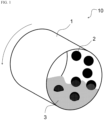
- FIG. 1 is a schematic view illustrating the structure of a ball mill that can be suitably used for fine crushing according to an embodiment of the present invention.
- FIG. 1 is a schematic view of a ball mill that can be suitably used for fine crushing according to an embodiment of the present invention.
- the ball mill that is a crusher 10
- a processing object 3 that is an object to be crushed
- a liquid if necessary
- the rotary container 1 with a cylinder diameter of 0.67 m, a cylinder length of 0.5 m, a rotation power of 3.7 kW, and a rotating speed of about 40 rpm; and the balls 2 made of alumina with a diameter of 20 to 25 mm and a filling weight of 140 kg.
- the crusher 10 may be used as the crusher 10.
- fine crushing refers to a crushing process for mainly iron ores to increase the proportion of particles with a particle size of -63 ⁇ m, and is a crushing process for iron ores to increase the proportion of particles with a particle size of -63 ⁇ m by an amount greater than the reduced proportion of particles with a particle size of +1 mm.
- particles with a particle size of -63 ⁇ m mean those that have passed through a sieve with mesh openings of 63 ⁇ m after sieving, and such particles are also expressed as particles with a particle size of less than 63 ⁇ m.
- particles with a particle size of +1 mm mean those that remain on a sieve with mesh openings of 1 mm after sieving, and such particles are also expressed as particles with a particle size of greater than or equal to 1 mm.
- the granularity of iron ores is improved as the iron ores include more particles with a particle size of -63 ⁇ m.
- Three types of iron ores described in Table 1 were finely crushed with the foregoing ball mill for 30 minutes. Then, the iron ores were sieved to evaluate the proportion of particles with a particle size of -63 ⁇ m. Table 1 illustrates the results. As illustrated in Table 1, iron ores with a smaller average pore size d A have a lower proportion of particles with a particle size of -63 ⁇ m, although all of the iron ores were finely crushed for the same period of time.
- Ores B and C which are iron ores with an average pore size d A of less than or equal to 10 ⁇ m, have lower fine crushability, that is, can be finely crushed less easily than Ores A that are iron ores with an average pore size d A of greater than 10 ⁇ m.
- the average pore size d A was determined by measuring a pore size distribution using mercury porosimetry in compliance with the JIS R1655:2003, and then determining a value of 50% from the cumulative pore volume of pores with a pore size of 3.6 nm to 200 ⁇ m.
- d represents the pore size (m)
- ⁇ represents the surface tension (N/m) of mercury
- ⁇ represents the contact angle (°) between the measured sample and mercury
- P represents the pressure (Pa) applied to mercury.
- AutoPore IV9520 manufactured by Micromeritics Instruments Corporation
- the surface tension of mercury was set to 0.48 N/m
- the contact angle between mercury and the sample was set to 140°.
- Table 1 Types of ores Chemical composition Raw material characteristics After fine crushing T.Fe SiO 2 Al 2 O 3 +1mm -63 ⁇ m Average pore size d A -63 ⁇ m mass% mass% mass% mass% mass% ⁇ m mass% OreA 56.4 6.6 1.8 37.2 9.4 22.5 71.6 OreB 64.8 1.5 1.5 42.7 2.4 9.3 60.7 OreC 63.6 6.3 0.7 36.3 6.4 5.3 50.3
- the iron ores: Ores B with an average pore size d A of less than or equal to 10 ⁇ m, which have poor fine crushability, and the iron ores: Ores A with an average pore size d A of greater than 10 ⁇ m were coarsely crushed with a jaw crusher in advance, and then, the proportion of particles with a particle size of + 1 mm was measured. Then, the coarsely crushed iron ores were finely crushed in the dry state with a ball mill such as the one illustrated in FIG. 1 for 30 minutes. Then, the proportion of particles with a particle size of - 63 ⁇ m in the finely crushed iron ores was measured.
- pellets obtained through the granulation were measured with Autograph under a speed condition of 1 mm/min. The crushing strength was determined from the average crushing strength of 10 pellets.
- pellets obtained through granulation preferably have a crushing strength of greater than or equal to 49 N from the perspective of suppressing powdering during transport, for example. Tables 2 and 3 below illustrate the test conditions and the measurement results of the crushing strength.
- "coarse crushing” refers to a crushing process for mainly iron ores to reduce the proportion of particles with a particle size of +1 mm, and is a crushing process for iron ores to reduce the proportion of particles with a particle size of + 1 mm by an amount greater than the increased proportion of particles with a particle size of -63 ⁇ m.
- Table 2 illustrates the results of the iron ores: Ores B.
- coarsely crushing the iron ores: Ores B with low fine crushability in advance to reduce the proportion of particles with a particle size of +1 mm leads to an increase in the proportion of particles with a particle size of -63 ⁇ m after fine crushing is performed for 30 minutes. From the results, it is found that when iron ores with an average pore size d A of less than or equal to 10 ⁇ m are finely crushed, it is possible to efficiently perform fine crushing to increase the proportion of particles with a particle size of -63 ⁇ m by performing coarse crushing in advance to reduce the proportion of particles with a particle size of greater than or equal to 1 mm.
- Ores B in which the proportion of particles with a particle size of + 1 mm was 42.7 mass% with the jaw crusher until the proportion of the particles with a particle size of +1 mm became 18.9 mass%. Meanwhile, about 30 minutes were additionally required to finely crush the iron ores: Ores B in which the proportion of particles with a particle size of -63 ⁇ m is 60.7 mass after finely crushed, with the ball mill until the proportion of the particles with a particle size of -63 ⁇ m became 73.3 mass%.
- Table 3 is a table illustrating the results of the iron ores: Ores A.
- coarsely crushing the iron ores: Ores A in advance to reduce the proportion of particles with a particle size of +1 mm also leads to an increase in the proportion of particles with a particle size of -63 ⁇ m after fine crushing is performed for 30 minutes.
- about 10 seconds were required to coarsely crush the iron ores: Ores A in which the proportion of particles with a particle size of + 1 mm was 37.2 mass% with the jaw crusher until the proportion of the particles with a particle size of + 1 mm became 13.3 mass%.
- Ores A in which the proportion of particles with a particle size of - 63 ⁇ m after finely crushed is 71.6 mass%, with the ball mill until the proportion of the particles with a particle size of -63 ⁇ m became 82.8 mass%. Accordingly, finely crushing the iron ores: Ores A with an average pore size d A of greater than 10 ⁇ m after coarsely crushing them was able to obtain the time saving effect of about 12 minutes. Meanwhile, finely crushing the iron ores: Ores B with an average pore size d A of less than or equal to 10 ⁇ m after coarsely crushing them was able to obtain the time-saving effect of about 30 minutes. From the results, it is found that the ore crushing method according to the present embodiment is more preferably applied to iron ores with an average pore size d A of less than or equal to 10 ⁇ m.
- the ore crushing method according to the present embodiment is also applicable to iron ores that are unclear as to whether the iron ores include those that are difficult to finely crush. Accordingly, even when the iron ores include those that are difficult to finely crush, it is possible to efficiently perform fine crushing to increase the proportion of particles with a particle size of -63 ⁇ m.
- the inventors have found a first embodiment for improving the efficiency of crushing iron ores from the foregoing study. That is, iron ores are coarsely crushed with a crushing machine, such as a roller press or a jaw crusher, in advance so that the proportion of particles with a particle size of +1 mm is reduced. Then, the resulting iron ores are finely crushed with a crushing machine, such as a ball mill, so that the proportion of particles with a particle size of -63 ⁇ m is increased. In this manner, coarsely crushing iron ores in advance allows the iron ores to be finely crushed efficiently even when the iron ores include those that are difficult to finely crush. Note that the iron ores may include other ores. In such a case, all the ores may be coarsely crushed together so that the proportion of iron ore particles with a particle size of greater than or equal to 1 mm is reduced, and then, the resulting ores may be finely crushed.
- a crushing machine such as a roller press or a jaw crusher
- a second embodiment has been found from the fact that there is a correlation between the average pore size d A and the fine crushability of iron ores. That is, iron ores with an average pore size d A of greater than 10 ⁇ m, which have excellent fine crushability, may be directly sent to a crushing machine, such as a ball mill. Meanwhile, it is preferable that iron ores with an average pore size d A of less than or equal to 10 ⁇ m, which have poor fine crushability, be coarsely crushed in advance so that the proportion of particles with a particle size of + 1 mm is reduced, and then be sent to a crushing machine, such as a ball mill, to be finely crushed therein. In this manner, identifying iron ores with poor fine crushability to coarsely crush them can reduce the amount of iron ores to be coarsely crushed in advance. This allows for more efficient crushing of the iron ores.
- the inventors have found from the foregoing study a third embodiment for improving the efficiency of crushing iron ores in which the proportion of particles with a particle size of greater than or equal to 1 mm is greater than or equal to 30 mass%. That is, iron ores in which the proportion of particles with a particle size of greater than or equal to 1 mm is greater than or equal to 30 mass% are coarsely crushed with a crushing machine, such as a roller press or a jaw crusher, so that the proportion of the particles with a particle size of greater than or equal to 1 mm becomes less than or equal to 20 mass%.
- a crushing machine such as a roller press or a jaw crusher
- the resulting iron ores are finely crushed with a crushing machine, such as a ball mill.
- a crushing machine such as a ball mill.
- coarsely crushing iron ores in advance allows the iron ores to be finely crushed efficiently.
- the proportion of the particles with a particle size of +1 mm after the coarse crushing is preferably less than or equal to 10 mass%.
- the lower limit of the proportion of the particles with a particle size of +1 mm is not limited to a particular value, and may be zero.
- the iron ores may include other ores. In such a case, all the ores may be coarsely crushed together so that the proportion of iron ore particles with a particle size of greater than or equal to 1 mm becomes less than or equal to 20 mass%, and then, the resulting ores may be finely crushed.
- a fourth embodiment is based on the finding obtained in granulating the crushed iron ores into pellets. That is, a process of finely crushing iron ores is performed to finely crush the iron ores so that the proportion of particles with a particle size of -63 ⁇ m becomes greater than or equal to 70 mass%. This can increase the crushing strength of pellets obtained through granulation, and thus can suppress powdering of the pellets during transport.
- the iron ores are finely crushed so that the proportion of the particles with a particle size of - 63 ⁇ m becomes greater than or equal to 80 mass%.
- the upper limit of the proportion of the particles with a particle size of -63 ⁇ m is not limited to a particular value, but is about 98 mass% in consideration of a load that applied during crushing.
- a fifth embodiment has been developed from the perspective of preventing dust during fine crushing. That is, a wet ball mill is used as a fine crushing device.
- the same coarsely crushed iron ores as those of test No. Test 2 in Table 2 were finely crushed with a dry ball mill (Test 2) and a wet ball mill (Test 5), and were then granulated into pellets, and the crushing strength of the pellets was measured as in Table 2.
- Table 4 below illustrates the proportion of particles with a particle size of + 1 mm before the fine crushing, the proportion of particles with a particle size of -63 ⁇ m after the fine crushing, and the measurement results of the crushing strength of the obtained pellets. As illustrated in Table 4, the proportion of particles with a particle size of -63 ⁇ m of the test No.
- Test 5 is higher than that of the test No. Test 2. From the results, it is found that iron ores can be finely crushed more efficiently with a wet ball mill than with a dry ball mill. Table 4 Test No. Before fine crushing Fine crushing condition After fine crushing Pellets +1mm -63 ⁇ m +1mm -63 ⁇ m Crushing strength mass% mass% mass% mass% N Test 2 18.9 16.7 Dry 5.5 73.3 79.4 Test 5 18.9 16.7 Wet 4.1 81.2 132.8
Landscapes
- Engineering & Computer Science (AREA)
- Chemical & Material Sciences (AREA)
- Manufacturing & Machinery (AREA)
- Geochemistry & Mineralogy (AREA)
- Geology (AREA)
- General Life Sciences & Earth Sciences (AREA)
- Life Sciences & Earth Sciences (AREA)
- Environmental & Geological Engineering (AREA)
- Materials Engineering (AREA)
- Mechanical Engineering (AREA)
- Metallurgy (AREA)
- Organic Chemistry (AREA)
- Food Science & Technology (AREA)
- Manufacture And Refinement Of Metals (AREA)
- Disintegrating Or Milling (AREA)
Abstract
Description
- The present invention relates to an ore crushing method, and also relates to a pellet production method that uses as a raw material iron ores processed with the ore crushing method.
- When iron ores are used in a smelting process, sintered ores or pellets (which may be either baked or not baked) are produced through a granulation step. It is known that crushing ores is effective in improving the granulation operation for improving the yields and productivity of sintered ores or pellets.
- For example,
Patent Literature 1 discloses a technique for producing sintered ores involving using, as granulated raw material, fine ores that have been crushed in advance. -
Patent Literature 2 discloses a crushing method for iron-ore raw material using a roll crusher, which includes mixing a first iron-ore raw material as a crushing target with a second iron-ore raw material, which is harder than the first iron-ore raw material, as a crushing auxiliary material, and putting the thus mixed first and second iron-ore raw materials into the roll crusher so as to crush them. The crushed iron ores are granulated into pellets as a raw material to be sintered. -
Patent Literatures 3 and 4 respectively disclose: to granulate iron ores with a high crystal water content, a sintered ore production method that includes sieving iron ores with a predetermined mesh size, crushing the remaining iron ores and the like on the sieve, mixing the crushed iron ores and the like with iron ores and the like that have passed through the sieve, and then granulating the mixture; and a pretreatment method for a raw material to be sintered that includes subjecting the raw material to be sintered to compression crushing using a roller press crusher, and then granulating the crushed material. - Patent Literature 5 discloses a sintered ore production method that includes crushing porous iron ores before granulating them.
-
- Patent Literature 1:
JP-2016-17211A - Patent Literature 2: International Publication No.
WO 2010/113571 - Patent Literature 3:
JP-2008-261016A - Patent Literature 4:
JP-2007-162127A - Patent Literature 5:
JP-2007-138244A - The conventional techniques have the following problems.
- That is, the conventional techniques are problematic in that they are insufficient as techniques for crushing powdery iron ores including coarse particles that are difficult to finely crush. The technique disclosed in
Patent Literature 1 only describes crushing, and does not take any measure against the mixing of ores with low crushability. The technique disclosed inPatent Literature 2 is not intended to crush an iron-ore raw material with relatively high hardness that is used as a crushing auxiliary material. - The techniques disclosed in
Patent Literatures 3 and 4 are not intended to solve the problem with the mixing of ores that are difficult to crush, either. - The technique disclosed in Patent Literature 5 is intended to solve the problem that a large amount of water would be needed to granulate a porous raw material, and is not intended to solve the problem with the mixing of ores that are difficult to crush, either.
- An object of the present invention is to provide an ore crushing method that can efficiently and finely crush iron ores that are difficult to finely crush. In addition, it is another object of the present invention to provide a pellet production method that uses as a raw material iron ores processed with the crushing method.
- The inventors have found that coarsely crushing iron ores that are difficult to crush in advance allows the iron ores to be finely crushed efficiently.
- An ore crushing method according to the present invention that advantageously solves the foregoing problem is an ore crushing method for crushing ores including iron ores. The method includes coarsely crushing iron ores to reduce the proportion of particles with a particle size of greater than or equal to 1 mm, and finely crushing the coarsely crushed iron ores to increase the proportion of particles with a particle size of less than 63 µm.
- In the ore crushing method according to the present invention, it is considered that the following can be more preferable solution means, for example:
- (a) the average pore size of the iron ores before being coarsely crushed is less than or equal to 10 µm,
- (b) the proportion of particles with a particle size of greater than or equal to 1 mm in the iron ores before being coarsely crushed is greater than or equal to 30 mass%, and the iron ores are coarsely crushed so that the proportion of the particles with a particle size of greater than or equal to 1 mm becomes less than or equal to 20 mass%,
- (c) the iron ores are finely crushed so that the proportion of particles with a particle size of less than 63 µm becomes greater than or equal to 70 mass%, and
- (d) the iron ores are finely crushed with a wet ball mill.
- A pellet production method according to the present invention that advantageously solves the foregoing problem includes granulating a raw material, which includes the iron ores crushed with any one of the foregoing ore crushing methods, into pellets.
- According to the present invention, even when iron ores include those that are difficult to finely crush, it is possible to finely crush the iron ores efficiently by coarsely crushing them in advance. Thus, such a technique can be suitably used for the production of a sintered-ore raw material or pellets.
-
FIG. 1 is a schematic view illustrating the structure of a ball mill that can be suitably used for fine crushing according to an embodiment of the present invention. - Hereinafter, an embodiment of the present invention will be specifically described. Note that the drawing is only schematic, and may be different from the actual one. In addition, the following embodiment illustrates examples of a device and a method for embodying the technical idea of the present invention, and thus, the configuration of the embodiment is not limited to the following configuration. That is, various changes may be made to the technical idea of the present invention within the technical scope recited in the claims.
-
FIG. 1 is a schematic view of a ball mill that can be suitably used for fine crushing according to an embodiment of the present invention. In the ball mill that is acrusher 10,balls 2 of a hard material, such as alumina, that are substantially spherical in shape, aprocessing object 3 that is an object to be crushed, and a liquid (if necessary) are put into arotary container 1 that is substantially cylindrical in shape, so that the balls roll with the rotation of therotary container 1, thereby causing theprocessing object 3 to be finely crushed between theballs 2 and between theball 2 and therotary container 1. For example, it is possible to use therotary container 1 with a cylinder diameter of 0.67 m, a cylinder length of 0.5 m, a rotation power of 3.7 kW, and a rotating speed of about 40 rpm; and theballs 2 made of alumina with a diameter of 20 to 25 mm and a filling weight of 140 kg. Note that not only the foregoing ball mill, but also a bead mill, a jet mill, or a roller mill, for example, may be used as thecrusher 10. In the present embodiment, "fine crushing" refers to a crushing process for mainly iron ores to increase the proportion of particles with a particle size of -63 µm, and is a crushing process for iron ores to increase the proportion of particles with a particle size of -63 µm by an amount greater than the reduced proportion of particles with a particle size of +1 mm. Note that in the present embodiment, particles with a particle size of -63 µm mean those that have passed through a sieve with mesh openings of 63 µm after sieving, and such particles are also expressed as particles with a particle size of less than 63 µm. Meanwhile, particles with a particle size of +1 mm mean those that remain on a sieve with mesh openings of 1 mm after sieving, and such particles are also expressed as particles with a particle size of greater than or equal to 1 mm. - The granularity of iron ores is improved as the iron ores include more particles with a particle size of -63 µm. Three types of iron ores described in Table 1 were finely crushed with the foregoing ball mill for 30 minutes. Then, the iron ores were sieved to evaluate the proportion of particles with a particle size of -63 µm. Table 1 illustrates the results. As illustrated in Table 1, iron ores with a smaller average pore size dA have a lower proportion of particles with a particle size of -63 µm, although all of the iron ores were finely crushed for the same period of time. Consequently, it is found that Ores B and C, which are iron ores with an average pore size dA of less than or equal to 10 µm, have lower fine crushability, that is, can be finely crushed less easily than Ores A that are iron ores with an average pore size dA of greater than 10 µm. Herein, the average pore size dA was determined by measuring a pore size distribution using mercury porosimetry in compliance with the JIS R1655:2003, and then determining a value of 50% from the cumulative pore volume of pores with a pore size of 3.6 nm to 200 µm. Herein, the pore size is a cylinder diameter calculated with the Washburn's equation of the following Expression (1), provided that open pores are cylindrical in shape.

- In Expression (1) above, d represents the pore size (m), σ represents the surface tension (N/m) of mercury, θ represents the contact angle (°) between the measured sample and mercury, and P represents the pressure (Pa) applied to mercury. For example, AutoPore IV9520 (manufactured by Micromeritics Instruments Corporation) can be used as a measuring device. The surface tension of mercury was set to 0.48 N/m, and the contact angle between mercury and the sample was set to 140°.
Table 1 Types of ores Chemical composition Raw material characteristics After fine crushing T.Fe SiO2 Al2O3 +1mm -63µm Average pore size dA -63µm mass% mass% mass% mass% mass% µm mass% OreA 56.4 6.6 1.8 37.2 9.4 22.5 71.6 OreB 64.8 1.5 1.5 42.7 2.4 9.3 60.7 OreC 63.6 6.3 0.7 36.3 6.4 5.3 50.3 - Next, the iron ores: Ores B with an average pore size dA of less than or equal to 10 µm, which have poor fine crushability, and the iron ores: Ores A with an average pore size dA of greater than 10 µm were coarsely crushed with a jaw crusher in advance, and then, the proportion of particles with a particle size of + 1 mm was measured. Then, the coarsely crushed iron ores were finely crushed in the dry state with a ball mill such as the one illustrated in
FIG. 1 for 30 minutes. Then, the proportion of particles with a particle size of - 63 µm in the finely crushed iron ores was measured. Then, 2 mass% slaked lime was added to and mixed with the finely crushed iron ores, and the mixture was granulated with a pelletizer under a moisture condition of 7 mass%. Then, the crushing strength of pellets obtained through the granulation was measured with Autograph under a speed condition of 1 mm/min. The crushing strength was determined from the average crushing strength of 10 pellets. Typically, pellets obtained through granulation preferably have a crushing strength of greater than or equal to 49 N from the perspective of suppressing powdering during transport, for example. Tables 2 and 3 below illustrate the test conditions and the measurement results of the crushing strength. In the present embodiment, "coarse crushing" refers to a crushing process for mainly iron ores to reduce the proportion of particles with a particle size of +1 mm, and is a crushing process for iron ores to reduce the proportion of particles with a particle size of + 1 mm by an amount greater than the increased proportion of particles with a particle size of -63 µm.Table 2 Test No. Before fine crushing After fine crushing Pellets +1mm -63µm +1mm -63µm Crushing strength mass% mass% mass% mass % N Test 1 42.7 2.4 8.1 60.7 16.7 Test 218.9 16.7 5.5 73.3 79.4 Test 39.7 24.8 4.0 80.0 149.0 Test 4 1.2 32.0 0.8 92.6 188.0 - Table 2 illustrates the results of the iron ores: Ores B. As illustrated in Table 2, coarsely crushing the iron ores: Ores B with low fine crushability in advance to reduce the proportion of particles with a particle size of +1 mm leads to an increase in the proportion of particles with a particle size of -63 µm after fine crushing is performed for 30 minutes. From the results, it is found that when iron ores with an average pore size dA of less than or equal to 10 µm are finely crushed, it is possible to efficiently perform fine crushing to increase the proportion of particles with a particle size of -63 µm by performing coarse crushing in advance to reduce the proportion of particles with a particle size of greater than or equal to 1 mm.
- About 10 seconds were required to coarsely crush the iron ores: Ores B in which the proportion of particles with a particle size of + 1 mm was 42.7 mass% with the jaw crusher until the proportion of the particles with a particle size of +1 mm became 18.9 mass%. Meanwhile, about 30 minutes were additionally required to finely crush the iron ores: Ores B in which the proportion of particles with a particle size of -63 µm is 60.7 mass after finely crushed, with the ball mill until the proportion of the particles with a particle size of -63 µm became 73.3 mass%.
- This can confirm that when iron ores in which the proportion of particles with a particle size of + 1 mm is 42.7 mass% (which is greater than or equal to 30 mass%) are coarsely crushed in advance so that the proportion of the particles with a particle size of +1 mm becomes 18.9 mass% (which is less than or equal to 20 mass%), it is possible to increase the proportion of particles with a particle size of -63 µm to greater than or equal to 70 mass% in a short time. Further, it is also found that granulating iron ores in which the proportion of particles with a particle size of -63 µm is greater than or equal to 70 mass% to form pellets can produce pellets with a crushing strength of greater than or equal to 49 N that can suppress the powdering thereof during transport, for example.
Table 3 Test No. Before fine crushing After fine crushing Pellets +1mm -63µm +1mm -63µm Crushing strength mass% mass% mass% mass% N Test 6 37.2 9.4 7.7 71.6 72.3 Test 7 13.3 21.1 4.1 82.8 152.2 - Table 3 is a table illustrating the results of the iron ores: Ores A. As illustrated in Table 3, coarsely crushing the iron ores: Ores A in advance to reduce the proportion of particles with a particle size of +1 mm also leads to an increase in the proportion of particles with a particle size of -63 µm after fine crushing is performed for 30 minutes. In addition, about 10 seconds were required to coarsely crush the iron ores: Ores A in which the proportion of particles with a particle size of + 1 mm was 37.2 mass% with the jaw crusher until the proportion of the particles with a particle size of + 1 mm became 13.3 mass%. Meanwhile, about 12 minutes were additionally required to finely crush the iron ores: Ores A in which the proportion of particles with a particle size of - 63 µm after finely crushed is 71.6 mass%, with the ball mill until the proportion of the particles with a particle size of -63 µm became 82.8 mass%.
Accordingly, finely crushing the iron ores: Ores A with an average pore size dA of greater than 10 µm after coarsely crushing them was able to obtain the time saving effect of about 12 minutes. Meanwhile, finely crushing the iron ores: Ores B with an average pore size dA of less than or equal to 10 µm after coarsely crushing them was able to obtain the time-saving effect of about 30 minutes. From the results, it is found that the ore crushing method according to the present embodiment is more preferably applied to iron ores with an average pore size dA of less than or equal to 10 µm. - Note that the ore crushing method according to the present embodiment is also applicable to iron ores that are unclear as to whether the iron ores include those that are difficult to finely crush. Accordingly, even when the iron ores include those that are difficult to finely crush, it is possible to efficiently perform fine crushing to increase the proportion of particles with a particle size of -63 µm.
- The inventors have found a first embodiment for improving the efficiency of crushing iron ores from the foregoing study. That is, iron ores are coarsely crushed with a crushing machine, such as a roller press or a jaw crusher, in advance so that the proportion of particles with a particle size of +1 mm is reduced. Then, the resulting iron ores are finely crushed with a crushing machine, such as a ball mill, so that the proportion of particles with a particle size of -63 µm is increased. In this manner, coarsely crushing iron ores in advance allows the iron ores to be finely crushed efficiently even when the iron ores include those that are difficult to finely crush. Note that the iron ores may include other ores. In such a case, all the ores may be coarsely crushed together so that the proportion of iron ore particles with a particle size of greater than or equal to 1 mm is reduced, and then, the resulting ores may be finely crushed.
- A second embodiment has been found from the fact that there is a correlation between the average pore size dA and the fine crushability of iron ores. That is, iron ores with an average pore size dA of greater than 10 µm, which have excellent fine crushability, may be directly sent to a crushing machine, such as a ball mill. Meanwhile, it is preferable that iron ores with an average pore size dA of less than or equal to 10 µm, which have poor fine crushability, be coarsely crushed in advance so that the proportion of particles with a particle size of + 1 mm is reduced, and then be sent to a crushing machine, such as a ball mill, to be finely crushed therein. In this manner, identifying iron ores with poor fine crushability to coarsely crush them can reduce the amount of iron ores to be coarsely crushed in advance. This allows for more efficient crushing of the iron ores.
- The inventors have found from the foregoing study a third embodiment for improving the efficiency of crushing iron ores in which the proportion of particles with a particle size of greater than or equal to 1 mm is greater than or equal to 30 mass%. That is, iron ores in which the proportion of particles with a particle size of greater than or equal to 1 mm is greater than or equal to 30 mass% are coarsely crushed with a crushing machine, such as a roller press or a jaw crusher, so that the proportion of the particles with a particle size of greater than or equal to 1 mm becomes less than or equal to 20 mass%.
- Then, the resulting iron ores are finely crushed with a crushing machine, such as a ball mill. In this manner, coarsely crushing iron ores in advance allows the iron ores to be finely crushed efficiently. Note that the proportion of the particles with a particle size of +1 mm after the coarse crushing is preferably less than or equal to 10 mass%. The lower limit of the proportion of the particles with a particle size of +1 mm is not limited to a particular value, and may be zero. In addition, the iron ores may include other ores. In such a case, all the ores may be coarsely crushed together so that the proportion of iron ore particles with a particle size of greater than or equal to 1 mm becomes less than or equal to 20 mass%, and then, the resulting ores may be finely crushed.
- A fourth embodiment is based on the finding obtained in granulating the crushed iron ores into pellets. That is, a process of finely crushing iron ores is performed to finely crush the iron ores so that the proportion of particles with a particle size of -63 µm becomes greater than or equal to 70 mass%. This can increase the crushing strength of pellets obtained through granulation, and thus can suppress powdering of the pellets during transport. Preferably, the iron ores are finely crushed so that the proportion of the particles with a particle size of - 63 µm becomes greater than or equal to 80 mass%. The upper limit of the proportion of the particles with a particle size of -63 µm is not limited to a particular value, but is about 98 mass% in consideration of a load that applied during crushing.
- A fifth embodiment has been developed from the perspective of preventing dust during fine crushing. That is, a wet ball mill is used as a fine crushing device. The same coarsely crushed iron ores as those of test No.
Test 2 in Table 2 were finely crushed with a dry ball mill (Test 2) and a wet ball mill (Test 5), and were then granulated into pellets, and the crushing strength of the pellets was measured as in Table 2. Table 4 below illustrates the proportion of particles with a particle size of + 1 mm before the fine crushing, the proportion of particles with a particle size of -63 µm after the fine crushing, and the measurement results of the crushing strength of the obtained pellets. As illustrated in Table 4, the proportion of particles with a particle size of -63 µm of the test No. Test 5 is higher than that of the test No.Test 2. From the results, it is found that iron ores can be finely crushed more efficiently with a wet ball mill than with a dry ball mill.Table 4 Test No. Before fine crushing Fine crushing condition After fine crushing Pellets +1mm -63µm +1mm -63µm Crushing strength mass% mass% mass% mass % N Test 2 18.9 16.7 Dry 5.5 73.3 79.4 Test 5 18.9 16.7 Wet 4.1 81.2 132.8 - With the ore crushing method according to the present invention, even when iron ores include those that are difficult to finely crush, it is possible to finely crush the iron ores efficiently by coarsely crushing them in advance. Such finely crushed iron ores have excellent granularity. Thus, using the crushing method for the production of a sintered-ore raw material or pellets is industrially advantageous.
-
- 1
- rotary container
- 2
- ball
- 3
- processing object
- 10
- crusher (ball mill)
Claims (6)
- An ore crushing method for crushing ores including iron ores, characterized in that the ore crushing method comprisescoarsely crushing the iron ores to reduce a proportion of particles with a particle size of greater than or equal to 1 mm andfinely crushing the coarsely crushed iron ores to increase a proportion of particles with a particle size of less than 63 µm.
- The ore crushing method according to claim 1, wherein
an average pore size of the iron ores before being coarsely crushed is less than or equal to 10 µm. - The ore crushing method according to claim 1 or 2, whereinthe proportion of the particles with a particle size of greater than or equal to 1 mm in the iron ores before being coarsely crushed is greater than or equal to 30 mass% andthe iron ores are coarsely crushed so that the proportion of the particles with a particle size of greater than or equal to 1 mm becomes less than or equal to 20 mass%.
- The ore crushing method according to any one of claims 1 to 3, wherein
the iron ores are finely crushed so that the proportion of the particles with a particle size of less than 63 µm becomes greater than or equal to 70 mass%. - The ore crushing method according to any one of claims 1 to 4, wherein
the iron ores are finely crushed with a wet ball mill. - A pellet production method, characterized in that the pellet production method comprises granulating a raw material into pellets, the raw material including the iron ores crushed with the ore crushing method according to any one of claims 1 to 5.
Applications Claiming Priority (2)
| Application Number | Priority Date | Filing Date | Title |
|---|---|---|---|
| JP2021097698 | 2021-06-11 | ||
| PCT/JP2022/009357 WO2022259656A1 (en) | 2021-06-11 | 2022-03-04 | Ore crushing method and pellet production method |
Publications (3)
| Publication Number | Publication Date |
|---|---|
| EP4339311A1 true EP4339311A1 (en) | 2024-03-20 |
| EP4339311A4 EP4339311A4 (en) | 2024-09-04 |
| EP4339311B1 EP4339311B1 (en) | 2025-11-19 |
Family
ID=84425790
Family Applications (1)
| Application Number | Title | Priority Date | Filing Date |
|---|---|---|---|
| EP22819846.1A Active EP4339311B1 (en) | 2021-06-11 | 2022-03-04 | Iron ore crushing method and pellet production method |
Country Status (8)
| Country | Link |
|---|---|
| US (1) | US20240271245A1 (en) |
| EP (1) | EP4339311B1 (en) |
| JP (1) | JP7364128B2 (en) |
| CN (1) | CN117413076A (en) |
| AU (1) | AU2022287786B2 (en) |
| BR (1) | BR112023025788A2 (en) |
| CA (1) | CA3220862A1 (en) |
| WO (1) | WO2022259656A1 (en) |
Family Cites Families (11)
| Publication number | Priority date | Publication date | Assignee | Title |
|---|---|---|---|---|
| JPS6319531A (en) * | 1986-07-14 | 1988-01-27 | Nippon Kokan Kk <Nkk> | Automatic sample preparing device |
| JP4767388B2 (en) | 2000-04-26 | 2011-09-07 | 新日本製鐵株式会社 | Method for producing sintered ore with excellent high-temperature properties |
| JP5119462B2 (en) | 2005-11-17 | 2013-01-16 | 新日鐵住金株式会社 | Pretreatment method of sintered raw material and method of manufacturing sintered ore |
| JP4746410B2 (en) * | 2005-11-17 | 2011-08-10 | 新日本製鐵株式会社 | Method for producing sintered ore |
| JP5000366B2 (en) | 2007-04-12 | 2012-08-15 | 新日本製鐵株式会社 | Method for producing sintered ore |
| BRPI1014863B1 (en) | 2009-03-31 | 2021-10-26 | Nippon Steel Corporation | IRON ORE MATERIAL CRUSHING METHOD |
| KR101496097B1 (en) * | 2014-07-25 | 2015-02-27 | 한국에너지기술연구원 | Method for preparing iron-based catalyst and iron-based catalyst prepared by the same |
| JP6361335B2 (en) | 2014-07-09 | 2018-07-25 | 新日鐵住金株式会社 | Method for producing sintered ore |
| JP6519005B2 (en) * | 2015-03-31 | 2019-05-29 | 日本製鉄株式会社 | Method of producing sintered ore |
| CN107937716A (en) * | 2017-11-02 | 2018-04-20 | 安阳钢铁股份有限公司 | A kind of iron ore pellets raw materials for production preparation method for being conducive to efficient pelletizing |
| CN109909057B (en) * | 2019-02-28 | 2021-08-20 | 玉溪大红山矿业有限公司 | Ore dressing process for magnetic-gravity combined upgrading and tailing lowering of open-air lava iron ore |
-
2022
- 2022-03-04 WO PCT/JP2022/009357 patent/WO2022259656A1/en not_active Ceased
- 2022-03-04 AU AU2022287786A patent/AU2022287786B2/en active Active
- 2022-03-04 JP JP2023527508A patent/JP7364128B2/en active Active
- 2022-03-04 CN CN202280038966.7A patent/CN117413076A/en active Pending
- 2022-03-04 CA CA3220862A patent/CA3220862A1/en active Pending
- 2022-03-04 US US18/568,932 patent/US20240271245A1/en active Pending
- 2022-03-04 EP EP22819846.1A patent/EP4339311B1/en active Active
- 2022-03-04 BR BR112023025788A patent/BR112023025788A2/en active Search and Examination
Also Published As
| Publication number | Publication date |
|---|---|
| CA3220862A1 (en) | 2022-12-15 |
| EP4339311B1 (en) | 2025-11-19 |
| BR112023025788A2 (en) | 2024-02-27 |
| WO2022259656A1 (en) | 2022-12-15 |
| AU2022287786A1 (en) | 2023-12-14 |
| EP4339311A4 (en) | 2024-09-04 |
| US20240271245A1 (en) | 2024-08-15 |
| CN117413076A (en) | 2024-01-16 |
| AU2022287786B2 (en) | 2025-02-27 |
| JP7364128B2 (en) | 2023-10-18 |
| JPWO2022259656A1 (en) | 2022-12-15 |
Similar Documents
| Publication | Publication Date | Title |
|---|---|---|
| US4960461A (en) | Method and installation for extracting gold from gold ore | |
| JP3123810B2 (en) | Cement extender and method for producing the same | |
| US20020152843A1 (en) | Briquette as material for steel making and method for production thereof | |
| TW201418188A (en) | Ultra fine milk of lime composition | |
| EP3134933B1 (en) | Method of producing electrolytic manganese dioxide with high compact density and electrolytic manganese dioxide produced therefrom | |
| Abazarpoor et al. | Investigation on the particle size and shape of iron ore pellet feed using ball mill and HPGR grinding methods | |
| EP4339311B1 (en) | Iron ore crushing method and pellet production method | |
| EP1705154A1 (en) | Indium oxide powder and method for producing same | |
| DE102013106372B4 (en) | Abrasive grains based on eutectic zirconium corundum | |
| CN105060753A (en) | Particle shaping method for machine-made aggregate | |
| RU2824643C2 (en) | Method of crushing ore and method of producing pellets | |
| EP3816110B1 (en) | Preparation method for electrolytic manganese dioxide powder | |
| CN102378821B (en) | Method of crushing iron ore material | |
| JP2002536628A (en) | Dry recycling method for (U, Pu) O2 mixed oxide nuclear fuel scrap | |
| JPH0424289B2 (en) | ||
| JP2017058362A (en) | Sample preparation method for fluorescent X-ray analysis | |
| CN119907783A (en) | Ceramic spherical body and method for producing the same | |
| JP3518736B2 (en) | Method for producing granulated blast furnace slag sand | |
| JP5119462B2 (en) | Pretreatment method of sintered raw material and method of manufacturing sintered ore | |
| JP2000247751A (en) | Method for producing alumina powder for sintered body | |
| JP2016176130A (en) | Raw pellet for manufacturing iron ore calcinated pellet and method for manufacturing iron ore calcinated pellet | |
| JP4274834B2 (en) | Slag stability evaluation method | |
| JP2004154681A (en) | Method for recycling waste glass material and glass cullet manufactured by the method | |
| CN121244395A (en) | Method for regulating and controlling grain size and morphology of granite pegmatite and method for separating quartz from granite pegmatite | |
| CN114851094B (en) | Sweeping material for shot blasting |
Legal Events
| Date | Code | Title | Description |
|---|---|---|---|
| STAA | Information on the status of an ep patent application or granted ep patent |
Free format text: STATUS: THE INTERNATIONAL PUBLICATION HAS BEEN MADE |
|
| PUAI | Public reference made under article 153(3) epc to a published international application that has entered the european phase |
Free format text: ORIGINAL CODE: 0009012 |
|
| STAA | Information on the status of an ep patent application or granted ep patent |
Free format text: STATUS: REQUEST FOR EXAMINATION WAS MADE |
|
| 17P | Request for examination filed |
Effective date: 20231212 |
|
| AK | Designated contracting states |
Kind code of ref document: A1 Designated state(s): AL AT BE BG CH CY CZ DE DK EE ES FI FR GB GR HR HU IE IS IT LI LT LU LV MC MK MT NL NO PL PT RO RS SE SI SK SM TR |
|
| A4 | Supplementary search report drawn up and despatched |
Effective date: 20240806 |
|
| RIC1 | Information provided on ipc code assigned before grant |
Ipc: C22B 1/24 20060101ALI20240731BHEP Ipc: B02C 17/04 20060101ALI20240731BHEP Ipc: C22B 1/16 20060101ALI20240731BHEP Ipc: C22B 1/14 20060101AFI20240731BHEP |
|
| DAV | Request for validation of the european patent (deleted) | ||
| DAX | Request for extension of the european patent (deleted) | ||
| RIC1 | Information provided on ipc code assigned before grant |
Ipc: C22B 1/14 20060101AFI20250624BHEP Ipc: C22B 1/16 20060101ALI20250624BHEP Ipc: B02C 17/04 20060101ALI20250624BHEP Ipc: C22B 1/24 20060101ALI20250624BHEP |
|
| GRAP | Despatch of communication of intention to grant a patent |
Free format text: ORIGINAL CODE: EPIDOSNIGR1 |
|
| STAA | Information on the status of an ep patent application or granted ep patent |
Free format text: STATUS: GRANT OF PATENT IS INTENDED |
|
| INTG | Intention to grant announced |
Effective date: 20250804 |
|
| GRAS | Grant fee paid |
Free format text: ORIGINAL CODE: EPIDOSNIGR3 |
|
| GRAA | (expected) grant |
Free format text: ORIGINAL CODE: 0009210 |
|
| STAA | Information on the status of an ep patent application or granted ep patent |
Free format text: STATUS: THE PATENT HAS BEEN GRANTED |
|
| AK | Designated contracting states |
Kind code of ref document: B1 Designated state(s): AL AT BE BG CH CY CZ DE DK EE ES FI FR GB GR HR HU IE IS IT LI LT LU LV MC MK MT NL NO PL PT RO RS SE SI SK SM TR |
|
| REG | Reference to a national code |
Ref country code: CH Ref legal event code: F10 Free format text: ST27 STATUS EVENT CODE: U-0-0-F10-F00 (AS PROVIDED BY THE NATIONAL OFFICE) Effective date: 20251119 Ref country code: GB Ref legal event code: FG4D |
|
| REG | Reference to a national code |
Ref country code: DE Ref legal event code: R096 Ref document number: 602022025363 Country of ref document: DE |
|
| REG | Reference to a national code |
Ref country code: IE Ref legal event code: FG4D |
|
| REG | Reference to a national code |
Ref country code: NL Ref legal event code: MP Effective date: 20251119 |
|
| PG25 | Lapsed in a contracting state [announced via postgrant information from national office to epo] |
Ref country code: ES Free format text: LAPSE BECAUSE OF FAILURE TO SUBMIT A TRANSLATION OF THE DESCRIPTION OR TO PAY THE FEE WITHIN THE PRESCRIBED TIME-LIMIT Effective date: 20251119 |
|
| REG | Reference to a national code |
Ref country code: LT Ref legal event code: MG9D |
|
| PG25 | Lapsed in a contracting state [announced via postgrant information from national office to epo] |
Ref country code: NO Free format text: LAPSE BECAUSE OF FAILURE TO SUBMIT A TRANSLATION OF THE DESCRIPTION OR TO PAY THE FEE WITHIN THE PRESCRIBED TIME-LIMIT Effective date: 20260219 |
|
| PG25 | Lapsed in a contracting state [announced via postgrant information from national office to epo] |
Ref country code: AT Free format text: LAPSE BECAUSE OF FAILURE TO SUBMIT A TRANSLATION OF THE DESCRIPTION OR TO PAY THE FEE WITHIN THE PRESCRIBED TIME-LIMIT Effective date: 20251119 Ref country code: HR Free format text: LAPSE BECAUSE OF FAILURE TO SUBMIT A TRANSLATION OF THE DESCRIPTION OR TO PAY THE FEE WITHIN THE PRESCRIBED TIME-LIMIT Effective date: 20251119 Ref country code: FI Free format text: LAPSE BECAUSE OF FAILURE TO SUBMIT A TRANSLATION OF THE DESCRIPTION OR TO PAY THE FEE WITHIN THE PRESCRIBED TIME-LIMIT Effective date: 20251119 |
|
| PGFP | Annual fee paid to national office [announced via postgrant information from national office to epo] |
Ref country code: AT Payment date: 20260301 Year of fee payment: 5 |
|
| REG | Reference to a national code |
Ref country code: AT Ref legal event code: MK05 Ref document number: 1858872 Country of ref document: AT Kind code of ref document: T Effective date: 20251119 |
|
| PG25 | Lapsed in a contracting state [announced via postgrant information from national office to epo] |
Ref country code: NL Free format text: LAPSE BECAUSE OF FAILURE TO SUBMIT A TRANSLATION OF THE DESCRIPTION OR TO PAY THE FEE WITHIN THE PRESCRIBED TIME-LIMIT Effective date: 20251119 |
|
| PG25 | Lapsed in a contracting state [announced via postgrant information from national office to epo] |
Ref country code: RS Free format text: LAPSE BECAUSE OF FAILURE TO SUBMIT A TRANSLATION OF THE DESCRIPTION OR TO PAY THE FEE WITHIN THE PRESCRIBED TIME-LIMIT Effective date: 20260219 |
|
| PG25 | Lapsed in a contracting state [announced via postgrant information from national office to epo] |
Ref country code: IS Free format text: LAPSE BECAUSE OF FAILURE TO SUBMIT A TRANSLATION OF THE DESCRIPTION OR TO PAY THE FEE WITHIN THE PRESCRIBED TIME-LIMIT Effective date: 20260319 |
|
| PG25 | Lapsed in a contracting state [announced via postgrant information from national office to epo] |
Ref country code: PT Free format text: LAPSE BECAUSE OF FAILURE TO SUBMIT A TRANSLATION OF THE DESCRIPTION OR TO PAY THE FEE WITHIN THE PRESCRIBED TIME-LIMIT Effective date: 20260319 |
|
| PG25 | Lapsed in a contracting state [announced via postgrant information from national office to epo] |
Ref country code: PL Free format text: LAPSE BECAUSE OF FAILURE TO SUBMIT A TRANSLATION OF THE DESCRIPTION OR TO PAY THE FEE WITHIN THE PRESCRIBED TIME-LIMIT Effective date: 20251119 |
|
| PG25 | Lapsed in a contracting state [announced via postgrant information from national office to epo] |
Ref country code: LV Free format text: LAPSE BECAUSE OF FAILURE TO SUBMIT A TRANSLATION OF THE DESCRIPTION OR TO PAY THE FEE WITHIN THE PRESCRIBED TIME-LIMIT Effective date: 20251119 |
|
| PG25 | Lapsed in a contracting state [announced via postgrant information from national office to epo] |
Ref country code: BG Free format text: LAPSE BECAUSE OF FAILURE TO SUBMIT A TRANSLATION OF THE DESCRIPTION OR TO PAY THE FEE WITHIN THE PRESCRIBED TIME-LIMIT Effective date: 20251119 |