EP4339258A1 - Organometallic compound, organic light-emitting device including the organometallic compound, and electronic apparatus including the organic light-emitting device - Google Patents
Organometallic compound, organic light-emitting device including the organometallic compound, and electronic apparatus including the organic light-emitting device Download PDFInfo
- Publication number
- EP4339258A1 EP4339258A1 EP23164905.4A EP23164905A EP4339258A1 EP 4339258 A1 EP4339258 A1 EP 4339258A1 EP 23164905 A EP23164905 A EP 23164905A EP 4339258 A1 EP4339258 A1 EP 4339258A1
- Authority
- EP
- European Patent Office
- Prior art keywords
- group
- substituted
- unsubstituted
- alkyl
- salt
- Prior art date
- Legal status (The legal status is an assumption and is not a legal conclusion. Google has not performed a legal analysis and makes no representation as to the accuracy of the status listed.)
- Pending
Links
Images

Classifications
-
- C—CHEMISTRY; METALLURGY
- C07—ORGANIC CHEMISTRY
- C07F—ACYCLIC, CARBOCYCLIC OR HETEROCYCLIC COMPOUNDS CONTAINING ELEMENTS OTHER THAN CARBON, HYDROGEN, HALOGEN, OXYGEN, NITROGEN, SULFUR, SELENIUM OR TELLURIUM
- C07F15/00—Compounds containing elements of Groups 8, 9, 10 or 18 of the Periodic Table
- C07F15/0006—Compounds containing elements of Groups 8, 9, 10 or 18 of the Periodic Table compounds of the platinum group
- C07F15/0033—Iridium compounds
-
- C—CHEMISTRY; METALLURGY
- C09—DYES; PAINTS; POLISHES; NATURAL RESINS; ADHESIVES; COMPOSITIONS NOT OTHERWISE PROVIDED FOR; APPLICATIONS OF MATERIALS NOT OTHERWISE PROVIDED FOR
- C09K—MATERIALS FOR MISCELLANEOUS APPLICATIONS, NOT PROVIDED FOR ELSEWHERE
- C09K11/00—Luminescent materials, e.g. electroluminescent or chemiluminescent
- C09K11/06—Luminescent materials, e.g. electroluminescent or chemiluminescent containing organic luminescent materials
-
- H—ELECTRICITY
- H10—SEMICONDUCTOR DEVICES; ELECTRIC SOLID-STATE DEVICES NOT OTHERWISE PROVIDED FOR
- H10K—ORGANIC ELECTRIC SOLID-STATE DEVICES
- H10K50/00—Organic light-emitting devices
- H10K50/10—OLEDs or polymer light-emitting diodes [PLED]
- H10K50/11—OLEDs or polymer light-emitting diodes [PLED] characterised by the electroluminescent [EL] layers
- H10K50/12—OLEDs or polymer light-emitting diodes [PLED] characterised by the electroluminescent [EL] layers comprising dopants
-
- H—ELECTRICITY
- H10—SEMICONDUCTOR DEVICES; ELECTRIC SOLID-STATE DEVICES NOT OTHERWISE PROVIDED FOR
- H10K—ORGANIC ELECTRIC SOLID-STATE DEVICES
- H10K50/00—Organic light-emitting devices
- H10K50/10—OLEDs or polymer light-emitting diodes [PLED]
- H10K50/14—Carrier transporting layers
- H10K50/15—Hole transporting layers
-
- H—ELECTRICITY
- H10—SEMICONDUCTOR DEVICES; ELECTRIC SOLID-STATE DEVICES NOT OTHERWISE PROVIDED FOR
- H10K—ORGANIC ELECTRIC SOLID-STATE DEVICES
- H10K50/00—Organic light-emitting devices
- H10K50/10—OLEDs or polymer light-emitting diodes [PLED]
- H10K50/14—Carrier transporting layers
- H10K50/16—Electron transporting layers
-
- H—ELECTRICITY
- H10—SEMICONDUCTOR DEVICES; ELECTRIC SOLID-STATE DEVICES NOT OTHERWISE PROVIDED FOR
- H10K—ORGANIC ELECTRIC SOLID-STATE DEVICES
- H10K85/00—Organic materials used in the body or electrodes of devices covered by this subclass
- H10K85/30—Coordination compounds
- H10K85/341—Transition metal complexes, e.g. Ru(II)polypyridine complexes
- H10K85/342—Transition metal complexes, e.g. Ru(II)polypyridine complexes comprising iridium
-
- C—CHEMISTRY; METALLURGY
- C09—DYES; PAINTS; POLISHES; NATURAL RESINS; ADHESIVES; COMPOSITIONS NOT OTHERWISE PROVIDED FOR; APPLICATIONS OF MATERIALS NOT OTHERWISE PROVIDED FOR
- C09K—MATERIALS FOR MISCELLANEOUS APPLICATIONS, NOT PROVIDED FOR ELSEWHERE
- C09K2211/00—Chemical nature of organic luminescent or tenebrescent compounds
- C09K2211/10—Non-macromolecular compounds
- C09K2211/1018—Heterocyclic compounds
- C09K2211/1025—Heterocyclic compounds characterised by ligands
- C09K2211/1029—Heterocyclic compounds characterised by ligands containing one nitrogen atom as the heteroatom
- C09K2211/1033—Heterocyclic compounds characterised by ligands containing one nitrogen atom as the heteroatom with oxygen
-
- C—CHEMISTRY; METALLURGY
- C09—DYES; PAINTS; POLISHES; NATURAL RESINS; ADHESIVES; COMPOSITIONS NOT OTHERWISE PROVIDED FOR; APPLICATIONS OF MATERIALS NOT OTHERWISE PROVIDED FOR
- C09K—MATERIALS FOR MISCELLANEOUS APPLICATIONS, NOT PROVIDED FOR ELSEWHERE
- C09K2211/00—Chemical nature of organic luminescent or tenebrescent compounds
- C09K2211/10—Non-macromolecular compounds
- C09K2211/1018—Heterocyclic compounds
- C09K2211/1025—Heterocyclic compounds characterised by ligands
- C09K2211/1029—Heterocyclic compounds characterised by ligands containing one nitrogen atom as the heteroatom
- C09K2211/1037—Heterocyclic compounds characterised by ligands containing one nitrogen atom as the heteroatom with sulfur
-
- C—CHEMISTRY; METALLURGY
- C09—DYES; PAINTS; POLISHES; NATURAL RESINS; ADHESIVES; COMPOSITIONS NOT OTHERWISE PROVIDED FOR; APPLICATIONS OF MATERIALS NOT OTHERWISE PROVIDED FOR
- C09K—MATERIALS FOR MISCELLANEOUS APPLICATIONS, NOT PROVIDED FOR ELSEWHERE
- C09K2211/00—Chemical nature of organic luminescent or tenebrescent compounds
- C09K2211/18—Metal complexes
- C09K2211/185—Metal complexes of the platinum group, i.e. Os, Ir, Pt, Ru, Rh or Pd
-
- H—ELECTRICITY
- H10—SEMICONDUCTOR DEVICES; ELECTRIC SOLID-STATE DEVICES NOT OTHERWISE PROVIDED FOR
- H10K—ORGANIC ELECTRIC SOLID-STATE DEVICES
- H10K2101/00—Properties of the organic materials covered by group H10K85/00
- H10K2101/10—Triplet emission
-
- H—ELECTRICITY
- H10—SEMICONDUCTOR DEVICES; ELECTRIC SOLID-STATE DEVICES NOT OTHERWISE PROVIDED FOR
- H10K—ORGANIC ELECTRIC SOLID-STATE DEVICES
- H10K50/00—Organic light-emitting devices
- H10K50/10—OLEDs or polymer light-emitting diodes [PLED]
- H10K50/11—OLEDs or polymer light-emitting diodes [PLED] characterised by the electroluminescent [EL] layers
-
- H—ELECTRICITY
- H10—SEMICONDUCTOR DEVICES; ELECTRIC SOLID-STATE DEVICES NOT OTHERWISE PROVIDED FOR
- H10K—ORGANIC ELECTRIC SOLID-STATE DEVICES
- H10K85/00—Organic materials used in the body or electrodes of devices covered by this subclass
- H10K85/60—Organic compounds having low molecular weight
- H10K85/649—Aromatic compounds comprising a hetero atom
- H10K85/657—Polycyclic condensed heteroaromatic hydrocarbons
- H10K85/6572—Polycyclic condensed heteroaromatic hydrocarbons comprising only nitrogen in the heteroaromatic polycondensed ring system, e.g. phenanthroline or carbazole
Definitions
- the disclosure relates to an organometallic compound, an organic light-emitting device including the same, and an electronic apparatus including the organic light-emitting device.
- OLEDs are self-emissive devices, and have improved characteristics in terms of viewing angles, response time, brightness, driving voltage, and response speed. In addition. OLEDs can produce full-color images.
- Organic light-emitting devices typically include an anode, a cathode, and an organic layer located between the anode and the cathode and including an emission layer.
- a hole transport region may be located between the anode and the emission layer, and an electron transport region may be located between the emission layer and the cathode.
- Holes provided from the anode may move toward the emission layer through the hole transport region, and electrons provided from the cathode may move toward the emission layer through the electron transport region.
- the holes and the electrons may recombine in the emission layer to produce excitons.
- the excitons may transition from an excited state to a ground state, thus generating light.
- an organometallic compound an organic light-emitting device including the same, and an electronic apparatus including the organic light-emitting device.
- an organometallic compound represented by Formula 1: Formula 1 M 1 (L 1 ) n1 (L 2 ) n2 wherein, in Formula 1,
- an organic light-emitting device includes a first electrode, a second electrode, and an organic layer located between the first electrode and the second electrode, wherein the organic layer includes an emission layer, and wherein the organic layer further includes at least one of the organometallic compound.
- the organometallic compound may be included in the emission layer of the organic layer, and the organometallic compound included in the emission layer may act as a dopant.
- an electronic apparatus includes the organic light-emitting device.
- FIGURE shows a schematic cross-sectional view of an organic light-emitting device according to one or more embodiments.
- first, second, third etc. may be used herein to describe various elements, components, regions, layers, and/or sections, these elements, components, regions, layers, and/or sections should not be limited by these terms. These terms are only used to distinguish one element, component, region, layer, or section from another element, component, region, layer, or section. Thus, a first element, component, region, layer, or section discussed below could be termed a second element, component, region, layer, or section without departing from the teachings of the present embodiments.
- Exemplary embodiments are described herein with reference to cross section illustrations that are schematic illustrations of idealized embodiments. As such, variations from the shapes of the illustrations as a result, for example, of manufacturing techniques and/or tolerances, are to be expected. Thus, embodiments described herein should not be construed as limited to the particular shapes of regions as illustrated herein but are to include deviations in shapes that result, for example, from manufacturing. For example, a region illustrated or described as flat may, typically, have rough and/or nonlinear features. Moreover, sharp angles that are illustrated may be rounded. Thus, the regions illustrated in the figures are schematic in nature and their shapes are not intended to illustrate the precise shape of a region and are not intended to limit the scope of the present claims.
- a work function or a highest occupied molecular orbital (HOMO) energy level is expressed as an absolute value from a vacuum level.
- the work function or the HOMO energy level is referred to be “deep,” “high,” or “large,” the work function or the HOMO energy level has a large absolute value based on “0 electron Volts (eV)" of the vacuum level, while when the work function or the HOMO energy level is referred to be “shallow,” “low,” or “small,” the work function or HOMO energy level has a small absolute value based on "0 eV” of the vacuum level.
- an organometallic compound is represented by Formula 1: Formula 1 M 1 (L 1 ) n1 (L 2 ) n2 wherein M 1 in Formula 1 is a transition metal.
- M 1 in Formula 1 may be a first-row transition metal of the Periodic Table of Elements, a second-row transition metal of the Periodic Table of Elements, or a third-row transition metal of the Periodic Table of Elements.
- M 1 may be iridium, platinum, palladium, gold, osmium, titanium, zirconium, hafnium, europium, terbium, thulium, or rhodium.
- M 1 may be iridium, osmium, platinum, palladium, or gold.
- M 1 may be iridium.
- n1 and n2 in Formula 1 are each independently 1 or 2.
- a sum of n1 and n2 may be 3.
- n1 may be 2, and n2 may be 1.
- L 1 in Formula 1 is a ligand represented by Formula 1A:
- X 1 is C or N
- X 2 is C or N
- the bond between M 1 and X 1 in Formula 1A may be a covalent bond or a coordination bond.
- the bond between M 1 and X 2 in Formula 1A may be a covalent bond or a coordination bond.
- X 1 may be N
- X 2 may be C
- a bond between X 1 and M 1 may be a coordination bond
- a bond between X 2 and M 1 may be a covalent bond.
- Y 1 in Formula 1A is O, S, Se, C(R 41 )(R 42 ), or N(R 43 ).
- R 41 to R 43 may each be as described herein.
- R 2 , R 11 , R 12 , and R 41 to R 43 in Formula 1A are each independently hydrogen, deuterium, -F, -Cl, -Br, -I, -SF 5 , a hydroxyl group, a cyano group, a nitro group, an amino group, an amidino group, a hydrazine group, a hydrazone group, a carboxylic acid group or a salt thereof, a sulfonic acid group or a salt thereof, a phosphoric acid group or a salt thereof, a substituted or unsubstituted C 1 -C 60 alkyl group, a substituted or unsubstituted C 2 -C 60 alkenyl group, a substituted or unsubstituted C 2 - C 60 alkynyl group, a substituted or unsubstituted C 1 -C 60 alkoxy group, a substituted or unsubstituted C 1 -C 60 alkyl
- Ring CY 2 in Formula 1A is a 6-membered carbocyclic group to which a C 5 -C 30 carbocyclic group is condensed, a 6-membered carbocyclic group to which a C 1 -C 30 heterocyclic group is condensed, a 6-membered heterocyclic group to which a C 5 -C 30 carbocyclic group is condensed, or a 6-membered heterocyclic group to which a C 1 -C 30 heterocyclic group is condensed.
- ring CY 2 may be a condensed ring group in which two or more first rings are condensed with each other, a condensed ring group in which two or more second rings are condensed with each other, or a condensed ring group in which at least one first ring is condensed with at least one second ring,
- ring CY 2 may be a naphthalene group, a 1,2,3,4-tetrahydronaphthalene group, a phenanthrene group, a pyridine group, a pyrimidine group, a pyrazine group, a pyridazine group, a triazine group, a quinoline group, an isoquinoline group, a quinoxaline group, a quinazoline group, a phenanthroline group, a benzofuran group, a benzothiophene group, a fluorene group, a carbazole group, a dibenzofuran group, a dibenzothiophene group, a dibenzosilole group, an azafluorene group, an azacarbazole group, an azadibenzofuran group, an azadibenzothiophene group, or an azadibenzosilole group.
- ring CY 2 may be a naphthalene group.
- a moiety represented by in Formula 1A may be a group represented by one of Formulae 1-1 to 1-16: wherein, in Formulae 1-1 to 1-16,
- a moiety represented by in Formula 1A may be a group represented by one of Formulae 2-1 to 2-3: wherein, in Formulae 2-1 to 2-3,
- ring CY 25 may be a benzene group, a naphthalene group, a 1,2,3,4-tetrahydronaphthalene group, a phenanthrene group, a pyridine group, a pyrimidine group, a pyrazine group, a pyridazine group, a triazine group, a quinoline group, an isoquinoline group, a quinoxaline group, a quinazoline group, a phenanthroline group, a benzofuran group, a benzothiophene group, a fluorene group, a carbazole group, a dibenzofuran group, a dibenzothiophene group, a dibenzosilole group, an azafluorene group, an azacarbazole group, an azadibenzofuran group, an azadibenzothiophene group, or an azadibenzo
- a moiety represented by in Formula 1A may be a group represented by one of Formulae 2A-1 to 2A-3: wherein, in Formulae 2A-1 to 2A-3,
- a moiety represented by in Formula 1A may be a group represented by one of Formulae 2A-11 to 2A-19: wherein, in Formulae 2A-11 to 2A-19,
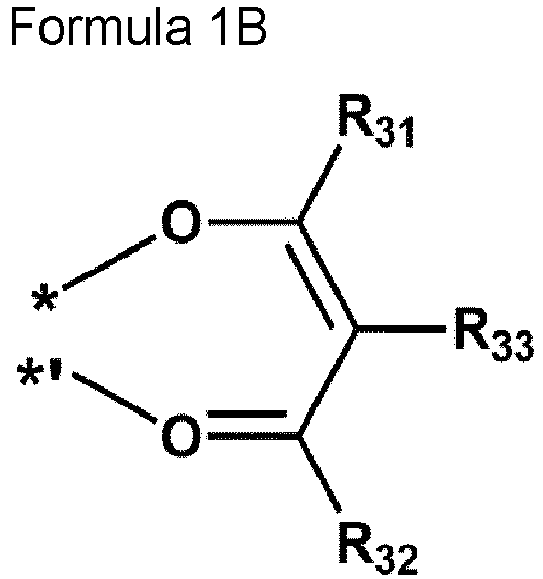
- L 2 in Formula 1 is a ligand represented by Formula 1B: wherein R 31 to R 33 in Formula 1B are each independently hydrogen, deuterium, -F, - Cl, -Br, -I, -SF 5 , a hydroxyl group, a cyano group, a nitro group, an amino group, an amidino group, a hydrazine group, a hydrazone group, a carboxylic acid group or a salt thereof, a sulfonic acid group or a salt thereof, a phosphoric acid group or a salt thereof, a substituted or unsubstituted C 1 -C 60 alkyl group, a substituted or unsubstituted C 2 -C 60 alkenyl group, a substituted or unsubstituted C 2 - C 60 alkynyl group, a substituted or unsubstituted C 1 -C 60 alkoxy group, a substituted or unsubstituted C 1 -
- R 2 , R 11 , R 12 , R 31 to R 33 , and R 41 to R 43 may each independently be:
- R 2 , R 11 , R 12 , R 31 to R 33 , and R 41 to R 43 may each independently be:
- R 31 to R 33 may not include a fluorine.
- R 31 to R 33 each may not be a C 1 -C 10 alkyl group that is substituted with a fluorine.
- R 33 may be hydrogen or deuterium.
- At least one R 2 in Formula 1A is a C 1 -C 10 alkyl group that is substituted with a fluorine.
- one R 2 group may be a C 1 -C 10 alkyl group substituted with a fluorine.
- B11 of Formula 1A indicates the number of R 11 groups, and b11 is 1 or 2. When b11 is 2 or greater, two or more of R 11 may be identical to or different from each other.
- B12 in Formula 1A indicates the number of R 12 groups, and b12 is an integer from 1 to 4.
- b12 is 2, the two R 12 groups may be identical to or different from each other.
- B2 in Formula 1A indicates the number of R 2 groups, and b2 is an integer from 1 to 6. When b2 is 2 or greater, two or more of R 2 may be identical to or different from each other.
- * and *' in Formulae 1A and 1B are each a binding site to M 1 .
- the organometallic compound may be represented by one of Formulae 3-1 to 3-3: wherein, in Formulae 3-1 to 3-3,
- the organometallic compound may be represented by one of Compounds 1 to 128:
- the organometallic compound may be electrically neutral.
- the organometallic compound represented by Formula 1 includes a ligand represented by Formula 1A and a ligand represented by Formula 1B.
- the ligand represented by Formula 1A may control the conjugation and wavelength of the organometallic compound by introducing an alkyl group in which ring CY 2 is substituted with a fluorine as a substituent.
- a ligand containing X 1 and condensed three rings for example, benzothienopyridine, benzofuropyridine, or the like
- the lifespan and the efficiency of a light-emitting device using at least one of the organometallic compounds may be improved.
- an electronic device for example, an organic light-emitting device, including at least one of the organometallic compounds represented by Formula 1 may show a low driving voltage and a high efficiency, and a roll-off phenomenon thereof may be reduced.
- the highest occupied molecular orbital (HOMO) energy level, lowest unoccupied molecular orbital (LUMO) energy level, triplet (T 1 ) energy level, and singlet (S 1 ) energy level of selected organometallic compounds represented by Formula 1 were calculated using a density functional theory (DFT) method of the Gaussian 09 program with the molecular structure optimized at the B3LYP level, and results thereof are shown in Table 1.
- the energy levels are expressed in electron volts (eV).
- organometallic compounds represented by Formula 1 has such electric characteristics that are suitable for use as a dopant for an electronic device, for example, an organic light-emitting device.
- the full width at half maximum (FWHM) of the emission peak of the emission spectrum or the electroluminescence spectrum of the organometallic compound may be about 50 nanometers (nm) or less, about 45 nm or less, about 40 nm or less, about 39 nm or less, about 38 nm or less, or about 37 nm or less.
- the maximum emission wavelength (emission peak wavelength, ⁇ max ) of the emission peak of the emission spectrum or the electroluminescence spectrum of the organometallic compound may be about 590 nm to about 650 nm.
- the maximum emission wavelength of the emission peak of the emission spectrum or the electroluminescence spectrum of the organometallic compound may be about 600 nm to about 650 nm, about 600 nm to about 640 nm, or about 610 nm to about 640 nm.
- the organometallic compound represented by Formula 1 may be suitable for use as a dopant in an organic layer of an organic light-emitting device, for example, an emission layer of the organic layer
- another aspect provides an organic light-emitting device including a first electrode; a second electrode; and an organic layer that is disposed between the first electrode and the second electrode, wherein the organic layer includes an emission layer, and wherein the organic layer further includes at least one of the organometallic compounds represented by Formula 1.
- the organic light-emitting device includes an organic layer including at least one of the organometallic compounds represented by Formula 1 as described above. Accordingly, the organic light-emitting device may have an excellent driving voltage, an excellent current efficiency, a good external quantum efficiency, an excellent roll-off ratio, and a relatively narrow FWHM of the electroluminescent (EL) spectrum emission peak. Hence, the organic light-emitting device may have excellent lifetime characteristics.
- the organometallic compound of Formula 1 may be used between a pair of electrodes of an organic light-emitting device.
- at least one of the organometallic compounds represented by Formula 1 may be included in the emission layer.
- the organometallic compound may act as a dopant, and the emission layer may further include a host (that is, an amount of the at least one organometallic compound represented by Formula 1 in the emission layer is less than an amount of the host in the emission layer, based on weight).
- an amount of the host in the emission layer may be greater than an amount of the at least one organometallic compound represented by Formula 1 in the emission layer, based on weight.
- the emission layer may emit a red light.
- the emission layer may emit a red light having a maximum emission wavelength of about 590 nm to about 650 nm.
- the emission layer may emit a red light having a maximum emission wavelength of about 600 nm to about 650 nm, about 600 nm to about 640 nm, or about 610 nm to about 640 nm.
- (an organic layer) includes at least one of the organometallic compound may include a case in which "(an organic layer) includes identical organometallic compounds represented by Formula 1" and a case in which "(an organic layer) includes two or more different organometallic compounds represented by Formula 1.”
- the organic layer may include, as the at least one organometallic compound, only a Compound 1.
- the Compound 1 may be included in the emission layer of the organic light-emitting device.
- the organic layer may include, as the at least one organometallic compound, a Compound 1 and a Compound 2.
- both the Compound 1 and the Compound 2 may be located in an identical layer (for example, both the Compound 1 and the Compound 2 may be located in an emission layer).
- the first electrode may be an anode, which is a hole injection electrode, and the second electrode may be a cathode, which is an electron injection electrode; or the first electrode may be a cathode, which is an electron injection electrode, and the second electrode may be an anode, which is a hole injection electrode.
- the first electrode may be an anode
- the second electrode may be a cathode
- the organic layer may further include a hole transport region located between the first electrode and the emission layer, and an electron transport region located between the emission layer and the second electrode
- the hole transport region may include a hole injection layer, a hole transport layer, an electron-blocking layer, a buffer layer, or a combination thereof
- the electron transport region may include a hole-blocking layer, an electron transport layer, an electron injection layer, or a combination thereof.
- organic layer refers to a single layer and/or a plurality of layers located between the first electrode and the second electrode of the organic light-emitting device.
- the "organic layer” may include, in addition to an organic compound, an organometallic complex including a metal.
- the FIGURE is a schematic cross-sectional view of an organic light-emitting device 10 according to one or more embodiments.
- the organic light-emitting device 10 includes a first electrode 11, an organic layer 15, and a second electrode 19, which are sequentially stacked in the stated order.
- a substrate may be additionally disposed under the first electrode 11 or on the second electrode 19.
- the substrate may be a conventional substrate used in organic light-emitting devices, for example, a glass substrate or a transparent plastic substrate, each having excellent mechanical strength, thermal stability, transparency, surface smoothness, ease of handling, and/or water repellency.
- the first electrode 11 may be produced by depositing or sputtering, onto the substrate, a material for forming the first electrode 11.
- the first electrode 11 may be an anode.
- the material for forming the first electrode 11 may be selected from materials with a high work function for easy hole injection.
- the first electrode 11 may be a reflective electrode, a semi-transmissive electrode, or a transmissive electrode.
- the material for forming the first electrode 11 may be indium tin oxide (ITO), indium zinc oxide (IZO), tin oxide (SnO 2 ), or zinc oxide (ZnO).
- the material for forming the first electrode 11 may be a metal, such as magnesium (Mg), aluminum (Al), silver (Ag), aluminum-lithium (Al-Li), calcium (Ca), magnesium-indium (Mg-In), or magnesium-silver (Mg-Ag).
- a metal such as magnesium (Mg), aluminum (Al), silver (Ag), aluminum-lithium (Al-Li), calcium (Ca), magnesium-indium (Mg-In), or magnesium-silver (Mg-Ag).
- the first electrode 11 may have a single-layered structure or a multi-layered structure including a plurality of layers.
- the first electrode 11 may have a three-layered structure of ITO/Ag/ITO, but the structure of the first electrode 11 is not limited thereto.
- the organic layer 15 may be located on the first electrode 11.
- the organic layer 15 may include a hole transport region, an emission layer, and an electron transport region.
- the hole transport region may be located between the first electrode 11 and the emission layer.
- the hole transport region may include a hole injection layer, a hole transport layer, an electron-blocking layer, a buffer layer, or a combination thereof.
- the hole transport region may include only either a hole injection layer or a hole transport layer.
- the hole transport region may have a hole injection layer/hole transport layer structure or a hole injection layer/hole transport layer/electron-blocking layer structure, wherein, for each structure, respective layers are sequentially stacked in this stated order from the first electrode 11.
- the hole injection layer may be formed on the first electrode 11 by using one or more suitable methods, for example, vacuum deposition, spin coating, casting, Langmuir-Blodgett (LB) deposition, or the like.
- suitable methods for example, vacuum deposition, spin coating, casting, Langmuir-Blodgett (LB) deposition, or the like.
- the deposition conditions may vary according to a material that is used to form the hole injection layer, and the structure and thermal characteristics of the hole injection layer material.
- the deposition conditions may include a deposition temperature of about 100°C to about 500°C, a vacuum pressure of about 10 -8 torr to about 10 -3 torr, and a deposition rate of about 0.01 angstroms per second ( ⁇ /sec) to about 100 ⁇ /sec.
- the deposition conditions are not limited thereto.
- coating conditions may vary according to the material used to form the hole injection layer, and the structure and thermal properties of the hole injection layer material. For example, a coating speed may be about 2,000 revolutions per minute (rpm) to about 5,000 rpm, and a temperature at which a heat treatment may be performed to remove a solvent after coating may be from about 80°C to about 200°C. However, the coating conditions are not limited thereto.
- the conditions for forming the hole transport layer and the electron-blocking layer may be similar to or the same as the conditions for forming the hole injection layer.
- the hole transport region may include at least one of 4,4',4"-tris(3-methylphenylphenylamino)triphenylamine (m-MTDATA), 4,4',4"-tris(N,N-diphenylamino)triphenylamine (TDATA), 4,4',4"-tris ⁇ N-(2-naphthyl)-N-phenylamino ⁇ -triphenylamine (2-TNATA), N,N'-di(1-naphthyl)-N,N'-diphenylbenzidine (NPB), ⁇ -NPB, N,N'-bis(3-methylphenyl)-N,N'-diphenyl-[1,1-biphenyl]-4,4'-diamine (TPD), spiro-TPD, spiro-NPB, methylated NPB, 4,4'-cyclohexylidene bis[N,N-bis(4-methylphenyl)benzenamine] (TA
- the compound represented by Formula 201 may be represented by Formula 201A, but embodiments are not limited thereto:
- R 101 , R 111 , R 112 , and R 109 in Formula 201A are each as described herein.
- the compound represented by Formula 201 and the compound represented by Formula 202 may be one of compounds HT1 to HT20, but embodiments are not limited thereto:
- a thickness of the hole transport region may be about 100 ⁇ to about 10,000 ⁇ , for example, about 100 ⁇ to about 1,000 ⁇ .
- a thickness of the hole injection layer may be about 100 ⁇ to about 10,000 ⁇ , for example, about 100 ⁇ to about 1,000 ⁇
- a thickness of the hole transport layer may be about 50 ⁇ to about 2,000 ⁇ , for example, about 100 ⁇ to about 1,500 ⁇ .
- the hole transport region may further include, in addition to these materials, a charge-generation material for the improvement of the conductive properties.
- the charge-generation material may be homogeneously or non-homogeneously dispersed in the hole transport region.
- the charge-generation material may be, for example, a p-dopant.
- the p-dopant may be one of a quinone derivative, a metal oxide, or a cyano group-containing compound, but embodiments are not limited thereto.
- non-limiting examples of the p-dopant include a quinone derivative, such as tetracyanoquinodimethane (TCNQ), 2,3,5,6-tetrafluoro-tetracyano-1,4-benzoquinonedimethane (F4-TCNQ), 1,3,4,5,7,8-hexafluorotetracyanonaphthoquinodimethane (F6-TCNQ), or the like; a metal oxide, such as a tungsten oxide, a molybdenum oxide, or the like; or a cyano group-containing compound, such as Compounds HT-D1 or F12, but embodiments are not limited thereto:
- a quinone derivative such as tetracyanoquinodimethane (TCNQ), 2,3,5,6-tetrafluoro-tetracyano-1,4-benzoquinonedimethane (F4-TCNQ), 1,3,4,5,7,8-hexafluo
- the hole transport region may include a buffer layer.
- the buffer layer may compensate for an optical resonance distance according to a wavelength of light emitted from the emission layer to increase efficiency.
- an emission layer may be formed on the hole transport region by vacuum deposition, spin coating, casting, LB deposition, or the like.
- the deposition or coating conditions may be similar to those applied in forming the hole injection layer although the deposition or coating conditions may vary according to a material that is used to form the emission layer.
- a material for forming the electron-blocking layer may be selected from materials for the hole transport region described above and materials for a host to be explained herein.
- the material for the electron-blocking layer is not limited thereto.
- a material for the electron-blocking layer may be mCP, which will be explained herein.
- the emission layer may include a host and a dopant, and the dopant may include at least one of the organometallic compounds represented by Formula 1.
- the host may include at least one of 1,3,5-tri(1-phenyl-1H-benzo[d]imidazol-2-yl)benzene (TPBi), 3-tert-butyl-9,10-di(naphth-2-yl)anthracene (TBADN), 9,10-di(naphthalene-2-yl)anthracene (ADN) (also referred to as "DNA”), 4,4'-bis(N-carbazolyl)-1,1'-biphenyl (CBP), 4,4'-bis(9-carbazolyl)-2,2'-dimethyl-biphenyl (CDBP), 1,3,5-tris(carbazole-9-yl)benzene (tCP), 1,3-bis(N-carbazolyl)benzene (mCP), Compound H50, or Compound H51, but embodiments are not limited thereto:
- the host may include a compound represented by Formula 301, but embodiments are not limited thereto: wherein Ar 111 and Ar 112 in Formula 301 may each independently be:
- Ar 113 to Ar 116 in Formula 301 may each independently be:
- the host may include a compound represented by Formula 302, but embodiments are not limited thereto: wherein Ar 122 to Ar 125 in Formula 302 are as described in connection with Ar 113 in Formula 301.
- Ar 126 and Ar 127 in Formula 302 may each independently be a C 1 -C 10 alkyl group (for example, a methyl group, an ethyl group, a propyl group, or the like).
- k and l in Formula 302 may each independently be an integer from 0 to 4.
- k and I may each independently be 0, 1, or 2.
- the emission layer may be patterned into a red emission layer, a green emission layer, and/or a blue emission layer. In one or more embodiments, due to a stacked structure including a red emission layer, a green emission layer, and/or a blue emission layer, the emission layer may emit a white light.
- an amount of the dopant may be about 0.01 parts by weight to about 15 parts by weight, based on 100 parts by weight of the host, but embodiments are not limited thereto.
- a thickness of the emission layer may be about 100 ⁇ to about 1,000 ⁇ , for example, about 200 ⁇ to about 600 ⁇ . Without wishing to be bound to theory, when the thickness of the emission layer is within these ranges, excellent light-emission characteristics may be obtained without a substantial increase in driving voltage.
- An electron transport region may be located on the emission layer.
- the electron transport region may include a hole-blocking layer, an electron transport layer, an electron injection layer, or a combination thereof.
- the electron transport region may have a hole-blocking layer/electron transport layer/electron injection layer structure, or the electron transport region may have an electron transport layer/electron injection layer structure, but the structure of the electron transport region is not limited thereto.
- the electron transport layer may have a single-layered structure or a multi-layered structure including two or more different materials.
- Conditions for forming the hole-blocking layer, the electron transport layer, and the electron injection layer which constitute the electron transport region may be understood by referring to the conditions for forming the hole injection layer.
- the hole-blocking layer may include, for example, at least one of 2,9-dimethyl-4,7-diphenyl-1,10-phenanthroline (BCP), 4,7-diphenyl-1,10-phenanthroline (Bphen), or bis(2-methyl-8-quinolinolato-N1,O8)-(1,1'-biphenyl-4-olato)aluminum (BAlq), but embodiments are not limited thereto:
- a thickness of the hole-blocking layer may be in a range of about 20 ⁇ to about 1,000 ⁇ , for example, about 30 ⁇ to about 300 ⁇ . Without wishing to be bound to theory, when the thickness of the hole-blocking layer is within these ranges, excellent hole blocking characteristics may be obtained without a substantial increase in driving voltage.
- the electron transport layer may further include at least one of 2,9-dimethyl-4,7-diphenyl-1,10-phenanthroline (BCP), 4,7-diphenyl-1,10-phenanthroline (Bphen), tris(8-hydroxy-quinolinato)aluminum (Alq 3 ), bis(2-methyl-8-quinolinolato-N1,O8)-(1,1'-biphenyl-4-olato)aluminum (BAlq), 3-(4-biphenylyl)-4-phenyl-5-tert-butylphenyl-1,2,4-triazole (TAZ), or 4-(naphthalen-1-yl)-3,5-diphenyl-4H-1,2,4-triazole (NTAZ), but embodiments are not limited thereto:
- the electron transport layer may include at least one of ET1 to ET25, but embodiments are not limited thereto:
- a thickness of the electron transport layer may be about 100 ⁇ to about 1,000 ⁇ , for example, about 150 ⁇ to about 500 ⁇ .
- the electron transport layer may have satisfactory electron transporting characteristics without a substantial increase in driving voltage.
- the electron transport layer may include a metal-containing material in addition to the material as described herein.
- the metal-containing material may include a Li complex.
- the Li complex may include, for example, Compound ET-D1 (lithium quinolate, LiQ) or ET-D2, but embodiments are not limited thereto:
- the electron transport region may include an electron injection layer that promotes the flow of electrons from the second electrode 19 thereinto.
- the electron injection layer may include at least one of LiF, NaCl, CsF, Li 2 O, BaO, or a combination thereof.
- a thickness of the electron injection layer may be about 1 ⁇ to about 100 ⁇ , and, for example, about 3 ⁇ to about 90 ⁇ . Without wishing to be bound to theory, when the thickness of the electron injection layer is within the ranges described above, satisfactory electron injection characteristics may be obtained without a substantial increase in driving voltage.
- the second electrode 19 may be located on the organic layer 15.
- the second electrode 19 may be a cathode.
- a material for forming the second electrode 19 may be metal, an alloy, an electrically conductive compound, or a combination thereof, which have a relatively low work function.
- lithium (Li), magnesium (Mg), aluminum (Al), silver (Ag), aluminum-lithium (Al-Li), calcium (Ca), magnesium-indium (Mg-In), or magnesium-silver (Mg-Ag) may be used as the material for forming the second electrode 19.
- a transmissive electrode formed using ITO or IZO may be used as the second electrode 19.
- Another aspect provides a diagnostic composition including at least one organometallic compound represented by Formula 1.
- the organometallic compound represented by Formula 1 provides a high luminescent efficiency. Accordingly, a diagnostic composition including at least one of the organometallic compounds represented by Formula 1 may have a high diagnostic efficiency.
- the diagnostic composition may be used in various applications including a diagnosis kit, a diagnosis reagent, a biosensor, a biomarker, or the like, but embodiments are not limited thereto.
- C 1 -C 60 alkyl group refers to a linear or branched saturated aliphatic hydrocarbon monovalent group having 1 to 60 carbon atoms, and non-limiting examples thereof include a methyl group, an ethyl group, a propyl group, an isobutyl group, a sec-butyl group, a tert-butyl group, a pentyl group, an isoamyl group, a hexyl group, or the like.
- C 1 -C 60 alkylene group refers to a divalent group having the same structure as the C 1 -C 60 alkyl group.
- C 1 -C 60 alkoxy group refers to a monovalent group represented by -OA 101 (wherein A 101 is the C 1 -C 60 alkyl group), and non-limiting examples thereof include a methoxy group, an ethoxy group, an isopropyloxy group, or the like.
- C 1 -C 60 alkylthio group refers to a monovalent group represented by -SA 101' (wherein A 101' is the C 1 -C 60 alkyl group).
- C 2 -C 60 alkenyl group refers to a hydrocarbon group formed by substituting at least one carbon-carbon double bond in the middle or at the terminus of the C 2 -C 60 alkyl group, and non-limiting examples thereof include an ethenyl group, a propenyl group, a butenyl group, or the like.
- C 2 -C 60 alkenylene group refers to a divalent group having the same structure as the C 2 -C 60 alkenyl group.
- C 2 -C 60 alkynyl group refers to a hydrocarbon group formed by substituting at least one carbon-carbon triple bond in the middle or at the terminus of the C 2 -C 60 alkyl group, and non-limiting examples thereof include an ethynyl group, a propynyl group, or the like.
- C 2 -C 60 alkynylene group refers to a divalent group having the same structure as the C 2 -C 60 alkynyl group.
- C 3 -C 10 cycloalkyl group refers to a monovalent saturated hydrocarbon monocyclic group having 3 to 10 carbon atoms, and non-limiting examples thereof include a cyclopropyl group, a cyclobutyl group, a cyclopentyl group, a cyclohexyl group, a cycloheptyl group, or the like.
- C 3 -C 10 cycloalkylene group refers to a divalent group having the same structure as the C 3 -C 10 cycloalkyl group.
- C 1 -C 10 heterocycloalkyl group refers to a monovalent saturated monocyclic group having at least one heteroatom selected from N, O, P, Ge, Se, Si, and S as a ring-forming atom and 1 to 10 carbon atoms as ring-forming atom(s), and non-limiting examples thereof include a tetrahydrofuranyl group, a tetrahydrothiophenyl group, or the like.
- C 1 -C 10 heterocycloalkylene group refers to a divalent group having the same structure as the C 1 -C 10 heterocycloalkyl group.
- C 3 -C 10 cycloalkenyl group refers to a monovalent monocyclic group that has 3 to 10 carbon atoms and at least one carbon-carbon double bond in the ring thereof and no aromaticity, and non-limiting examples thereof include a cyclopentenyl group, a cyclohexenyl group, and a cycloheptenyl group.
- C 3 -C 10 cycloalkenylene group refers to a divalent group having the same structure as the C 3 -C 10 cycloalkenyl group.
- C 1 -C 10 heterocycloalkenyl group refers to a monovalent monocyclic group that has at least one heteroatom selected from N, O, P, Ge, Se, Si, and S as a ring-forming atom, 1 to 10 carbon atoms as ring-forming atom(s), and at least one double bond in its ring.
- Non-limiting examples of the C 1 -C 10 heterocycloalkenyl group include a 2,3-dihydrofuranyl group, a 2,3-dihydrothiophenyl group, or the like.
- C 1 -C 10 heterocycloalkenylene group refers to a divalent group having the same structure as the C 1 -C 10 heterocycloalkenyl group.
- C 6 -C 60 aryl group refers to a monovalent group having a carbocyclic aromatic ring system having 6 to 60 carbon atoms
- C 6 -C 60 arylene group refers to a divalent group having a carbocyclic aromatic ring system having 6 to 60 carbon atoms.
- Non-limiting examples of the C 6 -C 60 aryl group include a phenyl group, a naphthyl group, an anthracenyl group, a phenanthrenyl group, a pyrenyl group, a chrysenyl group, or the like.
- the C 6 -C 60 aryl group and the C 6 -C 60 arylene group each include two or more rings, the rings may be fused to each other.
- C 7 -C 60 alkyl aryl group refers to a C 6 -C 60 aryl group substituted with at least one C 1 -C 60 alkyl group.
- C 7 -C 60 aryl alkyl group refers to a C 1 -C 60 alkyl group substituted with at least one C 6 -C 60 aryl group.
- C 1 -C 60 heteroaryl group refers to a monovalent group having a carbocyclic aromatic ring system that has at least one heteroatom selected from N, O, P, Ge, Se, Si, and S as a ring-forming atom, and 1 to 60 carbon atoms as ring-forming atom(s).
- C 1 -C 60 heteroarylene group refers to a divalent group having a carbocyclic aromatic ring system that has at least one heteroatom selected from N, O, P, Ge, Se, Si, and S as a ring-forming atom, and 1 to 60 carbon atoms as ring-forming atom(s).
- Non-limiting examples of the C 1 -C 60 heteroaryl group include a pyridinyl group, a pyrimidinyl group, a pyrazinyl group, a pyridazinyl group, a triazinyl group, a quinolinyl group, an isoquinolinyl group, or the like.
- the C 1 -C 60 heteroaryl group and the C 1 -C 60 heteroarylene group each include two or more rings, the rings may be fused to each other.
- C 2 -C 60 alkyl heteroaryl group refers to a C 1 -C 60 heteroaryl group substituted with at least one C 1 -C 60 alkyl group.
- C 2 -C 60 heteroaryl alkyl group refers to a C 1 -C 60 alkyl group substituted with at least one C 1 -C 60 heteroaryl group.
- C 6 -C 60 aryloxy group indicates -OA 102 (wherein A 102 is a C 6 -C 60 aryl group), and the term “C 6 -C 60 arylthio group” as used herein indicates -SA 103 (wherein A 103 is a C 6 -C 60 aryl group).
- C 1 -C 60 heteroaryloxy group indicates -OA 104 (wherein A 104 is a C 1 -C 60 heteroaryl group), and the term “C 1 -C 60 heteroarylthio group” as used herein indicates -SA 105 (wherein A 105 is the C 1 -C 60 heteroaryl group).
- monovalent non-aromatic condensed polycyclic group refers to a monovalent group (for example, having 8 to 60 carbon atoms) having two or more rings condensed to each other, only carbon atoms as ring-forming atoms, and no aromaticity in its entire molecular structure.
- Non-limiting examples of the monovalent non-aromatic condensed polycyclic group include a fluorenyl group or the like.
- divalent non-aromatic condensed polycyclic group refers to a divalent group having the same structure as the monovalent non-aromatic condensed polycyclic group described above.
- the term "monovalent non-aromatic condensed heteropolycyclic group” as used herein refers to a monovalent group (for example, having 2 to 60 carbon atoms) having two or more rings condensed with each other, a heteroatom selected from N, O, P, Ge, Se, Si, and S, other than carbon atoms, as a ring-forming atom, and no aromaticity in its entire molecular structure.
- Non-limiting examples of the monovalent non-aromatic condensed heteropolycyclic group include a carbazolyl group or the like.
- divalent non-aromatic condensed heteropolycyclic group refers to a divalent group having the same structure as the monovalent non-aromatic condensed heteropolycyclic group described above.
- C 5 -C 30 carbocyclic group refers to a saturated or unsaturated ring group having, as a ring-forming atom, 5 to 30 carbon atoms only.
- the C 5 -C 30 carbocyclic group may be a monocyclic group or a polycyclic group.
- C 1 -C 30 heterocyclic group refers to a saturated or unsaturated ring group having, as a ring-forming atom, at least one heteroatom selected from N, O, P, Ge, Se, Si, and S other than 1 to 30 carbon atoms as ring-forming atom(s).
- the C 1 -C 30 heterocyclic group may be a monocyclic group or a polycyclic group.
- organometallic compounds and organic light-emitting devices are described in further detail with reference to Synthesis Examples and Examples.
- embodiments of the organometallic compound represented by Formula 1 and the organic light-emitting device are not limited thereto.
- the wording "B was used instead of A" used in describing Synthesis Examples means that an amount of A used was identical to an amount of B used, in terms of a molar equivalent.
- a palladium catalyst (tetrakis(triphenylphosphine)palladium(0), Pd(PPh 3 ) 4 ) (0.31 g, 0.27 mmol) was added to the reaction mixture. Afterwards, the resultant reaction mixture was stirred and heated under reflux at a temperature of 110°C. Then, the temperature was allowed to cool to room temperature.
- Pentane-2,4-dione (0.17 g, 1.71 mmol) and potassium carbonate (K 2 CO 3 ) (0.24 g, 1.71 mmol) were added to Compound 3B (1.50 g, 0.68 mmol), and the resultant mixture was mixed with 15 mL of 2-ethoxyethanol, followed by stirring at room temperature for 18 hours. After extraction, the obtained solid was purified by column chromatography (eluents: methylene chloride (MC) and hexane) to obtain 1.32 g (yield of 83%) of Compound 3. The obtained compound was identified by HRMS (MALDI) and HPLC analysis.
- an ITO-patterned glass substrate was cut to a size of 50 millimeters (mm) x 50 mm x 0.5 mm, sonicated with isopropyl alcohol and DI water, each for 5 minutes, and then cleaned by exposure to ultraviolet rays and ozone for 30 minutes.
- the resultant patterned glass substrate was loaded onto a vacuum deposition apparatus.
- Compounds HT3 and F12-P-dopant were co-deposited by vacuum on the anode at a weight ratio of 98:2 to form a hole injection layer having a thickness of 100 ⁇ , and then, Compound HT3 was vacuum-deposited on the hole injection layer to form a hole transport layer having a thickness of 1,600 ⁇ .
- Organic light-emitting devices were manufactured in a similar manner as in Example 1, except that compounds shown in Table 2 were each used as a dopant in forming an emission layer.
- the driving voltage (Volts, V), roll-off ratio (%), maximum emission wavelength ( ⁇ max , nm), full width at half maximum (FWHM, nm), and maximum external quantum efficiency (Max EQE, %) of each of the organic light-emitting devices manufactured in Examples 1 to 4 and Comparative Examples 1 and 2 were evaluated, and the results are shown in Table 2.
- a current-voltage meter (Keithley 2400) and a luminance meter (Minolta Cs-1 000A) were used as evaluation apparatuses.
- the roll-off ratio was calculated according to Equation 1.
- the organic light-emitting devices of Examples 1 to 4 have a low driving voltage, a reduced roll-off ratio, a narrow FWHM, and a high maximum EQE.
- the organic light-emitting devices of Examples 1 to 4 have a lower driving voltage, a reduced roll-off ratio, a narrower FWHM, and equivalent or higher maximum EQE than the organic light-emitting devices of Comparative Examples 1 and 2.
- an electronic device for example, an organic light-emitting device, using at least one of the organometallic compounds may have characteristics of a low driving voltage and a high efficiency.
- a high-quality organic light-emitting device may be embodied.
Landscapes
- Chemical & Material Sciences (AREA)
- Organic Chemistry (AREA)
- Engineering & Computer Science (AREA)
- Materials Engineering (AREA)
- Physics & Mathematics (AREA)
- Optics & Photonics (AREA)
- Crystallography & Structural Chemistry (AREA)
- Inorganic Chemistry (AREA)
- Electroluminescent Light Sources (AREA)
Abstract
Formula 1 M1(L1)n1(L2)n2
wherein, in Formula 1, M1 is a transition metal, L1 is a ligand represented by Formula 1A, L2 is a ligand represented by Formula 1B, and n1 and n2 are each independently 1 or 2:

Description
- The disclosure relates to an organometallic compound, an organic light-emitting device including the same, and an electronic apparatus including the organic light-emitting device.
- Organic light-emitting devices (OLEDs) are self-emissive devices, and have improved characteristics in terms of viewing angles, response time, brightness, driving voltage, and response speed. In addition. OLEDs can produce full-color images.
- Organic light-emitting devices typically include an anode, a cathode, and an organic layer located between the anode and the cathode and including an emission layer. A hole transport region may be located between the anode and the emission layer, and an electron transport region may be located between the emission layer and the cathode. Holes provided from the anode may move toward the emission layer through the hole transport region, and electrons provided from the cathode may move toward the emission layer through the electron transport region. The holes and the electrons may recombine in the emission layer to produce excitons. The excitons may transition from an excited state to a ground state, thus generating light.
- Provided are an organometallic compound, an organic light-emitting device including the same, and an electronic apparatus including the organic light-emitting device.
- Additional aspects will be set forth in part in the detailed description that follows and, in part, will be apparent from the detailed description, or may be learned by practice of the presented exemplary embodiments.
- According to an aspect, provided is an organometallic compound represented by Formula 1:
Formula 1 M1(L1)n1(L2)n2
wherein, in Formula 1, - M1 is a transition metal,
- L1 is a ligand represented by Formula 1A,
- L2 is a ligand represented by Formula 1B,
- n1 and n2 are each independently 1 or 2,
- X1 is C or N, and X2 may be C or N,
- Y1 is O, S, Se, C(R41)(R42), or N(R43),
- ring CY2 is a 6-membered carbocyclic group to which a C5-C30 carbocyclic group is condensed, a 6-membered carbocyclic group to which a C1-C30 heterocyclic group is condensed, a 6-membered heterocyclic group to which a C5-C30 carbocyclic group is condensed, or a 6-membered heterocyclic group to which a C1-C30 heterocyclic group is condensed,
- R2, R11, R12, R31 to R33, and R41 to R43 are each independently hydrogen, deuterium, -F, -Cl, -Br, -I, -SF5, a hydroxyl group, a cyano group, a nitro group, an amino group, an amidino group, a hydrazine group, a hydrazone group, a carboxylic acid group or a salt thereof, a sulfonic acid group or a salt thereof, a phosphoric acid group or a salt thereof, a substituted or unsubstituted C1-C60 alkyl group, a substituted or unsubstituted C2-C60 alkenyl group, a substituted or unsubstituted C2-C60 alkynyl group, a substituted or unsubstituted C1- C60 alkoxy group, a substituted or unsubstituted C1-C60 alkylthio group, a substituted or unsubstituted C3-C10 cycloalkyl group, a substituted or unsubstituted C1-C10 heterocycloalkyl group, a substituted or unsubstituted C3-C10 cycloalkenyl group, a substituted or unsubstituted C2-C10 heterocycloalkenyl group, a substituted or unsubstituted C6- C60 aryl group, a substituted or unsubstituted C7-C60 alkyl aryl group, a substituted or unsubstituted C7-C60 aryl alkyl group, a substituted or unsubstituted C6- C60 aryloxy group, a substituted or unsubstituted C6- C60 arylthio group, a substituted or unsubstituted C1-C60 heteroaryl group, a substituted or unsubstituted C2-C60 alkyl heteroaryl group, a substituted or unsubstituted C2-C60 heteroaryl alkyl group, a substituted or unsubstituted C1- C60 heteroaryloxy group, a substituted or unsubstituted C1- C60 heteroarylthio group, a substituted or unsubstituted monovalent non-aromatic condensed polycyclic group, a substituted or unsubstituted monovalent non-aromatic condensed heteropolycyclic group, -Si(Q1)(Q2)(Q3), -Ge(Q1)(Q2)(Q3), -N(Q4)(Q5), - B(Q6)(Q7), -P(Q8)(Q9), or -P(=O)(Q8)(Q9),
- at least one R2 is a C1-C10 alkyl group that is substituted with a fluorine,
- b2 is an integer from 1 to 6,
- b11 is 1 or 2,
- b12 is an integer from 1 to 4,
- * and *' each indicate a binding site to M1, and
- at least one substituent of the substituted C5-C30 carbocyclic group, the substituted C1-C30 heterocyclic group, the substituted C1-C60 alkyl group, the substituted C2-C60 alkenyl group, the substituted C2-C60 alkynyl group, the substituted C1-C60 alkoxy group, the substituted C1-C60 alkylthio group, the substituted C3-C10 cycloalkyl group, the substituted C1-C10 heterocycloalkyl group, the substituted C3-C10 cycloalkenyl group, the substituted C1-C10 heterocycloalkenyl group, the substituted C6-C60 aryl group, the substituted C7-C60 alkyl aryl group, the substituted C7-C60 aryl alkyl group, the substituted C6-C60 aryloxy group, the substituted C6-C60 arylthio group, the substituted C1-C60 heteroaryl group, the substituted C2-C60 alkyl heteroaryl group, the substituted C2-C60 heteroaryl alkyl group, the substituted C1-C60 heteroaryloxy group, the substituted C1-C60 heteroarylthio group, the substituted monovalent non-aromatic condensed polycyclic group, and the substituted monovalent non-aromatic condensed heteropolycyclic group is:
- deuterium, -F, -Cl, -Br, -I, -SF5, -CD3, -CD2H, -CDH2, -CF3, -CF2H, -CFH2, a hydroxyl group, a cyano group, a nitro group, an amino group, an amidino group, a hydrazine group, a hydrazone group, a carboxylic acid group or a salt thereof, a sulfonic acid group or a salt thereof, a phosphoric acid group or a salt thereof, a C1-C60 alkyl group, a C2-C60 alkenyl group, a C2-C60 alkynyl group, a C1-C60 alkoxy group, or a C1-C60 alkylthio group,
- a C1-C60 alkyl group, a C2-C60 alkenyl group, a C2-C60 alkynyl group, a C1-C60 alkoxy group, or a C1-C60 alkylthio group, each substituted with at least one of deuterium, -F, -Cl, -Br, -I, -SF5, -CD3, -CD2H, -CDH2, -CF3, -CF2H, -CFH2, a hydroxyl group, a cyano group, a nitro group, an amino group, an amidino group, a hydrazine group, a hydrazone group, a carboxylic acid group or a salt thereof, a sulfonic acid group or a salt thereof, a phosphoric acid group or a salt thereof, a C3-C10 cycloalkyl group, a C1-C10 heterocycloalkyl group, a C3-C10 cycloalkenyl group, a C1-C10 heterocycloalkenyl group, a C6-C60 aryl group, a C7-C60 alkyl aryl group, a C6-C60 aryloxy group, a C6-C60 arylthio group, a C1-C60 heteroaryl group, a C2-C60 alkyl heteroaryl group, a C1-C60 heteroaryloxy group, a C1-C60 heteroarylthio group, a monovalent non-aromatic condensed polycyclic group, a monovalent non-aromatic condensed heteropolycyclic group, -Si(Q11)(Q12)(Q13), -Ge(Q11)(Q12)(Q13), - N(Q14)(Q15), -B(Q16)(Q17), -P(Q18)(Q19), -P(=O)(Q18)(Q19), or a combination thereof,
- a C3-C10 cycloalkyl group, a C1-C10 heterocycloalkyl group, a C3-C10 cycloalkenyl group, a C1-C10 heterocycloalkenyl group, a C6-C60 aryl group, a C7-C60 alkyl aryl group, a C6-C60 aryloxy group, a C6-C60 arylthio group, a C1-C60 heteroaryl group, a C2-C60 alkyl heteroaryl group, a C1-C60 heteroaryloxy group, a C1-C60 heteroarylthio group, a monovalent non-aromatic condensed polycyclic group, or a monovalent non-aromatic condensed heteropolycyclic group,
- a C3-C10 cycloalkyl group, a C1-C10 heterocycloalkyl group, a C3-C10 cycloalkenyl group, a C1-C10 heterocycloalkenyl group, a C6-C60 aryl group, a C7-C60 alkyl aryl group, a C6-C60 aryloxy group, a C6-C60 arylthio group, a C1-C60 heteroaryl group, a C2-C60 alkyl heteroaryl group, a C1-C60 heteroaryloxy group, a C1-C60 heteroarylthio group, a monovalent non-aromatic condensed polycyclic group, or a monovalent non-aromatic condensed heteropolycyclic group, each substituted with at least one of deuterium, -F, -Cl, -Br, -I, -SF5, -CD3, -CD2H, -CDH2, -CF3, -CF2H, - CFH2, a hydroxyl group, a cyano group, a nitro group, an amino group, an amidino group, a hydrazine group, a hydrazone group, a carboxylic acid group or a salt thereof, a sulfonic acid group or a salt thereof, a phosphoric acid group or a salt thereof, a C1-C60 alkyl group, a C2-C60 alkenyl group, a C2-C60 alkynyl group, a C1-C60 alkoxy group, a C1-C60 alkylthio group, a C3-C10 cycloalkyl group, a C1-C10 heterocycloalkyl group, a C3-C10 cycloalkenyl group, a C1-C10 heterocycloalkenyl group, a C6-C60 aryl group, a C7-C60 alkyl aryl group, a C7-C60 aryl alkyl group, a C6-C60 aryloxy group, a C6-C60 arylthio group, a C1-C60 heteroaryl group, a C2-C60 alkyl heteroaryl group, a C2-C60 heteroaryl alkyl group, a C1-C60 heteroaryloxy group, a C1-C60 heteroarylthio group, a monovalent non-aromatic condensed polycyclic group, a monovalent non-aromatic condensed heteropolycyclic group, -Si(Q21)(Q22)(Q23), -Ge(Q21)(Q22)(Q23), - N(Q24)(Q25), -B(Q26)(Q27), -P(Q28)(Q29), -P(=O)(Q28)(Q29), or a combination thereof, or
- -Si(Q31)(Q32)(Q33), -Ge(Q31)(Q32)(Q33), -N(Q34)(Q35), -B(Q36)(Q37), - P(Q39)(Q39), or -P(=O)(Q38)(Q39),
- wherein Q1 to Q9, Q11 to Q19, Q21 to Q29, and Q31 to Q39 are each independently hydrogen, deuterium, -F, -Cl, -Br, -I, -SF5, a hydroxyl group, a cyano group, a nitro group, an amino group, an amidino group, a hydrazine group, a hydrazone group, a carboxylic acid group or a salt thereof, a sulfonic acid group or a salt thereof, a phosphoric acid group or a salt thereof, a substituted or unsubstituted C1-C60 alkyl group, a substituted or unsubstituted C2-C60 alkenyl group, a substituted or unsubstituted C2-C60 alkynyl group, a substituted or unsubstituted C1-C60 alkoxy group, a substituted or unsubstituted C1-C60 alkylthio group, a substituted or unsubstituted C3-C10 cycloalkyl group, a substituted or unsubstituted C1-C10 heterocycloalkyl group, a substituted or unsubstituted C3-C10 cycloalkenyl group, a substituted or unsubstituted C1-C10 heterocycloalkenyl group, a substituted or unsubstituted C6-C60 aryl group, a substituted or unsubstituted C7-C60 alkyl aryl group, a substituted or unsubstituted C7-C60 aryl alkyl group, a substituted or unsubstituted C6-C60 aryloxy group, a substituted or unsubstituted C6-C60 arylthio group, a substituted or unsubstituted C1-C60 heteroaryl group, a substituted or unsubstituted C2-C60 alkyl heteroaryl group, a substituted or unsubstituted C2-C60 heteroaryl alkyl group, a substituted or unsubstituted C1-C60 heteroaryloxy group, a substituted or unsubstituted C1-C60 heteroarylthio group, a substituted or unsubstituted monovalent non-aromatic condensed polycyclic group, or a substituted or unsubstituted monovalent non-aromatic condensed heteropolycyclic group.
- According to another aspect, an organic light-emitting device includes a first electrode, a second electrode, and an organic layer located between the first electrode and the second electrode, wherein the organic layer includes an emission layer, and wherein the organic layer further includes at least one of the organometallic compound.
- The organometallic compound may be included in the emission layer of the organic layer, and the organometallic compound included in the emission layer may act as a dopant.
- According to another aspect, an electronic apparatus includes the organic light-emitting device.
- The above and other aspects, features, and advantages of certain exemplary embodiments will be more apparent from the following detailed description taken in conjunction with the FIGURE, which shows a schematic cross-sectional view of an organic light-emitting device according to one or more embodiments.
- Reference will now be made in further detail to exemplary embodiments, examples of which are illustrated in the accompanying drawing, wherein like reference numerals refer to like elements throughout. In this regard, the present exemplary embodiments may have different forms and should not be construed as being limited to the detailed descriptions set forth herein. Accordingly, the exemplary embodiments are merely described in further detail below, and by referring to the figure, to explain certain aspects. As used herein, the term "and/or" includes any and all combinations of one or more of the associated listed items. Expressions such as "at least one of," when preceding a list of elements, modify the entire list of elements and do not modify the individual elements of the list.
- The terminology used herein is for the purpose of describing one or more exemplary embodiments only and is not intended to be limiting. As used herein, the singular forms "a," "an," and "the" are intended to include the plural forms as well, unless the context clearly indicates otherwise. The term "or" means "and/or." It will be further understood that the terms "comprises" and/or "comprising," or "includes" and/or "including" when used in this specification, specify the presence of stated features, regions, integers, steps, operations, elements, and/or components, but do not preclude the presence or addition of one or more other features, regions, integers, steps, operations, elements, components, and/or groups thereof.
- It will be understood that, although the terms first, second, third etc. may be used herein to describe various elements, components, regions, layers, and/or sections, these elements, components, regions, layers, and/or sections should not be limited by these terms. These terms are only used to distinguish one element, component, region, layer, or section from another element, component, region, layer, or section. Thus, a first element, component, region, layer, or section discussed below could be termed a second element, component, region, layer, or section without departing from the teachings of the present embodiments.
- Exemplary embodiments are described herein with reference to cross section illustrations that are schematic illustrations of idealized embodiments. As such, variations from the shapes of the illustrations as a result, for example, of manufacturing techniques and/or tolerances, are to be expected. Thus, embodiments described herein should not be construed as limited to the particular shapes of regions as illustrated herein but are to include deviations in shapes that result, for example, from manufacturing. For example, a region illustrated or described as flat may, typically, have rough and/or nonlinear features. Moreover, sharp angles that are illustrated may be rounded. Thus, the regions illustrated in the figures are schematic in nature and their shapes are not intended to illustrate the precise shape of a region and are not intended to limit the scope of the present claims.
- It will be understood that when an element is referred to as being "on" another element, it can be directly in contact with the other element or intervening elements may be present therebetween. In contrast, when an element is referred to as being "directly on" another element, there are no intervening elements present.
- Unless otherwise defined, all terms (including technical and scientific terms) used herein have the same meaning as commonly understood by one of ordinary skill in the art to which this general inventive concept belongs. It will be further understood that terms, such as those defined in commonly used dictionaries, should be interpreted as having a meaning that is consistent with their meaning in the context of the relevant art and the present disclosure, and will not be interpreted in an idealized or overly formal sense unless expressly so defined herein.
- "About" or "approximately" as used herein is inclusive of the stated value and means within an acceptable range of deviation for the particular value as determined by one of ordinary skill in the art, considering the measurement in question and the error associated with measurement of the particular quantity (i.e., the limitations of the measurement system). For example, "about" can mean within one or more standard deviations, or within ± 30%, 20%, 10%, 5% of the stated value.
- Hereinafter, a work function or a highest occupied molecular orbital (HOMO) energy level is expressed as an absolute value from a vacuum level. In addition, when the work function or the HOMO energy level is referred to be "deep," "high," or "large," the work function or the HOMO energy level has a large absolute value based on "0 electron Volts (eV)" of the vacuum level, while when the work function or the HOMO energy level is referred to be "shallow," "low," or "small," the work function or HOMO energy level has a small absolute value based on "0 eV" of the vacuum level.
- According to an aspect, an organometallic compound is represented by Formula 1:
Formula 1 M1(L1)n1(L2)n2
wherein M1 in Formula 1 is a transition metal. - In one or more embodiments, M1 in Formula 1 may be a first-row transition metal of the Periodic Table of Elements, a second-row transition metal of the Periodic Table of Elements, or a third-row transition metal of the Periodic Table of Elements.
- In one or more embodiments, M1 may be iridium, platinum, palladium, gold, osmium, titanium, zirconium, hafnium, europium, terbium, thulium, or rhodium.
- For example, M1 may be iridium, osmium, platinum, palladium, or gold.
- In one or more embodiments, M1 may be iridium.
- n1 and n2 in Formula 1 are each independently 1 or 2.
- In one or more embodiments, a sum of n1 and n2 may be 3.
- For example, n1 may be 2, and n2 may be 1.
- L1 in Formula 1 is a ligand represented by Formula 1A:

- In regard to Formula 1A, X1 is C or N, and X2 is C or N.
- The bond between M1 and X1 in Formula 1A may be a covalent bond or a coordination bond.
- The bond between M1 and X2 in Formula 1A may be a covalent bond or a coordination bond.
- In one or more embodiments, X1 may be N, X2 may be C, a bond between X1 and M1 may be a coordination bond, and a bond between X2 and M1 may be a covalent bond.
- Y1 in Formula 1A is O, S, Se, C(R41)(R42), or N(R43). R41 to R43 may each be as described herein.
- R2, R11, R12, and R41 to R43 in Formula 1A are each independently hydrogen, deuterium, -F, -Cl, -Br, -I, -SF5, a hydroxyl group, a cyano group, a nitro group, an amino group, an amidino group, a hydrazine group, a hydrazone group, a carboxylic acid group or a salt thereof, a sulfonic acid group or a salt thereof, a phosphoric acid group or a salt thereof, a substituted or unsubstituted C1-C60 alkyl group, a substituted or unsubstituted C2-C60 alkenyl group, a substituted or unsubstituted C2- C60 alkynyl group, a substituted or unsubstituted C1-C60 alkoxy group, a substituted or unsubstituted C1-C60 alkylthio group, a substituted or unsubstituted C3-C10 cycloalkyl group, a substituted or unsubstituted C1-C10 heterocycloalkyl group, a substituted or unsubstituted C3-C10 cycloalkenyl group, a substituted or unsubstituted C1-C10 heterocycloalkenyl group, a substituted or unsubstituted C6-C60 aryl group, a substituted or unsubstituted C7-C60 alkyl aryl group, a substituted or unsubstituted C7-C60 aryl alkyl group, a substituted or unsubstituted C6-C60 aryloxy group, a substituted or unsubstituted C6-C60 arylthio group, a substituted or unsubstituted C1-C60 heteroaryl group, a substituted or unsubstituted C2-C60 alkyl heteroaryl group, a substituted or unsubstituted C2-C60 heteroaryl alkyl group, a substituted or unsubstituted C1-C60 heteroaryloxy group, a substituted or unsubstituted C1-C60 heteroarylthio group, a substituted or unsubstituted monovalent non-aromatic condensed polycyclic group, or a substituted or unsubstituted monovalent non-aromatic condensed heteropolycyclic group.
- Ring CY2 in Formula 1A is a 6-membered carbocyclic group to which a C5-C30 carbocyclic group is condensed, a 6-membered carbocyclic group to which a C1-C30 heterocyclic group is condensed, a 6-membered heterocyclic group to which a C5-C30 carbocyclic group is condensed, or a 6-membered heterocyclic group to which a C1-C30 heterocyclic group is condensed.
- In one or more embodiments, ring CY2 may be a condensed ring group in which two or more first rings are condensed with each other, a condensed ring group in which two or more second rings are condensed with each other, or a condensed ring group in which at least one first ring is condensed with at least one second ring,
- the first ring may be a cyclopentane group, a cyclopentadiene group, a furan group, a thiophene group, a pyrrole group, a silole group, an indene group, a benzofuran group, a benzothiophene group, an indole group, a benzosilole group, an oxazole group, an isoxazole group, an oxadiazole group, an isoxadiazole group, an oxatriazole group, an isoxatriazole group, a thiazole group, an isothiazole group, a thiadiazole group, an isothiadiazole group, a thiatriazole group, an isothiatriazole group, a pyrazole group, an imidazole group, a triazole group, a tetrazole group, an azasilole group, a diazasilole group, or a triazasilole group, and
- the second ring may be an adamantane group, a norbornane group, a norbornene group, a cyclohexane group, a cyclohexene group, a benzene group, a pyridine group, a pyrimidine group, a pyrazine group, a pyridazine group, or a triazine group.
- In one or more embodiments, ring CY2 may be a naphthalene group, a 1,2,3,4-tetrahydronaphthalene group, a phenanthrene group, a pyridine group, a pyrimidine group, a pyrazine group, a pyridazine group, a triazine group, a quinoline group, an isoquinoline group, a quinoxaline group, a quinazoline group, a phenanthroline group, a benzofuran group, a benzothiophene group, a fluorene group, a carbazole group, a dibenzofuran group, a dibenzothiophene group, a dibenzosilole group, an azafluorene group, an azacarbazole group, an azadibenzofuran group, an azadibenzothiophene group, or an azadibenzosilole group.
- For example, ring CY2 may be a naphthalene group.
- In one or more embodiments, a moiety represented by


- Z13 to Z16 may each independently be as described in connection with R12, provided that Z13 to Z16 may not be hydrogen,
- X1, Y1, R11, and b11 are each as described herein,
- * indicates a binding site to M1, and
- *" indicates a binding site to an adjacent atom.
- In one or more embodiments, a moiety represented by


- X2 is as described herein,
- X21 may be N or C(R21), X22 is N or C(R22), X23 is N or C(R23), and X24 is N or C(R24),
- ring CY25 may be a C5-C30 carbocyclic group or a C1-C30 heterocyclic group,
- R21 to R25 are each independently as described in connection with R2,
- b25 may be an integer from 1 to 10,
- *' indicates a binding site to M1, and
- *" indicates a binding site to an adjacent atom.
- In one or more embodiments, ring CY25 may be a benzene group, a naphthalene group, a 1,2,3,4-tetrahydronaphthalene group, a phenanthrene group, a pyridine group, a pyrimidine group, a pyrazine group, a pyridazine group, a triazine group, a quinoline group, an isoquinoline group, a quinoxaline group, a quinazoline group, a phenanthroline group, a benzofuran group, a benzothiophene group, a fluorene group, a carbazole group, a dibenzofuran group, a dibenzothiophene group, a dibenzosilole group, an azafluorene group, an azacarbazole group, an azadibenzofuran group, an azadibenzothiophene group, or an azadibenzosilole group.
- In one or more embodiments, a moiety represented by


- X2 is as described herein,
- R21 to R25 are each independently as described in connection with R2,
- c25 may be an integer from 1 to 4,
- *' indicates a binding site to M1, and
- *" indicates a binding site to an adjacent atom.
- In one or more embodiments, a moiety represented by


- X2 is as described herein,
- Z21 to Z24 may each independently be a C1-C10 alkyl group that is substituted with at least one fluorine,
- Z25 may be:
- hydrogen, deuterium, -F, -Cl, -Br, -I, -SF5, -CD3, -CD2H, -CDH2, or a C1-C10 alkyl group;
- a C1-C10 alkyl group that is substituted with at least one of deuterium, -F, -Cl, -Br, -I, -SF5, -CD3, -CD2H, -CDH2, C1-C10 alkyl group, a phenyl group, a naphthyl group, a pyridinyl group, a pyrimidinyl group, or a combination thereof;
- a phenyl group, a naphthyl group, a fluorenyl group, a phenanthrenyl group, an anthracenyl group, a fluoranthenyl group, a triphenylenyl group, a pyrenyl group, a chrysenyl group, a pyrrolyl group, a thiophenyl group, a furanyl group, an imidazolyl group, a pyrazolyl group, a thiazolyl group, an isothiazolyl group, an oxazolyl group, an isoxazolyl group, a pyridinyl group, a pyrazinyl group, a pyrimidinyl group, a pyridazinyl group, an isoindolyl group, an indolyl group, an indazolyl group, a purinyl group, a quinolinyl group, an isoquinolinyl group, a benzoquinolinyl group, a quinoxalinyl group, a quinazolinyl group, a cinnolinyl group, a carbazolyl group, a phenanthrolinyl group, a benzoimidazolyl group, a benzofuranyl group, a benzothiophenyl group, a benzoisothiazolyl group, a benzoxazolyl group, an isobenzoxazolyl group, a triazolyl group, a tetrazolyl group, an oxadiazolyl group, a triazinyl group, a dibenzofuranyl group, a dibenzothiophenyl group, a benzocarbazolyl group, a dibenzocarbazolyl group, an imidazopyridinyl group, or an imidazopyrimidinyl group; or
- a phenyl group, a naphthyl group, a fluorenyl group, a phenanthrenyl group, an anthracenyl group, a fluoranthenyl group, a triphenylenyl group, a pyrenyl group, a chrysenyl group, a pyrrolyl group, a thiophenyl group, a furanyl group, an imidazolyl group, a pyrazolyl group, a thiazolyl group, an isothiazolyl group, an oxazolyl group, an isoxazolyl group, a pyridinyl group, a pyrazinyl group, a pyrimidinyl group, a pyridazinyl group, an isoindolyl group, an indolyl group, an indazolyl group, a purinyl group, a quinolinyl group, an isoquinolinyl group, a benzoquinolinyl group, a quinoxalinyl group, a quinazolinyl group, a cinnolinyl group, a carbazolyl group, a phenanthrolinyl group, a benzoimidazolyl group, a benzofuranyl group, a benzothiophenyl group, a benzoisothiazolyl group, a benzoxazolyl group, an isobenzoxazolyl group, a triazolyl group, a tetrazolyl group, an oxadiazolyl group, a triazinyl group, a dibenzofuranyl group, a dibenzothiophenyl group, a benzocarbazolyl group, a dibenzocarbazolyl group, an imidazopyridinyl group, or an imidazopyrimidinyl group, each substituted with at least one of deuterium, -F, -Cl, - Br, -I, -SF5, -CD3, -CD2H, -CDH2, a C1-C10 alkyl group, a phenyl group, a naphthyl group, a fluorenyl group, a phenanthrenyl group, an anthracenyl group, a fluoranthenyl group, a triphenylenyl group, a pyrenyl group, a chrysenyl group, a pyrrolyl group, a thiophenyl group, a furanyl group, an imidazolyl group, a pyrazolyl group, a thiazolyl group, an isothiazolyl group, an oxazolyl group, an isoxazolyl group, a pyridinyl group, a pyrazinyl group, a pyrimidinyl group, a pyridazinyl group, an isoindolyl group, an indolyl group, an indazolyl group, a purinyl group, a quinolinyl group, an isoquinolinyl group, a benzoquinolinyl group, a quinoxalinyl group, a quinazolinyl group, a cinnolinyl group, a carbazolyl group, a phenanthrolinyl group, a benzoimidazolyl group, a benzofuranyl group, a benzothiophenyl group, a benzoisothiazolyl group, a benzoxazolyl group, an isobenzoxazolyl group, a triazolyl group, a tetrazolyl group, an oxadiazolyl group, a triazinyl group, a dibenzofuranyl group, a dibenzothiophenyl group, a benzocarbazolyl group, a dibenzocarbazolyl group, an imidazopyridinyl group, an imidazopyrimidinyl group, or a combination thereof,
- d25 may be an integer from 1 to 5,
- d26 may be an integer from 1 to 4,
- *' indicates a binding site to M1, and
- *" indicates a binding site to an adjacent atom.
- L2 in Formula 1 is a ligand represented by Formula 1B:

- In one or more embodiments, in Formulae 1A and 1B, R2, R11, R12, R31 to R33, and R41 to R43 may each independently be:
- hydrogen, deuterium, -F, -Cl, -Br, -I, -SF5, -CD3, -CD2H, -CDH2, -CF3, -CF2H, -CFH2, a hydroxyl group, a cyano group, a nitro group, an amino group, an amidino group, a hydrazine group, a hydrazone group, a carboxylic acid group or a salt thereof, a sulfonic acid group or a salt thereof, a phosphoric acid group or a salt thereof, a C1-C20 alkyl group, a C1-C20 alkoxy group, or a C1-C20 alkylthio group;
- a C1-C20 alkyl group, a C1-C20 alkoxy group, or a C1-C20 alkylthio group, each substituted with at least one of deuterium, -F, -Cl, -Br, -I, -SF5, -CD3, -CD2H, -CDH2, -CF3, -CF2H, -CFH2, a hydroxyl group, a cyano group, a nitro group, an amino group, an amidino group, a hydrazine group, a hydrazone group, a carboxylic acid group or a salt thereof, a sulfonic acid group or a salt thereof, a phosphoric acid group or a salt thereof, a C1-C10 alkyl group, a cyclopentyl group, a cyclohexyl group, a cycloheptyl group, a cyclooctyl group, an adamantanyl group, a norbornanyl group, a norbornenyl group, a cyclopentenyl group, a cyclohexenyl group, a cycloheptenyl group, a phenyl group, a naphthyl group, a pyridinyl group, a pyrimidinyl group, or a combination thereof;
- a cyclopentyl group, a cyclohexyl group, a cycloheptyl group, a cyclooctyl group, an adamantanyl group, a norbornanyl group, a norbornenyl group, a cyclopentenyl group, a cyclohexenyl group, a cycloheptenyl group, a phenyl group, a naphthyl group, a fluorenyl group, a phenanthrenyl group, an anthracenyl group, a fluoranthenyl group, a triphenylenyl group, a pyrenyl group, a chrysenyl group, a pyrrolyl group, a thiophenyl group, a furanyl group, an imidazolyl group, a pyrazolyl group, a thiazolyl group, an isothiazolyl group, an oxazolyl group, an isoxazolyl group, a pyridinyl group, a pyrazinyl group, a pyrimidinyl group, a pyridazinyl group, an isoindolyl group, an indolyl group, an indazolyl group, a purinyl group, a quinolinyl group, an isoquinolinyl group, a benzoquinolinyl group, a quinoxalinyl group, a quinazolinyl group, a cinnolinyl group, a carbazolyl group, a phenanthrolinyl group, a benzimidazolyl group, a benzofuranyl group, a benzothiophenyl group, an isobenzothiazolyl group, a benzoxazolyl group, an isobenzoxazolyl group, a triazolyl group, a tetrazolyl group, an oxadiazolyl group, a triazinyl group, a dibenzofuranyl group, a dibenzothiophenyl group, a benzocarbazolyl group, a dibenzocarbazolyl group, an imidazopyridinyl group, or an imidazopyrimidinyl group;
- a cyclopentyl group, a cyclohexyl group, a cycloheptyl group, a cyclooctyl group, an adamantanyl group, a norbornanyl group, a norbornenyl group, a cyclopentenyl group, a cyclohexenyl group, a cycloheptenyl group, a phenyl group, a naphthyl group, a fluorenyl group, a phenanthrenyl group, an anthracenyl group, a fluoranthenyl group, a triphenylenyl group, a pyrenyl group, a chrysenyl group, a pyrrolyl group, a thiophenyl group, a furanyl group, an imidazolyl group, a pyrazolyl group, a thiazolyl group, an isothiazolyl group, an oxazolyl group, an isoxazolyl group, a pyridinyl group, a pyrazinyl group, a pyrimidinyl group, a pyridazinyl group, an isoindolyl group, an indolyl group, an indazolyl group, a purinyl group, a quinolinyl group, an isoquinolinyl group, a benzoquinolinyl group, a quinoxalinyl group, a quinazolinyl group, a cinnolinyl group, a carbazolyl group, a phenanthrolinyl group, a benzimidazolyl group, a benzofuranyl group, a benzothiophenyl group, an isobenzothiazolyl group, a benzoxazolyl group, an isobenzoxazolyl group, a triazolyl group, a tetrazolyl group, an oxadiazolyl group, a triazinyl group, a dibenzofuranyl group, a dibenzothiophenyl group, a benzocarbazolyl group, a dibenzocarbazolyl group, an imidazopyridinyl group, or an imidazopyrimidinyl group, each substituted with at least one of deuterium, -F, -Cl, -Br, -I, -SF5, -CD3, -CD2H, -CDH2, -CF3, -CF2H, -CFH2, a hydroxyl group, a cyano group, a nitro group, an amino group, an amidino group, a hydrazine group, a hydrazone group, a carboxylic acid group or a salt thereof, a sulfonic acid group or a salt thereof, a phosphoric acid group or a salt thereof, a C1-C20 alkyl group, a C1-C20 alkoxy group, a C1-C20 alkylthio group, a cyclopentyl group, a cyclohexyl group, a cycloheptyl group, a cyclooctyl group, an adamantanyl group, a norbornanyl group, a norbornenyl group, a cyclopentenyl group, a cyclohexenyl group, a cycloheptenyl group, a phenyl group, a naphthyl group, a fluorenyl group, a phenanthrenyl group, an anthracenyl group, a fluoranthenyl group, a triphenylenyl group, a pyrenyl group, a chrysenyl group, a pyrrolyl group, a thiophenyl group, a furanyl group, an imidazolyl group, a pyrazolyl group, a thiazolyl group, an isothiazolyl group, an oxazolyl group, an isoxazolyl group, a pyridinyl group, a pyrazinyl group, a pyrimidinyl group, a pyridazinyl group, an isoindolyl group, an indolyl group, an indazolyl group, a purinyl group, a quinolinyl group, an isoquinolinyl group, a benzoquinolinyl group, a quinoxalinyl group, a quinazolinyl group, a cinnolinyl group, a carbazolyl group, a phenanthrolinyl group, a benzimidazolyl group, a benzofuranyl group, a benzothiophenyl group, an isobenzothiazolyl group, a benzoxazolyl group, an isobenzoxazolyl group, a triazolyl group, a tetrazolyl group, an oxadiazolyl group, a triazinyl group, a dibenzofuranyl group, a dibenzothiophenyl group, a benzocarbazolyl group, a dibenzocarbazolyl group, an imidazopyridinyl group, an imidazopyrimidinyl group, or a combination thereof; or
- -N(Q4)(Q5), -B(Q6)(Q7), -P(Q8)(Q9), or -P(=O)(Q8)(Q9),
- Q4 to Q9 may each independently be:
- -CH3, -CD3, -CD2H, -CDH2, -CH2CH3, -CH2CD3, -CH2CD2H, -CH2CDH2, - CHDCH3, -CHDCD2H, -CHDCDH2, -CHDCD3, -CD2CD3, -CD2CD2H, or -CD2CDH2;
- an n-propyl group, an isopropyl group, an n-butyl group, an isobutyl group, a sec-butyl group, a tert-butyl group, an n-pentyl group, an isopentyl group, a sec-pentyl group, a tert-pentyl group, a phenyl group, or a naphthyl group; or
- an n-propyl group, an isopropyl group, an n-butyl group, an isobutyl group, a sec-butyl group, a tert-butyl group, an n-pentyl group, an isopentyl group, a sec-pentyl group, a tert-pentyl group, a phenyl group, or a naphthyl group, each substituted with at least one of deuterium, a C1-C10 alkyl group, a phenyl group, or a combination thereof.
- In one or more embodiments, in Formulae 1A and 1B, R2, R11, R12, R31 to R33, and R41 to R43 may each independently be:
- hydrogen, deuterium, -F, -Cl, -Br, -I, -SF5, -CD3, -CD2H, -CDH2, -CF3, -CF2H, -CFH2, a C1-C60 alkyl group, a C2-C60 alkenyl group, a C2-C60 alkynyl group, a C1-C60 alkoxy group, or a C1-C60 alkylthio group;
- a group represented by one of Formulae 9-1 to 9-39, 9-44 to 9-61, 9-201 to 9-237, 10-1 to 10-129, or 10-201 to 10-350; or
- -N(Q4)(Q5):
- In one or more embodiments, R31 to R33 may not include a fluorine. For example, R31 to R33 each may not be a C1-C10 alkyl group that is substituted with a fluorine.
- In one or more embodiments, R33 may be hydrogen or deuterium.
- At least one R2 in Formula 1A is a C1-C10 alkyl group that is substituted with a fluorine.
- In one or more embodiments, one R2 group may be a C1-C10 alkyl group substituted with a fluorine.
- B11 of Formula 1A indicates the number of R11 groups, and b11 is 1 or 2. When b11 is 2 or greater, two or more of R11 may be identical to or different from each other.
- B12 in Formula 1A indicates the number of R12 groups, and b12 is an integer from 1 to 4. When b12 is 2, the two R12 groups may be identical to or different from each other.
- B2 in Formula 1A indicates the number of R2 groups, and b2 is an integer from 1 to 6. When b2 is 2 or greater, two or more of R2 may be identical to or different from each other. * and *' in Formulae 1A and 1B are each a binding site to M1.
- In one or more embodiments, the organometallic compound may be represented by one of Formulae 3-1 to 3-3:


- M1, Y1, R31 to R33, n1, and n2 are each as described herein,
- R13 and R14 may each independently be as described herein in connection with R11,
- R15 to R18 may each independently be as described herein in connection with R12, and
- R21 to R24 and R26 to R29 may each independently be as described herein in connection with R2
- In one or more embodiments, the organometallic compound may be represented by one of Compounds 1 to 128:








- In one or more embodiments, the organometallic compound may be electrically neutral.
- The organometallic compound represented by Formula 1 includes a ligand represented by Formula 1A and a ligand represented by Formula 1B. The ligand represented by Formula 1A may control the conjugation and wavelength of the organometallic compound by introducing an alkyl group in which ring CY2 is substituted with a fluorine as a substituent. In addition, by introducing a ligand containing X1 and condensed three rings (for example, benzothienopyridine, benzofuropyridine, or the like), the lifespan and the efficiency of a light-emitting device using at least one of the organometallic compounds may be improved.
- Accordingly, an electronic device, for example, an organic light-emitting device, including at least one of the organometallic compounds represented by Formula 1 may show a low driving voltage and a high efficiency, and a roll-off phenomenon thereof may be reduced.
- The highest occupied molecular orbital (HOMO) energy level, lowest unoccupied molecular orbital (LUMO) energy level, triplet (T1) energy level, and singlet (S1) energy level of selected organometallic compounds represented by Formula 1 were calculated using a density functional theory (DFT) method of the Gaussian 09 program with the molecular structure optimized at the B3LYP level, and results thereof are shown in Table 1. The energy levels are expressed in electron volts (eV).
Table 1 Compound structure HOMO (eV) LUMO (eV) S1 (eV) T1 (eV) 1 -5.046 -2.071 2.423 2.101 15 -5.016 -2.059 2.405 2.081 5 -5.022 -2.109 2.383 2.085 19 -4.989 -2.097 2.365 2.063 

- From Table 1, it was confirmed that the organometallic compounds represented by Formula 1 has such electric characteristics that are suitable for use as a dopant for an electronic device, for example, an organic light-emitting device.
- In one or more embodiments, the full width at half maximum (FWHM) of the emission peak of the emission spectrum or the electroluminescence spectrum of the organometallic compound may be about 50 nanometers (nm) or less, about 45 nm or less, about 40 nm or less, about 39 nm or less, about 38 nm or less, or about 37 nm or less.
- In one or more embodiments, the maximum emission wavelength (emission peak wavelength, λmax) of the emission peak of the emission spectrum or the electroluminescence spectrum of the organometallic compound may be about 590 nm to about 650 nm. For example, the maximum emission wavelength of the emission peak of the emission spectrum or the electroluminescence spectrum of the organometallic compound may be about 600 nm to about 650 nm, about 600 nm to about 640 nm, or about 610 nm to about 640 nm.
- Synthesis methods of the organometallic compound represented by Formula 1 may be recognizable by one of ordinary skill in the art and by referring to Synthesis Examples provided herein.
- Accordingly, since the organometallic compound represented by Formula 1 may be suitable for use as a dopant in an organic layer of an organic light-emitting device, for example, an emission layer of the organic layer, another aspect provides an organic light-emitting device including a first electrode; a second electrode; and an organic layer that is disposed between the first electrode and the second electrode, wherein the organic layer includes an emission layer, and wherein the organic layer further includes at least one of the organometallic compounds represented by Formula 1.
- The organic light-emitting device includes an organic layer including at least one of the organometallic compounds represented by Formula 1 as described above. Accordingly, the organic light-emitting device may have an excellent driving voltage, an excellent current efficiency, a good external quantum efficiency, an excellent roll-off ratio, and a relatively narrow FWHM of the electroluminescent (EL) spectrum emission peak. Hence, the organic light-emitting device may have excellent lifetime characteristics.
- The organometallic compound of Formula 1 may be used between a pair of electrodes of an organic light-emitting device. For example, at least one of the organometallic compounds represented by Formula 1 may be included in the emission layer. In this regard, the organometallic compound may act as a dopant, and the emission layer may further include a host (that is, an amount of the at least one organometallic compound represented by Formula 1 in the emission layer is less than an amount of the host in the emission layer, based on weight). In one or more embodiments, an amount of the host in the emission layer may be greater than an amount of the at least one organometallic compound represented by Formula 1 in the emission layer, based on weight.
- In one or more embodiments, the emission layer may emit a red light. For example, the emission layer may emit a red light having a maximum emission wavelength of about 590 nm to about 650 nm. For example, the emission layer may emit a red light having a maximum emission wavelength of about 600 nm to about 650 nm, about 600 nm to about 640 nm, or about 610 nm to about 640 nm.
- The expression "(an organic layer) includes at least one of the organometallic compound" as used herein may include a case in which "(an organic layer) includes identical organometallic compounds represented by Formula 1" and a case in which "(an organic layer) includes two or more different organometallic compounds represented by Formula 1."
- For example, the organic layer may include, as the at least one organometallic compound, only a Compound 1. In this embodiment, the Compound 1 may be included in the emission layer of the organic light-emitting device. In one or more embodiments, the organic layer may include, as the at least one organometallic compound, a Compound 1 and a Compound 2. In this regard, both the Compound 1 and the Compound 2 may be located in an identical layer (for example, both the Compound 1 and the Compound 2 may be located in an emission layer).
- The first electrode may be an anode, which is a hole injection electrode, and the second electrode may be a cathode, which is an electron injection electrode; or the first electrode may be a cathode, which is an electron injection electrode, and the second electrode may be an anode, which is a hole injection electrode.
- In one or more embodiments, in the organic light-emitting device, the first electrode may be an anode, and the second electrode may be a cathode, and the organic layer may further include a hole transport region located between the first electrode and the emission layer, and an electron transport region located between the emission layer and the second electrode, and the hole transport region may include a hole injection layer, a hole transport layer, an electron-blocking layer, a buffer layer, or a combination thereof, and the electron transport region may include a hole-blocking layer, an electron transport layer, an electron injection layer, or a combination thereof.
- The term "organic layer" used herein refers to a single layer and/or a plurality of layers located between the first electrode and the second electrode of the organic light-emitting device. The "organic layer" may include, in addition to an organic compound, an organometallic complex including a metal.
- The FIGURE is a schematic cross-sectional view of an organic light-emitting
device 10 according to one or more embodiments. Hereinafter, the structure and manufacturing method of the organic light-emittingdevice 10 according to one or more embodiments will be described in connection with the FIGURE, but embodiments are not limited thereto. The organic light-emittingdevice 10 includes afirst electrode 11, anorganic layer 15, and asecond electrode 19, which are sequentially stacked in the stated order. - A substrate may be additionally disposed under the
first electrode 11 or on thesecond electrode 19. The substrate may be a conventional substrate used in organic light-emitting devices, for example, a glass substrate or a transparent plastic substrate, each having excellent mechanical strength, thermal stability, transparency, surface smoothness, ease of handling, and/or water repellency. - The
first electrode 11 may be produced by depositing or sputtering, onto the substrate, a material for forming thefirst electrode 11. Thefirst electrode 11 may be an anode. The material for forming thefirst electrode 11 may be selected from materials with a high work function for easy hole injection. Thefirst electrode 11 may be a reflective electrode, a semi-transmissive electrode, or a transmissive electrode. The material for forming thefirst electrode 11 may be indium tin oxide (ITO), indium zinc oxide (IZO), tin oxide (SnO2), or zinc oxide (ZnO). In one or more embodiments, the material for forming thefirst electrode 11 may be a metal, such as magnesium (Mg), aluminum (Al), silver (Ag), aluminum-lithium (Al-Li), calcium (Ca), magnesium-indium (Mg-In), or magnesium-silver (Mg-Ag). - The
first electrode 11 may have a single-layered structure or a multi-layered structure including a plurality of layers. For example, thefirst electrode 11 may have a three-layered structure of ITO/Ag/ITO, but the structure of thefirst electrode 11 is not limited thereto. - The
organic layer 15 may be located on thefirst electrode 11. - The
organic layer 15 may include a hole transport region, an emission layer, and an electron transport region. - The hole transport region may be located between the
first electrode 11 and the emission layer. - The hole transport region may include a hole injection layer, a hole transport layer, an electron-blocking layer, a buffer layer, or a combination thereof.
- The hole transport region may include only either a hole injection layer or a hole transport layer. In one or more embodiments, the hole transport region may have a hole injection layer/hole transport layer structure or a hole injection layer/hole transport layer/electron-blocking layer structure, wherein, for each structure, respective layers are sequentially stacked in this stated order from the
first electrode 11. - When the hole transport region includes a hole injection layer, the hole injection layer may be formed on the
first electrode 11 by using one or more suitable methods, for example, vacuum deposition, spin coating, casting, Langmuir-Blodgett (LB) deposition, or the like. - When a hole injection layer is formed by vacuum deposition, the deposition conditions may vary according to a material that is used to form the hole injection layer, and the structure and thermal characteristics of the hole injection layer material. For example, the deposition conditions may include a deposition temperature of about 100°C to about 500°C, a vacuum pressure of about 10-8 torr to about 10-3 torr, and a deposition rate of about 0.01 angstroms per second (Å/sec) to about 100 Å/sec. However, the deposition conditions are not limited thereto.
- When the hole injection layer is formed using spin coating, coating conditions may vary according to the material used to form the hole injection layer, and the structure and thermal properties of the hole injection layer material. For example, a coating speed may be about 2,000 revolutions per minute (rpm) to about 5,000 rpm, and a temperature at which a heat treatment may be performed to remove a solvent after coating may be from about 80°C to about 200°C. However, the coating conditions are not limited thereto.
- The conditions for forming the hole transport layer and the electron-blocking layer may be similar to or the same as the conditions for forming the hole injection layer.
- The hole transport region may include at least one of 4,4',4"-tris(3-methylphenylphenylamino)triphenylamine (m-MTDATA), 4,4',4"-tris(N,N-diphenylamino)triphenylamine (TDATA), 4,4',4"-tris{N-(2-naphthyl)-N-phenylamino}-triphenylamine (2-TNATA), N,N'-di(1-naphthyl)-N,N'-diphenylbenzidine (NPB), β-NPB, N,N'-bis(3-methylphenyl)-N,N'-diphenyl-[1,1-biphenyl]-4,4'-diamine (TPD), spiro-TPD, spiro-NPB, methylated NPB, 4,4'-cyclohexylidene bis[N,N-bis(4-methylphenyl)benzenamine] (TAPC), 4,4'-bis[N,N'-(3-tolyl)amino]-3,3'-dimethylbiphenyl (HMTPD), 4,4',4"-tris(N-carbazolyl)triphenylamine (TCTA), polyaniline/dodecylbenzenesulfonic acid (PANI/DBSA), poly(3,4-ethylenedioxythiophene)/poly(4-styrenesulfonate) (PEDOT/PSS), polyaniline/camphor sulfonic acid (PANI/CSA), (polyaniline)/poly(4-styrenesulfonate) (PANI/PSS), a compound represented by Formula 201, or a compound represented by Formula 202, but embodiments are not limited thereto:


- Ar101 and Ar102 in Formula 201 may each independently be:
- a phenylene group, a pentalenylene group, an indenylene group, a naphthylene group, an azulenylene group, a heptalenylene group, an acenaphthylene group, a fluorenylene group, a phenalenylene group, a phenanthrenylene group, an anthracenylene group, a fluoranthenylene group, a triphenylenylene group, a pyrenylene group, a chrysenylenylene group, a naphthacenylene group, a picenylene group, a perylenylene group, or a pentacenylene group; or
- a phenylene group, a pentalenylene group, an indenylene group, a naphthylene group, an azulenylene group, a heptalenylene group, an acenaphthylene group, a fluorenylene group, a phenalenylene group, a phenanthrenylene group, an anthracenylene group, a fluoranthenylene group, a triphenylenylene group, a pyrenylene group, a chrysenylenylene group, a naphthacenylene group, a picenylene group, a perylenylene group, or a pentacenylene group, each substituted with at least one of deuterium, -F, -Cl, -Br, - I, -SF5, a hydroxyl group, a cyano group, a nitro group, an amino group, an amidino group, a hydrazine group, a hydrazone group, a carboxylic acid group or a salt thereof, a sulfonic acid group or a salt thereof, a phosphoric acid group or a salt thereof, a C1-C60 alkyl group, a C2-C60 alkenyl group, a C2-C60 alkynyl group, a C1-C60 alkoxy group, a C1-C60 alkylthio group, a C3-C10 cycloalkyl group, a C3-C10 cycloalkenyl group, a C1-C10 heterocycloalkyl group, a C1-C10 heterocycloalkenyl group, a C6-C60 aryl group, a C7-C60 alkyl aryl group, a C7-C60 aryl alkyl group, a C6-C60 aryloxy group, a C6-C60 arylthio group, a C1-C60 heteroaryl group, a C2-C60 alkyl heteroaryl group, a C2-C60 heteroaryl alkyl group, a C1-C60 heteroaryloxy group, a C1-C60 heteroarylthio group, a monovalent non-aromatic condensed polycyclic group, a monovalent non-aromatic condensed heteropolycyclic group, or a combination thereof.
- xa and xb in Formula 201 may each independently be an integer from 0 to 5, or 0, 1, or 2. For example, xa may be 1 and xb may be 0, but xa and xb are not limited thereto.
- R101 to R108, R111 to R119, and R121 to R124 in Formulae 201 and 202 may each independently be:
- hydrogen, deuterium, -F, -Cl, -Br, -I, -SF5, a hydroxyl group, a cyano group, a nitro group, an amino group, an amidino group, a hydrazine group, a hydrazone group, a carboxylic acid group or a salt thereof, a sulfonic acid group or a salt thereof, a phosphoric acid group or a salt thereof, a C1-C10 alkyl group (for example, a methyl group, an ethyl group, a propyl group, a butyl group, a pentyl group, a hexyl group, or the like), a C1-C10 alkoxy group (for example, a methoxy group, an ethoxy group, a propoxy group, a butoxy group, a pentoxy group, or the like), or a C1-C10 alkylthio group;
- a C1-C10 alkyl group, a C1-C10 alkoxy group, or a C1-C10 alkylthio group, each substituted with at least one of deuterium, -F, -Cl, -Br, -I, -SF5, a hydroxyl group, a cyano group, a nitro group, an amino group, an amidino group, hydrazine, a hydrazone group, a carboxylic acid group or a salt thereof, a sulfonic acid group or a salt thereof, a phosphoric acid group or a salt thereof, or a combination thereof;
- a phenyl group, a naphthyl group, an anthracenyl group, a fluorenyl group, or a pyrenyl group; or
- a phenyl group, a naphthyl group, an anthracenyl group, a fluorenyl group, or a pyrenyl group, each substituted with at least one of deuterium, -F, -Cl, -Br, -I, - SF5, a hydroxyl group, a cyano group, a nitro group, an amino group, an amidino group, a hydrazine group, a hydrazone group, a carboxylic acid group or a salt thereof, a sulfonic acid group or a salt thereof, a phosphoric acid group or a salt thereof, a C1-C10 alkyl group, a C1-C10 alkoxy group, a C1-C10 alkylthio group, or a combination thereof, but embodiments are not limited thereto.
- R109 in Formula 201 may be:
- a phenyl group, a naphthyl group, an anthracenyl group, or a pyridinyl group; or
- a phenyl group, a naphthyl group, an anthracenyl group, or a pyridinyl group, each substituted with at least one of deuterium, -F, -Cl, -Br, -I, -SF5, a hydroxyl group, a cyano group, a nitro group, an amino group, an amidino group, a hydrazine group, a hydrazone group, a carboxylic acid group or a salt thereof, a sulfonic acid group or a salt thereof, a phosphoric acid group or a salt thereof, a C1-C20 alkyl group, a C1-C20 alkoxy group, a C1-C20 alkylthio group, a phenyl group, a naphthyl group, an anthracenyl group, a pyridinyl group, or a combination thereof.
- According to one or more embodiments, the compound represented by Formula 201 may be represented by Formula 201A, but embodiments are not limited thereto:

- R101, R111, R112, and R109 in Formula 201A are each as described herein.
- For example, the compound represented by Formula 201, and the compound represented by Formula 202 may be one of compounds HT1 to HT20, but embodiments are not limited thereto:


- A thickness of the hole transport region may be about 100 Å to about 10,000 Å, for example, about 100 Å to about 1,000 Å. When the hole transport region includes at least one of a hole injection layer and a hole transport layer, a thickness of the hole injection layer may be about 100 Å to about 10,000 Å, for example, about 100 Å to about 1,000 Å, and a thickness of the hole transport layer may be about 50 Å to about 2,000 Å, for example, about 100 Å to about 1,500 Å. Without wishing to be bound to theory when the thicknesses of the hole transport region, the hole injection layer, and/or the hole transport layer are within these ranges, satisfactory hole transporting characteristics may be obtained without a substantial increase in driving voltage.
- The hole transport region may further include, in addition to these materials, a charge-generation material for the improvement of the conductive properties. The charge-generation material may be homogeneously or non-homogeneously dispersed in the hole transport region.
- The charge-generation material may be, for example, a p-dopant. The p-dopant may be one of a quinone derivative, a metal oxide, or a cyano group-containing compound, but embodiments are not limited thereto. For example, non-limiting examples of the p-dopant include a quinone derivative, such as tetracyanoquinodimethane (TCNQ), 2,3,5,6-tetrafluoro-tetracyano-1,4-benzoquinonedimethane (F4-TCNQ), 1,3,4,5,7,8-hexafluorotetracyanonaphthoquinodimethane (F6-TCNQ), or the like; a metal oxide, such as a tungsten oxide, a molybdenum oxide, or the like; or a cyano group-containing compound, such as Compounds HT-D1 or F12, but embodiments are not limited thereto:


- The hole transport region may include a buffer layer.
- The buffer layer may compensate for an optical resonance distance according to a wavelength of light emitted from the emission layer to increase efficiency.
- Then, an emission layer may be formed on the hole transport region by vacuum deposition, spin coating, casting, LB deposition, or the like. When the emission layer is formed by vacuum deposition or spin coating, the deposition or coating conditions may be similar to those applied in forming the hole injection layer although the deposition or coating conditions may vary according to a material that is used to form the emission layer.
- Meanwhile, when the hole transport region includes an electron-blocking layer, a material for forming the electron-blocking layer may be selected from materials for the hole transport region described above and materials for a host to be explained herein. However, the material for the electron-blocking layer is not limited thereto. For example, when the hole transport region includes an electron-blocking layer, a material for the electron-blocking layer may be mCP, which will be explained herein.
- The emission layer may include a host and a dopant, and the dopant may include at least one of the organometallic compounds represented by Formula 1.
- The host may include at least one of 1,3,5-tri(1-phenyl-1H-benzo[d]imidazol-2-yl)benzene (TPBi), 3-tert-butyl-9,10-di(naphth-2-yl)anthracene (TBADN), 9,10-di(naphthalene-2-yl)anthracene (ADN) (also referred to as "DNA"), 4,4'-bis(N-carbazolyl)-1,1'-biphenyl (CBP), 4,4'-bis(9-carbazolyl)-2,2'-dimethyl-biphenyl (CDBP), 1,3,5-tris(carbazole-9-yl)benzene (tCP), 1,3-bis(N-carbazolyl)benzene (mCP), Compound H50, or Compound H51, but embodiments are not limited thereto:


- In one or more embodiments, the host may include a compound represented by Formula 301, but embodiments are not limited thereto:

- a phenylene group, a naphthylene group, a phenanthrenylene group, or a pyrenylene group; or
- a phenylene group, a naphthylene group, a phenanthrenylene group, or a pyrenylene group, each substituted with at least one of a phenyl group, a naphthyl group, an anthracenyl group, or a combination thereof.
- Ar113 to Ar116 in Formula 301 may each independently be:
- a C1-C10 alkyl group, a phenyl group, a naphthyl group, a phenanthrenyl group, or a pyrenyl group; or
a phenyl group, a naphthyl group, a phenanthrenyl group or a pyrenyl group, each substituted with at least one of a phenyl group, a naphthyl group, an anthracenyl group, or a combination thereof. - g, h, i, and j in Formula 301 may each independently be an integer from 0 to 4, and g, h, i, and j may each independently be, for example, 0, 1, or 2.
- Ar113 to Ar116 in Formula 301 may each independently be:
- a C1-C10 alkyl group which is substituted with at least one of a phenyl group, a naphthyl group, an anthracenyl group, or a combination thereof;
- a phenyl group, a naphthyl group, an anthracenyl group, a pyrenyl group, a phenanthrenyl group, or a fluorenyl group;
- a phenyl group, a naphthyl group, an anthracenyl group, a pyrenyl group, a phenanthrenyl group, or a fluorenyl group, each substituted with at least one of deuterium, -F, -Cl, -Br, -I, -SF5, a hydroxyl group, a cyano group, a nitro group, an amino group, an amidino group, a hydrazine group, a hydrazone group, a carboxylic acid group or a salt thereof, a sulfonic acid group or a salt thereof, a phosphoric acid group or a salt thereof, a C1-C60 alkyl group, a C2-C60 alkenyl group, a C2-C60 alkynyl group, a C1-C60 alkoxy group, a C1-C60 alkylthio group, a phenyl group, a naphthyl group, an anthracenyl group, a pyrenyl group, a phenanthrenyl group, a fluorenyl group, or a combination thereof; or
- a group represented by formula:

- In one or more embodiments, the host may include a compound represented by Formula 302, but embodiments are not limited thereto:

- Ar126 and Ar127 in Formula 302 may each independently be a C1-C10 alkyl group (for example, a methyl group, an ethyl group, a propyl group, or the like).
- k and l in Formula 302 may each independently be an integer from 0 to 4. For example, k and I may each independently be 0, 1, or 2.
- When the organic light-emitting
device 10 is a full-color organic light-emittingdevice 10, the emission layer may be patterned into a red emission layer, a green emission layer, and/or a blue emission layer. In one or more embodiments, due to a stacked structure including a red emission layer, a green emission layer, and/or a blue emission layer, the emission layer may emit a white light. - When the emission layer includes a host and a dopant, an amount of the dopant may be about 0.01 parts by weight to about 15 parts by weight, based on 100 parts by weight of the host, but embodiments are not limited thereto.
- A thickness of the emission layer may be about 100 Å to about 1,000 Å, for example, about 200 Å to about 600 Å. Without wishing to be bound to theory, when the thickness of the emission layer is within these ranges, excellent light-emission characteristics may be obtained without a substantial increase in driving voltage.
- An electron transport region may be located on the emission layer.
- The electron transport region may include a hole-blocking layer, an electron transport layer, an electron injection layer, or a combination thereof.
- For example, the electron transport region may have a hole-blocking layer/electron transport layer/electron injection layer structure, or the electron transport region may have an electron transport layer/electron injection layer structure, but the structure of the electron transport region is not limited thereto. The electron transport layer may have a single-layered structure or a multi-layered structure including two or more different materials.
- Conditions for forming the hole-blocking layer, the electron transport layer, and the electron injection layer which constitute the electron transport region may be understood by referring to the conditions for forming the hole injection layer.
- When the electron transport region includes a hole-blocking layer, the hole-blocking layer may include, for example, at least one of 2,9-dimethyl-4,7-diphenyl-1,10-phenanthroline (BCP), 4,7-diphenyl-1,10-phenanthroline (Bphen), or bis(2-methyl-8-quinolinolato-N1,O8)-(1,1'-biphenyl-4-olato)aluminum (BAlq), but embodiments are not limited thereto:

- A thickness of the hole-blocking layer may be in a range of about 20 Å to about 1,000 Å, for example, about 30 Å to about 300 Å. Without wishing to be bound to theory, when the thickness of the hole-blocking layer is within these ranges, excellent hole blocking characteristics may be obtained without a substantial increase in driving voltage.
- The electron transport layer may further include at least one of 2,9-dimethyl-4,7-diphenyl-1,10-phenanthroline (BCP), 4,7-diphenyl-1,10-phenanthroline (Bphen), tris(8-hydroxy-quinolinato)aluminum (Alq3), bis(2-methyl-8-quinolinolato-N1,O8)-(1,1'-biphenyl-4-olato)aluminum (BAlq), 3-(4-biphenylyl)-4-phenyl-5-tert-butylphenyl-1,2,4-triazole (TAZ), or 4-(naphthalen-1-yl)-3,5-diphenyl-4H-1,2,4-triazole (NTAZ), but embodiments are not limited thereto:

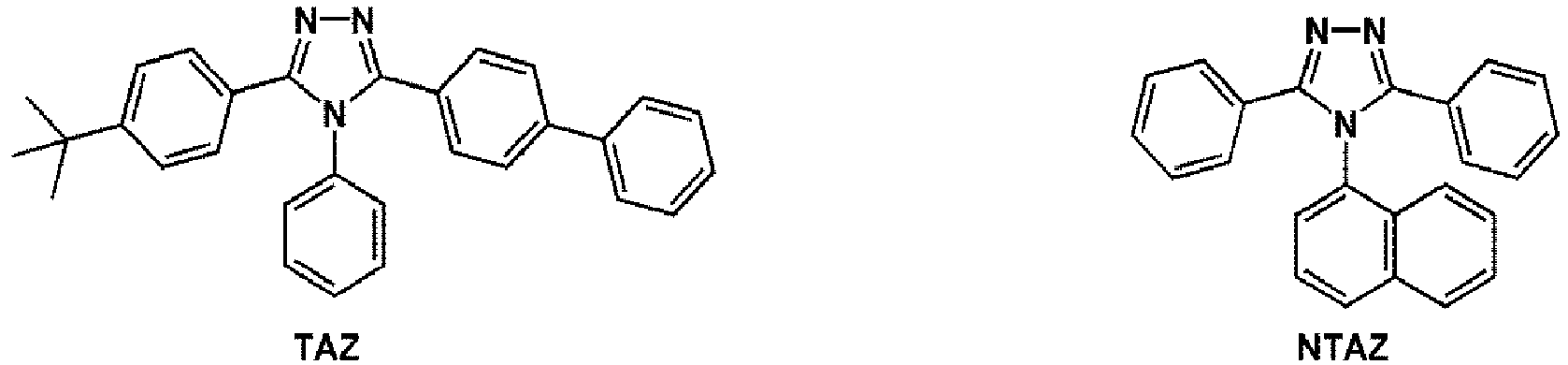
- In one or more embodiments, the electron transport layer may include at least one of ET1 to ET25, but embodiments are not limited thereto:


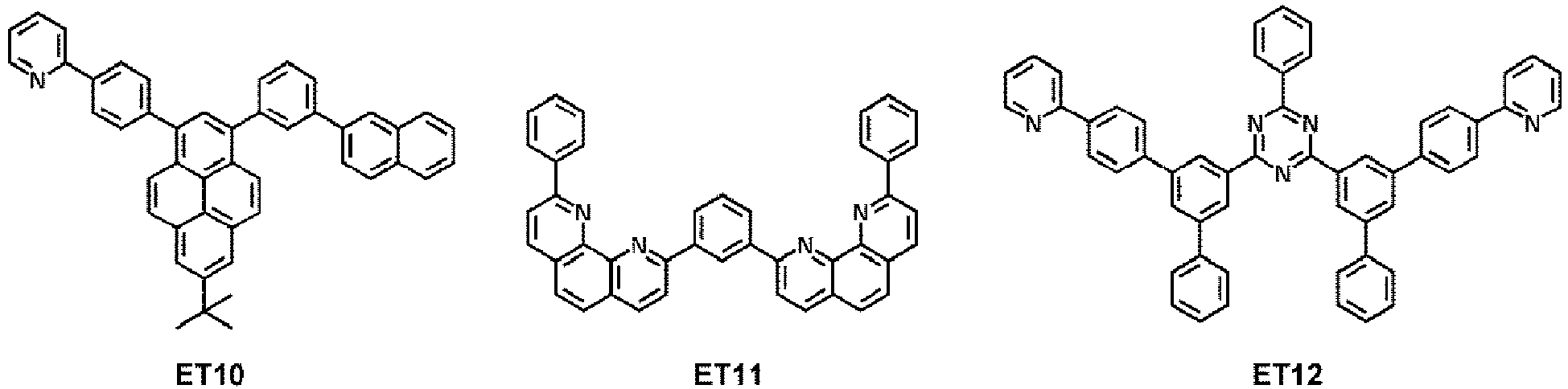


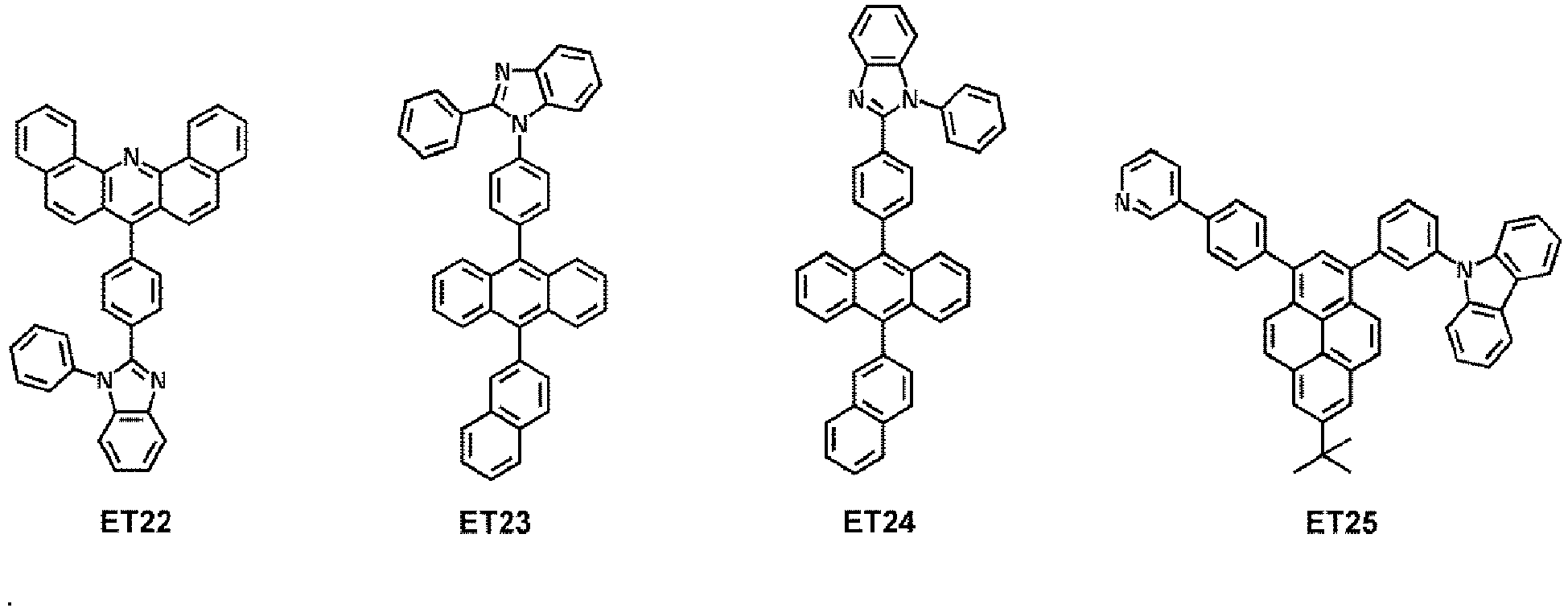
- A thickness of the electron transport layer may be about 100 Å to about 1,000 Å, for example, about 150 Å to about 500 Å. Without wishing to be bound to theory, when the thickness of the electron transport layer is within the ranges described above, the electron transport layer may have satisfactory electron transporting characteristics without a substantial increase in driving voltage.
- The electron transport layer may include a metal-containing material in addition to the material as described herein.
- The metal-containing material may include a Li complex. The Li complex may include, for example, Compound ET-D1 (lithium quinolate, LiQ) or ET-D2, but embodiments are not limited thereto:

- The electron transport region may include an electron injection layer that promotes the flow of electrons from the
second electrode 19 thereinto. - The electron injection layer may include at least one of LiF, NaCl, CsF, Li2O, BaO, or a combination thereof.
- A thickness of the electron injection layer may be about 1 Å to about 100 Å, and, for example, about 3 Å to about 90 Å. Without wishing to be bound to theory, when the thickness of the electron injection layer is within the ranges described above, satisfactory electron injection characteristics may be obtained without a substantial increase in driving voltage.
- The
second electrode 19 may be located on theorganic layer 15. Thesecond electrode 19 may be a cathode. A material for forming thesecond electrode 19 may be metal, an alloy, an electrically conductive compound, or a combination thereof, which have a relatively low work function. For example, lithium (Li), magnesium (Mg), aluminum (Al), silver (Ag), aluminum-lithium (Al-Li), calcium (Ca), magnesium-indium (Mg-In), or magnesium-silver (Mg-Ag) may be used as the material for forming thesecond electrode 19. In one or more embodiments, to manufacture a top-emission type light-emitting device, a transmissive electrode formed using ITO or IZO may be used as thesecond electrode 19. - Hereinbefore, the organic light-emitting device has been described with reference to the FIGURE, but embodiments are not limited thereto.
- Another aspect provides a diagnostic composition including at least one organometallic compound represented by Formula 1.
- The organometallic compound represented by Formula 1 provides a high luminescent efficiency. Accordingly, a diagnostic composition including at least one of the organometallic compounds represented by Formula 1 may have a high diagnostic efficiency.
- The diagnostic composition may be used in various applications including a diagnosis kit, a diagnosis reagent, a biosensor, a biomarker, or the like, but embodiments are not limited thereto.
- The term "C1-C60 alkyl group" as used herein refers to a linear or branched saturated aliphatic hydrocarbon monovalent group having 1 to 60 carbon atoms, and non-limiting examples thereof include a methyl group, an ethyl group, a propyl group, an isobutyl group, a sec-butyl group, a tert-butyl group, a pentyl group, an isoamyl group, a hexyl group, or the like. The term "C1-C60 alkylene group" as used herein refers to a divalent group having the same structure as the C1-C60 alkyl group.
- The term "C1-C60 alkoxy group" used herein refers to a monovalent group represented by -OA101 (wherein A101 is the C1-C60 alkyl group), and non-limiting examples thereof include a methoxy group, an ethoxy group, an isopropyloxy group, or the like.
- The term "C1-C60 alkylthio group" as used herein refers to a monovalent group represented by -SA101' (wherein A101' is the C1-C60 alkyl group).
- The term "C2-C60 alkenyl group" as used herein refers to a hydrocarbon group formed by substituting at least one carbon-carbon double bond in the middle or at the terminus of the C2-C60 alkyl group, and non-limiting examples thereof include an ethenyl group, a propenyl group, a butenyl group, or the like. The term "C2-C60 alkenylene group" as used herein refers to a divalent group having the same structure as the C2-C60 alkenyl group.
- The term "C2-C60 alkynyl group" as used herein refers to a hydrocarbon group formed by substituting at least one carbon-carbon triple bond in the middle or at the terminus of the C2-C60 alkyl group, and non-limiting examples thereof include an ethynyl group, a propynyl group, or the like. The term "C2-C60 alkynylene group" as used herein refers to a divalent group having the same structure as the C2-C60 alkynyl group.
- The term "C3-C10 cycloalkyl group" as used herein refers to a monovalent saturated hydrocarbon monocyclic group having 3 to 10 carbon atoms, and non-limiting examples thereof include a cyclopropyl group, a cyclobutyl group, a cyclopentyl group, a cyclohexyl group, a cycloheptyl group, or the like. The term "C3-C10 cycloalkylene group" as used herein refers to a divalent group having the same structure as the C3-C10 cycloalkyl group.
- The term "C1-C10 heterocycloalkyl group" as used herein refers to a monovalent saturated monocyclic group having at least one heteroatom selected from N, O, P, Ge, Se, Si, and S as a ring-forming atom and 1 to 10 carbon atoms as ring-forming atom(s), and non-limiting examples thereof include a tetrahydrofuranyl group, a tetrahydrothiophenyl group, or the like. The term "C1-C10 heterocycloalkylene group" as used herein refers to a divalent group having the same structure as the C1-C10 heterocycloalkyl group.
- The term "C3-C10 cycloalkenyl group" as used herein refers to a monovalent monocyclic group that has 3 to 10 carbon atoms and at least one carbon-carbon double bond in the ring thereof and no aromaticity, and non-limiting examples thereof include a cyclopentenyl group, a cyclohexenyl group, and a cycloheptenyl group. The term "C3-C10 cycloalkenylene group" as used herein refers to a divalent group having the same structure as the C3-C10 cycloalkenyl group.
- The term "C1-C10 heterocycloalkenyl group" as used herein refers to a monovalent monocyclic group that has at least one heteroatom selected from N, O, P, Ge, Se, Si, and S as a ring-forming atom, 1 to 10 carbon atoms as ring-forming atom(s), and at least one double bond in its ring. Non-limiting examples of the C1-C10 heterocycloalkenyl group include a 2,3-dihydrofuranyl group, a 2,3-dihydrothiophenyl group, or the like. The term "C1-C10 heterocycloalkenylene group" as used herein refers to a divalent group having the same structure as the C1-C10 heterocycloalkenyl group.
- The term "C6-C60 aryl group" as used herein refers to a monovalent group having a carbocyclic aromatic ring system having 6 to 60 carbon atoms, and the term "C6-C60 arylene group" as used herein refers to a divalent group having a carbocyclic aromatic ring system having 6 to 60 carbon atoms. Non-limiting examples of the C6-C60 aryl group include a phenyl group, a naphthyl group, an anthracenyl group, a phenanthrenyl group, a pyrenyl group, a chrysenyl group, or the like. When the C6-C60 aryl group and the C6-C60 arylene group each include two or more rings, the rings may be fused to each other.
- The term "C7-C60 alkyl aryl group" as used herein refers to a C6-C60 aryl group substituted with at least one C1-C60 alkyl group. The term "C7-C60 aryl alkyl group" as used herein refers to a C1-C60 alkyl group substituted with at least one C6-C60 aryl group.
- The term "C1-C60 heteroaryl group" as used herein refers to a monovalent group having a carbocyclic aromatic ring system that has at least one heteroatom selected from N, O, P, Ge, Se, Si, and S as a ring-forming atom, and 1 to 60 carbon atoms as ring-forming atom(s). The term "C1-C60 heteroarylene group" as used herein refers to a divalent group having a carbocyclic aromatic ring system that has at least one heteroatom selected from N, O, P, Ge, Se, Si, and S as a ring-forming atom, and 1 to 60 carbon atoms as ring-forming atom(s). Non-limiting examples of the C1-C60 heteroaryl group include a pyridinyl group, a pyrimidinyl group, a pyrazinyl group, a pyridazinyl group, a triazinyl group, a quinolinyl group, an isoquinolinyl group, or the like. When the C1-C60 heteroaryl group and the C1-C60 heteroarylene group each include two or more rings, the rings may be fused to each other.
- The term "C2-C60 alkyl heteroaryl group" as used herein refers to a C1-C60 heteroaryl group substituted with at least one C1-C60 alkyl group. The term "C2-C60 heteroaryl alkyl group" as used herein refers to a C1-C60 alkyl group substituted with at least one C1-C60 heteroaryl group.
- The term "C6-C60 aryloxy group" as used herein indicates -OA102 (wherein A102 is a C6-C60 aryl group), and the term "C6-C60 arylthio group" as used herein indicates -SA103 (wherein A103 is a C6-C60 aryl group).
- The term "C1-C60 heteroaryloxy group" as used herein indicates -OA104 (wherein A104 is a C1-C60 heteroaryl group), and the term "C1-C60 heteroarylthio group" as used herein indicates -SA105 (wherein A105 is the C1-C60 heteroaryl group).
- The term "monovalent non-aromatic condensed polycyclic group" as used herein refers to a monovalent group (for example, having 8 to 60 carbon atoms) having two or more rings condensed to each other, only carbon atoms as ring-forming atoms, and no aromaticity in its entire molecular structure. Non-limiting examples of the monovalent non-aromatic condensed polycyclic group include a fluorenyl group or the like. The term "divalent non-aromatic condensed polycyclic group" as used herein refers to a divalent group having the same structure as the monovalent non-aromatic condensed polycyclic group described above.
- The term "monovalent non-aromatic condensed heteropolycyclic group" as used herein refers to a monovalent group (for example, having 2 to 60 carbon atoms) having two or more rings condensed with each other, a heteroatom selected from N, O, P, Ge, Se, Si, and S, other than carbon atoms, as a ring-forming atom, and no aromaticity in its entire molecular structure. Non-limiting examples of the monovalent non-aromatic condensed heteropolycyclic group include a carbazolyl group or the like. The term "divalent non-aromatic condensed heteropolycyclic group" as used herein refers to a divalent group having the same structure as the monovalent non-aromatic condensed heteropolycyclic group described above.
- The term "C5-C30 carbocyclic group" as used herein refers to a saturated or unsaturated ring group having, as a ring-forming atom, 5 to 30 carbon atoms only. The C5-C30 carbocyclic group may be a monocyclic group or a polycyclic group.
- The term "C1-C30 heterocyclic group" as used herein refers to a saturated or unsaturated ring group having, as a ring-forming atom, at least one heteroatom selected from N, O, P, Ge, Se, Si, and S other than 1 to 30 carbon atoms as ring-forming atom(s). The C1-C30 heterocyclic group may be a monocyclic group or a polycyclic group.
- At least one substituent of the substituted C5-C30 carbocyclic group, the substituted C1-C30 heterocyclic group, the substituted C1-C60 alkyl group, the substituted C2-C60 alkenyl group, the substituted C2-C60 alkynyl group, the substituted C1-C60 alkoxy group, the substituted C1-C60 alkylthio group, the substituted C3-C10 cycloalkyl group, the substituted C1-C10 heterocycloalkyl group, the substituted C3-C10 cycloalkenyl group, the substituted C1-C10 heterocycloalkenyl group, the substituted C6-C60 aryl group, the substituted C7-C60 alkyl aryl group, the substituted C7-C60 aryl alkyl group, the substituted C6-C60 aryloxy group, the substituted C6-C60 arylthio group, the substituted C1-C60 heteroaryl group, the substituted C2-C60 alkyl heteroaryl group, the substituted C2-C60 heteroaryl alkyl group, the substituted C1-C60 heteroaryloxy group, the substituted C1-C60 heteroarylthio group, the substituted monovalent non-aromatic condensed polycyclic group, and the substituted monovalent non-aromatic condensed heteropolycyclic group may be:
- deuterium, -F, -Cl, -Br, -I, -SF5, -CD3, -CD2H, -CDH2, -CF3, -CF2H, -CFH2, a hydroxyl group, a cyano group, a nitro group, an amino group, an amidino group, a hydrazine group, a hydrazone group, a carboxylic acid group or a salt thereof, a sulfonic acid group or a salt thereof, a phosphoric acid group or a salt thereof, a C1-C60 alkyl group, a C2-C60 alkenyl group, a C2-C60 alkynyl group, a C1-C60 alkoxy group, or a C1-C60 alkylthio group;
- a C1-C60 alkyl group, a C2-C60 alkenyl group, a C2-C60 alkynyl group, a C1-C60 alkoxy group, or a C1-C60 alkylthio group, each substituted with at least one of deuterium, -F, -Cl, -Br, -I, -SF5, -CD3, -CD2H, -CDH2, -CF3, -CF2H, -CFH2, a hydroxyl group, a cyano group, a nitro group, an amino group, an amidino group, a hydrazine group, a hydrazone group, a carboxylic acid group or a salt thereof, a sulfonic acid group or a salt thereof, a phosphoric acid group or a salt thereof, a C3-C10 cycloalkyl group, a C1-C10 heterocycloalkyl group, a C3-C10 cycloalkenyl group, a C1-C10 heterocycloalkenyl group, a C6-C60 aryl group, a C7-C60 alkyl aryl group, a C6-C60 aryloxy group, a C6-C60 arylthio group, a C1-C60 heteroaryl group, a C2-C60 alkyl heteroaryl group, a C1-C60 heteroaryloxy group, a C1-C60 heteroarylthio group, a monovalent non-aromatic condensed polycyclic group, a monovalent non-aromatic condensed heteropolycyclic group, -N(Q11)(Q12), -Si(Q13)(Q14)(Q15), -B(Q16)(Q17), - P(Q18)(Q19), -P(=O)(Q18)(Q19), or a combination thereof;
- a C3-C10 cycloalkyl group, a C1-C10 heterocycloalkyl group, a C3-C10 cycloalkenyl group, a C1-C10 heterocycloalkenyl group, a C6-C60 aryl group, a C7-C60 alkyl aryl group, a C6-C60 aryloxy group, a C6-C60 arylthio group, a C1-C60 heteroaryl group, a C2-C60 alkyl heteroaryl group, a C1-C60 heteroaryloxy group, a C1-C60 heteroarylthio group, a monovalent non-aromatic condensed polycyclic group, or a monovalent non-aromatic condensed heteropolycyclic group;
- a C3-C10 cycloalkyl group, a C1-C10 heterocycloalkyl group, a C3-C10 cycloalkenyl group, a C1-C10 heterocycloalkenyl group, a C6-C60 aryl group, a C7-C60 alkyl aryl group, a C6-C60 aryloxy group, a C6-C60 arylthio group, a C1-C60 heteroaryl group, a C2-C60 alkyl heteroaryl group, a C1-C60 heteroaryloxy group, a C1-C60 heteroarylthio group, a monovalent non-aromatic condensed polycyclic group, or a monovalent non-aromatic condensed heteropolycyclic group, each substituted with at least one of deuterium, -F, -Cl, -Br, -I, -SF5, -CD3, -CD2H, -CDH2, -CF3, -CF2H, - CFH2, a hydroxyl group, a cyano group, a nitro group, an amino group, an amidino group, a hydrazine group, a hydrazone group, a carboxylic acid group or a salt thereof, a sulfonic acid group or a salt thereof, a phosphoric acid group or a salt thereof, a C1-C60 alkyl group, a C2-C60 alkenyl group, a C2-C60 alkynyl group, a C1-C60 alkoxy group, a C1-C60 alkylthio group, a C3-C10 cycloalkyl group, a C1-C10 heterocycloalkyl group, a C3-C10 cycloalkenyl group, a C1-C10 heterocycloalkenyl group, a C6-C60 aryl group, a C7-C60 alkyl aryl group, a C7-C60 aryl alkyl group, a C6-C60 aryloxy group, a C6-C60 arylthio group, a C1-C60 heteroaryl group, a C2-C60 alkyl heteroaryl group, a C2-C60 heteroaryl alkyl group, a C1-C60 heteroaryloxy group, a C1-C60 heteroarylthio group, a monovalent non-aromatic condensed polycyclic group, a monovalent non-aromatic condensed heteropolycyclic group, -N(Q21)(Q22), - Si(Q23)(Q24)(Q25), -B(Q26)(Q27), -P(Q28)(Q29), -P(=O)(Q28)(Q29), or a combination thereof; or
- -N(Q31)(Q32), -Si(Q33)(Q34)(Q35), -B(Q36)(Q37), -P(Q38)(Q39), or - P(=O)(Q38)(Q39),
- wherein Q1 to Q9, Q11 to Q19, Q21 to Q29, and Q31 to Q39 may each independently be hydrogen, deuterium, -F, -Cl, -Br, -I, -SF5, a hydroxyl group, a cyano group, a nitro group, an amino group, an amidino group, a hydrazine group, a hydrazone group, a carboxylic acid group or a salt thereof, a sulfonic acid group or a salt thereof, a phosphoric acid group or a salt thereof, a substituted or unsubstituted C1-C60 alkyl group, a substituted or unsubstituted C2-C60 alkenyl group, a substituted or unsubstituted C2-C60 alkynyl group, a substituted or unsubstituted C1-C60 alkoxy group, a substituted or unsubstituted C1-C60 alkylthio group, a substituted or unsubstituted C3-C10 cycloalkyl group, a substituted or unsubstituted C1-C10 heterocycloalkyl group, a substituted or unsubstituted C3-C10 cycloalkenyl group, a substituted or unsubstituted C1-C10 heterocycloalkenyl group, a substituted or unsubstituted C6-C60 aryl group, a substituted or unsubstituted C7-C60 alkyl aryl group, a substituted or unsubstituted C7-C60 aryl alkyl group, a substituted or unsubstituted C6-C60 aryloxy group, a substituted or unsubstituted C6-C60 arylthio group, a substituted or unsubstituted C1-C60 heteroaryl group, a substituted or unsubstituted C2-C60 alkyl heteroaryl group, a substituted or unsubstituted C2-C60 heteroaryl alkyl group, a substituted or unsubstituted C1-C60 heteroaryloxy group, a substituted or unsubstituted C1-C60 heteroarylthio group, a substituted or unsubstituted monovalent non-aromatic condensed polycyclic group, or a substituted or unsubstituted monovalent non-aromatic condensed heteropolycyclic group.
- Hereinafter, organometallic compounds and organic light-emitting devices according to exemplary embodiments are described in further detail with reference to Synthesis Examples and Examples. However, embodiments of the organometallic compound represented by Formula 1 and the organic light-emitting device are not limited thereto. The wording "B was used instead of A" used in describing Synthesis Examples means that an amount of A used was identical to an amount of B used, in terms of a molar equivalent.
-

- Under a nitrogen environment, 1-chloro-8-isobutylbenzo[4,5]thieno[2,3-c]pyridine (1.50 grams (g), 5.44 millimoles (mmol)) and 4,4,5,5-tetramethyl-2-(4-(trifloromethyl)naphthalene-2-yl)-1,3,2-dioxoborolane (1.93 g, 5.98 mmol) were dissolved in 120 milliliters (mL) of 1,4-dioxane. Separately, potassium carbonate (K2CO3) (1.73 g, 16.32 mmol) was dissolved in 40 mL of deionized water (DI water), and then added to the reaction mixture. The, a palladium catalyst (tetrakis(triphenylphosphine)palladium(0), Pd(PPh3)4) (0.31 g, 0.27 mmol) was added to the reaction mixture. Afterwards, the resultant reaction mixture was stirred and heated under reflux at a temperature of 110°C. Then, the temperature was allowed to cool to room temperature. After extraction, the resulting solid product was purified by column chromatography (eluents: ethyl acetate (EA) and n-hexane) to obtain 2.04 g (yield of 86%) of 8-isobutyl-1-(4-(trifluoromethyl)naphthalene-2-yl)benzo[4,5]thieno[2,3-c]pyridine, that is, Compound 3A. The obtained compound was identified by high resolution mass spectrometry using matrix assisted laser desorption ionization (HRMS (MALDI)) and high-performance liquid chromatography (HPLC) analysis.
- HRMS (MALDI) calculated for C26H20F3NS: m/z: 435.51; found: 436.43.
- Compound 3A (2.07 g, 4.76 mmol) and iridium chloride hydrate (0.8 g, 2.27 mmol) were mixed with 30 mL of 2-ethoxyethanol and 10 mL of DI water, and the mixture was stirred and heated under reflux for 24 hours, and then, the temperature was allowed to lower to room temperature. The solid thus obtained was separated by filtration, washed sufficiently with water, methanol, and hexane, in this stated order, and then, dried in a vacuum oven, to obtain 2.35 g (yield of 90%) of Compound 3B. The obtained Compound 3B was used in the next reaction without an additional purification process.
- Pentane-2,4-dione (0.17 g, 1.71 mmol) and potassium carbonate (K2CO3) (0.24 g, 1.71 mmol) were added to Compound 3B (1.50 g, 0.68 mmol), and the resultant mixture was mixed with 15 mL of 2-ethoxyethanol, followed by stirring at room temperature for 18 hours. After extraction, the obtained solid was purified by column chromatography (eluents: methylene chloride (MC) and hexane) to obtain 1.32 g (yield of 83%) of Compound 3. The obtained compound was identified by HRMS (MALDI) and HPLC analysis.
- HRMS (MALDI) calculated for C57H46F6IrN2O2S2: m/z: 1161.25; found: 1162.10.
-

- 1.87 g (yield of 81%) of Compound 6 was obtained in a similar manner as used to synthesize Compound 3A of Synthesis Example 1, except that 1-chloro-8-methyl-7-phenylbenzo[4,5]thieno[2,3-c]pyridine (1.50 g, 4.84 mmol) was used instead of 1-chloro-8-isobutylbenzo[4,5]thieno[2,3-c]pyridine according to the synthesis method of Compound 3A. The obtained compound was identified by HRMS (MALDI) and HPLC analysis.
- HRMS (MALDI) calculated for C63H42F6IrN2O2S2: m/z: 1229.37; found: 1230.31.
-

- 1.79 g (yield of 79%) was obtained in a similar manner as used to synthesize Compound 3A of Synthesis Example 1, except that 1-chloro-8-methyl-7-phenylbenzofuro[2,3-c]pyridine (1.50 g, 5.11 mmol) was used instead of 1-chloro-8-isobutylbenzo[4,5]thieno[2,3-c]pyridine according to the synthesis method of Compound 3A. The obtained compound was identified by HRMS (MALDI) and HPLC analysis.
- HRMS (MALDI) calculated for C63H42F6IrN2O4. m/z: 1197.25; found: 1198.15
-

- 1.93 g (yield of 81%) of Compound 31 was obtained in a similar manner as used to synthesize Compound 3A of Synthesis Example 1, except that 2-(4-(difluoromethyl)naphthalene-2-yl)-4,4,5,5- tetramethyl-1,3,2-dioxoborolane (1.82 g, 5.98 mmol) was used instead of 4,4,5,5-tetramethyl-2-(4-(trifluoromethyl)naphthalene-2-yl)-1,3,2-dioxoborolane. according to the synthesis method of Compound 3A The obtained compound was identified by HRMS (MALDI) and HPLC analysis.
- HRMS (MALDI) calculated for C57H48F4IrN2O2S2: m/z: 1125.35; found: 1126.30.
- As an anode, an ITO-patterned glass substrate was cut to a size of 50 millimeters (mm) x 50 mm x 0.5 mm, sonicated with isopropyl alcohol and DI water, each for 5 minutes, and then cleaned by exposure to ultraviolet rays and ozone for 30 minutes. The resultant patterned glass substrate was loaded onto a vacuum deposition apparatus.
- Compounds HT3 and F12-P-dopant were co-deposited by vacuum on the anode at a weight ratio of 98:2 to form a hole injection layer having a thickness of 100 Å, and then, Compound HT3 was vacuum-deposited on the hole injection layer to form a hole transport layer having a thickness of 1,600 Å.
- Next, Compounds RH3 (host) and 1 (dopant) were co-deposited at a weight ratio of 97:3 on the hole transport layer to form an emission layer having a thickness of 400 Å.
- Then, Compound ETL and Liq-N-dopant were co-deposited on the emission layer at the volume ratio of 50:50 to form an electron transport layer having a thickness of 350 Å, Liq-N-dopant was vacuum-deposited on the electron transport layer to form an electron injection layer having a thickness of 10 Å, and Al was vacuum-deposited on the electron injection layer to form a cathode having a thickness of 1,000 Å, thereby completing the manufacture of an organic light-emitting device.


- Organic light-emitting devices were manufactured in a similar manner as in Example 1, except that compounds shown in Table 2 were each used as a dopant in forming an emission layer.
- The driving voltage (Volts, V), roll-off ratio (%), maximum emission wavelength (λmax, nm), full width at half maximum (FWHM, nm), and maximum external quantum efficiency (Max EQE, %) of each of the organic light-emitting devices manufactured in Examples 1 to 4 and Comparative Examples 1 and 2 were evaluated, and the results are shown in Table 2. As evaluation apparatuses, a current-voltage meter (Keithley 2400) and a luminance meter (Minolta Cs-1 000A) were used. The roll-off ratio was calculated according to Equation 1.

Table 2 Dopant in emission layer Driving voltage (V) Roll-off ratio (%) λmax (nm) FWHM (nm) Max EQE (%) Example 1 Compound 3 4.7 11 608 36 24 Example 2 Compound 6 4.7 11 618 37 27 Example 3 Compound 20 4.7 12 620 37 27 Example 4 Compound 31 4.8 11 615 37 24 Comparative Example 1 Compound CE1 4.9 15 631 39 24 Comparative Example 2 Compound CE2 4.9 12 625 37 25 

- From Table 2, it can be seen that the organic light-emitting devices of Examples 1 to 4 have a low driving voltage, a reduced roll-off ratio, a narrow FWHM, and a high maximum EQE.
- In addition, it can be seen that the organic light-emitting devices of Examples 1 to 4 have a lower driving voltage, a reduced roll-off ratio, a narrower FWHM, and equivalent or higher maximum EQE than the organic light-emitting devices of Comparative Examples 1 and 2.
- Since the organometallic compound has excellent electrical characteristics, an electronic device, for example, an organic light-emitting device, using at least one of the organometallic compounds may have characteristics of a low driving voltage and a high efficiency. Thus, due to the use of at least one of the organometallic compounds, a high-quality organic light-emitting device may be embodied.
- It should be understood that exemplary embodiments described herein should be considered in a descriptive sense only and not for purposes of limitation. Descriptions of features or aspects within each exemplary embodiment should typically be considered as available for other similar features or aspects in other exemplary embodiments. While one or more exemplary embodiments have been described with reference to the figure, it will be understood by those of ordinary skill in the art that various changes in form and details may be made therein without departing from the scope as defined by the following claims.








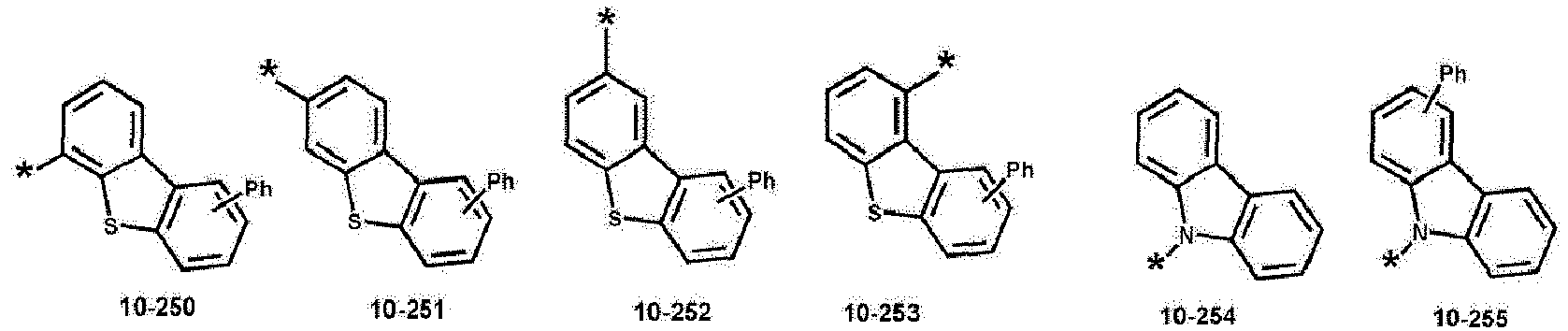


Claims (15)
- An organometallic compound represented by Formula 1:
Formula 1 M1(L1)n1(L2)n2
wherein, in Formula 1,M1 is a transition metal,L1 is a ligand represented by Formula 1A,L2 is a ligand represented by Formula 1B, andn1 and n2 are each independently 1 or 2,wherein, in Formulae 1A and 1B,
 X1 is C or N, and X2 is C or N,Y1 is O, S, Se, C(R41)(R42), or N(R43),ring CY2 is a 6-membered carbocyclic group to which a C5-C30 carbocyclic group is condensed, a 6-membered carbocyclic group to which a C1-C30 heterocyclic group is condensed, a 6-membered heterocyclic group to which a C5-C30 carbocyclic group is condensed, or a 6-membered heterocyclic group to which a C1-C30 heterocyclic group is condensed,R2, R11, R12, R31 to R33, and R41 to R43 are each independently hydrogen, deuterium, -F, -Cl, -Br, -I, -SF5, a hydroxyl group, a cyano group, a nitro group, an amino group, an amidino group, a hydrazine group, a hydrazone group, a carboxylic acid group or a salt thereof, a sulfonic acid group or a salt thereof, a phosphoric acid group or a salt thereof, a substituted or unsubstituted C1-C60 alkyl group, a substituted or unsubstituted C2-C60 alkenyl group, a substituted or unsubstituted C2-C60 alkynyl group, a substituted or unsubstituted C1- C60 alkoxy group, a substituted or unsubstituted C1-C60 alkylthio group, a substituted or unsubstituted C3-C10 cycloalkyl group, a substituted or unsubstituted C1-C10 heterocycloalkyl group, a substituted or unsubstituted C3-C10 cycloalkenyl group, a substituted or unsubstituted C2-C10 heterocycloalkenyl group, a substituted or unsubstituted C6- C60 aryl group, a substituted or unsubstituted C7-C60 alkyl aryl group, a substituted or unsubstituted C7-C60 aryl alkyl group, a substituted or unsubstituted C6- C60 aryloxy group, a substituted or unsubstituted C6- C60 arylthio group, a substituted or unsubstituted C1- C60 heteroaryl group, a substituted or unsubstituted C2-C60 alkyl heteroaryl group, a substituted or unsubstituted C2-C60 heteroaryl alkyl group, a substituted or unsubstituted C1- C60 heteroaryloxy group, a substituted or unsubstituted C1- C60 heteroarylthio group, a substituted or unsubstituted monovalent non-aromatic condensed polycyclic group, a substituted or unsubstituted monovalent non-aromatic condensed heteropolycyclic group, - Si(Q1)(Q2)(Q3), -Ge(Q1)(Q2)(Q3), -N(Q4)(Q5), -B(Q6)(Q7), -P(Q8)(Q9), or -P(=O)(Q8)(Q9),at least one R2 is a C1-C10 alkyl group that is substituted with a fluorine,b2 is an integer from 1 to 6,b11 is 1 or 2,b12 is an integer from 1 to 4,* and *' each indicate a binding site to M1, andat least one substituent of the substituted C5-C30 carbocyclic group, the substituted C1-C30 heterocyclic group, the substituted C1-C60 alkyl group, the substituted C2-C60 alkenyl group, the substituted C2-C60 alkynyl group, the substituted C1-C60 alkoxy group, the substituted C1-C60 alkylthio group, the substituted C3-C10 cycloalkyl group, the substituted C1-C10 heterocycloalkyl group, the substituted C3-C10 cycloalkenyl group, the substituted C1-C10 heterocycloalkenyl group, the substituted C6-C60 aryl group, the substituted C7-C60 alkyl aryl group, the substituted C7-C60 aryl alkyl group, the substituted C6-C60 aryloxy group, the substituted C6-C60 arylthio group, the substituted C1-C60 heteroaryl group, the substituted C2-C60 alkyl heteroaryl group, the substituted C2-C60 heteroaryl alkyl group, the substituted C1-C60 heteroaryloxy group, the substituted C1-C60 heteroarylthio group, the substituted monovalent non-aromatic condensed polycyclic group, and the substituted monovalent non-aromatic condensed heteropolycyclic group is:deuterium, -F, -Cl, -Br, -I, -SF5, -CD3, -CD2H, -CDH2, -CF3, -CF2H, -CFH2, a hydroxyl group, a cyano group, a nitro group, an amino group, an amidino group, a hydrazine group, a hydrazone group, a carboxylic acid group or a salt thereof, a sulfonic acid group or a salt thereof, a phosphoric acid group or a salt thereof, a C1-C60 alkyl group, a C2-C60 alkenyl group, a C2-C60 alkynyl group, a C1-C60 alkoxy group, or a C1-C60 alkylthio group;a C1-C60 alkyl group, a C2-C60 alkenyl group, a C2-C60 alkynyl group, a C1-C60 alkoxy group, or a C1-C60 alkylthio group, each substituted with at least one of deuterium, -F, -Cl, - Br, -I, -SF5, -CD3, -CD2H, -CDH2, -CF3, -CF2H, -CFH2, a hydroxyl group, a cyano group, a nitro group, an amino group, an amidino group, a hydrazine group, a hydrazone group, a carboxylic acid group or a salt thereof, a sulfonic acid group or a salt thereof, a phosphoric acid group or a salt thereof, a C3-C10 cycloalkyl group, a C1-C10 heterocycloalkyl group, a C3-C10 cycloalkenyl group, a C1-C10 heterocycloalkenyl group, a C6-C60 aryl group, a C7-C60 alkyl aryl group, a C6-C60 aryloxy group, a C6-C60 arylthio group, a C1-C60 heteroaryl group, a C2-C60 alkyl heteroaryl group, a C1-C60 heteroaryloxy group, a C1-C60 heteroarylthio group, a monovalent non-aromatic condensed polycyclic group, a monovalent non-aromatic condensed heteropolycyclic group, -Si(Q11)(Q12)(Q13), -Ge(Q11)(Q12)(Q13), -N(Q14)(Q15), - B(Q16)(Q17), -P(Q18)(Q19), -P(=O)(Q18)(Q19), or a combination thereof;a C3-C10 cycloalkyl group, a C1-C10 heterocycloalkyl group, a C3-C10 cycloalkenyl group, a C1-C10 heterocycloalkenyl group, a C6-C60 aryl group, a C7-C60 alkyl aryl group, a C6-C60 aryloxy group, a C6-C60 arylthio group, a C1-C60 heteroaryl group, a C2-C60 alkyl heteroaryl group, a C1-C60 heteroaryloxy group, a C1-C60 heteroarylthio group, a monovalent non-aromatic condensed polycyclic group, or a monovalent non-aromatic condensed heteropolycyclic group;a C3-C10 cycloalkyl group, a C1-C10 heterocycloalkyl group, a C3-C10 cycloalkenyl group, a C1-C10 heterocycloalkenyl group, a C6-C60 aryl group, a C7-C60 alkyl aryl group, a C6-C60 aryloxy group, a C6-C60 arylthio group, a C1-C60 heteroaryl group, a C2-C60 alkyl heteroaryl group, a C1-C60 heteroaryloxy group, a C1-C60 heteroarylthio group, a monovalent non-aromatic condensed polycyclic group, or a monovalent non-aromatic condensed heteropolycyclic group, each substituted with at least one of deuterium, -F, -Cl, -Br, -I, -SF5, -CD3, -CD2H, -CDH2, -CF3, -CF2H, -CFH2, a hydroxyl group, a cyano group, a nitro group, an amino group, an amidino group, a hydrazine group, a hydrazone group, a carboxylic acid group or a salt thereof, a sulfonic acid group or a salt thereof, a phosphoric acid group or a salt thereof, a C1-C60 alkyl group, a C2-C60 alkenyl group, a C2-C60 alkynyl group, a C1-C60 alkoxy group, a C1-C60 alkylthio group, a C3-C10 cycloalkyl group, a C1-C10 heterocycloalkyl group, a C3-C10 cycloalkenyl group, a C1-C10 heterocycloalkenyl group, a C6-C60 aryl group, a C7-C60 alkyl aryl group, a C7-C60 aryl alkyl group, a C6-C60 aryloxy group, a C6-C60 arylthio group, a C1-C60 heteroaryl group, a C2-C60 alkyl heteroaryl group, a C2-C60 heteroaryl alkyl group, a C1-C60 heteroaryloxy group, a C1-C60 heteroarylthio group, a monovalent non-aromatic condensed polycyclic group, a monovalent non-aromatic condensed heteropolycyclic group, -Si(Q21)(Q22)(Q23), -Ge(Q21)(Q22)(Q23), -N(Q24)(Q25), -B(Q26)(Q27), - P(Q28)(Q29), -P(=O)(Q28)(Q29), or a combination thereof; or-Si(Q31)(Q32)(Q33), -Ge(Q31)(Q32)(Q33), -N(Q34)(Q35), -B(Q36)(Q37), -P(Q38)(Q39), or - P(=O)(Q33)(Q39),wherein Q1 to Q9, Q11 to Q19, Q21 to Q29, and Q31 to Q39 are each independently hydrogen, deuterium, -F, -Cl, -Br, -I, -SF5, a hydroxyl group, a cyano group, a nitro group, an amino group, an amidino group, a hydrazine group, a hydrazone group, a carboxylic acid group or a salt thereof, a sulfonic acid group or a salt thereof, a phosphoric acid group or a salt thereof, a substituted or unsubstituted C1-C60 alkyl group, a substituted or unsubstituted C2-C60 alkenyl group, a substituted or unsubstituted C2-C60 alkynyl group, a substituted or unsubstituted C1-C60 alkoxy group, a substituted or unsubstituted C1-C60 alkylthio group, a substituted or unsubstituted C3-C10 cycloalkyl group, a substituted or unsubstituted C1-C10 heterocycloalkyl group, a substituted or unsubstituted C3-C10 cycloalkenyl group, a substituted or unsubstituted C1-C10 heterocycloalkenyl group, a substituted or unsubstituted C6-C60 aryl group, a substituted or unsubstituted C7-C60 alkyl aryl group, a substituted or unsubstituted C7-C60 aryl alkyl group, a substituted or unsubstituted C6-C60 aryloxy group, a substituted or unsubstituted C6-C60 arylthio group, a substituted or unsubstituted C1-C60 heteroaryl group, a substituted or unsubstituted C2-C60 alkyl heteroaryl group, a substituted or unsubstituted C2-C60 heteroaryl alkyl group, a substituted or unsubstituted C1-C60 heteroaryloxy group, a substituted or unsubstituted C1-C60 heteroarylthio group, a substituted or unsubstituted monovalent non-aromatic condensed polycyclic group, or a substituted or unsubstituted monovalent non-aromatic condensed heteropolycyclic group.
 - The organometallic compound of claim 1, whereinM1 is iridium, platinum, palladium, gold, osmium, titanium, zirconium, hafnium, europium, terbium, thulium, or rhodium;preferably whereinM1 is iridium, anda sum of n1 and n2 is 3.
- The organometallic compound of claims 1 or 2, whereinring CY2 is a condensed ring group in which two or more first rings are condensed with each other, a condensed ring group in which two or more second rings are condensed with each other, or a condensed ring group in which at least one first ring is condensed with at least one second ring,the first ring is a cyclopentane group, a cyclopentadiene group, a furan group, a thiophene group, a pyrrole group, a silole group, an indene group, a benzofuran group, a benzothiophene group, an indole group, a benzosilole group, an oxazole group, an isoxazole group, an oxadiazole group, an isoxadiazole group, an oxatriazole group, an isoxatriazole group, a thiazole group, an isothiazole group, a thiadiazole group, an isothiadiazole group, a thiatriazole group, an isothiatriazole group, a pyrazole group, an imidazole group, a triazole group, a tetrazole group, an azasilole group, a diazasilole group, or a triazasilole group, andthe second ring is an adamantane group, a norbornane group, a norbornene group, a cyclohexane group, a cyclohexene group, a benzene group, a pyridine group, a pyrimidine group, a pyrazine group, a pyridazine group, or a triazine group.
- The organometallic compound of any of claims 1-3, whereinring CY2 is a naphthalene group, a 1,2,3,4-tetrahydronaphthalene group, a phenanthrene group, a pyridine group, a pyrimidine group, a pyrazine group, a pyridazine group, a triazine group, a quinoline group, an isoquinoline group, a quinoxaline group, a quinazoline group, a phenanthroline group, a benzofuran group, a benzothiophene group, a fluorene group, a carbazole group, a dibenzofuran group, a dibenzothiophene group, a dibenzosilole group, an azafluorene group, an azacarbazole group, an azadibenzofuran group, an azadibenzothiophene group, or an azadibenzosilole group; and/or
whereina moiety represented by
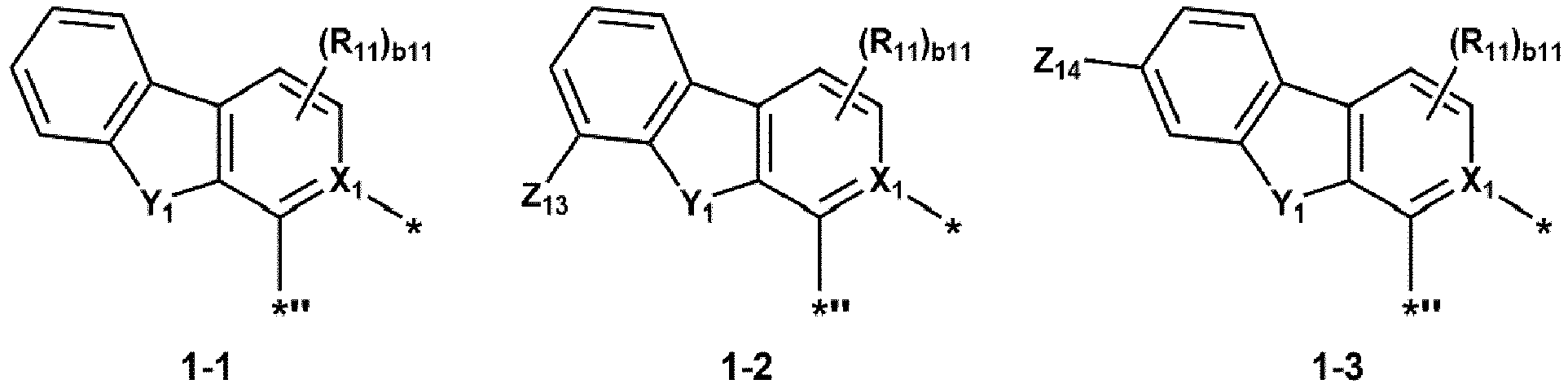
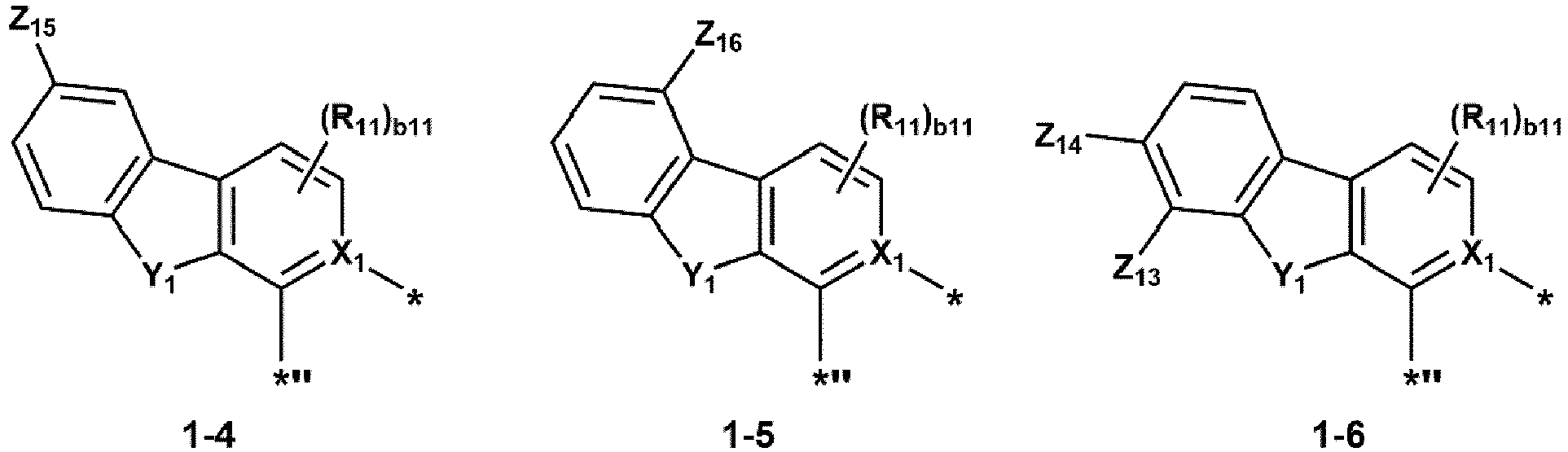


 Z13 to Z16 are each independently as described in connection with R12 in claim 1, provided that Z13 to Z16 are not hydrogen,X1, Y1, R11, and b11 are each as described in claim 1,* indicates a binding site to M1, and*" indicates a binding site to an adjacent atom.
 - The organometallic compound of any of claims 1-4, wherein
a moiety represented by
 X2 is as described in claim 1,X21 is N or C(R21), X22 is N or C(R22), X23 is N or C(R23), and X24 is N or C(R24), ring CY25 is a C5-C30 carbocyclic group or a C1-C30 heterocyclic group,R21 to R25 are each independently as described in connection with R2 in claim 1, b25 is an integer from 1 to 10,*' indicates a binding site to M1, and*" indicates a binding site to an adjacent atom;preferably whereinring CY25 is a benzene group, a naphthalene group, a 1,2,3,4-tetrahydronaphthalene group, a phenanthrene group, a pyridine group, a pyrimidine group, a pyrazine group, a pyridazine group, a triazine group, a quinoline group, an isoquinoline group, a quinoxaline group, a quinazoline group, a phenanthroline group, a benzofuran group, a benzothiophene group, a fluorene group, a carbazole group, a dibenzofuran group, a dibenzothiophene group, a dibenzosilole group, an azafluorene group, an azacarbazole group, an azadibenzofuran group, an azadibenzothiophene group, or an azadibenzosilole group.
 - The organometallic compound of any of claims 1-5, wherein
a moiety represented by
 X2 is as described in claim 1,R21 to R25 are each independently as described in connection with R2 in claim 1, c25 is an integer from 1 to 4,*' indicates a binding site to M1, and*" indicates a binding site to an adjacent atom; orwherein
A moiety represented by


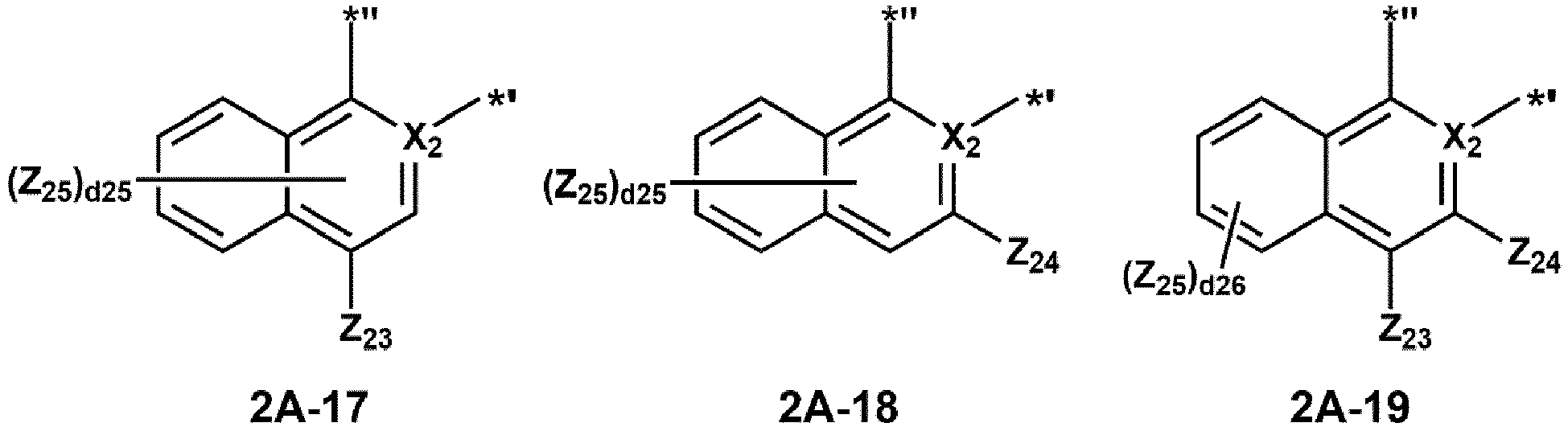 X2 is as described in claim 1,Z21 to Z24 are each independently a C1-C10 alkyl group that is substituted with at least one fluorine,Z25 is:hydrogen, deuterium, -F, -Cl, -Br, -I, -SF5, -CD3, -CD2H, -CDH2, or a C1-C10 alkyl group;a C1-C10 alkyl group that is substituted with at least one of deuterium, -F, -Cl, -Br, -I, -SF5, -CD3, -CD2H, -CDH2, a C1-C10 alkyl group, a phenyl group, a naphthyl group, a pyridinyl group, a pyrimidinyl group, or a combination thereof;a phenyl group, a naphthyl group, a fluorenyl group, a phenanthrenyl group, an anthracenyl group, a fluoranthenyl group, a triphenylenyl group, a pyrenyl group, a chrysenyl group, a pyrrolyl group, a thiophenyl group, a furanyl group, an imidazolyl group, a pyrazolyl group, a thiazolyl group, an isothiazolyl group, an oxazolyl group, an isoxazolyl group, a pyridinyl group, a pyrazinyl group, a pyrimidinyl group, a pyridazinyl group, an isoindolyl group, an indolyl group, an indazolyl group, a purinyl group, a quinolinyl group, an isoquinolinyl group, a benzoquinolinyl group, a quinoxalinyl group, a quinazolinyl group, a cinnolinyl group, a carbazolyl group, a phenanthrolinyl group, a benzoimidazolyl group, a benzofuranyl group, a benzothiophenyl group, a benzoisothiazolyl group, a benzoxazolyl group, an isobenzoxazolyl group, a triazolyl group, a tetrazolyl group, an oxadiazolyl group, a triazinyl group, a dibenzofuranyl group, a dibenzothiophenyl group, a benzocarbazolyl group, a dibenzocarbazolyl group, an imidazopyridinyl group, or an imidazopyrimidinyl group; ora phenyl group, a naphthyl group, a fluorenyl group, a phenanthrenyl group, an anthracenyl group, a fluoranthenyl group, a triphenylenyl group, a pyrenyl group, a chrysenyl group, a pyrrolyl group, a thiophenyl group, a furanyl group, an imidazolyl group, a pyrazolyl group, a thiazolyl group, an isothiazolyl group, an oxazolyl group, an isoxazolyl group, a pyridinyl group, a pyrazinyl group, a pyrimidinyl group, a pyridazinyl group, an isoindolyl group, an indolyl group, an indazolyl group, a purinyl group, a quinolinyl group, an isoquinolinyl group, a benzoquinolinyl group, a quinoxalinyl group, a quinazolinyl group, a cinnolinyl group, a carbazolyl group, a phenanthrolinyl group, a benzoimidazolyl group, a benzofuranyl group, a benzothiophenyl group, a benzoisothiazolyl group, a benzoxazolyl group, an isobenzoxazolyl group, a triazolyl group, a tetrazolyl group, an oxadiazolyl group, a triazinyl group, a dibenzofuranyl group, a dibenzothiophenyl group, a benzocarbazolyl group, a dibenzocarbazolyl group, an imidazopyridinyl group, or an imidazopyrimidinyl group, each substituted with at least one of deuterium, -F, -Cl, -Br, -I, -SF5, -CD3, -CD2H, -CDH2, a C1-C10 alkyl group, a phenyl group, a naphthyl group, a fluorenyl group, a phenanthrenyl group, an anthracenyl group, a fluoranthenyl group, a triphenylenyl group, a pyrenyl group, a chrysenyl group, a pyrrolyl group, a thiophenyl group, a furanyl group, an imidazolyl group, a pyrazolyl group, a thiazolyl group, an isothiazolyl group, an oxazolyl group, an isoxazolyl group, a pyridinyl group, a pyrazinyl group, a pyrimidinyl group, a pyridazinyl group, an isoindolyl group, an indolyl group, an indazolyl group, a purinyl group, a quinolinyl group, an isoquinolinyl group, a benzoquinolinyl group, a quinoxalinyl group, a quinazolinyl group, a cinnolinyl group, a carbazolyl group, a phenanthrolinyl group, a benzoimidazolyl group, a benzofuranyl group, a benzothiophenyl group, a benzoisothiazolyl group, a benzoxazolyl group, an isobenzoxazolyl group, a triazolyl group, a tetrazolyl group, an oxadiazolyl group, a triazinyl group, a dibenzofuranyl group, a dibenzothiophenyl group, a benzocarbazolyl group, a dibenzocarbazolyl group, an imidazopyridinyl group, an imidazopyrimidinyl group, or a combination thereof,d25 is an integer from 1 to 5,d26 is an integer from 1 to 4,*' indicates a binding site to M1, and*" indicates a binding site to an adjacent atom.
 - The organometallic compound of any of claims 1-6, wherein R2, R11, R12, R31 to R33, and R41 to R43 are each independently:hydrogen, deuterium, -F, -Cl, -Br, -I, -SF5, -CD3, -CD2H, -CDH2, -CF3, -CF2H, -CFH2, a hydroxyl group, a cyano group, a nitro group, an amino group, an amidino group, a hydrazine group, a hydrazone group, a carboxylic acid group or a salt thereof, a sulfonic acid group or a salt thereof, a phosphoric acid group or a salt thereof, a C1-C20 alkyl group, a C1-C20 alkoxy group, or a C1-C20 alkylthio group;a C1-C20 alkyl group, a C1-C20 alkoxy group, or a C1-C20 alkylthio group, each substituted with at least one of deuterium, -F, -Cl, -Br, -I, -SF5, -CD3, -CD2H, -CDH2, -CF3, - CF2H, -CFH2, a hydroxyl group, a cyano group, a nitro group, an amino group, an amidino group, a hydrazine group, a hydrazone group, a carboxylic acid group or a salt thereof, a sulfonic acid group or a salt thereof, a phosphoric acid group or a salt thereof, a C1-C10 alkyl group, a cyclopentyl group, a cyclohexyl group, a cycloheptyl group, a cyclooctyl group, an adamantanyl group, a norbornanyl group, a norbornenyl group, a cyclopentenyl group, a cyclohexenyl group, a cycloheptenyl group, a phenyl group, a naphthyl group, a pyridinyl group, a pyrimidinyl group, or a combination thereof;a cyclopentyl group, a cyclohexyl group, a cycloheptyl group, a cyclooctyl group, an adamantanyl group, a norbornanyl group, a norbornenyl group, a cyclopentenyl group, a cyclohexenyl group, a cycloheptenyl group, a phenyl group, a naphthyl group, a fluorenyl group, a phenanthrenyl group, an anthracenyl group, a fluoranthenyl group, a triphenylenyl group, a pyrenyl group, a chrysenyl group, a pyrrolyl group, a thiophenyl group, a furanyl group, an imidazolyl group, a pyrazolyl group, a thiazolyl group, an isothiazolyl group, an oxazolyl group, an isoxazolyl group, a pyridinyl group, a pyrazinyl group, a pyrimidinyl group, a pyridazinyl group, an isoindolyl group, an indolyl group, an indazolyl group, a purinyl group, a quinolinyl group, an isoquinolinyl group, a benzoquinolinyl group, a quinoxalinyl group, a quinazolinyl group, a cinnolinyl group, a carbazolyl group, a phenanthrolinyl group, a benzimidazolyl group, a benzofuranyl group, a benzothiophenyl group, an isobenzothiazolyl group, a benzoxazolyl group, an isobenzoxazolyl group, a triazolyl group, a tetrazolyl group, an oxadiazolyl group, a triazinyl group, a dibenzofuranyl group, a dibenzothiophenyl group, a benzocarbazolyl group, a dibenzocarbazolyl group, an imidazopyridinyl group, or an imidazopyrimidinyl group;a cyclopentyl group, a cyclohexyl group, a cycloheptyl group, a cyclooctyl group, an adamantanyl group, a norbornanyl group, a norbornenyl group, a cyclopentenyl group, a cyclohexenyl group, a cycloheptenyl group, a phenyl group, a naphthyl group, a fluorenyl group, a phenanthrenyl group, an anthracenyl group, a fluoranthenyl group, a triphenylenyl group, a pyrenyl group, a chrysenyl group, a pyrrolyl group, a thiophenyl group, a furanyl group, an imidazolyl group, a pyrazolyl group, a thiazolyl group, an isothiazolyl group, an oxazolyl group, an isoxazolyl group, a pyridinyl group, a pyrazinyl group, a pyrimidinyl group, a pyridazinyl group, an isoindolyl group, an indolyl group, an indazolyl group, a purinyl group, a quinolinyl group, an isoquinolinyl group, a benzoquinolinyl group, a quinoxalinyl group, a quinazolinyl group, a cinnolinyl group, a carbazolyl group, a phenanthrolinyl group, a benzimidazolyl group, a benzofuranyl group, a benzothiophenyl group, an isobenzothiazolyl group, a benzoxazolyl group, an isobenzoxazolyl group, a triazolyl group, a tetrazolyl group, an oxadiazolyl group, a triazinyl group, a dibenzofuranyl group, a dibenzothiophenyl group, a benzocarbazolyl group, a dibenzocarbazolyl group, an imidazopyridinyl group, or an imidazopyrimidinyl group, each substituted with at least one of deuterium, -F, -Cl, -Br, -I, - SF5, -CD3, -CD2H, -CDH2, -CF3, -CF2H, -CFH2, a hydroxyl group, a cyano group, a nitro group, an amino group, an amidino group, a hydrazine group, a hydrazone group, a carboxylic acid group or a salt thereof, a sulfonic acid group or a salt thereof, a phosphoric acid group or a salt thereof, a C1-C20 alkyl group, a C1-C20 alkoxy group, a C1-C20 alkylthio group, a cyclopentyl group, a cyclohexyl group, a cycloheptyl group, a cyclooctyl group, an adamantanyl group, a norbornanyl group, a norbornenyl group, a cyclopentenyl group, a cyclohexenyl group, a cycloheptenyl group, a phenyl group, a naphthyl group, a fluorenyl group, a phenanthrenyl group, an anthracenyl group, a fluoranthenyl group, a triphenylenyl group, a pyrenyl group, a chrysenyl group, a pyrrolyl group, a thiophenyl group, a furanyl group, an imidazolyl group, a pyrazolyl group, a thiazolyl group, an isothiazolyl group, an oxazolyl group, an isoxazolyl group, a pyridinyl group, a pyrazinyl group, a pyrimidinyl group, a pyridazinyl group, an isoindolyl group, an indolyl group, an indazolyl group, a purinyl group, a quinolinyl group, an isoquinolinyl group, a benzoquinolinyl group, a quinoxalinyl group, a quinazolinyl group, a cinnolinyl group, a carbazolyl group, a phenanthrolinyl group, a benzimidazolyl group, a benzofuranyl group, a benzothiophenyl group, an isobenzothiazolyl group, a benzoxazolyl group, an isobenzoxazolyl group, a triazolyl group, a tetrazolyl group, an oxadiazolyl group, a triazinyl group, a dibenzofuranyl group, a dibenzothiophenyl group, a benzocarbazolyl group, a dibenzocarbazolyl group, an imidazopyridinyl group, an imidazopyrimidinyl group, or a combination thereof; or-N(Q4)(Q5), -B(Q6)(Q7), -P(Q8)(Q9), or -P(=O)(Q8)(Q9),Q4 to Q9 are each independently:-CH3, -CD3, -CD2H, -CDH2, -CH2CH3, -CH2CD3, -CH2CD2H, -CH2CDH2, -CHDCH3, - CHDCD2H, -CHDCDH2, -CHDCD3, -CD2CD3, -CD2CD2H, or -CD2CDH2;an n-propyl group, an isopropyl group, an n-butyl group, an isobutyl group, a sec-butyl group, a tert-butyl group, an n-pentyl group, an isopentyl group, a sec-pentyl group, a tert-pentyl group, a phenyl group, or a naphthyl group; oran n-propyl group, an isopropyl group, an n-butyl group, an isobutyl group, a sec-butyl group, a tert-butyl group, an n-pentyl group, an isopentyl group, a sec-pentyl group, a tert-pentyl group, a phenyl group, or a naphthyl group, each substituted with at least one of deuterium, a C1-C10 alkyl group, a phenyl group, or a combination thereof.
- The organometallic compound of any of claims 1-7, wherein R2, R11, R12, R31 to R33, and R41 to R43 are each independently:hydrogen, deuterium, -F, -Cl, -Br, -I, -SF5, -CD3, -CD2H, -CDH2, -CF3, -CF2H, -CFH2, a C1-C60 alkyl group, a C2-C60 alkenyl group, a C2-C60 alkynyl group, a C1-C60 alkoxy group, or a C1-C60 alkylthio group; ora group represented by one of Formulae 9-1 to 9-39, 9-44 to 9-61, 9-201 to 9-237, 10-1 to 10-129, or 10-201 to 10-350; or-N(Q4)(Q5), andQ4 and Q5 are each as described in claim 1:













- The organometallic compound of any of claims 1-8, wherein
the organometallic compound is represented by one of Formulae 3-1 to 3-3:

 M1, Y1, R31 to R33, n1, and n2 are each as described in claim 1,R13 and R14 are each independently as described in connection with R11 in claim 1,R15 to R18 are each independently as described in connection with R12 in claim 1, andR21 to R24 and R26 to R29 are each independently as described in connection with R2 in claim 1.
 - The organometallic compound of claim 1, wherein the organometallic compound is represented by one of Compounds 1 to 128:


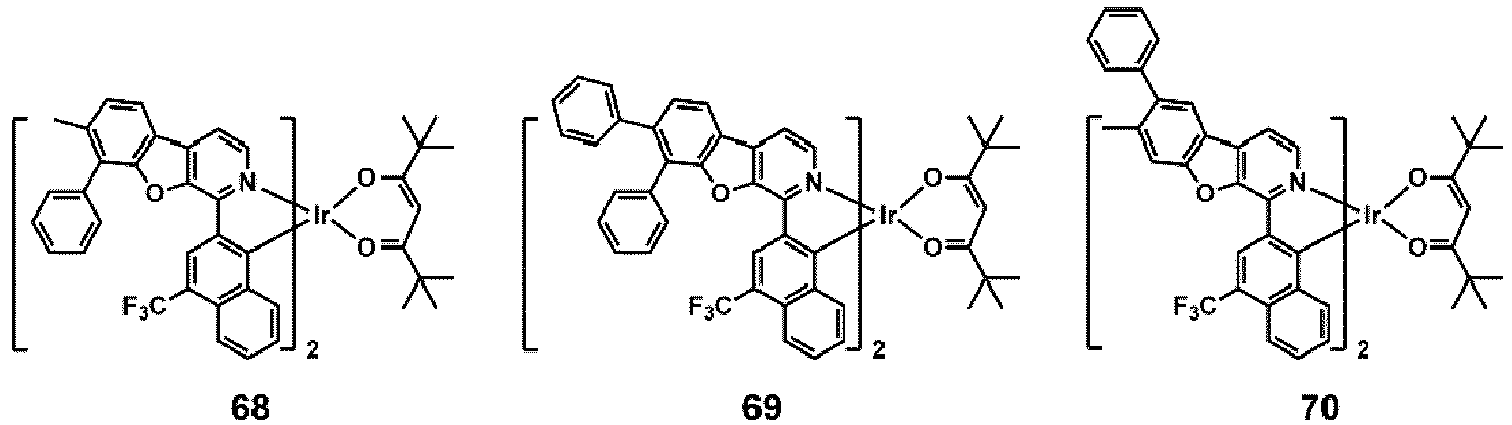


- An organic light-emitting device, comprising:a first electrode;a second electrode; andan organic layer located between the first electrode and the second electrode,wherein the organic layer comprises an emission layer, andwherein the organic layer further comprises at least one of the organometallic compound of any of claims 1-10.
- The organic light-emitting device of claim 11, wherein
the emission layer comprises the at least one organometallic compound. - The organic light-emitting device of claim 12, whereinthe emission layer further comprises a host, and an amount of the host in the emission layer is greater than an amount of the at least one organometallic compound in the emission layer, based on weight; and/orwherein the emission layer emits light having a maximum emission wavelength of 590 nanometers to 650 nanometers.
- The organic light-emitting device of any of claims 11-13, whereinthe first electrode is an anode,the second electrode is a cathode,the organic layer further comprises a hole transport region located between the first electrode and the emission layer, and an electron transport region located between the emission layer and the second electrode, whereinthe hole transport region comprises a hole injection layer, a hole transport layer, an electron-blocking layer, a buffer layer, or a combination thereof, andthe electron transport region comprises a hole-blocking layer, an electron transport layer, an electron injection layer, or a combination thereof.
- An electronic apparatus, comprising the organic light-emitting device of any of claims 11-14.
Applications Claiming Priority (1)
| Application Number | Priority Date | Filing Date | Title |
|---|---|---|---|
| KR1020220116671A KR102875793B1 (en) | 2022-09-15 | 2022-09-15 | Organometallic compound, organic light emitting device including the same and electronic apparatus comprising organic light emitting device |
Publications (1)
| Publication Number | Publication Date |
|---|---|
| EP4339258A1 true EP4339258A1 (en) | 2024-03-20 |
Family
ID=85781814
Family Applications (1)
| Application Number | Title | Priority Date | Filing Date |
|---|---|---|---|
| EP23164905.4A Pending EP4339258A1 (en) | 2022-09-15 | 2023-03-29 | Organometallic compound, organic light-emitting device including the organometallic compound, and electronic apparatus including the organic light-emitting device |
Country Status (4)
| Country | Link |
|---|---|
| US (1) | US20240124507A1 (en) |
| EP (1) | EP4339258A1 (en) |
| KR (1) | KR102875793B1 (en) |
| CN (1) | CN117700464A (en) |
Families Citing this family (1)
| Publication number | Priority date | Publication date | Assignee | Title |
|---|---|---|---|---|
| CN119751512A (en) * | 2024-11-29 | 2025-04-04 | 吉林奥来德光电材料股份有限公司 | An organic metal iridium complex and an organic electroluminescent device containing the same |
Citations (1)
| Publication number | Priority date | Publication date | Assignee | Title |
|---|---|---|---|---|
| EP4039691A1 (en) * | 2021-02-05 | 2022-08-10 | Samsung Electronics Co., Ltd. | Organometallic compound, organic light-emitting device including the same, and electronic apparatus including the organic light-emitting device |
Family Cites Families (2)
| Publication number | Priority date | Publication date | Assignee | Title |
|---|---|---|---|---|
| KR102395780B1 (en) * | 2017-03-23 | 2022-05-09 | 삼성전자주식회사 | Organometallic compound, organic light emitting device including the same |
| KR102796695B1 (en) * | 2019-03-29 | 2025-04-21 | 삼성전자주식회사 | Composition and organic light emitting device including the same |
-
2022
- 2022-09-15 KR KR1020220116671A patent/KR102875793B1/en active Active
-
2023
- 2023-03-29 EP EP23164905.4A patent/EP4339258A1/en active Pending
- 2023-09-14 CN CN202311188921.0A patent/CN117700464A/en active Pending
- 2023-09-15 US US18/468,015 patent/US20240124507A1/en active Pending
Patent Citations (1)
| Publication number | Priority date | Publication date | Assignee | Title |
|---|---|---|---|---|
| EP4039691A1 (en) * | 2021-02-05 | 2022-08-10 | Samsung Electronics Co., Ltd. | Organometallic compound, organic light-emitting device including the same, and electronic apparatus including the organic light-emitting device |
Also Published As
| Publication number | Publication date |
|---|---|
| KR102875793B1 (en) | 2025-10-24 |
| CN117700464A (en) | 2024-03-15 |
| KR20240037764A (en) | 2024-03-22 |
| US20240124507A1 (en) | 2024-04-18 |
Similar Documents
| Publication | Publication Date | Title |
|---|---|---|
| EP3988557B1 (en) | Organometallic compound, organic light-emitting device including the same, and diagnostic composition including the organometallic compound | |
| EP4086265B1 (en) | Organometallic compound, organic light-emitting device including the same, and electronic apparatus including the organic light-emitting device | |
| EP4122999B1 (en) | Organometallic compound, organic light-emitting device including the same, and electronic apparatus including the organic light-emitting device | |
| EP4495127A1 (en) | Organometallic compound, organic light-emitting device including the same, and electronic apparatus including the organic light-emitting device | |
| EP4339258A1 (en) | Organometallic compound, organic light-emitting device including the organometallic compound, and electronic apparatus including the organic light-emitting device | |
| EP4273206A1 (en) | Organometallic compound, organic light-emitting device including the same, and electronic apparatus including the organic light-emitting device | |
| EP4151700A1 (en) | Composition, layer including the composition, light-emitting device including the composition, and electronic apparatus including the light-emitting device | |
| CN118684711A (en) | Organic metal compound, organic light emitting device including the organic metal compound, and electronic device including the organic light emitting device | |
| CN116003473A (en) | Organometallic compound, organic light-emitting device including the same, and electronic apparatus including the organic light-emitting device | |
| EP4311850B1 (en) | Organometallic compound, organic light-emitting device including the same, and electronic apparatus including the organic light-emitting device | |
| EP4321593A1 (en) | Organometallic compound, organic light-emitting device including the same, and electronic apparatus including the organic light-emitting device | |
| EP4480955A1 (en) | Organometallic compound, organic light-emitting device including the same, and electronic apparatus including the organic light-emitting device | |
| EP4549448A1 (en) | Organometallic compound, organic light-emitting device including the same, and electronic apparatus including organic light-emitting device | |
| EP4389852B1 (en) | Organometallic compound, organic light-emitting device including the same, and electronic apparatus including the organic light-emitting device | |
| EP4606808A1 (en) | Organometallic compound, organic light-emitting device including the same, and electronic apparatus including the organic light-emitting device | |
| US20240140972A1 (en) | Organometallic compound, organic light-emitting device including the organometallic compound, and electronic apparatus including the organic light-emitting device | |
| KR102887177B1 (en) | Organometallic compound, organic light emitting device including the same and electronic apparatus comprising organic light emitting device | |
| EP4613754A1 (en) | Organometallic compound, light-emitting device including the same, and electronic apparatus including the light-emitting device | |
| EP4099420B1 (en) | Composition, layer including the composition, light-emitting device including the composition, and electronic apparatus including the light-emitting device | |
| US20240206312A1 (en) | Organometallic compound, organic light-emitting device including the same, and electronic apparatus including the organic light-emitting device | |
| US20240334807A1 (en) | Organometallic compound, organic light-emitting device including the organometallic compound, and electronic apparatus including the organic light-emitting device | |
| US20260068519A1 (en) | Organometallic compound, organic light-emitting device including the same, and electronic apparatus including the organic light-emitting device | |
| US20240124505A1 (en) | Organometallic compound, organic light-emitting device including the same, and electronic apparatus including organic light-emitting device | |
| US20230183278A1 (en) | Organometallic compound, organic light-emitting device including the same, and electronic apparatus including the organic light-emitting device | |
| US20230397485A1 (en) | Organometallic compound, organic light-emitting device including organometallic compound, and electronic apparatus including organic light-emitting device |
Legal Events
| Date | Code | Title | Description |
|---|---|---|---|
| PUAI | Public reference made under article 153(3) epc to a published international application that has entered the european phase |
Free format text: ORIGINAL CODE: 0009012 |
|
| STAA | Information on the status of an ep patent application or granted ep patent |
Free format text: STATUS: THE APPLICATION HAS BEEN PUBLISHED |
|
| AK | Designated contracting states |
Kind code of ref document: A1 Designated state(s): AL AT BE BG CH CY CZ DE DK EE ES FI FR GB GR HR HU IE IS IT LI LT LU LV MC ME MK MT NL NO PL PT RO RS SE SI SK SM TR |
|
| STAA | Information on the status of an ep patent application or granted ep patent |
Free format text: STATUS: REQUEST FOR EXAMINATION WAS MADE |
|
| 17P | Request for examination filed |
Effective date: 20240327 |
|
| RBV | Designated contracting states (corrected) |
Designated state(s): AL AT BE BG CH CY CZ DE DK EE ES FI FR GB GR HR HU IE IS IT LI LT LU LV MC ME MK MT NL NO PL PT RO RS SE SI SK SM TR |
|
| P01 | Opt-out of the competence of the unified patent court (upc) registered |
Effective date: 20240530 |
|
| RAP1 | Party data changed (applicant data changed or rights of an application transferred) |
Owner name: SAMSUNG DISPLAY CO., LTD. |