EP4339160A1 - Aliovalent multi-cation doping of li-garnet for stabilization of cubic llzo - Google Patents
Aliovalent multi-cation doping of li-garnet for stabilization of cubic llzo Download PDFInfo
- Publication number
- EP4339160A1 EP4339160A1 EP23197318.1A EP23197318A EP4339160A1 EP 4339160 A1 EP4339160 A1 EP 4339160A1 EP 23197318 A EP23197318 A EP 23197318A EP 4339160 A1 EP4339160 A1 EP 4339160A1
- Authority
- EP
- European Patent Office
- Prior art keywords
- combination
- oxidation number
- cubic
- garnet
- llzo
- Prior art date
- Legal status (The legal status is an assumption and is not a legal conclusion. Google has not performed a legal analysis and makes no representation as to the accuracy of the status listed.)
- Granted
Links
Images


Classifications
-
- C—CHEMISTRY; METALLURGY
- C04—CEMENTS; CONCRETE; ARTIFICIAL STONE; CERAMICS; REFRACTORIES
- C04B—LIME, MAGNESIA; SLAG; CEMENTS; COMPOSITIONS THEREOF, e.g. MORTARS, CONCRETE OR LIKE BUILDING MATERIALS; ARTIFICIAL STONE; CERAMICS; REFRACTORIES; TREATMENT OF NATURAL STONE
- C04B35/00—Shaped ceramic products characterised by their composition; Ceramics compositions; Processing powders of inorganic compounds preparatory to the manufacturing of ceramic products
- C04B35/01—Shaped ceramic products characterised by their composition; Ceramics compositions; Processing powders of inorganic compounds preparatory to the manufacturing of ceramic products based on oxide ceramics
- C04B35/48—Shaped ceramic products characterised by their composition; Ceramics compositions; Processing powders of inorganic compounds preparatory to the manufacturing of ceramic products based on oxide ceramics based on zirconium or hafnium oxides, zirconates, zircon or hafnates
-
- H—ELECTRICITY
- H01—ELECTRIC ELEMENTS
- H01M—PROCESSES OR MEANS, e.g. BATTERIES, FOR THE DIRECT CONVERSION OF CHEMICAL ENERGY INTO ELECTRICAL ENERGY
- H01M10/00—Secondary cells; Manufacture thereof
- H01M10/05—Accumulators with non-aqueous electrolyte
- H01M10/056—Accumulators with non-aqueous electrolyte characterised by the materials used as electrolytes, e.g. mixed inorganic/organic electrolytes
- H01M10/0561—Accumulators with non-aqueous electrolyte characterised by the materials used as electrolytes, e.g. mixed inorganic/organic electrolytes the electrolyte being constituted of inorganic materials only
- H01M10/0562—Solid materials
-
- C—CHEMISTRY; METALLURGY
- C01—INORGANIC CHEMISTRY
- C01G—COMPOUNDS CONTAINING METALS NOT COVERED BY SUBCLASSES C01D OR C01F
- C01G25/00—Compounds of zirconium
- C01G25/006—Compounds containing zirconium, with or without oxygen or hydrogen, and containing two or more other elements
-
- C—CHEMISTRY; METALLURGY
- C01—INORGANIC CHEMISTRY
- C01G—COMPOUNDS CONTAINING METALS NOT COVERED BY SUBCLASSES C01D OR C01F
- C01G30/00—Compounds of antimony
- C01G30/02—Antimonates; Antimonites
- C01G30/026—Antimonates; Antimonites containing at least two metals
-
- C—CHEMISTRY; METALLURGY
- C01—INORGANIC CHEMISTRY
- C01G—COMPOUNDS CONTAINING METALS NOT COVERED BY SUBCLASSES C01D OR C01F
- C01G33/00—Compounds of niobium
- C01G33/006—Compounds containing niobium, with or without oxygen or hydrogen, and containing two or more other elements
-
- C—CHEMISTRY; METALLURGY
- C01—INORGANIC CHEMISTRY
- C01G—COMPOUNDS CONTAINING METALS NOT COVERED BY SUBCLASSES C01D OR C01F
- C01G35/00—Compounds of tantalum
- C01G35/006—Compounds containing tantalum, with or without oxygen or hydrogen, and containing two or more other elements
-
- H—ELECTRICITY
- H01—ELECTRIC ELEMENTS
- H01M—PROCESSES OR MEANS, e.g. BATTERIES, FOR THE DIRECT CONVERSION OF CHEMICAL ENERGY INTO ELECTRICAL ENERGY
- H01M10/00—Secondary cells; Manufacture thereof
- H01M10/05—Accumulators with non-aqueous electrolyte
- H01M10/052—Li-accumulators
-
- C—CHEMISTRY; METALLURGY
- C01—INORGANIC CHEMISTRY
- C01P—INDEXING SCHEME RELATING TO STRUCTURAL AND PHYSICAL ASPECTS OF SOLID INORGANIC COMPOUNDS
- C01P2002/00—Crystal-structural characteristics
- C01P2002/70—Crystal-structural characteristics defined by measured X-ray, neutron or electron diffraction data
- C01P2002/72—Crystal-structural characteristics defined by measured X-ray, neutron or electron diffraction data by d-values or two theta-values, e.g. as X-ray diagram
-
- C—CHEMISTRY; METALLURGY
- C04—CEMENTS; CONCRETE; ARTIFICIAL STONE; CERAMICS; REFRACTORIES
- C04B—LIME, MAGNESIA; SLAG; CEMENTS; COMPOSITIONS THEREOF, e.g. MORTARS, CONCRETE OR LIKE BUILDING MATERIALS; ARTIFICIAL STONE; CERAMICS; REFRACTORIES; TREATMENT OF NATURAL STONE
- C04B2235/00—Aspects relating to ceramic starting mixtures or sintered ceramic products
- C04B2235/70—Aspects relating to sintered or melt-casted ceramic products
- C04B2235/74—Physical characteristics
- C04B2235/76—Crystal structural characteristics, e.g. symmetry
- C04B2235/762—Cubic symmetry, e.g. beta-SiC
- C04B2235/764—Garnet structure A3B2(CO4)3
-
- H—ELECTRICITY
- H01—ELECTRIC ELEMENTS
- H01M—PROCESSES OR MEANS, e.g. BATTERIES, FOR THE DIRECT CONVERSION OF CHEMICAL ENERGY INTO ELECTRICAL ENERGY
- H01M2300/00—Electrolytes
- H01M2300/0017—Non-aqueous electrolytes
- H01M2300/0065—Solid electrolytes
- H01M2300/0068—Solid electrolytes inorganic
-
- H—ELECTRICITY
- H01—ELECTRIC ELEMENTS
- H01M—PROCESSES OR MEANS, e.g. BATTERIES, FOR THE DIRECT CONVERSION OF CHEMICAL ENERGY INTO ELECTRICAL ENERGY
- H01M2300/00—Electrolytes
- H01M2300/0017—Non-aqueous electrolytes
- H01M2300/0065—Solid electrolytes
- H01M2300/0068—Solid electrolytes inorganic
- H01M2300/0071—Oxides
-
- Y—GENERAL TAGGING OF NEW TECHNOLOGICAL DEVELOPMENTS; GENERAL TAGGING OF CROSS-SECTIONAL TECHNOLOGIES SPANNING OVER SEVERAL SECTIONS OF THE IPC; TECHNICAL SUBJECTS COVERED BY FORMER USPC CROSS-REFERENCE ART COLLECTIONS [XRACs] AND DIGESTS
- Y02—TECHNOLOGIES OR APPLICATIONS FOR MITIGATION OR ADAPTATION AGAINST CLIMATE CHANGE
- Y02E—REDUCTION OF GREENHOUSE GAS [GHG] EMISSIONS, RELATED TO ENERGY GENERATION, TRANSMISSION OR DISTRIBUTION
- Y02E60/00—Enabling technologies; Technologies with a potential or indirect contribution to GHG emissions mitigation
- Y02E60/10—Energy storage using batteries
Definitions
- Materials according to embodiments relate to solid electrolyte materials for Li solid-state batteries.
- Solid electrolyte materials are an essential component of solid-state Li-ion batteries, as they enable transport of Li ions while blocking formation of Li metal dendrites that can short circuit the device.
- Oxide-based solid electrolytes are particularly desirable, due to favorable properties such as high hardness, and electrochemical stability against air and Li metal.
- oxide electrolytes typically have lower conductivity for Li-ions relative to liquid, gel, or sulfide electrolytes, limiting the application of these materials.
- Li-garnet is one of the most promising classes of oxide materials for use as a solid electrolyte for Li solid-state batteries, due to its high conductivity and wide electrochemical stability window.
- undoped Li-garnet (Li 7 La 3 Zr 2 O 12 ) adopts a tetragonal crystal structure at room temperature, which does not provide sufficient Li-ion conductivity for practical application in a solid-state battery.
- the primary strategy to address this is to incorporate substitutional dopants that stabilize the high-temperature cubic crystal structure, which can produce a room temperature conductivity in excess of 1 mS/cm.
- some approaches include the following: (1) Ta-LLZO / Nb-LLZO: Li-garnet with cubic phase stabilized through substitution of Zr for Ta or Nb, inducing Li vacancies.
- Compositions include Li 7-x La 3 Ta x Zr 2-x O 12 and Li 7-x La 3 Nb x Zr 2-x O 12 with x ⁇ 0.4.
- Al-LLZO / Ga-LLZO Li-garnet with cubic phase stabilized through substitution of Li for Al or Ga.
- Compositions include Li 7-3x Al x La 3 Zr 2 O 12 and Li 7-3x Ga x La 3 Zr 2 O 12 with x ⁇ 0.2.
- a widely recognized method for improving the Li-ion conductivity of Li-garnet is substitutional doping which induces Li vacancies in excess of 0.4 per formula unit, resulting in stabilization of the high-temperature cubic LLZO phase at room temperature.
- Zr-site doping Li 6.5 La 3 Zr 1.5 Ta 0.5 O 12 , Li 6.5 La 3 Zr 1.5 Nb 0.5 O 12 .
- Li-site doping Li 6.4 Al 0.2 La 3 Zr 2 O 12 , Li 6.4 Ga 0.2 La 3 Zr 2 O 12 .
- a widely used method for stabilizing the cubic LLZO structure is through substitutions of higher valance elements that induce formation of Li vacancies of at least 0.5 per formula unit, e.g., Li 6.5 La 3 Zr 1.5 Ta 0.5 O 12 with Ta 5+ dopants in the Zr 4+ sites, and Li 6.4 Al 0.2 La 3 Zr 2 O 12 with Al 3+ dopants in the Li + sites.
- drawbacks of doping methods which induce Li vacancies include: decrease of attainable conductivity due to decreased Li content; Li-site dopants (e.g., Al 3+ , Fe 3+ , Ga 3+ ) can decrease Li-ion conductivity by occupying sites used for Li-ion hopping; and higher cost of many elements used for substitutional doping.
- Li-site dopants e.g., Al 3+ , Fe 3+ , Ga 3+
- the disclosure provides materials used as solid electrolytes for Li solid-state batteries, according to embodiments.
- lithium garnet material compositions with new doping strategies that incorporate multiple dopants into the parent Li 7 La 3 Zr 2 O 12 material, which stabilize the cubic LLZO structure without inducing Li vacancies.
- Potential benefits of this multi-dopant strategy are (1) higher conductivity, due to higher retained Li content, (2) higher stability due to entropy benefits associated with larger number of dopants, and (3) lower cost, as synergistic effects of multiple dopants allows use of lower cost elements.
- An embodiment includes new lithium garnet material compositions with cubic phase through substitutions of multiple aliovalent cation dopants for Zr in the parent Li 7 La 3 Zr 2 O 12 material, such that the overall Li content remains 7 per formula unit.
- at least one dopant is selected from the group of 2+ and 3+ cations (Y, In, Mg, Ca, Ba, Sc, Sr, Ru), and at least one dopant is selected from the group of 5+ and 6+ cations (Ta, Nb, Mo, Sb, Te), such that the overall oxidation state of all Zr substitutions averages to 4+, and the Li stoichiometry of the material is unchanged.
- the entropic stabilization may also be increased through additional substitutions of isovalent dopants for Zr from the group (Hf, Ti, Sn, Si), so long as the stabilization of the cubic LLZO phase is maintained.
- An embodiment demonstrates an approach to stabilize cubic garnet with Li content of 7 per formula unit, through substitution of Zr (4+) with a combination of subvalent (2+ and 3+) and supervalent (5+, 6+) cations to maintain overall charge balance in the Zr site.
- an embodiment includes a material having the following formula: Li 7+ ⁇ La 3 Zr 2-x-y-z M1 x M2 y M3 z O 12 where M1 is one or a combination of (Y, In, Mg, Ca, Ba, Sc, Sr, Ru) with oxidation number (valence) lower than 4+, M2 is one or a combination of (Bi, Ta, Nb, Mo, Sb, Te, W) with oxidation number (valence) higher than 4+, and M3 is one or a combination of (Hf, Ti, Ge, Sn, Si) with oxidation number (valence) equal to 4+, subject to 0 ⁇ x ⁇ 1, 0 ⁇ y ⁇ 1, 0 ⁇ z ⁇ 2, 0 ⁇ x+y+z ⁇ 2, and -0.2 ⁇ 0.2.
- M1 is one or a combination of (Y, In, Mg, Ca, Ba, Sc, Sr, Ru) with oxidation number (valence) lower than 4+
- M2 is one or a combination of (Bi
- Another embodiment of the material includes a lithium garnet material having the following formula: Li 7+ ⁇ La 3 Zr 2-x-y-z M1 x M2 y M3 z O 12 where M1 is one or a combination of (Y, In, Mg, Ca, Ba, Sc, Sr, Ru) with oxidation number (valence) lower than 4+, M2 is one or a combination of (Bi, Ta, Nb, Mo, Sb, Te) with oxidation number (valence) higher than 4+, and M3 is one or a combination of (Hf, Ti, Sn, Si) with oxidation number (valence) equal to 4+, subject to 0 ⁇ x ⁇ 1, 0 ⁇ y ⁇ 1, 0 ⁇ z ⁇ 2, 0 ⁇ x+y+z ⁇ 2, and -0.2 ⁇ 0.2.
- M1 is one or a combination of (Y, In, Mg, Ca, Ba, Sc, Sr, Ru) with oxidation number (valence) lower than 4+
- M2 is one or a combination of (
- Another embodiment of the material includes a lithium garnet material having the following formula: Li 7+ ⁇ La 3 Zr 2-x-y-z M1 x M2 y M3 z O 12 where M1 is one or a combination of (Y, In, Mg, Ca, Ba, Sr, Ru) with oxidation number (valence) lower than 4+, M2 is one or a combination of (Bi, Ta, Nb, Mo, Sb, Te, W) with oxidation number (valence) higher than 4+, and M3 is one or a combination of (Hf, Ti, Sn, Si) with oxidation number (valence) equal to 4+, subject to 0 ⁇ x ⁇ 1, 0 ⁇ y ⁇ 1, 0 ⁇ z ⁇ 2, 0 ⁇ x+y+z ⁇ 2, and -0.2 ⁇ 0.2.
- M1 is one or a combination of (Y, In, Mg, Ca, Ba, Sr, Ru) with oxidation number (valence) lower than 4+
- M2 is one or a combination of (Bi
- Another embodiment of the material includes a lithium oxide solid-state electrolyte material comprising: Li 7+ ⁇ La 3 Zr 2-x-y-z M1 x M2 y M3 z O 12 wherein:
- Another embodiment of the material includes a lithium oxide solid-state electrolyte material comprising: Li 7+ ⁇ La 3 Zr 2-x-y-z M1 x M2 y M3 z O 12 wherein:
- Another embodiment of the material includes a material which retains a cubic LLZO phase at room temperature and which has the formula: Li 7+ ⁇ La 3 Zr 2-x-y-z M1 x M2 y M3 z O 12 where M1 is one or a combination of (Y, In, Mg, Ca, Ba, Sc, Sr, Ru) with oxidation number (valence) lower than 4+, M2 is one or a combination of (Bi, Ta, Nb, Mo, Sb, Te) with oxidation number (valence) higher than 4+, and M3 is one or a combination of (Hf, Ti, Sn, Si) with oxidation number (valence) equal to 4+, subject to 0 ⁇ x ⁇ 1, 0 ⁇ y ⁇ 1, 0 ⁇ z ⁇ 2, 0 ⁇ x+y+z ⁇ 2, and -0.2 ⁇ 0.2.
- M1 is one or a combination of (Y, In, Mg, Ca, Ba, Sc, Sr, Ru) with oxidation number (valence) lower than 4+
- Another embodiment of the material includes a material which retains a cubic LLZO phase at room temperature and which has the formula: Li 7+ ⁇ La 3 Zr 2-x-y-z M1 x M2 y M3 z O 12 where M1 is one or a combination of (Y, In, Mg, Ca, Ba, Sr, Ru) with oxidation number (valence) lower than 4+, M2 is one or a combination of (Bi, Ta, Nb, Mo, Sb, Te, W) with oxidation number (valence) higher than 4+, and M3 is one or a combination of (Hf, Ti, Sn, Si) with oxidation number (valence) equal to 4+, subject to 0 ⁇ x ⁇ 1, 0 ⁇ y ⁇ 1, 0 ⁇ z ⁇ 2, 0 ⁇ x+y+z ⁇ 2, and -0.2 ⁇ 0.2.
- M1 is one or a combination of (Y, In, Mg, Ca, Ba, Sr, Ru) with oxidation number (valence) lower than 4+
- Another embodiment is a solid state lithium battery comprising a cathode active material layer, an anode active material layer, and a solid electrolyte layer formed between the cathode active material layer and the anode active material layer, wherein the solid electrolyte layer comprises any of the aforementioned materials.
- the expression, "at least one of a, b and c,” should be understood as including only a, only b, only c, both a and b, both a and c, both b and c, or all of a, b and c.
- a term “same” is used to compare a dimension of two or more elements, the term may cover a "substantially same" dimension.
- the Li-garnet material has great technological relevance due to its potential application as a solid electrolyte material for Li-ion batteries, due to its high hardness, wide electrochemical stability, and high Li-ion conductivity.
- the base material Li 7 La 3 Zr 2 O 12 forms a low conductivity tetragonal crystal structure at room temperature, so modifications are needed to attain sufficient Li-ion conductivity for applications as a solid electrolyte.
- a widely used method for improving the conductivity of Li garnet is through incorporation of dopants that induce Li vacancies, which result in the stabilization of the high conductivity cubic phase.
- substitutions of Ta 5+ or Nb 5+ for Zr 4+ e.g., Li 6.5 La 3 Zr 1.5 Ta 0.5 O 12 , Li 6.5 La 3 Zr 1.5 Nb 0.5 O 12
- substitutions of Al 3+ , Fe 3+ , or Ga 3+ for Li + e.g., Li 6.4 Al 0.2 La 3 Zr 2 O 12 , Li 6.4 Fe 0.2 La 3 Zr 2 O 12 , Li 6.4 Ga 0.2 La 3 Zr 2 O 12 ).
- Stabilization of cubic garnet through this method has been shown to occur when substitutions induce Li vacancies of at least 0.5 per formula unit.
- An alternate approach to stabilization of cubic garnet without generation of significant amount of Li vacancies is an embodiment which includes stabilization of cubic garnet without generation of significant amount of Li vacancies through substitution of multiple aliovalent cations for Zr 4+ in the lithium garnet structure.
- the multi cation substitutions generate disorder that stabilizes the cubic garnet phase at room temperature, while maintaining the Li content at around 7 per formula unit.
- the key aspect of this embodiment is the inclusion of at least one supervalent (5+ and 6+) dopant and one subvalent (2+ and 3+) dopant (taken from the list in Table 1 below), such that the overall charge balance is maintained without shifting the Li content of the material.
- Table 1 List of candidate dopants Element Expected oxidation state Dopant type (Zr site) Ba 2+ Subvalent Ca 2+ Subvalent Mg 2+ Subvalent Sr 2+ Subvalent Ru 2+ Subvalent Y 3+ Subvalent In 3+ Subvalent Hf 4+ Isovalent Sn 4+ Isovalent Ti 4+ Isovalent Si 4+ Isovalent Bi 5+ Supervalent Ta 5+ Supervalent Nb 5+ Supervalent Sb 5+ Supervalent Mo 6+ Supervalent w 6+ Supervalent Te 6+ Supervalent
- an embodiment includes a material having the following formula: Li 7+ ⁇ La 3 Zr 2-x-y-z M1 x M2 y M3 z O 12 where M1 is one or a combination of (Y, In, Mg, Ca, Ba, Sc, Sr, Ru) with oxidation number (valence) lower than 4+, M2 is one or a combination of (Bi, Ta, Nb, Mo, Sb, Te, W) with oxidation number (valence) higher than 4+, and M3 is one or a combination of (Hf, Ti, Ge, Sn, Si) with oxidation number (valence) equal to 4+, subject to 0 ⁇ x ⁇ 1, 0 ⁇ y ⁇ 1, 0 ⁇ z ⁇ 2, 0 ⁇ x+y+z ⁇ 2, and -0.2 ⁇ 0.2.
- the materials in an embodiment are therefore those which retain the high-conductivity cubic LLZO phase at room temperature, and have a composition formula of the form: Li 7+ ⁇ La 3 Zr 2-x-y-z M1 x M2 y M3 z O 12 where M1 is one or a combination of (Y, In, Mg, Ca, Ba, Sc, Sr, Ru) with oxidation number (valence) lower than 4+, M2 is one or a combination of (Bi, Ta, Nb, Mo, Sb, Te) with oxidation number (valence) higher than 4+, and M3 is one or a combination of (Hf, Ti, Sn, Si) with oxidation number (valence) equal to 4+, subject to 0 ⁇ x ⁇ 1, 0 ⁇ y ⁇ 1, 0 ⁇ z ⁇ 2, 0 ⁇ x+y+z ⁇ 2, and -0.2 ⁇ 0.2.
- the materials in another embodiment are therefore those which retain the high-conductivity cubic LLZO phase at room temperature, and have a composition formula of the form: Li 7+ ⁇ La 3 Zr 2-x-y-z M1 x M2 y M3 z O 12 where M1 is one or a combination of (Y, In, Mg, Ca, Ba, Sr, Ru) with oxidation number (valence) lower than 4+, M2 is one or a combination of (Bi, Ta, Nb, Mo, Sb, Te, W) with oxidation number (valence) higher than 4+, and M3 is one or a combination of (Hf, Ti, Sn, Si) with oxidation number (valence) equal to 4+, subject to 0 ⁇ x ⁇ 1, 0 ⁇ y ⁇ 1, 0 ⁇ z ⁇ 2, 0 ⁇ x+y+z ⁇ 2, and -0.2 ⁇ 0.2.
- an embodiment includes a lithium garnet material having the following formula: Li 7+ ⁇ La 3 Zr 2-x-y-z M1 x M2 y M3 z O 12 where M1 is one or a combination of (Y, In, Mg, Ca, Ba, Sc, Sr, Ru) with oxidation number (valence) lower than 4+, M2 is one or a combination of (Bi, Ta, Nb, Mo, Sb, Te) with oxidation number (valence) higher than 4+, and M3 is one or a combination of (Hf, Ti, Sn, Si) with oxidation number (valence) equal to 4+, subject to 0 ⁇ x ⁇ 1, 0 ⁇ y ⁇ 1, 0 ⁇ z ⁇ 2, 0 ⁇ x+y+z ⁇ 2, and -0.2 ⁇ 0.2.
- M1 is one or a combination of (Y, In, Mg, Ca, Ba, Sc, Sr, Ru) with oxidation number (valence) lower than 4+
- M2 is one or a combination of (Bi,
- Another embodiment includes a lithium garnet material having the following formula: Li 7+ ⁇ La 3 Zr 2-x-y-z M1 x M2 y M3 z O 12 where M1 is one or a combination of (Y, In, Mg, Ca, Ba, Sr, Ru) with oxidation number (valence) lower than 4+, M2 is one or a combination of (Bi, Ta, Nb, Mo, Sb, Te, W) with oxidation number (valence) higher than 4+, and M3 is one or a combination of (Hf, Ti, Sn, Si) with oxidation number (valence) equal to 4+, subject to 0 ⁇ x ⁇ 1, 0 ⁇ y ⁇ 1, 0 ⁇ z ⁇ 2, 0 ⁇ x+y+z ⁇ 2, and -0.2 ⁇ 0.2.
- M1 is one or a combination of (Y, In, Mg, Ca, Ba, Sr, Ru) with oxidation number (valence) lower than 4+
- M2 is one or a combination of (Bi, Ta,
- Another embodiment includes a lithium oxide solid-state electrolyte material comprising: Li 7+ ⁇ La 3 Zr 2-x-y-z M1 x M2 y M3 z O 12 wherein:
- Another embodiment includes a lithium oxide solid-state electrolyte material comprising: Li 7+ ⁇ La 3 Zr 2-x-y-z M1 x M2 y M3 z O 12 wherein:
- M1 is preferably one or a combination of two or more of Y, Mg, and Ca. In a preferred embodiment, M1 is one or a combination of Y and Mg or one or a combination of Ca and Mg. In a preferred embodiment, M1 is one of Y, Mg, and Ca. In one preferred embodiment, M1 is Y. In another preferred embodiment, M1 is Mg. In still another preferred embodiment, M1 is Ca.
- M2 is preferably one or a combination of two or more of Ta, Nb, and Sb. In a preferred embodiment, M2 is one of Ta, Nb, and Sb. In one preferred embodiment, M2 is Ta. In another preferred embodiment, M2 is Nb. In still another preferred embodiment, M2 is Sb.
- M3 is preferably one or a combination of two or more of Sn, Hf, and Ge. In a preferred embodiment, M3 is Sn.
- a method of preparing the oxide is the solid-state method.
- precursor powders are combined in a certain ratio depending on the composition of the target material.
- precursors may consist of lithium carbonate, lanthanum hydroxide, zirconium oxide, and at least one precursor containing each of the included metals M1, M2, and M3.
- metal precursors include metal oxides, hydroxides, carbonates, and nitrates.
- the compounds described in this invention may be prepared using, for instance, the precursors tantalum oxide, niobium oxide, bismuth oxide, molybdenum oxide, tungsten oxide, tellurium hydroxide, titanium oxide, tin oxide, hafnium oxide, germanium oxide, silicon oxide, indium oxide, scandium oxide, barium carbonate, magnesium carbonate, calcium carbonate, and strontium carbonate as sources of the associated metal ions.
- the precursor mixture may be mixed by a method such as ball milling or planetary milling to produce a homogeneous mixture. Mixing may be done with a suitable solvent such as ethanol, isopropanol, ethylene glycol, or acetone to assist with the uniform dispersion of the precursors.
- a suitable solvent such as ethanol, isopropanol, ethylene glycol, or acetone to assist with the uniform dispersion of the precursors.
- the precursor mixture may then be heat treated to a temperature of 600C-1100C, for a period of 1 hour to 48 hours to produce an oxide powder with the desired composition and crystal structure.
- the oxide powder may be compressed using a hydraulic uniaxial press to form a densely packed pellet.
- Heat treatment may then be applied at a temperature of about 900 °C - 1500 °C for 1 hour to 48 hours to produce a dense pellet which may be used as a solid electrolyte separator in a solid state lithium battery cell.
- the calcined powder may be formed into a pellet through application of uniaxial pressure of 100 - 500 MPa.
- the pellet may then be heat treated at 1200 °C for 2 hours to form a dense sintered solid electrolyte separator suitable for use in a lithium battery cell.
- an ionic liquid electrolyte can be used as the cathode electrolyte (catholyte) and a garnet oxide electrolyte can be used as the Li-metal anode electrolyte, (anolyte).
- a garnet oxide electrolyte can be used as the Li-metal anode electrolyte, (anolyte).
- 20- ⁇ m-thick Li metal on 10-pm-thick Cu foil can be attached to the protonated surface of the LLZO pellet by cold-isostatic pressing at 250 MPa.
- a commercially available NCM111 electrode (loading capacity: 3.2 g cm -3 , active material: 93 wt%; Samsung SDI) can be coated onto Al foil as the cathode.
- the ionic liquid Pyr13FSI (Kanto Chemical Co. Inc.) can be mixed with LiFSI salt (2M) to prepare the catholyte.
- the mixed solution can be dropped onto the cathode and then infiltrated into the cathode under a vacuum for 2 h.
- the infiltrated amount of ionic liquid can be 20 wt% relative to the cathode weight.
- the infiltrated cathode can be placed on the other side of the LLZO pellet in a 2032-coin cell.
- a relatively small cathode (0.4 cm in diameter) can be used for the hybrid electrolyte cell.
- the cell can be sealed under a vacuum using a pouch cell.
- a 110 micrometer pellet of LLZO (garnet) can be used.
- An even thinner pellet can desirably be made by a method like tape casting, down to 20 micrometer.
- the garnet electrolyte can have a thickness in the range of 20 - 150 micrometers. Another thickness range for the garnet electrolyte is 20 - 110 micrometers.
- An embodiment of the aforementioned materials can be assembled together with a cathode active material layer and an anode active material layer to be used in an embodiment which is a solid state lithium battery comprising a cathode active material layer, an anode active material layer, and a solid electrolyte layer formed between the cathode active material layer and the anode active material layer, wherein the solid electrolyte layer comprises any of the aforementioned materials.
- test compositions and XRD results are included in Table 2 to demonstrate the wide applicability of the aliovalent multi-cation doping strategy in this material.
- the tested compositions included in Table 2 were prepared in the following manner.
- the compound Li 7 La 3 Y 0.25 Zr 1.5 Sb 0.25 O 12 which was the target composition for Example 1, was prepared using the precursor powders lithium carbonate, lanthanum hydroxide, zirconium oxide, yttrium oxide, and antimony oxide, mixed in a stoichiometric ratio with the addition of 5 - 50 % excess lithium precursor to mitigate lithium evaporation during heat treatment.
- the precursor powders were then processed in a planetary mill at 350 rpm for 24 hours using zirconia mixing balls.
- the precursor mixture was then heat treated at 1000 °C for 8 hours to produce a powder of the desired composition and crystal structure.
- Examples 2-6 and Comparative Examples 1-9 were prepared in a manner similar to that described above in Example 1, but using precursors tantalum oxide, niobium oxide, titanium oxide, tin oxide, silicon oxide, magnesium carbonate, and calcium carbonate as sources of the associated metal ions.
- the synthesized materials were characterized via XRD to confirm the presence of the cubic garnet phase at room temperature, as well as SEM/EDS to confirm that the dopants have been incorporated into the parent structure.
- numerous samples of the undoped Li garnet material as well as multi-doped Li garnet that substitutes multiple isovalent dopants for Zr (Hf, Ti, Sn, Si) were also synthesized, as set forth above.
- the material was confirmed by XRD to form the low conductivity tetragonal phase, confirming that the incorporation of the aliovalent dopants is necessary for the stabilization of the cubic phase.
- Table 2 The results are shown in Table 2 below.
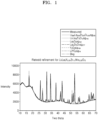
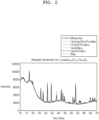
- FIGS. 1-4 XRD patterns with Rietveld refinement for selected samples are shown in FIGS. 1-4 , illustrating the tetragonal structure for the undoped and isovalent multi-cation doped material and the cubic structure for the aliovalent multi-cation doped material.
- FIGS. 1-4 show XRD results for representative samples, with Rietveld refinement fitting for cubic LLZO (blue) and tetragonal LLZO (yellow), as follows.
- FIG. 1 shows a positive result: cubic LLZO stabilized by aliovalent Zr-site doping with Y 3+ , Nb 5+ (Example 3);
- FIG. 1 shows a positive result: cubic LLZO stabilized by aliovalent Zr-site doping with Y 3+ , Nb 5+ (Example 3);
- FIG. 1 shows a positive result: cubic LLZO stabilized by aliovalent Zr-site doping with Y 3+ ,
- FIG. 2 shows a positive result: cubic LLZO stabilized by aliovalent Zr-site doping with Ca 2+ , Ta 5+ (Example 4);
- FIG. 3 shows a negative result: tetragonal LLZO with isovalent Zr-site doping with Ti 4+ , Sn 4+ (Comparative Example 2); and
- FIG. 4 shows a negative result: undoped tetragonal LLZO (Comparative Example 7).
- Table 2 List of synthesized compositions, with XRD fitting results Sample ID Target composition Zr doping type LLZO phase (purity) Ex. 1 Li 7 La 3 Y 0.25 Zr 1.5 Sb 0.25 O 12 Aliovalent Cubic (95 wt.%) Ex.
- Table 2 presents a list of synthesized compositions, with XRD fitting results showing LLZO phase purity and crystal structure.
- aliovalent Zr-site doping stabilized cubic LLZO while retaining a nominal Li content of 7 per formula unit, while isovalent doping and undoped samples produced tetragonal LLZO at room temperature.
- Example 7 and 8 and Comparative Example 10 were prepared in a manner similar to that described above in Example 1, but using the precursor powders lithium carbonate, lanthanum hydroxide, zirconium oxide, tantalum oxide, and magnesium carbonate in Example 7, the precursor powders lithium carbonate, lanthanum hydroxide, zirconium oxide, tantalum oxide, and yttrium oxide in Example 8, and the precursor powders lithium carbonate, lanthanum hydroxide, and zirconium oxide in Comparative Example 10 (undoped LLZO). Further, the samples were sintered at 1200 °C for 8 hours, and then the room temperature conductivity of each sample was measured, with the results that were obtained being shown in Table 3 below.
- the Mg-Ta-LLZO and Y-Ta-LLZO compositions both had significantly higher conductivity than updoped LLZO, with an improvement of>40x for Y-Ta-LLZO and >100x for Mg-Ta-LLZO.
- samples sintered at 1100 °C showed similar trends, but much lower conductivity than those sintered at 1200 °C.
- a cleaning treatment with phosphoric acid and ethanol produced much better electrochemical impedance spectroscopy (EIS) results than sandpaper alone, namely, lower resistance and a better fit to equivalent circuit model.
- EIS electrochemical impedance spectroscopy
- an embodiment which focuses on new lithium garnet material compositions with new doping strategies that incorporate multiple dopants into the parent Li 7 La 3 Zr 2 O 12 material, which stabilize the cubic LLZO structure without inducing Li vacancies has potential benefits including (1) higher conductivity, due to higher retained Li content, (2) higher stability due to entropy benefits associated with larger number of dopants, and (3) lower cost, as synergistic effects of multiple dopants allows use of lower cost elements.
Landscapes
- Chemical & Material Sciences (AREA)
- Engineering & Computer Science (AREA)
- Organic Chemistry (AREA)
- Manufacturing & Machinery (AREA)
- Inorganic Chemistry (AREA)
- Electrochemistry (AREA)
- Chemical Kinetics & Catalysis (AREA)
- General Chemical & Material Sciences (AREA)
- General Physics & Mathematics (AREA)
- Physics & Mathematics (AREA)
- Condensed Matter Physics & Semiconductors (AREA)
- Ceramic Engineering (AREA)
- Composite Materials (AREA)
- Materials Engineering (AREA)
- Structural Engineering (AREA)
- Conductive Materials (AREA)
- Secondary Cells (AREA)
Abstract
Description
- Materials according to embodiments relate to solid electrolyte materials for Li solid-state batteries.
- Solid electrolyte materials are an essential component of solid-state Li-ion batteries, as they enable transport of Li ions while blocking formation of Li metal dendrites that can short circuit the device. Oxide-based solid electrolytes are particularly desirable, due to favorable properties such as high hardness, and electrochemical stability against air and Li metal. However, oxide electrolytes typically have lower conductivity for Li-ions relative to liquid, gel, or sulfide electrolytes, limiting the application of these materials.
- Li-garnet (LLZO) is one of the most promising classes of oxide materials for use as a solid electrolyte for Li solid-state batteries, due to its high conductivity and wide electrochemical stability window.
- However, undoped Li-garnet (Li7La3Zr2O12) adopts a tetragonal crystal structure at room temperature, which does not provide sufficient Li-ion conductivity for practical application in a solid-state battery.
- The primary strategy to address this is to incorporate substitutional dopants that stabilize the high-temperature cubic crystal structure, which can produce a room temperature conductivity in excess of 1 mS/cm.
- In particular, some approaches include the following: (1) Ta-LLZO / Nb-LLZO: Li-garnet with cubic phase stabilized through substitution of Zr for Ta or Nb, inducing Li vacancies. Compositions include Li7-xLa3TaxZr2-xO12 and Li7-xLa3NbxZr2-xO12 with x~0.4. (2) Al-LLZO / Ga-LLZO: Li-garnet with cubic phase stabilized through substitution of Li for Al or Ga. Compositions include Li7-3xAlxLa3Zr2O12 and Li7-3xGaxLa3Zr2O12 with x~0.2. (3) Li7-3xM1xM2yM32-yM4O12, M1: Al, M2: Nb, Ta, Sb, Bi, M3: Zr, M4: La.
- A widely recognized method for improving the Li-ion conductivity of Li-garnet is substitutional doping which induces Li vacancies in excess of 0.4 per formula unit, resulting in stabilization of the high-temperature cubic LLZO phase at room temperature. Examples of Zr-site doping: Li6.5La3Zr1.5Ta0.5O12, Li6.5La3Zr1.5Nb0.5O12. Examples of Li-site doping: Li6.4Al0.2La3Zr2O12, Li6.4Ga0.2La3Zr2O12.
- Specifically, a widely used method for stabilizing the cubic LLZO structure is through substitutions of higher valance elements that induce formation of Li vacancies of at least 0.5 per formula unit, e.g., Li6.5La3Zr1.5Ta0.5O12 with Ta5+ dopants in the Zr4+ sites, and Li6.4Al0.2La3Zr2O12 with Al3+ dopants in the Li+ sites.
- However, drawbacks of doping methods which induce Li vacancies include: decrease of attainable conductivity due to decreased Li content; Li-site dopants (e.g., Al3+, Fe3+, Ga3+) can decrease Li-ion conductivity by occupying sites used for Li-ion hopping; and higher cost of many elements used for substitutional doping.
- Thus, there is a need for improvement in the materials used as solid electrolytes for Li solid-state batteries.
- Information disclosed in this Background section has already been known to or derived by the inventors before or during the process of achieving the embodiments of the present application, or is technical information acquired in the process of achieving the embodiments. Therefore, it may contain information that does not form the prior art that is already known to the public.
- The disclosure provides materials used as solid electrolytes for Li solid-state batteries, according to embodiments.
- According to an embodiment, there are new lithium garnet material compositions with new doping strategies that incorporate multiple dopants into the parent Li7La3Zr2O12 material, which stabilize the cubic LLZO structure without inducing Li vacancies. Potential benefits of this multi-dopant strategy are (1) higher conductivity, due to higher retained Li content, (2) higher stability due to entropy benefits associated with larger number of dopants, and (3) lower cost, as synergistic effects of multiple dopants allows use of lower cost elements.
- An embodiment includes new lithium garnet material compositions with cubic phase through substitutions of multiple aliovalent cation dopants for Zr in the parent Li7La3Zr2O12 material, such that the overall Li content remains 7 per formula unit. In order to stabilize the cubic LLZO phase, at least one dopant is selected from the group of 2+ and 3+ cations (Y, In, Mg, Ca, Ba, Sc, Sr, Ru), and at least one dopant is selected from the group of 5+ and 6+ cations (Ta, Nb, Mo, Sb, Te), such that the overall oxidation state of all Zr substitutions averages to 4+, and the Li stoichiometry of the material is unchanged. The entropic stabilization may also be increased through additional substitutions of isovalent dopants for Zr from the group (Hf, Ti, Sn, Si), so long as the stabilization of the cubic LLZO phase is maintained.
- An embodiment demonstrates an approach to stabilize cubic garnet with Li content of 7 per formula unit, through substitution of Zr (4+) with a combination of subvalent (2+ and 3+) and supervalent (5+, 6+) cations to maintain overall charge balance in the Zr site.
- Thus, an embodiment includes a material having the following formula:
Li7+δLa3Zr2-x-y-zM1xM2yM3zO12
where M1 is one or a combination of (Y, In, Mg, Ca, Ba, Sc, Sr, Ru) with oxidation number (valence) lower than 4+, M2 is one or a combination of (Bi, Ta, Nb, Mo, Sb, Te, W) with oxidation number (valence) higher than 4+, and M3 is one or a combination of (Hf, Ti, Ge, Sn, Si) with oxidation number (valence) equal to 4+, subject to 0<x≤1, 0<y≤1, 0≤z≤2, 0<x+y+z≤2, and -0.2<δ<0.2. - Another embodiment of the material includes a lithium garnet material having the following formula:
Li7+δLa3Zr2-x-y-zM1xM2yM3zO12
where M1 is one or a combination of (Y, In, Mg, Ca, Ba, Sc, Sr, Ru) with oxidation number (valence) lower than 4+, M2 is one or a combination of (Bi, Ta, Nb, Mo, Sb, Te) with oxidation number (valence) higher than 4+, and M3 is one or a combination of (Hf, Ti, Sn, Si) with oxidation number (valence) equal to 4+, subject to 0<x≤1, 0<y≤1, 0≤z≤2, 0<x+y+z≤2, and
-0.2<δ<0.2. - Another embodiment of the material includes a lithium garnet material having the following formula:
Li7+δLa3Zr2-x-y-zM1xM2yM3zO12
where M1 is one or a combination of (Y, In, Mg, Ca, Ba, Sr, Ru) with oxidation number (valence) lower than 4+, M2 is one or a combination of (Bi, Ta, Nb, Mo, Sb, Te, W) with oxidation number (valence) higher than 4+, and M3 is one or a combination of (Hf, Ti, Sn, Si) with oxidation number (valence) equal to 4+, subject to 0<x≤1, 0<y≤1, 0≤z≤2, 0<x+y+z≤2, and -0.2<δ<0.2. - Another embodiment of the material includes a lithium oxide solid-state electrolyte material comprising:
Li7+δLa3Zr2-x-y-zM1xM2yM3zO12
wherein: - M1 is one or a combination of subvalent 2+ or 3+ Zr dopants (Y, In, Mg, Ca, Ba, Sc, Sr, Ru),
- M2 is one or a combination of supervalent 5+ or 6+ Zr dopants (Bi, Ta, Nb, Mo, Sb, Te),
- M3 is one or a combination of isovalent 4+ Zr dopants (Ti, Hf, Ge, Sn, Si),
- 0<x≤1, 0<y≤1, 0≤z≤2, 0<x+y+z≤2, and -0.2<δ<0.2, and
- the material has a cubic LLZO crystal structure which is stabilized at room temperature.
- Another embodiment of the material includes a lithium oxide solid-state electrolyte material comprising:
Li7+δLa3Zr2-x-y-zM1xM2yM3zO12
wherein: - M1 is one or a combination of subvalent 2+ or 3+ Zr dopants (Y, In, Mg, Ca, Ba, Sr, Ru),
- M2 is one or a combination of supervalent 5+ or 6+ Zr dopants (Bi, Ta, Nb, Mo, Sb, Te, W),
- M3 is one or a combination of isovalent 4+ Zr dopants (Ti, Hf, Ge, Sn, Si),
- 0<x≤1, 0<y≤1, 0≤z≤2, 0<x+y+z≤2, and -0.2<δ<0.2, and
- the material has a cubic LLZO crystal structure which is stabilized at room temperature.
- Another embodiment of the material includes a material which retains a cubic LLZO phase at room temperature and which has the formula:
Li7+δLa3Zr2-x-y-zM1xM2yM3zO12
where M1 is one or a combination of (Y, In, Mg, Ca, Ba, Sc, Sr, Ru) with oxidation number (valence) lower than 4+, M2 is one or a combination of (Bi, Ta, Nb, Mo, Sb, Te) with oxidation number (valence) higher than 4+, and M3 is one or a combination of (Hf, Ti, Sn, Si) with oxidation number (valence) equal to 4+, subject to 0<x≤1, 0<y≤1, 0≤z≤2, 0<x+y+z≤2, and
-0.2<δ<0.2. - Another embodiment of the material includes a material which retains a cubic LLZO phase at room temperature and which has the formula:
Li7+δLa3Zr2-x-y-zM1xM2yM3zO12
where M1 is one or a combination of (Y, In, Mg, Ca, Ba, Sr, Ru) with oxidation number (valence) lower than 4+, M2 is one or a combination of (Bi, Ta, Nb, Mo, Sb, Te, W) with oxidation number (valence) higher than 4+, and M3 is one or a combination of (Hf, Ti, Sn, Si) with oxidation number (valence) equal to 4+, subject to 0<x≤1, 0<y≤1, 0≤z≤2, 0<x+y+z≤2, and
-0.2<δ<0.2. - Another embodiment is a solid state lithium battery comprising a cathode active material layer, an anode active material layer, and a solid electrolyte layer formed between the cathode active material layer and the anode active material layer, wherein the solid electrolyte layer comprises any of the aforementioned materials.
- Example embodiments of the inventive concept will be more clearly understood from the following detailed description taken in conjunction with the accompanying drawings in which:
-
FIG. 1 is an XRD pattern with Rietveld refinement for Example 3, -
FIG. 2 is an XRD pattern with Rietveld refinement for Example 4, -
FIG. 3 is an XRD pattern with Rietveld refinement for Comparative Example 2, and -
FIG. 4 is an XRD pattern with Rietveld refinement for Comparative Example 7. - The embodiments of the disclosure described herein are example embodiments, and thus, the disclosure is not limited thereto, and may be realized in various other forms. Each of the embodiments provided in the following description is not excluded from being associated with one or more features of another example or another embodiment also provided herein or not provided herein but consistent with the disclosure. For example, even if matters described in a specific example or embodiment are not described in a different example or embodiment thereto, the matters may be understood as being related to or combined with the different example or embodiment, unless otherwise mentioned in descriptions thereof. In addition, it should be understood that all descriptions of principles, aspects, examples, and embodiments of the disclosure are intended to encompass structural and functional equivalents thereof. In addition, these equivalents should be understood as including not only currently well-known equivalents but also equivalents to be developed in the future.
- As used herein, expressions such as "at least one of," when preceding a list of elements, modify the entire list of elements and do not modify the individual elements of the list. For example, the expression, "at least one of a, b and c," should be understood as including only a, only b, only c, both a and b, both a and c, both b and c, or all of a, b and c. Herein, when a term "same" is used to compare a dimension of two or more elements, the term may cover a "substantially same" dimension.
- The Li-garnet material has great technological relevance due to its potential application as a solid electrolyte material for Li-ion batteries, due to its high hardness, wide electrochemical stability, and high Li-ion conductivity. However, the base material Li7La3Zr2O12 forms a low conductivity tetragonal crystal structure at room temperature, so modifications are needed to attain sufficient Li-ion conductivity for applications as a solid electrolyte. As mentioned above, a widely used method for improving the conductivity of Li garnet is through incorporation of dopants that induce Li vacancies, which result in the stabilization of the high conductivity cubic phase. The most relevant examples of this are substitutions of Ta5+ or Nb5+ for Zr4+ (e.g., Li6.5La3Zr1.5Ta0.5O12, Li6.5La3Zr1.5Nb0.5O12), or substitutions of Al3+, Fe3+, or Ga3+ for Li+ (e.g., Li6.4Al0.2La3Zr2O12, Li6.4Fe0.2La3Zr2O12, Li6.4Ga0.2La3Zr2O12). Stabilization of cubic garnet through this method has been shown to occur when substitutions induce Li vacancies of at least 0.5 per formula unit.
- An alternate approach to stabilization of cubic garnet without generation of significant amount of Li vacancies is an embodiment which includes stabilization of cubic garnet without generation of significant amount of Li vacancies through substitution of multiple aliovalent cations for Zr4+ in the lithium garnet structure. The multi cation substitutions generate disorder that stabilizes the cubic garnet phase at room temperature, while maintaining the Li content at around 7 per formula unit. The key aspect of this embodiment is the inclusion of at least one supervalent (5+ and 6+) dopant and one subvalent (2+ and 3+) dopant (taken from the list in Table 1 below), such that the overall charge balance is maintained without shifting the Li content of the material.
Table 1: List of candidate dopants Element Expected oxidation state Dopant type (Zr site) Ba 2+ Subvalent Ca 2+ Subvalent Mg 2+ Subvalent Sr 2+ Subvalent Ru 2+ Subvalent Y 3+ Subvalent In 3+ Subvalent Hf 4+ Isovalent Sn 4+ Isovalent Ti 4+ Isovalent Si 4+ Isovalent Bi 5+ Supervalent Ta 5+ Supervalent Nb 5+ Supervalent Sb 5+ Supervalent Mo 6+ Supervalent w 6+ Supervalent Te 6+ Supervalent - Benefits of the multi-cation substitution method are:
- 1) Higher conductivity of cubic Li-garnet electrolyte, due to higher retained Li content relative to cubic garnet stabilized via Li vacancy formation;
- 2) Thermodynamic stabilization of the material due to higher configurational entropy, increasing resistance to electrochemical decomposition; and
- 3) Ability to incorporate subvalent 2+ and 3+ dopants into the Zr site, with potential benefits to cost or desirable secondary properties of the material. Substitution of subvalent elements for Zr is normally unfeasible in this material, as charge balance would require Li>7 which is very energetically unfavorable.
- Thus, as a general matter, an embodiment includes a material having the following formula:
Li7+δLa3Zr2-x-y-zM1xM2yM3zO12
where M1 is one or a combination of (Y, In, Mg, Ca, Ba, Sc, Sr, Ru) with oxidation number (valence) lower than 4+, M2 is one or a combination of (Bi, Ta, Nb, Mo, Sb, Te, W) with oxidation number (valence) higher than 4+, and M3 is one or a combination of (Hf, Ti, Ge, Sn, Si) with oxidation number (valence) equal to 4+, subject to 0<x≤1, 0<y≤1, 0≤z≤2, 0<x+y+z≤2, and -0.2<δ<0.2. - The materials in an embodiment are therefore those which retain the high-conductivity cubic LLZO phase at room temperature, and have a composition formula of the form:
Li7+δLa3Zr2-x-y-zM1xM2yM3zO12
where M1 is one or a combination of (Y, In, Mg, Ca, Ba, Sc, Sr, Ru) with oxidation number (valence) lower than 4+, M2 is one or a combination of (Bi, Ta, Nb, Mo, Sb, Te) with oxidation number (valence) higher than 4+, and M3 is one or a combination of (Hf, Ti, Sn, Si) with oxidation number (valence) equal to 4+, subject to 0<x≤1, 0<y≤1, 0≤z≤2, 0<x+y+z≤2, and -0.2<δ<0.2. - The materials in another embodiment are therefore those which retain the high-conductivity cubic LLZO phase at room temperature, and have a composition formula of the form:
Li7+δLa3Zr2-x-y-zM1xM2yM3zO12
where M1 is one or a combination of (Y, In, Mg, Ca, Ba, Sr, Ru) with oxidation number (valence) lower than 4+, M2 is one or a combination of (Bi, Ta, Nb, Mo, Sb, Te, W) with oxidation number (valence) higher than 4+, and M3 is one or a combination of (Hf, Ti, Sn, Si) with oxidation number (valence) equal to 4+, subject to 0<x≤1, 0<y≤1, 0≤z≤2, 0<x+y+z≤2, and -0.2<δ<0.2. - Thus, an embodiment includes a lithium garnet material having the following formula:
Li7+δLa3Zr2-x-y-zM1xM2yM3zO12
where M1 is one or a combination of (Y, In, Mg, Ca, Ba, Sc, Sr, Ru) with oxidation number (valence) lower than 4+, M2 is one or a combination of (Bi, Ta, Nb, Mo, Sb, Te) with oxidation number (valence) higher than 4+, and M3 is one or a combination of (Hf, Ti, Sn, Si) with oxidation number (valence) equal to 4+, subject to 0<x≤1, 0<y≤1, 0≤z≤2, 0<x+y+z≤2, and
-0.2<δ<0.2. - Another embodiment includes a lithium garnet material having the following formula:
Li7+δLa3Zr2-x-y-zM1xM2yM3zO12
where M1 is one or a combination of (Y, In, Mg, Ca, Ba, Sr, Ru) with oxidation number (valence) lower than 4+, M2 is one or a combination of (Bi, Ta, Nb, Mo, Sb, Te, W) with oxidation number (valence) higher than 4+, and M3 is one or a combination of (Hf, Ti, Sn, Si) with oxidation number (valence) equal to 4+, subject to 0<x≤1, 0<y≤1, 0≤z≤2, 0<x+y+z≤2, and
-0.2<δ<0.2. - Another embodiment includes a lithium oxide solid-state electrolyte material comprising:
Li7+δLa3Zr2-x-y-zM1xM2yM3zO12
wherein: - M1 is one or a combination of subvalent 2+ or 3+ Zr dopants (Y, In, Mg, Ca, Ba, Sc, Sr, Ru),
- M2 is one or a combination of supervalent 5+ or 6+ Zr dopants (Bi, Ta, Nb, Mo, Sb, Te),
- M3 is one or a combination of isovalent 4+ Zr dopants (Ti, Hf, Ge, Sn, Si),
- 0<x≤1, 0<y≤1, 0≤z≤2, 0<x+y+z≤2, and -0.2<δ<0.2, and
- the material has a cubic LLZO crystal structure which is stabilized at room temperature.
- Another embodiment includes a lithium oxide solid-state electrolyte material comprising:
Li7+δLa3Zr2-x-y-zM1xM2yM3zO12
wherein: - M1 is one or a combination of subvalent 2+ or 3+ Zr dopants (Y, In, Mg, Ca, Ba, Sr, Ru),
- M2 is one or a combination of supervalent 5+ or 6+ Zr dopants (Bi, Ta, Nb, Mo, Sb, Te, W),
- M3 is one or a combination of isovalent 4+ Zr dopants (Ti, Hf, Ge, Sn, Si),
- 0<x≤1, 0<y≤1, 0≤z≤2, 0<x+y+z≤2, and -0.2<δ<0.2, and
- the material has a cubic LLZO crystal structure which is stabilized at room temperature.
- M1 is preferably one or a combination of two or more of Y, Mg, and Ca. In a preferred embodiment, M1 is one or a combination of Y and Mg or one or a combination of Ca and Mg. In a preferred embodiment, M1 is one of Y, Mg, and Ca. In one preferred embodiment, M1 is Y. In another preferred embodiment, M1 is Mg. In still another preferred embodiment, M1 is Ca.
- M2 is preferably one or a combination of two or more of Ta, Nb, and Sb. In a preferred embodiment, M2 is one of Ta, Nb, and Sb. In one preferred embodiment, M2 is Ta. In another preferred embodiment, M2 is Nb. In still another preferred embodiment, M2 is Sb.
- M3 is preferably one or a combination of two or more of Sn, Hf, and Ge. In a preferred embodiment, M3 is Sn.
- In a preferred embodiment, 0<x≤0.5. In another preferred embodiment, 0<x≤0.25. In a preferred embodiment, 0<y≤0.5. In another preferred embodiment, 0<y≤0.25. In a preferred embodiment, 0≤z≤1.25. In another preferred embodiment, 0≤z≤0.75. In still another preferred embodiment, 0≤z≤0.50. In yet another preferred embodiment, 0≤z≤0.25.
- A method of preparing the oxide is the solid-state method. In this method, precursor powders are combined in a certain ratio depending on the composition of the target material. In a typical preparation, precursors may consist of lithium carbonate, lanthanum hydroxide, zirconium oxide, and at least one precursor containing each of the included metals M1, M2, and M3. Examples of metal precursors include metal oxides, hydroxides, carbonates, and nitrates. In particular, the compounds described in this invention may be prepared using, for instance, the precursors tantalum oxide, niobium oxide, bismuth oxide, molybdenum oxide, tungsten oxide, tellurium hydroxide, titanium oxide, tin oxide, hafnium oxide, germanium oxide, silicon oxide, indium oxide, scandium oxide, barium carbonate, magnesium carbonate, calcium carbonate, and strontium carbonate as sources of the associated metal ions.
- The precursor mixture may be mixed by a method such as ball milling or planetary milling to produce a homogeneous mixture. Mixing may be done with a suitable solvent such as ethanol, isopropanol, ethylene glycol, or acetone to assist with the uniform dispersion of the precursors.
- The precursor mixture may then be heat treated to a temperature of 600C-1100C, for a period of 1 hour to 48 hours to produce an oxide powder with the desired composition and crystal structure.
- Subsequently the oxide powder may be compressed using a hydraulic uniaxial press to form a densely packed pellet. Heat treatment may then be applied at a temperature of about 900 °C - 1500 °C for 1 hour to 48 hours to produce a dense pellet which may be used as a solid electrolyte separator in a solid state lithium battery cell.
- For instance, the calcined powder may be formed into a pellet through application of uniaxial pressure of 100 - 500 MPa. The pellet may then be heat treated at 1200 °C for 2 hours to form a dense sintered solid electrolyte separator suitable for use in a lithium battery cell.
- As an example of making a battery full cell using a garnet solid electrolyte and a Li-metal anode, an ionic liquid electrolyte can be used as the cathode electrolyte (catholyte) and a garnet oxide electrolyte can be used as the Li-metal anode electrolyte, (anolyte). First, 20-µm-thick Li metal on 10-pm-thick Cu foil (Honjo Metal Co., Ltd.) can be attached to the protonated surface of the LLZO pellet by cold-isostatic pressing at 250 MPa. A commercially available NCM111 electrode (loading capacity: 3.2 g cm-3, active material: 93 wt%; Samsung SDI) can be coated onto Al foil as the cathode. The ionic liquid Pyr13FSI (Kanto Chemical Co. Inc.) can be mixed with LiFSI salt (2M) to prepare the catholyte. The mixed solution can be dropped onto the cathode and then infiltrated into the cathode under a vacuum for 2 h. The infiltrated amount of ionic liquid can be 20 wt% relative to the cathode weight. The infiltrated cathode can be placed on the other side of the LLZO pellet in a 2032-coin cell. To eliminate the possibility of direct contact between the ionic liquid and Li-metal, a relatively small cathode (0.4 cm in diameter) can be used for the hybrid electrolyte cell. Finally, the cell can be sealed under a vacuum using a pouch cell.
- A 110 micrometer pellet of LLZO (garnet) can be used. An even thinner pellet can desirably be made by a method like tape casting, down to 20 micrometer. The garnet electrolyte can have a thickness in the range of 20 - 150 micrometers. Another thickness range for the garnet electrolyte is 20 - 110 micrometers.
- An embodiment of the aforementioned materials can be assembled together with a cathode active material layer and an anode active material layer to be used in an embodiment which is a solid state lithium battery comprising a cathode active material layer, an anode active material layer, and a solid electrolyte layer formed between the cathode active material layer and the anode active material layer, wherein the solid electrolyte layer comprises any of the aforementioned materials.
- Embodiments will now be illustrated by way of the following examples, which do not limit the embodiments in any way.
- Using the standard solid-state method, numerous examples of the Li-garnet with multiple aliovalent dopants substituted for Zr were synthesized following the substitution rules in an embodiment, as described below.
- A broad list of tested compositions and XRD results are included in Table 2 to demonstrate the wide applicability of the aliovalent multi-cation doping strategy in this material. The tested compositions included in Table 2 were prepared in the following manner.
- The compound Li7La3Y0.25Zr1.5Sb0.25O12, which was the target composition for Example 1, was prepared using the precursor powders lithium carbonate, lanthanum hydroxide, zirconium oxide, yttrium oxide, and antimony oxide, mixed in a stoichiometric ratio with the addition of 5 - 50 % excess lithium precursor to mitigate lithium evaporation during heat treatment. The precursor powders were then processed in a planetary mill at 350 rpm for 24 hours using zirconia mixing balls. The precursor mixture was then heat treated at 1000 °C for 8 hours to produce a powder of the desired composition and crystal structure.
- The compounds described in Examples 2-6 and Comparative Examples 1-9 were prepared in a manner similar to that described above in Example 1, but using precursors tantalum oxide, niobium oxide, titanium oxide, tin oxide, silicon oxide, magnesium carbonate, and calcium carbonate as sources of the associated metal ions.
- The synthesized materials were characterized via XRD to confirm the presence of the cubic garnet phase at room temperature, as well as SEM/EDS to confirm that the dopants have been incorporated into the parent structure. As controls, numerous samples of the undoped Li garnet material as well as multi-doped Li garnet that substitutes multiple isovalent dopants for Zr (Hf, Ti, Sn, Si) were also synthesized, as set forth above. In all cases, in the undoped material or isovalent multi-cation doping, the material was confirmed by XRD to form the low conductivity tetragonal phase, confirming that the incorporation of the aliovalent dopants is necessary for the stabilization of the cubic phase. The results are shown in Table 2 below. XRD patterns with Rietveld refinement for selected samples are shown in
FIGS. 1-4 , illustrating the tetragonal structure for the undoped and isovalent multi-cation doped material and the cubic structure for the aliovalent multi-cation doped material. In particular,FIGS. 1-4 show XRD results for representative samples, with Rietveld refinement fitting for cubic LLZO (blue) and tetragonal LLZO (yellow), as follows.FIG. 1 shows a positive result: cubic LLZO stabilized by aliovalent Zr-site doping with Y3+, Nb5+ (Example 3);FIG. 2 shows a positive result: cubic LLZO stabilized by aliovalent Zr-site doping with Ca2+, Ta5+ (Example 4);FIG. 3 shows a negative result: tetragonal LLZO with isovalent Zr-site doping with Ti4+, Sn4+ (Comparative Example 2); andFIG. 4 shows a negative result: undoped tetragonal LLZO (Comparative Example 7).Table 2: List of synthesized compositions, with XRD fitting results Sample ID Target composition Zr doping type LLZO phase (purity) Ex. 1 Li7La3Y0.25Zr1.5Sb0.25O12 Aliovalent Cubic (95 wt.%) Ex. 2 Li7La3Y0.25Zr1.5Ta0.25O12 Aliovalent Cubic (89 wt.%) Ex. 3 Li7La3Y0.25Zr1.5Nb0.25O12 Aliovalent Cubic (94 wt.%) Ex. 4 Li7La3Ca0.25Zr1.25Ta0.5O12 Aliovalent Cubic (97 wt.%) Ex. 5 Li7La3Mg0.25Zr1.25Nb0.5O12 Aliovalent Cubic (98 wt.%) Ex. 6 Li7La3Mg0.25Zr1.25Ta0.5O12 Aliovalent Cubic (98 wt.%) Comp. Ex. 1 Li7La3Ti0.25Zr1.5Sn0.25O12 Isovalent Tetragonal (100 wt.%) Comp. Ex. 2 Li7La3Ti0.25Zr1.25Sn0.5O12 Isovalent Tetragonal (100 wt.%) Comp. Ex. 3 Li7La3Si0.25Zr1.25Sn0.5O12 Isovalent Tetragonal (97 wt.%) Comp. Ex. 4 Li7La3Ti0.25ZrSn0.35O12 Isovalent Tetragonal (99 wt.%) Comp. Ex. 5 Li7La3Ti0.25Zr0.5Sn1.25O12 Isovalent Tetragonal (100 wt.%) Comp. Ex. 6 Li7La3Ti0.5Zr0.5Sn1.25O12 Isovalent Tetragonal (97 wt.%) Comp. Ex. 7 Li7La3Zr2O12 Undoped Tetragonal (99 wt.%) Comp. Ex. 8 Li7La3Zr2O12 Undoped Tetragonal (99 wt.%) Comp. Ex. 9 Li7La3Zr2O12 Undoped Tetragonal (98 wt.%) - As shown above, Table 2 presents a list of synthesized compositions, with XRD fitting results showing LLZO phase purity and crystal structure. In all cases, aliovalent Zr-site doping stabilized cubic LLZO while retaining a nominal Li content of 7 per formula unit, while isovalent doping and undoped samples produced tetragonal LLZO at room temperature.
- The compounds described in Examples 7 and 8 and Comparative Example 10 were prepared in a manner similar to that described above in Example 1, but using the precursor powders lithium carbonate, lanthanum hydroxide, zirconium oxide, tantalum oxide, and magnesium carbonate in Example 7, the precursor powders lithium carbonate, lanthanum hydroxide, zirconium oxide, tantalum oxide, and yttrium oxide in Example 8, and the precursor powders lithium carbonate, lanthanum hydroxide, and zirconium oxide in Comparative Example 10 (undoped LLZO). Further, the samples were sintered at 1200 °C for 8 hours, and then the room temperature conductivity of each sample was measured, with the results that were obtained being shown in Table 3 below.
Table 3: Conductivity results Sample ID Composition Sintering Room Temp. Conductivity Ex. 7 Li7La3Zr1.25Mg0.25Ta0.5O12 1200 °C, 8h 2.8×10⁻⁵ S/cm Ex. 8 Li7La3ZrY0.5Ta0.5O12 1200 °C, 8h 8.9×10⁻⁶ S/cm Comp. Ex. 10 Li7La3Zr2O12 1200 °C, 8h 2.1×10⁻⁷ S/cm - As can be seen from the results set forth in Table 3, the Mg-Ta-LLZO and Y-Ta-LLZO compositions both had significantly higher conductivity than updoped LLZO, with an improvement of>40x for Y-Ta-LLZO and >100x for Mg-Ta-LLZO. Further, samples sintered at 1100 °C showed similar trends, but much lower conductivity than those sintered at 1200 °C. Also, a cleaning treatment with phosphoric acid and ethanol produced much better electrochemical impedance spectroscopy (EIS) results than sandpaper alone, namely, lower resistance and a better fit to equivalent circuit model.
- The experimental results demonstrate the utility of the multi-doping strategy of the disclosure and the excellent properties of multi-doped samples of the disclosure.
- Thus, as mentioned above, an embodiment which focuses on new lithium garnet material compositions with new doping strategies that incorporate multiple dopants into the parent Li7La3Zr2O12 material, which stabilize the cubic LLZO structure without inducing Li vacancies, has potential benefits including (1) higher conductivity, due to higher retained Li content, (2) higher stability due to entropy benefits associated with larger number of dopants, and (3) lower cost, as synergistic effects of multiple dopants allows use of lower cost elements.
- The foregoing is illustrative of exemplary embodiments and is not to be construed as limiting the disclosure. Although a few exemplary embodiments have been described, those skilled in the art will readily appreciate that many modifications are possible in the above embodiments without materially departing from the disclosure.
Claims (20)
- A material having the following formula:
Li7+δLa3Zr2-x-y-zM1xM2yM3zO12
where M1 is one or a combination of two or more of Y, In, Mg, Ca, Ba, Sc, Sr, and Ru with oxidation number lower than 4+, M2 is one or a combination of two or more of Bi, Ta, Nb, Mo, Sb, Te, and W with oxidation number higher than 4+, and M3 is one or a combination of two or more of Hf, Ti, Ge, Sn, and Si with oxidation number equal to 4+, subject to 0<x≤1, 0<y≤1, 0≤z≤2, 0<x+y+z≤2, and -0.2<δ<0.2. - The material of claim 1, wherein the material is a lithium garnet material having the following formula:
Li7+δLa3Zr2-x-y-zM1xM2yM3zO12
where M1 is one or a combination of two or more of Y, In, Mg, Ca, Ba, Sc, Sr, and Ru with oxidation number lower than 4+, M2 is one or a combination of two or more of Bi, Ta, Nb, Mo, Sb, and Te with oxidation number higher than 4+, and M3 is one or a combination of two or more of Hf, Ti, Sn, and Si with oxidation number equal to 4+, subject to 0<x≤1, 0<y≤1, 0≤z≤2, 0<x+y+z≤2, and -0.2<δ<0.2. - The material of claim 1, wherein the material is a lithium garnet material having the following formula:
Li7+δLa3Zr2-x-y-zM1xM2yM3zO12
where M1 is one or a combination of two or more of Y, In, Mg, Ca, Ba, Sr, and Ru with oxidation number lower than 4+, M2 is one or a combination of two or more of Bi, Ta, Nb, Mo, Sb, Te, and W with oxidation number higher than 4+, and M3 is one or a combination of two or more of Hf, Ti, Sn, and Si with oxidation number equal to 4+, subject to 0<x≤1, 0<y≤1, 0≤z≤2, 0<x+y+z≤2, and -0.2<δ<0.2. - The material of claim 1, wherein the material is a lithium oxide solid-state electrolyte material comprising:
Li7+δLa3Zr2-x-y-zM1xM2yM3zO12
wherein:M1 is one or a combination of two or more of subvalent 2+ or 3+ Zr dopants selected from Y, In, Mg, Ca, Ba, Sc, Sr, and Ru,M2 is one or a combination of two or more of supervalent 5+ or 6+ Zr dopants selected from Bi, Ta, Nb, Mo, Sb, and Te,M3 is one or a combination of two or more of isovalent 4+ Zr dopants selected from Ti, Hf, Ge, Sn, and Si,0<x≤1, 0<y≤1, 0≤z≤2, 0<x+y+z≤2, and -0.2<δ<0.2, andthe material has a cubic LLZO crystal structure which is stabilized at room temperature. - The material of claim 1, wherein the material is a lithium oxide solid-state electrolyte material comprising:
Li7+δLa3Zr2-x-y-zM1xM2yM3zO12
wherein:M1 is one or a combination of two or more of subvalent 2+ or 3+ Zr dopants selected from Y, In, Mg, Ca, Ba, Sr, and Ru,M2 is one or a combination of two or more of supervalent 5+ or 6+ Zr dopants selected from Bi, Ta, Nb, Mo, Sb, Te, and W,M3 is one or a combination of two or more of isovalent 4+ Zr dopants selected from Ti, Hf, Ge, Sn, and Si,0<x≤1, 0<y≤1, 0≤z≤2, 0<x+y+z≤2, and -0.2<δ<0.2, andthe material has a cubic LLZO crystal structure which is stabilized at room temperature. - The material of claim 1, wherein the material retains a cubic LLZO phase at room temperature and has the formula:
Li7+δLa3Zr2-x-y-zM1xM2yM3zO12
where M1 is one or a combination of two or more of Y, In, Mg, Ca, Ba, Sc, Sr, and Ru with oxidation number lower than 4+, M2 is one or a combination of two or more of Bi, Ta, Nb, Mo, Sb, and Te with oxidation number higher than 4+, and M3 is one or a combination of two or more of Hf, Ti, Sn, and Si with oxidation number equal to 4+, subject to 0<x≤1, 0<y≤1, 0≤z≤2, 0<x+y+z≤2, and -0.2<δ<0.2. - The material of claim 1, wherein the material retains a cubic LLZO phase at room temperature and has the formula:
Li7+δLa3Zr2-x-y-zM1xM2yM3zO12
where M1 is one or a combination of two or more of Y, In, Mg, Ca, Ba, Sr, and Ru with oxidation number lower than 4+, M2 is one or a combination of two or more of Bi, Ta, Nb, Mo, Sb, Te, and W with oxidation number higher than 4+, and M3 is one or a combination of two or more of Hf, Ti, Sn, and Si with oxidation number equal to 4+, subject to 0<x≤1, 0<y≤1, 0≤z≤2, 0<x+y+z≤2, and -0.2<δ<0.2. - The material of claim 1, wherein M1 comprises Y.
- The material of claim 1, wherein M1 comprises Mg.
- The material of claim 1, wherein M1 comprises Ca.
- The material of claim 1, wherein M2 comprises Ta.
- The material of claim 1, wherein M2 comprises Nb.
- The material of claim 1, wherein M2 comprises Sb.
- The material of claim 8, wherein M2 comprises at least one of Sb, Ta, and Nb.
- The material of claim 9, wherein M2 comprises at least one of Ta and Nb.
- The material of claim 10, wherein M2 comprises Ta.
- The material of claim 1, wherein M1 comprises Mg and M2 comprises Ta.
- The material of claim 1, wherein M1 comprises Y and M2 comprises Ta.
- A solid state lithium battery comprising a cathode active material layer, an anode active material layer, and a solid electrolyte layer formed between the cathode active material layer and the anode active material layer, wherein the solid electrolyte layer comprises the material of claim 1.
- The solid state lithium battery of claim 19, wherein the solid electrolyte layer has a thickness of 20 - 150 micrometers.
Applications Claiming Priority (3)
| Application Number | Priority Date | Filing Date | Title |
|---|---|---|---|
| US202263407528P | 2022-09-16 | 2022-09-16 | |
| US202263421281P | 2022-11-01 | 2022-11-01 | |
| US18/113,417 US20240097184A1 (en) | 2022-09-16 | 2023-02-23 | ALIOVALENT MULTI-CATION DOPING OF Li-GARNET FOR STABILIZATION OF CUBIC LLZO |
Publications (2)
| Publication Number | Publication Date |
|---|---|
| EP4339160A1 true EP4339160A1 (en) | 2024-03-20 |
| EP4339160B1 EP4339160B1 (en) | 2026-04-15 |
Family
ID=88068353
Family Applications (1)
| Application Number | Title | Priority Date | Filing Date |
|---|---|---|---|
| EP23197318.1A Active EP4339160B1 (en) | 2022-09-16 | 2023-09-14 | Aliovalent multi-cation doping of li-garnet for stabilization of cubic llzo |
Country Status (3)
| Country | Link |
|---|---|
| US (1) | US20240097184A1 (en) |
| EP (1) | EP4339160B1 (en) |
| KR (1) | KR20240038584A (en) |
Families Citing this family (3)
| Publication number | Priority date | Publication date | Assignee | Title |
|---|---|---|---|---|
| US12587274B2 (en) | 2023-03-28 | 2026-03-24 | Quantum Generative Materials Llc | Satellite optimization management system based on natural language input and artificial intelligence |
| US12368503B2 (en) | 2023-12-27 | 2025-07-22 | Quantum Generative Materials Llc | Intent-based satellite transmit management based on preexisting historical location and machine learning |
| US12603701B2 (en) | 2023-12-27 | 2026-04-14 | Quantum Generative Materials Llc | Distributed satellite constellation management and control system |
Citations (6)
| Publication number | Priority date | Publication date | Assignee | Title |
|---|---|---|---|---|
| US20180301754A1 (en) * | 2017-04-17 | 2018-10-18 | Corning Incorporated | Lithium-garnet solid electrolyte composite, tape articles, and methods thereof |
| EP3439072A1 (en) * | 2017-08-04 | 2019-02-06 | Samsung Electronics Co., Ltd. | Solid electrolyte, method of preparing the same, and lithium battery including the solid electrolyte |
| WO2019094359A1 (en) * | 2017-11-07 | 2019-05-16 | The Regents Of The University Of Michigan | Solid-state battery electrolyte having increased stability towards cathode materials |
| US20210280901A1 (en) * | 2020-03-06 | 2021-09-09 | Seiko Epson Corporation | Solid Electrolyte, Method For Producing Solid Electroylyte, And Composite Body |
| WO2021224637A1 (en) * | 2020-05-07 | 2021-11-11 | Johnson Matthey Public Limited Company | Lithium-ion conductive ceramic material and process |
| US20220044837A1 (en) * | 2020-08-06 | 2022-02-10 | Samsung Electronics Co., Ltd. | Solid ion conductor, solid electrolyte including the same, electrochemical device including the same, and preparation method thereof |
-
2023
- 2023-02-23 US US18/113,417 patent/US20240097184A1/en active Pending
- 2023-07-28 KR KR1020230098942A patent/KR20240038584A/en active Pending
- 2023-09-14 EP EP23197318.1A patent/EP4339160B1/en active Active
Patent Citations (6)
| Publication number | Priority date | Publication date | Assignee | Title |
|---|---|---|---|---|
| US20180301754A1 (en) * | 2017-04-17 | 2018-10-18 | Corning Incorporated | Lithium-garnet solid electrolyte composite, tape articles, and methods thereof |
| EP3439072A1 (en) * | 2017-08-04 | 2019-02-06 | Samsung Electronics Co., Ltd. | Solid electrolyte, method of preparing the same, and lithium battery including the solid electrolyte |
| WO2019094359A1 (en) * | 2017-11-07 | 2019-05-16 | The Regents Of The University Of Michigan | Solid-state battery electrolyte having increased stability towards cathode materials |
| US20210280901A1 (en) * | 2020-03-06 | 2021-09-09 | Seiko Epson Corporation | Solid Electrolyte, Method For Producing Solid Electroylyte, And Composite Body |
| WO2021224637A1 (en) * | 2020-05-07 | 2021-11-11 | Johnson Matthey Public Limited Company | Lithium-ion conductive ceramic material and process |
| US20220044837A1 (en) * | 2020-08-06 | 2022-02-10 | Samsung Electronics Co., Ltd. | Solid ion conductor, solid electrolyte including the same, electrochemical device including the same, and preparation method thereof |
Also Published As
| Publication number | Publication date |
|---|---|
| US20240097184A1 (en) | 2024-03-21 |
| EP4339160B1 (en) | 2026-04-15 |
| KR20240038584A (en) | 2024-03-25 |
Similar Documents
| Publication | Publication Date | Title |
|---|---|---|
| EP4339160A1 (en) | Aliovalent multi-cation doping of li-garnet for stabilization of cubic llzo | |
| CN103687811B (en) | The garnet type compound of conducting lithium ions | |
| CN111918838B (en) | Ceramic powders, sintered bodies and batteries | |
| KR102643327B1 (en) | Complex oxide powder, method for producing complex oxide powder, method for producing solid electrolyte body, and method for producing lithium ion secondary battery | |
| KR20160080813A (en) | Garnet solid electrolyte and method for preparing the same | |
| KR20210018040A (en) | Oxide, preparation method thereof, solid electrolyte including the oxide, and electrochemical device including the oxide | |
| EP4296234A1 (en) | Solid-state electrolyte material and solid-state battery utilizing the same | |
| US11444318B2 (en) | Garnet-type lithium-ion solid-state conductor | |
| CN115989206A (en) | Lithium-metal oxide/garnet composite thin film and its manufacturing method | |
| KR20240051250A (en) | Cathode with coated disordered rock salt material | |
| CN112993387A (en) | Solid electrolyte, method for preparing the same, protective layer for lithium battery, metal-air battery, and electrochemical device | |
| US12519128B2 (en) | Methods for lowering the hot-pressing temperatures of garnet structured ionic conductors | |
| WO2024035997A2 (en) | Multi-doped garnet electrolytes | |
| Weinmann et al. | Stabilizing Interfaces of All‐Ceramic Composite Cathodes for Li‐Garnet Batteries | |
| US20230246228A1 (en) | Lithium-ion solid state conductor, electrode and battery including the conductor, methods of manufacture thereof | |
| KR20190022396A (en) | Positive active material, method of fabricating of the same, and lithium secondary battery comprising the same | |
| KR20250043589A (en) | Lmo cathode compositions | |
| EP4365148A1 (en) | Low-cost multi-cationic li-garnet as a solid-state ionic conductor for lithium batteries | |
| KR20150129953A (en) | Solid electrolyte, method for manufacturing the same, and all solid state rechargeable lithium battery including the same | |
| CN117985750A (en) | Lithium garnet material and solid-state lithium battery comprising the same | |
| KR102863073B1 (en) | Solid lithium conductor, lithium battery including the conductor, and methods of manufacturing thereof | |
| CN117728008A (en) | Materials and solid-state lithium batteries including the same | |
| CN115991600B (en) | Lithium metal oxide/lithium garnet composite film and preparation method thereof | |
| Wang et al. | Effects of Ca2+, Mg2+, Na+, and K+ substitutions on the microstructure and electrical properties of GdCoO3 ceramics | |
| US20240194934A1 (en) | Solid electrolyte composition for triple-doped garnet-type all-solid-state battery, solid electrolyte for triple-doped garnet-type all-solid-state battery using same, and method for preparing same |
Legal Events
| Date | Code | Title | Description |
|---|---|---|---|
| PUAI | Public reference made under article 153(3) epc to a published international application that has entered the european phase |
Free format text: ORIGINAL CODE: 0009012 |
|
| STAA | Information on the status of an ep patent application or granted ep patent |
Free format text: STATUS: THE APPLICATION HAS BEEN PUBLISHED |
|
| AK | Designated contracting states |
Kind code of ref document: A1 Designated state(s): AL AT BE BG CH CY CZ DE DK EE ES FI FR GB GR HR HU IE IS IT LI LT LU LV MC ME MK MT NL NO PL PT RO RS SE SI SK SM TR |
|
| STAA | Information on the status of an ep patent application or granted ep patent |
Free format text: STATUS: REQUEST FOR EXAMINATION WAS MADE |
|
| 17P | Request for examination filed |
Effective date: 20240626 |
|
| RBV | Designated contracting states (corrected) |
Designated state(s): AL AT BE BG CH CY CZ DE DK EE ES FI FR GB GR HR HU IE IS IT LI LT LU LV MC ME MK MT NL NO PL PT RO RS SE SI SK SM TR |
|
| GRAP | Despatch of communication of intention to grant a patent |
Free format text: ORIGINAL CODE: EPIDOSNIGR1 |
|
| STAA | Information on the status of an ep patent application or granted ep patent |
Free format text: STATUS: GRANT OF PATENT IS INTENDED |
|
| INTG | Intention to grant announced |
Effective date: 20251121 |
|
| RIN1 | Information on inventor provided before grant (corrected) |
Inventor name: CROSS, SAMUEL Inventor name: WANG, YAN Inventor name: AMACHRAA, MAHDI |
|
| GRAS | Grant fee paid |
Free format text: ORIGINAL CODE: EPIDOSNIGR3 |
|
| GRAA | (expected) grant |
Free format text: ORIGINAL CODE: 0009210 |
|
| STAA | Information on the status of an ep patent application or granted ep patent |
Free format text: STATUS: THE PATENT HAS BEEN GRANTED |
|
| AK | Designated contracting states |
Kind code of ref document: B1 Designated state(s): AL AT BE BG CH CY CZ DE DK EE ES FI FR GB GR HR HU IE IS IT LI LT LU LV MC ME MK MT NL NO PL PT RO RS SE SI SK SM TR |
|
| REG | Reference to a national code |
Ref country code: CH Ref legal event code: F10 Free format text: ST27 STATUS EVENT CODE: U-0-0-F10-F00 (AS PROVIDED BY THE NATIONAL OFFICE) Effective date: 20260415 |