EP4338249B1 - Flywheel doubly-fed system with capability to supply a double inertial contribution, natural and synthetic, and related innovative operation logic - Google Patents
Flywheel doubly-fed system with capability to supply a double inertial contribution, natural and synthetic, and related innovative operation logic Download PDFInfo
- Publication number
- EP4338249B1 EP4338249B1 EP22727985.8A EP22727985A EP4338249B1 EP 4338249 B1 EP4338249 B1 EP 4338249B1 EP 22727985 A EP22727985 A EP 22727985A EP 4338249 B1 EP4338249 B1 EP 4338249B1
- Authority
- EP
- European Patent Office
- Prior art keywords
- inertial response
- electrical grid
- frequency
- grid
- electrical
- Prior art date
- Legal status (The legal status is an assumption and is not a legal conclusion. Google has not performed a legal analysis and makes no representation as to the accuracy of the status listed.)
- Active
Links
Images


Classifications
-
- H—ELECTRICITY
- H02—GENERATION; CONVERSION OR DISTRIBUTION OF ELECTRIC POWER
- H02J—ELECTRIC POWER NETWORKS; CIRCUIT ARRANGEMENTS OR SYSTEMS FOR SUPPLYING OR DISTRIBUTING ELECTRIC POWER; SYSTEMS FOR STORING ELECTRIC ENERGY
- H02J3/00—Circuit arrangements for AC mains or AC distribution networks
- H02J3/28—Arrangements for balancing of the load in networks by storage of energy
- H02J3/30—Arrangements for balancing of the load in networks by storage of energy using dynamo-electric machines coupled to flywheels
-
- H—ELECTRICITY
- H02—GENERATION; CONVERSION OR DISTRIBUTION OF ELECTRIC POWER
- H02P—CONTROL OR REGULATION OF ELECTRIC MOTORS, ELECTRIC GENERATORS OR DYNAMO-ELECTRIC CONVERTERS; CONTROLLING TRANSFORMERS, REACTORS OR CHOKE COILS
- H02P9/00—Arrangements for controlling electric generators for the purpose of obtaining a desired output
- H02P9/007—Control circuits for doubly fed generators
-
- H—ELECTRICITY
- H02—GENERATION; CONVERSION OR DISTRIBUTION OF ELECTRIC POWER
- H02P—CONTROL OR REGULATION OF ELECTRIC MOTORS, ELECTRIC GENERATORS OR DYNAMO-ELECTRIC CONVERTERS; CONTROLLING TRANSFORMERS, REACTORS OR CHOKE COILS
- H02P2103/00—Controlling arrangements characterised by the type of generator
- H02P2103/10—Controlling arrangements characterised by the type of generator of the asynchronous type
-
- Y—GENERAL TAGGING OF NEW TECHNOLOGICAL DEVELOPMENTS; GENERAL TAGGING OF CROSS-SECTIONAL TECHNOLOGIES SPANNING OVER SEVERAL SECTIONS OF THE IPC; TECHNICAL SUBJECTS COVERED BY FORMER USPC CROSS-REFERENCE ART COLLECTIONS [XRACs] AND DIGESTS
- Y02—TECHNOLOGIES OR APPLICATIONS FOR MITIGATION OR ADAPTATION AGAINST CLIMATE CHANGE
- Y02E—REDUCTION OF GREENHOUSE GAS [GHG] EMISSIONS, RELATED TO ENERGY GENERATION, TRANSMISSION OR DISTRIBUTION
- Y02E60/00—Enabling technologies; Technologies with a potential or indirect contribution to GHG emissions mitigation
- Y02E60/16—Mechanical energy storage, e.g. flywheels or pressurised fluids
Definitions
- the present invention relates, in general, to a system for supporting stability of an electrical grid and, more specifically, to:
- the operation principle of a kinetic storage system is essentially based on the conversion of electrical energy into kinetic energy and vice versa.
- the components required to carry out the above-mentioned reversible energy conversion typically include:
- the system according to WO 2019/185753 A1 is designed to support a three-phase electrical grid and to operate as an energy storage device and includes an asynchronous electric machine whose rotor interacts with a flywheel, wherein said asynchronous electric machine is fed, on the one hand, by a three-phase electrical grid and, on the other hand, by a three-phase variable-frequency electric current.
- the rotor of the asynchronous electric machine is fed by a variable-frequency three-phase electric current supplied via a frequency converter connected to the three-phase electrical grid.
- system according to WO 2019/185753 A1 is configured to implement a time-power control of energy charging/discharging, wherein the storage or release of power is adjusted in accordance with the measured grid frequency and is controlled in accordance with the rotation speed gradient.
- the state of charge at the instant the synthetic inertial response DP2 is initiated - i.e., SOC( t 0 + t m ) - represents the energy actually available for supplying said synthetic inertial response DP2, whereby the time for supplying the latter depends on both SOC( t 0 + t m ) and on the DP2 value set.
- SOC( t 0 + t m ) represents the energy actually available for supplying said synthetic inertial response DP2
- the time for supplying the latter depends on both SOC( t 0 + t m ) and on the DP2 value set.
Landscapes
- Engineering & Computer Science (AREA)
- Power Engineering (AREA)
- Supply And Distribution Of Alternating Current (AREA)
- Control Of Electric Motors In General (AREA)
- Control Of Multiple Motors (AREA)
- Control Of Position, Course, Altitude, Or Attitude Of Moving Bodies (AREA)
- Air Bags (AREA)
Description
- The present invention relates, in general, to a system for supporting stability of an electrical grid and, more specifically, to:
- a flywheel doubly-fed system (commonly known in the reference technical field alternatively as "Flywheel Double-Fed System") for storing/delivering electrical energy from/to an electrical grid; and
- a relative innovative operation logic whereby the flywheel doubly-fed system is able to supply a double inertial contribution, natural and synthetic, so as to increase the stability of an electrical grid.
- As is well known, the evolution of the electrical system towards a system increasingly rich in renewable energy sources has promoted the growth of energy storage systems to cope with active power fluctuations, contributing to power balance and grid frequency stability. In this context, different types of storage systems have been developed over time, among which kinetic storage systems.
- In particular, the operation principle of a kinetic storage system is essentially based on the conversion of electrical energy into kinetic energy and vice versa. Whatever the type of the kinetic storage system, the components required to carry out the above-mentioned reversible energy conversion typically include:
- an electric machine (i.e. an electric motor/generator) for converting the electrical energy into kinetic energy and vice versa;
- a flywheel coupled to the electric machine for storing kinetic energy and for delivering the stored kinetic energy; and
- a bi-directional converter which allows to control the main parameters of the electric motor (i.e., power supply frequency and voltage) in order to vary the rotation speed of the flywheel and make the kinetic storage system controllable in the energy charging and discharging steps.
- An example of a kinetic storage system of the aforesaid type is described in the International Application
WO 2019/185753 A1 , alsoUS2021028626 , which concerns a system directly connected to an electrical distribution or transmission grid, wherein an asynchronous, double-fed and variable-speed electrical machine is coupled to a flywheel. - In particular, the system according to
WO 2019/185753 A1 is designed to support a three-phase electrical grid and to operate as an energy storage device and includes an asynchronous electric machine whose rotor interacts with a flywheel, wherein said asynchronous electric machine is fed, on the one hand, by a three-phase electrical grid and, on the other hand, by a three-phase variable-frequency electric current. - More in detail, the rotor of the asynchronous electric machine is fed by a variable-frequency three-phase electric current supplied via a frequency converter connected to the three-phase electrical grid.
- In addition, the system according to
WO 2019/185753 A1 is configured to implement a time-power control of energy charging/discharging, wherein the storage or release of power is adjusted in accordance with the measured grid frequency and is controlled in accordance with the rotation speed gradient. - The kinetic energy that a kinetic storage system is able to store and deliver depends on the maximum (ωmax ) and minimum (ωmin ) speeds permissible for such a system, as well as its equivalent inertia Jeq (i.e., flywheel inertia Jv + rotor inertia Jr ) according to the following mathematical expression:

- Several kinetic storage systems currently on the market aim to increase kinetic energy E by driving the flywheel at high speeds, typically greater than 10,000 rpm, using permanent magnet motors. In this case, the flywheel may have a lower inertia, i.e. lower mass and dimensions according to the following expression:

- The presence of a flywheel rotating at a high speed results in high rolling friction losses, as these are proportional to the square of the speed. In particular, at the flywheel periphery, the tangential speed can assume such values as to compromise the thermal stability of the flywheel. For these reasons, the solutions currently on the market typically provide building the entire kinetic storage system (flywheel + electric motor) within a vacuum-sealed casing.
- In addition, several kinetic storage systems currently on the market provide to feed the stator circuit of the electric motor via a bidirectional converter (for example of the inverter type) to control the motor speed. The speed variation of the flywheel through motor control by the converter enables to store/deliver electrical energy from/to the electrical grid. Despite the fact that the kinetic storage system has a rotating mass and, therefore, an intrinsic inertia of its own, due to the presence of an upstream static electrical energy conversion stage (bi-directional converter), the electrical transmission grid interfaces with the kinetic storage system in the same way as an electrochemical storage system, i.e. a system without intrinsic or natural inertia. Therefore, the known solutions of the aforementioned type, in the event of a frequency change on the electrical grid, do not allow to supply a power contribution resulting from the intrinsic or natural inertia of the rotating mass, but only allow to provide a power contribution resulting from a synthetic inertia that can be obtained by means of control actions by the static converter. In addition, the kinetic storage systems of the aforesaid type, being only able to provide synthetic inertia by control actions by the static converter, have a response time linked to the delays of the transfer functions of the measurement loops of the frequency and adjustment grid. Considering, for example, a time of approximately 500 ms required to obtain a reliable estimate of the grid frequency derivative (or ROCOF, acronym for "Rate Of Change Of Frequency"), one is therefore necessarily bound to this time constant before a synthetic inertia control can be implemented with a fully inverter-based kinetic storage system.
- In light of the foregoing, the Applicant felt the need to conduct a very thorough research in order to try to develop an innovative kinetic storage system able to overcome the aforementioned technical limitations of currently known solutions, thus leading to the conception of the present invention.
- Therefore, an aim of the present invention is to provide an innovative kinetic storage system that is able to overcome the technical limitations of the known-type solutions, having the invention defined by the features of the independent claims and the preferred embodiments in the dependent claims.
- In addition, a further aim of the present invention is to provide an innovative system to support the stability of an electrical grid, more specifically a flywheel doubly-fed system for storing/delivering electrical energy from/to an electrical grid, which is able to supply a double inertial contribution, natural and synthetic, so as to increase the grid stability.
- These and other aims are achieved by the present invention in that it relates to a system for supporting the stability of an electrical grid by storing/releasing electrical energy from/to said electrical grid, as defined in the appended claims.
- In particular, the system according to the present invention comprises:
- an asynchronous electric machine that includes a rotor provided with an accessible rotor circuit and a stator provided with a stator circuit;
- a flywheel coupled to the rotor;
- a static converter; and
- electronic control means;
- the stator circuit is connected to the electrical grid to be fed by the latter;
- the static converter is connected between the electrical grid and the rotor circuit and is controllable to supply said rotor circuit with an electrical power supply with adjustable frequency and voltage;
- the asynchronous electric machine is configured to
- absorb electrical energy from the electrical grid by converting the absorbed electrical energy into kinetic energy and by storing said kinetic energy by means of the flywheel and
- deliver electrical energy to the electrical grid by converting the kinetic energy stored by means of the flywheel into electrical energy and by supplying the latter to the electrical grid; and
- the electronic control means are configured to
- receive measurement data indicative of a measured frequency of the electrical grid,
- determine, on the basis of the measurement data received, ROCOF values indicative of a derivative of the measured frequency of the electrical grid and
- control operation of the static converter on the basis of the determined ROCOF values.
- More specifically, according to the present invention, in case of a change in the frequency of the electrical grid:
- the asynchronous electrical machine is configured to immediately provide an uncontrolled natural inertial response to said frequency variation, by absorbing active power from the electrical grid in case of a frequency increase, or by supplying active power to the electrical grid in case of a frequency reduction, and
- the electronic control means are configured to
- determine a given ROCOF value related to said frequency variation and,
- once said given ROCOF value has been determined, start controlling the operation of the static converter so that the asynchronous electric machine begins to supply a controlled synthetic inertial response wherein the absorbed/supplied active power is modulated as a function of the given ROCOF value determined and of the uncontrolled natural inertial response already provided.
- In order to better understand the present invention, some preferred embodiments, provided for merely exemplary and non-limiting purposes will now be illustrated with reference to the enclosed drawings (not in a scale), wherein:
-
Figure 1 schematically illustrates a flywheel doubly-fed system according to a preferred embodiment of the present invention; and -
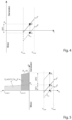
Figures 2-5 show example diagrams of the operation of the flywheel doubly-fed system ofFigure 1 . - The following description is provided to enable a person skilled in the art to make and use the invention. Various modifications to the embodiments set forth will be immediately clear to the persons skilled in the art and the general principles herein disclosed may be applied to other embodiments and applications without, however, departing from the protection scope of the present invention as defined in the enclosed claims.
- Therefore, the present invention should not be understood as limited to the sole embodiments described and shown, but it must be given the widest scope of protection in accordance with the characteristics defined in the appended claims.
- The present invention relates to a system for supporting the stability of an electrical grid by storing/releasing electrical energy from/to said electrical grid. In particular, the system according to the present invention is based on a kinetic storage architecture of the flywheel doubly-fed type and will therefore be hereinafter referred to as the FDF system (where the acronym FDF stands for "Flywheel Doubly Fed") for the sake of brevity and simplicity.
-
Figure 1 schematically illustrates an FDF system (denoted overall by 1) according to a preferred embodiment of the present invention. - In particular, the FDF system 1 includes:
- an asynchronous electric machine 11 (conveniently, a three-phase asynchronous motor) including a
rotor 111 provided with an accessible rotor circuit (in particular, accessible compared to asynchronous squirrel-cage machines where the rotor is short-circuited) and astator 112 provided with a stator circuit; - a
flywheel 12 coupled to therotor 111, wherein saidflywheel 12 may be either directly coupled torotor 111 or via a mechanical device (i.e. a mechanism) for transmitting rotational speed (e.g. with a fixed or variable rotational speed transmission ratio); - a
static converter 13; and - electronic control means 14.
- The stator circuit is connected to an electrical grid 2 (conveniently, a three-phase electrical grid - e.g., an electrical transmission/distribution grid) to be fed by the latter. Conveniently, the stator circuit can be connected to the
electrical grid 2 via one ormore transformers 3. - The
static converter 13 is connected between theelectrical grid 2 and the rotor circuit and is controllable to provide said rotor circuit with an electric power supply with adjustable frequency and voltage. Conveniently, thestatic converter 13 may be connected to theelectrical grid 2 via said transformer(s) 3. - The asynchronous
electric machine 11 is configured to: - absorb electrical energy from the
electrical grid 2 by converting the absorbed electrical energy into kinetic energy and by storing said kinetic energy by means of theflywheel 12; and - deliver electrical energy to the
electrical grid 2 by converting the kinetic energy stored by means of theflywheel 12 into electrical energy and by supplying the latter to theelectrical grid 2. - The electronic control means 14 are configured to:
- receive measurement data indicative of a measured frequency of the
electrical grid 2; - determine, on the basis of the measurement data received, ROCOF values indicative of a derivative of the measured frequency of the
electrical grid 2; and - control the operation of the
static converter 13 on the basis of the determined ROCOF values. - The present invention concerns, in particular, an innovative operation logic for the supply of a double inertial contribution, natural and synthetic, by the FDF system 1.
- In fact, according to the present invention, in case a change occurs in the frequency of the electrical grid 2:
- the asynchronous
electric machine 11 is configured to immediately provide an uncontrolled natural inertial response to said frequency variation, by absorbing active power from theelectrical grid 2 in case of a frequency increase, or by supplying active power to theelectrical grid 2 in case of a frequency reduction, and - the electronic control means 14 are configured to
- determine a given ROCOF value related to said frequency variation and,
- once said given ROCOF value has been determined, start controlling the operation of the
static converter 13 according to a predefined control logic so that the asynchronouselectric machine 11 begins to supply a controlled synthetic inertial response wherein the absorbed/supplied active power is modulated as a function of the given ROCOF value determined and of the uncontrolled natural inertial response already provided.
- In fact, following events that determine a change in the grid frequency, the speed nr of the
rotor 111 may be considered as constant in the first moments (i.e., nr = cost). Therefore, if the event determines an increase in the grid frequency (i.e. an increase in ns , which indicates the synchronism speed), the FDF system 1, which is operating in the linear section of the mechanical characteristic inFigure 2 , responds in a stable manner by absorbing active power (i.e., nr < ns , s > 0, where s indicates the slip). If, on the other hand, the event determines a reduction in the grid frequency (i.e. a reduction of ns ), the FDF system 1 responds stably by supplying active power (i.e., nr > ns , s < 0). The FDF system 1 has a power response due to the natural inertia that allows for fast response times to changes in the grid frequency and inherently stable behaviour. - The presence of the
static converter 13 for feeding the rotor circuit allows to vary in a controlled manner the speed nr of therotor 111 / the slip s and, therefore, the power exchanged with theelectrical grid 2 as a function of the frequency error. The electronic control means 14 may be conveniently configured to generate a family of static characteristics as perFigure 3 , each of which is associated with a different synthetic inertia. - The innovative operation logic of the FDF system 1, which enables the integration of the two inertial contributions (natural and synthetic) which may be supplied by the FDF system 1, will be described in detail hereinafter.
- In
Figure 2 the static mechanical characteristic of the asynchronous electric machine 11 (i.e., electromagnetic torque as a function of the rotation speed nr of therotor 111, for a given value of the synchronism speed ns ) is reported, recalling that the electrical power absorbed/supplied is proportional to the electromagnetic torque Ce and the rotation speed nr of therotor 111. - The trend of the state of charge (SOC) of the FDF system 1 is a function of the rotation speed nr of the
rotor 111. In particular, when switching from nr,min (SOC 0%) to nr,max (SOC 100%), the FDF system 1 accelerates charging itself; vice versa, the FDF system 1 decelerates discharging the accumulated kinetic energy into the grid. - Conveniently, the
static converter 13 used to feed the rotor circuit may be of the "Active Front End" (AFE) type so that the frequency and current on the rotor circuit can be adjusted. Such adjustment may be conveniently implemented by means of a vector control, which allows the electromagnetic torque to be controlled by acting on the current components along the direct and quadrature axis of the current. Such adjustment in fact allows a controlled variation of the electromagnetic torque at the air gap and, thus, a control of the power absorbed/supplied by the FDF system 1. In the absence of variations in the grid frequency (i.e., with constant stator frequency), the electronic control means 14, dedicated to controlling thestatic converter 13, can conveniently impose a variation in the electromagnetic torque at the air gap by a corresponding variation in the frequency and amplitude of the power supply voltage supplied by thestatic converter 13 to the rotor circuit. - Graphically, such a behaviour may be represented as a "controlled" shift of the static mechanical characteristic to the right or to the left, depending on whether a charge or discharge power set point is to be imposed.
- In this regard, an example graph is shown in
Figure 3 , which, for simplicity's sake, only reports the stable mechanical characteristics. - Specifically, in the example of
Figure 3 , it is assumed that the FDF system 1 initially operates at point A (point of balance between electromagnetic torque and friction and ventilation mechanical torque). Theflywheel 12 rotates at a speed nr,A which will correspond to a certain value of stored kinetic energy or SOC. - Assuming that the set point P* is to be set, the electronic control means 14 can control the
static converter 13 so that the latter feeds the rotor circuit with a triad of currents/voltages at different amplitudes and frequencies; the corresponding static mechanical characteristic is shifted to the left in relation to the initial static mechanical characteristic. - Since the inertia of the FDF 1 system is high, the speed nr of the
rotor 111 cannot change instantaneously (i.e., constant nr,A ); the working point therefore switches from A to A', to which P* supply corresponds. - During the subsequent transient, the working point will tend to return to a balance with the load torque, decelerating to point A'' and thus discharging the stored kinetic energy into the grid.
- The operation logic of the FDF system 1 hereinafter described enables said FDF system 1 to support the
electrical grid 2 during frequency events (i.e. in case of changes in the grid frequency) by supplying a double power contribution, i.e. by supplying an immediate, uncontrolled natural inertial response and a delayed, controlled synthetic inertial response. - In this regard, let us consider:
- t 0 the instant at which the frequency event occurs; and
- tm the time required for processing the measurement of the grid frequency derivative (i.e., "Rate Of Change Of Frequency" - ROCOF) by the electronic control means 14.
- When there is a rapid change in the grid frequency from the nominal value, i.e. a change in the synchronism speed ns , there is automatically a change in the slip s, defined as:

- In the first moments, the speed nr of the
rotor 111 can be considered as constant. - If the grid event determines an increase in the grid frequency (i.e., nr < n s, s > 0), the FDF system 1 responds stably by absorbing active power (charge, motor behaviour).
- If, on the other hand, the grid event determines a reduction in the grid frequency (i.e., nr >ns , s < 0), the FDF system 1 responds stably by supplying active power (discharge, generator behaviour).
- Graphically, this behaviour can be represented by considering that, in case of a change in ns , the characteristic of the asynchronous
electric machine 11 shifts horizontally (to the left when there is a reduction in ns , to the right for an increase in ns ). The working point shifts to the new characteristic vertically, i.e. at constant nr . - In this regard, an example graph is shown in
Figure 4 for the case wherein, following a disturbance, the grid frequency remains at ns,low. - More specifically, in the example of
Figure 4 , ns,high is assumed to be constant and the FDF system 1 is assumed to be working in A (dash-dot line), whereby it is kept rotating at speed n r,A and at constant and positive slip (nr,A < ns ). The FDF system 1 therefore acts as a motor in that it absorbs power to keep the rotation speed. At the instant t 0 a reduction in the grid frequency occurs at ns,low, so the characteristic shifts to the left (solid line). The working point therefore shifts to A', which results in ns,low < nr,A , and s < 0 (generator operation). The power contribution supplied is DP1. - Such change in the power absorbed/supplied is immediate when a frequency event occurs and uncontrolled. This behaviour occurs for any value of nr (i.e. SOC) of the FDF system 1, always within the limits of maximum/minimum stored energy and maximum/minimum power of the asynchronous
electric machine 11. - It can be proven that the time trend of the response will also be inertial, i.e. the DP1 provided will be proportional to:

- K indicates the slope of the stable section of the asynchronous electric machine characteristic 11 (i.e., a nameplate figure, which can be calculated as the ratio of the machine rated power to the rated slip),
- ROCOF(t 0) indicates the derivative of the grid frequency at the instant t 0 and
- Δt indicates the time range during which such response can be sustained, thus depending on the stored kinetic energy, i.e. SOC(t 0), and on the DP1 itself.
- In this regard, it is worth highlighting that:
- the state of charge (or SOC) at the instant t 0 when the frequency event occurs (proportional to the square of the speed of rotation nr at that instant and to the mechanical inertia of the FDF system 1) represents the kinetic energy available for providing the inertial response, i.e. the duration during which that response may be sustained;
- in case of a low SOC(t 0), it may occur that the power supplied resets to zero (at nr,min ) before the processing time tm has elapsed, thus making it impossible to supply the additional contribution of the synthetic inertial response.
- The synthetic inertia supply function can be conveniently defined by means of an appropriate control law that modulates the power absorbed/supplied by the FDF system 1 as a function of the measured value of the derivative before the grid frequency (i.e. ROCOF).
- The control law may be conveniently implemented by a corresponding software and/or firmware control logic preloaded on the electronic control means 14 and executed by them when the FDF system 1 is in operation.
- However, the supply of the synthetic inertial response is bound to the processing of the ROCOF measure (which will be hereinafter referred to as
ROCOF ). - In order to calculate the
ROCOF value, the electronic control means 14 are preferably configured to: - continuously sample the measured grid frequency;
- filter the sampled grid frequency; and
- process the data thus obtained to calculate the
ROCOF measured value. - It can be assumed, for simplicity's sake, that the aforementioned sampling, filtering and processing operations require a time equal to tm.
- Furthermore, unlike the natural inertial response, the synthetic power response supplied by the FDF system 1 is controllable in module (always within the power and energy limits of the FDF system 1).
- In particular, the contribution of the synthetic inertial response DP2 may be described as:

- It is therefore possible to adjust the amplitude of the synthetic inertial response by acting on the parameter α, remembering that, in any case, the value of the synthetic inertial response DP2 is limited by the size of the asynchronous
electric machine 11. - In addition, it is important to note that the state of charge at the instant the synthetic inertial response DP2 is initiated - i.e., SOC(t 0 + tm ) - represents the energy actually available for supplying said synthetic inertial response DP2, whereby the time for supplying the latter depends on both SOC(t 0 + tm ) and on the DP2 value set. Thus, by appropriately adjusting the parameter α, it is possible to decide to minimise or maximise the synthetic inertial contribution over the natural one.
- In
Figure 5 an example graph is shown related to the working point shifted following the activation of the synthetic inertial response (in quadrant I) and an exemplary trend of the power response over time (in quadrant II). - In particular, in the example of
Figure 5 , following a reduction in the grid frequency from n s,high to ns,low, the natural inertial response brings the working point from A to A', wherein the FDF system 1 supplies the active power PA' . However, the FDF system 1 is not supplying the nominal power Pn of the asynchronouselectric machine 11, so it is possible, by implementing synthetic inertia, to shift the working point to
- In order to activate the supply of the synthetic inertial response, one or more adjustable minimum ROCOF thresholds ROCOFmin may be conveniently defined so that:
- if
ROCOF < ROCOFmin, the supply of the synthetic inertial response is not activated and the FDF system 1 continues to supply the natural inertial contribution DP1 within the power/energy limits as grid conditions change; - if, instead,
ROCOF > ROCOFmin, the supply of the synthetic inertial response is activated. - Furthermore, on the basis of
-
ROCOF andΔ f , i.e. the shift between measured frequency and nominal value, - SOC (t 0 + tm ) and
- predefined objectives of the implemented control logic (e.g. maximisation or minimisation of the FDF system 1 contribution depending on grid conditions),
- a) α > K· Δt → increasing the synthetic inertial power contribution DP2 (at most up to the nominal power Pn ) compared to the natural inertial contribution DP1, while reducing the supply time of DP2;
- b) α = K · Δt → limit case wherein the FDF system 1 supplies a synthetic inertial contribution DP2 equal to the natural inertial response DP1;
- c) α < K · Δt → reducing the synthetic inertial power contribution DP2 compared to the natural inertial contribution DP1, while increasing the supply time of DP2.
- The value of the parameter α can be conveniently varied (i.e. different predefined values of the parameter α may be conveniently used) depending on whether an overfrequency (
Δf > 0) or underfrequency (Δf < 0) event occurs. - In particular, during an underfrequency event, in order to support the
electrical grid 2 and reduce the risk of blackout, the synthetic inertial contribution of the FDF system 1 may be conveniently maximised by selecting option a); on the other hand, for overfrequency events, which are typically less frequent, option b) or c) may be conveniently selected. - Furthermore, in case SOC (t 0 + t m) is close to the limit values of 100 % (in the case of an overfrequency event) or 0 % (in the case of an underfrequency event), option c) is preferably selected in order to exploit the contribution of the FDF system 1 for as long as possible.
- Moreover, having a nearly real-time measurement or estimate of the inertia of the
electrical grid 2 to which the FDF system 1 is connected, it may be conveniently selected: - option a) in case a low grid inertia value is detected (i.e. a grid inertia value equal to/less than a predefined first grid inertia threshold), in order to better support the low-inertia
electrical grid 2; and - option b) or c) in case of high grid inertia values (i.e. grid inertia values equal to/higher than a second predefined grid inertia threshold).
- Thereby, the synthetic inertial contribution of the FDF system 1 is a function of the natural inertial response supplied and the measured ROCOF value.
- From the foregoing disclosure, the many innovative characteristics and the innumerable technical advantages of the present invention are immediately evident to a person skilled in the art.
- In this regard, it is extremely important to remember that currently known kinetic storage systems (either based on the use of permanent magnet motors, inverter-type converters for the power supply of the stator circuit, or asynchronous double fed electric machines such as, for example, the system disclosed in
WO 2019/185753 A1 ) are only and exclusively capable of providing synthetic inertia and only after the time required to obtain a reliable estimate of the grid frequency derivative, i.e. the ROCOF, has elapsed. - By contrast, as explained above, the FDF system according to the present invention is able to supply a double inertial contribution, i.e. an immediate and uncontrolled natural inertial contribution and a delayed and controlled synthetic inertial contribution, thus being able to support the stability of an electrical grid in an extremely effective and efficient manner.
- In addition, the specific control/adjustment logic in supplying the synthetic inertial response implemented by the FDF system according to the present invention and described in paragraph 2.2 above is also absolutely innovative compared to known solutions.
- In conclusion, it is important to note that, while the above described invention refers in particular to very specific embodiments, it must not be intended as limited to such embodiments, including within its scope all the variants, modifications, simplifications or generalisations covered by the enclosed claims.
Claims (8)
- System (1) for supporting stability of an electrical grid (2) by storing/releasing electrical energy from/to said electrical grid (2), comprising:• an asynchronous electric machine (11) that includes a rotor (111) provided with an accessible rotor circuit and a stator (112) provided with a stator circuit;• a flywheel (12) coupled to the rotor (111);• a static converter (13); and• electronic control means (14);wherein:• the stator circuit is connected to the electrical grid (2) to be fed by the latter;• the static converter (13) is connected between the electrical grid (2) and the rotor circuit and is controllable to supply said rotor circuit with an electrical power supply with adjustable frequency and voltage;• the asynchronous electric machine (11) is configured to- absorb electrical energy from the electrical grid (2) by converting the absorbed electrical energy into kinetic energy and by storing said kinetic energy by means of the flywheel (12) and- deliver electrical energy to the electrical grid (2) by converting the kinetic energy stored by means of the flywheel (12) into electrical energy and by supplying the latter to the electrical grid (2); and• the electronic control means (14) are configured to- receive measurement data indicative of a measured frequency of the electrical grid (2),- determine, on the basis of the measurement data received, ROCOF values indicative of a derivative of the measured frequency of the electrical grid (2) and- control operation of the static converter (13) on the basis of the determined ROCOF values;whereby, if a frequency variation occurs in the electrical grid (2), the asynchronous electrical machine (11) is configured to immediately provide an uncontrolled natural inertial response to said frequency variation, by absorbing active power from the electrical grid (2) in case of a frequency increase, or by supplying active power to the electrical grid (2) in case of a frequency reduction, and• the electronic control means (14) are configured, if a frequency variation occurs in the electrical grid (2), to:characterised in that- determine a given ROCOF value related to said frequency variation and,- once said given ROCOF value has been determined, start controlling the operation of the static converter (13) so that the asynchronous electric machine (11) begins to supply a controlled synthetic inertial response;
an absorbed/supplied active power of said controlled synthetic inertial response is modulated as a function of the given ROCOF value determined and of the uncontrolled natural inertial response already provided. - The system of claim 1, wherein the electronic control means (14) are configured to activate the supply of the controlled synthetic inertial response only if the given ROCOF value determined satisfies one or more predefined conditions with respect to one or more predefined minimum ROCOF thresholds.
- The system according to claim 1 or 2, wherein the electronic control means (14) are configured to increase/reduce the controlled synthetic inertial response with respect to the uncontrolled natural inertial response by reducing/increasing a supply time of said controlled synthetic inertial response, or to cause the controlled synthetic inertial response to be equal to the uncontrolled natural inertial response, based on one or more of the following parameters/conditions:• a deviation between the measured frequency of the electrical grid (2) and a predefined nominal value of grid frequency, or an occurrence in the electrical grid (2) of an over-frequency or under-frequency event;• a current value of energy stored in the system (1) when the supply of the controlled synthetic inertial response begins;• one or more predefined operational objectives of the system (1);• one or more measured/estimated values of inertia of the electrical grid (2).
- The system of claim 3, wherein, if an under-frequency event occurs in the electrical grid (2), the electronic control means (14) are configured to increase the controlled synthetic inertial response with respect to the uncontrolled natural inertial response by reducing the supply time of said controlled synthetic inertial response.
- The system according to claim 3 or 4, wherein, if an over-frequency event occurs in the electrical grid (2), the electronic control means (14) are configured to reduce the controlled synthetic inertial response with respect to the uncontrolled natural inertial response by increasing the supply time of said controlled synthetic inertial response, or to cause the controlled synthetic inertial response to be equal to the uncontrolled natural inertial response.
- The system according to any claim 3-5, wherein, if the current value of energy stored in the system (1) when the supply of the controlled synthetic inertial response begins is equal or close to predefined limit values, the electronic control means (14) are configured to reduce the controlled synthetic inertial response with respect to the uncontrolled natural inertial response by increasing the supply time of said controlled synthetic inertial response.
- The system according to any claim 3-6, wherein, if one or more measured/estimated values of inertia of the electrical grid (2) are equal/lower to/than a first predefined grid inertia threshold, the electronic control means (14) are configured to increase the controlled synthetic inertial response with respect to the uncontrolled natural inertial response by reducing the supply time of said controlled synthetic inertial response.
- The system according to any claim 3-7, wherein, if one or more measured/estimated values of inertia of the electrical grid (2) are equal/greater to/than a second predefined grid inertia threshold, the electronic control means (14) are configured to reduce the controlled synthetic inertial response with respect to the uncontrolled natural inertial response by increasing the supply time of said controlled synthetic inertial response, or to cause the controlled synthetic inertial response to be equal to the uncontrolled natural inertial response.
Priority Applications (1)
| Application Number | Priority Date | Filing Date | Title |
|---|---|---|---|
| HRP20251201TT HRP20251201T1 (en) | 2021-05-10 | 2022-05-10 | DOUBLE-POWERED FLYWHEEL SYSTEM WITH THE POSSIBILITY OF PROVIDING DOUBLE INERTIAL CONTRIBUTION, NATURAL AND SYNTHETIC, AND CONNECTED INNOVATIVE WORK LOGIC |
Applications Claiming Priority (3)
| Application Number | Priority Date | Filing Date | Title |
|---|---|---|---|
| EP21425021 | 2021-05-10 | ||
| IT102021000017042A IT202100017042A1 (en) | 2021-06-29 | 2021-06-29 | DOUBLE FEEDING FLYWHEEL SYSTEM WITH CAPACITY TO DELIVER A DOUBLE INERTIAL, NATURAL AND SYNTHETIC CONTRIBUTION, AND RELATIVE INNOVATIVE OPERATING LOGIC |
| PCT/IB2022/054309 WO2022238879A1 (en) | 2021-05-10 | 2022-05-10 | Flywheel doubly-fed system with capability to supply a double inertial contribution, natural and synthetic, and related innovative operation logic |
Publications (3)
| Publication Number | Publication Date |
|---|---|
| EP4338249A1 EP4338249A1 (en) | 2024-03-20 |
| EP4338249B1 true EP4338249B1 (en) | 2025-07-02 |
| EP4338249C0 EP4338249C0 (en) | 2025-07-02 |
Family
ID=81940494
Family Applications (1)
| Application Number | Title | Priority Date | Filing Date |
|---|---|---|---|
| EP22727985.8A Active EP4338249B1 (en) | 2021-05-10 | 2022-05-10 | Flywheel doubly-fed system with capability to supply a double inertial contribution, natural and synthetic, and related innovative operation logic |
Country Status (7)
| Country | Link |
|---|---|
| US (1) | US12388264B2 (en) |
| EP (1) | EP4338249B1 (en) |
| AU (1) | AU2022272132A1 (en) |
| ES (1) | ES3042441T3 (en) |
| HR (1) | HRP20251201T1 (en) |
| PL (1) | PL4338249T3 (en) |
| WO (1) | WO2022238879A1 (en) |
Family Cites Families (8)
| Publication number | Priority date | Publication date | Assignee | Title |
|---|---|---|---|---|
| US4001666A (en) * | 1975-04-03 | 1977-01-04 | General Electric Company | Load peak shaver power regulating system |
| ITVA20040055A1 (en) | 2004-11-23 | 2005-02-23 | St Microelectronics Srl | METHOD AND CIRCUIT OF CONTROL OF AN ELECTRICITY GENERATION SYSTEM |
| US9531289B2 (en) * | 2012-04-27 | 2016-12-27 | Raytheon Company | Electro-mechanical kinetic energy storage device and method of operation |
| US9667232B2 (en) | 2015-05-13 | 2017-05-30 | Raytheon Company | System and method for parallel configuration of hybrid energy storage module |
| WO2018004765A2 (en) * | 2016-04-01 | 2018-01-04 | Raytheon Company | Hybrid energy storage modules for pulsed power effectors with medium voltage direct current (mvdc) power distribution |
| CA3051063C (en) * | 2017-02-15 | 2022-04-05 | Simon Jasmin | Power control device |
| DE102018204787A1 (en) * | 2018-03-28 | 2019-10-02 | Siemens Aktiengesellschaft | Double-fed asynchronous machine with flywheel as phase shifter and energy storage |
| EP3937368B1 (en) * | 2020-07-08 | 2025-11-12 | Siemens Aktiengesellschaft | Systems comprising a double fed induction machine and a fly wheel, and methods of operating such systems |
-
2022
- 2022-05-10 HR HRP20251201TT patent/HRP20251201T1/en unknown
- 2022-05-10 EP EP22727985.8A patent/EP4338249B1/en active Active
- 2022-05-10 WO PCT/IB2022/054309 patent/WO2022238879A1/en not_active Ceased
- 2022-05-10 US US18/560,123 patent/US12388264B2/en active Active
- 2022-05-10 ES ES22727985T patent/ES3042441T3/en active Active
- 2022-05-10 PL PL22727985.8T patent/PL4338249T3/en unknown
- 2022-05-10 AU AU2022272132A patent/AU2022272132A1/en active Pending
Also Published As
| Publication number | Publication date |
|---|---|
| HRP20251201T1 (en) | 2025-12-19 |
| WO2022238879A1 (en) | 2022-11-17 |
| PL4338249T3 (en) | 2026-01-05 |
| EP4338249A1 (en) | 2024-03-20 |
| AU2022272132A1 (en) | 2023-11-30 |
| US20240235200A1 (en) | 2024-07-11 |
| EP4338249C0 (en) | 2025-07-02 |
| US12388264B2 (en) | 2025-08-12 |
| ES3042441T3 (en) | 2025-11-20 |
Similar Documents
| Publication | Publication Date | Title |
|---|---|---|
| CA2754643C (en) | Method for operating a wind turbine | |
| EP1914419B1 (en) | Wind energy installation and method of controlling the output power from a wind energy installation | |
| US9506454B2 (en) | Systems and methods for regulating wind turbines | |
| JP5726187B2 (en) | Wind farm, wind turbine, wind turbine control method, and bang-bang type controller | |
| EP2688172B1 (en) | Method and apparatus for adaptively controlling wind park turbines | |
| EP2451073A1 (en) | Variable-speed power generation device and control method therefor | |
| US10683846B2 (en) | Method for controlling a wind turbine | |
| US11962262B2 (en) | Wind turbine with virtual synchronous generator and DC link control | |
| EP2843787A1 (en) | An isochronous wind turbine generator capable of stand-alone operation | |
| CA2613665A1 (en) | Methods for synchronising a plurality of generators | |
| AU2010283722A1 (en) | Asynchronous generator system and wind turbine having an asynchronous generator system | |
| AU2018206230B2 (en) | Power grid stabilising system | |
| CN110024252A (en) | Method for being fed into electrical power in power supply network | |
| Fein et al. | A paradigm change in wind power station control through emulation of conventional power plant behaviour | |
| EP4338249B1 (en) | Flywheel doubly-fed system with capability to supply a double inertial contribution, natural and synthetic, and related innovative operation logic | |
| WO2024187642A1 (en) | Flywheel energy storage system, power grid frequency regulation system, control method for flywheel energy storage system, control system, and storage medium | |
| CN120767889A (en) | A flywheel energy storage phase regulator system based on a brushless doubly fed motor | |
| CN106130076B (en) | A low-voltage ride-through control method for self-enclosed electromagnetic coupling speed-regulated wind turbines | |
| EP1626492B1 (en) | Method in frequency converter provided with voltage intermediate circuit, and frequency converter | |
| WO2000036298A1 (en) | Method and device for the conversion of a fluid stream of varying strength into electrical energy | |
| AU2014200885B2 (en) | Method for operating a wind turbine | |
| JPH09508449A (en) | Loom drive | |
| IT202100017042A1 (en) | DOUBLE FEEDING FLYWHEEL SYSTEM WITH CAPACITY TO DELIVER A DOUBLE INERTIAL, NATURAL AND SYNTHETIC CONTRIBUTION, AND RELATIVE INNOVATIVE OPERATING LOGIC | |
| CN113922400B (en) | New energy support machine with energy storage device arranged through electrical connection and control method | |
| Blaabjerg et al. | Generator Systems for Wind Turbines |
Legal Events
| Date | Code | Title | Description |
|---|---|---|---|
| STAA | Information on the status of an ep patent application or granted ep patent |
Free format text: STATUS: UNKNOWN |
|
| STAA | Information on the status of an ep patent application or granted ep patent |
Free format text: STATUS: THE INTERNATIONAL PUBLICATION HAS BEEN MADE |
|
| PUAI | Public reference made under article 153(3) epc to a published international application that has entered the european phase |
Free format text: ORIGINAL CODE: 0009012 |
|
| STAA | Information on the status of an ep patent application or granted ep patent |
Free format text: STATUS: REQUEST FOR EXAMINATION WAS MADE |
|
| 17P | Request for examination filed |
Effective date: 20231110 |
|
| AK | Designated contracting states |
Kind code of ref document: A1 Designated state(s): AL AT BE BG CH CY CZ DE DK EE ES FI FR GB GR HR HU IE IS IT LI LT LU LV MC MK MT NL NO PL PT RO RS SE SI SK SM TR |
|
| DAV | Request for validation of the european patent (deleted) | ||
| DAX | Request for extension of the european patent (deleted) | ||
| GRAP | Despatch of communication of intention to grant a patent |
Free format text: ORIGINAL CODE: EPIDOSNIGR1 |
|
| STAA | Information on the status of an ep patent application or granted ep patent |
Free format text: STATUS: GRANT OF PATENT IS INTENDED |
|
| INTG | Intention to grant announced |
Effective date: 20250127 |
|
| GRAS | Grant fee paid |
Free format text: ORIGINAL CODE: EPIDOSNIGR3 |
|
| GRAA | (expected) grant |
Free format text: ORIGINAL CODE: 0009210 |
|
| STAA | Information on the status of an ep patent application or granted ep patent |
Free format text: STATUS: THE PATENT HAS BEEN GRANTED |
|
| AK | Designated contracting states |
Kind code of ref document: B1 Designated state(s): AL AT BE BG CH CY CZ DE DK EE ES FI FR GB GR HR HU IE IS IT LI LT LU LV MC MK MT NL NO PL PT RO RS SE SI SK SM TR |
|
| REG | Reference to a national code |
Ref country code: GB Ref legal event code: FG4D |
|
| REG | Reference to a national code |
Ref country code: CH Ref legal event code: EP |
|
| REG | Reference to a national code |
Ref country code: DE Ref legal event code: R096 Ref document number: 602022016914 Country of ref document: DE |
|
| REG | Reference to a national code |
Ref country code: IE Ref legal event code: FG4D |
|
| U01 | Request for unitary effect filed |
Effective date: 20250725 |
|
| U07 | Unitary effect registered |
Designated state(s): AT BE BG DE DK EE FI FR IT LT LU LV MT NL PT RO SE SI Effective date: 20250731 |
|
| REG | Reference to a national code |
Ref country code: ES Ref legal event code: FG2A Ref document number: 3042441 Country of ref document: ES Kind code of ref document: T3 Effective date: 20251120 |
|
| REG | Reference to a national code |
Ref country code: GR Ref legal event code: EP Ref document number: 20250401968 Country of ref document: GR Effective date: 20251112 |
|
| REG | Reference to a national code |
Ref country code: HR Ref legal event code: T1PR Ref document number: P20251201 Country of ref document: HR |
|
| PG25 | Lapsed in a contracting state [announced via postgrant information from national office to epo] |
Ref country code: IS Free format text: LAPSE BECAUSE OF FAILURE TO SUBMIT A TRANSLATION OF THE DESCRIPTION OR TO PAY THE FEE WITHIN THE PRESCRIBED TIME-LIMIT Effective date: 20251102 |
|
| PG25 | Lapsed in a contracting state [announced via postgrant information from national office to epo] |
Ref country code: NO Free format text: LAPSE BECAUSE OF FAILURE TO SUBMIT A TRANSLATION OF THE DESCRIPTION OR TO PAY THE FEE WITHIN THE PRESCRIBED TIME-LIMIT Effective date: 20251002 |
|
| PG25 | Lapsed in a contracting state [announced via postgrant information from national office to epo] |
Ref country code: CZ Free format text: LAPSE BECAUSE OF FAILURE TO SUBMIT A TRANSLATION OF THE DESCRIPTION OR TO PAY THE FEE WITHIN THE PRESCRIBED TIME-LIMIT Effective date: 20250702 |
|
| PG25 | Lapsed in a contracting state [announced via postgrant information from national office to epo] |
Ref country code: RS Free format text: LAPSE BECAUSE OF FAILURE TO SUBMIT A TRANSLATION OF THE DESCRIPTION OR TO PAY THE FEE WITHIN THE PRESCRIBED TIME-LIMIT Effective date: 20251002 |
|
| PG25 | Lapsed in a contracting state [announced via postgrant information from national office to epo] |
Ref country code: SM Free format text: LAPSE BECAUSE OF FAILURE TO SUBMIT A TRANSLATION OF THE DESCRIPTION OR TO PAY THE FEE WITHIN THE PRESCRIBED TIME-LIMIT Effective date: 20250702 |
|
| PG25 | Lapsed in a contracting state [announced via postgrant information from national office to epo] |
Ref country code: SK Free format text: LAPSE BECAUSE OF FAILURE TO SUBMIT A TRANSLATION OF THE DESCRIPTION OR TO PAY THE FEE WITHIN THE PRESCRIBED TIME-LIMIT Effective date: 20250702 |