EP4337481B1 - Hvac unit with an evaporator unit - Google Patents
Hvac unit with an evaporator unit Download PDFInfo
- Publication number
- EP4337481B1 EP4337481B1 EP22728841.2A EP22728841A EP4337481B1 EP 4337481 B1 EP4337481 B1 EP 4337481B1 EP 22728841 A EP22728841 A EP 22728841A EP 4337481 B1 EP4337481 B1 EP 4337481B1
- Authority
- EP
- European Patent Office
- Prior art keywords
- evaporator
- assigned
- ventilation
- side face
- heating
- Prior art date
- Legal status (The legal status is an assumption and is not a legal conclusion. Google has not performed a legal analysis and makes no representation as to the accuracy of the status listed.)
- Active
Links
Images

Classifications
-
- B—PERFORMING OPERATIONS; TRANSPORTING
- B60—VEHICLES IN GENERAL
- B60H—ARRANGEMENTS OF HEATING, COOLING, VENTILATING OR OTHER AIR-TREATING DEVICES SPECIALLY ADAPTED FOR PASSENGER OR GOODS SPACES OF VEHICLES
- B60H1/00—Heating, cooling or ventilating devices
- B60H1/00507—Details, e.g. mounting arrangements, desaeration devices
- B60H1/00514—Details of air conditioning housings
- B60H1/00521—Mounting or fastening of components in housings, e.g. heat exchangers, fans, electronic regulators
-
- B—PERFORMING OPERATIONS; TRANSPORTING
- B60—VEHICLES IN GENERAL
- B60H—ARRANGEMENTS OF HEATING, COOLING, VENTILATING OR OTHER AIR-TREATING DEVICES SPECIALLY ADAPTED FOR PASSENGER OR GOODS SPACES OF VEHICLES
- B60H1/00—Heating, cooling or ventilating devices
- B60H1/32—Cooling devices
- B60H1/3233—Cooling devices characterised by condensed liquid drainage means
Definitions
- the invention relates to a heating, ventilation and/or air conditioning unit with an evaporator unit.
- top and the bottom edge and the side edges do not imperatively run along a sharp rim, since the transition from the end faces to the side faces can also be rounded.
- one of the two separate sealing strips continues on the side face assigned to the bottom edge and the other of the two separate sealing strips ends on the side face assigned to the side edge.
- less elastic damping material is used.
- the distance should not be too large, since the length of the channel shortens as the distance increases, and controlled guidance of the water on the side face is adversely affected by too short a channel.
- the elastic damping material may be in the form of a unipartite seal element, for example in the form of a stamped part or a shaped part. As a result, the production of the elastic damping material is particularly easy and cost-effective.
- the elastic damping material only partially covers the side faces in the width direction. This means that the side faces are wider than the elastic damping material. This likewise contributes to a low use of elastic damping material.
- the elastic damping material may be a foamed material. With foamed materials, it is usually possible to achieve good damping and sealing.
- the object is achieved according to the invention in claim 1.
- the bypass duct is therefore formed automatically in a particularly easy way when the heating, ventilation and/or air conditioning unit is being assembled or when the evaporator unit is being inserted into the housing.
- penetrated water can be conducted particularly quickly and reliably to a condensed water outlet without the water dispersing in the heating, ventilation and/or air conditioning unit in an uncontrolled manner.
- the elastic damping material is compressed to some extent when the evaporator unit is being inserted into the housing, with the result that the bypass duct is automatically sealed.
- the housing may have a bulge running along the channel in such a way that the bulge together with the channel forms the bypass duct with respect to the evaporator.
- a bulge makes it possible to enlarge a cross section of the bypass duct, with the result that even relatively large quantities of water can be removed quickly and reliably.
- Figure 1 shows a heating, ventilation and/or air conditioning unit 10.
- Heating, ventilation and/or air conditioning units 10 of this type are commonly used in motor vehicles to aerate and air condition a vehicle interior.
- the heating, ventilation and/or air conditioning unit 10 comprises a housing 12, which usually has two housing shells which are fastened to one another and only one of which can be seen in Figure 1 , and also a base trough 14, which is joined in a fluid-tight manner to the two housing shells and forms a base of the housing 12.
- the heating, ventilation and/or air conditioning unit 10 has a fresh air inlet 16 through which fresh air is drawn in, in particular by means of a fan 18 which is accommodated in the housing 12.
- the fresh air inlet 16 is formed in an inlet connector 20, which likewise forms a part of the housing 12.
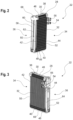
- An evaporator unit 22 is accommodated in the housing 12. This evaporator unit is illustrated in two different perspective views in Figures 2 and 3 .
- An air guide for air drawn in through the fresh air inlet 16 extends from the fresh air inlet 16 through the housing 12 to the evaporator unit 22 and from the evaporator unit 22 to an air outlet 24.
- the housing 12 is in particular a fan housing, in which fan flaps are accommodated in addition to the evaporator unit 22.
- the fan flaps are not illustrated in the figures.
- a path of an air guide is schematically illustrated by way of example using a dashed line, it being possible for the exact path to vary depending on the position of the fan flaps.
- the housing 12 usually has multiple air outlets 24, an air stream being conducted to specific air outlets 24 depending on the position of the fan flaps.
- the evaporator unit 22 comprises an elastic damping material 30, which is fastened on the outer side of the evaporator 28.
- the elastic damping material 30 is adhesively bonded to the evaporator 28.
- the evaporator 28 has two oppositely directed end faces 32, which form an inlet side 34 and an outlet side 36 for the air stream.
- the evaporator 28 has a top edge 38 and a bottom edge 40 and also two side edges 42, 44, each of which joins the top edge 38 to the bottom edge 40.
- top edge 38, the bottom edge 40 and the side edges 42, 44 together surround the two end faces 32 in the manner of a frame in a side view.
- a side face 46, 48, 50, 52 is assigned to each edge 38, 40, 42, 44.
- the side faces 46, 48 assigned to the top edge 38 and the bottom edge 40 form in particular a top side and a bottom side, respectively, of the evaporator 28.
- the side faces 46, 48 are curved in the exemplary embodiment, since the edges of the evaporator 28 are rounded at the top and bottom.
- the elastic damping material 30 on the end faces 32 is arranged over a height between the coolant inlet 54 or the coolant outlet 56 and the side face 46 of the top edge 38.
- the elastic damping material 30 on the end faces can also extend as far as the height of the coolant inlet 54 or the coolant outlet 56.
- the elastic damping material 30 is arranged merely on the assigned side face 48 and the end faces 32 are free of elastic damping material 30 in the region of the bottom edge 40.
- Elastic damping material 30 is likewise arranged on the side faces 50, 52 assigned to the side edges 42, 44.
- the elastic damping material 30 is arranged at least in certain portions in the form of two separate sealing strips 58, 60.
- a channel 62 is formed between the sealing strips 58, 60.
- Water can be guided along the evaporator 28 through the channel 62 towards the bottom, where the water can run into the base trough 14.
- the sealing strips 58, 60 are arranged on the side face 50, which is arranged opposite to the side face 52 on which the coolant inlet 54 and the coolant outlet 56 are present.
- the draining-off of water is not adversely affected by the connection pieces of the coolant inlet 54 or the coolant outlet 56.
- the sealing strips 58, 60 run parallel to one another.
- one of the two sealing strips 58 is shorter than the other sealing strip 60.
- the shorter sealing strip 58 ends on the side face 50 assigned to the side edge 42.
- the sealing strip 58 ends on the side face 50 at a distance from the side face 48 assigned to the bottom edge 40.
- the other sealing strip 60 continues on the side face 48 assigned to the bottom edge 40.
- the shortened sealing strip 58 makes it possible not only for water to flow downwards out of the channel 62, but for the water to also flow to some extent to the side, as can be seen in Figure 2 .
- the sealing strip 58 which has a shortened form is that which, in the installed state of the evaporator unit 22, is spaced apart further from a filter 26 in the flow direction than is the other sealing strip 60.
- the water at the bottom end of the channel 62 is conducted away from the filter 26 to some extent, which avoids the penetration of water into the filter 26.
- the other, longer sealing strip 60 ends on the side face 48 assigned to the bottom edge 40.
- a further sealing strip 64 that likewise continues on the side face 48 assigned to the bottom edge 40 is arranged on the opposite side face 52.
- the sealing strips 60, 64 end at a distance from one another on the side face 48 assigned to the bottom edge 40. This forms an interruption 66, through which water can flow away.
- the elastic damping material 30 preferably extends over the entire length of the side faces 50, 52, as is illustrated in Figures 2 and 3 .
- the elastic damping material 30 extends in strip form and around the periphery over the side faces 46, 48, 50, 52.
- the two sealing strips 58, 60 between which the channel 62 is formed are joined to one another at a junction point 68.
- the sealing strips 58, 60 are thus aligned at a defined distance in relation to one another by way of the junction point 68 at least at one end. This simplifies the application of the sealing strips 58, 60 to the side face 50.
- junction point 68 is arranged on the side face 50 in a region adjoining the top edge 38. Because the junction point 68 is arranged at a relatively high level on the side face 50, it is also possible for the channel 62 to start at a relatively high level on the side face 50, this being advantageous in terms of a quick and reliable removal of water.
- the elastic damping material 30 extends in the region of the junction point 68 both from the side face 46 assigned to the top edge 38 and from the junction point 68 to the end faces 32 of the evaporator 28, the elastic damping material 30 running continuously from the junction point 68 across the end faces 32 to the side face 46 assigned to the top edge 38. What is meant by this is that the elastic damping material 30 is not subdivided on the end faces 32. In this way, a pocket which receives a corner of the evaporator 28 is formed in the elastic damping material 30. The pocket makes it possible to align the elastic damping material 30 on the evaporator 28, with the result that positioning the elastic damping material 30 is simplified.
- the elastic damping material 30 is a foamed material, for example.
- the elastic damping material 30 is a unipartite seal element.
- a closed-pore foam can be used.
- the elastic damping material 30 is clamped between the housing 12 and the evaporator 28 and seals an intermediate space between the housing 12 and the evaporator 28.
- the elastic damping material 30 on the side faces 50, 52 assigned to the side edges 42, 44 ensures that no air can flow past the evaporator 28.
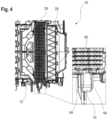
- the housing 12 When the evaporator unit 22 is received in the housing 12, the housing 12 covers the channel 62 formed between the sealing strips 58, 60 in such a way that the channel 62 forms a bypass duct with respect to the evaporator 28. This can be seen in the sectional illustration shown in Figure 4 .
- Water drawn in via the air inlet 16 of the heating, ventilation and/or air conditioning unit 10 can be removed through the bypass duct.
- the housing 12 has a bulge 70, which runs along the channel 62 in such a way that the bulge 70 together with the channel 62 forms the bypass duct with respect to the evaporator 28.
Landscapes
- Physics & Mathematics (AREA)
- Thermal Sciences (AREA)
- Engineering & Computer Science (AREA)
- Mechanical Engineering (AREA)
- Air-Conditioning For Vehicles (AREA)
Description
- The invention relates to a heating, ventilation and/or air conditioning unit with an evaporator unit.
- Heating, ventilation and/or air conditioning units are designed to generate one or more temperature-controlled air streams. In motor vehicles, units of this type are used for the aeration and air conditioning of a vehicle interior.
- To this end, firstly an air stream is drawn in via a fresh air inlet by means of a fan, and then the air stream flows through and is cooled by an evaporator.
- When the fresh air is being drawn in, it is possible for not only air but also water to be drawn in, for example when it is raining or if water runs into the fresh air inlet during a washing operation.
-
JP2000002495 A - Each of
EP3025883 A1 andJP2013086753 A - Consequently, there is the risk of water entering the fan or a filter arranged upstream of the evaporator, thereby possibly adversely affecting the function of the heating, ventilation and/or air conditioning unit.
- It is therefore an object of the present invention to provide a heating, ventilation and/or air conditioning unit with an evaporator unit that allows penetrated water to be discharged quickly from the heating, ventilation and/or air conditioning unit.
- This object is achieved according to the invention claimed in independent claim 1. Preferred embodiments of the invention are laid down in the appended dependent claims.
- The designations "top" and "bottom" refer to an alignment in which the evaporator unit is mounted in a vehicle or in another unit.
- The channel formed by the sealing strips serves to guide drawn-in water along the evaporator in a controlled manner towards the bottom, where the water can flow into a base trough and can be discharged from the heating, ventilation and/or air conditioning unit through a condensed water outlet. The channel therefore prevents penetrated water from dispersing in an uncontrolled manner.
- Furthermore, the elastic damping material serves to damp vibrations and to seal the evaporator with respect to the housing.
- According to the invention, the elastic damping material is utilized in order to form a channel for the removal of water. In this way, the evaporator unit is particularly compact and cost-effective.
- Within the meaning of the invention, a side face or an end face is to be understood to mean not necessarily merely a continuous, planar face, but rather a face of a sheath of the evaporator, since the evaporator has a multiplicity of fins and therefore a ribbed structure.
- In addition, the top and the bottom edge and the side edges do not imperatively run along a sharp rim, since the transition from the end faces to the side faces can also be rounded.
- Preferably, one of the two separate sealing strips continues on the side face assigned to the bottom edge and the other of the two separate sealing strips ends on the side face assigned to the side edge. As a result, less elastic damping material is used.
- The other sealing strip ends in particular on the side face at a distance from the side face assigned to the bottom edge. In this way, an outlet opening of the channel on the side face is directed both downwards and to the side. Therefore, water guided in the channel can flow away not only downwards, but also to the side. This is advantageous to the effect that, in an installed state of the evaporator unit in a heating, ventilation and/or air conditioning unit, the water can be conducted away from a filter arranged upstream of the evaporator.
- The greater the distance of the sealing strip from the side face assigned to the bottom side edge, the larger the lateral opening. However, the distance should not be too large, since the length of the channel shortens as the distance increases, and controlled guidance of the water on the side face is adversely affected by too short a channel.
- According to one preferred embodiment, a further sealing strip that likewise continues on the side face assigned to the bottom edge is arranged on the opposite side face, wherein the sealing strips end at a distance from one another on the side face assigned to the bottom edge. This forms an interruption in the elastic damping material on the side face assigned to the bottom edge, as a result of which water which condenses on the evaporator can better drain off downwards. In particular, a situation in which water is on the elastic damping material for a long period of time is avoided.
- The two separate sealing strips are joined to one another for example at a junction point, wherein the junction point is arranged on the side face in a region adjoining the top edge. The application of the sealing strips to the side face is simplified by the sealing strips being joined to one another at a junction point. More specifically, the sealing strips are aligned at a defined distance from one another owing to the junction point.
- The elastic damping material may be in the form of a unipartite seal element, for example in the form of a stamped part or a shaped part. As a result, the production of the elastic damping material is particularly easy and cost-effective.
- According to one preferred embodiment, the elastic damping material only partially covers the side faces in the width direction. This means that the side faces are wider than the elastic damping material. This likewise contributes to a low use of elastic damping material.
- For example, the elastic damping material is adhesively bonded to the evaporator. This allows the elastic damping material to be applied to the evaporator particularly easily.
- The elastic damping material may be a foamed material. With foamed materials, it is usually possible to achieve good damping and sealing.
- The object is achieved according to the invention in claim 1. The bypass duct is therefore formed automatically in a particularly easy way when the heating, ventilation and/or air conditioning unit is being assembled or when the evaporator unit is being inserted into the housing.
- In the bypass duct, penetrated water can be conducted particularly quickly and reliably to a condensed water outlet without the water dispersing in the heating, ventilation and/or air conditioning unit in an uncontrolled manner.
- The elastic damping material is compressed to some extent when the evaporator unit is being inserted into the housing, with the result that the bypass duct is automatically sealed.
- The housing may have a bulge running along the channel in such a way that the bulge together with the channel forms the bypass duct with respect to the evaporator. Such a bulge makes it possible to enlarge a cross section of the bypass duct, with the result that even relatively large quantities of water can be removed quickly and reliably.
- Further advantages of the invention will emerge from the following description and from the drawings, to which reference is made. In the drawings:
-
Figure 1 shows a heating, ventilation and/or air conditioning unit according to the invention, -
Figure 2 shows an evaporator unit of a heating, ventilation and/or air conditioning unit according to the invention in a perspective view, -
Figure 3 shows the evaporator unit fromFigure 2 in a further view, and -
Figure 4 shows a cross section through the heating, ventilation and/or air conditioning unit fromFigure 1 . -
Figure 1 shows a heating, ventilation and/orair conditioning unit 10. - Heating, ventilation and/or
air conditioning units 10 of this type are commonly used in motor vehicles to aerate and air condition a vehicle interior. - The heating, ventilation and/or
air conditioning unit 10 comprises ahousing 12, which usually has two housing shells which are fastened to one another and only one of which can be seen inFigure 1 , and also abase trough 14, which is joined in a fluid-tight manner to the two housing shells and forms a base of thehousing 12. - The heating, ventilation and/or
air conditioning unit 10 has afresh air inlet 16 through which fresh air is drawn in, in particular by means of afan 18 which is accommodated in thehousing 12. - The
fresh air inlet 16 is formed in aninlet connector 20, which likewise forms a part of thehousing 12. - An
evaporator unit 22 is accommodated in thehousing 12. This evaporator unit is illustrated in two different perspective views inFigures 2 and 3 . - An air guide for air drawn in through the
fresh air inlet 16 extends from thefresh air inlet 16 through thehousing 12 to theevaporator unit 22 and from theevaporator unit 22 to anair outlet 24. - A
filter 26, through which the drawn-in air likewise flows, is arranged upstream of theevaporator unit 22. - The
housing 12 is in particular a fan housing, in which fan flaps are accommodated in addition to theevaporator unit 22. For the sake of simplicity, the fan flaps are not illustrated in the figures. - In
Figure 1 , a path of an air guide is schematically illustrated by way of example using a dashed line, it being possible for the exact path to vary depending on the position of the fan flaps. - The
housing 12 usually hasmultiple air outlets 24, an air stream being conducted tospecific air outlets 24 depending on the position of the fan flaps. - For the air conditioning of a vehicle interior, fresh air is drawn in and glides through the
evaporator unit 22, with the fresh air being cooled. - In addition to an
evaporator 28, theevaporator unit 22 comprises an elastic dampingmaterial 30, which is fastened on the outer side of theevaporator 28. For example, the elastic dampingmaterial 30 is adhesively bonded to theevaporator 28. - The
evaporator 28 has two oppositely directed end faces 32, which form aninlet side 34 and anoutlet side 36 for the air stream. - The
evaporator 28 has atop edge 38 and abottom edge 40 and also twoside edges top edge 38 to thebottom edge 40. - The
top edge 38, thebottom edge 40 and the side edges 42, 44 together surround the two end faces 32 in the manner of a frame in a side view. - A
side face edge top edge 38 and thebottom edge 40 form in particular a top side and a bottom side, respectively, of theevaporator 28. - The side faces 46, 48 are curved in the exemplary embodiment, since the edges of the
evaporator 28 are rounded at the top and bottom. - In addition, the
evaporator 28 has acoolant inlet 54 and acoolant outlet 56. - As can be seen in
Figures 2 and 3 , the elastic dampingmaterial 30 on the end faces 32 is arranged over a height between thecoolant inlet 54 or thecoolant outlet 56 and theside face 46 of thetop edge 38. - As an alternative, the elastic damping
material 30 on the end faces can also extend as far as the height of thecoolant inlet 54 or thecoolant outlet 56. - Along the
bottom edge 40, the elastic dampingmaterial 30 is arranged merely on the assignedside face 48 and the end faces 32 are free of elastic dampingmaterial 30 in the region of thebottom edge 40. -
Elastic damping material 30 is likewise arranged on the side faces 50, 52 assigned to the side edges 42, 44. - As can be seen in
Figure 2 , on theside face 50 assigned to theside edge 42, the elastic dampingmaterial 30 is arranged at least in certain portions in the form of two separate sealing strips 58, 60. - A
channel 62 is formed between the sealing strips 58, 60. - Water can be guided along the
evaporator 28 through thechannel 62 towards the bottom, where the water can run into thebase trough 14. - A condensed water outlet, through which the water can ultimately drain out of the heating, ventilation and/or
air conditioning unit 10, is present in thebase trough 14. - In particular, the sealing strips 58, 60 are arranged on the
side face 50, which is arranged opposite to theside face 52 on which thecoolant inlet 54 and thecoolant outlet 56 are present. As a result, the draining-off of water is not adversely affected by the connection pieces of thecoolant inlet 54 or thecoolant outlet 56. - The sealing strips 58, 60 run parallel to one another.
- However, one of the two sealing
strips 58 is shorter than theother sealing strip 60. Theshorter sealing strip 58 ends on theside face 50 assigned to theside edge 42. - More specifically, the sealing
strip 58 ends on theside face 50 at a distance from theside face 48 assigned to thebottom edge 40. - The
other sealing strip 60 continues on theside face 48 assigned to thebottom edge 40. - The shortened
sealing strip 58 makes it possible not only for water to flow downwards out of thechannel 62, but for the water to also flow to some extent to the side, as can be seen inFigure 2 . - In particular, the sealing
strip 58 which has a shortened form is that which, in the installed state of theevaporator unit 22, is spaced apart further from afilter 26 in the flow direction than is theother sealing strip 60. As a result, the water at the bottom end of thechannel 62 is conducted away from thefilter 26 to some extent, which avoids the penetration of water into thefilter 26. - The other, longer sealing
strip 60 ends on theside face 48 assigned to thebottom edge 40. - In addition, a further sealing
strip 64 that likewise continues on theside face 48 assigned to thebottom edge 40 is arranged on theopposite side face 52. - The sealing strips 60, 64 end at a distance from one another on the
side face 48 assigned to thebottom edge 40. This forms aninterruption 66, through which water can flow away. - The elastic damping
material 30 preferably extends over the entire length of the side faces 50, 52, as is illustrated inFigures 2 and 3 . - Viewed overall, the elastic damping
material 30 extends in strip form and around the periphery over the side faces 46, 48, 50, 52. - As can be seen in
Figure 2 , the two sealingstrips channel 62 is formed are joined to one another at ajunction point 68. The sealing strips 58, 60 are thus aligned at a defined distance in relation to one another by way of thejunction point 68 at least at one end. This simplifies the application of the sealing strips 58, 60 to theside face 50. - The
junction point 68 is arranged on theside face 50 in a region adjoining thetop edge 38. Because thejunction point 68 is arranged at a relatively high level on theside face 50, it is also possible for thechannel 62 to start at a relatively high level on theside face 50, this being advantageous in terms of a quick and reliable removal of water. - The elastic damping
material 30 extends in the region of thejunction point 68 both from theside face 46 assigned to thetop edge 38 and from thejunction point 68 to the end faces 32 of theevaporator 28, the elastic dampingmaterial 30 running continuously from thejunction point 68 across the end faces 32 to theside face 46 assigned to thetop edge 38. What is meant by this is that the elastic dampingmaterial 30 is not subdivided on the end faces 32. In this way, a pocket which receives a corner of theevaporator 28 is formed in the elastic dampingmaterial 30. The pocket makes it possible to align the elastic dampingmaterial 30 on theevaporator 28, with the result that positioning the elastic dampingmaterial 30 is simplified. - The elastic damping
material 30 is a foamed material, for example. - In particular, the elastic damping
material 30 is a unipartite seal element. - To reduce the water uptake, a closed-pore foam can be used.
- When the
evaporator unit 22 is received in thehousing 12, the elastic dampingmaterial 30 is clamped between thehousing 12 and theevaporator 28 and seals an intermediate space between thehousing 12 and theevaporator 28. - In particular, the elastic damping
material 30 on the side faces 50, 52 assigned to the side edges 42, 44 ensures that no air can flow past theevaporator 28. - When the
evaporator unit 22 is received in thehousing 12, thehousing 12 covers thechannel 62 formed between the sealing strips 58, 60 in such a way that thechannel 62 forms a bypass duct with respect to theevaporator 28. This can be seen in the sectional illustration shown inFigure 4 . - Water drawn in via the
air inlet 16 of the heating, ventilation and/orair conditioning unit 10 can be removed through the bypass duct. - As is shown in
Figure 1 and inFigure 4 , thehousing 12 has abulge 70, which runs along thechannel 62 in such a way that thebulge 70 together with thechannel 62 forms the bypass duct with respect to theevaporator 28.
Claims (9)
- Heating, ventilation and/or air conditioning unit (10) with an evaporator unit (22) and with a housing (12) in which the evaporator unit (22) is received, the evaporator unit (22) comprising an evaporator (28) having two oppositely directed end faces (32), which form an inlet and an outlet side (34, 36) for the air stream, having a top and a bottom edge (38, 40) and having two side edges (42, 44) joining the top and the bottom edge (38, 40), which together surround the two end faces (32), wherein the top and the bottom edge (38, 40) and the side edges (42, 44) each have an assigned side face (46, 48, 50, 52), and comprising an elastic damping material (30) which is fastened on the outer side of the evaporator (28),
characterized in that,
on one of the side faces (50, 52) assigned to the side edges (42, 44), the elastic damping material (30) is arranged at least in certain portions in the form of two separate sealing strips (58, 60), in such a way that a channel (62) is formed between the sealing strips (58, 60), wherein the elastic damping material (30) is clamped between the housing (12) and the evaporator (28), and wherein the housing (12) covers the channel (62) formed between the sealing strips (58, 60), in such a way that the channel (62) forms a bypass duct with respect to the evaporator (28). - Heating, ventilation and/or air conditioning unit (10) according to Claim 1, characterized in that one of the two separate sealing strips (58, 60) continues on the side face (48) assigned to the bottom edge (40) and the other of the two separate sealing strips (58, 60) ends on said one side face (50) assigned to the side edge (42).
- Heating, ventilation and/or air conditioning unit (10) according to Claim 2, characterized in that the other sealing strip (58) ends on said one side face (50) at a distance from the side face (48) assigned to the bottom edge (40).
- Heating, ventilation and/or air conditioning unit (10) according to either of Claims 1 and 2, characterized in that a further sealing strip (64) that likewise continues on the side face (48) assigned to the bottom edge (40) is arranged on the opposite side face (52) assigned to the opposite side edge (44), wherein the sealing strips (60, 64) end at a distance from one another on the side face (48) assigned to the bottom edge (40).
- Heating, ventilation and/or air conditioning unit (10) according to one of the preceding claims, characterized in that the two separate sealing strips (58, 60) are joined to one another at a junction point (68), wherein the junction point (68) is arranged on said one side face (50) assigned to the side edge (42), in a region adjoining the top edge (38).
- Heating, ventilation and/or air conditioning unit (10) according to one of the preceding claims, characterized in that the elastic damping material (30) is in the form of a unipartite seal element.
- Heating, ventilation and/or air conditioning unit (10) according to one of the preceding claims, characterized in that the elastic damping material (30) is adhesively bonded to the evaporator (28).
- Heating, ventilation and/or air conditioning unit (10) according to one of the preceding claims, characterized in that the elastic damping material (30) is a foamed material.
- Heating, ventilation and/or air conditioning unit (10) according to one of the preceding claims, characterized in that the housing (12) has a bulge (70), which runs along the channel (62) in such a way that the bulge (70) together with the channel (62) forms the bypass duct with respect to the evaporator (28).
Applications Claiming Priority (2)
| Application Number | Priority Date | Filing Date | Title |
|---|---|---|---|
| DE102021112524.3A DE102021112524A1 (en) | 2021-05-12 | 2021-05-12 | evaporator unit |
| PCT/EP2022/062859 WO2022238517A1 (en) | 2021-05-12 | 2022-05-11 | Evaporator unit |
Publications (2)
| Publication Number | Publication Date |
|---|---|
| EP4337481A1 EP4337481A1 (en) | 2024-03-20 |
| EP4337481B1 true EP4337481B1 (en) | 2025-07-09 |
Family
ID=81984812
Family Applications (1)
| Application Number | Title | Priority Date | Filing Date |
|---|---|---|---|
| EP22728841.2A Active EP4337481B1 (en) | 2021-05-12 | 2022-05-11 | Hvac unit with an evaporator unit |
Country Status (4)
| Country | Link |
|---|---|
| EP (1) | EP4337481B1 (en) |
| CN (1) | CN117320898A (en) |
| DE (1) | DE102021112524A1 (en) |
| WO (1) | WO2022238517A1 (en) |
Family Cites Families (3)
| Publication number | Priority date | Publication date | Assignee | Title |
|---|---|---|---|---|
| JP3000270B2 (en) * | 1998-06-17 | 2000-01-17 | 株式会社ゼクセル | Storage structure of heat exchanger |
| JP5860666B2 (en) * | 2011-10-21 | 2016-02-16 | 株式会社日本クライメイトシステムズ | Air conditioner for vehicles |
| GB2532768B (en) * | 2014-11-27 | 2018-01-10 | Mahle Int Gmbh | Evaporator seal |
-
2021
- 2021-05-12 DE DE102021112524.3A patent/DE102021112524A1/en not_active Withdrawn
-
2022
- 2022-05-11 EP EP22728841.2A patent/EP4337481B1/en active Active
- 2022-05-11 CN CN202280034156.4A patent/CN117320898A/en active Pending
- 2022-05-11 WO PCT/EP2022/062859 patent/WO2022238517A1/en not_active Ceased
Also Published As
| Publication number | Publication date |
|---|---|
| DE102021112524A1 (en) | 2022-11-17 |
| CN117320898A (en) | 2023-12-29 |
| EP4337481A1 (en) | 2024-03-20 |
| WO2022238517A1 (en) | 2022-11-17 |
Similar Documents
| Publication | Publication Date | Title |
|---|---|---|
| EP1270294B1 (en) | Automotive air conditioner | |
| US8439655B2 (en) | Cooling channel for a fan motor for a ventilation, heating, and/or air conditioning system | |
| US4332187A (en) | Air intake housing | |
| EP1809500B1 (en) | Hvac with detached deflector | |
| US6857282B2 (en) | Air-conditioning system for vehicles | |
| CN108698482B (en) | Air conditioning unit for vehicle | |
| US5787729A (en) | Accumulator deflector | |
| US7879122B2 (en) | Air filter and fan device for vehicle ventilation systems | |
| US20120199661A1 (en) | Vehicle air conditioner | |
| JPH11115471A (en) | Air conditioner | |
| US6632133B2 (en) | Air filter for vehicle ventilation | |
| US12558943B2 (en) | Air conditioning system | |
| EP4337481B1 (en) | Hvac unit with an evaporator unit | |
| CN213291915U (en) | Overhead parking air conditioner with leak protection water function | |
| US6182741B1 (en) | Air conditioner for preventing corrosion of evaporator | |
| CN116241941B (en) | Air conditioner | |
| US6877550B2 (en) | Vehicle air conditioner | |
| CN114274730A (en) | Chassis and integrated vehicle-mounted air conditioner | |
| JPH0568709U (en) | Automotive air conditioner | |
| JP2003118350A (en) | Vehicle air conditioner | |
| US20240326555A1 (en) | Heating, ventilation and/or air conditioning system | |
| US12485731B2 (en) | Roof-type air conditioner | |
| WO2022238518A1 (en) | Evaporator unit | |
| JP2002064922A (en) | Grommet and installation structure thereof | |
| JP2004237870A (en) | Air conditioning unit for vehicle |
Legal Events
| Date | Code | Title | Description |
|---|---|---|---|
| STAA | Information on the status of an ep patent application or granted ep patent |
Free format text: STATUS: UNKNOWN |
|
| STAA | Information on the status of an ep patent application or granted ep patent |
Free format text: STATUS: THE INTERNATIONAL PUBLICATION HAS BEEN MADE |
|
| PUAI | Public reference made under article 153(3) epc to a published international application that has entered the european phase |
Free format text: ORIGINAL CODE: 0009012 |
|
| STAA | Information on the status of an ep patent application or granted ep patent |
Free format text: STATUS: REQUEST FOR EXAMINATION WAS MADE |
|
| 17P | Request for examination filed |
Effective date: 20231023 |
|
| AK | Designated contracting states |
Kind code of ref document: A1 Designated state(s): AL AT BE BG CH CY CZ DE DK EE ES FI FR GB GR HR HU IE IS IT LI LT LU LV MC MK MT NL NO PL PT RO RS SE SI SK SM TR |
|
| DAV | Request for validation of the european patent (deleted) | ||
| DAX | Request for extension of the european patent (deleted) | ||
| GRAP | Despatch of communication of intention to grant a patent |
Free format text: ORIGINAL CODE: EPIDOSNIGR1 |
|
| STAA | Information on the status of an ep patent application or granted ep patent |
Free format text: STATUS: GRANT OF PATENT IS INTENDED |
|
| INTG | Intention to grant announced |
Effective date: 20250203 |
|
| GRAS | Grant fee paid |
Free format text: ORIGINAL CODE: EPIDOSNIGR3 |
|
| GRAA | (expected) grant |
Free format text: ORIGINAL CODE: 0009210 |
|
| STAA | Information on the status of an ep patent application or granted ep patent |
Free format text: STATUS: THE PATENT HAS BEEN GRANTED |
|
| AK | Designated contracting states |
Kind code of ref document: B1 Designated state(s): AL AT BE BG CH CY CZ DE DK EE ES FI FR GB GR HR HU IE IS IT LI LT LU LV MC MK MT NL NO PL PT RO RS SE SI SK SM TR |
|
| REG | Reference to a national code |
Ref country code: GB Ref legal event code: FG4D |
|
| REG | Reference to a national code |
Ref country code: CH Ref legal event code: EP |
|
| REG | Reference to a national code |
Ref country code: IE Ref legal event code: FG4D |
|
| REG | Reference to a national code |
Ref country code: DE Ref legal event code: R096 Ref document number: 602022017335 Country of ref document: DE |
|
| REG | Reference to a national code |
Ref country code: NL Ref legal event code: MP Effective date: 20250709 |
|
| PG25 | Lapsed in a contracting state [announced via postgrant information from national office to epo] |
Ref country code: PT Free format text: LAPSE BECAUSE OF FAILURE TO SUBMIT A TRANSLATION OF THE DESCRIPTION OR TO PAY THE FEE WITHIN THE PRESCRIBED TIME-LIMIT Effective date: 20251110 |
|
| PG25 | Lapsed in a contracting state [announced via postgrant information from national office to epo] |
Ref country code: NL Free format text: LAPSE BECAUSE OF FAILURE TO SUBMIT A TRANSLATION OF THE DESCRIPTION OR TO PAY THE FEE WITHIN THE PRESCRIBED TIME-LIMIT Effective date: 20250709 |
|
| REG | Reference to a national code |
Ref country code: AT Ref legal event code: MK05 Ref document number: 1811550 Country of ref document: AT Kind code of ref document: T Effective date: 20250709 |
|
| PG25 | Lapsed in a contracting state [announced via postgrant information from national office to epo] |
Ref country code: IS Free format text: LAPSE BECAUSE OF FAILURE TO SUBMIT A TRANSLATION OF THE DESCRIPTION OR TO PAY THE FEE WITHIN THE PRESCRIBED TIME-LIMIT Effective date: 20251109 |
|
| PG25 | Lapsed in a contracting state [announced via postgrant information from national office to epo] |
Ref country code: NO Free format text: LAPSE BECAUSE OF FAILURE TO SUBMIT A TRANSLATION OF THE DESCRIPTION OR TO PAY THE FEE WITHIN THE PRESCRIBED TIME-LIMIT Effective date: 20251009 |
|
| REG | Reference to a national code |
Ref country code: LT Ref legal event code: MG9D |
|
| PG25 | Lapsed in a contracting state [announced via postgrant information from national office to epo] |
Ref country code: AT Free format text: LAPSE BECAUSE OF FAILURE TO SUBMIT A TRANSLATION OF THE DESCRIPTION OR TO PAY THE FEE WITHIN THE PRESCRIBED TIME-LIMIT Effective date: 20250709 |
|
| PG25 | Lapsed in a contracting state [announced via postgrant information from national office to epo] |
Ref country code: FI Free format text: LAPSE BECAUSE OF FAILURE TO SUBMIT A TRANSLATION OF THE DESCRIPTION OR TO PAY THE FEE WITHIN THE PRESCRIBED TIME-LIMIT Effective date: 20250709 |
|
| PG25 | Lapsed in a contracting state [announced via postgrant information from national office to epo] |
Ref country code: HR Free format text: LAPSE BECAUSE OF FAILURE TO SUBMIT A TRANSLATION OF THE DESCRIPTION OR TO PAY THE FEE WITHIN THE PRESCRIBED TIME-LIMIT Effective date: 20250709 |
|
| PG25 | Lapsed in a contracting state [announced via postgrant information from national office to epo] |
Ref country code: GR Free format text: LAPSE BECAUSE OF FAILURE TO SUBMIT A TRANSLATION OF THE DESCRIPTION OR TO PAY THE FEE WITHIN THE PRESCRIBED TIME-LIMIT Effective date: 20251010 |
|
| PG25 | Lapsed in a contracting state [announced via postgrant information from national office to epo] |
Ref country code: SE Free format text: LAPSE BECAUSE OF FAILURE TO SUBMIT A TRANSLATION OF THE DESCRIPTION OR TO PAY THE FEE WITHIN THE PRESCRIBED TIME-LIMIT Effective date: 20250709 |
|
| PG25 | Lapsed in a contracting state [announced via postgrant information from national office to epo] |
Ref country code: LV Free format text: LAPSE BECAUSE OF FAILURE TO SUBMIT A TRANSLATION OF THE DESCRIPTION OR TO PAY THE FEE WITHIN THE PRESCRIBED TIME-LIMIT Effective date: 20250709 |
|
| PG25 | Lapsed in a contracting state [announced via postgrant information from national office to epo] |
Ref country code: BG Free format text: LAPSE BECAUSE OF FAILURE TO SUBMIT A TRANSLATION OF THE DESCRIPTION OR TO PAY THE FEE WITHIN THE PRESCRIBED TIME-LIMIT Effective date: 20250709 Ref country code: PL Free format text: LAPSE BECAUSE OF FAILURE TO SUBMIT A TRANSLATION OF THE DESCRIPTION OR TO PAY THE FEE WITHIN THE PRESCRIBED TIME-LIMIT Effective date: 20250709 |
|
| PG25 | Lapsed in a contracting state [announced via postgrant information from national office to epo] |
Ref country code: RS Free format text: LAPSE BECAUSE OF FAILURE TO SUBMIT A TRANSLATION OF THE DESCRIPTION OR TO PAY THE FEE WITHIN THE PRESCRIBED TIME-LIMIT Effective date: 20251009 |
|
| PG25 | Lapsed in a contracting state [announced via postgrant information from national office to epo] |
Ref country code: ES Free format text: LAPSE BECAUSE OF FAILURE TO SUBMIT A TRANSLATION OF THE DESCRIPTION OR TO PAY THE FEE WITHIN THE PRESCRIBED TIME-LIMIT Effective date: 20250709 |
|
| PG25 | Lapsed in a contracting state [announced via postgrant information from national office to epo] |
Ref country code: SM Free format text: LAPSE BECAUSE OF FAILURE TO SUBMIT A TRANSLATION OF THE DESCRIPTION OR TO PAY THE FEE WITHIN THE PRESCRIBED TIME-LIMIT Effective date: 20250709 |
|
| PG25 | Lapsed in a contracting state [announced via postgrant information from national office to epo] |
Ref country code: DK Free format text: LAPSE BECAUSE OF FAILURE TO SUBMIT A TRANSLATION OF THE DESCRIPTION OR TO PAY THE FEE WITHIN THE PRESCRIBED TIME-LIMIT Effective date: 20250709 |
|
| PG25 | Lapsed in a contracting state [announced via postgrant information from national office to epo] |
Ref country code: IT Free format text: LAPSE BECAUSE OF FAILURE TO SUBMIT A TRANSLATION OF THE DESCRIPTION OR TO PAY THE FEE WITHIN THE PRESCRIBED TIME-LIMIT Effective date: 20250709 |
|
| PG25 | Lapsed in a contracting state [announced via postgrant information from national office to epo] |
Ref country code: CZ Free format text: LAPSE BECAUSE OF FAILURE TO SUBMIT A TRANSLATION OF THE DESCRIPTION OR TO PAY THE FEE WITHIN THE PRESCRIBED TIME-LIMIT Effective date: 20250709 |
|
| PG25 | Lapsed in a contracting state [announced via postgrant information from national office to epo] |
Ref country code: SK Free format text: LAPSE BECAUSE OF FAILURE TO SUBMIT A TRANSLATION OF THE DESCRIPTION OR TO PAY THE FEE WITHIN THE PRESCRIBED TIME-LIMIT Effective date: 20250709 Ref country code: EE Free format text: LAPSE BECAUSE OF FAILURE TO SUBMIT A TRANSLATION OF THE DESCRIPTION OR TO PAY THE FEE WITHIN THE PRESCRIBED TIME-LIMIT Effective date: 20250709 |