EP4336701A1 - Battery inrush and outrush current limiting - Google Patents
Battery inrush and outrush current limiting Download PDFInfo
- Publication number
- EP4336701A1 EP4336701A1 EP23193057.9A EP23193057A EP4336701A1 EP 4336701 A1 EP4336701 A1 EP 4336701A1 EP 23193057 A EP23193057 A EP 23193057A EP 4336701 A1 EP4336701 A1 EP 4336701A1
- Authority
- EP
- European Patent Office
- Prior art keywords
- switch
- voltage
- resistor
- control circuit
- battery
- Prior art date
- Legal status (The legal status is an assumption and is not a legal conclusion. Google has not performed a legal analysis and makes no representation as to the accuracy of the status listed.)
- Pending
Links
Images


Classifications
-
- H—ELECTRICITY
- H02—GENERATION; CONVERSION OR DISTRIBUTION OF ELECTRIC POWER
- H02J—ELECTRIC POWER NETWORKS; CIRCUIT ARRANGEMENTS OR SYSTEMS FOR SUPPLYING OR DISTRIBUTING ELECTRIC POWER; SYSTEMS FOR STORING ELECTRIC ENERGY
- H02J7/00—Circuit arrangements for charging or discharging batteries or for supplying loads from batteries
- H02J7/60—Circuit arrangements for charging or discharging batteries or for supplying loads from batteries including safety or protection arrangements
- H02J7/62—Circuit arrangements for charging or discharging batteries or for supplying loads from batteries including safety or protection arrangements against overcurrent
-
- H—ELECTRICITY
- H02—GENERATION; CONVERSION OR DISTRIBUTION OF ELECTRIC POWER
- H02J—ELECTRIC POWER NETWORKS; CIRCUIT ARRANGEMENTS OR SYSTEMS FOR SUPPLYING OR DISTRIBUTING ELECTRIC POWER; SYSTEMS FOR STORING ELECTRIC ENERGY
- H02J7/00—Circuit arrangements for charging or discharging batteries or for supplying loads from batteries
- H02J7/60—Circuit arrangements for charging or discharging batteries or for supplying loads from batteries including safety or protection arrangements
- H02J7/663—Circuit arrangements for charging or discharging batteries or for supplying loads from batteries including safety or protection arrangements using battery or load disconnect circuits
-
- H—ELECTRICITY
- H02—GENERATION; CONVERSION OR DISTRIBUTION OF ELECTRIC POWER
- H02J—ELECTRIC POWER NETWORKS; CIRCUIT ARRANGEMENTS OR SYSTEMS FOR SUPPLYING OR DISTRIBUTING ELECTRIC POWER; SYSTEMS FOR STORING ELECTRIC ENERGY
- H02J2207/00—Details of circuit arrangements for charging or discharging batteries or supplying loads from batteries
- H02J2207/20—Charging or discharging characterised by the power electronics converter
Definitions
- the disclosed technology relates generally to battery technologies, and more particularly some embodiments relate to current limiting in such technologies.
- one aspect disclosed features an apparatus, comprising: a battery; a resistive load; a switch comprising a first transistor and a second transistor; a resistor; an inductor; and a control circuit; wherein the switch, the resistor, and the inductor are coupled in series between the battery and the resistive load; and wherein the control circuit controls the switch based on a voltage across the resistor.
- Embodiments of the apparatus may include one or more of the following features.
- the first transistor is a first MOSFET; and the second transistor is a second MOSFET.
- a drain of the first MOSFET is electrically coupled to a drain of the second MOSFET;
- a gate of the first MOSFET is electrically coupled to a gate of the second MOSFET; and
- the gates of the first and second MOSFETs are electrically coupled to an output of the control circuit.
- the control circuit opens the switch when the voltage across the resistor exceeds a predetermined reference voltage; and the control circuit closes the switch when the voltage across the resistor does not exceed the predetermined reference voltage.
- control circuit opens the switch when the voltage across the resistor exceeds a predetermined reference voltage and an enable signal is asserted; and the control circuit closes the switch when the voltage across the resistor does not exceed the predetermined reference voltage and the enable signal is asserted.
- Some embodiments comprise a diode having an input electrically coupled to ground and an output electrically coupled to a node between the switch and the inductor.
- one aspect disclosed features an apparatus, comprising: a battery; a resistive load; a switch; a resistor; an inductor; and a control circuit; wherein the switch, the resistor, and the inductor are coupled in series between the battery and the resistive load; and wherein the control circuit controls the switch based on a voltage across the resistor.
- Embodiments of the apparatus may include one or more of the following features.
- the first transistor is a first MOSFET; and the second transistor is a second MOSFET.
- a gate of the MOSFET is electrically coupled to an output of the control circuit.
- the control circuit opens the switch when the voltage across the resistor exceeds a predetermined reference voltage; and the control circuit closes the switch when the voltage across the resistor does not exceed the predetermined reference voltage.
- the control circuit opens the switch when the voltage across the resistor exceeds a predetermined reference voltage and an enable signal is asserted; and the control circuit closes the switch when the voltage across the resistor does not exceed the predetermined reference voltage and the enable signal is asserted.
- Some embodiments comprise a diode having an input electrically coupled to ground and an output electrically coupled to a node between the switch and the inductor.
- one aspect disclosed features an apparatus, comprising: a battery; a resistive load; a first switch; a second switch; a resistor; an inductor; and a control circuit; wherein the first and second switches, the resistor, and the inductor are coupled in series between the battery and the resistive load; wherein the resistor and the inductor are coupled in series between the first and second switches; and wherein the control circuit controls the first and second switches based on a voltage across the resistor.
- Embodiments of the apparatus may include one or more of the following features.
- the first switch is a first MOSFET; and the second switch is a second MOSFET.
- a gate of the first MOSFET is electrically coupled to a first output of the control circuit; and a gate of the second MOSFET is electrically coupled to a second output of the control circuit.
- the control circuit opens the first switch when the voltage across the resistor exceeds a predetermined reference voltage; and the control circuit closes the first switch when the voltage across the resistor does not exceed the predetermined reference voltage.
- the control circuit opens the first switch when the voltage across the resistor exceeds a predetermined reference voltage and a discharge enable signal is asserted; and the control circuit closes the first switch when the voltage across the resistor does not exceed the predetermined reference voltage and a discharge enable signal is negated.
- the control circuit opens the second switch when the voltage across the resistor exceeds a predetermined reference voltage; and the control circuit closes the second switch when the voltage across the resistor does not exceed the predetermined reference voltage.
- the control circuit opens the second switch when the voltage across the resistor exceeds a predetermined reference voltage and a discharge enable signal is asserted; and the control circuit closes the second switch when the voltage across the resistor does not exceed the predetermined reference voltage and a discharge enable signal is negated.
- Some embodiments comprise a first diode having an input electrically coupled to ground and an output electrically coupled to a node between the first switch and the inductor; and a second diode having an input electrically coupled to ground and an output electrically coupled to a node between the second switch and the inductor.
- Electric vehicles generally include a high-voltage battery and a load in the form of an electric motor.
- the load generally has some capacitance.
- the electric motor may have an inverter that has substantial capacitance. Without some sort of current limiting circuit, this capacitance may allow for substantial inrush and outrush currents at the battery. Unchecked, these currents may be in the hundreds or thousands of amps. When the system is fused, these currents will trip the fuse, disabling the system. When unfused, these currents will cause catastrophic damage to the batteries and other components of the system.
- FIG. 1 is a circuit block diagram of a conventional system 100 for limiting discharge currents.
- the system 100 includes a battery 102, a load 104, a high-side contactor CTH electrically coupled between a positive terminal of the battery 102 and the load 104, and a pre-charge circuit 106 electrically coupled in parallel with the high-side contactor CTH.
- the pre-charge circuit 106 includes a pre-charge contactor CTP electrically coupled in series with a pre-charge resistor R.
- the system may also include a low-side contactor CTL electrically coupled between a negative terminal of the battery 102 and the load 104.
- the system 100 may pre-charge the pre-charge circuit 106.
- the high-side contactor CTH may be open, the low-side contactor CTL may be closed, and the pre-charge contactor CTP may be closed.
- the pre-charge resistor R is selected to pre-charge the bus quickly, but not so quickly as to cause the pre-charge contactor CTP to fail.
- the pre-charge resistor R may be selected to pre-charge the bus in the range of one to five seconds.
- the resistance of the pre-charge resistor R and the capacitance of the load 104 limit the current flowing to the load 104 during pre-charge.
- the resistance of the pre-charge resistor R may be around 50 ohms, or by way of example, between 45-55 ohms.
- the capacitance of the load 104 may generally be in the range of 700-900 microfarad range.
- the current drawn through the pre-charge circuit 106 may approach zero. Then the high-side contactor CTH maybe closed and the pre-charge contactor CTP may be opened. The system 100 is then operational.
- the contactors may fail, for example by exploding or by being welded shut.
- the pre-charge resistor R may fail.
- this approach involves significant cost and complexity for little value. It cannot effectively be used as a fuse because it won't load share with the high-side contactor.
- Nominally-identical cells will have very similar impedances, and the impedance scales roughly linearly with capacity for a given state of charge. As such, no matter how many cells are placed directly in parallel, they will current balance amongst themselves very evenly. Should these cells then be placed in series with another nominally-identical parallel group, all cells in the system will see approximately the same current at any given moment in time.
- FIG. 2 is a circuit block diagram of a system 200 for limiting outrush currents from a battery during battery discharge according to some embodiments of the disclosed technologies. Battery discharge may occur when the voltage across the battery exceeds the voltage across the load.
- the system 200 may include one or more of a battery 202, a load 204, and/or a discharge current limiter 206 electrically coupled between a positive terminal of the battery 202 and the load 204.
- the discharge current limiter 206 may include one or more of an inductor L3, a resistor R4, and/or a switch 208 electrically coupled in series.
- the switch 208 may be implemented as two power MOSFETs F2 and F3.
- Power FETs have a body diode characteristic, illustrated as body diodes for the MOSFETs F2 and F3 in FIG. 2 .
- body diodes for the MOSFETs F2 and F3 in FIG. 2 .
- the drains of the MOSFETs F2 and F3 may be electrically coupled together.
- the gates of the MOSFETs F2 and F3 may be electrically coupled together, and may be driven by a gate driver GD2.
- MOSFETs F2 and F3 may be implemented as NMOS, with the body terminal tied to the source to avoid large transient voltages; i.e., the body and drain form a diode connection.
- the MOSFETs F2 and F3 may be implemented as silicon carbide, gallium nitride, or similar materials.
- a snubber diode Z1 may be electrically coupled between the positive terminal of the battery 202 and ground for overvoltage suppression.
- the snubber diode Z1 may be implemented as a Zener diode.
- a freewheel diode D4 may be electrically coupled between ground and a node between the switch 208 and the resistor R4.
- a voltage sensor V2 may sense a voltage across the resistor R4.
- a comparator COMP2 may compare that voltage V2 with a reference voltage REF2.
- the comparator COMP2 may output a logic high ("1") when the voltage V2 is less than the reference voltage REF2, and a logic low (“0") otherwise.
- An AND gate A2 may trigger the gate driver GD2 to drive the gates of the MOSFETs F2 and F3 when voltage V2 is less than the reference voltage REF2 and an enable signal ENABLE2 is asserted, thereby turning the switch 208 on.
- the gate driver GD2 may turn off the switch 208, thereby interrupting the current provided by the battery 202 to the inductor L3, which may continue to supply a diminishing level of current to the load 204, with the current flowing through the freewheel diode D4 and the resistor R4.
- the voltage V2 across the resistor R4 may fall below the reference voltage REF2.
- the discharge current limiter 206 is enabled (i.e., the enable signal ENABLE2 is asserted)
- the gate driver GD2 may turn on the switch 208, again supplying current from the battery 202 to the load 204.
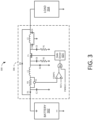
- FIG. 3 is a circuit block diagram of a system 300 for limiting inrush currents into a battery during battery charge according to some embodiments of the disclosed technologies.
- Battery charge may occur when the voltage across the load exceeds the voltage across the battery.
- the system 300 may include a battery 302, a load 304, and a charge current limiter 306 electrically coupled between a positive terminal of the battery 302 and the load 304.
- the charge current limiter 306 may include a diode D1, a resistor R3, an inductor L1, a switch F1, and an inductor L2, electrically coupled in series.
- the switch F1 may be implemented as a MOSFET.
- the MOSFET F1 may be implemented as NMOS with the body terminal tied to the source to avoid large transient voltages.
- the MOSFET F1 may be implemented as silicon carbide, gallium nitride, or similar materials.
- the discharge current limiter 306 may include a freewheel diode D2 and a bypass diode D3.
- the discharge current limiter 306 may include additional elements for filtering the current.
- the charge current limiter 306 may include capacitor C2, capacitor C6 and resistor R2, capacitor C5 and resistor R1, and/or inductor L2 and capacitors C3 and C4, which may be connected as shown in FIG. 3 .
- a voltage sensor V1 may sense a voltage across the resistor R1.
- a comparator COMP1 may compare that voltage V1 with a reference voltage REF1.
- the comparator COMP1 may output a logic low when the voltage V1 exceeds the reference voltage REF1, and a logic high otherwise.
- An AND gate A1 may trigger the gate driver GD1 to drive the gate of the MOSFET F4 when voltage V1 is less than the reference voltage REF1 and an enable signal ENABLE1 is asserted, thereby turning the MOSFET F1 on.
- the gate driver GD1 When a current flowing across the inductor L2 to the battery 302 is too high, the voltage V1 across the sense resistor R3 may exceed the reference voltage REF1, and the gate driver GD1 will turn off the MOSFET F1, thereby interrupting the current provided by the load 304 to the inductor L1, which may continue to supply a diminishing level of current to the battery 302, with the current flowing through the freewheel diode D2 and the resistor R3. When the current through the inductor L1 is sufficiently low, the voltage V1 across the resistor R3 may fall below the reference voltage REF1. In response, the gate driver GD1 may turn on the MOSFET F1, thereby supplying current from the load 304 to the battery 302.
- diode D3 may permit the battery 302 to charge the load 304, and diode D1 may prevent the current from entering the charge current limiter 306.
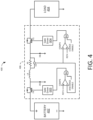
- FIG. 4 is a circuit block diagram of a system 400 for limiting inrush and outrush currents for a battery during battery charge and discharge according to some embodiments of the disclosed technologies.
- the system 400 may include a battery 402, a load 404, and a charge current limiter 406 electrically coupled between a positive terminal of the battery 402 and the load 404.
- the discharge current limiter 406 may include a switch F4, an inductor L4, a resistor R5, and a switch F5, electrically coupled in series.
- the switches F4 and F5 are implemented as MOSFETs.
- the MOSFETs F4 and F5 may be implemented as NMOS with the body terminal tied to the source to avoid large transient voltages.
- the MOSFETs F4 and F5 may be implemented as silicon carbide, gallium nitride, or similar materials. Other circuits may be used to implement the switches, for example as described above with reference to FIG. 2 .
- the gates of the MOSFETs F4 and F5 may be driven by gate drivers GD3 and GD4, respectively.
- a first freewheel diode D5 may be electrically coupled between ground and a node between the MOSFET F4 and the inductor L4.
- a second freewheel diode D6 may be electrically coupled between ground and a node between the MOSFET F5 and the resistor R5.
- a voltage sensor V3 may sense a voltage across the resistor R5.
- a comparator COMP3 may compare that voltage V3 with a reference voltage REF3. The comparator COMP3 may output a logic high when the voltage V3 is less than the reference voltage REF3, and a logic low otherwise.
- An AND gate A3 may trigger the gate driver GD3 to drive the gate of the MOSFET F4 when voltage V3 is less than the reference voltage REF3 and an enable signal DISCHARGE ENABLE is asserted, thereby turning the switch MOSFET F4 on.
- the gate driver GD3 may turn off the MOSFET F4, thereby interrupting the current provided by the battery 402 to the inductor L4, which may continue to supply a diminishing level of current to the load 404, with the current flowing through the freewheel diode D5 and the resistor R5.
- the gate driver GD3 may turn on the MOSFET F4, again supplying current from the battery 402 to the load 404.
- a comparator COMP4 may compare that voltage V3 with a reference voltage REF4.
- the comparator COMP4 may output a logic high when the voltage V3 is less than the reference voltage REF4, and a logic low otherwise.
- An AND gate A4 may trigger the gate driver GD4 to drive the gate of the MOSFET F5 when voltage V3 is less than the reference voltage REF4 and an enable signal CHARGE ENABLE is asserted, thereby turning the switch MOSFET F5 on.
- the gate driver GD4 may turn off the MOSFET F5, thereby interrupting the current provided by the load 404 to the inductor L4, which may continue to supply a diminishing level of current to the battery 402, with the current flowing through the freewheel diode D6 and the resistor R5.
- the gate driver GD4 may turn on the MOSFET F5, thereby supplying current from the load 404 to the battery 402.
- the inductance of the inductor may form a low-pass filter that further reduces ripple in whichever direction the current is flowing. Therefore, even a step change in load may result in a slow change in current.
- the timing of the switches may be used to determine how strong a low-pass filter is needed to achieve a desired ripple current that can be measured as a hysteretic effect.
- the switches may modulate the signal without overloading the switches.
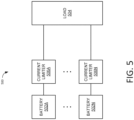
- FIG. 5 is a block diagram of a system 500 where multiple current limiters connect multiple batteries to a single load according to some embodiments of the disclosed technologies.
- N batteries 502A-N may be connected to a single load 504 by N respective current limiters 506A-N.
- Each of the current limiters may be implemented as one of the current limiters 206, 306, and 406 described above. Without the current limiters 506, the batteries 502 may be subject to high and dangerous inrush and outrush currents. For example, if one battery is at 800V while the other batteries are at 600V, the 800V battery may dump as much current as possible into the other batteries, on the order of hundreds of amps, which may blow a fuse or otherwise take the system 500 offline.
Landscapes
- Engineering & Computer Science (AREA)
- Power Engineering (AREA)
- Emergency Protection Circuit Devices (AREA)
Abstract
The present application relates to an apparatus (200) capable of limiting discharge currents from a battery. The apparatus comprises: a battery (202); a resistive load (204); a switch (208) comprising a first transistor (F2) and a second transistor (F3); a resistor (R4); an inductor (L3); and a control circuit (GD2); wherein the switch, the resistor, and the inductor are coupled in series between the battery and the resistive load; and wherein the control circuit controls the switch based on a voltage across the resistor.
Description
- The disclosed technology relates generally to battery technologies, and more particularly some embodiments relate to current limiting in such technologies.
- In general, one aspect disclosed features an apparatus, comprising: a battery; a resistive load; a switch comprising a first transistor and a second transistor; a resistor; an inductor; and a control circuit; wherein the switch, the resistor, and the inductor are coupled in series between the battery and the resistive load; and wherein the control circuit controls the switch based on a voltage across the resistor.
- Embodiments of the apparatus may include one or more of the following features. In some embodiments, the first transistor is a first MOSFET; and the second transistor is a second MOSFET. In some embodiments, a drain of the first MOSFET is electrically coupled to a drain of the second MOSFET; a gate of the first MOSFET is electrically coupled to a gate of the second MOSFET; and the gates of the first and second MOSFETs are electrically coupled to an output of the control circuit. In some embodiments, the control circuit opens the switch when the voltage across the resistor exceeds a predetermined reference voltage; and the control circuit closes the switch when the voltage across the resistor does not exceed the predetermined reference voltage. In some embodiments, the control circuit opens the switch when the voltage across the resistor exceeds a predetermined reference voltage and an enable signal is asserted; and the control circuit closes the switch when the voltage across the resistor does not exceed the predetermined reference voltage and the enable signal is asserted. Some embodiments comprise a diode having an input electrically coupled to ground and an output electrically coupled to a node between the switch and the inductor.
- In general, one aspect disclosed features an apparatus, comprising: a battery; a resistive load; a switch; a resistor; an inductor; and a control circuit; wherein the switch, the resistor, and the inductor are coupled in series between the battery and the resistive load; and wherein the control circuit controls the switch based on a voltage across the resistor.
- Embodiments of the apparatus may include one or more of the following features. In some embodiments, the first transistor is a first MOSFET; and the second transistor is a second MOSFET. In some embodiments, a gate of the MOSFET is electrically coupled to an output of the control circuit. In some embodiments, the control circuit opens the switch when the voltage across the resistor exceeds a predetermined reference voltage; and the control circuit closes the switch when the voltage across the resistor does not exceed the predetermined reference voltage. In some embodiments, the control circuit opens the switch when the voltage across the resistor exceeds a predetermined reference voltage and an enable signal is asserted; and the control circuit closes the switch when the voltage across the resistor does not exceed the predetermined reference voltage and the enable signal is asserted. Some embodiments comprise a diode having an input electrically coupled to ground and an output electrically coupled to a node between the switch and the inductor.
- In general, one aspect disclosed features an apparatus, comprising: a battery; a resistive load; a first switch; a second switch; a resistor; an inductor; and a control circuit; wherein the first and second switches, the resistor, and the inductor are coupled in series between the battery and the resistive load; wherein the resistor and the inductor are coupled in series between the first and second switches; and wherein the control circuit controls the first and second switches based on a voltage across the resistor.
- Embodiments of the apparatus may include one or more of the following features. In some embodiments, the first switch is a first MOSFET; and the second switch is a second MOSFET. In some embodiments, a gate of the first MOSFET is electrically coupled to a first output of the control circuit; and a gate of the second MOSFET is electrically coupled to a second output of the control circuit. In some embodiments, the control circuit opens the first switch when the voltage across the resistor exceeds a predetermined reference voltage; and the control circuit closes the first switch when the voltage across the resistor does not exceed the predetermined reference voltage. In some embodiments, the control circuit opens the first switch when the voltage across the resistor exceeds a predetermined reference voltage and a discharge enable signal is asserted; and the control circuit closes the first switch when the voltage across the resistor does not exceed the predetermined reference voltage and a discharge enable signal is negated. In some embodiments, the control circuit opens the second switch when the voltage across the resistor exceeds a predetermined reference voltage; and the control circuit closes the second switch when the voltage across the resistor does not exceed the predetermined reference voltage. In some embodiments, the control circuit opens the second switch when the voltage across the resistor exceeds a predetermined reference voltage and a discharge enable signal is asserted; and the control circuit closes the second switch when the voltage across the resistor does not exceed the predetermined reference voltage and a discharge enable signal is negated. Some embodiments comprise a first diode having an input electrically coupled to ground and an output electrically coupled to a node between the first switch and the inductor; and a second diode having an input electrically coupled to ground and an output electrically coupled to a node between the second switch and the inductor.
- The present disclosure, in accordance with one or more various embodiments, is described in detail with reference to the following figures. The figures are provided for purposes of illustration only and merely depict typical or example embodiments.
-
FIG. 1 is a circuit block diagram of a conventional system for limiting discharge currents. -
FIG. 2 is a circuit block diagram of a system for limiting outrush currents from a battery during battery discharge according to some embodiments of the disclosed technologies. -
FIG. 3 is a circuit block diagram of a system for limiting inrush currents into a battery during battery charge according to some embodiments of the disclosed technologies. -
FIG. 4 is a circuit block diagram of a system for limiting inrush and outrush currents for a battery during battery charge and discharge according to some embodiments of the disclosed technologies. -
FIG. 5 is a block diagram of a system where multiple current limiters connect multiple batteries to a single load according to some embodiments of the disclosed technologies. - The figures are not exhaustive and do not limit the present disclosure to the precise form disclosed.
- Electric vehicles generally include a high-voltage battery and a load in the form of an electric motor. The load generally has some capacitance. For example, the electric motor may have an inverter that has substantial capacitance. Without some sort of current limiting circuit, this capacitance may allow for substantial inrush and outrush currents at the battery. Unchecked, these currents may be in the hundreds or thousands of amps. When the system is fused, these currents will trip the fuse, disabling the system. When unfused, these currents will cause catastrophic damage to the batteries and other components of the system.
-
FIG. 1 is a circuit block diagram of aconventional system 100 for limiting discharge currents. Referring toFIG. 1 , thesystem 100 includes abattery 102, aload 104, a high-side contactor CTH electrically coupled between a positive terminal of thebattery 102 and theload 104, and apre-charge circuit 106 electrically coupled in parallel with the high-side contactor CTH. Thepre-charge circuit 106 includes a pre-charge contactor CTP electrically coupled in series with a pre-charge resistor R. The system may also include a low-side contactor CTL electrically coupled between a negative terminal of thebattery 102 and theload 104. - Prior to charging the
load 104, thesystem 100 may pre-charge thepre-charge circuit 106. During pre-charge, the high-side contactor CTH may be open, the low-side contactor CTL may be closed, and the pre-charge contactor CTP may be closed. The pre-charge resistor R is selected to pre-charge the bus quickly, but not so quickly as to cause the pre-charge contactor CTP to fail. For example, the pre-charge resistor R may be selected to pre-charge the bus in the range of one to five seconds. The resistance of the pre-charge resistor R and the capacitance of theload 104 limit the current flowing to theload 104 during pre-charge. The resistance of the pre-charge resistor R may be around 50 ohms, or by way of example, between 45-55 ohms. The capacitance of theload 104 may generally be in the range of 700-900 microfarad range. - When the voltage across the
load 104 and the battery voltage are roughly the same, the current drawn through thepre-charge circuit 106 may approach zero. Then the high-side contactor CTH maybe closed and the pre-charge contactor CTP may be opened. Thesystem 100 is then operational. - This approach has several disadvantages. The contactors may fail, for example by exploding or by being welded shut. The pre-charge resistor R may fail. Furthermore, this approach involves significant cost and complexity for little value. It cannot effectively be used as a fuse because it won't load share with the high-side contactor.
- With independent switched controls, e.g. a high-side or low-side contactor, full-voltage battery modules in parallel can ensure system function, albeit at reduced performance, if a single module encounters some sort of failure. However, should such switching not be present, a failure may cause a significant performance loss. For example, the loss of a single battery cell in a single parallel group would cause a severe reduction in the power capacity.
- Nominally-identical cells will have very similar impedances, and the impedance scales roughly linearly with capacity for a given state of charge. As such, no matter how many cells are placed directly in parallel, they will current balance amongst themselves very evenly. Should these cells then be placed in series with another nominally-identical parallel group, all cells in the system will see approximately the same current at any given moment in time.
- If half of the cells in one parallel group encounter a fault and disconnect from the electrical circuit, the remaining cells in that parallel group will encounter approximately twice the voltage sag under a given load, and will limit the dynamic power performance of the system by around 50%. Since that parallel group also requires half as much capacity to go from maximum to minimum state of charge, the total capacity of the system has effectively been reduced by 50%. The basic battery monitoring system algorithms to use dynamic voltage limits and voltage-determined state of charge limits are very well discussed and thoroughly understood by the industry.
- With multiple full-voltage strings in parallel, each with multiple cells in each parallel group, the loss of half of the cells from a single parallel group has a relatively small impact on the resistance of the collective string; as such, that string will deliver approximately the same amount of current as each of the other strings under a given load. As a result, the state of charge of the damaged parallel group within that string will be lower when the load is reduced, resulting in a lower string voltage and a potentially massive inrush current from other strings - to balance the voltage of all of these strings in parallel -that is trivially capable of causing a thermal runaway event. As such, without a current limiter of some sort, if one of several full-voltage modules has a reduced-capacity parallel group, the only safe choice is to disconnect the entire string.
-
FIG. 2 is a circuit block diagram of asystem 200 for limiting outrush currents from a battery during battery discharge according to some embodiments of the disclosed technologies. Battery discharge may occur when the voltage across the battery exceeds the voltage across the load. - Referring to
FIG. 2 , thesystem 200 may include one or more of abattery 202, a load 204, and/or a dischargecurrent limiter 206 electrically coupled between a positive terminal of thebattery 202 and the load 204. The dischargecurrent limiter 206 may include one or more of an inductor L3, a resistor R4, and/or aswitch 208 electrically coupled in series. - In the depicted embodiment, the
switch 208 may be implemented as two power MOSFETs F2 and F3. Power FETs have a body diode characteristic, illustrated as body diodes for the MOSFETs F2 and F3 inFIG. 2 . When the MOSFETs F2 and F3 are arranged as shown inFIG. 2 , this characteristic allows currents to be blocked in both directions. The drains of the MOSFETs F2 and F3 may be electrically coupled together. The gates of the MOSFETs F2 and F3 may be electrically coupled together, and may be driven by a gate driver GD2. - Other circuits may be used to implement the
switch 208. However, a slow switch will require a larger inductor L3 to sufficiently reduce ripple. The use of high-speed switches such as the MOSFETs F2 and F3 allows for the use of a smaller inductor L3. The MOSFETs F2 and F3 may be implemented as NMOS, with the body terminal tied to the source to avoid large transient voltages; i.e., the body and drain form a diode connection. The MOSFETs F2 and F3 may be implemented as silicon carbide, gallium nitride, or similar materials. - A snubber diode Z1 may be electrically coupled between the positive terminal of the
battery 202 and ground for overvoltage suppression. The snubber diode Z1 may be implemented as a Zener diode. A freewheel diode D4 may be electrically coupled between ground and a node between theswitch 208 and the resistor R4. - A voltage sensor V2 may sense a voltage across the resistor R4. A comparator COMP2 may compare that voltage V2 with a reference voltage REF2. The comparator COMP2 may output a logic high ("1") when the voltage V2 is less than the reference voltage REF2, and a logic low ("0") otherwise. An AND gate A2 may trigger the gate driver GD2 to drive the gates of the MOSFETs F2 and F3 when voltage V2 is less than the reference voltage REF2 and an enable signal ENABLE2 is asserted, thereby turning the
switch 208 on. - When a current across the inductor L3 to the load 204 is too high, the voltage V2 across the sense resistor R4 may exceed the reference voltage REF2, and the gate driver GD2 may turn off the
switch 208, thereby interrupting the current provided by thebattery 202 to the inductor L3, which may continue to supply a diminishing level of current to the load 204, with the current flowing through the freewheel diode D4 and the resistor R4. When the current through the inductor L3 is sufficiently low, the voltage V2 across the resistor R4 may fall below the reference voltage REF2. In response, if the dischargecurrent limiter 206 is enabled (i.e., the enable signal ENABLE2 is asserted), the gate driver GD2 may turn on theswitch 208, again supplying current from thebattery 202 to the load 204. -
FIG. 3 is a circuit block diagram of asystem 300 for limiting inrush currents into a battery during battery charge according to some embodiments of the disclosed technologies. Battery charge may occur when the voltage across the load exceeds the voltage across the battery. Referring toFIG. 3 , thesystem 300 may include abattery 302, aload 304, and a chargecurrent limiter 306 electrically coupled between a positive terminal of thebattery 302 and theload 304. The chargecurrent limiter 306 may include a diode D1, a resistor R3, an inductor L1, a switch F1, and an inductor L2, electrically coupled in series. - The switch F1 may be implemented as a MOSFET. The MOSFET F1 may be implemented as NMOS with the body terminal tied to the source to avoid large transient voltages. The MOSFET F1 may be implemented as silicon carbide, gallium nitride, or similar materials.
- The discharge
current limiter 306 may include a freewheel diode D2 and a bypass diode D3. The dischargecurrent limiter 306 may include additional elements for filtering the current. For example, the chargecurrent limiter 306 may include capacitor C2, capacitor C6 and resistor R2, capacitor C5 and resistor R1, and/or inductor L2 and capacitors C3 and C4, which may be connected as shown inFIG. 3 . - A voltage sensor V1 may sense a voltage across the resistor R1. A comparator COMP1 may compare that voltage V1 with a reference voltage REF1. The comparator COMP1 may output a logic low when the voltage V1 exceeds the reference voltage REF1, and a logic high otherwise. An AND gate A1 may trigger the gate driver GD1 to drive the gate of the MOSFET F4 when voltage V1 is less than the reference voltage REF1 and an enable signal ENABLE1 is asserted, thereby turning the MOSFET F1 on.
- When a current flowing across the inductor L2 to the
battery 302 is too high, the voltage V1 across the sense resistor R3 may exceed the reference voltage REF1, and the gate driver GD1 will turn off the MOSFET F1, thereby interrupting the current provided by theload 304 to the inductor L1, which may continue to supply a diminishing level of current to thebattery 302, with the current flowing through the freewheel diode D2 and the resistor R3. When the current through the inductor L1 is sufficiently low, the voltage V1 across the resistor R3 may fall below the reference voltage REF1. In response, the gate driver GD1 may turn on the MOSFET F1, thereby supplying current from theload 304 to thebattery 302. - When the voltage across
battery 302 exceeds the voltage across theload 304, diode D3 may permit thebattery 302 to charge theload 304, and diode D1 may prevent the current from entering the chargecurrent limiter 306. -
FIG. 4 is a circuit block diagram of asystem 400 for limiting inrush and outrush currents for a battery during battery charge and discharge according to some embodiments of the disclosed technologies. Referring toFIG. 4 , thesystem 400 may include abattery 402, aload 404, and a chargecurrent limiter 406 electrically coupled between a positive terminal of thebattery 402 and theload 404. The dischargecurrent limiter 406 may include a switch F4, an inductor L4, a resistor R5, and a switch F5, electrically coupled in series. - In the depicted embodiment, the switches F4 and F5 are implemented as MOSFETs. The MOSFETs F4 and F5 may be implemented as NMOS with the body terminal tied to the source to avoid large transient voltages. The MOSFETs F4 and F5 may be implemented as silicon carbide, gallium nitride, or similar materials. Other circuits may be used to implement the switches, for example as described above with reference to
FIG. 2 . The gates of the MOSFETs F4 and F5 may be driven by gate drivers GD3 and GD4, respectively. - A first freewheel diode D5 may be electrically coupled between ground and a node between the MOSFET F4 and the inductor L4. A second freewheel diode D6 may be electrically coupled between ground and a node between the MOSFET F5 and the resistor R5.
- First, an operation of the
system 400 for limiting inrush current for thebattery 402 during battery charge is described. A voltage sensor V3 may sense a voltage across the resistor R5. A comparator COMP3 may compare that voltage V3 with a reference voltage REF3. The comparator COMP3 may output a logic high when the voltage V3 is less than the reference voltage REF3, and a logic low otherwise. An AND gate A3 may trigger the gate driver GD3 to drive the gate of the MOSFET F4 when voltage V3 is less than the reference voltage REF3 and an enable signal DISCHARGE ENABLE is asserted, thereby turning the switch MOSFET F4 on. - When a current flowing across the inductor L4 to the
battery 402 is too high, the voltage V3 across the sense resistor R5 may exceed the reference voltage REF3, and the gate driver GD3 may turn off the MOSFET F4, thereby interrupting the current provided by thebattery 402 to the inductor L4, which may continue to supply a diminishing level of current to theload 404, with the current flowing through the freewheel diode D5 and the resistor R5. When the current through the inductor L4 is sufficiently low, the voltage V3 across the resistor R5 may fall below the reference voltage REF3. In response, the gate driver GD3 may turn on the MOSFET F4, again supplying current from thebattery 402 to theload 404. - Now, an operation of the
system 400 for limiting outrush current from thebattery 402 during battery discharge is described. A comparator COMP4 may compare that voltage V3 with a reference voltage REF4. The comparator COMP4 may output a logic high when the voltage V3 is less than the reference voltage REF4, and a logic low otherwise. An AND gate A4 may trigger the gate driver GD4 to drive the gate of the MOSFET F5 when voltage V3 is less than the reference voltage REF4 and an enable signal CHARGE ENABLE is asserted, thereby turning the switch MOSFET F5 on. - When a current flowing across the inductor L4 to the
battery 402 is too high, the voltage V3 across the sense resistor R5 may exceed the reference voltage REF4, and the gate driver GD4 may turn off the MOSFET F5, thereby interrupting the current provided by theload 404 to the inductor L4, which may continue to supply a diminishing level of current to thebattery 402, with the current flowing through the freewheel diode D6 and the resistor R5. When the current through the inductor L4 is sufficiently low, the voltage V3 across the resistor R5 may fall below the reference voltage REF4. In response, the gate driver GD4 may turn on the MOSFET F5, thereby supplying current from theload 404 to thebattery 402. - Advantageously, in the described embodiments the inductance of the inductor, together with the resistance of the battery, may form a low-pass filter that further reduces ripple in whichever direction the current is flowing. Therefore, even a step change in load may result in a slow change in current. The timing of the switches may be used to determine how strong a low-pass filter is needed to achieve a desired ripple current that can be measured as a hysteretic effect. The switches may modulate the signal without overloading the switches.
- The disclosed current limiters may be used in parallel so multiple batteries may be connected to a single load.
FIG. 5 is a block diagram of asystem 500 where multiple current limiters connect multiple batteries to a single load according to some embodiments of the disclosed technologies. Referring toFIG. 5 ,N batteries 502A-N may be connected to asingle load 504 by N respectivecurrent limiters 506A-N. Each of the current limiters may be implemented as one of thecurrent limiters system 500 offline. - Terms and phrases used in this document, and variations thereof, unless otherwise expressly stated, should be construed as open ended as opposed to limiting. Adjectives such as "conventional," "traditional," "normal," "standard," "known," and terms of similar meaning should not be construed as limiting the item described to a given time period or to an item available as of a given time, but instead should be read to encompass conventional, traditional, normal, or standard technologies that may be available or known now or at any time in the future. The presence of broadening words and phrases such as "one or more," "at least," "but not limited to" or other like phrases in some instances shall not be read to mean that the narrower case is intended or required in instances where such broadening phrases may be absent.
- The foregoing description of the present disclosure has been provided for the purposes of illustration and description. It is not intended to be exhaustive or to limit the disclosure to the precise forms disclosed. The breadth and scope of the present disclosure should not be limited by any of the above-described exemplary embodiments. Many modifications and variations will be apparent to the practitioner skilled in the art. The modifications and variations include any relevant combination of the disclosed features. The embodiments were chosen and described in order to best explain the principles of the disclosure and its practical application, thereby enabling others skilled in the art to understand the disclosure for various embodiments and with various modifications that are suited to the particular use contemplated. It is intended that the scope of the disclosure be defined by the following claims and their equivalence.
Claims (15)
- An apparatus, comprising:a battery;a resistive load;a switch comprising a first transistor and a second transistor;a resistor;an inductor; anda control circuit;wherein the switch, the resistor, and the inductor are coupled in series between the battery and the resistive load; andwherein the control circuit controls the switch based on a voltage across the resistor.
- The apparatus of claim 1, wherein:the first transistor is a first MOSFET; andthe second transistor is a second MOSFET.
- The apparatus of claim 2, wherein:a drain of the first MOSFET is electrically coupled to a drain of the second MOSFET;a gate of the first MOSFET is electrically coupled to a gate of the second MOSFET; andthe gates of the first and second MOSFETs are electrically coupled to an output of the control circuit.
- The apparatus of claim 1, wherein:the control circuit opens the switch when the voltage across the resistor exceeds a predetermined reference voltage; andthe control circuit closes the switch when the voltage across the resistor does not exceed the predetermined reference voltage;or wherein:the control circuit opens the switch when the voltage across the resistor exceeds a predetermined reference voltage and an enable signal is asserted; andthe control circuit closes the switch when the voltage across the resistor does not exceed the predetermined reference voltage and the enable signal is asserted.
- The apparatus of claim 1, further comprising:
a diode having an input electrically coupled to ground and an output electrically coupled to a node between the switch and the inductor. - An apparatus, comprising:a battery;a resistive load;a switch;a resistor;an inductor; anda control circuit;wherein the switch, the resistor, and the inductor are coupled in series between the battery and the resistive load; andwherein the control circuit controls the switch based on a voltage across the resistor.
- The apparatus of claim 6, wherein:the first transistor is a first MOSFET; andthe second transistor is a second MOSFET
- The apparatus of claim 7, wherein:
a gate of the MOSFET is electrically coupled to an output of the control circuit. - The apparatus of claim 6, wherein:the control circuit opens the switch when the voltage across the resistor exceeds a predetermined reference voltage; andthe control circuit closes the switch when the voltage across the resistor does not exceed the predetermined reference voltage;or wherein:the control circuit opens the switch when the voltage across the resistor exceeds a predetermined reference voltage and an enable signal is asserted; andthe control circuit closes the switch when the voltage across the resistor does not exceed the predetermined reference voltage and the enable signal is asserted;or, further comprising:
a diode having an input electrically coupled to ground and an output electrically coupled to a node between the switch and the inductor. - An apparatus, comprising:a battery;a resistive load;a first switch;a second switch;a resistor;an inductor; anda control circuit;wherein the first and second switches, the resistor, and the inductor are coupled in series between the battery and the resistive load;wherein the resistor and the inductor are coupled in series between the first and second switches; andwherein the control circuit controls the first and second switches based on a voltage across the resistor.
- The apparatus of claim 10, wherein:the first switch is a first MOSFET; andthe second switch is a second MOSFET.
- The apparatus of claim 11, wherein:a gate of the first MOSFET is electrically coupled to a first output of the control circuit; anda gate of the second MOSFET is electrically coupled to a second output of the control circuit.
- The apparatus of claim 10, wherein:the control circuit opens the first switch when the voltage across the resistor exceeds a predetermined reference voltage; andthe control circuit closes the first switch when the voltage across the resistor does not exceed the predetermined reference voltage.
- The apparatus of claim 10, wherein:the control circuit opens the first switch when the voltage across the resistor exceeds a predetermined reference voltage and a discharge enable signal is asserted; andthe control circuit closes the first switch when the voltage across the resistor does not exceed the predetermined reference voltage and a discharge enable signal is negated;or, wherein:the control circuit opens the second switch when the voltage across the resistor exceeds a predetermined reference voltage; andthe control circuit closes the second switch when the voltage across the resistor does not exceed the predetermined reference voltage;or wherein:the control circuit opens the second switch when the voltage across the resistor exceeds a predetermined reference voltage and a discharge enable signal is asserted; andthe control circuit closes the second switch when the voltage across the resistor does not exceed the predetermined reference voltage and a discharge enable signal is negated.
- The apparatus of claim 10, further comprising:a first diode having an input electrically coupled to ground and an output electrically coupled to a node between the first switch and the inductor; anda second diode having an input electrically coupled to ground and an output electrically coupled to a node between the second switch and the inductor.
Applications Claiming Priority (1)
| Application Number | Priority Date | Filing Date | Title |
|---|---|---|---|
| US17/893,938 US11888335B1 (en) | 2022-08-23 | 2022-08-23 | Battery inrush and outrush current limiting |
Publications (1)
| Publication Number | Publication Date |
|---|---|
| EP4336701A1 true EP4336701A1 (en) | 2024-03-13 |
Family
ID=87762853
Family Applications (1)
| Application Number | Title | Priority Date | Filing Date |
|---|---|---|---|
| EP23193057.9A Pending EP4336701A1 (en) | 2022-08-23 | 2023-08-23 | Battery inrush and outrush current limiting |
Country Status (2)
| Country | Link |
|---|---|
| US (2) | US11888335B1 (en) |
| EP (1) | EP4336701A1 (en) |
Families Citing this family (1)
| Publication number | Priority date | Publication date | Assignee | Title |
|---|---|---|---|---|
| US20250030360A1 (en) * | 2023-07-19 | 2025-01-23 | Imperial Industrial Supply Co. | Power conditioning device for power generators |
Citations (4)
| Publication number | Priority date | Publication date | Assignee | Title |
|---|---|---|---|---|
| US5689209A (en) * | 1994-12-30 | 1997-11-18 | Siliconix Incorporated | Low-side bidirectional battery disconnect switch |
| US20080150488A1 (en) * | 2006-12-26 | 2008-06-26 | Chun Lu | Power management circuit for battery pack |
| US20090066161A1 (en) * | 2007-09-06 | 2009-03-12 | O2Micro, Inc. | Power management systems with current sensors |
| US20180013298A1 (en) * | 2016-07-11 | 2018-01-11 | Mitsumi Electric Co., Ltd. | Protection ic and semiconductor integrated circuit |
Family Cites Families (10)
| Publication number | Priority date | Publication date | Assignee | Title |
|---|---|---|---|---|
| US3643334A (en) | 1969-11-19 | 1972-02-22 | Computer Ind Inc | Pen carriage assembly |
| US9018912B2 (en) | 2011-05-17 | 2015-04-28 | Inphi Corporation | System and method for managing parallel-connected battery cells |
| US9627897B2 (en) | 2014-10-30 | 2017-04-18 | General Electric Company | String current limited battery charging control |
| US9954353B2 (en) * | 2015-11-05 | 2018-04-24 | GM Global Technology Operations LLC | Self turn-on and turn-off pre-charge circuit to limit bulk capacitor inrush current |
| US10476262B2 (en) * | 2017-03-24 | 2019-11-12 | Ford Global Technologies, Llc | Dual-bus battery precharge circuit |
| EP3402072B1 (en) * | 2017-05-08 | 2021-06-30 | Hamilton Sundstrand Corporation | Inrush current limiting system and method |
| US11159084B2 (en) * | 2018-12-14 | 2021-10-26 | Infineon Technologies Ag | Protection circuit with a cut-off switch for power systems |
| WO2021243550A1 (en) | 2020-06-02 | 2021-12-09 | Inventus Power, Inc. | Large-format battery management system |
| US11716013B2 (en) * | 2020-12-17 | 2023-08-01 | Cisco Technology, Inc. | Active inrush current limitation and hold-up time extension circuit |
| US11489333B2 (en) * | 2021-02-04 | 2022-11-01 | Abb Schweiz Ag | Inrush current limiting transformer energization apparatuses, methods, systems, and technique |
-
2022
- 2022-08-23 US US17/893,938 patent/US11888335B1/en active Active
-
2023
- 2023-08-23 EP EP23193057.9A patent/EP4336701A1/en active Pending
- 2023-12-19 US US18/545,615 patent/US20240120754A1/en not_active Abandoned
Patent Citations (4)
| Publication number | Priority date | Publication date | Assignee | Title |
|---|---|---|---|---|
| US5689209A (en) * | 1994-12-30 | 1997-11-18 | Siliconix Incorporated | Low-side bidirectional battery disconnect switch |
| US20080150488A1 (en) * | 2006-12-26 | 2008-06-26 | Chun Lu | Power management circuit for battery pack |
| US20090066161A1 (en) * | 2007-09-06 | 2009-03-12 | O2Micro, Inc. | Power management systems with current sensors |
| US20180013298A1 (en) * | 2016-07-11 | 2018-01-11 | Mitsumi Electric Co., Ltd. | Protection ic and semiconductor integrated circuit |
Also Published As
| Publication number | Publication date |
|---|---|
| US20240120754A1 (en) | 2024-04-11 |
| US11888335B1 (en) | 2024-01-30 |
Similar Documents
| Publication | Publication Date | Title |
|---|---|---|
| US5793596A (en) | Floating positive circuit breaker | |
| KR101780396B1 (en) | Apparatus and method for protecting battery | |
| US6768621B2 (en) | Contactor feedback and precharge/discharge circuit | |
| TW398107B (en) | Charge/discharge control circuit and charging type power-supply unit | |
| US20150115736A1 (en) | Bypassable battery modules | |
| US10135266B2 (en) | Battery system for motor vehicle with loss-free switching and automatic charge equalization | |
| KR102586102B1 (en) | Battery protection circuit and battery pack including same | |
| CN117083776A (en) | Circuit breakers using semiconductors | |
| US8737031B2 (en) | Voltage monitoring circuit, and vehicle equipped with same | |
| CN102470811A (en) | On-board power supply of vehicle and control device for on-board power supply | |
| EP4336701A1 (en) | Battery inrush and outrush current limiting | |
| CN1104073C (en) | Charge and discharge coatrol circuit | |
| JP2019071239A (en) | Direct current cutout gear | |
| KR20210108148A (en) | Battery system | |
| US11245272B2 (en) | Output protector for charger | |
| CN112787368A (en) | Current limiting circuit | |
| US11482854B2 (en) | Direct current (DC) circuit breaker | |
| CN110901396A (en) | Anti-mutual charging circuit and method for power supply of multiple battery packs of quadrotor aircraft | |
| US20240039062A1 (en) | Removable Battery Pack with at least one Switching Element for Interrupting or Enabling a Charging or Discharging Current | |
| JP4774961B2 (en) | Uninterruptible power system | |
| CN209767182U (en) | Battery protection circuit | |
| CN111200355B (en) | Power-on buffer circuit | |
| RU2289879C1 (en) | Inverter with overcurrent protected input | |
| US11901750B2 (en) | Multi-functional current limiter for energy storage devices | |
| CN219302904U (en) | Control circuit for relay |
Legal Events
| Date | Code | Title | Description |
|---|---|---|---|
| PUAI | Public reference made under article 153(3) epc to a published international application that has entered the european phase |
Free format text: ORIGINAL CODE: 0009012 |
|
| STAA | Information on the status of an ep patent application or granted ep patent |
Free format text: STATUS: REQUEST FOR EXAMINATION WAS MADE |
|
| 17P | Request for examination filed |
Effective date: 20230823 |
|
| AK | Designated contracting states |
Kind code of ref document: A1 Designated state(s): AL AT BE BG CH CY CZ DE DK EE ES FI FR GB GR HR HU IE IS IT LI LT LU LV MC ME MK MT NL NO PL PT RO RS SE SI SK SM TR |
|
| RBV | Designated contracting states (corrected) |
Designated state(s): AL AT BE BG CH CY CZ DE DK EE ES FI FR GB GR HR HU IE IS IT LI LT LU LV MC ME MK MT NL NO PL PT RO RS SE SI SK SM TR |
|
| RAP3 | Party data changed (applicant data changed or rights of an application transferred) |
Owner name: AMPAIRE, INC. |