EP4336629A2 - Battery cell - Google Patents
Battery cell Download PDFInfo
- Publication number
- EP4336629A2 EP4336629A2 EP23193622.0A EP23193622A EP4336629A2 EP 4336629 A2 EP4336629 A2 EP 4336629A2 EP 23193622 A EP23193622 A EP 23193622A EP 4336629 A2 EP4336629 A2 EP 4336629A2
- Authority
- EP
- European Patent Office
- Prior art keywords
- battery cell
- electrode assembly
- assembly
- cap
- terminal
- Prior art date
- Legal status (The legal status is an assumption and is not a legal conclusion. Google has not performed a legal analysis and makes no representation as to the accuracy of the status listed.)
- Pending
Links
Images



Classifications
-
- H—ELECTRICITY
- H01—ELECTRIC ELEMENTS
- H01M—PROCESSES OR MEANS, e.g. BATTERIES, FOR THE DIRECT CONVERSION OF CHEMICAL ENERGY INTO ELECTRICAL ENERGY
- H01M50/00—Constructional details or processes of manufacture of the non-active parts of electrochemical cells other than fuel cells, e.g. hybrid cells
- H01M50/10—Primary casings; Jackets or wrappings
- H01M50/147—Lids or covers
- H01M50/148—Lids or covers characterised by their shape
- H01M50/15—Lids or covers characterised by their shape for prismatic or rectangular cells
-
- H—ELECTRICITY
- H01—ELECTRIC ELEMENTS
- H01M—PROCESSES OR MEANS, e.g. BATTERIES, FOR THE DIRECT CONVERSION OF CHEMICAL ENERGY INTO ELECTRICAL ENERGY
- H01M50/00—Constructional details or processes of manufacture of the non-active parts of electrochemical cells other than fuel cells, e.g. hybrid cells
- H01M50/10—Primary casings; Jackets or wrappings
- H01M50/14—Primary casings; Jackets or wrappings for protecting against damage caused by external factors
-
- H—ELECTRICITY
- H01—ELECTRIC ELEMENTS
- H01M—PROCESSES OR MEANS, e.g. BATTERIES, FOR THE DIRECT CONVERSION OF CHEMICAL ENERGY INTO ELECTRICAL ENERGY
- H01M50/00—Constructional details or processes of manufacture of the non-active parts of electrochemical cells other than fuel cells, e.g. hybrid cells
- H01M50/10—Primary casings; Jackets or wrappings
- H01M50/102—Primary casings; Jackets or wrappings characterised by their shape or physical structure
- H01M50/103—Primary casings; Jackets or wrappings characterised by their shape or physical structure prismatic or rectangular
-
- H—ELECTRICITY
- H01—ELECTRIC ELEMENTS
- H01M—PROCESSES OR MEANS, e.g. BATTERIES, FOR THE DIRECT CONVERSION OF CHEMICAL ENERGY INTO ELECTRICAL ENERGY
- H01M50/00—Constructional details or processes of manufacture of the non-active parts of electrochemical cells other than fuel cells, e.g. hybrid cells
- H01M50/10—Primary casings; Jackets or wrappings
- H01M50/147—Lids or covers
- H01M50/148—Lids or covers characterised by their shape
- H01M50/154—Lid or cover comprising an axial bore for receiving a central current collector
-
- H—ELECTRICITY
- H01—ELECTRIC ELEMENTS
- H01M—PROCESSES OR MEANS, e.g. BATTERIES, FOR THE DIRECT CONVERSION OF CHEMICAL ENERGY INTO ELECTRICAL ENERGY
- H01M50/00—Constructional details or processes of manufacture of the non-active parts of electrochemical cells other than fuel cells, e.g. hybrid cells
- H01M50/10—Primary casings; Jackets or wrappings
- H01M50/147—Lids or covers
- H01M50/155—Lids or covers characterised by the material
- H01M50/164—Lids or covers characterised by the material having a layered structure
-
- H—ELECTRICITY
- H01—ELECTRIC ELEMENTS
- H01M—PROCESSES OR MEANS, e.g. BATTERIES, FOR THE DIRECT CONVERSION OF CHEMICAL ENERGY INTO ELECTRICAL ENERGY
- H01M50/00—Constructional details or processes of manufacture of the non-active parts of electrochemical cells other than fuel cells, e.g. hybrid cells
- H01M50/10—Primary casings; Jackets or wrappings
- H01M50/172—Arrangements of electric connectors penetrating the casing
- H01M50/174—Arrangements of electric connectors penetrating the casing adapted for the shape of the cells
- H01M50/176—Arrangements of electric connectors penetrating the casing adapted for the shape of the cells for prismatic or rectangular cells
-
- H—ELECTRICITY
- H01—ELECTRIC ELEMENTS
- H01M—PROCESSES OR MEANS, e.g. BATTERIES, FOR THE DIRECT CONVERSION OF CHEMICAL ENERGY INTO ELECTRICAL ENERGY
- H01M50/00—Constructional details or processes of manufacture of the non-active parts of electrochemical cells other than fuel cells, e.g. hybrid cells
- H01M50/50—Current conducting connections for cells or batteries
- H01M50/531—Electrode connections inside a battery casing
- H01M50/533—Electrode connections inside a battery casing characterised by the shape of the leads or tabs
-
- H—ELECTRICITY
- H01—ELECTRIC ELEMENTS
- H01M—PROCESSES OR MEANS, e.g. BATTERIES, FOR THE DIRECT CONVERSION OF CHEMICAL ENERGY INTO ELECTRICAL ENERGY
- H01M50/00—Constructional details or processes of manufacture of the non-active parts of electrochemical cells other than fuel cells, e.g. hybrid cells
- H01M50/50—Current conducting connections for cells or batteries
- H01M50/531—Electrode connections inside a battery casing
- H01M50/54—Connection of several leads or tabs of plate-like electrode stacks, e.g. electrode pole straps or bridges
-
- H—ELECTRICITY
- H01—ELECTRIC ELEMENTS
- H01M—PROCESSES OR MEANS, e.g. BATTERIES, FOR THE DIRECT CONVERSION OF CHEMICAL ENERGY INTO ELECTRICAL ENERGY
- H01M50/00—Constructional details or processes of manufacture of the non-active parts of electrochemical cells other than fuel cells, e.g. hybrid cells
- H01M50/50—Current conducting connections for cells or batteries
- H01M50/543—Terminals
- H01M50/547—Terminals characterised by the disposition of the terminals on the cells
- H01M50/548—Terminals characterised by the disposition of the terminals on the cells on opposite sides of the cell
-
- H—ELECTRICITY
- H01—ELECTRIC ELEMENTS
- H01M—PROCESSES OR MEANS, e.g. BATTERIES, FOR THE DIRECT CONVERSION OF CHEMICAL ENERGY INTO ELECTRICAL ENERGY
- H01M50/00—Constructional details or processes of manufacture of the non-active parts of electrochemical cells other than fuel cells, e.g. hybrid cells
- H01M50/50—Current conducting connections for cells or batteries
- H01M50/543—Terminals
- H01M50/547—Terminals characterised by the disposition of the terminals on the cells
- H01M50/55—Terminals characterised by the disposition of the terminals on the cells on the same side of the cell
-
- H—ELECTRICITY
- H01—ELECTRIC ELEMENTS
- H01M—PROCESSES OR MEANS, e.g. BATTERIES, FOR THE DIRECT CONVERSION OF CHEMICAL ENERGY INTO ELECTRICAL ENERGY
- H01M50/00—Constructional details or processes of manufacture of the non-active parts of electrochemical cells other than fuel cells, e.g. hybrid cells
- H01M50/50—Current conducting connections for cells or batteries
- H01M50/543—Terminals
- H01M50/552—Terminals characterised by their shape
- H01M50/553—Terminals adapted for prismatic, pouch or rectangular cells
-
- H—ELECTRICITY
- H01—ELECTRIC ELEMENTS
- H01M—PROCESSES OR MEANS, e.g. BATTERIES, FOR THE DIRECT CONVERSION OF CHEMICAL ENERGY INTO ELECTRICAL ENERGY
- H01M50/00—Constructional details or processes of manufacture of the non-active parts of electrochemical cells other than fuel cells, e.g. hybrid cells
- H01M50/50—Current conducting connections for cells or batteries
- H01M50/543—Terminals
- H01M50/564—Terminals characterised by their manufacturing process
- H01M50/567—Terminals characterised by their manufacturing process by fixing means, e.g. screws, rivets or bolts
-
- Y—GENERAL TAGGING OF NEW TECHNOLOGICAL DEVELOPMENTS; GENERAL TAGGING OF CROSS-SECTIONAL TECHNOLOGIES SPANNING OVER SEVERAL SECTIONS OF THE IPC; TECHNICAL SUBJECTS COVERED BY FORMER USPC CROSS-REFERENCE ART COLLECTIONS [XRACs] AND DIGESTS
- Y02—TECHNOLOGIES OR APPLICATIONS FOR MITIGATION OR ADAPTATION AGAINST CLIMATE CHANGE
- Y02E—REDUCTION OF GREENHOUSE GAS [GHG] EMISSIONS, RELATED TO ENERGY GENERATION, TRANSMISSION OR DISTRIBUTION
- Y02E60/00—Enabling technologies; Technologies with a potential or indirect contribution to GHG emissions mitigation
- Y02E60/10—Energy storage using batteries
Definitions
- the technology and implementations disclosed in this patent document generally relate to a battery cell.
- secondary batteries battery cells
- Such a secondary battery may have a structure in which an electrode assembly, formed by stacking a positive pole plate, a negative pole plate and a separator, or winding the same in a roll shape, is accommodated in a case.
- the impact When an impact is applied to a battery cell, the impact may be transmitted to the electrode assembly inside the battery cell, which may cause damage to the electrode assembly. Furthermore, the damage to the electrode assembly may cause a short circuit with an internal surface of the case, which may cause an operation abnormality of the battery cell.
- the disclosed technology can be implemented in some embodiments to provide a battery cell having a protective structure configured to protect an electrode assembly.
- another aspect of the disclosed technology is to provide a battery cell having a structure configured to further increase the rigidity of the protective structure.
- another aspect of the disclosed technology is to provide a battery cell configured to increase energy density through a simple connective structure between an electrode assembly and a terminal of the battery cell.
- a battery cell includes: an electrode assembly including a plurality of pole plates; one or more protective assemblies disposed on at least one side of the electrode assembly; and a case having an internal space in which the electrode assembly is accommodated, wherein the one or more protective assemblies include: a protective frame including an insulating material; and a connection unit coupled to the protective frame and electrically connected to the electrode assembly.
- the battery cell further includes: a cap assembly coupled to the case and having a terminal disposed therein, wherein the connection unit is electrically connected to the terminal and the electrode assembly, respectively.
- connection unit includes: a current collecting member electrically connected to the electrode assembly; and a connection member configured to electrically connect the current collecting member and the terminal.
- the protective frame includes a coupling protrusion inserted into the current collecting member.
- the current collecting member includes a material having rigidity higher than that of the insulating material of the protective frame.
- connection member is inserted into the terminal.
- the terminal includes: a rivet having an insertion hole into which the connection member is inserted; and a terminal portion to which the rivet is coupled.
- the rivet and the terminal portion are formed of different materials.
- the electrode assembly further includes an uncoated portion which is not coated with an active material, and the uncoated portion is electrically connected to the current collecting member.
- At least a portion of the uncoated portion is disposed between the current collecting member and the cap assembly.
- the protective frame includes a through-hole through which an electrolyte passes.
- the cap assembly includes an electrolyte inlet into which the electrolyte is injected, wherein the electrolyte inlet is disposed to face the through-hole.
- the protective frame includes: a body portion facing the electrode assembly in a first direction; and one or more bend portions extending from the body portion and facing the electrode assembly in a second direction, perpendicular to the first direction.
- the one or more bend portions are disposed to cover edges of the electrode assembly.
- the battery cell further includes: a first cap assembly and a second cap assembly coupled to both sides of the case, wherein the one or more protective assemblies include: a first protective assembly facing the first cap assembly and a second protective assembly facing the second cap assembly.
- a battery cell includes a protective assembly having high rigidity, thereby effectively protecting an electrode assembly from external impacts.
- a battery cell includes a connection member in which at least a portion thereof is inserted into a terminal, thereby reducing wasted space inside a case and increasing energy density.
- connection member and a terminal may be electrically connected to each other in the process of assembling a cap assembly to a case, thereby simplifying an assembly process.
- ordinal numbers such as “first” and “second” may be used to distinguish between components. These ordinal numbers are used to distinguish the same or similar components from each other, and the meaning of the terms should not be construed as limited by the use of these ordinal numbers. For example, the components combined with these ordinal numbers should not be construed as limiting the order of use or arrangement of the components. If necessary, the ordinal numbers may be used interchangeably.
- FIG. 1 is a perspective view of a battery cell 10.
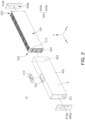
- FIG. 2 is an exploded perspective view of a battery cell 10.
- the battery cell 10 may be a rechargeable secondary battery.
- the battery cell 10 may be a secondary battery having an angular appearance as illustrated in FIGS. 1 and 2 , but a specific appearance thereof is not limited to those illustrated in the drawings.
- the battery cell may be a cylindrical secondary battery or a pouch type secondary battery.
- the battery cell 10 may include an electrode assembly 100, a case 300 having an internal space in which the electrode assembly 100 is accommodated, and one or more cap assemblies coupled to the case 300 to close the internal space of the case 300.
- the electrode assembly 100 may include a plurality of pole plates and a separator disposed between the pole plates.
- the electrode assembly 100 may be formed by stacking a plurality of positive pole plates, a plurality of negative pole plates, and one or more separators in one direction.
- the electrode assembly 100 may have a jelly roll structure in which the positive pole plate, the negative pole plate, and the separator interposed therebetween are wound.
- the battery cell 10 may include one or more electrode assemblies 100.
- the electrode assemblies may be stacked and disposed in one direction (e.g., in an X-axis direction).
- the case 300 may have an internal space S in which the electrode assembly 100 and an electrolyte (not illustrated) may be accommodated.
- the case 300 may include a material having sufficient rigidity to protect the internal electrode assembly 100 disposed thereinside and maintain an external shape of an entire battery cell 10.
- a portion of the case 300 may be formed of a metal material such as aluminum, iron, or stainless steel.
- the material of the case 300 is not limited thereto, and may be formed of any material as long as it has rigidity capable of maintaining the external shape of the battery cell 10 and protecting the internal electrode assembly.
- the case 300 may have an internal space S and may have a shape in which at least one side thereof is open.
- the case 300 may have a hexahedral shape in which a first opening 301 and a second opening 302 are formed at both ends in a longitudinal direction (e.g., a Z-axis direction).
- the internal space S may be formed between the first opening 301 and the second opening 302, and the electrode assembly 100 may be accommodated in the internal space S.
- the case 300 has a hexahedral shape in which both sides thereof is open as illustrated in FIG. 2 .
- a specific shape of the case 300 is not limited to those illustrated in the drawings.
- the case 300 may be configured in any shape as long as it secures the internal space S into which the electrode assembly 100 may be inserted and accommodated.
- the case may have a circular column shape in which an upper surface or a lower surface thereof is open, or a polyhedron shape in which at least one side is open.
- the battery cell 10 may include one or more cap assemblies 400a and 400b coupled to the case 300.
- a first cap assembly 400a and a second cap assembly 400b may be coupled with the first opening 301 and the second opening 302 of the case 300 to close the internal space S of the case 300.
- Each of the cap assemblies 400a and 400b may include cap plates 420a and 420b coupled to the case 300 and terminals 410a and 410b disposed in the cap plates 420a and 420b.
- the terminals 410a and 410b may be electrically connected to the electrode assembly 100 in the case 300.
- the electrode assembly 100 may be electrically connected to other components (e.g., a conductive busbar) outside the battery cell 10 through the terminals 410a and 410b.
- the terminals 410a and 410b may be fixedly disposed on the cap plates 420a and 420b.
- the cap plates 420a and 420b may be coupled to the case 300 to form at least one side surface of the battery cell 10.
- the cap plates 420a and 420b may include a material having a predetermined rigidity to close one open side of the case 300 and protect the electrode assembly 100 disposed in the internal space S.
- a material having a predetermined rigidity to close one open side of the case 300 and protect the electrode assembly 100 disposed in the internal space S.
- at least a portion of the cap plates 420a and 420b may be formed of the same material as the case 300.
- the cap assemblies 400a and 400b may be welded and coupled to the case 300.
- the cap plates 420a and 420b of the cap assembly 400a and 400b cover the openings 301 and 302 of the case 300, a portion thereof in contact with the case 300 may be laser welded to the case 300.
- a coupling method between the cap assemblies 400a and 400b and the case 300 is not limited to the aforementioned description.
- a plurality of cap assemblies 400a and 400b may be provided.
- the cap assemblies 400a and 400b may include a first cap assembly 400a and a second cap assembly 400b in which the first terminal 410a and the second terminal 410b having opposite polarities are disposed, respectively.
- the first cap assembly 400a and the second cap assembly 400b may be coupled to both ends of the case 300.
- the first cap assembly 400a may have a first terminal 410a as a negative pole terminal and may be coupled and welded to the first opening 301 of the case 300 to close the first opening 301.
- the second cap assembly 400b may have a second terminal 410b as a positive pole terminal and may be coupled and welded to the second opening 302 of the case 300 to close the second opening 302. Accordingly, the first cap assembly 400a and the second cap assembly 400b may close both sides of the case 300 in which the electrode assembly 100 is accommodated.
- a laser welding method may be applied to the coupling of the cap assembly 400 and the case 300, but a specific coupling method is not limited thereto.
- the position of the cap assembly 400 is not limited to those illustrated in FIGS. 1 and 2 .
- a plurality of cap assemblies 400a and 400b may all be disposed on the same side surface of the case 300.
- the battery cell 10 may include a protective assembly 200 disposed on at least one side of the electrode assembly 100 to protect the electrode assembly 100.
- the protective assembly 200 may include a protective frame 210 configured to protect the electrode assembly 100, and a connection member 220 electrically connecting the electrode assembly 100 and the terminal 410a and 410b to each other.
- the protective assembly 200 may be disposed on a side of the electrode assembly 100 facing the cap assembly and may protect the electrode assembly 100 and electrically connect the electrode assembly 100 and the terminals of the cap assembly at the same time.
- the protective frame 210 of the protective assembly 200 may prevent damage to the electrode assembly 100 by impacts applied to the battery cell by including a material that can absorb impacts
- the connection member 220 of the protective assembly 200 may electrically connect the electrode assembly and the terminals of the cap assembly by including include a conductive metal material.
- the protective frame 210 may include an insulating material, thereby preventing an unintended short circuit between the electrode assembly 100 and the case 300.
- the protective frame 210 may be configured to cover at least one edge of the electrode assembly.
- an upper end and a lower end of the protective frame 210 may be disposed to surround an upper edge and a lower edge of the electrode assembly to absorb the impact applied to the battery cell and protect the edges of the electrode assembly.
- connection member 220 of the protective assembly 200 may be inserted into the cap assembly 400.
- the connection member 220 may be provided in the form of a pin structure protruding in a direction oriented toward the cap assembly 400, and may be inserted into and in contact with the terminals 410a and 410b of the cap assembly 400. Accordingly, the electrode assembly 100 may be electrically connected to the terminal 410a and 410b of the cap assembly 400 through the connection member 220.
- a plurality of protective assemblies 200 may be provided.
- the protective assembly 200 may be disposed to cover one side facing the cap assembly 400 and the other side, opposite to one side of the cap assembly, in the electrode assembly 100.
- the cap assembly 400 may be configured to be assembled in the opening of the case 300 in a first direction (Z-axis direction), and a connection unit may be disposed to face the cap assembly 400 in the first direction (Z-axis direction). At least a portion of the connection member 220 may extend in the first direction and may be naturally inserted into the terminals 410a and 410b in the process of coupling the cap assembly 400 to the case 300.
- the terminal 410a and 410b and the electrode assembly 100 are naturally connected to each other in the process of assembling the cap assembly 400 and the case 300, a connection process between the electrode assembly 100 and the terminals 410a and 410b may be further simplified. Furthermore, in the battery cell 10 according to embodiments, since at least a portion of the connection member 220 is inserted into the terminals 410a and 410b according to the embodiments, it is advantageous to increase energy density by reducing wasted space for a connection between the electrode assembly 100 and the terminals 410a and 410b.
- the battery cell 10 may further include a vent member 310 configured to discharge gas generated in the internal space S.
- the vent member 310 may be opened earlier than other regions of the battery cell 10 to prevent the battery cell 10 from exploding.
- the vent member 310 may be coupled to the case 300.
- the vent member 310 may be coupled to a venting hole 303 formed on a side surface of the case 300.
- the vent member 310 may be coupled to the venting hole 303 to close the venting hole 303.
- the vent member 310 may be configured to seal the vent hole 303, thereby preventing foreign materials from flowing into the battery cell 10 via the venting hole 303 or an electrolyte inside the battery cell 10 from flowing out.
- vent member 310 When gas is generated in the internal space S of the case 300 while the battery cell 10 is repeatedly charged and discharged and the internal pressure is higher than the preset pressure, at least a portion of the vent member 310 may be configured to be broken. For example, a notch portion 311 having a lesser thickness than those of other portions may be formed on the vent member 310. When the internal pressure of the case 300 is higher than the preset pressure, the notch portion 311 may be preferentially broken in the vent member 310, and the gas in the internal space S may be discharged to the outside of the battery cell 10 through the broken notch portion 311.
- cap assembly 400 included in a battery cell 10 will be described in detail with reference to FIGS. 3 and 4 .
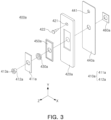
- FIG. 3 is an exploded perspective view of a first cap assembly 400a.
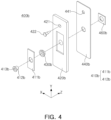
- FIG. 4 is an exploded perspective view of a second cap assembly 400b.
- the cap assemblies 400a and 400b described in FIGS. 3 and 4 may correspond to the cap assemblies 400a and 400b described in FIGS. 1 and 2 , and thus, a redundant description thereof may be omitted.
- the first cap assembly 400a may include a first terminal 410a electrically connected to an electrode assembly 100 and a first cap plate 420a supporting the first terminal 410a. Furthermore, the first cap assembly 400a may further include a first terminal insulator 450a and a first gasket 430a that electrically separate the first terminal 410a from the first cap plate 420a. Furthermore, the first cap assembly 400a may further include a first cap insulator 440a in which the first cap plate 420a prevents the electrode assembly 100 from being directly short-circuited.
- the first terminal 410a of the first cap assembly 400a may include a first terminal portion 411a and a first rivet 412a.
- the first terminal portion 411a may be disposed on the first cap plate 420a to serve as a connection terminal in which the battery cell 10 is electrically connected to an external component (e.g., a conductive busbar).
- the first terminal portion 411a may be formed of a plate-shaped member formed of a conductive metal such as aluminum or an aluminum alloy.
- the material of the first terminal portion 411a is not limited to aluminum.
- the first rivet 412a may be coupled to the first terminal portion 411a.
- the first rivet 412a may penetrate through the first terminal portion 411a to be riveted and coupled to the first terminal portion 411a.
- the first rivet 412a and the first terminal portion 411a may be coupled to each other by laser welding.
- the first rivet 412a may penetrate through both the first terminal portion 411a and the first cap plate 420a, and an end thereof may be disposed to face one side of the electrode assembly 100.
- the first rivet 412a may include a first insertion hole 413a into which a connection member 220 can be inserted.
- the first insertion hole 413a may have a shape of a hole penetrating through the first rivet 412a.
- the connection member 220 may be inserted into and bonded to the first insertion hole 413a of the first rivet 412a and may be electrically connected to the first rivet 412a.
- the first rivet 412a may be formed of a material different from a material constituting the first terminal portion 411a.
- the first terminal portion 411a may be formed of aluminum or an aluminum alloy, and the first rivet 412a may be formed of copper or a copper alloy.
- the first rivet 412a may be formed of the same material as the material constituting the first terminal portion 411a.
- the first cap plate 420a may be coupled to a case 300 to support the first terminal 410a.
- the first cap plate 420a may be configured to close a first opening 301 of the case 300.
- the first cap plate 420a may be formed of a plate-shaped member and may be bonded to the case 300 by laser welding or ultrasonic welding to close the first opening 301.
- the first cap plate 420a may be formed of the same material as the case 300.
- both the first cap plate 420a and the case 300 may be formed of aluminum or an aluminum alloy.
- the material constituting the first cap plate 420a is not limited thereto, and may be formed of any material as long as it can close the first opening 301 of the case 300 and stably protect internal components thereof.
- insulating members formed of an insulating material may be disposed between the first terminal 410a and the first cap plate 420a to electrically separate the first terminal 410a from the first cap plate 420a from each other.
- the first terminal insulator 450a disposed on a rear surface of the first terminal portion 411a, and the first gasket 430a into which the first rivet 412a is inserted may correspond to such insulating members.
- the first terminal insulator 450a may include an insulating material (e.g., a polymer), and may be disposed between the first terminal portion 411a and the first cap plate 420a and may be configured to insulate the first terminal portion 411a from the first cap plate 420a.
- an insulating material e.g., a polymer
- the first gasket 430a may include an insulating material (e.g., a polymer), and may be disposed between the first rivet 412a and the first cap plate 420a and may be configured to insulate the first rivet 412a from the first cap plate 420a.
- the first gasket 430a may be disposed to surround the first rivet 412a, and may block a gap between the first rivet 412a and the first cap plate 420a, thereby preventing foreign materials outside the battery cell 10 from flowing into the gap or an electrolyte inside the battery cell 10 from leaking through the gap.
- An insulating member for preventing the first cap plate 420a from being unintentionally short-circuited with a component accommodated in the case 300 may be disposed on a rear surface of the first cap plate 420a.
- the first cap insulator 440a covering the rear surface of the first cap plate 420a may correspond to such an insulation member (here, the 'rear surface of the first cap plate 420a' may denote a surface facing from the first cap plate 420a to the internal space S of the case 300).
- the first cap insulator 440a may include an insulating material to prevent the first cap plate 420a from being short-circuited in contact with the electrode assembly 100.
- the first cap assembly 400a may further include a first fixing member 460a coupled to the first rivet 412a.
- the first fixing member 460a may be disposed on a rear surface of the first cap plate 420a and may be coupled to an end of the first rivet 412a.
- the first fixing member 460a may be configured to have a width greater than a hole through which the first rivet 412a passes in the first cap plate 420a.
- the 'width' may denote a length in a direction, perpendicular to the first direction (Z-axis direction), which is a direction in which the first rivet 412a penetrates through the first cap plate 420a.
- the first fixing member 460a may be coupled to an end of the first rivet 412a penetrating through the first cap assembly 400a, thereby preventing the components constituting the first cap assembly 400a from being separated from each other.
- the second cap assembly 400b may include a second terminal 410b electrically connected to the electrode assembly 100 and a second cap plate 420b supporting the second terminal 410b. Furthermore, the second cap assembly 400b may further include a second gasket 430b blocking a gap between a second rivet and the second cap plate 420b. Furthermore, the second cap assembly 400b may further include a second cap insulator 440b for preventing the second cap plate 420b from being directly short-circuited with the electrode assembly 100.
- the second terminal 410b of the second cap assembly 400b may include a second terminal portion 411b and a second rivet 412b.
- the second terminal portion 411b may be disposed on the second cap plate 420b to serve as a connection terminal used to electrically connect the battery cell 10 to an external component (e.g., a conductive busbar).
- the second terminal portion 411b may be formed of a plate-shaped member formed of a conductive metal such as aluminum or an aluminum alloy.
- the material of the second terminal portion 411b is not limited to aluminum.
- the second rivet 412b may be coupled to the second terminal portion 411b.
- the second rivet 412b may penetrate through the second terminal portion 411b to be riveted and coupled to the second terminal portion 411b.
- the second rivet 412b and the second terminal portion 411b may be coupled to each other by laser welding.
- the second rivet 412b may penetrate through both the second terminal portion 411b and the second cap plate 420b, and an end thereof may be disposed to face the electrode assembly 100.
- the first rivet 412a may be disposed to face one side of the electrode assembly 100
- the second rivet 412b may be disposed to face the other side, opposite to one side of the electrode assembly 100.
- the second rivet 412b may include a second insertion hole 413b into which the connection member 220 can be inserted.
- the second insertion hole 413b may have a shape of a hole penetrating through the second rivet 412b.
- the connection member 220 may be inserted into and bonded to the second insertion hole 413b of the second rivet 412b and may be electrically connected to the second rivet 412b.
- the second rivet 412b may be formed of the same material as a material constituting the second terminal portion 411b.
- both the second terminal portion 411b and the second rivet 412b may be formed of aluminum or an aluminum alloy.
- the second rivet 412b may be formed of a material different from the material constituting the second terminal portion 411b.
- the second cap plate 420b may be coupled to the case 300 to support the second terminal 410b.
- the second cap plate 420b may be configured to close a second opening 302 of the case 300.
- the second cap plate 420b is formed of a plate-shaped member and may be bonded to the case 300 by laser welding or ultrasonic welding to close the second opening 302.
- the second cap plate 420b may be formed of the same material as the case 300.
- both the second cap plate 420b and the case 300 may be formed of aluminum or an aluminum alloy.
- the material constituting the second cap plate 420b is not limited thereto, and may be formed of any material as long as it can close the second opening 302 of the case 300 and stably protect internal components thereof.
- the second gasket 430b may be disposed between the second rivet 412b and the second cap plate 420b, and may block a gap between the second rivet 412b and the second cap plate 420b, thereby preventing foreign materials outside the battery cell 10 from flowing into the gap or an electrolyte inside the battery cell 10 from leaking through the gap.
- the second gasket 430b may include an insulating material (e.g., a polymer).
- a second terminal insulator for electrically separating the second terminal portion 411b from the second cap plate 420b may be disposed between the second terminal portion 411b and the second cap plate 420b.
- the second terminal insulator may be omitted as illustrated in FIG. 4 , and in this case, the second terminal portion 411b and the second cap plate 420b may be in contact with each other.
- An insulating member for preventing the second cap plate 420b from being unintentionally short-circuited with a component accommodated in the case 300 may be disposed on a rear surface of the second cap plate 420b.
- the second cap insulator 440b covering the rear surface of the second cap plate 420b may correspond to such an insulating member (here, the 'rear surface of the second cap plate 420b' may denote a surface facing from the second cap plate 420b to the internal space S of the case 300).
- the second cap insulator 440b may include an insulating material to prevent the second cap plate 420b from being short-circuited in contact with the electrode assembly 100.
- the second cap assembly 400b may further include a second fixing member 460b coupled to the second rivet 412b.
- the second fixing member 460b may be disposed on a rear surface of the second cap plate 420b and may be coupled to an end of the second rivet 412b.
- the second fixing member 460b may be configured to have a width greater than a hole through which the second rivet 412b passes in the second cap plate 420b.
- the 'width' may denote a length in a direction, perpendicular to the first direction (Z-axis direction), which is a direction in which the second rivet 412b penetrates through the second cap plate 420b.
- the second fixing member 460b may be coupled to an end of the second rivet 412b penetrating through the second cap assembly 400b, thereby preventing the components constituting the second cap assemblies 400b from being separated from each other.
- At least one of a plurality of cap assemblies 400a and 400b may include an electrolyte inlet 421 used to inject an electrolyte into the case 300.
- the first cap assembly 400a and the second cap assembly 400b may include the electrolyte inlet 421.
- the electrolyte inlet 421 may be provided on the cap plates 420a and 420b.
- the electrolyte inlet 421 may have a hole shape penetrating through the cap plates 420a and 420b.
- An avoiding hole 441 may also be provided in the cap insulators 440a and 440b disposed on rear sides of the cap plates 420a and 420b to correspond to positions of the electrolyte inlets of the cap plates 420a and 420b.
- the avoiding hole 441 of the cap insulators 440a and 440b may be sufficiently large so as not to disturb an injection of the electrolyte through the electrolyte inlet 421.
- the electrolyte inlet 421 may be sealed with a stopper 422.
- the stopper 422 may have a shape of being inserted into the electrolyte inlet 421.
- the stopper 422 may be fitted and coupled to the electrolyte inlet 421.
- the stopper 422 may block the electrolyte inlet 421 to prevent the electrolyte in the case 300 from leaking to the outside of the battery cell 10.
- the electrolyte inlet 421 may be provided in both the first cap assembly 400a and the second cap assembly 400b, or can be provided in only one cap assembly.
- the first cap plate 420a, the first terminal portion 411a, the second cap plate 420b, and the second terminal portion 411b may be all formed of the same material, and in this case, the case 300 may also be formed of the same material.
- the first terminal 410a of the first cap assembly 400a and the second terminal 410b of the second cap assembly 400b may be configured to have different polarities.
- the first terminal 410a may be electrically connected to negative pole plates
- the second terminal 410b may be electrically connected to positive pole plates. (Or vice versa.)
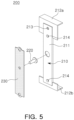
- FIG. 5 is an exploded perspective view of the protective assembly 200.
- FIG. 6 is a reference view illustrating a state in which an electrode assembly and a protective assembly 200 are coupled.
- FIG. 7 is a reference view illustrating a state in which a cap assembly is coupled to a case.
- a battery cell and components thereof described in FIGS. 5 to 7 correspond to the battery cell and the components thereof described in FIGS. 1 to 4 , a redundant description thereof may be omitted.
- a protective assembly 200 of FIGS. 5 to 7 may correspond to the protective assembly 200 described in FIGS. 1 and 2 .
- the protective assembly 200 may include a current collecting member 230 electrically connected to an uncoated portion 112, a connection member 220 protruding from the current collecting member 230, and a protective frame 210 supporting the current collecting member 230 and the connection member 220.
- the protective frame 210 may be disposed on at least one side of the electrode assembly to protect the electrode assembly.
- the protective frame 210 may include a material absorbing impacts in order to prevent the electrode assembly from being damaged by impacts outside a battery cell. Furthermore, the protective frame 210 may include an insulating material in order to prevent the electrode assembly from being short-circuited in contact with a case. Specifically, the protective frame 210 may be stably disposed around the electrode assembly, by including a material that does not react with an electrolyte. For example, the protective frame 210 may include a non-conductive metal, plastic, or a polymer resin material. However, the material of the protective frame 210 is not limited to those described above.
- the protective frame 210 may include a body portion 211 to which the current collecting member 230 is coupled, and one or more bend portions 212 extending from the body portion 211 to protect edges of the electrode assembly.
- the body portion 211 of the protective frame 210 may be disposed to face at least a portion of the electrode assembly in the first direction.
- the body portion 211 may be provided in a structure having different widths in a height direction so that the uncoated portion of the electrode assembly may pass therethrough.
- a width of an upper end and a width of a lower end of the body portion 211 may be wider than a width of an intermediate end of the body portion 211.
- the upper end and the lower end of the body portion 211 sufficiently may cover and protect one side of the electrode assembly, and at the same time, the uncoated portion of the electrode assembly may be released by the intermediate end of the body portion 211, thereby closely attaching the protective frame 210 to one side of the electrode assembly.
- the protective frame 210 may include one or more bend portions 212 connected to the body portion 211.
- the bend portion 212 may face at least a portion of the electrode assembly 100 in a second direction different from the first direction.
- the second direction may be a direction, perpendicular to the first direction.
- the protective frame 210 may include a first bend portion 212a extending from one side of the body portion 211 and a second bend portion 212b extending from the other side of the body portion 211.
- the first bend portion 212a and the second bend portion 212b may extend from the body portion 211 in both ends of the body portion 211 in a vertical direction.
- the body portion 211 and the first bend portion 212a may cover at least a portion of one edge of the electrode assembly.
- the body portion 211 and the second bend portion 212b may cover at least a portion of the other one edge of the electrode assembly.
- the current collecting member 230 may be coupled to the protective frame 210.
- the current collecting member 230 may be supported by the protective frame 210 and may be stably connected to the electrode assembly.
- the current collecting member 230 is a plate-shaped member including a conductive metal and may be electrically connected to the uncoated portion 112 of the electrode assembly 100 to form a passage for a current flow between the electrode assembly 100 and a terminal 410.
- the current collecting member 230 may be fixed to a front surface of the body portion 211 of the protective frame 210.
- the front surface of the body portion 211 may refer to a surface facing the cap assembly 400 from the body portion 211.
- Various coupling methods may be applied to coupling the current collecting member 230 and the protective frame 210.
- the body portion 211 may be provided with a coupling protrusion 214 configured to penetrate through the current collecting member 230, and the coupling protrusion 214 may be thermally fused in a state of passing through the current collecting member 230, thus fixing the current collecting member.
- the current collecting member 230 and the body portion 211 may be fixed to each other by a bonding material such as a bonding binder.
- the current collecting member 230 may include a material having better mechanical rigidity than a material constituting the protective frame 210.
- the protective frame 210 may include a plastic or a resin material
- the current collecting member 230 may include a conductive metal material.
- the current collecting member 230 including a metallic material is coupled to the protective frame 210, structural rigidity thereof may be further increased as compared to a case in which the protective frame 210 and the current collecting member 230 are disposed alone.
- the protective frame 210 covering one side of the electrode assembly 100 may stably support the current collecting member 230, thereby stably maintaining an electrical connection between the current collecting member 230 and the electrode assembly 100.
- a relative position thereof with the electrode assembly may be fixed, thereby increasing easiness of a connection between the electrode assembly 100 and the current collecting member 230.
- the protective frame 210 may be disposed to surround a partial surface of the current collecting member 230, and accordingly, only a specific portion of the current collecting member 230 may be connected to the uncoated portion 112.
- connection member 220 may be configured to protrude from one surface of the current collecting member 230 in a direction oriented toward an external periphery of the electrode assembly 100.
- the connection member 220 may be provided in a pin-shaped structure penetrating through the current collecting member 230, and at least a portion thereof may protrude from one surface of the current collecting member 230 in a first direction in which the cap assembly 400 is assembled.
- connection member 220 may be in contact with the current collecting member 230, and the other portion thereof may be in contact with a terminal 410 of the cap assembly 400.
- connection member 220 includes a conductive material, and may electrically connect the current collecting member 230 and the terminal 410 of the cap assembly 400.
- the protective assembly 200 may include a through-hole 213 through which an electrolyte passes.
- the through-hole 213 of the protective frame 210 may be provided in the form of a hole penetrating through the body portion 211 and extending from one side of the protective frame 210 to the other side of the protective frame 210.
- the electrolyte injected from the outside of the case may flow into the electrode assembly 100 through the through-hole 213 of the protective frame 210. That is, the through-hole 213 of the protective frame 210 may allow the electrolyte to be smoothly injected thereinto.
- the through-hole 213 of the protective assembly 200 may be disposed to face the electrolyte inlet 421 of the cap assembly 400.
- the through-hole 213 and the electrolyte inlet 421 may face each other in the first direction as a coupling direction of the cap assembly 400 and the case 300.
- the electrolyte introduced from the electrolyte inlet 421 may flow smoothly into the case 300 by passing through the through-hole 213.
- FIG. 6 may sequentially illustrate a process in which the electrode assembly 100 and the protective assembly 200 are connected to each other during the manufacturing process of the battery cell 10.
- the electrode assembly 100 may include a plurality of pole plates 110 stacked in one direction. At least one of the plurality of pole plates 110 may include a coated portion 111 coated with an active material and an uncoated portion 112 not coated with the active material. In the process of stacking or winding the plurality of pole plates 110, the uncoated portions 112 may be aligned side by side at predetermined positions.
- the uncoated portion 112 may be electrically connected to the terminals 410a and 410b of the cap assemblies 400a and 400b through the protective assembly 200 to serve as a passage for a current flow between the electrode assembly 100 and the terminals 410a and 410b.
- the uncoated portions 112 may be configured to extend from one side of the coating part 111.
- uncoated portions of a positive pole plate may be disposed side by side on one side of the electrode assembly 100
- uncoated portions of a negative pole plate may be disposed side by side on the other side, opposite to one side of the electrode assembly 100.
- all of the uncoated portions 112 illustrated in an upper left end of FIG. 6 may have the same polarity.
- the uncoated portions 112 having the same polarity may be in contact with and connected to each other. If necessary, at least a portion of the uncoated portions 112 may be folded to come into contact with other neighboring uncoated portions 112.
- the uncoated portions 112 having the same polarity may be bound to each other to form a plurality of aggregates, and the protective assembly 200 may be seated and assembled between the aggregates of the uncoated portions 112.
- the protective assembly 200 at least a portion of the protective frame 210 may face the electrode assembly 100 in the first direction, but each of the first bend portion 212a and the second bend portion 212b of the protective frame 210 may be disposed to cover different edges of the electrode assembly 100.
- the first direction may be a direction in which the uncoated portion 112 extends from the coating portion 111 of the electrode assembly 100.
- the current collecting member 230 of the protective assembly 200 may be electrically connected to the uncoated portion 112.
- the uncoated portion 112 may be bent to form a junction portion 113, and the junction portion 113 may cover at least a portion of a front surface of the current collecting member 230.
- the front surface of the current collecting member 230 may refer to a surface facing the cap assembly 400 from the current collecting member 230.
- junction portion 113 of the uncoated portion 112 and the current collecting member 230 may be electrically connected to each other.
- the junction portion 113 of the uncoated portion 112 and the current collecting member 230 may be in contact with each other and may be electrically connected each other by means of a welding and jointing manner.
- a welding process may be performed through a front surface of the junction portion 113 in a state in which the junction portion 113 covers a front surface of the current collecting member 230.
- the current collecting member 230 may be disposed on a rear surface of the junction portion 113, thereby preventing damage to an interior of the electrode assembly 100 by the welding process.
- a laser welding method may be applied to a junction of the uncoated portion and the connection unit.
- any connecting method may be applied as long as it can electrically connect the uncoated portion to the connection unit.
- the uncoated portion 112 of the electrode assembly 100 may include an avoiding portion 114 to avoid interference with the connection member 220.
- a portion of the uncoated portion 112 may be cut to form the avoiding portion 114, thereby avoiding the interference with the connection member 220 in the process of bending the uncoated portion 112 to cover at least a portion of the protective assembly 200.
- the electrode assembly 100 connected to the protective assembly 200 may be accommodated into the case 300 and may be electrically connected to the terminals 410a and 410b of the cap assemblies 400a and 400b.
- the cap assembly 400 in a state in which the electrode assembly 100 is accommodated into the case 300, the cap assembly 400 may be assembled in the case 300, and in this process, the connection member 220 may be inserted into the terminals 410a and 410b of the cap assemblies 400a and 400b.
- the cap assembly 400 illustrated in FIG. 7 may correspond to either the first cap assembly 400a or the second cap assembly 400b illustrated in FIGS. 1 to 4 .
- the electrode assembly 100 may be electrically connected to the current collecting member 230, the connection member 220, and the terminals 410a and 410b.
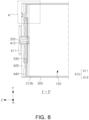
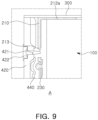
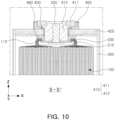
- FIGS. 8 to 10 a cross-sectional configuration of a battery cell 10 on a cap assembly 400 will be described with reference to FIGS. 8 to 10 .
- FIG. 8 is a cross-sectional view of part I-I' of FIG. 1 .
- FIG. 9 is an enlarged view of part A of FIG. 8 .
- FIG. 10 is a cross-sectional view of part II-II' of FIG. 1 .
- a battery cell 10 and components thereof described in FIGS. 8 to 10 correspond to the battery cell 10 and the components thereof described in FIGS. 1 to 7 , a redundant description thereof may be omitted.
- a cap assembly 400 described in FIGS. 8 to 10 may correspond to any one of the first cap assembly 400a and the second cap assembly 400b described in FIGS. 1 to 7 .
- the cap assembly 400 of the battery cell 10 may be coupled to a case 300 in the first direction (Z-axis direction), and accordingly, a terminal 410a of the cap assembly 400 may be electrically connected to an electrode assembly 100 through a connection member 220.
- a protective assembly 200 may include a current collecting member 230 electrically connected to an uncoated portion 112 of the electrode assembly 100, a connection member 220 electrically connected to the current collecting member 230, and a protective frame 210 surrounding at least a portion of the current collecting member 230.
- connection member 220 may be configured to extend in a direction oriented toward the cap assembly 400 by penetrating through the current collecting member 230.
- connection member 220 may be provided as a separate member assembled to the current collecting member 230, or may be provided integrally with the current collecting member 230.
- the current collecting member 230 and the connection member 220 may be formed of the same material as a material forming the uncoated portion 112 connected to the current collecting member 230.
- the current collecting member 230 and the connection member 220 may be formed of copper or a copper alloy identically thereto.
- the current collecting member 230 and the connection member 220 may be formed of aluminum or an aluminum alloy identically thereto.
- the materials of the current collecting member 230 and the connection member 220 are not limited to the aforementioned description, and may be formed of, for example, a material different from the uncoated portion 112 connected to the current collecting member 230.
- the protective frame 210 includes an insulating material and may be disposed between the current collecting member 230 and the uncoated portion 112.
- the protective frame 210 may cover a partial surface (e.g., a rear surface) of the current collecting member 230 so that only a specific portion of the current collecting member 230 may be connected to the uncoated portion 112.
- the terminal 410a of the cap assembly 400 may be electrically connected to the connection member 220.
- the terminal 410a may include a terminal portion 411 exposed to the outside of the cap assembly 400 and a rivet 412 coupled to the terminal portion 411.
- the rivet 412 may include an insertion hole 413 into which the connection member 220 is inserted.
- the connection member 220 may be welded and coupled while being inserted into the insertion hole 413.
- an upper end thereof may be exposed to the outside of the battery cell 10, and through the upper end, a contact portion between the connection member 220 and the rivet 412 may be welded to bond the connection member 220 and the rivet 412 to each other.
- a width of the insertion hole 413 of the rivet 412 may have a size corresponding to a thickness of the connection member 220.
- the rivet 412 may further include a guide groove for guiding an insertion position of the connection member 220.
- the guide groove may have a shape of an inclined surface formed in an inlet of the insertion hole 413. Accordingly, even if the insertion hole 413 has a size that fits the connection member 220, the upper end of the connection member 220 may easily enter the insertion hole 413 along the inclined surface of the guide groove, thereby increasing assembly easiness.
- An end of the rivet 412 may be inserted into an avoiding portion 114 provided to avoid the connection member 220 in the uncoated portion 112.
- the end of the rivet 412 may be disposed adjacently to the current collecting member 230 exposed through the avoiding 114. According to such a structure, the cap assembly 400 and the electrode assembly 100 may be brought into close contact with each other to increase space efficiency.
- a material constituting the rivet 412 may be the same as a material constituting the connection member 220 inserted into the rivet 412.
- the connection member 220 includes copper
- the rivet 412 may also include copper.
- the rivet 412 and the connection member 220 are formed of the same material, coupling easiness and bonding reliability by means of welding between the rivet 412 and the connection member 220 may be further increased.
- a material constituting the rivet 412 and a material constituting the terminal portion 411 may be different from each other.
- the rivet 412 may include copper or may be formed in a form in which nickel is plated on copper, and the terminal portion 411 may include aluminum.
- connection member 220 is connected to the terminal portion 411 through the rivet 412 formed of the same material, coupling easiness and coupling reliability may be increased as compared to when directly coupled to the terminal portion 411 formed of a different material.
- the rivet 412 directly connected to the connection member 220 may be formed of the same material as the connection member 220, and the terminal portion 411 may be formed a material different from the rivet 412 and the connection member 220, thereby increasing the degree of freedom of material selection of the terminal portion 410 as well as securing connection easiness and connection stability.
- a through-hole 213 of the protective assembly 200 may be disposed to face an electrolyte inlet 421 of the cap assembly 400.
- the through-hole 213 and the electrolyte inlet 421 may face each other in the first direction (Z-axis direction).
- An electrolyte injected into the case through the electrolyte inlet provided in the cap plate may flow into the electrode assembly by penetrating through the through-hole 213 of the protective frame 210.
- the electrolyte inlet may be closed by a stopper 422.
- FIGS. 8 and 9 one end of the stopper 422 may pass through the electrolyte inlet and reach the through-hole 213 of the protective frame 210.
- a specific shape of the stopper 422 is not limited to those illustrated in the drawings.
- a shape and a size of the electrolyte inlet and the through-hole 213 may be variously formed.
- the through-hole 213 may be formed to be the same as or larger than the electrolyte inlet.
- the through-hole 213 may have a circular or elliptical hole shape, or may have a slit shape.
- a plurality of electrolyte inlets and a plurality of through-holes 213 may be provided.
- a plurality of through-holes 213 may be provided in a portion of the protective frame 210 facing the electrolyte inlet.
- the through-hole 213 is illustrated in the shape of a simple hole penetrated in the first direction (Z-axis direction), this is only an example, and a specific shape of the through-hole 213 may be different from that illustrated in the drawings.
- the through-hole 213 may be provided in the shape of a hole having a path extending in an inclined direction in the first direction, or may be provided in the shape of a hole having a curved path more than once from one surface to the other surface of the protective frame 210.
- the battery cell 10 includes a protective assembly 200 disposed on at least one side of the electrode assembly 100, thereby safely protecting the electrode assembly from impacts applied to the battery cell 10.
- the protective assembly 200 may include an insulating material and a material that does not react with an electrolyte by preventing the electrode assembly 100 from being unintentionally short-circuited with the case 300.
- the protective assembly 200 may be used as a protective structure having high structural rigidity by including a current collecting member including a metallic material.
- the protective assembly 200 may include a connection member 220 inserted into a terminal 410 of the cap assembly 400 to concisely and stably connect the electrode assembly 100 and the terminal 410, and a space for connecting the electrode assembly 100 and the terminal 410 may be reduced, thereby increasing energy density of the battery cell 10.
Landscapes
- Chemical & Material Sciences (AREA)
- Chemical Kinetics & Catalysis (AREA)
- Electrochemistry (AREA)
- General Chemical & Material Sciences (AREA)
- Engineering & Computer Science (AREA)
- Manufacturing & Machinery (AREA)
- Connection Of Batteries Or Terminals (AREA)
- Cell Separators (AREA)
- Secondary Cells (AREA)
Abstract
Description
- The technology and implementations disclosed in this patent document generally relate to a battery cell.
- Unlike primary batteries, since secondary batteries (battery cells) are convenient to be charged or discharged, they have attracted significant attention as power sources for various mobile devices and electric vehicles.
- Such a secondary battery may have a structure in which an electrode assembly, formed by stacking a positive pole plate, a negative pole plate and a separator, or winding the same in a roll shape, is accommodated in a case.
- When an impact is applied to a battery cell, the impact may be transmitted to the electrode assembly inside the battery cell, which may cause damage to the electrode assembly. Furthermore, the damage to the electrode assembly may cause a short circuit with an internal surface of the case, which may cause an operation abnormality of the battery cell.
- Therefore, there is a need for a structure capable of protecting the electrode assembly from external impacts and stably maintaining an electrical connection between the electrode assembly and a terminal of the battery cell.
- The disclosed technology can be implemented in some embodiments to provide a battery cell having a protective structure configured to protect an electrode assembly.
- Furthermore, another aspect of the disclosed technology is to provide a battery cell having a structure configured to further increase the rigidity of the protective structure.
- Furthermore, another aspect of the disclosed technology is to provide a battery cell configured to increase energy density through a simple connective structure between an electrode assembly and a terminal of the battery cell.
- A battery cell according to the disclosed technology includes: an electrode assembly including a plurality of pole plates; one or more protective assemblies disposed on at least one side of the electrode assembly; and a case having an internal space in which the electrode assembly is accommodated, wherein the one or more protective assemblies include: a protective frame including an insulating material; and a connection unit coupled to the protective frame and electrically connected to the electrode assembly.
- In some embodiments of the disclosed technology, the battery cell further includes: a cap assembly coupled to the case and having a terminal disposed therein, wherein the connection unit is electrically connected to the terminal and the electrode assembly, respectively.
- In some embodiments of the disclosed technology, the connection unit includes: a current collecting member electrically connected to the electrode assembly; and a connection member configured to electrically connect the current collecting member and the terminal.
- In some embodiments of the disclosed technology, the protective frame includes a coupling protrusion inserted into the current collecting member.
- In some embodiments of the disclosed technology, the current collecting member includes a material having rigidity higher than that of the insulating material of the protective frame.
- In some embodiments of the disclosed technology, at least a portion of the connection member is inserted into the terminal.
- In some embodiments of the disclosed technology, the terminal includes: a rivet having an insertion hole into which the connection member is inserted; and a terminal portion to which the rivet is coupled.
- In some embodiments of the disclosed technology, the rivet and the terminal portion are formed of different materials.
- In some embodiments of the disclosed technology, the electrode assembly further includes an uncoated portion which is not coated with an active material, and the uncoated portion is electrically connected to the current collecting member.
- In some embodiments of the disclosed technology, at least a portion of the uncoated portion is disposed between the current collecting member and the cap assembly.
- In some embodiments of the disclosed technology, the protective frame includes a through-hole through which an electrolyte passes.
- In some embodiments of the disclosed technology, the cap assembly includes an electrolyte inlet into which the electrolyte is injected, wherein the electrolyte inlet is disposed to face the through-hole.
- In some embodiments of the disclosed technology, the protective frame includes: a body portion facing the electrode assembly in a first direction; and one or more bend portions extending from the body portion and facing the electrode assembly in a second direction, perpendicular to the first direction.
- In some embodiments of the disclosed technology, the one or more bend portions are disposed to cover edges of the electrode assembly.
- In some embodiments of the disclosed technology, the battery cell further includes: a first cap assembly and a second cap assembly coupled to both sides of the case, wherein the one or more protective assemblies include: a first protective assembly facing the first cap assembly and a second protective assembly facing the second cap assembly.
- A battery cell according to embodiments includes a protective assembly having high rigidity, thereby effectively protecting an electrode assembly from external impacts.
- Furthermore, a battery cell according to embodiments includes a connection member in which at least a portion thereof is inserted into a terminal, thereby reducing wasted space inside a case and increasing energy density.
- Furthermore, in a battery cell according to embodiments, a connection member and a terminal may be electrically connected to each other in the process of assembling a cap assembly to a case, thereby simplifying an assembly process.
- Certain aspects, features, and advantages of the disclosed technology are illustrated by the following detailed description with reference to the accompanying drawings.
-
FIG. 1 is a perspective view of a battery cell according to an embodiment. -
FIG. 2 is an exploded perspective view of a battery cell according to an embodiment. -
FIG. 3 is an exploded perspective view of a first cap assembly according to an embodiment. -
FIG. 4 is an exploded perspective view of a second cap assembly according to an embodiment. -
FIG. 5 is an exploded perspective view of a protective assembly according to an embodiment. -
FIG. 6 is a reference view illustrating a state in which an electrode assembly and a protective assembly are coupled to each other according to an embodiment. -
FIG. 7 is a reference view illustrating a state in which a cap assembly is coupled to a case according to an embodiment. -
FIG. 8 is a cross-sectional view of part I-I' ofFIG. 1 . -
FIG. 9 is an enlarged view of part A ofFIG. 8 . -
FIG. 10 is a cross-sectional view of part II-II' ofFIG. 1 . - Prior to describing the exemplary embodiments in detail, it should be understood that the terms used in the specification and the appended claims should not be construed as being limited to general and dictionary meanings, but should be interpreted based on the meanings and concepts corresponding to technical aspects of the present disclosure on the basis of the principle that the inventor is allowed to define terms appropriately for the best explanation. Therefore, it should be understood that the embodiments described in this specification and the configurations illustrated in the drawings are only the most desirable embodiments of the disclosed technology and do not represent all the technical concepts of disclosed technology, and accordingly, there may be various equivalents and variations that can replace the embodiments and the configurations of the disclosed technology at the time of this application.
- The same reference numeral or symbol written in each accompanying drawing of the specification refers to parts or components that perform substantially the same function. For convenience of explanation and understanding, the disclosed technology is described using the same reference numeral or symbol even in different exemplary embodiments. That is, even if a plurality of drawings illustrate components having the same reference number, all of the plurality of drawings do not refer to an embodiment.
- In this specification, the singular also includes the plural unless specifically stated otherwise in the phrase. It will be further understood that the terms "comprises," "comprising," "includes" and/or "including," when used herein, specify the presence of stated features, integers, steps, operations, elements, components and/or combinations thereof, but do not preclude the presence or addition of one or more other features, integers, steps, operations, elements, components, and/or groups thereof.
- Furthermore, it should be noted in advance that the expressions such as "above," "upper," "below," "beneath," "lower," "side," "front," and "rear" are based on the direction illustrated in the drawings, and may be expressed differently if the direction of the object is changed.
- Furthermore, in the present specification and claims, terms including ordinal numbers such as "first" and "second" may be used to distinguish between components. These ordinal numbers are used to distinguish the same or similar components from each other, and the meaning of the terms should not be construed as limited by the use of these ordinal numbers. For example, the components combined with these ordinal numbers should not be construed as limiting the order of use or arrangement of the components. If necessary, the ordinal numbers may be used interchangeably.
- Hereinafter, with reference to the drawings, specific embodiments of the present disclosure will be described. However, the scope of the present disclosure is not limited to the suggested embodiments. For example, those skilled in the art who understand the idea of the present disclosure may propose other embodiments included within the scope of the idea of the present disclosure by adding, modifying, or deleting components, but the embodiments described herein have been provided so that this disclosure will be thorough and complete, and will convey the full scope of the disclosure to one of ordinary skill in the art. In the drawings, the shapes and dimensions of elements may be exaggerated for clarity.
-
FIG. 1 is a perspective view of abattery cell 10. -
FIG. 2 is an exploded perspective view of abattery cell 10. - In embodiments, the
battery cell 10 may be a rechargeable secondary battery. Thebattery cell 10 may be a secondary battery having an angular appearance as illustrated inFIGS. 1 and2 , but a specific appearance thereof is not limited to those illustrated in the drawings. For example, the battery cell may be a cylindrical secondary battery or a pouch type secondary battery. - In embodiments, the
battery cell 10 may include anelectrode assembly 100, acase 300 having an internal space in which theelectrode assembly 100 is accommodated, and one or more cap assemblies coupled to thecase 300 to close the internal space of thecase 300. - The
electrode assembly 100 may include a plurality of pole plates and a separator disposed between the pole plates. For example, theelectrode assembly 100 may be formed by stacking a plurality of positive pole plates, a plurality of negative pole plates, and one or more separators in one direction. Alternatively, theelectrode assembly 100 may have a jelly roll structure in which the positive pole plate, the negative pole plate, and the separator interposed therebetween are wound. - In some embodiments, the
battery cell 10 may include one ormore electrode assemblies 100. When thebattery cell 10 has a plurality of electrode assemblies, the electrode assemblies may be stacked and disposed in one direction (e.g., in an X-axis direction). - The
case 300 may have an internal space S in which theelectrode assembly 100 and an electrolyte (not illustrated) may be accommodated. - The
case 300 may include a material having sufficient rigidity to protect theinternal electrode assembly 100 disposed thereinside and maintain an external shape of anentire battery cell 10. For example, at least a portion of thecase 300 may be formed of a metal material such as aluminum, iron, or stainless steel. However, the material of thecase 300 is not limited thereto, and may be formed of any material as long as it has rigidity capable of maintaining the external shape of thebattery cell 10 and protecting the internal electrode assembly. - The
case 300 may have an internal space S and may have a shape in which at least one side thereof is open. For example, referring toFIGS. 1 and2 , thecase 300 may have a hexahedral shape in which afirst opening 301 and asecond opening 302 are formed at both ends in a longitudinal direction (e.g., a Z-axis direction). The internal space S may be formed between thefirst opening 301 and thesecond opening 302, and theelectrode assembly 100 may be accommodated in the internal space S. - In the following description, embodiments will be described on the premise that the
case 300 has a hexahedral shape in which both sides thereof is open as illustrated inFIG. 2 . However, a specific shape of thecase 300 is not limited to those illustrated in the drawings. Thecase 300 may be configured in any shape as long as it secures the internal space S into which theelectrode assembly 100 may be inserted and accommodated. For example, the case may have a circular column shape in which an upper surface or a lower surface thereof is open, or a polyhedron shape in which at least one side is open. - In embodiments, the
battery cell 10 may include one ormore cap assemblies case 300. For example, referring toFIG. 2 , afirst cap assembly 400a and asecond cap assembly 400b may be coupled with thefirst opening 301 and thesecond opening 302 of thecase 300 to close the internal space S of thecase 300. - Each of the
cap assemblies cap plates case 300 andterminals cap plates - The
terminals electrode assembly 100 in thecase 300. Theelectrode assembly 100 may be electrically connected to other components (e.g., a conductive busbar) outside thebattery cell 10 through theterminals - The
terminals cap plates cap plates case 300 to form at least one side surface of thebattery cell 10. - The
cap plates case 300 and protect theelectrode assembly 100 disposed in the internal space S. For example, at least a portion of thecap plates case 300. - The
cap assemblies case 300. For example, while thecap plates cap assembly openings case 300, a portion thereof in contact with thecase 300 may be laser welded to thecase 300. However, a coupling method between thecap assemblies case 300 is not limited to the aforementioned description. - In one
battery cell 10, a plurality ofcap assemblies cap assemblies first cap assembly 400a and asecond cap assembly 400b in which thefirst terminal 410a and thesecond terminal 410b having opposite polarities are disposed, respectively. - As illustrated in
FIGS. 1 and2 , thefirst cap assembly 400a and thesecond cap assembly 400b may be coupled to both ends of thecase 300. For example, thefirst cap assembly 400a may have a first terminal 410a as a negative pole terminal and may be coupled and welded to thefirst opening 301 of thecase 300 to close thefirst opening 301. Thesecond cap assembly 400b may have asecond terminal 410b as a positive pole terminal and may be coupled and welded to thesecond opening 302 of thecase 300 to close thesecond opening 302. Accordingly, thefirst cap assembly 400a and thesecond cap assembly 400b may close both sides of thecase 300 in which theelectrode assembly 100 is accommodated. - A laser welding method may be applied to the coupling of the
cap assembly 400 and thecase 300, but a specific coupling method is not limited thereto. - However, the position of the
cap assembly 400 is not limited to those illustrated inFIGS. 1 and2 . For example, unlike those illustrated inFIGS. 1 and2 , in thebattery cell 10, a plurality ofcap assemblies case 300. - The
battery cell 10 may include aprotective assembly 200 disposed on at least one side of theelectrode assembly 100 to protect theelectrode assembly 100. - The
protective assembly 200 may include aprotective frame 210 configured to protect theelectrode assembly 100, and aconnection member 220 electrically connecting theelectrode assembly 100 and the terminal 410a and 410b to each other. - The
protective assembly 200 may be disposed on a side of theelectrode assembly 100 facing the cap assembly and may protect theelectrode assembly 100 and electrically connect theelectrode assembly 100 and the terminals of the cap assembly at the same time. For example, theprotective frame 210 of theprotective assembly 200 may prevent damage to theelectrode assembly 100 by impacts applied to the battery cell by including a material that can absorb impacts, and theconnection member 220 of theprotective assembly 200 may electrically connect the electrode assembly and the terminals of the cap assembly by including include a conductive metal material. - Furthermore, the
protective frame 210 may include an insulating material, thereby preventing an unintended short circuit between theelectrode assembly 100 and thecase 300. - When an impact is applied to the battery cell, an edge portion of the electrode assembly and the case may collide with each other to be damaged, and a short circuit may occur between the edge portion of the electrode assembly and the case. In order to prevent such a short circuit, the
protective frame 210 may be configured to cover at least one edge of the electrode assembly. For example, an upper end and a lower end of theprotective frame 210 may be disposed to surround an upper edge and a lower edge of the electrode assembly to absorb the impact applied to the battery cell and protect the edges of the electrode assembly. - At least a portion of the
connection member 220 of theprotective assembly 200 may be inserted into thecap assembly 400. For example, theconnection member 220 may be provided in the form of a pin structure protruding in a direction oriented toward thecap assembly 400, and may be inserted into and in contact with theterminals cap assembly 400. Accordingly, theelectrode assembly 100 may be electrically connected to the terminal 410a and 410b of thecap assembly 400 through theconnection member 220. - In the
battery cell 10, a plurality ofprotective assemblies 200 may be provided. For example, referring toFIG. 2 , theprotective assembly 200 may be disposed to cover one side facing thecap assembly 400 and the other side, opposite to one side of the cap assembly, in theelectrode assembly 100. - The
cap assembly 400 may be configured to be assembled in the opening of thecase 300 in a first direction (Z-axis direction), and a connection unit may be disposed to face thecap assembly 400 in the first direction (Z-axis direction). At least a portion of theconnection member 220 may extend in the first direction and may be naturally inserted into theterminals cap assembly 400 to thecase 300. - According to the
battery cell 10 of the embodiments, since the terminal 410a and 410b and theelectrode assembly 100 are naturally connected to each other in the process of assembling thecap assembly 400 and thecase 300, a connection process between theelectrode assembly 100 and theterminals battery cell 10 according to embodiments, since at least a portion of theconnection member 220 is inserted into theterminals electrode assembly 100 and theterminals - Meanwhile, the
battery cell 10 may further include avent member 310 configured to discharge gas generated in the internal space S. When internal pressure of thebattery cell 10 is higher than a predetermined pressure, thevent member 310 may be opened earlier than other regions of thebattery cell 10 to prevent thebattery cell 10 from exploding. - The
vent member 310 may be coupled to thecase 300. For example, thevent member 310 may be coupled to aventing hole 303 formed on a side surface of thecase 300. - The
vent member 310 may be coupled to theventing hole 303 to close theventing hole 303. When the internal pressure of thecase 300 is lower than a preset pressure, thevent member 310 may be configured to seal thevent hole 303, thereby preventing foreign materials from flowing into thebattery cell 10 via theventing hole 303 or an electrolyte inside thebattery cell 10 from flowing out. - When gas is generated in the internal space S of the
case 300 while thebattery cell 10 is repeatedly charged and discharged and the internal pressure is higher than the preset pressure, at least a portion of thevent member 310 may be configured to be broken. For example, anotch portion 311 having a lesser thickness than those of other portions may be formed on thevent member 310. When the internal pressure of thecase 300 is higher than the preset pressure, thenotch portion 311 may be preferentially broken in thevent member 310, and the gas in the internal space S may be discharged to the outside of thebattery cell 10 through thebroken notch portion 311. - Hereinafter, the disclosed technology will be described in detail with reference to the accompanying drawings. However, this is only illustrative and the disclosed technology is not limited to the specific embodiments described as illustrative.
- Hereinafter, a
cap assembly 400 included in abattery cell 10 will be described in detail with reference toFIGS. 3 and4 . -
FIG. 3 is an exploded perspective view of afirst cap assembly 400a. -
FIG. 4 is an exploded perspective view of asecond cap assembly 400b. - The
cap assemblies FIGS. 3 and4 may correspond to thecap assemblies FIGS. 1 and2 , and thus, a redundant description thereof may be omitted. - The
first cap assembly 400a may include afirst terminal 410a electrically connected to anelectrode assembly 100 and afirst cap plate 420a supporting thefirst terminal 410a. Furthermore, thefirst cap assembly 400a may further include a firstterminal insulator 450a and afirst gasket 430a that electrically separate the first terminal 410a from thefirst cap plate 420a. Furthermore, thefirst cap assembly 400a may further include afirst cap insulator 440a in which thefirst cap plate 420a prevents theelectrode assembly 100 from being directly short-circuited. - The first terminal 410a of the
first cap assembly 400a may include afirst terminal portion 411a and afirst rivet 412a. - The
first terminal portion 411a may be disposed on thefirst cap plate 420a to serve as a connection terminal in which thebattery cell 10 is electrically connected to an external component (e.g., a conductive busbar). To this end, thefirst terminal portion 411a may be formed of a plate-shaped member formed of a conductive metal such as aluminum or an aluminum alloy. However, the material of thefirst terminal portion 411a is not limited to aluminum. - The
first rivet 412a may be coupled to thefirst terminal portion 411a. For example, thefirst rivet 412a may penetrate through thefirst terminal portion 411a to be riveted and coupled to thefirst terminal portion 411a. Furthermore, thefirst rivet 412a and thefirst terminal portion 411a may be coupled to each other by laser welding. - The
first rivet 412a may penetrate through both thefirst terminal portion 411a and thefirst cap plate 420a, and an end thereof may be disposed to face one side of theelectrode assembly 100. - The
first rivet 412a may include afirst insertion hole 413a into which aconnection member 220 can be inserted. Thefirst insertion hole 413a may have a shape of a hole penetrating through thefirst rivet 412a. Theconnection member 220 may be inserted into and bonded to thefirst insertion hole 413a of thefirst rivet 412a and may be electrically connected to thefirst rivet 412a. - The
first rivet 412a may be formed of a material different from a material constituting thefirst terminal portion 411a. For example, thefirst terminal portion 411a may be formed of aluminum or an aluminum alloy, and thefirst rivet 412a may be formed of copper or a copper alloy. However, thefirst rivet 412a may be formed of the same material as the material constituting thefirst terminal portion 411a. - The
first cap plate 420a may be coupled to acase 300 to support thefirst terminal 410a. - The
first cap plate 420a may be configured to close afirst opening 301 of thecase 300. For example, thefirst cap plate 420a may be formed of a plate-shaped member and may be bonded to thecase 300 by laser welding or ultrasonic welding to close thefirst opening 301. For ease of welding, thefirst cap plate 420a may be formed of the same material as thecase 300. For example, both thefirst cap plate 420a and thecase 300 may be formed of aluminum or an aluminum alloy. However, the material constituting thefirst cap plate 420a is not limited thereto, and may be formed of any material as long as it can close thefirst opening 301 of thecase 300 and stably protect internal components thereof. - When the
first cap plate 420a includes a conductive material, insulating members formed of an insulating material may be disposed between thefirst terminal 410a and thefirst cap plate 420a to electrically separate the first terminal 410a from thefirst cap plate 420a from each other. For example, referring toFIG. 3 , the firstterminal insulator 450a disposed on a rear surface of thefirst terminal portion 411a, and thefirst gasket 430a into which thefirst rivet 412a is inserted may correspond to such insulating members. - The first
terminal insulator 450a may include an insulating material (e.g., a polymer), and may be disposed between thefirst terminal portion 411a and thefirst cap plate 420a and may be configured to insulate thefirst terminal portion 411a from thefirst cap plate 420a. - The
first gasket 430a may include an insulating material (e.g., a polymer), and may be disposed between thefirst rivet 412a and thefirst cap plate 420a and may be configured to insulate thefirst rivet 412a from thefirst cap plate 420a. On the other hand, thefirst gasket 430a may be disposed to surround thefirst rivet 412a, and may block a gap between thefirst rivet 412a and thefirst cap plate 420a, thereby preventing foreign materials outside thebattery cell 10 from flowing into the gap or an electrolyte inside thebattery cell 10 from leaking through the gap. - An insulating member for preventing the
first cap plate 420a from being unintentionally short-circuited with a component accommodated in the case 300 (e.g., the electrode assembly 100) may be disposed on a rear surface of thefirst cap plate 420a. For example, referring toFIG. 3 , in thefirst cap assembly 400a, thefirst cap insulator 440a covering the rear surface of thefirst cap plate 420a may correspond to such an insulation member (here, the 'rear surface of thefirst cap plate 420a' may denote a surface facing from thefirst cap plate 420a to the internal space S of the case 300). Thefirst cap insulator 440a may include an insulating material to prevent thefirst cap plate 420a from being short-circuited in contact with theelectrode assembly 100. - The
first cap assembly 400a may further include afirst fixing member 460a coupled to thefirst rivet 412a. Thefirst fixing member 460a may be disposed on a rear surface of thefirst cap plate 420a and may be coupled to an end of thefirst rivet 412a. Thefirst fixing member 460a may be configured to have a width greater than a hole through which thefirst rivet 412a passes in thefirst cap plate 420a. Here, the 'width' may denote a length in a direction, perpendicular to the first direction (Z-axis direction), which is a direction in which thefirst rivet 412a penetrates through thefirst cap plate 420a. Thefirst fixing member 460a may be coupled to an end of thefirst rivet 412a penetrating through thefirst cap assembly 400a, thereby preventing the components constituting thefirst cap assembly 400a from being separated from each other. - The
second cap assembly 400b may include asecond terminal 410b electrically connected to theelectrode assembly 100 and asecond cap plate 420b supporting thesecond terminal 410b. Furthermore, thesecond cap assembly 400b may further include asecond gasket 430b blocking a gap between a second rivet and thesecond cap plate 420b. Furthermore, thesecond cap assembly 400b may further include asecond cap insulator 440b for preventing thesecond cap plate 420b from being directly short-circuited with theelectrode assembly 100. - The second terminal 410b of the
second cap assembly 400b may include a secondterminal portion 411b and asecond rivet 412b. - The second
terminal portion 411b may be disposed on thesecond cap plate 420b to serve as a connection terminal used to electrically connect thebattery cell 10 to an external component (e.g., a conductive busbar). To this end, the secondterminal portion 411b may be formed of a plate-shaped member formed of a conductive metal such as aluminum or an aluminum alloy. However, the material of the secondterminal portion 411b is not limited to aluminum. - The
second rivet 412b may be coupled to the secondterminal portion 411b. For example, thesecond rivet 412b may penetrate through the secondterminal portion 411b to be riveted and coupled to the secondterminal portion 411b. Furthermore, thesecond rivet 412b and the secondterminal portion 411b may be coupled to each other by laser welding. - The
second rivet 412b may penetrate through both the secondterminal portion 411b and thesecond cap plate 420b, and an end thereof may be disposed to face theelectrode assembly 100. In this case, thefirst rivet 412a may be disposed to face one side of theelectrode assembly 100, and thesecond rivet 412b may be disposed to face the other side, opposite to one side of theelectrode assembly 100. - The
second rivet 412b may include asecond insertion hole 413b into which theconnection member 220 can be inserted. Thesecond insertion hole 413b may have a shape of a hole penetrating through thesecond rivet 412b. Theconnection member 220 may be inserted into and bonded to thesecond insertion hole 413b of thesecond rivet 412b and may be electrically connected to thesecond rivet 412b. - The
second rivet 412b may be formed of the same material as a material constituting the secondterminal portion 411b. For example, both the secondterminal portion 411b and thesecond rivet 412b may be formed of aluminum or an aluminum alloy. However, if necessary, thesecond rivet 412b may be formed of a material different from the material constituting the secondterminal portion 411b. - The
second cap plate 420b may be coupled to thecase 300 to support thesecond terminal 410b. - The
second cap plate 420b may be configured to close asecond opening 302 of thecase 300. For example, thesecond cap plate 420b is formed of a plate-shaped member and may be bonded to thecase 300 by laser welding or ultrasonic welding to close thesecond opening 302. For ease of welding, thesecond cap plate 420b may be formed of the same material as thecase 300. For example, both thesecond cap plate 420b and thecase 300 may be formed of aluminum or an aluminum alloy. However, the material constituting thesecond cap plate 420b is not limited thereto, and may be formed of any material as long as it can close thesecond opening 302 of thecase 300 and stably protect internal components thereof. - The
second gasket 430b may be disposed between thesecond rivet 412b and thesecond cap plate 420b, and may block a gap between thesecond rivet 412b and thesecond cap plate 420b, thereby preventing foreign materials outside thebattery cell 10 from flowing into the gap or an electrolyte inside thebattery cell 10 from leaking through the gap. Furthermore, thesecond gasket 430b may include an insulating material (e.g., a polymer). - Although not illustrated in the drawings, a second terminal insulator for electrically separating the second
terminal portion 411b from thesecond cap plate 420b may be disposed between the secondterminal portion 411b and thesecond cap plate 420b. However, in some embodiments, when the secondterminal portion 411b and thesecond cap plate 420b do not need to be insulated from each other, the second terminal insulator may be omitted as illustrated inFIG. 4 , and in this case, the secondterminal portion 411b and thesecond cap plate 420b may be in contact with each other. - An insulating member for preventing the
second cap plate 420b from being unintentionally short-circuited with a component accommodated in the case 300 (e.g., the electrode assembly 100) may be disposed on a rear surface of thesecond cap plate 420b. For example, referring toFIG. 4 , in thesecond cap assembly 400b, thesecond cap insulator 440b covering the rear surface of thesecond cap plate 420b may correspond to such an insulating member (here, the 'rear surface of thesecond cap plate 420b' may denote a surface facing from thesecond cap plate 420b to the internal space S of the case 300). Thesecond cap insulator 440b may include an insulating material to prevent thesecond cap plate 420b from being short-circuited in contact with theelectrode assembly 100. - The
second cap assembly 400b may further include asecond fixing member 460b coupled to thesecond rivet 412b. Thesecond fixing member 460b may be disposed on a rear surface of thesecond cap plate 420b and may be coupled to an end of thesecond rivet 412b. Thesecond fixing member 460b may be configured to have a width greater than a hole through which thesecond rivet 412b passes in thesecond cap plate 420b. Here, the 'width' may denote a length in a direction, perpendicular to the first direction (Z-axis direction), which is a direction in which thesecond rivet 412b penetrates through thesecond cap plate 420b. Thesecond fixing member 460b may be coupled to an end of thesecond rivet 412b penetrating through thesecond cap assembly 400b, thereby preventing the components constituting thesecond cap assemblies 400b from being separated from each other. - At least one of a plurality of
cap assemblies electrolyte inlet 421 used to inject an electrolyte into thecase 300. For example, referring toFIGS. 3 and4 , thefirst cap assembly 400a and thesecond cap assembly 400b may include theelectrolyte inlet 421. - The
electrolyte inlet 421 may be provided on thecap plates electrolyte inlet 421 may have a hole shape penetrating through thecap plates - An avoiding
hole 441 may also be provided in thecap insulators cap plates cap plates hole 441 of thecap insulators electrolyte inlet 421. - After injecting the electrolyte, the
electrolyte inlet 421 may be sealed with astopper 422. Thestopper 422 may have a shape of being inserted into theelectrolyte inlet 421. Thestopper 422 may be fitted and coupled to theelectrolyte inlet 421. Thestopper 422 may block theelectrolyte inlet 421 to prevent the electrolyte in thecase 300 from leaking to the outside of thebattery cell 10. - The
electrolyte inlet 421 may be provided in both thefirst cap assembly 400a and thesecond cap assembly 400b, or can be provided in only one cap assembly. - In some embodiments, the
first cap plate 420a, thefirst terminal portion 411a, thesecond cap plate 420b, and the secondterminal portion 411b may be all formed of the same material, and in this case, thecase 300 may also be formed of the same material. - The first terminal 410a of the
first cap assembly 400a and the second terminal 410b of thesecond cap assembly 400b may be configured to have different polarities. For example, in thebattery cell 10, thefirst terminal 410a may be electrically connected to negative pole plates, and thesecond terminal 410b may be electrically connected to positive pole plates. (Or vice versa.) - Hereinafter, a
protective assembly 200 of thebattery cell 10 will be described in detail with reference toFIGS. 5 to 7 . -
FIG. 5 is an exploded perspective view of theprotective assembly 200. -
FIG. 6 is a reference view illustrating a state in which an electrode assembly and aprotective assembly 200 are coupled. -
FIG. 7 is a reference view illustrating a state in which a cap assembly is coupled to a case. - Since a battery cell and components thereof described in
FIGS. 5 to 7 correspond to the battery cell and the components thereof described inFIGS. 1 to 4 , a redundant description thereof may be omitted. For example, aprotective assembly 200 ofFIGS. 5 to 7 may correspond to theprotective assembly 200 described inFIGS. 1 and2 . - The
protective assembly 200 may include acurrent collecting member 230 electrically connected to anuncoated portion 112, aconnection member 220 protruding from the current collectingmember 230, and aprotective frame 210 supporting the current collectingmember 230 and theconnection member 220. - The
protective frame 210 may be disposed on at least one side of the electrode assembly to protect the electrode assembly. - The
protective frame 210 may include a material absorbing impacts in order to prevent the electrode assembly from being damaged by impacts outside a battery cell. Furthermore, theprotective frame 210 may include an insulating material in order to prevent the electrode assembly from being short-circuited in contact with a case. Specifically, theprotective frame 210 may be stably disposed around the electrode assembly, by including a material that does not react with an electrolyte. For example, theprotective frame 210 may include a non-conductive metal, plastic, or a polymer resin material. However, the material of theprotective frame 210 is not limited to those described above. - The
protective frame 210 may include abody portion 211 to which the current collectingmember 230 is coupled, and one or more bend portions 212 extending from thebody portion 211 to protect edges of the electrode assembly. - The
body portion 211 of theprotective frame 210 may be disposed to face at least a portion of the electrode assembly in the first direction. - The
body portion 211 may be provided in a structure having different widths in a height direction so that the uncoated portion of the electrode assembly may pass therethrough. Referring toFIG. 5 , for example, a width of an upper end and a width of a lower end of thebody portion 211 may be wider than a width of an intermediate end of thebody portion 211. According to such a structure, the upper end and the lower end of thebody portion 211 sufficiently may cover and protect one side of the electrode assembly, and at the same time, the uncoated portion of the electrode assembly may be released by the intermediate end of thebody portion 211, thereby closely attaching theprotective frame 210 to one side of the electrode assembly. - The
protective frame 210 may include one or more bend portions 212 connected to thebody portion 211. The bend portion 212 may face at least a portion of theelectrode assembly 100 in a second direction different from the first direction. For example, the second direction may be a direction, perpendicular to the first direction. - Referring to
FIG. 5 , theprotective frame 210 may include afirst bend portion 212a extending from one side of thebody portion 211 and asecond bend portion 212b extending from the other side of thebody portion 211. For example, thefirst bend portion 212a and thesecond bend portion 212b may extend from thebody portion 211 in both ends of thebody portion 211 in a vertical direction. - The
body portion 211 and thefirst bend portion 212a may cover at least a portion of one edge of the electrode assembly. Thebody portion 211 and thesecond bend portion 212b may cover at least a portion of the other one edge of the electrode assembly. - The
current collecting member 230 may be coupled to theprotective frame 210. Thecurrent collecting member 230 may be supported by theprotective frame 210 and may be stably connected to the electrode assembly. - The
current collecting member 230 is a plate-shaped member including a conductive metal and may be electrically connected to theuncoated portion 112 of theelectrode assembly 100 to form a passage for a current flow between theelectrode assembly 100 and a terminal 410. - The
current collecting member 230 may be fixed to a front surface of thebody portion 211 of theprotective frame 210. Here, the front surface of thebody portion 211 may refer to a surface facing thecap assembly 400 from thebody portion 211. Various coupling methods may be applied to coupling the current collectingmember 230 and theprotective frame 210. For example, thebody portion 211 may be provided with acoupling protrusion 214 configured to penetrate through the current collectingmember 230, and thecoupling protrusion 214 may be thermally fused in a state of passing through the current collectingmember 230, thus fixing the current collecting member. Alternatively, the current collectingmember 230 and thebody portion 211 may be fixed to each other by a bonding material such as a bonding binder. - The
current collecting member 230 may include a material having better mechanical rigidity than a material constituting theprotective frame 210. For example, theprotective frame 210 may include a plastic or a resin material, and the current collectingmember 230 may include a conductive metal material. - As the current collecting
member 230 including a metallic material is coupled to theprotective frame 210, structural rigidity thereof may be further increased as compared to a case in which theprotective frame 210 and the current collectingmember 230 are disposed alone. - Furthermore, the
protective frame 210 covering one side of theelectrode assembly 100 may stably support the current collectingmember 230, thereby stably maintaining an electrical connection between the current collectingmember 230 and theelectrode assembly 100. - Furthermore, as the current collecting
member 230 is fixed to theprotective frame 210, a relative position thereof with the electrode assembly may be fixed, thereby increasing easiness of a connection between theelectrode assembly 100 and the current collectingmember 230. - Meanwhile, the
protective frame 210 may be disposed to surround a partial surface of the current collectingmember 230, and accordingly, only a specific portion of the current collectingmember 230 may be connected to theuncoated portion 112. - The
connection member 220 may be configured to protrude from one surface of the current collectingmember 230 in a direction oriented toward an external periphery of theelectrode assembly 100. For example, theconnection member 220 may be provided in a pin-shaped structure penetrating through the current collectingmember 230, and at least a portion thereof may protrude from one surface of the current collectingmember 230 in a first direction in which thecap assembly 400 is assembled. - At least a portion of the
connection member 220 may be in contact with the current collectingmember 230, and the other portion thereof may be in contact with aterminal 410 of thecap assembly 400. - The
connection member 220 includes a conductive material, and may electrically connect the current collectingmember 230 and theterminal 410 of thecap assembly 400. - When the plate-shaped member is disposed on one side of the
electrode assembly 100, there may be a problem that the electrolyte may be prevented from flowing in thecase 300. - To prevent such a problem, the
protective assembly 200 according to some embodiments may include a through-hole 213 through which an electrolyte passes. For example, referring toFIGS. 5 and7 , the through-hole 213 of theprotective frame 210 may be provided in the form of a hole penetrating through thebody portion 211 and extending from one side of theprotective frame 210 to the other side of theprotective frame 210. - During a manufacturing process of the
battery cell 10, at least a portion of the electrolyte injected from the outside of the case may flow into theelectrode assembly 100 through the through-hole 213 of theprotective frame 210. That is, the through-hole 213 of theprotective frame 210 may allow the electrolyte to be smoothly injected thereinto. - The through-
hole 213 of theprotective assembly 200 may be disposed to face theelectrolyte inlet 421 of thecap assembly 400. For example, the through-hole 213 and theelectrolyte inlet 421 may face each other in the first direction as a coupling direction of thecap assembly 400 and thecase 300. - As the through-
hole 213 is disposed in theprotective assembly 200, the electrolyte introduced from theelectrolyte inlet 421 may flow smoothly into thecase 300 by passing through the through-hole 213. -
FIG. 6 may sequentially illustrate a process in which theelectrode assembly 100 and theprotective assembly 200 are connected to each other during the manufacturing process of thebattery cell 10. - Referring to an upper left end of
FIG. 6 , theelectrode assembly 100 may include a plurality ofpole plates 110 stacked in one direction. At least one of the plurality ofpole plates 110 may include acoated portion 111 coated with an active material and anuncoated portion 112 not coated with the active material. In the process of stacking or winding the plurality ofpole plates 110, theuncoated portions 112 may be aligned side by side at predetermined positions. - The
uncoated portion 112 may be electrically connected to theterminals cap assemblies protective assembly 200 to serve as a passage for a current flow between theelectrode assembly 100 and theterminals - In the
electrode assembly 100, theuncoated portions 112 may be configured to extend from one side of thecoating part 111. In this case, uncoated portions of a positive pole plate may be disposed side by side on one side of theelectrode assembly 100, and uncoated portions of a negative pole plate may be disposed side by side on the other side, opposite to one side of theelectrode assembly 100. For example, all of theuncoated portions 112 illustrated in an upper left end ofFIG. 6 may have the same polarity. - Referring to thane upper right end of
FIG. 6 , theuncoated portions 112 having the same polarity may be in contact with and connected to each other. If necessary, at least a portion of theuncoated portions 112 may be folded to come into contact with other neighboringuncoated portions 112. - Referring to a lower left end of
FIG. 6 , theuncoated portions 112 having the same polarity may be bound to each other to form a plurality of aggregates, and theprotective assembly 200 may be seated and assembled between the aggregates of theuncoated portions 112. In theprotective assembly 200, at least a portion of theprotective frame 210 may face theelectrode assembly 100 in the first direction, but each of thefirst bend portion 212a and thesecond bend portion 212b of theprotective frame 210 may be disposed to cover different edges of theelectrode assembly 100. Here, the first direction may be a direction in which theuncoated portion 112 extends from thecoating portion 111 of theelectrode assembly 100. - After the
protective assembly 200 is seated, the current collectingmember 230 of theprotective assembly 200 may be electrically connected to theuncoated portion 112. - Referring to a lower right end of
FIG. 6 , at least a portion of theuncoated portion 112 may be bent to form ajunction portion 113, and thejunction portion 113 may cover at least a portion of a front surface of the current collectingmember 230. Here, the front surface of the current collectingmember 230 may refer to a surface facing thecap assembly 400 from the current collectingmember 230. - The
junction portion 113 of theuncoated portion 112 and the current collectingmember 230 may be electrically connected to each other. For example, thejunction portion 113 of theuncoated portion 112 and the current collectingmember 230 may be in contact with each other and may be electrically connected each other by means of a welding and jointing manner. - A welding process may be performed through a front surface of the
junction portion 113 in a state in which thejunction portion 113 covers a front surface of the current collectingmember 230. In this case, the current collectingmember 230 may be disposed on a rear surface of thejunction portion 113, thereby preventing damage to an interior of theelectrode assembly 100 by the welding process. - A laser welding method may be applied to a junction of the uncoated portion and the connection unit. However, in addition to the laser welding method, any connecting method may be applied as long as it can electrically connect the uncoated portion to the connection unit.
- The
uncoated portion 112 of theelectrode assembly 100 may include an avoidingportion 114 to avoid interference with theconnection member 220. For example, referring toFIG. 6 , a portion of theuncoated portion 112 may be cut to form the avoidingportion 114, thereby avoiding the interference with theconnection member 220 in the process of bending theuncoated portion 112 to cover at least a portion of theprotective assembly 200. - The
electrode assembly 100 connected to theprotective assembly 200 may be accommodated into thecase 300 and may be electrically connected to theterminals cap assemblies FIG. 7 , in a state in which theelectrode assembly 100 is accommodated into thecase 300, thecap assembly 400 may be assembled in thecase 300, and in this process, theconnection member 220 may be inserted into theterminals cap assemblies cap assembly 400 illustrated inFIG. 7 may correspond to either thefirst cap assembly 400a or thesecond cap assembly 400b illustrated inFIGS. 1 to 4 . - As the
cap assembly 400 is coupled to thecase 300, theelectrode assembly 100 may be electrically connected to the current collectingmember 230, theconnection member 220, and theterminals - Hereinafter, a cross-sectional configuration of a
battery cell 10 on acap assembly 400 will be described with reference toFIGS. 8 to 10 . -
FIG. 8 is a cross-sectional view of part I-I' ofFIG. 1 . -
FIG. 9 is an enlarged view of part A ofFIG. 8 . -
FIG. 10 is a cross-sectional view of part II-II' ofFIG. 1 . - Since a
battery cell 10 and components thereof described inFIGS. 8 to 10 correspond to thebattery cell 10 and the components thereof described inFIGS. 1 to 7 , a redundant description thereof may be omitted. For example, acap assembly 400 described inFIGS. 8 to 10 may correspond to any one of thefirst cap assembly 400a and thesecond cap assembly 400b described inFIGS. 1 to 7 . - The
cap assembly 400 of thebattery cell 10 may be coupled to acase 300 in the first direction (Z-axis direction), and accordingly, a terminal 410a of thecap assembly 400 may be electrically connected to anelectrode assembly 100 through aconnection member 220. - A
protective assembly 200 may include acurrent collecting member 230 electrically connected to anuncoated portion 112 of theelectrode assembly 100, aconnection member 220 electrically connected to the current collectingmember 230, and aprotective frame 210 surrounding at least a portion of the current collectingmember 230. - The
connection member 220 may be configured to extend in a direction oriented toward thecap assembly 400 by penetrating through the current collectingmember 230. - The
connection member 220 may be provided as a separate member assembled to the current collectingmember 230, or may be provided integrally with the current collectingmember 230. - The
current collecting member 230 and theconnection member 220 may be formed of the same material as a material forming theuncoated portion 112 connected to the current collectingmember 230. For example, when theuncoated portion 112 connected to the current collectingmember 230 is formed of copper or a copper alloy, the current collectingmember 230 and theconnection member 220 may be formed of copper or a copper alloy identically thereto. Alternatively, when theuncoated portion 112 connected to the current collectingmember 230 is formed of aluminum or an aluminum alloy, the current collectingmember 230 and theconnection member 220 may be formed of aluminum or an aluminum alloy identically thereto. However, the materials of the current collectingmember 230 and theconnection member 220 are not limited to the aforementioned description, and may be formed of, for example, a material different from theuncoated portion 112 connected to the current collectingmember 230. - The
protective frame 210 includes an insulating material and may be disposed between the current collectingmember 230 and theuncoated portion 112. Theprotective frame 210 may cover a partial surface (e.g., a rear surface) of the current collectingmember 230 so that only a specific portion of the current collectingmember 230 may be connected to theuncoated portion 112. - The terminal 410a of the
cap assembly 400 may be electrically connected to theconnection member 220. - The terminal 410a may include a
terminal portion 411 exposed to the outside of thecap assembly 400 and arivet 412 coupled to theterminal portion 411. - The
rivet 412 may include aninsertion hole 413 into which theconnection member 220 is inserted. Theconnection member 220 may be welded and coupled while being inserted into theinsertion hole 413. For example, in a state in which theconnection member 220 is inserted into theinsertion hole 413, an upper end thereof may be exposed to the outside of thebattery cell 10, and through the upper end, a contact portion between theconnection member 220 and therivet 412 may be welded to bond theconnection member 220 and therivet 412 to each other. - A width of the
insertion hole 413 of therivet 412 may have a size corresponding to a thickness of theconnection member 220. - The
rivet 412 may further include a guide groove for guiding an insertion position of theconnection member 220. For example, the guide groove may have a shape of an inclined surface formed in an inlet of theinsertion hole 413. Accordingly, even if theinsertion hole 413 has a size that fits theconnection member 220, the upper end of theconnection member 220 may easily enter theinsertion hole 413 along the inclined surface of the guide groove, thereby increasing assembly easiness. - An end of the
rivet 412 may be inserted into an avoidingportion 114 provided to avoid theconnection member 220 in theuncoated portion 112. For example, in a state in which thecap assembly 400 is coupled to thecase 300, the end of therivet 412 may be disposed adjacently to the current collectingmember 230 exposed through the avoiding 114. According to such a structure, thecap assembly 400 and theelectrode assembly 100 may be brought into close contact with each other to increase space efficiency. - In some embodiments, a material constituting the
rivet 412 may be the same as a material constituting theconnection member 220 inserted into therivet 412. For example, when theconnection member 220 includes copper, therivet 412 may also include copper. As therivet 412 and theconnection member 220 are formed of the same material, coupling easiness and bonding reliability by means of welding between therivet 412 and theconnection member 220 may be further increased. - In this case, a material constituting the
rivet 412 and a material constituting theterminal portion 411 may be different from each other. For example, therivet 412 may include copper or may be formed in a form in which nickel is plated on copper, and theterminal portion 411 may include aluminum. - Since the
connection member 220 is connected to theterminal portion 411 through therivet 412 formed of the same material, coupling easiness and coupling reliability may be increased as compared to when directly coupled to theterminal portion 411 formed of a different material. - In other words, the
rivet 412 directly connected to theconnection member 220 may be formed of the same material as theconnection member 220, and theterminal portion 411 may be formed a material different from therivet 412 and theconnection member 220, thereby increasing the degree of freedom of material selection of theterminal portion 410 as well as securing connection easiness and connection stability. - A through-
hole 213 of theprotective assembly 200 may be disposed to face anelectrolyte inlet 421 of thecap assembly 400. For example, referring toFIGS. 8 and9 , the through-hole 213 and theelectrolyte inlet 421 may face each other in the first direction (Z-axis direction). - An electrolyte injected into the case through the electrolyte inlet provided in the cap plate may flow into the electrode assembly by penetrating through the through-
hole 213 of theprotective frame 210. - After the injection of the electrolyte is completed, the electrolyte inlet may be closed by a
stopper 422.FIGS. 8 and9 , one end of thestopper 422 may pass through the electrolyte inlet and reach the through-hole 213 of theprotective frame 210. However, a specific shape of thestopper 422 is not limited to those illustrated in the drawings. - Meanwhile, a shape and a size of the electrolyte inlet and the through-
hole 213 may be variously formed. For example, the through-hole 213 may be formed to be the same as or larger than the electrolyte inlet. For example, the through-hole 213 may have a circular or elliptical hole shape, or may have a slit shape. - If necessary, a plurality of electrolyte inlets and a plurality of through-
holes 213 may be provided. For example, a plurality of through-holes 213 may be provided in a portion of theprotective frame 210 facing the electrolyte inlet. - In the drawings, although the through-
hole 213 is illustrated in the shape of a simple hole penetrated in the first direction (Z-axis direction), this is only an example, and a specific shape of the through-hole 213 may be different from that illustrated in the drawings. For example, the through-hole 213 may be provided in the shape of a hole having a path extending in an inclined direction in the first direction, or may be provided in the shape of a hole having a curved path more than once from one surface to the other surface of theprotective frame 210. - In some embodiments, the
battery cell 10 includes aprotective assembly 200 disposed on at least one side of theelectrode assembly 100, thereby safely protecting the electrode assembly from impacts applied to thebattery cell 10. - Furthermore, the
protective assembly 200 may include an insulating material and a material that does not react with an electrolyte by preventing theelectrode assembly 100 from being unintentionally short-circuited with thecase 300. - Furthermore, the
protective assembly 200 may be used as a protective structure having high structural rigidity by including a current collecting member including a metallic material. - Furthermore, the
protective assembly 200 may include aconnection member 220 inserted into aterminal 410 of thecap assembly 400 to concisely and stably connect theelectrode assembly 100 and the terminal 410, and a space for connecting theelectrode assembly 100 and the terminal 410 may be reduced, thereby increasing energy density of thebattery cell 10. - The content described above is merely an example in which the principle of the disclosed technology is applied, and other configurations may be further included without departing from the scope of the disclosed technology. Therefore, it will be apparent to those skilled in the art that modifications and variations could be made without departing from the scope of the disclosed technology as defined by the appended claims. In addition, some components may be deleted and implemented in the above-described example embodiments, and each of the embodiments may be combined and implemented with each other.
Claims (15)
- A battery cell comprising:an electrode assembly including a plurality of pole plates;one or more protective assemblies disposed on at least one side of the electrode assembly; anda case having an internal space in which the electrode assembly is accommodated,wherein the one or more protective assemblies comprise:a protective frame including an insulating material; anda connection unit coupled to the protective frame and electrically connected to the electrode assembly.
- The battery cell of claim 1, further comprising:a cap assembly coupled to the case and having a terminal disposed therein,wherein the connection unit is electrically connected to the terminal and the electrode assembly, respectively.
- The battery cell of claim 2, wherein the connection unit comprises:a current collecting member electrically connected to the electrode assembly; anda connection member configured to electrically connect the current collecting member and the terminal.
- The battery cell of claim 3, wherein the protective frame includes a coupling protrusion inserted into the current collecting member.
- The battery cell of any one of claims 3 or 4, wherein the current collecting member includes a material having rigidity higher than that of the insulating material of the protective frame.
- The battery cell of any one of claims 3 to 5, wherein at least a portion of the connection member is inserted into the terminal.
- The battery cell of any one of claims 2 to 6, wherein the terminal comprises:a rivet having an insertion hole into which the connection member is inserted; anda terminal portion to which the rivet is coupled.
- The battery cell of claim 7, wherein the rivet and the terminal portion are formed of different materials.
- The battery cell of any one of claims 3 to 8, wherein the electrode assembly further comprises an uncoated portion which is not coated with an active material, and
the uncoated portion is electrically connected to the current collecting member. - The battery cell of claim 9, wherein at least a portion of the uncoated portion is disposed between the current collecting member and the cap assembly.
- The battery cell of any one of claims 1 to 10, wherein the protective frame includes a through-hole through which an electrolyte passes.
- The battery cell of claim 11, wherein the cap assembly comprises an electrolyte inlet into which the electrolyte is injected,
wherein the electrolyte inlet is disposed to face the through-hole. - The battery cell of any one of claims 1 to 12, wherein the protective frame comprises:a body portion facing the electrode assembly in a first direction; andone or more bend portions extending from the body portion and facing the electrode assembly in a second direction, perpendicular to the first direction.
- The battery cell of claim 13, wherein the one or more bend portions are disposed to cover edges of the electrode assembly.
- The battery cell of any one of claims 1 to 14, further comprising:a first cap assembly and a second cap assembly coupled to both sides of the case,wherein the one or more protective assemblies comprise:
a first protective assembly facing the first cap assembly and a second protective assembly facing the second cap assembly.
Applications Claiming Priority (2)
| Application Number | Priority Date | Filing Date | Title |
|---|---|---|---|
| KR20220113658 | 2022-09-07 | ||
| KR1020230078030A KR20240034640A (en) | 2022-09-07 | 2023-06-19 | Battery cell |
Publications (2)
| Publication Number | Publication Date |
|---|---|
| EP4336629A2 true EP4336629A2 (en) | 2024-03-13 |
| EP4336629A3 EP4336629A3 (en) | 2024-09-11 |
Family
ID=87847890
Family Applications (1)
| Application Number | Title | Priority Date | Filing Date |
|---|---|---|---|
| EP23193622.0A Pending EP4336629A3 (en) | 2022-09-07 | 2023-08-28 | Battery cell |
Country Status (2)
| Country | Link |
|---|---|
| US (1) | US20240079692A1 (en) |
| EP (1) | EP4336629A3 (en) |
Families Citing this family (3)
| Publication number | Priority date | Publication date | Assignee | Title |
|---|---|---|---|---|
| JP2025167462A (en) * | 2024-04-26 | 2025-11-07 | プライムプラネットエナジー&ソリューションズ株式会社 | Battery and its mounting structure |
| CN222507932U (en) * | 2024-04-30 | 2025-02-18 | 惠州亿纬动力电池有限公司 | Top cover assembly and battery |
| KR20260013668A (en) * | 2024-07-22 | 2026-01-29 | 삼성에스디아이 주식회사 | Secondary battery and battery pack including the same |
Family Cites Families (7)
| Publication number | Priority date | Publication date | Assignee | Title |
|---|---|---|---|---|
| KR100947981B1 (en) * | 2007-11-12 | 2010-03-18 | 삼성에스디아이 주식회사 | Battery pack |
| US8956753B2 (en) * | 2010-03-30 | 2015-02-17 | Samsung Sdi Co., Ltd. | Secondary battery and secondary battery module |
| US12230814B2 (en) * | 2017-03-27 | 2025-02-18 | Sanyo Electric Co., Ltd. | Rectangular secondary battery and assembled battery including the same |
| CN207800781U (en) * | 2018-02-01 | 2018-08-31 | 宁德时代新能源科技股份有限公司 | Power battery and battery modules |
| KR102571489B1 (en) * | 2018-03-21 | 2023-08-28 | 삼성에스디아이 주식회사 | Secondary Battery |
| CN111106299A (en) * | 2018-11-07 | 2020-05-05 | 宁德时代新能源科技股份有限公司 | Secondary battery and method for manufacturing same |
| KR20220054130A (en) * | 2020-10-23 | 2022-05-02 | 삼성에스디아이 주식회사 | Secondary battery |
-
2023
- 2023-08-28 EP EP23193622.0A patent/EP4336629A3/en active Pending
- 2023-09-06 US US18/462,062 patent/US20240079692A1/en active Pending
Also Published As
| Publication number | Publication date |
|---|---|
| EP4336629A3 (en) | 2024-09-11 |
| US20240079692A1 (en) | 2024-03-07 |
Similar Documents
| Publication | Publication Date | Title |
|---|---|---|
| EP4336629A2 (en) | Battery cell | |
| KR102943820B1 (en) | Battery cells, batteries, and electrical devices | |
| KR20240034640A (en) | Battery cell | |
| KR101233470B1 (en) | Rechargeable battery | |
| CN102751527B (en) | Secondary battery | |
| KR102483338B1 (en) | Secondary Battery | |
| KR101146414B1 (en) | Rechargeable battery | |
| KR101222267B1 (en) | Secondary battery | |
| KR102596537B1 (en) | Rechargeable battery | |
| US9077026B2 (en) | Rechargeable battery pack | |
| KR20190024293A (en) | Secondary Battery And Assembling Method thereof | |
| US12191507B2 (en) | Battery cell | |
| EP2819204B1 (en) | Rechargeable battery | |
| KR101222261B1 (en) | Rechargeable battery | |
| CN105914304B (en) | Rechargeable battery and its module | |
| KR20120081547A (en) | Secondary battery, method of assembling the same and battery pack including the secondary battery | |
| EP4266476A1 (en) | Secondary battery | |
| KR102908431B1 (en) | Rechargeable-battery battery | |
| KR101118700B1 (en) | Secondary battery | |
| US20240079748A1 (en) | Battery cell, and battery module and battery pack including the same | |
| CN116982212A (en) | secondary battery | |
| JP2025539132A (en) | Battery cells, batteries and electrical devices | |
| KR20240034639A (en) | Battery cell | |
| CN117673430A (en) | Battery cell | |
| KR102663724B1 (en) | Rechargeable battery |
Legal Events
| Date | Code | Title | Description |
|---|---|---|---|
| PUAI | Public reference made under article 153(3) epc to a published international application that has entered the european phase |
Free format text: ORIGINAL CODE: 0009012 |
|
| STAA | Information on the status of an ep patent application or granted ep patent |
Free format text: STATUS: THE APPLICATION HAS BEEN PUBLISHED |
|
| AK | Designated contracting states |
Kind code of ref document: A2 Designated state(s): AL AT BE BG CH CY CZ DE DK EE ES FI FR GB GR HR HU IE IS IT LI LT LU LV MC ME MK MT NL NO PL PT RO RS SE SI SK SM TR |
|
| PUAL | Search report despatched |
Free format text: ORIGINAL CODE: 0009013 |
|
| AK | Designated contracting states |
Kind code of ref document: A3 Designated state(s): AL AT BE BG CH CY CZ DE DK EE ES FI FR GB GR HR HU IE IS IT LI LT LU LV MC ME MK MT NL NO PL PT RO RS SE SI SK SM TR |
|
| RIC1 | Information provided on ipc code assigned before grant |
Ipc: H01M 50/553 20210101ALI20240802BHEP Ipc: H01M 50/548 20210101ALI20240802BHEP Ipc: H01M 50/164 20210101ALI20240802BHEP Ipc: H01M 50/148 20210101ALI20240802BHEP Ipc: H01M 50/15 20210101ALI20240802BHEP Ipc: H01M 50/103 20210101AFI20240802BHEP |
|
| STAA | Information on the status of an ep patent application or granted ep patent |
Free format text: STATUS: REQUEST FOR EXAMINATION WAS MADE |
|
| 17P | Request for examination filed |
Effective date: 20250306 |