EP4336317A1 - Gesture controlled interface for in-flight users - Google Patents

Gesture controlled interface for in-flight users Download PDF

Info

Publication number
EP4336317A1
EP4336317A1 EP23196277.0A EP23196277A EP4336317A1 EP 4336317 A1 EP4336317 A1 EP 4336317A1 EP 23196277 A EP23196277 A EP 23196277A EP 4336317 A1 EP4336317 A1 EP 4336317A1
Authority
EP
European Patent Office
Prior art keywords
free space
gesture
gestures
flight
various embodiments
Prior art date
Legal status (The legal status is an assumption and is not a legal conclusion. Google has not performed a legal analysis and makes no representation as to the accuracy of the status listed.)
Pending
Application number
EP23196277.0A
Other languages
German (de)
French (fr)
Inventor
Kingshuk ROY
Vaitheeshwari JAISANKAR
Current Assignee (The listed assignees may be inaccurate. Google has not performed a legal analysis and makes no representation or warranty as to the accuracy of the list.)
Goodrich Lighting Systems Inc
Original Assignee
Goodrich Lighting Systems Inc
Priority date (The priority date is an assumption and is not a legal conclusion. Google has not performed a legal analysis and makes no representation as to the accuracy of the date listed.)
Filing date
Publication date
Priority claimed from US18/077,925 external-priority patent/US12153738B2/en
Application filed by Goodrich Lighting Systems Inc filed Critical Goodrich Lighting Systems Inc
Publication of EP4336317A1 publication Critical patent/EP4336317A1/en
Pending legal-status Critical Current

Links

Images

Classifications

    • GPHYSICS
    • G06COMPUTING OR CALCULATING; COUNTING
    • G06FELECTRIC DIGITAL DATA PROCESSING
    • G06F3/00Input arrangements for transferring data to be processed into a form capable of being handled by the computer; Output arrangements for transferring data from processing unit to output unit, e.g. interface arrangements
    • G06F3/01Input arrangements or combined input and output arrangements for interaction between user and computer
    • G06F3/017Gesture based interaction, e.g. based on a set of recognized hand gestures

Definitions

  • the present disclosure relates to systems and methods for controlling in-flight services, and more specifically, to using gestures to control in-flight services.
  • the system includes a gesture detection device; an actuator; and a controller, where the controller is configured to: receive a detected free space gesture from the gesture detection device; compare the detected free space gesture to a plurality of identified free space gestures; responsive to identifying a free space gesture from the plurality of identified free space gestures, identify an associated in-flight service based on the identified free space gesture; and, responsive to identifying the associated in-flight service, send a first command to the actuator to perform the associated in-flight service.
  • the detected free space gesture is at least one of a movement of hands, fingers, or a head.
  • the movement of the head is at least one of a head pose, a nod, an eye movement, or a facial expression.
  • the movement of the fingers is at least one of pointing in at least one of an up direction, a down direction, a left direction, or a right direction.
  • the movement of the hands is a wave or sign language.
  • the sign language comprises a sign language sign or a sign language letter.
  • the associated in-flight service is at least one of turning on a reading light, turning off the reading light, turning on air, turning off the air, turning on a flight attendant call signal, opening a door to a storage bin, or closing the door to the storage bin.
  • the gesture detection device is at least one of a visual sensing device, ultrasound sensing device, an infrared proximity sensing device, a graphical user interface (GUI), or a sensor module including an IR source and an IR camera.
  • GUI graphical user interface
  • the controller is further configured to, responsive to a failure to identify the free space gesture from the plurality of identified free space gestures, send a second command back to the gesture detection device to inform a user of an unrecognizable free space gesture.
  • the free space gesture is a sequence of free space gestures.
  • the method includes receiving, by a controller, a detected free space gesture from a gesture detection device; comparing, by the controller, the detected free space gesture to a plurality of identified free space gestures; responsive to identifying a free space gesture from the plurality of identified free space gestures, identifying, by the controller, an associated in-flight service based on the identified free space gesture; and responsive to identifying the associated in-flight service, sending, by the controller, a first command to an actuator to perform the associated in-flight service.
  • the detected free space gesture is at least one of a movement of hands, fingers, or a head.
  • the movement of the head is at least one of a head pose, a nod, an eye movement, or a facial expression.
  • the movement of the fingers is at least one of pointing in at least one of an up direction, a down direction, a left direction, or a right direction.
  • the movement of the hands is a wave or sign language.
  • the sign language comprises a sign language sign or a sign language letter.
  • the associated in-flight service is at least one of turning on a reading light, turning off the reading light, turning on air, turning off the air, turning on a flight attendant call signal, opening a door to a storage bin, or closing the door to the storage bin.
  • the gesture detection device is at least one of a visual sensing device, ultrasound sensing device, an infrared proximity sensing device, or a graphical user interface (GUI), or a sensor module including an IR source and an IR camera.
  • GUI graphical user interface
  • the method further comprises, responsive to a failure to identify the free space gesture from the plurality of identified free space gestures, sending, by the controller, a second command back to the gesture detection device to inform a user of an unrecognizable free space gesture.
  • the free space gesture is a sequence of free space gestures.
  • references to "a,” “an,” or “the” may include one or more than one and that reference to an item in the singular may also include the item in the plural. Further, all ranges may include upper and lower values and all ranges and ratio limits disclosed herein may be combined.
  • the system and method disclosed herein provides for the passenger and/or flight attendant to use gestures to control one or more of the passenger's reading lighting, air conditioning, flight attendant call signal, and overhead storage bin doors. Utilizing gestures to activate or deactivate the reading lighting, air conditioning, flight attendant call signal, and/or open and close the door to the overhead storage bins reduces a need for passengers to get up every time to operate the switch panels placed overhead and provides autonomy to disabled passengers. Also, considering a pandemic situation, utilizing gestures to activate or deactivate the reading lighting, air conditioning, flight attendant call signal, and/or open and close the door to the overhead storage bins ensures touchless points in future advancements. This provides safer environment to the passengers also reduces the ambiguity in passengers point of view.
  • the aircraft 100 is an example of a passenger or transport vehicle in which gesture-controlled systems may be implemented in accordance with various embodiments.
  • the aircraft 100 has a starboard wing 102 and a port wing 104 attached to a fuselage 106.
  • the aircraft 100 also includes a starboard engine 108 connected to the starboard wing 102 and a port engine 110 connected to the port wing 104.
  • the aircraft 100 also includes a starboard horizontal stabilizer 112, a port horizontal stabilizer 114, and a vertical stabilizer 116.
  • the aircraft 100 also includes various cabin sections, including, for example, a first cabin section 118, a second cabin section 120, a third cabin section 122, and a pilot cabin 124.
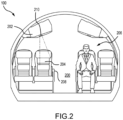
  • Cabin 200 may be a cabin such as the first cabin section 118, the second cabin section 120, or the third cabin section 122 of FIG. 1 .
  • the cabin 200 may include overhead storage bins 202, passenger seats 204 for supporting passengers 206, armrest 208, lavatory surfaces, PEDs, and other structures/surfaces.
  • the cabin 200 may include passenger service units (PSUs) 210 that control various functions for passengers in the cabin 200, such as reading lighting, air conditioning, and a flight attendant call signal.
  • PSUs passenger service units
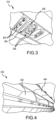
  • the PSU 210 includes a row of three adjacent aircraft passenger cabin gaspers 302, hereinafter referred to as "gaspers" 302.
  • the gaspers 302 are configured for blowing air towards the passengers, sitting on the passenger seats below the PSU 210.
  • the gaspers 302 have circular or nearly circular cross-sections.
  • the gaspers 302 in particular have a circular outlet for delivering air towards the passengers.
  • electrical switches 304 are provided next to reading lights 306.
  • each electrical switch of the electrical switches 304 is configured for switching an adjacent and associated reading light of reading lights 306, which is arranged next to the electrical switches 304 on the side opposite to the gaspers 302.
  • switch 308 is a call button for triggering a signal for calling flight attendant personnel.
  • the overhead storage bins 202 in one or more of the various cabin sections may include one or more of the walls 402 and a door 404 that form the overhead storage bins 202.
  • the door 404 may be in a closed position, as is illustrated with regard to overhead storage bins 202 of FIG. 2 , or in an open position, as is illustrated with regard to door 404 in FIG. 4 .
  • the in-flight service may include turning a reading light on or off, turning the air-conditioning on or off, calling for assistance of a flight attendant, or opening or closing a door to an overhead storage bin.
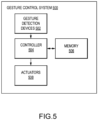
  • the gesture control system 500 may include one or more gesture detection devices 502, a controller 504, a memory 506, and a one or more actuators 508.
  • the one or more gesture detection devices 502 may be a sensor that senses a motion or movement made by the passenger.
  • the one or more gesture detection devices 502 detects a free space gesture, i.e., one or more of a movement of hands, fingers, or head, among others, of a user, i.e., a passenger, a flight crew member, or a maintenance crew member, among others.
  • a free space gesture i.e., one or more of a movement of hands, fingers, or head, among others, of a user, i.e., a passenger, a flight crew member, or a maintenance crew member, among others.
  • the free space gesture is a hands or fingers movement
  • the one or more gesture detection devices 502 may detect one or more of pointing, a wave, or sign language, among others.
  • the pointing may be pointing in an up direction, a down direction, a left direction, or a right direction.
  • the one or more gesture detection devices 502 detects one or more of head pose, nod, eye movement, or facial expression, among others. In various embodiments, the one or more gesture detection devices 502 may detect a sequence of free space gestures to control an in-flight service. In various embodiments, the one or more gesture detection devices 502 may be a visual sensing device, ultrasound sensing device, an infrared proximity sensing device, or a graphical user interface (GUI), among others, to capture the input signals from the user. In various embodiments, the one or more gesture detection devices 502 may be a sensor module including an IR source and an IR camera that maps a three-dimensional (3D) space to identify a free space gesture.
  • 3D three-dimensional
  • the one or more gesture detection devices 502 may be located on a back of passenger seat to which another passenger seat is facing or on a bulkhead to which a passenger seat facing. In various embodiments, the one or more gesture detection devices 502, which may be electrically coupled to the controller 504, may be configured to provide the detected free space gesture or sequence of free space gestures to the controller 504.
  • the controller 504 may include a logic device such as one or more of a central processing unit (CPU), an accelerated processing unit (APU), a digital signal processor (DSP), a field programmable gate array (FPGA), an application specific integrated circuit (ASIC), or the like.
  • the controller 504 may further include any non-transitory memory known in the art. The memory may store instructions usable by the logic device to perform operations as described herein.
  • the controller 504 may be electrically coupled to one or more gesture detection devices 502 and may be configured to receive the detected free space gesture or sequence of free space gestures from the one or more gesture detection devices 502. In various embodiments, the controller 504 may process the detected free space gesture or sequence of free space gestures to identify an in-flight service from a plurality of in-flight services to be performed based on the detected free space gesture or sequence of free space gestures. In order to identify the in-flight service from a plurality of in-flight services based on the detected free space gesture or sequence of free space gestures, in various embodiments, the controller 504 accesses memory 506 which stores a database of identified free space gestures and gesture free space sequences.
  • the controller 504 compares the received free space gesture or sequence of free space gestures to the identified free space gestures and free space gesture sequences stored in the database of identified free space gestures and free space gesture sequences in the memory 506 to identify a free space gesture or free space gesture sequence from the database of identified free space gestures and free space gesture sequences.
  • the controller 504 may send a signal back to the one or more gesture detection devices 502 to inform the user of the unrecognizable free space gesture or sequence of free space gestures.
  • the one or more gesture detection devices 502 is a GUI
  • the controller may provide a command that causes the GUI to display information informing the user to move closer to the GUI so that the free space gesture may be recognized or slow down the motion provided by the user so that the free space gesture may be recognized, among others.
  • an indicator may be provided next to the one or more gesture detection devices 502 that provides an indication informing the user to move closer to the GUI so that the free space gesture may be recognized or slow down the motion provided by the user so that the free space gesture may be recognized, among others.
  • the memory 506 further includes a gesture-to-in-flight service correlation database that provides a cross-reference or correlation of free space gestures and free space gesture sequences to in-flight services.
  • the controller 504 uses an identified free space gesture or free space gesture sequence from database of identified free space gestures and free space gesture sequences to identify an associated in-flight service from the gesture-to-in-flight service correlation database.
  • the controller 540 may be configured to send a command to one or more of the one or more actuators 508 so that the one or more actuators perform the in-flight service.
  • the one or more actuators 508 may be coupled to the reading light, the gaspers, the flight attendant call signal, or the door to the overhead storage bin.
  • users seated on their seat would be able to perform a free space gesture in front of the one or more gesture detection devices 502 to perform one or more in-flight service such as, turning a reading light on or off, turning the air-conditioning on or off, calling for assistance of a flight attendant, or opening or closing a door to an overhead storage bin.
  • performing one or more of these in-flight services provides touchless service such that the user would not have to get up from their seat and cause hindrance for the other fellow users as well as making services to users who are not able to accomplish these tasks easier.
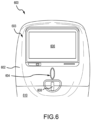
  • the passenger seat 600 such as passenger seats 204 of FIG. 2 , includes a seat back 602 with a seat assembly 603 onto which one or more gesture detection devices 604 or 606, such as one or more gesture detection devices 502 of FIG. 5 , may be located.
  • the one or more gesture detection devices 604 or 606 are disposed proximate a latch 608.
  • “Proximate” as disclosed herein refers to being spaced apart from, in accordance with various embodiments.
  • the latch 608 may be configured to release a tray 610, in accordance with various embodiments.
  • latch 608 may retrain the tray 610 in a closed state in response to the latch 608 being in a first position as illustrated.
  • the tray 610 may be released and transition into an open state.
  • the latch 608 is not limited in this regard.
  • the latch 608 could include a push release, an automated release, or the like.
  • the seat assembly 603 include one or more gesture detection devices 604 or 606.
  • the gesture detection devices 604 may be one or more of a visual sensing device, ultrasound sensing device, or an infrared proximity sensing device, among others, to capture the input signals from the user. Although illustrated as including a plurality of gesture detection devices 604, the present disclosure is not limited in this regard. For example, a seat assembly 603 having only one gesture detection device 604 is within the scope of this disclosure.
  • the gesture detection device 606 is a graphical user interface (GUI) to capture the input signals from the user.
  • GUI graphical user interface
  • the gesture detection device 606 may be configured to display various media, such as movies, games, etc.
  • the one or more gesture detection devices 604 or 606 are electrically coupled to a power source and a controller. Although illustrated as including the gesture detection device 606, the present disclosure is not limited in this regard. For example, a seat assembly 603 without the gesture detection device 606 is within the scope of this disclosure.
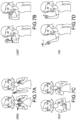
  • FIGs. 7A, 7B, 7C, and 7D a plurality of sign language gestures for use with gesture detection devices are illustrated. That is, in addition to the one or more gesture detection devices, such as one or more gesture detection devices 604 or 606 of FIG. 6 and one or more gesture detection devices 502 of FIG.
  • the gesture detection device may identify more specific free space gestures such as sign language.
  • the free space gesture that may be performed by the user may be sign language sign for "open,” as illustrated in FIG. 7A , that would be associated with opening a door to an overhead storage bin.
  • the gesture that may be performed by the user may be sign language sign for "light,” as illustrated in FIG.
  • the free space gesture that may be performed by the user may be sign language sign for "help,” as illustrated in FIG. 7C , that would be associated with calling for assistance of a flight attendant.
  • the free space gesture that may be performed by the user may be sign language sign for "fan,” as illustrated in FIG. 7D , that would be associated with turning the air-conditioning on or off.
  • the free space gesture control system may be programmed with numerous sign language signs that may be associated with in-flight services that are within the scope of this disclosure.
  • FIG. 8A, 8B, 8C, and 8D in accordance with various embodiments, a plurality of sign language letters that may be identified as free space gestures for use with gesture detection devices are illustrated. That is, in addition to the one or more gesture detection devices, such as one or more gesture detection devices 604 or 606 of FIG. 6 and one or more gesture detection devices of FIG.
  • the gesture detection device may identify more specific free space gestures such as sign language letters.
  • the free space gesture that may be performed by the user may be sign language letter "O," as illustrated in FIG. 8A , that would be associated with opening a door to an overhead storage bin.
  • the free space gesture that may be performed by the user may be sign language sign letter "L,” as illustrated in FIG.
  • the free space gesture that may be performed by the user may be sign language sign letter "H,” as illustrated in FIG. 8C , that would be associated with calling for assistance of a flight attendant.
  • the free space gesture that may be performed by the user may be sign language sign letter "A,” as illustrated in FIG. 8D , that would be associated with turning the air-conditioning on or off.
  • the gesture control system may be programmed with numerous sign language letter that may be associated with in-flight services that are within the scope of this disclosure.
  • the method 900 may be performed by a controller, such as controller 504 described above with respect to FIG. 5 .
  • the controller may be configured to receive a detected free space gesture or sequence of free space gestures from the one or more gesture detection devices such as one or more gesture detection devices 604 or 606 of FIG. 6 and one or more gesture detection devices 502 of FIG. 5 .
  • the controller may be configured to compare the received free space gesture or sequence of free space gestures to identified free space gestures and free space gesture sequences stored in the database of identified free space gestures and free space gesture sequences in a memory.
  • the controller may be configured to determine whether free space gesture is unrecognizable. If at block 906 the free space gesture is unrecognizable, at block 908, the controller may be configured to send a command back to the one or more gesture detection devices so that the one or more gesture detection devices inform the user of the unrecognizable free space gesture or sequence of free space gestures. If at block 906, the free space gesture is recognizable, i.e., a failure to identify a recognizable command, then at block 910 the controller may be configured to use the identified free space gesture or free space gesture sequence from the database of identified free space gestures and free space gesture sequences to identify an associated in-flight service from the gesture-to-in-flight service correlation database. At block 912, once the controller has identified the in-flight service, the controller may be configured to send a command to one or more of one or more actuators so that the one or more actuators perform the in-flight service.
  • references to "one embodiment,” “an embodiment,” “various embodiments,” etc. indicate that the embodiment described may include a particular feature, structure, or characteristic, but every embodiment may not necessarily include the particular feature, structure, or characteristic. Moreover, such phrases are not necessarily referring to the same embodiment. Further, when a particular feature, structure, or characteristic is described in connection with an embodiment, it is submitted that it is within the knowledge of one skilled in the art to affect such feature, structure, or characteristic in connection with other embodiments whether or not explicitly described. After reading the description, it will be apparent to one skilled in the relevant art(s) how to implement the disclosure in alternative embodiments.
  • Numbers, percentages, or other values stated herein are intended to include that value, and also other values that are about or approximately equal to the stated value, as would be appreciated by one of ordinary skill in the art encompassed by various embodiments of the present disclosure.
  • a stated value should therefore be interpreted broadly enough to encompass values that are at least close enough to the stated value to perform a desired function or achieve a desired result.
  • the stated values include at least the variation to be expected in a suitable industrial process, and may include values that are within 10%, within 5%, within 1%, within 0.1%, or within 0.01% of a stated value.
  • the terms “substantially,” “about,” or “approximately” as used herein represent an amount close to the stated amount that still performs a desired function or achieves a desired result.
  • the term “substantially,” “about,” or “approximately” may refer to an amount that is within 10% of, within 5% of, within 1% of, within 0.1% of, and within 0.01% of a stated amount or value

Landscapes

  • Engineering & Computer Science (AREA)
  • General Engineering & Computer Science (AREA)
  • Theoretical Computer Science (AREA)
  • Human Computer Interaction (AREA)
  • Physics & Mathematics (AREA)
  • General Physics & Mathematics (AREA)
  • User Interface Of Digital Computer (AREA)

Abstract

A system for controlling in-flight services using gestures is disclosed. The system comprises: a gesture detection device (502); an actuator (508); and a controller (504). The controller is configured to: receive a detected free space gesture from the gesture detection device; compare the detected free space gesture to a plurality of identified free space gestures; responsive to identifying a free space gesture from the plurality of identified free space gestures, identify an associated in-flight service based on the identified free space gesture; and responsive to identifying the associated in-flight service, send a first command to the actuator to perform the associated in-flight service.

Description

    CROSS-REFERENCE TO RELATED APPLICATIONS
  • This application claims priority to, and the benefit of, India Patent Application No. 202211051674 (DAS CODE: CA33), filed September 9, 2022 , and titled "GESTURE CONTROLLED INTERFACE FOR IN-FLIGHT USERS," and U.S. 18/077,925 filed on 8 December 2022 ..
  • FIELD
  • The present disclosure relates to systems and methods for controlling in-flight services, and more specifically, to using gestures to control in-flight services.
  • BACKGROUND
  • The world is getting more connected by the day. Currently, over 4.6 billion passengers are transported by global commercial airlines and this number is set to grow to a staggering 7.8 billion by 2036. Airports and airlines are under sustained pressure to increase capacity, improve passenger experience and manage long-term traffic growth safely, cost-effectively and with less impact on the environment. It is clear that air and ground travel workflows must adapt not only to reduce costs but, importantly, to give passengers a better, customer friendly and relaxed traveling experience. Over time, in order to stay competitive, it has become important for airlines to revisit the customers' requirements and understand them better. With the advancement in technology, customers expect to have a more powerful and hassle-free user interface.
  • SUMMARY
  • Disclosed herein is a system for controlling in-flight services using gestures. The system includes a gesture detection device; an actuator; and a controller, where the controller is configured to: receive a detected free space gesture from the gesture detection device; compare the detected free space gesture to a plurality of identified free space gestures; responsive to identifying a free space gesture from the plurality of identified free space gestures, identify an associated in-flight service based on the identified free space gesture; and, responsive to identifying the associated in-flight service, send a first command to the actuator to perform the associated in-flight service.
  • In various embodiments, the detected free space gesture is at least one of a movement of hands, fingers, or a head. In various embodiments, the movement of the head is at least one of a head pose, a nod, an eye movement, or a facial expression. In various embodiments, the movement of the fingers is at least one of pointing in at least one of an up direction, a down direction, a left direction, or a right direction. In various embodiments, the movement of the hands is a wave or sign language. In various embodiments, the sign language comprises a sign language sign or a sign language letter.
  • In various embodiments, the associated in-flight service is at least one of turning on a reading light, turning off the reading light, turning on air, turning off the air, turning on a flight attendant call signal, opening a door to a storage bin, or closing the door to the storage bin. In various embodiments, the gesture detection device is at least one of a visual sensing device, ultrasound sensing device, an infrared proximity sensing device, a graphical user interface (GUI), or a sensor module including an IR source and an IR camera.
  • In various embodiments, the controller is further configured to, responsive to a failure to identify the free space gesture from the plurality of identified free space gestures, send a second command back to the gesture detection device to inform a user of an unrecognizable free space gesture. In various embodiments, the free space gesture is a sequence of free space gestures.
  • Also disclosed herein is a method for controlling in-flight services using gestures. The method includes receiving, by a controller, a detected free space gesture from a gesture detection device; comparing, by the controller, the detected free space gesture to a plurality of identified free space gestures; responsive to identifying a free space gesture from the plurality of identified free space gestures, identifying, by the controller, an associated in-flight service based on the identified free space gesture; and responsive to identifying the associated in-flight service, sending, by the controller, a first command to an actuator to perform the associated in-flight service.
  • In various embodiments, the detected free space gesture is at least one of a movement of hands, fingers, or a head. In various embodiments, the movement of the head is at least one of a head pose, a nod, an eye movement, or a facial expression. In various embodiments, the movement of the fingers is at least one of pointing in at least one of an up direction, a down direction, a left direction, or a right direction. In various embodiments, the movement of the hands is a wave or sign language. In various embodiments, the sign language comprises a sign language sign or a sign language letter.
  • In various embodiments, the associated in-flight service is at least one of turning on a reading light, turning off the reading light, turning on air, turning off the air, turning on a flight attendant call signal, opening a door to a storage bin, or closing the door to the storage bin. In various embodiments, the gesture detection device is at least one of a visual sensing device, ultrasound sensing device, an infrared proximity sensing device, or a graphical user interface (GUI), or a sensor module including an IR source and an IR camera.
  • In various embodiments, the method further comprises, responsive to a failure to identify the free space gesture from the plurality of identified free space gestures, sending, by the controller, a second command back to the gesture detection device to inform a user of an unrecognizable free space gesture. In various embodiments, the free space gesture is a sequence of free space gestures.
  • BRIEF DESCRIPTION OF THE DRAWINGS
  • The subject matter of the present disclosure is particularly pointed out and distinctly claimed in the concluding portion of the specification. A more complete understanding of the present disclosure, however, may best be obtained by referring to the following detailed description and claims in connection with the following drawings. While the drawings illustrate various embodiments employing the principles described herein, the drawings do not limit the scope of the claims.
    • FIG. 1 illustrates an aircraft and various sections within the aircraft, in accordance with various embodiments.
    • FIG. 2 illustrates a cabin of an aircraft, in accordance with various embodiments.
    • FIG. 3 illustrates a view of passenger service unit (PSU) as seen from a passenger sitting on one of the passenger seats below the PSU, in accordance with various embodiments.
    • FIG. 4 illustrates a view of an overhead storage bins, in accordance with various embodiments.
    • FIG. 5 illustrates a system that may be used to control in-flight services using gestures, according to various embodiments.
    • FIG. 6 illustrates a passenger seat with gesture detection devices for use in a cabin of an aircraft, according to various embodiments.
    • FIGs. 7A, 7B, 7C, and 7D illustrate a plurality of sign language gestures for use with gesture detection devices, according to various embodiments.
    • FIGs. 8A, 8B, 8C, and 8D illustrate a plurality of sign language letters that may be identified as gestures for use with gesture detection devices, according to various embodiments.
    • FIG. 9 illustrates a method for controlling in-flight services using gestures, according to various embodiments.
    DETAILED DESCRIPTION
  • The following detailed description of various embodiments herein makes reference to the accompanying drawings, which show various embodiments by way of illustration. While these various embodiments are described in sufficient detail to enable those skilled in the art to practice the disclosure, it should be understood that other embodiments may be realized and that changes may be made without departing from the scope of the disclosure. Thus, the detailed description herein is presented for purposes of illustration only and not of limitation. Furthermore, any reference to singular includes plural embodiments, and any reference to more than one component or step may include a singular embodiment or step. Also, any reference to attached, fixed, connected, or the like may include permanent, removable, temporary, partial, full or any other possible attachment option. Additionally, any reference to without contact (or similar phrases) may also include reduced contact or minimal contact. It should also be understood that unless specifically stated otherwise, references to "a," "an," or "the" may include one or more than one and that reference to an item in the singular may also include the item in the plural. Further, all ranges may include upper and lower values and all ranges and ratio limits disclosed herein may be combined.
  • Currently, services, such as a passenger's reading lighting, air conditioning, and flight attendant call signal are placed above the passenger and are operated manually. Additionally, doors to the overhead storage bins are closed manually by passengers or flight attendants.
  • However, manual operating the passenger's reading lighting, air conditioning, and flight attendant call signal as well as a door to the overhead storage bins have many drawbacks. For example, for a passenger who is not able to easily reach the overhead panel, that passenger must get up every time to activate or deactivate the reading lighting, air conditioning, flight attendant call signal, and/or open and close the door to the overhead storage bins.
  • Disclosed herein is a system and method for using gestures to control in-flight services. The system and method disclosed herein provides for the passenger and/or flight attendant to use gestures to control one or more of the passenger's reading lighting, air conditioning, flight attendant call signal, and overhead storage bin doors. Utilizing gestures to activate or deactivate the reading lighting, air conditioning, flight attendant call signal, and/or open and close the door to the overhead storage bins reduces a need for passengers to get up every time to operate the switch panels placed overhead and provides autonomy to disabled passengers. Also, considering a pandemic situation, utilizing gestures to activate or deactivate the reading lighting, air conditioning, flight attendant call signal, and/or open and close the door to the overhead storage bins ensures touchless points in future advancements. This provides safer environment to the passengers also reduces the ambiguity in passengers point of view.
  • Referring now to FIG. 1, in accordance with various embodiments, an aircraft 100 and various sections within the aircraft is illustrated. The aircraft 100 is an example of a passenger or transport vehicle in which gesture-controlled systems may be implemented in accordance with various embodiments. In various embodiments, the aircraft 100 has a starboard wing 102 and a port wing 104 attached to a fuselage 106. In various embodiments, the aircraft 100 also includes a starboard engine 108 connected to the starboard wing 102 and a port engine 110 connected to the port wing 104. In various embodiments, the aircraft 100 also includes a starboard horizontal stabilizer 112, a port horizontal stabilizer 114, and a vertical stabilizer 116. In various embodiments, the aircraft 100 also includes various cabin sections, including, for example, a first cabin section 118, a second cabin section 120, a third cabin section 122, and a pilot cabin 124.
  • Referring now to FIG. 2, in accordance with various embodiments, a cabin of an aircraft 100 is illustrated. Cabin 200 may be a cabin such as the first cabin section 118, the second cabin section 120, or the third cabin section 122 of FIG. 1. In various embodiments, the cabin 200 may include overhead storage bins 202, passenger seats 204 for supporting passengers 206, armrest 208, lavatory surfaces, PEDs, and other structures/surfaces. In various embodiment, the cabin 200 may include passenger service units (PSUs) 210 that control various functions for passengers in the cabin 200, such as reading lighting, air conditioning, and a flight attendant call signal.
  • Referring now to FIG. 3, in accordance with various embodiments, a view of passenger service unit (PSU) as seen from a passenger sitting on one of the passenger seats below the PSU is illustrated. In various embodiments, the PSU 210 includes a row of three adjacent aircraft passenger cabin gaspers 302, hereinafter referred to as "gaspers" 302. In various embodiments, the gaspers 302 are configured for blowing air towards the passengers, sitting on the passenger seats below the PSU 210. In various embodiments, the gaspers 302 have circular or nearly circular cross-sections. In various embodiments, the gaspers 302 in particular have a circular outlet for delivering air towards the passengers. In various embodiments, electrical switches 304 are provided next to reading lights 306. In various embodiments, each electrical switch of the electrical switches 304 is configured for switching an adjacent and associated reading light of reading lights 306, which is arranged next to the electrical switches 304 on the side opposite to the gaspers 302. In various embodiments, switch 308 is a call button for triggering a signal for calling flight attendant personnel.
  • Referring now to FIG. 4, in accordance with various embodiments, a view of an overhead storage bins 202 of FIG. 2 is illustrated. In various embodiments, the overhead storage bins 202 in one or more of the various cabin sections, such as the first cabin section 118, the second cabin section 120, or the third cabin section 122 of FIG. 1, may include one or more of the walls 402 and a door 404 that form the overhead storage bins 202. In various embodiments, the door 404 may be in a closed position, as is illustrated with regard to overhead storage bins 202 of FIG. 2, or in an open position, as is illustrated with regard to door 404 in FIG. 4.
  • Referring now to FIG. 5, in accordance with various embodiments, a system that may be used to control in-flight services using gestures is illustrated. In various embodiments, the in-flight service may include turning a reading light on or off, turning the air-conditioning on or off, calling for assistance of a flight attendant, or opening or closing a door to an overhead storage bin. The gesture control system 500 may include one or more gesture detection devices 502, a controller 504, a memory 506, and a one or more actuators 508. In various embodiments, the one or more gesture detection devices 502 may be a sensor that senses a motion or movement made by the passenger. In various embodiments, the one or more gesture detection devices 502 detects a free space gesture, i.e., one or more of a movement of hands, fingers, or head, among others, of a user, i.e., a passenger, a flight crew member, or a maintenance crew member, among others. In that regard, if the free space gesture is a hands or fingers movement, the one or more gesture detection devices 502 may detect one or more of pointing, a wave, or sign language, among others. In various embodiment, the pointing may be pointing in an up direction, a down direction, a left direction, or a right direction. In various embodiments, if the free space gesture is a head movement, the one or more gesture detection devices 502 detects one or more of head pose, nod, eye movement, or facial expression, among others. In various embodiments, the one or more gesture detection devices 502 may detect a sequence of free space gestures to control an in-flight service. In various embodiments, the one or more gesture detection devices 502 may be a visual sensing device, ultrasound sensing device, an infrared proximity sensing device, or a graphical user interface (GUI), among others, to capture the input signals from the user. In various embodiments, the one or more gesture detection devices 502 may be a sensor module including an IR source and an IR camera that maps a three-dimensional (3D) space to identify a free space gesture. In various embodiments, the one or more gesture detection devices 502 may be located on a back of passenger seat to which another passenger seat is facing or on a bulkhead to which a passenger seat facing. In various embodiments, the one or more gesture detection devices 502, which may be electrically coupled to the controller 504, may be configured to provide the detected free space gesture or sequence of free space gestures to the controller 504.
  • In various embodiments, the controller 504 may include a logic device such as one or more of a central processing unit (CPU), an accelerated processing unit (APU), a digital signal processor (DSP), a field programmable gate array (FPGA), an application specific integrated circuit (ASIC), or the like. In various embodiments, the controller 504 may further include any non-transitory memory known in the art. The memory may store instructions usable by the logic device to perform operations as described herein.
  • In various embodiments, the controller 504 may be electrically coupled to one or more gesture detection devices 502 and may be configured to receive the detected free space gesture or sequence of free space gestures from the one or more gesture detection devices 502. In various embodiments, the controller 504 may process the detected free space gesture or sequence of free space gestures to identify an in-flight service from a plurality of in-flight services to be performed based on the detected free space gesture or sequence of free space gestures. In order to identify the in-flight service from a plurality of in-flight services based on the detected free space gesture or sequence of free space gestures, in various embodiments, the controller 504 accesses memory 506 which stores a database of identified free space gestures and gesture free space sequences. In various embodiments, the controller 504 compares the received free space gesture or sequence of free space gestures to the identified free space gestures and free space gesture sequences stored in the database of identified free space gestures and free space gesture sequences in the memory 506 to identify a free space gesture or free space gesture sequence from the database of identified free space gestures and free space gesture sequences.
  • In various embodiments, if the free space gesture or sequence of free space gestures is unrecognizable, then the controller 504 may send a signal back to the one or more gesture detection devices 502 to inform the user of the unrecognizable free space gesture or sequence of free space gestures. In that regard, if the one or more gesture detection devices 502 is a GUI, the controller may provide a command that causes the GUI to display information informing the user to move closer to the GUI so that the free space gesture may be recognized or slow down the motion provided by the user so that the free space gesture may be recognized, among others. In that regard, if the one or more gesture detection devices 502 is a visual sensing device, ultrasound sensing device, or an infrared proximity sensing device, an indicator may be provided next to the one or more gesture detection devices 502 that provides an indication informing the user to move closer to the GUI so that the free space gesture may be recognized or slow down the motion provided by the user so that the free space gesture may be recognized, among others.
  • In various embodiments, the memory 506 further includes a gesture-to-in-flight service correlation database that provides a cross-reference or correlation of free space gestures and free space gesture sequences to in-flight services. In that regard, in various embodiment, the controller 504 uses an identified free space gesture or free space gesture sequence from database of identified free space gestures and free space gesture sequences to identify an associated in-flight service from the gesture-to-in-flight service correlation database. In various embodiments, once the controller has identified the in-flight service, the controller 540 may be configured to send a command to one or more of the one or more actuators 508 so that the one or more actuators perform the in-flight service. In various embodiment, the one or more actuators 508 may be coupled to the reading light, the gaspers, the flight attendant call signal, or the door to the overhead storage bin.
  • Accordingly, in various embodiments, users seated on their seat would be able to perform a free space gesture in front of the one or more gesture detection devices 502 to perform one or more in-flight service such as, turning a reading light on or off, turning the air-conditioning on or off, calling for assistance of a flight attendant, or opening or closing a door to an overhead storage bin. In various embodiments, performing one or more of these in-flight services provides touchless service such that the user would not have to get up from their seat and cause hindrance for the other fellow users as well as making services to users who are not able to accomplish these tasks easier.
  • Referring now to FIG. 6, in accordance with various embodiments, a passenger seat with gesture detection devices for use in a cabin of an aircraft is illustrated. In various embodiments, the passenger seat 600, such as passenger seats 204 of FIG. 2, includes a seat back 602 with a seat assembly 603 onto which one or more gesture detection devices 604 or 606, such as one or more gesture detection devices 502 of FIG. 5, may be located. In various embodiments, the one or more gesture detection devices 604 or 606 are disposed proximate a latch 608. "Proximate" as disclosed herein refers to being spaced apart from, in accordance with various embodiments. The latch 608 may be configured to release a tray 610, in accordance with various embodiments. In this regard, latch 608 may retrain the tray 610 in a closed state in response to the latch 608 being in a first position as illustrated. In various embodiments, by rotating the latch 608, the tray 610 may be released and transition into an open state. Although illustrated as being configured to rotate, the latch 608 is not limited in this regard. For example, the latch 608 could include a push release, an automated release, or the like.
  • In various embodiments, the seat assembly 603 include one or more gesture detection devices 604 or 606. In various embodiments, the gesture detection devices 604 may be one or more of a visual sensing device, ultrasound sensing device, or an infrared proximity sensing device, among others, to capture the input signals from the user. Although illustrated as including a plurality of gesture detection devices 604, the present disclosure is not limited in this regard. For example, a seat assembly 603 having only one gesture detection device 604 is within the scope of this disclosure. In various embodiments, the gesture detection device 606 is a graphical user interface (GUI) to capture the input signals from the user. The gesture detection device 606 may be configured to display various media, such as movies, games, etc. In various embodiments, the one or more gesture detection devices 604 or 606 are electrically coupled to a power source and a controller. Although illustrated as including the gesture detection device 606, the present disclosure is not limited in this regard. For example, a seat assembly 603 without the gesture detection device 606 is within the scope of this disclosure.
  • Referring now to FIGs. 7A, 7B, 7C, and 7D, in accordance with various embodiments, a plurality of sign language gestures for use with gesture detection devices are illustrated. That is, in addition to the one or more gesture detection devices, such as one or more gesture detection devices 604 or 606 of FIG. 6 and one or more gesture detection devices 502 of FIG. 5, detects a free space gesture, i.e., one or more of a movement of hands, fingers, or head, among others, of a user, i.e., a passenger, a flight crew member, or a maintenance crew member, among others, such as pointing, waving, head pose, nod, eye movement, or facial expression, among others, the gesture detection device may identify more specific free space gestures such as sign language. In various embodiments, the free space gesture that may be performed by the user may be sign language sign for "open," as illustrated in FIG. 7A, that would be associated with opening a door to an overhead storage bin. In various embodiments, the gesture that may be performed by the user may be sign language sign for "light," as illustrated in FIG. 7B, that would be associated with turning a reading light on or off. In various embodiments, the free space gesture that may be performed by the user may be sign language sign for "help," as illustrated in FIG. 7C, that would be associated with calling for assistance of a flight attendant. In various embodiments, the free space gesture that may be performed by the user may be sign language sign for "fan," as illustrated in FIG. 7D, that would be associated with turning the air-conditioning on or off. Although illustrated as including only these sign language signs, the present disclosure is not limited in this regard. For example, the free space gesture control system may be programmed with numerous sign language signs that may be associated with in-flight services that are within the scope of this disclosure.
  • Referring now to FIG. 8A, 8B, 8C, and 8D, in accordance with various embodiments, a plurality of sign language letters that may be identified as free space gestures for use with gesture detection devices are illustrated. That is, in addition to the one or more gesture detection devices, such as one or more gesture detection devices 604 or 606 of FIG. 6 and one or more gesture detection devices of FIG. 5, detects a free space gesture, i.e., one or more of a movement of hands, fingers, or head, among others, of a user, i.e., a passenger, a flight crew member, or a maintenance crew member, among others, such as pointing, waving, sign language, head pose, nod, eye movement, or facial expression, among others, the gesture detection device may identify more specific free space gestures such as sign language letters. In various embodiments, the free space gesture that may be performed by the user may be sign language letter "O," as illustrated in FIG. 8A, that would be associated with opening a door to an overhead storage bin. In various embodiments, the free space gesture that may be performed by the user may be sign language sign letter "L," as illustrated in FIG. 8B, that would be associated with turning a reading light on or off. In various embodiments, the free space gesture that may be performed by the user may be sign language sign letter "H," as illustrated in FIG. 8C, that would be associated with calling for assistance of a flight attendant. In various embodiments, the free space gesture that may be performed by the user may be sign language sign letter "A," as illustrated in FIG. 8D, that would be associated with turning the air-conditioning on or off. Although illustrated as including only these sign language letters, the present disclosure is not limited in this regard. For example, the gesture control system may be programmed with numerous sign language letter that may be associated with in-flight services that are within the scope of this disclosure.
  • Referring now to FIG. 9, in accordance with various embodiments, a method for controlling in-flight services using gestures is illustrated. The method 900 may be performed by a controller, such as controller 504 described above with respect to FIG. 5. At block 902, the controller may be configured to receive a detected free space gesture or sequence of free space gestures from the one or more gesture detection devices such as one or more gesture detection devices 604 or 606 of FIG. 6 and one or more gesture detection devices 502 of FIG. 5. At block 904, the controller may be configured to compare the received free space gesture or sequence of free space gestures to identified free space gestures and free space gesture sequences stored in the database of identified free space gestures and free space gesture sequences in a memory. At block 906, the controller may be configured to determine whether free space gesture is unrecognizable. If at block 906 the free space gesture is unrecognizable, at block 908, the controller may be configured to send a command back to the one or more gesture detection devices so that the one or more gesture detection devices inform the user of the unrecognizable free space gesture or sequence of free space gestures. If at block 906, the free space gesture is recognizable, i.e., a failure to identify a recognizable command, then at block 910 the controller may be configured to use the identified free space gesture or free space gesture sequence from the database of identified free space gestures and free space gesture sequences to identify an associated in-flight service from the gesture-to-in-flight service correlation database. At block 912, once the controller has identified the in-flight service, the controller may be configured to send a command to one or more of one or more actuators so that the one or more actuators perform the in-flight service.
  • Benefits and other advantages have been described herein with regard to specific embodiments. Furthermore, the connecting lines shown in the various figures contained herein are intended to represent exemplary functional relationships and/or physical couplings between the various elements. It should be noted that many alternative or additional functional relationships or physical connections may be present in a practical system. However, the benefits, advantages, and any elements that may cause any benefit or advantage to occur or become more pronounced are not to be construed as critical, required, or essential features or elements of the disclosure. The scope of the disclosure is accordingly to be limited by nothing other than the appended claims, in which reference to an element in the singular is not intended to mean "one and only one" unless explicitly so stated, but rather "one or more." Moreover, where a phrase similar to "at least one of A, B, or C" is used in the claims, it is intended that the phrase be interpreted to mean that A alone may be present in an embodiment, B alone may be present in an embodiment, C alone may be present in an embodiment, or that any combination of the elements A, B and C may be present in a single embodiment; for example, A and B, A and C, B and C, or A and B and C.
  • Systems, methods, and apparatus are provided herein. In the detailed description herein, references to "one embodiment," "an embodiment," "various embodiments," etc., indicate that the embodiment described may include a particular feature, structure, or characteristic, but every embodiment may not necessarily include the particular feature, structure, or characteristic. Moreover, such phrases are not necessarily referring to the same embodiment. Further, when a particular feature, structure, or characteristic is described in connection with an embodiment, it is submitted that it is within the knowledge of one skilled in the art to affect such feature, structure, or characteristic in connection with other embodiments whether or not explicitly described. After reading the description, it will be apparent to one skilled in the relevant art(s) how to implement the disclosure in alternative embodiments.
  • Numbers, percentages, or other values stated herein are intended to include that value, and also other values that are about or approximately equal to the stated value, as would be appreciated by one of ordinary skill in the art encompassed by various embodiments of the present disclosure. A stated value should therefore be interpreted broadly enough to encompass values that are at least close enough to the stated value to perform a desired function or achieve a desired result. The stated values include at least the variation to be expected in a suitable industrial process, and may include values that are within 10%, within 5%, within 1%, within 0.1%, or within 0.01% of a stated value. Additionally, the terms "substantially," "about," or "approximately" as used herein represent an amount close to the stated amount that still performs a desired function or achieves a desired result. For example, the term "substantially," "about," or "approximately" may refer to an amount that is within 10% of, within 5% of, within 1% of, within 0.1% of, and within 0.01% of a stated amount or value.
  • Finally, it should be understood that, within the scope of the claims, any of the above-described concepts can be used alone or in combination with any or all of the other above-described concepts. Although various embodiments have been disclosed and described, one of ordinary skill in this art would recognize that certain modifications would come within the scope of the invention as defined by the claims.

Claims (15)

  1. A system for controlling in-flight services using gestures, the system comprising:
    a gesture detection device (502);
    an actuator (508); and
    a controller (504), wherein the controller is configured to:
    receive a detected free space gesture from the gesture detection device;
    compare the detected free space gesture to a plurality of identified free space gestures;
    responsive to identifying a free space gesture from the plurality of identified free space gestures, identify an associated in-flight service based on the identified free space gesture; and
    responsive to identifying the associated in-flight service, send a first command to the actuator to perform the associated in-flight service.
  2. The system of claim 1, wherein the detected free space gesture is at least one of a movement of hands, fingers, or a head.
  3. The system of claim 2, wherein the movement of the head is at least one of a head pose, a nod, an eye movement, or a facial expression.
  4. The system of claim 2, wherein the movement of the fingers is at least one of pointing in at least one of an up direction, a down direction, a left direction, or a right direction.
  5. The system of claim 2, wherein the movement of the hands is a wave or sign language and optionally wherein the sign language comprises a sign language sign or a sign language letter.
  6. The system of any preceding claim, wherein the associated in-flight service is at least one of turning on a reading light, turning off the reading light, turning on air, turning off the air, turning on a flight attendant call signal, opening a door to a storage bin, or closing the door to the storage bin.
  7. The system of any preceding claim, wherein the gesture detection device (502) is at least one of a visual sensing device, ultrasound sensing device, an infrared proximity sensing device, a graphical user interface, GUI, or a sensor module including an IR source and an IR camera.
  8. The system of any preceding claim, wherein the controller (504) is further configured to:
    responsive to a failure to identify the free space gesture from the plurality of identified free space gestures, send a second command back to the gesture detection device to inform a user of an unrecognizable free space gesture.
  9. The system of any preceding claim, wherein the free space gesture is a sequence of free space gestures.
  10. A method for controlling in-flight services using gestures, the method comprising:
    receiving, by a controller (504), a detected free space gesture from a gesture detection device;
    comparing, by the controller, the detected free space gesture to a plurality of identified free space gestures;
    responsive to identifying a free space gesture from the plurality of identified free space gestures, identifying, by the controller, an associated in-flight service based on the identified free space gesture; and
    responsive to identifying the associated in-flight service, sending, by the controller, a first command to an actuator to perform the associated in-flight service.
  11. The method of claim 10, wherein the detected free space gesture is at least one of a movement of hands, fingers, or a head, and optionally, wherein the movement of the head is at least one of a head pose, a nod, an eye movement, or a facial expression; wherein the movement of the fingers is at least one of pointing in at least one of an up direction, a down direction, a left direction, or a right direction; or wherein the movement of the hands is a wave or sign language, optionally wherein the sign language comprises a sign language sign or a sign language letter.
  12. The method of claim 10 or 11, wherein the associated in-flight service is at least one of turning on a reading light, turning off the reading light, turning on air, turning off the air, turning on a flight attendant call signal, opening a door to a storage bin, or closing the door to the storage bin.
  13. The method of claim 10, 11 or 12, wherein the gesture detection device is at least one of a visual sensing device, ultrasound sensing device, an infrared proximity sensing device, or a graphical user interface, GUI, or a sensor module including an IR source and an IR camera.
  14. The method of any of claims 10 to 13, wherein the method further comprises:
    responsive to a failure to identify the free space gesture from the plurality of identified free space gestures, sending, by the controller, a second command back to the gesture detection device to inform a user of an unrecognizable free space gesture.
  15. The method of any of claims 10 to 14, wherein the free space gesture is a sequence of free space gestures.
EP23196277.0A 2022-09-09 2023-09-08 Gesture controlled interface for in-flight users Pending EP4336317A1 (en)

Applications Claiming Priority (2)

Application Number Priority Date Filing Date Title
IN202211051674 2022-09-09
US18/077,925 US12153738B2 (en) 2022-09-09 2022-12-08 Gesture controlled interface for in-flight users

Publications (1)

Publication Number Publication Date
EP4336317A1 true EP4336317A1 (en) 2024-03-13

Family

ID=88016316

Family Applications (1)

Application Number Title Priority Date Filing Date
EP23196277.0A Pending EP4336317A1 (en) 2022-09-09 2023-09-08 Gesture controlled interface for in-flight users

Country Status (1)

Country Link
EP (1) EP4336317A1 (en)

Citations (5)

* Cited by examiner, † Cited by third party
Publication number Priority date Publication date Assignee Title
US20100199228A1 (en) * 2009-01-30 2010-08-05 Microsoft Corporation Gesture Keyboarding
US20130063340A1 (en) * 2011-09-09 2013-03-14 Thales Avionics, Inc. Eye tracking control of vehicle entertainment systems
US20180136733A1 (en) * 2007-10-29 2018-05-17 The Boeing Company Aircraft having gesture-based control for an onboard passenger service unit
US10423237B2 (en) * 2016-08-15 2019-09-24 Purple Communications, Inc. Gesture-based control and usage of video relay service communications
US20220001985A1 (en) * 2020-06-25 2022-01-06 Goodrich Corporation Aircraft smart cabin control

Patent Citations (5)

* Cited by examiner, † Cited by third party
Publication number Priority date Publication date Assignee Title
US20180136733A1 (en) * 2007-10-29 2018-05-17 The Boeing Company Aircraft having gesture-based control for an onboard passenger service unit
US20100199228A1 (en) * 2009-01-30 2010-08-05 Microsoft Corporation Gesture Keyboarding
US20130063340A1 (en) * 2011-09-09 2013-03-14 Thales Avionics, Inc. Eye tracking control of vehicle entertainment systems
US10423237B2 (en) * 2016-08-15 2019-09-24 Purple Communications, Inc. Gesture-based control and usage of video relay service communications
US20220001985A1 (en) * 2020-06-25 2022-01-06 Goodrich Corporation Aircraft smart cabin control

Similar Documents

Publication Publication Date Title
US11142321B2 (en) Aircraft door and privacy panel assemblies
CN108569408B (en) Vehicle comprising an electronic luggage rack control system
CN108569405B (en) Contactless operable luggage rack assembly
US10793277B2 (en) Electronic stowage bin control systems and methods
EP3299293B1 (en) A passenger supply unit for an aircraft cabin
US10647429B2 (en) Vehicle stowage bin assemblies having weight sensors
US8040257B2 (en) Apparatus for interconnecting a pilot station to at least one other aircraft zone, cockpit and aircraft equipped with such an apparatus
US10864849B2 (en) Illuminated stowage bin assemblies within vehicles
US12153738B2 (en) Gesture controlled interface for in-flight users
EP3606827A1 (en) Seat actuation control through in-flight entertainment system
EP4008633A1 (en) Stowage bin assemblies having electronic front panels
EP3708485A1 (en) An information projection and control system
EP4109222A1 (en) Gesture-based systems and methods for aircraft cabin light control
US20220404913A1 (en) Gesture-based systems and methods for aircraft cabin light control
EP4600149A1 (en) Divider system and method for an internal cabin of an aircraft
US12503231B2 (en) Centralized control system for an aircraft cabin
US20250313345A1 (en) System for flight status based control of a device arranged in a cabin of an aircraft and aircraft comprising such a system
Reisinger Inadvertent Slide Activation
WO2025073365A1 (en) Gesture recognition system

Legal Events

Date Code Title Description
PUAI Public reference made under article 153(3) epc to a published international application that has entered the european phase

Free format text: ORIGINAL CODE: 0009012

STAA Information on the status of an ep patent application or granted ep patent

Free format text: STATUS: THE APPLICATION HAS BEEN PUBLISHED

AK Designated contracting states

Kind code of ref document: A1

Designated state(s): AL AT BE BG CH CY CZ DE DK EE ES FI FR GB GR HR HU IE IS IT LI LT LU LV MC ME MK MT NL NO PL PT RO RS SE SI SK SM TR

STAA Information on the status of an ep patent application or granted ep patent

Free format text: STATUS: REQUEST FOR EXAMINATION WAS MADE

17P Request for examination filed

Effective date: 20240912

RBV Designated contracting states (corrected)

Designated state(s): AL AT BE BG CH CY CZ DE DK EE ES FI FR GB GR HR HU IE IS IT LI LT LU LV MC ME MK MT NL NO PL PT RO RS SE SI SK SM TR