EP4334502B1 - Novel oxyfluorides, electrodes containing them and their use for hydrogen production - Google Patents
Novel oxyfluorides, electrodes containing them and their use for hydrogen production Download PDFInfo
- Publication number
- EP4334502B1 EP4334502B1 EP22731067.9A EP22731067A EP4334502B1 EP 4334502 B1 EP4334502 B1 EP 4334502B1 EP 22731067 A EP22731067 A EP 22731067A EP 4334502 B1 EP4334502 B1 EP 4334502B1
- Authority
- EP
- European Patent Office
- Prior art keywords
- compound
- anyone
- formula
- solution
- electrode
- Prior art date
- Legal status (The legal status is an assumption and is not a legal conclusion. Google has not performed a legal analysis and makes no representation as to the accuracy of the status listed.)
- Active
Links
Images









Classifications
-
- B—PERFORMING OPERATIONS; TRANSPORTING
- B01—PHYSICAL OR CHEMICAL PROCESSES OR APPARATUS IN GENERAL
- B01J—CHEMICAL OR PHYSICAL PROCESSES, e.g. CATALYSIS OR COLLOID CHEMISTRY; THEIR RELEVANT APPARATUS
- B01J27/00—Catalysts comprising the elements or compounds of halogens, sulfur, selenium, tellurium, phosphorus or nitrogen; Catalysts comprising carbon compounds
- B01J27/06—Halogens; Compounds thereof
- B01J27/08—Halides
- B01J27/12—Fluorides
-
- B—PERFORMING OPERATIONS; TRANSPORTING
- B01—PHYSICAL OR CHEMICAL PROCESSES OR APPARATUS IN GENERAL
- B01J—CHEMICAL OR PHYSICAL PROCESSES, e.g. CATALYSIS OR COLLOID CHEMISTRY; THEIR RELEVANT APPARATUS
- B01J35/00—Catalysts, in general, characterised by their form or physical properties
- B01J35/30—Catalysts, in general, characterised by their form or physical properties characterised by their physical properties
- B01J35/33—Electric or magnetic properties
-
- C—CHEMISTRY; METALLURGY
- C01—INORGANIC CHEMISTRY
- C01G—COMPOUNDS CONTAINING METALS NOT COVERED BY SUBCLASSES C01D OR C01F
- C01G51/00—Compounds of cobalt
- C01G51/80—Compounds containing cobalt, with or without oxygen or hydrogen, and containing one or more other elements
- C01G51/82—Compounds containing cobalt, with or without oxygen or hydrogen, and containing two or more other elements
-
- C—CHEMISTRY; METALLURGY
- C01—INORGANIC CHEMISTRY
- C01G—COMPOUNDS CONTAINING METALS NOT COVERED BY SUBCLASSES C01D OR C01F
- C01G53/00—Compounds of nickel
- C01G53/80—Compounds containing nickel, with or without oxygen or hydrogen, and containing one or more other elements
- C01G53/82—Compounds containing nickel, with or without oxygen or hydrogen, and containing two or more other elements
-
- C—CHEMISTRY; METALLURGY
- C04—CEMENTS; CONCRETE; ARTIFICIAL STONE; CERAMICS; REFRACTORIES
- C04B—LIME, MAGNESIA; SLAG; CEMENTS; COMPOSITIONS THEREOF, e.g. MORTARS, CONCRETE OR LIKE BUILDING MATERIALS; ARTIFICIAL STONE; CERAMICS; REFRACTORIES; TREATMENT OF NATURAL STONE
- C04B35/00—Shaped ceramic products characterised by their composition; Ceramics compositions; Processing powders of inorganic compounds preparatory to the manufacturing of ceramic products
- C04B35/515—Shaped ceramic products characterised by their composition; Ceramics compositions; Processing powders of inorganic compounds preparatory to the manufacturing of ceramic products based on non-oxide ceramics
- C04B35/553—Shaped ceramic products characterised by their composition; Ceramics compositions; Processing powders of inorganic compounds preparatory to the manufacturing of ceramic products based on non-oxide ceramics based on fluorides
-
- C—CHEMISTRY; METALLURGY
- C04—CEMENTS; CONCRETE; ARTIFICIAL STONE; CERAMICS; REFRACTORIES
- C04B—LIME, MAGNESIA; SLAG; CEMENTS; COMPOSITIONS THEREOF, e.g. MORTARS, CONCRETE OR LIKE BUILDING MATERIALS; ARTIFICIAL STONE; CERAMICS; REFRACTORIES; TREATMENT OF NATURAL STONE
- C04B35/00—Shaped ceramic products characterised by their composition; Ceramics compositions; Processing powders of inorganic compounds preparatory to the manufacturing of ceramic products
- C04B35/622—Forming processes; Processing powders of inorganic compounds preparatory to the manufacturing of ceramic products
- C04B35/626—Preparing or treating the powders individually or as batches ; preparing or treating macroscopic reinforcing agents for ceramic products, e.g. fibres; mechanical aspects section B
- C04B35/62605—Treating the starting powders individually or as mixtures
- C04B35/62645—Thermal treatment of powders or mixtures thereof other than sintering
- C04B35/62675—Thermal treatment of powders or mixtures thereof other than sintering characterised by the treatment temperature
-
- C—CHEMISTRY; METALLURGY
- C25—ELECTROLYTIC OR ELECTROPHORETIC PROCESSES; APPARATUS THEREFOR
- C25B—ELECTROLYTIC OR ELECTROPHORETIC PROCESSES FOR THE PRODUCTION OF COMPOUNDS OR NON-METALS; APPARATUS THEREFOR
- C25B1/00—Electrolytic production of inorganic compounds or non-metals
- C25B1/01—Products
- C25B1/02—Hydrogen or oxygen
- C25B1/04—Hydrogen or oxygen by electrolysis of water
-
- C—CHEMISTRY; METALLURGY
- C25—ELECTROLYTIC OR ELECTROPHORETIC PROCESSES; APPARATUS THEREFOR
- C25B—ELECTROLYTIC OR ELECTROPHORETIC PROCESSES FOR THE PRODUCTION OF COMPOUNDS OR NON-METALS; APPARATUS THEREFOR
- C25B11/00—Electrodes; Manufacture thereof not otherwise provided for
- C25B11/04—Electrodes; Manufacture thereof not otherwise provided for characterised by the material
- C25B11/051—Electrodes formed of electrocatalysts on a substrate or carrier
- C25B11/052—Electrodes comprising one or more electrocatalytic coatings on a substrate
-
- C—CHEMISTRY; METALLURGY
- C25—ELECTROLYTIC OR ELECTROPHORETIC PROCESSES; APPARATUS THEREFOR
- C25B—ELECTROLYTIC OR ELECTROPHORETIC PROCESSES FOR THE PRODUCTION OF COMPOUNDS OR NON-METALS; APPARATUS THEREFOR
- C25B11/00—Electrodes; Manufacture thereof not otherwise provided for
- C25B11/04—Electrodes; Manufacture thereof not otherwise provided for characterised by the material
- C25B11/051—Electrodes formed of electrocatalysts on a substrate or carrier
- C25B11/055—Electrodes formed of electrocatalysts on a substrate or carrier characterised by the substrate or carrier material
- C25B11/057—Electrodes formed of electrocatalysts on a substrate or carrier characterised by the substrate or carrier material consisting of a single element or compound
- C25B11/065—Carbon
-
- C—CHEMISTRY; METALLURGY
- C25—ELECTROLYTIC OR ELECTROPHORETIC PROCESSES; APPARATUS THEREFOR
- C25B—ELECTROLYTIC OR ELECTROPHORETIC PROCESSES FOR THE PRODUCTION OF COMPOUNDS OR NON-METALS; APPARATUS THEREFOR
- C25B11/00—Electrodes; Manufacture thereof not otherwise provided for
- C25B11/04—Electrodes; Manufacture thereof not otherwise provided for characterised by the material
- C25B11/051—Electrodes formed of electrocatalysts on a substrate or carrier
- C25B11/073—Electrodes formed of electrocatalysts on a substrate or carrier characterised by the electrocatalyst material
- C25B11/075—Electrodes formed of electrocatalysts on a substrate or carrier characterised by the electrocatalyst material consisting of a single catalytic element or catalytic compound
- C25B11/077—Electrodes formed of electrocatalysts on a substrate or carrier characterised by the electrocatalyst material consisting of a single catalytic element or catalytic compound the compound being a non-noble metal oxide
- C25B11/0775—Electrodes formed of electrocatalysts on a substrate or carrier characterised by the electrocatalyst material consisting of a single catalytic element or catalytic compound the compound being a non-noble metal oxide of the rutile type
-
- H—ELECTRICITY
- H01—ELECTRIC ELEMENTS
- H01M—PROCESSES OR MEANS, e.g. BATTERIES, FOR THE DIRECT CONVERSION OF CHEMICAL ENERGY INTO ELECTRICAL ENERGY
- H01M4/00—Electrodes
- H01M4/86—Inert electrodes with catalytic activity, e.g. for fuel cells
- H01M4/8605—Porous electrodes
-
- H—ELECTRICITY
- H01—ELECTRIC ELEMENTS
- H01M—PROCESSES OR MEANS, e.g. BATTERIES, FOR THE DIRECT CONVERSION OF CHEMICAL ENERGY INTO ELECTRICAL ENERGY
- H01M4/00—Electrodes
- H01M4/86—Inert electrodes with catalytic activity, e.g. for fuel cells
- H01M4/90—Selection of catalytic material
- H01M4/9016—Oxides, hydroxides or oxygenated metallic salts
-
- H—ELECTRICITY
- H01—ELECTRIC ELEMENTS
- H01M—PROCESSES OR MEANS, e.g. BATTERIES, FOR THE DIRECT CONVERSION OF CHEMICAL ENERGY INTO ELECTRICAL ENERGY
- H01M4/00—Electrodes
- H01M4/86—Inert electrodes with catalytic activity, e.g. for fuel cells
- H01M4/90—Selection of catalytic material
- H01M4/9075—Catalytic material supported on carriers, e.g. powder carriers
-
- H—ELECTRICITY
- H01—ELECTRIC ELEMENTS
- H01M—PROCESSES OR MEANS, e.g. BATTERIES, FOR THE DIRECT CONVERSION OF CHEMICAL ENERGY INTO ELECTRICAL ENERGY
- H01M8/00—Fuel cells; Manufacture thereof
- H01M8/08—Fuel cells with aqueous electrolytes
- H01M8/083—Alkaline fuel cells
-
- H—ELECTRICITY
- H01—ELECTRIC ELEMENTS
- H01M—PROCESSES OR MEANS, e.g. BATTERIES, FOR THE DIRECT CONVERSION OF CHEMICAL ENERGY INTO ELECTRICAL ENERGY
- H01M8/00—Fuel cells; Manufacture thereof
- H01M8/08—Fuel cells with aqueous electrolytes
- H01M8/086—Phosphoric acid fuel cells [PAFC]
-
- C—CHEMISTRY; METALLURGY
- C01—INORGANIC CHEMISTRY
- C01P—INDEXING SCHEME RELATING TO STRUCTURAL AND PHYSICAL ASPECTS OF SOLID INORGANIC COMPOUNDS
- C01P2002/00—Crystal-structural characteristics
- C01P2002/50—Solid solutions
-
- C—CHEMISTRY; METALLURGY
- C01—INORGANIC CHEMISTRY
- C01P—INDEXING SCHEME RELATING TO STRUCTURAL AND PHYSICAL ASPECTS OF SOLID INORGANIC COMPOUNDS
- C01P2002/00—Crystal-structural characteristics
- C01P2002/70—Crystal-structural characteristics defined by measured X-ray, neutron or electron diffraction data
- C01P2002/72—Crystal-structural characteristics defined by measured X-ray, neutron or electron diffraction data by d-values or two theta-values, e.g. as X-ray diagram
-
- C—CHEMISTRY; METALLURGY
- C01—INORGANIC CHEMISTRY
- C01P—INDEXING SCHEME RELATING TO STRUCTURAL AND PHYSICAL ASPECTS OF SOLID INORGANIC COMPOUNDS
- C01P2002/00—Crystal-structural characteristics
- C01P2002/80—Crystal-structural characteristics defined by measured data other than those specified in group C01P2002/70
- C01P2002/82—Crystal-structural characteristics defined by measured data other than those specified in group C01P2002/70 by IR- or Raman-data
-
- C—CHEMISTRY; METALLURGY
- C01—INORGANIC CHEMISTRY
- C01P—INDEXING SCHEME RELATING TO STRUCTURAL AND PHYSICAL ASPECTS OF SOLID INORGANIC COMPOUNDS
- C01P2002/00—Crystal-structural characteristics
- C01P2002/80—Crystal-structural characteristics defined by measured data other than those specified in group C01P2002/70
- C01P2002/85—Crystal-structural characteristics defined by measured data other than those specified in group C01P2002/70 by XPS, EDX or EDAX data
-
- C—CHEMISTRY; METALLURGY
- C01—INORGANIC CHEMISTRY
- C01P—INDEXING SCHEME RELATING TO STRUCTURAL AND PHYSICAL ASPECTS OF SOLID INORGANIC COMPOUNDS
- C01P2002/00—Crystal-structural characteristics
- C01P2002/80—Crystal-structural characteristics defined by measured data other than those specified in group C01P2002/70
- C01P2002/88—Crystal-structural characteristics defined by measured data other than those specified in group C01P2002/70 by thermal analysis data, e.g. TGA, DTA, DSC
-
- C—CHEMISTRY; METALLURGY
- C01—INORGANIC CHEMISTRY
- C01P—INDEXING SCHEME RELATING TO STRUCTURAL AND PHYSICAL ASPECTS OF SOLID INORGANIC COMPOUNDS
- C01P2004/00—Particle morphology
- C01P2004/01—Particle morphology depicted by an image
- C01P2004/04—Particle morphology depicted by an image obtained by TEM, STEM, STM or AFM
-
- C—CHEMISTRY; METALLURGY
- C01—INORGANIC CHEMISTRY
- C01P—INDEXING SCHEME RELATING TO STRUCTURAL AND PHYSICAL ASPECTS OF SOLID INORGANIC COMPOUNDS
- C01P2006/00—Physical properties of inorganic compounds
- C01P2006/40—Electric properties
-
- C—CHEMISTRY; METALLURGY
- C04—CEMENTS; CONCRETE; ARTIFICIAL STONE; CERAMICS; REFRACTORIES
- C04B—LIME, MAGNESIA; SLAG; CEMENTS; COMPOSITIONS THEREOF, e.g. MORTARS, CONCRETE OR LIKE BUILDING MATERIALS; ARTIFICIAL STONE; CERAMICS; REFRACTORIES; TREATMENT OF NATURAL STONE
- C04B2235/00—Aspects relating to ceramic starting mixtures or sintered ceramic products
- C04B2235/02—Composition of constituents of the starting material or of secondary phases of the final product
- C04B2235/30—Constituents and secondary phases not being of a fibrous nature
- C04B2235/32—Metal oxides, mixed metal oxides, or oxide-forming salts thereof, e.g. carbonates, nitrates, (oxy)hydroxides, chlorides
- C04B2235/327—Iron group oxides, their mixed metal oxides, or oxide-forming salts thereof
- C04B2235/3272—Iron oxides or oxide forming salts thereof, e.g. hematite, magnetite
-
- C—CHEMISTRY; METALLURGY
- C04—CEMENTS; CONCRETE; ARTIFICIAL STONE; CERAMICS; REFRACTORIES
- C04B—LIME, MAGNESIA; SLAG; CEMENTS; COMPOSITIONS THEREOF, e.g. MORTARS, CONCRETE OR LIKE BUILDING MATERIALS; ARTIFICIAL STONE; CERAMICS; REFRACTORIES; TREATMENT OF NATURAL STONE
- C04B2235/00—Aspects relating to ceramic starting mixtures or sintered ceramic products
- C04B2235/02—Composition of constituents of the starting material or of secondary phases of the final product
- C04B2235/30—Constituents and secondary phases not being of a fibrous nature
- C04B2235/32—Metal oxides, mixed metal oxides, or oxide-forming salts thereof, e.g. carbonates, nitrates, (oxy)hydroxides, chlorides
- C04B2235/327—Iron group oxides, their mixed metal oxides, or oxide-forming salts thereof
- C04B2235/3275—Cobalt oxides, cobaltates or cobaltites or oxide forming salts thereof, e.g. bismuth cobaltate, zinc cobaltite
-
- C—CHEMISTRY; METALLURGY
- C04—CEMENTS; CONCRETE; ARTIFICIAL STONE; CERAMICS; REFRACTORIES
- C04B—LIME, MAGNESIA; SLAG; CEMENTS; COMPOSITIONS THEREOF, e.g. MORTARS, CONCRETE OR LIKE BUILDING MATERIALS; ARTIFICIAL STONE; CERAMICS; REFRACTORIES; TREATMENT OF NATURAL STONE
- C04B2235/00—Aspects relating to ceramic starting mixtures or sintered ceramic products
- C04B2235/02—Composition of constituents of the starting material or of secondary phases of the final product
- C04B2235/30—Constituents and secondary phases not being of a fibrous nature
- C04B2235/32—Metal oxides, mixed metal oxides, or oxide-forming salts thereof, e.g. carbonates, nitrates, (oxy)hydroxides, chlorides
- C04B2235/327—Iron group oxides, their mixed metal oxides, or oxide-forming salts thereof
- C04B2235/3279—Nickel oxides, nickalates, or oxide-forming salts thereof
-
- C—CHEMISTRY; METALLURGY
- C04—CEMENTS; CONCRETE; ARTIFICIAL STONE; CERAMICS; REFRACTORIES
- C04B—LIME, MAGNESIA; SLAG; CEMENTS; COMPOSITIONS THEREOF, e.g. MORTARS, CONCRETE OR LIKE BUILDING MATERIALS; ARTIFICIAL STONE; CERAMICS; REFRACTORIES; TREATMENT OF NATURAL STONE
- C04B2235/00—Aspects relating to ceramic starting mixtures or sintered ceramic products
- C04B2235/02—Composition of constituents of the starting material or of secondary phases of the final product
- C04B2235/30—Constituents and secondary phases not being of a fibrous nature
- C04B2235/32—Metal oxides, mixed metal oxides, or oxide-forming salts thereof, e.g. carbonates, nitrates, (oxy)hydroxides, chlorides
- C04B2235/3284—Zinc oxides, zincates, cadmium oxides, cadmiates, mercury oxides, mercurates or oxide forming salts thereof
-
- H—ELECTRICITY
- H01—ELECTRIC ELEMENTS
- H01M—PROCESSES OR MEANS, e.g. BATTERIES, FOR THE DIRECT CONVERSION OF CHEMICAL ENERGY INTO ELECTRICAL ENERGY
- H01M8/00—Fuel cells; Manufacture thereof
- H01M8/10—Fuel cells with solid electrolytes
- H01M2008/1095—Fuel cells with polymeric electrolytes
-
- Y—GENERAL TAGGING OF NEW TECHNOLOGICAL DEVELOPMENTS; GENERAL TAGGING OF CROSS-SECTIONAL TECHNOLOGIES SPANNING OVER SEVERAL SECTIONS OF THE IPC; TECHNICAL SUBJECTS COVERED BY FORMER USPC CROSS-REFERENCE ART COLLECTIONS [XRACs] AND DIGESTS
- Y02—TECHNOLOGIES OR APPLICATIONS FOR MITIGATION OR ADAPTATION AGAINST CLIMATE CHANGE
- Y02E—REDUCTION OF GREENHOUSE GAS [GHG] EMISSIONS, RELATED TO ENERGY GENERATION, TRANSMISSION OR DISTRIBUTION
- Y02E60/00—Enabling technologies; Technologies with a potential or indirect contribution to GHG emissions mitigation
- Y02E60/30—Hydrogen technology
- Y02E60/36—Hydrogen production from non-carbon containing sources, e.g. by water electrolysis
-
- Y—GENERAL TAGGING OF NEW TECHNOLOGICAL DEVELOPMENTS; GENERAL TAGGING OF CROSS-SECTIONAL TECHNOLOGIES SPANNING OVER SEVERAL SECTIONS OF THE IPC; TECHNICAL SUBJECTS COVERED BY FORMER USPC CROSS-REFERENCE ART COLLECTIONS [XRACs] AND DIGESTS
- Y02—TECHNOLOGIES OR APPLICATIONS FOR MITIGATION OR ADAPTATION AGAINST CLIMATE CHANGE
- Y02E—REDUCTION OF GREENHOUSE GAS [GHG] EMISSIONS, RELATED TO ENERGY GENERATION, TRANSMISSION OR DISTRIBUTION
- Y02E60/00—Enabling technologies; Technologies with a potential or indirect contribution to GHG emissions mitigation
- Y02E60/30—Hydrogen technology
- Y02E60/50—Fuel cells
-
- Y—GENERAL TAGGING OF NEW TECHNOLOGICAL DEVELOPMENTS; GENERAL TAGGING OF CROSS-SECTIONAL TECHNOLOGIES SPANNING OVER SEVERAL SECTIONS OF THE IPC; TECHNICAL SUBJECTS COVERED BY FORMER USPC CROSS-REFERENCE ART COLLECTIONS [XRACs] AND DIGESTS
- Y02—TECHNOLOGIES OR APPLICATIONS FOR MITIGATION OR ADAPTATION AGAINST CLIMATE CHANGE
- Y02P—CLIMATE CHANGE MITIGATION TECHNOLOGIES IN THE PRODUCTION OR PROCESSING OF GOODS
- Y02P20/00—Technologies relating to chemical industry
- Y02P20/10—Process efficiency
- Y02P20/133—Renewable energy sources, e.g. sunlight
Definitions
- the present invention concerns the electrochemical production of hydrogen.
- the overpotential originates from the energy barriers of four intermediate reaction steps (Table 1).
- the addition of a catalyst lowers these barriers and thus the overpotential ( Figure 2 ).
- the benchmark catalysts are iridium and ruthenium oxides, whether in acidic or basic medium. However, their prohibitive cost makes any industrial application difficult.
- the present invention thus concerns a compound of formula (I): (M1 2+ x M2 3+ 1-x ) 1-u-v (M1' 2+ y M2' 3+ 1-y ) u (M1" 2+ z M2" 3+ 1-z ) v O 1-w F 1+w (I)
- formula (I) (M1 2+ x M2 3+ 1-x ) 1-u-v (M1' 2+ y M2' 3+ 1-y ) u (M1" 2+ z M2" 3+ 1-z ) v O 1-w F 1+w (I)
- transition metals of the d / f block include the following elements:
- Alkaline-earth elements refer to Be, Mg, Ca, Sr, Ba, Ra.
- M1, M1' and M1" belong to d / f block or alkaline-earth elements in the periodic table and M2, M2' and M2" belong to d / f block of the periodic table.
- M1 and M1', M1" are chosen from Mn, Fe, Co, Ni, Cu, Zn and M2 and, M2', M2" are chosen from Mn, Fe, Co, Ni, Ru, Rh.
- the compound of formula (I) is chosen from the following compounds:
- the present invention concerns a solid solution of the compound of formula (I) as defined above.
- solid solution refers to a unique phase component made of the compound of formula (I) as defined above.
- the present invention concerns an electrode comprising the compound of the invention, as a catalyst.
- the symbol * means the active site of the catalyst.
- said electrode may be a working, a positive or a negative electrode.
- the electrode comprises a support loaded with said catalyst.
- Said support is generally chosen from stable, inert high-surface area substrates which are able to load the catalyst.
- the loading may be achieved in particular by impregnating the support with an ink comprising the catalyst compound (I).
- the support may be soaked in the ink or spread with the ink.
- Said ink may be a mixture of the catalyst compound (I) in an aqueous solution, optionally comprising a water soluble solvent (such as ethanol).
- Said ink may also comprise one or more binders, such as Nafion and multiwalled carbon nanotubes.
- the CNT helps electrically connect the catalyst and the Nafion helps with adhesion to the substrate.
- Said support may be chosen in particular from carbon paper (such as Toray carbon paper), Ni foam, transparent conductive oxides (TCO) such as fluorinated tin oxide (Fluorine doped tin oxide, FTO), indium tin oxide (ITO) and antimony doped tin oxide (ATO).
- carbon paper such as Toray carbon paper
- Ni foam transparent conductive oxides (TCO) such as fluorinated tin oxide (Fluorine doped tin oxide, FTO), indium tin oxide (ITO) and antimony doped tin oxide (ATO).
- TCO transparent conductive oxides
- FTO fluorinated tin oxide
- ITO indium tin oxide
- ATO antimony doped tin oxide
- the catalyst loaded support located on one side of the electrode contacts with the electrolyte whereas the other side of the electrode is connected with a current collector.
- the present invention also concerns a process of preparation of the solid solution of the invention. Said process comprises the following steps:
- the concentrated hydrofluoric acid (HF) solution is a solution of hydrogen fluoride in water, in a concentration comprised between 20 and 40 mol.L -1 , typically 28 mol.L -1 (HF 48% ).
- the solution of dissolved metal salts refers to the concentrated hydrofluoric acid solution wherein salts of M1, M2, M1', M2', M1", M2" as well as their counter-ions are dissolved.
- Counter-ions may include anions such as chloride, nitrate, carbonate, phosphate, sulfate, acetate, carbonate, etc....
- Such solution of dissolved metal salts can be achieved by dissolving under stirring salts of M1, M2, M1', M2', M1", M2"with their respective counter ions, or solvates therefrom in the concentrated hydrofluoric acid solution, in respective concentrations corresponding to the respective ratio of M1, M2, M1', M2', M1", M2" in formula (II).
- the evaporation may be conducted by stirring the solution under heating (generally in an oil bath) at a temperature below or equal to the boiling temperature of the solution, typically at about 100°C for a duration sufficient to achieve a precipitate.
- the precipitate may be obtained by the precipitation of the solution of concentrated hydrofluoric acid (HF) of the dissolved metal salts, by addition of alcohol, typically ethanol. Said precipitation may be handled at room temperature.
- HF concentrated hydrofluoric acid
- the precipitate is then separated e.g. by filtration.
- Said precipitate is constituted by the hydrated fluorinated compound (II).
- the step of thermal treatment may be carried out in a furnace at a temperature comprised between 150 and 400°C, generally under ambient atmosphere, in a duration sufficient to achieve the weight loss corresponding of the loss of the six water and two HF molecules comprised in the hydrated fluorinated precursor of formula (II).
- the compounds of formula (II) are novel and are another object of the invention: (M1 2+ x M2 3+ 1-x ) 1-u-v (M1' 2+ y M2' 3+ 1-y ) u (M1" 2+ z M2" 3+ 1-z ) v F 5 (H 2 O) 7 (II)
- the invention also concerns an electrochemical cell comprising at least one electrode of the invention.
- said electrochemical cell may be a water electrolyzer and/or a fuel cell.
- the electrode of the invention is typically a working electrode (i.e.) the electrode on which the reaction of interest (water electrolysis) occurs.
- the working electrode is typically used in three electrode system, in conjunction with an auxiliary electrode (Pt or carbon counter electrode) and a reference electrode (such as Hg/HgO reference electrode).
- auxiliary electrode Pt or carbon counter electrode
- reference electrode such as Hg/HgO reference electrode
- the electrolyte may generally be chosen from strong acids such as sulfuric acid and strong bases such as potassium hydroxide and sodium hydroxide, due to their strong conducting abilities.
- strong acids such as sulfuric acid and strong bases such as potassium hydroxide and sodium hydroxide, due to their strong conducting abilities.
- a solid polymer electrolyte such as Nafion can also be used.
- Fuel cells are made up of an anode and a cathode separated by an electrolyte.
- the electrolyte can be chosen from potassium hydroxide, salt carbonates, and phosphoric acid or can be a polymer membrane in particular.
- the present invention also concerns a process of preparation of hydrogen comprising the electrolysis of water with an electrochemical cell of the invention.
- Water electrolysis also called water splitting refers to the process of using electricity to decompose water into oxygen and hydrogen gas, requiring a minimum potential difference of 1.23 volts.
- Hydrogen gas formed in this way can be used as hydrogen fuel in a fuel cell combined with said water electrolyzer.
- Example 1 Electrocatalytic properties of solid solutions M 2+ x M 3+ 1-x O 1-x F 1+x
- Electrocatalytic measurements are performed in a standard 3-electrode setup in a custom-built glass single compartment reaction cell. Hg/HgO reference and Pt or carbon counter electrodes are used for all measurements.
- Hg/HgO reference and Pt or carbon counter electrodes are used for all measurements.
- For a working electrode substrate Toray Carbon Paper is used as a model high-surface area support (catalyst loading of 5 mg.cm -2 ).
- a rotating disk setup with a glassy carbon surface is used (catalyst loading of 0.1 mg.cm -2 ).
- a catalyst ink is generated by sonicating 300 ⁇ l ethanol, 100 ⁇ l de-ionized water, 10 ⁇ l of 5% Nafion TM solution, 4 mg catalyst and 0.2 mg multiwalled carbon nanotubes (10-40 nm diameter).
- the ink is spread onto a working electrode surface and allowed to dry under ambient conditions.
- 1.0 M KOH is used as the electrolyte in all measurements at room temperature (approximately 21°C) and 95% compensation of the solution resistance is used correct correction.
- the solution resistance is measured at open circuit at 100 KHz frequency before each measurement.
- Turnover frequencies are calculated by dividing the reaction rate (extracted from the current density, assuming 4 electrons extracted from each water molecule) by the redox-active cobalt species, calculated through integrating the area under the Co(II/III) redox peak at 0.1 V vs. RHE (Reversible Hydrogen Electrode).
- the Co 2+ 0.5 Fe 3+ 0.5 O 0.5 F 1.5 catalyst-loaded carbon paper electrode exhibits 220 mV overpotential for a current density of 10 mA.cm -2 ( Figure 3 ).
- the Tafel slope measured in a current density range of 1-100 mA.cm -2 , is calculated to be 27 mV.decade -1 ( Figure 4 ).
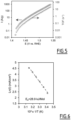
- the mass activity of Co 2+ 0.5 Fe 3+ 0.5 O 0.5 F 1.5 reaches 846 A.g -1 , with a TOF of 21 s -1 per electroactive site (or 0.5 s -1 using the total mass of cobalt deposited) ( Figure 5 ).
- the high activity is also evident through the low activation energy of 28.9 kJ.mol -1 , calculated from the Arrhenius plot ( Figure 6 ).
- the activity is stable for more than 500 h, as measured through chronopotentiometric tests at current densities of 10, 50, 200 and 1000 mA.cm -2 ( Figure 7 ).
- Table 3 gathers their electrochemical properties in comparison with precious metals oxides and with the best reported oxohydroxides. It should be noted that in order to properly compare catalytic performances of anodic materials, it is necessary to take into account several electrochemical characteristics as well as the measuring conditions:
- the synthesis of oxyfluorinated solid solutions M 2+ x M' 3+ 1-x O 1-x F 1+x is carried out in two steps: the first one is the synthesis of a hydrated fluorinated precursor M 2+ M' 3+ F 5 (H 2 O) 7 , frequently written MM'F 5 .7H 2 O, or M 2+ x M' 2+ 1-x F 2 (H 2 O) 4 in concentrated hydrofluoric acid (HF) and the second one consists of a moderate thermal treatment in ambient atmosphere to obtain the solid solutions M 2+ x M' 3+ 1-x O 1-x F 1+x .
- HF concentrated hydrofluoric acid
- MM'F 5 ⁇ 7H 2 O The metal salts (chlorides, nitrates, carbonates, phosphates, sulfates, acetates...) are dissolved in a concentrated HF solution. Then the solution is evaporated at a temperature below the boiling point of the solution until the beginning of the precipitation. The solution is cooled at ambient air and the as-synthesized solid is filtered out, washed and dried leading to MM'F 5 (H 2 O) 7 with a yield around 70%.
- CoCl 2 .6H 2 O (237.9 mg) and Fe(NO 3 ) 3 ⁇ 9H 2 O (404.0 mg) are dissolved into 10 mL of a concentrated hydrofluoric acid solution (28 mol.L -1 , HF 48% ).
- the reaction mixture is placed in a Teflon Becher and stirred for 1 h at 100°C in an oil bath until the formation of a precipitate. After cooling, the mixture is filtered, washed with technical ethanol and dried at room temperature giving pink powder.
- Ni(NO 3 ) 2 ⁇ 6H 2 O (290.8 mg) and Fe(NO 3 ) 3 ⁇ 9H 2 O (404.0 mg) are dissolved into 10 mL a concentrated hydrofluoric acid solution (28 mol.L -1 , HF 48% ).
- the reaction mixture is placed in a Teflon Becher and stirred for 1 h at 100°C in an oil bath until the formation of a precipitate. After cooling, the mixture is filtered, washed with technical ethanol and dried at room temperature giving green powder.
- CoCl 2 ⁇ 6H 2 O (119.0 mg), Ni(NO 3 ) 2 ⁇ 6H 2 O (145.4 mg) and Fe(NO 3 ) 3 ⁇ 9H 2 O (404.0 mg), are dissolved into 10 mL a concentrated hydrofluoric acid solution (28 mol.L -1 , HF 48% ).
- the reaction mixture is placed in a Teflon Becher and stirred for 1 h at 100 °C in an oil bath until the formation of a precipitate. After cooling, the mixture is filtered, washed with technical ethanol and dried at room temperature giving brownish powder.
- CoCl 2 ⁇ 6H 2 O (892.2 mg), and FeCl 2 ⁇ 4H 2 O (248.5 mg), are dissolved into 50 mL of isopropanol.
- the latter has been, prior to the synthesis, carefully degassed by bubbling it using argon for 30 min.
- the reaction mixture is placed in a round bottom flask previously flushed with argon.
- 10 mL of degassed concentrated hydrofluoric acid solution 28 mol.L -1 , HF 48% ) (30 minute by bubbling it using argon) is added to the solution and the solution is allowed to stir for 30 min under argon atmosphere until precipitation is complete.
- the mixture is filtered, washed with technical ethanol and dried at room temperature giving a pink powder.
- CoCl 2 ⁇ 6H 2 O (119 mg), Ni(NO 3 ) 3 ⁇ 6H 2 O (290.8 mg) and FeCl 2 ⁇ 4H 2 O (99.8 mg), are dissolved into 15 mL of isopropanol. The latter has been, prior to the synthesis, carefully degassed by bubbling it using argon for 30 min. The reaction mixture is placed in a round bottom flask previously flushed with argon. Once the solubilisation is completed, 3 mL of degassed concentrated hydrofluoric acid solution (28 mol.L -1 , HF 48% ) (30 minute by bubbling it using argon) is added to the solution and the solution is allowed to stir for 30 min under argon atmosphere until precipitation is complete. Finally, the mixture is filtered, washed with technical ethanol and dried at room temperature giving a brownish powder.
- Example 3.2 Ni 2+ 0.5 Fe 3+ 0.5 O 0.5 F 1.5
- Example 3.5 Co 2+ 0.25 Ni 2+ 0.5 Fe 3+ 0.25 O 0.25 F 1.75
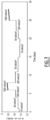
- TXRD The monitoring of the structural evolution of Co 0.5 Fe 0.5 O 0.5 F 1.5 as function of the temperature exhibits four domains ( Figure 13 ):
- TGA The formulation of the intermediate phase Co 0.5 Fe 0.5 O 0.5 F 1.5 observed by TDRX is confirmed by TGA under ambient air ( Figure 14 ).
- CoFeF 5 (H 2 O) 7 undergoes the following decompositions upon thermal treatment, the experimental weight loss values are in good agreement with theoretical values:
- XRD XRD patterns of Co 0.5 Fe 0.5 O 0.5 F 1.5 and Ni 0.5 Fe 0.5 O 0.5 F 1.5 match with the PDF card (01-070-1522) of FeOF (rutile structure type) and show line profiles which are characteristic of low crystalline compounds ( Figure 15 ).
- FTIR Water removal of hydrated fluorides CoFeF 5 (H 2 O) 7 and CoFeF 5 (H 2 O) 7 after thermal treatment is confirmed by FTIR ( Figure 16 ).
- the FTIR spectra of CoFeF 5 (H 2 O) 7 and CoFeF 5 (H 2 O) 7 present a broad signal between 3300 and 2800 cm -1 and a sharp peak centered at 1600 cm -1 attributed to the stretching ( ⁇ O-H ) and bending ( ⁇ H-O-H ) modes respectively. After thermal treatment, these signals are no longer present, confirming H 2 O removal.
- the thermal treatment induces a significant increase of the specific surface area (S BET ) between the hydrated fluorides and the oxyfluorides: CoFeF 5 (H 2 O) 7 (3 m 2 .g -1 ), NiFeF 5 (H 2 O) 7 (1 m 2 .g -1 ), Co 0.5 Fe 0.5 O 0.5 F 1.5 (24 m 2 .g -1 ), and Ni 0.5 Fe 0.5 O 0.5 F 1.5 (17 m 2 .g -1 ) ( Figure 17 ).
- S BET specific surface area
Landscapes
- Chemical & Material Sciences (AREA)
- Engineering & Computer Science (AREA)
- Chemical Kinetics & Catalysis (AREA)
- Materials Engineering (AREA)
- Organic Chemistry (AREA)
- Electrochemistry (AREA)
- Metallurgy (AREA)
- General Chemical & Material Sciences (AREA)
- Inorganic Chemistry (AREA)
- Manufacturing & Machinery (AREA)
- Ceramic Engineering (AREA)
- Life Sciences & Earth Sciences (AREA)
- Sustainable Development (AREA)
- Sustainable Energy (AREA)
- Structural Engineering (AREA)
- Physics & Mathematics (AREA)
- Thermal Sciences (AREA)
- Catalysts (AREA)
- Battery Electrode And Active Subsutance (AREA)
Description
- The present invention concerns the electrochemical production of hydrogen.
- Global warming, ocean acidification, extreme weather events, and low air quality require an urgent energy transition towards renewable energies (wind, solar, thermal, etc.). However, their intermittent nature implies their storage. Hydrogen in tandem with a fuel cell (FC) appears among the most promising solution for energy storage and recovery, and some are already on the market. Although hydrogen is the most abundant gas in the universe, it is found on earth almost only in combined form (CH4, H2O...). Steam methane reforming in which CO2 is emitted is currently the main industrial process for hydrogen manufacturing (> 95%). If CO2 is not sequestered, this hydrogen is called gray hydrogen, if captured upstream, it is then qualified as blue hydrogen. In the long term, its production must tend towards greenhouse gas-free process to give decarbonized hydrogen called green hydrogen. The electrolysis of water falls under this last appellation and represents, in a vision of sustainable development, the most attractive solution. However, the industrial development of electrolyzers is hampered by their low energy efficiency, related to the need of a significant overpotential to the anode as illustrated in
Figure 1 . Consequently, the cost of producing green hydrogen is four times higher than that of gray hydrogen. - According to the mechanisms proposed in the literature for the Oxygen Evolution Reaction (OER) reaction, the overpotential originates from the energy barriers of four intermediate reaction steps (Table 1). The addition of a catalyst lowers these barriers and thus the overpotential (
Figure 2 ). To date, the benchmark catalysts are iridium and ruthenium oxides, whether in acidic or basic medium. However, their prohibitive cost makes any industrial application difficult. - As an alternative to these benchmark oxides, new catalysts based on 3d elements have recently been proposed: ABO3 perovskites, AB2O4 spinels and layer structures of mono- or multimetallic oxyhydroxides MOOH (Xu et al Chem. Soc. Rev 2017, 46, 337. https://doi.org/10.1039/c6cs00328a). This latter family provides currently the best alternative, in alkaline medium, to precious metal oxides but not industrialized.
- Mixed-metal oxyfluorides electrocatalysts and their use as electrodes in an electrolyzer have been described by Lemoine Kévin et al. (Lemoine Kévin ET AL: "Investigating of mixed-metal (oxy)fluorides as a new clas of water oxidation electrocatalysts", Chem. Science, 2019, 10, 9 September 2019 (2019-09-09), pages 9209-9218, XP055854900,DOI: 10.1039/c9sc04027grsc.li/ chemical-science; and LEMOINE KÉVIN ET AL: "Amorphous Iron-Manganese Oxyfluorides, Promising Catalysts for Oxygen Evolution Reaction under Acidic Media",ACS APPLIED ENERGY MATERIALS, [Online] vol. 4, no. 2, 22 February 2021 (2021-02-22), pages 1173-1181, XP055854918,ISSN: 2574-0962, DOI: 10.1021/acsaem.0c02417).
- Despite the aforementioned progress, there is still a need to continually push the performance of earth-abundant water oxidation catalysts.
- According to a first object, the present invention thus concerns a compound of formula (I):
(M12+ xM23+ 1-x)1-u-v(M1'2+ yM2'3+ 1-y)u(M1"2+ zM2"3+ 1-z)vO1-wF1+w (I)
Wherein - M1, M2, M1', M2', M1", M2" are transition metals of the d/f block or alkaline-earth elements in the periodic table;
- u, v, x, y and z are identical or different and are such that:


- According to an embodiment, in formula (I) :
- M1, M2, M1', M2', M1", M2" are transition metals of the d/f block or alkaline-earth elements in the periodic table;
- u, v, x, y and z are identical or different and are such that:


- As used herein, the transition metals of the d/f block include the following elements:
- 3d : Sc, Ti, V, Cr, Mn, Fe, Co, Ni, Cu;
- 4d: Y, Zr, Nb, Mo, Tc, Ru, Rh, Pd, Ag;
- 5d: Lu, Hf, Ta, W, Re, Os, Ir, Pt, Au, Hg;
- 6d: Lr, Rf, Db, Sg, Bh, Hs, Mt, Ds, Rg, Cn; and
- the lanthanides and actinides of the f block, which include La, Ce, Pr, Nd, Pm, Sm, Eu, Gd, Tb, Dy, Ho, Er, Tm, Yb, Ac, Th, Pa, U, Np, Pu, Am, Cm, Bk, Cf, Es, Fm, Md, No.
- Alkaline-earth elements refer to Be, Mg, Ca, Sr, Ba, Ra.
- According to an embodiment, M1, M1' and M1" belong to d/f block or alkaline-earth elements in the periodic table and M2, M2' and M2" belong to d/f block of the periodic table.
- In particular, M1 and M1', M1" are chosen from Mn, Fe, Co, Ni, Cu, Zn and M2 and, M2', M2" are chosen from Mn, Fe, Co, Ni, Ru, Rh.
- According to an embodiment, either x = 0.5 and y = z = u = v = 0 or
- x = y = 0.5 and u = 0.5 and z = v = 0 with M2 = M2' or
- x = 0.3 and y = 0.7 and u=0.5 and z = v = 0 with M2 = M2'.
- According to a particular embodiment, the compound of formula (I) is chosen from the following compounds:
- M2+ 0.5Fe3+ 0.5O0.5F1.5 with M = Co, Ni, Zn
- Co2+ 0.5Fe3+ 0.5O0.5F1.5
- Co2+ 0.75Fe3+ 0.25O0.25F1.75
- Ni2+ 0.5Fe3+ 0.5O0.5F1.5,
- Zn2+ 0.5Fe3+ 0.5O0.5F1.5,
- Co2+ 0.25Ni2+ 0.25Fe3+ 0.5O0.5F1.5,
- Ni2+ 0.15Co2+ 0.425Fe3+ 0.425O0.425F1.575,
- Ni2+ 0.25Co2+ 0.375Fe3+ 0.375O0.375F1.625,
- Ni2+ 0.5Co2+ 0.25Fe3+ 0.25O0.25F1.75,
- Ni2+ 0.75Co2+ 0.125Fe3+ 0.125O0.125F1.875 and
- Co2+ 0.15Fe2+ 0.35Fe3+ 0.5O0.5F1.5.
- According to a further object, the present invention concerns a solid solution of the compound of formula (I) as defined above.
- The term "solid solution" as used herein refers to a unique phase component made of the compound of formula (I) as defined above.
- According to a still further object, the present invention concerns an electrode comprising the compound of the invention, as a catalyst.
- As a catalyst, the compounds of formula (I) lower the kinetics barrier of the intermediates reactions involved in water electrolysis. Some illustrative reactions are set out in Table 1 below:
Table 1. Intermediates reactions during OER in acidic or basic media. Acid catalyst Alkaline catalyst H2O + * → HO* + H+ + e- 1A) OH- + * → HO* + e- 1B) HO* → O* + H+ + e- 2A) HO* + OH- → O* + H2O + e- 2B) H2O + O* → HOO* + H+ + e- 3A) O* + OH- → HOO* + e- 3B) HOO* → * + O2 + H+ + e- 4A) HOO* + OH- → * + O2 + H2O + e- 4B) - The symbol * means the active site of the catalyst.
- According to an embodiment, said electrode may be a working, a positive or a negative electrode.
- Typically, the electrode comprises a support loaded with said catalyst.
- Said support is generally chosen from stable, inert high-surface area substrates which are able to load the catalyst.
- The loading may be achieved in particular by impregnating the support with an ink comprising the catalyst compound (I). Typically, the support may be soaked in the ink or spread with the ink.
- Said ink may be a mixture of the catalyst compound (I) in an aqueous solution, optionally comprising a water soluble solvent (such as ethanol). Said ink may also comprise one or more binders, such as Nafion and multiwalled carbon nanotubes. The CNT helps electrically connect the catalyst and the Nafion helps with adhesion to the substrate.
- Said support may be chosen in particular from carbon paper (such as Toray carbon paper), Ni foam, transparent conductive oxides (TCO) such as fluorinated tin oxide (Fluorine doped tin oxide, FTO), indium tin oxide (ITO) and antimony doped tin oxide (ATO).
- The catalyst loaded support located on one side of the electrode contacts with the electrolyte whereas the other side of the electrode is connected with a current collector.
- According to another object, the present invention also concerns a process of preparation of the solid solution of the invention. Said process comprises the following steps:
- The synthesis of a hydrated fluorinated precursor of formula (II):
(M12+ xM23+ 1-x)1-u-v(M1'2+ yM2'3+ 1-y)u(M1"2+ zM2"3+ 1-z)vF5(H2O)7 (II)
Where x, y, z, u, v, M1, M2, M1', M2', M1" and M2" are defined as above, By evaporation of a concentrated hydrofluoric acid (HF) solution of the dissolved metal salts or by precipitation of said solution; and - The thermal treatment of the compound of formula (II) at a temperature comprised between 150 and 400°C.
- The concentrated hydrofluoric acid (HF) solution is a solution of hydrogen fluoride in water, in a concentration comprised between 20 and 40 mol.L-1, typically 28 mol.L-1 (HF48%).
- The solution of dissolved metal salts refers to the concentrated hydrofluoric acid solution wherein salts of M1, M2, M1', M2', M1", M2" as well as their counter-ions are dissolved. Counter-ions may include anions such as chloride, nitrate, carbonate, phosphate, sulfate, acetate, carbonate, etc.... Such solution of dissolved metal salts can be achieved by dissolving under stirring salts of M1, M2, M1', M2', M1", M2"with their respective counter ions, or solvates therefrom in the concentrated hydrofluoric acid solution, in respective concentrations corresponding to the respective ratio of M1, M2, M1', M2', M1", M2" in formula (II).
- The evaporation may be conducted by stirring the solution under heating (generally in an oil bath) at a temperature below or equal to the boiling temperature of the solution, typically at about 100°C for a duration sufficient to achieve a precipitate.
- Alternatively, the precipitate may be obtained by the precipitation of the solution of concentrated hydrofluoric acid (HF) of the dissolved metal salts, by addition of alcohol, typically ethanol. Said precipitation may be handled at room temperature.
- According to both alternatives, the precipitate is then separated e.g. by filtration. Said precipitate is constituted by the hydrated fluorinated compound (II).
- The step of thermal treatment may be carried out in a furnace at a temperature comprised between 150 and 400°C, generally under ambient atmosphere, in a duration sufficient to achieve the weight loss corresponding of the loss of the six water and two HF molecules comprised in the hydrated fluorinated precursor of formula (II).
- The compounds of formula (II) are novel and are another object of the invention:
(M12+ xM23+ 1-x)1-u-v(M1'2+ yM2'3+ 1-y)u(M1"2+ zM2"3+ 1-z)vF5(H2O)7 (II)
- Where x, y, z, u, v, M1, M2, M1', M2', M1" and M2" are defined as above.
- According to another object, the invention also concerns an electrochemical cell comprising at least one electrode of the invention.
- Typically, said electrochemical cell may be a water electrolyzer and/or a fuel cell.
- In the case of electrolysis, the electrode of the invention is typically a working electrode (i.e.) the electrode on which the reaction of interest (water electrolysis) occurs.
- The working electrode is typically used in three electrode system, in conjunction with an auxiliary electrode (Pt or carbon counter electrode) and a reference electrode (such as Hg/HgO reference electrode).
- The electrolyte may generally be chosen from strong acids such as sulfuric acid and strong bases such as potassium hydroxide and sodium hydroxide, due to their strong conducting abilities. A solid polymer electrolyte such as Nafion can also be used.
- Fuel cells are made up of an anode and a cathode separated by an electrolyte.
- The electrolyte can be chosen from potassium hydroxide, salt carbonates, and phosphoric acid or can be a polymer membrane in particular.
- According to another object, the present invention also concerns a process of preparation of hydrogen comprising the electrolysis of water with an electrochemical cell of the invention.
- Water electrolysis (also called water splitting) refers to the process of using electricity to decompose water into oxygen and hydrogen gas, requiring a minimum potential difference of 1.23 volts.
- Hydrogen gas formed in this way can be used as hydrogen fuel in a fuel cell combined with said water electrolyzer.
- In the fuel cell, hydrogen is consumed, water is created, and an electric current is generated, which can be used to power electrical devices.
- The following reactions are involved (Table 2):
Electrolyte Water electrolysis Fuel cell Acidic solution Cathode: 2H+ + 2e- → H2 (0 V) Cathode: H2 → 2H+ + 2e- (0 V) Anode: 
Anode: 
Alkaline solution Cathode: 2H2O + 2e- → H2 + 2OH- (0 V) Cathode: H2 + 2OH- → 2H2O + 2e- (0 V) Anode: 
Anode: 
-
-
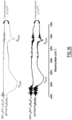
Figure 1 is a schematic representation of an electrolyzer (A) and representation of overpotential applied to the anode at 10 mA.cm-2 (B). -
Figure 2 is a representation of modulating the energy levels of the binding strength between the active sites and the intermediates and its impact on the overpotential. -
Figure 3 represents the cyclic voltammetry measurement of Co2+ 0.5Fe3+ 0.5O0.5F1.5 showing the current density as a function of the potential applied. -
Figure 4 illustrates the Tafel slope of Co2+ 0.5Fe3+ 0.5O0.5F1.5 on Glassy Carbon and Carbon Paper substrate indicating that for every increase of 27 mV of applied potential, the current density increases by one order of magnitude. -
Figure 5 shows the evolution of the mass activity (left) and TOF (right) as a function of the applied potential for Co2+ 0.5Fe3+ 0.5O0.5F1.5. -
Figure 6 represents the Arrhenius plot for Co2+ 0.5Fe3+ 0.5O0.5F1.5 to determine the activation energy of the rate limiting step. -
Figure 7 illustrates the chronopotentiometric measurement of Co2+ 0.5Fe3+ 0.5O0.5F1.5 over extended periods of time shows no obvious activity decrease. -
Figure 8 represents the XRD patterns of Co2+Fe3+F5(H2O)7, Ni2+Fe3+F5(H2O)7 and Co2+ o.5Ni2+ o.5Fe3+F5(H2O)7 matching with the PDF card number 00-037-0794 (CoFeF5(H2O)7). -
Figure 9 represents the XRD patterns of Co2+ 0.75Fe2+ 0.25F2(H2O)4 and Co2+ 0.25Ni2+ 0.5Fe2+ 0.25F2(H2O)4 matching with the PDF card number 00-025-0243 (CoF2(H2O)4) -
Figure 10 represents the volume of the cell as a function of the composition for Co2+ xFe2+ 1-xF2(H2O)4 with x = 0-1. The evolution is in accordance to the Vegard's law which confirms the metal ratio. -
Figure 11 represents the volume of the cell as a function of the composition for NixCo2+ (1-x)/2Fe2+ (1-x)/2F2(H2O)4, with x = 0-1. The evolution is in accordance to the Vegard's law which confirms the metal ratio. -
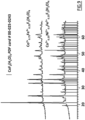
Figure 12 represents the EDX spectra of Co2+Fe3+F5(H2O)7 and Ni2+Fe3+F5(H2O)7, ratios of metal cations M'3+/M2+ are close to one. -
Figure 13 represents the TXRD of Co2+Fe3+F5(H2O)7 under ambient atmosphere showing the formation of the intermediate phase Co2+ 0.5Fe3+ 0.5O0.5F1.5 with rutile structure type (characteristic peaks surrounded in the black circles). -
Figure 14 represents the thermogravimetric curve of Co2+Fe3+F5(H2O)7 under ambient air. -
Figure 15 represents the XRD patterns of Co2+ 0.5Fe3+ 0.5O0.5F1.5 and Ni2+ 0.5Fe3+ 0.5O0.5F1.5 obtained by thermal treatment of Co2+Fe3+F5(H2O)7 and Ni2+Fe3+F5(H2O)7, respectively. -
Figure 16 illustrates the comparison of FTIR spectra of Co2+ 0.5Fe3+ 0.5O0.5F1.5 and Ni2+ 0.5Fe3+ 0.5O0.5F1.5 with those of their corresponding hydrated precursors, Co2+Fe3+F5(H2O)7 and Ni2+Fe3+F5(H2O)7. -
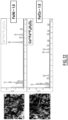
Figure 17 represents the N2 adsorption-desorption isotherms of Co2+ 0.5Fe3+ 0.5O0.5F1.5 and Ni2+ 0.5Fe3+ 0.5O0.5F1.5 and corresponding BJH pore size distributions. -
Figure 18 represents the TEM pictures showing the mesoporosity of Co2+ 0.5Fe3+ 0.5O0.5F1.5 and Ni2+ 0.5Fe3+ 0.5O0.5F1.5. - Electrocatalytic measurements are performed in a standard 3-electrode setup in a custom-built glass single compartment reaction cell. Hg/HgO reference and Pt or carbon counter electrodes are used for all measurements. For a working electrode substrate, Toray Carbon Paper is used as a model high-surface area support (catalyst loading of 5 mg.cm-2). Alternatively, a rotating disk setup with a glassy carbon surface is used (catalyst loading of 0.1 mg.cm-2). To generate a catalyst-coated working electrode, a catalyst ink is generated by sonicating 300 µl ethanol, 100 µl de-ionized water, 10 µl of 5% Nafion™ solution, 4 mg catalyst and 0.2 mg multiwalled carbon nanotubes (10-40 nm diameter). The ink is spread onto a working electrode surface and allowed to dry under ambient conditions. 1.0 M KOH is used as the electrolyte in all measurements at room temperature (approximately 21°C) and 95% compensation of the solution resistance is used correct correction. The solution resistance is measured at open circuit at 100 KHz frequency before each measurement. Turnover frequencies (TOFs) are calculated by dividing the reaction rate (extracted from the current density, assuming 4 electrons extracted from each water molecule) by the redox-active cobalt species, calculated through integrating the area under the Co(II/III) redox peak at 0.1 V vs. RHE (Reversible Hydrogen Electrode).
- The Co2+ 0.5Fe3+ 0.5O0.5F1.5 catalyst-loaded carbon paper electrode exhibits 220 mV overpotential for a current density of 10 mA.cm-2 (
Figure 3 ). The Tafel slope, measured in a current density range of 1-100 mA.cm-2, is calculated to be 27 mV.decade-1 (Figure 4 ). At 300 mV overpotential, the mass activity of Co2+ 0.5Fe3+ 0.5O0.5F1.5 reaches 846 A.g-1, with a TOF of 21 s-1 per electroactive site (or 0.5 s-1 using the total mass of cobalt deposited) (Figure 5 ). The high activity is also evident through the low activation energy of 28.9 kJ.mol-1, calculated from the Arrhenius plot (Figure 6 ). The activity is stable for more than 500 h, as measured through chronopotentiometric tests at current densities of 10, 50, 200 and 1000 mA.cm-2 (Figure 7 ). - Overall, the electrocatalytic performance of Co2+ 0.5Fe3+ 0.5O0.5F1.5 is arguably the best reported for a cobalt-based material under the above-mentioned standard testing conditions in terms of a combination of overpotential, mass activity, turnover frequency and stability. This conclusion is attained after a careful comparison of quantitative performance metrics of notable catalysts reported over the last several years (Table 3).
- Table 3 gathers their electrochemical properties in comparison with precious metals oxides and with the best reported oxohydroxides. It should be noted that in order to properly compare catalytic performances of anodic materials, it is necessary to take into account several electrochemical characteristics as well as the measuring conditions:
- overpotential (mV),
- Tafel slope (mV.dec-1): the lower it is, the lower the increase in potential to be applied to obtain a high current density and therefore a high hydrogen production rate,
- turnover frequency (TOF, s-1): reflects the efficiency of a catalytic site (frequency of reactions). The higher the TOF, the better the activity,
- mass activity (mA.g-1) at a given overpotential,
- temperature of the electrolytic medium, here RT,
- concentration of the medium in KOH, here 1 M.
- The synthesis of oxyfluorinated solid solutions M2+ xM'3+ 1-xO1-xF1+x is carried out in two steps: the first one is the synthesis of a hydrated fluorinated precursor M2+M'3+F5(H2O)7, frequently written MM'F5.7H2O, or M2+ xM'2+ 1-xF2(H2O)4 in concentrated hydrofluoric acid (HF) and the second one consists of a moderate thermal treatment in ambient atmosphere to obtain the solid solutions M2+ xM'3+ 1-xO1-xF1+x.
- For the synthesis of MM'F5·7H2O: The metal salts (chlorides, nitrates, carbonates, phosphates, sulfates, acetates...) are dissolved in a concentrated HF solution. Then the solution is evaporated at a temperature below the boiling point of the solution until the beginning of the precipitation. The solution is cooled at ambient air and the as-synthesized solid is filtered out, washed and dried leading to MM'F5(H2O)7 with a yield around 70%. These synthesis methods can be extending to three (or more) metals by multi-substitution as well as on +II and/or +III metal cations such as M2+ 1-xM"2+ xM'3+F5(H2O)7 or M2+M'3+ 1-xM"3+ xF5(H2O)7. As alternative synthesis, after dissolution of the metal salts, the precipitation is triggered by an addition of an alcohol such as ethanol at room temperature. The solid is recovered by the same aforementioned protocol.
- For the synthesis of M2+ xM'2+ 1-xF2(H2O)4. the metal salts (chlorides, nitrates, carbonates, phosphates, sulfates, acetates...) are dissolved in alcohol (ethanol, isopropanol, ...). The solvent should be degassed prior to the reaction by bubbling it with argon for 30 min. After the degassed concentrated HF (bubbling with argon for 30 min) is added allowing the hydrated fluoride to precipitate. The as-synthesized solid is filtered out, washed and dried leading to MM'F2(H2O)4 with a yield around 70%. These synthesis methods can be extending to three (or more) metals by multi-substitution such as M2+ 1-xM"2+ xM'2+F2(H2O)4.
- CoCl2.6H2O (237.9 mg) and Fe(NO3)3·9H2O (404.0 mg) are dissolved into 10 mL of a concentrated hydrofluoric acid solution (28 mol.L-1, HF48%). The reaction mixture is placed in a Teflon Becher and stirred for 1 h at 100°C in an oil bath until the formation of a precipitate. After cooling, the mixture is filtered, washed with technical ethanol and dried at room temperature giving pink powder.
- Ni(NO3)2·6H2O (290.8 mg) and Fe(NO3)3·9H2O (404.0 mg) are dissolved into 10 mL a concentrated hydrofluoric acid solution (28 mol.L-1, HF48%). The reaction mixture is placed in a Teflon Becher and stirred for 1 h at 100°C in an oil bath until the formation of a precipitate. After cooling, the mixture is filtered, washed with technical ethanol and dried at room temperature giving green powder.
- CoCl2·6H2O (119.0 mg), Ni(NO3)2·6H2O (145.4 mg) and Fe(NO3)3·9H2O (404.0 mg), are dissolved into 10 mL a concentrated hydrofluoric acid solution (28 mol.L-1, HF48%). The reaction mixture is placed in a Teflon Becher and stirred for 1 h at 100 °C in an oil bath until the formation of a precipitate. After cooling, the mixture is filtered, washed with technical ethanol and dried at room temperature giving brownish powder.
- CoCl2·6H2O (892.2 mg), and FeCl2·4H2O (248.5 mg), are dissolved into 50 mL of isopropanol. The latter has been, prior to the synthesis, carefully degassed by bubbling it using argon for 30 min. The reaction mixture is placed in a round bottom flask previously flushed with argon. Once the solubilisation is completed, 10 mL of degassed concentrated hydrofluoric acid solution (28 mol.L-1, HF48%) (30 minute by bubbling it using argon) is added to the solution and the solution is allowed to stir for 30 min under argon atmosphere until precipitation is complete. Finally, the mixture is filtered, washed with technical ethanol and dried at room temperature giving a pink powder.
- CoCl2·6H2O (119 mg), Ni(NO3)3·6H2O (290.8 mg) and FeCl2·4H2O (99.8 mg), are dissolved into 15 mL of isopropanol. The latter has been, prior to the synthesis, carefully degassed by bubbling it using argon for 30 min. The reaction mixture is placed in a round bottom flask previously flushed with argon. Once the solubilisation is completed, 3 mL of degassed concentrated hydrofluoric acid solution (28 mol.L-1, HF48%) (30 minute by bubbling it using argon) is added to the solution and the solution is allowed to stir for 30 min under argon atmosphere until precipitation is complete. Finally, the mixture is filtered, washed with technical ethanol and dried at room temperature giving a brownish powder.
- A thermal treatment at moderated temperature (+/- 250°C) in atmospheric conditions of hydrated fluorides MM'F5(H2O)7 leads to the formation of solid solutions M0.5M'0.5O0.5F1.5 along the general reaction:
MM'F5(H2O)7 → 2M0.5M'0.5O0.5F1.5 + 2HF + 6H2O
- Co2+ 0.5Fe3+ 0.5O0.5F1.5 is obtained by thermal treatment of Co2+Fe3+F5(H2O)7 under ambient atmosphere at 240°C for 1 h in a furnace corresponding to an experimental weight loss of 43.4% close to the theoretical value 43.9% (mbefore = 175 mg, mafter = 99 mg).
- Ni2+ 0.5Fe3+ 0.5O0.5F1.5 is obtained by thermal treatment of Ni2+Fe3+F5(H2O)7 under ambient atmosphere at 290°C for 1h30 min in a furnace corresponding to an experimental weight loss of 44.7% close to the theoretical value 44% (mbefore = 434 mg, mafter = 240 mg).
- Co2+ 0.25Ni2+ 0.25Fe3+ 0.5O0.5F1.5 is obtained by thermal treatment of Co2+ 0.5Ni2+ 0.5Fe3+F5(H2O)7 under ambient atmosphere at 280°C for 30 min in a furnace corresponding to an experimental weight loss of 46% close to the theoretical value 44.0% (mbefore = 371 mg, mafter = 200 mg).
- Co2+ 0.75Fe3+ 0.25O0.25F1.75 is obtained by thermal treatment of Co2+ 0.75Fe2+ 0.25F2(H2O)4 under dry synthetic air at 300°C for 1 h in a furnace previously flushed for 30 min under dry synthetic air, corresponding to an experimental weight loss of 41.5% close to the theoretical value 43.7% (mbefore = 436 mg, mafter = 255 mg).
- Co2+ 0.25Ni2+ 0.5Fe3+ 0.25O0.5F1.5 is obtained by thermal treatment of Co2+ 0.25Ni2+ 0.5Fe2+ 0.25F2(H2O)4 under dry synthetic air at 220°C for 1 h in a furnace previously flushed for 30 min under dry synthetic air, corresponding to an experimental weight loss of 39.1% close to the theoretical value 40.2% (mbefore = 139.5 mg, mafter = 85 mg).
-
- XRD = X-ray diffraction
- SEM-EDX = Scanning Electron Microscope coupled with Energy Dispersive X-ray TXRD = Thermal X-ray Diffraction
- TGA = ThermoGravimetry Analysis
- FTIR = Fourier Transformed Infrared Spectroscopy
- TEM = Transmission Electron Microscopy
- Experimental XRD patterns match with the known XRD pattern of the CoFeF5(H2O)7 (PDF card number 00-037-0794) (
Figure 8 ). Small shifts of diffraction peaks related to different metal ionic radii are observed. The metal ratio M'3+/M2+ close to one, obtained by SEM-EDX, is in good agreement with M2+M'3+F5(H2O)7 formulations (Figure 12 ). - TXRD: The monitoring of the structural evolution of Co0.5Fe0.5O0.5F1.5 as function of the temperature exhibits four domains (
Figure 13 ): - (1) RT-100°C: stability of CoFeF5(H2O)7,
- (2) 100-200°C: dehydration of CoFeF5(H2O)7 leading to the formation of CoFeF5(H2O)n (n < 7),
- (3) 220-280°C: formation of Co0.5Fe0.5O0.5F1.5 with rutile structure type,
- (4) from 300°C: formation of oxides CoO and CoFe2O4.
- TGA: The formulation of the intermediate phase Co0.5Fe0.5O0.5F1.5 observed by TDRX is confirmed by TGA under ambient air (
Figure 14 ). CoFeF5(H2O)7 undergoes the following decompositions upon thermal treatment, the experimental weight loss values are in good agreement with theoretical values: - 100°C < T < 200°C: CoFeF5(H2O)7 → CoFeF5 + 7H2O
- (%theo = 37.6% / %exp = 37.3%)
- 200°C < T < 280°C: CoFeF5 + H2O → 2Co0.5Fe0.5O0.5F1.5 + 2HF
- (%theo = 43.4% / %exp = 43.9%)
- T > 280°C: 2Co0.5Fe0.5O0.5F1.5 + 3/2 H2O → ½CoO + ½CoFe2O4 + 3HF
- (%theo = 53.6% / %exp = 52.8%)
- XRD: XRD patterns of Co0.5Fe0.5O0.5F1.5 and Ni0.5Fe0.5O0.5F1.5 match with the PDF card (01-070-1522) of FeOF (rutile structure type) and show line profiles which are characteristic of low crystalline compounds (
Figure 15 ). - FTIR: Water removal of hydrated fluorides CoFeF5(H2O)7 and CoFeF5(H2O)7 after thermal treatment is confirmed by FTIR (
Figure 16 ). The FTIR spectra of CoFeF5(H2O)7 and CoFeF5(H2O)7 present a broad signal between 3300 and 2800 cm-1 and a sharp peak centered at 1600 cm-1 attributed to the stretching (νO-H) and bending (δH-O-H) modes respectively. After thermal treatment, these signals are no longer present, confirming H2O removal. - The thermal treatment induces a significant increase of the specific surface area (SBET) between the hydrated fluorides and the oxyfluorides: CoFeF5(H2O)7 (3 m2.g-1), NiFeF5(H2O)7 (1 m2.g-1), Co0.5Fe0.5O0.5F1.5 (24 m2.g-1), and Ni0.5Fe0.5O0.5F1.5 (17 m2.g-1) (
Figure 17 ). - TEM images show that the increase of SBET is probably related to an emerging porosity related to the removal of HF and H2O gas molecules during the thermal decomposition (
Figure 18 ). This nanostructuration, in agreement with XRD patterns, is also confirmed by N2 adsorption/desorption isotherms showing type IV hysteresis corresponding to mesoporous structure according to the IUPAC classification; the mesopores diameters range from 2 up to 10 nm (Figure 17 ).
| Catalysts | Substrate | η* (mV) | Bulk TOF (s-1)** | Tafel (mV.dec-1) | Mass activity** (A.g-1) | Reference |
| Co0.5Fe0.5O0.5F1.5 | CP | 220 | 0.5 | 27 | 846 | Present invention |
| LDH-(Co,Fe) | CP | 331 | 0.01 | 85 | 32 | Zhang et Science (80 2016, 35 (6283), 333 337. |
| G-(Co,Fe)OOH | GC | 271 | 0.043 | 60 | 162 | Zhang et al 2016 |
| G-(Co,Fe,Mo)OOH | CP | 233 | 0.09 | - | - | Zhang et al. Na Catal. 2020, 985-9924 |
| G-(Co,Fe,Mo,W)OO H | CP | 212 | 0.24 | - | - | Zhang et al 2020 |
| G-(Co,Fe,W)OOH | GC | 217 | 0.46 | 37 | 1175 | Zhang et al 2016 |
| LDH-(Ni,Fe) | GC | 269 | 0.07 | - | 117 | Zhang et al 2016 |
| LDH/GO-(Ni,Fe) | GC | 210 | 0.1 | 42 | - | McCrory et al. Am. Chem. So 2015, 137 (13 4347-4357 |
| (Ni,Fe,Mo)OOH | CP | 201 | 0.1 | 32 | - | Zhang et al 2020 |
| (Ni,Fe,Mo,W)OO H | CP | 205 | 0.14 | 28 | - | Zhang et al 2020 |
| IrO2 | CP | 260 | 0.01 | 45 | - | McCrory et al 2015 |
| * evaluated at 10 mA.cm-2 ** evaluated at 300 mV |
Claims (13)
- A compound of formula (I):
(M12+ xM23+ 1-x)1-u-v(M1'2+ yM2'3+ 1-y)u(M1"2+ zM2"3+ 1-z)vO1-wF1+w (I)
WhereinM1, M2, M1', M2', M1", M2" are transition metals of the d/f block or alkaline-earth elements in the periodic table;u, v, x, y and z are identical or different and are such thatu+v < 1;0 < x,y,z < 1;w = x+u(y-x)+v(z-x). - The compound according to claim 1 where M1, M1' and M1" belong to d/f block or alkaline-earth elements in the periodic table and M2, M2' and M2" belong to d/f transition elements of the periodic table.
- The compound according to claim 1 or 2 wherein:either x = 0.5 and y = z = u = v = 0 orx = y = 0.5 and u = 0.5 and z = v = 0 with M2 = M2' orx = 0.3 and y = 0.7 and u=0.5 and z = v = 0 with M2 = M2'.
- The compound according to anyone of the preceding claims wherein M1 and M1', M1" are chosen from Mn, Fe, Co, Ni, Cu, Zn and M2 and M2', M2" are chosen from Mn, Fe, Co, Ni, Ru, Rh.
- The compound according to anyone of the preceding claims wherein the compound (I) is chosen from Co2+ 0.5Fe3+ 0.5O0.5F1.5, Ni2+ 0.5Fe3+ 0.5O0.5F1.5, Zn2+ 0.5Fe3+ 0.5O0.5F1.5, Co2+ 0.25Ni2+ 0.25Fe3+ 0.5O0.5F1.5, Co2+ 0.15Fe2+ 0.35Fe3+ 0.5O0.5F1.5, Co2+ 0.75Fe3+ 0.25O0.25F1.75, Ni2+ 0.15Co2+ 0.425Fe3+ 0.425O0.425F1.575, Ni2+ 0.25Co2+ 0.375Fe3+ 0.375O0.375F1.625, Ni2+ 0.5Co2+ 0.25Fe3+ 0.25O0.25F1.75, Ni2+ 0.75Co2+ 0.125Fe3+ 0.125O0.125F1.875.
- A solid solution of the compound according to anyone of claims 1 to 5.
- An electrode comprising the compound of formula (I) according to anyone of claims 1 to 5 as a catalyst.
- The electrode according to claim 7, comprising carbon paper loaded with an ink comprising the compound of formula (I).
- An electrochemical cell comprising the electrode according to anyone of claims 7 and 8.
- The electrochemical cell according to claim 9 which is a water electrolyzer and/or a fuel cell.
- The process of preparation of the solid solution according to 6, which comprises the following steps:- The synthesis of a hydrated fluorinated precursor of formula (II):
(M12+ xM23+ 1-x)1-u-v(M1'2+ yM2'3+ 1-y)u(M1"2+ zM2"3+ 1-z)vF5(H2O)7 (II)
Where x, y, z, u, v, M1, M2, M1', M2', M1", M2" are defined as in anyone of claims 1 to 5,By evaporation of a concentrated hydrofluoric acid (HF) solution of the dissolved metal salts or by precipitation of said solution; and- The thermal treatment of the compound of formula (II) at a temperature comprised between 150 and 400°C. - The compound of formula (II):
(M12+ xM23+ 1-x)1-u-v(M1'2+ yM2'3+ 1-y)u(M1"2+ zM2"3+ 1-z)vF5(H2O)7 (II)
Where x, y, z, u, v, M1, M2, M1', M2', M1", M2" are defined as in anyone of claims 1 to 5. - A process of preparation of hydrogen comprising the electrolysis of water with an electrochemical cell according to anyone of claims 9 or 10.
Applications Claiming Priority (2)
| Application Number | Priority Date | Filing Date | Title |
|---|---|---|---|
| EP21305587.4A EP4086371A1 (en) | 2021-05-06 | 2021-05-06 | Novel oxyfluorides, electrodes containing them and their use for hydrogen production |
| PCT/EP2022/062347 WO2022234120A1 (en) | 2021-05-06 | 2022-05-06 | Novel oxyfluorides, electrodes containing them and their use for hydrogen production |
Publications (2)
| Publication Number | Publication Date |
|---|---|
| EP4334502A1 EP4334502A1 (en) | 2024-03-13 |
| EP4334502B1 true EP4334502B1 (en) | 2025-06-04 |
Family
ID=76059838
Family Applications (2)
| Application Number | Title | Priority Date | Filing Date |
|---|---|---|---|
| EP21305587.4A Withdrawn EP4086371A1 (en) | 2021-05-06 | 2021-05-06 | Novel oxyfluorides, electrodes containing them and their use for hydrogen production |
| EP22731067.9A Active EP4334502B1 (en) | 2021-05-06 | 2022-05-06 | Novel oxyfluorides, electrodes containing them and their use for hydrogen production |
Family Applications Before (1)
| Application Number | Title | Priority Date | Filing Date |
|---|---|---|---|
| EP21305587.4A Withdrawn EP4086371A1 (en) | 2021-05-06 | 2021-05-06 | Novel oxyfluorides, electrodes containing them and their use for hydrogen production |
Country Status (4)
| Country | Link |
|---|---|
| US (1) | US20240240336A1 (en) |
| EP (2) | EP4086371A1 (en) |
| CA (1) | CA3217387A1 (en) |
| WO (1) | WO2022234120A1 (en) |
Family Cites Families (3)
| Publication number | Priority date | Publication date | Assignee | Title |
|---|---|---|---|---|
| US8192609B2 (en) * | 2009-12-01 | 2012-06-05 | Wisconsin Alumni Research Foundation | Cobalt oxyfluoride catalysts for electrolytic dissociation of water |
| US10041179B2 (en) * | 2012-08-08 | 2018-08-07 | University of Pittsburgh—of the Commonwealth System of Higher Education | Non-noble metal based electro-catalyst compositions for proton exchange membrane based water electrolysis and methods of making |
| US10944114B2 (en) * | 2015-12-10 | 2021-03-09 | University of Pittsburgh—of the Commonwealth System of Higher Education | Highly active, robust and versatile multifunctional, fully non-noble metals based electro-catalyst compositions and methods of making for energy conversion and storage |
-
2021
- 2021-05-06 EP EP21305587.4A patent/EP4086371A1/en not_active Withdrawn
-
2022
- 2022-05-06 CA CA3217387A patent/CA3217387A1/en active Pending
- 2022-05-06 US US18/558,590 patent/US20240240336A1/en active Pending
- 2022-05-06 WO PCT/EP2022/062347 patent/WO2022234120A1/en not_active Ceased
- 2022-05-06 EP EP22731067.9A patent/EP4334502B1/en active Active
Also Published As
| Publication number | Publication date |
|---|---|
| EP4334502A1 (en) | 2024-03-13 |
| CA3217387A1 (en) | 2022-11-10 |
| WO2022234120A1 (en) | 2022-11-10 |
| EP4086371A1 (en) | 2022-11-09 |
| US20240240336A1 (en) | 2024-07-18 |
Similar Documents
| Publication | Publication Date | Title |
|---|---|---|
| Chen et al. | Boosting electrocatalytic oxygen evolution by cation defect modulation via electrochemical etching | |
| US12451495B2 (en) | Highly active, robust and versatile multifunctional, fully non-noble metals based electro-catalyst compositions and methods of making for energy conversion and storage | |
| Wu et al. | La-RuO2 nanocrystals with efficient electrocatalytic activity for overall water splitting in acidic media: Synergistic effect of La doping and oxygen vacancy | |
| Raja et al. | In-situ grown metal-organic framework-derived carbon-coated Fe-doped cobalt oxide nanocomposite on fluorine-doped tin oxide glass for acidic oxygen evolution reaction | |
| Li et al. | Structure evolution from Fe2Ni MIL MOF to carbon confined O-doped FeNi/FeF2 via partial fluorination for improved oxygen evolution reaction | |
| Wu et al. | Fe-doped NiO mesoporous nanosheets array for highly efficient overall water splitting | |
| Li et al. | Construction of Ni2P-NiFe2O4 heterostructured nanosheets towards performance-enhanced water oxidation reaction | |
| Teng et al. | In/ZnO@ C hollow nanocubes for efficient electrochemical reduction of CO 2 to formate and rechargeable Zn–CO 2 batteries | |
| KR20220031516A (en) | METHOD OF MANUFACTURING NiCoFe LAYERED DOUBLE HYDROXIDE, ELECTRODE, MEMBRANE ELECTRODE ASSEMBLY AND WATER ELECTROYSISING SYSTEM COMPRISING THE SAME | |
| Fang et al. | Enhanced urea oxidization electrocatalysis on spinel cobalt oxide nanowires via on-site electrochemical defect engineering | |
| Rezaei et al. | Porous magnetic iron-manganese oxide nanocubes derived from metal organic framework deposited on reduced graphene oxide nanoflake as a bi-functional electrocatalyst for hydrogen evolution and oxygen reduction reaction | |
| Chanda et al. | Electrochemical synthesis of Li-doped NiFeCo oxides for efficient catalysis of the oxygen evolution reaction in an alkaline environment | |
| Li et al. | NiFeP nanocages embedded in melamine sponge derived nitrogen doped porous carbon foam as an efficient oxygen evolution electrocatalyst | |
| Amer et al. | Facial synthesis of high-performance Ni doped-tin oxide mesoporous for CO2 electroreduction to formate | |
| CN119497765A (en) | Ruthenium-based electrocatalysts for oxygen evolution in acidic media | |
| EP4334502B1 (en) | Novel oxyfluorides, electrodes containing them and their use for hydrogen production | |
| TW202208691A (en) | Electrode for gas evolution in electrolytic processes | |
| JP7738028B2 (en) | Porous amorphous metal oxide-based catalyst for oxygen evolution reaction and water splitting system using the catalyst | |
| CN112779553A (en) | Composite material and preparation method and application thereof | |
| CN119061425A (en) | A porous iridium oxide catalyst and its preparation method and application | |
| Wang et al. | C, N co-doped mesoporous Co-based phosphates via glucose-mediated regulation for the selective electrochemical water oxidation in alkaline realistic seawater | |
| Cao et al. | Surface modified perovskite SrCo0. 8Fe0. 1Nb0. 1O3-δ oxide for enhanced electrocatalytic activity of oxygen evolution reaction | |
| Amin et al. | Transition Metal Tungstate’s Electrocatalyst Supported on a Mixture of Reduced Graphene Oxide and Silica Template for Water Splitting | |
| JP7831757B2 (en) | Electrodes, water electrolytic cells, water electrolytic devices, carbon dioxide reduction electrolytic cells, and carbon dioxide electrolytic devices | |
| US20250333846A1 (en) | Catalyst for water electrolysis using fluorine-doped tin oxide support and method for manufacturing the same |
Legal Events
| Date | Code | Title | Description |
|---|---|---|---|
| STAA | Information on the status of an ep patent application or granted ep patent |
Free format text: STATUS: UNKNOWN |
|
| STAA | Information on the status of an ep patent application or granted ep patent |
Free format text: STATUS: THE INTERNATIONAL PUBLICATION HAS BEEN MADE |
|
| PUAI | Public reference made under article 153(3) epc to a published international application that has entered the european phase |
Free format text: ORIGINAL CODE: 0009012 |
|
| STAA | Information on the status of an ep patent application or granted ep patent |
Free format text: STATUS: REQUEST FOR EXAMINATION WAS MADE |
|
| 17P | Request for examination filed |
Effective date: 20231103 |
|
| AK | Designated contracting states |
Kind code of ref document: A1 Designated state(s): AL AT BE BG CH CY CZ DE DK EE ES FI FR GB GR HR HU IE IS IT LI LT LU LV MC MK MT NL NO PL PT RO RS SE SI SK SM TR |
|
| DAV | Request for validation of the european patent (deleted) | ||
| DAX | Request for extension of the european patent (deleted) | ||
| GRAP | Despatch of communication of intention to grant a patent |
Free format text: ORIGINAL CODE: EPIDOSNIGR1 |
|
| STAA | Information on the status of an ep patent application or granted ep patent |
Free format text: STATUS: GRANT OF PATENT IS INTENDED |
|
| RIC1 | Information provided on ipc code assigned before grant |
Ipc: H01M 8/083 20160101ALI20241108BHEP Ipc: H01M 4/86 20060101ALI20241108BHEP Ipc: B01J 27/12 20060101ALI20241108BHEP Ipc: H01M 8/10 20160101ALI20241108BHEP Ipc: H01M 8/086 20160101ALI20241108BHEP Ipc: H01M 4/90 20060101ALI20241108BHEP Ipc: C04B 35/626 20060101ALI20241108BHEP Ipc: C04B 35/553 20060101ALI20241108BHEP Ipc: C25B 11/077 20210101ALI20241108BHEP Ipc: C25B 11/065 20210101ALI20241108BHEP Ipc: C25B 11/052 20210101ALI20241108BHEP Ipc: B01J 35/33 20240101ALI20241108BHEP Ipc: C25B 1/04 20210101AFI20241108BHEP |
|
| INTG | Intention to grant announced |
Effective date: 20241202 |
|
| GRAS | Grant fee paid |
Free format text: ORIGINAL CODE: EPIDOSNIGR3 |
|
| GRAA | (expected) grant |
Free format text: ORIGINAL CODE: 0009210 |
|
| STAA | Information on the status of an ep patent application or granted ep patent |
Free format text: STATUS: THE PATENT HAS BEEN GRANTED |
|
| RAP3 | Party data changed (applicant data changed or rights of an application transferred) |
Owner name: CENTRE NATIONAL DE LA RECHERCHE SCIENTIFIQUE Owner name: UNIVERSITE DE MONTREAL Owner name: UNIVERSITE DU MANS |
|
| AK | Designated contracting states |
Kind code of ref document: B1 Designated state(s): AL AT BE BG CH CY CZ DE DK EE ES FI FR GB GR HR HU IE IS IT LI LT LU LV MC MK MT NL NO PL PT RO RS SE SI SK SM TR |
|
| REG | Reference to a national code |
Ref country code: GB Ref legal event code: FG4D |
|
| REG | Reference to a national code |
Ref country code: CH Ref legal event code: EP |
|
| REG | Reference to a national code |
Ref country code: DE Ref legal event code: R096 Ref document number: 602022015557 Country of ref document: DE |
|
| REG | Reference to a national code |
Ref country code: IE Ref legal event code: FG4D |
|
| REG | Reference to a national code |
Ref country code: NL Ref legal event code: MP Effective date: 20250604 |
|
| PG25 | Lapsed in a contracting state [announced via postgrant information from national office to epo] |
Ref country code: ES Free format text: LAPSE BECAUSE OF FAILURE TO SUBMIT A TRANSLATION OF THE DESCRIPTION OR TO PAY THE FEE WITHIN THE PRESCRIBED TIME-LIMIT Effective date: 20250604 Ref country code: FI Free format text: LAPSE BECAUSE OF FAILURE TO SUBMIT A TRANSLATION OF THE DESCRIPTION OR TO PAY THE FEE WITHIN THE PRESCRIBED TIME-LIMIT Effective date: 20250604 |
|
| REG | Reference to a national code |
Ref country code: LT Ref legal event code: MG9D |
|
| PG25 | Lapsed in a contracting state [announced via postgrant information from national office to epo] |
Ref country code: GR Free format text: LAPSE BECAUSE OF FAILURE TO SUBMIT A TRANSLATION OF THE DESCRIPTION OR TO PAY THE FEE WITHIN THE PRESCRIBED TIME-LIMIT Effective date: 20250905 Ref country code: NO Free format text: LAPSE BECAUSE OF FAILURE TO SUBMIT A TRANSLATION OF THE DESCRIPTION OR TO PAY THE FEE WITHIN THE PRESCRIBED TIME-LIMIT Effective date: 20250904 |
|
| PG25 | Lapsed in a contracting state [announced via postgrant information from national office to epo] |
Ref country code: PL Free format text: LAPSE BECAUSE OF FAILURE TO SUBMIT A TRANSLATION OF THE DESCRIPTION OR TO PAY THE FEE WITHIN THE PRESCRIBED TIME-LIMIT Effective date: 20250604 |
|
| PG25 | Lapsed in a contracting state [announced via postgrant information from national office to epo] |
Ref country code: BG Free format text: LAPSE BECAUSE OF FAILURE TO SUBMIT A TRANSLATION OF THE DESCRIPTION OR TO PAY THE FEE WITHIN THE PRESCRIBED TIME-LIMIT Effective date: 20250604 |
|
| PG25 | Lapsed in a contracting state [announced via postgrant information from national office to epo] |
Ref country code: HR Free format text: LAPSE BECAUSE OF FAILURE TO SUBMIT A TRANSLATION OF THE DESCRIPTION OR TO PAY THE FEE WITHIN THE PRESCRIBED TIME-LIMIT Effective date: 20250604 |
|
| PG25 | Lapsed in a contracting state [announced via postgrant information from national office to epo] |
Ref country code: RS Free format text: LAPSE BECAUSE OF FAILURE TO SUBMIT A TRANSLATION OF THE DESCRIPTION OR TO PAY THE FEE WITHIN THE PRESCRIBED TIME-LIMIT Effective date: 20250904 |
|
| PG25 | Lapsed in a contracting state [announced via postgrant information from national office to epo] |
Ref country code: LV Free format text: LAPSE BECAUSE OF FAILURE TO SUBMIT A TRANSLATION OF THE DESCRIPTION OR TO PAY THE FEE WITHIN THE PRESCRIBED TIME-LIMIT Effective date: 20250604 |
|
| PG25 | Lapsed in a contracting state [announced via postgrant information from national office to epo] |
Ref country code: NL Free format text: LAPSE BECAUSE OF FAILURE TO SUBMIT A TRANSLATION OF THE DESCRIPTION OR TO PAY THE FEE WITHIN THE PRESCRIBED TIME-LIMIT Effective date: 20250604 |
|
| PG25 | Lapsed in a contracting state [announced via postgrant information from national office to epo] |
Ref country code: PT Free format text: LAPSE BECAUSE OF FAILURE TO SUBMIT A TRANSLATION OF THE DESCRIPTION OR TO PAY THE FEE WITHIN THE PRESCRIBED TIME-LIMIT Effective date: 20251006 |
|
| REG | Reference to a national code |
Ref country code: AT Ref legal event code: MK05 Ref document number: 1800405 Country of ref document: AT Kind code of ref document: T Effective date: 20250604 |
|
| PG25 | Lapsed in a contracting state [announced via postgrant information from national office to epo] |
Ref country code: IS Free format text: LAPSE BECAUSE OF FAILURE TO SUBMIT A TRANSLATION OF THE DESCRIPTION OR TO PAY THE FEE WITHIN THE PRESCRIBED TIME-LIMIT Effective date: 20251004 |
|
| PG25 | Lapsed in a contracting state [announced via postgrant information from national office to epo] |
Ref country code: AT Free format text: LAPSE BECAUSE OF FAILURE TO SUBMIT A TRANSLATION OF THE DESCRIPTION OR TO PAY THE FEE WITHIN THE PRESCRIBED TIME-LIMIT Effective date: 20250604 Ref country code: SM Free format text: LAPSE BECAUSE OF FAILURE TO SUBMIT A TRANSLATION OF THE DESCRIPTION OR TO PAY THE FEE WITHIN THE PRESCRIBED TIME-LIMIT Effective date: 20250604 |
|
| PG25 | Lapsed in a contracting state [announced via postgrant information from national office to epo] |
Ref country code: CZ Free format text: LAPSE BECAUSE OF FAILURE TO SUBMIT A TRANSLATION OF THE DESCRIPTION OR TO PAY THE FEE WITHIN THE PRESCRIBED TIME-LIMIT Effective date: 20250604 |
|
| PG25 | Lapsed in a contracting state [announced via postgrant information from national office to epo] |
Ref country code: EE Free format text: LAPSE BECAUSE OF FAILURE TO SUBMIT A TRANSLATION OF THE DESCRIPTION OR TO PAY THE FEE WITHIN THE PRESCRIBED TIME-LIMIT Effective date: 20250604 |
|
| PG25 | Lapsed in a contracting state [announced via postgrant information from national office to epo] |
Ref country code: SK Free format text: LAPSE BECAUSE OF FAILURE TO SUBMIT A TRANSLATION OF THE DESCRIPTION OR TO PAY THE FEE WITHIN THE PRESCRIBED TIME-LIMIT Effective date: 20250604 |
|
| PG25 | Lapsed in a contracting state [announced via postgrant information from national office to epo] |
Ref country code: IT Free format text: LAPSE BECAUSE OF FAILURE TO SUBMIT A TRANSLATION OF THE DESCRIPTION OR TO PAY THE FEE WITHIN THE PRESCRIBED TIME-LIMIT Effective date: 20250604 |
|
| REG | Reference to a national code |
Ref country code: DE Ref legal event code: R097 Ref document number: 602022015557 Country of ref document: DE |
|
| PLBE | No opposition filed within time limit |
Free format text: ORIGINAL CODE: 0009261 |
|
| STAA | Information on the status of an ep patent application or granted ep patent |
Free format text: STATUS: NO OPPOSITION FILED WITHIN TIME LIMIT |
|
| PG25 | Lapsed in a contracting state [announced via postgrant information from national office to epo] |
Ref country code: DK Free format text: LAPSE BECAUSE OF FAILURE TO SUBMIT A TRANSLATION OF THE DESCRIPTION OR TO PAY THE FEE WITHIN THE PRESCRIBED TIME-LIMIT Effective date: 20250604 |
|
| REG | Reference to a national code |
Ref country code: CH Ref legal event code: L10 Free format text: ST27 STATUS EVENT CODE: U-0-0-L10-L00 (AS PROVIDED BY THE NATIONAL OFFICE) Effective date: 20260416 |