EP4334171B1 - A device for supporting and operating a cable drum and a service trailer comprising said device - Google Patents
A device for supporting and operating a cable drum and a service trailer comprising said device Download PDFInfo
- Publication number
- EP4334171B1 EP4334171B1 EP22730309.6A EP22730309A EP4334171B1 EP 4334171 B1 EP4334171 B1 EP 4334171B1 EP 22730309 A EP22730309 A EP 22730309A EP 4334171 B1 EP4334171 B1 EP 4334171B1
- Authority
- EP
- European Patent Office
- Prior art keywords
- trailer
- sliding carriage
- main frame
- frame
- cable
- Prior art date
- Legal status (The legal status is an assumption and is not a legal conclusion. Google has not performed a legal analysis and makes no representation as to the accuracy of the status listed.)
- Active
Links
Images



Classifications
-
- B—PERFORMING OPERATIONS; TRANSPORTING
- B60—VEHICLES IN GENERAL
- B60P—VEHICLES ADAPTED FOR LOAD TRANSPORTATION OR TO TRANSPORT, TO CARRY, OR TO COMPRISE SPECIAL LOADS OR OBJECTS
- B60P3/00—Vehicles adapted to transport, to carry or to comprise special loads or objects
- B60P3/035—Vehicles adapted to transport, to carry or to comprise special loads or objects for transporting reel units
-
- B—PERFORMING OPERATIONS; TRANSPORTING
- B65—CONVEYING; PACKING; STORING; HANDLING THIN OR FILAMENTARY MATERIAL
- B65H—HANDLING THIN OR FILAMENTARY MATERIAL, e.g. SHEETS, WEBS, CABLES
- B65H49/00—Unwinding or paying-out filamentary material; Supporting, storing or transporting packages from which filamentary material is to be withdrawn or paid-out
- B65H49/18—Methods or apparatus in which packages rotate
- B65H49/20—Package-supporting devices
- B65H49/32—Stands or frameworks
-
- B—PERFORMING OPERATIONS; TRANSPORTING
- B65—CONVEYING; PACKING; STORING; HANDLING THIN OR FILAMENTARY MATERIAL
- B65H—HANDLING THIN OR FILAMENTARY MATERIAL, e.g. SHEETS, WEBS, CABLES
- B65H75/00—Storing webs, tapes, or filamentary material, e.g. on reels
- B65H75/02—Cores, formers, supports, or holders for coiled, wound, or folded material, e.g. reels, spindles, bobbins, cop tubes, cans, mandrels or chucks
- B65H75/34—Cores, formers, supports, or holders for coiled, wound, or folded material, e.g. reels, spindles, bobbins, cop tubes, cans, mandrels or chucks specially adapted or mounted for storing and repeatedly paying-out and re-storing lengths of material provided for particular purposes, e.g. anchored hoses, power cables
- B65H75/38—Cores, formers, supports, or holders for coiled, wound, or folded material, e.g. reels, spindles, bobbins, cop tubes, cans, mandrels or chucks specially adapted or mounted for storing and repeatedly paying-out and re-storing lengths of material provided for particular purposes, e.g. anchored hoses, power cables involving the use of a core or former internal to, and supporting, a stored package of material
- B65H75/40—Cores, formers, supports, or holders for coiled, wound, or folded material, e.g. reels, spindles, bobbins, cop tubes, cans, mandrels or chucks specially adapted or mounted for storing and repeatedly paying-out and re-storing lengths of material provided for particular purposes, e.g. anchored hoses, power cables involving the use of a core or former internal to, and supporting, a stored package of material mobile or transportable
- B65H75/42—Cores, formers, supports, or holders for coiled, wound, or folded material, e.g. reels, spindles, bobbins, cop tubes, cans, mandrels or chucks specially adapted or mounted for storing and repeatedly paying-out and re-storing lengths of material provided for particular purposes, e.g. anchored hoses, power cables involving the use of a core or former internal to, and supporting, a stored package of material mobile or transportable attached to, or forming part of, mobile tools, machines or vehicles
- B65H75/425—Cores, formers, supports, or holders for coiled, wound, or folded material, e.g. reels, spindles, bobbins, cop tubes, cans, mandrels or chucks specially adapted or mounted for storing and repeatedly paying-out and re-storing lengths of material provided for particular purposes, e.g. anchored hoses, power cables involving the use of a core or former internal to, and supporting, a stored package of material mobile or transportable attached to, or forming part of, mobile tools, machines or vehicles attached to, or forming part of a vehicle, e.g. truck, trailer, vessel
-
- B—PERFORMING OPERATIONS; TRANSPORTING
- B65—CONVEYING; PACKING; STORING; HANDLING THIN OR FILAMENTARY MATERIAL
- B65H—HANDLING THIN OR FILAMENTARY MATERIAL, e.g. SHEETS, WEBS, CABLES
- B65H75/00—Storing webs, tapes, or filamentary material, e.g. on reels
- B65H75/02—Cores, formers, supports, or holders for coiled, wound, or folded material, e.g. reels, spindles, bobbins, cop tubes, cans, mandrels or chucks
- B65H75/34—Cores, formers, supports, or holders for coiled, wound, or folded material, e.g. reels, spindles, bobbins, cop tubes, cans, mandrels or chucks specially adapted or mounted for storing and repeatedly paying-out and re-storing lengths of material provided for particular purposes, e.g. anchored hoses, power cables
- B65H75/38—Cores, formers, supports, or holders for coiled, wound, or folded material, e.g. reels, spindles, bobbins, cop tubes, cans, mandrels or chucks specially adapted or mounted for storing and repeatedly paying-out and re-storing lengths of material provided for particular purposes, e.g. anchored hoses, power cables involving the use of a core or former internal to, and supporting, a stored package of material
- B65H75/44—Constructional details
- B65H75/4481—Arrangements or adaptations for driving the reel or the material
-
- H—ELECTRICITY
- H02—GENERATION; CONVERSION OR DISTRIBUTION OF ELECTRIC POWER
- H02G—INSTALLATION OF ELECTRIC CABLES OR LINES, OR OF COMBINED OPTICAL AND ELECTRIC CABLES OR LINES
- H02G1/00—Methods or apparatus specially adapted for installing, maintaining, repairing or dismantling electric cables or lines
- H02G1/06—Methods or apparatus specially adapted for installing, maintaining, repairing or dismantling electric cables or lines for laying cables, e.g. laying apparatus on vehicle
-
- H—ELECTRICITY
- H02—GENERATION; CONVERSION OR DISTRIBUTION OF ELECTRIC POWER
- H02G—INSTALLATION OF ELECTRIC CABLES OR LINES, OR OF COMBINED OPTICAL AND ELECTRIC CABLES OR LINES
- H02G11/00—Arrangements of electric cables or lines between relatively-movable parts
- H02G11/02—Arrangements of electric cables or lines between relatively-movable parts using take-up reel or drum
Definitions
- a pilot rope unwinder made of a steel frame consisting of four removable parts in the form of two supports and two beams; a tubular steel axis for the operating drum, on one end with a hole for bolting the bearing on, and on the other with a shank enabling possible connection of a drive; steel flange with bolts with a spacing matching the working drums and a centring hole matching the tubular axis; two ball bearings placed in a clamping bracket, bolted together.
- the aforementioned small accessories include: guy ropes, rollers, tools, lighting mast, service Kevlar guy, electrical sockets, as well as guides built into the box to run the service cable on them.
- the winding mechanism is electrically driven and the winder is usually controlled by a wireless remote control, is suitably powered by a power generator or a battery and is preferably provided with a self-cleaning device for removing dirt from the cable arisen during winding of the cable on the reel.
- a device for delivering an elongated element (e.g., a cable) consisting of a bracket, a frame mounted on the bracket and two rollers mounted on the frame and arranged in a V-shape to support and guide the element during delivery.
- the frame includes a lower part and an upper part (preferably telescopic) on which rollers are mounted and which is adjustable (preferably by an adjustment screw) relative to the lower part.
- the device is provided with stops for locking the parts in a relatively adjusted position.
- the disclosed device is constructed as a trailer having a chassis and jacks positioned on the chassis for securing the chassis at a desired location.
- a cable trailer used for supporting a cable reel weighing up to 10 tons and for laying the cable in a trench or along a trench.
- the trailer consists of a trailer chassis provided with an inner opening and enclosed by a tailgate that can be opened or removed to provide access to the space of the inner opening; two mounting arms for securing the cable reel, said mounting arms being spaced apart through the inner hole and substantially equidistant from the tailgate; a bridge with a cable guide to facilitate the removal of the cable from the cable drum; at least one cable support arm extends from the side of the undercarriage; a plurality of cable guides arranged on at least one cable support arm to facilitate steering the cable; and a hydraulic actuator system for positioning at least one cable support arm and securing the cable drum to the mounting arms; while in use, the cable drum is mounted on mounting arms in the space of the inner opening, and the cable is guided through the cable guide and cable guides into the ditch.
- a transport device is known, especially for transporting materials on drums and for unwinding and winding them, equipped with a chassis frame with a closed structure with extendible supports, mounted on a wheel set and equipped with a drum drive mechanism, having a drum carrier unit set in motion with a hydraulic cylinder.
- the device is characterized in that the drum support assembly has a tiltable frame supported pivotally on the chassis frame, the frame being preferably H-shaped and offset to the back relative to the chassis frame.
- carriages for moving the load are arranged in the frame, provided with running elements, preferably rolling.
- a drive mechanism of the carriages is arranged in the front part of the tilting frame.
- the frame is mounted on bases connected to a hydraulic cylinder on one side and brackets on the other.
- the ends of the tilting frame have a telescopically extendible element.
- a roller is arranged on its upper surface in the front part of the chassis frame, with a length corresponding to the width of the chassis frame, which constitutes the bearing element of the chassis frame and serves to drive the drum.
- the chassis frame is provided with a floor and there is a box on the frame.
- openings are provided in the side walls of the carriages in which fasteners are provided for supporting the drums.
- the aim of the invention was to provide a device for improving the efficiency of building fibre-optic infrastructure.
- Another aim of the invention was to create a multi-purpose mobile device constituting a complete device for the assembly of fibre-optic infrastructure.
- the essence of the invention is a device for supporting and operating a cable drum, equipped with a rectangular frame and a locking-release mechanism, characterised in that a sliding carriage equipped with tensioning is mounted on the main frame, wherein said sliding carriage is in the shape of a rectangle, open on one side, which is the front part of a sliding carriage, in addition, the main frame is equipped with a locking-release mechanism mounted on both sides of the main frame on its longitudinal sides; in the centre of the front transverse part of the main frame there is a winch connected to the drive; in the longitudinal part, the main frame consists of two parallel to each other semi-closed channels mounted upwards with the open part of the channels, and in the centre of each semi-closed channel of the longitudinal part of the main frame there are support rollers, which are attached to a sliding carriage mounted on the main frame; a triangular boom with swivel arms is mounted in the front, open part of the sliding carriage by means of bolts; in the upper part of each of the swivel arms of the triangular
- the bar comprises two sliding discs.
- the device comprises a securing fixture of the triangular boom in the form of braces.
- the device comprises a sliding carriage safety device, which is a bolt grip made of a sleeve fixed on the main frame and a sleeve in the sliding carriage.
- the drive is selected from the group consisting of a mechanical, electric, hydraulic or pneumatic drive.
- the drive is equipped with a controller for wired or wireless control.
- a service trailer especially for transporting materials on drums, equipped with a chassis frame mounted on a wheelset and provided with a floor plate, a front wall, two side walls and a ceiling plate, characterised in that a device according to the invention is mounted in its rear part, while in the front part there is a frame for fastening the compressor and an air dryer connected to it, from which a compressed air system leads towards the rear of the trailer and ends with a valve and a connector; side door is located in the right side wall of the trailer at the height of the frame with the compressor and air dryer installed; in the front wall there is a hot air outlet and a fuel inlet for refuelling the compressor, while in the left side wall there is an air inlet for the screw compressor.
- the frame ends at the top with a shelf for mounting accessories.
- the compressed air system in the section from the air dryer to the device is stretched along the inner side of the right side of the trailer, and at the height of the device there is a vertical section of the compressed air system leading to the inner side of the trailer ceiling plate, from where the compressed air system is routed to the edge of the ceiling plate of the rear of the trailer.
- the trailer according to the invention contains supports.
- the trailer according to the invention is provided with a closing part in the form of a tailgate or a rear door.
- the invention provides the following advantages; it:
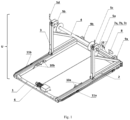
- fig. 1 shows the device according to the invention in the rest position in isometric view
- fig. 2 shows the device according to the invention in the rest position in a side view showing the tensioning device of the sliding carriage
- fig. 3 shows the device according to the invention in the rest position in side view, detailing the support rollers of the sliding carriage
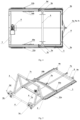
- fig. 4 shows the device according to the invention in the rest position in top view
- fig. 5 shows the device according to the invention in the extended position in isometric view
- fig. 6 shows the device according to the invention in the extended position in a side view
- fig. 7 shows the device according to the invention in the rest position mounted on the trailer
- fig. 8 shows the device according to the invention in the extended state mounted on the trailer; fig. 9 shows the trailer according to the invention with a loaded cable drum in isometric view, in particular showing the rear and the right side of the trailer; fig. 10 shows the front view of the trailer according to the invention; fig. 11 shows the trailer according to the invention in the left side view; fig. 12 shows the preparation of a boom for loading a drum onto the trailer according to the invention, incorporating the device according to the invention; fig. 13 shows the loading of the drum on the trailer according to the invention incorporating the device according to the invention; fig. 14 shows a drum loaded on a trailer according to the invention incorporating the device according to the invention; fig. 15 shows the construction of a locking-release mechanism in the device according to the invention.
- the device U according to the invention is a device provided with a steel main frame 1 for supporting and operating a cable drum used for assembling fibre-optic infrastructure.
- the design of the U device according to the invention is shown in fig. 1-6 , where 1 stands for the main frame, 2 stands for the sliding carriage, 3 stands for the triangular boom, 4 stands for the support bar, 5a and 5b stand for clamping yokes, 5c and 5d stand for threaded cranks, 6 stands for a winch with a drive, 7a stands for the first tensioning rollers, 7b stands for the second tensioning rollers, 7c stands for the third tensioning rollers, 8 stands for fixture of the sliding carriage, 9a and 9b stand for securing fixture of the triangular boom; 10a and 10b stand for a locking-release mechanism; 11a and 11b stand for the tensioning of the sliding carriage, 12 stands for the support rollers of the sliding carriage, 22 stands for an additional reinforcing plate, 23 stands for an additional reinforcing beam.
- the device U according to the invention is a separate module ready to be mounted in vehicles or trailers known from the prior art or in the trailer P according to the invention.
- a sliding carriage 2 equipped with tensioning 11a and 11b is mounted on the main frame 1, wherein said sliding carriage 2 is rectangular in shape, open on one side constituting the front part of the sliding carriage 2.
- the main frame 1 is equipped with a locking-release mechanism 10a, 10b mounted on both sides of the main frame 1 on its longitudinal sides. Whereas, the tensioning mechanism 11a and 11b interacts/cooperates with the locking-release mechanism 10a and 10b mounted on the main frame 1.
- a winch 6 is mounted, connected to the drive.
- the sliding carriage 2 is equipped with a fixture 8 securing the sliding carriage 2 in the form of a bolt grip placed in a sleeve fixed in the main frame 1 and a sleeve in the sliding carriage 2.
- the said securing fixture 8 of the sliding carriage ensures that the carriage 2 with a triangular boom 3 is secured against horizontal movement during transport.
- a triangular boom 3 equipped with a securing fixture of the triangular boom in the form of brackets 9a and 9b, which protect it against vertical movement during the transport of the U device.
- the sliding carriage 2 and the triangular boom 3 located on the main frame 1 are moved by means of an electrically powered drive of winch 6 via a steel cable and tensioning rollers 7a, 7b and 7c.
- other types of drives e.g. mechanical, hydraulic, pneumatic
- other types of drives e.g. mechanical, hydraulic, pneumatic
- the device U according to the invention is powered by an external power source, which may be, for example, an accumulator of a vehicle towing a trailer on which the device is mounted.
- an external power source which may be, for example, an accumulator of a vehicle towing a trailer on which the device is mounted.
- an independent installation is provided, powered from the vehicle accumulator (Cars) up to the auxiliary socket mounted on the hook of the towing vehicle.
- the trailer is connected by a plug to the socket of the vehicle towing the trailer.
- the installed system on the trailer supplies power to the winch 6 with the drive.
- the drive is fixed to the centre of the front and transverse parts of the main frame 1 and is controlled by a wired remote control
- wireless remote controls can also be used.
- wired control a contactor and the extend / retract buttons are used.
- wireless control the control is carried out by means of a transmitter and a receiver, where the extend / retract command is given by radio waves.
- the two-button wired remote control has the following buttons:
- the main frame 1 in the longitudinal part, consists of two semi-closed channels parallel to each other, mounted with the open part of the channel facing upwards, and in the middle of each semi-closed channel of the longitudinal part of the main frame 1 there are support rollers 12 ( Fig. 3 ) which, through an opening (or e.g. a cut) in the aforementioned semi-closed channel, were attached (with a distance allowing their movement) to a sliding carriage 2 mounted on the main frame 1.
- a suitable spacing between the first and second sets of support rollers 12 with respect to the sliding carriage 2 allows the sliding carriage 2 to slide in the main frame 1. This allows for a suitable extension beyond the front of the range of the main frame 1 (as shown in fig. 5 and 6 ) and provides additional freedom to position the Cable Drum X prior to loading.
- the device U is equipped with an additional reinforcing plate 22 and an additional reinforcing beam 23.
- the additional reinforcing plate 22 is intended to be mounted under the trailer floor, on which the U -device is mounted, and it fastens the main frame 1 and the winch 6 with the trailer support frame through.
- the additional reinforcing beam 23 is also intended to be mounted under the floor of the trailer on which the U device is mounted, and the said beam 23 fastens the main frame 1 with the trailer supporting frame through.
- a triangular boom 3 with tilting arms is mounted by means of bolts.
- the arms of the triangular boom 3 are able to tilt to load the Cable Drum X.
- clamping yokes 5a, 5b are mounted, equipped with quadruple bearing sleeves and a support bar 4 fitted with two sliding plates and secured with threaded cranks 5c, 5d constituting the closing mechanism of the clamping yokes 5a, 5b.
- the winch 6 is connected via a cable successively to the first tensioning roller 7a located in the rear part of the transverse main frame 1, the second tensioning roller 7b located in the rear part of the sliding carriage 2 and to the third tensioning roller 7c mounted on the triangular boom 3.
- the device U combines the following functions:
- the service trailer P according to the invention is intended in particular for transporting materials on cable drums and contains the device U according to the invention, which in an unloaded variant at rest is shown in Fig. 7 .
- Fig. 8 the device U according to the invention is shown in a trailer P according to the invention during extension.
- Trailer P is equipped with a chassis frame mounted on a wheelset and with a floor plate, a front wall, two side walls and a ceiling plate.
- the trailer P is provided with a closure in the form of a rear double door, but another closure, e.g. a tailgate, may be used.
- the device U according to the invention is located in the rear part.
- a frame 13 for mounting a compressor 14 and an air dryer 15 connected to it.
- a shelf for mounting accessories 16 was designed (for various types of accessories that may be useful during line work).
- the frame 13 ends at the top with a shelf for mounting accessories 16, for the safe storage of small accessories or additional devices.
- the trailer P is provided with supports 18. Extending the trailer supports 8 is particularly recommended before loading and unloading the drum X. While using the trailer P, it is not required to extend the trailer supports 8.
- a compressed air system 17 runs towards the rear of the trailer P and ends with a valve and a nipple.
- said compressed air system 17 in the section from the air dryer 15 to the device U is extended along the inner surface of the right side of the trailer P.
- the system 17 turns vertically upwards towards the inner side of the ceiling plate of the trailer P, from where the compressed air system 17 is led up to the edge of the ceiling plate of the rear of the trailer P.
- the compressor 14 and the air dryer 15 are devices known from the prior art.
- the compressor 14 is started by a starter in accordance with the compressor 14 manufacturer's instructions and should remain started for the duration of the line work.
- the compressed air system 17 is supplied, which is terminated with a valve and a connector to which an external blower is connected.
- the said external blower machine is connected to the system 17 via an external, flexible, high-pressure hose.
- By opening the valve at the compressed air connection 17 the blower is ready for operation and can start working.
- the service trailer P enables the integration of many service devices, which, when integrated in a closed trailer, form a compact, mobile and specialised set for line work, e.g. for assembly, installation, laying, unfolding, inserting, blowing, pulling all kinds of cables, conduits, pipes, wires, etc.
- the designed bodywork enables adaptation of the trailer P according to the invention to a wide range of applications, enables quick access to individual devices and their efficient service.
- Stage 1 preparing the device U for loading (or unloading) of Drum X
- the device U according to the invention when loaded on the trailer P according to the invention, in the starting condition (i.e. free from loading) is blocked for transport and secured against vertical movement (by means of the triangular boom securing fixtures 9a and 9b ) and horizontal movement (by means of the securing fixture 8 of the sliding carriage).
- the securing fixtures of the triangular boom 9a and 9b are automatically released. After releasing the securing fixture 8 (used for transport), it is possible to extend the sliding carriage 2 and the triangular boom 3 in the device U according to the invention. In this embodiment, the travel of the sliding carriage 2 is controlled by a wired remote control.
- the travel of the sliding carriage 2 in the main frame 1 enables the appropriate spacing of sets of supporting rollers 12 in the main frame 1 in relation to the sliding carriage 2.
- the pinning of the triangular boom 3 mounted in the front open part of the sliding carriage 2 by means of bolts allows the arms of the triangular boom 3 to tilt out for loading the drum X.
- the motorized winch 6 loosens the steel cable and the steel cable through the first, second and third tensioning rollers 7a, 7b and 7c successively, thanks to the tensioning features of the sliding carriage 11a and 11b (in the form of springs that begin to pull), cause the sliding carriage 2 to slide out together with the triangular boom 3, until the point of contact with the locking-release mechanism 10a and 10b is reached.
- the locking-release mechanism 10a and 10b when the sliding carriage 2 extends, first locks the sliding carriage 2 and enables the tilting out the triangular boom 3. Note: in the first phase, the operator manually tilts the triangular boom 3 while loosening the steel cable from the winch 6, but only until the triangular boom 3 tilts (i.e. approx. 20 cm) so that the triangular boom 3 can continue to tilt automatically / automatically (gravity) .
- the locking-release mechanism 10a and 10b during the retraction procedure of the sliding carriage 2, until the triangular boom 3 returns (i.e. it returns to its initial position in the carriage 2) automatically locks the sliding carriage 2. This allows free return movement of the triangular boom 3. As soon as the triangular boom 3 comes into contact with the sliding carriage 2, the locking device is automatically released (by means of special pawls), allowing the sliding back into the return position by the sliding carriage 2.
- the locking-release mechanism 10a, 10b is shown in Fig. 15 , wherein 24 is the triangular locking element, 25 is the pin and 26 is the release part.
- the locking-release mechanism 10a, 10b applied consists of:
- Two triangular parts A were symmetrically mounted on the main frame 1, and they were mounted in such a way that the upper part of the triangles A protrudes above the upper part of the main frame 1, fulfilling the function of a lock of the rear transverse structure of the sliding carriage 2 (so the sliding carriage 2 moves only between the starting position and the lock of the triangles described above A).
- Two guides for the ratchet slides D have been symmetrically mounted to the main Frame 1, so that the ratchet slides B could freely move up and down through the oncoming and exiting sliding carriage 2.
- the guides D also fulfil the function of limiting the movement of the moving slides B to the necessary extent, and in particular limiting their upper position.
- Two ratchet slides B have been symmetrically mounted to the main frame 1, so that they can move freely up and down, the ejection spring C provides upward movement, and the rear transverse part of the sliding carriage 2, by riding onto the ratchet slides, provides the downward movement.
- pins 25 or e.g. rounded mandrels
- the pins 25 which, through the penetrations / holes (with a diameter greater than the pins / mandrels) on the edges of the rear - transverse - lower part of the sliding carriage 2 structure, enter the penetration / hole in the initial phase of tilting of the triangular boom 3, locking at the same time the return movement of the sliding carriage 2.
- both the two triangular parts A and the pins 25 / rounded mandrels of the ratchet slides B prevent the sliding carriage 2 from moving forward and backward, thus blocking the sliding carriage 2.
- the ratchet slides B are pushed up again waiting for the sliding carriage 2
- the sliding carriage 2 has stopped at the point of contact with the locking-and-release mechanism 10a and 10b (i.e. when the maximum extension point has been reached), it is the moment of locking the carriage.
- the triangular boom 3 is unlocked, which, by further loosening the cable from the winch 6 with the drive, allows the arms of the triangular boom 3 to tilt until the necessary height in the axis of the drum X is reached, as shown in Fig. 12 .
- the operator manually releases the clamping yokes 5a and 5b by unscrewing the threaded cranks 5c and 5d, respectively. The operator then opens the clamping yokes 5a and 5b, which allows the support bar 4 to be pulled out.
- Stage 2 Fixing and securing the drum X in the device U according to the invention
- Stage 3 Pulling in the triangular boom 3 and inserting the sliding carriage 2 in the trailer interior
- the arms of the triangular boom 3 are pulled in together with the drum X placed on the support bar 4, the winch 6 with a drive pulls the steel cable in and through the tensioning rollers 7a , 7b and 7c, the triangular boom 3 is pulled in until the triangular boom 3 is laid and rests in the sliding carriage 2, which stands locked in its original point of contact with the locking-release mechanism 10a and 10b.
- the carriage 2 After the triangular boom 3 is laid and rested in the sliding carriage 2 at the point of contact with the locking-release mechanism 10a and 10b (i.e. after folding and fully resting, the carriage 2 is unlocked). The triangular boom 3 is blocked successively, while the sliding carriage 2 is unlocked at the same time. By continuing to pull in the line through the motorized winch 6, the sliding carriage 2 is retracted while tensioning the tensions of the sliding carriage 11a and 11b (the springs begin to stretch) until the sliding carriage 2 reaches the return starting point.
- Stage 4 Completion of work and securing of the device U according to the invention:
- the sliding carriage 2 with the triangular boom 3 reaching the starting point are automatically locked again and secured against vertical movement during transport by means of securing fixtures of the triangular boom 9a and 9b. Additionally, the sliding carriage 2 together with the triangular boom 3 is secured against horizontal movement during transport by means of the securing fixture of the sliding carriage 8. Thus, the device U according to the invention reaches the occupied start condition with loading.
- the device U with the drum X is secured and ready for transport and at the same time ready for line work ( fig. 14 ).
- the trailer according to the invention containing the device U according to the invention with a loaded cable drum X is ready for use and does not require any additional operations to be performed before line work is started.
- the trailer P should always be connected to an additional independent power supply, e.g. directly to the battery of the vehicle towing the trailer. It is recommended that the vehicle always have the engine running when loading and unloading the drum X.
- connection to an independent power supply and the engine running in the vehicle is required only for the time of loading and unloading the drum X. During the use of the trailer P, power is not required.
- the rear door wings and the side doors of trailer P must always be open and secured during loading, use and unloading of drum X.
Landscapes
- Engineering & Computer Science (AREA)
- Health & Medical Sciences (AREA)
- Public Health (AREA)
- Transportation (AREA)
- Mechanical Engineering (AREA)
- Unwinding Of Filamentary Materials (AREA)
- Jib Cranes (AREA)
- Loading Or Unloading Of Vehicles (AREA)
Description
- The subject-matter of the invention is a device for supporting and operating a cable drum, and a service trailer comprising said device.
- The construction of infrastructure along with the installation of fibre-optic networks requires the use of appropriate precision devices and support equipment. Specialised equipment must be packed, secured, and transported to the installation/assembly sites where it is set up, arranged and connected.
- From the Polish application description
PL4198561 A1 - From the Polish patent specification
PL233144 B1 - From a UK application description
GB2224092 A - From the US application description
US2014086688 A1 a cable trailer is known, used for supporting a cable reel weighing up to 10 tons and for laying the cable in a trench or along a trench. The trailer consists of a trailer chassis provided with an inner opening and enclosed by a tailgate that can be opened or removed to provide access to the space of the inner opening; two mounting arms for securing the cable reel, said mounting arms being spaced apart through the inner hole and substantially equidistant from the tailgate; a bridge with a cable guide to facilitate the removal of the cable from the cable drum; at least one cable support arm extends from the side of the undercarriage; a plurality of cable guides arranged on at least one cable support arm to facilitate steering the cable; and a hydraulic actuator system for positioning at least one cable support arm and securing the cable drum to the mounting arms; while in use, the cable drum is mounted on mounting arms in the space of the inner opening, and the cable is guided through the cable guide and cable guides into the ditch. - From the Polish patent specification
PL134585 B1 - The frame, on the other hand, is mounted on bases connected to a hydraulic cylinder on one side and brackets on the other. Preferably, the ends of the tilting frame have a telescopically extendible element. Moreover, in a preferred embodiment of the disclosure, a roller is arranged on its upper surface in the front part of the chassis frame, with a length corresponding to the width of the chassis frame, which constitutes the bearing element of the chassis frame and serves to drive the drum. Preferably, the chassis frame is provided with a floor and there is a box on the frame. In preferred embodiments, openings are provided in the side walls of the carriages in which fasteners are provided for supporting the drums.
- Other devices for supporting and operating a cable drum are known e.g. from
US 4 588 142 A ,GB 2 265 355 AUS 5 895 197 A . - The aim of the invention was to provide a device for improving the efficiency of building fibre-optic infrastructure. Another aim of the invention was to create a multi-purpose mobile device constituting a complete device for the assembly of fibre-optic infrastructure.
- The essence of the invention is a device for supporting and operating a cable drum, equipped with a rectangular frame and a locking-release mechanism, characterised in that a sliding carriage equipped with tensioning is mounted on the main frame, wherein said sliding carriage is in the shape of a rectangle, open on one side, which is the front part of a sliding carriage, in addition, the main frame is equipped with a locking-release mechanism mounted on both sides of the main frame on its longitudinal sides; in the centre of the front transverse part of the main frame there is a winch connected to the drive; in the longitudinal part, the main frame consists of two parallel to each other semi-closed channels mounted upwards with the open part of the channels, and in the centre of each semi-closed channel of the longitudinal part of the main frame there are support rollers, which are attached to a sliding carriage mounted on the main frame; a triangular boom with swivel arms is mounted in the front, open part of the sliding carriage by means of bolts; in the upper part of each of the swivel arms of the triangular boom, clamping yokes are mounted, equipped with quadruple bearing sleeves and mounting the support bar, secured with threaded cranks constituting the closing mechanism of the clamping yokes; the winch is connected via a cable successively to the first tensioning roller located in the rear transverse part of the main frame, the second tensioning roller located in the rear part of the sliding carriage and to the third tensioning roller located on the triangular boom.
- Preferably, the bar comprises two sliding discs.
- Preferably, the device comprises a securing fixture of the triangular boom in the form of braces.
- Preferably, the device comprises a sliding carriage safety device, which is a bolt grip made of a sleeve fixed on the main frame and a sleeve in the sliding carriage.
- Preferably, the drive is selected from the group consisting of a mechanical, electric, hydraulic or pneumatic drive.
- Preferably, the drive is equipped with a controller for wired or wireless control.
- Another subject of the invention is a service trailer, especially for transporting materials on drums, equipped with a chassis frame mounted on a wheelset and provided with a floor plate, a front wall, two side walls and a ceiling plate, characterised in that a device according to the invention is mounted in its rear part, while in the front part there is a frame for fastening the compressor and an air dryer connected to it, from which a compressed air system leads towards the rear of the trailer and ends with a valve and a connector; side door is located in the right side wall of the trailer at the height of the frame with the compressor and air dryer installed; in the front wall there is a hot air outlet and a fuel inlet for refuelling the compressor, while in the left side wall there is an air inlet for the screw compressor.
- Preferably, the frame ends at the top with a shelf for mounting accessories.
- Preferably, the compressed air system in the section from the air dryer to the device is stretched along the inner side of the right side of the trailer, and at the height of the device there is a vertical section of the compressed air system leading to the inner side of the trailer ceiling plate, from where the compressed air system is routed to the edge of the ceiling plate of the rear of the trailer.
- Preferably, the trailer according to the invention contains supports.
- Preferably, the trailer according to the invention is provided with a closing part in the form of a tailgate or a rear door.
- The invention provides the following advantages; it:
- Accelerates the pace of work;
- Enables easier loading, transport and assembly;
- Two persons are sufficient to load, transport, handle and install the infrastructure;
- Enables a reduction of loading time by about 15-20 minutes compared to the existing solutions;
- Eliminates the need to unload and set up the equipment at the work site, because it is enough to properly position the trailer according to the invention in relation to the work site;
- The smaller dimensions of the trailer according to the invention facilitate its parking - the required space, which is necessary for parking / positioning the trailer during assembly operations, is much smaller than the hitherto required - approx. 50% less space;
- During installation the trailer is self-powered and can stand alone in place. And the vehicle that transported the trailer can be unhitched/disconnected;
- During the installation process, appropriately designed modules/segments allow the job to be completed faster and more efficiently;
- Due to the absence of the need to unload, there is no equipment, no accessories and no materials to be deployed. When moving the set to the next installation site to continue the work, there is no reloading and securing;
- It provides increased savings in the Logistics aspect, which in turn translates into greater efficiency and effectiveness of building fibre-optic infrastructure - efficiency increase in the range of 30-40%.
- The invention is shown in embodiments in figures, where
fig. 1 shows the device according to the invention in the rest position in isometric view;fig. 2 shows the device according to the invention in the rest position in a side view showing the tensioning device of the sliding carriage;fig. 3 shows the device according to the invention in the rest position in side view, detailing the support rollers of the sliding carriage;fig. 4 shows the device according to the invention in the rest position in top view;fig. 5 shows the device according to the invention in the extended position in isometric view;fig. 6 shows the device according to the invention in the extended position in a side view;fig. 7 shows the device according to the invention in the rest position mounted on the trailer;fig. 8 shows the device according to the invention in the extended state mounted on the trailer;fig. 9 shows the trailer according to the invention with a loaded cable drum in isometric view, in particular showing the rear and the right side of the trailer;fig. 10 shows the front view of the trailer according to the invention;fig. 11 shows the trailer according to the invention in the left side view;fig. 12 shows the preparation of a boom for loading a drum onto the trailer according to the invention, incorporating the device according to the invention;fig. 13 shows the loading of the drum on the trailer according to the invention incorporating the device according to the invention;fig. 14 shows a drum loaded on a trailer according to the invention incorporating the device according to the invention;fig. 15 shows the construction of a locking-release mechanism in the device according to the invention. - The device U according to the invention is a device provided with a steel
main frame 1 for supporting and operating a cable drum used for assembling fibre-optic infrastructure. The design of the U device according to the invention is shown infig. 1-6 , where 1 stands for the main frame, 2 stands for the sliding carriage, 3 stands for the triangular boom, 4 stands for the support bar, 5a and 5b stand for clamping yokes, 5c and 5d stand for threaded cranks, 6 stands for a winch with a drive, 7a stands for the first tensioning rollers, 7b stands for the second tensioning rollers, 7c stands for the third tensioning rollers, 8 stands for fixture of the sliding carriage, 9a and 9b stand for securing fixture of the triangular boom; 10a and 10b stand for a locking-release mechanism; 11a and 11b stand for the tensioning of the sliding carriage, 12 stands for the support rollers of the sliding carriage, 22 stands for an additional reinforcing plate, 23 stands for an additional reinforcing beam. - As shown in
fig. 1 in this non-limiting embodiment, the device U according to the invention is a separate module ready to be mounted in vehicles or trailers known from the prior art or in the trailer P according to the invention. - A sliding
carriage 2 equipped with tensioning 11a and 11b is mounted on themain frame 1, wherein said slidingcarriage 2 is rectangular in shape, open on one side constituting the front part of the slidingcarriage 2. Moreover, themain frame 1 is equipped with a locking-release mechanism main frame 1 on its longitudinal sides. Whereas, thetensioning mechanism release mechanism main frame 1. - In the centre of the front transverse part of the main frame 1 a
winch 6 is mounted, connected to the drive. The slidingcarriage 2 is equipped with afixture 8 securing the slidingcarriage 2 in the form of a bolt grip placed in a sleeve fixed in themain frame 1 and a sleeve in thesliding carriage 2. - The said securing
fixture 8 of the sliding carriage ensures that thecarriage 2 with atriangular boom 3 is secured against horizontal movement during transport. - Moreover, on the
main frame 1, through thecarriage 2, atriangular boom 3 equipped with a securing fixture of the triangular boom in the form ofbrackets carriage 2 and thetriangular boom 3 located on themain frame 1 are moved by means of an electrically powered drive ofwinch 6 via a steel cable andtensioning rollers - The device U according to the invention is powered by an external power source, which may be, for example, an accumulator of a vehicle towing a trailer on which the device is mounted. In this non-limiting embodiment, an independent installation is provided, powered from the vehicle accumulator (Cars) up to the auxiliary socket mounted on the hook of the towing vehicle. The trailer is connected by a plug to the socket of the vehicle towing the trailer. The installed system on the trailer supplies power to the
winch 6 with the drive. - Whereas, in this embodiment, the drive is fixed to the centre of the front and transverse parts of the
main frame 1 and is controlled by a wired remote control, while wireless remote controls can also be used. However, in the case of wired control, a contactor and the extend / retract buttons are used. In the case of wireless control, the control is carried out by means of a transmitter and a receiver, where the extend / retract command is given by radio waves. - In this embodiment, the two-button wired remote control has the following buttons:
- a) The extend / tilt button;
- b) The retract button.
- As indicated in
fig. 1 and3 , in the longitudinal part, themain frame 1 consists of two semi-closed channels parallel to each other, mounted with the open part of the channel facing upwards, and in the middle of each semi-closed channel of the longitudinal part of themain frame 1 there are support rollers 12 (Fig. 3 ) which, through an opening (or e.g. a cut) in the aforementioned semi-closed channel, were attached (with a distance allowing their movement) to a slidingcarriage 2 mounted on themain frame 1. A suitable spacing between the first and second sets ofsupport rollers 12 with respect to the slidingcarriage 2 allows the slidingcarriage 2 to slide in themain frame 1. This allows for a suitable extension beyond the front of the range of the main frame 1 (as shown infig. 5 and6 ) and provides additional freedom to position the Cable Drum X prior to loading. - As indicated in
fig. 2 , in this embodiment the device U is equipped with an additional reinforcingplate 22 and an additional reinforcingbeam 23. The additional reinforcingplate 22 is intended to be mounted under the trailer floor, on which the U-device is mounted, and it fastens themain frame 1 and thewinch 6 with the trailer support frame through. The additional reinforcingbeam 23 is also intended to be mounted under the floor of the trailer on which the U device is mounted, and the saidbeam 23 fastens themain frame 1 with the trailer supporting frame through. - In the front, open part of the sliding
carriage 2, atriangular boom 3 with tilting arms is mounted by means of bolts. As a result, the arms of thetriangular boom 3 are able to tilt to load the Cable Drum X. - In the upper part of each of the tilting arms of the
triangular boom 3, clampingyokes support bar 4 fitted with two sliding plates and secured with threadedcranks yokes - The
winch 6 is connected via a cable successively to thefirst tensioning roller 7a located in the rear part of the transversemain frame 1, thesecond tensioning roller 7b located in the rear part of the slidingcarriage 2 and to thethird tensioning roller 7c mounted on thetriangular boom 3. - The device U according to the invention combines the following functions:
- Loading and unloading of cable / conduit / pipe / wire drum with a lifting device.
- Quick securing of the cable / conduit / pipe / wire drum during transport.
- Possibility to use the drum with cables / conduits / pipes / wires during line works without the need to unlock, unload the drum from a vehicle or trailer.
- The service trailer P according to the invention is intended in particular for transporting materials on cable drums and contains the device U according to the invention, which in an unloaded variant at rest is shown in
Fig. 7 . WhereasFig. 8 the device U according to the invention is shown in a trailer P according to the invention during extension. Trailer P is equipped with a chassis frame mounted on a wheelset and with a floor plate, a front wall, two side walls and a ceiling plate. Moreover, in this embodiment, the trailer P is provided with a closure in the form of a rear double door, but another closure, e.g. a tailgate, may be used. - The device U according to the invention is located in the rear part. On the other hand, in the front part of the trailer P there is a
frame 13 for mounting acompressor 14 and anair dryer 15 connected to it. - Additionally, using the remaining space in the trailer P, a shelf for mounting
accessories 16 was designed (for various types of accessories that may be useful during line work). In this non-limiting embodiment, theframe 13 ends at the top with a shelf for mountingaccessories 16, for the safe storage of small accessories or additional devices. - In addition, the trailer P is provided with
supports 18. Extending the trailer supports 8 is particularly recommended before loading and unloading the drum X. While using the trailer P, it is not required to extend the trailer supports 8. - As indicated in
fig. 9 , from the air dryer 15 acompressed air system 17 runs towards the rear of the trailer P and ends with a valve and a nipple. Whereby, saidcompressed air system 17 in the section from theair dryer 15 to the device U is extended along the inner surface of the right side of the trailer P. At the height of the device U, thesystem 17 turns vertically upwards towards the inner side of the ceiling plate of the trailer P, from where thecompressed air system 17 is led up to the edge of the ceiling plate of the rear of the trailer P. - Moreover, in the right side wall of the trailer P, at the height of the
frame 13 with the mountedcompressor 14 andair dryer 15, there are side doors that allow free access to thecompressor 14 and theair dryer 15 from the outside. - As indicated in
fig. 10 , in the front wall of the trailer P there is awarm air outlet 19 for cooling the compressor and afuel filler 20 for refuelling the compressor. Whereas, as indicated inFig. 11 , in the left side wall of the trailer P, anair inlet 21 for thescrew compressor 14 is installed. - The
compressor 14 and theair dryer 15 are devices known from the prior art. When using thecompressor 14 in the trailer P, check the fuel level in thecompressor 14, and if necessary, refuel through the fuel filler neck for e.g. thecompressor 20 located in the trailer P. Thecompressor 14 is started by a starter in accordance with thecompressor 14 manufacturer's instructions and should remain started for the duration of the line work. By opening the valve located at thecompressor 14, thecompressed air system 17 is supplied, which is terminated with a valve and a connector to which an external blower is connected. Whereas, the said external blower machine is connected to thesystem 17 via an external, flexible, high-pressure hose. By opening the valve at thecompressed air connection 17 the blower is ready for operation and can start working. - Independent and free rotation of the loaded and secured cable drum X around its axis causes the cables / conduits / pipes / wires to unwind or wind. This allows immediate access and use when performing line work. After completing the work, it is enough to turn off the
compressor 14 and close the valves, i.e. the first valve at thecompressor 14 and the second at thecompressed air system 17 terminated with a valve and a connector. Then, the external blower, connected with an external, flexible, high-pressure hose to the compressedair system coupling 17 is disconnected (i.e. detached). In the last stage, the rear door wings and the side door of the trailer P are closed, thus securing everything for transport. - The service trailer P according to the invention enables the integration of many service devices, which, when integrated in a closed trailer, form a compact, mobile and specialised set for line work, e.g. for assembly, installation, laying, unfolding, inserting, blowing, pulling all kinds of cables, conduits, pipes, wires, etc.
- At the same time, in the trailer P, all devices, including the device U according to the invention, are installed in the working sequence, so there is no need to remove the devices in order to prepare them for the commencement of work. This way, the team is operational within minutes of arriving at the job site. By skipping unpacking / packing of the equipment necessary for work, the efficiency of the team significantly increases, especially when it carries out line work in many locations in one day.
- The designed bodywork enables adaptation of the trailer P according to the invention to a wide range of applications, enables quick access to individual devices and their efficient service.
- The device U according to the invention, when loaded on the trailer P according to the invention, in the starting condition (i.e. free from loading) is blocked for transport and secured against vertical movement (by means of the triangular
boom securing fixtures fixture 8 of the sliding carriage). - Before starting the operation of the U device, release the securing
fixture 8 of the sliding carriage by pulling the bolt grip from the sleeve fixed in themain frame 1 and in the slidingcarriage 2. The securingfixture 8 is manually released by the Operator. - On the other hand, the securing fixtures of the
triangular boom carriage 2 and thetriangular boom 3 in the device U according to the invention. In this embodiment, the travel of the slidingcarriage 2 is controlled by a wired remote control. - The travel of the sliding
carriage 2 in themain frame 1 enables the appropriate spacing of sets of supportingrollers 12 in themain frame 1 in relation to the slidingcarriage 2. The pinning of thetriangular boom 3 mounted in the front open part of the slidingcarriage 2 by means of bolts allows the arms of thetriangular boom 3 to tilt out for loading the drum X. - When the sliding
carriage 2 is extended together with thetriangular boom 3, themotorized winch 6 loosens the steel cable and the steel cable through the first, second andthird tensioning rollers carriage carriage 2 to slide out together with thetriangular boom 3, until the point of contact with the locking-release mechanism - The locking-
release mechanism carriage 2 extends, first locks the slidingcarriage 2 and enables the tilting out thetriangular boom 3. Note: in the first phase, the operator manually tilts thetriangular boom 3 while loosening the steel cable from thewinch 6, but only until thetriangular boom 3 tilts (i.e. approx. 20 cm) so that thetriangular boom 3 can continue to tilt automatically / automatically (gravity) . - The locking-
release mechanism carriage 2, until thetriangular boom 3 returns (i.e. it returns to its initial position in the carriage 2) automatically locks the slidingcarriage 2. This allows free return movement of thetriangular boom 3. As soon as thetriangular boom 3 comes into contact with the slidingcarriage 2, the locking device is automatically released (by means of special pawls), allowing the sliding back into the return position by the slidingcarriage 2. The locking-release mechanism Fig. 15 , wherein 24 is the triangular locking element, 25 is the pin and 26 is the release part. - In this non-limiting embodiment, the locking-
release mechanism - A) two triangular parts (i.e., locking elements 24);
- B) two ratchet slides which are the
release parts 26 with a fixed pin 25 (or, e.g., a rounded pin); - C) two springs pushing out the slide;
- D) two guides for ratchet slides.
- Two triangular parts A were symmetrically mounted on the
main frame 1, and they were mounted in such a way that the upper part of the triangles A protrudes above the upper part of themain frame 1, fulfilling the function of a lock of the rear transverse structure of the sliding carriage 2 (so the slidingcarriage 2 moves only between the starting position and the lock of the triangles described above A). - Two guides for the ratchet slides D have been symmetrically mounted to the
main Frame 1, so that the ratchet slides B could freely move up and down through the oncoming and exiting slidingcarriage 2. The guides D also fulfil the function of limiting the movement of the moving slides B to the necessary extent, and in particular limiting their upper position. - In order for the ratchet slides B to automatically return / position themselves in the upper part of the guides, springs were mounted symmetrically on the
main frame 1, pushing out the C slides, but allowing the pushing (downward movement) of the ratchet slides B through the oncoming slidingcarriage 2. - Two ratchet slides B have been symmetrically mounted to the
main frame 1, so that they can move freely up and down, the ejection spring C provides upward movement, and the rear transverse part of the slidingcarriage 2, by riding onto the ratchet slides, provides the downward movement. - An important element are the pins 25 (or e.g. rounded mandrels) which, through the penetrations / holes (with a diameter greater than the pins / mandrels) on the edges of the rear - transverse - lower part of the sliding
carriage 2 structure, enter the penetration / hole in the initial phase of tilting of the triangular boom3, locking at the same time the return movement of the slidingcarriage 2. - Thus, in the swing phase of the
triangular Boom 3, both the two triangular parts A and thepins 25 / rounded mandrels of the ratchet slides B prevent the slidingcarriage 2 from moving forward and backward, thus blocking the slidingcarriage 2. - Only in the return phase of the
triangular boom 3, i.e. until it is laid in the slidingcarriage 2, while simultaneously pressing thepins 25 / mandrels of the ratchet slides B, it is possible to move backwards and return the slidingcarriage 2 to its starting point. - The ratchet slides B are pushed up again waiting for the sliding
carriage 2
After the slidingcarriage 2 has stopped at the point of contact with the locking-and-release mechanism triangular boom 3 is unlocked, which, by further loosening the cable from thewinch 6 with the drive, allows the arms of thetriangular boom 3 to tilt until the necessary height in the axis of the drum X is reached, as shown inFig. 12 . - After the arms of the
triangular boom 3 have tilted to the point specified by the operator (e.g. the height of the drum axis), the operator manually releases the clamping yokes 5a and 5b by unscrewing the threadedcranks support bar 4 to be pulled out. When thesupport bar 4 is pulled out, an open space is reached between the arms of thetriangular boom 3, which allows the drum X to be rolled in or the trailer according to the invention to be set up/moved/parked with the device U according to the invention in such a way that the axis of the drum X is in the closing axis of the clamping yokes 5a and 5b. - In the axis of the drum X there are holes on both its left and right sides (through holes), into the holes in the axis of the drum X the operator places the
support bar 4, so that the ends of thesupport bar 4 are in place of the bearing sleeves located on both sides in the clamping yokes 5a and 5b. After thesupport bar 4 has been returned to the clamping yokes 5a and 5b, the clamping yokes 5a and 5b are closed and secured with threadedcranks support bar 4 there are two disks moved to the left and right sides of the drum X, which, after its centring, are attached to thesupport bar 4, and protect the drum X from shifting during loading, i.e. retracting by the device U according to the invention, and during transport. This loading step is shown schematically inFig. 13 . - After placing and securing the drum X on the
support bar 4 and placing thesupport bar 4 in the clamping yokes 5a and 5b, the arms of thetriangular boom 3 are pulled in together with the drum X placed on thesupport bar 4, thewinch 6 with a drive pulls the steel cable in and through thetensioning rollers triangular boom 3 is pulled in until thetriangular boom 3 is laid and rests in the slidingcarriage 2, which stands locked in its original point of contact with the locking-release mechanism - After the
triangular boom 3 is laid and rested in the slidingcarriage 2 at the point of contact with the locking-release mechanism carriage 2 is unlocked). Thetriangular boom 3 is blocked successively, while the slidingcarriage 2 is unlocked at the same time. By continuing to pull in the line through themotorized winch 6, the slidingcarriage 2 is retracted while tensioning the tensions of the slidingcarriage carriage 2 reaches the return starting point. - The sliding
carriage 2 with thetriangular boom 3 reaching the starting point are automatically locked again and secured against vertical movement during transport by means of securing fixtures of thetriangular boom carriage 2 together with thetriangular boom 3 is secured against horizontal movement during transport by means of the securing fixture of the slidingcarriage 8. Thus, the device U according to the invention reaches the occupied start condition with loading. - The device U with the drum X is secured and ready for transport and at the same time ready for line work (
fig. 14 ). - Whereas, the trailer according to the invention containing the device U according to the invention with a loaded cable drum X is ready for use and does not require any additional operations to be performed before line work is started.
- This is due to the innovative fastening system, including the use of clamping
yokes triangular boom 3, which enables direct, independent and free rotation of the placedsupport bar 4, and as a result, allows the cable drum X to rotate around its axis (causing cables / conduits / pipes / wires to unwind or wind). - Whereas, when loading / unloading the cable drum X, it must be noted that the trailer P should always be connected to an additional independent power supply, e.g. directly to the battery of the vehicle towing the trailer. It is recommended that the vehicle always have the engine running when loading and unloading the drum X.
- However, the said connection to an independent power supply and the engine running in the vehicle is required only for the time of loading and unloading the drum X. During the use of the trailer P, power is not required.
- The rear door wings and the side doors of trailer P must always be open and secured during loading, use and unloading of drum X.
- The above-mentioned embodiments and drawings are only examples of embodiments of the device U and the trailer P according to the invention, and do not limit the invention. The embodiments of the invention presented in the exemplary embodiments constitute an illustrative basic model of the device U and the trailer P equipped with wire control, but an integral feature of the invention is the possibility of retrofitting them, e.g. with the following functions, such as:
- full automation;
- introduction of wireless control;
- changeable or cooperating power sources and types of drives (electric, hydraulic or pneumatic);
- However, the above changes do not require the reconstruction or redesign of the U device, but only the installation of additional parts.
Claims (11)
- A device for supporting and operating a cable drum, equipped with a rectangular main frame (1) and a locking-release mechanism, characterised in that a sliding carriage (2) equipped with tensioning (11a and 11b) is mounted on the main frame (1), wherein said sliding carriage (2) is in the shape of a rectangle, open on one side, which is the front part of a sliding carriage (2), in addition, the main frame (1) is equipped with a locking-release mechanism (10a, 10b) mounted on both sides of the main frame (1) on its longitudinal sides; in the centre of the front transverse part of the main frame (1) there is a winch (6) connected to a drive; in the longitudinal part, the main frame (1) consists of two parallel to each other semi-closed channels mounted upwards with the open part of the channel, and in the centre of each semi-closed channel of the longitudinal part of the main frame (1) there are support rollers (12), which are attached to the sliding carriage (2) mounted on the main frame (1); a triangular boom (3) with swivel arms is mounted in the front, open part of the sliding carriage (2) by means of bolts; in the upper part of each of the swivel arms of the triangular boom (3), clamping yokes (5a, 5b) are mounted, equipped with quadruple bearing sleeves and mounting a support bar (4) secured with threaded cranks (5c, 5d) constituting the closing mechanism of the clamping yokes (5a, 5b); the winch (6) is connected via a cable successively to a first tensioning roller (7a) located in the rear transverse part of the main frame (1), a second tensioning roller (7b) located in the rear part of the sliding carriage (2) and to a third tensioning roller (7c) located on the triangular boom (3).
- The device according to claim 1, characterised in that the bar (4) comprises two sliding discs.
- The device according to claim 1 or 2, characterised in that it comprises a triangular boom securing fixture (9a, 9b) in the form of braces.
- The device according to any of the preceding claims from 1 to 3, characterised in that it comprises a securing fixture (8) of the sliding carriage (2), which is a bolt grip in the sleeve mounted on the main frame (1) and the sleeve in the sliding carriage (2).
- The device according to any of the preceding claims, 1 to 4, characterised in that the drive is selected from the group of mechanical, electric, hydraulic or pneumatic drives.
- The device according to any of the preceding claims from 1 to 5, characterised in that the drive is equipped with a controller for wired or wireless control.
- A service trailer, especially for transporting materials on drums, equipped with a chassis frame mounted on a wheelset and provided with a floor plate, a front wall, two side walls and a ceiling plate, characterised in that a device (U)according to any from the previous claims from 1 to 6 is mounted in its rear part, while in the front part there is a frame (13) for fastening the compressor (14) and an air dryer (15) connected to it, from which the compressed air system (17) leads towards the rear of the trailer (P) and ends with a valve and a connector; side door is located in the right side wall of the trailer (P) at the height of the frame (13) with the compressor (14) and air dryer (15) installed; in the front wall there is a hot air outlet (19) and a fuel inlet (20) for refuelling the compressor (14), while in the left side wall there is an air inlet for the screw compressor (14).
- The trailer according to claim 7, characterised in that the frame (13) is terminated at the top by a shelf for mounting accessories (16).
- The trailer according to claim 7 or 8, characterised in that the compressed air system (17) in the section from the air dryer (15) to the device (U) is stretched along the inner side of the right side of the trailer (P), and at the height of the device (U) there is a vertical section of the compressed air system (17), leading to the inside of the trailer (P) ceiling plate, from where the compressed air system (17) is routed to the edge of the ceiling plate of the rear of the trailer (P).
- The trailer according to any one of the preceding claims from 7 to 9, characterised in that it comprises supports (18).
- The trailer according to any one of the preceding claims from 7 to 10, characterised in that it is provided with a closure in the form of a tailgate or rear door.
Applications Claiming Priority (2)
| Application Number | Priority Date | Filing Date | Title |
|---|---|---|---|
| PL437789A PL437789A1 (en) | 2021-05-06 | 2021-05-06 | Device for supporting and operating the cable drum and a service trailer containing them |
| PCT/IB2022/053639 WO2022234373A1 (en) | 2021-05-06 | 2022-04-19 | A device for supporting and operating a cable drum and a service trailer comprising said device |
Publications (3)
| Publication Number | Publication Date |
|---|---|
| EP4334171A1 EP4334171A1 (en) | 2024-03-13 |
| EP4334171C0 EP4334171C0 (en) | 2025-06-11 |
| EP4334171B1 true EP4334171B1 (en) | 2025-06-11 |
Family
ID=82020973
Family Applications (1)
| Application Number | Title | Priority Date | Filing Date |
|---|---|---|---|
| EP22730309.6A Active EP4334171B1 (en) | 2021-05-06 | 2022-04-19 | A device for supporting and operating a cable drum and a service trailer comprising said device |
Country Status (7)
| Country | Link |
|---|---|
| US (1) | US20240227655A1 (en) |
| EP (1) | EP4334171B1 (en) |
| CA (1) | CA3218104A1 (en) |
| ES (1) | ES3041142T3 (en) |
| HU (1) | HUE073156T2 (en) |
| PL (2) | PL437789A1 (en) |
| WO (1) | WO2022234373A1 (en) |
Families Citing this family (3)
| Publication number | Priority date | Publication date | Assignee | Title |
|---|---|---|---|---|
| CN118004819B (en) * | 2024-04-08 | 2024-06-11 | 四川省川河盛鑫电力工程有限公司 | Cable laying device |
| CN118281771B (en) * | 2024-06-04 | 2024-08-20 | 广东阳硕绿建科技股份有限公司 | Cable installation equipment for wind power generation and installation method thereof |
| CN120793648B (en) * | 2025-09-15 | 2025-11-18 | 华能陇东能源有限责任公司 | A traction and winding device for cable laying in an energy storage power station |
Family Cites Families (16)
| Publication number | Priority date | Publication date | Assignee | Title |
|---|---|---|---|---|
| US2867390A (en) * | 1956-06-29 | 1959-01-06 | Robert M Anrig | Spool trailer |
| US4148445A (en) * | 1977-07-13 | 1979-04-10 | Midland Tank Rental Company | Apparatus and method for dispensing and retrieving flexible pipe |
| US4588142A (en) * | 1981-07-20 | 1986-05-13 | Malzacher Fred H | Cable spooling system |
| US4568035A (en) * | 1984-01-13 | 1986-02-04 | Ruch James P | Oilfield cable service trailer |
| US4701098A (en) * | 1986-09-26 | 1987-10-20 | Dakota Mfg. Co., Inc. | Cable wheel handling and transporting trailer |
| US6612516B1 (en) * | 1991-01-16 | 2003-09-02 | H. Norman Clarkson | Method and apparatus for cable dispensing and placement |
| GB2264923A (en) * | 1992-03-04 | 1993-09-15 | Sahlins Maskin Ab | Support for a reel |
| US5598866A (en) * | 1995-11-06 | 1997-02-04 | Nelson; Cliff H. | Portable well testing apparatus |
| US5895197A (en) * | 1997-05-30 | 1999-04-20 | Ok Champion Corporation | Cable reel handler |
| US6419424B1 (en) * | 1998-11-11 | 2002-07-16 | Null's Machine & Mfg., Inc. | Coil pipe trailer |
| US6273188B1 (en) * | 1998-12-11 | 2001-08-14 | Schlumberger Technology Corporation | Trailer mounted coiled tubing rig |
| US6347761B1 (en) * | 2000-07-28 | 2002-02-19 | Rick E. Larson | Mobile cable dispensing system |
| US20030006034A1 (en) * | 2001-07-05 | 2003-01-09 | Heartland Rig International, Llc | Coiled tubing level wind system |
| GB2514047B (en) * | 2012-03-08 | 2016-05-11 | Shell Int Research | Seismic cable handling system and method |
| US20140312156A1 (en) * | 2013-04-23 | 2014-10-23 | Bazooka Farmstar, Inc. | Base and spool for managing hose |
| US20160175906A1 (en) * | 2014-12-19 | 2016-06-23 | OilStone Energy Services, Inc. | Systems and methods for deploying tubular conduits and tubing |
-
2021
- 2021-05-06 PL PL437789A patent/PL437789A1/en unknown
-
2022
- 2022-04-19 ES ES22730309T patent/ES3041142T3/en active Active
- 2022-04-19 PL PL22730309.6T patent/PL4334171T3/en unknown
- 2022-04-19 CA CA3218104A patent/CA3218104A1/en active Pending
- 2022-04-19 US US18/558,851 patent/US20240227655A1/en active Pending
- 2022-04-19 EP EP22730309.6A patent/EP4334171B1/en active Active
- 2022-04-19 WO PCT/IB2022/053639 patent/WO2022234373A1/en not_active Ceased
- 2022-04-19 HU HUE22730309A patent/HUE073156T2/en unknown
Also Published As
| Publication number | Publication date |
|---|---|
| WO2022234373A1 (en) | 2022-11-10 |
| EP4334171A1 (en) | 2024-03-13 |
| HUE073156T2 (en) | 2026-01-28 |
| EP4334171C0 (en) | 2025-06-11 |
| US20240227655A1 (en) | 2024-07-11 |
| ES3041142T3 (en) | 2025-11-07 |
| CA3218104A1 (en) | 2022-11-10 |
| PL4334171T3 (en) | 2026-02-23 |
| PL437789A1 (en) | 2022-08-22 |
Similar Documents
| Publication | Publication Date | Title |
|---|---|---|
| EP4334171B1 (en) | A device for supporting and operating a cable drum and a service trailer comprising said device | |
| US4597712A (en) | Trailer apparatus for transporting vehicles and other cargo | |
| JP6286053B2 (en) | Powered replacement dolly and clamping device | |
| US11427446B2 (en) | Vehicle crane having a telescoping jib and vehicle crane system and method for mounting a bracing apparatus on the telescoping jib of a vehicle crane | |
| US4186901A (en) | Cargo ramp hoist mechanism | |
| US10017095B2 (en) | Mobile support and lift system | |
| JP7393416B2 (en) | Vehicle crane system for transporting installed parts, especially the main jib of vehicle cranes | |
| US10953782B2 (en) | Directional vehicle recovery unit | |
| US12447887B2 (en) | Multifunctional tailgate door and cargo load system and multidirectional bumper apparatus with adaptable tow hitch receiver | |
| US7465144B1 (en) | Adjustable winch and pulley system | |
| US7748943B2 (en) | Vehicle-mounted lifting system | |
| JPH06340236A (en) | Dolly with vehicle elevation transfer device | |
| US20100135756A1 (en) | System for lifting and stowing a vehicle | |
| WO2017078625A9 (en) | Apparatus for supporting a load on a truck or a trailer and method of off-loading the load | |
| US4693650A (en) | Trailer apparatus for transporting vehicles and other cargo | |
| US20050230340A1 (en) | Portable crane/winch/hoist | |
| WO2009025679A1 (en) | Method and apparatus for installing razor wire | |
| WO2001085508A1 (en) | Automobile body correction device and body correction method | |
| KR102242473B1 (en) | Cable laying system and cable laying method using it | |
| KR200287768Y1 (en) | A movable maintenance car | |
| CN110901606A (en) | Belt-shaped auxiliary brake device | |
| CN115043269A (en) | Mobile cable winding and unwinding system and method | |
| JP2020504697A (en) | Systems and methods for handling, storage, and transport | |
| RU15053U1 (en) | MOBILE CABLE LAYER | |
| EP0208980B1 (en) | Apparatus for supporting vehicles and the like |
Legal Events
| Date | Code | Title | Description |
|---|---|---|---|
| STAA | Information on the status of an ep patent application or granted ep patent |
Free format text: STATUS: UNKNOWN |
|
| STAA | Information on the status of an ep patent application or granted ep patent |
Free format text: STATUS: THE INTERNATIONAL PUBLICATION HAS BEEN MADE |
|
| PUAI | Public reference made under article 153(3) epc to a published international application that has entered the european phase |
Free format text: ORIGINAL CODE: 0009012 |
|
| STAA | Information on the status of an ep patent application or granted ep patent |
Free format text: STATUS: REQUEST FOR EXAMINATION WAS MADE |
|
| 17P | Request for examination filed |
Effective date: 20231205 |
|
| AK | Designated contracting states |
Kind code of ref document: A1 Designated state(s): AL AT BE BG CH CY CZ DE DK EE ES FI FR GB GR HR HU IE IS IT LI LT LU LV MC MK MT NL NO PL PT RO RS SE SI SK SM TR |
|
| DAV | Request for validation of the european patent (deleted) | ||
| DAX | Request for extension of the european patent (deleted) | ||
| GRAP | Despatch of communication of intention to grant a patent |
Free format text: ORIGINAL CODE: EPIDOSNIGR1 |
|
| STAA | Information on the status of an ep patent application or granted ep patent |
Free format text: STATUS: GRANT OF PATENT IS INTENDED |
|
| INTG | Intention to grant announced |
Effective date: 20250109 |
|
| GRAS | Grant fee paid |
Free format text: ORIGINAL CODE: EPIDOSNIGR3 |
|
| GRAA | (expected) grant |
Free format text: ORIGINAL CODE: 0009210 |
|
| STAA | Information on the status of an ep patent application or granted ep patent |
Free format text: STATUS: THE PATENT HAS BEEN GRANTED |
|
| AK | Designated contracting states |
Kind code of ref document: B1 Designated state(s): AL AT BE BG CH CY CZ DE DK EE ES FI FR GB GR HR HU IE IS IT LI LT LU LV MC MK MT NL NO PL PT RO RS SE SI SK SM TR |
|
| REG | Reference to a national code |
Ref country code: GB Ref legal event code: FG4D |
|
| REG | Reference to a national code |
Ref country code: CH Ref legal event code: EP |
|
| REG | Reference to a national code |
Ref country code: IE Ref legal event code: FG4D |
|
| REG | Reference to a national code |
Ref country code: DE Ref legal event code: R096 Ref document number: 602022015842 Country of ref document: DE |
|
| U01 | Request for unitary effect filed |
Effective date: 20250707 |
|
| U07 | Unitary effect registered |
Designated state(s): AT BE BG DE DK EE FI FR IT LT LU LV MT NL PT RO SE SI Effective date: 20250711 |
|
| PG25 | Lapsed in a contracting state [announced via postgrant information from national office to epo] |
Ref country code: GR Free format text: LAPSE BECAUSE OF FAILURE TO SUBMIT A TRANSLATION OF THE DESCRIPTION OR TO PAY THE FEE WITHIN THE PRESCRIBED TIME-LIMIT Effective date: 20250912 |
|
| PG25 | Lapsed in a contracting state [announced via postgrant information from national office to epo] |
Ref country code: HR Free format text: LAPSE BECAUSE OF FAILURE TO SUBMIT A TRANSLATION OF THE DESCRIPTION OR TO PAY THE FEE WITHIN THE PRESCRIBED TIME-LIMIT Effective date: 20250611 |
|
| PG25 | Lapsed in a contracting state [announced via postgrant information from national office to epo] |
Ref country code: RS Free format text: LAPSE BECAUSE OF FAILURE TO SUBMIT A TRANSLATION OF THE DESCRIPTION OR TO PAY THE FEE WITHIN THE PRESCRIBED TIME-LIMIT Effective date: 20250911 |
|
| REG | Reference to a national code |
Ref country code: ES Ref legal event code: FG2A Ref document number: 3041142 Country of ref document: ES Kind code of ref document: T3 Effective date: 20251107 |
|
| PG25 | Lapsed in a contracting state [announced via postgrant information from national office to epo] |
Ref country code: SM Free format text: LAPSE BECAUSE OF FAILURE TO SUBMIT A TRANSLATION OF THE DESCRIPTION OR TO PAY THE FEE WITHIN THE PRESCRIBED TIME-LIMIT Effective date: 20250611 |
|
| PG25 | Lapsed in a contracting state [announced via postgrant information from national office to epo] |
Ref country code: SK Free format text: LAPSE BECAUSE OF FAILURE TO SUBMIT A TRANSLATION OF THE DESCRIPTION OR TO PAY THE FEE WITHIN THE PRESCRIBED TIME-LIMIT Effective date: 20250611 |
|
| REG | Reference to a national code |
Ref country code: HU Ref legal event code: AG4A Ref document number: E073156 Country of ref document: HU |
|
| PLBE | No opposition filed within time limit |
Free format text: ORIGINAL CODE: 0009261 |
|
| STAA | Information on the status of an ep patent application or granted ep patent |
Free format text: STATUS: NO OPPOSITION FILED WITHIN TIME LIMIT |
|
| REG | Reference to a national code |
Ref country code: CH Ref legal event code: L10 Free format text: ST27 STATUS EVENT CODE: U-0-0-L10-L00 (AS PROVIDED BY THE NATIONAL OFFICE) Effective date: 20260423 |