EP4333310A1 - Methods and systems for data transfer via a communication channel - Google Patents
Methods and systems for data transfer via a communication channel Download PDFInfo
- Publication number
- EP4333310A1 EP4333310A1 EP23194604.7A EP23194604A EP4333310A1 EP 4333310 A1 EP4333310 A1 EP 4333310A1 EP 23194604 A EP23194604 A EP 23194604A EP 4333310 A1 EP4333310 A1 EP 4333310A1
- Authority
- EP
- European Patent Office
- Prior art keywords
- code
- neural network
- codeword
- channel
- encoder
- Prior art date
- Legal status (The legal status is an assumption and is not a legal conclusion. Google has not performed a legal analysis and makes no representation as to the accuracy of the status listed.)
- Granted
Links
Images


Classifications
-
- H—ELECTRICITY
- H03—ELECTRONIC CIRCUITRY
- H03M—CODING; DECODING; CODE CONVERSION IN GENERAL
- H03M13/00—Coding, decoding or code conversion, for error detection or error correction; Coding theory basic assumptions; Coding bounds; Error probability evaluation methods; Channel models; Simulation or testing of codes
- H03M13/29—Coding, decoding or code conversion, for error detection or error correction; Coding theory basic assumptions; Coding bounds; Error probability evaluation methods; Channel models; Simulation or testing of codes combining two or more codes or code structures, e.g. product codes, generalised product codes, concatenated codes, inner and outer codes
- H03M13/2906—Coding, decoding or code conversion, for error detection or error correction; Coding theory basic assumptions; Coding bounds; Error probability evaluation methods; Channel models; Simulation or testing of codes combining two or more codes or code structures, e.g. product codes, generalised product codes, concatenated codes, inner and outer codes using block codes
- H03M13/2927—Decoding strategies
-
- G—PHYSICS
- G06—COMPUTING OR CALCULATING; COUNTING
- G06N—COMPUTING ARRANGEMENTS BASED ON SPECIFIC COMPUTATIONAL MODELS
- G06N3/00—Computing arrangements based on biological models
- G06N3/02—Neural networks
- G06N3/04—Architecture, e.g. interconnection topology
- G06N3/045—Combinations of networks
- G06N3/0455—Auto-encoder networks; Encoder-decoder networks
-
- G—PHYSICS
- G06—COMPUTING OR CALCULATING; COUNTING
- G06N—COMPUTING ARRANGEMENTS BASED ON SPECIFIC COMPUTATIONAL MODELS
- G06N3/00—Computing arrangements based on biological models
- G06N3/02—Neural networks
- G06N3/08—Learning methods
-
- H—ELECTRICITY
- H03—ELECTRONIC CIRCUITRY
- H03M—CODING; DECODING; CODE CONVERSION IN GENERAL
- H03M13/00—Coding, decoding or code conversion, for error detection or error correction; Coding theory basic assumptions; Coding bounds; Error probability evaluation methods; Channel models; Simulation or testing of codes
- H03M13/03—Error detection or forward error correction by redundancy in data representation, i.e. code words containing more digits than the source words
- H03M13/033—Theoretical methods to calculate these checking codes
- H03M13/036—Heuristic code construction methods, i.e. code construction or code search based on using trial-and-error
-
- H—ELECTRICITY
- H03—ELECTRONIC CIRCUITRY
- H03M—CODING; DECODING; CODE CONVERSION IN GENERAL
- H03M13/00—Coding, decoding or code conversion, for error detection or error correction; Coding theory basic assumptions; Coding bounds; Error probability evaluation methods; Channel models; Simulation or testing of codes
- H03M13/27—Coding, decoding or code conversion, for error detection or error correction; Coding theory basic assumptions; Coding bounds; Error probability evaluation methods; Channel models; Simulation or testing of codes using interleaving techniques
- H03M13/2703—Coding, decoding or code conversion, for error detection or error correction; Coding theory basic assumptions; Coding bounds; Error probability evaluation methods; Channel models; Simulation or testing of codes using interleaving techniques the interleaver involving at least two directions
- H03M13/2707—Simple row-column interleaver, i.e. pure block interleaving
-
- H—ELECTRICITY
- H03—ELECTRONIC CIRCUITRY
- H03M—CODING; DECODING; CODE CONVERSION IN GENERAL
- H03M13/00—Coding, decoding or code conversion, for error detection or error correction; Coding theory basic assumptions; Coding bounds; Error probability evaluation methods; Channel models; Simulation or testing of codes
- H03M13/29—Coding, decoding or code conversion, for error detection or error correction; Coding theory basic assumptions; Coding bounds; Error probability evaluation methods; Channel models; Simulation or testing of codes combining two or more codes or code structures, e.g. product codes, generalised product codes, concatenated codes, inner and outer codes
- H03M13/2906—Coding, decoding or code conversion, for error detection or error correction; Coding theory basic assumptions; Coding bounds; Error probability evaluation methods; Channel models; Simulation or testing of codes combining two or more codes or code structures, e.g. product codes, generalised product codes, concatenated codes, inner and outer codes using block codes
-
- H—ELECTRICITY
- H03—ELECTRONIC CIRCUITRY
- H03M—CODING; DECODING; CODE CONVERSION IN GENERAL
- H03M13/00—Coding, decoding or code conversion, for error detection or error correction; Coding theory basic assumptions; Coding bounds; Error probability evaluation methods; Channel models; Simulation or testing of codes
- H03M13/65—Purpose and implementation aspects
- H03M13/6597—Implementations using analogue techniques for coding or decoding, e.g. analogue Viterbi decoder
-
- G—PHYSICS
- G06—COMPUTING OR CALCULATING; COUNTING
- G06N—COMPUTING ARRANGEMENTS BASED ON SPECIFIC COMPUTATIONAL MODELS
- G06N3/00—Computing arrangements based on biological models
- G06N3/02—Neural networks
- G06N3/04—Architecture, e.g. interconnection topology
- G06N3/048—Activation functions
Definitions
- the present disclosure refers to methods and systems for data transfer via a communication channel.
- methods and systems for data transfer via a communication channel according to the independent claims are provided.
- a method for data transfer via a communication channel comprises determining, in a first data processing unit, a codeword from a message using a channel code and sending the codeword via the communication channel.
- the channel code comprises an outer code concatenated with an inner code;
- the outer code is one of a Reed-Solomon code, a folded Reed-Solomon code, a twisted Reed-Solomon code, and a generalized Reed-Solomon code;
- the inner code is a neural network code comprising a neural encoder-decoder pair which includes an encoding neural network and a decoding neural network; a nonlinear channel and/or a noisy channel is arranged between the encoding neural network and the decoding neural network;
- the neural encoder-decoder pair has been adapted such that the decoding neural network provides an estimated outer codeword symbol for an input outer codeword symbol by training the neural encoder-decoder pair using a training data set which comprises a plurality of outer codewords determined from
- each outer codeword symbol of the plurality of outer codewords may be used as an input to the encoding neural network
- a method for data transfer via a communication channel comprises receiving, in a second data processing unit, a noisy version of a codeword that has been transmitted via the communication channel and determining an estimated message from the noisy version of the codeword using a channel code.
- the channel code comprises an outer code concatenated with an inner code;
- the outer code is one of a Reed-Solomon code, a folded Reed-Solomon code, a twisted Reed-Solomon code, and a generalized Reed-Solomon code;
- the inner code is a neural network code comprising a neural encoder-decoder pair which includes an encoding neural network and a decoding neural network; a nonlinear channel and/or a noisy channel is arranged between the encoding neural network and the decoding neural network;
- the neural encoder-decoder pair has been adapted such that the decoding neural network provides an estimated outer codeword symbol for an input outer codeword symbol by training the neural encoder-decoder pair using a training data set which comprises a plurality of outer codewords determined from a plurality of input messages by an outer code encoder.
- One or more outer codeword symbols of the plurality of outer codewords are used as an input to the encoding neural network.
- each outer codeword symbol of the plurality of outer codewords may be used as an input to the encoding neural network.
- a system for data transfer via a communication channel comprises a first data processing unit and is configured to determine, in the first data processing unit, a codeword from a message using a channel code and to send the codeword via the communication channel.
- the channel code comprises an outer code concatenated with an inner code;
- the outer code is one of a Reed-Solomon code, a folded Reed-Solomon code, a twisted Reed-Solomon code, and a generalized Reed-Solomon code;
- the inner code is a neural network code comprising a neural encoder-decoder pair which includes an encoding neural network and a decoding neural network; a nonlinear channel and/or a noisy channel is arranged between the encoding neural network and the decoding neural network;
- the neural encoder-decoder pair has been adapted such that the decoding neural network provides an estimated outer codeword symbol for an input outer codeword symbol by training the neural encoder-decoder pair using a training data set which comprises a plurality of outer codewords determined from a plurality of input messages by an outer code encoder.
- One or more outer codeword symbols of the plurality of outer codewords are used as an input to the encoding neural network.
- each outer codeword symbol of the plurality of outer codewords may be used as an input to the encoding neural network.
- a system for data transfer via a communication channel comprises a second data processing unit and is configured to receive, in the second data processing unit, a noisy version of a codeword that has been transmitted via the communication channel and to determine an estimated message from the noisy version of the codeword using a channel code.
- the channel code comprises an outer code concatenated with an inner code;
- the outer code is one of a Reed-Solomon code, a folded Reed-Solomon code, a twisted Reed-Solomon code, and a generalized Reed-Solomon code;
- the inner code is a neural network code comprising a neural encoder-decoder pair which includes an encoding neural network and a decoding neural network; a nonlinear channel and/or a noisy channel is arranged between the encoding neural network and the decoding neural network;
- the neural encoder-decoder pair has been adapted such that the decoding neural network provides an estimated outer codeword symbol for an input outer codeword symbol by training the neural encoder-decoder pair using a training data set which comprises a plurality of outer codewords determined from a plurality of input messages by an outer code encoder.
- One or more outer codeword symbols of the plurality of outer codewords are used as an input to the encoding neural network.
- each outer codeword symbol of the plurality of outer codewords may be used as an input to the encoding neural network.
- the training data set comprising the outer codewords determined from input messages by the outer code encoder as opposed to, e.g., a uniform sampling of input symbols, allows for specific optimization of the inner neural network code.
- a channel code may be employed for data transfer which comprises a specific classic outer code for a given neural superchannel - comprising a chain of a neural network encoder, a channel, and neural network decoder - such that the blocklength and code dimension of the inner neural network code can be extended linearly with the parameters of the outer code, wherein the complexity increases algebraically.
- RS codes are maximum distance separable (MDS) codes defined over a large Galois field.
- MDS maximum distance separable
- the inner code may comprise a high error-correction capability and small code dimension, remaining errors (and possibly also erasures) may be corrected by a high-rate non-binary outer code with a low-complexity decoder.
- the employed outer codes in particular RS codes, may protect against bursty errors caused by, e.g., memory effects in the noisy channel, thereby being especially advantageous for noisy channels with a channel memory that is less than the blocklength of the inner neural network code.
- a boldface lower case letter, such as x may represent a vector, in particular a vector of random variable realizations, with elements x i
- a boldface upper case letter X may represent a matrix of realizations.
- F q denotes a Galois field with q elements, where q is a prime power.
- a range indicated by the phrase "between x and y" includes the boundary points x and y.
- the quantity in case a quantity is used as an input to (output from) a neural network, the quantity may be an input to/of (output from) the neural network.
- the quantity may be a direct input (output) to the neural network, i.e., there may be no further intermediate quantity that is determined from the quantity (from which the quantity is determined) and which is subsequently (previously) used as input to (output from) the neural network.
- the quantity may also be an indirect input to (output from) the neural network.
- each outer codeword symbol may be a direct or an indirect input to the encoding neural network.
- the training may comprise optimizing an encoding parameter vector of the encoding neural network (inner code encoder) and/or optimizing a decoding parameter vector of the decoding neural network (inner code decoder).
- the encoding parameter vector may comprise a plurality of encoding weight matrices and/or a plurality of encoding bias vectors. Each of the encoding weight matrices and/or encoding bias vectors may be assigned to a layer of the encoding neural network.
- the decoding parameter vector may comprise a plurality of decoding weight matrices and/or a plurality of decoding bias vectors. Each of the decoding weight matrices and/or decoding bias vectors may be assigned to a layer of the decoding neural network.
- the encoding parameter vector and/or the decoding parameter vector may be determined by a gradient-descend method.
- the encoding neural network and the decoding neural network may, e.g., be trained alternatingly.
- Training may be carried out using a loss function that is configured to minimize an error probability of the concatenated code.
- the loss function may be a categorical cross-entropy loss or a binary cross-entropy loss.
- the training may comprise feedbacked neural learning, such as reinforcement learning, and/or mutual-information-estimation based neural learning and/or generative adversarial network (GAN) based learning.
- the neural encoder-decoder pair may correspond to an (over-complete) autoencoder, in particular with a noisy channel in between.
- Reinforcement learning may for example be carried out using a policy gradient method.
- the policy gradient method may comprise perturbing an encoding neural network output for determining a gradient estimate in order to train the encoding neural network.
- Employing the outer code may reduce a required amount of channel simulations, especially for high signal-to-noise ratios as compared to end-to-end neural network code constructions, since the error correction capability of the outer (classic) code may already provide a coarse target symbol error probability for the small inner neural network code, given a (compound) channel model.
- Determining the training data set may comprise randomly sampling the plurality of input messages (having a fixed message length), in particular randomly determining a plurality of input messages, preferably with a fixed message length.
- the random determining may, e.g., comprise uniform random sampling.
- Determining the training data set may further comprise determining the plurality of outer codewords by encoding the plurality of input messages with the outer code encoder, yielding, in particular, each of the outer codeword symbols of the plurality of outer codewords. Each outer codeword symbol of each codeword of the plurality of outer codewords may be used as an input to the encoding neural network.
- the training may comprise determining a plurality of binary vectors from the plurality of outer codeword symbols, preferably by one-hot encoding each of the plurality of outer codeword symbols (provided as an input to the encoding neural network).
- the plurality of binary vectors may also be determined from the plurality of outer codeword symbols by binary encoding each of the plurality of outer codeword symbols.
- One-hot encoding may allow for improved error probability performance.
- One-hot-encoding techniques can in particular be employed for training when using small inner code dimensions, e.g., 6 or 8.
- the training may further comprise determining a plurality of normalized vectors from a plurality of encoder output vectors by subjecting each of the plurality of encoder output vectors to a power constraint, preferably a block power constraint.
- the plurality of normalized vectors may be determined by subtracting a mean value from each of the plurality of encoder output vectors and subsequently dividing by the square root of a variance value.
- the training may comprise determining a plurality of noisy vectors from a plurality of intermediate vectors by subjecting the plurality of intermediate vectors, preferably each of the plurality of intermediate vectors, to noise, wherein the plurality of intermediate vectors may result from the encoding neural network.
- the plurality of intermediate vectors and/or the plurality of noisy vectors may be used as an input of the decoding neural network.
- the plurality of intermediate vectors may be subjected to noise via the nonlinear and/or noisy channel.
- Each intermediate vector may be one of the plurality of encoder output vectors. Each intermediate vector may also be one of the plurality of normalized vectors
- the training may comprise determining the plurality of noisy vectors from the plurality of normalized vectors by subjecting the plurality of normalized vectors, preferably each of the plurality of normalized vectors, to noise.
- the training may also comprise determining the plurality of noisy vectors from the plurality of encoder output vectors, by subjecting the plurality of encoder output vectors, preferably each of the plurality of encoder output vectors, to noise.
- the noise may be independent and identically distributed (i.i.d.).
- the noise may have a Gaussian distribution, in particular with zero mean and/or a variance proportional to a noise power per positive frequency.
- the noise may be additive, in particular additive white Gaussian noise (AWGN).
- AWGN additive white Gaussian noise
- the noise may also have any other distribution associated with a communication model.
- the noise may comprise Rayleigh channel noise and/or bursterror channel noise.
- the training may comprise performing a plurality of training trials, for each of which the noise comprises a different one of a plurality of noise levels. For example, in a first training trial, the noise may have a first noise level and in a second training trial, the noise may have a second noise level different from the first noise level. Further, in a third training trial, the noise may have a third noise level different from the first and the second noise level. An entire training set may be processed for each training trial.
- the plurality of noise levels may comprise energy per bit to noise power spectral density ratios (signal-to-noise ratio per bit values) E b /N 0 from 1.0 dB to 3.5 dB and/or from 4.0 dB to 7.5 dB and/or from 8.0 dB to 15.0 dB.
- the plurality of noise levels may comprise signal-to-noise ratio per bit values E b /N 0 from 2.5 dB to 3.5 dB and/or from 4.5 dB to 5.5 dB and/or from 9.5 dB to 10.5 dB.
- the plurality of noise levels may comprise signal-to-noise ratio per bit values E b /N 0 from 2.9 dB to 3.1 dB and/or from 4.9 dB to 5.1 dB and/or from 9.9 dB to 10.1 dB.
- E b denotes the average signal energy per information bit and N 0 denotes the noise power per positive-frequency.
- At least one of the plurality of noise levels may be due to one of an AWGN channel, a Rayleigh fast fading channel, and a bursty channel.
- the plurality of noise levels may for example be selected such that a symbol error rate between 0.001 and 0.1, preferably between 0.005 and 0.05, is achieved.
- the training may comprise determining a plurality of decoder output vectors from the plurality of noisy vectors by applying the decoding neural network to the plurality of noisy vectors.
- the estimated message may be determined from the plurality of noisy vectors and/or decoding neural network outputs by using an outer code decoder, preferably a list decoder, which more preferably uses soft information obtained from the decoding neural network.
- the list decoder may for example be a Guruswami-Sudan list decoder for RS codes.
- the outer code decoder may be an errors-only decoder that may preferably correct only outer codeword symbol errors.
- the outer code decoder may also be an errors-and-erasures decoder that may preferably correct both outer codeword symbol errors and symbol erasures.
- the errors-and-erasures decoder may require a thresholding step for the decoding neural network comprising setting a neural decoder output vector component to an erasure symbol based on the minimum confidence level being below a predefined symbol confidence threshold.
- the decoding neural network output may take any value between 0 and 1.
- the symbol confidence threshold for the highest value of the softmax function output and/or the sigmoid function output may for example be 0.5 for the softmax value and an appropriate value for the sigmoid function output. Confidence values may vary in correspondence with the specific signal-to-noise characteristic of the system and may accordingly be optimized.
- the outer codeword symbols may be fed serially or in parallel as input to the encoding neural network.
- a single encoding neural network may be used serially/sequentially by providing only one encoding neural network (e.g., by hardware implementation), in particular one neural encoder-decoder pair.
- multiple copies of the (same) encoding neural network in particular, multiple copies of the (same) neural encoder-decoder pair may be provided such that each of the copies of the encoding neural network (in particular, of the neural encoder-decoder pair) receives one of the outer codeword symbols.
- Each of the copies of the encoding neural network (or the neural encoder-decoder pair) may have the same encoding neural network parameters (and/or decoding neural network parameters).
- a more compact and cost-efficient design may be achieved.
- computations may be parallelized so that the total computation time may be reduced.
- the number of (implemented) encoding neural networks may be equal to the number of decoding neural networks.
- the number of encoding neural networks may be different from (e.g., greater or less than) the number of decoding neural networks.
- the complexity for encoding and decoding may thus be optimized separately since the power constraint may be applied to an entire codeword (of length n 1 ⁇ n 2 ) in between the encoding neural network(s) and decoding neural network(s), which may result in a complete separation of neural encoding and decoding.
- the outer code may have an outer code dimension between 127 and 4095, preferably 223, and/or the inner code has an inner code dimension between 3 and 27, preferably between 6 and 12, more preferably 4 or 8.
- the outer code may have an outer blocklength between 127 and 4096, preferably 255, and/or the inner code has an inner blocklength between 8 and 24, preferably 12.
- the inner code dimension may for example be smaller than the outer code dimension.
- the inner code dimension may be the binary logarithm of the number of possible outer codeword symbols.
- the outer codeword symbols may be non-binary.
- the number of possible outer codeword symbols (which is the cardinality of the set of possible symbols) may be 8, 9, 16, 27, 32, 64, 81, 128, 256, 512 or 1024.
- Each possible outer codeword symbol may be represented as a binary or ternary string that may be given as an input sequence to the encoding neural network.
- the outer codeword symbols may in particular be from a Galois field with a field size being a power of two with an integer exponent greater than one.
- An input size of the encoding neural network may be equal to said integer exponent.
- the inner code may be binary, i.e., the inner code symbols may be binary.
- the outer codeword symbols may be binary and/or the inner code symbols may be non-binary.
- Each of the outer codeword symbols from each of the plurality of outer codewords may be used as an input to the encoding neural network, in particular after representing the symbol as a binary or ternary string.
- the outer codeword symbols (of different codewords of the plurality of outer codewords) may be interleaved by an interleaver, preferably before being used as an input to the encoding neural network.
- the outer codeword symbols from the plurality of outer codewords used (when a plurality of transmissions is combined) as an input to the encoding neural network may thus result from different codewords of the plurality of outer codewords.
- the inner neural decoder output vectors (from the different codewords of the plurality of outer codewords) may be de-interleaved by a de-interleaver, in particular before being used as an input to the outer code decoder.
- a de-interleaver By interleaving the outer codewords, protection against burst errors and robustness to channel model changes may be improved.
- the number of outer codewords whose symbols are interleaved with each other may for example be equal to the blocklength of the outer code.
- the interleaver may be a block interleaver, preferably a row-column block interleaver.
- the interleaving may further comprise determining the outer codeword symbols from the plurality of outer codewords used (for one pass) as an input to the inner encoding neural network from matrix columns (or matrix rows) of the interleaving matrix.
- the neural encoder-decoder pair may have been adapted and/or trained in a third data processing unit.
- the third data processing unit may be different from the first data processing unit and/or the second data processing unit.
- the neural encoder-decoder pair may also have been adapted and/or trained in the first data processing unit and/or the second data processing unit.
- the neural encoder-decoder pair may have been adapted and/or trained before and/or independently from determining, in the first data processing unit, the codeword to be sent.
- the neural encoder-decoder pair may have been adapted and/or trained before and/or independently from receiving, in the second data processing unit, the noisy version of the codeword transmitted via the communication channel.
- the neural encoder-decoder pair may have been adapted and/or trained before and/or independently from determining the estimated message from the noisy version of the codeword by using the channel code.
- the first data processing unit may be a first data processing device.
- the second data processing unit may be a second data processing device.
- the third data processing unit may be a third data processing device.
- the first data processing unit and the second data processing unit may also be part of a common data processing device, such as a coded data storage device.
- the third data processing unit may also be a part of the common data processing device.
- At least one or each of the data processing devices may, e.g., be a computer.
- At least one of or each of the data processing units may comprise a (volatile and/or non-volatile) memory.
- the (physical) communication channel may comprise a wired channel and/or a wireless channel.
- the communication channel may for example comprise at least one of an optical fiber, a Wi-Fi channel, a radio channel or a storage device channel.
- Determining the codeword from the message using the channel code may comprise encoding the message with the channel code. Determining the codeword may in particular comprise determining a first intermediate (outer) codeword by encoding the message (to the first intermediate codeword) using the outer code. Determining the codeword may further comprise encoding the first intermediate codeword using the inner code (in particular, using the encoding neural network), which preferably has been adapted/trained using the training data set.
- Sending (transmitting) the codeword via the communication channel may comprise sending/transmitting the codeword from the first data processing unit, in particular by a first transceiver unit.
- the codeword emitted via/to the communication channel may yield a noisy version, which is received at the second data processing unit.
- the noisy version of the codeword may for example be yielded due to noise in the communication channel.
- the codeword and the noisy version of the codeword may be different from each other or, depending on the noise power/level, be the same.
- the codeword may be stored in the first data processing unit/device.
- the noisy version of the codeword may be stored in the second data processing unit/device.
- Receiving the noisy version of the codeword may comprise receiving the noisy version of the codeword by a second transceiver unit of the second data processing unit.
- Determining the estimated message from the noisy version of the codeword using the channel code may comprise decoding the noisy version of the codeword with the channel code.
- Determining the estimated message may in particular comprise determining a second intermediate codeword by decoding the noisy version of the codeword using the inner code (in particular, using the decoding neural network), which preferably has been adapted/trained using the training data set. Determining the estimated message may further comprise decoding the second intermediate codeword (to the estimated message) using the outer code.
- the first intermediate codeword may be interleaved with further first intermediate codewords from further messages, preferably before being encoded using the inner code.
- the second intermediate codeword may be de-interleaved, preferably before being decoded using the outer code.
- the embodiments described above in connection with the methods for data transfer via a communication channel may be provided correspondingly for the systems for data transfer via a communication channel.
- the decoding described for the second data processing unit may also correspondingly be carried out in the first data processing unit.
- the encoding described for the first data processing unit may also correspondingly be carried out in the second data processing unit.
- the system may comprise a first data processing unit 10.
- the first data processing unit 10 may be a first data processing device with a first processor 10a, a first memory unit 10b, and a first transceiver unit 10c.
- the first transceiver unit 10c is configured to send/emit and/or receive signals via the communication channel 11.
- the communication channel 11 may or may not be part of the system.
- the system may comprise a second data processing unit 12.
- the second data processing unit 12 may be a second data processing device with a second processor 12a, a second memory unit 12b, and a second transceiver unit 12c.
- the second transceiver unit 12c is configured to send/emit and/or receive signals via the communication channel 11.
- the third data processing unit may be a third data processing device with a third processing unit, a third memory unit and, optionally, a third transceiver unit.
- a codeword is determined in the first data processing unit 10 from an (initial) message using a channel code.
- a first intermediate codeword is determined from the message by encoding the message with an outer code.
- the codeword is determined from the first intermediate codeword by encoding the first intermediate codeword using an inner code.
- the inner code is a neural network code comprising a neural encoder-decoder pair with a channel between them that has been adapted to provide a reliable estimate of the transmitted message by training the neural encoder-decoder pair.
- the codeword is sent from the first data processing unit 10 to the second data processing unit 12 via the communication channel 11, resulting in a noisy version of the codeword, which is received at the second data processing unit 12.
- an estimate of the message is determined in the second data processing unit 12 using the decoder of the channel code.
- a second intermediate codeword is determined from the noisy version of the codeword by decoding the noisy version of the codeword using the decoder of the (trained) inner code.
- the estimated message is determined from the second intermediate codeword by decoding the second intermediate codeword using the decoder of the outer code. In case of successful error correction, the (initial) message and the estimated message coincide and one can say that there was no block error.
- a graphical representation of a neural encoder-decoder pair with a channel between them that are encoders and decoders of an inner neural network code is shown together with an outer code input/output.
- Training the encoder-decoder pairs may be carried out as follows. Steps as a part of the training may model and/or correspond to respective steps for transmission of messages / data transfer.
- a training data set may be determined by randomly sampling (e.g., according to a uniform distribution for all message symbols) a plurality of input messages with a fixed message length k 2 , where k 2 is a positive natural number. Subsequently, a plurality of outer codewords / outer code sequences ⁇ n 2 , where n 2 is a positive natural number that is larger than or equal to k 2 , is determined by encoding the plurality of input messages with an outer code encoder.
- Each symbol of the outer codeword ⁇ n 2 may be represented as a binary vector s ⁇ F 2 2 k 1 , where k 1 is a positive natural number.
- Each binary vector s is determined by one-hot encoding one of the plurality of outer codeword symbols of a codeword.
- the outer code may for example be a Reed-Solomon code.
- the outer code is not a neural network code (i.e., the outer code is a "classic code").
- an encoder output vector x ⁇ ⁇ R n 1 is determined from each binary vector s by applying a (parametrized) encoding function fo which represents an encoding neural network (inner code encoder) 21 as a part of an (n 1 , k 1 ) neural network code.
- Each affine map F 1 represents an l-th hidden layer of the encoding neural network 21 and comprises an (encoding) weight matrix W I and an (encoding) bias vector b I .
- Each of the non-linear activation functions ⁇ 1 , ..., ⁇ L-1 may for example be the rectified linear unit (ReLU) activation function or any of its variants, including Leaky ReLU, randomized leaky ReLU, parametric leaky ReLU, or newer variants such as (exponential linear unit) ELU or scaled ELU. Other activation functions such as, e.g., the softplus function may also be provided.
- the number of encoder hidden layers L of the encoding neural network may for example be between 1 and 10, preferably be 2.
- the loss function takes as input the input values of the encoding neural network and the output values of the decoding neural network. The loss function therefore calculates how far, in cross-entropy terms, the neural decoder output is from the neural encoder input.
- the random determining of the plurality of input messages results in a corresponding distribution of encoder output vectors x ⁇ .
- a noisy vector y is sampled. This corresponds to the normalized vectors x ⁇ ⁇ passing through a non-linear channel and/or noisy channel 22.
- AWGN additive white Gaussian noise
- a (neural) decoder output vector s ⁇ ⁇ 0,1 2 k 1 is determined from each noisy vector y by applying a decoding function g ⁇ ' , which represents a decoding neural network (inner code decoder) 23, and subsequently applying, e.g., a softmax function.
- the decoder output vector ⁇ is restricted to values between 0 and 1, for every element of the one-hot encoded input vector, where all elements sum to 1. Due to these properties, the values of the decoder output vector ⁇ can be regarded as confidence values that a certain input element was active (i.e., has a 1), while all other input elements are non-active (zero).
- the index of the element with the largest confidence value represents the estimated symbol. Moreover, if the largest confidence value of a certain decoder output falls below a certain threshold, the symbol transmission is discarded by flagging the symbol as erasure.
- Each decoding affine map G l represents an l-th (decoder) hidden layer of the decoding neural network 23 and comprises a (decoding) weight matrix W l ′ and a (decoding) bias vector b l ′ .
- Each of the decoder non-linear activation functions ⁇ 1 ′ , ... , ⁇ L ⁇ 1 ′ may for example be the rectified linear unit activation function or any of its variants, including Leaky ReLU, randomized leaky ReLU, parametric leaky ReLU, or newer variants such as (exponential linear unit) ELU or scaled ELU. Other activation functions such as, e.g., the softplus function may also be provided.
- the number of decoder hidden layers L' may for example be between 1 and 10, preferably be 2.
- the decoder output vector ⁇ can be interpreted as a vector of probabilities in which the j ⁇ -th element is the estimated probability that the j ⁇ -th outer codeword symbol was transmitted ( j ⁇ ⁇ ⁇ 1,2, ..., 2 k 1 ⁇ .
- the optimizer may for example comprise stochastic gradient descent or Adam with Nesterov momentum (NAdam).
- the neural encoder-decoder pair is optimized over the outer code sequences.
- the neural encoder-decoder pair may be adapted/trained such that for input outer code sequences, corresponding estimated outer code sequences are provided and the loss function is minimized by the neural encoder-decoder pair.
- an estimated message may be provided for each input message.
- Fig. 3 shows a graphical representation of a channel code comprising an outer code concatenated with an inner code.
- each outer codeword symbol is represented by a binary vector s with 256 bits, in particular by one of (0,...0,1), (0,...,0,1,0), ..., (0,1,0,...,0), and (1,0,...,0).
- 255 noisy vectors y each comprising 12 bits, are obtained.
- the interleaver may for example be a row-column block interleaver.
- the interleaver outputs one column comprising 255 outer codeword symbols of the interleaver matrix. This action is reversed by the deinterleaver before the outer code decoder 32.
- An errors-and-erasures decoder may be provided by applying a thresholding algorithm to the softmax outputs of the decoding neural network 23 and determining a symbol as erased based on being below a confidence threshold, which may yield further BLER gains.
- plain polar codes and plain LDPC (low-density-parity check) codes may result in smaller BLER values for the AWGN channel at the same E b /N 0 level, these codes may not be robust to changes in the channel parameters and channel model.
- the proposed channel code thus also provides advantages for, e.g., fading and bursty channels.
- Fig. 3 is only an example.
- the number of processed symbols may be larger or smaller than 255.
- the number of symbols each encoding neural network 21 (and decoding neural network 23) may receive and process and output may be larger than one. In other words, each encoding neural network 21 and each decoding neural network 23 may receive and process and output one or more symbols.
- the proposed method allows for employing higher blocklengths, in particular above 256, as well as higher code rates with respect to general neural encode-decoder code designs.
- the latter are generally more restricted due to a huge training and computation complexity of encoding and decoding, which corresponds to neural networks becoming huge.
- high blocklengths and code rates can be achieved together with a small complexity, which may be even lower than the decoding complexity of polar and LDPC codes.
Landscapes
- Engineering & Computer Science (AREA)
- Physics & Mathematics (AREA)
- Theoretical Computer Science (AREA)
- Probability & Statistics with Applications (AREA)
- Data Mining & Analysis (AREA)
- Evolutionary Computation (AREA)
- Artificial Intelligence (AREA)
- Biomedical Technology (AREA)
- Biophysics (AREA)
- Computational Linguistics (AREA)
- Health & Medical Sciences (AREA)
- Life Sciences & Earth Sciences (AREA)
- General Health & Medical Sciences (AREA)
- Molecular Biology (AREA)
- Computing Systems (AREA)
- General Engineering & Computer Science (AREA)
- General Physics & Mathematics (AREA)
- Mathematical Physics (AREA)
- Software Systems (AREA)
- Error Detection And Correction (AREA)
Abstract
determining, in a first data processing unit (10), a codeword from a message using a channel code and sending the codeword via the communication channel (11), wherein the channel code comprises an outer code concatenated with an inner code; the outer code is one of a Reed-Solomon code, a folded Reed-Solomon code, a twisted Reed-Solomon code, and a generalized Reed-Solomon code; the inner code is a neural network code comprising a neural encoder-decoder pair, which includes an encoding neural network (21) and a decoding neural network (23); a nonlinear channel and/or a noisy channel (22) is arranged between the encoding neural network (21) and the decoding neural network (23); and the neural encoder-decoder pair has been adapted such that the decoding neural network (23) provides an estimated outer codeword symbol for an input outer codeword symbol by training the neural encoder-decoder pair using a training data set which comprises a plurality of outer codewords determined from a plurality of input messages by an outer code encoder (31), wherein one or more outer codeword symbols of the plurality of outer codewords are used as an input to the encoding neural network (21).
Moreover, a further method and systems for data transfer via a communication channel (11) are provided.
Description
- The present disclosure refers to methods and systems for data transfer via a communication channel.
- Practical channel codes are necessary to reliably reconstruct messages that are transmitted through a noisy and/or nonlinear medium, such as air or an optical fiber, with a low complexity decoder that achieves small block error probabilities (BLER) and high code rates at specified blocklengths (S. Lin and D. J. Costello, Error control coding. Prentice Hall, 2001, vol. 2, no. 4). Capacity-achieving polar codes (E. Ankan, IEEE Trans. Inf. Theory, vol. 55, no. 7, pp. 3051-3073, 2009) are the first practical channel codes that are asymptotically optimal for binary-input memoryless symmetric channels. However, practical code design even for such channels, for which capacity-achieving and capacity-approaching codes are known, requires a careful adaptation of encoder-decoder pairs for different blocklengths, code rates, channel parameters, and complexity constraints (I. Tal and A. Vardy, IEEE Trans. Inf. Theory, vol. 61, no. 5, pp. 2213-2226, 2015). Furthermore, a change in the channel model, especially to a non-standard one, can significantly deteriorate the reliability performance of a practical code designed for a given model, which necessitates the automation of the code design procedure.
- (Deep) artificial neural networks have been proposed as alternative encoder-decoder pairs used for error correction such that code design is automated with the aim of adapting to the changes in the channel model and code parameters and of improving on classic channel codes in terms of BLER and complexity (Y. Jiang et al., Conf. Neural Inf. Process. Sys., vol. 32, 2019, pp. 1-19; J. Clausius, et al., Int. Symp. Topics Coding, Montreal, 2021, pp. 1-5.). Such code constructions aim to design all component codes as neural networks.
- It is an object of the present disclosure to provide a method and a system for data transfer via a communication channel with an improved error rate and robustness properties. As a solution, methods and systems for data transfer via a communication channel according to the independent claims are provided.
- According to one aspect, a method for data transfer via a communication channel is provided. The method comprises determining, in a first data processing unit, a codeword from a message using a channel code and sending the codeword via the communication channel. The channel code comprises an outer code concatenated with an inner code; the outer code is one of a Reed-Solomon code, a folded Reed-Solomon code, a twisted Reed-Solomon code, and a generalized Reed-Solomon code; the inner code is a neural network code comprising a neural encoder-decoder pair which includes an encoding neural network and a decoding neural network; a nonlinear channel and/or a noisy channel is arranged between the encoding neural network and the decoding neural network; the neural encoder-decoder pair has been adapted such that the decoding neural network provides an estimated outer codeword symbol for an input outer codeword symbol by training the neural encoder-decoder pair using a training data set which comprises a plurality of outer codewords determined from a plurality of input messages by an outer code encoder. One or more outer codeword symbols of the plurality of outer codewords are used as an input to the encoding neural network.
- By way of example, each outer codeword symbol of the plurality of outer codewords may be used as an input to the encoding neural network
- According to another aspect, a method for data transfer via a communication channel is provided. The method comprises receiving, in a second data processing unit, a noisy version of a codeword that has been transmitted via the communication channel and determining an estimated message from the noisy version of the codeword using a channel code. The channel code comprises an outer code concatenated with an inner code; the outer code is one of a Reed-Solomon code, a folded Reed-Solomon code, a twisted Reed-Solomon code, and a generalized Reed-Solomon code; the inner code is a neural network code comprising a neural encoder-decoder pair which includes an encoding neural network and a decoding neural network; a nonlinear channel and/or a noisy channel is arranged between the encoding neural network and the decoding neural network; the neural encoder-decoder pair has been adapted such that the decoding neural network provides an estimated outer codeword symbol for an input outer codeword symbol by training the neural encoder-decoder pair using a training data set which comprises a plurality of outer codewords determined from a plurality of input messages by an outer code encoder. One or more outer codeword symbols of the plurality of outer codewords are used as an input to the encoding neural network.
- By way of example, each outer codeword symbol of the plurality of outer codewords may be used as an input to the encoding neural network.
- According to a further aspect, a system for data transfer via a communication channel is provided. The system comprises a first data processing unit and is configured to determine, in the first data processing unit, a codeword from a message using a channel code and to send the codeword via the communication channel. The channel code comprises an outer code concatenated with an inner code; the outer code is one of a Reed-Solomon code, a folded Reed-Solomon code, a twisted Reed-Solomon code, and a generalized Reed-Solomon code; the inner code is a neural network code comprising a neural encoder-decoder pair which includes an encoding neural network and a decoding neural network; a nonlinear channel and/or a noisy channel is arranged between the encoding neural network and the decoding neural network; the neural encoder-decoder pair has been adapted such that the decoding neural network provides an estimated outer codeword symbol for an input outer codeword symbol by training the neural encoder-decoder pair using a training data set which comprises a plurality of outer codewords determined from a plurality of input messages by an outer code encoder. One or more outer codeword symbols of the plurality of outer codewords are used as an input to the encoding neural network.
- By way of example, each outer codeword symbol of the plurality of outer codewords may be used as an input to the encoding neural network.
- According to another aspect, a system for data transfer via a communication channel is provided. The system comprises a second data processing unit and is configured to receive, in the second data processing unit, a noisy version of a codeword that has been transmitted via the communication channel and to determine an estimated message from the noisy version of the codeword using a channel code. The channel code comprises an outer code concatenated with an inner code; the outer code is one of a Reed-Solomon code, a folded Reed-Solomon code, a twisted Reed-Solomon code, and a generalized Reed-Solomon code; the inner code is a neural network code comprising a neural encoder-decoder pair which includes an encoding neural network and a decoding neural network; a nonlinear channel and/or a noisy channel is arranged between the encoding neural network and the decoding neural network; the neural encoder-decoder pair has been adapted such that the decoding neural network provides an estimated outer codeword symbol for an input outer codeword symbol by training the neural encoder-decoder pair using a training data set which comprises a plurality of outer codewords determined from a plurality of input messages by an outer code encoder. One or more outer codeword symbols of the plurality of outer codewords are used as an input to the encoding neural network.
- By way of example, each outer codeword symbol of the plurality of outer codewords may be used as an input to the encoding neural network.
- The training data set comprising the outer codewords determined from input messages by the outer code encoder as opposed to, e.g., a uniform sampling of input symbols, allows for specific optimization of the inner neural network code. With the resulting concatenated classic (non-neural) and neural network code, a channel code may be employed for data transfer which comprises a specific classic outer code for a given neural superchannel - comprising a chain of a neural network encoder, a channel, and neural network decoder - such that the blocklength and code dimension of the inner neural network code can be extended linearly with the parameters of the outer code, wherein the complexity increases algebraically.
- Hence, encountering a very large number of parameters to be optimized can be avoided which, due to an exponential increase in the number of codewords arising with the code dimension, may be required for creating neural network codes for large blocklengths without the proposed code concatenation. In contrast, by the proposed code concatenation, a single code with a long blocklength may be obtained that may represent a low-complexity alternative to directly providing a classic code for long blocklengths. An improved channel code for error correction with a large blocklength is possible by using a concatenation scheme in which the decoding complexity increases only algebraically with a concatenated code blocklength, whereas the block error probability decreases exponentially. The concatenation scheme being adapted to the inner neural network code may improve the performance of the neural network code and allows for training with larger blocklengths and code rates by reducing the total decoding complexity and delay for large blocklengths.
- By using one of the proposed outer codes, a high code-minimum-distance for given code blocklength and code dimension can be achieved. For example, Reed-Solomon (RS) codes are maximum distance separable (MDS) codes defined over a large Galois field. While the inner code may comprise a high error-correction capability and small code dimension, remaining errors (and possibly also erasures) may be corrected by a high-rate non-binary outer code with a low-complexity decoder. The employed outer codes, in particular RS codes, may protect against bursty errors caused by, e.g., memory effects in the noisy channel, thereby being especially advantageous for noisy channels with a channel memory that is less than the blocklength of the inner neural network code.
- Within the context of the present disclosure, a superscript may denote a sequence of variables, e.g., xn = x1, x2, ..., xi, ..., xn, and a subscript may denote a variable position in the sequence. Further, a boldface lower case letter, such as x, may represent a vector, in particular a vector of random variable realizations, with elements xi , and a boldface upper case letter X may represent a matrix of realizations. Fq denotes a Galois field with q elements, where q is a prime power. Within the context of the present disclosure, a range indicated by the phrase "between x and y" includes the boundary points x and y.
- Within the context of the present disclosure, in case a quantity is used as an input to (output from) a neural network, the quantity may be an input to/of (output from) the neural network. The quantity may be a direct input (output) to the neural network, i.e., there may be no further intermediate quantity that is determined from the quantity (from which the quantity is determined) and which is subsequently (previously) used as input to (output from) the neural network. The quantity may also be an indirect input to (output from) the neural network. In particular, each outer codeword symbol may be a direct or an indirect input to the encoding neural network.
- The training may comprise optimizing an encoding parameter vector of the encoding neural network (inner code encoder) and/or optimizing a decoding parameter vector of the decoding neural network (inner code decoder). The encoding parameter vector may comprise a plurality of encoding weight matrices and/or a plurality of encoding bias vectors. Each of the encoding weight matrices and/or encoding bias vectors may be assigned to a layer of the encoding neural network. The decoding parameter vector may comprise a plurality of decoding weight matrices and/or a plurality of decoding bias vectors. Each of the decoding weight matrices and/or decoding bias vectors may be assigned to a layer of the decoding neural network. The encoding parameter vector and/or the decoding parameter vector may be determined by a gradient-descend method. The encoding neural network and the decoding neural network may, e.g., be trained alternatingly.
- Training may be carried out using a loss function that is configured to minimize an error probability of the concatenated code. The loss function may be a categorical cross-entropy loss or a binary cross-entropy loss.
- The training may comprise feedbacked neural learning, such as reinforcement learning, and/or mutual-information-estimation based neural learning and/or generative adversarial network (GAN) based learning. The neural encoder-decoder pair may correspond to an (over-complete) autoencoder, in particular with a noisy channel in between. Reinforcement learning may for example be carried out using a policy gradient method. The policy gradient method may comprise perturbing an encoding neural network output for determining a gradient estimate in order to train the encoding neural network.
- Employing the outer code may reduce a required amount of channel simulations, especially for high signal-to-noise ratios as compared to end-to-end neural network code constructions, since the error correction capability of the outer (classic) code may already provide a coarse target symbol error probability for the small inner neural network code, given a (compound) channel model.
- Determining the training data set may comprise randomly sampling the plurality of input messages (having a fixed message length), in particular randomly determining a plurality of input messages, preferably with a fixed message length. The random determining may, e.g., comprise uniform random sampling. Depending on the data to be transmitted, different sets of input messages and/or different sampling distributions may also be employed. Determining the training data set may further comprise determining the plurality of outer codewords by encoding the plurality of input messages with the outer code encoder, yielding, in particular, each of the outer codeword symbols of the plurality of outer codewords. Each outer codeword symbol of each codeword of the plurality of outer codewords may be used as an input to the encoding neural network.
- The training may comprise determining a plurality of binary vectors from the plurality of outer codeword symbols, preferably by one-hot encoding each of the plurality of outer codeword symbols (provided as an input to the encoding neural network). The plurality of binary vectors may also be determined from the plurality of outer codeword symbols by binary encoding each of the plurality of outer codeword symbols.
- One-hot encoding may allow for improved error probability performance. One-hot-encoding techniques can in particular be employed for training when using small inner code dimensions, e.g., 6 or 8.
- The training may further comprise determining a plurality of normalized vectors from a plurality of encoder output vectors by subjecting each of the plurality of encoder output vectors to a power constraint, preferably a block power constraint.
- In particular, the plurality of normalized vectors may be determined by subtracting a mean value from each of the plurality of encoder output vectors and subsequently dividing by the square root of a variance value.
- The training may comprise determining a plurality of noisy vectors from a plurality of intermediate vectors by subjecting the plurality of intermediate vectors, preferably each of the plurality of intermediate vectors, to noise, wherein the plurality of intermediate vectors may result from the encoding neural network. The plurality of intermediate vectors and/or the plurality of noisy vectors may be used as an input of the decoding neural network. The plurality of intermediate vectors may be subjected to noise via the nonlinear and/or noisy channel.
- Each intermediate vector may be one of the plurality of encoder output vectors. Each intermediate vector may also be one of the plurality of normalized vectors
- In particular, the training may comprise determining the plurality of noisy vectors from the plurality of normalized vectors by subjecting the plurality of normalized vectors, preferably each of the plurality of normalized vectors, to noise. The training may also comprise determining the plurality of noisy vectors from the plurality of encoder output vectors, by subjecting the plurality of encoder output vectors, preferably each of the plurality of encoder output vectors, to noise.
- The noise may be independent and identically distributed (i.i.d.). The noise may have a Gaussian distribution, in particular with zero mean and/or a variance proportional to a noise power per positive frequency. The noise may be additive, in particular additive white Gaussian noise (AWGN). The noise may also have any other distribution associated with a communication model. In particular, the noise may comprise Rayleigh channel noise and/or bursterror channel noise.
- The training may comprise performing a plurality of training trials, for each of which the noise comprises a different one of a plurality of noise levels. For example, in a first training trial, the noise may have a first noise level and in a second training trial, the noise may have a second noise level different from the first noise level. Further, in a third training trial, the noise may have a third noise level different from the first and the second noise level. An entire training set may be processed for each training trial.
- The plurality of noise levels may comprise energy per bit to noise power spectral density ratios (signal-to-noise ratio per bit values) Eb/N0 from 1.0 dB to 3.5 dB and/or from 4.0 dB to 7.5 dB and/or from 8.0 dB to 15.0 dB. Preferably, the plurality of noise levels may comprise signal-to-noise ratio per bit values Eb/N0 from 2.5 dB to 3.5 dB and/or from 4.5 dB to 5.5 dB and/or from 9.5 dB to 10.5 dB. More preferably, the plurality of noise levels may comprise signal-to-noise ratio per bit values Eb/N0 from 2.9 dB to 3.1 dB and/or from 4.9 dB to 5.1 dB and/or from 9.9 dB to 10.1 dB. Eb denotes the average signal energy per information bit and N0 denotes the noise power per positive-frequency.
- At least one of the plurality of noise levels may be due to one of an AWGN channel, a Rayleigh fast fading channel, and a bursty channel. The plurality of noise levels may for example be selected such that a symbol error rate between 0.001 and 0.1, preferably between 0.005 and 0.05, is achieved.
- The training may comprise determining a plurality of decoder output vectors from the plurality of noisy vectors by applying the decoding neural network to the plurality of noisy vectors.
- Determining the plurality of decoder output vectors may further comprise applying a softmax function to the decoding neural network output, in particular for the categorical cross-entropy loss or a sigmoid function for the binary cross-entropy loss. Determining the plurality of decoder output vectors may further comprise using a maximum of a softmax function output and/or a maximum of a sigmoid function output, preferably as a decision threshold for discarding symbols, for example by setting a decoder output vector component to be an erasure symbol based on being below a predefined confidence threshold of the highest value in the softmax function output and/or the highest value in the sigmoid function output.
- The estimated message may be determined from the plurality of noisy vectors and/or decoding neural network outputs by using an outer code decoder, preferably a list decoder, which more preferably uses soft information obtained from the decoding neural network. The list decoder may for example be a Guruswami-Sudan list decoder for RS codes.
- The outer code decoder may be an errors-only decoder that may preferably correct only outer codeword symbol errors. The outer code decoder may also be an errors-and-erasures decoder that may preferably correct both outer codeword symbol errors and symbol erasures. The errors-and-erasures decoder may require a thresholding step for the decoding neural network comprising setting a neural decoder output vector component to an erasure symbol based on the minimum confidence level being below a predefined symbol confidence threshold. The decoding neural network output may take any value between 0 and 1. The symbol confidence threshold for the highest value of the softmax function output and/or the sigmoid function output may for example be 0.5 for the softmax value and an appropriate value for the sigmoid function output. Confidence values may vary in correspondence with the specific signal-to-noise characteristic of the system and may accordingly be optimized.
- The outer codeword symbols may be fed serially or in parallel as input to the encoding neural network.
- For example, a single encoding neural network may be used serially/sequentially by providing only one encoding neural network (e.g., by hardware implementation), in particular one neural encoder-decoder pair. Alternatively, multiple copies of the (same) encoding neural network, in particular, multiple copies of the (same) neural encoder-decoder pair may be provided such that each of the copies of the encoding neural network (in particular, of the neural encoder-decoder pair) receives one of the outer codeword symbols. Each of the copies of the encoding neural network (or the neural encoder-decoder pair) may have the same encoding neural network parameters (and/or decoding neural network parameters). In case of a single encoding neural network, a more compact and cost-efficient design may be achieved. In case of multiple copies, computations may be parallelized so that the total computation time may be reduced.
- The number of (implemented) encoding neural networks may be equal to the number of decoding neural networks. Alternatively, the number of encoding neural networks may be different from (e.g., greater or less than) the number of decoding neural networks. The complexity for encoding and decoding may thus be optimized separately since the power constraint may be applied to an entire codeword (of length n1 · n2) in between the encoding neural network(s) and decoding neural network(s), which may result in a complete separation of neural encoding and decoding.
- The outer code may have an outer code dimension between 127 and 4095, preferably 223, and/or the inner code has an inner code dimension between 3 and 27, preferably between 6 and 12, more preferably 4 or 8. The outer code may have an outer blocklength between 127 and 4096, preferably 255, and/or the inner code has an inner blocklength between 8 and 24, preferably 12.
- The inner code dimension may for example be smaller than the outer code dimension. The inner code dimension may be the binary logarithm of the number of possible outer codeword symbols.
- The outer codeword symbols may be non-binary. The number of possible outer codeword symbols (which is the cardinality of the set of possible symbols) may be 8, 9, 16, 27, 32, 64, 81, 128, 256, 512 or 1024. Each possible outer codeword symbol may be represented as a binary or ternary string that may be given as an input sequence to the encoding neural network. The outer codeword symbols may in particular be from a Galois field with a field size being a power of two with an integer exponent greater than one. An input size of the encoding neural network may be equal to said integer exponent.
- The inner code may be binary, i.e., the inner code symbols may be binary. Alternatively, the outer codeword symbols may be binary and/or the inner code symbols may be non-binary.
- Each of the outer codeword symbols from each of the plurality of outer codewords may be used as an input to the encoding neural network, in particular after representing the symbol as a binary or ternary string.
- The outer codeword symbols (of different codewords of the plurality of outer codewords) may be interleaved by an interleaver, preferably before being used as an input to the encoding neural network. The outer codeword symbols from the plurality of outer codewords used (when a plurality of transmissions is combined) as an input to the encoding neural network may thus result from different codewords of the plurality of outer codewords.
- Analogously, the inner neural decoder output vectors (from the different codewords of the plurality of outer codewords) may be de-interleaved by a de-interleaver, in particular before being used as an input to the outer code decoder. By interleaving the outer codewords, protection against burst errors and robustness to channel model changes may be improved. The number of outer codewords whose symbols are interleaved with each other may for example be equal to the blocklength of the outer code.
- The interleaver may be a block interleaver, preferably a row-column block interleaver.
- The interleaving may comprise determining an interleaving matrix for the different codewords of the plurality of outer codewords, preferably for a number of outer codewords that is equal to the blocklength of the outer code. Determining the interleaving matrix may comprise filling matrix rows (or matrix columns) of the interleaving matrix with the outer codeword symbols of each codeword of the plurality of outer codewords. In other words, each of the matrix rows (or of the matrix columns) of the interleaving matrix comprises the outer codeword symbols of one of the outer codewords. The interleaving may further comprise determining the outer codeword symbols from the plurality of outer codewords used (for one pass) as an input to the inner encoding neural network from matrix columns (or matrix rows) of the interleaving matrix.
- The neural encoder-decoder pair may have been adapted and/or trained in a third data processing unit. The third data processing unit may be different from the first data processing unit and/or the second data processing unit. The neural encoder-decoder pair may also have been adapted and/or trained in the first data processing unit and/or the second data processing unit.
- The neural encoder-decoder pair may have been adapted and/or trained before and/or independently from determining, in the first data processing unit, the codeword to be sent. The neural encoder-decoder pair may have been adapted and/or trained before and/or independently from receiving, in the second data processing unit, the noisy version of the codeword transmitted via the communication channel. The neural encoder-decoder pair may have been adapted and/or trained before and/or independently from determining the estimated message from the noisy version of the codeword by using the channel code.
- The first data processing unit may be a first data processing device. The second data processing unit may be a second data processing device. The third data processing unit may be a third data processing device. The first data processing unit and the second data processing unit may also be part of a common data processing device, such as a coded data storage device. The third data processing unit may also be a part of the common data processing device. At least one or each of the data processing devices may, e.g., be a computer. At least one of or each of the data processing units may comprise a (volatile and/or non-volatile) memory.
- The (physical) communication channel may comprise a wired channel and/or a wireless channel. The communication channel may for example comprise at least one of an optical fiber, a Wi-Fi channel, a radio channel or a storage device channel.
- Determining the codeword from the message using the channel code may comprise encoding the message with the channel code. Determining the codeword may in particular comprise determining a first intermediate (outer) codeword by encoding the message (to the first intermediate codeword) using the outer code. Determining the codeword may further comprise encoding the first intermediate codeword using the inner code (in particular, using the encoding neural network), which preferably has been adapted/trained using the training data set.
- Sending (transmitting) the codeword via the communication channel may comprise sending/transmitting the codeword from the first data processing unit, in particular by a first transceiver unit. The codeword emitted via/to the communication channel may yield a noisy version, which is received at the second data processing unit. The noisy version of the codeword may for example be yielded due to noise in the communication channel. The codeword and the noisy version of the codeword may be different from each other or, depending on the noise power/level, be the same. The codeword may be stored in the first data processing unit/device. The noisy version of the codeword may be stored in the second data processing unit/device.
- Receiving the noisy version of the codeword may comprise receiving the noisy version of the codeword by a second transceiver unit of the second data processing unit. Determining the estimated message from the noisy version of the codeword using the channel code may comprise decoding the noisy version of the codeword with the channel code. Determining the estimated message may in particular comprise determining a second intermediate codeword by decoding the noisy version of the codeword using the inner code (in particular, using the decoding neural network), which preferably has been adapted/trained using the training data set. Determining the estimated message may further comprise decoding the second intermediate codeword (to the estimated message) using the outer code.
- The first intermediate codeword may be interleaved with further first intermediate codewords from further messages, preferably before being encoded using the inner code. The second intermediate codeword may be de-interleaved, preferably before being decoded using the outer code.
- The embodiments described above in connection with the methods for data transfer via a communication channel may be provided correspondingly for the systems for data transfer via a communication channel. The decoding described for the second data processing unit may also correspondingly be carried out in the first data processing unit. The encoding described for the first data processing unit may also correspondingly be carried out in the second data processing unit.
- In the following, embodiments, by way of example, are described with reference to figures.
-
FIG. 1 shows a graphical representation of a system for data transfer via a communication channel. -
FIG. 2 shows a graphical representation of a neural encoder-decoder pair of an inner neural network code together with an outer code input/output. -
FIG. 3 shows a graphical representation of a channel code comprising an outer code concatenated with an inner code. - In
Fig. 1 , a graphical representation of a system for data transfer via acommunication channel 11 is shown. The system may comprise a firstdata processing unit 10. The firstdata processing unit 10 may be a first data processing device with afirst processor 10a, afirst memory unit 10b, and afirst transceiver unit 10c. Thefirst transceiver unit 10c is configured to send/emit and/or receive signals via thecommunication channel 11. Thecommunication channel 11 may or may not be part of the system. - Additionally or alternatively, the system may comprise a second
data processing unit 12. The seconddata processing unit 12 may be a second data processing device with asecond processor 12a, asecond memory unit 12b, and asecond transceiver unit 12c. Thesecond transceiver unit 12c is configured to send/emit and/or receive signals via thecommunication channel 11. - Further, a third data processing unit (not necessarily part of the system) may be provided (not shown). The third data processing unit may be a third data processing device with a third processing unit, a third memory unit and, optionally, a third transceiver unit.
- For data transfer between the first
data processing unit 10 and the seconddata processing unit 12, a codeword is determined in the firstdata processing unit 10 from an (initial) message using a channel code. In particular, a first intermediate codeword is determined from the message by encoding the message with an outer code. Further, the codeword is determined from the first intermediate codeword by encoding the first intermediate codeword using an inner code. The inner code is a neural network code comprising a neural encoder-decoder pair with a channel between them that has been adapted to provide a reliable estimate of the transmitted message by training the neural encoder-decoder pair. - Subsequently, the codeword is sent from the first
data processing unit 10 to the seconddata processing unit 12 via thecommunication channel 11, resulting in a noisy version of the codeword, which is received at the seconddata processing unit 12. From the noisy version of the codeword, an estimate of the message is determined in the seconddata processing unit 12 using the decoder of the channel code. In particular, a second intermediate codeword is determined from the noisy version of the codeword by decoding the noisy version of the codeword using the decoder of the (trained) inner code. Further, the estimated message is determined from the second intermediate codeword by decoding the second intermediate codeword using the decoder of the outer code. In case of successful error correction, the (initial) message and the estimated message coincide and one can say that there was no block error. - In
Fig. 2 , a graphical representation of a neural encoder-decoder pair with a channel between them that are encoders and decoders of an inner neural network code is shown together with an outer code input/output. Training the encoder-decoder pairs may be carried out as follows. Steps as a part of the training may model and/or correspond to respective steps for transmission of messages / data transfer. - A training data set may be determined by randomly sampling (e.g., according to a uniform distribution for all message symbols) a plurality of input messages with a fixed message length k2, where k2 is a positive natural number. Subsequently, a plurality of outer codewords / outer code sequences ũ n
2 , where n2 is a positive natural number that is larger than or equal to k2, is determined by encoding the plurality of input messages with an outer code encoder. - Each symbol of the outer codeword ũ n
2 may be represented as a binary vector
- Subsequently, an encoder output vector

neural network 21 and comprises an (encoding) weight matrix WI and an (encoding) bias vector bI . Hence, the encoding parameter vector Θ to be determined during training can be written as Θ = (Wl , bl, ... , WL, bL ). Each of the non-linear activation functions σ1, ..., σL-1 may for example be the rectified linear unit (ReLU) activation function or any of its variants, including Leaky ReLU, randomized leaky ReLU, parametric leaky ReLU, or newer variants such as (exponential linear unit) ELU or scaled ELU. Other activation functions such as, e.g., the softplus function may also be provided. The number of encoder hidden layers L of the encoding neural network may for example be between 1 and 10, preferably be 2. - The encoding parameter vector Θ may, e.g., be determined by minimizing an empirical loss

- Next, a normalized vector


- From each normalized vector


noisy channel 22. The nonlinear/noisy channel 22 may simulate the (physical)communication channel 11. For example, independent and identically distributed (i.i.d.) noise according to a Gaussian distribution with zero mean and variance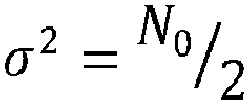

- Subsequently, a (neural) decoder output vector
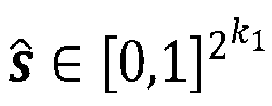
- The decoding function gΘ' comprises a plurality of (decoding) affine maps G1, ..., GL' and (decoding) non-linear activation functions


neural network 23 and comprises a (decoding) weight matrix


- The decoder output vector ŝ can be interpreted as a vector of probabilities in which the j̃-th element is the estimated probability that the j̃-th outer codeword symbol was transmitted (j̃ ∈ {1,2, ..., 2 k
1 }. - From all neural decoder output vectors ŝ via

- The decoder parameter vector Θ' may be determined by, e.g., a categorical cross-entropy loss, in particular,

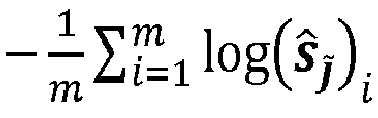
- The neural encoder-decoder pair is optimized over the outer code sequences. In particular, the neural encoder-decoder pair may be adapted/trained such that for input outer code sequences, corresponding estimated outer code sequences are provided and the loss function is minimized by the neural encoder-decoder pair. Thus, also for each input message an estimated message may be provided.
-
Fig. 3 shows a graphical representation of a channel code comprising an outer code concatenated with an inner code. The outer code is an (n2, k2) RS code with outer code blocklength n2 = 255, outer code dimension (message length) k2 = 223, and outer codeword symbols from Fq with number of outer codeword symbols q = 256, i.e., from {0, 1, ..., 255}. It is noted that n2 = 255 = q - 1. The inner code is an (n1, k1) neural network code with inner code blocklength n1 = 12 and inner code dimension k1 = log2q = 8. - An input message m with message length k2 = 223 and comprising 223 input symbols is encoded by an outer code encoder (here: RS encoder) 31 to an outer codeword (here: RS codeword) with blocklength n2 = 255, i.e., the RS codeword comprises 255 outer codeword symbols (here: RS symbol). Each outer codeword symbol can be represented by log2 256 = 8 bits, allowing for each outer codeword symbol to indicate one of 28 = 256 possible outer codeword symbol value assignments. In case of one-hot encoding, each outer codeword symbol is represented by a binary vector s with 256 bits, in particular by one of (0,...0,1), (0,...,0,1,0), ..., (0,1,0,...,0), and (1,0,...,0).
- Since each outer codeword symbol can be represented by 8 bits, which is equal to the inner code dimension k1, each outer codeword symbol constitutes an inner code input and each outer codeword symbol can then be used as an input of the (same) encoding
neural network 21, i.e., the encodingneural network 21 is used n2 = 255 times for each outer codeword. The encodingneural network 21 respectively outputs (binary) encoder output vectors x̃ , each of which is represented by 12 bits, corresponding to the inner code blocklength being n1 = 12. By respectively passing through thenoisy channel 22, 255 noisy vectors y, each comprising 12 bits, are obtained. Each of the noisy vectors y subsequently is given as an input to the (same) decodingneural network 23, respectively yielding one of 255 noisy (outer codeword) symbols (that correspond to a noisy RS codeword symbol), each of which can be represented by k1 = 8 bits. The 255 noisy outer codeword symbols (corresponding to a block with blocklength n2 = 255) are subsequently fed into an outer code decoder (RS decoder) 32, yielding an estimate m̂ of the input message m with length k2 = 223 and comprising 223 output symbols that are equal to the 223 symbols of the input message m. - Robustness and protection against burst errors can be improved by employing an interleaver (not shown in
Fig. 3 ) between theouter code encoder 31 and the encodingneural networks 21, as well as a corresponding de-interleaver between the decodingneural networks 23 and theouter code decoder 32. - The interleaver may for example be a row-column block interleaver. To this end, an n2 × n2 interleaver matrix is determined from n2 outer codewords (respectively stemming from n2 input messages m) such that each interleaver matrix row comprises the n2 = 255 outer codeword symbols of each of the n2 outer codewords. For each pass of outer codeword symbols as an input to the encoding
neural network 21, the interleaver outputs one column comprising 255 outer codeword symbols of the interleaver matrix. This action is reversed by the deinterleaver before theouter code decoder 32. - Using an outer high-rate RS code with an errors-only decoder as part of the
outer code decoder 32, considerable gains in terms of block error probabilities / BLER as compared to mere neural encoder-decoder pairs for an additive white Gaussian noise channel / AWGN may be achieved. An errors-and-erasures decoder may be provided by applying a thresholding algorithm to the softmax outputs of the decodingneural network 23 and determining a symbol as erased based on being below a confidence threshold, which may yield further BLER gains. - Simulations for the AWGN channel at 3.75 dB of signal-to-noise ratio per bit value Eb/N0 show that the BLER of a comparative plain neural network code with code dimension 4 and blocklength 7 is equal to 1.4 × 10⁻², while the BLER of the proposed channel code, with code dimension 8 · 223 and
blocklength 12 · 255, is equal to 1.05 × 10⁻³. This illustrates the fundamental gains from the proposed type of channel codes since the comparative plain neural network code and the channel code comprise approximately same code rates ((223 · 8)/(255 · 12) ≈ 4/7). While plain polar codes and plain LDPC (low-density-parity check) codes may result in smaller BLER values for the AWGN channel at the same Eb/N0 level, these codes may not be robust to changes in the channel parameters and channel model. The proposed channel code thus also provides advantages for, e.g., fading and bursty channels. - It is to be noted that the structure of
Fig. 3 is only an example. By way of example, the number of processed symbols may be larger or smaller than 255. Furthermore, in various aspects of this disclosure, the number of symbols each encoding neural network 21 (and decoding neural network 23) may receive and process and output may be larger than one. In other words, each encodingneural network 21 and each decodingneural network 23 may receive and process and output one or more symbols. - Further, the proposed method allows for employing higher blocklengths, in particular above 256, as well as higher code rates with respect to general neural encode-decoder code designs. The latter are generally more restricted due to a huge training and computation complexity of encoding and decoding, which corresponds to neural networks becoming huge. With the proposed method, high blocklengths and code rates can be achieved together with a small complexity, which may be even lower than the decoding complexity of polar and LDPC codes.
- The features disclosed in this specification, the figures and/or the claims may be material for the realization of various embodiments, taken in isolation or in various combinations thereof.
Claims (15)
- A method for data transfer via a communication channel (11), comprising:determining, in a first data processing unit (10), a codeword from a message using a channel code and sending the codeword via the communication channel (11),wherein the channel code comprises an outer code concatenated with an inner code;wherein the outer code is one of a Reed-Solomon code, a folded Reed-Solomon code, a twisted Reed-Solomon code, and a generalized Reed-Solomon code;wherein the inner code is a neural network code comprising a neural encoder-decoder pair, which includes an encoding neural network (21) and a decoding neural network (23);wherein a nonlinear channel and/or a noisy channel (22) is arranged between the encoding neural network (21) and the decoding neural network (23); andwherein the neural encoder-decoder pair has been adapted such that the decoding neural network (23) provides an estimated outer codeword symbol for an input outer codeword symbol by training the neural encoder-decoder pair using a training data set which comprises a plurality of outer codewords determined from a plurality of input messages by an outer code encoder (31),wherein one or more outer codeword symbols of the plurality of outer codewords are used as an input to the encoding neural network (21).
- The method according to claim 1,
wherein each outer codeword symbol of the plurality of outer codewords is used as an input to the encoding neural network (21). - The method according to claim 1 or 2,
wherein the training comprises determining a plurality of binary vectors from the outer codeword symbols, preferably by one-hot encoding each of the outer codeword symbols. - The method according to any one of the preceding claims,
wherein the training comprises determining a plurality of normalized vectors from a plurality of encoder output vectors by subjecting each of the plurality of encoder output vectors to a power constraint. - The method according to one of the preceding claims,wherein the training comprises determining a plurality of noisy vectors from a plurality of intermediate vectors by subjecting the plurality of intermediate vectors to noise,wherein the plurality of intermediate vectors result from the encoding neural network (21) and are used as an input of the decoding neural network (23); preferably wherein the training comprises performing a plurality of training trials, for each of which the noise comprises a different one of a plurality of noise levels.
- The method according to claim 5,
wherein the training comprises determining a plurality of decoder output vectors from the plurality of noisy vectors by applying the decoding neural network (23) to the plurality of noisy vectors. - The method according to one of the preceding claims, further comprising:
determining an estimated message from the plurality of noisy vectors by using an outer code decoder, preferably a list decoder. - The method according to one of the preceding claims,wherein the outer codeword symbols are fed serially or in parallel as input to the encoding neural network (21); and/orwherein the outer code has an outer code dimension between 127 and 1023, preferably 223, and/or the inner code has an inner code dimension between 3 and 27, preferably 4 or 8.
- The method according to one of the preceding claims,
wherein the outer codeword symbols are non-binary. - The method according to one of the preceding claims,wherein the outer codeword symbols of different codewords of the plurality of outer codewords are interleaved by an interleaver, preferably before being used as input to the encoding neural network (21);preferably wherein the interleaver is a block interleaver, preferably a row-column block interleaver.
- A method for data transfer via a communication channel (11), comprising:receiving, in a second data processing unit (12), a noisy version of a codeword that has been transmitted via the communication channel (11) and determining an estimated message from the noisy version of the codeword using a channel code,wherein the channel code comprises an outer code concatenated with an inner code;wherein the outer code is one of a Reed-Solomon code, a folded Reed-Solomon code, a twisted Reed-Solomon code, and a generalized Reed-Solomon code;wherein the inner code is a neural network code comprising a neural encoder-decoder pair which includes an encoding neural network (21) and a decoding neural network (23);wherein a nonlinear channel and/or a noisy channel (22) is arranged between the encoding neural network (21) and the decoding neural network (23); andwherein the neural encoder-decoder pair has been adapted such that the decoding neural network (23) provides an estimated outer codeword symbol for an input outer codeword symbol by training the neural encoder-decoder pair using a training data set which comprises a plurality of outer codewords determined from a plurality of input messages by an outer code encoder (31),wherein one or more outer codeword symbols of the plurality of outer codewords are used as an input to the encoding neural network (21);preferably wherein each outer codeword symbol of the plurality of outer codewords is used as an input to the encoding neural network (21).
- A system for data transfer via a communication channel (11), the system comprising a first data processing unit (10) and being configured to:determine, in the first data processing unit (10), a codeword from a message using a channel code and send the codeword via the communication channel (11),wherein the channel code comprises an outer code concatenated with an inner code;wherein the outer code is one of a Reed-Solomon code, a folded Reed-Solomon code, a twisted Reed-Solomon code, and a generalized Reed-Solomon code;wherein the inner code is a neural network code comprising a neural encoder-decoder pair which includes an encoding neural network (21) and a decoding neural network (23);wherein a nonlinear channel and/or a noisy channel (22) is arranged between the encoding neural network (21) and the decoding neural network (23); andwherein the neural encoder-decoder pair has been adapted such that the decoding neural network (23) provides an estimated outer codeword symbol for an input outer codeword symbol by training the neural encoder-decoder pair using a training data set which comprises a plurality of outer codewords determined from a plurality of input messages by an outer code encoder (31),wherein one or more outer codeword symbols of the plurality of outer codewords are used as an input to the encoding neural network (21).
- The system according to claim 12,
wherein each outer codeword symbol of the plurality of outer codewords is used as an input to the encoding neural network (21). - A system for data transfer via a communication channel (11), the system comprising a second data processing unit (12) and being configured to:receive, in the second data processing unit (12), a noisy version of a codeword that has been transmitted via the communication channel (11) and determine an estimated message from the noisy version of the codeword using a channel code,wherein the channel code comprises an outer code concatenated with an inner code;wherein the outer code is one of a Reed-Solomon code, a folded Reed-Solomon code, a twisted Reed-Solomon code, and a generalized Reed-Solomon code;wherein the inner code is a neural network code comprising a neural encoder-decoder pair which includes an encoding neural network (21) and a decoding neural network (23);wherein a nonlinear channel and/or a noisy channel (22) is arranged between the encoding neural network (21) and the decoding neural network (23); andwherein the neural encoder-decoder pair has been adapted such that the decoding neural network (23) provides an estimated outer codeword symbol for an input outer codeword symbol by training the neural encoder-decoder pair using a training data set which comprises a plurality of outer codewords determined from a plurality of input messages by an outer code encoder (31),wherein one or more outer codeword symbols of the plurality of outer codewords are used as an input to the encoding neural network (21).
- The system according to claim 14,
wherein each outer codeword symbol of the plurality of outer codewords is used as an input to the encoding neural network (21).
Applications Claiming Priority (1)
| Application Number | Priority Date | Filing Date | Title |
|---|---|---|---|
| LU502737A LU502737B1 (en) | 2022-08-31 | 2022-08-31 | Methods and systems for data transfer via a communication channel |
Publications (2)
| Publication Number | Publication Date |
|---|---|
| EP4333310A1 true EP4333310A1 (en) | 2024-03-06 |
| EP4333310B1 EP4333310B1 (en) | 2025-10-29 |
Family
ID=84331792
Family Applications (1)
| Application Number | Title | Priority Date | Filing Date |
|---|---|---|---|
| EP23194604.7A Active EP4333310B1 (en) | 2022-08-31 | 2023-08-31 | Methods and systems for data transfer via a communication channel |
Country Status (2)
| Country | Link |
|---|---|
| EP (1) | EP4333310B1 (en) |
| LU (1) | LU502737B1 (en) |
Citations (1)
| Publication number | Priority date | Publication date | Assignee | Title |
|---|---|---|---|---|
| US11387848B1 (en) * | 2021-03-11 | 2022-07-12 | Samsung Electronics Co., Ltd. | Hierarchical error correction code |
-
2022
- 2022-08-31 LU LU502737A patent/LU502737B1/en active IP Right Grant
-
2023
- 2023-08-31 EP EP23194604.7A patent/EP4333310B1/en active Active
Patent Citations (1)
| Publication number | Priority date | Publication date | Assignee | Title |
|---|---|---|---|---|
| US11387848B1 (en) * | 2021-03-11 | 2022-07-12 | Samsung Electronics Co., Ltd. | Hierarchical error correction code |
Non-Patent Citations (8)
| Title |
|---|
| CHAHINE KARL ET AL: "Turbo Autoencoder with a Trainable Interleaver", PROC., IEEE INTERNATIONAL CONFERENCE ON COMMUNICATIONS, IEEE, ICC-2022, 16 May 2022 (2022-05-16), pages 3886 - 3891, XP034167564, DOI: 10.1109/ICC45855.2022.9839051 * |
| I. TALA. VARDY: "Trans. Inf. Theory", vol. 61, 2015, IEEE, pages: 2213 - 2226 |
| J. CLAUSIUS ET AL., INT. SYMP. TOPICS CODING, pages 1 - 5 |
| JANNIS CLAUSIUS ET AL: "Serial vs. Parallel Turbo-Autoencoders and Accelerated Training for Learned Channel Codes", ARXIV.ORG, CORNELL UNIVERSITY LIBRARY, 201 OLIN LIBRARY CORNELL UNIVERSITY ITHACA, NY 14853, 22 July 2021 (2021-07-22), XP091004348 * |
| ONUR G�NL� ET AL: "Concatenated Classic and Neural (CCN) Codes: ConcatenatedAE", ARXIV.ORG, CORNELL UNIVERSITY LIBRARY, 201 OLIN LIBRARY CORNELL UNIVERSITY ITHACA, NY 14853, 4 September 2022 (2022-09-04), XP091310609 * |
| S. LIND. J. COSTELLO, ERROR CONTROL CODING., vol. 2, no. 4, 2001 |
| TOBIAS GRUBER ET AL: "On Deep Learning-Based Channel Decoding", ARXIV.ORG, CORNELL UNIVERSITY LIBRARY, 201 OLIN LIBRARY CORNELL UNIVERSITY ITHACA, NY 14853, 26 January 2017 (2017-01-26), XP080751805, DOI: 10.1109/CISS.2017.7926071 * |
| Y. JIANG ET AL., CONF. NEURAL INF. PROCESS. SYS., vol. 32, 2019, pages 1 - 19 |
Also Published As
| Publication number | Publication date |
|---|---|
| LU502737B1 (en) | 2024-02-29 |
| EP4333310B1 (en) | 2025-10-29 |
Similar Documents
| Publication | Publication Date | Title |
|---|---|---|
| US10673462B2 (en) | Coding method and coding device | |
| CN101689866B (en) | LDPC Convolutional Code Encoder and LDPC Convolutional Code Decoder | |
| KR100594818B1 (en) | Low Density Parity Check Code Decoding Device Using Sequential Decoding | |
| US9215457B2 (en) | Method and system for communicating multimedia using reconfigurable rateless codes and decoding in-process status feedback | |
| CN101103533B (en) | Encoding method | |
| US8386880B2 (en) | Method for transmitting non-binary codes and decoding the same | |
| KR100984289B1 (en) | Signal transmitting/receiving apparatus for supporting variable coding rate in a communication system and method thereof | |
| US20040268205A1 (en) | Low-density parity-check codes for multiple code rates | |
| US8806288B2 (en) | Systems and methods for providing unequal error protection code design from probabilistically fixed composition codes | |
| KR20070119580A (en) | Block Low Density Parity Check Code Encoding / Decoding Apparatus and Method in Communication Systems | |
| CN109921803B (en) | Decoding Method of High Density Linear Block Code Based on Neural Network | |
| CN114157309A (en) | Polar code decoding method, device and system | |
| CN110739977A (en) | A BCH code decoding method based on deep learning | |
| EP1901435A1 (en) | An interleaving scheme for an LDPC coded 32APSK system | |
| CN112332866B (en) | Cascade code parameter identification method based on DVB-S and DVB-S2 signals | |
| EP4333310A1 (en) | Methods and systems for data transfer via a communication channel | |
| Günlü et al. | Concatenated classic and neural (CCN) codes: ConcatenatedAE | |
| CN103457612A (en) | Iterative soft decision decoding method for Reed Solomon-convolution cascade codes | |
| US20240137151A1 (en) | Hybrid product polar codes-based communication systems and methods | |
| Runge et al. | Improved list decoding for polar-coded probabilistic shaping | |
| CN112470406B (en) | Sequencing device and method for basic check node processing for message passing decoding of non-binary codes | |
| EP1901436A2 (en) | Bit mapping scheme for an LDPC coded 16APSK system | |
| Shalin et al. | Differential properties of polar codes | |
| CN120165706B (en) | A multi-step decoding decision accelerated decoding method, device and storage medium | |
| Kukieattikool et al. | Variable‐rate staircase codes with RS component codes for optical wireless transmission |
Legal Events
| Date | Code | Title | Description |
|---|---|---|---|
| PUAI | Public reference made under article 153(3) epc to a published international application that has entered the european phase |
Free format text: ORIGINAL CODE: 0009012 |
|
| STAA | Information on the status of an ep patent application or granted ep patent |
Free format text: STATUS: THE APPLICATION HAS BEEN PUBLISHED |
|
| AK | Designated contracting states |
Kind code of ref document: A1 Designated state(s): AL AT BE BG CH CY CZ DE DK EE ES FI FR GB GR HR HU IE IS IT LI LT LU LV MC ME MK MT NL NO PL PT RO RS SE SI SK SM TR |
|
| STAA | Information on the status of an ep patent application or granted ep patent |
Free format text: STATUS: REQUEST FOR EXAMINATION WAS MADE |
|
| 17P | Request for examination filed |
Effective date: 20240906 |
|
| RBV | Designated contracting states (corrected) |
Designated state(s): AL AT BE BG CH CY CZ DE DK EE ES FI FR GB GR HR HU IE IS IT LI LT LU LV MC ME MK MT NL NO PL PT RO RS SE SI SK SM TR |
|
| GRAP | Despatch of communication of intention to grant a patent |
Free format text: ORIGINAL CODE: EPIDOSNIGR1 |
|
| STAA | Information on the status of an ep patent application or granted ep patent |
Free format text: STATUS: GRANT OF PATENT IS INTENDED |
|
| RIC1 | Information provided on ipc code assigned before grant |
Ipc: G06N 3/048 20230101ALN20250506BHEP Ipc: H03M 13/00 20060101ALI20250506BHEP Ipc: G06N 3/08 20230101ALI20250506BHEP Ipc: G06N 3/0455 20230101ALI20250506BHEP Ipc: H03M 13/03 20060101ALI20250506BHEP Ipc: H03M 13/27 20060101ALI20250506BHEP Ipc: H03M 13/29 20060101AFI20250506BHEP |
|
| INTG | Intention to grant announced |
Effective date: 20250520 |
|
| GRAS | Grant fee paid |
Free format text: ORIGINAL CODE: EPIDOSNIGR3 |
|
| GRAA | (expected) grant |
Free format text: ORIGINAL CODE: 0009210 |
|
| STAA | Information on the status of an ep patent application or granted ep patent |
Free format text: STATUS: THE PATENT HAS BEEN GRANTED |
|
| P01 | Opt-out of the competence of the unified patent court (upc) registered |
Free format text: CASE NUMBER: UPC_APP_5759_4333310/2025 Effective date: 20250903 |
|
| AK | Designated contracting states |
Kind code of ref document: B1 Designated state(s): AL AT BE BG CH CY CZ DE DK EE ES FI FR GB GR HR HU IE IS IT LI LT LU LV MC ME MK MT NL NO PL PT RO RS SE SI SK SM TR |
|
| REG | Reference to a national code |
Ref country code: CH Ref legal event code: F10 Free format text: ST27 STATUS EVENT CODE: U-0-0-F10-F00 (AS PROVIDED BY THE NATIONAL OFFICE) Effective date: 20251029 Ref country code: GB Ref legal event code: FG4D |
|
| REG | Reference to a national code |
Ref country code: IE Ref legal event code: FG4D |
|
| REG | Reference to a national code |
Ref country code: DE Ref legal event code: R096 Ref document number: 602023007973 Country of ref document: DE |