EP4333135A1 - Lipolysis device, lipolysis method, and electric power generation method - Google Patents
Lipolysis device, lipolysis method, and electric power generation method Download PDFInfo
- Publication number
- EP4333135A1 EP4333135A1 EP22795384.1A EP22795384A EP4333135A1 EP 4333135 A1 EP4333135 A1 EP 4333135A1 EP 22795384 A EP22795384 A EP 22795384A EP 4333135 A1 EP4333135 A1 EP 4333135A1
- Authority
- EP
- European Patent Office
- Prior art keywords
- glycerol
- lipolysis
- lipolytic enzyme
- protrusions
- lipolysis device
- Prior art date
- Legal status (The legal status is an assumption and is not a legal conclusion. Google has not performed a legal analysis and makes no representation as to the accuracy of the status listed.)
- Pending
Links
- 230000004130 lipolysis Effects 0.000 title claims abstract description 128
- 238000000034 method Methods 0.000 title claims description 62
- 238000010248 power generation Methods 0.000 title claims description 19
- PEDCQBHIVMGVHV-UHFFFAOYSA-N Glycerine Chemical compound OCC(O)CO PEDCQBHIVMGVHV-UHFFFAOYSA-N 0.000 claims abstract description 555
- 239000000463 material Substances 0.000 claims abstract description 79
- 102000004190 Enzymes Human genes 0.000 claims abstract description 74
- 108090000790 Enzymes Proteins 0.000 claims abstract description 74
- 230000002366 lipolytic effect Effects 0.000 claims abstract description 62
- 238000007254 oxidation reaction Methods 0.000 claims abstract description 46
- 230000003647 oxidation Effects 0.000 claims abstract description 44
- 108010090622 glycerol oxidase Proteins 0.000 claims abstract description 24
- 150000001875 compounds Chemical class 0.000 claims abstract description 23
- 230000000694 effects Effects 0.000 claims abstract description 19
- 108090000765 processed proteins & peptides Proteins 0.000 claims abstract description 18
- 230000008569 process Effects 0.000 claims description 22
- 230000007246 mechanism Effects 0.000 claims description 20
- QVGXLLKOCUKJST-UHFFFAOYSA-N atomic oxygen Chemical compound [O] QVGXLLKOCUKJST-UHFFFAOYSA-N 0.000 claims description 19
- 229910052760 oxygen Inorganic materials 0.000 claims description 19
- 239000001301 oxygen Substances 0.000 claims description 19
- 108090000854 Oxidoreductases Proteins 0.000 claims description 16
- 102000004316 Oxidoreductases Human genes 0.000 claims description 16
- 102000004882 Lipase Human genes 0.000 claims description 14
- 108090001060 Lipase Proteins 0.000 claims description 14
- 239000004367 Lipase Substances 0.000 claims description 14
- 235000019421 lipase Nutrition 0.000 claims description 14
- XLYOFNOQVPJJNP-UHFFFAOYSA-N water Substances O XLYOFNOQVPJJNP-UHFFFAOYSA-N 0.000 claims description 11
- 230000001590 oxidative effect Effects 0.000 claims description 10
- 239000011148 porous material Substances 0.000 claims description 10
- 101000892220 Geobacillus thermodenitrificans (strain NG80-2) Long-chain-alcohol dehydrogenase 1 Proteins 0.000 claims description 8
- 238000009826 distribution Methods 0.000 claims description 5
- 239000000446 fuel Substances 0.000 claims description 4
- 102000007698 Alcohol dehydrogenase Human genes 0.000 claims description 3
- 108010021809 Alcohol dehydrogenase Proteins 0.000 claims description 3
- 239000010410 layer Substances 0.000 description 39
- 239000000872 buffer Substances 0.000 description 25
- 238000000638 solvent extraction Methods 0.000 description 24
- 238000007789 sealing Methods 0.000 description 22
- 238000009792 diffusion process Methods 0.000 description 19
- 239000007789 gas Substances 0.000 description 15
- 210000001519 tissue Anatomy 0.000 description 15
- 235000014113 dietary fatty acids Nutrition 0.000 description 12
- 229930195729 fatty acid Natural products 0.000 description 12
- 239000000194 fatty acid Substances 0.000 description 12
- 150000004665 fatty acids Chemical class 0.000 description 12
- 210000001124 body fluid Anatomy 0.000 description 11
- 239000007853 buffer solution Substances 0.000 description 11
- 239000010839 body fluid Substances 0.000 description 9
- OKTJSMMVPCPJKN-UHFFFAOYSA-N Carbon Chemical compound [C] OKTJSMMVPCPJKN-UHFFFAOYSA-N 0.000 description 8
- 238000003491 array Methods 0.000 description 8
- 229910052799 carbon Inorganic materials 0.000 description 8
- 239000005515 coenzyme Substances 0.000 description 8
- 238000000354 decomposition reaction Methods 0.000 description 8
- 238000010586 diagram Methods 0.000 description 8
- -1 potassium ferricyanide Chemical compound 0.000 description 8
- 239000012790 adhesive layer Substances 0.000 description 6
- RXKJFZQQPQGTFL-UHFFFAOYSA-N dihydroxyacetone Chemical compound OCC(=O)CO RXKJFZQQPQGTFL-UHFFFAOYSA-N 0.000 description 6
- 239000007788 liquid Substances 0.000 description 6
- 238000004519 manufacturing process Methods 0.000 description 6
- 239000004626 polylactic acid Substances 0.000 description 6
- 229920001343 polytetrafluoroethylene Polymers 0.000 description 6
- 239000004810 polytetrafluoroethylene Substances 0.000 description 6
- 239000000499 gel Substances 0.000 description 5
- 229920000747 poly(lactic acid) Polymers 0.000 description 5
- 239000000126 substance Substances 0.000 description 5
- 239000002551 biofuel Substances 0.000 description 4
- 239000003575 carbonaceous material Substances 0.000 description 4
- 238000006243 chemical reaction Methods 0.000 description 4
- 210000003722 extracellular fluid Anatomy 0.000 description 4
- 239000010408 film Substances 0.000 description 4
- 235000000346 sugar Nutrition 0.000 description 4
- 229920000049 Carbon (fiber) Polymers 0.000 description 3
- 102000008186 Collagen Human genes 0.000 description 3
- 108010035532 Collagen Proteins 0.000 description 3
- 108010029541 Laccase Proteins 0.000 description 3
- MJVAVZPDRWSRRC-UHFFFAOYSA-N Menadione Chemical compound C1=CC=C2C(=O)C(C)=CC(=O)C2=C1 MJVAVZPDRWSRRC-UHFFFAOYSA-N 0.000 description 3
- 239000004698 Polyethylene Substances 0.000 description 3
- 210000001789 adipocyte Anatomy 0.000 description 3
- 239000004917 carbon fiber Substances 0.000 description 3
- 210000004027 cell Anatomy 0.000 description 3
- 229920001436 collagen Polymers 0.000 description 3
- 229940120503 dihydroxyacetone Drugs 0.000 description 3
- 238000001746 injection moulding Methods 0.000 description 3
- VNWKTOKETHGBQD-UHFFFAOYSA-N methane Chemical compound C VNWKTOKETHGBQD-UHFFFAOYSA-N 0.000 description 3
- 229920000573 polyethylene Polymers 0.000 description 3
- 125000004151 quinonyl group Chemical group 0.000 description 3
- 239000011347 resin Substances 0.000 description 3
- 229920005989 resin Polymers 0.000 description 3
- KIUKXJAPPMFGSW-DNGZLQJQSA-N (2S,3S,4S,5R,6R)-6-[(2S,3R,4R,5S,6R)-3-Acetamido-2-[(2S,3S,4R,5R,6R)-6-[(2R,3R,4R,5S,6R)-3-acetamido-2,5-dihydroxy-6-(hydroxymethyl)oxan-4-yl]oxy-2-carboxy-4,5-dihydroxyoxan-3-yl]oxy-5-hydroxy-6-(hydroxymethyl)oxan-4-yl]oxy-3,4,5-trihydroxyoxane-2-carboxylic acid Chemical compound CC(=O)N[C@H]1[C@H](O)O[C@H](CO)[C@@H](O)[C@@H]1O[C@H]1[C@H](O)[C@@H](O)[C@H](O[C@H]2[C@@H]([C@@H](O[C@H]3[C@@H]([C@@H](O)[C@H](O)[C@H](O3)C(O)=O)O)[C@H](O)[C@@H](CO)O2)NC(C)=O)[C@@H](C(O)=O)O1 KIUKXJAPPMFGSW-DNGZLQJQSA-N 0.000 description 2
- MRYHMFJDZYADEB-UHFFFAOYSA-N 2-amino-3-methylnaphthalene-1,4-dione Chemical compound C1=CC=C2C(=O)C(C)=C(N)C(=O)C2=C1 MRYHMFJDZYADEB-UHFFFAOYSA-N 0.000 description 2
- CYCRZLRIJWDWCM-UHFFFAOYSA-N 2-aminonaphthalene-1,4-dione Chemical compound C1=CC=C2C(=O)C(N)=CC(=O)C2=C1 CYCRZLRIJWDWCM-UHFFFAOYSA-N 0.000 description 2
- ASDLSKCKYGVMAI-UHFFFAOYSA-N 9,10-dioxoanthracene-2-carboxylic acid Chemical compound C1=CC=C2C(=O)C3=CC(C(=O)O)=CC=C3C(=O)C2=C1 ASDLSKCKYGVMAI-UHFFFAOYSA-N 0.000 description 2
- 229910000906 Bronze Inorganic materials 0.000 description 2
- JOYRKODLDBILNP-UHFFFAOYSA-N Ethyl urethane Chemical compound CCOC(N)=O JOYRKODLDBILNP-UHFFFAOYSA-N 0.000 description 2
- 239000002033 PVDF binder Substances 0.000 description 2
- 229920000954 Polyglycolide Polymers 0.000 description 2
- XJLXINKUBYWONI-DQQFMEOOSA-N [[(2r,3r,4r,5r)-5-(6-aminopurin-9-yl)-3-hydroxy-4-phosphonooxyoxolan-2-yl]methoxy-hydroxyphosphoryl] [(2s,3r,4s,5s)-5-(3-carbamoylpyridin-1-ium-1-yl)-3,4-dihydroxyoxolan-2-yl]methyl phosphate Chemical compound NC(=O)C1=CC=C[N+]([C@@H]2[C@H]([C@@H](O)[C@H](COP([O-])(=O)OP(O)(=O)OC[C@@H]3[C@H]([C@@H](OP(O)(O)=O)[C@@H](O3)N3C4=NC=NC(N)=C4N=C3)O)O2)O)=C1 XJLXINKUBYWONI-DQQFMEOOSA-N 0.000 description 2
- 239000007864 aqueous solution Substances 0.000 description 2
- 230000003796 beauty Effects 0.000 description 2
- WQZGKKKJIJFFOK-VFUOTHLCSA-N beta-D-glucose Chemical compound OC[C@H]1O[C@@H](O)[C@H](O)[C@@H](O)[C@@H]1O WQZGKKKJIJFFOK-VFUOTHLCSA-N 0.000 description 2
- 239000010974 bronze Substances 0.000 description 2
- 239000011203 carbon fibre reinforced carbon Substances 0.000 description 2
- 239000003054 catalyst Substances 0.000 description 2
- 229920001577 copolymer Polymers 0.000 description 2
- KUNSUQLRTQLHQQ-UHFFFAOYSA-N copper tin Chemical compound [Cu].[Sn] KUNSUQLRTQLHQQ-UHFFFAOYSA-N 0.000 description 2
- 201000010099 disease Diseases 0.000 description 2
- 208000037265 diseases, disorders, signs and symptoms Diseases 0.000 description 2
- 235000006694 eating habits Nutrition 0.000 description 2
- 229920000840 ethylene tetrafluoroethylene copolymer Polymers 0.000 description 2
- 238000011156 evaluation Methods 0.000 description 2
- 239000006260 foam Substances 0.000 description 2
- 125000000524 functional group Chemical group 0.000 description 2
- 150000002314 glycerols Chemical class 0.000 description 2
- 229920002674 hyaluronan Polymers 0.000 description 2
- 229960003160 hyaluronic acid Drugs 0.000 description 2
- 230000002209 hydrophobic effect Effects 0.000 description 2
- NOESYZHRGYRDHS-UHFFFAOYSA-N insulin Chemical compound N1C(=O)C(NC(=O)C(CCC(N)=O)NC(=O)C(CCC(O)=O)NC(=O)C(C(C)C)NC(=O)C(NC(=O)CN)C(C)CC)CSSCC(C(NC(CO)C(=O)NC(CC(C)C)C(=O)NC(CC=2C=CC(O)=CC=2)C(=O)NC(CCC(N)=O)C(=O)NC(CC(C)C)C(=O)NC(CCC(O)=O)C(=O)NC(CC(N)=O)C(=O)NC(CC=2C=CC(O)=CC=2)C(=O)NC(CSSCC(NC(=O)C(C(C)C)NC(=O)C(CC(C)C)NC(=O)C(CC=2C=CC(O)=CC=2)NC(=O)C(CC(C)C)NC(=O)C(C)NC(=O)C(CCC(O)=O)NC(=O)C(C(C)C)NC(=O)C(CC(C)C)NC(=O)C(CC=2NC=NC=2)NC(=O)C(CO)NC(=O)CNC2=O)C(=O)NCC(=O)NC(CCC(O)=O)C(=O)NC(CCCNC(N)=N)C(=O)NCC(=O)NC(CC=3C=CC=CC=3)C(=O)NC(CC=3C=CC=CC=3)C(=O)NC(CC=3C=CC(O)=CC=3)C(=O)NC(C(C)O)C(=O)N3C(CCC3)C(=O)NC(CCCCN)C(=O)NC(C)C(O)=O)C(=O)NC(CC(N)=O)C(O)=O)=O)NC(=O)C(C(C)CC)NC(=O)C(CO)NC(=O)C(C(C)O)NC(=O)C1CSSCC2NC(=O)C(CC(C)C)NC(=O)C(NC(=O)C(CCC(N)=O)NC(=O)C(CC(N)=O)NC(=O)C(NC(=O)C(N)CC=1C=CC=CC=1)C(C)C)CC1=CN=CN1 NOESYZHRGYRDHS-UHFFFAOYSA-N 0.000 description 2
- FRASJONUBLZVQX-UHFFFAOYSA-N naphthoquinone group Chemical group C1(C=CC(C2=CC=CC=C12)=O)=O FRASJONUBLZVQX-UHFFFAOYSA-N 0.000 description 2
- 229930027945 nicotinamide-adenine dinucleotide Natural products 0.000 description 2
- 239000004745 nonwoven fabric Substances 0.000 description 2
- 229920002493 poly(chlorotrifluoroethylene) Polymers 0.000 description 2
- 239000005023 polychlorotrifluoroethylene (PCTFE) polymer Substances 0.000 description 2
- 229920000139 polyethylene terephthalate Polymers 0.000 description 2
- 239000005020 polyethylene terephthalate Substances 0.000 description 2
- 229920000642 polymer Polymers 0.000 description 2
- 229920002981 polyvinylidene fluoride Polymers 0.000 description 2
- 238000001179 sorption measurement Methods 0.000 description 2
- 210000004003 subcutaneous fat Anatomy 0.000 description 2
- 239000000758 substrate Substances 0.000 description 2
- AWDBHOZBRXWRKS-UHFFFAOYSA-N tetrapotassium;iron(6+);hexacyanide Chemical compound [K+].[K+].[K+].[K+].[Fe+6].N#[C-].N#[C-].N#[C-].N#[C-].N#[C-].N#[C-] AWDBHOZBRXWRKS-UHFFFAOYSA-N 0.000 description 2
- 239000010936 titanium Substances 0.000 description 2
- 229910052719 titanium Inorganic materials 0.000 description 2
- LUEWUZLMQUOBSB-FSKGGBMCSA-N (2s,3s,4s,5s,6r)-2-[(2r,3s,4r,5r,6s)-6-[(2r,3s,4r,5s,6s)-4,5-dihydroxy-2-(hydroxymethyl)-6-[(2r,4r,5s,6r)-4,5,6-trihydroxy-2-(hydroxymethyl)oxan-3-yl]oxyoxan-3-yl]oxy-4,5-dihydroxy-2-(hydroxymethyl)oxan-3-yl]oxy-6-(hydroxymethyl)oxane-3,4,5-triol Chemical compound O[C@H]1[C@@H](O)[C@H](O)[C@@H](CO)O[C@H]1O[C@@H]1[C@@H](CO)O[C@@H](O[C@@H]2[C@H](O[C@@H](OC3[C@H](O[C@@H](O)[C@@H](O)[C@H]3O)CO)[C@@H](O)[C@H]2O)CO)[C@H](O)[C@H]1O LUEWUZLMQUOBSB-FSKGGBMCSA-N 0.000 description 1
- GXDIXDKPIUJGOV-UHFFFAOYSA-N 3-amino-1,4-dioxonaphthalene-2-carboxylic acid Chemical compound C1=CC=C2C(=O)C(N)=C(C(O)=O)C(=O)C2=C1 GXDIXDKPIUJGOV-UHFFFAOYSA-N 0.000 description 1
- FHVDTGUDJYJELY-UHFFFAOYSA-N 6-{[2-carboxy-4,5-dihydroxy-6-(phosphanyloxy)oxan-3-yl]oxy}-4,5-dihydroxy-3-phosphanyloxane-2-carboxylic acid Chemical compound O1C(C(O)=O)C(P)C(O)C(O)C1OC1C(C(O)=O)OC(OP)C(O)C1O FHVDTGUDJYJELY-UHFFFAOYSA-N 0.000 description 1
- RZVHIXYEVGDQDX-UHFFFAOYSA-N 9,10-anthraquinone Chemical group C1=CC=C2C(=O)C3=CC=CC=C3C(=O)C2=C1 RZVHIXYEVGDQDX-UHFFFAOYSA-N 0.000 description 1
- JAJIPIAHCFBEPI-UHFFFAOYSA-N 9,10-dioxoanthracene-1-sulfonic acid Chemical compound O=C1C2=CC=CC=C2C(=O)C2=C1C=CC=C2S(=O)(=O)O JAJIPIAHCFBEPI-UHFFFAOYSA-N 0.000 description 1
- MMNWSHJJPDXKCH-UHFFFAOYSA-N 9,10-dioxoanthracene-2-sulfonic acid Chemical compound C1=CC=C2C(=O)C3=CC(S(=O)(=O)O)=CC=C3C(=O)C2=C1 MMNWSHJJPDXKCH-UHFFFAOYSA-N 0.000 description 1
- 229910000809 Alumel Inorganic materials 0.000 description 1
- 108010024957 Ascorbate Oxidase Proteins 0.000 description 1
- 229910052580 B4C Inorganic materials 0.000 description 1
- 241000894006 Bacteria Species 0.000 description 1
- 108010015428 Bilirubin oxidase Proteins 0.000 description 1
- 229910001369 Brass Inorganic materials 0.000 description 1
- 229920000298 Cellophane Polymers 0.000 description 1
- 229920002101 Chitin Polymers 0.000 description 1
- 229920001661 Chitosan Polymers 0.000 description 1
- 229910019918 CrB2 Inorganic materials 0.000 description 1
- 229920002558 Curdlan Polymers 0.000 description 1
- 239000001879 Curdlan Substances 0.000 description 1
- MNQZXJOMYWMBOU-VKHMYHEASA-N D-glyceraldehyde Chemical compound OC[C@@H](O)C=O MNQZXJOMYWMBOU-VKHMYHEASA-N 0.000 description 1
- 229910000737 Duralumin Inorganic materials 0.000 description 1
- 108010010803 Gelatin Proteins 0.000 description 1
- 229920002581 Glucomannan Polymers 0.000 description 1
- WQZGKKKJIJFFOK-GASJEMHNSA-N Glucose Natural products OC[C@H]1OC(O)[C@H](O)[C@@H](O)[C@@H]1O WQZGKKKJIJFFOK-GASJEMHNSA-N 0.000 description 1
- 229910003862 HfB2 Inorganic materials 0.000 description 1
- 229920002153 Hydroxypropyl cellulose Polymers 0.000 description 1
- 102000004877 Insulin Human genes 0.000 description 1
- 108090001061 Insulin Proteins 0.000 description 1
- 229910020968 MoSi2 Inorganic materials 0.000 description 1
- BAWFJGJZGIEFAR-NNYOXOHSSA-O NAD(+) Chemical compound NC(=O)C1=CC=C[N+]([C@H]2[C@@H]([C@H](O)[C@@H](COP(O)(=O)OP(O)(=O)OC[C@@H]3[C@H]([C@@H](O)[C@@H](O3)N3C4=NC=NC(N)=C4N=C3)O)O2)O)=C1 BAWFJGJZGIEFAR-NNYOXOHSSA-O 0.000 description 1
- 229910019748 NbB Inorganic materials 0.000 description 1
- 229910020044 NbSi2 Inorganic materials 0.000 description 1
- 208000008589 Obesity Diseases 0.000 description 1
- OAICVXFJPJFONN-UHFFFAOYSA-N Phosphorus Chemical compound [P] OAICVXFJPJFONN-UHFFFAOYSA-N 0.000 description 1
- 229920001328 Polyvinylidene chloride Polymers 0.000 description 1
- ZLMJMSJWJFRBEC-UHFFFAOYSA-N Potassium Chemical compound [K] ZLMJMSJWJFRBEC-UHFFFAOYSA-N 0.000 description 1
- 229910004217 TaSi2 Inorganic materials 0.000 description 1
- ATJFFYVFTNAWJD-UHFFFAOYSA-N Tin Chemical compound [Sn] ATJFFYVFTNAWJD-UHFFFAOYSA-N 0.000 description 1
- RTAQQCXQSZGOHL-UHFFFAOYSA-N Titanium Chemical compound [Ti] RTAQQCXQSZGOHL-UHFFFAOYSA-N 0.000 description 1
- 238000005411 Van der Waals force Methods 0.000 description 1
- 230000002745 absorbent Effects 0.000 description 1
- 239000002250 absorbent Substances 0.000 description 1
- 239000002253 acid Substances 0.000 description 1
- 230000009471 action Effects 0.000 description 1
- 125000002252 acyl group Chemical group 0.000 description 1
- 150000001298 alcohols Chemical class 0.000 description 1
- 229940072056 alginate Drugs 0.000 description 1
- 235000010443 alginic acid Nutrition 0.000 description 1
- 229920000615 alginic acid Polymers 0.000 description 1
- 229910045601 alloy Inorganic materials 0.000 description 1
- 239000000956 alloy Substances 0.000 description 1
- 125000003277 amino group Chemical group 0.000 description 1
- 238000004458 analytical method Methods 0.000 description 1
- 230000003579 anti-obesity Effects 0.000 description 1
- UIFOTCALDQIDTI-UHFFFAOYSA-N arsanylidynenickel Chemical compound [As]#[Ni] UIFOTCALDQIDTI-UHFFFAOYSA-N 0.000 description 1
- 238000003149 assay kit Methods 0.000 description 1
- 239000011942 biocatalyst Substances 0.000 description 1
- 230000015572 biosynthetic process Effects 0.000 description 1
- 239000008280 blood Substances 0.000 description 1
- 210000004369 blood Anatomy 0.000 description 1
- 239000010951 brass Substances 0.000 description 1
- 125000003178 carboxy group Chemical group [H]OC(*)=O 0.000 description 1
- 230000000747 cardiac effect Effects 0.000 description 1
- 210000000170 cell membrane Anatomy 0.000 description 1
- 229910052804 chromium Inorganic materials 0.000 description 1
- 238000004891 communication Methods 0.000 description 1
- 239000002131 composite material Substances 0.000 description 1
- 229920001940 conductive polymer Polymers 0.000 description 1
- 229910052802 copper Inorganic materials 0.000 description 1
- 239000010949 copper Substances 0.000 description 1
- 235000019316 curdlan Nutrition 0.000 description 1
- 229940078035 curdlan Drugs 0.000 description 1
- 230000006837 decompression Effects 0.000 description 1
- 230000003247 decreasing effect Effects 0.000 description 1
- 238000013461 design Methods 0.000 description 1
- 230000006806 disease prevention Effects 0.000 description 1
- 239000012153 distilled water Substances 0.000 description 1
- 229940079593 drug Drugs 0.000 description 1
- 239000003814 drug Substances 0.000 description 1
- 238000003487 electrochemical reaction Methods 0.000 description 1
- 230000002255 enzymatic effect Effects 0.000 description 1
- UQSQSQZYBQSBJZ-UHFFFAOYSA-N fluorosulfonic acid Chemical compound OS(F)(=O)=O UQSQSQZYBQSBJZ-UHFFFAOYSA-N 0.000 description 1
- 239000008273 gelatin Substances 0.000 description 1
- 229920000159 gelatin Polymers 0.000 description 1
- 235000019322 gelatine Nutrition 0.000 description 1
- 235000011852 gelatine desserts Nutrition 0.000 description 1
- 229910052732 germanium Inorganic materials 0.000 description 1
- 229940046240 glucomannan Drugs 0.000 description 1
- 239000008103 glucose Substances 0.000 description 1
- 229910052737 gold Inorganic materials 0.000 description 1
- 229910052735 hafnium Inorganic materials 0.000 description 1
- 230000036541 health Effects 0.000 description 1
- 125000002887 hydroxy group Chemical group [H]O* 0.000 description 1
- 239000001863 hydroxypropyl cellulose Substances 0.000 description 1
- 235000010977 hydroxypropyl cellulose Nutrition 0.000 description 1
- 230000006872 improvement Effects 0.000 description 1
- 229910052738 indium Inorganic materials 0.000 description 1
- 238000003780 insertion Methods 0.000 description 1
- 230000037431 insertion Effects 0.000 description 1
- 229940125396 insulin Drugs 0.000 description 1
- 239000003014 ion exchange membrane Substances 0.000 description 1
- 229910052741 iridium Inorganic materials 0.000 description 1
- 229910052742 iron Inorganic materials 0.000 description 1
- 238000012423 maintenance Methods 0.000 description 1
- 229910052748 manganese Inorganic materials 0.000 description 1
- 235000013372 meat Nutrition 0.000 description 1
- 238000002844 melting Methods 0.000 description 1
- 230000008018 melting Effects 0.000 description 1
- QSHDDOUJBYECFT-UHFFFAOYSA-N mercury Chemical compound [Hg] QSHDDOUJBYECFT-UHFFFAOYSA-N 0.000 description 1
- 229910052753 mercury Inorganic materials 0.000 description 1
- 229910052751 metal Inorganic materials 0.000 description 1
- 239000002184 metal Substances 0.000 description 1
- 239000007769 metal material Substances 0.000 description 1
- 239000003094 microcapsule Substances 0.000 description 1
- 229910052750 molybdenum Inorganic materials 0.000 description 1
- 238000012806 monitoring device Methods 0.000 description 1
- 238000000465 moulding Methods 0.000 description 1
- MOFOBJHOKRNACT-UHFFFAOYSA-N nickel silver Chemical compound [Ni].[Ag] MOFOBJHOKRNACT-UHFFFAOYSA-N 0.000 description 1
- 239000010956 nickel silver Substances 0.000 description 1
- BOPGDPNILDQYTO-NNYOXOHSSA-N nicotinamide-adenine dinucleotide Chemical compound C1=CCC(C(=O)N)=CN1[C@H]1[C@H](O)[C@H](O)[C@@H](COP(O)(=O)OP(O)(=O)OC[C@@H]2[C@H]([C@@H](O)[C@@H](O2)N2C3=NC=NC(N)=C3N=C2)O)O1 BOPGDPNILDQYTO-NNYOXOHSSA-N 0.000 description 1
- 150000004767 nitrides Chemical class 0.000 description 1
- 235000020824 obesity Nutrition 0.000 description 1
- 210000000056 organ Anatomy 0.000 description 1
- 229910052763 palladium Inorganic materials 0.000 description 1
- 206010033675 panniculitis Diseases 0.000 description 1
- 238000005192 partition Methods 0.000 description 1
- 239000008188 pellet Substances 0.000 description 1
- 229910000889 permalloy Inorganic materials 0.000 description 1
- 230000035699 permeability Effects 0.000 description 1
- 230000000704 physical effect Effects 0.000 description 1
- 229910052697 platinum Inorganic materials 0.000 description 1
- PXXKQOPKNFECSZ-UHFFFAOYSA-N platinum rhodium Chemical compound [Rh].[Pt] PXXKQOPKNFECSZ-UHFFFAOYSA-N 0.000 description 1
- 229920001197 polyacetylene Polymers 0.000 description 1
- 239000004633 polyglycolic acid Substances 0.000 description 1
- 229920001296 polysiloxane Polymers 0.000 description 1
- 239000004800 polyvinyl chloride Substances 0.000 description 1
- 239000005033 polyvinylidene chloride Substances 0.000 description 1
- 238000002459 porosimetry Methods 0.000 description 1
- 229910052700 potassium Inorganic materials 0.000 description 1
- 239000011591 potassium Substances 0.000 description 1
- 238000003825 pressing Methods 0.000 description 1
- 230000002265 prevention Effects 0.000 description 1
- 230000001737 promoting effect Effects 0.000 description 1
- 238000006722 reduction reaction Methods 0.000 description 1
- 238000011160 research Methods 0.000 description 1
- 229910052702 rhenium Inorganic materials 0.000 description 1
- 229910052703 rhodium Inorganic materials 0.000 description 1
- 239000010948 rhodium Substances 0.000 description 1
- 229910052707 ruthenium Inorganic materials 0.000 description 1
- 229910021332 silicide Inorganic materials 0.000 description 1
- 239000010703 silicon Substances 0.000 description 1
- 229910052710 silicon Inorganic materials 0.000 description 1
- 229910052709 silver Inorganic materials 0.000 description 1
- 239000000243 solution Substances 0.000 description 1
- 210000004304 subcutaneous tissue Anatomy 0.000 description 1
- 150000008163 sugars Chemical class 0.000 description 1
- 229910052715 tantalum Inorganic materials 0.000 description 1
- 239000010409 thin film Substances 0.000 description 1
- 238000012546 transfer Methods 0.000 description 1
- 229910052721 tungsten Inorganic materials 0.000 description 1
- 229910052720 vanadium Inorganic materials 0.000 description 1
- 229910052725 zinc Inorganic materials 0.000 description 1
- 229910052726 zirconium Inorganic materials 0.000 description 1
Images


Classifications
-
- H—ELECTRICITY
- H01—ELECTRIC ELEMENTS
- H01M—PROCESSES OR MEANS, e.g. BATTERIES, FOR THE DIRECT CONVERSION OF CHEMICAL ENERGY INTO ELECTRICAL ENERGY
- H01M8/00—Fuel cells; Manufacture thereof
- H01M8/16—Biochemical fuel cells, i.e. cells in which microorganisms function as catalysts
-
- A—HUMAN NECESSITIES
- A61—MEDICAL OR VETERINARY SCIENCE; HYGIENE
- A61F—FILTERS IMPLANTABLE INTO BLOOD VESSELS; PROSTHESES; DEVICES PROVIDING PATENCY TO, OR PREVENTING COLLAPSING OF, TUBULAR STRUCTURES OF THE BODY, e.g. STENTS; ORTHOPAEDIC, NURSING OR CONTRACEPTIVE DEVICES; FOMENTATION; TREATMENT OR PROTECTION OF EYES OR EARS; BANDAGES, DRESSINGS OR ABSORBENT PADS; FIRST-AID KITS
- A61F5/00—Orthopaedic methods or devices for non-surgical treatment of bones or joints; Nursing devices ; Anti-rape devices
- A61F5/0003—Apparatus for the treatment of obesity; Anti-eating devices
- A61F5/0013—Implantable devices or invasive measures
-
- A—HUMAN NECESSITIES
- A61—MEDICAL OR VETERINARY SCIENCE; HYGIENE
- A61M—DEVICES FOR INTRODUCING MEDIA INTO, OR ONTO, THE BODY; DEVICES FOR TRANSDUCING BODY MEDIA OR FOR TAKING MEDIA FROM THE BODY; DEVICES FOR PRODUCING OR ENDING SLEEP OR STUPOR
- A61M37/00—Other apparatus for introducing media into the body; Percutany, i.e. introducing medicines into the body by diffusion through the skin
- A61M37/0015—Other apparatus for introducing media into the body; Percutany, i.e. introducing medicines into the body by diffusion through the skin by using microneedles
-
- C—CHEMISTRY; METALLURGY
- C12—BIOCHEMISTRY; BEER; SPIRITS; WINE; VINEGAR; MICROBIOLOGY; ENZYMOLOGY; MUTATION OR GENETIC ENGINEERING
- C12N—MICROORGANISMS OR ENZYMES; COMPOSITIONS THEREOF; PROPAGATING, PRESERVING, OR MAINTAINING MICROORGANISMS; MUTATION OR GENETIC ENGINEERING; CULTURE MEDIA
- C12N9/00—Enzymes; Proenzymes; Compositions thereof; Processes for preparing, activating, inhibiting, separating or purifying enzymes
- C12N9/0004—Oxidoreductases (1.)
- C12N9/0006—Oxidoreductases (1.) acting on CH-OH groups as donors (1.1)
-
- C—CHEMISTRY; METALLURGY
- C12—BIOCHEMISTRY; BEER; SPIRITS; WINE; VINEGAR; MICROBIOLOGY; ENZYMOLOGY; MUTATION OR GENETIC ENGINEERING
- C12N—MICROORGANISMS OR ENZYMES; COMPOSITIONS THEREOF; PROPAGATING, PRESERVING, OR MAINTAINING MICROORGANISMS; MUTATION OR GENETIC ENGINEERING; CULTURE MEDIA
- C12N9/00—Enzymes; Proenzymes; Compositions thereof; Processes for preparing, activating, inhibiting, separating or purifying enzymes
- C12N9/14—Hydrolases (3)
- C12N9/16—Hydrolases (3) acting on ester bonds (3.1)
- C12N9/18—Carboxylic ester hydrolases (3.1.1)
- C12N9/20—Triglyceride splitting, e.g. by means of lipase
-
- C—CHEMISTRY; METALLURGY
- C12—BIOCHEMISTRY; BEER; SPIRITS; WINE; VINEGAR; MICROBIOLOGY; ENZYMOLOGY; MUTATION OR GENETIC ENGINEERING
- C12Y—ENZYMES
- C12Y101/00—Oxidoreductases acting on the CH-OH group of donors (1.1)
- C12Y101/01—Oxidoreductases acting on the CH-OH group of donors (1.1) with NAD+ or NADP+ as acceptor (1.1.1)
- C12Y101/01001—Alcohol dehydrogenase (1.1.1.1)
-
- C—CHEMISTRY; METALLURGY
- C12—BIOCHEMISTRY; BEER; SPIRITS; WINE; VINEGAR; MICROBIOLOGY; ENZYMOLOGY; MUTATION OR GENETIC ENGINEERING
- C12Y—ENZYMES
- C12Y101/00—Oxidoreductases acting on the CH-OH group of donors (1.1)
- C12Y101/01—Oxidoreductases acting on the CH-OH group of donors (1.1) with NAD+ or NADP+ as acceptor (1.1.1)
- C12Y101/01006—Glycerol dehydrogenase (1.1.1.6)
-
- C—CHEMISTRY; METALLURGY
- C12—BIOCHEMISTRY; BEER; SPIRITS; WINE; VINEGAR; MICROBIOLOGY; ENZYMOLOGY; MUTATION OR GENETIC ENGINEERING
- C12Y—ENZYMES
- C12Y101/00—Oxidoreductases acting on the CH-OH group of donors (1.1)
- C12Y101/03—Oxidoreductases acting on the CH-OH group of donors (1.1) with a oxygen as acceptor (1.1.3)
-
- H—ELECTRICITY
- H01—ELECTRIC ELEMENTS
- H01M—PROCESSES OR MEANS, e.g. BATTERIES, FOR THE DIRECT CONVERSION OF CHEMICAL ENERGY INTO ELECTRICAL ENERGY
- H01M4/00—Electrodes
- H01M4/86—Inert electrodes with catalytic activity, e.g. for fuel cells
- H01M4/90—Selection of catalytic material
- H01M4/9008—Organic or organo-metallic compounds
-
- A—HUMAN NECESSITIES
- A61—MEDICAL OR VETERINARY SCIENCE; HYGIENE
- A61F—FILTERS IMPLANTABLE INTO BLOOD VESSELS; PROSTHESES; DEVICES PROVIDING PATENCY TO, OR PREVENTING COLLAPSING OF, TUBULAR STRUCTURES OF THE BODY, e.g. STENTS; ORTHOPAEDIC, NURSING OR CONTRACEPTIVE DEVICES; FOMENTATION; TREATMENT OR PROTECTION OF EYES OR EARS; BANDAGES, DRESSINGS OR ABSORBENT PADS; FIRST-AID KITS
- A61F5/00—Orthopaedic methods or devices for non-surgical treatment of bones or joints; Nursing devices ; Anti-rape devices
- A61F5/0003—Apparatus for the treatment of obesity; Anti-eating devices
- A61F5/0013—Implantable devices or invasive measures
- A61F2005/0016—Implantable devices or invasive measures comprising measuring means
- A61F2005/0023—Implantable devices or invasive measures comprising measuring means for sensing chemical parameters
-
- A—HUMAN NECESSITIES
- A61—MEDICAL OR VETERINARY SCIENCE; HYGIENE
- A61M—DEVICES FOR INTRODUCING MEDIA INTO, OR ONTO, THE BODY; DEVICES FOR TRANSDUCING BODY MEDIA OR FOR TAKING MEDIA FROM THE BODY; DEVICES FOR PRODUCING OR ENDING SLEEP OR STUPOR
- A61M37/00—Other apparatus for introducing media into the body; Percutany, i.e. introducing medicines into the body by diffusion through the skin
- A61M37/0015—Other apparatus for introducing media into the body; Percutany, i.e. introducing medicines into the body by diffusion through the skin by using microneedles
- A61M2037/0023—Drug applicators using microneedles
-
- A—HUMAN NECESSITIES
- A61—MEDICAL OR VETERINARY SCIENCE; HYGIENE
- A61M—DEVICES FOR INTRODUCING MEDIA INTO, OR ONTO, THE BODY; DEVICES FOR TRANSDUCING BODY MEDIA OR FOR TAKING MEDIA FROM THE BODY; DEVICES FOR PRODUCING OR ENDING SLEEP OR STUPOR
- A61M37/00—Other apparatus for introducing media into the body; Percutany, i.e. introducing medicines into the body by diffusion through the skin
- A61M37/0015—Other apparatus for introducing media into the body; Percutany, i.e. introducing medicines into the body by diffusion through the skin by using microneedles
- A61M2037/0046—Solid microneedles
-
- C—CHEMISTRY; METALLURGY
- C12—BIOCHEMISTRY; BEER; SPIRITS; WINE; VINEGAR; MICROBIOLOGY; ENZYMOLOGY; MUTATION OR GENETIC ENGINEERING
- C12Y—ENZYMES
- C12Y101/00—Oxidoreductases acting on the CH-OH group of donors (1.1)
- C12Y101/03—Oxidoreductases acting on the CH-OH group of donors (1.1) with a oxygen as acceptor (1.1.3)
- C12Y101/03021—Glycerol-3-phosphate-oxidase (1.1.3.21)
-
- H—ELECTRICITY
- H01—ELECTRIC ELEMENTS
- H01M—PROCESSES OR MEANS, e.g. BATTERIES, FOR THE DIRECT CONVERSION OF CHEMICAL ENERGY INTO ELECTRICAL ENERGY
- H01M4/00—Electrodes
- H01M4/02—Electrodes composed of, or comprising, active material
- H01M2004/021—Physical characteristics, e.g. porosity, surface area
-
- H—ELECTRICITY
- H01—ELECTRIC ELEMENTS
- H01M—PROCESSES OR MEANS, e.g. BATTERIES, FOR THE DIRECT CONVERSION OF CHEMICAL ENERGY INTO ELECTRICAL ENERGY
- H01M2250/00—Fuel cells for particular applications; Specific features of fuel cell system
- H01M2250/30—Fuel cells in portable systems, e.g. mobile phone, laptop
-
- Y—GENERAL TAGGING OF NEW TECHNOLOGICAL DEVELOPMENTS; GENERAL TAGGING OF CROSS-SECTIONAL TECHNOLOGIES SPANNING OVER SEVERAL SECTIONS OF THE IPC; TECHNICAL SUBJECTS COVERED BY FORMER USPC CROSS-REFERENCE ART COLLECTIONS [XRACs] AND DIGESTS
- Y02—TECHNOLOGIES OR APPLICATIONS FOR MITIGATION OR ADAPTATION AGAINST CLIMATE CHANGE
- Y02E—REDUCTION OF GREENHOUSE GAS [GHG] EMISSIONS, RELATED TO ENERGY GENERATION, TRANSMISSION OR DISTRIBUTION
- Y02E60/00—Enabling technologies; Technologies with a potential or indirect contribution to GHG emissions mitigation
- Y02E60/30—Hydrogen technology
- Y02E60/50—Fuel cells
Definitions
- the present invention relates to a lipolysis device, a lipolysis method, and an electric power generation method.
- a biofuel cell uses a biocatalyst as an electrode catalyst, and can generate electric power by combining an oxidation reaction of a biofuel at an anode with a reduction reaction of oxygen or the like at a cathode.
- Patent Document 1 discloses an energy generator that includes conductive reactor gel having an enzyme that decomposes sugar and/or fat and/or fatty acid; a surface electrode arranged in contact with a surface of the reactor gel; and a secondary battery or electric equipment electrically connected to the surface electrode and the reactor gel; and in which the reactor gel takes in the sugar and/or fat and/or fatty acid from a living body when arranged in direct contact with a surface of the living body, and decomposes these living-body-derived components by the enzyme contained in the gel, and the secondary battery is charged or the electric equipment is driven by electric energy generated in the decomposition reaction by the enzyme.
- Patent Document 1 Japanese Unexamined Patent Application Publication No. 2006-147472
- Patent Document 1 does not disclose any specific means for extracting living-body-derived substances such as sugar and fat in living bodies or specific means for generating energy from recovered living-body-derived substances, and it has been necessary to develop specific means for realizing these.
- the present invention has been made in view of the above-mentioned circumstances and an object of the present invention is to provide a lipolysis device, a lipolysis method, and an electric power generation method, with which energy can be obtained by decomposing fat in living bodies and utilizing glycerol that is an obtained decomposition product.
- a lipolysis device includes: a base material; a glycerol introduction portion that is provided on a surface of the base material; and a glycerol oxidation portion that is provided on a surface, which is an opposite surface to the surface having the glycerol introduction portion thereon, of the base material.
- the glycerol introduction portion has a protrusion containing lipolytic enzyme or a peptide compound having equivalent activity to that of the lipolytic enzyme.
- the glycerol oxidation portion contains glycerol oxidase and oxidizes glycerol introduced from the glycerol introduction portion.
- a lipolysis method is the lipolysis method for decomposing fat in a living body and includes: a lipolysis process for pricking the living body with a protrusion containing lipolytic enzyme or a peptide compound having equivalent activity to that of the lipolytic enzyme, so as to decompose fat in the living body and obtain glycerol; and an oxidizing process for oxidizing the glycerol, which is obtained in the lipolysis process, by glycerol oxidase in a glycerol oxidation portion.
- An electric power generation method is the electric power generation method for generating electric power by using fat in a living body as fuel and includes: a lipolysis process for pricking the living body with a protrusion, which contains lipolytic enzyme or a peptide compound having equivalent activity to that of the lipolytic enzyme, so as to decompose fat in the living body and obtain glycerol; and an oxidizing-reducing process for oxidizing the glycerol, which is obtained in the lipolysis process, in an anode containing glycerol oxidase and for reducing oxygen in the air in a cathode.
- a lipolysis device a lipolysis method, and an electric power generation method, with which energy can be obtained by decomposing fat in living bodies and utilizing glycerol that is an obtained decomposition product, can be provided.
- a lipolysis device, a lipolysis method, and an electric power generation method according to the present invention will be described below.
- the present invention is not limited to the following configurations and can be appropriately modified and applied without changing the gist of the present invention.
- a combination of two or more of the individual preferred configurations of the invention described below is also the present invention.
- a lipolysis device includes a base material; a glycerol introduction portion that is provided on a surface of the base material; and a glycerol oxidation portion that is provided on a surface, which is an opposite surface to the surface having the glycerol introduction portion thereon, of the base material.
- the glycerol introduction portion has protrusions containing lipolytic enzyme or peptide compound having equivalent activity to that of lipolytic enzyme (hereinafter also referred to as lipolytic enzyme or the like), and the glycerol oxidation portion contains glycerol oxidase and oxidizes glycerol introduced from the glycerol introduction portion.
- a mechanism of energy generation in the lipolysis device according to the present invention is as follows.
- the protrusions of the glycerol introduction portion in the lipolysis device according to the present invention are brought into close contact with a skin and inserted into the skin, lipolytic enzyme or the like is released in skin tissue and subcutaneous fat is decomposed by the lipolytic enzyme or the like.
- the concentration of glycerol in body fluids such as interstitial fluid in the skin tissue increases.
- the glycerol is liquid in living bodies because a melting point of glycerol is 20°C, and the glycerol reaches the glycerol oxidation portion through the protrusions by diffusion.
- the glycerol that reaches the glycerol oxidation portion is oxidized by oxidase to generate energy.
- the lipolysis device according to the present invention is capable of generating energy by utilizing fat in living bodies and therefore, slimming effect by lipolysis can also be expected.
- the lipolysis device utilizes fat in living bodies.
- glycerol and fatty acids are produced. Therefore, it is also conceivable to use fatty acids as substrates.
- Fatty acids are decomposed to acyl CoA in living bodies by a plurality of enzymes and then oxidized in the ⁇ circuit to generate energy.
- the fatty acids need to be decomposed by using a plurality of enzymes, making design of the glycerol oxidation portion very complicated. It is thus difficult to artificially reproduce the system of extracting energy from fatty acids.
- glycerol is a substrate, energy can be extracted through oxidation by a single enzyme, being able to simplify the configuration of the lipolysis device.
- the lipolysis device has protrusions containing lipolytic enzyme or the like in the glycerol introduction portion.
- lipolytic enzyme or the like By inserting the protrusions into a skin, lipolytic enzyme or the like can be released into a living body so as to collect glycerol, which is obtained by fat decomposition, through the protrusions.
- the configuration of the protrusions in the glycerol introduction portion is not particularly limited as long as the protrusions contain lipolytic enzyme or the like and are able to introduce glycerol, which is obtained by fat decomposition, from skin tissue to the glycerol oxidation portion by diffusion or the like.
- the protrusions are preferably porous bodies and/or hollow bodies. More preferably, the protrusions are porous bodies.
- the protrusions are porous bodies, in addition to diffusion based on concentration gradient of glycerol in bodily fluids, glycerol can be introduced into the battery portion by a capillary force of the porous bodies as described later. Efficiency of glycerol introduction is thus improved. Further, since the protrusions are porous bodies, adsorption of the lipolytic enzyme or the like to the protrusions is also improved.
- D50 in pore diameter distribution is preferably from 0.05 ⁇ m to 10 ⁇ m inclusive. This further improves efficiency of introducing glycerol to the battery portion. More preferably, D50 in the pore diameter distribution is from 0.5 ⁇ m to 5 ⁇ m inclusive. D50 in the pore size distribution can be obtained from a pore diameter distribution curve [horizontal axis: pore diameter ( ⁇ m), vertical axis: log differential pore volume (mL/g)] measured by mercury porosimetry.
- the surfaces of the protrusions are preferably hydrophilic.
- affinity for highly hydrophilic glycerol further rises and the efficiency of introducing glycerol to the glycerol oxidation portion is further improved.
- the protrusions are porous bodies and their surfaces are highly hydrophilic
- glycerol having a higher hydrophilic property than fatty acids can be selectively introduced into the glycerol oxidation portion by the capillary force of the porous bodies. Accordingly, the efficiency of glycerol introduction is further improved.
- the lipolysis device according to the present invention further includes a battery portion that includes an anode and a cathode connected with the anode, glycerol concentration near the anode is increased and a current value is accordingly increased, being able to improve output.
- Examples of a method for making the surfaces of the protrusions hydrophilic include a method for imparting hydroxyl groups to the surfaces of the protrusions by using plasma or the like.
- a contact angle with water on the surfaces of the protrusions in the lipolysis device is 60° or smaller. This makes the hydrophilic property of the protrusions more sufficient.
- the contact angle is more preferably 50° or smaller, further more preferably 40° or smaller, and especially preferably 30° or smaller.
- the contact angle can be measured with a contact angle meter.
- a shape of the protrusion is not particularly limited as long as a skin can be pricked with the protrusion having the shape, but the shape is preferably conical or pyramidal. More preferably, the shape is conical.
- the material of the protrusion is preferably a polymer, metal, resin, or the like that does not harm living bodies and is compatible with the living bodies.
- Specific examples of the material for the protrusion include alginate, hyaluronic acid, curdlan, chitin, chitosan, glucomannan, polymalic acid, collagen, collagen peptide, hydroxypropyl cellulose, gelatin, silicon, titanium, silicone, polylactic acid (PLA), polyglycolic acid (PLA), and PLA-PGA copolymers, and plasma-treated materials of these.
- biodegradable materials are more preferable
- hyaluronic acid, collagen, and polylactic acid are further more preferable
- polylactic acid is especially preferable.
- a length of the protrusion is not particularly limited as long as a skin can be pricked with the protrusion having the length, but the length is preferably from 100 ⁇ m to 3000 ⁇ m inclusive. This allows lipolytic enzyme or the like to be more sufficiently diffused into subcutaneous fat in a less invasive manner.
- the length of the protrusion is more preferably from 150 ⁇ m to 1500 ⁇ m inclusive, further more preferably from 150 ⁇ m to 1000 ⁇ m inclusive, and especially preferably from 200 ⁇ m to 800 ⁇ m inclusive.
- a diameter of a bottom portion of the protrusion (the maximum diameter of the protrusion) is preferably from 50 ⁇ m to 1000 ⁇ m inclusive. This makes it possible to prick a skin in a less invasive manner.
- the diameter of the bottom portion of the protrusion is more preferably from 100 ⁇ m to 800 ⁇ m inclusive.
- the number of protrusions included in the glycerol introduction portion is not particularly limited, but the number is preferably from 25 to 250000 inclusive. More preferably, the number is from 2500 to 50000 inclusive.
- the density of protrusions included in the glycerol introduction portion is not particularly limited, but the density is preferably from 1/cm 2 to 10000/cm 2 inclusive. More preferably, the density is from 100/cm 2 to 2000/cm 2 inclusive.
- the method for manufacturing protrusions in the glycerol introduction portion is not particularly limited, and examples of the method include a method for injection-molding a material for forming the protrusions.
- the protrusions may be dry or contain a liquid such as a buffer solution.
- a liquid such as a buffer solution.
- the inside of the protrusions is under negative pressure, more preferably a vacuum, in a state that the protrusions are covered with a sealing member which will be described later.
- the lipolytic enzyme or a peptide compound having equivalent activity to the lipolytic enzyme contained in the protrusions is not particularly limited as long as the lipolytic enzyme or peptide compound is capable of decomposing fat into glycerol and fatty acids.
- Specific examples of the lipolytic enzyme include lipase and analogues of lipase.
- the enzyme activity of the peptide compound is preferably from 50 to 120 inclusive when the enzyme activity of lipase is 100.
- a preferable example of the lipolytic enzyme or the like is lipase or analogues of lipase.
- Analogues of the lipolytic enzyme are not particularly limited as long as the analogues of the lipolytic enzyme can decompose fat into glycerol and fatty acids.
- Examples of the analogues include chemically modified lipase.
- Examples of the chemically modified lipase include lipase bound with, for example, cell membrane permeable peptide or the like.
- An average molecular weight of the lipolytic enzyme or the like is preferably from 2000 to 100000 inclusive. This improves permeability of lipolytic enzyme or the like to fat cells.
- the average molecular weight is preferably from 5000 to 80000 inclusive, and more preferably from 10000 to 70000 inclusive.
- the average molecular weight of the lipolytic enzyme or the like can be measured by ultracentrifugal analysis.
- the aspect in which the protrusions contain lipolytic enzyme or the like is not particularly limited, but the lipolytic enzyme or the like is preferably bound to or adsorbed on the protrusions.
- the above-mentioned binding means chemical bonding and adsorbing means physical adsorption.
- Examples of the aspect in which lipolytic enzyme or the like is chemically bound to the protrusions include an aspect in which a functional group possessed by lipolytic enzyme or the like and a functional group possessed by the protrusions are bound by ionic bonding.
- Examples of the aspect in which the lipolytic enzyme or the like is physically adsorbed on the protrusions include an aspect in which lipolytic enzyme or the like and molecules forming the protrusions are bound by van der Waals forces.
- lipolytic enzyme or the like may be directly bound to or adsorbed on the protrusions, but micro-capsules or the like containing the lipolytic enzyme or the like may be bound to or adsorbed on the protrusions.
- the method for binding or adsorbing lipolytic enzyme or the like on the protrusions is not particularly limited, but examples of the method include a method in which after the protrusions are immersed in an aqueous solution containing pH-adjusted lipolytic enzyme or the like for a certain period of time, the protrusions are dried at a temperature from 20°C to 40°C inclusive.
- the lipolytic enzyme or the like when the lipolytic enzyme or the like has heat resistance as, for example, lipase derived from highly thermophilic bacteria, the lipolytic enzyme or the like can be embedded in the protrusions in molding of the protrusions by injection molding or the like.
- the lipolytic enzyme or the like when lipolytic enzyme or the like is embedded in protrusions made of a biodegradable material, part of the protrusions are decomposed in a living body after insertion of the protrusions into the living body and accordingly, the lipolytic enzyme or the like can be released in the living body.
- the base material is not particularly limited as long as the base material supports the protrusions of the glycerol introduction portion.
- the base material may be made of the same material as or a different material from that of the protrusions, but the same material is preferable.
- the thickness of the base material is preferably from 100 ⁇ m to 1000 ⁇ m inclusive. More preferably, the thickness is from 300 ⁇ m to 500 ⁇ m inclusive.
- the base material preferably includes an adhesive layer on a portion, on which the protrusions are not formed, of the surface of the base material on the side having the protrusions. This allows a skin and the lipolysis device of the present invention to adhere to each other.
- the protrusions in the glycerol introduction portion and the surface of the base material on the side having the protrusions or the adhesive layer are preferably covered by a sealing member.
- the protrusions and the surface of the base material on the side having the protrusions or the adhesive layer are covered by a sealing member, the protrusions are exposed by removing the sealing member and the protrusions are accordingly ready to be inserted into a skin.
- the glycerol oxidation portion in the lipolysis device according to the present invention is provided on the surface of the base material on the side opposite to the side having the protrusions.
- the glycerol oxidation portion is not particularly limited as long as the glycerol oxidation portion contains glycerol oxidase and oxidizes glycerol introduced from the glycerol introduction portion.
- the glycerol oxidase is not particularly limited as long as the glycerol oxidase can oxidize glycerol and extract electrons, and analogues of glycerol oxidase may also be employed.
- the glycerol oxidase is preferably glycerol dehydrogenase, alcohol dehydrogenase, glycerol oxidase, or the like, and more preferably glycerol dehydrogenase or analogues of glycerol dehydrogenase.
- glycerol dehydrogenase for example, is used as the glycerol oxidase, glycerol is dehydrogenated (oxidized) to produce dihydroxyacetone. Further, when alcohol dehydrogenase is used, glycerol is dehydrogenated (oxidized) to produce glyceraldehyde.
- the lipolysis device further includes a suction mechanism that sucks glycerol from the glycerol introduction portion into the glycerol oxidation portion. This further increases an introduction speed of glycerol into the glycerol oxidation portion and allows the glycerol oxidation portion to start glycerol oxidation at an earlier stage.
- the suction mechanism is not particularly limited as long as the suction mechanism sucks glycerol into the glycerol oxidation portion from the glycerol introduction portion.
- Examples of the suction mechanism include a mechanism that utilizes a pressure difference in the lipolysis device and a mechanism that utilizes a capillary force.
- the suction mechanism is the mechanism that utilizes a pressure difference in the lipolysis device
- an aspect is employed that the insides of the base material, glycerol oxidation portion, and glycerol introduction portion are in a negative pressure and dry state; a buffer layer containing moisture such as a buffer solution is provided between the base material and the glycerol oxidation portion; and the base material and the buffer layer, and the glycerol oxidation portion and the buffer layer are partitioned by respective partitioning members which are removable or partitioning members which can be broken by external pressure.
- liquid in the buffer layer infiltrates into the base material, glycerol introduction portion, and glycerol oxidation portion and water evaporates from the surface of the glycerol oxidation portion.
- the pressure in the glycerol oxidation portion drops below the pressure in the glycerol introduction portion and body fluid in a living body, and this pressure difference allows glycerol in the living body to be sucked through the glycerol introduction portion into the glycerol oxidation portion.
- the suction mechanism is the mechanism that utilizes the capillary force
- an aspect that the protrusions in the glycerol introduction portion are porous bodies is employed.
- Body fluid containing glycerol in a living body is absorbed into pores of porous bodies by the capillary force, allowing glycerol to be sucked into the glycerol oxidation portion.
- the lipolysis device preferably includes a battery portion that includes an anode and a cathode connected with the anode, and in this configuration, the anode is the glycerol oxidation portion.
- the lipolysis device includes the battery portion
- glycerol produced in skin tissue reaches the anode of the battery portion from the glycerol introduction portion.
- the glycerol that reaches the anode is oxidized by oxidase and oxygen in the air is reduced at the cathode, generating electric energy.
- the lipolysis device according to the present invention including the battery portion can also be referred to as a power generation device.
- an anode is preferably connected to a surface of the base material on a side opposite to the side having the protrusions in the glycerol introduction portion. This allows glycerol, which is introduced into the battery portion through the protrusions, to be more efficiently oxidized in the anode.
- the lipolysis device according to the present invention may include a buffer layer between the glycerol introduction portion and the battery portion as described later.
- the glycerol introduction portion and the anode may be connected via the buffer layer in the use of the lipolysis device according to the present invention.
- the anode in the battery portion only needs to contain glycerol oxidase, but glycerol oxidase is preferably immobilized on the surface of the anode.
- the anode may further contain coenzyme oxidase and electron mediator.
- the coenzyme oxidase oxidizes coenzyme (for example, NAD + and NADP + ) that is reduced by oxidase and a reduce form of coenzyme (for example, NADH and NADPH), and examples of the coenzyme oxidase include diaphorase.
- coenzyme for example, NAD + and NADP +
- oxidase for example, NAD + and NADP +
- a reduce form of coenzyme for example, NADH and NADPH
- examples of the coenzyme oxidase include diaphorase.
- the action of the coenzyme oxidase produces electrons when the coenzyme reverts to its oxidized form, and the electrons are transferred from the coenzyme oxidase to an electrode via the electron mediator.
- a compound having a quinone skeleton is preferably used as the electron mediator, and a compound having a naphthoquinone skeleton is particularly preferred.
- 2-amino-1,4-naphthoquinone (ANQ), 2-amino-3-methyl-1,4-naphthoquinone (AMNQ), 2-methyl-1,4-naphthoquinone (VK3), 2-amino-3-carboxy-1,4-naphthoquinone (ACNQ), and the like can be used.
- compounds having an anthraquinone skeleton such as anthraquinone-1-sulfonic acid, anthraquinone-2-sulfonic acid, and anthraquinone-2-carboxylic acid, and derivatives of these can be used as the compound having the quinone skeleton.
- compounds having an anthraquinone skeleton such as anthraquinone-1-sulfonic acid, anthraquinone-2-sulfonic acid, and anthraquinone-2-carboxylic acid, and derivatives of these can be used as the compound having the quinone skeleton.
- one or more kinds of other compounds that act as the electron mediator may be used together with the compound having the quinone skeleton, if necessary.
- the cathode in the battery portion only needs to contain catalyst for reducing oxygen in the air, but the cathode preferably contains oxygen reductase. It is more preferable that the oxygen reductase is immobilized on the surface of the cathode.
- the oxygen reductase is not particularly limited as long as the oxygen reductase can reduce oxygen.
- the oxygen reductase include multi-copper enzymes such as bilirubin oxidase, laccase, and ascorbate oxidase, and analogues of these. Laccase is preferable among these.
- an electron mediator may be used with these enzymes, and examples of the electron mediator include potassium hexacyanoferrate (II), potassium hexacyanoferrate (III), potassium ferricyanide, and potassium octacyanotungstate.
- Materials for forming the anode and cathode are not particularly limited as long as the material has conductivity, but conductive porous materials are preferable. Accordingly, the enzyme can be immobilized more sufficiently. More preferable examples of the conductive porous materials include carbon-based materials such as porous carbon, carbon pellets, carbon felt, carbon paper, or a multilayer body of carbon fiber or carbon particulates.
- the lipolysis device includes a buffer layer, described later, between the glycerol introduction portion and the battery portion and the anode is in a dry and depressurized state and partitioning members, which partition the glycerol introduction portion and battery portion from the buffer layer, are broken by external pressure
- a compressible and expandable carbon material is preferable as the material for forming the anode.
- the materials for forming the anode and the cathode may be the same as or different from each other.
- the anode and the cathode may be dry or contain a liquid such as a buffer solution before the lipolysis device is used.
- a liquid such as a buffer solution before the lipolysis device is used.
- the inside of the system in the battery portion is preferably negative pressure, more preferably a vacuum.
- the anode and the cathode preferably further include current collectors.
- any material can be employed for the current collector as long as the current collector is made of the material that can be electrically connected with the outside and the material does not produce electrochemical reactions in the battery portion.
- metallic materials such as Pt, Ag, Au, Ru, Rh, Os, Nb, Mo, In, Ir, Zn, Mn, Fe, Co, Ti, V, Cr, Pd, Re, Ta, W, Zr, Ge, and Hf; alloys such as alumel, brass, duralumin, bronze, nickelin, platinum-rhodium, permalloy, permendur, nickel silver, and phosphor bronze; conductive polymers such as polyacetylenes; carbon-based materials such as carbon felt, carbon paper, or a multilayer body of carbon fiber or carbon particulates; borides such as HfB 2 , NbB, CrB 2 , and B 4 C; nitrides such as TiN and ZrN; silicides such as VSi 2 , NbSi 2 , MoSi
- the battery portion preferably further includes a separator between the anode and the cathode.
- the separator can be made of any material as long as the material is permeable to protons, but the material is preferably flexible. Specifically, non-woven fabrics, cellophane, perfluorosulfonic acid-based ion exchange membranes, and the like can be used.
- the cathode is preferably covered by a gas diffusion layer through which gas can circulate.
- a material for forming the gas diffusion layer is not particularly limited, and examples of the material include fluororesins such as polytetrafluoroethylene (PTFE), tetrafluoroethylene-hexafluoropropylene copolymer (FEP), polyvinylidene fluoride (PVdF), tetrafluoroethylene-ethylene copolymer (ETFE), polychlorotrifluoroethylene (PCTFE), and tetrafluoroethylene-perfluoroalkyl vinyl ether copolymer (PFA) .
- PTFE polytetrafluoroethylene
- FEP tetrafluoroethylene-hexafluoropropylene copolymer
- PVdF polyvinylidene fluoride
- ETFE tetrafluoroethylene-ethylene copolymer
- PCTFE polychlorotrifluoroethylene
- the battery portion is preferably covered by a sealing member that blocks air.
- a sealing member oxygen is supplied to the battery portion by removing the sealing member and the reaction of the battery portion can be started. More preferably, an outer side portion of the gas diffusion layer is covered by the sealing member.
- a material for the sealing member is not particularly limited as long as the material can block the air and, for example, polyethylene (PE) and the like are employed.
- PE polyethylene
- the lipolysis device may further include a buffer layer containing moisture such as a buffer solution between the glycerol introduction portion and the battery portion.
- a buffer layer containing moisture such as a buffer solution between the glycerol introduction portion and the battery portion.
- the lipolysis device is the battery portion
- the insides of the base material, the anode and cathode in the battery portion, and the glycerol introduction portion are in a negative pressure and dry state
- a buffer layer containing moisture such as a buffer solution is provided between the base material and the buffer layer
- the base material and the buffer layer, and the battery portion and the buffer layer are partitioned by respective partitioning members which are removable or partitioning members which can be broken by external pressure.
- a liquid in the buffer layer infiltrates into the base material, glycerol introduction portion, and battery portion and water evaporates from the surface of the battery portion.
- the pressure in the battery portion drops below the pressure in the glycerol introduction portion and the body fluid in a living body, and this pressure difference allows glycerol in the living body to be sucked through the glycerol introduction portion into the battery portion.
- the material of the partitioning member is not particularly limited as long as the material is a waterproof material and specific examples of the material include polyethylene terephthalate (PET) and polyvinyl chloride (PVC) film.
- PET polyethylene terephthalate
- PVC polyvinyl chloride
- examples of a material of the partitioning member include thin-film PVDC, polyethylene, and urethane foam with hydrophobic coated surfaces. Compressible and expandable materials are preferable and urethane foam with hydrophobic coated surfaces are more preferable.
- a glycerol oxidation portion device only needs to contain the base material, the glycerol introduction portion, and the glycerol oxidation portion, but the glycerol oxidation portion device may include other members.
- Other members are not particularly limited as long as the members do not impair the functionality of the lipolysis device of the present invention.
- Examples of other members include members that discharges products generated by oxidation of glycerol and/or battery reaction to the outside of the lipolysis device or into a living body; auxiliary members for immobilization such as belts and bandages; and water absorbent polymers.
- the lipolysis device according to the present invention consumes fat in subcutaneous tissue of an applied area and therefore, a slimming effect on a desired part of a body can be expected by applying the lipolysis device to the part.
- the lipolysis device according to the present invention can be used in an attached manner to a living body and can be used as a patch device such as a slimming patch or a partially-slimming patch.
- Electric power obtained by the lipolysis device according to the present invention can be used for various electrical devices.
- electrical devices include digital devices having a short-range wireless communication function such as Bluetooth (registered trademark), such as a portable information terminal, a wearable device, a music player, and a digital camera; and implantable medical devices such as artificial organs such as artificial hearts, cardiac pacemakers, insulin and other drug injectors, or in-body monitoring devices such as blood glucose level measuring devices.
- a short-range wireless communication function such as Bluetooth (registered trademark)
- implantable medical devices such as artificial organs such as artificial hearts, cardiac pacemakers, insulin and other drug injectors, or in-body monitoring devices such as blood glucose level measuring devices.
- electric power obtained by the lipolysis device can also be converted into vibration energy using an actuator element, and the vibration can be transmitted to the protrusions to promote lipolysis.
- the lipolysis device according to the present invention can be connected to a light emitting diode, and consumption of fat by the lipolysis device can be visually notified to a user of the lipolysis device by lighting the light emitting diode.
- the present invention is a lipolysis method for decomposing fat in a living body and is also a lipolysis method that includes: a lipolysis process for pricking a living body with protrusions, which contain lipolytic enzyme or a peptide compound having equivalent activity to that of the lipolytic enzyme, so as to decompose fat in the living body and obtain glycerol; and an oxidizing process for oxidizing the glycerol, which is obtained in the lipolysis process, by glycerol oxidase in a glycerol oxidation portion.
- the lipolysis method according to the present invention is not particularly limited as long as the lipolysis method includes the lipolysis process and the oxidizing process, but the lipolysis method is preferably conducted by using the lipolysis device according to the present invention.
- the present invention is an electric power generation method for generating electric power by using fat in a living body as fuel and is also an electric power generation method that includes: a lipolysis process for pricking a living body with protrusions, which contain lipolytic enzyme or a peptide compound having equivalent activity to that of the lipolytic enzyme, so as to decompose fat in the living body and obtain glycerol; and an oxidizing-reducing process for oxidizing the glycerol, which is obtained in the lipolysis process, in an anode containing glycerol oxidase and for reducing oxygen in the air in a cathode.
- the electric power generation method according to the present invention is not particularly limited as long as the electric power generation method includes the lipolysis process and the oxidizing-reducing process, but the electric power generation method is preferably conducted by using the lipolysis device according to the present invention.
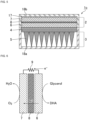
- Fig. 1 is a diagram illustrating an example of a lipolysis device, which is in use, according to the present invention.
- This lipolysis device 1 includes a battery portion 2 including a glycerol oxidation portion 6, a glycerol introduction portion 3, and a base material 4.
- the glycerol introduction portion 3 including protrusions 5 is provided on a surface of the base material 4. When a user presses the surface, which is provided with the protrusions 5, of the glycerol introduction portion 3 against the user's skin, the protrusions 5 are inserted in the skin.
- Fig. 2 is a schematic sectional view of a lipolysis device and skin tissue when the lipolysis device according to the present invention is used.
- This lipolysis device 1 includes the battery portion 2 and the glycerol introduction portion 3.
- the glycerol introduction portion 3 composed of the protrusions 5 is provided on the surface of the base material 4, and the battery portion 2 is provided on a surface, which is an opposite surface to the surface having the protrusions 5, of the base material 4.
- an anode (glycerol oxidation portion) 6 is arranged so as to be in contact with the base material 4, and a separator 8 and a cathode 7 are laminated on the anode 6 in this order.
- the anode 6 and the cathode 7 are connected with each other by an external circuit 9.
- the protrusions 5 are inserted in a skin and lipolytic enzyme 10 contained in the protrusions 5 diffuses into skin tissue 14.
- the lipolytic enzyme 10 reaches fat cells 15 by the diffusion and decomposes fat.
- glycerol 13 generated by the fat decomposition reaches the anode 6 through the protrusions 5, the glycerol 13 is oxidized by glycerol oxidase 11 contained in the anode 6. This generates electrons and protons.
- the electrons and protons transfer to the cathode 7 via the external circuit 9 and the separator 8 and oxygen is reduced by oxygen reductase 12 in the cathode 7, thus generating electric energy and providing a function as a battery.
- Fig. 3A is a schematic view of a lipolysis device according to a first embodiment of the present invention.
- This lipolysis device 1a includes the battery portion 2 and the glycerol introduction portion 3, and a buffer layer 19 is provided between the battery portion 2 and the glycerol introduction portion 3.
- the protrusions 5 are provided on the surface of the base material 4 and an adhesive layer is provided on a portion, on which the protrusions are not provided, of the surface of the base material 4 on the side having the protrusions 5.
- the glycerol introduction portion 3 is covered by a sealing member 18a so that surfaces of the protrusions 5 are covered.
- the base material 4 on the glycerol introduction portion 3 and the buffer layer 19 are partitioned by a partitioning member 16a, and the buffer layer 19 and the anode 6 in the battery portion 2 are partitioned by another partitioning member 16a.
- the separator 8, the cathode 7, and a gas diffusion layer 17, which is made of a PTFE film, are laminated on the anode 6 in this order, and the surface of the battery portion 2 is covered by a sealing member 18b.
- the anode 6 and cathode 7 in the battery portion 2 and the protrusions 5 in the glycerol introduction portion 3 are in a vacuum (reduced pressure) and dry state.
- Fig. 3B is a diagram for explaining a glycerol suction mechanism provided in the lipolysis device according to the first embodiment of the present invention.
- a buffer solution of the buffer layer 19 infiltrates into the anode 6, the cathode 7, and the protrusions 5.
- the protrusions 5 are exposed by removing the sealing member 18a and inserted in a skin. Accordingly, the buffer solution in the protrusions 5 is brought into contact with interstitial fluid in skin tissue.
- moisture infiltrated in the anode 6 and cathode 7 evaporates through the gas diffusion layer 17. Accordingly, body fluid in the skin tissue containing glycerol is sucked up to the anode 6 through the protrusions 5.
- Fig. 4A is a schematic view of a lipolysis device according to a second embodiment of the present invention.
- This lipolysis device 1b includes the battery portion 2 and the glycerol introduction portion 3, and the buffer layer 19 is provided between the battery portion 2 and the glycerol introduction portion 3.
- the protrusions 5 are provided on the surface of the base material 4 and an adhesive layer is provided on a portion, on which the protrusions are not provided, of the surface of the base material 4 on the side having the protrusions 5.
- the glycerol introduction portion 3 is covered by the sealing member 18a so that surfaces of the protrusions 5 are covered.
- the base material 4 on the glycerol introduction portion 3 and the buffer layer 19 are partitioned by a partitioning member 16b, and the buffer layer 19 and an anode 6a in the battery portion 2 are partitioned by another partitioning member 16b.
- the separator 8, the cathode 7, and the gas diffusion layer 17 are laminated on the anode 6a in this order, and the surface of the battery portion 2 is covered by the sealing member 18b.
- the anode 6a and cathode 7 in the battery portion 2 and the protrusions 5 in the glycerol introduction portion 3 are in a vacuum (reduced pressure) and dry state.
- the anode 6a is made of a compressible and expandable carbon material
- the partitioning member 16b is made of a compressible and expandable material
- the gas diffusion layer 17 is made of a PTFE film.
- Fig. 4B is a diagram for explaining a glycerol suction mechanism provided in the lipolysis device according to the second embodiment of the present invention.
- the protrusions 5 are exposed by removing the sealing member 18a according to the second embodiment and the lipolysis device 1b is pressed against a skin so as to insert the protrusions 5 in the skin.
- the partitioning members 16b are broken by pressure for pressing the lipolysis device 1b against the skin, and the buffer solution of the buffer layer 19 infiltrates into the anode 6a, the cathode 7, and the protrusions 5. Accordingly, the buffer solution in the protrusions 5 is brought into contact with interstitial fluid in skin tissue.
- the gas diffusion layer 17 is exposed to the atmosphere by removing the sealing member 18b, moisture infiltrated in the anode 6a and cathode 7 evaporates through the gas diffusion layer 17.
- the anode 6a and the partitioning members 16b are made of the compressible and expandable material. Therefore, a restoring force of the partitioning members 16b and the anode 6a generated by the breaking of the decompression state caused by the breaking of the partitioning members 16b also increases a speed of sucking the body fluid in the skin tissue up to the anode 6a.
- Fig. 5 is a schematic view of a lipolysis device according to a third embodiment of the present invention.
- This lipolysis device 1c includes the battery portion 2 and the glycerol introduction portion 3.
- the protrusions 5 are provided on the surface of the base material 4 and an adhesive layer is provided on a portion, on which the protrusions are not provided, of the surface of the base material 4 on the side having the protrusions 5.
- the glycerol introduction portion 3 is covered by the sealing member 18a so that the surfaces of the protrusions 5 are covered.
- the anode 6 is arranged so as to be in contact with the base material 4 on the glycerol introduction portion 3, and the separator 8, the cathode 7, and the gas diffusion layer 17, which is made of a PTFE film, are laminated on the anode 6 in this order.
- the surface of the battery portion 2 is covered by the sealing member 18b.
- the anode 6 and cathode 7 in the battery portion 2 and the protrusions 5 in the glycerol introduction portion 3 are wetted by a buffer solution.
- the protrusions 5 are exposed by removing the sealing member 18a and inserted in a skin. Accordingly, the buffer solution in the protrusions 5 is brought into contact with interstitial fluid in skin tissue.
- the gas diffusion layer 17 is exposed to the atmosphere by removing the sealing member 18b, moisture in the anode 6 and cathode 7 evaporates through the gas diffusion layer 17. Accordingly, body fluid in the skin tissue containing glycerol is sucked up to the anode 6 through the protrusions 5.
- Fig. 6 is a diagram schematically illustrating a principle of electric power generation in a battery portion of the lipolysis device according to the present invention.
- the separator 8 is arranged between the anode 6 and the cathode 7, and the anode 6 and the cathode 7 are connected by the external circuit 9.
- glycerol dehydrogenase When glycerol dehydrogenase is immobilized as the glycerol oxidase on the surface of the anode 6, glycerol is dehydrogenated by glycerol dehydrogenase to extract electrons (e - ) and produce dihydroxyacetone (DHA). Further, at the cathode 7, oxygen (O 2 ) in the air is reduced by protons (H + ) transferred from the anode 6 through the separator 8 and electrons (e - ) sent through the external circuit 9, producing water (H 2 O). These reactions occur simultaneously, generating electrical energy between electrodes.
- a resin mold was formed by injection molding into a microneedle array master mold (master mold formed of 100 conical needles of ⁇ : 0.5 mm, h: 0.65 mm). Polylactic acid was injection-molded into the resin mold to make porous microneedle arrays.
- Protrusions of the obtained microneedle arrays were treated with plasma to make the protrusions hydrophilic.
- the contact angle ( ⁇ ) with water on the surface of the protrusions was measured 10 seconds after 0.3 ⁇ l of distilled water was dropped onto the protrusions of the resulting hydrophilic microneedle arrays.
- a contact angle with water on the surface of the protrusions was 35°.
- the protrusions of the microneedle arrays were immersed in an aqueous solution containing lipase with pH adjusted from 6 to 9, and then dried at 30°C.
- the lipase was immobilized on the protrusions of the porous microneedle arrays by ionic bonding between the carboxyl group of the polylactic acid and the amino group of the lipase.
- a battery portion was installed so that an anode was crimped onto the back of the microneedle arrays obtained in Manufacturing example 1.
- the anode with glycerol dehydrogenase immobilized on its surface and a cathode with laccase enzyme immobilized on its surface have liquid junction through the separator.
- Carbon fiber electrodes were used for the anode and cathode.
- Nonwoven fabric made of PTFE was used for the separator.
- a coil (inductor) in a circuit that increases a voltage was used as an external circuit for the battery portion.
- microneedle arrays obtained in Manufacturing example 1 and the lipolysis device obtained in Example 1 were used to evaluate the following physical properties.
- a light emitting diode was connected to the lipolysis device obtained in Example 1, and the diode lit up when the protrusions of the lipolysis device were invaded in a skin.
Landscapes
- Health & Medical Sciences (AREA)
- Chemical & Material Sciences (AREA)
- Life Sciences & Earth Sciences (AREA)
- Engineering & Computer Science (AREA)
- Organic Chemistry (AREA)
- Wood Science & Technology (AREA)
- Genetics & Genomics (AREA)
- Bioinformatics & Cheminformatics (AREA)
- Zoology (AREA)
- General Health & Medical Sciences (AREA)
- Biochemistry (AREA)
- Biomedical Technology (AREA)
- General Engineering & Computer Science (AREA)
- Microbiology (AREA)
- General Chemical & Material Sciences (AREA)
- Electrochemistry (AREA)
- Chemical Kinetics & Catalysis (AREA)
- Medicinal Chemistry (AREA)
- Biotechnology (AREA)
- Molecular Biology (AREA)
- Heart & Thoracic Surgery (AREA)
- Veterinary Medicine (AREA)
- Public Health (AREA)
- Animal Behavior & Ethology (AREA)
- Sustainable Energy (AREA)
- Manufacturing & Machinery (AREA)
- Sustainable Development (AREA)
- Obesity (AREA)
- Nursing (AREA)
- Dermatology (AREA)
- Anesthesiology (AREA)
- Materials Engineering (AREA)
- Child & Adolescent Psychology (AREA)
- Medical Informatics (AREA)
- Hematology (AREA)
- Orthopedic Medicine & Surgery (AREA)
- Vascular Medicine (AREA)
- Apparatus Associated With Microorganisms And Enzymes (AREA)
- Hybrid Cells (AREA)
- Immobilizing And Processing Of Enzymes And Microorganisms (AREA)
Abstract
Description
- The present invention relates to a lipolysis device, a lipolysis method, and an electric power generation method.
- In recent years, the number of obese people has been rapidly increasing in Japan as well, due to changes in the social environment surrounding dietary habits, namely, westernization of dietary habits and lack of exercise. Obesity leads to various diseases, such as lifestyle-related diseases, and beauty problems. Therefore, effective prevention and improvement methods have been required, and research on anti-obesity has been actively conducted.
- Here, with growing interest in energy issues in recent years, biofuel cells that use bio-related substances such as sugars and alcohols as fuels have been attracting attention. A biofuel cell uses a biocatalyst as an electrode catalyst, and can generate electric power by combining an oxidation reaction of a biofuel at an anode with a reduction reaction of oxygen or the like at a cathode.
- Regarding such a biofuel cell, for example,
Patent Document 1 discloses an energy generator that includes conductive reactor gel having an enzyme that decomposes sugar and/or fat and/or fatty acid; a surface electrode arranged in contact with a surface of the reactor gel; and a secondary battery or electric equipment electrically connected to the surface electrode and the reactor gel; and in which the reactor gel takes in the sugar and/or fat and/or fatty acid from a living body when arranged in direct contact with a surface of the living body, and decomposes these living-body-derived components by the enzyme contained in the gel, and the secondary battery is charged or the electric equipment is driven by electric energy generated in the decomposition reaction by the enzyme. - Patent Document 1:
Japanese Unexamined Patent Application Publication No. 2006-147472 - However,
Patent Document 1 does not disclose any specific means for extracting living-body-derived substances such as sugar and fat in living bodies or specific means for generating energy from recovered living-body-derived substances, and it has been necessary to develop specific means for realizing these. - Further, from the viewpoint of disease prevention, health maintenance, and beauty, it has also been desired to develop a technique for promoting decomposition of fat in living bodies.
- The present invention has been made in view of the above-mentioned circumstances and an object of the present invention is to provide a lipolysis device, a lipolysis method, and an electric power generation method, with which energy can be obtained by decomposing fat in living bodies and utilizing glycerol that is an obtained decomposition product.
- A lipolysis device according to the present invention includes: a base material; a glycerol introduction portion that is provided on a surface of the base material; and a glycerol oxidation portion that is provided on a surface, which is an opposite surface to the surface having the glycerol introduction portion thereon, of the base material. The glycerol introduction portion has a protrusion containing lipolytic enzyme or a peptide compound having equivalent activity to that of the lipolytic enzyme. The glycerol oxidation portion contains glycerol oxidase and oxidizes glycerol introduced from the glycerol introduction portion.
- A lipolysis method according to the present invention is the lipolysis method for decomposing fat in a living body and includes: a lipolysis process for pricking the living body with a protrusion containing lipolytic enzyme or a peptide compound having equivalent activity to that of the lipolytic enzyme, so as to decompose fat in the living body and obtain glycerol; and an oxidizing process for oxidizing the glycerol, which is obtained in the lipolysis process, by glycerol oxidase in a glycerol oxidation portion.
- An electric power generation method according to the present invention is the electric power generation method for generating electric power by using fat in a living body as fuel and includes: a lipolysis process for pricking the living body with a protrusion, which contains lipolytic enzyme or a peptide compound having equivalent activity to that of the lipolytic enzyme, so as to decompose fat in the living body and obtain glycerol; and an oxidizing-reducing process for oxidizing the glycerol, which is obtained in the lipolysis process, in an anode containing glycerol oxidase and for reducing oxygen in the air in a cathode. Advantageous Effects of Invention
- According to the present invention, a lipolysis device, a lipolysis method, and an electric power generation method, with which energy can be obtained by decomposing fat in living bodies and utilizing glycerol that is an obtained decomposition product, can be provided.
-
- [
Fig. 1] Fig. 1 is a diagram illustrating an example of a lipolysis device, which is in use, according to the present invention. - [
Fig. 2] Fig. 2 is a schematic sectional view of a lipolysis device and skin tissue when the lipolysis device according to the present invention is used. - [
Fig. 3A] Fig. 3A is a schematic view of a lipolysis device according to a first embodiment of the present invention. - [
Fig. 3B] Fig. 3B is a diagram for explaining a glycerol suction mechanism provided in the lipolysis device according to the first embodiment of the present invention. - [
Fig. 4A] Fig. 4A is a schematic view of a lipolysis device according to a second embodiment of the present invention. - [
Fig. 4B] Fig. 4B is a diagram for explaining a glycerol suction mechanism provided in the lipolysis device according to the second embodiment of the present invention. - [
Fig. 5] Fig. 5 is a schematic view of a lipolysis device according to a third embodiment of the present invention. - [
Fig. 6] Fig. 6 is a diagram schematically illustrating a principle of electric power generation in a battery portion of the lipolysis device according to the present invention. - A lipolysis device, a lipolysis method, and an electric power generation method according to the present invention will be described below.
- However, the present invention is not limited to the following configurations and can be appropriately modified and applied without changing the gist of the present invention. A combination of two or more of the individual preferred configurations of the invention described below is also the present invention.
- A lipolysis device according to the present invention includes a base material; a glycerol introduction portion that is provided on a surface of the base material; and a glycerol oxidation portion that is provided on a surface, which is an opposite surface to the surface having the glycerol introduction portion thereon, of the base material. In the lipolysis device, the glycerol introduction portion has protrusions containing lipolytic enzyme or peptide compound having equivalent activity to that of lipolytic enzyme (hereinafter also referred to as lipolytic enzyme or the like), and the glycerol oxidation portion contains glycerol oxidase and oxidizes glycerol introduced from the glycerol introduction portion.
- A mechanism of energy generation in the lipolysis device according to the present invention is as follows.
- When the protrusions of the glycerol introduction portion in the lipolysis device according to the present invention are brought into close contact with a skin and inserted into the skin, lipolytic enzyme or the like is released in skin tissue and subcutaneous fat is decomposed by the lipolytic enzyme or the like. When the fat is decomposed, the concentration of glycerol in body fluids such as interstitial fluid in the skin tissue increases. The glycerol is liquid in living bodies because a melting point of glycerol is 20°C, and the glycerol reaches the glycerol oxidation portion through the protrusions by diffusion. The glycerol that reaches the glycerol oxidation portion is oxidized by oxidase to generate energy.
- When this oxidation reaction continues, the concentration of glycerol in body fluids is decreased, accelerating the reaction of fat decomposition into glycerol and fatty acids.
- The lipolysis device according to the present invention is capable of generating energy by utilizing fat in living bodies and therefore, slimming effect by lipolysis can also be expected.
- The lipolysis device according to the present invention utilizes fat in living bodies. When fat is decomposed, glycerol and fatty acids are produced. Therefore, it is also conceivable to use fatty acids as substrates. Fatty acids are decomposed to acyl CoA in living bodies by a plurality of enzymes and then oxidized in the β circuit to generate energy. However, in order to extract energy from fatty acids, the fatty acids need to be decomposed by using a plurality of enzymes, making design of the glycerol oxidation portion very complicated. It is thus difficult to artificially reproduce the system of extracting energy from fatty acids. On the other hand, when glycerol is a substrate, energy can be extracted through oxidation by a single enzyme, being able to simplify the configuration of the lipolysis device.
- The lipolysis device according to the present invention has protrusions containing lipolytic enzyme or the like in the glycerol introduction portion. By inserting the protrusions into a skin, lipolytic enzyme or the like can be released into a living body so as to collect glycerol, which is obtained by fat decomposition, through the protrusions.
- The configuration of the protrusions in the glycerol introduction portion is not particularly limited as long as the protrusions contain lipolytic enzyme or the like and are able to introduce glycerol, which is obtained by fat decomposition, from skin tissue to the glycerol oxidation portion by diffusion or the like. However, the protrusions are preferably porous bodies and/or hollow bodies. More preferably, the protrusions are porous bodies. When the protrusions are porous bodies, in addition to diffusion based on concentration gradient of glycerol in bodily fluids, glycerol can be introduced into the battery portion by a capillary force of the porous bodies as described later. Efficiency of glycerol introduction is thus improved. Further, since the protrusions are porous bodies, adsorption of the lipolytic enzyme or the like to the protrusions is also improved.
- When the protrusions are porous bodies, D50 in pore diameter distribution is preferably from 0.05 µm to 10 µm inclusive. This further improves efficiency of introducing glycerol to the battery portion. More preferably, D50 in the pore diameter distribution is from 0.5 µm to 5 µm inclusive. D50 in the pore size distribution can be obtained from a pore diameter distribution curve [horizontal axis: pore diameter (µm), vertical axis: log differential pore volume (mL/g)] measured by mercury porosimetry.
- The surfaces of the protrusions are preferably hydrophilic. When the surfaces of the protrusions are highly hydrophilic, affinity for highly hydrophilic glycerol further rises and the efficiency of introducing glycerol to the glycerol oxidation portion is further improved.
- Furthermore, when the protrusions are porous bodies and their surfaces are highly hydrophilic, in addition to diffusion based on the concentration gradient of glycerol in bodily fluids, glycerol having a higher hydrophilic property than fatty acids can be selectively introduced into the glycerol oxidation portion by the capillary force of the porous bodies. Accordingly, the efficiency of glycerol introduction is further improved. In addition, when the lipolysis device according to the present invention further includes a battery portion that includes an anode and a cathode connected with the anode, glycerol concentration near the anode is increased and a current value is accordingly increased, being able to improve output.
- Examples of a method for making the surfaces of the protrusions hydrophilic include a method for imparting hydroxyl groups to the surfaces of the protrusions by using plasma or the like.
- It is preferable that a contact angle with water on the surfaces of the protrusions in the lipolysis device is 60° or smaller. This makes the hydrophilic property of the protrusions more sufficient. The contact angle is more preferably 50° or smaller, further more preferably 40° or smaller, and especially preferably 30° or smaller.
- The contact angle can be measured with a contact angle meter.
- A shape of the protrusion is not particularly limited as long as a skin can be pricked with the protrusion having the shape, but the shape is preferably conical or pyramidal. More preferably, the shape is conical.
- The material of the protrusion is preferably a polymer, metal, resin, or the like that does not harm living bodies and is compatible with the living bodies. Specific examples of the material for the protrusion include alginate, hyaluronic acid, curdlan, chitin, chitosan, glucomannan, polymalic acid, collagen, collagen peptide, hydroxypropyl cellulose, gelatin, silicon, titanium, silicone, polylactic acid (PLA), polyglycolic acid (PLA), and PLA-PGA copolymers, and plasma-treated materials of these. Among these, biodegradable materials are more preferable, hyaluronic acid, collagen, and polylactic acid are further more preferable, and polylactic acid is especially preferable.
- A length of the protrusion is not particularly limited as long as a skin can be pricked with the protrusion having the length, but the length is preferably from 100 µm to 3000 µm inclusive. This allows lipolytic enzyme or the like to be more sufficiently diffused into subcutaneous fat in a less invasive manner. The length of the protrusion is more preferably from 150 µm to 1500 µm inclusive, further more preferably from 150 µm to 1000 µm inclusive, and especially preferably from 200 µm to 800 µm inclusive.
- A diameter of a bottom portion of the protrusion (the maximum diameter of the protrusion) is preferably from 50 µm to 1000 µm inclusive. This makes it possible to prick a skin in a less invasive manner. The diameter of the bottom portion of the protrusion is more preferably from 100 µm to 800 µm inclusive.
- The number of protrusions included in the glycerol introduction portion is not particularly limited, but the number is preferably from 25 to 250000 inclusive. More preferably, the number is from 2500 to 50000 inclusive.
- The density of protrusions included in the glycerol introduction portion is not particularly limited, but the density is preferably from 1/cm2 to 10000/cm2 inclusive. More preferably, the density is from 100/cm2 to 2000/cm2 inclusive.
- The method for manufacturing protrusions in the glycerol introduction portion is not particularly limited, and examples of the method include a method for injection-molding a material for forming the protrusions.
- The protrusions may be dry or contain a liquid such as a buffer solution. When the protrusions are dry, it is preferable that the inside of the protrusions is under negative pressure, more preferably a vacuum, in a state that the protrusions are covered with a sealing member which will be described later.
- The lipolytic enzyme or a peptide compound having equivalent activity to the lipolytic enzyme contained in the protrusions is not particularly limited as long as the lipolytic enzyme or peptide compound is capable of decomposing fat into glycerol and fatty acids. Specific examples of the lipolytic enzyme include lipase and analogues of lipase. The enzyme activity of the peptide compound is preferably from 50 to 120 inclusive when the enzyme activity of lipase is 100. A preferable example of the lipolytic enzyme or the like is lipase or analogues of lipase.
- Analogues of the lipolytic enzyme are not particularly limited as long as the analogues of the lipolytic enzyme can decompose fat into glycerol and fatty acids. Examples of the analogues include chemically modified lipase. Examples of the chemically modified lipase include lipase bound with, for example, cell membrane permeable peptide or the like.
- An average molecular weight of the lipolytic enzyme or the like is preferably from 2000 to 100000 inclusive. This improves permeability of lipolytic enzyme or the like to fat cells. The average molecular weight is preferably from 5000 to 80000 inclusive, and more preferably from 10000 to 70000 inclusive.
- The average molecular weight of the lipolytic enzyme or the like can be measured by ultracentrifugal analysis.
- The aspect in which the protrusions contain lipolytic enzyme or the like is not particularly limited, but the lipolytic enzyme or the like is preferably bound to or adsorbed on the protrusions. The above-mentioned binding means chemical bonding and adsorbing means physical adsorption. Examples of the aspect in which lipolytic enzyme or the like is chemically bound to the protrusions include an aspect in which a functional group possessed by lipolytic enzyme or the like and a functional group possessed by the protrusions are bound by ionic bonding.
- Examples of the aspect in which the lipolytic enzyme or the like is physically adsorbed on the protrusions include an aspect in which lipolytic enzyme or the like and molecules forming the protrusions are bound by van der Waals forces.
- An aspect in which the lipolytic enzyme or the like is physically adsorbed on the protrusions is preferable.
- Further, lipolytic enzyme or the like may be directly bound to or adsorbed on the protrusions, but micro-capsules or the like containing the lipolytic enzyme or the like may be bound to or adsorbed on the protrusions.
- The method for binding or adsorbing lipolytic enzyme or the like on the protrusions is not particularly limited, but examples of the method include a method in which after the protrusions are immersed in an aqueous solution containing pH-adjusted lipolytic enzyme or the like for a certain period of time, the protrusions are dried at a temperature from 20°C to 40°C inclusive.
- Further, when the lipolytic enzyme or the like has heat resistance as, for example, lipase derived from highly thermophilic bacteria, the lipolytic enzyme or the like can be embedded in the protrusions in molding of the protrusions by injection molding or the like. For example, when lipolytic enzyme or the like is embedded in protrusions made of a biodegradable material, part of the protrusions are decomposed in a living body after insertion of the protrusions into the living body and accordingly, the lipolytic enzyme or the like can be released in the living body.
- The base material is not particularly limited as long as the base material supports the protrusions of the glycerol introduction portion. The base material may be made of the same material as or a different material from that of the protrusions, but the same material is preferable.
- The thickness of the base material is preferably from 100 µm to 1000 µm inclusive. More preferably, the thickness is from 300 µm to 500 µm inclusive.
- The base material preferably includes an adhesive layer on a portion, on which the protrusions are not formed, of the surface of the base material on the side having the protrusions. This allows a skin and the lipolysis device of the present invention to adhere to each other.
- In a state before the use of the lipolysis device according to the present invention, the protrusions in the glycerol introduction portion and the surface of the base material on the side having the protrusions or the adhesive layer are preferably covered by a sealing member. When the protrusions and the surface of the base material on the side having the protrusions or the adhesive layer are covered by a sealing member, the protrusions are exposed by removing the sealing member and the protrusions are accordingly ready to be inserted into a skin.
- The glycerol oxidation portion in the lipolysis device according to the present invention is provided on the surface of the base material on the side opposite to the side having the protrusions.
- The glycerol oxidation portion is not particularly limited as long as the glycerol oxidation portion contains glycerol oxidase and oxidizes glycerol introduced from the glycerol introduction portion.
- The glycerol oxidase is not particularly limited as long as the glycerol oxidase can oxidize glycerol and extract electrons, and analogues of glycerol oxidase may also be employed. The glycerol oxidase is preferably glycerol dehydrogenase, alcohol dehydrogenase, glycerol oxidase, or the like, and more preferably glycerol dehydrogenase or analogues of glycerol dehydrogenase.
- When glycerol dehydrogenase, for example, is used as the glycerol oxidase, glycerol is dehydrogenated (oxidized) to produce dihydroxyacetone. Further, when alcohol dehydrogenase is used, glycerol is dehydrogenated (oxidized) to produce glyceraldehyde.
- It is preferable that the lipolysis device further includes a suction mechanism that sucks glycerol from the glycerol introduction portion into the glycerol oxidation portion. This further increases an introduction speed of glycerol into the glycerol oxidation portion and allows the glycerol oxidation portion to start glycerol oxidation at an earlier stage.
- The suction mechanism is not particularly limited as long as the suction mechanism sucks glycerol into the glycerol oxidation portion from the glycerol introduction portion. Examples of the suction mechanism include a mechanism that utilizes a pressure difference in the lipolysis device and a mechanism that utilizes a capillary force.
- When the suction mechanism is the mechanism that utilizes a pressure difference in the lipolysis device, for example, an aspect is employed that the insides of the base material, glycerol oxidation portion, and glycerol introduction portion are in a negative pressure and dry state; a buffer layer containing moisture such as a buffer solution is provided between the base material and the glycerol oxidation portion; and the base material and the buffer layer, and the glycerol oxidation portion and the buffer layer are partitioned by respective partitioning members which are removable or partitioning members which can be broken by external pressure. In this aspect, if the partitioning members are removed or the partitioning members are broken by external pressure, liquid in the buffer layer infiltrates into the base material, glycerol introduction portion, and glycerol oxidation portion and water evaporates from the surface of the glycerol oxidation portion. As a result, the pressure in the glycerol oxidation portion drops below the pressure in the glycerol introduction portion and body fluid in a living body, and this pressure difference allows glycerol in the living body to be sucked through the glycerol introduction portion into the glycerol oxidation portion.
- When the suction mechanism is the mechanism that utilizes the capillary force, an aspect that the protrusions in the glycerol introduction portion are porous bodies is employed. Body fluid containing glycerol in a living body is absorbed into pores of porous bodies by the capillary force, allowing glycerol to be sucked into the glycerol oxidation portion.
- The lipolysis device preferably includes a battery portion that includes an anode and a cathode connected with the anode, and in this configuration, the anode is the glycerol oxidation portion.
- When the lipolysis device includes the battery portion, glycerol produced in skin tissue reaches the anode of the battery portion from the glycerol introduction portion. The glycerol that reaches the anode is oxidized by oxidase and oxygen in the air is reduced at the cathode, generating electric energy.
- The lipolysis device according to the present invention including the battery portion can also be referred to as a power generation device.
- In the battery portion, an anode is preferably connected to a surface of the base material on a side opposite to the side having the protrusions in the glycerol introduction portion. This allows glycerol, which is introduced into the battery portion through the protrusions, to be more efficiently oxidized in the anode.
- The lipolysis device according to the present invention may include a buffer layer between the glycerol introduction portion and the battery portion as described later. In this configuration, the glycerol introduction portion and the anode may be connected via the buffer layer in the use of the lipolysis device according to the present invention.
- The anode in the battery portion only needs to contain glycerol oxidase, but glycerol oxidase is preferably immobilized on the surface of the anode.
- The anode may further contain coenzyme oxidase and electron mediator.
- The coenzyme oxidase oxidizes coenzyme (for example, NAD+ and NADP+) that is reduced by oxidase and a reduce form of coenzyme (for example, NADH and NADPH), and examples of the coenzyme oxidase include diaphorase. The action of the coenzyme oxidase produces electrons when the coenzyme reverts to its oxidized form, and the electrons are transferred from the coenzyme oxidase to an electrode via the electron mediator.
- A compound having a quinone skeleton is preferably used as the electron mediator, and a compound having a naphthoquinone skeleton is particularly preferred. Specifically, 2-amino-1,4-naphthoquinone (ANQ), 2-amino-3-methyl-1,4-naphthoquinone (AMNQ), 2-methyl-1,4-naphthoquinone (VK3), 2-amino-3-carboxy-1,4-naphthoquinone (ACNQ), and the like can be used.
- In addition to the compound having the naphthoquinone skeleton, for example, compounds having an anthraquinone skeleton such as anthraquinone-1-sulfonic acid, anthraquinone-2-sulfonic acid, and anthraquinone-2-carboxylic acid, and derivatives of these can be used as the compound having the quinone skeleton. Furthermore, one or more kinds of other compounds that act as the electron mediator may be used together with the compound having the quinone skeleton, if necessary.
- The cathode in the battery portion only needs to contain catalyst for reducing oxygen in the air, but the cathode preferably contains oxygen reductase. It is more preferable that the oxygen reductase is immobilized on the surface of the cathode.
- The oxygen reductase is not particularly limited as long as the oxygen reductase can reduce oxygen. Examples of the oxygen reductase include multi-copper enzymes such as bilirubin oxidase, laccase, and ascorbate oxidase, and analogues of these. Laccase is preferable among these. Further, an electron mediator may be used with these enzymes, and examples of the electron mediator include potassium hexacyanoferrate (II), potassium hexacyanoferrate (III), potassium ferricyanide, and potassium octacyanotungstate.
- Materials for forming the anode and cathode are not particularly limited as long as the material has conductivity, but conductive porous materials are preferable. Accordingly, the enzyme can be immobilized more sufficiently. More preferable examples of the conductive porous materials include carbon-based materials such as porous carbon, carbon pellets, carbon felt, carbon paper, or a multilayer body of carbon fiber or carbon particulates. When the lipolysis device according to the present invention includes a buffer layer, described later, between the glycerol introduction portion and the battery portion and the anode is in a dry and depressurized state and partitioning members, which partition the glycerol introduction portion and battery portion from the buffer layer, are broken by external pressure, a compressible and expandable carbon material is preferable as the material for forming the anode.
- The materials for forming the anode and the cathode may be the same as or different from each other.
- The anode and the cathode may be dry or contain a liquid such as a buffer solution before the lipolysis device is used. When the anode and the cathode are dry, the inside of the system in the battery portion is preferably negative pressure, more preferably a vacuum.
- The anode and the cathode preferably further include current collectors.
- Any material can be employed for the current collector as long as the current collector is made of the material that can be electrically connected with the outside and the material does not produce electrochemical reactions in the battery portion. Specific examples include metallic materials such as Pt, Ag, Au, Ru, Rh, Os, Nb, Mo, In, Ir, Zn, Mn, Fe, Co, Ti, V, Cr, Pd, Re, Ta, W, Zr, Ge, and Hf; alloys such as alumel, brass, duralumin, bronze, nickelin, platinum-rhodium, permalloy, permendur, nickel silver, and phosphor bronze; conductive polymers such as polyacetylenes; carbon-based materials such as carbon felt, carbon paper, or a multilayer body of carbon fiber or carbon particulates; borides such as HfB2, NbB, CrB2, and B4C; nitrides such as TiN and ZrN; silicides such as VSi2, NbSi2, MoSi2, and TaSi2; and composite materials of these materials.
- The battery portion preferably further includes a separator between the anode and the cathode. The separator can be made of any material as long as the material is permeable to protons, but the material is preferably flexible. Specifically, non-woven fabrics, cellophane, perfluorosulfonic acid-based ion exchange membranes, and the like can be used.
- In the battery portion, the cathode is preferably covered by a gas diffusion layer through which gas can circulate. A material for forming the gas diffusion layer is not particularly limited, and examples of the material include fluororesins such as polytetrafluoroethylene (PTFE), tetrafluoroethylene-hexafluoropropylene copolymer (FEP), polyvinylidene fluoride (PVdF), tetrafluoroethylene-ethylene copolymer (ETFE), polychlorotrifluoroethylene (PCTFE), and tetrafluoroethylene-perfluoroalkyl vinyl ether copolymer (PFA) .
- The battery portion is preferably covered by a sealing member that blocks air. When the battery portion is covered by a sealing member, oxygen is supplied to the battery portion by removing the sealing member and the reaction of the battery portion can be started. More preferably, an outer side portion of the gas diffusion layer is covered by the sealing member.
- A material for the sealing member is not particularly limited as long as the material can block the air and, for example, polyethylene (PE) and the like are employed.
- The lipolysis device may further include a buffer layer containing moisture such as a buffer solution between the glycerol introduction portion and the battery portion. When the protrusions, the anode and cathode in the battery portion, and the protrusions in the glycerol introduction portion are dry, the lipolysis device can be made ready to generate electric power by allowing water in the buffer layer to infiltrate into the anode and cathode in the battery portion and the protrusions in the glycerol introduction portion in use of the lipolysis device.
- When the lipolysis device is the battery portion, as a specific mechanism of the suction mechanism that utilizes a pressure difference in the lipolysis device, an aspect is employed that the insides of the base material, the anode and cathode in the battery portion, and the glycerol introduction portion are in a negative pressure and dry state; a buffer layer containing moisture such as a buffer solution is provided between the base material and the buffer layer; and the base material and the buffer layer, and the battery portion and the buffer layer are partitioned by respective partitioning members which are removable or partitioning members which can be broken by external pressure. In this aspect, if the partitioning members are removed or the partitioning members are broken by external pressure, a liquid in the buffer layer infiltrates into the base material, glycerol introduction portion, and battery portion and water evaporates from the surface of the battery portion. As a result, the pressure in the battery portion drops below the pressure in the glycerol introduction portion and the body fluid in a living body, and this pressure difference allows glycerol in the living body to be sucked through the glycerol introduction portion into the battery portion.
- When the partitioning members are removed from the device in use of the lipolysis device having the buffer layer, the material of the partitioning member is not particularly limited as long as the material is a waterproof material and specific examples of the material include polyethylene terephthalate (PET) and polyvinyl chloride (PVC) film.
- In the configuration that the partitioning members are broken by external pressure in use of the lipolysis device, examples of a material of the partitioning member include thin-film PVDC, polyethylene, and urethane foam with hydrophobic coated surfaces. Compressible and expandable materials are preferable and urethane foam with hydrophobic coated surfaces are more preferable.
- A glycerol oxidation portion device according to the present invention only needs to contain the base material, the glycerol introduction portion, and the glycerol oxidation portion, but the glycerol oxidation portion device may include other members. Other members are not particularly limited as long as the members do not impair the functionality of the lipolysis device of the present invention. Examples of other members include members that discharges products generated by oxidation of glycerol and/or battery reaction to the outside of the lipolysis device or into a living body; auxiliary members for immobilization such as belts and bandages; and water absorbent polymers.
- The lipolysis device according to the present invention consumes fat in subcutaneous tissue of an applied area and therefore, a slimming effect on a desired part of a body can be expected by applying the lipolysis device to the part.
- The lipolysis device according to the present invention can be used in an attached manner to a living body and can be used as a patch device such as a slimming patch or a partially-slimming patch.
- Electric power obtained by the lipolysis device according to the present invention can be used for various electrical devices. Examples of electrical devices include digital devices having a short-range wireless communication function such as Bluetooth (registered trademark), such as a portable information terminal, a wearable device, a music player, and a digital camera; and implantable medical devices such as artificial organs such as artificial hearts, cardiac pacemakers, insulin and other drug injectors, or in-body monitoring devices such as blood glucose level measuring devices.
- In addition, electric power obtained by the lipolysis device can also be converted into vibration energy using an actuator element, and the vibration can be transmitted to the protrusions to promote lipolysis.
- Further, the lipolysis device according to the present invention can be connected to a light emitting diode, and consumption of fat by the lipolysis device can be visually notified to a user of the lipolysis device by lighting the light emitting diode.
- The present invention is a lipolysis method for decomposing fat in a living body and is also a lipolysis method that includes: a lipolysis process for pricking a living body with protrusions, which contain lipolytic enzyme or a peptide compound having equivalent activity to that of the lipolytic enzyme, so as to decompose fat in the living body and obtain glycerol; and an oxidizing process for oxidizing the glycerol, which is obtained in the lipolysis process, by glycerol oxidase in a glycerol oxidation portion.
- The lipolysis method according to the present invention is not particularly limited as long as the lipolysis method includes the lipolysis process and the oxidizing process, but the lipolysis method is preferably conducted by using the lipolysis device according to the present invention.
- The present invention is an electric power generation method for generating electric power by using fat in a living body as fuel and is also an electric power generation method that includes: a lipolysis process for pricking a living body with protrusions, which contain lipolytic enzyme or a peptide compound having equivalent activity to that of the lipolytic enzyme, so as to decompose fat in the living body and obtain glycerol; and an oxidizing-reducing process for oxidizing the glycerol, which is obtained in the lipolysis process, in an anode containing glycerol oxidase and for reducing oxygen in the air in a cathode.
- The electric power generation method according to the present invention is not particularly limited as long as the electric power generation method includes the lipolysis process and the oxidizing-reducing process, but the electric power generation method is preferably conducted by using the lipolysis device according to the present invention.
- Embodiments according to the present invention will now be described below with reference to the accompanying drawings. In all the drawings of the embodiments, the same or corresponding components are given the same reference characters.
-
Fig. 1 is a diagram illustrating an example of a lipolysis device, which is in use, according to the present invention. Thislipolysis device 1 includes abattery portion 2 including aglycerol oxidation portion 6, aglycerol introduction portion 3, and abase material 4. Theglycerol introduction portion 3 includingprotrusions 5 is provided on a surface of thebase material 4. When a user presses the surface, which is provided with theprotrusions 5, of theglycerol introduction portion 3 against the user's skin, theprotrusions 5 are inserted in the skin. -
Fig. 2 is a schematic sectional view of a lipolysis device and skin tissue when the lipolysis device according to the present invention is used. - This
lipolysis device 1 includes thebattery portion 2 and theglycerol introduction portion 3. Theglycerol introduction portion 3 composed of theprotrusions 5 is provided on the surface of thebase material 4, and thebattery portion 2 is provided on a surface, which is an opposite surface to the surface having theprotrusions 5, of thebase material 4. In thebattery portion 2, an anode (glycerol oxidation portion) 6 is arranged so as to be in contact with thebase material 4, and aseparator 8 and acathode 7 are laminated on theanode 6 in this order. Theanode 6 and thecathode 7 are connected with each other by anexternal circuit 9. Theprotrusions 5 are inserted in a skin andlipolytic enzyme 10 contained in theprotrusions 5 diffuses intoskin tissue 14. Thelipolytic enzyme 10 reachesfat cells 15 by the diffusion and decomposes fat. Whenglycerol 13 generated by the fat decomposition reaches theanode 6 through theprotrusions 5, theglycerol 13 is oxidized byglycerol oxidase 11 contained in theanode 6. This generates electrons and protons. The electrons and protons transfer to thecathode 7 via theexternal circuit 9 and theseparator 8 and oxygen is reduced byoxygen reductase 12 in thecathode 7, thus generating electric energy and providing a function as a battery. -
Fig. 3A is a schematic view of a lipolysis device according to a first embodiment of the present invention. - This
lipolysis device 1a according to the first embodiment includes thebattery portion 2 and theglycerol introduction portion 3, and abuffer layer 19 is provided between thebattery portion 2 and theglycerol introduction portion 3. In theglycerol introduction portion 3, theprotrusions 5 are provided on the surface of thebase material 4 and an adhesive layer is provided on a portion, on which the protrusions are not provided, of the surface of thebase material 4 on the side having theprotrusions 5. Theglycerol introduction portion 3 is covered by a sealingmember 18a so that surfaces of theprotrusions 5 are covered. - The
base material 4 on theglycerol introduction portion 3 and thebuffer layer 19 are partitioned by apartitioning member 16a, and thebuffer layer 19 and theanode 6 in thebattery portion 2 are partitioned by another partitioningmember 16a. Theseparator 8, thecathode 7, and agas diffusion layer 17, which is made of a PTFE film, are laminated on theanode 6 in this order, and the surface of thebattery portion 2 is covered by a sealingmember 18b. - The
anode 6 andcathode 7 in thebattery portion 2 and theprotrusions 5 in theglycerol introduction portion 3 are in a vacuum (reduced pressure) and dry state. -
Fig. 3B is a diagram for explaining a glycerol suction mechanism provided in the lipolysis device according to the first embodiment of the present invention. - By removing the
partitioning members 16a in the first embodiment, a buffer solution of thebuffer layer 19 infiltrates into theanode 6, thecathode 7, and theprotrusions 5. Theprotrusions 5 are exposed by removing the sealingmember 18a and inserted in a skin. Accordingly, the buffer solution in theprotrusions 5 is brought into contact with interstitial fluid in skin tissue. When thegas diffusion layer 17 is exposed to the atmosphere by removing the sealingmember 18b, moisture infiltrated in theanode 6 andcathode 7 evaporates through thegas diffusion layer 17. Accordingly, body fluid in the skin tissue containing glycerol is sucked up to theanode 6 through theprotrusions 5. -
Fig. 4A is a schematic view of a lipolysis device according to a second embodiment of the present invention. - This
lipolysis device 1b according to the second embodiment includes thebattery portion 2 and theglycerol introduction portion 3, and thebuffer layer 19 is provided between thebattery portion 2 and theglycerol introduction portion 3. In theglycerol introduction portion 3, theprotrusions 5 are provided on the surface of thebase material 4 and an adhesive layer is provided on a portion, on which the protrusions are not provided, of the surface of thebase material 4 on the side having theprotrusions 5. Theglycerol introduction portion 3 is covered by the sealingmember 18a so that surfaces of theprotrusions 5 are covered. - The
base material 4 on theglycerol introduction portion 3 and thebuffer layer 19 are partitioned by apartitioning member 16b, and thebuffer layer 19 and ananode 6a in thebattery portion 2 are partitioned by another partitioningmember 16b. Theseparator 8, thecathode 7, and thegas diffusion layer 17 are laminated on theanode 6a in this order, and the surface of thebattery portion 2 is covered by the sealingmember 18b. - The
anode 6a andcathode 7 in thebattery portion 2 and theprotrusions 5 in theglycerol introduction portion 3 are in a vacuum (reduced pressure) and dry state. - The
anode 6a is made of a compressible and expandable carbon material, the partitioningmember 16b is made of a compressible and expandable material, and thegas diffusion layer 17 is made of a PTFE film. -
Fig. 4B is a diagram for explaining a glycerol suction mechanism provided in the lipolysis device according to the second embodiment of the present invention. - The
protrusions 5 are exposed by removing the sealingmember 18a according to the second embodiment and thelipolysis device 1b is pressed against a skin so as to insert theprotrusions 5 in the skin. Thepartitioning members 16b are broken by pressure for pressing thelipolysis device 1b against the skin, and the buffer solution of thebuffer layer 19 infiltrates into theanode 6a, thecathode 7, and theprotrusions 5. Accordingly, the buffer solution in theprotrusions 5 is brought into contact with interstitial fluid in skin tissue. When thegas diffusion layer 17 is exposed to the atmosphere by removing the sealingmember 18b, moisture infiltrated in theanode 6a andcathode 7 evaporates through thegas diffusion layer 17. Accordingly, body fluid in the skin tissue containing glycerol is sucked up to theanode 6a through theprotrusions 5. Theanode 6a and thepartitioning members 16b are made of the compressible and expandable material. Therefore, a restoring force of thepartitioning members 16b and theanode 6a generated by the breaking of the decompression state caused by the breaking of thepartitioning members 16b also increases a speed of sucking the body fluid in the skin tissue up to theanode 6a. -
Fig. 5 is a schematic view of a lipolysis device according to a third embodiment of the present invention. - This
lipolysis device 1c according to the third embodiment includes thebattery portion 2 and theglycerol introduction portion 3. In theglycerol introduction portion 3, theprotrusions 5 are provided on the surface of thebase material 4 and an adhesive layer is provided on a portion, on which the protrusions are not provided, of the surface of thebase material 4 on the side having theprotrusions 5. Theglycerol introduction portion 3 is covered by the sealingmember 18a so that the surfaces of theprotrusions 5 are covered. In thebattery portion 2, theanode 6 is arranged so as to be in contact with thebase material 4 on theglycerol introduction portion 3, and theseparator 8, thecathode 7, and thegas diffusion layer 17, which is made of a PTFE film, are laminated on theanode 6 in this order. The surface of thebattery portion 2 is covered by the sealingmember 18b. - The
anode 6 andcathode 7 in thebattery portion 2 and theprotrusions 5 in theglycerol introduction portion 3 are wetted by a buffer solution. Theprotrusions 5 are exposed by removing the sealingmember 18a and inserted in a skin. Accordingly, the buffer solution in theprotrusions 5 is brought into contact with interstitial fluid in skin tissue. When thegas diffusion layer 17 is exposed to the atmosphere by removing the sealingmember 18b, moisture in theanode 6 andcathode 7 evaporates through thegas diffusion layer 17. Accordingly, body fluid in the skin tissue containing glycerol is sucked up to theanode 6 through theprotrusions 5. -
Fig. 6 is a diagram schematically illustrating a principle of electric power generation in a battery portion of the lipolysis device according to the present invention. - The
separator 8 is arranged between theanode 6 and thecathode 7, and theanode 6 and thecathode 7 are connected by theexternal circuit 9. - When glycerol dehydrogenase is immobilized as the glycerol oxidase on the surface of the
anode 6, glycerol is dehydrogenated by glycerol dehydrogenase to extract electrons (e-) and produce dihydroxyacetone (DHA). Further, at thecathode 7, oxygen (O2) in the air is reduced by protons (H+) transferred from theanode 6 through theseparator 8 and electrons (e-) sent through theexternal circuit 9, producing water (H2O). These reactions occur simultaneously, generating electrical energy between electrodes. - The present invention will be described in more detail with reference to examples below, but the present invention is not limited only to these examples.
- A resin mold was formed by injection molding into a microneedle array master mold (master mold formed of 100 conical needles of ϕ: 0.5 mm, h: 0.65 mm). Polylactic acid was injection-molded into the resin mold to make porous microneedle arrays.
- Protrusions of the obtained microneedle arrays were treated with plasma to make the protrusions hydrophilic.
- Using a contact angle meter (Model CA-X, Kyowa Interface Science Co., Ltd.), the contact angle (θ) with water on the surface of the protrusions was measured 10 seconds after 0.3 µl of distilled water was dropped onto the protrusions of the resulting hydrophilic microneedle arrays. A contact angle with water on the surface of the protrusions was 35°.
- The protrusions of the microneedle arrays were immersed in an aqueous solution containing lipase with pH adjusted from 6 to 9, and then dried at 30°C.
- Accordingly, the lipase was immobilized on the protrusions of the porous microneedle arrays by ionic bonding between the carboxyl group of the polylactic acid and the amino group of the lipase.
- A battery portion was installed so that an anode was crimped onto the back of the microneedle arrays obtained in Manufacturing example 1. In the battery portion, the anode with glycerol dehydrogenase immobilized on its surface and a cathode with laccase enzyme immobilized on its surface have liquid junction through the separator. Carbon fiber electrodes were used for the anode and cathode. Nonwoven fabric made of PTFE was used for the separator. A coil (inductor) in a circuit that increases a voltage was used as an external circuit for the battery portion.
- The microneedle arrays obtained in Manufacturing example 1 and the lipolysis device obtained in Example 1 were used to evaluate the following physical properties.
- Animal meat containing fat was pricked with the protrusions of the microneedle arrays obtained in Manufacturing example 1 and Glycerol Assay Kit manufactured by Cayman Chemical was used to check glycerol generation.
- A light emitting diode was connected to the lipolysis device obtained in Example 1, and the diode lit up when the protrusions of the lipolysis device were invaded in a skin. Reference Signs List
-
- 1, 1a, 1b, 1c
- lipolysis device
- 2
- battery portion
- 3
- glycerol introduction portion
- 4
- base material
- 5
- protrusion
- 6, 6a
- anode (glycerol oxidation portion)
- 7
- cathode
- 8
- separator
- 9
- external circuit
- 10
- lipolytic enzyme
- 11
- glycerol oxidase
- 12
- oxygen reductase
- 13
- glycerol
- 14
- skin tissue
- 15
- fat cell
- 16a, 16b
- partitioning member
- 17
- gas diffusion layer
- 18a, 18b
- sealing member
- 19
- buffer layer
Claims (17)
- A lipolysis device comprising:a base material;a glycerol introduction portion that is provided on a surface of the base material; anda glycerol oxidation portion that is provided on a surface, the surface being an opposite surface to the surface having the glycerol introduction portion thereon, of the base material, whereinthe glycerol introduction portion has a protrusion containing lipolytic enzyme or a peptide compound having equivalent activity to that of the lipolytic enzyme, andthe glycerol oxidation portion contains glycerol oxidase and oxidizes glycerol introduced from the glycerol introduction portion.
- The lipolysis device according to Claim 1 comprising:a battery portion that includes an anode and a cathode, the cathode being connected with the anode, whereinthe anode is the glycerol oxidation portion.
- The lipolysis device according to Claim 1 or 2, wherein a contact angle with water on a surface of the protrusion is 60° or smaller.
- The lipolysis device according to any one of Claims 1 to 3, wherein a length of the protrusion is from 100 µm to 3000 µm inclusive.
- The lipolysis device according to any one of Claims 1 to 4, wherein the protrusion is a porous body.
- The lipolysis device according to Claim 5, wherein D50 of the protrusion in pore diameter distribution is from 0.05 µm to 10 µm inclusive.
- The lipolysis device according to any one of Claims 1 to 6, wherein the protrusion is a biodegradable material.
- The lipolysis device according to any one of Claims 1 to 7, wherein the lipolytic enzyme or the peptide compound having equivalent activity to that of the lipolytic enzyme is bound to or adsorbed on the protrusion.
- The lipolysis device according to any one of Claims 1 to 8, wherein an average molecular weight of the lipolytic enzyme is from 2000 to 100000 inclusive.
- The lipolysis device according to any one of Claims 1 to 9, wherein the lipolytic enzyme or the peptide compound having equivalent activity to that of the lipolytic enzyme is lipase or a peptide compound designed to have equivalent activity to that of lipase.
- The lipolysis device according to any one of Claims 1 to 10 further comprising: a suction mechanism that sucks glycerol from the glycerol introduction portion into the glycerol oxidation portion.
- The lipolysis device according to Claim 11, wherein the suction mechanism utilizes a pressure difference in the lipolysis device.
- The lipolysis device according to Claim 11 or 12, wherein the suction mechanism utilizes a capillary force.
- The lipolysis device according to any one of Claims 2 to 13, wherein the cathode contains oxygen reductase and reduces oxygen in the air.
- The lipolysis device according to any one of Claims 1 to 14, wherein the glycerol oxidase is at least one selected from a group consisting of glycerol dehydrogenase, alcohol dehydrogenase, glycerol oxidase, and analogues of these.
- A lipolysis method for decomposing fat in a living body, the lipolysis method comprising:a lipolysis process for pricking the living body with a protrusion, the protrusion containing lipolytic enzyme or a peptide compound having equivalent activity to that of the lipolytic enzyme, so as to decompose fat in the living body and obtain glycerol; andan oxidizing process for oxidizing the glycerol, the glycerol being obtained in the lipolysis process, by glycerol oxidase in a glycerol oxidation portion.
- An electric power generation method for generating electric power by using fat in a living body as fuel, the electric power generation method comprising:a lipolysis process for pricking the living body with a protrusion, the protrusion containing lipolytic enzyme or a peptide compound having equivalent activity to that of the lipolytic enzyme, so as to decompose fat in the living body and obtain glycerol; andan oxidizing-reducing process for oxidizing the glycerol, the glycerol being obtained in the lipolysis process, in an anode containing glycerol oxidase and for reducing oxygen in the air in a cathode.
Applications Claiming Priority (2)
| Application Number | Priority Date | Filing Date | Title |
|---|---|---|---|
| JP2021077660 | 2021-04-30 | ||
| PCT/JP2022/013596 WO2022230464A1 (en) | 2021-04-30 | 2022-03-23 | Lipolysis device, lipolysis method, and electric power generation method |
Publications (2)
| Publication Number | Publication Date |
|---|---|
| EP4333135A1 true EP4333135A1 (en) | 2024-03-06 |
| EP4333135A4 EP4333135A4 (en) | 2025-03-19 |
Family
ID=83847916
Family Applications (1)
| Application Number | Title | Priority Date | Filing Date |
|---|---|---|---|
| EP22795384.1A Pending EP4333135A4 (en) | 2021-04-30 | 2022-03-23 | Lipolysis device, lipolysis method, and electric power generation method |
Country Status (7)
| Country | Link |
|---|---|
| US (1) | US20230398008A1 (en) |
| EP (1) | EP4333135A4 (en) |
| JP (1) | JP7632602B2 (en) |
| KR (1) | KR20230160329A (en) |
| CN (1) | CN116941078A (en) |
| TW (1) | TWI835122B (en) |
| WO (1) | WO2022230464A1 (en) |
Family Cites Families (6)
| Publication number | Priority date | Publication date | Assignee | Title |
|---|---|---|---|---|
| JP2006147472A (en) | 2004-11-24 | 2006-06-08 | Olympus Corp | Energy generator using substance originated from living body |
| JP5572429B2 (en) | 2010-03-18 | 2014-08-13 | オリンパス株式会社 | Power supply |
| JP2012190787A (en) * | 2011-02-24 | 2012-10-04 | Sony Corp | Microbial fuel cell, fuel and microbe for the fuel cell, and bioreactor and biosensor |
| CN105708543B (en) * | 2016-04-15 | 2017-11-07 | 兰州大学 | A kind of multi-functional fat melting filling beauty gun of micropin formula |
| KR101806074B1 (en) * | 2017-05-26 | 2017-12-07 | 유승민 | Composition for lipolysis |
| KR20190103903A (en) * | 2018-02-28 | 2019-09-05 | 배재대학교 산학협력단 | Micro needle patch for fat decomposition |
-
2022
- 2022-03-23 WO PCT/JP2022/013596 patent/WO2022230464A1/en not_active Ceased
- 2022-03-23 CN CN202280018284.XA patent/CN116941078A/en active Pending
- 2022-03-23 JP JP2023517156A patent/JP7632602B2/en active Active
- 2022-03-23 EP EP22795384.1A patent/EP4333135A4/en active Pending
- 2022-03-23 KR KR1020237035990A patent/KR20230160329A/en active Pending
- 2022-04-26 TW TW111115795A patent/TWI835122B/en active
-
2023
- 2023-08-29 US US18/457,542 patent/US20230398008A1/en active Pending
Also Published As
| Publication number | Publication date |
|---|---|
| JP7632602B2 (en) | 2025-02-19 |
| EP4333135A4 (en) | 2025-03-19 |
| JPWO2022230464A1 (en) | 2022-11-03 |
| KR20230160329A (en) | 2023-11-23 |
| TWI835122B (en) | 2024-03-11 |
| WO2022230464A1 (en) | 2022-11-03 |
| CN116941078A (en) | 2023-10-24 |
| US20230398008A1 (en) | 2023-12-14 |
| TW202310478A (en) | 2023-03-01 |
Similar Documents
| Publication | Publication Date | Title |
|---|---|---|
| Jeerapan et al. | On‐body bioelectronics: wearable biofuel cells for bioenergy harvesting and self‐powered biosensing | |
| Mohammadifar et al. | Biopower-on-Skin: Electricity generation from sweat-eating bacteria for self-powered E-Skins | |
| Slaughter et al. | Enzymatic glucose biofuel cell and its application | |
| Yin et al. | Wearable high-powered biofuel cells using enzyme/carbon nanotube composite fibers on textile cloth | |
| Shoji et al. | Biofuel cell backpacked insect and its application to wireless sensing | |
| WO2013130145A2 (en) | Printed biofuel cells | |
| Falk et al. | Biofuel cells for biomedical applications: colonizing the animal kingdom | |
| US10297835B2 (en) | Flexible and implantable glucose fuel cell | |
| Zebda et al. | Glucose biofuel cell construction based on enzyme, graphite particle and redox mediator compression | |
| AU2003252379A1 (en) | Micro integrated cardiac pacemaker and distributed cardiac pacing system | |
| JP7466857B2 (en) | Bio battery and electric patch using the same | |
| Singh et al. | Bio-compatible bio-fuel cells for medical devices | |
| Shitanda et al. | Toward self-powered real-time health monitoring of body fluid components based on improved enzymatic biofuel cells | |
| US10316284B2 (en) | Implantable biocompatible reactor | |
| Banerjee et al. | A tattoo-like glucose abiotic biofuel cell | |
| JP2011165464A (en) | Fuel cell | |
| US20230398008A1 (en) | Lipolysis device, lipolysis method, and electric power generation method | |
| JP5279069B2 (en) | Bio battery | |
| Stetten et al. | A one-compartment, direct glucose fuel cell for powering long-term medical implants | |
| US9257709B2 (en) | Paper-based fuel cell | |
| Terutsuki et al. | Water-proof anti-drying enzymatic O2 cathode for bioelectric skin patch | |
| Tottori et al. | Flexible porous microneedle array for bioelectric skin patch | |
| Udaya et al. | Carbon nanomaterials for biofuel cells | |
| Konwar et al. | Flexible biofuel cells: an overview | |
| Yadav et al. | Biofuel cells: concepts and perspectives for implantable devices |
Legal Events
| Date | Code | Title | Description |
|---|---|---|---|
| STAA | Information on the status of an ep patent application or granted ep patent |
Free format text: STATUS: THE INTERNATIONAL PUBLICATION HAS BEEN MADE |
|
| PUAI | Public reference made under article 153(3) epc to a published international application that has entered the european phase |
Free format text: ORIGINAL CODE: 0009012 |
|
| STAA | Information on the status of an ep patent application or granted ep patent |
Free format text: STATUS: REQUEST FOR EXAMINATION WAS MADE |
|
| 17P | Request for examination filed |
Effective date: 20230705 |
|
| AK | Designated contracting states |
Kind code of ref document: A1 Designated state(s): AL AT BE BG CH CY CZ DE DK EE ES FI FR GB GR HR HU IE IS IT LI LT LU LV MC MK MT NL NO PL PT RO RS SE SI SK SM TR |
|
| DAV | Request for validation of the european patent (deleted) | ||
| DAX | Request for extension of the european patent (deleted) | ||
| A4 | Supplementary search report drawn up and despatched |
Effective date: 20250218 |
|
| RIC1 | Information provided on ipc code assigned before grant |
Ipc: H01M 8/16 20060101AFI20250212BHEP |