EP4332958A1 - Voice recognition device, voice recognition method, and voice recognition program - Google Patents
Voice recognition device, voice recognition method, and voice recognition program Download PDFInfo
- Publication number
- EP4332958A1 EP4332958A1 EP22819962.6A EP22819962A EP4332958A1 EP 4332958 A1 EP4332958 A1 EP 4332958A1 EP 22819962 A EP22819962 A EP 22819962A EP 4332958 A1 EP4332958 A1 EP 4332958A1
- Authority
- EP
- European Patent Office
- Prior art keywords
- command
- input
- registration
- correct
- voice data
- Prior art date
- Legal status (The legal status is an assumption and is not a legal conclusion. Google has not performed a legal analysis and makes no representation as to the accuracy of the status listed.)
- Pending
Links
Images






Classifications
-
- G—PHYSICS
- G10—MUSICAL INSTRUMENTS; ACOUSTICS
- G10L—SPEECH ANALYSIS TECHNIQUES OR SPEECH SYNTHESIS; SPEECH RECOGNITION; SPEECH OR VOICE PROCESSING TECHNIQUES; SPEECH OR AUDIO CODING OR DECODING
- G10L15/00—Speech recognition
- G10L15/22—Procedures used during a speech recognition process, e.g. man-machine dialogue
-
- B—PERFORMING OPERATIONS; TRANSPORTING
- B60—VEHICLES IN GENERAL
- B60R—VEHICLES, VEHICLE FITTINGS, OR VEHICLE PARTS, NOT OTHERWISE PROVIDED FOR
- B60R16/00—Electric or fluid circuits specially adapted for vehicles and not otherwise provided for; Arrangement of elements of electric or fluid circuits specially adapted for vehicles and not otherwise provided for
- B60R16/02—Electric or fluid circuits specially adapted for vehicles and not otherwise provided for; Arrangement of elements of electric or fluid circuits specially adapted for vehicles and not otherwise provided for electric constitutive elements
-
- B—PERFORMING OPERATIONS; TRANSPORTING
- B60—VEHICLES IN GENERAL
- B60R—VEHICLES, VEHICLE FITTINGS, OR VEHICLE PARTS, NOT OTHERWISE PROVIDED FOR
- B60R16/00—Electric or fluid circuits specially adapted for vehicles and not otherwise provided for; Arrangement of elements of electric or fluid circuits specially adapted for vehicles and not otherwise provided for
- B60R16/02—Electric or fluid circuits specially adapted for vehicles and not otherwise provided for; Arrangement of elements of electric or fluid circuits specially adapted for vehicles and not otherwise provided for electric constitutive elements
- B60R16/037—Electric or fluid circuits specially adapted for vehicles and not otherwise provided for; Arrangement of elements of electric or fluid circuits specially adapted for vehicles and not otherwise provided for electric constitutive elements for occupant comfort, e.g. for automatic adjustment of appliances according to personal settings, e.g. seats, mirrors, steering wheel
- B60R16/0373—Voice control
-
- G—PHYSICS
- G10—MUSICAL INSTRUMENTS; ACOUSTICS
- G10L—SPEECH ANALYSIS TECHNIQUES OR SPEECH SYNTHESIS; SPEECH RECOGNITION; SPEECH OR VOICE PROCESSING TECHNIQUES; SPEECH OR AUDIO CODING OR DECODING
- G10L15/00—Speech recognition
- G10L15/01—Assessment or evaluation of speech recognition systems
-
- G—PHYSICS
- G10—MUSICAL INSTRUMENTS; ACOUSTICS
- G10L—SPEECH ANALYSIS TECHNIQUES OR SPEECH SYNTHESIS; SPEECH RECOGNITION; SPEECH OR VOICE PROCESSING TECHNIQUES; SPEECH OR AUDIO CODING OR DECODING
- G10L15/00—Speech recognition
- G10L15/02—Feature extraction for speech recognition; Selection of recognition unit
-
- G—PHYSICS
- G10—MUSICAL INSTRUMENTS; ACOUSTICS
- G10L—SPEECH ANALYSIS TECHNIQUES OR SPEECH SYNTHESIS; SPEECH RECOGNITION; SPEECH OR VOICE PROCESSING TECHNIQUES; SPEECH OR AUDIO CODING OR DECODING
- G10L15/00—Speech recognition
- G10L15/06—Creation of reference templates; Training of speech recognition systems, e.g. adaptation to the characteristics of the speaker's voice
- G10L15/065—Adaptation
-
- G—PHYSICS
- G10—MUSICAL INSTRUMENTS; ACOUSTICS
- G10L—SPEECH ANALYSIS TECHNIQUES OR SPEECH SYNTHESIS; SPEECH RECOGNITION; SPEECH OR VOICE PROCESSING TECHNIQUES; SPEECH OR AUDIO CODING OR DECODING
- G10L15/00—Speech recognition
- G10L15/08—Speech classification or search
- G10L15/10—Speech classification or search using distance or distortion measures between unknown speech and reference templates
-
- G—PHYSICS
- G10—MUSICAL INSTRUMENTS; ACOUSTICS
- G10L—SPEECH ANALYSIS TECHNIQUES OR SPEECH SYNTHESIS; SPEECH RECOGNITION; SPEECH OR VOICE PROCESSING TECHNIQUES; SPEECH OR AUDIO CODING OR DECODING
- G10L15/00—Speech recognition
- G10L15/28—Constructional details of speech recognition systems
- G10L15/30—Distributed recognition, e.g. in client-server systems, for mobile phones or network applications
-
- G—PHYSICS
- G10—MUSICAL INSTRUMENTS; ACOUSTICS
- G10L—SPEECH ANALYSIS TECHNIQUES OR SPEECH SYNTHESIS; SPEECH RECOGNITION; SPEECH OR VOICE PROCESSING TECHNIQUES; SPEECH OR AUDIO CODING OR DECODING
- G10L17/00—Speaker identification or verification techniques
- G10L17/06—Decision making techniques; Pattern matching strategies
-
- G—PHYSICS
- G10—MUSICAL INSTRUMENTS; ACOUSTICS
- G10L—SPEECH ANALYSIS TECHNIQUES OR SPEECH SYNTHESIS; SPEECH RECOGNITION; SPEECH OR VOICE PROCESSING TECHNIQUES; SPEECH OR AUDIO CODING OR DECODING
- G10L15/00—Speech recognition
- G10L15/22—Procedures used during a speech recognition process, e.g. man-machine dialogue
- G10L2015/223—Execution procedure of a spoken command
Definitions
- the present disclosure relates to a technique for performing voice recognition on a command of a mobile body.
- Patent Literature 1 discloses a voice recognition device that, in a case where a voice input by a user of a vehicle cannot be recognized, stores the voice as an unrecognized word in association with a travelling situation of the vehicle, selects a plurality of synonyms for the unrecognized word from a voice recognition dictionary based on the travelling situation of the vehicle, presents the plurality of selected synonyms to the user, and stores a synonym selected by the user from among the plurality of presented synonyms in association with the unrecognized word.
- Patent Literature 1 it is not considered that correct voice recognition cannot be performed due to a difference in noise sound between registration of a registration command and utterance of an input command, and thus a further improvement is required.
- Patent Literature 1 JP 2004-233542 A
- the present disclosure has been made to solve such a problem, and an object of the present disclosure is to provide a technique capable of correctly specifying a correct command for an input command even in a case where a noise sound is different between registration of a registration command and utterance of an input command.
- a voice recognition device is a voice recognition device that performs voice recognition on a command of a mobile body, the voice recognition device including a first acquisition unit that acquires input voice data of an input command uttered by a speaker who gets on the mobile body, a database storing registration voice data of a plurality of registration commands uttered by the speaker in advance, an estimation unit that compares the plurality of pieces of registration voice data with the input voice data to estimate a registration command corresponding to the input command, a presentation unit that presents an estimation result, a second acquisition unit that acquires an error instruction indicating that the estimation result is an error, a determination unit that, in a case where the error instruction is acquired, determines a correct command corresponding to the input command based on an operation by the speaker, and a database management unit that stores the correct command and the input voice data in the database in association with each other.
- a correct command for an input command can be correctly specified.
- a speaker identification technique that acquires voice data uttered by a target speaker to be identified and compares a feature amount of the acquired voice data with a feature amount of voice data of each of a plurality of registration speakers to identify which registration speaker the target speaker corresponds to.
- the recognition rate is decreased when one speaker utters various contents.
- a short utterance such as a command for a device
- the degradation in the recognition rate becomes remarkable.
- commands for a device uttered by the same speaker can be recognized.
- feature amounts of a plurality of registration commands uttered by the target speaker are registered in advance, a feature amount of an input command uttered by the target speaker is compared with each of the feature amounts of the plurality of registration commands, and a registration command having the maximum similarity is determined as the input command.
- the input command can be recognized.
- Patent Literature 1 does not describe a difference in noise sound between the registration and the utterance as a cause of voice recognition failure, and thus has an idea different from the present disclosure. Further, Patent Literature 1 presents a plurality of synonyms for an unrecognized word to a user, but the plurality of synonyms is merely selected in accordance with a travel situation, and cannot be said to be always synonyms for the unrecognized word. Further, since Patent Literature 1 is configured to cause the user to select a synonym from among the plurality of presented synonyms, the user needs to memorize in their head synonyms different from an originally intended word. Therefore, Patent Literature 1 needs further improvement in order to store a correct synonym corresponding to an unrecognized word in association with the unrecognized word.
- a voice recognition device is a voice recognition device that performs voice recognition on a command of a mobile body, the voice recognition device including a first acquisition unit that acquires input voice data of an input command uttered by a speaker who gets on the mobile body, a database storing registration voice data of a plurality of registration commands uttered by the speaker in advance, an estimation unit that compares the plurality of pieces of registration voice data with the input voice data to estimate a registration command corresponding to the input command, a presentation unit that presents an estimation result, a second acquisition unit that acquires an error instruction indicating that the estimation result is an error, a determination unit that, in a case where the error instruction is acquired, determines a correct command corresponding to the input command based on an operation by the speaker, and a database management unit that stores the correct command and the input voice data in the database in association with each other.
- the correct command for the input command is determined based on the operation by the speaker, and the correct command and the input voice data are stored in the database in association with each other.
- the correct command for the input command can be correctly specified, and the specified correct command can be registered in the database in association with the input voice data.
- the input voice data including the noise sound at the time when the input command cannot be recognized is registered in the database in association with the correct command. Therefore, thereafter, in a case where an erroneously estimated input command is uttered in the same scene as the scene where the error instruction is input, the correct command for the input command can be correctly recognized.
- the input utterance data of the word (input command) originally intended to be uttered by the speaker is registered as it is, the impression of the word originally intended to be uttered remains in the speaker's head through the act of registering the input utterance data, and thereafter, a command input through the utterance becomes extremely smooth.
- the determination unit may present a plurality of correct candidate commands, acquire a selection instruction to select one correct candidate command from among the plurality of correct candidate commands, and determine the one correct candidate command as the correct command.
- the determination unit may present the plurality of registration commands sorted in descending order of similarity between the input voice data and the plurality of pieces of registration voice data, as the plurality of correct candidate commands.
- the determination unit may monitor an operation input to the mobile body and determine the correct command based on a monitoring result.
- the correct command since the correct command is determined based on the monitoring result of the operation input to the mobile body after the input of the error instruction, the correct command can be determined without explicitly checking with the speaker about the correct command, and a processing load and a burden on the speaker are reduced.
- the determination unit may hold, in a memory, the input voice data corresponding to the input command to which the error instruction is input, estimate a correct command based on a monitoring result of an operation on the mobile body after the input of the error instruction, reproduce the input voice data held in the memory and present the estimated correct command in a case where stopping of the mobile body is detected, acquire a check instruction for the estimated correct command, and determine the correct command based on the check instruction.
- the correct command estimated based on the monitoring result of the operation input to the mobile body after the input of the error instruction is presented, and the correct command is determined based on the check instruction from the speaker for the estimated correct command.
- the correct command presented together with the input voice data is the correct command estimated from the monitoring result of the operation input to the mobile body, the correct command presented together with the input voice data is likely to be the correct command, and the check work to be carried out by the speaker becomes easy.
- the determination unit may present, in a case where the check instruction indicating that the estimated correct command is an error command is acquired, the plurality of registration commands as correct candidate commands, acquire a selection instruction to select one correct candidate command from among the plurality of registration commands, and determine the one correct candidate command as the correct command.
- the estimated correct command is an error command
- the plurality of registration commands is presented as the correct candidate commands, and the correct command is determined by the speaker from among the presented correct candidate commands. Therefore, eventually an appropriate correct command can be determined.
- the determination unit may present the registration commands sorted in descending order of similarity between the plurality of pieces of registration voice data and the input voice data, as the correct candidate commands.
- the estimation unit may compare the feature amounts between the plurality of pieces of registration voice data and the input voice data to estimate the registration command corresponding to the input command.
- the registration command corresponding to the input command can be accurately estimated.
- the estimation unit may compare a feature amount between the input voice data and voices of a plurality of registration speakers to identify a registration speaker corresponding to the speaker, and compare registration voice data of the plurality of registration commands with the input voice data for the identified registration speaker to estimate the registration command corresponding to the input command.
- the input voice data is compared with the registration voice data of the same speaker and thus the registration command corresponding to the input command is estimated.
- the registration command can be accurately estimated.
- the presentation unit may present a message for prompting input of the error instruction only in a case where the estimation result is an error.
- the error instruction may be input only in the case where the estimation result is an error, and thus the input load can be reduced.
- the determination unit may determine the correct command based on an operation by the speaker in a case where the second acquisition unit acquires the error instruction within a predetermined timeout period, and determine that the estimation result is correct in a case where the second acquisition unit does not acquire the error instruction within the timeout period.
- the processing for determining the correct command is executed, and in a case where the error instruction is not acquired within the timeout period, the estimation result is determined to be correct. Therefore, a situation in which the correctness of the estimation result is not determined for a long time is avoided.
- a voice recognition method is a voice recognition method in a voice recognition device that performs voice recognition on a command of a mobile body, the method including acquiring input voice data of an input command uttered by a speaker who gets on the mobile body, acquiring a plurality of registration commands uttered by the speaker in advance from a database, comparing each piece of the plurality of registration commands with the input voice data to estimate a registration command corresponding to the input command, presenting an estimation result, acquiring an error instruction indicating that the estimation result is an error, determining, in a case where the error instruction is acquired, a correct command corresponding to the input command based on an operation by the speaker, and storing the correct command and the input voice data in the database in association with each other.
- This configuration can provide a voice recognition method that can obtain the function and effect similar to those of the voice recognition device.
- a voice recognition program for causing a computer to function as a voice recognition device that performs voice recognition on a command of a mobile body, the program for causing the computer to perform acquiring input voice data of an input command uttered by a speaker who gets on the mobile body, acquiring registration voice data of a plurality of registration commands uttered by the speaker in advance from a database, comparing each piece of the registration voice data with the input voice data to estimate a registration command corresponding to the input command, presenting an estimation result, acquiring an error instruction indicating that the estimation result is an error, determining, in a case where the error instruction is acquired, a correct command corresponding to the input command based on an operation by the speaker, and storing the correct command and the input voice data in the database in association with each other.
- This configuration can provide a voice recognition program that can obtain the function and effect similar to those of the voice recognition device.
- the present disclosure allows such a voice recognition program to be distributed using a computer-readable non-transitory recording medium such as a CD-ROM, or via a communication network such as the Internet.
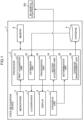
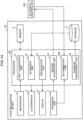
- FIG. 1 is a block diagram illustrating an example of a configuration of a voice recognition device 1 according to a first embodiment of the present disclosure.
- the voice recognition device 1 is mounted on a mobile body, for example.
- the mobile body include a gasoline automobile, an electric automobile, an electric bicycle, an electric scooter, and an electric motorcycle.
- the voice recognition device 1 may be a mobile information terminal possessed by a user who gets on the mobile body.
- the voice recognition device 1 includes a microphone 2, a processor 3, a database 4, a loudspeaker 5, a display 6, an operation unit 7, and a memory 8.
- the microphone 2 collects a sound such as a voice uttered by a user who gets on the mobile body, converts the collected sound into a sound signal, performs analog-digital (A/D) conversion on the converted sound signal, and inputs the A/D-converted sound signal to a first acquisition unit 31.
- a sound such as a voice uttered by a user who gets on the mobile body
- converts the collected sound into a sound signal performs analog-digital (A/D) conversion on the converted sound signal
- A/D analog-digital
- the loudspeaker 5 converts a sound signal such as a message generated by the processor 3 to a sound and outputs the converted sound to the outside.
- the display 6 is a display device such as a liquid crystal display panel, and displays an image including various messages generated by a presentation unit 33.
- the operation unit 7 includes a touch panel, a physical button, and the like, and receives operations input by the user.
- the operation unit 7 includes, for example, an operation unit that receives a user's operation on the voice recognition device 1 and an operation unit that receives an operation on the mobile body.
- the operation unit that receives an operation on the mobile body is, for example, an operation unit for operating devices of the mobile body. Examples of the devices of the mobile body include an audio device, an air conditioner, wipers, a car navigation device, and lighting equipment.
- the memory 8 includes, for example, a rewritable nonvolatile storage device, and stores a program or the like that causes the processor 3 to function as the voice recognition device 1.
- the processor 3 includes, for example, a central processing unit.
- the processor 3 includes the first acquisition unit 31, an estimation unit 32, a presentation unit 33, a second acquisition unit 34, a determination unit 35, and a database management unit 36.
- the first acquisition unit 31 to the database management unit 36 are implemented by the processor 3 executing a voice recognition program.
- the first acquisition unit 31 to the database management unit 36 may be implemented by a dedicated semiconductor circuit such as an application specific integrated circuit (ASIC).
- ASIC application specific integrated circuit
- the first acquisition unit 31 detects a voice interval from a sound signal input from the microphone 2, and acquires the detected voice interval as input voice data.
- the input voice data includes, for example, voice data of an input command uttered by a user who rides on the mobile body.
- the input command is a command for controlling the mobile body.
- the input command may be a command for setting a destination to a car navigation system, a command for switching a display screen of the car navigation system to heading-up display or north-up display, a command for operating a drive system of a mobile body such as an engine and an accelerator, or a command for operating various equipment of the mobile body such as an air conditioner, wipers, windows, and doors.
- the estimation unit 32 compares a plurality of pieces of registration voice data with the input voice data to estimate a registration command corresponding to the input command. For example, the estimation unit 32 calculates similarity between each of the plurality of pieces of registration voice data that is voice data of a plurality of registration commands registered in the database 4 in advance and the input voice data, and estimates a registration command having maximum similarity equal to or greater than a threshold as the registration command corresponding to the input command. For example, the estimation unit 32 may calculate the similarity in a feature amount between each of the plurality of pieces of registration voice data and the input voice data.
- the feature amount is a feature amount suitable for voice recognition such as an i vector, an x vector, and a d vector.
- a reciprocal of a distance between the feature amount of the registration voice data and the feature amount of the input voice data can be used. The distance is, for example, a Euclidean distance.
- the presentation unit 33 presents an estimation result obtained by the estimation unit 32.
- the presentation unit 33 presents, as the estimation result, a check message for checking whether the registration command estimated by the estimation unit 32 is correct.
- the estimation unit 32 may output the check message to at least one of the display 6 and the loudspeaker 5 to present the check message.
- the second acquisition unit 34 acquires a check instruction from the user indicating whether the estimation result is correct via the operation unit 7.
- the second acquisition unit 34 may acquire the check instruction through voice recognition.
- the second acquisition unit 34 may perform voice recognition on the input voice data collected by the microphone 2 within a predetermined period after the check message is presented to acquire the check instruction.
- the check instruction includes, for example, an error instruction indicating that the estimation result is an error or a correct instruction indicating that the estimation result is correct.
- the second acquisition unit 34 may output the registration command estimated by the estimation unit 32 to an in-vehicle controller 100.
- the determination unit 35 determines a correct command corresponding to an input command based on an operation by the speaker. For example, the determination unit 35 presents a plurality of correct candidate commands, acquires a selection instruction to select one correct candidate command from among the plurality of correct candidate commands, and determines the acquired one correct candidate command as the correct command.
- the determination unit 35 may present the plurality of registration commands sorted in descending order of the similarity between the input voice data and each of the plurality of pieces of registration voice data, as the plurality of correct candidate commands. For example, the determination unit 35 may display a list of the plurality of registration commands sorted in descending order on the display 6.
- the database management unit 36 stores the correct command and the input voice data in the database 4 in association with each other.
- the database 4 is implemented by, for example, a hard disk drive or a solid state drive.
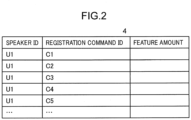
- the database 4 stores the feature amount of the registration voice data of each of the plurality of registration commands for each of one or more speakers scheduled to ride on the mobile body.
- FIG. 2 is a diagram illustrating an example of a data configuration of the database 4.
- the database 4 stores a speaker identification (ID), a registration command ID, and the feature amount in association with each other.
- the speaker ID is an identifier for uniquely identifying one or more speakers who are scheduled to get on the mobile body.
- the registration command ID is an identifier for uniquely identifying the registration command.
- the feature amount is a feature amount of the registration voice data.
- the database 4 stores feature amounts of n registration commands with registration command IDs "Cl" to "Cn" for a user with user ID "U1".
- the registration voice data is, for example, voice data acquired through advance registration work of causing the speaker to utter registration commands one by one.
- This advance registration work is carried out, for example, when the mobile body stops immediately after the purchase of the mobile body.
- the stopping state refers to a state in which power is supplied from a battery of the mobile body to at least the voice recognition device 1, but the mobile body is not traveling.
- the database management unit 36 outputs a message prompting utterance to the display 6 and the loudspeaker 5 in a predetermined order for each of the plurality of registration commands as recognition candidates.
- the speaker utters the registration commands one by one in accordance with this message.
- the database management unit 36 prompts the speaker to input the speaker ID prior to the start of the advance registration work.
- the database management unit 36 can acquire which speaker has uttered and which registration command has been currently uttered by the speaker. Then, the database management unit 36 acquires the registration voice data using the microphone 2, calculates a feature amount of the acquired registration voice data, and stores the calculated feature amount in the database 4 in association with the user ID and the registration command ID.
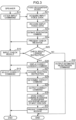
- FIG. 3 is a flowchart illustrating an example of processing of the voice recognition device 1 according to the first embodiment.
- the speaker user
- the first acquisition unit 31 acquires an input voice data of the input command from a sound signal collected by the microphone 2.
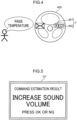
- FIG. 4 is a diagram illustrating an example of a scene where the input command is uttered.
- the speaker operating a steering wheel 400 is uttering "raise the temperature" as the input command.
- the steering wheel 400 includes an error button 601 for inputting an error instruction and a determination button 602 for inputting a correct instruction.
- the error button 601 and the determination button 602 are examples of the operation unit 7.
- step S22 the first acquisition unit 31 holds the input voice data in the memory 8 to record the input voice data.
- the input voice data of "raise the temperature” is recorded.
- the estimation unit 32 identifies a speaker who has uttered the input command based on the feature amount of the input voice data, calculates similarity in feature amount between each of the plurality of registration commands stored in the database 4 and the input voice data for the identified speaker, and estimates a registration command having the highest similarity equal to or greater than the threshold as the registration command corresponding to the input command.
- the estimation unit 32 may calculate similarity between the feature amount of a voice of each of one or more registration speakers scheduled to ride on the mobile body, the feature amount being stored in the memory 8 of the mobile body in advance and the feature amount of the input voice data, and identify a registration speaker having the calculated highest similarity as the speaker who has uttered the input command.
- step S24 the presentation unit 33 presents a check message to the speaker.
- FIG. 5 is a diagram illustrating an example of a check screen G1 showing the check message.
- the check screen G1 shows “increase sound volume” which is the estimation result.
- the check screen G1 shows a message "command estimation result” indicating that "increase sound volume” is the estimation result of the input command and a message "please press OK or NG” for prompting the speaker to input a check instruction as to whether the estimation result is correct.
- step S12 the speaker inputs the check result using the operation unit 7.
- FIG. 6 is a diagram illustrating an example of a scene where the error button 601 is operated.
- the speaker utters "raise the temperature”, this utterance is estimated as "increase sound volume”.
- the speaker presses the error button 601.
- step S25 the second acquisition unit 34 determines whether the input check instruction is an error instruction or a correct instruction.
- the second acquisition unit 34 determines that the check instruction is an error instruction (YES in step S25).
- the second acquisition unit 34 determines that the check instruction is a correct instruction (NO in step S25), and outputs the registration command estimated by the estimation unit 32 to the in-vehicle controller 100 (step S32).
- the registration command is received by the in-vehicle controller 100.
- step S26 the determination unit 35 displays the plurality of registration commands stored in the database 4 on the display 6 as the correct candidate commands.
- the determination unit 35 may sort the registration commands in descending order of the similarity of the registration voice data with respect to the input voice data and display the sorted registration commands on the display 6.
- FIG. 7 is a diagram illustrating an example of a list screen G2 of the correct candidate commands.
- the similarity of the registration commands with respect to the input voice data is high in the order of "raise temperature”, “decrease sound volume”, and “increase air volume”, and thus the list screen G2 shows the registration commands in this order.
- the determination unit 35 may exclude a registration command erroneously estimated by the estimation unit 32.
- step S13 the speaker selects a correct command from the registration commands shown on the list screen G2.
- the speaker inputs an operation for positioning a quadrangular cursor 702 on the correct command, and presses the determination button 602 to select the correct command.
- FIG. 8 is a view illustrating an example of a scene where the correct command is selected.
- the operation for positioning the cursor 702 can be performed by operating an up button 603 or a down button 604 provided on the steering wheel 400.
- the up button 603 is a button for moving the cursor 702 up
- the down button 604 is a button for moving the cursor 702 down.
- the up button 603 and the down button 604 are examples of the operation unit 7.
- the down button 604 When the down button 604 is pressed in a state where the cursor 702 is positioned at the bottom or second registration command from the bottom on the list screen G2 illustrated in FIG. 7 , the plurality of registration commands to be shown is scrolled on the list screen G2, and registration commands having the lower similarity with respect to the input voice data are shown. In a case where an operation on the scroll bar 701 is input, the plurality of registration commands to be displayed may be scrolled on the list screen G2.
- the speaker may input an operation for touching the registration command corresponding to the correct command among the registration commands shown on the list screen G2 to select the correct command.
- the registration command "raise the temperature” is selected.
- step S27 the determination unit 35 acquires a selection instruction indicating the selected registration command via the operation unit 7.
- step S28 the determination unit 35 determines the registration command indicated by the correct instruction as the correct command.
- step S29 the determination unit 35 outputs the correct command to the in-vehicle controller 100.
- the in-vehicle controller 100 acquires the correct command and executes the acquired correct command.
- the correct command "raise the temperature” is executed.
- the in-vehicle controller 100 performs control for raising the temperature of the air conditioner included in the mobile body.
- step S30 the database management unit 36 stores the correct command in the database 4 in association with the speaker ID of the speaker identified in step S23 and the feature amount of the input voice data acquired in step S21.
- a record in which the feature amount of the input voice data, the registration command ID of the registration command corresponding to the correct command, and the speaker ID are associated with each other is added to the database 4.
- the feature amount of the input voice data to be added is a feature amount including a noise sound which is an environmental sound at a time of inputting an error instruction.
- the estimation unit 32 can compare the feature amounts of the input voice data and the registration voice data whose noise sounds are similar, and the estimation accuracy of the registration command is improved.
- step S31 the determination unit 35 presents a termination message indicating that the correct command has been received to the user using at least one of the microphone 2 and the loudspeaker 5.
- FIG. 9 is a diagram illustrating an example of a termination screen G3 indicating a termination message.
- the termination screen G3 shows "command has been accepted” which is a message indicating that the input command has been received.
- the termination screen G3 shows a message "execute” the received command "raise the temperature”.
- the correct command for the input command is determined based on the operation by the speaker, and the correct command and the input voice data are stored in the database 4 in association with each other.
- the correct command for the input command can be correctly specified, and the specified correct command can be registered in the database 4 in association with the input voice data and the speaker ID.
- the input voice data including the noise sound at the time when the input command cannot be recognized is registered in the database 4 in association with the correct command and the speaker ID. Therefore, thereafter, in a case where an erroneously estimated input command is uttered by the same speaker in the same scene as the scene where the error instruction is input, the correct command for the input command can be correctly recognized.
- FIG. 10 is a block diagram illustrating an example of the configuration of a voice recognition device 1A in the second embodiment. Note that in the second embodiment, the same components as those in the first embodiment are denoted by the same reference signs, and the description thereof will be omitted.
- a processor 3A of the voice recognition device 1A includes a first acquisition unit 31, an estimation unit 32, a presentation unit 33, a second acquisition unit 34, a determination unit 35A, and a database management unit 36.
- the determination unit 35A monitors an operation input to the operation unit 7 and determines a correct command based on a monitoring result.
- the determination unit 35A may determine a registration command input first among a plurality of registration commands as the correct command.
- the determination unit 35A may set, as a monitoring period, a certain period after the error instruction is acquired, and determine, as the correct command, the registration command input first among the plurality of input registration commands in the monitoring period.
- the monitoring period is an assumed period from the input of the error instruction to the input of the operation corresponding to the uttered input command, and for example, an appropriate time such as 1 minute or 2 minutes can be set.
- FIG. 11 is a flowchart illustrating an example of processing of the voice recognition device 1A according to the second embodiment.
- steps S101 and S102 are the same as steps S11 and S12 in FIG. 3 .
- steps S201, S202, S203, S204, S205, and S212 are the same as steps S21, S22, S23, S24, S25, and S32 in FIG. 3 .
- step S204 the check screen G1 illustrated in FIG. 5 is displayed.
- step S206 the second acquisition unit 34 that has acquired the error instruction presents a cancel message indicating that the input command has been canceled to the speaker using at least one of a microphone 2 and a loudspeaker 5.
- FIG. 12 is a diagram illustrating a cancel screen G4 presenting the cancel message.
- the cancel screen G4 shows a message "cancellation has been accepted" indicating that the input command has been cancelled.
- step S103 the speaker inputs an operation of the device to the operation unit 7.
- step S207 in step S207, the determination unit 35A monitors the operation of the device input to the operation unit 7. In step S208, the determination unit 35A determines a correct command based on the monitoring result.
- FIG. 13 is a diagram illustrating an example of a monitoring scene.
- a dial 500 for adjusting the temperature of an air conditioner is adjusted clockwise, and the operation for raising the temperature of the air conditioner is input. This operation is the operation first input during the monitoring period. Therefore, the determination unit 35A determines that the input command is "raise the temperature" for the air conditioner. Note that, in the monitoring period, the determination unit 35A may determine, just when the registration command is first input, the registration command as the correct command, or may wait for the termination of the monitoring period, then specify the registration command input first during the monitoring period, and determine the specified registration command as the correct command. Note that, in a case where a registration command is not input during the monitoring period, the determination unit 35 A may terminate the processing without determining the correct command.
- Steps S209, S210, and S211 are the same as steps S29, S30, and S31 in FIG. 3 , a correct command is output to the in-vehicle controller 100, the correct command is stored in the database 4 in association with the feature amount of the input voice data and the speaker ID, and a termination message is presented.
- the correct command is determined based on the monitoring result of the operation input to the mobile body after the input of the error instruction, the correct command can be determined without explicitly checking with the speaker about the correct command, and a processing load and a burden on the speaker are reduced.
- FIG. 14 is a block diagram illustrating an example of a configuration of a voice recognition device 1B according to the third embodiment.
- the same components as those in the first and second embodiments are denoted by the same reference signs, and the description thereof will be omitted.
- a processor 3B of the voice recognition device 1B includes a first acquisition unit 31, an estimation unit 32, a presentation unit 33, a second acquisition unit 34, a determination unit 35B, and a database management unit 36.
- the determination unit 35B holds, in the memory 8, input voice data corresponds to an input command into which an error instruction has been input. After inputting the error instruction, the determination unit 35B estimates a correct command based on a monitoring result of an operation on the mobile body. Details of processing for estimating the correct command based on the monitoring result are the same as the processing for determining the correct command based on the monitoring result in the second embodiment.
- the determination unit 35B When detecting the stopping of the mobile body, the determination unit 35B reproduces the input voice data held in the memory 8 and presents the estimated correct command, acquires a check instruction for the estimated correct command, and determines the correct command based on the check instruction. For example, in a case where the determination unit 35B acquires, from an in-vehicle controller 100, a stopping notification notifying that the mobile body is stopped, the determination unit 35B may detect that the mobile body is stopped. The stopping notification may be notified, for example, when an ignition key of the mobile body is turned off, or may be notified when a shift lever of the mobile body is set to parking or neutral.
- the determination unit 35B may recognize a state that the mobile body stays at a predetermined place in a certain period of time as stopping using position information from a Global Positioning System (GPS). Note that, in a case where the stopping of the mobile body is detected, the determination unit 35B may reproduce the input voice data held in the memory 8, and present the correct command to a personal digital assistant (for example, a smartphone) of a user who gets on the mobile body.
- GPS Global Positioning System
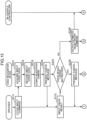
- FIG. 15 is a flowchart illustrating an example of processing of the voice recognition device 1B according to the third embodiment.
- steps S111 and S 112 are the same as steps S101 and S103 in FIG. 11 .
- steps S221, S222, S223, S224, S225, S226, and S236 are the same as steps S201, S202, S203, S204, S205, S206, and S212 in FIG. 11 .
- FIG. 15 as in the second embodiment, a case where utterance "raise the temperature" is estimated as "increase sound volume” is exemplified. Therefore, the check screen G1 illustrated in FIG. 5 is displayed in step S224, and the cancel screen G4 illustrated in FIG. 12 is displayed in step S226.
- FIG. 16 is a flowchart following FIG. 15 .
- step S113 is the same as step S102 in FIG. 11 .
- step S227 is the same as step S207 in FIG. 11 .
- step S301 the in-vehicle controller 100 outputs the stopping notification.
- the estimated correct command is referred to as an estimation correct command.
- step S229 the determination unit 35B acquires the stopping notification to detect the stopping of the mobile body.
- step S230 the determination unit 35B reproduces the input voice data recorded in step S222 and presents the estimation correct command.
- FIG. 17 is a diagram illustrating an example of a presentation screen G5 of the estimation correct command.
- the presentation screen G5 shows "raise the temperature” indicating the estimation correct command and a message "is this correct?" inquiring whether the presented estimation correct command is correct.
- the determination unit 35B outputs the recorded input voice data from the loudspeaker 5 in a state where the presentation screen G5 is displayed.
- the speaker collates the output sound of the input voice data "raise the temperature” with the estimation correct command shown on the presentation screen G5 to determine whether the estimation correct command is correct.
- step S114 the speaker who has checked the presentation screen G5 inputs a check instruction indicating whether the estimation correct command is correct.
- the determination unit 35B acquires a correct instruction as the check instruction (NO in step S231), determines the estimation correct command as the correct command, and stores the determined correct command in the database 4 in association with the feature amount of the input voice data and the speaker ID (step S236).
- the determination unit 35B acquires an error instruction as the check instruction (YES in step S231), and the processing goes to step S232.
- step S232 the determination unit 35B displays a plurality of registration commands stored in the database 4 on the display 6 as correct candidate commands.
- FIG. 18 is a diagram illustrating an example of a list screen G6 of the correct candidate commands.
- the similarity of the registration commands with respect to the input voice data is high in the order of "decrease sound volume”, "increase air volume”, and "decrease air volume”, and thus the list screen G6 shows the registration commands in this order.
- the determination unit 35B may exclude a registration command and an estimation correct command erroneously estimated by the estimation unit 32. Since the basic configuration of the list screen G6 is the same as that of the list screen G2 illustrated in FIG. 7 , detailed description will be omitted.
- step S115 the speaker selects a correct command from among the registration commands shown on the list screen G6.
- the speaker operates an up button 603 or a down button 604 to position a cursor 702 on a corresponding registration command, and presses the determination button 602 to select the correct command.
- the determination unit 35B may output the input audio data "raise the temperature" from the loudspeaker 5 again in the state where the list screen G6 is displayed.
- step S233 the determination unit 35B acquires a selection instruction indicating the selected registration command via the operation unit 7.
- step S234 the determination unit 35B determines the registration command indicated by the correct instruction as the correct command.
- step S235 the database management unit 36 stores the correct command in the database 4 in association with the feature amount of the input voice data and the speaker ID.
- the voice recognition device 1B when the stopping of the mobile body is detected, the input voice data corresponding to the error instruction stored in the memory 8 is reproduced, and the estimation correct command estimated based on the monitoring result of the operation input to the mobile body after the input of the error instruction is presented. Then, the correct command is determined based on the check instruction from the speaker for the estimation correct command. As a result, since the correct command check work is carried out not during travel but after stopping, the safety of the speaker during travel can be ensured.
- the first acquisition unit 31 may simply hold the plurality of pieces of input voice data to which the error instruction has been input in the memory 8 during travel.
- the determination unit 35B estimates the estimation correct command during travel based on the monitoring result of the operation on the device for each of the plurality of pieces of input voice data. Then, after the mobile body stops, the determination unit 35B presents the estimation correct command for each of the plurality of pieces of input voice data in conjunction with reproduction of the input voice data, and prompts the speaker to sequentially carry out the check work of the correct command, thereby determining the correct command corresponding to the plurality of pieces of input voice data.
- the database management unit 36 may store the feature amount in the database 4 in association with the determined correct command and the speaker ID for each of the plurality of pieces of input voice data.
- the speaker can easily check which input command the input voice data to be reproduced correspond to.
- the estimation correct command presented together with the input voice data is the correct command estimated based on the monitoring result of the operation input to the mobile body, the correct command presented together with the input voice data is likely to be the correct command, and the check work to be carried out by the speaker becomes easy.
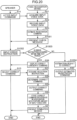
- step S1001 the presentation unit 33 presents a check message to the speaker.
- FIG. 21 is a diagram illustrating an example of a check screen G1' showing the check message in the modification of the first embodiment.
- the difference between the check screen G1' and the check screen G1 is that the check screen G1 shows a message "please press OK or NG", whereas the check screen G1' shows a message "please press NG if there is an error". That is, in the message of the check screen G1', the input of the error instruction is prompted only in a case where the estimation result is an error.
- step S1002 the speaker who has determined that the estimation result "increase sound volume" shown on the check screen G1' is an error inputs an error instruction using the operation unit 7. In this case, the speaker presses the error button 601 as described in FIG. 6 .
- step S1002 the speaker who has determined that the estimation result "increase sound volume" shown on the check screen G1' is accurate inputs nothing using the operation unit 7.
- step S1003 the second acquisition unit 34 determines whether the error instruction has been successfully acquired within a timeout period.
- the timeout period is a preset time for waiting for the input of an error instruction by the speaker.
- step S1003 In a case where the second acquisition unit 34 acquires the error instruction within the timeout period (YES in step S1003), the processing proceeds to step S26. On the other hand, in a case where the second acquisition unit 34 does not acquire the error instruction within the timeout period (NO in step S1003), the processing proceeds to step S1004.
- step S1004 the determination unit 35 determines that the estimation result estimated by the estimation unit 32 is correct, and the processing proceeds to step S32. Subsequent processing is the same as that in the first embodiment.
- the error instruction may be input only in the case where the estimation result is an error, and thus the input load for the speaker can be reduced.
- the presentation unit 33 may outputs, to at least one of the display 6 and the loudspeaker 5, a check message for prompting input of an error instruction only in the case where the estimation result is an error to present the estimation result.
- FIG. 22 is a flowchart in a modification of the second embodiment. In FIGS. 22 and 11 , the same processing are denoted by the same reference signs, and the description thereof will be omitted.
- step S2001 the presentation unit 33 presents a check message to the speaker.
- the presentation unit 33 presents the check screen G1' described in the modification of the first embodiment to the speaker.
- step S2002 the speaker who has determined that the estimation result "increase sound volume" shown on the check screen G1' is an error inputs an error instruction using the operation unit 7. In this case, the speaker presses the error button 601 as described in FIG. 6 .
- step S2002 the speaker who has determined that the estimation result "increase sound volume" shown on the check screen G1' is correct inputs nothing using the operation unit 7.
- step S2003 the second acquisition unit 34 determines whether the error instruction has been successfully acquired within a timeout period. In a case where the second acquisition unit 34 acquires the error instruction within the timeout period (YES in step S2003), the processing proceeds to step S206. On the other hand, in a case where the second acquisition unit 34 does not acquire the error instruction within the timeout period (No in step S2003), the processing proceeds to step S2004.
- step S2004 the determination unit 35A determines that the estimation result estimated by the estimation unit 32 is correct, and the processing proceeds to step S212. Thereafter, the same processing as that of the second embodiment is executed.
- the error instruction may be input only in the case where the estimation result is an error, and thus the input load for the speaker can be reduced.
- the presentation unit 33 may output, to at least one of the display 6 and the loudspeaker 5, a check message for prompting input of an error instruction only in the case where the estimation result is an error to present the estimation result.
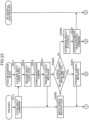
- FIG. 23 is a flowchart in a modification of the third embodiment. In FIGS. 23 and 15 , the same processing are denoted by the same reference signs, and the description thereof will be omitted. Note that a flowchart following FIG. 23 is identical to FIG. 16 .
- step S3001 the presentation unit 33 presents a check message to the speaker.
- the presentation unit 33 presents the check screen G1' described in the modification of the first embodiment to the speaker.
- step S3002 the speaker who has determined that the estimation result "increase sound volume" shown on the check screen G1' is an error inputs an error instruction using the operation unit 7. In this case, the speaker presses the error button 601 as described in FIG. 6 .
- step S3002 the speaker who has determined that the estimation result "increase sound volume" shown on the check screen G1' is correct inputs nothing using the operation unit 7.
- step S3003 the second acquisition unit 34 determines whether the error instruction has been successfully acquired within a timeout period. In a case where the second acquisition unit 34 acquires the error instruction within the timeout period (YES in step S3003), the processing proceeds to step S226. On the other hand, in a case where the second acquisition unit 34 does not acquire the error instruction within the timeout period (No in step S3003), the processing proceeds to step S3004.
- step S3004 the determination unit 35B determines that the estimation result estimated by the estimation unit 32 is correct, and the processing proceeds to step S236. Thereafter, the same processing as that of the third embodiment is executed.
- the error instruction may be input only in the case where the estimation result is an error, and thus the input load for the speaker can be reduced.
- the present disclosure is useful in a technical field where an input command of a device such as a mobile body is input using voice.
Landscapes
- Engineering & Computer Science (AREA)
- Acoustics & Sound (AREA)
- Health & Medical Sciences (AREA)
- Audiology, Speech & Language Pathology (AREA)
- Human Computer Interaction (AREA)
- Physics & Mathematics (AREA)
- Computational Linguistics (AREA)
- Multimedia (AREA)
- Mechanical Engineering (AREA)
- Computer Vision & Pattern Recognition (AREA)
- Artificial Intelligence (AREA)
- User Interface Of Digital Computer (AREA)
- Navigation (AREA)
Abstract
Description
- The present disclosure relates to a technique for performing voice recognition on a command of a mobile body.
-
Patent Literature 1 discloses a voice recognition device that, in a case where a voice input by a user of a vehicle cannot be recognized, stores the voice as an unrecognized word in association with a travelling situation of the vehicle, selects a plurality of synonyms for the unrecognized word from a voice recognition dictionary based on the travelling situation of the vehicle, presents the plurality of selected synonyms to the user, and stores a synonym selected by the user from among the plurality of presented synonyms in association with the unrecognized word. - However, in
Patent Literature 1, it is not considered that correct voice recognition cannot be performed due to a difference in noise sound between registration of a registration command and utterance of an input command, and thus a further improvement is required. - Patent Literature 1:
JP 2004-233542 A - The present disclosure has been made to solve such a problem, and an object of the present disclosure is to provide a technique capable of correctly specifying a correct command for an input command even in a case where a noise sound is different between registration of a registration command and utterance of an input command.
- A voice recognition device according to one aspect of the present disclosure is a voice recognition device that performs voice recognition on a command of a mobile body, the voice recognition device including a first acquisition unit that acquires input voice data of an input command uttered by a speaker who gets on the mobile body, a database storing registration voice data of a plurality of registration commands uttered by the speaker in advance, an estimation unit that compares the plurality of pieces of registration voice data with the input voice data to estimate a registration command corresponding to the input command, a presentation unit that presents an estimation result, a second acquisition unit that acquires an error instruction indicating that the estimation result is an error, a determination unit that, in a case where the error instruction is acquired, determines a correct command corresponding to the input command based on an operation by the speaker, and a database management unit that stores the correct command and the input voice data in the database in association with each other.
- According to the present disclosure, even in a case where a noise sound is different between registration of a registration command and utterance of an input command, a correct command for an input command can be correctly specified.
-
-
FIG. 1 is a block diagram illustrating an example of a configuration of a voice recognition device according to a first embodiment of the present disclosure. -
FIG. 2 is a diagram illustrating an example of a data structure of a database. -
FIG. 3 is a flowchart illustrating an example of processing of the voice recognition device according to the first embodiment. -
FIG. 4 is a diagram illustrating an example of a scene where an input command is uttered. -
FIG. 5 is a diagram illustrating an example of a check screen indicating a check message. -
FIG. 6 is a diagram illustrating an example of a scene where an error button is operated. -
FIG. 7 is a diagram illustrating an example of a list screen of correct candidate commands. -
FIG. 8 is a diagram illustrating an example of a scene where the correct command is selected. -
FIG. 9 is a diagram illustrating an example of a completion screen indicating a completion message. -
FIG. 10 is a block diagram illustrating an example of a configuration of a voice recognition device according to a second embodiment. -
FIG. 11 is a flowchart illustrating an example of processing of the voice recognition device according to the second embodiment. -
FIG. 12 is a diagram illustrating a cancel screen presenting a cancel message. -
FIG. 13 is a diagram illustrating an example of a monitoring scene. -
FIG. 14 is a block diagram illustrating an example of a configuration of a voice recognition device according to a third embodiment. -
FIG. 15 is a flowchart illustrating an example of processing of thevoice recognition device 1B according to the third embodiment. -
FIG. 16 is a flowchart followingFIG. 15 . -
FIG. 17 is a diagram illustrating an example of a presentation screen of an estimation correct command. -
FIG. 18 is a diagram illustrating an example of a list screen of correct candidate commands. -
FIG. 19 is a diagram illustrating a presentation screen according to a modification. -
FIG. 20 is a flowchart in the modification of the first embodiment. -
FIG. 21 is a diagram illustrating an example of a check screen indicating a check message in the modification of the first embodiment. -
FIG. 22 is a flowchart in a modification of the second embodiment. -
FIG. 23 is a flowchart in a modification of the third embodiment. - There is known a speaker identification technique that acquires voice data uttered by a target speaker to be identified and compares a feature amount of the acquired voice data with a feature amount of voice data of each of a plurality of registration speakers to identify which registration speaker the target speaker corresponds to. In such a speaker identification technique, it has been found that the recognition rate is decreased when one speaker utters various contents. In particular, in a case of a short utterance such as a command for a device, it has been found that the degradation in the recognition rate becomes remarkable.
- On the other hand, if this degradation in the recognition rate is used, commands for a device uttered by the same speaker can be recognized. For example, feature amounts of a plurality of registration commands uttered by the target speaker are registered in advance, a feature amount of an input command uttered by the target speaker is compared with each of the feature amounts of the plurality of registration commands, and a registration command having the maximum similarity is determined as the input command. As a result, the input command can be recognized.
- However, in a device such as a mobile body, an ambient noise sound varies depending on driving conditions such as travel and stopping. Therefore, in a case where the driving situation is different between at the registration of the feature amounts of the plurality of registration commands during stopping and at the utterance of the input command during travel, only similarity of low value can be obtained, and the input commands cannot be accurately recognized.
-
Patent Literature 1 does not describe a difference in noise sound between the registration and the utterance as a cause of voice recognition failure, and thus has an idea different from the present disclosure. Further,Patent Literature 1 presents a plurality of synonyms for an unrecognized word to a user, but the plurality of synonyms is merely selected in accordance with a travel situation, and cannot be said to be always synonyms for the unrecognized word. Further, sincePatent Literature 1 is configured to cause the user to select a synonym from among the plurality of presented synonyms, the user needs to memorize in their head synonyms different from an originally intended word. Therefore,Patent Literature 1 needs further improvement in order to store a correct synonym corresponding to an unrecognized word in association with the unrecognized word. - The present disclosure has been made in order to solve such a problem. Each aspect of the present disclosure will be described below.
- A voice recognition device according to one aspect of the present disclosure is a voice recognition device that performs voice recognition on a command of a mobile body, the voice recognition device including a first acquisition unit that acquires input voice data of an input command uttered by a speaker who gets on the mobile body, a database storing registration voice data of a plurality of registration commands uttered by the speaker in advance, an estimation unit that compares the plurality of pieces of registration voice data with the input voice data to estimate a registration command corresponding to the input command, a presentation unit that presents an estimation result, a second acquisition unit that acquires an error instruction indicating that the estimation result is an error, a determination unit that, in a case where the error instruction is acquired, determines a correct command corresponding to the input command based on an operation by the speaker, and a database management unit that stores the correct command and the input voice data in the database in association with each other.
- According to this configuration, in the case where the registration command corresponding to the input command is estimated and the error instruction for the estimation result is acquired, the correct command for the input command is determined based on the operation by the speaker, and the correct command and the input voice data are stored in the database in association with each other.
- Therefore, even if the input command cannot be correctly recognized due to the difference in noise sound between at the registration of the registration command and at the utterance of the input command, the correct command for the input command can be correctly specified, and the specified correct command can be registered in the database in association with the input voice data. As a result, the input voice data including the noise sound at the time when the input command cannot be recognized is registered in the database in association with the correct command. Therefore, thereafter, in a case where an erroneously estimated input command is uttered in the same scene as the scene where the error instruction is input, the correct command for the input command can be correctly recognized. Further, according to the present configuration, since the input utterance data of the word (input command) originally intended to be uttered by the speaker is registered as it is, the impression of the word originally intended to be uttered remains in the speaker's head through the act of registering the input utterance data, and thereafter, a command input through the utterance becomes extremely smooth.
- In the voice recognition device, the determination unit may present a plurality of correct candidate commands, acquire a selection instruction to select one correct candidate command from among the plurality of correct candidate commands, and determine the one correct candidate command as the correct command.
- According to this configuration, since one correct candidate command selected from among the plurality of correct candidate commands is determined as the correct command, the correct command corresponding to the input command can be correctly recognized.
- In the voice recognition device, the determination unit may present the plurality of registration commands sorted in descending order of similarity between the input voice data and the plurality of pieces of registration voice data, as the plurality of correct candidate commands.
- According to this configuration, since the plurality of registration commands sorted in descending order of similarity between the input voice data and the plurality of pieces of registration voice data is presented as the plurality of correct candidate commands, selection of the correct command becomes easy.
- In the above voice recognition device, after input of the error instruction, the determination unit may monitor an operation input to the mobile body and determine the correct command based on a monitoring result.
- According to this configuration, since the correct command is determined based on the monitoring result of the operation input to the mobile body after the input of the error instruction, the correct command can be determined without explicitly checking with the speaker about the correct command, and a processing load and a burden on the speaker are reduced.
- In the above voice recognition device, the determination unit may hold, in a memory, the input voice data corresponding to the input command to which the error instruction is input, estimate a correct command based on a monitoring result of an operation on the mobile body after the input of the error instruction, reproduce the input voice data held in the memory and present the estimated correct command in a case where stopping of the mobile body is detected, acquire a check instruction for the estimated correct command, and determine the correct command based on the check instruction.
- According to this configuration, when the stopping of the mobile body is detected, the input voice data corresponding to the error instruction stored in the memory is reproduced, the correct command estimated based on the monitoring result of the operation input to the mobile body after the input of the error instruction is presented, and the correct command is determined based on the check instruction from the speaker for the estimated correct command. As a result, since the correct command check work is carried out not during travel but after stopping, the safety of the speaker during travel can be ensured. Further, since the correct command estimated in conjunction with the reproduction of the input voice data is presented, even if a plurality of input commands is erroneously estimated during travel, it is possible to prompt the speaker to easily check which input command the input voice data to be reproduced is for. In addition, since the correct command presented together with the input voice data is the correct command estimated from the monitoring result of the operation input to the mobile body, the correct command presented together with the input voice data is likely to be the correct command, and the check work to be carried out by the speaker becomes easy.
- In the voice recognition device, the determination unit may present, in a case where the check instruction indicating that the estimated correct command is an error command is acquired, the plurality of registration commands as correct candidate commands, acquire a selection instruction to select one correct candidate command from among the plurality of registration commands, and determine the one correct candidate command as the correct command.
- According to this configuration, even if the estimated correct command is an error command, the plurality of registration commands is presented as the correct candidate commands, and the correct command is determined by the speaker from among the presented correct candidate commands. Therefore, eventually an appropriate correct command can be determined.
- In the above voice recognition device, the determination unit may present the registration commands sorted in descending order of similarity between the plurality of pieces of registration voice data and the input voice data, as the correct candidate commands.
- According to this configuration, since the plurality of registration commands sorted in descending order of similarity between the input voice data and the plurality of pieces of registration voice data is presented as the plurality of correct candidate commands, selection of the correct command becomes easy.
- In the above voice recognition device, the estimation unit may compare the feature amounts between the plurality of pieces of registration voice data and the input voice data to estimate the registration command corresponding to the input command.
- According to this configuration, since the feature amounts of the plurality of pieces of registration voice data and the input voice data are compared, the registration command corresponding to the input command can be accurately estimated.
- In the above voice recognition device, the estimation unit may compare a feature amount between the input voice data and voices of a plurality of registration speakers to identify a registration speaker corresponding to the speaker, and compare registration voice data of the plurality of registration commands with the input voice data for the identified registration speaker to estimate the registration command corresponding to the input command.
- According to this configuration, the input voice data is compared with the registration voice data of the same speaker and thus the registration command corresponding to the input command is estimated. Thus, the registration command can be accurately estimated.
- In the above voice recognition device, the presentation unit may present a message for prompting input of the error instruction only in a case where the estimation result is an error.
- According to this configuration, the error instruction may be input only in the case where the estimation result is an error, and thus the input load can be reduced.
- In the above voice recognition device, the determination unit may determine the correct command based on an operation by the speaker in a case where the second acquisition unit acquires the error instruction within a predetermined timeout period, and determine that the estimation result is correct in a case where the second acquisition unit does not acquire the error instruction within the timeout period.
- According to this configuration, in a case where the error instruction is acquired within the timeout period, the processing for determining the correct command is executed, and in a case where the error instruction is not acquired within the timeout period, the estimation result is determined to be correct. Therefore, a situation in which the correctness of the estimation result is not determined for a long time is avoided.
- A voice recognition method according to another aspect of the present disclosure is a voice recognition method in a voice recognition device that performs voice recognition on a command of a mobile body, the method including acquiring input voice data of an input command uttered by a speaker who gets on the mobile body, acquiring a plurality of registration commands uttered by the speaker in advance from a database, comparing each piece of the plurality of registration commands with the input voice data to estimate a registration command corresponding to the input command, presenting an estimation result, acquiring an error instruction indicating that the estimation result is an error, determining, in a case where the error instruction is acquired, a correct command corresponding to the input command based on an operation by the speaker, and storing the correct command and the input voice data in the database in association with each other.
- This configuration can provide a voice recognition method that can obtain the function and effect similar to those of the voice recognition device.
- A voice recognition program according to still another aspect of the present disclosure is a voice recognition program for causing a computer to function as a voice recognition device that performs voice recognition on a command of a mobile body, the program for causing the computer to perform acquiring input voice data of an input command uttered by a speaker who gets on the mobile body, acquiring registration voice data of a plurality of registration commands uttered by the speaker in advance from a database, comparing each piece of the registration voice data with the input voice data to estimate a registration command corresponding to the input command, presenting an estimation result, acquiring an error instruction indicating that the estimation result is an error, determining, in a case where the error instruction is acquired, a correct command corresponding to the input command based on an operation by the speaker, and storing the correct command and the input voice data in the database in association with each other.
- This configuration can provide a voice recognition program that can obtain the function and effect similar to those of the voice recognition device.
- It is needless to say that the present disclosure allows such a voice recognition program to be distributed using a computer-readable non-transitory recording medium such as a CD-ROM, or via a communication network such as the Internet.
- Each of embodiments to be described below illustrates a specific example of the present disclosure. Numerical values, shapes, components, steps, an order of steps, and the like shown in the embodiments below are merely examples, and are not intended to limit the present disclosure. Furthermore, among components in the embodiments below, a component that is not described in an independent claim indicating the most significant concept will be described as an optional component. Furthermore, in all the embodiments, the respective contents can be combined.
-
FIG. 1 is a block diagram illustrating an example of a configuration of avoice recognition device 1 according to a first embodiment of the present disclosure. Thevoice recognition device 1 is mounted on a mobile body, for example. Examples of the mobile body include a gasoline automobile, an electric automobile, an electric bicycle, an electric scooter, and an electric motorcycle. However, the above mobile bodies are merely examples, and thevoice recognition device 1 may be a mobile information terminal possessed by a user who gets on the mobile body. - The
voice recognition device 1 includes amicrophone 2, aprocessor 3, adatabase 4, aloudspeaker 5, adisplay 6, anoperation unit 7, and amemory 8. - The
microphone 2 collects a sound such as a voice uttered by a user who gets on the mobile body, converts the collected sound into a sound signal, performs analog-digital (A/D) conversion on the converted sound signal, and inputs the A/D-converted sound signal to afirst acquisition unit 31. - The
loudspeaker 5 converts a sound signal such as a message generated by theprocessor 3 to a sound and outputs the converted sound to the outside. - The
display 6 is a display device such as a liquid crystal display panel, and displays an image including various messages generated by apresentation unit 33. - The
operation unit 7 includes a touch panel, a physical button, and the like, and receives operations input by the user. Theoperation unit 7 includes, for example, an operation unit that receives a user's operation on thevoice recognition device 1 and an operation unit that receives an operation on the mobile body. The operation unit that receives an operation on the mobile body is, for example, an operation unit for operating devices of the mobile body. Examples of the devices of the mobile body include an audio device, an air conditioner, wipers, a car navigation device, and lighting equipment. - The
memory 8 includes, for example, a rewritable nonvolatile storage device, and stores a program or the like that causes theprocessor 3 to function as thevoice recognition device 1. - The
processor 3 includes, for example, a central processing unit. Theprocessor 3 includes thefirst acquisition unit 31, anestimation unit 32, apresentation unit 33, asecond acquisition unit 34, adetermination unit 35, and adatabase management unit 36. Thefirst acquisition unit 31 to thedatabase management unit 36 are implemented by theprocessor 3 executing a voice recognition program. However, this is merely an example, and thefirst acquisition unit 31 to thedatabase management unit 36 may be implemented by a dedicated semiconductor circuit such as an application specific integrated circuit (ASIC). - The
first acquisition unit 31 detects a voice interval from a sound signal input from themicrophone 2, and acquires the detected voice interval as input voice data. The input voice data includes, for example, voice data of an input command uttered by a user who rides on the mobile body. The input command is a command for controlling the mobile body. For example, the input command may be a command for setting a destination to a car navigation system, a command for switching a display screen of the car navigation system to heading-up display or north-up display, a command for operating a drive system of a mobile body such as an engine and an accelerator, or a command for operating various equipment of the mobile body such as an air conditioner, wipers, windows, and doors. - The
estimation unit 32 compares a plurality of pieces of registration voice data with the input voice data to estimate a registration command corresponding to the input command. For example, theestimation unit 32 calculates similarity between each of the plurality of pieces of registration voice data that is voice data of a plurality of registration commands registered in thedatabase 4 in advance and the input voice data, and estimates a registration command having maximum similarity equal to or greater than a threshold as the registration command corresponding to the input command. For example, theestimation unit 32 may calculate the similarity in a feature amount between each of the plurality of pieces of registration voice data and the input voice data. The feature amount is a feature amount suitable for voice recognition such as an i vector, an x vector, and a d vector. As the similarity, for example, a reciprocal of a distance between the feature amount of the registration voice data and the feature amount of the input voice data can be used. The distance is, for example, a Euclidean distance. - The
presentation unit 33 presents an estimation result obtained by theestimation unit 32. For example, thepresentation unit 33 presents, as the estimation result, a check message for checking whether the registration command estimated by theestimation unit 32 is correct. Theestimation unit 32 may output the check message to at least one of thedisplay 6 and theloudspeaker 5 to present the check message. - The
second acquisition unit 34 acquires a check instruction from the user indicating whether the estimation result is correct via theoperation unit 7. Note that thesecond acquisition unit 34 may acquire the check instruction through voice recognition. In this case, thesecond acquisition unit 34 may perform voice recognition on the input voice data collected by themicrophone 2 within a predetermined period after the check message is presented to acquire the check instruction. The check instruction includes, for example, an error instruction indicating that the estimation result is an error or a correct instruction indicating that the estimation result is correct. In a case where acquiring the correct instruction, thesecond acquisition unit 34 may output the registration command estimated by theestimation unit 32 to an in-vehicle controller 100. - The
determination unit 35 determines a correct command corresponding to an input command based on an operation by the speaker. For example, thedetermination unit 35 presents a plurality of correct candidate commands, acquires a selection instruction to select one correct candidate command from among the plurality of correct candidate commands, and determines the acquired one correct candidate command as the correct command. Thedetermination unit 35 may present the plurality of registration commands sorted in descending order of the similarity between the input voice data and each of the plurality of pieces of registration voice data, as the plurality of correct candidate commands. For example, thedetermination unit 35 may display a list of the plurality of registration commands sorted in descending order on thedisplay 6. - The
database management unit 36 stores the correct command and the input voice data in thedatabase 4 in association with each other. - The
database 4 is implemented by, for example, a hard disk drive or a solid state drive. Thedatabase 4 stores the feature amount of the registration voice data of each of the plurality of registration commands for each of one or more speakers scheduled to ride on the mobile body.FIG. 2 is a diagram illustrating an example of a data configuration of thedatabase 4. Thedatabase 4 stores a speaker identification (ID), a registration command ID, and the feature amount in association with each other. The speaker ID is an identifier for uniquely identifying one or more speakers who are scheduled to get on the mobile body. The registration command ID is an identifier for uniquely identifying the registration command. The feature amount is a feature amount of the registration voice data. In the example ofFIG. 2 , thedatabase 4 stores feature amounts of n registration commands with registration command IDs "Cl" to "Cn" for a user with user ID "U1". - The registration voice data is, for example, voice data acquired through advance registration work of causing the speaker to utter registration commands one by one. This advance registration work is carried out, for example, when the mobile body stops immediately after the purchase of the mobile body. The stopping state refers to a state in which power is supplied from a battery of the mobile body to at least the
voice recognition device 1, but the mobile body is not traveling. - In the advance registration work, the
database management unit 36 outputs a message prompting utterance to thedisplay 6 and theloudspeaker 5 in a predetermined order for each of the plurality of registration commands as recognition candidates. The speaker utters the registration commands one by one in accordance with this message. Thedatabase management unit 36 prompts the speaker to input the speaker ID prior to the start of the advance registration work. - Thus, the
database management unit 36 can acquire which speaker has uttered and which registration command has been currently uttered by the speaker. Then, thedatabase management unit 36 acquires the registration voice data using themicrophone 2, calculates a feature amount of the acquired registration voice data, and stores the calculated feature amount in thedatabase 4 in association with the user ID and the registration command ID. -
FIG. 3 is a flowchart illustrating an example of processing of thevoice recognition device 1 according to the first embodiment. In step S11, the speaker (user) utters an input command. In step S12, thefirst acquisition unit 31 acquires an input voice data of the input command from a sound signal collected by themicrophone 2.FIG. 4 is a diagram illustrating an example of a scene where the input command is uttered. In the example ofFIG. 4 , the speaker operating asteering wheel 400 is uttering "raise the temperature" as the input command. Thesteering wheel 400 includes anerror button 601 for inputting an error instruction and adetermination button 602 for inputting a correct instruction. Theerror button 601 and thedetermination button 602 are examples of theoperation unit 7. - In step S22, the
first acquisition unit 31 holds the input voice data in thememory 8 to record the input voice data. In the example ofFIG. 4 , the input voice data of "raise the temperature" is recorded. - In step S23, the
estimation unit 32 identifies a speaker who has uttered the input command based on the feature amount of the input voice data, calculates similarity in feature amount between each of the plurality of registration commands stored in thedatabase 4 and the input voice data for the identified speaker, and estimates a registration command having the highest similarity equal to or greater than the threshold as the registration command corresponding to the input command. When the speaker is identified, theestimation unit 32 may calculate similarity between the feature amount of a voice of each of one or more registration speakers scheduled to ride on the mobile body, the feature amount being stored in thememory 8 of the mobile body in advance and the feature amount of the input voice data, and identify a registration speaker having the calculated highest similarity as the speaker who has uttered the input command. - In step S24, the
presentation unit 33 presents a check message to the speaker.FIG. 5 is a diagram illustrating an example of a check screen G1 showing the check message. In the example ofFIG. 5 , since the estimation result for the input command is "increase sound volume", the check screen G1 shows "increase sound volume" which is the estimation result. In addition, the check screen G1 shows a message "command estimation result" indicating that "increase sound volume" is the estimation result of the input command and a message "please press OK or NG" for prompting the speaker to input a check instruction as to whether the estimation result is correct. - In step S12, the speaker inputs the check result using the
operation unit 7.FIG. 6 is a diagram illustrating an example of a scene where theerror button 601 is operated. In the example ofFIG. 6 , although the speaker utters "raise the temperature", this utterance is estimated as "increase sound volume". Thus, the speaker presses theerror button 601. In a case where the estimation result of theestimation unit 32 is correct, the speaker presses thedetermination button 602. - In step S25, the
second acquisition unit 34 determines whether the input check instruction is an error instruction or a correct instruction. Here, since the speaker presses theerror button 601, thesecond acquisition unit 34 determines that the check instruction is an error instruction (YES in step S25). On the other hand, in a case where the speaker presses thedetermination button 602, thesecond acquisition unit 34 determines that the check instruction is a correct instruction (NO in step S25), and outputs the registration command estimated by theestimation unit 32 to the in-vehicle controller 100 (step S32). As a result, the registration command is received by the in-vehicle controller 100. - In step S26, the
determination unit 35 displays the plurality of registration commands stored in thedatabase 4 on thedisplay 6 as the correct candidate commands. In this case, thedetermination unit 35 may sort the registration commands in descending order of the similarity of the registration voice data with respect to the input voice data and display the sorted registration commands on thedisplay 6.FIG. 7 is a diagram illustrating an example of a list screen G2 of the correct candidate commands. In this example, the similarity of the registration commands with respect to the input voice data is high in the order of "raise temperature", "decrease sound volume", and "increase air volume", and thus the list screen G2 shows the registration commands in this order. Note that, when displaying the correct candidate command, thedetermination unit 35 may exclude a registration command erroneously estimated by theestimation unit 32. - In step S13, the speaker selects a correct command from the registration commands shown on the list screen G2. In the example of
FIG. 7 , the speaker inputs an operation for positioning aquadrangular cursor 702 on the correct command, and presses thedetermination button 602 to select the correct command. -
FIG. 8 is a view illustrating an example of a scene where the correct command is selected. As illustrated inFIG. 8 , the operation for positioning thecursor 702 can be performed by operating an upbutton 603 or adown button 604 provided on thesteering wheel 400. The upbutton 603 is a button for moving thecursor 702 up, and thedown button 604 is a button for moving thecursor 702 down. The upbutton 603 and thedown button 604 are examples of theoperation unit 7. - When the
down button 604 is pressed in a state where thecursor 702 is positioned at the bottom or second registration command from the bottom on the list screen G2 illustrated inFIG. 7 , the plurality of registration commands to be shown is scrolled on the list screen G2, and registration commands having the lower similarity with respect to the input voice data are shown. In a case where an operation on thescroll bar 701 is input, the plurality of registration commands to be displayed may be scrolled on the list screen G2. - The speaker may input an operation for touching the registration command corresponding to the correct command among the registration commands shown on the list screen G2 to select the correct command. Here, the registration command "raise the temperature" is selected.
- In step S27, the
determination unit 35 acquires a selection instruction indicating the selected registration command via theoperation unit 7. In step S28, thedetermination unit 35 determines the registration command indicated by the correct instruction as the correct command. - In step S29, the
determination unit 35 outputs the correct command to the in-vehicle controller 100. As a result, the in-vehicle controller 100 acquires the correct command and executes the acquired correct command. Here, the correct command "raise the temperature" is executed. As a result, the in-vehicle controller 100 performs control for raising the temperature of the air conditioner included in the mobile body. - In step S30, the
database management unit 36 stores the correct command in thedatabase 4 in association with the speaker ID of the speaker identified in step S23 and the feature amount of the input voice data acquired in step S21. As a result, a record in which the feature amount of the input voice data, the registration command ID of the registration command corresponding to the correct command, and the speaker ID are associated with each other is added to thedatabase 4. Here, the feature amount of the input voice data to be added is a feature amount including a noise sound which is an environmental sound at a time of inputting an error instruction. Therefore, thereafter, in a case where an erroneously estimated input command is uttered in a scene similar to the scene where the error instruction is input, theestimation unit 32 can compare the feature amounts of the input voice data and the registration voice data whose noise sounds are similar, and the estimation accuracy of the registration command is improved. - In step S31, the
determination unit 35 presents a termination message indicating that the correct command has been received to the user using at least one of themicrophone 2 and theloudspeaker 5.FIG. 9 is a diagram illustrating an example of a termination screen G3 indicating a termination message. The termination screen G3 shows "command has been accepted" which is a message indicating that the input command has been received. In addition, the termination screen G3 shows a message "execute" the received command "raise the temperature". - As described above, in the
voice recognition device 1, in the case where the registration command corresponding to the input command is estimated and the error instruction for the estimation result is acquired, the correct command for the input command is determined based on the operation by the speaker, and the correct command and the input voice data are stored in thedatabase 4 in association with each other. - Therefore, even if the input command uttered by the same speaker cannot be correctly recognized due to the difference between the noise sound during registration of the registration command and the noise sound during utterance of the input command, the correct command for the input command can be correctly specified, and the specified correct command can be registered in the
database 4 in association with the input voice data and the speaker ID. As a result, the input voice data including the noise sound at the time when the input command cannot be recognized is registered in thedatabase 4 in association with the correct command and the speaker ID. Therefore, thereafter, in a case where an erroneously estimated input command is uttered by the same speaker in the same scene as the scene where the error instruction is input, the correct command for the input command can be correctly recognized. - In a second embodiment, a correct command is determined based on a monitoring result of an operation input to a mobile body.
FIG. 10 is a block diagram illustrating an example of the configuration of avoice recognition device 1A in the second embodiment. Note that in the second embodiment, the same components as those in the first embodiment are denoted by the same reference signs, and the description thereof will be omitted. - A
processor 3A of thevoice recognition device 1A includes afirst acquisition unit 31, anestimation unit 32, apresentation unit 33, asecond acquisition unit 34, adetermination unit 35A, and adatabase management unit 36. After thesecond acquisition unit 34 acquires an error instruction, thedetermination unit 35A monitors an operation input to theoperation unit 7 and determines a correct command based on a monitoring result. Here, after thesecond acquisition unit 34 acquires the error instruction, thedetermination unit 35A may determine a registration command input first among a plurality of registration commands as the correct command. For example, thedetermination unit 35A may set, as a monitoring period, a certain period after the error instruction is acquired, and determine, as the correct command, the registration command input first among the plurality of input registration commands in the monitoring period. The monitoring period is an assumed period from the input of the error instruction to the input of the operation corresponding to the uttered input command, and for example, an appropriate time such as 1 minute or 2 minutes can be set. -
FIG. 11 is a flowchart illustrating an example of processing of thevoice recognition device 1A according to the second embodiment. InFIG. 11 , steps S101 and S102 are the same as steps S11 and S12 inFIG. 3 . InFIG. 11 , steps S201, S202, S203, S204, S205, and S212 are the same as steps S21, S22, S23, S24, S25, and S32 inFIG. 3 . Further, inFIG. 11 , as in the first embodiment, a case where utterance "raise the temperature" is estimated as "increase sound volume" is exemplified. Therefore, in step S204, the check screen G1 illustrated inFIG. 5 is displayed. - In step S206, the
second acquisition unit 34 that has acquired the error instruction presents a cancel message indicating that the input command has been canceled to the speaker using at least one of amicrophone 2 and aloudspeaker 5.FIG. 12 is a diagram illustrating a cancel screen G4 presenting the cancel message. The cancel screen G4 shows a message "cancellation has been accepted" indicating that the input command has been cancelled. - In step S103, the speaker inputs an operation of the device to the
operation unit 7. - In step S207, in step S207, the
determination unit 35A monitors the operation of the device input to theoperation unit 7. In step S208, thedetermination unit 35A determines a correct command based on the monitoring result. -
FIG. 13 is a diagram illustrating an example of a monitoring scene. In the example ofFIG. 13 , adial 500 for adjusting the temperature of an air conditioner is adjusted clockwise, and the operation for raising the temperature of the air conditioner is input. This operation is the operation first input during the monitoring period. Therefore, thedetermination unit 35A determines that the input command is "raise the temperature" for the air conditioner. Note that, in the monitoring period, thedetermination unit 35A may determine, just when the registration command is first input, the registration command as the correct command, or may wait for the termination of the monitoring period, then specify the registration command input first during the monitoring period, and determine the specified registration command as the correct command. Note that, in a case where a registration command is not input during the monitoring period, thedetermination unit 35 A may terminate the processing without determining the correct command. - Steps S209, S210, and S211 are the same as steps S29, S30, and S31 in
FIG. 3 , a correct command is output to the in-vehicle controller 100, the correct command is stored in thedatabase 4 in association with the feature amount of the input voice data and the speaker ID, and a termination message is presented. - As described above, in the
voice recognition device 1A, since the correct command is determined based on the monitoring result of the operation input to the mobile body after the input of the error instruction, the correct command can be determined without explicitly checking with the speaker about the correct command, and a processing load and a burden on the speaker are reduced. - In a third embodiment, a speaker is prompted to carry out check work of a correct command after a mobile body stops.
FIG. 14 is a block diagram illustrating an example of a configuration of avoice recognition device 1B according to the third embodiment. In the third embodiment, the same components as those in the first and second embodiments are denoted by the same reference signs, and the description thereof will be omitted. - A
processor 3B of thevoice recognition device 1B includes afirst acquisition unit 31, anestimation unit 32, apresentation unit 33, asecond acquisition unit 34, adetermination unit 35B, and adatabase management unit 36. - The
determination unit 35B holds, in thememory 8, input voice data corresponds to an input command into which an error instruction has been input. After inputting the error instruction, thedetermination unit 35B estimates a correct command based on a monitoring result of an operation on the mobile body. Details of processing for estimating the correct command based on the monitoring result are the same as the processing for determining the correct command based on the monitoring result in the second embodiment. - When detecting the stopping of the mobile body, the
determination unit 35B reproduces the input voice data held in thememory 8 and presents the estimated correct command, acquires a check instruction for the estimated correct command, and determines the correct command based on the check instruction. For example, in a case where thedetermination unit 35B acquires, from an in-vehicle controller 100, a stopping notification notifying that the mobile body is stopped, thedetermination unit 35B may detect that the mobile body is stopped. The stopping notification may be notified, for example, when an ignition key of the mobile body is turned off, or may be notified when a shift lever of the mobile body is set to parking or neutral. Furthermore, thedetermination unit 35B may recognize a state that the mobile body stays at a predetermined place in a certain period of time as stopping using position information from a Global Positioning System (GPS). Note that, in a case where the stopping of the mobile body is detected, thedetermination unit 35B may reproduce the input voice data held in thememory 8, and present the correct command to a personal digital assistant (for example, a smartphone) of a user who gets on the mobile body. -
FIG. 15 is a flowchart illustrating an example of processing of thevoice recognition device 1B according to the third embodiment. InFIG. 15 , steps S111 and S 112 are the same as steps S101 and S103 inFIG. 11 . InFIG. 15 , steps S221, S222, S223, S224, S225, S226, and S236 are the same as steps S201, S202, S203, S204, S205, S206, and S212 inFIG. 11 . Further, inFIG. 15 , as in the second embodiment, a case where utterance "raise the temperature" is estimated as "increase sound volume" is exemplified. Therefore, the check screen G1 illustrated inFIG. 5 is displayed in step S224, and the cancel screen G4 illustrated inFIG. 12 is displayed in step S226. -
FIG. 16 is a flowchart followingFIG. 15 . InFIG. 16 , step S113 is the same as step S102 inFIG. 11 . InFIG. 16 , step S227 is the same as step S207 inFIG. 11 . - In step S228, the
determination unit 35B estimates the correct command based on the monitoring result of the operation of the device input to theoperation unit 7. In step S301, the in-vehicle controller 100 outputs the stopping notification. Hereinafter, the estimated correct command is referred to as an estimation correct command. - In step S229, the
determination unit 35B acquires the stopping notification to detect the stopping of the mobile body. In step S230, thedetermination unit 35B reproduces the input voice data recorded in step S222 and presents the estimation correct command. -
FIG. 17 is a diagram illustrating an example of a presentation screen G5 of the estimation correct command. The presentation screen G5 shows "raise the temperature" indicating the estimation correct command and a message "is this correct?" inquiring whether the presented estimation correct command is correct. Thedetermination unit 35B outputs the recorded input voice data from theloudspeaker 5 in a state where the presentation screen G5 is displayed. The speaker collates the output sound of the input voice data "raise the temperature" with the estimation correct command shown on the presentation screen G5 to determine whether the estimation correct command is correct. - In step S114, the speaker who has checked the presentation screen G5 inputs a check instruction indicating whether the estimation correct command is correct. The speaker who has determined that the command is correct presses a
determination button 602. As a result, thedetermination unit 35B acquires a correct instruction as the check instruction (NO in step S231), determines the estimation correct command as the correct command, and stores the determined correct command in thedatabase 4 in association with the feature amount of the input voice data and the speaker ID (step S236). - On the other hand, the speaker who has determined that the command is an error presses an
error button 601. Accordingly, thedetermination unit 35B acquires an error instruction as the check instruction (YES in step S231), and the processing goes to step S232. - In step S232, the
determination unit 35B displays a plurality of registration commands stored in thedatabase 4 on thedisplay 6 as correct candidate commands.FIG. 18 is a diagram illustrating an example of a list screen G6 of the correct candidate commands. In this example, the similarity of the registration commands with respect to the input voice data is high in the order of "decrease sound volume", "increase air volume", and "decrease air volume", and thus the list screen G6 shows the registration commands in this order. Note that, when the correct candidate command is displayed, thedetermination unit 35B may exclude a registration command and an estimation correct command erroneously estimated by theestimation unit 32. Since the basic configuration of the list screen G6 is the same as that of the list screen G2 illustrated inFIG. 7 , detailed description will be omitted. - In step S115, the speaker selects a correct command from among the registration commands shown on the list screen G6. In the example of
FIG. 18 , the speaker operates an upbutton 603 or adown button 604 to position acursor 702 on a corresponding registration command, and presses thedetermination button 602 to select the correct command. Thedetermination unit 35B may output the input audio data "raise the temperature" from theloudspeaker 5 again in the state where the list screen G6 is displayed. - In step S233, the
determination unit 35B acquires a selection instruction indicating the selected registration command via theoperation unit 7. In step S234, thedetermination unit 35B determines the registration command indicated by the correct instruction as the correct command. - In step S235, the
database management unit 36 stores the correct command in thedatabase 4 in association with the feature amount of the input voice data and the speaker ID. - In such a manner, in the
voice recognition device 1B, when the stopping of the mobile body is detected, the input voice data corresponding to the error instruction stored in thememory 8 is reproduced, and the estimation correct command estimated based on the monitoring result of the operation input to the mobile body after the input of the error instruction is presented. Then, the correct command is determined based on the check instruction from the speaker for the estimation correct command. As a result, since the correct command check work is carried out not during travel but after stopping, the safety of the speaker during travel can be ensured. - Note that a plurality of error instructions may be input during travel. In this case, the
first acquisition unit 31 may simply hold the plurality of pieces of input voice data to which the error instruction has been input in thememory 8 during travel. Thedetermination unit 35B estimates the estimation correct command during travel based on the monitoring result of the operation on the device for each of the plurality of pieces of input voice data. Then, after the mobile body stops, thedetermination unit 35B presents the estimation correct command for each of the plurality of pieces of input voice data in conjunction with reproduction of the input voice data, and prompts the speaker to sequentially carry out the check work of the correct command, thereby determining the correct command corresponding to the plurality of pieces of input voice data. In this case, thedatabase management unit 36 may store the feature amount in thedatabase 4 in association with the determined correct command and the speaker ID for each of the plurality of pieces of input voice data. - In such a manner, since the estimation correct command is presented in conjunction with the reproduction of the input voice data, even if a plurality of error instructions is input during travel, the speaker can easily check which input command the input voice data to be reproduced correspond to.
- In addition, since the estimation correct command presented together with the input voice data is the correct command estimated based on the monitoring result of the operation input to the mobile body, the correct command presented together with the input voice data is likely to be the correct command, and the check work to be carried out by the speaker becomes easy.
- Modifications set forth below can be adopted in the present disclosure.
- (1) In step S230 of
FIG. 16 , thedetermination unit 35B may display a presentation screen G7 illustrated inFIG. 19 on thedisplay 6.FIG. 19 is a diagram illustrating the presentation screen G7 according to a modification. The presentation screen G7 shows the estimation correct command at the top and shows registration commands that are sorted in descending order of the similarity with respect to the input voice data at the second and subsequent parts and are other than the registration commands erroneously estimated by theestimation unit 32.
Thedetermination unit 35B outputs the input voice data "raise the temperature" from theloudspeaker 5 in conjunction with display of the presentation screen G5. The speaker who hears this sound operates the upbutton 603 or thedown button 604 to position thecursor 702 on an intended registration command, and presses thedetermination button 602. The registration command selected in this manner is determined as the correct command for the input voice data, and is stored in thedatabase 4 in association with the feature amount of the input voice data. In this modification, the speaker does not need to input the check instruction in step S114, and does not need to display the list screen G6 in step S232. Therefore, the processing can be simplified. - (2) Some components included in the
processor 3 and thedatabase 4 in the first embodiment may be held by a cloud server. - (3) The database stores the feature amount of the registration voice data, but may store the registration voice data.
- (4) In the first embodiment, the
presentation unit 33 may output, to at least one of thedisplay 6 and theloudspeaker 5, a check message for prompting input of an error instruction only in the case where the estimation result is an error to present the estimation result.FIG. 20 is a flowchart in the modification of the first embodiment. InFIGS. 20 and3 , the same processing are denoted by the same reference signs, and the description thereof will be omitted. - In step S1001 following step S23, the
presentation unit 33 presents a check message to the speaker.FIG. 21 is a diagram illustrating an example of a check screen G1' showing the check message in the modification of the first embodiment. The difference between the check screen G1' and the check screen G1 is that the check screen G1 shows a message "please press OK or NG", whereas the check screen G1' shows a message "please press NG if there is an error". That is, in the message of the check screen G1', the input of the error instruction is prompted only in a case where the estimation result is an error. - In step S1002, the speaker who has determined that the estimation result "increase sound volume" shown on the check screen G1' is an error inputs an error instruction using the
operation unit 7. In this case, the speaker presses theerror button 601 as described inFIG. 6 . - On the other hand, in step S1002, the speaker who has determined that the estimation result "increase sound volume" shown on the check screen G1' is accurate inputs nothing using the
operation unit 7. - In step S1003, the
second acquisition unit 34 determines whether the error instruction has been successfully acquired within a timeout period. The timeout period is a preset time for waiting for the input of an error instruction by the speaker. - In a case where the
second acquisition unit 34 acquires the error instruction within the timeout period (YES in step S1003), the processing proceeds to step S26. On the other hand, in a case where thesecond acquisition unit 34 does not acquire the error instruction within the timeout period (NO in step S1003), the processing proceeds to step S1004. - In step S1004, the
determination unit 35 determines that the estimation result estimated by theestimation unit 32 is correct, and the processing proceeds to step S32. Subsequent processing is the same as that in the first embodiment. - According to this modification, the error instruction may be input only in the case where the estimation result is an error, and thus the input load for the speaker can be reduced.
- (5) In the second embodiment, the
presentation unit 33 may outputs, to at least one of thedisplay 6 and theloudspeaker 5, a check message for prompting input of an error instruction only in the case where the estimation result is an error to present the estimation result.FIG. 22 is a flowchart in a modification of the second embodiment. InFIGS. 22 and11 , the same processing are denoted by the same reference signs, and the description thereof will be omitted. - In step S2001, the
presentation unit 33 presents a check message to the speaker. In this case, thepresentation unit 33 presents the check screen G1' described in the modification of the first embodiment to the speaker. - In step S2002, the speaker who has determined that the estimation result "increase sound volume" shown on the check screen G1' is an error inputs an error instruction using the
operation unit 7. In this case, the speaker presses theerror button 601 as described inFIG. 6 . - On the other hand, in step S2002, the speaker who has determined that the estimation result "increase sound volume" shown on the check screen G1' is correct inputs nothing using the
operation unit 7. - In step S2003, the
second acquisition unit 34 determines whether the error instruction has been successfully acquired within a timeout period. In a case where thesecond acquisition unit 34 acquires the error instruction within the timeout period (YES in step S2003), the processing proceeds to step S206. On the other hand, in a case where thesecond acquisition unit 34 does not acquire the error instruction within the timeout period (No in step S2003), the processing proceeds to step S2004. - In step S2004, the
determination unit 35A determines that the estimation result estimated by theestimation unit 32 is correct, and the processing proceeds to step S212. Thereafter, the same processing as that of the second embodiment is executed. - According to this modification, the error instruction may be input only in the case where the estimation result is an error, and thus the input load for the speaker can be reduced.
- (6) In the third embodiment, the
presentation unit 33 may output, to at least one of thedisplay 6 and theloudspeaker 5, a check message for prompting input of an error instruction only in the case where the estimation result is an error to present the estimation result.FIG. 23 is a flowchart in a modification of the third embodiment. InFIGS. 23 and15 , the same processing are denoted by the same reference signs, and the description thereof will be omitted. Note that a flowchart followingFIG. 23 is identical toFIG. 16 . - In step S3001, the
presentation unit 33 presents a check message to the speaker. In this case, thepresentation unit 33 presents the check screen G1' described in the modification of the first embodiment to the speaker. - In step S3002, the speaker who has determined that the estimation result "increase sound volume" shown on the check screen G1' is an error inputs an error instruction using the
operation unit 7. In this case, the speaker presses theerror button 601 as described inFIG. 6 . - On the other hand, in step S3002, the speaker who has determined that the estimation result "increase sound volume" shown on the check screen G1' is correct inputs nothing using the
operation unit 7. - In step S3003, the
second acquisition unit 34 determines whether the error instruction has been successfully acquired within a timeout period. In a case where thesecond acquisition unit 34 acquires the error instruction within the timeout period (YES in step S3003), the processing proceeds to step S226. On the other hand, in a case where thesecond acquisition unit 34 does not acquire the error instruction within the timeout period (No in step S3003), the processing proceeds to step S3004. - In step S3004, the
determination unit 35B determines that the estimation result estimated by theestimation unit 32 is correct, and the processing proceeds to step S236. Thereafter, the same processing as that of the third embodiment is executed. - According to this modification, the error instruction may be input only in the case where the estimation result is an error, and thus the input load for the speaker can be reduced.
- The present disclosure is useful in a technical field where an input command of a device such as a mobile body is input using voice.
Claims (13)
- A voice recognition device that performs voice recognition on a command of a mobile body, the device comprising:a first acquisition unit that acquires input voice data of an input command uttered by a speaker who gets on the mobile body;a database storing registration voice data of a plurality of registration commands uttered by the speaker in advance;an estimation unit that compares the plurality of pieces of registration voice data with the input voice data to estimate a registration command corresponding to the input command;a presentation unit that presents an estimation result;a second acquisition unit that acquires an error instruction indicating that the estimation result is an error;a determination unit that, in a case where the error instruction is acquired, determines a correct command corresponding to the input command based on an operation by the speaker; anda database management unit that stores the correct command and the input voice data in the database in association with each other.
- The voice recognition device according to claim 1, wherein the determination unit presents a plurality of correct candidate commands, acquires a selection instruction for selecting one correct candidate command from among the plurality of correct candidate commands, and determines the one correct candidate command as the correct command.
- The voice recognition device according to claim 2, wherein the determination unit presents the plurality of registration commands sorted in descending order of similarity between the input voice data and the plurality of pieces registration voice data, as the plurality of correct candidate commands.
- The voice recognition device according to claim 1, wherein the determination unit monitors, after input of the error instruction, an operation input to the mobile body and determines the correct command based on a monitoring result.
- The voice recognition device according to claim 1, wherein the determination unitholds, in a memory, the input voice data corresponding to the input command to which the error instruction is input,estimates a correct command based on a monitoring result of an operation on the mobile body after input of the error instruction, andpresents, in a case where stopping of the mobile body is detected, the estimated correct command in conjunction with reproduction of the input voice data held in the memory, acquires a check instruction for the estimated correct command, and determines the correct command based on the check instruction.
- The voice recognition device according to claim 5, wherein the determination unit presents, in a case where the check instruction indicating that the estimated correct command is an error is acquired, the plurality of registration commands as correct candidate commands, acquires a selection instruction for selecting one correct candidate command from among the plurality of registration commands, and determines the one correct candidate command as the correct command.
- The voice recognition device according to claim 6, wherein the determination unit presents the plurality of registration commands sorted in descending order of similarity between the plurality of pieces of registration voice data and the input voice data, as the correct candidate command.
- The voice recognition device according to claim 1, wherein the estimation unit compares a feature amount between the plurality of pieces of registration voice data and the input voice data to estimate the registration command corresponding to the input command.
- The voice recognition device according to claim 1, wherein the estimation unit compares a feature amount between the input voice data and voices of a plurality of registration speakers to identify a registration speaker corresponding to the speaker, and compares registration voice data of the plurality of registration commands with the input voice data for the identified registration speaker to estimate the registration command corresponding to the input command.
- The voice recognition device according to any one of claims 1 to 9, wherein the presentation unit presents a message for prompting input of the error instruction only in a case where the estimation result is an error.
- The voice recognition device according to claim 10, wherein the determination unit determines the correct command based on the operation by the speaker in a case where the second acquisition unit acquires the error instruction within a predetermined timeout period, and determines that the estimation result is correct in a case where the second acquisition unit does not acquire the error instruction within the timeout period.
- A voice recognition method in a voice recognition device that performs voice recognition on a command of a mobile body, the voice recognition method comprising:acquiring input voice data of an input command uttered by a speaker who gets on the mobile body;acquiring a plurality of registration commands uttered by the speaker in advance from a database;comparing the plurality of registration commands with the input voice data to estimate a registration command corresponding to the input command;presenting an estimation result;acquiring an error instruction indicating that the estimation result is an error;determining, in a case where the error instruction is acquired, a correct command corresponding to the input command based on an operation by the speaker; andstoring the correct command and the input voice data in the database in association with each other.
- A voice recognition program for causing a computer to function as a voice recognition device that performs voice recognition on a command of a mobile body, the program for causing the computer to perform:acquiring input voice data of an input command uttered by a speaker who gets on the mobile body;acquiring registration voice data of a plurality of registration commands uttered by the speaker in advance from a database;comparing each piece of the registration voice data with the input voice data to estimate a registration command corresponding to the input command;presenting an estimation result;acquiring an error instruction indicating that the estimation result is an error;determining, in a case where the error instruction is acquired, a correct command corresponding to the input command based on an operation by the speaker; andstoring the correct command and the input voice data in the database in association with each other.
Applications Claiming Priority (2)
| Application Number | Priority Date | Filing Date | Title |
|---|---|---|---|
| JP2021095208 | 2021-06-07 | ||
| PCT/JP2022/018594 WO2022259776A1 (en) | 2021-06-07 | 2022-04-22 | Voice recognition device, voice recognition method, and voice recognition program |
Publications (2)
| Publication Number | Publication Date |
|---|---|
| EP4332958A1 true EP4332958A1 (en) | 2024-03-06 |
| EP4332958A4 EP4332958A4 (en) | 2024-09-25 |
Family
ID=84425948
Family Applications (1)
| Application Number | Title | Priority Date | Filing Date |
|---|---|---|---|
| EP22819962.6A Pending EP4332958A4 (en) | 2021-06-07 | 2022-04-22 | SPEECH RECOGNITION DEVICE, SPEECH RECOGNITION METHOD AND SPEECH RECOGNITION PROGRAM |
Country Status (5)
| Country | Link |
|---|---|
| US (1) | US12626699B2 (en) |
| EP (1) | EP4332958A4 (en) |
| JP (2) | JP7789771B2 (en) |
| CN (1) | CN117461079A (en) |
| WO (1) | WO2022259776A1 (en) |
Families Citing this family (2)
| Publication number | Priority date | Publication date | Assignee | Title |
|---|---|---|---|---|
| WO2025191650A1 (en) * | 2024-03-11 | 2025-09-18 | ファナック株式会社 | Voice command creation device and computer-readable storage medium |
| WO2025191872A1 (en) * | 2024-03-15 | 2025-09-18 | ファナック株式会社 | Voice command creation device and computer-readable storage medium |
Family Cites Families (69)
| Publication number | Priority date | Publication date | Assignee | Title |
|---|---|---|---|---|
| JPH07109560B2 (en) * | 1990-11-30 | 1995-11-22 | 富士通テン株式会社 | Voice recognizer |
| US6081263A (en) * | 1997-10-23 | 2000-06-27 | Sony Corporation | System and method of a user configurable display of information resources |
| US6201540B1 (en) * | 1998-01-07 | 2001-03-13 | Microsoft Corporation | Graphical interface components for in-dash automotive accessories |
| US20020184043A1 (en) * | 2001-06-04 | 2002-12-05 | Egidio Lavorgna | Systems and methods for managing business metrics |
| US7996232B2 (en) * | 2001-12-03 | 2011-08-09 | Rodriguez Arturo A | Recognition of voice-activated commands |
| EP1378886A1 (en) * | 2002-07-02 | 2004-01-07 | Ubicall Communications en abrégé "UbiCall" S.A. | Speech recognition device |
| JP3724461B2 (en) * | 2002-07-25 | 2005-12-07 | 株式会社デンソー | Voice control device |
| JP2004233542A (en) | 2003-01-29 | 2004-08-19 | Honda Motor Co Ltd | Voice recognition device |
| JP2005204975A (en) * | 2004-01-23 | 2005-08-04 | Samii Kk | Game machine |
| US7899671B2 (en) * | 2004-02-05 | 2011-03-01 | Avaya, Inc. | Recognition results postprocessor for use in voice recognition systems |
| JP2005331882A (en) * | 2004-05-21 | 2005-12-02 | Pioneer Electronic Corp | Voice recognition device, method, and program |
| JP4784056B2 (en) | 2004-08-18 | 2011-09-28 | パナソニック電工株式会社 | Control device with voice recognition function |
| JP2009116277A (en) * | 2007-11-09 | 2009-05-28 | Panasonic Electric Works Co Ltd | Voice recognition device |
| JP4693918B2 (en) * | 2009-06-30 | 2011-06-01 | 株式会社東芝 | Image quality adjusting apparatus and image quality adjusting method |
| US20150279354A1 (en) * | 2010-05-19 | 2015-10-01 | Google Inc. | Personalization and Latency Reduction for Voice-Activated Commands |
| JP5067459B2 (en) * | 2010-08-31 | 2012-11-07 | ブラザー工業株式会社 | Image formation control program and image processing apparatus |
| JP5601419B2 (en) * | 2011-03-25 | 2014-10-08 | 三菱電機株式会社 | Elevator call registration device |
| KR20120127052A (en) * | 2011-05-13 | 2012-11-21 | 삼성전자주식회사 | Image forming apparatus and method for color registration correction |
| US10522133B2 (en) * | 2011-05-23 | 2019-12-31 | Nuance Communications, Inc. | Methods and apparatus for correcting recognition errors |
| US8793136B2 (en) * | 2012-02-17 | 2014-07-29 | Lg Electronics Inc. | Method and apparatus for smart voice recognition |
| EP2648386B1 (en) * | 2012-04-08 | 2021-08-25 | Samsung Electronics Co., Ltd. | Management Server and Method for Controlling Device, User Terminal Apparatus and Method for Controlling Device, and User Terminal Apparatus and Control Method Thereof |
| KR20130113893A (en) * | 2012-04-08 | 2013-10-16 | 삼성전자주식회사 | User terminal device and system for performing user customized health management, and methods thereof |
| KR101948665B1 (en) * | 2012-08-23 | 2019-02-18 | 삼성전자주식회사 | Flexible apparatus and control method thereof |
| KR101284594B1 (en) * | 2012-10-26 | 2013-07-10 | 삼성전자주식회사 | Image processing apparatus and control method thereof, image processing system |
| CN103020047A (en) * | 2012-12-31 | 2013-04-03 | 威盛电子股份有限公司 | Method for correcting voice response and natural language dialogue system |
| HK1186912A2 (en) * | 2013-01-25 | 2014-03-21 | Zhipei Wang | Remote control system and device |
| US20140280241A1 (en) * | 2013-03-15 | 2014-09-18 | MediaGraph, LLC | Methods and Systems to Organize Media Items According to Similarity |
| US9354782B2 (en) * | 2013-05-15 | 2016-05-31 | Alex Gorod | Social exposure management system and method |
| JP6246334B2 (en) * | 2013-05-29 | 2017-12-13 | オーシャンズ カンパニー リミテッド | Electronic device, electronic device control method, and program |
| US9698999B2 (en) * | 2013-12-02 | 2017-07-04 | Amazon Technologies, Inc. | Natural language control of secondary device |
| KR102210433B1 (en) * | 2014-01-21 | 2021-02-01 | 삼성전자주식회사 | Electronic device for speech recognition and method thereof |
| CN106233246B (en) * | 2014-04-22 | 2018-06-12 | 三菱电机株式会社 | User interface system, user interface control device and user interface control method |
| US20150319612A1 (en) * | 2014-05-01 | 2015-11-05 | Global Tel*Link Corp. | System and Method for Authenticating Called Parties of Individuals Within a Controlled Environment |
| US10222840B2 (en) * | 2014-10-15 | 2019-03-05 | Samsung Electronics Co., Ltd. | Display apparatus and controlling method thereof |
| CN106157955A (en) * | 2015-03-30 | 2016-11-23 | 阿里巴巴集团控股有限公司 | A kind of sound control method and device |
| JP6659115B2 (en) * | 2015-10-28 | 2020-03-04 | キヤノン株式会社 | Image forming device |
| JP6610395B2 (en) * | 2016-04-12 | 2019-11-27 | コニカミノルタ株式会社 | Information processing apparatus and program |
| WO2017212235A1 (en) * | 2016-06-06 | 2017-12-14 | Cirrus Logic International Semiconductor Limited | Voice user interface |
| US10079024B1 (en) * | 2016-08-19 | 2018-09-18 | Amazon Technologies, Inc. | Detecting replay attacks in voice-based authentication |
| JP6526608B2 (en) * | 2016-09-06 | 2019-06-05 | 株式会社東芝 | Dictionary update device and program |
| KR102641940B1 (en) * | 2016-11-03 | 2024-02-29 | 삼성전자주식회사 | Display apparatus and control method thereof |
| US10028794B2 (en) * | 2016-12-19 | 2018-07-24 | Ethicon Llc | Surgical system with voice control |
| US11076042B2 (en) * | 2017-02-27 | 2021-07-27 | Huawei Technologies Co., Ltd. | Favorite-object display method and terminal |
| JP6884263B2 (en) * | 2018-02-21 | 2021-06-09 | 三菱電機株式会社 | Display control device and display control method |
| US10614805B2 (en) * | 2018-03-09 | 2020-04-07 | Midea Group Co., Ltd. | Voice-assisted restocking method and system |
| US10872604B2 (en) * | 2018-05-17 | 2020-12-22 | Qualcomm Incorporated | User experience evaluation |
| WO2019221667A1 (en) * | 2018-05-18 | 2019-11-21 | Schneider Electric Asia Pte Ltd | A relay device |
| US11103773B2 (en) * | 2018-07-27 | 2021-08-31 | Yogesh Rathod | Displaying virtual objects based on recognition of real world object and identification of real world object associated location or geofence |
| EP3826280B1 (en) * | 2018-08-07 | 2023-05-24 | Huawei Technologies Co., Ltd. | Method for generating speech control command, and terminal |
| US11386304B2 (en) * | 2018-08-20 | 2022-07-12 | Samsung Electronics Co., Ltd. | Electronic device and method of controlling the same |
| US11348588B2 (en) * | 2018-08-20 | 2022-05-31 | Samsung Electronics Co., Ltd. | Electronic device and operation method for performing speech recognition |
| JP6797338B2 (en) * | 2018-08-31 | 2020-12-09 | 三菱電機株式会社 | Information processing equipment, information processing methods and programs |
| KR102748336B1 (en) * | 2018-09-05 | 2024-12-31 | 삼성전자주식회사 | Electronic Device and the Method for Operating Task corresponding to Shortened Command |
| RU2768558C1 (en) * | 2018-09-12 | 2022-03-24 | ЭлДжи ЭЛЕКТРОНИКС ИНК. | Clothes registration device and clothes recommendation device, as well as online system containing thereof |
| KR102887671B1 (en) * | 2018-09-21 | 2025-11-19 | 삼성전자주식회사 | Electronic apparatus, system and method for using speech recognition service |
| CN111200725B (en) * | 2018-11-19 | 2023-09-26 | 中强光电股份有限公司 | Projector and starting method thereof |
| US10937425B2 (en) * | 2019-01-10 | 2021-03-02 | Dell Products L.P. | Systems and methods for selectively activating and interacting with a speech recognition service during application runtime without interrupting execution of the application |
| US11205433B2 (en) * | 2019-08-21 | 2021-12-21 | Qualcomm Incorporated | Method and apparatus for activating speech recognition |
| US12300229B2 (en) * | 2019-10-23 | 2025-05-13 | Kidde Fire Protection, Llc | Method and an apparatus for executing operation/s on device/s |
| KR20220070466A (en) * | 2019-10-29 | 2022-05-31 | 엘지전자 주식회사 | Intelligent speech recognition method and device |
| US12131737B2 (en) * | 2020-03-19 | 2024-10-29 | Nissan Motor Co., Ltd. | Voice recognition device and voice recognition method |
| KR20220034571A (en) * | 2020-09-11 | 2022-03-18 | 삼성전자주식회사 | Electronic device for identifying a command included in voice and method of opearating the same |
| US11164215B1 (en) * | 2020-10-01 | 2021-11-02 | Instreamatic, Inc. | Context-based voice-related advertisement offers |
| KR102815897B1 (en) * | 2020-10-21 | 2025-06-02 | 현대자동차주식회사 | Vehicle and control method thereof |
| WO2022095553A1 (en) * | 2020-11-04 | 2022-05-12 | 海信视像科技股份有限公司 | Display device, and food material information editing method |
| EP4000569A1 (en) * | 2020-11-13 | 2022-05-25 | 3M Innovative Properties Company | Personal protective device with local voice recognition and method of processing a voice signal therein |
| CN112908297B (en) * | 2020-12-22 | 2022-07-08 | 北京百度网讯科技有限公司 | Response speed testing method, device, equipment and storage medium of vehicle-mounted equipment |
| US12114038B2 (en) * | 2021-04-02 | 2024-10-08 | Rovi Guides, Inc. | Methods and systems for providing dynamic content based on user preferences |
| WO2022249801A1 (en) * | 2021-05-28 | 2022-12-01 | パナソニック インテレクチュアル プロパティ コーポレーション オブ アメリカ | Voice recognition device, voice recognition method, and voice recognition program |
-
2022
- 2022-04-22 EP EP22819962.6A patent/EP4332958A4/en active Pending
- 2022-04-22 WO PCT/JP2022/018594 patent/WO2022259776A1/en not_active Ceased
- 2022-04-22 CN CN202280040371.5A patent/CN117461079A/en active Pending
- 2022-04-22 JP JP2023527557A patent/JP7789771B2/en active Active
-
2023
- 2023-12-04 US US18/527,928 patent/US12626699B2/en active Active
-
2025
- 2025-12-10 JP JP2025244160A patent/JP2026035881A/en active Pending
Also Published As
| Publication number | Publication date |
|---|---|
| JPWO2022259776A1 (en) | 2022-12-15 |
| WO2022259776A1 (en) | 2022-12-15 |
| JP2026035881A (en) | 2026-03-04 |
| US12626699B2 (en) | 2026-05-12 |
| CN117461079A (en) | 2024-01-26 |
| US20240105174A1 (en) | 2024-03-28 |
| JP7789771B2 (en) | 2025-12-22 |
| EP4332958A4 (en) | 2024-09-25 |
Similar Documents
| Publication | Publication Date | Title |
|---|---|---|
| US7617108B2 (en) | Vehicle mounted control apparatus | |
| JP4804052B2 (en) | Voice recognition device, navigation device provided with voice recognition device, and voice recognition method of voice recognition device | |
| CN106796786B (en) | voice recognition system | |
| US12626699B2 (en) | Voice recognition device, voice recognition method, and non-transitory computer readable recording medium | |
| EP2518447A1 (en) | System and method for fixing user input mistakes in an in-vehicle electronic device | |
| JP2004126413A (en) | On-vehicle controller and program for causing computer to execute operation explanation method thereof | |
| CN109976515B (en) | Information processing method, device, vehicle and computer readable storage medium | |
| CN111128143B (en) | Driving support device, vehicle, driving support method, and non-transitory storage medium storing program | |
| CN103124895B (en) | To advance guidance system, guiding device of advancing, advance bootstrap technique and computer program | |
| JP2005331882A (en) | Voice recognition device, method, and program | |
| JP5181533B2 (en) | Spoken dialogue device | |
| JP2009251388A (en) | Native language utterance device | |
| US8090582B2 (en) | Voice recognition apparatus | |
| CN113129891B (en) | Automobile use guidance system and method | |
| JP2006317573A (en) | Information terminal | |
| JP2009031943A (en) | Facility specification device, facility specification method, and computer program | |
| JP2009265019A (en) | Car navigation device | |
| US20050278110A1 (en) | Vehicle navigation system | |
| JP4910563B2 (en) | Voice recognition device | |
| JPH11126089A (en) | Voice interaction device | |
| CN116883120A (en) | Method and device for pushing vehicle driving service, vehicle and medium | |
| JP4453377B2 (en) | Voice recognition device, program, and navigation device | |
| JP2008094228A (en) | Call alert device for vehicles | |
| JP4534855B2 (en) | Navigation device | |
| JP2005084589A (en) | Voice recognition device |
Legal Events
| Date | Code | Title | Description |
|---|---|---|---|
| STAA | Information on the status of an ep patent application or granted ep patent |
Free format text: STATUS: THE INTERNATIONAL PUBLICATION HAS BEEN MADE |
|
| PUAI | Public reference made under article 153(3) epc to a published international application that has entered the european phase |
Free format text: ORIGINAL CODE: 0009012 |
|
| STAA | Information on the status of an ep patent application or granted ep patent |
Free format text: STATUS: REQUEST FOR EXAMINATION WAS MADE |
|
| 17P | Request for examination filed |
Effective date: 20231129 |
|
| AK | Designated contracting states |
Kind code of ref document: A1 Designated state(s): AL AT BE BG CH CY CZ DE DK EE ES FI FR GB GR HR HU IE IS IT LI LT LU LV MC MK MT NL NO PL PT RO RS SE SI SK SM TR |
|
| DAV | Request for validation of the european patent (deleted) | ||
| DAX | Request for extension of the european patent (deleted) | ||
| A4 | Supplementary search report drawn up and despatched |
Effective date: 20240823 |
|
| RIC1 | Information provided on ipc code assigned before grant |
Ipc: G10L 17/06 20130101ALN20240819BHEP Ipc: G10L 15/22 20060101ALI20240819BHEP Ipc: G10L 15/10 20060101ALI20240819BHEP Ipc: G10L 15/00 20130101ALI20240819BHEP Ipc: G06F 3/16 20060101ALI20240819BHEP Ipc: B60R 16/02 20060101ALI20240819BHEP Ipc: G10L 15/065 20130101AFI20240819BHEP |
|
| GRAP | Despatch of communication of intention to grant a patent |
Free format text: ORIGINAL CODE: EPIDOSNIGR1 |
|
| STAA | Information on the status of an ep patent application or granted ep patent |
Free format text: STATUS: GRANT OF PATENT IS INTENDED |
|
| RIC1 | Information provided on ipc code assigned before grant |
Ipc: G10L 15/065 20130101AFI20251103BHEP Ipc: B60R 16/02 20060101ALI20251103BHEP Ipc: G06F 3/16 20060101ALI20251103BHEP Ipc: G10L 15/00 20130101ALI20251103BHEP Ipc: G10L 15/10 20060101ALI20251103BHEP Ipc: G10L 15/22 20060101ALI20251103BHEP Ipc: G10L 17/06 20130101ALN20251103BHEP |
|
| INTG | Intention to grant announced |
Effective date: 20251117 |
|
| GRAJ | Information related to disapproval of communication of intention to grant by the applicant or resumption of examination proceedings by the epo deleted |
Free format text: ORIGINAL CODE: EPIDOSDIGR1 |
|
| STAA | Information on the status of an ep patent application or granted ep patent |
Free format text: STATUS: REQUEST FOR EXAMINATION WAS MADE |
|
| GRAP | Despatch of communication of intention to grant a patent |
Free format text: ORIGINAL CODE: EPIDOSNIGR1 |
|
| STAA | Information on the status of an ep patent application or granted ep patent |
Free format text: STATUS: GRANT OF PATENT IS INTENDED |
|
| INTC | Intention to grant announced (deleted) | ||
| RIC1 | Information provided on ipc code assigned before grant |
Ipc: G10L 15/065 20130101AFI20260305BHEP Ipc: B60R 16/02 20060101ALI20260305BHEP Ipc: G06F 3/16 20060101ALI20260305BHEP Ipc: G10L 15/00 20130101ALI20260305BHEP Ipc: G10L 15/10 20060101ALI20260305BHEP Ipc: G10L 15/22 20060101ALI20260305BHEP Ipc: B60R 16/037 20060101ALI20260305BHEP Ipc: G10L 17/06 20130101ALN20260305BHEP |
|
| INTG | Intention to grant announced |
Effective date: 20260319 |