EP4332801A1 - Estimation device, estimation method, and estimation program - Google Patents
Estimation device, estimation method, and estimation program Download PDFInfo
- Publication number
- EP4332801A1 EP4332801A1 EP21945010.3A EP21945010A EP4332801A1 EP 4332801 A1 EP4332801 A1 EP 4332801A1 EP 21945010 A EP21945010 A EP 21945010A EP 4332801 A1 EP4332801 A1 EP 4332801A1
- Authority
- EP
- European Patent Office
- Prior art keywords
- communication data
- payload
- estimation
- similarity
- abnormal
- Prior art date
- Legal status (The legal status is an assumption and is not a legal conclusion. Google has not performed a legal analysis and makes no representation as to the accuracy of the status listed.)
- Granted
Links
Images

Classifications
-
- G—PHYSICS
- G06—COMPUTING OR CALCULATING; COUNTING
- G06F—ELECTRIC DIGITAL DATA PROCESSING
- G06F21/00—Security arrangements for protecting computers, components thereof, programs or data against unauthorised activity
- G06F21/50—Monitoring users, programs or devices to maintain the integrity of platforms, e.g. of processors, firmware or operating systems
- G06F21/55—Detecting local intrusion or implementing counter-measures
- G06F21/552—Detecting local intrusion or implementing counter-measures involving long-term monitoring or reporting
-
- H—ELECTRICITY
- H04—ELECTRIC COMMUNICATION TECHNIQUE
- H04L—TRANSMISSION OF DIGITAL INFORMATION, e.g. TELEGRAPHIC COMMUNICATION
- H04L63/00—Network architectures or network communication protocols for network security
- H04L63/14—Network architectures or network communication protocols for network security for detecting or protecting against malicious traffic
- H04L63/1408—Network architectures or network communication protocols for network security for detecting or protecting against malicious traffic by monitoring network traffic
- H04L63/1416—Event detection, e.g. attack signature detection
-
- G—PHYSICS
- G06—COMPUTING OR CALCULATING; COUNTING
- G06F—ELECTRIC DIGITAL DATA PROCESSING
- G06F21/00—Security arrangements for protecting computers, components thereof, programs or data against unauthorised activity
- G06F21/50—Monitoring users, programs or devices to maintain the integrity of platforms, e.g. of processors, firmware or operating systems
- G06F21/55—Detecting local intrusion or implementing counter-measures
- G06F21/56—Computer malware detection or handling, e.g. anti-virus arrangements
- G06F21/566—Dynamic detection, i.e. detection performed at run-time, e.g. emulation, suspicious activities
-
- G—PHYSICS
- G06—COMPUTING OR CALCULATING; COUNTING
- G06N—COMPUTING ARRANGEMENTS BASED ON SPECIFIC COMPUTATIONAL MODELS
- G06N20/00—Machine learning
-
- G—PHYSICS
- G06—COMPUTING OR CALCULATING; COUNTING
- G06N—COMPUTING ARRANGEMENTS BASED ON SPECIFIC COMPUTATIONAL MODELS
- G06N20/00—Machine learning
- G06N20/20—Ensemble learning
-
- G—PHYSICS
- G06—COMPUTING OR CALCULATING; COUNTING
- G06N—COMPUTING ARRANGEMENTS BASED ON SPECIFIC COMPUTATIONAL MODELS
- G06N3/00—Computing arrangements based on biological models
- G06N3/02—Neural networks
- G06N3/04—Architecture, e.g. interconnection topology
- G06N3/044—Recurrent networks, e.g. Hopfield networks
-
- G—PHYSICS
- G06—COMPUTING OR CALCULATING; COUNTING
- G06N—COMPUTING ARRANGEMENTS BASED ON SPECIFIC COMPUTATIONAL MODELS
- G06N3/00—Computing arrangements based on biological models
- G06N3/02—Neural networks
- G06N3/04—Architecture, e.g. interconnection topology
- G06N3/045—Combinations of networks
-
- G—PHYSICS
- G06—COMPUTING OR CALCULATING; COUNTING
- G06N—COMPUTING ARRANGEMENTS BASED ON SPECIFIC COMPUTATIONAL MODELS
- G06N3/00—Computing arrangements based on biological models
- G06N3/02—Neural networks
- G06N3/08—Learning methods
-
- H—ELECTRICITY
- H04—ELECTRIC COMMUNICATION TECHNIQUE
- H04L—TRANSMISSION OF DIGITAL INFORMATION, e.g. TELEGRAPHIC COMMUNICATION
- H04L41/00—Arrangements for maintenance, administration or management of data switching networks, e.g. of packet switching networks
- H04L41/14—Network analysis or design
- H04L41/142—Network analysis or design using statistical or mathematical methods
-
- H—ELECTRICITY
- H04—ELECTRIC COMMUNICATION TECHNIQUE
- H04L—TRANSMISSION OF DIGITAL INFORMATION, e.g. TELEGRAPHIC COMMUNICATION
- H04L63/00—Network architectures or network communication protocols for network security
- H04L63/14—Network architectures or network communication protocols for network security for detecting or protecting against malicious traffic
- H04L63/1408—Network architectures or network communication protocols for network security for detecting or protecting against malicious traffic by monitoring network traffic
- H04L63/1425—Traffic logging, e.g. anomaly detection
Definitions
- the present invention relates to an estimation device, an estimation method, and an estimation program.
- CPS cyber-physical systems
- CPS protocols are diverse, and it is difficult to set abnormality detection rules for the CPS one by one due to cost. Therefore, a method of learning detection rules using machine learning is useful.
- an attack on the CPS is at an early stage, and new attacks are expected to appear one after another in the future, and thus, it is important to detect an abnormality based on anomaly using unsupervised learning capable of coping with unknown abnormalities.
- an alert indicating an event determined to be abnormal is searched to identify what kind of attack is being performed on the entire system.
- a naive method of counting an alert of the same type as a certain alert there is a method of counting an alert in which discrete amounts of the same protocol, ip, port, and the like match among the alerts.
- it is desirable to count matching of payloads see Non Patent Literature 1).
- Non Patent Literature 1 " Modbus Protocol Overview", [online], M-System Co., Ltd., [searched on April 26, 2021], Internet ⁇ URL: https://www.m-system.co.jp/mssjapanese/kaisetsu/nmmodbus.pdf>
- the present invention has been made in view of the above, and an object of the present invention is to make it possible to search a large number of alerts for an alert that is more similar to matching of payloads.
- an estimation device includes an extraction unit configured to extract a fixed-length feature amount from a payload of communication data, a calculation unit configured to calculate a similarity between feature amounts of abnormal communication data, and a determination unit configured to determine that events are of a same type when the calculated similarity is greater than a predetermined threshold.
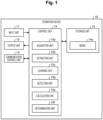
- FIG. 1 is a schematic diagram illustrating a schematic configuration of an estimation device.
- an estimation device 10 is realized by a general-purpose computer such as a personal computer, and includes an input unit 11, an output unit 12, a communication control unit 13, a storage unit 14, and a control unit 15.
- the input unit 11 is implemented with an input device such as a keyboard or a mouse and inputs various types of instruction information such as processing start to the control unit 15 in response to an input operation of an operator.
- the output unit 12 is implemented with a display device such as a liquid crystal display, a printing device such as a printer, or the like.
- the communication control unit 13 is implemented with a network interface card (NIC) or the like and controls communication between an external device such as a server and the control unit 15 via a network.
- NIC network interface card
- the communication control unit 13 controls communication between the control unit 15 and a management device or the like that manages communication data to be subjected to estimation processing described below.
- the storage unit 14 is realized by a semiconductor memory element such as a random access memory (RAM) or a flash memory or a storage device such as a hard disk or an optical disk, and stores parameters and the like of a model 14a learned by a learning unit 15c to be described later. Note that the storage unit 14 may be configured to establish communication with the control unit 15 via the communication control unit 13.
- a semiconductor memory element such as a random access memory (RAM) or a flash memory or a storage device such as a hard disk or an optical disk, and stores parameters and the like of a model 14a learned by a learning unit 15c to be described later.
- the storage unit 14 may be configured to establish communication with the control unit 15 via the communication control unit 13.
- the control unit 15 is implemented with a central processing unit (CPU) or the like and executes a processing program stored in a memory. As a result, as illustrated in Fig. 1 , the control unit 15 functions as an acquisition unit 15a, an extraction unit 15b, the learning unit 15c, a detection unit 15d, a calculation unit 15e, and a determination unit 15f. Note that each or some of these functional units may be mounted on different hardware. For example, the learning unit 15c may be mounted on a device different from a device on which the other functional units are mounted. Alternatively, the learning unit 15c and the detection unit 15d may be mounted on a device different from a device on which the other functional units are mounted. Further, the control unit 15 may include other functional units.
- CPU central processing unit
- the acquisition unit 15a acquires communication data.
- the acquisition unit 15a acquires communication data to be used for estimation processing that will be described later via the input unit 11 or the communication control unit 13.
- the acquisition unit 15a may store the acquired communication data in the storage unit 14.
- the acquisition unit 15a may transfer such information to the extraction unit 15b instead of storing the information in the storage unit 14.
- the extraction unit 15b extracts a fixed-length feature amount from a payload of the communication data. Specifically, the extraction unit 15b extracts a fixed-length feature amount by converting a payload into a fixed-length feature vector by Bidirectional Encoder Representations from Transformers (BERT).
- BERT Bidirectional Encoder Representations from Transformers
- variable-length series data in a natural language is converted into a fixed-length feature vector z as expressed by the following formula (1).
- z nth BERT x ntd
- Input data x is a tensor including a data index n, a time index t, and a word index d.
- the data index n is the number of sentences
- the time index t is the number of characters
- the word index d is a word type.
- h is an index of a feature vector.
- the data index n is the number of packets
- the time index t is the length of the payload
- the word index d is 256 types of bytes expressed in a two-digit hexadecimal number.
- the extraction unit 15b extracts a payload of a packet, performs preprocessing of converting every eight bits into a character of a two-digit hexadecimal number, and then converts the payload into a fixed-length feature vector by BERT.
- the learning unit 15c learns the model 14a that determines whether the communication data is normal or abnormal by using the fixed-length feature amount extracted from the payload of the communication data. For example, the learning unit 15c generates the model 14a based on a VAE that determines whether an input packet is normal or abnormal by anomaly-based unsupervised learning.
- the detection unit 15d detects abnormal communication data using the model 14a that determines whether the communication data is normal or abnormal by using the fixed-length feature amount extracted from the payload of the communication data. That is, the detection unit 15d detects abnormal communication data by using the learned model 14a. For example, the detection unit 15d uses the learned VAE model 14a to transfer a packet determined to be abnormal to the calculation unit 15e described below via the extraction unit 15b.
- the calculation unit 15e calculates a similarity between the feature amounts of the abnormal communication data. For example, the calculation unit 15e calculates a distance between feature vectors as a similarity between converted feature vectors of the abnormal communication data.
- a cos similarity between the feature vectors corresponds to the distance between the feature vectors, and the higher the cos similarity, the smaller the distance.
- the calculation unit 15e measures the similarity between the packets with respect to two feature vectors of two packets by a cos distance illustrated in the following formula (3) or an L2 norm illustrated in the following formula (4).
- D cos z 1 nh ′ ⁇ z 2 nh ′ ⁇ z 1 nh ′ ⁇ ⁇ z 2 nh ′ ⁇ [Math. 4]
- D L 2 ⁇ z 1 nh ′ ⁇ z 2 nh ′ ⁇ 2
- the determination unit 15f determines that the events are of the same type. For example, in a case where the distance between the feature vectors is less than a predetermined threshold ⁇ , the determination unit 15f determines that the events are of the same type.
- the estimation device 10 can search a large number of alerts for an alert that is more similar to matching of payloads, regardless of presence of a place or the like of a payload where serial numbers increase without meaning. Therefore, even in a case where a trace of an attack appears in the payload as in CPS, it is possible to detect a trend of the attack from the large number of alerts.
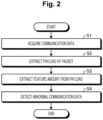
- Fig. 2 is a flowchart illustrating a detection processing procedure.
- the flowchart of Fig. 2 is started, for example, at a timing when an operation for instructing a start of the detection processing is input.
- the acquisition unit 15a acquires communication data (step S1).
- the extraction unit 15b extracts a payload of a packet of the acquired communication data (step S2). Furthermore, the extraction unit 15b extracts a fixed-length feature amount from the payload (step S3). For example, the extraction unit 15b extracts a payload of a packet, performs preprocessing of converting every eight bits into a character of a two-digit hexadecimal number, and then converts the payload into a fixed-length feature vector by BERT.
- the detection unit 15d detects abnormal communication data by using the learned model 14a (step S4).
- the detection unit 15d detects abnormal communication data by using the learned VAE model 14a. Thereby, a series of detection processing ends.
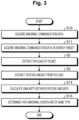
- Fig. 3 is a flowchart illustrating a search processing procedure.
- the flowchart of Fig. 3 is started, for example, at a timing when an operation for instructing a start of the search processing is input.
- the extraction unit 15b acquires communication data detected as abnormal from the detection unit 15d (step S10).
- the extraction unit 15b may acquire communication data detected as abnormal via the input unit 11 or the communication control unit 13.
- the extraction unit 15b acquires abnormal communication data as a search processing target via the input unit 11 or the communication control unit 13 (step S11).
- the extraction unit 15b extracts a payload of each packet of the acquired abnormal communication data (step S2). Furthermore, the extraction unit 15b extracts a fixed-length feature amount from each payload (step S3). For example, the extraction unit 15b extracts a payload from each packet, performs preprocessing of converting every eight bits into a character of a two-digit hexadecimal number, and then converts the payload into a fixed-length feature vector by BERT.
- the calculation unit 15e calculates a similarity between the feature amounts of the payloads of the abnormal communication data (step S14). For example, the calculation unit 15e calculates a distance between feature vectors as a similarity between converted feature vectors of the abnormal communication data.
- the determination unit 15f determines that abnormal events are of the same type (step S15). For example, in a case where the distance between the feature vectors is less than a predetermined threshold, the determination unit 15f determines that abnormal events are of the same type. Thereby, a series of search processing ends.
- the extraction unit 15b extracts the fixed-length feature amount from the payload of the communication data.
- the calculation unit 15e calculates the similarity between the feature amounts of the abnormal communication data. Further, when the calculated similarity is larger than the predetermined threshold, the determination unit 15f determines that the events are of the same type.
- the extraction unit 15b extracts the fixed-length feature amount by converting the payload into the fixed-length feature vector by BERT, the calculation unit 15e calculates the distance between the feature vectors as the similarity between the converted feature vectors of the abnormal communication data, and the determination unit 15f determines that the events are of the same type in a case where the distance between the feature vectors is less than the predetermined threshold.
- the estimation device 10 can search a large number of alerts for an alert that is more similar to matching of payloads, regardless of presence of a place or the like of a payload where serial numbers increase without meaning. Therefore, even in a case where a trace of an attack appears in the payload as in CPS, it is possible to detect a trend of the attack from the large number of alerts.
- the detection unit 15d detects the abnormal communication data using the model 14a that determines whether the communication data is normal or abnormal by using the fixed-length feature amount extracted from the payload of the communication data. As a result, the estimation device 10 can easily detect the trend of the attack from the large number of alerts.
- the learning unit 15c learns the model 14a by using the fixed-length feature amount extracted from the payload of the communication data. This makes it possible to detect unknown new attacks that appear one after another.
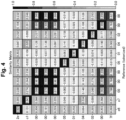
- FIG. 4 is a diagram for explaining an example.
- a similarity between feature amounts was calculated as illustrated in Fig. 4 by the estimation processing of the above embodiment for two abnormal packets, that is, an abnormal packet 1 and an abnormal packet 2 described below.
- similarities corresponding to the portions of the first two serial numbers are 0.928 and 0.924.
- a similarity corresponding to the portion distinguishing the abnormality is 0.827, and the similarities of the portions of the serial numbers have higher values.
- the estimation device 10 can be mounted by installing an estimation program executing the foregoing estimation processing as package software or online software on a desired computer.
- the information processing device can be caused to function as the estimation device 10.
- the information processing device also includes a mobile communication terminal such as a smartphone, a mobile phone, and a personal handyphone system (PHS) and a slate terminal such as a personal digital assistant (PDA).
- PHS personal handyphone system
- slate terminal such as a personal digital assistant
- the functions of the estimation device 10 may be mounted on a cloud server.
- FIG. 5 is a diagram illustrating an example of the computer that executes the estimation program.
- a computer 1000 includes, for example, a memory 1010, a CPU 1020, a hard disk drive interface 1030, a disk drive interface 1040, a serial port interface 1050, a video adapter 1060, and a network interface 1070. These units are connected to each other by a bus 1080.
- the memory 1010 includes a read only memory (ROM) 1011 and a RAM 1012.
- the ROM 1011 stores, for example, a boot program such as a basic input output system (BIOS).
- BIOS basic input output system
- the hard disk drive interface 1030 is connected to a hard disk drive 1031.
- the disk drive interface 1040 is connected to a disk drive 1041.
- a removable storage medium such as a magnetic disk or an optical disc is inserted into the disk drive 1041.
- the serial port interface 1050 is connected to, for example, a mouse 1051 and a keyboard 1052.
- the video adapter 1060 is connected to, for example, a display 1061.
- the hard disk drive 1031 stores, for example, an OS 1091, an application program 1092, a program module 1093, and program data 1094. All of the information described in the above embodiment is stored in the hard disk drive 1031 or the memory 1010, for example.
- the estimation program is stored in the hard disk drive 1031 as the program module 1093 in which commands to be executed by the computer 1000, for example, are described. Specifically, the program module 1093 in which each processing executed by the estimation device 10 described in the foregoing embodiment is described is stored in the hard disk drive 1031.
- Data used in information processing performed by the estimation program is stored as the program data 1094 in, for example, the hard disk drive 1031.
- the CPU 1020 reads, into the RAM 1012, the program module 1093 and the program data 1094 stored in the hard disk drive 1031 as necessary and executes each procedure described above.
- the program module 1093 and the program data 1094 related to the estimation program are not limited to being stored in the hard disk drive 1031, and may be stored in, for example, a removable storage medium and read by the CPU 1020 via the disk drive 1041 or the like.
- the program module 1093 and the program data 1094 related to the estimation program may be stored in another computer connected via a network such as a local area network (LAN) or a wide area network (WAN) and may be read by the CPU 1020 via the network interface 1070.
- LAN local area network
- WAN wide area network
Landscapes
- Engineering & Computer Science (AREA)
- Theoretical Computer Science (AREA)
- Computer Security & Cryptography (AREA)
- General Engineering & Computer Science (AREA)
- Physics & Mathematics (AREA)
- Software Systems (AREA)
- Computing Systems (AREA)
- General Physics & Mathematics (AREA)
- Computer Hardware Design (AREA)
- Mathematical Physics (AREA)
- Signal Processing (AREA)
- Computer Networks & Wireless Communication (AREA)
- Artificial Intelligence (AREA)
- Evolutionary Computation (AREA)
- Data Mining & Analysis (AREA)
- General Health & Medical Sciences (AREA)
- Health & Medical Sciences (AREA)
- Molecular Biology (AREA)
- Biomedical Technology (AREA)
- Biophysics (AREA)
- Computational Linguistics (AREA)
- Life Sciences & Earth Sciences (AREA)
- Mathematical Optimization (AREA)
- Probability & Statistics with Applications (AREA)
- Pure & Applied Mathematics (AREA)
- Mathematical Analysis (AREA)
- Algebra (AREA)
- Computer Vision & Pattern Recognition (AREA)
- Medical Informatics (AREA)
- Virology (AREA)
- Data Exchanges In Wide-Area Networks (AREA)
- Devices For Executing Special Programs (AREA)
- Debugging And Monitoring (AREA)
Abstract
Description
- The present invention relates to an estimation device, an estimation method, and an estimation program.
- In recent years, with the spread of cyber-physical systems (CPS), importance of abnormality detection in the CPS has increased. CPS protocols are diverse, and it is difficult to set abnormality detection rules for the CPS one by one due to cost. Therefore, a method of learning detection rules using machine learning is useful. In particular, an attack on the CPS is at an early stage, and new attacks are expected to appear one after another in the future, and thus, it is important to detect an abnormality based on anomaly using unsupervised learning capable of coping with unknown abnormalities.
- Furthermore, since it is difficult to directly incorporate a detector in the CPS, an abnormality detection system using communication data is assumed. Unlike abnormality detection in malfunction countermeasures, it is important to estimate a trend of attack in cyber security because it also affects countermeasures.
- At the time of abnormality detection using the communication data of the CPS, an alert indicating an event determined to be abnormal is searched to identify what kind of attack is being performed on the entire system. As a naive method of counting an alert of the same type as a certain alert, there is a method of counting an alert in which discrete amounts of the same protocol, ip, port, and the like match among the alerts. However, since it is considered that the trend of the CPS attack appears in a payload, it is desirable to count matching of payloads (see Non Patent Literature 1).
- Non Patent Literature 1: "Modbus Protocol Overview", [online], M-System Co., Ltd., [searched on April 26, 2021], Internet <URL: https://www.m-system.co.jp/mssjapanese/kaisetsu/nmmodbus.pdf>
- However, conventionally, it is difficult to search a large number of alerts for an alert that is more similar to matching of payloads. For example, there is a place or the like in a payload where serial numbers increase without meaning, and thus it is difficult to perform search with perfect matching.
- The present invention has been made in view of the above, and an object of the present invention is to make it possible to search a large number of alerts for an alert that is more similar to matching of payloads.
- In order to solve the above problem and achieve the object, an estimation device according to the present invention includes an extraction unit configured to extract a fixed-length feature amount from a payload of communication data, a calculation unit configured to calculate a similarity between feature amounts of abnormal communication data, and a determination unit configured to determine that events are of a same type when the calculated similarity is greater than a predetermined threshold.
- According to the present invention, it is possible to search a large number of alerts for an alert that is more similar to matching of payloads.
-
-
Fig. 1 is a schematic diagram illustrating a schematic configuration of an estimation device. -
Fig. 2 is a flowchart illustrating a detection processing procedure. -
Fig. 3 is a flowchart illustrating a search processing procedure. -
Fig. 4 is a diagram for explaining an example. -
Fig. 5 is a diagram illustrating a computer that executes an estimation program. - Hereinafter, an embodiment of the present invention will be described in detail with reference to the drawings. Note that the present invention is not limited by this embodiment. In addition, the same portions are denoted by the same reference signs in the description of the drawings.
- [Configuration of Estimation Device]
Fig. 1 is a schematic diagram illustrating a schematic configuration of an estimation device. As illustrated inFig. 1 , anestimation device 10 is realized by a general-purpose computer such as a personal computer, and includes aninput unit 11, an output unit 12, acommunication control unit 13, a storage unit 14, and acontrol unit 15. - The
input unit 11 is implemented with an input device such as a keyboard or a mouse and inputs various types of instruction information such as processing start to thecontrol unit 15 in response to an input operation of an operator. The output unit 12 is implemented with a display device such as a liquid crystal display, a printing device such as a printer, or the like. - The
communication control unit 13 is implemented with a network interface card (NIC) or the like and controls communication between an external device such as a server and thecontrol unit 15 via a network. For example, thecommunication control unit 13 controls communication between thecontrol unit 15 and a management device or the like that manages communication data to be subjected to estimation processing described below. - The storage unit 14 is realized by a semiconductor memory element such as a random access memory (RAM) or a flash memory or a storage device such as a hard disk or an optical disk, and stores parameters and the like of a
model 14a learned by alearning unit 15c to be described later. Note that the storage unit 14 may be configured to establish communication with thecontrol unit 15 via thecommunication control unit 13. - The
control unit 15 is implemented with a central processing unit (CPU) or the like and executes a processing program stored in a memory. As a result, as illustrated inFig. 1 , thecontrol unit 15 functions as anacquisition unit 15a, an extraction unit 15b, thelearning unit 15c, adetection unit 15d, acalculation unit 15e, and adetermination unit 15f. Note that each or some of these functional units may be mounted on different hardware. For example, thelearning unit 15c may be mounted on a device different from a device on which the other functional units are mounted. Alternatively, thelearning unit 15c and thedetection unit 15d may be mounted on a device different from a device on which the other functional units are mounted. Further, thecontrol unit 15 may include other functional units. - The
acquisition unit 15a acquires communication data. For example, theacquisition unit 15a acquires communication data to be used for estimation processing that will be described later via theinput unit 11 or thecommunication control unit 13. In addition, theacquisition unit 15a may store the acquired communication data in the storage unit 14. Note that theacquisition unit 15a may transfer such information to the extraction unit 15b instead of storing the information in the storage unit 14. - The extraction unit 15b extracts a fixed-length feature amount from a payload of the communication data. Specifically, the extraction unit 15b extracts a fixed-length feature amount by converting a payload into a fixed-length feature vector by Bidirectional Encoder Representations from Transformers (BERT).
- Here, in general, in BERT, variable-length series data in a natural language is converted into a fixed-length feature vector z as expressed by the following formula (1).
[Math. 1]
- Input data x is a tensor including a data index n, a time index t, and a word index d. In the natural language, the data index n is the number of sentences, the time index t is the number of characters, and the word index d is a word type. In the above formula (1), h is an index of a feature vector.
- On the other hand, in a case where a payload of network traffic is input data, it is sufficient if the data index n is the number of packets, the time index t is the length of the payload, and the word index d is 256 types of bytes expressed in a two-digit hexadecimal number.
- That is, the extraction unit 15b extracts a payload of a packet, performs preprocessing of converting every eight bits into a character of a two-digit hexadecimal number, and then converts the payload into a fixed-length feature vector by BERT.
- The
learning unit 15c learns themodel 14a that determines whether the communication data is normal or abnormal by using the fixed-length feature amount extracted from the payload of the communication data. For example, thelearning unit 15c generates themodel 14a based on a VAE that determines whether an input packet is normal or abnormal by anomaly-based unsupervised learning. - The
detection unit 15d detects abnormal communication data using themodel 14a that determines whether the communication data is normal or abnormal by using the fixed-length feature amount extracted from the payload of the communication data. That is, thedetection unit 15d detects abnormal communication data by using the learnedmodel 14a. For example, thedetection unit 15d uses thelearned VAE model 14a to transfer a packet determined to be abnormal to thecalculation unit 15e described below via the extraction unit 15b. - The
calculation unit 15e calculates a similarity between the feature amounts of the abnormal communication data. For example, thecalculation unit 15e calculates a distance between feature vectors as a similarity between converted feature vectors of the abnormal communication data. Here, a cos similarity between the feature vectors corresponds to the distance between the feature vectors, and the higher the cos similarity, the smaller the distance. - In addition, the
calculation unit 15e calculates a similarity not between bytes but between packets in order to calculate a similarity of events of packets determined to be abnormal. Therefore, thecalculation unit 15e first takes an average so that an index of the payload remains as shown in the following formula (2).
[Math. 2]
- In addition, the
calculation unit 15e measures the similarity between the packets with respect to two feature vectors of two packets by a cos distance illustrated in the following formula (3) or an L2 norm illustrated in the following formula (4).
[Math. 3]

- When the calculated similarity is larger than a predetermined threshold, the
determination unit 15f determines that the events are of the same type. For example, in a case where the distance between the feature vectors is less than a predetermined threshold ε, thedetermination unit 15f determines that the events are of the same type. - As described above, by using a similarity in a latent variable space, the
estimation device 10 can search a large number of alerts for an alert that is more similar to matching of payloads, regardless of presence of a place or the like of a payload where serial numbers increase without meaning. Therefore, even in a case where a trace of an attack appears in the payload as in CPS, it is possible to detect a trend of the attack from the large number of alerts. - [Estimation Processing] Next, estimation processing performed by the
estimation device 10 according to the present embodiment will be described with reference toFigs. 2 and3 . The estimation processing of the present embodiment includes detection processing and search processing. First,Fig. 2 is a flowchart illustrating a detection processing procedure. The flowchart ofFig. 2 is started, for example, at a timing when an operation for instructing a start of the detection processing is input. - First, the
acquisition unit 15a acquires communication data (step S1). - Next, the extraction unit 15b extracts a payload of a packet of the acquired communication data (step S2). Furthermore, the extraction unit 15b extracts a fixed-length feature amount from the payload (step S3). For example, the extraction unit 15b extracts a payload of a packet, performs preprocessing of converting every eight bits into a character of a two-digit hexadecimal number, and then converts the payload into a fixed-length feature vector by BERT.
- Then, the
detection unit 15d detects abnormal communication data by using the learnedmodel 14a (step S4). For example, thedetection unit 15d detects abnormal communication data by using the learnedVAE model 14a. Thereby, a series of detection processing ends. -
Fig. 3 is a flowchart illustrating a search processing procedure. The flowchart ofFig. 3 is started, for example, at a timing when an operation for instructing a start of the search processing is input. - First, the extraction unit 15b acquires communication data detected as abnormal from the
detection unit 15d (step S10). The extraction unit 15b may acquire communication data detected as abnormal via theinput unit 11 or thecommunication control unit 13. - Furthermore, the extraction unit 15b acquires abnormal communication data as a search processing target via the
input unit 11 or the communication control unit 13 (step S11). - Next, the extraction unit 15b extracts a payload of each packet of the acquired abnormal communication data (step S2). Furthermore, the extraction unit 15b extracts a fixed-length feature amount from each payload (step S3). For example, the extraction unit 15b extracts a payload from each packet, performs preprocessing of converting every eight bits into a character of a two-digit hexadecimal number, and then converts the payload into a fixed-length feature vector by BERT.
- Next, the
calculation unit 15e calculates a similarity between the feature amounts of the payloads of the abnormal communication data (step S14). For example, thecalculation unit 15e calculates a distance between feature vectors as a similarity between converted feature vectors of the abnormal communication data. - Then, when the calculated similarity is larger than a predetermined threshold, the
determination unit 15f determines that abnormal events are of the same type (step S15). For example, in a case where the distance between the feature vectors is less than a predetermined threshold, thedetermination unit 15f determines that abnormal events are of the same type. Thereby, a series of search processing ends. - [Effects] As described above, the extraction unit 15b extracts the fixed-length feature amount from the payload of the communication data. In addition, the
calculation unit 15e calculates the similarity between the feature amounts of the abnormal communication data. Further, when the calculated similarity is larger than the predetermined threshold, thedetermination unit 15f determines that the events are of the same type. - Specifically, the extraction unit 15b extracts the fixed-length feature amount by converting the payload into the fixed-length feature vector by BERT, the
calculation unit 15e calculates the distance between the feature vectors as the similarity between the converted feature vectors of the abnormal communication data, and thedetermination unit 15f determines that the events are of the same type in a case where the distance between the feature vectors is less than the predetermined threshold. - As described above, by using a similarity in a latent variable space, the
estimation device 10 can search a large number of alerts for an alert that is more similar to matching of payloads, regardless of presence of a place or the like of a payload where serial numbers increase without meaning. Therefore, even in a case where a trace of an attack appears in the payload as in CPS, it is possible to detect a trend of the attack from the large number of alerts. - Further, the
detection unit 15d detects the abnormal communication data using themodel 14a that determines whether the communication data is normal or abnormal by using the fixed-length feature amount extracted from the payload of the communication data. As a result, theestimation device 10 can easily detect the trend of the attack from the large number of alerts. - In addition, the
learning unit 15c learns themodel 14a by using the fixed-length feature amount extracted from the payload of the communication data. This makes it possible to detect unknown new attacks that appear one after another. - [Examples]
Fig. 4 is a diagram for explaining an example. In the present example, a similarity between feature amounts was calculated as illustrated inFig. 4 by the estimation processing of the above embodiment for two abnormal packets, that is, an abnormal packet 1 and an abnormal packet 2 described below. - abnormal packet 1: "2e
c1 00 00 00 05 01 04 02 00 7f" - abnormal packet 2: "
e6 e7 00 00 00 05 01 04 02 00 00" - "2e c1" at the head of the abnormal packet 1 and "e6 e7" at the head of the abnormal packet 2 are portions of serial numbers. In addition, "7f" at the end of the abnormal packet 1 and "00" at the end of the abnormal packet 2 are portions that essentially distinguish abnormality. Then,
Fig. 4 illustrates a cos similarity between feature vectors by BERT for each byte of each packet. - When attention is paid to diagonal components in
Fig. 4 , similarities corresponding to the portions of the first two serial numbers are 0.928 and 0.924. On the other hand, a similarity corresponding to the portion distinguishing the abnormality is 0.827, and the similarities of the portions of the serial numbers have higher values. As described above, it was confirmed that the feature vector according to BERT can relatively ignore the portions of the serial numbers. - [Program] It is also possible to produce a program that describes the processing executed by the
estimation device 10 according to the above embodiment in a computer executable language. As an embodiment, theestimation device 10 can be mounted by installing an estimation program executing the foregoing estimation processing as package software or online software on a desired computer. For example, by causing an information processing device to perform the estimation program, the information processing device can be caused to function as theestimation device 10. The information processing device also includes a mobile communication terminal such as a smartphone, a mobile phone, and a personal handyphone system (PHS) and a slate terminal such as a personal digital assistant (PDA). Further, the functions of theestimation device 10 may be mounted on a cloud server. -
Fig. 5 is a diagram illustrating an example of the computer that executes the estimation program. Acomputer 1000 includes, for example, amemory 1010, aCPU 1020, a harddisk drive interface 1030, adisk drive interface 1040, aserial port interface 1050, avideo adapter 1060, and anetwork interface 1070. These units are connected to each other by a bus 1080. - The
memory 1010 includes a read only memory (ROM) 1011 and aRAM 1012. TheROM 1011 stores, for example, a boot program such as a basic input output system (BIOS). The harddisk drive interface 1030 is connected to ahard disk drive 1031. Thedisk drive interface 1040 is connected to adisk drive 1041. For example, a removable storage medium such as a magnetic disk or an optical disc is inserted into thedisk drive 1041. Theserial port interface 1050 is connected to, for example, amouse 1051 and akeyboard 1052. Thevideo adapter 1060 is connected to, for example, adisplay 1061. - Here, the
hard disk drive 1031 stores, for example, anOS 1091, anapplication program 1092, aprogram module 1093, andprogram data 1094. All of the information described in the above embodiment is stored in thehard disk drive 1031 or thememory 1010, for example. - The estimation program is stored in the
hard disk drive 1031 as theprogram module 1093 in which commands to be executed by thecomputer 1000, for example, are described. Specifically, theprogram module 1093 in which each processing executed by theestimation device 10 described in the foregoing embodiment is described is stored in thehard disk drive 1031. - Data used in information processing performed by the estimation program is stored as the
program data 1094 in, for example, thehard disk drive 1031. TheCPU 1020 reads, into theRAM 1012, theprogram module 1093 and theprogram data 1094 stored in thehard disk drive 1031 as necessary and executes each procedure described above. - The
program module 1093 and theprogram data 1094 related to the estimation program are not limited to being stored in thehard disk drive 1031, and may be stored in, for example, a removable storage medium and read by theCPU 1020 via thedisk drive 1041 or the like. Alternatively, theprogram module 1093 and theprogram data 1094 related to the estimation program may be stored in another computer connected via a network such as a local area network (LAN) or a wide area network (WAN) and may be read by theCPU 1020 via thenetwork interface 1070. - Although the embodiment to which the invention made by the present inventor is applied has been described above, the present invention is not limited by the description and the drawings constituting a part of the disclosure of the present invention according to the present embodiment. In other words, other embodiments, examples, operational technologies, and the like made by those skilled in the art and the like on the basis of the present embodiment are all included in the scope of the present invention.
-
- 10
- Estimation device
- 11
- Input unit
- 12
- Output unit
- 13
- Communication control unit
- 14
- Storage unit
- 14a
- Model
- 15
- Control unit
- 15a
- Acquisition unit
- 15b
- Extraction unit
- 15c
- Learning unit
- 15d
- Detection unit
- 15e
- Calculation unit
- 15f
- Determination unit
Claims (6)
- An estimation device comprising:an extraction unit configured to extract a fixed-length feature amount from a payload of communication data;a calculation unit configured to calculate a similarity between feature amounts of abnormal communication data; anda determination unit configured to determine that events are of a same type when the calculated similarity is greater than a predetermined threshold.
- The estimation device according to claim 1, whereinthe extraction unit extracts the fixed-length feature amount by converting the payload into a fixed-length feature vector by Bidirectional Encoder Representations from Transformers (BERT),the calculation unit calculates a distance between feature vectors as a similarity between the converted feature vectors of the abnormal communication data, andthe determination unit determines that events are of a same type when the distance between the feature vectors is less than a predetermined threshold.
- The estimation device according to claim 1, further including: a detection unit configured to detect the abnormal communication data by a model that determines whether the communication data is normal or abnormal using the fixed-length feature amount extracted from the payload of the communication data.
- The estimation device according to claim 3, further including: a learning unit configured to learn the model by using the fixed-length feature amount extracted from the payload of the communication data.
- An estimation method executed by an estimation device, the estimation method comprising:an extraction process of extracting a fixed-length feature amount from a payload of communication data;a calculation process of calculating a similarity between feature amounts of abnormal communication data; anda determination process of determining that events are of a same type when the calculated similarity is greater than a predetermined threshold.
- An estimation program that causes a computer to execute:an extraction step of extracting a fixed-length feature amount from a payload of communication data;a calculation step of calculating a similarity between feature amounts of abnormal communication data; anda determination step of determining that events are of a same type when the calculated similarity is greater than a predetermined threshold.
Applications Claiming Priority (1)
| Application Number | Priority Date | Filing Date | Title |
|---|---|---|---|
| PCT/JP2021/021623 WO2022259330A1 (en) | 2021-06-07 | 2021-06-07 | Estimation device, estimation method, and estimation program |
Publications (3)
| Publication Number | Publication Date |
|---|---|
| EP4332801A1 true EP4332801A1 (en) | 2024-03-06 |
| EP4332801A4 EP4332801A4 (en) | 2024-11-27 |
| EP4332801B1 EP4332801B1 (en) | 2026-04-22 |
Family
ID=84424946
Family Applications (1)
| Application Number | Title | Priority Date | Filing Date |
|---|---|---|---|
| EP21945010.3A Active EP4332801B1 (en) | 2021-06-07 | 2021-06-07 | Estimation device, estimation method, and estimation program |
Country Status (6)
| Country | Link |
|---|---|
| US (1) | US20250119438A1 (en) |
| EP (1) | EP4332801B1 (en) |
| JP (1) | JP7619454B2 (en) |
| CN (1) | CN117396868A (en) |
| AU (1) | AU2021449562B2 (en) |
| WO (1) | WO2022259330A1 (en) |
Family Cites Families (14)
| Publication number | Priority date | Publication date | Assignee | Title |
|---|---|---|---|---|
| JP6794197B2 (en) * | 2016-09-12 | 2020-12-02 | キヤノン株式会社 | Information processing equipment, information processing methods and programs |
| JP6955912B2 (en) * | 2017-06-19 | 2021-10-27 | 株式会社日立製作所 | Network monitoring device, its system, and its method |
| US10581897B1 (en) * | 2017-07-26 | 2020-03-03 | EMC IP Holding Company LLC | Method and system for implementing threat intelligence as a service |
| US11934520B2 (en) * | 2018-03-28 | 2024-03-19 | Nvidia Corporation | Detecting data anomalies on a data interface using machine learning |
| KR102279983B1 (en) * | 2018-12-28 | 2021-07-21 | 성균관대학교산학협력단 | Network Intrusion Detection Method using unsupervised deep learning algorithms and Computer Readable Recording Medium on which program therefor is recorded |
| US10776642B2 (en) * | 2019-01-25 | 2020-09-15 | Toyota Research Institute, Inc. | Sampling training data for in-cabin human detection from raw video |
| JP7248103B2 (en) * | 2019-03-26 | 2023-03-29 | 日本電気株式会社 | Anomaly detection method, anomaly detection device, program |
| CN113874888A (en) | 2019-05-20 | 2021-12-31 | 日本电信电话株式会社 | Information processing device, generation method, and generation program |
| CN110554782B (en) * | 2019-07-25 | 2023-06-27 | 北京智慧章鱼科技有限公司 | Expression input image synthesis method and system |
| US11689561B2 (en) * | 2019-11-11 | 2023-06-27 | Microsoft Technology Licensing, Llc | Detecting unknown malicious content in computer systems |
| CN113130073B (en) * | 2020-01-16 | 2024-01-19 | 宏碁股份有限公司 | Method for selecting influence indexes by utilizing automation mechanism and electronic device |
| CN111372043B (en) | 2020-02-06 | 2021-05-11 | 浙江大华技术股份有限公司 | Abnormity detection method and related equipment and device |
| JP6788929B1 (en) | 2020-07-15 | 2020-11-25 | フジモールド工業株式会社 | Image processing device and image processing method for determining the test object |
| CN112860484A (en) * | 2021-01-29 | 2021-05-28 | 深信服科技股份有限公司 | Container runtime abnormal behavior detection and model training method and related device |
-
2021
- 2021-06-07 CN CN202180098471.9A patent/CN117396868A/en active Pending
- 2021-06-07 JP JP2023527174A patent/JP7619454B2/en active Active
- 2021-06-07 AU AU2021449562A patent/AU2021449562B2/en active Active
- 2021-06-07 WO PCT/JP2021/021623 patent/WO2022259330A1/en not_active Ceased
- 2021-06-07 US US18/567,376 patent/US20250119438A1/en active Pending
- 2021-06-07 EP EP21945010.3A patent/EP4332801B1/en active Active
Also Published As
| Publication number | Publication date |
|---|---|
| CN117396868A (en) | 2024-01-12 |
| AU2021449562B2 (en) | 2025-11-20 |
| WO2022259330A1 (en) | 2022-12-15 |
| EP4332801B1 (en) | 2026-04-22 |
| EP4332801A4 (en) | 2024-11-27 |
| US20250119438A1 (en) | 2025-04-10 |
| AU2021449562A1 (en) | 2023-11-30 |
| JP7619454B2 (en) | 2025-01-22 |
| JPWO2022259330A1 (en) | 2022-12-15 |
Similar Documents
| Publication | Publication Date | Title |
|---|---|---|
| US20230041014A1 (en) | Data pattern analysis using optimized deterministic finite automaton | |
| EP3796599B1 (en) | Evaluation device and evaluation method | |
| US20150067776A1 (en) | Method and apparatus for compilation of finite automata | |
| EP3404572B1 (en) | Attack code detection device, attack code detection method, and attack code detection program | |
| US20150067863A1 (en) | Method and apparatus for processing finite automata | |
| US11102082B1 (en) | System and method for inferring operating systems using transmission control protocol fingerprints | |
| EP0585523B1 (en) | Automatic language boundary identification for a peripheral unit that supports multiple control languages | |
| CN117792803B (en) | Payload-based network attack detection method, system and medium | |
| EP3964986A1 (en) | Extraction device, extraction method, and extraction program | |
| EP4332801B1 (en) | Estimation device, estimation method, and estimation program | |
| Zhu et al. | Adaptive header identification and unsupervised clustering strategy for enhanced protocol reverse engineering | |
| EP4325385B1 (en) | Estimation device, estimation method, and estimation program | |
| EP4333391A1 (en) | Detection device, detection method, and detection program | |
| AU2019446476B2 (en) | Information processing device, creation method, and creation program | |
| CN116192462B (en) | Malicious software analysis method and device based on PE file format | |
| CN117668841A (en) | Malicious software detection method, device, equipment and medium | |
| US20230216872A1 (en) | Sample data generation apparatus, sample data generation method, and computer readable recording medium | |
| CN113810342A (en) | Intrusion detection method, device, equipment and medium | |
| EP4524790A1 (en) | Abnormality detection device, abnormality detection method, and abnormality detection program | |
| US20250068729A1 (en) | Ultra-light clustering-based generative intrusion detection device and method, and computer-readable recording medium including instructions to perform method | |
| CN121486486B (en) | Communication protocol parsing methods, systems, computer equipment and computer program products | |
| CN119647477B (en) | Text detection method and device, electronic equipment and storage medium | |
| CN118939518B (en) | Log processing method, device, equipment and storage medium | |
| Nandakumar et al. | A Novel Approach to User Agent String Parsing for Vulnerability Analysis Using Multi-Headed Attention | |
| WO2024241596A1 (en) | Detection device, detection method, and detection program |
Legal Events
| Date | Code | Title | Description |
|---|---|---|---|
| STAA | Information on the status of an ep patent application or granted ep patent |
Free format text: STATUS: THE INTERNATIONAL PUBLICATION HAS BEEN MADE |
|
| PUAI | Public reference made under article 153(3) epc to a published international application that has entered the european phase |
Free format text: ORIGINAL CODE: 0009012 |
|
| STAA | Information on the status of an ep patent application or granted ep patent |
Free format text: STATUS: REQUEST FOR EXAMINATION WAS MADE |
|
| 17P | Request for examination filed |
Effective date: 20231130 |
|
| AK | Designated contracting states |
Kind code of ref document: A1 Designated state(s): AL AT BE BG CH CY CZ DE DK EE ES FI FR GB GR HR HU IE IS IT LI LT LU LV MC MK MT NL NO PL PT RO RS SE SI SK SM TR |
|
| DAV | Request for validation of the european patent (deleted) | ||
| DAX | Request for extension of the european patent (deleted) | ||
| A4 | Supplementary search report drawn up and despatched |
Effective date: 20241030 |
|
| RIC1 | Information provided on ipc code assigned before grant |
Ipc: H04L 9/40 20220101ALI20241024BHEP Ipc: H04L 41/142 20220101ALI20241024BHEP Ipc: G06N 20/20 20190101ALI20241024BHEP Ipc: G06N 20/00 20190101ALI20241024BHEP Ipc: G06N 3/08 20230101ALI20241024BHEP Ipc: G06N 3/045 20230101ALI20241024BHEP Ipc: G06N 3/044 20230101ALI20241024BHEP Ipc: G06F 21/57 20130101ALI20241024BHEP Ipc: G06F 21/56 20130101ALI20241024BHEP Ipc: G06F 21/55 20130101AFI20241024BHEP |
|
| STAA | Information on the status of an ep patent application or granted ep patent |
Free format text: STATUS: EXAMINATION IS IN PROGRESS |
|
| 17Q | First examination report despatched |
Effective date: 20250618 |
|
| RAP3 | Party data changed (applicant data changed or rights of an application transferred) |
Owner name: NTT, INC. |
|
| REG | Reference to a national code |
Ref country code: DE Ref legal event code: R079 Free format text: PREVIOUS MAIN CLASS: G06F0021550000 Ipc: H04L0009400000 Ref document number: 602021052891 Country of ref document: DE |
|
| GRAP | Despatch of communication of intention to grant a patent |
Free format text: ORIGINAL CODE: EPIDOSNIGR1 |
|
| STAA | Information on the status of an ep patent application or granted ep patent |
Free format text: STATUS: GRANT OF PATENT IS INTENDED |
|
| INTG | Intention to grant announced |
Effective date: 20251208 |
|
| RIC1 | Information provided on ipc code assigned before grant |
Ipc: H04L 9/40 20220101AFI20251128BHEP Ipc: H04L 41/142 20220101ALI20251128BHEP Ipc: G06F 21/55 20130101ALI20251128BHEP Ipc: G06N 20/20 20190101ALI20251128BHEP Ipc: G06F 21/56 20130101ALI20251128BHEP Ipc: G06N 3/044 20230101ALI20251128BHEP Ipc: G06N 3/045 20230101ALI20251128BHEP Ipc: G06N 3/08 20230101ALI20251128BHEP Ipc: G06N 20/00 20190101ALI20251128BHEP |
|
| GRAS | Grant fee paid |
Free format text: ORIGINAL CODE: EPIDOSNIGR3 |
|
| GRAA | (expected) grant |
Free format text: ORIGINAL CODE: 0009210 |
|
| STAA | Information on the status of an ep patent application or granted ep patent |
Free format text: STATUS: THE PATENT HAS BEEN GRANTED |
|
| AK | Designated contracting states |
Kind code of ref document: B1 Designated state(s): AL AT BE BG CH CY CZ DE DK EE ES FI FR GB GR HR HU IE IS IT LI LT LU LV MC MK MT NL NO PL PT RO RS SE SI SK SM TR |
|
| REG | Reference to a national code |
Ref country code: CH Ref legal event code: F10 Free format text: ST27 STATUS EVENT CODE: U-0-0-F10-F00 (AS PROVIDED BY THE NATIONAL OFFICE) Effective date: 20260422 Ref country code: GB Ref legal event code: FG4D |