EP4332796A1 - A user login anomaly detection method and system - Google Patents
A user login anomaly detection method and system Download PDFInfo
- Publication number
- EP4332796A1 EP4332796A1 EP22306273.8A EP22306273A EP4332796A1 EP 4332796 A1 EP4332796 A1 EP 4332796A1 EP 22306273 A EP22306273 A EP 22306273A EP 4332796 A1 EP4332796 A1 EP 4332796A1
- Authority
- EP
- European Patent Office
- Prior art keywords
- parameter
- user
- log
- login
- anomaly
- Prior art date
- Legal status (The legal status is an assumption and is not a legal conclusion. Google has not performed a legal analysis and makes no representation as to the accuracy of the status listed.)
- Pending
Links
Images
Classifications
-
- G—PHYSICS
- G06—COMPUTING OR CALCULATING; COUNTING
- G06F—ELECTRIC DIGITAL DATA PROCESSING
- G06F21/00—Security arrangements for protecting computers, components thereof, programs or data against unauthorised activity
- G06F21/30—Authentication, i.e. establishing the identity or authorisation of security principals
- G06F21/31—User authentication
-
- G—PHYSICS
- G06—COMPUTING OR CALCULATING; COUNTING
- G06F—ELECTRIC DIGITAL DATA PROCESSING
- G06F21/00—Security arrangements for protecting computers, components thereof, programs or data against unauthorised activity
- G06F21/50—Monitoring users, programs or devices to maintain the integrity of platforms, e.g. of processors, firmware or operating systems
- G06F21/55—Detecting local intrusion or implementing counter-measures
- G06F21/552—Detecting local intrusion or implementing counter-measures involving long-term monitoring or reporting
-
- H—ELECTRICITY
- H04—ELECTRIC COMMUNICATION TECHNIQUE
- H04L—TRANSMISSION OF DIGITAL INFORMATION, e.g. TELEGRAPHIC COMMUNICATION
- H04L63/00—Network architectures or network communication protocols for network security
- H04L63/08—Network architectures or network communication protocols for network security for authentication of entities
-
- H—ELECTRICITY
- H04—ELECTRIC COMMUNICATION TECHNIQUE
- H04L—TRANSMISSION OF DIGITAL INFORMATION, e.g. TELEGRAPHIC COMMUNICATION
- H04L63/00—Network architectures or network communication protocols for network security
- H04L63/10—Network architectures or network communication protocols for network security for controlling access to devices or network resources
- H04L63/101—Access control lists [ACL]
-
- H—ELECTRICITY
- H04—ELECTRIC COMMUNICATION TECHNIQUE
- H04L—TRANSMISSION OF DIGITAL INFORMATION, e.g. TELEGRAPHIC COMMUNICATION
- H04L63/00—Network architectures or network communication protocols for network security
- H04L63/14—Network architectures or network communication protocols for network security for detecting or protecting against malicious traffic
- H04L63/1408—Network architectures or network communication protocols for network security for detecting or protecting against malicious traffic by monitoring network traffic
- H04L63/1416—Event detection, e.g. attack signature detection
-
- H—ELECTRICITY
- H04—ELECTRIC COMMUNICATION TECHNIQUE
- H04L—TRANSMISSION OF DIGITAL INFORMATION, e.g. TELEGRAPHIC COMMUNICATION
- H04L63/00—Network architectures or network communication protocols for network security
- H04L63/14—Network architectures or network communication protocols for network security for detecting or protecting against malicious traffic
- H04L63/1408—Network architectures or network communication protocols for network security for detecting or protecting against malicious traffic by monitoring network traffic
- H04L63/1425—Traffic logging, e.g. anomaly detection
Definitions
- the present invention relates to a user login anomaly detection method.
- the invention also relates to a computer program and a device configured to carry out such a method.
- the field of the invention is the field of the detecting anomalies related to successful logins of a user on authentication system, and more particularly on an authentication system regulating access to SaaS services.
- SaaS Services Users log into cloud based SaaS Services, for example Microsoft ® SaaS Services, hosted in the cloud, for example Azure cloud, using an authentication server that is hosted in the network providing said services, such as Microsoft Azure Active Directory (AD) authentication.
- the SaaS services can be email, file repositories, company intranet and a number of other business applications.
- Such authentication may get compromised due to weak passwords or through many more sophisticated attacks including phishing attacks that hackers launch on unsuspecting users to capture usernames & passwords.
- One such example is to launch brute force attacks in which cybercriminals use automated tools to obtain the account password. If successful, the attackers can then invade a network, elevate their rights with administrative access, disable security products, and even run ransomware to encrypt critical data and hold the companies / users hostage.
- a purpose of the present invention is to provide a solution for user login anomaly detection.
- Another purpose of the present invention is to provide a user login anomaly detection solution that is more user centric and more individualized for each user.
- Yet another purpose of the present invention is to provide a user login anomaly detection solution that is more efficient.
- the invention makes it possible to achieve at least one of these aims by a computer implemented method for detecting anomaly(ies) regarding the logins of a user on a local, or remote, authentication system, such as a remote Active Directory, AD, authentication system, said method comprising at least one iteration of a monitoring phase for a user, said monitoring phase comprising the following steps:
- the present invention thus proposes user login anomaly detection based on only successful logins of the user, over a monitoring period.
- Several parameters are measured for each login and an anomaly score for the monitoring period is calculated based said parameters.
- the invention proposes allocating different weights for each parameter in the computation of the anomaly score.
- the weight allocated to each parameter is itself calculated based on the probability density of each value that said parameter takes during the monitoring period, i.e. in the log collected for said monitoring period.
- the present invention proposes a solution for login anomaly detection that is more user centric and individualized for each user.
- the login anomaly detection according to the invention is more adapted for each user and provides more efficient login anomaly detection.
- At least one predetermined value that said parameter may take may be determined during an observation period, prior to the first iteration of the monitoring phase.
- the invention may comprise, for at least one user, an observation period during which at least one value, i.e. bin, may be determined for at least one parameter.
- the determination of a least one value may be done by collecting logs of successful logins of said user during said observation period, and detecting in said logs each different value of said parameter.
- Each different value may thus be stored as a predetermined value, i.e. a bin, to be used during the monitoring phases(s) for said parameter and said user.
- the monitored parameters may take different values for different users.
- the invention allows use of values that are specific for each user, instead of using generic values common to all users.
- observation period may be chosen as desired.
- the observation period may be a month.
- the monitoring period may be chosen as desired.
- the monitoring period may be a day.
- the log for each user will be collected for a, and in particular, each day.
- An anomaly score may then be determined for each day and an anomaly occurring during a specific day may be detected.
- Any parameter relative to a login configuration may be used as a monitored parameter in the present invention.
- a monitored parameter may comprise, or may be, the time of day, TOD, of the login.
- TOD time of day
- a monitored parameter may comprise, or may be, the day of week, DOW, of the login.
- DOW day of week
- one monitored parameter may comprise, or may be, the geographical location, GEO, of the login.
- GEO geographical location
- the inventors have noticed that the combination of these three parameters, i.e. the TOD, DOW and GEO, allows efficient and reactive anomaly detection.
- the predetermined values, i.e. the bins, associated to said parameter may be (8h-12h;12h-16h;16h-20h;20h-24h).
- the values may be determined specifically for a given user.
- the bins may be different than those indicated here.
- the predetermined values, i.e. the bins, associated to said parameter may be (Monday; Tuesday; Wednesday; Thursday; Friday; Saturday; Sunday).
- the values may be determined specifically for a given user.
- the bins for this parameter may be different than those indicated here.
- the density probability, noted P a (b), of a bin “b” of a parameter "a” may be calculated according to any appropriate formula or relation.
- the weight, noted W a , of a parameter "a" may be calculated according to any appropriate formula or relation.
- the anomaly score, noted S, of the log may be calculated according to any appropriate formula or relation.
- the method according to the invention may be used to detect login anomalies, for one or several users, for logging into cloud based SaaS Services, for example Microsoft ® SaaS Services, hosted in the cloud, for example Azure cloud, using in built authentication server, such as Microsoft Azure Active Directory (AD) authentication.
- cloud based SaaS Services for example Microsoft ® SaaS Services
- Azure cloud hosted in the cloud
- AD Microsoft Azure Active Directory
- the SaaS services accessed can be email, file repositories, company intranet and a number of other business applications.
- the authentication server may be placed in a local or remote network, for example the Microsoft network.
- the SaaS services may be hosted in said network, for example the Microsoft network.
- the services may be hosted in another network than the one hosting the authentication server.
- the computer program may be in any programming language such as C, C++, JAVA, Python, etc.
- the computer program may be in machine language.
- the computer program may be stored, in a non-transient memory, such as a USB stick, a flash memory, a hard-disk, a processor, a programmable electronic chop, etc.
- a non-transient memory such as a USB stick, a flash memory, a hard-disk, a processor, a programmable electronic chop, etc.
- the computer program may be stored in a computerized device such as a Smartphone, a tablet, a computer, a server, etc.
- a device comprising means configured to carry out the steps of the method according to the invention.
- the device according to the invention may comprise means configured to carry out at least one, or a combination of at least two, of the optional features recited above in connection with the method according to the invention, in combination with the mandatory features of the method according to the invention.
- the device according to the invention provides the same advantages/benefits as those mentioned above for the method according to the invention.
- the device according to the invention may be any computerized device such as a Smartphone, a tablet, a computer, a server, a processor, etc.
- the device according to the invention may execute one or several applications to carry out the steps of the method according to the invention.
- the device according to the invention may be loaded with, and configured to execute, the computer program according to the invention.
- the device may comprise at least one module configured to collect a log of successful logins of the user on the authentication system over a monitoring period.
- the log of successful logins over the monitoring period comprises, for each successful login, measured values of several monitored parameters.
- Each measured value of each monitored parameter corresponds to a predetermined value, also called bin, among several values previously defined for said parameter.
- the device may comprise at least one module configured to calculate, for each monitored parameter, a probability density, in the log, of each predetermined value of said parameter.
- the calculation of each probability density may be carried out according to any formula, and more particularly according to Relation 1 indicated above.
- the device may comprise at least one module configured to calculate for each parameter, a weight, as a function of the probability density of each predetermined value of said parameter.
- the calculation of each weight may be carried out according to any formula, and more particularly according to Relation 2 indicated above.
- the device may comprise at least one module configured to calculate an anomaly score as a function of the weights of each parameter.
- the calculation of the anomaly score may be carried out according to any formula, and more particularly according to Relation 3 indicated above.
- the device may comprise at least one module configured to compare the calculated anomaly score to a predetermined threshold to determine whether there is, or not, an anomaly with the successful logins over the monitoring period.
- At least one of these modules and more generally at least one of the modules of the device according to the invention, may be an independent module separated from the other modules.
- At least two of the modules may be integrated into a common module.
- At least one of the modules may be a software, such as a computer program, an application, etc.
- At least one of the modules may be a hardware component, such as a processor, a chip, a smartphone, a tablet, a computer, a server, etc.
- At least one of the modules may be a combination of at least one software and at least one hardware component.
- the device according to the invention may be hosted in the network where the authentication server is hosted.
- the device according to the invention may be hosted outside the network where the authentication server is hosted.
- the device according to the invention is in communication with the authentication server, directly or indirectly, for example through a communication network, such as the Internet.
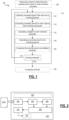
- FIGURE 1 is a diagrammatic representation of a non-limitative example of a method according to the invention.
- the method 100 of FIGURE 1 may be used to detect login anomalies for a user of cloud based SaaS Services, for example Microsoft ® SaaS Services, hosted in the cloud, for example hosted in the Azure cloud.
- cloud based SaaS Services for example Microsoft ® SaaS Services
- each user must be authenticated by an authentication server that is hosted in the same network as the SaaS services, for example the Microsoft ® network.
- the authentication may be carried out by entering login data, such as a username and a password.
- the login data is verified against login data stored in said network, such as login data stored in an AD of said network. If the login data is correct, then the user is authenticated and the login is successful.
- the user than may have access to SaaS services.
- the method 100 may be used to detect login anomalies, for one or several users, in such a configuration. More generally, the method 100 may be used to detect anomalies regarding the logins of a user on an authentication system, local or remote.
- the method 100 is carried out individually for each user. Thus the method carries out login anomaly detection specific to each user.
- the method 100 comprises a monitoring phase 110 carried out for a monitoring period.
- the monitoring period may be one day.
- the monitoring phase comprises a step 112 collecting a log of successful logins of said user on the authentication system, during the monitoring period, i.e. during one day. For each login during this monitoring phase, the values of several monitored parameters are measured. These parameters characterize each login, in time and/or in space. For example, the measured parameters may be:
- the log of successful logins may be collected from the authentication server, such as the Microsoft ® network for example, by requesting said log from the authentication server.
- the observation period 140 For each parameter, values are determined, prior to the monitoring phase 110. This is the observation period 140.
- the observation period may be thirty days.
- These predetermined values are also called bins in the present document.
- the predetermined values, i.e. the bins, for at least one monitored parameter may be specific for at least one, in particular for each, user.
- the predetermined values i.e. the bins, may be (8h-12h;12h-16h;16h-20h;20h-24h) for at least one user.
- the predetermined values, i.e. the bins, associated to said parameter may be (Monday; Tuesday; Wednesday; Thursday; Friday; Saturday; Sunday), for at least one user.
- the bins for at least one parameter may be determined during an observation phase carried out prior to the monitoring phase.
- the monitoring phase 110 comprises a step 114 calculating, for each value of each monitored parameter, a probability density, in said log. During this step, for each bin previously determined for each monitored parameter, a probability density is calculated. The probability density of a bin of a parameter is dependent on the number of occurrences of said bin in the log.
- the monitoring phase 110 comprises a step 116 calculating, for each monitored parameter, a weight, in said log.
- the weight may be calculated as a function of the density probabilities of each bin of the parameter, calculated during step 114.
- the monitoring phase 110 comprises a step 118 calculating an anomaly score for the logins of the user during the monitoring period.
- the anomaly score may be calculated as a function of the weights calculated during step 116 and the probability densities calculated during step 114.
- the monitoring phase 110 comprises a step 120 for comparing the anomaly score calculated in step 118 to a given threshold.
- the threshold may be specific for each user.
- the threshold may be the same for at least two, and in particular for all, users.
- the threshold may be 0,7.
- anomaly score is smaller than the threshold then no anomaly is detected. Another iteration of the monitoring phase 110 may be carried out.
- the method 100 may comprise an optional step 130 for carrying out a specific action in order to:
- the method 100 may also comprise an optional observation phase 140 for determining, at least one value, or bin, for at least one monitored parameter.
- an optional observation phase 140 for determining, at least one value, or bin, for at least one monitored parameter.
- the determination of a least one bin for at least one monitored parameter may be done by collecting logs of successful logins during an observation period and detecting in said logs each different value of said parameter. Each different value may thus be stored as a bin, to be used during the monitoring phases(s) for this parameter and for this user.
- the monitored parameters may take different values for different users.
- the invention allows use of values that are specific for each user and not to use generic values common to all users.
- the observation period may be for example a week or a month.
- FIGURE 2 is a diagrammatic representation of a non-limitative example of a device according to the invention.
- the device 200 of FIGURE 2 may be used to carry out a method according to the invention, and more specifically the method 100 of FIGURE 1 .
- the device 200 may be any computerized device such as a Smartphone, a tablet, a computer, a server, a processor, etc.
- the device 200 may be hosted in the remote network, i.e. the network hosting the authentication network. Alternatively, the device 200 may be distant to said network. In this case, the device 200 is in communication with the remote network, or at least the authentication server.
- the device 200 comprises a module 202 for collecting the log of successful logins for a user, for example from the authentication server.
- the log collection module 202 may be configured to carry out the log collection step 112 of the method 100.
- the device 200 comprises a module 204 for calculating probability densities of each value of each monitored parameter in the log collected by the module 202 for a monitoring period.
- the calculating module 204 may be configured to carry out the probability density calculation step 114 of the method 100.
- the device 200 comprises a module 206 for calculating a weight for each monitored parameter in the log collected by the module 202 for a monitoring period.
- the weight calculating module 206 may be configured to carry out the weight calculation step 116 of the method 100.
- the device 200 further comprises a module 208 for calculating an anomaly score corresponding to the log collected by the module 202, i.e. to the monitoring period for which said log is collected.
- the anomaly score calculating module 208 may be configured to carry out the anomaly score calculation step 118 of the method 100.
- the device 200 moreover comprises a module 210 for comparing the anomaly score to a threshold to determine whether there is an anomaly in the logins of the user over the monitoring period.
- the comparison module 210 may be configured to carry out the step 120 of the method 100.
- the device 200 may optionally comprise a module 212 for carrying out a specific action when an anomaly is detected for a monitoring period, in order to:
- the device 200 may optionally comprise a module 220 for carrying out an observation phase, for example the observation phase 140 of method 100, for determining, at least one value, or bin, for at least one monitored parameter.
- a module 220 for carrying out an observation phase for example the observation phase 140 of method 100, for determining, at least one value, or bin, for at least one monitored parameter.
- At least one of the modules of the device 200 described with reference to FIGURE 2 may be an independent module separated from the other modules.
- At least two of the modules may be integrated into a common module.
- At least one of the modules may be a software, such as a computer program, an application, etc.
- At least one of the modules may be a hardware component, such as a processor, a chip, a smartphone, a tablet, a computer, a server, etc.
- At least one of the modules may be a combination of at least one software and at least one hardware component.
Landscapes
- Engineering & Computer Science (AREA)
- Computer Security & Cryptography (AREA)
- Computer Hardware Design (AREA)
- General Engineering & Computer Science (AREA)
- Theoretical Computer Science (AREA)
- Computing Systems (AREA)
- Computer Networks & Wireless Communication (AREA)
- Signal Processing (AREA)
- Software Systems (AREA)
- Physics & Mathematics (AREA)
- General Physics & Mathematics (AREA)
- Debugging And Monitoring (AREA)
Abstract
-collecting (112) a log of successful logins of said user on said authentication system
- calculating(114), for each monitored parameter, a probability density, in said log, of each predetermined value of said parameter;
- calculating (116), for each parameter, a weight, as a function of said probability density of each predetermined value of said parameter;
- calculating (118) an anomaly score for said log as a function of the said weights and said probability densities; and
- comparing (120) said anomaly score to a given threshold in order to determine an anomaly in said daily log for said user.
Description
- The present invention relates to a user login anomaly detection method. The invention also relates to a computer program and a device configured to carry out such a method.
- The field of the invention is the field of the detecting anomalies related to successful logins of a user on authentication system, and more particularly on an authentication system regulating access to SaaS services.
- Users log into cloud based SaaS Services, for example Microsoft® SaaS Services, hosted in the cloud, for example Azure cloud, using an authentication server that is hosted in the network providing said services, such as Microsoft Azure Active Directory (AD) authentication. The SaaS services can be email, file repositories, company intranet and a number of other business applications. Such authentication may get compromised due to weak passwords or through many more sophisticated attacks including phishing attacks that hackers launch on unsuspecting users to capture usernames & passwords. One such example is to launch brute force attacks in which cybercriminals use automated tools to obtain the account password. If successful, the attackers can then invade a network, elevate their rights with administrative access, disable security products, and even run ransomware to encrypt critical data and hold the companies / users hostage.
- Hence there is a need to monitor the logins of users that take place through an authentication server of a network, either local or distant. As more and more companies and their users embrace this mode of authentication, this becomes all the more critical.
- A purpose of the present invention is to provide a solution for user login anomaly detection.
- Another purpose of the present invention is to provide a user login anomaly detection solution that is more user centric and more individualized for each user.
- Yet another purpose of the present invention is to provide a user login anomaly detection solution that is more efficient.
- The invention makes it possible to achieve at least one of these aims by a computer implemented method for detecting anomaly(ies) regarding the logins of a user on a local, or remote, authentication system, such as a remote Active Directory, AD, authentication system, said method comprising at least one iteration of a monitoring phase for a user, said monitoring phase comprising the following steps:
- collecting a log of successful logins of said user on said authentication system over a monitoring period:
- ▪ said log comprising, for each successful login, measured values of several monitored parameters;
- ▪ each measured value of each monitored parameter corresponding to a predetermined value among several values, called bins, previously defined for said parameter;
- calculating, for each monitored parameter, a probability density, in said log, of each predetermined value of said parameter;
- calculating, for each parameter, a weight, as a function of said probability density of each predetermined value of said parameter;
- calculating an anomaly score for said log as a function of the weights and probability densities; and
- comparing said score to a given threshold in order to determine an anomaly in said daily log for said user.
- The present invention thus proposes user login anomaly detection based on only successful logins of the user, over a monitoring period. Several parameters are measured for each login and an anomaly score for the monitoring period is calculated based said parameters. Advantageously, the invention proposes allocating different weights for each parameter in the computation of the anomaly score. Moreover, the weight allocated to each parameter is itself calculated based on the probability density of each value that said parameter takes during the monitoring period, i.e. in the log collected for said monitoring period. Thus, the present invention proposes a solution for login anomaly detection that is more user centric and individualized for each user. As a consequence, the login anomaly detection according to the invention is more adapted for each user and provides more efficient login anomaly detection.
- For at least one parameter, at least one predetermined value that said parameter may take, may be determined during an observation period, prior to the first iteration of the monitoring phase.
- The invention may comprise, for at least one user, an observation period during which at least one value, i.e. bin, may be determined for at least one parameter. The determination of a least one value may be done by collecting logs of successful logins of said user during said observation period, and detecting in said logs each different value of said parameter. Each different value may thus be stored as a predetermined value, i.e. a bin, to be used during the monitoring phases(s) for said parameter and said user.
- This enables a more personalized, and user centric, login anomaly detection. Indeed, the monitored parameters may take different values for different users. The invention allows use of values that are specific for each user, instead of using generic values common to all users.
- Of course, the observation period may be chosen as desired. According to some embodiments, the observation period may be a month.
- The monitoring period may be chosen as desired.
- According to some embodiments, the monitoring period may be a day. Thus the log for each user will be collected for a, and in particular, each day. An anomaly score may then be determined for each day and an anomaly occurring during a specific day may be detected.
- Any parameter relative to a login configuration may be used as a monitored parameter in the present invention.
- In some embodiments, for each login, a monitored parameter may comprise, or may be, the time of day, TOD, of the login. Thus, it is possible to monitor the activity of the user during the day. This gives valuable information regarding the behavior of the user and helps detecting an anomaly. For example, for a user who never logs in during night time, several night time logins may indicate suspicious activity that has to be detected.
- Alternatively, or in addition, for each login, a monitored parameter may comprise, or may be, the day of week, DOW, of the login. Thus, it is possible to monitor the activity of the user during the days of the week. This gives valuable information regarding the behavior of the user and helps detecting an anomaly over a week. For example, for a user who never logs in during the weekend, several logins during the weekend may indicate suspicious activity to be detected.
- Alternatively, or in addition, for each login, one monitored parameter may comprise, or may be, the geographical location, GEO, of the login. Thus, it is possible to monitor the activity of the user on a geographical scale. This gives valuable information regarding the behavior of the user and helps detecting an anomaly starting from the position of the user. For example, for a user who never logs in from a specific country or region, several logins carried out from said country or region may indicate suspicious activity to be detected.
- The inventors have noticed that the combination of these three parameters, i.e. the TOD, DOW and GEO, allows efficient and reactive anomaly detection.
- For example, for a monitored parameter that is the time of the day, the predetermined values, i.e. the bins, associated to said parameter may be (8h-12h;12h-16h;16h-20h;20h-24h). The values may be determined specifically for a given user. For another user, the bins may be different than those indicated here.
- According to non limitative examples, for a monitored parameter that is the day of the week, the predetermined values, i.e. the bins, associated to said parameter may be (Monday; Tuesday; Wednesday; Thursday; Friday; Saturday; Sunday). The values may be determined specifically for a given user. For another user, the bins for this parameter may be different than those indicated here.
- The density probability, noted Pa(b), of a bin "b" of a parameter "a" may be calculated according to any appropriate formula or relation.
- In some non limitative embodiments, the probability density Pa(b) may be calculated according to the following relation:

- Pa(b): the probability density of the bin "b" of parameter "a";
- TL: the total number of logins for this user during the monitoring period for bin "b" ;
- TLU: the total number of logins for this user during the monitoring period across all Bins Ba ; and
- Ba: the total number of bins for parameter "a".
- The weight, noted Wa, of a parameter "a" may be calculated according to any appropriate formula or relation.
- In some non limitative embodiments, the weight Wa of the parameter "a" for a user may be calculated according to the following relation:

- for a User c
- Pa(b|c): the probability density of the bin b of parameter a; and
- Ba: the total number of bins for parameter a.
- The anomaly score, noted S, of the log may be calculated according to any appropriate formula or relation.
- In some non limitative embodiments, the score, S, may be calculated according to the following relation:

- for a user c
- Wa: the weight of parameter "a";
- W : the sum of the weights of all of the parameters; and
- Pa(b): the probability density of the bin "b" of parameter "a".
- The method according to the invention may be used to detect login anomalies, for one or several users, for logging into cloud based SaaS Services, for example Microsoft®SaaS Services, hosted in the cloud, for example Azure cloud, using in built authentication server, such as Microsoft Azure Active Directory (AD) authentication.
- The SaaS services accessed can be email, file repositories, company intranet and a number of other business applications.
- The authentication server may be placed in a local or remote network, for example the Microsoft network. The SaaS services may be hosted in said network, for example the Microsoft network. Alternatively, the services may be hosted in another network than the one hosting the authentication server.
- According to another aspect of the same invention, it is proposed a computer program comprising instructions, which when executed by a computer, cause the computer to carry out the steps of the method according to the invention.
- The computer program may be in any programming language such as C, C++, JAVA, Python, etc.
- The computer program may be in machine language.
- The computer program may be stored, in a non-transient memory, such as a USB stick, a flash memory, a hard-disk, a processor, a programmable electronic chop, etc.
- The computer program may be stored in a computerized device such as a Smartphone, a tablet, a computer, a server, etc.
- According to another aspect of the same invention, it is proposed a device comprising means configured to carry out the steps of the method according to the invention.
- The device according to the invention may comprise means configured to carry out at least one, or a combination of at least two, of the optional features recited above in connection with the method according to the invention, in combination with the mandatory features of the method according to the invention. The device according to the invention provides the same advantages/benefits as those mentioned above for the method according to the invention.
- The device according to the invention may be any computerized device such as a Smartphone, a tablet, a computer, a server, a processor, etc.
- The device according to the invention may execute one or several applications to carry out the steps of the method according to the invention.
- The device according to the invention may be loaded with, and configured to execute, the computer program according to the invention.
- The device may comprise at least one module configured to collect a log of successful logins of the user on the authentication system over a monitoring period. As indicated above, the log of successful logins over the monitoring period comprises, for each successful login, measured values of several monitored parameters. Each measured value of each monitored parameter corresponds to a predetermined value, also called bin, among several values previously defined for said parameter.
- The device may comprise at least one module configured to calculate, for each monitored parameter, a probability density, in the log, of each predetermined value of said parameter. The calculation of each probability density may be carried out according to any formula, and more particularly according to Relation 1 indicated above.
- The device may comprise at least one module configured to calculate for each parameter, a weight, as a function of the probability density of each predetermined value of said parameter. The calculation of each weight may be carried out according to any formula, and more particularly according to Relation 2 indicated above.
- The device may comprise at least one module configured to calculate an anomaly score as a function of the weights of each parameter. The calculation of the anomaly score may be carried out according to any formula, and more particularly according to Relation 3 indicated above.
- The device may comprise at least one module configured to compare the calculated anomaly score to a predetermined threshold to determine whether there is, or not, an anomaly with the successful logins over the monitoring period.
- At least one of these modules, and more generally at least one of the modules of the device according to the invention, may be an independent module separated from the other modules.
- At least two of the modules may be integrated into a common module.
- At least one of the modules may be a software, such as a computer program, an application, etc.
- At least one of the modules may be a hardware component, such as a processor, a chip, a smartphone, a tablet, a computer, a server, etc.
- At least one of the modules may be a combination of at least one software and at least one hardware component.
- The device according to the invention may be hosted in the network where the authentication server is hosted.
- Alternatively, the device according to the invention may be hosted outside the network where the authentication server is hosted. In this case, the device according to the invention is in communication with the authentication server, directly or indirectly, for example through a communication network, such as the Internet.
- Other advantages and characteristics will become apparent on examination of the detailed description of an embodiment which is in no way limitative, and the attached figures, where:
-
FIGURE 1 is a diagrammatic representation of a non-limitative example of a method according to the invention; and -
FIGURE 2 is a diagrammatic representation of a non-limitative example of a device according to the invention. - It is well understood that the embodiments that will be described below are in no way limitative. In particular, it is possible to imagine variants of the invention comprising only a selection of the characteristics described hereinafter, in isolation from the other characteristics described, if this selection of characteristics is sufficient to confer a technical advantage or to differentiate the invention with respect to the state of the prior art. Such a selection comprises at least one, preferably functional, characteristic without structural details, or with only a part of the structural details if this part alone is sufficient to confer a technical advantage or to differentiate the invention with respect to the prior art.
- In the FIGURES, elements common to several figures retain the same reference.
-
FIGURE 1 is a diagrammatic representation of a non-limitative example of a method according to the invention. - The
method 100 ofFIGURE 1 may be used to detect login anomalies for a user of cloud based SaaS Services, for example Microsoft®SaaS Services, hosted in the cloud, for example hosted in the Azure cloud. In order to access SaaS services hosted in the cloud, each user must be authenticated by an authentication server that is hosted in the same network as the SaaS services, for example the Microsoft®network. The authentication may be carried out by entering login data, such as a username and a password. The login data is verified against login data stored in said network, such as login data stored in an AD of said network. If the login data is correct, then the user is authenticated and the login is successful. The user than may have access to SaaS services. - The
method 100 may be used to detect login anomalies, for one or several users, in such a configuration. More generally, themethod 100 may be used to detect anomalies regarding the logins of a user on an authentication system, local or remote. - The
method 100 is carried out individually for each user. Thus the method carries out login anomaly detection specific to each user. - The
method 100 comprises amonitoring phase 110 carried out for a monitoring period. For example, without loss of generality, the monitoring period may be one day. - The monitoring phase comprises a
step 112 collecting a log of successful logins of said user on the authentication system, during the monitoring period, i.e. during one day. For each login during this monitoring phase, the values of several monitored parameters are measured. These parameters characterize each login, in time and/or in space. For example, the measured parameters may be: - the time of day, TOD, the successful login takes place,
- the day of the week, DOW, the successful login takes place, and
- the geographic location, GEO, where the successful login takes place.
- The log of successful logins may be collected from the authentication server, such as the Microsoft® network for example, by requesting said log from the authentication server.
- For each parameter, values are determined, prior to the
monitoring phase 110. This is theobservation period 140. For example, without loss of generality, the observation period may be thirty days. - These predetermined values are also called bins in the present document.
- The predetermined values, i.e. the bins, for at least one monitored parameter may be specific for at least one, in particular for each, user.
- For example, for the TOD parameter, the predetermined values, i.e. the bins, may be (8h-12h;12h-16h;16h-20h;20h-24h) for at least one user.
- For example, for the DOW parameter, the predetermined values, i.e. the bins, associated to said parameter may be (Monday; Tuesday; Wednesday; Thursday; Friday; Saturday; Sunday), for at least one user.
- For at least one user, the bins for at least one parameter may be determined during an observation phase carried out prior to the monitoring phase.
- The
monitoring phase 110 comprises astep 114 calculating, for each value of each monitored parameter, a probability density, in said log. During this step, for each bin previously determined for each monitored parameter, a probability density is calculated. The probability density of a bin of a parameter is dependent on the number of occurrences of said bin in the log. - In some embodiments, the probability density, noted Pa(b), of a bin "b" for a parameter "a" may be calculated according to the following relation:

- Pa(b): the probability density of the bin "b" of parameter "a";
- TL: the total number of logins for this user during the monitoring period for bin "b" ;
- TLU: the total number of logins for this user during the monitoring period across all Bins Ba ; and
- Ba: the total number of bins for parameter "a".
- The
monitoring phase 110 comprises astep 116 calculating, for each monitored parameter, a weight, in said log. For each parameter, the weight may be calculated as a function of the density probabilities of each bin of the parameter, calculated duringstep 114. - In some embodiments, the weight Wa of the parameter "a" for a user may be calculated according to the following relation:

- for a User c
- Pa(b|c): the probability density of the bin b of parameter a; and
- Ba: the total number of bins for parameter a.
- The
monitoring phase 110 comprises astep 118 calculating an anomaly score for the logins of the user during the monitoring period. The anomaly score may be calculated as a function of the weights calculated duringstep 116 and the probability densities calculated duringstep 114. - In some non limitative embodiments, the score, S, may be calculated according to the following relation:

- for a user c
- Wa: the weight of parameter "a";
- W : the sum of the weights of all of the parameters; and
- Pa(b): the probability density of the bin "b" of parameter "a".
- The
monitoring phase 110 comprises astep 120 for comparing the anomaly score calculated instep 118 to a given threshold. The threshold may be specific for each user. The threshold may be the same for at least two, and in particular for all, users. - According to a non limitative example, the threshold may be 0,7.
- If the anomaly score is smaller than the threshold then no anomaly is detected. Another iteration of the
monitoring phase 110 may be carried out. - If the anomaly score is equal to, or greater than, the threshold value then an anomaly is detected. In this case, the
method 100 may comprise anoptional step 130 for carrying out a specific action in order to: - stop the anomaly, for example by denying access to the user, and/or
- report the anomaly, for example by emitting an alert to the user, to an administrator, etc.
- The
method 100 may also comprise anoptional observation phase 140 for determining, at least one value, or bin, for at least one monitored parameter. Thus, it is possible to determine bins that are specific to each user. The determination of a least one bin for at least one monitored parameter may be done by collecting logs of successful logins during an observation period and detecting in said logs each different value of said parameter. Each different value may thus be stored as a bin, to be used during the monitoring phases(s) for this parameter and for this user. - This enables a more personalized, and user centric, anomaly detection. Indeed, the monitored parameters may take different values for different users. The invention allows use of values that are specific for each user and not to use generic values common to all users.
- The observation period may be for example a week or a month.
-
FIGURE 2 is a diagrammatic representation of a non-limitative example of a device according to the invention. - The
device 200 ofFIGURE 2 may be used to carry out a method according to the invention, and more specifically themethod 100 ofFIGURE 1 . Thedevice 200 may be any computerized device such as a Smartphone, a tablet, a computer, a server, a processor, etc. - The
device 200 may be hosted in the remote network, i.e. the network hosting the authentication network. Alternatively, thedevice 200 may be distant to said network. In this case, thedevice 200 is in communication with the remote network, or at least the authentication server. - The
device 200 comprises amodule 202 for collecting the log of successful logins for a user, for example from the authentication server. Without loss of generality, thelog collection module 202 may be configured to carry out thelog collection step 112 of themethod 100. - The
device 200 comprises amodule 204 for calculating probability densities of each value of each monitored parameter in the log collected by themodule 202 for a monitoring period. Without loss of generality, the calculatingmodule 204 may be configured to carry out the probabilitydensity calculation step 114 of themethod 100. - The
device 200 comprises amodule 206 for calculating a weight for each monitored parameter in the log collected by themodule 202 for a monitoring period. Without loss of generality, theweight calculating module 206 may be configured to carry out theweight calculation step 116 of themethod 100. - The
device 200 further comprises amodule 208 for calculating an anomaly score corresponding to the log collected by themodule 202, i.e. to the monitoring period for which said log is collected. Without loss of generality, the anomaly score calculatingmodule 208 may be configured to carry out the anomalyscore calculation step 118 of themethod 100. - The
device 200 moreover comprises amodule 210 for comparing the anomaly score to a threshold to determine whether there is an anomaly in the logins of the user over the monitoring period. Without loss of generality, thecomparison module 210 may be configured to carry out thestep 120 of themethod 100. - The
device 200 may optionally comprise amodule 212 for carrying out a specific action when an anomaly is detected for a monitoring period, in order to: - stop the anomaly, for example by denying access to the user, and/or
- report the anomaly, for example by emitting an alert to the user, to an administrator, etc.
- etc.
- The
device 200 may optionally comprise amodule 220 for carrying out an observation phase, for example theobservation phase 140 ofmethod 100, for determining, at least one value, or bin, for at least one monitored parameter. - At least one of the modules of the
device 200 described with reference toFIGURE 2 , and more generally at least one of the modules of the device according to the invention, may be an independent module separated from the other modules. - At least two of the modules may be integrated into a common module.
- At least one of the modules may be a software, such as a computer program, an application, etc.
- At least one of the modules may be a hardware component, such as a processor, a chip, a smartphone, a tablet, a computer, a server, etc.
- At least one of the modules may be a combination of at least one software and at least one hardware component.
- Of course, the invention is not limited to the examples detailed above.
Claims (9)
- A computer implemented method (100) for detecting anomaly(ies) regarding the logins of a user on a local, or remote, authentication system, such as a remote Active Directory, AD, authentication system, said method (100) comprising at least one iteration of a monitoring phase (110) for a user, said monitoring phase (110) comprising the following steps:- collecting (112) a log of successful logins of said user on said authentication system over a monitoring period:▪ said log comprising, for each successful login, measured values of several monitored parameters;▪ each measured value of each monitored parameter corresponding to a predetermined value among several values, called bins, previously defined for said parameter;- calculating(114), for each monitored parameter, a probability density, in said log, of each predetermined value of said parameter;- calculating (116), for each parameter, a weight, as a function of said probability density of each predetermined value of said parameter;- calculating (118) an anomaly score for said log as a function of the said weights and said probability densities; and- comparing (120) said anomaly score to a given threshold in order to determine an anomaly in said daily log for said user.
- The method (100) according to the preceding claim, characterized in that the monitoring period is a day.
- The method (100) according to any one the preceding claims, characterized in that, for each login, the monitored parameters comprise at least one of the following parameters:- the time of day, TOD, of the login,- the day of week, DOW, of the login, and- the geographical location, GEO, of the login.
- The method (100) according to the preceding claim, characterized in that the bins are:- TOD: 8h-12h;12h-16h;16h-20h;20h-24h;- TOW: Monday; Tuesday; Wednesday; Thursday; Friday; Saturday; Sunday:
- The method (100) according to any of the preceding claims, characterized in that the density probability, Pa(b), of a bin "b" of a parameter "a" is calculated according to the following formula:
 - Pa(b): the probability density of the bin "b" of parameter "a";- TL: the total number of logins for this user during the monitoring period for bin "b" ;- TLU: the total number of logins for this user during the monitoring period across all Bins Ba ; and- Ba: the total number of bins for parameter "a".
 - The method (100) according to any of the preceding claims, characterized in that the weight Wa of a parameter "a" is calculated according to the following formula:
 - for a User c- Pa(b|c): the probability density of the bin b of parameter a; and- Ba: the total number of bins for parameter a.
 - The method (100) according to any of the preceding claims, characterized in that the anomaly score, S, is calculated according to the following formula:
 - for a user c- Wa: the weight of parameter "a";- W : the sum of the weights of all of the parameters; and- Pa(b): the probability density of the bin "b" of parameter "a".
 - A computer program comprising instructions, which when executed by a computer, cause the computer to carry out the steps of the method (100) according to any of the preceding claims.
- A device (200) comprising means configured to carry out the steps of the method (100) according to any one of claims 1-7.
Priority Applications (2)
| Application Number | Priority Date | Filing Date | Title |
|---|---|---|---|
| EP22306273.8A EP4332796A1 (en) | 2022-08-29 | 2022-08-29 | A user login anomaly detection method and system |
| US18/358,589 US12526299B2 (en) | 2022-08-29 | 2023-07-25 | User login anomaly detection method and system |
Applications Claiming Priority (1)
| Application Number | Priority Date | Filing Date | Title |
|---|---|---|---|
| EP22306273.8A EP4332796A1 (en) | 2022-08-29 | 2022-08-29 | A user login anomaly detection method and system |
Publications (1)
| Publication Number | Publication Date |
|---|---|
| EP4332796A1 true EP4332796A1 (en) | 2024-03-06 |
Family
ID=84044020
Family Applications (1)
| Application Number | Title | Priority Date | Filing Date |
|---|---|---|---|
| EP22306273.8A Pending EP4332796A1 (en) | 2022-08-29 | 2022-08-29 | A user login anomaly detection method and system |
Country Status (2)
| Country | Link |
|---|---|
| US (1) | US12526299B2 (en) |
| EP (1) | EP4332796A1 (en) |
Citations (2)
| Publication number | Priority date | Publication date | Assignee | Title |
|---|---|---|---|---|
| US8312540B1 (en) * | 2008-06-13 | 2012-11-13 | Juniper Networks, Inc. | System for slowing password attacks |
| US20200128047A1 (en) * | 2018-10-19 | 2020-04-23 | Oracle International Corporation | Autonomous monitoring of applications in a cloud environment |
Family Cites Families (10)
| Publication number | Priority date | Publication date | Assignee | Title |
|---|---|---|---|---|
| US10630729B2 (en) * | 2017-12-15 | 2020-04-21 | T-Mobile Usa, Inc. | Detecting fraudulent logins |
| US20200137067A1 (en) * | 2018-10-31 | 2020-04-30 | Hewlett Packard Enterprise Development Lp | Timeline for user and entity behavior analytics |
| US11425149B2 (en) * | 2019-01-31 | 2022-08-23 | Rapid7, Inc. | Multi-baseline unsupervised security-incident and network behavioral anomaly detection in cloud-based compute environments |
| US11438354B2 (en) * | 2019-11-04 | 2022-09-06 | Verizon Patent And Licensing Inc. | Systems and methods for utilizing machine learning models to detect cloud-based network access anomalies |
| US11218473B2 (en) * | 2019-11-06 | 2022-01-04 | Capital One Services, Llc | Systems and methods for identifying suspicious logins |
| US11269978B2 (en) * | 2020-05-07 | 2022-03-08 | Microsoft Technology Licensing, Llc | Detection of slow brute force attacks based on user-level time series analysis |
| US11943235B2 (en) * | 2021-01-04 | 2024-03-26 | Saudi Arabian Oil Company | Detecting suspicious user logins in private networks using machine learning |
| EP4113338B1 (en) * | 2021-06-30 | 2025-10-01 | Bull SAS | Method for detecting rdp login anomaly |
| US11954189B2 (en) * | 2022-01-31 | 2024-04-09 | Salesforce, Inc. | Method and system for contextual user logon authentication |
| US12341801B2 (en) * | 2022-12-16 | 2025-06-24 | Acronis International Gmbh | System and method of anomaly detection with configuration-related activity profiles |
-
2022
- 2022-08-29 EP EP22306273.8A patent/EP4332796A1/en active Pending
-
2023
- 2023-07-25 US US18/358,589 patent/US12526299B2/en active Active
Patent Citations (2)
| Publication number | Priority date | Publication date | Assignee | Title |
|---|---|---|---|---|
| US8312540B1 (en) * | 2008-06-13 | 2012-11-13 | Juniper Networks, Inc. | System for slowing password attacks |
| US20200128047A1 (en) * | 2018-10-19 | 2020-04-23 | Oracle International Corporation | Autonomous monitoring of applications in a cloud environment |
Also Published As
| Publication number | Publication date |
|---|---|
| US20240073231A1 (en) | 2024-02-29 |
| US12526299B2 (en) | 2026-01-13 |
Similar Documents
| Publication | Publication Date | Title |
|---|---|---|
| US20250080518A1 (en) | Systems and methods of sharing information through a tag-based consortium | |
| US9117076B2 (en) | System and method for detecting potential threats by monitoring user and system behavior associated with computer and network activity | |
| NL2031466B1 (en) | System and method for active detection of malicious network resources | |
| US9760701B1 (en) | Secondary user authentication bypass based on a whitelisting deviation from a user pattern | |
| EP3188436A1 (en) | Platform for protecting small and medium enterprises from cyber security threats | |
| KR102157712B1 (en) | Information leakage detection method and device | |
| US11750618B1 (en) | System and method for retrieval and analysis of operational data from customer, cloud-hosted virtual resources | |
| EP2985974A1 (en) | Malicious tunneling handling system | |
| US20030084323A1 (en) | Network intrusion detection system and method | |
| US9059987B1 (en) | Methods and systems of using single sign-on for identification for a web server not integrated with an enterprise network | |
| CN112165488A (en) | Risk assessment method, device and equipment and readable storage medium | |
| EP4348932B1 (en) | Threat detection using cloud resource management logs | |
| Matsuda et al. | Detecting apt attacks against active directory using machine leaning | |
| CN110225031B (en) | Dynamic permission vulnerability detection method, system and device and readable storage medium | |
| US10511974B2 (en) | System and method of identifying potentially dangerous devices during the interaction of a user with banking services | |
| US11855989B1 (en) | System and method for graduated deny list | |
| Bakar et al. | Adaptive authentication based on analysis of user behavior | |
| NZ776613A (en) | Detecting and responding to attempts to gain unauthorized access to user accounts in an online system | |
| CN109165514A (en) | A kind of risk checking method | |
| US12019784B2 (en) | Privacy preserving evaluation of sensitive user features for anomaly detection | |
| US9800596B1 (en) | Automated detection of time-based access anomalies in a computer network through processing of login data | |
| GB2544608A (en) | Network monitoring device, network monitoring method, and network monitoring program | |
| US20180183819A1 (en) | System to detect machine-initiated events in time series data | |
| Grigorescu et al. | Contextual remediations prioritization system designed to implement theoretical principles of CVSS V4 | |
| US12526299B2 (en) | User login anomaly detection method and system |
Legal Events
| Date | Code | Title | Description |
|---|---|---|---|
| PUAI | Public reference made under article 153(3) epc to a published international application that has entered the european phase |
Free format text: ORIGINAL CODE: 0009012 |
|
| STAA | Information on the status of an ep patent application or granted ep patent |
Free format text: STATUS: THE APPLICATION HAS BEEN PUBLISHED |
|
| AK | Designated contracting states |
Kind code of ref document: A1 Designated state(s): AL AT BE BG CH CY CZ DE DK EE ES FI FR GB GR HR HU IE IS IT LI LT LU LV MC MK MT NL NO PL PT RO RS SE SI SK SM TR |
|
| STAA | Information on the status of an ep patent application or granted ep patent |
Free format text: STATUS: REQUEST FOR EXAMINATION WAS MADE |
|
| 17P | Request for examination filed |
Effective date: 20240826 |
|
| RBV | Designated contracting states (corrected) |
Designated state(s): AL AT BE BG CH CY CZ DE DK EE ES FI FR GB GR HR HU IE IS IT LI LT LU LV MC MK MT NL NO PL PT RO RS SE SI SK SM TR |
|
| P01 | Opt-out of the competence of the unified patent court (upc) registered |
Free format text: CASE NUMBER: APP_22847/2025 Effective date: 20250514 |
|
| GRAP | Despatch of communication of intention to grant a patent |
Free format text: ORIGINAL CODE: EPIDOSNIGR1 |
|
| STAA | Information on the status of an ep patent application or granted ep patent |
Free format text: STATUS: GRANT OF PATENT IS INTENDED |
|
| INTG | Intention to grant announced |
Effective date: 20260302 |