EP4332746A1 - Data processing method and data processing program - Google Patents
Data processing method and data processing program Download PDFInfo
- Publication number
- EP4332746A1 EP4332746A1 EP23176939.9A EP23176939A EP4332746A1 EP 4332746 A1 EP4332746 A1 EP 4332746A1 EP 23176939 A EP23176939 A EP 23176939A EP 4332746 A1 EP4332746 A1 EP 4332746A1
- Authority
- EP
- European Patent Office
- Prior art keywords
- data
- specific
- digital twin
- read
- common
- Prior art date
- Legal status (The legal status is an assumption and is not a legal conclusion. Google has not performed a legal analysis and makes no representation as to the accuracy of the status listed.)
- Granted
Links
Images







Classifications
-
- G—PHYSICS
- G06—COMPUTING OR CALCULATING; COUNTING
- G06F—ELECTRIC DIGITAL DATA PROCESSING
- G06F3/00—Input arrangements for transferring data to be processed into a form capable of being handled by the computer; Output arrangements for transferring data from processing unit to output unit, e.g. interface arrangements
- G06F3/06—Digital input from, or digital output to, record carriers, e.g. RAID, emulated record carriers or networked record carriers
- G06F3/0601—Interfaces specially adapted for storage systems
- G06F3/0628—Interfaces specially adapted for storage systems making use of a particular technique
- G06F3/0655—Vertical data movement, i.e. input-output transfer; data movement between one or more hosts and one or more storage devices
-
- G—PHYSICS
- G06—COMPUTING OR CALCULATING; COUNTING
- G06F—ELECTRIC DIGITAL DATA PROCESSING
- G06F3/00—Input arrangements for transferring data to be processed into a form capable of being handled by the computer; Output arrangements for transferring data from processing unit to output unit, e.g. interface arrangements
- G06F3/06—Digital input from, or digital output to, record carriers, e.g. RAID, emulated record carriers or networked record carriers
- G06F3/0601—Interfaces specially adapted for storage systems
- G06F3/0602—Interfaces specially adapted for storage systems specifically adapted to achieve a particular effect
- G06F3/0608—Saving storage space on storage systems
-
- G—PHYSICS
- G06—COMPUTING OR CALCULATING; COUNTING
- G06F—ELECTRIC DIGITAL DATA PROCESSING
- G06F16/00—Information retrieval; Database structures therefor; File system structures therefor
- G06F16/20—Information retrieval; Database structures therefor; File system structures therefor of structured data, e.g. relational data
- G06F16/27—Replication, distribution or synchronisation of data between databases or within a distributed database system; Distributed database system architectures therefor
-
- G—PHYSICS
- G06—COMPUTING OR CALCULATING; COUNTING
- G06F—ELECTRIC DIGITAL DATA PROCESSING
- G06F3/00—Input arrangements for transferring data to be processed into a form capable of being handled by the computer; Output arrangements for transferring data from processing unit to output unit, e.g. interface arrangements
- G06F3/06—Digital input from, or digital output to, record carriers, e.g. RAID, emulated record carriers or networked record carriers
- G06F3/0601—Interfaces specially adapted for storage systems
- G06F3/0602—Interfaces specially adapted for storage systems specifically adapted to achieve a particular effect
- G06F3/061—Improving I/O performance
-
- G—PHYSICS
- G06—COMPUTING OR CALCULATING; COUNTING
- G06F—ELECTRIC DIGITAL DATA PROCESSING
- G06F3/00—Input arrangements for transferring data to be processed into a form capable of being handled by the computer; Output arrangements for transferring data from processing unit to output unit, e.g. interface arrangements
- G06F3/06—Digital input from, or digital output to, record carriers, e.g. RAID, emulated record carriers or networked record carriers
- G06F3/0601—Interfaces specially adapted for storage systems
- G06F3/0628—Interfaces specially adapted for storage systems making use of a particular technique
- G06F3/0655—Vertical data movement, i.e. input-output transfer; data movement between one or more hosts and one or more storage devices
- G06F3/0659—Command handling arrangements, e.g. command buffers, queues, command scheduling
-
- G—PHYSICS
- G06—COMPUTING OR CALCULATING; COUNTING
- G06F—ELECTRIC DIGITAL DATA PROCESSING
- G06F3/00—Input arrangements for transferring data to be processed into a form capable of being handled by the computer; Output arrangements for transferring data from processing unit to output unit, e.g. interface arrangements
- G06F3/06—Digital input from, or digital output to, record carriers, e.g. RAID, emulated record carriers or networked record carriers
- G06F3/0601—Interfaces specially adapted for storage systems
- G06F3/0668—Interfaces specially adapted for storage systems adopting a particular infrastructure
- G06F3/067—Distributed or networked storage systems, e.g. storage area networks [SAN], network attached storage [NAS]
-
- G—PHYSICS
- G06—COMPUTING OR CALCULATING; COUNTING
- G06F—ELECTRIC DIGITAL DATA PROCESSING
- G06F3/00—Input arrangements for transferring data to be processed into a form capable of being handled by the computer; Output arrangements for transferring data from processing unit to output unit, e.g. interface arrangements
- G06F3/06—Digital input from, or digital output to, record carriers, e.g. RAID, emulated record carriers or networked record carriers
- G06F3/0601—Interfaces specially adapted for storage systems
- G06F3/0668—Interfaces specially adapted for storage systems adopting a particular infrastructure
- G06F3/0671—In-line storage system
- G06F3/0673—Single storage device
- G06F3/0679—Non-volatile semiconductor memory device, e.g. flash memory, one time programmable memory [OTP]
-
- G—PHYSICS
- G06—COMPUTING OR CALCULATING; COUNTING
- G06F—ELECTRIC DIGITAL DATA PROCESSING
- G06F3/00—Input arrangements for transferring data to be processed into a form capable of being handled by the computer; Output arrangements for transferring data from processing unit to output unit, e.g. interface arrangements
- G06F3/06—Digital input from, or digital output to, record carriers, e.g. RAID, emulated record carriers or networked record carriers
- G06F3/0601—Interfaces specially adapted for storage systems
- G06F3/0602—Interfaces specially adapted for storage systems specifically adapted to achieve a particular effect
- G06F3/0604—Improving or facilitating administration, e.g. storage management
-
- G—PHYSICS
- G06—COMPUTING OR CALCULATING; COUNTING
- G06F—ELECTRIC DIGITAL DATA PROCESSING
- G06F3/00—Input arrangements for transferring data to be processed into a form capable of being handled by the computer; Output arrangements for transferring data from processing unit to output unit, e.g. interface arrangements
- G06F3/06—Digital input from, or digital output to, record carriers, e.g. RAID, emulated record carriers or networked record carriers
- G06F3/0601—Interfaces specially adapted for storage systems
- G06F3/0628—Interfaces specially adapted for storage systems making use of a particular technique
- G06F3/0629—Configuration or reconfiguration of storage systems
- G06F3/0631—Configuration or reconfiguration of storage systems by allocating resources to storage systems
Definitions
- the embodiment discussed herein is related to a data processing method and a data processing program.
- An object actually operating in the real world may be represented as a model of mapping in a virtual space according to a digital twin (DT).
- DT digital twin
- source data of a state such as a sensor value detected by a real-world IoT device is transmitted to a center.
- the center constructs a digital twin of the real-world object from the received source data.
- the digital twin for each service performs a process of visualizing and analyzing the real world using the source data.
- information derived based on the target source data is stored in association with the object (twin), which makes it easier to perform analysis and visualization processing (referred to as specific processing).
- a technique for a multi-tenant service in which a database has common data and specific data for each tenant and an specific schema is enabled to access the common data through a view.
- a plurality of computers for data analysis is provided and the computers for data analysis are distributed and executed for each analysis process.
- a technique of simulating a plurality of aspects of a system by defining each model-specific data and common data in a plurality of simulation environments.
- IDM multi-tenant identity management
- an object of the embodiment is to enable efficient use of storage even when the number of services increases.
- a method for data processing to be performed by a computer of a data processing device comprising: a common digital twin in which first processed data obtained by processing received source data is stored; a specific digital twin in which second processed data obtained by processing the source data is stored; and a service unit for each of a plurality of services that requests access to the common digital twin or the specific digital twin to perform data processing, wherein each of a plurality of the service units is configured to: read the second processed data from the specific digital twin for each of the plurality of services; and when no data to be read is determined to exist, read the first processed data from the common digital twin, in accordance with a predetermined data distribution rule.
- an effect that storage may be efficiently used even when the number of services increases is exerted.
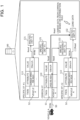
- FIG. 1 is an explanatory diagram illustrating an example of a data processing method according to an embodiment.
- a data processing device 100 includes, for example, a common digital twin (DT) common to a plurality of services, and a specific digital twin unique to each of the plurality of services.
- the data processing device 100 is a computer that performs a process of distributing reading and writing of data for the common DT and the specific DT based on a distribution rule at a time of a data request (input/output (I/O) request).
- the common DT and the specific DT are each formed in a storage area such as a database (DB).
- DB database
- a vehicle A transmits a speed to the data processing device 100, and an average speed per hour is calculated for each of the plurality of services to carry out analysis processing based on the average speed per hour.
- the data processing device 100 writes, for example, first processed data S1 obtained by processing information regarding the "speed”, which is source data S0 transmitted from a sensor of the vehicle A, in a common DT 110 (Write).
- the data processing device 100 writes, in the common DT 110, a twin name "vehicle A", an attribute "speed per hour”, and a speed value "15km/h” as the first processed data S1.
- a specific DT #1 (111) and a specific DT #2 (112) are provided as two specific DTs corresponding to two different services related to the twin "vehicle A". Furthermore, an specific processing unit #1 (121) and an specific processing unit #2 (122) are provided corresponding to the two services. Furthermore, an analysis unit #1 (131) and an analysis unit #2 (132) are provided corresponding to the two services.
- the specific processing unit #1 (121) reads the value of the speed per hour, which is the first processed data S1 of the vehicle A, from the common DT 110, and performs specific processing of generating second processed data S2 corresponding to a service #1 on the read value. Then, the specific processing unit #1 (121) writes the second processed data S2, which is the specific processing result, in the specific DT #1 (111) (Write).
- the specific processing unit #1 (121) calculates, from the common DT 110, an average value (average speed) of the "speed per hour" of a predetermined period of time (e.g., during the past 10 minutes) for the value of the "speed per hour", which is data of the vehicle A.
- the specific processing unit #1 (121) calculates an average speed "35 km/h” as the second processed data S2, and writes the twin name "vehicle A", the attribute "average speed per hour”, and the speed value "35 km/h” in the specific DT #1 (111).
- the analysis unit #1 (131) carries out the analysis processing corresponding to the service #1. For example, the analysis unit #1 (131) reads the average speed per hour of the vehicle A, which is the second processed data S2, from the specific DT #1 (111) (Read), and carries out the analysis processing for the service #1, such as prediction of traveling of the vehicle A, based on the average speed per hour and values of other attributes.
- the specific processing unit #2 (122) reads the value of the speed per hour, which is the first processed data S1 of the vehicle A, from the common DT 110, and performs specific processing of generating second processed data S2 corresponding to a service #2 on the read value. Then, the specific processing unit #2 (122) writes the second processed data S2, which is the specific processing result, in the specific DT #2 (112) (Write).
- the specific processing unit #2 (122) calculates, from the common DT 110, an average value (average speed) of the "speed per hour" of a predetermined period of time (e.g., during the past 30 minutes) for the value of the "speed per hour", which is data of the vehicle A.
- the specific processing unit #2 (122) calculates an average speed "20 km/h” as the second processed data S2, and writes the twin name "vehicle A", the attribute "average speed per hour”, and the speed value "20 km/h” in the specific DT #2 (112).
- the analysis unit #2 (132) carries out the analysis processing corresponding to the service #2.
- the analysis unit #2 (132) reads the average speed per hour of the vehicle A, which is the second processed data S2, from the specific DT #2 (112) (Read), and carries out the analysis processing for the service #2, such as prediction of traveling of the vehicle A, based on the average speed per hour and values of other attributes.
- the specific DT #1 (111) and the specific DT #2 (112) are managed by different service providers, and the common DT 110 is managed by a service base provider.
- some specific DTs do not include an specific processing unit.
- the second processed data S2 (specific processing result) processed by the specific processing unit does not exist in the specific DT but exists only in the common DT.
- the DT from which the analysis unit obtains the processed data (specific processing result) differs for each specific DT.
- the data processing device 100 has a distribution rule for each access request source with respect to the DT.
- a basic default distribution rule is "reading the second processed data S2 and reading the first processed data S1 if it is determined that no data to be read exists".
- the data processing device 100 controls the reading of the DT based on the distribution rule setting. This makes it possible to control a source from which data is obtained with a simple mechanism.
- the distribution rule may be set for each access request source with respect to the DT. For example, in a case where the access request source has a distribution rule and the data processing device 100 has succeeded in obtaining the distribution rule from the request source, distribution may be carried out in accordance with the obtained distribution rule instead of the default acquisition rule.
- the data processing device 100 is enabled to present one DT for the plurality of services while having the common DT and the specific DT, which makes it possible to reduce resources and the like.
- the analysis unit #2 (132) may also read the first processed data S1 "speed per hour” from the common DT 110 and carry out the analysis processing corresponding to the service #2.
- the vehicle A transmits the "speed per hour” and "average speed per hour” to write them in the common DT 110.
- the analysis unit #2 (132) may read the same attribute "average speed per hour” from the common DT 110 to carry out the analysis processing based on the distribution rule (3).
- the analysis unit #2 reads data (first processed data S1) from the common DT 110 based on the distribution rule, it becomes possible to support different service forms. For example, there are the following service forms [1.] to [3.].
- FIG. 2 is an explanatory diagram of a problem when a digital twin is prepared for each service.
- a DT-A (201) and a DT-B (202) need to be prepared corresponding to two services A and B.
- an specific processing unit A (211), an specific processing unit B (212), an analysis unit A (213), and an analysis unit B (214) are prepared corresponding to the two services.
- the same information is doubly collected and retained by the two services so that the DT-A (201) and the DT-B (202) are needed, which incurs enormous cost.
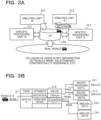
- FIGs. 3A and 3B are explanatory diagrams of a problem when a digital twin is shared by a plurality of services.
- a DT 210 common to the two services A and B is prepared.
- an specific processing unit A (211), an specific processing unit B (212), an analysis unit A (213), and an analysis unit B (214) are prepared corresponding to the two services.
- a digital twin is shared by a plurality of services, there is a problem that specific processing results, which are service-specific, cause collision at the time of saving (writing) the specific processing results of specific services in the digital twin.
- a collision occurs in which the specific processing results having values different for each service are to be written.
- the digital twin is shared by a plurality of services, not only a collision occurs in information associated with the plurality of services, such as attributes and relationships, but also a problem of confidentiality occurs.
- FIG. 3B illustrates a specific example of collision occurrence.
- the specific processing unit A (211) calculates the attribute "average speed per hour (35 km/h)" for the past 10 minutes based on the "speed per hour” of the vehicle A, and writes it in the DT 210.
- the specific processing unit B (212) calculates the attribute "average speed per hour (20 km/h)" for the past 30 minutes based on the "speed per hour” of the vehicle A, and writes it in the DT 210.
- a collision occurs as the specific processing unit A (211) and the specific processing unit B (212) attempt to write different values (35 km/h and 20 km/h) for the same attribute "average speed per hour" in the DT 210, whereby analysis may not be carried out.
- relationship collision a collision occurs when a similar relationship name is used in a relationship between digital twins (e.g., hierarchical relationship between a person and an organization, etc.). Furthermore, a problem of confidentiality is raised. For example, in a case where the analysis unit A (213) and the analysis unit B (214) are services of different companies, specific processing results may not be intended to be disclosed to each other, but this may not be adapted, whereby the confidentiality may not be maintained.
- FIG. 4 is an explanatory diagram of functions of the data processing device according to the embodiment.
- the data processing device 100 is configured by distributed processing of a plurality of servers, for example.
- the data processing device 100 includes an integrated digital twin I/O unit 401, a service DT setting table 402, a distribution rule table 403, the common DT 110, the specific DT #1 (111), the specific DT #2 (112), a service unit #1 (411), and a service unit #2 (412).
- the common DT 110, the specific DT #1 (111), and the specific DT #2 (112) are an integrated digital twin 400 integrated into one. Furthermore, it is assumed that the data processing device 100 receives a value of the "speed" detected by the sensor of the vehicle A illustrated in FIG. 1 as source data S0.
- the number of the specific digital twins is set to two, which includes the specific DT #1 (111) and the specific DT #2 (112) corresponding to the two services, in the exemplary configuration of FIG. 4 for the sake of convenience, the number of the specific digital twins may be arranged depending on the number of services.
- the service unit #1 (411) and the service unit #2 (412) include the specific processing unit and the analysis unit illustrated in FIG. 1 .
- Information regarding the DT to be accessed for each service is set in the service DT setting table 402. For example, information indicating that the access of the service unit #1 (411) is the specific DT #1 (111) and the access of the service unit #2 (412) is the specific DT #2 (112) is set. Note that the common DT 110 is accessible from both of the service unit #1 (411) and the service unit #2 (412).
- the service unit #1 (411) includes the specific processing unit #1 (121) and the analysis unit #1 (131) illustrated in FIG. 1 .
- the service unit #1 (411) accesses (reads and writes) the common DT 110 and the specific DT #1 (111) via the integrated digital twin I/O unit 401.
- the service unit #2 (412) includes the specific processing unit #2 (122) and the analysis unit #2 (132) illustrated in FIG. 1 .
- the service unit #2 (412) accesses the common DT 110 and the specific DT #2 (112) via the integrated digital twin I/O unit 401.
- the integrated digital twin I/O unit 401 includes a request reception unit 421, a distribution destination determination unit 422, and a request transmission unit 423.
- the request reception unit 421 receives a request for accessing the digital twin.
- the request reception unit 421 receives requests from the source data S0 of "speed" transmitted by the "vehicle A", the service unit #1 (411), and the service unit #2 (412).
- the distribution destination determination unit 422 refers to the distribution rule table 403 based on the request from the transmission source of the source data S0 that has made the request or the service units #1 and #2 (411 and 412). Then, the distribution destination determination unit 422 determines distribution destinations of access (reading and writing) to the DT (common DT 110 and specific DTs #1 and #2 (111 and 112)) based on the distribution rule set in the distribution rule table 403.
- the distribution destination determination unit 422 performs writing in the corresponding specific DT in accordance with the distribution rule, for example. Furthermore, in response to read requests from the specific processing unit and the analysis unit, the distribution destination determination unit 422 first performs reading from the service-specific DT, and then performs reading from the common DT if there is no data. In addition, in a case where no specific distribution rule is defined by the request source, the distribution destination determination unit 422 performs processing by applying a default distribution rule.
- “specific DT #1 ⁇ common DT” is set for reading from the DT in the service unit #1 (411) in a record 403-2 of the distribution rule table 403.
- the analysis unit #1 (131) of the service unit #1 (411) first reads the data of the attribute requested from the specific DT #1 (111), and reads the data from the common DT 110 if it fails to read the data of the attribute from the specific DT #1 (111).
- “specific DT #2 ⁇ common DT” is set for reading from the DT in the service unit #2 (412) in a record 403-3 of the distribution rule table 403.
- the analysis unit #2 (132) of the service unit #2 (412) first reads the data of the attribute requested from the specific DT #2 (112), and reads the data from the common DT 110 if it fails to read the data of the attribute from the specific DT #2 (112).
- reading and writing from and to the common DT 110 are set for a "common" request that does not specify a request source in a record 403-4 of the distribution rule table 403.
- FIG. 5 is a diagram illustrating an exemplary hardware configuration of the data processing device.
- the data processing device 100 may be configured by a computer such as a server including general-purpose hardware illustrated in FIG. 5 .
- the data processing device 100 includes a central processing unit (CPU) 501, a memory 502, and a network interface (I/F) 503. Furthermore, the data processing device 100 includes a recording medium I/F 504, a recording medium 505, a portable recording medium I/F 506, and a portable recording medium 507. Furthermore, the specific components are coupled to each other by a bus 500.
- the CPU 501 functions as a control unit that takes overall control of the data processing device 100.
- the CPU 501 may include a plurality of cores.
- the memory 502 includes, for example, a read only memory (ROM), a random access memory (RAM), a flash ROM, and the like.
- the flash ROM stores an operating system (OS) program
- the ROM stores application programs
- the RAM is used as a work area for the CPU 501, for example.
- a program stored in the memory 502 is loaded into the CPU 501 to cause the CPU 501 to execute coded processing.
- the network I/F 503 is coupled to a network NW through a communication line, and is coupled to an external computer through the network NW.
- each server is coupled to the external computer through the network NW.
- the network I/F 503 manages an interface between the network NW and the inside of the device, and controls input and output of data from the external computer.
- a modem, a local area network (LAN) adapter, or the like may be adopted as the network I/F 503.
- the recording medium I/F 504 controls reading and writing of data from and to the recording medium 505 under the control of the CPU 501.
- the recording medium 505 stores data written under the control of the recording medium I/F 504. Examples of the recording medium 505 include a magnetic disk, an optical disc, and the like.
- the portable recording medium I/F 506 controls reading and writing of data from and into the portable recording medium 507 under the control of the CPU 501.
- the portable recording medium 507 stores data written under the control of the portable recording medium I/F 506.
- Examples of the portable recording medium 507 include a compact disc (CD)-ROM, a digital versatile disk (DVD), a universal serial bus (USB) memory, and the like.
- the data processing device 100 may include, for example, an input device, a display, and the like in addition to the components described above.
- the functions of the integrated digital twin I/O unit 401 illustrated in FIG. 4 may be implemented by the CPU 501 illustrated in FIG. 5 executing a program.
- the functions of the service DT setting table 402, the distribution rule table 403, the common DT 110, the specific DT #1 (111), and the specific DT #2 (112) illustrated in FIG. 4 may be implemented by, for example, using the recording medium 505 and the portable recording medium 507 illustrated in FIG. 5 .
- the service units #1 and #2 (411 and 412) illustrated in FIG. 4 may be configured by hardware such as the server in FIG. 5 and the like each owned by a service company outside the data processing device 100.
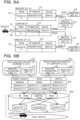
- FIGs. 6A and 6B are explanatory diagrams of a first exemplary process performed by the data processing device.
- FIGs. 6A and 6B illustrate an exemplary process in the case of above-described [1.] sharing a DT among multiple different services.
- FIG. 6A illustrates an access state of reading and writing to the DT in a similar manner to FIG. 1
- FIG. 6B illustrates a distribution state of reading and writing in response to a request for each service.
- the distribution rule table 403 illustrated in FIG. 6B represents a default distribution rule, which is "reading the attribute value of the common DT until the specific processing of the service is written, and reading the attribute of the specific DT when the specific processing is written". Specifically, in the distribution rule table 403, only writing to the common DT 110 is set for the source data S0 from the sensor. Furthermore, “specific DT #1 -> common DT” is set for reading from the DT in the service unit #1 (411). Furthermore, “specific DT #1” is set for writing to the DT in the service unit #1 (411).
- FIGs. 6A and 6B are two exemplary services, and one is a ride-hailing service (#1) 411 of a company A, and the other one is a deoxygenation service (#2) 412 of a company B.
- ride-hailing service #1 411 of a company A
- deoxygenation service #2 412 of a company B.
- the specific processing unit #1 (121) calculates the attribute "average speed per hour” for the past 10 minutes from the "speed per hour” to provide a service related to dispatch of the vehicle A. Then, the specific processing unit #1 (121) writes the calculated value in the specific DT #1 (111) based on the distribution rule of the distribution rule table 403.
- the analysis unit #1 (131) performs reading based on the distribution rule of the distribution rule table 403. First, the analysis unit #1 (131) reads the value of the attribute "average speed” from the specific DT #1 (111). At this time, in a case where the analysis unit #1 (131) fails to read the value of the attribute "average speed” from the specific DT #1 (111), it reads the value of the "speed per hour” from the common DT 110, and carries out analysis based on the "speed per hour".
- the specific processing unit #2 (122) calculates the "average speed per hour” for the past 30 minutes from the "speed per hour” to predict a CO2 emission amount. Then, the specific processing unit #2 (122) writes the calculated value in the specific DT #2 (112) based on the distribution rule of the distribution rule table 403.
- the analysis unit #2 (132) performs reading based on the distribution rule of the distribution rule table 403. First, the analysis unit #2 (132) reads the value of the attribute "average speed” from the specific DT #2 (112). At this time, in a case where the analysis unit #2 (132) fails to read the value of the attribute "average speed” from the specific DT #2 (112), it reads the value of the "speed per hour” from the common DT 110, and carries out analysis based on the "speed per hour".
- the data processing device 100 is enabled to be present in a form of behaving as one DT in response to requests from different services, and is enabled to provide a plurality of services with one DT. Additionally, the common DT 110 and the service-specific DTs #1 and #2 (111 and 112) may be selectively used, and the storage area needed for the DT may be reduced.
- mapping shared by the plurality of services only needs to be one common DT 110, a plurality of upload destinations of the source data S0 for creating the mapping does not need to be provided, and resources for the mapping may be reduced. For example, for the two services, the vehicle A only needs to transmit data to one common DT 110.
- analysis results among the plurality of services may be viewed as one DT, it becomes possible to know a relationship that has not been recognized previously. For example, by making a proposal to change the private vehicle A to a share-ride bus or the like based on the analysis results of the two services illustrated in FIGs. 6A and 6B , it becomes possible to present information regarding further reduction of CO2 emission.
- FIGs. 7A and 7B are comparative diagrams for explaining storage reduction.
- FIG. 7A illustrates an exemplary DT configuration according to the related art.
- a DT needs to be prepared for each service.
- a common DT 210 and a specific DT-A 201 are prepared for the service A.
- the common DT 210 and a specific DT-B 202 also need to be prepared for the service B.
- a storage area equivalent to the common DT 210 needs to be prepared for each service, which incurs enormous cost of the DT storage capacity as the number of services increases.
- FIG. 7B illustrates an exemplary DT configuration according to the embodiment. According to the embodiment, it is sufficient if one common DT 110 is prepared regardless of the number of services. As illustrated in FIG. 7B , in the case of the two service units #1 and #2 (411 and 412), the specific DT #1 (111) for the service unit #1 (411) and the specific DT #2 (112) for the service unit #2 (412) are prepared. Then, it is sufficient if the common DT 110 to be shared by the service units #1 and #2 (411 and 412) are prepared. It only needs to arrange one common DT 110 for all services. As a result, according to the embodiment, it becomes possible to enhance the effect of reducing the DT storage capacity as the number of services increases.
- FIGs. 8A and 8B are explanatory diagrams of a second exemplary process performed by the data processing device.
- FIGs. 8A and 8B illustrate an exemplary process in the case of above-described [2.] reducing a change cost at a time of changing calculation of an attribute value depending on a situation.
- FIGs. 8A and 8B illustrate access states of reading and writing to the DT at different times.
- FIGs. 8A and 8B is an example of one service, and includes one common DT 110 and one specific DT #1 (111).
- An specific processing unit (common) 801 performs a process of reading the "speed per hour" of the vehicle A in the common DT 110, calculating the "average speed per hour” for the past 10 minutes, and writing it in the common DT 110.
- the specific processing unit #1 (121) performs a process of reading the "speed per hour” of the vehicle A in the common DT 110, calculating the "average speed per hour” for the past 30 minutes, and writing it in the specific DT #1 (111) during operation.
- the distribution rule table 403 is a default distribution rule, which is "reading the attribute value of the common DT until the specific processing of the service is written, and reading the attribute of the specific DT when the specific processing is written".
- the analysis unit #1 (131) of a certain service reads the "average speed" from the common DT 110 when the specific processing unit #1 (121) is unoperated. Then, as illustrated in FIG. 8B , the analysis unit #1 (131) reads the "average speed" of the same attribute from the specific DT #1 (111) during the operation of the specific processing unit #1 (121).
- the specific processing unit #1 (111) is caused to operate when the situation changes due to a factor that a variation in the speed per hour of the vehicle A is large so that it is desired to increase the calculation of the "average speed per hour” from the past 10 minutes to the past 30 minutes.
- the analysis unit #1 (131) changes the specific processing unit that calculates the attribute value from "common" to "#1" according to the situation change.
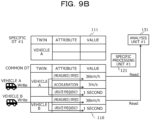
- FIGs. 9A and 9B are explanatory diagrams of a third exemplary process performed by the data processing device.
- FIGs. 9A and 9B illustrates an exemplary process in the case of [3.] reducing a change cost when it is desired to change a reading destination of a DT depending on a situation described above.
- FIGs. 9A and 9B illustrate access states of reading and writing to the DT at different times.
- the example illustrated in FIGs. 9A and 9B is an example of one service, and includes one common DT 110 and one specific DT #1 (111).
- the common DT 110 retains attributes "speed”, “acceleration level”, and “update frequency” and values of the respective attributes based on source data of a vehicle A. Furthermore, the common DT 110 retains attributes "speed” and “update frequency” and values of the respective attributes based on source data of a vehicle B.
- the specific processing unit 121 performs a process of reading the values of the respective attributes of the vehicle A in the common DT 110, estimating a "speed", and writing it in the specific DT #1 (111). Then, in this third exemplary process, an specific processing unit for the vehicle B is not included, and a specific DT related to the vehicle B is also not included.
- the analysis unit #1 (131) reads the value of the "(estimated) speed” from the specific DT #1 (111) for the vehicle A. Furthermore, the analysis unit #1 (131) reads the value of the "(measured) speed” directly from the common DT 110 for the vehicle B.
- the update frequency of the source data "speed” of the vehicle A is 1 minute
- the update frequency of the source data "speed” of the vehicle B is 1 second, which is a state where the update frequency is higher than that of the vehicle A.
- the distribution rule table 403 is a default distribution rule, which is "reading the attribute value of the common DT until the specific processing of the service is written, and reading the attribute of the specific DT when the specific processing is written".
- the analysis unit #1 (131) of a certain service reads the "(estimated) speed" from the specific DT #1 (111) during the operation of the specific processing unit #1 (121).
- the analysis unit #1 (131) low-accuracy analysis based on the "(estimated) speed” with the “update frequency” of 1 minute is carried out for the vehicle A, whereas high-accuracy analysis based on the "(measured) speed” with the "update frequency” of 1 second is carried out for the vehicle B.
- the data processing device 100 is capable of determining whether the "update frequency" is high frequency or low frequency by comparing it with a threshold, and is also capable of determining whether data accuracy is high accuracy or low accuracy based on the "update frequency".
- the "update frequency" of the "speed” of the vehicle A is updated from 1 minute to 1 second.
- the analysis unit #1 (131) stops reading the "(estimated) speed” of the vehicle A from the specific processing unit #1 (121), and reads the "(measured) speed” from the common DT 110.
- the "update frequency" of the vehicle A is 1 second, and highly accurate analysis based on the "(measured) speed” may be carried out at the update frequency similar to that of the vehicle B.
- the reading destination is changed to the DT with a value with higher accuracy due to a change in the update frequency (increase in accuracy) based on replacement of a sensor for detecting the speed of the vehicle A or the like.
- the analysis unit #1 (131) changes the reading destination from "specific DT #1" to the "common DT".
- FIG. 10 is a flowchart illustrating an exemplary overall process of the data processing device. The process of FIG. 10 is mainly performed by the integrated digital twin I/O unit 401 in FIG. 4 , and is executed by the CPU 501 illustrated in FIG. 5 .
- the data processing device 100 receives a request for access to a DT (step S1001).
- the data processing device 100 obtains a request source and request content (step S1002).
- the request source is, for example, the specific processing units #1 and #2 (121 and 122) or the analysis units #1 and #2 (131 and 132) of the service units #1 and #2 (411 and 412) described above.
- step S1003 determines whether the request content is read or write. If the request content is read (read in step S1003), the data processing device 100 proceeds to processing of step S1004. On the other hand, if the request content is write (write in step S1003), the data processing device 100 proceeds to processing of step S1008.
- step S1004 the data processing device 100 obtains a reading rule of the request source (step S1004). Then, the data processing device 100 determines whether or not the reading rule of the request source has been successfully obtained (step S1005). If the reading rule of the request source has been successfully obtained (Yes in step S1005), the data processing device 100 processes the data read in accordance with the obtained rule (distribution rule) (step S1006), and terminates the process above.
- step S1007 the data processing device 100 performs a default reading process (step S1007), and terminates the process above.
- the data processing device 100 performs data read processing in accordance with the default distribution rule, and terminates the process above.
- step S1008 the data processing device 100 obtains a writing rule of the request source (step S1008). Then, the data processing device 100 determines whether or not the writing rule of the request source has been successfully obtained (step S1009). If the writing rule of the request source has been successfully obtained (Yes in step S1009), the data processing device 100 performs data write processing in accordance with the obtained rule (distribution rule) (step S1010), and terminates the process above.
- step S1011 the data processing device 100 performs a default writing process (step S1011), and terminates the process above.
- the data processing device 100 performs data write processing in accordance with the default distribution rule, and terminates the process above.
- FIG. 11 is a flowchart illustrating an exemplary default reading process of the data processing device. The process illustrated in FIG. 11 is a detailed process of the default reading process indicated in step S1007 in FIG. 10 .
- the data processing device 100 obtains a request source and request content of reading with respect to a DT (step S1101).
- the request source is the sensor that transmits the speed of the vehicle A described above, the specific processing units #1 and #2 (121 and 122) of the service units #1 and #2 (411 and 412), or the analysis units #1 and #2 (131 and 132).
- the data processing device 100 determines whether the request source is a sensor or a service (step S1102). As a result of the determination, if the request source is a sensor (sensor in step S1102), the data processing device 100 sets an abnormality detection error (step S1103), and proceeds to processing of step S1111.
- the sensor makes only a write request by transmission, reading is regarded as an abnormality detection error.
- step S1102 if the request source is a service as a result of the determination in step S1102 (service in step S1102), the data processing device 100 reads data from the service-specific DT corresponding to the service (step S1104). Next, the data processing device 100 determines whether or not the data has been successfully read (step S1105).
- step S1105 If the data has been successfully read as a result of the determination in step S1105 (Yes in step S1105), the data processing device 100 uses the read value (step S1106), and proceeds to the processing of step S1111.
- step S1105 the data processing device 100 reads data from the common DT in accordance with the default distribution rule (step S1107). Next, the data processing device 100 determines whether or not the data has been successfully read (step S1108).
- step S1108 If the data has been successfully read as a result of the determination in step S1108 (Yes in step S1108), the data processing device 100 uses the read value (step S1109), and proceeds to the processing of step S1111.
- step S1110 the data processing device 100 sets a read failure error (step S1110), and proceeds to the processing of step S1111.
- step S1111 the data processing device 100 returns the read value or the error to the request source (step S1111), and terminates the process above.
- the service unit (specific processing unit or analysis unit) as the request source performs data processing based on the value returned by the data processing device 100, and performs error processing when an error occurs.
- FIG. 12 is a flowchart illustrating an exemplary default writing process of the data processing device. The process illustrated in FIG. 12 is a detailed process of the default writing process indicated in step S1011 in FIG. 10 .
- the data processing device 100 obtains a request source of writing to a DT (step S1201).
- the request source is the sensor that transmits the speed of the vehicle A described above, the specific processing units #1 and #2 (121 and 122) of the service units #1 and #2 (411 and 412), or the analysis units #1 and #2 (131 and 132).
- the data processing device 100 determines whether the request source is a sensor or a service (step S1202). As a result of the determination, if the request source is a sensor (sensor in step S1202), the data processing device 100 writes data in the common DT (step S1203), and proceeds to processing of step S1204.
- step S1202 determines whether the request source is a service as a result of the determination in step S1202 (service in step S1202).
- the data processing device 100 writes the data in the service-specific DT corresponding to the service (step S1207), and proceeds to processing of step S1208.
- step S1203 the data processing device 100 determines whether or not the data has been successfully written. As a result of the determination, if the data has been successfully written in the common DT (Yes in step S1204), the data processing device 100 determines that the writing is normal processing (step S1205), and proceeds to processing of step S1211.
- step S1204 the data processing device 100 detects a write error (step S1206), and proceeds to the processing of step S1211.
- step S1207 the data processing device 100 determines whether or not the data has been successfully written. As a result of the determination, if the data has been successfully written in the service-specific DT (Yes in step S1208), the data processing device 100 determines that the writing is normal processing (step S1209), and proceeds to the processing of step S1211.
- step S1210 the data processing device 100 detects a write error (step S1210), and proceeds to the processing of step S1211.
- step S1211 the data processing device 100 returns the normal end of the writing or the error to the request source (step S1211), and terminates the process above.
- the service unit (specific processing unit or analysis unit) as the request source performs data processing based on the value returned by the data processing device 100, and performs error processing when an error occurs.
- the request source that accesses the DT may be set not only for each service but also in units of the specific processing unit or the analysis unit.
- the specific processing e.g., equivalent to the second exemplary process
- the specific processing may be set to read and write data in the common DT as a distribution rule unique to the request source. Then, if the unique distribution rule has been successfully obtained from the request source, the distribution rule may be easily added only by adding the record 403-4 to the distribution rule table 403 in FIG. 4 .
- the data processing device 100 includes a common digital twin in which first processed data obtained by processing received source data is stored, a specific digital twin in which second processed data obtained by processing the source data is stored, and a plurality of service-specific service units that requests access to the common digital twin or the specific digital twin to perform data processing.
- the plurality of service units reads the second processed data from the specific digital twin for each of a plurality of services in accordance with a predetermined data distribution rule, and reads the first processed data from the common digital twin when it is determined that there is no data to be read.
- one integrated digital twin is formed in which data used by the plurality of services in common is stored in the common digital twin and data unique to each of the plurality of services is stored in the specific digital twin.
- the service unit is enabled to efficiently read needed data. As a result, it becomes possible to suppress an increase in the storage area for efficient use even when the number of services increases.
- the data processing device 100 obtains the specific distribution rule. Then, it accesses the common digital twin or the specific digital twin in accordance with the obtained specific distribution rule. This makes it possible to access the common digital twin or the specific digital twin in accordance with the distribution rule of the request source.
- the plurality of service units of the data processing device 100 may include an specific processing unit that generates the second processed data obtained by processing the source data and writes the second processed data in the specific digital twin, and an analysis unit that processes the first processed data or the second processed data.
- the analysis unit reads the second processed data from the specific digital twin for each of the plurality of services, and reads the first processed data from the common digital twin when it is determined that there is no data to be read.
- the service unit may include the service-specific specific processing unit and the analysis unit that carries out analysis after the specific processing. In this case, the analysis unit may carry out not only the analysis based on the second processed data after the specific processing but also the analysis based on the first processed data.
- the plurality of service units of the data processing device 100 may perform a process of reading the first processed data from the common digital twin and writing the second processed data obtained by processing the read first processed data in the specific digital twin for each service.
- the first processed data may be shared and used by the plurality of service units, and the second processed data specificly processed by each of the service units may be stored in the specific digital twin different for each service.
- the service unit of the data processing device 100 may make access of reading and writing to data of the same attribute in the common digital twin and the specific digital twin.
- the service such as analysis may be continued by reading data of the same attribute from the specific digital twin.
- the specific processing unit of the data processing device 100 may switch between execution and non-execution of the process of reading the first processed data from the common digital twin and creating processed second processed data.
- the analysis unit reads the first processed data from the common digital twin at the time of non-execution of the specific processing unit.
- the analysis unit may switch to the processing of reading the second processed data from the specific digital twin.
- the analysis unit of the data processing device 100 reads the second processed data from the specific digital twin when the data accuracy of the source data is low accuracy or a low update frequency based on the data accuracy or the update frequency of the source data.
- the first processed data may be read from the common digital twin.
- the data processing device 100 writes the first processed data obtained by processing the received source data in the common digital twin in accordance with a predetermined data distribution rule. Furthermore, the plurality of service units may write the second processed data obtained by processing the source data in the specific digital twin for each service. As a result, a large number of pieces of source data may be received at all times and stored and retained in the common digital twin as the first processed data, and the second processed data for each service unit may be stored in the specific digital twin for each service.
- the data processing device 100 is enabled to provide data available for each service in common in the common digital twin and to provide data unique to each service in the specific digital twin.
- the specific digital twin is separated for each service and may be applied to services different from each other, and data may not be read from each other between different services so that confidentiality may be maintained.
- the integrated digital twin in which the common digital twin and the specific digital twin are integrated may be applied to Mobility as a Service (MaaS), a smart city such as pedestrian traffic flow guidance, and the like.
- MoaS Mobility as a Service
- a smart city such as pedestrian traffic flow guidance
- the data processing method described in the embodiment may be implemented by causing a processor such as a server to execute a program prepared in advance.
- the present method is implemented by being recorded in a computer-readable recording medium such as a hard disk, a flexible disk, a compact disc read only memory (CD-ROM), a digital versatile disk (DVD), a flash memory, or the like, and being read from the recording medium by a computer.
- the present method may be distributed via a network such as the Internet.
Landscapes
- Engineering & Computer Science (AREA)
- Theoretical Computer Science (AREA)
- Physics & Mathematics (AREA)
- General Engineering & Computer Science (AREA)
- General Physics & Mathematics (AREA)
- Human Computer Interaction (AREA)
- Databases & Information Systems (AREA)
- Computing Systems (AREA)
- Data Mining & Analysis (AREA)
- Information Retrieval, Db Structures And Fs Structures Therefor (AREA)
- Management, Administration, Business Operations System, And Electronic Commerce (AREA)
Abstract
Description
- The embodiment discussed herein is related to a data processing method and a data processing program.
- An object actually operating in the real world may be represented as a model of mapping in a virtual space according to a digital twin (DT). For example, source data of a state such as a sensor value detected by a real-world IoT device is transmitted to a center. The center constructs a digital twin of the real-world object from the received source data. In the center, the digital twin for each service performs a process of visualizing and analyzing the real world using the source data. When the center carries out the analysis and visualization, information derived based on the target source data is stored in association with the object (twin), which makes it easier to perform analysis and visualization processing (referred to as specific processing).
- As related art, for example, there is a technique for a multi-tenant service in which a database has common data and specific data for each tenant and an specific schema is enabled to access the common data through a view. Furthermore, for example, there is a technique in which a plurality of computers for data analysis is provided and the computers for data analysis are distributed and executed for each analysis process. Furthermore, for example, there is a technique of simulating a plurality of aspects of a system by defining each model-specific data and common data in a plurality of simulation environments. Furthermore, for example, there is a technique of defining specific and common regions and separating domains using a function of multi-tenant identity management (IDM) in a cloud environment.
- International Publication Pamphlet No.
WO 2017/090142 ,Japanese Laid-open Patent Publication No. 2017-199250 U.S. Patent Application Publication No. 2021/0117593 , andU.S. Patent Application Publication No. 2016/0173475 are disclosed as related art. - Since the real world is vast, a huge storage area is needed for mapping of the real world. Accordingly, enormous cost is to be involved if a digital twin is prepared for each service. On the other hand, if a digital twin is shared by a plurality of services, there is a problem that specific processing results, which are service-specific, cause collision at the time of saving (writing) the specific processing results of specific services in the digital twin. For example, for the same attribute "average speed" calculated by each of the specific services, a collision occurs in which the specific processing results having values different for each service are to be written. In the related art, there has been a problem that efficient storage use may not be available when the number of services increases.
- In one aspect, an object of the embodiment is to enable efficient use of storage even when the number of services increases.
- According to an aspect of the embodiments, a method for data processing to be performed by a computer of a data processing device comprising: a common digital twin in which first processed data obtained by processing received source data is stored; a specific digital twin in which second processed data obtained by processing the source data is stored; and a service unit for each of a plurality of services that requests access to the common digital twin or the specific digital twin to perform data processing, wherein each of a plurality of the service units is configured to: read the second processed data from the specific digital twin for each of the plurality of services; and when no data to be read is determined to exist, read the first processed data from the common digital twin, in accordance with a predetermined data distribution rule.
- According to one aspect of the embodiment, an effect that storage may be efficiently used even when the number of services increases is exerted.
-
-
FIG. 1 is an explanatory diagram illustrating an example of a data processing method according to an embodiment; -
FIG. 2 is an explanatory diagram of a problem when a digital twin is prepared for each service; -
FIGs. 3A and 3B are explanatory diagrams of a problem when a digital twin is shared by a plurality of services; -
FIG. 4 is an explanatory diagram of functions of a data processing device according to the embodiment; -
FIG. 5 is a diagram illustrating an exemplary hardware configuration of the data processing device; -
FIGs. 6A and 6B are explanatory diagrams of a first exemplary process performed by the data processing device; -
FIGs. 7A and 7B are comparative diagrams for explaining storage reduction; -
FIGs. 8A and 8B are explanatory diagrams of a second exemplary process performed by the data processing device; -
FIGs. 9A and9B are explanatory diagrams of a third exemplary process performed by the data processing device; -
FIG. 10 is a flowchart illustrating an exemplary overall process of the data processing device; -
FIG. 11 is a flowchart illustrating an exemplary default reading process of the data processing device; and -
FIG. 12 is a flowchart illustrating an exemplary default writing process of the data processing device. - Hereinafter, an embodiment of a data processing method and a data processing program according to the disclosure will be described in detail with reference to the drawings.
-
FIG. 1 is an explanatory diagram illustrating an example of a data processing method according to an embodiment. Adata processing device 100 includes, for example, a common digital twin (DT) common to a plurality of services, and a specific digital twin unique to each of the plurality of services. Thedata processing device 100 is a computer that performs a process of distributing reading and writing of data for the common DT and the specific DT based on a distribution rule at a time of a data request (input/output (I/O) request). The common DT and the specific DT are each formed in a storage area such as a database (DB). - Exemplary data processing of the
data processing device 100 will be described with reference to the example illustrated inFIG. 1 . In this example, a vehicle A transmits a speed to thedata processing device 100, and an average speed per hour is calculated for each of the plurality of services to carry out analysis processing based on the average speed per hour. - The
data processing device 100 writes, for example, first processed data S1 obtained by processing information regarding the "speed", which is source data S0 transmitted from a sensor of the vehicle A, in a common DT 110 (Write). Thedata processing device 100 writes, in thecommon DT 110, a twin name "vehicle A", an attribute "speed per hour", and a speed value "15km/h" as the first processed data S1. - In the example of
FIG. 1 , a specific DT #1 (111) and a specific DT #2 (112) are provided as two specific DTs corresponding to two different services related to the twin "vehicle A". Furthermore, an specific processing unit #1 (121) and an specific processing unit #2 (122) are provided corresponding to the two services. Furthermore, an analysis unit #1 (131) and an analysis unit #2 (132) are provided corresponding to the two services. - The specific processing unit #1 (121) reads the value of the speed per hour, which is the first processed data S1 of the vehicle A, from the
common DT 110, and performs specific processing of generating second processed data S2 corresponding to aservice # 1 on the read value. Then, the specific processing unit #1 (121) writes the second processed data S2, which is the specific processing result, in the specific DT #1 (111) (Write). The specific processing unit #1 (121) calculates, from thecommon DT 110, an average value (average speed) of the "speed per hour" of a predetermined period of time (e.g., during the past 10 minutes) for the value of the "speed per hour", which is data of the vehicle A. - In the example of
FIG. 1 , the specific processing unit #1 (121) calculates an average speed "35 km/h" as the second processed data S2, and writes the twin name "vehicle A", the attribute "average speed per hour", and the speed value "35 km/h" in the specific DT #1 (111). - The analysis unit #1 (131) carries out the analysis processing corresponding to the
service # 1. For example, the analysis unit #1 (131) reads the average speed per hour of the vehicle A, which is the second processed data S2, from the specific DT #1 (111) (Read), and carries out the analysis processing for theservice # 1, such as prediction of traveling of the vehicle A, based on the average speed per hour and values of other attributes. - The specific processing unit #2 (122) reads the value of the speed per hour, which is the first processed data S1 of the vehicle A, from the
common DT 110, and performs specific processing of generating second processed data S2 corresponding to aservice # 2 on the read value. Then, the specific processing unit #2 (122) writes the second processed data S2, which is the specific processing result, in the specific DT #2 (112) (Write). The specific processing unit #2 (122) calculates, from thecommon DT 110, an average value (average speed) of the "speed per hour" of a predetermined period of time (e.g., during the past 30 minutes) for the value of the "speed per hour", which is data of the vehicle A. - In the example of
FIG. 1 , the specific processing unit #2 (122) calculates an average speed "20 km/h" as the second processed data S2, and writes the twin name "vehicle A", the attribute "average speed per hour", and the speed value "20 km/h" in the specific DT #2 (112). - The analysis unit #2 (132) carries out the analysis processing corresponding to the
service # 2. For example, the analysis unit #2 (132) reads the average speed per hour of the vehicle A, which is the second processed data S2, from the specific DT #2 (112) (Read), and carries out the analysis processing for theservice # 2, such as prediction of traveling of the vehicle A, based on the average speed per hour and values of other attributes. - For example, the specific DT #1 (111) and the specific DT #2 (112) are managed by different service providers, and the
common DT 110 is managed by a service base provider. - Here, for example, some specific DTs do not include an specific processing unit. In that case, the second processed data S2 (specific processing result) processed by the specific processing unit does not exist in the specific DT but exists only in the common DT. In this case, the DT from which the analysis unit obtains the processed data (specific processing result) differs for each specific DT.
- In the embodiment, the
data processing device 100 has a distribution rule for each access request source with respect to the DT. A basic default distribution rule is "reading the second processed data S2 and reading the first processed data S1 if it is determined that no data to be read exists". Thedata processing device 100 controls the reading of the DT based on the distribution rule setting. This makes it possible to control a source from which data is obtained with a simple mechanism. - The distribution rule may be set for each access request source with respect to the DT. For example, in a case where the access request source has a distribution rule and the
data processing device 100 has succeeded in obtaining the distribution rule from the request source, distribution may be carried out in accordance with the obtained distribution rule instead of the default acquisition rule. - Note that the default distribution rule described above may also be rephrased as "reading the attribute value of the common DT until the specific processing of the service is written, and reading the attribute of the specific DT when the specific processing is written".
- As a result, the
data processing device 100 is enabled to present one DT for the plurality of services while having the common DT and the specific DT, which makes it possible to reduce resources and the like. - A specific example will be described as follows:
- (1) It is assumed that the analysis unit #2 (132) reads the second processed data S2 (specific processing result) from the specific DT #2 (112) as illustrated in
FIG. 1 . (2) However, it is assumed that no second processed data S2 (specific processing result) exists in the specific DT #2 (112). In this case, - (3) The analysis unit #2 (132) reads data (first processed data S1) from the
common DT 110 based on the distribution rule. - Here, the analysis unit #2 (132) may also read the first processed data S1 "speed per hour" from the
common DT 110 and carry out the analysis processing corresponding to theservice # 2. Although not exemplified inFIG. 1 , it is assumed that the vehicle A transmits the "speed per hour" and "average speed per hour" to write them in thecommon DT 110. Then, it is assumed that no data of the attribute "average speed per hour" exists in the specific DT #2 (112). In this case, the analysis unit #2 (132) may read the same attribute "average speed per hour" from thecommon DT 110 to carry out the analysis processing based on the distribution rule (3). - Here, according to the processing of (3) the analysis unit #2 (132) reads data (first processed data S1) from the
common DT 110 based on the distribution rule, it becomes possible to support different service forms. For example, there are the following service forms [1.] to [3.]. - [1.] Sharing a DT among multiple different services. [2.] Reducing a change cost at a time of changing calculation of an attribute value depending on a situation. [3.] Reducing a change cost when it is desired to change a reading destination of a DT depending on a situation. Exemplary processes of the services according to those respective forms [1.] to [3.] will be described later as exemplary processes [1.] to [3.].
- Here, problems of an existing DT will be described with reference to
FIGs. 2 to 3B . Since the real world is vast, a huge storage area is needed for mapping of the real world. -
FIG. 2 is an explanatory diagram of a problem when a digital twin is prepared for each service. For example, a DT-A (201) and a DT-B (202) need to be prepared corresponding to two services A and B. Furthermore, an specific processing unit A (211), an specific processing unit B (212), an analysis unit A (213), and an analysis unit B (214) are prepared corresponding to the two services. In the exemplary configuration ofFIG. 2 , the same information is doubly collected and retained by the two services so that the DT-A (201) and the DT-B (202) are needed, which incurs enormous cost. -
FIGs. 3A and 3B are explanatory diagrams of a problem when a digital twin is shared by a plurality of services. As illustrated inFIG. 3A , aDT 210 common to the two services A and B is prepared. Furthermore, an specific processing unit A (211), an specific processing unit B (212), an analysis unit A (213), and an analysis unit B (214) are prepared corresponding to the two services. When a digital twin is shared by a plurality of services, there is a problem that specific processing results, which are service-specific, cause collision at the time of saving (writing) the specific processing results of specific services in the digital twin. - For example, for a certain attribute "speed per hour" common to the specific services, a collision occurs in which the specific processing results having values different for each service are to be written. As described above, when the digital twin is shared by a plurality of services, not only a collision occurs in information associated with the plurality of services, such as attributes and relationships, but also a problem of confidentiality occurs.
-
FIG. 3B illustrates a specific example of collision occurrence. For example, it is assumed that the specific processing unit A (211) calculates the attribute "average speed per hour (35 km/h)" for the past 10 minutes based on the "speed per hour" of the vehicle A, and writes it in theDT 210. Furthermore, it is assumed that the specific processing unit B (212) calculates the attribute "average speed per hour (20 km/h)" for the past 30 minutes based on the "speed per hour" of the vehicle A, and writes it in theDT 210. In this case, a collision occurs as the specific processing unit A (211) and the specific processing unit B (212) attempt to write different values (35 km/h and 20 km/h) for the same attribute "average speed per hour" in theDT 210, whereby analysis may not be carried out. - While an exemplary attribute collision has been described with reference to
FIG. 3B , there is a relationship collision as another exemplary collision. As for the relationship collision, a collision occurs when a similar relationship name is used in a relationship between digital twins (e.g., hierarchical relationship between a person and an organization, etc.). Furthermore, a problem of confidentiality is raised. For example, in a case where the analysis unit A (213) and the analysis unit B (214) are services of different companies, specific processing results may not be intended to be disclosed to each other, but this may not be adapted, whereby the confidentiality may not be maintained. -
FIG. 4 is an explanatory diagram of functions of the data processing device according to the embodiment. Thedata processing device 100 is configured by distributed processing of a plurality of servers, for example. Thedata processing device 100 includes an integrated digital twin I/O unit 401, a service DT setting table 402, a distribution rule table 403, thecommon DT 110, the specific DT #1 (111), the specific DT #2 (112), a service unit #1 (411), and a service unit #2 (412). - The
common DT 110, the specific DT #1 (111), and the specific DT #2 (112) are an integrateddigital twin 400 integrated into one. Furthermore, it is assumed that thedata processing device 100 receives a value of the "speed" detected by the sensor of the vehicle A illustrated inFIG. 1 as source data S0. - Although the number of the specific digital twins is set to two, which includes the specific DT #1 (111) and the specific DT #2 (112) corresponding to the two services, in the exemplary configuration of
FIG. 4 for the sake of convenience, the number of the specific digital twins may be arranged depending on the number of services. The service unit #1 (411) and the service unit #2 (412) include the specific processing unit and the analysis unit illustrated inFIG. 1 . - Information regarding the DT to be accessed for each service is set in the service DT setting table 402. For example, information indicating that the access of the service unit #1 (411) is the specific DT #1 (111) and the access of the service unit #2 (412) is the specific DT #2 (112) is set. Note that the
common DT 110 is accessible from both of the service unit #1 (411) and the service unit #2 (412). - For example, the service unit #1 (411) includes the specific processing unit #1 (121) and the analysis unit #1 (131) illustrated in
FIG. 1 . The service unit #1 (411) accesses (reads and writes) thecommon DT 110 and the specific DT #1 (111) via the integrated digital twin I/O unit 401. - The service unit #2 (412) includes the specific processing unit #2 (122) and the analysis unit #2 (132) illustrated in
FIG. 1 . The service unit #2 (412) accesses thecommon DT 110 and the specific DT #2 (112) via the integrated digital twin I/O unit 401. - The integrated digital twin I/
O unit 401 includes arequest reception unit 421, a distributiondestination determination unit 422, and arequest transmission unit 423. Therequest reception unit 421 receives a request for accessing the digital twin. In the example ofFIG. 4 , therequest reception unit 421 receives requests from the source data S0 of "speed" transmitted by the "vehicle A", the service unit #1 (411), and the service unit #2 (412). - The distribution
destination determination unit 422 refers to the distribution rule table 403 based on the request from the transmission source of the source data S0 that has made the request or theservice units # 1 and #2 (411 and 412). Then, the distributiondestination determination unit 422 determines distribution destinations of access (reading and writing) to the DT (common DT 110 andspecific DTs # 1 and #2 (111 and 112)) based on the distribution rule set in the distribution rule table 403. - In the distribution rule table 403, information regarding a request source, a distribution rule of reading from the DT, and a distribution rule of writing to the DT is set. In response to write requests from the specific processing unit and the analysis unit, the distribution
destination determination unit 422 performs writing in the corresponding specific DT in accordance with the distribution rule, for example. Furthermore, in response to read requests from the specific processing unit and the analysis unit, the distributiondestination determination unit 422 first performs reading from the service-specific DT, and then performs reading from the common DT if there is no data. In addition, in a case where no specific distribution rule is defined by the request source, the distributiondestination determination unit 422 performs processing by applying a default distribution rule. - In the distribution rule table 403 of the example illustrated in
FIG. 4 , "reading the attribute value of the common DT until the specific processing of the service is written, and reading the attribute of the specific DT when the specific processing is written" is set as the default distribution rule. In a record 403-1 of the distribution rule table 403, only writing to thecommon DT 110 is set for the source data S0 from the sensor. - Furthermore, in the example of
FIG. 4 , "specific DT # 1 → common DT" is set for reading from the DT in the service unit #1 (411) in a record 403-2 of the distribution rule table 403. This indicates that the data of the attribute requested from the specific DT #1 (111) is first read, and the data is read from thecommon DT 110 if it fails to read the data from the specific DT #1 (111) (including a case where there is no value). For example, in the example ofFIG. 1 , the analysis unit #1 (131) of the service unit #1 (411) first reads the data of the attribute requested from the specific DT #1 (111), and reads the data from thecommon DT 110 if it fails to read the data of the attribute from the specific DT #1 (111). - Furthermore, in the example of
FIG. 4 , "specific DT # 1" is set for writing to the DT in the service unit #1 (411) in the record 403-2 of the distribution rule table 403. This indicates that the data of the attribute requested is written only in the specific DT #1 (111). - Furthermore, in the example of
FIG. 4 , "specific DT # 2 → common DT" is set for reading from the DT in the service unit #2 (412) in a record 403-3 of the distribution rule table 403. This indicates that the data of the attribute requested from the specific DT #2 (112) is first read, and the data is read from thecommon DT 110 if it fails to read the data from the specific DT #2 (112) (including a case where there is no value). For example, in the example ofFIG. 1 , the analysis unit #2 (132) of the service unit #2 (412) first reads the data of the attribute requested from the specific DT #2 (112), and reads the data from thecommon DT 110 if it fails to read the data of the attribute from the specific DT #2 (112). - Furthermore, in the example of
FIG. 4 , "specific DT # 2" is set for writing to the DT in the service unit #2 (412) in the record 403-3 of the distribution rule table 403. This indicates that the data of the attribute requested is written only in the specific DT #2 (112). - Furthermore, in the example of
FIG. 4 , reading and writing from and to thecommon DT 110 are set for a "common" request that does not specify a request source in a record 403-4 of the distribution rule table 403. -
FIG. 5 is a diagram illustrating an exemplary hardware configuration of the data processing device. Thedata processing device 100 may be configured by a computer such as a server including general-purpose hardware illustrated inFIG. 5 . - The
data processing device 100 includes a central processing unit (CPU) 501, amemory 502, and a network interface (I/F) 503. Furthermore, thedata processing device 100 includes a recording medium I/F 504, arecording medium 505, a portable recording medium I/F 506, and aportable recording medium 507. Furthermore, the specific components are coupled to each other by abus 500. - The
CPU 501 functions as a control unit that takes overall control of thedata processing device 100. TheCPU 501 may include a plurality of cores. Thememory 502 includes, for example, a read only memory (ROM), a random access memory (RAM), a flash ROM, and the like. Specifically, the flash ROM stores an operating system (OS) program, the ROM stores application programs, and the RAM is used as a work area for theCPU 501, for example. A program stored in thememory 502 is loaded into theCPU 501 to cause theCPU 501 to execute coded processing. - The network I/
F 503 is coupled to a network NW through a communication line, and is coupled to an external computer through the network NW. In a case where thedata processing device 100 includes a plurality of servers, for example, each server is coupled to the external computer through the network NW. Then, the network I/F 503 manages an interface between the network NW and the inside of the device, and controls input and output of data from the external computer. For example, a modem, a local area network (LAN) adapter, or the like may be adopted as the network I/F 503. - The recording medium I/
F 504 controls reading and writing of data from and to therecording medium 505 under the control of theCPU 501. Therecording medium 505 stores data written under the control of the recording medium I/F 504. Examples of therecording medium 505 include a magnetic disk, an optical disc, and the like. - The portable recording medium I/
F 506 controls reading and writing of data from and into theportable recording medium 507 under the control of theCPU 501. Theportable recording medium 507 stores data written under the control of the portable recording medium I/F 506. Examples of theportable recording medium 507 include a compact disc (CD)-ROM, a digital versatile disk (DVD), a universal serial bus (USB) memory, and the like. - Note that the
data processing device 100 may include, for example, an input device, a display, and the like in addition to the components described above. - The functions of the integrated digital twin I/
O unit 401 illustrated inFIG. 4 may be implemented by theCPU 501 illustrated inFIG. 5 executing a program. The functions of the service DT setting table 402, the distribution rule table 403, thecommon DT 110, the specific DT #1 (111), and the specific DT #2 (112) illustrated inFIG. 4 may be implemented by, for example, using therecording medium 505 and theportable recording medium 507 illustrated inFIG. 5 . - Meanwhile, the
service units # 1 and #2 (411 and 412) illustrated inFIG. 4 may be configured by hardware such as the server inFIG. 5 and the like each owned by a service company outside thedata processing device 100. - Next, each exemplary process of the
data processing device 100 will be described. Each of the following processes is performed by theCPU 501, which serves as a control unit of thedata processing device 100. -
FIGs. 6A and 6B are explanatory diagrams of a first exemplary process performed by the data processing device.FIGs. 6A and 6B illustrate an exemplary process in the case of above-described [1.] sharing a DT among multiple different services.FIG. 6A illustrates an access state of reading and writing to the DT in a similar manner toFIG. 1 , andFIG. 6B illustrates a distribution state of reading and writing in response to a request for each service. - The distribution rule table 403 illustrated in
FIG. 6B represents a default distribution rule, which is "reading the attribute value of the common DT until the specific processing of the service is written, and reading the attribute of the specific DT when the specific processing is written". Specifically, in the distribution rule table 403, only writing to thecommon DT 110 is set for the source data S0 from the sensor. Furthermore, "specific DT #1 -> common DT" is set for reading from the DT in the service unit #1 (411). Furthermore, "specific DT # 1" is set for writing to the DT in the service unit #1 (411). - Furthermore, "
specific DT # 2 → common DT" is set for reading from the DT in the service unit #2 (412). Furthermore, "specific DT # 2" is set for writing to the DT in the service unit #2 (412). - The examples illustrated in
FIGs. 6A and 6B are two exemplary services, and one is a ride-hailing service (#1) 411 of a company A, and the other one is a deoxygenation service (#2) 412 of a company B. - In the ride-hailing service (#1) 411 of the company A, the specific processing unit #1 (121) calculates the attribute "average speed per hour" for the past 10 minutes from the "speed per hour" to provide a service related to dispatch of the vehicle A. Then, the specific processing unit #1 (121) writes the calculated value in the specific DT #1 (111) based on the distribution rule of the distribution rule table 403.
- Furthermore, the analysis unit #1 (131) performs reading based on the distribution rule of the distribution rule table 403. First, the analysis unit #1 (131) reads the value of the attribute "average speed" from the specific DT #1 (111). At this time, in a case where the analysis unit #1 (131) fails to read the value of the attribute "average speed" from the specific DT #1 (111), it reads the value of the "speed per hour" from the
common DT 110, and carries out analysis based on the "speed per hour". - Furthermore, in the deoxygenation service (#2) 412 of the company B, the specific processing unit #2 (122) calculates the "average speed per hour" for the past 30 minutes from the "speed per hour" to predict a CO2 emission amount. Then, the specific processing unit #2 (122) writes the calculated value in the specific DT #2 (112) based on the distribution rule of the distribution rule table 403.
- Furthermore, the analysis unit #2 (132) performs reading based on the distribution rule of the distribution rule table 403. First, the analysis unit #2 (132) reads the value of the attribute "average speed" from the specific DT #2 (112). At this time, in a case where the analysis unit #2 (132) fails to read the value of the attribute "average speed" from the specific DT #2 (112), it reads the value of the "speed per hour" from the
common DT 110, and carries out analysis based on the "speed per hour". - As described above, the
data processing device 100 is enabled to be present in a form of behaving as one DT in response to requests from different services, and is enabled to provide a plurality of services with one DT. Additionally, thecommon DT 110 and the service-specific DTs # 1 and #2 (111 and 112) may be selectively used, and the storage area needed for the DT may be reduced. - Furthermore, since the mapping shared by the plurality of services only needs to be one
common DT 110, a plurality of upload destinations of the source data S0 for creating the mapping does not need to be provided, and resources for the mapping may be reduced. For example, for the two services, the vehicle A only needs to transmit data to onecommon DT 110. - Furthermore, since analysis results among the plurality of services may be viewed as one DT, it becomes possible to know a relationship that has not been recognized previously. For example, by making a proposal to change the private vehicle A to a share-ride bus or the like based on the analysis results of the two services illustrated in
FIGs. 6A and 6B , it becomes possible to present information regarding further reduction of CO2 emission. -
FIGs. 7A and 7B are comparative diagrams for explaining storage reduction.FIG. 7A illustrates an exemplary DT configuration according to the related art. According to the related art, a DT needs to be prepared for each service. As illustrated inFIG. 7A , in the case of the two services A and B, acommon DT 210 and a specific DT-A 201 are prepared for the service A. Furthermore, thecommon DT 210 and a specific DT-B 202 also need to be prepared for the service B. In this manner, according to the related art, a storage area equivalent to thecommon DT 210 needs to be prepared for each service, which incurs enormous cost of the DT storage capacity as the number of services increases. -
FIG. 7B illustrates an exemplary DT configuration according to the embodiment. According to the embodiment, it is sufficient if onecommon DT 110 is prepared regardless of the number of services. As illustrated inFIG. 7B , in the case of the twoservice units # 1 and #2 (411 and 412), the specific DT #1 (111) for the service unit #1 (411) and the specific DT #2 (112) for the service unit #2 (412) are prepared. Then, it is sufficient if thecommon DT 110 to be shared by theservice units # 1 and #2 (411 and 412) are prepared. It only needs to arrange onecommon DT 110 for all services. As a result, according to the embodiment, it becomes possible to enhance the effect of reducing the DT storage capacity as the number of services increases. -
FIGs. 8A and 8B are explanatory diagrams of a second exemplary process performed by the data processing device.FIGs. 8A and 8B illustrate an exemplary process in the case of above-described [2.] reducing a change cost at a time of changing calculation of an attribute value depending on a situation.FIGs. 8A and 8B illustrate access states of reading and writing to the DT at different times. - The example illustrated in
FIGs. 8A and 8B is an example of one service, and includes onecommon DT 110 and one specific DT #1 (111). An specific processing unit (common) 801 performs a process of reading the "speed per hour" of the vehicle A in thecommon DT 110, calculating the "average speed per hour" for the past 10 minutes, and writing it in thecommon DT 110. - It is assumed that the specific processing unit #1 (121) performs a process of reading the "speed per hour" of the vehicle A in the
common DT 110, calculating the "average speed per hour" for the past 30 minutes, and writing it in the specific DT #1 (111) during operation. - Here, the distribution rule table 403 is a default distribution rule, which is "reading the attribute value of the common DT until the specific processing of the service is written, and reading the attribute of the specific DT when the specific processing is written".
- In this second exemplary process, as illustrated in
FIG. 8A , the analysis unit #1 (131) of a certain service reads the "average speed" from thecommon DT 110 when the specific processing unit #1 (121) is unoperated. Then, as illustrated inFIG. 8B , the analysis unit #1 (131) reads the "average speed" of the same attribute from the specific DT #1 (111) during the operation of the specific processing unit #1 (121). - In the example illustrated in
FIGs. 8A and 8B , the specific processing unit #1 (111) is caused to operate when the situation changes due to a factor that a variation in the speed per hour of the vehicle A is large so that it is desired to increase the calculation of the "average speed per hour" from the past 10 minutes to the past 30 minutes. As a result, it becomes possible to reduce the change cost when the analysis unit #1 (131) changes the specific processing unit that calculates the attribute value from "common" to "#1" according to the situation change. -
FIGs. 9A and9B are explanatory diagrams of a third exemplary process performed by the data processing device.FIGs. 9A and9B illustrates an exemplary process in the case of [3.] reducing a change cost when it is desired to change a reading destination of a DT depending on a situation described above.FIGs. 9A and9B illustrate access states of reading and writing to the DT at different times. - The example illustrated in
FIGs. 9A and9B is an example of one service, and includes onecommon DT 110 and one specific DT #1 (111). Thecommon DT 110 retains attributes "speed", "acceleration level", and "update frequency" and values of the respective attributes based on source data of a vehicle A. Furthermore, thecommon DT 110 retains attributes "speed" and "update frequency" and values of the respective attributes based on source data of a vehicle B. - As illustrated in
FIG. 9A , thespecific processing unit 121 performs a process of reading the values of the respective attributes of the vehicle A in thecommon DT 110, estimating a "speed", and writing it in the specific DT #1 (111). Then, in this third exemplary process, an specific processing unit for the vehicle B is not included, and a specific DT related to the vehicle B is also not included. - The analysis unit #1 (131) reads the value of the "(estimated) speed" from the specific DT #1 (111) for the vehicle A. Furthermore, the analysis unit #1 (131) reads the value of the "(measured) speed" directly from the
common DT 110 for the vehicle B. Here, it is assumed that the update frequency of the source data "speed" of the vehicle A is 1 minute, whereas the update frequency of the source data "speed" of the vehicle B is 1 second, which is a state where the update frequency is higher than that of the vehicle A. - Here, the distribution rule table 403 is a default distribution rule, which is "reading the attribute value of the common DT until the specific processing of the service is written, and reading the attribute of the specific DT when the specific processing is written".
- In this third exemplary process, as illustrated in
FIG. 9A , the analysis unit #1 (131) of a certain service reads the "(estimated) speed" from the specific DT #1 (111) during the operation of the specific processing unit #1 (121). At this time, in the analysis unit #1 (131), low-accuracy analysis based on the "(estimated) speed" with the "update frequency" of 1 minute is carried out for the vehicle A, whereas high-accuracy analysis based on the "(measured) speed" with the "update frequency" of 1 second is carried out for the vehicle B. For example, thedata processing device 100 is capable of determining whether the "update frequency" is high frequency or low frequency by comparing it with a threshold, and is also capable of determining whether data accuracy is high accuracy or low accuracy based on the "update frequency". - Here, as illustrated in
FIG. 9B , it is assumed that the "update frequency" of the "speed" of the vehicle A is updated from 1 minute to 1 second. In this case, the analysis unit #1 (131) stops reading the "(estimated) speed" of the vehicle A from the specific processing unit #1 (121), and reads the "(measured) speed" from thecommon DT 110. In this case, the "update frequency" of the vehicle A is 1 second, and highly accurate analysis based on the "(measured) speed" may be carried out at the update frequency similar to that of the vehicle B. - In the example illustrated in
FIGs. 9A and9B , for example, the reading destination is changed to the DT with a value with higher accuracy due to a change in the update frequency (increase in accuracy) based on replacement of a sensor for detecting the speed of the vehicle A or the like. As a result, it becomes possible to reduce the change cost when the analysis unit #1 (131) changes the reading destination from "specific DT # 1" to the "common DT". - Next, an exemplary data processing procedure of the
data processing device 100 will be described with reference toFIGs. 10 to 12 . -
FIG. 10 is a flowchart illustrating an exemplary overall process of the data processing device. The process ofFIG. 10 is mainly performed by the integrated digital twin I/O unit 401 inFIG. 4 , and is executed by theCPU 501 illustrated inFIG. 5 . - First, the
data processing device 100 receives a request for access to a DT (step S1001). Next, thedata processing device 100 obtains a request source and request content (step S1002). The request source is, for example, the specificprocessing units # 1 and #2 (121 and 122) or theanalysis units # 1 and #2 (131 and 132) of theservice units # 1 and #2 (411 and 412) described above. - Next, the
data processing device 100 determines whether the request content is read or write (step S1003). If the request content is read (read in step S1003), thedata processing device 100 proceeds to processing of step S1004. On the other hand, if the request content is write (write in step S1003), thedata processing device 100 proceeds to processing of step S1008. - In step S1004, the
data processing device 100 obtains a reading rule of the request source (step S1004). Then, thedata processing device 100 determines whether or not the reading rule of the request source has been successfully obtained (step S1005). If the reading rule of the request source has been successfully obtained (Yes in step S1005), thedata processing device 100 processes the data read in accordance with the obtained rule (distribution rule) (step S1006), and terminates the process above. - On the other hand, if it fails to obtain the reading rule of the request source (No in step S1005), the
data processing device 100 performs a default reading process (step S1007), and terminates the process above. In the default reading process, thedata processing device 100 performs data read processing in accordance with the default distribution rule, and terminates the process above. - In step S1008, the
data processing device 100 obtains a writing rule of the request source (step S1008). Then, thedata processing device 100 determines whether or not the writing rule of the request source has been successfully obtained (step S1009). If the writing rule of the request source has been successfully obtained (Yes in step S1009), thedata processing device 100 performs data write processing in accordance with the obtained rule (distribution rule) (step S1010), and terminates the process above. - On the other hand, if it fails to obtain the writing rule of the request source (No in step S1009), the
data processing device 100 performs a default writing process (step S1011), and terminates the process above. In the default writing process, thedata processing device 100 performs data write processing in accordance with the default distribution rule, and terminates the process above. -
FIG. 11 is a flowchart illustrating an exemplary default reading process of the data processing device. The process illustrated inFIG. 11 is a detailed process of the default reading process indicated in step S1007 inFIG. 10 . - First, the
data processing device 100 obtains a request source and request content of reading with respect to a DT (step S1101). Here, it is assumed that the request source is the sensor that transmits the speed of the vehicle A described above, the specificprocessing units # 1 and #2 (121 and 122) of theservice units # 1 and #2 (411 and 412), or theanalysis units # 1 and #2 (131 and 132). - Then, the
data processing device 100 determines whether the request source is a sensor or a service (step S1102). As a result of the determination, if the request source is a sensor (sensor in step S1102), thedata processing device 100 sets an abnormality detection error (step S1103), and proceeds to processing of step S1111. Here, since the sensor makes only a write request by transmission, reading is regarded as an abnormality detection error. - On the other hand, if the request source is a service as a result of the determination in step S1102 (service in step S1102), the
data processing device 100 reads data from the service-specific DT corresponding to the service (step S1104). Next, thedata processing device 100 determines whether or not the data has been successfully read (step S1105). - If the data has been successfully read as a result of the determination in step S1105 (Yes in step S1105), the
data processing device 100 uses the read value (step S1106), and proceeds to the processing of step S1111. - On the other hand, if it fails to read the data (No in step S1105), the
data processing device 100 reads data from the common DT in accordance with the default distribution rule (step S1107). Next, thedata processing device 100 determines whether or not the data has been successfully read (step S1108). - If the data has been successfully read as a result of the determination in step S1108 (Yes in step S1108), the
data processing device 100 uses the read value (step S1109), and proceeds to the processing of step S1111. - On the other hand, if it fails to read the data (No in step S1108), the
data processing device 100 sets a read failure error (step S1110), and proceeds to the processing of step S1111. - In step S1111, the
data processing device 100 returns the read value or the error to the request source (step S1111), and terminates the process above. The service unit (specific processing unit or analysis unit) as the request source performs data processing based on the value returned by thedata processing device 100, and performs error processing when an error occurs. -
FIG. 12 is a flowchart illustrating an exemplary default writing process of the data processing device. The process illustrated inFIG. 12 is a detailed process of the default writing process indicated in step S1011 inFIG. 10 . - First, the
data processing device 100 obtains a request source of writing to a DT (step S1201). Here, it is assumed that the request source is the sensor that transmits the speed of the vehicle A described above, the specificprocessing units # 1 and #2 (121 and 122) of theservice units # 1 and #2 (411 and 412), or theanalysis units # 1 and #2 (131 and 132). - Then, the
data processing device 100 determines whether the request source is a sensor or a service (step S1202). As a result of the determination, if the request source is a sensor (sensor in step S1202), thedata processing device 100 writes data in the common DT (step S1203), and proceeds to processing of step S1204. - On the other hand, if the request source is a service as a result of the determination in step S1202 (service in step S1202), the
data processing device 100 writes the data in the service-specific DT corresponding to the service (step S1207), and proceeds to processing of step S1208. - After the processing of step S1203, the
data processing device 100 determines whether or not the data has been successfully written (step S1204). As a result of the determination, if the data has been successfully written in the common DT (Yes in step S1204), thedata processing device 100 determines that the writing is normal processing (step S1205), and proceeds to processing of step S1211. - On the other hand, if the it fails to write the data in the common DT as a result of the determination (No in step S1204), the
data processing device 100 detects a write error (step S1206), and proceeds to the processing of step S1211. - Furthermore, after the processing of step S1207, the
data processing device 100 determines whether or not the data has been successfully written (step S1208). As a result of the determination, if the data has been successfully written in the service-specific DT (Yes in step S1208), thedata processing device 100 determines that the writing is normal processing (step S1209), and proceeds to the processing of step S1211. - On the other hand, if the it fails to write the data in the service-specific DT as a result of the determination (No in step S1208), the
data processing device 100 detects a write error (step S1210), and proceeds to the processing of step S1211. - In step S1211, the
data processing device 100 returns the normal end of the writing or the error to the request source (step S1211), and terminates the process above. The service unit (specific processing unit or analysis unit) as the request source performs data processing based on the value returned by thedata processing device 100, and performs error processing when an error occurs. - In the descriptions of the
data processing device 100 described above, the request source that accesses the DT may be set not only for each service but also in units of the specific processing unit or the analysis unit. Furthermore, as illustrated in the record 403-4 of the distribution rule table 403 inFIG. 4 , the specific processing (e.g., equivalent to the second exemplary process) may be set to read and write data in the common DT as a distribution rule unique to the request source. Then, if the unique distribution rule has been successfully obtained from the request source, the distribution rule may be easily added only by adding the record 403-4 to the distribution rule table 403 inFIG. 4 . - The
data processing device 100 according to the embodiment described above includes a common digital twin in which first processed data obtained by processing received source data is stored, a specific digital twin in which second processed data obtained by processing the source data is stored, and a plurality of service-specific service units that requests access to the common digital twin or the specific digital twin to perform data processing. The plurality of service units reads the second processed data from the specific digital twin for each of a plurality of services in accordance with a predetermined data distribution rule, and reads the first processed data from the common digital twin when it is determined that there is no data to be read. As a result, one integrated digital twin is formed in which data used by the plurality of services in common is stored in the common digital twin and data unique to each of the plurality of services is stored in the specific digital twin. Furthermore, according to the data distribution rule of the specific digital twin -> common digital twin, the service unit is enabled to efficiently read needed data. As a result, it becomes possible to suppress an increase in the storage area for efficient use even when the number of services increases. - Furthermore, in a case where the request source of the access to the digital twin has an specific distribution rule, the
data processing device 100 obtains the specific distribution rule. Then, it accesses the common digital twin or the specific digital twin in accordance with the obtained specific distribution rule. This makes it possible to access the common digital twin or the specific digital twin in accordance with the distribution rule of the request source. - Furthermore, the plurality of service units of the
data processing device 100 may include an specific processing unit that generates the second processed data obtained by processing the source data and writes the second processed data in the specific digital twin, and an analysis unit that processes the first processed data or the second processed data. The analysis unit reads the second processed data from the specific digital twin for each of the plurality of services, and reads the first processed data from the common digital twin when it is determined that there is no data to be read. As described above, the service unit may include the service-specific specific processing unit and the analysis unit that carries out analysis after the specific processing. In this case, the analysis unit may carry out not only the analysis based on the second processed data after the specific processing but also the analysis based on the first processed data. - Furthermore, the plurality of service units of the
data processing device 100 may perform a process of reading the first processed data from the common digital twin and writing the second processed data obtained by processing the read first processed data in the specific digital twin for each service. As a result, the first processed data may be shared and used by the plurality of service units, and the second processed data specificly processed by each of the service units may be stored in the specific digital twin different for each service. - Furthermore, the service unit of the
data processing device 100 may make access of reading and writing to data of the same attribute in the common digital twin and the specific digital twin. As a result, for example, in a case where data of a certain attribute may not be read from the common digital twin, the service such as analysis may be continued by reading data of the same attribute from the specific digital twin. - Furthermore, it is assumed that the specific processing unit of the
data processing device 100 may switch between execution and non-execution of the process of reading the first processed data from the common digital twin and creating processed second processed data. In this case, the analysis unit reads the first processed data from the common digital twin at the time of non-execution of the specific processing unit. On the other hand, at the time of execution of the specific processing unit, the analysis unit may switch to the processing of reading the second processed data from the specific digital twin. As a result, for example, it becomes possible to cope with a change in situation such as changing the calculation state of the attribute value depending on execution or non-execution of the specific processing unit, and to suppress the change cost of the process related to the situation change. - Furthermore, the analysis unit of the
data processing device 100 reads the second processed data from the specific digital twin when the data accuracy of the source data is low accuracy or a low update frequency based on the data accuracy or the update frequency of the source data. On the other hand, when the data accuracy of the source data is high accuracy or a high update frequency, the first processed data may be read from the common digital twin. As a result, it becomes possible to cope with the data accuracy or the update frequency of the source data, and for example, it becomes possible to read data with higher accuracy or a higher update frequency among the data retained in the common digital twin and the specific digital twin to use it for analysis. - Furthermore, the
data processing device 100 writes the first processed data obtained by processing the received source data in the common digital twin in accordance with a predetermined data distribution rule. Furthermore, the plurality of service units may write the second processed data obtained by processing the source data in the specific digital twin for each service. As a result, a large number of pieces of source data may be received at all times and stored and retained in the common digital twin as the first processed data, and the second processed data for each service unit may be stored in the specific digital twin for each service. - From the above, in the digital twin accessed by a large number of services, the
data processing device 100 according to the embodiment is enabled to provide data available for each service in common in the common digital twin and to provide data unique to each service in the specific digital twin. The specific digital twin is separated for each service and may be applied to services different from each other, and data may not be read from each other between different services so that confidentiality may be maintained. The integrated digital twin in which the common digital twin and the specific digital twin are integrated may be applied to Mobility as a Service (MaaS), a smart city such as pedestrian traffic flow guidance, and the like. - Note that the data processing method described in the embodiment may be implemented by causing a processor such as a server to execute a program prepared in advance. The present method is implemented by being recorded in a computer-readable recording medium such as a hard disk, a flexible disk, a compact disc read only memory (CD-ROM), a digital versatile disk (DVD), a flash memory, or the like, and being read from the recording medium by a computer. Furthermore, the present method may be distributed via a network such as the Internet.
Claims (10)
- A method for data processing to be performed by a computer of a data processing device comprising: a common digital twin in which first processed data obtained by processing received source data is stored; a specific digital twin in which second processed data obtained by processing the source data is stored; and a service unit for each of a plurality of services that requests access to the common digital twin or the specific digital twin to perform data processing, wherein
each of a plurality of the service units is configured to:read the second processed data from the specific digital twin for each of the plurality of services; andwhen no data to be read is determined to exist,read the first processed data from the common digital twin, in accordance with a predetermined data distribution rule. - The method according to claim 1, whereinwhen a request source of the access to the digital twin has an specific distribution rule, the specific distribution rule is obtained, andthe common digital twin or the specific digital twin is accessed in accordance with the obtained specific distribution rule.
- The method according to claim 1, wherein
the plurality of service units includes:an specific processing unit that generates the second processed data obtained by processing the source data and writes the second processed data in the specific digital twin; and an analysis unit that processes the first processed data or the second processed data, andthe analysis unit is configured to:read the second processed data from the specific digital twin for each of the plurality of services; andwhen no data to be read is determined to exist,read the first processed data from the common digital twin. - The method according to claim 1, wherein
the plurality of service units is configured to:read the first processed data from the common digital twin; andwrite the second processed data obtained by processing the read first processed data in the specific digital twin for each of the plurality of services. - The method according to claim 1, wherein
the service unit makes access of reading and writing to data of a same attribute in the common digital twin and the specific digital twin. - The method according to claim 3, whereinin a case where the specific processing unit switches between execution and non-execution of a process in which the first processed data is read from the common digital twin and the second processed data that has been processed is generated,the analysis unit is configured to:read the first processed data from the common digital twin at a time of the non-execution of the specific processing unit; andread the second processed data from the specific digital twin at a time of the execution of the specific processing unit.
- The method according to claim 3, wherein
the analysis unit is configured to:read, based on data accuracy or an update frequency of the source data, the second processed data from the specific digital twin when the data accuracy of the source data is low accuracy or the update frequency of the source data is a low update frequency; andread the first processed data from the common digital twin when the data accuracy of the source data is high accuracy or the update frequency of the source data is a high update frequency. - The method according to claim 1, whereinin accordance with the predetermined data distribution rule,the first processed data obtained by processing the received source data is written in the common digital twin, andthe plurality of service unitswrites the second processed data obtained by processing the source data in the specific digital twin for each of the plurality of services.
- A data processing program to be executed by a computer comprising:a common digital twin in which first processed data obtained by processing received source data is stored;a specific digital twin in which second processed data obtained by processing the source data is stored; anda service unit for each of a plurality of services that requests access to the common digital twin or the specific digital twin to perform data processing;wherein the data processing program causes, when executed, each of a plurality of the service units to:read the second processed data from the specific digital twin for each of the plurality of services; andwhen no data to be read is determined to exist,read the first processed data from the common digital twin, in accordance with a predetermined data distribution rule.
- A data processing apparatus comprising:a common digital twin in which first processed data obtained by processing received source data is stored;a specific digital twin in which second processed data obtained by processing the source data is stored; anda service unit for each of a plurality of services that requests access to the common digital twin or the specific digital twin to perform data processing;wherein the data processing apparatus is configured to:read the second processed data from the specific digital twin for each of the plurality of services; andwhen no data to be read is determined to exist,read the first processed data from the common digital twin, in accordance with a predetermined data distribution rule.
Applications Claiming Priority (1)
| Application Number | Priority Date | Filing Date | Title |
|---|---|---|---|
| JP2022136107A JP7900656B2 (en) | 2022-08-29 | 2022-08-29 | Data processing method and data processing program |
Publications (2)
| Publication Number | Publication Date |
|---|---|
| EP4332746A1 true EP4332746A1 (en) | 2024-03-06 |
| EP4332746B1 EP4332746B1 (en) | 2026-03-11 |
Family
ID=86692964
Family Applications (1)
| Application Number | Title | Priority Date | Filing Date |
|---|---|---|---|
| EP23176939.9A Active EP4332746B1 (en) | 2022-08-29 | 2023-06-02 | Data processing method and data processing program |
Country Status (4)
| Country | Link |
|---|---|
| US (1) | US12687983B2 (en) |
| EP (1) | EP4332746B1 (en) |
| JP (1) | JP7900656B2 (en) |
| ES (1) | ES3067387T3 (en) |
Families Citing this family (1)
| Publication number | Priority date | Publication date | Assignee | Title |
|---|---|---|---|---|
| US12704978B2 (en) * | 2022-12-06 | 2026-08-11 | Micron Technology, Inc. | Management of vehicle system information using a deep learning device |
Citations (5)
| Publication number | Priority date | Publication date | Assignee | Title |
|---|---|---|---|---|
| US20160173475A1 (en) | 2012-09-07 | 2016-06-16 | Oracle International Corporation | Multi-tenancy identity management system |
| WO2017090142A1 (en) | 2015-11-26 | 2017-06-01 | 株式会社野村総合研究所 | Service-providing system |
| JP2017199250A (en) | 2016-04-28 | 2017-11-02 | 株式会社日立製作所 | Computer system, data analysis method, and computer |
| US20190138333A1 (en) * | 2017-11-07 | 2019-05-09 | General Electric Company | Contextual digital twin runtime environment |
| US20210117593A1 (en) | 2019-10-21 | 2021-04-22 | Siemens Aktiengesellschaft | Configurable digital twin |
Family Cites Families (16)
| Publication number | Priority date | Publication date | Assignee | Title |
|---|---|---|---|---|
| US9143563B2 (en) | 2011-11-11 | 2015-09-22 | Rockwell Automation Technologies, Inc. | Integrated and scalable architecture for accessing and delivering data |
| US20230396650A1 (en) * | 2022-06-01 | 2023-12-07 | Fetch.AI Limited | System and method for providing services using digital twins |
| CN111295659B (en) * | 2017-11-02 | 2024-09-17 | 区块链控股有限公司 | Computer-implemented systems and methods for combining blockchain technology with digital twins |
| US11676098B2 (en) * | 2017-11-21 | 2023-06-13 | International Business Machines Corporation | Digital twin management in IoT systems |
| US20190243933A1 (en) * | 2018-02-07 | 2019-08-08 | Incucomm, Inc. | System and method that characterizes an object employing virtual representations thereof |
| EP3709227B1 (en) * | 2019-03-11 | 2021-12-29 | ABB Schweiz AG | System and method for interoperable communication of an automation system component with multiple information sources |
| US12159148B2 (en) * | 2019-06-07 | 2024-12-03 | Nippon Telegraph And Telephone Corporation | Digital twin computing apparatus, digital twin computing method, program and data structure |
| EP3933516A1 (en) * | 2020-06-30 | 2022-01-05 | Siemens Aktiengesellschaft | Method and system for creating or updating a digital twin |
| US11501426B2 (en) * | 2020-09-17 | 2022-11-15 | International Business Machines Corporation | Tracking of mass-produced products |
| US11921872B2 (en) * | 2020-12-16 | 2024-03-05 | International Business Machines Corporation | Access control for a data object including data with different access requirements |
| GB202020927D0 (en) * | 2020-12-31 | 2021-02-17 | Sekai Digital Twins Ltd | Digital twin for entity management |
| AU2021467229A1 (en) * | 2021-09-30 | 2024-04-11 | Innovation Technical Solution S.A.O.C. (Innovateq) | Methods and systems for optimizing scattered databases and accessing complex data structures for end-user integrated platforms |
| US12418773B2 (en) * | 2021-12-20 | 2025-09-16 | Intel Corporation | Digital twin framework for next generation networks |
| CN115034030A (en) * | 2022-03-25 | 2022-09-09 | 北京商询科技有限公司 | Deployment method and system of digital twin scene |
| GB2617364A (en) * | 2022-04-06 | 2023-10-11 | Satavia Ltd | System and method for managing data in digital twins |
| US20240061975A1 (en) * | 2022-04-15 | 2024-02-22 | PassiveLogic, Inc. | Composable digital twins |
-
2022
- 2022-08-29 JP JP2022136107A patent/JP7900656B2/en active Active
-
2023
- 2023-05-30 US US18/203,234 patent/US12687983B2/en active Active
- 2023-06-02 EP EP23176939.9A patent/EP4332746B1/en active Active
- 2023-06-02 ES ES23176939T patent/ES3067387T3/en active Active
Patent Citations (5)
| Publication number | Priority date | Publication date | Assignee | Title |
|---|---|---|---|---|
| US20160173475A1 (en) | 2012-09-07 | 2016-06-16 | Oracle International Corporation | Multi-tenancy identity management system |
| WO2017090142A1 (en) | 2015-11-26 | 2017-06-01 | 株式会社野村総合研究所 | Service-providing system |
| JP2017199250A (en) | 2016-04-28 | 2017-11-02 | 株式会社日立製作所 | Computer system, data analysis method, and computer |
| US20190138333A1 (en) * | 2017-11-07 | 2019-05-09 | General Electric Company | Contextual digital twin runtime environment |
| US20210117593A1 (en) | 2019-10-21 | 2021-04-22 | Siemens Aktiengesellschaft | Configurable digital twin |
Also Published As
| Publication number | Publication date |
|---|---|
| JP2024032446A (en) | 2024-03-12 |
| US12687983B2 (en) | 2026-07-21 |
| US20240069791A1 (en) | 2024-02-29 |
| JP7900656B2 (en) | 2026-08-05 |
| ES3067387T3 (en) | 2026-05-21 |
| EP4332746B1 (en) | 2026-03-11 |
Similar Documents
| Publication | Publication Date | Title |
|---|---|---|
| US10691504B2 (en) | Container based service management | |
| US11994863B2 (en) | Trajectory similarity search | |
| JP7811065B2 (en) | Computer-implemented method, computer-implemented system, and computer program (Classification based on imbalanced datasets) | |
| US11545030B2 (en) | Vehicle traffic information analysis and traffic jam management | |
| US11449772B2 (en) | Predicting operational status of system | |
| WO2023160327A1 (en) | Container image management | |
| US11748219B1 (en) | Application event logging augmentation | |
| JP7657288B2 (en) | Unbiased anomaly detection and anomaly location identification system, method, and program | |
| CN109710709A (en) | Interest point data processing method, device, electronic equipment and storage medium | |
| US20220237099A1 (en) | Service specifying method and non-transitory computer-readable medium | |
| US12001863B2 (en) | Containerized software discovery and identification | |
| EP4332746B1 (en) | Data processing method and data processing program | |
| US12123737B2 (en) | Truncating graphical route summaries of transit routes for display via graphical user interfaces | |
| WO2022111112A1 (en) | Automatically adjusting data access policies in data analytics | |
| CN120233990A (en) | Error detection in code translation using large language models | |
| US20180227386A1 (en) | Cache memory balancing based on moving object prediction | |
| US20230418702A1 (en) | System log pattern analysis by image similarity recognition | |
| AU2021325335B2 (en) | Minimizing delay while migrating direct memory access (dma) mapped pages | |
| CN116225583A (en) | Track computer user navigation to generate new navigation paths | |
| US11520809B2 (en) | Checkpoint management in a database system | |
| US12461830B2 (en) | Resource-aware workload reallocation across cloud environments | |
| CN117667964B (en) | Data processing method, device, equipment, database and computer program product | |
| US12572340B2 (en) | Controlling application logging | |
| US12487897B2 (en) | Suspected abnormal log diagnosis | |
| CN113761990B (en) | Road boundary detection method, device, unmanned vehicle and storage medium |
Legal Events
| Date | Code | Title | Description |
|---|---|---|---|
| PUAI | Public reference made under article 153(3) epc to a published international application that has entered the european phase |
Free format text: ORIGINAL CODE: 0009012 |
|
| STAA | Information on the status of an ep patent application or granted ep patent |
Free format text: STATUS: THE APPLICATION HAS BEEN PUBLISHED |
|
| STAA | Information on the status of an ep patent application or granted ep patent |
Free format text: STATUS: REQUEST FOR EXAMINATION WAS MADE |
|
| AK | Designated contracting states |
Kind code of ref document: A1 Designated state(s): AL AT BE BG CH CY CZ DE DK EE ES FI FR GB GR HR HU IE IS IT LI LT LU LV MC ME MK MT NL NO PL PT RO RS SE SI SK SM TR |
|
| 17P | Request for examination filed |
Effective date: 20240212 |
|
| RBV | Designated contracting states (corrected) |
Designated state(s): AL AT BE BG CH CY CZ DE DK EE ES FI FR GB GR HR HU IE IS IT LI LT LU LV MC ME MK MT NL NO PL PT RO RS SE SI SK SM TR |
|
| STAA | Information on the status of an ep patent application or granted ep patent |
Free format text: STATUS: EXAMINATION IS IN PROGRESS |
|
| 17Q | First examination report despatched |
Effective date: 20250612 |
|
| GRAP | Despatch of communication of intention to grant a patent |
Free format text: ORIGINAL CODE: EPIDOSNIGR1 |
|
| STAA | Information on the status of an ep patent application or granted ep patent |
Free format text: STATUS: GRANT OF PATENT IS INTENDED |
|
| INTG | Intention to grant announced |
Effective date: 20251125 |
|
| GRAS | Grant fee paid |
Free format text: ORIGINAL CODE: EPIDOSNIGR3 |
|
| GRAA | (expected) grant |
Free format text: ORIGINAL CODE: 0009210 |
|
| STAA | Information on the status of an ep patent application or granted ep patent |
Free format text: STATUS: THE PATENT HAS BEEN GRANTED |
|
| AK | Designated contracting states |
Kind code of ref document: B1 Designated state(s): AL AT BE BG CH CY CZ DE DK EE ES FI FR GB GR HR HU IE IS IT LI LT LU LV MC ME MK MT NL NO PL PT RO RS SE SI SK SM TR |
|
| REG | Reference to a national code |
Ref country code: CH Ref legal event code: F10 Free format text: ST27 STATUS EVENT CODE: U-0-0-F10-F00 (AS PROVIDED BY THE NATIONAL OFFICE) Effective date: 20260311 Ref country code: GB Ref legal event code: FG4D |
|
| REG | Reference to a national code |
Ref country code: DE Ref legal event code: R096 Ref document number: 602023013232 Country of ref document: DE |
|
| REG | Reference to a national code |
Ref country code: IE Ref legal event code: FG4D |
|
| REG | Reference to a national code |
Ref country code: ES Ref legal event code: FG2A Ref document number: 3067387 Country of ref document: ES Kind code of ref document: T3 Effective date: 20260521 |
|
| PG25 | Lapsed in a contracting state [announced via postgrant information from national office to epo] |
Ref country code: RS Free format text: LAPSE BECAUSE OF FAILURE TO SUBMIT A TRANSLATION OF THE DESCRIPTION OR TO PAY THE FEE WITHIN THE PRESCRIBED TIME-LIMIT Effective date: 20260611 |
|
| PG25 | Lapsed in a contracting state [announced via postgrant information from national office to epo] |
Ref country code: GR Free format text: LAPSE BECAUSE OF FAILURE TO SUBMIT A TRANSLATION OF THE DESCRIPTION OR TO PAY THE FEE WITHIN THE PRESCRIBED TIME-LIMIT Effective date: 20260612 |
|
| REG | Reference to a national code |
Ref country code: LT Ref legal event code: MG9D |
|
| PG25 | Lapsed in a contracting state [announced via postgrant information from national office to epo] |
Ref country code: LT Free format text: LAPSE BECAUSE OF FAILURE TO SUBMIT A TRANSLATION OF THE DESCRIPTION OR TO PAY THE FEE WITHIN THE PRESCRIBED TIME-LIMIT Effective date: 20260311 |
|
| PGFP | Annual fee paid to national office [announced via postgrant information from national office to epo] |
Ref country code: DE Payment date: 20260626 Year of fee payment: 4 |
|
| PG25 | Lapsed in a contracting state [announced via postgrant information from national office to epo] |
Ref country code: NO Free format text: LAPSE BECAUSE OF FAILURE TO SUBMIT A TRANSLATION OF THE DESCRIPTION OR TO PAY THE FEE WITHIN THE PRESCRIBED TIME-LIMIT Effective date: 20260611 |
|
| PG25 | Lapsed in a contracting state [announced via postgrant information from national office to epo] |
Ref country code: FI Free format text: LAPSE BECAUSE OF FAILURE TO SUBMIT A TRANSLATION OF THE DESCRIPTION OR TO PAY THE FEE WITHIN THE PRESCRIBED TIME-LIMIT Effective date: 20260311 Ref country code: SE Free format text: LAPSE BECAUSE OF FAILURE TO SUBMIT A TRANSLATION OF THE DESCRIPTION OR TO PAY THE FEE WITHIN THE PRESCRIBED TIME-LIMIT Effective date: 20260311 |
|
| REG | Reference to a national code |
Ref country code: NL Ref legal event code: MP Effective date: 20260311 |
|
| PG25 | Lapsed in a contracting state [announced via postgrant information from national office to epo] |
Ref country code: HR Free format text: LAPSE BECAUSE OF FAILURE TO SUBMIT A TRANSLATION OF THE DESCRIPTION OR TO PAY THE FEE WITHIN THE PRESCRIBED TIME-LIMIT Effective date: 20260311 |
|
| PG25 | Lapsed in a contracting state [announced via postgrant information from national office to epo] |
Ref country code: LV Free format text: LAPSE BECAUSE OF FAILURE TO SUBMIT A TRANSLATION OF THE DESCRIPTION OR TO PAY THE FEE WITHIN THE PRESCRIBED TIME-LIMIT Effective date: 20260311 |
|
| PG25 | Lapsed in a contracting state [announced via postgrant information from national office to epo] |
Ref country code: BG Free format text: LAPSE BECAUSE OF FAILURE TO SUBMIT A TRANSLATION OF THE DESCRIPTION OR TO PAY THE FEE WITHIN THE PRESCRIBED TIME-LIMIT Effective date: 20260311 |