EP4332270A1 - Apparatus for manufacturing nitrogen-containing compound and method for manufacturing nitrogen-containing compound - Google Patents
Apparatus for manufacturing nitrogen-containing compound and method for manufacturing nitrogen-containing compound Download PDFInfo
- Publication number
- EP4332270A1 EP4332270A1 EP22795809.7A EP22795809A EP4332270A1 EP 4332270 A1 EP4332270 A1 EP 4332270A1 EP 22795809 A EP22795809 A EP 22795809A EP 4332270 A1 EP4332270 A1 EP 4332270A1
- Authority
- EP
- European Patent Office
- Prior art keywords
- nitrogen
- containing compound
- electrode
- cathode
- producing
- Prior art date
- Legal status (The legal status is an assumption and is not a legal conclusion. Google has not performed a legal analysis and makes no representation as to the accuracy of the status listed.)
- Pending
Links
Images

Classifications
-
- C—CHEMISTRY; METALLURGY
- C01—INORGANIC CHEMISTRY
- C01C—AMMONIA; CYANOGEN; COMPOUNDS THEREOF
- C01C1/00—Ammonia; Compounds thereof
- C01C1/02—Preparation, purification or separation of ammonia
- C01C1/04—Preparation of ammonia by synthesis
-
- B—PERFORMING OPERATIONS; TRANSPORTING
- B01—PHYSICAL OR CHEMICAL PROCESSES OR APPARATUS IN GENERAL
- B01J—CHEMICAL OR PHYSICAL PROCESSES, e.g. CATALYSIS OR COLLOID CHEMISTRY; THEIR RELEVANT APPARATUS
- B01J31/00—Catalysts comprising hydrides, coordination complexes or organic compounds
- B01J31/16—Catalysts comprising hydrides, coordination complexes or organic compounds containing coordination complexes
- B01J31/22—Organic complexes
- B01J31/2265—Carbenes or carbynes, i.e.(image)
- B01J31/2269—Heterocyclic carbenes
- B01J31/2273—Heterocyclic carbenes with only nitrogen as heteroatomic ring members, e.g. 1,3-diarylimidazoline-2-ylidenes
-
- B—PERFORMING OPERATIONS; TRANSPORTING
- B01—PHYSICAL OR CHEMICAL PROCESSES OR APPARATUS IN GENERAL
- B01J—CHEMICAL OR PHYSICAL PROCESSES, e.g. CATALYSIS OR COLLOID CHEMISTRY; THEIR RELEVANT APPARATUS
- B01J31/00—Catalysts comprising hydrides, coordination complexes or organic compounds
- B01J31/16—Catalysts comprising hydrides, coordination complexes or organic compounds containing coordination complexes
- B01J31/24—Phosphines, i.e. phosphorus bonded to only carbon atoms, or to both carbon and hydrogen atoms, including e.g. sp2-hybridised phosphorus compounds such as phosphabenzene, phosphole or anionic phospholide ligands
-
- C—CHEMISTRY; METALLURGY
- C25—ELECTROLYTIC OR ELECTROPHORETIC PROCESSES; APPARATUS THEREFOR
- C25B—ELECTROLYTIC OR ELECTROPHORETIC PROCESSES FOR THE PRODUCTION OF COMPOUNDS OR NON-METALS; APPARATUS THEREFOR
- C25B1/00—Electrolytic production of inorganic compounds or non-metals
- C25B1/01—Products
-
- C—CHEMISTRY; METALLURGY
- C25—ELECTROLYTIC OR ELECTROPHORETIC PROCESSES; APPARATUS THEREFOR
- C25B—ELECTROLYTIC OR ELECTROPHORETIC PROCESSES FOR THE PRODUCTION OF COMPOUNDS OR NON-METALS; APPARATUS THEREFOR
- C25B1/00—Electrolytic production of inorganic compounds or non-metals
- C25B1/01—Products
- C25B1/27—Ammonia
-
- C—CHEMISTRY; METALLURGY
- C25—ELECTROLYTIC OR ELECTROPHORETIC PROCESSES; APPARATUS THEREFOR
- C25B—ELECTROLYTIC OR ELECTROPHORETIC PROCESSES FOR THE PRODUCTION OF COMPOUNDS OR NON-METALS; APPARATUS THEREFOR
- C25B1/00—Electrolytic production of inorganic compounds or non-metals
- C25B1/50—Processes
-
- C—CHEMISTRY; METALLURGY
- C25—ELECTROLYTIC OR ELECTROPHORETIC PROCESSES; APPARATUS THEREFOR
- C25B—ELECTROLYTIC OR ELECTROPHORETIC PROCESSES FOR THE PRODUCTION OF COMPOUNDS OR NON-METALS; APPARATUS THEREFOR
- C25B11/00—Electrodes; Manufacture thereof not otherwise provided for
- C25B11/04—Electrodes; Manufacture thereof not otherwise provided for characterised by the material
-
- C—CHEMISTRY; METALLURGY
- C25—ELECTROLYTIC OR ELECTROPHORETIC PROCESSES; APPARATUS THEREFOR
- C25B—ELECTROLYTIC OR ELECTROPHORETIC PROCESSES FOR THE PRODUCTION OF COMPOUNDS OR NON-METALS; APPARATUS THEREFOR
- C25B11/00—Electrodes; Manufacture thereof not otherwise provided for
- C25B11/04—Electrodes; Manufacture thereof not otherwise provided for characterised by the material
- C25B11/042—Electrodes formed of a single material
-
- C—CHEMISTRY; METALLURGY
- C25—ELECTROLYTIC OR ELECTROPHORETIC PROCESSES; APPARATUS THEREFOR
- C25B—ELECTROLYTIC OR ELECTROPHORETIC PROCESSES FOR THE PRODUCTION OF COMPOUNDS OR NON-METALS; APPARATUS THEREFOR
- C25B11/00—Electrodes; Manufacture thereof not otherwise provided for
- C25B11/04—Electrodes; Manufacture thereof not otherwise provided for characterised by the material
- C25B11/051—Electrodes formed of electrocatalysts on a substrate or carrier
- C25B11/073—Electrodes formed of electrocatalysts on a substrate or carrier characterised by the electrocatalyst material
- C25B11/075—Electrodes formed of electrocatalysts on a substrate or carrier characterised by the electrocatalyst material consisting of a single catalytic element or catalytic compound
- C25B11/085—Organic compound
-
- C—CHEMISTRY; METALLURGY
- C25—ELECTROLYTIC OR ELECTROPHORETIC PROCESSES; APPARATUS THEREFOR
- C25B—ELECTROLYTIC OR ELECTROPHORETIC PROCESSES FOR THE PRODUCTION OF COMPOUNDS OR NON-METALS; APPARATUS THEREFOR
- C25B13/00—Diaphragms; Spacing elements
- C25B13/04—Diaphragms; Spacing elements characterised by the material
-
- C—CHEMISTRY; METALLURGY
- C25—ELECTROLYTIC OR ELECTROPHORETIC PROCESSES; APPARATUS THEREFOR
- C25B—ELECTROLYTIC OR ELECTROPHORETIC PROCESSES FOR THE PRODUCTION OF COMPOUNDS OR NON-METALS; APPARATUS THEREFOR
- C25B3/00—Electrolytic production of organic compounds
- C25B3/01—Products
- C25B3/05—Heterocyclic compounds
-
- C—CHEMISTRY; METALLURGY
- C25—ELECTROLYTIC OR ELECTROPHORETIC PROCESSES; APPARATUS THEREFOR
- C25B—ELECTROLYTIC OR ELECTROPHORETIC PROCESSES FOR THE PRODUCTION OF COMPOUNDS OR NON-METALS; APPARATUS THEREFOR
- C25B3/00—Electrolytic production of organic compounds
- C25B3/20—Processes
- C25B3/25—Reduction
-
- C—CHEMISTRY; METALLURGY
- C25—ELECTROLYTIC OR ELECTROPHORETIC PROCESSES; APPARATUS THEREFOR
- C25B—ELECTROLYTIC OR ELECTROPHORETIC PROCESSES FOR THE PRODUCTION OF COMPOUNDS OR NON-METALS; APPARATUS THEREFOR
- C25B9/00—Cells or assemblies of cells; Constructional parts of cells; Assemblies of constructional parts, e.g. electrode-diaphragm assemblies; Process-related cell features
- C25B9/17—Cells comprising dimensionally-stable non-movable electrodes; Assemblies of constructional parts thereof
- C25B9/19—Cells comprising dimensionally-stable non-movable electrodes; Assemblies of constructional parts thereof with diaphragms
-
- C—CHEMISTRY; METALLURGY
- C25—ELECTROLYTIC OR ELECTROPHORETIC PROCESSES; APPARATUS THEREFOR
- C25B—ELECTROLYTIC OR ELECTROPHORETIC PROCESSES FOR THE PRODUCTION OF COMPOUNDS OR NON-METALS; APPARATUS THEREFOR
- C25B9/00—Cells or assemblies of cells; Constructional parts of cells; Assemblies of constructional parts, e.g. electrode-diaphragm assemblies; Process-related cell features
- C25B9/17—Cells comprising dimensionally-stable non-movable electrodes; Assemblies of constructional parts thereof
- C25B9/19—Cells comprising dimensionally-stable non-movable electrodes; Assemblies of constructional parts thereof with diaphragms
- C25B9/23—Cells comprising dimensionally-stable non-movable electrodes; Assemblies of constructional parts thereof with diaphragms comprising ion-exchange membranes in or on which electrode material is embedded
-
- B—PERFORMING OPERATIONS; TRANSPORTING
- B01—PHYSICAL OR CHEMICAL PROCESSES OR APPARATUS IN GENERAL
- B01J—CHEMICAL OR PHYSICAL PROCESSES, e.g. CATALYSIS OR COLLOID CHEMISTRY; THEIR RELEVANT APPARATUS
- B01J2231/00—Catalytic reactions performed with catalysts classified in B01J31/00
- B01J2231/60—Reduction reactions, e.g. hydrogenation
- B01J2231/62—Reductions in general of inorganic substrates, e.g. formal hydrogenation, e.g. of N2
-
- B—PERFORMING OPERATIONS; TRANSPORTING
- B01—PHYSICAL OR CHEMICAL PROCESSES OR APPARATUS IN GENERAL
- B01J—CHEMICAL OR PHYSICAL PROCESSES, e.g. CATALYSIS OR COLLOID CHEMISTRY; THEIR RELEVANT APPARATUS
- B01J2531/00—Additional information regarding catalytic systems classified in B01J31/00
- B01J2531/02—Compositional aspects of complexes used, e.g. polynuclearity
- B01J2531/0238—Complexes comprising multidentate ligands, i.e. more than 2 ionic or coordinative bonds from the central metal to the ligand, the latter having at least two donor atoms, e.g. N, O, S, P
- B01J2531/0241—Rigid ligands, e.g. extended sp2-carbon frameworks or geminal di- or trisubstitution
- B01J2531/0244—Pincer-type complexes, i.e. consisting of a tridentate skeleton bound to a metal, e.g. by one to three metal-carbon sigma-bonds
-
- B—PERFORMING OPERATIONS; TRANSPORTING
- B01—PHYSICAL OR CHEMICAL PROCESSES OR APPARATUS IN GENERAL
- B01J—CHEMICAL OR PHYSICAL PROCESSES, e.g. CATALYSIS OR COLLOID CHEMISTRY; THEIR RELEVANT APPARATUS
- B01J2531/00—Additional information regarding catalytic systems classified in B01J31/00
- B01J2531/60—Complexes comprising metals of Group VI (VIA or VIB) as the central metal
- B01J2531/64—Molybdenum
Definitions
- the present invention relates to an apparatus for producing a nitrogen-containing compound and a method for producing a nitrogen-containing compound.
- Ammonia is an important chemical raw material used as a basic material for fertilizers and chemical products, and uses thereof for coal fired power generation co-combustion and as an energy carrier also draw attention recently.
- Ammonia is conventionally produced by Haber-Bosch process.
- Haber-Bosch process is a method for producing ammonia by reacting nitrogen gas and hydrogen gas under the presence of an iron-based catalyst.
- Haber-Bosch process is a method for synthesizing ammonia at high temperature and under high pressure, energy consumption thereof is large, and a large apparatus made from a special material is required. Furthermore, there is also a problem of emitting a large amount of carbon dioxide, which is a greenhouse effect gas, when hydrogen gas is obtained from natural gas mainly containing methane (CH 4 ).
- PTL 1, PTL 2, and NPL 1 each disclose a method for producing ammonia from nitrogen and hydrogen using a molybdenum complex catalyst. These documents indicate that production of ammonia at ambient temperature and under ambient pressure is possible.
- NPL 1 Molybdenum-catalysed ammonia production with samarium diiodide and alcohols or water, Y Ashida, K. Arashiba, K. Nakajima, and Y Nishibayashi, Nature, 568, 536-540 (2019 )
- the present inventors have studied a method for improving quantity of ammonia produced by the ammonia production methods described in PTL 1, PTL 2, and NPL 1.
- the present invention has been made in view of the above circumstances and provides an apparatus for producing a nitrogen-containing compound and a method for producing a nitrogen-containing compound which are capable of improving production quantity of the nitrogen-containing compound.
- the present inventors have found that production quantity of a nitrogen-containing compound can be improved by, in an apparatus including: a cathode part including a nitrogen-activation catalyst, an organic solvent, a reducing agent, and a cathode electrode; an anode part including an anode electrode; and a diaphragm positioned between the cathode part and the anode part, applying voltage between the cathode electrode and the anode electrode and synthesizing, in the cathode part, the nitrogen-containing compound from nitrogen and protons originating from a proton source.
- a nitrogen-containing compound production apparatus and a nitrogen-containing compound production method shown below are provided.
- a nitrogen-containing compound production apparatus and a nitrogen-containing compound production method which are capable of improving production quantity of the nitrogen-containing compound can be provided.
- a nitrogen-containing compound production apparatus of the present disclosure includes: a cathode part including a nitrogen-activation catalyst, an organic solvent, a reducing agent, and a cathode electrode; an anode part including an anode electrode; and a diaphragm positioned between the cathode part and the anode part. At least one of the cathode part and the anode part includes a proton source.
- the nitrogen-containing compound production apparatus of the present disclosure applies voltage between the cathode electrode and the anode electrode to synthesize a nitrogen-containing compound from nitrogen and protons originating from the proton source in the cathode part.
- a nitrogen-containing compound is synthesized in the cathode part under the presence of the nitrogen-activation catalyst and the reducing agent, and, at the same time, the reducing agent oxidized during reaction to synthesize the nitrogen-containing compound can be reduced by an electrolytic method.
- the reducing agent can be reduced by an electrolytic method, the reducing agent can be repeatedly used. Therefore, the reducing agent can be efficiently used, and production quantity of the nitrogen-containing compound is considered to be increased without using a large amount of the reducing agent.
- the phrase "at the same time” herein means that synthesis of the nitrogen-containing compound and reduction of the oxidized reducing agent take place in the cathode part. It is preferable that a time interval between synthesis of the nitrogen-containing compound and reduction of the oxidized reducing agent be short.
- the nitrogen-containing compound is synthesized from nitrogen and the proton source under the presence of the nitrogen-activation catalyst and the reducing agent. Specifically, electron donation from the reducing agent and reaction to produce the nitrogen-containing compound are included.
- the reaction to produce the nitrogen-containing compound proceeds under the presence of the nitrogen-activation catalyst, for example, proceeds through proton-coupled electron transfer (PCET) reaction coupled with electron donation from the reducing agent.
- PCET proton-coupled electron transfer
- Reduction of the oxidized reducing agent by an electrolytic method proceeds as cathode reaction of the electrolytic method. Any reaction can be selected as anode reaction paired with the cathode reaction.
- reaction shown in (1) to (3) below in the case where the nitrogen-containing compound is ammonia, for example, ammonia is continuously synthesized through reaction shown in (1) to (3) below.
- ammonia is continuously synthesized through reaction shown in (1) to (3) below.
- electron donation from the reducing agent proceeding coupled with NH 3 production reaction, that is, reaction shown in (1) below is inclusively described in reaction shown in (2) below.
- Red represents the reducing agent
- Ox represents the oxidized reducing agent
- Cat represents the nitrogen-activation catalyst
- Protons in the reaction of (2) can be donated through the diaphragm from the proton source added to the inside of the cathode part or from the abode part.
- ammonia (NH 3 ) is continuously synthesized through reaction shown in (A) to (E) below, when ammonia is synthesized using a molybdenum complex (hereinafter, also referred to as "Mocat") as the nitrogen-activation catalyst, samarium iodide (SmI 2 ) as the reducing agent, and water (H 2 O) as the proton source, for example.
- Mocat molybdenum complex
- SmI 2 samarium iodide
- H 2 O water
- the reducing agent in an amount equal to or more than the amount of nitrogen is required; therefore, a large amount of the reducing agent is required in order to improve production quantity of the nitrogen-containing compound.
- the reducing agent can be repeatedly used by reducing, by an electrolytic method, the reducing agent oxidized through reaction to synthesize the nitrogen-containing compound in the cathode part. Therefore, it is considered that the reducing agent can be efficiently used, and production quantity of the nitrogen-containing compound can be increased without using a large amount of the reducing agent.
- the nitrogen-containing compound production apparatus of the present disclosure since water can be used as the proton source, the nitrogen-containing compound such as ammonia can be synthesized from nitrogen without passing through production of hydrogen gas. Therefore, a step of obtaining hydrogen gas from natural gas mainly containing methane (CH 4 ) can be omitted, and the problem of emitting a large amount of carbon dioxide, which is a greenhouse effect gas, hardly arises.
- the nitrogen-containing compound production apparatus of the present disclosure is considered to be excellent in industrial productivity as the nitrogen-containing compound production apparatus of the present disclosure can advance reaction to synthesize the nitrogen-containing compound under mild reaction conditions, energy consumption is thus little, and a large apparatus made from a special material can be omitted.
- FIG. 1 and Fig. 2 are schematic diagrams each illustrating an example of the nitrogen-containing compound production apparatus according to the present disclosure.
- a nitrogen-containing compound production apparatus 10 illustrated in Fig. 1 is a so-called H-type cell and includes: a cathode part 7 including a cathode electrode 1 and a cathode chamber 4; an anode part 8 including an anode electrode 2 and an anode chamber 5; and a diaphragm 3 positioned between the cathode part 7 and the anode part 8.
- a power supply 6 capable of applying voltage to the cathode electrode 1 and the anode electrode 2 may be further provided.
- a cathode liquid including a nitrogen-activation catalyst, an organic solvent, and a reducing agent is added to the cathode chamber 4.
- At least one of the cathode part 7 or the anode part 8 includes a proton source. That is, at least one of the cathode liquid or an anode liquid includes the proton source.
- a reference electrode may be placed inside the cathode chamber 4 or at a position connected to the diaphragm 3 via a salt bridge, and the potential of the cathode electrode 1 may be precisely controlled with reference to the reference electrode.
- the nitrogen-activation catalyst reacts with nitrogen molecules supplied to the cathode chamber 4 and activates nitrogen molecules to form metal-nitrogen bonds.
- the cycle in which protons are supplied to the nitrogen from the proton source, electrons are supplied by the reducing agent, and metal is reduced is repeated to produce a nitrogen-containing compound.
- the oxidized reducing agent is reduced in the cathode part 7 and reused.
- the cathode liquid refers to a liquid used in the cathode part (cathode chamber) and is, for example, a liquid in which the nitrogen-activation catalyst and the reducing agent are added and the proton source, an additive, and the like are optionally added to a solvent
- the anode liquid refers to a liquid used in the anode part (anode chamber) and is, for example, a solvent or a liquid in which an additive, the proton source, and the like are added to a solvent.
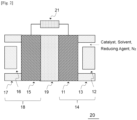
- a nitrogen-containing compound production apparatus 20 illustrated in Fig. 2 is a stack-type cell similar to a so-called PEM water electrolysis device and includes: a cathode part 14 including a cathode electrode 11, a cathode liquid flowing part 12, and a cathode current collector 13; an anode part 18 including an anode electrode 15, an anode liquid flowing part 16, and an anode current collector 17; and a diaphragm 19 positioned between the cathode part 14 and the anode part 18.
- a power supply 21 capable of applying voltage to the cathode electrode 11 and the anode electrode 15 may be further provided.
- the cathode liquid including the nitrogen-activation catalyst, the organic solvent, and the reducing agent flows through the cathode liquid flowing part 12 and is supplied to the cathode electrode 11.
- At least one of the cathode part 14 and the anode part 18 includes a proton source. That is, at least one of the cathode liquid and an anode liquid includes the proton source.
- a reference electrode may be placed inside the cathode liquid flowing part 12 or at a position connected to the diaphragm 19 via a salt bridge, and the potential of the cathode electrode 11 may be precisely controlled with reference to the reference electrode.
- the nitrogen-activation catalyst reacts with nitrogen molecules supplied into the cathode liquid and activates nitrogen molecules to form metal-nitrogen bonds.
- the cycle in which protons are supplied to the nitrogen from the proton source, electrons are supplied by the reducing agent, and metal is reduced is repeated to produce a nitrogen-containing compound.
- the oxidized reducing agent is reduced in the cathode part 14 and reused.
- the proton source in the nitrogen-containing compound production apparatus of the present disclosure includes water, alcohols such as methanol, ethanol, propanol, butanol, trifluoroethanol, phenol, and ethylene glycol, hydrogenated lutidine, hydrogenated picoline, hydrogenated collidine, and the like, and water is preferable.
- the proton source may be included in at least one of the cathode liquid and the anode liquid as an anode solvent and/or a cathode solvent described later, or may be included in at least one of the cathode liquid and the anode liquid as an electric conductivity improving additive described later.
- examples of the nitrogen-containing compound in the nitrogen-containing compound production apparatus of the present disclosure include ammonia, silylamine, and hydrazine, and ammonia is preferable.
- the nitrogen-activation catalyst of the present disclosure is not particularly limited as long as it is a catalyst capable of activating nitrogen, examples thereof include a metal complex activating nitrogen, an organic metal complex capable of breaking nitrogen triple bonds is preferable, and an organic metal complex capable of breaking nitrogen triple bonds and soluble in an organic solvent is more preferable.
- the phrase "soluble in an organic solvent” means that when the nitrogen-activation catalyst in an amount achieving a concentration of 0.1 mmol/L is mixed with an organic solvent, dissolution can be visually observed, for example.
- Examples of the central metal of the metal complex activating nitrogen include Ti, V, Mo, Fe, Mn, Co, Pt, Ir, and W, and Mo is preferable.
- Examples of a ligand of the metal complex activating nitrogen include a halide ion and a tertiary phosphine, a combination of a pincer ligand (that is, a ligand to which three coordinating atoms bind from three directions on the same plane including the central metal) and a halide ion is preferable, a combination of a phosphorus-carbon-phosphorus (PCP)-type pincer ligand or a phosphorus-nitrogen-phosphorus (PNP)-type pincer ligand and a halide ion is more preferable, and a combination of a PCP-type pincer ligand and a halide ion is still more preferable.
- a pincer ligand that is, a ligand to which three coordinating atoms bind from three directions on the same plane including the central metal
- a halide ion is preferable
- a complex meeting solubility in an organic solvent and reactivity with the reducing agent can be suitable used as the metal complex activating nitrogen.
- a molybdenum complex in which the central metal is Mo is preferable, a molybdenum complex having, as a ligand, a pincer ligand and a halide ion is more preferable, a molybdenum complex having, as a ligand, a PCP-type pincer ligand or a PNP-type pincer ligand and a halide ion is still more preferable, and a molybdenum complex having, as a ligand, a PCP-type pincer ligand and a halide ion is further preferable.
- Examples of the molybdenum complex having, as a ligand, a PNP-type pincer ligand and a halide ion include molybdenum complexes represented by formulae (1), (5), or (6) below.
- examples of the molybdenum complex having, as a ligand, a PCP-type pincer ligand and a halide ion include molybdenum complexes represented by formulae (2) or (3) below.
- other molybdenum complexes include a molybdenum complex represented by formula (4) below.
- R 1 to R 4 are each independently represent hydrogen or a linear, cyclic, or branched hydrocarbon group having 1 to 14 carbon atoms;
- R 5 represents hydrogen or a linear, cyclic, or branched hydrocarbon group having 1 to 14 carbon atoms and substituting hydrogen in the ring;
- X's each independently represent a halide ion selected from the group constituting of fluorine, chlorine, bromine, and iodine.
- R 1 and R 2 and/or R 3 and R 4 may bind to each other to form a ring
- PR 1 R 2 and PR 3 R 4 may be identical to or different from each other
- all of R 1 to R 4 may be identical to one another or R 1 to R 4 may be at least partially different.
- the "linear, cyclic, or branched hydrocarbon group having 1 to 14 carbon atoms" for R 1 to R 5 can be selected from the group consisting of an alkyl group having 1 to 6 carbon atoms, an alkenyl group having 2 to 6 carbon atoms, an alkynyl group having 2 to 6 carbon atoms, a cycloalkyl group having 3 to 6 carbon atoms, a cycloalkenyl group having 3 to 6 carbon atoms, a cycloalkynyl group having 3 to 6 carbon atoms, and an aryl group having 6 to 14 carbon atoms, for example.
- R 1 to R 4 an alkyl group having 1 to 6 carbon atoms is preferable, and an alkyl group having 1 to 4 carbon atoms is more preferable.
- R 1 to R 4 a butyl group is preferable, and a tert-butyl group is more preferable.
- R 5 's when two or three R 5 's are present, these R 5 's may bind to each other to form a ring. In addition, when two or three R 5 's are present, all R 5 's may be identical to one another, or R 5 's may be at least partially different.
- X is preferably bromine, chlorine, or iodine and more preferably chlorine or iodine.
- X 3 in the formula means that three X's bind to Mo.
- R 1 to R 5 and X are the same as those in formula (1) above.
- R 1 to R 5 and X are the same as those in formula (1) above.
- R 1 to R 3 are the same as those in formula (1) above.
- R 1 to R 5 and X are the same as those in formula (1) above.
- R 1 to R 5 and X are the same as those in formula (1) above.
- the concentration of the nitrogen-activation catalyst in the cathode liquid is not particularly limited but is, for example, 0.1 mmol/L or more and 1 mol/L or less from the viewpoint of accelerating reaction to synthesize the nitrogen-containing compound.
- the reducing agent of the present disclosure is not particularly limited as long as it is a compound capable of reducing the nitrogen-activation catalyst, a compound that has a redox potential equal to or negative than the open circuit potential of the nitrogen-activation catalyst and is soluble in an organic solvent is preferable from the viewpoint of accelerating reaction to synthesize the nitrogen-containing compound.
- the reduction potential of the reducing agent of the present disclosure be on the more positive side than competitive reaction thereof, that is, reduction reaction of the proton source or protons, and it is more preferable that the reduction potential of the reducing agent of the present disclosure be on the more positive side than -2.0 VvsSCE.
- the redox potential of the reducing agent can be obtained by converting, into a potential based on the saturated calomel electrode (SCE), a value measured by a cyclic voltammetry (CV) method using, for example, a Ag/Ag + electrode as a reference electrode; more specifically, the redox potential of the reducing agent can be measured by a method described in examples described later.
- SCE saturated calomel electrode
- CV cyclic voltammetry
- soluble in an organic solvent means that when the reducing agent in an amount achieving a concentration of 0.1 mmol/L is mixed with an organic solvent, dissolution can be visually observed, for example.
- Examples of the reducing agent of the present disclosure include at least one selected from the group consisting of samarium iodide, decamethylcobaltocene, cobaltocene, and decamethylchromocene. Among them, at least one selected from the group consisting of samarium iodide and decamethylcobaltocene is preferable, and samarium iodide is more preferable.
- One kind of the reducing agent may be used alone, or two or more kinds thereof may be used in combination.
- the concentration of the reducing agent in the cathode liquid is not particularly limited but is, for example, 0.1 mmol/L or more and 1 mol/L or less from the viewpoint of accelerating reaction to synthesize the nitrogen-containing compound.
- reduction reaction for example, 2H 2 O + 2e - ⁇ H 2 + 2OH -
- reduction reaction for example, 2H + + 2e - ⁇ H 2
- protons supplied to the cathode part from the anode part through the diaphragm occur as competitive reaction in addition to reduction reaction of the reducing agent as in (3) or (C) above.
- a cathode electrode with high overpotential with respect to competitive reaction be selected so that reduction reaction of the reducing agent as in (3) or (C) above preferentially occurs.
- an electrode including at least one selected from titanium, vanadium, manganese, iron, cobalt, nickel, copper, zinc, gallium, niobium, molybdenum, silver, indium, tin, lead, bismuth, aluminum, and carbon is preferable as the cathode electrode.
- examples of the cathode electrode include a titanium electrode, a vanadium electrode, a manganese electrode, an iron electrode, a cobalt electrode, a nickel electrode, a copper electrode, a zinc electrode, a gallium electrode, a niobium electrode, a molybdenum electrode, a silver electrode, an indium electrode, a tin electrode, a lead electrode, a bismuth electrode, an aluminum electrode, a carbon electrode, and an electrode of a combination thereof.
- a titanium electrode is preferable from the viewpoint of further accelerating reaction in the cathode part.
- An anode electrode with low reaction overpotential is preferably used as the anode electrode from the viewpoint of accelerating reaction on the anode electrode.
- reaction of (E) above is selected as reaction on the anode electrode
- an anode electrode with low oxygen production overpotential is preferably used from the viewpoint of accelerating reaction of (E) on the anode electrode.
- An electrode including at least one selected from rhodium, palladium, iridium, ruthenium, platinum, gold, titanium, nickel, cobalt, manganese, copper, zinc, tin, iron, lanthanum, strontium, chromium, calcium, barium, cerium, bismuth, tungsten, and carbon is preferable as the anode electrode.
- examples of the anode electrode include a rhodium electrode, a palladium electrode, an iridium electrode, a ruthenium electrode, a platinum electrode, a gold electrode, a titanium electrode, a nickel electrode, a cobalt electrode, a manganese electrode, a copper electrode, a zinc electrode, a tin electrode, an iron electrode, a lanthanum electrode, a strontium electrode, a chromium electrode, a calcium electrode, a barium electrode, a cerium electrode, a bismuth electrode, a tungsten electrode, a carbon electrode, and an electrode of a combination thereof.
- a nickel electrode is preferable from the viewpoint of further accelerating reaction in the anode part.
- the diaphragm has a function to prevent the catalyst and the reducing agent from moving from the cathode part to the anode part.
- the diaphragm has a function to move protons from the anode part to the cathode part, or to move OH - ions from the cathode part to the anode part.
- a diaphragm chemically and/or physically stable even in the organic solvent that is, a diaphragm that is hardly dissolved and/or hardly swells even in the organic solvent is preferably selected.
- the diaphragm examples include an inorganic membrane such as a glass filter and a zeolite membrane; and an ion exchange membrane such as an anion exchange membrane, a cation exchange membrane, and a bipolar membrane. Among them, an anion exchange membrane or an inorganic membrane is preferable, and an anion exchange membrane is more preferable.
- One kind of the diaphragm may be used alone, or two or more kinds thereof may be used in combination.
- a thickness of the diaphragm is not particularly limited but is, for example, 10 ⁇ m or more and 5000 ⁇ m or less from the viewpoints of ion conductivity and chemical and/or physical stability, and when an ion exchange membrane is used as the diaphragm, a lower limit of the thickness of the diaphragm is preferably 60 ⁇ m or more, more preferably 65 ⁇ m or more, and still more preferably 70 ⁇ m or more from the viewpoint of suppressing dissolution of the membrane.
- An additive capable of improving electric conductivity without impairing reaction to synthesize the nitrogen-containing compound may be added to the cathode liquid and/or the anode liquid from the viewpoint of accelerating reaction to synthesize the nitrogen-containing compound.
- Examples of such an electric conductivity improving additive include a metal halide salt such as lithium iodide, sodium iodide, potassium iodide, lithium chloride, sodium chloride, and potassium chloride; a compound which is a complex of a cation and an anion such as dimethylanilinium borate, tetrabutylammonium hexafluorophosphate, ammonium hexafluorophosphate, [LutH]OTf (hydrogenated lutidine trifluoromethanesulphonate), [ColH]OTf (hydrogenated collidine trifluoromethanesulphonate), [PicH]OTf (hydrogenated picoline trifluoromethanesulphonate), 1-hexyl-3-methylimidazolium bis(trifluoromethylsulfonyl)imide, and 1-butyl-3-methylimidazolium bis(trifluoromethylsulfonyl)amide (ion liquid); and
- water may be used as the additive.
- a concentration of the electric conductivity improving additive in the cathode liquid or the anode liquid is not particularly limited but is, for example, 0.1 mmol/L or more and 3 mol/L or less from the viewpoint of accelerating reaction to synthesize the nitrogen-containing compound.
- the organic solvent used in the cathode part is preferably an organic solvent that is capable of dissolving the salt for improving activity and/or electric conductivity of the nitrogen-activation catalyst and has a stable potential window even during applying voltage.
- an organic solvent having a solubility parameter of 20 (cal/cm 3 ) 1/2 or less is desirably selected.
- the "solubility parameter (SP value)" herein is a value introduced by Hildebrand and defined by regular solution theory.
- organic solvent examples include ethers such as dibutyl ether, diethyl ether, dimethoxyethane, 1,4-dioxane, and tetrahydrofuran; alcohols such as methanol, ethanol, propanol, isopropanol, butanol, trifluoroethanol, phenol, and ethyleneglycol; nitriles such as acetonitrile; alkanes such as n-hexane; and carbonates such as ethylene carbonate, propylene carbonate, butylene carbonate, dimethyl carbonate, diethyl carbonate, ethyl carbonate, and methyl propyl carbonate.
- ethers such as dibutyl ether, diethyl ether, dimethoxyethane, 1,4-dioxane, and tetrahydrofuran
- alcohols such as methanol, ethanol, propanol, isopropanol, butanol, triflu
- tetrahydrofuran and/or dimethoxyethane are preferable, and dimethoxyethane is more preferable from the viewpoint of ellectrochemical stability.
- One kind of the organic solvent may be used alone, or two or more kinds thereof may be used in combination.
- Examples of a solvent used in the anode part include water and an organic solvent including water.
- the organic solvent used in the anode part includes those same as the organic solvents listed for the cathode solvent.
- a voltage be selected such that competitive reaction and reduction precipitation of the reducing agent and the proton source are suppressed while maximizing the current value at which the reducing agent is electrochemically reduced.
- the voltage is more preferably 5.0 V or less, still more preferably 4.5 V or less, further preferably 4.0 V or less, and still further preferably 3.5 V or less.
- the potential of the cathode electrode be selected such that competitive reaction and reduction precipitation of the reducing agent and the proton source are suppressed while maximizing the current value at which the reducing agent is electrochemically reduced.
- the nitrogen-containing compound production apparatus of the present disclosure may include a reference electrode and is preferably operated such that the potential of the cathode electrode defined on the basis of the reference electrode is on the more positive side than reduction reaction of the proton source or protons, more preferably on the more positive side than -2.3 VvsSCE, still more preferably on the more positive side than -2.0 VvsSCE, and further preferably on the more positive side than -1.8 VvsSCE.
- production of the nitrogen-containing compound can be advanced under relatively mild conditions, and production of the nitrogen-containing compound can be advanced by carrying out operation within the ranges of -80°C or more and 100°C or less and 0.10 MPa or more and 0.20 MPa or less, for example.
- the temperature is preferably -60°C or more and 70°C or less and more preferably -40°C or more and 60°C or less.
- a nitrogen-containing compound production method of the present disclosure is a nitrogen-containing compound production method using the nitrogen-containing compound production apparatus of the present disclosure, and includes a step of applying voltage between the cathode electrode and the anode electrode to synthesize a nitrogen-containing compound from nitrogen and protons originating from the proton source in the cathode part.
- the same effect as the nitrogen-containing compound production apparatus of the present disclosure can be provided.
- each element constituting the nitrogen-containing compound production apparatus in the nitrogen-containing compound production method of the present disclosure and preferable operation of the nitrogen-containing compound production apparatus are same as those for the nitrogen-containing compound production apparatus of the present disclosure described above.
- An electrolytic cell made of Pyrex glass, H-type cell illustrated in Fig. 1 was used.
- An anion exchange membrane (ASE, manufactured by ASTOM Corporation, product name: "NEOSEPTA ASE-A-5142 membrane,” thickness: 150 ⁇ m) was used as a diaphragm of the cell, a nickel (Ni) electrode was used as an anode electrode, and a titanium (Ti) electrode was used as a cathode electrode.
- the produced amount of ammonia was 0.025 mmol. Since the produced amount of ammonia derived from chemical reaction calculated from the amount of samarium iodide used was 0.009 mmol, 0.016 mmol of ammonia was produced through electrochemical reaction.
- the molybdenum complex represented by formula (A) above was produced according to the description of a non patent literature, Y Ashida, Y Nishibayashi et. al., "Molybdenum-catalysed ammonia production with samarium diiodide and alcohols or water," Nature, 568, 536 (2019 ).
- t Bu represents a tert-butyl group.
- the redox potential of the reducing agent was measured by a cyclic voltammetry (CV) method.
- the CV was measured with the following device and conditions.
- the redox potential of the obtained reducing agent was converted into a SCE-based potential from a Ag/Ag + -based potential.
- Potentiostat manufactured by TOHO Technical Research Co., Ltd., product name "8 CHANNEL POTENTIOSTAT/GALVANOSTAT MODEL PS-08"
- the open circuit potential of the nitrogen-activation catalyst was measured by a open circuit potential (OCP) measurement method.
- OCP open circuit potential
- the OCP was measured with the following device and conditions.
- the obtained open circuit potential of the nitrogen-activation catalyst was converted into a SCE-based potential from a Ag/Ag + -based potential.
- Potentiostat manufactured by TOHO Technical Research Co., Ltd., product name "8 CHANNEL POTENTIOSTAT/GALVANOSTAT MODEL PS-08"
- Ammonia was produced in the same manner as Example 1 except that "0.011 mmol of the molybdenum complex represented by formula (A)" put into the cathode chamber was changed to "0.009 mmol of the molybdenum complex represented by formula (A)," and "1600 mg of sodium iodide” was changed to "800 mg of sodium iodide.”
- the produced amount of ammonia was 0.022 mmol. Since the produced amount of ammonia derived from chemical reaction calculated from the amount of samarium iodide used was 0.011 mmol, 0.011 mmol of ammonia was produced through electrochemical reaction.
- Ammonia was produced in the same manner as Example 1 except that no voltage was applied between the anode electrode and the cathode electrode of the electrolytic cell.
- the produced amount of ammonia was 0.009 mmol and was equal to the produced amount of ammonia derived from chemical reaction calculated from the amount of samarium iodide.
- Ammonia was produced in the same manner as Example 1 except that "application of a potential of -1.7 V based on the SCE reference electrode to the cathode electrode” was changed to "application of a potential of -2.5 V based on the SCE reference electrode to the cathode electrode.”
- the produced amount of ammonia was 0.023 mmol. Since the produced amount of ammonia derived from chemical reaction calculated from the amount of samarium iodide used was 0.009 mmol, 0.014 mmol of ammonia was produced through electrochemical reaction. Generation of bubbles from the cathode electrode was observed, and production of hydrogen was confirmed.
- Ammonia was produced in the same manner as Example 1 except that "0.011 mmol of the molybdenum complex represented by formula (A)" put into the cathode chamber was changed to "0.010 mmol of the molybdenum complex represented by formula (A),” and "500 mg of tetrabutylammonium hexafluorophosphate (Bu 4 NPF 6 )” put into the cathode chamber was changed to "600 mg of dimethylanilinium tetrakispentafluorophenylborate (DMAB).” The produced amount of ammonia was 0.018 mmol. Since the produced amount of ammonia derived from chemical reaction calculated from the amount of samarium iodide used was 0.010 mmol, 0.008 mmol of ammonia was produced through electrochemical reaction.
- Ammonia was produced in the same manner as Example 4 except that "0.010 mmol of the molybdenum complex represented by formula (A)" put into the cathode chamber was changed to "0.007 mmol of the molybdenum complex represented by formula (A),” "600 mg of DMAB” put into the cathode chamber was changed to "2900 mg of DMAB,” and "0.06 mmol of samarium iodide” was changed to "0.12 mmol of samarium iodide.” The produced amount of ammonia was 0.047 mmol.
- Ammonia was produced in the same manner as Example 1 except that the anion exchange membrane was changed from ASE (manufactured by ASTOM Corporation, product name: "NEOSEPTA ASE-A-5142 membrane,” thickness: 150 ⁇ m) to AHA (manufactured by ASTOM Corporation, product name: “NEOSEPTA AHA-A-5142 membrane,” thickness: 220 ⁇ m).
- the produced amount of ammonia was 0.024 mmol. Since the produced amount of ammonia derived from chemical reaction calculated from the amount of samarium iodide used was 0.009 mmol, 0.015 mmol of ammonia was produced through electrochemical reaction.
- Ammonia was produced in the same manner as Example 1 except that the anion exchange membrane was changed from ASE (manufactured by ASTOM Corporation, product name: "NEOSEPTA ASE-A-5142 membrane,” thickness: 150 ⁇ m) to FAA-3-PK-75 (manufactured by FuMA-Tech GmbH, product name: “Fumasep (registered trademark) FAA-3-PK-75 membrane,” thickness: 75 ⁇ m).
- the produced amount of ammonia was 0.027 mmol. Since the produced amount of ammonia derived from chemical reaction calculated from the amount of samarium iodide used was 0.009 mmol, 0.018 mmol of ammonia was produced through electrochemical reaction.
- An anion exchange membrane (AHA (manufactured by ASTOM Corporation, product name: "NEOSEPTAAHA-A-5142 membrane,” thickness: 220 ⁇ m) was used as a diaphragm of the cell, a nickel (Ni) electrode was used as an anode electrode, and a titanium (Ti) electrode was used as a cathode electrode.
- AHA anion exchange membrane
- the produced amount of ammonia was 0.143 mmol. Since the produced amount of ammonia derived from chemical reaction calculated from the amount of samarium iodide used was 0.080 mmol, 0.063 mmol of ammonia was produced through electrochemical reaction.
Landscapes
- Chemical & Material Sciences (AREA)
- Organic Chemistry (AREA)
- Engineering & Computer Science (AREA)
- Chemical Kinetics & Catalysis (AREA)
- Materials Engineering (AREA)
- Electrochemistry (AREA)
- Metallurgy (AREA)
- Inorganic Chemistry (AREA)
- Analytical Chemistry (AREA)
- Catalysts (AREA)
- Electrolytic Production Of Non-Metals, Compounds, Apparatuses Therefor (AREA)
- Treating Waste Gases (AREA)
- Physical Or Chemical Processes And Apparatus (AREA)
- Electrodes For Compound Or Non-Metal Manufacture (AREA)
Abstract
Description
- The present invention relates to an apparatus for producing a nitrogen-containing compound and a method for producing a nitrogen-containing compound.
- Ammonia is an important chemical raw material used as a basic material for fertilizers and chemical products, and uses thereof for coal fired power generation co-combustion and as an energy carrier also draw attention recently.
- Ammonia is conventionally produced by Haber-Bosch process. Haber-Bosch process is a method for producing ammonia by reacting nitrogen gas and hydrogen gas under the presence of an iron-based catalyst.
- However, since Haber-Bosch process is a method for synthesizing ammonia at high temperature and under high pressure, energy consumption thereof is large, and a large apparatus made from a special material is required. Furthermore, there is also a problem of emitting a large amount of carbon dioxide, which is a greenhouse effect gas, when hydrogen gas is obtained from natural gas mainly containing methane (CH4).
- Therefore, development of a method for producing ammonia from nitrogen and water under mild reaction conditions is desired.
-
PTL 1,PTL 2, andNPL 1 each disclose a method for producing ammonia from nitrogen and hydrogen using a molybdenum complex catalyst. These documents indicate that production of ammonia at ambient temperature and under ambient pressure is possible. -
- PTL 1:
JP 2013-159568 A - PTL 2:
JP 2010-195703 A - NPL 1: Molybdenum-catalysed ammonia production with samarium diiodide and alcohols or water, Y Ashida, K. Arashiba, K. Nakajima, and Y Nishibayashi, Nature, 568, 536-540 (2019)
- The present inventors have studied a method for improving quantity of ammonia produced by the ammonia production methods described in
PTL 1,PTL 2, andNPL 1. - The present invention has been made in view of the above circumstances and provides an apparatus for producing a nitrogen-containing compound and a method for producing a nitrogen-containing compound which are capable of improving production quantity of the nitrogen-containing compound.
- The present inventors have found that production quantity of a nitrogen-containing compound can be improved by, in an apparatus including: a cathode part including a nitrogen-activation catalyst, an organic solvent, a reducing agent, and a cathode electrode; an anode part including an anode electrode; and a diaphragm positioned between the cathode part and the anode part, applying voltage between the cathode electrode and the anode electrode and synthesizing, in the cathode part, the nitrogen-containing compound from nitrogen and protons originating from a proton source.
- That is, according to the present invention, a nitrogen-containing compound production apparatus and a nitrogen-containing compound production method shown below are provided.
-
- [1] An apparatus for producing a nitrogen-containing compound, including:
- a cathode part including a nitrogen-activation catalyst, an organic solvent, a reducing agent, and a cathode electrode;
- an anode part including an anode electrode; and
- a diaphragm positioned between the cathode part and the anode part, in which
- at least one of the cathode part and the anode part includes a proton source, and
- voltage is applied between the cathode electrode and the anode electrode to synthesize a nitrogen-containing compound from nitrogen and protons originating from the proton source in the cathode part.
- [2] A method for producing the nitrogen-containing compound using the nitrogen-containing compound production apparatus according to item [1] above, the nitrogen-containing compound production method including:
a step of applying voltage between the cathode electrode and the anode electrode to synthesize a nitrogen-containing compound from nitrogen and protons originating from the proton source in the cathode part. - According to the present invention, a nitrogen-containing compound production apparatus and a nitrogen-containing compound production method which are capable of improving production quantity of the nitrogen-containing compound can be provided.
-
-
Fig. 1 is a schematic diagram illustrating an example of a nitrogen-containing compound production apparatus according to the present disclosure. -
Fig. 2 is a schematic diagram illustrating an example of the nitrogen-containing compound production apparatus according to the present disclosure. - A nitrogen-containing compound production apparatus of the present disclosure includes: a cathode part including a nitrogen-activation catalyst, an organic solvent, a reducing agent, and a cathode electrode; an anode part including an anode electrode; and a diaphragm positioned between the cathode part and the anode part. At least one of the cathode part and the anode part includes a proton source. The nitrogen-containing compound production apparatus of the present disclosure applies voltage between the cathode electrode and the anode electrode to synthesize a nitrogen-containing compound from nitrogen and protons originating from the proton source in the cathode part.
- According to the nitrogen-containing compound production apparatus of the present disclosure, a nitrogen-containing compound is synthesized in the cathode part under the presence of the nitrogen-activation catalyst and the reducing agent, and, at the same time, the reducing agent oxidized during reaction to synthesize the nitrogen-containing compound can be reduced by an electrolytic method. When the reducing agent can be reduced by an electrolytic method, the reducing agent can be repeatedly used. Therefore, the reducing agent can be efficiently used, and production quantity of the nitrogen-containing compound is considered to be increased without using a large amount of the reducing agent.
- The phrase "at the same time" herein means that synthesis of the nitrogen-containing compound and reduction of the oxidized reducing agent take place in the cathode part. It is preferable that a time interval between synthesis of the nitrogen-containing compound and reduction of the oxidized reducing agent be short.
- In the nitrogen-containing compound production apparatus of the present disclosure, the nitrogen-containing compound is synthesized from nitrogen and the proton source under the presence of the nitrogen-activation catalyst and the reducing agent. Specifically, electron donation from the reducing agent and reaction to produce the nitrogen-containing compound are included.
- The reaction to produce the nitrogen-containing compound proceeds under the presence of the nitrogen-activation catalyst, for example, proceeds through proton-coupled electron transfer (PCET) reaction coupled with electron donation from the reducing agent.
- Reduction of the oxidized reducing agent by an electrolytic method proceeds as cathode reaction of the electrolytic method. Any reaction can be selected as anode reaction paired with the cathode reaction.
- In the nitrogen-containing compound production apparatus of the present disclosure, in the case where the nitrogen-containing compound is ammonia, for example, ammonia is continuously synthesized through reaction shown in (1) to (3) below. Incidentally, electron donation from the reducing agent proceeding coupled with NH3 production reaction, that is, reaction shown in (1) below is inclusively described in reaction shown in (2) below.
- (1) Electron donation from reducing agent
Red → Ox + e-
- (2) NH3 production reaction
N2 + 6Red + 6H+ → (Cat) → 2NH3 + 6Ox
- (3) Reduction reaction of reducing agent (cathode reaction)
Ox + e- → Red
- Here, Red represents the reducing agent, Ox represents the oxidized reducing agent, and Cat represents the nitrogen-activation catalyst.
- Protons in the reaction of (2) can be donated through the diaphragm from the proton source added to the inside of the cathode part or from the abode part.
- In addition, in the nitrogen-containing compound production apparatus of the present disclosure, it is considered that ammonia (NH3) is continuously synthesized through reaction shown in (A) to (E) below, when ammonia is synthesized using a molybdenum complex (hereinafter, also referred to as "Mocat") as the nitrogen-activation catalyst, samarium iodide (SmI2) as the reducing agent, and water (H2O) as the proton source, for example. Incidentally, reaction shown in (A) below proceeding coupled with NH3 production reaction is inclusively described in reaction shown in (B) below.
- (A) SmI2 + H2O → SmI2(H2O) → SmI2(OH) + H+ + e-
- (B) NH3 production reaction
N2 + 6SmI2 + 6H2O → (proton-coupled electron transfer (PCET) reaction + Mocat) → 2NH3 + 6SmI2(OH)
- (C) Samarium iodide reduction reaction (cathode reaction)
SmI2(OH) + e- → SmI2 + OH-
- (D) Migration of OH- from the cathode part to the anode part
OH- (cathode part) → (diaphragm) → OH- (anode part)
- (E) Anode reaction
4OH- → O2 + 2H2O + 4e-
- In the reaction to synthesize the nitrogen-containing compound using the reducing agent, as in the reaction of (2) and (B) above, the reducing agent in an amount equal to or more than the amount of nitrogen is required; therefore, a large amount of the reducing agent is required in order to improve production quantity of the nitrogen-containing compound. On the other hand, in the nitrogen-containing compound production apparatus of the present disclosure, the reducing agent can be repeatedly used by reducing, by an electrolytic method, the reducing agent oxidized through reaction to synthesize the nitrogen-containing compound in the cathode part. Therefore, it is considered that the reducing agent can be efficiently used, and production quantity of the nitrogen-containing compound can be increased without using a large amount of the reducing agent.
- In addition, in the nitrogen-containing compound production apparatus of the present disclosure, since water can be used as the proton source, the nitrogen-containing compound such as ammonia can be synthesized from nitrogen without passing through production of hydrogen gas. Therefore, a step of obtaining hydrogen gas from natural gas mainly containing methane (CH4) can be omitted, and the problem of emitting a large amount of carbon dioxide, which is a greenhouse effect gas, hardly arises.
- Furthermore, the nitrogen-containing compound production apparatus of the present disclosure is considered to be excellent in industrial productivity as the nitrogen-containing compound production apparatus of the present disclosure can advance reaction to synthesize the nitrogen-containing compound under mild reaction conditions, energy consumption is thus little, and a large apparatus made from a special material can be omitted.
- An electrolytic cell can be used as the nitrogen-containing compound production apparatus of the present disclosure, for example.
Fig. 1 andFig. 2 are schematic diagrams each illustrating an example of the nitrogen-containing compound production apparatus according to the present disclosure. - A nitrogen-containing
compound production apparatus 10 illustrated inFig. 1 is a so-called H-type cell and includes: acathode part 7 including acathode electrode 1 and acathode chamber 4; ananode part 8 including ananode electrode 2 and ananode chamber 5; and a diaphragm 3 positioned between thecathode part 7 and theanode part 8. In addition, apower supply 6 capable of applying voltage to thecathode electrode 1 and theanode electrode 2 may be further provided. - A cathode liquid including a nitrogen-activation catalyst, an organic solvent, and a reducing agent is added to the
cathode chamber 4. At least one of thecathode part 7 or theanode part 8 includes a proton source. That is, at least one of the cathode liquid or an anode liquid includes the proton source. In addition, a reference electrode may be placed inside thecathode chamber 4 or at a position connected to the diaphragm 3 via a salt bridge, and the potential of thecathode electrode 1 may be precisely controlled with reference to the reference electrode. - The nitrogen-activation catalyst reacts with nitrogen molecules supplied to the
cathode chamber 4 and activates nitrogen molecules to form metal-nitrogen bonds. The cycle in which protons are supplied to the nitrogen from the proton source, electrons are supplied by the reducing agent, and metal is reduced is repeated to produce a nitrogen-containing compound. The oxidized reducing agent is reduced in thecathode part 7 and reused. - Here, in the present specification, the cathode liquid refers to a liquid used in the cathode part (cathode chamber) and is, for example, a liquid in which the nitrogen-activation catalyst and the reducing agent are added and the proton source, an additive, and the like are optionally added to a solvent; and the anode liquid refers to a liquid used in the anode part (anode chamber) and is, for example, a solvent or a liquid in which an additive, the proton source, and the like are added to a solvent.
- A nitrogen-containing
compound production apparatus 20 illustrated inFig. 2 is a stack-type cell similar to a so-called PEM water electrolysis device and includes: acathode part 14 including acathode electrode 11, a cathodeliquid flowing part 12, and a cathodecurrent collector 13; ananode part 18 including ananode electrode 15, an anodeliquid flowing part 16, and an anodecurrent collector 17; and adiaphragm 19 positioned between thecathode part 14 and theanode part 18. In addition, apower supply 21 capable of applying voltage to thecathode electrode 11 and theanode electrode 15 may be further provided. - The cathode liquid including the nitrogen-activation catalyst, the organic solvent, and the reducing agent flows through the cathode
liquid flowing part 12 and is supplied to thecathode electrode 11. - At least one of the
cathode part 14 and theanode part 18 includes a proton source. That is, at least one of the cathode liquid and an anode liquid includes the proton source. In addition, a reference electrode may be placed inside the cathodeliquid flowing part 12 or at a position connected to thediaphragm 19 via a salt bridge, and the potential of thecathode electrode 11 may be precisely controlled with reference to the reference electrode. - The nitrogen-activation catalyst reacts with nitrogen molecules supplied into the cathode liquid and activates nitrogen molecules to form metal-nitrogen bonds. The cycle in which protons are supplied to the nitrogen from the proton source, electrons are supplied by the reducing agent, and metal is reduced is repeated to produce a nitrogen-containing compound. The oxidized reducing agent is reduced in the
cathode part 14 and reused. - The proton source in the nitrogen-containing compound production apparatus of the present disclosure includes water, alcohols such as methanol, ethanol, propanol, butanol, trifluoroethanol, phenol, and ethylene glycol, hydrogenated lutidine, hydrogenated picoline, hydrogenated collidine, and the like, and water is preferable. Here, the proton source may be included in at least one of the cathode liquid and the anode liquid as an anode solvent and/or a cathode solvent described later, or may be included in at least one of the cathode liquid and the anode liquid as an electric conductivity improving additive described later.
- In addition, examples of the nitrogen-containing compound in the nitrogen-containing compound production apparatus of the present disclosure include ammonia, silylamine, and hydrazine, and ammonia is preferable.
- Although the nitrogen-activation catalyst of the present disclosure is not particularly limited as long as it is a catalyst capable of activating nitrogen, examples thereof include a metal complex activating nitrogen, an organic metal complex capable of breaking nitrogen triple bonds is preferable, and an organic metal complex capable of breaking nitrogen triple bonds and soluble in an organic solvent is more preferable. Here, the phrase "soluble in an organic solvent" means that when the nitrogen-activation catalyst in an amount achieving a concentration of 0.1 mmol/L is mixed with an organic solvent, dissolution can be visually observed, for example.
- Examples of the central metal of the metal complex activating nitrogen include Ti, V, Mo, Fe, Mn, Co, Pt, Ir, and W, and Mo is preferable.
- Examples of a ligand of the metal complex activating nitrogen include a halide ion and a tertiary phosphine, a combination of a pincer ligand (that is, a ligand to which three coordinating atoms bind from three directions on the same plane including the central metal) and a halide ion is preferable, a combination of a phosphorus-carbon-phosphorus (PCP)-type pincer ligand or a phosphorus-nitrogen-phosphorus (PNP)-type pincer ligand and a halide ion is more preferable, and a combination of a PCP-type pincer ligand and a halide ion is still more preferable.
- A complex meeting solubility in an organic solvent and reactivity with the reducing agent can be suitable used as the metal complex activating nitrogen.
- Among them, as the metal complex activating nitrogen, a molybdenum complex in which the central metal is Mo is preferable, a molybdenum complex having, as a ligand, a pincer ligand and a halide ion is more preferable, a molybdenum complex having, as a ligand, a PCP-type pincer ligand or a PNP-type pincer ligand and a halide ion is still more preferable, and a molybdenum complex having, as a ligand, a PCP-type pincer ligand and a halide ion is further preferable.
- Examples of the molybdenum complex having, as a ligand, a PNP-type pincer ligand and a halide ion include molybdenum complexes represented by formulae (1), (5), or (6) below. In addition, examples of the molybdenum complex having, as a ligand, a PCP-type pincer ligand and a halide ion include molybdenum complexes represented by formulae (2) or (3) below. In addition, other molybdenum complexes include a molybdenum complex represented by formula (4) below.

- In formula (1) above, R1 to R4 are each independently represent hydrogen or a linear, cyclic, or branched hydrocarbon group having 1 to 14 carbon atoms; R5 represents hydrogen or a linear, cyclic, or branched hydrocarbon group having 1 to 14 carbon atoms and substituting hydrogen in the ring; X's each independently represent a halide ion selected from the group constituting of fluorine, chlorine, bromine, and iodine.
- Here, R1 and R2 and/or R3 and R4 may bind to each other to form a ring, PR1R2 and PR3R4 may be identical to or different from each other, and all of R1 to R4 may be identical to one another or R1 to R4 may be at least partially different.
- The "linear, cyclic, or branched hydrocarbon group having 1 to 14 carbon atoms" for R1 to R5 can be selected from the group consisting of an alkyl group having 1 to 6 carbon atoms, an alkenyl group having 2 to 6 carbon atoms, an alkynyl group having 2 to 6 carbon atoms, a cycloalkyl group having 3 to 6 carbon atoms, a cycloalkenyl group having 3 to 6 carbon atoms, a cycloalkynyl group having 3 to 6 carbon atoms, and an aryl group having 6 to 14 carbon atoms, for example. Among them, as R1 to R4, an alkyl group having 1 to 6 carbon atoms is preferable, and an alkyl group having 1 to 4 carbon atoms is more preferable. In addition, as R1 to R4, a butyl group is preferable, and a tert-butyl group is more preferable.
- In addition, when two or three R5's are present, these R5's may bind to each other to form a ring. In addition, when two or three R5's are present, all R5's may be identical to one another, or R5's may be at least partially different.
- X is preferably bromine, chlorine, or iodine and more preferably chlorine or iodine.
- Here, X3 in the formula means that three X's bind to Mo.

- In formula (2) above, R1 to R5 and X are the same as those in formula (1) above.


- In formula (3) above, R1 to R5 and X are the same as those in formula (1) above.
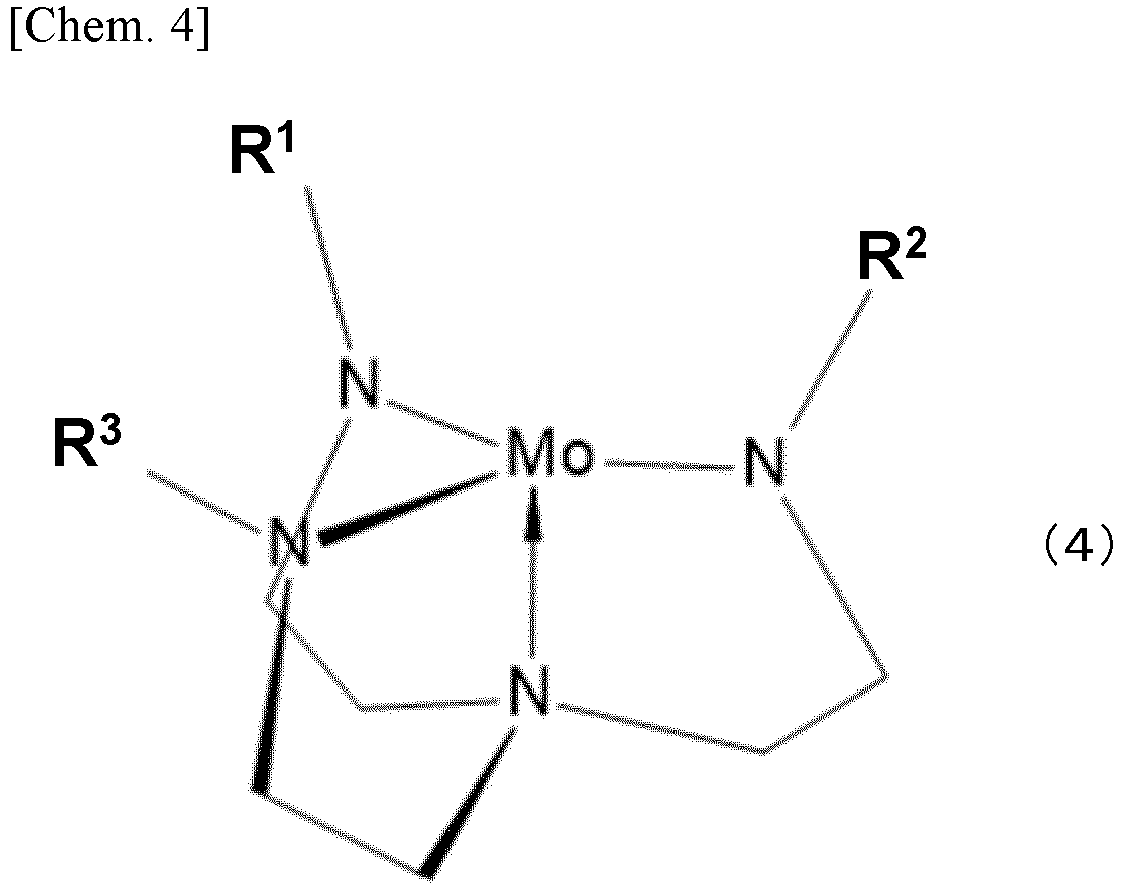
- In formula (4) above, R1 to R3 are the same as those in formula (1) above.

- In formula (5) above, R1 to R5 and X are the same as those in formula (1) above.
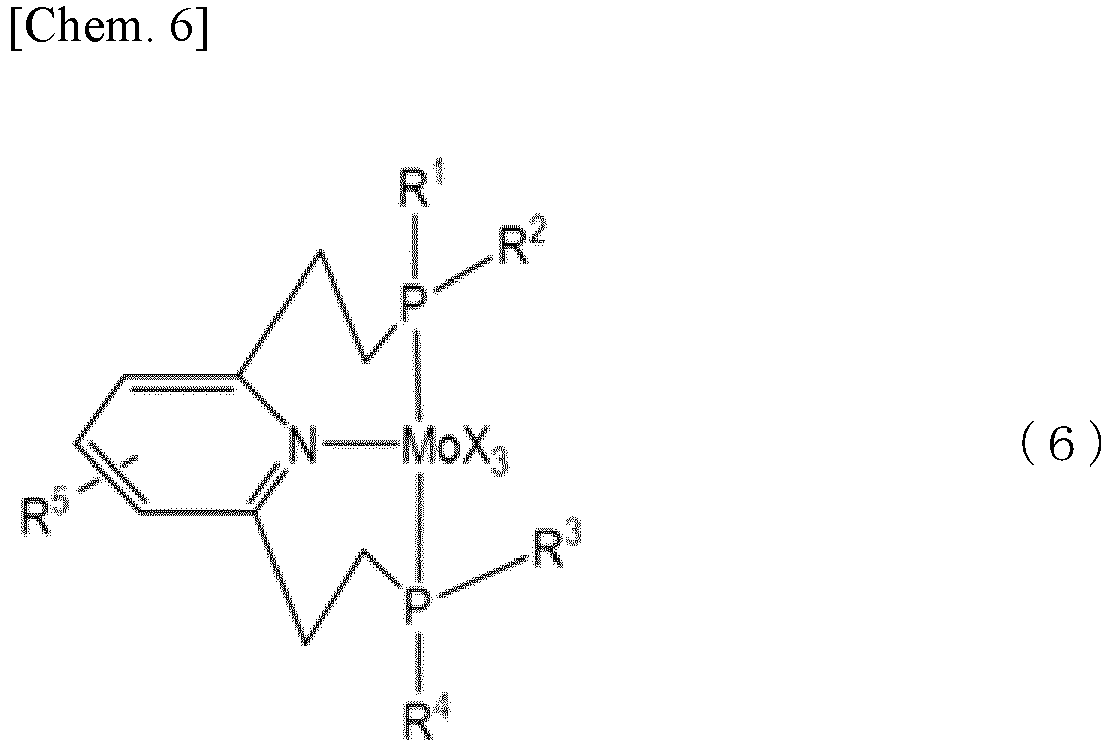
- In formula (6) above, R1 to R5 and X are the same as those in formula (1) above.
- The concentration of the nitrogen-activation catalyst in the cathode liquid is not particularly limited but is, for example, 0.1 mmol/L or more and 1 mol/L or less from the viewpoint of accelerating reaction to synthesize the nitrogen-containing compound.
- Although the reducing agent of the present disclosure is not particularly limited as long as it is a compound capable of reducing the nitrogen-activation catalyst, a compound that has a redox potential equal to or negative than the open circuit potential of the nitrogen-activation catalyst and is soluble in an organic solvent is preferable from the viewpoint of accelerating reaction to synthesize the nitrogen-containing compound. In addition, from the viewpoint of accelerating reaction to synthesize the nitrogen-containing compound, it is preferable that the reduction potential of the reducing agent of the present disclosure be on the more positive side than competitive reaction thereof, that is, reduction reaction of the proton source or protons, and it is more preferable that the reduction potential of the reducing agent of the present disclosure be on the more positive side than -2.0 VvsSCE.
- The redox potential of the reducing agent can be obtained by converting, into a potential based on the saturated calomel electrode (SCE), a value measured by a cyclic voltammetry (CV) method using, for example, a Ag/Ag+ electrode as a reference electrode; more specifically, the redox potential of the reducing agent can be measured by a method described in examples described later.
- In addition, the phrase "soluble in an organic solvent" means that when the reducing agent in an amount achieving a concentration of 0.1 mmol/L is mixed with an organic solvent, dissolution can be visually observed, for example.
- Examples of the reducing agent of the present disclosure include at least one selected from the group consisting of samarium iodide, decamethylcobaltocene, cobaltocene, and decamethylchromocene. Among them, at least one selected from the group consisting of samarium iodide and decamethylcobaltocene is preferable, and samarium iodide is more preferable. One kind of the reducing agent may be used alone, or two or more kinds thereof may be used in combination.
- The concentration of the reducing agent in the cathode liquid is not particularly limited but is, for example, 0.1 mmol/L or more and 1 mol/L or less from the viewpoint of accelerating reaction to synthesize the nitrogen-containing compound.
- In the cathode part, reduction reaction (for example, 2H2O + 2e- → H2 + 2OH-) of the proton source added to the cathode part and reduction reaction (for example, 2H+ + 2e- → H2) of protons supplied to the cathode part from the anode part through the diaphragm occur as competitive reaction in addition to reduction reaction of the reducing agent as in (3) or (C) above.
- Therefore, it is preferable that a cathode electrode with high overpotential with respect to competitive reaction be selected so that reduction reaction of the reducing agent as in (3) or (C) above preferentially occurs.
- A metal with high hydrogen production overpotential is preferably selected as the cathode electrode; specifically, it is preferable that the equation logic = -6 or less be satisfied with respect to the exchange current density of hydrogen production reaction. Specifically, an electrode including at least one selected from titanium, vanadium, manganese, iron, cobalt, nickel, copper, zinc, gallium, niobium, molybdenum, silver, indium, tin, lead, bismuth, aluminum, and carbon is preferable as the cathode electrode.
- In addition, examples of the cathode electrode include a titanium electrode, a vanadium electrode, a manganese electrode, an iron electrode, a cobalt electrode, a nickel electrode, a copper electrode, a zinc electrode, a gallium electrode, a niobium electrode, a molybdenum electrode, a silver electrode, an indium electrode, a tin electrode, a lead electrode, a bismuth electrode, an aluminum electrode, a carbon electrode, and an electrode of a combination thereof. Among them, a titanium electrode is preferable from the viewpoint of further accelerating reaction in the cathode part.
- An anode electrode with low reaction overpotential is preferably used as the anode electrode from the viewpoint of accelerating reaction on the anode electrode. For example, when reaction of (E) above is selected as reaction on the anode electrode, an anode electrode with low oxygen production overpotential is preferably used from the viewpoint of accelerating reaction of (E) on the anode electrode.
- An electrode including at least one selected from rhodium, palladium, iridium, ruthenium, platinum, gold, titanium, nickel, cobalt, manganese, copper, zinc, tin, iron, lanthanum, strontium, chromium, calcium, barium, cerium, bismuth, tungsten, and carbon is preferable as the anode electrode.
- In addition, examples of the anode electrode include a rhodium electrode, a palladium electrode, an iridium electrode, a ruthenium electrode, a platinum electrode, a gold electrode, a titanium electrode, a nickel electrode, a cobalt electrode, a manganese electrode, a copper electrode, a zinc electrode, a tin electrode, an iron electrode, a lanthanum electrode, a strontium electrode, a chromium electrode, a calcium electrode, a barium electrode, a cerium electrode, a bismuth electrode, a tungsten electrode, a carbon electrode, and an electrode of a combination thereof. Among them, a nickel electrode is preferable from the viewpoint of further accelerating reaction in the anode part.
- The diaphragm has a function to prevent the catalyst and the reducing agent from moving from the cathode part to the anode part. In addition, according to the types of the reducing agent, the proton source, and the anode reaction used, the diaphragm has a function to move protons from the anode part to the cathode part, or to move OH- ions from the cathode part to the anode part. In addition, when reaction in the cathode part occurs in an organic solvent, a diaphragm chemically and/or physically stable even in the organic solvent, that is, a diaphragm that is hardly dissolved and/or hardly swells even in the organic solvent is preferably selected.
- Examples of the diaphragm include an inorganic membrane such as a glass filter and a zeolite membrane; and an ion exchange membrane such as an anion exchange membrane, a cation exchange membrane, and a bipolar membrane. Among them, an anion exchange membrane or an inorganic membrane is preferable, and an anion exchange membrane is more preferable. One kind of the diaphragm may be used alone, or two or more kinds thereof may be used in combination.
- A thickness of the diaphragm is not particularly limited but is, for example, 10 µm or more and 5000 µm or less from the viewpoints of ion conductivity and chemical and/or physical stability, and when an ion exchange membrane is used as the diaphragm, a lower limit of the thickness of the diaphragm is preferably 60 µm or more, more preferably 65 µm or more, and still more preferably 70 µm or more from the viewpoint of suppressing dissolution of the membrane.
- An additive capable of improving electric conductivity without impairing reaction to synthesize the nitrogen-containing compound may be added to the cathode liquid and/or the anode liquid from the viewpoint of accelerating reaction to synthesize the nitrogen-containing compound.
- Examples of such an electric conductivity improving additive include a metal halide salt such as lithium iodide, sodium iodide, potassium iodide, lithium chloride, sodium chloride, and potassium chloride; a compound which is a complex of a cation and an anion such as dimethylanilinium borate, tetrabutylammonium hexafluorophosphate, ammonium hexafluorophosphate, [LutH]OTf (hydrogenated lutidine trifluoromethanesulphonate), [ColH]OTf (hydrogenated collidine trifluoromethanesulphonate), [PicH]OTf (hydrogenated picoline trifluoromethanesulphonate), 1-hexyl-3-methylimidazolium bis(trifluoromethylsulfonyl)imide, and 1-butyl-3-methylimidazolium bis(trifluoromethylsulfonyl)amide (ion liquid); and a basic compound such as sodium hydroxide and potassium hydroxide. One kind of the additive may be used alone, or two or more kinds thereof may be used in combination.
- In addition, when an organic solvent is used as the solvent, water may be used as the additive.
- A concentration of the electric conductivity improving additive in the cathode liquid or the anode liquid is not particularly limited but is, for example, 0.1 mmol/L or more and 3 mol/L or less from the viewpoint of accelerating reaction to synthesize the nitrogen-containing compound.
- The organic solvent used in the cathode part is preferably an organic solvent that is capable of dissolving the salt for improving activity and/or electric conductivity of the nitrogen-activation catalyst and has a stable potential window even during applying voltage. For example, an organic solvent having a solubility parameter of 20 (cal/cm3)1/2 or less is desirably selected. The "solubility parameter (SP value)" herein is a value introduced by Hildebrand and defined by regular solution theory.
- Examples of such an organic solvent include ethers such as dibutyl ether, diethyl ether, dimethoxyethane, 1,4-dioxane, and tetrahydrofuran; alcohols such as methanol, ethanol, propanol, isopropanol, butanol, trifluoroethanol, phenol, and ethyleneglycol; nitriles such as acetonitrile; alkanes such as n-hexane; and carbonates such as ethylene carbonate, propylene carbonate, butylene carbonate, dimethyl carbonate, diethyl carbonate, ethyl carbonate, and methyl propyl carbonate. Among them, tetrahydrofuran and/or dimethoxyethane are preferable, and dimethoxyethane is more preferable from the viewpoint of ellectrochemical stability. One kind of the organic solvent may be used alone, or two or more kinds thereof may be used in combination.
- Examples of a solvent used in the anode part include water and an organic solvent including water. The organic solvent used in the anode part includes those same as the organic solvents listed for the cathode solvent.
- In the nitrogen-containing compound production apparatus of the present disclosure, it is preferable that a voltage be selected such that competitive reaction and reduction precipitation of the reducing agent and the proton source are suppressed while maximizing the current value at which the reducing agent is electrochemically reduced.
- Specifically, the voltage is more preferably 5.0 V or less, still more preferably 4.5 V or less, further preferably 4.0 V or less, and still further preferably 3.5 V or less.
- In the nitrogen-containing compound production apparatus of the present disclosure, it is preferable that the potential of the cathode electrode be selected such that competitive reaction and reduction precipitation of the reducing agent and the proton source are suppressed while maximizing the current value at which the reducing agent is electrochemically reduced.
- Specifically, the nitrogen-containing compound production apparatus of the present disclosure may include a reference electrode and is preferably operated such that the potential of the cathode electrode defined on the basis of the reference electrode is on the more positive side than reduction reaction of the proton source or protons, more preferably on the more positive side than -2.3 VvsSCE, still more preferably on the more positive side than -2.0 VvsSCE, and further preferably on the more positive side than -1.8 VvsSCE.
- According to the nitrogen-containing compound production apparatus of the present disclosure, production of the nitrogen-containing compound can be advanced under relatively mild conditions, and production of the nitrogen-containing compound can be advanced by carrying out operation within the ranges of -80°C or more and 100°C or less and 0.10 MPa or more and 0.20 MPa or less, for example. The temperature is preferably -60°C or more and 70°C or less and more preferably -40°C or more and 60°C or less.
- A nitrogen-containing compound production method of the present disclosure is a nitrogen-containing compound production method using the nitrogen-containing compound production apparatus of the present disclosure, and includes a step of applying voltage between the cathode electrode and the anode electrode to synthesize a nitrogen-containing compound from nitrogen and protons originating from the proton source in the cathode part.
- According to the nitrogen-containing compound production method of the present disclosure, the same effect as the nitrogen-containing compound production apparatus of the present disclosure can be provided.
- Preferable aspects of each element constituting the nitrogen-containing compound production apparatus in the nitrogen-containing compound production method of the present disclosure and preferable operation of the nitrogen-containing compound production apparatus are same as those for the nitrogen-containing compound production apparatus of the present disclosure described above.
- Hereinafter, the present disclosure will be described in further detail with examples, but the present disclosure is not limited to the examples.
- An electrolytic cell (made of Pyrex glass, H-type cell) illustrated in
Fig. 1 was used. An anion exchange membrane (ASE, manufactured by ASTOM Corporation, product name: "NEOSEPTA ASE-A-5142 membrane," thickness: 150 µm) was used as a diaphragm of the cell, a nickel (Ni) electrode was used as an anode electrode, and a titanium (Ti) electrode was used as a cathode electrode. - Into an anode chamber of the H-type cell, was put 40 mL of a 0.2 mol/L deoxidized potassium hydroxide (KOH) aqueous solution, and 0.011 mmol of the molybdenum complex represented by formula (A) below as a nitrogen-activation catalyst, 0.06 mmol of samarium iodide (SmI2, with a reduction potential of -0.70 VvsSCE) as a reducing agent, 40 mL of dehydrated and deoxidized dimethoxyethane (DME) as a solvent, and 500 mg of tetrabutylammonium hexafluorophosphate (Bu4NPF6) and 1600 mg of sodium iodide as an electric conductivity improving additive were put into a cathode chamber.
- Thereafter, a potential of -1.7 V based on a SCE reference electrode was applied to the cathode electrode, followed by energization for two hours to conduct ammonia synthesis reaction. Subsequently, 10 mL of 0.02 mol/L sulfuric acid was added to the cathode chamber to terminate reaction, and produced ammonia was quantified by ion chromatography.
- The produced amount of ammonia was 0.025 mmol. Since the produced amount of ammonia derived from chemical reaction calculated from the amount of samarium iodide used was 0.009 mmol, 0.016 mmol of ammonia was produced through electrochemical reaction.

- Here, the molybdenum complex represented by formula (A) above was produced according to the description of a non patent literature, Y Ashida, Y Nishibayashi et. al., "Molybdenum-catalysed ammonia production with samarium diiodide and alcohols or water," Nature, 568, 536 (2019).
- The symbol tBu represents a tert-butyl group.
- The redox potential of the reducing agent was measured by a cyclic voltammetry (CV) method. The CV was measured with the following device and conditions. The redox potential of the obtained reducing agent was converted into a SCE-based potential from a Ag/Ag+-based potential.
- Potentiostat: manufactured by TOHO Technical Research Co., Ltd., product name "8 CHANNEL POTENTIOSTAT/GALVANOSTAT MODEL PS-08"
- Working electrode: glassy carbon electrode (manufactured by BAS Inc., OD: 6 mm, ID: 3 mm)
- Counter electrode: platinum electrode (manufactured by BAS Inc., length: 5 cm, electrode part diameter: 0.5 mm)
- Reference electrode: non-aqueous solvent-based reference electrode (manufactured by BAS Inc., Ag/Ag+, RE-7)
-
- Supporting electrolyte: 0.1 M ammonium tetrabutylhexafluorophosphate
- Sweeping velocity: 100 mV/second
- Solvent: dimethoxyethane
- Measurement was carried out in a glove box substituted by nitrogen gas.
- Reducing agent concentration: 10 mM
- The open circuit potential of the nitrogen-activation catalyst was measured by a open circuit potential (OCP) measurement method. The OCP was measured with the following device and conditions. The obtained open circuit potential of the nitrogen-activation catalyst was converted into a SCE-based potential from a Ag/Ag+-based potential.
- Potentiostat: manufactured by TOHO Technical Research Co., Ltd., product name "8 CHANNEL POTENTIOSTAT/GALVANOSTAT MODEL PS-08"
- Working electrode: glassy carbon electrode (manufactured by BAS Inc., OD: 6 mm, ID: 3 mm)
- Counter electrode: platinum electrode (manufactured by BAS Inc., length: 5 cm, electrode part diameter: 0.5 mm)
- Reference electrode: non-aqueous solvent-based reference electrode (manufactured by BAS Inc., Ag/Ag+, RE-7)
-
- Supporting electrolyte: 0.1 M ammonium tetrabutylhexafluorophosphate
- Solvent: dimethoxyethane
- Measurement was carried out in a glove box substituted by nitrogen gas.
- Nitrogen-activation catalyst concentration: 1 mM
- Ammonia was produced in the same manner as Example 1 except that "0.011 mmol of the molybdenum complex represented by formula (A)" put into the cathode chamber was changed to "0.009 mmol of the molybdenum complex represented by formula (A)," and "1600 mg of sodium iodide" was changed to "800 mg of sodium iodide." The produced amount of ammonia was 0.022 mmol. Since the produced amount of ammonia derived from chemical reaction calculated from the amount of samarium iodide used was 0.011 mmol, 0.011 mmol of ammonia was produced through electrochemical reaction.
- Ammonia was produced in the same manner as Example 1 except that no voltage was applied between the anode electrode and the cathode electrode of the electrolytic cell. The produced amount of ammonia was 0.009 mmol and was equal to the produced amount of ammonia derived from chemical reaction calculated from the amount of samarium iodide.
- Ammonia was produced in the same manner as Example 1 except that "application of a potential of -1.7 V based on the SCE reference electrode to the cathode electrode" was changed to "application of a potential of -2.5 V based on the SCE reference electrode to the cathode electrode." The produced amount of ammonia was 0.023 mmol. Since the produced amount of ammonia derived from chemical reaction calculated from the amount of samarium iodide used was 0.009 mmol, 0.014 mmol of ammonia was produced through electrochemical reaction. Generation of bubbles from the cathode electrode was observed, and production of hydrogen was confirmed.
- Ammonia was produced in the same manner as Example 3 except that no samarium iodide was added to the cathode chamber. The produced amount of ammonia was 0.002 mmol.
Table 1 Cathode part Anode part Diaphragm Cathode potential [V vs SCE] NH3 production amount [mmol] Catalyst Reducing agent Electrode Solvent Additive Electrode Solvent Additive Example 1 Mo complex (A) (0.011 mmol) SmI2 (0.06 mmol) Ti DME Bu4NPF6 (500 mg) Nal (1600 mg) Ni Water 0.2M KOH ASE -1.7 0.025 Example 2 Mo complex (A) (0.009 mmol) SmI2 (0.06 mmol) Ti DME Bu4NPF6 (500 mg) NaI (800 mg) Ni Water 0.2M KOH ASE -1.7 0.022 Comparative Example 1 Mo complex (A) (0.011 mmol) SmI2 (0.06 mmol) Ti DME Bu4NPF6 (500 mg) NaI (1600 mg) Ni Water 0.2M KOH ASE - 0.009 Example 3 Mo complex (A) (0.011 mmol) SmI2 (0.06 mmol) Ti DME Bu4NPF6 (500 mg) NaI (1600 mg) Ni Water 0.2M KOH ASE -2.5 0.023 Comparative Example 2 Mo complex (A) (0.011 mmol) - Ti DME Bu4NPF6 (500 mg) NaI (1600 mg) Ni Water 0.2M KOH ASE -2.5 0.002 - Ammonia was produced in the same manner as Example 1 except that "0.011 mmol of the molybdenum complex represented by formula (A)" put into the cathode chamber was changed to "0.010 mmol of the molybdenum complex represented by formula (A)," and "500 mg of tetrabutylammonium hexafluorophosphate (Bu4NPF6)" put into the cathode chamber was changed to "600 mg of dimethylanilinium tetrakispentafluorophenylborate (DMAB)." The produced amount of ammonia was 0.018 mmol. Since the produced amount of ammonia derived from chemical reaction calculated from the amount of samarium iodide used was 0.010 mmol, 0.008 mmol of ammonia was produced through electrochemical reaction.
- Ammonia was produced in the same manner as Example 4 except that "0.010 mmol of the molybdenum complex represented by formula (A)" put into the cathode chamber was changed to "0.007 mmol of the molybdenum complex represented by formula (A)," "600 mg of DMAB" put into the cathode chamber was changed to "2900 mg of DMAB," and "0.06 mmol of samarium iodide" was changed to "0.12 mmol of samarium iodide." The produced amount of ammonia was 0.047 mmol. Since the produced amount of ammonia derived from chemical reaction calculated from the amount of samarium iodide used was 0.033 mmol, 0.010 mmol of ammonia was produced through electrochemical reaction.
Table 2 Cathode part Anode part Diaphragm Cathode potential [V vs SCE] NH3 production amount [mmol] Catalyst Reducing agent Electrode Solvent Additive Electrode Solvent Additive Example 4 Mo complex (A) (0.010 mmol) SmI2 (0.06 mmol) Ti DME DMAB (600 mg) NaI (1600 mg) Ni Water 0.2M KOH ASE -1.7 0.018 Example 5 Mo complex (A) (0.007 mmol) SmI2 (0.12 mmol) Ti DME DMAB (2900 mg) NaI (1600 mg) Ni Water 0.2M KOH ASE -1.7 0.047 - Ammonia was produced in the same manner as Example 1 except that the anion exchange membrane was changed from ASE (manufactured by ASTOM Corporation, product name: "NEOSEPTA ASE-A-5142 membrane," thickness: 150 µm) to AHA (manufactured by ASTOM Corporation, product name: "NEOSEPTA AHA-A-5142 membrane," thickness: 220 µm). The produced amount of ammonia was 0.024 mmol. Since the produced amount of ammonia derived from chemical reaction calculated from the amount of samarium iodide used was 0.009 mmol, 0.015 mmol of ammonia was produced through electrochemical reaction.
- Ammonia was produced in the same manner as Example 1 except that the anion exchange membrane was changed from ASE (manufactured by ASTOM Corporation, product name: "NEOSEPTA ASE-A-5142 membrane," thickness: 150 µm) to FAA-3-PK-75 (manufactured by FuMA-Tech GmbH, product name: "Fumasep (registered trademark) FAA-3-PK-75 membrane," thickness: 75 µm). The produced amount of ammonia was 0.027 mmol. Since the produced amount of ammonia derived from chemical reaction calculated from the amount of samarium iodide used was 0.009 mmol, 0.018 mmol of ammonia was produced through electrochemical reaction.
Table 3 Cathode part Anode part Diaphragm Cathode potential [V vs SCE] NH3 production amount [mmol] Catalyst Reducing agent Electrode Solvent Additive Electrode Solvent Additive Example 6 Mo complex (A) (0.011 mmol) SmI2 (0.06 mmol) Ti DME Bu4NPF6 (500 mg) NaI (1600 mg) Ni Water 0.2M KOH AHA -1.7 0.024 Example 7 Mo complex (A) (0.011 mmol) SmI2 (0.06 mmol) Ti DME Bu4NPF6 (500 mg) NaI (1600 mg) Ni Water 0.2M KOH FAA-3-PK-75 -1.7 0.027 - An anion exchange membrane (AHA (manufactured by ASTOM Corporation, product name: "NEOSEPTAAHA-A-5142 membrane," thickness: 220 µm) was used as a diaphragm of the cell, a nickel (Ni) electrode was used as an anode electrode, and a titanium (Ti) electrode was used as a cathode electrode.
- Into an anode chamber of the H-type cell, were put 40 mL of dehydrated and deoxidized dimethoxyethane (DME), 4 mL of water, and 800 mg of lithium iodide, and 0.008 mmol of the molybdenum complex represented by formula (A) above as a nitrogen-activation catalyst, 0.24 mmol of samarium iodide (SmI2, with a reduction potential of -0.70 VvsSCE) as a reducing agent, 40 mL of dehydrated and deoxidized dimethoxyethane (DME) as a solvent, and 300 mg of DMAB, 300 mg of lithium iodide, and 1 mL of ionic liquid BMI-TFSA as electric conductivity improving additives were put into a cathode chamber.
- Thereafter, a potential of -2.5 V based on a SCE reference electrode was applied to the cathode electrode, followed by energization for two hours to conduct ammonia synthesis reaction. Subsequently, 10 mL of 0.02 mol/L sulfuric acid was added to the cathode chamber to terminate reaction, and produced ammonia was quantified by ion chromatography.
- The produced amount of ammonia was 0.143 mmol. Since the produced amount of ammonia derived from chemical reaction calculated from the amount of samarium iodide used was 0.080 mmol, 0.063 mmol of ammonia was produced through electrochemical reaction.
Table 4 Cathode part Anode part Diaphragm Cathode potential [V vs SCE] NH3 production amount [mmol] Catalyst Reducing agent Electrode Solvent Additive Electrode Solvent Additive Example 8 Mo complex (A) (0.008 mmol) SmI2 (0.24 mmol) Ti DME DMAB (500 mg) Lil (300 mg) BMI-TFSA (1 mL) Ni DME H2O, LiI AHA -2.5 0.143 - Here, the respective abbreviations and compounds shown in Tables 1-4 are as follows. Nitrogen-activation catalyst
Mo complex (A): molybdenum complex (open circuit potential: -0.10 V) represented by formula (A) above - Reducing agent
SmI2: samarium iodide (Tokyo Chemical Industry Co., Ltd., reduction potential: -0.70 VvsSCE) - Electrode
- Ti: titanium electrode (manufactured by TAIYO WIRE CLOTH CO., LTD., product name: "fine titanium fiber processed product ST/Ti 0.2 mm")
- Ni: nickel electrode (manufactured by The Nilaco Corporation, product name: "Nickel100 mesh")
- Solvent
DME: dimethoxyethane (manufactured by FUJIFILM Wako Pure Chemical Corporation) - Additive
- KOH: potassium hydroxide (manufactured by FUJIFILM Wako Pure Chemical Corporation)
- Bu4NPF6: tetrabutylammonium hexafluorophosphate (manufactured by FUJIFILM Wako Pure Chemical Corporation)
- NaI: sodium iodide (manufactured by FUJIFILM Wako Pure Chemical Corporation)
- DMAB: dimethylanilinium tetrakispentafluorophenylborate
- LiI: lithium iodide (manufactured by FUJIFILM Wako Pure Chemical Corporation)
- BMI-TFSA: 1-butyl-3-methylimidazolium bis(trifluoromethylsulfonyl)amide Diaphragm
- ASE: anion exchange membrane (manufactured by ASTOM Corporation, product name: "NEOSEPTAASE-A-5142," thickness: 150 µm)
- FAA-3-PK-75: anion exchange membrane (manufactured by FuMA-Tech GmbH, product name: "FAA-3-PK-75," thickness: 75 µm)
- AHA: anion exchange membrane (manufactured by ASTOM Corporation, product name: "NEOSEPTAAHA-A-5142," thickness: 220 µm)
- From Tables 1-4, it is understood that the produced amounts of ammonia in Examples are larger than the produced amounts of ammonia in Comparative Examples. That is, it is understood that according to the nitrogen-containing compound production apparatus of the present disclosure, the amount of a nitrogen-containing compound produced can be improved.
-
- 1: Cathode electrode
- 2: Anode electrode
- 3: Diaphragm
- 4: Cathode chamber
- 5: Anode chamber
- 6: Power supply
- 7: Cathode part
- 8: Anode part
- 10: Nitrogen-containing compound production apparatus
- 11: Cathode electrode
- 12: Cathode liquid flowing part
- 13: Cathode current collector
- 14: Cathode part
- 15: Anode electrode
- 16: Anode liquid flowing part
- 17: Anode current collector
- 18: Anode part
- 19: Diaphragm
- 20: Nitrogen-containing compound production apparatus
- 21: Power supply
Claims (11)
- An apparatus for producing a nitrogen-containing compound, comprising:a cathode part including a nitrogen-activation catalyst, an organic solvent, a reducing agent, and a cathode electrode;an anode part including an anode electrode; anda diaphragm positioned between the cathode part and the anode part, whereinat least one of the cathode part and the anode part includes a proton source, andvoltage is applied between the cathode electrode and the anode electrode to synthesize a nitrogen-containing compound from nitrogen and protons originating from the proton source in the cathode part.
- The apparatus for producing a nitrogen-containing compound according to claim 1, wherein the reducing agent includes a compound having a redox potential equal to or negative than a open circuit potential of the nitrogen-activation catalyst and being soluble in the organic solvent.
- The apparatus for producing a nitrogen-containing compound according to claim 1 or 2, wherein
a reduction potential of the reducing agent is on a more positive side than the proton source or reduction reaction of the protons. - The apparatus for producing a nitrogen-containing compound according to any of claims 1 to 3, wherein
the cathode electrode includes at least one selected from the group consisting of titanium, vanadium, manganese, iron, cobalt, nickel, copper, zinc, gallium, niobium, molybdenum, silver, indium, tin, lead, bismuth, aluminum, and carbon. - The apparatus for producing a nitrogen-containing compound according to any of claims 1 to 4, wherein
the anode electrode includes at least one selected from rhodium, palladium, iridium, ruthenium, platinum, gold, titanium, nickel, cobalt, manganese, copper, zinc, tin, iron, lanthanum, strontium, chromium, calcium, barium, cerium, bismuth, tungsten, and carbon. - The apparatus for producing a nitrogen-containing compound according to any of claims 1 to 5, wherein
the cathode part further includes an electric conductivity improving additive. - The apparatus for producing a nitrogen-containing compound according to claim 6, wherein
the electric conductivity improving additive includes at least one selected from the group consisting of a metal halide salt, a compound which is a complex of a cation and an anion, and a basic compound. - The apparatus for producing a nitrogen-containing compound according to any of claims 1 to 7, wherein
the diaphragm includes at least one selected from the group consisting of a glass filter, a zeolite membrane, an anion exchange membrane, a cation exchange membrane, and a bipolar membrane. - The apparatus for producing a nitrogen-containing compound according to any of claims 1 to 8, wherein
the nitrogen-containing compound includes ammonia. - The apparatus for producing a nitrogen-containing compound according to any of claims 1 to 9, operated within ranges of -80°C or more and 100°C or less and 0.10 MPa or more and 0.20 MPa or less.
- A method for producing a nitrogen-containing compound using the apparatus for producing a nitrogen-containing compound according to any of claims 1 to 10, the method comprising:
a step of applying voltage between the cathode electrode and the anode electrode to synthesize a nitrogen-containing compound from nitrogen and protons originating from the proton source in the cathode part.
Applications Claiming Priority (2)
| Application Number | Priority Date | Filing Date | Title |
|---|---|---|---|
| JP2021075354 | 2021-04-27 | ||
| PCT/JP2022/018931 WO2022230896A1 (en) | 2021-04-27 | 2022-04-26 | Apparatus for manufacturing nitrogen-containing compound and method for manufacturing nitrogen-containing compound |
Publications (2)
| Publication Number | Publication Date |
|---|---|
| EP4332270A1 true EP4332270A1 (en) | 2024-03-06 |
| EP4332270A4 EP4332270A4 (en) | 2025-04-16 |
Family
ID=83848489
Family Applications (1)
| Application Number | Title | Priority Date | Filing Date |
|---|---|---|---|
| EP22795809.7A Pending EP4332270A4 (en) | 2021-04-27 | 2022-04-26 | APPARATUS AND METHOD FOR MANUFACTURING A NITROGEN-CONTAINING COMPOUND |
Country Status (7)
| Country | Link |
|---|---|
| US (1) | US20240209520A1 (en) |
| EP (1) | EP4332270A4 (en) |
| JP (1) | JPWO2022230896A1 (en) |
| CN (1) | CN117242206A (en) |
| AU (1) | AU2022266421A1 (en) |
| CA (1) | CA3218029A1 (en) |
| WO (1) | WO2022230896A1 (en) |
Families Citing this family (1)
| Publication number | Priority date | Publication date | Assignee | Title |
|---|---|---|---|---|
| CN120882655A (en) * | 2023-03-07 | 2025-10-31 | 出光兴产株式会社 | Reducing agent |
Family Cites Families (3)
| Publication number | Priority date | Publication date | Assignee | Title |
|---|---|---|---|---|
| JPH0254790A (en) * | 1988-08-18 | 1990-02-23 | Choichi Furuya | Method and apparatus for electrolytically synthesizing ammonia |
| JP7164114B2 (en) * | 2018-01-19 | 2022-11-01 | 学校法人 名古屋電気学園 | Vanadium complex and nitrogen fixation method using the same |
| CN113518837B (en) * | 2019-12-17 | 2024-03-22 | 株式会社东芝 | Ammonia production device and ammonia production method |
-
2022
- 2022-04-26 EP EP22795809.7A patent/EP4332270A4/en active Pending
- 2022-04-26 CA CA3218029A patent/CA3218029A1/en active Pending
- 2022-04-26 JP JP2023517570A patent/JPWO2022230896A1/ja active Pending
- 2022-04-26 CN CN202280030908.XA patent/CN117242206A/en active Pending
- 2022-04-26 WO PCT/JP2022/018931 patent/WO2022230896A1/en not_active Ceased
- 2022-04-26 US US18/556,979 patent/US20240209520A1/en active Pending
- 2022-04-26 AU AU2022266421A patent/AU2022266421A1/en active Pending
Also Published As
| Publication number | Publication date |
|---|---|
| AU2022266421A1 (en) | 2023-11-09 |
| JPWO2022230896A1 (en) | 2022-11-03 |
| CA3218029A1 (en) | 2022-11-03 |
| EP4332270A4 (en) | 2025-04-16 |
| US20240209520A1 (en) | 2024-06-27 |
| WO2022230896A1 (en) | 2022-11-03 |
| CN117242206A (en) | 2023-12-15 |
Similar Documents
| Publication | Publication Date | Title |
|---|---|---|
| Tan et al. | Ionic liquid-based electrolytes for CO2 electroreduction and CO2 electroorganic transformation | |
| KR102186440B1 (en) | Electrochemical Ammonia Synthesis Method Using Recycling Process | |
| Zhang et al. | Electrocatalytic hydrogen evolution from neutral water by molecular cobalt tripyridine–diamine complexes | |
| Harman et al. | Isostructural. eta. 2-dihydrogen complexes [Os (NH3) 5 (H2)] n+ (n= 2, 3) and the hydrogenation of acetone | |
| US20180023198A1 (en) | Reduction Method And Electrolysis System For Electrochemical Carbon Dioxide Utilization | |
| JP7169606B2 (en) | Method for producing carbon monoxide or organic compound | |
| US20240141517A1 (en) | Improvements in electrochemical reduction of carbon dioxide | |
| AU2022268059B2 (en) | Method for producing nitrogen-containing compound | |
| KR101695622B1 (en) | Method for electrochemical ammonia synthesis using alcohol-based electrolyte | |
| US20240209520A1 (en) | Apparatus for manufacturing nitrogen-containing compound and method for manufacturing nitrogen-containing compound | |
| Wang et al. | Electrosynthesis of cyclic carbonates from CO2 and diols in ionic liquids under mild conditions | |
| CN114874269B (en) | Nickel-based transition metal complex and preparation method and application thereof | |
| CN111575732A (en) | A kind of electrochemical preparation method of phosgene synthesis raw material | |
| US20160115605A1 (en) | System and method for selective electrochemical reduction of carbon dioxide employing an anodized silver electrode | |
| CN118996449B (en) | A method for electrosynthesis of cyclohexanone oxime at ampere-level current density | |
| CN114892204B (en) | Anion-cation double-doped catalyst and preparation method and application thereof | |
| CN118186416A (en) | Cu (copper) alloy2+Ion-promoted process for electrooxidation of monohydric alcohol compounds | |
| US9790603B2 (en) | Process and catalyst-electrolyte combination for electrolysis | |
| Abaci et al. | Electrosynthesis of 4, 4′-dinitroazobenzene on PbO2 electrodes | |
| US7638029B2 (en) | Electrolytic method for producing borohydride | |
| EP4497845A1 (en) | Method for electrochemically synthesizing alkylene carbonate | |
| WO2025183187A1 (en) | Reducing agent for synthesizing nitrogen-containing compound | |
| EP4658836A1 (en) | Electrolyte solution and a method of manufacturing thereof | |
| CN110938836B (en) | A method for improving the stability of electrodes for CO2 electrochemical reduction | |
| WO2025154641A1 (en) | Copper cluster, electrode for use in reduction of carbon dioxide, carbon dioxide reduction device, and method for producing methanol |
Legal Events
| Date | Code | Title | Description |
|---|---|---|---|
| STAA | Information on the status of an ep patent application or granted ep patent |
Free format text: STATUS: THE INTERNATIONAL PUBLICATION HAS BEEN MADE |
|
| PUAI | Public reference made under article 153(3) epc to a published international application that has entered the european phase |
Free format text: ORIGINAL CODE: 0009012 |
|
| STAA | Information on the status of an ep patent application or granted ep patent |
Free format text: STATUS: REQUEST FOR EXAMINATION WAS MADE |
|
| 17P | Request for examination filed |
Effective date: 20231026 |
|
| AK | Designated contracting states |
Kind code of ref document: A1 Designated state(s): AL AT BE BG CH CY CZ DE DK EE ES FI FR GB GR HR HU IE IS IT LI LT LU LV MC MK MT NL NO PL PT RO RS SE SI SK SM TR |
|
| DAV | Request for validation of the european patent (deleted) | ||
| DAX | Request for extension of the european patent (deleted) | ||
| A4 | Supplementary search report drawn up and despatched |
Effective date: 20250317 |
|
| RIC1 | Information provided on ipc code assigned before grant |
Ipc: B01J 31/24 20060101ALI20250311BHEP Ipc: B01J 31/22 20060101ALI20250311BHEP Ipc: C01C 1/04 20060101ALI20250311BHEP Ipc: C25B 11/042 20210101ALI20250311BHEP Ipc: C25B 9/23 20210101ALI20250311BHEP Ipc: C25B 9/19 20210101ALI20250311BHEP Ipc: C25B 3/25 20210101ALI20250311BHEP Ipc: C25B 3/05 20210101ALI20250311BHEP Ipc: C25B 1/50 20210101ALI20250311BHEP Ipc: C25B 1/27 20210101ALI20250311BHEP Ipc: C25B 1/01 20210101AFI20250311BHEP |