EP4330784B1 - Method for localizing a mobile construction robot on a construction site using semantic segmentation, construction robot system and computer program product - Google Patents
Method for localizing a mobile construction robot on a construction site using semantic segmentation, construction robot system and computer program product Download PDFInfo
- Publication number
- EP4330784B1 EP4330784B1 EP22722720.4A EP22722720A EP4330784B1 EP 4330784 B1 EP4330784 B1 EP 4330784B1 EP 22722720 A EP22722720 A EP 22722720A EP 4330784 B1 EP4330784 B1 EP 4330784B1
- Authority
- EP
- European Patent Office
- Prior art keywords
- semantic
- data
- construction
- construction site
- environment data
- Prior art date
- Legal status (The legal status is an assumption and is not a legal conclusion. Google has not performed a legal analysis and makes no representation as to the accuracy of the status listed.)
- Active
Links
Images


Classifications
-
- G—PHYSICS
- G05—CONTROLLING; REGULATING
- G05D—SYSTEMS FOR CONTROLLING OR REGULATING NON-ELECTRIC VARIABLES
- G05D1/00—Control of position, course, altitude or attitude of land, water, air or space vehicles, e.g. using automatic pilots
- G05D1/02—Control of position or course in two dimensions
- G05D1/021—Control of position or course in two dimensions specially adapted to land vehicles
- G05D1/0231—Control of position or course in two dimensions specially adapted to land vehicles using optical position detecting means
- G05D1/0246—Control of position or course in two dimensions specially adapted to land vehicles using optical position detecting means using a video camera in combination with image processing means
-
- B—PERFORMING OPERATIONS; TRANSPORTING
- B25—HAND TOOLS; PORTABLE POWER-DRIVEN TOOLS; MANIPULATORS
- B25J—MANIPULATORS; CHAMBERS PROVIDED WITH MANIPULATION DEVICES
- B25J11/00—Manipulators not otherwise provided for
-
- B—PERFORMING OPERATIONS; TRANSPORTING
- B25—HAND TOOLS; PORTABLE POWER-DRIVEN TOOLS; MANIPULATORS
- B25J—MANIPULATORS; CHAMBERS PROVIDED WITH MANIPULATION DEVICES
- B25J11/00—Manipulators not otherwise provided for
- B25J11/005—Manipulators for mechanical processing tasks
-
- B—PERFORMING OPERATIONS; TRANSPORTING
- B25—HAND TOOLS; PORTABLE POWER-DRIVEN TOOLS; MANIPULATORS
- B25J—MANIPULATORS; CHAMBERS PROVIDED WITH MANIPULATION DEVICES
- B25J5/00—Manipulators mounted on wheels or on carriages
- B25J5/007—Manipulators mounted on wheels or on carriages mounted on wheels
-
- G—PHYSICS
- G01—MEASURING; TESTING
- G01C—MEASURING DISTANCES, LEVELS OR BEARINGS; SURVEYING; NAVIGATION; GYROSCOPIC INSTRUMENTS; PHOTOGRAMMETRY OR VIDEOGRAMMETRY
- G01C21/00—Navigation; Navigational instruments not provided for in groups G01C1/00 - G01C19/00
- G01C21/20—Instruments for performing navigational calculations
-
- G—PHYSICS
- G05—CONTROLLING; REGULATING
- G05D—SYSTEMS FOR CONTROLLING OR REGULATING NON-ELECTRIC VARIABLES
- G05D1/00—Control of position, course, altitude or attitude of land, water, air or space vehicles, e.g. using automatic pilots
- G05D1/02—Control of position or course in two dimensions
- G05D1/021—Control of position or course in two dimensions specially adapted to land vehicles
- G05D1/0231—Control of position or course in two dimensions specially adapted to land vehicles using optical position detecting means
- G05D1/0238—Control of position or course in two dimensions specially adapted to land vehicles using optical position detecting means using obstacle or wall sensors
- G05D1/024—Control of position or course in two dimensions specially adapted to land vehicles using optical position detecting means using obstacle or wall sensors in combination with a laser
-
- G—PHYSICS
- G05—CONTROLLING; REGULATING
- G05D—SYSTEMS FOR CONTROLLING OR REGULATING NON-ELECTRIC VARIABLES
- G05D1/00—Control of position, course, altitude or attitude of land, water, air or space vehicles, e.g. using automatic pilots
- G05D1/02—Control of position or course in two dimensions
- G05D1/021—Control of position or course in two dimensions specially adapted to land vehicles
- G05D1/0268—Control of position or course in two dimensions specially adapted to land vehicles using internal positioning means
- G05D1/0274—Control of position or course in two dimensions specially adapted to land vehicles using internal positioning means using mapping information stored in a memory device
-
- G—PHYSICS
- G06—COMPUTING OR CALCULATING; COUNTING
- G06T—IMAGE DATA PROCESSING OR GENERATION, IN GENERAL
- G06T7/00—Image analysis
- G06T7/10—Segmentation; Edge detection
- G06T7/11—Region-based segmentation
-
- G—PHYSICS
- G06—COMPUTING OR CALCULATING; COUNTING
- G06T—IMAGE DATA PROCESSING OR GENERATION, IN GENERAL
- G06T7/00—Image analysis
- G06T7/10—Segmentation; Edge detection
- G06T7/194—Segmentation; Edge detection involving foreground-background segmentation
-
- G—PHYSICS
- G06—COMPUTING OR CALCULATING; COUNTING
- G06T—IMAGE DATA PROCESSING OR GENERATION, IN GENERAL
- G06T7/00—Image analysis
- G06T7/70—Determining position or orientation of objects or cameras
- G06T7/73—Determining position or orientation of objects or cameras using feature-based methods
-
- G—PHYSICS
- G06—COMPUTING OR CALCULATING; COUNTING
- G06T—IMAGE DATA PROCESSING OR GENERATION, IN GENERAL
- G06T2207/00—Indexing scheme for image analysis or image enhancement
- G06T2207/20—Special algorithmic details
- G06T2207/20081—Training; Learning
-
- G—PHYSICS
- G06—COMPUTING OR CALCULATING; COUNTING
- G06T—IMAGE DATA PROCESSING OR GENERATION, IN GENERAL
- G06T2207/00—Indexing scheme for image analysis or image enhancement
- G06T2207/20—Special algorithmic details
- G06T2207/20084—Artificial neural networks [ANN]
-
- G—PHYSICS
- G06—COMPUTING OR CALCULATING; COUNTING
- G06T—IMAGE DATA PROCESSING OR GENERATION, IN GENERAL
- G06T2207/00—Indexing scheme for image analysis or image enhancement
- G06T2207/30—Subject of image; Context of image processing
- G06T2207/30244—Camera pose
Definitions
- the present invention relates to a method for localizing a mobile construction robot on a construction site.
- the environment data may be captured by the mobile construction robot itself. All sensor equipment may thus be on-board of the mobile construction robot. Hence, the autonomy of the mobile construction robot may be increased.
- the semantic model may be updated using the environment data.
- the environment data may be used for localizing the mobile construction robot and for improving the semantic classifier. This, in turn, may further augment the robustness and/or precision of the localization.
- the semantic classifier may be trainable.
- the semantic model may be updated multiple times, preferably regularly.
- the update may use current or previous semantic segmentation data and / or current or previous environment data or a selection thereof.
- the data is classified into three different classes: construction site foreground, construction site background and unknown.
- the standard deviation threshold may be increased to 1 m or more, in particular in case if large amounts of clutter are to be expected.
- the semantic classifier 18 having a semantic model in the form of a neural network architecture is trained on different data sources.
- the semantic model is pre-trained with labelled data 26 (see figure 1 ), e. g. the NYUDepth v2 dataset ( Nathan Silberman, Derek Hoiem, Pushmeet Kohli, and Rob Fergus; "Indoor Segmentation and Support Inference from RGBD Images”; In European Conf. on Computer Vision (ECCV), 2012 ), which contains 1449 images extracted from video sequences of indoor scenes, each with per-pixel semantic annotations. Of this data set the classes "wall”, “ceiling”, and "floor” were mapped to the construction site background class, whereas the remaining classes were mapped to the construction site foreground class.
- labelled data 26 e. g. the NYUDepth v2 dataset ( Nathan Silberman, Derek Hoiem, Pushmeet Kohli, and Rob Fergus; "Indoor Segmentation and Support Inference from RGBD Images”; In European Conf. on Computer Vision (ECCV), 2012 ), which contains 1449 images extracted from video sequences of indoor scenes, each with per-pixel semantic annotations.
- a pre-training step 24 (see figure 1 ) is performed as an initial step to allow the semantic model to acquire prior knowledge that can then be leveraged as an inductive bias to perform the same semantic segmentation task on subsequently captured data.
- the semantic model is then fine-tuned with self-supervision through the pseudo-labels generated on the real-world scene in which the mobile construction robot is deployed.
- the semantic model is continuously updated.
- each new environment is named a "task”, and "task boundaries" are assumed to be known. Every time the mobile construction robot is moved to a new environment, the same scheme as above is applied, i.e., the semantic model trained on the previous environments is provided as new training data the classes or, respectively, the pseudo-labels generated from the current environment.
- each training batch is filled with frames collected in the current environment, along with a small fraction of images collected in the previous environments, so that the semantic model is, in particular continuously, updated with a mix of current and previously gathered semantic segmentation data.
- the semantic model is to be jointly optimized over data from current and previous environments.
- storing all observations or sematic segmentation data from past environments in memory would require a large memory space.
- a memory buffer for each of the previous environments only contains a random subset of all image and pseudo-label or label attributions.
- Training batches are then filled from the memory buffers of previous environments alongside with self-supervised labels of the current environment.
- a batch of size 10 may be used.
- the semantic model may be trained for, e. g. up to 100 epochs. Preferably, early stopping with a patience of 20 epochs based on a validation loss may be used.
- the replay buffers may be filled according to a ratio between the target and the NYU data of between 1:1 and 200:1, e. g. 1:1, 3:1, 4:1, 10:1, 20:1, or 200:1.
- the replay buffers may also be filled according to a replay fraction of between 1% and 30%, e. g. 5% or 10%. Preferably a replay fraction of 10% is used.
- the replay buffer may be filled with the full source dataset, whereas training batches are filled with a pre-defined target-to-source ratio. For instance, a ratio Construction site to NYU of 4:1 with a batch size of 10 indicates that batches on average contain 8 images from the construction site and two images from NYU.
- FIG. 10 may make use of alternative continual learning methods, for example regularization methods.
- One example may be a distillation approach, in which a weighted regularization term L d is added to a cross entropy loss L ce to encourage the semantic model to retain knowledge from previous tasks.
- This distillation may be either applied to output logits produced by the semantic model (output distillation) or on intermediate features extracted from the model architecture before a final classification module (feature distillation).
- a further alternative may be an elastic weight consolidation (EWC), in which deviations of network parameters across tasks are penalized.
- EWC elastic weight consolidation
- replay buffers have shown to be very effective in minimizing the amount of forgetting on the NYU dataset, and generally allow attaining a good trade-off with the segmentation quality on the pseudo-labels from the target domain.
- control unit 104 is arranged inside the mobile construction robot 102. It comprises a computing unit 106 and a computer program product 108 including a storage readable by the computing unit 106.
- the computing unit 106 comprises a neuronal network unit configured as semantic classifier 18 as described in reference to figure 1 .
- the storage carries instructions which, when executed by the computing unit 106, cause the computing unit 106 to execute the method according to the invention and as described previously.
- the mobile construction robot 102 comprises a robotic arm 110. It comprises an end effector, on which a power tool 113 is detachably mounted.
- the power tool 113 may be a drilling machine. It may comprise a vacuum cleaning unit for an automatic removal of dust.
- the robot arm 110 and/or the power tool 113 may also comprise a vibration damping unit.
- the mobile construction robot 102 comprises a plurality of sensors and localization support elements.
- it comprises a camera system 112 comprising three 2D-cameras.
- It further comprises a LIDAR scanner 114. Both elements 112 and 114 are aligned to each other and connected to the control unit 104.
- the cameras of the camera system 112 are time-synchronized with the LIDAR scans from the LIDAR scanner 114.
- the mobile construction robot 102 may further comprise other pose-aware sensors or elements, e. g. an inertial measurement unit (not shown in figure 3 ).
- other pose-aware sensors or elements e. g. an inertial measurement unit (not shown in figure 3 ).
- the mobile construction robot 102 may also comprise a reflector 110 or another kind of detectable point, which can be used to additionally localize the mobile construction robot 102, e. g. by using a total station for a measurement of a relative displacement between, for example, a starting pose and a current pose.
Landscapes
- Engineering & Computer Science (AREA)
- Physics & Mathematics (AREA)
- General Physics & Mathematics (AREA)
- Radar, Positioning & Navigation (AREA)
- Computer Vision & Pattern Recognition (AREA)
- Remote Sensing (AREA)
- Theoretical Computer Science (AREA)
- Mechanical Engineering (AREA)
- Robotics (AREA)
- Automation & Control Theory (AREA)
- Aviation & Aerospace Engineering (AREA)
- Electromagnetism (AREA)
- Optics & Photonics (AREA)
- Multimedia (AREA)
- Image Analysis (AREA)
- Manipulator (AREA)
- Control Of Position, Course, Altitude, Or Attitude Of Moving Bodies (AREA)
Description
- The present invention relates to a method for localizing a mobile construction robot on a construction site.
- The usefulness of a mobile construction robot on a construction site increases with its autonomy. It is thus of particular interest if the mobile construction robot is capable of inferring its position on a construction site in an autonomous, precise and robust manner.
- Numerous efforts have been made to this end to date. One approach consists in using map data of the construction site, e. g. building information model (BIM) data in combination with, for example, a total station or the like. Nonetheless, such solutions lack flexibility and usability and often require manual interventions.
- Even if BIM data are available for a specific construction site, a localization solely based on such BIM data and, for example, distance measurements, regularly fails due to interfering objects like persons, power tools, material depositions, or the like on the construction site.
- Therefore, it is an object of the present invention to provide a robust and precise method for localizing a mobile construction robot on a construction site.
- This is achieved in a number of aspects of the present invention, in which a first aspect is a method of localizing a mobile construction robot on a construction site, wherein environment data of the construction site is captured, wherein a pose of the mobile robot is inferred using the environment data, wherein the method comprises a step of semantic segmentation, wherein a semantic classifier having an updatable semantic model classifies the environment data into at least two semantic classes, wherein the semantic model is updated at least once by assigning points of environment data to one of the two semantic classes, if a distance of the points to a BIM model data surpass a threshold, and otherwise assign the points of environment data to the other one of the two semantic classes.
- The pose may comprise a position and/or orientation of the mobile construction robot, in particular in reference to the construction site.
- Particularly preferably the environment data comprises 3D environment data. The environment data may be obtained by distance measurement sensors, e. g. by a LIDAR scanner or a time-of-flight camera.
- Thus, it is an idea of the invention to semantically segregate different parts of the captured environment data.
- In particular the environment data may be classified in regard to the usefulness of the data for localizing the mobile construction site robot. Thus, noisy or even interfering data can be detected and discarded from the environment data. Hence, it permits a robust and precise localization based on a purposive selection of the environment data, in particular in the presence of, for example, clutter on the construction site.
- The environment data may be captured by the mobile construction robot itself. All sensor equipment may thus be on-board of the mobile construction robot. Hence, the autonomy of the mobile construction robot may be increased.
- In a preferred variant of the method the semantic model may be updated using the environment data. Thus, the environment data may be used for localizing the mobile construction robot and for improving the semantic classifier. This, in turn, may further augment the robustness and/or precision of the localization.
- The semantic classifier classifies the environment data into a set of classes. The set of classes may contain a finite number of semantic classes.
- Preferably, at least one of said semantic classes may correspond to a construction site background and at least one of said semantic classes may correspond to a construction site foreground.
- The classes, in particular the background and foreground classes, may relate to the immutability of objects detected in the environment data, e. g. walls versus tables or moving animals; and / or, preferably, refer to the probability that the environment data is mapped in an available set of map data, e. g. BIM data. "Background" may comprise, for example, environment data of walls, ceilings, floors, or the like. In particular, it may comprise elements that usually are represented in map data or, respectively, BIM data. "Foreground" may comprise other elements, in particular inferring objects like persons, furniture, equipment, or the like.
- Preferably, the pose may be inferred using a subset of the environment data that is classified as construction site background. So, environment data may be stripped off data classified as construction site foreground. Unclassified data may also be stripped off. Subsequently, the localization may be executed based on the remaining environment data, in particular solely based on environment data classified as background. Of course, if finer classifications are available, the additional semantic information may also be taken into consideration. For example, if a plurality of background classes is available, e. g. separate classes for walls, ceilings, floors, or the like, this additional semantic information may facilitate a matching of the environment data with available BIM data.
- The quality, in particular the rate of correct classifications, may be improved if the semantic segmentation of the environment data is refined at least once using at least one additional data set, preferably an image data set. For this, superpixels may be generated, for example by using a simple linear iterative clustering (SLIC)-algorithm.
- Preferably, the pose may be inferred using map data of the construction site, e. g. BIM data. In particular, the environment data or a selection thereof may be matched to the map data in order to infer the position and / or the orientation of the mobile construction robot.
- The semantic classifier may be trainable. Thus, in order to adapt the semantic classifications to different domains, the semantic model may be updated multiple times, preferably regularly. The update may use current or previous semantic segmentation data and / or current or previous environment data or a selection thereof.
- To counteract catastrophic forgetting the semantic model may be updated with a mix of current and previously gathered semantic segmentation data.
- Whereas traditional methods of semantic segmentation allow for the introduction of new classes across different semantic segmentation tasks, the invention focuses on classifying environment data, in particular according to its usefulness for localization. Thus, it is preferred that the set of said semantic classes is fixed for all semantic segmentations. In this sense, the invention tackles the problem of domain adaptation, in which the goal is to tune the semantic classifier towards better generalization to a new domain (target) which possibly has a large semantic gap from the one of which the semantic classifier is trained (source).
- Another aspect of the invention relates to a construction robot system comprising a mobile construction robot, configured for working on a construction site, for example for drilling, chiselling, grinding, plastering and/or painting, and a control unit, wherein the control unit is configured to localize the mobile construction robot using the method according to the invention.
- The mobile construction robot may comprise a mobile base for moving at least on one of the construction site's floor, its ceiling, or one of its walls. The mobile base may be unidirectional, multidirectional or omnidirectional. It may comprise wheels and/or tracked wheels. Alternatively, it may also be or comprise a legged mobile base. Additionally, or alternatively, the mobile construction robot, in particular the mobile base, may be an aerial vehicle, in particular an unmanned aerial vehicle, also known as a "construction drone".
- It may be configured to at least one of grasping or moving an object, drilling, chiselling, grinding, plastering, or painting.
- The mobile construction robot may comprise the control unit. Additionally, or in the alternative, the control unit may be, or at least partly, external to the mobile construction robot. The control unit may be, at least partly, part of a cloud-based computing system. The control unit may be configured to control a plurality of mobile construction robots. In particular, the same semantic classifier or at least its semantic model may be used for a plurality of mobile construction robots. Thus, a training of the semantic classifier may be beneficial to several ones of the plurality of mobile construction robots.
- In a preferred embodiment the mobile construction robot comprises a 3D sensor, e. g. a LIDAR scanner or a stereoscopic camera system, and at least one camera. Thus, the 3D sensor may provide 3D environment data as environment data, which is enriched by image data, e. g. RGB-image data, provided by the at least one camera.
- Another aspect of the invention relates to a computer program product including a storage readable by a control unit of a construction robot system, the storage carrying instructions which, when executed by the control unit, cause the control unit to execute the method according to the invention.
- The invention will be described further, by way of example, with reference to the accompanying drawings which illustrate preferred variants thereof, it being understood that the following description is illustrative of and not limitative of the scope of the invention. The features shown there are not necessarily to be understood to scale and are presented in such a way that the special features of the invention are clearly visible. The various features may be realized individually or in combination in any desired way in variants of the invention.
-
- Figure 1
- shows an overview of the method according to the invention;
- Figures 2a to 2d
- show different stages of semantic classification; and
- Figure 3
- shows a construction robot system.
- As far as possible, same reference signs are used for functionally equivalent elements within the description and in the figures.
-
Figure 1 schematically shows an overview of themethod 10 according to the invention, which will be described in more detail in the following section. - The
method 10 and, hence, the construction robot system applying themethod 10 according to the invention combine the concepts of continual learning and of self-supervision. -
Environment data 12 is captured by a LIDAR scanner. By matching theenvironment data 12 with aBIM model 14, representing, e. g. a floorplan of the construction site, an initial pose estimate and an initial set of pseudo-labels 16 are generated during a localization step. - A
semantic classifier 18 comprising a continually learned semantic model serves as an input filter to the localisation, semantically segmenting ascene 20 observed by acamera system 22, comprising one or more cameras, in this embodiment one camera monitoring the rear left, one camera monitoring the center, and one camera monitoring the rear right, into segments, e. g. superpixels, classified as construction site foreground or as construction site background. This refined segmentation is fed forward into the localization. - The set of semantic classes are not arbitrary class labels, but purposively selected by the observable affordance that some parts of a current scene are mapped (construction site background) and some are not (construction site foreground). Therefore, pseudo-labels are created based on the localisation in reference to the
BIM model 14 to train thesemantic classifier 18, whereas the segmentation into construction site foreground and construction site background informs the localisation. - This creates a feedback loop that can yield improvements for both parts of the procedure, in particular for the quality of the semantic classification and for the robustness and the precision of the localisation, i. e. the pose detection. On average, experiments showed improvements of semantic segmentation by 60% and median localisation error by 10% during deployment.
- Thus, a life-long self-supervised learning of semantic classification of
scenes 20 is achieved. The invention tackles several topics, of which the following topics will be discussed in more detail: - Matching environment data with the
BIM model 14 for localisation, - Pseudolabel generation for self-supervision based on a multi-modal calibration and the
available BIM model 14, and - Integration of continual learning methods with respect to domain adaptation in semantic segmentation
- The mobile construction robot is localized based on aligning the
environment data 12 from the LIDAR scans with the given floorplan in the form of theBIM model data 14. - Given a building model mesh M representing the
BIM model 14, a point-cloud P representing theenvironment data 12, and an initial alignment

- The point-to-plane ICP is preferably run with three nearest neighbors and initialised on the previously solved pose. Furthermore, multiple filters are applied to the input. These filters may also be applied after the semantic filtering:
- ▪ The LIDAR scans are required to have at minimum 500 points; thus, scans are rejected where the segmentation classified nearly everything as construction site foreground.
- ▪ The LIDAR scans are subsampled to a maximum density of 10.000 points/m3.
- ▪ After nearest neighbour association, 20% of points that are the furthest away from the
BIM model 14 are rejected. - ▪ Furthermore, associations are rejected where the estimated surface normal, estimated based on the 10 nearest neighbours, have a larger angle deviation than 1.5 rad.
- Furthermore, for very cluttered 3D environments or, respectively, construction sites, additional filters may be enforced in order to localise without segmentation: For example, only four degrees of freedom, in particular x, y, z, yaw, may be inferred. Normal directions may be based on 30 nearest neighbours. Points may only be associated to the
BIM model data 14 if the angle between the normals is below 0.8 rad. - To further divide the point-cloud P into construction site foreground and construction site background points, image data from the
camera system 22 is used as additional information. - After having the image data from the
camera system 22 semantically classified, a static point-cloud P static is extracted from the point-cloud P as those points p ∈ P whose reprojected pixel in the image frame is classified as construction site background. - Accordingly, localisation, i. e. pose detection, is based on

-
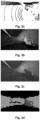
Figures 2a to 2d show different stages during the generation of pseudo-labels and, hence, during the semantic classification. - For each camera of the
camera system 22 semantic classifications ("pseudo-labels") are generated by labelling the captured point-cloud of theenvironment data 12 leveraging a current pose estimate as well as theBIM model data 14 of the construction site. - As an example,
figure 2a schematically shows a mesh according toBIM model data 14 and a point-cloud corresponding toenvironment data 12 from a LIDAR scan as an overlay image. - In this variant of the
method 10, the data is classified into three different classes: construction site foreground, construction site background and unknown. - The classes are created in two steps. First, for each point of the
localised environment data 12, we calculate the distance to the closest plane of the mesh according to theBIM model data 14 using a fast intersection and distance computation according to Pierre Alliez, Stephane Tayeb, and Camille Wormser, "3D fast intersection and distance computation". In CGAL User and Reference Manual. CGAL Editorial Board, 5.2 edition, 2020; https://doc.cgal.org/5.2/Manual/packages.html#PkgAABBTree. - If the distance surpasses a given threshold δ, the point is assigned the construction site foreground class, otherwise it is assigned the construction site background class. Empirically, the distance threshold is set to δ = 0.1m.
Figure 2b schematically shows the result of this preliminary classification as an image of thecamera system 22 overlaid with a projection of the classified point-cloud. Pixels in black along the LIDAR scan lines correspond to the class unknown, pixel in light grey along the LIDAR scan lines the correspond to construction site foreground and the remaining pixels along the LIDAR scan lines correspond to construction site background. Thus, according tofigure 2b an area comprising a worker and some equipment has been classified as foreground on the right half offigure 2b . - In the second stage, the projection is refined using superpixels created with a simple linear iterative clustering (SLIC-) algorithm, which utilizes k-means clustering.
Figure 2c schematically shows an example of a resulting oversegmented image with a mesh according to the superpixels. In particular, this mesh may correspond to the outlines of the superpixels. - In particular, the image is oversegmented into a superpixel set S. A superpixel s ∈ S is then assigned a class according to a majority voting of the contained projected classes. The segmentation is further improved by discarding superpixels whose depth variance surpasses a given threshold.
- Superpixels with a depth variance that surpasses 0.5 m are discarded. Images are smoothed with a Gaussian kernel (σ = 0.2). The images are oversegmented into approximately 400 superpixels with SLIC parameter compactness = 10.
- Instead of the SLlC-algorithm, other superpixel algorithms may be employed alternatively, e. g. the SCALP-algorithm according to Remi Giraud, Vinh-Thong Ta, and Nicolas Papadakis; "SCALP: superpixels with contour adherence using linear path"; CoRR, abs/1903.07149, 2019; http://arxiv.org/absZ1903.07149.
- Furthermore, depending on the type of environment the standard deviation threshold may be increased to 1 m or more, in particular in case if large amounts of clutter are to be expected.
-
Figure 2d schematically shows an example of a resulting semantic classification, wherein black pixels are classified by the majority voting as unknown, pixels in dark grey are classified as construction site foreground, and pixels in light grey are classified as construction site background. - It has been found out that the quality of classification or, respectively, of the pseudo-labels, is sufficient to be used as a training signal for retraining the semantic model of the
semantic classifier 18. A particular advantage of themethod 10 according to the invention is that the classification can be generated on-the-fly without requiring any external supervision. - To improve the semantic classification, the
semantic classifier 18 having a semantic model in the form of a neural network architecture is trained on different data sources. - To cater to the goal of online learning, a lightweight network architecture based on Fast-SCNN according to Rudra P K Poudel, Stephan Liwicki, and Roberto Cipolla, "Fast-SCNN: Fast Semantic Segmentation Network"; In British Machine Vision Conf. (BMVC), 2019, is used for the
semantic classifier 18. - The semantic model is pre-trained with labelled data 26 (see
figure 1 ), e. g. the NYUDepth v2 dataset (Nathan Silberman, Derek Hoiem, Pushmeet Kohli, and Rob Fergus; "Indoor Segmentation and Support Inference from RGBD Images"; In European Conf. on Computer Vision (ECCV), 2012), which contains 1449 images extracted from video sequences of indoor scenes, each with per-pixel semantic annotations. Of this data set the classes "wall", "ceiling", and "floor" were mapped to the construction site background class, whereas the remaining classes were mapped to the construction site foreground class. - A pre-training step 24 (see
figure 1 ) is performed as an initial step to allow the semantic model to acquire prior knowledge that can then be leveraged as an inductive bias to perform the same semantic segmentation task on subsequently captured data. - The semantic model is then fine-tuned with self-supervision through the pseudo-labels generated on the real-world scene in which the mobile construction robot is deployed. Thus, the semantic model is continuously updated.
- With reference to the nomenclature often used in continual learning, each new environment is named a "task", and "task boundaries" are assumed to be known. Every time the mobile construction robot is moved to a new environment, the same scheme as above is applied, i.e., the semantic model trained on the previous environments is provided as new training data the classes or, respectively, the pseudo-labels generated from the current environment.
- In order to achieve this domain adaptation and allow the semantic model to improve the semantic segmentation accuracy on the current environment in which it is deployed without forgetting information learned on previous tasks, a method is adopted based on memory replay buffers.
- When adapting to a new environment, each training batch is filled with frames collected in the current environment, along with a small fraction of images collected in the previous environments, so that the semantic model is, in particular continuously, updated with a mix of current and previously gathered semantic segmentation data.
- Hence, in each training step, the semantic model is to be jointly optimized over data from current and previous environments. However, storing all observations or sematic segmentation data from past environments in memory would require a large memory space.
- To solve this problem, according to the invention a memory buffer for each of the previous environments only contains a random subset of all image and pseudo-label or label attributions.
- Training batches are then filled from the memory buffers of previous environments alongside with self-supervised labels of the current environment.
- According to a preferred variant of the
method 10 according to the invention, a batch ofsize 10 may be used. The semantic model may be trained for, e. g. up to 100 epochs. Preferably, early stopping with a patience of 20 epochs based on a validation loss may be used. In different variants the replay buffers may be filled according to a ratio between the target and the NYU data of between 1:1 and 200:1, e. g. 1:1, 3:1, 4:1, 10:1, 20:1, or 200:1. The replay buffers may also be filled according to a replay fraction of between 1% and 30%, e. g. 5% or 10%. Preferably a replay fraction of 10% is used. - The semantic model based on Fast-SCNN preferably has a total of 1 to 2 × 10⁶, e. g. approximately 1,8 × 10⁶, trainable parameters.
- Group normalization may be used in all layers, which, in general, has been found to perform better in regard to the required transfer-learning tasks than alternative normalization methods like batch normalization.
- In variants of the
method 10 different strategies for memory replay may be used. A first strategy, which is the one adopted in the variant of themethod 10 as described before, on each source (e. g. NYU data set) -to-target (e. g. construction site) transfer, the replay buffer may be refilled with a fraction of randomly selected samples from the source dataset(s), here the NYU dataset. Then, the training batches are filled from the replay buffer and the target dataset according to their relative sizes. - According to an alternative, second strategy, the replay buffer may be filled with the full source dataset, whereas training batches are filled with a pre-defined target-to-source ratio. For instance, a ratio Construction site to NYU of 4:1 with a batch size of 10 indicates that batches on average contain 8 images from the construction site and two images from NYU.
- Larger target-to-source ratios, or smaller replay fractions, have shown to achieve higher performance on the target domain, but cause the amount of information retained from the source domain to drop. At the same time, the segmentation quality on the pseudo-labels of the target dataset follows an inverse trend, generally increasing for smaller amounts of replay. This highlights the trade-off between the accuracy on the target and on the source domain.
- Further variants of the
method 10 according to the invention may make use of alternative continual learning methods, for example regularization methods. One example may be a distillation approach, in which a weighted regularization term Ld is added to a cross entropy loss Lce to encourage the semantic model to retain knowledge from previous tasks. This distillation may be either applied to output logits produced by the semantic model (output distillation) or on intermediate features extracted from the model architecture before a final classification module (feature distillation). - A further alternative may be an elastic weight consolidation (EWC), in which deviations of network parameters across tasks are penalized.
- Overall, replay buffers have shown to be very effective in minimizing the amount of forgetting on the NYU dataset, and generally allow attaining a good trade-off with the segmentation quality on the pseudo-labels from the target domain.
-
Figure 3 shows aconstruction robot system 100 on a construction site, theconstruction robot system 100 comprising amobile construction robot 102 and acontrol unit 104, which is schematically represented infigure 3 . - In this embodiment, the
control unit 104 is arranged inside themobile construction robot 102. It comprises acomputing unit 106 and acomputer program product 108 including a storage readable by thecomputing unit 106. Thecomputing unit 106 comprises a neuronal network unit configured assemantic classifier 18 as described in reference tofigure 1 . The storage carries instructions which, when executed by thecomputing unit 106, cause thecomputing unit 106 to execute the method according to the invention and as described previously. - Furthermore, the
mobile construction robot 102 comprises arobotic arm 110. It comprises an end effector, on which apower tool 113 is detachably mounted. Thepower tool 113 may be a drilling machine. It may comprise a vacuum cleaning unit for an automatic removal of dust. Therobot arm 110 and/or thepower tool 113 may also comprise a vibration damping unit. - The
control unit 104 is configured to control therobotic arm 110. It may comprise further modules, for example a communication module, in particular for wireless communication, e. g. with an external cloud computing system (not shown infigure 3 ), a display unit, or the like. - Furthermore, the
control unit 104 is configured to control amobile base 116 of themobile construction robot 102. In this embodiment, the mobile base 118 is a wheeled ground vehicle, on which other parts of themobile construction robot 102 are mounted. - The
mobile construction robot 102 may be configured for drilling floors, walls and / or ceilings. For this, therobotic arm 110 may, preferably, be capable of moving according to at least 6 degrees of freedom. - The
mobile construction robot 102 comprises a plurality of sensors and localization support elements. In particular, it comprises acamera system 112 comprising three 2D-cameras. It further comprises aLIDAR scanner 114. Bothelements control unit 104. Furthermore, the cameras of thecamera system 112 are time-synchronized with the LIDAR scans from theLIDAR scanner 114. - The
mobile construction robot 102 may further comprise other pose-aware sensors or elements, e. g. an inertial measurement unit (not shown infigure 3 ). - The
mobile construction robot 102 may also comprise areflector 110 or another kind of detectable point, which can be used to additionally localize themobile construction robot 102, e. g. by using a total station for a measurement of a relative displacement between, for example, a starting pose and a current pose.
Claims (12)
- Method (10) of localizing a mobile construction robot (102) on a construction site (101), wherein environment data (12) of the construction site is captured, wherein a pose of the mobile robot (102) is inferred using the environment data (12), wherein the method (10) comprises a step of semantic segmentation, wherein a semantic classifier (18) having an updatable semantic model classifies the environment data (12) into at least two semantic classes, wherein the semantic model is updated at least once by assigning points of environment data to one of the two semantic classes, if a distance of the points to a BIM model data surpass a threshold, and otherwise assign the points of environment data to the other one of the two semantic classes.
- Method according to claim 1, characterized in that the semantic model is updated using the environment data (12).
- Method according to one of the preceding claims, characterized in that at least one of said semantic classes corresponds to a construction site background and at least one of said semantic classes corresponds to a construction site foreground.
- Method according to one of the preceding claims, characterized in that the pose is inferred using a subset of the environment data (12) that is classified as construction site background.
- Method according to one of the preceding claims, characterized in that the semantic segmentation of the environment data (12) is refined at least once using at least one additional data set, preferably an image data set.
- Method according to one of the preceding claims, characterized in that the pose is inferred using map data of the construction site, e. g. BIM data (14).
- Method according to one of the preceding claims, characterized in that the semantic model is updated multiple times, preferably regularly.
- Method according to one of the preceding claims, characterized in that the semantic model is updated with a mix of current and previously gathered semantic segmentation data.
- Method according to one of the preceding claims, characterized in that the set of said semantic classes is fixed for all semantic segmentations.
- Construction robot system (100) comprising a mobile construction robot (102), for example for drilling, chiselling, grinding, plastering and/or painting, and a control unit (104), characterized in that the control unit (104) is configured to localize the mobile construction robot (102) using the method (10) according to one of the preceding claims.
- Construction robot system according to the preceding claim, characterized in that the mobile construction robot (102) comprises a 3D sensor, e. g. a LIDAR scanner (114) or a stereoscopic camera system, and at least one camera.
- A computer program product (108) including a storage readable by a control unit (104) of a construction robot system (100), the storage carrying instructions which, when executed by the control unit (104), cause the control unit to execute the method according to one of the claims 1 to 9.
Applications Claiming Priority (2)
| Application Number | Priority Date | Filing Date | Title |
|---|---|---|---|
| EP21171587.5A EP4083740A1 (en) | 2021-04-30 | 2021-04-30 | Method for localizing a mobile construction robot on a construction site using semantic segmentation, construction robot system and computer program product |
| PCT/EP2022/059830 WO2022228897A1 (en) | 2021-04-30 | 2022-04-13 | Method for localizing a mobile construction robot on a construction site using semantic segmentation, construction robot system and computer program product |
Publications (2)
| Publication Number | Publication Date |
|---|---|
| EP4330784A1 EP4330784A1 (en) | 2024-03-06 |
| EP4330784B1 true EP4330784B1 (en) | 2024-11-27 |
Family
ID=75746495
Family Applications (2)
| Application Number | Title | Priority Date | Filing Date |
|---|---|---|---|
| EP21171587.5A Withdrawn EP4083740A1 (en) | 2021-04-30 | 2021-04-30 | Method for localizing a mobile construction robot on a construction site using semantic segmentation, construction robot system and computer program product |
| EP22722720.4A Active EP4330784B1 (en) | 2021-04-30 | 2022-04-13 | Method for localizing a mobile construction robot on a construction site using semantic segmentation, construction robot system and computer program product |
Family Applications Before (1)
| Application Number | Title | Priority Date | Filing Date |
|---|---|---|---|
| EP21171587.5A Withdrawn EP4083740A1 (en) | 2021-04-30 | 2021-04-30 | Method for localizing a mobile construction robot on a construction site using semantic segmentation, construction robot system and computer program product |
Country Status (4)
| Country | Link |
|---|---|
| US (1) | US20240181625A1 (en) |
| EP (2) | EP4083740A1 (en) |
| CN (1) | CN116982081A (en) |
| WO (1) | WO2022228897A1 (en) |
Families Citing this family (4)
| Publication number | Priority date | Publication date | Assignee | Title |
|---|---|---|---|---|
| CN115690338A (en) * | 2021-07-30 | 2023-02-03 | 北京图森智途科技有限公司 | Map construction method, map construction device, map construction equipment and storage medium |
| CN117999115A (en) * | 2021-09-16 | 2024-05-07 | 苹果公司 | Aligning scanning environments for multi-user communication sessions |
| EP4403313A1 (en) * | 2023-01-23 | 2024-07-24 | Hilti Aktiengesellschaft | Construction robot with lifting device and method for processing a building element |
| CN120715954A (en) * | 2025-08-05 | 2025-09-30 | 中建八局第四建设有限公司 | A positioning device for a construction robot |
Family Cites Families (14)
| Publication number | Priority date | Publication date | Assignee | Title |
|---|---|---|---|---|
| US7043474B2 (en) * | 2002-04-15 | 2006-05-09 | International Business Machines Corporation | System and method for measuring image similarity based on semantic meaning |
| EP3825807B1 (en) * | 2015-11-02 | 2025-04-02 | Starship Technologies OÜ | Method, device and assembly for map generation |
| US11526744B2 (en) * | 2016-07-09 | 2022-12-13 | Doxel, Inc. | Monitoring construction of a structure |
| US10678256B2 (en) * | 2017-09-28 | 2020-06-09 | Nec Corporation | Generating occlusion-aware bird eye view representations of complex road scenes |
| WO2019089018A1 (en) * | 2017-10-31 | 2019-05-09 | Hewlett-Packard Development Company, L.P. | Mobile robots to generate reference maps for localization |
| US10546196B2 (en) * | 2017-12-20 | 2020-01-28 | X Development Llc | Semantic place recognition and localization |
| EP3506211B1 (en) * | 2017-12-28 | 2021-02-24 | Dassault Systèmes | Generating 3d models representing buildings |
| WO2019153245A1 (en) * | 2018-02-09 | 2019-08-15 | Baidu.Com Times Technology (Beijing) Co., Ltd. | Systems and methods for deep localization and segmentation with 3d semantic map |
| US10754343B2 (en) * | 2018-02-15 | 2020-08-25 | X Development Llc | Semantic mapping of environments for autonomous devices |
| US10650531B2 (en) * | 2018-03-16 | 2020-05-12 | Honda Motor Co., Ltd. | Lidar noise removal using image pixel clusterings |
| WO2019185170A1 (en) * | 2018-03-30 | 2019-10-03 | Toyota Motor Europe | Electronic device, robotic system and method for localizing a robotic system |
| WO2022106021A1 (en) * | 2020-11-20 | 2022-05-27 | Abb Schweiz Ag | Method of handling carrier by means of mobile robot, control system and mobile robot |
| EP4088884A1 (en) * | 2021-05-12 | 2022-11-16 | Hilti Aktiengesellschaft | Method of acquiring sensor data on a construction site, construction robot system, computer program product, and training method |
| US20250278920A1 (en) * | 2024-03-01 | 2025-09-04 | Caterpillar Inc. | Computer implemented method and system for semantic segmentation of worksite |
-
2021
- 2021-04-30 EP EP21171587.5A patent/EP4083740A1/en not_active Withdrawn
-
2022
- 2022-04-13 CN CN202280019684.2A patent/CN116982081A/en active Pending
- 2022-04-13 US US18/284,646 patent/US20240181625A1/en active Pending
- 2022-04-13 EP EP22722720.4A patent/EP4330784B1/en active Active
- 2022-04-13 WO PCT/EP2022/059830 patent/WO2022228897A1/en not_active Ceased
Also Published As
| Publication number | Publication date |
|---|---|
| EP4330784A1 (en) | 2024-03-06 |
| US20240181625A1 (en) | 2024-06-06 |
| CN116982081A (en) | 2023-10-31 |
| EP4083740A1 (en) | 2022-11-02 |
| WO2022228897A1 (en) | 2022-11-03 |
Similar Documents
| Publication | Publication Date | Title |
|---|---|---|
| US20240181625A1 (en) | Method for localizing a mobile construction robot on a construction site using semantic segmentation, construction robot system and computer program product | |
| Brickwedde et al. | Mono-sf: Multi-view geometry meets single-view depth for monocular scene flow estimation of dynamic traffic scenes | |
| US20230121534A1 (en) | Method and electronic device for 3d object detection using neural networks | |
| EP4044126B1 (en) | Feature detection for automated air-to-air refueling (a3r) | |
| Neumann et al. | Pedestrian and ego-vehicle trajectory prediction from monocular camera | |
| EP3405845B1 (en) | Object-focused active three-dimensional reconstruction | |
| CN104732587B (en) | An indoor 3D semantic map construction method based on depth sensor | |
| Chatterjee et al. | Vision based autonomous robot navigation: algorithms and implementations | |
| CN113012219A (en) | Information processing apparatus, information processing method, and computer readable medium | |
| AliAkbarpour et al. | Emerging trends and applications of neuromorphic dynamic vision sensors: A survey | |
| Shi et al. | Optimal pose and shape estimation for category-level 3d object perception | |
| Roberts et al. | Saliency detection and model-based tracking: a two part vision system for small robot navigation in forested environment | |
| IL277741B1 (en) | System and method for visual positioning | |
| CN121844269A (en) | A clutter-collecting robot utilizing floor segmentation for mapping and navigation systems. | |
| CN115497077A (en) | Carriage attitude recognition system, carriage attitude recognition method, electronic device and storage medium | |
| Silva et al. | Monocular trail detection and tracking aided by visual SLAM for small unmanned aerial vehicles | |
| Byrne et al. | Expansion segmentation for visual collision detection and estimation | |
| Miksik et al. | Incremental dense multi-modal 3d scene reconstruction | |
| US11657506B2 (en) | Systems and methods for autonomous robot navigation | |
| Pinard et al. | End-to-end depth from motion with stabilized monocular videos | |
| Gökcen et al. | Object aware RGBD SLAM in dynamic environments | |
| CN113158816B (en) | Visual odometry quadratic surface road sign construction method for outdoor scene objects | |
| Vatavu et al. | Modeling and tracking of dynamic obstacles for logistic plants using omnidirectional stereo vision | |
| HK40102470B (en) | Method for localizing a mobile construction robot on a construction site using semantic segmentation, construction robot system and computer program product | |
| HK40102470A (en) | Method for localizing a mobile construction robot on a construction site using semantic segmentation, construction robot system and computer program product |
Legal Events
| Date | Code | Title | Description |
|---|---|---|---|
| STAA | Information on the status of an ep patent application or granted ep patent |
Free format text: STATUS: UNKNOWN |
|
| STAA | Information on the status of an ep patent application or granted ep patent |
Free format text: STATUS: THE INTERNATIONAL PUBLICATION HAS BEEN MADE |
|
| PUAI | Public reference made under article 153(3) epc to a published international application that has entered the european phase |
Free format text: ORIGINAL CODE: 0009012 |
|
| STAA | Information on the status of an ep patent application or granted ep patent |
Free format text: STATUS: REQUEST FOR EXAMINATION WAS MADE |
|
| 17P | Request for examination filed |
Effective date: 20231130 |
|
| AK | Designated contracting states |
Kind code of ref document: A1 Designated state(s): AL AT BE BG CH CY CZ DE DK EE ES FI FR GB GR HR HU IE IS IT LI LT LU LV MC MK MT NL NO PL PT RO RS SE SI SK SM TR |
|
| REG | Reference to a national code |
Ref country code: HK Ref legal event code: DE Ref document number: 40102470 Country of ref document: HK |
|
| REG | Reference to a national code |
Ref legal event code: R079 Ref country code: DE Ref legal event code: R079 Ref document number: 602022008221 Country of ref document: DE Free format text: PREVIOUS MAIN CLASS: G05D0001020000 Ipc: G05D0001000000 |
|
| DAV | Request for validation of the european patent (deleted) | ||
| DAX | Request for extension of the european patent (deleted) | ||
| GRAP | Despatch of communication of intention to grant a patent |
Free format text: ORIGINAL CODE: EPIDOSNIGR1 |
|
| STAA | Information on the status of an ep patent application or granted ep patent |
Free format text: STATUS: GRANT OF PATENT IS INTENDED |
|
| RIC1 | Information provided on ipc code assigned before grant |
Ipc: G05D 1/00 20240101AFI20240728BHEP |
|
| INTG | Intention to grant announced |
Effective date: 20240816 |
|
| GRAS | Grant fee paid |
Free format text: ORIGINAL CODE: EPIDOSNIGR3 |
|
| GRAA | (expected) grant |
Free format text: ORIGINAL CODE: 0009210 |
|
| STAA | Information on the status of an ep patent application or granted ep patent |
Free format text: STATUS: THE PATENT HAS BEEN GRANTED |
|
| AK | Designated contracting states |
Kind code of ref document: B1 Designated state(s): AL AT BE BG CH CY CZ DE DK EE ES FI FR GB GR HR HU IE IS IT LI LT LU LV MC MK MT NL NO PL PT RO RS SE SI SK SM TR |
|
| REG | Reference to a national code |
Ref country code: GB Ref legal event code: FG4D |
|
| REG | Reference to a national code |
Ref country code: CH Ref legal event code: EP |
|
| REG | Reference to a national code |
Ref country code: IE Ref legal event code: FG4D |
|
| REG | Reference to a national code |
Ref country code: DE Ref legal event code: R096 Ref document number: 602022008221 Country of ref document: DE |
|
| REG | Reference to a national code |
Ref country code: LT Ref legal event code: MG9D |
|
| REG | Reference to a national code |
Ref country code: NL Ref legal event code: MP Effective date: 20241127 |
|
| PG25 | Lapsed in a contracting state [announced via postgrant information from national office to epo] |
Ref country code: IS Free format text: LAPSE BECAUSE OF FAILURE TO SUBMIT A TRANSLATION OF THE DESCRIPTION OR TO PAY THE FEE WITHIN THE PRESCRIBED TIME-LIMIT Effective date: 20250327 Ref country code: PT Free format text: LAPSE BECAUSE OF FAILURE TO SUBMIT A TRANSLATION OF THE DESCRIPTION OR TO PAY THE FEE WITHIN THE PRESCRIBED TIME-LIMIT Effective date: 20250327 Ref country code: HR Free format text: LAPSE BECAUSE OF FAILURE TO SUBMIT A TRANSLATION OF THE DESCRIPTION OR TO PAY THE FEE WITHIN THE PRESCRIBED TIME-LIMIT Effective date: 20241127 |
|
| PG25 | Lapsed in a contracting state [announced via postgrant information from national office to epo] |
Ref country code: FI Free format text: LAPSE BECAUSE OF FAILURE TO SUBMIT A TRANSLATION OF THE DESCRIPTION OR TO PAY THE FEE WITHIN THE PRESCRIBED TIME-LIMIT Effective date: 20241127 Ref country code: NL Free format text: LAPSE BECAUSE OF FAILURE TO SUBMIT A TRANSLATION OF THE DESCRIPTION OR TO PAY THE FEE WITHIN THE PRESCRIBED TIME-LIMIT Effective date: 20241127 |
|
| REG | Reference to a national code |
Ref country code: AT Ref legal event code: MK05 Ref document number: 1746279 Country of ref document: AT Kind code of ref document: T Effective date: 20241127 |
|
| PG25 | Lapsed in a contracting state [announced via postgrant information from national office to epo] |
Ref country code: BG Free format text: LAPSE BECAUSE OF FAILURE TO SUBMIT A TRANSLATION OF THE DESCRIPTION OR TO PAY THE FEE WITHIN THE PRESCRIBED TIME-LIMIT Effective date: 20241127 |
|
| PG25 | Lapsed in a contracting state [announced via postgrant information from national office to epo] |
Ref country code: ES Free format text: LAPSE BECAUSE OF FAILURE TO SUBMIT A TRANSLATION OF THE DESCRIPTION OR TO PAY THE FEE WITHIN THE PRESCRIBED TIME-LIMIT Effective date: 20241127 |
|
| PG25 | Lapsed in a contracting state [announced via postgrant information from national office to epo] |
Ref country code: NO Free format text: LAPSE BECAUSE OF FAILURE TO SUBMIT A TRANSLATION OF THE DESCRIPTION OR TO PAY THE FEE WITHIN THE PRESCRIBED TIME-LIMIT Effective date: 20250227 |
|
| PG25 | Lapsed in a contracting state [announced via postgrant information from national office to epo] |
Ref country code: AT Free format text: LAPSE BECAUSE OF FAILURE TO SUBMIT A TRANSLATION OF THE DESCRIPTION OR TO PAY THE FEE WITHIN THE PRESCRIBED TIME-LIMIT Effective date: 20241127 Ref country code: GR Free format text: LAPSE BECAUSE OF FAILURE TO SUBMIT A TRANSLATION OF THE DESCRIPTION OR TO PAY THE FEE WITHIN THE PRESCRIBED TIME-LIMIT Effective date: 20250228 Ref country code: LV Free format text: LAPSE BECAUSE OF FAILURE TO SUBMIT A TRANSLATION OF THE DESCRIPTION OR TO PAY THE FEE WITHIN THE PRESCRIBED TIME-LIMIT Effective date: 20241127 |
|
| PG25 | Lapsed in a contracting state [announced via postgrant information from national office to epo] |
Ref country code: PL Free format text: LAPSE BECAUSE OF FAILURE TO SUBMIT A TRANSLATION OF THE DESCRIPTION OR TO PAY THE FEE WITHIN THE PRESCRIBED TIME-LIMIT Effective date: 20241127 |
|
| PG25 | Lapsed in a contracting state [announced via postgrant information from national office to epo] |
Ref country code: RS Free format text: LAPSE BECAUSE OF FAILURE TO SUBMIT A TRANSLATION OF THE DESCRIPTION OR TO PAY THE FEE WITHIN THE PRESCRIBED TIME-LIMIT Effective date: 20250227 |
|
| PG25 | Lapsed in a contracting state [announced via postgrant information from national office to epo] |
Ref country code: SM Free format text: LAPSE BECAUSE OF FAILURE TO SUBMIT A TRANSLATION OF THE DESCRIPTION OR TO PAY THE FEE WITHIN THE PRESCRIBED TIME-LIMIT Effective date: 20241127 |
|
| PGFP | Annual fee paid to national office [announced via postgrant information from national office to epo] |
Ref country code: DE Payment date: 20250422 Year of fee payment: 4 |
|
| PG25 | Lapsed in a contracting state [announced via postgrant information from national office to epo] |
Ref country code: DK Free format text: LAPSE BECAUSE OF FAILURE TO SUBMIT A TRANSLATION OF THE DESCRIPTION OR TO PAY THE FEE WITHIN THE PRESCRIBED TIME-LIMIT Effective date: 20241127 |
|
| PG25 | Lapsed in a contracting state [announced via postgrant information from national office to epo] |
Ref country code: EE Free format text: LAPSE BECAUSE OF FAILURE TO SUBMIT A TRANSLATION OF THE DESCRIPTION OR TO PAY THE FEE WITHIN THE PRESCRIBED TIME-LIMIT Effective date: 20241127 |
|
| PGFP | Annual fee paid to national office [announced via postgrant information from national office to epo] |
Ref country code: FR Payment date: 20250425 Year of fee payment: 4 |
|
| PG25 | Lapsed in a contracting state [announced via postgrant information from national office to epo] |
Ref country code: RO Free format text: LAPSE BECAUSE OF FAILURE TO SUBMIT A TRANSLATION OF THE DESCRIPTION OR TO PAY THE FEE WITHIN THE PRESCRIBED TIME-LIMIT Effective date: 20241127 |
|
| PG25 | Lapsed in a contracting state [announced via postgrant information from national office to epo] |
Ref country code: SK Free format text: LAPSE BECAUSE OF FAILURE TO SUBMIT A TRANSLATION OF THE DESCRIPTION OR TO PAY THE FEE WITHIN THE PRESCRIBED TIME-LIMIT Effective date: 20241127 |
|
| PG25 | Lapsed in a contracting state [announced via postgrant information from national office to epo] |
Ref country code: CZ Free format text: LAPSE BECAUSE OF FAILURE TO SUBMIT A TRANSLATION OF THE DESCRIPTION OR TO PAY THE FEE WITHIN THE PRESCRIBED TIME-LIMIT Effective date: 20241127 |
|
| PG25 | Lapsed in a contracting state [announced via postgrant information from national office to epo] |
Ref country code: IT Free format text: LAPSE BECAUSE OF FAILURE TO SUBMIT A TRANSLATION OF THE DESCRIPTION OR TO PAY THE FEE WITHIN THE PRESCRIBED TIME-LIMIT Effective date: 20241127 |
|
| REG | Reference to a national code |
Ref country code: DE Ref legal event code: R097 Ref document number: 602022008221 Country of ref document: DE |
|
| PG25 | Lapsed in a contracting state [announced via postgrant information from national office to epo] |
Ref country code: SE Free format text: LAPSE BECAUSE OF FAILURE TO SUBMIT A TRANSLATION OF THE DESCRIPTION OR TO PAY THE FEE WITHIN THE PRESCRIBED TIME-LIMIT Effective date: 20241127 |
|
| PLBE | No opposition filed within time limit |
Free format text: ORIGINAL CODE: 0009261 |
|
| STAA | Information on the status of an ep patent application or granted ep patent |
Free format text: STATUS: NO OPPOSITION FILED WITHIN TIME LIMIT |
|
| REG | Reference to a national code |
Ref country code: CH Ref legal event code: L10 Free format text: ST27 STATUS EVENT CODE: U-0-0-L10-L00 (AS PROVIDED BY THE NATIONAL OFFICE) Effective date: 20251008 |
|
| 26N | No opposition filed |
Effective date: 20250828 |
|
| REG | Reference to a national code |
Ref country code: CH Ref legal event code: H13 Free format text: ST27 STATUS EVENT CODE: U-0-0-H10-H13 (AS PROVIDED BY THE NATIONAL OFFICE) Effective date: 20251125 |
|
| PG25 | Lapsed in a contracting state [announced via postgrant information from national office to epo] |
Ref country code: LU Free format text: LAPSE BECAUSE OF NON-PAYMENT OF DUE FEES Effective date: 20250413 |
|
| PG25 | Lapsed in a contracting state [announced via postgrant information from national office to epo] |
Ref country code: MC Free format text: LAPSE BECAUSE OF FAILURE TO SUBMIT A TRANSLATION OF THE DESCRIPTION OR TO PAY THE FEE WITHIN THE PRESCRIBED TIME-LIMIT Effective date: 20241127 |
|
| REG | Reference to a national code |
Ref country code: BE Ref legal event code: MM Effective date: 20250430 |
|
| PG25 | Lapsed in a contracting state [announced via postgrant information from national office to epo] |
Ref country code: BE Free format text: LAPSE BECAUSE OF NON-PAYMENT OF DUE FEES Effective date: 20250430 |
|
| PG25 | Lapsed in a contracting state [announced via postgrant information from national office to epo] |
Ref country code: CH Free format text: LAPSE BECAUSE OF NON-PAYMENT OF DUE FEES Effective date: 20250430 |
|
| PG25 | Lapsed in a contracting state [announced via postgrant information from national office to epo] |
Ref country code: IE Free format text: LAPSE BECAUSE OF NON-PAYMENT OF DUE FEES Effective date: 20250413 |