EP4328921A1 - Information processing program, information processing method, and information processing device - Google Patents
Information processing program, information processing method, and information processing device Download PDFInfo
- Publication number
- EP4328921A1 EP4328921A1 EP21937833.8A EP21937833A EP4328921A1 EP 4328921 A1 EP4328921 A1 EP 4328921A1 EP 21937833 A EP21937833 A EP 21937833A EP 4328921 A1 EP4328921 A1 EP 4328921A1
- Authority
- EP
- European Patent Office
- Prior art keywords
- vectors
- vector
- information processing
- analyzed
- genome
- Prior art date
- Legal status (The legal status is an assumption and is not a legal conclusion. Google has not performed a legal analysis and makes no representation as to the accuracy of the status listed.)
- Pending
Links
Images











Classifications
-
- G—PHYSICS
- G16—INFORMATION AND COMMUNICATION TECHNOLOGY [ICT] SPECIALLY ADAPTED FOR SPECIFIC APPLICATION FIELDS
- G16B—BIOINFORMATICS, i.e. INFORMATION AND COMMUNICATION TECHNOLOGY [ICT] SPECIALLY ADAPTED FOR GENETIC OR PROTEIN-RELATED DATA PROCESSING IN COMPUTATIONAL MOLECULAR BIOLOGY
- G16B40/00—ICT specially adapted for biostatistics; ICT specially adapted for bioinformatics-related machine learning or data mining, e.g. knowledge discovery or pattern finding
- G16B40/20—Supervised data analysis
-
- G—PHYSICS
- G16—INFORMATION AND COMMUNICATION TECHNOLOGY [ICT] SPECIALLY ADAPTED FOR SPECIFIC APPLICATION FIELDS
- G16B—BIOINFORMATICS, i.e. INFORMATION AND COMMUNICATION TECHNOLOGY [ICT] SPECIALLY ADAPTED FOR GENETIC OR PROTEIN-RELATED DATA PROCESSING IN COMPUTATIONAL MOLECULAR BIOLOGY
- G16B15/00—ICT specially adapted for analysing two-dimensional [2D] or three-dimensional [3D] molecular structures, e.g. structural or functional relations or structure alignment
-
- G—PHYSICS
- G16—INFORMATION AND COMMUNICATION TECHNOLOGY [ICT] SPECIALLY ADAPTED FOR SPECIFIC APPLICATION FIELDS
- G16B—BIOINFORMATICS, i.e. INFORMATION AND COMMUNICATION TECHNOLOGY [ICT] SPECIALLY ADAPTED FOR GENETIC OR PROTEIN-RELATED DATA PROCESSING IN COMPUTATIONAL MOLECULAR BIOLOGY
- G16B35/00—ICT specially adapted for in silico combinatorial libraries of nucleic acids, proteins or peptides
-
- G—PHYSICS
- G16—INFORMATION AND COMMUNICATION TECHNOLOGY [ICT] SPECIALLY ADAPTED FOR SPECIFIC APPLICATION FIELDS
- G16B—BIOINFORMATICS, i.e. INFORMATION AND COMMUNICATION TECHNOLOGY [ICT] SPECIALLY ADAPTED FOR GENETIC OR PROTEIN-RELATED DATA PROCESSING IN COMPUTATIONAL MOLECULAR BIOLOGY
- G16B30/00—ICT specially adapted for sequence analysis involving nucleotides or amino acids
Definitions
- the present invention relates to information processing programs, for example.
- chimeric antigen receptor introduced T cell therapy has attracted attention as immunotherapy of cancer using genetically modified T cells.
- a CAR is a receptor that: is artificially made by fusion of a part that specifically recognizes an antigen and that is derived from an antibody with a part derived from a T cell receptor (TCR), the part having a cytotoxic function; specifically recognizes a cancer antigen; and is able to attack the cancer antigen.
- TCR T cell receptor
- An object of the present invention in one aspect is to provide an information processing program, an information processing method, and an information processing apparatus that enable determination of a genome that serves as a substitute for a subgenome included in a target genome.
- an information processing program causes a computer to execute a process including executing training of a trained model on the basis of training data defining relations between vectors corresponding to genomes and vectors respectively corresponding to pluralities of subgenomes composing the genomes and in a case where a genome to be analyzed has been received, calculating vectors of a plurality of subgenomes corresponding to the genome to be analyzed by inputting the genome to be analyzed into the trained model.
- Determination of a genome is enabled, the genome serving as a substitute for a subgenome included in a target genome.
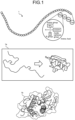
- FIG. 1 is a diagram for explanation of genomes.
- a genome 1 includes genetic information prescribing a sequence in which plural amino acids are linked to each other. An amino acid is determined by consecutive three bases, that is, a codon.
- the genome 1 also includes information on a protein 1a.
- the protein 1a has 20 types of multiple amino acids bonded to each other in a chain.
- the structure of the protein 1a is able to be considered as a primary structure, a secondary structure, a tertiary structure, or a higher-order (quaternary) structure of proteins.
- 1b illustrates a higher-order structure of the protein 1a.
- a primary structure of a protein, a secondary structure of a protein, a tertiary structure of a protein, and a higher-order structure of a protein will respectively be referred to as a primary structure, a secondary structure, a tertiary structure, and a higher-order structure, as appropriate.
- DNAs and RNAs each have four types of bases that are each denoted by a symbol, "A”, “G”, “C”, “T”, or “U”. Furthermore, sequences each made up of three bases determine 20 types of amino acids. Each of these amino acids is denoted by symbols, "A” to "Y”.
- FIG. 2 is a diagram illustrating relations between: amino acids; and bases and codons. A sequence of three bases is called a "codon”. Each sequence of bases determines a codon and an amino acid is determined when a codon is determined.
- determining a codon determines an amino acid, but determining an amino acid does not uniquely determine a codon.
- the amino acid “alanine (Ala) A”
- a protein is also uniquely determined by a sequence of bases.
- a primary structure of a protein is a sequence of plural amino acids.
- a secondary structure includes ⁇ -helixes and ⁇ -sheets that are symmetrical substructures observed locally.
- a tertiary structure includes plural secondary structures.
- a higher-order structure includes plural tertiary structures.
- FIG. 3 is a diagram for explanation of a primary structure, a secondary structure, a tertiary structure, and a higher-order structure of a protein.
- a higher-order structure Z 1 includes tertiary structures Y 1 , Y 2 , and Y 3 .
- the tertiary structure Y 1 includes, for example, secondary structures X 2 , X 2 , and X 3 .
- the secondary structure X 1 includes, for example, primary structures W 2 , W 2 , and W 3 .
- the primary structure W 1 includes, for example, amino acids A 1 , A 2 , and A 3 .
- a gene vector used in this embodiment is a DNA or RNA molecule that is used to artificially carry a foreign genetic substance to another cell.
- Gene vectors include, for example, plasmids, cosmids, lambda phages, and artificial chromosomes.
- FIG. 4 is a diagram illustrating an example of the gene vector.
- the gene vector illustrated in FIG. 4 is pBR322 plasmid and is widely used as a cloning vector. Description will be made on the assumption that gene vectors themselves are base sequences of DNAs and RNAs and correspond to, for example, higher-order structures of proteins described by reference to FIG. 3 .
- the gene vector is generated by synthesis of plural subvectors.
- Subvectors are base sequences of DNAs and RNAs and correspond to, for example, secondary structures of proteins described by reference to FIG. 3 .
- Subvectors include so-called colon bacillus vectors including elements for maintenance in colon bacilli and vectors for maintenance in cell lines derived from, for example, yeast, plants, and mammals.
- the subvectors may be other vectors.
- FIG. 5 is a diagram for explanation of an example of a process in a training phase of the information processing apparatus according to the embodiment.
- the information processing apparatus executes machine training of a trained model 70 by using training data 65.
- the trained model 70 corresponds to, for example, a convolutional neural network (CNN) or a recurrent neural network (RNN).
- CNN convolutional neural network
- RNN recurrent neural network
- the training data 65 define relations between vectors of target genomes (therapeutic drugs) and vectors of pluralities of subgenomes included in the target genomes.
- a vector of a target genome corresponds to input data and a plurality of subgenomes serves as correct answer values of output data therefor.
- the information processing apparatus executes training by error back propagation so that output upon input of a vector of a target genome into the trained model 70 approaches vectors of its subgenomes.
- the information processing apparatus adjusts parameters of the trained model 70 (executes machine training) by repeatedly executing the above described process on the basis of the relations included in the training data 65, the relations each being between: a vector of a target genome; and vectors of a plurality of subgenomes.
- FIG. 6 is a diagram for explanation of an example of a process in an analysis phase of the information processing apparatus according to the embodiment.
- the information processing apparatus executes the following process by using the trained model 70 that has been trained in the training phase.
- the information processing apparatus In response to the information processing apparatus receiving an analysis query 80 that specifies a target genome (a therapeutic drug), the information processing apparatus converts the target genome in the analysis query 80 to a vector Vob80. By inputting the vector Vob80 to the trained model 70, the information processing apparatus calculates a plurality of vectors (Vsb80-1, Vsb80-2, Vsb80-3, ..., Vsb80-n) corresponding to its subgenomes and stores the calculated plurality of vectors into a subgenome table T1.
- Vsb80-1, Vsb80-2, Vsb80-3, ..., Vsb80-n a plurality of vectors corresponding to its subgenomes
- the information processing apparatus makes a comparison among degrees of similarity between plural vectors (Vt1, Vt2, Vt3, ..., Vtn) corresponding respectively to alternative gene vectors stored in an alternative gene vector table T2 and the plurality of vectors (Vsb80-1, Vsb80-2, Vsb80-3, ..., Vsb80-n) to determine vectors of similar alternative gene vectors.
- the information processing apparatus registers the vector of the target genome, the vectors of the subgenomes, and the vectors of the similar alternative gene vectors, in association with one another, into an alternative management table 85.
- the information processing apparatus executes training of the trained model 70 beforehand, on the basis of the training data 65 defining the relations between the vectors of the target genomes and the vectors of their subgenomes.
- the information processing apparatus calculates vectors of subgenomes corresponding to the target compound in the analysis query.
- Using the vectors of the subgenomes output from the trained model 70 facilitates detection of substitutable gene vectors that are gene vectors similar to the subgenomes included in the target genome.
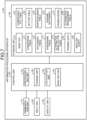
- FIG. 7 is a functional block diagram illustrating the configuration of the information processing apparatus according to the first embodiment. As illustrated in FIG. 7 , this information processing apparatus 100 has a communication unit 110, an input unit 120, a display unit 130, a storage unit 140, and a control unit 150.
- the communication unit 110 is connected to, for example, an external device by wire or wirelessly and transmits and receives information to and from, for example, the external device.
- the communication unit 110 is implemented by a network interface card (NIC).
- NIC network interface card
- the communication unit 110 may be connected to a network not illustrated in the drawings.
- the input unit 120 is an input device that inputs various types of information to the information processing apparatus 100.
- the input unit 120 corresponds to, for example, a keyboard and a mouse, or a touch panel.
- the display unit 130 is a display device that displays information output from the control unit 150.
- the display unit 130 corresponds to, for example, a liquid crystal display, an organic electro luminescence (EL) display, or a touch panel.
- EL organic electro luminescence
- the storage unit 140 has a base file 50, a conversion table 51, a dictionary table 52, a compressed file table 53, a vector table 54, and an inverted index table 55. Furthermore, the storage unit 140 has the subgenome table T1, the alternative gene vector table T2, a genome dictionary D2, the training data 65, the trained model 70, the analysis query 80, and the alternative management table 85.
- the storage unit 140 is implemented by, for example: a semiconductor memory element, such as a random access memory (RAM) or a flash memory; or a storage device, such as a hard disk or an optical disk.
- the base file 50 is a file that holds information including a sequence of plural bases.
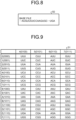
- FIG. 8 is a diagram illustrating an example of a data structure of a base file. As illustrated in FIG. 8 , the base file 50 is represented by four types of symbols, each of which is "A”, “G”, “C”, “T”, or "U”.
- the conversion table 51 is a table associating codons and codes of the codons with each other.
- a sequence of three bases is called a "codon”.
- FIG. 9 is a diagram illustrating an example of a data structure of a conversion table. As illustrated in FIG. 9 , codons are respectively associated with codes. For example, a codon, "UUU”, has a code, "40h(01000000)". Herein, "h” indicates being a hexadecimal number.
- the dictionary table 52 is a table that holds various dictionaries.
- FIG. 10 is a diagram illustrating an example of a data structure of a dictionary table. As illustrated in FIG. 10 , this dictionary table 52 has a protein primary structure dictionary D1-1, a secondary structure dictionary D1-2, a tertiary structure dictionary D1-3, and a higher-order structure dictionary D1-4.
- the protein primary structure dictionary D1-1 is dictionary data defining relations between compressed codes of proteins and sequences of codons composing the proteins.
- FIG. 11 is a diagram illustrating an example of a data structure of a protein primary structure dictionary. As illustrated in FIG. 11 , the protein primary structure dictionary D1-1 associates the compressed codes, names, and codon code sequences with one another.
- the compressed codes are compressed code sequences of codons (or symbol sequences of amino acids).
- the names are names of the proteins.
- the codon code sequences are sequences of compressed codes of the codons. Sequences of symbols of amino acids, instead of the codon code sequences, may be associated with the compressed codes of the protein primary structures.
- a compressed code "C0008000h” is assigned to a protein primary structure, "type I collagen”.
- a codon code sequence corresponding to the compressed code, "C0008000h”, is "02h63h78h ... 03h”.
- the secondary structure dictionary D1-2 is dictionary data defining relations between sequences of compressed codes of protein primary structures and compressed codes of secondary structures.
- FIG. 12 is a diagram illustrating an example of a data structure of a secondary structure dictionary. As illustrated in FIG. 12 , the secondary structure dictionary D1-2 associates the compressed codes, names, and protein primary structure code sequences with one another.
- the compressed codes are compressed codes assigned to secondary structures of proteins.
- the names are names of the secondary structures.
- the protein primary structure code sequences are sequences of compressed codes of protein primary structures corresponding to the secondary structures.
- a compressed code "D0000000h”
- ⁇ secondary structure For example, a compressed code, "D0000000h”, is assigned to a secondary structure, " ⁇ secondary structure”.
- the tertiary structure dictionary D1-3 is dictionary data defining relations between sequences of compressed codes of secondary structures and compressed codes of tertiary structures.
- FIG. 13 is a diagram illustrating an example of a data structure of a tertiary structure dictionary. As illustrated in FIG. 13 , the tertiary structure dictionary D1-3 associates the compressed codes, names, and secondary structure code sequences with one another.
- the compressed codes are compressed codes that have been assigned to the tertiary structures.
- the names are names of the tertiary structures.
- the secondary structure code sequences are sequences of compressed codes of secondary structures corresponding to the tertiary structures.
- a compressed code "E0000000h”
- ⁇ tertiary structure For example, a compressed code, "E0000000h”, is assigned to a tertiary structure, " ⁇ tertiary structure”.
- the higher-order structure dictionary D1-4 is dictionary data defining relations between sequences of compressed codes of tertiary structures and compressed codes of higher-order structures.
- FIG. 14 is a diagram illustrating an example of a data structure of a higher-order structure dictionary.
- the higher-order structure dictionary D1-4 associates the compressed codes, names, and tertiary structure code sequences with one another.
- the compressed codes are compressed codes that have been assigned to the higher-order structures.
- the names are names of the higher-order structures.
- the tertiary structure code sequences are sequences of compressed codes of tertiary structures corresponding to the higher-order structures.
- a compressed code "F0000000h”
- ⁇ higher-order structure For example, a compressed code, "F0000000h”, is assigned to a higher-order structure, " ⁇ higher-order structure”.
- a tertiary structure code sequence corresponding to the compressed code, "F0000000h” is "E0000031hE00 ".
- the compressed file table 53 is a table that holds various compressed files.
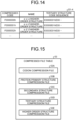
- FIG. 15 is a diagram illustrating an example of a data structure of a compressed file table. As illustrated in FIG. 15 , this compressed file table 53 has a codon compression file 53A, a protein primary structure compression file 53B, a secondary structure compression file 53C, a tertiary structure compression file 53D, and a higher-order structure compression file 53E.
- the codon compression file 53A is a file having the bases compressed in units of codons, the bases being included in the base file 50.
- the protein primary structure compression file 53B is a file having the sequences coded in units of protein primary structures, the sequences being of the compressed codes of the codons included in the codon compression file 53A.
- the secondary structure compression file 53C is a file having the sequences coded in units of secondary structures, the sequences being of the compressed codes of the protein primary structures included in the protein primary structure compression file 53B.
- the tertiary structure compression file 53D is a file having the sequences coded in units of tertiary structures, the sequences being of the compressed codes of the secondary structures included in the secondary structure compression file 53C.
- the higher-order structure compression file 53E is a file having the sequences coded in units of higher-order structures, the sequences being of the compressed codes of the tertiary structures included in the tertiary structure compression file 53D.
- the vector table 54 is a table that holds vectors corresponding to protein primary structures, secondary structures, tertiary structures, and higher-order structures.
- FIG. 16 is a diagram illustrating an example of a data structure of a vector table. As illustrated in FIG. 16 , this vector table 54 has a protein primary structure vector table VT1-1, a secondary structure vector table VT1-2, a tertiary structure vector table VT1-3, and a higher-order structure vector table VT1-4.
- the protein primary structure vector table VT1-1 is a table that holds vectors corresponding to protein primary structures.
- FIG. 17 is a diagram illustrating an example of a data structure of a protein primary structure vector table. As illustrated in FIG. 17 , the protein primary structure vector table VT1-1 has compressed codes of the protein primary structures, and the vectors that have been assigned to the compressed codes of these protein primary structures, in association with each other. The vectors of the protein primary structures are calculated by Poincare Embeddings. Poincare Embeddings will be described later.
- the secondary structure vector table VT1-2 is a table that holds vectors corresponding to secondary structures.
- FIG. 18 is a diagram illustrating an example of a data structure of a secondary structure vector table. As illustrated in FIG. 18 , the secondary structure vector table VT1-2 has compressed codes of the secondary structures and the vectors that have been assigned to the compressed codes of the secondary structures, in association with each other. The vectors of the secondary structures are each calculated by adding up the vectors of the protein primary structures included in that secondary structure.
- the tertiary structure vector table VT1-3 is a table that holds vectors corresponding to tertiary structures.
- FIG. 19 is a diagram illustrating an example of a data structure of a tertiary structure vector table. As illustrated in FIG. 19 , the tertiary structure vector table VT1-3 has compressed codes of the tertiary structures and the vectors that have been assigned to the compressed codes of the tertiary structures, in association with each other. The vectors of the tertiary structures are each calculated by adding up the vectors of the secondary structures included in that tertiary structure.
- the higher-order structure vector table VT1-4 is a table that holds vectors corresponding to higher-order structures.
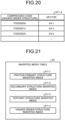
- FIG. 20 is a diagram illustrating an example of a data structure of a higher-order structure vector table. As illustrated in FIG. 20 , the higher-order structure vector table VT1-4 has compressed codes of the higher-order structures and the vectors that have been assigned to the compressed codes of the higher-order structures, in association with each other. The vectors of the higher-order structures are each calculated by adding up the vectors of the tertiary structures included in that higher-order structure.
- the inverted index table 55 is a table that holds various inverted indices.
- FIG. 21 is a diagram illustrating an example of a data structure of an inverted index table. As illustrated in FIG. 21 , the inverted index table 55 has a protein primary structure inverted index In1-1, a secondary structure inverted index In1-2, a tertiary structure inverted index In1-3, and a higher-order structure inverted index In1-4.
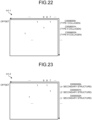
- FIG. 22 is a diagram illustrating an example of a data structure of a protein primary structure inverted index.
- the horizontal axis of the protein primary structure inverted index In1-1 is an axis corresponding to offsets.
- the vertical axis of the protein primary structure inverted index In1-1 is an axis corresponding to compressed codes of protein primary structures.
- the protein primary structure inverted index In1-1 is represented by a bitmap of "0" or "1" and the whole bitmap is set to "0" in the initial state.
- the compressed code of the protein primary structure at the head of the protein primary structure compression file 53B has an offset of "0".
- the code, "C0008000h (type I collagen)" of a protein primary structure is included at the eighth position from the head of the protein primary structure compression file 53B, the bit at a position where the column of the offset of "7" in the protein inverted index In1-1 and the row of the code, "C0008000h (type I collagen)", of the protein intersect each other is "1".
- FIG. 23 is a diagram illustrating an example of a data structure of a secondary structure inverted index.
- the horizontal axis of the secondary structure inverted index In1-2 is an axis corresponding to offsets.
- the vertical axis of the secondary structure inverted index In1-2 is an axis corresponding to compressed codes of secondary structures.
- the secondary structure inverted index In1-2 is represented by a bitmap of "0" or "1" and the whole bitmap is set to "0" in the initial state.
- the compressed code of the secondary structure at the head of the secondary structure compression file 53C has an offset of "0".
- the code, "D000000h ( ⁇ secondary structure)" of a secondary structure is included at the eighth position from the head of the secondary structure compression file 53C, the bit at a position where the column of the offset of "7" in the secondary structure inverted index In1-2 and the row of the compressed code, "D0000000h ( ⁇ secondary structure)", of the secondary structure intersect each other is "1".
- FIG. 24 is a diagram illustrating an example of a data structure of a tertiary structure inverted index.
- the horizontal axis of the tertiary structure inverted index In1-3 is an axis corresponding to offsets.
- the vertical axis of the tertiary structure inverted index In1-3 is an axis corresponding to compressed codes of tertiary structures.
- the tertiary structure inverted index In1-3 is represented by a bitmap of "0" or "1" and the whole bitmap is set to "0" in the initial state.
- the compressed code of the tertiary structure at the head of the tertiary structure compression file 53D has an offset of "0".
- the code, "E0000000h ( ⁇ tertiary structure)" of a tertiary structure is included at the eleventh position from the head of the tertiary structure compression file 53D
- the bit at a position where the column of the offset of "10" in the tertiary structure inverted index In1-3 and the row of the compressed code, "E0000000h ( ⁇ tertiary structure)", of the tertiary structure intersect each other is "1".
- FIG. 25 is a diagram illustrating an example of a data structure of a higher-order structure inverted index. It is the diagram illustrating the example of the data structure of the higher-order structure inverted index.
- the horizontal axis of the higher-order structure inverted index In1-4 is an axis corresponding to offsets.
- the vertical axis of the higher-order structure inverted index In1-4 is an axis corresponding to compressed codes of higher-order structures.
- the higher-order structure inverted index In1-4 is represented by a bitmap of "0" or "1" and the whole bitmap is set to "0" in the initial state.
- the compressed code of the higher-order structure at the head of the higher-order structure compression file 53E has an offset of "0".
- the code, "F0000000h ( ⁇ higher-order structure)" of a higher-order structure is included at the eleventh position from the head of the higher-order structure compression file 53E, the bit at a position where the column of the offset of "10" in the higher-order structure inverted index In1-4 and the row of the compressed code, "F0000000h ( ⁇ higher-order structure)", of the higher-order structure intersect each other is "1".
- the alternative gene vector table T2 holds vectors of plural gene vectors.
- the gene vectors correspond to secondary structures of proteins.
- the vectors stored in the alternative gene vector table T2 may be the vectors that have been registered in the secondary structure vector table VT1-2.
- a data structure of the alternative gene vector table T2, as described by reference to FIG. 6 has the vectors of the plural alternative gene vectors stored therein.
- the genome dictionary D2 defines relations between names of target genomes and names of subgenomes included in these target genomes.
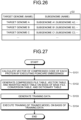
- FIG. 26 is a diagram illustrating an example of a data structure of a genome dictionary. As illustrated in FIG. 26 , this genome dictionary D2 associates the names of the target vectors and the names of the pluralities of subgenomes with each other.
- the training data 65 define relations each between a vector of a target genome and vectors of a plurality of subgenomes included in that target genome.
- the training data 65 have a data structure corresponding to the data structure of the training data described by reference to FIG. 5 .
- the trained model 70 is a model corresponding to, for example, a CNN or an RNN, and parameters are set for the trained model 70.
- the analysis query 80 includes information on a target genome (therapeutic drug) to be analyzed.
- the information on a target genome includes information on a base sequence corresponding to a higher-order structure.
- the alternative management table 85 is a table holding vectors of subgenomes included in target genomes and vectors of gene vectors similar to these subgenomes in association with each other, the gene vectors being able to substitute for the subgenomes.
- the control unit 150 has a preprocessing unit 151, a training unit 152, a calculation unit 153, and an analysis unit 154.
- the control unit 150 is implemented by, for example, a central processing unit (CPU) or a micro processing unit (MPU).
- the control unit 150 may be implemented by, for example, an integrated circuit, such as an application specific integrated circuit (ASIC) or a field programmable gate array (FPGA).
- ASIC application specific integrated circuit
- FPGA field programmable gate array
- the preprocessing unit 151 calculates a vector of a higher-order structure or tertiary structure corresponding to a target genome (therapeutic drug) and vectors of secondary structures corresponding to subgenomes, for example.
- the preprocessing unit 151 executes a process of generating the codon compression file 53A, a process of generating the protein primary structure compression file 53B, and a process of generating the protein primary structure vector table VT1-1 and the protein primary structure inverted index In1-1.
- the preprocessing unit 151 compares the base file 50 and the conversion table 51 with each other, assigns compressed codes, in units of codons, to the base sequence in the base file 50, and generates the codon compression file 53A.
- the preprocessing unit 151 compares the codon compression file 53A and the protein primary structure dictionary D1-1 with each other, assigns compressed codes, in units of protein primary structures, to sequences of the compressed codes of the codons included in the codon compression file 53A, and generates the protein primary compression file 53B.
- the preprocessing unit 151 calculates vectors of the protein primary structures (the compressed codes of the protein primary structures) by embedding the compressed codes of the protein primary structures in Poincare space.
- a process of calculating a vector by embedding into Poincare space is a technique called Poincare Embeddings.
- Poincare Embeddings for example, a technique described in Non-Patent Literature by Valentin Khrulkov1 et al., "Hyperbolic Image Embeddings", published by Cornell University on April 3, 2019 may be used.
- Poincare Embeddings are characterized in that a vector is assigned according to the embedded position in Poincare space and the more similar pieces of information are, the nearer their embedded positions are. Therefore, groups having similar characteristics are embedded at positions that are near one another in Poincare space and similar vectors are thus assigned to these groups.
- the preprocessing unit 151 refers to a protein primary structure similarity table defining protein primary structures that are similar to each other, embeds a compressed code of each protein primary structure into Poincare space, and calculates a vector of the compressed code of each protein primary structure.
- the preprocessing unit 151 may execute Poincare Embeddings beforehand for a compressed code of each protein primary structure defined in the protein dictionary primary structure D1-1.
- the preprocessing unit 151 generates the protein primary structure vector table VT1-1 by associating protein primary structures (compressed codes of protein primary structures) and vectors of the protein primary structures with each other.
- the preprocessing unit 151 generates the protein primary structure inverted index In1-1 on the basis of relations between the vectors of the protein primary structures and positions of the protein primary structures (the compressed codes of the protein primary structures) in the protein primary structure compression file 53B.
- the preprocessing unit 151 executes a process of generating the secondary structure compression file 53C and a process of generating the secondary structure vector table VT1-2 and the secondary structure inverted index In1-2.
- the preprocessing unit 151 compares the protein primary structure compression file 53B and the secondary structure dictionary D1-2 with each other, assigns compressed codes, in units of secondary structures, to sequences of the compressed codes of the protein primary structures included in the protein primary structure compression file 53B and generates the secondary structure compression file 53C.
- the preprocessing unit 151 refers to the secondary structure dictionary D1-2 and determines protein primary structure code sequences (sequences of compressed codes of protein primary structures) corresponding to a compressed code of a secondary structure.
- the preprocessing unit 151 obtains vectors of the determined compressed codes of the protein primary structures from the protein primary structure vector table VT1-1, adds up the obtained vectors, and thereby calculates a vector of the compressed code of the secondary structure. By repeatedly executing the above described process, the preprocessing unit 151 calculates vectors of secondary structures.
- the preprocessing unit 151 By associating the secondary structures (the compressed codes of the secondary structures) and the vectors of the secondary structures with each other, the preprocessing unit 151 generates the secondary structure vector table VT1-2.
- the preprocessing unit 151 generates the secondary structure inverted index In1-2 on the basis of relations between the vectors of the secondary structures and positions of the secondary structures (the compressed codes of the secondary structures) in the secondary structure compression file 53C.
- the preprocessing unit 151 executes a process of generating the tertiary structure compression file 53D and a process of generating the tertiary structure vector table VT1-3 and the tertiary structure inverted index In1-3.
- the preprocessing unit 151 compares the secondary structure compression file 53C and the tertiary structure dictionary D1-3 with each other, assigns compressed codes, in units of tertiary structures, to sequences of the compressed codes of the secondary structures included in the secondary structure compression file 53C.
- the preprocessing unit 151 refers to the tertiary structure dictionary D1-3 and determines secondary structure code sequences (sequences of compressed codes of secondary structures) corresponding to a compressed code of a tertiary structure.
- the preprocessing unit 151 obtains vectors of the determined compressed codes of the secondary structures from the secondary structure vector table VT1-2, adds up the obtained vectors, and thereby calculates a vector of the compressed code of the tertiary structure. By repeatedly executing the above described process, the preprocessing unit 151 calculates vectors of tertiary structures.
- the preprocessing unit 151 By associating the tertiary structures (the compressed codes of the tertiary structures) and the vectors of the tertiary structures with each other, the preprocessing unit 151 generates the tertiary structure vector table VT1-3.
- the preprocessing unit 151 generates the tertiary structure inverted index In1-3 on the basis of relations between the vectors of the tertiary structures and positions of the tertiary structures (the compressed codes of the tertiary structures) in the tertiary structure compression file 53D.
- the preprocessing unit 151 executes a process of generating the higher-order structure compression file 53E and a process of generating the higher-order structure vector table VT1-4 and the higher-order structure inverted index In1-4.
- the preprocessing unit 151 compares the tertiary structure compression file 53D and the higher-order structure dictionary D1-4 with each other, assigns compressed codes, in units of higher-order structures, to sequences of the compressed codes of the tertiary structures included in the tertiary structure compression file 53D, and generates the higher-order structure compression file 53E.
- the preprocessing unit 151 refers to the higher-order structure dictionary D1-4 and determines tertiary structure code sequences (sequences of compressed codes of tertiary structures) corresponding to a compressed code of a higher-order structure.
- the preprocessing unit 151 obtains vectors of the determined compressed codes of the tertiary structures from the tertiary structure vector table VT1-3, adds up the obtained vectors, and thereby calculates a vector of the compressed code of the higher-order structure. By repeatedly executing the above described process, the preprocessing unit 151 calculates vectors of higher-order structures.
- the preprocessing unit 151 generates the higher-order structure vector table VT1-4 by associating the higher-order structures (the compressed codes of the higher-order structures) and the vectors of the higher-order structures with each other.
- the preprocessing unit 151 generates the higher-order structure inverted index In1-4 on the basis of relations between the vectors of the higher-order structures and positions of the higher-order structures (the compressed codes of the higher-order structures) in the higher-order structure compression file 53E.
- the preprocessing unit 151 sets, as is, the vectors of the tertiary structures included in the secondary structure vector table VT1-2, in the alternative gene vector table T2.
- the preprocessing unit 151 may set the specified vector in the alternative gene genome table T2.
- the preprocessing unit 151 determines a relation between a name of a target genome and names of subgenomes, on the basis of the genome dictionary D2.
- the preprocessing unit 151 determines a vector of the target genome on the basis of the higher-order structure dictionary D1-4 and the higher-order structure vector table VT1-4, or the tertiary structure dictionary D1-4 and the tertiary structure vector table VT1-3, and the name of the target genome.
- the preprocessing unit 151 determines vectors of the subgenomes on the basis of the secondary structure dictionary D1-2 and secondary structure vector table VT1-2 and the names of the subgenomes.
- the preprocessing unit 151 determines the relation between the target genome and the subgenomes through this process and registers the relation into the training data 65.
- the preprocessing unit 151 generates the training data 65 by repeatedly executing the above described process.
- the information processing apparatus 100 may obtain and use the training data 65 that have been generated beforehand, from, for example, an external device.
- the training unit 152 executes training of the trained model 70 by using the training data 65.
- a process by the training unit 152 corresponds to the process described by reference to FIG. 5 .
- the training unit 152 obtains, from the training data 65, a pair of: a vector of a target genome (a therapeutic drug); vectors of subgenomes corresponding to the vector of this target genome.
- the training unit 152 adjusts parameters of the trained model 70 by executing training by error back propagation so that the value of output from the trained model 70 in a case where the vector of the target genome is input to the trained model 70 approaches the values of the vectors of the subgenomes.
- the training unit 152 executes training of the trained model 70 by repeatedly executing the above described process for pairs of vectors of target genomes and vectors of subgenomes in the training data 65.
- the calculation unit 153 calculates vectors of subgenomes included in the target genome in the analysis query 80, by using the trained model 70 that has been trained.
- a process by the calculation unit 153 corresponds to the process described by reference to FIG. 6 .
- the calculation unit 153 may receive the analysis query 80 from the input unit 120 or may receive the analysis query 80 from an external device via the communication unit 110.
- the calculation unit 153 obtains a base sequence of the target genome included in the analysis query 80.
- the calculation unit 153 compares the base sequence of the target genome and the conversion table 51 with each other, determines codons included in the base sequence of the target genome, and converts the base sequence of the target genome into compressed codes, in units of codons. Furthermore, the calculation unit 153 compares the codon code sequences compressed in units of codons and the protein primary structure dictionary D1-1 with each other and converts the codon code sequences into compressed codes, in units of protein primary structures.
- the calculation unit 153 compares the converted compressed codes of the protein primary structures with the protein primary structure vector table VT1-1 and determines vectors of the compressed codes of the protein primary structures. By adding up the determined vectors of the compressed codes of the protein primary structures, the calculation unit 153 calculates the vector Vob80 corresponding to the target genome included in the analysis query 80.
- the calculation unit 153 executes the following process.
- the calculation unit 153 compares the secondary structures of the subgenomes of the target genome with the secondary structure dictionary D1-2 and secondary structure vector table VT1-2, and determines vectors of the secondary structures of the subgenomes included in the target genome. By adding up the determined vectors of the secondary structures of the subgenomes, the calculation unit 153 calculates a vector of the target genome.
- the calculation unit 153 calculates plural vectors corresponding to the subgenomes by inputting the vector Vob80 into the trained model 70.
- the calculation unit 153 outputs the calculated vectors of the subgenomes, to the analysis unit 154.
- the vectors of the subgenomes calculated by the calculation unit 153 will be respectively referred to as "analysis vectors”.
- the calculation unit 153 stores the vectors (analysis vectors) of the subgenomes into the subgenome table T1.
- the analysis unit 154 makes a search for information on alternative gene vectors having vectors similar to the analysis vectors, on the basis of the analysis vectors. On the basis of a result of the search, the analysis unit 154 registers the vectors of the subgenomes included in the target genome and the vectors (similar vectors described hereinafter) of the alternative gene vectors similar thereto, in association with each other, into the alternative management table 85.
- the analysis unit 154 calculates distances between an analysis vector and the vectors included in the alternative gene vector table T2 to determine any vector having a distance less than a threshold, the distance being from the analysis vector. Any vector included in the alternative gene vector table T2 and having the distance from the analysis vector is a "similar vector", the distance being less than the threshold. A gene vector corresponding to this similar vector is a substitutable gene vector.
- the analysis unit 154 may determine a compressed code of the gene vector corresponding to the similar vector, on the basis of the secondary structure vector table VT1-2 and determine a protein primary structure included in the gene vector, on the basis of the determined compressed code of the gene vector, the secondary structure dictionary D1-2, and the protein primary structure dictionary D1-1. By executing this process, the analysis unit 154 makes a search for characteristics of the substitutable gene vector corresponding to the similar vector and registers the characteristics into the alternative management table 85.
- the characteristics of the substitutable gene vector are the protein included in the gene vector and the primary structure of the protein.
- the analysis unit 154 may make a search, for each of the analysis vectors, for characteristics of the gene vector corresponding to the similar vector and register the characteristics into the alternative management table 85.
- the analysis unit 154 may output the alternative management table 85 to the display unit 130 to cause the display unit 130 to display the alternative management table 85 or may transmit the alternative management table 85 to an external device connected to a network.
- FIG. 27 is a first flowchart illustrating a procedure by the information processing apparatus according to the embodiment.
- the preprocessing unit 151 of the information processing apparatus 100 calculates vectors of compressed codes of proteins by executing Poincare Embeddings (Step S101) .
- the preprocessing unit 151 On the basis of the base file 50, the conversion table 51, and the dictionary table 52, the preprocessing unit 151 generates the compressed file table 53, the vector table 54, and the inverted index table 55 (Step S102) .
- the preprocessing unit 151 generates the training data 65 (Step S103).
- the training unit 152 of the information processing apparatus 100 executes training of the trained model 70 (Step S104) .
- FIG. 28 is a second flowchart illustrating a procedure by the information processing apparatus according to the embodiment.
- the calculation unit 153 of the information processing apparatus 100 receives the analysis query 80 (Step S201).
- the calculation unit 153 calculates a vector of the analysis query 80 (target genome) (Step S202) .
- the calculation unit 153 calculates vectors of subgenomes by inputting the calculated vector of the analysis query 80 into the trained model 70 that has been trained (Step S203).
- the analysis unit 154 of the information processing apparatus 100 compares the vectors of the subgenomes and the alternative gene vector table T2 with each other (Step S204).
- the analysis unit 154 makes a search for substitutable gene vectors corresponding to the subgenomes (Step S205).
- the analysis unit 154 registers a result of the search into the alternative management table 85 (Step S206) .
- the information processing apparatus 100 executes training of the trained model 70 beforehand, on the basis of the training data 65 defining relations between vectors of target compounds (therapeutic drugs) and vectors of subgenomes.
- the information processing apparatus 100 calculates vectors of subgenomes corresponding to an analysis query (a target genome) by inputting the vector of the analysis query into the trained model 70 that has been trained. Using the vectors of the subgenomes output from the trained model 70 facilitates detection of substitutable gene vectors similar to the subgenomes included in the target genome.
- executing the process by the information processing apparatus 100 facilitates the search for an inexpensive gene vector serving as an alternative to that subgenome.
- the comparison is made at granularity of subgenomes (secondary structures) for a search to be made for a substitutable gene vector, but the embodiment is not limited to this example.
- the information processing apparatus 100 may make a comparison at granularity of plural primary structures composing a subgenome for a search to be made for alternative primary structures.
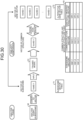
- FIG. 29 is a diagram for explanation of an example of a process in a training phase of an information processing apparatus according to the second embodiment.
- the information processing apparatus executes training of a trained model 91.
- the trained model 91 corresponds to, for example, a CNN or an RNN.
- the training data 90 define relations between vectors of pluralities of subgenomes for synthesis of target genomes (therapeutic drugs) and vectors of common structures maintained in genetic modification based on gene vectors.
- vectors of subgenomes correspond to input data
- vectors of plural common structures serve as correct answer values.
- the information processing apparatus executes training by error back propagation, so that output upon input of a vector of a subgenome to the trained model 91 approaches the vector of each common structure.
- the information processing apparatus adjusts parameters of the trained model 91 (executes machine training) by repeatedly executing the above described process on the basis of the relations between the vectors of the subgenomes included in the training data 90 and the vectors of the common structures.
- FIG. 30 is a diagram for explanation of a process by the information processing apparatus according to the second embodiment.
- the information processing apparatus according to the second embodiment may train the trained model 91 beforehand.
- the information processing apparatus trains the trained model 91 that is different from the trained model 70.
- the trained model 91 outputs a vector of a common structure in a case where a vector of an analysis query (subgenome) 92 is input to the trained model 91.
- the information processing apparatus In response to the information processing apparatus receiving the analysis query 92 specifying the subgenome, the information processing apparatus converts the subgenome in the analysis query 92 into a vector Vsb92-1 by using a subgenome vector table T1. By inputting the vector Vsb92-1 of the subgenome into the trained model 91, the information processing apparatus calculates a vector Vcm92-1 corresponding to its common structure.
- the information processing apparatus compares the vector Vsb92-1 of the subgenome and vectors of plural gene vectors included in an alternative gene vector table T2 with each other.
- the alternative gene vector table T2 corresponds to the alternative gene vector table T2 described with respect to the first embodiment.
- the information processing apparatus determines a vector of a gene vector similar to the vector Vsb92-1 of the subgenome. For example, a vector Vt92-1 is determined as the vector of the gene vector similar to the vector Vsb92-1 of the subgenome. A vector of a common structure common to the subgenome having the vector Vsb92-1 and the gene vector having the vector Vt92-1 is then found to be the vector Vcm92-1 output from the trained model 91. Furthermore, a result of subtraction of the vector Vcm92-1 of the common structure from the vector Vt92-1 of the gene vector is a vector of a "genetically modified structure" corresponding to difference between the similar gene vector and the subgenome.
- the information processing apparatus registers the relation between the vector of the common structure and the vector of the genetically modified structure into a common structure and genetically modified structure table 93. By repeatedly executing the above described process for vectors of subgenomes, the information processing apparatus generates the common structure and genetically modified structure table 93.
- the information processing apparatus inputs the vector of the analysis query 92 into the trained model 91 that has been trained to calculate a vector of each common structure corresponding to the subgenome in the analysis query. Furthermore, by subtraction of a vector of a common structure from each of vectors of gene vectors similar to a subgenome, a vector of a genetically modified structure corresponding to difference between the similar subgenome and the gene vector is calculated. Using the above described vector of the common structure and vector of the genetically modified structure facilitates analysis for a better gene vector usable for synthesis and manufacture of the target genome.
- FIG. 31 is a functional block diagram illustrating a configuration of the information processing apparatus according to the second embodiment.
- this information processing apparatus 200 has a communication unit 210, an input unit 220, a display unit 230, a storage unit 240, and a control unit 250.
- Description related to the communication unit 210, the input unit 220, and the display unit 230 is similar to the description related to the communication unit 110, the input unit 120, and the display unit 130 described with respect to the first embodiment.
- the storage unit 240 has a base file 50, a conversion table 51, a dictionary table 52, a compressed file table 53, a vector table 54, and an inverted index table 55. Furthermore, the storage unit 240 has the subgenome table T1, the alternative gene vector table T2, a genome dictionary D2, the training data 90, the trained model 91, the analysis query 92, and the common structure and genetically modified structure table 93.
- the storage unit 240 is implemented by, for example: a semiconductor memory element, such as a random access memory (RAM) or a flash memory; or a storage device, such as a hard disk or an optical disk.
- Description related to the base file 50, the conversion table 51, the dictionary table 52, the compressed file table 53, the vector table 54, the inverted index table 55, the subgenome table T1, the alternative gene vector table T2, and the genome dictionary D2 is similar to what has been described with respect to the first embodiment.
- the training data 90 are similar to those described by reference to FIG. 29 .
- Description related to the trained model 91 and the analysis query 92 is similar to what has been described by reference to FIG. 30 .
- the common structure and genetically modified structure table 93 includes information on genetically modified structure vectors for genetic modification from gene vectors similar to common structure vectors to subgenomes.
- the common structure and genetically modified structure table 93 in FIG. 30 includes genetically modified structure vectors corresponding to Vcm92-1.
- a vector obtained by adding up vectors of common structures and vectors of genetically modified structures is a vector corresponding to a vector of a gene vector.
- the control unit 250 has a preprocessing unit 251, a training unit 252, a calculation unit 253, and an analysis unit 254.
- the control unit 250 is implemented by, for example, a CPU or an MPU.
- the control unit 250 may be implemented by, for example, an integrated circuit, such as an ASIC or FPGA.
- the preprocessing unit 251 may obtain the training data 90 from an external device or the preprocessing unit 251 may generate the training data 90.
- the calculation unit 253 calculates a vector of each common structure to be subjected to a genetic modification via a synthetic pathway for the subgenome in the analysis query 92, by using the trained model 91 that has been trained.
- the calculation unit 253 outputs the calculated vector of each common structure, to the analysis unit 254.
- the analysis unit 254 generates the common structure and genetically modified mechanism table 93 on the basis of the vector of the subgenome in the analysis query 92, the common structure vectors, and the gene vector table T2. An example of a process by the analysis unit 254 will be described hereinafter.
- the analysis unit 254 calculates distances between a vector of a subgenome and vectors included in the alternative gene vector table T2 respectively to determine any vector having a distance less than a threshold, the distance being from the vector of the subgenome. Any vector included in the alternative gene vector table T2 and having a distance less than the threshold will be referred to as a "similar vector", the distance being from the vector of the subgenome.
- the analysis unit 254 calculates a vector of a genetically modified structure, and determines a correspondence relation between the common structure vector and the vector of the genetically modified structure.
- the analysis unit 254 registers the common structure vector and the vector of the genetically modified structure into the common structure and genetically modified structure table 93.
- the analysis unit 254 generates the common structure and genetically modified structure table 93.
- the analysis unit 245 may output the common structure and genetically modified structure table 93 to the display unit 230 to cause the display unit 230 to display the common structure and genetically modified structure table 93, or may transmit the common structure and genetically modified structure table 93 to an external device connected to a network.
- FIG. 32 is a flowchart illustrating a procedure by the information processing apparatus according to the second embodiment.
- the calculation unit 253 of the information processing apparatus 200 receives the analysis query 92 (Step S301).
- the calculation unit 253 converts the subgenome in the analysis query 92 into a vector (Step S302).
- the calculation unit 253 calculates a vector of a common structure (Step S303).
- the analysis unit 254 of the information processing apparatus 200 determines any similar vector (Step S304).
- the analysis unit 254 calculates a vector of a genetically modified structure by subtracting the vector of the common structure from the vector of each gene vector similar to the subgenome (Step S305).
- the analysis unit 254 registers a relation between the vector of the common structure and the vector of the genetically modified structure into the common structure and genetically modified structure table 93 (Step S306).
- the analysis unit 254 outputs information on the common structure and genetically modified structure table (Step S307).
- the information processing apparatus 200 inputs a vector of the analysis query 92, into the trained model 91 that has been trained to calculate a vector of each common structure corresponding to the subgenome in the analysis query. Furthermore, by subtraction of a vector of a common structure from the vector of each gene vector similar to the subgenome, a vector of a genetically modified structure corresponding to difference between the similar subgenome and the gene vector is calculated. Using the above described vector of the common structure and vector of the genetically modified structure facilitates analysis for a better gene vector usable for genetic modification to the target genome and resynthesis and manufacture of the target genome.
- Subgenomes and gene vectors are each a secondary structure composed of plural protein primary structures. Furthermore, using dispersion vectors of the protein primary structures enables estimation of protein primary structures adjacent to a certain protein primary structure and is able to be applied to evaluation of bonding and stability of each protein primary structure. With respect to genetic modification from a gene vector to a proven subgenome, executing machine training on the basis of dispersion vectors of plural protein primary structures composing a secondary structure of the subgenome or gene vector enables improvement of: application of the gene vector; the genetic modification; and accuracy of analysis of resynthesis.
- FIG. 33 is a diagram illustrating an example of a hardware configuration of a computer that implements functions that are the same as those of the information processing apparatus according to the embodiment.
- a computer 300 has a CPU 301 that executes various types of arithmetic processing, an input device 302 that receives data input from a user, and a display 303. Furthermore, the computer 300 has: a communication device 304 that transfers data to and from, for example, an external device, via a wired or wireless network; and an interface device 305. The computer 300 also has a RAM 306 that temporarily stores therein various types of information, and a hard disk device 307. Each of these devices 301 to 307 is connected to a bus 308.
- the hard disk device 307 has a preprocessing program 307a, a training program 307b, a calculation program 307c, and an analysis program 307d. Furthermore, the CPU 301 reads the programs 307a to 307d and load the read programs 307a to 307d into the RAM 306.
- the preprocessing program 307a functions as a preprocessing process 306a.
- the training program 307b functions as a training process 306b.
- the calculation program 307c functions as a calculation process 306c.
- the analysis program 307d functions as an analysis process 306d.
- a process by the preprocessing process 306a corresponds to the process by the preprocessing unit 151 or 251.
- a process by the training process 306b corresponds to the process by the training unit 152 or 252.
- a process by the calculation process 306c corresponds to the process by the calculation unit 153 or 253.
- a process by the analysis process 306d corresponds to the process by the analysis unit 154.
- the programs 307a to 307d are not necessarily stored in the hard disk device 307 beforehand.
- each program is stored in a "portable physical medium", such as a flexible disk (FD), a CD-ROM, a DVD, a magnetooptical disk, or an IC card, which is to be inserted in the computer 300.
- the computer 300 may then read and execute the programs 307a to 307d therefrom.
Landscapes
- Engineering & Computer Science (AREA)
- Physics & Mathematics (AREA)
- Life Sciences & Earth Sciences (AREA)
- Health & Medical Sciences (AREA)
- Medical Informatics (AREA)
- Spectroscopy & Molecular Physics (AREA)
- Data Mining & Analysis (AREA)
- Theoretical Computer Science (AREA)
- Bioinformatics & Cheminformatics (AREA)
- General Health & Medical Sciences (AREA)
- Evolutionary Biology (AREA)
- Biotechnology (AREA)
- Biophysics (AREA)
- Bioinformatics & Computational Biology (AREA)
- Public Health (AREA)
- Artificial Intelligence (AREA)
- Computer Vision & Pattern Recognition (AREA)
- Evolutionary Computation (AREA)
- Epidemiology (AREA)
- Databases & Information Systems (AREA)
- Bioethics (AREA)
- Software Systems (AREA)
- Chemical & Material Sciences (AREA)
- Crystallography & Structural Chemistry (AREA)
- Biochemistry (AREA)
- Library & Information Science (AREA)
- Molecular Biology (AREA)
- Information Retrieval, Db Structures And Fs Structures Therefor (AREA)
- Management, Administration, Business Operations System, And Electronic Commerce (AREA)
- Communication Control (AREA)
Abstract
Description
- The present invention relates to information processing programs, for example.
- Genetic recombination manipulations have been performed using gene vectors due to advancement of gene transfer technologies and deeper understanding related immunological mechanisms. Mediums with various added characteristics are used as gene vectors differently depending on sizes of gene segments inserted and purposes of insertion. Gene vectors derived from host organisms, such as colon bacilli and yeasts, are used for these manipulations.
- For example, chimeric antigen receptor (CAR) introduced T cell therapy has attracted attention as immunotherapy of cancer using genetically modified T cells. A CAR is a receptor that: is artificially made by fusion of a part that specifically recognizes an antigen and that is derived from an antibody with a part derived from a T cell receptor (TCR), the part having a cytotoxic function; specifically recognizes a cancer antigen; and is able to attack the cancer antigen.
-
- Patent Literature 1: International Publication Pamphlet No.
WO 2020/230240 - Patent Literature 2: International Publication Pamphlet No.
WO 2007/102578 - Developing gene therapy drugs using gene vectors is very promising but synthesizing gene therapy drugs using various gene vectors, as is, is difficult.
- Accordingly, one may consider synthesizing target gene therapy drugs by substitution of various gene vectors, but searching for substitutable gene vectors and efficient genetic modification are actually difficult.
- An object of the present invention in one aspect is to provide an information processing program, an information processing method, and an information processing apparatus that enable determination of a genome that serves as a substitute for a subgenome included in a target genome.
- According to an aspect of the embodiment of the invention, an information processing program causes a computer to execute a process including executing training of a trained model on the basis of training data defining relations between vectors corresponding to genomes and vectors respectively corresponding to pluralities of subgenomes composing the genomes and in a case where a genome to be analyzed has been received, calculating vectors of a plurality of subgenomes corresponding to the genome to be analyzed by inputting the genome to be analyzed into the trained model.
- Determination of a genome is enabled, the genome serving as a substitute for a subgenome included in a target genome.
-
-
FIG. 1 is a diagram for explanation of a genome. -
FIG. 2 is a diagram illustrating relations between: amino acids; and bases and codons. -
FIG. 3 is a diagram for explanation of a primary structure, a secondary structure, a tertiary structure, and a higher-order structure of a protein. -
FIG. 4 is a diagram illustrating an example of a gene vector. -
FIG. 5 is a diagram for explanation of an example of a process in a training phase of an information processing apparatus according to an embodiment. -
FIG. 6 is a diagram for explanation of an example of a process in an analysis phase of the information processing apparatus according to the embodiment. -
FIG. 7 is a functional block diagram illustrating a configuration of the information processing apparatus according to the first embodiment. -
FIG. 8 is a diagram illustrating an example of a data structure of a base file. -
FIG. 9 is a diagram illustrating an example of a data structure of a conversion table. -
FIG. 10 is a diagram illustrating an example of a data structure of a dictionary table. -
FIG. 11 is a diagram illustrating an example of a data structure of a protein primary structure dictionary. -
FIG. 12 is a diagram illustrating an example of a data structure of a secondary structure dictionary. -
FIG. 13 is a diagram illustrating an example of a data structure of a tertiary structure dictionary. -
FIG. 14 is a diagram illustrating an example of a data structure of a higher-order structure dictionary. -
FIG. 15 is a diagram illustrating an example of a data structure of a compressed file table. -
FIG. 16 is a diagram illustrating an example of a data structure of a vector table. -
FIG. 17 is a diagram illustrating an example of a data structure of a protein primary structure vector table. -
FIG. 18 is a diagram illustrating an example of a data structure of a secondary structure vector table. -
FIG. 19 is a diagram illustrating an example of a data structure of a tertiary structure vector table. -
FIG. 20 is a diagram illustrating an example of a data structure of a higher-order structure vector table. -
FIG. 21 is a diagram illustrating an example of a data structure of an inverted index table. -
FIG. 22 is a diagram illustrating an example of a data structure of a protein primary structure inverted index. -
FIG. 23 is a diagram illustrating an example of a data structure of a secondary structure inverted index. -
FIG. 24 is a diagram illustrating an example of a data structure of a tertiary structure inverted index. -
FIG. 25 is a diagram illustrating an example of a data structure of a higher-order structure inverted index. -
FIG. 26 is a diagram illustrating an example of a data structure of a genome dictionary. -
FIG. 27 is a first flowchart illustrating a procedure by the information processing apparatus according to the embodiment. -
FIG. 28 is a second flowchart illustrating a procedure by the information processing apparatus according to the embodiment. -
FIG. 29 is a diagram for explanation of an example of a process in a training phase of an information processing apparatus according to a second embodiment. -
FIG. 30 is a diagram for explanation of a process by the information processing apparatus according to the second embodiment. -
FIG. 31 is a functional block diagram illustrating a configuration of the information processing apparatus according to the second embodiment. -
FIG. 32 is a flowchart illustrating a procedure by the information processing apparatus according to the second embodiment. -
FIG. 33 is a diagram illustrating an example of a hardware configuration of a computer that implements functions that are the same as those of the information processing apparatuses according to the embodiments. Description of Embodiments - Embodiments of an information processing program, an information processing method, and an information processing apparatus disclosed in the present application will hereinafter be described in detail on the basis of the drawings. The present invention is not limited by these embodiments.
- Genomes will be described before description of an embodiment.
FIG. 1 is a diagram for explanation of genomes. Agenome 1 includes genetic information prescribing a sequence in which plural amino acids are linked to each other. An amino acid is determined by consecutive three bases, that is, a codon. Thegenome 1 also includes information on aprotein 1a. Theprotein 1a has 20 types of multiple amino acids bonded to each other in a chain. The structure of theprotein 1a is able to be considered as a primary structure, a secondary structure, a tertiary structure, or a higher-order (quaternary) structure of proteins. 1b illustrates a higher-order structure of theprotein 1a. In the description hereinafter, a primary structure of a protein, a secondary structure of a protein, a tertiary structure of a protein, and a higher-order structure of a protein will respectively be referred to as a primary structure, a secondary structure, a tertiary structure, and a higher-order structure, as appropriate. - DNAs and RNAs each have four types of bases that are each denoted by a symbol, "A", "G", "C", "T", or "U". Furthermore, sequences each made up of three bases determine 20 types of amino acids. Each of these amino acids is denoted by symbols, "A" to "Y".
FIG. 2 is a diagram illustrating relations between: amino acids; and bases and codons. A sequence of three bases is called a "codon". Each sequence of bases determines a codon and an amino acid is determined when a codon is determined. - As illustrated in
FIG. 2 , plural types of codons are associated with one amino acid. Therefore, determining a codon determines an amino acid, but determining an amino acid does not uniquely determine a codon. For example, the amino acid, "alanine (Ala) A", is associated with a codon, "GCU", "GCC", "GCA", or "GCG". - A protein is also uniquely determined by a sequence of bases. A primary structure of a protein is a sequence of plural amino acids. A secondary structure includes α-helixes and β-sheets that are symmetrical substructures observed locally. A tertiary structure includes plural secondary structures. Furthermore, a higher-order structure includes plural tertiary structures.
FIG. 3 is a diagram for explanation of a primary structure, a secondary structure, a tertiary structure, and a higher-order structure of a protein. For example, as illustrated inFIG. 3 , a higher-order structure Z1 includes tertiary structures Y1, Y2, and Y3. The tertiary structure Y1 includes, for example, secondary structures X2, X2, and X3. The secondary structure X1 includes, for example, primary structures W2, W2, and W3. The primary structure W1 includes, for example, amino acids A1, A2, and A3. - A gene vector used in this embodiment is a DNA or RNA molecule that is used to artificially carry a foreign genetic substance to another cell. Gene vectors include, for example, plasmids, cosmids, lambda phages, and artificial chromosomes.
FIG. 4 is a diagram illustrating an example of the gene vector. The gene vector illustrated inFIG. 4 is pBR322 plasmid and is widely used as a cloning vector. Description will be made on the assumption that gene vectors themselves are base sequences of DNAs and RNAs and correspond to, for example, higher-order structures of proteins described by reference toFIG. 3 . - Furthermore, the gene vector is generated by synthesis of plural subvectors. Subvectors are base sequences of DNAs and RNAs and correspond to, for example, secondary structures of proteins described by reference to
FIG. 3 . Subvectors include so-called colon bacillus vectors including elements for maintenance in colon bacilli and vectors for maintenance in cell lines derived from, for example, yeast, plants, and mammals. The subvectors may be other vectors. - An example of a process by an information processing apparatus according to this embodiment will be described next.
-
FIG. 5 is a diagram for explanation of an example of a process in a training phase of the information processing apparatus according to the embodiment. As illustrated inFIG. 5 , the information processing apparatus executes machine training of a trainedmodel 70 by usingtraining data 65. The trainedmodel 70 corresponds to, for example, a convolutional neural network (CNN) or a recurrent neural network (RNN). - The
training data 65 define relations between vectors of target genomes (therapeutic drugs) and vectors of pluralities of subgenomes included in the target genomes. For example, a vector of a target genome corresponds to input data and a plurality of subgenomes serves as correct answer values of output data therefor. - The information processing apparatus executes training by error back propagation so that output upon input of a vector of a target genome into the trained
model 70 approaches vectors of its subgenomes. The information processing apparatus adjusts parameters of the trained model 70 (executes machine training) by repeatedly executing the above described process on the basis of the relations included in thetraining data 65, the relations each being between: a vector of a target genome; and vectors of a plurality of subgenomes. -
FIG. 6 is a diagram for explanation of an example of a process in an analysis phase of the information processing apparatus according to the embodiment. In the analysis phase, the information processing apparatus executes the following process by using the trainedmodel 70 that has been trained in the training phase. - In response to the information processing apparatus receiving an
analysis query 80 that specifies a target genome (a therapeutic drug), the information processing apparatus converts the target genome in theanalysis query 80 to a vector Vob80. By inputting the vector Vob80 to the trainedmodel 70, the information processing apparatus calculates a plurality of vectors (Vsb80-1, Vsb80-2, Vsb80-3, ..., Vsb80-n) corresponding to its subgenomes and stores the calculated plurality of vectors into a subgenome table T1. - The information processing apparatus makes a comparison among degrees of similarity between plural vectors (Vt1, Vt2, Vt3, ..., Vtn) corresponding respectively to alternative gene vectors stored in an alternative gene vector table T2 and the plurality of vectors (Vsb80-1, Vsb80-2, Vsb80-3, ..., Vsb80-n) to determine vectors of similar alternative gene vectors. The information processing apparatus registers the vector of the target genome, the vectors of the subgenomes, and the vectors of the similar alternative gene vectors, in association with one another, into an alternative management table 85.
- As described above, the information processing apparatus according to the embodiment executes training of the trained
model 70 beforehand, on the basis of thetraining data 65 defining the relations between the vectors of the target genomes and the vectors of their subgenomes. By inputting a vector of an analysis query into the trainedmodel 70 that has been trained, the information processing apparatus calculates vectors of subgenomes corresponding to the target compound in the analysis query. Using the vectors of the subgenomes output from the trainedmodel 70 facilitates detection of substitutable gene vectors that are gene vectors similar to the subgenomes included in the target genome. - An example of a configuration of the information processing apparatus according to the first embodiment will be described next.
FIG. 7 is a functional block diagram illustrating the configuration of the information processing apparatus according to the first embodiment. As illustrated inFIG. 7 , thisinformation processing apparatus 100 has a communication unit 110, an input unit 120, adisplay unit 130, astorage unit 140, and acontrol unit 150. - The communication unit 110 is connected to, for example, an external device by wire or wirelessly and transmits and receives information to and from, for example, the external device. For example, the communication unit 110 is implemented by a network interface card (NIC). The communication unit 110 may be connected to a network not illustrated in the drawings.
- The input unit 120 is an input device that inputs various types of information to the
information processing apparatus 100. The input unit 120 corresponds to, for example, a keyboard and a mouse, or a touch panel. - The
display unit 130 is a display device that displays information output from thecontrol unit 150. Thedisplay unit 130 corresponds to, for example, a liquid crystal display, an organic electro luminescence (EL) display, or a touch panel. - The
storage unit 140 has abase file 50, a conversion table 51, a dictionary table 52, a compressed file table 53, a vector table 54, and an inverted index table 55. Furthermore, thestorage unit 140 has the subgenome table T1, the alternative gene vector table T2, a genome dictionary D2, thetraining data 65, the trainedmodel 70, theanalysis query 80, and the alternative management table 85. Thestorage unit 140 is implemented by, for example: a semiconductor memory element, such as a random access memory (RAM) or a flash memory; or a storage device, such as a hard disk or an optical disk. - The
base file 50 is a file that holds information including a sequence of plural bases.FIG. 8 is a diagram illustrating an example of a data structure of a base file. As illustrated inFIG. 8 , thebase file 50 is represented by four types of symbols, each of which is "A", "G", "C", "T", or "U". - The conversion table 51 is a table associating codons and codes of the codons with each other. A sequence of three bases is called a "codon".
FIG. 9 is a diagram illustrating an example of a data structure of a conversion table. As illustrated inFIG. 9 , codons are respectively associated with codes. For example, a codon, "UUU", has a code, "40h(01000000)". Herein, "h" indicates being a hexadecimal number. - The dictionary table 52 is a table that holds various dictionaries.
FIG. 10 is a diagram illustrating an example of a data structure of a dictionary table. As illustrated inFIG. 10 , this dictionary table 52 has a protein primary structure dictionary D1-1, a secondary structure dictionary D1-2, a tertiary structure dictionary D1-3, and a higher-order structure dictionary D1-4. - The protein primary structure dictionary D1-1 is dictionary data defining relations between compressed codes of proteins and sequences of codons composing the proteins.
FIG. 11 is a diagram illustrating an example of a data structure of a protein primary structure dictionary. As illustrated inFIG. 11 , the protein primary structure dictionary D1-1 associates the compressed codes, names, and codon code sequences with one another. The compressed codes are compressed code sequences of codons (or symbol sequences of amino acids). The names are names of the proteins. The codon code sequences are sequences of compressed codes of the codons. Sequences of symbols of amino acids, instead of the codon code sequences, may be associated with the compressed codes of the protein primary structures. - For example, a compressed code, "C0008000h", is assigned to a protein primary structure, "type I collagen". A codon code sequence corresponding to the compressed code, "C0008000h", is "02h63h78h ... 03h".
- The secondary structure dictionary D1-2 is dictionary data defining relations between sequences of compressed codes of protein primary structures and compressed codes of secondary structures.
FIG. 12 is a diagram illustrating an example of a data structure of a secondary structure dictionary. As illustrated inFIG. 12 , the secondary structure dictionary D1-2 associates the compressed codes, names, and protein primary structure code sequences with one another. The compressed codes are compressed codes assigned to secondary structures of proteins. The names are names of the secondary structures. The protein primary structure code sequences are sequences of compressed codes of protein primary structures corresponding to the secondary structures. - For example, a compressed code, "D0000000h", is assigned to a secondary structure, "α secondary structure". A protein primary structure code sequence corresponding to the compressed code, "D0000000h", is "C0008001hC00 ...".
- The tertiary structure dictionary D1-3 is dictionary data defining relations between sequences of compressed codes of secondary structures and compressed codes of tertiary structures.
FIG. 13 is a diagram illustrating an example of a data structure of a tertiary structure dictionary. As illustrated inFIG. 13 , the tertiary structure dictionary D1-3 associates the compressed codes, names, and secondary structure code sequences with one another. The compressed codes are compressed codes that have been assigned to the tertiary structures. The names are names of the tertiary structures. The secondary structure code sequences are sequences of compressed codes of secondary structures corresponding to the tertiary structures. - For example, a compressed code, "E0000000h", is assigned to a tertiary structure, "αα tertiary structure". A secondary structure code sequence corresponding to the compressed code, "E0000000h", is "D0008031hD00 ...".
- The higher-order structure dictionary D1-4 is dictionary data defining relations between sequences of compressed codes of tertiary structures and compressed codes of higher-order structures.
FIG. 14 is a diagram illustrating an example of a data structure of a higher-order structure dictionary. As illustrated inFIG. 14 , the higher-order structure dictionary D1-4 associates the compressed codes, names, and tertiary structure code sequences with one another. The compressed codes are compressed codes that have been assigned to the higher-order structures. The names are names of the higher-order structures. The tertiary structure code sequences are sequences of compressed codes of tertiary structures corresponding to the higher-order structures. - For example, a compressed code, "F0000000h", is assigned to a higher-order structure, "ααα higher-order structure". A tertiary structure code sequence corresponding to the compressed code, "F0000000h" is "E0000031hE00 ...".
- The description of
FIG. 7 will now be resumed. The compressed file table 53 is a table that holds various compressed files.FIG. 15 is a diagram illustrating an example of a data structure of a compressed file table. As illustrated inFIG. 15 , this compressed file table 53 has a codon compression file 53A, a protein primarystructure compression file 53B, a secondarystructure compression file 53C, a tertiary structure compression file 53D, and a higher-order structure compression file 53E. - The codon compression file 53A is a file having the bases compressed in units of codons, the bases being included in the
base file 50. - The protein primary
structure compression file 53B is a file having the sequences coded in units of protein primary structures, the sequences being of the compressed codes of the codons included in the codon compression file 53A. - The secondary
structure compression file 53C is a file having the sequences coded in units of secondary structures, the sequences being of the compressed codes of the protein primary structures included in the protein primarystructure compression file 53B. - The tertiary structure compression file 53D is a file having the sequences coded in units of tertiary structures, the sequences being of the compressed codes of the secondary structures included in the secondary
structure compression file 53C. - The higher-order structure compression file 53E is a file having the sequences coded in units of higher-order structures, the sequences being of the compressed codes of the tertiary structures included in the tertiary structure compression file 53D.
- The vector table 54 is a table that holds vectors corresponding to protein primary structures, secondary structures, tertiary structures, and higher-order structures.
FIG. 16 is a diagram illustrating an example of a data structure of a vector table. As illustrated inFIG. 16 , this vector table 54 has a protein primary structure vector table VT1-1, a secondary structure vector table VT1-2, a tertiary structure vector table VT1-3, and a higher-order structure vector table VT1-4. - The protein primary structure vector table VT1-1 is a table that holds vectors corresponding to protein primary structures.
FIG. 17 is a diagram illustrating an example of a data structure of a protein primary structure vector table. As illustrated inFIG. 17 , the protein primary structure vector table VT1-1 has compressed codes of the protein primary structures, and the vectors that have been assigned to the compressed codes of these protein primary structures, in association with each other. The vectors of the protein primary structures are calculated by Poincare Embeddings. Poincare Embeddings will be described later. - The secondary structure vector table VT1-2 is a table that holds vectors corresponding to secondary structures.
FIG. 18 is a diagram illustrating an example of a data structure of a secondary structure vector table. As illustrated inFIG. 18 , the secondary structure vector table VT1-2 has compressed codes of the secondary structures and the vectors that have been assigned to the compressed codes of the secondary structures, in association with each other. The vectors of the secondary structures are each calculated by adding up the vectors of the protein primary structures included in that secondary structure. - The tertiary structure vector table VT1-3 is a table that holds vectors corresponding to tertiary structures.
FIG. 19 is a diagram illustrating an example of a data structure of a tertiary structure vector table. As illustrated inFIG. 19 , the tertiary structure vector table VT1-3 has compressed codes of the tertiary structures and the vectors that have been assigned to the compressed codes of the tertiary structures, in association with each other. The vectors of the tertiary structures are each calculated by adding up the vectors of the secondary structures included in that tertiary structure. - The higher-order structure vector table VT1-4 is a table that holds vectors corresponding to higher-order structures.
FIG. 20 is a diagram illustrating an example of a data structure of a higher-order structure vector table. As illustrated inFIG. 20 , the higher-order structure vector table VT1-4 has compressed codes of the higher-order structures and the vectors that have been assigned to the compressed codes of the higher-order structures, in association with each other. The vectors of the higher-order structures are each calculated by adding up the vectors of the tertiary structures included in that higher-order structure. - The description of
FIG. 7 will now be resumed. The inverted index table 55 is a table that holds various inverted indices.FIG. 21 is a diagram illustrating an example of a data structure of an inverted index table. As illustrated inFIG. 21 , the inverted index table 55 has a protein primary structure inverted index In1-1, a secondary structure inverted index In1-2, a tertiary structure inverted index In1-3, and a higher-order structure inverted index In1-4. -
FIG. 22 is a diagram illustrating an example of a data structure of a protein primary structure inverted index. The horizontal axis of the protein primary structure inverted index In1-1 is an axis corresponding to offsets. The vertical axis of the protein primary structure inverted index In1-1 is an axis corresponding to compressed codes of protein primary structures. The protein primary structure inverted index In1-1 is represented by a bitmap of "0" or "1" and the whole bitmap is set to "0" in the initial state. - For example, the compressed code of the protein primary structure at the head of the protein primary
structure compression file 53B has an offset of "0". In a case where the code, "C0008000h (type I collagen)", of a protein primary structure is included at the eighth position from the head of the protein primarystructure compression file 53B, the bit at a position where the column of the offset of "7" in the protein inverted index In1-1 and the row of the code, "C0008000h (type I collagen)", of the protein intersect each other is "1". -
FIG. 23 is a diagram illustrating an example of a data structure of a secondary structure inverted index. The horizontal axis of the secondary structure inverted index In1-2 is an axis corresponding to offsets. The vertical axis of the secondary structure inverted index In1-2 is an axis corresponding to compressed codes of secondary structures. The secondary structure inverted index In1-2 is represented by a bitmap of "0" or "1" and the whole bitmap is set to "0" in the initial state. - For example, the compressed code of the secondary structure at the head of the secondary
structure compression file 53C has an offset of "0". In a case where the code, "D000000h (α secondary structure)", of a secondary structure is included at the eighth position from the head of the secondarystructure compression file 53C, the bit at a position where the column of the offset of "7" in the secondary structure inverted index In1-2 and the row of the compressed code, "D0000000h (α secondary structure)", of the secondary structure intersect each other is "1". -
FIG. 24 is a diagram illustrating an example of a data structure of a tertiary structure inverted index. The horizontal axis of the tertiary structure inverted index In1-3 is an axis corresponding to offsets. The vertical axis of the tertiary structure inverted index In1-3 is an axis corresponding to compressed codes of tertiary structures. The tertiary structure inverted index In1-3 is represented by a bitmap of "0" or "1" and the whole bitmap is set to "0" in the initial state. - For example, the compressed code of the tertiary structure at the head of the tertiary structure compression file 53D has an offset of "0". In a case where the code, "E0000000h (αα tertiary structure)", of a tertiary structure is included at the eleventh position from the head of the tertiary structure compression file 53D, the bit at a position where the column of the offset of "10" in the tertiary structure inverted index In1-3 and the row of the compressed code, "E0000000h (αα tertiary structure)", of the tertiary structure intersect each other is "1".
-
FIG. 25 is a diagram illustrating an example of a data structure of a higher-order structure inverted index. It is the diagram illustrating the example of the data structure of the higher-order structure inverted index. The horizontal axis of the higher-order structure inverted index In1-4 is an axis corresponding to offsets. The vertical axis of the higher-order structure inverted index In1-4 is an axis corresponding to compressed codes of higher-order structures. The higher-order structure inverted index In1-4 is represented by a bitmap of "0" or "1" and the whole bitmap is set to "0" in the initial state. - For example, the compressed code of the higher-order structure at the head of the higher-order structure compression file 53E has an offset of "0". In a case where the code, "F0000000h (ααα higher-order structure)", of a higher-order structure is included at the eleventh position from the head of the higher-order structure compression file 53E, the bit at a position where the column of the offset of "10" in the higher-order structure inverted index In1-4 and the row of the compressed code, "F0000000h (ααα higher-order structure)", of the higher-order structure intersect each other is "1".
- The description of
FIG. 7 will now be resumed. The alternative gene vector table T2 holds vectors of plural gene vectors. The gene vectors correspond to secondary structures of proteins. For example, the vectors stored in the alternative gene vector table T2 may be the vectors that have been registered in the secondary structure vector table VT1-2. A data structure of the alternative gene vector table T2, as described by reference toFIG. 6 , has the vectors of the plural alternative gene vectors stored therein. - The genome dictionary D2 defines relations between names of target genomes and names of subgenomes included in these target genomes.
FIG. 26 is a diagram illustrating an example of a data structure of a genome dictionary. As illustrated inFIG. 26 , this genome dictionary D2 associates the names of the target vectors and the names of the pluralities of subgenomes with each other. - The
training data 65 define relations each between a vector of a target genome and vectors of a plurality of subgenomes included in that target genome. Thetraining data 65 have a data structure corresponding to the data structure of the training data described by reference toFIG. 5 . - The trained
model 70 is a model corresponding to, for example, a CNN or an RNN, and parameters are set for the trainedmodel 70. - The
analysis query 80 includes information on a target genome (therapeutic drug) to be analyzed. For example, the information on a target genome includes information on a base sequence corresponding to a higher-order structure. - The alternative management table 85 is a table holding vectors of subgenomes included in target genomes and vectors of gene vectors similar to these subgenomes in association with each other, the gene vectors being able to substitute for the subgenomes.
- The
control unit 150 has apreprocessing unit 151, atraining unit 152, acalculation unit 153, and ananalysis unit 154. Thecontrol unit 150 is implemented by, for example, a central processing unit (CPU) or a micro processing unit (MPU). Furthermore, thecontrol unit 150 may be implemented by, for example, an integrated circuit, such as an application specific integrated circuit (ASIC) or a field programmable gate array (FPGA). - By executing various processes described below, the
preprocessing unit 151 calculates a vector of a higher-order structure or tertiary structure corresponding to a target genome (therapeutic drug) and vectors of secondary structures corresponding to subgenomes, for example. - Firstly, the
preprocessing unit 151 executes a process of generating the codon compression file 53A, a process of generating the protein primarystructure compression file 53B, and a process of generating the protein primary structure vector table VT1-1 and the protein primary structure inverted index In1-1. - The
preprocessing unit 151 compares thebase file 50 and the conversion table 51 with each other, assigns compressed codes, in units of codons, to the base sequence in thebase file 50, and generates the codon compression file 53A. - The
preprocessing unit 151 compares the codon compression file 53A and the protein primary structure dictionary D1-1 with each other, assigns compressed codes, in units of protein primary structures, to sequences of the compressed codes of the codons included in the codon compression file 53A, and generates the proteinprimary compression file 53B. - In response to the
preprocessing unit 151 generating the protein primarystructure compression file 53B, thepreprocessing unit 151 calculates vectors of the protein primary structures (the compressed codes of the protein primary structures) by embedding the compressed codes of the protein primary structures in Poincare space. A process of calculating a vector by embedding into Poincare space is a technique called Poincare Embeddings. For Poincare Embeddings, for example, a technique described in Non-Patent Literature by Valentin Khrulkov1 et al., "Hyperbolic Image Embeddings", published by Cornell University on April 3, 2019 may be used. - Poincare Embeddings are characterized in that a vector is assigned according to the embedded position in Poincare space and the more similar pieces of information are, the nearer their embedded positions are. Therefore, groups having similar characteristics are embedded at positions that are near one another in Poincare space and similar vectors are thus assigned to these groups. Although illustration will be omitted, the
preprocessing unit 151 refers to a protein primary structure similarity table defining protein primary structures that are similar to each other, embeds a compressed code of each protein primary structure into Poincare space, and calculates a vector of the compressed code of each protein primary structure. Thepreprocessing unit 151 may execute Poincare Embeddings beforehand for a compressed code of each protein primary structure defined in the protein dictionary primary structure D1-1. - The
preprocessing unit 151 generates the protein primary structure vector table VT1-1 by associating protein primary structures (compressed codes of protein primary structures) and vectors of the protein primary structures with each other. Thepreprocessing unit 151 generates the protein primary structure inverted index In1-1 on the basis of relations between the vectors of the protein primary structures and positions of the protein primary structures (the compressed codes of the protein primary structures) in the protein primarystructure compression file 53B. - Subsequently, the
preprocessing unit 151 executes a process of generating the secondarystructure compression file 53C and a process of generating the secondary structure vector table VT1-2 and the secondary structure inverted index In1-2. - The
preprocessing unit 151 compares the protein primarystructure compression file 53B and the secondary structure dictionary D1-2 with each other, assigns compressed codes, in units of secondary structures, to sequences of the compressed codes of the protein primary structures included in the protein primarystructure compression file 53B and generates the secondarystructure compression file 53C. - The
preprocessing unit 151 refers to the secondary structure dictionary D1-2 and determines protein primary structure code sequences (sequences of compressed codes of protein primary structures) corresponding to a compressed code of a secondary structure. Thepreprocessing unit 151 obtains vectors of the determined compressed codes of the protein primary structures from the protein primary structure vector table VT1-1, adds up the obtained vectors, and thereby calculates a vector of the compressed code of the secondary structure. By repeatedly executing the above described process, thepreprocessing unit 151 calculates vectors of secondary structures. - By associating the secondary structures (the compressed codes of the secondary structures) and the vectors of the secondary structures with each other, the
preprocessing unit 151 generates the secondary structure vector table VT1-2. Thepreprocessing unit 151 generates the secondary structure inverted index In1-2 on the basis of relations between the vectors of the secondary structures and positions of the secondary structures (the compressed codes of the secondary structures) in the secondarystructure compression file 53C. - Subsequently, the
preprocessing unit 151 executes a process of generating the tertiary structure compression file 53D and a process of generating the tertiary structure vector table VT1-3 and the tertiary structure inverted index In1-3. - The
preprocessing unit 151 compares the secondarystructure compression file 53C and the tertiary structure dictionary D1-3 with each other, assigns compressed codes, in units of tertiary structures, to sequences of the compressed codes of the secondary structures included in the secondarystructure compression file 53C. - The
preprocessing unit 151 refers to the tertiary structure dictionary D1-3 and determines secondary structure code sequences (sequences of compressed codes of secondary structures) corresponding to a compressed code of a tertiary structure. Thepreprocessing unit 151 obtains vectors of the determined compressed codes of the secondary structures from the secondary structure vector table VT1-2, adds up the obtained vectors, and thereby calculates a vector of the compressed code of the tertiary structure. By repeatedly executing the above described process, thepreprocessing unit 151 calculates vectors of tertiary structures. - By associating the tertiary structures (the compressed codes of the tertiary structures) and the vectors of the tertiary structures with each other, the
preprocessing unit 151 generates the tertiary structure vector table VT1-3. Thepreprocessing unit 151 generates the tertiary structure inverted index In1-3 on the basis of relations between the vectors of the tertiary structures and positions of the tertiary structures (the compressed codes of the tertiary structures) in the tertiary structure compression file 53D. - Subsequently, the
preprocessing unit 151 executes a process of generating the higher-order structure compression file 53E and a process of generating the higher-order structure vector table VT1-4 and the higher-order structure inverted index In1-4. - The
preprocessing unit 151 compares the tertiary structure compression file 53D and the higher-order structure dictionary D1-4 with each other, assigns compressed codes, in units of higher-order structures, to sequences of the compressed codes of the tertiary structures included in the tertiary structure compression file 53D, and generates the higher-order structure compression file 53E. - The
preprocessing unit 151 refers to the higher-order structure dictionary D1-4 and determines tertiary structure code sequences (sequences of compressed codes of tertiary structures) corresponding to a compressed code of a higher-order structure. Thepreprocessing unit 151 obtains vectors of the determined compressed codes of the tertiary structures from the tertiary structure vector table VT1-3, adds up the obtained vectors, and thereby calculates a vector of the compressed code of the higher-order structure. By repeatedly executing the above described process, thepreprocessing unit 151 calculates vectors of higher-order structures. - The
preprocessing unit 151 generates the higher-order structure vector table VT1-4 by associating the higher-order structures (the compressed codes of the higher-order structures) and the vectors of the higher-order structures with each other. Thepreprocessing unit 151 generates the higher-order structure inverted index In1-4 on the basis of relations between the vectors of the higher-order structures and positions of the higher-order structures (the compressed codes of the higher-order structures) in the higher-order structure compression file 53E. - The following description is on an example of a process in which the
preprocessing unit 151 generates the alternative gene vector table T2. For example, thepreprocessing unit 151 sets, as is, the vectors of the tertiary structures included in the secondary structure vector table VT1-2, in the alternative gene vector table T2. In a case where thepreprocessing unit 151 has received specification of a vector via the input unit 120, thepreprocessing unit 151 may set the specified vector in the alternative gene genome table T2. - The following description is on an example of a process in which the
preprocessing unit 151 generates thetraining data 65. Thepreprocessing unit 151 determines a relation between a name of a target genome and names of subgenomes, on the basis of the genome dictionary D2. Thepreprocessing unit 151 determines a vector of the target genome on the basis of the higher-order structure dictionary D1-4 and the higher-order structure vector table VT1-4, or the tertiary structure dictionary D1-4 and the tertiary structure vector table VT1-3, and the name of the target genome. Thepreprocessing unit 151 determines vectors of the subgenomes on the basis of the secondary structure dictionary D1-2 and secondary structure vector table VT1-2 and the names of the subgenomes. Thepreprocessing unit 151 determines the relation between the target genome and the subgenomes through this process and registers the relation into thetraining data 65. - The
preprocessing unit 151 generates thetraining data 65 by repeatedly executing the above described process. Theinformation processing apparatus 100 may obtain and use thetraining data 65 that have been generated beforehand, from, for example, an external device. - The description of
FIG. 7 will now be resumed. Thetraining unit 152 executes training of the trainedmodel 70 by using thetraining data 65. A process by thetraining unit 152 corresponds to the process described by reference toFIG. 5 . Thetraining unit 152 obtains, from thetraining data 65, a pair of: a vector of a target genome (a therapeutic drug); vectors of subgenomes corresponding to the vector of this target genome. Thetraining unit 152 adjusts parameters of the trainedmodel 70 by executing training by error back propagation so that the value of output from the trainedmodel 70 in a case where the vector of the target genome is input to the trainedmodel 70 approaches the values of the vectors of the subgenomes. - The
training unit 152 executes training of the trainedmodel 70 by repeatedly executing the above described process for pairs of vectors of target genomes and vectors of subgenomes in thetraining data 65. - In a case where the
calculation unit 153 has received specification by theanalysis query 80, thecalculation unit 153 calculates vectors of subgenomes included in the target genome in theanalysis query 80, by using the trainedmodel 70 that has been trained. A process by thecalculation unit 153 corresponds to the process described by reference toFIG. 6 . Thecalculation unit 153 may receive theanalysis query 80 from the input unit 120 or may receive theanalysis query 80 from an external device via the communication unit 110. - The
calculation unit 153 obtains a base sequence of the target genome included in theanalysis query 80. Thecalculation unit 153 compares the base sequence of the target genome and the conversion table 51 with each other, determines codons included in the base sequence of the target genome, and converts the base sequence of the target genome into compressed codes, in units of codons. Furthermore, thecalculation unit 153 compares the codon code sequences compressed in units of codons and the protein primary structure dictionary D1-1 with each other and converts the codon code sequences into compressed codes, in units of protein primary structures. - The
calculation unit 153 compares the converted compressed codes of the protein primary structures with the protein primary structure vector table VT1-1 and determines vectors of the compressed codes of the protein primary structures. By adding up the determined vectors of the compressed codes of the protein primary structures, thecalculation unit 153 calculates the vector Vob80 corresponding to the target genome included in theanalysis query 80. - In a case where a target genome has been specified by secondary structures of plural subgenomes, the
calculation unit 153 executes the following process. Thecalculation unit 153 compares the secondary structures of the subgenomes of the target genome with the secondary structure dictionary D1-2 and secondary structure vector table VT1-2, and determines vectors of the secondary structures of the subgenomes included in the target genome. By adding up the determined vectors of the secondary structures of the subgenomes, thecalculation unit 153 calculates a vector of the target genome. - The
calculation unit 153 calculates plural vectors corresponding to the subgenomes by inputting the vector Vob80 into the trainedmodel 70. Thecalculation unit 153 outputs the calculated vectors of the subgenomes, to theanalysis unit 154. In the description hereinafter, the vectors of the subgenomes calculated by thecalculation unit 153 will be respectively referred to as "analysis vectors". Thecalculation unit 153 stores the vectors (analysis vectors) of the subgenomes into the subgenome table T1. - The
analysis unit 154 makes a search for information on alternative gene vectors having vectors similar to the analysis vectors, on the basis of the analysis vectors. On the basis of a result of the search, theanalysis unit 154 registers the vectors of the subgenomes included in the target genome and the vectors (similar vectors described hereinafter) of the alternative gene vectors similar thereto, in association with each other, into the alternative management table 85. - For example, the
analysis unit 154 calculates distances between an analysis vector and the vectors included in the alternative gene vector table T2 to determine any vector having a distance less than a threshold, the distance being from the analysis vector. Any vector included in the alternative gene vector table T2 and having the distance from the analysis vector is a "similar vector", the distance being less than the threshold. A gene vector corresponding to this similar vector is a substitutable gene vector. - The
analysis unit 154 may determine a compressed code of the gene vector corresponding to the similar vector, on the basis of the secondary structure vector table VT1-2 and determine a protein primary structure included in the gene vector, on the basis of the determined compressed code of the gene vector, the secondary structure dictionary D1-2, and the protein primary structure dictionary D1-1. By executing this process, theanalysis unit 154 makes a search for characteristics of the substitutable gene vector corresponding to the similar vector and registers the characteristics into the alternative management table 85. The characteristics of the substitutable gene vector are the protein included in the gene vector and the primary structure of the protein. - By repeatedly executing the above described process for the analysis vectors, the
analysis unit 154 may make a search, for each of the analysis vectors, for characteristics of the gene vector corresponding to the similar vector and register the characteristics into the alternative management table 85. Theanalysis unit 154 may output the alternative management table 85 to thedisplay unit 130 to cause thedisplay unit 130 to display the alternative management table 85 or may transmit the alternative management table 85 to an external device connected to a network. - An example of a procedure by the
information processing apparatus 100 according to the embodiment will be described next.FIG. 27 is a first flowchart illustrating a procedure by the information processing apparatus according to the embodiment. As illustrated inFIG. 27 , thepreprocessing unit 151 of theinformation processing apparatus 100 calculates vectors of compressed codes of proteins by executing Poincare Embeddings (Step S101) . - On the basis of the
base file 50, the conversion table 51, and the dictionary table 52, thepreprocessing unit 151 generates the compressed file table 53, the vector table 54, and the inverted index table 55 (Step S102) . - The
preprocessing unit 151 generates the training data 65 (Step S103). On the basis of thetraining data 65, thetraining unit 152 of theinformation processing apparatus 100 executes training of the trained model 70 (Step S104) . -
FIG. 28 is a second flowchart illustrating a procedure by the information processing apparatus according to the embodiment. Thecalculation unit 153 of theinformation processing apparatus 100 receives the analysis query 80 (Step S201). Thecalculation unit 153 calculates a vector of the analysis query 80 (target genome) (Step S202) . - The
calculation unit 153 calculates vectors of subgenomes by inputting the calculated vector of theanalysis query 80 into the trainedmodel 70 that has been trained (Step S203). Theanalysis unit 154 of theinformation processing apparatus 100 compares the vectors of the subgenomes and the alternative gene vector table T2 with each other (Step S204). - The
analysis unit 154 makes a search for substitutable gene vectors corresponding to the subgenomes (Step S205). Theanalysis unit 154 registers a result of the search into the alternative management table 85 (Step S206) . - Effects of the
information processing apparatus 100 according to the embodiment will be described next. In the training phase, theinformation processing apparatus 100 executes training of the trainedmodel 70 beforehand, on the basis of thetraining data 65 defining relations between vectors of target compounds (therapeutic drugs) and vectors of subgenomes. In the analysis phase, theinformation processing apparatus 100 calculates vectors of subgenomes corresponding to an analysis query (a target genome) by inputting the vector of the analysis query into the trainedmodel 70 that has been trained. Using the vectors of the subgenomes output from the trainedmodel 70 facilitates detection of substitutable gene vectors similar to the subgenomes included in the target genome. - For example, in a case where a subgenome included in a target genome is a rare subgenome, executing the process by the
information processing apparatus 100 facilitates the search for an inexpensive gene vector serving as an alternative to that subgenome. - In the above described embodiment, the comparison is made at granularity of subgenomes (secondary structures) for a search to be made for a substitutable gene vector, but the embodiment is not limited to this example. For example, the
information processing apparatus 100 may make a comparison at granularity of plural primary structures composing a subgenome for a search to be made for alternative primary structures. - A second embodiment will be described next.
FIG. 29 is a diagram for explanation of an example of a process in a training phase of an information processing apparatus according to the second embodiment. As illustrated inFIG. 29 , by usingtraining data 90, the information processing apparatus executes training of a trainedmodel 91. The trainedmodel 91 corresponds to, for example, a CNN or an RNN. - The
training data 90 define relations between vectors of pluralities of subgenomes for synthesis of target genomes (therapeutic drugs) and vectors of common structures maintained in genetic modification based on gene vectors. For example, vectors of subgenomes correspond to input data, and vectors of plural common structures serve as correct answer values. - The information processing apparatus executes training by error back propagation, so that output upon input of a vector of a subgenome to the trained
model 91 approaches the vector of each common structure. The information processing apparatus adjusts parameters of the trained model 91 (executes machine training) by repeatedly executing the above described process on the basis of the relations between the vectors of the subgenomes included in thetraining data 90 and the vectors of the common structures. -
FIG. 30 is a diagram for explanation of a process by the information processing apparatus according to the second embodiment. Similarly to theinformation processing apparatus 100 of the first embodiment, the information processing apparatus according to the second embodiment may train the trainedmodel 91 beforehand. Furthermore, as described already by reference toFIG. 29 , the information processing apparatus trains the trainedmodel 91 that is different from the trainedmodel 70. The trainedmodel 91 outputs a vector of a common structure in a case where a vector of an analysis query (subgenome) 92 is input to the trainedmodel 91. - In response to the information processing apparatus receiving the
analysis query 92 specifying the subgenome, the information processing apparatus converts the subgenome in theanalysis query 92 into a vector Vsb92-1 by using a subgenome vector table T1. By inputting the vector Vsb92-1 of the subgenome into the trainedmodel 91, the information processing apparatus calculates a vector Vcm92-1 corresponding to its common structure. - The information processing apparatus compares the vector Vsb92-1 of the subgenome and vectors of plural gene vectors included in an alternative gene vector table T2 with each other. The alternative gene vector table T2 corresponds to the alternative gene vector table T2 described with respect to the first embodiment.
- The information processing apparatus determines a vector of a gene vector similar to the vector Vsb92-1 of the subgenome. For example, a vector Vt92-1 is determined as the vector of the gene vector similar to the vector Vsb92-1 of the subgenome. A vector of a common structure common to the subgenome having the vector Vsb92-1 and the gene vector having the vector Vt92-1 is then found to be the vector Vcm92-1 output from the trained
model 91. Furthermore, a result of subtraction of the vector Vcm92-1 of the common structure from the vector Vt92-1 of the gene vector is a vector of a "genetically modified structure" corresponding to difference between the similar gene vector and the subgenome. - The information processing apparatus registers the relation between the vector of the common structure and the vector of the genetically modified structure into a common structure and genetically modified structure table 93. By repeatedly executing the above described process for vectors of subgenomes, the information processing apparatus generates the common structure and genetically modified structure table 93.
- As described above, the information processing apparatus according to the second embodiment inputs the vector of the
analysis query 92 into the trainedmodel 91 that has been trained to calculate a vector of each common structure corresponding to the subgenome in the analysis query. Furthermore, by subtraction of a vector of a common structure from each of vectors of gene vectors similar to a subgenome, a vector of a genetically modified structure corresponding to difference between the similar subgenome and the gene vector is calculated. Using the above described vector of the common structure and vector of the genetically modified structure facilitates analysis for a better gene vector usable for synthesis and manufacture of the target genome. - An example of a configuration of the information processing apparatus according to the second embodiment will be described next.
FIG. 31 is a functional block diagram illustrating a configuration of the information processing apparatus according to the second embodiment. As illustrated inFIG. 31 , thisinformation processing apparatus 200 has a communication unit 210, aninput unit 220, adisplay unit 230, astorage unit 240, and acontrol unit 250. - Description related to the communication unit 210, the
input unit 220, and thedisplay unit 230 is similar to the description related to the communication unit 110, the input unit 120, and thedisplay unit 130 described with respect to the first embodiment. - The
storage unit 240 has abase file 50, a conversion table 51, a dictionary table 52, a compressed file table 53, a vector table 54, and an inverted index table 55. Furthermore, thestorage unit 240 has the subgenome table T1, the alternative gene vector table T2, a genome dictionary D2, thetraining data 90, the trainedmodel 91, theanalysis query 92, and the common structure and genetically modified structure table 93. Thestorage unit 240 is implemented by, for example: a semiconductor memory element, such as a random access memory (RAM) or a flash memory; or a storage device, such as a hard disk or an optical disk. - Description related to the
base file 50, the conversion table 51, the dictionary table 52, the compressed file table 53, the vector table 54, the inverted index table 55, the subgenome table T1, the alternative gene vector table T2, and the genome dictionary D2 is similar to what has been described with respect to the first embodiment. Thetraining data 90 are similar to those described by reference toFIG. 29 . Description related to the trainedmodel 91 and theanalysis query 92 is similar to what has been described by reference toFIG. 30 . - As described by reference to
FIG. 30 , the common structure and genetically modified structure table 93 includes information on genetically modified structure vectors for genetic modification from gene vectors similar to common structure vectors to subgenomes. For example, the common structure and genetically modified structure table 93 inFIG. 30 includes genetically modified structure vectors corresponding to Vcm92-1. A vector obtained by adding up vectors of common structures and vectors of genetically modified structures is a vector corresponding to a vector of a gene vector. - The description of
FIG. 31 will now be resumed. Thecontrol unit 250 has a preprocessing unit 251, a training unit 252, acalculation unit 253, and ananalysis unit 254. Thecontrol unit 250 is implemented by, for example, a CPU or an MPU. Furthermore, thecontrol unit 250 may be implemented by, for example, an integrated circuit, such as an ASIC or FPGA. - Description related to the preprocessing unit 251 is similar to the description of the process related to the
preprocessing unit 151 described with respect to the first embodiment. Thebase file 50, the conversion table 51, the dictionary table 52, the compressed file table 53, the vector table 54, the inverted index table 55, the subgenome table T1, and the alternative gene vector table T2 are generated by the preprocessing unit 251. The preprocessing unit 251 may obtain thetraining data 90 from an external device or the preprocessing unit 251 may generate thetraining data 90. - In a case where the
calculation unit 253 has received specification by theanalysis query 92, thecalculation unit 253 calculates a vector of each common structure to be subjected to a genetic modification via a synthetic pathway for the subgenome in theanalysis query 92, by using the trainedmodel 91 that has been trained. Thecalculation unit 253 outputs the calculated vector of each common structure, to theanalysis unit 254. - In the description hereinafter, the vectors of common structures calculated by the
calculation unit 253 will each be referred to as the "common structure vector". - The
analysis unit 254 generates the common structure and genetically modified mechanism table 93 on the basis of the vector of the subgenome in theanalysis query 92, the common structure vectors, and the gene vector table T2. An example of a process by theanalysis unit 254 will be described hereinafter. - The
analysis unit 254 calculates distances between a vector of a subgenome and vectors included in the alternative gene vector table T2 respectively to determine any vector having a distance less than a threshold, the distance being from the vector of the subgenome. Any vector included in the alternative gene vector table T2 and having a distance less than the threshold will be referred to as a "similar vector", the distance being from the vector of the subgenome. - By subtracting the common structure vector from the similar vector, the
analysis unit 254 calculates a vector of a genetically modified structure, and determines a correspondence relation between the common structure vector and the vector of the genetically modified structure. Theanalysis unit 254 registers the common structure vector and the vector of the genetically modified structure into the common structure and genetically modified structure table 93. By repeatedly executing the above described process, the analysis unit 254generates the common structure and genetically modified structure table 93. The analysis unit 245 may output the common structure and genetically modified structure table 93 to thedisplay unit 230 to cause thedisplay unit 230 to display the common structure and genetically modified structure table 93, or may transmit the common structure and genetically modified structure table 93 to an external device connected to a network. - An example of a procedure by the
information processing apparatus 200 according to the second embodiment will be described next.FIG. 32 is a flowchart illustrating a procedure by the information processing apparatus according to the second embodiment. Thecalculation unit 253 of theinformation processing apparatus 200 receives the analysis query 92 (Step S301). - On the basis of the subgenome table T1, the
calculation unit 253 converts the subgenome in theanalysis query 92 into a vector (Step S302). - By inputting the vector of the subgenome into the trained
model 91 that has been trained, thecalculation unit 253 calculates a vector of a common structure (Step S303). On the basis of distances between the vector of the common structure and vectors in the alternative gene vector table T2, theanalysis unit 254 of theinformation processing apparatus 200 determines any similar vector (Step S304). - The
analysis unit 254 calculates a vector of a genetically modified structure by subtracting the vector of the common structure from the vector of each gene vector similar to the subgenome (Step S305). Theanalysis unit 254 registers a relation between the vector of the common structure and the vector of the genetically modified structure into the common structure and genetically modified structure table 93 (Step S306). Theanalysis unit 254 outputs information on the common structure and genetically modified structure table (Step S307). - Effects of the
information processing apparatus 200 according to the second embodiment will be described next. Theinformation processing apparatus 200 inputs a vector of theanalysis query 92, into the trainedmodel 91 that has been trained to calculate a vector of each common structure corresponding to the subgenome in the analysis query. Furthermore, by subtraction of a vector of a common structure from the vector of each gene vector similar to the subgenome, a vector of a genetically modified structure corresponding to difference between the similar subgenome and the gene vector is calculated. Using the above described vector of the common structure and vector of the genetically modified structure facilitates analysis for a better gene vector usable for genetic modification to the target genome and resynthesis and manufacture of the target genome. - Subgenomes and gene vectors are each a secondary structure composed of plural protein primary structures. Furthermore, using dispersion vectors of the protein primary structures enables estimation of protein primary structures adjacent to a certain protein primary structure and is able to be applied to evaluation of bonding and stability of each protein primary structure. With respect to genetic modification from a gene vector to a proven subgenome, executing machine training on the basis of dispersion vectors of plural protein primary structures composing a secondary structure of the subgenome or gene vector enables improvement of: application of the gene vector; the genetic modification; and accuracy of analysis of resynthesis.
- An example of a hardware configuration of a computer that implements functions that are the same as those of the above described information processing apparatus 100 (200) according to the embodiment will be described next.
FIG. 33 is a diagram illustrating an example of a hardware configuration of a computer that implements functions that are the same as those of the information processing apparatus according to the embodiment. - As illustrated in
FIG. 9 , acomputer 300 has a CPU 301 that executes various types of arithmetic processing, an input device 302 that receives data input from a user, and adisplay 303. Furthermore, thecomputer 300 has: acommunication device 304 that transfers data to and from, for example, an external device, via a wired or wireless network; and aninterface device 305. Thecomputer 300 also has aRAM 306 that temporarily stores therein various types of information, and a hard disk device 307. Each of these devices 301 to 307 is connected to abus 308. - The hard disk device 307 has a
preprocessing program 307a, atraining program 307b, acalculation program 307c, and ananalysis program 307d. Furthermore, the CPU 301 reads theprograms 307a to 307d and load theread programs 307a to 307d into theRAM 306. - The
preprocessing program 307a functions as apreprocessing process 306a. Thetraining program 307b functions as atraining process 306b. Thecalculation program 307c functions as acalculation process 306c. Theanalysis program 307d functions as ananalysis process 306d. - A process by the
preprocessing process 306a corresponds to the process by thepreprocessing unit 151 or 251. A process by thetraining process 306b corresponds to the process by thetraining unit 152 or 252. A process by thecalculation process 306c corresponds to the process by thecalculation unit analysis process 306d corresponds to the process by theanalysis unit 154. - The
programs 307a to 307d are not necessarily stored in the hard disk device 307 beforehand. For example, each program is stored in a "portable physical medium", such as a flexible disk (FD), a CD-ROM, a DVD, a magnetooptical disk, or an IC card, which is to be inserted in thecomputer 300. Thecomputer 300 may then read and execute theprograms 307a to 307d therefrom. -
- 110, 210 COMMUNICATION UNIT
- 120, 220 INPUT UNIT
- 130, 230 DISPLAY UNIT
- 140, 240 STORAGE UNIT
- 150, 250 CONTROL UNIT
- 151, 251 PREPROCESSING UNIT
- 152, 252 TRAINING UNIT
- 153, 253 CALCULATION UNIT
- 154, 254 ANALYSIS UNIT
Claims (13)
- An information processing program that causes a computer to execute a process comprising:executing training of a trained model on the basis of training data defining relations between vectors corresponding to genomes and vectors respectively corresponding to pluralities of subgenomes composing the genomes; andin a case where a genome to be analyzed has been received, calculating vectors of a plurality of subgenomes corresponding to the genome to be analyzed by inputting the genome to be analyzed into the trained model.
- The information processing program according to claim 1, wherein the process further includes making a search for alternative gene vectors that are able to substitute for the subgenomes, on the basis of degrees of similarity between the calculated vectors of the plurality of subgenomes and vectors of a plurality of alternative gene vectors that are candidates for alternatives.
- The information processing program according to claim 1, wherein the genome to be analyzed includes a plurality of secondary structures of a protein and the process further includes calculating a vector of the genome to be analyzed, by adding up vectors of the plurality of secondary structures included in the genome to be analyzed.
- An information processing program that causes a computer to execute a process comprising:executing training of a trained model on the basis of training data having, in association with each other, stored vectors of a plurality of subgenomes included in a synthetic pathway for manufacture of a genome and stored vectors of common structures representing structures common to structures of the subgenomes and structures of gene vectors; andin a case where input of a subgenome to be analyzed has been received, calculating a vector of a common structure corresponding to the subgenome to be analyzed, by inputting a vector of the subgenome to be analyzed into the trained model.
- The information processing program according to claim 4, wherein the process further includes: making a search for a vector of a gene vector similar to the vector of the subgenome on the basis of similarity relations between the vector of the subgenome and vectors of a plurality of gene vectors that are candidates for an alternative; and calculating a vector of a genetically modified structure representing a structure of a portion corresponding to difference between a structure of the subgenome and a structure of the gene vector obtained by the search, on the basis of the vector obtained by the search and the calculated vector of the common structure.
- An information processing method comprising:executing training of a trained model on the basis of training data defining relations between vectors corresponding to genomes and vectors respectively corresponding to pluralities of subgenomes composing the genomes; andin a case where a genome that is a target to be analyzed has been received, inputting the genome that is the target to be analyzed into the trained model and calculating vectors of a plurality of subvectors corresponding to a gene vector of the target to be analyzed.
- The information processing method according to claim 6, further including making a search, on the basis of degrees of similarity between the calculated vectors of a plurality of subgenomes and vectors of a plurality of alternative gene vectors that are candidates for alternatives, the search being for alternative gene vectors that are able to substitute for the subgenomes.
- The information processing method according to claim 6, wherein the genome that is the target to be analyzed includes a plurality of secondary structures of a protein and the information processing method further includes calculating a vector of the genome that is the target to be analyzed, by adding up vectors of the plurality of secondary structures included in the genome that is the target to be analyzed.
- An information processing method comprising:executing training of a trained model on the basis of training data defining relations between vectors of a plurality of subgenomes included in a synthetic pathway for manufacture of a genome and vectors of common structures representing structures common to structures of the subgenomes and structures of gene vectors; andin a case where a subgenome to be analyzed has been received, calculating a vector of a common structure corresponding to the subgenome to be analyzed, by inputting a vector of the subgenome to be analyzed into the trained model.
- The information processing method according to claim 9, further including: making a search for a vector of a gene vector similar to the vector of the subgenome on the basis of degrees of similarity between the vector of the subgenome and vectors of a plurality of gene vectors serving as candidates for alternatives; and calculating a vector of a genetically modified structure representing a structure of a portion corresponding to difference between a structure of the subgenome and a structure of the gene vector obtained by the search, on the basis of the vector obtained by the search and the calculated vector of the common structure.
- An information processing apparatus, comprising a control unit configured to:execute training of a trained model on the basis of training data defining relations between vectors corresponding to genomes and vectors respectively corresponding to pluralities of subgenomes composing the genomes;input, in a case where a genome to be analyzed has been received, the genome to be analyzed into the trained model; andcalculate vectors of a plurality of subgenomes corresponding to the genome to be analyzed.
- The information processing apparatus according to claim 11, wherein the control unit is further configured to make a search for alternative gene vectors that are able to substitute for the subgenomes, on the basis of degrees of similarity between the vectors of the calculated plurality of subgenomes and vectors of a plurality of alternative gene vectors that are candidates for alternatives.
- The information processing apparatus according to claim 11, wherein the genome to be analyzed includes a plurality of secondary structures of a protein, and the control unit is further configured to calculate a vector of the genome to be analyzed by adding up vectors of the plurality of secondary structures included in the genome to be analyzed.
Applications Claiming Priority (1)
| Application Number | Priority Date | Filing Date | Title |
|---|---|---|---|
| PCT/JP2021/015983 WO2022224336A1 (en) | 2021-04-20 | 2021-04-20 | Information processing program, information processing method, and information processing device |
Publications (2)
| Publication Number | Publication Date |
|---|---|
| EP4328921A1 true EP4328921A1 (en) | 2024-02-28 |
| EP4328921A4 EP4328921A4 (en) | 2024-06-26 |
Family
ID=83723418
Family Applications (1)
| Application Number | Title | Priority Date | Filing Date |
|---|---|---|---|
| EP21937833.8A Pending EP4328921A4 (en) | 2021-04-20 | 2021-04-20 | INFORMATION PROCESSING PROGRAM, INFORMATION PROCESSING METHOD, AND INFORMATION PROCESSING DEVICE |
Country Status (6)
| Country | Link |
|---|---|
| US (1) | US20240006028A1 (en) |
| EP (1) | EP4328921A4 (en) |
| JP (1) | JP7619443B2 (en) |
| CN (1) | CN117043868A (en) |
| AU (1) | AU2021441603A1 (en) |
| WO (1) | WO2022224336A1 (en) |
Family Cites Families (15)
| Publication number | Priority date | Publication date | Assignee | Title |
|---|---|---|---|---|
| WO1997036252A1 (en) * | 1996-03-22 | 1997-10-02 | University Of Guelph | Computational method for designing chemical structures having common functional characteristics |
| US7047137B1 (en) * | 2000-11-28 | 2006-05-16 | Hewlett-Packard Development Company, L.P. | Computer method and apparatus for uniform representation of genome sequences |
| EP1607898A3 (en) * | 2004-05-18 | 2006-03-29 | Neal E. Solomon | A bioinformatics system for functional proteomics modelling |
| WO2007102578A1 (en) | 2006-03-09 | 2007-09-13 | Keio University | Method of designing base sequence |
| US20120115734A1 (en) * | 2010-11-04 | 2012-05-10 | Laura Potter | In silico prediction of high expression gene combinations and other combinations of biological components |
| JP6667447B2 (en) * | 2013-11-15 | 2020-03-18 | ヒンジ セラピューティクス,インコーポレイテッド | Computer-aided modeling for treatment design. |
| CN107025386B (en) * | 2017-03-22 | 2020-07-17 | 杭州电子科技大学 | A method for gene association analysis based on deep learning algorithm |
| WO2018226900A2 (en) * | 2017-06-06 | 2018-12-13 | Zymergen Inc. | A htp genomic engineering platform for improving fungal strains |
| US20200363414A1 (en) * | 2017-09-05 | 2020-11-19 | Gritstone Oncology, Inc. | Neoantigen Identification for T-Cell Therapy |
| CN110832596B (en) * | 2017-10-16 | 2021-03-26 | 因美纳有限公司 | Deep Learning-Based Deep Convolutional Neural Network Training Method |
| WO2019084559A1 (en) * | 2017-10-27 | 2019-05-02 | Apostle, Inc. | Predicting cancer-related pathogenic impact of somatic mutations using deep learning-based methods |
| EP3759131A4 (en) * | 2018-02-27 | 2021-12-01 | Gritstone bio, Inc. | NEO-ANTIGEN IDENTIFICATION USING PAN-ALLEL MODELS |
| JP7246979B2 (en) * | 2019-03-18 | 2023-03-28 | 株式会社日立製作所 | Biological reaction information processing system and biological reaction information processing method |
| JP2020181959A (en) * | 2019-04-26 | 2020-11-05 | 東京エレクトロン株式会社 | Learning method, management device and management program |
| CN113811949A (en) | 2019-05-13 | 2021-12-17 | 富士通株式会社 | Evaluation method, evaluation procedure and evaluation device |
-
2021
- 2021-04-20 JP JP2023515916A patent/JP7619443B2/en active Active
- 2021-04-20 CN CN202180095792.3A patent/CN117043868A/en active Pending
- 2021-04-20 EP EP21937833.8A patent/EP4328921A4/en active Pending
- 2021-04-20 AU AU2021441603A patent/AU2021441603A1/en not_active Abandoned
- 2021-04-20 WO PCT/JP2021/015983 patent/WO2022224336A1/en not_active Ceased
-
2023
- 2023-09-15 US US18/468,023 patent/US20240006028A1/en active Pending
Also Published As
| Publication number | Publication date |
|---|---|
| WO2022224336A1 (en) | 2022-10-27 |
| CN117043868A (en) | 2023-11-10 |
| JP7619443B2 (en) | 2025-01-22 |
| US20240006028A1 (en) | 2024-01-04 |
| JPWO2022224336A1 (en) | 2022-10-27 |
| EP4328921A4 (en) | 2024-06-26 |
| AU2021441603A1 (en) | 2023-09-28 |
Similar Documents
| Publication | Publication Date | Title |
|---|---|---|
| Chatzou et al. | Multiple sequence alignment modeling: methods and applications | |
| Kuchaiev et al. | Integrative network alignment reveals large regions of global network similarity in yeast and human | |
| Ovchinnikov et al. | Large-scale determination of previously unsolved protein structures using evolutionary information | |
| Banerjee et al. | FINDER: an automated software package to annotate eukaryotic genes from RNA-Seq data and associated protein sequences | |
| US11851704B2 (en) | Deepsimulator method and system for mimicking nanopore sequencing | |
| Duan et al. | Deciphering the rules of ribosome binding site differentiation in context dependence | |
| KR101788673B1 (en) | Method for protecting nucleic acid sequence data security and computer readable storage medium storing the method | |
| Barquist et al. | Studying RNA homology and conservation with infernal: from single sequences to RNA families | |
| He et al. | Predicting the sequence specificities of DNA-binding proteins by DNA fine-tuned language model with decaying learning rates | |
| Grigson et al. | Computational function prediction of bacteria and phage proteins | |
| Backofen et al. | Bioinformatics of prokaryotic RNAs | |
| EP4328921A1 (en) | Information processing program, information processing method, and information processing device | |
| Bi | A Monte Carlo EM algorithm for de novo motif discovery in biomolecular sequences | |
| Hernandez-Mejia et al. | Uncovering antibody cross-reaction dynamics in influenza A infections | |
| Bi | A genetic-based EM motif-finding algorithm for biological sequence analysis | |
| Wu et al. | Using the chou’s pseudo component to predict the ncRNA locations based on the improved K-nearest neighbor (iKNN) classifier | |
| Huang et al. | The statistical power of k-mer based aggregative statistics for alignment-free detection of horizontal gene transfer | |
| Nugent | De novo membrane protein structure prediction | |
| Bi | SEAM: A stochastic EM-type algorithm for motif-finding in biopolymer sequences | |
| Qingge et al. | Filling a protein scaffold with a reference | |
| Harris et al. | Whole-genome sequencing for rapid and accurate identification of bacterial transmission pathways | |
| Araújo et al. | Computational genomics | |
| Wu et al. | PredictFP2: a new computational model to predict fusion peptide domain in all retroviruses | |
| Zhou et al. | An artificial neural network method for combining gene prediction based on equitable weights | |
| Jain et al. | Prediction and Visualisation of Viral Genome Antigen Using Deep Learning & Artificial Intelligence |
Legal Events
| Date | Code | Title | Description |
|---|---|---|---|
| STAA | Information on the status of an ep patent application or granted ep patent |
Free format text: STATUS: THE INTERNATIONAL PUBLICATION HAS BEEN MADE |
|
| PUAI | Public reference made under article 153(3) epc to a published international application that has entered the european phase |
Free format text: ORIGINAL CODE: 0009012 |
|
| STAA | Information on the status of an ep patent application or granted ep patent |
Free format text: STATUS: REQUEST FOR EXAMINATION WAS MADE |
|
| 17P | Request for examination filed |
Effective date: 20230908 |
|
| AK | Designated contracting states |
Kind code of ref document: A1 Designated state(s): AL AT BE BG CH CY CZ DE DK EE ES FI FR GB GR HR HU IE IS IT LI LT LU LV MC MK MT NL NO PL PT RO RS SE SI SK SM TR |
|
| A4 | Supplementary search report drawn up and despatched |
Effective date: 20240524 |
|
| RIC1 | Information provided on ipc code assigned before grant |
Ipc: G16B 30/00 20190101ALI20240517BHEP Ipc: G16B 35/00 20190101ALI20240517BHEP Ipc: G16B 50/00 20190101ALI20240517BHEP Ipc: G16B 15/00 20190101ALI20240517BHEP Ipc: G16B 40/20 20190101AFI20240517BHEP |
|
| DAV | Request for validation of the european patent (deleted) | ||
| DAX | Request for extension of the european patent (deleted) |