EP4328777A1 - Method for protecting data based on private set union protocol, and apparatus implementing the same method - Google Patents
Method for protecting data based on private set union protocol, and apparatus implementing the same method Download PDFInfo
- Publication number
- EP4328777A1 EP4328777A1 EP23184605.6A EP23184605A EP4328777A1 EP 4328777 A1 EP4328777 A1 EP 4328777A1 EP 23184605 A EP23184605 A EP 23184605A EP 4328777 A1 EP4328777 A1 EP 4328777A1
- Authority
- EP
- European Patent Office
- Prior art keywords
- vector
- information set
- computing device
- information
- generating
- Prior art date
- Legal status (The legal status is an assumption and is not a legal conclusion. Google has not performed a legal analysis and makes no representation as to the accuracy of the status listed.)
- Granted
Links
Images






Classifications
-
- G—PHYSICS
- G06—COMPUTING OR CALCULATING; COUNTING
- G06F—ELECTRIC DIGITAL DATA PROCESSING
- G06F21/00—Security arrangements for protecting computers, components thereof, programs or data against unauthorised activity
- G06F21/60—Protecting data
- G06F21/62—Protecting access to data via a platform, e.g. using keys or access control rules
- G06F21/6218—Protecting access to data via a platform, e.g. using keys or access control rules to a system of files or objects, e.g. local or distributed file system or database
- G06F21/6227—Protecting access to data via a platform, e.g. using keys or access control rules to a system of files or objects, e.g. local or distributed file system or database where protection concerns the structure of data, e.g. records, types, queries
-
- G—PHYSICS
- G06—COMPUTING OR CALCULATING; COUNTING
- G06F—ELECTRIC DIGITAL DATA PROCESSING
- G06F21/00—Security arrangements for protecting computers, components thereof, programs or data against unauthorised activity
- G06F21/60—Protecting data
- G06F21/606—Protecting data by securing the transmission between two devices or processes
-
- G—PHYSICS
- G06—COMPUTING OR CALCULATING; COUNTING
- G06F—ELECTRIC DIGITAL DATA PROCESSING
- G06F21/00—Security arrangements for protecting computers, components thereof, programs or data against unauthorised activity
- G06F21/60—Protecting data
- G06F21/62—Protecting access to data via a platform, e.g. using keys or access control rules
- G06F21/6218—Protecting access to data via a platform, e.g. using keys or access control rules to a system of files or objects, e.g. local or distributed file system or database
- G06F21/6245—Protecting personal data, e.g. for financial or medical purposes
-
- H—ELECTRICITY
- H04—ELECTRIC COMMUNICATION TECHNIQUE
- H04L—TRANSMISSION OF DIGITAL INFORMATION, e.g. TELEGRAPHIC COMMUNICATION
- H04L9/00—Cryptographic mechanisms or cryptographic arrangements for secret or secure communications; Network security protocols
- H04L9/06—Cryptographic mechanisms or cryptographic arrangements for secret or secure communications; Network security protocols the encryption apparatus using shift registers or memories for block-wise or stream coding, e.g. DES systems or RC4; Hash functions; Pseudorandom sequence generators
- H04L9/0643—Hash functions, e.g. MD5, SHA, HMAC or f9 MAC
-
- H—ELECTRICITY
- H04—ELECTRIC COMMUNICATION TECHNIQUE
- H04L—TRANSMISSION OF DIGITAL INFORMATION, e.g. TELEGRAPHIC COMMUNICATION
- H04L9/00—Cryptographic mechanisms or cryptographic arrangements for secret or secure communications; Network security protocols
- H04L9/08—Key distribution or management, e.g. generation, sharing or updating, of cryptographic keys or passwords
- H04L9/0894—Escrow, recovery or storing of secret information, e.g. secret key escrow or cryptographic key storage
-
- H—ELECTRICITY
- H04—ELECTRIC COMMUNICATION TECHNIQUE
- H04L—TRANSMISSION OF DIGITAL INFORMATION, e.g. TELEGRAPHIC COMMUNICATION
- H04L2209/00—Additional information or applications relating to cryptographic mechanisms or cryptographic arrangements for secret or secure communication H04L9/00
- H04L2209/08—Randomization, e.g. dummy operations or using noise
Definitions
- the present disclosure relates to a method for protecting data based on a private set union (PSU) protocol and an apparatus for implementing the same method, and more particularly, to a method for protecting data based on a PSU protocol for protecting information of each terminal using the PSU protocol when data is transmitted and received between different terminals, and an apparatus for implementing the same method.
- PSU private set union
- PSU private set union
- the PSU technology may cause a problem in securing data safety in that the sets know each other what elements each does not have.
- a hash table preprocessing technique is used to determine whether each element is in the intersection.
- the sets given as input are appropriately divided into hash tables, and intersection calculation is performed for each bin.
- the hash table preprocessing technology guarantees safety only in the case of the PSI protocol, and may not guarantee data safety in that additional information on the intersection may be inferred when an element of the other party is received in the case of being applied to the PSU protocol.
- shuffle when shuffle is used in the PSU protocol, it is not applied as a simple way for the sending side to send elements alone in random order. In practice, additional interactions are required, which causes a problem in that the amount of communication increases rapidly as the number of calculation increases. In particular, when shuffle is used in the PSU technology, it may take several times the amount of communication compared to the PSI technology that only performs the hash table preprocessing.
- aspects of the present disclosure provide a method for protecting data based on a PSU protocol capable of safely providing information on a union without leakage of information on an intersection between datasets in using the PSU protocol when transmitting data between terminals, and an apparatus for implementing the same method.
- aspects of the present disclosure also provide a method for protecting data based on a PSU protocol capable of drastically reducing the amount of communication that increases when shuffling is performed to prevent additional information leakage in using the PSU protocol when transmitting data between terminals, and an apparatus for implementing the same method.
- aspects of the present disclosure also provide a method for protecting data based on a PSU protocol capable of preventing an increase in the amount of communication by adding a minimum calculation process of compressing a length of an input vector when shuffling is performed in using the PSU protocol when transmitting data between terminals, and an apparatus for implementing the same method.
- a method for protecting data based on a private set union (PSU) protocol performed by a first computing device for transmitting and receiving data to and from a second computing device.
- the method comprises generating a Boolean vector for a first information set, based on whether or not each of a plurality of first groups that are groups of elements of the first information set stored in the first computing device is the same as each of a plurality of second groups that are groups of elements of a second information set stored in the second computing device, obtaining a random vector for the first information set as a result of shuffling performed by using the Boolean vector generated by the first computing device as an input and using order information and encryption information selected by the second computing device as inputs, and generating information on a union of the first information set and the second information set based on the random vector.
- PSU private set union
- the generating of the Boolean vector for the first information set may include generating the plurality of first groups by grouping the elements of the first information set based on a hash value.
- the generating of the Boolean vector for the first information set may include generating a first tag vector corresponding to each of the plurality of first groups.
- the generating of the Boolean vector for the first information set may include generating the Boolean vector based on whether the first tag vector and a second tag vector generated to correspond to each of the plurality of second groups in the second computing device have the same value.
- the generating of the Boolean vector may include calculating a plurality of Boolean shares having a value of 1 if each element of the first tag vector and each element of the second tag vector are the same and having a value of 0 if each element of the first tag vector and each element of the second tag vector are not the same, and obtaining a Boolean vector for the first information set by combining the plurality of Boolean shares.
- sizes of each element of the first tag vector and each element of the second tag vector may be set to 40 + log N (where N is a length of the vector and is a natural number greater than or equal to 2).
- the obtaining the random vector for the first information set as the result of shuffling may include setting the Boolean vector generated by the first computing device as an input of the shuffling, and obtaining the random vector for the first information set as a result of performing the shuffling based on information on a permutation function randomly selected for changing an arrangement order of the plurality of second groups in the second computing device and a masking vector selected for encryption processing for the permutation function being set as the input of the shuffling.
- the random vector for the first information set may be a first random vector
- the generating of the information on the union of the first information set and the second information set may include obtaining information on a second random vector calculated by applying the permutation function and the masking vector to the Boolean vector for the second information set in the second computing device, and identifying whether each element of the first random vector and each element of the second random vector are the same.
- the generating of the information on the union of the first information set and the second information set may include performing oblivious transfer (OT) with the second computing device using the first random vector and the second random vector, and outputting information on a difference set between the first information set and the second information set as a result of performing the OT.
- OT oblivious transfer
- the method may further comprise transmitting the information on the union of the first information set and the second information set to an external server.
- a method for protecting data based on a private set union (PSU) protocol performed by a first computing device for transmitting and receiving data to and from a second computing device.
- the method comprises: obtaining, by the first computing device, information on a first union of a first information set stored in the first computing device and a second information set stored in the second computing device by communicating with the second computing device, and transmitting the information on the first union to an external server.
- PSU private set union
- the method may further comprise communicating, by the first computing device, with a third computing device, obtaining a second union of the first union obtained by the first computing device and a third information set stored in the third computing device, and transmitting information on the second union to the external server.
- the obtaining of the information on the first union of the first information set stored in the first computing device and the second information set stored in the second computing device may include generating a Boolean vector for the first information set, based on whether or not each of a plurality of first groups that are groups of elements of the first information set stored in the first computing device is the same as each of a plurality of second groups that are groups of elements of the second information set stored in the second computing device, and generating information on the first union of the first information set and the second information set based on a random vector for the first information set obtained as a result of shuffling performed by using the Boolean vector generated by the first computing device as an input and using order information and encryption information selected by the second computing device as inputs.
- the generating of the Boolean vector for the first information set may include generating the plurality of first groups by grouping the elements of the first information set based on a hash value, and generating a first tag vector corresponding to each of the plurality of first groups.
- the random vector for the first information set may be a first random vector
- the generating of the information on the first union of the first information set and the second information set may include obtaining information on a second random vector for the second information set calculated by applying the order information and the encryption information to the Boolean vector for the second information set in the second computing device, and generating the information on the first union based on whether each element of the first random vector and each element of the second random vector are the same.
- a first computing device comprises: a network interface configured to communicate with a second computing device, one or more processors, a memory configured to load a computer program executed by the processor, and a storage configured to store the computer program, wherein the computer program may include instructions for performing: an operation generating a Boolean vector for a first information set, based on whether or not each of a plurality of first groups that are groups of elements of the first information set stored in the first computing device is the same as each of a plurality of second groups that are groups of elements of a second information set stored in the second computing device, an operation of obtaining a random vector for the first information set as a result of shuffling performed by using the Boolean vector generated by the first computing device as an input and using order information and encryption information selected by the second computing device as inputs, and an operation of generating information on a union of the first information set and the second information set based on the random vector.
- the operation of generating of the Boolean vector for the first information set may include an operation of generating the plurality of first groups by grouping the elements of the first information set based on a hash value, and an operation of generating a first tag vector corresponding to each of the plurality of first groups.
- the operation of obtaining the random vector for the first information set as the result of shuffling may include an operation of setting the Boolean vector generated by the first computing device as an input of the shuffling, and an operation of obtaining the random vector for the first information set as a result of performing the shuffling based on information on a permutation function randomly selected for changing an arrangement order of the plurality of second groups in the second computing device and a masking vector selected for encryption processing for the permutation function being set as the input of the shuffling.
- the random vector for the first information set may be a first random vector
- the operation of generating of the information on the union of the first information set and the second information set may include an operation of obtaining information on a second random vector calculated by applying the permutation function and the masking vector to the Boolean vector for the second information set in the second computing device, and an operation of generating the information on the first union based on whether each element of the first random vector and each element of the second random vector are the same.
- the operation of generating of the information on the union of the first information set and the second information set may include an operation of performing oblivious transfer (OT) with the second computing device using the first random vector and the second random vector, and an operation of outputting information on a difference set between the first information set and the second information set as a result of performing the OT.
- OT oblivious transfer
- first, second, A, B, (a), (b) can be used. These terms are only for distinguishing the components from other components, and the nature or order of the components is not limited by the terms. If a component is described as being “connected,” “coupled” or “contacted” to another component, that component may be directly connected to or contacted with that other component, but it should be understood that another component also may be “connected,” “coupled” or “contacted” between each component.
- FIG. 1 illustrates a configuration of a system according to an embodiment of the present disclosure.
- a system according to an exemplary embodiment of the present disclosure includes a first computing device 100, a second computing device 10, and a server 20, and the first computing device 100 is connected to the second computing device 10 and the server 20 through a network.
- the first computing device 100 and the second computing device 10 are terminals that store data generated by an execution of various types of installed applications and data stores data stored in its own database or acquired from an external device, and may be, for example, any one of a mobile computing device such as a smart phone, tablet personal computer (PC), laptop PC, personal digital assistant (PDA), and the like, and a stationary computing device such as a desktop PC.
- a mobile computing device such as a smart phone, tablet personal computer (PC), laptop PC, personal digital assistant (PDA), and the like
- PDA personal digital assistant
- the server 20 is a device that receives and stores calculation results between data sets stored in each of the first computing device 100 and the second computing device 10, and may be provided as a stationary computing device such as a server or a PC.
- the calculation result between the datasets that the server 20 receives from either the first computing device 100 or the second computing device 10 is, for example, information on a union of the datasets stored in the two devices.
- the server 20 may provide the calculation result between stored and managed datasets to an external terminal so as to be used for data analysis.
- the first computing device 100 may generate information on a union of a first information set Y and a second information set X by applying a private set union (PSU) protocol to the first information set Y stored in the device itself and the second information set X stored in the second computing device 10 connected through the network.
- PSU private set union
- the first computing device 100 may generate a union of the first information set Y and the second information set X by analyzing whether each element of the first information set Y is included in the second information set X using the PSU protocol, even without performing an operation of receiving the elements of the second information set X of the second computing device 10 itself.
- the first computing device 100 may perform preprocessing using a hash table and oblivious shuffling.
- the first computing device 100 may significantly reduce the amount of communication compared to a case in which a Boolean vector is not used, by using the Boolean vector as an input vector when performing the oblivious shuffling.
- FIG. 2 is a flowchart for explaining a method for protecting data based on a PSU protocol according to an exemplary embodiment of the present disclosure.
- a method for protecting data based on a PSU protocol may be executed by a computing device 100 illustrated in FIG. 14 .
- the first computing device 100 executing the method according to the present exemplary embodiment may be a computing device having an application program execution environment.
- the first computing device 100 may be, for example, a device capable of performing an arithmetic function, such as a PC, server, laptop computer, or smart phone.
- an increase in the amount of communication may be prevented when shuffling is performed to prevent additional information leakage.
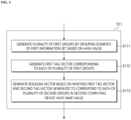
- the first computing device 100 generates a Boolean vector ( b Y ) for the first information set Y, based on whether or not each of a plurality of first groups (see reference numerals 921 to 924 in FIG. 9 ) that are groups of elements of the first information set Y stored therein is the same as each of a plurality of second groups (see reference numerals 911 to 914 in FIG. 9 ) that are groups of elements of the second information set X stored in the second computing device 10.
- a Boolean vector ( b Y ) for the first information set Y, based on whether or not each of a plurality of first groups (see reference numerals 921 to 924 in FIG. 9 ) that are groups of elements of the first information set Y stored therein is the same as each of a plurality of second groups (see reference numerals 911 to 914 in FIG. 9 ) that are groups of elements of the second information set X stored in the second computing device 10.
- Operation S11 corresponds to a preprocessing step 81 and an equality share generation (ESG) step 82 of the entire process of the PSU protocol illustrated in FIG. 8 .
- ESG equality share generation
- the preprocessing step 81 an operation of grouping the information sets (X, Y) using a hash value and generating tags ( t X , t Y ) is performed, and in the ESG step 82, Boolean vectors ( b X , b Y ) are generated depending on whether or not the tags ( t X , t Y ) are identical.
- operation S11 may include an operation S111 of generating a plurality of first groups 921 to 924 by grouping the elements of the first information set Y based on the hash value, an operation S112 of generating a first tag vector ( t Y ) (see numeral 92 in FIG. 9 ) corresponding to each of the plurality of first groups 921 to 924, and an operation S113 of generating a Boolean vector ( b Y ) based on whether the first tag vector ( t Y )92 and a second tag vector ( t Y ) (see numeral 91 in FIG. 9 ) generated to correspond to each of the plurality of second groups 911 to 914 in the second computing device 10 have the same value.
- the first computing device 100 may generate the first tag vector ( t Y ) 92 by grouping the elements of the first information set Y 902 stored therein into the plurality of first groups 921 to 924 based on the hash value and assigning a tag to each group.
- the second computing device 10 may generate the second tag vector ( t X ) 91 by grouping the elements of the second information set X 901 stored therein into the plurality of second groups 911 to 914 based on the hash value and assigning a tag to each group.
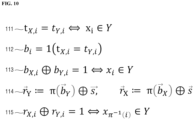
- the first tag vector ( t Y ) 92 and the second tag vector ( t Y ) 91 may be generated as vectors that satisfy Equation 1 (see numeral 111 in FIG. 10 ) defined as each element of the second information set X being included in the first information set Y.
- the sizes (number of bits) of each element of the first tag vector ( t Y ) 92 and each element of the second tag vector ( t Y ) 91 may be set to l ⁇ ⁇ + log N ( ⁇ is a natural number greater than or equal to 1, and N is a length of the vector and is a natural number greater than or equal to 2).
- ⁇ may be set to, for example, 40, and may be set to a value smaller than or greater than 40 according to user's settings.
- the first computing device 100 may calculate a plurality of Boolean shares having a value of 1 if each element of the first tag vector ( t Y ) 92 and each element of the second tag vector ( t X ) 91 are the same, and having a value of 0 if each element of the first tag vector ( t Y )92 and each element of the second tag vector ( t Y ) 91 are not the same, using Equation 2 (see reference numeral 112 in FIG. 10 ).
- the first computing device 100 may obtain the Boolean vector ( b Y ) for the first information set Y that satisfies Equation 3 (see numeral 113 in FIG. 10 ) by combining the plurality of Boolean shares calculated in operation S113.
- the second computing device 10 may also obtain the Boolean vector ( b X ) for the second information set X that satisfies Equation 3 (113). Accordingly, the length of the vector may be significantly reduced by generating the Boolean vector ( b Y ) and a Boolean vector ( b X ) from the first tag vector ( t Y ) 92 and the second tag vector ( t X ) 91.
- the first tag vector ( t Y ) 92 and the second tag vector ( t X ) 91 may have a length of 64 bits
- the Boolean vector ( b Y ) and the Boolean vector ( b X ) may have a length of 1 bit.
- the first computing device 100 obtains a random vector for the first information set Y as a result of shuffling performed by using the Boolean vector ( b Y ) generated by the first computing device 100 as an input and using order information and encryption information selected by the second computing device 10 as inputs.
- operation S12 may include an operation S121 of setting the Boolean vector generated by the first computing device as an input of shuffling, and an operation S122 of obtaining a random vector for the first information set Y as a result of performing the shuffling based on information on a permutation function ( ⁇ ) randomly selected for changing an arrangement order of the plurality of second groups 911 to 914 in the second computing device 10 and a masking vector ( s ) selected for encryption processing for the permutation function being set as the input of shuffling.
- ⁇ permutation function
- the first computing device 100 uses the Boolean vector ( b Y ) for the first information set Y as the input for shuffling, it is possible to significantly reduce the amount of communication compared to the case of using the first tag vector ( t Y ) 92.
- the first tag vector ( t Y ) 92 may have a length of 64 bits, and the Boolean vector ( b Y ) whose length is compressed compared to the first tag vector ( t Y ) 92 may have a length of 1 bit. Accordingly, when the first tag vector ( t Y ) is used as the input for shuffling, the amount of communication of O(lN log N ) is required, but when the Boolean vector ( b Y ) is used as the input for shuffling as in the exemplary embodiment of the present disclosure, the length of the vector input as input is compressed so that the same shuffling operation may be performed with only the amount of communication of O(N(log N + l)).
- the first computing device 100 generates information on a union (X U Y) of the first information set Y and the second information set X based on the random vector obtained through operation S12.
- Operations S12 and S13 correspond to oblivious shuffling (OS) step 83 and oblivious transfer (OT) step 84 of the entire process of the PSU protocol illustrated in FIG. 8 .
- OS step 83 a shuffling operation of taking the Boolean vectors ( b X , b Y ) generated through the ESG step 82 as the input is performed, and in the OT step 84, an operation of outputting a difference set (X-Y) of the information sets (X, Y) is performed by performing oblivious transfer (OT) using the random vectors ( r X , r Y ) obtained as a result of shuffling.
- operation S13 may include an operation S131 of obtaining, by the second computing device 10, information on a second random vector ( r X ) calculated by applying the permutation function ( ⁇ ) and the masking vector ( s ) to the Boolean vector ( b X ) for the second information set X, and an operation S132 of identifying whether each element of the first random vector ( r Y ) for the first information set Y obtained by the first computing device 100 and each element of the second random vector ( r X ) for the second information set X stored in the second computing device 10 are the same.
- the first computing device 100 may obtain the first random vector ( r Y ) for the first information set Y calculated using Equation 4 (see numeral 114 in FIG. 10 ).
- the second computing device 10 may calculate the second random vector ( r X ) for the second information set X using Equation 4 114.
- the first computing device 100 may not know information on in what order the second computing device 10 shuffled the plurality of second groups 911 to 914, which are groups of the elements of the second information set X, through shuffling. That is, in the process of the first computing device 100 obtaining information on the union of the first information set Y and the second information set X, leakage of information on the second information set X stored in the second computing device 10 may be prevented through shuffling.
- the first computing device 100 may determine whether each element of the second information set X is included in the first information set Y by identifying whether each element of the first random vector ( r Y ) and each element of the second random vector ( r X ) are the same as in Equation 5 (see numeral 115 in FIG. 10 ). Accordingly, the information on the union of the first information set Y and the second information set X may be generated through the process of analyzing whether each element of the second information set X is included in the first information set Y.
- operations S133 and operation S134 may be additionally performed after operations S131 and operation S132 are performed.
- the first computing device 100 may perform oblivious transfer (OT) with the second computing device using the first random vector ( r Y ) and the second random vector ( r X ).
- the first computing device 100 may output information on a difference set between the first information set and the second information set as a result of performing OT.
- the first computing device 100 may transmit the information on the union of the first information set Y and the second information set X generated through operations S11 to S13 to the server 20. That is, the calculation according to the PSU protocol may be performed by the first computing device 100, but the calculation result may be stored in the server 20 and managed.
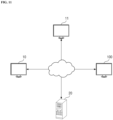
- FIG. 11 is a system configuration diagram according to another exemplary embodiment of the present disclosure.
- a system includes a first computing device 100, a second computing device 10, a third computing device 11, and a server 20, and the first computing device 100 is connected to the second computing device 10, the third computing device 11, and the server 20 through a network.
- the first computing device 100, the second computing device 10, and the third computing device 11 are terminals that store data generated by an execution of various types of installed applications and data stores data stored in its own database or acquired from an external device, and may be, for example, any one of a mobile computing device such as a smart phone, tablet personal computer (PC), laptop PC, personal digital assistant (PDA), and the like, and a stationary computing device such as a desktop PC.
- a mobile computing device such as a smart phone, tablet personal computer (PC), laptop PC, personal digital assistant (PDA), and the like
- PDA personal digital assistant
- the server 20 is a device that receives and stores calculation results between data sets stored in each of the first computing device 100, the second computing device 10, and the third computing device 11, and may be provided as a stationary computing device such as a server or a PC.
- the calculation result between the datasets that the server 20 receives from at least one of the first computing device 100, the second computing device 10, and the third computing device 11 is, for example, information on a union of the datasets stored in the three devices.
- the server 20 may provide the calculation result between stored and managed datasets to an external terminal so as to be used for data analysis.
- FIG. 12 is a flowchart for explaining a method for protecting data based on a PSU protocol according to another exemplary embodiment of the present disclosure.
- a method for protecting data based on a PSU protocol may be executed by a computing device 100 illustrated in FIG. 14 .
- the first computing device 100 executing the method according to the present exemplary embodiment may be a computing device having an application program execution environment.
- the first computing device 100 may be, for example, a device capable of performing an arithmetic function, such as a PC, server, laptop computer, or smart phone.
- the first computing device 100 obtains information on a first union of a first information set stored in the first computing device 100 and a second information set stored in the second computing device 10 by communicating with the second computing device 10.
- the first computing device 100 may generate a Boolean vector for the first information set based on whether each of a plurality of first groups, which are groups of elements of the first information set stored therein, is the same as each of a plurality of second groups, which are groups of elements of the second information set stored in the second computing device 10.
- the first computing device 100 may generate a plurality of first groups by grouping the elements of the first information set based on the hash value, generate a first tag vector corresponding to each of the plurality of first groups, and generate a Boolean vector for the first information set based on whether the first tag vector and a second tag vector generated to correspond to each of the plurality of second groups by the second computing device 10 have the same value.
- the first computing device 100 may generate information on a first union of the first information set and the second information set based on a random vector for the first information set obtained as a result of shuffling performed by using the Boolean vector generated by the first computing device 100 as an input and using order information and encryption information selected by the second computing device 10 as inputs.
- the first computing device 100 may obtain information on a second random vector for the second information set calculated by applying order information and encryption information to the Boolean vector to the second information set by the second computing device 10, and generate the information on the first union based on whether each element of the first random vector for the first information set is the same as each element of the second random vector for the second information set.
- the first computing device 100 transmits the information on the first union to the server 20.
- the first computing device 100 may additionally perform operations S23 to S25 after performing operations S21 and S22.
- the first computing device 100 may communicate with the third computing device 11, and in operation S24, the first computing device 100 may obtain a second union of the first union obtained by the first computing device 100 and a third information set stored in the third computing device 11.
- the first computing device 100 transmits information on the second union to the server 20.
- a calculation of generating another second union between the generated union and an information set additionally stored in another terminal may be performed.
- the information on the first union or the second union generated through the calculation based on the PSU protocol as described above may be transmitted to the server and stored and managed instead of being stored in each terminal.
- the information on the union of the datasets may be safely provided without leakage of information on the intersection between the datasets.
- FIG. 14 is a hardware configuration diagram of an exemplary computing device 100.
- the computing device 100 may include one or more processors 101, a bus 107, a network interface 102, a memory 103, which loads a computer program 105 executed by the processors 101, and a storage 104 for storing the computer program 105.
- the processor 101 controls overall operations of each component of computing device 100.
- the processor 101 may be configured to include at least one of a Central Processing Unit (CPU), a Micro Processor Unit (MPU), a Micro Controller Unit (MCU), a Graphics Processing Unit (GPU), or any type of processor well known in the art. Further, the processor 101 may perform calculations on at least one application or program for executing a method/operation according to various embodiments of the present disclosure.
- the computing device 100 may have one or more processors.
- the memory 103 stores various data, instructions and/or information.
- the memory 103 may load one or more programs 105 from the storage 104 to execute methods/operations according to various embodiments of the present disclosure.
- An example of the memory 103 may be a RAM, but is not limited thereto.
- the bus 107 provides communication between components of computing device 100.
- the bus 107 may be implemented as various types of bus such as an address bus, a data bus and a control bus.
- the network interface 102 supports wired and wireless internet communication of the computing device 100.
- the network interface 102 may support various communication methods other than internet communication.
- the network interface 102 may be configured to comprise a communication module well known in the art of the present disclosure.
- the storage 104 can non-temporarily store one or more computer programs 105.
- the storage 104 may be configured to comprise a non-volatile memory, such as a Read Only Memory (ROM), an Erasable Programmable ROM (EPROM), an Electrically Erasable Programmable ROM (EEPROM), a flash memory, a hard disk, a removable disk, or any type of computer readable recording medium well known in the art.
- ROM Read Only Memory
- EPROM Erasable Programmable ROM
- EEPROM Electrically Erasable Programmable ROM
- the computer program 105 may include one or more instructions, on which the methods/operations according to various embodiments of the present disclosure are implemented.
- the processor 101 may perform the methods/operations in accordance with various embodiments of the present disclosure by executing the one or more instructions.
- a computer program 105 may include instructions for performing an operation of generating a Boolean vector for the first information set, based on whether or not each of a plurality of first groups that are groups of elements of the first information set stored in the first computing device 100 is the same as each of a plurality of second groups that are groups of elements of the second information set stored in the second computing device 10, an operation of obtaining a random vector for the first information set as a result of shuffling performed by using the Boolean vector generated by the first computing device as an input and using order information and encryption information selected by the second computing device as inputs, and operation of generating information on a union of the first information set and the second information set based on the random vector.
- the technical features of the present disclosure described so far may be embodied as computer readable codes on a computer readable medium.
- the computer readable medium may be, for example, a removable recording medium (CD, DVD, Blu-ray disc, USB storage device, removable hard disk) or a fixed recording medium (ROM, RAM, computer equipped hard disk).
- the computer program recorded on the computer readable medium may be transmitted to other computing device via a network such as internet and installed in the other computing device, thereby being used in the other computing device.
Landscapes
- Engineering & Computer Science (AREA)
- Theoretical Computer Science (AREA)
- Computer Security & Cryptography (AREA)
- Health & Medical Sciences (AREA)
- Bioethics (AREA)
- General Health & Medical Sciences (AREA)
- General Engineering & Computer Science (AREA)
- Physics & Mathematics (AREA)
- Software Systems (AREA)
- General Physics & Mathematics (AREA)
- Computer Hardware Design (AREA)
- Databases & Information Systems (AREA)
- Computer Networks & Wireless Communication (AREA)
- Signal Processing (AREA)
- Medical Informatics (AREA)
- Power Engineering (AREA)
- Storage Device Security (AREA)
Abstract
Description
- The present disclosure relates to a method for protecting data based on a private set union (PSU) protocol and an apparatus for implementing the same method, and more particularly, to a method for protecting data based on a PSU protocol for protecting information of each terminal using the PSU protocol when data is transmitted and received between different terminals, and an apparatus for implementing the same method.
- As regulations on data protection have been strengthened due to concerns over personal information infringement, which has recently increased socially, research on personal information protection technology is being actively conducted, centered on global companies that want to utilize users' personal or sensitive information.
- The global companies often want to integrate information stored in various platforms and DBs, analyze the information, and use the information for marketing and sales strategies. However, there are often legal restrictions on integrating information even within the same company.
- In particular, if the entire data is simply sent to a central server for data integration, an intersection between the datasets is completely revealed.
- Under such a background, private set union (PSU) technology, which is a protocol that does not reveal any information other than the union when two sets are given, has attracted attention.
- Compared to private set interaction (PSI) technology that calculates an intersection, the PSU technology may cause a problem in securing data safety in that the sets know each other what elements each does not have.
- On the other hand, in the case of the PSI protocol, a hash table preprocessing technique is used to determine whether each element is in the intersection. In this case, the sets given as input are appropriately divided into hash tables, and intersection calculation is performed for each bin.
- The hash table preprocessing technology guarantees safety only in the case of the PSI protocol, and may not guarantee data safety in that additional information on the intersection may be inferred when an element of the other party is received in the case of being applied to the PSU protocol.
- Accordingly, in order to address issues related to the hash table preprocessing in the PSU protocol, a shuffle idea has recently been proposed that randomly mixes the elements to be sent so that the order of each bin is not known after performing the hash table preprocessing.
- However, when shuffle is used in the PSU protocol, it is not applied as a simple way for the sending side to send elements alone in random order. In practice, additional interactions are required, which causes a problem in that the amount of communication increases rapidly as the number of calculation increases. In particular, when shuffle is used in the PSU technology, it may take several times the amount of communication compared to the PSI technology that only performs the hash table preprocessing.
- Therefore, in using the PSU protocol, a technology capable of solving the problem of the increased amount of communication when using shuffle while ensuring safety during data transmission is required.
- Aspects of the present disclosure provide a method for protecting data based on a PSU protocol capable of safely providing information on a union without leakage of information on an intersection between datasets in using the PSU protocol when transmitting data between terminals, and an apparatus for implementing the same method.
- Aspects of the present disclosure also provide a method for protecting data based on a PSU protocol capable of drastically reducing the amount of communication that increases when shuffling is performed to prevent additional information leakage in using the PSU protocol when transmitting data between terminals, and an apparatus for implementing the same method.
- Aspects of the present disclosure also provide a method for protecting data based on a PSU protocol capable of preventing an increase in the amount of communication by adding a minimum calculation process of compressing a length of an input vector when shuffling is performed in using the PSU protocol when transmitting data between terminals, and an apparatus for implementing the same method.
- However, aspects of the present disclosure are not restricted to those set forth herein. The above and other aspects of the present disclosure will become more apparent to one of ordinary skill in the art to which the present disclosure pertains by referencing the detailed description of the present disclosure given below.
- According to an aspect of the present disclosure, there is provided a method for protecting data based on a private set union (PSU) protocol, performed by a first computing device for transmitting and receiving data to and from a second computing device. The method comprises generating a Boolean vector for a first information set, based on whether or not each of a plurality of first groups that are groups of elements of the first information set stored in the first computing device is the same as each of a plurality of second groups that are groups of elements of a second information set stored in the second computing device, obtaining a random vector for the first information set as a result of shuffling performed by using the Boolean vector generated by the first computing device as an input and using order information and encryption information selected by the second computing device as inputs, and generating information on a union of the first information set and the second information set based on the random vector.
- In some embodiments, the generating of the Boolean vector for the first information set may include generating the plurality of first groups by grouping the elements of the first information set based on a hash value.
- In some embodiments, the generating of the Boolean vector for the first information set may include generating a first tag vector corresponding to each of the plurality of first groups.
- In some embodiments, the generating of the Boolean vector for the first information set may include generating the Boolean vector based on whether the first tag vector and a second tag vector generated to correspond to each of the plurality of second groups in the second computing device have the same value.
- In some embodiments, the generating of the Boolean vector may include calculating a plurality of Boolean shares having a value of 1 if each element of the first tag vector and each element of the second tag vector are the same and having a value of 0 if each element of the first tag vector and each element of the second tag vector are not the same, and obtaining a Boolean vector for the first information set by combining the plurality of Boolean shares.
- In some embodiments, sizes of each element of the first tag vector and each element of the second tag vector may be set to 40 + log N (where N is a length of the vector and is a natural number greater than or equal to 2).
- In some embodiments, the obtaining the random vector for the first information set as the result of shuffling may include setting the Boolean vector generated by the first computing device as an input of the shuffling, and obtaining the random vector for the first information set as a result of performing the shuffling based on information on a permutation function randomly selected for changing an arrangement order of the plurality of second groups in the second computing device and a masking vector selected for encryption processing for the permutation function being set as the input of the shuffling.
- In some embodiments, the random vector for the first information set may be a first random vector, and the generating of the information on the union of the first information set and the second information set may include obtaining information on a second random vector calculated by applying the permutation function and the masking vector to the Boolean vector for the second information set in the second computing device, and identifying whether each element of the first random vector and each element of the second random vector are the same.
- In some embodiments, the generating of the information on the union of the first information set and the second information set may include performing oblivious transfer (OT) with the second computing device using the first random vector and the second random vector, and outputting information on a difference set between the first information set and the second information set as a result of performing the OT.
- In some embodiments, the method may further comprise transmitting the information on the union of the first information set and the second information set to an external server.
- According to an aspect of the present disclosure, there is provided a method for protecting data based on a private set union (PSU) protocol, performed by a first computing device for transmitting and receiving data to and from a second computing device. The method comprises: obtaining, by the first computing device, information on a first union of a first information set stored in the first computing device and a second information set stored in the second computing device by communicating with the second computing device, and transmitting the information on the first union to an external server.
- In some embodiments, the method may further comprise communicating, by the first computing device, with a third computing device, obtaining a second union of the first union obtained by the first computing device and a third information set stored in the third computing device, and transmitting information on the second union to the external server.
- In some embodiments, the obtaining of the information on the first union of the first information set stored in the first computing device and the second information set stored in the second computing device may include generating a Boolean vector for the first information set, based on whether or not each of a plurality of first groups that are groups of elements of the first information set stored in the first computing device is the same as each of a plurality of second groups that are groups of elements of the second information set stored in the second computing device, and generating information on the first union of the first information set and the second information set based on a random vector for the first information set obtained as a result of shuffling performed by using the Boolean vector generated by the first computing device as an input and using order information and encryption information selected by the second computing device as inputs.
- In some embodiments, the generating of the Boolean vector for the first information set may include generating the plurality of first groups by grouping the elements of the first information set based on a hash value, and generating a first tag vector corresponding to each of the plurality of first groups.
- In some embodiments, the random vector for the first information set may be a first random vector, and the generating of the information on the first union of the first information set and the second information set may include obtaining information on a second random vector for the second information set calculated by applying the order information and the encryption information to the Boolean vector for the second information set in the second computing device, and generating the information on the first union based on whether each element of the first random vector and each element of the second random vector are the same.
- According to an aspect of the present disclosure, there is provided a first computing device. The first computing device comprises: a network interface configured to communicate with a second computing device, one or more processors, a memory configured to load a computer program executed by the processor, and a storage configured to store the computer program, wherein the computer program may include instructions for performing: an operation generating a Boolean vector for a first information set, based on whether or not each of a plurality of first groups that are groups of elements of the first information set stored in the first computing device is the same as each of a plurality of second groups that are groups of elements of a second information set stored in the second computing device, an operation of obtaining a random vector for the first information set as a result of shuffling performed by using the Boolean vector generated by the first computing device as an input and using order information and encryption information selected by the second computing device as inputs, and an operation of generating information on a union of the first information set and the second information set based on the random vector.
- In some embodiments, the operation of generating of the Boolean vector for the first information set may include an operation of generating the plurality of first groups by grouping the elements of the first information set based on a hash value, and an operation of generating a first tag vector corresponding to each of the plurality of first groups.
- In some embodiments, the operation of obtaining the random vector for the first information set as the result of shuffling may include an operation of setting the Boolean vector generated by the first computing device as an input of the shuffling, and an operation of obtaining the random vector for the first information set as a result of performing the shuffling based on information on a permutation function randomly selected for changing an arrangement order of the plurality of second groups in the second computing device and a masking vector selected for encryption processing for the permutation function being set as the input of the shuffling.
- In some embodiments, the random vector for the first information set may be a first random vector, and the operation of generating of the information on the union of the first information set and the second information set may include an operation of obtaining information on a second random vector calculated by applying the permutation function and the masking vector to the Boolean vector for the second information set in the second computing device, and an operation of generating the information on the first union based on whether each element of the first random vector and each element of the second random vector are the same.
- In some embodiments, the operation of generating of the information on the union of the first information set and the second information set may include an operation of performing oblivious transfer (OT) with the second computing device using the first random vector and the second random vector, and an operation of outputting information on a difference set between the first information set and the second information set as a result of performing the OT.
- The above and other aspects and features of the present disclosure will become more apparent by describing in detail exemplary embodiments thereof with reference to the attached drawings, in which:
-
FIG. 1 is a system configuration diagram according to an exemplary embodiment of the present disclosure; -
FIG. 2 is a flowchart for explaining a method for protecting data based on a PSU protocol according to an exemplary embodiment of the present disclosure; -
FIGS. 3 to 6 are flowcharts for explaining detailed processes of some steps illustrated inFIG. 2 ; -
FIG. 7 is an example illustrating input information and output information of a PSU protocol according to some exemplary embodiments of the present disclosure; -
FIG. 8 is an example of information input and output at each step of the entire process of the PSU protocol according to some exemplary embodiments of the present disclosure; -
FIG. 9 is an example illustrating a preprocessing process for generating a tag vector according to some exemplary embodiments of the present disclosure; -
FIG. 10 is an example of Equations for generating vectors used in each step of the entire process ofFIG. 8 ; -
FIG. 11 is a system configuration diagram according to another exemplary embodiment of the present disclosure; -
FIG. 12 is a flowchart for explaining a method for protecting data based on a PSU protocol according to another exemplary embodiment of the present disclosure; -
FIG. 13 is a flowchart for explaining steps additionally performed after each step ofFIG. 12 is performed; and -
FIG. 14 is a hardware configuration diagram of an exemplary computing device capable of implementing methods according to some exemplary embodiments of the present disclosure. - Hereinafter, preferred embodiments of the present disclosure will be described with reference to the attached drawings. The advantages and features of the present disclosure and methods of accomplishing the same may be understood more readily by reference to the following detailed description of preferred embodiments and the accompanying drawings. The present disclosure may, however, be embodied in many different forms and should not be construed as being limited to the embodiments set forth herein. Rather, these embodiments are provided so that this disclosure will be thorough and complete and will fully convey the concept of the disclosure to those skilled in the art, and the present disclosure will only be defined by the appended claims.
- In adding reference numerals to the components of each drawing, it should be noted that the same reference numerals are assigned to the same components as much as possible even though they are shown in different drawings. In addition, in describing the present disclosure, when it is determined that the detailed description of the related well-known configuration or function may obscure the gist of the present disclosure, the detailed description thereof will be omitted.
- Unless otherwise defined, all terms used in the present specification (including technical and scientific terms) may be used in a sense that can be commonly understood by those skilled in the art. In addition, the terms defined in the commonly used dictionaries are not ideally or excessively interpreted unless they are specifically defined clearly. The terminology used herein is for the purpose of describing particular embodiments only and is not intended to be limiting of the disclosure. In this specification, the singular also includes the plural unless specifically stated otherwise in the phrase.
- In addition, in describing the component of this disclosure, terms, such as first, second, A, B, (a), (b), can be used. These terms are only for distinguishing the components from other components, and the nature or order of the components is not limited by the terms. If a component is described as being "connected," "coupled" or "contacted" to another component, that component may be directly connected to or contacted with that other component, but it should be understood that another component also may be "connected," "coupled" or "contacted" between each component.
- The terms "comprise", "include", "have", etc. when used in this specification, specify the presence of stated features, integers, steps, operations, elements, components, and/or combinations of them but do not preclude the presence or addition of one or more other features, integers, steps, operations, elements, components, and/or combinations thereof.
- Hereinafter, some embodiments of the present disclosure will be described in detail with reference to the accompanying drawings.
-
FIG. 1 illustrates a configuration of a system according to an embodiment of the present disclosure. Referring toFIG. 1 , a system according to an exemplary embodiment of the present disclosure includes afirst computing device 100, asecond computing device 10, and aserver 20, and thefirst computing device 100 is connected to thesecond computing device 10 and theserver 20 through a network. - The
first computing device 100 and thesecond computing device 10 are terminals that store data generated by an execution of various types of installed applications and data stores data stored in its own database or acquired from an external device, and may be, for example, any one of a mobile computing device such as a smart phone, tablet personal computer (PC), laptop PC, personal digital assistant (PDA), and the like, and a stationary computing device such as a desktop PC. - The
server 20 is a device that receives and stores calculation results between data sets stored in each of thefirst computing device 100 and thesecond computing device 10, and may be provided as a stationary computing device such as a server or a PC. Here, the calculation result between the datasets that theserver 20 receives from either thefirst computing device 100 or thesecond computing device 10 is, for example, information on a union of the datasets stored in the two devices. Theserver 20 may provide the calculation result between stored and managed datasets to an external terminal so as to be used for data analysis. - Referring to
FIG. 7 , thefirst computing device 100 may generate information on a union of a first information set Y and a second information set X by applying a private set union (PSU) protocol to the first information set Y stored in the device itself and the second information set X stored in thesecond computing device 10 connected through the network. - In this case, the
first computing device 100 may generate a union of the first information set Y and the second information set X by analyzing whether each element of the first information set Y is included in the second information set X using the PSU protocol, even without performing an operation of receiving the elements of the second information set X of thesecond computing device 10 itself. - As an exemplary embodiment, in applying the PSU protocol to the first information set Y and the second information set X, the
first computing device 100 may perform preprocessing using a hash table and oblivious shuffling. - In this case, the
first computing device 100 may significantly reduce the amount of communication compared to a case in which a Boolean vector is not used, by using the Boolean vector as an input vector when performing the oblivious shuffling. - According to the configuration of the system of the present disclosure as described above, it is possible to safely provide information on the union without information leakage on the intersection between datasets in using the PSU protocol when transmitting data between the terminals, and it is possible to drastically reduce the increased amount of communication when performing shuffling to prevent additional information leakage.
-
FIG. 2 is a flowchart for explaining a method for protecting data based on a PSU protocol according to an exemplary embodiment of the present disclosure. - A method for protecting data based on a PSU protocol according to an exemplary embodiment of the present disclosure may be executed by a
computing device 100 illustrated inFIG. 14 . Thefirst computing device 100 executing the method according to the present exemplary embodiment may be a computing device having an application program execution environment. Thefirst computing device 100 may be, for example, a device capable of performing an arithmetic function, such as a PC, server, laptop computer, or smart phone. - It should be noted that description of a subject performing some operations included in the method according to an exemplary embodiment of the present disclosure may be omitted, and in such case, the subject is the
first computing device 100. - According to an exemplary embodiment of the present disclosure described below, in a union calculation between the datasets using the PSU protocol, an increase in the amount of communication may be prevented when shuffling is performed to prevent additional information leakage.
- First, in operation S11, the
first computing device 100 generates a Boolean vector (b Y ) for the first information set Y, based on whether or not each of a plurality of first groups (seereference numerals 921 to 924 inFIG. 9 ) that are groups of elements of the first information set Y stored therein is the same as each of a plurality of second groups (seereference numerals 911 to 914 inFIG. 9 ) that are groups of elements of the second information set X stored in thesecond computing device 10. - Operation S11 corresponds to a
preprocessing step 81 and an equality share generation (ESG)step 82 of the entire process of the PSU protocol illustrated inFIG. 8 . In thepreprocessing step 81, an operation of grouping the information sets (X, Y) using a hash value and generating tags (t X ,t Y ) is performed, and in theESG step 82, Boolean vectors (b X,b Y ) are generated depending on whether or not the tags (t X ,t Y ) are identical. - Specifically, referring to
FIG. 3 , operation S11 may include an operation S111 of generating a plurality offirst groups 921 to 924 by grouping the elements of the first information set Y based on the hash value, an operation S112 of generating a first tag vector (t Y ) (see numeral 92 inFIG. 9 ) corresponding to each of the plurality offirst groups 921 to 924, and an operation S113 of generating a Boolean vector (b Y ) based on whether the first tag vector (t Y )92 and a second tag vector (t Y ) (see numeral 91 inFIG. 9 ) generated to correspond to each of the plurality ofsecond groups 911 to 914 in thesecond computing device 10 have the same value. - As an exemplary embodiment, referring to
FIG. 9 in relation to the operations S111 and S112, thefirst computing device 100 may generate the first tag vector (t Y ) 92 by grouping the elements of the first information setY 902 stored therein into the plurality offirst groups 921 to 924 based on the hash value and assigning a tag to each group. Similarly, thesecond computing device 10 may generate the second tag vector (t X ) 91 by grouping the elements of the second information setX 901 stored therein into the plurality ofsecond groups 911 to 914 based on the hash value and assigning a tag to each group. - In this case, if the two
tag vectors t Y ) 92 and the second tag vector (t Y ) 91 may be generated as vectors that satisfy Equation 1 (see numeral 111 inFIG. 10 ) defined as each element of the second information set X being included in the first information set Y. - As an exemplary embodiment, the sizes (number of bits) of each element of the first tag vector (
t Y ) 92 and each element of the second tag vector (t Y ) 91 may be set to ℓ ≈ σ + log N (σ is a natural number greater than or equal to 1, and N is a length of the vector and is a natural number greater than or equal to 2). If the size of each element of the two tag vectors is set to be shorter than a reference value, a false-positive error in which t X,i = tY,¡ even though not xi ∈ Y, may occur, and if the size of each element of the two tag vectors is set to be longer than the reference value, the amount of calculation performed in each step of the PSU protocol may increase. - For this reason, if the size (number of bits) of each element of the two tag vectors is set to ℓ ≈ σ + log N, the probability of false-positive occurrence may be lowered to 2-σ or less. In this case, σ may be set to, for example, 40, and may be set to a value smaller than or greater than 40 according to user's settings.
- As an exemplary embodiment, in operation S113, the
first computing device 100 may calculate a plurality of Boolean shares having a value of 1 if each element of the first tag vector (t Y ) 92 and each element of the second tag vector (t X ) 91 are the same, and having a value of 0 if each element of the first tag vector (t Y )92 and each element of the second tag vector (t Y ) 91 are not the same, using Equation 2 (see reference numeral 112 inFIG. 10 ). - From this, the
first computing device 100 may obtain the Boolean vector (b Y ) for the first information set Y that satisfies Equation 3 (see numeral 113 inFIG. 10 ) by combining the plurality of Boolean shares calculated in operation S113. Similarly, thesecond computing device 10 may also obtain the Boolean vector (b X ) for the second information set X that satisfies Equation 3 (113). Accordingly, the length of the vector may be significantly reduced by generating the Boolean vector (b Y ) and a Boolean vector (b X ) from the first tag vector (t Y ) 92 and the second tag vector (t X ) 91. For example, the first tag vector (t Y ) 92 and the second tag vector (t X ) 91 may have a length of 64 bits, and the Boolean vector (b Y ) and the Boolean vector (b X ) may have a length of 1 bit. - Next, in operation S12, the
first computing device 100 obtains a random vector for the first information set Y as a result of shuffling performed by using the Boolean vector (b Y ) generated by thefirst computing device 100 as an input and using order information and encryption information selected by thesecond computing device 10 as inputs. - As an exemplary embodiment, as illustrated in
FIG. 4 , operation S12 may include an operation S121 of setting the Boolean vector generated by the first computing device as an input of shuffling, and an operation S122 of obtaining a random vector for the first information set Y as a result of performing the shuffling based on information on a permutation function (π) randomly selected for changing an arrangement order of the plurality ofsecond groups 911 to 914 in thesecond computing device 10 and a masking vector (s ) selected for encryption processing for the permutation function being set as the input of shuffling. - As described above, according to operation S12, since the
first computing device 100 uses the Boolean vector (b Y ) for the first information set Y as the input for shuffling, it is possible to significantly reduce the amount of communication compared to the case of using the first tag vector (t Y ) 92. - As an example, the first tag vector (
t Y ) 92 may have a length of 64 bits, and the Boolean vector (b Y ) whose length is compressed compared to the first tag vector (t Y ) 92 may have a length of 1 bit. Accordingly, when the first tag vector (t Y ) is used as the input for shuffling, the amount of communication of O(ℓN log N) is required, but when the Boolean vector (b Y ) is used as the input for shuffling as in the exemplary embodiment of the present disclosure, the length of the vector input as input is compressed so that the same shuffling operation may be performed with only the amount of communication of O(N(log N + ℓ)). - Finally, in operation S13, the
first computing device 100 generates information on a union (X U Y) of the first information set Y and the second information set X based on the random vector obtained through operation S12. - Operations S12 and S13 correspond to oblivious shuffling (OS)
step 83 and oblivious transfer (OT)step 84 of the entire process of the PSU protocol illustrated inFIG. 8 . In theOS step 83, a shuffling operation of taking the Boolean vectors (b X ,b Y ) generated through theESG step 82 as the input is performed, and in theOT step 84, an operation of outputting a difference set (X-Y) of the information sets (X, Y) is performed by performing oblivious transfer (OT) using the random vectors (r X ,r Y ) obtained as a result of shuffling. - Specifically, referring to
FIG. 5 , operation S13 may include an operation S131 of obtaining, by thesecond computing device 10, information on a second random vector (r X ) calculated by applying the permutation function (π) and the masking vector (s ) to the Boolean vector (b X ) for the second information set X, and an operation S132 of identifying whether each element of the first random vector (r Y ) for the first information set Y obtained by thefirst computing device 100 and each element of the second random vector (r X ) for the second information set X stored in thesecond computing device 10 are the same. - As an exemplary embodiment, in operation S132, the
first computing device 100 may obtain the first random vector (r Y ) for the first information set Y calculated using Equation 4 (see numeral 114 inFIG. 10 ). Similarly, thesecond computing device 10 may calculate the second random vector (r X) for the second information set X using Equation 4 114. - Accordingly, the
first computing device 100 may not know information on in what order thesecond computing device 10 shuffled the plurality ofsecond groups 911 to 914, which are groups of the elements of the second information set X, through shuffling. That is, in the process of thefirst computing device 100 obtaining information on the union of the first information set Y and the second information set X, leakage of information on the second information set X stored in thesecond computing device 10 may be prevented through shuffling. - In addition, in operation S132, the
first computing device 100 may determine whether each element of the second information set X is included in the first information set Y by identifying whether each element of the first random vector (r Y ) and each element of the second random vector (r X) are the same as in Equation 5 (see numeral 115 inFIG. 10 ). Accordingly, the information on the union of the first information set Y and the second information set X may be generated through the process of analyzing whether each element of the second information set X is included in the first information set Y. - As an exemplary embodiment, referring to
FIG. 6 , in operation S13, operations S133 and operation S134 may be additionally performed after operations S131 and operation S132 are performed. - In operation S133, the
first computing device 100 may perform oblivious transfer (OT) with the second computing device using the first random vector (r Y ) and the second random vector (r X ). Next, in operation S134, thefirst computing device 100 may output information on a difference set between the first information set and the second information set as a result of performing OT. - Meanwhile, the
first computing device 100 may transmit the information on the union of the first information set Y and the second information set X generated through operations S11 to S13 to theserver 20. That is, the calculation according to the PSU protocol may be performed by thefirst computing device 100, but the calculation result may be stored in theserver 20 and managed. - According to the method according to the exemplary embodiment of the present disclosure as described above, in using the PSU protocol when transmitting data between the terminals, it is possible to safely provide the union information without leakage of information on intersection between the datasets. In addition, it is possible to prevent an increase in the amount of communication by adding a minimum calculation process for compressing the length of the vector input when performing shuffling to prevent additional information leakage of the dataset.
-
FIG. 11 is a system configuration diagram according to another exemplary embodiment of the present disclosure. - Referring to
FIG. 11 , a system according to an exemplary embodiment of the present disclosure includes afirst computing device 100, asecond computing device 10, athird computing device 11, and aserver 20, and thefirst computing device 100 is connected to thesecond computing device 10, thethird computing device 11, and theserver 20 through a network. - The
first computing device 100, thesecond computing device 10, and thethird computing device 11 are terminals that store data generated by an execution of various types of installed applications and data stores data stored in its own database or acquired from an external device, and may be, for example, any one of a mobile computing device such as a smart phone, tablet personal computer (PC), laptop PC, personal digital assistant (PDA), and the like, and a stationary computing device such as a desktop PC. - The
server 20 is a device that receives and stores calculation results between data sets stored in each of thefirst computing device 100, thesecond computing device 10, and thethird computing device 11, and may be provided as a stationary computing device such as a server or a PC. Here, the calculation result between the datasets that theserver 20 receives from at least one of thefirst computing device 100, thesecond computing device 10, and thethird computing device 11 is, for example, information on a union of the datasets stored in the three devices. Theserver 20 may provide the calculation result between stored and managed datasets to an external terminal so as to be used for data analysis. -
FIG. 12 is a flowchart for explaining a method for protecting data based on a PSU protocol according to another exemplary embodiment of the present disclosure. - A method for protecting data based on a PSU protocol according to an exemplary embodiment of the present disclosure may be executed by a
computing device 100 illustrated inFIG. 14 . Thefirst computing device 100 executing the method according to the present exemplary embodiment may be a computing device having an application program execution environment. Thefirst computing device 100 may be, for example, a device capable of performing an arithmetic function, such as a PC, server, laptop computer, or smart phone. - It should be noted that description of a subject performing some operations included in the method according to an exemplary embodiment of the present disclosure may be omitted, and in such case, the subject is the
first computing device 100. - First, in operation S21, the
first computing device 100 obtains information on a first union of a first information set stored in thefirst computing device 100 and a second information set stored in thesecond computing device 10 by communicating with thesecond computing device 10. - As an exemplary embodiment, in operation S21, the
first computing device 100 may generate a Boolean vector for the first information set based on whether each of a plurality of first groups, which are groups of elements of the first information set stored therein, is the same as each of a plurality of second groups, which are groups of elements of the second information set stored in thesecond computing device 10. In this case, thefirst computing device 100 may generate a plurality of first groups by grouping the elements of the first information set based on the hash value, generate a first tag vector corresponding to each of the plurality of first groups, and generate a Boolean vector for the first information set based on whether the first tag vector and a second tag vector generated to correspond to each of the plurality of second groups by thesecond computing device 10 have the same value. - In addition, the
first computing device 100 may generate information on a first union of the first information set and the second information set based on a random vector for the first information set obtained as a result of shuffling performed by using the Boolean vector generated by thefirst computing device 100 as an input and using order information and encryption information selected by thesecond computing device 10 as inputs. - Specifically, the
first computing device 100 may obtain information on a second random vector for the second information set calculated by applying order information and encryption information to the Boolean vector to the second information set by thesecond computing device 10, and generate the information on the first union based on whether each element of the first random vector for the first information set is the same as each element of the second random vector for the second information set. - Next, in operation S22, the
first computing device 100 transmits the information on the first union to theserver 20. - As an exemplary embodiment, referring to
FIG. 13 , thefirst computing device 100 may additionally perform operations S23 to S25 after performing operations S21 and S22. - In operation S23, the
first computing device 100 may communicate with thethird computing device 11, and in operation S24, thefirst computing device 100 may obtain a second union of the first union obtained by thefirst computing device 100 and a third information set stored in thethird computing device 11. - Next, in operation S25, the
first computing device 100 transmits information on the second union to theserver 20. - According to the exemplary embodiment as described above, after generating information on a first union of information sets stored in two of the three terminals using the PSU protocol, a calculation of generating another second union between the generated union and an information set additionally stored in another terminal may be performed.
- In addition, the information on the first union or the second union generated through the calculation based on the PSU protocol as described above may be transmitted to the server and stored and managed instead of being stored in each terminal.
- According to the exemplary embodiment as described above, in performing a calculation based on the PSU protocol on datasets stored in a plurality of terminals, the information on the union of the datasets may be safely provided without leakage of information on the intersection between the datasets.
-
FIG. 14 is a hardware configuration diagram of anexemplary computing device 100. - Referring to
FIG. 14 , thecomputing device 100 may include one ormore processors 101, abus 107, anetwork interface 102, amemory 103, which loads acomputer program 105 executed by theprocessors 101, and astorage 104 for storing thecomputer program 105. - The
processor 101 controls overall operations of each component ofcomputing device 100. Theprocessor 101 may be configured to include at least one of a Central Processing Unit (CPU), a Micro Processor Unit (MPU), a Micro Controller Unit (MCU), a Graphics Processing Unit (GPU), or any type of processor well known in the art. Further, theprocessor 101 may perform calculations on at least one application or program for executing a method/operation according to various embodiments of the present disclosure. Thecomputing device 100 may have one or more processors. - The
memory 103 stores various data, instructions and/or information. Thememory 103 may load one ormore programs 105 from thestorage 104 to execute methods/operations according to various embodiments of the present disclosure. An example of thememory 103 may be a RAM, but is not limited thereto. - The
bus 107 provides communication between components ofcomputing device 100. Thebus 107 may be implemented as various types of bus such as an address bus, a data bus and a control bus. - The
network interface 102 supports wired and wireless internet communication of thecomputing device 100. Thenetwork interface 102 may support various communication methods other than internet communication. To this end, thenetwork interface 102 may be configured to comprise a communication module well known in the art of the present disclosure. - The
storage 104 can non-temporarily store one ormore computer programs 105. Thestorage 104 may be configured to comprise a non-volatile memory, such as a Read Only Memory (ROM), an Erasable Programmable ROM (EPROM), an Electrically Erasable Programmable ROM (EEPROM), a flash memory, a hard disk, a removable disk, or any type of computer readable recording medium well known in the art. - The
computer program 105 may include one or more instructions, on which the methods/operations according to various embodiments of the present disclosure are implemented. When thecomputer program 105 is loaded on thememory 103, theprocessor 101 may perform the methods/operations in accordance with various embodiments of the present disclosure by executing the one or more instructions. - As an exemplary embodiment, a
computer program 105 may include instructions for performing an operation of generating a Boolean vector for the first information set, based on whether or not each of a plurality of first groups that are groups of elements of the first information set stored in thefirst computing device 100 is the same as each of a plurality of second groups that are groups of elements of the second information set stored in thesecond computing device 10, an operation of obtaining a random vector for the first information set as a result of shuffling performed by using the Boolean vector generated by the first computing device as an input and using order information and encryption information selected by the second computing device as inputs, and operation of generating information on a union of the first information set and the second information set based on the random vector. - The technical features of the present disclosure described so far may be embodied as computer readable codes on a computer readable medium. The computer readable medium may be, for example, a removable recording medium (CD, DVD, Blu-ray disc, USB storage device, removable hard disk) or a fixed recording medium (ROM, RAM, computer equipped hard disk). The computer program recorded on the computer readable medium may be transmitted to other computing device via a network such as internet and installed in the other computing device, thereby being used in the other computing device.
- Although operations are shown in a specific order in the drawings, it should not be understood that desired results can be obtained when the operations must be performed in the specific order or sequential order or when all of the operations must be performed. In certain situations, multitasking and parallel processing may be advantageous. According to the above-described embodiments, it should not be understood that the separation of various configurations is necessarily required, and it should be understood that the described program components and systems may generally be integrated together into a single software product or be packaged into multiple software products.
- In concluding the detailed description, those skilled in the art will appreciate that many variations and modifications can be made to the preferred embodiments without substantially departing from the principles of the present disclosure. Therefore, the disclosed preferred embodiments of the disclosure are used in a generic and descriptive sense only and not for purposes of limitation.
Claims (15)
- A method for protecting data based on a private set union (PSU) protocol, performed by a first computing device for transmitting and receiving data to and from a second computing device, the method comprising:generating a Boolean vector for a first information set, based on whether or not each of a plurality of first groups that are groups of elements of the first information set stored in the first computing device is the same as each of a plurality of second groups that are groups of elements of a second information set stored in the second computing device;obtaining a random vector for the first information set as a result of shuffling performed by using the Boolean vector generated by the first computing device as an input and using order information and encryption information selected by the second computing device as inputs; andgenerating information on a union of the first information set and the second information set based on the random vector.
- The method of claim 1, wherein the generating of the Boolean vector for the first information set includes generating the plurality of first groups by grouping the elements of the first information set based on a hash value.
- The method of claim 1, wherein the generating of the Boolean vector for the first information set includes generating a first tag vector corresponding to each of the plurality of first groups.
- The method of claim 3, wherein the generating of the Boolean vector for the first information set includes generating the Boolean vector based on whether the first tag vector and a second tag vector generated to correspond to each of the plurality of second groups in the second computing device have the same value.
- The method of claim 4, wherein the generating of the Boolean vector includes:calculating a plurality of Boolean shares having a value of 1 if each element of the first tag vector and each element of the second tag vector are the same and having a value of 0 if each element of the first tag vector and each element of the second tag vector are not the same; andobtaining a Boolean vector for the first information set by combining the plurality of Boolean shares.
- The method of claim 4, wherein sizes of each element of the first tag vector and each element of the second tag vector are set to 40 + log N (where N is a length of the vector and is a natural number greater than or equal to 2).
- The method of claim 1, wherein the obtaining the random vector for the first information set as the result of shuffling includes:setting the Boolean vector generated by the first computing device as an input of the shuffling; andobtaining the random vector for the first information set as a result of performing the shuffling based on information on a permutation function randomly selected for changing an arrangement order of the plurality of second groups in the second computing device and a masking vector selected for encryption processing for the permutation function being set as the input of the shuffling.
- The method of claim 7, wherein the random vector for the first information set is a first random vector, and
the generating of the information on the union of the first information set and the second information set includes:obtaining information on a second random vector calculated by applying the permutation function and the masking vector to the Boolean vector for the second information set in the second computing device; andidentifying whether each element of the first random vector and each element of the second random vector are the same. - The method of claim 8, wherein the generating of the information on the union of the first information set and the second information set includes:performing oblivious transfer (OT) with the second computing device using the first random vector and the second random vector; andoutputting information on a difference set between the first information set and the second information set as a result of performing the OT.
- The method of claim 1, further comprising transmitting the information on the union of the first information set and the second information set to an external server.
- A first computing device comprising:a network interface configured to communicate with a second computing device;one or more processors;a memory configured to load a computer program executed by the processor; anda storage configured to store the computer program,wherein the computer program includes instructions for performing:an operation generating a Boolean vector for a first information set, based on whether or not each of a plurality of first groups that are groups of elements of the first information set stored in the first computing device is the same as each of a plurality of second groups that are groups of elements of a second information set stored in the second computing device;an operation of obtaining a random vector for the first information set as a result of shuffling performed by using the Boolean vector generated by the first computing device as an input and using order information and encryption information selected by the second computing device as inputs; andan operation of generating information on a union of the first information set and the second information set based on the random vector.
- The first computing device of claim 11, wherein the operation of generating of the Boolean vector for the first information set includes:an operation of generating the plurality of first groups by grouping the elements of the first information set based on a hash value; andan operation of generating a first tag vector corresponding to each of the plurality of first groups.
- The first computing device of claim 11, wherein the operation of obtaining the random vector for the first information set as the result of shuffling includes:an operation of setting the Boolean vector generated by the first computing device as an input of the shuffling; andan operation of obtaining the random vector for the first information set as a result of performing the shuffling based on information on a permutation function randomly selected for changing an arrangement order of the plurality of second groups in the second computing device and a masking vector selected for encryption processing for the permutation function being set as the input of the shuffling.
- The first computing device of claim 13, wherein the random vector for the first information set is a first random vector, and
the operation of generating of the information on the union of the first information set and the second information set includes:an operation of obtaining information on a second random vector calculated by applying the permutation function and the masking vector to the Boolean vector for the second information set in the second computing device; andan operation of generating the information on the first union based on whether each element of the first random vector and each element of the second random vector are the same. - The first computing device of claim 14, wherein the operation of generating of the information on the union of the first information set and the second information set includes:an operation of performing oblivious transfer (OT) with the second computing device using the first random vector and the second random vector; andan operation of outputting information on a difference set between the first information set and the second information set as a result of performing the OT.
Applications Claiming Priority (2)
| Application Number | Priority Date | Filing Date | Title |
|---|---|---|---|
| KR20220107226 | 2022-08-26 | ||
| KR1020220141508A KR20240029490A (en) | 2022-08-26 | 2022-10-28 | Method for protecting data based on private set union protocol, and apparatus implementing the same method |
Publications (2)
| Publication Number | Publication Date |
|---|---|
| EP4328777A1 true EP4328777A1 (en) | 2024-02-28 |
| EP4328777B1 EP4328777B1 (en) | 2024-12-25 |
Family
ID=87245634
Family Applications (1)
| Application Number | Title | Priority Date | Filing Date |
|---|---|---|---|
| EP23184605.6A Active EP4328777B1 (en) | 2022-08-26 | 2023-07-11 | Method for protecting data based on private set union protocol, and apparatus implementing the same method |
Country Status (2)
| Country | Link |
|---|---|
| US (1) | US20240070310A1 (en) |
| EP (1) | EP4328777B1 (en) |
Cited By (1)
| Publication number | Priority date | Publication date | Assignee | Title |
|---|---|---|---|---|
| CN120223282A (en) * | 2025-03-13 | 2025-06-27 | 西安电子科技大学 | Unbalanced privacy set union method and union set system based on fully homomorphic encryption |
-
2023
- 2023-06-29 US US18/216,223 patent/US20240070310A1/en not_active Abandoned
- 2023-07-11 EP EP23184605.6A patent/EP4328777B1/en active Active
Non-Patent Citations (2)
| Title |
|---|
| GARIMELLA GAYATHRI ET AL: "Private Set Operations from Oblivious Switching", 1 January 2021, TOPICS IN CRYPTOLOGY - CT-RSA 2020 : THE CRYPTOGRAPHERS' TRACK AT THE RSA CONFERENCE 2020, SAN FRANCISCO, CA, USA, FEBRUARY 24-28, 2020, PAGE(S) 591 - 617, XP047596234 * |
| YU CHEN ET AL: "Private Set Operations from Multi-Query Reverse Private Membership Test", vol. 20220526:074413, 26 May 2022 (2022-05-26), pages 1 - 27, XP061075251, Retrieved from the Internet <URL:https://eprint.iacr.org/archive/2022/652/1653551053.pdf> [retrieved on 20220531] * |
Cited By (1)
| Publication number | Priority date | Publication date | Assignee | Title |
|---|---|---|---|---|
| CN120223282A (en) * | 2025-03-13 | 2025-06-27 | 西安电子科技大学 | Unbalanced privacy set union method and union set system based on fully homomorphic encryption |
Also Published As
| Publication number | Publication date |
|---|---|
| EP4328777B1 (en) | 2024-12-25 |
| US20240070310A1 (en) | 2024-02-29 |
Similar Documents
| Publication | Publication Date | Title |
|---|---|---|
| US10691417B2 (en) | System and method for executing native client code in a storage device | |
| US20210318991A1 (en) | Multi-cloud bi-directional storage replication system and techniques | |
| US20140149322A1 (en) | Protecting Contents in a Content Management System by Automatically Determining the Content Security Level | |
| US9716694B2 (en) | Encryption method and information processing device | |
| TWI470436B (en) | System, method, and computer program product for ordering a plurality of write commands associated with a storage device | |
| US12182631B2 (en) | Container framework for user-defined functions | |
| CN111161085B (en) | Service request processing method, device, electronic equipment and computer readable medium | |
| US20230017807A1 (en) | Data processing method for coping with ransomware, program for executing the method, and computer-readable recording medium storing the program | |
| EP4328777B1 (en) | Method for protecting data based on private set union protocol, and apparatus implementing the same method | |
| CN115098877A (en) | File encryption and decryption method and device, electronic equipment and medium | |
| CN112073444A (en) | Data set processing method and device and server | |
| US12026268B2 (en) | Cloud server and method for controlling cloud server thereof | |
| KR20140138800A (en) | Shared buffers for processing elements on a network device | |
| CN115714767A (en) | File data secure transmission method, device, equipment and medium based on big data | |
| US12518063B2 (en) | Computer system and information processing method | |
| CN112417390A (en) | File processing method, device, equipment and storage medium | |
| CN110888972A (en) | Sensitive content identification method and device based on Spark Streaming | |
| CN113139190A (en) | Program file detection method and device, electronic equipment and storage medium | |
| CN115033870A (en) | Anti-malicious tampering code method and device based on big data cloud deployment | |
| CN113032741A (en) | Class file encryption method, class file operation method, device, equipment and medium | |
| KR20240029490A (en) | Method for protecting data based on private set union protocol, and apparatus implementing the same method | |
| US10880083B2 (en) | Information processing apparatus and method | |
| US20160034331A1 (en) | Memory system and data protection method thereof | |
| JPWO2015182418A1 (en) | Dynamic reading code analysis apparatus, dynamic reading code analysis method, and dynamic reading code analysis program | |
| CN116796852A (en) | Model training method and model training device |
Legal Events
| Date | Code | Title | Description |
|---|---|---|---|
| PUAI | Public reference made under article 153(3) epc to a published international application that has entered the european phase |
Free format text: ORIGINAL CODE: 0009012 |
|
| STAA | Information on the status of an ep patent application or granted ep patent |
Free format text: STATUS: REQUEST FOR EXAMINATION WAS MADE |
|
| STAA | Information on the status of an ep patent application or granted ep patent |
Free format text: STATUS: EXAMINATION IS IN PROGRESS |
|
| 17P | Request for examination filed |
Effective date: 20230711 |
|
| AK | Designated contracting states |
Kind code of ref document: A1 Designated state(s): AL AT BE BG CH CY CZ DE DK EE ES FI FR GB GR HR HU IE IS IT LI LT LU LV MC ME MK MT NL NO PL PT RO RS SE SI SK SM TR |
|
| 17Q | First examination report despatched |
Effective date: 20240208 |
|
| GRAP | Despatch of communication of intention to grant a patent |
Free format text: ORIGINAL CODE: EPIDOSNIGR1 |
|
| STAA | Information on the status of an ep patent application or granted ep patent |
Free format text: STATUS: GRANT OF PATENT IS INTENDED |
|
| INTG | Intention to grant announced |
Effective date: 20240904 |
|
| GRAS | Grant fee paid |
Free format text: ORIGINAL CODE: EPIDOSNIGR3 |
|
| GRAA | (expected) grant |
Free format text: ORIGINAL CODE: 0009210 |
|
| STAA | Information on the status of an ep patent application or granted ep patent |
Free format text: STATUS: THE PATENT HAS BEEN GRANTED |
|
| AK | Designated contracting states |
Kind code of ref document: B1 Designated state(s): AL AT BE BG CH CY CZ DE DK EE ES FI FR GB GR HR HU IE IS IT LI LT LU LV MC ME MK MT NL NO PL PT RO RS SE SI SK SM TR |
|
| REG | Reference to a national code |
Ref country code: GB Ref legal event code: FG4D |
|
| REG | Reference to a national code |
Ref country code: CH Ref legal event code: EP |
|
| REG | Reference to a national code |
Ref country code: DE Ref legal event code: R096 Ref document number: 602023001484 Country of ref document: DE |
|
| REG | Reference to a national code |
Ref country code: IE Ref legal event code: FG4D |
|
| REG | Reference to a national code |
Ref country code: LT Ref legal event code: MG9D |
|
| PG25 | Lapsed in a contracting state [announced via postgrant information from national office to epo] |
Ref country code: HR Free format text: LAPSE BECAUSE OF FAILURE TO SUBMIT A TRANSLATION OF THE DESCRIPTION OR TO PAY THE FEE WITHIN THE PRESCRIBED TIME-LIMIT Effective date: 20241225 |
|
| PG25 | Lapsed in a contracting state [announced via postgrant information from national office to epo] |
Ref country code: FI Free format text: LAPSE BECAUSE OF FAILURE TO SUBMIT A TRANSLATION OF THE DESCRIPTION OR TO PAY THE FEE WITHIN THE PRESCRIBED TIME-LIMIT Effective date: 20241225 |
|
| PG25 | Lapsed in a contracting state [announced via postgrant information from national office to epo] |
Ref country code: BG Free format text: LAPSE BECAUSE OF FAILURE TO SUBMIT A TRANSLATION OF THE DESCRIPTION OR TO PAY THE FEE WITHIN THE PRESCRIBED TIME-LIMIT Effective date: 20241225 |
|
| PG25 | Lapsed in a contracting state [announced via postgrant information from national office to epo] |
Ref country code: NO Free format text: LAPSE BECAUSE OF FAILURE TO SUBMIT A TRANSLATION OF THE DESCRIPTION OR TO PAY THE FEE WITHIN THE PRESCRIBED TIME-LIMIT Effective date: 20250325 |
|
| PG25 | Lapsed in a contracting state [announced via postgrant information from national office to epo] |
Ref country code: GR Free format text: LAPSE BECAUSE OF FAILURE TO SUBMIT A TRANSLATION OF THE DESCRIPTION OR TO PAY THE FEE WITHIN THE PRESCRIBED TIME-LIMIT Effective date: 20250326 Ref country code: LV Free format text: LAPSE BECAUSE OF FAILURE TO SUBMIT A TRANSLATION OF THE DESCRIPTION OR TO PAY THE FEE WITHIN THE PRESCRIBED TIME-LIMIT Effective date: 20241225 |
|
| PG25 | Lapsed in a contracting state [announced via postgrant information from national office to epo] |
Ref country code: RS Free format text: LAPSE BECAUSE OF FAILURE TO SUBMIT A TRANSLATION OF THE DESCRIPTION OR TO PAY THE FEE WITHIN THE PRESCRIBED TIME-LIMIT Effective date: 20250325 |
|
| REG | Reference to a national code |
Ref country code: NL Ref legal event code: MP Effective date: 20241225 |
|
| PG25 | Lapsed in a contracting state [announced via postgrant information from national office to epo] |
Ref country code: NL Free format text: LAPSE BECAUSE OF FAILURE TO SUBMIT A TRANSLATION OF THE DESCRIPTION OR TO PAY THE FEE WITHIN THE PRESCRIBED TIME-LIMIT Effective date: 20241225 |
|
| REG | Reference to a national code |
Ref country code: AT Ref legal event code: MK05 Ref document number: 1754794 Country of ref document: AT Kind code of ref document: T Effective date: 20241225 |
|
| PG25 | Lapsed in a contracting state [announced via postgrant information from national office to epo] |
Ref country code: SM Free format text: LAPSE BECAUSE OF FAILURE TO SUBMIT A TRANSLATION OF THE DESCRIPTION OR TO PAY THE FEE WITHIN THE PRESCRIBED TIME-LIMIT Effective date: 20241225 |
|
| PG25 | Lapsed in a contracting state [announced via postgrant information from national office to epo] |
Ref country code: PL Free format text: LAPSE BECAUSE OF FAILURE TO SUBMIT A TRANSLATION OF THE DESCRIPTION OR TO PAY THE FEE WITHIN THE PRESCRIBED TIME-LIMIT Effective date: 20241225 |
|
| PG25 | Lapsed in a contracting state [announced via postgrant information from national office to epo] |
Ref country code: ES Free format text: LAPSE BECAUSE OF FAILURE TO SUBMIT A TRANSLATION OF THE DESCRIPTION OR TO PAY THE FEE WITHIN THE PRESCRIBED TIME-LIMIT Effective date: 20241225 |
|
| PG25 | Lapsed in a contracting state [announced via postgrant information from national office to epo] |
Ref country code: IS Free format text: LAPSE BECAUSE OF FAILURE TO SUBMIT A TRANSLATION OF THE DESCRIPTION OR TO PAY THE FEE WITHIN THE PRESCRIBED TIME-LIMIT Effective date: 20250425 |
|
| PG25 | Lapsed in a contracting state [announced via postgrant information from national office to epo] |
Ref country code: PT Free format text: LAPSE BECAUSE OF FAILURE TO SUBMIT A TRANSLATION OF THE DESCRIPTION OR TO PAY THE FEE WITHIN THE PRESCRIBED TIME-LIMIT Effective date: 20250428 |
|
| PG25 | Lapsed in a contracting state [announced via postgrant information from national office to epo] |
Ref country code: EE Free format text: LAPSE BECAUSE OF FAILURE TO SUBMIT A TRANSLATION OF THE DESCRIPTION OR TO PAY THE FEE WITHIN THE PRESCRIBED TIME-LIMIT Effective date: 20241225 |
|
| PG25 | Lapsed in a contracting state [announced via postgrant information from national office to epo] |
Ref country code: AT Free format text: LAPSE BECAUSE OF FAILURE TO SUBMIT A TRANSLATION OF THE DESCRIPTION OR TO PAY THE FEE WITHIN THE PRESCRIBED TIME-LIMIT Effective date: 20241225 Ref country code: RO Free format text: LAPSE BECAUSE OF FAILURE TO SUBMIT A TRANSLATION OF THE DESCRIPTION OR TO PAY THE FEE WITHIN THE PRESCRIBED TIME-LIMIT Effective date: 20241225 |
|
| PG25 | Lapsed in a contracting state [announced via postgrant information from national office to epo] |
Ref country code: SK Free format text: LAPSE BECAUSE OF FAILURE TO SUBMIT A TRANSLATION OF THE DESCRIPTION OR TO PAY THE FEE WITHIN THE PRESCRIBED TIME-LIMIT Effective date: 20241225 |
|
| PG25 | Lapsed in a contracting state [announced via postgrant information from national office to epo] |
Ref country code: CZ Free format text: LAPSE BECAUSE OF FAILURE TO SUBMIT A TRANSLATION OF THE DESCRIPTION OR TO PAY THE FEE WITHIN THE PRESCRIBED TIME-LIMIT Effective date: 20241225 |
|
| PG25 | Lapsed in a contracting state [announced via postgrant information from national office to epo] |
Ref country code: IT Free format text: LAPSE BECAUSE OF FAILURE TO SUBMIT A TRANSLATION OF THE DESCRIPTION OR TO PAY THE FEE WITHIN THE PRESCRIBED TIME-LIMIT Effective date: 20241225 |
|
| PG25 | Lapsed in a contracting state [announced via postgrant information from national office to epo] |
Ref country code: SE Free format text: LAPSE BECAUSE OF FAILURE TO SUBMIT A TRANSLATION OF THE DESCRIPTION OR TO PAY THE FEE WITHIN THE PRESCRIBED TIME-LIMIT Effective date: 20241225 |
|
| REG | Reference to a national code |
Ref country code: DE Ref legal event code: R097 Ref document number: 602023001484 Country of ref document: DE |
|
| PG25 | Lapsed in a contracting state [announced via postgrant information from national office to epo] |
Ref country code: DK Free format text: LAPSE BECAUSE OF FAILURE TO SUBMIT A TRANSLATION OF THE DESCRIPTION OR TO PAY THE FEE WITHIN THE PRESCRIBED TIME-LIMIT Effective date: 20241225 |
|
| PLBE | No opposition filed within time limit |
Free format text: ORIGINAL CODE: 0009261 |
|
| STAA | Information on the status of an ep patent application or granted ep patent |
Free format text: STATUS: NO OPPOSITION FILED WITHIN TIME LIMIT |
|
| 26N | No opposition filed |
Effective date: 20250926 |
|
| REG | Reference to a national code |
Ref country code: DE Ref legal event code: R119 Ref document number: 602023001484 Country of ref document: DE |
|
| PG25 | Lapsed in a contracting state [announced via postgrant information from national office to epo] |
Ref country code: LU Free format text: LAPSE BECAUSE OF NON-PAYMENT OF DUE FEES Effective date: 20250711 |
|
| REG | Reference to a national code |
Ref country code: BE Ref legal event code: MM Effective date: 20250731 |
|
| PG25 | Lapsed in a contracting state [announced via postgrant information from national office to epo] |
Ref country code: DE Free format text: LAPSE BECAUSE OF NON-PAYMENT OF DUE FEES Effective date: 20260203 |
|
| PG25 | Lapsed in a contracting state [announced via postgrant information from national office to epo] |
Ref country code: BE Free format text: LAPSE BECAUSE OF NON-PAYMENT OF DUE FEES Effective date: 20250731 |
|
| PG25 | Lapsed in a contracting state [announced via postgrant information from national office to epo] |
Ref country code: FR Free format text: LAPSE BECAUSE OF NON-PAYMENT OF DUE FEES Effective date: 20250731 |