EP4327936A1 - Hydrogenation catalyst, and flow-type organic synthesis system and method for producing hydrogenated organic compound using same - Google Patents
Hydrogenation catalyst, and flow-type organic synthesis system and method for producing hydrogenated organic compound using same Download PDFInfo
- Publication number
- EP4327936A1 EP4327936A1 EP22791516.2A EP22791516A EP4327936A1 EP 4327936 A1 EP4327936 A1 EP 4327936A1 EP 22791516 A EP22791516 A EP 22791516A EP 4327936 A1 EP4327936 A1 EP 4327936A1
- Authority
- EP
- European Patent Office
- Prior art keywords
- catalyst
- carrier
- compound
- hydrogenation
- titania
- Prior art date
- Legal status (The legal status is an assumption and is not a legal conclusion. Google has not performed a legal analysis and makes no representation as to the accuracy of the status listed.)
- Pending
Links
- 239000003054 catalyst Substances 0.000 title claims abstract description 178
- 238000005984 hydrogenation reaction Methods 0.000 title claims abstract description 88
- 238000004519 manufacturing process Methods 0.000 title claims abstract description 47
- 238000003786 synthesis reaction Methods 0.000 title claims description 14
- 150000002894 organic compounds Chemical class 0.000 title claims description 8
- GWEVSGVZZGPLCZ-UHFFFAOYSA-N Titan oxide Chemical compound O=[Ti]=O GWEVSGVZZGPLCZ-UHFFFAOYSA-N 0.000 claims abstract description 115
- 125000003118 aryl group Chemical group 0.000 claims abstract description 42
- VYPSYNLAJGMNEJ-UHFFFAOYSA-N Silicium dioxide Chemical compound O=[Si]=O VYPSYNLAJGMNEJ-UHFFFAOYSA-N 0.000 claims abstract description 41
- 150000001875 compounds Chemical class 0.000 claims abstract description 41
- PNEYBMLMFCGWSK-UHFFFAOYSA-N aluminium oxide Inorganic materials [O-2].[O-2].[O-2].[Al+3].[Al+3] PNEYBMLMFCGWSK-UHFFFAOYSA-N 0.000 claims abstract description 24
- 229910052751 metal Inorganic materials 0.000 claims abstract description 18
- 239000002184 metal Substances 0.000 claims abstract description 18
- 239000000377 silicon dioxide Substances 0.000 claims abstract description 17
- 230000000737 periodic effect Effects 0.000 claims abstract description 5
- KDLHZDBZIXYQEI-UHFFFAOYSA-N Palladium Chemical compound [Pd] KDLHZDBZIXYQEI-UHFFFAOYSA-N 0.000 claims description 66
- 239000007788 liquid Substances 0.000 claims description 45
- 239000011148 porous material Substances 0.000 claims description 43
- 239000002994 raw material Substances 0.000 claims description 41
- 238000006243 chemical reaction Methods 0.000 claims description 39
- 239000007789 gas Substances 0.000 claims description 29
- 239000013078 crystal Substances 0.000 claims description 20
- 239000002131 composite material Substances 0.000 claims description 9
- 239000000463 material Substances 0.000 claims description 8
- UFHFLCQGNIYNRP-UHFFFAOYSA-N Hydrogen Chemical compound [H][H] UFHFLCQGNIYNRP-UHFFFAOYSA-N 0.000 claims description 7
- 229910052739 hydrogen Inorganic materials 0.000 claims description 7
- 239000001257 hydrogen Substances 0.000 claims description 7
- 229910052763 palladium Inorganic materials 0.000 claims description 6
- 239000007787 solid Substances 0.000 claims description 4
- 150000002832 nitroso derivatives Chemical class 0.000 abstract description 54
- 150000004982 aromatic amines Chemical class 0.000 abstract description 17
- 238000005695 dehalogenation reaction Methods 0.000 abstract description 14
- 239000003112 inhibitor Substances 0.000 abstract description 10
- 239000000047 product Substances 0.000 description 36
- 238000000034 method Methods 0.000 description 20
- 238000001354 calcination Methods 0.000 description 16
- 230000003197 catalytic effect Effects 0.000 description 13
- 238000011084 recovery Methods 0.000 description 11
- CZGCEKJOLUNIFY-UHFFFAOYSA-N 4-Chloronitrobenzene Chemical compound [O-][N+](=O)C1=CC=C(Cl)C=C1 CZGCEKJOLUNIFY-UHFFFAOYSA-N 0.000 description 9
- 229910002651 NO3 Inorganic materials 0.000 description 9
- NHNBFGGVMKEFGY-UHFFFAOYSA-N Nitrate Chemical compound [O-][N+]([O-])=O NHNBFGGVMKEFGY-UHFFFAOYSA-N 0.000 description 9
- 238000002441 X-ray diffraction Methods 0.000 description 9
- 239000010936 titanium Substances 0.000 description 9
- 239000000758 substrate Substances 0.000 description 8
- IEYSGPZUULPJPQ-UHFFFAOYSA-N 1-chloro-4-nitrosobenzene Chemical compound ClC1=CC=C(N=O)C=C1 IEYSGPZUULPJPQ-UHFFFAOYSA-N 0.000 description 7
- 239000007864 aqueous solution Substances 0.000 description 7
- 239000002585 base Substances 0.000 description 7
- GPNDARIEYHPYAY-UHFFFAOYSA-N palladium(ii) nitrate Chemical compound [Pd+2].[O-][N+]([O-])=O.[O-][N+]([O-])=O GPNDARIEYHPYAY-UHFFFAOYSA-N 0.000 description 7
- 239000000126 substance Substances 0.000 description 7
- TWRXJAOTZQYOKJ-UHFFFAOYSA-L Magnesium chloride Chemical compound [Mg+2].[Cl-].[Cl-] TWRXJAOTZQYOKJ-UHFFFAOYSA-L 0.000 description 6
- VSCWAEJMTAWNJL-UHFFFAOYSA-K aluminium trichloride Chemical compound Cl[Al](Cl)Cl VSCWAEJMTAWNJL-UHFFFAOYSA-K 0.000 description 6
- -1 phosphorus compound Chemical class 0.000 description 6
- 238000011027 product recovery Methods 0.000 description 6
- QSNSCYSYFYORTR-UHFFFAOYSA-N 4-chloroaniline Chemical compound NC1=CC=C(Cl)C=C1 QSNSCYSYFYORTR-UHFFFAOYSA-N 0.000 description 5
- 239000007795 chemical reaction product Substances 0.000 description 5
- 239000011248 coating agent Substances 0.000 description 5
- 238000000576 coating method Methods 0.000 description 5
- 238000010926 purge Methods 0.000 description 5
- PAYRUJLWNCNPSJ-UHFFFAOYSA-N Aniline Chemical compound NC1=CC=CC=C1 PAYRUJLWNCNPSJ-UHFFFAOYSA-N 0.000 description 4
- CURLTUGMZLYLDI-UHFFFAOYSA-N Carbon dioxide Chemical compound O=C=O CURLTUGMZLYLDI-UHFFFAOYSA-N 0.000 description 4
- QSHDDOUJBYECFT-UHFFFAOYSA-N mercury Chemical compound [Hg] QSHDDOUJBYECFT-UHFFFAOYSA-N 0.000 description 4
- 229910052753 mercury Inorganic materials 0.000 description 4
- LQNUZADURLCDLV-UHFFFAOYSA-N nitrobenzene Chemical compound [O-][N+](=O)C1=CC=CC=C1 LQNUZADURLCDLV-UHFFFAOYSA-N 0.000 description 4
- 239000000741 silica gel Substances 0.000 description 4
- 229910002027 silica gel Inorganic materials 0.000 description 4
- OGIDPMRJRNCKJF-UHFFFAOYSA-N titanium oxide Inorganic materials [Ti]=O OGIDPMRJRNCKJF-UHFFFAOYSA-N 0.000 description 4
- OKTJSMMVPCPJKN-UHFFFAOYSA-N Carbon Chemical compound [C] OKTJSMMVPCPJKN-UHFFFAOYSA-N 0.000 description 3
- VEXZGXHMUGYJMC-UHFFFAOYSA-M Chloride anion Chemical compound [Cl-] VEXZGXHMUGYJMC-UHFFFAOYSA-M 0.000 description 3
- PXHVJJICTQNCMI-UHFFFAOYSA-N Nickel Chemical compound [Ni] PXHVJJICTQNCMI-UHFFFAOYSA-N 0.000 description 3
- 235000010724 Wisteria floribunda Nutrition 0.000 description 3
- 229910052782 aluminium Inorganic materials 0.000 description 3
- DIZPMCHEQGEION-UHFFFAOYSA-H aluminium sulfate (anhydrous) Chemical compound [Al+3].[Al+3].[O-]S([O-])(=O)=O.[O-]S([O-])(=O)=O.[O-]S([O-])(=O)=O DIZPMCHEQGEION-UHFFFAOYSA-H 0.000 description 3
- 230000000052 comparative effect Effects 0.000 description 3
- 238000007796 conventional method Methods 0.000 description 3
- 238000009826 distribution Methods 0.000 description 3
- 239000000017 hydrogel Substances 0.000 description 3
- 239000000543 intermediate Substances 0.000 description 3
- 150000002736 metal compounds Chemical class 0.000 description 3
- NLRKCXQQSUWLCH-UHFFFAOYSA-N nitrosobenzene Chemical compound O=NC1=CC=CC=C1 NLRKCXQQSUWLCH-UHFFFAOYSA-N 0.000 description 3
- BASFCYQUMIYNBI-UHFFFAOYSA-N platinum Chemical compound [Pt] BASFCYQUMIYNBI-UHFFFAOYSA-N 0.000 description 3
- 238000006722 reduction reaction Methods 0.000 description 3
- VXEGSRKPIUDPQT-UHFFFAOYSA-N 4-[4-(4-methoxyphenyl)piperazin-1-yl]aniline Chemical compound C1=CC(OC)=CC=C1N1CCN(C=2C=CC(N)=CC=2)CC1 VXEGSRKPIUDPQT-UHFFFAOYSA-N 0.000 description 2
- RTZKZFJDLAIYFH-UHFFFAOYSA-N Diethyl ether Chemical compound CCOCC RTZKZFJDLAIYFH-UHFFFAOYSA-N 0.000 description 2
- ZRALSGWEFCBTJO-UHFFFAOYSA-N Guanidine Chemical compound NC(N)=N ZRALSGWEFCBTJO-UHFFFAOYSA-N 0.000 description 2
- QAOWNCQODCNURD-UHFFFAOYSA-L Sulfate Chemical compound [O-]S([O-])(=O)=O QAOWNCQODCNURD-UHFFFAOYSA-L 0.000 description 2
- RTAQQCXQSZGOHL-UHFFFAOYSA-N Titanium Chemical compound [Ti] RTAQQCXQSZGOHL-UHFFFAOYSA-N 0.000 description 2
- YRKCREAYFQTBPV-UHFFFAOYSA-N acetylacetone Chemical compound CC(=O)CC(C)=O YRKCREAYFQTBPV-UHFFFAOYSA-N 0.000 description 2
- XAGFODPZIPBFFR-UHFFFAOYSA-N aluminium Chemical compound [Al] XAGFODPZIPBFFR-UHFFFAOYSA-N 0.000 description 2
- JLDSOYXADOWAKB-UHFFFAOYSA-N aluminium nitrate Chemical compound [Al+3].[O-][N+]([O-])=O.[O-][N+]([O-])=O.[O-][N+]([O-])=O JLDSOYXADOWAKB-UHFFFAOYSA-N 0.000 description 2
- 229910000329 aluminium sulfate Inorganic materials 0.000 description 2
- 239000006227 byproduct Substances 0.000 description 2
- 229910002092 carbon dioxide Inorganic materials 0.000 description 2
- 239000001569 carbon dioxide Substances 0.000 description 2
- 239000000460 chlorine Substances 0.000 description 2
- 230000000694 effects Effects 0.000 description 2
- 238000002474 experimental method Methods 0.000 description 2
- 230000005484 gravity Effects 0.000 description 2
- 229910052809 inorganic oxide Inorganic materials 0.000 description 2
- DCKVFVYPWDKYDN-UHFFFAOYSA-L oxygen(2-);titanium(4+);sulfate Chemical compound [O-2].[Ti+4].[O-]S([O-])(=O)=O DCKVFVYPWDKYDN-UHFFFAOYSA-L 0.000 description 2
- 239000002245 particle Substances 0.000 description 2
- 238000002459 porosimetry Methods 0.000 description 2
- 239000005049 silicon tetrachloride Substances 0.000 description 2
- 229910001388 sodium aluminate Inorganic materials 0.000 description 2
- 239000002904 solvent Substances 0.000 description 2
- 230000002194 synthesizing effect Effects 0.000 description 2
- 229910052719 titanium Inorganic materials 0.000 description 2
- XJDNKRIXUMDJCW-UHFFFAOYSA-J titanium tetrachloride Chemical compound Cl[Ti](Cl)(Cl)Cl XJDNKRIXUMDJCW-UHFFFAOYSA-J 0.000 description 2
- XROWMBWRMNHXMF-UHFFFAOYSA-J titanium tetrafluoride Chemical compound [F-].[F-].[F-].[F-].[Ti+4] XROWMBWRMNHXMF-UHFFFAOYSA-J 0.000 description 2
- VXUYXOFXAQZZMF-UHFFFAOYSA-N titanium(IV) isopropoxide Chemical compound CC(C)O[Ti](OC(C)C)(OC(C)C)OC(C)C VXUYXOFXAQZZMF-UHFFFAOYSA-N 0.000 description 2
- BNGXYYYYKUGPPF-UHFFFAOYSA-M (3-methylphenyl)methyl-triphenylphosphanium;chloride Chemical compound [Cl-].CC1=CC=CC(C[P+](C=2C=CC=CC=2)(C=2C=CC=CC=2)C=2C=CC=CC=2)=C1 BNGXYYYYKUGPPF-UHFFFAOYSA-M 0.000 description 1
- ZCYVEMRRCGMTRW-UHFFFAOYSA-N 7553-56-2 Chemical compound [I] ZCYVEMRRCGMTRW-UHFFFAOYSA-N 0.000 description 1
- QTBSBXVTEAMEQO-UHFFFAOYSA-M Acetate Chemical compound CC([O-])=O QTBSBXVTEAMEQO-UHFFFAOYSA-M 0.000 description 1
- BTBUEUYNUDRHOZ-UHFFFAOYSA-N Borate Chemical compound [O-]B([O-])[O-] BTBUEUYNUDRHOZ-UHFFFAOYSA-N 0.000 description 1
- CPELXLSAUQHCOX-UHFFFAOYSA-M Bromide Chemical compound [Br-] CPELXLSAUQHCOX-UHFFFAOYSA-M 0.000 description 1
- WKBOTKDWSSQWDR-UHFFFAOYSA-N Bromine atom Chemical compound [Br] WKBOTKDWSSQWDR-UHFFFAOYSA-N 0.000 description 1
- BVKZGUZCCUSVTD-UHFFFAOYSA-L Carbonate Chemical compound [O-]C([O-])=O BVKZGUZCCUSVTD-UHFFFAOYSA-L 0.000 description 1
- ZAMOUSCENKQFHK-UHFFFAOYSA-N Chlorine atom Chemical compound [Cl] ZAMOUSCENKQFHK-UHFFFAOYSA-N 0.000 description 1
- LFQSCWFLJHTTHZ-UHFFFAOYSA-N Ethanol Chemical compound CCO LFQSCWFLJHTTHZ-UHFFFAOYSA-N 0.000 description 1
- KRHYYFGTRYWZRS-UHFFFAOYSA-N Fluorane Chemical class F KRHYYFGTRYWZRS-UHFFFAOYSA-N 0.000 description 1
- KRHYYFGTRYWZRS-UHFFFAOYSA-M Fluoride anion Chemical compound [F-] KRHYYFGTRYWZRS-UHFFFAOYSA-M 0.000 description 1
- PXGOKWXKJXAPGV-UHFFFAOYSA-N Fluorine Chemical compound FF PXGOKWXKJXAPGV-UHFFFAOYSA-N 0.000 description 1
- 229910003890 H2TiO3 Inorganic materials 0.000 description 1
- AVXURJPOCDRRFD-UHFFFAOYSA-N Hydroxylamine Chemical compound ON AVXURJPOCDRRFD-UHFFFAOYSA-N 0.000 description 1
- CHJJGSNFBQVOTG-UHFFFAOYSA-N N-methyl-guanidine Natural products CNC(N)=N CHJJGSNFBQVOTG-UHFFFAOYSA-N 0.000 description 1
- KKCBUQHMOMHUOY-UHFFFAOYSA-N Na2O Inorganic materials [O-2].[Na+].[Na+] KKCBUQHMOMHUOY-UHFFFAOYSA-N 0.000 description 1
- MXRIRQGCELJRSN-UHFFFAOYSA-N O.O.O.[Al] Chemical compound O.O.O.[Al] MXRIRQGCELJRSN-UHFFFAOYSA-N 0.000 description 1
- MUBZPKHOEPUJKR-UHFFFAOYSA-N Oxalic acid Chemical compound OC(=O)C(O)=O MUBZPKHOEPUJKR-UHFFFAOYSA-N 0.000 description 1
- 229910019142 PO4 Inorganic materials 0.000 description 1
- 239000012696 Pd precursors Substances 0.000 description 1
- 239000004231 Riboflavin-5-Sodium Phosphate Substances 0.000 description 1
- XUIMIQQOPSSXEZ-UHFFFAOYSA-N Silicon Chemical compound [Si] XUIMIQQOPSSXEZ-UHFFFAOYSA-N 0.000 description 1
- 239000004115 Sodium Silicate Substances 0.000 description 1
- BOTDANWDWHJENH-UHFFFAOYSA-N Tetraethyl orthosilicate Chemical compound CCO[Si](OCC)(OCC)OCC BOTDANWDWHJENH-UHFFFAOYSA-N 0.000 description 1
- 229910011006 Ti(SO4)2 Inorganic materials 0.000 description 1
- 229910010348 TiF3 Inorganic materials 0.000 description 1
- 229910010342 TiF4 Inorganic materials 0.000 description 1
- 229910003080 TiO4 Inorganic materials 0.000 description 1
- 239000002253 acid Substances 0.000 description 1
- 230000002378 acidificating effect Effects 0.000 description 1
- 125000002252 acyl group Chemical group 0.000 description 1
- 239000000654 additive Substances 0.000 description 1
- 125000003342 alkenyl group Chemical group 0.000 description 1
- 150000004703 alkoxides Chemical class 0.000 description 1
- 125000003545 alkoxy group Chemical group 0.000 description 1
- 125000004453 alkoxycarbonyl group Chemical group 0.000 description 1
- 150000003973 alkyl amines Chemical class 0.000 description 1
- 125000000217 alkyl group Chemical group 0.000 description 1
- 235000011124 aluminium ammonium sulphate Nutrition 0.000 description 1
- SMZOGRDCAXLAAR-UHFFFAOYSA-N aluminium isopropoxide Chemical compound [Al+3].CC(C)[O-].CC(C)[O-].CC(C)[O-] SMZOGRDCAXLAAR-UHFFFAOYSA-N 0.000 description 1
- JPUHCPXFQIXLMW-UHFFFAOYSA-N aluminium triethoxide Chemical compound CCO[Al](OCC)OCC JPUHCPXFQIXLMW-UHFFFAOYSA-N 0.000 description 1
- WPUINVXKIPAAHK-UHFFFAOYSA-N aluminum;potassium;oxygen(2-) Chemical compound [O-2].[O-2].[Al+3].[K+] WPUINVXKIPAAHK-UHFFFAOYSA-N 0.000 description 1
- ANBBXQWFNXMHLD-UHFFFAOYSA-N aluminum;sodium;oxygen(2-) Chemical compound [O-2].[O-2].[Na+].[Al+3] ANBBXQWFNXMHLD-UHFFFAOYSA-N 0.000 description 1
- LCQXXBOSCBRNNT-UHFFFAOYSA-K ammonium aluminium sulfate Chemical compound [NH4+].[Al+3].[O-]S([O-])(=O)=O.[O-]S([O-])(=O)=O LCQXXBOSCBRNNT-UHFFFAOYSA-K 0.000 description 1
- 238000004458 analytical method Methods 0.000 description 1
- 150000001448 anilines Chemical class 0.000 description 1
- 150000004945 aromatic hydrocarbons Chemical class 0.000 description 1
- 125000003435 aroyl group Chemical group 0.000 description 1
- 125000003710 aryl alkyl group Chemical group 0.000 description 1
- 150000001555 benzenes Chemical class 0.000 description 1
- GDTBXPJZTBHREO-UHFFFAOYSA-N bromine Substances BrBr GDTBXPJZTBHREO-UHFFFAOYSA-N 0.000 description 1
- 229910052794 bromium Inorganic materials 0.000 description 1
- YHWCPXVTRSHPNY-UHFFFAOYSA-N butan-1-olate;titanium(4+) Chemical compound [Ti+4].CCCC[O-].CCCC[O-].CCCC[O-].CCCC[O-] YHWCPXVTRSHPNY-UHFFFAOYSA-N 0.000 description 1
- 125000003178 carboxy group Chemical group [H]OC(*)=O 0.000 description 1
- 239000007809 chemical reaction catalyst Substances 0.000 description 1
- 229910052801 chlorine Inorganic materials 0.000 description 1
- 239000008119 colloidal silica Substances 0.000 description 1
- 238000001816 cooling Methods 0.000 description 1
- 230000003247 decreasing effect Effects 0.000 description 1
- 238000001514 detection method Methods 0.000 description 1
- 238000010586 diagram Methods 0.000 description 1
- IJKVHSBPTUYDLN-UHFFFAOYSA-N dihydroxy(oxo)silane Chemical compound O[Si](O)=O IJKVHSBPTUYDLN-UHFFFAOYSA-N 0.000 description 1
- SWSQBOPZIKWTGO-UHFFFAOYSA-N dimethylaminoamidine Natural products CN(C)C(N)=N SWSQBOPZIKWTGO-UHFFFAOYSA-N 0.000 description 1
- 238000004090 dissolution Methods 0.000 description 1
- 238000001035 drying Methods 0.000 description 1
- 239000011737 fluorine Substances 0.000 description 1
- 229910052731 fluorine Inorganic materials 0.000 description 1
- 238000004817 gas chromatography Methods 0.000 description 1
- 229910052736 halogen Inorganic materials 0.000 description 1
- 150000002367 halogens Chemical class 0.000 description 1
- 125000004435 hydrogen atom Chemical group [H]* 0.000 description 1
- XMBWDFGMSWQBCA-UHFFFAOYSA-N hydrogen iodide Chemical compound I XMBWDFGMSWQBCA-UHFFFAOYSA-N 0.000 description 1
- 125000002887 hydroxy group Chemical group [H]O* 0.000 description 1
- 238000005470 impregnation Methods 0.000 description 1
- 239000003317 industrial substance Substances 0.000 description 1
- 230000000977 initiatory effect Effects 0.000 description 1
- ICIWUVCWSCSTAQ-UHFFFAOYSA-M iodate Chemical compound [O-]I(=O)=O ICIWUVCWSCSTAQ-UHFFFAOYSA-M 0.000 description 1
- 239000011630 iodine Substances 0.000 description 1
- 229910052740 iodine Inorganic materials 0.000 description 1
- 238000012423 maintenance Methods 0.000 description 1
- 238000005259 measurement Methods 0.000 description 1
- 150000002739 metals Chemical class 0.000 description 1
- UKVIEHSSVKSQBA-UHFFFAOYSA-N methane;palladium Chemical compound C.[Pd] UKVIEHSSVKSQBA-UHFFFAOYSA-N 0.000 description 1
- ZEIWWVGGEOHESL-UHFFFAOYSA-N methanol;titanium Chemical compound [Ti].OC.OC.OC.OC ZEIWWVGGEOHESL-UHFFFAOYSA-N 0.000 description 1
- 239000000203 mixture Substances 0.000 description 1
- VVQDMDRAUXFEND-UHFFFAOYSA-N n-(4-chlorophenyl)hydroxylamine Chemical compound ONC1=CC=C(Cl)C=C1 VVQDMDRAUXFEND-UHFFFAOYSA-N 0.000 description 1
- 229910052759 nickel Inorganic materials 0.000 description 1
- 150000005181 nitrobenzenes Chemical class 0.000 description 1
- 125000001477 organic nitrogen group Chemical group 0.000 description 1
- 239000003960 organic solvent Substances 0.000 description 1
- 150000002941 palladium compounds Chemical class 0.000 description 1
- NBIIXXVUZAFLBC-UHFFFAOYSA-K phosphate Chemical compound [O-]P([O-])([O-])=O NBIIXXVUZAFLBC-UHFFFAOYSA-K 0.000 description 1
- 239000010452 phosphate Substances 0.000 description 1
- 229910052698 phosphorus Inorganic materials 0.000 description 1
- 239000011574 phosphorus Substances 0.000 description 1
- 229910052697 platinum Inorganic materials 0.000 description 1
- 238000001556 precipitation Methods 0.000 description 1
- HKJYVRJHDIPMQB-UHFFFAOYSA-N propan-1-olate;titanium(4+) Chemical compound CCCO[Ti](OCCC)(OCCC)OCCC HKJYVRJHDIPMQB-UHFFFAOYSA-N 0.000 description 1
- FZJCXIDLUFPGPP-UHFFFAOYSA-N propan-2-ol;toluene Chemical compound CC(C)O.CC1=CC=CC=C1 FZJCXIDLUFPGPP-UHFFFAOYSA-N 0.000 description 1
- 238000003908 quality control method Methods 0.000 description 1
- 238000004445 quantitative analysis Methods 0.000 description 1
- 238000011946 reduction process Methods 0.000 description 1
- 150000003839 salts Chemical class 0.000 description 1
- 238000000926 separation method Methods 0.000 description 1
- 238000007086 side reaction Methods 0.000 description 1
- 229910052710 silicon Inorganic materials 0.000 description 1
- 239000010703 silicon Substances 0.000 description 1
- 150000003377 silicon compounds Chemical class 0.000 description 1
- NTHWMYGWWRZVTN-UHFFFAOYSA-N sodium silicate Chemical compound [Na+].[Na+].[O-][Si]([O-])=O NTHWMYGWWRZVTN-UHFFFAOYSA-N 0.000 description 1
- 229910052911 sodium silicate Inorganic materials 0.000 description 1
- 239000011949 solid catalyst Substances 0.000 description 1
- 229910001220 stainless steel Inorganic materials 0.000 description 1
- 239000010935 stainless steel Substances 0.000 description 1
- 125000000020 sulfo group Chemical group O=S(=O)([*])O[H] 0.000 description 1
- 230000001629 suppression Effects 0.000 description 1
- LFQCEHFDDXELDD-UHFFFAOYSA-N tetramethyl orthosilicate Chemical compound CO[Si](OC)(OC)OC LFQCEHFDDXELDD-UHFFFAOYSA-N 0.000 description 1
- LLZRNZOLAXHGLL-UHFFFAOYSA-J titanic acid Chemical compound O[Ti](O)(O)O LLZRNZOLAXHGLL-UHFFFAOYSA-J 0.000 description 1
- 150000003609 titanium compounds Chemical class 0.000 description 1
- JMXKSZRRTHPKDL-UHFFFAOYSA-N titanium ethoxide Chemical compound [Ti+4].CC[O-].CC[O-].CC[O-].CC[O-] JMXKSZRRTHPKDL-UHFFFAOYSA-N 0.000 description 1
- 229910000349 titanium oxysulfate Inorganic materials 0.000 description 1
- 229910000348 titanium sulfate Inorganic materials 0.000 description 1
- UBZYKBZMAMTNKW-UHFFFAOYSA-J titanium tetrabromide Chemical compound Br[Ti](Br)(Br)Br UBZYKBZMAMTNKW-UHFFFAOYSA-J 0.000 description 1
- HDUMBHAAKGUHAR-UHFFFAOYSA-J titanium(4+);disulfate Chemical compound [Ti+4].[O-]S([O-])(=O)=O.[O-]S([O-])(=O)=O HDUMBHAAKGUHAR-UHFFFAOYSA-J 0.000 description 1
- YONPGGFAJWQGJC-UHFFFAOYSA-K titanium(iii) chloride Chemical compound Cl[Ti](Cl)Cl YONPGGFAJWQGJC-UHFFFAOYSA-K 0.000 description 1
- MDDPTCUZZASZIQ-UHFFFAOYSA-N tris[(2-methylpropan-2-yl)oxy]alumane Chemical compound [Al+3].CC(C)(C)[O-].CC(C)(C)[O-].CC(C)(C)[O-] MDDPTCUZZASZIQ-UHFFFAOYSA-N 0.000 description 1
- XLYOFNOQVPJJNP-UHFFFAOYSA-N water Substances O XLYOFNOQVPJJNP-UHFFFAOYSA-N 0.000 description 1
Images


Classifications
-
- B—PERFORMING OPERATIONS; TRANSPORTING
- B01—PHYSICAL OR CHEMICAL PROCESSES OR APPARATUS IN GENERAL
- B01J—CHEMICAL OR PHYSICAL PROCESSES, e.g. CATALYSIS OR COLLOID CHEMISTRY; THEIR RELEVANT APPARATUS
- B01J23/00—Catalysts comprising metals or metal oxides or hydroxides, not provided for in group B01J21/00
- B01J23/38—Catalysts comprising metals or metal oxides or hydroxides, not provided for in group B01J21/00 of noble metals
- B01J23/40—Catalysts comprising metals or metal oxides or hydroxides, not provided for in group B01J21/00 of noble metals of the platinum group metals
- B01J23/44—Palladium
-
- B—PERFORMING OPERATIONS; TRANSPORTING
- B01—PHYSICAL OR CHEMICAL PROCESSES OR APPARATUS IN GENERAL
- B01J—CHEMICAL OR PHYSICAL PROCESSES, e.g. CATALYSIS OR COLLOID CHEMISTRY; THEIR RELEVANT APPARATUS
- B01J21/00—Catalysts comprising the elements, oxides, or hydroxides of magnesium, boron, aluminium, carbon, silicon, titanium, zirconium, or hafnium
- B01J21/06—Silicon, titanium, zirconium or hafnium; Oxides or hydroxides thereof
- B01J21/063—Titanium; Oxides or hydroxides thereof
-
- B—PERFORMING OPERATIONS; TRANSPORTING
- B01—PHYSICAL OR CHEMICAL PROCESSES OR APPARATUS IN GENERAL
- B01J—CHEMICAL OR PHYSICAL PROCESSES, e.g. CATALYSIS OR COLLOID CHEMISTRY; THEIR RELEVANT APPARATUS
- B01J35/00—Catalysts, in general, characterised by their form or physical properties
- B01J35/60—Catalysts, in general, characterised by their form or physical properties characterised by their surface properties or porosity
- B01J35/64—Pore diameter
- B01J35/643—Pore diameter less than 2 nm
-
- B—PERFORMING OPERATIONS; TRANSPORTING
- B01—PHYSICAL OR CHEMICAL PROCESSES OR APPARATUS IN GENERAL
- B01J—CHEMICAL OR PHYSICAL PROCESSES, e.g. CATALYSIS OR COLLOID CHEMISTRY; THEIR RELEVANT APPARATUS
- B01J35/00—Catalysts, in general, characterised by their form or physical properties
- B01J35/60—Catalysts, in general, characterised by their form or physical properties characterised by their surface properties or porosity
- B01J35/64—Pore diameter
- B01J35/647—2-50 nm
-
- B—PERFORMING OPERATIONS; TRANSPORTING
- B01—PHYSICAL OR CHEMICAL PROCESSES OR APPARATUS IN GENERAL
- B01J—CHEMICAL OR PHYSICAL PROCESSES, e.g. CATALYSIS OR COLLOID CHEMISTRY; THEIR RELEVANT APPARATUS
- B01J35/00—Catalysts, in general, characterised by their form or physical properties
- B01J35/70—Catalysts, in general, characterised by their form or physical properties characterised by their crystalline properties, e.g. semi-crystalline
-
- B—PERFORMING OPERATIONS; TRANSPORTING
- B01—PHYSICAL OR CHEMICAL PROCESSES OR APPARATUS IN GENERAL
- B01J—CHEMICAL OR PHYSICAL PROCESSES, e.g. CATALYSIS OR COLLOID CHEMISTRY; THEIR RELEVANT APPARATUS
- B01J37/00—Processes, in general, for preparing catalysts; Processes, in general, for activation of catalysts
- B01J37/02—Impregnation, coating or precipitation
- B01J37/0201—Impregnation
-
- B—PERFORMING OPERATIONS; TRANSPORTING
- B01—PHYSICAL OR CHEMICAL PROCESSES OR APPARATUS IN GENERAL
- B01J—CHEMICAL OR PHYSICAL PROCESSES, e.g. CATALYSIS OR COLLOID CHEMISTRY; THEIR RELEVANT APPARATUS
- B01J37/00—Processes, in general, for preparing catalysts; Processes, in general, for activation of catalysts
- B01J37/02—Impregnation, coating or precipitation
- B01J37/0201—Impregnation
- B01J37/0207—Pretreatment of the support
-
- B—PERFORMING OPERATIONS; TRANSPORTING
- B01—PHYSICAL OR CHEMICAL PROCESSES OR APPARATUS IN GENERAL
- B01J—CHEMICAL OR PHYSICAL PROCESSES, e.g. CATALYSIS OR COLLOID CHEMISTRY; THEIR RELEVANT APPARATUS
- B01J37/00—Processes, in general, for preparing catalysts; Processes, in general, for activation of catalysts
- B01J37/02—Impregnation, coating or precipitation
- B01J37/024—Multiple impregnation or coating
- B01J37/0242—Coating followed by impregnation
-
- C—CHEMISTRY; METALLURGY
- C07—ORGANIC CHEMISTRY
- C07B—GENERAL METHODS OF ORGANIC CHEMISTRY; APPARATUS THEREFOR
- C07B61/00—Other general methods
-
- C—CHEMISTRY; METALLURGY
- C07—ORGANIC CHEMISTRY
- C07C—ACYCLIC OR CARBOCYCLIC COMPOUNDS
- C07C209/00—Preparation of compounds containing amino groups bound to a carbon skeleton
- C07C209/30—Preparation of compounds containing amino groups bound to a carbon skeleton by reduction of nitrogen-to-oxygen or nitrogen-to-nitrogen bonds
- C07C209/32—Preparation of compounds containing amino groups bound to a carbon skeleton by reduction of nitrogen-to-oxygen or nitrogen-to-nitrogen bonds by reduction of nitro groups
- C07C209/36—Preparation of compounds containing amino groups bound to a carbon skeleton by reduction of nitrogen-to-oxygen or nitrogen-to-nitrogen bonds by reduction of nitro groups by reduction of nitro groups bound to carbon atoms of six-membered aromatic rings in presence of hydrogen-containing gases and a catalyst
-
- C—CHEMISTRY; METALLURGY
- C07—ORGANIC CHEMISTRY
- C07C—ACYCLIC OR CARBOCYCLIC COMPOUNDS
- C07C209/00—Preparation of compounds containing amino groups bound to a carbon skeleton
- C07C209/30—Preparation of compounds containing amino groups bound to a carbon skeleton by reduction of nitrogen-to-oxygen or nitrogen-to-nitrogen bonds
- C07C209/32—Preparation of compounds containing amino groups bound to a carbon skeleton by reduction of nitrogen-to-oxygen or nitrogen-to-nitrogen bonds by reduction of nitro groups
- C07C209/36—Preparation of compounds containing amino groups bound to a carbon skeleton by reduction of nitrogen-to-oxygen or nitrogen-to-nitrogen bonds by reduction of nitro groups by reduction of nitro groups bound to carbon atoms of six-membered aromatic rings in presence of hydrogen-containing gases and a catalyst
- C07C209/365—Preparation of compounds containing amino groups bound to a carbon skeleton by reduction of nitrogen-to-oxygen or nitrogen-to-nitrogen bonds by reduction of nitro groups by reduction of nitro groups bound to carbon atoms of six-membered aromatic rings in presence of hydrogen-containing gases and a catalyst by reduction with preservation of halogen-atoms in compounds containing nitro groups and halogen atoms bound to the same carbon skeleton
-
- C—CHEMISTRY; METALLURGY
- C07—ORGANIC CHEMISTRY
- C07C—ACYCLIC OR CARBOCYCLIC COMPOUNDS
- C07C211/00—Compounds containing amino groups bound to a carbon skeleton
- C07C211/43—Compounds containing amino groups bound to a carbon skeleton having amino groups bound to carbon atoms of six-membered aromatic rings of the carbon skeleton
- C07C211/44—Compounds containing amino groups bound to a carbon skeleton having amino groups bound to carbon atoms of six-membered aromatic rings of the carbon skeleton having amino groups bound to only one six-membered aromatic ring
- C07C211/52—Compounds containing amino groups bound to a carbon skeleton having amino groups bound to carbon atoms of six-membered aromatic rings of the carbon skeleton having amino groups bound to only one six-membered aromatic ring the carbon skeleton being further substituted by halogen atoms or by nitro or nitroso groups
-
- B—PERFORMING OPERATIONS; TRANSPORTING
- B01—PHYSICAL OR CHEMICAL PROCESSES OR APPARATUS IN GENERAL
- B01J—CHEMICAL OR PHYSICAL PROCESSES, e.g. CATALYSIS OR COLLOID CHEMISTRY; THEIR RELEVANT APPARATUS
- B01J21/00—Catalysts comprising the elements, oxides, or hydroxides of magnesium, boron, aluminium, carbon, silicon, titanium, zirconium, or hafnium
- B01J21/06—Silicon, titanium, zirconium or hafnium; Oxides or hydroxides thereof
- B01J21/08—Silica
-
- B—PERFORMING OPERATIONS; TRANSPORTING
- B01—PHYSICAL OR CHEMICAL PROCESSES OR APPARATUS IN GENERAL
- B01J—CHEMICAL OR PHYSICAL PROCESSES, e.g. CATALYSIS OR COLLOID CHEMISTRY; THEIR RELEVANT APPARATUS
- B01J23/00—Catalysts comprising metals or metal oxides or hydroxides, not provided for in group B01J21/00
- B01J23/38—Catalysts comprising metals or metal oxides or hydroxides, not provided for in group B01J21/00 of noble metals
- B01J23/40—Catalysts comprising metals or metal oxides or hydroxides, not provided for in group B01J21/00 of noble metals of the platinum group metals
- B01J23/42—Platinum
-
- B—PERFORMING OPERATIONS; TRANSPORTING
- B01—PHYSICAL OR CHEMICAL PROCESSES OR APPARATUS IN GENERAL
- B01J—CHEMICAL OR PHYSICAL PROCESSES, e.g. CATALYSIS OR COLLOID CHEMISTRY; THEIR RELEVANT APPARATUS
- B01J23/00—Catalysts comprising metals or metal oxides or hydroxides, not provided for in group B01J21/00
- B01J23/70—Catalysts comprising metals or metal oxides or hydroxides, not provided for in group B01J21/00 of the iron group metals or copper
- B01J23/74—Iron group metals
- B01J23/755—Nickel
Definitions
- the present invention relates to a hydrogenation catalyst for a hydrogenation reaction of an aromatic halonitro compound, a flow-type organic synthesis system using the hydrogenation catalyst, and a manufacturing method of a hydrogenated organic compound.
- Patent Document 1 a method of causing hydrogen reduction of the aromatic halonitro compound in the presence of an acidic phosphorus compound is known, for example (see Patent Document 1). Further, a method of hydrogenating the aromatic halonitro compound by using an organic nitrogen base (alkylamines, alicyclic amines, or guanidine) is known (see Patent Document 2). Further, a method of causing halogenated benzenes to coexist and producing halogenated anilines from halogenated nitrobenzenes by contact reduction is known (see Patent Document 3). Further, a method of hydrogenating the aromatic halonitro compound by using a hydrogenation catalyst in the presence of carbon dioxide is known (see Patent Document 4).
- a nitroso compound for example, nitrosobenzene
- the aromatic halonitro compound for example, halonitrobenzene
- a nitroso compound for example, nitrosobenzene
- the nitroso compound is harmful to humans, aquatic creatures, and the like and can burn explosively, it is particularly important to suppress the production of the nitroso compound.
- the present invention is made in view of such problems of conventional techniques, and a main purpose thereof is to provide a hydrogenation catalyst, a flow-type organic synthesis system using the same, and a manufacturing method of a hydrogenated organic compound that can improve, in the hydrogenation of an aromatic halonitro compound, the yield of halogenated aromatic amine as a target product without the need for a dehalogenation inhibitor while suppressing the production of a nitroso compound.
- a hydrogenation catalyst for hydrogenation of an aromatic halonitro compound comprises: a carrier containing at least one of silica, titania, and alumina; and at least one metal carried by the carrier and selected from group 10 elements in a periodic table.
- the metal is palladium.
- the carrier is a composite carrier composed of alumina and titania, and the composite carrier includes a structure that a base material made of alumina is coated with titania.
- the carrier contains titania that includes, as a crystal structure, 38% or more of an anatase-type.
- the carrier containing titania does not include, as the crystal structure, a rutile-type.
- an average pore diameter of the carrier containing titania is 78 times or less of a longitudinal molecular length of the aromatic halonitro compound.
- an average pore diameter of the carrier is approximately 50 nm or less.
- a flow-type organic synthesis system is configured to cause a gas/liquid/solid three phase reaction by using: a fixed catalyst including the hydrogenation catalyst according to any one of the first to seventh aspects; hydrogen as a gas raw material; and the aromatic halonitro compound as a liquid raw material.
- a manufacturing method of a hydrogenated organic compound hydrogenates the aromatic halonitro compound by using the hydrogenation catalyst according to any one of the first to seventh aspects.
- the hydrogenation catalyst according to the present embodiment has a structure that at least one metal (hereinafter referred to as "catalytic metal") selected from group 10 elements in a periodic table is carried by a carrier containing at least one of silica (SiO 2 ), titania (TiO 2 ), and alumina (Al 2 O 3 ).
- a carrier containing at least one of silica (SiO 2 ), titania (TiO 2 ), and alumina (Al 2 O 3 ).
- This hydrogenation catalyst is especially used for the hydrogenation of an aromatic halonitro compound, thereby causing a unique effect that has not been caused by conventional catalysts used for the hydrogenation of the aromatic halonitro compound. More specifically, the hydrogenation catalyst can improve, in the hydrogenation of the aromatic halonitro compound, the yield of halogenated aromatic amine (hydrogenated organic compound) as a target product without the need for a dehalogenation inhibitor while suppressing the production of a nitroso compound as a by-product.
- nickel (Ni), palladium (Pd), platinum (Pt), or the like included in the group 10 elements in the periodic table can be used, and palladium is particularly preferable.
- a palladium precursor is not limited, and a nitrate, a sulfate, a chloride, an acetylacetone complex, or the like can be used as a palladium compound, for example.
- the catalytic metal is dispersed and carried on an outer surface of the carrier and inner surfaces of pores of the carrier.
- the shape and size (average particle size or the like) of a base material such as silica, titania, and alumina contained in the carrier are not limited, and various shapes and sizes can be adopted depending on the specification of a reactor used in a hydrogenation reaction of the aromatic halonitro compound, reaction conditions, and the like.
- a base material composed of at least one of silica, titania, and alumina a commercially available base material for a catalytic carrier can be used.
- silica for a catalytic carrier the CARiACT Q series manufactured by Fuji Silysia Chemical Ltd. can be given.
- titania for a catalytic carrier the CS-300S-12 series and CS-950-12 series manufactured by Sakai Chemical Industry Co., Ltd. can be given.
- alumina for a catalytic carrier the neobead GB series manufactured by Mizusawa Industrial Chemicals, Ltd. can be given.
- the base material containing at least one of silica, titania, and alumina a material (porous inorganic oxide), which is obtained by synthesizing a hydrosol or hydrogel of a metal hydrous oxide by pH swing, can be used.
- the pH swing alternately swings the hydrosol or hydrogel of the metal hydrous oxide plural times between a precipitation pH region and a dissolution pH region thereof.
- the metal hydrous oxide is a hydrous oxide of one or more metals selected from silicon (Si), titanium (Ti), and aluminum (Al).
- a metal compound used as a raw material for synthesizing the hydrosol or hydrogel of the metal hydrous oxide for example, a chloride, a fluoride, a bromide, and an iodide thereof, salts such as nitrate, sulfate, carbonate, acetate, phosphate, borate, oxalate, hydrofluoric acid salt, silicate, and iodate, oxoacid salt, alkoxides, and the like can be used. Only one kind of metal compound may be used singly, or plural kinds of metal compound may be used as a mixture.
- colloidal silica SiO 2 ⁇ XH 2 O
- ultrafine anhydrous silica SiO 2
- Sodium Silicate Na 2 O ⁇ XSiO 2 ⁇ YH 2 O (X is in the range of 1 to 4)
- Silicon Tetrachloride SiCl 4
- Silicate Ester Si(OCH 3 ) 4 , Si(OC 2 H 5 ) 4 ]
- titanium compound for example, titanium tetrachloride (TiCl 4 ), Titanium sulfate [Ti 2 (SO 4 ) 3 , Ti(SO 4 ) 2 ], titanium oxysulfate (TiOSO 4 ), titanium trichloride (TiCl 3 ), titanium bromide (TiBr 4 ), titanium fluoride (TiF 4 , TiF 3 ), titanium oxide (TiO 2 ), orthotitanic acid (H 4 TiO 4 ), metatitanic acid (H 2 TiO 3 ), titanium methoxide [Ti(OCH 3 ) 4 ], titanium ethoxide [Ti(OC 2 H 5 ) 4 ], titanium propoxide [Ti(OC 3 H 7 ) 4 ], titanium isopropoxide ⁇ Ti[OCH(CH 3 ) 2 ] 4 ⁇ , titanium butoxide [Ti(OC 4 H 9 ) 4 ], or the like can be used.
- TiCl 4 titanium t
- a composite carrier composed of alumina and titania may be used as the carrier.
- the composite carrier includes a structure that a base material made of alumina is coated with titania.
- a skeleton structure can be used as the shape of the composite carrier.
- a large number of pores are formed, as a plurality of needle-like or columnar structures is three-dimensionally intertwined.
- Such a structure can increase the specific surface area (a ratio of a pore volume to a pore diameter) of the hydrogenation catalyst and facilitate control of the pore structure.
- the carrier containing titania preferably contains titania including, as a crystal phase (crystal structure), 38% or more of an anatase-type. Accordingly, it is possible to stably improve the yield of halogenated aromatic amine as a target product while effectively suppressing the production of the nitroso compound. Further, the carrier more preferably contains titania including, as the crystal phase, 96% or more of the anatase-type, and more preferably contains titania including 100% of the anatase-type. The proportion of the anatase-type in the crystal phase can be changed by changing the calcination temperature of the carrier.
- the carrier containing titania preferably includes, as the crystal phase, 38% or more of the anatase-type, and does not include, as the crystal phase, a rutile-type. Further, the crystal phase of the carrier can be confirmed by X-ray diffraction analysis using an X-ray diffraction device.
- the average pore diameter of the carrier containing at least one of silica and titania is preferably approximately 50 nm or less. Accordingly, it is possible to stably improve the yield of halogenated aromatic amine as a target product while effectively suppressing the production of the nitroso compound. Further, the average pore diameter of the carrier containing titania is more preferably approximately 18 nm or less, and more preferably approximately 7 nm or less.
- the average pore diameter of the carrier containing silica is preferably 75 times or less of a longitudinal molecular length of the aromatic halonitro compound. Accordingly, it is possible to stably improve the yield of the halogenated aromatic amine as a target product while effectively suppressing the production of the nitroso compound. Further, the average pore diameter of the carrier containing titania is preferably 78 times or less of the longitudinal molecular length of the aromatic halonitro compound. The average pore diameter of the carrier containing titania is more preferably 28 times or less of the longitudinal molecular length of the aromatic halonitro compound, and more preferably 11 times or less thereof.
- the average pore diameter of the carrier can be measured using a pore distribution measuring device (for example, a mercury porosimeter). Further, the longitudinal molecular length of the aromatic halonitro compound can be calculated using a quantum chemical calculation program.
- the processes described in the above-mentioned documents and known catalyst production processes for example, an impregnation process, a drying process, a calcination process, a reduction process, or the like
- the catalyst (or the carrier) can be formed into a desired shape such as a spherical shape, a columnar shape, a cylindrical shape, or the like depending on the purpose of use.
- the size (particle size or the like) of the catalyst (or the carrier) can be set appropriately.
- the hydrogenation of the aromatic halonitro compound is represented by the following general Formula (1).
- X represents fluorine, chlorine, bromine, or iodine.
- R represents a hydrogen atom, a hydroxyl group, a carboxyl group, a sulfo group, an alkyl group, an alkenyl group, an aralkyl group, an aryl group, an acyl group, an aroyl group, an alkoxy group, or an alkoxycarbonyl group.
- aniline is produced via nitrosobenzene and hydroxylamine as intermediates.
- 4-chloronitrosobenzene is detected as an intermediate, and the detection of nitrosobenzene is negligible.
- 4-chloronitrobenzene may be hydrogenated using any of a batch type, a semi-batch type, and a flow-type, and the hydrogenation catalyst according to the present embodiment is particularly suitable as a flow-type reaction catalyst used in a flow-type reaction system that causes a gas/liquid/solid three phase reaction.
- the flow-type organic synthesis system 1 includes a flow-type fixed bed reactor 2 (hereinafter referred to as "reactor 2") that causes the gas/liquid/solid three phase reaction by using hydrogen as a gas raw material, 4-chloronitrobenzene as a liquid raw material, and the hydrogenation catalyst as a solid catalyst.
- a flow-type fixed bed reactor 2 (hereinafter referred to as "reactor 2") that causes the gas/liquid/solid three phase reaction by using hydrogen as a gas raw material, 4-chloronitrobenzene as a liquid raw material, and the hydrogenation catalyst as a solid catalyst.
- an organic solvent alcohol, ether, other aromatic hydrocarbons, or the like
- the reaction can be caused without a solvent.
- the reactor 2 is a known tubular reactor accommodating a catalyst layer 3 including the hydrogenation catalyst.
- the reactor 2 causes a reaction by causing the gas raw material and the liquid raw material, which are continuously supplied from an inlet line L1, to flow into the catalyst layer 3.
- the reactor 2 is provided with a tubular electric furnace 4 composed of two independent blocks, and can adjust the reaction temperature (more specifically, the temperature of the catalyst layer 3) by supplying heat as required.
- the reactor 2 for example, it is possible to use not only a downflow reactor that causes the raw materials to flow in the same direction as gravity but also an up-flow reactor that causes the raw materials to flow in the opposite direction to gravity.
- the gas raw material is continuously supplied to the reactor 2 via a gas raw material supply line L2 connected to the inlet line L1. Further, the inlet line L1 is connected to a purge gas supply line L3 through which a purge gas flows.
- a purge gas supply line L3 through which a purge gas flows.
- the liquid raw material is stored in a liquid raw material tank 11.
- a liquid raw material pump 12 causes the liquid raw material to flow into the inlet line L1 via a liquid raw material supply line L4, and the liquid raw material is continuously supplied to the reactor 2 together with the gas raw material.
- the liquid raw material supply line L4 is provided with a preheater/precooler 13. The preheater/precooler 13 heats or cools the liquid raw material, thereby adjusting the temperature of the liquid raw material supplied to the reactor 2 within a preset target range.
- a reaction product mainly containing 4-chloroaniline is continuously discharged to an outlet line L6.
- the outlet line L6 is provided with a heat exchanger 21.
- the heat exchanger 21 heats or cools the reaction product, thereby controlling the temperature of the reaction product discharged from the reactor 2 within a preset target range.
- the reaction product cooled by the heat exchanger 21 is supplied to a main drum 25 (gas-liquid separator) connected to a downstream portion of the outlet line L6.
- the reaction product is gas-liquid separated into an off-gas (residual gas) containing an unreacted gas raw material and the like and a recovery liquid containing a target (product) of the reaction.
- the off-gas (gas phase component) separated in the main drum 25 is discharged via an off-gas transportation line L7 (the first line of a residual gas transportation line).
- the recovery liquid from the main drum 25 is supplied to a product recovery drum 41 via a recovery liquid transportation line L9 (target recovery line).
- the gas remaining in the recovery liquid is gas-liquid separated from the recovery liquid. This separated gas is discharged to the outside via a separated gas discharge line L10. Further, the recovery liquid (target product) separated in the product recovery drum 41 is recovered via a product recovery line L11.
- an operator appropriately samples the recovery liquid from the product recovery line L11 at prescribed timings.
- the operator can identify and quantify 4-chloroaniline or the like as a target product (product) by analyzing the recovery liquid using liquid chromatograph or gas chromatograph.
- Pd/C catalyst 5% Palladium on Activated Carbon, Degussa type E 106 R/W 5%Pd (wetted with ca.55% water)" manufactured by Wako Pure Chemical Industries, Ltd.
- Pd/C catalyst 5% Palladium on Activated Carbon, Degussa type E 106 R/W 5%Pd (wetted with ca.55% water) carrying 5 wt.% of metal
- a commercially available silica gel (“CARiACT Q-10" manufactured by Fuji Silysia Chemical Ltd.) for a catalytic carrier was calcined at 500°C for 3 hours, and weighed to be 5g. Subsequently, the calcined silica gel was impregnated with a 0.42% palladium nitrate aqueous solution [Pd(NO 3 )aq] such that Pd is carried at 2 wt.%, and calcined at 500°C for 3 hours after being dried. Accordingly, the catalyst A (Pd-carried silica catalyst) was acquired.
- a commercially available silica gel (“CARiACT Q-50" manufactured by Fuji Silysia Chemical Ltd.) for a catalytic carrier was calcined at 500°C for 3 hours, and weighed to be 5g. Subsequently, the calcined silica gel was impregnated with a 0.42% palladium nitrate aqueous solution [Pd(NO 3 )aq] such that Pd is carried at 2 wt.%, and calcined at 500°C for 3 hours after being dried. Accordingly, the catalyst B (Pd-carried silica catalyst) was acquired.
- a titania carrier prepared by pH swing was calcined at 500°C for 3 hours, and weighed to be 5g. Subsequently, the calcined titania carrier was impregnated with a 0.42% palladium nitrate aqueous solution [Pd(NO 3 )aq] such that Pd is carried at 2 wt.%, and calcined at 500°C for 3 hours after being dried. Accordingly, the catalyst C (Pd-carried titania catalyst) was acquired.
- the titania carrier prepared by pH swing was manufactured by a known method similar to the manufacturing method of a titania carrier disclosed in Japanese Patent No. 5599212 (see [0123]).
- a commercially available titania ("CS-300S-12" manufactured by Sakai Chemical Industry Co., Ltd.) for a catalytic carrier was calcined at 500°C for 3 hours, and weighed to be 5g. Subsequently, the calcined titania was impregnated with a 0.42% palladium nitrate aqueous solution [Pd(NO 3 )aq] such that Pd is carried at 2 wt.%. and calcined at 500°C for 3 hours after being dried. Accordingly, the catalyst D (Pd-carried titania catalyst) was acquired.
- the catalyst D includes not only a catalyst with a carrier calcined at 500°C but also a catalyst with a carrier calcined at other temperatures (600°C, 700°C, 800°C, 900°C, and 950°C).
- a commercially available titania ("CS-950-12” manufactured by Sakai Chemical Industry Co., Ltd.) for a catalytic carrier was calcined at 500°C for 3 hours, and weighed to be 5g. Subsequently, the calcined titania was impregnated with a 0.42% palladium nitrate aqueous solution [Pd(NO 3 )aq] such that Pd is carried at 2 wt.%. and calcined at 500°C for 3 hours after being dried. Accordingly, the catalyst E (Pd-carried titania catalyst) was acquired.
- alumina carrier prepared by pH swing was calcined at 500°C for 3 hours, and weighed to be 5g. Subsequently, the calcined alumina carrier was impregnated with a 0.42% palladium nitrate aqueous solution [Pd(NO 3 )aq] such that Pd is carried at 2 wt.%, and calcined at 500°C for 3 hours after being dried. Accordingly, the catalyst F (Pd-carried alumina catalyst) was acquired.
- the alumina carrier prepared by pH swing was manufactured by a known method similar to the manufacturing method of an alumina carrier disclosed in Japanese Patent No. 5599212 (see AS-2).
- a titania-coating alumina carrier (HBT) prepared by pH swing was calcined at 500°C for 3 hours, and weighed to be 5g. Subsequently, the calcined titania-coating alumina carrier was impregnated with a 0.42% palladium nitrate aqueous solution [Pd(NO 3 )aq] such that Pd is carried at 2 wt.%, and calcined at 500°C for 3 hours after being dried. Accordingly, the catalyst G (Pd-carried titania-coating alumina catalyst) was acquired.
- the titania-coating alumina carrier (HBT) prepared by pH swing was manufactured by a known method similar to the manufacturing method of a titania-coating alumina carrier disclosed in Japanese Patent No. 5599212 (see AT-2).
- the center of the catalyst layer 3 was arranged on a second stage (upper stage) of the tubular electric furnace 4 composed of two independent blocks, after a stainless steel reactor tube of the reactor 2 is filled with 1.0g of the hydrogenation catalyst. Then, the catalyst layer 3 was heated such that the temperature at the center thereof was 40°C. Subsequently, using the liquid raw material pump 12, 4-ClNB/TOL-IPA (toluene isopropyl alcohol solvent) as a liquid raw material was supplied to the reaction tube at a flow rate of 0.2 ml/min, and hydrogen as a gas raw material was supplied to the reaction tube at a flow rate of 20 cm 3 /min.
- 4-ClNB/TOL-IPA toluene isopropyl alcohol solvent
- the temperature of the hydrogenation catalyst increases according to the heat generated by the liquid raw material. Accordingly, by adjusting the temperature of each block of the electric furnace 4 during the reaction, the temperature at the center of the catalyst layer 3 during the reaction was controlled at 40°C. After the reaction, the product was cooled, recovered, and analyzed by gas chromatography. Further, the flow rate of an outflow gas after cooling the product was measured by a mass flowmeter. From the analysis and measurement results, the conversion of 4-ClNB, the selectivity of 4-ClAN (target product), and the selectivity of 4-chloronitrosobenzene (nitroso compound) were calculated. Such an experiment on the hydrogenation reaction of 4-chloronitrobenzene was conducted for each of the hydrogenation catalysts (the catalysts A to G) and the Pd/C catalyst.
- Figure 2 is a graph showing the relationship between the conversion of 4-ClNB as a liquid raw material and the selectivity of the nitroso compound (more specifically, 4-chloronitrosobenzene) in the hydrogenation reaction for the catalyst A, the catalyst C, the catalyst F, the catalyst G, and the Pd/C catalyst (comparative catalyst).
- Figure 3 is a graph showing the relationship between the conversion of 4-ClNB as a liquid raw material and the selectivity of 4-ClAN in the hydrogenation reaction for the same catalysts as in Figure 2 .
- Figures 4 and 5 are graphs showing the influence of the calcination temperatures (500°C, 600°C, 700°C, 800°C, 900°C, and 950°C) of the carrier on the action (reaction characteristics) of the catalyst using the carrier containing titania.
- Figure 4 shows, for the catalyst D at each calcination temperature of the carrier, the relationship between the conversion of 4-ClNB as a liquid raw material and the selectivity of the nitroso compound (more specifically, 4-chloronitrosobenzene) in the hydrogenation reaction.
- Figure 5 shows, for the catalyst D at each calcination temperature of the carrier that is the same as in Figure 4 , the relationship between the conversion of 4-ClNB as a liquid raw material and the selectivity of 4-ClAN in the hydrogenation reaction.
- Figure 6 is a graph showing a diffraction pattern of an X-ray based on an X-ray diffraction method (XRD) for the carrier of the catalyst D at the same calcination temperatures of the carrier as in Figures 4-5 .
- XRD X-ray diffraction method
- a fully automatic multi-purpose horizontal X-ray analyzer Smart Lab X-RAY DIFFRACTOMETER
- RIR Reference Intensity Ratio
- Table 1 shows the percentage of each of the crystal phases (the anatase-type and the rutile-type) calculated based on the RIR method from the data of the X-ray diffraction at each of the calcination temperatures (500°C, 600°C, 700°C, 800°C, 900°C, and 950°C) of the carrier of the catalyst D.
- [Table 1] number calcination temperature percentage of crystal phase (%) anatase-type rutile-type 1 950°C 7.5 92.5 2 900°C 38 62 3 800°C 96.4 3.6 4 700°C 100 0 5 600°C 100 0 6 500°C 100 0
- the catalyst D considering the selectivity of 4-ClAN and the selectivity of the nitroso compound shown in each of Figures 4 and 5 and the percentage of the anatase-type crystal phase shown in Table 1, it is confirmed that in a case where the percentage of the anatase-type crystal phase of the carrier containing titania is 38% or more, the yield of 4-ClAN (target product) is improved while suppressing the production of the nitroso compound as compared with the Pd/C catalyst.
- the percentage of the anatase-type can be 38% or more.
- Figures 7 and 8 are graphs showing the influence of the average pore diameter of the carrier on the action of the catalyst using the carrier containing titania.
- Figure 7 shows the relationship between the conversion of 4-ClNB as a liquid raw material and the selectivity of the nitroso compound (more specifically, 4-chloronitrosobenzene) in the hydrogenation reaction for the catalyst C, the catalyst D, the catalyst E, and the Pd/C catalyst (comparative catalyst).
- Figure 8 shows the relationship between the conversion of 4-ClNB as a liquid raw material and the selectivity of 4-ClAN in the hydrogenation reaction for the same catalysts as in Figure 7 .
- Table 2 shows the average pore diameter of the carrier used in each of the catalyst C, the catalyst D, and the catalyst E. Each average pore diameter was measured based on mercury porosimetry. Further, as a pore distribution measuring device, "Micromeritics Automatic Mercury Porosimeter Autopore IV 9500" manufactured by Shimadzu Corporation was used. [Table 2] catalyst average pore diameter (4V/A) (nm) substrate length (nm) quotient (average pore diameter/substrate length) (-) C(TiO 2 ) 7.3 0.65 11.2 D(TiO 2 ) 18.1 0.65 27.8 E(TiO 2 ) 50.7 0.65 78
- the catalyst C, the catalyst D, and the catalyst E using the carrier containing titania considering the selectivity of 4-ClAN and the selectivity of the nitroso compound shown in each of Figures 7 and 8 and the average pore diameter of the carrier shown in Table 2, it is confirmed that in a case where the average pore diameter of the carrier containing titania is approximately 50 nm or less, the yield of 4-ClAN (target product) is improved while suppressing the production of the nitroso compound as compared with the Pd/C catalyst. Further, it is confirmed that setting the average pore diameter to approximately 18 nm or less like the catalysts C and D is more preferable from the viewpoint of suppressing the production of the nitroso compound and improving the yield of 4-ClAN (target product).
- the average pore diameter of the carrier containing titania is preferably 78 times or less of the longitudinal molecular length (substrate length) of 4-ClNB. Accordingly, it is possible to stably improve the yield of 4-ClAN as a target product while effectively suppressing the production of the nitroso compound. Further, the average pore diameter of the carrier containing titania is more preferably 28 times or less of the substrate length, and more preferably, 11 times or less thereof.
- Figures 9 and 10 are graphs showing the influence of the average pore diameter of the carrier on the action of the catalyst using the carrier containing silica.
- Figure 9 shows the relationship between the conversion of 4-ClNB as a liquid raw material and the selectivity of the nitroso compound (more specifically, 4-chloronitrosobenzene) in the hydrogenation reaction for the catalyst B and the Pd/C catalyst (comparative catalyst).
- Figure 10 shows the relationship between the conversion of 4-ClNB as a liquid raw material and the selectivity of 4-ClAN in the hydrogenation reaction for the same catalysts as in Figure 9 .
- the longitudinal molecular length of 4-ClNB was calculated by Gaussian of a general-purpose quantum chemical calculation program. Accordingly, the average pore diameter of the carrier containing silica is preferably 75 times or less of the longitudinal molecular length (substrate length) of 4-ClNB.
- the catalyst B using the carrier containing silica considering the selectivity of 4-ClAN and the selectivity of the nitroso compound shown in each of Figures 9 and 10 and the average pore diameter of the carrier thereof, in a case where the average pore diameter of the carrier containing silica is approximately 50 nm or less, there is a possibility of improving the yield of 4-ClAN (target product) while suppressing the production of the nitroso compound as compared with the Pd/C catalyst, like the abovementioned catalyst using the carrier containing titanium.
Landscapes
- Chemical & Material Sciences (AREA)
- Organic Chemistry (AREA)
- Chemical Kinetics & Catalysis (AREA)
- Engineering & Computer Science (AREA)
- Materials Engineering (AREA)
- Organic Low-Molecular-Weight Compounds And Preparation Thereof (AREA)
- Catalysts (AREA)
- Low-Molecular Organic Synthesis Reactions Using Catalysts (AREA)
- Nanotechnology (AREA)
Abstract
Description
- The present invention relates to a hydrogenation catalyst for a hydrogenation reaction of an aromatic halonitro compound, a flow-type organic synthesis system using the hydrogenation catalyst, and a manufacturing method of a hydrogenated organic compound.
- In the hydrogenation to add hydrogen to an unsaturated bond of an aromatic halonitro compound, a dehalogenation reaction (separation of halogen) easily occurs, which lowers the yield and quality of a halogenated aromatic amine as a target product.
- Conventionally, as a technique for suppressing the dehalogenation reaction in the hydrogenation of the aromatic halonitro compound, a method of causing hydrogen reduction of the aromatic halonitro compound in the presence of an acidic phosphorus compound is known, for example (see Patent Document 1). Further, a method of hydrogenating the aromatic halonitro compound by using an organic nitrogen base (alkylamines, alicyclic amines, or guanidine) is known (see Patent Document 2). Further, a method of causing halogenated benzenes to coexist and producing halogenated anilines from halogenated nitrobenzenes by contact reduction is known (see Patent Document 3). Further, a method of hydrogenating the aromatic halonitro compound by using a hydrogenation catalyst in the presence of carbon dioxide is known (see Patent Document 4).
-
- Patent Document 1:
JPS51-122029A - Patent Document 2:
JPS52-35652B - Patent Document 3:
JPH7-133255A - Patent Document 4:
JP2004-277409A - In a case where additives, gases, or the like (hereinafter referred to as "dehalogenation inhibitor") is used for suppressing the dehalogenation reaction like the conventional techniques described in
Patent Documents 1 to 4, the recovery process of the dehalogenation inhibitor is required. Accordingly, the manufacturing process of a product (target product) becomes complicated, and there is a risk that the dehalogenation inhibitor is mixed into the product. Furthermore, the conventional technique described inPatent Document 4 increases the load of safety control and product quality control in the manufacturing process that handles carbon dioxide. - Further, in the hydrogenation of the aromatic halonitro compound (for example, halonitrobenzene), a nitroso compound (for example, nitrosobenzene) may be produced as a by-product. Since the nitroso compound is harmful to humans, aquatic creatures, and the like and can burn explosively, it is particularly important to suppress the production of the nitroso compound.
- The present invention is made in view of such problems of conventional techniques, and a main purpose thereof is to provide a hydrogenation catalyst, a flow-type organic synthesis system using the same, and a manufacturing method of a hydrogenated organic compound that can improve, in the hydrogenation of an aromatic halonitro compound, the yield of halogenated aromatic amine as a target product without the need for a dehalogenation inhibitor while suppressing the production of a nitroso compound.
- In the first aspect of the present invention, a hydrogenation catalyst for hydrogenation of an aromatic halonitro compound comprises: a carrier containing at least one of silica, titania, and alumina; and at least one metal carried by the carrier and selected from
group 10 elements in a periodic table. - Accordingly, it is possible to improve, in the hydrogenation of an aromatic halonitro compound, the yield of halogenated aromatic amine as a target product without the need for a dehalogenation inhibitor while suppressing the production of a nitroso compound.
- In the second aspect of the present invention, the metal is palladium.
- Accordingly, it is possible to effectively improve, in the hydrogenation of an aromatic halonitro compound, the yield of halogenated aromatic amine as a target product while effectively suppressing the production of a nitroso compound.
- In the third aspect of the present invention, the carrier is a composite carrier composed of alumina and titania, and the composite carrier includes a structure that a base material made of alumina is coated with titania.
- Accordingly, it is possible to effectively improve, in the hydrogenation of an aromatic halonitro compound, the yield of halogenated aromatic amine as a target product while effectively suppressing the production of a nitroso compound.
- In the fourth aspect of the present invention, the carrier contains titania that includes, as a crystal structure, 38% or more of an anatase-type.
- Accordingly, in a case where a hydrogenation catalyst with a carrier containing titania is used in the hydrogenation of an aromatic halonitro compound, it is possible to effectively improve the yield of halogenated aromatic amine as a target product while effectively suppressing the production of a nitroso compound.
- In the fifth aspect of the present invention, the carrier containing titania does not include, as the crystal structure, a rutile-type.
- Accordingly, in a case where a hydrogenation catalyst with a carrier containing titania is used in the hydrogenation of an aromatic halonitro compound, it is possible to more effectively improve the yield of halogenated aromatic amine as a target product while more effectively suppressing the production of a nitroso compound.
- In the sixth aspect of the present invention, an average pore diameter of the carrier containing titania is 78 times or less of a longitudinal molecular length of the aromatic halonitro compound.
- Accordingly, it is possible to effectively improve, in the hydrogenation of an aromatic halonitro compound, the yield of halogenated aromatic amine as a target product while effectively suppressing the production of a nitroso compound.
- In the seventh aspect of the present invention, an average pore diameter of the carrier is approximately 50 nm or less.
- Accordingly, it is possible to effectively improve, in the hydrogenation of an aromatic halonitro compound, the yield of halogenated aromatic amine as a target product while effectively suppressing the production of a nitroso compound.
- In the eighth aspect of the present invention, a flow-type organic synthesis system is configured to cause a gas/liquid/solid three phase reaction by using: a fixed catalyst including the hydrogenation catalyst according to any one of the first to seventh aspects; hydrogen as a gas raw material; and the aromatic halonitro compound as a liquid raw material.
- Accordingly, it is possible to more precisely control the reaction temperature as compared with a batch method. Accordingly, it is possible to improve the yield of halogenated aromatic amine as a target product without the need for a dehalogenation inhibitor while suppressing the production of a nitroso compound. Further, the recovery process of the hydrogenation catalyst after the reaction in the batch method becomes unnecessary, and there is an advantage that the scale can be more easily increased as compared with the batch method.
- In the ninth aspect of the present invention, a manufacturing method of a hydrogenated organic compound hydrogenates the aromatic halonitro compound by using the hydrogenation catalyst according to any one of the first to seventh aspects.
- Accordingly, it is possible to improve, in the hydrogenation of an aromatic halonitro compound, the yield of halogenated aromatic amine as a target product without the need for a dehalogenation inhibitor while suppressing the production of a nitroso compound.
- Thus, according to the present invention, it is possible to improve, in the hydrogenation of an aromatic halonitro compound, the yield of halogenated aromatic amine as a target product without the need for a dehalogenation inhibitor while suppressing the production of a nitroso compound.
-
-
Figure 1 is a diagram showing an overall configuration of a flow-type organic synthesis system for the hydrogenation of an aromatic halonitro compound according to an embodiment; -
Figure 2 is a graph (for a catalyst A, a catalyst C, a catalyst F, and a catalyst G) showing the relationship between the conversion of 4-ClNB and the selectivity of a nitroso compound in the hydrogenation reaction; -
Figure 3 is a graph (for the catalyst A, the catalyst C, the catalyst F, and the catalyst G) showing the relationship between the conversion of 4-ClNB and the selectivity of 4-ClAN in the hydrogenation reaction; -
Figure 4 is a graph (for a catalyst D) showing the relationship between the conversion of 4-ClNB and the selectivity of the nitroso compound in the hydrogenation reaction; -
Figure 5 is a graph (for the catalyst D) showing the relationship between the conversion of 4-ClNB and the selectivity of 4-ClAN in the hydrogenation reaction; -
Figure 6 is a graph (for the catalyst D) showing a diffraction pattern of an X-ray based on an X-ray diffraction method (XRD); -
Figure 7 is a graph (for the catalyst C, the catalyst D, and a catalyst E) showing the influence of the average pore diameter of a carrier on the action of a catalyst using a carrier containing titania; -
Figure 8 is a graph (for the catalyst C, the catalyst D, and the catalyst E) showing the influence of the average pore diameter of the carrier on the action of the catalyst using the carrier containing titania; -
Figure 9 is a graph (for a catalyst B) showing the influence of the average pore diameter of a carrier on the action of a catalyst using a carrier containing silica; and -
Figure 10 is a graph (for the catalyst B) showing the influence of the average pore diameter of the carrier on the action of the catalyst using the carrier containing silica. - In the following, with reference to the drawings, a hydrogenation catalyst, a flow-type organic synthesis system using the hydrogenation catalyst, and a manufacturing method of a hydrogenated organic compound according to an embodiment will be described.
- The hydrogenation catalyst according to the present embodiment has a structure that at least one metal (hereinafter referred to as "catalytic metal") selected from
group 10 elements in a periodic table is carried by a carrier containing at least one of silica (SiO2), titania (TiO2), and alumina (Al2O3). - This hydrogenation catalyst is especially used for the hydrogenation of an aromatic halonitro compound, thereby causing a unique effect that has not been caused by conventional catalysts used for the hydrogenation of the aromatic halonitro compound. More specifically, the hydrogenation catalyst can improve, in the hydrogenation of the aromatic halonitro compound, the yield of halogenated aromatic amine (hydrogenated organic compound) as a target product without the need for a dehalogenation inhibitor while suppressing the production of a nitroso compound as a by-product.
- As the catalytic metal, nickel (Ni), palladium (Pd), platinum (Pt), or the like included in the
group 10 elements in the periodic table can be used, and palladium is particularly preferable. A palladium precursor is not limited, and a nitrate, a sulfate, a chloride, an acetylacetone complex, or the like can be used as a palladium compound, for example. The catalytic metal is dispersed and carried on an outer surface of the carrier and inner surfaces of pores of the carrier. - The shape and size (average particle size or the like) of a base material such as silica, titania, and alumina contained in the carrier are not limited, and various shapes and sizes can be adopted depending on the specification of a reactor used in a hydrogenation reaction of the aromatic halonitro compound, reaction conditions, and the like. As the base material composed of at least one of silica, titania, and alumina, a commercially available base material for a catalytic carrier can be used. As an example of commercially available silica for a catalytic carrier, the CARiACT Q series manufactured by Fuji Silysia Chemical Ltd. can be given. Further, as an example of commercially available titania for a catalytic carrier, the CS-300S-12 series and CS-950-12 series manufactured by Sakai Chemical Industry Co., Ltd. can be given. Further, as an example of commercially available alumina for a catalytic carrier, the neobead GB series manufactured by Mizusawa Industrial Chemicals, Ltd. can be given.
- Further, as the base material containing at least one of silica, titania, and alumina, a material (porous inorganic oxide), which is obtained by synthesizing a hydrosol or hydrogel of a metal hydrous oxide by pH swing, can be used. The pH swing alternately swings the hydrosol or hydrogel of the metal hydrous oxide plural times between a precipitation pH region and a dissolution pH region thereof.
- The metal hydrous oxide is a hydrous oxide of one or more metals selected from silicon (Si), titanium (Ti), and aluminum (Al). For a metal compound used as a raw material for synthesizing the hydrosol or hydrogel of the metal hydrous oxide, for example, a chloride, a fluoride, a bromide, and an iodide thereof, salts such as nitrate, sulfate, carbonate, acetate, phosphate, borate, oxalate, hydrofluoric acid salt, silicate, and iodate, oxoacid salt, alkoxides, and the like can be used. Only one kind of metal compound may be used singly, or plural kinds of metal compound may be used as a mixture.
- As a silicon compound, for example, colloidal silica (SiO2▪XH2O), ultrafine anhydrous silica (SiO2), Sodium Silicate [Na2O▪XSiO2▪YH2O (X is in the range of 1 to 4)], Silicon Tetrachloride (SiCl4), Silicate Ester [Si(OCH3)4, Si(OC2H5)4], or the like can be used.
- As a titanium compound, for example, titanium tetrachloride (TiCl4), Titanium sulfate [Ti2(SO4)3, Ti(SO4)2], titanium oxysulfate (TiOSO4), titanium trichloride (TiCl3), titanium bromide (TiBr4), titanium fluoride (TiF4, TiF3), titanium oxide (TiO2), orthotitanic acid (H4TiO4), metatitanic acid (H2TiO3), titanium methoxide [Ti(OCH3)4], titanium ethoxide [Ti(OC2H5)4], titanium propoxide [Ti(OC3H7)4], titanium isopropoxide {Ti[OCH(CH3)2]4}, titanium butoxide [Ti(OC4H9)4], or the like can be used.
- As an aluminum compound, for example, metal aluminum (Al), aluminum chloride (AlCl3, AlCl3▪6H2O), aluminum nitrate [Al(NO3)3▪9H2O], aluminum sulfate [Al2(SO4)3, Al2(SO4)3▪18H2O], polyaluminum chloride [(Al2(OH)nCl6-n)m (1<n<5, m<10)], ammonium alum [NH4Al(SO4)2▪12H2O], sodium aluminate (NaAlO2), potassium aluminate (KAlO2), aluminum isopropoxide [Al[OCH(CH3)2]3], aluminum ethoxide [Al(OC2H5)3], aluminum-t-butoxide [Al[OC(CH3)3]3], aluminum hydroxide [Al(OH)3], or the like can be used.
- For details of such a carrier synthesized by pH swing and its manufacturing method, see porous inorganic oxide and its manufacturing method disclosed in
Japanese Patent No. 4119144 - Further, as the carrier, a composite carrier composed of alumina and titania may be used. The composite carrier includes a structure that a base material made of alumina is coated with titania. As the shape of the composite carrier, for example, a skeleton structure can be used. In the skeletal structure, a large number of pores are formed, as a plurality of needle-like or columnar structures is three-dimensionally intertwined. Such a structure can increase the specific surface area (a ratio of a pore volume to a pore diameter) of the hydrogenation catalyst and facilitate control of the pore structure.
- For details of such a composite carrier, see the carrier and its manufacturing method disclosed in
Japanese Patent No.6456204 - The carrier containing titania preferably contains titania including, as a crystal phase (crystal structure), 38% or more of an anatase-type. Accordingly, it is possible to stably improve the yield of halogenated aromatic amine as a target product while effectively suppressing the production of the nitroso compound. Further, the carrier more preferably contains titania including, as the crystal phase, 96% or more of the anatase-type, and more preferably contains titania including 100% of the anatase-type. The proportion of the anatase-type in the crystal phase can be changed by changing the calcination temperature of the carrier. In particular, the carrier containing titania preferably includes, as the crystal phase, 38% or more of the anatase-type, and does not include, as the crystal phase, a rutile-type. Further, the crystal phase of the carrier can be confirmed by X-ray diffraction analysis using an X-ray diffraction device.
- The average pore diameter of the carrier containing at least one of silica and titania is preferably approximately 50 nm or less. Accordingly, it is possible to stably improve the yield of halogenated aromatic amine as a target product while effectively suppressing the production of the nitroso compound. Further, the average pore diameter of the carrier containing titania is more preferably approximately 18 nm or less, and more preferably approximately 7 nm or less.
- Further, the average pore diameter of the carrier containing silica is preferably 75 times or less of a longitudinal molecular length of the aromatic halonitro compound. Accordingly, it is possible to stably improve the yield of the halogenated aromatic amine as a target product while effectively suppressing the production of the nitroso compound. Further, the average pore diameter of the carrier containing titania is preferably 78 times or less of the longitudinal molecular length of the aromatic halonitro compound. The average pore diameter of the carrier containing titania is more preferably 28 times or less of the longitudinal molecular length of the aromatic halonitro compound, and more preferably 11 times or less thereof.
- The average pore diameter of the carrier can be measured using a pore distribution measuring device (for example, a mercury porosimeter). Further, the longitudinal molecular length of the aromatic halonitro compound can be calculated using a quantum chemical calculation program.
- For the production of the abovementioned hydrogenation catalyst that causes the carrier to carry the catalytic metal, the processes described in the above-mentioned documents and known catalyst production processes (for example, an impregnation process, a drying process, a calcination process, a reduction process, or the like) can be appropriately used. Further, the catalyst (or the carrier) can be formed into a desired shape such as a spherical shape, a columnar shape, a cylindrical shape, or the like depending on the purpose of use. Further, the size (particle size or the like) of the catalyst (or the carrier) can be set appropriately.
- Next, the hydrogenation reaction of the aromatic halonitro compound using the hydrogenation catalyst according to the present embodiment will be described.
- The hydrogenation of the aromatic halonitro compound is represented by the following general Formula (1).

- In Formula (1), "X" represents fluorine, chlorine, bromine, or iodine. Further, "R" represents a hydrogen atom, a hydroxyl group, a carboxyl group, a sulfo group, an alkyl group, an alkenyl group, an aralkyl group, an aryl group, an acyl group, an aroyl group, an alkoxy group, or an alkoxycarbonyl group.
- In the following, as the hydrogenation of the aromatic halonitro compound, the hydrogenation of 4-chloronitrobenzene will be described as an example. In the hydrogenation of 4-chloronitrobenzene, as shown in the process of Formula (2), as hydrogen is added to 4-chloronitrobenzene as a raw material, 4-chloroaniline as a target product is produced via 4-chloronitrosobenzene and 4-chlorophenylhydroxylamine as intermediates. Finally, 4-chloroaniline is reduced to aniline. On the other hand, according to dehalogenation of 4-chloronitrobenzene, nitrobenzene may be produced. According to hydrogenation of nitrobenzene, aniline is produced via nitrosobenzene and hydroxylamine as intermediates. In the hydrogenation reaction in the present embodiment, only 4-chloronitrosobenzene is detected as an intermediate, and the detection of nitrosobenzene is negligible.
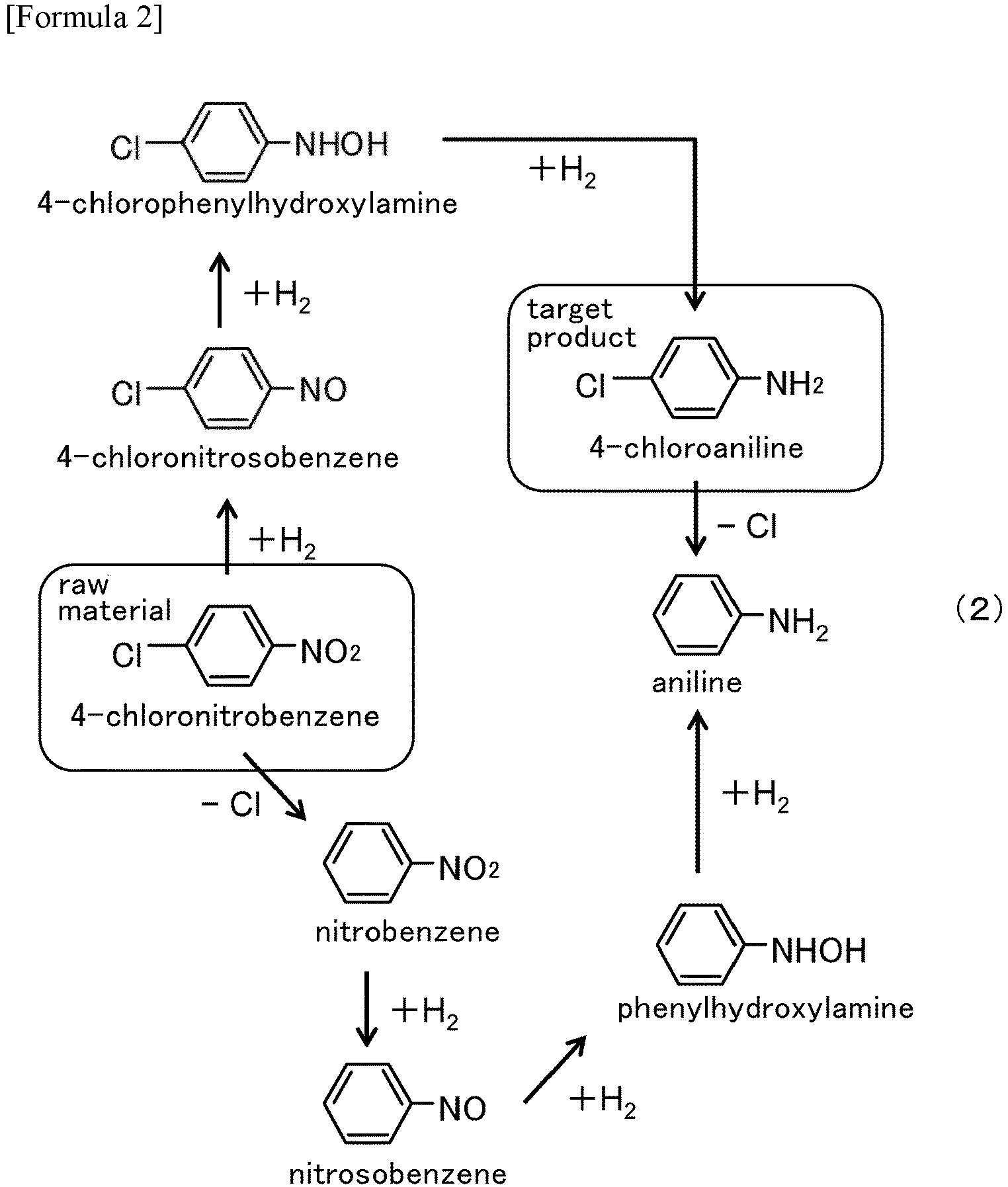
- 4-chloronitrobenzene may be hydrogenated using any of a batch type, a semi-batch type, and a flow-type, and the hydrogenation catalyst according to the present embodiment is particularly suitable as a flow-type reaction catalyst used in a flow-type reaction system that causes a gas/liquid/solid three phase reaction.
- Next, with reference to
Figure 1 , an example of the configuration of the flow-type organic synthesis system 1 (hydrogenation reaction system) will be described. - The flow-type
organic synthesis system 1 includes a flow-type fixed bed reactor 2 (hereinafter referred to as "reactor 2") that causes the gas/liquid/solid three phase reaction by using hydrogen as a gas raw material, 4-chloronitrobenzene as a liquid raw material, and the hydrogenation catalyst as a solid catalyst. For the liquid raw material, an organic solvent (alcohol, ether, other aromatic hydrocarbons, or the like) inert to the reaction can be used. In a case where the aromatic halonitro compound to be hydrogenated is liquid, the reaction can be caused without a solvent. - The
reactor 2 is a known tubular reactor accommodating acatalyst layer 3 including the hydrogenation catalyst. Thereactor 2 causes a reaction by causing the gas raw material and the liquid raw material, which are continuously supplied from an inlet line L1, to flow into thecatalyst layer 3. Further, thereactor 2 is provided with a tubularelectric furnace 4 composed of two independent blocks, and can adjust the reaction temperature (more specifically, the temperature of the catalyst layer 3) by supplying heat as required. As thereactor 2, for example, it is possible to use not only a downflow reactor that causes the raw materials to flow in the same direction as gravity but also an up-flow reactor that causes the raw materials to flow in the opposite direction to gravity. - The gas raw material is continuously supplied to the
reactor 2 via a gas raw material supply line L2 connected to the inlet line L1. Further, the inlet line L1 is connected to a purge gas supply line L3 through which a purge gas flows. In the flow-typeorganic synthesis system 1, it is possible to perform a purging operation of equipment, piping, or the like inside the system by supplying the purge gas to the purge gas supply line L3 at the time of maintenance or the like. - The liquid raw material is stored in a liquid
raw material tank 11. A liquidraw material pump 12 causes the liquid raw material to flow into the inlet line L1 via a liquid raw material supply line L4, and the liquid raw material is continuously supplied to thereactor 2 together with the gas raw material. Further, the liquid raw material supply line L4 is provided with a preheater/precooler 13. The preheater/precooler 13 heats or cools the liquid raw material, thereby adjusting the temperature of the liquid raw material supplied to thereactor 2 within a preset target range. - Further, from the
reactor 2, a reaction product mainly containing 4-chloroaniline is continuously discharged to an outlet line L6. The outlet line L6 is provided with aheat exchanger 21. Theheat exchanger 21 heats or cools the reaction product, thereby controlling the temperature of the reaction product discharged from thereactor 2 within a preset target range. - The reaction product cooled by the
heat exchanger 21 is supplied to a main drum 25 (gas-liquid separator) connected to a downstream portion of the outlet line L6. In themain drum 25, the reaction product is gas-liquid separated into an off-gas (residual gas) containing an unreacted gas raw material and the like and a recovery liquid containing a target (product) of the reaction. - The off-gas (gas phase component) separated in the
main drum 25 is discharged via an off-gas transportation line L7 (the first line of a residual gas transportation line). - The recovery liquid from the
main drum 25 is supplied to aproduct recovery drum 41 via a recovery liquid transportation line L9 (target recovery line). In theproduct recovery drum 41, the gas remaining in the recovery liquid is gas-liquid separated from the recovery liquid. This separated gas is discharged to the outside via a separated gas discharge line L10. Further, the recovery liquid (target product) separated in theproduct recovery drum 41 is recovered via a product recovery line L11. - In the flow-type
organic synthesis system 1, an operator appropriately samples the recovery liquid from the product recovery line L11 at prescribed timings. The operator can identify and quantify 4-chloroaniline or the like as a target product (product) by analyzing the recovery liquid using liquid chromatograph or gas chromatograph. - In the flow-type organic synthesis system 1 (see
Figure 1 ), an experiment was conducted to produce 4-chloroaniline (hereinafter referred to as "4-ClAN") as a target product by hydrogenating 4-chloronitrobenzene (hereinafter referred to as "4-ClNB") using each of the following catalysts A to G as a hydrogenation catalyst. In the present embodiment, a commercially available Pd/C (palladium carbon) catalyst ("5% Palladium on Activated Carbon, Degussa type E 106 R/W 5%Pd (wetted with ca.55% water)" manufactured by Wako Pure Chemical Industries, Ltd.) carrying 5 wt.% of metal was used as a catalyst (hereinafter referred to as "Pd/C catalyst") to be compared with the hydrogenation catalyst. - A commercially available silica gel ("CARiACT Q-10" manufactured by Fuji Silysia Chemical Ltd.) for a catalytic carrier was calcined at 500°C for 3 hours, and weighed to be 5g. Subsequently, the calcined silica gel was impregnated with a 0.42% palladium nitrate aqueous solution [Pd(NO3)aq] such that Pd is carried at 2 wt.%, and calcined at 500°C for 3 hours after being dried. Accordingly, the catalyst A (Pd-carried silica catalyst) was acquired.
- A commercially available silica gel ("CARiACT Q-50" manufactured by Fuji Silysia Chemical Ltd.) for a catalytic carrier was calcined at 500°C for 3 hours, and weighed to be 5g. Subsequently, the calcined silica gel was impregnated with a 0.42% palladium nitrate aqueous solution [Pd(NO3)aq] such that Pd is carried at 2 wt.%, and calcined at 500°C for 3 hours after being dried. Accordingly, the catalyst B (Pd-carried silica catalyst) was acquired.
- A titania carrier prepared by pH swing was calcined at 500°C for 3 hours, and weighed to be 5g. Subsequently, the calcined titania carrier was impregnated with a 0.42% palladium nitrate aqueous solution [Pd(NO3)aq] such that Pd is carried at 2 wt.%, and calcined at 500°C for 3 hours after being dried. Accordingly, the catalyst C (Pd-carried titania catalyst) was acquired. The titania carrier prepared by pH swing was manufactured by a known method similar to the manufacturing method of a titania carrier disclosed in
Japanese Patent No. 5599212 - A commercially available titania ("CS-300S-12" manufactured by Sakai Chemical Industry Co., Ltd.) for a catalytic carrier was calcined at 500°C for 3 hours, and weighed to be 5g. Subsequently, the calcined titania was impregnated with a 0.42% palladium nitrate aqueous solution [Pd(NO3)aq] such that Pd is carried at 2 wt.%. and calcined at 500°C for 3 hours after being dried. Accordingly, the catalyst D (Pd-carried titania catalyst) was acquired. The catalyst D includes not only a catalyst with a carrier calcined at 500°C but also a catalyst with a carrier calcined at other temperatures (600°C, 700°C, 800°C, 900°C, and 950°C).
- A commercially available titania ("CS-950-12" manufactured by Sakai Chemical Industry Co., Ltd.) for a catalytic carrier was calcined at 500°C for 3 hours, and weighed to be 5g. Subsequently, the calcined titania was impregnated with a 0.42% palladium nitrate aqueous solution [Pd(NO3)aq] such that Pd is carried at 2 wt.%. and calcined at 500°C for 3 hours after being dried. Accordingly, the catalyst E (Pd-carried titania catalyst) was acquired.
- An alumina carrier prepared by pH swing was calcined at 500°C for 3 hours, and weighed to be 5g. Subsequently, the calcined alumina carrier was impregnated with a 0.42% palladium nitrate aqueous solution [Pd(NO3)aq] such that Pd is carried at 2 wt.%, and calcined at 500°C for 3 hours after being dried. Accordingly, the catalyst F (Pd-carried alumina catalyst) was acquired. The alumina carrier prepared by pH swing was manufactured by a known method similar to the manufacturing method of an alumina carrier disclosed in
Japanese Patent No. 5599212 - A titania-coating alumina carrier (HBT) prepared by pH swing was calcined at 500°C for 3 hours, and weighed to be 5g. Subsequently, the calcined titania-coating alumina carrier was impregnated with a 0.42% palladium nitrate aqueous solution [Pd(NO3)aq] such that Pd is carried at 2 wt.%, and calcined at 500°C for 3 hours after being dried. Accordingly, the catalyst G (Pd-carried titania-coating alumina catalyst) was acquired. The titania-coating alumina carrier (HBT) prepared by pH swing was manufactured by a known method similar to the manufacturing method of a titania-coating alumina carrier disclosed in
Japanese Patent No. 5599212 - In the hydrogenation reaction of 4-chloronitrobenzene using the flow-type
organic synthesis system 1, the center of thecatalyst layer 3 was arranged on a second stage (upper stage) of the tubularelectric furnace 4 composed of two independent blocks, after a stainless steel reactor tube of thereactor 2 is filled with 1.0g of the hydrogenation catalyst. Then, thecatalyst layer 3 was heated such that the temperature at the center thereof was 40°C. Subsequently, using the liquidraw material pump 12, 4-ClNB/TOL-IPA (toluene isopropyl alcohol solvent) as a liquid raw material was supplied to the reaction tube at a flow rate of 0.2 ml/min, and hydrogen as a gas raw material was supplied to the reaction tube at a flow rate of 20 cm3/min. With the initiation of the hydrogenation reaction (reduction reaction) of the liquid raw material, the temperature of the hydrogenation catalyst increases according to the heat generated by the liquid raw material. Accordingly, by adjusting the temperature of each block of theelectric furnace 4 during the reaction, the temperature at the center of thecatalyst layer 3 during the reaction was controlled at 40°C. After the reaction, the product was cooled, recovered, and analyzed by gas chromatography. Further, the flow rate of an outflow gas after cooling the product was measured by a mass flowmeter. From the analysis and measurement results, the conversion of 4-ClNB, the selectivity of 4-ClAN (target product), and the selectivity of 4-chloronitrosobenzene (nitroso compound) were calculated. Such an experiment on the hydrogenation reaction of 4-chloronitrobenzene was conducted for each of the hydrogenation catalysts (the catalysts A to G) and the Pd/C catalyst. -
Figure 2 is a graph showing the relationship between the conversion of 4-ClNB as a liquid raw material and the selectivity of the nitroso compound (more specifically, 4-chloronitrosobenzene) in the hydrogenation reaction for the catalyst A, the catalyst C, the catalyst F, the catalyst G, and the Pd/C catalyst (comparative catalyst).Figure 3 is a graph showing the relationship between the conversion of 4-ClNB as a liquid raw material and the selectivity of 4-ClAN in the hydrogenation reaction for the same catalysts as inFigure 2 . - In
Figure 2 , it is confirmed that the selectivity of the nitroso compound for all of the catalyst A, the catalyst C, the catalyst F, and the catalyst G is lower than the selectivity of the nitroso compound for the Pd/C catalyst in a case where the conversion of 4-ClNB is a similar value. In particular, when the catalyst C containing titania is used, the nitroso compound is hardly produced. - In
Figure 3 , it is confirmed that the selectivity of 4-ClAN for the catalyst C is higher than the selectivity of 4-ClAN for the Pd/C catalyst in a case where the conversion of 4-ClNB is a similar value. Further, it is confirmed that the selectivity of 4-ClAN for the catalyst A is approximately equal to or higher than the selectivity of 4-ClAN for the Pd/C catalyst, although the selectivity of 4-ClAN for the catalyst A is slightly lower than the selectivity of 4-ClAN for the Pd/C catalyst in a portion (approximately 80%) of the conversion of 4-ClNB. -
Figures 4 and5 are graphs showing the influence of the calcination temperatures (500°C, 600°C, 700°C, 800°C, 900°C, and 950°C) of the carrier on the action (reaction characteristics) of the catalyst using the carrier containing titania.Figure 4 shows, for the catalyst D at each calcination temperature of the carrier, the relationship between the conversion of 4-ClNB as a liquid raw material and the selectivity of the nitroso compound (more specifically, 4-chloronitrosobenzene) in the hydrogenation reaction.Figure 5 shows, for the catalyst D at each calcination temperature of the carrier that is the same as inFigure 4 , the relationship between the conversion of 4-ClNB as a liquid raw material and the selectivity of 4-ClAN in the hydrogenation reaction. - In
Figure 4 , in a case where the calcination temperature of the carrier for the catalyst D is 500°C, 600°C, and 700°C, the production of the nitroso compound is hardly confirmed (the selectivity of the nitroso compound is almost zero). By contrast, in a case where the carrier is calcined at a higher temperature (800°C or higher), the production of the nitroso compound is confirmed. In particular, in a case where the calcination temperature of the carrier is 900°C and 950°C (900°C or higher), the production of the nitroso compound is significant, and the selectivity of the nitroso compound for the catalyst D is equal to or higher than the selectivity of the nitroso compound for the Pd/C catalyst. - In
Figure 5 , it is confirmed that the selectivity of 4-ClAN for the catalyst D tends to be higher than the selectivity of 4-ClAN for the Pd/C catalyst at any calcination temperature of the carrier. -
Figure 6 is a graph showing a diffraction pattern of an X-ray based on an X-ray diffraction method (XRD) for the carrier of the catalyst D at the same calcination temperatures of the carrier as inFigures 4-5 . As an X-ray diffraction device, a fully automatic multi-purpose horizontal X-ray analyzer (Smart Lab X-RAY DIFFRACTOMETER) manufactured by Rigaku Corporation was used. Further, quantitative analysis in the X-ray diffraction method was conducted by an RIR (Reference Intensity Ratio) method. - A peak (which appeared in the vicinity of a diffraction angle 2θ = 25.3° in a case where a CuKα ray was used as an X-ray source) corresponding to a {101} face of the anatase-type crystal phase indicating the presence of titania was detected in the diffraction pattern of the X-ray shown in
Figure 6 . By contrast, at the calcination temperatures (800°C, 900°C, and 950°C) of the carrier at which the nitroso compound was produced, a peak (which appeared in the vicinity of a diffraction angle 2θ = 27.4° in a case where a CuKα ray was used as an X-ray source) corresponding to a {110} face of a rutile-type crystal phase was detected in addition to the peak of the anatase-type. At the calcination temperatures 900°C and 950°C of the carrier at which the production of the nitroso compound was significant, the peak of the anatase-type was decreased, while the peak intensity caused by the rutile-type was remarkably high. Accordingly, it is confirmed that there is a correlation between the proportion of presence of the rutile-type crystal phase and the production behavior of the nitroso compound. In other words, in the catalyst containing titania, it is possible to suppress the production of the nitroso compound by increasing the ratio of the anatase-type crystal phase as a crystal phase. - Table 1 shows the percentage of each of the crystal phases (the anatase-type and the rutile-type) calculated based on the RIR method from the data of the X-ray diffraction at each of the calcination temperatures (500°C, 600°C, 700°C, 800°C, 900°C, and 950°C) of the carrier of the catalyst D.
[Table 1] number calcination temperature percentage of crystal phase (%) anatase-type rutile- type 1 950°C 7.5 92.5 2 900°C 38 62 3 800°C 96.4 3.6 4 700° C 100 0 5 600° C 100 0 6 500° C 100 0 - Regarding the catalyst D, considering the selectivity of 4-ClAN and the selectivity of the nitroso compound shown in each of
Figures 4 and5 and the percentage of the anatase-type crystal phase shown in Table 1, it is confirmed that in a case where the percentage of the anatase-type crystal phase of the carrier containing titania is 38% or more, the yield of 4-ClAN (target product) is improved while suppressing the production of the nitroso compound as compared with the Pd/C catalyst. By setting the calcination temperature of the carrier containing titania to 900° C or lower, the percentage of the anatase-type can be 38% or more. -
Figures 7 and8 are graphs showing the influence of the average pore diameter of the carrier on the action of the catalyst using the carrier containing titania.Figure 7 shows the relationship between the conversion of 4-ClNB as a liquid raw material and the selectivity of the nitroso compound (more specifically, 4-chloronitrosobenzene) in the hydrogenation reaction for the catalyst C, the catalyst D, the catalyst E, and the Pd/C catalyst (comparative catalyst).Figure 8 shows the relationship between the conversion of 4-ClNB as a liquid raw material and the selectivity of 4-ClAN in the hydrogenation reaction for the same catalysts as inFigure 7 . - Table 2 shows the average pore diameter of the carrier used in each of the catalyst C, the catalyst D, and the catalyst E. Each average pore diameter was measured based on mercury porosimetry. Further, as a pore distribution measuring device, "Micromeritics Automatic Mercury Porosimeter Autopore IV 9500" manufactured by Shimadzu Corporation was used.
[Table 2] catalyst average pore diameter (4V/A) (nm) substrate length (nm) quotient (average pore diameter/substrate length) (-) C(TiO2) 7.3 0.65 11.2 D(TiO2) 18.1 0.65 27.8 E(TiO2) 50.7 0.65 78 - In
Figure 7 , it is confirmed that the selectivity of the nitroso compound for all of the catalyst C, the catalyst D, and the catalyst E is lower than the selectivity of the nitroso compound for the Pd/C catalyst in a case where the conversion of 4-ClNB is a similar value. In particular, in a case where the catalyst C and the catalyst D having a smaller average pore diameter are used, the nitroso compound is hardly produced. - In
Figure 8 , it is confirmed that the selectivity of 4-ClAN for the catalyst C, the catalyst D, and the catalyst E tends to be higher than the selectivity of 4-ClAN for the Pd/C catalyst, in a case where the conversion of 4-ClNB is a similar value. - Regarding the catalyst C, the catalyst D, and the catalyst E using the carrier containing titania, considering the selectivity of 4-ClAN and the selectivity of the nitroso compound shown in each of
Figures 7 and8 and the average pore diameter of the carrier shown in Table 2, it is confirmed that in a case where the average pore diameter of the carrier containing titania is approximately 50 nm or less, the yield of 4-ClAN (target product) is improved while suppressing the production of the nitroso compound as compared with the Pd/C catalyst. Further, it is confirmed that setting the average pore diameter to approximately 18 nm or less like the catalysts C and D is more preferable from the viewpoint of suppressing the production of the nitroso compound and improving the yield of 4-ClAN (target product). Further, it is confirmed that setting the average pore diameter to approximately 7 nm or less like the catalyst C is more preferable from the viewpoint of suppressing the production of the nitroso compound and improving the yield of 4-ClAN (target product). Further, as shown in Table 2, the average pore diameter of the carrier containing titania is preferably 78 times or less of the longitudinal molecular length (substrate length) of 4-ClNB. Accordingly, it is possible to stably improve the yield of 4-ClAN as a target product while effectively suppressing the production of the nitroso compound. Further, the average pore diameter of the carrier containing titania is more preferably 28 times or less of the substrate length, and more preferably, 11 times or less thereof. -
Figures 9 and10 are graphs showing the influence of the average pore diameter of the carrier on the action of the catalyst using the carrier containing silica.Figure 9 shows the relationship between the conversion of 4-ClNB as a liquid raw material and the selectivity of the nitroso compound (more specifically, 4-chloronitrosobenzene) in the hydrogenation reaction for the catalyst B and the Pd/C catalyst (comparative catalyst).Figure 10 shows the relationship between the conversion of 4-ClNB as a liquid raw material and the selectivity of 4-ClAN in the hydrogenation reaction for the same catalysts as inFigure 9 . - The average pore diameter of the carrier of the catalyst B measured based on mercury porosimetry like the abovementioned Table 2 is 48.8 nm. Further, the average pore diameter of the carrier of the catalyst B is 75 times of the longitudinal molecular length (substrate length) of 4-ClNB (average pore diameter/substrate length = 75). The longitudinal molecular length of 4-ClNB was calculated by Gaussian of a general-purpose quantum chemical calculation program. Accordingly, the average pore diameter of the carrier containing silica is preferably 75 times or less of the longitudinal molecular length (substrate length) of 4-ClNB.
- In
Figure 9 , it is confirmed that the selectivity of the nitroso compound for the catalyst B tends to be lower than the selectivity of the nitroso compound for the Pd/C catalyst in a case where the conversion of 4-ClNB is a similar value. - In
Figure 10 , it is confirmed that the selectivity of 4-ClAN for the catalyst B tends to be higher than the selectivity of 4-ClAN for the Pd/C catalyst in a case where the conversion of 4-ClNB is a similar value. - Regarding the catalyst B using the carrier containing silica, considering the selectivity of 4-ClAN and the selectivity of the nitroso compound shown in each of
Figures 9 and10 and the average pore diameter of the carrier thereof, in a case where the average pore diameter of the carrier containing silica is approximately 50 nm or less, there is a possibility of improving the yield of 4-ClAN (target product) while suppressing the production of the nitroso compound as compared with the Pd/C catalyst, like the abovementioned catalyst using the carrier containing titanium. Further, in a case where the quotient of the average pore diameter of the carrier of the catalyst B divided by the longitudinal molecular length (substrate length) of 4-ClNB is 75 or less, there is a possibility of improving the yield of 4-ClAN (target product) while suppressing the production of the nitroso compound as compared with the Pd/C catalyst. - The present invention has been described above based on specific embodiments, but these embodiments are merely examples, and the present invention is not limited by these embodiments. Not all the components of the hydrogenation catalyst and the manufacturing method of the hydrogenated organic compound using the hydrogenation catalyst shown in the above-mentioned embodiments are essential, and at least those skilled in the art can select the components as appropriate within the scope of the present invention.
-
- 1: flow-type organic synthesis system
- 2: flow-type fixed bed reactor
- 3: catalyst layer
- 4: electric furnace
- 11: liquid raw material tank
- 12: liquid raw material pump
- 13: preheater/precooler
- 21: heat exchanger
- 25: main drum
- 41: product recovery drum
Claims (9)
- A hydrogenation catalyst for hydrogenation of an aromatic halonitro compound, the hydrogenation catalyst comprising:a carrier containing at least one of silica, titania, and alumina; andat least one metal carried by the carrier and selected from group 10 elements in a periodic table.
- The hydrogenation catalyst according to claim 1, wherein the metal is palladium.
- The hydrogenation catalyst according to claim 1 or 2, wherein the carrier is a composite carrier composed of alumina and titania, and
the composite carrier includes a structure that a base material made of alumina is coated with titania. - The hydrogenation catalyst according to claim 1 or 2, wherein the carrier contains titania that includes, as a crystal structure, 38% or more of an anatase-type.
- The hydrogenation catalyst according to claim 4, wherein the carrier containing titania does not include, as the crystal structure, a rutile-type.
- The hydrogenation catalyst according to claim 1 or 2, wherein an average pore diameter of the carrier containing titania is 78 times or less of a longitudinal molecular length of the aromatic halonitro compound.
- The hydrogenation catalyst according to claim 1 or 2, wherein an average pore diameter of the carrier is approximately 50 nm or less.
- A flow-type organic synthesis system configured to cause a gas/liquid/solid three phase reaction by using:a fixed catalyst including the hydrogenation catalyst according to any one of claims 1 to 7;hydrogen as a gas raw material; andthe aromatic halonitro compound as a liquid raw material.
- A manufacturing method of a hydrogenated organic compound, hydrogenating the aromatic halonitro compound by using the hydrogenation catalyst according to any one of claims 1 to 8.
Applications Claiming Priority (2)
| Application Number | Priority Date | Filing Date | Title |
|---|---|---|---|
| JP2021072144A JP7840118B2 (en) | 2021-04-21 | 2021-04-21 | Hydrogenation catalyst, flow-type organic synthesis system using the same, and method for producing hydrogenated organic compounds |
| PCT/JP2022/015479 WO2022224741A1 (en) | 2021-04-21 | 2022-03-29 | Hydrogenation catalyst, and flow-type organic synthesis system and method for producing hydrogenated organic compound using same |
Publications (2)
| Publication Number | Publication Date |
|---|---|
| EP4327936A1 true EP4327936A1 (en) | 2024-02-28 |
| EP4327936A4 EP4327936A4 (en) | 2025-04-16 |
Family
ID=83722121
Family Applications (1)
| Application Number | Title | Priority Date | Filing Date |
|---|---|---|---|
| EP22791516.2A Pending EP4327936A4 (en) | 2021-04-21 | 2022-03-29 | HYDROGENATION CATALYST, AND FLOW-TYPE ORGANIC SYNTHESIS SYSTEM AND METHOD FOR PRODUCING HYDROGENATED ORGANIC COMPOUND USING SAME |
Country Status (8)
| Country | Link |
|---|---|
| US (1) | US20240216893A1 (en) |
| EP (1) | EP4327936A4 (en) |
| JP (1) | JP7840118B2 (en) |
| KR (1) | KR20230171472A (en) |
| CN (1) | CN117651607A (en) |
| AU (1) | AU2022261569B2 (en) |
| CA (1) | CA3215678A1 (en) |
| WO (1) | WO2022224741A1 (en) |
Cited By (1)
| Publication number | Priority date | Publication date | Assignee | Title |
|---|---|---|---|---|
| EP4559573A4 (en) * | 2022-07-21 | 2025-11-19 | Chiyoda Corp | HYDRATION CATALYST AND ORGANIC SYNTHESIS SYSTEM OF FLOW TYPE AND METHOD FOR PRODUCING A HYDROGENATED ORGANIC COMPOUND THEREBY |
Family Cites Families (18)
| Publication number | Priority date | Publication date | Assignee | Title |
|---|---|---|---|---|
| JPS5235652B2 (en) | 1972-02-19 | 1977-09-10 | ||
| US4020107A (en) | 1975-04-07 | 1977-04-26 | E. I. Du Pont De Nemours And Co. | Catalytic reduction of halonitroaromatic compounds |
| DE3266559D1 (en) * | 1981-08-14 | 1985-10-31 | Du Pont | Hydrogenation process |
| US4760187A (en) * | 1981-08-14 | 1988-07-26 | E. I. Du Pont De Nemours And Company | Process for reducing chloronitrobenzenes using ruthenium with a minor amount of platinum as the catalyst |
| DE4300297C2 (en) * | 1993-01-08 | 1998-01-29 | Degussa | Process for the selective catalytic hydrogenation of the carbonyl group of 4-carboxylbenzaldehyde |
| JP3517914B2 (en) | 1993-11-11 | 2004-04-12 | 日産化学工業株式会社 | Method for selective reduction of halogenated nitrobenzenes |
| DE19909168A1 (en) * | 1999-03-03 | 2000-09-07 | Basf Ag | Process for the production of amines |
| JP4119144B2 (en) | 2002-03-29 | 2008-07-16 | 千代田化工建設株式会社 | Method for producing porous inorganic oxide |
| JP4317049B2 (en) | 2003-02-27 | 2009-08-19 | 三井化学株式会社 | Process for producing halogenated aromatic amines |
| CN101663265B (en) | 2007-03-27 | 2016-06-08 | 和光纯药工业株式会社 | The manufacture method of aryl-hydroxy amine |
| CN101265194B (en) * | 2008-04-24 | 2011-08-17 | 中国科学院长春应用化学研究所 | Catalytic hydrogenation method for preparing halogenated aromatic amine from halogenated arene nitro compounds |
| JP5758802B2 (en) | 2008-08-04 | 2015-08-05 | シリサイクル インコーポレイテッドSilicycle Inc. | Metal-containing organosilica catalyst, production method and use |
| CN101658788B (en) * | 2009-09-24 | 2012-01-18 | 西华师范大学 | Catalyst for greenly synthesizing halogenated arylamine by means of high-efficiency catalytic hydrogenation of halogenated aromatic nitro compound and preparation method thereof |
| JP5599212B2 (en) * | 2010-03-30 | 2014-10-01 | 千代田化工建設株式会社 | Hydrocarbon oil hydrotreating catalyst, method for producing the same, and hydrotreating method for hydrocarbon oil using the same |
| JP2015188878A (en) * | 2014-03-29 | 2015-11-02 | 千代田化工建設株式会社 | Hydrogenation catalyst for aromatic hydrocarbon compound, and method for hydrogenating using the same |
| JP6456204B2 (en) | 2015-03-24 | 2019-01-23 | 千代田化工建設株式会社 | Aromatic hydrocarbon hydrogenation catalyst and hydrotreating method using the same |
| HUE060530T2 (en) * | 2015-10-01 | 2023-03-28 | Monsanto Technology Llc | Process for the catalytic hydrogenation of halonitroaromatic compounds |
| JP7576389B2 (en) | 2019-02-04 | 2024-10-31 | 千代田化工建設株式会社 | Flow organic synthesis method |
-
2021
- 2021-04-21 JP JP2021072144A patent/JP7840118B2/en active Active
-
2022
- 2022-03-29 AU AU2022261569A patent/AU2022261569B2/en active Active
- 2022-03-29 WO PCT/JP2022/015479 patent/WO2022224741A1/en not_active Ceased
- 2022-03-29 KR KR1020237039568A patent/KR20230171472A/en active Pending
- 2022-03-29 US US18/555,886 patent/US20240216893A1/en active Pending
- 2022-03-29 CN CN202280029270.8A patent/CN117651607A/en active Pending
- 2022-03-29 EP EP22791516.2A patent/EP4327936A4/en active Pending
- 2022-03-29 CA CA3215678A patent/CA3215678A1/en active Pending
Cited By (1)
| Publication number | Priority date | Publication date | Assignee | Title |
|---|---|---|---|---|
| EP4559573A4 (en) * | 2022-07-21 | 2025-11-19 | Chiyoda Corp | HYDRATION CATALYST AND ORGANIC SYNTHESIS SYSTEM OF FLOW TYPE AND METHOD FOR PRODUCING A HYDROGENATED ORGANIC COMPOUND THEREBY |
Also Published As
| Publication number | Publication date |
|---|---|
| JP7840118B2 (en) | 2026-04-03 |
| KR20230171472A (en) | 2023-12-20 |
| AU2022261569A1 (en) | 2023-11-30 |
| JP2022166739A (en) | 2022-11-02 |
| CA3215678A1 (en) | 2022-10-27 |
| WO2022224741A9 (en) | 2024-02-01 |
| WO2022224741A1 (en) | 2022-10-27 |
| AU2022261569B2 (en) | 2026-02-05 |
| US20240216893A1 (en) | 2024-07-04 |
| CN117651607A (en) | 2024-03-05 |
| EP4327936A4 (en) | 2025-04-16 |
Similar Documents
| Publication | Publication Date | Title |
|---|---|---|
| Tomer et al. | Mixed oxides supported low-nickel formulations for the direct amination of aliphatic alcohols with ammonia | |
| KR20020057956A (en) | Stable highly active supported copper based catalysts | |
| US7399726B2 (en) | Process for direct oxidation of propylene to propylene oxide and large particle size titanium silicalite catalysts for use therein | |
| EP3528945B1 (en) | Process for producing oxidative dehydrogenation catalysts using hydrothermal treatment and peroxide treatment | |
| KR20170139602A (en) | Flow-phase ammoxidation reaction catalyst and method for producing acrylonitrile | |
| US20120065431A1 (en) | Method for producing aromatic amines | |
| WO2011040224A1 (en) | Hydrodesulfurization catalyst for a hydrocarbon oil, manufacturing method therefor, and hydrorefining method | |
| US20140248208A1 (en) | Catalyst and method for producing chlorine by means of a gas-phase oxidation | |
| US20240216893A1 (en) | Hydrogenation catalyst, flow-type organic synthesis system using the same, and manufacturing method of hydrogenated organic compound | |
| US9468913B2 (en) | Catalyst and method for the production of chlorine by gas phase oxidation | |
| EP2214816A2 (en) | Single-step catalytic preparation of para-aminophenol | |
| KR20230125025A (en) | Catalyst for decomposing chlorine gas, exhaust gas treatment device and method for decomposing chlorine gas | |
| KR20160140653A (en) | Hydrodesulfurization catalyst for hydrocarbon oil | |
| US20260034535A1 (en) | Hydrogenation catalyst, and flow-type organic synthesis system and method for producing hydrogenated organic compound using same | |
| EP3903926A1 (en) | Catalytic material comprising ni supported on an oxidic support comprising zr and si | |
| CN1541764A (en) | A kind of low carbon alkane isomerization catalyst and preparation method | |
| JPH10251207A (en) | Production of 4-aminodiphenylamine | |
| US7262333B2 (en) | Process for the production of phenylalkanes that use a catalyst based on silicated alumina | |
| Joshi et al. | Synthesis of monoesters and diesters using eco-friendly solid acid catalysts M (IV) tungstates and phosphates | |
| WO2026058792A1 (en) | Reduction catalyst | |
| EP4534197A1 (en) | Catalyst for decomposition of ammonia, and method for decomposition of ammonia | |
| JP7060994B2 (en) | Manufacturing method of p-xylene | |
| JP2024160280A (en) | Heterogeneous Catalysts | |
| CN120641202A (en) | Method for decomposing nitrous oxide and method for producing nitrous oxide decomposition catalyst | |
| CN121913869A (en) | Method for preparing isopropanol by hydrogenation of acetone |
Legal Events
| Date | Code | Title | Description |
|---|---|---|---|
| STAA | Information on the status of an ep patent application or granted ep patent |
Free format text: STATUS: THE INTERNATIONAL PUBLICATION HAS BEEN MADE |
|
| PUAI | Public reference made under article 153(3) epc to a published international application that has entered the european phase |
Free format text: ORIGINAL CODE: 0009012 |
|
| STAA | Information on the status of an ep patent application or granted ep patent |
Free format text: STATUS: REQUEST FOR EXAMINATION WAS MADE |
|
| 17P | Request for examination filed |
Effective date: 20231117 |
|
| AK | Designated contracting states |
Kind code of ref document: A1 Designated state(s): AL AT BE BG CH CY CZ DE DK EE ES FI FR GB GR HR HU IE IS IT LI LT LU LV MC MK MT NL NO PL PT RO RS SE SI SK SM TR |
|
| DAV | Request for validation of the european patent (deleted) | ||
| DAX | Request for extension of the european patent (deleted) | ||
| A4 | Supplementary search report drawn up and despatched |
Effective date: 20250319 |
|
| RIC1 | Information provided on ipc code assigned before grant |
Ipc: C07C 211/52 20060101ALI20250313BHEP Ipc: C07C 209/36 20060101ALI20250313BHEP Ipc: C07B 61/00 20060101ALI20250313BHEP Ipc: B01J 23/44 20060101AFI20250313BHEP |