EP4325517A1 - Methods and devices in performing a vision testing procedure on a person - Google Patents
Methods and devices in performing a vision testing procedure on a person Download PDFInfo
- Publication number
- EP4325517A1 EP4325517A1 EP22191012.8A EP22191012A EP4325517A1 EP 4325517 A1 EP4325517 A1 EP 4325517A1 EP 22191012 A EP22191012 A EP 22191012A EP 4325517 A1 EP4325517 A1 EP 4325517A1
- Authority
- EP
- European Patent Office
- Prior art keywords
- person
- information
- confidence value
- task
- testing procedure
- Prior art date
- Legal status (The legal status is an assumption and is not a legal conclusion. Google has not performed a legal analysis and makes no representation as to the accuracy of the status listed.)
- Granted
Links
Images


Classifications
-
- G—PHYSICS
- G02—OPTICS
- G02C—SPECTACLES; SUNGLASSES OR GOGGLES INSOFAR AS THEY HAVE THE SAME FEATURES AS SPECTACLES; CONTACT LENSES
- G02C7/00—Optical parts
- G02C7/02—Lenses; Lens systems ; Methods of designing lenses
- G02C7/024—Methods of designing ophthalmic lenses
- G02C7/027—Methods of designing ophthalmic lenses considering wearer's parameters
-
- G—PHYSICS
- G06—COMPUTING OR CALCULATING; COUNTING
- G06N—COMPUTING ARRANGEMENTS BASED ON SPECIFIC COMPUTATIONAL MODELS
- G06N3/00—Computing arrangements based on biological models
- G06N3/02—Neural networks
- G06N3/08—Learning methods
-
- A—HUMAN NECESSITIES
- A61—MEDICAL OR VETERINARY SCIENCE; HYGIENE
- A61B—DIAGNOSIS; SURGERY; IDENTIFICATION
- A61B3/00—Apparatus for testing the eyes; Instruments for examining the eyes
- A61B3/02—Subjective types, i.e. testing apparatus requiring the active assistance of the patient
- A61B3/028—Subjective types, i.e. testing apparatus requiring the active assistance of the patient for testing visual acuity; for determination of refraction, e.g. phoropters
-
- G—PHYSICS
- G06—COMPUTING OR CALCULATING; COUNTING
- G06N—COMPUTING ARRANGEMENTS BASED ON SPECIFIC COMPUTATIONAL MODELS
- G06N20/00—Machine learning
-
- G—PHYSICS
- G06—COMPUTING OR CALCULATING; COUNTING
- G06N—COMPUTING ARRANGEMENTS BASED ON SPECIFIC COMPUTATIONAL MODELS
- G06N3/00—Computing arrangements based on biological models
- G06N3/02—Neural networks
- G06N3/04—Architecture, e.g. interconnection topology
- G06N3/045—Combinations of networks
- G06N3/0455—Auto-encoder networks; Encoder-decoder networks
-
- G—PHYSICS
- G06—COMPUTING OR CALCULATING; COUNTING
- G06N—COMPUTING ARRANGEMENTS BASED ON SPECIFIC COMPUTATIONAL MODELS
- G06N3/00—Computing arrangements based on biological models
- G06N3/02—Neural networks
- G06N3/04—Architecture, e.g. interconnection topology
- G06N3/0464—Convolutional networks [CNN, ConvNet]
-
- G—PHYSICS
- G16—INFORMATION AND COMMUNICATION TECHNOLOGY [ICT] SPECIALLY ADAPTED FOR SPECIFIC APPLICATION FIELDS
- G16H—HEALTHCARE INFORMATICS, i.e. INFORMATION AND COMMUNICATION TECHNOLOGY [ICT] SPECIALLY ADAPTED FOR THE HANDLING OR PROCESSING OF MEDICAL OR HEALTHCARE DATA
- G16H50/00—ICT specially adapted for medical diagnosis, medical simulation or medical data mining; ICT specially adapted for detecting, monitoring or modelling epidemics or pandemics
- G16H50/20—ICT specially adapted for medical diagnosis, medical simulation or medical data mining; ICT specially adapted for detecting, monitoring or modelling epidemics or pandemics for computer-aided diagnosis, e.g. based on medical expert systems
Definitions
- the present invention relates to a computer-implemented method and a training apparatus for training of a machine learning model for determining a confidence value during at least one test cycle of a vision testing procedure, a computer-implemented method and a vision test apparatus for performing a vision testing procedure on a person, a computer program for training of a machine learning model for determining a confidence value during at least one test cycle of a vision testing procedure, a computer program for performing a vision testing procedure on a person, a trained machine learning model, and a method for producing at least one spectacle lens.
- US 10,209,773 B2 discloses methods and systems for modifying a media, such as Virtual Reality, Augmented Reality, or Mixed Reality (VR/AR/MxR) media based on a vision profile and a target application.
- a Sensory Data Exchange (SDE) is created that enables identification of various vision profiles for users and user groups.
- the SDE may be utilized to modify one or more media in accordance with each type of user and/or user group.
- WO 2017/106770 A discloses methods and apparatus providing digital diagnostics and digital therapeutics to patients.
- the digital personalized medicine system uses digital data to assess or diagnose symptoms of a patient, and feedback from the patient response to treatment is considered to update the personalized therapeutic interventions.
- the methods and apparatus disclosed herein can also diagnose and treat cognitive function of a subject, with fewer questions, decreased amounts of time, and determine a plurality of behavioral, neurological or mental health disorders, and provide clinically acceptable sensitivity and specificity in the diagnosis and treatment.
- CN109157186A discloses an unmanned self-help visual acuity monitor including a control host and a display screen communicatively connected to the control host, a wireless interactive keyboard and a binocular camera.
- the binocular camera includes two sub-cameras that are used for simultaneously collecting face images of the tested persons and transmitting the face images to a control host computer.
- a non-standard test behavior recognition module is used to identify whether there is non-standard test behavior in the eyes of the tested person according to the face image captured by the binocular camera.
- Facial Action Units which define particular face muscle activity
- the document proposes a method for detecting Facial Action Units (FAU), which define particular face muscle activity, from an input image.
- FAU detection is formulated as a multi-task learning problem, where image features and attention maps are input to a branch for each action unit to extract discriminative feature embeddings, using a new loss function, the center contrastive (CC) loss.
- CC center contrastive
- facial micro-expression refers to split-second muscle changes in the face, indicating that a person is either consciously or unconsciously suppressing their true emotions.
- these expressions are constantly occurring on people faces, they were easily ignored by people with the eye blinking. That is to say, most people don't notice them and it is the true representation of people emotions and mental health. Accordingly, both of psychologists and computer scientists (in the fields of computer vision and machine learning in particular) pay attention to it owing to their promising applications in various fields (e.g. Mental clinical diagnosis and therapy, affective computing).
- EmoXNet which is an ensemble learning technique for learning convoluted facial representations
- EmoXNetLite which is a distillation technique that is useful for transferring the knowledge from our ensemble model to an efficient deep neural network using label-smoothen soft labels for able to effectively detect expressions in real-time.
- the decease is identified through oral examination or manual procedures. Due to the advent of smart phone, one can record the voice and send it to the cloud server for processing. Our system classifies the voice data and provides the decision to the user. This greatly reduces the transport cost, and waiting time for oral examination at medical center.
- the mobile phone recorded the patient voice data and it will be stored into the cloud.
- the voice data is synthesized to signals and with the help of deep Neural network the voice pathology can be identified.
- a computer-implemented method and a training apparatus for training of a machine learning model for determining a confidence value during at least one test cycle of a vision testing procedure
- a computer-implemented method and a vision test apparatus for performing a vision testing procedure on a person, a computer program, a trained machine learning model, and a method for producing at least one spectacle lens having the features of the independent claims.
- Preferred embodiments, which might be implemented in an isolated fashion or in any arbitrary combination, are listed in the dependent claims or throughout the following description.
- the present invention relates to a computer-implemented method, particularly suitable, for training of a machine learning model for determining a confidence value during at least one test cycle of a vision testing procedure, wherein the confidence value is designated for determining at least one action in at least one subsequent test cycle of the vision testing procedure; comprising the following steps:
- the indicated steps may, preferably, be performed in the given order, commencing with step a) and finishing with step c). However, any or all of the indicated steps may also be repeated several times and/or preformed concurrently in part.
- the term "computer-implemented method” refers to a method which involves at least one apparatus, specifically a computer, or a plurality of apparatus, particularly connected via a computer network.
- the plurality of apparatus may be connected via a network by using at least one connection interfaces at any one of the apparatus of the plurality of apparatus.
- the computer-implemented method may be implemented as at least one computer program that may be provided on a storage medium carrying the computer program, whereby at least one of the steps of the computer-implemented method, specifically at least one of steps a), b) or c), are performed by using the at least one computer program.
- any one of the steps a), b) and c) are performed using the at least one computer program.
- the at least one computer program may be accessible by an apparatus which may be adapted for performing the method via a network, such as via an in-house network or via internet.
- the present method can, thus, be performed on a programmable apparatus which is configured for this purpose, such as by providing a computer program which is configured for such a purpose.
- machine learning model refers to a trainable computer-implemented architecture, particularly a trainable statistical model, that applies artificial intelligence to automatically determine a representative result, particularly the confidence value.
- training refers to a process of determining adjustable parameters of the machine learning model using a training data for generating a trained machine learning model.
- the training may comprise at least one optimization or tuning process, wherein a best parameter combination is determined.
- the training is carried out to improve the capability of the machine learning model to determine the representative result, particularly the confidence value, by analyzing at least a portion of the training data.
- the term “determine” or any grammatical variation thereof refers to a process of generating representative results.
- the representative results generated by the present aspect is information about the confidence value of the person.
- the information may be provided as data.
- data refers to an item, such as a numeric or an alphanumeric item, which comprises at least one piece of information.
- the data may be provided in machine readable form, such that it may be input or output of a machine learning model, particularly of any neural network comprised by the machine learning model.
- the term "vision testing procedure” refers to a procedure in which the at least one condition, particularly of at least one eye, of the person is determined, wherein the at least one condition is an performance indicator of the vision of the person, particularly an impairment of the vision of person.
- the at least one condition of the at least one eye of the person may be at least one visual parameter of the at least one eye of the person.
- the vision testing procedure may be performed in a stepwise manner, particularly as a series of consecutive test cycles.
- performance indicator of the vision of the person refers to a value used for defining a visual ability of the person, particularly a visual parameter of the at least one eye of the person.
- the term “subsequent test cycle” refers to a test cycle which is performed after at least one particular test cycle.
- the at least one "particular test cycle” may be the test cycle that is currently performed.
- the at least one particular test cycle may, thus, be performed before the subsequent test cycle.
- an action may be performed that is based on the confidence value.
- the term “action” refers to a process step that is, particularly directly, related to the vision testing procedure, specifically a progress of the vision testing procedure and/or a collection of further training data.
- the term “confidence value” refers to a measure of a certainty level of the person at providing the expected response. Thereby, the confidence value indicates how sure the person is in giving an expected response during at least one cycle of the vision testing procedure and/or whether the given response was correct compared to the query.
- training data comprises first information about at least one behavior of a person during at least one test cycle of a vision testing procedure, wherein the at least one behavior of the person as provided by the first information is recorded from an observation of the person during a time interval after the person is queried to solve at least one task by providing an expected response.
- second information about at least one known confidence value is comprised by the training data, wherein the confidence value is a measure of a confidence level of the person at providing the expected response.
- training data refers to data that is used for training of the machine learning model.
- the parameters of the machine learning model may, thus, be adjusted, when at least a portion of the training data is analyzed by the machine learning model.
- the training data in that sense, may comprise at least one "known” information and the machine learning model may, further, be configured for a training of determining information that corresponds to the known information as accurate as possible, or, in other words, the determined information may deviate from the known information as little as possible.
- the training data may comprise real data and/or simulated data.
- the term "information" refers to a piece of content being comprised by data.
- the terms “first” or “second” or “third” and so forth are considered as a description of an element without specifying an order or a chronological sequence and without excluding a possibility that other elements of the same may be present.
- the presence of an element with a higher number does not imply that an element with a lower number has also to be present, e.g. the presence of a "second” element does not imply the presence of a "first” element.
- a “first” element may be present.
- a “first” element is generally different from a “second” element and a “third” element. This is true for any possible permutation.
- the term "behavior” refers to an observable action and/or reaction of the person, including not acting and/or not reacting, particularly to the at least one task that the person is being queried to solve.
- the acting and/or reacting of the person may be understood as a kind of communication of the person, specifically any verbal communication and any non-verbal communication, which may comprise body language.
- the term “recording” or any grammatical variation thereof refers to a generation of data comprising a specific information, particularly the training data comprising the first information. Particularly for the training data, the term “recording” does not necessarily imply that the first information being recorded from an observation is real data, in particular, the first information being recorded from the observation may be simulated data, particularly simulated by simulating the observation.
- the term “observation” refers to monitoring a person.
- the monitoring may be selected from at least one of: recording at least one image, at least one video clip of the person, recording the voice of the person, or recording at least one vital sign of the person. The recording may be performed when the person is trying to give the expected response.
- the term "querying” or any grammatical variation thereof refers to a process of requesting a response or an indication from a person, particularly for solving at least one task.
- the requesting may be performed, in particular, by presenting a request.
- the request may be presented during the particular test cycle.
- the request may be at least one of: a visible, an audible, or a tactile request.
- the term "solving” or any grammatical variation thereof refers to a person being required to provide an expected response for solving at least one task.
- expected response refers to the fact that for solving the task, providing a specific response is required.
- the specific response may be a correct response that is solving the at least one task correctly.
- the specific response may be an incorrect response solving the at least one task incorrectly.
- providing no response by the person who is queried to the at least one task may also be considered as an incorrect response.
- the response may be considered as incorrect if the behavior of the person is interpreted as uncertain.
- a correct response or an incorrect response to the at least one task may be expected to be provided by the expected response.
- time interval refers to a duration or a time period having a first point of time, at which the duration starts, and a second point of time, at which the duration finishes.
- the time interval may start at the first point of time when the person is queried to provide the expected response.
- the time interval may end at the second point of time when the person has provided the expected response or when a predetermined time-to-answer has expired.
- the at least one confidence value of the person is determined by analyzing the first information by using a machine learning model. Further, a deviation between the determined confidence value and the at least one known confidence value as provided by the second information is determined. Thereby, the deviation may be determined by a loss-function and/or an objective-function may be used.
- the term "analyzing” or any grammatical variation thereof refers to a systematic investigation in which the at least one outcome under investigation is broken down into its components. These components are, hereby, investigated on the basis of selected criteria and subsequently ordered, examined and evaluated.
- the term “deviation” refers to a difference between two pieces of information, preferably the difference between two values, particularly a mathematical and/or statistical difference between the two values. The deviation as used in step b) is the difference between the determined confidence value and the at least one known confidence value.
- step c) the machine learning model is adjusted for minimizing the deviation between the determined confidence value and the at least one known confidence value. Further, steps a) to c) are repeated until a determination criterion is met.
- the term "adjusting" or any grammatical variation thereof refers to changing at least one parameter of the machine learning model.
- the at least one parameter may be changed in order to minimize the deviation between the determined confidence value and the at least one known confidence value, particularly on a statistical basis.
- the term “determination criterion” refers to a condition that, when met, leads to the termination of a sequential or iterative procedure, particularly the termination of the computer-implemented method for training of a machine learning model.
- the at least one parameter of the machine learning model that resulted by determining a minimal deviation may be used in a trained machine learning model.
- the determination criterion may be selected from:
- an indication about the second information may be obtained from at least one of:
- the professional may be at least one of:
- the machine learning model may, further, be trained for determining a correctness value, wherein the at least one correctness value is a measure of a probability that a response provided by the person is the expected response,
- the first further determination criterion may be selected from:
- the machine learning model may comprise
- the machine learning model may, further, be trained for determining at least one action in at least one subsequent test cycle of the vision testing procedure, wherein the training data further comprises
- the second further determination criterion may be selected from:
- the machine learning model may further comprise
- the machine learning model may be a machine learning model that is trained in a domain applicable to the vision testing procedure before it is trained for determining the at least one confidence value according to any one of the preceding aspect or embodiments.
- the term "trained in a domain applicable to the vision testing procedure" refers to the fact that the machine learning may be trained for analyzing comparable, specifically the same, input data and/or for determining comparable output data. Thereby, the effort for training the machine learning model for determining the at least one confidence value may be reduced.
- the domain applicable to the vision testing procedure may be selected from at least one of:
- the present invention relates to a computer-implemented method, particularly suitable, for performing a vision testing procedure on a person, wherein the vision testing procedure comprises at least two subsequent test cycles, wherein a test cycle comprises at least the following steps:
- steps d) to f) may be repeated in at least one subsequent test cycle using the at least one determined action.
- the confidence value may be selected from
- the time interval starts at a first point of time when the person may be queried to provide the expected response.
- the term “queried to provide the expected response” may refer to a point in time at which the response from the person is requested. The point of time at which the request is started and/or ended may be the "first point of time”.
- the time interval may end at a second point of time after which the person has provided the response and/or at which a predetermined time-to-answer has expired.
- the term “provided the expected response” may refer to the point of time at which the person has stopped giving the response, particularly the expected response.
- time-to-answer refers to a time interval in which the person can provide the expected response.
- a duration of this time interval may be a predetermined fixed value, or may be adjusted in accordance with a duration a particular person may actually need for the at least one task.
- a value for this time interval may be changed depending on a time value required for the person to provide the response, especially being increased in if the person may show a high rate of providing no response to the at least one task.
- the at least one determined action may be used in at least one consecutive test cycle.
- consecutive test cycle refers to a test cycle that is performed directly after a particular test cycle without any intermediate, the further test cycle being performed after the particular test cycle and before the consecutive test cycle. Thereby, the consecutive test cycle is the next test cycle that is performed after the particular test cycle.
- the at least one action may be determined by at least one of
- the measurement data may further comprise fifth information about the response, especially the actual response, as provided by the person to the at least one task.
- the fifth information may be comprised by the first information.
- the term "fifth information" refers to a piece of information that may be comprised in the first information. The fifth information may, in particular, be recorded during an observation of the person.
- the at least one action may be further based on at least one of:
- determining at least one action in at least one subsequent test cycle may be based on at least one of:
- the least one correctness value may be selected from at least two individual values.
- the correctness value may be selected from a discrete scale comprising exactly the two individual values.
- the correctness value may further be selected from a continuous scale comprising the two individual values.
- the definitions and examples that are provided above in relationship with the confidence value may also be applicable here.
- the vision testing procedure may be performed to determine at least one condition, particularly of at least one eye, of the person, particularly wherein the condition may be an performance indicator of the vision of the person, particularly an impairment of the person.
- condition may refer to a state of mind and/or body of the person. It may, particularly, not refer to a sickness and/or health status of the person requiring any medical procedure.
- excursion refers to a loss and/or an abnormality of physiological, psychological, or anatomical structure and/ or function, whether permanent or temporary.
- An impairment is, particularly, a condition related to the vision of the person, particularly to the at least one eye of the person, that may be considered as not being normal, and/or may be perceived as disadvantageous by the person and/or may be possibly improved.
- the at least one condition of the at least one eye of the person may be at least one visual parameter of the at least one eye of the person.
- visual parameter refers to a refractive error and/or a visual performance of the at least one eye of the person.
- the at least one visual parameter may be selected from at least one of a refractive error and/or a visual performance of the at least one eye of the person.
- a refractive error refers to a bending of incident light entering the interior of the eye of the person via the pupil
- the term “refractive error” refers to an observation that the incident light may, in particular owing to a form of the eye, not be focusing appropriately on the retina of the eye, resulting in a defocus of the eye.
- the term “visual performance” refers to a characteristic that is indirectly and/or directly related to the at least one eye of the person, wherein the visual performance may be determined by investigating the at least one eye of the person by using an adapted measurement procedure.
- the refractive error of the at least one eye of the person may be at least one of a value related to:
- the visual performance may be selected from at least one of
- the at least one expected response may be at least one of:
- the first information may comprise only information recorded in a time interval during which the at least one person is providing the response.
- the first information may be processed in a pre-processing routine to comprise only information about a predetermined body-part of the person, particularly selected from at least one of: the face of the person; or the upper body of the person.
- the first information may be processed in a pre-processing routine to comprise only information about the person showing a predetermined at least one behavior.
- the first information about the at least one behavior, particularly the at least one predetermined behavior, of the person may comprise information about at least one of:
- the at least one expression in the body of the person may be selected from at least one of:
- the at least one expression in the voice may be selected from at least one of:
- At least one recording device may be selected from at least one of:
- the at least one expression in the voice of the person may be recorded by using the audio recording device, particularly a microphone.
- the term "microphone” refers to a sound converter that converts sound pressure oscillations from the air into corresponding electrical voltage changes.
- the at least one expression in the body of the person may be recorded by using the visual recording device, particularly selected from at least one of:
- solving the at least one task may be performed by the person using at least one assistive device, particularly at least one assistive device having a degree of influencing the ability of the person to solve the at least one task.
- assistive device refers to a device configured for supporting the person in solving the at least one task.
- the at least one assistive device may be configured to counteract the impairment of the person impeding the person to solve the at least one task.
- counteract refers to a use of the assistive device which results in decreasing the impairment of the person.
- At least one assistive device may be selected from at least one of:
- the degree of the at least one assistive device of influencing the ability of the person to solve the at least one task may be selected from:
- At least one result of the vision testing procedure may be determined from the at least one assistive device used in the last test cycle, particularly determined from the at least one degree of the at least one assistive device of influencing the ability of the person to solve the at least one task used in the last test cycle.
- the term "last test cycle” refers to the latest test cycle being performed before the vision testing procedure is being stopped or terminated.
- the at least one refractive value of the assistive device may be the result.
- the at least one result may be at least one refractive value of an optical lens, particularly configured for compensating the at least one refractive error of the at least one eye of the person.
- optical lens refers to a visual aid which is used for determining and/or correcting a defective vision of a person wearing the optical lens.
- the optical lens may be selected from at least one of:
- the term “spectacle lens” refers to an optical lens which is used for determining and/or correcting a defective vision of a wearer of the optical lens, wherein the optical lens is carried in front of the eye of the person, thereby avoiding a direct contact with the eye of a wearer.
- the term “contact lens” refers to a lens placed directly on the surface of the eye of the wearer to correct visual defects.
- intraocular lens refers to an artificial lens implanted in the eye of a wearer for correcting the defective vision.
- the at least one action may be selected from at least one of:
- the term "giving a feedback” refers to giving an indication to the person about the performance of the person within the vision testing procedure, particularly an indication about the response provided, particularly in the particular measurement cycle, being the expected response or not being the respected response.
- the term “maintaining" a specific at least one action performed in the particular test cycle refers to repeating the specific at least one action in the subsequent test cycle.
- the term “changing" a specific at least one action refers to adapting in the subsequent test cycle the at least one action performed in the particular test cycle, particularly be considering the at least one confidence value.
- symbol refers to a structure that is used to test a visual parameter of the person.
- the term "parameter of a symbol” refers to a value influences the appearance of the symbol, particularly when the parameter of the symbol changes then the appearance of the symbol also changes.
- polarization refers to a property of transverse waves, particularly light waves, that specifies a geometrical orientation of at least one oscillation.
- the at least one further task may have a different difficulty, particularly an increasing or a decreasing difficulty, specifically compared to the at least one presented task.
- the term "different difficulty" may be related to a change of the presented symbol and/or at least one parameter of the presented symbol, particularly presented in the at least one particular test cycle.
- a difference of the difficulty between the at least one further task and the at least one presented task may correlate with the at least one determined confidence value. In particular, when the person is confident on giving the expected response, the change in in the difficulty between the at least one further task and the at least one presented task may be larger and/or smaller compared to a situation in which the person is unsure on giving the expected response.
- the at least one further assistive device may have a different degree of influencing the ability of the person to solve the at least one task, specifically compared to the at least one used assistive device.
- the "used assistive device" may be the assistive device used in the particular test cycle.
- a difference of the degree between the at least one used assistive device and the at least one further assistive device may correlate with the at least one determined confidence value.
- the change in the degree between the at least one used assistive device and the at least one further assistive device may be larger and/or smaller compared to a situation in which the person is confident on giving the expected response.
- the degree of the at least one further assistive device of influencing the ability of the person to solve the at least one task may be selected to improve the ability of the person to solve the task.
- the term "improve the ability of the person to solve the task” may refer to the fact that the difficulty of the at least one task is counteracted by the assistive device.
- the presentation device may be selected from at least one of:
- querying the person to provide the expected response may be performed by using a querying device, particularly selected from at least one of: a screen or a speaker.
- a querying device particularly selected from at least one of: a screen or a speaker.
- the term "speaker” refers to a sound transducers for converting at least one input signal into at least one mechanical vibration, particularly wherein the at least one mechanical vibration is perceptible as sound.
- the querying device may be identical to the presenting device.
- At least one task may be selected from at least one of:
- the difficulty of the at least one task may correlate with at least one of:
- the measurement data recorded during at least one test cycle may be used as further training data in the computer-implemented method for further training of the machine learning model for determining the confidence value according to any one of the preceding aspects or embodiments.
- the term "measurement data” refers to data that is recorded from an observation of the person performing the vision testing procedure, particularly by using an already trained machine learning model.
- the term “further training” refers to an additional training being performed on the machine learning model that is already trained for determining the confidence level.
- the measurement data may comprise at least one of
- the measurement data may be transmitted from a vision test apparatus to a training apparatus, particularly by using connecting interfaces, particularly wherein at least a portion of the measurement data may be recorded by the vision test apparatus, wherein the training apparatus may be performing the at least one further training.
- the term "vision test apparatus” refers to a device used for performing the vision testing procedure, particularly comprising a processing device for running the machine learning model.
- the term "training apparatus” refers to a device used for training of the machine learning model, particularly comprising a processing device for running the machine learning model.
- the training apparatus may be the vision test apparatus.
- connecting interface or any grammatical variation thereof refers to an interface configured for transmitting data from a first apparatus to a second apparatus and/or receiving data with a second apparatus transmitted from a first apparatus.
- a typical connecting interface may be a network controller.
- the updated machine learning model may be transmitted from the training apparatus to the vision test apparatus, particularly by using connecting interfaces, wherein the vision test apparatus may be performing further test cycles by using the updated trained machine learning model.
- the data comprising the first information may be selected from at least one of:
- the visual data may be selected from at least one of:
- the audio data may be processed before it is input into the machine learning model for determining an audio spectrogram of the audio data, particularly by using at least one of
- the machine learning model may comprise a first input layer for the audio data into which the audio data, particularly the audio spectrogram, is input.
- input layer refers to a layer into which the data to be processed by the neural network comprising the input layer is input.
- the visual data may be processed before it is input into the machine learning model to extract a portion of the visual data comprising information about the face of the person, particularly by using at least one of
- the machine learning model may comprise a second input layer for the visual data into which the visual data, particularly the portion of the visual data comprising information about the face of the person, is input.
- the first input layer may forward information through a fourth encoding neural network, particularly selected from at least one of:
- the fourth encoding neural network may forward information into a first latent layer.
- latent layer refers to the last layer of an encoding neural network, which generates at least one output that is subsequently fed into a dense fusion layer for combining a plurality of latent layers, an output layer, or a decoding network.
- the second input layer may forward information through a fifth encoding neural network, particularly selected from at least one of:
- the fifth encoding neural network may forward information into a second latent layer.
- the first neural network may be selected from at least one of:
- the second neural network may be selected from at least one of:
- the third neural network may be selected from at least one of:
- the present invention relates to a computer program comprising instructions which, when the program is executed by a computer, cause the computer to carry out the method according to any one of the preceding aspects or embodiments.
- the term "computer program” refers to at least one executable instruction for at least one programmable apparatus, specifically a computer, preferably a sequence of executable instructions, for processing and/or solving of at least one function and/or at least one task and/or at least one problem by using at least one programmable apparatus, specifically a computer, preferably for performing some or all steps of any one of the methods according to any aspect or embodiment as described within the present invention.
- instructions are combined to a computer program code and/or provided in a programming language.
- a computer program is typically processed by using a processing device comprised by the at least one computer.
- the computer program may be running on the computer.
- the computer program code may be provided on a data storage medium or a separate device such as an optical storage medium, e.g. on a compact disc, directly on a computer or data processing device, or via a network, such as via an in-house network or via internet.
- a data storage medium or a separate device such as an optical storage medium, e.g. on a compact disc, directly on a computer or data processing device, or via a network, such as via an in-house network or via internet.
- the present invention relates to a trained machine learning model which has been trained according to any one of the preceding aspects or embodiments.
- the term "trained machine learning” refers to a model of the machine learning model, specifically comprising at least one neural network, that is trained, particularly that comprises parameters that are adapted for determining a confidence value during at least one test cycle of a vision testing procedure.
- the parameters of the machine learning model, particularly of the respective neural network may be adapted by analyzing training data or further training data.
- the present invention relates to a training apparatus for training of a machine learning model for determining a confidence value during at least one test cycle of a vision testing procedure, wherein the training apparatus is configured to carry out a computer-implemented method for training of a machine learning model for determining a confidence value during at least one test cycle of a vision testing procedure, wherein the confidence value is designated for determining at least one action in at least one subsequent test cycle of the vision testing procedure; comprising the following steps:
- the training apparatus may be further configured for carrying out a computer-implemented method for training of a machine learning model for determining a confidence value during at least one test cycle of a vision testing procedure according to any one of any one of the preceding aspects or embodiments.
- the present invention relates to a vision test apparatus for determining at least one visual parameter of a person, wherein the vision test apparatus is configured to carry out a computer-implemented method for performing a vision testing procedure on the person, wherein the vision test apparatus is configured to carry out a computer-implemented method for performing a vision testing procedure on a person, wherein the vision testing procedure comprises at least two subsequent test cycles, wherein a test cycle comprises at least the following steps:
- the apparatus may be further configured to carry out a computer-implemented method for performing a vision testing procedure on a person according to any one of the preceding aspects or embodiments.
- the apparatus may be selected from at least one of:
- tablette refers to a portable, flat touch-screen computer.
- laptop refers to a special type of computer having a screen movably attached to a housing, wherein the screen may be folded onto the housing.
- the presentation device may be selected from at least one of:
- the screen may be selected from at least one of:
- the audio recording device may be a microphone.
- the visual recording device may be selected from at least one of:
- the tactile recording device may be a touch screen, particularly the at least one touch screen of the mobile communication device, specifically a smartphone.
- the apparatus comprises a querying device for querying the person to provide the expected response.
- the querying device may be selected from at least one of: a speaker; or a screen.
- the apparatus may comprise a data storage unit, particularly for storing at least one of:
- the present invention relates to a method for producing a geometrical model of at least one spectacle lens for manufacturing of the at least one spectacle lens, wherein producing the geometrical model comprises
- the at least one spectacle is manufactured by processing at least one lens blank and considering the geometrical model of the at least one spectacle lens.
- a hard copy of the at least one spectacle lens is, eventually, made available to the person.
- the data related to at least one refractive value may be determined by carrying out a computer-implemented method for performing a vision testing procedure on a person according to any one of the preceding aspects or embodiments.
- all method steps may be performed by using a single processing device, such as a computer, especially a virtual reality headset, an augmented reality system, a desktop computer, a television set, smart glasses or a mobile communication device, specifically a smartphone.
- the single processing device may be configured to exclusively perform at least one computer program, in particular at least one line of computer program code configured to execute at least one algorithm, as used in at least one of the methods according to the present invention.
- the computer program as executed on the single processing device may comprise all instructions causing the computer to carry out at least one of the methods according to the present invention.
- At least one method step may be performed by using at least one remote processing device, especially selected from at least one of a server or a cloud computer, which is not located at the site of the user when executing the at least one method step.
- the computer program may comprise at least one remote portion to be executed by the at least one remote processing device to carry out the at least one method step.
- the computer program may comprise at least one interface configured to forward to and/or receive data from the at least one remote portion of the computer program.
- the present invention exhibits the following advantages.
- the machine learning model is trained for determining the confidence value and/or correctness value, specifically for determining at least one action.
- the behavior of the person is evaluated the person during a vision testing procedure, specifically a specific visual parameter of the at least one eye of the person.
- the respective measurement may be performed without guidance of a professional by the person alone.
- a professional may provide additional support.
- the person on which the vision testing procedure is performed may trust more the results of the vision testing procedure, particularly as the vision testing procedure may feel more natural, especially owing to the dependency of the at least one action on the behavior of the person.
- feedback may be provided to the person in a similar fashion as it is provided from a professional, particularly an optometrist, an ophthalmologist and/or or technician.
- the vision testing procedure may be performed in less steps, thereby being performed faster, as the result may be approached faster.
- the terms “have”, “comprise” or “include” or any arbitrary grammatical variation thereof are used in a non-exclusive way. Thus, these terms may refer to both a situation in which, besides the feature introduced by these terms, no further features are present in the entity described in this context and to a situation in which one or more further features are present.
- the expressions “A has B”, “A comprises B” and “A includes B” may both refer to a situation in which, besides B, no other element is present in A (i.e. a situation in which A solely and exclusively consists of B) and to a situation in which, besides B, one or more further elements are present in entity A, such as element C, elements C and D or even further elements.
- the terms “preferably”, “more preferably”, “particularly”, “more particularly”, or similar terms are used in conjunction with optional features, without restricting alternative possibilities.
- features introduced by these terms are optional features and are not intended to restrict the scope of the claims in any way.
- the invention may, as the skilled person will recognize, be performed by using alternative features.
- features introduced by "in an embodiment” or similar expressions are intended to be optional features, without any restriction regarding alternative embodiments of the invention, without any restrictions regarding the scope of the invention and without any restriction regarding the possibility of combining the features introduced in this way with other features of the invention.
- Fig. 1 illustrates an exemplary vision test apparatus 100 running a trained machine learning model 200, particularly processed by a processing device 110 of the vision test apparatus 100.
- the vision test apparatus 100 is configured for carrying out a computer-implemented method for performing a vision testing procedure 202 on the person 300.
- the vision testing procedure comprises at least two subsequent test cycles 204.
- the computer-implemented method 200 is described later in more detail.
- the vision testing procedure may be performed to determine at least one condition, particularly of at least one eye 302, of the person 300, particularly wherein the condition is a performance indicator of the vision of the person, particularly an impairment of the person 300.
- the at least one condition of the at least one eye 302 of the person 300 may be the at least one visual parameter of the at least one eye 302 of the person 300.
- the at least one visual parameter may be a refractive error or a visual performance of the at least one eye 302 of the person 300.
- the refractive error may be at least one a value related to a spherical power, a cylindrical power, a cylinder axis, and/or an addition power.
- the visual performance may be a visual acuity, particularly selected from at least one of a near field visual acuity, an intermediate visual acuity, or a far field visual acuity.
- the visual performance may, alternatively or in addition, be a contrast sensitivity, a color vision, and/or a visual field.
- the vision test apparatus 100 is a mobile communication device, specifically a smartphone.
- the vision test apparatus 100 may be a tablet or a laptop.
- the person 300 is looking at the vision test apparatus 100 through an optional assistive device 400.
- the vision testing procedure may be performed without making use of the assistive device 400.
- the assistive device 400 as exemplarily depicted here is an optical lens, specifically a spectacle lens that is comprised by a spectacle frame.
- the presentation device 102 depicted in Fig. 1 is exemplarily an electronic device, specifically the mobile communication device, more specifically the smartphone.
- the presentation device 102 may be selected from an eye chart, or at least one further electronic device, specifically a screen, a monitor a personal computer and/or a smartwatch.
- the screen may be selected from a virtual reality headset, an augmented reality system, a desktop computer, a television set, smart glasses; or the mobile communication device, specifically the smartphone.
- the apparatus 100 of the depicted embodiment comprises an audio recording device 104, particularly a microphone.
- the apparatus 100 comprises a visual recording device 106, particularly a front camera of the apparatus 100 being a smartphone, according to the exemplary embodiment.
- the visual recording device 106 may be a further and/or different camera, particularly a back camera of a further mobile communication device.
- the visual recording device 106 may be a photocamera, an infrared sensitive camera, a webcam, eye tracking glasses and/or a visually evoked potential device.
- the apparatus 100 may further comprise a tactile recording device 108.
- the tactile recording device 108 may be a touch screen, particularly of the exemplary mobile communication device.
- the vision test apparatus 100 may further comprise a distance recording device 112.
- the computer-implemented method particularly suitable, for performing the vision testing procedure 202 on the person 300 is depicted in Fig. 2 .
- the computer-implemented method is implemented as a computer program that is executed and/or running on the vision testing apparatus 100.
- the vision testing procedure comprises at least two subsequent test cycles 204, wherein a test cycle 204 comprises at least the following steps:
- the steps d) to g) may repeated in at least one subsequent test cycle 204 using the at least one determined action.
- the confidence value may be selected from at least one discrete scale, particularly wherein the confidence value is selected from at least two individual values, or at least one continuous scale, particularly wherein the continuous scale is ranging from the person 300 being fully confident to the person 300 being fully unsure.
- the at least one determined action may be used in at least one consecutive test cycle 204.
- the two individual values may be a first value of the confidence value representing the person 300 being confident, and/or a second value of the confidence value representing the person 300 being unsure about providing the expected response.
- the confidence value may be selected from at least three individual values, wherein a first value of the confidence value represents the person 300 being confident, and/or wherein a second value of the confidence value represents the person 300 being neutral, and/or wherein a third value of the confidence value represents the person 300 being unsure about providing the expected response.
- the at least one known confidence value as provided by the second information may have the same number of values as the determined confidence value; and/or the individual values of the at least one known confidence value as provided by the second information may represent the same piece of information about the confidence value as the values of the determined confidence value.
- the time interval after the person 300 is queried to solve at least one task by providing an expected response may start at a first point of time when the person 300 is queried to provide the expected response.
- the time interval may end at a second point of time after which the person 300 has provided the response and/or at which a predetermined time-to-answer has expired.
- the at least one action may be determined by the trained machine learning model 200, a professional performing the vision testing procedure and/or a predetermined response-action scheme.
- the professional may be an optician, an ophthalmologist, a technician, a psychologist and/or a nurse.
- the measurement data may further comprise fifth information about the response as provided by the person 300.
- the fifth information may be comprised by the first information.
- the at least one action may further be based on the at least one correctness value, or a time value required for the person 300 to provide the response, particularly the expected response, or the progress of the visual testing procedure, or the at least one presented task.
- the at least one correctness value may be selected from at least two individual values, specifically from exactly two individual values.
- the individual values may be a first value that represents the response as provided by the person 300 is the expected response, and a second value that represents the response as provided by the person 300 is not the expected response.
- the at least one expected response may be a verbal indication of a solution of the at least one task, or a non-verbal indication of a solution of the at least one task.
- the first information may comprise only information recorded in a time interval during which the at least one person 300 is providing the response.
- the first information may be processed in a pre-processing routine to comprise only information about a predetermined body-part of the person 300, particularly selected from at least one of: the face of the person 300; or the upper body of the person 300.
- the first information may be processed in a pre-processing routine to comprise only information about the person 300 showing a predetermined at least one behavior.
- the first information about the at least one behavior of the person 300 may comprise information about at least one expression in a body of the person 300, particularly at least one expression in a face of the person 300.
- the first information about the at least one behavior of the person 300 may, additionally or alternatively, comprise information about at least one expression in the voice of the person 300 and/or a characteristic behavior of a head of the person 300, particularly causing a movement of the head towards or away from the presentation device 102.
- the first information may comprise information about a characteristic behavior of a movement of the at least one eye 302 of the person 300; a characteristic behavior of an eyelid of the at least one eye 302 of the person 300 and/or a characteristic behavior of at least one arm of the person 300.
- the at least one expression in the body of the person 300 may be at least one expression in the face of the person 300, specifically an expression of the at least one eye 302 of the person 300, particularly an eye squinting of the person 300.
- the at least one expression in the body of the person may additionally or alternatively be a scratching of the head, particularly by using a hand of the person 300; or the head of the person 300 moving closer to or away from the presentation device 102, particularly for thereby adjusting a distance between the at least one eye 302 of the person 300 and the presentation device 102, specifically the presented and/or queried at least one task.
- the at least one expression in the voice may be a volume, a time duration, an irregular pause, a modulation, a frequency and/or pitch, particularly a mean frequency and/or pitch, and/or a modulation.
- the at least one recording device may be an audio recording device 104, a visual recording device 106, a tactile recording device 108 and/or a distance recording device 112.
- the at least one expression in the voice of the person 300 may be recorded by using the audio recording device 104, particularly the microphone.
- the at least one expression in the body of the person 300 may be recorded by using the visual recording device 106.
- Solving the at least one task may be performed by the person 300 using at least one assistive device 400, particularly at least one assistive device 400 having a degree of influencing the ability of the person 300 to solve the at least one task.
- the at least one assistive device 400 may be configured to counteract the impairment of the person 300 preventing the person 300 to solve the at least one task.
- the at least one assistive device 400 is a visual aid used by the person 300, specifically an optical lens being a spectacle lens and being comprised by a spectacle.
- the visual aid may be a phoropter, a spectral filter, a polarization filter and/or a liquid optical lens device.
- the optical lens may, alternatively, be a contact lens or an intraocular lens.
- the degree of the at least one assistive device 400 of influencing the ability of the person 300 to solve the at least one task may be at least one refractive value of the visual aid 400 used by the person 300 when solving the at least one task, at least one refractive value of the phoropter or the liquid optical lens used by the person 300 when solving the at least one task, at least one spectral characteristic of a spectral filter used by the person 300 when solving the at least one task and/or at least one polarization characteristic of a polarization filter used by the person 300 when solving the at least one task.
- At least one result of the vision testing procedure may be determined from the at least one assistive device 400 used in the last test cycle 204, particularly determined from the at least one degree of the at least one assistive device 400 of influencing the ability of the person 300 to solve the at least one task used in the last test cycle 204.
- the at least one result may be at least one refractive value of the optical lens, particularly configured for compensating the at least one refractive error of the at least one eye 302 of the person 300.
- the at least one action may be giving a feedback to the person 300 whether the at least one provided response was the expected response, particularly before presenting at least one task in the at least one subsequent test cycle 204.
- the at least one action may be querying an indication on an estimate of the at least one certainty from the person 300, particularly before presenting the at least one task in the at least one subsequent test cycle 204, changing the time-to-answer in the at least one subsequent test cycle 204, maintaining the at least one presented task and presenting it again in the at least one subsequent test cycle 204, changing the at least one presented task and presenting at least one further task in the subsequent test cycle 204 that is different from the at least one presented task, maintaining the used assistive device 400 and using it again in the at least one subsequent test cycle 204 and/or changing the used assistive device 400 and using at least one further assistive device 400 in the subsequent test cycle 204 that is different from the used assistive device.
- the at least one action may be changing at least one parameter of a symbol presented on the presentation device 102 and displaying a further symbol considering the changed parameter in at least one subsequent test cycle 204.
- the changed parameter may be a size, an orientation, a color and/or a polarization.
- the at least one action may be querying an indication on a change of a distance between the eye 302 of the person 300 and the displaying device from the person 300, particularly before presenting the at least one task in the at least one subsequent test cycle 204.
- the at least one further task may have a different difficulty, particularly an increasing or a decreasing difficulty, compared to the at least one presented task. A variation of the difficulty between the at least one further task and the at least one presented task may correlate with the at least one determined confidence value.
- the at least one further assistive device 400 may have a different degree of influencing the ability of the person 300 to solve the at least one task compared to the at least one used assistive device 400. A variation of the degree between the at least one used assistive device 400 and the at least one further assistive device 400 may correlate with the at least one determined confidence value.
- the degree of the at least one further assistive device 400 of influencing the ability of the person 300 to solve the at least one task may be selected to improve the ability of the person 300 to solve the task.
- the at least one task may be providing an indication about a type of the at least one symbol.
- the at least one task may be providing an indication about at least one parameter of the at least one symbol, wherein the at least one parameter may be selected from an orientation, a color, a contrast, or a polarization.
- the at least one task may be providing an indication about a number of a first plurality of the at least one symbol being presented on the presentation device 102 and having a common feature, particularly wherein a second plurality of the at least one symbol is additionally presented on the presentation device 102 and is not having the common feature.
- the difficulty of the at least one task may correlate with a size of the at least one symbol, a complexity of the at least one symbol, the orientation of the symbol, the color of the symbol, and/or the contrast of the symbol.
- the at least one symbol may have a type that may be selected from a letter, a number, a sign, or an arrow.
- the data comprising the first information may be audio data recorded by using the audio recording device 104, visual data recorded by using the visual recording device 106, tactile data recorded by using the tactile recording device 108 and/or distance data recorded by using the distance recording device 112.
- the visual data may be an image a video, particularly recorded during the time interval, more particularly recorded at a particular time interval at which the person 300 is providing the response.
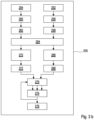
- the computer-implemented method for performing the vision testing procedure 202 is implemented in a machine learning model 200 that comprises a first input layer 252 for the audio data into which the audio data, particularly an audio spectrogram, is input.
- the audio data may be processed before it is input into the machine learning model 200 for determining the audio spectrogram of the audio data, particularly by using a Fourier transform method; or a wavelet transform method, particularly implemented by using a digital signal processor.
- the exemplary machine learning model 200 further comprises a second input layer 254 for the visual data into which the visual data, particularly the portion of the visual data comprising information about the face of the person 300, is input.
- the visual data may be processed before it is input into the machine learning model 200 to extract a portion of the visual data comprising information about the face of the person 300, particularly by selecting a specific subset of frames, particularly wherein the frames are selected that are recorded during the person is providing the response, more particularly wherein further frames are selected which are recorded within a predetermined time interval comprising the person providing the response, a face landmark detection; a face classification and/or a cropping of the face, particularly based on the face landmark detection.
- the extraction of the portion of the visual data may be implemented by using a digital signal processor.
- the first input layer 252 forwards information through a fourth encoding neural network 256.
- the fourth encoding neural network 256 may be a convolutional neural network, a VGG16, a VGG19, an Xception, an InceptionV3, a ResNet50, a ResNet101, a MobileNet and/or a MobileNetV2. There may be further ways for implementing the fourth network 206.
- the fourth encoding neural network 256 forwards information into a first latent layer 258.
- the second input layer 254 forwards information through a fifth encoding neural network 260.
- the fifth encoding neural network 260 may be may be a convolutional neural network, a VGG16, a VGG19, an Xception, an InceptionV3, a ResNet50, a ResNet101, a MobileNet and/or a MobileNetV2.
- the fifth encoding neural network 260 forwards information into a second latent layer 262.
- the first latent layer 258 and the second latent layer 262 both forward information into a fusion layer 264. There may be further options in routing the information; particularly a further layer may forward information into the fusion layer 264.
- the fusion layer 264 forwards information through a first neural network 266 having a first output layer 268, wherein the first output layer 268 provides the at least one confidence value.
- the information from the first latent layer 258 and/or the second latent layer 262 may alternatively be forwarded through and/or directly into the first neural network 266. Thereby, the fusion layer 264 may not be required.
- the first neural network 266 may be at least one layer dense network having at least two class softmax output heads or at least one layer dense network having at least two linear output heads.
- the fusion layer 264 forwards information through a second neural network 270 having a second output layer 272, wherein the second output layer 272 provides the at least one correctness value.
- the second neural network 270 may not be required.
- the information from the first latent layer 258 and/or the second latent layer 262 may alternatively be forwarded through and/or directly into the second neural network 270.
- the second neural network 270 may be at least one layer dense network having at least two class softmax output heads or at least one layer dense network having at least two linear output heads.
- the first output layer 268 and the second output layer 272 forwards information through a third neural network 274 having a third output layer 276, wherein the third output layer 276 provides the at least one action.
- the third neural network 274 may not be required.
- the third neural network 274 may be at least one layer dense network having at least two class softmax output head or at least one layer dense network having a linear output head.
- the computer-implemented method for performing the vision testing procedure 202 is implemented in a further machine learning model 200.
- the further machine learning model 200 has the same components as the machine learning model 200 depicted in Fig. 3a , wherein reference to further details thereof can be made to the description of Fig. 3a above.
- the further machine learning model 200 according to Fig. 3b further comprises a data storage unit 278 for storing at least one of: the at least one confidence value; the at least one correctness values; the at least one action; the at least one action particularly which may be determined in the current measurement cycle.
- the determining at least one action in at least one subsequent test cycle may then be based on taking into account at least one of:
- the discussed machine learning model 200 is a trained machine learning model 200.
- An exemplary computer-implemented method 500, particularly suitable, for training of the machine learning model 200 for determining a confidence value during at least one test cycle 204 of a vision testing procedure is depicted in Fig. 4 .
- the training may be performed on a training apparatus 600 on which the exemplary computer-implemented method 500 for training of the machine learning model 200 is running and/or implemented.
- the training apparatus 600 may be the vision test apparatus 100.
- the confidence value is designated for determining at least one action in at least one subsequent test cycle 204 of the vision testing procedure; comprising the following steps:
- the determination criterion may be the deviation being below a threshold, a difference between the deviation determined in a training cycle and the deviation determined in a preceding training cycle being below a further threshold, wherein a training cycle comprises the steps a) to c).
- the determination criterion may be, a predetermined number of the training cycles being reached and/or an end of a predetermined training time interval is being reached.
- An indication about the second information may be obtained from the professional experienced in performing the vision testing procedure and/or the person 300, particularly after being queried during the vision testing procedure to provide an indication about the confidence value.
- the indication about the second information may be obtained from monitoring at least one vital sign of the person 300, particularly wherein the at least one vital sign is selected from any one of a blood pressure, a heart-beat rate, or a blink rate.
- the indication about the second information may be obtained from a time value required for the person to provide the response, particularly the expected response.
- the machine learning model 200 may further trained for determining a correctness value, wherein the at least one correctness value is a measure of a probability that a response provided by the person 300 is the expected response,
- the first further determination criterion may be the first further deviation being below a further threshold and/or a difference between the first further deviation determined in a training cycle and the first further deviation determined in a preceding training cycle being below a first further threshold, wherein a training cycle comprises the steps a) to c).
- the first further determination criterion may be a predetermined first further number of the training cycles being reached and/or an end of a predetermined first further training time interval being reached.
- the machine learning model 200 may, alternatively or in addition, further be trained for determining at least one action in at least one subsequent test cycle 204 of the vision testing procedure, wherein the training data further comprises
- the second further determination criterion may be the second further deviation being below a further threshold and/or a difference between the second further deviation determined in a training cycle and the second further deviation determined in a preceding training cycle being below a second further threshold, wherein a training cycle comprises the steps a) to c).
- the second further determination criterion may be a predetermined second further number of the training cycles being reached and/or an end of a predetermined second further training time interval being reached.
- Determining the at least one action may comprise additionally analyzing the at least one correctness value.
- the fourth information about the at least one known action may be determined in an assessment of the professional experienced in performing the vision testing procedure.
- the machine learning model 200 may be a machine learning model 200 that is trained in a domain applicable to the vision testing procedure before it is trained for determining the at least one confidence value.
- the domain applicable to the vision testing procedure may be selected from a voice classification or voice regression and/or a facial expression classification or facial expression regression and/or a body expression classification or body expression regression.
- the measurement data recorded during at least one test cycle 204 is used as further training data in the computer-implemented method for further training of the machine learning model 200 for determining the confidence value.
- the at least one further training data may comprise measurement data of at least 2; 3; 4; 5; 7; 10; 15; 20; 25; 50; 75; 100; 125; 150; 200; 500; 1000; 2000; 5000; 10000; 20000; 50000 test cycles 204.
- the measurement data may comprise the first information about at least one behavior of a person 300 and the second information about at least one known confidence value.
- the measurement data may additionally comprise the third information about at least one known correctness value and/or the fourth information about at least one known action and/or the fifth information about the response as provided by the person 300.
- the measurement data may be transmitted from a vision test apparatus 100 to a training apparatus 600, particularly by using connecting interfaces 120, 620, wherein at least a portion of the measurement data is recorded by the vision test apparatus 100, wherein the training apparatus 600 is performing the at least one further training.
- the updated machine learning model 200 is transmitted from the training apparatus 600 to the vision test apparatus 100, particularly by using the connecting interfaces 120, 620, wherein the vision test apparatus 100 is performing further test cycles 204 by using the updated trained machine learning model.
- the invention also relates to a method for producing a geometrical model of at least one spectacle lens for manufacturing of the at least one spectacle lens 704, wherein producing the geometrical model comprises a step of producing a geometrical model of at least one spectacle lens 700 for at least one eye 302 of a person 300 by using data related to at least one refractive value; and determining the data related to the at least one refractive value by carrying out a computer-implemented method for performing a vision testing procedure on the person 300.
- the at least one spectacle lens may be manufactured in a step 702 of by processing at least one lens blank and considering the produced geometrical model of the at least one spectacle lens.
Landscapes
- Engineering & Computer Science (AREA)
- Health & Medical Sciences (AREA)
- Physics & Mathematics (AREA)
- Theoretical Computer Science (AREA)
- Life Sciences & Earth Sciences (AREA)
- General Health & Medical Sciences (AREA)
- Biomedical Technology (AREA)
- Software Systems (AREA)
- General Physics & Mathematics (AREA)
- Data Mining & Analysis (AREA)
- Biophysics (AREA)
- Molecular Biology (AREA)
- Medical Informatics (AREA)
- Mathematical Physics (AREA)
- General Engineering & Computer Science (AREA)
- Artificial Intelligence (AREA)
- Evolutionary Computation (AREA)
- Computing Systems (AREA)
- Public Health (AREA)
- Ophthalmology & Optometry (AREA)
- Computational Linguistics (AREA)
- Veterinary Medicine (AREA)
- Heart & Thoracic Surgery (AREA)
- Surgery (AREA)
- Animal Behavior & Ethology (AREA)
- Computer Vision & Pattern Recognition (AREA)
- Databases & Information Systems (AREA)
- Pathology (AREA)
- Epidemiology (AREA)
- Primary Health Care (AREA)
- Optics & Photonics (AREA)
- Image Analysis (AREA)
- Eyeglasses (AREA)
Abstract
Description
- The present invention relates to a computer-implemented method and a training apparatus for training of a machine learning model for determining a confidence value during at least one test cycle of a vision testing procedure, a computer-implemented method and a vision test apparatus for performing a vision testing procedure on a person, a computer program for training of a machine learning model for determining a confidence value during at least one test cycle of a vision testing procedure, a computer program for performing a vision testing procedure on a person, a trained machine learning model, and a method for producing at least one spectacle lens.
-
US 10,209,773 B2 -
WO 2017/106770 A discloses methods and apparatus providing digital diagnostics and digital therapeutics to patients. The digital personalized medicine system uses digital data to assess or diagnose symptoms of a patient, and feedback from the patient response to treatment is considered to update the personalized therapeutic interventions. The methods and apparatus disclosed herein can also diagnose and treat cognitive function of a subject, with fewer questions, decreased amounts of time, and determine a plurality of behavioral, neurological or mental health disorders, and provide clinically acceptable sensitivity and specificity in the diagnosis and treatment. -
CN109157186A discloses an unmanned self-help visual acuity monitor including a control host and a display screen communicatively connected to the control host, a wireless interactive keyboard and a binocular camera. The binocular camera includes two sub-cameras that are used for simultaneously collecting face images of the tested persons and transmitting the face images to a control host computer. A non-standard test behavior recognition module is used to identify whether there is non-standard test behavior in the eyes of the tested person according to the face image captured by the binocular camera. - Geethu Miriam Jacob and Bjorn Stenger, Facial Action Unit Detection With Transformers, CVPR (2021), p. 7680 - 7689, describes that the Facial Action Coding System is a taxonomy for fine-grained facial expression analysis. The document proposes a method for detecting Facial Action Units (FAU), which define particular face muscle activity, from an input image. FAU detection is formulated as a multi-task learning problem, where image features and attention maps are input to a branch for each action unit to extract discriminative feature embeddings, using a new loss function, the center contrastive (CC) loss. They employ a new FAU correlation network, based on a transformer encoder architecture, to capture the relationships between different action units for the wide range of expressions in the training data.
- Xiaohong Li and Jun Yu,Shu Zhan, Spontaneous facial micro-expression detection based on deep learning, 13th International Conference on Signal Processing (2016), IEEE, p. 1130-1134 describes that facial micro-expression refers to split-second muscle changes in the face, indicating that a person is either consciously or unconsciously suppressing their true emotions. Although these expressions are constantly occurring on people faces, they were easily ignored by people with the eye blinking. That is to say, most people don't notice them and it is the true representation of people emotions and mental health. Accordingly, both of psychologists and computer scientists (in the fields of computer vision and machine learning in particular) pay attention to it owing to their promising applications in various fields (e.g. Mental clinical diagnosis and therapy, affective computing). However, detecting micro-expression is still difficult task. They proposed a novel approach based on deep multi-task learning method with the HOOF(Histograms of oriented optical flow) feature for micro-expression detection. They investigated a deep multi-task learning method for facial landmark localization and split the facial area into regions of interest(ROIS). Facial microexpression are generated by the movement of facial muscles, so they combined robust optical flow approach with the HOOF feature for evaluating the direction of movement of facial muscles.
- Rauf Momin, Ali Shan Momin, Khalid Rasheed and Muhammad Saqib, Recognizing Facial Expressions in the Wild using Multi-Architectural Representations based Ensemble Learning with Distillation, IEEE Access (2017), Volume XX describes that facial expressions are the most common universal forms of body language. In the past few years, automatic facial expression recognition (FER) has been an active field of research. However, it is still a challenging task due to different uncertainties and complications. Nevertheless, efficiency and performance are yet essential aspects for building robust systems. They proposed two models, EmoXNet which is an ensemble learning technique for learning convoluted facial representations, and EmoXNetLite which is a distillation technique that is useful for transferring the knowledge from our ensemble model to an efficient deep neural network using label-smoothen soft labels for able to effectively detect expressions in real-time.
- Arsha Nagrani, Samuel Albanie and Andrew Zisserman, Seeing Voices and Hearing Faces: Cross-modal biometric matching, Proceedings of the IEEE conference on computer vision and pattern recognition (2018), p. 8427-8436 decribes that they introduce a seemingly impossible task: given only an audio clip of someone speaking, decide which of two face images is the speaker. In this document they study this, and a number of related cross-modal tasks, aimed at answering the question: how much can they infer from the voice about the face and vice versa? They study this task "in the wild", employing the datasets that are now publicly available for face recognition from static images (VGGFace) and speaker identification from audio (VoxCeleb). These provide training and testing scenarios for both static and dynamic testing of cross-modal matching. They make the following contributions: (i) they introduce CNN architectures for both binary and multi-way cross-modal face and audio matching; (ii) they compare dynamic testing (where video information is available, but the audio is not from the same video) with static testing (where only a single still image is available); and (iii) they use human testing as a baseline to calibrate the difficulty of the task.
- Jeberson Retna Raj, J Jabez, S Senduru Srinivasulu, S Gowri, and J S Vimali, Voice Pathology Detection Based on Deep Neural Network Approach, IOP Conference Series: Materials Science and Engineering (2021), Vol. 1020, No. 1, p. 012001, IOP Publishing, describe that the advancement of technology offers solution to the complex problems faced by the society and brings the wellbeing of the individuals. Smart healthcare is prominent nowadays for diagnosis, treatment and constant monitoring which reduces visitation of hospital, transport cost and waiting time. Voice pathology is a decease which affects the person vocal cord so that one who facing difficult in speech. If the decease not identified in time, it leads to permanent loss of voice for an individual. Traditionally, the decease is identified through oral examination or manual procedures. Due to the advent of smart phone, one can record the voice and send it to the cloud server for processing. Our system classifies the voice data and provides the decision to the user. This greatly reduces the transport cost, and waiting time for oral examination at medical center. The mobile phone recorded the patient voice data and it will be stored into the cloud. The voice data is synthesized to signals and with the help of deep Neural network the voice pathology can be identified.
- Sidra Abid Syed, Munaf Rashid, Samreen Hussain, and Hira Zahid, Comparative Analysis of CNN and RNN for Voice Pathology Detection, BioMed Research International (2021), Article ID 6635964 describes that diagnosis on the basis of a computerized acoustic examination may play an incredibly important role in early diagnosis and in monitoring and even improving effective pathological speech diagnostics. Various acoustic metrics test the health of the voice. The precision of these parameters also has to do with algorithms for the detection of speech noise. The idea is to detect the disease pathology from the voice. First, they apply the feature extraction on the SVD dataset. After the feature extraction, the system input goes into the 27 neuronal layer neural networks that are convolutional and recurrent neural network.
- In typical vision tests that are performed by a person without the guidance of an experienced professional, the person is left alone with a complicated workflow which has to be performed. In that sense, the person has to respond to several different tasks, e.g. giving an indication of a particular parameter as shape, contrast, size, orientation for plurality of different symbols. The person may, further, have to adapt different distances between at least one eye of the person and the symbols, which are presented at a presenting device. In such typical vision tests, the behavior of the person during the typical vision tests is not considered. This means that the test strategy is not adapted to the individual needs of the person, as no subsequent action is based on the behavior of the person. Particularly, no individual feedback is provided to the person during the typical vision test based on the behavior of the person. The person, therefore, tends not to trust in the result of such typical vision tests.
- It is therefore an objective of the present invention to provide, in particular in view
US 10,209,773 B2 WO 2017/106770 A andCN109157186A , a computer-implemented method and a training apparatus for training of a machine learning model for determining a confidence value during at least one test cycle of a vision testing procedure, a computer-implemented method and a vision test apparatus for performing a vision testing procedure on a person, a computer program for training of a machine learning model for determining a confidence value during at least one test cycle of a vision testing procedure, a computer program for performing a vision testing procedure on a person, a trained machine learning model, and a method for producing at least one spectacle lens, which at least partially overcome the above-mentioned problems of the state of the art. - It is a particular objective of the present invention to provide an easily accessible and trustworthy vision testing procedure that offers a precise, fast and reliable approach, which is obtained by a training procedure, which better addresses the actual problems typically occurring in vision testing. It is especially desired that, after training, the corresponding vision testing procedure can, eventually, be performed in a guided manner which provides an easily accessible and comprehensible approach to the person who is queried, which, thereby, considerably contributes to reliable and reproducible results obtained in vision testing, and which, eventually, leads to producing of better adapted spectacle lenses to the needs of the person who is queried.
- This problem is solved by a computer-implemented method and a training apparatus for training of a machine learning model for determining a confidence value during at least one test cycle of a vision testing procedure, a computer-implemented method and a vision test apparatus for performing a vision testing procedure on a person, a computer program, a trained machine learning model, and a method for producing at least one spectacle lens having the features of the independent claims. Preferred embodiments, which might be implemented in an isolated fashion or in any arbitrary combination, are listed in the dependent claims or throughout the following description.
- In a first aspect, the present invention relates to a computer-implemented method, particularly suitable, for training of a machine learning model for determining a confidence value during at least one test cycle of a vision testing procedure, wherein the confidence value is designated for determining at least one action in at least one subsequent test cycle of the vision testing procedure; comprising the following steps:
- a) providing training data, comprising
- first information about at least one behavior of a person during at least one test cycle of a vision testing procedure, wherein the at least one behavior of the person as provided by the first information is recorded from an observation of the person during a time interval after the person is queried to solve at least one task by providing an expected response;
- second information about at least one known confidence value;
- b) determining at least one confidence value of the person, wherein the confidence value is a measure of a confidence level of the person at providing the expected response, by analyzing the first information using a machine learning model, and determining a deviation between the determined confidence value and the at least one known confidence value as provided by the second information;
- c) adjusting the machine learning model for minimizing the deviation between the determined confidence value and the at least one known confidence value;
- Herein, the indicated steps may, preferably, be performed in the given order, commencing with step a) and finishing with step c). However, any or all of the indicated steps may also be repeated several times and/or preformed concurrently in part.
- As generally used, the term "computer-implemented method" refers to a method which involves at least one apparatus, specifically a computer, or a plurality of apparatus, particularly connected via a computer network. The plurality of apparatus may be connected via a network by using at least one connection interfaces at any one of the apparatus of the plurality of apparatus. The computer-implemented method may be implemented as at least one computer program that may be provided on a storage medium carrying the computer program, whereby at least one of the steps of the computer-implemented method, specifically at least one of steps a), b) or c), are performed by using the at least one computer program. Preferably any one of the steps a), b) and c) are performed using the at least one computer program. Alternatively, the at least one computer program may be accessible by an apparatus which may be adapted for performing the method via a network, such as via an in-house network or via internet. With particular regard to the present invention, the present method can, thus, be performed on a programmable apparatus which is configured for this purpose, such as by providing a computer program which is configured for such a purpose.
- As generally used, the term "machine learning model" refers to a trainable computer-implemented architecture, particularly a trainable statistical model, that applies artificial intelligence to automatically determine a representative result, particularly the confidence value. As generally used, the term "training" refers to a process of determining adjustable parameters of the machine learning model using a training data for generating a trained machine learning model. The training may comprise at least one optimization or tuning process, wherein a best parameter combination is determined. The training is carried out to improve the capability of the machine learning model to determine the representative result, particularly the confidence value, by analyzing at least a portion of the training data.
- As generally used, the term "determine" or any grammatical variation thereof refers to a process of generating representative results. With particular regard to the present invention, the representative results generated by the present aspect is information about the confidence value of the person. The information may be provided as data. The term "data" refers to an item, such as a numeric or an alphanumeric item, which comprises at least one piece of information. The data may be provided in machine readable form, such that it may be input or output of a machine learning model, particularly of any neural network comprised by the machine learning model.
- As used herein, the term "vision testing procedure" refers to a procedure in which the at least one condition, particularly of at least one eye, of the person is determined, wherein the at least one condition is an performance indicator of the vision of the person, particularly an impairment of the vision of person. The at least one condition of the at least one eye of the person may be at least one visual parameter of the at least one eye of the person. The vision testing procedure may be performed in a stepwise manner, particularly as a series of consecutive test cycles. As used herein, the term "performance indicator of the vision of the person" refers to a value used for defining a visual ability of the person, particularly a visual parameter of the at least one eye of the person. As used herein, the term "subsequent test cycle" refers to a test cycle which is performed after at least one particular test cycle. The at least one "particular test cycle" may be the test cycle that is currently performed. The at least one particular test cycle may, thus, be performed before the subsequent test cycle. In the subsequent test cycle, an action may be performed that is based on the confidence value. As used herein, the term "action" refers to a process step that is, particularly directly, related to the vision testing procedure, specifically a progress of the vision testing procedure and/or a collection of further training data. As used herein, the term "confidence value" refers to a measure of a certainty level of the person at providing the expected response. Thereby, the confidence value indicates how sure the person is in giving an expected response during at least one cycle of the vision testing procedure and/or whether the given response was correct compared to the query.
- According to step a), training data is provided. Firstly, the training data comprises first information about at least one behavior of a person during at least one test cycle of a vision testing procedure, wherein the at least one behavior of the person as provided by the first information is recorded from an observation of the person during a time interval after the person is queried to solve at least one task by providing an expected response. Further, second information about at least one known confidence value is comprised by the training data, wherein the confidence value is a measure of a confidence level of the person at providing the expected response.
- As generally used, the term "training data" refers to data that is used for training of the machine learning model. The parameters of the machine learning model may, thus, be adjusted, when at least a portion of the training data is analyzed by the machine learning model. The training data, in that sense, may comprise at least one "known" information and the machine learning model may, further, be configured for a training of determining information that corresponds to the known information as accurate as possible, or, in other words, the determined information may deviate from the known information as little as possible. The training data may comprise real data and/or simulated data.
- As used herein, the term "information" refers to a piece of content being comprised by data. As used herein, the terms "first" or "second" or "third" and so forth are considered as a description of an element without specifying an order or a chronological sequence and without excluding a possibility that other elements of the same may be present. The presence of an element with a higher number does not imply that an element with a lower number has also to be present, e.g. the presence of a "second" element does not imply the presence of a "first" element. Still, a "first" element may be present. A "first" element is generally different from a "second" element and a "third" element. This is true for any possible permutation.
- As used herein the term "behavior" refers to an observable action and/or reaction of the person, including not acting and/or not reacting, particularly to the at least one task that the person is being queried to solve. The acting and/or reacting of the person may be understood as a kind of communication of the person, specifically any verbal communication and any non-verbal communication, which may comprise body language.
- As used herein, the term "recording" or any grammatical variation thereof refers to a generation of data comprising a specific information, particularly the training data comprising the first information. Particularly for the training data, the term "recording" does not necessarily imply that the first information being recorded from an observation is real data, in particular, the first information being recorded from the observation may be simulated data, particularly simulated by simulating the observation. As used herein, the term "observation" refers to monitoring a person. Herein, the monitoring may be selected from at least one of: recording at least one image, at least one video clip of the person, recording the voice of the person, or recording at least one vital sign of the person. The recording may be performed when the person is trying to give the expected response.
- As used herein, the term "querying" or any grammatical variation thereof refers to a process of requesting a response or an indication from a person, particularly for solving at least one task. The requesting may be performed, in particular, by presenting a request. The request may be presented during the particular test cycle. The request may be at least one of: a visible, an audible, or a tactile request. As further used herein, the term "solving" or any grammatical variation thereof refers to a person being required to provide an expected response for solving at least one task. The term "expected response" refers to the fact that for solving the task, providing a specific response is required. The specific response may be a correct response that is solving the at least one task correctly. As an alternative, the specific response may be an incorrect response solving the at least one task incorrectly. Thereby, providing no response by the person who is queried to the at least one task may also be considered as an incorrect response. The response may be considered as incorrect if the behavior of the person is interpreted as uncertain. As a result, a correct response or an incorrect response to the at least one task may be expected to be provided by the expected response.
- As used herein, the term "time interval" refers to a duration or a time period having a first point of time, at which the duration starts, and a second point of time, at which the duration finishes. In particular, the time interval may start at the first point of time when the person is queried to provide the expected response. The time interval may end at the second point of time when the person has provided the expected response or when a predetermined time-to-answer has expired.
- According to step b), the at least one confidence value of the person is determined by analyzing the first information by using a machine learning model. Further, a deviation between the determined confidence value and the at least one known confidence value as provided by the second information is determined. Thereby, the deviation may be determined by a loss-function and/or an objective-function may be used.
- As generally used, the term "analyzing" or any grammatical variation thereof refers to a systematic investigation in which the at least one outcome under investigation is broken down into its components. These components are, hereby, investigated on the basis of selected criteria and subsequently ordered, examined and evaluated. As generally used, the term "deviation" refers to a difference between two pieces of information, preferably the difference between two values, particularly a mathematical and/or statistical difference between the two values. The deviation as used in step b) is the difference between the determined confidence value and the at least one known confidence value.
- According to step c), the machine learning model is adjusted for minimizing the deviation between the determined confidence value and the at least one known confidence value. Further, steps a) to c) are repeated until a determination criterion is met.
- As used herein, the term "adjusting" or any grammatical variation thereof refers to changing at least one parameter of the machine learning model. The at least one parameter may be changed in order to minimize the deviation between the determined confidence value and the at least one known confidence value, particularly on a statistical basis. As used herein, the term "determination criterion" refers to a condition that, when met, leads to the termination of a sequential or iterative procedure, particularly the termination of the computer-implemented method for training of a machine learning model. The at least one parameter of the machine learning model that resulted by determining a minimal deviation may be used in a trained machine learning model.
- In a preferred embodiment, the determination criterion may be selected from:
- the deviation being below a threshold;
- a difference between the deviation determined in a training cycle and the deviation determined in a preceding training cycle being below a further threshold, wherein a training cycle comprises the steps a) to c);
- a predetermined number of the training cycles is reached; or
- an end of a predetermined training time interval is reached.
- In a further preferred embodiment, an indication about the second information may be obtained from at least one of:
- a professional who is experienced in performing the vision testing procedure;
- the person, particularly after being queried during the vision testing procedure to provide an indication about the confidence value;
- monitoring at least one vital sign of the person, particularly wherein the at least one vital sign is selected from any one of a blood pressure; a heart-beat rate or a blink rate; or
- a time value required for the person to provide the response, particularly the expected response.
- In a further preferred embodiment, the professional may be at least one of:
- an optician;
- an ophthalmologist;
- a technician;
- a psychologist; or
- a nurse.
- In a further preferred embodiment, the machine learning model may, further, be trained for determining a correctness value, wherein the at least one correctness value is a measure of a probability that a response provided by the person is the expected response,
- wherein the first information further comprises information about the response provided by the person, and
- wherein the training data further comprises third information about at least one known correctness value;
- In a further preferred embodiment, the first further determination criterion may be selected from:
- the first further deviation being below a first further threshold;
- a difference between the first further deviation determined in a training cycle and the first further deviation determined in a preceding training cycle being below a first further threshold, wherein a training cycle comprises the steps a) to c);
- a predetermined first further number of the training cycles is reached; or
- an end of a predetermined first further training time interval is reached.
- In a further preferred embodiment, the machine learning model may comprise
- a first neural network configured for determining the confidence value; and/or
- a second neural network configured for determining the correctness value, particularly wherein the first neural network differs from the second neural network.
- In a further preferred embodiment, the machine learning model may, further, be trained for determining at least one action in at least one subsequent test cycle of the vision testing procedure, wherein the training data further comprises
- fourth information about at least one known action,
- In a further preferred embodiment, the second further determination criterion may be selected from:
- the second further deviation being below a second further threshold;
- a difference between the second further deviation determined in a training cycle and the second further deviation determined in a preceding training cycle being below a second further threshold, wherein a training cycle comprises the steps a) to c);
- a predetermined second further number of the training cycles is reached; or
- an end of a predetermined second further training time interval is reached.
- In a further preferred embodiment, the machine learning model may further comprise
- a third neural network for determining the at least one action,
- In a further preferred embodiment, the machine learning model may be a machine learning model that is trained in a domain applicable to the vision testing procedure before it is trained for determining the at least one confidence value according to any one of the preceding aspect or embodiments. As used herein, the term "trained in a domain applicable to the vision testing procedure" refers to the fact that the machine learning may be trained for analyzing comparable, specifically the same, input data and/or for determining comparable output data. Thereby, the effort for training the machine learning model for determining the at least one confidence value may be reduced.
- In a further preferred embodiment, the domain applicable to the vision testing procedure may be selected from at least one of:
- voice classification or voice regression;
- facial expression classification or facial expression regression; or
- body expression classification or body expression regression
- In a further aspect, the present invention relates to a computer-implemented method, particularly suitable, for performing a vision testing procedure on a person, wherein the vision testing procedure comprises at least two subsequent test cycles, wherein a test cycle comprises at least the following steps:
- d) presenting at least one task to a person querying the person to provide an expected response by using a presentation device;
- e) recording measurement data by using at least one recording device, comprising
- first information about at least one behavior of a person during at least one test cycle of a vision testing procedure, wherein the at least one behavior of the person as provided by the first information is recorded from an observation of the person during a time interval after the person is queried to solve at least one task by providing an expected response;
- f) determining a confidence value of the person by analyzing the first information using a machine learning model being trained by the method according to any one of the preceding aspect or embodiments by using a processing device; and
- g) determining at least one action in at least one subsequent test cycle of the vision testing procedure based on the determined confidence value by using the processing device.
- In a further embodiment, steps d) to f) may be repeated in at least one subsequent test cycle using the at least one determined action.
- In a further preferred embodiment, the confidence value may be selected from
- at least one discrete scale, particularly wherein the confidence value is selected from at least two individual values; or
- at least one continuous scale, particularly wherein the continuous scale is ranging from the person being fully confident to the person being fully unsure.
- In a further preferred embodiment,
- a first value of the confidence value may represent the person being confident, and
- a second value of the confidence value may represent the person being unsure about providing the expected response. Thereby exactly two different values, namely the first value and the second value, may be available on a discrete scale. As used herein, the term "confident" refers to the person being sure on providing the expected response. As used herein, the term "unsure" refers to the person being insecure, or not confident at all, when providing the expected response. In a further embodiment, the confidence value may be selected from at least three individual values.
- In a further preferred embodiment,
- a first value of the confidence value may represent the person being confident, and/or
- a second value of the confidence value may represent the person being neutral, and/or
- a third value of the confidence value may represent the person being unsure about providing the expected response. Thereby exactly three different values, namely the first value, the second value and the third value, may be available. As used herein, the term "neutral" refers to the person being balanced in terms of providing the expected response, thereby the person being neither confident nor unsure on providing the expected response. However, further embodiments are conceivable.
- In a further preferred embodiment,
- the at least one known confidence value as provided by the second information may have the same number of values as the determined confidence value; and/or wherein
- the individual values of the at least one known confidence value as provided by the second information may represent the same piece of information about the confidence value as the values of the determined confidence value.
- In a further preferred embodiment, the time interval starts at a first point of time when the person may be queried to provide the expected response. As used here, the term "queried to provide the expected response" may refer to a point in time at which the response from the person is requested. The point of time at which the request is started and/or ended may be the "first point of time". In a further embodiment, the time interval may end at a second point of time after which the person has provided the response and/or at which a predetermined time-to-answer has expired. As used herein, the term "provided the expected response" may refer to the point of time at which the person has stopped giving the response, particularly the expected response. As used herein, the term "time-to-answer" refers to a time interval in which the person can provide the expected response. Herein, a duration of this time interval may be a predetermined fixed value, or may be adjusted in accordance with a duration a particular person may actually need for the at least one task. By way of example, a value for this time interval may be changed depending on a time value required for the person to provide the response, especially being increased in if the person may show a high rate of providing no response to the at least one task.
- In a further preferred embodiment, the at least one determined action may be used in at least one consecutive test cycle. As generally used, the term "consecutive test cycle" refers to a test cycle that is performed directly after a particular test cycle without any intermediate, the further test cycle being performed after the particular test cycle and before the consecutive test cycle. Thereby, the consecutive test cycle is the next test cycle that is performed after the particular test cycle.
- In a further preferred embodiment, the at least one action may be determined by at least one of
- the machine learning model trained by the method according to any one of the preceding aspect or embodiments by using the processing device;
- the professional performing the vision testing procedure; or
- a predetermined response-action scheme, particularly by using the processing device.
- In a further preferred embodiment, the measurement data may further comprise fifth information about the response, especially the actual response, as provided by the person to the at least one task. In a further embodiment, the fifth information may be comprised by the first information. As used herein, the term "fifth information" refers to a piece of information that may be comprised in the first information. The fifth information may, in particular, be recorded during an observation of the person.
- In a further preferred embodiment, the at least one action may be further based on at least one of:
- the at least one correctness value;
- the time value required for the person to provide the response, particularly the expected response;
- the at least one presented task; or
- the progress of the visual testing procedure.
- In a further preferred embodiment, at least one of
- the at least one confidence value;
- the at least one correctness values;
- the at least one action; or
- the at least one presented task
- In a further preferred embodiment, wherein the determining at least one action in at least one subsequent test cycle may be based on at least one of:
- a predefined number of a plurality of confidence values;
- a predefined number of a plurality of correctness values;
- a predefined number of a plurality of actions; or
- a predefined number of a plurality of presented tasks,
- In a further preferred embodiment, the least one correctness value may be selected from at least two individual values. Thereby, the correctness value may be selected from a discrete scale comprising exactly the two individual values. On the other hand, the correctness value may further be selected from a continuous scale comprising the two individual values. In particular, the definitions and examples that are provided above in relationship with the confidence value may also be applicable here.
- In a further preferred embodiment,
- a first value may represent the response as provided by the person is the expected response, and/or
- a second value may represent the response as provided by the person is not the expected response.
- In a further preferred embodiment, the vision testing procedure may be performed to determine at least one condition, particularly of at least one eye, of the person, particularly wherein the condition may be an performance indicator of the vision of the person, particularly an impairment of the person. As used herein, the term "condition" may refer to a state of mind and/or body of the person. It may, particularly, not refer to a sickness and/or health status of the person requiring any medical procedure. As generally used, the term "impairment" refers to a loss and/or an abnormality of physiological, psychological, or anatomical structure and/ or function, whether permanent or temporary. An impairment is, particularly, a condition related to the vision of the person, particularly to the at least one eye of the person, that may be considered as not being normal, and/or may be perceived as disadvantageous by the person and/or may be possibly improved.
- In a further preferred embodiment, the at least one condition of the at least one eye of the person may be at least one visual parameter of the at least one eye of the person. As used herein, the term "visual parameter" refers to a refractive error and/or a visual performance of the at least one eye of the person.
- In a further preferred embodiment, the at least one visual parameter may be selected from at least one of a refractive error and/or a visual performance of the at least one eye of the person. As generally used, the terms "refraction" or "refractive" refer to a bending of incident light entering the interior of the eye of the person via the pupil, wherein the term "refractive error" refers to an observation that the incident light may, in particular owing to a form of the eye, not be focusing appropriately on the retina of the eye, resulting in a defocus of the eye. As used herein, the term "visual performance" refers to a characteristic that is indirectly and/or directly related to the at least one eye of the person, wherein the visual performance may be determined by investigating the at least one eye of the person by using an adapted measurement procedure.
- In a further preferred embodiment, the refractive error of the at least one eye of the person may be at least one of a value related to:
- a spherical power;
- a cylindrical power;
- a cylinder axis; or
- an addition power.
- In a further preferred embodiment, the visual performance may be selected from at least one of
- a visual acuity, particularly selected from at least one of:
- ∘ a near field visual acuity;
- ∘ an intermediate field visual acuity; or
- ∘ a far field visual acuity;
- a contrast sensitivity; or
- a color vision; or
- a visual field.
- In a further preferred embodiment, the at least one expected response may be at least one of:
- a verbal indication of a solution of the at least one task;
- a non-verbal indication of a solution of the at least one task.
- In a further preferred embodiment, the first information may comprise only information recorded in a time interval during which the at least one person is providing the response. In a further preferred embodiment, the first information may be processed in a pre-processing routine to comprise only information about a predetermined body-part of the person, particularly selected from at least one of: the face of the person; or the upper body of the person. In a further preferred embodiment, the first information may be processed in a pre-processing routine to comprise only information about the person showing a predetermined at least one behavior.
- In a further preferred embodiment, the first information about the at least one behavior, particularly the at least one predetermined behavior, of the person may comprise information about at least one of:
- at least one expression in a body of the person, particularly at least one expression in a face of the person;
- at least one expression in the voice of the person;
- a characteristic behavior of a head of the person, particularly causing a movement of the at least one eye towards or away from the presentation device;
- a characteristic behavior of a movement of the at least one eye of the person;
- a characteristic behavior of an eyelid of the at least one eye of the person;
- a characteristic behavior of at least one arm of the person.
- In a further preferred embodiment, the at least one expression in the body of the person may be selected from at least one of:
- at least one expression in the face of the person; particularly an expression of the at least one eye of the person, particularly an eye squinting of the person;
- a scratching of the head, particularly by using a hand of the person; or
- the head of the person moving closer to or away from the presentation device, particularly for thereby adjusting a distance between the at least one eye of the person and the presentation device.
- In a further preferred embodiment, the at least one expression in the voice may be selected from at least one of:
- a volume;
- a time duration;
- an irregular pause;
- a frequency or pitch, particularly a mean frequency or pitch;
- a modulation.
- In a further preferred embodiment, at least one recording device may be selected from at least one of:
- an audio recording device;
- a visual recording device;
- a tactile recording device; or
- a distance recording device
- In a further preferred embodiment, the at least one expression in the voice of the person may be recorded by using the audio recording device, particularly a microphone. As generally used, the term "microphone" refers to a sound converter that converts sound pressure oscillations from the air into corresponding electrical voltage changes.
- In a further preferred embodiment, the at least one expression in the body of the person may be recorded by using the visual recording device, particularly selected from at least one of:
- a camera, particularly at least one of a front camera and/or a back camera of a mobile communication device, specifically selected from at least one of:
- ∘ a smartphone;
- ∘ a tablet; or
- ∘ a smart watch;
- a photo-camera;
- an infrared-camera;
- a webcam;
- eye tracking glasses; or
- a visually evoked potential device.
- In a further preferred embodiment, solving the at least one task may be performed by the person using at least one assistive device, particularly at least one assistive device having a degree of influencing the ability of the person to solve the at least one task. As generally used, the term "assistive device" refers to a device configured for supporting the person in solving the at least one task. In a further embodiment, the at least one assistive device may be configured to counteract the impairment of the person impeding the person to solve the at least one task. As used herein, the term "counteract" refers to a use of the assistive device which results in decreasing the impairment of the person.
- In a further preferred embodiment, at least one assistive device may be selected from at least one of:
- a visual aid, particularly an optical lens, used by the person; or
- a phoropter;
- a spectral filter;
- a polarization filter; or
- a liquid optical lens device;
- In a further preferred embodiment, the degree of the at least one assistive device of influencing the ability of the person to solve the at least one task may be selected from:
- at least one refractive value of the visual aid used by the person when solving the at least one task;
- at least one refractive value of the phoropter or the liquid optical lens used by the person when solving the at least one task;
- at least one spectral characteristic of a spectral filter used by the person when solving the at least one task; or
- at least one polarization characteristic of a polarization filter used by the person when solving the at least one task.
- In a further preferred embodiment, at least one result of the vision testing procedure may be determined from the at least one assistive device used in the last test cycle, particularly determined from the at least one degree of the at least one assistive device of influencing the ability of the person to solve the at least one task used in the last test cycle. As used herein, the term "last test cycle" refers to the latest test cycle being performed before the vision testing procedure is being stopped or terminated. Thereby, the at least one refractive value of the assistive device may be the result. In a further embodiment, the at least one result may be at least one refractive value of an optical lens, particularly configured for compensating the at least one refractive error of the at least one eye of the person. The term "optical lens" refers to a visual aid which is used for determining and/or correcting a defective vision of a person wearing the optical lens.
- In a further preferred embodiment, the optical lens may be selected from at least one of:
- a spectacle lens;
- a contact lens; or
- an intraocular lens.
- Based on the "Standard", 3.5.2, the term "spectacle lens" refers to an optical lens which is used for determining and/or correcting a defective vision of a wearer of the optical lens, wherein the optical lens is carried in front of the eye of the person, thereby avoiding a direct contact with the eye of a wearer. As generally used, the term "contact lens" refers to a lens placed directly on the surface of the eye of the wearer to correct visual defects. As further generally used, the term, "intraocular lens" refers to an artificial lens implanted in the eye of a wearer for correcting the defective vision.
- In a further preferred embodiment, the at least one action may be selected from at least one of:
- giving a feedback to the person whether the at least one provided response was the expected response, particularly before presenting the at least one task in the at least one subsequent test cycle;
- querying an indication on an estimate of the at least one certainty from the person, particularly before presenting the at least one task in the at least one subsequent test cycle;
- changing the time-to-answer in the at least one subsequent test cycle;
- maintaining the at least one presented task and presenting it again in the at least one subsequent test cycle;
- changing the at least one presented task and presenting at least one further task in the subsequent test cycle which differs from the at least one presented task;
- maintaining the used assistive device and using it again in the at least one subsequent test cycle;
- changing the used assistive device and using at least one further assistive device in the subsequent test cycle which differs from the used assistive device;
- changing at least one parameter of a symbol presented on the presentation device; particularly wherein the at least one parameter of the symbol is selected from at least one of:
- ∘ a size,
- ∘ an orientation,
- ∘ a color, or
- ∘ a polarization
- querying an indication on a change of a distance between the eye of the person and the displaying device from the person, particularly before presenting the at least one task in the at least one subsequent test cycle; or
- querying an indication on a change of an orientation between the eye of the person and the displaying device and or symbol from the person, particularly before presenting the at least one task in the at least one subsequent test cycle.
- As used herein, the term "giving a feedback" refers to giving an indication to the person about the performance of the person within the vision testing procedure, particularly an indication about the response provided, particularly in the particular measurement cycle, being the expected response or not being the respected response. As used herein, the term "maintaining" a specific at least one action performed in the particular test cycle refers to repeating the specific at least one action in the subsequent test cycle. As used herein, the term "changing" a specific at least one action refers to adapting in the subsequent test cycle the at least one action performed in the particular test cycle, particularly be considering the at least one confidence value. As used herein, the term "symbol" refers to a structure that is used to test a visual parameter of the person. As used herein, the term "parameter of a symbol" refers to a value influences the appearance of the symbol, particularly when the parameter of the symbol changes then the appearance of the symbol also changes. As generally used, the term "polarization" refers to a property of transverse waves, particularly light waves, that specifies a geometrical orientation of at least one oscillation.
- In a further preferred embodiment, the at least one further task may have a different difficulty, particularly an increasing or a decreasing difficulty, specifically compared to the at least one presented task. As used herein, the term "different difficulty" may be related to a change of the presented symbol and/or at least one parameter of the presented symbol, particularly presented in the at least one particular test cycle. In a further embodiment, a difference of the difficulty between the at least one further task and the at least one presented task may correlate with the at least one determined confidence value. In particular, when the person is confident on giving the expected response, the change in in the difficulty between the at least one further task and the at least one presented task may be larger and/or smaller compared to a situation in which the person is unsure on giving the expected response.
- In a further preferred embodiment, the at least one further assistive device may have a different degree of influencing the ability of the person to solve the at least one task, specifically compared to the at least one used assistive device. The "used assistive device" may be the assistive device used in the particular test cycle. In a further embodiment, a difference of the degree between the at least one used assistive device and the at least one further assistive device may correlate with the at least one determined confidence value. In particular, when the person is unsure on giving the expected response, the change in the degree between the at least one used assistive device and the at least one further assistive device may be larger and/or smaller compared to a situation in which the person is confident on giving the expected response. In a further embodiment, the degree of the at least one further assistive device of influencing the ability of the person to solve the at least one task may be selected to improve the ability of the person to solve the task. As used herein, the term "improve the ability of the person to solve the task" may refer to the fact that the difficulty of the at least one task is counteracted by the assistive device.
- In a further preferred embodiment, the presentation device may be selected from at least one of:
- an eye chart;
- an electronic device, particularly selected from at least one of:
- ∘ a screen;
- ∘ a monitor;
- ∘ a mobile communication device, specifically a smartphone;
- ∘ a personal computer; or
- ∘ a smartwatch.
- In a further preferred embodiment, querying the person to provide the expected response may be performed by using a querying device, particularly selected from at least one of: a screen or a speaker. As generally used, the term "speaker" refers to a sound transducers for converting at least one input signal into at least one mechanical vibration, particularly wherein the at least one mechanical vibration is perceptible as sound. The querying device may be identical to the presenting device.
- In a further preferred embodiment, at least one task may be selected from at least one of:
- providing an indication about a type of at least one symbol;
- providing an indication about at least one parameter of the at least one symbol, wherein the at least one parameter is selected from
- ∘ an orientation;
- ∘ a color;
- ∘ a contrast; or
- ∘ a polarization;
- providing an indication about a number of a first plurality of the at least one symbol being presented on the presentation device and having a common feature, particularly wherein a second plurality of the at least one symbol is additionally presented on the presentation device and is not having the common feature.
- In a further preferred embodiment, the difficulty of the at least one task may correlate with at least one of:
- a size of the at least one symbol;
- a complexity of the at least one symbol;
- the orientation of the symbol;
- the color of the symbol;
- the contrast of the symbol; or
- the polarization of the symbol.
- In a further preferred embodiment, the measurement data recorded during at least one test cycle may be used as further training data in the computer-implemented method for further training of the machine learning model for determining the confidence value according to any one of the preceding aspects or embodiments. As used herein, the term "measurement data" refers to data that is recorded from an observation of the person performing the vision testing procedure, particularly by using an already trained machine learning model. As used herein, the term "further training" refers to an additional training being performed on the machine learning model that is already trained for determining the confidence level.
- In a further preferred embodiment, the measurement data may comprise at least one of
- the first information about at least one behavior of a person;
- the second information about at least one known confidence value:
- the third information about at least one known correctness value;
- the fourth information about at least one known action; or
- the fifth information about the response as provided by the person.
- In a further preferred embodiment, the measurement data may be transmitted from a vision test apparatus to a training apparatus, particularly by using connecting interfaces, particularly wherein at least a portion of the measurement data may be recorded by the vision test apparatus, wherein the training apparatus may be performing the at least one further training. As used herein, the term "vision test apparatus" refers to a device used for performing the vision testing procedure, particularly comprising a processing device for running the machine learning model. As used herein, the term "training apparatus" refers to a device used for training of the machine learning model, particularly comprising a processing device for running the machine learning model. The training apparatus may be the vision test apparatus. As generally used, the term "connecting interface" or any grammatical variation thereof refers to an interface configured for transmitting data from a first apparatus to a second apparatus and/or receiving data with a second apparatus transmitted from a first apparatus. A typical connecting interface may be a network controller.
- In a further preferred embodiment, the updated machine learning model may be transmitted from the training apparatus to the vision test apparatus, particularly by using connecting interfaces, wherein the vision test apparatus may be performing further test cycles by using the updated trained machine learning model.
- In a further preferred embodiment, the data comprising the first information may be selected from at least one of:
- audio data recorded by using the audio recording device;
- visual data recorded by using the visual recording device;
- tactile data recorded by using the tactile recording device; or
- distance data recorded by using the distance recording device.
- In a further preferred embodiment, the visual data may be selected from at least one of:
- an image; or
- a video;
- In a further preferred embodiment, the audio data may be processed before it is input into the machine learning model for determining an audio spectrogram of the audio data, particularly by using at least one of
- a Fourier transform method; or
- a wavelet transform method,
- In a further preferred embodiment, the machine learning model may comprise a first input layer for the audio data into which the audio data, particularly the audio spectrogram, is input. As generally used, the term "input layer" refers to a layer into which the data to be processed by the neural network comprising the input layer is input.
- In a further preferred embodiment, the visual data may be processed before it is input into the machine learning model to extract a portion of the visual data comprising information about the face of the person, particularly by using at least one of
- selecting a specific subset of frames, particularly wherein the frames are selected that are recorded during the person is providing the response, more particularly wherein further frames are selected which are recorded within a predetermined time interval comprising the person providing the response;
- a face landmark detection;
- a face classification; or
- a cropping of the face, particularly based on the face landmark detection,
- In a further preferred embodiment, the machine learning model may comprise a second input layer for the visual data into which the visual data, particularly the portion of the visual data comprising information about the face of the person, is input.
- In a further preferred embodiment, the first input layer may forward information through a fourth encoding neural network, particularly selected from at least one of:
- a convolutional neural network;
- a VGG16;
- a VGG19;
- an Xception;
- an InceptionV3;
- a ResNet50;
- a ResNet101;
- a MobileNet; or
- a MobileNetV2.
- In a further preferred embodiment, the fourth encoding neural network may forward information into a first latent layer. As generally used, the term "latent layer" refers " refers to the last layer of an encoding neural network, which generates at least one output that is subsequently fed into a dense fusion layer for combining a plurality of latent layers, an output layer, or a decoding network.
- In a further preferred embodiment, the second input layer may forward information through a fifth encoding neural network, particularly selected from at least one of:
- a convolutional neural network;
- a VGG16;
- a VGG19;
- an Xception;
- an InceptionV3;
- a ResNet50;
- a ResNet101;
- a MobileNet; or
- a MobileNetV2.
- In a further preferred embodiment, the fifth encoding neural network may forward information into a second latent layer. In a further embodiment, at least one of:
- the first latent layer; or
- the second latent layer,
- In a further preferred embodiment, at least one of:
- the fusion layer;
- the first latent layer; or
- the second latent layer,
- In a further preferred embodiment, the first neural network may be selected from at least one of:
- at least one layer dense network having at least two class softmax output heads; or
- at least one layer dense network having at least two linear output heads.
- In a further preferred embodiment, at least one of:
- the fusion layer;
- the first latent layer; or
- the second latent layer,
- In a further preferred embodiment, the second neural network may be selected from at least one of:
- at least one layer dense network having at least two class softmax output heads; or
- at least one layer dense network having at least one linear output heads.
- In a further preferred embodiment, at least one of:
- the first output layer; or
- the second output layer
- In a further preferred embodiment, the third neural network may be selected from at least one of:
- at least one layer dense network having at least two class softmax output heads.
- In a further aspect, the present invention relates to a computer program comprising instructions which, when the program is executed by a computer, cause the computer to carry out the method according to any one of the preceding aspects or embodiments.
- As generally used, the term "computer program" refers to at least one executable instruction for at least one programmable apparatus, specifically a computer, preferably a sequence of executable instructions, for processing and/or solving of at least one function and/or at least one task and/or at least one problem by using at least one programmable apparatus, specifically a computer, preferably for performing some or all steps of any one of the methods according to any aspect or embodiment as described within the present invention. Typically, instructions are combined to a computer program code and/or provided in a programming language. A computer program is typically processed by using a processing device comprised by the at least one computer. For this purpose, the computer program may be running on the computer. The computer program code may be provided on a data storage medium or a separate device such as an optical storage medium, e.g. on a compact disc, directly on a computer or data processing device, or via a network, such as via an in-house network or via internet. For further details concerning the computer program, a reference may be made to the methods according to the present invention as disclosed elsewhere herein.
- In a further aspect, the present invention relates to a trained machine learning model which has been trained according to any one of the preceding aspects or embodiments. As used herein, the term "trained machine learning" refers to a model of the machine learning model, specifically comprising at least one neural network, that is trained, particularly that comprises parameters that are adapted for determining a confidence value during at least one test cycle of a vision testing procedure. The parameters of the machine learning model, particularly of the respective neural network, may be adapted by analyzing training data or further training data.
- In a further aspect, the present invention relates to a training apparatus for training of a machine learning model for determining a confidence value during at least one test cycle of a vision testing procedure, wherein the training apparatus is configured to carry out a computer-implemented method for training of a machine learning model for determining a confidence value during at least one test cycle of a vision testing procedure, wherein the confidence value is designated for determining at least one action in at least one subsequent test cycle of the vision testing procedure; comprising the following steps:
- a) providing training data, comprising
- first information about at least one behavior of a person during at least one test cycle of a vision testing procedure, wherein the at least one behavior of the person as provided by the first information is recorded from an observation of the person during a time interval after the person is queried to solve at least one task by providing an expected response;
- second information about at least one known confidence value, wherein the confidence value is a measure of a confidence level of the person at providing the expected response;
- b) determining at least one confidence value of the person by analyzing the first information using a machine learning model, and determining a deviation between the determined confidence value and the at least one known confidence value as provided by the second information;
- c) adjusting the machine learning model for minimizing the deviation between the determined confidence value and the at least one known confidence value;
- In a further embodiment, the training apparatus may be further configured for carrying out a computer-implemented method for training of a machine learning model for determining a confidence value during at least one test cycle of a vision testing procedure according to any one of any one of the preceding aspects or embodiments.
- In a further aspect, the present invention relates to a vision test apparatus for determining at least one visual parameter of a person, wherein the vision test apparatus is configured to carry out a computer-implemented method for performing a vision testing procedure on the person, wherein the vision test apparatus is configured to carry out a computer-implemented method for performing a vision testing procedure on a person, wherein the vision testing procedure comprises at least two subsequent test cycles, wherein a test cycle comprises at least the following steps:
- d) presenting at least one task to a person querying the person to provide an expected response by using a presentation device;
- e) recording measurement data by using at least one recording device, comprising
- first information about at least one behavior of a person during at least one test cycle of a vision testing procedure, wherein the at least one behavior of the person as provided by the first information is recorded from an observation of the person during a time interval after the person is queried to solve at least one task by providing an expected response;
- f) determining a confidence value of the person by analyzing the first information using a machine learning model being trained by the method according to any one of the preceding aspects or embodiments by analyzing the first information by using a processing device; and
- g) determining at least one action in at least one subsequent test cycle of the vision testing procedure based on the determined confidence value by using the processing device.
- In a further embodiment, the apparatus may be further configured to carry out a computer-implemented method for performing a vision testing procedure on a person according to any one of the preceding aspects or embodiments.
- In a further embodiment, wherein the apparatus may be selected from at least one of:
- a mobile communication device, specifically a smartphone;
- a tablet; or
- a laptop.
- As generally used, the term "tablet" refers to a portable, flat touch-screen computer. As generally used, the term "laptop" refers to a special type of computer having a screen movably attached to a housing, wherein the screen may be folded onto the housing.
- In a further embodiment, the presentation device may be selected from at least one of:
- an eye chart;
- an electronic device, particularly selected from at least one of:
- ∘ a screen;
- ∘ a monitor;
- ∘ a mobile communication device, specifically a smartphone;
- ∘ a personal computer; or
- ∘ a smartwatch.
- In a further embodiment, the screen may be selected from at least one of:
- a virtual reality headset;
- an augmented reality system;
- a desktop computer;
- a television set;
- smart glasses; or
- a mobile communication device, specifically a smartphone.
- In a further embodiment, the audio recording device may be a microphone.
- In a further embodiment, the visual recording device may be selected from at least one of:
- a camera, particularly at least one of a front camera and/or a back camera of a mobile communication device, specifically selected from at least one of:
- ∘ a smartphone;
- ∘ a tablet; or
- ∘ a smart watch;
- a photocamera;
- an infrared sensitive camera;
- a webcam;
- eye tracking glasses; or
- a visually evoked potential device.
- In a further embodiment, the tactile recording device may be a touch screen, particularly the at least one touch screen of the mobile communication device, specifically a smartphone. In a further embodiment, the apparatus comprises a querying device for querying the person to provide the expected response. In a further embodiment, the querying device may be selected from at least one of: a speaker; or a screen. In a further embodiment, the apparatus may comprise a data storage unit, particularly for storing at least one of:
- the at least one confidence value;
- the at least one correctness values;
- the at least one action; or
- the at least one presented task.
- In a further aspect, the present invention relates to a method for producing a geometrical model of at least one spectacle lens for manufacturing of the at least one spectacle lens, wherein producing the geometrical model comprises
- producing a geometrical model of at least one spectacle lens for at least one eye of a person by using data related to at least one refractive value; and
- determining the data related to the at least one refractive value by carrying out a computer-implemented method for performing a vision testing procedure on a person, wherein the vision testing procedure comprises at least two subsequent test cycles, wherein a test cycle comprises at least the following steps:
- d) presenting at least one task to a person querying the person to provide an expected response by using a presentation device;
- e) recording measurement data by using at least one recording device, comprising
- first information about at least one behavior of a person during at least one test cycle of a vision testing procedure, wherein the at least one behavior of the person as provided by the first information is recorded from an observation of the person during a time interval after the person is queried to solve at least one task by providing an expected response;
- f) determining a confidence value of the person by analyzing the first information using a machine learning model being trained by the method according to any one of the preceding aspects or embodiments by using a processing device; and
- g) determining at least one action in at least one subsequent test cycle of the vision testing procedure based on the determined confidence value by using the processing device.
- In a further embodiment, the at least one spectacle is manufactured by processing at least one lens blank and considering the geometrical model of the at least one spectacle lens. In the process of manufacturing the at least one spectacle lens, a hard copy of the at least one spectacle lens is, eventually, made available to the person.
- In a further embodiment, the data related to at least one refractive value may be determined by carrying out a computer-implemented method for performing a vision testing procedure on a person according to any one of the preceding aspects or embodiments.
- Various embodiments may be conceived for implementing the methods according to the present invention. According to a first embodiment, all method steps may be performed by using a single processing device, such as a computer, especially a virtual reality headset, an augmented reality system, a desktop computer, a television set, smart glasses or a mobile communication device, specifically a smartphone. In this embodiment, the single processing device may be configured to exclusively perform at least one computer program, in particular at least one line of computer program code configured to execute at least one algorithm, as used in at least one of the methods according to the present invention. Herein, the computer program as executed on the single processing device may comprise all instructions causing the computer to carry out at least one of the methods according to the present invention. Alternatively or in addition, at least one method step may be performed by using at least one remote processing device, especially selected from at least one of a server or a cloud computer, which is not located at the site of the user when executing the at least one method step. In this further embodiment, the computer program may comprise at least one remote portion to be executed by the at least one remote processing device to carry out the at least one method step. Further, the computer program may comprise at least one interface configured to forward to and/or receive data from the at least one remote portion of the computer program.
- With respect to the prior art, the present invention exhibits the following advantages.
- The machine learning model is trained for determining the confidence value and/or correctness value, specifically for determining at least one action. Thereby, the behavior of the person is evaluated the person during a vision testing procedure, specifically a specific visual parameter of the at least one eye of the person. Thus, the respective measurement may be performed without guidance of a professional by the person alone. Alternatively, a professional may provide additional support.
- As a result, the person on which the vision testing procedure is performed may trust more the results of the vision testing procedure, particularly as the vision testing procedure may feel more natural, especially owing to the dependency of the at least one action on the behavior of the person. Further, feedback may be provided to the person in a similar fashion as it is provided from a professional, particularly an optometrist, an ophthalmologist and/or or technician.
- Due to the fact that the at least one action is based on the confidence value the vision testing procedure may be performed in less steps, thereby being performed faster, as the result may be approached faster.
- As used herein, the terms "have", "comprise" or "include" or any arbitrary grammatical variation thereof are used in a non-exclusive way. Thus, these terms may refer to both a situation in which, besides the feature introduced by these terms, no further features are present in the entity described in this context and to a situation in which one or more further features are present. As an example, the expressions "A has B", "A comprises B" and "A includes B" may both refer to a situation in which, besides B, no other element is present in A (i.e. a situation in which A solely and exclusively consists of B) and to a situation in which, besides B, one or more further elements are present in entity A, such as element C, elements C and D or even further elements.
- As further used herein, the terms "preferably", "more preferably", "particularly", "more particularly", or similar terms are used in conjunction with optional features, without restricting alternative possibilities. Thus, features introduced by these terms are optional features and are not intended to restrict the scope of the claims in any way. The invention may, as the skilled person will recognize, be performed by using alternative features. Similarly, features introduced by "in an embodiment" or similar expressions are intended to be optional features, without any restriction regarding alternative embodiments of the invention, without any restrictions regarding the scope of the invention and without any restriction regarding the possibility of combining the features introduced in this way with other features of the invention.
- Embodiment 1. A computer-implemented method, particularly suitable, for training of a machine learning model for determining a confidence value during at least one test cycle of a vision testing procedure, wherein the confidence value is designated for determining at least one action in at least one subsequent test cycle of the vision testing procedure; comprising the following steps:
- a) providing training data, comprising
- first information about at least one behavior of a person during at least one test cycle of a vision testing procedure, wherein the at least one behavior of the person as provided by the first information is recorded from an observation of the person during a time interval after the person is queried to solve at least one task by providing an expected response;
- second information about at least one known confidence value;
- b) determining at least one confidence value of the person, wherein the confidence value is a measure of a confidence level of the person at providing the expected response, by analyzing the first information using a machine learning model, and determining a deviation between the determined confidence value and the at least one known confidence value as provided by the second information;
- c) adjusting the machine learning model for minimizing the deviation between the determined confidence value and the at least one known confidence value;
- a) providing training data, comprising
- Embodiment 2. The method according to any one of the preceding Embodiments, wherein the determination criterion is selected from:
- the deviation being below a threshold;
- a difference between the deviation determined in a training cycle and the deviation determined in a preceding training cycle being below a further threshold, wherein a training cycle comprises the steps a) to c);
- a predetermined number of the training cycles is reached; or
- an end of a predetermined training time interval is reached.
- Embodiment 3. The method according to any one of the preceding Embodiments, wherein an indication about the second information is obtained from at least one of:
- a professional experienced in performing the vision testing procedure;
- the person, particularly after being queried during the vision testing procedure to provide an indication about the confidence value;
- monitoring at least one vital sign of the person, particularly wherein the at least one vital sign is selected from any one of a blood pressure or a heart-beat rate or a blink rate; or
- a time value required for the person to provide the response, particularly the expected response.
- Embodiment 4. The method according to any one of the preceding Embodiments, wherein the professional is at least one of:
- an optician;
- an ophthalmologist;
- a technican;
- a psychologist; or
- a nurse.
- Embodiment 5. The method according to any one of the preceding Embodiments, wherein the machine learning model is further trained for determining a correctness value, wherein the at least one correctness value is a measure of a probability that a response provided by the person is the expected response,
- wherein the first information further comprises information about the response provided by the person, and
- wherein the training data further comprises third information about at least one known correctness value;
- Embodiment 6. The method according to any one of the preceding Embodiments, wherein the first further determination criterion is selected from:
- the first further deviation being below a further threshold;
- a difference between the first further deviation determined in a training cycle and the first further deviation determined in a preceding training cycle being below a first further threshold, wherein a training cycle comprises the steps a) to c);
- a predetermined first further number of the training cycles is reached; or
- an end of a predetermined first further training time interval is reached.
- Embodiment 7. The method according to any one of the preceding Embodiments, wherein the machine learning model comprises
- a first neural network for determining the confidence value; and/or
- a second neural network for determining the correctness value, particularly wherein the first neural network differs from the second neural network.
- Embodiment 8. The method according to any one of the preceding Embodiments, wherein the machine learning model is further trained for determining at least one action in at least one subsequent test cycle of the vision testing procedure, wherein the training data further comprises
- fourth information about at least one known action,
- Embodiment 9. The method according to any one of the preceding Embodiments, wherein the second further determination criterion is selected from:
- the second further deviation being below a further threshold;
- a difference between the second further deviation determined in a training cycle and the second further deviation determined in a preceding training cycle being below a second further threshold, wherein a training cycle comprises the steps a) to c);
- a predetermined second further number of the training cycles is reached; or
- an end of a predetermined second further training time interval is reached.
- Embodiment 10. The method according to any one of the preceding Embodiments, wherein the machine learning model further comprises
- a third neural network for determining the at least one action,
- Embodiment 11. The method according to any one of the preceding Embodiments, wherein determining the at least one action comprises additionally analyzing the at least one correctness value.
- Embodiment 12. The method according to any one of the preceding Embodiments, wherein the fourth information about the at least one known action is determined in an assessment of the professional experienced in performing the vision testing procedure.
- Embodiment 13. The method according to any one of the preceding Embodiments, wherein the machine learning model is a machine learning model that is trained in a domain applicable to the vision testing procedure before it is trained for determining the at least one confidence value according to any one of the preceding Embodiments.
- Embodiment 14. The method according to any one of the preceding Embodiments, wherein the domain applicable to the vision testing procedure is selected from at least one of:
- voice classification or voice regression;
- facial expression classification or facial expression regression; or
- body expression classification or body expression regression
- Embodiment 15. A computer-implemented method, particularly suitable, for performing a vision testing procedure on a person, wherein the vision testing procedure comprises at least two subsequent test cycles, wherein a test cycle comprises at least the following steps:
- d) presenting at least one task to a person querying the person to provide an expected response by using a presentation device;
- e) recording measurement data by using at least one recording device, comprising
- first information about at least one behavior of a person during at least one test cycle of a vision testing procedure, wherein the at least one behavior of the person as provided by the first information is recorded from an observation of the person during a time interval after the person is queried to solve at least one task by providing an expected response;
- f) determining a confidence value of the person by analyzing the first information using a machine learning model being trained by the method according to any one of the preceding Embodiments by using a processing device; and
- g) determining at least one action in at least one subsequent test cycle of the vision testing procedure based on the determined confidence value.
- Embodiment 16. The method according to any one of the preceding Embodiments, wherein steps d) to f) are repeated in at least one subsequent test cycle using the at least one determined action.
- Embodiment 17. The method according to any one of the preceding Embodiments, wherein the confidence value is selected from
- at least one discrete scale, particularly wherein the confidence value is selected from at least two individual values; or
- at least one continuous scale, particularly wherein the continuous scale is ranging from the person being fully confident to the person being fully unsure.
- Embodiment 18. The method according to the preceding Embodiment, wherein
- a first value of the confidence value represents the person being confident, and
- a second value of the confidence value represents the person being unsure
- Embodiment 19. The method according to the preceding Embodiment, wherein the confidence value is selected from at least three individual values.
- Embodiment 20. The method according to the preceding Embodiment, wherein
- a first value of the confidence value represents the person being confident, and
- a second value of the confidence value represents the person being neutral, and
- a third value of the confidence value represents the person being unsure about providing the expected response.
- Embodiment 21. The method according to the preceding Embodiment, wherein
- the at least one known confidence value as provided by the second information has the same number of values as the determined confidence value; and wherein
- the individual values of the at least one known confidence value as provided by the second information represent the same piece of information about the confidence value as the values of the determined confidence value.
- Embodiment 22. The method according to any one of the preceding embodiments, wherein the time interval starts at a first point of time when the person is queried to provide the expected response.
- Embodiment 23. The method according to any one of the preceding embodiments, wherein the time interval ends at a second point of time after which the person has provided the response or at which a predetermined time-to-answer has expired.
- Embodiment 24. The method according to any one of the preceding Embodiments, wherein the at least one determined action is used in at least one consecutive test cycle.
- Embodiment 25. The method according to any one of the preceding embodiments, wherein the at least one action is determined by at least one of
- the machine learning model trained by the method according to any one of the preceding Embodiments by using the processing device;
- the professional performing the vision testing procedure; or
- a predetermined response-action scheme, particularly by using the processing device.
- Embodiment 26. The method according to any one of the preceding embodiments, wherein the measurement data further comprises fifth information about the response as provided by the person.
- Embodiment 27. The method according to the preceding embodiment, wherein the fifth information is comprised by the first information.
- Embodiment 28. The method according to any one of the preceding embodiments, wherein the at least one action is further based on at least one of:
- the at least one correctness value; or
- a time value required for the person to provide the response, particularly the expected response;
- the at least one presented task;
- the progress of the visual testing procedure.
- Embodiment 29. The method according to any one of the preceding Embodiments, wherein at least one of
- the at least one confidence value;
- the at least one correctness values;
- the at least one action; or
- the at least one presented task
- Embodiment 30. The method according to any one of the preceding Embodiments, wherein the determining at least one action in at least one subsequent test cycle is further based on at least one of:
- a predefined number of a plurality of confidence values;
- a predefined number of a plurality of correctness values;
- a predefined number of a plurality of actions; or
- a predefined number of a plurality of presented tasks
- Embodiment 31. The method according to any one of the preceding Embodiments, wherein the least one correctness value is selected from at least two individual values.
- Embodiment 32. The method according to any one of the preceding Embodiments, wherein
- a first value represents the response as provided by the person is the expected response,
- a second value represents the response as provided by the person is not the expected response.
- Embodiment 33. The method according to any one of the preceding Embodiments, wherein the vision testing procedure is performed to determine at least one condition, particularly of at least one eye, of the person, particularly wherein the condition is an performance indicator of the vision of the person, particularly an impairment of the person.
- Embodiment 34. The method according to any one of the preceding Embodiments, wherein the at least one condition of the at least one eye of the person is at least one visual parameter of the at least one eye of the person.
- Embodiment 35. The method according to any one of the preceding Embodiments, wherein the at least one visual parameter is selected from at least one of a refractive error or a visual performance of the at least one eye of the person.
- Embodiment 36. The method according to any one of the preceding embodiments, wherein the refractive error of the at least one eye of the person is at least one of a value related to:
- a spherical power;
- a cylindrical power;
- a cylinder axis; or
- an addition power.
- Embodiment 37. The method according to the any one of the preceding Embodiments, wherein the visual performance is selected from at least one of
- a visual acuity, particularly selected from at least one of:
- ∘ a near field visual acuity;
- ∘ an intermediate visual acuity; or
- ∘ a far field visual acuity;
- a contrast sensitivity; or
- a color vision; or
- a visual field.
- a visual acuity, particularly selected from at least one of:
- Embodiment 38. The method according to the any one of the preceding Embodiments, wherein the at least one expected response is at least one of:
- a verbal indication of a solution of the at least one task;
- a non-verbal indication of a solution of the at least one task.
- Embodiment 39. The method according to the any one of the preceding Embodiments, wherein the first information comprises only information recorded in a time interval during which the at least one person is providing the response.
- Embodiment 40. The method according to the any one of the preceding Embodiments, wherein the first information is processed in a pre-processing routine to comprise only information about a predetermined body-part of the person, particularly selected from at least one of: the face of the person; or the upper body of the person.
- Embodiment 41. The method according to the any one of the preceding Embodiments, wherein the first information is processed in a pre-processing routine to comprise only information about the person showing a predetermined at least one behavior.
- Embodiment 42. The method according to the any one of the preceding Embodiments, wherein the first information about the at least one behavior of the person comprises information about at least one of:
- at least one expression in a body of the person, particularly at least one expression in a face of the person;
- at least one expression in the voice of the person;
- a characteristic behavior of a head of the person, particularly causing a movement of the head towards or away from the presentation device;
- a characteristic behavior of a movement of the at least one eye of the person;
- a characteristic behavior of an eyelid of the at least one eye of the person;
- a characteristic behavior of at least one arm of the person.
- Embodiment 43. The method according to the any one of the preceding Embodiments, wherein the at least one expression in the body of the person is selected from at least one of:
- at least one expression in the face of the person; particularly an expression of the at least one eye of the person, particularly an eye squinting of the person;
- a scratching of the head, particularly by using a hand of the person; or
- the head of the person moving closer to or away from the presentation device, particularly for thereby adjusting a distance between the at least one eye of the person and the presentation device.
- Embodiment 44. The method according to the any one of the preceding Embodiments, wherein the at least one expression in the voice is selected from at least one of:
- a volume;
- a time duration;
- an irregular pause;
- a modulation;
- a frequency or pitch, particularly a mean frequency or pitch; or
- a modulation.
- Embodiment 45. The method according to any one of the preceding Embodiments, wherein at least one recording device is selected from at least one of:
- an audio recording device;
- a visual recording device;
- a tactile recording device; or
- a distance recording device.
- Embodiment 46. The method according to the any one of the preceding Embodiments, wherein the at least one expression in the voice of the person is recorded by using the audio recording device, particularly a microphone.
- Embodiment 47. The method according to the any one of the preceding Embodiments, wherein the at least one expression in the body of the person is recorded by using the visual recording device, particularly selected from at least one of:
- a camera, particularly at least one of a front camera and/or a back camera of a mobile communication device, specifically selected from at least one of:
- ∘ a smartphone;
- ∘ a tablet; or
- ∘ a smart watch;
- a photo-camera;
- an infrared-camera;
- a webcam;
- eye tracking glasses; or
- a visually evoked potential device.
- a camera, particularly at least one of a front camera and/or a back camera of a mobile communication device, specifically selected from at least one of:
- Embodiment 48. The method according to the any one of the preceding Embodiments, wherein solving the at least one task is performed by the person using at least one assistive device, particularly at least one assistive device having a degree of influencing the ability of the person to solve the at least one task.
- Embodiment 49. The method according to the any one of the preceding Embodiments, wherein the at least one assistive device is configured to counteract the impairment of the person preventing the person to solve the at least one task.
- Embodiment 50. The method according to the any one of the preceding Embodiments, wherein at least one assistive device is selected from at least one of:
- a visual aid, particularly spectacles, used by the person; or
- a phoropter;
- a spectral filter;
- a polarization filter; or
- a liquid optical lens device;
- Embodiment 51. The method according to the any one of the preceding Embodiments, wherein the degree of the at least one assistive device of influencing the ability of the person to solve the at least one task is selected from:
- at least one refractive value of the visual aid used by the person when solving the at least one task;
- at least one refractive value of the phoropter or the liquid optical lens used by the person when solving the at least one task;
- at least one spectral characteristic of a spectral filter used by the person when solving the at least one task; or
- at least one polarization characteristic of a polarization filter used by the person when solving the at least one task.
- Embodiment 52. The method according to the any one of the preceding Embodiments, wherein at least one result of the vision testing procedure is determined from the at least one assistive device used in the last test cycle; particularly determined from the at least one degree of the at least one assistive device of influencing the ability of the person to solve the at least one task used in the last test cycle.
- Embodiment 53. The method according to the any one of the preceding Embodiments, wherein the at least one result is at least one refractive value of an optical lens, particularly configured for compensating the at least one refractive error of the at least one eye of the person.
- Embodiment 54. The method according to the any one of the preceding Embodiments, wherein the optical lens is selected from at least one of:
- a spectacle lens;
- a contact lens; or
- an intraocular lens.
- Embodiment 55. The method according to the any one of the preceding Embodiments, wherein the at least one action is selected from at least one of:
- giving a feedback to the person whether the at least one provided response was the expected response, particularly before presenting the at least one task in the at least one subsequent test cycle;
- querying an indication on an estimate of the at least one certainty from the person, particularly before presenting the at least one task in the at least one subsequent test cycle;
- changing the time-to-answer in the at least one subsequent test cycle;
- maintaining the at least one presented task and presenting it again in the at least one subsequent test cycle;
- changing the at least one presented task and presenting at least one further task in the subsequent test cycle which differs from the at least one presented task;
- maintaining the used assistive device and using it again in the at least one subsequent test cycle;
- changing the used assistive device and using at least one further assistive device in the subsequent test cycle which differs from the used assistive device ;
- changing at least one parameter of a symbol presented on the presentation device; particularly wherein the at least one parameter is selected from at least one of:
- ∘ a size,
- ∘ an orientation,
- ∘ a color, or
- ∘ a polarization;
- querying an indication on a change of a distance between the eye of the person and the displaying device from the person, particularly before presenting the at least one task in the at least one subsequent test cycle; or
- querying an indication on a change of an orientation between the eye of the person and the displaying device and or symbol from the person, particularly before presenting the at least one task in the at least one subsequent test cycle.
- Embodiment 56. The method according to the any one of the preceding Embodiments, wherein the at least one further task has a different difficulty, particularly an increasing or a decreasing difficulty, compared to the at least one presented task.
- Embodiment 57. The method according to the any one of the preceding Embodiments, wherein a variation of the difficulty between the at least one further task and the at least one presented task correlates with the at least one determined confidence value.
- Embodiment 58. The method according to the any one of the preceding Embodiments, wherein the at least one further assistive device has a different degree of influencing the ability of the person to solve the at least one task compared to the at least one used assistive device.
- Embodiment 59. The method according to the any one of the preceding Embodiments, wherein a variation of the degree between the at least one used assistive device and the at least one further assistive device correlates with the at least one determined confidence value.
- Embodiment 60. The method according to the any one of the preceding Embodiments, wherein the degree of the at least one further assistive device of influencing the ability of the person to solve the at least one task is selected to improve the ability of the person to solve the task.
- Embodiment 61. The method according to the any one of the preceding Embodiments, wherein the presentation device is selected from at least one of:
- an eye chart;
- an electronic device, particularly selected from at least one of:
- ∘ a screen;
- ∘ a monitor;
- ∘ a mobile communication device, specifically a smartphone;
- ∘ a personal computer; or
- ∘ a smartwatch.
-
Embodiment 62. The method according to the any one of the preceding Embodiments, wherein querying the person to provide the expected response is performed by using a querying device, wherein the querying device is particularly selected from at least one of: a screen; or a speaker. - Embodiment 63. The method according to the any one of the preceding Embodiments, wherein at least one task is selected from at least one of:
- providing an indication about a type of at least one symbol;
- providing an indication about at least one parameter of the at least one symbol, wherein the at least one parameter is selected from
- ∘ an orientation;
- ∘ a color;
- ∘ a contrast; or
- ∘ a polarization; or
- providing an indication about a number of a first plurality of the at least one symbol being presented on the presentation device and having a common feature, particularly wherein a second plurality of the at least one symbol is additionally presented on the presentation device and is not having the common feature.
- Embodiment 64. The method according to the any one of the preceding Embodiments, wherein the difficulty of the at least one task correlates with at least one of:
- a size of the at least one symbol;
- a complexity of the at least one symbol;
- the orientation of the symbol;
- the color of the symbol; or
- the contrast of the symbol.
- Embodiment 65. The method according to the any one of the preceding Embodiments, wherein the at least one symbol has a type being selected from at least one of:
- a letter;
- a number;
- a sign; or
- an arrow.
- Embodiment 66. The method according to any one of the preceding Embodiments, wherein the measurement data recorded during at least one test cycle is used as further training data in the computer-implemented method for further training of the machine learning model for determining the confidence value according to any one of the preceding Embodiments.
- Embodiment 67. The method according to any one of the preceding Embodiments, wherein the measurement data comprises at least one of
- the first information about at least one behavior of a person;
- the second information about at least one known confidence value:
- the third information about at least one known correctness value;
- the fourth information about at least one known action; or
- the fifth information about the response as provided by the person.
- Embodiment 68. The method according to any one of the preceding Embodiments, wherein the at least one further training data comprises measurement data of at least 2; 3; 4; 5; 7; 10; 15; 20; 25; 50; 75; 100; 125; 150; 200; 500; 1000; 2000; 5000; 10000; 20000; 50000 test cycles.
- Embodiment 69. The method according to any one of the preceding Embodiments, wherein the measurement data are transmitted from a vision test apparatus to a training apparatus, particularly by using connecting interfaces, wherein at least a portion of the measurement data is recorded by the vision test apparatus, wherein the training apparatus is performing the at least one further training.
- Embodiment 70. The method according to any one of the preceding Embodiments, wherein the updated machine learning model is transmitted from the training apparatus to the vision test apparatus, particularly by using connecting interfaces, wherein the vision test apparatus is performing further test cycles by using the updated trained machine learning model.
- Embodiment 71. The method according to any one of the preceding Embodiments, wherein the data comprising the first information is selected from at least one of:
- audio data recorded by using the audio recording device;
- visual data recorded by using the visual recording device;
- tactile data recorded by using the tactile recording device; or
- distance data recorded by using the distance recording device.
- Embodiment 72. The method according to any one of the preceding Embodiments, wherein the tactile recording device is a touch screen;
- Embodiment 73. The method according to any one of the preceding Embodiments, wherein the visual data is selected from at least one of:
- an image; or
- a video;
- Embodiment 74. The method according to any one of the preceding Embodiments, wherein the audio data is processed before it is input into the machine learning model for determining an audio spectrogram of the audio data, particularly by using at least one of
- a Fourier transform method; or
- a wavelet transform method,
- Embodiment 75. The method according to any one of the preceding Embodiments, wherein the machine learning model comprises a first input layer for the audio data into which the audio data, particularly the audio spectrogram, is input.
- Embodiment 76. The method according to any one of the preceding Embodiments, wherein the visual data is processed before it is input into the machine learning model to extract a portion of the visual data comprising information about the face of the person, particularly by using at least one of
- selecting a specific subset of frames, particularly wherein the frames are selected that are recorded during the person is providing the response, more particularly wherein further frames are selected which are recorded within a predetermined time interval comprising the person providing the response;
- a face landmark detection;
- a face classification; or
- a cropping of the face, particularly based on the face landmark detection, particularly implemented by using a digital signal processor.
- Embodiment 77. The method according to any one of the preceding Embodiments, wherein the machine learning model comprises a second input layer for the visual data into which the visual data, particularly the portion of the visual data comprising information about the face of the person, is input.
- Embodiment 78. The method according to any one of the preceding Embodiments, wherein the first input layer forwards information through a fourth encoding neural network, particularly selected from at least one of:
- a convolutional neural network;
- a VGG16;
- a VGG19;
- an Xception;
- an InceptionV3;
- a ResNet50;
- a ResNet101;
- a MobileNet; or
- a MobileNetV2.
- Embodiment 79. The method according to any one of the preceding Embodiments, wherein the fourth encoding neural network forwards information into a first latent layer.
- Embodiment 80. The method according to any one of the preceding Embodiments, wherein the second input layer forwards information through a fifth encoding neural network, particularly selected from at least one of:
- a convolutional neural network;
- a VGG16;
- a VGG19;
- an Xception;
- an InceptionV3;
- a ResNet50;
- a ResNet101;
- a MobileNet; or
- a MobileNetV2.
- Embodiment 81. The method according to any one of the preceding Embodiments, wherein the fifth encoding neural network forwards information into a second latent layer.
- Embodiment 82. The method according to any one of the preceding Embodiments, wherein at least one of:
- the first latent layer; or
- the second latent layer,
- Embodiment 83. The method according to any one of the preceding Embodiments, wherein at least one of:
- the fusion layer;
- the first latent layer; or
- the second latent layer,
- Embodiment 84. The method according to any one of the preceding Embodiments, wherein the first neural network is selected from at least one of:
- at least one layer dense network having an at least two class softmax output head; or
- at least one layer dense network having a linear output head.
- Embodiment 85. The method according to any one of the preceding Embodiments, wherein at least one of:
- the fusion layer;
- the first latent layer; or
- the second latent layer,
- Embodiment 86. The method according to any one of the preceding Embodiments, wherein the second neural network is selected from at least one of:
- at least one layer dense network having an at least two class softmax output head; or
- at least one layer dense network having a linear output head.
- Embodiment 87. The method according to any one of the preceding Embodiments, wherein at least one of:
- the first output layer; or
- the second output layer
- Embodiment 88. The method according to any one of the preceding Embodiments, wherein the third neural network is selected from at least one of:
- at least one layer dense network having an at least two class softmax output head; or
- at least one layer dense network having a linear output head.
- Embodiment 89. A computer program comprising instructions which, when the program is executed by a computer, cause the computer to carry out the method according to any one of the preceding Embodiments.
- Embodiment 90. A trained machine learning model being trained according to any one of the preceding method Embodiments.
- Embodiment 91. A training apparatus for training of a machine learning model for determining a confidence value during at least one test cycle of a vision testing procedure, wherein the training apparatus is configured to carry out a computer-implemented method for training of a machine learning model for determining a confidence value during at least one test cycle of a vision testing procedure, wherein the confidence value is designated for determining at least one action in at least one subsequent test cycle of the vision testing procedure; comprising the following steps:
- a) providing training data, comprising
- first information about at least one behavior of a person during at least one test cycle of a vision testing procedure, wherein the at least one behavior of the person as provided by the first information is recorded from an observation of the person during a time interval after the person is queried to solve at least one task by providing an expected response;
- second information about at least one known confidence value, wherein the confidence value is a measure of a confidence level of the person at providing the expected response;
- b) determining at least one confidence value of the person by analyzing the first information using a machine learning model, and determining a deviation between the determined confidence value and the at least one known confidence value as provided by the second information;
- c) adjusting the machine learning model for minimizing the deviation between the determined confidence value and the at least one known confidence value;
- a) providing training data, comprising
- Embodiment 92. The training apparatus according to any one of the preceding claims, wherein the training apparatus is further configured for carrying out a computer-implemented method for training of a machine learning model for determining a confidence value during at least one test cycle of a vision testing procedure according to any one of any one of the preceding Embodiments.
- Embodiment 93. A vision test apparatus for determining at least one visual parameter of a person, wherein the vision test apparatus is configured to carry out a computer-implemented method for performing a vision testing procedure on the person, wherein the vision testing procedure comprises at least two subsequent test cycles, wherein a test cycle comprises at least the following steps:
- d) presenting at least one task to a person querying the person to provide an expected response by using a presentation device;
- e) recording measurement data by using at least one recording device, comprising
- first information about at least one behavior of a person during at least one test cycle of a vision testing procedure, wherein the at least one behavior of the person as provided by the first information is recorded from an observation of the person during a time interval after the person is queried to solve at least one task by providing an expected response;
- f) determining a confidence value of the person by analyzing the first information using a machine learning model being trained by the method according to any one of the preceding Embodiments by analyzing the first information by using a processing device; and
- g) determining at least one action in at least one subsequent test cycle of the vision testing procedure based on the determined confidence value by using the processing device.
- Embodiment 94. The training apparatus or the vison test apparatus according to any one of the preceding claims, wherein the apparatus is further configured to carry out a computer-implemented method for performing a vision testing procedure on a person according to any one of the preceding Embodiments.
- Embodiment 95. The training apparatus or the vison test apparatus according to any one of the preceding apparatus Embodiments, wherein the apparatus is selected from at least one of:
- a mobile communication device, specifically a smartphone;
- a tablet; or
- a laptop.
- Embodiment 96. The training apparatus or the vison test apparatus according to any one of the preceding apparatus Embodiments, wherein the presentation device is selected from at least one of:
- an eye chart;
- an electronic device, particularly selected from at least one of:
- ∘ a screen;
- ∘ a monitor;
- ∘ a mobile communication device, specifically a smartphone;
- ∘ a personal computer; or
- ∘ a smartwatch.
- Embodiment 97. The training apparatus or the vison test apparatus according to any one of the preceding apparatus Embodiments, wherein the screen is selected from at least one of:
- a virtual reality headset;
- an augmented reality system;
- a desktop computer;
- a television set;
- smart glasses; or
- a mobile communication device, specifically a smartphone.
- Embodiment 98. The training apparatus or the vison test apparatus according to any one of the preceding apparatus Embodiments, wherein the audio recording device is a microphone.
- Embodiment 99. The training apparatus or the vison test apparatus according to any one of the preceding apparatus Embodiments, wherein the visual recording device is selected from at least one of:
- a camera, particularly at least one of a front camera and/or a back camera of a mobile communication device, specifically selected from at least one of:
- ∘ a smartphone;
- ∘ a tablet; or
- ∘ a smart watch;
- a photocamera;
- an infrared sensitive camera;
- a webcam;
- eye tracking glasses; or
- a visually evoked potential device.
- a camera, particularly at least one of a front camera and/or a back camera of a mobile communication device, specifically selected from at least one of:
- Embodiment 100. The training apparatus or the vison test apparatus according to any one of the preceding apparatus Embodiments, wherein the tactile recording device is a touch screen, particularly the at least one touch screen of the mobile communication device, specifically a smartphone.
- Embodiment 101. The training apparatus or the vison test apparatus according to any one of the preceding apparatus Embodiments, wherein the apparatus comprises a querying device for querying the person to provide the expected response.
- Embodiment 102. The training apparatus or the vison test apparatus according to any one of the preceding apparatus Embodiments, wherein the querying device selected from at least one of: a speaker; or a screen.
- Embodiment 103. The training apparatus or the vison test apparatus according to any one of the preceding apparatus Embodiments, wherein the apparatus comprises a data storage unit, particularly for storing at least one of:
- the at least one confidence value;
- the at least one correctness values; or
- the at least one action.
-
Embodiment 104. A method for producing a geometrical model of at least one spectacle lens for manufacturing of the at least one spectacle lens, wherein producing the geometrical model comprises- producing a geometrical model of at least one spectacle lens for at least one eye of a person by using data related to at least one refractive value; and
- determining the data related to the at least one refractive value by carrying out a computer-implemented method for performing a vision testing procedure on a person, wherein the vision testing procedure comprises at least two subsequent test cycles, wherein a test cycle comprises at least the following steps:
- d) presenting at least one task to a person querying the person to provide an expected response by using a presentation device;
- e) recording measurement data by using at least one recording device, comprising
- first information about at least one behavior of a person during at least one test cycle of a vision testing procedure, wherein the at least one behavior of the person as provided by the first information is recorded from an observation of the person during a time interval after the person is queried to solve at least one task by providing an expected response;
- f) determining a confidence value of the person by analyzing the first information using a machine learning model being trained by the method according to any one of the preceding Embodiments by using a processing device; and
- g) determining at least one action in at least one subsequent test cycle of the vision testing procedure based on the determined confidence value by using the processing device.
- Embodiment 105. The method for producing at least one spectacle lens according to any one of the preceding claims, the at least one spectacle lens is manufactured by processing at least one lens blank by considering the produced geometrical model of the at least one spectacle lens.
-
Embodiment 106. The method for producing at least one spectacle lens according to any one of the preceding claims, wherein the data related to at least one refractive value is determined by carrying out a computer-implemented method for performing a vision testing procedure on a person according to any one of the preceding Embodiments. - Further optional features and embodiments of the present invention are disclosed in more detail in the subsequent description of preferred embodiments, preferably in conjunction with the dependent claims. Therein, the respective optional features may be implemented in an isolated fashion as well as in any arbitrary feasible combination, as the skilled person will realize. It is emphasized here that the scope of the invention is not restricted by the preferred embodiments.
- In the Figures:
- Figure 1
- illustrates an aerial view of an exemplary vision test apparatus for performing a vision testing procedure;
- Figure 2
- illustrates a schematic view of an exemplary computer program running on the vision test apparatus comprising a computer-implemented method for performing the vision testing procedure;
- Figures 3a and b
- illustrate exemplary schematic views of machine learning models as comprised by the computer-implemented method;
- Figure 4
- illustrates a schematic view of a further exemplary computer-implemented method for training of the machine learning model;
- Figure 5
- illustrates a schematic view of an exemplary vision test apparatus and an exemplary training apparatus; and
- Figure 6
- illustrates a schematic view of method for producing a geometrical model of a spectacle lens for manufacturing the spectacle lens.
-
Fig. 1 illustrates an exemplary vision test apparatus 100 running a trainedmachine learning model 200, particularly processed by aprocessing device 110 of the vision test apparatus 100. The vision test apparatus 100 is configured for carrying out a computer-implemented method for performing a vision testing procedure 202 on theperson 300. The vision testing procedure comprises at least two subsequent test cycles 204. The computer-implementedmethod 200 is described later in more detail. - The vision testing procedure may be performed to determine at least one condition, particularly of at least one
eye 302, of theperson 300, particularly wherein the condition is a performance indicator of the vision of the person, particularly an impairment of theperson 300. The at least one condition of the at least oneeye 302 of theperson 300 may be the at least one visual parameter of the at least oneeye 302 of theperson 300. - The at least one visual parameter may be a refractive error or a visual performance of the at least one
eye 302 of theperson 300. The refractive error may be at least one a value related to a spherical power, a cylindrical power, a cylinder axis, and/or an addition power. The visual performance may be a visual acuity, particularly selected from at least one of a near field visual acuity, an intermediate visual acuity, or a far field visual acuity. The visual performance may, alternatively or in addition, be a contrast sensitivity, a color vision, and/or a visual field. - The vision test apparatus 100, as depicted in the exemplary embodiment of
Fig. 1 , is a mobile communication device, specifically a smartphone. Alternatively, the vision test apparatus 100 may be a tablet or a laptop. Theperson 300 is looking at the vision test apparatus 100 through an optionalassistive device 400. The vision testing procedure may be performed without making use of theassistive device 400. Theassistive device 400 as exemplarily depicted here is an optical lens, specifically a spectacle lens that is comprised by a spectacle frame. - During the vision testing procedure at least one task is presented to the
person 300 on a presentation device 102. The presentation device 102 depicted inFig. 1 is exemplarily an electronic device, specifically the mobile communication device, more specifically the smartphone. Alternatively, the presentation device 102 may be selected from an eye chart, or at least one further electronic device, specifically a screen, a monitor a personal computer and/or a smartwatch. The screen may be selected from a virtual reality headset, an augmented reality system, a desktop computer, a television set, smart glasses; or the mobile communication device, specifically the smartphone. - During the vision testing procedure the
person 300 is queried to provide a response, specifically an expected response. Further, during the vision testing procedure the behavior of theperson 300 is recorded and analyzed. Therefore, the apparatus 100 of the depicted embodiment comprises anaudio recording device 104, particularly a microphone. As further depicted, the apparatus 100 comprises avisual recording device 106, particularly a front camera of the apparatus 100 being a smartphone, according to the exemplary embodiment. Alternatively, thevisual recording device 106 may be a further and/or different camera, particularly a back camera of a further mobile communication device. Further alternatively, thevisual recording device 106 may be a photocamera, an infrared sensitive camera, a webcam, eye tracking glasses and/or a visually evoked potential device. For receiving a response of theperson 300 and/or recording an observation of theperson 300, the apparatus 100 may further comprise atactile recording device 108. As depicted, thetactile recording device 108 may be a touch screen, particularly of the exemplary mobile communication device. The vision test apparatus 100 may further comprise adistance recording device 112. - The computer-implemented method, particularly suitable, for performing the vision testing procedure 202 on the
person 300 is depicted inFig. 2 . The computer-implemented method is implemented as a computer program that is executed and/or running on the vision testing apparatus 100. - The vision testing procedure comprises at least two subsequent test cycles 204, wherein a test cycle 204 comprises at least the following steps:
- d) presenting at least one
task 210 to theperson 300 querying theperson 300 to provide an expected response by using a presentation device 102; - e)
recording measurement data 212 by using at least one recording device, comprising- first information about at least one behavior of the
person 300 during at least one 204 of the vision testing procedure, wherein the at least one behavior of theperson 300 as provided by the first information is recorded from an observation of theperson 300 during a time interval after theperson 300 is queried to solve at least one task by providing an expected response;
- first information about at least one behavior of the
- f) determining a
confidence value 214 of theperson 300 by analyzing the first information using a trainedmachine learning model 200; and - g) determining at least one
action 216 in at least one subsequent test cycle 204 of the vision testing procedure based on the determined confidence value. - The steps d) to g) may repeated in at least one subsequent test cycle 204 using the at least one determined action. The confidence value may be selected from at least one discrete scale, particularly wherein the confidence value is selected from at least two individual values, or at least one continuous scale, particularly wherein the continuous scale is ranging from the
person 300 being fully confident to theperson 300 being fully unsure. The at least one determined action may be used in at least one consecutive test cycle 204. The two individual values may be a first value of the confidence value representing theperson 300 being confident, and/or a second value of the confidence value representing theperson 300 being unsure about providing the expected response. - Alternatively, the confidence value may be selected from at least three individual values, wherein a first value of the confidence value represents the
person 300 being confident, and/or wherein a second value of the confidence value represents theperson 300 being neutral, and/or wherein a third value of the confidence value represents theperson 300 being unsure about providing the expected response. - The at least one known confidence value as provided by the second information may have the same number of values as the determined confidence value; and/or the individual values of the at least one known confidence value as provided by the second information may represent the same piece of information about the confidence value as the values of the determined confidence value.
- The time interval after the
person 300 is queried to solve at least one task by providing an expected response may start at a first point of time when theperson 300 is queried to provide the expected response. The time interval may end at a second point of time after which theperson 300 has provided the response and/or at which a predetermined time-to-answer has expired. - The at least one action may be determined by the trained
machine learning model 200, a professional performing the vision testing procedure and/or a predetermined response-action scheme. The professional may be an optician, an ophthalmologist, a technician, a psychologist and/or a nurse. The measurement data may further comprise fifth information about the response as provided by theperson 300. The fifth information may be comprised by the first information. The at least one action may further be based on the at least one correctness value, or a time value required for theperson 300 to provide the response, particularly the expected response, or the progress of the visual testing procedure, or the at least one presented task. - The at least one correctness value may be selected from at least two individual values, specifically from exactly two individual values. The individual values may be a first value that represents the response as provided by the
person 300 is the expected response, and a second value that represents the response as provided by theperson 300 is not the expected response. The at least one expected response may be a verbal indication of a solution of the at least one task, or a non-verbal indication of a solution of the at least one task. - The first information may comprise only information recorded in a time interval during which the at least one
person 300 is providing the response. The first information may be processed in a pre-processing routine to comprise only information about a predetermined body-part of theperson 300, particularly selected from at least one of: the face of theperson 300; or the upper body of theperson 300. The first information may be processed in a pre-processing routine to comprise only information about theperson 300 showing a predetermined at least one behavior. - The first information about the at least one behavior of the
person 300 may comprise information about at least one expression in a body of theperson 300, particularly at least one expression in a face of theperson 300. The first information about the at least one behavior of theperson 300 may, additionally or alternatively, comprise information about at least one expression in the voice of theperson 300 and/or a characteristic behavior of a head of theperson 300, particularly causing a movement of the head towards or away from the presentation device 102. Additionally, or alternatively, the first information, may comprise information about a characteristic behavior of a movement of the at least oneeye 302 of theperson 300; a characteristic behavior of an eyelid of the at least oneeye 302 of theperson 300 and/or a characteristic behavior of at least one arm of theperson 300. - The at least one expression in the body of the
person 300 may be at least one expression in the face of theperson 300, specifically an expression of the at least oneeye 302 of theperson 300, particularly an eye squinting of theperson 300. The at least one expression in the body of the person may additionally or alternatively be a scratching of the head, particularly by using a hand of theperson 300; or the head of theperson 300 moving closer to or away from the presentation device 102, particularly for thereby adjusting a distance between the at least oneeye 302 of theperson 300 and the presentation device 102, specifically the presented and/or queried at least one task. The at least one expression in the voice may be a volume, a time duration, an irregular pause, a modulation, a frequency and/or pitch, particularly a mean frequency and/or pitch, and/or a modulation. - The at least one recording device may be an
audio recording device 104, avisual recording device 106, atactile recording device 108 and/or adistance recording device 112. The at least one expression in the voice of theperson 300 may be recorded by using theaudio recording device 104, particularly the microphone. The at least one expression in the body of theperson 300 may be recorded by using thevisual recording device 106. - Solving the at least one task may be performed by the
person 300 using at least oneassistive device 400, particularly at least oneassistive device 400 having a degree of influencing the ability of theperson 300 to solve the at least one task. The at least oneassistive device 400 may be configured to counteract the impairment of theperson 300 preventing theperson 300 to solve the at least one task. - According to the exemplary embodiment depicted in
Fig. 1 , the at least oneassistive device 400 is a visual aid used by theperson 300, specifically an optical lens being a spectacle lens and being comprised by a spectacle. Alternatively, or in addition, the visual aid may be a phoropter, a spectral filter, a polarization filter and/or a liquid optical lens device. The optical lens may, alternatively, be a contact lens or an intraocular lens. - The degree of the at least one
assistive device 400 of influencing the ability of theperson 300 to solve the at least one task may be at least one refractive value of thevisual aid 400 used by theperson 300 when solving the at least one task, at least one refractive value of the phoropter or the liquid optical lens used by theperson 300 when solving the at least one task, at least one spectral characteristic of a spectral filter used by theperson 300 when solving the at least one task and/or at least one polarization characteristic of a polarization filter used by theperson 300 when solving the at least one task. - At least one result of the vision testing procedure may be determined from the at least one
assistive device 400 used in the last test cycle 204, particularly determined from the at least one degree of the at least oneassistive device 400 of influencing the ability of theperson 300 to solve the at least one task used in the last test cycle 204. The at least one result may be at least one refractive value of the optical lens, particularly configured for compensating the at least one refractive error of the at least oneeye 302 of theperson 300. - The at least one action may be giving a feedback to the
person 300 whether the at least one provided response was the expected response, particularly before presenting at least one task in the at least one subsequent test cycle 204. Alternatively or in addition, the at least one action may be querying an indication on an estimate of the at least one certainty from theperson 300, particularly before presenting the at least one task in the at least one subsequent test cycle 204, changing the time-to-answer in the at least one subsequent test cycle 204, maintaining the at least one presented task and presenting it again in the at least one subsequent test cycle 204, changing the at least one presented task and presenting at least one further task in the subsequent test cycle 204 that is different from the at least one presented task, maintaining the usedassistive device 400 and using it again in the at least one subsequent test cycle 204 and/or changing the usedassistive device 400 and using at least one furtherassistive device 400 in the subsequent test cycle 204 that is different from the used assistive device. - Alternatively, or in addition, the at least one action may be changing at least one parameter of a symbol presented on the presentation device 102 and displaying a further symbol considering the changed parameter in at least one subsequent test cycle 204. The changed parameter may be a size, an orientation, a color and/or a polarization. Alternatively, or in addition, the at least one action may be querying an indication on a change of a distance between the
eye 302 of theperson 300 and the displaying device from theperson 300, particularly before presenting the at least one task in the at least one subsequent test cycle 204. - The at least one further task may have a different difficulty, particularly an increasing or a decreasing difficulty, compared to the at least one presented task. A variation of the difficulty between the at least one further task and the at least one presented task may correlate with the at least one determined confidence value. The at least one further
assistive device 400 may have a different degree of influencing the ability of theperson 300 to solve the at least one task compared to the at least one usedassistive device 400. A variation of the degree between the at least one usedassistive device 400 and the at least one furtherassistive device 400 may correlate with the at least one determined confidence value. The degree of the at least one furtherassistive device 400 of influencing the ability of theperson 300 to solve the at least one task may be selected to improve the ability of theperson 300 to solve the task. - The at least one task may be providing an indication about a type of the at least one symbol. Alternatively, or in addition, the at least one task may be providing an indication about at least one parameter of the at least one symbol, wherein the at least one parameter may be selected from an orientation, a color, a contrast, or a polarization. Alternatively, or in addition, the at least one task may be providing an indication about a number of a first plurality of the at least one symbol being presented on the presentation device 102 and having a common feature, particularly wherein a second plurality of the at least one symbol is additionally presented on the presentation device 102 and is not having the common feature.
- The difficulty of the at least one task may correlate with a size of the at least one symbol, a complexity of the at least one symbol, the orientation of the symbol, the color of the symbol, and/or the contrast of the symbol. The at least one symbol may have a type that may be selected from a letter, a number, a sign, or an arrow.
- The data comprising the first information may be audio data recorded by using the
audio recording device 104, visual data recorded by using thevisual recording device 106, tactile data recorded by using thetactile recording device 108 and/or distance data recorded by using thedistance recording device 112. The visual data may be an image a video, particularly recorded during the time interval, more particularly recorded at a particular time interval at which theperson 300 is providing the response. - As exemplarily being depicted in
Fig. 3a , the computer-implemented method for performing the vision testing procedure 202 is implemented in amachine learning model 200 that comprises afirst input layer 252 for the audio data into which the audio data, particularly an audio spectrogram, is input. The audio data may be processed before it is input into themachine learning model 200 for determining the audio spectrogram of the audio data, particularly by using a Fourier transform method; or a wavelet transform method, particularly implemented by using a digital signal processor. - The exemplary
machine learning model 200 further comprises asecond input layer 254 for the visual data into which the visual data, particularly the portion of the visual data comprising information about the face of theperson 300, is input. The visual data may be processed before it is input into themachine learning model 200 to extract a portion of the visual data comprising information about the face of theperson 300, particularly by selecting a specific subset of frames, particularly wherein the frames are selected that are recorded during the person is providing the response, more particularly wherein further frames are selected which are recorded within a predetermined time interval comprising the person providing the response, a face landmark detection; a face classification and/or a cropping of the face, particularly based on the face landmark detection. The extraction of the portion of the visual data may be implemented by using a digital signal processor. There may be further input layers for further input data. - The
first input layer 252 forwards information through a fourth encodingneural network 256. The fourth encodingneural network 256 may be a convolutional neural network, a VGG16, a VGG19, an Xception, an InceptionV3, a ResNet50, a ResNet101, a MobileNet and/or a MobileNetV2. There may be further ways for implementing the fourth network 206. The fourth encodingneural network 256 forwards information into a firstlatent layer 258. - The
second input layer 254 forwards information through a fifth encodingneural network 260. The fifth encodingneural network 260 may be may be a convolutional neural network, a VGG16, a VGG19, an Xception, an InceptionV3, a ResNet50, a ResNet101, a MobileNet and/or a MobileNetV2. The fifth encodingneural network 260 forwards information into a secondlatent layer 262. - The first
latent layer 258 and the secondlatent layer 262 both forward information into afusion layer 264. There may be further options in routing the information; particularly a further layer may forward information into thefusion layer 264. - The
fusion layer 264 forwards information through a firstneural network 266 having afirst output layer 268, wherein thefirst output layer 268 provides the at least one confidence value. The information from the firstlatent layer 258 and/or the secondlatent layer 262 may alternatively be forwarded through and/or directly into the firstneural network 266. Thereby, thefusion layer 264 may not be required. The firstneural network 266 may be at least one layer dense network having at least two class softmax output heads or at least one layer dense network having at least two linear output heads. - The
fusion layer 264 forwards information through a secondneural network 270 having asecond output layer 272, wherein thesecond output layer 272 provides the at least one correctness value. The secondneural network 270 may not be required. The information from the firstlatent layer 258 and/or the secondlatent layer 262 may alternatively be forwarded through and/or directly into the secondneural network 270. The secondneural network 270 may be at least one layer dense network having at least two class softmax output heads or at least one layer dense network having at least two linear output heads. - The
first output layer 268 and thesecond output layer 272 forwards information through a thirdneural network 274 having athird output layer 276, wherein thethird output layer 276 provides the at least one action. The thirdneural network 274 may not be required. The thirdneural network 274 may be at least one layer dense network having at least two class softmax output head or at least one layer dense network having a linear output head. - As exemplarily being depicted in
Fig. 3b , the computer-implemented method for performing the vision testing procedure 202 is implemented in a furthermachine learning model 200. The furthermachine learning model 200 has the same components as themachine learning model 200 depicted inFig. 3a , wherein reference to further details thereof can be made to the description ofFig. 3a above. In addition hereto, the furthermachine learning model 200 according toFig. 3b further comprises adata storage unit 278 for storing at least one of: the at least one confidence value; the at least one correctness values; the at least one action; the at least one action particularly which may be determined in the current measurement cycle. - Therefore, the determining at least one action in at least one subsequent test cycle may then be based on taking into account at least one of:
- a predefined number of a plurality of confidence values;
- a predefined number of a plurality of correctness values;
- a predefined number of a plurality of actions; or
- a predefined number of a plurality of presented tasks,
- The discussed
machine learning model 200 is a trainedmachine learning model 200. An exemplary computer-implementedmethod 500, particularly suitable, for training of themachine learning model 200 for determining a confidence value during at least one test cycle 204 of a vision testing procedure is depicted inFig. 4 . As depicted inFig. 5 , the training may be performed on atraining apparatus 600 on which the exemplary computer-implementedmethod 500 for training of themachine learning model 200 is running and/or implemented. Thetraining apparatus 600 may be the vision test apparatus 100. The confidence value is designated for determining at least one action in at least one subsequent test cycle 204 of the vision testing procedure; comprising the following steps: - a) providing
training data 502, comprising- first information about at least one behavior of a
person 300 during at least one test cycle 204 of a vision testing procedure, wherein the at least one behavior of theperson 300 as provided by the first information is recorded from an observation of theperson 300 during a time interval after theperson 300 is queried to solve at least one task by providing an expected response; - second information about at least one known confidence value;
- first information about at least one behavior of a
- b) determining at least one
confidence value 504 of theperson 300, wherein the confidence value is a measure of a confidence level of theperson 300 at providing the expected response, by analyzing the first information using amachine learning model 200, and determining adeviation 506 between the determined confidence value and the at least one known confidence value as provided by the second information; - c) adjusting 508 the
machine learning model 200 for minimizing the deviation between the determined confidence value and the at least one known confidence value; - The determination criterion may be the deviation being below a threshold, a difference between the deviation determined in a training cycle and the deviation determined in a preceding training cycle being below a further threshold, wherein a training cycle comprises the steps a) to c). Alternatively or in addition, the determination criterion may be, a predetermined number of the training cycles being reached and/or an end of a predetermined training time interval is being reached.
- An indication about the second information may be obtained from the professional experienced in performing the vision testing procedure and/or the
person 300, particularly after being queried during the vision testing procedure to provide an indication about the confidence value. Alternatively or in addition, the indication about the second information may be obtained from monitoring at least one vital sign of theperson 300, particularly wherein the at least one vital sign is selected from any one of a blood pressure, a heart-beat rate, or a blink rate. Alternatively or in addition, the indication about the second information may be obtained from a time value required for the person to provide the response, particularly the expected response. - The
machine learning model 200 may further trained for determining a correctness value, wherein the at least one correctness value is a measure of a probability that a response provided by theperson 300 is the expected response, - wherein the first information further comprises information about the response provided by the
person 300, and - wherein the training data further comprises third information about at least one known correctness value;
- The first further determination criterion may be the first further deviation being below a further threshold and/or a difference between the first further deviation determined in a training cycle and the first further deviation determined in a preceding training cycle being below a first further threshold, wherein a training cycle comprises the steps a) to c). Alternatively or in addition, the first further determination criterion may be a predetermined first further number of the training cycles being reached and/or an end of a predetermined first further training time interval being reached.
- The
machine learning model 200 may, alternatively or in addition, further be trained for determining at least one action in at least one subsequent test cycle 204 of the vision testing procedure, wherein the training data further comprises - fourth information about at least one known action,
- The second further determination criterion may be the second further deviation being below a further threshold and/or a difference between the second further deviation determined in a training cycle and the second further deviation determined in a preceding training cycle being below a second further threshold, wherein a training cycle comprises the steps a) to c). Alternatively or in addition, the second further determination criterion may be a predetermined second further number of the training cycles being reached and/or an end of a predetermined second further training time interval being reached.
- Determining the at least one action may comprise additionally analyzing the at least one correctness value. The fourth information about the at least one known action may be determined in an assessment of the professional experienced in performing the vision testing procedure. The
machine learning model 200 may be amachine learning model 200 that is trained in a domain applicable to the vision testing procedure before it is trained for determining the at least one confidence value. The domain applicable to the vision testing procedure may be selected from a voice classification or voice regression and/or a facial expression classification or facial expression regression and/or a body expression classification or body expression regression. - The measurement data recorded during at least one test cycle 204 is used as further training data in the computer-implemented method for further training of the
machine learning model 200 for determining the confidence value. Thereby an updatedmachine learning model 200 may be provided The at least one further training data may comprise measurement data of at least 2; 3; 4; 5; 7; 10; 15; 20; 25; 50; 75; 100; 125; 150; 200; 500; 1000; 2000; 5000; 10000; 20000; 50000 test cycles 204. - The measurement data may comprise the first information about at least one behavior of a
person 300 and the second information about at least one known confidence value. The measurement data may additionally comprise the third information about at least one known correctness value and/or the fourth information about at least one known action and/or the fifth information about the response as provided by theperson 300. - According to
Fig. 5 , the measurement data may be transmitted from a vision test apparatus 100 to atraining apparatus 600, particularly by using connectinginterfaces training apparatus 600 is performing the at least one further training. The updatedmachine learning model 200, particularly generated in the further training of themachine learning model 200, is transmitted from thetraining apparatus 600 to the vision test apparatus 100, particularly by using the connectinginterfaces - As exemplarily depicted in
Fig. 6 the invention also relates to a method for producing a geometrical model of at least one spectacle lens for manufacturing of the at least onespectacle lens 704, wherein producing the geometrical model comprises a step of producing a geometrical model of at least onespectacle lens 700 for at least oneeye 302 of aperson 300 by using data related to at least one refractive value; and determining the data related to the at least one refractive value by carrying out a computer-implemented method for performing a vision testing procedure on theperson 300. The at least one spectacle lens may be manufactured in astep 702 of by processing at least one lens blank and considering the produced geometrical model of the at least one spectacle lens. -
- 100
- vision test apparatus
- 102
- presentation device
- 104
- audio recording device
- 106
- visual recording device
- 108
- tactile recording device
- 110
- processing device
- 112
- distance recording device
- 120
- connecting interface
- 200
- machine learning model
- 202
- method for performing a vision testing procedure
- 204
- test cycle
- 210
- step d): presenting at least one task
- 212
- step e): recording measurement data
- 214
- step f): determining a confidence value
- 216
- step g): determining at least one action
- 252
- first input layer
- 254
- second input layer
- 256
- fourth encoding neural network
- 258
- first latent layer
- 260
- fifth encoding neural network
- 262
- second latent layer
- 264
- fusion layer
- 266
- first neural network
- 268
- first output layer
- 270
- second neural network
- 272
- second output layer
- 274
- third neural network
- 276
- third output layer
- 278
- data storage unit
- 300
- person
- 302
- eye
- 400
- assistive device
- 500
- method for training of the machine learning model
- 502
- step a): providing training data
- 504
- part of step b): determining at least one confidence value
- 506
- part of step b): determining a deviation
- 508
- step c): adjusting the machine learning model
- 510
- determine correctness value
- 512
- determine first further deviation
- 514
- adjust the machine learning model
- 516
- determine at least one action
- 518
- determine second further deviation
- 520
- adjust the machine learning model
- 600
- training apparatus
- 620
- connecting interface
- 700
- step of produce a geometrical model of at least one spectacle lens
- 702
- step of manufacturing the at least one spectacle lens
- 704
- method for producing a geometrical model of at least one spectacle lens for manufacturing of the at least one spectacle lens
As generally used, the term "spectrogram" refers to a representation of the time course of a frequency spectrum of a signal by means of an image. As generally used, the term "digital signal processor" refers to an electronic component used for the processing of digital signals, particularly audio and/or video signals. As generally used, the term "Fourier transform method" refers to a process allowing for the analysis of complex waveforms in terms of their sinusoidal components. As generally used, the term "wavelet transform method" refers to a mathematical technique for decomposing a signal into multiple lower resolution levels by controlling the scaling and shifting factors of a single wavelet function.
Claims (15)
- A computer-implemented method for training (500) of a machine learning model (200) for determining a confidence value during at least one test cycle (204) of a vision testing procedure (202), wherein the confidence value is designated for determining at least one action in at least one subsequent test cycle (204) of the vision testing procedure (202); comprising the following steps:a) providing training data (502), comprising- first information about at least one behavior of a person (300) during at least one test cycle (204) of a vision testing procedure (202), wherein the at least one behavior of the person (300) as provided by the first information is recorded from an observation of the person (300) during a time interval after the person (300) is queried to solve at least one task by providing an expected response;- second information about at least one known confidence value;b) determining at least one confidence value (504) of the person (300), wherein the confidence value is a measure of a confidence level of the person (300) at providing the expected response, by analyzing the first information using a machine learning model (200), and determining a deviation (506) between the determined confidence value and the at least one known confidence value as provided by the second information;c) adjusting (508) the machine learning model (200) for minimizing the deviation between the determined confidence value and the at least one known confidence value;wherein the steps a) to c) are repeated until a determination criterion is met.
- The method according to the preceding claim, wherein the machine learning model (200) is further trained for determining a correctness value, wherein the at least one correctness value is a measure of a probability that a response provided by the person (300) is the expected response,- wherein the first information further comprises information about the response provided by the person (300), and- wherein the training data further comprises third information about at least one known correctness value;wherein the at least one correctness value is determined by analyzing the first information using the machine learning model (200), wherein a first further deviation is determined between the determined correctness value and the known correctness value as provided by the third information, wherein the further training is repeated until a first further determination criterion is met.
- The method according to any one of the preceding claims, wherein the machine learning model (200) is further trained for determining at least one action in at least one subsequent test cycle (204) of the vision testing procedure, wherein the training data further comprises- fourth information about at least one known action,wherein the at least one action is determined by analyzing the determined at least one confidence value by using the machine learning model (200), wherein a further deviation is determined between the at least one determined action and the at least one known action provided by the fourth information, wherein the further training is repeated until a second further determination criterion is met.
- A trained machine learning model (200) being trained according to any one of the preceding claims.
- A computer-implemented method for performing a vision testing procedure (202) on a person (300), wherein the vision testing procedure comprises at least two subsequent test cycles (204), wherein a test cycle (204) comprises at least the following steps:d) presenting at least one task (210) to a person (300) querying the person (300) to provide an expected response by using a presentation device (102);e) recording measurement data (212) by using at least one recording device, comprising- first information about at least one behavior of a person (300) during at least one test cycle (204) of a vision testing procedure, wherein the at least one behavior of the person (300) as provided by the first information is recorded from an observation of the person (300) during a time interval after the person (300) is queried to solve at least one task by providing an expected response;f) determining a confidence value (214) of the person (300) by analyzing the first information using a machine learning model (200) being trained by the method according to any one of the preceding claims by using a processing device (110); andg) determining at least one action (216) in at least one subsequent test cycle (204) of the vision testing procedure based on the determined confidence value.
- The method according to any one of the preceding claims, wherein the vision testing procedure is performed for determining at least one condition of at least one eye (302) of the person (300), wherein the condition is a performance indicator of the vision of the person (300), particularly an impairment of the person (300) being expressed by at least one visual parameter of the at least one eye (302) of the person (300), wherein the at least one visual parameter is selected from at least one of a refractive error or a visual performance of the at least one eye (302) of the person (300).
- The method according to any one of the preceding claims, wherein solving the at least one task is performed by the person (300) using at least one assistive device (400), wherein the at least one assistive device (400) has a degree of influencing the ability of the person (300) to solve the at least one task, wherein the at least one assistive device (400) is configured to counteract the impairment of the person (300) impeding the person (300) to solve the at least one task.
- The method according to any one of the preceding claims, wherein the at least one action is selected from at least one of:- giving a feedback to the person (300) whether the at least one provided response was the expected response, particularly before presenting the at least one task in the at least one subsequent test cycle (204);- querying an indication on an estimate of the at least one certainty from the person (300), particularly before presenting the at least one task in the at least one subsequent test cycle (204);- changing the time-to-answer in the at least one subsequent test cycle (204);- maintaining the at least one presented task and presenting it again in the at least one subsequent test cycle (204);- changing the at least one presented task and presenting at least one further task in the subsequent test cycle (204) which differs from the at least one presented task;- maintaining the used assistive device (400) and using it again in the at least one subsequent test cycle (204);- changing the used assistive device (400) and using at least one further assistive device (400) in the subsequent test cycle (204) which differs from the used assistive device (400);- changing at least one parameter of a symbol presented on the presentation device (102); particularly wherein the at least one parameter is selected from at least one of:∘ a size,∘ an orientation,∘ a color, or∘ a polarizationof the symbol; and displaying a further symbol considering the changed parameter in at least one subsequent test cycle (204); or- querying an indication on a change of a distance between the eye (302) of the person (300) and the displaying device from the person (300), particularly before presenting the at least one task in the at least one subsequent test cycle (204).
- The method according to the preceding claim, wherein the at least one further task has a different difficulty, particularly an increasing or a decreasing difficulty, compared to the at least one presented task, wherein a variation of the difficulty between the at least one further task and the at least one presented task correlates with the at least one determined confidence value.
- The method according to any one of the two preceding claims, wherein the at least one further assistive device (400) has a different degree of influencing the ability of the person (300) to solve the at least one task compared to the at least one used assistive device (400), wherein a variation of the degree between the at least one used assistive (400) device and the at least one further assistive device (400) correlates with the at least one determined confidence value.
- A computer program comprising instructions which, when the program is executed by a computer, cause the computer to carry out a computer-implemented method for training of a machine learning model (200) for determining a confidence value during at least one test cycle (204) of a vision testing procedure, wherein the confidence value is designated for determining at least one action in at least one subsequent test cycle (204) of the vision testing procedure; comprising the following steps:a) providing training data (502), comprising- first information about at least one behavior of a person (300) during at least one test cycle (204) of a vision testing procedure, wherein the at least one behavior of the person (300) as provided by the first information is recorded from an observation of the person (300) during a time interval after the person (300) is queried to solve at least one task by providing an expected response;- second information about at least one known confidence value, wherein the confidence value is a measure of a confidence level of the person (300) at providing the expected response;b) determining at least one confidence value (504) of the person (300) by analyzing the first information using a machine learning model (200), and determining a deviation (506) between the determined confidence value and the at least one known confidence value as provided by the second information;c) adjusting (508) the machine learning model (200) for minimizing the deviation between the determined confidence value and the at least one known confidence value;wherein the steps a) to c) are repeated until a determination criterion is met.
- A computer program comprising instructions which, when the program is executed by a computer, cause the computer to carry out a computer-implemented method for performing a vision testing procedure (202) on a person (300), wherein the vision testing procedure comprises at least two subsequent test cycles (204), wherein a test cycle (204) comprises at least the following steps:d) presenting at least one task (210) to a person (300) querying the person (300) to provide an expected response by using a presentation device (102);e) recording measurement data (212) by using at least one recording device, comprising- first information about at least one behavior of a person (300) during at least one test cycle (204) of a vision testing procedure, wherein the at least one behavior of the person (300) as provided by the first information is recorded from an observation of the person (300) during a time interval after the person (300) is queried to solve at least one task by providing an expected response;f) determining a confidence value (214) of the person (300) by analyzing the first information using a machine learning model (200) being trained by the method according to any one of the preceding claims 1 to 3 by using a processing device (110); andg) determining at least one action (216) in at least one subsequent test cycle (204) of the vision testing procedure based on the determined confidence value.
- A training apparatus (600) for training of a machine learning model (200) for determining a confidence value during at least one test cycle (204) of a vision testing procedure, wherein the training apparatus (600) is configured to carry out a computer-implemented method for training of a machine learning model (200) for determining a confidence value during at least one test cycle (204) of a vision testing procedure, wherein the confidence value is designated for determining at least one action in at least one subsequent test cycle (204) of the vision testing procedure; comprising the following steps:a) providing training data (502), comprising- first information about at least one behavior of a person (300) during at least one test cycle (204) of a vision testing procedure, wherein the at least one behavior of the person (300) as provided by the first information is recorded from an observation of the person (300) during a time interval after the person (300) is queried to solve at least one task by providing an expected response;- second information about at least one known confidence value, wherein the confidence value is a measure of a confidence level of the person (300) at providing the expected response;b) determining at least one confidence value (504) of the person (300) by analyzing the first information using a machine learning model (200), and determining a deviation (506) between the determined confidence value and the at least one known confidence value as provided by the second information;c) adjusting (508) the machine learning model (200) for minimizing the deviation between the determined confidence value and the at least one known confidence value;wherein the steps a) to c) are repeated until a determination criterion is met.
- A vision test apparatus (100) for determining at least one visual parameter of a person (300), wherein the vision test apparatus (100) is configured to carry out a computer-implemented method for performing a vision testing procedure (202) on the person (300), wherein the vision testing procedure comprises at least two subsequent test cycles (204), wherein a test cycle (204) comprises at least the following steps:d) presenting at least one task (210) to a person (300) querying the person (300) to provide an expected response by using a presentation device (102);e) recording measurement data (212) by using at least one recording device, comprising- first information about at least one behavior of a person (300) during at least one test cycle (204) of a vision testing procedure, wherein the at least one behavior of the person (300) as provided by the first information is recorded from an observation of the person (300) during a time interval after the person (300) is queried to solve at least one task by providing an expected response;f) determining a confidence value (214) of the person (300) by analyzing the first information using a machine learning model (200) being trained by the method according to any one of the preceding claims 1 to 3 by analyzing the first information by using a processing device (110); andg) determining at least one action (216) in at least one subsequent test cycle (204) of the vision testing procedure based on the determined confidence value by using the processing device (110).
- A method for producing a geometrical model (704) of at least one spectacle lens for manufacturing of the at least one spectacle lens, wherein producing the geometrical model comprises- producing a geometrical model (702) of at least one spectacle lens for at least one eye (302) of a person (300) by using data related to at least one refractive value; and- determining the data related to the at least one refractive value by carrying out a computer-implemented method for performing a vision testing procedure (202) on a person (300), wherein the vision testing procedure comprises at least two subsequent test cycles (204), wherein a test cycle (204) comprises at least the following steps:d) presenting at least one task (212) to a person (300) querying the person (300) to provide an expected response by using a presentation device (102);e) recording measurement data (214) by using at least one recording device, comprising- first information about at least one behavior of a person (300) during at least one test cycle (204) of a vision testing procedure, wherein the at least one behavior of the person (300) as provided by the first information is recorded from an observation of the person (300) during a time interval after the person (300) is queried to solve at least one task by providing an expected response;f) determining a confidence value (216) of the person (300) by analyzing the first information using a machine learning model (200) being trained by the method according to any one of the preceding claims 1 to 3 by using a processing device (110); andg) determining at least one action (218) in at least one subsequent test cycle (204) of the vision testing procedure based on the determined confidence value by using the processing device (110).
Priority Applications (4)
| Application Number | Priority Date | Filing Date | Title |
|---|---|---|---|
| EP22191012.8A EP4325517B1 (en) | 2022-08-18 | 2022-08-18 | Methods and devices in performing a vision testing procedure on a person |
| CN202380015058.0A CN118402010A (en) | 2022-08-18 | 2023-08-17 | Method and apparatus for performing vision testing procedure on person |
| PCT/EP2023/072660 WO2024038134A1 (en) | 2022-08-18 | 2023-08-17 | Methods and devices in performing a vision testing procedure on a person |
| US18/660,605 US12572802B2 (en) | 2022-08-18 | 2024-05-10 | Methods and devices in performing a vision testing procedure on a person |
Applications Claiming Priority (1)
| Application Number | Priority Date | Filing Date | Title |
|---|---|---|---|
| EP22191012.8A EP4325517B1 (en) | 2022-08-18 | 2022-08-18 | Methods and devices in performing a vision testing procedure on a person |
Publications (3)
| Publication Number | Publication Date |
|---|---|
| EP4325517A1 true EP4325517A1 (en) | 2024-02-21 |
| EP4325517C0 EP4325517C0 (en) | 2024-11-20 |
| EP4325517B1 EP4325517B1 (en) | 2024-11-20 |
Family
ID=83507510
Family Applications (1)
| Application Number | Title | Priority Date | Filing Date |
|---|---|---|---|
| EP22191012.8A Active EP4325517B1 (en) | 2022-08-18 | 2022-08-18 | Methods and devices in performing a vision testing procedure on a person |
Country Status (4)
| Country | Link |
|---|---|
| US (1) | US12572802B2 (en) |
| EP (1) | EP4325517B1 (en) |
| CN (1) | CN118402010A (en) |
| WO (1) | WO2024038134A1 (en) |
Cited By (1)
| Publication number | Priority date | Publication date | Assignee | Title |
|---|---|---|---|---|
| CN117786606A (en) * | 2024-02-27 | 2024-03-29 | 四川大学 | Visual touch fusion signal identification method and system based on deep learning |
Families Citing this family (2)
| Publication number | Priority date | Publication date | Assignee | Title |
|---|---|---|---|---|
| CN115708120B (en) * | 2021-08-10 | 2026-05-22 | 腾讯科技(深圳)有限公司 | Face image processing method, device, equipment and storage medium |
| CN120391992B (en) * | 2025-06-27 | 2025-09-23 | 北京大学第三医院(北京大学第三临床医学院) | A functional vision test method for self-monitoring of visual health |
Citations (6)
| Publication number | Priority date | Publication date | Assignee | Title |
|---|---|---|---|---|
| CN106175657A (en) * | 2015-12-11 | 2016-12-07 | 北京大学第医院 | A kind of vision automatic checkout system |
| WO2017106770A1 (en) | 2015-12-18 | 2017-06-22 | Cognoa, Inc. | Platform and system for digital personalized medicine |
| CN109157186A (en) | 2018-10-25 | 2019-01-08 | 武汉目明乐视健康科技有限公司 | Unmanned self-service vision monitoring instrument |
| US10209773B2 (en) | 2016-04-08 | 2019-02-19 | Vizzario, Inc. | Methods and systems for obtaining, aggregating, and analyzing vision data to assess a person's vision performance |
| US20210382329A1 (en) * | 2019-04-23 | 2021-12-09 | Carl Zeiss Vision International Gmbh | Determination of at least one optical parameter of a spectacle lens |
| US20220125299A1 (en) * | 2020-10-28 | 2022-04-28 | University Of Miami | Vision testing via prediction-based setting of initial stimuli characteristics for user interface locations |
Family Cites Families (12)
| Publication number | Priority date | Publication date | Assignee | Title |
|---|---|---|---|---|
| CN110621261A (en) * | 2017-03-13 | 2019-12-27 | 凯亚可公司 | Accommodating lens device |
| EP3586720A1 (en) * | 2018-06-29 | 2020-01-01 | Carl Zeiss Vision International GmbH | Method for optimising an optical aid using automatic determination of subjective vision |
| LU100902B1 (en) * | 2018-08-09 | 2020-02-17 | Iee Sa | System including a device and a learning algorithm to perform a confidence measure-based classification or regression problem |
| CH715893A9 (en) * | 2018-12-20 | 2023-06-30 | Cm Profiling Sarl | A system and method for reading and analyzing behavior, including verbal language, body language, and facial expressions, to determine a person's congruence. |
| US11710034B2 (en) * | 2019-02-27 | 2023-07-25 | Intel Corporation | Misuse index for explainable artificial intelligence in computing environments |
| US12144545B2 (en) * | 2019-06-07 | 2024-11-19 | SPEQS Limited | Eye test |
| CN114175095B (en) * | 2019-08-02 | 2026-01-16 | 基因泰克公司 | Processing images of eyes using deep learning to predict vision |
| AU2020347874B2 (en) * | 2019-09-16 | 2025-07-10 | Eyeonic Pty Limited | Method and/or system for testing visual function |
| AU2020409013B2 (en) * | 2019-12-19 | 2026-03-26 | Alcon Inc. | Vision quality assessment based on machine learning model and wavefront analysis |
| DE102020004840A1 (en) * | 2020-08-07 | 2022-02-10 | Rodenstock Gmbh | Improved calculation of ophthalmic lenses |
| US20220183546A1 (en) * | 2020-12-10 | 2022-06-16 | William V. Padula | Automated vision tests and associated systems and methods |
| US20220354440A1 (en) * | 2021-05-04 | 2022-11-10 | Willis Dennis Grajales | Worldwide vision screening and visual field screening booth, kiosk, or exam room using artificial intelligence, screen sharing technology, and telemedicine video conferencing system to interconnect patient with eye doctor anywhere around the world via the internet using ethernet, 4G, 5G, 6G or Wifi for teleconsultation and to review results |
-
2022
- 2022-08-18 EP EP22191012.8A patent/EP4325517B1/en active Active
-
2023
- 2023-08-17 WO PCT/EP2023/072660 patent/WO2024038134A1/en not_active Ceased
- 2023-08-17 CN CN202380015058.0A patent/CN118402010A/en active Pending
-
2024
- 2024-05-10 US US18/660,605 patent/US12572802B2/en active Active
Patent Citations (6)
| Publication number | Priority date | Publication date | Assignee | Title |
|---|---|---|---|---|
| CN106175657A (en) * | 2015-12-11 | 2016-12-07 | 北京大学第医院 | A kind of vision automatic checkout system |
| WO2017106770A1 (en) | 2015-12-18 | 2017-06-22 | Cognoa, Inc. | Platform and system for digital personalized medicine |
| US10209773B2 (en) | 2016-04-08 | 2019-02-19 | Vizzario, Inc. | Methods and systems for obtaining, aggregating, and analyzing vision data to assess a person's vision performance |
| CN109157186A (en) | 2018-10-25 | 2019-01-08 | 武汉目明乐视健康科技有限公司 | Unmanned self-service vision monitoring instrument |
| US20210382329A1 (en) * | 2019-04-23 | 2021-12-09 | Carl Zeiss Vision International Gmbh | Determination of at least one optical parameter of a spectacle lens |
| US20220125299A1 (en) * | 2020-10-28 | 2022-04-28 | University Of Miami | Vision testing via prediction-based setting of initial stimuli characteristics for user interface locations |
Non-Patent Citations (4)
| Title |
|---|
| GEETHU MIRIAM JACOBBJORN STENGER: "Facial Action Unit Detection With Transformers", CVPR, 2021, pages 7680 - 7689 |
| JEBERSON RETNA RAJJ JABEZS SENDURU SRINIVASULUS GOWRIJ S VIMALI: "IOP Conference Series: Materials Science and Engineering", vol. 1020, 2021, IOP PUBLISHING, article "Voice Pathology Detection Based on Deep Neural Network Approach", pages: 012001 |
| RAUF MOMINALI SHAN MOMINKHALID RASHEEDMUHAMMAD SAQIB: "Recognizing Facial Expressions in the Wild using Multi-Architectural Representations based Ensemble Learning with Distillation", IEEE ACCESS, 2017 |
| XIAOHONG LIJUN YUSHU ZHAN: "13th International Conference on Signal Processing", 2016, IEEE, article "Spontaneous facial micro-expression detection based on deep learning", pages: 1130 - 1134 |
Cited By (2)
| Publication number | Priority date | Publication date | Assignee | Title |
|---|---|---|---|---|
| CN117786606A (en) * | 2024-02-27 | 2024-03-29 | 四川大学 | Visual touch fusion signal identification method and system based on deep learning |
| CN117786606B (en) * | 2024-02-27 | 2024-04-30 | 四川大学 | Visual touch fusion signal identification method and system based on deep learning |
Also Published As
| Publication number | Publication date |
|---|---|
| EP4325517C0 (en) | 2024-11-20 |
| CN118402010A (en) | 2024-07-26 |
| EP4325517B1 (en) | 2024-11-20 |
| US12572802B2 (en) | 2026-03-10 |
| US20240289616A1 (en) | 2024-08-29 |
| WO2024038134A1 (en) | 2024-02-22 |
Similar Documents
| Publication | Publication Date | Title |
|---|---|---|
| US12572802B2 (en) | Methods and devices in performing a vision testing procedure on a person | |
| CN109414164B (en) | Augmented reality system and method for user health analysis | |
| CN120227030B (en) | Intelligent System and Method for Early Screening of Depression Based on EEG-Eye Tracking Multimodal Data Fusion | |
| US20240268660A1 (en) | Determining a visual performance of an eye of a person | |
| WO2023150575A2 (en) | Cyber-physical system to enhance usability and quality of telehealth consultation | |
| Shekar et al. | VREye: Exploring human visual acuity test using virtual reality | |
| US20260033712A1 (en) | Multifocal media content compensation | |
| US20260033720A1 (en) | Avatar-guided vision tests in virtual environments | |
| US20260033711A1 (en) | Vision tests in virtual reality and augmented reality | |
| KR102208508B1 (en) | Systems and methods for performing complex ophthalmic tratment | |
| CN117218154A (en) | A method for identifying patient attention based on information entropy in meta-clinic room scenarios | |
| US12490897B1 (en) | Astigmatism-driven media content compensation | |
| US20260053339A1 (en) | Systems and methods for identifying and categorizing floaters in simulated lighting conditions | |
| US20260053355A1 (en) | Systems and methods for diagnosing and monitoring progression of retinal disorders with focused vision tests | |
| US20260053351A1 (en) | Systems and methods for assessing rapid eye movement patterns using virtual reality | |
| US20260053346A1 (en) | Systems and methods for detecting early signs of macular degeneration using detailed visual patterns | |
| US20260053349A1 (en) | Systems and methods for examining tear film quality using high-resolution imagery | |
| US20260038650A1 (en) | Personalized eyewear manufacturing | |
| US20260033717A1 (en) | Voice-guided vision tests in virtual environments | |
| WO2025247410A1 (en) | Detection method and system for determining whether a patient suffers from strabismus and/or convergence insufficiency | |
| US12621427B2 (en) | Methods and systems for visual field testing using dynamic light point grids in virtual reality | |
| US20260053348A1 (en) | Systems and methods for detecting and treating eye misalignment with dynamic tasks | |
| US20260053345A1 (en) | Systems and methods for simulating visual anomalies to diagnose ocular conditions | |
| US20260053341A1 (en) | Systems and methods for dynamically conducting visual tests for eye disease screening | |
| US20260053343A1 (en) | Systems and methods for detecting and treating visual processing disorders with multisensory integration |
Legal Events
| Date | Code | Title | Description |
|---|---|---|---|
| PUAI | Public reference made under article 153(3) epc to a published international application that has entered the european phase |
Free format text: ORIGINAL CODE: 0009012 |
|
| STAA | Information on the status of an ep patent application or granted ep patent |
Free format text: STATUS: EXAMINATION IS IN PROGRESS |
|
| 17P | Request for examination filed |
Effective date: 20230626 |
|
| AK | Designated contracting states |
Kind code of ref document: A1 Designated state(s): AL AT BE BG CH CY CZ DE DK EE ES FI FR GB GR HR HU IE IS IT LI LT LU LV MC MK MT NL NO PL PT RO RS SE SI SK SM TR |
|
| RBV | Designated contracting states (corrected) |
Designated state(s): AL AT BE BG CH CY CZ DE DK EE ES FI FR GB GR HR HU IE IS IT LI LT LU LV MC MK MT NL NO PL PT RO RS SE SI SK SM TR |
|
| GRAP | Despatch of communication of intention to grant a patent |
Free format text: ORIGINAL CODE: EPIDOSNIGR1 |
|
| STAA | Information on the status of an ep patent application or granted ep patent |
Free format text: STATUS: GRANT OF PATENT IS INTENDED |
|
| RIC1 | Information provided on ipc code assigned before grant |
Ipc: G06N 3/0464 20230101ALI20240404BHEP Ipc: G06N 3/0455 20230101ALI20240404BHEP Ipc: G02C 7/02 20060101ALI20240404BHEP Ipc: G16H 50/20 20180101AFI20240404BHEP |
|
| INTG | Intention to grant announced |
Effective date: 20240507 |
|
| GRAS | Grant fee paid |
Free format text: ORIGINAL CODE: EPIDOSNIGR3 |
|
| GRAA | (expected) grant |
Free format text: ORIGINAL CODE: 0009210 |
|
| STAA | Information on the status of an ep patent application or granted ep patent |
Free format text: STATUS: THE PATENT HAS BEEN GRANTED |
|
| AK | Designated contracting states |
Kind code of ref document: B1 Designated state(s): AL AT BE BG CH CY CZ DE DK EE ES FI FR GB GR HR HU IE IS IT LI LT LU LV MC MK MT NL NO PL PT RO RS SE SI SK SM TR |
|
| REG | Reference to a national code |
Ref country code: GB Ref legal event code: FG4D |
|
| REG | Reference to a national code |
Ref country code: CH Ref legal event code: EP |
|
| REG | Reference to a national code |
Ref country code: DE Ref legal event code: R096 Ref document number: 602022007859 Country of ref document: DE |
|
| REG | Reference to a national code |
Ref country code: IE Ref legal event code: FG4D |
|
| U01 | Request for unitary effect filed |
Effective date: 20241121 |
|
| U07 | Unitary effect registered |
Designated state(s): AT BE BG DE DK EE FI FR IT LT LU LV MT NL PT RO SE SI Effective date: 20241127 |
|
| PG25 | Lapsed in a contracting state [announced via postgrant information from national office to epo] |
Ref country code: HR Free format text: LAPSE BECAUSE OF FAILURE TO SUBMIT A TRANSLATION OF THE DESCRIPTION OR TO PAY THE FEE WITHIN THE PRESCRIBED TIME-LIMIT Effective date: 20241120 Ref country code: IS Free format text: LAPSE BECAUSE OF FAILURE TO SUBMIT A TRANSLATION OF THE DESCRIPTION OR TO PAY THE FEE WITHIN THE PRESCRIBED TIME-LIMIT Effective date: 20250320 |
|
| PG25 | Lapsed in a contracting state [announced via postgrant information from national office to epo] |
Ref country code: ES Free format text: LAPSE BECAUSE OF FAILURE TO SUBMIT A TRANSLATION OF THE DESCRIPTION OR TO PAY THE FEE WITHIN THE PRESCRIBED TIME-LIMIT Effective date: 20241120 |
|
| PG25 | Lapsed in a contracting state [announced via postgrant information from national office to epo] |
Ref country code: NO Free format text: LAPSE BECAUSE OF FAILURE TO SUBMIT A TRANSLATION OF THE DESCRIPTION OR TO PAY THE FEE WITHIN THE PRESCRIBED TIME-LIMIT Effective date: 20250220 |
|
| PG25 | Lapsed in a contracting state [announced via postgrant information from national office to epo] |
Ref country code: GR Free format text: LAPSE BECAUSE OF FAILURE TO SUBMIT A TRANSLATION OF THE DESCRIPTION OR TO PAY THE FEE WITHIN THE PRESCRIBED TIME-LIMIT Effective date: 20250221 |
|
| PG25 | Lapsed in a contracting state [announced via postgrant information from national office to epo] |
Ref country code: PL Free format text: LAPSE BECAUSE OF FAILURE TO SUBMIT A TRANSLATION OF THE DESCRIPTION OR TO PAY THE FEE WITHIN THE PRESCRIBED TIME-LIMIT Effective date: 20241120 |
|
| PG25 | Lapsed in a contracting state [announced via postgrant information from national office to epo] |
Ref country code: RS Free format text: LAPSE BECAUSE OF FAILURE TO SUBMIT A TRANSLATION OF THE DESCRIPTION OR TO PAY THE FEE WITHIN THE PRESCRIBED TIME-LIMIT Effective date: 20250220 |
|
| PG25 | Lapsed in a contracting state [announced via postgrant information from national office to epo] |
Ref country code: SM Free format text: LAPSE BECAUSE OF FAILURE TO SUBMIT A TRANSLATION OF THE DESCRIPTION OR TO PAY THE FEE WITHIN THE PRESCRIBED TIME-LIMIT Effective date: 20241120 |
|
| PG25 | Lapsed in a contracting state [announced via postgrant information from national office to epo] |
Ref country code: SK Free format text: LAPSE BECAUSE OF FAILURE TO SUBMIT A TRANSLATION OF THE DESCRIPTION OR TO PAY THE FEE WITHIN THE PRESCRIBED TIME-LIMIT Effective date: 20241120 |
|
| PG25 | Lapsed in a contracting state [announced via postgrant information from national office to epo] |
Ref country code: CZ Free format text: LAPSE BECAUSE OF FAILURE TO SUBMIT A TRANSLATION OF THE DESCRIPTION OR TO PAY THE FEE WITHIN THE PRESCRIBED TIME-LIMIT Effective date: 20241120 |
|
| PLBE | No opposition filed within time limit |
Free format text: ORIGINAL CODE: 0009261 |
|
| STAA | Information on the status of an ep patent application or granted ep patent |
Free format text: STATUS: NO OPPOSITION FILED WITHIN TIME LIMIT |
|
| U20 | Renewal fee for the european patent with unitary effect paid |
Year of fee payment: 4 Effective date: 20250827 |
|
| 26N | No opposition filed |
Effective date: 20250821 |
|
| REG | Reference to a national code |
Ref country code: CH Ref legal event code: H13 Free format text: ST27 STATUS EVENT CODE: U-0-0-H10-H13 (AS PROVIDED BY THE NATIONAL OFFICE) Effective date: 20260324 |
|
| PG25 | Lapsed in a contracting state [announced via postgrant information from national office to epo] |
Ref country code: MC Free format text: LAPSE BECAUSE OF FAILURE TO SUBMIT A TRANSLATION OF THE DESCRIPTION OR TO PAY THE FEE WITHIN THE PRESCRIBED TIME-LIMIT Effective date: 20241120 |
|
| PG25 | Lapsed in a contracting state [announced via postgrant information from national office to epo] |
Ref country code: CH Free format text: LAPSE BECAUSE OF NON-PAYMENT OF DUE FEES Effective date: 20250831 |
|
| PG25 | Lapsed in a contracting state [announced via postgrant information from national office to epo] |
Ref country code: IE Free format text: LAPSE BECAUSE OF NON-PAYMENT OF DUE FEES Effective date: 20250818 |