EP4325385A1 - Estimation device, estimation method, and estimation program - Google Patents
Estimation device, estimation method, and estimation program Download PDFInfo
- Publication number
- EP4325385A1 EP4325385A1 EP21940697.2A EP21940697A EP4325385A1 EP 4325385 A1 EP4325385 A1 EP 4325385A1 EP 21940697 A EP21940697 A EP 21940697A EP 4325385 A1 EP4325385 A1 EP 4325385A1
- Authority
- EP
- European Patent Office
- Prior art keywords
- data
- estimation
- abnormal
- normal
- normal data
- Prior art date
- Legal status (The legal status is an assumption and is not a legal conclusion. Google has not performed a legal analysis and makes no representation as to the accuracy of the status listed.)
- Granted
Links
Images




Classifications
-
- G—PHYSICS
- G06—COMPUTING OR CALCULATING; COUNTING
- G06F—ELECTRIC DIGITAL DATA PROCESSING
- G06F21/00—Security arrangements for protecting computers, components thereof, programs or data against unauthorised activity
- G06F21/50—Monitoring users, programs or devices to maintain the integrity of platforms, e.g. of processors, firmware or operating systems
- G06F21/55—Detecting local intrusion or implementing counter-measures
- G06F21/56—Computer malware detection or handling, e.g. anti-virus arrangements
- G06F21/566—Dynamic detection, i.e. detection performed at run-time, e.g. emulation, suspicious activities
-
- G—PHYSICS
- G06—COMPUTING OR CALCULATING; COUNTING
- G06N—COMPUTING ARRANGEMENTS BASED ON SPECIFIC COMPUTATIONAL MODELS
- G06N3/00—Computing arrangements based on biological models
- G06N3/02—Neural networks
- G06N3/08—Learning methods
- G06N3/09—Supervised learning
-
- G—PHYSICS
- G06—COMPUTING OR CALCULATING; COUNTING
- G06N—COMPUTING ARRANGEMENTS BASED ON SPECIFIC COMPUTATIONAL MODELS
- G06N5/00—Computing arrangements using knowledge-based models
- G06N5/04—Inference or reasoning models
- G06N5/045—Explanation of inference; Explainable artificial intelligence [XAI]; Interpretable artificial intelligence
-
- H—ELECTRICITY
- H04—ELECTRIC COMMUNICATION TECHNIQUE
- H04L—TRANSMISSION OF DIGITAL INFORMATION, e.g. TELEGRAPHIC COMMUNICATION
- H04L63/00—Network architectures or network communication protocols for network security
- H04L63/14—Network architectures or network communication protocols for network security for detecting or protecting against malicious traffic
- H04L63/1408—Network architectures or network communication protocols for network security for detecting or protecting against malicious traffic by monitoring network traffic
- H04L63/1425—Traffic logging, e.g. anomaly detection
-
- H—ELECTRICITY
- H04—ELECTRIC COMMUNICATION TECHNIQUE
- H04L—TRANSMISSION OF DIGITAL INFORMATION, e.g. TELEGRAPHIC COMMUNICATION
- H04L63/00—Network architectures or network communication protocols for network security
- H04L63/14—Network architectures or network communication protocols for network security for detecting or protecting against malicious traffic
- H04L63/1441—Countermeasures against malicious traffic
- H04L63/1466—Active attacks involving interception, injection, modification, spoofing of data unit addresses, e.g. hijacking, packet injection or TCP sequence number attacks
-
- H—ELECTRICITY
- H04—ELECTRIC COMMUNICATION TECHNIQUE
- H04L—TRANSMISSION OF DIGITAL INFORMATION, e.g. TELEGRAPHIC COMMUNICATION
- H04L65/00—Network arrangements, protocols or services for supporting real-time applications in data packet communication
- H04L65/1066—Session management
- H04L65/1069—Session establishment or de-establishment
Definitions
- the present invention relates to an estimation device, an estimation method, and an estimation program.
- Non Patent Literature 1 William Briguglio and Sherif Saad, "Interpreting Machine Learning Malware Detectors Which Leverage N-gram Analysis", [online], [retrieved on April 14, 2021], Internet ⁇ URL: https://arxiv.org/abs/2001.10916.pdf>
- Non Patent Literature 2 Xiao Zhang, Manish Marwah, I-ta Lee, Martin Arlitt, Dan Goldwasser, "ACE-An Anomaly Contribution Explainer for Cyber-Security Applications", [online], [retrieved on April 14, 2021], Internet ⁇ URL: https://arxiv.org/pdf/1912.00314.pdf>
- causes of abnormalities are specified with communication data with fixed lengths as abnormality detection targets, and the causes of the abnormalities cannot be specified with the communication data with variable lengths as abnormality detection targets.
- the present invention has been made in view of the foregoing circumstances, and an object of the present invention is to set communication data with a variable length as an abnormality detection target and specify a cause of an abnormality.
- an estimation device includes: an estimation unit configured to estimate normal data having maximum similarity to abnormal data by using the abnormal data determined to be abnormal and a plurality of pieces of normal data determined to be normal; and an extraction unit configured to compare the abnormal data with normal data estimated and extract a portion of the abnormal data having no portion corresponding to the normal data as a portion causing abnormality.
- Fig. 1 is a diagram illustrating an overview of an estimation device.
- the estimation device sets communication data with a variable length as an abnormality detection target and specifies a byte portion estimated as a cause of an abnormality of the communication data.
- abnormality determination data for a pair of communication data determined to be abnormal (abnormality determination data) and a plurality of pieces of communication data determined to be normal (normality determination data), normality determination data most similar to the abnormality determination data is specified as illustrated in Fig. 1(b) .
- the estimation device calculates similarity between abnormality determination data and each piece of normality determination data by applying a dynamic programming method of obtaining all calculation results while recording the calculation results of the plurality of divided portions.
- a portion in which there is a gap is specified and is estimated as an abnormal byte that has caused abnormality determination.
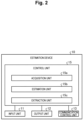
- Fig. 2 is a schematic diagram illustrating a schematic configuration of an estimation device.
- the estimation device 10 is implemented by a general-purpose computer such as a personal computer and includes an input unit 11, an output unit 12, a communication control unit 13, and a control unit 15.
- the input unit 11 is implemented with an input device such as a keyboard or a mouse and inputs various types of instruction information such as processing start to the control unit 15 in response to an input operation of an operator.
- the output unit 12 is implemented with a display device such as a liquid crystal display, a printing device such as a printer, or the like.
- the communication control unit 13 is implemented with a network interface card (NIC) or the like and controls communication between an external device such as a server and the control unit 15 via a network.
- NIC network interface card
- the communication control unit 13 controls communication between the control unit 15 and a management device or the like that manages a data set or a parameter of an estimation processing target to be described below.
- the control unit 15 is implemented with a central processing unit (CPU) or the like and executes a processing program stored in a memory. As a result, as illustrated in Fig. 2 , the control unit 15 functions as an acquisition unit 15a, an estimation unit 15b, and an extraction unit 15c. Each or some of these functional units may be mounted on different hardware. For example, the estimation unit 15b and the extraction unit 15c may be mounted on different hardware.
- the control unit 15 may include other functional units.
- the acquisition unit 15a acquires data determined to be abnormal and a plurality of pieces of data determined to be normal. For example, the acquisition unit 15a acquires, via the input unit 11 or via the communication control unit 13 from a management device or the like that manages results of deep learning, a data set of abnormal data of an estimation processing target to be described below or normal data used for the estimation process, a parameter used for the estimation process, and the like.
- the acquisition unit 15a may store the acquired data in a storage unit (not illustrated) implemented by a semiconductor memory element such as a random access memory (RAM) or a flash memory, or a storage device such as a hard disk or an optical disk. Alternatively, the acquisition unit 15a may transfer these pieces of information to the estimation unit 15b to be described below without storing the information in the storage unit.
- a storage unit not illustrated
- a semiconductor memory element such as a random access memory (RAM) or a flash memory
- a storage device such as a hard disk or an optical disk.
- the acquisition unit 15a may transfer these pieces of information to the estimation unit 15b to be described below without storing the information in the storage unit.
- the estimation unit 15b estimates normal data that has most similarity between the abnormal data determined to be abnormal and each of the plurality of normal data determined to be normal. Specifically, the estimation unit 15b evaluates similarity between a payload of a packet determined to be abnormal and a set of payloads of packets determined to be normal using the acquired data, and estimates a payload that is most similar to the payload of the packet determined to be abnormal.
- the estimation unit 15b calculates similarity between the abnormal data and the normal data by applying a dynamic programming method.
- the estimation device 10 sets, as a processing target, a payload of a packet of one piece of abnormal data and, for example, 100 or more pieces of normal data among data determined to be abnormal or normal in accordance with abnormality detection by deep learning.
- the payload is, for example, a character string of hexadecimal digits represented as [00 00 10 FF 10] or the like, and is a data string with a variable length which is 1 or more in length.
- the estimation unit 15b calculates the similarity between the abnormal data and the normal data assuming that characters appearing in the abnormal data and the normal data are looped continuously. That is, the estimation unit 15b assumes that byte characters (00 to FF) appearing in data are looped and sets similarity between, for example, byte characters "00" and "FF” and similarity between "00" and "01" to the same value.
- the dynamic programming method can be expressed as in the following Expressions (1) and (2).
- S i j max S i ⁇ 1 , j ⁇ 1 + s x i y j S i ⁇ 1 , j ⁇ d S i , j ⁇ 1 ⁇ d
- Expression (1) is an expression in which quantifies similarity S(i, j) between X and Y using similarity s(x i , y j ) between one character x i in an abnormal data string X and one character y j in a normal data string Y.
- the estimation unit 15b may set in advance such that the character similarity s to the byte character "00" of the normal data of the comparison destination is + 10, the character similarity s to "01", “02", “03”, “FF”, “FE”, and “FD” is + 5, and the similarity s to other byte characters is -5.
- the estimation unit 15b calculates the similarity between the abnormal data and the normal data using the similarity s between the characters of the abnormal data and the normal data as a value of a predetermined range.
- the estimation unit 15b After evaluating the similarity between the abnormal data string X and a k-th normal data string Y k , the estimation unit 15b repeats a process of evaluating similarity between the abnormal data string X and a (k+1)th normal data string Y k+1 until an l-th normal data string Y 1 .
- the estimation unit 15b can compare pieces of data with a variable length using the dynamic programming method.
- the estimation unit 15b calculates the similarity between the abnormal data string X and each normal data string Y by performing correction using an anomaly score. That is, the estimation unit 15b calculates, as the similarity between the abnormal data string X and each normal data string Y, a value obtained by multiplying the foregoing S(i, j) by an AI abnormality score (anomaly score) of a result of the abnormality detection by the deep learning of each normal data string Y as a bias. For example, the estimation unit 15b applies the bias so that the similarity score of the normal data having a lower anomaly score among the normal data with respect to the abnormal data increases. Then, the estimation unit 15b specifies the normal data string Y in which the calculated similarity is a highest value as Y target .
- the extraction unit 15c compares the abnormal data with the normal data estimated to have the maximum similarity and extracts a portion of the abnormal data having no portion corresponding to the normal data as a cause portion of the abnormality. Specifically, the extraction unit 15c extracts a portion having a gap from the estimated payload as an abnormal portion in the payload of the packet determined to be abnormal.
- the extraction unit 15c determines and extracts an abnormal portion. In this case, the extraction unit 15c substitutes the second byte of the normal data with a blank character.
- the second byte of the normal data is not "11"
- the second byte of the abnormal data and the normal data may be extracted as a portion having a gap.
- the extraction unit 15c outputs the extracted abnormal portion via the output unit 12. For example, the extraction unit 15c outputs a payload of a pair of abnormal data and normal data to the output unit 12 such as a display, and highlights a portion having a gap determined as an abnormal portion.
- the extraction unit 15c may output information regarding the extracted abnormal point to another information processing device via the communication control unit 13.
- FIG. 3 is a diagram illustrating an extraction processing result.
- normal data having most similarity to abnormal data and a portion having a gap in the abnormal data from the normal data are exemplified.
- Fig. 3 "0X86 0X8C 0X5F" is displayed as an abnormal portion having a gap as indicated in bold.
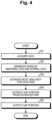
- Fig. 4 is a flowchart illustrating an estimation process procedure.
- the flowchart of Fig. 4 is started, for example, at a timing at which an operation of giving an instruction to start the estimation process is input.
- the acquisition unit 15a acquires abnormal data determined to be abnormal and a plurality of pieces of normal data determined to be normal (step S1).
- the estimation unit 15b generates pairs of abnormal data and normal data (step S2).
- the estimation unit 15b estimates a pair having the most similarity between the abnormal data and the normal data among the generated pairs (step S3).
- the estimation unit 15b calculates the similarity of each pair using dynamic programming method. At that time, the estimation unit 15b calculates the similarity of each pair assuming that the characters appearing in the abnormal data and the normal data continuously loop. The estimation unit 15b calculates the similarity of each pair using the similarity of the characters of the abnormal data and the normal data as a value of a predetermined range. The estimation unit 15b calculates the similarity of each pair by performing correction using the anomaly score.
- the extraction unit 15c compares the abnormal data with the normal data estimated to have the most similarity and extracts a portion of the abnormal data having no portion corresponding to the normal data and having a gap as a cause portion of the abnormality (step S4).
- the extraction unit 15c highlights the portion having the gap determined as the abnormal portion and outputs the highlighted portion to the output unit 12 (step S5). Consequently, a series of estimation processes end.
- the estimation unit 15b estimates the normal data having the most similarity between the abnormal data determined to be abnormal and each of the plurality of normal data determined to be normal.
- the extraction unit 15c compares the abnormal data with the normal data estimated to have the maximum similarity, and extracts a portion of the abnormal data having no portion corresponding to the normal data as a cause portion of the abnormality.
- estimation device 10 can specify a portion different from the normal data of the abnormal data most similar to the normal data as a portion causing the abnormality regardless of lengths of the normal data and the abnormal data. Accordingly, estimation device 10 can specify the cause of the abnormality by using the communication data with a variable length as an abnormality detection target.
- the estimation unit 15b calculates the similarity between the abnormal data and the normal data by applying the dynamic programming method. In this way, the estimation device 10 can accurately specify the cause of the abnormality by specifically calculating the similarity between the abnormal data and the normal data using the communication data with a variable length as the abnormality detection target.
- the estimation unit 15b calculates the similarity between the abnormal data and the normal data assuming that characters appearing in the abnormal data and the normal data continuously loop. As described above, the estimation device 10 can specify the cause of the abnormality by specifically efficiently calculating the similarity.
- the estimation unit 15b calculates the similarity between the abnormal data and the normal data using the similarity between the characters of the abnormal data and the characters of the normal data as a value of the predetermined range. As described above, the estimation device 10 can accurately specify the cause of the abnormality by specifically efficiently calculating the similarity.
- the estimation unit 15b calculates the similarity between the abnormal data and the normal data by performing correction using the anomaly score. In this way, the estimation device 10 can specify the cause of the abnormality by specifically calculating the similarity with high accuracy.
- Fig. 5 is a diagram illustrating an example.
- estimation accuracy of the byte portion of the abnormal communication data generated in an assumed cyberattack scenario was measured as described below.
- a malicious code insertion attack in which a malicious person inserts a code for executing a malicious program into a part of communication that is normally operating to enable a fraudulent operation is assumed. Then, a byte portion into which the malicious code was inserted was estimated as an abnormal portion.
- each byte was converted from hexadecimal digits (0x00 to 0xff) to numerical values (0 to 255) in order to obtain a data format which can be used in the dynamic programming method.
- Fig. 5 illustrates an evaluation result of Example.
- evaluation it is confirmed whether the estimation of the byte sequence of the abnormal position completely matches for each packet.
- a correct answer was set.
- an error was set.
- the abnormal position can be estimated in all the packets.
- e correct estimation cannot be performed for two packets.
- correct estimation cannot be performed for six packets.
- the estimation can be performed with 90% or more accuracy as a whole.
- the estimation device 10 can be mounted by installing an estimation program executing the foregoing estimation process as package software or online software on a desired computer.
- the information processing device can be caused to function as the estimation device 10.
- the information processing device also includes a mobile communication terminal such as a smartphone, a mobile phone, and a personal handyphone system (PHS) and a slate terminal such as a personal digital assistant (PDA).
- PHS personal handyphone system
- slate terminal such as a personal digital assistant
- the functions of the estimation device 10 may be mounted on a cloud server.
- FIG. 6 is a diagram illustrating an example of a computer that executes an estimation program.
- a computer 1000 includes, for example, a memory 1010, a CPU 1020, a hard disk drive interface 1030, a disk drive interface 1040, a serial port interface 1050, a video adapter 1060, and a network interface 1070. These units are connected to each other by a bus 1080.
- the memory 1010 includes a read only memory (ROM) 1011 and a RAM 1012.
- the ROM 1011 stores, for example, a boot program such as a basic input output system (BIOS).
- BIOS basic input output system
- the hard disk drive interface 1030 is connected to a hard disk drive 1031.
- the disk drive interface 1040 is connected to a disk drive 1041.
- a removable storage medium such as a magnetic disk or an optical disc is inserted into the disk drive 1041.
- the serial port interface 1050 is connected to, for example, a mouse 1051 and a keyboard 1052.
- the video adapter 1060 is connected to, for example, a display 1061.
- the hard disk drive 1031 stores, for example, an OS 1091, an application program 1092, a program module 1093, and program data 1094. All of the information described in the foregoing embodiment is stored in the hard disk drive 1031 or the memory 1010, for example.
- the estimation program is stored in the hard disk drive 1031 as the program module 1093 in which commands to be executed by the computer 1000, for example, are described.
- the program module 1093 in which each process executed by the estimation device 10 described in the foregoing embodiment is described is stored in the hard disk drive 1031.
- Data used in information process performed by the estimation program is stored as the program data 1094 in, for example, the hard disk drive 1031.
- the CPU 1020 reads, into the RAM 1012, the program module 1093 and the program data 1094 stored in the hard disk drive 1031 as necessary and executes each procedure described above.
- the program module 1093 and the program data 1094 related to the estimation program are not limited to being stored in the hard disk drive 1031, and may be stored in, for example, a removable storage medium and read by the CPU 1020 via the disk drive 1041 or the like.
- the program module 1093 and the program data 1094 related to the estimation program may be stored in another computer connected via a network such as a local area network (LAN) or a wide area network (WAN) and may be read by the CPU 1020 via the network interface 1070.
- LAN local area network
- WAN wide area network
Landscapes
- Engineering & Computer Science (AREA)
- Computer Security & Cryptography (AREA)
- General Engineering & Computer Science (AREA)
- Theoretical Computer Science (AREA)
- Computer Hardware Design (AREA)
- Software Systems (AREA)
- Physics & Mathematics (AREA)
- General Physics & Mathematics (AREA)
- Computing Systems (AREA)
- General Health & Medical Sciences (AREA)
- Health & Medical Sciences (AREA)
- Virology (AREA)
- Signal Processing (AREA)
- Mathematical Physics (AREA)
- Data Mining & Analysis (AREA)
- Evolutionary Computation (AREA)
- Computational Linguistics (AREA)
- Computer Networks & Wireless Communication (AREA)
- Artificial Intelligence (AREA)
- Biophysics (AREA)
- Biomedical Technology (AREA)
- Life Sciences & Earth Sciences (AREA)
- Medical Informatics (AREA)
- Molecular Biology (AREA)
- Data Exchanges In Wide-Area Networks (AREA)
- Devices For Executing Special Programs (AREA)
- Debugging And Monitoring (AREA)
Abstract
Description
- The present invention relates to an estimation device, an estimation method, and an estimation program.
- In recent years, an endeavor called smart factories aiming at optimization of factories by utilizing communication data of control devices in factories has been promoted. On the other hand, there is concern of new types of cyberattack targeting smart factories appearing, and security countermeasures are urgently required. Defending against new types of cyberattacks is difficult, and detection technologies are desired. In particular, anomaly-type abnormality detection in which deep learning for automatically learning normal features from input data is used is expected to enable new types of cyberattacks to be detected with high accuracy.
- However, a deep learning determination process is a black box. When an actual operation is assumed, people in charge of security cannot specify causes of abnormality because it is not possible to describe causes detected as abnormalities. Therefore, in recent years, a technology called a so-called interpretable AI for describing the causes of abnormalities from deep learning has been disclosed (see Non Patent Literature 1).
- Non Patent Literature 1: William Briguglio and Sherif Saad, "Interpreting Machine Learning Malware Detectors Which Leverage N-gram Analysis", [online], [retrieved on April 14, 2021], Internet <URL: https://arxiv.org/abs/2001.10916.pdf> Non Patent Literature 2: Xiao Zhang, Manish Marwah, I-ta Lee, Martin Arlitt, Dan Goldwasser, "ACE-An Anomaly Contribution Explainer for Cyber-Security Applications", [online], [retrieved on April 14, 2021], Internet <URL: https://arxiv.org/pdf/1912.00314.pdf>
- However, in the related technologies, causes of abnormalities are specified with communication data with fixed lengths as abnormality detection targets, and the causes of the abnormalities cannot be specified with the communication data with variable lengths as abnormality detection targets.
- The present invention has been made in view of the foregoing circumstances, and an object of the present invention is to set communication data with a variable length as an abnormality detection target and specify a cause of an abnormality.
- In order to solve the above-described problems and achieve the object, an estimation device according to an aspect of the present invention includes: an estimation unit configured to estimate normal data having maximum similarity to abnormal data by using the abnormal data determined to be abnormal and a plurality of pieces of normal data determined to be normal; and an extraction unit configured to compare the abnormal data with normal data estimated and extract a portion of the abnormal data having no portion corresponding to the normal data as a portion causing abnormality.
- According to the present invention, it is possible to set communication data with a variable length as an abnormality detection target and specify a cause of an abnormality.
-
-
Fig. 1 is a diagram illustrating an overview of an estimation device. -
Fig. 2 is a schematic diagram illustrating a schematic configuration of an estimation device. -
Fig. 3 is a diagram illustrating an extraction processing result. -
Fig. 4 is a flowchart illustrating an estimation processing procedure. -
Fig. 5 is a diagram illustrating an example. -
Fig. 6 is a diagram illustrating a computer that executes an estimation program. - Hereinafter, an embodiment of the present invention will be described in detail with reference to the drawings. The present invention is not limited by this embodiment. Further, in the description of the drawings, the same portions are denoted by the same reference numerals.
-
Fig. 1 is a diagram illustrating an overview of an estimation device. As illustrated inFig. 1 , the estimation device according to the present embodiment sets communication data with a variable length as an abnormality detection target and specifies a byte portion estimated as a cause of an abnormality of the communication data. Specifically, as illustrated inFig. 1(a) , for a pair of communication data determined to be abnormal (abnormality determination data) and a plurality of pieces of communication data determined to be normal (normality determination data), normality determination data most similar to the abnormality determination data is specified as illustrated inFig. 1(b) . At that time, the estimation device calculates similarity between abnormality determination data and each piece of normality determination data by applying a dynamic programming method of obtaining all calculation results while recording the calculation results of the plurality of divided portions. Of the portions, as illustrated inFig. 1(c) , a portion in which there is a gap is specified and is estimated as an abnormal byte that has caused abnormality determination. -
Fig. 2 is a schematic diagram illustrating a schematic configuration of an estimation device. As illustrated inFig. 2 , the estimation device 10 is implemented by a general-purpose computer such as a personal computer and includes aninput unit 11, anoutput unit 12, acommunication control unit 13, and acontrol unit 15. - The
input unit 11 is implemented with an input device such as a keyboard or a mouse and inputs various types of instruction information such as processing start to thecontrol unit 15 in response to an input operation of an operator. Theoutput unit 12 is implemented with a display device such as a liquid crystal display, a printing device such as a printer, or the like. - The
communication control unit 13 is implemented with a network interface card (NIC) or the like and controls communication between an external device such as a server and thecontrol unit 15 via a network. For example, thecommunication control unit 13 controls communication between thecontrol unit 15 and a management device or the like that manages a data set or a parameter of an estimation processing target to be described below. - The
control unit 15 is implemented with a central processing unit (CPU) or the like and executes a processing program stored in a memory. As a result, as illustrated inFig. 2 , thecontrol unit 15 functions as anacquisition unit 15a, anestimation unit 15b, and an extraction unit 15c. Each or some of these functional units may be mounted on different hardware. For example, theestimation unit 15b and the extraction unit 15c may be mounted on different hardware. Thecontrol unit 15 may include other functional units. - The
acquisition unit 15a acquires data determined to be abnormal and a plurality of pieces of data determined to be normal. For example, theacquisition unit 15a acquires, via theinput unit 11 or via thecommunication control unit 13 from a management device or the like that manages results of deep learning, a data set of abnormal data of an estimation processing target to be described below or normal data used for the estimation process, a parameter used for the estimation process, and the like. - The
acquisition unit 15a may store the acquired data in a storage unit (not illustrated) implemented by a semiconductor memory element such as a random access memory (RAM) or a flash memory, or a storage device such as a hard disk or an optical disk. Alternatively, theacquisition unit 15a may transfer these pieces of information to theestimation unit 15b to be described below without storing the information in the storage unit. - The
estimation unit 15b estimates normal data that has most similarity between the abnormal data determined to be abnormal and each of the plurality of normal data determined to be normal. Specifically, theestimation unit 15b evaluates similarity between a payload of a packet determined to be abnormal and a set of payloads of packets determined to be normal using the acquired data, and estimates a payload that is most similar to the payload of the packet determined to be abnormal. - For example, the
estimation unit 15b calculates similarity between the abnormal data and the normal data by applying a dynamic programming method. Here, the estimation device 10 sets, as a processing target, a payload of a packet of one piece of abnormal data and, for example, 100 or more pieces of normal data among data determined to be abnormal or normal in accordance with abnormality detection by deep learning. The payload is, for example, a character string of hexadecimal digits represented as [00 00 10 FF 10] or the like, and is a data string with a variable length which is 1 or more in length. - The
estimation unit 15b calculates the similarity between the abnormal data and the normal data assuming that characters appearing in the abnormal data and the normal data are looped continuously. That is, theestimation unit 15b assumes that byte characters (00 to FF) appearing in data are looped and sets similarity between, for example, byte characters "00" and "FF" and similarity between "00" and "01" to the same value. - The
estimation unit 15b calculates similarity S between one abnormal data string X=[x1, x2,..., xn] and one normal data string Y=[y1, y2,..., ym] among the plurality of normal data strings Y1, Y2,..., Yk,..., and Y1. At that time, theestimation unit 15b calculates Ytarget with the most similarity to X using the dynamic programming method. - The dynamic programming method can be expressed as in the following Expressions (1) and (2).
[Math. 1]

- The foregoing Expression (1) is an expression in which quantifies similarity S(i, j) between X and Y using similarity s(xi, yj) between one character xi in an abnormal data string X and one character yj in a normal data string Y.
- In the first row of the foregoing Expression (1), as shown in the foregoing Expression (2), when xi matches yj, +10 is set as s(xi, yj). When xi does not match yj, a distance between xi and yj is subtracted.
- Alternatively, for example, when comparing with the byte character "00" of the abnormal data, the
estimation unit 15b may set in advance such that the character similarity s to the byte character "00" of the normal data of the comparison destination is + 10, the character similarity s to "01", "02", "03", "FF", "FE", and "FD" is + 5, and the similarity s to other byte characters is -5. - In this way, the
estimation unit 15b calculates the similarity between the abnormal data and the normal data using the similarity s between the characters of the abnormal data and the normal data as a value of a predetermined range. - After evaluating the similarity between the abnormal data string X and a k-th normal data string Yk, the
estimation unit 15b repeats a process of evaluating similarity between the abnormal data string X and a (k+1)th normal data string Yk+1 until an l-th normal data string Y1. - In this way, the
estimation unit 15b can compare pieces of data with a variable length using the dynamic programming method. - Thereafter, the
estimation unit 15b calculates the similarity between the abnormal data string X and each normal data string Y by performing correction using an anomaly score. That is, theestimation unit 15b calculates, as the similarity between the abnormal data string X and each normal data string Y, a value obtained by multiplying the foregoing S(i, j) by an AI abnormality score (anomaly score) of a result of the abnormality detection by the deep learning of each normal data string Y as a bias. For example, theestimation unit 15b applies the bias so that the similarity score of the normal data having a lower anomaly score among the normal data with respect to the abnormal data increases. Then, theestimation unit 15b specifies the normal data string Y in which the calculated similarity is a highest value as Ytarget. - The extraction unit 15c compares the abnormal data with the normal data estimated to have the maximum similarity and extracts a portion of the abnormal data having no portion corresponding to the normal data as a cause portion of the abnormality. Specifically, the extraction unit 15c extracts a portion having a gap from the estimated payload as an abnormal portion in the payload of the packet determined to be abnormal.
- For example, when a payload of abnormal data of a comparison source is "00 11 FF FD" and a payload of normal data of a comparison destination is "00 FF FD," there is no portion corresponding to the second byte "11" of the comparison source in the normal data. Therefore, the extraction unit 15c determines and extracts an abnormal portion. In this case, the extraction unit 15c substitutes the second byte of the normal data with a blank character.
- Even when the second byte of the normal data is not "11," the second byte of the abnormal data and the normal data may be extracted as a portion having a gap.
- The extraction unit 15c outputs the extracted abnormal portion via the
output unit 12. For example, the extraction unit 15c outputs a payload of a pair of abnormal data and normal data to theoutput unit 12 such as a display, and highlights a portion having a gap determined as an abnormal portion. The extraction unit 15c may output information regarding the extracted abnormal point to another information processing device via thecommunication control unit 13. - Here,
Fig. 3 is a diagram illustrating an extraction processing result. InFig. 3 , normal data having most similarity to abnormal data and a portion having a gap in the abnormal data from the normal data are exemplified. InFig. 3 , "0X86 0X8C 0X5F" is displayed as an abnormal portion having a gap as indicated in bold. - Next, an estimation process performed by the estimation device 10 according to the present embodiment will be described with reference to
Fig. 4. Fig. 4 is a flowchart illustrating an estimation process procedure. The flowchart ofFig. 4 is started, for example, at a timing at which an operation of giving an instruction to start the estimation process is input. - First, the
acquisition unit 15a acquires abnormal data determined to be abnormal and a plurality of pieces of normal data determined to be normal (step S1). - Subsequently, the
estimation unit 15b generates pairs of abnormal data and normal data (step S2). Theestimation unit 15b estimates a pair having the most similarity between the abnormal data and the normal data among the generated pairs (step S3). - For example, the
estimation unit 15b calculates the similarity of each pair using dynamic programming method. At that time, theestimation unit 15b calculates the similarity of each pair assuming that the characters appearing in the abnormal data and the normal data continuously loop. Theestimation unit 15b calculates the similarity of each pair using the similarity of the characters of the abnormal data and the normal data as a value of a predetermined range. Theestimation unit 15b calculates the similarity of each pair by performing correction using the anomaly score. - The extraction unit 15c compares the abnormal data with the normal data estimated to have the most similarity and extracts a portion of the abnormal data having no portion corresponding to the normal data and having a gap as a cause portion of the abnormality (step S4).
- Then, the extraction unit 15c highlights the portion having the gap determined as the abnormal portion and outputs the highlighted portion to the output unit 12 (step S5). Consequently, a series of estimation processes end.
- As described above, in the estimation device 10, the
estimation unit 15b estimates the normal data having the most similarity between the abnormal data determined to be abnormal and each of the plurality of normal data determined to be normal. The extraction unit 15c compares the abnormal data with the normal data estimated to have the maximum similarity, and extracts a portion of the abnormal data having no portion corresponding to the normal data as a cause portion of the abnormality. - In this way, the estimation device 10 can specify a portion different from the normal data of the abnormal data most similar to the normal data as a portion causing the abnormality regardless of lengths of the normal data and the abnormal data. Accordingly, estimation device 10 can specify the cause of the abnormality by using the communication data with a variable length as an abnormality detection target.
- The
estimation unit 15b calculates the similarity between the abnormal data and the normal data by applying the dynamic programming method. In this way, the estimation device 10 can accurately specify the cause of the abnormality by specifically calculating the similarity between the abnormal data and the normal data using the communication data with a variable length as the abnormality detection target. - The
estimation unit 15b calculates the similarity between the abnormal data and the normal data assuming that characters appearing in the abnormal data and the normal data continuously loop. As described above, the estimation device 10 can specify the cause of the abnormality by specifically efficiently calculating the similarity. - The
estimation unit 15b calculates the similarity between the abnormal data and the normal data using the similarity between the characters of the abnormal data and the characters of the normal data as a value of the predetermined range. As described above, the estimation device 10 can accurately specify the cause of the abnormality by specifically efficiently calculating the similarity. - The
estimation unit 15b calculates the similarity between the abnormal data and the normal data by performing correction using the anomaly score. In this way, the estimation device 10 can specify the cause of the abnormality by specifically calculating the similarity with high accuracy. -
Fig. 5 is a diagram illustrating an example. In the present example, estimation accuracy of the byte portion of the abnormal communication data generated in an assumed cyberattack scenario was measured as described below. - As the cyberattack scenario, a malicious code insertion attack in which a malicious person inserts a code for executing a malicious program into a part of communication that is normally operating to enable a fraudulent operation is assumed. Then, a byte portion into which the malicious code was inserted was estimated as an abnormal portion.
- For example, in the case of normal communication "00 01 00 00 00 41 6b" and abnormal communication "00 01 00 00 54 1b FF FF 31 00 41 6b," an inserted malicious code "54 1b FF FF 31" is specified as an abnormal portion.
- Using 2133 pieces of normal data and 100 pieces of abnormal data for each length (three types of 1 to 3) of the malicious code to be inserted in packets to which a normal label or an abnormal label is given by deep learning, a byte sequence of the malicious code was inserted into one random location of the normal data.
- An abnormal portion was determined for each packet. At that time, each byte was converted from hexadecimal digits (0x00 to 0xff) to numerical values (0 to 255) in order to obtain a data format which can be used in the dynamic programming method.
-
Fig. 5 illustrates an evaluation result of Example. In evaluation, it is confirmed whether the estimation of the byte sequence of the abnormal position completely matches for each packet. When the estimation of the byte sequence of the abnormal position completely matches, a correct answer was set. When the estimation of the byte sequence of the abnormal position completely does not match, an error was set. - As illustrated in
Fig. 5 , when the abnormal byte sequence is inserted into one location, the abnormal position can be estimated in all the packets. When an abnormal byte sequence is inserted into two locations, e correct estimation cannot be performed for two packets. When an abnormal byte sequence is inserted into three locations, correct estimation cannot be performed for six packets. However, it has been confirmed that the estimation can be performed with 90% or more accuracy as a whole. - It is also possible to produce a program that describes the process executed by the estimation device 10 according to the above embodiment. in a computer executable language. As an embodiment, the estimation device 10 can be mounted by installing an estimation program executing the foregoing estimation process as package software or online software on a desired computer. For example, by causing an information processing device to perform the estimation program, the information processing device can be caused to function as the estimation device 10. The information processing device also includes a mobile communication terminal such as a smartphone, a mobile phone, and a personal handyphone system (PHS) and a slate terminal such as a personal digital assistant (PDA). The functions of the estimation device 10 may be mounted on a cloud server.
-
Fig. 6 is a diagram illustrating an example of a computer that executes an estimation program. Acomputer 1000 includes, for example, amemory 1010, aCPU 1020, a harddisk drive interface 1030, adisk drive interface 1040, aserial port interface 1050, avideo adapter 1060, and anetwork interface 1070. These units are connected to each other by a bus 1080. - The
memory 1010 includes a read only memory (ROM) 1011 and aRAM 1012. TheROM 1011 stores, for example, a boot program such as a basic input output system (BIOS). The harddisk drive interface 1030 is connected to ahard disk drive 1031. Thedisk drive interface 1040 is connected to adisk drive 1041. For example, a removable storage medium such as a magnetic disk or an optical disc is inserted into thedisk drive 1041. Theserial port interface 1050 is connected to, for example, amouse 1051 and akeyboard 1052. Thevideo adapter 1060 is connected to, for example, adisplay 1061. - Here, the
hard disk drive 1031 stores, for example, anOS 1091, anapplication program 1092, aprogram module 1093, andprogram data 1094. All of the information described in the foregoing embodiment is stored in thehard disk drive 1031 or thememory 1010, for example. - The estimation program is stored in the
hard disk drive 1031 as theprogram module 1093 in which commands to be executed by thecomputer 1000, for example, are described. Specifically, theprogram module 1093 in which each process executed by the estimation device 10 described in the foregoing embodiment is described is stored in thehard disk drive 1031. - Data used in information process performed by the estimation program is stored as the
program data 1094 in, for example, thehard disk drive 1031. TheCPU 1020 reads, into theRAM 1012, theprogram module 1093 and theprogram data 1094 stored in thehard disk drive 1031 as necessary and executes each procedure described above. - The
program module 1093 and theprogram data 1094 related to the estimation program are not limited to being stored in thehard disk drive 1031, and may be stored in, for example, a removable storage medium and read by theCPU 1020 via thedisk drive 1041 or the like. Alternatively, theprogram module 1093 and theprogram data 1094 related to the estimation program may be stored in another computer connected via a network such as a local area network (LAN) or a wide area network (WAN) and may be read by theCPU 1020 via thenetwork interface 1070. - Although the embodiments to which the invention made by the present inventors is applied have been described above, the present invention is not limited by the description and the drawings forming a part of the disclosure of the present invention according to the present embodiments. In other words, other embodiments, examples, operational technologies, and the like made by those skilled in the art and the like on the basis of the present embodiment are all included in the scope of the present invention.
-
- 10
- Estimation device
- 11
- Input unit
- 12
- Output unit
- 13
- Communication control unit
- 15
- Control unit
- 15a
- Acquisition unit
- 15b
- Estimation unit
- 15c
- Extraction unit
Claims (7)
- An estimation device comprising:an estimation unit configured to estimate normal data having maximum similarity between abnormal data determined to be abnormal and each of a plurality of pieces of normal data determined to be normal; andan extraction unit configured to compare the abnormal data with normal data estimated to have the maximum similarity and extract a portion of the abnormal data having no portion corresponding to the normal data as a portion causing abnormality.
- The estimation device according to claim 1, wherein the estimation unit calculates similarity by applying a dynamic programming method.
- The estimation device according to claim 2, wherein the estimation unit calculates similarity assuming that characters appearing in the abnormal data and the normal data continuously loop.
- The estimation device according to claim 2, wherein the estimation unit calculates the similarity by using similarity between characters of the abnormal data and characters of the normal data as a value of a predetermined range.
- The estimation device according to claim 2, wherein the estimation unit calculates the similarity by performing correction using an anomaly score.
- An estimation method executed by an estimation device, the estimation method comprising:an estimation procedure of estimating normal data having maximum similarity between abnormal data determined to be abnormal and each of a plurality of pieces of normal data determined to be normal; andan extraction procedure of comparing the abnormal data with normal data estimated to have the maximum similarity and extracting a portion of the abnormal data having no portion corresponding to the normal data as a portion causing abnormality.
- An estimation program that causes a computer to execute:an estimation step of estimating normal data having maximum similarity between abnormal data determined to be abnormal and each of a plurality of pieces of normal data determined to be normal; andan extraction step of comparing the abnormal data with normal data estimated to have the maximum similarity and extracting a portion of the abnormal data having no portion corresponding to the normal data as a portion causing abnormality.
Applications Claiming Priority (1)
| Application Number | Priority Date | Filing Date | Title |
|---|---|---|---|
| PCT/JP2021/018654 WO2022244077A1 (en) | 2021-05-17 | 2021-05-17 | Estimation device, estimation method, and estimation program |
Publications (3)
| Publication Number | Publication Date |
|---|---|
| EP4325385A1 true EP4325385A1 (en) | 2024-02-21 |
| EP4325385A4 EP4325385A4 (en) | 2025-01-15 |
| EP4325385B1 EP4325385B1 (en) | 2026-03-11 |
Family
ID=84141360
Family Applications (1)
| Application Number | Title | Priority Date | Filing Date |
|---|---|---|---|
| EP21940697.2A Active EP4325385B1 (en) | 2021-05-17 | 2021-05-17 | Estimation device, estimation method, and estimation program |
Country Status (6)
| Country | Link |
|---|---|
| US (1) | US20240256667A1 (en) |
| EP (1) | EP4325385B1 (en) |
| JP (1) | JP7586306B2 (en) |
| CN (1) | CN117296068B (en) |
| AU (1) | AU2021445975B2 (en) |
| WO (1) | WO2022244077A1 (en) |
Families Citing this family (1)
| Publication number | Priority date | Publication date | Assignee | Title |
|---|---|---|---|---|
| CN117296068B (en) * | 2021-05-17 | 2025-09-30 | 恩梯梯株式会社 | Estimation device, estimation method, and recording medium |
Family Cites Families (12)
| Publication number | Priority date | Publication date | Assignee | Title |
|---|---|---|---|---|
| US6721456B1 (en) * | 2000-02-23 | 2004-04-13 | International Business Machines Corporation | Color image data and control bit compression scheme with run length encoding |
| US20070192863A1 (en) * | 2005-07-01 | 2007-08-16 | Harsh Kapoor | Systems and methods for processing data flows |
| JP2005115426A (en) * | 2003-10-02 | 2005-04-28 | Omron Corp | Abnormality recovery support device and abnormality recovery support system |
| WO2005047862A2 (en) * | 2003-11-12 | 2005-05-26 | The Trustees Of Columbia University In The City Of New York | Apparatus method and medium for identifying files using n-gram distribution of data |
| JP5522850B2 (en) * | 2010-11-10 | 2014-06-18 | 京セラコミュニケーションシステム株式会社 | Vulnerability diagnostic device |
| KR101162051B1 (en) * | 2010-12-21 | 2012-07-03 | 한국인터넷진흥원 | Using string comparison malicious code detection and classification system and method |
| WO2017061270A1 (en) * | 2015-10-09 | 2017-04-13 | 日本電信電話株式会社 | Vulnerability discovering device, vulnerability discovering method, and vulnerability discovering program |
| JP6585654B2 (en) * | 2017-05-01 | 2019-10-02 | 日本電信電話株式会社 | Determination apparatus, analysis system, determination method, and determination program |
| CN110278177B (en) * | 2018-03-15 | 2022-04-12 | 武汉芯泰科技有限公司 | IP packet header detection method and device |
| WO2020186033A1 (en) * | 2019-03-13 | 2020-09-17 | Arun Lakhotia | Method for automatic creation of malware detection signature |
| WO2022190198A1 (en) * | 2021-03-09 | 2022-09-15 | 日本電信電話株式会社 | Estimation device, estimation method and program |
| CN117296068B (en) * | 2021-05-17 | 2025-09-30 | 恩梯梯株式会社 | Estimation device, estimation method, and recording medium |
-
2021
- 2021-05-17 CN CN202180097987.1A patent/CN117296068B/en active Active
- 2021-05-17 AU AU2021445975A patent/AU2021445975B2/en active Active
- 2021-05-17 JP JP2023522024A patent/JP7586306B2/en active Active
- 2021-05-17 EP EP21940697.2A patent/EP4325385B1/en active Active
- 2021-05-17 WO PCT/JP2021/018654 patent/WO2022244077A1/en not_active Ceased
- 2021-05-17 US US18/290,452 patent/US20240256667A1/en active Pending
Also Published As
| Publication number | Publication date |
|---|---|
| CN117296068B (en) | 2025-09-30 |
| EP4325385A4 (en) | 2025-01-15 |
| CN117296068A (en) | 2023-12-26 |
| WO2022244077A1 (en) | 2022-11-24 |
| AU2021445975A1 (en) | 2023-11-16 |
| JP7586306B2 (en) | 2024-11-19 |
| AU2021445975B2 (en) | 2025-07-24 |
| JPWO2022244077A1 (en) | 2022-11-24 |
| EP4325385B1 (en) | 2026-03-11 |
| US20240256667A1 (en) | 2024-08-01 |
Similar Documents
| Publication | Publication Date | Title |
|---|---|---|
| EP3404572B1 (en) | Attack code detection device, attack code detection method, and attack code detection program | |
| US11102082B1 (en) | System and method for inferring operating systems using transmission control protocol fingerprints | |
| EP3506140A1 (en) | Hacking code sensing device, hacking code sensing method, and hacking code sensing program | |
| JP6697123B2 (en) | Profile generation device, attack detection device, profile generation method, and profile generation program | |
| WO2015186662A1 (en) | Log analysis device, attack detection device, attack detection method and program | |
| CN113935034B (en) | Malicious code family classification method, device and storage medium based on graph neural network | |
| EP3796599B1 (en) | Evaluation device and evaluation method | |
| EP3367288B1 (en) | Classification method, classification device, and classification program | |
| Elkhawas et al. | Malware detection using opcode trigram sequence with SVM | |
| EP3964986A1 (en) | Extraction device, extraction method, and extraction program | |
| EP4325385B1 (en) | Estimation device, estimation method, and estimation program | |
| Nafiiev et al. | Malware detection model based on machine learning | |
| US20150193617A1 (en) | Signature verification device, signature verification method, and program | |
| CN114579965A (en) | Malicious code detection method and device and computer readable storage medium | |
| Pranav et al. | Detection of botnets in IoT networks using graph theory and machine learning | |
| CN116458119B (en) | Estimation device, estimation method, and recording medium | |
| CN119172281A (en) | Terminal abnormality detection method and related device | |
| EP4332801B1 (en) | Estimation device, estimation method, and estimation program | |
| JP7593491B2 (en) | DETECTION APPARATUS, DETECTION METHOD, AND DETECTION PROGRAM | |
| US12265617B2 (en) | Labeling device and labeling program | |
| CN113728605A (en) | Abnormality detection method and abnormality detection device | |
| EP4524790A1 (en) | Abnormality detection device, abnormality detection method, and abnormality detection program | |
| Nandakumar et al. | A Novel Approach to User Agent String Parsing for Vulnerability Analysis Using Multi-Headed Attention | |
| Shiroky | How does the Structure of a Complex Information System Affects its Integral Risk | |
| Tsuzaki et al. | A fuzzy hashing technique for large scale software birthmarks |
Legal Events
| Date | Code | Title | Description |
|---|---|---|---|
| STAA | Information on the status of an ep patent application or granted ep patent |
Free format text: STATUS: THE INTERNATIONAL PUBLICATION HAS BEEN MADE |
|
| PUAI | Public reference made under article 153(3) epc to a published international application that has entered the european phase |
Free format text: ORIGINAL CODE: 0009012 |
|
| STAA | Information on the status of an ep patent application or granted ep patent |
Free format text: STATUS: REQUEST FOR EXAMINATION WAS MADE |
|
| 17P | Request for examination filed |
Effective date: 20231113 |
|
| AK | Designated contracting states |
Kind code of ref document: A1 Designated state(s): AL AT BE BG CH CY CZ DE DK EE ES FI FR GB GR HR HU IE IS IT LI LT LU LV MC MK MT NL NO PL PT RO RS SE SI SK SM TR |
|
| DAV | Request for validation of the european patent (deleted) | ||
| DAX | Request for extension of the european patent (deleted) | ||
| A4 | Supplementary search report drawn up and despatched |
Effective date: 20241217 |
|
| RIC1 | Information provided on ipc code assigned before grant |
Ipc: H04L 65/1069 20220101ALN20241211BHEP Ipc: H04L 9/40 20220101ALI20241211BHEP Ipc: G06N 5/045 20230101ALI20241211BHEP Ipc: G06N 3/09 20230101ALI20241211BHEP Ipc: G06N 20/00 20190101ALI20241211BHEP Ipc: G06F 21/56 20130101AFI20241211BHEP |
|
| RAP3 | Party data changed (applicant data changed or rights of an application transferred) |
Owner name: NTT, INC. |
|
| GRAP | Despatch of communication of intention to grant a patent |
Free format text: ORIGINAL CODE: EPIDOSNIGR1 |
|
| RIC1 | Information provided on ipc code assigned before grant |
Ipc: G06F 21/56 20130101AFI20250917BHEP Ipc: G06N 20/00 20190101ALI20250917BHEP Ipc: G06N 3/09 20230101ALI20250917BHEP Ipc: G06N 5/045 20230101ALI20250917BHEP Ipc: H04L 9/40 20220101ALI20250917BHEP Ipc: H04L 65/1069 20220101ALN20250917BHEP |
|
| STAA | Information on the status of an ep patent application or granted ep patent |
Free format text: STATUS: GRANT OF PATENT IS INTENDED |
|
| RIC1 | Information provided on ipc code assigned before grant |
Ipc: G06F 21/56 20130101AFI20251008BHEP Ipc: G06N 20/00 20190101ALI20251008BHEP Ipc: G06N 3/09 20230101ALI20251008BHEP Ipc: G06N 5/045 20230101ALI20251008BHEP Ipc: H04L 9/40 20220101ALI20251008BHEP Ipc: H04L 65/1069 20220101ALN20251008BHEP |
|
| RIC1 | Information provided on ipc code assigned before grant |
Ipc: G06F 21/56 20130101AFI20251014BHEP Ipc: G06N 20/00 20190101ALI20251014BHEP Ipc: G06N 3/09 20230101ALI20251014BHEP Ipc: G06N 5/045 20230101ALI20251014BHEP Ipc: H04L 9/40 20220101ALI20251014BHEP Ipc: H04L 65/1069 20220101ALN20251014BHEP |
|
| INTG | Intention to grant announced |
Effective date: 20251022 |
|
| GRAS | Grant fee paid |
Free format text: ORIGINAL CODE: EPIDOSNIGR3 |
|
| GRAA | (expected) grant |
Free format text: ORIGINAL CODE: 0009210 |
|
| STAA | Information on the status of an ep patent application or granted ep patent |
Free format text: STATUS: THE PATENT HAS BEEN GRANTED |
|
| AK | Designated contracting states |
Kind code of ref document: B1 Designated state(s): AL AT BE BG CH CY CZ DE DK EE ES FI FR GB GR HR HU IE IS IT LI LT LU LV MC MK MT NL NO PL PT RO RS SE SI SK SM TR |
|
| REG | Reference to a national code |
Ref country code: CH Ref legal event code: F10 Free format text: ST27 STATUS EVENT CODE: U-0-0-F10-F00 (AS PROVIDED BY THE NATIONAL OFFICE) Effective date: 20260311 Ref country code: GB Ref legal event code: FG4D |
|
| REG | Reference to a national code |
Ref country code: DE Ref legal event code: R096 Ref document number: 602021049976 Country of ref document: DE |
|
| REG | Reference to a national code |
Ref country code: IE Ref legal event code: FG4D |
|
| PG25 | Lapsed in a contracting state [announced via postgrant information from national office to epo] |
Ref country code: RS Free format text: LAPSE BECAUSE OF FAILURE TO SUBMIT A TRANSLATION OF THE DESCRIPTION OR TO PAY THE FEE WITHIN THE PRESCRIBED TIME-LIMIT Effective date: 20260611 |
|
| PG25 | Lapsed in a contracting state [announced via postgrant information from national office to epo] |
Ref country code: ES Free format text: LAPSE BECAUSE OF FAILURE TO SUBMIT A TRANSLATION OF THE DESCRIPTION OR TO PAY THE FEE WITHIN THE PRESCRIBED TIME-LIMIT Effective date: 20260311 |
|
| PGFP | Annual fee paid to national office [announced via postgrant information from national office to epo] |
Ref country code: GB Payment date: 20260527 Year of fee payment: 6 |
|
| PG25 | Lapsed in a contracting state [announced via postgrant information from national office to epo] |
Ref country code: GR Free format text: LAPSE BECAUSE OF FAILURE TO SUBMIT A TRANSLATION OF THE DESCRIPTION OR TO PAY THE FEE WITHIN THE PRESCRIBED TIME-LIMIT Effective date: 20260612 |
|
| REG | Reference to a national code |
Ref country code: LT Ref legal event code: MG9D |
|
| PG25 | Lapsed in a contracting state [announced via postgrant information from national office to epo] |
Ref country code: LT Free format text: LAPSE BECAUSE OF FAILURE TO SUBMIT A TRANSLATION OF THE DESCRIPTION OR TO PAY THE FEE WITHIN THE PRESCRIBED TIME-LIMIT Effective date: 20260311 |
|
| PGFP | Annual fee paid to national office [announced via postgrant information from national office to epo] |
Ref country code: DE Payment date: 20260528 Year of fee payment: 6 |
|
| PG25 | Lapsed in a contracting state [announced via postgrant information from national office to epo] |
Ref country code: NO Free format text: LAPSE BECAUSE OF FAILURE TO SUBMIT A TRANSLATION OF THE DESCRIPTION OR TO PAY THE FEE WITHIN THE PRESCRIBED TIME-LIMIT Effective date: 20260611 |
|
| PG25 | Lapsed in a contracting state [announced via postgrant information from national office to epo] |
Ref country code: SE Free format text: LAPSE BECAUSE OF FAILURE TO SUBMIT A TRANSLATION OF THE DESCRIPTION OR TO PAY THE FEE WITHIN THE PRESCRIBED TIME-LIMIT Effective date: 20260311 Ref country code: FI Free format text: LAPSE BECAUSE OF FAILURE TO SUBMIT A TRANSLATION OF THE DESCRIPTION OR TO PAY THE FEE WITHIN THE PRESCRIBED TIME-LIMIT Effective date: 20260311 |
|
| REG | Reference to a national code |
Ref country code: NL Ref legal event code: MP Effective date: 20260311 |
|
| PG25 | Lapsed in a contracting state [announced via postgrant information from national office to epo] |
Ref country code: HR Free format text: LAPSE BECAUSE OF FAILURE TO SUBMIT A TRANSLATION OF THE DESCRIPTION OR TO PAY THE FEE WITHIN THE PRESCRIBED TIME-LIMIT Effective date: 20260311 |
|
| PGFP | Annual fee paid to national office [announced via postgrant information from national office to epo] |
Ref country code: FR Payment date: 20260527 Year of fee payment: 6 |
|
| PG25 | Lapsed in a contracting state [announced via postgrant information from national office to epo] |
Ref country code: LV Free format text: LAPSE BECAUSE OF FAILURE TO SUBMIT A TRANSLATION OF THE DESCRIPTION OR TO PAY THE FEE WITHIN THE PRESCRIBED TIME-LIMIT Effective date: 20260311 |
|
| PG25 | Lapsed in a contracting state [announced via postgrant information from national office to epo] |
Ref country code: BG Free format text: LAPSE BECAUSE OF FAILURE TO SUBMIT A TRANSLATION OF THE DESCRIPTION OR TO PAY THE FEE WITHIN THE PRESCRIBED TIME-LIMIT Effective date: 20260311 |