EP4324556A1 - Zeolite with improved hydroisomerization activity - Google Patents
Zeolite with improved hydroisomerization activity Download PDFInfo
- Publication number
- EP4324556A1 EP4324556A1 EP23186887.8A EP23186887A EP4324556A1 EP 4324556 A1 EP4324556 A1 EP 4324556A1 EP 23186887 A EP23186887 A EP 23186887A EP 4324556 A1 EP4324556 A1 EP 4324556A1
- Authority
- EP
- European Patent Office
- Prior art keywords
- zeolite catalyst
- zeolite
- equal
- lutidine
- collidine
- Prior art date
- Legal status (The legal status is an assumption and is not a legal conclusion. Google has not performed a legal analysis and makes no representation as to the accuracy of the status listed.)
- Pending
Links
Images


Classifications
-
- C—CHEMISTRY; METALLURGY
- C07—ORGANIC CHEMISTRY
- C07C—ACYCLIC OR CARBOCYCLIC COMPOUNDS
- C07C5/00—Preparation of hydrocarbons from hydrocarbons containing the same number of carbon atoms
- C07C5/22—Preparation of hydrocarbons from hydrocarbons containing the same number of carbon atoms by isomerisation
- C07C5/2206—Catalytic processes not covered by C07C5/23 - C07C5/31
- C07C5/222—Catalytic processes not covered by C07C5/23 - C07C5/31 with crystalline alumino-silicates, e.g. molecular sieves
-
- B—PERFORMING OPERATIONS; TRANSPORTING
- B01—PHYSICAL OR CHEMICAL PROCESSES OR APPARATUS IN GENERAL
- B01J—CHEMICAL OR PHYSICAL PROCESSES, e.g. CATALYSIS OR COLLOID CHEMISTRY; THEIR RELEVANT APPARATUS
- B01J29/00—Catalysts comprising molecular sieves
- B01J29/04—Catalysts comprising molecular sieves having base-exchange properties, e.g. crystalline zeolites
- B01J29/06—Crystalline aluminosilicate zeolites; Isomorphous compounds thereof
- B01J29/70—Crystalline aluminosilicate zeolites; Isomorphous compounds thereof of types characterised by their specific structure not provided for in groups B01J29/08 - B01J29/65
- B01J29/72—Crystalline aluminosilicate zeolites; Isomorphous compounds thereof of types characterised by their specific structure not provided for in groups B01J29/08 - B01J29/65 containing iron group metals, noble metals or copper
- B01J29/74—Noble metals
- B01J29/7461—MRE-type, e.g. ZSM-48
-
- B—PERFORMING OPERATIONS; TRANSPORTING
- B01—PHYSICAL OR CHEMICAL PROCESSES OR APPARATUS IN GENERAL
- B01J—CHEMICAL OR PHYSICAL PROCESSES, e.g. CATALYSIS OR COLLOID CHEMISTRY; THEIR RELEVANT APPARATUS
- B01J29/00—Catalysts comprising molecular sieves
- B01J29/04—Catalysts comprising molecular sieves having base-exchange properties, e.g. crystalline zeolites
- B01J29/06—Crystalline aluminosilicate zeolites; Isomorphous compounds thereof
- B01J29/70—Crystalline aluminosilicate zeolites; Isomorphous compounds thereof of types characterised by their specific structure not provided for in groups B01J29/08 - B01J29/65
- B01J29/703—MRE-type, e.g. ZSM-48
-
- B—PERFORMING OPERATIONS; TRANSPORTING
- B01—PHYSICAL OR CHEMICAL PROCESSES OR APPARATUS IN GENERAL
- B01J—CHEMICAL OR PHYSICAL PROCESSES, e.g. CATALYSIS OR COLLOID CHEMISTRY; THEIR RELEVANT APPARATUS
- B01J35/00—Catalysts, in general, characterised by their form or physical properties
- B01J35/50—Catalysts, in general, characterised by their form or physical properties characterised by their shape or configuration
-
- B—PERFORMING OPERATIONS; TRANSPORTING
- B01—PHYSICAL OR CHEMICAL PROCESSES OR APPARATUS IN GENERAL
- B01J—CHEMICAL OR PHYSICAL PROCESSES, e.g. CATALYSIS OR COLLOID CHEMISTRY; THEIR RELEVANT APPARATUS
- B01J35/00—Catalysts, in general, characterised by their form or physical properties
- B01J35/50—Catalysts, in general, characterised by their form or physical properties characterised by their shape or configuration
- B01J35/54—Bars or plates
-
- B—PERFORMING OPERATIONS; TRANSPORTING
- B01—PHYSICAL OR CHEMICAL PROCESSES OR APPARATUS IN GENERAL
- B01J—CHEMICAL OR PHYSICAL PROCESSES, e.g. CATALYSIS OR COLLOID CHEMISTRY; THEIR RELEVANT APPARATUS
- B01J35/00—Catalysts, in general, characterised by their form or physical properties
- B01J35/60—Catalysts, in general, characterised by their form or physical properties characterised by their surface properties or porosity
- B01J35/61—Surface area
- B01J35/615—100-500 m2/g
-
- B—PERFORMING OPERATIONS; TRANSPORTING
- B01—PHYSICAL OR CHEMICAL PROCESSES OR APPARATUS IN GENERAL
- B01J—CHEMICAL OR PHYSICAL PROCESSES, e.g. CATALYSIS OR COLLOID CHEMISTRY; THEIR RELEVANT APPARATUS
- B01J35/00—Catalysts, in general, characterised by their form or physical properties
- B01J35/60—Catalysts, in general, characterised by their form or physical properties characterised by their surface properties or porosity
- B01J35/63—Pore volume
- B01J35/633—Pore volume less than 0.5 ml/g
-
- B—PERFORMING OPERATIONS; TRANSPORTING
- B01—PHYSICAL OR CHEMICAL PROCESSES OR APPARATUS IN GENERAL
- B01J—CHEMICAL OR PHYSICAL PROCESSES, e.g. CATALYSIS OR COLLOID CHEMISTRY; THEIR RELEVANT APPARATUS
- B01J35/00—Catalysts, in general, characterised by their form or physical properties
- B01J35/60—Catalysts, in general, characterised by their form or physical properties characterised by their surface properties or porosity
- B01J35/64—Pore diameter
- B01J35/643—Pore diameter less than 2 nm
-
- B—PERFORMING OPERATIONS; TRANSPORTING
- B01—PHYSICAL OR CHEMICAL PROCESSES OR APPARATUS IN GENERAL
- B01J—CHEMICAL OR PHYSICAL PROCESSES, e.g. CATALYSIS OR COLLOID CHEMISTRY; THEIR RELEVANT APPARATUS
- B01J35/00—Catalysts, in general, characterised by their form or physical properties
- B01J35/60—Catalysts, in general, characterised by their form or physical properties characterised by their surface properties or porosity
- B01J35/64—Pore diameter
- B01J35/647—2-50 nm
-
- C—CHEMISTRY; METALLURGY
- C01—INORGANIC CHEMISTRY
- C01B—NON-METALLIC ELEMENTS; COMPOUNDS THEREOF; METALLOIDS OR COMPOUNDS THEREOF NOT COVERED BY SUBCLASS C01C
- C01B39/00—Compounds having molecular sieve and base-exchange properties, e.g. crystalline zeolites; Their preparation; After-treatment, e.g. ion-exchange or dealumination
- C01B39/02—Crystalline aluminosilicate zeolites; Isomorphous compounds thereof; Direct preparation thereof; Preparation thereof starting from a reaction mixture containing a crystalline zeolite of another type, or from preformed reactants; After-treatment thereof
- C01B39/46—Other types characterised by their X-ray diffraction pattern and their defined composition
- C01B39/48—Other types characterised by their X-ray diffraction pattern and their defined composition using at least one organic template directing agent
-
- C—CHEMISTRY; METALLURGY
- C10—PETROLEUM, GAS OR COKE INDUSTRIES; TECHNICAL GASES CONTAINING CARBON MONOXIDE; FUELS; LUBRICANTS; PEAT
- C10G—CRACKING HYDROCARBON OILS; PRODUCTION OF LIQUID HYDROCARBON MIXTURES, e.g. BY DESTRUCTIVE HYDROGENATION, OLIGOMERISATION, POLYMERISATION; RECOVERY OF HYDROCARBON OILS FROM OIL-SHALE, OIL-SAND, OR GASES; REFINING MIXTURES MAINLY CONSISTING OF HYDROCARBONS; REFORMING OF NAPHTHA; MINERAL WAXES
- C10G45/00—Refining of hydrocarbon oils using hydrogen or hydrogen-generating compounds
- C10G45/44—Hydrogenation of the aromatic hydrocarbons
- C10G45/46—Hydrogenation of the aromatic hydrocarbons characterised by the catalyst used
- C10G45/54—Hydrogenation of the aromatic hydrocarbons characterised by the catalyst used containing crystalline alumino-silicates, e.g. molecular sieves
-
- C—CHEMISTRY; METALLURGY
- C10—PETROLEUM, GAS OR COKE INDUSTRIES; TECHNICAL GASES CONTAINING CARBON MONOXIDE; FUELS; LUBRICANTS; PEAT
- C10G—CRACKING HYDROCARBON OILS; PRODUCTION OF LIQUID HYDROCARBON MIXTURES, e.g. BY DESTRUCTIVE HYDROGENATION, OLIGOMERISATION, POLYMERISATION; RECOVERY OF HYDROCARBON OILS FROM OIL-SHALE, OIL-SAND, OR GASES; REFINING MIXTURES MAINLY CONSISTING OF HYDROCARBONS; REFORMING OF NAPHTHA; MINERAL WAXES
- C10G45/00—Refining of hydrocarbon oils using hydrogen or hydrogen-generating compounds
- C10G45/58—Refining of hydrocarbon oils using hydrogen or hydrogen-generating compounds to change the structural skeleton of some of the hydrocarbon content without cracking the other hydrocarbons present, e.g. lowering pour point; Selective hydrocracking of normal paraffins
- C10G45/60—Refining of hydrocarbon oils using hydrogen or hydrogen-generating compounds to change the structural skeleton of some of the hydrocarbon content without cracking the other hydrocarbons present, e.g. lowering pour point; Selective hydrocracking of normal paraffins characterised by the catalyst used
- C10G45/64—Refining of hydrocarbon oils using hydrogen or hydrogen-generating compounds to change the structural skeleton of some of the hydrocarbon content without cracking the other hydrocarbons present, e.g. lowering pour point; Selective hydrocracking of normal paraffins characterised by the catalyst used containing crystalline alumino-silicates, e.g. molecular sieves
-
- C—CHEMISTRY; METALLURGY
- C10—PETROLEUM, GAS OR COKE INDUSTRIES; TECHNICAL GASES CONTAINING CARBON MONOXIDE; FUELS; LUBRICANTS; PEAT
- C10G—CRACKING HYDROCARBON OILS; PRODUCTION OF LIQUID HYDROCARBON MIXTURES, e.g. BY DESTRUCTIVE HYDROGENATION, OLIGOMERISATION, POLYMERISATION; RECOVERY OF HYDROCARBON OILS FROM OIL-SHALE, OIL-SAND, OR GASES; REFINING MIXTURES MAINLY CONSISTING OF HYDROCARBONS; REFORMING OF NAPHTHA; MINERAL WAXES
- C10G65/00—Treatment of hydrocarbon oils by two or more hydrotreatment processes only
- C10G65/02—Treatment of hydrocarbon oils by two or more hydrotreatment processes only plural serial stages only
- C10G65/04—Treatment of hydrocarbon oils by two or more hydrotreatment processes only plural serial stages only including only refining steps
- C10G65/08—Treatment of hydrocarbon oils by two or more hydrotreatment processes only plural serial stages only including only refining steps at least one step being a hydrogenation of the aromatic hydrocarbons
-
- C—CHEMISTRY; METALLURGY
- C10—PETROLEUM, GAS OR COKE INDUSTRIES; TECHNICAL GASES CONTAINING CARBON MONOXIDE; FUELS; LUBRICANTS; PEAT
- C10M—LUBRICATING COMPOSITIONS; USE OF CHEMICAL SUBSTANCES EITHER ALONE OR AS LUBRICATING INGREDIENTS IN A LUBRICATING COMPOSITION
- C10M101/00—Lubricating compositions characterised by the base-material being a mineral or fatty oil
- C10M101/02—Petroleum fractions
-
- C—CHEMISTRY; METALLURGY
- C10—PETROLEUM, GAS OR COKE INDUSTRIES; TECHNICAL GASES CONTAINING CARBON MONOXIDE; FUELS; LUBRICANTS; PEAT
- C10M—LUBRICATING COMPOSITIONS; USE OF CHEMICAL SUBSTANCES EITHER ALONE OR AS LUBRICATING INGREDIENTS IN A LUBRICATING COMPOSITION
- C10M101/00—Lubricating compositions characterised by the base-material being a mineral or fatty oil
- C10M101/02—Petroleum fractions
- C10M101/025—Petroleum fractions waxes
-
- C—CHEMISTRY; METALLURGY
- C10—PETROLEUM, GAS OR COKE INDUSTRIES; TECHNICAL GASES CONTAINING CARBON MONOXIDE; FUELS; LUBRICANTS; PEAT
- C10M—LUBRICATING COMPOSITIONS; USE OF CHEMICAL SUBSTANCES EITHER ALONE OR AS LUBRICATING INGREDIENTS IN A LUBRICATING COMPOSITION
- C10M109/00—Lubricating compositions characterised by the base-material being a compound of unknown or incompletely defined constitution
- C10M109/02—Reaction products
-
- C—CHEMISTRY; METALLURGY
- C10—PETROLEUM, GAS OR COKE INDUSTRIES; TECHNICAL GASES CONTAINING CARBON MONOXIDE; FUELS; LUBRICANTS; PEAT
- C10M—LUBRICATING COMPOSITIONS; USE OF CHEMICAL SUBSTANCES EITHER ALONE OR AS LUBRICATING INGREDIENTS IN A LUBRICATING COMPOSITION
- C10M177/00—Special methods of preparation of lubricating compositions; Chemical modification by after-treatment of components or of the whole of a lubricating composition, not covered by other classes
-
- B—PERFORMING OPERATIONS; TRANSPORTING
- B01—PHYSICAL OR CHEMICAL PROCESSES OR APPARATUS IN GENERAL
- B01J—CHEMICAL OR PHYSICAL PROCESSES, e.g. CATALYSIS OR COLLOID CHEMISTRY; THEIR RELEVANT APPARATUS
- B01J2229/00—Aspects of molecular sieve catalysts not covered by B01J29/00
- B01J2229/10—After treatment, characterised by the effect to be obtained
- B01J2229/18—After treatment, characterised by the effect to be obtained to introduce other elements into or onto the molecular sieve itself
-
- C—CHEMISTRY; METALLURGY
- C07—ORGANIC CHEMISTRY
- C07C—ACYCLIC OR CARBOCYCLIC COMPOUNDS
- C07C2529/00—Catalysts comprising molecular sieves
- C07C2529/04—Catalysts comprising molecular sieves having base-exchange properties, e.g. crystalline zeolites, pillared clays
- C07C2529/06—Crystalline aluminosilicate zeolites; Isomorphous compounds thereof
- C07C2529/65—Crystalline aluminosilicate zeolites; Isomorphous compounds thereof of the ferrierite type, e.g. types ZSM-21, ZSM-35 or ZSM-38
-
- C—CHEMISTRY; METALLURGY
- C10—PETROLEUM, GAS OR COKE INDUSTRIES; TECHNICAL GASES CONTAINING CARBON MONOXIDE; FUELS; LUBRICANTS; PEAT
- C10M—LUBRICATING COMPOSITIONS; USE OF CHEMICAL SUBSTANCES EITHER ALONE OR AS LUBRICATING INGREDIENTS IN A LUBRICATING COMPOSITION
- C10M2203/00—Organic non-macromolecular hydrocarbon compounds and hydrocarbon fractions as ingredients in lubricant compositions
- C10M2203/10—Petroleum or coal fractions, e.g. tars, solvents, bitumen
- C10M2203/1006—Petroleum or coal fractions, e.g. tars, solvents, bitumen used as base material
-
- C—CHEMISTRY; METALLURGY
- C10—PETROLEUM, GAS OR COKE INDUSTRIES; TECHNICAL GASES CONTAINING CARBON MONOXIDE; FUELS; LUBRICANTS; PEAT
- C10N—INDEXING SCHEME ASSOCIATED WITH SUBCLASS C10M RELATING TO LUBRICATING COMPOSITIONS
- C10N2060/00—Chemical after-treatment of the constituents of the lubricating composition
- C10N2060/02—Reduction, e.g. hydrogenation
-
- C—CHEMISTRY; METALLURGY
- C10—PETROLEUM, GAS OR COKE INDUSTRIES; TECHNICAL GASES CONTAINING CARBON MONOXIDE; FUELS; LUBRICANTS; PEAT
- C10N—INDEXING SCHEME ASSOCIATED WITH SUBCLASS C10M RELATING TO LUBRICATING COMPOSITIONS
- C10N2070/00—Specific manufacturing methods for lubricant compositions
Definitions
- the present invention relates to a zeolite with improved hydroisomerization activity and a hydroisomerization reaction process of a feedstock using the same. More specifically, the present invention relates to a zeolite catalyst having an MRE structure in which acid sites exists near a pore mouth, and to a hydroisomerization reaction process for C22+ hydrocarbons using the zeolite catalyst.
- hydroisomerization reactions to convert n-paraffin to iso-paraffin is becoming increasingly important in refining processes such as lubricant manufacturing. This is due to the low low-temperature fluidity of long-chain n-paraffins, which does not meet the specifications of modern lubricant products. In particular, in recent years, the quality of raw materials has deteriorated due to rising oil prices, while the development of automobile engine technology has required higher quality products for lubricants. In this regard, the hydroisomerization reaction for C15 or higher n-paraffins can be applied to a high-viscosity index high-grade lubricating oil manufacturing process.
- the above-described hydroisomerization reaction is known to be performed mainly by a bifunctional catalyst, which typically include a metal component with a hydrogenation/dehydrogenation function and a support with an acid sites for skeletal isomerization.
- a bifunctional catalyst typically include a metal component with a hydrogenation/dehydrogenation function and a support with an acid sites for skeletal isomerization.
- various materials such as silica-alumina, clay, zeolite, etc., are known as supports having acid sites.
- zeolite materials not only have a stable structure even under harsh reaction conditions, but also have a large specific surface area and a large number of acid sites, making them suitable for application in isomerization reactions.
- EU-2 belongs to the ZSM-48 family, along with ZSM-48, ZBM-30, and EU-11, and the ZSM-48 family has been given the three-letter skeletal structure code *MRE by the Structure Commission of the International Zeolite. They have similar XRD patterns, i.e., similar crystal structures.
- Korean Patent No. 10-2161426 discloses a process of hydroisomerization of hydrocarbon oils using a zeolite belonging to the ZSM-48 family as a catalyst and specific specifications of a zeolite catalyst used therein.
- US Patent No. 5,961,951 discloses a series of processes for preparing a zeolite catalyst having a ZSM-48 structure by mixing silica, a trivalent metal oxide, an alkali metal oxide, ethylenediamine, and water, and specifications for zeolite catalysts prepared by the above processes.
- An problem to be solved by the present invention is to provide a zeolite catalyst having an MRE structure for hydroisomerization of a hydrocarbon feedstock having 22 or more carbon atoms, which is difficult to reach inside the zeolite catalyst due to the long carbon chain length.
- the invention provides a zeolite catalyst having an MRE structure for a hydroisomerization reaction, the zeolite catalyst having an adsorption amount ratio of lutidine to collidine of greater than 3 and less than or equal to 10 as measured by FTIR as specified further below using lutidine and collidine as adsorbents.
- the zeolite catalyst having the MRE structure is any one of EU2, ZSM-48 or ZBM-30 zeolite.
- an adsorption amount ratio of lutidine to collidine measured by FTIR using lutidine and collidine as adsorbents is less than or equal to 8.
- the zeolite catalyst has a silica-alumina ratio (SAR) of 100 to 250.
- the zeolite catalyst has a SAR of 120 to 200.
- the zeolite catalyst has a SAR of 150 to 170.
- the zeolite catalyst has a volume of pores having a diameter greater than 50 nm of less than 0.1 cc/g, as measured by BET after pretreatment in a vacuum state at 350°C for 3 hours and using N 2 as an adsorbent.
- the zeolite catalyst has a volume of pores having a diameter in a range of 2 to 50 nm of less than 0.2 cc/g, as measured by BET after pretreatment in a vacuum state at 350°C for 3 hours and using N 2 as an adsorbent.
- the zeolite catalyst has a morphology selected from the group consisting of a granular shape, a needle shape, and a rod shape.
- the zeolite catalyst has a surface area of greater than or equal to 250 m 2 /g and not greater than 300 m 2 /g, as measured by BET after pretreatment in a vacuum state at 350°C for 3 hours and using N 2 as an adsorbent.
- the invention further provides a method of hydroisomerization for a feedstock, including the step of subjecting the feedstock to a hydroisomerization reaction under conditions of a temperature of 200°C to 500°C, a hydrogen pressure of 1 to 200 atmospheres, a liquid space velocity (LHSV) of 1.0 to 10.0 hr -1 , and a hydrogen/feedstock ratio of 45 to 1780 Nm 3 /m 3 in the presence of a zeolite catalyst according to the invention.
- a method of hydroisomerization for a feedstock including the step of subjecting the feedstock to a hydroisomerization reaction under conditions of a temperature of 200°C to 500°C, a hydrogen pressure of 1 to 200 atmospheres, a liquid space velocity (LHSV) of 1.0 to 10.0 hr -1 , and a hydrogen/feedstock ratio of 45 to 1780 Nm 3 /m 3 in the presence of a zeolite catalyst according to the invention.
- LHSV liquid space velocity
- the carbon number of hydrocarbons in the feedstock is at least 22.
- the zeolite catalyst of the present invention it is possible to increase the yield of hydroisomerization while avoiding cracking of hydrocarbon feedstock for the preparation of lubricating base oils as much as possible. Furthermore, the hydroisomerization reaction of feedstock using the zeolite catalyst of the present invention can proceed at a lower reaction temperature than when conventional zeolites are used.
- a zeolite catalyst having an MRE structure for a hydroisomerization reaction, the zeolite catalyst having an adsorption amount ratio of lutidine to collidine of greater than 3 and less than or equal to 10 as measured by FTIR using lutidine and collidine as adsorbents.
- the adsorption ratio of lutidine to collidine may be greater than 3 to less than or equal to 10, greater than 3 to less than 9, greater than 3 to less than or equal to 8, greater than 3 to less than or equal to 7, greater than 3 to less than or equal to 6, greater than or equal to 3 to not greater than 5, greater than or equal to 3 to less than or equal to 4, greater than or equal to 4 to not greater than 10, greater than or equal to 4 to not greater than 9, greater than or equal to 4 to not greater than 8, greater than or equal to 4 to not greater than 7, greater than or equal to 4 to not greater than 6, greater than or equal to 4 to not greater than 5, greater than or equal to 5 to not greater than 10, greater than or equal to 5 to not greater than 9, greater than or equal to 5 to not greater than 8, greater than or equal to 5 to not greater than 7, greater than or equal to 5 to not greater than 6, greater than or equal to 6 to not greater than 10, greater than or equal to 6 to not greater than 9, greater than or equal to 6 to not greater than 8, greater than or equal to 6 to not greater than 7, greater than
- lutidine which has a pyridine chemical structure with two methyl groups
- collidine which has three methyl groups
- lutidine has a smaller molecular size compared to collidine, which has three methyl groups, allowing lutidine to enter deeper through the pores present in the MRE zeolite catalyst, but the absolute molecular size of lutidine and collidine makes it difficult for them to enter the deep interior of the catalyst through the pores of the MRE zeolite catalyst.
- lutidine can enter the pore mouth of the MRE zeolite catalyst slightly inward from the pore entrance, while collidine can be present near the pore entrance, further outward than the pore mouth.
- FTIR Fourier transform infrared spectroscopy
- the acid sites are mainly located on the outside of the pores, which may be disadvantageous from the point of view of reaction yield because the cracking reaction dominates over the hydroisomerization reaction.
- the ratio of the adsorbed amount of lutidine to collidine is greater than 10
- the acid sites of the MRE zeolite catalyst are located inside the pore mouth, and when the metal is immersed in the MRE zeolite support, the dispersion of the metal may not be smooth, resulting in a decrease in the performance of the catalyst.
- the MRE zeolite catalyst may be imparted a dual functional catalytic function by immersing a metal, such as platinum, in the zeolite, in which the metal precursor is immersed in the zeolite in a solution dissolved in water, and the metal precursor has a size larger than the MRE zeolite pores, so the metal precursor cannot enter the pores and remains on the outer surface.
- the outer acid sites on the zeolite serve to evenly disperse the remaining metal on the outer surface of the zeolite, such as to prevent sintering during the reaction. If the adsorption capacity ratio of lutidine to collidine is greater than 10, the acid sites that help disperse the metal as described above will be located more internally, resulting in a lack of acid sites on the surface, and the metal may not disperse well.
- the zeolite catalyst is any one of EU2, ZSM-48 or ZBM-30 zeolite.
- MRE is a three-letter skeletal structure code assigned to the ZSM-48 family by the International Zeolite Structure Committee, and a zeolite catalyst having the MRE structure is not limited to any zeolite belonging to the ZSM-48 family.
- the zeolite catalyst is a SAR of 100 to 250.
- SAR means the molar ratio of SiO 2 to Al 2 O 3 constituting the zeolite catalyst
- the zeolite catalyst having the MRE structure may have a SAR of 100 to 250, 100 to 200, 100 to 180, 120 to 250, 120 to 200, 120 to 180, 150 to 250, 150 to 200, 150 to 180, or 150 to 170.
- some of the Si present in SiO 2 may be substituted with Al, and the charge of the substituted Al is 3+, which is different from Si having a charge of 4+, so the substitution causes an imbalance of charges, and H + is introduced to maintain the neutrality of the charge in this state of imbalance, and this H + acts as an acid sites.
- the more Al 2 O 3 that makes up the zeolite catalyst the more spots are present on the zeolite catalyst, and the smaller the SAR, the more favorable the catalyst is in terms of reaction yield.
- the reaction temperature must be increased to allow more conversion reactions to occur at one acid site, which has the problem that the decomposition reaction may also be promoted at the same time as the reaction temperature is increased.
- the SAR is less than 100, the EU-1 structure is mainly synthesized, not the EU-2 structure to be obtained in the present disclosure, and EU-1 is disadvantageous compared to the EU-2 structure in terms of isomerization yield.
- the zeolite catalyst does not include pores with a diameter greater than 50 nm.
- pores with a width (diameter) of less than 2 nm are classified as micropores
- pores with a width of 2 nm to 50 nm are classified as mesopores
- pores with a width of more than 50 nm are classified as macropores
- the zeolite catalysts having the MRE structure of the present invention may not contain macropores.
- the pore size and volume of the zeolite catalyst as used herein are measured using BET equipment (e.g., Micromeritics' ASAP 2020), which is based on BET theory and measures the amount of gas adsorbed on a solid surface as the pressure change in a vacuum chamber while varying the pressure of the gas at a constant temperature. Specifically, after pretreatment in a vacuum state at 350°C for 3 hours, N 2 is adsorbed, and the amount of N 2 gas adsorbed can be measured and calculated from the BET adsorption isotherm.
- BET equipment e.g., Micromeritics' ASAP 2020
- the volume of macropores in the zeolite catalyst is less than 0.3 cc/g, preferably less than 0.2 cc/g, more preferably less than 0.1 cc/g. Most preferably, the zeolite catalyst does not contain macropores.
- the zeolite catalyst does not include mesopores.
- the zeolite catalyst may have a volume of pores having a diameter in a range of 2 to 50 nm of less than 0.2 cc/g.
- the zeolite catalyst may have a volume of pores having a diameter of 2 nm to 50 nm and less than 0.1 cc/g, more preferably, the zeolite catalyst may not include pores having a diameter of 2 nm to 50 nm.
- the zeolite catalyst of the present invention preferably do not substantially include macropores and mesopores, and thus has an advantage in terms of manufacturing cost.
- the zeolite catalyst according to the present invention preferably does not include macropores and mesopores, and may include only pores (micropores) having a diameter of less than 2 nm. Pores with a diameter of less than 2 nm are not easy for C22+ n-paraffin to enter the zeolite catalyst through the pores, preventing C22+ n-paraffin from cracking at acid sites inside the zeolite.
- the acid sites of the zeolite catalyst are located in the pore mouth, so that C22+ n-paraffin can be isomerized into iso-paraffin through a desired hydroisomerization reaction without approaching the inside of the catalyst.
- the zeolite catalyst may have a morphology selected from the group consisting of a granular shape, a needle shape, and a rod shape.
- the morphology is observed by SEM images as shown in FIG. 3 .
- the zeolite catalyst may preferably have a granular shape morphology.
- the zeolite catalyst has a BET surface area of greater than 250 m 2 /g and less than 300 m 2 /g.
- the specific surface area of zeolite catalysts is measured using BET equipment (e.g., Micromeritics' ASAP 2020), which is based on BET theory and measures the amount of gas adsorbed on a solid surface as the pressure change in a vacuum chamber while varying the pressure of the gas at a constant temperature. Specifically, after pretreatment in a vacuum state at 350°C for 3 hours, N 2 is adsorbed, and the amount of N 2 gas adsorbed can be measured and calculated from the BET adsorption isotherm.
- BET equipment e.g., Micromeritics' ASAP 2020
- the zeolite catalyst may have a specific surface area of greater than or equal to 250 m 2 /g and not greater than 300 m 2 /g, greater than or equal to 250 m 2 /g and not greater than 290 m 2 /g, greater than or equal to 250 m 2 /g and not greater than 280 m 2 /g, greater than or equal to 250 m 2 /g and not greater than 270 m 2 /g, greater than or equal to 250 m 2 /g and not greater than 260 m 2 /g, greater than or equal to 260 m 2 /g and not greater than 300 m 2 /g, greater than or equal to 260 m 2 /g and not greater than 290 m 2 /g, greater than or equal to 260 m 2 /g and not greater than 280 m 2 /g, greater than or equal to 260 m 2 /g and not greater than 270 m 2 /g, greater than or equal to 270 m 2 /g
- the zeolite catalyst of the present disclosure does not substantially include macropores and mesopores but includes micropores, resulting in a high BET surface area, which is an increase from the BET surface area of about 220 m 2 /g for a typical MRE-structured zeolite. All other conditions being equal, a low BET surface area means that the zeolite structure has not grown properly, which typically indicates low catalytic activity.
- n-paraffin-containing feedstock including mineral, synthetic, and/or biomass-derived feedstock
- Such feedstock may typically contain at least about 15% by weight of n-paraffin, and more particularly at least about 40% by weight.
- hydrocarbon oils having a boiling point as measured by ASTM D-86 or ASTM D-2887
- hydrocarbon oils having a boiling point as measured by ASTM D-86 or ASTM D-2887
- hydrocarbon oils in the range of lubricating base oils specifically hydrocarbon oils in the range of lubricating base oils.
- the pores of the aforementioned zeolite catalysts are micropores having a diameter of less than 2 nm, and are therefore effectively applicable to hydrocarbon oils having a carbon number of about 22 or more and having a lubricating base oil boiling point in the range of about 360°C to 580°C. More specifically, the zeolite catalyst having the above micropores is effective in the hydroisomerization of hydrocarbon oils having a carbon number of 22 to 35, 22 to 30, 22 to 25, 25 to 35, 25 to 30, 27 to 35, or 27 to 30.
- the hydrocarbon feedstock contains n-paraffins (wax component) at about 15% by weight, specifically at least about 40% by weight.
- the feedstock may contain, for example, about 10 ppm (wt) or less (specifically, about 5 ppm (wt) or less) of nitrogen and/or about 10 ppm (wt) or less (specifically, about 5 ppm (wt) or less) of sulfur.
- the hydroisomerization process is performed on the hydrocarbon feedstock, for example, at a temperature of about 200°C to 500°C (specifically about 220°C to 450°C, more specifically about 240°C to 400°C), a hydrogen pressure of about 1 to 200 atmospheres (specifically about 100 to 180 atmospheres, more specifically about 130 to 150 atmospheres), a space velocity (LHSV) of about 0.1 to 10 hr -1 (specifically about 0.5 to 5 hr -1 , more specifically about 1 to 2 hr -1 ), and a hydrogen/feedstock ratio of about 45 to 1780 Nm 3 /m 3 (specifically about 200 to 1000 Nm 3 /m 3 , more specifically about 480 to 530 Nm 3 /m 3 ).
- the pour point of the hydrocarbon oil as the feedstock may be reduced, for example, by at least about -12°C, and more specifically by at least about -18°C.
- the viscosity index may be in the range of, for example, at least about 60, more particularly about 70 to 160, more particularly about 80 to 150, and more particularly about 120 to 140.
- a zeolite catalyst according to one embodiment of the present invention was prepared through the following process, and reagents used in the processes of Preparation Examples and Comparative Preparation Examples are shown in Table 1 below.
- Table 1 Reagent Manufacturer Aluminum hydroxide Sigma-Aldrich LUDOX ® HS-40 colloidal silica Sigma-Aldrich Cetyltrimethylammonium chloride solution (25wt% in H2O) Sigma-Aldrich Sodium hydroxide, bead,>98.0% SUMCHUN CHEMICALS Sodium Hydroxide Solution (20wt% in H2O) SUMCHUN CHEMICALS CATAPAL A Sasol Hexamethonium Chloride Dihydrate (> 99.0%) TCl
- Solution A1 was prepared by completely dissolving 44.73 g of sodium hydroxide, bead, >98.0% in 1121.49 g of distilled DI water
- solution A2 was prepared by adding 5.06 g of aluminum hydroxide to solution A1 and completely dissolving
- solution A3 was prepared by adding 37.49 g of hexamethonium chloride dihydrate (> 99.0%) to solution A2, and completely dissolving. Thereafter, while stirring the solution A3 at room temperature at high speed, 780.30 g of LUDOX ® HS-40 colloidal silica was added dropwise for about 1 hour to form a gel. The prepared gel was poured into a 2 L hastelloy autoclave, rotated at 600 rpm, aged at room temperature and pressure for 24 hours, heated to 165°C for 85 minutes, and hydrothermally synthesized at 165°C for 48 hours.
- the synthesized product was thoroughly washed with DI water until the pH was neutral, and then dried overnight in an oven at 50°C. Organic matter was completely removed from the synthesized zeolite in a muffle furnace under the conditions of 450°C ⁇ 1 hour ⁇ 3°C/min and 550°C ⁇ 6 hours ⁇ 1°C/min.
- the zeolite after the above series of washing and calcining processes is referred to as Na-EU2.
- the Na-EU2 was ion-exchanged twice at room temperature with 1 M NH 4 NO 3 solution to replace Na + ions contained therein with NH 4+ ions.
- the zeolite after ion exchange is referred to as NH4-EU2.
- NH4-EU2 was sufficiently mixed with 18 g of pural pseudoboehmite, which was impregnated with 1% Pt(NH 3 ) 4 (NO 3 ) 2 solution 36 g and 60% nitric acid 1.32 g solution by initial impregnation method.
- the supported zeolite was sufficiently dried at room temperature and then calcined in a muffle furnace at 120°C ⁇ 3 hours ⁇ 2°C/min and 500°C ⁇ 3 hours ⁇ 2°C/min to obtain a final zeolite catalyst sample A.
- Samples B to D were prepared through the following process using the same reagents as in the above Preparation Example.
- zeolite catalyst sample B was prepared by the same process as sample A, except that in the step of rotating the gel, the rotation speed was 400 rpm and the subsequent aging at room temperature and pressure for 24 h was not performed.
- Solution C1 was prepared by adding 4.59 g of CATAPAL A to 223.65 g of 20% by weight of NaOH solution and completely dissolving
- solution C2 was prepared by pouring 942.57 g of distilled DI Water into solution C1 and completely dissolving
- solution C3 was prepared by adding 37.49g of hexamethonium chloride dihydrate (> 99.0%) and completely dissolving.
- 780.30 g of LUDOX ® HS-40 colloidal silica was added dropwise for about 1 hour to form a gel.
- the prepared gel was poured into a 2 L hastelloy autoclave, rotated at 600 rpm, heated at room temperature and pressure to 165°C for 5 hours, and then hydrothermally synthesized at 165°C for 48 hours.
- zeolite catalyst sample C was prepared through the same steps of washing, drying, calcining, and ion exchange as in the preparation process of sample A.
- Solution D1 was prepared by completely dissolving 204.56 g of 20% by weight NaOH solution in 811.15 g of distilled DI water
- solution D2 was prepared by adding 5.17 g of aluminum hydroxide to solution D1 and completely dissolving
- solution D3 was prepared by adding 20.55 g of hexamethonium chloride dihydrate (> 99.0%) and completely dissolving.
- solution D4 was prepared by adding 60.40 g of cetyltrimethylammonium chloride solution (25% by weight in H 2 O) to solution D3 and completely dissolving.
- zeolite catalyst sample D was prepared through the same steps of washing, drying, calcining, and ion exchange as in the preparation process of sample A.
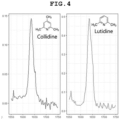
- the FTIR peaks of collidine and lutidine according to the above FTIR measuring method are shown in FIG. 4 , and the FTIR adsorption areas for lutidine and collidine respectively were obtained by integrating over the wavenumber range of 1600 cm -1 to 1700 cm -1 . Specific peak areas for each sample are as listed in Table 3 below.
- a feedstock having the properties in Table 2 below was introduced into a hydroisomerization reaction in the presence of a zeolite catalyst of any of the above samples A to D at a hydrogen pressure of about 160 atmospheres, a liquid space velocity (LHSV) of about 1.7 hr -1 , a hydrogen/feedstock ratio of about 500 Nm 3 /m 3 , and a reaction temperature of (pour point target - 18°C).
- LHSV liquid space velocity
- sample A represents a granular type
- sample B represents an amorphous type in which the growth of the crystal is not completely finished
- sample C represents a needle type
- sample D represents a rod type
- sample B of the amorphous type in Table 3 exhibits a significantly lower BET surface area compared to samples A, C, and D having other types of morphologies.
Landscapes
- Chemical & Material Sciences (AREA)
- Organic Chemistry (AREA)
- Chemical Kinetics & Catalysis (AREA)
- Engineering & Computer Science (AREA)
- Materials Engineering (AREA)
- Oil, Petroleum & Natural Gas (AREA)
- Crystallography & Structural Chemistry (AREA)
- General Chemical & Material Sciences (AREA)
- Life Sciences & Earth Sciences (AREA)
- Geology (AREA)
- General Life Sciences & Earth Sciences (AREA)
- Inorganic Chemistry (AREA)
- Catalysts (AREA)
- Low-Molecular Organic Synthesis Reactions Using Catalysts (AREA)
Abstract
The present invention provides a zeolite catalyst having an MRE structure for hydroisomerization. The zeolite catalyst has an adsorption volume ratio of lutidine to collidine measured by FTIR using lutidine and collidine as adsorbents of greater than 3 and less than or equal to 10. The present invention further provides a method of hydroisomerization for a feedstock, including subjecting the feedstock to a hydroisomerization reaction under conditions of a temperature of 200°C to 500°C, a hydrogen pressure of 1 to 200 atmospheres, a liquid space velocity (LHSV) of 1.0 to 10.0 hr-1, and a hydrogen/feedstock ratio of 45 to 1780 Nm3/m3 in the presence of the zeolite catalyst.
Description
- The present invention relates to a zeolite with improved hydroisomerization activity and a hydroisomerization reaction process of a feedstock using the same. More specifically, the present invention relates to a zeolite catalyst having an MRE structure in which acid sites exists near a pore mouth, and to a hydroisomerization reaction process for C22+ hydrocarbons using the zeolite catalyst.
- The importance of hydroisomerization reactions to convert n-paraffin to iso-paraffin is becoming increasingly important in refining processes such as lubricant manufacturing. This is due to the low low-temperature fluidity of long-chain n-paraffins, which does not meet the specifications of modern lubricant products. In particular, in recent years, the quality of raw materials has deteriorated due to rising oil prices, while the development of automobile engine technology has required higher quality products for lubricants. In this regard, the hydroisomerization reaction for C15 or higher n-paraffins can be applied to a high-viscosity index high-grade lubricating oil manufacturing process.
- The above-described hydroisomerization reaction is known to be performed mainly by a bifunctional catalyst, which typically include a metal component with a hydrogenation/dehydrogenation function and a support with an acid sites for skeletal isomerization. In this regard, various materials such as silica-alumina, clay, zeolite, etc., are known as supports having acid sites. In particular, zeolite materials not only have a stable structure even under harsh reaction conditions, but also have a large specific surface area and a large number of acid sites, making them suitable for application in isomerization reactions.
- In order to maximize the hydroisomerization reaction and suppress the cracking of hydrocarbons to be treated as much as possible, studies have been conducted to use zeolite materials with excellent shape selectivity as zeolites, and among them, zeolite materials with a unidimensional 10-ring pore structure (ZSM-22, ZSM-23, EU-2, ZSM-48, etc.) have been reported to have excellent selectivity for the hydroisomerization reaction.
- According to the catalog of the International Zeolite Association (IZA), EU-2 belongs to the ZSM-48 family, along with ZSM-48, ZBM-30, and EU-11, and the ZSM-48 family has been given the three-letter skeletal structure code *MRE by the Structure Commission of the International Zeolite. They have similar XRD patterns, i.e., similar crystal structures.
-
Korean Patent No. 10-2161426 - In addition,
US Patent No. 5,961,951 discloses a series of processes for preparing a zeolite catalyst having a ZSM-48 structure by mixing silica, a trivalent metal oxide, an alkali metal oxide, ethylenediamine, and water, and specifications for zeolite catalysts prepared by the above processes. - However, while the patent document discloses a catalyst suitable for hydroisomerization of n-paraffin having 10 or more carbon atoms, the patent references do not specifically address the specification of catalysts required for the hydroisomerization of n-paraffins having more than 10 carbon atoms, for example, 22 or more carbon atoms.
- An problem to be solved by the present invention is to provide a zeolite catalyst having an MRE structure for hydroisomerization of a hydrocarbon feedstock having 22 or more carbon atoms, which is difficult to reach inside the zeolite catalyst due to the long carbon chain length.
- Against this background, the invention provides a zeolite catalyst having an MRE structure for a hydroisomerization reaction, the zeolite catalyst having an adsorption amount ratio of lutidine to collidine of greater than 3 and less than or equal to 10 as measured by FTIR as specified further below using lutidine and collidine as adsorbents.
- In one embodiment, the zeolite catalyst having the MRE structure is any one of EU2, ZSM-48 or ZBM-30 zeolite.
- In one embodiment, with respect to the zeolite catalyst, an adsorption amount ratio of lutidine to collidine measured by FTIR using lutidine and collidine as adsorbents is less than or equal to 8.
- In one embodiment, the zeolite catalyst has a silica-alumina ratio (SAR) of 100 to 250.
- In one embodiment, the zeolite catalyst has a SAR of 120 to 200.
- In one embodiment, the zeolite catalyst has a SAR of 150 to 170.
- In one embodiment, the zeolite catalyst has a volume of pores having a diameter greater than 50 nm of less than 0.1 cc/g, as measured by BET after pretreatment in a vacuum state at 350°C for 3 hours and using N2 as an adsorbent.
- In one embodiment, the zeolite catalyst has a volume of pores having a diameter in a range of 2 to 50 nm of less than 0.2 cc/g, as measured by BET after pretreatment in a vacuum state at 350°C for 3 hours and using N2 as an adsorbent.
- In one embodiment, the zeolite catalyst has a morphology selected from the group consisting of a granular shape, a needle shape, and a rod shape.
- In one embodiment, the zeolite catalyst has a surface area of greater than or equal to 250 m2/g and not greater than 300 m2/g, as measured by BET after pretreatment in a vacuum state at 350°C for 3 hours and using N2 as an adsorbent..
- The invention further provides a method of hydroisomerization for a feedstock, including the step of subjecting the feedstock to a hydroisomerization reaction under conditions of a temperature of 200°C to 500°C, a hydrogen pressure of 1 to 200 atmospheres, a liquid space velocity (LHSV) of 1.0 to 10.0 hr-1, and a hydrogen/feedstock ratio of 45 to 1780 Nm3/m3 in the presence of a zeolite catalyst according to the invention.
- In one embodiment, the carbon number of hydrocarbons in the feedstock is at least 22.
- With the zeolite catalyst of the present invention, it is possible to increase the yield of hydroisomerization while avoiding cracking of hydrocarbon feedstock for the preparation of lubricating base oils as much as possible. Furthermore, the hydroisomerization reaction of feedstock using the zeolite catalyst of the present invention can proceed at a lower reaction temperature than when conventional zeolites are used.
-
-
FIG. 1 is the chemical structure of lutidine and collidine, corresponding to the adsorbents used to determine the acid sites of the zeolite catalyst of the present invention; -
FIG. 2 is a schematic diagram showing the adsorbed positions of lutidine and collidine used as adsorbents to measure the acid sites of the zeolite catalyst of the present invention; -
FIG. 3 is an SEM image for observing the morphology of zeolite catalysts of Example samples A to D; and -
FIG. 4 shows FTIR peak data for lutidine and collidine according to an Example of the present invention. - According to the present invention, provided is a zeolite catalyst having an MRE structure for a hydroisomerization reaction, the zeolite catalyst having an adsorption amount ratio of lutidine to collidine of greater than 3 and less than or equal to 10 as measured by FTIR using lutidine and collidine as adsorbents.
- The adsorption ratio of lutidine to collidine may be greater than 3 to less than or equal to 10, greater than 3 to less than 9, greater than 3 to less than or equal to 8, greater than 3 to less than or equal to 7, greater than 3 to less than or equal to 6, greater than or equal to 3 to not greater than 5, greater than or equal to 3 to less than or equal to 4, greater than or equal to 4 to not greater than 10, greater than or equal to 4 to not greater than 9, greater than or equal to 4 to not greater than 8, greater than or equal to 4 to not greater than 7, greater than or equal to 4 to not greater than 6, greater than or equal to 4 to not greater than 5, greater than or equal to 5 to not greater than 10, greater than or equal to 5 to not greater than 9, greater than or equal to 5 to not greater than 8, greater than or equal to 5 to not greater than 7, greater than or equal to 5 to not greater than 6, greater than or equal to 6 to not greater than 10, greater than or equal to 6 to not greater than 9, greater than or equal to 6 to not greater than 8, greater than or equal to 6 to not greater than 7, greater than or equal to 7 to not greater than 10, greater than or equal to 7 to not greater than 9, or greater than or equal to 7 to not greater than 8.
- As shown in
FIG. 1 , lutidine, which has a pyridine chemical structure with two methyl groups, has a smaller molecular size compared to collidine, which has three methyl groups, allowing lutidine to enter deeper through the pores present in the MRE zeolite catalyst, but the absolute molecular size of lutidine and collidine makes it difficult for them to enter the deep interior of the catalyst through the pores of the MRE zeolite catalyst. - In other words, lutidine can enter the pore mouth of the MRE zeolite catalyst slightly inward from the pore entrance, while collidine can be present near the pore entrance, further outward than the pore mouth.
- To observe the acid sites distribution of the MRE zeolite catalyst in the present invention, Fourier transform infrared spectroscopy (FTIR) with lutidine and collidine as adsorbents is used, and as mentioned above, lutidine can enter more interior of the pores compared to collidine, and FTIR peak measurements show that the ratio of the adsorbed amount of lutidine to collidine is greater than 3, which means that the acid sites of the MRE zeolite catalyst are mainly located near the pore mouth of the pores, not outside of the pores. As shown in
FIG. 2 , if the ratio of the adsorbed amount of lutidine to collidine is less than or equal to 3, the acid sites are mainly located on the outside of the pores, which may be disadvantageous from the point of view of reaction yield because the cracking reaction dominates over the hydroisomerization reaction. On the other hand, if the ratio of the adsorbed amount of lutidine to collidine is greater than 10, the acid sites of the MRE zeolite catalyst are located inside the pore mouth, and when the metal is immersed in the MRE zeolite support, the dispersion of the metal may not be smooth, resulting in a decrease in the performance of the catalyst. - More specifically, the MRE zeolite catalyst may be imparted a dual functional catalytic function by immersing a metal, such as platinum, in the zeolite, in which the metal precursor is immersed in the zeolite in a solution dissolved in water, and the metal precursor has a size larger than the MRE zeolite pores, so the metal precursor cannot enter the pores and remains on the outer surface. The outer acid sites on the zeolite serve to evenly disperse the remaining metal on the outer surface of the zeolite, such as to prevent sintering during the reaction. If the adsorption capacity ratio of lutidine to collidine is greater than 10, the acid sites that help disperse the metal as described above will be located more internally, resulting in a lack of acid sites on the surface, and the metal may not disperse well.
- In one embodiment, the zeolite catalyst is any one of EU2, ZSM-48 or ZBM-30 zeolite. As described above, MRE is a three-letter skeletal structure code assigned to the ZSM-48 family by the International Zeolite Structure Committee, and a zeolite catalyst having the MRE structure is not limited to any zeolite belonging to the ZSM-48 family.
- In one embodiment, the zeolite catalyst is a SAR of 100 to 250. SAR means the molar ratio of SiO2 to Al2O3 constituting the zeolite catalyst, and the zeolite catalyst having the MRE structure may have a SAR of 100 to 250, 100 to 200, 100 to 180, 120 to 250, 120 to 200, 120 to 180, 150 to 250, 150 to 200, 150 to 180, or 150 to 170. In the zeolite catalyst, some of the Si present in SiO2 may be substituted with Al, and the charge of the substituted Al is 3+, which is different from Si having a charge of 4+, so the substitution causes an imbalance of charges, and H+ is introduced to maintain the neutrality of the charge in this state of imbalance, and this H+ acts as an acid sites. In other words, the more Al2O3 that makes up the zeolite catalyst, the more spots are present on the zeolite catalyst, and the smaller the SAR, the more favorable the catalyst is in terms of reaction yield. More specifically, if the SAR is greater than 250, there is less Al in the entire zeolite catalyst, so the number of acid sites where the conversion reaction occurs is also less, and in order to achieve the same level of reaction as a zeolite with more acid sites, the reaction temperature must be increased to allow more conversion reactions to occur at one acid site, which has the problem that the decomposition reaction may also be promoted at the same time as the reaction temperature is increased. In addition, when the SAR is less than 100, the EU-1 structure is mainly synthesized, not the EU-2 structure to be obtained in the present disclosure, and EU-1 is disadvantageous compared to the EU-2 structure in terms of isomerization yield.
- In one embodiment, the zeolite catalyst does not include pores with a diameter greater than 50 nm.
- According to the IUPAC pore size classification, pores with a width (diameter) of less than 2 nm are classified as micropores, pores with a width of 2 nm to 50 nm are classified as mesopores, and pores with a width of more than 50 nm are classified as macropores, and according to the above classification, the zeolite catalysts having the MRE structure of the present invention may not contain macropores.
- The pore size and volume of the zeolite catalyst as used herein are measured using BET equipment (e.g., Micromeritics' ASAP 2020), which is based on BET theory and measures the amount of gas adsorbed on a solid surface as the pressure change in a vacuum chamber while varying the pressure of the gas at a constant temperature. Specifically, after pretreatment in a vacuum state at 350°C for 3 hours, N2 is adsorbed, and the amount of N2 gas adsorbed can be measured and calculated from the BET adsorption isotherm.
- In one embodiment, the volume of macropores in the zeolite catalyst is less than 0.3 cc/g, preferably less than 0.2 cc/g, more preferably less than 0.1 cc/g. Most preferably, the zeolite catalyst does not contain macropores.
- In one embodiment, the zeolite catalyst does not include mesopores. Most preferably, the zeolite catalyst may have a volume of pores having a diameter in a range of 2 to 50 nm of less than 0.2 cc/g. Preferably, the zeolite catalyst may have a volume of pores having a diameter of 2 nm to 50 nm and less than 0.1 cc/g, more preferably, the zeolite catalyst may not include pores having a diameter of 2 nm to 50 nm. When the volume of mesopores in a zeolite catalyst exceeds 0.2 cc/g, it becomes easier for C22+ hydrocarbons to enter the deeper interior of the catalyst, which is also the location of the hydrogenation isomerization reaction and the location of the cracking reaction, leading to the cleavage of n-paraffin chains through unwanted cracking as a side reaction.
- In addition, there are two methods for preparing zeolite catalysts containing macropores and mesopores: first, preparing zeolite catalysts and subsequently etching the pores, and second, directly synthesizing zeolites containing macropores and mesopores using surfactants. In the former case, there is zeolite that is lost by the etching process, which increases the manufacturing cost per unit weight, and in the latter case, special surfactants must be used, and the raw material cost of these surfactants is high, and the process cost of filtering the zeolite and treating the foam of the remaining mother liquor in the zeolite recovery step after synthesis is high, which also results in a high manufacturing cost. As described above, the zeolite catalyst of the present invention preferably do not substantially include macropores and mesopores, and thus has an advantage in terms of manufacturing cost.
- As described above, the zeolite catalyst according to the present invention preferably does not include macropores and mesopores, and may include only pores (micropores) having a diameter of less than 2 nm. Pores with a diameter of less than 2 nm are not easy for C22+ n-paraffin to enter the zeolite catalyst through the pores, preventing C22+ n-paraffin from cracking at acid sites inside the zeolite. In addition, as described above, the acid sites of the zeolite catalyst are located in the pore mouth, so that C22+ n-paraffin can be isomerized into iso-paraffin through a desired hydroisomerization reaction without approaching the inside of the catalyst.
- In one embodiment, the zeolite catalyst may have a morphology selected from the group consisting of a granular shape, a needle shape, and a rod shape. The morphology is observed by SEM images as shown in
FIG. 3 . From the viewpoint of improving the hydroisomerization reaction yield of hydrocarbon feedstock and reducing weighted average bed temperature (WABT), the zeolite catalyst may preferably have a granular shape morphology. - In one embodiment, the zeolite catalyst has a BET surface area of greater than 250 m2/g and less than 300 m2/g. The specific surface area of zeolite catalysts is measured using BET equipment (e.g., Micromeritics' ASAP 2020), which is based on BET theory and measures the amount of gas adsorbed on a solid surface as the pressure change in a vacuum chamber while varying the pressure of the gas at a constant temperature. Specifically, after pretreatment in a vacuum state at 350°C for 3 hours, N2 is adsorbed, and the amount of N2 gas adsorbed can be measured and calculated from the BET adsorption isotherm.
- More specifically, the zeolite catalyst may have a specific surface area of greater than or equal to 250 m2/g and not greater than 300 m2/g, greater than or equal to 250 m2/g and not greater than 290 m2/g, greater than or equal to 250 m2/g and not greater than 280 m2/g, greater than or equal to 250 m2/g and not greater than 270 m2/g, greater than or equal to 250 m2/g and not greater than 260 m2/g, greater than or equal to 260 m2/g and not greater than 300 m2/g, greater than or equal to 260 m2/g and not greater than 290 m2/g, greater than or equal to 260 m2/g and not greater than 280 m2/g, greater than or equal to 260 m2/g and not greater than 270 m2/g, greater than or equal to 270 m2/g and not greater than 300 m2/g, greater than or equal to 270 m2/g and not greater than 290 m2/g, greater than or equal to 270 m2/g and not greater than 280 m2/g, greater than or equal to 280 m2/g and not greater than 300 m2/g, greater than or equal to 280 m2/g and not greater than 290 m2/g, and greater than or equal to 290 m2/g and not greater than 300 m2/g. As described above, the zeolite catalyst of the present disclosure does not substantially include macropores and mesopores but includes micropores, resulting in a high BET surface area, which is an increase from the BET surface area of about 220 m2/g for a typical MRE-structured zeolite. All other conditions being equal, a low BET surface area means that the zeolite structure has not grown properly, which typically indicates low catalytic activity.
- According to one aspect of the present invention, there is provided a process for converting n-paraffin-containing feedstock (including mineral, synthetic, and/or biomass-derived feedstock) to iso-paraffin by an isomerization reaction while supplying hydrogen in the presence of the zeolite catalyst according to the invention. Such feedstock may typically contain at least about 15% by weight of n-paraffin, and more particularly at least about 40% by weight.
- Specific examples of the above feedstock include hydrocarbon oils having a boiling point (as measured by ASTM D-86 or ASTM D-2887) in the range of at least about 150°C to 580°C, specifically hydrocarbon oils in the range of lubricating base oils.
- In one embodiment, the pores of the aforementioned zeolite catalysts are micropores having a diameter of less than 2 nm, and are therefore effectively applicable to hydrocarbon oils having a carbon number of about 22 or more and having a lubricating base oil boiling point in the range of about 360°C to 580°C. More specifically, the zeolite catalyst having the above micropores is effective in the hydroisomerization of hydrocarbon oils having a carbon number of 22 to 35, 22 to 30, 22 to 25, 25 to 35, 25 to 30, 27 to 35, or 27 to 30.
- In one embodiment, the hydrocarbon feedstock contains n-paraffins (wax component) at about 15% by weight, specifically at least about 40% by weight. In addition, the feedstock may contain, for example, about 10 ppm (wt) or less (specifically, about 5 ppm (wt) or less) of nitrogen and/or about 10 ppm (wt) or less (specifically, about 5 ppm (wt) or less) of sulfur.
- The hydroisomerization process is performed on the hydrocarbon feedstock, for example, at a temperature of about 200°C to 500°C (specifically about 220°C to 450°C, more specifically about 240°C to 400°C), a hydrogen pressure of about 1 to 200 atmospheres (specifically about 100 to 180 atmospheres, more specifically about 130 to 150 atmospheres), a space velocity (LHSV) of about 0.1 to 10 hr-1 (specifically about 0.5 to 5 hr-1, more specifically about 1 to 2 hr-1), and a hydrogen/feedstock ratio of about 45 to 1780 Nm3/m3 (specifically about 200 to 1000 Nm3/m3, more specifically about 480 to 530 Nm3/m3).
- After undergoing the aforementioned hydroisomerization process, the pour point of the hydrocarbon oil as the feedstock may be reduced, for example, by at least about -12°C, and more specifically by at least about -18°C. Further, when the feedstock is a hydrocarbon oil in the range of lubricating base oil boiling point, the viscosity index may be in the range of, for example, at least about 60, more particularly about 70 to 160, more particularly about 80 to 150, and more particularly about 120 to 140.
- A zeolite catalyst according to one embodiment of the present invention was prepared through the following process, and reagents used in the processes of Preparation Examples and Comparative Preparation Examples are shown in Table 1 below.
[Table 1] Reagent Manufacturer Aluminum hydroxide Sigma-Aldrich LUDOX® HS-40 colloidal silica Sigma-Aldrich Cetyltrimethylammonium chloride solution (25wt% in H2O) Sigma-Aldrich Sodium hydroxide, bead,>98.0% SUMCHUN CHEMICALS Sodium Hydroxide Solution (20wt% in H2O) SUMCHUN CHEMICALS CATAPAL A Sasol Hexamethonium Chloride Dihydrate (> 99.0%) TCl - Solution A1 was prepared by completely dissolving 44.73 g of sodium hydroxide, bead, >98.0% in 1121.49 g of distilled DI water, solution A2 was prepared by adding 5.06 g of aluminum hydroxide to solution A1 and completely dissolving, and solution A3 was prepared by adding 37.49 g of hexamethonium chloride dihydrate (> 99.0%) to solution A2, and completely dissolving. Thereafter, while stirring the solution A3 at room temperature at high speed, 780.30 g of LUDOX® HS-40 colloidal silica was added dropwise for about 1 hour to form a gel. The prepared gel was poured into a 2 L hastelloy autoclave, rotated at 600 rpm, aged at room temperature and pressure for 24 hours, heated to 165°C for 85 minutes, and hydrothermally synthesized at 165°C for 48 hours.
- Thereafter, the synthesized product was thoroughly washed with DI water until the pH was neutral, and then dried overnight in an oven at 50°C. Organic matter was completely removed from the synthesized zeolite in a muffle furnace under the conditions of 450°C × 1 hour × 3°C/min and 550°C × 6 hours × 1°C/min. The zeolite after the above series of washing and calcining processes is referred to as Na-EU2.
- The Na-EU2 was ion-exchanged twice at room temperature with 1 M NH4NO3 solution to replace Na+ ions contained therein with NH4+ ions. The zeolite after ion exchange is referred to as NH4-EU2.
- Then, 42 g of NH4-EU2 was sufficiently mixed with 18 g of pural pseudoboehmite, which was impregnated with 1% Pt(NH3)4(NO3)2 solution 36 g and 60% nitric acid 1.32 g solution by initial impregnation method. The supported zeolite was sufficiently dried at room temperature and then calcined in a muffle furnace at 120°C × 3 hours × 2°C/min and 500°C × 3 hours × 2°C/min to obtain a final zeolite catalyst sample A.
- Samples B to D were prepared through the following process using the same reagents as in the above Preparation Example.
- After gel formation, zeolite catalyst sample B was prepared by the same process as sample A, except that in the step of rotating the gel, the rotation speed was 400 rpm and the subsequent aging at room temperature and pressure for 24 h was not performed.
- Solution C1 was prepared by adding 4.59 g of CATAPAL A to 223.65 g of 20% by weight of NaOH solution and completely dissolving, solution C2 was prepared by pouring 942.57 g of distilled DI Water into solution C1 and completely dissolving, and then solution C3 was prepared by adding 37.49g of hexamethonium chloride dihydrate (> 99.0%) and completely dissolving. Thereafter, while rapidly stirring solution C3 at room temperature, 780.30 g of LUDOX® HS-40 colloidal silica was added dropwise for about 1 hour to form a gel. Thereafter, the prepared gel was poured into a 2 L hastelloy autoclave, rotated at 600 rpm, heated at room temperature and pressure to 165°C for 5 hours, and then hydrothermally synthesized at 165°C for 48 hours.
- Thereafter, zeolite catalyst sample C was prepared through the same steps of washing, drying, calcining, and ion exchange as in the preparation process of sample A.
- Solution D1 was prepared by completely dissolving 204.56 g of 20% by weight NaOH solution in 811.15 g of distilled DI water, solution D2 was prepared by adding 5.17 g of aluminum hydroxide to solution D1 and completely dissolving, and solution D3 was prepared by adding 20.55 g of hexamethonium chloride dihydrate (> 99.0%) and completely dissolving. Thereafter, solution D4 was prepared by adding 60.40 g of cetyltrimethylammonium chloride solution (25% by weight in H2O) to solution D3 and completely dissolving. While rapidly stirring the prepared solution D4 at room temperature, 798.13 g of LUDOX® HS-40 colloidal silica was added dropwise for about 1 hour to form a gel, and the prepared gel was poured into a 2 L hastelloy autoclave, rotated at about 400 to 600 rpm, aged for 24 hours at room temperature and pressure, then raised to 165°C for 85 minutes, and hydrothermally synthesized at 165°C for 48 hours.
- Thereafter, zeolite catalyst sample D was prepared through the same steps of washing, drying, calcining, and ion exchange as in the preparation process of sample A.
- In order to measure the acid sites distribution of samples A to D, FTIR measurement method was used. Measurements were performed in the following order.
- 1) Manufacture of 15 mg self-supporting zeolite wafer with 1.3 cm diameter.
- 2) Loading zeolite wafers into high-temperature/high-pressure cells.
- 3) At a pressure of 1.0 × 10⁻⁸ torr, the temperature was raised to 550°C at a rate of 10°C/min, followed by evacuation for 2 hours.
- 4) At a pressure of 1.0 × 10⁻⁸ torr, cooling to 150°C.
- 5) Repeated injection of lutidine or collidine until the adsorption peak area no longer increases under vacuum and at a temperature of 150°C.
- 6) Remove physically adsorbed lutidine or collidine for 2 hours at a pressure of 1.0 × 10⁻⁸ torr and a temperature of 200°C.
- 7) At a pressure of 1.0 × 10⁻⁸ torr, measure the adsorption area after reducing the temperature to 150°C.
- The FTIR peaks of collidine and lutidine according to the above FTIR measuring method are shown in
FIG. 4 , and the FTIR adsorption areas for lutidine and collidine respectively were obtained by integrating over the wavenumber range of 1600 cm-1 to 1700 cm-1. Specific peak areas for each sample are as listed in Table 3 below. - A feedstock having the properties in Table 2 below was introduced into a hydroisomerization reaction in the presence of a zeolite catalyst of any of the above samples A to D at a hydrogen pressure of about 160 atmospheres, a liquid space velocity (LHSV) of about 1.7 hr-1, a hydrogen/feedstock ratio of about 500 Nm3/m3, and a reaction temperature of (pour point target - 18°C).
[Table 2] Feedstock Specific gravity 0.8361 10% 439.2 50% 473.6 90% 524.8 Content of sulfur 2.2 Content of nitrogen < 1.0 Kinematic viscosity index 6.551 Pour point(°C) 48 - The SAR, BET surface area, volume fraction of mesopores, peak area of lutidine and collidine, lutidine/collidine peak area ratio, weighted average bed temperature (WABT), and the hydroisomerization reaction yield of samples A to D according to the above embodiments are shown in Table 3 below.
[Table 3] Sample A B C D SAR 152.5 118 127 164.8 BET 261.8 216.8 253.1 318.5 Vmeso 0.10 0.11 0.12 0.19 Lutidine 11.09 3.28 4.99 10.71 Collidine 2.77 1.41 1.97 2.54 Lu/Col 4.00 2.33 2.53 4.22 WABT 316 334 316 326 Yield 92.5 91.8 85.6 89.4 - As can be seen in Table 3, the highest yield of 92.5% was obtained when the hydroisomerization reaction was performed using the zeolite catalyst of sample A, which satisfied a SAR of more than 150, a BET surface area of more than 250, and a lutidine/collidine peak area ratio of more than 3 but less than 10, confirming that such a high yield can be achieved at a low reaction temperature (WABT).
- In addition, referring to
FIG. 3 in relation to the morphologies of samples A to Dit can be seen that sample A represents a granular type, sample B represents an amorphous type in which the growth of the crystal is not completely finished, sample C represents a needle type, and sample D represents a rod type, and due to these morphologies, sample B of the amorphous type in Table 3 exhibits a significantly lower BET surface area compared to samples A, C, and D having other types of morphologies.
Claims (13)
- A zeolite catalyst having an MRE structure for a hydroisomerization reaction, wherein an adsorption volume ratio of lutidine to collidine greater than 3 and less than or equal to 10, as measured by FTIR as specified in the description using lutidine and collidine as adsorbents.
- The zeolite catalyst of claim 1, wherein the zeolite catalyst having an MRE structure is any one of EU2, ZSM-48, or ZBM-30 zeolite.
- The zeolite catalyst of any preceding claim, wherein an adsorption volume ratio of lutidine to collidine greater than or equal to 8 measured by FTIR as specified in the description using lutidine and collidine as adsorbents.
- The zeolite catalyst of any preceding claim, wherein the zeolite catalyst has silica-alumina ratio (SAR) of 100 to 250.
- The zeolite catalyst of claim 4, wherein the zeolite catalyst has silica-alumina ratio (SAR) of 120 to 200.
- The zeolite catalyst of claim 4, wherein the zeolite catalyst has silica-alumina ratio (SAR) of 150 to 170.
- The zeolite catalyst of any preceding claim, wherein the zeolite catalyst has a volume of pores having a diameter in a range of greater than 50 nm of less than 0.1 cc/g, as measured by BET after pretreatment in a vacuum state at 350°C for 3 hours and using N2 as an adsorbent..
- The zeolite catalyst of claim 7, wherein the zeolite catalyst has a volume of pores having a diameter in a range of 2 to 50 nm of less than 0.2 cc/g, as measured by BET after pretreatment in a vacuum state at 350°C for 3 hours and using N2 as an adsorbent..
- The zeolite catalyst of any preceding claim, wherein the zeolite catalyst has a morphology selected from the group consisting of a granular shape, a needle shape, and a rod shape.
- The zeolite catalyst of claim 9, wherein the zeolite catalyst has a granular shape.
- The zeolite catalyst of any preceding claim, wherein the zeolite catalyst has a surface area greater than or equal to 250 m2/g and not greater than 300 m2/g, as measured by BET after pretreatment in a vacuum state at 350°C for 3 hours and using N2 as an adsorbent..
- A method of hydroisomerization for a feedstock, the method comprising:
subjecting a feedstock to a hydroisomerization reaction under conditions of a temperature of 200°C to 500°C, a hydrogen pressure of 1 to 200 atmospheres, a liquid space velocity (LHSV) of 1.0 to 10.0 hr-1, and a hydrogen/feedstock ratio of 45 to 1780 Nm3/m3 in the presence of a zeolite catalyst of any preceding claim. - The method of claim 12, wherein the hydrocarbons in the feedstock have a number of carbon atoms of at least 22.
Applications Claiming Priority (1)
| Application Number | Priority Date | Filing Date | Title |
|---|---|---|---|
| KR1020220103117A KR20240025192A (en) | 2022-08-18 | 2022-08-18 | Zeolite with improved hydroisomerization activity |
Publications (1)
| Publication Number | Publication Date |
|---|---|
| EP4324556A1 true EP4324556A1 (en) | 2024-02-21 |
Family
ID=87429398
Family Applications (1)
| Application Number | Title | Priority Date | Filing Date |
|---|---|---|---|
| EP23186887.8A Pending EP4324556A1 (en) | 2022-08-18 | 2023-07-21 | Zeolite with improved hydroisomerization activity |
Country Status (4)
| Country | Link |
|---|---|
| US (2) | US12338212B2 (en) |
| EP (1) | EP4324556A1 (en) |
| KR (1) | KR20240025192A (en) |
| CN (1) | CN117583020A (en) |
Citations (2)
| Publication number | Priority date | Publication date | Assignee | Title |
|---|---|---|---|---|
| US5961951A (en) | 1998-01-12 | 1999-10-05 | Mobil Oil Corporation | Synthesis ZSM-48 |
| KR102161426B1 (en) | 2012-10-02 | 2020-10-06 | 에네오스 가부시키가이샤 | Method for producing lubricant base oil and lubricant base oil |
Family Cites Families (11)
| Publication number | Priority date | Publication date | Assignee | Title |
|---|---|---|---|---|
| US4962269A (en) | 1982-05-18 | 1990-10-09 | Mobil Oil Corporation | Isomerization process |
| US4855530A (en) | 1982-05-18 | 1989-08-08 | Mobil Oil Corporation | Isomerization process |
| US5075269A (en) | 1988-12-15 | 1991-12-24 | Mobil Oil Corp. | Production of high viscosity index lubricating oil stock |
| FR2808028B1 (en) | 2000-04-21 | 2003-09-05 | Inst Francais Du Petrole | FLEXIBLE PROCESS FOR PRODUCING OIL BASES WITH A ZSM-48 ZEOLITE |
| US6923949B1 (en) | 2004-03-05 | 2005-08-02 | Exxonmobil Research And Engineering Company | Synthesis of ZSM-48 crystals with heterostructural, non ZSM-48, seeding |
| US7482300B2 (en) | 2005-12-13 | 2009-01-27 | Exxonmobil Research And Engineering Company | High activity ZSM-48 and methods for dewaxing |
| KR101528791B1 (en) * | 2008-02-08 | 2015-06-15 | 제이엑스 닛코닛세키에너지주식회사 | Hydroisomerization catalyst, process for producing the same, method of dewaxing hydrocarbon oil, and process for producing lube base oil |
| MY167591A (en) * | 2012-03-30 | 2018-09-20 | Jx Nippon Oil & Energy Corp | Method for producing hydroisomerization catalyst and method for producing lubricant base oil |
| KR102068312B1 (en) * | 2013-10-18 | 2020-01-20 | 에스케이이노베이션 주식회사 | Activated EU-2 Zeolite and Use Thereof |
| JP6386562B2 (en) | 2013-12-26 | 2018-09-05 | エクソンモービル リサーチ アンド エンジニアリング カンパニーExxon Research And Engineering Company | Synthesis of ZSM-48 crystals |
| WO2018199714A1 (en) * | 2017-04-28 | 2018-11-01 | 에스케이이노베이션 주식회사 | Hierarchical eu-2 type zeolite having both micropores and mesopores, and preparation method therefor |
-
2022
- 2022-08-18 KR KR1020220103117A patent/KR20240025192A/en active Pending
-
2023
- 2023-07-20 CN CN202310892962.1A patent/CN117583020A/en active Pending
- 2023-07-21 EP EP23186887.8A patent/EP4324556A1/en active Pending
- 2023-08-07 US US18/366,571 patent/US12338212B2/en active Active
-
2025
- 2025-05-12 US US19/205,885 patent/US20250270153A1/en active Pending
Patent Citations (2)
| Publication number | Priority date | Publication date | Assignee | Title |
|---|---|---|---|---|
| US5961951A (en) | 1998-01-12 | 1999-10-05 | Mobil Oil Corporation | Synthesis ZSM-48 |
| KR102161426B1 (en) | 2012-10-02 | 2020-10-06 | 에네오스 가부시키가이샤 | Method for producing lubricant base oil and lubricant base oil |
Non-Patent Citations (3)
| Title |
|---|
| BOUCHY C ET AL: "Fischer-Tropsch Waxes Upgrading via Hydrocracking and Selective Hydroisomerization", OIL & GAS SCIENCE & TECHNOLOGY: REVUE DE L'INSTITUT FRANCAIS DU PETROLE, EDITIONS TECHNIP PARIS, FR, vol. 64, no. 1, 28 February 2009 (2009-02-28), pages 91 - 112, XP002585754, ISSN: 1294-4475, [retrieved on 20090307], DOI: 10.2516/OGST/2008047 * |
| SCHULMAN EMILY ET AL: "Two-Dimensional Zeolite Materials: Structural and Acidity Properties", MATERIALS, vol. 13, no. 8, 12 April 2020 (2020-04-12), pages 1822, XP055788461, DOI: 10.3390/ma13081822 * |
| ZHANG MIAO ET AL: "Synthesis of ZSM-48 zeolites and their catalytic performance: a review", CATALYSIS SCIENCE & TECHNOLOGY, vol. 12, no. 16, 16 August 2022 (2022-08-16), UK, pages 5097 - 5109, XP093106945, ISSN: 2044-4753, DOI: 10.1039/D2CY00267A * |
Also Published As
| Publication number | Publication date |
|---|---|
| US20250270153A1 (en) | 2025-08-28 |
| CN117583020A (en) | 2024-02-23 |
| US20240059631A1 (en) | 2024-02-22 |
| KR20240025192A (en) | 2024-02-27 |
| US12338212B2 (en) | 2025-06-24 |
Similar Documents
| Publication | Publication Date | Title |
|---|---|---|
| US9616416B2 (en) | Process for preparing an industrial hydroconversion catalyst, catalyst thus obtained and use thereof in a hydroconversion process | |
| KR20070004530A (en) | Novel zeolite composite, method for making and catalytic application thereof | |
| JP2008525187A5 (en) | ||
| US9782760B2 (en) | Method of preparing an activated EU-2 zeolite | |
| KR101682434B1 (en) | Method for making aluminosilicate zsm-12 | |
| JP2010506010A (en) | Isomerization method using metal-modified small crystal MTT molecular sieve | |
| Chen et al. | Synthesis of a multi-branched dandelion-like SAPO-11 by an in situ inoculating seed-induced-steam-assisted conversion method (SISAC) as a highly effective hydroisomerization support | |
| JP7760051B2 (en) | ZSM-5 molecular sieve, its production method and use, hydrotreating catalyst, hydrodewaxing catalyst and use thereof | |
| KR101354235B1 (en) | Catalyst for hydrodewaxing process and a method of preparing the same | |
| Rodrıguez-Castellón et al. | Textural and structural properties and surface acidity characterization of mesoporous silica-zirconia molecular sieves | |
| EP4271779A1 (en) | Processes for producing diesel from unconventional feedstocks | |
| Munusamy et al. | Synthesis, characterization and hydroisomerization activity of ZSM-22/23 intergrowth zeolite | |
| Sammoury et al. | Impact of desilication of* BEA zeolites on the catalytic performance in hydroisomerization of n-C10 | |
| Manrique et al. | Hierarchical submicrosized Y zeolites prepared by sequential desilication–dealumination post-synthesis modification and their catalytic performance in vacuum gas oil hydrocracking | |
| US12338212B2 (en) | Zeolite with improved hydro-isomerization activity | |
| US9302254B2 (en) | Synthesis and use of M41S family molecular sieves | |
| CN118256275B (en) | Polystyrene white oil and preparation method thereof | |
| WO2026097003A1 (en) | Method for producing hydroisomerized and/or hydrocracked hydrocarbons with hierarchical zeolitic materials | |
| CN119186544A (en) | Amorphous silica-alumina containing neutral strong Br nsted acid and preparation method and application thereof | |
| EA050333B1 (en) | MOLECULAR SIEVE ZSM-5, METHOD OF ITS PRODUCTION AND ITS APPLICATION, HYDROTREATING CATALYST, HYDRODEPRAFINIZATION CATALYST AND THEIR APPLICATION |
Legal Events
| Date | Code | Title | Description |
|---|---|---|---|
| PUAI | Public reference made under article 153(3) epc to a published international application that has entered the european phase |
Free format text: ORIGINAL CODE: 0009012 |
|
| STAA | Information on the status of an ep patent application or granted ep patent |
Free format text: STATUS: REQUEST FOR EXAMINATION WAS MADE |
|
| 17P | Request for examination filed |
Effective date: 20230721 |
|
| AK | Designated contracting states |
Kind code of ref document: A1 Designated state(s): AL AT BE BG CH CY CZ DE DK EE ES FI FR GB GR HR HU IE IS IT LI LT LU LV MC ME MK MT NL NO PL PT RO RS SE SI SK SM TR |
|
| RAP1 | Party data changed (applicant data changed or rights of an application transferred) |
Owner name: SK INNOVATION CO., LTD. Owner name: SK ON CO., LTD. |