EP4322037A1 - Communication device, terminal device, computer program thereof and control method thereof - Google Patents
Communication device, terminal device, computer program thereof and control method thereof Download PDFInfo
- Publication number
- EP4322037A1 EP4322037A1 EP23187891.9A EP23187891A EP4322037A1 EP 4322037 A1 EP4322037 A1 EP 4322037A1 EP 23187891 A EP23187891 A EP 23187891A EP 4322037 A1 EP4322037 A1 EP 4322037A1
- Authority
- EP
- European Patent Office
- Prior art keywords
- access
- oid
- user
- terminal device
- database
- Prior art date
- Legal status (The legal status is an assumption and is not a legal conclusion. Google has not performed a legal analysis and makes no representation as to the accuracy of the status listed.)
- Pending
Links
Images




Classifications
-
- G—PHYSICS
- G06—COMPUTING OR CALCULATING; COUNTING
- G06F—ELECTRIC DIGITAL DATA PROCESSING
- G06F21/00—Security arrangements for protecting computers, components thereof, programs or data against unauthorised activity
- G06F21/60—Protecting data
- G06F21/62—Protecting access to data via a platform, e.g. using keys or access control rules
- G06F21/6218—Protecting access to data via a platform, e.g. using keys or access control rules to a system of files or objects, e.g. local or distributed file system or database
-
- G—PHYSICS
- G06—COMPUTING OR CALCULATING; COUNTING
- G06F—ELECTRIC DIGITAL DATA PROCESSING
- G06F21/00—Security arrangements for protecting computers, components thereof, programs or data against unauthorised activity
- G06F21/60—Protecting data
- G06F21/606—Protecting data by securing the transmission between two devices or processes
- G06F21/608—Secure printing
Definitions
- Japanese Patent Application No. 2008-065833 disclosed a peripheral device including an MIB (Management Information Base) database.
- MIB Management Information Base
- Values with different security levels coexist in an MIB database.
- the disclosure herein provides technologies for accessing to an MIB database with consideration given to coexistence of values with different security levels.
- a communication device disclosed herein may comprise a database storing, for each of a plurality of object IDs (OIDs) of Management Information Base (MIB), a value in association with the OID; and a request receiving unit configured to receive an access request from a terminal device, the access request being for requesting access to a value in the database, and the access request including one or more OIDs among the plurality of OIDs; and an access executing unit configured to, in a case where the access request is received from the terminal device, execute access to a value in the database according to the access request, wherein in a case where the access request includes a first OID among the plurality of OIDs and a user of the terminal device is authenticated as a specific user, the access executing unit executes access to a first value stored in the database in association with the first OID, in a case where the access request includes a second OID among the plurality of OIDs, which is different from the first OID, and the user of the terminal device is authenticated as the specific user,
- a computer program for a terminal device causes a processor of the terminal device to function as: a request sending unit configured to send an access request to a communication device, the access request being a command for requesting access to a value in a database of the communication device, the database storing, for each of a plurality of object IDs (OIDs) of Management Information Base (MIB), a value in association with the OID, and the access request including one or more OIDs among the plurality of OIDs that are specified by a user of the terminal device; and a response receiving unit configured to receive a response to the access request from the communication device, wherein in a case where the access request includes a first OID among the plurality of OIDs and the user of the terminal device is authenticated as a specific user, the response includes first information indicating that access to a first value stored in the database in association with the first OID has succeeded, in a case where the access request includes a second OID among the plurality of OIDs, which is
- the second value has a higher security level than the first value.
- access to the first value is permitted regardless of whether the user of the terminal device is authenticated as the specific user or not, whereas access to the second value is not permitted unless the user of the terminal device is authenticated as the specific user.
- Access to an MIB database can be realized with consideration given to coexistence of values with different security levels.
- a computer program for implementing the above-described communication device and a computer-readable storage medium storing the computer program are also novel and useful. Further, a method performed by the above-described communication device is novel and useful. Further, the above-described terminal device and a computer program for implementing the terminal device are also novel and useful. Further, a method performed by the above-described terminal device is novel and useful.
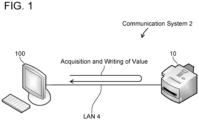
- a communication system 2 comprises a printer 10 and a terminal device 100.
- the devices 10, 100 are connected to a LAN (local area network) 4 and communicable with each other via the LAN 4.
- the LAN 4 may be a wired LAN or a wireless LAN.
- the printer 10 writes and sends information according to requests from the terminal device 100.
- an acquisition request for acquiring information and a writing request for writing information are commands according to HTTPS (Hypertext Transfer Protocol Secure).
- the printer 10 is a peripheral device (e.g., a peripheral device of the terminal device 100) configured to execute a print function.
- the printer 10 may be a multifunctional device configured to execute a scan function, a FAX function, etc. in addition to the print function.
- the printer 10 comprises a LAN interface 20, a print executing unit 22, and a controller 30.
- the units 20 to 30 are connected to a bus line (reference sign omitted).
- bus line reference sign omitted.
- interface may be abbreviated as "I/F”.
- the LAN I/F 20 is for communication via the LAN 4 and is connected to the LAN 4.
- the print executing unit 22 comprises a print mechanism of an inkjet scheme, laser scheme, or the like.
- the controller 30 comprises a CPU 32 and a memory 34.
- the memory 34 is configured of a volatile memory and a non-volatile memory.
- the CPU 32 executes various processes according to program 40 stored in the memory 34.
- the memory 34 further stores a database 50 and an authentication table 52.
- the program 40, the database 50, and the authentication table 52 are stored, for example, in the non-volatile memory of the memory 34.
- the database 50 stores various information (referred to as "MIB values” hereinafter) of the printer 10.
- the MIB values indicate, for example, a remaining amount in a consumable article, MAC address, name (i.e., user name), IP address, installed location, access destination, error history, status (print in progress, standby, etc.), print setting (e.g., default resolution for print), etc. of the printer 10.
- the database 50 stores the above-mentioned various information in a tree structure (i.e., hierarchical structure). This collection of various information in the tree structure is referred to as "MIB (Management Information Base)".
- the database 50 stores a content and an OID (object ID) in association with each MIB value.
- the content is a character string indicating the meaning of the MIB value.
- the OID is an identifier for identifying the MIB value.
- the authentication table 52 stores, for each of a plurality of OIDs in the database 50, the OID and an administrator authentication value in association with each other.
- the administrator authentication value indicates one of "Necessary” indicating that administrator authentication is necessary and "Unnecessary” indicating that administrator authentication is unnecessary.
- the terminal device 100 is a user terminal such as a desktop PC, a laptop PC, a tablet PC, a mobile phone (e.g., smartphone), or the like.
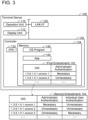
- the terminal device 100 comprises an operation unit 110, a display unit 112, a LAN I/F 120, and a controller 130.
- the operation unit 110 comprises a plurality of keys.
- a user can input various instructions to the terminal device 100 by operating the operation unit 110.
- the display unit 112 is a display configured to display various information.
- the display unit 112 may be a so-called touch screen (i.e., a part of the operation unit 110).
- the LAN I/F 120 is connected to the LAN 4.
- the controller 130 comprises a CPU 132 and a memory 134.
- the CPU 132 executes various processes according to programs 140, 142 stored in the memory 134.
- An OS program 140 is a program for controlling basic operation of the terminal device 100.
- An application 142 is a program for sending the acquisition request and the write request to the printer 10.
- the application 142 is provided, for example, by the vendor of the printer 10.
- the application 142 is downloaded, for example, from a server on the Internet.
- the memory 134 further stores an authentication table 152.
- the authentication table 152 is identical to the authentication table 52 of the printer 10.
- the authentication table 152 is stored in the memory 134 by the application 142.
- SNMP Simple Network Management Protocol
- TCP Transmission Control Protocol
- HTTPS Transmission Control Protocol
- HTTPS is more secure than SNMP since it employs user authentication and encryption of communication data.
- MIB values of the printer 10 may be used.
- HTTP which does not use SSL (Secure Socket Layer) or TLS (Transport Layer Security), may be used.
- HTTP executes user authentication using a user name (i.e., ID) and a password.
- HTTP supports basic authentication and digest authentication.
- the basic authentication is a scheme for coding a user name and a password by Base64 and sending it.
- the digest authentication is a scheme for hashing a user name and a password and sending it.
- a plain text generated by coding a user name and a password by Base64 is sent, while in the digest authentication, a value generated by hashing a user name and a password is sent.
- the digest authentication is more secure than the basic authentication.
- the digest authentication is used.
- the basic authentication may be used.
- the HTTP user authentication allows for user authentication for a plurality of users including, for example, an administrator, an individual user, a public user, etc.
- the individual user is a user who is permitted by the administrator to access at least a part of the database 50 of the printer 10.
- the public user is a user who is different from the administrator and the individual user.
- privilege level of the public user is lower than privilege levels of the administrator and the individual user
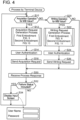
- FIG. 4 a process executed by the CPU 132 of the terminal device 100 according to the application 142 is described. The process of FIG. 4 is triggered by activation of the application 142. Communication between the terminal device 100 and the printer 10 is executed via the LAN I/Fs 20 and 120 and the LAN 4.
- Communication between the terminal device 100 and the printer 10 is executed via the LAN I/Fs 20 and 120 and the LAN 4.
- phrases such as “via the LAN I/F 20 (or 120)" and “via the LAN 4" will be omitted unless otherwise stated.
- the CPU 132 monitors in S10 whether an acquisition operation for acquiring an MIB value of the printer 10 is performed at the operation unit 110 and monitors in S20 whether a writing operation for writing an MIB value in the printer 10 is performed at the operation unit 110.
- the acquisition operation includes an operation of designating one or more items from among a plurality of items (i.e., a plurality of contents) corresponding to a plurality of MIB values of the printer 10.
- the writing operation includes an operation of designating one or more items corresponding to one or more MIB values (i.e., IP address, setting values of print setting, etc.) to be written in the printer 10, and an operation of inputting, for each of the designated one or more items, an MBI value to be written in the printer 10.
- the acquisition operation and the writing operation are, for example, operations on screens displayed on a display unit 112 of the terminal device 100.
- the CPU 132 executes in S12 an acquisition request generation process (see FIG. 5 ) for generating an acquisition request according to HTTP.
- the acquisition request is, for example, a command according to HTTP POST method that includes a header in which "X-HTTP-Method-Override 'GET′′′ is written (see FIG. 5 ).
- the acquisition request may be a command according to HTTP GET method.
- the CPU 132 executes HTTP user authentication between the terminal device 100 and the printer 10. Specifically, the terminal device 100 sends a request to the printer 10 and then receives a nonce (i.e., random value) from the printer 10. The terminal device 100 displays an input screen for input of a user name and a password on the display unit 112. The terminal device 100 generates an authentication parameter including a user name inputted to the input screen and the nonce received from the printer 10. The terminal device 100 then writes the generated authentication parameter in the header of the acquisition request generated in S12 (see FIG. 5 ). Thus, digest authentication using the information inputted to the input screen (i.e., the user name and password) is executed when the acquisition request is sent.
- a nonce i.e., random value
- the CPU 132 executes digest authentication according to the authentication parameter written in the header of the acquisition request and sends the acquisition request to the printer 10.
- a TLS (Transport Layer Security) session is established between the terminal device 100 and the printer 10.
- the acquisition request is sent to the printer 10 using the TLS session. That is, the acquisition request is encoded by TLS.
- the CPU 132 receives a process response as a response to the acquisition request sent in S16.
- the process response is also encoded by TLS.
- the CPU 132 determines whether the process response received in S30 includes a failure status.
- the failure status indicates that access to information in the database 50 has failed. For example, when administrator authentication is necessary and digest authentication by a user other than the administrator (e.g., public user) is executed, the process response includes the failure status.
- the CPU 132 When determining that the process response includes the failure status (YES in S32), the CPU 132 displays an input screen for input of a user name and a password on the display unit 112 in S34.
- This input screen is, for example, the same as the input screen displayed in S14. In this way, the user is able to know that authentication for the administrator, who is different from the user identified by the user name inputted in S14, is necessary and input an administrator name and a password.
- S34 When S34 is completed, the CPU 132 returns to the monitoring in S10 and the monitoring in S20. For example, information inputted in S34 is used in S14 and S16 when these steps are executed again.
- the CPU 132 When determining that the process response does not include the failure status (NO in S32), the CPU 132 returns to the monitoring in S10 and the monitoring in S20.
- the writing request is a command according to HTTP POST method.
- S24 is the same as S14 except that the authentication parameter is written in the header of the writing request.
- S26 is the same as S16 except that the writing request generated in S24 is sent to the printer 10. When the writing request is sent, digest authentication is executed and the writing request is encoded by TLS.
- the CPU 132 receives a process response as a response to the writing request sent in S26.
- the process response to the writing request is encoded by TLS.
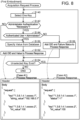
- the CPU 132 adds the one OID selected in S40 to an acquisition request. Specifically, as illustrated in FIG. 5 , a combination of "key” and the OID (e.g., "1.3.6.1.4. 1.xxxxxx. 1") is written in the body of the acquisition request.
- the CPU 132 specifies an administrator authentication value stored in association with the one OID selected in S40 in the authentication table 152.
- the CPU 132 determines whether the specified administrator authentication value indicates "Necessary". When determining that the specified administrator authentication value indicates "Unnecessary" (NO in S44), the CPU 132 skips S46, which will be described later, and proceeds to S48. On the other hand, when determining that the specified administrator authentication value indicates "Necessary" (YES in S44), the CPU 132 proceeds to S46.
- the CPU 132 decides that an authentication parameter including the administrator name is to be written in the header of the acquisition request.
- the authentication parameter including the administrator name is written in the header of the acquisition request.
- the CPU 132 determines whether there is an unselected OID among the one or more target OIDs. When determining that there is an unselected OID among the one or more target OIDs (YES in S48), the CPU 132 returns to S40 and selects another OID.
- the CPU 132 When determining that there is no unselected OID among the one or more target OIDs (NO in S48), the CPU 132 terminates the process of FIG. 5 .
- S60 is the same as S40 in FIG. 5 except that one or more OIDs corresponding to the one or more MIB values inputted by the writing operation are used.
- the CPU 132 adds the one OID selected in S60 to a writing request. Specifically, a combination of "key", the OID, and an MIB value to be written in the printer 10 (i.e., MIB value inputted by the user) is written in the body of the writing request according to HTTPS.
- S64 and S66 are the same as S44 and S46 except that it is decided to write an authentication parameter including the administrator name in the header of the writing request.
- S68 is the same as S48.
- FIG. 7 a process executed by the CPU 32 of the printer 10 according to the program 40 is described. The process of FIG. 7 is triggered by the printer 10 being turned on.
- the CPU 32 monitors whether an event of accessing the MIB database 50 using HTTP occurs.
- the event of S 100 includes that the LAN I/F 20 receives a command according to HTTP from the terminal device 100.
- the CPU 32 executes S102 and subsequent steps.
- S102 the CPU 32 determines whether the digest authentication between the terminal device 100 and the printer 10 has succeeded.
- the CPU 32 proceeds to S104.
- the CPU 32 determines whether the command according to HTTP received from the terminal device 100 (referred to as "received command” hereinafter) is an acquisition request. When determining that the received command is an acquisition request (YES in S104), the CPU 32 executes in S106 an acquisition request process (see FIG. 8 ) according to the acquisition request. In S120 following S106, the CPU 32 sends a process response generated in the acquisition request process in S106 to the terminal device 100. When S120 is completed, the CPU 32 returns to the monitoring in S100.
- the CPU 32 determines in S108 whether the received command is a writing request. When determining that the received command is a writing request (YES in S108), the CPU 32 executes in S110 a writing request process (see FIG. 9 ) according to the writing request. In S120 following S110, the CPU 32 sends a process response generated in the writing request process in S 110 to the terminal device 100.
- the CPU 32 When determining that the digest authentication has failed (NO in S102) or when the received command is neither of an acquisition request nor a writing request (e.g., the received request is a request that is not supported by the printer 10) (NO in S108), the CPU 32 proceeds to S122. In S122, the CPU 32 sends a failure response to the terminal device 100. The failure response indicates that a process according to the received command has failed. When S122 is completed, the CPU 32 returns to the monitoring in S100.
- the CPU 32 specifies an OID associated with the one "key" selected in S140 in the acquisition request.
- the CPU 32 specifies an administrator authentication value stored in association with the specified OID in the authentication table 152.
- the CPU 32 determines whether the specified administrator authentication value indicates "Necessary". When determining that the specified administrator authentication value indicates "Unnecessary" (NO in S142), the CPU 32 skips S144, which will be described later, and proceeds to S150. On the other hand, when determining that the specified administrator authentication value indicates "Necessary" (YES in S142), the CPU 32 proceeds to S144.
- the CPU 32 determines whether the user authenticated by the executed digest authentication (referred to as "authenticated user” hereinafter) is the administrator.
- authentication user referred to as "authenticated user” hereinafter
- the CPU 32 determines that the authenticated user is the administrator (YES in S144) and proceeds to S150.
- the CPU 32 acquires an MIB value stored in association with the specified OID from the database 50.
- the CPU 32 adds the MIB value acquired in S150 to a process response to the acquisition request. Specifically, as illustrated in FIG. 8 , a combination of "key”, the specified OID (e.g., "1.3.6.1.4.1.xxxxxx.1”), and the acquired MIB value (e.g., IP address "192.168.0.1”) is written in the body of the process response.
- the CPU 32 proceeds to S154.
- the CPU 32 determines whether there is an unselected "key” among the one or more "keys” included in the acquisition request. When determining that there is an unselected "key” among the one or more "keys” included in the acquisition request (YES in S154), the CPU 32 returns to S140 and selects another "key".
- the CPU 32 determines that the authenticated user is not the administrator (NO in S144) and proceeds to S156.
- the administrator name e.g., public user
- the CPU 32 adds the failure status to a process response to the acquisition request. Specifically, as illustrated in FIG. 8 , a combination of "key”, the specified OID (e.g., "1.3.6.1.4.1.xxxxxx. 1"), and the failure status (e.g., "status”:"-1") is written in the body of the process response.
- the CPU 32 proceeds to S154.
- the CPU 32 When determining that the authenticated user is the administrator (YES in S174), the CPU 32 proceeds to S180. In S180, the CPU 32 specifies an MIB value associated with the OID specified in S172 in the writing request. The CPU 32 then writes the specified MIB value in the database 50 in association with the specified OID. In other words, the MIB value stored in association with the specified OID in the database 50 is updated to the MIB value included in the writing request.
- the CPU 32 adds a success status indicating that the specified MIB value has been successfully written to a process response to the writing request. Specifically, as illustrated in FIG. 9 , a combination of "key”, the specified OID (e.g., "1.3.6.1.4.1.xxxxxx. 1"), and the success status (e.g., "status”:"0") is written in the body of the process response.
- S184 is the same as S154 in FIG. 8 except that the one or more "keys" included in the writing request are used.
- S186 is the same as S156 in FIG. 8 except that the process response to the writing request is used.
- OIDs corresponding to MIB values with relatively high security levels are associated with the administrator authentication value "Necessary", while OIDs corresponding to MIB values with relatively low security levels are associated with the administrator authentication value "Unnecessary”.
- the MIB values with relatively high security levels include, for example, an IP address, a MAC address, etc.
- the MIB values with relatively low security levels include, for example, the number of printed sheets, print settings, etc.
- Case A1 is conceived in which the user designates an IP address and the number of printed sheets as two items by the acquisition operation in S10 of FIG. 4 , and the administrator name and a password are inputted for the user authentication in S14.
- the terminal device 100 determines that the administrator authentication is "Necessary" for the OID of the IP address (YES in S44 of FIG. 5 ) and writes the administrator name in the header of the acquisition request (S46 in FIG. 5 and S14 in FIG. 4 ).
- the terminal device 100 then sends the printer 10 the acquisition request including the OID of the IP address and the OID of the number of printed sheets (S16).
- the printer 10 determines that the received command from the terminal device 100 is an acquisition request (YES in S100 and YES in S104) and determines that the digest authentication for the administrator has succeeded (YES in S102). In the present case, the printer 10 determines that the administrator authentication is "Necessary" for the OID of the IP address (YES in S142 of FIG. 8 ) and further determines that the authenticated user is the administrator (YES in S144). The printer 10 then adds the OID of the IP address and the MIB value stored in association with the IP address in the database 50 to a process response (S150 and S152).
- the printer 10 determines that the administrator authentication is "Unnecessary" for the OID of the number of printed sheets (NO in S142), skips the determination in S144, and adds the OID of the number of printed sheets and the MIB value "100" stored in association with the number of printed sheets in the database 50 to the process response (S150 and S152).
- the authenticated user is the administrator, and thus both the MIB value of the IP address with a high security level and the MIB value of the number of printed sheets with a low security level are added to the process response to the acquisition request.
- Case A2 (Case A2; FIG. 8 )
- the present case is the same as Case A1 except that a public user name and a password are inputted for the user authentication in S14.
- a process executed by the terminal device 100 in the present case is the same as that of Case A1 except that the public user name is written in the header of the acquisition request.
- the printer 10 determines that the received command from the terminal device 100 is an acquisition request (YES in S100 and YES in S104) and determines that the digest authentication for the public user has succeeded (YES in S102). In the present case, the printer 10 determines that the administrator authentication is "Necessary" for the OID of the IP address (YES in S142 of FIG. 8 ) and further determines that the authenticated user is not the administrator (NO in S144). The printer 10 then adds the OID of the IP address and the failure status to a process response (S156).
- a process executed by the printer 10 for the OID of the number of printed sheets in the present case is the same as that of Case A1.
- the authenticated user is the public user, and thus the MIB value of the IP address with a high security level is not added to the process response, while the MIB value of the number of printed sheets with a low security level is added to the process response to the acquisition request.
- Case B1 is conceived in which the user designates an IP address and a print setting as two items by the writing operation in S20 of FIG. 4 , inputs a new IP address and a value of a new print setting, and inputs the administrator name and a password for the user authentication in S24.
- the terminal device 100 determines that the administrator authentication is "Necessary" for the OID of the IP address (YES in S64 of FIG. 6 ) and writes the administrator name in the header of the writing request (S66 in FIG. 6 and S24 in FIG. 4 ). The terminal device 100 then send the printer 10 the writing request including the OID of the IP address, the OID of the print setting, the new IP address, and the new print setting (S26).
- the printer 10 determines that the received command from the terminal device 100 is a writing request (YES in S100 and YES in S108) and determines that the digest authentication for the administrator has succeeded (YES in S102). In the present case, the printer 10 determines that the administrator authentication is "Necessary" for the OID of the IP address (YES in S172 of FIG. 9 ) and further determines that the authenticated user is the administrator (YES in S174). The printer 10 writes the new IP address included in the writing request in the database 50 (S180). The printer 10 then adds the OID of the IP address and the success status to a process response (S182).
- the printer 10 determines that the administrator authentication is "Unnecessary" for the OID of the print setting (NO in S172), skips the determination in S174, and writes the new print setting included in the writing request in the database 50 (S180). The printer 10 then adds the OID of the print setting and the success status to the process response (S182).
- the authenticated user is the administrator, and thus both the MIB value of the IP address with a high security level and the MIB value of the print setting with a low security level are written in the database 50.
- Case B2 (Case B2; FIG. 9 )
- the present case is the same as Case B1 except that public user name and a password are inputted for the user authentication in S14.
- a process executed by the terminal device 100 in the present case is the same as that of Case B 1 except that public user name is written in the header of the writing request.
- the printer 10 determines that the received command from the terminal device 100 is a writing request (YES in S100 and YES in S108) and determines that the digest authentication for the public user has succeeded (YES in S102). In the present case, the printer 10 determines that the administrator authentication is "Necessary" for the OID of the IP address (YES in S172 of FIG. 9 ) and further determines that the authenticated user is not the administrator (NO in S174). The printer 10 then adds the OID of the IP address and the failure status to a process response (S186).
- a process executed by the printer 10 for the OID of the print setting in the present case is the same as that of Case B1.
- the authenticated user is the public user, and thus the MIB value of the IP address with a high security level is not written in the database 50, while the MIB value of the print setting with a low security level is written in the database 50.
- MIB values with different security levels coexist in the MIB database 50.
- access to MIB values with low security levels i.e., MIB values for which the administrator authentication is set as "Unnecessary”
- MIB values with high security levels i.e., MIB values for which the administrator authentication is set as "Necessary”
- access to MIB values with high security levels i.e., MIB values for which the administrator authentication is set as "Necessary
- Access to the MIB database 50 can be executed with consideration given to the coexistence of values with different security levels.
- the printer 10, the database 50, the authentication table 52, and the memory 34 are examples of "communication device”, “database”, “first list”, and “first memory”, respectively.
- the terminal device 100, the application 142, the CPU 132, the authentication table 152, and the memory 134 are examples of “terminal device”, “computer-readable instructions”, “processor”, “second list”, and “second memory”, respectively.
- the acquisition request and writing request are examples of "access request”.
- the failure status and the process response including the failure status are examples of "failure information” and "failure response", respectively.
- the administrator is an example of "specific user”.
- the OID corresponding to the number of printed sheets in Case A1 in FIG. 8 is an example of "first OID”.
- the MIB value corresponding to the number of printed sheets in Case A1 in FIG. 8 is an example of "first value”.
- the MIB value corresponding to the number of printed sheets in Case A1 in FIG. 8 and the success status in Case B1 in FIG. 9 are examples of "first information”.
- the OID corresponding to the IP address in Case A1 in FIG. 8 is an example of "second OID”.
- the MIB value corresponding to the IP address in Case A1 in FIG. 8 is an example of "second value”.
- the MIB value corresponding to the IP address in Case A1 in FIG. 8 and the success status in Case B1 in FIG. 9 are examples of "second information".
- S104 or S108 in FIG. 7 is an example of "receive an access request from a terminal device”.
- S106 or S110 in FIG. 7 is an example of "execute access to a value in the database”.
- S16 or S26 in FIG. 4 is an example of "send an access request to a communication device”.
- S30 in FIG. 4 is an example of "receive a response to the access request”.
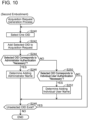
- the present embodiment is the same as the first embodiment except that authentication tables 54 and 154 are different and that an acquisition request generation process, writing request generation process, acquisition request process, and writing request process are different.
- the authentication table 54 of the present embodiment stores individual user authentication value in addition to OID and administrator authentication value.
- the Individual user authentication value indicates one of "Necessary” indicating that individual user authentication is necessary and "Unnecessary” indicating that individual user authentication is unnecessary.
- the authentication table 154 of the present embodiment is identical to the authentication table 54 of the present embodiment.
- S240 to S248 are the same as S40 to S48 in FIG. 5 .
- the CPU 132 proceeds to S250.
- S250 the CPU 132 specifies an individual user authentication value stored in association with the one OID selected in S240 in the authentication table 154. The CPU 132 then determines whether the specified individual user authentication value indicates "Necessary".
- the CPU 132 decides in S252 to write an authentication parameter including an individual user name in the header of the acquisition request.
- the authentication parameter including the individual user name is written in the acquisition request.
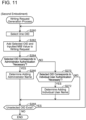
- S260 to S268 are the same as S60 to S68 in FIG. 6 .
- the CPU 132 proceeds to S270.
- S270 is the same as S250 in FIG. 10 .
- S272 is the same as S262 in FIG. 10 except that the writing request is used.
- S272 is completed, the CPU 132 proceeds to S268.
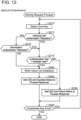
- S340 is the same as S140 in FIG. 8 .
- the CPU 32 specifies an OID associated with the one "key" selected in S340 in the acquisition request.
- the CPU 32 specifies an individual user authentication value stored in association with the specified OID in the authentication table 54.
- the CPU 32 determines whether the specified individual user authentication value indicates "Necessary".
- the CPU 32 determines whether the authenticated user is an eligible person.
- the eligible person is the individual user indicated by the individual user name written in the header of the acquisition request.
- the eligible person is the administrator indicated by the administrator name written in the header of the acquisition request.
- S356 is the same as S156 in FIG. 8 .
- S370 is the same as S170 in FIG. 9 .
- S372 is the same as S342 in FIG. 12 except that the writing request is used.
- S376 is the same as S172 in FIG. 9 .
- S374 is the same as S344 in FIG. 12 except that the writing request is used.
- S386 is the same as S186 in FIG. 9 .
- MIB values for which the individual user authentication "Necessary" is set are information set by the individual user (e.g., a list of telephone numbers, etc.).
- access to MIB values in the database 50 for which the individual user authentication "Necessary” is set can be executed by the individual user authentication, without need of the administrator authentication. Since the individual user other than the administrator is permitted to access a part of the database 50, convenience for the individual user is improved.
- a person determined as the eligible person in S374 is the individual user in case of YES in S372 or the administrator in case of YES in S376. That is, in the present embodiment, there are MIB values that the individual user can access but the administrator cannot.
- a person determined as eligible person in S374 may be the individual user or the administrator in case of YES in S372 and the eligible person may be the administrator in case of YES in S376. That is, in the modification, the administrator can access MIB values that the individual user can access.
- the OID corresponding to the individual user authentication "Necessary” and the MIB value corresponding to this OID are examples of “third OID” and “third value”, respectively.
- the authentication table 54 and the authentication table 154 are examples of “first list” and "second list”, respectively.
- the "communication device” is not limited to the printer 10 and may be, for example, a terminal device such as a desktop PC, a server, or the like.
- Modification 2 S102 in FIG. 7 may not be executed.
- the determination that the authenticated user is not the administrator includes that authentication is not executed for any user.
- Authentication being not executed for any user is an example of "the user of the terminal device is not authenticated as the specific user".
- Modification 4 One of the authentication table 52 (or 54) of the printer 10 and the authentication table 152 (or 154) of the terminal device 100 may be omitted. In the present modification, one of the "first list" and the "second list” may be omitted.
- Modification 5 Notification executed by "notify that authentication for the specific user is required” is not limited to the display of input screen in S34 of FIG. 4 and may be, for example, display of a message indicating that the administrator authentication is required, audio output of the message, etc.
- Modification 6 S34 in FIG. 4 may not be executed.
- "notify that authentication for the specific user is required” may be omitted.
- FIGS. 4 to 13 are implemented by the CPU 32 (or 132) executing the program 40 (or 140). Instead of this, at last one of these processes may be implemented by hardware such as a logic circuit, etc.
- a communication device comprising:
- (Item 4) The communication device according to any one of items 1 to 3, wherein the access request is a command according to Hypertext Transfer Protocol Secure (HTTPS).
- HTTPS Hypertext Transfer Protocol Secure
- (Item 5) The communication device according to any one of items 1 to 4, wherein the communication device further comprises: a response sending unit configured to, in the case where the access request includes the second OID and the user of the terminal device is not authenticated as the specific user, send a failure response to the terminal device as a response to the access request, the failure response indicating that the access to the second value has failed.
- a response sending unit configured to, in the case where the access request includes the second OID and the user of the terminal device is not authenticated as the specific user, send a failure response to the terminal device as a response to the access request, the failure response indicating that the access to the second value has failed.
- (Item 6) The communication device according to any one of items 1 to 5, wherein the access request is one of an acquisition request for acquiring a value stored in the database from the database and a writing request for writing a new value in the database.
- a control method of a communication device wherein the communication device comprises a database storing, for each of a plurality of object IDs (OIDs) of Management Information Base (MIB), a value in association with the OID wherein the control method comprises:
- a terminal device comprising:
- a control method of a terminal device comprising:
Landscapes
- Engineering & Computer Science (AREA)
- Theoretical Computer Science (AREA)
- Computer Security & Cryptography (AREA)
- Bioethics (AREA)
- General Health & Medical Sciences (AREA)
- Computer Hardware Design (AREA)
- Health & Medical Sciences (AREA)
- Software Systems (AREA)
- Physics & Mathematics (AREA)
- General Engineering & Computer Science (AREA)
- General Physics & Mathematics (AREA)
- Databases & Information Systems (AREA)
- Computer And Data Communications (AREA)
Abstract
Description
-
Japanese Patent Application No. 2008-065833 - Values with different security levels coexist in an MIB database. The disclosure herein provides technologies for accessing to an MIB database with consideration given to coexistence of values with different security levels.
- A communication device disclosed herein may comprise a database storing, for each of a plurality of object IDs (OIDs) of Management Information Base (MIB), a value in association with the OID; and a request receiving unit configured to receive an access request from a terminal device, the access request being for requesting access to a value in the database, and the access request including one or more OIDs among the plurality of OIDs; and an access executing unit configured to, in a case where the access request is received from the terminal device, execute access to a value in the database according to the access request, wherein in a case where the access request includes a first OID among the plurality of OIDs and a user of the terminal device is authenticated as a specific user, the access executing unit executes access to a first value stored in the database in association with the first OID, in a case where the access request includes a second OID among the plurality of OIDs, which is different from the first OID, and the user of the terminal device is authenticated as the specific user, the access executing unit executes access to a second value stored in the database in association with the second OID, in a case where the access request includes the first OID and the user of the terminal device is not authenticated as the specific user, the access executing unit executes access to the first value in the database, and in a case where the access request includes the second OID and the user of the terminal device is not authenticated as the specific user, the access to the second value in the database is not executed.
- Also disclosed herein is a computer program for a terminal device. the computer program causes a processor of the terminal device to function as: a request sending unit configured to send an access request to a communication device, the access request being a command for requesting access to a value in a database of the communication device, the database storing, for each of a plurality of object IDs (OIDs) of Management Information Base (MIB), a value in association with the OID, and the access request including one or more OIDs among the plurality of OIDs that are specified by a user of the terminal device; and a response receiving unit configured to receive a response to the access request from the communication device, wherein in a case where the access request includes a first OID among the plurality of OIDs and the user of the terminal device is authenticated as a specific user, the response includes first information indicating that access to a first value stored in the database in association with the first OID has succeeded, in a case where the access request includes a second OID among the plurality of OIDs, which is different from the first OID, and the user of the terminal device is authenticated as the specific user, the response includes second information indicating that access to a second value stored in the database in association with the second OID has succeeded, in a case where the access request includes the first OID and the user of the terminal device is not authenticated as the specific user, the response includes the first information, and in a case where the access request includes the second OID and the user of the terminal device is not authenticated as the specific user, the response does not include the second information.
- For example, it can be conceived that the second value has a higher security level than the first value. According to the configuration above, access to the first value is permitted regardless of whether the user of the terminal device is authenticated as the specific user or not, whereas access to the second value is not permitted unless the user of the terminal device is authenticated as the specific user. Access to an MIB database can be realized with consideration given to coexistence of values with different security levels.
- A computer program for implementing the above-described communication device and a computer-readable storage medium storing the computer program are also novel and useful. Further, a method performed by the above-described communication device is novel and useful. Further, the above-described terminal device and a computer program for implementing the terminal device are also novel and useful. Further, a method performed by the above-described terminal device is novel and useful.
-
FIG. 1 illustrates a configuration of a communication system. -
FIG. 2 illustrates a block diagram of a printer. -
FIG. 3 illustrates a block diagram of a terminal device. -
FIG. 4 illustrates a flowchart of a process by the terminal device. -
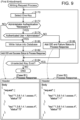
FIG. 5 illustrates a flowchart of an acquisition request generation process. -
FIG. 6 illustrates a flowchart of a writing request generation process. -
FIG. 7 illustrates a flowchart of a process by the printer. -
FIG. 8 illustrates a flowchart of an acquisition request process. -
FIG. 9 illustrates a flowchart of a writing request process. -
FIG. 10 illustrates a flowchart of an acquisition request generation process. -
FIG. 11 illustrates a flowchart of a writing request generation process. -
FIG. 12 illustrates a flowchart of an acquisition request process. -
FIG. 13 illustrates a flowchart of a writing request process. - (First Embodiment) (Configuration of
Communication System 2;FIG. 1 ) As illustrated inFIG. 1 , acommunication system 2 comprises aprinter 10 and aterminal device 100. Thedevices LAN 4. TheLAN 4 may be a wired LAN or a wireless LAN. In the present embodiment, theprinter 10 writes and sends information according to requests from theterminal device 100. In the present embodiment, an acquisition request for acquiring information and a writing request for writing information are commands according to HTTPS (Hypertext Transfer Protocol Secure). - (Configuration of
Printer 10;FIG. 2 ) Theprinter 10 is a peripheral device (e.g., a peripheral device of the terminal device 100) configured to execute a print function. In a modification, theprinter 10 may be a multifunctional device configured to execute a scan function, a FAX function, etc. in addition to the print function. Theprinter 10 comprises aLAN interface 20, aprint executing unit 22, and acontroller 30. Theunits 20 to 30 are connected to a bus line (reference sign omitted). Hereinafter, "interface" may be abbreviated as "I/F". - The LAN I/F 20 is for communication via the
LAN 4 and is connected to theLAN 4. Theprint executing unit 22 comprises a print mechanism of an inkjet scheme, laser scheme, or the like. - The
controller 30 comprises aCPU 32 and amemory 34. Thememory 34 is configured of a volatile memory and a non-volatile memory. TheCPU 32 executes various processes according toprogram 40 stored in thememory 34. Thememory 34 further stores adatabase 50 and an authentication table 52. Theprogram 40, thedatabase 50, and the authentication table 52 are stored, for example, in the non-volatile memory of thememory 34. - The
database 50 stores various information (referred to as "MIB values" hereinafter) of theprinter 10. The MIB values indicate, for example, a remaining amount in a consumable article, MAC address, name (i.e., user name), IP address, installed location, access destination, error history, status (print in progress, standby, etc.), print setting (e.g., default resolution for print), etc. of theprinter 10. Thedatabase 50 stores the above-mentioned various information in a tree structure (i.e., hierarchical structure). This collection of various information in the tree structure is referred to as "MIB (Management Information Base)". Specifically, thedatabase 50 stores a content and an OID (object ID) in association with each MIB value. The content is a character string indicating the meaning of the MIB value. The OID is an identifier for identifying the MIB value. - The authentication table 52 stores, for each of a plurality of OIDs in the
database 50, the OID and an administrator authentication value in association with each other. The administrator authentication value indicates one of "Necessary" indicating that administrator authentication is necessary and "Unnecessary" indicating that administrator authentication is unnecessary. - (Configuration of Terminal
Device 100;FIG. 3 ) Theterminal device 100 is a user terminal such as a desktop PC, a laptop PC, a tablet PC, a mobile phone (e.g., smartphone), or the like. Theterminal device 100 comprises anoperation unit 110, adisplay unit 112, a LAN I/F 120, and acontroller 130. Theoperation unit 110 comprises a plurality of keys. A user can input various instructions to theterminal device 100 by operating theoperation unit 110. Thedisplay unit 112 is a display configured to display various information. Thedisplay unit 112 may be a so-called touch screen (i.e., a part of the operation unit 110). The LAN I/F 120 is connected to theLAN 4. - The
controller 130 comprises aCPU 132 and amemory 134. TheCPU 132 executes various processes according toprograms memory 134. AnOS program 140 is a program for controlling basic operation of theterminal device 100. Anapplication 142 is a program for sending the acquisition request and the write request to theprinter 10. Theapplication 142 is provided, for example, by the vendor of theprinter 10. Theapplication 142 is downloaded, for example, from a server on the Internet. - The
memory 134 further stores an authentication table 152. The authentication table 152 is identical to the authentication table 52 of theprinter 10. The authentication table 152 is stored in thememory 134 by theapplication 142. - (Communication Protocols between
Printer 10 and Terminal Device 100) As a communication protocol for communicating MIB values of theprinter 10 between theprinter 10 and theterminal device 100, a protocol according to UDP (User Datagram Protocol) in the transport layer of the OSI (Open Systems Interconnection) reference model is widely known. Specifically, SNMP (Simple Network Management Protocol) is known. SNMP is SNMPv1, SNMPv2, or SNMPv2c. It can be contemplated that not only UDP but also a communication protocol according to TCP (Transmission Control Protocol) in the transport layer of the OSI reference model is used as a communication protocol for communicating MIB values. Specifically, it can be contemplated that HTTPS is used. This is because HTTPS is more secure than SNMP since it employs user authentication and encryption of communication data. Thus, it is possible to prevent MIB values of theprinter 10 from being illicitly written or acquired by a third party. In a modification, HTTP, which does not use SSL (Secure Socket Layer) or TLS (Transport Layer Security), may be used. - HTTP executes user authentication using a user name (i.e., ID) and a password. Here, HTTP supports basic authentication and digest authentication. The basic authentication is a scheme for coding a user name and a password by Base64 and sending it. The digest authentication is a scheme for hashing a user name and a password and sending it. In the basic authentication, a plain text generated by coding a user name and a password by Base64 is sent, while in the digest authentication, a value generated by hashing a user name and a password is sent. Thus, the digest authentication is more secure than the basic authentication. In the present embodiment, the digest authentication is used. In a modification, the basic authentication may be used.
- The HTTP user authentication allows for user authentication for a plurality of users including, for example, an administrator, an individual user, a public user, etc. The individual user is a user who is permitted by the administrator to access at least a part of the
database 50 of theprinter 10. The public user is a user who is different from the administrator and the individual user. Generally, privilege level of the public user is lower than privilege levels of the administrator and the individual user - (Process by
Terminal Device 100;FIG. 4 ) Referring toFIG. 4 , a process executed by theCPU 132 of theterminal device 100 according to theapplication 142 is described. The process ofFIG. 4 is triggered by activation of theapplication 142. Communication between theterminal device 100 and theprinter 10 is executed via the LAN I/Fs LAN 4. Hereinafter, phrases such as "via the LAN I/F 20 (or 120)" and "via theLAN 4" will be omitted unless otherwise stated. - The
CPU 132 monitors in S10 whether an acquisition operation for acquiring an MIB value of theprinter 10 is performed at theoperation unit 110 and monitors in S20 whether a writing operation for writing an MIB value in theprinter 10 is performed at theoperation unit 110. The acquisition operation includes an operation of designating one or more items from among a plurality of items (i.e., a plurality of contents) corresponding to a plurality of MIB values of theprinter 10. The writing operation includes an operation of designating one or more items corresponding to one or more MIB values (i.e., IP address, setting values of print setting, etc.) to be written in theprinter 10, and an operation of inputting, for each of the designated one or more items, an MBI value to be written in theprinter 10. The acquisition operation and the writing operation are, for example, operations on screens displayed on adisplay unit 112 of theterminal device 100. - When the acquisition operation is performed at the operation unit 110 (YES in S10), the
CPU 132 executes in S12 an acquisition request generation process (seeFIG. 5 ) for generating an acquisition request according to HTTP. The acquisition request is, for example, a command according to HTTP POST method that includes a header in which "X-HTTP-Method-Override 'GET′′′ is written (seeFIG. 5 ). In a modification, the acquisition request may be a command according to HTTP GET method. - In S14, the
CPU 132 executes HTTP user authentication between theterminal device 100 and theprinter 10. Specifically, theterminal device 100 sends a request to theprinter 10 and then receives a nonce (i.e., random value) from theprinter 10. Theterminal device 100 displays an input screen for input of a user name and a password on thedisplay unit 112. Theterminal device 100 generates an authentication parameter including a user name inputted to the input screen and the nonce received from theprinter 10. Theterminal device 100 then writes the generated authentication parameter in the header of the acquisition request generated in S12 (seeFIG. 5 ). Thus, digest authentication using the information inputted to the input screen (i.e., the user name and password) is executed when the acquisition request is sent. - In S16, the
CPU 132 executes digest authentication according to the authentication parameter written in the header of the acquisition request and sends the acquisition request to theprinter 10. When the digest authentication succeeds, a TLS (Transport Layer Security) session is established between theterminal device 100 and theprinter 10. The acquisition request is sent to theprinter 10 using the TLS session. That is, the acquisition request is encoded by TLS. - In S30 following S16, the
CPU 132 receives a process response as a response to the acquisition request sent in S16. The process response is also encoded by TLS. - In S32, the
CPU 132 determines whether the process response received in S30 includes a failure status. The failure status indicates that access to information in thedatabase 50 has failed. For example, when administrator authentication is necessary and digest authentication by a user other than the administrator (e.g., public user) is executed, the process response includes the failure status. - When determining that the process response includes the failure status (YES in S32), the
CPU 132 displays an input screen for input of a user name and a password on thedisplay unit 112 in S34. This input screen is, for example, the same as the input screen displayed in S14. In this way, the user is able to know that authentication for the administrator, who is different from the user identified by the user name inputted in S14, is necessary and input an administrator name and a password. When S34 is completed, theCPU 132 returns to the monitoring in S10 and the monitoring in S20. For example, information inputted in S34 is used in S14 and S16 when these steps are executed again. - When determining that the process response does not include the failure status (NO in S32), the
CPU 132 returns to the monitoring in S10 and the monitoring in S20. - When the writing operation is performed at the operation unit 110 (YES in S20), the
CPU 132 executes in S22 a writing request generation process (seeFIG. 6 ) for generating a writing request. The writing request is a command according to HTTP POST method. - S24 is the same as S14 except that the authentication parameter is written in the header of the writing request. S26 is the same as S16 except that the writing request generated in S24 is sent to the
printer 10. When the writing request is sent, digest authentication is executed and the writing request is encoded by TLS. - In S30 following S26, the
CPU 132 receives a process response as a response to the writing request sent in S26. The process response to the writing request is encoded by TLS. - (Acquisition Request Generation Process;
FIG. 5 ) The acquisition request generation process of S12 inFIG. 4 is described. In S40, theCPU 132 selects one OID from among one or more OIDs corresponding to the one or more contents selected by the acquisition operation (referred to as "one or more target OIDs" hereinafter). - In S42, the
CPU 132 adds the one OID selected in S40 to an acquisition request. Specifically, as illustrated inFIG. 5 , a combination of "key" and the OID (e.g., "1.3.6.1.4. 1.xxxxxx. 1") is written in the body of the acquisition request. - In S44, the
CPU 132 specifies an administrator authentication value stored in association with the one OID selected in S40 in the authentication table 152. TheCPU 132 determines whether the specified administrator authentication value indicates "Necessary". When determining that the specified administrator authentication value indicates "Unnecessary" (NO in S44), theCPU 132 skips S46, which will be described later, and proceeds to S48. On the other hand, when determining that the specified administrator authentication value indicates "Necessary" (YES in S44), theCPU 132 proceeds to S46. - In S46, the
CPU 132 decides that an authentication parameter including the administrator name is to be written in the header of the acquisition request. Thus, in S14 ofFIG. 4 , the authentication parameter including the administrator name is written in the header of the acquisition request. When S46 is completed, theCPU 132 proceeds to S48. - In S48, the
CPU 132 determines whether there is an unselected OID among the one or more target OIDs. When determining that there is an unselected OID among the one or more target OIDs (YES in S48), theCPU 132 returns to S40 and selects another OID. - When determining that there is no unselected OID among the one or more target OIDs (NO in S48), the
CPU 132 terminates the process ofFIG. 5 . - (Writing Request Generation Process;
FIG. 6 ) The writing request generation process of S22 inFIG. 4 is described. S60 is the same as S40 inFIG. 5 except that one or more OIDs corresponding to the one or more MIB values inputted by the writing operation are used. - In S62, the
CPU 132 adds the one OID selected in S60 to a writing request. Specifically, a combination of "key", the OID, and an MIB value to be written in the printer 10 (i.e., MIB value inputted by the user) is written in the body of the writing request according to HTTPS. - S64 and S66 are the same as S44 and S46 except that it is decided to write an authentication parameter including the administrator name in the header of the writing request. S68 is the same as S48.
- (Process by
Printer 10;FIG. 7 ) Referring toFIG. 7 , a process executed by theCPU 32 of theprinter 10 according to theprogram 40 is described. The process ofFIG. 7 is triggered by theprinter 10 being turned on. - In S100, the
CPU 32 monitors whether an event of accessing theMIB database 50 using HTTP occurs. The event ofS 100 includes that the LAN I/F 20 receives a command according to HTTP from theterminal device 100. - When the event of S100 occurs (YES in S100), the
CPU 32 executes S102 and subsequent steps. In S102, theCPU 32 determines whether the digest authentication between theterminal device 100 and theprinter 10 has succeeded. When determining that the digest authentication has succeeded (YES in S102), theCPU 32 proceeds to S104. - In S104, the
CPU 32 determines whether the command according to HTTP received from the terminal device 100 (referred to as "received command" hereinafter) is an acquisition request. When determining that the received command is an acquisition request (YES in S104), theCPU 32 executes in S106 an acquisition request process (seeFIG. 8 ) according to the acquisition request. In S120 following S106, theCPU 32 sends a process response generated in the acquisition request process in S106 to theterminal device 100. When S120 is completed, theCPU 32 returns to the monitoring in S100. - When determining that the received command is not an acquisition request (NO in S104), the
CPU 32 determines in S108 whether the received command is a writing request. When determining that the received command is a writing request (YES in S108), theCPU 32 executes in S110 a writing request process (seeFIG. 9 ) according to the writing request. In S120 following S110, theCPU 32 sends a process response generated in the writing request process inS 110 to theterminal device 100. - When determining that the digest authentication has failed (NO in S102) or when the received command is neither of an acquisition request nor a writing request (e.g., the received request is a request that is not supported by the printer 10) (NO in S108), the
CPU 32 proceeds to S122. In S122, theCPU 32 sends a failure response to theterminal device 100. The failure response indicates that a process according to the received command has failed. When S122 is completed, theCPU 32 returns to the monitoring in S100. - (Acquisition Request Process;
FIG. 8 ) The acquisition request process of S106 inFIG. 7 is described. In S140, theCPU 32 selects one "key" from among one or more "keys" included in the acquisition request. - In S142, the
CPU 32 specifies an OID associated with the one "key" selected in S140 in the acquisition request. TheCPU 32 specifies an administrator authentication value stored in association with the specified OID in the authentication table 152. TheCPU 32 determines whether the specified administrator authentication value indicates "Necessary". When determining that the specified administrator authentication value indicates "Unnecessary" (NO in S142), theCPU 32 skips S144, which will be described later, and proceeds to S150. On the other hand, when determining that the specified administrator authentication value indicates "Necessary" (YES in S142), theCPU 32 proceeds to S144. - In S144, the
CPU 32 determines whether the user authenticated by the executed digest authentication (referred to as "authenticated user" hereinafter) is the administrator. When the administrator name is written as the authentication parameter in the header of the acquisition request, theCPU 32 determines that the authenticated user is the administrator (YES in S144) and proceeds to S150. - In S150, the
CPU 32 acquires an MIB value stored in association with the specified OID from thedatabase 50. - In S152, the
CPU 32 adds the MIB value acquired in S150 to a process response to the acquisition request. Specifically, as illustrated inFIG. 8 , a combination of "key", the specified OID (e.g., "1.3.6.1.4.1.xxxxxx.1"), and the acquired MIB value (e.g., IP address "192.168.0.1") is written in the body of the process response. When S152 is completed, theCPU 32 proceeds to S154. - In S154, the
CPU 32 determines whether there is an unselected "key" among the one or more "keys" included in the acquisition request. When determining that there is an unselected "key" among the one or more "keys" included in the acquisition request (YES in S154), theCPU 32 returns to S140 and selects another "key". - When a user other than the administrator name (e.g., public user) is written as the authentication parameter in the header of the acquisition request, the
CPU 32 determines that the authenticated user is not the administrator (NO in S144) and proceeds to S156. - In S156, the
CPU 32 adds the failure status to a process response to the acquisition request. Specifically, as illustrated inFIG. 8 , a combination of "key", the specified OID (e.g., "1.3.6.1.4.1.xxxxxx. 1"), and the failure status (e.g., "status":"-1") is written in the body of the process response. When S156 is completed, theCPU 32 proceeds to S154. - (Writing Request Process;
FIG. 9 ) The writing request process ofS 110 inFIG. 7 is described. S 170 to S174 are the same as S140 to S144 inFIG. 8 except that one or more "keys" included in the writing request are used. - When determining that the authenticated user is the administrator (YES in S174), the
CPU 32 proceeds to S180. In S180, theCPU 32 specifies an MIB value associated with the OID specified in S172 in the writing request. TheCPU 32 then writes the specified MIB value in thedatabase 50 in association with the specified OID. In other words, the MIB value stored in association with the specified OID in thedatabase 50 is updated to the MIB value included in the writing request. - In subsequent S182, the
CPU 32 adds a success status indicating that the specified MIB value has been successfully written to a process response to the writing request. Specifically, as illustrated inFIG. 9 , a combination of "key", the specified OID (e.g., "1.3.6.1.4.1.xxxxxx. 1"), and the success status (e.g., "status":"0") is written in the body of the process response. When S182 is completed, theCPU 32 proceeds to S184. S184 is the same as S154 inFIG. 8 except that the one or more "keys" included in the writing request are used. - When determining that the authenticated user is not the administrator (NO in S174), the
CPU 32 proceeds to S186. S186 is the same as S156 inFIG. 8 except that the process response to the writing request is used. - (Specific Cases) For example, in the authentication table 52, OIDs corresponding to MIB values with relatively high security levels are associated with the administrator authentication value "Necessary", while OIDs corresponding to MIB values with relatively low security levels are associated with the administrator authentication value "Unnecessary". The MIB values with relatively high security levels include, for example, an IP address, a MAC address, etc. The MIB values with relatively low security levels include, for example, the number of printed sheets, print settings, etc.
- (Case A1;
FIG. 8 ) As an example, Case A1 is conceived in which the user designates an IP address and the number of printed sheets as two items by the acquisition operation in S10 ofFIG. 4 , and the administrator name and a password are inputted for the user authentication in S14. In the present case, theterminal device 100 determines that the administrator authentication is "Necessary" for the OID of the IP address (YES in S44 ofFIG. 5 ) and writes the administrator name in the header of the acquisition request (S46 inFIG. 5 and S14 inFIG. 4 ). Theterminal device 100 then sends theprinter 10 the acquisition request including the OID of the IP address and the OID of the number of printed sheets (S16). - The
printer 10 determines that the received command from theterminal device 100 is an acquisition request (YES in S100 and YES in S104) and determines that the digest authentication for the administrator has succeeded (YES in S102). In the present case, theprinter 10 determines that the administrator authentication is "Necessary" for the OID of the IP address (YES in S142 ofFIG. 8 ) and further determines that the authenticated user is the administrator (YES in S144). Theprinter 10 then adds the OID of the IP address and the MIB value stored in association with the IP address in thedatabase 50 to a process response (S150 and S152). - Further, the
printer 10 determines that the administrator authentication is "Unnecessary" for the OID of the number of printed sheets (NO in S142), skips the determination in S144, and adds the OID of the number of printed sheets and the MIB value "100" stored in association with the number of printed sheets in thedatabase 50 to the process response (S150 and S152). - In the present case, the authenticated user is the administrator, and thus both the MIB value of the IP address with a high security level and the MIB value of the number of printed sheets with a low security level are added to the process response to the acquisition request.
- (Case A2;
FIG. 8 ) The present case is the same as Case A1 except that a public user name and a password are inputted for the user authentication in S14. A process executed by theterminal device 100 in the present case is the same as that of Case A1 except that the public user name is written in the header of the acquisition request. - The
printer 10 determines that the received command from theterminal device 100 is an acquisition request (YES in S100 and YES in S104) and determines that the digest authentication for the public user has succeeded (YES in S102). In the present case, theprinter 10 determines that the administrator authentication is "Necessary" for the OID of the IP address (YES in S142 ofFIG. 8 ) and further determines that the authenticated user is not the administrator (NO in S144). Theprinter 10 then adds the OID of the IP address and the failure status to a process response (S156). - A process executed by the
printer 10 for the OID of the number of printed sheets in the present case is the same as that of Case A1. - In the present case, the authenticated user is the public user, and thus the MIB value of the IP address with a high security level is not added to the process response, while the MIB value of the number of printed sheets with a low security level is added to the process response to the acquisition request.
- (Case B1;
FIG. 9 ) As an example, Case B1 is conceived in which the user designates an IP address and a print setting as two items by the writing operation in S20 ofFIG. 4 , inputs a new IP address and a value of a new print setting, and inputs the administrator name and a password for the user authentication in S24. - In the present case, the
terminal device 100 determines that the administrator authentication is "Necessary" for the OID of the IP address (YES in S64 ofFIG. 6 ) and writes the administrator name in the header of the writing request (S66 inFIG. 6 and S24 inFIG. 4 ). Theterminal device 100 then send theprinter 10 the writing request including the OID of the IP address, the OID of the print setting, the new IP address, and the new print setting (S26). - The
printer 10 determines that the received command from theterminal device 100 is a writing request (YES in S100 and YES in S108) and determines that the digest authentication for the administrator has succeeded (YES in S102). In the present case, theprinter 10 determines that the administrator authentication is "Necessary" for the OID of the IP address (YES in S172 ofFIG. 9 ) and further determines that the authenticated user is the administrator (YES in S174). Theprinter 10 writes the new IP address included in the writing request in the database 50 (S180). Theprinter 10 then adds the OID of the IP address and the success status to a process response (S182). - Further, the
printer 10 determines that the administrator authentication is "Unnecessary" for the OID of the print setting (NO in S172), skips the determination in S174, and writes the new print setting included in the writing request in the database 50 (S180). Theprinter 10 then adds the OID of the print setting and the success status to the process response (S182). - In the present case, the authenticated user is the administrator, and thus both the MIB value of the IP address with a high security level and the MIB value of the print setting with a low security level are written in the
database 50. - (Case B2;
FIG. 9 ) The present case is the same as Case B1 except that public user name and a password are inputted for the user authentication in S14. A process executed by theterminal device 100 in the present case is the same as that ofCase B 1 except that public user name is written in the header of the writing request. - The
printer 10 determines that the received command from theterminal device 100 is a writing request (YES in S100 and YES in S108) and determines that the digest authentication for the public user has succeeded (YES in S102). In the present case, theprinter 10 determines that the administrator authentication is "Necessary" for the OID of the IP address (YES in S172 ofFIG. 9 ) and further determines that the authenticated user is not the administrator (NO in S174). Theprinter 10 then adds the OID of the IP address and the failure status to a process response (S186). - A process executed by the
printer 10 for the OID of the print setting in the present case is the same as that of Case B1. - In the present case, the authenticated user is the public user, and thus the MIB value of the IP address with a high security level is not written in the
database 50, while the MIB value of the print setting with a low security level is written in thedatabase 50. - (Effects of First Embodiment) Values with different security levels coexist in the
MIB database 50. According to the configuration of the present embodiment, access to MIB values with low security levels (i.e., MIB values for which the administrator authentication is set as "Unnecessary") is permitted regardless of whether the user of theterminal device 100 is authenticated as the administrator or not. On the other hand, access to MIB values with high security levels (i.e., MIB values for which the administrator authentication is set as "Necessary") is not permitted unless the user of theterminal device 100 is authenticated as the administrator. Access to theMIB database 50 can be executed with consideration given to the coexistence of values with different security levels. - (Correspondence Relationships) The
printer 10, thedatabase 50, the authentication table 52, and thememory 34 are examples of "communication device", "database", "first list", and "first memory", respectively. Theterminal device 100, theapplication 142, theCPU 132, the authentication table 152, and thememory 134 are examples of "terminal device", "computer-readable instructions", "processor", "second list", and "second memory", respectively. The acquisition request and writing request are examples of "access request". The failure status and the process response including the failure status are examples of "failure information" and "failure response", respectively. The administrator is an example of "specific user". The OID corresponding to the number of printed sheets in Case A1 inFIG. 8 is an example of "first OID". The MIB value corresponding to the number of printed sheets in Case A1 inFIG. 8 is an example of "first value". The MIB value corresponding to the number of printed sheets in Case A1 inFIG. 8 and the success status in Case B1 inFIG. 9 are examples of "first information". The OID corresponding to the IP address in Case A1 inFIG. 8 is an example of "second OID". The MIB value corresponding to the IP address in Case A1 inFIG. 8 is an example of "second value". The MIB value corresponding to the IP address in Case A1 inFIG. 8 and the success status in Case B1 inFIG. 9 are examples of "second information". - S104 or S108 in
FIG. 7 is an example of "receive an access request from a terminal device". S106 or S110 inFIG. 7 is an example of "execute access to a value in the database". S16 or S26 inFIG. 4 is an example of "send an access request to a communication device". S30 inFIG. 4 is an example of "receive a response to the access request". - (Second Embodiment) The present embodiment is the same as the first embodiment except that authentication tables 54 and 154 are different and that an acquisition request generation process, writing request generation process, acquisition request process, and writing request process are different.
- As illustrated in
FIG. 2 , the authentication table 54 of the present embodiment stores individual user authentication value in addition to OID and administrator authentication value. The Individual user authentication value indicates one of "Necessary" indicating that individual user authentication is necessary and "Unnecessary" indicating that individual user authentication is unnecessary. As illustrated inFIG. 3 , the authentication table 154 of the present embodiment is identical to the authentication table 54 of the present embodiment. - (Acquisition Request Generation Process;
FIG. 10 ) S240 to S248 are the same as S40 to S48 inFIG. 5 . When determining that an administrator authentication value stored in association with the one OID selected in S240 indicates "Unnecessary" in the authentication table 154 (NO in S244), theCPU 132 proceeds to S250. In S250, theCPU 132 specifies an individual user authentication value stored in association with the one OID selected in S240 in the authentication table 154. TheCPU 132 then determines whether the specified individual user authentication value indicates "Necessary". - When determining that the specified individual user authentication value indicates "Necessary" (YES in S250), the
CPU 132 decides in S252 to write an authentication parameter including an individual user name in the header of the acquisition request. Thus, in S14 ofFIG. 4 , the authentication parameter including the individual user name is written in the acquisition request. When S252 is completed, theCPU 132 proceeds to S248. - When determining that the specified individual user authentication value indicates "Unnecessary" (NO in S250), the
CPU 132 skips S252 and proceeds to S248. - (Write Request Generation Process;
FIG. 11 ) S260 to S268 are the same as S60 to S68 inFIG. 6 . When determining that an administrator authentication value stored in association with the one OID selected in S260 indicates "Unnecessary" in the authentication table 154 (NO in S264), theCPU 132 proceeds to S270. S270 is the same as S250 inFIG. 10 . - When determining that the specified individual user authentication value indicates "Necessary" (YES in S270), the
CPU 132 proceeds to S272. S272 is the same as S262 inFIG. 10 except that the writing request is used. When S272 is completed, theCPU 132 proceeds to S268. - When determining that the specified individual user authentication value indicates "Unnecessary" (NO in S270), the
CPU 132 skips S272 and proceeds to S268. - (Acquisition Request Process;
FIG. 12 ) S340 is the same as S140 inFIG. 8 . In S342, theCPU 32 specifies an OID associated with the one "key" selected in S340 in the acquisition request. TheCPU 32 specifies an individual user authentication value stored in association with the specified OID in the authentication table 54. TheCPU 32 determines whether the specified individual user authentication value indicates "Necessary". - When determining that the specified individual user authentication value indicates "Necessary" (YES in S342), the
CPU 32 proceeds to S344. - When determining that the specified individual user authentication value indicates "Unnecessary" (NO in S342), the
CPU 32 proceeds to S346. S346 is the same as S142 inFIG. 8 . When determining that the specified administrator authentication value indicates "Necessary" (YES in S346), theCPU 32 proceeds to S344. - In S344, the
CPU 32 determines whether the authenticated user is an eligible person. In case of determining YES in S342, the eligible person is the individual user indicated by the individual user name written in the header of the acquisition request. On the other hand, in case of determining YES in S346, the eligible person is the administrator indicated by the administrator name written in the header of the acquisition request. - When determining that the authenticated user is the eligible person (YES in S344), the
CPU 32 proceeds to S350 to S354. S350 to S354 are the same as S150 to S154 inFIG. 8 . - When determining that the authenticated user is not the eligible person (NO in S344), the
CPU 32 proceeds to S356. S356 is the same as S156 inFIG. 8 . - (Writing Request Process;
FIG. 13 ) S370 is the same as S170 inFIG. 9 . S372 is the same as S342 inFIG. 12 except that the writing request is used. - When determining that the specified individual user authentication value indicates "Necessary" (YES in S372), the
CPU 32 proceeds to S374. - When determining that the specified individual user authentication value indicates "Unnecessary" (NO in S372), the
CPU 32 proceeds to S376. S376 is the same as S172 inFIG. 9 . When determining that the specified administrator authentication value indicates "Necessary" (YES in S376), theCPU 32 proceeds to S374. S374 is the same as S344 inFIG. 12 except that the writing request is used. - When determining that the authenticated user is the eligible person (YES in S374), the
CPU 32 proceeds to S380 to S384. S380 to S384 are the same as S180 to S184 inFIG. 9 . - When determining that the authenticated user is not the eligible person (NO in S374), the
CPU 32 proceeds to S386. S386 is the same as S186 inFIG. 9 . - (Effects of Second Embodiment) For example, MIB values for which the individual user authentication "Necessary" is set are information set by the individual user (e.g., a list of telephone numbers, etc.). According to the configuration of the present embodiment, access to MIB values in the
database 50 for which the individual user authentication "Necessary" is set can be executed by the individual user authentication, without need of the administrator authentication. Since the individual user other than the administrator is permitted to access a part of thedatabase 50, convenience for the individual user is improved. - In the present embodiment, a person determined as the eligible person in S374 is the individual user in case of YES in S372 or the administrator in case of YES in S376. That is, in the present embodiment, there are MIB values that the individual user can access but the administrator cannot. In a modification, a person determined as eligible person in S374 may be the individual user or the administrator in case of YES in S372 and the eligible person may be the administrator in case of YES in S376. That is, in the modification, the administrator can access MIB values that the individual user can access.
- (Correspondence Relationships) The OID corresponding to the individual user authentication "Necessary" and the MIB value corresponding to this OID are examples of "third OID" and "third value", respectively. The authentication table 54 and the authentication table 154 are examples of "first list" and "second list", respectively.
- While the invention has been described in conjunction with various example structures outlined above and illustrated in the figures, various alternatives, modifications, variations, improvements, and/or substantial equivalents, whether known or that may be presently unforeseen, may become apparent to those having at least ordinary skill in the art. Accordingly, the example embodiments of the disclosure, as set forth above, are intended to be illustrative of the invention, and not limiting the invention. Various changes may be made without departing from the spirit and scope of the disclosure. Therefore, the disclosure is intended to embrace all known or later developed alternatives, modifications, variations, improvements, and/or substantial equivalents. Some specific examples of potential alternatives, modifications, or variations in the described invention are provided below.
- (Modification 1) The "communication device" is not limited to the
printer 10 and may be, for example, a terminal device such as a desktop PC, a server, or the like. - (Modification 2) S102 in
FIG. 7 may not be executed. In this instance, for example, in S144 ofFIG. 8 , the determination that the authenticated user is not the administrator includes that authentication is not executed for any user. In the present modification, Authentication being not executed for any user is an example of "the user of the terminal device is not authenticated as the specific user". - (Modification 3) S156 in
FIG. 8 and S186 inFIG. 9 may not be executed. In the present embodiment, the "failure response" may be omitted. - (Modification 4) One of the authentication table 52 (or 54) of the
printer 10 and the authentication table 152 (or 154) of theterminal device 100 may be omitted. In the present modification, one of the "first list" and the "second list" may be omitted. - (Modification 5) Notification executed by "notify that authentication for the specific user is required" is not limited to the display of input screen in S34 of
FIG. 4 and may be, for example, display of a message indicating that the administrator authentication is required, audio output of the message, etc. - (Modification 6) S34 in
FIG. 4 may not be executed. In the present modification, "notify that authentication for the specific user is required" may be omitted. - (Modification 7) In the embodiments above, the processes of
FIGS. 4 to 13 are implemented by the CPU 32 (or 132) executing the program 40 (or 140). Instead of this, at last one of these processes may be implemented by hardware such as a logic circuit, etc. - The following is a list of features of the technology disclosed herein.
- (Item 1) A communication device comprising:
- a database storing, for each of a plurality of object IDs (OIDs) of Management Information Base (MIB), a value in association with the OID; and
- a request receiving unit configured to receive an access request from a terminal device, the access request being for requesting access to a value in the database, and the access request including one or more OIDs among the plurality of OIDs; and
- an access executing unit configured to, in a case where the access request is received from the terminal device, execute access to a value in the database according to the access request, wherein
- in a case where the access request includes a first OID among the plurality of OIDs and a user of the terminal device is authenticated as a specific user, the access executing unit executes access to a first value stored in the database in association with the first OID,
- in a case where the access request includes a second OID among the plurality of OIDs, which is different from the first OID, and the user of the terminal device is authenticated as the specific user, the access executing unit executes access to a second value stored in the database in association with the second OID,
- in a case where the access request includes the first OID and the user of the terminal device is not authenticated as the specific user, the access executing unit executes access to the first value in the database, and
- in a case where the access request includes the second OID and the user of the terminal device is not authenticated as the specific user, the access to the second value in the database is not executed.
- (Item 2) The communication device according to
item 1, wherein
the user of the terminal device not being authenticated as the specific user includes that the user of the terminal device is authenticated as a user different from the specific user. - (Item 3) The communication device according to
item - in a case where the access request includes a third OID among the plurality of OIDs, which is different from the first OID, and the user of the terminal device is authenticated as an individual user different from the specific user, the access executing unit executes access to a third value stored in the database in association with the third OID, and
- in a case where the access request includes the third OID and the user of the terminal device is not authenticated as any one of the specific user and the individual user, the access to the third value in the database is not executed.
- (Item 4) The communication device according to any one of
items 1 to 3, wherein
the access request is a command according to Hypertext Transfer Protocol Secure (HTTPS). - (Item 5) The communication device according to any one of
items 1 to 4, wherein
the communication device further comprises:
a response sending unit configured to, in the case where the access request includes the second OID and the user of the terminal device is not authenticated as the specific user, send a failure response to the terminal device as a response to the access request, the failure response indicating that the access to the second value has failed. - (Item 6) The communication device according to any one of
items 1 to 5, wherein
the access request is one of an acquisition request for acquiring a value stored in the database from the database and a writing request for writing a new value in the database. - (Item 7) The communication device according to any one of
items 1 to 6, wherein - the communication device further comprises a first memory storing a first list of second OIDs, and
- a first determining unit configured to determine, by using the first list, whether an OID included in the access request is a second OID.
- (Item 8) A computer program for a terminal device, wherein the computer program causes a processor of the terminal device to function as:
- a request sending unit configured to send an access request to a communication device, the access request being a command for requesting access to a value in a database of the communication device, the database storing, for each of a plurality of object IDs (OIDs) of Management Information Base (MIB), a value in association with the OID, and the access request including one or more OIDs among the plurality of OIDs that are specified by a user of the terminal device; and
- a response receiving unit configured to receive a response to the access request from the communication device, wherein
- in a case where the access request includes a first OID among the plurality of OIDs and the user of the terminal device is authenticated as a specific user, the response includes first information indicating that access to a first value stored in the database in association with the first OID has succeeded,
- in a case where the access request includes a second OID among the plurality of OIDs, which is different from the first OID, and the user of the terminal device is authenticated as the specific user, the response includes second information indicating that access to a second value stored in the database in association with the second OID has succeeded,
- in a case where the access request includes the first OID and the user of the terminal device is not authenticated as the specific user, the response includes the first information, and
- in a case where the access request includes the second OID and the user of the terminal device is not authenticated as the specific user, the response does not include the second information.
- (Item 9) The computer program according to item 8, wherein
the user of the terminal device not being authenticated as the specific user includes that the user of the terminal device is a user different from the specific user. - (Item 10) The computer program according to item 8 or 9, wherein
- in a case where the access request includes a third OID among the plurality of OIDs, which is different from the first OID, and the user of the terminal device is authenticated as an individual user different from the specific user, the response includes third information indicating that access to a third value stored in the database in association with the third OID has succeeded, and
- in a case where the access request includes the third OID and the user of the terminal device is not authenticated as any one of the specific user and the individual user, the response does not include the third information.
- (Item 11) The computer program according to any one of items 8 to 10, wherein
the access request is a command according to Hypertext Transfer Protocol Secure (HTTPS). - (Item 12) The computer program according to any one of items 8 to 11, wherein
- in the case where the access request includes the second OID and the user of the terminal device is not authenticated as the specific user, the response includes failure information indicating that the access to the second value has failed, and
- the computer program further causes the processor to function as:
a notifying unit configured to, in a case where the response including the failure information is received from the communication device, notify that authentication for the specific user is required. - (Item 13) The computer program according to any one of items 8 to 12, wherein
the access request is one of an acquisition request for acquiring a value stored in the database from the database and a writing request for writing a new value in the database. - (Item 14) The computer program according to any one of items 8 to 13, wherein
- the terminal device comprises a second memory storing a second list of second OIDs,
- the computer program further causes the processor to function as:
- a second determining unit configured to determine, by using the second list, whether a second OID is included in two or more OIDs specified by the user of the terminal device, and
- an adding unit configured to, in a case where it is determined, by using the second list, that the second OID is included in the two or more OIDs, add information indicating that the user of the terminal device is the specific user to the access request.
- (Item 15) A computer program for a communication device, wherein the communication device comprises:
- a processor; and
- a database storing, for each of a plurality of object IDs (OIDs) of Management Information Base (MIB), a value in association with the OID,
- wherein the computer program causes the processor to function as:
- a request receiving unit configured to receive an access request from a terminal device, the access request being for requesting access to a value in the database, and the access request including one or more OIDs among the plurality of OIDs; and
- an access executing unit configured to, in a case where the access request is received from the terminal device, execute access to a value in the database according to the access request, wherein
- in a case where the access request includes a first OID among the plurality of OIDs and a user of the terminal device is authenticated as a specific user, the access executing unit executes access to a first value stored in the database in association with the first OID,
- in a case where the access request includes a second OID among the plurality of OIDs, which is different from the first OID, and the user of the terminal device is authenticated as the specific user, the access executing unit executes access to a second value stored in the database in association with the second OID,
- in a case where the access request includes the first OID and the user of the terminal device is not authenticated as the specific user, the access executing unit executes access to the first value in the database, and
- in a case where the access request includes the second OID and the user of the terminal device is not authenticated as the specific user, the access to the second value in the database is not executed.
- (Item 16) A control method of a communication device, wherein the communication device comprises a database storing, for each of a plurality of object IDs (OIDs) of Management Information Base (MIB), a value in association with the OID wherein the control method comprises:
- a receiving step for receiving an access request from a terminal device, the access request being for requesting access to a value in the database, and the access request including one or more OIDs among the plurality of OIDs; and
- an access executing unit for, in a case where the access request is received from the terminal device, executing access to a value in the database according to the access request, wherein
- in a case where the access request includes a first OID among the plurality of OIDs and a user of the terminal device is authenticated as a specific user, access to a first value stored in the database in association with the first OID is executed,
- in a case where the access request includes a second OID among the plurality of OIDs, which is different from the first OID, and the user of the terminal device is authenticated as the specific user, access to a second value stored in the database in association with the second OID is executed,
- in a case where the access request includes the first OID and the user of the terminal device is not authenticated as the specific user, access to the first value in the database is executed, and
- in a case where the access request includes the second OID and the user of the terminal device is not authenticated as the specific user, the access to the second value in the database is not executed.
- (Item 17) A terminal device comprising:
- a request sending unit configured to send an access request to a communication device, the access request being a command for requesting access to a value in a database of the communication device, the database storing, for each of a plurality of object IDs (OIDs) of Management Information Base (MIB), a value in association with the OID, and the access request including one or more OIDs among the plurality of OIDs that are specified by an user of the terminal device; and
- a response receiving unit configured to receive a response to the access request from the communication device, wherein
- in a case where the access request includes a first OID among the plurality of OIDs and the user of the terminal device is authenticated as a specific user, the response includes first information indicating that access to a first value stored in the database in association with the first OID has succeeded,
- in a case where the access request includes a second OID among the plurality of OIDs, which is different from the first OID, and the user of the terminal device is authenticated as the specific user, the response includes second information indicating that access to a second value stored in the database in association with the second OID has succeeded,
- in a case where the access request includes the first OID and the user of the terminal device is not authenticated as the specific user, the response includes the first information, and
- in a case where the access request includes the second OID and the user of the terminal device is not authenticated as the specific user, the response does not include the second information.
- (Item 18) A control method of a terminal device, the method comprising:
- a request sending step for sending an access request to a communication device, the access request being a command for requesting access to a value in a database of the communication device, the database storing, for each of a plurality of object IDs (OIDs) of Management Information Base (MIB), a value in association with the OID, and the access request including one or more OIDs among the plurality of OIDs that are specified by an user of the terminal device; and
- a response receiving unit for receiving a response to the access request from the communication device, wherein
- in a case where the access request includes a first OID among the plurality of OIDs and the user of the terminal device is authenticated as a specific user, the response includes first information indicating that access to a first value stored in the database in association with the first OID has succeeded,
- in a case where the access request includes a second OID among the plurality of OIDs, which is different from the first OID, and the user of the terminal device is authenticated as the specific user, the response includes second information indicating that access to a second value stored in the database in association with the second OID has succeeded,
- in a case where the access request includes the first OID and the user of the terminal device is not authenticated as the specific user, the response includes the first information, and
- in a case where the access request includes the second OID and the user of the terminal device is not authenticated as the specific user, the response does not include the second information.
Claims (9)
- A communication device (10) comprising:a database (50) storing, for each of a plurality of object IDs (OIDs) of Management Information Base (MIB), a value in association with the OID; anda request receiving unit (30) configured to receive an access request from a terminal device (100), the access request being for requesting access to a value in the database (50), and the access request including one or more OIDs among the plurality of OIDs; andan access executing unit (30) configured to, in a case where the access request is received from the terminal device (100), execute access to a value in the database (50) according to the access request, whereinin a case where the access request includes a first OID among the plurality of OIDs and a user of the terminal device (100) is authenticated as a specific user, the access executing unit (30) executes access to a first value stored in the database (50) in association with the first OID,in a case where the access request includes a second OID among the plurality of OIDs, which is different from the first OID, and the user of the terminal device (100) is authenticated as the specific user, the access executing unit (30) executes access to a second value stored in the database (50) in association with the second OID,in a case where the access request includes the first OID and the user of the terminal device (100) is not authenticated as the specific user, the access executing unit (30) executes access to the first value in the database (50), andin a case where the access request includes the second OID and the user of the terminal device (100) is not authenticated as the specific user, the access to the second value in the database (50) is not executed.
- The communication device (10) according to claim 1, wherein
the user of the terminal device (100) not being authenticated as the specific user includes that the user of the terminal device (100) is authenticated as a user different from the specific user - The communication device (10) according to claim 2, whereinin a case where the access request includes a third OID among the plurality of OIDs, which is different from the first OID, and the user of the terminal device (100) is authenticated as an individual user different from the specific user, the access executing unit (30) executes access to a third value stored in the database (50) in association with the third OID, andin a case where the access request includes the third OID and the user of the terminal device (100) is not authenticated as any one of the specific user and the individual user, the access to the third value in the database (50) is not executed.
- The communication device (10) according to any one of claims 1 to 3, wherein
the access request is a command according to Hypertext Transfer Protocol Secure (HTTPS). - The communication device (10) according to any one of claims 1 to 3, wherein
the communication device (10) further comprises:
a response sending unit (30) configured to, in the case where the access request includes the second OID and the user of the terminal device (100) is not authenticated as the specific user, send a failure response to the terminal device (100) as a response to the access request, the failure response indicating that the access to the second value has failed. - The communication device (10) according to any one of claims 1 to 3, wherein
the access request is one of an acquisition request for acquiring a value stored in the database (50) from the database (50) and a writing request for writing a new value in the database (50). - The communication device (10) according to any one of claims 1 to 3, whereinthe communication device (10) further comprises a first memory storing a first list of second OIDs, anda first determining unit (30) configured to determine, by using the first list, whether an OID included in the access request is a second OID.
- A computer program (40) for a communication device (10), wherein the communication device (10) comprises:a processor (32); anda database (50) storing, for each of a plurality of object IDs (OIDs) of Management Information Base (MIB), a value in association with the OID,wherein the computer program (40) causes the processor (32) to function as:a request receiving unit configured to receive an access request from a terminal device (100), the access request being for requesting access to a value in the database (50), and the access request including one or more OIDs among the plurality of OIDs; andan access executing unit configured to, in a case where the access request is received from the terminal device (100), execute access to a value in the database (50) according to the access request, whereinin a case where the access request includes a first OID among the plurality of OIDs and a user of the terminal device (100) is authenticated as a specific user, the access executing unit executes access to a first value stored in the database (50) in association with the first OID,in a case where the access request includes a second OID among the plurality of OIDs, which is different from the first OID, and the user of the terminal device (100) is authenticated as the specific user, the access executing unit executes access to a second value stored in the database (50) in association with the second OID,in a case where the access request includes the first OID and the user of the terminal device (100) is not authenticated as the specific user, the access executing unit executes access to the first value in the database (50), andin a case where the access request includes the second OID and the user of the terminal device (100) is not authenticated as the specific user, the access to the second value in the database (50) is not executed.
- A control method of a communication device (10), wherein the communication device (10) comprises a database (50) storing, for each of a plurality of object IDs (OIDs) of Management Information Base (MIB), a value in association with the OID wherein the control method comprises:a receiving step for receiving an access request from a terminal device (100), the access request being for requesting access to a value in the database (50), and the access request including one or more OIDs among the plurality of OIDs; andan access executing unit for, in a case where the access request is received from the terminal device (100), executing access to a value in the database (50) according to the access request, whereinin a case where the access request includes a first OID among the plurality of OIDs and a user of the terminal device (100) is authenticated as a specific user, access to a first value stored in the database (50) in association with the first OID is executed,in a case where the access request includes a second OID among the plurality of OIDs, which is different from the first OID, and the user of the terminal device (100) is authenticated as the specific user, access to a second value stored in the database (50) in association with the second OID is executed,in a case where the access request includes the first OID and the user of the terminal device (100) is not authenticated as the specific user, access to the first value in the database (50) is executed, andin a case where the access request includes the second OID and the user of the terminal device (100) is not authenticated as the specific user, the access to the second value in the database (50) is not executed.
Applications Claiming Priority (1)
| Application Number | Priority Date | Filing Date | Title |
|---|---|---|---|
| JP2022121740A JP2024018410A (en) | 2022-07-29 | 2022-07-29 | Computer programs for communication devices and terminal devices |
Publications (1)
| Publication Number | Publication Date |
|---|---|
| EP4322037A1 true EP4322037A1 (en) | 2024-02-14 |
Family
ID=87474304
Family Applications (1)
| Application Number | Title | Priority Date | Filing Date |
|---|---|---|---|
| EP23187891.9A Pending EP4322037A1 (en) | 2022-07-29 | 2023-07-26 | Communication device, terminal device, computer program thereof and control method thereof |
Country Status (3)
| Country | Link |
|---|---|
| US (1) | US12625988B2 (en) |
| EP (1) | EP4322037A1 (en) |
| JP (1) | JP2024018410A (en) |
Citations (3)
| Publication number | Priority date | Publication date | Assignee | Title |
|---|---|---|---|---|
| JP2008065833A (en) | 2006-09-08 | 2008-03-21 | Ricoh Co Ltd | System, method, and computer program product for acquiring information from a remote device using HTTP protocol |
| US8966076B2 (en) * | 2011-06-09 | 2015-02-24 | Canon Kabushiki Kaisha | Management apparatus, management method, and computer-readable medium |
| US20190258441A1 (en) * | 2018-02-19 | 2019-08-22 | Brother Kogyo Kabushiki Kaisha | Communication Device, Non-Transitory Computer-Readable Recording Medium Storing Computer-Readable Instructions for Communication Device, and Method Performed by Communication Device |
Family Cites Families (25)
| Publication number | Priority date | Publication date | Assignee | Title |
|---|---|---|---|---|
| US4713753A (en) * | 1985-02-21 | 1987-12-15 | Honeywell Inc. | Secure data processing system architecture with format control |
| US5572195A (en) * | 1994-08-01 | 1996-11-05 | Precision Tracking Fm, Inc. | Sensory and control system for local area networks |
| US7100169B2 (en) * | 2001-07-17 | 2006-08-29 | International Business Machines Corporation | Method, system, and program for transmitting notification to an input/output device |
| WO2005071519A1 (en) * | 2004-01-09 | 2005-08-04 | General Instrument Corporation | Method and apparatus for providing a security profile |
| JP2006195755A (en) * | 2005-01-13 | 2006-07-27 | Ricoh Co Ltd | Image input / output device |
| KR100636235B1 (en) * | 2005-05-24 | 2006-10-19 | 삼성전자주식회사 | Setting history management system and method of simple network management protocol |
| US20070150299A1 (en) * | 2005-12-22 | 2007-06-28 | Flory Clive F | Method, system, and apparatus for the management of the electronic files |
| JP2007188298A (en) * | 2006-01-13 | 2007-07-26 | Murata Mach Ltd | Snmp agent apparatus |
| JP2008059245A (en) | 2006-08-31 | 2008-03-13 | Yoshikawa Rf System Kk | Data carrier and data carrier system |
| JP4829822B2 (en) * | 2007-03-19 | 2011-12-07 | 株式会社リコー | Remote device management system |
| JP5481819B2 (en) * | 2008-09-30 | 2014-04-23 | 富士通株式会社 | Server management apparatus, information processing system, server management apparatus control method, and program |
| US8312128B2 (en) * | 2010-07-30 | 2012-11-13 | Hewlett-Packard Development Company, L.P. | Identification of management information base object identifiers supported by a managed device |
| JPWO2012046583A1 (en) * | 2010-10-04 | 2014-02-24 | 日本電気株式会社 | ACCESS CONTROL DEVICE, ACCESS CONTROL SYSTEM, ACCESS CONTROL METHOD, AND ACCESS CONTROL PROGRAM |
| JP5716390B2 (en) * | 2010-12-27 | 2015-05-13 | セイコーエプソン株式会社 | Network communication method, network communication system, network communication device, and program thereof |
| JP5882833B2 (en) | 2012-05-29 | 2016-03-09 | キヤノン株式会社 | Authentication device, authentication system, authentication method, and program |
| JP6410517B2 (en) * | 2014-08-18 | 2018-10-24 | キヤノン株式会社 | Image processing apparatus, information processing method, and program |
| JP6455178B2 (en) * | 2015-01-26 | 2019-01-23 | 富士ゼロックス株式会社 | Information processing apparatus and information processing program |
| US20180262510A1 (en) * | 2017-03-10 | 2018-09-13 | Microsoft Technology Licensing, Llc | Categorized authorization models for graphical datasets |
| US10924323B1 (en) * | 2017-04-07 | 2021-02-16 | Juniper Networks, Inc | Apparatus, system, and method for enabling network management systems to query and obtain related objects stored on network devices |
| US11658982B2 (en) * | 2017-10-06 | 2023-05-23 | Red Hat, Inc. | Efficient authentication in a file system with multiple security groups |
| JP7139868B2 (en) | 2018-10-18 | 2022-09-21 | ブラザー工業株式会社 | Scanner and computer program for scanner |
| WO2021183976A1 (en) * | 2020-03-12 | 2021-09-16 | Haworth, Inc. | User experience container level identity federation and content security |
| US11693948B2 (en) * | 2020-08-04 | 2023-07-04 | International Business Machines Corporation | Verifiable labels for mandatory access control |
| US11949547B2 (en) * | 2021-04-08 | 2024-04-02 | Splunk Inc. | Enhanced simple network management protocol (SNMP) connector |
| US11270020B1 (en) * | 2021-09-28 | 2022-03-08 | Snowflake Inc. | Privilege based access checks for query results |
-
2022
- 2022-07-29 JP JP2022121740A patent/JP2024018410A/en active Pending
-
2023
- 2023-07-20 US US18/355,512 patent/US12625988B2/en active Active
- 2023-07-26 EP EP23187891.9A patent/EP4322037A1/en active Pending
Patent Citations (3)
| Publication number | Priority date | Publication date | Assignee | Title |
|---|---|---|---|---|
| JP2008065833A (en) | 2006-09-08 | 2008-03-21 | Ricoh Co Ltd | System, method, and computer program product for acquiring information from a remote device using HTTP protocol |
| US8966076B2 (en) * | 2011-06-09 | 2015-02-24 | Canon Kabushiki Kaisha | Management apparatus, management method, and computer-readable medium |
| US20190258441A1 (en) * | 2018-02-19 | 2019-08-22 | Brother Kogyo Kabushiki Kaisha | Communication Device, Non-Transitory Computer-Readable Recording Medium Storing Computer-Readable Instructions for Communication Device, and Method Performed by Communication Device |
Also Published As
| Publication number | Publication date |
|---|---|
| JP2024018410A (en) | 2024-02-08 |
| US12625988B2 (en) | 2026-05-12 |
| US20240037261A1 (en) | 2024-02-01 |
Similar Documents
| Publication | Publication Date | Title |
|---|---|---|
| US8799441B2 (en) | Remote computer management when a proxy server is present at the site of a managed computer | |
| US20090113537A1 (en) | Proxy authentication server | |
| US8825826B2 (en) | Primitive functions for use in remote computer management | |
| JP2008527475A (en) | Configuration usage in devices with multiple configurations | |
| JP2005269656A (en) | Efficient and secure authentication of computing system | |
| JP2006018399A (en) | Information processing apparatus, information processing method, and program | |
| JP4455965B2 (en) | Authority information generating method, communication apparatus, program, and recording medium | |
| US20130262650A1 (en) | Management of a device connected to a remote computer using the remote computer to effect management actions | |
| JP4983596B2 (en) | Data providing system and data providing apparatus | |
| US12625988B2 (en) | Communication device, terminal device, non-transitory computer-readable recording medium storing computer-readable instructions thereof and control method thereof | |
| EP4312411A1 (en) | First communication device and computer program for second communication device | |
| JP2010108237A (en) | Information processing system | |
| JP2007257525A (en) | Device management device | |
| JP2017084378A (en) | Cloud service providing system and cloud service providing method | |
| US20220174055A1 (en) | Communication device, non-transitory computer-readable recording medium storing computer-readable instructions for communication device, and method performed by communication device | |
| JP2024018397A (en) | Communication device, computer program for communication device, and control method | |
| JP2020135131A (en) | Communication device and computer program for communication device | |
| US11972270B2 (en) | Communication device, non-transitory computer-readable recording medium storing computer-readable instructions for communication device, and method performed by communication device | |
| JP5623326B2 (en) | Client server system | |
| US11825058B2 (en) | Communication device and non-transitory computer-readable medium storing computer-readable instructions for communication device | |
| JP5211686B2 (en) | Data providing system and data providing apparatus | |
| JP2006180245A (en) | System and method for controlling network access | |
| JP7107042B2 (en) | Information processing device and information processing program | |
| JP6240253B2 (en) | Configuration usage in devices with multiple configurations | |
| JP2024018396A (en) | Communication device and computer program for communication device and method executed by communication device |
Legal Events
| Date | Code | Title | Description |
|---|---|---|---|
| PUAI | Public reference made under article 153(3) epc to a published international application that has entered the european phase |
Free format text: ORIGINAL CODE: 0009012 |
|
| STAA | Information on the status of an ep patent application or granted ep patent |
Free format text: STATUS: THE APPLICATION HAS BEEN PUBLISHED |
|
| AK | Designated contracting states |
Kind code of ref document: A1 Designated state(s): AL AT BE BG CH CY CZ DE DK EE ES FI FR GB GR HR HU IE IS IT LI LT LU LV MC ME MK MT NL NO PL PT RO RS SE SI SK SM TR |
|
| P01 | Opt-out of the competence of the unified patent court (upc) registered |
Effective date: 20240215 |
|
| STAA | Information on the status of an ep patent application or granted ep patent |
Free format text: STATUS: REQUEST FOR EXAMINATION WAS MADE |
|
| 17P | Request for examination filed |
Effective date: 20240723 |
|
| RBV | Designated contracting states (corrected) |
Designated state(s): AL AT BE BG CH CY CZ DE DK EE ES FI FR GB GR HR HU IE IS IT LI LT LU LV MC ME MK MT NL NO PL PT RO RS SE SI SK SM TR |
|
| GRAP | Despatch of communication of intention to grant a patent |
Free format text: ORIGINAL CODE: EPIDOSNIGR1 |
|
| STAA | Information on the status of an ep patent application or granted ep patent |
Free format text: STATUS: GRANT OF PATENT IS INTENDED |
|
| INTG | Intention to grant announced |
Effective date: 20260512 |
|
| GRAJ | Information related to disapproval of communication of intention to grant by the applicant or resumption of examination proceedings by the epo deleted |
Free format text: ORIGINAL CODE: EPIDOSDIGR1 |
|
| STAA | Information on the status of an ep patent application or granted ep patent |
Free format text: STATUS: REQUEST FOR EXAMINATION WAS MADE |