EP4321962A1 - Method and apparatus for controlling a device, storage medium, and program product - Google Patents
Method and apparatus for controlling a device, storage medium, and program product Download PDFInfo
- Publication number
- EP4321962A1 EP4321962A1 EP22209771.9A EP22209771A EP4321962A1 EP 4321962 A1 EP4321962 A1 EP 4321962A1 EP 22209771 A EP22209771 A EP 22209771A EP 4321962 A1 EP4321962 A1 EP 4321962A1
- Authority
- EP
- European Patent Office
- Prior art keywords
- state
- keyboard
- terminal device
- angle
- case
- Prior art date
- Legal status (The legal status is an assumption and is not a legal conclusion. Google has not performed a legal analysis and makes no representation as to the accuracy of the status listed.)
- Granted
Links
Images

Classifications
-
- G—PHYSICS
- G06—COMPUTING OR CALCULATING; COUNTING
- G06F—ELECTRIC DIGITAL DATA PROCESSING
- G06F3/00—Input arrangements for transferring data to be processed into a form capable of being handled by the computer; Output arrangements for transferring data from processing unit to output unit, e.g. interface arrangements
- G06F3/01—Input arrangements or combined input and output arrangements for interaction between user and computer
- G06F3/02—Input arrangements using manually operated switches, e.g. using keyboards or dials
- G06F3/0202—Constructional details or processes of manufacture of the input device
- G06F3/0208—Arrangements for adjusting the tilt angle of a keyboard, e.g. pivoting legs
-
- G—PHYSICS
- G06—COMPUTING OR CALCULATING; COUNTING
- G06F—ELECTRIC DIGITAL DATA PROCESSING
- G06F1/00—Details not covered by groups G06F3/00 - G06F13/00 and G06F21/00
- G06F1/26—Power supply means, e.g. regulation thereof
- G06F1/32—Means for saving power
- G06F1/3203—Power management, i.e. event-based initiation of a power-saving mode
- G06F1/3234—Power saving characterised by the action undertaken
- G06F1/325—Power saving in peripheral device
- G06F1/3271—Power saving in keyboard
-
- G—PHYSICS
- G06—COMPUTING OR CALCULATING; COUNTING
- G06F—ELECTRIC DIGITAL DATA PROCESSING
- G06F1/00—Details not covered by groups G06F3/00 - G06F13/00 and G06F21/00
- G06F1/16—Constructional details or arrangements
- G06F1/1613—Constructional details or arrangements for portable computers
- G06F1/1633—Constructional details or arrangements of portable computers not specific to the type of enclosures covered by groups G06F1/1615 - G06F1/1626
- G06F1/1662—Details related to the integrated keyboard
- G06F1/1667—Arrangements for adjusting the tilt angle of the integrated keyboard independently from the main body
-
- G—PHYSICS
- G06—COMPUTING OR CALCULATING; COUNTING
- G06F—ELECTRIC DIGITAL DATA PROCESSING
- G06F1/00—Details not covered by groups G06F3/00 - G06F13/00 and G06F21/00
- G06F1/16—Constructional details or arrangements
- G06F1/1613—Constructional details or arrangements for portable computers
- G06F1/1626—Constructional details or arrangements for portable computers with a single-body enclosure integrating a flat display, e.g. Personal Digital Assistants [PDAs]
-
- G—PHYSICS
- G06—COMPUTING OR CALCULATING; COUNTING
- G06F—ELECTRIC DIGITAL DATA PROCESSING
- G06F1/00—Details not covered by groups G06F3/00 - G06F13/00 and G06F21/00
- G06F1/16—Constructional details or arrangements
- G06F1/1613—Constructional details or arrangements for portable computers
- G06F1/1632—External expansion units, e.g. docking stations
-
- G—PHYSICS
- G06—COMPUTING OR CALCULATING; COUNTING
- G06F—ELECTRIC DIGITAL DATA PROCESSING
- G06F1/00—Details not covered by groups G06F3/00 - G06F13/00 and G06F21/00
- G06F1/16—Constructional details or arrangements
- G06F1/1613—Constructional details or arrangements for portable computers
- G06F1/1633—Constructional details or arrangements of portable computers not specific to the type of enclosures covered by groups G06F1/1615 - G06F1/1626
- G06F1/1675—Miscellaneous details related to the relative movement between the different enclosures or enclosure parts
- G06F1/1677—Miscellaneous details related to the relative movement between the different enclosures or enclosure parts for detecting open or closed state or particular intermediate positions assumed by movable parts of the enclosure, e.g. detection of display lid position with respect to main body in a laptop, detection of opening of the cover of battery compartment
-
- G—PHYSICS
- G06—COMPUTING OR CALCULATING; COUNTING
- G06F—ELECTRIC DIGITAL DATA PROCESSING
- G06F1/00—Details not covered by groups G06F3/00 - G06F13/00 and G06F21/00
- G06F1/26—Power supply means, e.g. regulation thereof
- G06F1/32—Means for saving power
- G06F1/3203—Power management, i.e. event-based initiation of a power-saving mode
- G06F1/3234—Power saving characterised by the action undertaken
- G06F1/325—Power saving in peripheral device
- G06F1/3265—Power saving in display device
-
- G—PHYSICS
- G06—COMPUTING OR CALCULATING; COUNTING
- G06F—ELECTRIC DIGITAL DATA PROCESSING
- G06F17/00—Digital computing or data processing equipment or methods, specially adapted for specific functions
- G06F17/10—Complex mathematical operations
- G06F17/11—Complex mathematical operations for solving equations, e.g. nonlinear equations, general mathematical optimization problems
Definitions
- the present invention relates to the technical field of device control, in particular to a method and an apparatus for controlling a device, a storage medium and a program product.
- a virtual keyboard displayed on the tablet screen is used to input relevant content.
- the virtual keyboard cannot meet the needs of users, and a physical keyboard can be connected to the tablet.
- the keyboard and the tablet can be controlled according to the angle between the keyboard and the tablet.
- Gravity sensors are installed on the keyboard and the tablet to collect keyboard data and tablet data in real time, so as to calculate the angle. Therefore, the calculation resource occupation rate is high and the power consumption is high.
- the present invention provides a method and an apparatus for controlling a device, a storage medium and a program product to at least solve the problems of high occupancy of computing resources and high power consumption.
- a method for controlling a device including determining a distance state between a keyboard and a terminal device, in which the keyboard is in communication connection with the terminal device, in a case that the distance state is a distant state, adjusting a state of a screen of the terminal device to a wake-up state, and obtaining a first position of the keyboard and a second position of the terminal device, determining an angle between the keyboard and the screen of the terminal device according to the first position and the second position, and adjusting a state of the keyboard according to the angle.
- the method further includes in a case that the distance state is a proximity state, adjusting the state of the keyboard to a disabled state.
- determining the distance state between the keyboard and the terminal device includes: obtaining a magnetic induction intensity at any magnetic pole of a magnetic induction sensor arranged on the terminal device, in which the keyboard is provided with a magnet, the magnetic induction intensity is generated by an interaction between the magnet and the magnetic induction sensor, and the keyboard is pivotally connected to the terminal device; in a case that the magnetic induction intensity is greater than or equal to a set intensity threshold, determining that the distance state between the keyboard and the terminal device is the proximity state; and in a case that the magnetic induction intensity is less than the set intensity threshold, determining that the distance state between the keyboard and the terminal device is the distant state.
- obtaining the first position of the keyboard includes: determining the state of the keyboard; and in a case that the state of the keyboard is a sleep state, converting the state of the keyboard from the sleep state to an available state, and collecting a current position of the keyboard as the first position.
- obtaining the second position of the terminal device includes: collecting a current position and a current gravity acceleration of the terminal device; determining whether a difference between the current position of the terminal device and a previous position of the terminal device is greater than a distance threshold; and in a case that the difference is greater than the distance threshold, determining whether a difference between the current gravity acceleration of the terminal device and a preset gravity acceleration is greater than an acceleration threshold, and in a case that the difference between the current gravity acceleration and the preset gravity acceleration is greater than the acceleration threshold, taking the current position of the terminal device as the second position.
- the first position is a first coordinate of the keyboard in a keyboard coordinate system
- the second position is a second coordinate of the terminal device in a terminal device coordinate system
- determining the angle between the keyboard and the screen of the terminal device according to the first position and the second position includes: establishing an equation of a relationship between coordinate and angle, according to the first coordinate, the second coordinate, and a transformation relationship between the keyboard coordinate system and the terminal device coordinate system; and obtaining the angle between the keyboard and the screen of the terminal device, according to the equation of the relationship between coordinate and angle.
- adjusting the state of the keyboard according to the angle includes: determining whether the angle belongs to an angle range; in a case that the angle belongs to the angle range, adjusting the state of the keyboard to an available state; and in a case that the angle does not belong to the angle range, adjusting the state of the keyboard to a disabled state.
- the method further includes: in response to a trigger operation of the keyboard, adjusting the state of the screen from a sleep state to the wake-up state.
- the method further includes: in a case that the state of the screen is a sleep state, stopping collecting a current position of the terminal device.
- an apparatus for controlling a device including: a first determining module, configured to determine a distance state between a keyboard and a terminal device, in which the keyboard is in communication connection with the terminal device; an obtaining module, configured to adjust a state of a screen of the terminal device to a wake-up state and obtain a first position of the keyboard and a second position of the terminal device in a case that the distance state is a distant state; a second determining module, configured to determine an angle between the keyboard and the screen of the terminal device according to the first position and the second position; and an adjusting module, configured to adjust a state of the keyboard according to the angle.
- the obtaining module is further configured to adjust the state of the keyboard to a disabled state in a case that the distance state is a proximity state.
- the first determining module is configured to: obtain a magnetic induction intensity at any magnetic pole of a magnetic induction sensor arranged on the terminal device, in which the keyboard is provided with a magnet, the magnetic induction intensity is generated by an interaction between the magnet and the magnetic induction sensor, and the keyboard is pivotally connected to the terminal device; in a case that the magnetic induction intensity is greater than or equal to a set intensity threshold, determine that the distance state between the keyboard and the terminal device is the proximity state; and in a case that the magnetic induction intensity is less than the set intensity threshold, determine that the distance state between the keyboard and the terminal device is the distant state.
- the obtaining module when obtaining the first position of the keyboard, is configured to: determine the state of the keyboard; and in a case that the state of the keyboard is a sleep state, convert the state of the keyboard from the sleep state to an available state and collect a current position of the keyboard as the first position.
- a computer-readable storage medium on which a computer instruction is stored.
- the instruction when executed by a processor, causes the computer to perform the method of the first aspect of embodiments of the present invention..
- a computer program product including a computer program or instruction.
- the computer program or instruction is executed by a processor, the method of the first aspect of embodiments of the present invention is implemented.
- the distance state between the keyboard and the terminal device is determined; in a case that the distance state is the distant state, the state of the screen of the terminal device is adjusted to the wake-up state, and the first position of the keyboard and the second position of the terminal device are obtained; the angle between the keyboard and the terminal device is determined according to the first position and the second position; in a case that the distance state between the keyboard and the terminal device is the distant state, the angle between the keyboard and the terminal device is determined, and the state of the keyboard is adjusted according to the angle. Therefore there is no need of continuous calculation of the angle, which reduces the occupancy of computing resources and power consumption.
- user information involved in the present invention includes but is not limited to: user device information and user personal information.
- the collection, storage, use, processing, transmission, provision and disclosure of user information in the present invention comply with relevant laws and regulations, and do not violate public order and good customs.
- a virtual keyboard displayed on the tablet screen is used to input relevant content.
- the virtual keyboard cannot meet the needs of users, and a physical keyboard can be connected to the tablet.
- the keyboard and the tablet can be controlled according to the angle between the keyboard and the tablet.
- Gravity sensors are installed on the keyboard and the tablet to collect keyboard data and tablet data in real time, so as to calculate the angle. Therefore, the calculation resource occupation rate is high and the power consumption is high.
- a distance state between a keyboard and a terminal device is determined; in a case that the distance state is a distant state, a state of a screen of the terminal device is adjusted to a wake-up state, and a first position of the keyboard and a second position of the terminal device are obtained; an angle between the keyboard and the terminal device is determined according to the first position and the second position; in a case that the distance state between the keyboard and the terminal device is the distant state, the angle between the keyboard and the terminal device is determined, and a state of the keyboard is adjusted according to the angle. Therefore there is no need of continuous calculation of the angle, which reduces the occupancy of computing resources and power consumption.
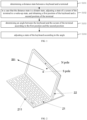
- Fig. 1 is a flowchart of a method for controlling a device according to embodiments of the present invention. As illustrated in Fig. 1 , the method includes the following steps.
- a distance state between a keyboard and a terminal device is determined, in which the keyboard is in communication connection with the terminal device.
- a state of a screen of the terminal device is adjusted to a wake-up state, and a first position of the keyboard and a second position of the terminal device are obtained.
- an angle between the keyboard and the terminal device is determined according to the first position and the second position.
- a state of the keyboard is adjusted according to the angle.
- the execution subject of the above method is a terminal device that does not have a keyboard.
- the terminal device includes but is not limited to a tablet, a smart screen and a handheld computer.
- the distance state between the keyboard and the terminal device is determined; in a case that the distance state is the distant state, the state of the screen of the terminal device is adjusted to the wake-up state, and the first position of the keyboard and the second position of the terminal device are obtained; the angle between the keyboard and the terminal device is determined according to the first position and the second position; in a case that the distance state between the keyboard and the terminal device is the distant state, the angle between the keyboard and the terminal device is calculated, and the state of the keyboard is adjusted according to the angle. Therefore there is no need of continuous calculation of the angle, which reduces the occupancy of computing resources and power consumption.
- the distance state between the keyboard and the terminal device indicates a proximity degree of the distance between the keyboard and the terminal device.
- the distance state between the keyboard and the terminal device includes a distant state and a proximity state.
- the distant state refers to a state in which the keyboard is far away from the terminal device
- the proximity state refers to a state in which the keyboard is close to the terminal device.
- the distance state can be quantified by measuring a linear distance between the keyboard and the terminal device, an angle between the keyboard and the terminal device, and a magnetic induction intensity between the magnetic induction sensor of the terminal device and a magnet on the keyboard.
- the distance state between the keyboard and the terminal device is determined.
- An implementation to realize this is to: obtain a magnetic induction intensity at any magnetic pole of a magnetic induction sensor arranged on the terminal device, in which the keyboard is provided with a magnet, the magnetic induction intensity is generated by an interaction between the magnet and the magnetic induction sensor, and the keyboard is pivotally connected to the terminal device; in a case that the magnetic induction intensity is greater than or equal to a set intensity threshold, determine that the distance state between the keyboard and the terminal device is the proximity state; and in a case that the magnetic induction intensity is less than the set intensity threshold, determine that the distance state between the keyboard and the terminal device is the distant state.
- the set intensity threshold is not limited and can be adjusted according to the actual practice.
- the magnetic induction sensor may also be installed on the keyboard, and the magnet may also be installed on the terminal device.
- the magnetic field interaction between the magnet and the magnetic induction sensor generates the magnetic induction intensity that changes with the distance at any magnetic pole of the magnetic induction sensor, as the distance between the keyboard and the terminal device varies. Therefore, the distance between the keyboard and the terminal device can be measured by the magnetic induction intensity generated at any magnetic pole of the magnetic induction sensor, so as to further control the keyboard and terminal device.
- Fig. 2 is a schematic diagram of an installation structure of a keyboard and a terminal device according to embodiments of the present invention. As illustrated in Fig. 2 , there is a keyboard 21 and a terminal device 22. A magnet 211 is arranged at a lower part of the keyboard 21, and a magnetic induction sensor 221 is arranged at an upper part of the terminal device 22. The N pole of the magnetic induction sensor 221 is located above, and the S pole of the magnetic induction sensor 221 is located below. It should be noted that Figure 2 is only an exemplary illustration and does not constitute a limitation of the present invention. The type and position of magnet 211 and magnetic induction sensor 221 can be adjusted according to the actual practice.
- a first gravity sensor is arranged on the keyboard to collect a position of the keyboard and a gravity acceleration of the keyboard.
- a second gravity sensor is arranged on the terminal device to collect a position of the terminal device and a gravity acceleration of the terminal device.
- the state of the keyboard when the distance state between the keyboard and the terminal device device is the proximity state, the state of the keyboard is adjusted to a disabled state to prevent accidental touch.
- the proximity state is a lid-closing state
- the state of the keyboard is adjusted to the disabled state, and the state of the screen is controlled to be a sleep state.
- the proximity state is a reversing-360-degree state
- the state of the keyboard is adjusted to the disabled state. It should be noted that when the screen is in the sleep state, the first gravity sensor and the second gravity sensor are controlled to not work, to reduce the standby power consumption.
- the state of the screen of the terminal device is adjusted to wake-up state, and the first gravity sensor on the keyboard and the second gravity sensor on the terminal device device starts to work.
- the data of the first gravity sensor on the keyboard and the second gravity sensor on the terminal device are updated, the data is reported to determine whether to perform the subsequent angle calculation.
- the first position of the keyboard is obtained.
- An implementation to realize this is to: determine the state of the keyboard; and in a case that the state of the keyboard is a sleep state, convert the state of the keyboard from the sleep state to an available state, and collect a current position of the keyboard as the first position.
- the keyboard is provided with a time-out sleep, that is, the keyboard automatically enters the sleep state when there is no external trigger operation within a set time.
- the keyboard is activated from the sleep state to the available state, and a current position of the keyboard is uploaded in time to ensure the real-time and accuracy of the angle calculation.
- the second position of the terminal device is obtained.
- An implementation to realize this is to: collect a current position and a current gravity acceleration of the terminal device; determine whether a difference between the current position of the terminal device and a previous position of the terminal device is greater than a distance threshold; and in a case that the difference is greater than the distance threshold, determine whether a difference between the current gravity acceleration of the terminal device and a preset gravity acceleration is greater than an acceleration threshold, and in a case that the difference between the current gravity acceleration and the preset gravity acceleration is greater than the acceleration threshold, take the current position of the terminal device as the second position.
- the angle calculation is performed, to reduce the calculation resource consumption and improve the calculation accuracy.
- the distance threshold and the acceleration threshold are not limited in the present invention, and can be adjusted according to the actual practice.
- the first position is a first coordinate of the keyboard in a keyboard coordinate system
- the second position is a second coordinate of the terminal device in a terminal device coordinate system
- the angle between the keyboard and the terminal device is determined according to the first position and the second position.
- the equation of the relationship between coordinate and angle is established according to the first coordinate, the second coordinate, and the transformation relationship between the keyboard coordinate system and the terminal device coordinate system.
- Fig. 3 is a schematic diagram of a keyboard coordinate system and a terminal device coordinate system according to embodiments of the present invention. As illustrated in Fig. 3 , both the keyboard coordinate system and the terminal device coordinate system are right-handed systems. x p y p z p refers to the terminal device coordinate system, and x k y k z k refers to the keyboard coordinate system.
- the angle between the terminal device and the keyboard can be converted to an angle from the terminal device coordinate system to the keyboard coordinate system around the y-axis, according to the formula of coordinate system rotation:
- X ′ Y ′ Z ′ cos ⁇ 0 ⁇ sin ⁇ 0 1 0 sin ⁇ 0 cos ⁇ X Y Z since the directions of the x-axis and z-axis of the rotated coordinate system need to be reversed again, the above transformation is changed to:
- ⁇ X ′ Y ′ ⁇ Z ′ cos ⁇ 0 ⁇ sin ⁇ 0 1 0 sin ⁇ 0 cos ⁇ X Y Z
- ⁇ is the rotation angle of the coordinate system
- the coordinate of a vector in the original coordinate system is [ X,Y,Z ]
- the angle between the keyboard and the terminal device is obtained according to the equation of the relationship between coordinate and angle.
- the state of the keyboard is adjusted according to the angle.
- An implementation to realize this is to: determine whether the angle belongs to an angle range; in a case that the angle belongs to the angle range, adjust the state of the keyboard to an available state; and in a case that the angle does not belong to the angle range, adjust the state of the keyboard to a disabled state.
- the angle range is not limited in the embodiments of the present invention, the angle range can be for example 15° - 185°.
- the state of the screen in response to a trigger operation of the keyboard, is adjusted from a sleep state to the wake-up state. Through triggering the keyboard, the screen can be woken up.
- the second gravity sensor in a case that the state of the screen is a sleep state, does not work and stops collecting the position of the terminal device; and the second gravity sensor may also not work and stop collecting the position of the keyboard, which reduces the power consumption.
- the distance state between the keyboard and the terminal device is determined; in a case that the distance state is the distant state, the state of the screen of the terminal device is adjusted to the wake-up state, and the first position of the keyboard and the second position of the terminal device are obtained; the angle between the keyboard and the terminal device is determined according to the first position and the second position; in a case that the distance state between the keyboard and the terminal device is the distant state, the angle between the keyboard and the terminal device is determined, and the state of the keyboard is adjusted according to the angle. Therefore there is no need of continuous calculation of the angle, which reduces the occupancy of computing resources and power consumption.
- Fig. 4 is a block diagram of an apparatus for controlling a device according to embodiments of the present invention.
- the apparatus 40 for controlling a device includes: a first determining module 41, an obtaining module 42, a second determining module 43, and an adjusting module 44.
- the first determining module 41 is configured to determine a distance state between a keyboard and a terminal device, in which the keyboard is in communication connection with the terminal device.
- the obtaining module 42 is configured to adjust a state of a screen of the terminal device to a wake-up state and obtain a first position of the keyboard and a second position of the terminal device in a case that the distance state is a distant state.
- the second determining module 43 is configured to determine an angle between the keyboard and the screen of the terminal device according to the first position and the second position.
- the adjusting module 44 is configured to adjust a state of the keyboard according to the angle.
- the obtaining module 42 is further configured to adjust the state of the keyboard to a disabled state in a case that the distance state is a proximity state.
- the first determining module 41 is configured to: obtain a magnetic induction intensity at any magnetic pole of a magnetic induction sensor arranged on the terminal device, in which the keyboard is provided with a magnet, the magnetic induction intensity is generated by an interaction between the magnet and the magnetic induction sensor, and the keyboard is pivotally connected to the terminal device; in a case that the magnetic induction intensity is greater than or equal to a set intensity threshold, determine that the distance state between the keyboard and the terminal device is the proximity state; and in a case that the magnetic induction intensity is less than the set intensity threshold, determine that the distance state between the keyboard and the terminal device is the distant state.
- the obtaining module 42 when obtaining the first position of the keyboard, is configured to: determine the state of the keyboard; and in a case that the state of the keyboard is a sleep state, convert the state of the keyboard from the sleep state to an available state and collect a current position of the keyboard as the first position.
- the obtaining module 42 is configured to: collect a current position and a current gravity acceleration of the terminal device; determine whether a difference between the current position of the terminal device and a previous position of the terminal device is greater than a distance threshold; and in a case that the difference is greater than the distance threshold, determine whether a difference between the current gravity acceleration of the terminal device and a preset gravity acceleration is greater than an acceleration threshold, and in a case that the difference between the current gravity acceleration and the preset gravity acceleration is greater than the acceleration threshold, take the current position of the terminal device as the second position.
- the first position is a first coordinate of the keyboard in a keyboard coordinate system
- the second position is a second coordinate of the terminal device in a terminal device coordinate system
- the second determining module 43 is configured to: establish an equation of a relationship between coordinate and angle according to the first coordinate, the second coordinate, and the transformation relationship between the keyboard coordinate system and the terminal device coordinate system; and obtain the angle between the keyboard and the screen of the terminal device according to the equation of the relationship between coordinate and angle.
- the adjusting module 44 when adjusting the state of the keyboard according to the angle, is configured to: determine whether the angle belongs to an angle range; in a case that the angle belongs to the angle range, adjust the state of the keyboard to an available state; and in a case that the angle does not belong to the angle range, adjust the state of the keyboard to a disabled state.
- the adjusting module 44 is further configured to adjust the state of the screen from a sleep state to the wake-up state in response to a trigger operation of the keyboard.
- the adjusting module 44 is further configured to stop collecting a position of the terminal device in a case that the state of the screen is a sleep state.
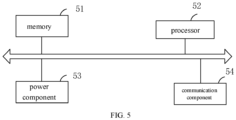
- Fig. 5 is a block diagram of an electronic device according to embodiments of the present invention. As illustrated in Fig. 5 , the electronic device includes a memory 51 and a processor 52. In addition, the electronic device also includes a power component 53 and a communication component 54.
- the memory 51 is configured to store a computer program and configured to store various types of data to support operations at the electronic device. Examples of such data include instructions for any application or method operating on the electronic device.
- the memory 51 may be implemented by any type of volatile or nonvolatile storage device or a combination of above, such as static random access memory (SRAM), electrically erasable programmable read only memory (EEPROM), erasable programmable read only memory (EPROM), programmable read only memory (PROM), read only memory (ROM), magnetic memory, flash memory, magnetic disk or optical disk.
- SRAM static random access memory
- EEPROM electrically erasable programmable read only memory
- EPROM erasable programmable read only memory
- PROM programmable read only memory
- ROM read only memory
- magnetic memory magnetic memory
- flash memory magnetic disk or optical disk.
- the communication component 54 is used for data transmission with other devices.
- the processor 52 can execute the computer instructions stored in the memory 51, to be configured to: determine a distance state between a keyboard and a terminal device; in a case that the distance state is a distant state, adjust a state of a screen of the terminal device to a wake-up state, and obtain a first position of the keyboard and a second position of the terminal device; determine an angle between the keyboard and the terminal device according to the first position and the second position; and adjust a state of the keyboard according to the angle.
- the processor 52 is further configured to adjust the state of the keyboard to a disabled state in a case that the distance state is a proximity state.
- the processor 52 when determining the distance state between the keyboard and the terminal device, is configured to: obtain a magnetic induction intensity at any magnetic pole of a magnetic induction sensor arranged on the terminal device, in which the keyboard is provided with a magnet, the magnetic induction intensity is generated by an interaction between the magnet and the magnetic induction sensor, and the keyboard is pivotally connected to the terminal device; in a case that the magnetic induction intensity is greater than or equal to a set intensity threshold, determine that the distance state between the keyboard and the terminal device is the proximity state; and in a case that the magnetic induction intensity is less than the set intensity threshold, determine that the distance state between the keyboard and the terminal device is the distant state.
- the processor 52 when obtaining the first position of the keyboard, is configured to: determine the state of the keyboard; and in a case that the state of the keyboard is a sleep state, convert the state of the keyboard from the sleep state to an available state, and collect a current position of the keyboard as the first position.
- the processor 52 when obtaining the second position of the terminal device, is configured to: collect a current position and a current gravity acceleration of the terminal device; determine whether a difference between the current position of the terminal device and a previous position of the terminal device is greater than a distance threshold; and in a case that the difference is greater than the distance threshold, determine whether a difference between the current gravity acceleration of the terminal device and a preset gravity acceleration is greater than an acceleration threshold, and in a case that the difference between the current gravity acceleration and the preset gravity acceleration is greater than the acceleration threshold, take the current position of the terminal device as the second position.
- the first position is a first coordinate of the keyboard in a keyboard coordinate system
- the second position is a second coordinate of the terminal device in a terminal device coordinate system
- the processor 52 when determining the angle between the keyboard and the screen of the terminal device according to the first position and the second position, is configured to: establish an equation of a relationship between coordinate and angle, according to the first coordinate, the second coordinate, and a transformation relationship between the keyboard coordinate system and the terminal device coordinate system; and obtain the angle between the keyboard and the terminal device according to the equation of the relationship between coordinate and angle.
- the processor 52 when adjusting the state of the keyboard according to the angle, is configured to: determine whether the angle belongs to an angle range; in a case that the angle belongs to the angle range, adjust the state of the keyboard to an available state; and in a case that the angle does not belong to the angle range, adjust the state of the keyboard to a disabled state.
- the processor 52 is configured to adjust the state of the screen from a sleep state to the wake-up state in response to a trigger operation of the keyboard.
- the processor 52 is further configured to stop collecting a position of the terminal device in a case that the state of the screen is a sleep state.
- embodiments of the present invention also provide a computer-readable storage medium storing a computer program.
- a computer-readable storage medium stores a computer program and the computer program is executed by one or more processors, the one or more processors are enabled to perform the steps in the embodiment of the method illustrated in Figure 1 .
- embodiments of the present invention also provide a computer program product including a computer program or instruction, when the computer program or instruction is executed by a processor, the steps in the embodiment of the method illustrated in Figure 1 are performed.
- the communication component in the Fig. 5 is configured to facilitate wired or wireless communication between the device including the communication component and other devices.
- the device including the communication component may access a wireless network based on a communication standard, such as Wi-Fi, 2G, 3G, 4G/LTE, 5G, and other mobile communication networks, or their combination.
- the communication component receives broadcast signals or broadcast related information from an external broadcast management system via a broadcast channel.
- the communication component also includes a near field communication (NFC) module to facilitate short-range communication.
- the NFC module can be implemented based on radio frequency identification (RFID) technology, infrared data association (IrDA) technology, ultra wideband (UWB) technology, Bluetooth (BT) technology and other technologies.
- RFID radio frequency identification
- IrDA infrared data association
- UWB ultra wideband
- Bluetooth Bluetooth
- the power component in the Fig. 5 provides power to various components of the device including the power component.
- the power component may include a power management system, one or more power sources, and other components associated with generating, managing, and distributing power to the device including the power component.
- the electronic device may further include a display screen and an audio component.
- the display screen includes a screen, the screen may include a liquid crystal display (LCD) and a touch panel (TP).
- the screen may be implemented as a touch screen to receive an input signal from a user.
- the touch panel includes one or more touch sensors to sense touch, sliding and gestures on the touch panel.
- the touch sensor may sense the boundary of the touch or slide action and detect the duration and pressure related to the touch or sliding operation.
- the audio component is configured to output and/or input multimedia data signals.
- the audio component includes a microphone (MIC) configured to receive external multimedia data signals when the device including the audio component is in an operating state, such as a call state, a recording state, and a voice recognition state.
- the received multimedia data signal may be further stored in the memory or transmitted via the communication component.
- the audio component further includes a speaker configured to output multimedia data signals.
- embodiments of the present invention can be provided as a method, a system, or a computer program product. Therefore, the present invention may take the form of a complete hardware embodiment, a complete software embodiment, or an embodiment combining software and hardware aspects. Furthermore, the present invention can take the form of a computer program product implemented on one or more computer usable storage media (including but not limited to disk memory, CD-ROM, optical memory, etc.) containing computer usable program codes.
- a computer usable storage media including but not limited to disk memory, CD-ROM, optical memory, etc.
- the distance state between the keyboard and the terminal device is determined; in a case that the distance state is the distant state, the state of the screen of the terminal device is adjusted to the wake-up state, and the first position of the keyboard and the second position of the terminal device are obtained; the angle between the keyboard and the terminal device is determined according to the first position and the second position; in a case that the distance state between the keyboard and the terminal device is the distant state, the angle between the keyboard and the terminal device is determined, and the state of the keyboard is adjusted according to the angle. Therefore there is no need of continuous calculation of the angle, which reduces the occupancy of computing resources and power consumption.
- each flow and/or block in the flowchart and/or block diagram, and the combination of flow and/or block in the flowchart and/or block diagram can be realized by computer program instructions.
- These computer program instructions may be provided to a processor of a general purpose computer, a special purpose computer, an embedded processor, or other programmable data processing device to generate a machine, such that instructions executed by a processor of a computer or other programmable data processing device generate devices for implementing functions specified in one or more flows of a flowchart and/or one or more blocks of a block diagram.
- These computer program instructions can also be stored in a computer-readable memory that can guide a computer or other programmable data processing device to work in a specific way, so that the instructions stored in the computer-readable memory generate a manufacture including an instruction device that implements the functions specified in one or more flows of a flowchart and/or one or more blocks of a block diagram.
- These computer program instructions can also be loaded onto a computer or other programmable data processing device to enable a series of operating steps to be executed on a computer or other programmable device to generate a computer implemented process, so that instructions executed on a computer or other programmable device provide steps for implementing functions specified in one or more flows of a flowchart and/or one or more blocks of a block diagram.
- a computing device includes one or more processors (CPUs), input/output interfaces, network interfaces, and memory.
- processors CPUs
- input/output interfaces network interfaces
- memory volatile and non-volatile memory
- the memory may include non-permanent memory in computer-readable medium, random access memory (RAM) and/or non-volatile memory, such as read-only memory (ROM) or flash RAM.
- RAM random access memory
- ROM read-only memory
- flash RAM flash random access memory
- the computer-readable medium including permanent and non-permanent, removable and non-removable medium may be stored by any method or technology.
- the information may be computer-readable instructions, data structures, modules of programs, or other data.
- Examples of the storage medium of a computer include, but are not limited to, a phase-change memory (PRAM), static random access memory (SRAM), dynamic random access memory (DRAM), other types of random access memory (RAM), read-only memory (ROM), electrically erasable programmable read-only memory (EEPROM), flash memory or other memory technologies, read-only optical disk read-only memory (CD-ROM), digital multifunction optical disk (DVD) or other optical storage, magnetic tape cartridge, magnetic tape magnetic disk storage or other magnetic storage devices or any other non-transmission media can be used to store information that can be accessed by the computing device.
- the computer-readable medium do not include any computer-readable transitory medium, such as modulated data signals and carriers.
Landscapes
- Engineering & Computer Science (AREA)
- Theoretical Computer Science (AREA)
- Physics & Mathematics (AREA)
- General Engineering & Computer Science (AREA)
- General Physics & Mathematics (AREA)
- Computer Hardware Design (AREA)
- Human Computer Interaction (AREA)
- Mathematical Physics (AREA)
- Mathematical Analysis (AREA)
- Mathematical Optimization (AREA)
- Computational Mathematics (AREA)
- Pure & Applied Mathematics (AREA)
- Data Mining & Analysis (AREA)
- Operations Research (AREA)
- Algebra (AREA)
- Databases & Information Systems (AREA)
- Software Systems (AREA)
- Power Sources (AREA)
Abstract
Description
- The present invention relates to the technical field of device control, in particular to a method and an apparatus for controlling a device, a storage medium and a program product.
- With the rapid development of Internet technology and the improvement of people's living standards, tablets have been widely used.
- During the use of the tablet, when there is a small amount of input demand, a virtual keyboard displayed on the tablet screen is used to input relevant content. However, when the input volume is large, the virtual keyboard cannot meet the needs of users, and a physical keyboard can be connected to the tablet.
- At present, the keyboard and the tablet can be controlled according to the angle between the keyboard and the tablet. Gravity sensors are installed on the keyboard and the tablet to collect keyboard data and tablet data in real time, so as to calculate the angle. Therefore, the calculation resource occupation rate is high and the power consumption is high.
- The present invention provides a method and an apparatus for controlling a device, a storage medium and a program product to at least solve the problems of high occupancy of computing resources and high power consumption.
- The technical scheme of the present invention is as follows.
- According to a first aspect of embodiments of the present invention, there is provided a method for controlling a device, including determining a distance state between a keyboard and a terminal device, in which the keyboard is in communication connection with the terminal device, in a case that the distance state is a distant state, adjusting a state of a screen of the terminal device to a wake-up state, and obtaining a first position of the keyboard and a second position of the terminal device, determining an angle between the keyboard and the screen of the terminal device according to the first position and the second position, and adjusting a state of the keyboard according to the angle.
- Optionally, the method further includes in a case that the distance state is a proximity state, adjusting the state of the keyboard to a disabled state.
- Optionally, determining the distance state between the keyboard and the terminal device includes: obtaining a magnetic induction intensity at any magnetic pole of a magnetic induction sensor arranged on the terminal device, in which the keyboard is provided with a magnet, the magnetic induction intensity is generated by an interaction between the magnet and the magnetic induction sensor, and the keyboard is pivotally connected to the terminal device; in a case that the magnetic induction intensity is greater than or equal to a set intensity threshold, determining that the distance state between the keyboard and the terminal device is the proximity state; and in a case that the magnetic induction intensity is less than the set intensity threshold, determining that the distance state between the keyboard and the terminal device is the distant state.
- Optionally, obtaining the first position of the keyboard includes: determining the state of the keyboard; and in a case that the state of the keyboard is a sleep state, converting the state of the keyboard from the sleep state to an available state, and collecting a current position of the keyboard as the first position.
- Optionally, obtaining the second position of the terminal device includes: collecting a current position and a current gravity acceleration of the terminal device; determining whether a difference between the current position of the terminal device and a previous position of the terminal device is greater than a distance threshold; and in a case that the difference is greater than the distance threshold, determining whether a difference between the current gravity acceleration of the terminal device and a preset gravity acceleration is greater than an acceleration threshold, and in a case that the difference between the current gravity acceleration and the preset gravity acceleration is greater than the acceleration threshold, taking the current position of the terminal device as the second position.
- Optionally, the first position is a first coordinate of the keyboard in a keyboard coordinate system, the second position is a second coordinate of the terminal device in a terminal device coordinate system, and determining the angle between the keyboard and the screen of the terminal device according to the first position and the second position includes: establishing an equation of a relationship between coordinate and angle, according to the first coordinate, the second coordinate, and a transformation relationship between the keyboard coordinate system and the terminal device coordinate system; and obtaining the angle between the keyboard and the screen of the terminal device, according to the equation of the relationship between coordinate and angle.
- Optionally, adjusting the state of the keyboard according to the angle includes: determining whether the angle belongs to an angle range; in a case that the angle belongs to the angle range, adjusting the state of the keyboard to an available state; and in a case that the angle does not belong to the angle range, adjusting the state of the keyboard to a disabled state.
- Optionally, after adjusting the state of the keyboard to the available state, the method further includes: in response to a trigger operation of the keyboard, adjusting the state of the screen from a sleep state to the wake-up state.
- Optionally, the method further includes: in a case that the state of the screen is a sleep state, stopping collecting a current position of the terminal device.
- According to a second aspect of embodiments of the present invention, there is provided an apparatus for controlling a device, including: a first determining module, configured to determine a distance state between a keyboard and a terminal device, in which the keyboard is in communication connection with the terminal device; an obtaining module, configured to adjust a state of a screen of the terminal device to a wake-up state and obtain a first position of the keyboard and a second position of the terminal device in a case that the distance state is a distant state; a second determining module, configured to determine an angle between the keyboard and the screen of the terminal device according to the first position and the second position; and an adjusting module, configured to adjust a state of the keyboard according to the angle.
- Optionally, the obtaining module is further configured to adjust the state of the keyboard to a disabled state in a case that the distance state is a proximity state.
- Optionally, when determining the distance state between the keyboard and the terminal device, the first determining module is configured to: obtain a magnetic induction intensity at any magnetic pole of a magnetic induction sensor arranged on the terminal device, in which the keyboard is provided with a magnet, the magnetic induction intensity is generated by an interaction between the magnet and the magnetic induction sensor, and the keyboard is pivotally connected to the terminal device; in a case that the magnetic induction intensity is greater than or equal to a set intensity threshold, determine that the distance state between the keyboard and the terminal device is the proximity state; and in a case that the magnetic induction intensity is less than the set intensity threshold, determine that the distance state between the keyboard and the terminal device is the distant state.
- Optionally, when obtaining the first position of the keyboard, the obtaining module is configured to: determine the state of the keyboard; and in a case that the state of the keyboard is a sleep state, convert the state of the keyboard from the sleep state to an available state and collect a current position of the keyboard as the first position.
- According to a third aspect of embodiments of the present invention, there is provided a computer-readable storage medium, on which a computer instruction is stored. The instruction, when executed by a processor, causes the computer to perform the method of the first aspect of embodiments of the present invention..
- According to a fourth aspect of embodiments of the present invention, there is provided a computer program product including a computer program or instruction. When the computer program or instruction is executed by a processor, the method of the first aspect of embodiments of the present invention is implemented.
- In some embodiments, the distance state between the keyboard and the terminal device is determined; in a case that the distance state is the distant state, the state of the screen of the terminal device is adjusted to the wake-up state, and the first position of the keyboard and the second position of the terminal device are obtained; the angle between the keyboard and the terminal device is determined according to the first position and the second position; in a case that the distance state between the keyboard and the terminal device is the distant state, the angle between the keyboard and the terminal device is determined, and the state of the keyboard is adjusted according to the angle. Therefore there is no need of continuous calculation of the angle, which reduces the occupancy of computing resources and power consumption.
- It should be understood that the above general description and the following detailed description are only illustrative and explanatory, and do not limit the present invention.
- The drawings herein are incorporated into the specification and form a part of this specification, showing embodiments consistent with the present invention, and are used together with the specification to explain the principles of the present invention.
-
Fig. 1 is a flowchart of a method for controlling a device according to embodiments of the present invention. -
Fig. 2 is a schematic diagram of an installation structure of a keyboard and a terminal device according to embodiments of the present invention. -
Fig. 3 is a schematic diagram of a keyboard coordinate system and a terminal device coordinate system according to embodiments of the present invention. -
Fig. 4 is a block diagram of an apparatus for controlling a device according to embodiments of the present invention. -
Fig. 5 is a block diagram of an electronic device according to embodiments of the present invention. - In order to enable ordinary person in the art to better understand the technical solution of the present invention, the technical solution in embodiments of the present invention will be described clearly and completely in combination with the annexed drawings.
- It should be noted that the terms "first", "second", and the like in the description and claims of the present invention and the drawings are used to distinguish similar objects, not necessarily to describe a specific order or sequence. It should be understood that the data so used can be interchanged where appropriate, so that embodiments of the present invention described herein can be implemented in an order other than those illustrated or described herein. Implementations described in the following embodiments do not represent all embodiments consistent with the present invention. On the contrary, they are only examples of an apparatus and a method consistent with some aspects of the present invention as detailed in the appended claims.
- It should be noted that, user information involved in the present invention includes but is not limited to: user device information and user personal information. The collection, storage, use, processing, transmission, provision and disclosure of user information in the present invention comply with relevant laws and regulations, and do not violate public order and good customs.
- With the rapid development of Internet technology and the improvement of people's living standards, tablets have been widely used.
- During the use of the tablet, when there is a small amount of input demand, a virtual keyboard displayed on the tablet screen is used to input relevant content. However, when the input volume is large, the virtual keyboard cannot meet the needs of users, and a physical keyboard can be connected to the tablet.
- At present, the keyboard and the tablet can be controlled according to the angle between the keyboard and the tablet. Gravity sensors are installed on the keyboard and the tablet to collect keyboard data and tablet data in real time, so as to calculate the angle. Therefore, the calculation resource occupation rate is high and the power consumption is high.
- For the above technical problems, in some embodiments of the present invention, a distance state between a keyboard and a terminal device is determined; in a case that the distance state is a distant state, a state of a screen of the terminal device is adjusted to a wake-up state, and a first position of the keyboard and a second position of the terminal device are obtained; an angle between the keyboard and the terminal device is determined according to the first position and the second position; in a case that the distance state between the keyboard and the terminal device is the distant state, the angle between the keyboard and the terminal device is determined, and a state of the keyboard is adjusted according to the angle. Therefore there is no need of continuous calculation of the angle, which reduces the occupancy of computing resources and power consumption.
- The technical solution provided by embodiments of the present invention is described in detail below in combination with the drawings.
-
Fig. 1 is a flowchart of a method for controlling a device according to embodiments of the present invention. As illustrated inFig. 1 , the method includes the following steps. - At block S101, a distance state between a keyboard and a terminal device is determined, in which the keyboard is in communication connection with the terminal device.
- At block S102, in a case that the distance state is a distant state, a state of a screen of the terminal device is adjusted to a wake-up state, and a first position of the keyboard and a second position of the terminal device are obtained.
- At block S103, an angle between the keyboard and the terminal device is determined according to the first position and the second position.
- At block S104, a state of the keyboard is adjusted according to the angle.
- In the embodiments, the execution subject of the above method is a terminal device that does not have a keyboard. The terminal device includes but is not limited to a tablet, a smart screen and a handheld computer.
- In the embodiments, the distance state between the keyboard and the terminal device is determined; in a case that the distance state is the distant state, the state of the screen of the terminal device is adjusted to the wake-up state, and the first position of the keyboard and the second position of the terminal device are obtained; the angle between the keyboard and the terminal device is determined according to the first position and the second position; in a case that the distance state between the keyboard and the terminal device is the distant state, the angle between the keyboard and the terminal device is calculated, and the state of the keyboard is adjusted according to the angle. Therefore there is no need of continuous calculation of the angle, which reduces the occupancy of computing resources and power consumption.
- It should be noted that the distance state between the keyboard and the terminal device indicates a proximity degree of the distance between the keyboard and the terminal device. In embodiments of the present invention, the distance state between the keyboard and the terminal device includes a distant state and a proximity state. The distant state refers to a state in which the keyboard is far away from the terminal device, and the proximity state refers to a state in which the keyboard is close to the terminal device. As for the quantization of the distance state between the keyboard and the terminal device, the distance state can be quantified by measuring a linear distance between the keyboard and the terminal device, an angle between the keyboard and the terminal device, and a magnetic induction intensity between the magnetic induction sensor of the terminal device and a magnet on the keyboard.
- In the above embodiments, the distance state between the keyboard and the terminal device is determined. An implementation to realize this is to: obtain a magnetic induction intensity at any magnetic pole of a magnetic induction sensor arranged on the terminal device, in which the keyboard is provided with a magnet, the magnetic induction intensity is generated by an interaction between the magnet and the magnetic induction sensor, and the keyboard is pivotally connected to the terminal device; in a case that the magnetic induction intensity is greater than or equal to a set intensity threshold, determine that the distance state between the keyboard and the terminal device is the proximity state; and in a case that the magnetic induction intensity is less than the set intensity threshold, determine that the distance state between the keyboard and the terminal device is the distant state. It should be noted that, in the present invention, the set intensity threshold is not limited and can be adjusted according to the actual practice. Obviously, the magnetic induction sensor may also be installed on the keyboard, and the magnet may also be installed on the terminal device. The magnetic field interaction between the magnet and the magnetic induction sensor generates the magnetic induction intensity that changes with the distance at any magnetic pole of the magnetic induction sensor, as the distance between the keyboard and the terminal device varies. Therefore, the distance between the keyboard and the terminal device can be measured by the magnetic induction intensity generated at any magnetic pole of the magnetic induction sensor, so as to further control the keyboard and terminal device.
-
Fig. 2 is a schematic diagram of an installation structure of a keyboard and a terminal device according to embodiments of the present invention. As illustrated inFig. 2 , there is akeyboard 21 and aterminal device 22. Amagnet 211 is arranged at a lower part of thekeyboard 21, and amagnetic induction sensor 221 is arranged at an upper part of theterminal device 22. The N pole of themagnetic induction sensor 221 is located above, and the S pole of themagnetic induction sensor 221 is located below. It should be noted thatFigure 2 is only an exemplary illustration and does not constitute a limitation of the present invention. The type and position ofmagnet 211 andmagnetic induction sensor 221 can be adjusted according to the actual practice. - It should be noted that a first gravity sensor is arranged on the keyboard to collect a position of the keyboard and a gravity acceleration of the keyboard. A second gravity sensor is arranged on the terminal device to collect a position of the terminal device and a gravity acceleration of the terminal device.
- In some embodiments, when the distance state between the keyboard and the terminal device device is the proximity state, the state of the keyboard is adjusted to a disabled state to prevent accidental touch. When the proximity state is a lid-closing state, the state of the keyboard is adjusted to the disabled state, and the state of the screen is controlled to be a sleep state. When the proximity state is a reversing-360-degree state, the state of the keyboard is adjusted to the disabled state. It should be noted that when the screen is in the sleep state, the first gravity sensor and the second gravity sensor are controlled to not work, to reduce the standby power consumption.
- In some other embodiments, when the distance state between the keyboard and the terminal device device is the distant state, the state of the screen of the terminal device is adjusted to wake-up state, and the first gravity sensor on the keyboard and the second gravity sensor on the terminal device device starts to work. When data of the first gravity sensor on the keyboard and the second gravity sensor on the terminal device are updated, the data is reported to determine whether to perform the subsequent angle calculation.
- In the above embodiments, the first position of the keyboard is obtained. An implementation to realize this is to: determine the state of the keyboard; and in a case that the state of the keyboard is a sleep state, convert the state of the keyboard from the sleep state to an available state, and collect a current position of the keyboard as the first position. The keyboard is provided with a time-out sleep, that is, the keyboard automatically enters the sleep state when there is no external trigger operation within a set time. To prevent the data of the first gravity sensor from not being updated when the keyboard is in the sleep state, when the keyboard is in the sleep state, the keyboard is activated from the sleep state to the available state, and a current position of the keyboard is uploaded in time to ensure the real-time and accuracy of the angle calculation.
- In the above embodiments, the second position of the terminal device is obtained. An implementation to realize this is to: collect a current position and a current gravity acceleration of the terminal device; determine whether a difference between the current position of the terminal device and a previous position of the terminal device is greater than a distance threshold; and in a case that the difference is greater than the distance threshold, determine whether a difference between the current gravity acceleration of the terminal device and a preset gravity acceleration is greater than an acceleration threshold, and in a case that the difference between the current gravity acceleration and the preset gravity acceleration is greater than the acceleration threshold, take the current position of the terminal device as the second position. When a displacement of the terminal device is greater than the distance threshold and is not interfered by an acceleration due to an external force, the angle calculation is performed, to reduce the calculation resource consumption and improve the calculation accuracy.
- It should be noted that the distance threshold and the acceleration threshold are not limited in the present invention, and can be adjusted according to the actual practice.
- In the above embodiments, the first position is a first coordinate of the keyboard in a keyboard coordinate system, the second position is a second coordinate of the terminal device in a terminal device coordinate system, and the angle between the keyboard and the terminal device is determined according to the first position and the second position. An implementation to realize this is to: establish an equation of a relationship between coordinate and angle, according to the first coordinate and the second coordinate and a transformation relationship between the keyboard coordinate system and the terminal device coordinate system; and obtain the angle between the keyboard and the terminal device according to the equation of the relationship between coordinate and angle.
- In some embodiments, the equation of the relationship between coordinate and angle is established according to the first coordinate, the second coordinate, and the transformation relationship between the keyboard coordinate system and the terminal device coordinate system.
-
Fig. 3 is a schematic diagram of a keyboard coordinate system and a terminal device coordinate system according to embodiments of the present invention. As illustrated inFig. 3 , both the keyboard coordinate system and the terminal device coordinate system are right-handed systems. xp yp zp refers to the terminal device coordinate system, and xk yk zk refers to the keyboard coordinate system. The angle between the terminal device and the keyboard can be converted to an angle from the terminal device coordinate system to the keyboard coordinate system around the y-axis, according to the formula of coordinate system rotation:

since the directions of the x-axis and z-axis of the rotated coordinate system need to be reversed again, the above transformation is changed to:

where θ is the rotation angle of the coordinate system, the coordinate of a vector in the original coordinate system is [X,Y,Z] and the coordinate of the same vector in the new coordinate system, formed by rotating the original coordinate system with the rotation angle θ around the y-axis, is [X',Y',Z']. In this scheme, the gravitational acceleration is the vector, [X,Y,Z] is the coordinate in the terminal device coordinate system, and [-X',Y',-Z'] is the coordinate in the keyboard coordinate system. The equation of the relationship between coordinate and angle is established:

- In the above embodiments, the angle between the keyboard and the terminal device is obtained according to the equation of the relationship between coordinate and angle.
- In the above embodiments, the state of the keyboard is adjusted according to the angle. An implementation to realize this is to: determine whether the angle belongs to an angle range; in a case that the angle belongs to the angle range, adjust the state of the keyboard to an available state; and in a case that the angle does not belong to the angle range, adjust the state of the keyboard to a disabled state. It should be noted that the angle range is not limited in the embodiments of the present invention, the angle range can be for example 15° - 185°.
- In some embodiments, in response to a trigger operation of the keyboard, the state of the screen is adjusted from a sleep state to the wake-up state. Through triggering the keyboard, the screen can be woken up.
- In some embodiments, in a case that the state of the screen is a sleep state, the second gravity sensor does not work and stops collecting the position of the terminal device; and the second gravity sensor may also not work and stop collecting the position of the keyboard, which reduces the power consumption.
- In the above embodiments of the method of the present invention, the distance state between the keyboard and the terminal device is determined; in a case that the distance state is the distant state, the state of the screen of the terminal device is adjusted to the wake-up state, and the first position of the keyboard and the second position of the terminal device are obtained; the angle between the keyboard and the terminal device is determined according to the first position and the second position; in a case that the distance state between the keyboard and the terminal device is the distant state, the angle between the keyboard and the terminal device is determined, and the state of the keyboard is adjusted according to the angle. Therefore there is no need of continuous calculation of the angle, which reduces the occupancy of computing resources and power consumption.
-
Fig. 4 is a block diagram of an apparatus for controlling a device according to embodiments of the present invention. As illustrated inFig. 4 , theapparatus 40 for controlling a device includes: a first determiningmodule 41, an obtainingmodule 42, a second determiningmodule 43, and an adjustingmodule 44. - The first determining
module 41 is configured to determine a distance state between a keyboard and a terminal device, in which the keyboard is in communication connection with the terminal device. - The obtaining
module 42 is configured to adjust a state of a screen of the terminal device to a wake-up state and obtain a first position of the keyboard and a second position of the terminal device in a case that the distance state is a distant state. - The second determining
module 43 is configured to determine an angle between the keyboard and the screen of the terminal device according to the first position and the second position. - The adjusting
module 44 is configured to adjust a state of the keyboard according to the angle. - Optionally, the obtaining
module 42 is further configured to adjust the state of the keyboard to a disabled state in a case that the distance state is a proximity state. - Optionally, when determining the distance state between the keyboard and the terminal device, the first determining
module 41 is configured to: obtain a magnetic induction intensity at any magnetic pole of a magnetic induction sensor arranged on the terminal device, in which the keyboard is provided with a magnet, the magnetic induction intensity is generated by an interaction between the magnet and the magnetic induction sensor, and the keyboard is pivotally connected to the terminal device; in a case that the magnetic induction intensity is greater than or equal to a set intensity threshold, determine that the distance state between the keyboard and the terminal device is the proximity state; and in a case that the magnetic induction intensity is less than the set intensity threshold, determine that the distance state between the keyboard and the terminal device is the distant state. - Optionally, when obtaining the first position of the keyboard, the obtaining
module 42 is configured to: determine the state of the keyboard; and in a case that the state of the keyboard is a sleep state, convert the state of the keyboard from the sleep state to an available state and collect a current position of the keyboard as the first position. - Optionally, when obtaining the second position of the terminal device, the obtaining
module 42 is configured to: collect a current position and a current gravity acceleration of the terminal device; determine whether a difference between the current position of the terminal device and a previous position of the terminal device is greater than a distance threshold; and in a case that the difference is greater than the distance threshold, determine whether a difference between the current gravity acceleration of the terminal device and a preset gravity acceleration is greater than an acceleration threshold, and in a case that the difference between the current gravity acceleration and the preset gravity acceleration is greater than the acceleration threshold, take the current position of the terminal device as the second position. - Optionally, the first position is a first coordinate of the keyboard in a keyboard coordinate system, the second position is a second coordinate of the terminal device in a terminal device coordinate system; when determining the angle between the keyboard and the screen of the terminal device according to the first position and the second position, the second determining
module 43 is configured to: establish an equation of a relationship between coordinate and angle according to the first coordinate, the second coordinate, and the transformation relationship between the keyboard coordinate system and the terminal device coordinate system; and obtain the angle between the keyboard and the screen of the terminal device according to the equation of the relationship between coordinate and angle. - Optionally, when adjusting the state of the keyboard according to the angle, the adjusting
module 44 is configured to: determine whether the angle belongs to an angle range; in a case that the angle belongs to the angle range, adjust the state of the keyboard to an available state; and in a case that the angle does not belong to the angle range, adjust the state of the keyboard to a disabled state. - Optionally, after adjusting the state of the keyboard to the available state, the adjusting
module 44 is further configured to adjust the state of the screen from a sleep state to the wake-up state in response to a trigger operation of the keyboard. - Optionally, the adjusting
module 44 is further configured to stop collecting a position of the terminal device in a case that the state of the screen is a sleep state. - As for the apparatus in the above embodiments, the specific mode for each module to perform operation has been described in detail in the embodiments of the method, and will not be described in detail here.
-
Fig. 5 is a block diagram of an electronic device according to embodiments of the present invention. As illustrated inFig. 5 , the electronic device includes amemory 51 and aprocessor 52. In addition, the electronic device also includes apower component 53 and acommunication component 54. - The
memory 51 is configured to store a computer program and configured to store various types of data to support operations at the electronic device. Examples of such data include instructions for any application or method operating on the electronic device. - The
memory 51 may be implemented by any type of volatile or nonvolatile storage device or a combination of above, such as static random access memory (SRAM), electrically erasable programmable read only memory (EEPROM), erasable programmable read only memory (EPROM), programmable read only memory (PROM), read only memory (ROM), magnetic memory, flash memory, magnetic disk or optical disk. - The
communication component 54 is used for data transmission with other devices. - The
processor 52 can execute the computer instructions stored in thememory 51, to be configured to: determine a distance state between a keyboard and a terminal device; in a case that the distance state is a distant state, adjust a state of a screen of the terminal device to a wake-up state, and obtain a first position of the keyboard and a second position of the terminal device; determine an angle between the keyboard and the terminal device according to the first position and the second position; and adjust a state of the keyboard according to the angle. - Optionally, the
processor 52 is further configured to adjust the state of the keyboard to a disabled state in a case that the distance state is a proximity state. - Optionally, when determining the distance state between the keyboard and the terminal device, the
processor 52 is configured to: obtain a magnetic induction intensity at any magnetic pole of a magnetic induction sensor arranged on the terminal device, in which the keyboard is provided with a magnet, the magnetic induction intensity is generated by an interaction between the magnet and the magnetic induction sensor, and the keyboard is pivotally connected to the terminal device; in a case that the magnetic induction intensity is greater than or equal to a set intensity threshold, determine that the distance state between the keyboard and the terminal device is the proximity state; and in a case that the magnetic induction intensity is less than the set intensity threshold, determine that the distance state between the keyboard and the terminal device is the distant state. - Optionally, when obtaining the first position of the keyboard, the
processor 52 is configured to: determine the state of the keyboard; and in a case that the state of the keyboard is a sleep state, convert the state of the keyboard from the sleep state to an available state, and collect a current position of the keyboard as the first position. - Optionally, when obtaining the second position of the terminal device, the
processor 52 is configured to: collect a current position and a current gravity acceleration of the terminal device; determine whether a difference between the current position of the terminal device and a previous position of the terminal device is greater than a distance threshold; and in a case that the difference is greater than the distance threshold, determine whether a difference between the current gravity acceleration of the terminal device and a preset gravity acceleration is greater than an acceleration threshold, and in a case that the difference between the current gravity acceleration and the preset gravity acceleration is greater than the acceleration threshold, take the current position of the terminal device as the second position. - Optionally, the first position is a first coordinate of the keyboard in a keyboard coordinate system, the second position is a second coordinate of the terminal device in a terminal device coordinate system; when determining the angle between the keyboard and the screen of the terminal device according to the first position and the second position, the
processor 52 is configured to: establish an equation of a relationship between coordinate and angle, according to the first coordinate, the second coordinate, and a transformation relationship between the keyboard coordinate system and the terminal device coordinate system; and obtain the angle between the keyboard and the terminal device according to the equation of the relationship between coordinate and angle. - Optionally, when adjusting the state of the keyboard according to the angle, the
processor 52 is configured to: determine whether the angle belongs to an angle range; in a case that the angle belongs to the angle range, adjust the state of the keyboard to an available state; and in a case that the angle does not belong to the angle range, adjust the state of the keyboard to a disabled state. - Optionally, after adjusting the state of the keyboard to the available state, the
processor 52 is configured to adjust the state of the screen from a sleep state to the wake-up state in response to a trigger operation of the keyboard. - Optionally, the
processor 52 is further configured to stop collecting a position of the terminal device in a case that the state of the screen is a sleep state. - Correspondingly, embodiments of the present invention also provide a computer-readable storage medium storing a computer program. When a computer-readable storage medium stores a computer program and the computer program is executed by one or more processors, the one or more processors are enabled to perform the steps in the embodiment of the method illustrated in
Figure 1 . - Correspondingly, embodiments of the present invention also provide a computer program product including a computer program or instruction, when the computer program or instruction is executed by a processor, the steps in the embodiment of the method illustrated in
Figure 1 are performed. - The communication component in the
Fig. 5 is configured to facilitate wired or wireless communication between the device including the communication component and other devices. The device including the communication component may access a wireless network based on a communication standard, such as Wi-Fi, 2G, 3G, 4G/LTE, 5G, and other mobile communication networks, or their combination. In one embodiment, the communication component receives broadcast signals or broadcast related information from an external broadcast management system via a broadcast channel. In one embodiment, the communication component also includes a near field communication (NFC) module to facilitate short-range communication. For example, the NFC module can be implemented based on radio frequency identification (RFID) technology, infrared data association (IrDA) technology, ultra wideband (UWB) technology, Bluetooth (BT) technology and other technologies. - The power component in the
Fig. 5 provides power to various components of the device including the power component. The power component may include a power management system, one or more power sources, and other components associated with generating, managing, and distributing power to the device including the power component. - The electronic device may further include a display screen and an audio component.
- The display screen includes a screen, the screen may include a liquid crystal display (LCD) and a touch panel (TP). When the screen includes a touch panel, the screen may be implemented as a touch screen to receive an input signal from a user. The touch panel includes one or more touch sensors to sense touch, sliding and gestures on the touch panel. The touch sensor may sense the boundary of the touch or slide action and detect the duration and pressure related to the touch or sliding operation.
- The audio component is configured to output and/or input multimedia data signals. For example, the audio component includes a microphone (MIC) configured to receive external multimedia data signals when the device including the audio component is in an operating state, such as a call state, a recording state, and a voice recognition state. The received multimedia data signal may be further stored in the memory or transmitted via the communication component. In some embodiments, the audio component further includes a speaker configured to output multimedia data signals.
- Those skilled in the art should understand that embodiments of the present invention can be provided as a method, a system, or a computer program product. Therefore, the present invention may take the form of a complete hardware embodiment, a complete software embodiment, or an embodiment combining software and hardware aspects. Furthermore, the present invention can take the form of a computer program product implemented on one or more computer usable storage media (including but not limited to disk memory, CD-ROM, optical memory, etc.) containing computer usable program codes.
- In the above embodiments of the method, apparatus, storage medium and program product of the present invention, the distance state between the keyboard and the terminal device is determined; in a case that the distance state is the distant state, the state of the screen of the terminal device is adjusted to the wake-up state, and the first position of the keyboard and the second position of the terminal device are obtained; the angle between the keyboard and the terminal device is determined according to the first position and the second position; in a case that the distance state between the keyboard and the terminal device is the distant state, the angle between the keyboard and the terminal device is determined, and the state of the keyboard is adjusted according to the angle. Therefore there is no need of continuous calculation of the angle, which reduces the occupancy of computing resources and power consumption.
- The present invention is described with reference to the flowchart and/or block diagram of the method, device (system), and computer program product according to the embodiment of the present invention. It shall be understood that each flow and/or block in the flowchart and/or block diagram, and the combination of flow and/or block in the flowchart and/or block diagram can be realized by computer program instructions. These computer program instructions may be provided to a processor of a general purpose computer, a special purpose computer, an embedded processor, or other programmable data processing device to generate a machine, such that instructions executed by a processor of a computer or other programmable data processing device generate devices for implementing functions specified in one or more flows of a flowchart and/or one or more blocks of a block diagram.
- These computer program instructions can also be stored in a computer-readable memory that can guide a computer or other programmable data processing device to work in a specific way, so that the instructions stored in the computer-readable memory generate a manufacture including an instruction device that implements the functions specified in one or more flows of a flowchart and/or one or more blocks of a block diagram.
- These computer program instructions can also be loaded onto a computer or other programmable data processing device to enable a series of operating steps to be executed on a computer or other programmable device to generate a computer implemented process, so that instructions executed on a computer or other programmable device provide steps for implementing functions specified in one or more flows of a flowchart and/or one or more blocks of a block diagram.
- In a typical configuration, a computing device includes one or more processors (CPUs), input/output interfaces, network interfaces, and memory.
- The memory may include non-permanent memory in computer-readable medium, random access memory (RAM) and/or non-volatile memory, such as read-only memory (ROM) or flash RAM. The memory is an example of computer-readable medium.
- The computer-readable medium including permanent and non-permanent, removable and non-removable medium, may be stored by any method or technology. The information may be computer-readable instructions, data structures, modules of programs, or other data. Examples of the storage medium of a computer include, but are not limited to, a phase-change memory (PRAM), static random access memory (SRAM), dynamic random access memory (DRAM), other types of random access memory (RAM), read-only memory (ROM), electrically erasable programmable read-only memory (EEPROM), flash memory or other memory technologies, read-only optical disk read-only memory (CD-ROM), digital multifunction optical disk (DVD) or other optical storage, magnetic tape cartridge, magnetic tape magnetic disk storage or other magnetic storage devices or any other non-transmission media can be used to store information that can be accessed by the computing device. As defined herein, the computer-readable medium do not include any computer-readable transitory medium, such as modulated data signals and carriers.
- It should be noted that in the present invention, the relation terms such as "first" and "second" are only used to distinguish one entity or operation from another entity or operation, and do not necessarily require or imply any such actual relationship or order between these entities or operations. Moreover, the terms "include", "comprise" or any other variant are intended to cover non-exclusive inclusion, so that a process, method, article or device including a series of elements not only includes those elements, but also includes other elements not explicitly listed, or also includes elements inherent to such process, method, article or device. Without more restrictions, the elements defined by the statement "include one..." do not exclude that there are other identical elements in the process, method, article or device including the elements.
- The above are only specific embodiments of the present invention, enabling those skilled in the art to understand or realize the present invention. A variety of modifications to these embodiments would be apparent to those skilled in the art. The general solution defined herein can be implemented in other embodiments without departing from the scope of the present invention. Therefore, the present invention will not be limited to these embodiments herein, but should conform to the widest scope consistent with the novel features disclosed herein.
Claims (15)
- A method for controlling a device, comprising:determining (S101) a distance state between a keyboard and a terminal device, wherein the keyboard is in communication connection with the terminal device;in a case that the distance state is a distant state, adjusting (S102) a state of a screen of the terminal device to a wake-up state, and obtaining a first position of the keyboard and a second position of the terminal device;determining (S103) an angle between the keyboard and the screen of the terminal device according to the first position and the second position; andadjusting (S104) a state of the keyboard according to the angle.
- The method according to claim 1, further comprising:
in a case that the distance state is a proximity state, adjusting the state of the keyboard to a disabled state. - The method according to claim 1 or 2, wherein determining the distance state between the keyboard and the terminal device comprises:obtaining a magnetic induction intensity at any magnetic pole of a magnetic induction sensor arranged on the terminal device, wherein the keyboard is provided with a magnet, the magnetic induction intensity is generated by an interaction between the magnet and the magnetic induction sensor, and the keyboard is pivotally connected to the terminal device;in a case that the magnetic induction intensity is greater than or equal to a set intensity threshold, determining that the distance state between the keyboard and the terminal device is the proximity state; andin a case that the magnetic induction intensity is less than the set intensity threshold, determining that the distance state between the keyboard and the terminal device is the distant state.
- The method according to any one of the preceding claims, wherein obtaining the first position of the keyboard comprises:determining the state of the keyboard; andin a case that the state of the keyboard is a sleep state, converting the state of the keyboard from the sleep state to an available state, and collecting a current position of the keyboard as the first position.
- The method according to any one of the preceding claims, wherein obtaining the second position of the terminal device comprises:collecting a current position and a current gravity acceleration of the terminal device;determining whether a difference between the current position of the terminal device and a previous position of the terminal device is greater than a distance threshold; andin a case that the difference is greater than the distance threshold, determining whether a difference between the current gravity acceleration of the terminal device and a preset gravity acceleration is greater than an acceleration threshold, and in a case that the difference between the current gravity acceleration and the preset gravity acceleration is greater than the acceleration threshold, taking the current position of the terminal device as the second position.
- The method according to any one of the preceding claims, wherein the first position is a first coordinate of the keyboard in a keyboard coordinate system, the second position is a second coordinate of the terminal device in a terminal device coordinate system, and determining the angle between the keyboard and the screen of the terminal device according to the first position and the second position comprises:establishing an equation of a relationship between coordinate and angle, according to the first coordinate, the second coordinate, and a transformation relationship between the keyboard coordinate system and the terminal device coordinate system; andobtaining the angle between the keyboard and the screen of the terminal device, according to the equation of the relationship between coordinate and angle.
- The method according to any one of the preceding claims, wherein adjusting the state of the keyboard according to the angle comprises:determining whether the angle belongs to an angle range;in a case that the angle belongs to the angle range, adjusting the state of the keyboard to an available state; andin a case that the angle does not belong to the angle range, adjusting the state of the keyboard to a disabled state.
- The method according to claim 7, wherein after adjusting the state of the keyboard to the available state, the method further comprises:
in response to a trigger operation of the keyboard, adjusting the state of the screen from a sleep state to the wake-up state. - The method according to any one of the preceding claims, further comprising:
in a case that the state of the screen is a sleep state, stopping collecting a current position of the terminal device. - An apparatus (40) for controlling a device, comprising:a first determining module (41), configured to determine a distance state between a keyboard and a terminal device, wherein the keyboard is in communication connection with the terminal device;an obtaining module (42), configured to adjust a state of a screen of the terminal device to a wake-up state and obtain a first position of the keyboard and a second position of the terminal device in a case that the distance state is a distant state;a second determining module (43), configured to determine an angle between the keyboard and the screen of the terminal device according to the first position and the second position; andan adjusting module (44), configured to adjust a state of the keyboard according to the angle.
- The apparatus (40) according to claim 10, wherein the obtaining module (42) is further configured to:
adjust the state of the keyboard to a disabled state in a case that the distance state is a proximity state. - The apparatus (40) according to claim 10 or 11, wherein the first determining module (41), when determining the distance state between the keyboard and the terminal device, is configured to:obtain a magnetic induction intensity at any magnetic pole of a magnetic induction sensor arranged on the terminal device, wherein the keyboard is provided with a magnet, the magnetic induction intensity is generated by an interaction between the magnet and the magnetic induction sensor, and the keyboard is pivotally connected to the terminal device;in a case that the magnetic induction intensity is greater than or equal to a set intensity threshold, determine that the distance state between the keyboard and the terminal device is the proximity state; andin a case that the magnetic induction intensity is less than the set intensity threshold, determine that the distance state between the keyboard and the terminal device is the distant state.
- The apparatus (40) according to any one of claims 10-12, wherein the obtaining module (42), when obtaining the first position of the keyboard, is configured to:determine the state of the keyboard; andin a case that the state of the keyboard is a sleep state, convert the state of the keyboard from the sleep state to an available state and collect a current position of the keyboard as the first position.
- A computer-readable storage medium, on which a computer instruction is stored, wherein the instruction, when executed by a processor, causes the computer to implement the method of any one of claims 1-9.
- A computer program product comprising a computer program or instruction, wherein when the computer program or instruction is executed by a processor, the method of any one of claims 1-9 is implemented.
Applications Claiming Priority (1)
| Application Number | Priority Date | Filing Date | Title |
|---|---|---|---|
| CN202210952800.8A CN117631756A (en) | 2022-08-09 | 2022-08-09 | Device control method, device, medium, and program product |
Publications (2)
| Publication Number | Publication Date |
|---|---|
| EP4321962A1 true EP4321962A1 (en) | 2024-02-14 |
| EP4321962B1 EP4321962B1 (en) | 2025-05-07 |
Family
ID=84363576
Family Applications (1)
| Application Number | Title | Priority Date | Filing Date |
|---|---|---|---|
| EP22209771.9A Active EP4321962B1 (en) | 2022-08-09 | 2022-11-28 | Method and apparatus for controlling a device, storage medium, and program product |
Country Status (3)
| Country | Link |
|---|---|
| US (1) | US12204698B2 (en) |
| EP (1) | EP4321962B1 (en) |
| CN (1) | CN117631756A (en) |
Citations (3)
| Publication number | Priority date | Publication date | Assignee | Title |
|---|---|---|---|---|
| US20130232353A1 (en) * | 2012-03-02 | 2013-09-05 | Jim Tom Belesiu | Mobile Device Power State |
| US20140145937A1 (en) * | 2012-11-28 | 2014-05-29 | Lenovo (Beijing) Co., Ltd. | Method and device for automatic control |
| US20170010657A1 (en) * | 2015-07-06 | 2017-01-12 | Google Inc. | Accelerometer based hall effect sensor filtering for computing devices |
Family Cites Families (7)
| Publication number | Priority date | Publication date | Assignee | Title |
|---|---|---|---|---|
| WO2012164732A1 (en) * | 2011-06-02 | 2012-12-06 | 富士通株式会社 | Electronic device, method for detecting opening and closing of electronic device, and program |
| US20150234478A1 (en) * | 2012-03-02 | 2015-08-20 | Microsoft Technology Licensing, Llc | Mobile Device Application State |
| TWI510996B (en) * | 2013-10-03 | 2015-12-01 | Acer Inc | Method for controlling touch panel and portable computer using the same |
| JP6712912B2 (en) * | 2016-06-23 | 2020-06-24 | ローム株式会社 | Electronics |
| IT201700057066A1 (en) * | 2017-05-25 | 2018-11-25 | St Microelectronics Srl | PROCESSING SYSTEM IMPLEMENTING AN ALGORITHM FOR THE MERGER OF DATA FROM INERTIAL SENSORS, AND METHOD |
| IT202000009937A1 (en) * | 2020-05-05 | 2021-11-05 | St Microelectronics Srl | METHOD OF CHECKING AN ELECTRONIC DEVICE BY CALCULATION OF AN OPENING ANGLE, RELATED ELECTRONIC DEVICE AND SOFTWARE PRODUCT |
| KR102902959B1 (en) * | 2020-08-03 | 2025-12-22 | 삼성전자주식회사 | Electronic device controlling input mode according to folding angle and Method thereof |
-
2022
- 2022-08-09 CN CN202210952800.8A patent/CN117631756A/en active Pending
- 2022-11-28 EP EP22209771.9A patent/EP4321962B1/en active Active
- 2022-11-30 US US18/072,430 patent/US12204698B2/en active Active
Patent Citations (3)
| Publication number | Priority date | Publication date | Assignee | Title |
|---|---|---|---|---|
| US20130232353A1 (en) * | 2012-03-02 | 2013-09-05 | Jim Tom Belesiu | Mobile Device Power State |
| US20140145937A1 (en) * | 2012-11-28 | 2014-05-29 | Lenovo (Beijing) Co., Ltd. | Method and device for automatic control |
| US20170010657A1 (en) * | 2015-07-06 | 2017-01-12 | Google Inc. | Accelerometer based hall effect sensor filtering for computing devices |
Also Published As
| Publication number | Publication date |
|---|---|
| CN117631756A (en) | 2024-03-01 |
| US20240053830A1 (en) | 2024-02-15 |
| EP4321962B1 (en) | 2025-05-07 |
| US12204698B2 (en) | 2025-01-21 |
Similar Documents
| Publication | Publication Date | Title |
|---|---|---|
| JP7280005B2 (en) | Wireless charging method and electronic device | |
| EP3306441B1 (en) | Temperature control method and apparatus | |
| EP3035489B1 (en) | Method and device for charge management | |
| JP2022538464A (en) | IMAGE PROCESSING METHOD AND ELECTRONIC DEVICE BASED ON VERTICAL SYNCHRONIZATION SIGNAL | |
| US11228860B2 (en) | Terminal positioning method, apparatus, electronic device and storage medium | |
| CN104536935B (en) | Calculate display methods, calculate edit methods and device | |
| CN103631493B (en) | Image display method, device and electronic equipment | |
| US12554371B2 (en) | Window display method and related apparatus | |
| EP2921969A1 (en) | Method and apparatus for centering and zooming webpage and electronic device | |
| CN108521609B (en) | Determine the method, apparatus and terminal of pushing video type | |
| EP4228233B1 (en) | Method for adding operation sequence and electronic device | |
| CN103702028A (en) | Method and device for controlling shooting and terminal equipment | |
| CN105100197B (en) | The method and device of application is installed | |
| CN105700362A (en) | Equipment control method and apparatus thereof | |
| CN104464674B (en) | Liquid crystal display method of adjustment and device | |
| KR20160031994A (en) | Method and device for sending message | |
| EP4321962A1 (en) | Method and apparatus for controlling a device, storage medium, and program product | |
| US20200145905A1 (en) | Method and apparatus for sending and receiving system information, and user equipment and base station | |
| US11800435B2 (en) | System message transmission method and device, and system message reception method and device | |
| CN106856339A (en) | Charging method, device and electronic equipment | |
| US11553536B2 (en) | Channel coordination method and apparatus | |
| CN108304288A (en) | Obtain the method, apparatus and storage medium of bandwidth availability ratio | |
| CN116263634A (en) | Terminal device control method, terminal device, storage medium, and program product | |
| CN114698081B (en) | Methods and devices, electronic equipment, and storage media for controlling data transmission | |
| CN105450854B (en) | A kind of method and device of weather forecast |
Legal Events
| Date | Code | Title | Description |
|---|---|---|---|
| PUAI | Public reference made under article 153(3) epc to a published international application that has entered the european phase |
Free format text: ORIGINAL CODE: 0009012 |
|
| STAA | Information on the status of an ep patent application or granted ep patent |
Free format text: STATUS: REQUEST FOR EXAMINATION WAS MADE |
|
| 17P | Request for examination filed |
Effective date: 20221128 |
|
| AK | Designated contracting states |
Kind code of ref document: A1 Designated state(s): AL AT BE BG CH CY CZ DE DK EE ES FI FR GB GR HR HU IE IS IT LI LT LU LV MC ME MK MT NL NO PL PT RO RS SE SI SK SM TR |
|
| GRAP | Despatch of communication of intention to grant a patent |
Free format text: ORIGINAL CODE: EPIDOSNIGR1 |
|
| STAA | Information on the status of an ep patent application or granted ep patent |
Free format text: STATUS: GRANT OF PATENT IS INTENDED |
|
| RIC1 | Information provided on ipc code assigned before grant |
Ipc: G06F 1/3234 20190101ALI20241210BHEP Ipc: G06F 1/16 20060101AFI20241210BHEP |
|
| INTG | Intention to grant announced |
Effective date: 20241223 |
|
| GRAS | Grant fee paid |
Free format text: ORIGINAL CODE: EPIDOSNIGR3 |
|
| P01 | Opt-out of the competence of the unified patent court (upc) registered |
Free format text: CASE NUMBER: APP_8616/2025 Effective date: 20250220 |
|
| GRAA | (expected) grant |
Free format text: ORIGINAL CODE: 0009210 |
|
| STAA | Information on the status of an ep patent application or granted ep patent |
Free format text: STATUS: THE PATENT HAS BEEN GRANTED |
|
| AK | Designated contracting states |
Kind code of ref document: B1 Designated state(s): AL AT BE BG CH CY CZ DE DK EE ES FI FR GB GR HR HU IE IS IT LI LT LU LV MC ME MK MT NL NO PL PT RO RS SE SI SK SM TR |
|
| REG | Reference to a national code |
Ref country code: GB Ref legal event code: FG4D |
|
| REG | Reference to a national code |
Ref country code: CH Ref legal event code: EP |
|
| REG | Reference to a national code |
Ref country code: DE Ref legal event code: R096 Ref document number: 602022014205 Country of ref document: DE |
|
| REG | Reference to a national code |
Ref country code: IE Ref legal event code: FG4D |
|
| REG | Reference to a national code |
Ref country code: NL Ref legal event code: MP Effective date: 20250507 |
|
| PG25 | Lapsed in a contracting state [announced via postgrant information from national office to epo] |
Ref country code: FI Free format text: LAPSE BECAUSE OF FAILURE TO SUBMIT A TRANSLATION OF THE DESCRIPTION OR TO PAY THE FEE WITHIN THE PRESCRIBED TIME-LIMIT Effective date: 20250507 Ref country code: ES Free format text: LAPSE BECAUSE OF FAILURE TO SUBMIT A TRANSLATION OF THE DESCRIPTION OR TO PAY THE FEE WITHIN THE PRESCRIBED TIME-LIMIT Effective date: 20250507 Ref country code: PT Free format text: LAPSE BECAUSE OF FAILURE TO SUBMIT A TRANSLATION OF THE DESCRIPTION OR TO PAY THE FEE WITHIN THE PRESCRIBED TIME-LIMIT Effective date: 20250908 |
|
| REG | Reference to a national code |
Ref country code: LT Ref legal event code: MG9D |
|
| PG25 | Lapsed in a contracting state [announced via postgrant information from national office to epo] |
Ref country code: NO Free format text: LAPSE BECAUSE OF FAILURE TO SUBMIT A TRANSLATION OF THE DESCRIPTION OR TO PAY THE FEE WITHIN THE PRESCRIBED TIME-LIMIT Effective date: 20250807 Ref country code: GR Free format text: LAPSE BECAUSE OF FAILURE TO SUBMIT A TRANSLATION OF THE DESCRIPTION OR TO PAY THE FEE WITHIN THE PRESCRIBED TIME-LIMIT Effective date: 20250808 |
|
| PG25 | Lapsed in a contracting state [announced via postgrant information from national office to epo] |
Ref country code: NL Free format text: LAPSE BECAUSE OF FAILURE TO SUBMIT A TRANSLATION OF THE DESCRIPTION OR TO PAY THE FEE WITHIN THE PRESCRIBED TIME-LIMIT Effective date: 20250507 Ref country code: PL Free format text: LAPSE BECAUSE OF FAILURE TO SUBMIT A TRANSLATION OF THE DESCRIPTION OR TO PAY THE FEE WITHIN THE PRESCRIBED TIME-LIMIT Effective date: 20250507 |
|
| REG | Reference to a national code |
Ref country code: AT Ref legal event code: MK05 Ref document number: 1793182 Country of ref document: AT Kind code of ref document: T Effective date: 20250507 |
|
| PG25 | Lapsed in a contracting state [announced via postgrant information from national office to epo] |
Ref country code: BG Free format text: LAPSE BECAUSE OF FAILURE TO SUBMIT A TRANSLATION OF THE DESCRIPTION OR TO PAY THE FEE WITHIN THE PRESCRIBED TIME-LIMIT Effective date: 20250507 |
|
| PG25 | Lapsed in a contracting state [announced via postgrant information from national office to epo] |
Ref country code: HR Free format text: LAPSE BECAUSE OF FAILURE TO SUBMIT A TRANSLATION OF THE DESCRIPTION OR TO PAY THE FEE WITHIN THE PRESCRIBED TIME-LIMIT Effective date: 20250507 |
|
| PG25 | Lapsed in a contracting state [announced via postgrant information from national office to epo] |
Ref country code: AT Free format text: LAPSE BECAUSE OF FAILURE TO SUBMIT A TRANSLATION OF THE DESCRIPTION OR TO PAY THE FEE WITHIN THE PRESCRIBED TIME-LIMIT Effective date: 20250507 |
|
| PG25 | Lapsed in a contracting state [announced via postgrant information from national office to epo] |
Ref country code: RS Free format text: LAPSE BECAUSE OF FAILURE TO SUBMIT A TRANSLATION OF THE DESCRIPTION OR TO PAY THE FEE WITHIN THE PRESCRIBED TIME-LIMIT Effective date: 20250807 |
|
| PG25 | Lapsed in a contracting state [announced via postgrant information from national office to epo] |
Ref country code: IS Free format text: LAPSE BECAUSE OF FAILURE TO SUBMIT A TRANSLATION OF THE DESCRIPTION OR TO PAY THE FEE WITHIN THE PRESCRIBED TIME-LIMIT Effective date: 20250907 |
|
| PG25 | Lapsed in a contracting state [announced via postgrant information from national office to epo] |
Ref country code: LV Free format text: LAPSE BECAUSE OF FAILURE TO SUBMIT A TRANSLATION OF THE DESCRIPTION OR TO PAY THE FEE WITHIN THE PRESCRIBED TIME-LIMIT Effective date: 20250507 |
|
| PGFP | Annual fee paid to national office [announced via postgrant information from national office to epo] |
Ref country code: DE Payment date: 20251119 Year of fee payment: 4 |
|
| PG25 | Lapsed in a contracting state [announced via postgrant information from national office to epo] |
Ref country code: SM Free format text: LAPSE BECAUSE OF FAILURE TO SUBMIT A TRANSLATION OF THE DESCRIPTION OR TO PAY THE FEE WITHIN THE PRESCRIBED TIME-LIMIT Effective date: 20250507 Ref country code: DK Free format text: LAPSE BECAUSE OF FAILURE TO SUBMIT A TRANSLATION OF THE DESCRIPTION OR TO PAY THE FEE WITHIN THE PRESCRIBED TIME-LIMIT Effective date: 20250507 |
|
| PG25 | Lapsed in a contracting state [announced via postgrant information from national office to epo] |
Ref country code: CZ Free format text: LAPSE BECAUSE OF FAILURE TO SUBMIT A TRANSLATION OF THE DESCRIPTION OR TO PAY THE FEE WITHIN THE PRESCRIBED TIME-LIMIT Effective date: 20250507 |
|
| PG25 | Lapsed in a contracting state [announced via postgrant information from national office to epo] |
Ref country code: EE Free format text: LAPSE BECAUSE OF FAILURE TO SUBMIT A TRANSLATION OF THE DESCRIPTION OR TO PAY THE FEE WITHIN THE PRESCRIBED TIME-LIMIT Effective date: 20250507 |
|
| PG25 | Lapsed in a contracting state [announced via postgrant information from national office to epo] |
Ref country code: SK Free format text: LAPSE BECAUSE OF FAILURE TO SUBMIT A TRANSLATION OF THE DESCRIPTION OR TO PAY THE FEE WITHIN THE PRESCRIBED TIME-LIMIT Effective date: 20250507 |
|
| PG25 | Lapsed in a contracting state [announced via postgrant information from national office to epo] |
Ref country code: IT Free format text: LAPSE BECAUSE OF FAILURE TO SUBMIT A TRANSLATION OF THE DESCRIPTION OR TO PAY THE FEE WITHIN THE PRESCRIBED TIME-LIMIT Effective date: 20250507 |
|
| REG | Reference to a national code |
Ref country code: DE Ref legal event code: R097 Ref document number: 602022014205 Country of ref document: DE |
|
| PG25 | Lapsed in a contracting state [announced via postgrant information from national office to epo] |
Ref country code: RO Free format text: LAPSE BECAUSE OF FAILURE TO SUBMIT A TRANSLATION OF THE DESCRIPTION OR TO PAY THE FEE WITHIN THE PRESCRIBED TIME-LIMIT Effective date: 20250507 |
|
| PLBE | No opposition filed within time limit |
Free format text: ORIGINAL CODE: 0009261 |
|
| STAA | Information on the status of an ep patent application or granted ep patent |
Free format text: STATUS: NO OPPOSITION FILED WITHIN TIME LIMIT |
|
| REG | Reference to a national code |
Ref country code: CH Ref legal event code: L10 Free format text: ST27 STATUS EVENT CODE: U-0-0-L10-L00 (AS PROVIDED BY THE NATIONAL OFFICE) Effective date: 20260318 |
|
| 26N | No opposition filed |
Effective date: 20260210 |