EP4321589A1 - Polysiloxane composition, adhesive, method for producing polysiloxane composition, and method for producing adhesive - Google Patents
Polysiloxane composition, adhesive, method for producing polysiloxane composition, and method for producing adhesive Download PDFInfo
- Publication number
- EP4321589A1 EP4321589A1 EP22784728.2A EP22784728A EP4321589A1 EP 4321589 A1 EP4321589 A1 EP 4321589A1 EP 22784728 A EP22784728 A EP 22784728A EP 4321589 A1 EP4321589 A1 EP 4321589A1
- Authority
- EP
- European Patent Office
- Prior art keywords
- polysiloxane composition
- group
- adhesive
- monomer unit
- unit
- Prior art date
- Legal status (The legal status is an assumption and is not a legal conclusion. Google has not performed a legal analysis and makes no representation as to the accuracy of the status listed.)
- Pending
Links
Images








Classifications
-
- C—CHEMISTRY; METALLURGY
- C08—ORGANIC MACROMOLECULAR COMPOUNDS; THEIR PREPARATION OR CHEMICAL WORKING-UP; COMPOSITIONS BASED THEREON
- C08G—MACROMOLECULAR COMPOUNDS OBTAINED OTHERWISE THAN BY REACTIONS ONLY INVOLVING UNSATURATED CARBON-TO-CARBON BONDS
- C08G77/00—Macromolecular compounds obtained by reactions forming a linkage containing silicon with or without sulfur, nitrogen, oxygen or carbon in the main chain of the macromolecule
- C08G77/04—Polysiloxanes
- C08G77/38—Polysiloxanes modified by chemical after-treatment
- C08G77/382—Polysiloxanes modified by chemical after-treatment containing atoms other than carbon, hydrogen, oxygen or silicon
- C08G77/388—Polysiloxanes modified by chemical after-treatment containing atoms other than carbon, hydrogen, oxygen or silicon containing nitrogen
-
- C—CHEMISTRY; METALLURGY
- C08—ORGANIC MACROMOLECULAR COMPOUNDS; THEIR PREPARATION OR CHEMICAL WORKING-UP; COMPOSITIONS BASED THEREON
- C08G—MACROMOLECULAR COMPOUNDS OBTAINED OTHERWISE THAN BY REACTIONS ONLY INVOLVING UNSATURATED CARBON-TO-CARBON BONDS
- C08G77/00—Macromolecular compounds obtained by reactions forming a linkage containing silicon with or without sulfur, nitrogen, oxygen or carbon in the main chain of the macromolecule
- C08G77/04—Polysiloxanes
- C08G77/22—Polysiloxanes containing silicon bound to organic groups containing atoms other than carbon, hydrogen and oxygen
- C08G77/26—Polysiloxanes containing silicon bound to organic groups containing atoms other than carbon, hydrogen and oxygen nitrogen-containing groups
-
- C—CHEMISTRY; METALLURGY
- C08—ORGANIC MACROMOLECULAR COMPOUNDS; THEIR PREPARATION OR CHEMICAL WORKING-UP; COMPOSITIONS BASED THEREON
- C08K—Use of inorganic or non-macromolecular organic substances as compounding ingredients
- C08K5/00—Use of organic ingredients
- C08K5/16—Nitrogen-containing compounds
- C08K5/17—Amines; Quaternary ammonium compounds
- C08K5/18—Amines; Quaternary ammonium compounds with aromatically bound amino groups
-
- C—CHEMISTRY; METALLURGY
- C08—ORGANIC MACROMOLECULAR COMPOUNDS; THEIR PREPARATION OR CHEMICAL WORKING-UP; COMPOSITIONS BASED THEREON
- C08K—Use of inorganic or non-macromolecular organic substances as compounding ingredients
- C08K5/00—Use of organic ingredients
- C08K5/16—Nitrogen-containing compounds
- C08K5/17—Amines; Quaternary ammonium compounds
- C08K5/19—Quaternary ammonium compounds
-
- C—CHEMISTRY; METALLURGY
- C08—ORGANIC MACROMOLECULAR COMPOUNDS; THEIR PREPARATION OR CHEMICAL WORKING-UP; COMPOSITIONS BASED THEREON
- C08K—Use of inorganic or non-macromolecular organic substances as compounding ingredients
- C08K5/00—Use of organic ingredients
- C08K5/16—Nitrogen-containing compounds
- C08K5/21—Urea; Derivatives thereof, e.g. biuret
-
- C—CHEMISTRY; METALLURGY
- C08—ORGANIC MACROMOLECULAR COMPOUNDS; THEIR PREPARATION OR CHEMICAL WORKING-UP; COMPOSITIONS BASED THEREON
- C08L—COMPOSITIONS OF MACROMOLECULAR COMPOUNDS
- C08L83/00—Compositions of macromolecular compounds obtained by reactions forming in the main chain of the macromolecule a linkage containing silicon with or without sulfur, nitrogen, oxygen or carbon only; Compositions of derivatives of such polymers
- C08L83/04—Polysiloxanes
- C08L83/06—Polysiloxanes containing silicon bound to oxygen-containing groups
-
- C—CHEMISTRY; METALLURGY
- C08—ORGANIC MACROMOLECULAR COMPOUNDS; THEIR PREPARATION OR CHEMICAL WORKING-UP; COMPOSITIONS BASED THEREON
- C08L—COMPOSITIONS OF MACROMOLECULAR COMPOUNDS
- C08L83/00—Compositions of macromolecular compounds obtained by reactions forming in the main chain of the macromolecule a linkage containing silicon with or without sulfur, nitrogen, oxygen or carbon only; Compositions of derivatives of such polymers
- C08L83/04—Polysiloxanes
- C08L83/08—Polysiloxanes containing silicon bound to organic groups containing atoms other than carbon, hydrogen and oxygen
-
- C—CHEMISTRY; METALLURGY
- C09—DYES; PAINTS; POLISHES; NATURAL RESINS; ADHESIVES; COMPOSITIONS NOT OTHERWISE PROVIDED FOR; APPLICATIONS OF MATERIALS NOT OTHERWISE PROVIDED FOR
- C09J—ADHESIVES; NON-MECHANICAL ASPECTS OF ADHESIVE PROCESSES IN GENERAL; ADHESIVE PROCESSES NOT PROVIDED FOR ELSEWHERE; USE OF MATERIALS AS ADHESIVES
- C09J183/00—Adhesives based on macromolecular compounds obtained by reactions forming in the main chain of the macromolecule a linkage containing silicon, with or without sulfur, nitrogen, oxygen, or carbon only; Adhesives based on derivatives of such polymers
- C09J183/04—Polysiloxanes
- C09J183/06—Polysiloxanes containing silicon bound to oxygen-containing groups
-
- C—CHEMISTRY; METALLURGY
- C09—DYES; PAINTS; POLISHES; NATURAL RESINS; ADHESIVES; COMPOSITIONS NOT OTHERWISE PROVIDED FOR; APPLICATIONS OF MATERIALS NOT OTHERWISE PROVIDED FOR
- C09J—ADHESIVES; NON-MECHANICAL ASPECTS OF ADHESIVE PROCESSES IN GENERAL; ADHESIVE PROCESSES NOT PROVIDED FOR ELSEWHERE; USE OF MATERIALS AS ADHESIVES
- C09J183/00—Adhesives based on macromolecular compounds obtained by reactions forming in the main chain of the macromolecule a linkage containing silicon, with or without sulfur, nitrogen, oxygen, or carbon only; Adhesives based on derivatives of such polymers
- C09J183/04—Polysiloxanes
- C09J183/08—Polysiloxanes containing silicon bound to organic groups containing atoms other than carbon, hydrogen, and oxygen
-
- C—CHEMISTRY; METALLURGY
- C08—ORGANIC MACROMOLECULAR COMPOUNDS; THEIR PREPARATION OR CHEMICAL WORKING-UP; COMPOSITIONS BASED THEREON
- C08G—MACROMOLECULAR COMPOUNDS OBTAINED OTHERWISE THAN BY REACTIONS ONLY INVOLVING UNSATURATED CARBON-TO-CARBON BONDS
- C08G2170/00—Compositions for adhesives
Definitions
- the present disclosure relates to a polysiloxane composition, an adhesive, a method for producing a polysiloxane composition, and a method for producing an adhesive.
- Patent Literature 1 International Publication No. WO 2005/056708
- An objective of the present disclosure is to provide an adhesive capable of realizing adhesion excellent in shear strength and impact resistance, a polysiloxane composition usable as a component contained in the adhesive, and respective methods for producing the adhesive and the polysiloxane composition.
- a polysiloxane composition according to the present disclosure is a copolymer of
- Both the adhesive monomer unit and the flexible monomer unit may be D units, and the adhesive monomer unit and the flexible monomer unit may constitute a linear main chain.
- the flexible monomer unit may occupy 47% by mol or more and 95% by mol or less of the polysiloxane composition.
- the substituent containing the catechol group may contain a hydrocarbon group.
- the substituent containing the catechol group may contain a urea group.
- the catechol group may be a denatured catechol group having a silylated structure where each hydrogen atom of two hydroxy groups linked at ortho positions of a benzene ring is substituted with an alkylsilyl group.
- An adhesive according to the present disclosure includes the above-mentioned polysiloxane composition according to the present disclosure.
- the adhesive according to the present disclosure may include a first polysiloxane composition and a second polysiloxane composition that each include the above-mentioned polysiloxane composition according to the present disclosure and have the flexible monomer unit in content rates different from each other.
- the adhesive according to the present disclosure may further include a third polysiloxane composition that includes the above-mentioned polysiloxane composition according to the present disclosure and has the flexible monomer unit in a content rate different from those in the first polysiloxane composition and the second polysiloxane composition.
- a method for producing a polysiloxane composition according to the present disclosure includes
- the generating may include
- the second siloxane unit may be a dimethylsiloxane unit.
- the method for producing the polysiloxane composition according to the present disclosure may further include, following the introducing, substituting, by reacting a polymer obtained in the introducing with a silylation agent, each hydrogen atom of the two hydroxy groups linked at the ortho positions of the benzene ring, with an alkylsilyl group.
- the method for producing the polysiloxane composition according to the present disclosure may include, following the substituting, reforming, by substituting the alkylsilyl group with the hydrogen atom again, a structure where the two hydroxy groups are linked at the ortho positions of the benzene ring.
- a method for producing an adhesive according to the present disclosure includes
- At least a third polysiloxane composition may be further prepared separately from the first polysiloxane composition and the second polysiloxane composition,
- the adhesive according to the present disclosure includes a copolymer of an adhesive monomer unit and a flexible monomer unit, and thus can realize adhesion excellent in shear strength and impact resistance.
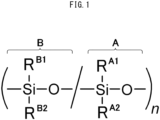
- FIG. 1 illustrates a chemical structure of a monomer unit of a polysiloxane composition according to the present embodiment.
- the polysiloxane composition according to the present embodiment is a copolymer of an adhesive monomer unit A mainly contributing to adhesiveness and a flexible monomer unit B mainly contributing to flexibility.
- the diagonal in FIG. 1 means that the arrangement of the adhesive monomer unit A and the flexible monomer unit B in the polysiloxane composition is unregulated.
- the polysiloxane composition according to the present embodiment is a random copolymer of the adhesive monomer unit A and the flexible monomer unit B.
- the adhesive monomer unit A contains a siloxane unit where two substituents R A1 and R A2 are bound to a silicon atom, namely, a D unit.
- One substituent R A1 includes a hydrocarbon group.
- Other substituent R A2 contains a catechol group that is a group contributing to adhesiveness.
- the molar ratio of catechol group: adhesive monomer unit A is 1:1.
- the flexible monomer unit B includes an organosiloxane unit containing no catechol group.
- the flexible monomer unit B is a D unit containing two substituents R B1 and R B2 each including a hydrocarbon group containing no catechol group.
- the hydrocarbon group constituting each of the substituents R A1 , R B1 , and R B2 , here used, can be, for example, one having 10 or less carbon atoms, specifically, an alkyl group having 10 or less carbon atoms.
- the alkyl group is preferably a methyl group.
- Such three substituents R A1 , R B1 , and R B2 may be the same as or different from one another.
- the substituent R A1 may be a methyl group and the flexible monomer unit B may be a dimethylsiloxane unit.
- one of the substituents R A1 , R B1 , and R B2 may be different from the remaining substituents, or all thereof may be different from one another.
- FIG. 2 illustrates a global structure of the polysiloxane composition according to the present embodiment.
- the polysiloxane composition according to the present embodiment has a structure where a plurality of catechol groups as side chains is bound to a main chain.
- the catechol groups are discretely repeatedly placed in the length direction of the main chain.
- each catechol group is contained in the substituent R A2 illustrated in FIG. 1 .
- the main chain includes a random arrangement of a moiety other than the catechol group in the adhesive monomer unit A illustrated in FIG. 1 , and the flexible monomer unit B.
- both the adhesive monomer unit A and the flexible monomer unit B are D units, and thus the main chain is linear.
- the flexible monomer unit B illustrated in FIG. 1 does not contain any catechol group in the substituents R B1 and R B2 , and thus serves to inhibit the binding density of the catechol group relative to the main chain illustrated in FIG. 2 , from being excessive, and to make the main chain flexible.
- Such making the main chain flexible means that, when the polysiloxane composition according to the present embodiment is used as a component contained in an adhesive, shear strength and impact resistance in adhesion can be enhanced.
- the flexible monomer unit B serves to impart shear strength and impact resistance to strong adhesiveness exhibited by the catechol group of the adhesive monomer unit A.
- the flexible monomer unit B occupies 47% by mol or more and 95% by mol or less of 100% by mol of the polysiloxane composition and the adhesive monomer unit A occupy the balance.
- the molar ratio between the adhesive monomer unit A and the flexible monomer unit B can be identified by the integral ratio of signals appearing in a 1 H-NMR spectrum.
- a linear copolymer of a first siloxane unit that is a precursor of the adhesive monomer unit A, and a second siloxane unit serving as the flexible monomer unit B is formed.
- a catechol group is introduced into the first siloxane unit in the copolymer, to thereby obtain the polysiloxane composition according to the present embodiment.
- a urea bond structure is desirably utilized for an increase in rate of introduction of a catechol group.
- a method for producing a polysiloxane composition, by introducing a catechol group by use of a urea bond structure is specifically described.
- a copolymer of a precursor first siloxane unit containing a compound containing an ammonium group, in a substituent, and a second siloxane unit containing a substituent including a hydrocarbon group is formed (copolymerization step S1).
- the precursor first siloxane unit is here a precursor of the adhesive monomer unit A illustrated in FIG. 1 .
- the substituent containing the compound containing an ammonium group, in the precursor first siloxane unit, is a precursor of the substituent R A2 illustrated in FIG. 1 .
- the second siloxane unit is the same as the flexible monomer unit B illustrated in FIG. 1 .
- urea group formation step S2 the copolymer formed in copolymerization step S1 is reacted with a carbonyl compound, to thereby replace the compound containing an ammonium group, in the precursor first siloxane unit, with a compound containing a urea group (urea group formation step S2).
- first siloxane unit where the compound containing an ammonium group is replaced with a compound containing a urea group.
- first siloxane unit The polymer undergoing this urea group formation step S2 is referred to as "precursor polysiloxane composition”.
- the above-mentioned precursor polysiloxane composition is reacted with catecholamine, to thereby introduce a catechol group into the first siloxane unit, via a urea bond containing the above-mentioned urea group (catechol group introduction step S3).
- catechol group introduction step S3 the rate of introduction of a catechol group can be increased by mediation of such a urea bond.
- the polysiloxane composition according to the present embodiment where the substituent R A2 illustrated in FIG. 1 contains a urea bond and a catechol group bound to the urea bond, is obtained.
- the polysiloxane composition obtained can be used as a component contained in an adhesive, specifically, as a main component.
- the "main component” here means one contained at a content of more than 50% by weight, and the concept thereof encompasses a content of 100% by weight.
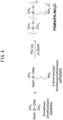
- the starting material, to which a catalyst was added, was stirred in 50% by weight of ethanol at 60°C for 12 hours.
- the resulting mixed solution was transferred to a disposable tray made of polypropylene, and heated in an opened system at 50°C for about five hours, to thereby evaporate the solvent.
- the resulting viscous solid product was heated in an oven at 100°C for two hours, to thereby obtain a copolymer (hereinafter, designated as "PDMS/PS-NH 3 Cl").
- loading ratio Four kinds of PDMS/PS-NH 3 Cl, different in mixing molar ratio of DMDMS: APDMMS (hereinafter, designated as "loading ratio"), were here obtained. Specifically, one where the loading ratio is 5:5 is adopted as Example 1, one where the loading ratio is 6:4 is adopted as Example 2, one where the loading ratio is 7:3 is adopted as Example 3, and one where the loading ratio is 8:2 is adopted as Example 4.
- the foregoing step is one example of copolymerization step S1 illustrated in FIG. 3 .
- a dimethylsiloxane unit constituting PDMS/PS-NH 3 Cl, illustrated in FIG. 4 is one example of the above-mentioned second siloxane unit.
- a siloxane unit taken together with the dimethylsiloxane unit to constitute PDMS/PS-NH 3 Cl is one example of the above-mentioned precursor first siloxane unit, and NH 3 Cl constituting the substituent is one example of the compound containing an ammonium group.
- the present step is one example of urea group formation step S2 illustrated in FIG. 3 .
- the 1,1'-carbonyldiimidazole used in the present step is one example of the above-mentioned carbonyl compound.
- a structure where imidazole is connected to an amide bond, illustrated in FIG. 5 is one example of the above-mentioned compound containing a urea group -NH-CO-N ⁇ , as a whole.
- a siloxane unit containing the compound, in a substituent is one example of the above-mentioned first siloxane unit.
- a crude product recovered was washed with purified water (20 to 40 mL), and an insoluble fraction was recovered by decantation, to thereby obtain a polysiloxane composition (hereinafter, designated as "PDMS/PS-U-Ph(OH) 2 ").
- the present step is one example of catechol group introduction step S3 illustrated in FIG. 3 .
- the dopamine hydrochloride used in the present step is one example of the above-mentioned catecholamine.
- the first siloxane unit undergoing the present step is one example of the adhesive monomer unit A illustrated in FIG. 1 .
- the second siloxane unit undergoing the present step is one example of the flexible monomer unit B illustrated in FIG. 1 .
- the substituent R A2 illustrated in FIG. 1 contains a catechol group that is in the state of being connected to a urea bond, as illustrated in FIG. 5 .
- the substituent R A2 illustrated in FIG. 1 separately contains a hydrocarbon group of a structure of carbon atoms linearly connected, specifically, a polymethylene group, from such urea bond structure and catechol group, as illustrated in FIG. 5 . More specifically, according to the present step, the substituent R A2 illustrated in FIG.
- urea bond structure 1 contains a trimethylene group (-CH 2 CH 2 CH 2 -) that connects a silicon atom of the adhesive monomer unit A and such a urea bond structure, and an ethylene group (-CH 2 CH 2 -) that connects such urea bond structure and catechol group.
- PDMS/PS-U-Ph(OH) 2 obtained as described above is partially insolubilized when dried and stored, and thus was stored in the form of a solution obtained by dissolution in a solvent, specifically, an ethanol solution.
- the ethanol solution was concentrated (40°C) by a rotary evaporator, and then added to water, and a solid precipitated was used as an adhesive.
- FIG. 6 illustrates an FT-IR spectrum of each PDMS/PS-U-Ph(OH) 2 according to Examples 1 to 4. As described above, the loading ratio of DMDMS: APDMMS in copolymerization step S1 differs among Examples 1 to 4. FIG. 6 indicates the loading ratio by brackets ⁇ >.
- FIG. 7 illustrates a 1 H-NMR spectrum of each PDMS/PS-U-Ph(OH) 2 according to Examples 1 to 4.
- a signal h derived from an aromatic ring was observed.
- introduction of a catechol group into the adhesive monomer unit A was identified.
- the molar ratio of flexible monomer unit B: adhesive monomer unit A (hereinafter, designated as "structural unit ratio") in PDMS/PS-U-Ph(OH) 2 was calculated from the integral ratio of a signal a derived from a methyl proton adjacent to a silicon atom and a signal h derived from an aromatic ring, in such each 1 H-NMR spectrum.
- FIG. 7 indicates the structural unit ratio calculated, by brackets (), and indicates the above-mentioned loading ratio by brackets ⁇ >.
- the structural unit ratio of flexible monomer unit B: adhesive monomer unit A was almost the same as the loading ratio, in each of Examples 1 to 4.
- an ethanol solution of such each PDMS/PS-U-Ph(OH) 2 according to Examples 1 to 4 was prepared, and the ethanol solution was added to water, to thereby precipitate a paste.
- the paste was used as an adhesive, and an evaluation was conducted.
- the adhesive includes such each PDMS/PS-U-Ph(OH) 2 , and thus the adhesive is also designated as "PDMS/PS-U-Ph(OH) 2 " hereinafter.
- Paste-like PDMS/PS-U-Ph(OH) 2 was applied to each of paired aluminum plates.
- a paste was obtained by applying a powder, sandwiching the aluminum plates, and heating the powder, in each of Examples 1 and 2.
- adhered surface regions of the paired aluminum plates, to which PDMS/PS-U-Ph(OH) 2 was applied, (hereinafter, referred to as "adhered surface"), were mutually stacked and fixed by clips, and heated and dried at 150°C for 12 hours. The area of the adhered surface was here 125 mm 2 .
- PDMS/PS-NH 3 Cl described above, as a precursor of PDMS/PS-U-Ph(OH) 2 was used as an adhesive for comparison, and each sample for evaluation according to Comparative Examples was also obtained in the same manner.
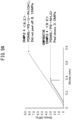
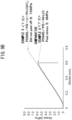
- FIG. 9A , FIG. 9B , FIG. 9C , and FIG. 9D respectively illustrate stress-strain diagrams of samples for evaluation according to Example 4, Example 3, Example 2, and Example 1.
- Example 4 Example 3, Example 2, and Example 1.
- the adhered surface of the sample was not peeled even by pulling at 8.16 MPa corresponding to the maximum stress measurable with a tensile shear tester used, and strong adhesiveness was confirmed.
- a main difference in chemical structure between each PDMS/PS-U-Ph(OH) 2 according to Examples 1 to 4 and each PDMS/PS-NH 3 Cl according to Comparative Examples 1 to 4 is whether or not a catechol group is introduced.
- a catechol group was confirmed to contribute to exhibition of strong adhesiveness, from the results illustrated in FIG. 9A to FIG. 9D .
- each PDMS/PS-U-Ph(OH) 2 according to Examples 1 to 4 can realize adhesion excellent in shear strength.
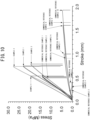
- the results are illustrated in FIG. 10 .
- the sample for evaluation of adhesion of the same materials according to Example 1 exhibited a shear strength of 23.0 MPa in the case of an area of the adhered surface of 40 mm 2 .
- the sample for evaluation of adhesion of the same materials according to Example 2 exhibited a shear strength of 19.5 MPa in the case of an area of the adhered surface of 50 mm 2 .
- the sample for evaluation of adhesion of the same materials according to Example 3 exhibited a shear strength of 27.7 MPa in the case of an area of the adhered surface of 31 mm 2 .
- the sample for evaluation of adhesion of the same materials according to Example 4 exhibited a shear strength of 19.6 MPa in the case of an area of the adhered surface of 36 mm 2 .
- FIG. 10 also illustrates a stress-strain diagram of samples for evaluation, produced with commercially available adhesives, of Commercial Reference Examples 1 to 10.
- the sample according to Commercial Reference Example 1 using a commercially available acrylic resin-based adhesive exhibited a shear strength of 14.0 MPa in the case of an area of the adhered surface of 40 mm 2 .
- the sample according to Commercial Reference Example 2 using a commercially available micro iron powder-containing epoxy-based adhesive exhibited a shear strength of 13.4 MPa in the case of an area of the adhered surface of 48 mm 2 .
- the sample according to Commercial Reference Example 3 using a commercially available polyvinyl alcohol-based adhesive exhibited a shear strength of 1.4 MPa in the case of an area of the adhered surface of 125 mm 2 .
- the sample according to Commercial Reference Example 4 using a commercially available polyvinyl acetate -based adhesive exhibited a shear strength of 0.7 MPa in the case of an area of the adhered surface of 125 mm 2 .
- the sample according to Commercial Reference Example 5 using a commercially available cyanoacrylate-based adhesive exhibited a shear strength of 1.6 MPa in the case of an area of the adhered surface of 125 mm 2 .
- the sample according to Commercial Reference Example 6 using a commercially available cyanoacrylate-based adhesive exhibited a shear strength of 3.1 MPa in the case of an area of the adhered surface of 125 mm 2 .
- the sample according to Commercial Reference Example 7 using a commercially available epoxy-based adhesive exhibited a shear strength of 3.9 MPa in the case of an area of the adhered surface of 125 mm 2 .
- the sample according to Commercial Reference Example 8 using a commercially available cyanoacrylate-based adhesive exhibited a shear strength of 4.4 MPa in the case of an area of the adhered surface of 125 mm 2 .
- the sample according to Commercial Reference Example 9 using a commercially available cyanoacrylate-based adhesive exhibited a shear strength of 4.3 MPa in the case of an area of the adhered surface of 125 mm 2 .
- the sample according to Commercial Reference Example 10 using a commercially available vinyl acetate resin-based adhesive (heat-melt type) exhibited a shear strength of 4.6 MPa in the case of an area of the adhered surface of 125 mm 2 .
- each of the samples for evaluation of adhesion of the same materials according to Examples 1 to 4 was confirmed to exhibit shear strength at ordinary temperature, the shear strength being more excellent than those according to Commercial Reference Examples 1 and 2 and much more excellent than those according to Commercial Reference Examples 3 to 10.
- sample for glass fiber-reinforced epoxy resin adhesiveness evaluation a sample for evaluation obtained by stacking a paired glass fiber-reinforced epoxy resin plates
- the area of the adhered surface was here 125 mm 2 .
- the same tensile shear test as in the case of FIG. 9 the test involving pulling and separating the glass fiber-reinforced epoxy resin plates in a direction in parallel with the adhered surface thereof, was performed, and thus a stress-strain diagram was measured.
- the results are illustrated in FIG. 11A .
- the adhered surface of the sample was not peeled even by pulling at 8.16 MPa corresponding to the maximum stress measurable with a tensile shear tester, and the adhesive according to Example 3 was confirmed to be applicable to adhesion of a glass fiber-reinforced epoxy resin.
- Such strong adhesiveness is considered to be exhibited by the presence of a PDMS component exhibiting flexibility, a catechol group exhibiting strong adhesiveness to a material surface, and a crosslinked structure of catechol groups, formed by heating and drying.
- the results are illustrated in FIG. 11B .
- the stress in peeling of the adhered surface with the glass fiber-reinforced epoxy resin plates was 18.8 MPa, and strong adhesiveness was exhibited.
- a hydrogen bond between a hydrogen group on a glass fiber-reinforced epoxy resin surface, and a catechol group, is considered to contribute to strong adhesiveness.
- Example 3 applicability of the adhesive according to Example 3 with respect to adhesion of copper was representatively examined.
- sample for evaluation obtained by stacking paired copper plates whose surfaces are almost not oxidized (hereinafter, referred to as "sample for oxidatively unprocessed copper adhesiveness evaluation") was produced with the adhesive according to Example 3 in the same manner as in the above-mentioned creation procedure of a sample for evaluation.
- sample for evaluation obtained by stacking paired copper plates whose surfaces were subjected to oxidation processing (hereinafter, referred to as "sample for oxidatively processed copper adhesiveness evaluation") was similarly produced with the adhesive according to Example 3 in the same manner as in the above-mentioned creation procedure of a sample for evaluation.
- the oxidation processing was performed by heating the copper plates in the air at 150°C for 12 hours.
- the area of the adhered surface was here 125 mm 2 in both the sample for oxidatively unprocessed copper adhesiveness evaluation and the sample for oxidatively processed copper adhesiveness evaluation.
- the samples were each subjected to the tensile shear test in the same manner as in the case of FIG. 9 , and thus a stress-strain diagram was measured.
- the results are illustrated in FIG. 12 .
- the sample for oxidatively unprocessed copper adhesiveness evaluation exhibited a sufficient shear strength of 6.2 MPa.
- the adhesive according to Example 3 was confirmed to be applicable to adhesion of the copper plates.
- the sample for oxidatively processed copper adhesiveness evaluation exhibited a large shear strength of 8.1 MPa. The reason for this is presumed that the copper plates were each subjected to oxidation processing to thereby allow a hydrogen bond and a coordination bond between copper oxide and a catechol group on the surface to contribute to strong adhesiveness. While copper oxide is here illustratively mentioned, the adhesives according to the present Examples 1 to 4 are each considered to be particularly suitable for adhesion of a common metal whose surface is oxidized, such as aluminum oxide.
- FIG. 13 illustrates evaluation results of water resistance.
- no peeling of the adhered surface was caused even by pulling at 8.16 MPa corresponding to the maximum stress measurable with a tensile shear tester, and sufficient water resistance was confirmed.
- FIG. 14A illustrates a design of an impact resistance test of the sample for evaluation according to Example 4.
- the impact resistance test was performed by striking the sample for evaluation with a hammer in a direction perpendicular to the adhered surface.
- the adhered surface of the sample for evaluation according to Example 4 was not peeled even by such striking with a hammer, and the aluminum plates were confirmed to be deformed.
- the adhered surface was not confirmed to be peeled even by again striking the aluminum plates with a hammer.
- Example 4 The same results as in the case of Example 4 were obtained with respect to the samples for evaluation according to Examples 2 and 3, although not illustrated.
- FIG. 14B illustrates a design of an impact resistance test of the sample for evaluation according to Example 1.
- the adhered surface of the sample for evaluation according to Example 1 was not peeled even by striking with a hammer once, and excellent impact resistance was exhibited as in the case of Example 4.
- each PDMS/PS-U-Ph(OH) 2 according to Examples 1 to 4 can realize adhesion excellent in impact resistance.
- Example 1 exhibited excellent impact resistance, but exhibited inferior impact resistance as compared with Example 4.
- the difference between Example 1 and Example 4 is the proportion of the flexible monomer unit B in PDMS/PS-U-Ph(OH) 2 .
- a polysiloxane composition including a polymer of the adhesive monomer unit A among the adhesive monomer unit A and the flexible monomer unit B was prepared in Comparative Example 5.
- the adhesive monomer unit A here used was a siloxane unit of a structure where a catechol group is bound to methylsiloxane via a urea bond as illustrated in FIG. 5 .
- the polysiloxane composition according to Comparative Example 5 (hereinafter, designated as "PS-U-Ph(OH) 2 ) was used as an adhesive to thereby obtain a sample for evaluation according to Comparative Example 5 in the same manner.
- FIG. 14C illustrates a design of an impact resistance test of the sample for evaluation according to Comparative Example 5.
- the adhered surface of the sample for evaluation according to Comparative Example 5 was easily peeled by striking with a hammer once. In other words, the sample for evaluation according to Comparative Example 5 exhibited no sufficient impact resistance.
- the content rate of the flexible polymer unit B in PDMS/PS-U-Ph(OH) 2 is preferably 47% by mol or more, more preferably 58% by mol or more, more preferably 66% by mol or more, more preferably 75% by mol or more in order to obtain particularly excellent impact resistance.
- the content rate of the flexible polymer unit B is preferably 95% by mol or less, more preferably 90% by mol or less, more preferably 85% by mol or less, more preferably 80% by mol or less in order to sufficiently ensure the adhesive monomer unit A contributing to robust shear strength, in PDMS/PS-U-Ph(OH) 2 .
- Each of the samples for adhesion evaluation according to Examples 1 to 4 was heated in an oven with a weight of 5 kg being suspended therefrom. The heating temperature was gradually raised. The load of the weight acts as a shear force on the adhered surface of the paired aluminum plates during heating.
- sample for aluminum-stainless steel adhesiveness evaluation a sample for evaluation obtained by stacking a paired aluminum plates and a stainless plate (hereinafter, referred to as "sample for aluminum-stainless steel adhesiveness evaluation") was produced in the same manner as in the above-mentioned creation procedure of a sample for evaluation.
- Each of the samples for aluminum-stainless steel adhesiveness evaluation according to Examples 1 to 4 was heated in an oven with a weight of 5 kg being suspended therefrom. The heating temperature was gradually raised to 150°C. As a result, the adhesion of each of the samples for aluminum-stainless steel adhesiveness evaluation according to Examples 1 to 4 was maintained. Furthermore, even when each of the samples was cooled to room temperature, the adhered surface was not peeled, and adhesiveness was confirmed to be able to be maintained in the environment in which the temperature changes in the range from room temperature to 150°C.
- sample for aluminum-glass adhesiveness evaluation A sample for evaluation obtained by stacking paired aluminum plates and a glass plate (hereinafter, referred to as "sample for aluminum-glass adhesiveness evaluation") was produced with each of the adhesives according to Examples 1 to 4 in the same manner as in the above-mentioned creation procedure of a sample for evaluation.
- each of the samples for aluminum-glass adhesiveness evaluation exhibited adhesion of the aluminum plates and the glass plate at sufficient strength
- each of the adhesives according to Examples 1 to 4 was confirmed to be applicable to adhesion of the aluminum plates and the glass plate.
- each of the samples for aluminum-glass adhesiveness evaluation according to Examples 1 to 4 was heated and dried, and then cooled to room temperature, and the adhesion state here was observed. As a result, no peeling of any adhered surface or no breakage of any glass plate was confirmed.
- Each of the adhesives according to Examples 1 to 4 was thus found to have a flexible structure where thermal strain due to the difference in thermal expansion coefficient, occurring by the change in temperature between different materials, can be relaxed.
- An adhesive having a structure illustrated in FIG. 2 can lead to the occurrence of a hydrogen bond between a hydroxy group of a catechol group and a hydroxy group of another catechol group.
- Such chemical binding of catechol groups constituting the adhesive causes deterioration in viscosity of the adhesive, resulting in shortening of the period for which the adhesive can be stored.
- the adhesive is here demanded to be able to be stably stored over a long period.
- Embodiment 2 for further achieving the object is described.
- FIG. 15 illustrates a procedure of a method for producing a polysiloxane composition according to the present embodiment. Since copolymerization step S1, urea group formation step S2, and catechol group introduction step S3 are the same as in the case of Embodiment 1, the description overlapped is here omitted.
- a catechol group introduced in catechol group introduction step S3 (hereinafter, designated as "non-protected catechol group") has a structure where two hydroxy groups are linked at the ortho positions of the benzene ring, as illustrated in FIG. 2 and FIG. 5 .
- a polymer obtained in catechol group introduction step S3 (hereinafter, designated as "non-protected polysiloxane composition") is reacted with a silylation agent (alkylsilyl group introduction step S4), after catechol group introduction step S3.
- the silylation agent here used can be a trialkylsilicon compound having a structure where three alkyl groups R C1 , R C2 , and R C3 , and any substituent X are bound to a silicon atom.
- the alkyl groups R C1 , R C2 , and R C3 may be the same as or different from one another, or one thereof may be different from the remaining two thereof.
- trialkylsilicon compound examples include trialkylalkoxysilane containing an alkoxy group as the substituent X, trialkylhalogenosilane containing a halogeno group as the substituent X, and silazane being other trialkylsilicon compound, containing a nitrogen-silicon bond as the substituent X.
- trialkylhalogenosilane examples include trialkylchlorosilane containing a chloro group as the substituent X.
- alkylsilyl group introduction step S4 illustrated in FIG. 15 the non-protected polysiloxane composition is reacted with the silylation agent, to thereby substitute each hydrogen atom of two hydroxy groups linked at the ortho positions of the benzene ring in the non-protected catechol group, with an alkylsilyl group.
- FIG. 17 illustrates a global structure of a polysiloxane composition obtained through alkylsilyl group introduction step S4 (hereinafter, designated as "protected polysiloxane composition").
- the protected polysiloxane composition has a silylated structure where each hydrogen atom of hydroxy groups in the non-protected catechol group illustrated in FIG. 2 is substituted with an alkylsilyl group R.
- non-protected catechol group where such hydrogen atoms are thus each substituted with an alkylsilyl group, is particularly called "denatured catechol group”.
- the alkylsilyl group R serves as a protection group that suppresses chemical binding of such denatured catechol groups.
- the protected polysiloxane composition obtained through alkylsilyl group introduction step S4 hardly causes any time-dependent change that leads to a gradual increase in degree of viscosity, and can be stably stored over a long period.
- the protected polysiloxane composition may also be used as a main component of the adhesive, as in the non-protected polysiloxane composition.
- the composition when used as the adhesive, the above-mentioned alkylsilyl group R as the protection group may be detached.
- the alkylsilyl group R as the protection group is detached after alkylsilyl group introduction step S4.
- the alkylsilyl group R as the protection group is again substituted with a hydrogen atom (alkylsilyl group detachment step S5).
- alkylsilyl group detachment step S5 a structure where two hydroxy groups are linked at the ortho positions of the benzene ring is formed.
- the denatured catechol group is returned to the non-protected catechol group.
- the procedure for substituting the protection group with a hydrogen atom is optionally performed.
- the protection group can be substituted with a hydrogen atom by hydrolysis of the protected polysiloxane composition under acidic conditions.
- the protection group can be substituted with a hydrogen atom by heating the protected polysiloxane composition.
- PDMS/PS-U-Ph(OH) 2 according to Example 3 was prepared in the above-mentioned manner and was reacted with hexamethyldisilazane (HMDS). Specifically, first, 4.64 mmol (0.7485 g) of HMDS was added to 0.72 mmol unit (0.1048 g) of PDMS/PS-U-Ph(OH) 2 according to Example 3. The amount of HMDS added was adjusted so as to be 20 equivalents relative to the adhesive monomer unit A in PDMS/PS-U-Ph(OH) 2 according to Example 3.
- HMDS hexamethyldisilazane
- Such PDMS/PS-U-Ph(OH) 2 and HMDS were stirred with a spatula for about 20 minutes, and were further stirred with a stirrer at room temperature for one hour.
- the stirred product was added to about 60 mL of hexane, and a precipitate was obtained by decantation.
- the precipitate is a protected polysiloxane composition according to Example 5.
- the foregoing step is one example of alkylsilyl group introduction step S4 illustrated in FIG. 15 .
- PDMS/PS-U-Ph(OH) 2 according to Example 3 is one example of the above-mentioned non-protected polysiloxane composition.
- HMDS is one example of the silylation agent illustrated in FIG. 16 .
- HMDS contains a methyl group as each of the alkyl groups R C1 , R C2 , and R C3 illustrated in FIG. 16 , and contains a trimethylsilicon compound containing a nitrogen-silicon bond, as the substituent X illustrated in FIG. 16 .
- the protected polysiloxane composition according to Example 5 obtained as the precipitate, contains a denatured catechol group.
- the denatured catechol group has a silylated structure where each hydrogen atom of two hydroxy groups linked at the ortho positions of the benzene ring in the non-protected catechol group is substituted with a trimethylsilyl group as one example of the above-mentioned alkylsilyl group R.
- the protected polysiloxane composition according to Example 5 is designated as PDMS/PS-Ph[OSi(CH 3 ) 3 ] 2 .
- the protected polysiloxane composition according to Example 5 was dissolved in each of dimethylformamide, methanol, ethanol, acetone, ethyl acetate, chloroform, diethyl ether, and toluene, but the non-protected polysiloxane composition according to Example 3 was dissolved merely in each of dimethylformamide, methanol, and ethanol, among such solvents.
- the protected polysiloxane composition according to Example 5 was hardly dissolved in dimethylsulfoxide, but the non-protected polysiloxane composition according to Example 3 was dissolved in dimethylsulfoxide.
- FIG. 19 illustrates a 1 H-NMR spectrum of the protected polysiloxane composition according to Example 5.
- a signal j derived from a methyl proton of the trimethylsilyl group as the alkylsilyl group R is observed in the 1 H-NMR spectrum illustrated in FIG. 19 .
- a signal i derived from a hydroxy group of the non-protected catechol group is observed in the 1 H-NMR spectrum illustrated in FIG. 7 , but the signal i is not confirmed in the 1 H-NMR spectrum illustrated in FIG. 19 . This fact supposes sure substitution of each hydrogen atom of hydroxy groups in the non-protected catechol group, with the trimethylsilyl group.
- a silicon atom and a urea bond structure are connected by a backbone including a plurality of carbon atoms.
- the rate of introduction of the trimethylsilyl group as the alkylsilyl group R was calculated from the integrated value of a signal b derived from a carbon atom directly bound to a silicon atom, among carbon atoms constituting the backbone, and the integrated value of the above-mentioned signal j, and thus was 99%.
- the trimethylsilyl group serving as the protection group was detached from the protected polysiloxane composition according to Example 5, with the view to an enhancement in adhesion force during use as the adhesive.
- the present step is one example of alkylsilyl group detachment step S5 illustrated in FIG. 15 .
- Hydrolysis occurs under acidic conditions where an acid is thus generated, and the hydrolysis allows the trimethylsilyl group in the protected polysiloxane composition according to Example 5 to be substituted with a hydrogen atom.
- a structure is reformed where two hydroxy groups are linked at the ortho positions of the benzene ring.
- the protected polysiloxane composition where the denatured catechol group is thus returned to the non-protected catechol group, is called "deprotected polysiloxane composition”.
- a deprotected polysiloxane composition according to Example 5 is here obtained by evaporating acetone as the above-mentioned solvent.
- An evaluation sample including paired aluminum plates stacked with the protected polysiloxane composition according to Example 5 was produced in the manner described with reference to FIG. 8 .
- the evaluation sample was subjected to the tensile shear test, and a sufficient shear strength of 10.7 MPa was exhibited in the case of an area of the adhered surface of 78 mm 2 .
- the protected polysiloxane composition according to Example 5 was found to be sufficiently usable as the adhesive even if not necessarily being co-existed with acid anhydride.
- an evaluation sample including paired aluminum plates stacked with the deprotected polysiloxane composition according to Example 5 was produced in the same manner.
- the evaluation sample was subjected to the tensile shear test, and a sufficient shear strength of 10.9 MPa was exhibited even in the case of a decrease in area of the adhered surface, to 61 mm 2 . It was confirmed from these results that adhesion force can be enhanced by promotion of detachment of the protection group due to co-existence with acid anhydride during use as the adhesive.
- Example 5 While detachment of the protection group was promoted due to co-existence of the protected polysiloxane composition with acid anhydride in Example 5 described above, the procedure for detaching the protection group was optionally performed as described with reference to FIG. 15 . Hereinafter, a variation example of the procedure for detaching the protection group is described.
- the protected polysiloxane composition according to Example 5 was dissolved in dimethylformamide as a solvent, and was stirred over one hour with the composition being heated to 150°C that is the same temperature as in adhesion. Thereafter, a deprotected polysiloxane composition according to a variation example was obtained by removal of the solvent.
- a 1 H-NMR spectrum of the deprotected polysiloxane composition according to the variation example was measured, and a decrease in area of a signal j derived from a methyl proton of the trimethylsilyl group as the alkylsilyl group R, and an increase in area of a signal i derived from a hydroxy group of the non-protected catechol group were observed as compared with the 1 H-NMR spectrum illustrated in FIG. 19 .
- the denatured catechol group was confirmed to be able to be returned to the non-protected catechol group with no use of any acid anhydride, but heating at 150°C.
- a catechol group contributes to exhibition of adhesiveness.
- a higher content rate of the adhesive monomer unit A can be said to be more advantageous for an increase in adhesion force of the adhesive.
- a higher content rate of the flexible monomer unit B results in a lower degree of viscosity of the adhesive at ordinary temperature.
- a higher content rate of the flexible monomer unit B is more advantageous for an enhancement in each of application to a subject.
- a plurality of polysiloxane compositions is first prepared, the compositions being different from each other in terms of the above-mentioned structural unit ratio (preparation step S11).
- Such a plurality of polysiloxane compositions is mixed to thereby obtain the adhesive as a mixture of such a plurality of polysiloxane compositions (mixing step S12).
- the first polysiloxane composition and a second polysiloxane composition lower in content rate of the flexible monomer unit B than the first polysiloxane composition are mixed in mixing step S12, the first polysiloxane composition serves as a thinner that reduces the degree of viscosity of the second polysiloxane composition.
- the degree of viscosity of an adhesive to be obtained can be easily adjusted by the mixing ratio of the first polysiloxane composition and the second polysiloxane composition.
- PDMS/PS-U-Ph(OH) 2 was produced as the first polysiloxane composition serving as the thinner, in the same manner as in Examples 1 to 4 except that the loading ratio of DMDMS: APDMMS is 19:1.
- copolymerization step S1 according to Example 6 upon heating a mixed solution including DMDMS, APDMMS, a catalyst, and a solvent in order to evaporate the solvent from the mixed solution, the area of a liquid surface of the mixed solution was set to be smaller than those in Examples 1 to 4. The reason for this is to suppress volatilization of a cyclic oligomer contributing to formation of the flexible monomer unit B.
- FIG. 22 illustrates an FT-IR spectrum of PDMS/PS-U-Ph(OH) 2 according to Example 6. Also in Example 6, an absorption peak assigned to a urea bond was observed at positions of a wavenumber of 1632 cm -1 and a wavenumber of 1575 cm -1 , and a urea bond was confirmed to be properly formed in catechol group introduction step S3 described above.
- FIG. 23 illustrates a 1 H-NMR spectrum of PDMS/PS-U-Ph(OH) 2 according to Example 6.
- a signal h derived from an aromatic ring was observed.
- introduction of a catechol group into the adhesive monomer unit A was identified.
- the structural unit ratio as the molar ratio of flexible monomer unit B: adhesive monomer unit A in PDMS/PS-U-Ph(OH) 2 was calculated from the integral ratio of a signal a derived from a methyl proton adjacent to a silicon atom and a signal h derived from an aromatic ring in the 1 H-NMR spectrum, and was found to be 93:7.
- FIG. 23 indicates the structural unit ratio by brackets (), and indicates the above-mentioned loading ratio by brackets ⁇ >.
- PDMS/PS-U-Ph(OH) 2 according to Example 3 was prepared as the second polysiloxane composition.
- PDMS/PS-U-Ph(OH) 2 according to Example 6 as the first polysiloxane composition
- PDMS/PS-U-Ph(OH) 2 according to Example 3 as the second polysiloxane composition were then mixed under a condition where the mass ratio of first polysiloxane composition: second polysiloxane composition is 1:3, and thus an adhesive according to Example was obtained.
- An evaluation sample including paired aluminum plates stacked with the adhesive according to the present Example was produced in the manner described with reference to FIG. 8 .
- the evaluation sample was subjected to the tensile shear test, and the adhered surface of the evaluation sample was not peeled and strong adhesiveness was confirmed even by pulling at 8.16 MPa corresponding to the maximum stress measurable with a tensile shear tester used, as in the cases of Examples 1 to 4.
- the area of the adhered surface was 61 mm 2 in order to confirm the shear stress in peeling of the adhered surface, a sufficient shear strength of 9.6 MPa was exhibited.
- the relevant evaluation sample was subjected to the impact resistance test in the manner described with reference to FIG. 14A and FIG. 14B .
- the relevant evaluation sample caused no peeling of the adhered surface even by striking with a hammer, and was confirmed to exhibit excellent impact resistance.
- the relevant evaluation sample was subjected to the above heat resistance test. Adhesion of the relevant evaluation sample with a load of a weight of 5 kg being applied as a shear force onto the adhered surface, was maintained even at 250°C. In other words, a heat resistance of 250°C was confirmed.
- the above-mentioned sample for aluminum-stainless steel adhesiveness evaluation was produced with the adhesive according to the present Example. Adhesion of the sample for aluminum-stainless steel adhesiveness evaluation was maintained even when it is heated to 150°C with a load of a weight of 5 kg being applied as a shear force onto the adhered surface, and was maintained even after it is cooled to room temperature, as in the cases of Examples 1 to 4.
- PDMS/PS-U-Ph(OH) 2 according to Example 3 was in the form of a hard paste.
- PDMS/PS-U-Ph(OH) 2 according to Example 6 as the first polysiloxane composition, was in the form of a liquid.
- the mass ratio of first polysiloxane composition: second polysiloxane composition, being 1:3, corresponds to 34:66 when converted into the molar ratio of the monomer units.
- the molar ratio of flexible monomer unit B: adhesive monomer unit A in the adhesive according to the present Example satisfies (93 ⁇ 34 + 66 ⁇ 66): (7 ⁇ 34 + 34 ⁇ 66) ⁇ 75:25.
- the value of the molar ratio is approximate to a structural unit ratio of 75:25 in PDMS/PS-U-Ph(OH) 2 according to Example 4.
- the ease of application of the adhesive according to the present Example, at room temperature was confirmed to be more excellent than the ease of application of PDMS/PS-U-Ph(OH) 2 according to Example 4, at room temperature.
- the foregoing exemplarily describes the case where the content rate of the flexible monomer unit B in the adhesive as the mixture is 75% by mol.
- the content rate of the flexible monomer unit B is not limited to this value, and can be optionally adjusted by the mixing ratio of the first polysiloxane composition and the second polysiloxane composition.
- the content rate of the flexible monomer unit B in the adhesive as the mixture is preferably 47% by mol or more and 95% by mol or less in order to achieve the balance between obtaining a sufficient adhesion force and enhancing ease of application.
- a production method involving mixing the first polysiloxane composition and the second polysiloxane composition is exemplified in the above Example
- a third polysiloxane composition different in structural unit ratio from the first polysiloxane composition and the second polysiloxane composition may be further mixed in addition to the first polysiloxane composition and the second polysiloxane composition, or four or more polysiloxane compositions mutually different in structural unit ratio may be mixed.
- At least any of such a plurality of polysiloxane compositions may be the above-mentioned deprotected polysiloxane composition.
- the protected polysiloxane composition can also be used as the adhesive, and thus at least any of such a plurality of polysiloxane compositions may also be a protected polysiloxane composition whose non-protected catechol group is replaced with a denatured catechol group.
- the first polysiloxane composition where the content rate of the adhesive monomer unit A is suppressed to 7% by mol, was used as a thinner in order to reduce the degree of viscosity.
- the degree of viscosity of the resulting polysiloxane composition according to a lower content rate of the adhesive monomer unit A.
- the silicone oil and PDMS/PS-U-Ph(OH) 2 were not compatible, and were precipitated with both being separated from each other.
- the silicone oil containing no catechol group could not serve as a thinner for PDMS/PS-U-Ph(OH) 2 .
- the first polysiloxane composition is required to contain the adhesive monomer unit A even in a slight amount in order that the first polysiloxane composition is compatible with the second polysiloxane composition to thereby serve as a thinner for the second polysiloxane composition.
- a polysiloxane composition having a content rate of the adhesive monomer unit A of more than 0% by mol and 10% by mol or less can be used as a thinner for another polysiloxane composition having a content rate of the adhesive monomer unit A of more than 10% by mol.
- the adhesive according to the present disclosure can be used in, for example, adhesion of a location demanded to have shear strength and impact resistance.
- the adhesive according to the present disclosure can be used in adhesion of members constituting an automobile.
- a cured product of the adhesive according to the present disclosure has shear strength and impact resistance, and thus can stably keep a robust adhesion structure even if an impact load according to vibration or impact is applied during driving of an automobile.
- the adhesive according to the present disclosure can also be used in adhesion of different materials.
- a multi-material structure can be realized where different materials are well-placed.
- the adhesive is suitable for adhesion of any two materials selected from the group consisting of aluminum, stainless steel, copper, glass, and an epoxy resin.
- Such a multi-material structure contributes to weight saving of automobiles and transport planes such as airplanes.
Landscapes
- Chemical & Material Sciences (AREA)
- Chemical Kinetics & Catalysis (AREA)
- Organic Chemistry (AREA)
- Health & Medical Sciences (AREA)
- Medicinal Chemistry (AREA)
- Polymers & Plastics (AREA)
- General Chemical & Material Sciences (AREA)
- Adhesives Or Adhesive Processes (AREA)
Abstract
Description
- The present disclosure relates to a polysiloxane composition, an adhesive, a method for producing a polysiloxane composition, and a method for producing an adhesive.
- In recent years, proteins secreted from marine organisms such as Mytilus edulis, having adhesion properties, have attracted attention. Catechol groups contained in such proteins have been revealed to contribute to exhibition of adhesion properties. Applications of catechol groups to adhesives have also been studied (see,
Patent Literature 1 below). - Patent Literature 1: International Publication No.
WO 2005/056708 - An objective of the present disclosure is to provide an adhesive capable of realizing adhesion excellent in shear strength and impact resistance, a polysiloxane composition usable as a component contained in the adhesive, and respective methods for producing the adhesive and the polysiloxane composition.
- A polysiloxane composition according to the present disclosure is a copolymer of
- an adhesive monomer unit including an organosiloxane unit containing a substituent containing a catechol group, and
- a flexible monomer unit including an organosiloxane unit containing no catechol group.
- Both the adhesive monomer unit and the flexible monomer unit may be D units, and the adhesive monomer unit and the flexible monomer unit may constitute a linear main chain.
- The flexible monomer unit may occupy 47% by mol or more and 95% by mol or less of the polysiloxane composition.
- The substituent containing the catechol group may contain a hydrocarbon group.
- The substituent containing the catechol group may contain a urea group.
- The catechol group may be a denatured catechol group having a silylated structure where each hydrogen atom of two hydroxy groups linked at ortho positions of a benzene ring is substituted with an alkylsilyl group.
- An adhesive according to the present disclosure includes the above-mentioned polysiloxane composition according to the present disclosure.
- The adhesive according to the present disclosure may include a first polysiloxane composition and a second polysiloxane composition that each include the above-mentioned polysiloxane composition according to the present disclosure and have the flexible monomer unit in content rates different from each other.
- The adhesive according to the present disclosure may further include a third polysiloxane composition that includes the above-mentioned polysiloxane composition according to the present disclosure and has the flexible monomer unit in a content rate different from those in the first polysiloxane composition and the second polysiloxane composition.
- A method for producing a polysiloxane composition according to the present disclosure includes
- generating a precursor polysiloxane composition that is a copolymer of a first siloxane unit containing a substituent containing a urea group, and a second siloxane unit containing a substituent including a hydrocarbon group, and
- introducing, by reacting the precursor polysiloxane composition with catecholamine, a catechol group where two hydroxy groups are linked at ortho positions of a benzene ring, into the first siloxane unit, via a urea bond containing the urea group.
- The generating may include
- forming a copolymer of a precursor first siloxane unit that serves as a precursor of the first siloxane unit and contains, in a substituent, a compound containing an ammonium group, and the second siloxane unit, and
- replacing, by reacting the formed copolymer with a carbonyl compound, the compound containing the ammonium group, in the precursor first siloxane unit, with a compound containing the urea group.
- The second siloxane unit may be a dimethylsiloxane unit.
- The method for producing the polysiloxane composition according to the present disclosure may further include, following the introducing, substituting, by reacting a polymer obtained in the introducing with a silylation agent, each hydrogen atom of the two hydroxy groups linked at the ortho positions of the benzene ring, with an alkylsilyl group.
- The method for producing the polysiloxane composition according to the present disclosure may include, following the substituting, reforming, by substituting the alkylsilyl group with the hydrogen atom again, a structure where the two hydroxy groups are linked at the ortho positions of the benzene ring.
- A method for producing an adhesive according to the present disclosure includes
- preparing a first polysiloxane composition and a second polysiloxane composition that are each obtained by the above-mentioned method for producing the polysiloxane composition according to the present disclosure and have the second siloxane unit in content rates different from each other, and
- mixing the first polysiloxane composition and the second polysiloxane composition.
- In the preparing, at least a third polysiloxane composition may be further prepared separately from the first polysiloxane composition and the second polysiloxane composition,
- the third polysiloxane composition may be obtained by the above-mentioned method for producing the polysiloxane composition according to the present disclosure, and have the second siloxane unit in a content rate different from those in the first polysiloxane composition and the second polysiloxane composition, and
- in the mixing, at least the third polysiloxane composition may be further mixed in addition to the first polysiloxane composition and the second polysiloxane composition.
- The adhesive according to the present disclosure includes a copolymer of an adhesive monomer unit and a flexible monomer unit, and thus can realize adhesion excellent in shear strength and impact resistance.
-
-
FIG. 1 is a conceptual scheme illustrating a local chemical structure of a polysiloxane composition according toEmbodiment 1; -
FIG. 2 is a conceptual scheme illustrating a global structure of the polysiloxane composition according toEmbodiment 1; -
FIG. 3 is a flowchart illustrating a method for producing the polysiloxane composition according toEmbodiment 1; -
FIG. 4 is a conceptual scheme illustrating a copolymerization step according to Examples 1 to 4; -
FIG. 5 is a conceptual scheme illustrating a urea group formation step and a catechol group introduction step according to Examples 1 to 4; -
FIG. 6 is a graph illustrating Fourier transform infrared spectroscopy (FT-IR) spectra of polysiloxane compositions according to Examples 1 to 4; -
FIG. 7 is a graph illustrating proton nuclear magnetic resonance (1H-NMR) spectra of the polysiloxane compositions according to Examples 1 to 4; -
FIG. 8 is a conceptual scheme illustrating a creation procedure of a sample for evaluation; -
FIG. 9A is a stress-strain diagram of samples for evaluation according to Example 4 and Comparative Example 4; -
FIG. 9B is a stress-strain diagram of samples for evaluation according to Example 3 and Comparative Example 3; -
FIG. 9C is a stress-strain diagram of samples for evaluation according to Example 2 and Comparative Example 2; -
FIG. 9D is a stress-strain diagram of samples for evaluation according to Example 1 and Comparative Example 1; -
FIG. 10 is a stress-strain diagram in the case of a decrease in an area of an adhered surface of each of samples for evaluation according to Examples 1 to 4 and Commercial Reference Examples 1 to 10; -
FIG. 11A is a stress-strain diagram of a sample for glass fiber-reinforced epoxy resin adhesiveness evaluation according to Example 3; -
FIG. 11B is a stress-strain diagram in the case of a decrease in the area of an adhered surface of the sample for glass fiber-reinforced epoxy resin adhesiveness evaluation according to Example 3; -
FIG. 12 is a stress-strain diagram of a sample for oxidatively unprocessed copper adhesiveness evaluation and a sample for oxidatively processed copper adhesiveness evaluation according to Example 3; -
FIG. 13 is a stress-strain diagram after immersion in water for 2 days, of samples for adhesion evaluation according to Examples 1 to 4 and Commercial Reference Examples 1 to 2; -
FIG. 14A is a photograph illustrating the result of an impact resistance test of a sample for evaluation according to Example 4; -
FIG. 14B is a photograph illustrating the result of an impact resistance test of a sample for evaluation according to Example 1; -
FIG. 14C is a photograph illustrating the result of an impact resistance test of a sample for evaluation according to Comparative Example 5; -
FIG. 15 is a flowchart illustrating a method for producing a polysiloxane composition according toEmbodiment 2; -
FIG. 16 is a conceptual scheme illustrating a configuration of a silylation agent according toEmbodiment 2; -
FIG. 17 is a conceptual scheme illustrating a global structure of a protected polysiloxane composition according toEmbodiment 2; -
FIG. 18 is a conceptual scheme illustrating an alkylsilyl group introduction step according to Example 5; -
FIG. 19 is a graph illustrating a 1H-NMR spectrum of a protected polysiloxane composition according to Example 5; -
FIG. 20 is a conceptual scheme illustrating an alkylsilyl group detachment step according to Example 5; -
FIG. 21 is a flowchart illustrating a method for producing an adhesive according toEmbodiment 3; -
FIG. 22 is a graph illustrating an FT-IR spectrum of a polysiloxane composition according to Example 6; and -
FIG. 23 is a graph illustrating a 1H-NMR spectrum of the polysiloxane composition according to Example 6. - Hereinafter, one specific example of the above-mentioned polysiloxane composition according to the present disclosure is described with respect to each of polysiloxane compositions according to
Embodiment 1 toEmbodiment 3. -
FIG. 1 illustrates a chemical structure of a monomer unit of a polysiloxane composition according to the present embodiment. The polysiloxane composition according to the present embodiment is a copolymer of an adhesive monomer unit A mainly contributing to adhesiveness and a flexible monomer unit B mainly contributing to flexibility. - The diagonal in
FIG. 1 means that the arrangement of the adhesive monomer unit A and the flexible monomer unit B in the polysiloxane composition is unregulated. In other words, the polysiloxane composition according to the present embodiment is a random copolymer of the adhesive monomer unit A and the flexible monomer unit B. - The adhesive monomer unit A contains a siloxane unit where two substituents RA1 and RA2 are bound to a silicon atom, namely, a D unit. One substituent RA1 includes a hydrocarbon group. Other substituent RA2 contains a catechol group that is a group contributing to adhesiveness. The molar ratio of catechol group: adhesive monomer unit A is 1:1.
- The flexible monomer unit B includes an organosiloxane unit containing no catechol group. Specifically, the flexible monomer unit B is a D unit containing two substituents RB1 and RB2 each including a hydrocarbon group containing no catechol group.
- The hydrocarbon group constituting each of the substituents RA1, RB1, and RB2, here used, can be, for example, one having 10 or less carbon atoms, specifically, an alkyl group having 10 or less carbon atoms. The alkyl group is preferably a methyl group. Such three substituents RA1, RB1, and RB2 may be the same as or different from one another. In other words, for example, the substituent RA1 may be a methyl group and the flexible monomer unit B may be a dimethylsiloxane unit.
- In this regard, one of the substituents RA1, RB1, and RB2 may be different from the remaining substituents, or all thereof may be different from one another.
-
FIG. 2 illustrates a global structure of the polysiloxane composition according to the present embodiment. The polysiloxane composition according to the present embodiment has a structure where a plurality of catechol groups as side chains is bound to a main chain. The catechol groups are discretely repeatedly placed in the length direction of the main chain. - Such each catechol group is contained in the substituent RA2 illustrated in
FIG. 1 . The main chain includes a random arrangement of a moiety other than the catechol group in the adhesive monomer unit A illustrated inFIG. 1 , and the flexible monomer unit B. In the present embodiment, both the adhesive monomer unit A and the flexible monomer unit B are D units, and thus the main chain is linear. - The flexible monomer unit B illustrated in
FIG. 1 does not contain any catechol group in the substituents RB1 and RB2, and thus serves to inhibit the binding density of the catechol group relative to the main chain illustrated inFIG. 2 , from being excessive, and to make the main chain flexible. - Such making the main chain flexible means that, when the polysiloxane composition according to the present embodiment is used as a component contained in an adhesive, shear strength and impact resistance in adhesion can be enhanced. In other words, the flexible monomer unit B serves to impart shear strength and impact resistance to strong adhesiveness exhibited by the catechol group of the adhesive monomer unit A.
- It is preferable for imparting excellent flexibility to the main chain without any loss in strong adhesiveness of the catechol group that the flexible monomer unit B occupies 47% by mol or more and 95% by mol or less of 100% by mol of the polysiloxane composition and the adhesive monomer unit A occupy the balance. The molar ratio between the adhesive monomer unit A and the flexible monomer unit B can be identified by the integral ratio of signals appearing in a 1H-NMR spectrum.
- Next, a method for producing the polysiloxane composition according to the present embodiment is described.
- First, a linear copolymer of a first siloxane unit that is a precursor of the adhesive monomer unit A, and a second siloxane unit serving as the flexible monomer unit B is formed. Next, a catechol group is introduced into the first siloxane unit in the copolymer, to thereby obtain the polysiloxane composition according to the present embodiment.
- According to studies by the inventors of the present application, introduction of a catechol group, if performed via a urea bond structure, is particularly efficient. In other words, a urea bond structure is desirably utilized for an increase in rate of introduction of a catechol group. Hereinafter, a method for producing a polysiloxane composition, by introducing a catechol group by use of a urea bond structure, is specifically described.
- As illustrated in
FIG. 3 , first, a copolymer of a precursor first siloxane unit containing a compound containing an ammonium group, in a substituent, and a second siloxane unit containing a substituent including a hydrocarbon group is formed (copolymerization step S1). - The precursor first siloxane unit is here a precursor of the adhesive monomer unit A illustrated in
FIG. 1 . The substituent containing the compound containing an ammonium group, in the precursor first siloxane unit, is a precursor of the substituent RA2 illustrated inFIG. 1 . The second siloxane unit is the same as the flexible monomer unit B illustrated inFIG. 1 . - Next, the copolymer formed in copolymerization step S1 is reacted with a carbonyl compound, to thereby replace the compound containing an ammonium group, in the precursor first siloxane unit, with a compound containing a urea group (urea group formation step S2). The "urea group" herein refers to a group represented by -NH-CON= or a group represented by -NH-CO-N<.
- Hereinafter, the precursor first siloxane unit where the compound containing an ammonium group is replaced with a compound containing a urea group is referred to as "first siloxane unit". The polymer undergoing this urea group formation step S2 is referred to as "precursor polysiloxane composition".
- Next, the above-mentioned precursor polysiloxane composition is reacted with catecholamine, to thereby introduce a catechol group into the first siloxane unit, via a urea bond containing the above-mentioned urea group (catechol group introduction step S3). As described above, the rate of introduction of a catechol group can be increased by mediation of such a urea bond.
- From the foregoing, the polysiloxane composition according to the present embodiment, where the substituent RA2 illustrated in
FIG. 1 contains a urea bond and a catechol group bound to the urea bond, is obtained. The polysiloxane composition obtained can be used as a component contained in an adhesive, specifically, as a main component. The "main component" here means one contained at a content of more than 50% by weight, and the concept thereof encompasses a content of 100% by weight. - Hereinafter, Examples of the production method illustrated in
FIG. 3 are described with reference toFIG. 4 andFIG. 5 . - As illustrated in
FIG. 4 , a mixed product of dimethoxydimethylsilane (DMDMS) (MW = 120.22 g/mol, purity: 98%) and 3-aminopropyldimethoxymethylsilane (APDMMS) (MW = 163.2 g/mol, purity: 97%) was adopted as a starting material. The starting material, to which a catalyst was added, was stirred in 50% by weight of ethanol at 60°C for 12 hours. The catalyst here used includes APDMMS, an equivalent of concentrated hydrochloric acid (MW = 36.46 g/mol, purity: 35 to 37%), and 2 equivalents of water based on the total molar number of DMDMS and APDMMS. Next, the resulting mixed solution was transferred to a disposable tray made of polypropylene, and heated in an opened system at 50°C for about five hours, to thereby evaporate the solvent. Next, the resulting viscous solid product was heated in an oven at 100°C for two hours, to thereby obtain a copolymer (hereinafter, designated as "PDMS/PS-NH3Cl"). - Four kinds of PDMS/PS-NH3Cl, different in mixing molar ratio of DMDMS: APDMMS (hereinafter, designated as "loading ratio"), were here obtained. Specifically, one where the loading ratio is 5:5 is adopted as Example 1, one where the loading ratio is 6:4 is adopted as Example 2, one where the loading ratio is 7:3 is adopted as Example 3, and one where the loading ratio is 8:2 is adopted as Example 4.
- The foregoing step is one example of copolymerization step S1 illustrated in
FIG. 3 . A dimethylsiloxane unit constituting PDMS/PS-NH3Cl, illustrated inFIG. 4 , is one example of the above-mentioned second siloxane unit. A siloxane unit taken together with the dimethylsiloxane unit to constitute PDMS/PS-NH3Cl is one example of the above-mentioned precursor first siloxane unit, and NH3Cl constituting the substituent is one example of the compound containing an ammonium group. - The description is continued with reference to
FIG. 5 . Next, a mixture of PDMS/PS-NH3Cl (5.0 mmol unit) dissolved in 5 mL of dehydrated DMSO (dimethylsulfoxide), 1.2 equivalents of 1,1'-carbonyldiimidazole (MW = 162.15 g/mol, purity: 97%) relative to an ammonium group, dissolved in 1.5 to 3 mL of dehydrated DMSO, and 1.2 equivalents of triethylamine (MW = 101.19 g/mol, purity: 99%) relative to an ammonium group, dissolved in 1.5 to 3 mL of dehydrated DMSO, was stirred at room temperature for 15 minutes, to thereby obtain a precursor polysiloxane composition. - The present step is one example of urea group formation step S2 illustrated in
FIG. 3 . The 1,1'-carbonyldiimidazole used in the present step is one example of the above-mentioned carbonyl compound. A structure where imidazole is connected to an amide bond, illustrated inFIG. 5 , is one example of the above-mentioned compound containing a urea group -NH-CO-N<, as a whole. A siloxane unit containing the compound, in a substituent, is one example of the above-mentioned first siloxane unit. - Next, to a mixed solution including the precursor polysiloxane composition, a mixed solution of 2 equivalents of dopamine hydrochloride (MW = 189.64 g/mol, purity: 98%) relative to an ammonium group, dissolved in 2.5 to 5 mL of dehydrated DMSO, and 2 equivalents of triethylamine (MW = 101.19 g/mol, purity: 99%) relative to an ammonium group, dissolved in 2.5 to 5 mL of dehydrated DMSO was added and stirred at 50°C for two hours. Thereafter, a reaction solution was added to ethyl acetate (400 to 600 mL), and a white solid precipitated was recovered by suction filtration. Next, a crude product recovered was washed with purified water (20 to 40 mL), and an insoluble fraction was recovered by decantation, to thereby obtain a polysiloxane composition (hereinafter, designated as "PDMS/PS-U-Ph(OH)2").
- The present step is one example of catechol group introduction step S3 illustrated in
FIG. 3 . The dopamine hydrochloride used in the present step is one example of the above-mentioned catecholamine. The first siloxane unit undergoing the present step is one example of the adhesive monomer unit A illustrated inFIG. 1 . The second siloxane unit undergoing the present step is one example of the flexible monomer unit B illustrated inFIG. 1 . - According to the present step, the substituent RA2 illustrated in
FIG. 1 , of the adhesive monomer unit A, contains a catechol group that is in the state of being connected to a urea bond, as illustrated inFIG. 5 . According to the present step, the substituent RA2 illustrated inFIG. 1 separately contains a hydrocarbon group of a structure of carbon atoms linearly connected, specifically, a polymethylene group, from such urea bond structure and catechol group, as illustrated inFIG. 5 . More specifically, according to the present step, the substituent RA2 illustrated inFIG. 1 contains a trimethylene group (-CH2CH2CH2-) that connects a silicon atom of the adhesive monomer unit A and such a urea bond structure, and an ethylene group (-CH2CH2-) that connects such urea bond structure and catechol group. - Here, PDMS/PS-U-Ph(OH)2 obtained as described above is partially insolubilized when dried and stored, and thus was stored in the form of a solution obtained by dissolution in a solvent, specifically, an ethanol solution. The ethanol solution was concentrated (40°C) by a rotary evaporator, and then added to water, and a solid precipitated was used as an adhesive.
-
FIG. 6 illustrates an FT-IR spectrum of each PDMS/PS-U-Ph(OH)2 according to Examples 1 to 4. As described above, the loading ratio of DMDMS: APDMMS in copolymerization step S1 differs among Examples 1 to 4.FIG. 6 indicates the loading ratio by brackets <>. - As illustrated in
FIG. 6 , an absorption peak assigned to a urea bond was observed around 1630 cm-1 and around 1580 cm-1 in each of Examples 1 to 4. Such observation indicates that a urea bond was properly formed in catechol group introduction step S3 described above. - In such each FT-IR spectrum, an absorption peak assigned to a siloxane bond, and an absorption peak assigned to a bond of a silicon atom in the siloxane unit and each methyl group as the substituents RA1, RB1, and RB2 illustrated in
FIG. 1 were also confirmed. -
FIG. 7 illustrates a 1H-NMR spectrum of each PDMS/PS-U-Ph(OH)2 according to Examples 1 to 4. In such each 1H-NMR spectrum, a signal h derived from an aromatic ring was observed. Thus, introduction of a catechol group into the adhesive monomer unit A was identified. - The molar ratio of flexible monomer unit B: adhesive monomer unit A (hereinafter, designated as "structural unit ratio") in PDMS/PS-U-Ph(OH)2 was calculated from the integral ratio of a signal a derived from a methyl proton adjacent to a silicon atom and a signal h derived from an aromatic ring, in such each 1H-NMR spectrum.
FIG. 7 indicates the structural unit ratio calculated, by brackets (), and indicates the above-mentioned loading ratio by brackets <>. As illustrated inFIG. 7 , the structural unit ratio of flexible monomer unit B: adhesive monomer unit A was almost the same as the loading ratio, in each of Examples 1 to 4. - Hereinafter, evaluation results in the case where PDMS/PS-U-Ph(OH)2 according to Examples 1 to 4 was used as an adhesive, are described.
- First, an ethanol solution of such each PDMS/PS-U-Ph(OH)2 according to Examples 1 to 4 was prepared, and the ethanol solution was added to water, to thereby precipitate a paste. The paste was used as an adhesive, and an evaluation was conducted. The adhesive includes such each PDMS/PS-U-Ph(OH)2, and thus the adhesive is also designated as "PDMS/PS-U-Ph(OH)2" hereinafter.
- A creation procedure of a sample for evaluation is described with reference to
FIG. 8 . Paste-like PDMS/PS-U-Ph(OH)2 was applied to each of paired aluminum plates. Here, such a paste was obtained by applying a powder, sandwiching the aluminum plates, and heating the powder, in each of Examples 1 and 2. - Next, regions of the paired aluminum plates, to which PDMS/PS-U-Ph(OH)2 was applied, (hereinafter, referred to as "adhered surface"), were mutually stacked and fixed by clips, and heated and dried at 150°C for 12 hours. The area of the adhered surface was here 125 mm2. Each sample for evaluation according to Examples 1 to 4 was thus obtained. PDMS/PS-NH3Cl described above, as a precursor of PDMS/PS-U-Ph(OH)2, was used as an adhesive for comparison, and each sample for evaluation according to Comparative Examples was also obtained in the same manner.
- Such each sample for evaluation was subjected to a tensile shear test involving pulling and separating the paired aluminum plates in a direction in parallel with the adhered surface thereof at room temperature, and thus a stress-strain diagram was measured.
-
FIG. 9A ,FIG. 9B ,FIG. 9C , andFIG. 9D respectively illustrate stress-strain diagrams of samples for evaluation according to Example 4, Example 3, Example 2, and Example 1. In each of Examples 1 to 4, the adhered surface of the sample was not peeled even by pulling at 8.16 MPa corresponding to the maximum stress measurable with a tensile shear tester used, and strong adhesiveness was confirmed. - Conversely, the adhered surface of PDMS/PS-NH3Cl (Comparative Example 4) where the loading ratio is 8:2 was confirmed to be peeled at 3.0 MPa, as illustrated in
FIG. 9A . The adhered surface of PDMS/PS-NH3Cl (Comparative Example 3) where the loading ratio is 7:3 was confirmed to be peeled at 5.9 MPa, as illustrated inFIG. 9B . The adhered surface of PDMS/PS-NH3Cl (Comparative Example 2) where the loading ratio is 6:4 was confirmed to be peeled at 7.4 MPa, as illustrated inFIG. 9C . The adhered surface of PDMS/PS-NH3Cl (Comparative Example 1) where the loading ratio is 5:5 was confirmed to be peeled at 6.8 MPa, as illustrated inFIG. 9D . - A main difference in chemical structure between each PDMS/PS-U-Ph(OH)2 according to Examples 1 to 4 and each PDMS/PS-NH3Cl according to Comparative Examples 1 to 4 is whether or not a catechol group is introduced. Thus, a catechol group was confirmed to contribute to exhibition of strong adhesiveness, from the results illustrated in
FIG. 9A to FIG. 9D . As described above, each PDMS/PS-U-Ph(OH)2 according to Examples 1 to 4 can realize adhesion excellent in shear strength. - Next, in order to confirm the shear stress in peeling of each of the samples for evaluation according to Examples 1 to 4, a stress-strain diagram was measured again with the area of the adhered surface of each of the samples for evaluation being reduced.
- The results are illustrated in
FIG. 10 . The sample for evaluation of adhesion of the same materials according to Example 1 exhibited a shear strength of 23.0 MPa in the case of an area of the adhered surface of 40 mm2. The sample for evaluation of adhesion of the same materials according to Example 2 exhibited a shear strength of 19.5 MPa in the case of an area of the adhered surface of 50 mm2. The sample for evaluation of adhesion of the same materials according to Example 3 exhibited a shear strength of 27.7 MPa in the case of an area of the adhered surface of 31 mm2. The sample for evaluation of adhesion of the same materials according to Example 4 exhibited a shear strength of 19.6 MPa in the case of an area of the adhered surface of 36 mm2. -
FIG. 10 also illustrates a stress-strain diagram of samples for evaluation, produced with commercially available adhesives, of Commercial Reference Examples 1 to 10. - The sample according to Commercial Reference Example 1 using a commercially available acrylic resin-based adhesive (two-component radical polymerization type) exhibited a shear strength of 14.0 MPa in the case of an area of the adhered surface of 40 mm2.
- The sample according to Commercial Reference Example 2 using a commercially available micro iron powder-containing epoxy-based adhesive (two-component addition reaction type) exhibited a shear strength of 13.4 MPa in the case of an area of the adhered surface of 48 mm2.
- The sample according to Commercial Reference Example 3 using a commercially available polyvinyl alcohol-based adhesive (aqueous solution dry solidification type) exhibited a shear strength of 1.4 MPa in the case of an area of the adhered surface of 125 mm2.
- The sample according to Commercial Reference Example 4 using a commercially available polyvinyl acetate -based adhesive (water dispersion dry solidification type) exhibited a shear strength of 0.7 MPa in the case of an area of the adhered surface of 125 mm2.
- The sample according to Commercial Reference Example 5 using a commercially available cyanoacrylate-based adhesive (moisture curing type) exhibited a shear strength of 1.6 MPa in the case of an area of the adhered surface of 125 mm2.
- The sample according to Commercial Reference Example 6 using a commercially available cyanoacrylate-based adhesive (moisture curing type) exhibited a shear strength of 3.1 MPa in the case of an area of the adhered surface of 125 mm2.
- The sample according to Commercial Reference Example 7 using a commercially available epoxy-based adhesive (two-component addition reaction type) exhibited a shear strength of 3.9 MPa in the case of an area of the adhered surface of 125 mm2.
- The sample according to Commercial Reference Example 8 using a commercially available cyanoacrylate-based adhesive (moisture curing type) exhibited a shear strength of 4.4 MPa in the case of an area of the adhered surface of 125 mm2.
- The sample according to Commercial Reference Example 9 using a commercially available cyanoacrylate-based adhesive (moisture curing type) exhibited a shear strength of 4.3 MPa in the case of an area of the adhered surface of 125 mm2.
- The sample according to Commercial Reference Example 10 using a commercially available vinyl acetate resin-based adhesive (heat-melt type) exhibited a shear strength of 4.6 MPa in the case of an area of the adhered surface of 125 mm2.
- As illustrated in
FIG. 10 , each of the samples for evaluation of adhesion of the same materials according to Examples 1 to 4 was confirmed to exhibit shear strength at ordinary temperature, the shear strength being more excellent than those according to Commercial Reference Examples 1 and 2 and much more excellent than those according to Commercial Reference Examples 3 to 10. - Next, applicability of an adhesive according to Example 3 with respect to adhesion of a glass fiber-reinforced epoxy resin was representatively examined. First, a sample for evaluation obtained by stacking a paired glass fiber-reinforced epoxy resin plates (hereinafter, referred to as "sample for glass fiber-reinforced epoxy resin adhesiveness evaluation") was produced with the adhesive according to Example 3 in the same manner as in the above-mentioned creation procedure of a sample for evaluation.
- The area of the adhered surface was here 125 mm2. The same tensile shear test as in the case of
FIG. 9 , the test involving pulling and separating the glass fiber-reinforced epoxy resin plates in a direction in parallel with the adhered surface thereof, was performed, and thus a stress-strain diagram was measured. - The results are illustrated in
FIG. 11A . The adhered surface of the sample was not peeled even by pulling at 8.16 MPa corresponding to the maximum stress measurable with a tensile shear tester, and the adhesive according to Example 3 was confirmed to be applicable to adhesion of a glass fiber-reinforced epoxy resin. Such strong adhesiveness is considered to be exhibited by the presence of a PDMS component exhibiting flexibility, a catechol group exhibiting strong adhesiveness to a material surface, and a crosslinked structure of catechol groups, formed by heating and drying. - Next, in order to confirm the shear stress in peeling of the sample for glass fiber-reinforced epoxy resin adhesiveness evaluation according to Example 3, the area of the adhered surface was decreased to 53 mm2, and then a stress-strain diagram was measured again.
- The results are illustrated in
FIG. 11B . The stress in peeling of the adhered surface with the glass fiber-reinforced epoxy resin plates was 18.8 MPa, and strong adhesiveness was exhibited. A hydrogen bond between a hydrogen group on a glass fiber-reinforced epoxy resin surface, and a catechol group, is considered to contribute to strong adhesiveness. - Next, applicability of the adhesive according to Example 3 with respect to adhesion of copper was representatively examined. First, a sample for evaluation obtained by stacking paired copper plates whose surfaces are almost not oxidized (hereinafter, referred to as "sample for oxidatively unprocessed copper adhesiveness evaluation") was produced with the adhesive according to Example 3 in the same manner as in the above-mentioned creation procedure of a sample for evaluation.
- A sample for evaluation obtained by stacking paired copper plates whose surfaces were subjected to oxidation processing (hereinafter, referred to as "sample for oxidatively processed copper adhesiveness evaluation") was similarly produced with the adhesive according to Example 3 in the same manner as in the above-mentioned creation procedure of a sample for evaluation. The oxidation processing was performed by heating the copper plates in the air at 150°C for 12 hours.
- The area of the adhered surface was here 125 mm2 in both the sample for oxidatively unprocessed copper adhesiveness evaluation and the sample for oxidatively processed copper adhesiveness evaluation. The samples were each subjected to the tensile shear test in the same manner as in the case of
FIG. 9 , and thus a stress-strain diagram was measured. - The results are illustrated in
FIG. 12 . The sample for oxidatively unprocessed copper adhesiveness evaluation exhibited a sufficient shear strength of 6.2 MPa. Thus, the adhesive according to Example 3 was confirmed to be applicable to adhesion of the copper plates. - The sample for oxidatively processed copper adhesiveness evaluation exhibited a large shear strength of 8.1 MPa. The reason for this is presumed that the copper plates were each subjected to oxidation processing to thereby allow a hydrogen bond and a coordination bond between copper oxide and a catechol group on the surface to contribute to strong adhesiveness. While copper oxide is here illustratively mentioned, the adhesives according to the present Examples 1 to 4 are each considered to be particularly suitable for adhesion of a common metal whose surface is oxidized, such as aluminum oxide.
- Next, evaluation results of water resistance are described. The same sample as the above-mentioned sample for evaluation used in the measurement of the stress-strain diagram illustrated in
FIG. 9 was examined with respect to water resistance. Specifically, the samples for evaluation according to Examples 1 to 4 and Commercial Reference Examples 1 and 2 were each immersed in water over two days, thereafter water was wiped off and a stress-strain diagram was immediately measured. The area of the adhered surface of each of the samples for evaluation was 125 mm2. -
FIG. 13 illustrates evaluation results of water resistance. In each of Examples 1 to 4, no peeling of the adhered surface was caused even by pulling at 8.16 MPa corresponding to the maximum stress measurable with a tensile shear tester, and sufficient water resistance was confirmed. - Conversely, peeling of the adhered surface was confirmed at 6.5 MPa in Commercial Reference Example 2. Slight moisture was observed in an adhesive according to Commercial Reference Example 2, adhered on a peeled surface. In Commercial Reference Example 1, no peeling was caused during measurement, but the adhered surface was peeled when left to still stand with the stress being applied thereof for some time. An adhesive according to Commercial Reference Example 1, adhered on a peeled surface, was softened as compared with the material before immersion. Accordingly, the samples for evaluation according to Commercial Reference Examples 1 and 2 are each considered to be affected by water and then peeled.
- Next, the same sample as the above-mentioned sample for evaluation used in the measurement of the stress-strain diagram illustrated in
FIG. 9 was subjected to an impact resistance test. The results thereof are described. -
FIG. 14A illustrates a design of an impact resistance test of the sample for evaluation according to Example 4. As illustrated, the impact resistance test was performed by striking the sample for evaluation with a hammer in a direction perpendicular to the adhered surface. The adhered surface of the sample for evaluation according to Example 4 was not peeled even by such striking with a hammer, and the aluminum plates were confirmed to be deformed. The adhered surface was not confirmed to be peeled even by again striking the aluminum plates with a hammer. - The same results as in the case of Example 4 were obtained with respect to the samples for evaluation according to Examples 2 and 3, although not illustrated.
-
FIG. 14B illustrates a design of an impact resistance test of the sample for evaluation according to Example 1. The adhered surface of the sample for evaluation according to Example 1 was not peeled even by striking with a hammer once, and excellent impact resistance was exhibited as in the case of Example 4. As described above, each PDMS/PS-U-Ph(OH)2 according to Examples 1 to 4 can realize adhesion excellent in impact resistance. - Herein, the adhered surface of the sample for evaluation according to Example 1 was peeled by again striking with a hammer, as illustrated in
FIG. 14B . In other words, Example 1 exhibited excellent impact resistance, but exhibited inferior impact resistance as compared with Example 4. The difference between Example 1 and Example 4 is the proportion of the flexible monomer unit B in PDMS/PS-U-Ph(OH)2. - In order to reveal the role of the flexible monomer unit B in PDMS/PS-U-Ph(OH)2, a polysiloxane composition including a polymer of the adhesive monomer unit A among the adhesive monomer unit A and the flexible monomer unit B, was prepared in Comparative Example 5. The adhesive monomer unit A here used was a siloxane unit of a structure where a catechol group is bound to methylsiloxane via a urea bond as illustrated in
FIG. 5 . - The polysiloxane composition according to Comparative Example 5 (hereinafter, designated as "PS-U-Ph(OH)2) was used as an adhesive to thereby obtain a sample for evaluation according to Comparative Example 5 in the same manner.
-
FIG. 14C illustrates a design of an impact resistance test of the sample for evaluation according to Comparative Example 5. The adhered surface of the sample for evaluation according to Comparative Example 5 was easily peeled by striking with a hammer once. In other words, the sample for evaluation according to Comparative Example 5 exhibited no sufficient impact resistance. - It is clear from the test results in
FIG. 14A to FIG. 14C , described above, that, as the proportion of the flexible polymer unit B present in PDMS/PS-U-Ph(OH)2 is lower, impact resistance of adhesion deteriorates. Conversely, the flexible polymer unit B was revealed to contribute to an enhancement in impact resistance in adhesion. - It can be said from the foregoing test results that the content rate of the flexible polymer unit B in PDMS/PS-U-Ph(OH)2 is preferably 47% by mol or more, more preferably 58% by mol or more, more preferably 66% by mol or more, more preferably 75% by mol or more in order to obtain particularly excellent impact resistance.
- Conversely, the content rate of the flexible polymer unit B is preferably 95% by mol or less, more preferably 90% by mol or less, more preferably 85% by mol or less, more preferably 80% by mol or less in order to sufficiently ensure the adhesive monomer unit A contributing to robust shear strength, in PDMS/PS-U-Ph(OH)2.
- Next, the same sample as the above-mentioned sample for evaluation used in the measurement of the stress-strain diagram illustrated in
FIG. 9 was subjected to a heat resistance test. The results thereof are described. - Each of the samples for adhesion evaluation according to Examples 1 to 4 was heated in an oven with a weight of 5 kg being suspended therefrom. The heating temperature was gradually raised. The load of the weight acts as a shear force on the adhered surface of the paired aluminum plates during heating.
- As a result, the adhesion of the paired aluminum plates was maintained in each of Examples 1 to 4, even at the temperature reaching 180°C. In other words, each of the samples for adhesion evaluation according to Examples 1 to 4 exhibited a heat resistance of 180°C. The reason for this is presumed that a crosslinking reaction of catechol groups progressed by heating and drying and a network structure was thus formed, and thus softening was moderately suppressed even at a relatively high temperature.
- Next, in order to examine heat resistance in the case of use in adhesion of different materials, a sample for evaluation obtained by stacking a paired aluminum plates and a stainless plate (hereinafter, referred to as "sample for aluminum-stainless steel adhesiveness evaluation") was produced in the same manner as in the above-mentioned creation procedure of a sample for evaluation.
- Each of the samples for aluminum-stainless steel adhesiveness evaluation according to Examples 1 to 4 was heated in an oven with a weight of 5 kg being suspended therefrom. The heating temperature was gradually raised to 150°C. As a result, the adhesion of each of the samples for aluminum-stainless steel adhesiveness evaluation according to Examples 1 to 4 was maintained. Furthermore, even when each of the samples was cooled to room temperature, the adhered surface was not peeled, and adhesiveness was confirmed to be able to be maintained in the environment in which the temperature changes in the range from room temperature to 150°C.
- The reason for this is presumed that, while softening at a high temperature was suppressed by formation of a crosslinked structure of catechol components, thermal strain due to the difference in thermal expansion coefficient between different materials was made to be relaxed by flexibility of a PDMS component.
- Next, applicability of each of the adhesives according to Examples 1 to 4, to adhesion of aluminum and glass, was examined. A sample for evaluation obtained by stacking paired aluminum plates and a glass plate (hereinafter, referred to as "sample for aluminum-glass adhesiveness evaluation") was produced with each of the adhesives according to Examples 1 to 4 in the same manner as in the above-mentioned creation procedure of a sample for evaluation.
- Here, each of the samples for aluminum-glass adhesiveness evaluation exhibited adhesion of the aluminum plates and the glass plate at sufficient strength, and each of the adhesives according to Examples 1 to 4 was confirmed to be applicable to adhesion of the aluminum plates and the glass plate.
- Furthermore, each of the samples for aluminum-glass adhesiveness evaluation according to Examples 1 to 4 was heated and dried, and then cooled to room temperature, and the adhesion state here was observed. As a result, no peeling of any adhered surface or no breakage of any glass plate was confirmed. Each of the adhesives according to Examples 1 to 4 was thus found to have a flexible structure where thermal strain due to the difference in thermal expansion coefficient, occurring by the change in temperature between different materials, can be relaxed.
- An adhesive having a structure illustrated in
FIG. 2 can lead to the occurrence of a hydrogen bond between a hydroxy group of a catechol group and a hydroxy group of another catechol group. Such chemical binding of catechol groups constituting the adhesive causes deterioration in viscosity of the adhesive, resulting in shortening of the period for which the adhesive can be stored. The adhesive is here demanded to be able to be stably stored over a long period. Hereinafter,Embodiment 2 for further achieving the object is described. -
FIG. 15 illustrates a procedure of a method for producing a polysiloxane composition according to the present embodiment. Since copolymerization step S1, urea group formation step S2, and catechol group introduction step S3 are the same as in the case ofEmbodiment 1, the description overlapped is here omitted. Here, a catechol group introduced in catechol group introduction step S3 (hereinafter, designated as "non-protected catechol group") has a structure where two hydroxy groups are linked at the ortho positions of the benzene ring, as illustrated inFIG. 2 andFIG. 5 . - In the present embodiment, a polymer obtained in catechol group introduction step S3 (hereinafter, designated as "non-protected polysiloxane composition") is reacted with a silylation agent (alkylsilyl group introduction step S4), after catechol group introduction step S3.
- As illustrated in
FIG. 16 , the silylation agent here used can be a trialkylsilicon compound having a structure where three alkyl groups RC1, RC2, and RC3, and any substituent X are bound to a silicon atom. The alkyl groups RC1, RC2, and RC3 may be the same as or different from one another, or one thereof may be different from the remaining two thereof. - Examples of the trialkylsilicon compound include trialkylalkoxysilane containing an alkoxy group as the substituent X, trialkylhalogenosilane containing a halogeno group as the substituent X, and silazane being other trialkylsilicon compound, containing a nitrogen-silicon bond as the substituent X. Examples of the trialkylhalogenosilane include trialkylchlorosilane containing a chloro group as the substituent X.
- In alkylsilyl group introduction step S4 illustrated in
FIG. 15 , the non-protected polysiloxane composition is reacted with the silylation agent, to thereby substitute each hydrogen atom of two hydroxy groups linked at the ortho positions of the benzene ring in the non-protected catechol group, with an alkylsilyl group. -
FIG. 17 illustrates a global structure of a polysiloxane composition obtained through alkylsilyl group introduction step S4 (hereinafter, designated as "protected polysiloxane composition"). The protected polysiloxane composition has a silylated structure where each hydrogen atom of hydroxy groups in the non-protected catechol group illustrated inFIG. 2 is substituted with an alkylsilyl group R. - Hereinafter, the non-protected catechol group, where such hydrogen atoms are thus each substituted with an alkylsilyl group, is particularly called "denatured catechol group".
- The alkylsilyl group R serves as a protection group that suppresses chemical binding of such denatured catechol groups. Thus, the protected polysiloxane composition obtained through alkylsilyl group introduction step S4 hardly causes any time-dependent change that leads to a gradual increase in degree of viscosity, and can be stably stored over a long period.
- The protected polysiloxane composition may also be used as a main component of the adhesive, as in the non-protected polysiloxane composition. Here, when the composition is used as the adhesive, the above-mentioned alkylsilyl group R as the protection group may be detached.
- Returning to
FIG. 15 , the description is continued. In the present embodiment, the alkylsilyl group R as the protection group is detached after alkylsilyl group introduction step S4. In other words, the alkylsilyl group R as the protection group is again substituted with a hydrogen atom (alkylsilyl group detachment step S5). Thus, a structure where two hydroxy groups are linked at the ortho positions of the benzene ring is formed. In other words, the denatured catechol group is returned to the non-protected catechol group. - The procedure for substituting the protection group with a hydrogen atom is optionally performed. As one example, the protection group can be substituted with a hydrogen atom by hydrolysis of the protected polysiloxane composition under acidic conditions. As another example, the protection group can be substituted with a hydrogen atom by heating the protected polysiloxane composition.
- Hereinafter, Examples of the production method illustrated in
FIG. 15 are described with reference toFIG. 18 to FIG. 20 . - As illustrated in
FIG. 18 , PDMS/PS-U-Ph(OH)2 according to Example 3 was prepared in the above-mentioned manner and was reacted with hexamethyldisilazane (HMDS). Specifically, first, 4.64 mmol (0.7485 g) of HMDS was added to 0.72 mmol unit (0.1048 g) of PDMS/PS-U-Ph(OH)2 according to Example 3. The amount of HMDS added was adjusted so as to be 20 equivalents relative to the adhesive monomer unit A in PDMS/PS-U-Ph(OH)2 according to Example 3. - Next, such PDMS/PS-U-Ph(OH)2 and HMDS were stirred with a spatula for about 20 minutes, and were further stirred with a stirrer at room temperature for one hour. The stirred product was added to about 60 mL of hexane, and a precipitate was obtained by decantation. The precipitate is a protected polysiloxane composition according to Example 5.
- The foregoing step is one example of alkylsilyl group introduction step S4 illustrated in
FIG. 15 . PDMS/PS-U-Ph(OH)2 according to Example 3 is one example of the above-mentioned non-protected polysiloxane composition. HMDS is one example of the silylation agent illustrated inFIG. 16 . HMDS contains a methyl group as each of the alkyl groups RC1, RC2, and RC3 illustrated inFIG. 16 , and contains a trimethylsilicon compound containing a nitrogen-silicon bond, as the substituent X illustrated inFIG. 16 . - As illustrated in
FIG. 18 , the protected polysiloxane composition according to Example 5, obtained as the precipitate, contains a denatured catechol group. The denatured catechol group has a silylated structure where each hydrogen atom of two hydroxy groups linked at the ortho positions of the benzene ring in the non-protected catechol group is substituted with a trimethylsilyl group as one example of the above-mentioned alkylsilyl group R. InFIG. 18 , the protected polysiloxane composition according to Example 5 is designated as PDMS/PS-Ph[OSi(CH3)3]2. - As above, substitution of each hydrogen atom of hydroxy groups in the non-protected catechol group with the alkylsilyl group R was found to enhance solubility in a solvent. Specifically, the protected polysiloxane composition according to Example 5 was dissolved in each of dimethylformamide, methanol, ethanol, acetone, ethyl acetate, chloroform, diethyl ether, and toluene, but the non-protected polysiloxane composition according to Example 3 was dissolved merely in each of dimethylformamide, methanol, and ethanol, among such solvents.
- Here, the protected polysiloxane composition according to Example 5 was hardly dissolved in dimethylsulfoxide, but the non-protected polysiloxane composition according to Example 3 was dissolved in dimethylsulfoxide.
-
FIG. 19 illustrates a 1H-NMR spectrum of the protected polysiloxane composition according to Example 5. A signal j derived from a methyl proton of the trimethylsilyl group as the alkylsilyl group R is observed in the 1H-NMR spectrum illustrated inFIG. 19 . A signal i derived from a hydroxy group of the non-protected catechol group is observed in the 1H-NMR spectrum illustrated inFIG. 7 , but the signal i is not confirmed in the 1H-NMR spectrum illustrated inFIG. 19 . This fact supposes sure substitution of each hydrogen atom of hydroxy groups in the non-protected catechol group, with the trimethylsilyl group. - In the adhesive monomer unit A, a silicon atom and a urea bond structure are connected by a backbone including a plurality of carbon atoms. The rate of introduction of the trimethylsilyl group as the alkylsilyl group R was calculated from the integrated value of a signal b derived from a carbon atom directly bound to a silicon atom, among carbon atoms constituting the backbone, and the integrated value of the above-mentioned signal j, and thus was 99%.
- This means that 99% of hydroxy groups present in the non-protected catechol group were each substituted with the trimethylsilyl group. Here, the fact that no signal i derived from a hydroxy group can be confirmed from the 1H-NMR spectrum illustrated in
FIG. 19 indicates the absence of the non-protected catechol group in the protected polysiloxane composition according to Example 5, and thus a rate of introduction of substantially 100% is considered to be achieved. - The description is continued with reference to
FIG. 20 . Next, the trimethylsilyl group serving as the protection group was detached from the protected polysiloxane composition according to Example 5, with the view to an enhancement in adhesion force during use as the adhesive. The present step is one example of alkylsilyl group detachment step S5 illustrated inFIG. 15 . - Specifically, a solution of 1.7 mg of acid anhydride, specifically, 3,3',4,4'-benzophenonetetracarboxylic acid dianhydride dissolved in 1 mL of acetone was added to and mixed with a solution of 57.0 mg of the protected polysiloxane composition according to Example 5 dissolved in 1 mL of acetone, to thereby generate an acid. The amount of acid anhydride added was 3% by weight in terms of the outer percentage based on 100% by weight of the protected polysiloxane composition according to Example 5.
- Hydrolysis occurs under acidic conditions where an acid is thus generated, and the hydrolysis allows the trimethylsilyl group in the protected polysiloxane composition according to Example 5 to be substituted with a hydrogen atom. In other words, a structure is reformed where two hydroxy groups are linked at the ortho positions of the benzene ring.
- Hereinafter, the protected polysiloxane composition, where the denatured catechol group is thus returned to the non-protected catechol group, is called "deprotected polysiloxane composition". A deprotected polysiloxane composition according to Example 5 is here obtained by evaporating acetone as the above-mentioned solvent.
- Hereinafter, evaluation results of adhesion properties of the protected polysiloxane composition and the deprotected polysiloxane composition according to Example 5 are described.
- An evaluation sample including paired aluminum plates stacked with the protected polysiloxane composition according to Example 5 was produced in the manner described with reference to
FIG. 8 . The evaluation sample was subjected to the tensile shear test, and a sufficient shear strength of 10.7 MPa was exhibited in the case of an area of the adhered surface of 78 mm2. Thus, the protected polysiloxane composition according to Example 5 was found to be sufficiently usable as the adhesive even if not necessarily being co-existed with acid anhydride. - In this regard, an evaluation sample including paired aluminum plates stacked with the deprotected polysiloxane composition according to Example 5 was produced in the same manner. The evaluation sample was subjected to the tensile shear test, and a sufficient shear strength of 10.9 MPa was exhibited even in the case of a decrease in area of the adhered surface, to 61 mm2. It was confirmed from these results that adhesion force can be enhanced by promotion of detachment of the protection group due to co-existence with acid anhydride during use as the adhesive.
- While detachment of the protection group was promoted due to co-existence of the protected polysiloxane composition with acid anhydride in Example 5 described above, the procedure for detaching the protection group was optionally performed as described with reference to
FIG. 15 . Hereinafter, a variation example of the procedure for detaching the protection group is described. - In order to confirm the detachment of the protection group with no use of any acid anhydride, but heating, the protected polysiloxane composition according to Example 5 was dissolved in dimethylformamide as a solvent, and was stirred over one hour with the composition being heated to 150°C that is the same temperature as in adhesion. Thereafter, a deprotected polysiloxane composition according to a variation example was obtained by removal of the solvent.
- A 1H-NMR spectrum of the deprotected polysiloxane composition according to the variation example was measured, and a decrease in area of a signal j derived from a methyl proton of the trimethylsilyl group as the alkylsilyl group R, and an increase in area of a signal i derived from a hydroxy group of the non-protected catechol group were observed as compared with the 1H-NMR spectrum illustrated in
FIG. 19 . In other words, the denatured catechol group was confirmed to be able to be returned to the non-protected catechol group with no use of any acid anhydride, but heating at 150°C. - Next, the viscosity as an index of ease of application of the adhesive to a subject is described.
- As described with reference to
FIG. 9A to FIG. 9D , a catechol group contributes to exhibition of adhesiveness. Thus, a higher content rate of the adhesive monomer unit A can be said to be more advantageous for an increase in adhesion force of the adhesive. In this regard, according to studies by the inventors of the present application, a higher content rate of the flexible monomer unit B results in a lower degree of viscosity of the adhesive at ordinary temperature. Thus, a higher content rate of the flexible monomer unit B is more advantageous for an enhancement in each of application to a subject. - There is a demand to achieve the balance between obtaining a sufficient adhesion force and enhancing ease of application. The balance is conveniently achieved when the content rate of the flexible monomer unit B in the adhesive can be easily adjusted. Hereinafter, an embodiment therefor is described.
- As illustrated in
FIG. 21 , in the present embodiment, a plurality of polysiloxane compositions is first prepared, the compositions being different from each other in terms of the above-mentioned structural unit ratio (preparation step S11). Such a plurality of polysiloxane compositions is mixed to thereby obtain the adhesive as a mixture of such a plurality of polysiloxane compositions (mixing step S12). - According to the present procedure, a polysiloxane composition containing a relatively higher content rate of the flexible monomer unit B, among the plurality of polysiloxane compositions prepared in preparation step S11, serves as a thinner. Specifically, when a first polysiloxane composition and a second polysiloxane composition lower in content rate of the flexible monomer unit B than the first polysiloxane composition are mixed in mixing step S12, the first polysiloxane composition serves as a thinner that reduces the degree of viscosity of the second polysiloxane composition. Thus, the degree of viscosity of an adhesive to be obtained can be easily adjusted by the mixing ratio of the first polysiloxane composition and the second polysiloxane composition.
- Hereinafter, a specific example of the production method illustrated in
FIG. 21 is described. - First, PDMS/PS-U-Ph(OH)2 according to Example 6 was produced as the first polysiloxane composition serving as the thinner, in the same manner as in Examples 1 to 4 except that the loading ratio of DMDMS: APDMMS is 19:1.
- In copolymerization step S1 according to Example 6, upon heating a mixed solution including DMDMS, APDMMS, a catalyst, and a solvent in order to evaporate the solvent from the mixed solution, the area of a liquid surface of the mixed solution was set to be smaller than those in Examples 1 to 4. The reason for this is to suppress volatilization of a cyclic oligomer contributing to formation of the flexible monomer unit B.
-
FIG. 22 illustrates an FT-IR spectrum of PDMS/PS-U-Ph(OH)2 according to Example 6. Also in Example 6, an absorption peak assigned to a urea bond was observed at positions of a wavenumber of 1632 cm-1 and a wavenumber of 1575 cm-1, and a urea bond was confirmed to be properly formed in catechol group introduction step S3 described above. -
FIG. 23 illustrates a 1H-NMR spectrum of PDMS/PS-U-Ph(OH)2 according to Example 6. In the 1H-NMR spectrum, a signal h derived from an aromatic ring was observed. Thus, introduction of a catechol group into the adhesive monomer unit A was identified. The structural unit ratio as the molar ratio of flexible monomer unit B: adhesive monomer unit A in PDMS/PS-U-Ph(OH)2 was calculated from the integral ratio of a signal a derived from a methyl proton adjacent to a silicon atom and a signal h derived from an aromatic ring in the 1H-NMR spectrum, and was found to be 93:7.FIG. 23 indicates the structural unit ratio by brackets (), and indicates the above-mentioned loading ratio by brackets <>. - Conversely, PDMS/PS-U-Ph(OH)2 according to Example 3, described above, was prepared as the second polysiloxane composition. PDMS/PS-U-Ph(OH)2 according to Example 6, as the first polysiloxane composition, and PDMS/PS-U-Ph(OH)2 according to Example 3, as the second polysiloxane composition were then mixed under a condition where the mass ratio of first polysiloxane composition: second polysiloxane composition is 1:3, and thus an adhesive according to Example was obtained.
- Specifically, first, one obtained by weighing PDMS/PS-U-Ph(OH)2 according to Example 6 and PDMS/PS-U-Ph(OH)2 according to Example 3 at a mass ratio of 1:3 and dissolving them in ethanol was mixed, and thus a mixed solution was produced. Next, the mixed solution was concentrated by a rotary evaporator, and then was added to water while stirring, and thus the adhesive according to Example was precipitated.
- Hereinafter, evaluation results of adhesion properties of the adhesive according to the present Example are described.
- An evaluation sample including paired aluminum plates stacked with the adhesive according to the present Example was produced in the manner described with reference to
FIG. 8 . The evaluation sample was subjected to the tensile shear test, and the adhered surface of the evaluation sample was not peeled and strong adhesiveness was confirmed even by pulling at 8.16 MPa corresponding to the maximum stress measurable with a tensile shear tester used, as in the cases of Examples 1 to 4. When the area of the adhered surface was 61 mm2 in order to confirm the shear stress in peeling of the adhered surface, a sufficient shear strength of 9.6 MPa was exhibited. - The relevant evaluation sample was subjected to the impact resistance test in the manner described with reference to
FIG. 14A andFIG. 14B . The relevant evaluation sample caused no peeling of the adhered surface even by striking with a hammer, and was confirmed to exhibit excellent impact resistance. - The relevant evaluation sample was subjected to the above heat resistance test. Adhesion of the relevant evaluation sample with a load of a weight of 5 kg being applied as a shear force onto the adhered surface, was maintained even at 250°C. In other words, a heat resistance of 250°C was confirmed.
- The above-mentioned sample for aluminum-stainless steel adhesiveness evaluation was produced with the adhesive according to the present Example. Adhesion of the sample for aluminum-stainless steel adhesiveness evaluation was maintained even when it is heated to 150°C with a load of a weight of 5 kg being applied as a shear force onto the adhered surface, and was maintained even after it is cooled to room temperature, as in the cases of Examples 1 to 4.
- Next, the evaluation results of ease of application of the adhesive according to the present Example are described.
- PDMS/PS-U-Ph(OH)2 according to Example 3, as the second polysiloxane composition, was in the form of a hard paste. Conversely, PDMS/PS-U-Ph(OH)2 according to Example 6, as the first polysiloxane composition, was in the form of a liquid. The adhesive according to the present Example, as the mixture of both, was in the form of a soft paste.
- The ease of application of the adhesive according to the present Example to a plate-shaped subject was confirmed to be certainly enhanced as compared with the case of PDMS/PS-U-Ph(OH)2 according to Example 3, as the second polysiloxane composition. The reason for this is because the first polysiloxane composition served as a thinner that reduces the degree of viscosity of the second polysiloxane composition.
- The mass ratio of first polysiloxane composition: second polysiloxane composition, being 1:3, corresponds to 34:66 when converted into the molar ratio of the monomer units. Thus, the molar ratio of flexible monomer unit B: adhesive monomer unit A in the adhesive according to the present Example satisfies (93 × 34 + 66 × 66): (7 × 34 + 34 × 66) ≈ 75:25.
- The value of the molar ratio is approximate to a structural unit ratio of 75:25 in PDMS/PS-U-Ph(OH)2 according to Example 4. However, the ease of application of the adhesive according to the present Example, at room temperature, was confirmed to be more excellent than the ease of application of PDMS/PS-U-Ph(OH)2 according to Example 4, at room temperature.
- In other words, in the case of the same molar ratio of flexible monomer unit B: adhesive monomer unit A, an adhesive obtained by mixing a plurality of polysiloxane compositions mutually different in structural unit ratio was found to be able to be more enhanced in ease of application than an adhesive including one polysiloxane composition.
- The foregoing exemplarily describes the case where the content rate of the flexible monomer unit B in the adhesive as the mixture is 75% by mol. The content rate of the flexible monomer unit B is not limited to this value, and can be optionally adjusted by the mixing ratio of the first polysiloxane composition and the second polysiloxane composition. The content rate of the flexible monomer unit B in the adhesive as the mixture is preferably 47% by mol or more and 95% by mol or less in order to achieve the balance between obtaining a sufficient adhesion force and enhancing ease of application.
- While a production method involving mixing the first polysiloxane composition and the second polysiloxane composition is exemplified in the above Example, a third polysiloxane composition different in structural unit ratio from the first polysiloxane composition and the second polysiloxane composition may be further mixed in addition to the first polysiloxane composition and the second polysiloxane composition, or four or more polysiloxane compositions mutually different in structural unit ratio may be mixed.
- When such a plurality of polysiloxane compositions mutually different in structural unit ratio is mixed, at least any of such a plurality of polysiloxane compositions may be the above-mentioned deprotected polysiloxane composition. As described above, the protected polysiloxane composition can also be used as the adhesive, and thus at least any of such a plurality of polysiloxane compositions may also be a protected polysiloxane composition whose non-protected catechol group is replaced with a denatured catechol group.
- Hereinafter, adhesives according to Comparative Examples are described.
- In the above Examples, when the adhesive as the mixture is obtained, the first polysiloxane composition, where the content rate of the adhesive monomer unit A is suppressed to 7% by mol, was used as a thinner in order to reduce the degree of viscosity. As described above, there is observed a tendency to reduce the degree of viscosity of the resulting polysiloxane composition according to a lower content rate of the adhesive monomer unit A.
- Preparation of an adhesive was attempted with as a thinner, a silicone oil containing no catechol group, in order to examine whether or not a polysiloxane where the content rate of the adhesive monomer unit A is suppressed to 0% by mol can serve as the thinner.
- Specifically, a product obtained by mixing the silicone oil and PDMS/PS-U-Ph(OH)2 according to Example 3, as the second polysiloxane composition, in a condition of a mass ratio of silicone oil: second polysiloxane composition of 1:3, was dissolved in ethanol, and was added to water. As a result, the silicone oil and PDMS/PS-U-Ph(OH)2 were not compatible, and were precipitated with both being separated from each other. In other words, the silicone oil containing no catechol group could not serve as a thinner for PDMS/PS-U-Ph(OH)2.
- From the result, the first polysiloxane composition is required to contain the adhesive monomer unit A even in a slight amount in order that the first polysiloxane composition is compatible with the second polysiloxane composition to thereby serve as a thinner for the second polysiloxane composition.
- As one example, a polysiloxane composition having a content rate of the adhesive monomer unit A of more than 0% by mol and 10% by mol or less can be used as a thinner for another polysiloxane composition having a content rate of the adhesive monomer unit A of more than 10% by mol.
- The foregoing describes some example embodiments for explanatory purposes. Although the foregoing discussion has presented specific embodiments, persons skilled in the art will recognize that changes may be made in form and detail without departing from the broader spirit and scope of the invention. Accordingly, the specification and drawings are to be regarded in an illustrative rather than a restrictive sense. This detailed description, therefore, is not to be taken in a limiting sense, and the scope of the invention is defined only by the included claims, along with the full range of equivalents to which such claims are entitled.
- This application claims the benefit of
Japanese Patent Application No. 2021-66515, filed on April 9, 2021 - The adhesive according to the present disclosure can be used in, for example, adhesion of a location demanded to have shear strength and impact resistance. As one specific example, the adhesive according to the present disclosure can be used in adhesion of members constituting an automobile. A cured product of the adhesive according to the present disclosure has shear strength and impact resistance, and thus can stably keep a robust adhesion structure even if an impact load according to vibration or impact is applied during driving of an automobile.
- The adhesive according to the present disclosure can also be used in adhesion of different materials. Thus, a multi-material structure can be realized where different materials are well-placed. In particular, the adhesive is suitable for adhesion of any two materials selected from the group consisting of aluminum, stainless steel, copper, glass, and an epoxy resin. Such a multi-material structure contributes to weight saving of automobiles and transport planes such as airplanes.
Claims (16)
- A polysiloxane composition that is a copolymer ofan adhesive monomer unit comprising an organosiloxane unit containing a substituent containing a catechol group, anda flexible monomer unit comprising an organosiloxane unit containing no catechol group.
- The polysiloxane composition according to claim 1, whereinboth the adhesive monomer unit and the flexible monomer unit are D units, andthe adhesive monomer unit and the flexible monomer unit constitute a linear main chain.
- The polysiloxane composition according to claim 1, wherein the flexible monomer unit occupies 47% by mol or more and 95% by mol or less of the polysiloxane composition.
- The polysiloxane composition according to claim 1, wherein the substituent containing the catechol group contains a hydrocarbon group.
- The polysiloxane composition according to claim 1, wherein the substituent containing the catechol group contains a urea group.
- The polysiloxane composition according to claim 1, wherein the catechol group is a denatured catechol group having a silylated structure where each hydrogen atom of two hydroxy groups linked at ortho positions of a benzene ring is substituted with an alkylsilyl group.
- An adhesive comprising:
the polysiloxane composition according to any one of claims 1 to 6. - An adhesive comprising:
a first polysiloxane composition and a second polysiloxane composition that each comprise the polysiloxane composition according to any one of claims 1 to 6 and have the flexible monomer unit in content rates different from each other. - The adhesive according to claim 8, further comprising:
a third polysiloxane composition that comprises the polysiloxane composition according to any one of claims 1 to 6 and has the flexible monomer unit in a content rate different from those in the first polysiloxane composition and the second polysiloxane composition. - A method for producing a polysiloxane composition, the method comprising:generating a precursor polysiloxane composition that is a copolymer of a first siloxane unit containing a substituent containing a urea group, and a second siloxane unit containing a substituent including a hydrocarbon group; andintroducing, by reacting the precursor polysiloxane composition with catecholamine, a catechol group where two hydroxy groups are linked at ortho positions of a benzene ring, into the first siloxane unit, via a urea bond containing the urea group.
- The method according to claim 10, wherein the generating comprises:forming a copolymer of a precursor first siloxane unit that serves as a precursor of the first siloxane unit and contains, in a substituent, a compound containing an ammonium group, and the second siloxane unit; andreplacing, by reacting the formed copolymer with a carbonyl compound, the compound containing the ammonium group, in the precursor first siloxane unit, with a compound containing the urea group.
- The method according to claim 10, wherein the second siloxane unit is a dimethylsiloxane unit.
- The method according to claim 10, further comprising:following the introducing,substituting, by reacting a polymer obtained in the introducing with a silylation agent, each hydrogen atom of the two hydroxy groups linked at the ortho positions of the benzene ring, with an alkylsilyl group.
- The method according to claim 13, further comprising:following the substituting,reforming, by substituting the alkylsilyl group with the hydrogen atom again, a structure where the two hydroxy groups are linked at the ortho positions of the benzene ring.
- A method for producing an adhesive, the method comprising:preparing a first polysiloxane composition and a second polysiloxane composition that are each obtained by the method according to any one of claims 10 to 14 and have the second siloxane unit in content rates different from each other; andmixing the first polysiloxane composition and the second polysiloxane composition.
- The method according to claim 15, whereinin the preparing, at least a third polysiloxane composition is further prepared separately from the first polysiloxane composition and the second polysiloxane composition,the third polysiloxane composition is obtained by the method according to any one of claims 10 to 14, and has the second siloxane unit in a content rate different from those in the first polysiloxane composition and the second polysiloxane composition, andin the mixing, at least the third polysiloxane composition is further mixed in addition to the first polysiloxane composition and the second polysiloxane composition.
Applications Claiming Priority (2)
| Application Number | Priority Date | Filing Date | Title |
|---|---|---|---|
| JP2021066515 | 2021-04-09 | ||
| PCT/JP2022/017342 WO2022215746A1 (en) | 2021-04-09 | 2022-04-08 | Polysiloxane composition, adhesive, method for producing polysiloxane composition, and method for producing adhesive |
Publications (2)
| Publication Number | Publication Date |
|---|---|
| EP4321589A1 true EP4321589A1 (en) | 2024-02-14 |
| EP4321589A4 EP4321589A4 (en) | 2025-04-16 |
Family
ID=83546175
Family Applications (1)
| Application Number | Title | Priority Date | Filing Date |
|---|---|---|---|
| EP22784728.2A Pending EP4321589A4 (en) | 2021-04-09 | 2022-04-08 | POLYSILOXANE COMPOSITION, ADHESIVE, METHOD FOR PRODUCING POLYSILOXANE COMPOSITION, AND METHOD FOR PRODUCING ADHESIVE |
Country Status (5)
| Country | Link |
|---|---|
| US (1) | US20240191036A1 (en) |
| EP (1) | EP4321589A4 (en) |
| JP (1) | JP7618181B2 (en) |
| KR (1) | KR20230169140A (en) |
| WO (1) | WO2022215746A1 (en) |
Families Citing this family (1)
| Publication number | Priority date | Publication date | Assignee | Title |
|---|---|---|---|---|
| CN119775957A (en) * | 2025-03-10 | 2025-04-08 | 长园新能源材料研究院(广东)有限公司 | A kind of water-based binder and preparation method thereof |
Family Cites Families (10)
| Publication number | Priority date | Publication date | Assignee | Title |
|---|---|---|---|---|
| CA2549195A1 (en) | 2003-12-09 | 2005-06-23 | Spherics, Inc. | Bioadhesive polymers with catechol functionality |
| KR101184801B1 (en) * | 2009-10-23 | 2012-09-20 | 주식회사 삼양사 | Siloxane compound and branched polycarbonate manufactured using the same |
| JP6176163B2 (en) * | 2014-03-25 | 2017-08-09 | 信越化学工業株式会社 | Organosilicon compounds and adhesive compositions and articles |
| JP2015182978A (en) | 2014-03-25 | 2015-10-22 | 信越化学工業株式会社 | Organosilicon compounds and adhesive compositions and articles |
| KR20200134930A (en) * | 2019-05-24 | 2020-12-02 | 주식회사 케이씨씨 | Silicone pressure sensitive adhesive composition |
| JP2021066515A (en) | 2019-10-28 | 2021-04-30 | 大日本印刷株式会社 | Pouch to be heated in microwave oven and packing material with polygon |
| JP2021091820A (en) | 2019-12-12 | 2021-06-17 | 日本曹達株式会社 | Modified polysiloxane and resin composition |
| GB201919026D0 (en) * | 2019-12-20 | 2020-02-05 | Governing Council Univ Toronto | Biocompatible adhesives and methods of manufacture thereof |
| JP2021176953A (en) | 2020-05-01 | 2021-11-11 | 国立大学法人 鹿児島大学 | Ladder-like polysilsesquioxane, linear polysiloxane, adhesive, method for producing ladder-like polysilsesquioxane, and method for producing linear polysiloxane |
| JP7327284B2 (en) | 2020-06-01 | 2023-08-16 | 信越化学工業株式会社 | Catechol-functional organopolysiloxane, method for producing the same, and powder processing agent |
-
2022
- 2022-04-08 US US18/554,444 patent/US20240191036A1/en active Pending
- 2022-04-08 WO PCT/JP2022/017342 patent/WO2022215746A1/en not_active Ceased
- 2022-04-08 KR KR1020237034449A patent/KR20230169140A/en active Pending
- 2022-04-08 EP EP22784728.2A patent/EP4321589A4/en active Pending
- 2022-04-08 JP JP2023513055A patent/JP7618181B2/en active Active
Also Published As
| Publication number | Publication date |
|---|---|
| EP4321589A4 (en) | 2025-04-16 |
| JP7618181B2 (en) | 2025-01-21 |
| US20240191036A1 (en) | 2024-06-13 |
| JPWO2022215746A1 (en) | 2022-10-13 |
| WO2022215746A1 (en) | 2022-10-13 |
| KR20230169140A (en) | 2023-12-15 |
Similar Documents
| Publication | Publication Date | Title |
|---|---|---|
| US9944758B2 (en) | Clustered functional polyorganosiloxanes, processes for forming same and methods for their use | |
| EP3208324B1 (en) | Organopolysiloxane composition containing light release additive and release sheet | |
| JP3198926B2 (en) | Curable silicone release agent composition and release paper | |
| JP5373696B2 (en) | Novel silphenylene skeleton-containing silicone polymer compound and method for producing the same | |
| JPS5853656B2 (en) | Process for preparing organopolysiloxanes suitable as active substances for non-stick coating materials for flat supports | |
| CN104364339B (en) | Stripping film is with heavily peeling off additive and stripping film constituent polyorganosiloxane composition and stripping film | |
| CN110591375B (en) | High-performance epoxy-silicone rubber modified material with interpenetrating network structure | |
| WO2014124364A1 (en) | Stable thermal radical curable silicone adhesive compositions | |
| JPH03128937A (en) | Curable silicone composition and its manufacture | |
| EP0822950A1 (en) | Tackified polydiorganosiloxane oligourea segmented copolymers and a process for making same | |
| KR20150037760A (en) | Antistatic peelable film | |
| WO2019087759A1 (en) | Silicone adhesive composition, adhesive tape, adhesive sheet and double-sided adhesive sheet | |
| JPWO2020026844A1 (en) | Silicone adhesive composition and adhesive tape or adhesive film using it | |
| JP5569471B2 (en) | Silicone composition for release paper or release film | |
| EP4321589A1 (en) | Polysiloxane composition, adhesive, method for producing polysiloxane composition, and method for producing adhesive | |
| KR20180028030A (en) | Silane-modified copolymer, method for preparing the same and adhesion improver | |
| JP4892922B2 (en) | Heavy release control agent and silicone composition for solventless release paper using the same | |
| CN111363103A (en) | Preparation method of tackifier for addition type organic silicon adhesive | |
| TW201116556A (en) | Organohydrogenpolysiloxane, making method, and addition-cure silicone composition | |
| CN110564162B (en) | Epoxy resin-silicone rubber composite material with cross-linked extended interpenetrating network structure and preparation method thereof | |
| JP2000044688A (en) | Acrylic-functional organopolysiloxane and radiation-curable composition | |
| JP3048470B2 (en) | Curable silicone composition for release paper | |
| JP5138205B2 (en) | Silicone composition for solvent-free release paper | |
| JP2508898B2 (en) | Release paper manufacturing method | |
| JP7678519B2 (en) | Polysiloxane composition, adhesive, and method for producing polysiloxane composition |
Legal Events
| Date | Code | Title | Description |
|---|---|---|---|
| STAA | Information on the status of an ep patent application or granted ep patent |
Free format text: STATUS: THE INTERNATIONAL PUBLICATION HAS BEEN MADE |
|
| PUAI | Public reference made under article 153(3) epc to a published international application that has entered the european phase |
Free format text: ORIGINAL CODE: 0009012 |
|
| STAA | Information on the status of an ep patent application or granted ep patent |
Free format text: STATUS: REQUEST FOR EXAMINATION WAS MADE |
|
| 17P | Request for examination filed |
Effective date: 20231010 |
|
| AK | Designated contracting states |
Kind code of ref document: A1 Designated state(s): AL AT BE BG CH CY CZ DE DK EE ES FI FR GB GR HR HU IE IS IT LI LT LU LV MC MK MT NL NO PL PT RO RS SE SI SK SM TR |
|
| DAV | Request for validation of the european patent (deleted) | ||
| DAX | Request for extension of the european patent (deleted) | ||
| REG | Reference to a national code |
Ref country code: DE Ref legal event code: R079 Free format text: PREVIOUS MAIN CLASS: C09J0183060000 Ipc: C09J0183080000 |
|
| A4 | Supplementary search report drawn up and despatched |
Effective date: 20250313 |
|
| RIC1 | Information provided on ipc code assigned before grant |
Ipc: C08G 77/388 20060101ALI20250307BHEP Ipc: C09J 183/08 20060101AFI20250307BHEP |