EP4321300A1 - Lignin-modified novolac-type phenol resin, method for producing same, molding material, resin composition, and grindstone - Google Patents
Lignin-modified novolac-type phenol resin, method for producing same, molding material, resin composition, and grindstone Download PDFInfo
- Publication number
- EP4321300A1 EP4321300A1 EP22784538.5A EP22784538A EP4321300A1 EP 4321300 A1 EP4321300 A1 EP 4321300A1 EP 22784538 A EP22784538 A EP 22784538A EP 4321300 A1 EP4321300 A1 EP 4321300A1
- Authority
- EP
- European Patent Office
- Prior art keywords
- lignin
- phenol resin
- compound
- equal
- type phenol
- Prior art date
- Legal status (The legal status is an assumption and is not a legal conclusion. Google has not performed a legal analysis and makes no representation as to the accuracy of the status listed.)
- Pending
Links
- 239000005011 phenolic resin Substances 0.000 title claims abstract description 165
- 239000011342 resin composition Substances 0.000 title claims description 33
- 238000004519 manufacturing process Methods 0.000 title claims description 31
- 239000012778 molding material Substances 0.000 title claims description 24
- 229920005610 lignin Polymers 0.000 claims description 170
- -1 phenol compound Chemical class 0.000 claims description 65
- 150000001875 compounds Chemical class 0.000 claims description 48
- 238000000034 method Methods 0.000 claims description 37
- VKYKSIONXSXAKP-UHFFFAOYSA-N hexamethylenetetramine Chemical compound C1N(C2)CN3CN1CN2C3 VKYKSIONXSXAKP-UHFFFAOYSA-N 0.000 claims description 28
- 229920005989 resin Polymers 0.000 claims description 19
- 239000011347 resin Substances 0.000 claims description 19
- 239000000203 mixture Substances 0.000 claims description 18
- 238000002156 mixing Methods 0.000 claims description 16
- 239000003377 acid catalyst Substances 0.000 claims description 15
- 239000003795 chemical substances by application Substances 0.000 claims description 15
- 239000004312 hexamethylene tetramine Substances 0.000 claims description 14
- 235000010299 hexamethylene tetramine Nutrition 0.000 claims description 14
- 230000004048 modification Effects 0.000 claims description 14
- 238000012986 modification Methods 0.000 claims description 14
- 239000002245 particle Substances 0.000 claims description 4
- 238000004821 distillation Methods 0.000 claims description 3
- ISWSIDIOOBJBQZ-UHFFFAOYSA-N Phenol Natural products OC1=CC=CC=C1 ISWSIDIOOBJBQZ-UHFFFAOYSA-N 0.000 description 66
- 238000002360 preparation method Methods 0.000 description 63
- 239000000463 material Substances 0.000 description 34
- MUBZPKHOEPUJKR-UHFFFAOYSA-N Oxalic acid Chemical compound OC(=O)C(O)=O MUBZPKHOEPUJKR-UHFFFAOYSA-N 0.000 description 33
- 150000002989 phenols Chemical class 0.000 description 32
- WSFSSNUMVMOOMR-UHFFFAOYSA-N Formaldehyde Chemical compound O=C WSFSSNUMVMOOMR-UHFFFAOYSA-N 0.000 description 30
- XLYOFNOQVPJJNP-UHFFFAOYSA-N water Substances O XLYOFNOQVPJJNP-UHFFFAOYSA-N 0.000 description 30
- LFQSCWFLJHTTHZ-UHFFFAOYSA-N Ethanol Chemical compound CCO LFQSCWFLJHTTHZ-UHFFFAOYSA-N 0.000 description 23
- 239000000047 product Substances 0.000 description 22
- 239000000945 filler Substances 0.000 description 21
- IUVCFHHAEHNCFT-INIZCTEOSA-N 2-[(1s)-1-[4-amino-3-(3-fluoro-4-propan-2-yloxyphenyl)pyrazolo[3,4-d]pyrimidin-1-yl]ethyl]-6-fluoro-3-(3-fluorophenyl)chromen-4-one Chemical compound C1=C(F)C(OC(C)C)=CC=C1C(C1=C(N)N=CN=C11)=NN1[C@@H](C)C1=C(C=2C=C(F)C=CC=2)C(=O)C2=CC(F)=CC=C2O1 IUVCFHHAEHNCFT-INIZCTEOSA-N 0.000 description 20
- WYURNTSHIVDZCO-UHFFFAOYSA-N Tetrahydrofuran Chemical compound C1CCOC1 WYURNTSHIVDZCO-UHFFFAOYSA-N 0.000 description 18
- 239000007787 solid Substances 0.000 description 18
- 238000010411 cooking Methods 0.000 description 17
- CSCPPACGZOOCGX-UHFFFAOYSA-N Acetone Chemical compound CC(C)=O CSCPPACGZOOCGX-UHFFFAOYSA-N 0.000 description 15
- 238000012360 testing method Methods 0.000 description 15
- 238000006243 chemical reaction Methods 0.000 description 14
- 239000002028 Biomass Substances 0.000 description 12
- 239000007864 aqueous solution Substances 0.000 description 12
- 230000000052 comparative effect Effects 0.000 description 11
- 239000000835 fiber Substances 0.000 description 11
- 235000006408 oxalic acid Nutrition 0.000 description 11
- 239000002904 solvent Substances 0.000 description 10
- HEMHJVSKTPXQMS-UHFFFAOYSA-M Sodium hydroxide Chemical compound [OH-].[Na+] HEMHJVSKTPXQMS-UHFFFAOYSA-M 0.000 description 9
- 239000006061 abrasive grain Substances 0.000 description 9
- 238000005452 bending Methods 0.000 description 9
- 238000005227 gel permeation chromatography Methods 0.000 description 9
- 238000010438 heat treatment Methods 0.000 description 9
- 239000002023 wood Substances 0.000 description 9
- 238000005259 measurement Methods 0.000 description 8
- 239000000843 powder Substances 0.000 description 8
- 239000000126 substance Substances 0.000 description 8
- QAOWNCQODCNURD-UHFFFAOYSA-N sulfuric acid Substances OS(O)(=O)=O QAOWNCQODCNURD-UHFFFAOYSA-N 0.000 description 8
- 241000196324 Embryophyta Species 0.000 description 7
- CDBYLPFSWZWCQE-UHFFFAOYSA-L Sodium Carbonate Chemical compound [Na+].[Na+].[O-]C([O-])=O CDBYLPFSWZWCQE-UHFFFAOYSA-L 0.000 description 7
- 125000003178 carboxy group Chemical group [H]OC(*)=O 0.000 description 7
- 238000000354 decomposition reaction Methods 0.000 description 7
- 230000008569 process Effects 0.000 description 7
- GJYCVCVHRSWLNY-UHFFFAOYSA-N 2-butylphenol Chemical compound CCCCC1=CC=CC=C1O GJYCVCVHRSWLNY-UHFFFAOYSA-N 0.000 description 6
- VTYYLEPIZMXCLO-UHFFFAOYSA-L Calcium carbonate Chemical compound [Ca+2].[O-]C([O-])=O VTYYLEPIZMXCLO-UHFFFAOYSA-L 0.000 description 6
- OKKJLVBELUTLKV-UHFFFAOYSA-N Methanol Chemical group OC OKKJLVBELUTLKV-UHFFFAOYSA-N 0.000 description 6
- 235000013312 flour Nutrition 0.000 description 6
- 125000000524 functional group Chemical group 0.000 description 6
- 238000004898 kneading Methods 0.000 description 6
- YGSDEFSMJLZEOE-UHFFFAOYSA-N salicylic acid Chemical compound OC(=O)C1=CC=CC=C1O YGSDEFSMJLZEOE-UHFFFAOYSA-N 0.000 description 6
- 240000000731 Fagus sylvatica Species 0.000 description 5
- 235000010099 Fagus sylvatica Nutrition 0.000 description 5
- 239000004793 Polystyrene Substances 0.000 description 5
- 239000000654 additive Substances 0.000 description 5
- 235000013339 cereals Nutrition 0.000 description 5
- 238000001035 drying Methods 0.000 description 5
- 239000011521 glass Substances 0.000 description 5
- 235000008216 herbs Nutrition 0.000 description 5
- 239000011256 inorganic filler Substances 0.000 description 5
- 229910003475 inorganic filler Inorganic materials 0.000 description 5
- FJKROLUGYXJWQN-UHFFFAOYSA-N papa-hydroxy-benzoic acid Natural products OC(=O)C1=CC=C(O)C=C1 FJKROLUGYXJWQN-UHFFFAOYSA-N 0.000 description 5
- 229920002223 polystyrene Polymers 0.000 description 5
- 229920001187 thermosetting polymer Polymers 0.000 description 5
- CURLTUGMZLYLDI-UHFFFAOYSA-N Carbon dioxide Chemical compound O=C=O CURLTUGMZLYLDI-UHFFFAOYSA-N 0.000 description 4
- PXIKRTCSSLJURC-UHFFFAOYSA-N Dihydroeugenol Chemical compound CCCC1=CC=C(O)C(OC)=C1 PXIKRTCSSLJURC-UHFFFAOYSA-N 0.000 description 4
- 229930040373 Paraformaldehyde Natural products 0.000 description 4
- VYPSYNLAJGMNEJ-UHFFFAOYSA-N Silicium dioxide Chemical compound O=[Si]=O VYPSYNLAJGMNEJ-UHFFFAOYSA-N 0.000 description 4
- TZCXTZWJZNENPQ-UHFFFAOYSA-L barium sulfate Chemical compound [Ba+2].[O-]S([O-])(=O)=O TZCXTZWJZNENPQ-UHFFFAOYSA-L 0.000 description 4
- WPYMKLBDIGXBTP-UHFFFAOYSA-N benzoic acid Chemical compound OC(=O)C1=CC=CC=C1 WPYMKLBDIGXBTP-UHFFFAOYSA-N 0.000 description 4
- 238000011156 evaluation Methods 0.000 description 4
- HYBBIBNJHNGZAN-UHFFFAOYSA-N furfural Chemical compound O=CC1=CC=CO1 HYBBIBNJHNGZAN-UHFFFAOYSA-N 0.000 description 4
- 239000007788 liquid Substances 0.000 description 4
- 238000000465 moulding Methods 0.000 description 4
- 239000012766 organic filler Substances 0.000 description 4
- 239000002994 raw material Substances 0.000 description 4
- YHEWWEXPVKCVFY-UHFFFAOYSA-N 2,6-Dimethoxy-4-propylphenol Chemical compound CCCC1=CC(OC)=C(O)C(OC)=C1 YHEWWEXPVKCVFY-UHFFFAOYSA-N 0.000 description 3
- HIXDQWDOVZUNNA-UHFFFAOYSA-N 2-(3,4-dimethoxyphenyl)-5-hydroxy-7-methoxychromen-4-one Chemical compound C=1C(OC)=CC(O)=C(C(C=2)=O)C=1OC=2C1=CC=C(OC)C(OC)=C1 HIXDQWDOVZUNNA-UHFFFAOYSA-N 0.000 description 3
- ZWEHNKRNPOVVGH-UHFFFAOYSA-N 2-Butanone Chemical compound CCC(C)=O ZWEHNKRNPOVVGH-UHFFFAOYSA-N 0.000 description 3
- CDAWCLOXVUBKRW-UHFFFAOYSA-N 2-aminophenol Chemical compound NC1=CC=CC=C1O CDAWCLOXVUBKRW-UHFFFAOYSA-N 0.000 description 3
- RZVHIXYEVGDQDX-UHFFFAOYSA-N 9,10-anthraquinone Chemical compound C1=CC=C2C(=O)C3=CC=CC=C3C(=O)C2=C1 RZVHIXYEVGDQDX-UHFFFAOYSA-N 0.000 description 3
- 229940076442 9,10-anthraquinone Drugs 0.000 description 3
- QTBSBXVTEAMEQO-UHFFFAOYSA-N Acetic acid Chemical compound CC(O)=O QTBSBXVTEAMEQO-UHFFFAOYSA-N 0.000 description 3
- HGINCPLSRVDWNT-UHFFFAOYSA-N Acrolein Chemical compound C=CC=O HGINCPLSRVDWNT-UHFFFAOYSA-N 0.000 description 3
- 241000218645 Cedrus Species 0.000 description 3
- XEKOWRVHYACXOJ-UHFFFAOYSA-N Ethyl acetate Chemical compound CCOC(C)=O XEKOWRVHYACXOJ-UHFFFAOYSA-N 0.000 description 3
- LYCAIKOWRPUZTN-UHFFFAOYSA-N Ethylene glycol Chemical compound OCCO LYCAIKOWRPUZTN-UHFFFAOYSA-N 0.000 description 3
- 229920002488 Hemicellulose Polymers 0.000 description 3
- DNIAPMSPPWPWGF-UHFFFAOYSA-N Propylene glycol Chemical compound CC(O)CO DNIAPMSPPWPWGF-UHFFFAOYSA-N 0.000 description 3
- YXFVVABEGXRONW-UHFFFAOYSA-N Toluene Chemical compound CC1=CC=CC=C1 YXFVVABEGXRONW-UHFFFAOYSA-N 0.000 description 3
- 125000000217 alkyl group Chemical group 0.000 description 3
- PNEYBMLMFCGWSK-UHFFFAOYSA-N aluminium oxide Inorganic materials [O-2].[O-2].[O-2].[Al+3].[Al+3] PNEYBMLMFCGWSK-UHFFFAOYSA-N 0.000 description 3
- 150000001412 amines Chemical class 0.000 description 3
- PYKYMHQGRFAEBM-UHFFFAOYSA-N anthraquinone Natural products CCC(=O)c1c(O)c2C(=O)C3C(C=CC=C3O)C(=O)c2cc1CC(=O)OC PYKYMHQGRFAEBM-UHFFFAOYSA-N 0.000 description 3
- 125000003118 aryl group Chemical group 0.000 description 3
- ZTQSAGDEMFDKMZ-UHFFFAOYSA-N butyric aldehyde Natural products CCCC=O ZTQSAGDEMFDKMZ-UHFFFAOYSA-N 0.000 description 3
- 229910000019 calcium carbonate Inorganic materials 0.000 description 3
- KVVSCMOUFCNCGX-UHFFFAOYSA-N cardol Chemical group CCCCCCCCCCCCCCCC1=CC(O)=CC(O)=C1 KVVSCMOUFCNCGX-UHFFFAOYSA-N 0.000 description 3
- 239000001913 cellulose Substances 0.000 description 3
- 229920002678 cellulose Polymers 0.000 description 3
- 238000004132 cross linking Methods 0.000 description 3
- MTHSVFCYNBDYFN-UHFFFAOYSA-N diethylene glycol Chemical compound OCCOCCO MTHSVFCYNBDYFN-UHFFFAOYSA-N 0.000 description 3
- 229920001971 elastomer Polymers 0.000 description 3
- 239000000806 elastomer Substances 0.000 description 3
- 238000005516 engineering process Methods 0.000 description 3
- RTZKZFJDLAIYFH-UHFFFAOYSA-N ether Substances CCOCC RTZKZFJDLAIYFH-UHFFFAOYSA-N 0.000 description 3
- 238000001914 filtration Methods 0.000 description 3
- XPFVYQJUAUNWIW-UHFFFAOYSA-N furfuryl alcohol Chemical compound OCC1=CC=CO1 XPFVYQJUAUNWIW-UHFFFAOYSA-N 0.000 description 3
- 239000008187 granular material Substances 0.000 description 3
- 238000000227 grinding Methods 0.000 description 3
- 125000002887 hydroxy group Chemical group [H]O* 0.000 description 3
- 238000001746 injection moulding Methods 0.000 description 3
- LCGLNKUTAGEVQW-UHFFFAOYSA-N methyl monoether Natural products COC LCGLNKUTAGEVQW-UHFFFAOYSA-N 0.000 description 3
- VLKZOEOYAKHREP-UHFFFAOYSA-N n-Hexane Chemical compound CCCCCC VLKZOEOYAKHREP-UHFFFAOYSA-N 0.000 description 3
- 229920003986 novolac Polymers 0.000 description 3
- 239000003960 organic solvent Substances 0.000 description 3
- URLKBWYHVLBVBO-UHFFFAOYSA-N p-dimethylbenzene Natural products CC1=CC=C(C)C=C1 URLKBWYHVLBVBO-UHFFFAOYSA-N 0.000 description 3
- 238000010298 pulverizing process Methods 0.000 description 3
- 239000011541 reaction mixture Substances 0.000 description 3
- 230000009257 reactivity Effects 0.000 description 3
- 229960004889 salicylic acid Drugs 0.000 description 3
- 229910000029 sodium carbonate Inorganic materials 0.000 description 3
- 229910001220 stainless steel Inorganic materials 0.000 description 3
- 239000010935 stainless steel Substances 0.000 description 3
- 238000001721 transfer moulding Methods 0.000 description 3
- 238000005406 washing Methods 0.000 description 3
- BGJSXRVXTHVRSN-UHFFFAOYSA-N 1,3,5-trioxane Chemical compound C1OCOCO1 BGJSXRVXTHVRSN-UHFFFAOYSA-N 0.000 description 2
- KBPLFHHGFOOTCA-UHFFFAOYSA-N 1-Octanol Chemical compound CCCCCCCCO KBPLFHHGFOOTCA-UHFFFAOYSA-N 0.000 description 2
- XLLIQLLCWZCATF-UHFFFAOYSA-N 2-methoxyethyl acetate Chemical compound COCCOC(C)=O XLLIQLLCWZCATF-UHFFFAOYSA-N 0.000 description 2
- QTWJRLJHJPIABL-UHFFFAOYSA-N 2-methylphenol;3-methylphenol;4-methylphenol Chemical compound CC1=CC=C(O)C=C1.CC1=CC=CC(O)=C1.CC1=CC=CC=C1O QTWJRLJHJPIABL-UHFFFAOYSA-N 0.000 description 2
- YEYKMVJDLWJFOA-UHFFFAOYSA-N 2-propoxyethanol Chemical compound CCCOCCO YEYKMVJDLWJFOA-UHFFFAOYSA-N 0.000 description 2
- CWLKGDAVCFYWJK-UHFFFAOYSA-N 3-aminophenol Chemical compound NC1=CC=CC(O)=C1 CWLKGDAVCFYWJK-UHFFFAOYSA-N 0.000 description 2
- DXRKLUVKXMAMOV-UHFFFAOYSA-N 3-heptadecylcatechol Chemical group CCCCCCCCCCCCCCCCCC1=CC=CC(O)=C1O DXRKLUVKXMAMOV-UHFFFAOYSA-N 0.000 description 2
- PLIKAWJENQZMHA-UHFFFAOYSA-N 4-aminophenol Chemical compound NC1=CC=C(O)C=C1 PLIKAWJENQZMHA-UHFFFAOYSA-N 0.000 description 2
- IKHGUXGNUITLKF-UHFFFAOYSA-N Acetaldehyde Chemical compound CC=O IKHGUXGNUITLKF-UHFFFAOYSA-N 0.000 description 2
- 244000226021 Anacardium occidentale Species 0.000 description 2
- 239000005711 Benzoic acid Substances 0.000 description 2
- LSNNMFCWUKXFEE-UHFFFAOYSA-M Bisulfite Chemical compound OS([O-])=O LSNNMFCWUKXFEE-UHFFFAOYSA-M 0.000 description 2
- ODINCKMPIJJUCX-UHFFFAOYSA-N Calcium oxide Chemical compound [Ca]=O ODINCKMPIJJUCX-UHFFFAOYSA-N 0.000 description 2
- 239000004215 Carbon black (E152) Substances 0.000 description 2
- PEDCQBHIVMGVHV-UHFFFAOYSA-N Glycerine Chemical compound OCC(O)CO PEDCQBHIVMGVHV-UHFFFAOYSA-N 0.000 description 2
- VEXZGXHMUGYJMC-UHFFFAOYSA-N Hydrochloric acid Chemical compound Cl VEXZGXHMUGYJMC-UHFFFAOYSA-N 0.000 description 2
- QIGBRXMKCJKVMJ-UHFFFAOYSA-N Hydroquinone Chemical compound OC1=CC=C(O)C=C1 QIGBRXMKCJKVMJ-UHFFFAOYSA-N 0.000 description 2
- UQSXHKLRYXJYBZ-UHFFFAOYSA-N Iron oxide Chemical compound [Fe]=O UQSXHKLRYXJYBZ-UHFFFAOYSA-N 0.000 description 2
- RRHGJUQNOFWUDK-UHFFFAOYSA-N Isoprene Chemical compound CC(=C)C=C RRHGJUQNOFWUDK-UHFFFAOYSA-N 0.000 description 2
- KFZMGEQAYNKOFK-UHFFFAOYSA-N Isopropanol Chemical compound CC(C)O KFZMGEQAYNKOFK-UHFFFAOYSA-N 0.000 description 2
- OFOBLEOULBTSOW-UHFFFAOYSA-N Malonic acid Chemical compound OC(=O)CC(O)=O OFOBLEOULBTSOW-UHFFFAOYSA-N 0.000 description 2
- LRHPLDYGYMQRHN-UHFFFAOYSA-N N-Butanol Chemical compound CCCCO LRHPLDYGYMQRHN-UHFFFAOYSA-N 0.000 description 2
- IMNFDUFMRHMDMM-UHFFFAOYSA-N N-Heptane Chemical compound CCCCCCC IMNFDUFMRHMDMM-UHFFFAOYSA-N 0.000 description 2
- SECXISVLQFMRJM-UHFFFAOYSA-N N-Methylpyrrolidone Chemical compound CN1CCCC1=O SECXISVLQFMRJM-UHFFFAOYSA-N 0.000 description 2
- AMQJEAYHLZJPGS-UHFFFAOYSA-N N-Pentanol Chemical compound CCCCCO AMQJEAYHLZJPGS-UHFFFAOYSA-N 0.000 description 2
- 229920000459 Nitrile rubber Polymers 0.000 description 2
- IGFHQQFPSIBGKE-UHFFFAOYSA-N Nonylphenol Natural products CCCCCCCCCC1=CC=C(O)C=C1 IGFHQQFPSIBGKE-UHFFFAOYSA-N 0.000 description 2
- OFBQJSOFQDEBGM-UHFFFAOYSA-N Pentane Chemical compound CCCCC OFBQJSOFQDEBGM-UHFFFAOYSA-N 0.000 description 2
- NBIIXXVUZAFLBC-UHFFFAOYSA-N Phosphoric acid Chemical compound OP(O)(O)=O NBIIXXVUZAFLBC-UHFFFAOYSA-N 0.000 description 2
- NBBJYMSMWIIQGU-UHFFFAOYSA-N Propionic aldehyde Chemical compound CCC=O NBBJYMSMWIIQGU-UHFFFAOYSA-N 0.000 description 2
- 235000021355 Stearic acid Nutrition 0.000 description 2
- PPBRXRYQALVLMV-UHFFFAOYSA-N Styrene Chemical compound C=CC1=CC=CC=C1 PPBRXRYQALVLMV-UHFFFAOYSA-N 0.000 description 2
- GWEVSGVZZGPLCZ-UHFFFAOYSA-N Titan oxide Chemical compound O=[Ti]=O GWEVSGVZZGPLCZ-UHFFFAOYSA-N 0.000 description 2
- XSQUKJJJFZCRTK-UHFFFAOYSA-N Urea Chemical compound NC(N)=O XSQUKJJJFZCRTK-UHFFFAOYSA-N 0.000 description 2
- XLOMVQKBTHCTTD-UHFFFAOYSA-N Zinc monoxide Chemical compound [Zn]=O XLOMVQKBTHCTTD-UHFFFAOYSA-N 0.000 description 2
- IKHGUXGNUITLKF-XPULMUKRSA-N acetaldehyde Chemical compound [14CH]([14CH3])=O IKHGUXGNUITLKF-XPULMUKRSA-N 0.000 description 2
- WNLRTRBMVRJNCN-UHFFFAOYSA-N adipic acid Chemical compound OC(=O)CCCCC(O)=O WNLRTRBMVRJNCN-UHFFFAOYSA-N 0.000 description 2
- 229910052782 aluminium Inorganic materials 0.000 description 2
- XAGFODPZIPBFFR-UHFFFAOYSA-N aluminium Chemical compound [Al] XAGFODPZIPBFFR-UHFFFAOYSA-N 0.000 description 2
- WNROFYMDJYEPJX-UHFFFAOYSA-K aluminium hydroxide Chemical compound [OH-].[OH-].[OH-].[Al+3] WNROFYMDJYEPJX-UHFFFAOYSA-K 0.000 description 2
- OJMOMXZKOWKUTA-UHFFFAOYSA-N aluminum;borate Chemical compound [Al+3].[O-]B([O-])[O-] OJMOMXZKOWKUTA-UHFFFAOYSA-N 0.000 description 2
- 239000002585 base Substances 0.000 description 2
- HUMNYLRZRPPJDN-UHFFFAOYSA-N benzaldehyde Chemical compound O=CC1=CC=CC=C1 HUMNYLRZRPPJDN-UHFFFAOYSA-N 0.000 description 2
- 235000010233 benzoic acid Nutrition 0.000 description 2
- 230000015572 biosynthetic process Effects 0.000 description 2
- IISBACLAFKSPIT-UHFFFAOYSA-N bisphenol A Chemical compound C=1C=C(O)C=CC=1C(C)(C)C1=CC=C(O)C=C1 IISBACLAFKSPIT-UHFFFAOYSA-N 0.000 description 2
- 238000005422 blasting Methods 0.000 description 2
- OSGAYBCDTDRGGQ-UHFFFAOYSA-L calcium sulfate Chemical compound [Ca+2].[O-]S([O-])(=O)=O OSGAYBCDTDRGGQ-UHFFFAOYSA-L 0.000 description 2
- 238000011088 calibration curve Methods 0.000 description 2
- 239000006229 carbon black Substances 0.000 description 2
- 239000001569 carbon dioxide Substances 0.000 description 2
- 229910002092 carbon dioxide Inorganic materials 0.000 description 2
- 239000011203 carbon fibre reinforced carbon Substances 0.000 description 2
- UFMJCOLGRWKUKO-UHFFFAOYSA-N cardol diene Chemical group CCCC=CCC=CCCCCCCCC1=CC(O)=CC(O)=C1 UFMJCOLGRWKUKO-UHFFFAOYSA-N 0.000 description 2
- 235000020226 cashew nut Nutrition 0.000 description 2
- 239000003054 catalyst Substances 0.000 description 2
- YCIMNLLNPGFGHC-UHFFFAOYSA-N catechol Chemical compound OC1=CC=CC=C1O YCIMNLLNPGFGHC-UHFFFAOYSA-N 0.000 description 2
- 238000005119 centrifugation Methods 0.000 description 2
- 239000004927 clay Substances 0.000 description 2
- 238000001816 cooling Methods 0.000 description 2
- 229930003836 cresol Natural products 0.000 description 2
- 239000003431 cross linking reagent Substances 0.000 description 2
- JHIVVAPYMSGYDF-UHFFFAOYSA-N cyclohexanone Chemical compound O=C1CCCCC1 JHIVVAPYMSGYDF-UHFFFAOYSA-N 0.000 description 2
- DIOQZVSQGTUSAI-UHFFFAOYSA-N decane Chemical compound CCCCCCCCCC DIOQZVSQGTUSAI-UHFFFAOYSA-N 0.000 description 2
- 230000018044 dehydration Effects 0.000 description 2
- 238000006297 dehydration reaction Methods 0.000 description 2
- 150000002148 esters Chemical class 0.000 description 2
- LZCLXQDLBQLTDK-UHFFFAOYSA-N ethyl 2-hydroxypropanoate Chemical compound CCOC(=O)C(C)O LZCLXQDLBQLTDK-UHFFFAOYSA-N 0.000 description 2
- 239000000706 filtrate Substances 0.000 description 2
- 239000003365 glass fiber Substances 0.000 description 2
- LEQAOMBKQFMDFZ-UHFFFAOYSA-N glyoxal Chemical compound O=CC=O LEQAOMBKQFMDFZ-UHFFFAOYSA-N 0.000 description 2
- ZSIAUFGUXNUGDI-UHFFFAOYSA-N hexan-1-ol Chemical compound CCCCCCO ZSIAUFGUXNUGDI-UHFFFAOYSA-N 0.000 description 2
- JARKCYVAAOWBJS-UHFFFAOYSA-N hexanal Chemical compound CCCCCC=O JARKCYVAAOWBJS-UHFFFAOYSA-N 0.000 description 2
- 229930195733 hydrocarbon Natural products 0.000 description 2
- 150000002430 hydrocarbons Chemical class 0.000 description 2
- 238000009413 insulation Methods 0.000 description 2
- 238000011835 investigation Methods 0.000 description 2
- 150000002576 ketones Chemical class 0.000 description 2
- 239000002029 lignocellulosic biomass Substances 0.000 description 2
- RLSSMJSEOOYNOY-UHFFFAOYSA-N m-cresol Chemical compound CC1=CC=CC(O)=C1 RLSSMJSEOOYNOY-UHFFFAOYSA-N 0.000 description 2
- 230000014759 maintenance of location Effects 0.000 description 2
- 238000002844 melting Methods 0.000 description 2
- 230000008018 melting Effects 0.000 description 2
- BDAGIHXWWSANSR-UHFFFAOYSA-N methanoic acid Natural products OC=O BDAGIHXWWSANSR-UHFFFAOYSA-N 0.000 description 2
- WSFSSNUMVMOOMR-NJFSPNSNSA-N methanone Chemical compound O=[14CH2] WSFSSNUMVMOOMR-NJFSPNSNSA-N 0.000 description 2
- 239000010445 mica Substances 0.000 description 2
- 229910052618 mica group Inorganic materials 0.000 description 2
- 150000007522 mineralic acids Chemical class 0.000 description 2
- 239000006082 mold release agent Substances 0.000 description 2
- SNQQPOLDUKLAAF-UHFFFAOYSA-N nonylphenol Chemical compound CCCCCCCCCC1=CC=CC=C1O SNQQPOLDUKLAAF-UHFFFAOYSA-N 0.000 description 2
- IXQGCWUGDFDQMF-UHFFFAOYSA-N o-Hydroxyethylbenzene Natural products CCC1=CC=CC=C1O IXQGCWUGDFDQMF-UHFFFAOYSA-N 0.000 description 2
- QWVGKYWNOKOFNN-UHFFFAOYSA-N o-cresol Chemical compound CC1=CC=CC=C1O QWVGKYWNOKOFNN-UHFFFAOYSA-N 0.000 description 2
- QIQXTHQIDYTFRH-UHFFFAOYSA-N octadecanoic acid Chemical compound CCCCCCCCCCCCCCCCCC(O)=O QIQXTHQIDYTFRH-UHFFFAOYSA-N 0.000 description 2
- OQCDKBAXFALNLD-UHFFFAOYSA-N octadecanoic acid Natural products CCCCCCCC(C)CCCCCCCCC(O)=O OQCDKBAXFALNLD-UHFFFAOYSA-N 0.000 description 2
- 239000003921 oil Substances 0.000 description 2
- 235000019198 oils Nutrition 0.000 description 2
- 150000007524 organic acids Chemical class 0.000 description 2
- IWDCLRJOBJJRNH-UHFFFAOYSA-N p-cresol Chemical compound CC1=CC=C(O)C=C1 IWDCLRJOBJJRNH-UHFFFAOYSA-N 0.000 description 2
- 229920002866 paraformaldehyde Polymers 0.000 description 2
- 239000003208 petroleum Substances 0.000 description 2
- 125000001997 phenyl group Chemical group [H]C1=C([H])C([H])=C(*)C([H])=C1[H] 0.000 description 2
- DTUQWGWMVIHBKE-UHFFFAOYSA-N phenylacetaldehyde Chemical compound O=CCC1=CC=CC=C1 DTUQWGWMVIHBKE-UHFFFAOYSA-N 0.000 description 2
- 239000000049 pigment Substances 0.000 description 2
- 238000013001 point bending Methods 0.000 description 2
- 229920006324 polyoxymethylene Polymers 0.000 description 2
- 239000002244 precipitate Substances 0.000 description 2
- 230000035484 reaction time Effects 0.000 description 2
- GHMLBKRAJCXXBS-UHFFFAOYSA-N resorcinol Chemical compound OC1=CC=CC(O)=C1 GHMLBKRAJCXXBS-UHFFFAOYSA-N 0.000 description 2
- SMQUZDBALVYZAC-UHFFFAOYSA-N salicylaldehyde Chemical compound OC1=CC=CC=C1C=O SMQUZDBALVYZAC-UHFFFAOYSA-N 0.000 description 2
- 239000000377 silicon dioxide Substances 0.000 description 2
- PCMORTLOPMLEFB-ONEGZZNKSA-N sinapic acid Chemical compound COC1=CC(\C=C\C(O)=O)=CC(OC)=C1O PCMORTLOPMLEFB-ONEGZZNKSA-N 0.000 description 2
- 229910052979 sodium sulfide Inorganic materials 0.000 description 2
- GRVFOGOEDUUMBP-UHFFFAOYSA-N sodium sulfide (anhydrous) Chemical compound [Na+].[Na+].[S-2] GRVFOGOEDUUMBP-UHFFFAOYSA-N 0.000 description 2
- 239000007858 starting material Substances 0.000 description 2
- 239000008117 stearic acid Substances 0.000 description 2
- 238000003756 stirring Methods 0.000 description 2
- 125000001424 substituent group Chemical group 0.000 description 2
- 238000006467 substitution reaction Methods 0.000 description 2
- 230000001629 suppression Effects 0.000 description 2
- 238000003786 synthesis reaction Methods 0.000 description 2
- 239000000454 talc Substances 0.000 description 2
- 229910052623 talc Inorganic materials 0.000 description 2
- YLQBMQCUIZJEEH-UHFFFAOYSA-N tetrahydrofuran Natural products C=1C=COC=1 YLQBMQCUIZJEEH-UHFFFAOYSA-N 0.000 description 2
- OGIDPMRJRNCKJF-UHFFFAOYSA-N titanium oxide Inorganic materials [Ti]=O OGIDPMRJRNCKJF-UHFFFAOYSA-N 0.000 description 2
- JOXIMZWYDAKGHI-UHFFFAOYSA-N toluene-4-sulfonic acid Chemical compound CC1=CC=C(S(O)(=O)=O)C=C1 JOXIMZWYDAKGHI-UHFFFAOYSA-N 0.000 description 2
- WHOZNOZYMBRCBL-OUKQBFOZSA-N (2E)-2-Tetradecenal Chemical compound CCCCCCCCCCC\C=C\C=O WHOZNOZYMBRCBL-OUKQBFOZSA-N 0.000 description 1
- KSEBMYQBYZTDHS-HWKANZROSA-M (E)-Ferulic acid Natural products COC1=CC(\C=C\C([O-])=O)=CC=C1O KSEBMYQBYZTDHS-HWKANZROSA-M 0.000 description 1
- JYEUMXHLPRZUAT-UHFFFAOYSA-N 1,2,3-triazine Chemical group C1=CN=NN=C1 JYEUMXHLPRZUAT-UHFFFAOYSA-N 0.000 description 1
- RMTXUPIIESNLPW-UHFFFAOYSA-N 1,2-dihydroxy-3-(pentadeca-8,11-dienyl)benzene Chemical group CCCC=CCC=CCCCCCCCC1=CC=CC(O)=C1O RMTXUPIIESNLPW-UHFFFAOYSA-N 0.000 description 1
- RYHBNJHYFVUHQT-UHFFFAOYSA-N 1,4-Dioxane Chemical compound C1COCCO1 RYHBNJHYFVUHQT-UHFFFAOYSA-N 0.000 description 1
- XQUPVDVFXZDTLT-UHFFFAOYSA-N 1-[4-[[4-(2,5-dioxopyrrol-1-yl)phenyl]methyl]phenyl]pyrrole-2,5-dione Chemical compound O=C1C=CC(=O)N1C(C=C1)=CC=C1CC1=CC=C(N2C(C=CC2=O)=O)C=C1 XQUPVDVFXZDTLT-UHFFFAOYSA-N 0.000 description 1
- RWNUSVWFHDHRCJ-UHFFFAOYSA-N 1-butoxypropan-2-ol Chemical compound CCCCOCC(C)O RWNUSVWFHDHRCJ-UHFFFAOYSA-N 0.000 description 1
- FUWDFGKRNIDKAE-UHFFFAOYSA-N 1-butoxypropan-2-yl acetate Chemical compound CCCCOCC(C)OC(C)=O FUWDFGKRNIDKAE-UHFFFAOYSA-N 0.000 description 1
- JOLQKTGDSGKSKJ-UHFFFAOYSA-N 1-ethoxypropan-2-ol Chemical compound CCOCC(C)O JOLQKTGDSGKSKJ-UHFFFAOYSA-N 0.000 description 1
- LIPRQQHINVWJCH-UHFFFAOYSA-N 1-ethoxypropan-2-yl acetate Chemical compound CCOCC(C)OC(C)=O LIPRQQHINVWJCH-UHFFFAOYSA-N 0.000 description 1
- ARXJGSRGQADJSQ-UHFFFAOYSA-N 1-methoxypropan-2-ol Chemical compound COCC(C)O ARXJGSRGQADJSQ-UHFFFAOYSA-N 0.000 description 1
- RTBFRGCFXZNCOE-UHFFFAOYSA-N 1-methylsulfonylpiperidin-4-one Chemical compound CS(=O)(=O)N1CCC(=O)CC1 RTBFRGCFXZNCOE-UHFFFAOYSA-N 0.000 description 1
- DMFAHCVITRDZQB-UHFFFAOYSA-N 1-propoxypropan-2-yl acetate Chemical compound CCCOCC(C)OC(C)=O DMFAHCVITRDZQB-UHFFFAOYSA-N 0.000 description 1
- JOLVYUIAMRUBRK-UHFFFAOYSA-N 11',12',14',15'-Tetradehydro(Z,Z-)-3-(8-Pentadecenyl)phenol Chemical group OC1=CC=CC(CCCCCCCC=CCC=CCC=C)=C1 JOLVYUIAMRUBRK-UHFFFAOYSA-N 0.000 description 1
- 238000001644 13C nuclear magnetic resonance spectroscopy Methods 0.000 description 1
- WHRZCXAVMTUTDD-UHFFFAOYSA-N 1h-furo[2,3-d]pyrimidin-2-one Chemical compound N1C(=O)N=C2OC=CC2=C1 WHRZCXAVMTUTDD-UHFFFAOYSA-N 0.000 description 1
- RNFJDJUURJAICM-UHFFFAOYSA-N 2,2,4,4,6,6-hexaphenoxy-1,3,5-triaza-2$l^{5},4$l^{5},6$l^{5}-triphosphacyclohexa-1,3,5-triene Chemical compound N=1P(OC=2C=CC=CC=2)(OC=2C=CC=CC=2)=NP(OC=2C=CC=CC=2)(OC=2C=CC=CC=2)=NP=1(OC=1C=CC=CC=1)OC1=CC=CC=C1 RNFJDJUURJAICM-UHFFFAOYSA-N 0.000 description 1
- UFBJCMHMOXMLKC-UHFFFAOYSA-N 2,4-dinitrophenol Chemical compound OC1=CC=C([N+]([O-])=O)C=C1[N+]([O-])=O UFBJCMHMOXMLKC-UHFFFAOYSA-N 0.000 description 1
- OAYXUHPQHDHDDZ-UHFFFAOYSA-N 2-(2-butoxyethoxy)ethanol Chemical compound CCCCOCCOCCO OAYXUHPQHDHDDZ-UHFFFAOYSA-N 0.000 description 1
- SBASXUCJHJRPEV-UHFFFAOYSA-N 2-(2-methoxyethoxy)ethanol Chemical compound COCCOCCO SBASXUCJHJRPEV-UHFFFAOYSA-N 0.000 description 1
- XNWFRZJHXBZDAG-UHFFFAOYSA-N 2-METHOXYETHANOL Chemical compound COCCO XNWFRZJHXBZDAG-UHFFFAOYSA-N 0.000 description 1
- PTTPXKJBFFKCEK-UHFFFAOYSA-N 2-Methyl-4-heptanone Chemical compound CC(C)CC(=O)CC(C)C PTTPXKJBFFKCEK-UHFFFAOYSA-N 0.000 description 1
- VADKRMSMGWJZCF-UHFFFAOYSA-N 2-bromophenol Chemical compound OC1=CC=CC=C1Br VADKRMSMGWJZCF-UHFFFAOYSA-N 0.000 description 1
- POAOYUHQDCAZBD-UHFFFAOYSA-N 2-butoxyethanol Chemical compound CCCCOCCO POAOYUHQDCAZBD-UHFFFAOYSA-N 0.000 description 1
- NQBXSWAWVZHKBZ-UHFFFAOYSA-N 2-butoxyethyl acetate Chemical compound CCCCOCCOC(C)=O NQBXSWAWVZHKBZ-UHFFFAOYSA-N 0.000 description 1
- ISPYQTSUDJAMAB-UHFFFAOYSA-N 2-chlorophenol Chemical compound OC1=CC=CC=C1Cl ISPYQTSUDJAMAB-UHFFFAOYSA-N 0.000 description 1
- FDIPWBUDOCPIMH-UHFFFAOYSA-N 2-decylphenol Chemical group CCCCCCCCCCC1=CC=CC=C1O FDIPWBUDOCPIMH-UHFFFAOYSA-N 0.000 description 1
- CYEJMVLDXAUOPN-UHFFFAOYSA-N 2-dodecylphenol Chemical group CCCCCCCCCCCCC1=CC=CC=C1O CYEJMVLDXAUOPN-UHFFFAOYSA-N 0.000 description 1
- ZNQVEEAIQZEUHB-UHFFFAOYSA-N 2-ethoxyethanol Chemical compound CCOCCO ZNQVEEAIQZEUHB-UHFFFAOYSA-N 0.000 description 1
- SVONRAPFKPVNKG-UHFFFAOYSA-N 2-ethoxyethyl acetate Chemical compound CCOCCOC(C)=O SVONRAPFKPVNKG-UHFFFAOYSA-N 0.000 description 1
- HFHFGHLXUCOHLN-UHFFFAOYSA-N 2-fluorophenol Chemical compound OC1=CC=CC=C1F HFHFGHLXUCOHLN-UHFFFAOYSA-N 0.000 description 1
- FIWYWGLEPWBBQU-UHFFFAOYSA-N 2-heptylphenol Chemical group CCCCCCCC1=CC=CC=C1O FIWYWGLEPWBBQU-UHFFFAOYSA-N 0.000 description 1
- HMWIHOZPGQRZLR-UHFFFAOYSA-N 2-hexadecylphenol Chemical group CCCCCCCCCCCCCCCCC1=CC=CC=C1O HMWIHOZPGQRZLR-UHFFFAOYSA-N 0.000 description 1
- ABMULKFGWTYIIK-UHFFFAOYSA-N 2-hexylphenol Chemical group CCCCCCC1=CC=CC=C1O ABMULKFGWTYIIK-UHFFFAOYSA-N 0.000 description 1
- KQDJTBPASNJQFQ-UHFFFAOYSA-N 2-iodophenol Chemical compound OC1=CC=CC=C1I KQDJTBPASNJQFQ-UHFFFAOYSA-N 0.000 description 1
- CRBJBYGJVIBWIY-UHFFFAOYSA-N 2-isopropylphenol Chemical compound CC(C)C1=CC=CC=C1O CRBJBYGJVIBWIY-UHFFFAOYSA-N 0.000 description 1
- IQUPABOKLQSFBK-UHFFFAOYSA-N 2-nitrophenol Chemical compound OC1=CC=CC=C1[N+]([O-])=O IQUPABOKLQSFBK-UHFFFAOYSA-N 0.000 description 1
- WCRKLZYTQVZTMM-UHFFFAOYSA-N 2-octadecylphenol Chemical group CCCCCCCCCCCCCCCCCCC1=CC=CC=C1O WCRKLZYTQVZTMM-UHFFFAOYSA-N 0.000 description 1
- RGDDVTHQUAQTIE-UHFFFAOYSA-N 2-pentadecylphenol Chemical group CCCCCCCCCCCCCCCC1=CC=CC=C1O RGDDVTHQUAQTIE-UHFFFAOYSA-N 0.000 description 1
- MEEKGULDSDXFCN-UHFFFAOYSA-N 2-pentylphenol Chemical group CCCCCC1=CC=CC=C1O MEEKGULDSDXFCN-UHFFFAOYSA-N 0.000 description 1
- LCHYEKKJCUJAKN-UHFFFAOYSA-N 2-propylphenol Chemical compound CCCC1=CC=CC=C1O LCHYEKKJCUJAKN-UHFFFAOYSA-N 0.000 description 1
- WJQOZHYUIDYNHM-UHFFFAOYSA-N 2-tert-Butylphenol Chemical group CC(C)(C)C1=CC=CC=C1O WJQOZHYUIDYNHM-UHFFFAOYSA-N 0.000 description 1
- JOONSONEBWTBLT-UHFFFAOYSA-N 2-tetradecylphenol Chemical group CCCCCCCCCCCCCCC1=CC=CC=C1O JOONSONEBWTBLT-UHFFFAOYSA-N 0.000 description 1
- RGVIYLQXUDJMCP-UHFFFAOYSA-N 2-tridecylphenol Chemical group CCCCCCCCCCCCCC1=CC=CC=C1O RGVIYLQXUDJMCP-UHFFFAOYSA-N 0.000 description 1
- UVNKQUXHHOZJLS-UHFFFAOYSA-N 2-undecylphenol Chemical group CCCCCCCCCCCC1=CC=CC=C1O UVNKQUXHHOZJLS-UHFFFAOYSA-N 0.000 description 1
- CMLFRMDBDNHMRA-UHFFFAOYSA-N 2h-1,2-benzoxazine Chemical group C1=CC=C2C=CNOC2=C1 CMLFRMDBDNHMRA-UHFFFAOYSA-N 0.000 description 1
- YLKVIMNNMLKUGJ-UHFFFAOYSA-N 3-Delta8-pentadecenylphenol Chemical group CCCCCCC=CCCCCCCCC1=CC=CC(O)=C1 YLKVIMNNMLKUGJ-UHFFFAOYSA-N 0.000 description 1
- QARRXYBJLBIVAK-UEMSJJPVSA-N 3-[(8e,11e)-pentadeca-8,11-dienyl]benzene-1,2-diol;3-[(8e,11e)-pentadeca-8,11,14-trienyl]benzene-1,2-diol;3-[(8e,11e,13e)-pentadeca-8,11,13-trienyl]benzene-1,2-diol;3-[(e)-pentadec-8-enyl]benzene-1,2-diol;3-pentadecylbenzene-1,2-diol Chemical group CCCCCCCCCCCCCCCC1=CC=CC(O)=C1O.CCCCCC\C=C\CCCCCCCC1=CC=CC(O)=C1O.CCC\C=C\C\C=C\CCCCCCCC1=CC=CC(O)=C1O.C\C=C\C=C\C\C=C\CCCCCCCC1=CC=CC(O)=C1O.OC1=CC=CC(CCCCCCC\C=C\C\C=C\CC=C)=C1O QARRXYBJLBIVAK-UEMSJJPVSA-N 0.000 description 1
- 229940018563 3-aminophenol Drugs 0.000 description 1
- MNOJRWOWILAHAV-UHFFFAOYSA-N 3-bromophenol Chemical compound OC1=CC=CC(Br)=C1 MNOJRWOWILAHAV-UHFFFAOYSA-N 0.000 description 1
- HORNXRXVQWOLPJ-UHFFFAOYSA-N 3-chlorophenol Chemical compound OC1=CC=CC(Cl)=C1 HORNXRXVQWOLPJ-UHFFFAOYSA-N 0.000 description 1
- SJTBRFHBXDZMPS-UHFFFAOYSA-N 3-fluorophenol Chemical compound OC1=CC=CC(F)=C1 SJTBRFHBXDZMPS-UHFFFAOYSA-N 0.000 description 1
- FXTKWBZFNQHAAO-UHFFFAOYSA-N 3-iodophenol Chemical compound OC1=CC=CC(I)=C1 FXTKWBZFNQHAAO-UHFFFAOYSA-N 0.000 description 1
- IYROWZYPEIMDDN-UHFFFAOYSA-N 3-n-pentadec-8,11,13-trienyl catechol Chemical group CC=CC=CCC=CCCCCCCCC1=CC=CC(O)=C1O IYROWZYPEIMDDN-UHFFFAOYSA-N 0.000 description 1
- RTZZCYNQPHTPPL-UHFFFAOYSA-N 3-nitrophenol Chemical compound OC1=CC=CC([N+]([O-])=O)=C1 RTZZCYNQPHTPPL-UHFFFAOYSA-N 0.000 description 1
- LDMRLRNXHLPZJN-UHFFFAOYSA-N 3-propoxypropan-1-ol Chemical compound CCCOCCCO LDMRLRNXHLPZJN-UHFFFAOYSA-N 0.000 description 1
- OSWFIVFLDKOXQC-UHFFFAOYSA-N 4-(3-methoxyphenyl)aniline Chemical compound COC1=CC=CC(C=2C=CC(N)=CC=2)=C1 OSWFIVFLDKOXQC-UHFFFAOYSA-N 0.000 description 1
- KLSLBUSXWBJMEC-UHFFFAOYSA-N 4-Propylphenol Chemical group CCCC1=CC=C(O)C=C1 KLSLBUSXWBJMEC-UHFFFAOYSA-N 0.000 description 1
- GZFGOTFRPZRKDS-UHFFFAOYSA-N 4-bromophenol Chemical compound OC1=CC=C(Br)C=C1 GZFGOTFRPZRKDS-UHFFFAOYSA-N 0.000 description 1
- WXNZTHHGJRFXKQ-UHFFFAOYSA-N 4-chlorophenol Chemical compound OC1=CC=C(Cl)C=C1 WXNZTHHGJRFXKQ-UHFFFAOYSA-N 0.000 description 1
- RHMPLDJJXGPMEX-UHFFFAOYSA-N 4-fluorophenol Chemical compound OC1=CC=C(F)C=C1 RHMPLDJJXGPMEX-UHFFFAOYSA-N 0.000 description 1
- HUVBUJGLRMRTSF-UHFFFAOYSA-N 4-heptadecylbenzene-1,2-diol Chemical group CCCCCCCCCCCCCCCCCC1=CC=C(O)C(O)=C1 HUVBUJGLRMRTSF-UHFFFAOYSA-N 0.000 description 1
- DHURZBNESRVDPJ-UHFFFAOYSA-N 4-heptadecylphenol Chemical group CCCCCCCCCCCCCCCCCC1=CC=C(O)C=C1 DHURZBNESRVDPJ-UHFFFAOYSA-N 0.000 description 1
- 229940090248 4-hydroxybenzoic acid Drugs 0.000 description 1
- 125000004203 4-hydroxyphenyl group Chemical group [H]OC1=C([H])C([H])=C(*)C([H])=C1[H] 0.000 description 1
- VSMDINRNYYEDRN-UHFFFAOYSA-N 4-iodophenol Chemical compound OC1=CC=C(I)C=C1 VSMDINRNYYEDRN-UHFFFAOYSA-N 0.000 description 1
- BTJIUGUIPKRLHP-UHFFFAOYSA-N 4-nitrophenol Chemical compound OC1=CC=C([N+]([O-])=O)C=C1 BTJIUGUIPKRLHP-UHFFFAOYSA-N 0.000 description 1
- ZCYVEMRRCGMTRW-UHFFFAOYSA-N 7553-56-2 Chemical compound [I] ZCYVEMRRCGMTRW-UHFFFAOYSA-N 0.000 description 1
- LPEKGGXMPWTOCB-UHFFFAOYSA-N 8beta-(2,3-epoxy-2-methylbutyryloxy)-14-acetoxytithifolin Natural products COC(=O)C(C)O LPEKGGXMPWTOCB-UHFFFAOYSA-N 0.000 description 1
- 239000005995 Aluminium silicate Substances 0.000 description 1
- 229910052582 BN Inorganic materials 0.000 description 1
- 229920001342 Bakelite® Polymers 0.000 description 1
- 235000017166 Bambusa arundinacea Nutrition 0.000 description 1
- 235000017491 Bambusa tulda Nutrition 0.000 description 1
- UHOVQNZJYSORNB-UHFFFAOYSA-N Benzene Chemical compound C1=CC=CC=C1 UHOVQNZJYSORNB-UHFFFAOYSA-N 0.000 description 1
- 235000018185 Betula X alpestris Nutrition 0.000 description 1
- 235000018212 Betula X uliginosa Nutrition 0.000 description 1
- 229930185605 Bisphenol Natural products 0.000 description 1
- PZNSFCLAULLKQX-UHFFFAOYSA-N Boron nitride Chemical compound N#B PZNSFCLAULLKQX-UHFFFAOYSA-N 0.000 description 1
- WKBOTKDWSSQWDR-UHFFFAOYSA-N Bromine atom Chemical compound [Br] WKBOTKDWSSQWDR-UHFFFAOYSA-N 0.000 description 1
- DKPFZGUDAPQIHT-UHFFFAOYSA-N Butyl acetate Natural products CCCCOC(C)=O DKPFZGUDAPQIHT-UHFFFAOYSA-N 0.000 description 1
- MRABAEUHTLLEML-UHFFFAOYSA-N Butyl lactate Chemical compound CCCCOC(=O)C(C)O MRABAEUHTLLEML-UHFFFAOYSA-N 0.000 description 1
- QPOBYCLFKIMNOM-ZIKNSQGESA-N C(\C=C\C1=CC=C(C=C1)O)(=O)O.OC1=CC=C(C=C1)CCC Chemical compound C(\C=C\C1=CC=C(C=C1)O)(=O)O.OC1=CC=C(C=C1)CCC QPOBYCLFKIMNOM-ZIKNSQGESA-N 0.000 description 1
- 229920000049 Carbon (fiber) Polymers 0.000 description 1
- JOLVYUIAMRUBRK-UTOQUPLUSA-N Cardanol Chemical group OC1=CC=CC(CCCCCCC\C=C/C\C=C/CC=C)=C1 JOLVYUIAMRUBRK-UTOQUPLUSA-N 0.000 description 1
- FAYVLNWNMNHXGA-UHFFFAOYSA-N Cardanoldiene Chemical group CCCC=CCC=CCCCCCCCC1=CC=CC(O)=C1 FAYVLNWNMNHXGA-UHFFFAOYSA-N 0.000 description 1
- 235000019492 Cashew oil Nutrition 0.000 description 1
- ZAMOUSCENKQFHK-UHFFFAOYSA-N Chlorine atom Chemical compound [Cl] ZAMOUSCENKQFHK-UHFFFAOYSA-N 0.000 description 1
- 244000301850 Cupressus sempervirens Species 0.000 description 1
- XDTMQSROBMDMFD-UHFFFAOYSA-N Cyclohexane Chemical compound C1CCCCC1 XDTMQSROBMDMFD-UHFFFAOYSA-N 0.000 description 1
- 229920000181 Ethylene propylene rubber Polymers 0.000 description 1
- 244000004281 Eucalyptus maculata Species 0.000 description 1
- MBMLMWLHJBBADN-UHFFFAOYSA-N Ferrous sulfide Chemical compound [Fe]=S MBMLMWLHJBBADN-UHFFFAOYSA-N 0.000 description 1
- PXGOKWXKJXAPGV-UHFFFAOYSA-N Fluorine Chemical compound FF PXGOKWXKJXAPGV-UHFFFAOYSA-N 0.000 description 1
- 244000073231 Larrea tridentata Species 0.000 description 1
- 235000006173 Larrea tridentata Nutrition 0.000 description 1
- 239000004640 Melamine resin Substances 0.000 description 1
- 229920000877 Melamine resin Polymers 0.000 description 1
- NTIZESTWPVYFNL-UHFFFAOYSA-N Methyl isobutyl ketone Chemical compound CC(C)CC(C)=O NTIZESTWPVYFNL-UHFFFAOYSA-N 0.000 description 1
- UIHCLUNTQKBZGK-UHFFFAOYSA-N Methyl isobutyl ketone Natural products CCC(C)C(C)=O UIHCLUNTQKBZGK-UHFFFAOYSA-N 0.000 description 1
- CTQNGGLPUBDAKN-UHFFFAOYSA-N O-Xylene Chemical compound CC1=CC=CC=C1C CTQNGGLPUBDAKN-UHFFFAOYSA-N 0.000 description 1
- 240000007594 Oryza sativa Species 0.000 description 1
- 235000007164 Oryza sativa Nutrition 0.000 description 1
- 244000082204 Phyllostachys viridis Species 0.000 description 1
- 235000015334 Phyllostachys viridis Nutrition 0.000 description 1
- 241000218657 Picea Species 0.000 description 1
- 235000008331 Pinus X rigitaeda Nutrition 0.000 description 1
- 241000018646 Pinus brutia Species 0.000 description 1
- 235000011613 Pinus brutia Nutrition 0.000 description 1
- 239000004698 Polyethylene Substances 0.000 description 1
- 239000004642 Polyimide Substances 0.000 description 1
- XBDQKXXYIPTUBI-UHFFFAOYSA-M Propionate Chemical compound CCC([O-])=O XBDQKXXYIPTUBI-UHFFFAOYSA-M 0.000 description 1
- 241000219492 Quercus Species 0.000 description 1
- 235000016976 Quercus macrolepis Nutrition 0.000 description 1
- 240000003152 Rhus chinensis Species 0.000 description 1
- 235000014220 Rhus chinensis Nutrition 0.000 description 1
- 239000004113 Sepiolite Substances 0.000 description 1
- 229910052581 Si3N4 Inorganic materials 0.000 description 1
- 239000006087 Silane Coupling Agent Substances 0.000 description 1
- KDYFGRWQOYBRFD-UHFFFAOYSA-N Succinic acid Natural products OC(=O)CCC(O)=O KDYFGRWQOYBRFD-UHFFFAOYSA-N 0.000 description 1
- 235000021307 Triticum Nutrition 0.000 description 1
- 244000098338 Triticum aestivum Species 0.000 description 1
- 229920001807 Urea-formaldehyde Polymers 0.000 description 1
- 240000008042 Zea mays Species 0.000 description 1
- 235000016383 Zea mays subsp huehuetenangensis Nutrition 0.000 description 1
- 235000002017 Zea mays subsp mays Nutrition 0.000 description 1
- 241000190021 Zelkova Species 0.000 description 1
- BJSBGAIKEORPFG-UHFFFAOYSA-N [[6-amino-1,2,3,4-tetramethoxy-4-(methoxyamino)-1,3,5-triazin-2-yl]-methoxyamino]methanol Chemical compound CONC1(N(C(N(C(=N1)N)OC)(N(CO)OC)OC)OC)OC BJSBGAIKEORPFG-UHFFFAOYSA-N 0.000 description 1
- 238000002835 absorbance Methods 0.000 description 1
- 238000010521 absorption reaction Methods 0.000 description 1
- 235000011054 acetic acid Nutrition 0.000 description 1
- KXKVLQRXCPHEJC-UHFFFAOYSA-N acetic acid trimethyl ester Natural products COC(C)=O KXKVLQRXCPHEJC-UHFFFAOYSA-N 0.000 description 1
- IPTNXMGXEGQYSY-UHFFFAOYSA-N acetic acid;1-methoxybutan-1-ol Chemical compound CC(O)=O.CCCC(O)OC IPTNXMGXEGQYSY-UHFFFAOYSA-N 0.000 description 1
- 230000009471 action Effects 0.000 description 1
- 239000001361 adipic acid Substances 0.000 description 1
- 235000011037 adipic acid Nutrition 0.000 description 1
- 239000003513 alkali Substances 0.000 description 1
- 229910052784 alkaline earth metal Inorganic materials 0.000 description 1
- 150000001342 alkaline earth metals Chemical class 0.000 description 1
- 125000004849 alkoxymethyl group Chemical group 0.000 description 1
- 229910000147 aluminium phosphate Inorganic materials 0.000 description 1
- 235000012211 aluminium silicate Nutrition 0.000 description 1
- 125000003277 amino group Chemical group 0.000 description 1
- 229940072049 amyl acetate Drugs 0.000 description 1
- 238000004458 analytical method Methods 0.000 description 1
- PGMYKACGEOXYJE-UHFFFAOYSA-N anhydrous amyl acetate Natural products CCCCCOC(C)=O PGMYKACGEOXYJE-UHFFFAOYSA-N 0.000 description 1
- JFCQEDHGNNZCLN-UHFFFAOYSA-N anhydrous glutaric acid Natural products OC(=O)CCCC(O)=O JFCQEDHGNNZCLN-UHFFFAOYSA-N 0.000 description 1
- 239000004760 aramid Substances 0.000 description 1
- 229920006231 aramid fiber Polymers 0.000 description 1
- 150000001491 aromatic compounds Chemical class 0.000 description 1
- 239000010425 asbestos Substances 0.000 description 1
- 229960000892 attapulgite Drugs 0.000 description 1
- 239000011425 bamboo Substances 0.000 description 1
- QBLDFAIABQKINO-UHFFFAOYSA-N barium borate Chemical compound [Ba+2].[O-]B=O.[O-]B=O QBLDFAIABQKINO-UHFFFAOYSA-N 0.000 description 1
- RQPZNWPYLFFXCP-UHFFFAOYSA-L barium dihydroxide Chemical compound [OH-].[OH-].[Ba+2] RQPZNWPYLFFXCP-UHFFFAOYSA-L 0.000 description 1
- 229910001863 barium hydroxide Inorganic materials 0.000 description 1
- 239000011324 bead Substances 0.000 description 1
- 229910021538 borax Inorganic materials 0.000 description 1
- GDTBXPJZTBHREO-UHFFFAOYSA-N bromine Substances BrBr GDTBXPJZTBHREO-UHFFFAOYSA-N 0.000 description 1
- 229910052794 bromium Inorganic materials 0.000 description 1
- KDYFGRWQOYBRFD-NUQCWPJISA-N butanedioic acid Chemical compound O[14C](=O)CC[14C](O)=O KDYFGRWQOYBRFD-NUQCWPJISA-N 0.000 description 1
- 239000001191 butyl (2R)-2-hydroxypropanoate Substances 0.000 description 1
- 239000006227 byproduct Substances 0.000 description 1
- AXCZMVOFGPJBDE-UHFFFAOYSA-L calcium dihydroxide Chemical compound [OH-].[OH-].[Ca+2] AXCZMVOFGPJBDE-UHFFFAOYSA-L 0.000 description 1
- 239000000920 calcium hydroxide Substances 0.000 description 1
- 229910001861 calcium hydroxide Inorganic materials 0.000 description 1
- 239000000292 calcium oxide Substances 0.000 description 1
- 235000012255 calcium oxide Nutrition 0.000 description 1
- 239000000378 calcium silicate Substances 0.000 description 1
- 229910052918 calcium silicate Inorganic materials 0.000 description 1
- CJZGTCYPCWQAJB-UHFFFAOYSA-L calcium stearate Chemical compound [Ca+2].CCCCCCCCCCCCCCCCCC([O-])=O.CCCCCCCCCCCCCCCCCC([O-])=O CJZGTCYPCWQAJB-UHFFFAOYSA-L 0.000 description 1
- 239000008116 calcium stearate Substances 0.000 description 1
- 235000013539 calcium stearate Nutrition 0.000 description 1
- GBAOBIBJACZTNA-UHFFFAOYSA-L calcium sulfite Chemical compound [Ca+2].[O-]S([O-])=O GBAOBIBJACZTNA-UHFFFAOYSA-L 0.000 description 1
- 235000010261 calcium sulphite Nutrition 0.000 description 1
- OYACROKNLOSFPA-UHFFFAOYSA-N calcium;dioxido(oxo)silane Chemical compound [Ca+2].[O-][Si]([O-])=O OYACROKNLOSFPA-UHFFFAOYSA-N 0.000 description 1
- 239000004202 carbamide Substances 0.000 description 1
- 125000004432 carbon atom Chemical group C* 0.000 description 1
- CREMABGTGYGIQB-UHFFFAOYSA-N carbon carbon Chemical compound C.C CREMABGTGYGIQB-UHFFFAOYSA-N 0.000 description 1
- 239000004917 carbon fiber Substances 0.000 description 1
- PTFIPECGHSYQNR-UHFFFAOYSA-N cardanol Chemical group CCCCCCCCCCCCCCCC1=CC=CC(O)=C1 PTFIPECGHSYQNR-UHFFFAOYSA-N 0.000 description 1
- 229940059459 cashew oil Drugs 0.000 description 1
- 239000010467 cashew oil Substances 0.000 description 1
- 239000000919 ceramic Substances 0.000 description 1
- 239000007809 chemical reaction catalyst Substances 0.000 description 1
- 229910052801 chlorine Inorganic materials 0.000 description 1
- 239000000460 chlorine Substances 0.000 description 1
- 229910052570 clay Inorganic materials 0.000 description 1
- 238000000748 compression moulding Methods 0.000 description 1
- 238000006482 condensation reaction Methods 0.000 description 1
- 238000007796 conventional method Methods 0.000 description 1
- PMHQVHHXPFUNSP-UHFFFAOYSA-M copper(1+);methylsulfanylmethane;bromide Chemical compound Br[Cu].CSC PMHQVHHXPFUNSP-UHFFFAOYSA-M 0.000 description 1
- 239000007822 coupling agent Substances 0.000 description 1
- 229960002126 creosote Drugs 0.000 description 1
- MLUCVPSAIODCQM-NSCUHMNNSA-N crotonaldehyde Chemical compound C\C=C\C=O MLUCVPSAIODCQM-NSCUHMNNSA-N 0.000 description 1
- MLUCVPSAIODCQM-UHFFFAOYSA-N crotonaldehyde Natural products CC=CC=O MLUCVPSAIODCQM-UHFFFAOYSA-N 0.000 description 1
- 229910001610 cryolite Inorganic materials 0.000 description 1
- 239000004643 cyanate ester Substances 0.000 description 1
- XLJMAIOERFSOGZ-UHFFFAOYSA-M cyanate group Chemical group [O-]C#N XLJMAIOERFSOGZ-UHFFFAOYSA-M 0.000 description 1
- 238000001514 detection method Methods 0.000 description 1
- 230000006866 deterioration Effects 0.000 description 1
- 238000011161 development Methods 0.000 description 1
- 230000018109 developmental process Effects 0.000 description 1
- 229910003460 diamond Inorganic materials 0.000 description 1
- 239000010432 diamond Substances 0.000 description 1
- XXJWXESWEXIICW-UHFFFAOYSA-N diethylene glycol monoethyl ether Chemical compound CCOCCOCCO XXJWXESWEXIICW-UHFFFAOYSA-N 0.000 description 1
- 230000029087 digestion Effects 0.000 description 1
- NJLLQSBAHIKGKF-UHFFFAOYSA-N dipotassium dioxido(oxo)titanium Chemical compound [K+].[K+].[O-][Ti]([O-])=O NJLLQSBAHIKGKF-UHFFFAOYSA-N 0.000 description 1
- POLCUAVZOMRGSN-UHFFFAOYSA-N dipropyl ether Chemical compound CCCOCCC POLCUAVZOMRGSN-UHFFFAOYSA-N 0.000 description 1
- 238000009826 distribution Methods 0.000 description 1
- ODQWQRRAPPTVAG-GZTJUZNOSA-N doxepin Chemical compound C1OC2=CC=CC=C2C(=C/CCN(C)C)/C2=CC=CC=C21 ODQWQRRAPPTVAG-GZTJUZNOSA-N 0.000 description 1
- 230000000694 effects Effects 0.000 description 1
- 238000007336 electrophilic substitution reaction Methods 0.000 description 1
- 239000003480 eluent Substances 0.000 description 1
- 230000007613 environmental effect Effects 0.000 description 1
- 125000003700 epoxy group Chemical group 0.000 description 1
- 125000001495 ethyl group Chemical group [H]C([H])([H])C([H])([H])* 0.000 description 1
- 229940116333 ethyl lactate Drugs 0.000 description 1
- 125000002534 ethynyl group Chemical group [H]C#C* 0.000 description 1
- 230000001747 exhibiting effect Effects 0.000 description 1
- 239000000284 extract Substances 0.000 description 1
- 238000000605 extraction Methods 0.000 description 1
- KSEBMYQBYZTDHS-HWKANZROSA-N ferulic acid Chemical compound COC1=CC(\C=C\C(O)=O)=CC=C1O KSEBMYQBYZTDHS-HWKANZROSA-N 0.000 description 1
- 229940114124 ferulic acid Drugs 0.000 description 1
- KSEBMYQBYZTDHS-UHFFFAOYSA-N ferulic acid Natural products COC1=CC(C=CC(O)=O)=CC=C1O KSEBMYQBYZTDHS-UHFFFAOYSA-N 0.000 description 1
- 235000001785 ferulic acid Nutrition 0.000 description 1
- 239000003063 flame retardant Substances 0.000 description 1
- 229910052731 fluorine Inorganic materials 0.000 description 1
- 239000011737 fluorine Substances 0.000 description 1
- 235000019253 formic acid Nutrition 0.000 description 1
- 239000002783 friction material Substances 0.000 description 1
- 235000011187 glycerol Nutrition 0.000 description 1
- 229940015043 glyoxal Drugs 0.000 description 1
- 230000005484 gravity Effects 0.000 description 1
- 125000005843 halogen group Chemical group 0.000 description 1
- MNWFXJYAOYHMED-UHFFFAOYSA-M heptanoate Chemical compound CCCCCCC([O-])=O MNWFXJYAOYHMED-UHFFFAOYSA-M 0.000 description 1
- FUZZWVXGSFPDMH-UHFFFAOYSA-N hexanoic acid Chemical compound CCCCCC(O)=O FUZZWVXGSFPDMH-UHFFFAOYSA-N 0.000 description 1
- 239000010903 husk Substances 0.000 description 1
- 230000007062 hydrolysis Effects 0.000 description 1
- 238000006460 hydrolysis reaction Methods 0.000 description 1
- 150000004679 hydroxides Chemical class 0.000 description 1
- 230000001771 impaired effect Effects 0.000 description 1
- 230000006872 improvement Effects 0.000 description 1
- 229910052740 iodine Inorganic materials 0.000 description 1
- 239000011630 iodine Substances 0.000 description 1
- 230000001788 irregular Effects 0.000 description 1
- IQPQWNKOIGAROB-UHFFFAOYSA-N isocyanate group Chemical group [N-]=C=O IQPQWNKOIGAROB-UHFFFAOYSA-N 0.000 description 1
- NLYAJNPCOHFWQQ-UHFFFAOYSA-N kaolin Chemical compound O.O.O=[Al]O[Si](=O)O[Si](=O)O[Al]=O NLYAJNPCOHFWQQ-UHFFFAOYSA-N 0.000 description 1
- 229920005611 kraft lignin Polymers 0.000 description 1
- 239000002655 kraft paper Substances 0.000 description 1
- ZLNQQNXFFQJAID-UHFFFAOYSA-L magnesium carbonate Chemical compound [Mg+2].[O-]C([O-])=O ZLNQQNXFFQJAID-UHFFFAOYSA-L 0.000 description 1
- 239000001095 magnesium carbonate Substances 0.000 description 1
- 229910000021 magnesium carbonate Inorganic materials 0.000 description 1
- VTHJTEIRLNZDEV-UHFFFAOYSA-L magnesium dihydroxide Chemical compound [OH-].[OH-].[Mg+2] VTHJTEIRLNZDEV-UHFFFAOYSA-L 0.000 description 1
- 239000000347 magnesium hydroxide Substances 0.000 description 1
- 229910001862 magnesium hydroxide Inorganic materials 0.000 description 1
- 239000000395 magnesium oxide Substances 0.000 description 1
- CPLXHLVBOLITMK-UHFFFAOYSA-N magnesium oxide Inorganic materials [Mg]=O CPLXHLVBOLITMK-UHFFFAOYSA-N 0.000 description 1
- AXZKOIWUVFPNLO-UHFFFAOYSA-N magnesium;oxygen(2-) Chemical compound [O-2].[Mg+2] AXZKOIWUVFPNLO-UHFFFAOYSA-N 0.000 description 1
- 235000009973 maize Nutrition 0.000 description 1
- 125000005439 maleimidyl group Chemical group C1(C=CC(N1*)=O)=O 0.000 description 1
- 229910052751 metal Inorganic materials 0.000 description 1
- 239000002184 metal Substances 0.000 description 1
- 125000002496 methyl group Chemical group [H]C([H])([H])* 0.000 description 1
- 229940057867 methyl lactate Drugs 0.000 description 1
- 239000011490 mineral wool Substances 0.000 description 1
- YKYONYBAUNKHLG-UHFFFAOYSA-N n-Propyl acetate Natural products CCCOC(C)=O YKYONYBAUNKHLG-UHFFFAOYSA-N 0.000 description 1
- 125000000449 nitro group Chemical group [O-][N+](*)=O 0.000 description 1
- CYGSXDXRHXMAOV-UHFFFAOYSA-N o-cresol hydrogen sulfate Chemical compound CC1=CC=CC=C1OS(O)(=O)=O CYGSXDXRHXMAOV-UHFFFAOYSA-N 0.000 description 1
- BTFQKIATRPGRBS-UHFFFAOYSA-N o-tolualdehyde Chemical compound CC1=CC=CC=C1C=O BTFQKIATRPGRBS-UHFFFAOYSA-N 0.000 description 1
- TVMXDCGIABBOFY-UHFFFAOYSA-N octane Chemical compound CCCCCCCC TVMXDCGIABBOFY-UHFFFAOYSA-N 0.000 description 1
- 238000012856 packing Methods 0.000 description 1
- 229910052625 palygorskite Inorganic materials 0.000 description 1
- QNGNSVIICDLXHT-UHFFFAOYSA-N para-ethylbenzaldehyde Natural products CCC1=CC=C(C=O)C=C1 QNGNSVIICDLXHT-UHFFFAOYSA-N 0.000 description 1
- 239000008188 pellet Substances 0.000 description 1
- 230000002093 peripheral effect Effects 0.000 description 1
- 229940044654 phenolsulfonic acid Drugs 0.000 description 1
- 229940100595 phenylacetaldehyde Drugs 0.000 description 1
- 150000003014 phosphoric acid esters Chemical class 0.000 description 1
- 230000029553 photosynthesis Effects 0.000 description 1
- 238000010672 photosynthesis Methods 0.000 description 1
- 230000000704 physical effect Effects 0.000 description 1
- OXNIZHLAWKMVMX-UHFFFAOYSA-N picric acid Chemical compound OC1=C([N+]([O-])=O)C=C([N+]([O-])=O)C=C1[N+]([O-])=O OXNIZHLAWKMVMX-UHFFFAOYSA-N 0.000 description 1
- 229920003192 poly(bis maleimide) Polymers 0.000 description 1
- 229920002037 poly(vinyl butyral) polymer Polymers 0.000 description 1
- 229920000573 polyethylene Polymers 0.000 description 1
- 229920001721 polyimide Polymers 0.000 description 1
- 229920000642 polymer Polymers 0.000 description 1
- 229920005749 polyurethane resin Polymers 0.000 description 1
- 229920002689 polyvinyl acetate Polymers 0.000 description 1
- 239000011118 polyvinyl acetate Substances 0.000 description 1
- BDERNNFJNOPAEC-UHFFFAOYSA-N propan-1-ol Chemical compound CCCO BDERNNFJNOPAEC-UHFFFAOYSA-N 0.000 description 1
- 229940090181 propyl acetate Drugs 0.000 description 1
- LLHKCFNBLRBOGN-UHFFFAOYSA-N propylene glycol methyl ether acetate Chemical compound COCC(C)OC(C)=O LLHKCFNBLRBOGN-UHFFFAOYSA-N 0.000 description 1
- 238000004537 pulping Methods 0.000 description 1
- 239000000376 reactant Substances 0.000 description 1
- 235000009566 rice Nutrition 0.000 description 1
- 229910052895 riebeckite Inorganic materials 0.000 description 1
- 229910052624 sepiolite Inorganic materials 0.000 description 1
- 235000019355 sepiolite Nutrition 0.000 description 1
- HBMJWWWQQXIZIP-UHFFFAOYSA-N silicon carbide Chemical compound [Si+]#[C-] HBMJWWWQQXIZIP-UHFFFAOYSA-N 0.000 description 1
- 229910010271 silicon carbide Inorganic materials 0.000 description 1
- HQVNEWCFYHHQES-UHFFFAOYSA-N silicon nitride Chemical compound N12[Si]34N5[Si]62N3[Si]51N64 HQVNEWCFYHHQES-UHFFFAOYSA-N 0.000 description 1
- 229920002050 silicone resin Polymers 0.000 description 1
- PCMORTLOPMLEFB-UHFFFAOYSA-N sinapinic acid Natural products COC1=CC(C=CC(O)=O)=CC(OC)=C1O PCMORTLOPMLEFB-UHFFFAOYSA-N 0.000 description 1
- 235000010339 sodium tetraborate Nutrition 0.000 description 1
- 239000000243 solution Substances 0.000 description 1
- 238000003892 spreading Methods 0.000 description 1
- 230000007480 spreading Effects 0.000 description 1
- 238000003860 storage Methods 0.000 description 1
- 229920003048 styrene butadiene rubber Polymers 0.000 description 1
- 239000000725 suspension Substances 0.000 description 1
- 230000008961 swelling Effects 0.000 description 1
- 230000002194 synthesizing effect Effects 0.000 description 1
- QURCVMIEKCOAJU-UHFFFAOYSA-N trans-isoferulic acid Natural products COC1=CC=C(C=CC(O)=O)C=C1O QURCVMIEKCOAJU-UHFFFAOYSA-N 0.000 description 1
- VLCLHFYFMCKBRP-UHFFFAOYSA-N tricalcium;diborate Chemical compound [Ca+2].[Ca+2].[Ca+2].[O-]B([O-])[O-].[O-]B([O-])[O-] VLCLHFYFMCKBRP-UHFFFAOYSA-N 0.000 description 1
- HFFLGKNGCAIQMO-UHFFFAOYSA-N trichloroacetaldehyde Chemical compound ClC(Cl)(Cl)C=O HFFLGKNGCAIQMO-UHFFFAOYSA-N 0.000 description 1
- ZIBGPFATKBEMQZ-UHFFFAOYSA-N triethylene glycol Chemical compound OCCOCCOCCO ZIBGPFATKBEMQZ-UHFFFAOYSA-N 0.000 description 1
- BSVBQGMMJUBVOD-UHFFFAOYSA-N trisodium borate Chemical compound [Na+].[Na+].[Na+].[O-]B([O-])[O-] BSVBQGMMJUBVOD-UHFFFAOYSA-N 0.000 description 1
- BIKXLKXABVUSMH-UHFFFAOYSA-N trizinc;diborate Chemical compound [Zn+2].[Zn+2].[Zn+2].[O-]B([O-])[O-].[O-]B([O-])[O-] BIKXLKXABVUSMH-UHFFFAOYSA-N 0.000 description 1
- DQTMTQZSOJMZSF-UHFFFAOYSA-N urushiol Chemical group CCCCCCCCCCCCCCCC1=CC=CC(O)=C1O DQTMTQZSOJMZSF-UHFFFAOYSA-N 0.000 description 1
- NQPDZGIKBAWPEJ-UHFFFAOYSA-N valeric acid Chemical compound CCCCC(O)=O NQPDZGIKBAWPEJ-UHFFFAOYSA-N 0.000 description 1
- 239000002966 varnish Substances 0.000 description 1
- 235000015112 vegetable and seed oil Nutrition 0.000 description 1
- 239000008158 vegetable oil Substances 0.000 description 1
- 125000000391 vinyl group Chemical group [H]C([*])=C([H])[H] 0.000 description 1
- 238000010792 warming Methods 0.000 description 1
- 238000009736 wetting Methods 0.000 description 1
- 239000010456 wollastonite Substances 0.000 description 1
- 229910052882 wollastonite Inorganic materials 0.000 description 1
- 239000008096 xylene Substances 0.000 description 1
- 125000002256 xylenyl group Chemical class C1(C(C=CC=C1)C)(C)* 0.000 description 1
- 239000011787 zinc oxide Substances 0.000 description 1
- XOOUIPVCVHRTMJ-UHFFFAOYSA-L zinc stearate Chemical compound [Zn+2].CCCCCCCCCCCCCCCCCC([O-])=O.CCCCCCCCCCCCCCCCCC([O-])=O XOOUIPVCVHRTMJ-UHFFFAOYSA-L 0.000 description 1
Classifications
-
- C—CHEMISTRY; METALLURGY
- C08—ORGANIC MACROMOLECULAR COMPOUNDS; THEIR PREPARATION OR CHEMICAL WORKING-UP; COMPOSITIONS BASED THEREON
- C08H—DERIVATIVES OF NATURAL MACROMOLECULAR COMPOUNDS
- C08H6/00—Macromolecular compounds derived from lignin, e.g. tannins, humic acids
-
- B—PERFORMING OPERATIONS; TRANSPORTING
- B24—GRINDING; POLISHING
- B24D—TOOLS FOR GRINDING, BUFFING OR SHARPENING
- B24D3/00—Physical features of abrasive bodies, or sheets, e.g. abrasive surfaces of special nature; Abrasive bodies or sheets characterised by their constituents
- B24D3/02—Physical features of abrasive bodies, or sheets, e.g. abrasive surfaces of special nature; Abrasive bodies or sheets characterised by their constituents the constituent being used as bonding agent
- B24D3/20—Physical features of abrasive bodies, or sheets, e.g. abrasive surfaces of special nature; Abrasive bodies or sheets characterised by their constituents the constituent being used as bonding agent and being essentially organic
- B24D3/28—Resins or natural or synthetic macromolecular compounds
-
- C—CHEMISTRY; METALLURGY
- C08—ORGANIC MACROMOLECULAR COMPOUNDS; THEIR PREPARATION OR CHEMICAL WORKING-UP; COMPOSITIONS BASED THEREON
- C08G—MACROMOLECULAR COMPOUNDS OBTAINED OTHERWISE THAN BY REACTIONS ONLY INVOLVING UNSATURATED CARBON-TO-CARBON BONDS
- C08G8/00—Condensation polymers of aldehydes or ketones with phenols only
- C08G8/04—Condensation polymers of aldehydes or ketones with phenols only of aldehydes
- C08G8/08—Condensation polymers of aldehydes or ketones with phenols only of aldehydes of formaldehyde, e.g. of formaldehyde formed in situ
- C08G8/20—Condensation polymers of aldehydes or ketones with phenols only of aldehydes of formaldehyde, e.g. of formaldehyde formed in situ with polyhydric phenols
-
- C—CHEMISTRY; METALLURGY
- C08—ORGANIC MACROMOLECULAR COMPOUNDS; THEIR PREPARATION OR CHEMICAL WORKING-UP; COMPOSITIONS BASED THEREON
- C08K—Use of inorganic or non-macromolecular organic substances as compounding ingredients
- C08K5/00—Use of organic ingredients
- C08K5/16—Nitrogen-containing compounds
- C08K5/34—Heterocyclic compounds having nitrogen in the ring
- C08K5/3467—Heterocyclic compounds having nitrogen in the ring having more than two nitrogen atoms in the ring
- C08K5/3477—Six-membered rings
- C08K5/3492—Triazines
-
- C—CHEMISTRY; METALLURGY
- C08—ORGANIC MACROMOLECULAR COMPOUNDS; THEIR PREPARATION OR CHEMICAL WORKING-UP; COMPOSITIONS BASED THEREON
- C08L—COMPOSITIONS OF MACROMOLECULAR COMPOUNDS
- C08L61/00—Compositions of condensation polymers of aldehydes or ketones; Compositions of derivatives of such polymers
- C08L61/04—Condensation polymers of aldehydes or ketones with phenols only
- C08L61/06—Condensation polymers of aldehydes or ketones with phenols only of aldehydes with phenols
- C08L61/12—Condensation polymers of aldehydes or ketones with phenols only of aldehydes with phenols with polyhydric phenols
-
- C—CHEMISTRY; METALLURGY
- C08—ORGANIC MACROMOLECULAR COMPOUNDS; THEIR PREPARATION OR CHEMICAL WORKING-UP; COMPOSITIONS BASED THEREON
- C08K—Use of inorganic or non-macromolecular organic substances as compounding ingredients
- C08K2201/00—Specific properties of additives
- C08K2201/002—Physical properties
- C08K2201/005—Additives being defined by their particle size in general
Definitions
- the present invention relates to a lignin-modified novolac-type phenol resin, a method for producing the same, a molding material and a resin composition including the lignin-modified novolac-type phenol resin, and a grindstone formed from a cured product of the resin composition.
- Patent Document 1 a technology for producing a lignin phenol resin having a weight average molecular weight of equal to or less than 5000 by causing a lignin having a weight average molecular weight of equal to or less than 5000, a phenol compound, and an aldehyde compound to react in the presence of an acid catalyst, is described.
- the lignin phenol resin is used as a molding material for a friction material.
- Patent Document 1 Japanese Unexamined Patent Publication No. 2013-199561
- Patent Document 1 the inventors of the present invention conducted an investigation, and it was found that the lignin phenol described in Patent Document 1 has room for improvement in terms of mechanical strength and heat-resistant strength.
- the present invention was made in view of the above-described problems, and the inventors found that a lignin-modified novolac-type phenol resin having a high molecular weight exhibits satisfactory processability when highly compounded by utilizing a lignin structure, and further found that a molding material having excellent mechanical characteristics and heat-resistant strength is obtained by using a lignin-modified novolac-type phenol resin having a weight average molecular weight of equal to or more than 5500, thus completing the present invention.
- a lignin-modified novolac-type phenol resin having a weight average molecular weight of equal to or more than 5500.
- a molding material including the above-described lignin-modified novolac-type phenol resin and a curing agent.
- a resin composition including the above-described lignin-modified novolac-type phenol resin and hexamethylenetetramine.
- a grindstone formed from a cured product of the above-described resin composition.
- a method for producing a lignin-modified novolac-type phenol resin including a step of causing a lignin compound, a phenol compound, and an aldehyde compound to react in the presence of an acid catalyst under conditions in which a molar ratio (F/P) of the aldehyde compound to the phenol compound is equal to or more than 0.5, to obtain a lignin-modified novolac-type phenol resin, in which the lignin-modified novolac-type phenol resin has a weight average molecular weight of equal to or more than 5500.
- F/P molar ratio
- a lignin-modified novolac-type phenol resin whose cured product has excellent mechanical characteristics and heat-resistant strength, and a method for producing the same are provided.
- a lignin-modified novolac-type phenol resin of the present embodiment has a weight average molecular weight of equal to or more than 5500.
- a cured product thereof has improved mechanical strength as compared with conventional lignin-modified novolac-type phenol resins.
- the lignin-modified novolac-type phenol resin has a lignin modification ratio of equal to or more than 25% and equal to or less than 60%.
- the resin has excellent resin strength and is also excellent in terms of curability and moldability.
- the lignin-modified novolac-type phenol resin having a weight average molecular weight of equal to or more than 5500 can be produced by causing a lignin compound, a phenol compound, and an aldehyde compound to react in the presence of an acid catalyst under the conditions in which the molar ratio (F/P) of the aldehyde compound to the phenol compound is equal to or more than 0.5, and preferably equal to or more than 0.5 and equal to or less than 1.2.
- the upper limit value of the molar ratio (F/P) is preferably equal to or less than 1.1, and more preferably equal to or less than 1.0.
- the lower limit value of the molar ratio (F/P) is preferably equal to or more than 0.55, and more preferably equal to or more than 0.6.
- Examples of the phenol compound used for the production of the lignin-modified novolac-type phenol resin of the present embodiment include phenol, a phenol derivative, and a combination thereof.
- a phenol derivative a phenol having an optional substituent introduced into the benzene ring can be used.
- the substituent include a hydroxy group; a lower alkyl group such as a methyl group and an ethyl group; a halogen atom such as fluorine, chlorine, bromine, and iodine; an amino group; a nitro group; and a carboxy group.
- phenol compound that can be used include phenol, catechol, resorcinol, hydroquinone, o-cresol, m-cresol, p-cresol, o-fluorophenol, m-fluorophenol, p-fluorophenol, o-chlorophenol, m-chlorophenol, p-chlorophenol, o-bromophenol, m-bromophenol, p-bromophenol, o-iodophenol, m-iodophenol, p-iodophenol, o-aminophenol, m-aminophenol, p-aminophenol, o-nitrophenol, m-nitrophenol, p-nitrophenol, 2,4-dinitrophenol, 2,4,6-trinitrophenol, salicylic acid, p-hydroxybenzoic acid, and combinations thereof.
- one kind thereof may be used alone, or two or more kinds thereof may be used in combination.
- an alkylphenol compound having 2 to 18 carbon atoms can also be used.
- the alkylphenol compound may have a branched chain in the alkyl chain or may have an unsaturated bond.
- the substitution position of the alkyl chain on the benzene ring may be any of ortho-, meta-, and para-substitutions.
- alkylphenol compound examples include ethylphenol, propylphenol, isopropylphenol, butylphenol, secondary butylphenol, tertiary butylphenol, amylphenol, tertiary aminophenol, hexylphenol, heptylphenol, octylphenol, tertiary octylphenol, nonylphenol, tertiary nonylphenol, decylphenol, undecylphenol, dodecylphenol, tridecylphenol, tetradecylphenol, pentadecylphenol, cardanol, cardol, urushiol, hexadecylphenol, methyl cardol, heptadecylphenol, laccol, thitsiol, and octadecylphenol.
- alkylphenol compound vegetable oils such as cashew nut shell liquid (cashew oil) and sumac extract can also be used.
- phenol cresol, xylenol, alkylphenol, and bisphenol
- phenol cresol, butylphenol, and bisphenol A
- the lignin compound used for the production of the lignin-modified novolac-type phenol resin of the present embodiment includes at least one selected from lignin and a lignin derivative.
- lignin is a major component forming the structure of the plant body and is one of the most abundant aromatic compounds in nature. Since lignin is partly bound together and exists as lignocellulose in plants, lignin often refers to substances obtainable from plants through decomposition and the like, and examples include pulp lignins such as kraft lignin, lignin sulfonic acid, soda lignin, and soda-anthraquinone lignin; organosolv lignin; lignophenol obtained when phenol is added to high-temperature high-pressure water-treated lignin or blasted lignin during extraction or the like with concentrated sulfuric acid; and phenolized lignin.
- pulp lignins such as kraft lignin, lignin sulfonic acid, soda lignin, and soda-anthraquinone lignin
- organosolv lignin lignophenol obtained when phenol is added to high-temperatur
- lignin The origin of lignin is not particularly limited, and examples thereof include wood that contains lignin and forms woody parts, and herbs, which include coniferous trees such as cedar, pine, cypress, and spruce; broadleaf trees such as beech, birch, oak, zelkova, and eucalyptus; and gramineous plants (herbs) such as paddy, wheat, maize, and bamboo.
- coniferous trees such as cedar, pine, cypress, and spruce
- broadleaf trees such as beech, birch, oak, zelkova, and eucalyptus
- pebs gramineous plants
- lignin derivative refers to a unit structure that constitutes lignin, or a compound having a structure similar to the unit structure that constitutes lignin.
- a lignin derivative has a phenol derivative as a unit structure. Since this unit structure has carbon-carbon bonds and carbon-oxygen-carbon bonds, which are chemically and biologically stable, the unit structure is less likely to be affected by chemical deterioration and biological decomposition.
- lignin derivatives examples include guaiacylpropane (ferulic acid) represented by Formula (A) of the following Formula (1), syringylpropane (sinapic acid) represented by the following Formula (B), and 4-hydroxyphenylpropane (coumaric acid) represented by the following Formula (C).
- the composition of the lignin derivative varies depending on the biomass used as a raw material. In coniferous trees, lignin derivatives including a guaiacylpropane structure are mainly extracted. In broadleaf trees, lignin derivatives including a guaiacylpropane structure and a syringylpropane structure are mainly extracted. In herbs, lignin derivatives including a guaiacylpropane structure, a syringylpropane structure, and a 4-hydroxyphenylpropane structure are mainly extracted.
- the lignin derivative is preferably obtained by decomposing biomass. Since biomass is a product obtained by incorporating and fixating carbon dioxide in the atmosphere during the process of photosynthesis, biomass contributes to suppression of an increase in carbon dioxide in the atmosphere, and industrial utilization of biomass can contribute to suppression of global warming. Examples of the biomass include lignocellulosic biomass. Examples of the lignocellulosic biomass include leaves, bark, branches, and wood of plants containing lignin, and processed products of these. Examples of the plants containing lignin include the above-mentioned broadleaf trees, coniferous trees, and herbs.
- Examples of a method for decomposing biomass include a method of performing a chemical treatment, a method of performing a hydrolysis treatment, a steam blasting method, a supercritical water treatment method, a subcritical water treatment method, a method of performing a mechanical treatment, a cresol sulfate method, and a pulp production method.
- a steam blasting method, a subcritical water treatment method, and a method of performing a mechanical treatment are preferred.
- a pulp production method is preferred.
- a lignin derivative can be prepared by, for example, subjecting biomass to a decomposition treatment in the presence of various cooking liquors and solvents at 150°C to 400°C and 1 to 40 MPa for 8 hours or less.
- Lignin derivatives can be prepared by the methods disclosed in Japanese Unexamined Patent Publication No. 2009-084320 , Japanese Unexamined Patent Publication No. 2012-201828 , and the like.
- the lignin derivative examples include a product obtained by decomposing lignocellulose in which lignin, cellulose, and hemicellulose are bound together.
- the lignin derivative may include lignin decomposition products, cellulose decomposition products, hemicellulose decomposition products, and the like, all of which include compounds having a lignin skeleton as main components.
- the lignin derivative may also include biomass-derived or process-derived inorganic substances; however, when the lignin derivative is used for the use applications of the present embodiment, the content of the inorganic substances is preferably equal to or less than 10% by mass with respect to the total amount of the lignin derivative used.
- the lignin derivative has many reaction sites on which a curing agent acts through an electrophilic substitution reaction toward the aromatic rings, and from the viewpoint that a compound having less steric hindrance in the vicinity of the reaction sites has excellent reactivity, it is preferable that at least one of the ortho-position and the para-position of an aromatic ring including a phenolic hydroxyl group is unsubstituted, while a lignin derived from coniferous trees and herbs including a large quantity of structures of guaiacyl nuclei and 4-hydroxyphenyl nuclei as the aromatic units of lignin is preferred.
- the lignin derivative those disclosed in Japanese Unexamined Patent Publication No. 2009-084320 , Japanese Unexamined Patent Publication No. 2012-201828 , and the like can be used.
- the lignin derivative may also be a lignin derivative having a functional group in addition to the above-described basic structure (secondary derivative of lignin).
- the functional group carried by the secondary derivative of lignin is not particularly limited; however, for example, a functional group capable of reacting with one or more of the same functional groups, or a functional group capable of reacting with another functional group is suitable. Specific examples thereof include an epoxy group, a methylol group, as well as a vinyl group, an ethynyl group, a maleimide group, a cyanate group, and an isocyanate group, all of which have carbon-carbon unsaturated bonds. Among these, a lignin derivative into which a methylol group is introduced (methylolated) is preferably used.
- Such a secondary derivative of lignin undergoes self-crosslinking through a self-condensation reaction between methylol groups and also crosslinks with an alkoxymethyl group and a hydroxyl group in the crosslinking agent described below.
- a lignin-modified novolac-type phenol resin having a homogeneous and rigid skeleton and having excellent solvent resistance is obtained.
- the lignin derivative used in the present embodiment may have a carboxyl group.
- a lignin obtained by a pulping process or a high-temperature high-pressure water treatment may have a carboxyl group. Since a lignin-modified novolac-type phenol resin obtained from a lignin derivative having a carboxyl group has many crosslinking points for a curing agent that will be described below, the crosslinking density of the resulting crosslinked body can be improved, and as a result, a crosslinked body having excellent solvent resistance can be obtained.
- the carboxyl group can be checked by the presence or absence of absorption of a peak at 172 to 174 ppm when the lignin derivative is subjected to a 13 C-NMR analysis pertaining to the carboxyl group.
- the lignin compound used for the production of the lignin-modified novolac-type phenol resin of the present embodiment has a weight average molecular weight of, for example, equal to or more than 2,000 and equal to or less than 100,000.
- the lower limit value of the weight average molecular weight is preferably equal to or more than 2,500, more preferably equal to or more than 3,000, and even more preferably equal to or more than 4,000.
- the upper limit value of the weight average molecular weight is preferably equal to or less than 90,000, more preferably equal to or less than 80,000, and even more preferably equal to or less than 75,000.
- the resulting lignin-modified novolac-type phenol resin can have excellent curability, and a cured product thereof can have high mechanical strength.
- the weight average molecular weight is a polystyrene-equivalent weight average molecular weight measured by gel permeation chromatography and can be determined by the method of the Examples.
- the lignin compound used for the production of the lignin-modified novolac-type phenol resin of the present embodiment has a number average molecular weight of, for example, equal to or more than 200 and equal to or less than 5,000.
- the lower limit value of the number average molecular weight is preferably equal to or more than 300, more preferably equal to or more than 350, and even more preferably equal to or less than 400.
- the upper limit value of the number average molecular weight is preferably equal to or less than 4,000, more preferably equal to or less than 3,000, and even more preferably equal to or less than 2,000.
- a lignin compound having a number average molecular weight in the above-described range is preferred because the lignin compound has excellent reactivity and therefore has excellent workability in the production process for the lignin-modified novolac-type phenol resin. Furthermore, by using a lignin compound having a number average molecular weight in the above-described range, the resulting lignin-modified novolac-type phenol resin has excellent curability, and a cured product thereof can have high mechanical strength.
- the number average molecular weight is a polystyrene-equivalent number average molecular weight measured by gel permeation chromatography and can be determined by the method of the Examples.
- a lignin derivative is dissolved in a solvent, and a measurement sample is prepared.
- the solvent used at this time is not particularly limited as long as it can dissolve the lignin derivative; however, from the viewpoint of the measurement accuracy of gel permeation chromatography, for example, tetrahydrofuran and N-methyl-2-pyrrolidone are preferred.
- the lignin compound of the present embodiment can include insoluble matter based on biomass, process-derived inorganic substances, and plant-derived high molecular weight organic substances, the molecular weight of the lignin compound is determined by selecting an appropriate solvent and filtering the insoluble matter.
- the content of the insoluble matter of the lignin compound used is preferably equal to or less than 30% by mass in an appropriate solvent.
- the molecular weight of the lignin-modified novolac-type phenol resin can be similarly determined by filtering the insoluble matter.
- the content of the insoluble matter in the lignin-modified novolac-type phenol resin is preferably equal to or less than 15% by mass, and more preferably equal to or less than 10% by mass.
- TSKgel GMHXL manufactured by Tosoh Corporation
- G2000HXL manufactured by Tosoh Corporation
- HRC-8320GPC manufactured by Tosoh Corporation
- the number average molecular weight and the weight average molecular weight of the target lignin compound can be calculated.
- the refractive index is preferred as the detection mode.
- the molecular weights of the polystyrene standards used for creating the calibration curve are not particularly limited; however, for example, polystyrene standards (manufactured by Tosoh Corporation) having weight average molecular weights of 1,090,000, 427,000, 190,000, 96,400, 37,900, 18,100, 10,200, 5,970, 2,630, 1,050, and 500 can be used.
- the softening point of the lignin compound used for the production of the lignin-modified novolac-type phenol resin of the present embodiment is preferably equal to or higher than 90°C, more preferably equal to or higher than 110°C, and even more preferably equal to or higher than 130°C.
- a lignin compound with a softening point which is so high that cannot be measured can be used.
- the resulting modified novolac-type phenol resin has a high molecular weight, low fluidity, and poor processability.
- the lignin-modified novolac-type phenol resin of the present embodiment is a lignin-modified phenol resin having a high lignin modification ratio obtainable from such a lignin compound and having a high molecular weight, unexpectedly satisfactory processability is obtained.
- the content of volatile matter of the lignin compound used in the present embodiment is preferably equal to or less than 60% by mass, more preferably equal to or less than 50% by mass, and even more preferably equal to or less than 40% by mass.
- the volatile matter of the lignin compound is within the above-described range, the reactivity of the lignin compound can be improved, and the reaction rate of the resulting lignin-modified novolac-type phenol resin can be increased.
- the main volatile matter is often water, and for example, the content is calculated by spreading 4 g in an aluminum cup and drying it at 80°C for 20 hours.
- the softening point of the lignin compound can be measured according to JISK2207 by using a ring and ball type softening point tester (for example, ASP-MG2 type manufactured by Meltec Corporation).
- a ring and ball type softening point tester for example, ASP-MG2 type manufactured by Meltec Corporation.
- the lignin compound includes a large amount of water, measurement is made after the lignin compound is completely dried at a temperature equal to or lower than 70°C.
- a satisfactory sample cannot be prepared due to the thermal fusibility of the lignin compound with a hot plate at 150°C to 200°C, it is determined that the softening point is too high to be measured.
- a large amount of components having a low molecular weight may be mixed in, and these components may cause volatile matter and foul odor during heating and a decrease in the softening point.
- These components can be utilized as they are, or can be removed by heating, drying, and the like of the lignin compound to adjust the softening point and foul odor.
- aldehyde compound used for the production of the lignin-modified novolac-type phenol resin of the present embodiment examples include formaldehyde, paraformaldehyde, trioxane, acetaldehyde, propionaldehyde, polyoxymethylene, chloral, hexamethylenetetramine, furfural, glyoxal, n-butylaldehyde, caproaldehyde, allylaldehyde, benzaldehyde, crotonaldehyde, acrolein, tetraoxymethylene, phenyl acetaldehyde, o-tolualdehyde, salicylaldehyde, and paraxylene dimethyl ether.
- formaldehyde paraformaldehyde, trioxane, polyoxymethylene, acetaldehyde, paraxylene dimethyl ether, and combinations thereof.
- aldehyde compound one kind thereof may be used alone, or two or more kinds thereof may be used in combination. Among these, it is preferable to use formaldehyde or acetaldehyde from the viewpoints of productivity and low cost.
- the acid catalyst used for the production of the lignin-modified novolac-type phenol resin of the present embodiment may be any acid catalyst that can be used as a reaction catalyst, and an organic acid, an inorganic acid, and a combination thereof can be used.
- the organic acid include acetic acid, formic acid, oxalic acid, malonic acid, succinic acid, glutaric acid, adipic acid, benzoic acid, salicylic acid, sulfonic acid, phenolsulfonic acid, and p-toluenesulfonic acid.
- the inorganic acid include hydrochloric acid, sulfuric acid, a sulfuric acid ester, phosphoric acid, and a phosphoric acid ester.
- the molar ratio (F/P) of the aldehyde compound to the phenol compound is, for example, equal to or more than 0.5, preferably equal to or more than 0.55, more preferably is equal to or more than 0.6.
- the upper limit value of the molar ratio (F/P) of the aldehyde compound to the phenol compound is, for example, equal to or less than 1.2, preferably equal to or less than 1.1, and more preferably equal to or less than 1.0.
- a lignin-modified novolac-type phenol resin having a weight average molecular weight of equal to or more than 5500 and having both processability and strength improved together, can be obtained.
- the step of causing a lignin compound, a phenol compound, and an aldehyde compound to react in the presence of an acid catalyst may include a step (step 1) of mixing the lignin compound and the phenol compound under heating at a temperature equal to or higher than 70°C and equal to or lower than 120°C to disperse the lignin compound and obtain a mixture; a step (step 2) of mixing an acid catalyst therein simultaneously with step 1 or after step 1; and a step (step 3) of mixing the aldehyde compound therein after step 2.
- the step of causing a lignin compound, a phenol compound, and an aldehyde compound to react in the presence of an acid catalyst is carried out at a temperature of, for example, 60°C to 120°C, and preferably 80°C to 100°C, for example, for a reaction time of 10 minutes to 100 minutes.
- the reaction can be carried out efficiently and sufficiently.
- the starting materials are uniformly mixed, the resulting lignin-modified novolac-type phenol resin can be cured uniformly due to intermolecular entanglement and intermolecular action, and therefore, molding with excellent dimensional accuracy can be realized.
- the reaction time is not particularly limited and may be appropriately determined according to the types of starting materials, the molar ratio of blending, the amount of use and type of catalyst, and the reaction conditions.
- the reaction mixture after the reaction may be subjected to post-treatment.
- post-treatment for example, distillation under heating (for example, equal to or higher than 150°C) or at normal pressure, distillation under reduced pressure, or a combination thereof can be used.
- step 1, step 2, and step 3 it is preferable to carry out the above-described step 1, step 2, and step 3 without a solvent; however, an organic solvent or water may be used as the solvent. Hydrated lignin may be used instead of adding water.
- the organic solvent include an alcohol, a ketone, an ester, an ether, and a hydrocarbon.
- the alcohol include methanol, ethanol, propanol, isopropanol, butanol, pentanol, hexanol, octanol, ethylene glycol, diethylene glycol, triethylene glycol, propylene glycol, and glycerin.
- Examples of the ketone include acetone, methyl ethyl ketone, methyl isobutyl ketone, diisobutyl ketone, and cyclohexanone.
- Examples of the ester include methyl acetate, ethyl acetate, propyl acetate, butyl acetate, methoxybutyl acetate, amyl acetate, methyl lactate, ethyl lactate, and butyl lactate.
- ether examples include propyl ether, dioxane, methyl cellosolve, ethyl cellosolve, propyl cellosolve, butyl cellosolve, propylene glycol monomethyl ether, propylene glycol monoethyl ether, propylene glycol monopropyl ether, propylene glycol monobutyl ether, methyl carbitol, ethyl carbitol, butyl carbitol, methyl cellosolve acetate, ethyl cellosolve acetate, propyl cellosolve acetate, butyl cellosolve acetate, propylene glycol monomethyl ether acetate, propylene glycol monoethyl ether acetate, propylene glycol monopropyl ether acetate, and propylene glycol monobutyl ether acetate.
- hydrocarbon examples include toluene, xylene, pentane, hexane, cyclohexane, heptane, octane, decane, solvent naphtha, industrial gasoline, petroleum ether, petroleum benzine, and ligroin. Regarding these, one kind thereof may be used alone, or two or more kinds thereof may be used in combination.
- the method of the present embodiment can shorten the process time and can increase the yield of the resin as compared with a conventional case of increasing the molecular weight with the reaction ratio of the phenol compound, the lignin compound, and the aldehyde compound. Furthermore, by adjusting the molar ratio (F/P) of the aldehyde compound to the phenol compound to the above-described range, and adjusting the molecular weight, the molecular weight distribution, and the amount of addition of the lignin compound used, the characteristics of the obtained lignin-modified novolac-type phenol resin and the physical properties of the resin material can be adjusted to desired ranges.
- F/P molar ratio
- the lignin-modified novolac-type phenol resin of the present embodiment obtained by the above-described method has a weight average molecular weight of equal to or more than 5500.
- the weight average molecular weight of the lignin-modified novolac-type phenol resin of the present embodiment is, for example, equal to or more than 5,500 and equal to or less than 50,000, preferably equal to or more than 6,000 and equal to or less than 45,000, and more preferably equal to or more than 7,000 and equal to or less than 40, 000.
- a lignin-modified novolac-type phenol resin having a weight average molecular weight in the above-described range has excellent curing characteristics, and a cured product thereof has high mechanical strength.
- the lignin-modified novolac-type phenol resin of the present embodiment has a lignin modification ratio of equal to or more than 25% and equal to or less than 60%, preferably equal to or more than 30% and equal to or less than 55%, and more preferably equal to or more than 35% and equal to or less than 55%.
- the lignin-modified novolac-type phenol resin of the present invention has a lignin modification ratio in the above-described range, the lignin-modified novolac-type phenol resin has excellent resin strength and heat resistance and also has excellent curability and moldability.
- the lignin-modified novolac-type phenol resin of the present embodiment can be provided in the form of, for example, a fine powder, granules, pellets, or varnish.
- the form of the lignin-modified novolac-type phenol resin can be appropriately selected according to the use application.
- the lignin-modified novolac-type phenol resin of the present embodiment obtained as described above is suitably used as, for example, a molding material for transfer molding and injection molding. More specifically, the above-described lignin-modified novolac-type phenol resin of the present embodiment is provided as a molding material by blending a curing agent (crosslinking agent) and optionally other components, and kneading the mixture at a predetermined temperature.
- a molding material including the lignin-modified novolac-type phenol resin of the present embodiment can be subjected to injection molding, and a molded article thereof has excellent mechanical properties such as strength and elastic modulus.
- an amine-based curing agent can be used.
- the amine-based curing agent specifically, hexamethylenetetramine, hexamethoxymethylol melamine, and the like can be used.
- the amine-based curing agent for example, it is preferable to use hexamethylenetetramine.
- the content of the curing agent is, for example, 7 parts by mass to 30 parts by mass, and preferably 10 parts by mass to 25 parts by mass, with respect to 100 parts by mass of the lignin-modified novolac-type phenol resin.
- a molding material having satisfactory curability can be obtained by setting the content to be within the above-described numerical value range.
- the molding material of the present embodiment may further include a filler material. That is, the molding material can include a lignin-modified novolac-type phenol resin, a curing agent, and a filler material.
- a fiber base material for example, a fiber base material, an organic filler material, or an inorganic filler material can be used.
- a fiber base material is a filler material having a fibrous shape.
- the organic filler material and the inorganic filler material may be each either a granular-shaped filler material or a plate-shaped filler material.
- the plate-shaped filler material is a filler material whose shape is a plate shape.
- a granular-shaped filler material is a filler material having a shape other than a fibrous shape and a plate shape, including irregular shapes. These may be used singly, or two or more kinds thereof may be used in combination.
- granular-shaped filler material for example, granular inorganic filler materials can be used, and glass beads, glass powder, calcium carbonate, talc, silica, aluminum hydroxide, clay, mica, and the like can be used.
- fibrous-shaped filler material examples include fibrous-shaped inorganic filler materials such as glass fibers, carbon fibers, asbestos fibers, metal fibers, wollastonite, attapulgite, sepiolite, rock wool, aluminum borate whiskers, potassium titanate fibers, calcium carbonate whiskers, titanium oxide whiskers, and ceramic fibers; and fibrous-shaped organic filler materials such as aramid fibers, polyimide fibers, and poly(paraphenylenebenzobisoxazole fibers). These may be used alone, or two or more kinds thereof may be used in combination.
- fibrous-shaped inorganic filler materials such as glass fibers, carbon fibers, asbestos fibers, metal fibers, wollastonite, attapulgite, sepiolite, rock wool, aluminum borate whiskers, potassium titanate fibers, calcium carbonate whiskers, titanium oxide whiskers, and ceramic fibers
- fibrous-shaped organic filler materials such as aramid fibers, polyimide fibers, and poly(paraphenylenebenz
- examples of the plate-shaped filler materials and the granular-shaped filler materials include talc, kaolin clay, calcium carbonate, zinc oxide, calcium silicate hydrate, mica, glass flakes, glass powder, magnesium carbonate, silica, titanium oxide, alumina, aluminum hydroxide, magnesium hydroxide, barium sulfate, calcium sulfate, calcium sulfite, zinc borate, barium metaborate, aluminum borate, calcium borate, sodium borate, aluminum nitride, boron nitride, silicon nitride, and pulverization products of the above-described fibrous-shaped filler materials.
- the content of the filler material in the molding material is, for example, 25 parts by mass to 500 parts by mass, preferably 50 parts by mass to 400 parts by mass, and more preferably 100 parts by mass to 300 parts by mass, with respect to 100 parts by mass of the lignin-modified novolac-type phenol resin.
- a molding material including the lignin-modified novolac-type phenol resin can have excellent mechanical strength.
- production stability of a crosslinked body (molded body) can be enhanced.
- the resin material for producing a molded body of the present embodiment can include other components in addition to the above-mentioned components to the extent that the purpose of the present invention is not impaired.
- the other components include additives such as an elastomer, a curing accelerator, a resin component, a mold release agent, a pigment, a flame retardant, an adhesion improver, and a coupling agent.
- elastomer examples include, but are not particularly limited to, acrylonitrile-butadiene rubber, isoprene, styrenebutadiene rubber, and ethylene-propylene rubber. Among these, acrylonitrile-butadiene rubber is preferred. Toughness in particular can be imparted by using an elastomer.
- curing accelerator conventional curing accelerators can be used without particular limitation, and examples include oxides or hydroxides of alkaline earth metals, such as magnesium oxide, calcium hydroxide, and barium hydroxide; and aromatic carboxylic acids such as salicylic acid and benzoic acid.
- the curing accelerator is used in an amount of, for example, 0.5 parts by mass to 20 parts by mass with respect to 100 parts by mass of the lignin-modified novolac-type phenol resin.
- the resin component examples include a urea (urea) resin, a resin having a triazine ring, such as a melamine resin, a bismaleimide resin, a polyurethane resin, a silicone resin, a resin having a benzoxazine ring, a cyanate ester resin, a polyvinyl butyral resin, and a polyvinyl acetate resin. Furthermore, a plurality of these can be used in combination as necessary.
- a urea (urea) resin such as a melamine resin, a bismaleimide resin, a polyurethane resin, a silicone resin, a resin having a benzoxazine ring, a cyanate ester resin, a polyvinyl butyral resin, and a polyvinyl acetate resin.
- a urea (urea) resin examples include a urea (urea) resin, a resin having a triazine ring, such as a
- mold release agent examples include stearic acid, calcium stearate, zinc stearate, and polyethylene.
- Examples of the pigment include carbon black.
- the resin material of the present embodiment is obtained by melting and kneading in advance a lignin-modified novolac-type phenol resin, a curing agent, and a filler material when used, with a kneader, a roll, or the like, subsequently uniformly mixing the resultant with the above-described other components, or melting and kneading all the raw material components to be blended, with a kneading device such as a roll, a co-kneader, or a twin-screw extruder alone, or with a combination of a roll and another mixing device, and then granulating or pulverizing the mixture.
- the molding material is provided in the form of, for example, powder, granules, a tablet, or a sheet.
- a molded article (crosslinked body) formed from a cured product of this molding material can be obtained.
- the method of molding the molding material is not particularly limited; however, for example, transfer molding, compression molding, and injection molding can be used.
- Examples of the molded article of the present embodiment include automobiles, aircraft, railroad vehicles, ships, general-purpose machines, household appliances, cooking utensils and molded articles used for peripheral parts thereof, or molded articles used for housings, structural and mechanical parts, and electrical and electronic parts of the above-described articles.
- the lignin-modified novolac-type phenol resin of the present embodiment is suitably used as a resin composition for resinoid grindstones. More specifically, the lignin-modified novolac-type phenol resin of the above-described present embodiment is provided as a powdery resin composition for a resinoid grindstone by blending with hexamethylenetetramine. Since the resin composition of the present embodiment includes the lignin-modified novolac-type phenol resin of the present embodiment and hexamethylenetetramine, the resin composition has excellent curability, and a cured product of the resin composition has mechanical strength and elastic modulus to the extent that is appropriate for use as a grindstone.
- the resin composition of the present embodiment is provided, for example, in the form of a powdery and granular material.
- the resin composition is provided in the form of powder, it is preferable to pulverize the resin composition such that the average particle size is equal to or more than 10 um and equal to or less than 60 um, from the viewpoint of handleability. From the viewpoint of grindstone strength, an average particle size of equal to or more than 15 um and equal to or less than 45 um is more preferred.
- the amount of hexamethylenetetramine in the resin composition of the present embodiment is preferably equal to or more than 2% by mass and equal to or less than 20% by mass, more preferably equal to or more than 5% by mass and equal to or less than 17% by mass, and even more preferably equal to or more than 8% by mass and equal to or less than 15% by mass, with respect to the lignin-modified novolac-type phenol resin.
- blending amount of hexamethylenetetramine is less than the above-described lower limit value, curing of the lignin-modified novolac-type phenol resin may be insufficient, and when the blending amount is more than the above-described upper limit value, gas generated by decomposition of hexamethylenetetramine may cause cracks or swelling in the obtained cured product.
- the resin composition of the present embodiment described above is used to produce a resinoid grindstone.
- the resinoid grindstone of the present embodiment is obtained by adding abrasive grains to the above-described resin composition; however, filler materials, additives, and the like other than the abrasive grains can be optionally used.
- abrasive grains for example, alumina oxide, silicon carbide, and diamond can be used, and these play a role in exhibiting the grinding performance of grindstones.
- inorganic fillers such as cryolite, iron sulfide, iron oxide, barium sulfate, and quicklime
- organic fillers such as thermosetting resin powders, rice husks, and wood flour
- a silane coupling agent furfuryl alcohol, furfural, creosote oil, other organic solvents, or a liquid resol-type phenol resin
- these can be used after wetting the surface of abrasive grains therewith in order to improve adhesiveness to the abrasive grains.
- a resinoid grindstone can be obtained by a step of first mixing a liquid resol-type phenol resin with abrasive grains, thoroughly kneading the mixture, obtaining abrasive grains with wet surfaces, and then adding a powdery resin composition including the lignin-modified novolac-type phenol resin of the present embodiment and hexamethylenetetramine, as well as the above-mentioned filler material and additives as necessary to the abrasive grains to prepare resin-coated grains; and a step of molding the obtained resin-coated grains into a required shape in a mold at normal temperature or heated to 40°C to 80°C and heating and baking this molded product for 10 to 50 hours as needed.
- the conditions for heating and baking are not particularly limited; however, for example, conditions in which the temperature is raised to normal temperature to 200°C for 10 to 24 hours and held at the peak temperature for
- the grindstone of the present embodiment obtained by the above-described method has excellent bending strength and water-resistant strength, and therefore has excellent grinding performance.
- a lignin derivative used for synthesizing a lignin-modified novolac-type phenol resin was prepared by the following procedure.
- the precipitate was suspended in 5 times the amount of water, and the suspension was readjusted to pH 2 with dilute sulfuric acid.
- the precipitated lignin is centrifuged again, washed with water, subsequently filtered under suction, spread on a vat, air-dried, and dried in an oven under reduced pressure at a temperature of equal to or lower than 70°C, and 140 parts by mass to 150 parts by weight (in terms of solid content) of an alkali lignin in the form of a brown powder having a solid content of equal to or more than 70% was obtained.
- the solid content ratio of lignin was calculated from the residual ratio obtained after putting 4 g of a sample in an aluminum cup and drying the sample by heating at 135°C for 1 hour.
- a lignin derivative was prepared in the same manner as in Preparation Example A1, except that when the reaction mixture was adjusted to pH 2 and centrifuged, the number of times of water washing was increased by adding water again and performing centrifugation, and drying was performed at a temperature equal to or lower than 80°C in an oven under reduced pressure.
- a lignin derivative was prepared in the same manner as in Preparation Example A1, except that 5000 parts by weight of pure water, 150 parts by weight of sodium hydroxide, 80 parts by weight of sodium sulfide, and 70 parts by mass of sodium carbonate as a cooking liquor, and 7.5 parts by weight of 9,10-anthraquinone as a cooking aid were used, and that when the reaction mixture was adjusted to pH 2 and centrifuged, the number of times of water washing was increased by adding water again and performing centrifugation, and drying was performed at a temperature equal to or lower than 80°C in an oven under reduced pressure.
- a lignin derivative was obtained in the same manner as in Preparation Example A1, except that beech wood flour having a moisture content of 50% was digested at 195°C for 1 hour by using 3000 parts by weight of ethanol and 2250 parts by weight of water as a cooking liquor, and an aqueous solution obtained by fractionally distilling ethanol from the cooking liquor was centrifuged and freeze-dried to obtain a lignin derivative having a solid content of equal to or more than 90%.
- lignin derivative was obtained in the same manner as in Preparation Example A3, except that beech wood flour having a moisture content of 50% was used.
- the lignin derivative was dispersed in acetone and filtered, acetone was distilled off from the filtrate at a temperature of equal to or lower than 70°C, and the residue was dried to obtain a low-molecular-weight lignin derivative.
- the weight average molecular weights, the number average molecular weights, and the softening temperatures of the obtained lignin derivatives were measured using a GPC method or a ring and ball type softening point tester, respectively.
- the results are shown in Table 1 as "Characteristics of lignin”.
- the weight average molecular weights, the number average molecular weights, and the lignin modification ratios of the obtained lignin-modified novolac-type phenol resins were measured. These measurement results are shown in Table 1 as "Characteristics of lignin-modified phenol resin". Since the lignin-modified novolac phenol resin component of the present embodiment may include a component having a particularly high molecular weight, the value obtained by excluding a high-molecular-weight component having a standard polystyrene number average molecular weight of more than 427,000 is also described within ( ) in the table for reference.
- the obtained phenol-modified lignin resin composition was blended with 160 parts by weight of glass fibers (filler material, glass milled fibers, manufactured by Nitto Boseki Co., Ltd., standard fiber diameter 1011.5 ⁇ m, average fiber length 90 pm) and 8 parts by weight of additives (stearic acid (manufactured by NOF Corporation) and carbon black (manufactured by Mitsubishi Chemical Corporation, #5)), and the mixture was kneaded with a heated roll at about 90°C for about 5 minutes, cooled, and pulverized to obtain a phenol-modified lignin resin composition (molding material).
- glass fibers fill material, glass milled fibers, manufactured by Nitto Boseki Co., Ltd., standard fiber diameter 1011.5 ⁇ m, average fiber length 90 pm
- additives stearic acid (manufactured by NOF Corporation) and carbon black (manufactured by Mitsubishi Chemical Corporation, #5)
- the obtained molding materials were subjected to transfer molding under the conditions of 175°C, 20 MPa, and 3 min, and were further heat-treated at 180°C for 8 h to obtain molded articles (cured products).
- the obtained molded articles were evaluated for the following items. The results are shown in Table 1.
- the flexural modulus and bending strength were measured at 25°C according to JIS K 6911 "General Testing Methods for Thermosetting Plastics". Specifically, a three-point bending test was performed by applying a load at a rate of 2 mm/min using a precision universal testing machine (AUTOGRAPH AG-Xplus manufactured by Shimadzu Corporation).
- the flexural modulus and the bending strength were measured at 150°C in the same manner as described above.
- the Charpy impact strength was measured according to JIS K 6911 "General Testing Methods for Thermosetting Plastics".
- the insulation resistance was performed according to JIS K 6911 "General Testing Methods for Thermosetting Plastics".
- a lignin-modified novolac-type phenol resin was prepared by the method shown in each Preparation Example.
- a lignin derivative was obtained in the same manner as in Preparation Example A1, except that 5000 parts by weight of pure water, 150 parts by weight of sodium hydroxide, 80 parts by weight of sodium sulfide, and 70 parts by mass of sodium carbonate as a cooking liquor, and 7.5 parts by weight of 9,10-anthraquinone as a cooking aid were used.
- a lignin derivative was obtained in the same manner as in Preparation Example A1, except that beech wood flour having a moisture content of 50% was digested at 195°C for 1 hour by using 3000 parts by weight of ethanol and 2250 parts by weight of water as a cooking liquor, and an aqueous solution obtained by fractionally distilling ethanol from the cooking liquor was centrifuged and freeze-dried to obtain a lignin derivative having a solid content of equal to or more than 90%.
- a lignin derivative was obtained in the same manner as in Preparation Example A1, except that beech wood flour having a moisture content of 50% was digested at 195°C for 1 hour by using 3000 parts by weight of ethanol and 2250 parts by weight of water as a cooking liquor, and an aqueous solution obtained by fractionally distilling ethanol from the cooking liquor was centrifuged and freeze-dried to obtain a lignin derivative having a solid content of equal to or more than 90%.
- the weight average molecular weights, the number average molecular weights, and the softening temperatures of the obtained lignin derivatives were measured using a GPC method or a ring and ball type softening point tester, respectively.
- the results are shown in Table 1 as "Characteristics of lignin”.
- the lignin-modified novolac phenol resin component of the present embodiment may include a component having a particularly high molecular weight, the value obtained by excluding a high-molecular-weight component having a standard polystyrene number average molecular weight of more than 427,000 is also described within ( ) in the table for reference.
- each Example and each Comparative Example 100 parts by mass of the lignin-modified phenol resin shown in Table 2 and 10 parts by mass of hexamethylenetetramine as a curing agent were mixed, and the mixture was finely powderized with a pulverizer to obtain a powdery resin composition having a particle size of 10 to 60 um.
- the flow of the obtained powdery resin composition was measured by the following method.
- the state of the coated grains was checked immediately after kneading and after storage for 12 hours under the conditions of 25°C and a relative humidity of 60%. Thereafter, the coated grains were charged into a mold and press-molded such that the molded product had a size of 100 mm ⁇ 25 mm ⁇ 15 mm and a bulk specific gravity of 2.0, and the molded product was placed on a stainless steel plate.
- the flexural modulus and bending strength were measured at 25°C according to JIS K 6911 "General Testing Methods for Thermosetting Plastics". Specifically, a three-point bending test was performed by applying a load at a rate of 2 mm/min using a precision universal testing machine (AUTOGRAPH AG-Xplus manufactured by Shimadzu Corporation).
Landscapes
- Chemical & Material Sciences (AREA)
- Organic Chemistry (AREA)
- Polymers & Plastics (AREA)
- Medicinal Chemistry (AREA)
- Chemical Kinetics & Catalysis (AREA)
- Health & Medical Sciences (AREA)
- Engineering & Computer Science (AREA)
- Mechanical Engineering (AREA)
- Materials Engineering (AREA)
- Biochemistry (AREA)
- Life Sciences & Earth Sciences (AREA)
- Compositions Of Macromolecular Compounds (AREA)
- Phenolic Resins Or Amino Resins (AREA)
- Polishing Bodies And Polishing Tools (AREA)
- Manufacture Of Macromolecular Shaped Articles (AREA)
Abstract
Description
- The present invention relates to a lignin-modified novolac-type phenol resin, a method for producing the same, a molding material and a resin composition including the lignin-modified novolac-type phenol resin, and a grindstone formed from a cured product of the resin composition.
- Various developments have been achieved so far in relation to methods for producing lignin-modified phenol resins. Since lignin is readily soluble in alkalis, liquid resols that are obtained in the presence of basic catalysts have been mainly investigated, and in novolacs that are obtained in the presence of acid catalysts, introduction of lignin has been limited due to the low thermal fusibility of lignin. Thus, investigations have been conducted to utilize a lignin having a reduced molecular weight or a modified lignin obtained by various processes and operations. As this kind of technology, for example, the technology described in Patent Document 1 is known. In Patent Document 1, a technology for producing a lignin phenol resin having a weight average molecular weight of equal to or less than 5000 by causing a lignin having a weight average molecular weight of equal to or less than 5000, a phenol compound, and an aldehyde compound to react in the presence of an acid catalyst, is described. In Patent Document 1, the lignin phenol resin is used as a molding material for a friction material.
- [Patent Document 1]
Japanese Unexamined Patent Publication No. 2013-199561 - However, the inventors of the present invention conducted an investigation, and it was found that the lignin phenol described in Patent Document 1 has room for improvement in terms of mechanical strength and heat-resistant strength.
- The present invention was made in view of the above-described problems, and the inventors found that a lignin-modified novolac-type phenol resin having a high molecular weight exhibits satisfactory processability when highly compounded by utilizing a lignin structure, and further found that a molding material having excellent mechanical characteristics and heat-resistant strength is obtained by using a lignin-modified novolac-type phenol resin having a weight average molecular weight of equal to or more than 5500, thus completing the present invention.
- According to the present invention, there is provided a lignin-modified novolac-type phenol resin having a weight average molecular weight of equal to or more than 5500.
- Furthermore, according to the present invention, there is provided a molding material including the above-described lignin-modified novolac-type phenol resin and a curing agent.
- According to the present invention, there is provided a resin composition including the above-described lignin-modified novolac-type phenol resin and hexamethylenetetramine.
- According to the present invention, there is also provided a grindstone formed from a cured product of the above-described resin composition.
- In addition, according to the present invention, there is provided a method for producing a lignin-modified novolac-type phenol resin, the method including a step of causing a lignin compound, a phenol compound, and an aldehyde compound to react in the presence of an acid catalyst under conditions in which a molar ratio (F/P) of the aldehyde compound to the phenol compound is equal to or more than 0.5, to obtain a lignin-modified novolac-type phenol resin,
in which the lignin-modified novolac-type phenol resin has a weight average molecular weight of equal to or more than 5500. - According to the present invention, a lignin-modified novolac-type phenol resin whose cured product has excellent mechanical characteristics and heat-resistant strength, and a method for producing the same are provided.
- Embodiments of the present invention will be described below.
- A lignin-modified novolac-type phenol resin of the present embodiment has a weight average molecular weight of equal to or more than 5500. When the lignin-modified novolac-type phenol resin of the present embodiment has a high weight average molecular weight, a cured product thereof has improved mechanical strength as compared with conventional lignin-modified novolac-type phenol resins.
- According to an embodiment, the lignin-modified novolac-type phenol resin has a lignin modification ratio of equal to or more than 25% and equal to or less than 60%. When the lignin-modified novolac-type phenol resin of the present invention has a lignin modification ratio in the above-described range, the resin has excellent resin strength and is also excellent in terms of curability and moldability.
- The lignin-modified novolac-type phenol resin having a weight average molecular weight of equal to or more than 5500 according to the present embodiment can be produced by causing a lignin compound, a phenol compound, and an aldehyde compound to react in the presence of an acid catalyst under the conditions in which the molar ratio (F/P) of the aldehyde compound to the phenol compound is equal to or more than 0.5, and preferably equal to or more than 0.5 and equal to or less than 1.2. The upper limit value of the molar ratio (F/P) is preferably equal to or less than 1.1, and more preferably equal to or less than 1.0. The lower limit value of the molar ratio (F/P) is preferably equal to or more than 0.55, and more preferably equal to or more than 0.6. By carrying out a reaction under conditions in which the molar ratio (F/P) of the aldehyde compound to the phenol compound is in the above-described range, a lignin-modified novolac-type phenol resin having the above-mentioned weight average molecular weight and lignin modification ratio, which achieves both processability and strength, can be produced.
- The materials and production conditions used for the production of the lignin-modified novolac-type phenol resin of the present embodiment will be described in detail below.
- Examples of the phenol compound used for the production of the lignin-modified novolac-type phenol resin of the present embodiment include phenol, a phenol derivative, and a combination thereof. As the phenol derivative, a phenol having an optional substituent introduced into the benzene ring can be used. Examples of the substituent include a hydroxy group; a lower alkyl group such as a methyl group and an ethyl group; a halogen atom such as fluorine, chlorine, bromine, and iodine; an amino group; a nitro group; and a carboxy group. Specific examples of the phenol compound that can be used include phenol, catechol, resorcinol, hydroquinone, o-cresol, m-cresol, p-cresol, o-fluorophenol, m-fluorophenol, p-fluorophenol, o-chlorophenol, m-chlorophenol, p-chlorophenol, o-bromophenol, m-bromophenol, p-bromophenol, o-iodophenol, m-iodophenol, p-iodophenol, o-aminophenol, m-aminophenol, p-aminophenol, o-nitrophenol, m-nitrophenol, p-nitrophenol, 2,4-dinitrophenol, 2,4,6-trinitrophenol, salicylic acid, p-hydroxybenzoic acid, and combinations thereof. Regarding the phenol compound, one kind thereof may be used alone, or two or more kinds thereof may be used in combination.
- As the phenol compound, an alkylphenol compound having 2 to 18 carbon atoms can also be used. The alkylphenol compound may have a branched chain in the alkyl chain or may have an unsaturated bond. Furthermore, the substitution position of the alkyl chain on the benzene ring may be any of ortho-, meta-, and para-substitutions. Examples of the alkylphenol compound include ethylphenol, propylphenol, isopropylphenol, butylphenol, secondary butylphenol, tertiary butylphenol, amylphenol, tertiary aminophenol, hexylphenol, heptylphenol, octylphenol, tertiary octylphenol, nonylphenol, tertiary nonylphenol, decylphenol, undecylphenol, dodecylphenol, tridecylphenol, tetradecylphenol, pentadecylphenol, cardanol, cardol, urushiol, hexadecylphenol, methyl cardol, heptadecylphenol, laccol, thitsiol, and octadecylphenol. As the alkylphenol compound, vegetable oils such as cashew nut shell liquid (cashew oil) and sumac extract can also be used.
- Among these, it is preferable to use one or more selected from the group consisting of phenol, cresol, xylenol, alkylphenol, and bisphenol as the phenol compound, and from the viewpoint of production cost, it is preferable to use phenol, cresol, butylphenol, and bisphenol A.
- The lignin compound used for the production of the lignin-modified novolac-type phenol resin of the present embodiment includes at least one selected from lignin and a lignin derivative.
- Along with cellulose and hemicellulose, lignin is a major component forming the structure of the plant body and is one of the most abundant aromatic compounds in nature. Since lignin is partly bound together and exists as lignocellulose in plants, lignin often refers to substances obtainable from plants through decomposition and the like, and examples include pulp lignins such as kraft lignin, lignin sulfonic acid, soda lignin, and soda-anthraquinone lignin; organosolv lignin; lignophenol obtained when phenol is added to high-temperature high-pressure water-treated lignin or blasted lignin during extraction or the like with concentrated sulfuric acid; and phenolized lignin. The origin of lignin is not particularly limited, and examples thereof include wood that contains lignin and forms woody parts, and herbs, which include coniferous trees such as cedar, pine, cypress, and spruce; broadleaf trees such as beech, birch, oak, zelkova, and eucalyptus; and gramineous plants (herbs) such as paddy, wheat, maize, and bamboo.
- In the present embodiment, the term "lignin derivative" refers to a unit structure that constitutes lignin, or a compound having a structure similar to the unit structure that constitutes lignin. A lignin derivative has a phenol derivative as a unit structure. Since this unit structure has carbon-carbon bonds and carbon-oxygen-carbon bonds, which are chemically and biologically stable, the unit structure is less likely to be affected by chemical deterioration and biological decomposition.
- Examples of the lignin derivative include guaiacylpropane (ferulic acid) represented by Formula (A) of the following Formula (1), syringylpropane (sinapic acid) represented by the following Formula (B), and 4-hydroxyphenylpropane (coumaric acid) represented by the following Formula (C). The composition of the lignin derivative varies depending on the biomass used as a raw material. In coniferous trees, lignin derivatives including a guaiacylpropane structure are mainly extracted. In broadleaf trees, lignin derivatives including a guaiacylpropane structure and a syringylpropane structure are mainly extracted. In herbs, lignin derivatives including a guaiacylpropane structure, a syringylpropane structure, and a 4-hydroxyphenylpropane structure are mainly extracted.
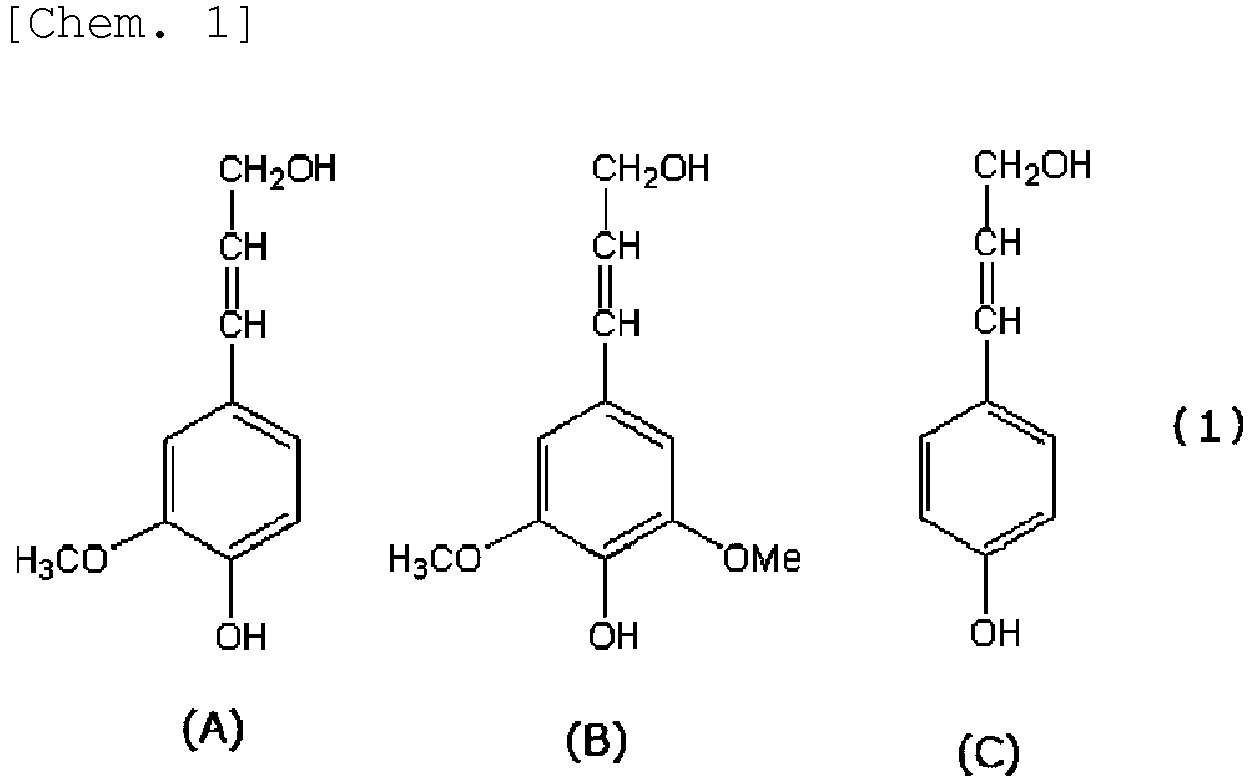
- The lignin derivative is preferably obtained by decomposing biomass. Since biomass is a product obtained by incorporating and fixating carbon dioxide in the atmosphere during the process of photosynthesis, biomass contributes to suppression of an increase in carbon dioxide in the atmosphere, and industrial utilization of biomass can contribute to suppression of global warming. Examples of the biomass include lignocellulosic biomass. Examples of the lignocellulosic biomass include leaves, bark, branches, and wood of plants containing lignin, and processed products of these. Examples of the plants containing lignin include the above-mentioned broadleaf trees, coniferous trees, and herbs.
- Examples of a method for decomposing biomass include a method of performing a chemical treatment, a method of performing a hydrolysis treatment, a steam blasting method, a supercritical water treatment method, a subcritical water treatment method, a method of performing a mechanical treatment, a cresol sulfate method, and a pulp production method. From the viewpoint of environmental load, a steam blasting method, a subcritical water treatment method, and a method of performing a mechanical treatment are preferred. From the viewpoint of cost, a pulp production method is preferred. Furthermore, from the viewpoint of cost, it is preferable to use a by-product of biomass utilization. A lignin derivative can be prepared by, for example, subjecting biomass to a decomposition treatment in the presence of various cooking liquors and solvents at 150°C to 400°C and 1 to 40 MPa for 8 hours or less. Lignin derivatives can be prepared by the methods disclosed in
Japanese Unexamined Patent Publication No. 2009-084320 Japanese Unexamined Patent Publication No. 2012-201828 - Examples of the lignin derivative include a product obtained by decomposing lignocellulose in which lignin, cellulose, and hemicellulose are bound together. Examples of the lignin derivative may include lignin decomposition products, cellulose decomposition products, hemicellulose decomposition products, and the like, all of which include compounds having a lignin skeleton as main components. Furthermore, the lignin derivative may also include biomass-derived or process-derived inorganic substances; however, when the lignin derivative is used for the use applications of the present embodiment, the content of the inorganic substances is preferably equal to or less than 10% by mass with respect to the total amount of the lignin derivative used.
- It is preferable that the lignin derivative has many reaction sites on which a curing agent acts through an electrophilic substitution reaction toward the aromatic rings, and from the viewpoint that a compound having less steric hindrance in the vicinity of the reaction sites has excellent reactivity, it is preferable that at least one of the ortho-position and the para-position of an aromatic ring including a phenolic hydroxyl group is unsubstituted, while a lignin derived from coniferous trees and herbs including a large quantity of structures of guaiacyl nuclei and 4-hydroxyphenyl nuclei as the aromatic units of lignin is preferred. Regarding the lignin derivative, those disclosed in
Japanese Unexamined Patent Publication No. 2009-084320 Japanese Unexamined Patent Publication No. 2012-201828 - The lignin derivative may also be a lignin derivative having a functional group in addition to the above-described basic structure (secondary derivative of lignin).
- The functional group carried by the secondary derivative of lignin is not particularly limited; however, for example, a functional group capable of reacting with one or more of the same functional groups, or a functional group capable of reacting with another functional group is suitable. Specific examples thereof include an epoxy group, a methylol group, as well as a vinyl group, an ethynyl group, a maleimide group, a cyanate group, and an isocyanate group, all of which have carbon-carbon unsaturated bonds. Among these, a lignin derivative into which a methylol group is introduced (methylolated) is preferably used. Such a secondary derivative of lignin undergoes self-crosslinking through a self-condensation reaction between methylol groups and also crosslinks with an alkoxymethyl group and a hydroxyl group in the crosslinking agent described below. As a result, a lignin-modified novolac-type phenol resin having a homogeneous and rigid skeleton and having excellent solvent resistance is obtained.
- In addition, the lignin derivative used in the present embodiment may have a carboxyl group. A lignin obtained by a pulping process or a high-temperature high-pressure water treatment may have a carboxyl group. Since a lignin-modified novolac-type phenol resin obtained from a lignin derivative having a carboxyl group has many crosslinking points for a curing agent that will be described below, the crosslinking density of the resulting crosslinked body can be improved, and as a result, a crosslinked body having excellent solvent resistance can be obtained.
- In a case where the above-mentioned lignin derivative has a carboxyl group, the carboxyl group can be checked by the presence or absence of absorption of a peak at 172 to 174 ppm when the lignin derivative is subjected to a 13C-NMR analysis pertaining to the carboxyl group.
- The lignin compound used for the production of the lignin-modified novolac-type phenol resin of the present embodiment has a weight average molecular weight of, for example, equal to or more than 2,000 and equal to or less than 100,000. The lower limit value of the weight average molecular weight is preferably equal to or more than 2,500, more preferably equal to or more than 3,000, and even more preferably equal to or more than 4,000. The upper limit value of the weight average molecular weight is preferably equal to or less than 90,000, more preferably equal to or less than 80,000, and even more preferably equal to or less than 75,000. By using a lignin compound having a weight average molecular weight in the above-described range, the resulting lignin-modified novolac-type phenol resin can have excellent curability, and a cured product thereof can have high mechanical strength. The weight average molecular weight is a polystyrene-equivalent weight average molecular weight measured by gel permeation chromatography and can be determined by the method of the Examples.
- The lignin compound used for the production of the lignin-modified novolac-type phenol resin of the present embodiment has a number average molecular weight of, for example, equal to or more than 200 and equal to or less than 5,000. The lower limit value of the number average molecular weight is preferably equal to or more than 300, more preferably equal to or more than 350, and even more preferably equal to or less than 400. The upper limit value of the number average molecular weight is preferably equal to or less than 4,000, more preferably equal to or less than 3,000, and even more preferably equal to or less than 2,000. A lignin compound having a number average molecular weight in the above-described range is preferred because the lignin compound has excellent reactivity and therefore has excellent workability in the production process for the lignin-modified novolac-type phenol resin. Furthermore, by using a lignin compound having a number average molecular weight in the above-described range, the resulting lignin-modified novolac-type phenol resin has excellent curability, and a cured product thereof can have high mechanical strength. The number average molecular weight is a polystyrene-equivalent number average molecular weight measured by gel permeation chromatography and can be determined by the method of the Examples.
- Here, an example of the method for measuring the molecular weight by the above-mentioned gel permeation chromatography will be described.
- In the method for measuring the molecular weight by gel permeation chromatography, first, a lignin derivative is dissolved in a solvent, and a measurement sample is prepared. The solvent used at this time is not particularly limited as long as it can dissolve the lignin derivative; however, from the viewpoint of the measurement accuracy of gel permeation chromatography, for example, tetrahydrofuran and N-methyl-2-pyrrolidone are preferred. Since the lignin compound of the present embodiment can include insoluble matter based on biomass, process-derived inorganic substances, and plant-derived high molecular weight organic substances, the molecular weight of the lignin compound is determined by selecting an appropriate solvent and filtering the insoluble matter. In order to increase the lignin modification ratio of the obtained lignin-modified novolac-type phenol resin, the content of the insoluble matter of the lignin compound used is preferably equal to or less than 30% by mass in an appropriate solvent. The molecular weight of the lignin-modified novolac-type phenol resin can be similarly determined by filtering the insoluble matter. The content of the insoluble matter in the lignin-modified novolac-type phenol resin is preferably equal to or less than 15% by mass, and more preferably equal to or less than 10% by mass. When the amount of the content is to the above-described extent, the lignin-modified novolac-type phenol resin has satisfactory curability and can be cured particularly uniformly.
- Next, "TSKgel GMHXL (manufactured by Tosoh Corporation)" and "G2000HXL (manufactured by Tosoh Corporation)", which are organic general-purpose columns packed with styrene-based polymer packing agents, are connected in series to a GPC system "HLC-8320GPC (manufactured by Tosoh Corporation)". 200 µL of the above-mentioned measurement sample is injected into this GPC system, tetrahydrofuran as an eluent is developed at 40°C at a rate of 1.0 mL/min, and the retention time is measured by utilizing the differential refractive index (RI) and the ultraviolet absorbance (UV). From a separately created calibration curve showing the relationship between the retention time and the molecular weight of polystyrene standards, the number average molecular weight and the weight average molecular weight of the target lignin compound can be calculated. The refractive index is preferred as the detection mode.
- The molecular weights of the polystyrene standards used for creating the calibration curve are not particularly limited; however, for example, polystyrene standards (manufactured by Tosoh Corporation) having weight average molecular weights of 1,090,000, 427,000, 190,000, 96,400, 37,900, 18,100, 10,200, 5,970, 2,630, 1,050, and 500 can be used.
- The softening point of the lignin compound used for the production of the lignin-modified novolac-type phenol resin of the present embodiment is preferably equal to or higher than 90°C, more preferably equal to or higher than 110°C, and even more preferably equal to or higher than 130°C. On the other hand, a lignin compound with a softening point which is so high that cannot be measured can be used. When a lignin-modified novolac-type phenol resin having a high modification ratio is produced by using such a lignin compound, the resulting modified novolac-type phenol resin has a high molecular weight, low fluidity, and poor processability. However, despite that the lignin-modified novolac-type phenol resin of the present embodiment is a lignin-modified phenol resin having a high lignin modification ratio obtainable from such a lignin compound and having a high molecular weight, unexpectedly satisfactory processability is obtained.
- The content of volatile matter of the lignin compound used in the present embodiment is preferably equal to or less than 60% by mass, more preferably equal to or less than 50% by mass, and even more preferably equal to or less than 40% by mass. When the volatile matter of the lignin compound is within the above-described range, the reactivity of the lignin compound can be improved, and the reaction rate of the resulting lignin-modified novolac-type phenol resin can be increased. The main volatile matter is often water, and for example, the content is calculated by spreading 4 g in an aluminum cup and drying it at 80°C for 20 hours.
- The softening point of the lignin compound can be measured according to JISK2207 by using a ring and ball type softening point tester (for example, ASP-MG2 type manufactured by Meltec Corporation). When the lignin compound includes a large amount of water, measurement is made after the lignin compound is completely dried at a temperature equal to or lower than 70°C. In the present embodiment, for example, when a satisfactory sample cannot be prepared due to the thermal fusibility of the lignin compound with a hot plate at 150°C to 200°C, it is determined that the softening point is too high to be measured.
- When a lignin compound obtained by decomposing biomass, a large amount of components having a low molecular weight may be mixed in, and these components may cause volatile matter and foul odor during heating and a decrease in the softening point. These components can be utilized as they are, or can be removed by heating, drying, and the like of the lignin compound to adjust the softening point and foul odor.
- Examples of the aldehyde compound used for the production of the lignin-modified novolac-type phenol resin of the present embodiment include formaldehyde, paraformaldehyde, trioxane, acetaldehyde, propionaldehyde, polyoxymethylene, chloral, hexamethylenetetramine, furfural, glyoxal, n-butylaldehyde, caproaldehyde, allylaldehyde, benzaldehyde, crotonaldehyde, acrolein, tetraoxymethylene, phenyl acetaldehyde, o-tolualdehyde, salicylaldehyde, and paraxylene dimethyl ether. Preferred are formaldehyde, paraformaldehyde, trioxane, polyoxymethylene, acetaldehyde, paraxylene dimethyl ether, and combinations thereof. Regarding the aldehyde compound, one kind thereof may be used alone, or two or more kinds thereof may be used in combination. Among these, it is preferable to use formaldehyde or acetaldehyde from the viewpoints of productivity and low cost.
- The acid catalyst used for the production of the lignin-modified novolac-type phenol resin of the present embodiment may be any acid catalyst that can be used as a reaction catalyst, and an organic acid, an inorganic acid, and a combination thereof can be used. Examples of the organic acid include acetic acid, formic acid, oxalic acid, malonic acid, succinic acid, glutaric acid, adipic acid, benzoic acid, salicylic acid, sulfonic acid, phenolsulfonic acid, and p-toluenesulfonic acid. Examples of the inorganic acid include hydrochloric acid, sulfuric acid, a sulfuric acid ester, phosphoric acid, and a phosphoric acid ester.
- In the production of the lignin-modified novolac-type phenol resin of the present embodiment, the molar ratio (F/P) of the aldehyde compound to the phenol compound is, for example, equal to or more than 0.5, preferably equal to or more than 0.55, more preferably is equal to or more than 0.6. The upper limit value of the molar ratio (F/P) of the aldehyde compound to the phenol compound is, for example, equal to or less than 1.2, preferably equal to or less than 1.1, and more preferably equal to or less than 1.0. By carrying out the reaction under the conditions in which the molar ratio (F/P) of the aldehyde compound to the phenol compound is in the above-described range, a lignin-modified novolac-type phenol resin having a weight average molecular weight of equal to or more than 5500 and having both processability and strength improved together, can be obtained.
- In the production of the lignin-modified novolac-type phenol resin of the present embodiment, the step of causing a lignin compound, a phenol compound, and an aldehyde compound to react in the presence of an acid catalyst may include a step (step 1) of mixing the lignin compound and the phenol compound under heating at a temperature equal to or higher than 70°C and equal to or lower than 120°C to disperse the lignin compound and obtain a mixture; a step (step 2) of mixing an acid catalyst therein simultaneously with step 1 or after step 1; and a step (step 3) of mixing the aldehyde compound therein after step 2. Furthermore, it is preferable that the step of causing a lignin compound, a phenol compound, and an aldehyde compound to react in the presence of an acid catalyst is carried out at a temperature of, for example, 60°C to 120°C, and preferably 80°C to 100°C, for example, for a reaction time of 10 minutes to 100 minutes. As a result, the reaction can be carried out efficiently and sufficiently. Furthermore, by carrying out the reaction under heating, the starting materials are uniformly mixed, the resulting lignin-modified novolac-type phenol resin can be cured uniformly due to intermolecular entanglement and intermolecular action, and therefore, molding with excellent dimensional accuracy can be realized. The reaction time is not particularly limited and may be appropriately determined according to the types of starting materials, the molar ratio of blending, the amount of use and type of catalyst, and the reaction conditions. The reaction mixture after the reaction may be subjected to post-treatment. For the post-treatment, for example, distillation under heating (for example, equal to or higher than 150°C) or at normal pressure, distillation under reduced pressure, or a combination thereof can be used.
- It is preferable to carry out the above-described step 1, step 2, and step 3 without a solvent; however, an organic solvent or water may be used as the solvent. Hydrated lignin may be used instead of adding water. Examples of the organic solvent include an alcohol, a ketone, an ester, an ether, and a hydrocarbon. Examples of the alcohol include methanol, ethanol, propanol, isopropanol, butanol, pentanol, hexanol, octanol, ethylene glycol, diethylene glycol, triethylene glycol, propylene glycol, and glycerin. Examples of the ketone include acetone, methyl ethyl ketone, methyl isobutyl ketone, diisobutyl ketone, and cyclohexanone. Examples of the ester include methyl acetate, ethyl acetate, propyl acetate, butyl acetate, methoxybutyl acetate, amyl acetate, methyl lactate, ethyl lactate, and butyl lactate. Examples of the ether include propyl ether, dioxane, methyl cellosolve, ethyl cellosolve, propyl cellosolve, butyl cellosolve, propylene glycol monomethyl ether, propylene glycol monoethyl ether, propylene glycol monopropyl ether, propylene glycol monobutyl ether, methyl carbitol, ethyl carbitol, butyl carbitol, methyl cellosolve acetate, ethyl cellosolve acetate, propyl cellosolve acetate, butyl cellosolve acetate, propylene glycol monomethyl ether acetate, propylene glycol monoethyl ether acetate, propylene glycol monopropyl ether acetate, and propylene glycol monobutyl ether acetate. Examples of the hydrocarbon include toluene, xylene, pentane, hexane, cyclohexane, heptane, octane, decane, solvent naphtha, industrial gasoline, petroleum ether, petroleum benzine, and ligroin. Regarding these, one kind thereof may be used alone, or two or more kinds thereof may be used in combination.
- Here, in conventional methods of increasing the molecular weight of the lignin-modified novolac-type phenol resin by adjusting the reaction ratio of the phenol compound, the lignin compound, and the aldehyde compound, the viscosity of the reactants increases, dehydration is less likely to occur, and therefore, the process time may become longer. Furthermore, a large amount of the phenol compound may remain unreacted.
- In contrast, the method of the present embodiment can shorten the process time and can increase the yield of the resin as compared with a conventional case of increasing the molecular weight with the reaction ratio of the phenol compound, the lignin compound, and the aldehyde compound. Furthermore, by adjusting the molar ratio (F/P) of the aldehyde compound to the phenol compound to the above-described range, and adjusting the molecular weight, the molecular weight distribution, and the amount of addition of the lignin compound used, the characteristics of the obtained lignin-modified novolac-type phenol resin and the physical properties of the resin material can be adjusted to desired ranges.
- The lignin-modified novolac-type phenol resin of the present embodiment obtained by the above-described method has a weight average molecular weight of equal to or more than 5500. The weight average molecular weight of the lignin-modified novolac-type phenol resin of the present embodiment is, for example, equal to or more than 5,500 and equal to or less than 50,000, preferably equal to or more than 6,000 and equal to or less than 45,000, and more preferably equal to or more than 7,000 and equal to or less than 40, 000. A lignin-modified novolac-type phenol resin having a weight average molecular weight in the above-described range has excellent curing characteristics, and a cured product thereof has high mechanical strength. The lignin-modified novolac-type phenol resin of the present embodiment has a lignin modification ratio of equal to or more than 25% and equal to or less than 60%, preferably equal to or more than 30% and equal to or less than 55%, and more preferably equal to or more than 35% and equal to or less than 55%. As the lignin-modified novolac-type phenol resin of the present invention has a lignin modification ratio in the above-described range, the lignin-modified novolac-type phenol resin has excellent resin strength and heat resistance and also has excellent curability and moldability.
- The lignin-modified novolac-type phenol resin of the present embodiment can be provided in the form of, for example, a fine powder, granules, pellets, or varnish. The form of the lignin-modified novolac-type phenol resin can be appropriately selected according to the use application.
- The lignin-modified novolac-type phenol resin of the present embodiment obtained as described above is suitably used as, for example, a molding material for transfer molding and injection molding. More specifically, the above-described lignin-modified novolac-type phenol resin of the present embodiment is provided as a molding material by blending a curing agent (crosslinking agent) and optionally other components, and kneading the mixture at a predetermined temperature. A molding material including the lignin-modified novolac-type phenol resin of the present embodiment can be subjected to injection molding, and a molded article thereof has excellent mechanical properties such as strength and elastic modulus.
- As the curing agent used for the molding material of the present embodiment, for example, an amine-based curing agent can be used. As the amine-based curing agent, specifically, hexamethylenetetramine, hexamethoxymethylol melamine, and the like can be used. As the amine-based curing agent, for example, it is preferable to use hexamethylenetetramine.
- The content of the curing agent is, for example, 7 parts by mass to 30 parts by mass, and preferably 10 parts by mass to 25 parts by mass, with respect to 100 parts by mass of the lignin-modified novolac-type phenol resin. A molding material having satisfactory curability can be obtained by setting the content to be within the above-described numerical value range.
- The molding material of the present embodiment may further include a filler material. That is, the molding material can include a lignin-modified novolac-type phenol resin, a curing agent, and a filler material.
- As the filler material, for example, a fiber base material, an organic filler material, or an inorganic filler material can be used. A fiber base material is a filler material having a fibrous shape. The organic filler material and the inorganic filler material may be each either a granular-shaped filler material or a plate-shaped filler material. The plate-shaped filler material is a filler material whose shape is a plate shape. A granular-shaped filler material is a filler material having a shape other than a fibrous shape and a plate shape, including irregular shapes. These may be used singly, or two or more kinds thereof may be used in combination.
- Regarding the granular-shaped filler material, for example, granular inorganic filler materials can be used, and glass beads, glass powder, calcium carbonate, talc, silica, aluminum hydroxide, clay, mica, and the like can be used.
- Examples of the fibrous-shaped filler material include fibrous-shaped inorganic filler materials such as glass fibers, carbon fibers, asbestos fibers, metal fibers, wollastonite, attapulgite, sepiolite, rock wool, aluminum borate whiskers, potassium titanate fibers, calcium carbonate whiskers, titanium oxide whiskers, and ceramic fibers; and fibrous-shaped organic filler materials such as aramid fibers, polyimide fibers, and poly(paraphenylenebenzobisoxazole fibers). These may be used alone, or two or more kinds thereof may be used in combination.
- Furthermore, examples of the plate-shaped filler materials and the granular-shaped filler materials include talc, kaolin clay, calcium carbonate, zinc oxide, calcium silicate hydrate, mica, glass flakes, glass powder, magnesium carbonate, silica, titanium oxide, alumina, aluminum hydroxide, magnesium hydroxide, barium sulfate, calcium sulfate, calcium sulfite, zinc borate, barium metaborate, aluminum borate, calcium borate, sodium borate, aluminum nitride, boron nitride, silicon nitride, and pulverization products of the above-described fibrous-shaped filler materials.
- The content of the filler material in the molding material is, for example, 25 parts by mass to 500 parts by mass, preferably 50 parts by mass to 400 parts by mass, and more preferably 100 parts by mass to 300 parts by mass, with respect to 100 parts by mass of the lignin-modified novolac-type phenol resin. By setting the content to be equal to or more than the above-described lower limit value, a molding material including the lignin-modified novolac-type phenol resin can have excellent mechanical strength. By setting the content to be equal to or less than the above-described upper limit value, production stability of a crosslinked body (molded body) can be enhanced.
- The resin material for producing a molded body of the present embodiment can include other components in addition to the above-mentioned components to the extent that the purpose of the present invention is not impaired. Examples of the other components include additives such as an elastomer, a curing accelerator, a resin component, a mold release agent, a pigment, a flame retardant, an adhesion improver, and a coupling agent.
- Examples of the elastomer include, but are not particularly limited to, acrylonitrile-butadiene rubber, isoprene, styrenebutadiene rubber, and ethylene-propylene rubber. Among these, acrylonitrile-butadiene rubber is preferred. Toughness in particular can be imparted by using an elastomer.
- As the curing accelerator, conventional curing accelerators can be used without particular limitation, and examples include oxides or hydroxides of alkaline earth metals, such as magnesium oxide, calcium hydroxide, and barium hydroxide; and aromatic carboxylic acids such as salicylic acid and benzoic acid. The curing accelerator is used in an amount of, for example, 0.5 parts by mass to 20 parts by mass with respect to 100 parts by mass of the lignin-modified novolac-type phenol resin.
- Examples of the resin component include a urea (urea) resin, a resin having a triazine ring, such as a melamine resin, a bismaleimide resin, a polyurethane resin, a silicone resin, a resin having a benzoxazine ring, a cyanate ester resin, a polyvinyl butyral resin, and a polyvinyl acetate resin. Furthermore, a plurality of these can be used in combination as necessary.
- Examples of the mold release agent include stearic acid, calcium stearate, zinc stearate, and polyethylene.
- Examples of the pigment include carbon black.
- The resin material of the present embodiment is obtained by melting and kneading in advance a lignin-modified novolac-type phenol resin, a curing agent, and a filler material when used, with a kneader, a roll, or the like, subsequently uniformly mixing the resultant with the above-described other components, or melting and kneading all the raw material components to be blended, with a kneading device such as a roll, a co-kneader, or a twin-screw extruder alone, or with a combination of a roll and another mixing device, and then granulating or pulverizing the mixture. In the present embodiment, the molding material is provided in the form of, for example, powder, granules, a tablet, or a sheet.
- By heat-treating and molding the obtained molding material, a molded article (crosslinked body) formed from a cured product of this molding material can be obtained. The method of molding the molding material is not particularly limited; however, for example, transfer molding, compression molding, and injection molding can be used.
- Examples of the molded article of the present embodiment include automobiles, aircraft, railroad vehicles, ships, general-purpose machines, household appliances, cooking utensils and molded articles used for peripheral parts thereof, or molded articles used for housings, structural and mechanical parts, and electrical and electronic parts of the above-described articles.
- The lignin-modified novolac-type phenol resin of the present embodiment is suitably used as a resin composition for resinoid grindstones. More specifically, the lignin-modified novolac-type phenol resin of the above-described present embodiment is provided as a powdery resin composition for a resinoid grindstone by blending with hexamethylenetetramine. Since the resin composition of the present embodiment includes the lignin-modified novolac-type phenol resin of the present embodiment and hexamethylenetetramine, the resin composition has excellent curability, and a cured product of the resin composition has mechanical strength and elastic modulus to the extent that is appropriate for use as a grindstone. The resin composition of the present embodiment is provided, for example, in the form of a powdery and granular material. When the resin composition is provided in the form of powder, it is preferable to pulverize the resin composition such that the average particle size is equal to or more than 10 um and equal to or less than 60 um, from the viewpoint of handleability. From the viewpoint of grindstone strength, an average particle size of equal to or more than 15 um and equal to or less than 45 um is more preferred.
- The amount of hexamethylenetetramine in the resin composition of the present embodiment is preferably equal to or more than 2% by mass and equal to or less than 20% by mass, more preferably equal to or more than 5% by mass and equal to or less than 17% by mass, and even more preferably equal to or more than 8% by mass and equal to or less than 15% by mass, with respect to the lignin-modified novolac-type phenol resin. When the blending amount of hexamethylenetetramine is less than the above-described lower limit value, curing of the lignin-modified novolac-type phenol resin may be insufficient, and when the blending amount is more than the above-described upper limit value, gas generated by decomposition of hexamethylenetetramine may cause cracks or swelling in the obtained cured product.
- The resin composition of the present embodiment described above is used to produce a resinoid grindstone. The resinoid grindstone of the present embodiment is obtained by adding abrasive grains to the above-described resin composition; however, filler materials, additives, and the like other than the abrasive grains can be optionally used. Regarding the abrasive grains, for example, alumina oxide, silicon carbide, and diamond can be used, and these play a role in exhibiting the grinding performance of grindstones. As the filler material, for example, inorganic fillers such as cryolite, iron sulfide, iron oxide, barium sulfate, and quicklime; and organic fillers such as thermosetting resin powders, rice husks, and wood flour can be used, and these play a role in improving the grinding performance of grindstones. As the additives, for example, a silane coupling agent, furfuryl alcohol, furfural, creosote oil, other organic solvents, or a liquid resol-type phenol resin can be used, and these can be used after wetting the surface of abrasive grains therewith in order to improve adhesiveness to the abrasive grains.
- As a method for producing a resinoid grindstone from the resin composition of the present embodiment, for example, a resinoid grindstone can be obtained by a step of first mixing a liquid resol-type phenol resin with abrasive grains, thoroughly kneading the mixture, obtaining abrasive grains with wet surfaces, and then adding a powdery resin composition including the lignin-modified novolac-type phenol resin of the present embodiment and hexamethylenetetramine, as well as the above-mentioned filler material and additives as necessary to the abrasive grains to prepare resin-coated grains; and a step of molding the obtained resin-coated grains into a required shape in a mold at normal temperature or heated to 40°C to 80°C and heating and baking this molded product for 10 to 50 hours as needed. The conditions for heating and baking are not particularly limited; however, for example, conditions in which the temperature is raised to normal temperature to 200°C for 10 to 24 hours and held at the peak temperature for 3 to 10 hours, and then gradually lowered, can be used.
- The grindstone of the present embodiment obtained by the above-described method has excellent bending strength and water-resistant strength, and therefore has excellent grinding performance.
- Thus, the embodiments of the present invention have been described above; however, these are only examples of the present invention, and various configurations other than the above-described ones can be employed.
- Hereinafter, the present invention will be described by way of Examples and Comparative Examples; however, the present invention is not intended to be limited to these.
- 1500 parts by weight of cedar wood flour having a moisture content of 50%, as well as 5000 parts by weight of pure water, 180 parts by weight of sodium hydroxide, and 120 parts by mass of sodium carbonate as a cooking liquor, and 7.5 parts by weight of 9,10-anthraquinone as a cooking aid were charged into a stainless steel autoclave facility having a capacity of 10 L, and a digestion reaction was carried out with stirring at 170°C for 3 hours. The cooking liquor after the reaction was cooled to room temperature, pulp component was removed with a screen, and a black liquor including lignin was separated. Dilute sulfuric acid was added to the separated black liquor to adjust the pH to 8, and a resulting precipitate was centrifuged. After washing twice with 500 parts by mass of water, the precipitate was suspended in 5 times the amount of water, and the suspension was readjusted to pH 2 with dilute sulfuric acid. The precipitated lignin is centrifuged again, washed with water, subsequently filtered under suction, spread on a vat, air-dried, and dried in an oven under reduced pressure at a temperature of equal to or lower than 70°C, and 140 parts by mass to 150 parts by weight (in terms of solid content) of an alkali lignin in the form of a brown powder having a solid content of equal to or more than 70% was obtained. The solid content ratio of lignin was calculated from the residual ratio obtained after putting 4 g of a sample in an aluminum cup and drying the sample by heating at 135°C for 1 hour.
- 100 parts by weight of phenol was introduced into a four-necked flask equipped with a stirrer, a cooling tube, and a thermometer, 40 parts by weight of the lignin derivative solid content was slowly added thereto, the mixture was mixed and dispersed at a temperature of equal to or higher than 60°C, 1.4 parts by weight of oxalic acid was added thereto, 58.6 parts by weight of a 37% aqueous solution of formaldehyde was slowly added thereto over 60 minutes to react at 100°C, the mixture after the addition was allowed to react at 100°C for 60 minutes, the temperature was raised to a temperature equal to or higher than 150°C by dehydration at normal pressure and reduced pressure, the mixture was extracted when a desired phenol concentration was reached, and 128.1 parts by weight of lignin-modified novolac-type phenol resin A1 was obtained.
- (Preparation of Lignin Derivative) A lignin derivative was prepared in the same manner as in Preparation Example A1, except that when the reaction mixture was adjusted to pH 2 and centrifuged, the number of times of water washing was increased by adding water again and performing centrifugation, and drying was performed at a temperature equal to or lower than 80°C in an oven under reduced pressure.
- (Preparation of Lignin-modified Phenol Resin) 127.9 parts by weight of lignin-modified phenol resin A2 was obtained in the same manner as in Preparation Example A1, except that 40 parts by weight of the lignin derivative solid content and 1.4 parts by weight of oxalic acid were added to 100 parts by weight of phenol, and the mixture was mixed at a temperature equal to or higher than 70°C for 30 minutes.
- (Preparation of Lignin Derivative) A lignin derivative was prepared in the same manner as in Preparation Example A1, except that 5000 parts by weight of pure water, 150 parts by weight of sodium hydroxide, 80 parts by weight of sodium sulfide, and 70 parts by mass of sodium carbonate as a cooking liquor, and 7.5 parts by weight of 9,10-anthraquinone as a cooking aid were used, and that when the reaction mixture was adjusted to pH 2 and centrifuged, the number of times of water washing was increased by adding water again and performing centrifugation, and drying was performed at a temperature equal to or lower than 80°C in an oven under reduced pressure.
- (Preparation of Lignin-modified Phenol Resin) 124.2 parts by weight of lignin-modified phenol resin A3 was obtained in the same manner as in Preparation Example A1, except that 37.4 parts by weight of the lignin derivative solid content and 1.5 parts by weight of oxalic acid were added to 100 parts by weight of phenol, the mixture was mixed at a temperature equal to or higher than 70°C for 30 minutes, and 51.2 parts by weight of a 37% aqueous solution of formaldehyde was used.
- (Preparation of Lignin Derivative) A lignin derivative was obtained in the same manner as in Preparation Example A1, except that beech wood flour having a moisture content of 50% was digested at 195°C for 1 hour by using 3000 parts by weight of ethanol and 2250 parts by weight of water as a cooking liquor, and an aqueous solution obtained by fractionally distilling ethanol from the cooking liquor was centrifuged and freeze-dried to obtain a lignin derivative having a solid content of equal to or more than 90%.
- (Preparation of lignin-modified phenol resin) 138.1 parts by weight of lignin-modified phenol resin A4 was obtained in the same manner as in Preparation Example A1, except that 100 parts by weight of phenol, 60 parts by weight of the lignin derivative solid content, and 1.6 parts by weight of oxalic acid were added, and 51.6 parts by weight of a 37% aqueous solution of formaldehyde was used.
- (Preparation of Lignin Derivative) A lignin derivative was obtained in the same manner as in Preparation Example A1.
- (Preparation of Lignin-modified Phenol Resin) 140.6 parts by weight of lignin-modified phenol resin A5 was obtained in the same manner as in Preparation Example A1, except that 100 parts by weight of phenol, 41.7 parts by weight of the lignin derivative solid content, and 1.4 parts by weight of oxalic acid were added, 57.8 parts by weight of a 37% aqueous solution of formaldehyde was used to reach a desired phenol concentration, and then 2.1 parts by weight of cashew shell oil was added thereto, mixed, and extracted.
- (Preparation of Lignin Derivative) 200 parts by weight of cedar wood powder having a moisture content of 50% and 567 parts by weight of pure water as a cooking liquor were charged into a stainless steel autoclave facility having a capacity of 10 L, and the mixture was treated under stirring at 300°C for 1 hour. The cooking liquor after the reaction was cooled to room temperature and separated by filtration to obtain a solid content including lignin. The obtained solid content was immersed in 250 parts of acetone for 12 hours. This was filtered, acetone was distilled off from the filtrate at a temperature of equal to or lower than 70°C, and the residue was dried to obtain 15.2 parts by weight of a lignin derivative.
- (Preparation of Lignin-modified Phenol Resin) 143.7 parts by weight of lignin-modified phenol resin A6 was obtained in the same manner as in Preparation Example A1, except that 100 parts by weight of phenol, 43.5 parts by weight of the lignin derivative solid content, 1.4 parts by weight of oxalic acid, and 73.3 parts by weight of a 37% aqueous solution of formaldehyde were used.
- (Preparation of Lignin Derivative) A lignin derivative was obtained in the same manner as in Preparation Example A3, except that beech wood flour having a moisture content of 50% was used. In addition, the lignin derivative was dispersed in acetone and filtered, acetone was distilled off from the filtrate at a temperature of equal to or lower than 70°C, and the residue was dried to obtain a low-molecular-weight lignin derivative.
- (Preparation of Lignin-modified Phenol Resin) 121.6 parts by weight of lignin-modified phenol resin A7 was obtained in the same manner as in Preparation Example A1, except that 100 parts by weight of phenol, 33.3 parts by weight of the lignin derivative solid content, 1.3 parts by weight of oxalic acid, and 58.6 parts by weight of a 37% aqueous solution of formaldehyde were used.
- The weight average molecular weights, the number average molecular weights, and the softening temperatures of the obtained lignin derivatives were measured using a GPC method or a ring and ball type softening point tester, respectively. The results are shown in Table 1 as "Characteristics of lignin".
- Furthermore, the weight average molecular weights, the number average molecular weights, and the lignin modification ratios of the obtained lignin-modified novolac-type phenol resins were measured. These measurement results are shown in Table 1 as "Characteristics of lignin-modified phenol resin". Since the lignin-modified novolac phenol resin component of the present embodiment may include a component having a particularly high molecular weight, the value obtained by excluding a high-molecular-weight component having a standard polystyrene number average molecular weight of more than 427,000 is also described within ( ) in the table for reference.
- In each Example and each Comparative Example, 15 parts by mass of hexamethylenetetramine (curing agent) was added to 100 parts by mass of the lignin-modified phenol resin shown in Table 1 at normal temperature, and the mixture was pulverized and mixed to prepare a phenol-modified lignin resin composition.
- The obtained phenol-modified lignin resin composition was blended with 160 parts by weight of glass fibers (filler material, glass milled fibers, manufactured by Nitto Boseki Co., Ltd., standard fiber diameter 1011.5 µm, average fiber length 90 pm) and 8 parts by weight of additives (stearic acid (manufactured by NOF Corporation) and carbon black (manufactured by Mitsubishi Chemical Corporation, #5)), and the mixture was kneaded with a heated roll at about 90°C for about 5 minutes, cooled, and pulverized to obtain a phenol-modified lignin resin composition (molding material).
-
- • Phenol resin A1: Lignin-modified novolac-type phenol resin A1 of Preparation Example A1
- • Phenol resin A2: Lignin-modified novolac-type phenol resin A2 of Preparation Example A2
- • Phenol resin A3: Lignin-modified novolac-type phenol resin A3 of Preparation Example A3
- • Phenol resin A4: Lignin-modified novolac-type phenol resin A4 of Preparation Example A4
- • Phenol resin A5: Lignin-modified novolac-type phenol resin A5 of Preparation Example A5
- • Phenol resin A6: Lignin-modified novolac-type phenol resin A6 of Preparation Example A6
- • Phenol resin A7: Lignin-modified novolac-type phenol resin A7 of Preparation Example A7
- • Phenol resin A8: Unmodified novolac-type phenol resin A8 (Mw = 9640, Mn = 940)
- The obtained molding materials were subjected to transfer molding under the conditions of 175°C, 20 MPa, and 3 min, and were further heat-treated at 180°C for 8 h to obtain molded articles (cured products). The obtained molded articles were evaluated for the following items. The results are shown in Table 1.
- The flexural modulus and bending strength were measured at 25°C according to JIS K 6911 "General Testing Methods for Thermosetting Plastics". Specifically, a three-point bending test was performed by applying a load at a rate of 2 mm/min using a precision universal testing machine (AUTOGRAPH AG-Xplus manufactured by Shimadzu Corporation).
- The flexural modulus and the bending strength were measured at 150°C in the same manner as described above.
- The Charpy impact strength was measured according to JIS K 6911 "General Testing Methods for Thermosetting Plastics".
- The insulation resistance was performed according to JIS K 6911 "General Testing Methods for Thermosetting Plastics".
-
Table 1 Comparative Example A1 Comparative Example A2 Comparative Example A3 Example A1 Example A2 Example A3 Example A4 Example A5 Phenol resin No. A8 A6 A7 A1 A2 A3 A4 A5 <Characteristics of lignin> Raw material tree type - Coniferous tree Broadleaf tree Coniferous tree Coniferous tree Coniferous tree Broadleaf tree Coniferous tree Lignin production method - High-temperature high-pressure water Kraft Soda Soda Kraft Organosolv Soda Mn THF (RT) - 620 910 1,490 1,660 1820 1040 1,490 Mw THF (RT) - 1300 1500 7,700 41400 (13100) 74400 (30100) 2700 7,700 Softening temperature (°C) 110 118 114 118 119 119 119 118 <Characteristics of lignin-modified phenol resin> Molar ratio (F/P) upon synthesis - 0.85 0.68 0.68 0.68 0.59 0.6 0.67 Mn THF (RT) 940 908 1,040 980 880 820 710 890 Mw THF (RT) 9,600 3,800 2700 15200 (6200) 12600 (8200) 41800 (10800) 6200 10600 (8800) Lignin modification ratio(%) 0 30 27 31 31 30 43 31 Amount of free phenol (% by mass) 4 3 1 3 2 1 1 2 - A lignin-modified novolac-type phenol resin was prepared by the method shown in each Preparation Example.
- (Preparation of Lignin Derivative) A lignin derivative was obtained in the same manner as in Preparation Example A1, except that 5000 parts by weight of pure water, 150 parts by weight of sodium hydroxide, 80 parts by weight of sodium sulfide, and 70 parts by mass of sodium carbonate as a cooking liquor, and 7.5 parts by weight of 9,10-anthraquinone as a cooking aid were used.
- (Preparation of Lignin-modified Phenol Resin) 125.0 parts by weight of lignin-modified phenol resin B1 was obtained in the same manner as in Preparation Example A1, except that 100 parts by weight of phenol, 37.4 parts by weight of the lignin derivative solid content, 1.5 parts by weight of oxalic acid, and 51.2 parts by weight of a 37% aqueous solution of formaldehyde were used.
- (Preparation of Lignin Derivative) A lignin derivative was obtained in the same manner as in Preparation Example A1, except that beech wood flour having a moisture content of 50% was digested at 195°C for 1 hour by using 3000 parts by weight of ethanol and 2250 parts by weight of water as a cooking liquor, and an aqueous solution obtained by fractionally distilling ethanol from the cooking liquor was centrifuged and freeze-dried to obtain a lignin derivative having a solid content of equal to or more than 90%.
- (Preparation of Lignin-modified Phenol Resin) 123.3 parts by weight of lignin-modified phenol resin B2 was obtained in the same manner as in Preparation Example A1, except that 100 parts by weight of phenol, 38.5 parts by weight of the lignin derivative solid content, 1.4 parts by weight of oxalic acid, and 55.2 parts by weight of a 37% aqueous solution of formaldehyde were used.
- (Preparation of Lignin Derivative) A lignin derivative was obtained in the same manner as in Preparation Example A1, except that beech wood flour having a moisture content of 50% was digested at 195°C for 1 hour by using 3000 parts by weight of ethanol and 2250 parts by weight of water as a cooking liquor, and an aqueous solution obtained by fractionally distilling ethanol from the cooking liquor was centrifuged and freeze-dried to obtain a lignin derivative having a solid content of equal to or more than 90%.
- (Preparation of Lignin-modified Phenol Resin) 156.7 parts by weight of lignin-modified phenol resin B3 was obtained in the same manner as in Preparation Example A1, except that 100 parts by weight of phenol, 79.2 parts by weight of the lignin derivative solid content, 1.8 parts by weight of oxalic acid, and 51.7 parts by weight of a 37% aqueous solution of formaldehyde were used.
- The weight average molecular weights, the number average molecular weights, and the softening temperatures of the obtained lignin derivatives were measured using a GPC method or a ring and ball type softening point tester, respectively. The results are shown in Table 1 as "Characteristics of lignin".
- Furthermore, the weight average molecular weights, the number average molecular weights, and the lignin modification ratios of the obtained lignin-modified novolac-type phenol resins were measured. These measurement results are shown in Table 1 as "Characteristics of lignin-modified phenol resin".
- Since the lignin-modified novolac phenol resin component of the present embodiment may include a component having a particularly high molecular weight, the value obtained by excluding a high-molecular-weight component having a standard polystyrene number average molecular weight of more than 427,000 is also described within ( ) in the table for reference.
- In each Example and each Comparative Example, 100 parts by mass of the lignin-modified phenol resin shown in Table 2 and 10 parts by mass of hexamethylenetetramine as a curing agent were mixed, and the mixture was finely powderized with a pulverizer to obtain a powdery resin composition having a particle size of 10 to 60 um.
-
- · Phenol resin B1: Lignin-modified novolac-type phenol resin B1 of Preparation Example B1
- · Phenol resin B2: Lignin-modified novolac-type phenol resin B2 of Preparation Example B2
- · Phenol resin B3: Lignin-modified novolac-type phenol resin B3 of Preparation Example B3
- · Phenol resin B4: Lignin-modified novolac-type phenol resin A6 of Preparation Example A6
- · Phenol resin B5: Unmodified novolac-type phenol resin B5 (Mw = 12640, Mn = 1204)
- The flow of the obtained powdery resin composition was measured by the following method.
- Using a powdery resin composition obtained by mixing and pulverizing 100 parts by weight of a phenol resin or a lignin-modified phenol resin and 10 parts by weight of hexamethylenetetramine, the flow was measured according to the flow A method of JIS K 6910 "Phenol Resin Testing Methods".
- As the flow of the powdery resin composition is longer, a cured product thereof has higher strength.
- In each Example and each Comparative Example, 1200 parts of alumina abrasive grains, SAKURUNDUM A#60 (manufactured by Japan Carlit Co., Ltd.), and 24 parts of a wetter liquid phenol resin, PR-55331 (manufactured by Sumitomo Bakelite Co., Ltd.) were kneaded for 4 minutes by using a Shinagawa type kneader, 144 parts of a phenol resin or unmodified phenol resin prepared in each of the above-described Preparation Examples was added thereto, and the mixture was further kneaded for 2 minutes to produce coated grains. The state of the coated grains was checked immediately after kneading and after storage for 12 hours under the conditions of 25°C and a relative humidity of 60%. Thereafter, the coated grains were charged into a mold and press-molded such that the molded product had a size of 100 mm × 25 mm × 15 mm and a bulk specific gravity of 2.0, and the molded product was placed on a stainless steel plate. This was placed in a hot air circulation type dryer with a programmable function and was cured by using a program of heating from normal temperature to 80°C for 5 hours, from 80°C to 100°C for 5 hours, from 100°C to 120°C for 10 hours, from 120°C to 130°C for 4 hours, and from 130°C to 170°C for 7 hours, maintaining at 180°C for 10 hours, and then cooling to normal temperature over 5 hours, and a grindstone test piece was produced.
- The obtained grindstone test pieces were evaluated for the following items. The evaluation results are shown in Table 2.
- The flexural modulus and bending strength were measured at 25°C according to JIS K 6911 "General Testing Methods for Thermosetting Plastics". Specifically, a three-point bending test was performed by applying a load at a rate of 2 mm/min using a precision universal testing machine (AUTOGRAPH AG-Xplus manufactured by Shimadzu Corporation).
- With regard to the water-resistant strength, a test piece was immersed in water at 80°C for 2 hours and taken out, and measurement was performed under the same conditions as for the normal temperature bending strength.
- With regard to the heat-resistant strength, a test piece was placed and left to stand at 200°C in a constant-temperature chamber for 15 minutes, and measurement was performed under the same conditions as for the normal temperature bending strength. The results are shown in Table 2.
-
Table 2 Example No. Comparative Example B1 Comparative Example B2 Example B1 Example B2 Example B3 Phenol resin No. B5 B4 B1 B2 B3 <Characteristics of lignin> Raw material tree type - Coniferous tree Coniferous tree Broadleaf tree Broadleaf tree Lignin production method - High-temperature high-pressure water Kraft Organosolv Organosolv Mn THF(RI) - 620 1820 1010 1010 Mw THF(RI) - 1300 74400 (30100) 2700 2700 Softening temperature °C 120 118 119 119 122 <Characteristics of lignin-modified phenol resin> Molar ratio (F/P) upon synthesis - 0.85 0.59 0.64 0.6 Mn THF(RI) 1200 910 840 900 990 Mw THF(RI) 12,600 3,800 13800 (9800) 5600 12400 (7100) Lignin modification ratio % 0 30 30 31 51 Amount of free phenol % by mass 2 3 1 1 2 <Characteristics of powdery resin composition> Flow mm 20 27 26 29 17 <Characteristics of grindstone> Normal temperature strength of grindstone N/mm2 38 42 44 44 35 Normal temperature elastic modulus of grindstone N/mm2 5400 5700 5800 5900 5400 Water-resistant strength of grindstone N/mm2 23 28 31 31 24 Heat-resistant strength (200°C) of grindstone N/mm2 37 39 48 53 42 - This application claims priority on the basis of
Japanese Patent Application No. 2021-064596, filed April 6, 2021
Claims (13)
- A lignin-modified novolac-type phenol resin having a weight average molecular weight of equal to or more than 5500.
- The lignin-modified novolac-type phenol resin according to claim 1,
wherein the lignin-modified novolac-type phenol resin has a lignin modification ratio of equal to or more than 25% and equal to or less than 60%. - The lignin-modified novolac-type phenol resin according to claim 1 or 2,wherein the lignin-modified novolac-type phenol resin isa resin obtainable by causing a lignin compound, a phenol compound, and an aldehyde compound to react in a presence of an acid catalyst under conditions in which a molar ratio (F/P) of the aldehyde compound to the phenol compound is equal to or more than 0.5.
- The lignin-modified novolac-type phenol resin according to claim 3,
wherein the lignin compound has a weight average molecular weight of equal to or more than 2,000 and equal to or less than 100,000. - A molding material comprising:the lignin-modified novolac-type phenol resin according to any one of claims 1 to 4; anda curing agent.
- A resin composition comprising:the lignin-modified novolac-type phenol resin according to any one of claims 1 to 4; andhexamethylenetetramine.
- The resin composition according to claim 6,
wherein the resin composition is in a powdery form with an average particle size of equal to or more than 10 µm and equal to or less than 60 pm. - A grindstone comprising a cured product of the resin composition according to claim 7.
- A method for producing a lignin-modified novolac-type phenol resin, the method comprising:causing a lignin compound, a phenol compound, and an aldehyde compound to react in a presence of an acid catalyst under conditions in which a molar ratio (F/P) of the aldehyde compound to the phenol compound is equal to or more than 0.5, to obtain a lignin-modified novolac-type phenol resin,wherein the lignin-modified novolac-type phenol resin has a weight average molecular weight of equal to or more than 5500.
- The method for producing a lignin-modified novolac-type phenol resin according to claim 9,
wherein the lignin-modified novolac-type phenol resin has a lignin modification ratio of equal to or more than 25% and equal to or less than 50%. - The method for producing a lignin-modified novolac-type phenol resin according to claim 9 or 10,
wherein the lignin compound has a number average molecular weight of equal to or more than 2,000 and equal to or less than 100,000. - The method for producing a lignin-modified novolac-type phenol resin according to any one of claims 9 to 11,
wherein the lignin compound includes volatile matter in an amount of equal to or less than 60% by mass. - The method for producing a lignin-modified novolac-type phenol resin according to any one of claims 9 to 12,
wherein the step of causing a lignin compound, a phenol compound, and an aldehyde compound to react in a presence of an acid catalyst under conditions in which a molar ratio (F/P) of the aldehyde compound to the phenol compound is equal to or more than 0.5, includes:mixing the lignin compound and the phenol compound to obtain a mixture;mixing the acid catalyst simultaneously with the step of obtaining the mixture, or after the step of obtaining the mixture;mixing the aldehyde compound after the step of mixing the acid catalyst; andperforming distillation at a temperature equal to or higher than 150°C at normal pressure and/or under reduced pressure.
Applications Claiming Priority (2)
| Application Number | Priority Date | Filing Date | Title |
|---|---|---|---|
| JP2021064596 | 2021-04-06 | ||
| PCT/JP2022/014561 WO2022215553A1 (en) | 2021-04-06 | 2022-03-25 | Lignin-modified novolac-type phenol resin, method for producing same, molding material, resin composition, and grindstone |
Publications (2)
| Publication Number | Publication Date |
|---|---|
| EP4321300A1 true EP4321300A1 (en) | 2024-02-14 |
| EP4321300A4 EP4321300A4 (en) | 2025-05-07 |
Family
ID=83545395
Family Applications (1)
| Application Number | Title | Priority Date | Filing Date |
|---|---|---|---|
| EP22784538.5A Pending EP4321300A4 (en) | 2021-04-06 | 2022-03-25 | LIGNIN-MODIFIED NOVOLAC PHENOL RESIN, METHOD FOR PRODUCING THE SAME, MOLDING MATERIAL, RESIN COMPOSITION AND GRINDING STONE |
Country Status (5)
| Country | Link |
|---|---|
| US (1) | US20240174786A1 (en) |
| EP (1) | EP4321300A4 (en) |
| JP (2) | JP7279865B2 (en) |
| CN (1) | CN117120498A (en) |
| WO (1) | WO2022215553A1 (en) |
Families Citing this family (2)
| Publication number | Priority date | Publication date | Assignee | Title |
|---|---|---|---|---|
| CN118405686B (en) * | 2023-09-21 | 2025-04-18 | 山东圣泉新能源科技有限公司 | Preparation method and application of lignin-based resin and carbon material for battery |
| JP7619551B1 (en) * | 2024-01-29 | 2025-01-22 | 四国化成工業株式会社 | Benzoxazine compounds and their uses |
Family Cites Families (13)
| Publication number | Priority date | Publication date | Assignee | Title |
|---|---|---|---|---|
| JP3152421B2 (en) * | 1989-07-12 | 2001-04-03 | 日立化成工業株式会社 | Method for producing lignocellulose-phenolic resin and lignocellulose-phenolic resin molded product |
| ATE136317T1 (en) * | 1991-11-07 | 1996-04-15 | Ruetgerswerke Ag | LIGNIN-MODIFIED BINDER MIXTURES AND METHOD FOR THE PRODUCTION THEREOF |
| JP2004307805A (en) * | 2003-03-25 | 2004-11-04 | Sumitomo Bakelite Co Ltd | Novolac type phenol resin and its composition for resinoid bonded grindstone |
| JP5256679B2 (en) | 2007-09-27 | 2013-08-07 | 住友ベークライト株式会社 | Lignin derivatives and their secondary derivatives |
| JP2012201828A (en) | 2011-03-25 | 2012-10-22 | Sumitomo Bakelite Co Ltd | Method for producing lignin derivative, method for producing lignin secondary derivative, lignin derivative, and lignin secondary derivative |
| JP5918585B2 (en) | 2012-03-23 | 2016-05-18 | 曙ブレーキ工業株式会社 | Friction material manufacturing method |
| AT513670A1 (en) * | 2012-11-26 | 2014-06-15 | Annikki Gmbh | Process for the preparation of phenol-formaldehyde-resin-analogous polymers |
| CN103145938A (en) * | 2013-03-26 | 2013-06-12 | 山东圣泉化工股份有限公司 | Lignin-modified phenolic resin and synthetic method thereof as well as grinding wheel comprising lignin-modified phenolic resin |
| CN105873970B (en) * | 2014-03-28 | 2019-09-10 | 住友电木株式会社 | Phenol modified lignin resin resin and its manufacturing method and resin combination, rubber composition and solidfied material |
| WO2018140400A1 (en) * | 2017-01-27 | 2018-08-02 | Lawter, Inc. | Biorenewable resin composition for well treatment |
| JP2020050814A (en) * | 2018-09-28 | 2020-04-02 | 住友ベークライト株式会社 | Resin material comprising phenol-modified lignin resin, phenol-modified lignin resin composition using the same, and structure body |
| CN110630990B (en) | 2019-10-11 | 2020-12-11 | 利辛县灵犀工业设计有限公司 | Convenient lamp holder convenient for bulb maintenance |
| JP7459564B2 (en) * | 2020-03-03 | 2024-04-02 | 住友ベークライト株式会社 | Method for producing lignin-modified novolac phenolic resin and method for producing crosslinked resin |
-
2022
- 2022-03-25 EP EP22784538.5A patent/EP4321300A4/en active Pending
- 2022-03-25 US US18/551,005 patent/US20240174786A1/en active Pending
- 2022-03-25 WO PCT/JP2022/014561 patent/WO2022215553A1/en not_active Ceased
- 2022-03-25 CN CN202280026387.0A patent/CN117120498A/en active Pending
- 2022-03-25 JP JP2022559969A patent/JP7279865B2/en active Active
-
2023
- 2023-03-27 JP JP2023049656A patent/JP7652207B2/en active Active
Also Published As
| Publication number | Publication date |
|---|---|
| WO2022215553A1 (en) | 2022-10-13 |
| JP2023076559A (en) | 2023-06-01 |
| CN117120498A (en) | 2023-11-24 |
| JPWO2022215553A1 (en) | 2022-10-13 |
| JP7279865B2 (en) | 2023-05-23 |
| EP4321300A4 (en) | 2025-05-07 |
| US20240174786A1 (en) | 2024-05-30 |
| JP7652207B2 (en) | 2025-03-27 |
Similar Documents
| Publication | Publication Date | Title |
|---|---|---|
| Siahkamari et al. | Lignin-glyoxal: a fully biobased formaldehyde-free wood adhesive for interior engineered wood products | |
| JP6541007B2 (en) | Phenol-modified lignin resin, method for producing the same, and resin composition, rubber composition, and cured product | |
| Li et al. | Preparation and characterization of a novel environmentally friendly phenol–formaldehyde adhesive modified with tannin and urea | |
| Kalami et al. | Replacing 100% of phenol in phenolic adhesive formulations with lignin | |
| US10138377B2 (en) | Lignin derivative, lignin resin composition, rubber composition, and molding material | |
| JP2023024831A (en) | Method for producing modified lignin, modified lignin, and modified lignin-containing resin composition material | |
| WO2007124400A2 (en) | Methods for producing modified aromatic renewable materials and compositions thereof | |
| US5300593A (en) | Lignin modified binding agents | |
| JP2023024830A (en) | Method for producing modified lignin and modified polyphenol, and resin composition material using modified lignin | |
| JP7652207B2 (en) | Resin composition and grinding wheel | |
| Qiao et al. | Preparation and characterization of a phenol-formaldehyde resin adhesive obtained from bio-ethanol production residue | |
| JP7215046B2 (en) | Method for producing resin material containing phenol-modified lignin resin, and method for producing structure using the same | |
| JP7459564B2 (en) | Method for producing lignin-modified novolac phenolic resin and method for producing crosslinked resin | |
| JP7396549B1 (en) | Resin composition and resin coated sand | |
| JP2020050814A (en) | Resin material comprising phenol-modified lignin resin, phenol-modified lignin resin composition using the same, and structure body | |
| US12325775B2 (en) | Method for producing polyphenol derivative, polyphenol derivative, and polyphenol derivative-containing resin composition material | |
| Arrusli et al. | Lignin-Glyoxal Bio-Adhesive based on lignin from sugarcane bagasse: characterization and application | |
| JP7197064B1 (en) | Thermosetting resin composition for friction material and friction material | |
| Omar et al. | The Use of Environmentally Friendly Bio-Oil in the Production of Phenol Formaldehyde (PF) Resin. | |
| JP2025180615A (en) | carbon materials | |
| Zhu et al. | Hydroxymethylated Lignosulfonate Modified Urea-Formaldehyde Resin for the Production of Environmentally Friendly Particleboard |
Legal Events
| Date | Code | Title | Description |
|---|---|---|---|
| STAA | Information on the status of an ep patent application or granted ep patent |
Free format text: STATUS: THE INTERNATIONAL PUBLICATION HAS BEEN MADE |
|
| PUAI | Public reference made under article 153(3) epc to a published international application that has entered the european phase |
Free format text: ORIGINAL CODE: 0009012 |
|
| STAA | Information on the status of an ep patent application or granted ep patent |
Free format text: STATUS: REQUEST FOR EXAMINATION WAS MADE |
|
| 17P | Request for examination filed |
Effective date: 20230914 |
|
| AK | Designated contracting states |
Kind code of ref document: A1 Designated state(s): AL AT BE BG CH CY CZ DE DK EE ES FI FR GB GR HR HU IE IS IT LI LT LU LV MC MK MT NL NO PL PT RO RS SE SI SK SM TR |
|
| DAV | Request for validation of the european patent (deleted) | ||
| DAX | Request for extension of the european patent (deleted) | ||
| A4 | Supplementary search report drawn up and despatched |
Effective date: 20250407 |
|
| RIC1 | Information provided on ipc code assigned before grant |
Ipc: C08J 5/14 20060101ALI20250401BHEP Ipc: C08H 7/00 20110101ALI20250401BHEP Ipc: C08L 61/12 20060101ALI20250401BHEP Ipc: C08K 5/3477 20060101ALI20250401BHEP Ipc: C08G 8/20 20060101ALI20250401BHEP Ipc: B24D 3/28 20060101AFI20250401BHEP |