EP4320134B1 - A fire-rated finishing product suitable for fabric applications - Google Patents
A fire-rated finishing product suitable for fabric applications Download PDFInfo
- Publication number
- EP4320134B1 EP4320134B1 EP22721657.9A EP22721657A EP4320134B1 EP 4320134 B1 EP4320134 B1 EP 4320134B1 EP 22721657 A EP22721657 A EP 22721657A EP 4320134 B1 EP4320134 B1 EP 4320134B1
- Authority
- EP
- European Patent Office
- Prior art keywords
- compound
- formula
- product according
- cellulose
- containing material
- Prior art date
- Legal status (The legal status is an assumption and is not a legal conclusion. Google has not performed a legal analysis and makes no representation as to the accuracy of the status listed.)
- Active
Links
Classifications
-
- D—TEXTILES; PAPER
- D06—TREATMENT OF TEXTILES OR THE LIKE; LAUNDERING; FLEXIBLE MATERIALS NOT OTHERWISE PROVIDED FOR
- D06M—TREATMENT, NOT PROVIDED FOR ELSEWHERE IN CLASS D06, OF FIBRES, THREADS, YARNS, FABRICS, FEATHERS OR FIBROUS GOODS MADE FROM SUCH MATERIALS
- D06M13/00—Treating fibres, threads, yarns, fabrics or fibrous goods made from such materials, with non-macromolecular organic compounds; Such treatment combined with mechanical treatment
- D06M13/322—Treating fibres, threads, yarns, fabrics or fibrous goods made from such materials, with non-macromolecular organic compounds; Such treatment combined with mechanical treatment with compounds containing nitrogen
- D06M13/44—Treating fibres, threads, yarns, fabrics or fibrous goods made from such materials, with non-macromolecular organic compounds; Such treatment combined with mechanical treatment with compounds containing nitrogen containing nitrogen and phosphorus
- D06M13/453—Phosphates or phosphites containing nitrogen atoms
-
- C—CHEMISTRY; METALLURGY
- C07—ORGANIC CHEMISTRY
- C07F—ACYCLIC, CARBOCYCLIC OR HETEROCYCLIC COMPOUNDS CONTAINING ELEMENTS OTHER THAN CARBON, HYDROGEN, HALOGEN, OXYGEN, NITROGEN, SULFUR, SELENIUM OR TELLURIUM
- C07F9/00—Compounds containing elements of Groups 5 or 15 of the Periodic Table
- C07F9/02—Phosphorus compounds
- C07F9/28—Phosphorus compounds with one or more P—C bonds
- C07F9/38—Phosphonic acids [RP(=O)(OH)2]; Thiophosphonic acids ; [RP(=X1)(X2H)2(X1, X2 are each independently O, S or Se)]
- C07F9/40—Esters thereof
- C07F9/4003—Esters thereof the acid moiety containing a substituent or a structure which is considered as characteristic
- C07F9/4006—Esters of acyclic acids which can have further substituents on alkyl
-
- C—CHEMISTRY; METALLURGY
- C09—DYES; PAINTS; POLISHES; NATURAL RESINS; ADHESIVES; COMPOSITIONS NOT OTHERWISE PROVIDED FOR; APPLICATIONS OF MATERIALS NOT OTHERWISE PROVIDED FOR
- C09K—MATERIALS FOR MISCELLANEOUS APPLICATIONS, NOT PROVIDED FOR ELSEWHERE
- C09K21/00—Fireproofing materials
- C09K21/06—Organic materials
- C09K21/12—Organic materials containing phosphorus
-
- D—TEXTILES; PAPER
- D06—TREATMENT OF TEXTILES OR THE LIKE; LAUNDERING; FLEXIBLE MATERIALS NOT OTHERWISE PROVIDED FOR
- D06M—TREATMENT, NOT PROVIDED FOR ELSEWHERE IN CLASS D06, OF FIBRES, THREADS, YARNS, FABRICS, FEATHERS OR FIBROUS GOODS MADE FROM SUCH MATERIALS
- D06M13/00—Treating fibres, threads, yarns, fabrics or fibrous goods made from such materials, with non-macromolecular organic compounds; Such treatment combined with mechanical treatment
- D06M13/10—Treating fibres, threads, yarns, fabrics or fibrous goods made from such materials, with non-macromolecular organic compounds; Such treatment combined with mechanical treatment with compounds containing oxygen
- D06M13/12—Aldehydes; Ketones
-
- D—TEXTILES; PAPER
- D06—TREATMENT OF TEXTILES OR THE LIKE; LAUNDERING; FLEXIBLE MATERIALS NOT OTHERWISE PROVIDED FOR
- D06M—TREATMENT, NOT PROVIDED FOR ELSEWHERE IN CLASS D06, OF FIBRES, THREADS, YARNS, FABRICS, FEATHERS OR FIBROUS GOODS MADE FROM SUCH MATERIALS
- D06M13/00—Treating fibres, threads, yarns, fabrics or fibrous goods made from such materials, with non-macromolecular organic compounds; Such treatment combined with mechanical treatment
- D06M13/244—Treating fibres, threads, yarns, fabrics or fibrous goods made from such materials, with non-macromolecular organic compounds; Such treatment combined with mechanical treatment with compounds containing sulfur or phosphorus
- D06M13/282—Treating fibres, threads, yarns, fabrics or fibrous goods made from such materials, with non-macromolecular organic compounds; Such treatment combined with mechanical treatment with compounds containing sulfur or phosphorus with compounds containing phosphorus
- D06M13/292—Mono-, di- or triesters of phosphoric or phosphorous acids; Salts thereof
-
- D—TEXTILES; PAPER
- D06—TREATMENT OF TEXTILES OR THE LIKE; LAUNDERING; FLEXIBLE MATERIALS NOT OTHERWISE PROVIDED FOR
- D06M—TREATMENT, NOT PROVIDED FOR ELSEWHERE IN CLASS D06, OF FIBRES, THREADS, YARNS, FABRICS, FEATHERS OR FIBROUS GOODS MADE FROM SUCH MATERIALS
- D06M13/00—Treating fibres, threads, yarns, fabrics or fibrous goods made from such materials, with non-macromolecular organic compounds; Such treatment combined with mechanical treatment
- D06M13/322—Treating fibres, threads, yarns, fabrics or fibrous goods made from such materials, with non-macromolecular organic compounds; Such treatment combined with mechanical treatment with compounds containing nitrogen
-
- D—TEXTILES; PAPER
- D06—TREATMENT OF TEXTILES OR THE LIKE; LAUNDERING; FLEXIBLE MATERIALS NOT OTHERWISE PROVIDED FOR
- D06M—TREATMENT, NOT PROVIDED FOR ELSEWHERE IN CLASS D06, OF FIBRES, THREADS, YARNS, FABRICS, FEATHERS OR FIBROUS GOODS MADE FROM SUCH MATERIALS
- D06M13/00—Treating fibres, threads, yarns, fabrics or fibrous goods made from such materials, with non-macromolecular organic compounds; Such treatment combined with mechanical treatment
- D06M13/322—Treating fibres, threads, yarns, fabrics or fibrous goods made from such materials, with non-macromolecular organic compounds; Such treatment combined with mechanical treatment with compounds containing nitrogen
- D06M13/46—Compounds containing quaternary nitrogen atoms
-
- D—TEXTILES; PAPER
- D06—TREATMENT OF TEXTILES OR THE LIKE; LAUNDERING; FLEXIBLE MATERIALS NOT OTHERWISE PROVIDED FOR
- D06M—TREATMENT, NOT PROVIDED FOR ELSEWHERE IN CLASS D06, OF FIBRES, THREADS, YARNS, FABRICS, FEATHERS OR FIBROUS GOODS MADE FROM SUCH MATERIALS
- D06M2101/00—Chemical constitution of the fibres, threads, yarns, fabrics or fibrous goods made from such materials, to be treated
- D06M2101/02—Natural fibres, other than mineral fibres
- D06M2101/04—Vegetal fibres
- D06M2101/06—Vegetal fibres cellulosic
-
- D—TEXTILES; PAPER
- D06—TREATMENT OF TEXTILES OR THE LIKE; LAUNDERING; FLEXIBLE MATERIALS NOT OTHERWISE PROVIDED FOR
- D06M—TREATMENT, NOT PROVIDED FOR ELSEWHERE IN CLASS D06, OF FIBRES, THREADS, YARNS, FABRICS, FEATHERS OR FIBROUS GOODS MADE FROM SUCH MATERIALS
- D06M2200/00—Functionality of the treatment composition and/or properties imparted to the textile material
- D06M2200/30—Flame or heat resistance, fire retardancy properties
Definitions
- the present invention relates to a fire-rated finishing product suitable for fabric applications and to a process for processing cellulose-containing material with said fire-rated finishing product.
- Cotton fiber is one of the most important natural fabric, which is widely used in people's daily life. Cotton fiber has a lot of advantages, in particular in terms of mechanical performances, biodegradability, gas permeability, dyeability and hydrophilicity. It is known that cotton fiber can be used in bedding, garment material, upholstery, such as carpet, cover for furniture, cushion, and so on.
- the fixing rate of formaldehyde / phosphorus / nitrogen-containing retardant e.g. Pyrovatex CP
- the fixing rate of formaldehyde / phosphorus / nitrogen-containing retardant is between 50 and 60 %.
- US 3,579,532 relates to bis-phosphono-propionamide substituted ethylene glycols and imidazolidinones. It is provided phosphorus-containing products, which are obtained by reacting a starting material comprising phosphorus and nitrogen atoms with glyoxal, formaldehyde, urea and an etherifying agent. Unfortunately, the provided phosphorus-containing product, as disclosed in US 3,579,532 , has a fixing rate of phosphorous on fabrics after wash-off process of about 55 % and high amount of phosphoric acid is used (around 25 g/L).
- US 3 800 010 A refers to phosphonopropionic acid amide derivatives made by reacting the corresponding phosphonopropionic acid amide with the corresponding halogenoaldehyde.
- the known flame-retardant chemicals contain or emit formaldehyde-containing phosphorus compounds, which are hazardous to the environment and to health.
- the product of the invention is efficient in terms of flameproofing properties, when applied on fabric, and durability, since it remains on the fabric, even after several washing operations, and laundering and dry-cleaning operations.
- the fixing rate is surprisingly high enough (up to 70 %) and the fixing step of the product on the fabric is also facilitated and greener for the environment, since less acid is needed.
- wastewater is less polluted by phosphorus, which makes the use of the product of the present invention attractive for the user.
- the product of formula I of the present invention is obtainable (or obtained) by the following steps:
- R 1 , R 2 are each a group equal to -CnH 2n+1 , wherein n ranges from 1 to 4, preferably equal to 1.
- said acetaldehyde compound is 2,2-dimethoxyacetaldehyde.
- the pH is adjusted to a value ranging from 7 to 10, preferably 8.5 to 9.
- the yield of the reaction between said compounds of formula II and III is of at least 70 %, preferably at least 85 %, measured by HPLC.
- reaction between said compounds of formula II and III is carried out at a temperature ranging between 40 to 80 °C, preferably between 50 to 70 °C, more preferably at 60 °C.
- reaction between said compounds of formula II and III is carried out during a period of time ranging from 0.5 to 4 hours, preferably from 0.5 to 3 hours, most preferably from 0.5 to 2.5 hours. This is particularly cost-efficient.
- the reaction between said compounds of formula II and formula III is carried out at a mole ratio ranging from 0.7 to 1.3. With such selection of mole ratio, the yield of the reaction between compounds II and III is improved.
- the product of the invention is substantially free of any added amount of formaldehyde. This is particularly advantageous for the environment and health.
- the present invention also relates to a process for processing cellulose-containing material comprising the following steps:
- the ammonium phosphate compound is selected from the list comprising (or consisting of) ammonium phosphate, diammonium phosphate, monoammonium phosphate and mixtures thereof.
- said ammonium phosphate compound preferably phosphoric acid
- said ammonium phosphate compound is present in an amount ranging from 1 to 20 g/L, preferably between 1 and 17 g/L, more preferably between 1 and 15 g/L, based on the total amount of said composition. This is particularly advantageous since low amount, lower than 20 g/L of ammonium phosphate compound, preferably phosphoric acid is used, meaning that less phosphorus is contained in wastewater, while keeping good results.
- the phosphorus fixing rate of said obtained composition onto the cellulose-containing material is of at least 65 %, preferably at least 70 %, preferably obtained without the presence of a resin containing formaldehyde.
- One particularly preferred embodiment relates to the curing conditions when the obtained composition is applied onto cellulose-containing material (e.g. fabric).
- the predetermined temperature ranges between 150-170 °C or is preferably equal to about 160°C.
- the curing time ranges from 3 to 15 minutes, preferably 10 minutes.
- the application of said obtained composition on said cellulose-containing material is carried out at a pH of above 3, preferably by foularding.
- the reactive hydroxy and acetal groups can react with the hydroxy groups of the cotton fiber.
- an intermolecular crosslinking is also possible in combination with the ammonium salt formed during the process.
- the present invention also relates to a cellulose-containing material, which is obtained by the process of the invention, wherein said cellulose-containing material is substantially free of any added amount of formaldehyde.
- the present invention relates to a (formaldehyde-free) flame retardant finishing product suitable for cellulose-containing materials, such as cotton or cotton blends (e.g., cotton / polyester and cotton / nylon), and durable to both laundering and dry-cleaning operations.
- cellulose-containing materials such as cotton or cotton blends (e.g., cotton / polyester and cotton / nylon), and durable to both laundering and dry-cleaning operations.
- the fire-rated finishing product can be provided in aqueous form when mixed with at least one wetting agent, a catalyst, preferably NH 4 H 2 PO 4 , and ammonium phosphate compound, for instance phosphoric acid (e.g. 80 or 85%), advantageously diluted in water.
- a catalyst preferably NH 4 H 2 PO 4
- ammonium phosphate compound for instance phosphoric acid (e.g. 80 or 85%)
- the (aqueous) composition obtained may be applied to the textile fabric by conventional means, e.g. by foularding.
- the fabric is then squeezed to the desired take-up, dried and subjected to a dry-heat process at temperatures above 100° C (see pad -> dry-> cure).
- the pH of the aqueous composition of the present invention used to impregnate the fabric is preferably brought above 3.
- the impregnation is preferably evenly carried out onto the fabric.
- the cellulose-containing materials can be impregnated on a pad mangle.
- Adequate liquor pick-up is preferred (50 - 70 %, up to 90% on knit fabrics) and can be achieved by a combination of absorbent fabric and long contact of the goods with the liquor (padding speed / guide rollers).
- Drying step can take place on stenter and can be carried out with maximum overfeed.
- the recommended drying temperature in the first zone is 110 °C; the temperature in the other zones should not be higher than 130 °C to minimize migration.
- the goods should, if possible, be processed in a partial vacuum (air extraction).
- Curing can be carried out in a curing oven 5 minutes at 150 °C. In the case of curing on stenter, a period of time between 45 to 60 sec. at 170 °C is sufficient.
- the impregnated goods can be washed off after curing, preferably within 24 h. Soda ash or caustic soda is added to the washing bath to neutralize the goods and to make the goods alkaline and therefore reduce hydrolysis of the finish during storage of the finished goods.
- the goods can remain in the alkaline bath for at least 2 min. After neutralizing and rinsing, they should be slightly alkaline and have a pH of 8 - 9.
- the flameproofing properties can remain over time on the fabric, even after several washing operations, and laundering and dry-cleaning operations, making said product durable enough.
- the wording "being substantially free of any added amount of formaldehyde” should be understood as the given object containing less than 0.1 weight %, preferably less than 0.01 weight %, more preferably less than 0.001 weight % of formaldehyde, based on the total weight % of the given object.
- HPLC / UV is carried out with Perkin Elmer Series 200 with an analytical balance AT 201 (Mettler-Toledo). Sample preparation is as follows:
- Steps 1 and 2 illustrated below show the synthesis steps, leading to the formation of the fire-rated finishing product of the present invention.
- the fire-rated finishing product of example 1 is applied onto a cotton fabric in the presence of a wetting agent, for instance INVADINE ® PBN wetting agent from Huntsman, and a (mixture) of catalyst(s): NH 4 H 2 PO 4 and/or phosphoric acid (85 %), as illustrated in tables 1 and 2 below.
- Sample 6 - the reference - corresponds to an embodiment of the state of the art.
- the working process mentioned in the tables above requires a temperature at the surface of 165°C, which can be obtained by using, for example Mathis air circulation from Mathis AG company.
- Pick up data relates to 100 g of dry fabric pick up 82 g of the application fleet.
- Table 3 illustrates the edge ignition burning test according to EN ISO 15025 of the above samples.
- Sample 3 Initial warp weft 25x60° C warp weft FAT 10 sec 10 sec AFT 0 0 0 0 AGT 0 0 0 DL 100 95 105 105
- Sample 4 Initial warp weft 25x60° C warp weft FAT 10 sec 10 sec AFT 0 0 0 0 AGT 0 0 0 DL 100 90 95 95 95 Sample 5
- an isocyanate group means one isocyanate group or more than one isocyanate group.
- endpoints includes all integer numbers and, where appropriate, fractions subsumed within that range (e.g. 1 to 5 can include 1, 2, 3, 4 when referring to, for example, a number of elements, and can also include 1.5, 2, 2.75 and 30 3.80, when referring to, for example, measurements).
- the recitation of end points also includes the end point values themselves (e.g. from 1.0 to 5.0 includes both 1.0 and 5.0). Any numerical range recited herein is intended to include all sub-ranges subsumed therein.
Landscapes
- Chemical & Material Sciences (AREA)
- Engineering & Computer Science (AREA)
- Textile Engineering (AREA)
- Organic Chemistry (AREA)
- General Health & Medical Sciences (AREA)
- Biochemistry (AREA)
- Life Sciences & Earth Sciences (AREA)
- Molecular Biology (AREA)
- Health & Medical Sciences (AREA)
- Materials Engineering (AREA)
- Treatments For Attaching Organic Compounds To Fibrous Goods (AREA)
- Fireproofing Substances (AREA)
- Organic Low-Molecular-Weight Compounds And Preparation Thereof (AREA)
Description
- The present invention relates to a fire-rated finishing product suitable for fabric applications and to a process for processing cellulose-containing material with said fire-rated finishing product.
- Cotton fiber is one of the most important natural fabric, which is widely used in people's daily life. Cotton fiber has a lot of advantages, in particular in terms of mechanical performances, biodegradability, gas permeability, dyeability and hydrophilicity. It is known that cotton fiber can be used in bedding, garment material, upholstery, such as carpet, cover for furniture, cushion, and so on.
- However, cotton fabric has high burning rate, and this can seriously harm consumers. This drawback is currently alleviated by the application of flame-retardant chemicals onto the fabric.
- It is essential that flame-retardant chemicals remain on the fabric after laundering and dry-cleaning operations.
- Generally, the fixing rate of formaldehyde / phosphorus / nitrogen-containing retardant (e.g. Pyrovatex CP) in the presence of an added amount of formaldehyde-containing resin, when applied on fabrics, is between 50 and 60 %.
- For example,
US 3,579,532 relates to bis-phosphono-propionamide substituted ethylene glycols and imidazolidinones. It is provided phosphorus-containing products, which are obtained by reacting a starting material comprising phosphorus and nitrogen atoms with glyoxal, formaldehyde, urea and an etherifying agent. Unfortunately, the provided phosphorus-containing product, as disclosed inUS 3,579,532 , has a fixing rate of phosphorous on fabrics after wash-off process of about 55 % and high amount of phosphoric acid is used (around 25 g/L). -
US 3 800 010 A refers to phosphonopropionic acid amide derivatives made by reacting the corresponding phosphonopropionic acid amide with the corresponding halogenoaldehyde. - The known flame-retardant chemicals contain or emit formaldehyde-containing phosphorus compounds, which are hazardous to the environment and to health.
- For these reasons, there is a need to provide a fire-rated finishing product suitable for fabric applications, which does not harm the environment and health and which provides higher yield, while guaranteeing durability after laundering and dry-cleaning operations of the fabric.
- It is an object of the present invention to overcome the aforementioned drawbacks by providing the following product having formula I:

- Wherein, R1, R2 are each a group equal to -CnH2n+1,
- wherein n ranges from 1 to 4, preferably equal to 1, and
- wherein R3 is H or methyl group.
- With the compound (product) of formula I of the invention, formaldehyde is no longer needed (in the product or even during the process of impregnation of the product onto fabrics), which is highly advantageous.
- The product of the invention is efficient in terms of flameproofing properties, when applied on fabric, and durability, since it remains on the fabric, even after several washing operations, and laundering and dry-cleaning operations.
- The fixing rate is surprisingly high enough (up to 70 %) and the fixing step of the product on the fabric is also facilitated and greener for the environment, since less acid is needed. In other words, wastewater is less polluted by phosphorus, which makes the use of the product of the present invention attractive for the user.
- Moreover, the use of formaldehyde-containing resin is no longer needed.
- Preferably, the product of formula I of the present invention is obtainable (or obtained) by the following steps:
- Providing a phosphorus-containing compound having the following formula II:

- Wherein, R1, R2 are each a group equal to -CnH2n+1,
- wherein n ranges from 1 to 4, preferably equal to 1, and
- wherein R3 is H or methyl group;
- Reacting the compound of said formula II with the following acetaldehyde compound having formula III:

- Wherein, R1, R2 are each a group equal to -CnH2n+1, wherein n ranges from 1 to 4, preferably equal to 1.
- More preferably, said acetaldehyde compound is 2,2-dimethoxyacetaldehyde.
- According to an advantageous embodiment of the invention, when said compound of formula III is reacted with said compound of formula II, the pH is adjusted to a value ranging from 7 to 10, preferably 8.5 to 9.
- Advantageously, the yield of the reaction between said compounds of formula II and III is of at least 70 %, preferably at least 85 %, measured by HPLC.
- More advantageously, the reaction between said compounds of formula II and III is carried out at a temperature ranging between 40 to 80 °C, preferably between 50 to 70 °C, more preferably at 60 °C.
- In a preferred embodiment, the reaction between said compounds of formula II and III is carried out during a period of time ranging from 0.5 to 4 hours, preferably from 0.5 to 3 hours, most preferably from 0.5 to 2.5 hours. This is particularly cost-efficient.
- In a particularly preferred embodiment, the reaction between said compounds of formula II and formula III is carried out at a mole ratio ranging from 0.7 to 1.3. With such selection of mole ratio, the yield of the reaction between compounds II and III is improved.
- More preferably, the product of the invention is substantially free of any added amount of formaldehyde. This is particularly advantageous for the environment and health.
- Even more preferably, formula II of the invention is obtained by applying the following steps:
- Reacting a compound having following formula IV:

- with a compound having the following formula V:
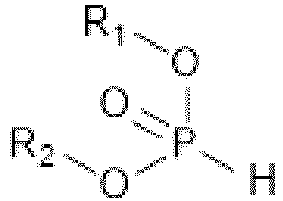
- Other embodiments of the product as disclosed hereinabove are mentioned in the annexed claims.
- The present invention also relates to a process for processing cellulose-containing material comprising the following steps:
- Mixing a product according to the present invention with an aqueous solution containing a catalyst, which comprises ammonium phosphate compound, or a mixture of catalysts in aqueous solution, which comprises ammonium phosphate compound and at least one pentavalent organic phosphorus compound,
- Applying the obtained composition on the cellulose-containing material and curing at a predetermined temperature.
- Preferably, the ammonium phosphate compound is selected from the list comprising (or consisting of) ammonium phosphate, diammonium phosphate, monoammonium phosphate and mixtures thereof.
- More preferably, said ammonium phosphate compound, preferably phosphoric acid, is present in an amount ranging from 1 to 20 g/L, preferably between 1 and 17 g/L, more preferably between 1 and 15 g/L, based on the total amount of said composition. This is particularly advantageous since low amount, lower than 20 g/L of ammonium phosphate compound, preferably phosphoric acid is used, meaning that less phosphorus is contained in wastewater, while keeping good results.
- According to a particularly advantageous embodiment, the phosphorus fixing rate of said obtained composition onto the cellulose-containing material is of at least 65 %, preferably at least 70 %, preferably obtained without the presence of a resin containing formaldehyde.
- One particularly preferred embodiment relates to the curing conditions when the obtained composition is applied onto cellulose-containing material (e.g. fabric). The predetermined temperature ranges between 150-170 °C or is preferably equal to about 160°C. Advantageously, the curing time ranges from 3 to 15 minutes, preferably 10 minutes.
- According to an advantageous embodiment of the invention, the application of said obtained composition on said cellulose-containing material is carried out at a pH of above 3, preferably by foularding.
- During the curing process the reactive hydroxy and acetal groups can react with the hydroxy groups of the cotton fiber. In addition to the product of the invention, an intermolecular crosslinking is also possible in combination with the ammonium salt formed during the process.
- Other embodiments of the process of the invention as disclosed hereinabove are mentioned in the annexed claims.
- Furthermore, the present invention also relates to a cellulose-containing material, which is obtained by the process of the invention, wherein said cellulose-containing material is substantially free of any added amount of formaldehyde.
- Other embodiments of the cellulose-containing material as disclosed hereinabove are mentioned in the annexed claims.
- The present invention relates to a (formaldehyde-free) flame retardant finishing product suitable for cellulose-containing materials, such as cotton or cotton blends (e.g., cotton / polyester and cotton / nylon), and durable to both laundering and dry-cleaning operations.
- In the context of the present invention, the fire-rated finishing product can be provided in aqueous form when mixed with at least one wetting agent, a catalyst, preferably NH4H2PO4, and ammonium phosphate compound, for instance phosphoric acid (e.g. 80 or 85%), advantageously diluted in water. The (aqueous) composition obtained may be applied to the textile fabric by conventional means, e.g. by foularding. The fabric is then squeezed to the desired take-up, dried and subjected to a dry-heat process at temperatures above 100° C (see pad -> dry-> cure). The pH of the aqueous composition of the present invention used to impregnate the fabric is preferably brought above 3.
- The impregnation is preferably evenly carried out onto the fabric.
- The cellulose-containing materials can be impregnated on a pad mangle. Adequate liquor pick-up is preferred (50 - 70 %, up to 90% on knit fabrics) and can be achieved by a combination of absorbent fabric and long contact of the goods with the liquor (padding speed / guide rollers).
- Drying step can take place on stenter and can be carried out with maximum overfeed. The recommended drying temperature in the first zone is 110 °C; the temperature in the other zones should not be higher than 130 °C to minimize migration. The goods should, if possible, be processed in a partial vacuum (air extraction).
- Curing can be carried out in a curing oven 5 minutes at 150 °C. In the case of curing on stenter, a period of time between 45 to 60 sec. at 170 °C is sufficient.
- According to a preferred embodiment, the impregnated goods can be washed off after curing, preferably within 24 h. Soda ash or caustic soda is added to the washing bath to neutralize the goods and to make the goods alkaline and therefore reduce hydrolysis of the finish during storage of the finished goods.
- In order to achieve continuous neutralization, the goods can remain in the alkaline bath for at least 2 min. After neutralizing and rinsing, they should be slightly alkaline and have a pH of 8 - 9.
- With the fire-rated finishing product of the present invention, the flameproofing properties can remain over time on the fabric, even after several washing operations, and laundering and dry-cleaning operations, making said product durable enough.
- In the meaning of the present invention, the wording "being substantially free of any added amount of formaldehyde" should be understood as the given object containing less than 0.1 weight %, preferably less than 0.01 weight %, more preferably less than 0.001 weight % of formaldehyde, based on the total weight % of the given object.
- In the context of the invention, the HPLC / UV is carried out with Perkin Elmer Series 200 with an analytical balance AT 201 (Mettler-Toledo).

- Weigh in about 0,1 g (Albegal B®, amphoteric leveling agent) of the test item into a 100 ml flask and fill up with water to the mark. 10 µl of the solution was injected and analysed by HPLC/UV.
- UV detection: 210 nm.
- In a reaction vessel 308.8 g (2.75 mol) dimethyl phosphonate and 8 g sodium methylate (30%) were stirred and heated to 45°C. Then, 181.44 g (2.55 mol) of acrylamide were added at this temperature and dissolved under stirring. In addition, 36.5 g of a 30% strength solution of sodium methylate in methanol were slowly added dropwise in the course of 3 hours. During this period of 3 hours, the temperature in the reaction mixture was increased to 70°C. When the reaction was complete, the methanol was distilled off.
- After the distillation had ended, the mixture was cooled to 60°C.
- 487.2 g (2,81 mol) 2,2-dimethoxyacetaldehyde (60%) were added under stirring. The pH was adjusted to a value between 7.5 and 9.5 (ideally pH 9.0) with potassium carbonate (50%) and held for two hours at 60°C.
- Yield of addition product: approx. 85% (HPLC).
- Steps 1 and 2 illustrated below show the synthesis steps, leading to the formation of the fire-rated finishing product of the present invention.
-

-

- The fire-rated finishing product of example 1 is applied onto a cotton fabric in the presence of a wetting agent, for instance INVADINE® PBN wetting agent from Huntsman, and a (mixture) of catalyst(s): NH4H2PO4 and/or phosphoric acid (85 %), as illustrated in tables 1 and 2 below. Sample 6 - the reference - corresponds to an embodiment of the state of the art.

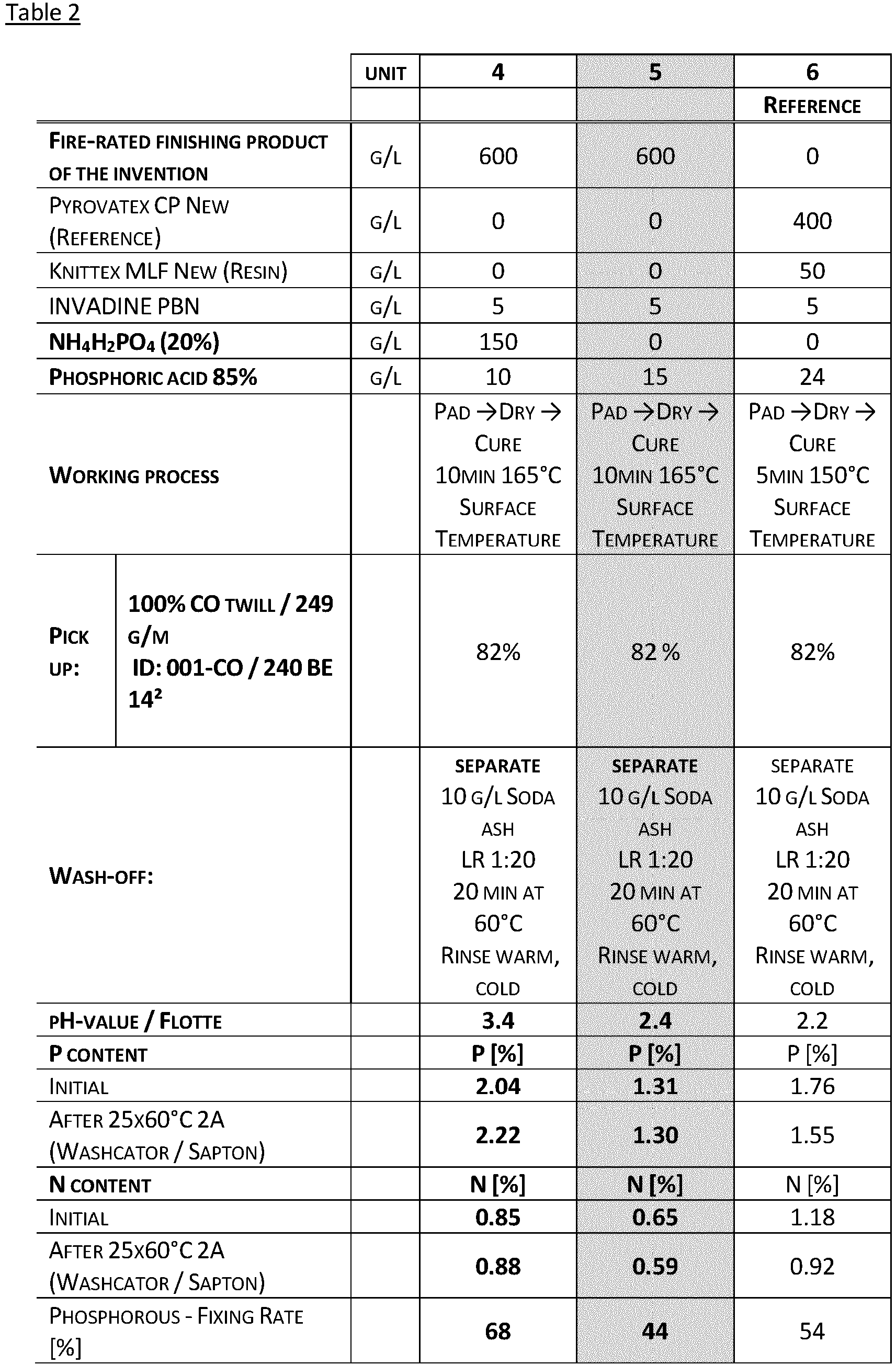
Pick up data relates to 100 g of dry fabric pick up 82 g of the application fleet. - Table 3 below illustrates the edge ignition burning test according to EN ISO 15025 of the above samples.
Table 3 Burning behavior EN ISO 15025 Edge ignition Edge ignition Sample 1 Initial warp weft 25x60° C warp weft FAT 10 sec 10 sec AFT 0 0 0 0 AGT 0 0 0 0 DL 105 95 95 95 Sample 2 Initial warp weft 25x60° C warp weft FAT 10 sec 10 sec AFT 0 0 0 0 AGT 0 0 0 0 DL 95 100 90 95 Sample 3 Initial warp weft 25x60° C warp weft FAT 10 sec 10 sec AFT 0 0 0 0 AGT 0 0 0 0 DL 100 95 105 105 Sample 4 Initial warp weft 25x60° C warp weft FAT 10 sec 10 sec AFT 0 0 0 0 AGT 0 0 0 0 DL 100 90 95 95 Sample 5 Initial warp weft 25x60° C warp weft FAT 10 sec 10 sec AFT 8 7 8 7 AGT DL Fully damaged Fully damaged Fully damaged Fully damaged Sample 6 Initial warp weft 25x60° C warp weft FAT 10 sec 10 sec AFT 0 0 0 0 AGT 0 0 0 0 DL 110 100 100 110 FAT = flame application time
AFT = after flame time (second)
DL = damaged length (mm)
sec. = seconds
100 g cotton textile pick up 82 g (= 42 g solid = 4,3 g P) of the aqueous preparation.Fixing rate = P-content (after wash-off process) * 100 / P-content (before wash-off process). - Reference throughout this specification to "one embodiment" or "an embodiment" means that a particular feature, structure or characteristic described in connection with the embodiment is included in at least one embodiment of the present invention. Thus, appearances of the phrases "in one embodiment" or "in an embodiment" in various places throughout this specification are not necessarily all referring to the same embodiment, but may. Furthermore, the particular features, structures or characteristics may be combined in any suitable manner, as would be apparent to a person skilled in the art from this disclosure, in one or more embodiments. Furthermore, while some embodiments described herein include some but not other features included in other embodiments, combinations of features of different embodiments are meant to be within the scope of the invention, and form different embodiments, as would be understood by those in the art.
- As used herein, the singular forms "a", "an", and "the" include both singular and plural referents unless the context clearly dictates otherwise. By way of example, "an isocyanate group" means one isocyanate group or more than one isocyanate group.
- The terms "comprising", "comprises" and "comprised of" as used herein are synonymous with "including", "includes" or "containing", "contains", and are inclusive or open-ended and do not exclude additional, non-recited members, elements or method steps. It will be appreciated that the terms "comprising", "comprises" and "comprised of" as used herein comprise the terms "consisting of", "consists" and "consists of". This means that, preferably, the aforementioned terms, such as "comprising", "comprises", "comprised of", "containing", "contains", "contained of", can be replaced by "consisting", "consisting of", "consists".
- Throughout this application, the term "about" is used to indicate that a value includes the standard deviation of error for the device or method being employed to determine the value.
- As used herein, the terms "% by weight", "wt%", "weight percentage", or "percentage by weight" are used interchangeably.
- The recitation of numerical ranges by endpoints includes all integer numbers and, where appropriate, fractions subsumed within that range (e.g. 1 to 5 can include 1, 2, 3, 4 when referring to, for example, a number of elements, and can also include 1.5, 2, 2.75 and 30 3.80, when referring to, for example, measurements). The recitation of end points also includes the end point values themselves (e.g. from 1.0 to 5.0 includes both 1.0 and 5.0). Any numerical range recited herein is intended to include all sub-ranges subsumed therein.
- Unless otherwise defined, all terms used in disclosing the invention, including technical and scientific terms, have the meaning as commonly understood by one of ordinary skill in the art to which this invention belongs. By means of further guidance, term definitions are included to better appreciate the teaching of the present invention.
- Throughout this application, different aspects of the invention are defined in more detail. Each aspect so defined may be combined with any other aspect or aspects unless clearly indicated to the contrary. In particular, any feature indicated as being preferred or advantageous may be combined with any other feature or features indicated as being preferred or advantageous.
Claims (16)
- A fire-rated finishing product suitable for fabric applications of the following formula I:
 Wherein, R1, R2 are each a group equal to -CnH2n+1,wherein n ranges from 1 to 4, preferably equal to 1, andwherein R3 is H or methyl group.
 - The product according to claim 1, obtainable by the following steps:- Providing a phosphorus-containing compound having the following formula II:
 Wherein, R1, R2 are each a group equal to -CnH2n+1,wherein n ranges from 1 to 4, preferably equal to 1, andwherein R3 is H or methyl group;- Reacting the compound of said formula II with the following acetaldehyde compound having formula III: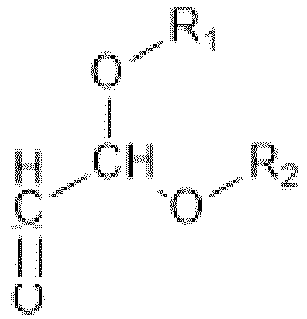
- The product according to claim 2, wherein said acetaldehyde compound is 2,2-dimethoxyacetaldehyde.
- The product according to claim 2 or 3, wherein, when said compound of formula III is reacted with said compound of formula II, the pH is adjusted to a value ranging from 7 to 10, preferably 8.5 to 9.
- The product according to any one of claims 2 to 4, wherein the yield of the reaction between said compounds of formula II and III is of at least 70 %, preferably at least 85 %, measured by HPLC.
- The product according to any one of claims 2 to 5, wherein the reaction between said compounds of formula II and III is carried out at a temperature ranging between 40 to 80 °C, preferably between 50 to 70 °C, more preferably at 60 °C.
- The product according to any one of claims 2 to 6, wherein the reaction between said compounds of formula II and III is carried out during a period of time ranging from 0.5 to 4 hours, preferably from 0.5 to 3 hours, most preferably from 0.5 to 2.5 hours.
- The product according to any one of claims 2 to 7, wherein the reaction between said compounds of formula II and formula III is carried out at a mole ratio ranging from 0.7 to 1.3.
- The product according to any one of claims 2 to 8, containing less than 0.1 weight % of any added amount of formaldehyde based on the total weight % of the product.
- The product according to any one of claims 2 to 9, wherein formula II is obtained by applying the following steps:- Reacting a compound having following formula IV:
 - with a compound having the following formula V:
- A process for processing cellulose-containing material comprising the following steps:- Mixing a product according to any one of the preceding claims with an aqueous solution containing a catalyst, which comprises ammonium phosphate compound, or a mixture of catalysts in aqueous solution, which comprises ammonium phosphate compound and at least one pentavalent organic phosphorus compound,- Applying the obtained composition on the cellulose-containing material and curing at a predetermined temperature.
- The process according to claim 11, wherein the ammonium phosphate compound is selected from the list comprising ammonium phosphate, diammonium phosphate, monoammonium phosphate and mixtures thereof.
- The process according to claim 11 or 12, wherein said ammonium phosphate compound, preferably phosphoric acid, is present in an amount ranging from 1 to 20 g/L, preferably between 1 and 17 g/L, more preferably between 1 and 15 g/L, based on the total amount of said composition.
- The process according to any one of claims 11 to 13, wherein the phosphorus fixing rate of said obtained composition onto the cellulose-containing material is of at least 65 %, preferably at least 70 %, preferably obtained without the presence of a resin.
- The process according to any one of claims 11 to 14, wherein the application of said obtained composition on said cellulose-containing material is carried out at a pH of above 3, preferably by foularding.
- Cellulose-containing material obtained by the process according to any one of claims 11 to 15, wherein said cellulose-containing material contains less than 0.1 weight % of any added amount of formaldehyde based on the total weight % of the cellulose-containing material.
Applications Claiming Priority (2)
| Application Number | Priority Date | Filing Date | Title |
|---|---|---|---|
| EP21167009 | 2021-04-06 | ||
| PCT/EP2022/059129 WO2022214545A1 (en) | 2021-04-06 | 2022-04-06 | A fire-rated finishing product suitable for fabric applications |
Publications (3)
| Publication Number | Publication Date |
|---|---|
| EP4320134A1 EP4320134A1 (en) | 2024-02-14 |
| EP4320134C0 EP4320134C0 (en) | 2025-06-11 |
| EP4320134B1 true EP4320134B1 (en) | 2025-06-11 |
Family
ID=75690077
Family Applications (1)
| Application Number | Title | Priority Date | Filing Date |
|---|---|---|---|
| EP22721657.9A Active EP4320134B1 (en) | 2021-04-06 | 2022-04-06 | A fire-rated finishing product suitable for fabric applications |
Country Status (8)
| Country | Link |
|---|---|
| EP (1) | EP4320134B1 (en) |
| KR (1) | KR20230165325A (en) |
| CN (1) | CN117120453A (en) |
| ES (1) | ES3037124T3 (en) |
| HU (1) | HUE072508T2 (en) |
| PL (1) | PL4320134T3 (en) |
| TW (1) | TWI836398B (en) |
| WO (1) | WO2022214545A1 (en) |
Family Cites Families (5)
| Publication number | Priority date | Publication date | Assignee | Title |
|---|---|---|---|---|
| GB1197591A (en) | 1967-07-28 | 1970-07-08 | Ciba Ltd | Phosphorus-Containing Reaction Products, processes for their production and their Application |
| CH552021A (en) * | 1970-02-06 | 1974-07-31 | Ciba Geigy Ag | PROCESS FOR THE PRODUCTION AND USE OF PHOSPHONOCARBONIC ACID AMIDES OUTSIDE THE TEXTILE INDUSTRY. |
| US6846004B2 (en) * | 2002-09-24 | 2005-01-25 | Milliken & Company | Silicone-based low permeability airbag fabric coatings |
| CN103572592B (en) * | 2012-07-27 | 2015-09-16 | 广东德美精细化工股份有限公司 | A kind of cotton fire retardant and preparation method thereof |
| JP6313331B2 (en) * | 2012-12-20 | 2018-04-18 | ポリアド サービシズ エルエルシー | Flame retardant polymer composition |
-
2022
- 2022-04-01 TW TW111112888A patent/TWI836398B/en active
- 2022-04-06 KR KR1020237037916A patent/KR20230165325A/en active Pending
- 2022-04-06 ES ES22721657T patent/ES3037124T3/en active Active
- 2022-04-06 WO PCT/EP2022/059129 patent/WO2022214545A1/en not_active Ceased
- 2022-04-06 EP EP22721657.9A patent/EP4320134B1/en active Active
- 2022-04-06 CN CN202280025759.8A patent/CN117120453A/en active Pending
- 2022-04-06 HU HUE22721657A patent/HUE072508T2/en unknown
- 2022-04-06 PL PL22721657.9T patent/PL4320134T3/en unknown
Also Published As
| Publication number | Publication date |
|---|---|
| PL4320134T3 (en) | 2025-10-27 |
| BR112023019882A2 (en) | 2023-11-07 |
| EP4320134A1 (en) | 2024-02-14 |
| EP4320134C0 (en) | 2025-06-11 |
| KR20230165325A (en) | 2023-12-05 |
| TWI836398B (en) | 2024-03-21 |
| HUE072508T2 (en) | 2025-11-28 |
| ES3037124T3 (en) | 2025-09-29 |
| TW202304942A (en) | 2023-02-01 |
| CN117120453A (en) | 2023-11-24 |
| WO2022214545A1 (en) | 2022-10-13 |
Similar Documents
| Publication | Publication Date | Title |
|---|---|---|
| Yang et al. | The bonding of a hydroxy-functional organophosphorus oligomer to nylon fabric using the formaldehyde derivatives of urea and melamine as the bonding agents | |
| US2795513A (en) | Process for finishing textile material and product | |
| US4013813A (en) | Aminoalkylphosphonic acid ester-based textile fire retardants | |
| US9675998B2 (en) | Formaldehyde-free flame retardant compositions and their use for manufacturing durable formaldehyde-free flame retardant cellulosic materials | |
| US20130260626A1 (en) | Flame retarded textile and process for coating textile | |
| US3772292A (en) | N-hydroxymethyl compounds,compositions containing such compounds and cellulose-containing textile materials treated therewith | |
| US3579532A (en) | Bis-phosphono-propionamide substituted ethylene glycols and imidazolidinones | |
| WO2022214545A1 (en) | A fire-rated finishing product suitable for fabric applications | |
| US4162279A (en) | Phosphonoxycarboxamides | |
| US4177300A (en) | Phosphonoxycarboxamide flame retarding compositions | |
| US3864076A (en) | Process for flameproofing organic fibers with phosphorus-containing condensation products and the products produced | |
| US3765837A (en) | Flame retardant finish for polyester/cotton blends | |
| HK40103894A (en) | A fire-rated finishing product suitable for fabric applications | |
| EP1444310B1 (en) | Flame-retardant compositions of methanephosphonic acid, boric acid and an organic base | |
| US3751290A (en) | Nonwoven fabrics | |
| US4045396A (en) | Flame retardant permanent press | |
| CA1065336A (en) | Brominated carbamoyl derivatives | |
| GB2046806A (en) | Process for resin-finishing of cottonpolyester blend textiles | |
| US3996269A (en) | Polyurethane polymers | |
| NO744034L (en) | ||
| US3567361A (en) | Bis-pyrrolidone-formaldehyde addition products and their use as crosslinking agents with cellulose | |
| US3874911A (en) | Process for the manufacture of phosphorus-containing condensation products, the products and their use as flameproofing agents | |
| US5320785A (en) | Compositions containing phosphono compounds and organic acids as flameproofing agents | |
| US3536648A (en) | Treatment of cellulosic textile materials to impart crease resistance thereto | |
| US3899548A (en) | N-(dialkylphosphonoalkyl)-carbamic acid alkyl esters |
Legal Events
| Date | Code | Title | Description |
|---|---|---|---|
| STAA | Information on the status of an ep patent application or granted ep patent |
Free format text: STATUS: UNKNOWN |
|
| STAA | Information on the status of an ep patent application or granted ep patent |
Free format text: STATUS: THE INTERNATIONAL PUBLICATION HAS BEEN MADE |
|
| PUAI | Public reference made under article 153(3) epc to a published international application that has entered the european phase |
Free format text: ORIGINAL CODE: 0009012 |
|
| STAA | Information on the status of an ep patent application or granted ep patent |
Free format text: STATUS: REQUEST FOR EXAMINATION WAS MADE |
|
| 17P | Request for examination filed |
Effective date: 20231102 |
|
| AK | Designated contracting states |
Kind code of ref document: A1 Designated state(s): AL AT BE BG CH CY CZ DE DK EE ES FI FR GB GR HR HU IE IS IT LI LT LU LV MC MK MT NL NO PL PT RO RS SE SI SK SM TR |
|
| RAP3 | Party data changed (applicant data changed or rights of an application transferred) |
Owner name: ARCHROMA INTERNATIONAL (GERMANY) GMBH |
|
| DAV | Request for validation of the european patent (deleted) | ||
| DAX | Request for extension of the european patent (deleted) | ||
| GRAP | Despatch of communication of intention to grant a patent |
Free format text: ORIGINAL CODE: EPIDOSNIGR1 |
|
| STAA | Information on the status of an ep patent application or granted ep patent |
Free format text: STATUS: GRANT OF PATENT IS INTENDED |
|
| RIC1 | Information provided on ipc code assigned before grant |
Ipc: D06M 13/322 20060101ALI20250205BHEP Ipc: D06M 13/292 20060101ALI20250205BHEP Ipc: D06M 13/12 20060101ALI20250205BHEP Ipc: C09K 21/12 20060101ALI20250205BHEP Ipc: C07F 9/40 20060101AFI20250205BHEP |
|
| INTG | Intention to grant announced |
Effective date: 20250226 |
|
| GRAS | Grant fee paid |
Free format text: ORIGINAL CODE: EPIDOSNIGR3 |
|
| GRAA | (expected) grant |
Free format text: ORIGINAL CODE: 0009210 |
|
| STAA | Information on the status of an ep patent application or granted ep patent |
Free format text: STATUS: THE PATENT HAS BEEN GRANTED |
|
| RAP1 | Party data changed (applicant data changed or rights of an application transferred) |
Owner name: ARCHROMA (SWITZERLAND) GMBH |
|
| AK | Designated contracting states |
Kind code of ref document: B1 Designated state(s): AL AT BE BG CH CY CZ DE DK EE ES FI FR GB GR HR HU IE IS IT LI LT LU LV MC MK MT NL NO PL PT RO RS SE SI SK SM TR |
|
| REG | Reference to a national code |
Ref country code: GB Ref legal event code: FG4D |
|
| REG | Reference to a national code |
Ref country code: CH Ref legal event code: EP |
|
| REG | Reference to a national code |
Ref country code: DE Ref legal event code: R096 Ref document number: 602022015826 Country of ref document: DE |
|
| REG | Reference to a national code |
Ref country code: IE Ref legal event code: FG4D |
|
| U01 | Request for unitary effect filed |
Effective date: 20250709 |
|
| U07 | Unitary effect registered |
Designated state(s): AT BE BG DE DK EE FI FR IT LT LU LV MT NL PT RO SE SI Effective date: 20250715 |
|
| REG | Reference to a national code |
Ref country code: ES Ref legal event code: FG2A Ref document number: 3037124 Country of ref document: ES Kind code of ref document: T3 Effective date: 20250929 |
|
| PG25 | Lapsed in a contracting state [announced via postgrant information from national office to epo] |
Ref country code: NO Free format text: LAPSE BECAUSE OF FAILURE TO SUBMIT A TRANSLATION OF THE DESCRIPTION OR TO PAY THE FEE WITHIN THE PRESCRIBED TIME-LIMIT Effective date: 20250911 |
|
| REG | Reference to a national code |
Ref country code: SK Ref legal event code: T3 Ref document number: E 46919 Country of ref document: SK |
|
| PG25 | Lapsed in a contracting state [announced via postgrant information from national office to epo] |
Ref country code: HR Free format text: LAPSE BECAUSE OF FAILURE TO SUBMIT A TRANSLATION OF THE DESCRIPTION OR TO PAY THE FEE WITHIN THE PRESCRIBED TIME-LIMIT Effective date: 20250611 |
|
| PG25 | Lapsed in a contracting state [announced via postgrant information from national office to epo] |
Ref country code: RS Free format text: LAPSE BECAUSE OF FAILURE TO SUBMIT A TRANSLATION OF THE DESCRIPTION OR TO PAY THE FEE WITHIN THE PRESCRIBED TIME-LIMIT Effective date: 20250911 |
|
| REG | Reference to a national code |
Ref country code: GR Ref legal event code: EP Ref document number: 20250401722 Country of ref document: GR Effective date: 20251009 |
|
| REG | Reference to a national code |
Ref country code: HU Ref legal event code: AG4A Ref document number: E072508 Country of ref document: HU |
|
| PG25 | Lapsed in a contracting state [announced via postgrant information from national office to epo] |
Ref country code: IS Free format text: LAPSE BECAUSE OF FAILURE TO SUBMIT A TRANSLATION OF THE DESCRIPTION OR TO PAY THE FEE WITHIN THE PRESCRIBED TIME-LIMIT Effective date: 20251011 |
|
| PG25 | Lapsed in a contracting state [announced via postgrant information from national office to epo] |
Ref country code: SM Free format text: LAPSE BECAUSE OF FAILURE TO SUBMIT A TRANSLATION OF THE DESCRIPTION OR TO PAY THE FEE WITHIN THE PRESCRIBED TIME-LIMIT Effective date: 20250611 |
|
| PGFP | Annual fee paid to national office [announced via postgrant information from national office to epo] |
Ref country code: GB Payment date: 20260323 Year of fee payment: 5 |
|
| PLBE | No opposition filed within time limit |
Free format text: ORIGINAL CODE: 0009261 |
|
| STAA | Information on the status of an ep patent application or granted ep patent |
Free format text: STATUS: NO OPPOSITION FILED WITHIN TIME LIMIT |
|
| PGFP | Annual fee paid to national office [announced via postgrant information from national office to epo] |
Ref country code: TR Payment date: 20260324 Year of fee payment: 5 |
|
| REG | Reference to a national code |
Ref country code: CH Ref legal event code: L10 Free format text: ST27 STATUS EVENT CODE: U-0-0-L10-L00 (AS PROVIDED BY THE NATIONAL OFFICE) Effective date: 20260423 |
|
| PGFP | Annual fee paid to national office [announced via postgrant information from national office to epo] |
Ref country code: PL Payment date: 20260324 Year of fee payment: 5 |
|
| PGFP | Annual fee paid to national office [announced via postgrant information from national office to epo] |
Ref country code: SK Payment date: 20260324 Year of fee payment: 5 |
|
| REG | Reference to a national code |
Ref country code: CH Ref legal event code: U11 Free format text: ST27 STATUS EVENT CODE: U-0-0-U10-U11 (AS PROVIDED BY THE NATIONAL OFFICE) Effective date: 20260501 |
|
| U20 | Renewal fee for the european patent with unitary effect paid |
Year of fee payment: 5 Effective date: 20260331 |