EP4319099A1 - Audio processing method, related device, storage medium and program product - Google Patents
Audio processing method, related device, storage medium and program product Download PDFInfo
- Publication number
- EP4319099A1 EP4319099A1 EP22877807.2A EP22877807A EP4319099A1 EP 4319099 A1 EP4319099 A1 EP 4319099A1 EP 22877807 A EP22877807 A EP 22877807A EP 4319099 A1 EP4319099 A1 EP 4319099A1
- Authority
- EP
- European Patent Office
- Prior art keywords
- audio data
- frequency spectrum
- audio
- feature
- segment
- Prior art date
- Legal status (The legal status is an assumption and is not a legal conclusion. Google has not performed a legal analysis and makes no representation as to the accuracy of the status listed.)
- Granted
Links
Images




Classifications
-
- G—PHYSICS
- G10—MUSICAL INSTRUMENTS; ACOUSTICS
- G10L—SPEECH ANALYSIS TECHNIQUES OR SPEECH SYNTHESIS; SPEECH RECOGNITION; SPEECH OR VOICE PROCESSING TECHNIQUES; SPEECH OR AUDIO CODING OR DECODING
- G10L19/00—Speech or audio signals analysis-synthesis techniques for redundancy reduction, e.g. in vocoders; Coding or decoding of speech or audio signals, using source filter models or psychoacoustic analysis
- G10L19/005—Correction of errors induced by the transmission channel, if related to the coding algorithm
-
- H—ELECTRICITY
- H04—ELECTRIC COMMUNICATION TECHNIQUE
- H04L—TRANSMISSION OF DIGITAL INFORMATION, e.g. TELEGRAPHIC COMMUNICATION
- H04L65/00—Network arrangements, protocols or services for supporting real-time applications in data packet communication
- H04L65/60—Network streaming of media packets
- H04L65/75—Media network packet handling
-
- G—PHYSICS
- G10—MUSICAL INSTRUMENTS; ACOUSTICS
- G10L—SPEECH ANALYSIS TECHNIQUES OR SPEECH SYNTHESIS; SPEECH RECOGNITION; SPEECH OR VOICE PROCESSING TECHNIQUES; SPEECH OR AUDIO CODING OR DECODING
- G10L19/00—Speech or audio signals analysis-synthesis techniques for redundancy reduction, e.g. in vocoders; Coding or decoding of speech or audio signals, using source filter models or psychoacoustic analysis
- G10L19/04—Speech or audio signals analysis-synthesis techniques for redundancy reduction, e.g. in vocoders; Coding or decoding of speech or audio signals, using source filter models or psychoacoustic analysis using predictive techniques
- G10L19/06—Determination or coding of the spectral characteristics, e.g. of the short-term prediction coefficients
-
- G—PHYSICS
- G10—MUSICAL INSTRUMENTS; ACOUSTICS
- G10L—SPEECH ANALYSIS TECHNIQUES OR SPEECH SYNTHESIS; SPEECH RECOGNITION; SPEECH OR VOICE PROCESSING TECHNIQUES; SPEECH OR AUDIO CODING OR DECODING
- G10L21/00—Speech or voice signal processing techniques to produce another audible or non-audible signal, e.g. visual or tactile, in order to modify its quality or its intelligibility
- G10L21/02—Speech enhancement, e.g. noise reduction or echo cancellation
- G10L21/0316—Speech enhancement, e.g. noise reduction or echo cancellation by changing the amplitude
-
- H—ELECTRICITY
- H04—ELECTRIC COMMUNICATION TECHNIQUE
- H04L—TRANSMISSION OF DIGITAL INFORMATION, e.g. TELEGRAPHIC COMMUNICATION
- H04L65/00—Network arrangements, protocols or services for supporting real-time applications in data packet communication
- H04L65/80—Responding to QoS
-
- G—PHYSICS
- G10—MUSICAL INSTRUMENTS; ACOUSTICS
- G10L—SPEECH ANALYSIS TECHNIQUES OR SPEECH SYNTHESIS; SPEECH RECOGNITION; SPEECH OR VOICE PROCESSING TECHNIQUES; SPEECH OR AUDIO CODING OR DECODING
- G10L25/00—Speech or voice analysis techniques not restricted to a single one of groups G10L15/00 - G10L21/00
- G10L25/27—Speech or voice analysis techniques not restricted to a single one of groups G10L15/00 - G10L21/00 characterised by the analysis technique
- G10L25/30—Speech or voice analysis techniques not restricted to a single one of groups G10L15/00 - G10L21/00 characterised by the analysis technique using neural networks
Definitions
- the present disclosure relates to the field of computer technologies, and in particular, to audio processing.
- an autoregressive iterative prediction method that is, a method of sequentially predicting a succeeding sampling point on the basis of a preceding sampling point, is commonly adopted for compensation and recovery for lost audio packets.
- Embodiments of the present disclosure provide an audio processing method, a related device, a storage medium, and a program product, which may improve the accuracy of prediction and compensation for lost audio packets.
- the embodiments of the present disclosure provide an audio processing method, which includes: acquiring target audio data and frequency spectrum information of the target audio data, the target audio data having an audio missing segment, and the frequency spectrum information including a frequency spectrum feature of a context audio segment of the audio missing segment; performing feature compensation on the frequency spectrum information of the target audio data according to the frequency spectrum feature of the context audio segment to obtain compensated frequency spectrum information of the target audio data; performing audio prediction according to the compensated frequency spectrum information to obtain predicted audio data; and compensating for the audio missing segment in the target audio data according to the predicted audio data to obtain compensated audio data of the target audio data.
- an audio processing apparatus which includes: an acquisition unit, configured to acquire target audio data and frequency spectrum information of the target audio data, the target audio data having an audio missing segment, and the frequency spectrum information including a frequency spectrum feature of a context audio segment of the audio missing segment; a processing unit, configured to perform feature compensation on the frequency spectrum information of the target audio data according to the frequency spectrum feature of the context audio segment to obtain compensated frequency spectrum information of the target audio data; and a prediction unit, configured to perform audio prediction according to the compensated frequency spectrum information to obtain predicted audio data, and the processing unit being further configured to compensate for the audio missing segment in the target audio data according to the predicted audio data to obtain compensated audio data of the target audio data.
- the embodiments of the present disclosure provide a computer device, which includes a processor, an input apparatus, an output apparatus, and a memory.
- the processor, the input apparatus, the output apparatus, and the memory are connected to each other, the memory is configured to store a computer program supporting the computer device to perform the foregoing method, the computer program includes program instructions, and the process is configured to invoke the program instructions to perform the following steps: acquiring target audio data and frequency spectrum information of the target audio data, the target audio data having an audio missing segment, and the frequency spectrum information including a frequency spectrum feature of a context audio segment of the audio missing segment; performing feature compensation on the frequency spectrum information of the target audio data according to the frequency spectrum feature of the context audio segment to obtain compensated frequency spectrum information of the target audio data; performing audio prediction according to the compensated frequency spectrum information to obtain predicted audio data; and compensating for the audio missing segment in the target audio data according to the predicted audio data to obtain compensated audio data of the target audio data.
- the embodiments of the present disclosure provide a computer-readable storage medium, which stores program instructions that, when executed by a processor, implement the audio processing method according to the foregoing aspect.
- the embodiments of the present disclosure provide a computer program product, which includes a computer program or computer instruction that, when executed by a processor, implements the audio processing method according to the foregoing aspect.
- a computer device may acquire frequency spectrum information of the target audio data, perform feature compensation on the frequency spectrum information based on a frequency spectrum feature of a context audio segment of the audio missing segment that is included in the frequency spectrum information to obtain compensated frequency spectrum information of the target audio data, and recognize the compensated frequency spectrum information to obtain more frequency spectrum information of the target audio data.
- the computer device may perform audio prediction according to the compensated frequency spectrum information to obtain predicted audio data, and compensate for the audio missing segment in the target audio data according to the predicted audio data and the target audio data to obtain compensated audio data of the target audio data.
- the computer device predicts and compensates for the audio missing segment according to frequency spectrum information of the overall context audio segment, so that the computer device may predict and compensate for the audio missing segment based on all frequency spectrum information of the target audio data, and the accuracy and rationality of prediction and compensation executable by the computer device on the audio missing segment may be improved.
- a computer device may predict and compensate for the audio missing segment according to a context audio segment of the audio missing segment in the target audio data.
- the computer device predicts the audio missing segment in the target audio data with reference to the context audio segment of the audio missing segment in the target audio data, so that the computer device can make full use of effective information of the target audio data during prediction of the audio missing segment, and the robustness of prediction and compensation executable by the computer device on the audio missing segment may be improved.
- the target audio data may be call voice data, music data, an audio part in video data, or the like.
- the call voice data may be historical data acquired from an instant messaging application program, or may also be data generated in real time during a voice call.
- the voice call may be realized based on a mobile communication network (such as a second-generation mobile communication network), or may also be voice over Internet Protocol (VoIP) realized based on the Internet Protocol (IP). That is, the call voice data may be collected by a mobile device in a mobile communication network, or may also be intercepted from the Internet.
- VoIP voice over Internet Protocol
- the audio missing segment in the target audio data refers to a segment without audio data (or with 0 piece of audio data)
- the context audio segment of the audio missing segment includes a preceding audio segment and a succeeding audio segment of the audio missing segment
- the preceding audio segment refers to an audio segment of which corresponding playback time is earlier than that of the audio missing segment in the target audio data
- the succeeding audio segment refers to an audio segment of which corresponding playback time is later than that of the audio missing segment in the target audio data.
- a media engine During transmission of audio data (such as the foregoing target audio data) over network, a media engine cannot ensure that each audio stream data packet can be received. Therefore, in a case that a data packet (that is, a data segment in the target audio data) is lost during transmission, an audio receiving end cannot acquire complete audio data, which affects the playback experience of a user at the receiving end for the target audio data.
- the target audio data is call voice data
- a partial audio segment in the call voice data cannot be successfully received by the receiving end due to network transmission problems, the user at the receiving end will experience freezing during a voice call, which affects the audio quality and user's call experience during the call.
- packet loss concealment may be performed based on a context audio segment of a lost audio segment to improve the listening experience (or call experience) of the user at the receiving end.
- PLC packet loss concealment
- the computer device may recognize and predict the context audio segment based on a non-autoregressive algorithm model, and compensate for the audio missing segment according to a recognition and prediction result of the context audio segment.
- the non-autoregressive algorithm model is preferably a non-recursive recognition process in which sequence markers are generated in parallel in a time sequence model without waiting for generation of a previous time marker. That is, the non-autoregressive algorithm model breaks a serial order in the recognition and prediction of the context audio segment, and may recognize the overall context audio segment to obtain a prediction result of the audio missing segment.
- the non-autoregressive algorithm model may be a deep learning-based network model.
- the computer device may adopt an end-to-end non-autoregressive model to compensate for the audio missing segment in the target audio data according to the context audio segment in the target audio data.
- the computer device may transform the context audio segment from the time domain to the frequency domain, and compensate for the audio missing segment in the target audio data by recognizing frequency spectrum information of the context audio segment in the frequency domain.
- the time domain and the frequency domain are basic information of signals (including voice signals and audio signals), and are used for signal analysis of signals from different dimensions. Different perspectives used for analysis of signals may be referred to as domains.
- the time domain may reflect a corresponding relationship between a mathematical function or physical signal and time, is the feedback of the real world, and is an objectively existing domain in the real world.
- the frequency domain is a coordinate system used for describing characteristics of a signal in the frequency domain, is a method that is constructed from a mathematical perspective as an aid to thinking, and does not exist objectively.
- the computer device may input a frequency spectrum feature of the context audio segment into a generator, and perform prediction based on the frequency spectrum feature of the context audio segment through the generator to obtain predicted audio data. Because the predicted audio data is audio data without an audio missing segment, after obtaining the predicted audio data, the computer device may perform data fusion on the predicted audio data and the original target audio data with the audio missing segment to obtain final audio data that will be played at the receiving end.
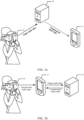
- the computer device may be deployed between a transmission end and a receiving end of the target audio data.
- a device corresponding to the transmission end may be a device marked by 10 in FIG. 1a
- a device corresponding to the receiving end may be a device marked by 11 in FIG. 1a
- the computer device may be a device deployed between the device 10 corresponding to the transmission end and the device 11 corresponding to the receiving end, and is marked by 12 in FIG. 1a .
- the computer device 12 may intercept audio data when the device 10 corresponding to the transmission end transmits the audio data to the device 11 corresponding to the receiving end, take the intercepted audio data as target audio data in case that it is detected that the intercepted audio data has an audio missing segment, compensate for the audio missing segment according to a frequency spectrum feature of context audio data of the audio missing segment in the target audio data to obtain compensated audio data of the target audio data after the target audio data is compensated and recovered, and transmit the compensated audio data to the device 11 corresponding to the receiving end.
- the device 11 corresponding to the receiving end may take the audio with a missing segment as target audio data in a case that the device 11 corresponding to the receiving end detects the missing of a partial audio segment in the audio data acquired from the device 10 corresponding to the transmission end, and transmit the target audio data to the computer device 12.
- the computer device 12 may feed back compensated audio data to the device 11 corresponding to the receiving end.
- the computer device may be a terminal device, or may also be a server, which is not defined herein.
- the computer device may also be a module integrated into the device corresponding to the receiving end or the device corresponding to the transmission end.
- the computer device may include, but is not limited to, a mobile phone, a computer, an intelligent voice interaction device, an intelligent household electrical appliance, an on-board terminal, and the like.
- FIG. 2 is a schematic flowchart of an audio processing method according to an embodiment of the present disclosure. As shown in FIG. 2 , the method may include the following steps S201 to S204.
- S201 Acquire target audio data and frequency spectrum information of the target audio data.
- the target audio data may refer to any audio data with an audio missing segment.
- the audio data may be music data, voice data, audio content in video data, or the like.
- the audio data may mainly refer to voice data that may be voice data generated in real time during a call or may also be historical voice data, and the voice data may include call voice, or may also include a voice message and the like in a social application program.
- the computer device may acquire frequency spectrum information of the target audio data, and map the frequency domain processing of the frequency spectrum information of the target audio data to the time domain analysis of the target audio data, so that the computer device can analyze the target audio data with a few of computing resources, and computing resources of the computer device can be effectively saved.
- the target audio data acquired by the computer device has the audio missing segment, and the audio missing segment is represented as 0 in the time domain, that is, a partial frequency band of the target audio data is represented as 0 in the time domain.
- a frequency spectrum, corresponding to the audio missing segment, in the frequency spectrum information of the target audio data is generally represented as 0.
- the computer device may adopt the short-time Fourier transform, or may also adopt the Mel-spectrum analysis (a time-to-frequency domain transformation method), or may also adopt a method of combining the short-time Fourier transform and the Mel-spectrum analysis to map the target audio data from the time domain to the frequency domain.
- the computer device may invoke a frequency domain processing module in the computer device to map the target audio data to the frequency domain.
- the frequency domain processing module may map the target audio data to the frequency domain according to an acquired sampling rate, an audio length (or an audio extraction length), a Fourier transform window length, and a Fourier transform window interval to obtain frequency spectrum information of the target audio data.
- the acquired sampling rate may be 16k
- the audio length may be 512 milliseconds (ms)
- the Fourier transform window length may be 1024
- the Fourier transform window interval may be 256.
- the sampling rate of 16k refers to that 1ms corresponds to 16 sampling points, so the audio length of 512ms corresponds to 8192 sampling points.
- the computer device may map the obtained sampling points to the frequency domain to obtain frequency spectrum information of the target audio data.
- an audio segment, having a time domain representation and corresponding playback time earlier than that of the audio missing segment, in the target audio data may be referred to as a preceding audio segment in the target audio data
- an audio segment, having a time domain representation and corresponding playback time later than that of the audio missing segment, in the target audio data may be referred to as a succeeding audio segment in the target audio data.
- the preceding audio segment and the succeeding audio segment may be collectively referred to as a context audio segment in the target audio data.
- the frequency spectrum information of the target audio data includes a frequency spectrum feature of the context audio segment of the audio missing segment, that is, a frequency spectrum feature of the preceding audio segment and a frequency spectrum feature of the succeeding audio segment of the audio missing segment.
- the computer device may perform feature compensation on the frequency spectrum information of the target audio data based on the frequency spectrum feature of the context audio segment, that is, perform S202.
- S202 Perform feature compensation on the frequency spectrum information of the target audio data according to the frequency spectrum feature of the context audio segment to obtain compensated frequency spectrum information of the target audio data.
- the feature compensation executable by the computer device on the frequency spectrum information of the target audio data based on the frequency spectrum feature of the context audio segment includes at least upsampling.
- the computer device may perform upsampling on the frequency spectrum information of the target audio data by bilinear interpolation or nearest-neighbor interpolation. After upsampling of the frequency spectrum information of the target audio data is completed, the computer device may add more feature information to the frequency spectrum information, so that when predicting and compensating for the audio missing segment in the target audio data subsequently, the computer device may acquire more frequency spectrum features from the frequency spectrum information subjected to upsampling to improve the accuracy of prediction and compensation executable by the computer device on the audio missing segment.
- the feature compensation executable by the computer device on the frequency spectrum information of the target audio data may further include convolution performed on the frequency spectrum information of the target audio data based on the context audio segment.
- the computer device may perceive more context information during feature compensation of the target audio data to expand a feature receptive field.
- the computer device may add various frequency spectrum features corresponding to different scales to the frequency spectrum information of the target audio data when performing feature compensation on the frequency spectrum information of the target audio data, so that the richness and rationality of features in compensated frequency spectrum information that is obtained by the computer device by performing feature compensation on the frequency spectrum information of the target audio data may be effectively improved.
- the computer device may perform upsampling once or multiple times during feature compensation of the frequency spectrum information of the target audio data. After performing upsampling each time, the computer device may perform convolution once, that is, the computer device performs feature compensation on the frequency spectrum information of the target audio data by alternately performing upsampling and convolution. Because the computer device performs further sampling on the sampling points of the target audio data when acquiring the frequency spectrum information of the target audio data, when performing feature compensation on the frequency spectrum information of the target audio data, the computer device may perform feature restoration by upsampling based on the sampling points in the frequency spectrum information.
- the computer device when performing feature restoration on the frequency spectrum information of the target audio data, performs feature compensation according to the quantity of sampling points included in the frequency spectrum information and the quantity of sampling points for sampling the target audio data in the time domain, so that the quantity of sampling points in compensated frequency spectrum information obtained by the computer device by performing feature compensation on the frequency spectrum information is consistent with the quantity of sampling points corresponding to the target audio data in the time domain, and the rationality of feature compensation executable by the computer device on the frequency spectrum information of the target audio data may be ensured.
- the computer device may invoke a generator in the computer device to perform feature compensation on the frequency spectrum information of the target audio data.
- the generator is connected to the foregoing frequency domain processing module configured to obtain the frequency spectrum information of the target audio data, that is, an output of the foregoing frequency domain processing module is an input of the generator.
- the generator includes one or more compensation subunits of different scales, and each compensation subunit includes a conv layer and an upsampling layer.
- the computer device When invoking the generator to perform feature compensation on the frequency spectrum information of the target audio data, the computer device inputs the frequency spectrum information of the target audio data into the generator, and invokes the one or more compensation subunits of different scales in the generator to perform iteration on the frequency spectrum information. Upsampling frequencies in different compensation subunits in the generator may be the same or different, and convolution depths and scales of the conv layers in different compensation subunits may also be the same or different.
- the computer device After obtaining the compensated frequency spectrum information of the target audio data, the computer device may predict and compensate for the audio missing segment in the target audio data based on the compensated frequency spectrum information, that is, perform S203.
- S203 Perform audio prediction according to the compensated frequency spectrum information to obtain predicted audio data.
- S204 Compensate for the audio missing segment in the target audio data according to the predicted audio data to obtain compensated audio data of the target audio data.
- the computer device may first perform audio prediction according to the compensated frequency spectrum information to obtain predicted audio data.
- the computer device may perform audio prediction based on all frequency spectrum features in the compensated frequency spectrum information, that is, the computer device performs prediction based on the compensated frequency spectrum information to obtain predicted data of all frequency bands in the target audio data.
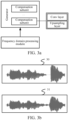
- FIG. 3b in a case that the target audio data with the audio missing segment that is acquired by the computer device is audio data marked by 30 in FIG.
- the computer device recognizes the target audio data to obtain compensated frequency spectrum information of the target audio data, and obtains predicted audio data, which is audio data marked by 31 in FIG. 3b , according to the compensated frequency spectrum information. It can be seen from the predicated audio data obtained by the computer device that when predicting and compensating for the audio missing segment in the target audio data, the computer device first obtains predicted audio data corresponding to the target audio data, and then compensates for the audio missing segment in the target audio data based on the target audio data and the predicted audio data to obtain compensated audio data of the target audio data.
- the computer device may compensate for the audio missing segment in the target audio data according to the target audio data and the predicted audio data, and a corresponding waveform and a data distribution of the predicted audio data obtained by the computer device by performing prediction according to the compensated frequency spectrum information are not completely consistent with those of the original target audio data. Therefore, when performing compensation and recovery according to the target audio data and the predicted audio data, the computer device may first determine a predicted missing segment corresponding to the audio missing segment in the target audio data from the predicted audio data, and then replace the audio missing segment in the target audio data with the predicted missing segment to obtain compensated audio data of the target audio data.
- the computer device may first determine a previous audio segment and a next audio segment of the audio missing segment from the target audio data and the predicted audio data. A segment end of the previous audio segment and a segment start of the audio missing segment are the same audio point, and a segment start of the next audio segment and a segment end of the audio missing segment are the same audio point.
- the computer device may further perform transition fusion according to the determined audio segments, and then generate compensated audio data according to an audio segment obtained by the transition fusion, so that the computer device may smoothly integrate the audio missing segment into the compensated audio data, the compensated audio data has characteristics of smooth transition, and the smoothness of playback of the compensated audio data when played by the receiving end device may also be improved.
- the computer device may perform transition fusion according to the determined audio segments in a fade-in and fade-out way.
- the fade-in and fade-out fusion method is a linear superposition method, that is, a method for linearly superimposing the target audio data and the compensated audio data.
- the computer device may adjust the previous audio segment and the next audio segment of the audio missing segment when compensating for the audio missing segment in the target audio data based on the predicted audio data, so that an audio missing segment in the compensated audio data is smoothly transitioned, and the playback effect of the compensated audio data obtained by fusion is improved.
- the computer device may fuse audio data obtained by transition fusion and the target audio data, or may also fuse the audio data obtained by transition fusion and the predicted audio data to obtain compensated audio data of the target audio data.
- the compensated audio data refers to data without an audio missing segment.
- a computer device may acquire frequency spectrum information of the target audio data, perform feature compensation on the frequency spectrum information based on a frequency spectrum feature of a context audio segment of the audio missing segment that is included in the frequency spectrum information to obtain compensated frequency spectrum information of the target audio data, and recognize the compensated frequency spectrum information to obtain more frequency spectrum information of the target audio data.
- the computer device may perform audio prediction according to the compensated frequency spectrum information to obtain predicted audio data, and compensate for the audio missing segment in the target audio data according to the predicted audio data and the target audio data to obtain compensated audio data of the target audio data.
- the computer device predicts and compensates for the audio missing segment according to frequency spectrum information of the overall context audio segment, so that the computer device can predict and compensate for the audio missing segment based on all frequency spectrum information of the target audio data, and the accuracy and rationality of prediction and compensation executable by the computer device on the audio missing segment may be improved.
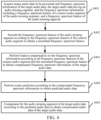
- FIG. 4 is a schematic flowchart of an audio processing method according to an embodiment of the present disclosure. As shown in FIG. 4 , the method may include the following steps S401 to S405.
- S401 Acquire target audio data and frequency spectrum information of the target audio data, the target audio data having an audio missing segment, and the frequency spectrum information including a frequency spectrum feature of a context audio segment of the audio missing segment and a frequency spectrum feature of the audio missing segment.
- the target audio data which is acquired by a computer device may be audio data with an audio missing segment that is actually acquired by the computer device, or may also be sample data that is extracted from training audio data.
- the computer device may recognize the frequency spectrum information of the target audio data to obtain predicted audio data, perform audio prediction based on all available frequency spectra of the target audio data, and further predict and compensate for the audio missing segment in the target audio data based on the predicted audio data and the target audio data.
- the computer device invokes a generator to recognize the frequency spectrum information of the target audio data so as to obtain predicted audio data.
- the computer device may train the generator by acquiring sample data.
- the computer device may train the generator (or the generator and a discriminator) with reference to a discrimination result of data outputted by the generator that is obtained through a discriminator.
- Both the generator and the discriminator are deep learning-based network structures.
- the generator and the discriminator may be designed together based on a model structure of a generative adversarial network (GAN) model, or the generator and the discriminator may be respectively designed based on a deep learning-based generator model and discrimination model.
- GAN generative adversarial network
- a process of training the generator by the computer device may be a process of training the discriminator.
- the computer device needs to perform adversarial training on both the generator and the discriminator to finally obtain trained network models.
- a convolutional neural network (CNN) is mainly used for the generator.
- the computer device may train the generator and the discriminator, respectively, to optimize the generator and the discriminator, respectively.
- a sampling rate and an audio extraction length may be specified.
- the computer device when acquiring the target audio data, the computer device may first invoke the generator to extract intermediate audio data with a length equal to the audio extraction length from the training audio data. Then, the computer device may invoke the generator to sample the intermediate audio data according to a target sampling rate so as to obtain a sampling sequence of the intermediate audio data, perform simulative packet loss adjustment on multiple sampling points in the sampling sequence according to a preset packet loss length to obtain target audio data.
- the simulative packet loss adjustment is an adjustment method for simulating packet loss by specifically adjusting sampling points.
- the multiple sampling points may be adjusted to 0, and the sampling points adjusted to 0 are taken as the audio missing segment in the target audio data.
- the training audio data includes audio data in one or more languages, such as Chinese, English, and German. Moreover, the training audio data may be audio data of one person, or may also be audio data of many persons. An audio length of the acquired training audio data exceeds 500 hours. In all embodiments of the present disclosure, some or all audio processing parameters that are specified in the generator may be as shown in Table 1.
- Table 1 Parameter name Parameter value Parameter name Parameter value Sampling rate 16k Generator amplification [8, 8, 2, 2] Audio extraction length 512ms Convolution kernel size 3 Fourier transform window length 1024 Single audio packet length 10ms Fourier transform window interval 256 Random quantity of lost packets 1-12 Batch_size 32 Lengths before and after fusion 20ms
- Batch_size refers to the size of each batch of data, that is, the quantity of samples that are trained together each time. By training samples in batches, an average loss function value of the samples may be calculated, and parameters of the network model may be updated. Batch_size generally takes the value of 32.
- the generator may extract intermediate audio data from the training audio data based on a set audio extraction length (which is assumed to be 512ms), and sample the intermediate audio data based on a target sampling rate (which is assumed to be 16k) to obtain a sampling sequence of the intermediate audio data.
- the obtained sampling sequence of the intermediate audio data includes 8192 sampling points.
- the computer device may randomly set K pieces of audio data in the 8192 sampling points as 0 to simulate audio missing segments in the target audio data.
- a length of each piece of audio data is the preset packet loss length that is set in the generator, which may be assumed to be 10-120ms.
- K is a positive integer less than or equal to 3.
- the generator may further randomly discard the 8192 sampling points in the sampling sequence of the intermediate audio data based on the set number (which is assumed to be 1-12) of packet loss segments, so that the target audio data which is acquired by the computer device is audio data including an audio missing segment.
- the audio missing segment included in the target audio data that is acquired by the computer device may also become packet loss data or a mask audio segment.
- the computer device takes audio data without packet loss as original audio data, and continuously trains model parameters of the generator, so that the generator performs prediction according to the context information in the frequency spectrum information of the target audio data to obtain predicted audio data whose similarity with the original audio data satisfies a threshold value, and predicts and compensates for the mask audio segment.
- the computer device may first perform digital signal processing on the target audio data to transform the target audio data from the time domain to the frequency domain so as to obtain frequency spectrum information of the target audio data.
- the computer device may transform the target audio data from the time domain to the frequency domain with reference to the parameters in Table 1.
- the computer device may transform the 8192 sampling points into a 32*80 frequency spectrogram (that is, the frequency spectrum information) by frequency domain transformation.
- features of the frequency spectrum information that are recognized by the computer device by invoking the generator include [N, 32, 80], 80 refers to the preset quantity of channels, N refers to the quantity of a batch of iterations that are inputted into the generator during training of the generator, N is equal to the value of Batch_size in Table 1, and when the trained generator is used to predict and compensate for an actual audio missing segment, N takes the value of 1.
- S402 Smooth the frequency spectrum feature of the audio missing segment according to the frequency spectrum feature of the context audio segment to obtain a smoothed frequency spectrum feature.
- S403 Perform feature compensation on the frequency spectrum information according to all frequency spectrum features of the context audio segment and the smoothed frequency spectrum feature to obtain compensated frequency spectrum information of the target audio data.
- S404 Perform audio prediction according to the compensated frequency spectrum information to obtain predicted audio data.
- the computer device After acquiring the frequency spectrum feature of the context audio segment that is included in the frequency spectrum information of the target audio data, the computer device performs prediction and compensation according to the frequency spectrum feature of the context audio segment.
- the frequency spectrum information of the target audio data further includes the frequency spectrum feature of the audio missing segment, and the frequency spectrum feature of the audio missing segment is represented as 0 in the frequency domain. Therefore, to avoid a situation where compensated frequency spectrum information that is obtained by subsequently performing feature compensation on the frequency spectrum information of the target audio data based on the frequency spectrum feature of the context audio segment includes many 0, the computer device may first smooth the frequency spectrum feature of the audio missing segment to adjust sampling points originally corresponding to 0 in the frequency spectrum information of the target audio data to non-0 sampling points.
- the computer device when subsequently performing feature compensation, the computer device will not add many sampling points corresponding to 0 to the frequency spectrum information of the target audio data.
- the smoothing of the frequency spectrum feature of the audio missing segment may improve the compensation effect of feature compensation subsequently performed on the frequency spectrum information.
- the computer device When smoothing the frequency spectrum feature of the audio missing segment, the computer device will also smooth the frequency spectrum feature of the context audio segment at the same time.
- the computer device may perform convolution once on the frequency spectrum information of the target audio data through a conv layer to smooth the frequency spectrum feature of the audio missing segment and the frequency spectrum feature of the context audio segment.
- the computer device may perform feature compensation on the frequency spectrum information according to the frequency spectrum feature of the context audio segment and the smoothed frequency spectrum feature of the audio missing segment.
- the computer device may first acquire a frequency spectrum length of frequency spectrum information composed of the frequency spectrum feature of the context audio segment and the smoothed frequency spectrum feature, and the frequency spectrum length is used for indicating the quantity of feature points in the frequency spectrum information.
- the acquired frequency spectrum length of the frequency spectrum information may be 8192.
- the computer device may determine the quantity of sampling points in the sampling sequence corresponding to the target audio data according to the sampling rate and the audio extraction length at which the target audio data is obtained, and perform upsampling on the frequency spectrum information according to the quantity of sampling points, to make the quantity of feature points in the frequency spectrum information be equal to the quantity of sampling points. Then, frequency spectrum information subjected to upsampling may be taken as compensated frequency spectrum information of the target audio data.
- a process of generation of the predicted audio data based on the compensated frequency spectrum information after the computer device performs feature compensation on the frequency spectrum information to obtain the compensated frequency spectrum information of the target audio data may be as shown in FIG. 5a .
- the computer device may first invoke a frequency domain generation module (a mel spectrogram module shown in FIG. 5a ) in the generator to map the target audio data to the frequency domain so as to obtain frequency spectrum information of the target audio data, and further perform convolution once through the conv layer to smooth the frequency spectrum feature of the audio missing segment in the frequency spectrum information.
- a frequency domain generation module a mel spectrogram module shown in FIG. 5a
- the computer device may perform feature compensation on the smoothed frequency spectrum feature by performing 8-fold upsampling twice and 2-fold upsampling twice.
- frequency spectrum information of the target audio data that is obtained by the computer device according to the frequency domain mapping parameters in Table 1 may be a 32*80 frequency spectrogram.
- the computer device performs upsampling once or more times on the frequency spectrum information according to the quantity of sampling points. After performing upsampling once, the computer device may perform multi-scale convolution operation on frequency spectrum information subjected to upsampling once to obtain all frequency spectrum features of the context audio segment.
- the computer device may perform deep convolution operation based on a res block structure (a convolution residual network structure) in FIG. 5a .
- the res block structure includes multiple network layers, and is configured to expand a frequency spectrum feature receptive field through multi-layer convolution.
- the res block structure may include 4 network layers, which are a 3*3 conv layer, a 5*5 conv layer, a 3*3 conv layer, and a 3*3 conv layer, respectively.
- the computer device may compress the quantity of channels of the compensated frequency spectrum information to obtain predicted audio data.
- the computer device may adjust the quantity of frequency spectrum channels of the compensated frequency spectrum information to 1 to obtain predicted audio data.
- the compensated frequency spectrum information that is obtained by the computer device by invoking the generator may be [8192, 80], and after acquiring the compensated frequency spectrum information, the computer device may compress the quantity of channels from 80 to 1 based on the compensated frequency spectrum information to transform the compensated frequency spectrum information into time domain information.
- the time domain information obtained by transforming the compensated frequency spectrum information is predicted audio data obtained by performing audio prediction based on the compensated frequency spectrum information, and the predicted audio data is obtained based on the entire compensated frequency spectrum information and is audio data without an audio missing segment.
- the computer device may predict entire audio based on learning of the context of the audio missing segment, and the computer device may compensate for the audio missing segment in the target audio data according to more valid information.
- the computer device performs non-autoregressive end-to-end one-time prediction to obtain predicted audio data, that is, compensates for all packet loss segments of an input once in a case that the input includes multiple packet loss segments, so that the computer device may obtain accurate predicted audio data, and meanwhile the calculation time of the computer device may be effectively saved.
- S405 Compensate for the audio missing segment in the target audio data according to the predicted audio data to obtain compensated audio data of the target audio data.
- the computer device may compensate for the audio missing segment in the target audio data according to the predicted audio data.
- the computer device may perform audio fusion on the target audio data and the predicted audio data based on the audio missing segment to obtain compensated audio data of the target audio data. Because a waveform of the predicted audio data generated by the computer device is not completely consistent with a waveform of the target audio data, the computer device may perform audio fusion on the target audio data and the predicted audio data based on the audio missing segment in a fade-in and fade-out way, so that the audio missing segment is more smoothly integrated into the original audio, and the original audio is smoothly transited.
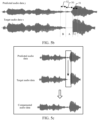
- the computer device may first determine a predicted missing segment corresponding to the audio missing segment from the predicted audio data, and determine an predicted associated segment of the predicted missing segment from the predicted audio data.
- the predicted missing segment corresponding to the audio missing segment that is determined by the computer device is marked by 50 in FIG. 5b
- the predicted associated segment may include audio segments respectively marked by 51 and 52 in FIG. 5b
- the audio segment marked by 51 in FIG. 5b may also be referred to as an audio fusion segment after packet loss (postaudio)
- the audio segment marked by 52 may also be referred to as an audio fusion segment before packet loss (preaudio).
- the computer device After determining the predicted missing segment and the predicted associated segment, the computer device further determines fusion parameters, and smooths the predicted associated segment according to the fusion parameters to obtain a smoothed predicted associated segment.
- the computer device may smooth the predicted associated segment based on the fusion parameters in combination with the predicted audio data (of which a corresponding sequence is assumed to be y) and the target audio data (of which a corresponding sequence is assumed to be x), and a smoothed predicted associated segment may refer to formula 2.1 and formula 2.2.
- preaudio ⁇ ⁇ y + ⁇ ⁇ x
- postaudio ⁇ ⁇ x + ⁇ ⁇ y
- preaudio represents a packet loss preceding text (or an audio fusion segment before packet loss)
- postaudio represents a packet loss succeeding text (or an audio fusion segment after packet loss).
- the computer device may further replace a corresponding audio segment in the predicted audio data with the smoothed predicted associated segment to obtain fused audio data, or in the target audio data, the computer device may replace the corresponding audio segment in the predicted audio data with the smoothed predicted associated segment, and replace the audio missing segment with the predicted missing segment to obtain fused audio data.
- the generated audio missing segment may be smoothly transited in the compensated audio data, thereby improving the quality of the audio.
- a process of fusing the target audio data and the predicted audio data to finally obtain compensated audio data by the computer device may be as shown in FIG. 5c .
- the computer device when training the generator, after the computer device invokes the generator to obtain the compensated audio data, the computer device may invoke the discriminator to recognize compensated audio data generated by the generator, and continuously optimize the generator through adversarial training between the discriminator and the generator, so that a difference between the compensated audio data generated by the generator and the original audio data is continuously reduced.
- the discriminator is a classification network, and is mainly configured to determine whether the generated compensated audio data is the original audio data.
- the adversarial learning process of the discriminator and the generator makes the discriminator unable to distinguish the difference between the compensated audio data learned and generated by the generator and the original audio data, thereby improving the quality of the audio data generated by the generator.
- the original audio data may be audio data without an audio missing segment that is acquired by the computer device from training sample data.
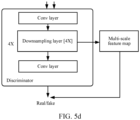
- the discriminator may be specifically as shown in FIG. 5d .
- the discriminator mainly adopts convolution operation and downsampling operation to extract feature maps at different resolutions from the compensated audio data, and the feature maps are used for subsequently solving a loss function. That is, after invoking the discriminator to extract feature maps at different resolutions from the compensated audio data, the computer device may determine, according to the feature maps of the compensated audio data at different resolutions, a feature difference between the compensated audio data and the intermediate audio data from which the target audio data is obtained, and train the generator and the discriminator to obtain a trained generator and a trained discriminator.
- the loss function used for training the generator and the discriminator includes one or more of the following: a discriminator loss function, a generator loss function, and a multi-resolution loss function (that is, a stft loss function).
- the discriminator loss function and the generator loss function may be loss functions used for time domain analysis of audio data
- the multi-resolution loss function is a loss function used for frequency domain analysis of audio data.
- the computer device when training the generator and the discriminator according to the feature maps at different resolutions, may first determine a time domain feature of the compensated audio data according to the feature maps of the compensated audio data at different resolutions. After acquiring a time domain feature difference between the compensated audio data and the intermediate audio data from which the target audio data is obtained, the computer device may acquire a consistency discrimination result of the compensated audio data and the intermediate audio data that is determined by the discriminator based on the time domain feature difference. The computer device may determine the discriminator loss function according to the consistency discrimination result, then determine the generator loss function according to the time domain feature difference, and train the generator and the discriminator according to the generator loss function and the discriminator loss function.
- a process of training the generator and the discriminator according to the generator loss function and the discriminator loss function may be that the generator is trained according to the generator loss function, and the discriminator is trained according to the discriminator loss function, or may also be that the generator and the discriminator are trained together according to a combined loss function composed of the generator loss function and the discriminator loss function.
- x is original audio data (or real audio data, that is, may be the foregoing intermediate audio data)
- s is audio data (such as the foregoing target audio data) that has a lost packet and is inputted into the generator
- z random noise
- the discriminator loss function may be represented as formula 3.1 and formula 3.2.
- G(s, z) refers to an expression corresponding to audio data (such as the foregoing compensated audio data) generated by the generator
- D k (x) refers to feature maps at different resolutions that are obtained by the discriminator by sampling original audio data
- D k (G(s, z)) refers to feature maps at different resolutions that are obtained by the discriminator by sampling the audio data generated by the generator.
- both the foregoing discriminator loss function Loss D and the generator loss function Loss G may be loss functions used for time domain analysis of audio data.
- multi-frequency band information of audio is taken into account, so that audio generated by the generator has a better effect on each frequency band.
- a resolution (STFT) loss function may also be taken in account to improve the stability of audio generated by the generator.
- the multi-resolution loss function refers to accumulation of audio in different parameters (such as an FFT length, a frame shift length, and a window size).
- the computer device may determine a frequency spectrum feature of the feature map of the compensated audio data at any resolution, and acquire a frequency spectrum feature of the intermediate audio data (that is, the original audio data) of the target audio data. Then, the computer device may obtain a spectrum convergence function of the feature map at any resolution according to the frequency spectrum feature of the feature map at any resolution and the frequency spectrum feature of the intermediate audio data.
- the foregoing spectrum convergence function may be represented as formula 5.1.
- L sc x ,y ⁇ STFT x ⁇ STFT y ⁇ STFT x
- the computer device may solve the multi-resolution loss function according to the spectrum convergence function of the feature maps at different resolutions, and train the generator and the discriminator based on the multi-resolution loss function.
- the computer device may determine, in a case that the frequency spectrum feature of the intermediate audio data is taken as a reference feature, a spectrum convergence function of the feature map at any resolution according to the frequency spectrum feature of the feature map at any resolution and the frequency spectrum feature of the intermediate audio data.
- the spectrum convergence function is used for indicating a frequency spectrum difference between the frequency spectrum feature of the intermediate audio data and the feature map at any resolution.
- the computer device may first acquire a frequency spectrum magnitude difference between the frequency spectrum feature of the feature map at any resolution and the frequency spectrum feature of the intermediate audio data to obtain a magnitude difference function.
- x is original audio data
- y is reconstructed audio data (such as the foregoing compensated audio data or predicted audio data)
- L mag represents a resolution loss logarithm
- the foregoing magnitude difference function may be represented as formula 6.1.
- L mag x ,y ⁇ log STFT x ⁇ log STFT y ⁇ N
- the computer device may take a function obtained by weighting the spectrum convergence function of the feature maps at different resolutions and the corresponding magnitude difference function as a multi-resolution loss function.
- the weighting of the spectrum convergence function of any feature map and the magnitude difference function may be represented as formula 7.1.
- L s G L sc x ,y + L mag x ,y
- the computer device may further perform normalization based on the weighting expression of the spectrum convergence function of the feature maps and the magnitude difference function to obtain a multi-resolution loss function.
- the multi-resolution loss function may be represented by L aux (G), and may specifically represented as formula 8.1.
- the loss function used for training the generator is represented as formula 9.1.
- Loss Loss G + Loss D + L aux G
- the generator is trained according to a combined loss of the time domain and the frequency domain, so that a trained generator generates high-level semantics and audio data with high audio quality.
- a connection mode of the generator and the discriminator may be as shown in FIG. 5e .
- Audio data generated by the generator may be the foregoing predicted audio data, or may also be the foregoing compensated audio data, which is not defined herein.
- the computer device may predict and compensate for the audio missing segment based on an end-to-end non-autoregressive generator according to all frequency spectrum information of context audio data of the audio missing segment in the target audio data.
- the computer device after obtaining predicted audio data, the computer device generates final compensated predicted data based on the predicted audio data and the target audio data, so that the accuracy of prediction executable by the computer device on the audio missing segment is improved, the smooth transition executable by the computer device on the audio missing segment according to the predicted data is also improved, and the listening experience of a user may be improved.
- the computer device trains the time domain prediction performance and the frequency domain prediction performance of the generator respectively, so that the robustness of a trained generator may be improved.
- the embodiments of the present disclosure further propose an audio processing apparatus, which may be a computer program (including program codes) running on the foregoing computer device.
- the audio processing apparatus is configured to perform the audio processing method shown in FIG. 2 or FIG. 4 .
- the audio processing apparatus includes: an acquisition unit 601, a processing unit 602, and a prediction unit 603.
- the acquisition unit 601 is configured to acquire target audio and frequency spectrum information of the target audio data, the target audio data having an audio missing segment, and the frequency spectrum information including a frequency spectrum feature of a context audio segment of the audio missing segment.
- the processing unit 602 is configured to perform feature compensation on the frequency spectrum information of the target audio data according to the frequency spectrum feature of the context audio segment to obtain compensated frequency spectrum information of the target audio data.
- the prediction unit 603 is configured to perform audio prediction according to the compensated frequency spectrum information to obtain predicted audio data.
- the processing unit 602 is further configured to compensate for the audio missing segment in the target audio data according to the predicted audio data to obtain compensated audio data of the target audio data.
- the processing unit 602 may be specifically configured to: perform audio fusion on the target audio data and the predicted audio data based on the audio missing segment to obtain the compensated audio data of the target audio data.
- the processing unit 602 may be specifically configured to: determine a predicted missing segment corresponding to the audio missing segment from the predicted audio data, and determine a predicted associated segment of the predicted missing segment from the predicted audio data; acquire a fusion parameter, and smooth the predicted associated segment according to the fusion parameter to obtain a smoothed predicted associated segment; and replace, in the predicted audio data, a corresponding audio segment in the predicted audio data with the smoothed predicted associated segment to obtain fused audio data.
- the processing unit 602 may be specifically configured to: replace the audio missing segment in the target audio data with the predicted missing segment in the predicted audio data, and replace a corresponding audio segment in the target audio data with the smoothed predicted associated segment to obtain the fused audio data.
- the target audio data may include data extracted by a generator from training audio data, and the generator specifies a sampling rate and an audio extraction length.
- the acquisition unit 601 is specifically configured to: invoke the generator to extract intermediate audio data with the audio extraction length from the training audio data; and invoke the generator to sample the intermediate audio data according to a target sampling rate to obtain a sampling sequence of the intermediate audio data, and perform simulative packet loss adjustment on multiple sampling points in the sampling sequence according to a preset packet loss length to obtain the target audio data, the sampling points subjected to the simulative packet loss adjustment being the audio missing segment in the target audio data.
- the target audio data may be determined by the generator according to the intermediate audio data extracted from the training audio data; and the processing unit 602 is further configured to invoke a discriminator to extract feature maps of the compensated audio data at different resolutions.
- the processing unit 602 is further configured to determine a feature difference between the compensated audio data and the intermediate audio data, from which the target audio data is obtained, according to the feature maps of the compensated audio data at different resolutions, and train the generator and the discriminator based on the feature difference to obtain a trained generator and a trained discriminator.
- the generator and the discriminator may be trained based on a loss function, and the loss function includes a multi-resolution loss function; and the processing unit 602 is specifically configured to: determine a frequency spectrum feature of the feature map of the compensated audio data at any resolution, and acquire a frequency spectrum feature of the intermediate audio data; obtain a spectrum convergence function of the feature map at any resolution according to the frequency spectrum feature of the feature map at any resolution and the frequency spectrum feature of the intermediate audio data, the spectrum convergence function being used for indicating a frequency spectrum difference between the frequency spectrum feature of the intermediate audio data and the feature map at any resolution; and solve the multi-resolution loss function according to the spectrum convergence functions of the feature maps at different resolutions, and train the generator and the discriminator based on the multi-resolution loss function.
- the processing unit 602 may be specifically configured to: determine, in a case that the frequency spectrum feature of the intermediate audio data is taken as a reference feature, the spectrum convergence function of the feature map at any resolution according to the frequency spectrum feature of the feature map at any resolution and the frequency spectrum feature of the intermediate audio data.
- the processing unit 602 is specifically configured to: acquire a frequency spectrum magnitude difference between the frequency spectrum feature of the feature map at any resolution and the frequency spectrum feature of the intermediate audio data to obtain a magnitude difference function; and take a function, obtained by weighting the spectrum convergence functions of the feature maps at different resolutions and the corresponding magnitude difference functions, as the multi-resolution loss function.
- the generator and the discriminator may be trained based on the loss function, and the loss function further includes a discriminator loss function and a generator loss function.
- the processing unit 602 is specifically configured to: determine a time domain feature of the compensated audio data according to the feature maps of the compensated audio data at different resolutions, and acquire a time domain feature difference between the compensated audio data and the intermediate audio data from which the target audio data is obtained; acquire a consistency discrimination result of the compensated audio data and the intermediate audio data that is determined by the discriminator based on the time domain feature difference, and solve the discriminator loss function according to the consistency discrimination result; and solve the generator loss function according to the time domain feature difference, and train the generator and the discriminator according to the generator loss function and the discriminator loss function.
- the frequency spectrum information further may include a frequency spectrum feature of the audio missing segment.
- the processing unit 602 is specifically configured to: smooth the frequency spectrum feature of the audio missing segment according to the frequency spectrum feature of the context audio segment to obtain a smoothed frequency spectrum feature of the audio missing segment; and perform the feature compensation on the frequency spectrum information of the target audio data according to all frequency spectrum features of the context audio segment and the smoothed frequency spectrum feature of the audio missing segment, to obtain the compensated frequency spectrum information of the target audio data.
- the processing unit 602 may be specifically configured to: acquire a frequency spectrum length of frequency spectrum information composed of the frequency spectrum features of the context audio segment and the smoothed frequency spectrum feature of the audio missing segment, the frequency spectrum length being used for indicating a quantity of feature points in the frequency spectrum information; determine a quantity of sampling points in a sampling sequence corresponding to the target audio data according to a sampling rate and an audio extraction length at which the target audio data is obtained, and perform upsampling on the frequency spectrum information according to the quantity of sampling points to make the quantity of feature points in the frequency spectrum information be equal to the quantity of sampling points; and take frequency spectrum information obtained after performing the upsampling as the compensated frequency spectrum information of the target audio data.
- upsampling may be performed once or more times on the frequency spectrum information according to the quantity of sampling points; and the processing unit 602 is further configured to perform, after the upsampling is performed once, multi-scale convolution operation on frequency spectrum information obtained after performing the upsampling, to obtain all frequency spectrum features of the context audio segment.
- the prediction unit 603 may be specifically configured to: adjust a quantity of frequency spectrum channels of the compensated frequency spectrum information to 1 to obtain the predicted audio data.
- the acquisition unit 601 may acquire frequency spectrum information of target audio data after acquiring the target audio data with an audio missing segment, and the processing unit 602 may perform feature compensation on the frequency spectrum information based on a frequency spectrum feature of a context audio segment of the audio missing segment that is included in the frequency spectrum information to obtain compensated frequency spectrum information of the target audio data, and recognize the compensated frequency spectrum information to obtain more frequency spectrum information of the target audio data.
- the prediction unit 603 may perform audio prediction according to the compensated frequency spectrum information to obtain predicted audio data, and compensate for the audio missing segment in the target audio data according to the predicted audio data and the target audio data to obtain compensated audio data of the target audio data.
- the audio missing segment is predicted and compensated according to frequency spectrum information of the overall context audio segment, so that the audio missing segment is predicted and compensated based on all frequency spectrum information of the target audio data, and the accuracy and rationality of prediction and compensation for the audio missing segment may be improved.
- FIG. 7 is a schematic structural block diagram of a computer device according to an embodiment of the present disclosure.
- the computer device may be a terminal device or a server, which is not defined herein.
- the computer device of this embodiment may include: one or more processors 701, one or more input apparatuses 702, one or more output apparatuses 703, and a memory 704.
- the foregoing processor 701, input apparatus 702, output apparatus 703, and memory 704 are connected via a bus 705.
- the memory 704 is configured to store a computer program including program instructions, and the processor 701 is configured to execute the program instructions stored in the memory 704.
- the memory 704 may include a volatile memory such as a random-access memory (RAM).
- the memory 704 may also include a non-volatile memory such as a flash memory and a solid-state drive (SSD).
- the memory 704 may further include a combination of the foregoing types of memories.
- the processor 701 may be a central processing unit (CPU).
- the processor 701 may further include a hardware chip.
- the foregoing hardware chip may be an application-specific integrated circuit (ASIC), a programmable logic device (PLD), or the like.
- the PLD may be a field-programmable gate array (FPGA), a generic array logic (GAL), or the like.
- the processor 701 may also be a combination of the foregoing structures.
- the memory 704 may be configured to store a computer program including program instructions
- the processor 701 is configured to execute the program instructions stored in the memory 704 to implement the steps of the corresponding method shown in FIG. 2 or FIG. 4 .
- the processor 701 may be configured to invoke the program instructions to perform: acquiring target audio data and frequency spectrum information of the target audio data, the target audio data having an audio missing segment, and the frequency spectrum information including a frequency spectrum feature of a context audio segment of the audio missing segment; performing feature compensation on the frequency spectrum information of the target audio data according to the frequency spectrum feature of the context audio segment to obtain compensated frequency spectrum information of the target audio data; performing audio prediction according to the compensated frequency spectrum information to obtain predicted audio data; and compensating for the audio missing segment in the target audio data according to the predicted audio data to obtain compensated audio data of the target audio data.
- the embodiments of the present disclosure provide a computer program product or a computer program, which includes computer instructions.
- the computer instructions are stored in a computer-readable storage medium.
- a processor of a computer device reads the computer instructions from the computer-readable storage medium and executes the computer instructions to cause the computer device to perform the foregoing method embodiment shown in FIG. 2 or FIG. 4 .
- the computer-readable storage medium may be a magnetic disk, an optical disc, a read-only memory (ROM), a random access memory (RAM), or the like.
- the embodiments of the present disclosure further provide a storage medium, which is configured to store a computer program.
- the computer program is used for performing the method according to the foregoing embodiments.
Landscapes
- Engineering & Computer Science (AREA)
- Multimedia (AREA)
- Signal Processing (AREA)
- Physics & Mathematics (AREA)
- Health & Medical Sciences (AREA)
- Audiology, Speech & Language Pathology (AREA)
- Human Computer Interaction (AREA)
- Acoustics & Sound (AREA)
- Computational Linguistics (AREA)
- Computer Networks & Wireless Communication (AREA)
- Quality & Reliability (AREA)
- Spectroscopy & Molecular Physics (AREA)
- Information Retrieval, Db Structures And Fs Structures Therefor (AREA)
Abstract
Description
- This application claims priority to
Chinese Patent Application No. 202111176990.0, entitled "AUDIO PROCESSING METHOD, RELATED DEVICE, STORAGE MEDIUM, AND PROGRAM PRODUCT" filed with the China National Intellectual Property Administration on October 9, 2021 - The present disclosure relates to the field of computer technologies, and in particular, to audio processing.
- With the continuous development of computer network technologies, packet loss usually occurs during transmission of audio data over the Internet, and partial audio data of transmitted audio cannot be received by a receiving end, which affects the listening experience of users.
- In the related technology, an autoregressive iterative prediction method, that is, a method of sequentially predicting a succeeding sampling point on the basis of a preceding sampling point, is commonly adopted for compensation and recovery for lost audio packets.
- An error is continuously accumulated during iterative prediction. Therefore, how to improve the accuracy of audio data obtained by prediction and compensation for lost audio packets becomes a current research hot spot.
- Embodiments of the present disclosure provide an audio processing method, a related device, a storage medium, and a program product, which may improve the accuracy of prediction and compensation for lost audio packets.
- In an aspect, the embodiments of the present disclosure provide an audio processing method, which includes: acquiring target audio data and frequency spectrum information of the target audio data, the target audio data having an audio missing segment, and the frequency spectrum information including a frequency spectrum feature of a context audio segment of the audio missing segment; performing feature compensation on the frequency spectrum information of the target audio data according to the frequency spectrum feature of the context audio segment to obtain compensated frequency spectrum information of the target audio data; performing audio prediction according to the compensated frequency spectrum information to obtain predicted audio data; and compensating for the audio missing segment in the target audio data according to the predicted audio data to obtain compensated audio data of the target audio data.
- In another aspect, the embodiments of the present disclosure provide an audio processing apparatus, which includes: an acquisition unit, configured to acquire target audio data and frequency spectrum information of the target audio data, the target audio data having an audio missing segment, and the frequency spectrum information including a frequency spectrum feature of a context audio segment of the audio missing segment; a processing unit, configured to perform feature compensation on the frequency spectrum information of the target audio data according to the frequency spectrum feature of the context audio segment to obtain compensated frequency spectrum information of the target audio data; and a prediction unit, configured to perform audio prediction according to the compensated frequency spectrum information to obtain predicted audio data, and the processing unit being further configured to compensate for the audio missing segment in the target audio data according to the predicted audio data to obtain compensated audio data of the target audio data.
- In still another aspect, the embodiments of the present disclosure provide a computer device, which includes a processor, an input apparatus, an output apparatus, and a memory. The processor, the input apparatus, the output apparatus, and the memory are connected to each other, the memory is configured to store a computer program supporting the computer device to perform the foregoing method, the computer program includes program instructions, and the process is configured to invoke the program instructions to perform the following steps: acquiring target audio data and frequency spectrum information of the target audio data, the target audio data having an audio missing segment, and the frequency spectrum information including a frequency spectrum feature of a context audio segment of the audio missing segment; performing feature compensation on the frequency spectrum information of the target audio data according to the frequency spectrum feature of the context audio segment to obtain compensated frequency spectrum information of the target audio data; performing audio prediction according to the compensated frequency spectrum information to obtain predicted audio data; and compensating for the audio missing segment in the target audio data according to the predicted audio data to obtain compensated audio data of the target audio data.
- In still another aspect, the embodiments of the present disclosure provide a computer-readable storage medium, which stores program instructions that, when executed by a processor, implement the audio processing method according to the foregoing aspect.
- In still another aspect, the embodiments of the present disclosure provide a computer program product, which includes a computer program or computer instruction that, when executed by a processor, implements the audio processing method according to the foregoing aspect.
- In the embodiments of the present disclosure, after acquiring target audio data with an audio missing segment, a computer device may acquire frequency spectrum information of the target audio data, perform feature compensation on the frequency spectrum information based on a frequency spectrum feature of a context audio segment of the audio missing segment that is included in the frequency spectrum information to obtain compensated frequency spectrum information of the target audio data, and recognize the compensated frequency spectrum information to obtain more frequency spectrum information of the target audio data. In addition, after obtaining the compensated frequency spectrum information, the computer device may perform audio prediction according to the compensated frequency spectrum information to obtain predicted audio data, and compensate for the audio missing segment in the target audio data according to the predicted audio data and the target audio data to obtain compensated audio data of the target audio data. The computer device predicts and compensates for the audio missing segment according to frequency spectrum information of the overall context audio segment, so that the computer device may predict and compensate for the audio missing segment based on all frequency spectrum information of the target audio data, and the accuracy and rationality of prediction and compensation executable by the computer device on the audio missing segment may be improved.
-
-
FIG. 1a is a schematic diagram of a scene of audio processing according to an embodiment of the present disclosure. -
FIG. 1b is a schematic diagram of a scene of another audio processing according to an embodiment of the present disclosure. -
FIG. 2 is a schematic flowchart of an audio processing method according to an embodiment of the present disclosure. -
FIG. 3a is a schematic diagram of a connection between a frequency domain processing module and a generator according to an embodiment of the present disclosure. -
FIG. 3b is a schematic diagram of target audio data and predicted audio data according to an embodiment of the present disclosure. -
FIG. 4 is a schematic flowchart of another audio processing method according to an embodiment of the present disclosure. -
FIG. 5a is a schematic diagram of a generator according to an embodiment of the present disclosure. -
FIG. 5b is a schematic diagram of audio fusion according to an embodiment of the present disclosure. -
FIG. 5c is a schematic diagram of another audio fusion according to an embodiment of the present disclosure. -
FIG. 5d is a schematic diagram of a discriminator according to an embodiment of the present disclosure. -
FIG. 5e is a schematic diagram of a generator and a discriminator according to an embodiment of the present disclosure. -
FIG. 6 is a schematic block diagram of an audio processing apparatus according to an embodiment of the present disclosure. -
FIG. 7 is a schematic block diagram of a computer device according to an embodiment of the present disclosure. - The embodiments of the present disclosure provide an audio processing method. According to the method, after acquiring target audio data with an audio missing segment, a computer device may predict and compensate for the audio missing segment according to a context audio segment of the audio missing segment in the target audio data. The computer device predicts the audio missing segment in the target audio data with reference to the context audio segment of the audio missing segment in the target audio data, so that the computer device can make full use of effective information of the target audio data during prediction of the audio missing segment, and the robustness of prediction and compensation executable by the computer device on the audio missing segment may be improved. In an embodiment, the target audio data may be call voice data, music data, an audio part in video data, or the like. The call voice data may be historical data acquired from an instant messaging application program, or may also be data generated in real time during a voice call. The voice call may be realized based on a mobile communication network (such as a second-generation mobile communication network), or may also be voice over Internet Protocol (VoIP) realized based on the Internet Protocol (IP). That is, the call voice data may be collected by a mobile device in a mobile communication network, or may also be intercepted from the Internet. In addition, the audio missing segment in the target audio data refers to a segment without audio data (or with 0 piece of audio data), the context audio segment of the audio missing segment includes a preceding audio segment and a succeeding audio segment of the audio missing segment, the preceding audio segment refers to an audio segment of which corresponding playback time is earlier than that of the audio missing segment in the target audio data, and the succeeding audio segment refers to an audio segment of which corresponding playback time is later than that of the audio missing segment in the target audio data.
- During transmission of audio data (such as the foregoing target audio data) over network, a media engine cannot ensure that each audio stream data packet can be received. Therefore, in a case that a data packet (that is, a data segment in the target audio data) is lost during transmission, an audio receiving end cannot acquire complete audio data, which affects the playback experience of a user at the receiving end for the target audio data. In a case that the target audio data is call voice data, and a partial audio segment in the call voice data cannot be successfully received by the receiving end due to network transmission problems, the user at the receiving end will experience freezing during a voice call, which affects the audio quality and user's call experience during the call. To avoid impact on the listening effect of the user at the receiving end due to the loss of audio data during transmission, packet loss concealment (PLC) may be performed based on a context audio segment of a lost audio segment to improve the listening experience (or call experience) of the user at the receiving end. In an embodiment, when predicting and compensating for the audio missing segment according to the context audio segment of the audio missing segment in the target audio data, to make full use of audio recorded in the target audio data, the computer device may recognize and predict the context audio segment based on a non-autoregressive algorithm model, and compensate for the audio missing segment according to a recognition and prediction result of the context audio segment.
- In the embodiments of the present disclosure including the embodiments of both the claims and the specification (hereinafter referred to as "all embodiments of the present disclosure"), the non-autoregressive algorithm model is preferably a non-recursive recognition process in which sequence markers are generated in parallel in a time sequence model without waiting for generation of a previous time marker. That is, the non-autoregressive algorithm model breaks a serial order in the recognition and prediction of the context audio segment, and may recognize the overall context audio segment to obtain a prediction result of the audio missing segment. In an embodiment, the non-autoregressive algorithm model may be a deep learning-based network model. For example, the computer device may adopt an end-to-end non-autoregressive model to compensate for the audio missing segment in the target audio data according to the context audio segment in the target audio data. In an implementation, when adopting the non-autoregressive algorithm model to recognize and predict the context audio segment of the audio missing segment, the computer device may transform the context audio segment from the time domain to the frequency domain, and compensate for the audio missing segment in the target audio data by recognizing frequency spectrum information of the context audio segment in the frequency domain. The time domain and the frequency domain are basic information of signals (including voice signals and audio signals), and are used for signal analysis of signals from different dimensions. Different perspectives used for analysis of signals may be referred to as domains. The time domain may reflect a corresponding relationship between a mathematical function or physical signal and time, is the feedback of the real world, and is an objectively existing domain in the real world. The frequency domain is a coordinate system used for describing characteristics of a signal in the frequency domain, is a method that is constructed from a mathematical perspective as an aid to thinking, and does not exist objectively. When analyzing a frequency spectrum of the context audio segment, the computer device may input a frequency spectrum feature of the context audio segment into a generator, and perform prediction based on the frequency spectrum feature of the context audio segment through the generator to obtain predicted audio data. Because the predicted audio data is audio data without an audio missing segment, after obtaining the predicted audio data, the computer device may perform data fusion on the predicted audio data and the original target audio data with the audio missing segment to obtain final audio data that will be played at the receiving end.
- In all embodiments of the present disclosure, the computer device may be deployed between a transmission end and a receiving end of the target audio data. As shown in
FIG. 1a , a device corresponding to the transmission end may be a device marked by 10 inFIG. 1a , a device corresponding to the receiving end may be a device marked by 11 inFIG. 1a , and the computer device may be a device deployed between thedevice 10 corresponding to the transmission end and thedevice 11 corresponding to the receiving end, and is marked by 12 inFIG. 1a . That is, thecomputer device 12 may intercept audio data when thedevice 10 corresponding to the transmission end transmits the audio data to thedevice 11 corresponding to the receiving end, take the intercepted audio data as target audio data in case that it is detected that the intercepted audio data has an audio missing segment, compensate for the audio missing segment according to a frequency spectrum feature of context audio data of the audio missing segment in the target audio data to obtain compensated audio data of the target audio data after the target audio data is compensated and recovered, and transmit the compensated audio data to thedevice 11 corresponding to the receiving end. In another implementation, after thedevice 10 corresponding to the transmission end transmits audio data to thedevice 11 corresponding to the receiving end, thedevice 11 corresponding to the receiving end may take the audio with a missing segment as target audio data in a case that thedevice 11 corresponding to the receiving end detects the missing of a partial audio segment in the audio data acquired from thedevice 10 corresponding to the transmission end, and transmit the target audio data to thecomputer device 12. As specifically shown inFIG. 1b , after predicting and compensating for the audio missing segment in the target audio data, thecomputer device 12 may feed back compensated audio data to thedevice 11 corresponding to the receiving end. In all embodiments of the present disclosure, the computer device may be a terminal device, or may also be a server, which is not defined herein. Moreover, the computer device may also be a module integrated into the device corresponding to the receiving end or the device corresponding to the transmission end. In addition, the computer device may include, but is not limited to, a mobile phone, a computer, an intelligent voice interaction device, an intelligent household electrical appliance, an on-board terminal, and the like. - Referring to
FIG. 2, FIG. 2 is a schematic flowchart of an audio processing method according to an embodiment of the present disclosure. As shown inFIG. 2 , the method may include the following steps S201 to S204. - S201: Acquire target audio data and frequency spectrum information of the target audio data.
- In all embodiments of the present disclosure, the target audio data may refer to any audio data with an audio missing segment. The audio data may be music data, voice data, audio content in video data, or the like. In all embodiments of the present disclosure, the audio data may mainly refer to voice data that may be voice data generated in real time during a call or may also be historical voice data, and the voice data may include call voice, or may also include a voice message and the like in a social application program. After acquiring the target audio data that is time domain data, a computer device requires a lot of computing resources for time domain data processing. In a case that the computer device determines that a lot of computing resources are required for direct processing of the target audio data, the computer device may acquire frequency spectrum information of the target audio data, and map the frequency domain processing of the frequency spectrum information of the target audio data to the time domain analysis of the target audio data, so that the computer device can analyze the target audio data with a few of computing resources, and computing resources of the computer device can be effectively saved.
- The target audio data acquired by the computer device has the audio missing segment, and the audio missing segment is represented as 0 in the time domain, that is, a partial frequency band of the target audio data is represented as 0 in the time domain. After the target audio data is mapped from the time domain to the frequency domain to obtain frequency spectrum information of the target audio data, a frequency spectrum, corresponding to the audio missing segment, in the frequency spectrum information of the target audio data is generally represented as 0. The computer device may adopt the short-time Fourier transform, or may also adopt the Mel-spectrum analysis (a time-to-frequency domain transformation method), or may also adopt a method of combining the short-time Fourier transform and the Mel-spectrum analysis to map the target audio data from the time domain to the frequency domain. The computer device may invoke a frequency domain processing module in the computer device to map the target audio data to the frequency domain. The frequency domain processing module may map the target audio data to the frequency domain according to an acquired sampling rate, an audio length (or an audio extraction length), a Fourier transform window length, and a Fourier transform window interval to obtain frequency spectrum information of the target audio data. The acquired sampling rate may be 16k, the audio length may be 512 milliseconds (ms), the Fourier transform window length may be 1024, and the Fourier transform window interval may be 256. The sampling rate of 16k refers to that 1ms corresponds to 16 sampling points, so the audio length of 512ms corresponds to 8192 sampling points. After obtaining the 8192 sampling points corresponding to the target audio data in the time domain, the computer device may map the obtained sampling points to the frequency domain to obtain frequency spectrum information of the target audio data.
- Based on the audio missing segment in the target audio data, an audio segment, having a time domain representation and corresponding playback time earlier than that of the audio missing segment, in the target audio data may be referred to as a preceding audio segment in the target audio data, and an audio segment, having a time domain representation and corresponding playback time later than that of the audio missing segment, in the target audio data may be referred to as a succeeding audio segment in the target audio data. The preceding audio segment and the succeeding audio segment may be collectively referred to as a context audio segment in the target audio data.
- The frequency spectrum information of the target audio data includes a frequency spectrum feature of the context audio segment of the audio missing segment, that is, a frequency spectrum feature of the preceding audio segment and a frequency spectrum feature of the succeeding audio segment of the audio missing segment. The computer device may perform feature compensation on the frequency spectrum information of the target audio data based on the frequency spectrum feature of the context audio segment, that is, perform S202.
- S202: Perform feature compensation on the frequency spectrum information of the target audio data according to the frequency spectrum feature of the context audio segment to obtain compensated frequency spectrum information of the target audio data.
- The feature compensation executable by the computer device on the frequency spectrum information of the target audio data based on the frequency spectrum feature of the context audio segment includes at least upsampling. In all embodiments of the present disclosure, the computer device may perform upsampling on the frequency spectrum information of the target audio data by bilinear interpolation or nearest-neighbor interpolation. After upsampling of the frequency spectrum information of the target audio data is completed, the computer device may add more feature information to the frequency spectrum information, so that when predicting and compensating for the audio missing segment in the target audio data subsequently, the computer device may acquire more frequency spectrum features from the frequency spectrum information subjected to upsampling to improve the accuracy of prediction and compensation executable by the computer device on the audio missing segment. In addition, the feature compensation executable by the computer device on the frequency spectrum information of the target audio data may further include convolution performed on the frequency spectrum information of the target audio data based on the context audio segment. By performing convolution on the frequency spectrum information, the computer device may perceive more context information during feature compensation of the target audio data to expand a feature receptive field. Based on the expanded feature receptive field, the computer device may add various frequency spectrum features corresponding to different scales to the frequency spectrum information of the target audio data when performing feature compensation on the frequency spectrum information of the target audio data, so that the richness and rationality of features in compensated frequency spectrum information that is obtained by the computer device by performing feature compensation on the frequency spectrum information of the target audio data may be effectively improved.
- In all embodiments of the present disclosure, the computer device may perform upsampling once or multiple times during feature compensation of the frequency spectrum information of the target audio data. After performing upsampling each time, the computer device may perform convolution once, that is, the computer device performs feature compensation on the frequency spectrum information of the target audio data by alternately performing upsampling and convolution. Because the computer device performs further sampling on the sampling points of the target audio data when acquiring the frequency spectrum information of the target audio data, when performing feature compensation on the frequency spectrum information of the target audio data, the computer device may perform feature restoration by upsampling based on the sampling points in the frequency spectrum information. That is, when performing feature restoration on the frequency spectrum information of the target audio data, the computer device performs feature compensation according to the quantity of sampling points included in the frequency spectrum information and the quantity of sampling points for sampling the target audio data in the time domain, so that the quantity of sampling points in compensated frequency spectrum information obtained by the computer device by performing feature compensation on the frequency spectrum information is consistent with the quantity of sampling points corresponding to the target audio data in the time domain, and the rationality of feature compensation executable by the computer device on the frequency spectrum information of the target audio data may be ensured.
- In all embodiments of the present disclosure, the computer device may invoke a generator in the computer device to perform feature compensation on the frequency spectrum information of the target audio data. The generator is connected to the foregoing frequency domain processing module configured to obtain the frequency spectrum information of the target audio data, that is, an output of the foregoing frequency domain processing module is an input of the generator. As specifically shown in
FIG. 3a , the generator includes one or more compensation subunits of different scales, and each compensation subunit includes a conv layer and an upsampling layer. When invoking the generator to perform feature compensation on the frequency spectrum information of the target audio data, the computer device inputs the frequency spectrum information of the target audio data into the generator, and invokes the one or more compensation subunits of different scales in the generator to perform iteration on the frequency spectrum information. Upsampling frequencies in different compensation subunits in the generator may be the same or different, and convolution depths and scales of the conv layers in different compensation subunits may also be the same or different. After obtaining the compensated frequency spectrum information of the target audio data, the computer device may predict and compensate for the audio missing segment in the target audio data based on the compensated frequency spectrum information, that is, perform S203. - S203: Perform audio prediction according to the compensated frequency spectrum information to obtain predicted audio data.
- S204: Compensate for the audio missing segment in the target audio data according to the predicted audio data to obtain compensated audio data of the target audio data.
- In S203 and S204, after obtaining the compensated frequency spectrum information of the target audio data, the computer device may first perform audio prediction according to the compensated frequency spectrum information to obtain predicted audio data. In all embodiments of the present disclosure, when performing audio prediction according to the compensated frequency spectrum information, the computer device may perform audio prediction based on all frequency spectrum features in the compensated frequency spectrum information, that is, the computer device performs prediction based on the compensated frequency spectrum information to obtain predicted data of all frequency bands in the target audio data. As specifically shown in
FIG. 3b , in a case that the target audio data with the audio missing segment that is acquired by the computer device is audio data marked by 30 inFIG. 3b , the computer device recognizes the target audio data to obtain compensated frequency spectrum information of the target audio data, and obtains predicted audio data, which is audio data marked by 31 inFIG. 3b , according to the compensated frequency spectrum information. It can be seen from the predicated audio data obtained by the computer device that when predicting and compensating for the audio missing segment in the target audio data, the computer device first obtains predicted audio data corresponding to the target audio data, and then compensates for the audio missing segment in the target audio data based on the target audio data and the predicted audio data to obtain compensated audio data of the target audio data. - In all embodiments of the present disclosure, the computer device may compensate for the audio missing segment in the target audio data according to the target audio data and the predicted audio data, and a corresponding waveform and a data distribution of the predicted audio data obtained by the computer device by performing prediction according to the compensated frequency spectrum information are not completely consistent with those of the original target audio data. Therefore, when performing compensation and recovery according to the target audio data and the predicted audio data, the computer device may first determine a predicted missing segment corresponding to the audio missing segment in the target audio data from the predicted audio data, and then replace the audio missing segment in the target audio data with the predicted missing segment to obtain compensated audio data of the target audio data. In another implementation, after obtaining the predicted audio data corresponding to the target audio data, the computer device may first determine a previous audio segment and a next audio segment of the audio missing segment from the target audio data and the predicted audio data. A segment end of the previous audio segment and a segment start of the audio missing segment are the same audio point, and a segment start of the next audio segment and a segment end of the audio missing segment are the same audio point. The computer device may further perform transition fusion according to the determined audio segments, and then generate compensated audio data according to an audio segment obtained by the transition fusion, so that the computer device may smoothly integrate the audio missing segment into the compensated audio data, the compensated audio data has characteristics of smooth transition, and the smoothness of playback of the compensated audio data when played by the receiving end device may also be improved.
- In all embodiments of the present disclosure, the computer device may perform transition fusion according to the determined audio segments in a fade-in and fade-out way. The fade-in and fade-out fusion method is a linear superposition method, that is, a method for linearly superimposing the target audio data and the compensated audio data. To improve the smoothness of linear superposition of the target audio data and the compensated audio data, the computer device may adjust the previous audio segment and the next audio segment of the audio missing segment when compensating for the audio missing segment in the target audio data based on the predicted audio data, so that an audio missing segment in the compensated audio data is smoothly transitioned, and the playback effect of the compensated audio data obtained by fusion is improved. In addition, when obtaining compensated audio data of the target audio data according to the target audio data and the predicted audio data, the computer device may fuse audio data obtained by transition fusion and the target audio data, or may also fuse the audio data obtained by transition fusion and the predicted audio data to obtain compensated audio data of the target audio data. The compensated audio data refers to data without an audio missing segment.
- In all embodiments of the present disclosure, after acquiring target audio data with an audio missing segment, a computer device may acquire frequency spectrum information of the target audio data, perform feature compensation on the frequency spectrum information based on a frequency spectrum feature of a context audio segment of the audio missing segment that is included in the frequency spectrum information to obtain compensated frequency spectrum information of the target audio data, and recognize the compensated frequency spectrum information to obtain more frequency spectrum information of the target audio data. In addition, after obtaining the compensated frequency spectrum information, the computer device may perform audio prediction according to the compensated frequency spectrum information to obtain predicted audio data, and compensate for the audio missing segment in the target audio data according to the predicted audio data and the target audio data to obtain compensated audio data of the target audio data. The computer device predicts and compensates for the audio missing segment according to frequency spectrum information of the overall context audio segment, so that the computer device can predict and compensate for the audio missing segment based on all frequency spectrum information of the target audio data, and the accuracy and rationality of prediction and compensation executable by the computer device on the audio missing segment may be improved.
- Referring to
FIG. 4, FIG. 4 is a schematic flowchart of an audio processing method according to an embodiment of the present disclosure. As shown inFIG. 4 , the method may include the following steps S401 to S405. - S401: Acquire target audio data and frequency spectrum information of the target audio data, the target audio data having an audio missing segment, and the frequency spectrum information including a frequency spectrum feature of a context audio segment of the audio missing segment and a frequency spectrum feature of the audio missing segment.
- The target audio data which is acquired by a computer device may be audio data with an audio missing segment that is actually acquired by the computer device, or may also be sample data that is extracted from training audio data. After acquiring the target audio data, the computer device may recognize the frequency spectrum information of the target audio data to obtain predicted audio data, perform audio prediction based on all available frequency spectra of the target audio data, and further predict and compensate for the audio missing segment in the target audio data based on the predicted audio data and the target audio data. After acquiring the target audio data, the computer device invokes a generator to recognize the frequency spectrum information of the target audio data so as to obtain predicted audio data. Thus, the computer device may train the generator by acquiring sample data.
- In an implementation, the computer device may train the generator (or the generator and a discriminator) with reference to a discrimination result of data outputted by the generator that is obtained through a discriminator. Both the generator and the discriminator are deep learning-based network structures. The generator and the discriminator may be designed together based on a model structure of a generative adversarial network (GAN) model, or the generator and the discriminator may be respectively designed based on a deep learning-based generator model and discrimination model. In all embodiments of the present disclosure, in a case that the generator and the discriminator are designed based on the model structure of the generative adversarial network, a process of training the generator by the computer device may be a process of training the discriminator. That is, in this case, the computer device needs to perform adversarial training on both the generator and the discriminator to finally obtain trained network models. When the generator and the discriminator are designed based on the model structure of the generative adversarial network, a convolutional neural network (CNN) is mainly used for the generator. In a case that the generator and the discriminator are respectively designed, the computer device may train the generator and the discriminator, respectively, to optimize the generator and the discriminator, respectively.
- In all embodiments of the present disclosure, when the generator is designed, a sampling rate and an audio extraction length may be specified. In a case that the target audio data is data extracted by the generator from the training audio data, when acquiring the target audio data, the computer device may first invoke the generator to extract intermediate audio data with a length equal to the audio extraction length from the training audio data. Then, the computer device may invoke the generator to sample the intermediate audio data according to a target sampling rate so as to obtain a sampling sequence of the intermediate audio data, perform simulative packet loss adjustment on multiple sampling points in the sampling sequence according to a preset packet loss length to obtain target audio data. The simulative packet loss adjustment is an adjustment method for simulating packet loss by specifically adjusting sampling points. For example, the multiple sampling points may be adjusted to 0, and the sampling points adjusted to 0 are taken as the audio missing segment in the target audio data. The training audio data includes audio data in one or more languages, such as Chinese, English, and German. Moreover, the training audio data may be audio data of one person, or may also be audio data of many persons. An audio length of the acquired training audio data exceeds 500 hours. In all embodiments of the present disclosure, some or all audio processing parameters that are specified in the generator may be as shown in Table 1.
Table 1 Parameter name Parameter value Parameter name Parameter value Sampling rate 16k Generator amplification [8, 8, 2, 2] Audio extraction length 512ms Convolution kernel size 3 Fourier transform window length 1024 Single audio packet length 10ms Fourier transform window interval 256 Random quantity of lost packets 1-12 Batch_size 32 Lengths before and after fusion 20ms - Batch_size refers to the size of each batch of data, that is, the quantity of samples that are trained together each time. By training samples in batches, an average loss function value of the samples may be calculated, and parameters of the network model may be updated. Batch_size generally takes the value of 32.
- In a case that the generator directly processes the training audio data, a lot of computing resources in the computer device will be consumed based on the audio length of the training audio data. Therefore, the generator may extract intermediate audio data from the training audio data based on a set audio extraction length (which is assumed to be 512ms), and sample the intermediate audio data based on a target sampling rate (which is assumed to be 16k) to obtain a sampling sequence of the intermediate audio data. In this case, the obtained sampling sequence of the intermediate audio data includes 8192 sampling points. Further, the computer device may randomly set K pieces of audio data in the 8192 sampling points as 0 to simulate audio missing segments in the target audio data. A length of each piece of audio data is the preset packet loss length that is set in the generator, which may be assumed to be 10-120ms. K is a positive integer less than or equal to 3. In another implementation, the generator may further randomly discard the 8192 sampling points in the sampling sequence of the intermediate audio data based on the set number (which is assumed to be 1-12) of packet loss segments, so that the target audio data which is acquired by the computer device is audio data including an audio missing segment.
- In all embodiments of the present disclosure, the audio missing segment included in the target audio data that is acquired by the computer device may also become packet loss data or a mask audio segment. When training the generator, the computer device takes audio data without packet loss as original audio data, and continuously trains model parameters of the generator, so that the generator performs prediction according to the context information in the frequency spectrum information of the target audio data to obtain predicted audio data whose similarity with the original audio data satisfies a threshold value, and predicts and compensates for the mask audio segment.
- In addition, in a case that the computer device directly invokes the generator to process the sampling sequence of the target audio data after acquiring the 8192 sampling points of the target audio data, the computer device will consume a lot of time due to the excessive input of the network. Therefore, after obtaining the sampling sequence of the target audio data, the computer device may first perform digital signal processing on the target audio data to transform the target audio data from the time domain to the frequency domain so as to obtain frequency spectrum information of the target audio data. The computer device may transform the target audio data from the time domain to the frequency domain with reference to the parameters in Table 1. The computer device may transform the 8192 sampling points into a 32*80 frequency spectrogram (that is, the frequency spectrum information) by frequency domain transformation. In this case, features of the frequency spectrum information that are recognized by the computer device by invoking the generator include [N, 32, 80], 80 refers to the preset quantity of channels, N refers to the quantity of a batch of iterations that are inputted into the generator during training of the generator, N is equal to the value of Batch_size in Table 1, and when the trained generator is used to predict and compensate for an actual audio missing segment, N takes the value of 1.
- S402: Smooth the frequency spectrum feature of the audio missing segment according to the frequency spectrum feature of the context audio segment to obtain a smoothed frequency spectrum feature.
- S403: Perform feature compensation on the frequency spectrum information according to all frequency spectrum features of the context audio segment and the smoothed frequency spectrum feature to obtain compensated frequency spectrum information of the target audio data.
- S404: Perform audio prediction according to the compensated frequency spectrum information to obtain predicted audio data.
- In S402 to S404, after acquiring the frequency spectrum feature of the context audio segment that is included in the frequency spectrum information of the target audio data, the computer device performs prediction and compensation according to the frequency spectrum feature of the context audio segment. The frequency spectrum information of the target audio data further includes the frequency spectrum feature of the audio missing segment, and the frequency spectrum feature of the audio missing segment is represented as 0 in the frequency domain. Therefore, to avoid a situation where compensated frequency spectrum information that is obtained by subsequently performing feature compensation on the frequency spectrum information of the target audio data based on the frequency spectrum feature of the context audio segment includes many 0, the computer device may first smooth the frequency spectrum feature of the audio missing segment to adjust sampling points originally corresponding to 0 in the frequency spectrum information of the target audio data to non-0 sampling points. Thus, when subsequently performing feature compensation, the computer device will not add many sampling points corresponding to 0 to the frequency spectrum information of the target audio data. The smoothing of the frequency spectrum feature of the audio missing segment may improve the compensation effect of feature compensation subsequently performed on the frequency spectrum information. When smoothing the frequency spectrum feature of the audio missing segment, the computer device will also smooth the frequency spectrum feature of the context audio segment at the same time. In a specific implementation, the computer device may perform convolution once on the frequency spectrum information of the target audio data through a conv layer to smooth the frequency spectrum feature of the audio missing segment and the frequency spectrum feature of the context audio segment.
- After smoothing the frequency spectrum feature of the audio missing segment based on the frequency spectrum feature of the context audio segment, the computer device may perform feature compensation on the frequency spectrum information according to the frequency spectrum feature of the context audio segment and the smoothed frequency spectrum feature of the audio missing segment. In a specific implementation, the computer device may first acquire a frequency spectrum length of frequency spectrum information composed of the frequency spectrum feature of the context audio segment and the smoothed frequency spectrum feature, and the frequency spectrum length is used for indicating the quantity of feature points in the frequency spectrum information. For example, the acquired frequency spectrum length of the frequency spectrum information may be 8192. After acquiring the frequency spectrum length, the computer device may determine the quantity of sampling points in the sampling sequence corresponding to the target audio data according to the sampling rate and the audio extraction length at which the target audio data is obtained, and perform upsampling on the frequency spectrum information according to the quantity of sampling points, to make the quantity of feature points in the frequency spectrum information be equal to the quantity of sampling points. Then, frequency spectrum information subjected to upsampling may be taken as compensated frequency spectrum information of the target audio data.
- A process of generation of the predicted audio data based on the compensated frequency spectrum information after the computer device performs feature compensation on the frequency spectrum information to obtain the compensated frequency spectrum information of the target audio data may be as shown in
FIG. 5a . The computer device may first invoke a frequency domain generation module (a mel spectrogram module shown inFIG. 5a ) in the generator to map the target audio data to the frequency domain so as to obtain frequency spectrum information of the target audio data, and further perform convolution once through the conv layer to smooth the frequency spectrum feature of the audio missing segment in the frequency spectrum information. In all embodiments of the present disclosure, as shown inFIG. 5a , after performing smoothing, the computer device may perform feature compensation on the smoothed frequency spectrum feature by performing 8-fold upsampling twice and 2-fold upsampling twice. In a case that the target audio data acquired by the computer device includes 8192 sampling points, frequency spectrum information of the target audio data that is obtained by the computer device according to the frequency domain mapping parameters in Table 1 may be a 32*80 frequency spectrogram. By performing 8-fold upsampling twice and 2-fold upsampling twice, a length dimension of the frequency spectrogram may be expanded to 32*8*8*2*2=8192. - In addition, the computer device performs upsampling once or more times on the frequency spectrum information according to the quantity of sampling points. After performing upsampling once, the computer device may perform multi-scale convolution operation on frequency spectrum information subjected to upsampling once to obtain all frequency spectrum features of the context audio segment. When performing multi-scale convolution operation, the computer device may perform deep convolution operation based on a res block structure (a convolution residual network structure) in
FIG. 5a . The res block structure includes multiple network layers, and is configured to expand a frequency spectrum feature receptive field through multi-layer convolution. Specifically, the res block structure may include 4 network layers, which are a 3*3 conv layer, a 5*5 conv layer, a 3*3 conv layer, and a 3*3 conv layer, respectively. - After obtaining the compensated frequency spectrum information of the target audio data, the computer device may compress the quantity of channels of the compensated frequency spectrum information to obtain predicted audio data. The computer device may adjust the quantity of frequency spectrum channels of the compensated frequency spectrum information to 1 to obtain predicted audio data. In all embodiments of the present disclosure, the compensated frequency spectrum information that is obtained by the computer device by invoking the generator may be [8192, 80], and after acquiring the compensated frequency spectrum information, the computer device may compress the quantity of channels from 80 to 1 based on the compensated frequency spectrum information to transform the compensated frequency spectrum information into time domain information. It will be appreciated that the time domain information obtained by transforming the compensated frequency spectrum information is predicted audio data obtained by performing audio prediction based on the compensated frequency spectrum information, and the predicted audio data is obtained based on the entire compensated frequency spectrum information and is audio data without an audio missing segment. Thus, the computer device may predict entire audio based on learning of the context of the audio missing segment, and the computer device may compensate for the audio missing segment in the target audio data according to more valid information. Moreover, the computer device performs non-autoregressive end-to-end one-time prediction to obtain predicted audio data, that is, compensates for all packet loss segments of an input once in a case that the input includes multiple packet loss segments, so that the computer device may obtain accurate predicted audio data, and meanwhile the calculation time of the computer device may be effectively saved.
- S405: Compensate for the audio missing segment in the target audio data according to the predicted audio data to obtain compensated audio data of the target audio data.
- After obtaining the predicted audio data, the computer device may compensate for the audio missing segment in the target audio data according to the predicted audio data. In a specific implementation, the computer device may perform audio fusion on the target audio data and the predicted audio data based on the audio missing segment to obtain compensated audio data of the target audio data. Because a waveform of the predicted audio data generated by the computer device is not completely consistent with a waveform of the target audio data, the computer device may perform audio fusion on the target audio data and the predicted audio data based on the audio missing segment in a fade-in and fade-out way, so that the audio missing segment is more smoothly integrated into the original audio, and the original audio is smoothly transited. When performing audio fusion in a fade-in and fade-out way, the computer device may first determine a predicted missing segment corresponding to the audio missing segment from the predicted audio data, and determine an predicted associated segment of the predicted missing segment from the predicted audio data. As shown in
FIG. 5b , the predicted missing segment corresponding to the audio missing segment that is determined by the computer device is marked by 50 inFIG. 5b , the predicted associated segment may include audio segments respectively marked by 51 and 52 inFIG. 5b , the audio segment marked by 51 inFIG. 5b may also be referred to as an audio fusion segment after packet loss (postaudio), and the audio segment marked by 52 may also be referred to as an audio fusion segment before packet loss (preaudio). After determining the predicted missing segment and the predicted associated segment, the computer device further determines fusion parameters, and smooths the predicted associated segment according to the fusion parameters to obtain a smoothed predicted associated segment. The fusion parameters may be determined by formula 1.1.
where, t represents the time corresponding to a sampling point, N represents the total quantity of sampling points included in a segment where the sampling point is located, and calculated fusion parameters include α and β in the foregoing formula. After obtaining the fusion parameters, the computer device may smooth the predicted associated segment based on the fusion parameters in combination with the predicted audio data (of which a corresponding sequence is assumed to be y) and the target audio data (of which a corresponding sequence is assumed to be x), and a smoothed predicted associated segment may refer to formula 2.1 and formula 2.2.

where, preaudio represents a packet loss preceding text (or an audio fusion segment before packet loss), and postaudio represents a packet loss succeeding text (or an audio fusion segment after packet loss). In the predicted audio data, the computer device may further replace a corresponding audio segment in the predicted audio data with the smoothed predicted associated segment to obtain fused audio data, or in the target audio data, the computer device may replace the corresponding audio segment in the predicted audio data with the smoothed predicted associated segment, and replace the audio missing segment with the predicted missing segment to obtain fused audio data. By fusing the context segment in the predicted audio data based on the audio missing segment, the generated audio missing segment may be smoothly transited in the compensated audio data, thereby improving the quality of the audio. A process of fusing the target audio data and the predicted audio data to finally obtain compensated audio data by the computer device may be as shown inFIG. 5c . - In all embodiments of the present disclosure, in a case that the target audio data is data extracted by the generator from training audio data, when training the generator, after the computer device invokes the generator to obtain the compensated audio data, the computer device may invoke the discriminator to recognize compensated audio data generated by the generator, and continuously optimize the generator through adversarial training between the discriminator and the generator, so that a difference between the compensated audio data generated by the generator and the original audio data is continuously reduced. The discriminator is a classification network, and is mainly configured to determine whether the generated compensated audio data is the original audio data. The adversarial learning process of the discriminator and the generator makes the discriminator unable to distinguish the difference between the compensated audio data learned and generated by the generator and the original audio data, thereby improving the quality of the audio data generated by the generator. The original audio data may be audio data without an audio missing segment that is acquired by the computer device from training sample data.
- The discriminator may be specifically as shown in
FIG. 5d . The discriminator mainly adopts convolution operation and downsampling operation to extract feature maps at different resolutions from the compensated audio data, and the feature maps are used for subsequently solving a loss function. That is, after invoking the discriminator to extract feature maps at different resolutions from the compensated audio data, the computer device may determine, according to the feature maps of the compensated audio data at different resolutions, a feature difference between the compensated audio data and the intermediate audio data from which the target audio data is obtained, and train the generator and the discriminator to obtain a trained generator and a trained discriminator. The loss function used for training the generator and the discriminator includes one or more of the following: a discriminator loss function, a generator loss function, and a multi-resolution loss function (that is, a stft loss function). In all embodiments of the present disclosure, the discriminator loss function and the generator loss function may be loss functions used for time domain analysis of audio data, and the multi-resolution loss function is a loss function used for frequency domain analysis of audio data. - In all embodiments of the present disclosure, when training the generator and the discriminator according to the feature maps at different resolutions, the computer device may first determine a time domain feature of the compensated audio data according to the feature maps of the compensated audio data at different resolutions. After acquiring a time domain feature difference between the compensated audio data and the intermediate audio data from which the target audio data is obtained, the computer device may acquire a consistency discrimination result of the compensated audio data and the intermediate audio data that is determined by the discriminator based on the time domain feature difference. The computer device may determine the discriminator loss function according to the consistency discrimination result, then determine the generator loss function according to the time domain feature difference, and train the generator and the discriminator according to the generator loss function and the discriminator loss function. A process of training the generator and the discriminator according to the generator loss function and the discriminator loss function may be that the generator is trained according to the generator loss function, and the discriminator is trained according to the discriminator loss function, or may also be that the generator and the discriminator are trained together according to a combined loss function composed of the generator loss function and the discriminator loss function. If x is original audio data (or real audio data, that is, may be the foregoing intermediate audio data), s is audio data (such as the foregoing target audio data) that has a lost packet and is inputted into the generator, and z is random noise, the discriminator loss function may be represented as formula 3.1 and formula 3.2.


where, G(s, z) refers to an expression corresponding to audio data (such as the foregoing compensated audio data) generated by the generator, D k(x) refers to feature maps at different resolutions that are obtained by the discriminator by sampling original audio data, and D k(G(s, z)) refers to feature maps at different resolutions that are obtained by the discriminator by sampling the audio data generated by the generator. - It is expected that the audio data generated by the generator is as similar as possible to the original audio data. Therefore, higher weights may be assigned to a mask segment (such as the foregoing audio missing segment) to verify the ability of the generator to generate the missing segment. If a weight corresponding to the audio missing segment is w, the generator loss function may be represented as formula 4.1.

- In all embodiments of the present disclosure, both the foregoing discriminator loss function LossD and the generator loss function LossG may be loss functions used for time domain analysis of audio data. In addition, multi-frequency band information of audio is taken into account, so that audio generated by the generator has a better effect on each frequency band. During training, a resolution (STFT) loss function may also be taken in account to improve the stability of audio generated by the generator. The multi-resolution loss function refers to accumulation of audio in different parameters (such as an FFT length, a frame shift length, and a window size). Thus, the computer device may determine a frequency spectrum feature of the feature map of the compensated audio data at any resolution, and acquire a frequency spectrum feature of the intermediate audio data (that is, the original audio data) of the target audio data. Then, the computer device may obtain a spectrum convergence function of the feature map at any resolution according to the frequency spectrum feature of the feature map at any resolution and the frequency spectrum feature of the intermediate audio data. In all embodiments of the present disclosure, if x is original audio data, y is reconstructed audio data (such as the foregoing compensated audio data or predicted audio data), and Lsc represents a spectrum convergence, the foregoing spectrum convergence function may be represented as formula 5.1.

- After obtaining the spectrum convergence function of the feature map at any resolution, the computer device may solve the multi-resolution loss function according to the spectrum convergence function of the feature maps at different resolutions, and train the generator and the discriminator based on the multi-resolution loss function. In a specific implementation, when obtaining the spectrum convergence function of the feature map at any resolution according to the frequency spectrum feature of the feature map at any resolution and the frequency spectrum feature of the intermediate audio data, the computer device may determine, in a case that the frequency spectrum feature of the intermediate audio data is taken as a reference feature, a spectrum convergence function of the feature map at any resolution according to the frequency spectrum feature of the feature map at any resolution and the frequency spectrum feature of the intermediate audio data. The spectrum convergence function is used for indicating a frequency spectrum difference between the frequency spectrum feature of the intermediate audio data and the feature map at any resolution. Thus, when solving the multi-resolution loss function according to the spectrum convergence function of the feature maps at different resolutions, the computer device may first acquire a frequency spectrum magnitude difference between the frequency spectrum feature of the feature map at any resolution and the frequency spectrum feature of the intermediate audio data to obtain a magnitude difference function. As described above, if x is original audio data, y is reconstructed audio data (such as the foregoing compensated audio data or predicted audio data), and Lmag represents a resolution loss logarithm, the foregoing magnitude difference function may be represented as formula 6.1.

- After obtaining the spectrum convergence function and the magnitude difference function, the computer device may take a function obtained by weighting the spectrum convergence function of the feature maps at different resolutions and the corresponding magnitude difference function as a multi-resolution loss function. The weighting of the spectrum convergence function of any feature map and the magnitude difference function may be represented as formula 7.1.

- The computer device may further perform normalization based on the weighting expression of the spectrum convergence function of the feature maps and the magnitude difference function to obtain a multi-resolution loss function. The multi-resolution loss function may be represented by Laux(G), and may specifically represented as formula 8.1.

where, m represents a value of the quantity of obtained feature maps at different resolutions, M represents the total quantity of obtained feature maps at different resolutions, m may take the value of 0 to 3, and M is equal to 4. Based on the foregoing loss functions, the loss function used for training the generator is represented as formula 9.1.
- The generator is trained according to a combined loss of the time domain and the frequency domain, so that a trained generator generates high-level semantics and audio data with high audio quality. In all embodiments of the present disclosure, a connection mode of the generator and the discriminator may be as shown in
FIG. 5e . Audio data generated by the generator may be the foregoing predicted audio data, or may also be the foregoing compensated audio data, which is not defined herein. - In all embodiments of the present disclosure, in order to enable a computer device to refer to more audio information in target audio data when the computer device predicts and compensates for an audio missing segment in the target audio data, the computer device may predict and compensate for the audio missing segment based on an end-to-end non-autoregressive generator according to all frequency spectrum information of context audio data of the audio missing segment in the target audio data. Moreover, after obtaining predicted audio data, the computer device generates final compensated predicted data based on the predicted audio data and the target audio data, so that the accuracy of prediction executable by the computer device on the audio missing segment is improved, the smooth transition executable by the computer device on the audio missing segment according to the predicted data is also improved, and the listening experience of a user may be improved. In addition, when training the generator, the computer device trains the time domain prediction performance and the frequency domain prediction performance of the generator respectively, so that the robustness of a trained generator may be improved.
- Based on the description of the foregoing audio processing method embodiments, the embodiments of the present disclosure further propose an audio processing apparatus, which may be a computer program (including program codes) running on the foregoing computer device. The audio processing apparatus is configured to perform the audio processing method shown in
FIG. 2 orFIG. 4 . Referring toFIG. 6 , the audio processing apparatus includes: anacquisition unit 601, aprocessing unit 602, and aprediction unit 603. Theacquisition unit 601 is configured to acquire target audio and frequency spectrum information of the target audio data, the target audio data having an audio missing segment, and the frequency spectrum information including a frequency spectrum feature of a context audio segment of the audio missing segment. Theprocessing unit 602 is configured to perform feature compensation on the frequency spectrum information of the target audio data according to the frequency spectrum feature of the context audio segment to obtain compensated frequency spectrum information of the target audio data. Theprediction unit 603 is configured to perform audio prediction according to the compensated frequency spectrum information to obtain predicted audio data. Theprocessing unit 602 is further configured to compensate for the audio missing segment in the target audio data according to the predicted audio data to obtain compensated audio data of the target audio data. - In all embodiments of the present disclosure, the
processing unit 602 may be specifically configured to: perform audio fusion on the target audio data and the predicted audio data based on the audio missing segment to obtain the compensated audio data of the target audio data. - In all embodiments of the present disclosure, the
processing unit 602 may be specifically configured to: determine a predicted missing segment corresponding to the audio missing segment from the predicted audio data, and determine a predicted associated segment of the predicted missing segment from the predicted audio data; acquire a fusion parameter, and smooth the predicted associated segment according to the fusion parameter to obtain a smoothed predicted associated segment; and replace, in the predicted audio data, a corresponding audio segment in the predicted audio data with the smoothed predicted associated segment to obtain fused audio data. - In all embodiments of the present disclosure, the
processing unit 602 may be specifically configured to: replace the audio missing segment in the target audio data with the predicted missing segment in the predicted audio data, and replace a corresponding audio segment in the target audio data with the smoothed predicted associated segment to obtain the fused audio data. - In all embodiments of the present disclosure, the target audio data may include data extracted by a generator from training audio data, and the generator specifies a sampling rate and an audio extraction length. The
acquisition unit 601 is specifically configured to: invoke the generator to extract intermediate audio data with the audio extraction length from the training audio data; and invoke the generator to sample the intermediate audio data according to a target sampling rate to obtain a sampling sequence of the intermediate audio data, and perform simulative packet loss adjustment on multiple sampling points in the sampling sequence according to a preset packet loss length to obtain the target audio data, the sampling points subjected to the simulative packet loss adjustment being the audio missing segment in the target audio data. - In all embodiments of the present disclosure, the target audio data may be determined by the generator according to the intermediate audio data extracted from the training audio data; and the
processing unit 602 is further configured to invoke a discriminator to extract feature maps of the compensated audio data at different resolutions. Theprocessing unit 602 is further configured to determine a feature difference between the compensated audio data and the intermediate audio data, from which the target audio data is obtained, according to the feature maps of the compensated audio data at different resolutions, and train the generator and the discriminator based on the feature difference to obtain a trained generator and a trained discriminator. - In all embodiments of the present disclosure, the generator and the discriminator may be trained based on a loss function, and the loss function includes a multi-resolution loss function; and the
processing unit 602 is specifically configured to: determine a frequency spectrum feature of the feature map of the compensated audio data at any resolution, and acquire a frequency spectrum feature of the intermediate audio data; obtain a spectrum convergence function of the feature map at any resolution according to the frequency spectrum feature of the feature map at any resolution and the frequency spectrum feature of the intermediate audio data, the spectrum convergence function being used for indicating a frequency spectrum difference between the frequency spectrum feature of the intermediate audio data and the feature map at any resolution; and solve the multi-resolution loss function according to the spectrum convergence functions of the feature maps at different resolutions, and train the generator and the discriminator based on the multi-resolution loss function. - In all embodiments of the present disclosure, the
processing unit 602 may be specifically configured to: determine, in a case that the frequency spectrum feature of the intermediate audio data is taken as a reference feature, the spectrum convergence function of the feature map at any resolution according to the frequency spectrum feature of the feature map at any resolution and the frequency spectrum feature of the intermediate audio data. Theprocessing unit 602 is specifically configured to: acquire a frequency spectrum magnitude difference between the frequency spectrum feature of the feature map at any resolution and the frequency spectrum feature of the intermediate audio data to obtain a magnitude difference function; and take a function, obtained by weighting the spectrum convergence functions of the feature maps at different resolutions and the corresponding magnitude difference functions, as the multi-resolution loss function. - In all embodiments of the present disclosure, the generator and the discriminator may be trained based on the loss function, and the loss function further includes a discriminator loss function and a generator loss function. The
processing unit 602 is specifically configured to: determine a time domain feature of the compensated audio data according to the feature maps of the compensated audio data at different resolutions, and acquire a time domain feature difference between the compensated audio data and the intermediate audio data from which the target audio data is obtained; acquire a consistency discrimination result of the compensated audio data and the intermediate audio data that is determined by the discriminator based on the time domain feature difference, and solve the discriminator loss function according to the consistency discrimination result; and solve the generator loss function according to the time domain feature difference, and train the generator and the discriminator according to the generator loss function and the discriminator loss function. - In all embodiments of the present disclosure, the frequency spectrum information further may include a frequency spectrum feature of the audio missing segment. The
processing unit 602 is specifically configured to: smooth the frequency spectrum feature of the audio missing segment according to the frequency spectrum feature of the context audio segment to obtain a smoothed frequency spectrum feature of the audio missing segment; and perform the feature compensation on the frequency spectrum information of the target audio data according to all frequency spectrum features of the context audio segment and the smoothed frequency spectrum feature of the audio missing segment, to obtain the compensated frequency spectrum information of the target audio data. - In all embodiments of the present disclosure, the
processing unit 602 may be specifically configured to: acquire a frequency spectrum length of frequency spectrum information composed of the frequency spectrum features of the context audio segment and the smoothed frequency spectrum feature of the audio missing segment, the frequency spectrum length being used for indicating a quantity of feature points in the frequency spectrum information; determine a quantity of sampling points in a sampling sequence corresponding to the target audio data according to a sampling rate and an audio extraction length at which the target audio data is obtained, and perform upsampling on the frequency spectrum information according to the quantity of sampling points to make the quantity of feature points in the frequency spectrum information be equal to the quantity of sampling points; and take frequency spectrum information obtained after performing the upsampling as the compensated frequency spectrum information of the target audio data. - In all embodiments of the present disclosure, upsampling may be performed once or more times on the frequency spectrum information according to the quantity of sampling points; and the
processing unit 602 is further configured to perform, after the upsampling is performed once, multi-scale convolution operation on frequency spectrum information obtained after performing the upsampling, to obtain all frequency spectrum features of the context audio segment. - In all embodiments of the present disclosure, the
prediction unit 603 may be specifically configured to: adjust a quantity of frequency spectrum channels of the compensated frequency spectrum information to 1 to obtain the predicted audio data. - In the embodiments of the present disclosure, the
acquisition unit 601 may acquire frequency spectrum information of target audio data after acquiring the target audio data with an audio missing segment, and theprocessing unit 602 may perform feature compensation on the frequency spectrum information based on a frequency spectrum feature of a context audio segment of the audio missing segment that is included in the frequency spectrum information to obtain compensated frequency spectrum information of the target audio data, and recognize the compensated frequency spectrum information to obtain more frequency spectrum information of the target audio data. In addition, after theprocessing unit 602 obtains the compensated frequency spectrum information, theprediction unit 603 may perform audio prediction according to the compensated frequency spectrum information to obtain predicted audio data, and compensate for the audio missing segment in the target audio data according to the predicted audio data and the target audio data to obtain compensated audio data of the target audio data. The audio missing segment is predicted and compensated according to frequency spectrum information of the overall context audio segment, so that the audio missing segment is predicted and compensated based on all frequency spectrum information of the target audio data, and the accuracy and rationality of prediction and compensation for the audio missing segment may be improved. - Referring to
FIG. 7, FIG. 7 is a schematic structural block diagram of a computer device according to an embodiment of the present disclosure. The computer device may be a terminal device or a server, which is not defined herein. As shown inFIG. 7 , the computer device of this embodiment may include: one ormore processors 701, one ormore input apparatuses 702, one ormore output apparatuses 703, and amemory 704. The foregoingprocessor 701,input apparatus 702,output apparatus 703, andmemory 704 are connected via abus 705. Thememory 704 is configured to store a computer program including program instructions, and theprocessor 701 is configured to execute the program instructions stored in thememory 704. - The
memory 704 may include a volatile memory such as a random-access memory (RAM). Thememory 704 may also include a non-volatile memory such as a flash memory and a solid-state drive (SSD). Thememory 704 may further include a combination of the foregoing types of memories. - The
processor 701 may be a central processing unit (CPU). Theprocessor 701 may further include a hardware chip. The foregoing hardware chip may be an application-specific integrated circuit (ASIC), a programmable logic device (PLD), or the like. The PLD may be a field-programmable gate array (FPGA), a generic array logic (GAL), or the like. Theprocessor 701 may also be a combination of the foregoing structures. - In the embodiments of the present disclosure, the
memory 704 may be configured to store a computer program including program instructions, and theprocessor 701 is configured to execute the program instructions stored in thememory 704 to implement the steps of the corresponding method shown inFIG. 2 orFIG. 4 . - In all embodiments of the present disclosure, the
processor 701 may be configured to invoke the program instructions to perform: acquiring target audio data and frequency spectrum information of the target audio data, the target audio data having an audio missing segment, and the frequency spectrum information including a frequency spectrum feature of a context audio segment of the audio missing segment; performing feature compensation on the frequency spectrum information of the target audio data according to the frequency spectrum feature of the context audio segment to obtain compensated frequency spectrum information of the target audio data; performing audio prediction according to the compensated frequency spectrum information to obtain predicted audio data; and compensating for the audio missing segment in the target audio data according to the predicted audio data to obtain compensated audio data of the target audio data. - The embodiments of the present disclosure provide a computer program product or a computer program, which includes computer instructions. The computer instructions are stored in a computer-readable storage medium. A processor of a computer device reads the computer instructions from the computer-readable storage medium and executes the computer instructions to cause the computer device to perform the foregoing method embodiment shown in
FIG. 2 orFIG. 4 . The computer-readable storage medium may be a magnetic disk, an optical disc, a read-only memory (ROM), a random access memory (RAM), or the like. - In addition, the embodiments of the present disclosure further provide a storage medium, which is configured to store a computer program. The computer program is used for performing the method according to the foregoing embodiments.
- The above are merely some embodiments of the present disclosure, and are not intended to limit the scope of the claims of the present disclosure. Those of ordinary skill in the art may understand and implement all or some processes of the foregoing embodiments, and equivalent modifications made according to the claims of the present disclosure shall still fall within the scope of the present disclosure.
Claims (17)
- An audio processing method, executable by a computer device, the method comprising:acquiring target audio data and frequency spectrum information of the target audio data, the target audio data having an audio missing segment, and the frequency spectrum information comprising a frequency spectrum feature of a context audio segment of the audio missing segment;performing feature compensation on the frequency spectrum information of the target audio data according to the frequency spectrum feature of the context audio segment to obtain compensated frequency spectrum information of the target audio data;performing audio prediction according to the compensated frequency spectrum information to obtain predicted audio data; andcompensating for the audio missing segment in the target audio data according to the predicted audio data to obtain compensated audio data of the target audio data.
- The method according to claim 1, wherein the compensating for the audio missing segment in the target audio data according to the predicted audio data to obtain compensated audio data of the target audio data comprises:
performing audio fusion on the target audio data and the predicted audio data based on the audio missing segment to obtain the compensated audio data of the target audio data. - The method according to claim 2, wherein the performing audio fusion on the target audio data and the predicted audio data based on the audio missing segment to obtain the compensated audio data of the target audio data comprises:determining a predicted missing segment corresponding to the audio missing segment from the predicted audio data, and determining a predicted associated segment of the predicted missing segment from the predicted audio data;acquiring a fusion parameter, and smoothing the predicted associated segment according to the fusion parameter to obtain a smoothed predicted associated segment; andreplacing, in the predicted audio data, a corresponding audio segment in the predicted audio data with the smoothed predicted associated segment to obtain fused audio data.
- The method according to claim 3, after obtaining the smoothed predicted associated segment, further comprising:
replacing the audio missing segment in the target audio data with the predicted missing segment in the predicted audio data, and replacing a corresponding audio segment in the target audio data with the smoothed predicted associated segment to obtain the fused audio data. - The method according to claim 1, wherein the target audio data comprises data extracted by a generator from training audio data, and the generator specifies a sampling rate and an audio extraction length; and the acquiring target audio data comprises:invoking the generator to extract intermediate audio data with the audio extraction length from the training audio data; andinvoking the generator to sample the intermediate audio data according to a target sampling rate to obtain a sampling sequence of the intermediate audio data, and performing simulative packet loss adjustment on a plurality of sampling points in the sampling sequence according to a preset packet loss length to obtain the target audio data, the sampling points subjected to the simulative packet loss adjustment being the audio missing segment in the target audio data.
- The method according to claim 1, wherein the target audio data is determined by a generator according to intermediate audio data extracted from training audio data; and the method further comprises:invoking a discriminator to extract feature maps of the compensated audio data at different resolutions; anddetermining a feature difference between the compensated audio data and the intermediate audio data, from which the target audio data is obtained, according to the feature maps of the compensated audio data at different resolutions, and training the generator and the discriminator based on the feature difference to obtain a trained generator and a trained discriminator.
- The method according to claim 6, wherein the generator and the discriminator are trained based on a loss function, and the loss function comprises a multi-resolution loss function; and the determining a feature difference between the compensated audio data and the intermediate audio data, from which the target audio data is obtained, according to the feature maps of the compensated audio data at different resolutions and training the generator and the discriminator based on the feature difference comprises:determining a frequency spectrum feature of the feature map of the compensated audio data at any resolution, and acquiring a frequency spectrum feature of the intermediate audio data;obtaining a spectrum convergence function of the feature map at any resolution according to the frequency spectrum feature of the feature map at any resolution and the frequency spectrum feature of the intermediate audio data, the spectrum convergence function being used for indicating a frequency spectrum difference between the frequency spectrum feature of the intermediate audio data and the feature map at any resolution; andsolving the multi-resolution loss function according to the spectrum convergence functions of the feature maps at different resolutions, and training the generator and the discriminator based on the multi-resolution loss function.
- The method according to claim 7, wherein the obtaining a spectrum convergence function of the feature map at any resolution according to the frequency spectrum feature of the feature map at any resolution and the frequency spectrum feature of the intermediate audio data comprises:determining, in a case that the frequency spectrum feature of the intermediate audio data is taken as a reference feature, the spectrum convergence function of the feature map at any resolution according to the frequency spectrum feature of the feature map at any resolution and the frequency spectrum feature of the intermediate audio data; andthe solving the multi-resolution loss function according to the spectrum convergence functions of the feature maps at different resolutions comprises:acquiring a frequency spectrum magnitude difference between the frequency spectrum feature of the feature map at any resolution and the frequency spectrum feature of the intermediate audio data to obtain a magnitude difference function; andtaking a function, obtained by weighting the spectrum convergence functions of the feature maps at different resolutions and the corresponding magnitude difference functions, as the multi-resolution loss function.
- The method according to claim 6, wherein the generator and the discriminator are trained based on a loss function, and the loss function further comprises a discriminator loss function and a generator loss function; and the determining a feature difference between the compensated audio data and the intermediate audio data, from which the target audio data is obtained, according to the feature maps of the compensated audio data at different resolutions and training the generator and the discriminator based on the feature difference comprises:determining a time domain feature of the compensated audio data according to the feature maps of the compensated audio data at different resolutions, and acquiring a time domain feature difference between the compensated audio data and the intermediate audio data from which the target audio data is obtained;acquiring a consistency discrimination result of the compensated audio data and the intermediate audio data that is determined by the discriminator based on the time domain feature difference, and solving the discriminator loss function according to the consistency discrimination result; andsolving the generator loss function according to the time domain feature difference, and training the generator and the discriminator according to the generator loss function and the discriminator loss function.
- The method according to claim 1, wherein the frequency spectrum information of the target audio data further comprises a frequency spectrum feature of the audio missing segment; and the performing feature compensation on the frequency spectrum information of the target audio data according to the frequency spectrum feature of the context audio segment to obtain compensated frequency spectrum information of the target audio data comprises:smoothing the frequency spectrum feature of the audio missing segment according to the frequency spectrum feature of the context audio segment to obtain a smoothed frequency spectrum feature of the audio missing segment; andperforming the feature compensation on the frequency spectrum information of the target audio data according to all frequency spectrum features of the context audio segment and the smoothed frequency spectrum feature of the audio missing segment, to obtain the compensated frequency spectrum information of the target audio data.
- The method according to claim 10, wherein the performing the feature compensation on the frequency spectrum information of the target audio data according to all frequency spectrum features of the context audio segment and the smoothed frequency spectrum feature of the audio missing segment to obtain the compensated frequency spectrum information of the target audio data comprises:acquiring a frequency spectrum length of frequency spectrum information composed of the frequency spectrum features of the context audio segment and the smoothed frequency spectrum feature of the audio missing segment, the frequency spectrum length being used for indicating a quantity of feature points in the frequency spectrum information;determining a quantity of sampling points in a sampling sequence corresponding to the target audio data according to a sampling rate and an audio extraction length at which the target audio data is obtained, and performing upsampling on the frequency spectrum information according to the quantity of sampling points to make the quantity of feature points in the frequency spectrum information be equal to the quantity of sampling points; andtaking frequency spectrum information obtained after performing the upsampling as the compensated frequency spectrum information of the target audio data.
- The method according to claim 11, wherein the upsampling is performed once or more times on the frequency spectrum information according to the quantity of sampling points; and the method further comprises:
after the upsampling is performed once, performing multi-scale convolution operation on frequency spectrum information obtained after performing the upsampling to obtain all frequency spectrum features of the context audio segment. - The method according to claim 1, wherein the performing audio prediction according to the compensated frequency spectrum information to obtain predicted audio data comprises:
adjusting a quantity of frequency spectrum channels of the compensated frequency spectrum information to 1 to obtain the predicted audio data. - An audio processing apparatus, comprising:an acquisition unit, configured to acquire target audio data and frequency spectrum information of the target audio data, the target audio data having an audio missing segment, and the frequency spectrum information comprising a frequency spectrum feature of a context audio segment of the audio missing segment;a processing unit, configured to perform feature compensation on the frequency spectrum information of the target audio data according to the frequency spectrum feature of the context audio segment to obtain compensated frequency spectrum information of the target audio data; anda prediction unit, configured to perform audio prediction according to the compensated frequency spectrum information to obtain predicted audio data, andthe processing unit being further configured to compensate for the audio missing segment in the target audio data according to the predicted audio data to obtain compensated audio data of the target audio data.
- A computer device, comprising a processor, an input apparatus, an output apparatus, and a memory, the processor, the input apparatus, the output apparatus, and the memory being connected to each other, the memory being configured to store a computer program, the computer program comprising program instructions, and the processor being configured to invoke the program instructions to perform the method according to any one of claims 1 to 13.
- A computer-readable storage medium, storing a computer program, the computer program comprising program instructions that, when executed by a processor, cause the processor to perform the method according to any one of claims 1 to 13.
- A computer program product, comprising a computer program or computer instruction that, when executed by a processor, implements the method according to any one of claims 1 to 13.
Applications Claiming Priority (2)
| Application Number | Priority Date | Filing Date | Title |
|---|---|---|---|
| CN202111176990.0A CN113612808B (en) | 2021-10-09 | 2021-10-09 | Audio processing method, related equipment, storage medium and program product |
| PCT/CN2022/113277 WO2023056783A1 (en) | 2021-10-09 | 2022-08-18 | Audio processing method, related device, storage medium and program product |
Publications (3)
| Publication Number | Publication Date |
|---|---|
| EP4319099A1 true EP4319099A1 (en) | 2024-02-07 |
| EP4319099A4 EP4319099A4 (en) | 2024-10-09 |
| EP4319099B1 EP4319099B1 (en) | 2026-04-15 |
Family
ID=78343469
Family Applications (1)
| Application Number | Title | Priority Date | Filing Date |
|---|---|---|---|
| EP22877807.2A Active EP4319099B1 (en) | 2021-10-09 | 2022-08-18 | Audio processing method, related device, storage medium and program product |
Country Status (4)
| Country | Link |
|---|---|
| US (1) | US20230326468A1 (en) |
| EP (1) | EP4319099B1 (en) |
| CN (1) | CN113612808B (en) |
| WO (1) | WO2023056783A1 (en) |
Families Citing this family (13)
| Publication number | Priority date | Publication date | Assignee | Title |
|---|---|---|---|---|
| CN113612808B (en) * | 2021-10-09 | 2022-01-25 | 腾讯科技(深圳)有限公司 | Audio processing method, related equipment, storage medium and program product |
| CN114339392B (en) | 2021-11-12 | 2023-09-12 | 腾讯科技(深圳)有限公司 | Video editing method, device, computer equipment and storage medium |
| CN114900779B (en) * | 2022-04-12 | 2023-06-06 | 东莞市晨新电子科技有限公司 | Audio compensation method, system and electronic equipment |
| CN114866856B (en) * | 2022-05-06 | 2024-01-02 | 北京达佳互联信息技术有限公司 | Audio signal processing method, audio generation model training method and device |
| CN115269911B (en) * | 2022-06-08 | 2025-09-05 | 北京科技大学 | Method for generating audio dataset of expanded steel plate shearing and falling when cutting the head and tail of steel plate |
| CN115171707B (en) * | 2022-07-07 | 2025-05-09 | 百果园技术(新加坡)有限公司 | Voice stream packet loss compensation method and its device, equipment, medium, and product |
| CN119585790A (en) * | 2022-09-29 | 2025-03-07 | 元平台技术有限公司 | Generate audio files from text input |
| CN115798506B (en) * | 2022-11-10 | 2026-02-24 | 维沃移动通信有限公司 | Voice processing method, device, electronic equipment and storage medium |
| CN115798440B (en) * | 2022-11-10 | 2025-12-05 | 河北科技大学 | A MIDI music generation method, apparatus and terminal device |
| CN116631420A (en) * | 2023-06-08 | 2023-08-22 | 中国工商银行股份有限公司 | Audio restoration method, device, computer equipment and storage medium |
| CN116705040A (en) * | 2023-07-05 | 2023-09-05 | 维沃移动通信有限公司 | Audio signal restoration method, device, electronic device and readable storage medium |
| GB2639939A (en) * | 2024-03-28 | 2025-10-08 | Sony Group Corp | A device, computer program and method |
| CN119943090B (en) * | 2025-04-08 | 2025-09-02 | 深圳市贝铂智能科技有限公司 | Method and system for repairing audio data loss in AI recording scenarios |
Family Cites Families (17)
| Publication number | Priority date | Publication date | Assignee | Title |
|---|---|---|---|---|
| SG124307A1 (en) * | 2005-01-20 | 2006-08-30 | St Microelectronics Asia | Method and system for lost packet concealment in high quality audio streaming applications |
| WO2006080149A1 (en) * | 2005-01-25 | 2006-08-03 | Matsushita Electric Industrial Co., Ltd. | Sound restoring device and sound restoring method |
| CN101437009B (en) * | 2007-11-15 | 2011-02-02 | 华为技术有限公司 | Method for hiding loss package and system thereof |
| CN103854649B (en) * | 2012-11-29 | 2018-08-28 | 中兴通讯股份有限公司 | A kind of frame losing compensation method of transform domain and device |
| EP3288031A1 (en) * | 2016-08-23 | 2018-02-28 | Fraunhofer-Gesellschaft zur Förderung der angewandten Forschung e.V. | Apparatus and method for encoding an audio signal using a compensation value |
| KR102051891B1 (en) * | 2017-08-10 | 2019-12-04 | 한양대학교 산학협력단 | Method and apparatus for packe loss concealment using generative adversarial network |
| CN112397102B (en) * | 2019-08-14 | 2022-07-08 | 腾讯科技(深圳)有限公司 | Audio processing method and device and terminal |
| CN111653285B (en) * | 2020-06-01 | 2023-06-30 | 北京猿力未来科技有限公司 | Packet loss compensation method and device |
| CN112820315B (en) * | 2020-07-13 | 2023-01-06 | 腾讯科技(深圳)有限公司 | Audio signal processing method, device, computer equipment and storage medium |
| CN118675537A (en) * | 2020-10-15 | 2024-09-20 | 杜比国际公司 | Real-time packet loss concealment using deep-drawn networks |
| CN112289343B (en) * | 2020-10-28 | 2024-03-19 | 腾讯音乐娱乐科技(深圳)有限公司 | Audio repair method and device, electronic equipment and computer readable storage medium |
| US12518768B2 (en) * | 2020-12-17 | 2026-01-06 | Dolby International Ab | Method and apparatus for processing of audio data using a pre-configured generator |
| CN112712812B (en) * | 2020-12-24 | 2024-04-26 | 腾讯音乐娱乐科技(深圳)有限公司 | Audio signal generation method, device, equipment and storage medium |
| CN113035207B (en) * | 2021-03-03 | 2024-03-22 | 北京猿力未来科技有限公司 | Audio processing method and device |
| CN113096685B (en) * | 2021-04-02 | 2024-05-07 | 北京猿力未来科技有限公司 | Audio processing method and device |
| CN113241054B (en) * | 2021-05-10 | 2023-03-21 | 北京声智科技有限公司 | Speech smoothing model generation method, speech smoothing method and device |
| CN113612808B (en) * | 2021-10-09 | 2022-01-25 | 腾讯科技(深圳)有限公司 | Audio processing method, related equipment, storage medium and program product |
-
2021
- 2021-10-09 CN CN202111176990.0A patent/CN113612808B/en active Active
-
2022
- 2022-08-18 WO PCT/CN2022/113277 patent/WO2023056783A1/en not_active Ceased
- 2022-08-18 EP EP22877807.2A patent/EP4319099B1/en active Active
-
2023
- 2023-06-08 US US18/207,554 patent/US20230326468A1/en active Pending
Also Published As
| Publication number | Publication date |
|---|---|
| US20230326468A1 (en) | 2023-10-12 |
| CN113612808B (en) | 2022-01-25 |
| EP4319099B1 (en) | 2026-04-15 |
| CN113612808A (en) | 2021-11-05 |
| EP4319099A4 (en) | 2024-10-09 |
| WO2023056783A1 (en) | 2023-04-13 |
Similar Documents
| Publication | Publication Date | Title |
|---|---|---|
| EP4319099A1 (en) | Audio processing method, related device, storage medium and program product | |
| EP4447040A1 (en) | Speech synthesis model training method, speech synthesis method, and related apparatuses | |
| WO2020181824A1 (en) | Voiceprint recognition method, apparatus and device, and computer-readable storage medium | |
| CN111292768B (en) | Method, device, storage medium and computer equipment for hiding packet loss | |
| US9424743B2 (en) | Real-time traffic detection | |
| CN114187547A (en) | Target video output method and device, storage medium and electronic device | |
| CN113473117B (en) | Non-reference audio and video quality evaluation method based on gated recurrent neural network | |
| WO2014056326A1 (en) | Method and device for evaluating voice quality | |
| US20160366274A1 (en) | Voice Quality Evaluation Method, Apparatus, and System | |
| CN112399247A (en) | Audio processing method, audio processing device and readable storage medium | |
| CN111640411A (en) | Audio synthesis method, device and computer readable storage medium | |
| CN118865970B (en) | Speech recognition method, device and robot equipment based on artificial intelligence | |
| EP4661003A1 (en) | Audio noise-reduction processing method and apparatus, storage medium, and electronic device | |
| CN112735466A (en) | Audio detection method and device | |
| US10522160B2 (en) | Methods and apparatus to identify a source of speech captured at a wearable electronic device | |
| CN114333912B (en) | Voice activation detection method, device, electronic device and storage medium | |
| CN113573136B (en) | Video processing method, video processing device, computer equipment and storage medium | |
| CN117640976A (en) | A low-latency speech recognition and translation method, equipment and storage medium in a live broadcast environment | |
| CN113489971B (en) | Full-reference audio and video objective quality evaluation method, system and terminal | |
| CN118230751A (en) | A method, terminal and server for adaptive noise reduction based on scene perception | |
| CN111354367B (en) | Speech processing method, device and computer storage medium | |
| HK40056704B (en) | Audio processing method, related apparatus, storage medium, and program product | |
| HK40056704A (en) | Audio processing method, related apparatus, storage medium, and program product | |
| CN117789756A (en) | Feature extraction method, device, electronic equipment and storage medium | |
| Strods et al. | Enhancing gappy speech audio signals with generative adversarial networks |
Legal Events
| Date | Code | Title | Description |
|---|---|---|---|
| STAA | Information on the status of an ep patent application or granted ep patent |
Free format text: STATUS: THE INTERNATIONAL PUBLICATION HAS BEEN MADE |
|
| PUAI | Public reference made under article 153(3) epc to a published international application that has entered the european phase |
Free format text: ORIGINAL CODE: 0009012 |
|
| STAA | Information on the status of an ep patent application or granted ep patent |
Free format text: STATUS: REQUEST FOR EXAMINATION WAS MADE |
|
| 17P | Request for examination filed |
Effective date: 20231024 |
|
| AK | Designated contracting states |
Kind code of ref document: A1 Designated state(s): AL AT BE BG CH CY CZ DE DK EE ES FI FR GB GR HR HU IE IS IT LI LT LU LV MC MK MT NL NO PL PT RO RS SE SI SK SM TR |
|
| A4 | Supplementary search report drawn up and despatched |
Effective date: 20240910 |
|
| RIC1 | Information provided on ipc code assigned before grant |
Ipc: H04L 65/75 20220101AFI20240904BHEP |
|
| DAV | Request for validation of the european patent (deleted) | ||
| DAX | Request for extension of the european patent (deleted) | ||
| REG | Reference to a national code |
Ref country code: DE Ref legal event code: R079 Free format text: PREVIOUS MAIN CLASS: H04L0065750000 Ipc: G10L0019005000 Ref document number: 602022034785 Country of ref document: DE |
|
| GRAP | Despatch of communication of intention to grant a patent |
Free format text: ORIGINAL CODE: EPIDOSNIGR1 |
|
| STAA | Information on the status of an ep patent application or granted ep patent |
Free format text: STATUS: GRANT OF PATENT IS INTENDED |
|
| RIC1 | Information provided on ipc code assigned before grant |
Ipc: G10L 19/005 20130101AFI20260113BHEP Ipc: G10L 25/30 20130101ALN20260113BHEP |
|
| RIC1 | Information provided on ipc code assigned before grant |
Ipc: G10L 19/005 20130101AFI20260128BHEP Ipc: G10L 25/30 20130101ALN20260128BHEP |
|
| GRAS | Grant fee paid |
Free format text: ORIGINAL CODE: EPIDOSNIGR3 |
|
| INTG | Intention to grant announced |
Effective date: 20260204 |
|
| GRAA | (expected) grant |
Free format text: ORIGINAL CODE: 0009210 |
|
| STAA | Information on the status of an ep patent application or granted ep patent |
Free format text: STATUS: THE PATENT HAS BEEN GRANTED |
|
| AK | Designated contracting states |
Kind code of ref document: B1 Designated state(s): AL AT BE BG CH CY CZ DE DK EE ES FI FR GB GR HR HU IE IS IT LI LT LU LV MC MK MT NL NO PL PT RO RS SE SI SK SM TR |
|
| REG | Reference to a national code |
Ref country code: CH Ref legal event code: F10 Free format text: ST27 STATUS EVENT CODE: U-0-0-F10-F00 (AS PROVIDED BY THE NATIONAL OFFICE) Effective date: 20260415 |
|
| REG | Reference to a national code |
Ref country code: DE Ref legal event code: R096 Ref document number: 602022034785 Country of ref document: DE |