EP4318845A1 - State estimation for a power system using parameterized potential functions for equality constraints - Google Patents
State estimation for a power system using parameterized potential functions for equality constraints Download PDFInfo
- Publication number
- EP4318845A1 EP4318845A1 EP22198493.3A EP22198493A EP4318845A1 EP 4318845 A1 EP4318845 A1 EP 4318845A1 EP 22198493 A EP22198493 A EP 22198493A EP 4318845 A1 EP4318845 A1 EP 4318845A1
- Authority
- EP
- European Patent Office
- Prior art keywords
- optimization problem
- equality
- inequality
- constraints
- function
- Prior art date
- Legal status (The legal status is an assumption and is not a legal conclusion. Google has not performed a legal analysis and makes no representation as to the accuracy of the status listed.)
- Pending
Links
Images


Classifications
-
- G—PHYSICS
- G05—CONTROLLING; REGULATING
- G05B—CONTROL OR REGULATING SYSTEMS IN GENERAL; FUNCTIONAL ELEMENTS OF SUCH SYSTEMS; MONITORING OR TESTING ARRANGEMENTS FOR SUCH SYSTEMS OR ELEMENTS
- G05B19/00—Program-control systems
- G05B19/02—Program-control systems electric
- G05B19/04—Program control other than numerical control, i.e. in sequence controllers or logic controllers
- G05B19/042—Program control other than numerical control, i.e. in sequence controllers or logic controllers using digital processors
-
- G—PHYSICS
- G06—COMPUTING OR CALCULATING; COUNTING
- G06F—ELECTRIC DIGITAL DATA PROCESSING
- G06F17/00—Digital computing or data processing equipment or methods, specially adapted for specific functions
- G06F17/10—Complex mathematical operations
- G06F17/11—Complex mathematical operations for solving equations, e.g. nonlinear equations, general mathematical optimization problems
-
- H—ELECTRICITY
- H02—GENERATION; CONVERSION OR DISTRIBUTION OF ELECTRIC POWER
- H02J—ELECTRIC POWER NETWORKS; CIRCUIT ARRANGEMENTS OR SYSTEMS FOR SUPPLYING OR DISTRIBUTING ELECTRIC POWER; SYSTEMS FOR STORING ELECTRIC ENERGY
- H02J13/00—Circuit arrangements for providing remote monitoring or remote control of equipment in a power distribution network
- H02J13/12—Monitoring network conditions, e.g. electrical magnitudes or operational status
-
- H—ELECTRICITY
- H02—GENERATION; CONVERSION OR DISTRIBUTION OF ELECTRIC POWER
- H02J—ELECTRIC POWER NETWORKS; CIRCUIT ARRANGEMENTS OR SYSTEMS FOR SUPPLYING OR DISTRIBUTING ELECTRIC POWER; SYSTEMS FOR STORING ELECTRIC ENERGY
- H02J3/00—Circuit arrangements for AC mains or AC distribution networks
- H02J3/001—Arrangements for handling faults or abnormalities, e.g. emergencies or contingencies
- H02J3/0012—Arrangements for handling faults or abnormalities, e.g. emergencies or contingencies characterised by the contingency detection means in AC networks, e.g. using phasor measurement units [PMU], synchrophasors or contingency analysis
-
- H—ELECTRICITY
- H02—GENERATION; CONVERSION OR DISTRIBUTION OF ELECTRIC POWER
- H02J—ELECTRIC POWER NETWORKS; CIRCUIT ARRANGEMENTS OR SYSTEMS FOR SUPPLYING OR DISTRIBUTING ELECTRIC POWER; SYSTEMS FOR STORING ELECTRIC ENERGY
- H02J2103/00—Details of circuit arrangements for mains or AC distribution networks
- H02J2103/30—Simulating, planning, modelling, reliability check or computer assisted design [CAD] of electric power networks
Definitions
- the embodiments described herein are generally directed to state estimation, and, more particularly, to state estimation for a power system using parameterized potential functions for equality constraints, and optionally, for inequality constraints as well.
- State estimation is used in management systems to estimate the most likely state of a network of a power system (e.g., power grid) from a sparely redundant set of measurements of nodal and branch quantities (e.g., nodal voltage phasors, power injections, and branch power flows). State estimation is necessary for complex systems in which the state cannot be directly observed and/or measurements of the state are prone to noise or corruption.
- the state of each node in the network of a power system may be defined, for example, by a nodal voltage magnitude and a nodal phase angle.
- Examples of management systems that utilize state estimation include, without limitation, a supervisory control and data acquisition (SCADA) system, an energy management system (EMS), a distribution management system (DMS), advanced DMS (ADMS), and the like.
- SCADA supervisory control and data acquisition
- EMS energy management system
- DMS distribution management system
- ADMS advanced DMS
- state estimation is solved either as an unconstrained non-linear weighted least squares (WLS) problem or as an equality-constrained non-linear WLS problem, to avoid numerical ill-conditioning for nodes (e.g., buses) with zero power injection.
- WLS weighted least squares
- the solution does not enforce feasibility constraints on the power injection.
- DER distributed energy resource
- KW kilowatts
- Such conditions may occur in state estimation for both transmission and distribution systems, but are more likely to occur in state estimation for distribution systems due to lower telemetry redundancy and lower data quality.
- management systems would benefit from state estimation that constrains nodal metrics (e.g., power output) to feasible values.
- systems, methods, and non-transitory computer-readable media are disclosed for state estimation for a power system, using parameterized potential functions (e.g., quadratic functions) for at least equality constraints.
- An objective of embodiments is to constrain the solution to an SE problem to feasible values for nodal metrics by satisfying all equality constraints within a tolerance.
- a further objective of embodiments is to estimate a state for a system, such as a power system, that can be used to optimize and control the system.
- the method comprises using at least one hardware processor to: acquire a constrained optimization problem comprising a convex first objective function to be minimized subject to one or more equality constraints; convert the constrained optimization problem into an unconstrained convex optimization problem comprising a second objective function that is a sum of the first objective function and a parameterized potential function for each of at least one of the one or more equality constraints, wherein each parameterized potential function is defined by an equality function and a center-of-attraction parameter; and perform a solution process comprising solving the unconstrained convex optimization problem by finding an input to the unconstrained convex optimization problem that minimizes an output of the unconstrained convex optimization problem, wherein one or more center-of-attraction parameters are updated when solving the unconstrained convex optimization problem to ensure that the input satisfies the one or more equality constraints within a tolerance, and wherein the input represents an estimated state of the power system.
- the method may further comprise using the at least one hardware processor to control the power system based on the estimated state.
- the method may further comprise providing the estimated state of the power system through a human-to-machine interface of an energy management system.
- the method may further comprise using the estimated state in one or more of a contingency analysis, a Volt-Var optimization, or optimal power flow, such as distributed energy resource management.
- the first objective function may comprise an error calculation in which a value of a measurement function, given the input, is subtracted from a value of a system telemetry.
- Each parametric potential function may be defined as: w c x ⁇ u 2 wherein w is a weight, x is the input, c(x) is the equality function, and u is the center-of-attraction parameter.
- the second objective function may be defined as: f x + ⁇ i w i c i x ⁇ u i 2 wherein f ( x ) is the first objective function, and i is an indexed set of equality constraints for each of which a parameterized potential function is included in the unconstrained convex optimization problem.
- the method may further comprise using the at least one hardware processor to perform a first process comprising: performing an initial iteration of the solution process to find an initial optimizing input, wherein the initial iteration of the solution process further comprises initializing a value of each center-of-attraction parameter in each parameterized potential function in the unconstrained convex optimization problem; determining whether or not the one or more equality constraints are violated by the initial optimizing input; when determining that the one or more equality constraints are not violated, outputting the initial optimizing input as an output estimated state of the power system; and when determining that at least one of the one or more equality constraints is violated, until the one or more equality constraints are not violated, over one or more subsequent iterations, performing the solution process, wherein the subsequent iteration of the solution process further comprises updating the value of each center-of-attraction parameter in each parameterized potential function corresponding to the one or more equality constraints, prior to solving the unconstrained convex optimization problem, and outputting the input found by the solution process in a final one of the one or
- the method may further comprise using the at least one hardware processor to control the power system based on the output estimated state.
- the one or more equality constraints are determined to be violated when at least one of the one or more equality constraints is outside of the tolerance, and wherein the one or more equality constraints are determined not to be violated when all of the one or more equality constraints are within the tolerance.
- the unconstrained convex optimization problem may comprise a parameterized potential function for all of the one or more equality constraints.
- an initial input used in solving the unconstrained convex optimization problem in the solution process of the subsequent iteration may be the input found by the solution process in an immediately preceding iteration.
- updating the value of each center-of-attraction parameter may comprise calculating the value of each center-of-attraction parameter based on a prior value of that center-of-attraction parameter in an immediately preceding iteration.
- updating the value of each center-of-attraction parameter may comprise calculating the value of each center-of-attraction parameter further based on a value of the equality function for a corresponding one of the one or more equality constraints given the input found by the solution process in an immediately preceding iteration.
- the constrained convex optimization problem may further comprise one or more inequality constraints
- the method may further comprise using the at least one hardware processor to: perform the first process, while ignoring the one or more inequality constraints, to find the output estimated state as a first initial optimizing input; determine whether or not the one or more inequality constraints are violated by the first initial optimizing input; when determining that the one or more inequality constraints are not violated, use the first initial optimizing input as a final estimated state of the power system; when determining that at least one of the one or more inequality constraints is violated, until the one or more inequality constraints are not violated, over one or more outer iterations, convert the constrained optimization problem into an inequality-unconstrained convex optimization problem comprising the first objective function and an inequality parameterized potential function for each of at least one of the one or more inequality constraints, wherein each inequality parameterized potential function is defined by an inequality function and a center-of-attraction parameter, determine a value of each center-of-attraction parameter in each inequality parameterized potential function in the inequality-unconstrained conve
- an inequality parameterized potential function may be added to the inequality-unconstrained convex optimization problem for each of the one or more inequality constraints that are violated and none of the one or more inequality constraints that have not been violated.
- each inequality parameterized potential function component may be defined as: w g x ⁇ u 2 wherein w is a weight, x is the input, g ( x ) is the inequality function, and u is the center-of-attraction parameter.
- the method comprises using at least one hardware processor to: acquire a constrained convex optimization problem comprising a first objective function to be minimized subject to one or more equality constraints; convert the constrained convex optimization problem into an unconstrained convex optimization problem comprising a second the objective function that is a sum of the first objective function and a parameterized potential function for each of the one or more equality constraints, wherein each parameterized potential function is defined by an equality function and a center-of-attraction parameter; define a joint system of equations comprising a first order optimality condition of the unconstrained convex optimization problem and the one or more equality constraints with associated weighting; and determine an estimated state of the power system by solving the joint system of equations using a root-finding algorithm.
- the method may further comprise using the at least one hardware processor to control the power system based on the estimated state.
- any of the features in the methods above may be implemented individually or with any subset of the other features in any combination.
- any of the features described herein may be combined with any other feature described herein, or implemented without any one or more other features described herein, in any combination of features whatsoever.
- any of the methods, described above and elsewhere herein may be embodied, individually or in any combination, in executable software modules of a processor-based system, such as a server, and/or in executable instructions stored in a non-transitory computer-readable medium.
- systems, methods, and non-transitory computer-readable media are disclosed for state estimation for a power system, using parameterized potential functions for equality constraints, and potentially, for inequality constraints as well. It is generally contemplated that the state estimation will be performed for a power system, such as a power grid (e.g., at any scale, from a large-scale utility grid to a microgrid or smaller).
- a power grid e.g., at any scale, from a large-scale utility grid to a microgrid or smaller.
- a power system may be any network of electrical components (e.g., power system equipment) configured to generate, store, supply, transmit, distribute, and/or consume electrical power, including, without limitation, power stations configured to produce electricity from combustible fuels (e.g., coal, natural gas, etc.) and/or renewable resources (e.g., wind, solar, nuclear, etc.), transmission systems configured to carry or transmit electricity from sources (e.g., generators) to loads, and distribution systems configured to feed supplied electricity to nearby homes, businesses, and/or other establishments.
- combustible fuels e.g., coal, natural gas, etc.
- renewable resources e.g., wind, solar, nuclear, etc.
- transmission systems configured to carry or transmit electricity from sources (e.g., generators) to loads
- distribution systems configured to feed supplied electricity to nearby homes, businesses, and/or other establishments.
- the disclosed approach is not limited to power systems. Rather, the disclosed approach may be applied to any system whose state is estimated using a WLS
- network refers to the interconnection of components within a system whose state is to be estimated.
- these components will generally include electrical components, such as power generators, distributed energy resources (e.g., renewable energy sources, battery energy storage (BES) systems, etc.), loads, transformers, transmission and distribution lines, and/or the like. It should be understood that other types of systems may be similarly represented as a network.
- electrical components such as power generators, distributed energy resources (e.g., renewable energy sources, battery energy storage (BES) systems, etc.), loads, transformers, transmission and distribution lines, and/or the like.
- BES battery energy storage
- node or “bus” generally refers to any point in the network at which a state is to be estimated when solving the SE problem.
- the state of each node may be defined as a voltage magnitude and phase angle at the node.
- the state of a node in a power system could be defined in other manners. It should be understood that the states of nodes in other types of systems will be defined in a manner that is appropriate for that type of system.
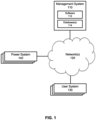
- FIG. 1 illustrates an example infrastructure in which one or more of the disclosed processes may be implemented, according to an embodiment.
- the infrastructure may comprise a management system 110 (e.g., comprising one or more servers) which hosts and/or executes one or more of the various functions, processes, methods, and/or software modules described herein.
- management system 110 include, without limitation, an EMS, DMS, ADMS, SCADA system, and the like.
- Management system 110 may comprise dedicated servers, or may instead be implemented in a computing cloud, in which the resources of one or more servers are dynamically and elastically allocated to multiple tenants based on demand. In either case, the servers may be collocated (e.g., in a single data center) and/or geographically distributed (e.g., across a plurality of data centers).
- Management system 110 may also comprise or be communicatively connected to software 112 and/or one or more databases 114. In addition, Management system 110 may be communicatively connected to one or more user systems 130 and/or power systems 140 (e.g., power grids) via one or more networks 120.
- power systems 140 e.g., power grids
- Network(s) 120 may comprise the Internet, and EMS 110 may communicate with user system(s) 130 and/or power system(s) 140 through the Internet using standard transmission protocols, such as HyperText Transfer Protocol (HTTP), HTTP Secure (HTTPS), File Transfer Protocol (FTP), FTP Secure (FTPS), Secure Shell FTP (SFTP), extensible Messaging and Presence Protocol (XMPP), Open Field Message Bus (OpenFMB), IEEE Smart Energy Profile Application Protocol (IEEE 2030.5), and the like, as well as proprietary protocols.
- HTTP HyperText Transfer Protocol
- HTTPS HTTP Secure
- FTP Secure File Transfer Protocol
- FTP Secure FTP Secure
- SFTP Secure Shell FTP
- XMPP extensible Messaging and Presence Protocol
- OpenFMB Open Field Message Bus
- IEEE 2030.5 IEEE Smart Energy Profile Application Protocol
- management system 110 may be connected to a subset of user systems 130 and/or power systems 140 via the Internet, but may be connected to one or more other user systems 130 and/or power systems 140 via an intranet.
- management system 110 may be connected to a subset of user systems 130 and/or power systems 140 via the Internet, but may be connected to one or more other user systems 130 and/or power systems 140 via an intranet.
- management system 110 may be connected to a subset of user systems 130 and/or power systems 140 via the Internet, but may be connected to one or more other user systems 130 and/or power systems 140 via an intranet.
- the infrastructure may comprise any number of user systems, power systems, software instances, and databases.
- User system(s) 130 may comprise any type or types of computing devices capable of wired and/or wireless communication, including without limitation, desktop computers, laptop computers, tablet computers, smart phones or other mobile phones, servers, game consoles, televisions, set-top boxes, electronic kiosks, point-of-sale terminals, embedded controllers, programmable logic controllers (PLCs), and/or the like. However, it is generally contemplated that user system(s) 130 would comprise personal computers, mobile devices, or workstations by which agents of an operator of a power system 140 can interact with management system 110.
- PLCs programmable logic controllers
- These interactions may comprise inputting data (e.g., parameters for configuring one or more of the processes described herein) and/or receiving data (e.g., the outputs of one or more processes described herein) via a graphical user interface provided by management system 110 or a system between management system 110 and user system(s) 130.
- data e.g., parameters for configuring one or more of the processes described herein
- receiving data e.g., the outputs of one or more processes described herein
- the graphical user interface may comprise screens (e.g., webpages) that include a combination of content and elements, such as text, images, videos, animations, references (e.g., hyperlinks), frames, inputs (e.g., textboxes, text areas, checkboxes, radio buttons, drop-down menus, buttons, forms, etc.), scripts (e.g., JavaScript), and the like, including elements comprising or derived from data stored in one or more databases (e.g., database(s) 114).
- screens e.g., webpages
- elements such as text, images, videos, animations, references (e.g., hyperlinks), frames, inputs (e.g., textboxes, text areas, checkboxes, radio buttons, drop-down menus, buttons, forms, etc.), scripts (e.g., JavaScript), and the like, including elements comprising or derived from data stored in one or more databases (e.g., database(s) 114).
- Management system 110 may execute software 112, comprising one or more software modules that implement one or more of the disclosed processes.
- management system 110 may comprise, be communicatively coupled with, or otherwise have access to one or more database(s) 114 that store the data input into and/or output from one or more of the disclosed processes.
- database(s) 114 Any suitable database may be utilized, including without limitation MySQL TM , Oracle TM , IBM TM , Microsoft SQL TM , Access TM , PostgreSQL TM , and the like, including cloud-based databases, proprietary databases, and unstructured databases.
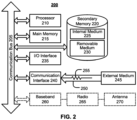
- FIG. 2 is a block diagram illustrating an example wired or wireless system 200 that may be used in connection with various embodiments described herein.
- system 200 may be used as or in conjunction with one or more of the functions, processes, or methods (e.g., to store and/or execute software 112) described herein, and may represent components of management system 110, user system(s) 130, power system(s) 140, and/or other processing devices described herein.
- System 200 can be a server or any conventional personal computer, or any other processor-enabled device that is capable of wired or wireless data communication. Other computer systems and/or architectures may be also used, as will be clear to those skilled in the art.
- System 200 preferably includes one or more processors 210.
- Processor(s) 210 may comprise a central processing unit (CPU). Additional processors may be provided, such as a graphics processing unit (GPU), an auxiliary processor to manage input/output, an auxiliary processor to perform floating-point mathematical operations, a special-purpose microprocessor having an architecture suitable for fast execution of signal-processing algorithms (e.g., digital-signal processor), a processor subordinate to the main processing system (e.g., back-end processor), an additional microprocessor or controller for dual or multiple processor systems, and/or a coprocessor. Such auxiliary processors may be discrete processors or may be integrated with processor 210.
- processors which may be used with system 200 include, without limitation, any of the processors (e.g., Pentium TM , Core i7 TM , Xeon TM , etc.) available from Intel Corporation of Santa Clara, California, any of the processors available from Advanced Micro Devices, Incorporated (AMD) of Santa Clara, California, any of the processors (e.g., A series, M series, etc.) available from Apple Inc. of Cupertino, any of the processors (e.g., Exynos TM ) available from Samsung Electronics Co., Ltd., of Seoul, South Korea, and/or the like.
- processors e.g., Pentium TM , Core i7 TM , Xeon TM , etc.
- AMD Advanced Micro Devices, Incorporated
- any of the processors e.g., A series, M series, etc.
- Apple Inc. Apple Inc. of Cupertino
- any of the processors e.g
- Communication bus 205 may include a data channel for facilitating information transfer between storage and other peripheral components of system 200. Furthermore, communication bus 205 may provide a set of signals used for communication with processor 210, including a data bus, address bus, and/or control bus (not shown). Communication bus 205 may comprise any standard or non-standard bus architecture such as, for example, bus architectures compliant with industry standard architecture (ISA), extended industry standard architecture (EISA), Micro Channel Architecture (MCA), peripheral component interconnect (PCI) local bus, standards promulgated by the Institute of Electrical and Electronics Engineers (IEEE) including IEEE 488 general-purpose interface bus (GPIB), IEEE 696/S-100, and/or the like.
- ISA industry standard architecture
- EISA extended industry standard architecture
- MCA Micro Channel Architecture
- PCI peripheral component interconnect
- System 200 preferably includes a main memory 215 and may also include a secondary memory 220.
- Main memory 215 provides storage of instructions and data for programs executing on processor 210, such as one or more of the functions and/or modules discussed herein (e.g., software 112). It should be understood that programs stored in the memory and executed by processor 210 may be written and/or compiled according to any suitable language, including without limitation C/C++, Java, JavaScript, Perl, Visual Basic, .NET, and the like.
- Main memory 215 is typically semiconductor-based memory such as dynamic random access memory (DRAM) and/or static random access memory (SRAM). Other semiconductor-based memory types include, for example, synchronous dynamic random access memory (SDRAM), Rambus dynamic random access memory (RDRAM), ferroelectric random access memory (FRAM), and the like, including read only memory (ROM).
- SDRAM synchronous dynamic random access memory
- RDRAM Rambus dynamic random access memory
- FRAM ferroelectric random access memory
- ROM read only memory
- Secondary memory 220 may optionally include an internal medium 225 and/or a removable medium 230.
- Removable medium 230 is read from and/or written to in any well-known manner.
- Removable storage medium 230 may be, for example, a magnetic tape drive, a compact disc (CD) drive, a digital versatile disc (DVD) drive, other optical drive, a flash memory drive, and/or the like.
- Secondary memory 220 is a non-transitory computer-readable medium having computer-executable code (e.g., software 112) and/or other data stored thereon. The computer software or data stored on secondary memory 220 is read into main memory 215 for execution by processor 210.
- secondary memory 220 may include other similar means for allowing computer programs or other data or instructions to be loaded into system 200. Such means may include, for example, a communication interface 240, which allows software and data to be transferred from external storage medium 245 to system 200. Examples of external storage medium 245 may include an external hard disk drive, an external optical drive, an external magneto-optical drive, and/or the like. Other examples of secondary memory 220 may include semiconductor-based memory, such as programmable read-only memory (PROM), erasable programmable read-only memory (EPROM), electrically erasable read-only memory (EEPROM), and flash memory (block-oriented memory similar to EEPROM).
- PROM programmable read-only memory
- EPROM erasable programmable read-only memory
- EEPROM electrically erasable read-only memory
- flash memory block-oriented memory similar to EEPROM
- system 200 may include a communication interface 240.
- Communication interface 240 allows software and data to be transferred between system 200 and external devices (e.g. printers), networks, or other information sources.
- external devices e.g. printers
- computer software or executable code may be transferred to system 200 from a network server (e.g., platform 110) via communication interface 240.
- Examples of communication interface 240 include a built-in network adapter, network interface card (NIC), Personal Computer Memory Card International Association (PCMCIA) network card, card bus network adapter, wireless network adapter, Universal Serial Bus (USB) network adapter, modem, a wireless data card, a communications port, an infrared interface, an IEEE 1394 fire-wire, and any other device capable of interfacing system 200 with a network (e.g., network(s) 120) or another computing device.
- NIC network interface card
- PCMCIA Personal Computer Memory Card International Association
- USB Universal Serial Bus
- Communication interface 240 preferably implements industry-promulgated protocol standards, such as Ethernet IEEE 802 standards, Fiber Channel, digital subscriber line (DSL), asynchronous digital subscriber line (ADSL), frame relay, asynchronous transfer mode (ATM), integrated digital services network (ISDN), personal communications services (PCS), transmission control protocol/Internet protocol (TCP/IP), serial line Internet protocol/point to point protocol (SLIP/PPP), and so on, but may also implement customized or non-standard interface protocols as well.
- industry-promulgated protocol standards such as Ethernet IEEE 802 standards, Fiber Channel, digital subscriber line (DSL), asynchronous digital subscriber line (ADSL), frame relay, asynchronous transfer mode (ATM), integrated digital services network (ISDN), personal communications services (PCS), transmission control protocol/Internet protocol (TCP/IP), serial line Internet protocol/point to point protocol (SLIP/PPP), and so on, but may also implement customized or non-standard interface protocols as well.
- Communication channel 250 may be a wired or wireless network (e.g., network(s) 120), or any variety of other communication links.
- Communication channel 250 carries signals 255 and can be implemented using a variety of wired or wireless communication means including wire or cable, fiber optics, conventional phone line, cellular phone link, wireless data communication link, radio frequency (“RF”) link, or infrared link, just to name a few.
- RF radio frequency
- Computer-executable code (e.g., computer programs, such as software 112) is stored in main memory 215 and/or secondary memory 220. Computer programs can also be received via communication interface 240 and stored in main memory 215 and/or secondary memory 220. Such computer programs, when executed, enable system 200 to perform the various functions of the disclosed embodiments as described elsewhere herein.
- computer-readable medium is used to refer to any non-transitory computer-readable storage media used to provide computer-executable code and/or other data to or within system 200.
- Examples of such media include main memory 215, secondary memory 220 (including internal memory 225 and/or removable medium 230), external storage medium 245, and any peripheral device communicatively coupled with communication interface 240 (including a network information server or other network device).
- These non-transitory computer-readable media are means for providing executable code, programming instructions, software, and/or other data to system 200.
- the software may be stored on a computer-readable medium and loaded into system 200 by way of removable medium 230, I/O interface 235, or communication interface 240.
- the software is loaded into system 200 in the form of electrical communication signals 255.
- the software when executed by processor 210, preferably causes processor 210 to perform one or more of the processes and functions described elsewhere herein.
- I/O interface 235 provides an interface between one or more components of system 200 and one or more input and/or output devices.
- Example input devices include, without limitation, sensors, keyboards, touch screens or other touch-sensitive devices, cameras, biometric sensing devices, computer mice, trackballs, pen-based pointing devices, and/or the like.
- Examples of output devices include, without limitation, other processing devices, cathode ray tubes (CRTs), plasma displays, light-emitting diode (LED) displays, liquid crystal displays (LCDs), printers, vacuum fluorescent displays (VFDs), surface-conduction electron-emitter displays (SEDs), field emission displays (FEDs), and/or the like.
- an input and output device may be combined, such as in the case of a touch panel display (e.g., in a smartphone, tablet, or other mobile device).
- System 200 may also include optional wireless communication components that facilitate wireless communication over a voice network and/or a data network (e.g., in the case of user system 130 that is a smart phone or other mobile device).
- the wireless communication components comprise an antenna system 270, a radio system 265, and a baseband system 260.
- RF radio frequency
- antenna system 270 may comprise one or more antennae and one or more multiplexors (not shown) that perform a switching function to provide antenna system 270 with transmit and receive signal paths.
- received RF signals can be coupled from a multiplexor to a low noise amplifier (not shown) that amplifies the received RF signal and sends the amplified signal to radio system 265.
- radio system 265 may comprise one or more radios that are configured to communicate over various frequencies.
- radio system 265 may combine a demodulator (not shown) and modulator (not shown) in one integrated circuit (IC). The demodulator and modulator can also be separate components. In the incoming path, the demodulator strips away the RF carrier signal leaving a baseband receive audio signal, which is sent from radio system 265 to baseband system 260.
- baseband system 260 decodes the signal and converts it to an analog signal. Then the signal is amplified and sent to a speaker. Baseband system 260 also receives analog audio signals from a microphone. These analog audio signals are converted to digital signals and encoded by baseband system 260. Baseband system 260 also encodes the digital signals for transmission and generates a baseband transmit audio signal that is routed to the modulator portion of radio system 265. The modulator mixes the baseband transmit audio signal with an RF carrier signal, generating an RF transmit signal that is routed to antenna system 270 and may pass through a power amplifier (not shown). The power amplifier amplifies the RF transmit signal and routes it to antenna system 270, where the signal is switched to the antenna port for transmission.
- the power amplifier amplifies the RF transmit signal and routes it to antenna system 270, where the signal is switched to the antenna port for transmission.
- Baseband system 260 is also communicatively coupled with processor(s) 210.
- Processor(s) 210 may have access to data storage areas 215 and 220.
- Processor(s) 210 are preferably configured to execute instructions (i.e., computer programs, such as the disclosed software) that can be stored in main memory 215 or secondary memory 220.
- Computer programs can also be received from baseband processor 260 and stored in main memory 210 or in secondary memory 220, or executed upon receipt. Such computer programs, when executed, enable system 200 to perform the various functions of the disclosed embodiments.
- FIG. 3 illustrates an example data flow between management system 110, a user system 130, and a power system 140, according to an embodiment.
- Power system 140 may comprise a monitoring module 310 and a control module 320.
- Software 112 of management system 110 may comprise a state estimation module 330, a control and optimization module 340, and a human-to-machine interface (HMI) 350.
- Database 114 of management system 110 may store a system model 360. It should be understood that communications between the various systems may be performed via network(s) 120. In addition, communications between a pair of modules may be performed via an application programming interface (API) provided by one of the modules.
- API application programming interface
- Monitoring module 310 may monitor and collect data that are output by one or more sensors in the network of power system 140. Monitoring module 310 may also derive data from the collected data. Monitoring module 310 may transmit or "push" the collected and/or derived data as system telemetry to state estimation module 330 (e.g., via an API of state estimation module 330). Alternatively, state estimation module 330 may retrieve or "pull" the system telemetry from monitoring module 310 (e.g., via an API of monitoring module 310). The system telemetry may include measurements at each of one or more nodes or other points within the network of power system 140. The system telemetry may be communicated from monitoring module 310 to state estimation module 330 in real time, as data is collected and/or derived, or periodically. As used herein, the term "real time" includes events that occur simultaneously, as well as events that occur contemporaneously, as dictated by ordinary delays resulting from latencies in processing, memory access, communications, and/or the like.
- State estimation module 330 receives the system telemetry from monitoring module 310 and uses the system telemetry in conjunction with system model 360 to generate an estimated state of power system 140.
- state estimation module 330 may implement one or more of the processes for state estimation, described herein, to set up an optimization problem based on the system telemetry and system model 360, and solve the optimization problem.
- State estimation module 330 may generate the estimated state of power system 140 in real time or periodically (e.g., whenever new system telemetry is received).
- the estimated state may comprise an estimated voltage magnitude and phase angle for each node within the network of power system 140.
- State estimation module 330 may send or "push" the estimated state of power system 140 to optimization and control module 340 (e.g., via an API of optimization and control module 340).
- optimization and control module 340 may retrieve or "pull" the estimated state of power system 140 from state estimation module 330 (e.g., via an API of state estimation module 330).
- the estimated state may be communicated from state estimation module 330 to optimization and control module 340 in real time, as the estimated state is generated, or periodically.
- Optimization and control module 340 receives the estimated state from state estimation module 330, and uses the estimated state in conjunction with system model 360 to determine an optimal configuration for one or more components of power system 140, and then control power system 140 to transition to the optimal configuration.
- optimization and control module 340 may generate control signals that are transmitted to control module 320 of power system 140.
- the control signals may be sent via an API of control module 320.
- the control signals may be communicated from optimization and control module 340 of management system 110 to control module 320 of power system 140 in real time, as the estimated states are received and analyzed, periodically, or in response to a user operation.
- Optimization and control module 340 may control power system 140 automatically (e.g., without any user intervention), semi-automatically (e.g., requiring user approval or confirmation), and/or in response to manual user inputs.
- Control module 320 of power system 140 receives the control signals from optimization and control module 340, and controls one or more components of power system 140 in accordance with the control signals. Examples of such control include, setting a setpoint (e.g., for real and/or reactive power for distributed energy resources), adjusting the power output of a power generator, adjusting the charging or discharging of a BES system, adjusting the power input to a load, closing or opening a switch (e.g., circuit breaker), and/or the like.
- setting a setpoint e.g., for real and/or reactive power for distributed energy resources
- adjusting the power output of a power generator adjusting the charging or discharging of a BES system
- adjusting the power input to a load closing or opening a switch (e.g., circuit breaker), and/or the like.
- Human-to-machine interface 350 may generate a graphical user interface that is transmitted to user system 130 and receive inputs to the graphical user interface via user system 130.
- the graphical user interface may provide information regarding the estimated state of power system 140 determined by state estimation module 330, an optimal configuration of power system 140 determined by optimization and control module 340, a control decision or recommendation determined by optimization and control module 340, a visual representation of system model 360, and/or the like.
- the graphical user interface may provide inputs that enable a user of user system 130 to configure settings of state estimation module 330, configure settings of optimization and control module 340, configure system model 360, specify or approve controls to be transmitted to control module 320 of power system 140, analyze power system 140, and/or the like.
- System model 360 may be stored in database 114 and accessed by modules, such as state estimation module 330 and optimization and control module 340, via any known means (e.g., via an API of database 114, a direct query of database 114, etc.).
- Database 114 may store a system model 360 for each power system 140 that is managed by management system 110.
- Each system model 360 models the network of power system 140 in any suitable manner.
- system model 360 may comprise a single-line diagram representing the components of the network and their relationships to each other. It should be understood that the single-line diagram may be implemented as a data structure that is capable of being automatically analyzed by software modules, including state estimation module 330 and optimization and control module 340.
- the estimated state, output by state estimation module 330 may be used as an input to any downstream function that may benefit from an estimated state of power system 140.
- These downstream functions may be implemented by optimization and control module 340, human-to-machine interface 350, and/or other modules within management system 110 or an external system.
- state estimation module 330 may send or "push" the estimated state of power system 140 to the other module (e.g., via an API of the implementing module or relayed through optimization and control module 340).
- the other module may retrieve or "pull" the estimated state of power system 140 from state estimation module 330 (e.g., via an API of state estimation module 330) or from optimization and control module 340 (e.g., via an API of optimization and control module 340).
- the estimated state may be communicated to the implementing module in real time, as the estimated state is generated, or periodically.
- the estimated state may be stored and, in response to a triggering event, displayed to a user within a graphical user interface of human-to-machine interface 350.
- the triggering event may be a user requesting the estimated state, the estimated state satisfying an alert condition, and/or the like.
- the user may be prompted via the graphical user interface or other means (e.g., a notification sent via email message, text message, voice message, etc.) to perform a preventative or corrective control operation (e.g., via an input of the graphical user interface, manually, etc.).
- the estimated state which may comprise voltage magnitudes and phase angles for each of the nodes in the network in power system 140, may be used to produce a baseline model for one or more downstream functions.
- a downstream function may utilize this baseline model to perform any type of analysis on power system 140, including optimal power flow, distributed energy resource (DER) management, contingency analysis, and/or the like.
- the analysis may be performed in response to a user operation, or automatically in real time or periodically. In some cases, the analysis may be provided to a user via human-to-machine interface 350. In other cases, optimization and control module 340 may, automatically (i.e., without user intervention) or semi-automatically (e.g., with user approval or confirmation), initiate a control operation based on the analysis. Initiation of the control operation may comprise transmitting control commands to control module 320 of power system 140, which may responsively control power system 140 according to the control commands.
- DER distributed energy resource
- the estimated state may be used by optimization and control module 340 as an input to contingency analysis.
- Contingency analysis may utilize the estimated state of power system 140in a baseline model (e.g., system model 360) of power system 140 to perform "what-if' analysis for various hypothetical scenarios (e.g., the failure of a component of power system 140).
- the estimated state e.g., voltage magnitude and phase angle
- the estimated state at each node may be used to calculate the power generation or consumption at that node for use in the contingency analysis.
- the contingency analysis may be executed in real time (e.g., as estimated states are output by state estimation module 330), periodically, and/or in response to a triggering event (e.g., user request, satisfaction of one or more monitored criteria, etc.).
- a triggering event e.g., user request, satisfaction of one or more monitored criteria, etc.
- a user may perform a preventative or corrective control operation (e.g., via an input of a graphical user interface of human-to-machine interface 350, manually, etc.).
- optimization and control module 340 may, automatically or semi-automatically, perform contingency analysis for one or more hypothetical scenarios, and when a problem is detected, initiate a preventative or corrective control operation via communication with control module 320 of power system 140.
- the estimated state may be used by optimization and control module 340 as an input to Volt-Var optimization.
- Volt-Var optimization may utilize the estimated state (e.g., voltage magnitudes and phase angles) and system model 360 (or other model) as a baseline to determine optimal voltage levels and reactive power to achieve efficient operation of power system 140 (e.g., by reducing system losses, peak demand, and/or energy consumption).
- the Volt-Var optimization may be executed in real time (e.g., as estimated states are output by state estimation module 330), periodically, and/or in response to a triggering event (e.g., user request, satisfaction of one or more monitored criteria, etc.).
- a triggering event e.g., user request, satisfaction of one or more monitored criteria, etc.
- Optimization and control module 340 may, automatically or semi-automatically, initiate a control operation via communication with control module 320 of power system 140 to conform power system 140 to the optimal voltage levels and reactive power, as determined by the Volt-Var optimization.
- the control operation may comprise controlling switchable capacitors, on-load tap-changers, and/or the like.
- the estimated state may be used by optimization and control module 340 as an input to optimal power flow.
- Optimal power flow may utilize the estimated state and system model 360 (or other model) as a baseline to manage power generation within power system 140.
- the optimal power flow may determine the optimal setpoints for power generators within power system 140, to meet the demand on power system 140, while minimizing operating costs and/or satisfying one or more other criteria.
- Optimal power flow may be executed in real time (e.g., as estimated states are output by state estimation module 330), periodically, and/or in response to a triggering event (e.g., user request, satisfaction of one or more monitored criteria, etc.).
- Optimization and control module 340 may, automatically or semi-automatically, initiate a control operation via communication with control module 320 of power system 140 to conform power system 140 to the setpoints determined by the optimal power flow.
- the estimated state may be used by optimization and control module 340 as an input to distributed energy resource (DER) management, which can be thought of as a species of optimal power flow.
- DER management may utilize the estimated state and system model 360 (or other model) to manage distributed energy resources within power system 140.
- the DER management may manage the setpoints for active and reactive power, power factor, and/or voltage at the points of interconnection with distributed energy resources or other nodes within the network.
- the DER management may be executed in real time (e.g., as estimated states are output by state estimation module 330), periodically, and/or in response to a triggering event (e.g., user request, satisfaction of one or more monitored criteria, etc.).
- Optimization and control module 340 may, automatically or semi-automatically, initiate a control operation via communication with control module 320 of power system 140 to conform power system 140 to the setpoints determined by the DER management.
- Embodiments of processes for state estimation for a power system, using parameterized potential functions for equality constraints, will now be described in detail. It should be understood that the described processes may be embodied in one or more software modules that are executed by one or more hardware processors, for example, as software 112 executed by processor(s) 210 of management system 110.
- the described processes may be implemented as instructions represented in source code, object code, and/or machine code. These instructions may be executed directly by hardware processor(s) 210, or alternatively, may be executed by a virtual machine or container operating between the object code and hardware processors 210.
- the disclosed software may be built upon or interfaced with one or more existing systems.
- the described processes may be implemented as a hardware component (e.g., general-purpose processor, integrated circuit (IC), application-specific integrated circuit (ASIC), digital signal processor (DSP), field-programmable gate array (FPGA) or other programmable logic device, discrete gate or transistor logic, etc.), combination of hardware components, or combination of hardware and software components.
- a hardware component e.g., general-purpose processor, integrated circuit (IC), application-specific integrated circuit (ASIC), digital signal processor (DSP), field-programmable gate array (FPGA) or other programmable logic device, discrete gate or transistor logic, etc.
- IC integrated circuit
- ASIC application-specific integrated circuit
- DSP digital signal processor
- FPGA field-programmable gate array
- the grouping of functions within a component, block, module, circuit, or step is for ease of description. Specific functions or steps can be moved from one component, block, module, circuit, or step to another without departing from the invention.
- each process may be implemented with fewer, more, or different subprocesses and a different arrangement and/or ordering of subprocesses.
- any subprocess which does not depend on the completion of another subprocess, may be executed before, after, or in parallel with that other independent subprocess, even if the subprocesses are described or illustrated in a particular order.
- the input x represents a state of the system being monitored and controlled, such as power system 140. In the case of a power system 140, the state may be defined as the voltage magnitude and phase angle at each node in the network.
- any equality constraint can be expressed in this manner, as well as other manners.
- it will be assumed that all equality constraints are expressed in the above form. However, it should be understood that, in an actual implementation, the equality constraint can be expressed in a different manner and either converted to the above form or used in its native form with appropriate modifications to other components of the SE problem.
- an "optimization problem” may comprise any problem of finding the best solution from all feasible solutions, and an "objective function” may be any function that is to be maximized or minimized.
- constrained refers to a problem in which the objective function is subject to a respective constraint
- unconstrained refers to a problem in which all respective constraints have been converted into an objective function.
- convex refers to any function in which the line segment between any two points on the graph of the function does not lie below the graph between the two points.
- the constrained optimization problem may also comprise inequality constraints.
- an inequality constraint will be expressed in the form: g x ⁇ 0 wherein g ( ⁇ ) is an inequality function that relates an input x to an output g ( x ) .
- g ( ⁇ ) is an inequality function that relates an input x to an output g ( x ) .
- any inequality constraint can be expressed in this manner, as well as other manners.
- it will be assumed that all inequality constraints are expressed in the above form.
- the inequality constraint can be expressed in a different manner and either converted to the above form or used in its native form with appropriate modifications to other components of the SE problem.
- the range [- ⁇ , ⁇ ] represents a feasible range of values for the equality function c(x).
- inequality constraint g ( x ) ⁇ 0 represents a range of possible values of a measurement corresponding to an input x .
- this range could be the capacity of a power generator (e.g., from zero to a maximum power output), the capacity of a BES system (e.g., based on the current charge level of the BES system), and/or the like.
- a tolerance may be allowed, such that the feasible range is represented by g ( x ) ⁇ ⁇ .
- the tolerance ⁇ may be the same or different for equality and inequality constraints.
- a parameterized potential function is used for each equality constraint.
- the term “parameterized” refers to the inclusion of an adjustable parameter within the potential function
- the term “potential” refers to the analogy between the unconstrained objective function and a generalized potential field (e.g., like a particle within a potential field is pulled towards a zero-force point).
- the parameterized potential function may be a quadratic function.
- Each parameterized potential function may be expressed as: w c x ⁇ u 2 wherein u is a center-of-attraction parameter that defines a "center of attraction" that, conceptually, acts like a spring to pull the output of the equality function c(x) towards zero.
- u is a center-of-attraction parameter that defines a "center of attraction” that, conceptually, acts like a spring to pull the output of the equality function c(x) towards zero.
- a value of c(x) violates its respective constraint when c ( x ) ⁇ - ⁇ or c ( x ) > ⁇ .
- a value of c(x) does not violate its respective constraint when - ⁇ ⁇ c(x) ⁇ ⁇ .
- the tolerance ⁇ is a practical consideration, since, in a numerical (computer) embodiment with finite precision, it may be impossible to satisfy the equality constraints exactly.
- the value of ⁇ may be set using any standard means.
- the SE problem becomes an unconstrained convex optimization problem UCP ( u ):
- f ( x ) may be the WLS problem: ⁇ l m w l z l ⁇ h l x 2 wherein z l represents the system telemetry at a point l , wherein h ( ⁇ ) is a measurement function that relates an input x to an output h ( x ), representing a predicted measurement given the input x, w l is a respective weight, and m represents the total number of points being measured in system model 360.
- f ( x ) encompasses any convex objective function to be minimized.
- FIG. 4 illustrates the operation of a virtual measurement that utilizes a center-of-attraction parameter u , according to an embodiment.
- the dotted lines in the figure represent gradients of the quadratic equality function c(x).
- each virtual measurement utilizes a center-of-attraction parameter u.
- the value of this center-of-attraction parameter u defines a location (i.e., a center of attraction) towards which c(x) is attracted, with the weight w representing the strength of attraction.
- the value of the center-of-attraction parameter u can be analogized as an anchor point to which one end of a spring is attached, with the other end of the spring attached to c(x), and weight w analogous to the Hook's constant of the spring.
- each center-of-attraction parameter u may be updated to "pull" the value of c(x) towards zero and eventually into the feasible range defined by the tolerance.
- the value of center-of-attraction parameter u may start at zero (i.e., u (0) ), and the problem UCP ( u (0) ) may be solved to convergence, resulting in c ( x (0) ).
- the value of center-of-attraction parameter u may be updated to u (1)
- the problem UCP ( u (1) ) may be solved to convergence, resulting in c ( x (1) ) .
- center-of-attraction parameter u may be updated to u (2) , and the problem UCP ( u (2) ) may be solved to convergence, resulting in c ( x (2) ) .
- This iterative process may continue until the value of c(x) is within the feasible range (i.e., zero with a tolerance ⁇ ).
- KKT Karush-Kuhn-Tucker
- ⁇ i ⁇ 2 w i u i
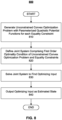
- FIG. 5 illustrates a solution process 500, according to an embodiment.
- Solution process 500 may be implemented by state estimation module 330 in software 112 of management system 110.
- an unconstrained convex optimization problem is prepared based on the equality constraints.
- a parameterized potential function may be generated for each equality constraint and summed with the objective function from the constrained optimization problem in a second objective function to be minimized.
- the values of the center-of-attraction parameters u i in all parameterized potential functions are determined.
- the value of the center-of-attraction parameter u i k for a current iteration k may be calculated based on a value of that center-of-attraction parameter u i k ⁇ 1 that was determined in an immediately preceding iteration k - 1.
- the value of a center-of-attraction parameter u i in a parameterized potential function may also be calculated based on a value of the equality function c i ( x ) in that same parameterized potential function. In other words, the value of the center-of-attraction parameter u may be adjusted based on the amount of violation.
- the unconstrained convex optimization problem min x P x u is solved by finding an input x that minimizes P ( x,u ), given the center-of-attraction parameters u determined in subprocess 520.
- the initial input x ( k ) ,ini in iteration k may be set to the final input x ( k- 1) ,fin that was output as the optimizing input (i.e., the input that minimizes the second objective function) from the immediately preceding iteration k - 1.
- the result of subprocess 530 and process 500 will be a final and optimizing input x ( k ), fin for the current iteration k of process 500.
- This final input x ( k ), fin represents an estimated state of power system 140.
- FIG. 6 illustrates an overall equality constraint (EC) algorithm 600 for solving a constrained optimization problem, comprising equality constraint(s), according to an embodiment.
- EC algorithm 600 may be implemented by state estimation module 330 in software 112 of management system 110.
- EC algorithm 600 operates to convert a constrained optimization problem, comprising an objective function to be minimized subject to one or more equality constraints, to an unconstrained convex optimization problem, and then solve the unconstrained convex optimization problem.
- EC algorithm 600 may iteratively execute solution process 500.
- the constrained optimization problem is acquired.
- This acquisition process may comprise retrieving a representation of the constrained optimization problem or retrieving representations of one or more components of the constrained optimization problem, such as the objective function to be minimized, and the equality functions of the equality constraint(s) to which the objective function is subject.
- Components of the constrained optimization problem may be stored in memory that persists over iterations of solution process 500, such that they can be easily accessed in each iteration of solution process 500, without having to be regenerated or redetermined in each iteration.
- the constrained optimization problem is converted to an unconstrained convex optimization problem with each of the equality constraint(s) represented as a parameterized potential function.
- u initial 0.
- Solution process 500 is performed to find an optimizing input x (0), fin that minimizes the unconstrained convex optimization problem. Over each subsequent iteration k of solution process 500, if any, the optimizing input x ( k- 1), fin found by the immediately preceding iteration k - 1 may be used as the initial input x ( k ), ini to the unconstrained convex optimization problem to be solved in iteration k of solution process 500 (i.e., in subprocess 530).
- Each center-of-attraction parameter u ( k ) in an iteration k of solution process 500 may be set, as discussed elsewhere herein, based on the value of the corresponding center-of-attraction parameter u ( k -1) in the immediately preceding iteration k - 1 of solution process 500, or initialized to u initial (e.g., zero) if there was no preceding iteration k - 1.
- the output of each iteration of solution process 500 will be a final input x ( k ), fin , representing the optimizing input, given the parameters of the unconstrained convex optimization problem in the current iteration k .
- subprocess 630 it is determined whether or not the most recently found input x ( k ), fin violates any of the equality constraint(s).
- an equality constraint is violated when the value of its equality function is not within a tolerance ⁇ of the constraint value (e.g., c ( x ) ⁇ - ⁇ or c(x) > ⁇ , if the constraint value is zero).
- an equality constraint is not violated when the value of its equality function is within a tolerance ⁇ of the constraint value (i.e., - ⁇ ⁇ c(x) ⁇ ⁇ , if the constraint value is zero).
- EC algorithm 600 proceeds to subprocess 640. Otherwise, if at least one equality constraint is violated (i.e., "Yes” in subprocess 630), algorithm executes another iteration of solution process 500.
- subprocess 640 once no equality constraints are violated (i.e., "No" in subprocess 630), the most recently found (i.e., last) optimizing input is output as the final estimated state of power system 140. This will be the input x ( k ), fin , output by the last iteration of solution process 500. It should be understood that this final estimated state of power system 140, output by subprocess 640, may be sent to optimization and control module 340, which may use the final estimated state to optimize a configuration of power system 140 and/or otherwise control power system 140.
- an iteration k is defined or delineated is arbitrary.
- the center-of-attraction parameters u i are determined, after solving the unconstrained convex optimization problem P ( k ) , for a future iteration k + 1.
- an iteration k can alternatively be delineated as including the determination of the center-of-attraction parameters u i prior to solving the unconstrained convex optimization problem P ( k ) , as illustrated in solution process 500.
- the particular delineation of the iterations k in any of the disclosed examples, should not be construed as limiting in any respect.
- FIG. 7 illustrates an overall inequality constraint (IC) algorithm 700 for solving a constrained optimization problem, comprising both equality constraint(s) and inequality constraint(s), according to an embodiment.
- IC algorithm 700 may be implemented by state estimation module 330 in software 112 of management system 110.
- IC algorithm 700 operates, over one or more iterations, to convert an IC-EC optimization problem, comprising an objective function to be minimized subject to one or more equality constraints and one or more inequality constraints, to an EC convex optimization problem (i.e., a problem that is subject to equality constraints, but not subject to any inequality constraints), and then solve the EC convex optimization problem using EC algorithm 600, which converts the EC convex optimization problem to a fully unconstrained convex optimization problem (i.e., a problem that is not subject to any inequality or equality constraints).
- the IC-EC optimization problem is acquired.
- This acquisition process may comprise retrieving a representation of the IC-EC optimization problem or retrieving representations of one or more components of the IC-EC optimization problem, such as the objective function to be minimized, the inequality functions of the inequality constraint(s) to which the objective function is subject, and the equality functions of the equality constraint(s) to which the objective function is subject.
- Components of the constrained optimization problem may be stored in memory that persists over iterations of the loop formed by EC algorithm 600 and subprocesses 730-750 of IC algorithm 700, such that they can be easily accessed in each iteration without having to be regenerated or redetermined in each iteration.
- a convex optimization problem is generated from the constrained optimization problem without any inequality constraints.
- the IC-EC optimization problem is converted into an EC-only optimization problem, without any representation of any inequality constraints. That is to say, no parameterized potential functions are included in the EC optimization problem for any inequality constraints.
- an initial iteration of EC algorithm 600 is executed to solve the EC optimization problem P EC noIC by converting the inequality-unconstrained optimization problem into a fully unconstrained optimization problem (e.g., in subprocess 510): P EC noIC : min x f x + ⁇ j n EC w j c j x ⁇ u j 2 subject to no equality and inequality constraints.
- P EC noIC is solved to convergence in order to find an input x ( noIC ), fin that minimizes P ( noIC ) (e.g., in subprocess 530).
- This input x ( noIC) , fin is output (e.g., in subprocess 640) as a potential solution to the optimization problem which may or may not satisfy the equality and inequality constraints.
- This solution process 500 may be performed iteratively, while updating each center-of-attraction parameter u i (e.g., in subprocess 520) until no equality constraints are violated (i.e., "No" in subprocess 630).
- subprocess 730 it is determined whether or not the most recently found input x violates any of the inequality constraint(s). It should be understood that, in the first iteration of subprocess 730, the most recently found input to be evaluated in subprocess 730 will be x ( noIC ), fin . In all subsequent iterations of subprocess 720, the most recently found input to be evaluated in subprocess 720 will be the final input x ( k -1), fin found by the most recent iteration k - 1 of EC algorithm 600. In an embodiment, an inequality constraint is violated when the value of its inequality function is not within a tolerance ⁇ of the feasible range (i.e., g ( x ) > ⁇ ).
- an inequality constraint is not violated when the value of its inequality function is within a tolerance ⁇ of the feasible range (i.e., g ( x ) ⁇ ⁇ ). If no inequality constraints are violated (i.e., "No" in subprocess 730), IC algorithm 700 proceeds to subprocess 760. Otherwise, if at least one inequality constraint is violated (i.e., "Yes” in subprocess 730), IC algorithm 700 executes an iteration of subprocess 740, followed by subprocess 750, followed by EC algorithm 600.
- an inequality-unconstrained or EC convex optimization problem is generated based on the set of inequality constraint(s) determined to have been violated in subprocess 730.
- a parameterized potential function may be generated for each inequality constraint in the set of violated inequality constraint(s) and summed with the objective function from the constrained optimization problem in a second objective function to be minimized.
- the parameterized potential function may be a quadratic function.
- this inequality-unconstrained convex optimization problem is still constrained by equality constraints.
- the values of the center-of-attraction parameters u j in all parameterized potential functions for violated inequality constraints are determined.
- the value of the center-of-attraction parameter u j k for a current iteration k may be calculated based on a value of that center-of-attraction parameter u j k ⁇ 1 that was determined in an immediately preceding iteration k - 1.
- the value of a center-of-attraction parameter u j in a parameterized potential function may also be calculated based on a value of the inequality function g j (x) in that same parameterized potential function. In other words, the value of the center-of-attraction parameter u may be adjusted based on the amount of violation.
- the EC convex optimization problem P EC has been defined in subprocesses 740 and 750, another iteration of EC algorithm 600 is executed.
- the EC optimization problem P ( noIC ) is used as the problem to be converted into a fully unconstrained optimization problem in the initial iteration of EC algorithm 600
- the EC optimization problem P EC k is used as the problem to be converted into a fully unconstrained optimization problem P ( k ) in each subsequent iteration k of EC algorithm 600.
- subprocess 760 once no inequality constraints are violated (i.e., "No" in subprocess 730), the most recently found (i.e., last) optimizing input is output as the final estimated state of power system 140.
- This may be the input x ( noIC ) ,fin , output by the initial iteration of EC algorithm 600, if no inequality violations were determined in the first, and therefore, only iteration of subprocess 730. Otherwise, this will be an input x ( k ), fin , output by the last iteration of EC algorithm 600.
- this final estimated state of power system 140, output by subprocess 760 may be sent to optimization and control module 340, which may use the final estimated state to optimize a configuration of power system 140 and/or otherwise control power system 140 as discussed elsewhere herein.
- EC algorithm 600 is utilized to solve the inequality-unconstrained or EC optimization problem, which is still subject to equality constraints.
- a different algorithm may be used to solve the EC optimization problem and/or convert the EC optimization problem to a fully unconstrained convex optimization problem.
- EC algorithm 600 in IC algorithm 700 could be replaced by any other suitable algorithm for solving an EC optimization problem.
- the set V IC k consists of all inequality constraints that have been determined to be violated in all prior iterations up to and including the current iteration k
- the set A ( k ) consists of any inequality constraints that are determined to be violated by the most recently found optimizing input.
- the initialization value u initial for each center-of-attraction parameter u is a predefined value, such as zero.
- an iteration k is defined or delineated is arbitrary.
- the sets V IC and A and the center-of-attraction parameters u j are determined, after solving the unconstrained convex optimization problem P EC k , for a future iteration k + 1.
- an iteration k can alternatively be delineated as including the determination of the sets V IC and A and the center-of-attraction parameters u j prior to solving the fully unconstrained convex optimization problem P EC k , as illustrated in EC algorithm 600.
- the particular delineation of the iterations k in any of the disclosed examples, should not be construed as limiting in any respect.
- EC algorithm 600 executes an inner loop of iterations, which are also referred to herein as iterations k, and which are distinct from the outer iterations k executed by IC algorithm 700.
- FIG. 8 illustrates an EC algorithm 800 for solving a constrained optimization problem, comprising equality constraint(s), according to an alternative embodiment.
- EC algorithm 800 may be implemented by state estimation module 330 in software 112 of management system 110.
- an unconstrained parametric convex optimization problem is generated based on the equality constraints, thereby converting the constrained optimization problem into an unconstrained convex optimization problem.
- a parameterized potential function e.g., quadratic function
- quadratic function may be generated for each equality constraint and summed with the objective function from the constrained optimization problem in a second objective function to be minimized.
- the solution to the parametric problem P UC ( u ) is x ( u ) , which is parametric on u and must also satisfy the equality constraints.
- a joint system of equations is defined.
- this joint system of equations is solved to find an optimizing input x .
- the solution may be found using any root-finding algorithm, such as Newton's method, also known as the Newton-Raphson method, to yield a solution that satisfies the KKT condition of the constrained optimization problem.
- Newton's method an initial guess of input x ini is made, the function is approximated by its tangent line, and the x-intercept of this tangent line is computed, which will generally be a better approximation of the original function's root than x ini . This process may be repeated with the computed x-intercept of the prior iteration as the new guess in each new iteration, until the solution converges to within a tolerance.
- subprocess 840 the solution from subprocess 830 is output.
- the solution may be output as an estimated state to optimization and control module 340.
- Optimization and control module 340 may then utilize the estimated state to optimize and/or control power system 140, as described elsewhere herein.
- the unconstrained SE problem generated in subprocess 810, can be expressed as: min x z ⁇ h x T W h z ⁇ h x + u ⁇ c x T W c u ⁇ c x min x z u ⁇ h x c x T W h W c z u ⁇ h x c x
- the upper left corner of the submatrix is H T W h H + C T W c C, which differs from H T W h H in the Hachtel's matrix in the Lagrange method, and results in a better-conditioned gain matrix.
- state estimation module 330 of a management system 110 is used to estimate the state of a system, such as power system 140, using algorithms 600 and/or 700.
- state estimation module 330 may receive system telemetry from a monitoring module 310 of the system, and use the system telemetry and system model 360 (e.g., retrieved from database 114) to define an optimization problem, subject to equality constraints, and optionally inequality constraints, as an unconstrained convex optimization problem.
- the optimization problem is formed as an unconstrained optimization problem by generating a parameterized potential function w ( c ( x ) - u ) 2 for each of the equality constraints.
- the unconstrained optimization problem may also include a parameterized potential function w ( g ( x ) - u ) 2 for each of the inequality constraints.
- w g ( x ) - u
- the use of the parameterized potential functions, representing virtual measurements shapes the potential field of the resulting unconstrained optimization problem, such that its stationary stationarity condition is identical to the KKT condition of the constrained optimization problem.
- the resulting unconstrained optimization problem may be iteratively prepared, using successively updated values for the center-of-attraction parameters u corresponding to the constraints, and solved, until no constraints are violated (i.e., all constraints are satisfied within a tolerance), to produce a final estimated state.
- the final estimated state may be output to an optimization and control module 340 of management system 110, which may input the final estimated state into one or more downstream functions, such as the generation of a graphical user interface, contingency analysis, power flow analysis (e.g., dispatcher or optimal power flow analysis), Volt-Var optimization, DER management, and/or the like.
- one or more of these downstream functions may, automatically (e.g., without user intervention) or semi-automatically (e.g., after user approval or confirmation), issue control commands to a control module 320 of the system, to thereby control the system.
- the state estimation may be used to monitor and control a system, such as a power system 140. For example, if the voltage at a measured point is too low, a corresponding power generator in power system 140 may be controlled to increase its reactive power output to increase the voltage at that measured point.
- the disclosed algorithms 600 and 700 are robust and easy to implement, and provide fast convergence.
- the weights w in the parameterized potential functions and/or the objective function f ( x ) may be adaptively adjusted based on the rate of convergence.
- the disclosed algorithms 600 and 700 could be used in other applications.
- One such application is training a machine-learning model, such as a neural network, and particularly a physics-informed neural network (PINN).
- PINN physics-informed neural network
- Combinations, described herein, such as “at least one of A, B, or C,” “one or more of A, B, or C,” “at least one of A, B, and C,” “one or more of A, B, and C,” and "A, B, C, or any combination thereof' include any combination of A, B, and/or C, and may include multiples of A, multiples of B, or multiples of C.
- combinations such as “at least one of A, B, or C,” “one or more of A, B, or C,” “at least one of A, B, and C,” “one or more of A, B, and C,” and "A, B, C, or any combination thereof' may be A only, B only, C only, A and B, A and C, B and C, or A and B and C, and any such combination may contain one or more members of its constituents A, B, and/or C.
- a combination of A and B may comprise one A and multiple B's, multiple A's and one B, or multiple A's and multiple B's.
Landscapes
- Engineering & Computer Science (AREA)
- Physics & Mathematics (AREA)
- General Physics & Mathematics (AREA)
- Mathematical Physics (AREA)
- Data Mining & Analysis (AREA)
- Computational Mathematics (AREA)
- Mathematical Analysis (AREA)
- Mathematical Optimization (AREA)
- Theoretical Computer Science (AREA)
- Pure & Applied Mathematics (AREA)
- Power Engineering (AREA)
- Algebra (AREA)
- Operations Research (AREA)
- Databases & Information Systems (AREA)
- Software Systems (AREA)
- General Engineering & Computer Science (AREA)
- Automation & Control Theory (AREA)
- Supply And Distribution Of Alternating Current (AREA)
Abstract
Prior methods of state estimation, based on a constrained optimization problem with equality and/or inequality constraints, rely on penalty-based heuristics which can produce very large weight values, resulting in ill-conditioning of the gain matrix. Disclosed embodiments of state estimation convert the constrained optimization problem into an unconstrained convex optimization problem in which violated equality and/or inequality constraints are represented as parameterized potential functions, each comprising a center-of-attraction parameter. This unconstrained convex optimization problem can be iteratively formed, using successively updated values for the center-of-attraction parameters, and solved, until no equality and/or inequality constraints are violated, to produce a final estimated state. This final estimated state may then be used to control the system being monitored, such as a power system.
Description
- The embodiments described herein are generally directed to state estimation, and, more particularly, to state estimation for a power system using parameterized potential functions for equality constraints, and optionally, for inequality constraints as well.
- State estimation (SE) is used in management systems to estimate the most likely state of a network of a power system (e.g., power grid) from a sparely redundant set of measurements of nodal and branch quantities (e.g., nodal voltage phasors, power injections, and branch power flows). State estimation is necessary for complex systems in which the state cannot be directly observed and/or measurements of the state are prone to noise or corruption. The state of each node in the network of a power system may be defined, for example, by a nodal voltage magnitude and a nodal phase angle. Examples of management systems that utilize state estimation include, without limitation, a supervisory control and data acquisition (SCADA) system, an energy management system (EMS), a distribution management system (DMS), advanced DMS (ADMS), and the like.
- Conventionally, state estimation is solved either as an unconstrained non-linear weighted least squares (WLS) problem or as an equality-constrained non-linear WLS problem, to avoid numerical ill-conditioning for nodes (e.g., buses) with zero power injection. In these cases, the solution does not enforce feasibility constraints on the power injection. For instance, a distributed energy resource (DER) with a maximum output of 10 kilowatts (KW) may be estimated, in the solution, to produce 12 KW. Such conditions may occur in state estimation for both transmission and distribution systems, but are more likely to occur in state estimation for distribution systems due to lower telemetry redundancy and lower data quality. Thus, management systems would benefit from state estimation that constrains nodal metrics (e.g., power output) to feasible values.
- Accordingly, systems, methods, and non-transitory computer-readable media are disclosed for state estimation for a power system, using parameterized potential functions (e.g., quadratic functions) for at least equality constraints. An objective of embodiments is to constrain the solution to an SE problem to feasible values for nodal metrics by satisfying all equality constraints within a tolerance. A further objective of embodiments is to estimate a state for a system, such as a power system, that can be used to optimize and control the system.
- In an embodiment of a method of state estimation for a power system, the method comprises using at least one hardware processor to: acquire a constrained optimization problem comprising a convex first objective function to be minimized subject to one or more equality constraints; convert the constrained optimization problem into an unconstrained convex optimization problem comprising a second objective function that is a sum of the first objective function and a parameterized potential function for each of at least one of the one or more equality constraints, wherein each parameterized potential function is defined by an equality function and a center-of-attraction parameter; and perform a solution process comprising solving the unconstrained convex optimization problem by finding an input to the unconstrained convex optimization problem that minimizes an output of the unconstrained convex optimization problem, wherein one or more center-of-attraction parameters are updated when solving the unconstrained convex optimization problem to ensure that the input satisfies the one or more equality constraints within a tolerance, and wherein the input represents an estimated state of the power system. The method may further comprise using the at least one hardware processor to control the power system based on the estimated state. The method may further comprise providing the estimated state of the power system through a human-to-machine interface of an energy management system. The method may further comprise using the estimated state in one or more of a contingency analysis, a Volt-Var optimization, or optimal power flow, such as distributed energy resource management. The first objective function may comprise an error calculation in which a value of a measurement function, given the input, is subtracted from a value of a system telemetry.
- Each parametric potential function may be defined as:


- The method may further comprise using the at least one hardware processor to perform a first process comprising: performing an initial iteration of the solution process to find an initial optimizing input, wherein the initial iteration of the solution process further comprises initializing a value of each center-of-attraction parameter in each parameterized potential function in the unconstrained convex optimization problem; determining whether or not the one or more equality constraints are violated by the initial optimizing input; when determining that the one or more equality constraints are not violated, outputting the initial optimizing input as an output estimated state of the power system; and when determining that at least one of the one or more equality constraints is violated, until the one or more equality constraints are not violated, over one or more subsequent iterations, performing the solution process, wherein the subsequent iteration of the solution process further comprises updating the value of each center-of-attraction parameter in each parameterized potential function corresponding to the one or more equality constraints, prior to solving the unconstrained convex optimization problem, and outputting the input found by the solution process in a final one of the one or more subsequent iterations as the output estimated state of the power system. The method may further comprise using the at least one hardware processor to control the power system based on the output estimated state. In an embodiment, the one or more equality constraints are determined to be violated when at least one of the one or more equality constraints is outside of the tolerance, and wherein the one or more equality constraints are determined not to be violated when all of the one or more equality constraints are within the tolerance. In the initial iteration and each of the one or more subsequent iterations, the unconstrained convex optimization problem may comprise a parameterized potential function for all of the one or more equality constraints. In each of the one or more subsequent iterations, an initial input used in solving the unconstrained convex optimization problem in the solution process of the subsequent iteration may be the input found by the solution process in an immediately preceding iteration.
- In each of the one or more subsequent iterations, updating the value of each center-of-attraction parameter may comprise calculating the value of each center-of-attraction parameter based on a prior value of that center-of-attraction parameter in an immediately preceding iteration. In each of the one or more subsequent iterations, updating the value of each center-of-attraction parameter may comprise calculating the value of each center-of-attraction parameter further based on a value of the equality function for a corresponding one of the one or more equality constraints given the input found by the solution process in an immediately preceding iteration. The value of each center-of-attraction parameter in a subsequent iteration k may be calculated as follows:

- The constrained convex optimization problem may further comprise one or more inequality constraints, and the method may further comprise using the at least one hardware processor to: perform the first process, while ignoring the one or more inequality constraints, to find the output estimated state as a first initial optimizing input; determine whether or not the one or more inequality constraints are violated by the first initial optimizing input; when determining that the one or more inequality constraints are not violated, use the first initial optimizing input as a final estimated state of the power system; when determining that at least one of the one or more inequality constraints is violated, until the one or more inequality constraints are not violated, over one or more outer iterations, convert the constrained optimization problem into an inequality-unconstrained convex optimization problem comprising the first objective function and an inequality parameterized potential function for each of at least one of the one or more inequality constraints, wherein each inequality parameterized potential function is defined by an inequality function and a center-of-attraction parameter, determine a value of each center-of-attraction parameter in each inequality parameterized potential function in the inequality-unconstrained convex optimization problem, and perform the first process using the inequality-unconstrained convex optimization problem as the constrained optimization problem in the first process, and output the input found by the first process in a final one of the one or more outer iterations as the final estimated state of the power system. In each of the one or more outer iterations, an inequality parameterized potential function may be added to the inequality-unconstrained convex optimization problem for each of the one or more inequality constraints that are violated and none of the one or more inequality constraints that have not been violated. For an inequality constraint expressed as g(x) ≤ 0, each inequality parameterized potential function component may be defined as:

- In an embodiment of a method of state estimation for a power system, the method comprises using at least one hardware processor to: acquire a constrained convex optimization problem comprising a first objective function to be minimized subject to one or more equality constraints; convert the constrained convex optimization problem into an unconstrained convex optimization problem comprising a second the objective function that is a sum of the first objective function and a parameterized potential function for each of the one or more equality constraints, wherein each parameterized potential function is defined by an equality function and a center-of-attraction parameter; define a joint system of equations comprising a first order optimality condition of the unconstrained convex optimization problem and the one or more equality constraints with associated weighting; and determine an estimated state of the power system by solving the joint system of equations using a root-finding algorithm. The method may further comprise using the at least one hardware processor to control the power system based on the estimated state.
- It should be understood that any of the features in the methods above may be implemented individually or with any subset of the other features in any combination. Thus, to the extent that the appended claims would suggest particular dependencies between features, disclosed embodiments are not limited to these particular dependencies. Rather, any of the features described herein may be combined with any other feature described herein, or implemented without any one or more other features described herein, in any combination of features whatsoever. In addition, any of the methods, described above and elsewhere herein, may be embodied, individually or in any combination, in executable software modules of a processor-based system, such as a server, and/or in executable instructions stored in a non-transitory computer-readable medium.
- The details of the present invention, both as to its structure and operation, may be gleaned in part by study of the accompanying drawings, in which like reference numerals refer to like parts, and in which:
-
FIG. 1 illustrates an example infrastructure, in which one or more of the processes described herein, may be implemented, according to an embodiment; -
FIG. 2 illustrates an example processing system, by which one or more of the processes described herein, may be executed, according to an embodiment; -
FIG. 3 illustrates an example data flow between systems and software modules within the example infrastructure, according to an embodiment; -
FIG. 4 illustrates the operation of a virtual measurement that utilizes a center-of-attraction parameter, according to an embodiment; -
FIG. 5 illustrates a solution process, according to an embodiment; -
FIG. 6 illustrates an overall algorithm for solving a constrained optimization problem, according to an embodiment; -
FIG. 7 illustrates an overall algorithm for solving a constrained optimization problem, comprising both equality constraint(s) and inequality constraint(s), according to an embodiment; and -
FIG. 8 illustrates an algorithm for solving a constrained optimization problem, comprising equality constraints, according to an embodiment. - In an embodiment, systems, methods, and non-transitory computer-readable media are disclosed for state estimation for a power system, using parameterized potential functions for equality constraints, and potentially, for inequality constraints as well. It is generally contemplated that the state estimation will be performed for a power system, such as a power grid (e.g., at any scale, from a large-scale utility grid to a microgrid or smaller). A power system may be any network of electrical components (e.g., power system equipment) configured to generate, store, supply, transmit, distribute, and/or consume electrical power, including, without limitation, power stations configured to produce electricity from combustible fuels (e.g., coal, natural gas, etc.) and/or renewable resources (e.g., wind, solar, nuclear, etc.), transmission systems configured to carry or transmit electricity from sources (e.g., generators) to loads, and distribution systems configured to feed supplied electricity to nearby homes, businesses, and/or other establishments. However, the disclosed approach is not limited to power systems. Rather, the disclosed approach may be applied to any system whose state is estimated using a WLS problem with one or more equality constraints.
- As used herein, the term "network" refers to the interconnection of components within a system whose state is to be estimated. In the case of a power system, these components will generally include electrical components, such as power generators, distributed energy resources (e.g., renewable energy sources, battery energy storage (BES) systems, etc.), loads, transformers, transmission and distribution lines, and/or the like. It should be understood that other types of systems may be similarly represented as a network.
- As used herein, the term "node" or "bus" generally refers to any point in the network at which a state is to be estimated when solving the SE problem. In the case of a power system, the state of each node may be defined as a voltage magnitude and phase angle at the node. However, the state of a node in a power system could be defined in other manners. It should be understood that the states of nodes in other types of systems will be defined in a manner that is appropriate for that type of system.
- After reading this description, it will become apparent to one skilled in the art how to implement the invention in various alternative embodiments and alternative applications. However, although various embodiments of the present invention will be described herein, it is understood that these embodiments are presented by way of example and illustration only, and not limitation. As such, this detailed description of various embodiments should not be construed to limit the scope or breadth of the present invention as set forth in the appended claims.
-
FIG. 1 illustrates an example infrastructure in which one or more of the disclosed processes may be implemented, according to an embodiment. The infrastructure may comprise a management system 110 (e.g., comprising one or more servers) which hosts and/or executes one or more of the various functions, processes, methods, and/or software modules described herein. Examples ofmanagement system 110 include, without limitation, an EMS, DMS, ADMS, SCADA system, and the like.Management system 110 may comprise dedicated servers, or may instead be implemented in a computing cloud, in which the resources of one or more servers are dynamically and elastically allocated to multiple tenants based on demand. In either case, the servers may be collocated (e.g., in a single data center) and/or geographically distributed (e.g., across a plurality of data centers).Management system 110 may also comprise or be communicatively connected tosoftware 112 and/or one ormore databases 114. In addition,Management system 110 may be communicatively connected to one or more user systems 130 and/or power systems 140 (e.g., power grids) via one ormore networks 120. - Network(s) 120 may comprise the Internet, and
EMS 110 may communicate with user system(s) 130 and/or power system(s) 140 through the Internet using standard transmission protocols, such as HyperText Transfer Protocol (HTTP), HTTP Secure (HTTPS), File Transfer Protocol (FTP), FTP Secure (FTPS), Secure Shell FTP (SFTP), extensible Messaging and Presence Protocol (XMPP), Open Field Message Bus (OpenFMB), IEEE Smart Energy Profile Application Protocol (IEEE 2030.5), and the like, as well as proprietary protocols. Whilemanagement system 110 is illustrated as being connected to various systems through a single set of network(s) 120, it should be understood thatmanagement system 110 may be connected to the various systems via different sets of one or more networks. For example,management system 110 may be connected to a subset of user systems 130 and/orpower systems 140 via the Internet, but may be connected to one or more other user systems 130 and/orpower systems 140 via an intranet. Furthermore, while only a few user systems 130 andpower systems 140, one instance ofsoftware 112, and one set of database(s) 114 are illustrated, it should be understood that the infrastructure may comprise any number of user systems, power systems, software instances, and databases. - User system(s) 130 may comprise any type or types of computing devices capable of wired and/or wireless communication, including without limitation, desktop computers, laptop computers, tablet computers, smart phones or other mobile phones, servers, game consoles, televisions, set-top boxes, electronic kiosks, point-of-sale terminals, embedded controllers, programmable logic controllers (PLCs), and/or the like. However, it is generally contemplated that user system(s) 130 would comprise personal computers, mobile devices, or workstations by which agents of an operator of a
power system 140 can interact withmanagement system 110. These interactions may comprise inputting data (e.g., parameters for configuring one or more of the processes described herein) and/or receiving data (e.g., the outputs of one or more processes described herein) via a graphical user interface provided bymanagement system 110 or a system betweenmanagement system 110 and user system(s) 130. The graphical user interface may comprise screens (e.g., webpages) that include a combination of content and elements, such as text, images, videos, animations, references (e.g., hyperlinks), frames, inputs (e.g., textboxes, text areas, checkboxes, radio buttons, drop-down menus, buttons, forms, etc.), scripts (e.g., JavaScript), and the like, including elements comprising or derived from data stored in one or more databases (e.g., database(s) 114). -
Management system 110 may executesoftware 112, comprising one or more software modules that implement one or more of the disclosed processes. In addition,management system 110 may comprise, be communicatively coupled with, or otherwise have access to one or more database(s) 114 that store the data input into and/or output from one or more of the disclosed processes. Any suitable database may be utilized, including without limitation MySQL™, Oracle™, IBM™, Microsoft SQL™, Access™, PostgreSQL™, and the like, including cloud-based databases, proprietary databases, and unstructured databases. -
FIG. 2 is a block diagram illustrating an example wired orwireless system 200 that may be used in connection with various embodiments described herein. For example,system 200 may be used as or in conjunction with one or more of the functions, processes, or methods (e.g., to store and/or execute software 112) described herein, and may represent components ofmanagement system 110, user system(s) 130, power system(s) 140, and/or other processing devices described herein.System 200 can be a server or any conventional personal computer, or any other processor-enabled device that is capable of wired or wireless data communication. Other computer systems and/or architectures may be also used, as will be clear to those skilled in the art. -
System 200 preferably includes one ormore processors 210. Processor(s) 210 may comprise a central processing unit (CPU). Additional processors may be provided, such as a graphics processing unit (GPU), an auxiliary processor to manage input/output, an auxiliary processor to perform floating-point mathematical operations, a special-purpose microprocessor having an architecture suitable for fast execution of signal-processing algorithms (e.g., digital-signal processor), a processor subordinate to the main processing system (e.g., back-end processor), an additional microprocessor or controller for dual or multiple processor systems, and/or a coprocessor. Such auxiliary processors may be discrete processors or may be integrated withprocessor 210. Examples of processors which may be used withsystem 200 include, without limitation, any of the processors (e.g., Pentium™, Core i7™, Xeon™, etc.) available from Intel Corporation of Santa Clara, California, any of the processors available from Advanced Micro Devices, Incorporated (AMD) of Santa Clara, California, any of the processors (e.g., A series, M series, etc.) available from Apple Inc. of Cupertino, any of the processors (e.g., Exynos™) available from Samsung Electronics Co., Ltd., of Seoul, South Korea, and/or the like. -
Processor 210 is preferably connected to a communication bus 205. Communication bus 205 may include a data channel for facilitating information transfer between storage and other peripheral components ofsystem 200. Furthermore, communication bus 205 may provide a set of signals used for communication withprocessor 210, including a data bus, address bus, and/or control bus (not shown). Communication bus 205 may comprise any standard or non-standard bus architecture such as, for example, bus architectures compliant with industry standard architecture (ISA), extended industry standard architecture (EISA), Micro Channel Architecture (MCA), peripheral component interconnect (PCI) local bus, standards promulgated by the Institute of Electrical and Electronics Engineers (IEEE) including IEEE 488 general-purpose interface bus (GPIB), IEEE 696/S-100, and/or the like. -
System 200 preferably includes amain memory 215 and may also include a secondary memory 220.Main memory 215 provides storage of instructions and data for programs executing onprocessor 210, such as one or more of the functions and/or modules discussed herein (e.g., software 112). It should be understood that programs stored in the memory and executed byprocessor 210 may be written and/or compiled according to any suitable language, including without limitation C/C++, Java, JavaScript, Perl, Visual Basic, .NET, and the like.Main memory 215 is typically semiconductor-based memory such as dynamic random access memory (DRAM) and/or static random access memory (SRAM). Other semiconductor-based memory types include, for example, synchronous dynamic random access memory (SDRAM), Rambus dynamic random access memory (RDRAM), ferroelectric random access memory (FRAM), and the like, including read only memory (ROM). - Secondary memory 220 may optionally include an
internal medium 225 and/or aremovable medium 230.Removable medium 230 is read from and/or written to in any well-known manner.Removable storage medium 230 may be, for example, a magnetic tape drive, a compact disc (CD) drive, a digital versatile disc (DVD) drive, other optical drive, a flash memory drive, and/or the like. Secondary memory 220 is a non-transitory computer-readable medium having computer-executable code (e.g., software 112) and/or other data stored thereon. The computer software or data stored on secondary memory 220 is read intomain memory 215 for execution byprocessor 210. - In alternative embodiments, secondary memory 220 may include other similar means for allowing computer programs or other data or instructions to be loaded into
system 200. Such means may include, for example, acommunication interface 240, which allows software and data to be transferred fromexternal storage medium 245 tosystem 200. Examples ofexternal storage medium 245 may include an external hard disk drive, an external optical drive, an external magneto-optical drive, and/or the like. Other examples of secondary memory 220 may include semiconductor-based memory, such as programmable read-only memory (PROM), erasable programmable read-only memory (EPROM), electrically erasable read-only memory (EEPROM), and flash memory (block-oriented memory similar to EEPROM). - As mentioned above,
system 200 may include acommunication interface 240.Communication interface 240 allows software and data to be transferred betweensystem 200 and external devices (e.g. printers), networks, or other information sources. For example, computer software or executable code may be transferred tosystem 200 from a network server (e.g., platform 110) viacommunication interface 240. Examples ofcommunication interface 240 include a built-in network adapter, network interface card (NIC), Personal Computer Memory Card International Association (PCMCIA) network card, card bus network adapter, wireless network adapter, Universal Serial Bus (USB) network adapter, modem, a wireless data card, a communications port, an infrared interface, an IEEE 1394 fire-wire, and any other device capable of interfacingsystem 200 with a network (e.g., network(s) 120) or another computing device.Communication interface 240 preferably implements industry-promulgated protocol standards, such as Ethernet IEEE 802 standards, Fiber Channel, digital subscriber line (DSL), asynchronous digital subscriber line (ADSL), frame relay, asynchronous transfer mode (ATM), integrated digital services network (ISDN), personal communications services (PCS), transmission control protocol/Internet protocol (TCP/IP), serial line Internet protocol/point to point protocol (SLIP/PPP), and so on, but may also implement customized or non-standard interface protocols as well. - Software and data transferred via
communication interface 240 are generally in the form of electrical communication signals 255. Thesesignals 255 may be provided tocommunication interface 240 via acommunication channel 250. In an embodiment,communication channel 250 may be a wired or wireless network (e.g., network(s) 120), or any variety of other communication links.Communication channel 250 carriessignals 255 and can be implemented using a variety of wired or wireless communication means including wire or cable, fiber optics, conventional phone line, cellular phone link, wireless data communication link, radio frequency ("RF") link, or infrared link, just to name a few. - Computer-executable code (e.g., computer programs, such as software 112) is stored in
main memory 215 and/or secondary memory 220. Computer programs can also be received viacommunication interface 240 and stored inmain memory 215 and/or secondary memory 220. Such computer programs, when executed, enablesystem 200 to perform the various functions of the disclosed embodiments as described elsewhere herein. - In this description, the term "computer-readable medium" is used to refer to any non-transitory computer-readable storage media used to provide computer-executable code and/or other data to or within
system 200. Examples of such media includemain memory 215, secondary memory 220 (includinginternal memory 225 and/or removable medium 230),external storage medium 245, and any peripheral device communicatively coupled with communication interface 240 (including a network information server or other network device). These non-transitory computer-readable media are means for providing executable code, programming instructions, software, and/or other data tosystem 200. - In an embodiment that is implemented using software, the software may be stored on a computer-readable medium and loaded into
system 200 by way ofremovable medium 230, I/O interface 235, orcommunication interface 240. In such an embodiment, the software is loaded intosystem 200 in the form of electrical communication signals 255. The software, when executed byprocessor 210, preferably causesprocessor 210 to perform one or more of the processes and functions described elsewhere herein. - In an embodiment, I/
O interface 235 provides an interface between one or more components ofsystem 200 and one or more input and/or output devices. Example input devices include, without limitation, sensors, keyboards, touch screens or other touch-sensitive devices, cameras, biometric sensing devices, computer mice, trackballs, pen-based pointing devices, and/or the like. Examples of output devices include, without limitation, other processing devices, cathode ray tubes (CRTs), plasma displays, light-emitting diode (LED) displays, liquid crystal displays (LCDs), printers, vacuum fluorescent displays (VFDs), surface-conduction electron-emitter displays (SEDs), field emission displays (FEDs), and/or the like. In some cases, an input and output device may be combined, such as in the case of a touch panel display (e.g., in a smartphone, tablet, or other mobile device). -
System 200 may also include optional wireless communication components that facilitate wireless communication over a voice network and/or a data network (e.g., in the case of user system 130 that is a smart phone or other mobile device). The wireless communication components comprise anantenna system 270, aradio system 265, and abaseband system 260. Insystem 200, radio frequency (RF) signals are transmitted and received over the air byantenna system 270 under the management ofradio system 265. - In an embodiment,
antenna system 270 may comprise one or more antennae and one or more multiplexors (not shown) that perform a switching function to provideantenna system 270 with transmit and receive signal paths. In the receive path, received RF signals can be coupled from a multiplexor to a low noise amplifier (not shown) that amplifies the received RF signal and sends the amplified signal toradio system 265. - In an alternative embodiment,
radio system 265 may comprise one or more radios that are configured to communicate over various frequencies. In an embodiment,radio system 265 may combine a demodulator (not shown) and modulator (not shown) in one integrated circuit (IC). The demodulator and modulator can also be separate components. In the incoming path, the demodulator strips away the RF carrier signal leaving a baseband receive audio signal, which is sent fromradio system 265 tobaseband system 260. - If the received signal contains audio information (e.g., in the case of a user system 130 that is capable of operating as a telephone), then baseband
system 260 decodes the signal and converts it to an analog signal. Then the signal is amplified and sent to a speaker.Baseband system 260 also receives analog audio signals from a microphone. These analog audio signals are converted to digital signals and encoded bybaseband system 260.Baseband system 260 also encodes the digital signals for transmission and generates a baseband transmit audio signal that is routed to the modulator portion ofradio system 265. The modulator mixes the baseband transmit audio signal with an RF carrier signal, generating an RF transmit signal that is routed toantenna system 270 and may pass through a power amplifier (not shown). The power amplifier amplifies the RF transmit signal and routes it toantenna system 270, where the signal is switched to the antenna port for transmission. -
Baseband system 260 is also communicatively coupled with processor(s) 210. Processor(s) 210 may have access todata storage areas 215 and 220. Processor(s) 210 are preferably configured to execute instructions (i.e., computer programs, such as the disclosed software) that can be stored inmain memory 215 or secondary memory 220. Computer programs can also be received frombaseband processor 260 and stored inmain memory 210 or in secondary memory 220, or executed upon receipt. Such computer programs, when executed, enablesystem 200 to perform the various functions of the disclosed embodiments. -
FIG. 3 illustrates an example data flow betweenmanagement system 110, a user system 130, and apower system 140, according to an embodiment.Power system 140 may comprise amonitoring module 310 and acontrol module 320.Software 112 ofmanagement system 110 may comprise astate estimation module 330, a control andoptimization module 340, and a human-to-machine interface (HMI) 350.Database 114 ofmanagement system 110 may store asystem model 360. It should be understood that communications between the various systems may be performed via network(s) 120. In addition, communications between a pair of modules may be performed via an application programming interface (API) provided by one of the modules. -
Monitoring module 310 may monitor and collect data that are output by one or more sensors in the network ofpower system 140.Monitoring module 310 may also derive data from the collected data.Monitoring module 310 may transmit or "push" the collected and/or derived data as system telemetry to state estimation module 330 (e.g., via an API of state estimation module 330). Alternatively,state estimation module 330 may retrieve or "pull" the system telemetry from monitoring module 310 (e.g., via an API of monitoring module 310). The system telemetry may include measurements at each of one or more nodes or other points within the network ofpower system 140. The system telemetry may be communicated frommonitoring module 310 tostate estimation module 330 in real time, as data is collected and/or derived, or periodically. As used herein, the term "real time" includes events that occur simultaneously, as well as events that occur contemporaneously, as dictated by ordinary delays resulting from latencies in processing, memory access, communications, and/or the like. -
State estimation module 330 receives the system telemetry frommonitoring module 310 and uses the system telemetry in conjunction withsystem model 360 to generate an estimated state ofpower system 140. In particular,state estimation module 330 may implement one or more of the processes for state estimation, described herein, to set up an optimization problem based on the system telemetry andsystem model 360, and solve the optimization problem.State estimation module 330 may generate the estimated state ofpower system 140 in real time or periodically (e.g., whenever new system telemetry is received). The estimated state may comprise an estimated voltage magnitude and phase angle for each node within the network ofpower system 140.State estimation module 330 may send or "push" the estimated state ofpower system 140 to optimization and control module 340 (e.g., via an API of optimization and control module 340). Alternatively, optimization andcontrol module 340 may retrieve or "pull" the estimated state ofpower system 140 from state estimation module 330 (e.g., via an API of state estimation module 330). The estimated state may be communicated fromstate estimation module 330 to optimization andcontrol module 340 in real time, as the estimated state is generated, or periodically. - Optimization and
control module 340 receives the estimated state fromstate estimation module 330, and uses the estimated state in conjunction withsystem model 360 to determine an optimal configuration for one or more components ofpower system 140, and then controlpower system 140 to transition to the optimal configuration. In particular, optimization andcontrol module 340 may generate control signals that are transmitted to controlmodule 320 ofpower system 140. For example, the control signals may be sent via an API ofcontrol module 320. The control signals may be communicated from optimization andcontrol module 340 ofmanagement system 110 to controlmodule 320 ofpower system 140 in real time, as the estimated states are received and analyzed, periodically, or in response to a user operation. Optimization andcontrol module 340 may controlpower system 140 automatically (e.g., without any user intervention), semi-automatically (e.g., requiring user approval or confirmation), and/or in response to manual user inputs. -
Control module 320 ofpower system 140 receives the control signals from optimization andcontrol module 340, and controls one or more components ofpower system 140 in accordance with the control signals. Examples of such control include, setting a setpoint (e.g., for real and/or reactive power for distributed energy resources), adjusting the power output of a power generator, adjusting the charging or discharging of a BES system, adjusting the power input to a load, closing or opening a switch (e.g., circuit breaker), and/or the like. - Human-to-
machine interface 350 may generate a graphical user interface that is transmitted to user system 130 and receive inputs to the graphical user interface via user system 130. The graphical user interface may provide information regarding the estimated state ofpower system 140 determined bystate estimation module 330, an optimal configuration ofpower system 140 determined by optimization andcontrol module 340, a control decision or recommendation determined by optimization andcontrol module 340, a visual representation ofsystem model 360, and/or the like. In addition, the graphical user interface may provide inputs that enable a user of user system 130 to configure settings ofstate estimation module 330, configure settings of optimization andcontrol module 340, configuresystem model 360, specify or approve controls to be transmitted to controlmodule 320 ofpower system 140, analyzepower system 140, and/or the like. -
System model 360 may be stored indatabase 114 and accessed by modules, such asstate estimation module 330 and optimization andcontrol module 340, via any known means (e.g., via an API ofdatabase 114, a direct query ofdatabase 114, etc.).Database 114 may store asystem model 360 for eachpower system 140 that is managed bymanagement system 110. Eachsystem model 360 models the network ofpower system 140 in any suitable manner. For example,system model 360 may comprise a single-line diagram representing the components of the network and their relationships to each other. It should be understood that the single-line diagram may be implemented as a data structure that is capable of being automatically analyzed by software modules, includingstate estimation module 330 and optimization andcontrol module 340. - The estimated state, output by
state estimation module 330, may be used as an input to any downstream function that may benefit from an estimated state ofpower system 140. These downstream functions may be implemented by optimization andcontrol module 340, human-to-machine interface 350, and/or other modules withinmanagement system 110 or an external system. In the event that a downstream function is implemented by another module,state estimation module 330 may send or "push" the estimated state ofpower system 140 to the other module (e.g., via an API of the implementing module or relayed through optimization and control module 340). Alternatively, the other module may retrieve or "pull" the estimated state ofpower system 140 from state estimation module 330 (e.g., via an API of state estimation module 330) or from optimization and control module 340 (e.g., via an API of optimization and control module 340). The estimated state may be communicated to the implementing module in real time, as the estimated state is generated, or periodically. - As an example of a downstream function, the estimated state may be stored and, in response to a triggering event, displayed to a user within a graphical user interface of human-to-
machine interface 350. The triggering event may be a user requesting the estimated state, the estimated state satisfying an alert condition, and/or the like. In the event that the estimated state satisfies an alert condition, the user may be prompted via the graphical user interface or other means (e.g., a notification sent via email message, text message, voice message, etc.) to perform a preventative or corrective control operation (e.g., via an input of the graphical user interface, manually, etc.). - In general, the estimated state, which may comprise voltage magnitudes and phase angles for each of the nodes in the network in
power system 140, may be used to produce a baseline model for one or more downstream functions. A downstream function may utilize this baseline model to perform any type of analysis onpower system 140, including optimal power flow, distributed energy resource (DER) management, contingency analysis, and/or the like. The analysis may be performed in response to a user operation, or automatically in real time or periodically. In some cases, the analysis may be provided to a user via human-to-machine interface 350. In other cases, optimization andcontrol module 340 may, automatically (i.e., without user intervention) or semi-automatically (e.g., with user approval or confirmation), initiate a control operation based on the analysis. Initiation of the control operation may comprise transmitting control commands to controlmodule 320 ofpower system 140, which may responsively controlpower system 140 according to the control commands. - As an example, the estimated state may be used by optimization and
control module 340 as an input to contingency analysis. Contingency analysis may utilize the estimated state of power system 140in a baseline model (e.g., system model 360) ofpower system 140 to perform "what-if' analysis for various hypothetical scenarios (e.g., the failure of a component of power system 140). For example, the estimated state (e.g., voltage magnitude and phase angle) at each node may be used to calculate the power generation or consumption at that node for use in the contingency analysis. The contingency analysis may be executed in real time (e.g., as estimated states are output by state estimation module 330), periodically, and/or in response to a triggering event (e.g., user request, satisfaction of one or more monitored criteria, etc.). If a problem is detected by the contingency analysis, a user may perform a preventative or corrective control operation (e.g., via an input of a graphical user interface of human-to-machine interface 350, manually, etc.). Alternatively or additionally, optimization andcontrol module 340 may, automatically or semi-automatically, perform contingency analysis for one or more hypothetical scenarios, and when a problem is detected, initiate a preventative or corrective control operation via communication withcontrol module 320 ofpower system 140. - As an additional example, the estimated state may be used by optimization and
control module 340 as an input to Volt-Var optimization. Volt-Var optimization may utilize the estimated state (e.g., voltage magnitudes and phase angles) and system model 360 (or other model) as a baseline to determine optimal voltage levels and reactive power to achieve efficient operation of power system 140 (e.g., by reducing system losses, peak demand, and/or energy consumption). The Volt-Var optimization may be executed in real time (e.g., as estimated states are output by state estimation module 330), periodically, and/or in response to a triggering event (e.g., user request, satisfaction of one or more monitored criteria, etc.). Optimization andcontrol module 340 may, automatically or semi-automatically, initiate a control operation via communication withcontrol module 320 ofpower system 140 to conformpower system 140 to the optimal voltage levels and reactive power, as determined by the Volt-Var optimization. The control operation may comprise controlling switchable capacitors, on-load tap-changers, and/or the like. - As an additional example, the estimated state may be used by optimization and
control module 340 as an input to optimal power flow. Optimal power flow may utilize the estimated state and system model 360 (or other model) as a baseline to manage power generation withinpower system 140. For example, the optimal power flow may determine the optimal setpoints for power generators withinpower system 140, to meet the demand onpower system 140, while minimizing operating costs and/or satisfying one or more other criteria. Optimal power flow may be executed in real time (e.g., as estimated states are output by state estimation module 330), periodically, and/or in response to a triggering event (e.g., user request, satisfaction of one or more monitored criteria, etc.). Optimization andcontrol module 340 may, automatically or semi-automatically, initiate a control operation via communication withcontrol module 320 ofpower system 140 to conformpower system 140 to the setpoints determined by the optimal power flow. - As an additional example, the estimated state may be used by optimization and
control module 340 as an input to distributed energy resource (DER) management, which can be thought of as a species of optimal power flow. DER management may utilize the estimated state and system model 360 (or other model) to manage distributed energy resources withinpower system 140. For example, the DER management may manage the setpoints for active and reactive power, power factor, and/or voltage at the points of interconnection with distributed energy resources or other nodes within the network. The DER management may be executed in real time (e.g., as estimated states are output by state estimation module 330), periodically, and/or in response to a triggering event (e.g., user request, satisfaction of one or more monitored criteria, etc.). Optimization andcontrol module 340 may, automatically or semi-automatically, initiate a control operation via communication withcontrol module 320 ofpower system 140 to conformpower system 140 to the setpoints determined by the DER management. - Embodiments of processes for state estimation for a power system, using parameterized potential functions for equality constraints, will now be described in detail. It should be understood that the described processes may be embodied in one or more software modules that are executed by one or more hardware processors, for example, as
software 112 executed by processor(s) 210 ofmanagement system 110. The described processes may be implemented as instructions represented in source code, object code, and/or machine code. These instructions may be executed directly by hardware processor(s) 210, or alternatively, may be executed by a virtual machine or container operating between the object code andhardware processors 210. In addition, the disclosed software may be built upon or interfaced with one or more existing systems. - Alternatively, the described processes may be implemented as a hardware component (e.g., general-purpose processor, integrated circuit (IC), application-specific integrated circuit (ASIC), digital signal processor (DSP), field-programmable gate array (FPGA) or other programmable logic device, discrete gate or transistor logic, etc.), combination of hardware components, or combination of hardware and software components. To clearly illustrate the interchangeability of hardware and software, various illustrative components, blocks, modules, circuits, and steps are described herein generally in terms of their functionality. Whether such functionality is implemented as hardware or software depends upon the particular application and design constraints imposed on the overall system. Skilled persons can implement the described functionality in varying ways for each particular application, but such implementation decisions should not be interpreted as causing a departure from the scope of the invention. In addition, the grouping of functions within a component, block, module, circuit, or step is for ease of description. Specific functions or steps can be moved from one component, block, module, circuit, or step to another without departing from the invention.
- Furthermore, while the processes, described herein, are illustrated with a certain arrangement and ordering of subprocesses, each process may be implemented with fewer, more, or different subprocesses and a different arrangement and/or ordering of subprocesses. In addition, it should be understood that any subprocess, which does not depend on the completion of another subprocess, may be executed before, after, or in parallel with that other independent subprocess, even if the subprocesses are described or illustrated in a particular order.
- Throughout the present disclosure, an equality constraint will be expressed in the form:

power system 140. In the case of apower system 140, the state may be defined as the voltage magnitude and phase angle at each node in the network. It should be understood that any equality constraint can be expressed in this manner, as well as other manners. Thus, for ease of understanding and conceptualization, it will be assumed that all equality constraints are expressed in the above form. However, it should be understood that, in an actual implementation, the equality constraint can be expressed in a different manner and either converted to the above form or used in its native form with appropriate modifications to other components of the SE problem. - The constrained optimization problem may be expressed as:


- The constrained optimization problem may also comprise inequality constraints. Throughout the present disclosure, an inequality constraint will be expressed in the form:

- Each equality constraint c(x) = 0 represents that a measurement function corresponding to an input x must equal zero. However, in practice, a tolerance ε may be allowed, such that -ε ≤ c(x) ≤ ε is allowable. The range [-ε, ε] represents a feasible range of values for the equality function c(x). Similarly, inequality constraint g(x) ≤ 0 represents a range of possible values of a measurement corresponding to an input x. In the context of a
power system 140, this range could be the capacity of a power generator (e.g., from zero to a maximum power output), the capacity of a BES system (e.g., based on the current charge level of the BES system), and/or the like. In practice, a tolerance may be allowed, such that the feasible range is represented by g(x) ≤ ε. The tolerance ε may be the same or different for equality and inequality constraints. - Existing methods for enforcing equality constraints in state estimation include the elimination method, feasible direction method, Lagrange method (e.g., Hachtel's matrix formulation), augmented Lagrange method (using multipliers), and penalty function method. In methods that utilize a penalty function, the weight for each equality constraint generally needs to be set to a very large value, in order to drive a violation of an equality constraint to zero.
- In an embodiment, instead of the above methods, a parameterized potential function is used for each equality constraint. In the context of the parameterized potential function, the term "parameterized" refers to the inclusion of an adjustable parameter within the potential function, and the term "potential" refers to the analogy between the unconstrained objective function and a generalized potential field (e.g., like a particle within a potential field is pulled towards a zero-force point). While not necessary to the embodiment, the parameterized potential function may be a quadratic function. Each parameterized potential function may be expressed as:

- Using the above parameterized potential function, the SE problem becomes an unconstrained convex optimization problem UCP(u):


system model 360. However, more generally, f(x) encompasses any convex objective function to be minimized. - Each parameterized potential function can be thought of as a virtual measurement.
FIG. 4 illustrates the operation of a virtual measurement that utilizes a center-of-attraction parameter u, according to an embodiment. The dotted lines in the figure represent gradients of the quadratic equality function c(x). As illustrated inFIG. 4 , each virtual measurement utilizes a center-of-attraction parameter u. The value of this center-of-attraction parameter u defines a location (i.e., a center of attraction) towards which c(x) is attracted, with the weight w representing the strength of attraction. In other words, the value of the center-of-attraction parameter u can be analogized as an anchor point to which one end of a spring is attached, with the other end of the spring attached to c(x), and weight w analogous to the Hook's constant of the spring. - While solving UCP(u) iteratively, instead of solving the original constrained optimization problem, the value of each center-of-attraction parameter u may be updated to "pull" the value of c(x) towards zero and eventually into the feasible range defined by the tolerance. For example, the value of center-of-attraction parameter u may start at zero (i.e., u (0)), and the problem UCP(u (0)) may be solved to convergence, resulting in c(x (0)). Then, the value of center-of-attraction parameter u may be updated to u (1), and the problem UCP(u (1)) may be solved to convergence, resulting in c(x (1)). Then, the value of center-of-attraction parameter u may be updated to u (2), and the problem UCP(u (2)) may be solved to convergence, resulting in c(x (2)). This iterative process may continue until the value of c(x) is within the feasible range (i.e., zero with a tolerance ε).
- The force field associated with the potential field of P(x, u) is defined by the negative gradient of P(x, u):


- If x(u) satisfies the equality constraints, x(u) satisfies the Karush-Kuhn-Tucker (KKT) condition of the constrained optimization problem. In particular, the KKT condition for the constrained optimization problem is:

- The joint system below has the same solution as the KKT condition of the constrained optimization problem:


- The parameters of the parameterized potential functions are related to the Lagrange multiplier λi as follows:

-
FIG. 5 illustrates asolution process 500, according to an embodiment.Solution process 500 may be implemented bystate estimation module 330 insoftware 112 ofmanagement system 110. - In
subprocess 510, an unconstrained convex optimization problem is prepared based on the equality constraints. In particular, a parameterized potential function may be generated for each equality constraint and summed with the objective function from the constrained optimization problem in a second objective function to be minimized. Again, the unconstrained convex optimization problem may be expressed as: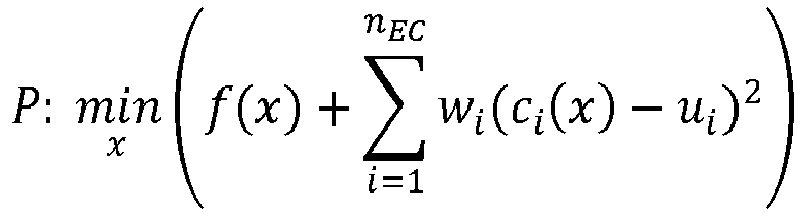
- In
subprocess 520, the values of the center-of-attraction parameters ui in all parameterized potential functions are determined. In an embodiment in whichprocess 500 is performed iteratively, the value of the center-of-attraction parameter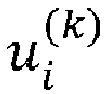

- In an embodiment, the value of each center-of-attraction parameter ui may be determined as follows:wherein uinitial is a predefined value, α is a scaling factor, which may be determined empirically or in any appropriate manner, or may be omitted or set to α = 1 so as to be effectively omitted. In an embodiment, uinitial = 0.

- In
subprocess 530, the unconstrained convex optimization problem
subprocess 520. In an embodiment in whichprocess 500 is performed iteratively, the initial input x (k),ini in iteration k may be set to the final input x (k-1),fin that was output as the optimizing input (i.e., the input that minimizes the second objective function) from the immediately preceding iteration k - 1. The result ofsubprocess 530 andprocess 500 will be a final and optimizing input x (k),fin for the current iteration k ofprocess 500. This final input x (k),fin represents an estimated state ofpower system 140. -
FIG. 6 illustrates an overall equality constraint (EC)algorithm 600 for solving a constrained optimization problem, comprising equality constraint(s), according to an embodiment.EC algorithm 600 may be implemented bystate estimation module 330 insoftware 112 ofmanagement system 110.EC algorithm 600 operates to convert a constrained optimization problem, comprising an objective function to be minimized subject to one or more equality constraints, to an unconstrained convex optimization problem, and then solve the unconstrained convex optimization problem. In solving the unconstrained convex optimization problem,EC algorithm 600 may iteratively executesolution process 500. - Initially, in
subprocess 610, the constrained optimization problem is acquired. This acquisition process may comprise retrieving a representation of the constrained optimization problem or retrieving representations of one or more components of the constrained optimization problem, such as the objective function to be minimized, and the equality functions of the equality constraint(s) to which the objective function is subject. Again, the constrained optimization problem may be represented as:

solution process 500, such that they can be easily accessed in each iteration ofsolution process 500, without having to be regenerated or redetermined in each iteration. - In
subprocess 620, the constrained optimization problem is converted to an unconstrained convex optimization problem with each of the equality constraint(s) represented as a parameterized potential function. The unconstrained convex optimization problem may be represented as:

-
Solution process 500 is performed to find an optimizing input x (0),fin that minimizes the unconstrained convex optimization problem. Over each subsequent iteration k ofsolution process 500, if any, the optimizing input x (k-1),fin found by the immediately preceding iteration k - 1 may be used as the initial input x (k),ini to the unconstrained convex optimization problem to be solved in iteration k of solution process 500 (i.e., in subprocess 530). In an embodiment, in each iteration ofsolution process 500, a parameterized potential function is included in the unconstrained convex optimization problem for every equality constraint:
- Each center-of-attraction parameter u (k) in an iteration k of
solution process 500 may be set, as discussed elsewhere herein, based on the value of the corresponding center-of-attraction parameter u (k-1) in the immediately preceding iteration k - 1 ofsolution process 500, or initialized to uinitial (e.g., zero) if there was no preceding iteration k - 1. The output of each iteration ofsolution process 500 will be a final input x (k),fin , representing the optimizing input, given the parameters of the unconstrained convex optimization problem in the current iteration k. - In
subprocess 630, it is determined whether or not the most recently found input x (k),fin violates any of the equality constraint(s). In an embodiment, an equality constraint is violated when the value of its equality function is not within a tolerance ε of the constraint value (e.g., c(x) < -ε or c(x) > ε, if the constraint value is zero). Conversely, in such an embodiment, an equality constraint is not violated when the value of its equality function is within a tolerance ε of the constraint value (i.e., -ε ≤ c(x) ≤ ε, if the constraint value is zero). If no equality constraints are violated (i.e., "No" in subprocess 630),EC algorithm 600 proceeds tosubprocess 640. Otherwise, if at least one equality constraint is violated (i.e., "Yes" in subprocess 630), algorithm executes another iteration ofsolution process 500. - In
subprocess 640, once no equality constraints are violated (i.e., "No" in subprocess 630), the most recently found (i.e., last) optimizing input is output as the final estimated state ofpower system 140. This will be the input x (k),fin , output by the last iteration ofsolution process 500. It should be understood that this final estimated state ofpower system 140, output bysubprocess 640, may be sent to optimization andcontrol module 340, which may use the final estimated state to optimize a configuration ofpower system 140 and/or otherwise controlpower system 140. - An example of EC pseudocode, implementing an embodiment of
EC algorithm 600, is provided below:
- It should also be understood that how an iteration k is defined or delineated is arbitrary. For example, in the above EC pseudocode, the center-of-attraction parameters ui are determined, after solving the unconstrained convex optimization problem P (k), for a future iteration k + 1. However, an iteration k can alternatively be delineated as including the determination of the center-of-attraction parameters ui prior to solving the unconstrained convex optimization problem P (k) , as illustrated in
solution process 500. In any case, the particular delineation of the iterations k, in any of the disclosed examples, should not be construed as limiting in any respect. -
FIG. 7 illustrates an overall inequality constraint (IC)algorithm 700 for solving a constrained optimization problem, comprising both equality constraint(s) and inequality constraint(s), according to an embodiment.IC algorithm 700 may be implemented bystate estimation module 330 insoftware 112 ofmanagement system 110.IC algorithm 700 operates, over one or more iterations, to convert an IC-EC optimization problem, comprising an objective function to be minimized subject to one or more equality constraints and one or more inequality constraints, to an EC convex optimization problem (i.e., a problem that is subject to equality constraints, but not subject to any inequality constraints), and then solve the EC convex optimization problem usingEC algorithm 600, which converts the EC convex optimization problem to a fully unconstrained convex optimization problem (i.e., a problem that is not subject to any inequality or equality constraints). - Initially, in
subprocess 710, the IC-EC optimization problem is acquired. This acquisition process may comprise retrieving a representation of the IC-EC optimization problem or retrieving representations of one or more components of the IC-EC optimization problem, such as the objective function to be minimized, the inequality functions of the inequality constraint(s) to which the objective function is subject, and the equality functions of the equality constraint(s) to which the objective function is subject. The IC-EC optimization problem may be represented as:


EC algorithm 600 and subprocesses 730-750 ofIC algorithm 700, such that they can be easily accessed in each iteration without having to be regenerated or redetermined in each iteration. - In
subprocess 720, a convex optimization problem is generated from the constrained optimization problem without any inequality constraints. In other words, the IC-EC optimization problem is converted into an EC-only optimization problem, without any representation of any inequality constraints. That is to say, no parameterized potential functions are included in the EC optimization problem for any inequality constraints. Thus, the convex optimization problem may be represented as:

- Next, an initial iteration of
EC algorithm 600 is executed to solve the EC optimization problem


solution process 500 may be performed iteratively, while updating each center-of-attraction parameter ui (e.g., in subprocess 520) until no equality constraints are violated (i.e., "No" in subprocess 630). - In
subprocess 730, it is determined whether or not the most recently found input x violates any of the inequality constraint(s). It should be understood that, in the first iteration ofsubprocess 730, the most recently found input to be evaluated insubprocess 730 will be x (noIC),fin . In all subsequent iterations ofsubprocess 720, the most recently found input to be evaluated insubprocess 720 will be the final input x (k-1),fin found by the most recent iteration k - 1 ofEC algorithm 600. In an embodiment, an inequality constraint is violated when the value of its inequality function is not within a tolerance ε of the feasible range (i.e., g(x) > ε). Conversely, in such an embodiment, an inequality constraint is not violated when the value of its inequality function is within a tolerance ε of the feasible range (i.e., g(x) ≤ ε). If no inequality constraints are violated (i.e., "No" in subprocess 730),IC algorithm 700 proceeds tosubprocess 760. Otherwise, if at least one inequality constraint is violated (i.e., "Yes" in subprocess 730),IC algorithm 700 executes an iteration ofsubprocess 740, followed bysubprocess 750, followed byEC algorithm 600. - In
subprocess 740, an inequality-unconstrained or EC convex optimization problem is generated based on the set of inequality constraint(s) determined to have been violated insubprocess 730. In particular, a parameterized potential function may be generated for each inequality constraint in the set of violated inequality constraint(s) and summed with the objective function from the constrained optimization problem in a second objective function to be minimized. While not necessary to the embodiment, the parameterized potential function may be a quadratic function. The EC convex optimization problem may be expressed as:
- In
subprocess 750, the values of the center-of-attraction parameters uj in all parameterized potential functions for violated inequality constraints are determined. The value of the center-of-attraction parameter

- In an embodiment, the value of each center-of-attraction parameter uj , for the parameterized potential functions representing inequality constraints, may be determined as follows:
when the set inequality constraints that are determined to be violated by the most recently found optimizing input is not empty,

when the set inequality constraints that are determined to be violated by the most recently found optimizing input is empty,


- After the EC convex optimization problem PEC has been defined in
subprocesses EC algorithm 600 is executed. Whereas the EC optimization problem P (noIC) is used as the problem to be converted into a fully unconstrained optimization problem in the initial iteration ofEC algorithm 600, the EC optimization problem
EC algorithm 600. In each subsequent iteration k ofEC algorithm 600, the fully unconstrained convex optimization problem P (k) may be expressed as:
- In
subprocess 760, once no inequality constraints are violated (i.e., "No" in subprocess 730), the most recently found (i.e., last) optimizing input is output as the final estimated state ofpower system 140. This may be the input x (noIC) ,fin, output by the initial iteration ofEC algorithm 600, if no inequality violations were determined in the first, and therefore, only iteration ofsubprocess 730. Otherwise, this will be an input x (k),fin , output by the last iteration ofEC algorithm 600. It should be understood that this final estimated state ofpower system 140, output bysubprocess 760, may be sent to optimization andcontrol module 340, which may use the final estimated state to optimize a configuration ofpower system 140 and/or otherwise controlpower system 140 as discussed elsewhere herein. - In
IC algorithm 700,EC algorithm 600 is utilized to solve the inequality-unconstrained or EC optimization problem, which is still subject to equality constraints. However, in an alternative embodiment, a different algorithm may be used to solve the EC optimization problem and/or convert the EC optimization problem to a fully unconstrained convex optimization problem. Thus,EC algorithm 600 inIC algorithm 700 could be replaced by any other suitable algorithm for solving an EC optimization problem. - An example of IC pseudocode, implementing an embodiment of
IC algorithm 700, is provided below:
- Notably, in the above pseudocode, the set

- It should also be understood that how an iteration k is defined or delineated is arbitrary. For example, in the above pseudocode, the sets VIC and A and the center-of-attraction parameters uj are determined, after solving the unconstrained convex optimization problem


EC algorithm 600. In any case, the particular delineation of the iterations k, in any of the disclosed examples, should not be construed as limiting in any respect. It should also be understood that, withinIC algorithm 700,EC algorithm 600 executes an inner loop of iterations, which are also referred to herein as iterations k, and which are distinct from the outer iterations k executed byIC algorithm 700. -
FIG. 8 illustrates anEC algorithm 800 for solving a constrained optimization problem, comprising equality constraint(s), according to an alternative embodiment.EC algorithm 800 may be implemented bystate estimation module 330 insoftware 112 ofmanagement system 110. Again, the constrained optimization problem may be represented as:

- In
subprocess 810, an unconstrained parametric convex optimization problem is generated based on the equality constraints, thereby converting the constrained optimization problem into an unconstrained convex optimization problem. In particular, a parameterized potential function (e.g., quadratic function) may be generated for each equality constraint and summed with the objective function from the constrained optimization problem in a second objective function to be minimized. The unconstrained convex optimization problem may be expressed as:
- In
subprocess 820, a joint system of equations is defined. The joint system of equations comprises the first order optimality condition of problem PUC (u) and the equality constraints:
- In
subprocess 830, this joint system of equations, defined insubprocess 820, is solved to find an optimizing input x. The solution may be found using any root-finding algorithm, such as Newton's method, also known as the Newton-Raphson method, to yield a solution that satisfies the KKT condition of the constrained optimization problem. In Newton's method, an initial guess of input xini is made, the function is approximated by its tangent line, and the x-intercept of this tangent line is computed, which will generally be a better approximation of the original function's root than xini . This process may be repeated with the computed x-intercept of the prior iteration as the new guess in each new iteration, until the solution converges to within a tolerance. - In
subprocess 840, the solution fromsubprocess 830 is output. For example, the solution may be output as an estimated state to optimization andcontrol module 340. Optimization andcontrol module 340 may then utilize the estimated state to optimize and/or controlpower system 140, as described elsewhere herein. - Using f(x) = wl (zl - hl (x))2, the constrained SE problem can be expressed as:


- The unconstrained SE problem, generated in
subprocess 810, can be expressed as:

- The joint system of equations, defined in
subprocess 820, can be expressed as:
- The Newton-Raphson iterative equations, used in
subprocess 830, for the joint system can be expressed as:
- The upper left corner of the submatrix is HTWhH + CTWcC, which differs from HTWhH in the Hachtel's matrix in the Lagrange method, and results in a better-conditioned gain matrix.
- In an embodiment,
state estimation module 330 of amanagement system 110 is used to estimate the state of a system, such aspower system 140, usingalgorithms 600 and/or 700. In particular,state estimation module 330 may receive system telemetry from amonitoring module 310 of the system, and use the system telemetry and system model 360 (e.g., retrieved from database 114) to define an optimization problem, subject to equality constraints, and optionally inequality constraints, as an unconstrained convex optimization problem. The optimization problem is formed as an unconstrained optimization problem by generating a parameterized potential function w(c(x) - u)2 for each of the equality constraints. The unconstrained optimization problem may also include a parameterized potential function w(g(x) - u)2 for each of the inequality constraints. The sum of any generated parameterized potential functions and an objective function f(x), derived from the system telemetry andsystem model 360 and representing the system (e.g., power system 140) is then minimized to find an optimizing input x. The use of the parameterized potential functions, representing virtual measurements, shapes the potential field of the resulting unconstrained optimization problem, such that its stationary stationarity condition is identical to the KKT condition of the constrained optimization problem. - The resulting unconstrained optimization problem may be iteratively prepared, using successively updated values for the center-of-attraction parameters u corresponding to the constraints, and solved, until no constraints are violated (i.e., all constraints are satisfied within a tolerance), to produce a final estimated state. The final estimated state may be output to an optimization and
control module 340 ofmanagement system 110, which may input the final estimated state into one or more downstream functions, such as the generation of a graphical user interface, contingency analysis, power flow analysis (e.g., dispatcher or optimal power flow analysis), Volt-Var optimization, DER management, and/or the like. - In some cases, one or more of these downstream functions may, automatically (e.g., without user intervention) or semi-automatically (e.g., after user approval or confirmation), issue control commands to a
control module 320 of the system, to thereby control the system. Thus, the state estimation may be used to monitor and control a system, such as apower system 140. For example, if the voltage at a measured point is too low, a corresponding power generator inpower system 140 may be controlled to increase its reactive power output to increase the voltage at that measured point. - Notably, the disclosed
algorithms algorithms - The above description of the disclosed embodiments is provided to enable any person skilled in the art to make or use the invention. Various modifications to these embodiments will be readily apparent to those skilled in the art, and the general principles described herein can be applied to other embodiments without departing from the spirit or scope of the invention. Thus, it is to be understood that the description and drawings presented herein represent a presently preferred embodiment of the invention and are therefore representative of the subject matter which is broadly contemplated by the present invention. It is further understood that the scope of the present invention fully encompasses other embodiments that may become obvious to those skilled in the art and that the scope of the present invention is accordingly not limited.
- Combinations, described herein, such as "at least one of A, B, or C," "one or more of A, B, or C," "at least one of A, B, and C," "one or more of A, B, and C," and "A, B, C, or any combination thereof' include any combination of A, B, and/or C, and may include multiples of A, multiples of B, or multiples of C. Specifically, combinations such as "at least one of A, B, or C," "one or more of A, B, or C," "at least one of A, B, and C," "one or more of A, B, and C," and "A, B, C, or any combination thereof' may be A only, B only, C only, A and B, A and C, B and C, or A and B and C, and any such combination may contain one or more members of its constituents A, B, and/or C. For example, a combination of A and B may comprise one A and multiple B's, multiple A's and one B, or multiple A's and multiple B's.
Claims (20)
- A method of state estimation for a power system, the method comprising using at least one hardware processor to:acquire a constrained optimization problem comprising a convex first objective function to be minimized subject to one or more equality constraints;convert the constrained optimization problem into an unconstrained convex optimization problem comprising a second objective function that is a sum of the first objective function and a parameterized potential function for each of at least one of the one or more equality constraints, wherein each parameterized potential function is defined by an equality function and a center-of-attraction parameter; andperform a solution process comprising solving the unconstrained convex optimization problem by finding an input to the unconstrained convex optimization problem that minimizes an output of the unconstrained convex optimization problem,wherein one or more center-of-attraction parameters are updated when solving the unconstrained convex optimization problem to ensure that the input satisfies the one or more equality constraints within a tolerance, andwherein the input represents an estimated state of the power system.
- The method of Claim 1, further comprising using the at least one hardware processor to control the power system based on the estimated state.
- The method of Claim 1, wherein each parametric potential function is defined as:

- The method of Claim 3, wherein the second objective function is defined as:

- The method of Claim 1, further comprising using the at least one hardware processor to perform a first process comprising:performing an initial iteration of the solution process to find an initial optimizing input, wherein the initial iteration of the solution process further comprises initializing a value of each center-of-attraction parameter in each parameterized potential function in the unconstrained convex optimization problem;determining whether or not the one or more equality constraints are violated by the initial optimizing input;when determining that the one or more equality constraints are not violated, outputting the initial optimizing input as an output estimated state of the power system; andwhen determining that at least one of the one or more equality constraints is violated,until the one or more equality constraints are not violated, over one or more subsequent iterations, performing the solution process, wherein the subsequent iteration of the solution process further comprises updating the value of each center-of-attraction parameter in each parameterized potential function corresponding to the one or more equality constraints, prior to solving the unconstrained convex optimization problem, andoutputting the input found by the solution process in a final one of the one or more subsequent iterations as the output estimated state of the power system.
- The method of Claim 5, further comprising using the at least one hardware processor to control the power system based on the output estimated state.
- The method of Claim 5, wherein the one or more equality constraints are determined to be violated when at least one of the one or more equality constraints is outside of the tolerance, and wherein the one or more equality constraints are determined not to be violated when all of the one or more equality constraints are within the tolerance.
- The method of Claim 5, wherein, in the initial iteration and each of the one or more subsequent iterations, the unconstrained convex optimization problem comprises a parameterized potential function for all of the one or more equality constraints.
- The method of Claim 5, wherein, in each of the one or more subsequent iterations, an initial input used in solving the unconstrained convex optimization problem in the solution process of the subsequent iteration is the input found by the solution process in an immediately preceding iteration.
- The method of Claim 5, wherein, in each of the one or more subsequent iterations, updating the value of each center-of-attraction parameter comprises calculating the value of each center-of-attraction parameter based on a prior value of that center-of-attraction parameter in an immediately preceding iteration.
- The method of Claim 10, wherein, in each of the one or more subsequent iterations, updating the value of each center-of-attraction parameter comprises calculating the value of each center-of-attraction parameter further based on a value of the equality function for a corresponding one of the one or more equality constraints given the input found by the solution process in an immediately preceding iteration.
- The method of Claim 11, wherein the value of each center-of-attraction parameter in a subsequent iteration k is calculated as follows:

- The method of Claim 5, wherein the constrained convex optimization problem further comprises one or more inequality constraints, and the method further comprises using the at least one hardware processor to:perform the first process, while ignoring the one or more inequality constraints, to find the output estimated state as a first initial optimizing input;determine whether or not the one or more inequality constraints are violated by the first initial optimizing input;when determining that the one or more inequality constraints are not violated, use the first initial optimizing input as a final estimated state of the power system;when determining that at least one of the one or more inequality constraints is violated,until the one or more inequality constraints are not violated, over one or more outer iterations,convert the constrained optimization problem into an inequality-unconstrained convex optimization problem comprising the first objective function and an inequality parameterized potential function for each of at least one of the one or more inequality constraints, wherein each inequality parameterized potential function is defined by an inequality function and a center-of-attraction parameter,determine a value of each center-of-attraction parameter in each inequality parameterized potential function in the inequality-unconstrained convex optimization problem, andperform the first process using the inequality-unconstrained convex optimization problem as the constrained optimization problem in the first process, andoutput the input found by the first process in a final one of the one or more outer iterations as the final estimated state of the power system.
- The method of Claim 13, wherein, in each of the one or more outer iterations, an inequality parameterized potential function is added to the inequality-unconstrained convex optimization problem for each of the one or more inequality constraints that are violated and none of the one or more inequality constraints that have not been violated.
- The method of Claim 13, wherein, for an inequality constraint expressed as g(x) ≤ 0, each inequality parameterized potential function component is defined as:

- The method of Claim 1, further comprising using the estimated state in one or more of a contingency analysis, a Volt-Var optimization, or an optimal power flow.
- The method of Claim 1, wherein the first objective function comprises an error calculation in which a value of a measurement function, given the input, is subtracted from a value of a system telemetry.
- A system comprising:at least one hardware processor; andsoftware configured to, when executed by the at least one hardware processor,acquire a constrained optimization problem comprising a convex first objective function to be minimized subject to one or more equality constraints,convert the constrained optimization problem into an unconstrained convex optimization problem comprising a second objective function that is a sum of the first objective function and a parameterized potential function for each of at least one of the one or more equality constraints, wherein each parameterized potential function is defined by an equality function and a center-of-attraction parameter, andsolve the unconstrained convex optimization problem by finding an input to the unconstrained convex optimization problem that minimizes an output of the unconstrained convex optimization problem, wherein one or more center-of-attraction parameters are updated when solving the unconstrained convex optimization problem to ensure that the input satisfies the one or more equality constraints within a tolerance, wherein the input represents an estimated state of the power system.
- A method of state estimation for a power system, the method comprising using at least one hardware processor to:acquire a constrained convex optimization problem comprising a first objective function to be minimized subject to one or more equality constraints;convert the constrained convex optimization problem into an unconstrained convex optimization problem comprising a second the objective function that is a sum of the first objective function and a parameterized potential function for each of the one or more equality constraints, wherein each parameterized potential function is defined by an equality function and a center-of-attraction parameter;define a joint system of equations comprising a first order optimality condition of the unconstrained convex optimization problem and the one or more equality constraints with associated weighting; anddetermine an estimated state of the power system by solving the joint system of equations using a root-finding algorithm.
- The method of Claim 19, further comprising using the at least one hardware processor to control the power system based on the estimated state.
Priority Applications (5)
| Application Number | Priority Date | Filing Date | Title |
|---|---|---|---|
| PCT/EP2023/071327 WO2024028345A1 (en) | 2022-08-02 | 2023-08-01 | State estimation for a power system using parameterized potential functions for equality constraints |
| CN202380057539.8A CN119631263A (en) | 2022-08-02 | 2023-08-01 | Using parameterized potential function for equality-constrained power system state estimation |
| US18/996,261 US20250244734A1 (en) | 2022-08-02 | 2023-08-01 | State estimation for a power system using parameterized potential functions for equality constraints |
| JP2025505790A JP7844744B2 (en) | 2022-08-02 | 2023-08-01 | State estimation of a power system using a parameterized potential function for equality constraints. |
| EP23748806.9A EP4566138A1 (en) | 2022-08-02 | 2023-08-01 | State estimation for a power system using parameterized potential functions for equality constraints |
Applications Claiming Priority (1)
| Application Number | Priority Date | Filing Date | Title |
|---|---|---|---|
| US17/879,414 US12386328B2 (en) | 2022-08-02 | 2022-08-02 | Parameterized potential functions for equality constraints |
Publications (1)
| Publication Number | Publication Date |
|---|---|
| EP4318845A1 true EP4318845A1 (en) | 2024-02-07 |
Family
ID=83506295
Family Applications (1)
| Application Number | Title | Priority Date | Filing Date |
|---|---|---|---|
| EP22198493.3A Pending EP4318845A1 (en) | 2022-08-02 | 2022-09-28 | State estimation for a power system using parameterized potential functions for equality constraints |
Country Status (2)
| Country | Link |
|---|---|
| US (1) | US12386328B2 (en) |
| EP (1) | EP4318845A1 (en) |
Families Citing this family (2)
| Publication number | Priority date | Publication date | Assignee | Title |
|---|---|---|---|---|
| US12602303B2 (en) * | 2024-01-31 | 2026-04-14 | Dell Products Lp | System and method for peripheral device fleet sizing and peripheral device workspace booking for seamless user experience |
| CN119474648A (en) * | 2024-11-28 | 2025-02-18 | 中国南方电网有限责任公司 | A method and system for calculating power flow in power system |
Citations (3)
| Publication number | Priority date | Publication date | Assignee | Title |
|---|---|---|---|---|
| CN109390929A (en) * | 2017-08-11 | 2019-02-26 | 郑州大学 | A kind of accurate idle work optimization method counted and small interference stability constrains |
| CN113139288A (en) * | 2021-04-21 | 2021-07-20 | 广东电网有限责任公司广州供电局 | Power distribution network distributed robust state estimation method and device based on GPU (graphics processing Unit) secondary acceleration |
| CN114417414A (en) * | 2022-01-20 | 2022-04-29 | 三未信安科技股份有限公司 | Privacy protection method based on edge calculation |
Family Cites Families (5)
| Publication number | Priority date | Publication date | Assignee | Title |
|---|---|---|---|---|
| US8738191B2 (en) * | 2010-09-17 | 2014-05-27 | Sarantos K. Aivaliotis | System and method for power grid management |
| US8832000B2 (en) * | 2011-06-07 | 2014-09-09 | The Trustees Of Columbia University In The City Of New York | Systems, device, and methods for parameter optimization |
| US11581733B2 (en) * | 2019-11-12 | 2023-02-14 | Alliance For Sustainable Energy, Llc | System state estimation with asynchronous measurements |
| US11444483B2 (en) * | 2020-01-14 | 2022-09-13 | Hitachi Energy Switzerland Ag | Adaptive state estimation for power systems |
| US11824354B2 (en) * | 2021-08-24 | 2023-11-21 | Bigwood Technology, Inc. | Online state estimation and topology identification using advanced metering infrastructure (AMI) measurements |
-
2022
- 2022-08-02 US US17/879,414 patent/US12386328B2/en active Active
- 2022-09-28 EP EP22198493.3A patent/EP4318845A1/en active Pending
Patent Citations (3)
| Publication number | Priority date | Publication date | Assignee | Title |
|---|---|---|---|---|
| CN109390929A (en) * | 2017-08-11 | 2019-02-26 | 郑州大学 | A kind of accurate idle work optimization method counted and small interference stability constrains |
| CN113139288A (en) * | 2021-04-21 | 2021-07-20 | 广东电网有限责任公司广州供电局 | Power distribution network distributed robust state estimation method and device based on GPU (graphics processing Unit) secondary acceleration |
| CN114417414A (en) * | 2022-01-20 | 2022-04-29 | 三未信安科技股份有限公司 | Privacy protection method based on edge calculation |
Also Published As
| Publication number | Publication date |
|---|---|
| US12386328B2 (en) | 2025-08-12 |
| US20240045391A1 (en) | 2024-02-08 |
Similar Documents
| Publication | Publication Date | Title |
|---|---|---|
| WO2024028348A1 (en) | State estimation for a power system using parameterized potential functions for inequality constraints | |
| US12386328B2 (en) | Parameterized potential functions for equality constraints | |
| WO2025061773A1 (en) | Training for an integrated graph neural network and non-linear iterative algorithm | |
| EP4528588A1 (en) | Pre-trained message-passing neural network element for a scalable neural network for processing data on power grids | |
| WO2024105199A1 (en) | System and method to control electric vehicle fleet charging or microgrid operation considering a heuristic approach to extend battery life | |
| WO2025153710A1 (en) | Computation and implementation of preemptive ranked resiliency measures using probabilistic optimization for enhanced operational resilience of a power system | |
| US20250244734A1 (en) | State estimation for a power system using parameterized potential functions for equality constraints | |
| JP7715947B2 (en) | Network-Constrained Energy Management System for Electric Vehicle Point Charging and Scheduling | |
| EP4199290A1 (en) | Network constraint energy management system for electric vehicle depot charging and scheduling | |
| WO2025157784A1 (en) | Dynamic capacity allocation of battery energy storage system for ancillary services | |
| EP4318846A1 (en) | State estimation for a power system using parameterized potential functions for inequality constraints | |
| EP4589498A1 (en) | Computation of preemptive ranked resiliency measures, including preemptive placement and real-time dispatch of distributed energy resources, using probabilistic optimization for enhanced operational resilience of a power system | |
| EP4513397A1 (en) | Collaborative unit commitment with integrated machine-learning | |
| WO2025108940A1 (en) | Forecasting using differential-based machine-learning architecture | |
| WO2025045735A1 (en) | Collaborative unit commitment with integrated machine-learning | |
| CN116024747B (en) | Dynamic balance autonomous method, device and equipment of power grid and storage medium | |
| JP7861216B2 (en) | State estimation of a power system using a parameterized potential function for inequality constraints | |
| EP4589497A1 (en) | Dynamic capacity allocation of battery energy storage system for ancillary services | |
| EP4625211A1 (en) | System control utilizing algorithmic framework to solve linear and non-linear optimization problems | |
| EP4668521A1 (en) | Integration of management system with distributed energy resource management system using probabilistic optimal power flow | |
| EP4528587A1 (en) | Training for an integrated graph neural network and non-linear iterative algorithm | |
| WO2025061771A1 (en) | Pre-trained message-passing neural network element for a scalable neural network for processing data on power grids | |
| EP4589496A1 (en) | Computation of preemptive ranked resiliency measures using probabilistic optimization for enhanced operational resilience of a power system | |
| EP4686949A1 (en) | Placement of measurement devices for observability of very large power systems | |
| EP4589800A1 (en) | Computation of preemptive ranked resiliency measures using probabilistic optimization for enhanced operational resilience of a power system |
Legal Events
| Date | Code | Title | Description |
|---|---|---|---|
| PUAI | Public reference made under article 153(3) epc to a published international application that has entered the european phase |
Free format text: ORIGINAL CODE: 0009012 |
|
| STAA | Information on the status of an ep patent application or granted ep patent |
Free format text: STATUS: REQUEST FOR EXAMINATION WAS MADE |
|
| 17P | Request for examination filed |
Effective date: 20220928 |
|
| AK | Designated contracting states |
Kind code of ref document: A1 Designated state(s): AL AT BE BG CH CY CZ DE DK EE ES FI FR GB GR HR HU IE IS IT LI LT LU LV MC MK MT NL NO PL PT RO RS SE SI SK SM TR |
|
| RBV | Designated contracting states (corrected) |
Designated state(s): AL AT BE BG CH CY CZ DE DK EE ES FI FR GB GR HR HU IE IS IT LI LT LU LV MC MK MT NL NO PL PT RO RS SE SI SK SM TR |