EP4318642A1 - Electrode active material for a fluoride ion battery, electrode for a fluoride ion battery, and fluoride ion battery - Google Patents
Electrode active material for a fluoride ion battery, electrode for a fluoride ion battery, and fluoride ion battery Download PDFInfo
- Publication number
- EP4318642A1 EP4318642A1 EP23179326.6A EP23179326A EP4318642A1 EP 4318642 A1 EP4318642 A1 EP 4318642A1 EP 23179326 A EP23179326 A EP 23179326A EP 4318642 A1 EP4318642 A1 EP 4318642A1
- Authority
- EP
- European Patent Office
- Prior art keywords
- active material
- electrode active
- ion battery
- metal atom
- fluoride ion
- Prior art date
- Legal status (The legal status is an assumption and is not a legal conclusion. Google has not performed a legal analysis and makes no representation as to the accuracy of the status listed.)
- Pending
Links
Images
Classifications
-
- H—ELECTRICITY
- H01—ELECTRIC ELEMENTS
- H01M—PROCESSES OR MEANS, e.g. BATTERIES, FOR THE DIRECT CONVERSION OF CHEMICAL ENERGY INTO ELECTRICAL ENERGY
- H01M4/00—Electrodes
- H01M4/02—Electrodes composed of, or comprising, active material
- H01M4/36—Selection of substances as active materials, active masses, active liquids
- H01M4/48—Selection of substances as active materials, active masses, active liquids of inorganic oxides or hydroxides
- H01M4/485—Selection of substances as active materials, active masses, active liquids of inorganic oxides or hydroxides of mixed oxides or hydroxides for inserting or intercalating light metals, e.g. LiTi2O4 or LiTi2OxFy
-
- H—ELECTRICITY
- H01—ELECTRIC ELEMENTS
- H01M—PROCESSES OR MEANS, e.g. BATTERIES, FOR THE DIRECT CONVERSION OF CHEMICAL ENERGY INTO ELECTRICAL ENERGY
- H01M4/00—Electrodes
- H01M4/02—Electrodes composed of, or comprising, active material
- H01M4/13—Electrodes for accumulators with non-aqueous electrolyte, e.g. for lithium-accumulators; Processes of manufacture thereof
- H01M4/131—Electrodes based on mixed oxides or hydroxides, or on mixtures of oxides or hydroxides, e.g. LiCoOx
-
- H—ELECTRICITY
- H01—ELECTRIC ELEMENTS
- H01M—PROCESSES OR MEANS, e.g. BATTERIES, FOR THE DIRECT CONVERSION OF CHEMICAL ENERGY INTO ELECTRICAL ENERGY
- H01M4/00—Electrodes
- H01M4/02—Electrodes composed of, or comprising, active material
- H01M4/36—Selection of substances as active materials, active masses, active liquids
- H01M4/48—Selection of substances as active materials, active masses, active liquids of inorganic oxides or hydroxides
- H01M4/483—Selection of substances as active materials, active masses, active liquids of inorganic oxides or hydroxides for non-aqueous cells
-
- C—CHEMISTRY; METALLURGY
- C01—INORGANIC CHEMISTRY
- C01F—COMPOUNDS OF THE METALS BERYLLIUM, MAGNESIUM, ALUMINIUM, CALCIUM, STRONTIUM, BARIUM, RADIUM, THORIUM, OR OF THE RARE-EARTH METALS
- C01F17/00—Compounds of rare earth metals
- C01F17/30—Compounds containing rare earth metals and at least one element other than a rare earth metal, oxygen or hydrogen, e.g. La4S3Br6
- C01F17/36—Compounds containing rare earth metals and at least one element other than a rare earth metal, oxygen or hydrogen, e.g. La4S3Br6 halogen being the only anion, e.g. NaYF4
-
- C—CHEMISTRY; METALLURGY
- C01—INORGANIC CHEMISTRY
- C01G—COMPOUNDS CONTAINING METALS NOT COVERED BY SUBCLASSES C01D OR C01F
- C01G49/00—Compounds of iron
- C01G49/0018—Mixed oxides or hydroxides
- C01G49/0036—Mixed oxides or hydroxides containing one alkaline earth metal, magnesium or lead
-
- H—ELECTRICITY
- H01—ELECTRIC ELEMENTS
- H01M—PROCESSES OR MEANS, e.g. BATTERIES, FOR THE DIRECT CONVERSION OF CHEMICAL ENERGY INTO ELECTRICAL ENERGY
- H01M10/00—Secondary cells; Manufacture thereof
- H01M10/05—Accumulators with non-aqueous electrolyte
- H01M10/054—Accumulators with insertion or intercalation of metals other than lithium, e.g. with magnesium or aluminium
-
- H—ELECTRICITY
- H01—ELECTRIC ELEMENTS
- H01M—PROCESSES OR MEANS, e.g. BATTERIES, FOR THE DIRECT CONVERSION OF CHEMICAL ENERGY INTO ELECTRICAL ENERGY
- H01M4/00—Electrodes
- H01M4/02—Electrodes composed of, or comprising, active material
- H01M4/13—Electrodes for accumulators with non-aqueous electrolyte, e.g. for lithium-accumulators; Processes of manufacture thereof
- H01M4/131—Electrodes based on mixed oxides or hydroxides, or on mixtures of oxides or hydroxides, e.g. LiCoOx
- H01M4/1315—Electrodes based on mixed oxides or hydroxides, or on mixtures of oxides or hydroxides, e.g. LiCoOx containing halogen atoms, e.g. LiCoOxFy
-
- H—ELECTRICITY
- H01—ELECTRIC ELEMENTS
- H01M—PROCESSES OR MEANS, e.g. BATTERIES, FOR THE DIRECT CONVERSION OF CHEMICAL ENERGY INTO ELECTRICAL ENERGY
- H01M4/00—Electrodes
- H01M4/02—Electrodes composed of, or comprising, active material
- H01M4/36—Selection of substances as active materials, active masses, active liquids
- H01M4/48—Selection of substances as active materials, active masses, active liquids of inorganic oxides or hydroxides
- H01M4/52—Selection of substances as active materials, active masses, active liquids of inorganic oxides or hydroxides of nickel, cobalt or iron
-
- H—ELECTRICITY
- H01—ELECTRIC ELEMENTS
- H01M—PROCESSES OR MEANS, e.g. BATTERIES, FOR THE DIRECT CONVERSION OF CHEMICAL ENERGY INTO ELECTRICAL ENERGY
- H01M4/00—Electrodes
- H01M4/02—Electrodes composed of, or comprising, active material
- H01M4/36—Selection of substances as active materials, active masses, active liquids
- H01M4/48—Selection of substances as active materials, active masses, active liquids of inorganic oxides or hydroxides
- H01M4/52—Selection of substances as active materials, active masses, active liquids of inorganic oxides or hydroxides of nickel, cobalt or iron
- H01M4/523—Selection of substances as active materials, active masses, active liquids of inorganic oxides or hydroxides of nickel, cobalt or iron for non-aqueous cells
-
- C—CHEMISTRY; METALLURGY
- C01—INORGANIC CHEMISTRY
- C01P—INDEXING SCHEME RELATING TO STRUCTURAL AND PHYSICAL ASPECTS OF SOLID INORGANIC COMPOUNDS
- C01P2002/00—Crystal-structural characteristics
- C01P2002/70—Crystal-structural characteristics defined by measured X-ray, neutron or electron diffraction data
- C01P2002/72—Crystal-structural characteristics defined by measured X-ray, neutron or electron diffraction data by d-values or two theta-values, e.g. as X-ray diagram
-
- C—CHEMISTRY; METALLURGY
- C01—INORGANIC CHEMISTRY
- C01P—INDEXING SCHEME RELATING TO STRUCTURAL AND PHYSICAL ASPECTS OF SOLID INORGANIC COMPOUNDS
- C01P2004/00—Particle morphology
- C01P2004/60—Particles characterised by their size
- C01P2004/61—Micrometer sized, i.e. from 1-100 micrometer
-
- C—CHEMISTRY; METALLURGY
- C01—INORGANIC CHEMISTRY
- C01P—INDEXING SCHEME RELATING TO STRUCTURAL AND PHYSICAL ASPECTS OF SOLID INORGANIC COMPOUNDS
- C01P2004/00—Particle morphology
- C01P2004/60—Particles characterised by their size
- C01P2004/64—Nanometer sized, i.e. from 1-100 nanometer
-
- H—ELECTRICITY
- H01—ELECTRIC ELEMENTS
- H01M—PROCESSES OR MEANS, e.g. BATTERIES, FOR THE DIRECT CONVERSION OF CHEMICAL ENERGY INTO ELECTRICAL ENERGY
- H01M10/00—Secondary cells; Manufacture thereof
- H01M10/05—Accumulators with non-aqueous electrolyte
-
- H—ELECTRICITY
- H01—ELECTRIC ELEMENTS
- H01M—PROCESSES OR MEANS, e.g. BATTERIES, FOR THE DIRECT CONVERSION OF CHEMICAL ENERGY INTO ELECTRICAL ENERGY
- H01M10/00—Secondary cells; Manufacture thereof
- H01M10/05—Accumulators with non-aqueous electrolyte
- H01M10/056—Accumulators with non-aqueous electrolyte characterised by the materials used as electrolytes, e.g. mixed inorganic/organic electrolytes
- H01M10/0561—Accumulators with non-aqueous electrolyte characterised by the materials used as electrolytes, e.g. mixed inorganic/organic electrolytes the electrolyte being constituted of inorganic materials only
- H01M10/0562—Solid materials
-
- H—ELECTRICITY
- H01—ELECTRIC ELEMENTS
- H01M—PROCESSES OR MEANS, e.g. BATTERIES, FOR THE DIRECT CONVERSION OF CHEMICAL ENERGY INTO ELECTRICAL ENERGY
- H01M10/00—Secondary cells; Manufacture thereof
- H01M10/36—Accumulators not provided for in groups H01M10/05-H01M10/34
-
- H—ELECTRICITY
- H01—ELECTRIC ELEMENTS
- H01M—PROCESSES OR MEANS, e.g. BATTERIES, FOR THE DIRECT CONVERSION OF CHEMICAL ENERGY INTO ELECTRICAL ENERGY
- H01M4/00—Electrodes
- H01M4/02—Electrodes composed of, or comprising, active material
- H01M2004/021—Physical characteristics, e.g. porosity, surface area
-
- H—ELECTRICITY
- H01—ELECTRIC ELEMENTS
- H01M—PROCESSES OR MEANS, e.g. BATTERIES, FOR THE DIRECT CONVERSION OF CHEMICAL ENERGY INTO ELECTRICAL ENERGY
- H01M2300/00—Electrolytes
- H01M2300/0017—Non-aqueous electrolytes
- H01M2300/0065—Solid electrolytes
- H01M2300/0068—Solid electrolytes inorganic
- H01M2300/008—Halides
-
- Y—GENERAL TAGGING OF NEW TECHNOLOGICAL DEVELOPMENTS; GENERAL TAGGING OF CROSS-SECTIONAL TECHNOLOGIES SPANNING OVER SEVERAL SECTIONS OF THE IPC; TECHNICAL SUBJECTS COVERED BY FORMER USPC CROSS-REFERENCE ART COLLECTIONS [XRACs] AND DIGESTS
- Y02—TECHNOLOGIES OR APPLICATIONS FOR MITIGATION OR ADAPTATION AGAINST CLIMATE CHANGE
- Y02E—REDUCTION OF GREENHOUSE GAS [GHG] EMISSIONS, RELATED TO ENERGY GENERATION, TRANSMISSION OR DISTRIBUTION
- Y02E60/00—Enabling technologies; Technologies with a potential or indirect contribution to GHG emissions mitigation
- Y02E60/10—Energy storage using batteries
Definitions
- the present disclosure relates to an electrode active material for a fluoride ion battery, an electrode for a fluoride ion battery, and a fluoride ion battery.
- a lithium ion battery has been known as a secondary battery having a high energy density.
- a fluoride ion battery has been proposed as a battery capable of achieving an energy density that is higher than that of the lithium ion battery.
- JP2017-143044A proposes an active material that has a layered perovskite structure and that has a crystal phase having a specific composition.
- a first embodiment is an electrode active material for a fluoride ion battery, that includes a complex oxide including a melilite-type crystal structure.
- a second embodiment is an electrode for a fluoride ion battery that includes the electrode active material for a fluoride ion battery of the first aspect.
- a third embodiment is a fluoride ion battery that includes the electrodes for a fluoride ion battery of the second aspect, and an electrolyte.
- step includes not only an independent step but also a step not clearly distinguishable from another step as long as the intended purpose of the step is achieved in the step. If a plurality of substances correspond to a component in a composition, the content of the component in the composition means the total amount of the plurality of substances present in the composition unless otherwise specified. Certain embodiments of the present disclosure will now be described in detail.
- an electrode active material for fluoride ion battery an electrode for a fluoride ion battery, and a fluoride ion battery for embodying the technical ideas of the present disclosure
- the present disclosure is not limited to the electrode active material for fluoride ion battery, the electrode for a fluoride ion battery, and the fluoride ion battery described below.
- Electrode active material for a fluoride ion battery includes a complex oxide that includes a melilite-type crystal structure.
- Many of the known electrode active materials each for a fluoride ion battery are each a metal active material, and each work as an active material by a fluorination-defluorination reaction of a metal thereof.
- the fluorination-defluorination reaction of a metal is a reaction associated with a significant change of the crystal structure thereof, and the volumetric change thereof is significant. Due to the above, overpotential thereof tends to be high, and the cycle performance and the rate capability thereof tend to be poor.
- a compound having a layered crystal structure works as an active material by intercalation and deintercalation of carrier ions into/from interlayer spaces. Small volumetric change due to the fact that the crystal structure of the active material does not change, reduction of overpotential, and improvement of each of the cycle performance, the rate capability, and the like may be expected.
- the complex oxide having the melilite-type crystal structure also has a layered structure and may therefore be expected to have the above advantages.
- Complex oxides each including the melilite-type crystal structure each generally have a theoretical composition represented by, for example, M 1 2 M 2 3 X 7 .
- M 1 represents an alkali metal, an alkali earth metal, lanthanoid, or the like.
- M 2 represents a transition metal, Al, Si, Zn, Ge, or the like.
- X represents O, N, F, S, Cl, or the like.
- M 2 -X 4 tetrahedra form a two-dimensional network structure and form a layered structure sandwiching an M 1 site therebetween.
- WO2019-065285 can be referred to.
- the complex oxide including the melilite-type crystal structure according to the present disclosure may include, in the composition thereof, a first metal atom that includes at least one type selected from a first metal atom group, a second metal atom that includes at least one type selected from a second metal atom group, and a specific non-metal atom that includes at least one type selected from a specific non-metal atom group and that includes at least an oxygen atom.
- the composition of the complex oxide may include only one type of the first metal atom, or may include two or more types thereof in combination.
- the composition of the complex oxide may include only one type of the second metal atom, or may include two or more types thereof in combination.
- the composition of the complex oxide may include only an oxygen atom as the specific non-metal atom, or may include an oxygen atom and a specific non-metal atom other than an oxygen atom in combination.
- the first metal atom group may include the first metal atom that includes at least one type selected from the group consisting of Li, Be, Na, Mg, K, Ca, Rb, Sr, Y, Cs, Ba, La, Ce, Pr, Nd, Pm, Sm, Eu, Gd, Tb, Dy, Ho, Er, Tm, Yb, Lu, Bi.
- the first metal atom may include at least one type selected from the group consisting of Ca, Sr, Y, Ba, and La, and may include at least Sr.
- the first metal atom may include at least one type selected from the group consisting of Ca, Sr, Y, Ba, and La, and may further include at least one type selected from the group consisting of Li, Be, Na, Mg K, Rb, Y, Cs, Ce, Pr, Nd, Pm, Sm, Eu, Gd, Tb, Dy, Ho, Er, Tm, Yb, Lu, and Bi.
- the first metal atom includes at least one type selected from the group consisting of Ca, Sr, Y, Ba, and La
- the total content of Ca, Sr, Y, Ba, and La in the first metal atom may be, for example, 50 mole-% or higher, 70 mole-% or higher, or 90 mole-% or higher.
- the total content of Ca, Sr, Y, Ba, and La in the first metal atom may be, for example, 100 mole-% or lower, or lower than 100 mole-%.
- the first metal atom may include Sr, and may further include at least one type selected from the group consisting of Li, Be, Na, Mg, K, Ca, Rb, Y, Cs, Ba, La, Ce, Pr, Nd, Pm, Sm, Eu, Gd, Tb, Dy, Ho, Er, Tm, Yb, Lu, and Bi.
- the content of Sr in the first metal atom may be, for example, 50 mole-% or higher, 70 mole-% or higher, or 90 mole-% or higher.
- the content of Sr in the first metal atom may be, for example, 100 mole-% or lower, or lower than 100 mole-%.
- the second metal atom group may include the second metal atom that includes at least one type selected from the group consisting of Al, Si, Sc, Ti, V, Cr, Mn, Fe, Co, Ni, Cu, Zn, Ga, Ge, Zr, Nb, Mo, Tc, Ru, Rh, Pd, Ag, Sn, Hf, Ta, W, Re, Os, Ir, Pt, Au, and the like.
- the second metal atom may include at least one type selected from the group consisting of Al, Si, Mn, Fe, Co, Ni, Cu, and Ge, may include at least one type selected from the group consisting of Fe and Ge, and may include at least Fe and Ge.
- the second metal atom may include at least one type selected from the group consisting of Al, Si, Mn, Fe, Co, Ni, Cu, and Ge, and may further include at least one type selected from the group consisting of Sc, Ti, V, Cr, Zn, Ga, Zr, Nb, Mo, Tc, Ru, Rh, Pd, Ag, Sn, Hf, Ta, W, Re, Os, Ir, Pt, and Au.
- the second metal atom includes at least one type selected from the group consisting of Al, Si, Mn, Fe, Co, Ni, Cu, and Ge
- the total content of Al, Si, Mn, Fe, Co, Ni, Cu, and Ge in the second metal atom may be, for example, 50 mole-% or higher, 70 mole-% or higher, or 90 mole-% or higher.
- the total content of Al, Si, Mn, Fe, Co, Ni, Cu, and Ge in the second metal atom may be, for example, 100 mole-% or lower, or lower than 100 mole-%.
- the second metal atom may include at least one type selected from the group consisting of Fe and Ge, and may further include at least one type selected from the group consisting of Al, Si, Sc, Ti, V, Cr, Mn, Co, Ni, Cu, Zn, Ga, Zr, Nb, Mo, Tc, Ru, Rh, Pd, Ag, Sn, Hf, Ta, W, Re, Os, Ir, Pt, and Au.
- the total content of Fe and Ge in the second metal atom may be, for example, 50 mole-% or higher, 70 mole-% or higher, or 90 mole-% or higher.
- the total content of Fe and Ge in the second metal atom may be, for example, 100 mole-% or lower, or lower than 100 mole-%.
- the specific non-metal atom group may at least include O, N, F, S, and Cl.
- the specific non-metal atom includes at least O, and may include at least one type of specific non-metal atom (such as, for example, N, F, S, and Cl) other than O selected from the specific non-metal atom group.
- the content of O in the specific non-metal atom may be, for example, 50 mole-% or higher, 70 mole-% or higher, or 90 mole-% or higher.
- the ratio of the total number of moles of the second metal atom to the total number of moles of the first metal atom may be 1.4 or greater and 1.6 or smaller and may be 1.45 or greater and 1.55 or smaller.
- the ratio of the total number of moles of the specific non-metal atom to the total number of moles of the first metal atom and the second metal atom for example, may be 1.3 or greater and 1.5 or smaller, and may be 1.35 or greater or 1.45 or smaller.
- the total number of moles of the first metal atom may be greater than 1.9 and smaller than 2.1, and may be 1.95 or greater and 2.05 or smaller.
- the total number of moles of the second metal atom may be greater than 2.9 and smaller than 3.1, and may be 2.95 or greater and 3.05 or smaller.
- the complex oxide may have the composition that is represented by, for example, a formula (1) below.
- b, c, and d may satisfy 1.9 ⁇ b ⁇ 2.1, 2.9 ⁇ c ⁇ 3.1, and 6.8 ⁇ d ⁇ 7.2 and may satisfy 1.95 ⁇ b ⁇ 2.05, 2.95 ⁇ c ⁇ 3.05, and 6.9 ⁇ d ⁇ 7.1.
- M 1 may include at least one type selected from the group consisting of. for example, Li, Be, Na, Mg, K, Ca, Rb, Sr, Y, Cs, Ba, La, Ce, Pr, Nd, Pm, Sm, Eu, Gd, Tb, Dy, Ho, Er, Tm, Yb, Lu, and Bi.
- M 1 may include at least one type selected from the group consisting of Ca, Sr, Y, Ba, and La, and may include at least Sr.
- M 1 may include at least one type selected from the group consisting of Ca, Sr, Y, Ba, and La, and may further include at least one type selected from the group consisting of Li, Be, Na, Mg, K, Rb, Y, Cs, Ce, Pr, Nd, Pm, Sm, Eu, Gd, Tb, Dy, Ho, Er, Tm, Yb, Lu, and Bi.
- M 1 includes at least one type selected from the groups consisting of Ca, Sr, Y, Ba, and La
- the total content of Ca, Sr, Y, Ba, and La in M 1 may be, for example, 50 mole-% or higher, 70 mole-% or higher, or 90 mole-% or higher.
- the total content of Ca, Sr, Y, Ba, and La in M 1 may be, for example, 100 mole-% or lower, or lower than 100 mole-%.
- M 1 may include Sr, and may further include at least one type selected from the group consisting of Li, Be, Na, Mg, K, Ca, Rb, Y, Cs, Ba, La, Ce, Pr, Nd, Pm, Sm, Eu, Gd, Tb, Dy, Ho, Er, Tm, Yb, Lu, and Bi.
- the content of Sr in M 1 may be, for example, 50 mole-% or higher, 70 mole-% or higher, or 90 mole-% or higher.
- the content of Sr in M 1 may be, for example, 100 mole-% or lower, or lower than 100 mole-%.
- M 2 may include at least one type selected from the group consisting of, for example, Al, Si, Sc, Ti, V, Cr, Mn, Fe, Co, Ni, Cu, Zn, Ga, Ge, Zr, Nb, Mo, Tc, Ru, Rh, Pd, Ag, Sn, Hf, Ta, W, Re, Os, Ir, Pt, and Au.
- M 2 may include at least one type selected from the group consisting of Al, Si, Mn, Fe, Co, Ni, Cu, and Ge, may include at least one type selected from the group consisting of Fe and Ge, and may include at least Fe and Ge.
- M 2 includes at least one type selected from the group consisting of Al, Si, Mn, Fe, Co, Ni, Cu, and Ge, and may further include at least one type selected from the group consisting of Sc, Ti, V, Cr, Zn, Ga, Zr, Nb, Mo, Tc, Ru, Rh, Pd, Ag, Sn, Hf, Ta, W, Re, Os, Ir, Pt, and Au.
- M 2 includes at least one type selected from the group consisting of Al, Si, Mn, Fe, Co, Ni, Cu, and Ge
- the total content of Al, Si, Mn, Fe, Co, Ni, Cu, and Ge in M 2 may be, for example, 50 mole-% or higher, 70 mole-% or higher, or 90 mole-% or higher.
- the total content of Al, Si, Mn, Fe, Co, Ni, Cu, and Ge in M 2 may be, for example, 100 mole-% or lower, or lower than 100 mole-%.
- M 2 may include at least one type selected from the group consisting of Fe and Ge, and may further include at least one type selected from the group consisting of Al, Si, Sc, Ti, V, Cr, Mn, Co, Ni, Cu, Zn, Ga, Zr, Nb, Mo, Tc, Ru, Rh, Pd, Ag, Sn, Hf, Ta, W, Re, Os, Ir, Pt, and Au.
- the total content of Fe and Ge in M 2 may be, for example, 50 mole-% or higher, 70 mole-% or higher, or 90 mole-% or higher.
- the total content of Fe and Ge in M 2 may be, for example, 100 mole-% or lower, or lower than 100 mole-%.
- X may include O, and may further include at least one type of the specific non-metal atom selected from the group consisting of N, F, S, and Cl.
- the content of O in X may be, for example, 50 mole-% or higher, 70 mole-% or higher, or 90 mole-% or higher.
- the number of moles of oxygen atoms included in the composition of the complex oxide is calculated based on the metal ion amount quantified using an ICP luminescence spectroscopic analysis method, taking into consideration the valence of each of the metals, and assuming that the total number of moles of the first metal atom and the second metal atom is 5.
- the number of moles of each of N, F, S, and Cl included in the composition of the complex oxide is also calculated in the same manner.
- Sr (divalent) to be the first metal atom, and Fe (trivalent) and Ge (tetravalent) to be the second metal atom are detected to be 2:2:1 as the ratios of the number of moles thereof using the ICP luminescence spectroscopic analysis method.
- the detected amounts of strontium ions, iron ions, and germanium ions are respectively 2, 2, and 1 on the molar basis.
- the complex oxide may be identified, by measuring an X-ray diffraction spectrum, that the complex oxide has a melilite-type crystal structure.
- the complex oxide may be identified to have the melilite-type crystal structure in the case where a similarity relation is established between an XRD spectrum of an inorganic crystal for which it is indicated that the inorganic crystal has a composition corresponding to the complex oxide and that the inorganic crystal has the melilite crystal structure in Inorganic Crystal Structure Database (ICSD), and the XRD spectrum of the complex oxide.
- ICSD Inorganic Crystal Structure Database
- the complex oxide may be identified to have the melilite-type crystal structure when, for plural (such as, for example, four) high intensity peaks of the XRD data of Sr 2 CoGe 2 O 7 in ICSD, the XRD data of the complex oxide has the peaks corresponding thereto.
- Sr 2 Fe 2 GeO 7 may be identified to have the melilite-type crystal structure when 2 ⁇ of the XRD data of Sr 2 Fe 2 GeO 7 is present at positions of, for example, 27.44° ⁇ 2°, 29.60° ⁇ 2°, 34.80° ⁇ 2°, and 49.06° ⁇ 2°.
- the shape of the complex oxide may be selected as necessary from, for example, a particle shape and a bulk shape.
- the volume mean particle diameter of the complex oxide may be, for example, 1 nm or larger and 100 ⁇ m or smaller.
- the volume mean particle diameter of the complex oxide may be 20 nm or larger, or 10 ⁇ m or smaller.
- the volume mean particle diameter of the complex oxide is determined as the particle diameter that corresponds to the volume cumulative 50% from the small particle diameter side in the volume-based cumulative particle size distribution.
- the volume-based cumulative particle size distribution is measured using, for example, a laser diffraction particle size distribution measuring apparatus.
- the complex oxide included in the electrode active material may be one type alone or may be two or more types in combination.
- the electrode active material may be a positive electrode active material or may be a negative electrode active material, depending on the active material included in the opposite electrode.
- the complex oxide can be used as the positive electrode active material by including an active material having a potential that is lower than that of the complex oxide, in the opposite electrode.
- the complex oxide can be used as the negative electrode active material by including an active material having a potential that is higher than that of the complex oxide, in the opposite electrode.
- an optional active material having a potential that is lower than that of the positive electrode active material can be selected as the negative electrode active material.
- the negative electrode active material may include, for example, a metal elemental substance, an alloy, a metal oxide, and fluorides of these.
- the metal atom included in the negative electrode active material may include, for example, La, Ca, Al, Eu, Li, Si, Ge, Sn, In, V, Cd, Cr, Fe, Zn, Ga, Ti, Nb, Mn, Yb, Zr, Sm, Ce, Mg, and Pb.
- the negative electrode active material include at least one type selected from the group consisting of Mg, MgF x , Al, AlF x , Sn, SnF x , Ce, CeF x , Ca, CaF x , Pb, and PbF x .
- "x" is a real number that is greater than zero.
- the negative electrode active material may also include a carbon material and a fluoride thereof.
- the carbon material include, for example, black lead, coke, and carbon nanotubes.
- Other examples of the negative electrode active material may also include a polymer material. Examples of the polymer material may include, for example, polyaniline, polypyrrole, polyacetylene, and polythiophene.
- an optional active material having a potential that is higher than that of the negative electrode active material may be selected as the positive electrode active material.
- the positive electrode active material may include, for example, a metal elemental substance, an alloy, a metal oxide, and fluorides thereof.
- the metal atom included in the positive electrode active material can include, for example, Cu, Ag, Ni, Co, Pb, Ce, Mn, Au, Pt, Rh, V, Os, Ru, Fe, Cr, Bi, Nb, Sb, Ti, Sn, and Zn.
- the positive electrode active material include at least one type selected from the group consisting of Cu, CuF x , Fe, FeF x , Bi, and BiF x .
- "x" is a real number that is greater than zero.
- the carbon materials and the polymer materials listed above may be used each as the positive electrode active material.
- the content rate of the complex oxide included in the electrode active material, relative to the electrode active material may be, for example, 50% by mass or higher, 70% by mass or higher, or 90% by mass or higher.
- the upper limit of the content rate of the complex oxide may be, for example, 100% by mass or lower.
- a manufacturing method for a ceramic material may be used as a manufacturing method for the complex oxide.
- Such a method may be used as, for example, a liquid phase method such as a polymerized complex method, a hydrothermal synthesis method, or a coprecipitation method, or a solid phase method such as a sintering method, or a mechanochemical method.
- the liquid phase method may be used for acquisition of the complex oxide that is chemically highly homogeneous.
- the complex oxide may also be synthesized using, for example, the polymerized complex method.
- the chemical homogeneity of the acquired complex oxide can be enhanced compared to that of the solid phase method.
- metal sources including the metals included in the complex oxide are first weighed to have the stoichiometric ratios equal to those of the metals included in the aimed complex oxide, to acquire a metal source mixture.
- the metal source mixture, pure water, and citric acid are next mixed with each other, and ethylene glycol is mixed therewith as necessary to acquire a raw material solution.
- the raw material solution is heated and concentrated to acquire a powdered precursor.
- the precursor is crushed as necessary and heat treatment is thereafter applied to the precursor to thereby be able to acquire a desired complex oxide.
- WO2019-065285 may be referred to.
- the metal sources to be used in the manufacture of the complex oxide may be selected as appropriate from, for example, a nitrate salt, an acetate salt, and an oxide each including the desired metal, to be used.
- the electrode composite for a fluoride ion battery includes the complex oxide that includes the melilite-type crystal structure.
- the complex oxide may be included in the electrode composite as an electrode active material.
- the details of the complex oxide are the same as described above.
- the content of the complex oxide in the electrode composite, relative to the electrode composite may be, for example, 30% by mass or higher and 99% by mass or lower, and may be 50% by mass or higher, or 80% by mass or lower.
- the electrode composite may include one type of the complex oxide alone or may include two or more types thereof in combination.
- the electrode composite may further include at least one type of another component selected from the group consisting of a conductive agent, a binder, a solid electrolyte, a dispersion agent, and the like.
- the conductive agent only has to have desired electron conductivity, and examples thereof may include, for example, a carbon material.
- a carbon material include, for example, carbon black such as fibrous carbon, acetylene black, Ketjen black, furnace black, or thermal black, graphene, fullerene, and carbon nanotubes.
- the binder may include, for example, fluorine-based binders such as polyvinylidene fluoride (PVDF) and polytetrafluoroethylene (PTFE).
- the solid electrolyte may include a fluoride of lanthanoid such as La or Ce, a fluoride of an alkali metal such as Li, Na, K, Rb, or Cs, and a fluoride of an alkali earth metal such as Ca, Sr, or Ba.
- the examples include a fluoride of La and Ba, such as, for example, La 0.9 Ba 0.1 F 2.9 , and a fluoride of Pb and Sn, such as, for example, PbSnF 4 .
- the content of the other components in the electrode composite, relative to the electrode composite may be, for example, 1% by mass or higher and 80% by mass or lower, and may be 20% by mass or higher, or 50% by mass or lower.
- the electrode composite may be used in forming the electrode active material layer included in the electrode.
- the electrode composite may be a positive electrode composite included in a positive electrode active material layer or may be a negative electrode composite included in a negative electrode active material layer, depending on the active material included in the opposite electrode thereof.
- the electrode for a fluoride ion battery includes the electrode composite for a fluoride ion battery.
- the electrode may include a current collector and an electrode active material layer disposed on the current collector.
- the material of the current collector can include, for example, gold, platinum, SUS, aluminum, nickel, iron, titanium, and carbon.
- the material of the current collector may be selected as necessary depending on the potential of the electrode.
- Examples of the current collector may include, for example, a foil shape, a mesh shape, and a porous shape.
- the electrode active material layer disposed on the current collector may include the above electrode composite.
- the content of the complex oxide in the electrode active material layer, relative to the electrode active material layer may, for example, be 20% by mass or higher, 50% by mass or higher, 70% by mass or higher, or 90% by mass or higher.
- the content of the complex oxide in the electrode active material layer may be, for example, 99% by mass or lower.
- the electrode active material layer may further include at least one type selected from the group consisting of a conductive agent, a binder, a solid electrolyte, a dispersion agent, and the like.
- the content of the conductive agent in the electrode active material layer, relative to the electrode active material layer may be 1% by mass or higher and 20% by mass or lower, and may be 5% by mass or higher, or 10% by mass or lower.
- the content of the binder in the electrode active material layer, relative to the electrode active material layer may be, for example, 1% by mass or higher and 30% by mass or lower.
- the electrode for a fluoride battery may be a positive electrode for a fluoride battery, that includes a positive electrode active material layer or may be a negative electrode for a fluoride battery, that includes a negative electrode active material layer, depending on the active material included in the active material layer of the opposite electrode thereof.
- the electrode may be manufactured by pressuring the electrode composite as powder to thereby form the electrode active material layer, and connecting the electrode active material layer and the current collector to each other.
- the electrode may be manufactured by applying the electrode composite that includes a solvent onto the current collector to be as necessary dried and pressure-formed, and thereby forming the electrode active material layer on the current collector.
- the fluoride ion battery includes the electrode for a fluoride ion battery, an electrolyte, and an opposite electrode.
- the electrode for a fluoride ion battery may be constituted as a positive electrode whose opposite electrode is a negative electrode, or may be constituted as a negative electrode whose opposite electrode is a positive electrode.
- the fluoride ion battery may include a separator between the positive electrode and the negative electrode.
- the fluoride ion battery may be a primary battery or may be a secondary battery, or may preferably be a secondary battery.
- a primary battery also includes use of a secondary battery as a primary battery, that is use with the purpose of discharging only once after the charging thereof. Examples of the shape of the fluoride ion battery include, for example, a coin shape, a laminate shape, a cylindrical shape, and a square shape.
- the details of the electrode for a fluoride ion battery, included in the fluoride ion battery is the same as described above.
- the electrolyte is disposed between the electrode for a fluoride ion battery, and the opposite electrode thereto.
- the electrolyte may be a liquid electrolyte, that is an electrolytic solution, or a solid electrolyte.
- the electrolytic solution may be, for example, a non-aqueous electrolytic solution that includes a fluoride salt and an organic solvent.
- the fluoride salt may include an inorganic fluoride salt, an organic fluoride salt, an ionic liquid, and the like.
- the inorganic fluoride salt may include an XF.
- X may include at least one type of alkali metal selected from the group consisting of Li, Na, K, Rb, and Cs.
- Examples of a cation of the organic fluoride salt may include an alkylammonium cation such as a tetramethylammonium cation.
- the concentration of the fluoride salt in the electrolytic solution for example, may be 0.1 mole-% or higher and 40 mole-% or lower, and may be 1 mole-% or higher, or 10 mole-% or lower.
- the organic solvent included in the electrolytic solution only has to be a solvent that solves the fluoride salt.
- the organic solvent may include, for example, a glyme such as triethyleneglycoldimethyl ether (G3) or tetraethyleneglycoldimetyl ether (G4), a cyclic carbonate such as ethylene carbonate (EC), fluoroethylene carbonate (FEC), difluoroethylene carbonate (DFEC), propylene carbonate (PC), or butylene carbonate (BC), and a chain carbonate such as dimethyl carbonate (DMC), diethyl carbonate (DEC), or ethylmethyl carbonate (EMC).
- G3 triethyleneglycoldimethyl ether
- G4 tetraethyleneglycoldimetyl ether
- a cyclic carbonate such as ethylene carbonate (EC), fluoroethylene carbonate (FEC), difluoroethylene carbonate (DFEC), propylene carbonate (PC), or butylene
- the solid electrolyte may include a fluoride of lanthanoid such as La or Ce, a fluoride of an alkali metal such as Li, Na, K, Rb, or Cs, and a fluoride of an alkali earth metal such as Ca, Sr, or Ba.
- the examples include a fluoride of La and Ba (such as, for example, La 0.9 Ba 0.1 F 2.9 ), and a fluoride of Pb and Sn (such as, for example, PbSnF 4 ).
- the opposite electrode may include a current collector and an electrode active material layer disposed on the current collector.
- the material of the current collector may be selected as necessary depending on the potential of the opposite electrode.
- examples of the material of the current collector may include, for example, gold, platinum, SUS, copper, nickel, and carbon.
- examples of the shape of the current collector may include, for example, a foil shape, a mesh shape, and a porous shape.
- the negative electrode active material included in the negative electrode active material layer of the opposite electrode to be the negative electrode only has to be a material having a potential that is lower than that of the complex oxide to be the positive electrode active material.
- the specific examples of the negative electrode active material are as above.
- the content of the negative electrode active material in the negative electrode active material layer, relative to the negative electrode active material layer, for example, may be 30% by mass or higher, or may be 50% by mass or higher, 70% by mass or higher, or 90% by mass or higher.
- the content of the negative electrode active material in the negative electrode active material layer may be, for example, 99% by mass or lower.
- the positive electrode active material included in the positive electrode active material layer of the opposite electrode to be the positive electrode only has to be an active material having a potential that is higher than that of the complex oxide to be the negative electrode active material.
- the specific examples of the positive electrode active material are as above.
- the content of the positive electrode active material in the positive electrode active material layer, relative to the positive electrode active material layer, for example, may be 30% by mass or higher, or may be 50% by mass or higher, 70% by mass or higher, or 90% by mass or higher.
- the content of the positive electrode active material in the positive electrode active material layer may be, for example, 99% by mass or lower.
- the electrode active material layer of the opposite electrode may further include at least one type selected from the group consisting of a conductive agent, a binder, a solid electrolyte, a dispersion agent, and the like.
- the content of the conductive agent in the electrode active material layer of the opposite electrode, relative to the electrode active material layer may be 1% by mass or higher and 20% by mass or lower, or may be 5% by mass or higher, or 10% by mass or lower.
- the content of the binder in the electrode active material layer, relative to the electrode active material layer may be, for example, 1% by mass or higher and 30% by mass or lower.
- the composition of the complex oxide was determined using an inductively coupled plasma (ICP) atomic emission spectrometry.
- ICP inductively coupled plasma
- the complex oxide was alkali-dissolved as a pre-process and was thereafter HCl-heat-dissolved to measure the compositional amounts of the metal ions using an inductively coupled plasma (ICP) atomic emission spectrometry apparatus (ICP-AES; Optima 8300: manufactured by Perkin Elmer Corporation), and the molar ratio of the oxygen atoms in the composition was determined assuming that the total of the compositional amounts of the metal ions was 5.
- the obtained complex oxide had a composition represented by Sr 2.00 Fe 2.04 Ge 0.96 O 6.98 .
- BaF 2 produced by Kojundo Chemical Laboratory Co., Ltd
- LaF 3 produced by (Kojundo Chemical Laboratory Co., Ltd.
- the weighed materials were dried by being heated at 120°C for 2 hours and were thereafter pulverized and mixed with each other at 600 rpm for 10 hours using a planetary ball mill to obtain a mixture. Heat treatment was applied to the obtained mixture at 600°C for 10 hours in an argon atmosphere to acquire a solid electrolyte that had a composition represented by La 0.9 Ba 0.1 F 2.9 .
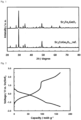
- Fig. 1 depicts the result thereof.
- the lower stage in Fig. 1 depicts an XRD pattern of a melilite-type complex oxide having the composition that is represented by Sr 2 CoGe 2 O 7 as an authentic preparation.
- Example 2 A constant current charge and discharge test was conducted for the battery for evaluation, that was acquired in Example 1.
- charge and discharge were performed for 11 times setting the current to be 6.7 mA/g, and the charge and discharge termination potentials to respectively be -1.5 V and 2.5 V (vs. Sn/SnF 2 ), in an environment at 140°C.
- Fig. 2 depicts the charge and the discharge profiles taken at the eleventh cycle.
Landscapes
- Chemical & Material Sciences (AREA)
- General Chemical & Material Sciences (AREA)
- Chemical Kinetics & Catalysis (AREA)
- Electrochemistry (AREA)
- Engineering & Computer Science (AREA)
- Inorganic Chemistry (AREA)
- Materials Engineering (AREA)
- Organic Chemistry (AREA)
- Manufacturing & Machinery (AREA)
- Life Sciences & Earth Sciences (AREA)
- Geology (AREA)
- General Life Sciences & Earth Sciences (AREA)
- Battery Electrode And Active Subsutance (AREA)
- Compounds Of Iron (AREA)
Abstract
Description
- This application claims priority to
Japanese Patent Application No. 2022-125517, filed on August 5, 2022 - The present disclosure relates to an electrode active material for a fluoride ion battery, an electrode for a fluoride ion battery, and a fluoride ion battery.
- A lithium ion battery has been known as a secondary battery having a high energy density. A fluoride ion battery has been proposed as a battery capable of achieving an energy density that is higher than that of the lithium ion battery. For example,
JP2017-143044A - A first embodiment is an electrode active material for a fluoride ion battery, that includes a complex oxide including a melilite-type crystal structure. A second embodiment is an electrode for a fluoride ion battery that includes the electrode active material for a fluoride ion battery of the first aspect. A third embodiment is a fluoride ion battery that includes the electrodes for a fluoride ion battery of the second aspect, and an electrolyte.
-
-
Fig. 1 shows an exemplary of X-ray diffraction pattern of a complex oxide according to Example. -
Fig. 2 shows an exemplary of a charge / discharge profile of a battery for evaluation. - The term "step" as used herein includes not only an independent step but also a step not clearly distinguishable from another step as long as the intended purpose of the step is achieved in the step. If a plurality of substances correspond to a component in a composition, the content of the component in the composition means the total amount of the plurality of substances present in the composition unless otherwise specified. Certain embodiments of the present disclosure will now be described in detail. It should be noted that the embodiments described below are exemplifications of an electrode active material for fluoride ion battery, an electrode for a fluoride ion battery, and a fluoride ion battery for embodying the technical ideas of the present disclosure, and the present disclosure is not limited to the electrode active material for fluoride ion battery, the electrode for a fluoride ion battery, and the fluoride ion battery described below.
- An electrode active material for a fluoride ion battery (hereinafter, also referred to simply as "electrode active material") includes a complex oxide that includes a melilite-type crystal structure. Many of the known electrode active materials each for a fluoride ion battery are each a metal active material, and each work as an active material by a fluorination-defluorination reaction of a metal thereof. The fluorination-defluorination reaction of a metal is a reaction associated with a significant change of the crystal structure thereof, and the volumetric change thereof is significant. Due to the above, overpotential thereof tends to be high, and the cycle performance and the rate capability thereof tend to be poor. On the other hand, a compound having a layered crystal structure works as an active material by intercalation and deintercalation of carrier ions into/from interlayer spaces. Small volumetric change due to the fact that the crystal structure of the active material does not change, reduction of overpotential, and improvement of each of the cycle performance, the rate capability, and the like may be expected. The complex oxide having the melilite-type crystal structure also has a layered structure and may therefore be expected to have the above advantages.
- Complex oxides each including the melilite-type crystal structure each generally have a theoretical composition represented by, for example, M1 2M2 3X7. M1 represents an alkali metal, an alkali earth metal, lanthanoid, or the like. M2 represents a transition metal, Al, Si, Zn, Ge, or the like. X represents O, N, F, S, Cl, or the like. In the melilite-type crystal structure, M2-X4 tetrahedra form a two-dimensional network structure and form a layered structure sandwiching an M1 site therebetween. As to the composition and the like of the melilite-type crystal structure, for example,
WO2019-065285 can be referred to. With the melilite-type crystal structure, an excellent cycle performance, an excellent rate capability, and the like caused by the two-dimensional diffusion of the fluoride ions are expected. An increase of the capacity caused by the redox reaction of anions each coordinated to an M2 site is also expected. - The complex oxide including the melilite-type crystal structure according to the present disclosure (hereinafter, also referred to simply as "complex oxide") may include, in the composition thereof, a first metal atom that includes at least one type selected from a first metal atom group, a second metal atom that includes at least one type selected from a second metal atom group, and a specific non-metal atom that includes at least one type selected from a specific non-metal atom group and that includes at least an oxygen atom. The composition of the complex oxide may include only one type of the first metal atom, or may include two or more types thereof in combination. The composition of the complex oxide may include only one type of the second metal atom, or may include two or more types thereof in combination. The composition of the complex oxide may include only an oxygen atom as the specific non-metal atom, or may include an oxygen atom and a specific non-metal atom other than an oxygen atom in combination.
- The first metal atom group may include the first metal atom that includes at least one type selected from the group consisting of Li, Be, Na, Mg, K, Ca, Rb, Sr, Y, Cs, Ba, La, Ce, Pr, Nd, Pm, Sm, Eu, Gd, Tb, Dy, Ho, Er, Tm, Yb, Lu, Bi. The first metal atom may include at least one type selected from the group consisting of Ca, Sr, Y, Ba, and La, and may include at least Sr.
- The first metal atom may include at least one type selected from the group consisting of Ca, Sr, Y, Ba, and La, and may further include at least one type selected from the group consisting of Li, Be, Na, Mg K, Rb, Y, Cs, Ce, Pr, Nd, Pm, Sm, Eu, Gd, Tb, Dy, Ho, Er, Tm, Yb, Lu, and Bi. In the case where the first metal atom includes at least one type selected from the group consisting of Ca, Sr, Y, Ba, and La, the total content of Ca, Sr, Y, Ba, and La in the first metal atom may be, for example, 50 mole-% or higher, 70 mole-% or higher, or 90 mole-% or higher. The total content of Ca, Sr, Y, Ba, and La in the first metal atom may be, for example, 100 mole-% or lower, or lower than 100 mole-%.
- The first metal atom may include Sr, and may further include at least one type selected from the group consisting of Li, Be, Na, Mg, K, Ca, Rb, Y, Cs, Ba, La, Ce, Pr, Nd, Pm, Sm, Eu, Gd, Tb, Dy, Ho, Er, Tm, Yb, Lu, and Bi. In the case where the first meal atom includes Sr, the content of Sr in the first metal atom may be, for example, 50 mole-% or higher, 70 mole-% or higher, or 90 mole-% or higher. The content of Sr in the first metal atom may be, for example, 100 mole-% or lower, or lower than 100 mole-%.
- The second metal atom group may include the second metal atom that includes at least one type selected from the group consisting of Al, Si, Sc, Ti, V, Cr, Mn, Fe, Co, Ni, Cu, Zn, Ga, Ge, Zr, Nb, Mo, Tc, Ru, Rh, Pd, Ag, Sn, Hf, Ta, W, Re, Os, Ir, Pt, Au, and the like. The second metal atom may include at least one type selected from the group consisting of Al, Si, Mn, Fe, Co, Ni, Cu, and Ge, may include at least one type selected from the group consisting of Fe and Ge, and may include at least Fe and Ge.
- The second metal atom may include at least one type selected from the group consisting of Al, Si, Mn, Fe, Co, Ni, Cu, and Ge, and may further include at least one type selected from the group consisting of Sc, Ti, V, Cr, Zn, Ga, Zr, Nb, Mo, Tc, Ru, Rh, Pd, Ag, Sn, Hf, Ta, W, Re, Os, Ir, Pt, and Au. In the case where the second metal atom includes at least one type selected from the group consisting of Al, Si, Mn, Fe, Co, Ni, Cu, and Ge, the total content of Al, Si, Mn, Fe, Co, Ni, Cu, and Ge in the second metal atom may be, for example, 50 mole-% or higher, 70 mole-% or higher, or 90 mole-% or higher. The total content of Al, Si, Mn, Fe, Co, Ni, Cu, and Ge in the second metal atom may be, for example, 100 mole-% or lower, or lower than 100 mole-%.
- The second metal atom may include at least one type selected from the group consisting of Fe and Ge, and may further include at least one type selected from the group consisting of Al, Si, Sc, Ti, V, Cr, Mn, Co, Ni, Cu, Zn, Ga, Zr, Nb, Mo, Tc, Ru, Rh, Pd, Ag, Sn, Hf, Ta, W, Re, Os, Ir, Pt, and Au. In the case where the second metal atom includes at least one type selected from the group consisting of Fe and Ge, the total content of Fe and Ge in the second metal atom may be, for example, 50 mole-% or higher, 70 mole-% or higher, or 90 mole-% or higher. The total content of Fe and Ge in the second metal atom may be, for example, 100 mole-% or lower, or lower than 100 mole-%.
- The specific non-metal atom group may at least include O, N, F, S, and Cl. The specific non-metal atom includes at least O, and may include at least one type of specific non-metal atom (such as, for example, N, F, S, and Cl) other than O selected from the specific non-metal atom group. The content of O in the specific non-metal atom may be, for example, 50 mole-% or higher, 70 mole-% or higher, or 90 mole-% or higher.
- In the composition of the complex oxide, the ratio of the total number of moles of the second metal atom to the total number of moles of the first metal atom, for example, may be 1.4 or greater and 1.6 or smaller and may be 1.45 or greater and 1.55 or smaller. In the composition of the complex oxide, the ratio of the total number of moles of the specific non-metal atom to the total number of moles of the first metal atom and the second metal atom, for example, may be 1.3 or greater and 1.5 or smaller, and may be 1.35 or greater or 1.45 or smaller. In the composition of the complex oxide, in the case where the total number of moles of the specific non-metal atom is set to be 7, for example, the total number of moles of the first metal atom may be greater than 1.9 and smaller than 2.1, and may be 1.95 or greater and 2.05 or smaller. In the composition of the complex oxide, in the case where the total number of moles of the specific non-metal atom is set to be 7, for example, the total number of moles of the second metal atom may be greater than 2.9 and smaller than 3.1, and may be 2.95 or greater and 3.05 or smaller.
- The complex oxide may have the composition that is represented by, for example, a formula (1) below.
M1 bM2 cXd (1)
- In the formula (1), b, c, and d, for example, may satisfy 1.9<b<2.1, 2.9<c<3.1, and 6.8<d<7.2 and may satisfy 1.95≤b≤2.05, 2.95≤c≤3.05, and 6.9<d<7.1.
- M1 may include at least one type selected from the group consisting of. for example, Li, Be, Na, Mg, K, Ca, Rb, Sr, Y, Cs, Ba, La, Ce, Pr, Nd, Pm, Sm, Eu, Gd, Tb, Dy, Ho, Er, Tm, Yb, Lu, and Bi. M1 may include at least one type selected from the group consisting of Ca, Sr, Y, Ba, and La, and may include at least Sr.
- M1 may include at least one type selected from the group consisting of Ca, Sr, Y, Ba, and La, and may further include at least one type selected from the group consisting of Li, Be, Na, Mg, K, Rb, Y, Cs, Ce, Pr, Nd, Pm, Sm, Eu, Gd, Tb, Dy, Ho, Er, Tm, Yb, Lu, and Bi. In the case where M1 includes at least one type selected from the groups consisting of Ca, Sr, Y, Ba, and La, the total content of Ca, Sr, Y, Ba, and La in M1 may be, for example, 50 mole-% or higher, 70 mole-% or higher, or 90 mole-% or higher. The total content of Ca, Sr, Y, Ba, and La in M1 may be, for example, 100 mole-% or lower, or lower than 100 mole-%.
- M1 may include Sr, and may further include at least one type selected from the group consisting of Li, Be, Na, Mg, K, Ca, Rb, Y, Cs, Ba, La, Ce, Pr, Nd, Pm, Sm, Eu, Gd, Tb, Dy, Ho, Er, Tm, Yb, Lu, and Bi. In the case where M1 includes Sr, the content of Sr in M1 may be, for example, 50 mole-% or higher, 70 mole-% or higher, or 90 mole-% or higher. The content of Sr in M1 may be, for example, 100 mole-% or lower, or lower than 100 mole-%.
- M2 may include at least one type selected from the group consisting of, for example, Al, Si, Sc, Ti, V, Cr, Mn, Fe, Co, Ni, Cu, Zn, Ga, Ge, Zr, Nb, Mo, Tc, Ru, Rh, Pd, Ag, Sn, Hf, Ta, W, Re, Os, Ir, Pt, and Au. M2 may include at least one type selected from the group consisting of Al, Si, Mn, Fe, Co, Ni, Cu, and Ge, may include at least one type selected from the group consisting of Fe and Ge, and may include at least Fe and Ge.
- M2 includes at least one type selected from the group consisting of Al, Si, Mn, Fe, Co, Ni, Cu, and Ge, and may further include at least one type selected from the group consisting of Sc, Ti, V, Cr, Zn, Ga, Zr, Nb, Mo, Tc, Ru, Rh, Pd, Ag, Sn, Hf, Ta, W, Re, Os, Ir, Pt, and Au. In the case where M2 includes at least one type selected from the group consisting of Al, Si, Mn, Fe, Co, Ni, Cu, and Ge, the total content of Al, Si, Mn, Fe, Co, Ni, Cu, and Ge in M2 may be, for example, 50 mole-% or higher, 70 mole-% or higher, or 90 mole-% or higher. The total content of Al, Si, Mn, Fe, Co, Ni, Cu, and Ge in M2 may be, for example, 100 mole-% or lower, or lower than 100 mole-%.
- M2 may include at least one type selected from the group consisting of Fe and Ge, and may further include at least one type selected from the group consisting of Al, Si, Sc, Ti, V, Cr, Mn, Co, Ni, Cu, Zn, Ga, Zr, Nb, Mo, Tc, Ru, Rh, Pd, Ag, Sn, Hf, Ta, W, Re, Os, Ir, Pt, and Au. In the case where M2 includes at least one type selected from the group consisting of Fe and Ge, the total content of Fe and Ge in M2 may be, for example, 50 mole-% or higher, 70 mole-% or higher, or 90 mole-% or higher. The total content of Fe and Ge in M2 may be, for example, 100 mole-% or lower, or lower than 100 mole-%.
- X may include O, and may further include at least one type of the specific non-metal atom selected from the group consisting of N, F, S, and Cl. The content of O in X may be, for example, 50 mole-% or higher, 70 mole-% or higher, or 90 mole-% or higher.
- The number of moles of oxygen atoms included in the composition of the complex oxide is calculated based on the metal ion amount quantified using an ICP luminescence spectroscopic analysis method, taking into consideration the valence of each of the metals, and assuming that the total number of moles of the first metal atom and the second metal atom is 5. The number of moles of each of N, F, S, and Cl included in the composition of the complex oxide is also calculated in the same manner.
- It is assumed, for example, that Sr (divalent) to be the first metal atom, and Fe (trivalent) and Ge (tetravalent) to be the second metal atom are detected to be 2:2:1 as the ratios of the number of moles thereof using the ICP luminescence spectroscopic analysis method. In this case, the detected amounts of strontium ions, iron ions, and germanium ions are respectively 2, 2, and 1 on the molar basis. Assuming that the valence of a strontium ion is 2, the valence of an iron ion is 3, and the valence of a germanium ion is 4, the number of moles of oxygen atoms included in the complex oxide is calculated to be (2×2+3×2+1×4)/2=7.
- It may be identified, by measuring an X-ray diffraction spectrum, that the complex oxide has a melilite-type crystal structure. For example, the complex oxide may be identified to have the melilite-type crystal structure in the case where a similarity relation is established between an XRD spectrum of an inorganic crystal for which it is indicated that the inorganic crystal has a composition corresponding to the complex oxide and that the inorganic crystal has the melilite crystal structure in Inorganic Crystal Structure Database (ICSD), and the XRD spectrum of the complex oxide.
- In the case where the complex oxide has a theoretical composition of, for example, Sr2Fe2GeO7, the complex oxide may be identified to have the melilite-type crystal structure when, for plural (such as, for example, four) high intensity peaks of the XRD data of Sr2CoGe2O7 in ICSD, the XRD data of the complex oxide has the peaks corresponding thereto. For example, Sr2Fe2GeO7 may be identified to have the melilite-type crystal structure when 2θ of the XRD data of Sr2Fe2GeO7 is present at positions of, for example, 27.44°±2°, 29.60°±2°, 34.80°±2°, and 49.06°±2°.
- The shape of the complex oxide may be selected as necessary from, for example, a particle shape and a bulk shape. The volume mean particle diameter of the complex oxide may be, for example, 1 nm or larger and 100 µm or smaller. The volume mean particle diameter of the complex oxide may be 20 nm or larger, or 10 µm or smaller. The volume mean particle diameter of the complex oxide is determined as the particle diameter that corresponds to the volume cumulative 50% from the small particle diameter side in the volume-based cumulative particle size distribution. The volume-based cumulative particle size distribution is measured using, for example, a laser diffraction particle size distribution measuring apparatus.
- The complex oxide included in the electrode active material may be one type alone or may be two or more types in combination. The electrode active material may be a positive electrode active material or may be a negative electrode active material, depending on the active material included in the opposite electrode. When the fluoride ion battery is manufactured, the complex oxide can be used as the positive electrode active material by including an active material having a potential that is lower than that of the complex oxide, in the opposite electrode. On the other hand, the complex oxide can be used as the negative electrode active material by including an active material having a potential that is higher than that of the complex oxide, in the opposite electrode.
- In the case where the electrode active material is used as the positive electrode active material, an optional active material having a potential that is lower than that of the positive electrode active material can be selected as the negative electrode active material. Examples of the negative electrode active material may include, for example, a metal elemental substance, an alloy, a metal oxide, and fluorides of these. Examples of the metal atom included in the negative electrode active material may include, for example, La, Ca, Al, Eu, Li, Si, Ge, Sn, In, V, Cd, Cr, Fe, Zn, Ga, Ti, Nb, Mn, Yb, Zr, Sm, Ce, Mg, and Pb. It is preferred that, among these, the negative electrode active material include at least one type selected from the group consisting of Mg, MgFx, Al, AlFx, Sn, SnFx, Ce, CeFx, Ca, CaFx, Pb, and PbFx. "x" is a real number that is greater than zero. Examples of the negative electrode active material may also include a carbon material and a fluoride thereof. Examples of the carbon material include, for example, black lead, coke, and carbon nanotubes. Other examples of the negative electrode active material may also include a polymer material. Examples of the polymer material may include, for example, polyaniline, polypyrrole, polyacetylene, and polythiophene.
- In the case where the electrode active material is used as the negative electrode active material, an optional active material having a potential that is higher than that of the negative electrode active material may be selected as the positive electrode active material. Examples of the positive electrode active material may include, for example, a metal elemental substance, an alloy, a metal oxide, and fluorides thereof. Examples of the metal atom included in the positive electrode active material can include, for example, Cu, Ag, Ni, Co, Pb, Ce, Mn, Au, Pt, Rh, V, Os, Ru, Fe, Cr, Bi, Nb, Sb, Ti, Sn, and Zn. It is preferred that, among these, the positive electrode active material include at least one type selected from the group consisting of Cu, CuFx, Fe, FeFx, Bi, and BiFx. "x" is a real number that is greater than zero. The carbon materials and the polymer materials listed above may be used each as the positive electrode active material.
- The content rate of the complex oxide included in the electrode active material, relative to the electrode active material, may be, for example, 50% by mass or higher, 70% by mass or higher, or 90% by mass or higher. The upper limit of the content rate of the complex oxide may be, for example, 100% by mass or lower.
- A manufacturing method for a ceramic material may be used as a manufacturing method for the complex oxide. Such a method may be used as, for example, a liquid phase method such as a polymerized complex method, a hydrothermal synthesis method, or a coprecipitation method, or a solid phase method such as a sintering method, or a mechanochemical method. Among these, the liquid phase method may be used for acquisition of the complex oxide that is chemically highly homogeneous.
- The complex oxide may also be synthesized using, for example, the polymerized complex method. With this method, the chemical homogeneity of the acquired complex oxide can be enhanced compared to that of the solid phase method. In this method, metal sources including the metals included in the complex oxide are first weighed to have the stoichiometric ratios equal to those of the metals included in the aimed complex oxide, to acquire a metal source mixture. The metal source mixture, pure water, and citric acid are next mixed with each other, and ethylene glycol is mixed therewith as necessary to acquire a raw material solution. The raw material solution is heated and concentrated to acquire a powdered precursor. The precursor is crushed as necessary and heat treatment is thereafter applied to the precursor to thereby be able to acquire a desired complex oxide. For the details of the polymerized complex method, for example,
WO2019-065285 may be referred to. - The metal sources to be used in the manufacture of the complex oxide may be selected as appropriate from, for example, a nitrate salt, an acetate salt, and an oxide each including the desired metal, to be used.
- The electrode composite for a fluoride ion battery (hereinafter, also referred to simply as "electrode composite") includes the complex oxide that includes the melilite-type crystal structure. The complex oxide may be included in the electrode composite as an electrode active material. The details of the complex oxide are the same as described above. The content of the complex oxide in the electrode composite, relative to the electrode composite, may be, for example, 30% by mass or higher and 99% by mass or lower, and may be 50% by mass or higher, or 80% by mass or lower. The electrode composite may include one type of the complex oxide alone or may include two or more types thereof in combination.
- In addition to the complex oxide, the electrode composite may further include at least one type of another component selected from the group consisting of a conductive agent, a binder, a solid electrolyte, a dispersion agent, and the like.
- The conductive agent only has to have desired electron conductivity, and examples thereof may include, for example, a carbon material. Examples of the carbon material include, for example, carbon black such as fibrous carbon, acetylene black, Ketjen black, furnace black, or thermal black, graphene, fullerene, and carbon nanotubes. Examples of the binder may include, for example, fluorine-based binders such as polyvinylidene fluoride (PVDF) and polytetrafluoroethylene (PTFE).
- Examples of the solid electrolyte may include a fluoride of lanthanoid such as La or Ce, a fluoride of an alkali metal such as Li, Na, K, Rb, or Cs, and a fluoride of an alkali earth metal such as Ca, Sr, or Ba. For example, the examples include a fluoride of La and Ba, such as, for example, La0.9Ba0.1F2.9, and a fluoride of Pb and Sn, such as, for example, PbSnF4.
- In the case where the electrode composite includes other components in addition to the complex oxide, the content of the other components in the electrode composite, relative to the electrode composite, may be, for example, 1% by mass or higher and 80% by mass or lower, and may be 20% by mass or higher, or 50% by mass or lower.
- The electrode composite may be used in forming the electrode active material layer included in the electrode. The electrode composite may be a positive electrode composite included in a positive electrode active material layer or may be a negative electrode composite included in a negative electrode active material layer, depending on the active material included in the opposite electrode thereof.
- The electrode for a fluoride ion battery (hereinafter, also referred to simply as "electrode") includes the electrode composite for a fluoride ion battery. The electrode may include a current collector and an electrode active material layer disposed on the current collector. Examples of the material of the current collector can include, for example, gold, platinum, SUS, aluminum, nickel, iron, titanium, and carbon. The material of the current collector may be selected as necessary depending on the potential of the electrode. Examples of the current collector may include, for example, a foil shape, a mesh shape, and a porous shape.
- The electrode active material layer disposed on the current collector may include the above electrode composite. The content of the complex oxide in the electrode active material layer, relative to the electrode active material layer, may, for example, be 20% by mass or higher, 50% by mass or higher, 70% by mass or higher, or 90% by mass or higher. The content of the complex oxide in the electrode active material layer may be, for example, 99% by mass or lower.
- In addition to the complex oxide, the electrode active material layer may further include at least one type selected from the group consisting of a conductive agent, a binder, a solid electrolyte, a dispersion agent, and the like. The content of the conductive agent in the electrode active material layer, relative to the electrode active material layer, for example, may be 1% by mass or higher and 20% by mass or lower, and may be 5% by mass or higher, or 10% by mass or lower. The content of the binder in the electrode active material layer, relative to the electrode active material layer, may be, for example, 1% by mass or higher and 30% by mass or lower.
- The electrode for a fluoride battery may be a positive electrode for a fluoride battery, that includes a positive electrode active material layer or may be a negative electrode for a fluoride battery, that includes a negative electrode active material layer, depending on the active material included in the active material layer of the opposite electrode thereof.
- The electrode may be manufactured by pressuring the electrode composite as powder to thereby form the electrode active material layer, and connecting the electrode active material layer and the current collector to each other. The electrode may be manufactured by applying the electrode composite that includes a solvent onto the current collector to be as necessary dried and pressure-formed, and thereby forming the electrode active material layer on the current collector.
- The fluoride ion battery includes the electrode for a fluoride ion battery, an electrolyte, and an opposite electrode. The electrode for a fluoride ion battery may be constituted as a positive electrode whose opposite electrode is a negative electrode, or may be constituted as a negative electrode whose opposite electrode is a positive electrode. The fluoride ion battery may include a separator between the positive electrode and the negative electrode. The fluoride ion battery may be a primary battery or may be a secondary battery, or may preferably be a secondary battery. A primary battery also includes use of a secondary battery as a primary battery, that is use with the purpose of discharging only once after the charging thereof. Examples of the shape of the fluoride ion battery include, for example, a coin shape, a laminate shape, a cylindrical shape, and a square shape.
- The details of the electrode for a fluoride ion battery, included in the fluoride ion battery is the same as described above. The electrolyte is disposed between the electrode for a fluoride ion battery, and the opposite electrode thereto. The electrolyte may be a liquid electrolyte, that is an electrolytic solution, or a solid electrolyte.
- The electrolytic solution may be, for example, a non-aqueous electrolytic solution that includes a fluoride salt and an organic solvent. Examples of the fluoride salt may include an inorganic fluoride salt, an organic fluoride salt, an ionic liquid, and the like. Examples of the inorganic fluoride salt may include an XF. X may include at least one type of alkali metal selected from the group consisting of Li, Na, K, Rb, and Cs. Examples of a cation of the organic fluoride salt may include an alkylammonium cation such as a tetramethylammonium cation. The concentration of the fluoride salt in the electrolytic solution, for example, may be 0.1 mole-% or higher and 40 mole-% or lower, and may be 1 mole-% or higher, or 10 mole-% or lower.
- The organic solvent included in the electrolytic solution only has to be a solvent that solves the fluoride salt. Examples of the organic solvent may include, for example, a glyme such as triethyleneglycoldimethyl ether (G3) or tetraethyleneglycoldimetyl ether (G4), a cyclic carbonate such as ethylene carbonate (EC), fluoroethylene carbonate (FEC), difluoroethylene carbonate (DFEC), propylene carbonate (PC), or butylene carbonate (BC), and a chain carbonate such as dimethyl carbonate (DMC), diethyl carbonate (DEC), or ethylmethyl carbonate (EMC). An ionic liquid may also be used as the organic solvent.
- Examples of the solid electrolyte may include a fluoride of lanthanoid such as La or Ce, a fluoride of an alkali metal such as Li, Na, K, Rb, or Cs, and a fluoride of an alkali earth metal such as Ca, Sr, or Ba. For example, the examples include a fluoride of La and Ba (such as, for example, La0.9Ba0.1F2.9), and a fluoride of Pb and Sn (such as, for example, PbSnF4).
- The opposite electrode may include a current collector and an electrode active material layer disposed on the current collector. The material of the current collector may be selected as necessary depending on the potential of the opposite electrode. In the case where the opposite electrode is used as, for example, a negative electrode, examples of the material of the current collector may include, for example, gold, platinum, SUS, copper, nickel, and carbon. Examples of the shape of the current collector may include, for example, a foil shape, a mesh shape, and a porous shape.
- In the case where a fluoride ion battery is manufactured using the electrode for a fluoride ion battery as the positive electrode thereof, the negative electrode active material included in the negative electrode active material layer of the opposite electrode to be the negative electrode only has to be a material having a potential that is lower than that of the complex oxide to be the positive electrode active material. The specific examples of the negative electrode active material are as above. The content of the negative electrode active material in the negative electrode active material layer, relative to the negative electrode active material layer, for example, may be 30% by mass or higher, or may be 50% by mass or higher, 70% by mass or higher, or 90% by mass or higher. The content of the negative electrode active material in the negative electrode active material layer may be, for example, 99% by mass or lower.
- In the case where the fluoride ion battery is manufactured using the electrode for a fluoride ion battery as the negative electrode thereof, the positive electrode active material included in the positive electrode active material layer of the opposite electrode to be the positive electrode only has to be an active material having a potential that is higher than that of the complex oxide to be the negative electrode active material. The specific examples of the positive electrode active material are as above. The content of the positive electrode active material in the positive electrode active material layer, relative to the positive electrode active material layer, for example, may be 30% by mass or higher, or may be 50% by mass or higher, 70% by mass or higher, or 90% by mass or higher. The content of the positive electrode active material in the positive electrode active material layer may be, for example, 99% by mass or lower.
- In addition to the electrode active material, the electrode active material layer of the opposite electrode may further include at least one type selected from the group consisting of a conductive agent, a binder, a solid electrolyte, a dispersion agent, and the like. The content of the conductive agent in the electrode active material layer of the opposite electrode, relative to the electrode active material layer, for example, may be 1% by mass or higher and 20% by mass or lower, or may be 5% by mass or higher, or 10% by mass or lower. The content of the binder in the electrode active material layer, relative to the electrode active material layer may be, for example, 1% by mass or higher and 30% by mass or lower.
- The present invention will be described below in detail with reference to Example while the present invention is not limited to Example.
- Sr(NO3)2 (produced by FUJIFILM Wako Pure Chemical Corporation), Fe(NO3)2·9H2O (produced by FUJIFILM Wako Pure Chemical Corporation), and GeO2 (produced by Kojundo Chemical Laboratory Co., Ltd.) were weighed to be 2:2:1 as their metal molar ratios. Pure water, citric acid (produced by FUJIFILM Wako Pure Chemical Corporation) whose molar amount is five times as much as the total cation amount, and ethylene glycol (produced by FUJIFILM Wako Pure Chemical Corporation) whose molar amount is equal to the total cation amount were added to the above, and all these raw materials were stirred to be homogeneous to obtain a raw material solution. The raw material solution was put in a thermostatic bath that was set at 150°C and was left untouched to be heated and concentrated to thereby obtain a powdered precursor. The acquired precursor was pulverized and heat treatment was thereafter applied to the precursor at 1,000°C for 10 hours in the air using a box furnace to obtain a complex oxide.
- For the complex oxide obtained as above, the composition of the complex oxide was determined using an inductively coupled plasma (ICP) atomic emission spectrometry. For example, the complex oxide was alkali-dissolved as a pre-process and was thereafter HCl-heat-dissolved to measure the compositional amounts of the metal ions using an inductively coupled plasma (ICP) atomic emission spectrometry apparatus (ICP-AES; Optima 8300: manufactured by Perkin Elmer Corporation), and the molar ratio of the oxygen atoms in the composition was determined assuming that the total of the compositional amounts of the metal ions was 5. The obtained complex oxide had a composition represented by Sr2.00Fe2.04Ge0.96O6.98.
- BaF2 (produced by Kojundo Chemical Laboratory Co., Ltd) and LaF3 (produced by (Kojundo Chemical Laboratory Co., Ltd.) were weighed to be 1:9 as their molar ratios. The weighed materials were dried by being heated at 120°C for 2 hours and were thereafter pulverized and mixed with each other at 600 rpm for 10 hours using a planetary ball mill to obtain a mixture. Heat treatment was applied to the obtained mixture at 600°C for 10 hours in an argon atmosphere to acquire a solid electrolyte that had a composition represented by La0.9Ba0.1F2.9.
- 150 mg of the complex oxide obtained as above as the electrode active material, 300 mg of the solid electrolyte obtained as above, and 50 mg of VGCF(R)-H (produced by Showa Denko K.K.) as a conductive agent were prepared and were mixed with each other for 15 minutes in a mortar. 15 g of zirconia (ZrO2) balls (Φ 3 mm) as a media for mixing was added to the above to be mixed with each other using a homogenizer to obtain a positive electrode composite. This step was fully performed in a argon-filled glove box.
- 150 mg of SnF2 (produced by Sigma-Aldrich Co., LLC) as a negative electrode active material, 300 mg of the solid electrolyte obtained as above, and 50 mg of VGCF(R)-H as a conductive agent were prepared and were mixed with each other for 15 minutes in a mortar. 15 g of ZrO2 balls (Φ 3 mm) as a media for mixing was added to the above to be mixed with each other using a homogenizer to obtain a negative electrode composite. This step was fully performed in a argon-filled glove box.
- 10 mg of the positive electrode composite, 175 mg of the solid electrolyte, and 50 mg of the negative electrode composite, each obtained as above, were stacked on each other in this order to be power-compacted. An Au foil was attached on each of both ends as a current collector to manufacture a battery for evaluation. This step was fully performed in a argon-filled glove box.
- The complex oxide obtained as above (Sr2.00Fe2.04Ge0.96O6.98) was filled in an XRD glass folder to execute powder XRD measurement therefor using an X-ray diffraction measuring apparatus (manufactured by Rigaku Corporation, Miniflex 600). For example, the measurement was conducted using a CuKα radiation (λ=0.154 nm) at a scanning speed of 10°/min from 2θ=20° to 80° with the step width: 0.02°.
Fig. 1 depicts the result thereof. The lower stage inFig. 1 depicts an XRD pattern of a melilite-type complex oxide having the composition that is represented by Sr2CoGe2O7 as an authentic preparation. - In the XRD pattern of the complex oxide obtained as above, peaks are recognized at the positions of 2θ=27.44°, 29.60°, 34.80°, and 49.08° as the four high intensity peaks.
- It turned out that the complex oxide acquired as above had the melilite-type crystal structure from the fact that the peaks were observed that corresponded to the four peaks at 2θ=27.44°±2°, 29.60°±2°, 34.80°±2°, and 49.06°±2° in the XRD data of ICSD.
- A constant current charge and discharge test was conducted for the battery for evaluation, that was acquired in Example 1. In the charge and discharge test, charge and discharge were performed for 11 times setting the current to be 6.7 mA/g, and the charge and discharge termination potentials to respectively be -1.5 V and 2.5 V (vs. Sn/SnF2), in an environment at 140°C.
Fig. 2 depicts the charge and the discharge profiles taken at the eleventh cycle. - In the charge profile, a first plateau region was observed in the vicinity of -1.0 to 0.5 V (vs. Sn/SnF2) and a second plateau region was observed in the vicinity of 1.5 to 2.0 V (vs. Sn/SnF2). The theoretical capacity of Sr2Fe2GeO7 is 56.9 mAh/g per one electron reaction. It may be considered that charge compensation is achieved by the reaction of Fe3+/Fe4+ from the fact that a capacity corresponding to a two-electron reaction is acquired in the first plateau region. It may be considered that charge compensation is achieved by redox of oxygen from the fact that a capacity exceeding the number of the reacted electrons by oxidation and reduction of the metal atoms is exhibited in the second plateau region.
- It is to be understood that although the present invention has been described with regard to preferred embodiments thereof, various other embodiments and variants may occur to those skilled in the art, which are within the scope and spirit of the invention, and such other embodiments and variants are intended to be covered by the following claims.
- Although the present disclosure has been described with reference to several exemplary embodiments, it is to be understood that the words that have been used are words of description and illustration, rather than words of limitation. Changes may be made within the purview of the appended claims, as presently stated and as amended, without departing from the scope and spirit of the disclosure in its aspects. Although the disclosure has been described with reference to particular examples, means, and embodiments, the disclosure may be not intended to be limited to the particulars disclosed; rather the disclosure extends to all functionally equivalent structures, methods, and uses such as are within the scope of the appended claims.
- One or more examples or embodiments of the disclosure may be referred to herein, individually and/or collectively, by the term "disclosure" merely for convenience and without intending to voluntarily limit the scope of this application to any particular disclosure or inventive concept. Moreover, although specific examples and embodiments have been illustrated and described herein, it should be appreciated that any subsequent arrangement designed to achieve the same or similar purpose may be substituted for the specific examples or embodiments shown. This disclosure may be intended to cover any and all subsequent adaptations or variations of various examples and embodiments. Combinations of the above examples and embodiments, and other examples and embodiments not specifically described herein, will be apparent to those of skill in the art upon reviewing the description.
- In addition, in the foregoing Detailed Description, various features may be grouped together or described in a single embodiment for the purpose of streamlining the disclosure. This disclosure may be not to be interpreted as reflecting an intention that the claimed embodiments require more features than are expressly recited in each claim. Rather, as the following claims reflect, inventive subject matter may be directed to less than all of the features of any of the disclosed embodiments. Thus, the following claims are incorporated into the Detailed Description, with each claim standing on its own as defining separately claimed subject matter.
- The above disclosed subject matter shall be considered illustrative, and not restrictive, and the appended claims are intended to cover all such modifications, enhancements, and other embodiments which fall within the true spirit and scope of the present disclosure. Thus, to the maximum extent allowed by law, the scope of the present disclosure may be determined by the broadest permissible interpretation of the following claims and their equivalents, and shall not be restricted or limited by the foregoing detailed description.
- All publications, patent applications, and technical standards mentioned in this specification are herein incorporated by reference to the same extent as if each individual publication, patent application, or technical standard was specifically and individually indicated to be incorporated by reference.
Claims (16)
- An electrode active material for a fluoride ion battery, the electrode active material comprising
a complex oxide that comprises a melilite-type crystal structure. - The electrode active material for a fluoride ion battery according to claim 1, wherein
the complex oxide comprises:a first metal atom that comprises at least one selected from a first metal atom group below;a second metal atom that comprises at least one selected from a second metal atom group below;a specific non-metal atom that comprises at least one selected from a specific non-metal atom group below; andat least an oxygen atom as the specific non-metal atom, whereinthe first metal atom group: Li, Be, Na, Mg, K, Ca, Rb, Sr, Y, Cs, Ba, La, Ce, Pr, Nd, Pm, Sm, Eu, Gd, Tb, Dy, Ho, Er, Tm, Yb, Lu, and Bi, whereinthe second metal atom group: Al, Si, Sc, Ti, V, Cr, Mn, Fe, Co, Ni, Cu, Zn, Ga, Ge, Zr, Nb, Mo, Tc, Ru, Rh, Pd, Ag, Sn, Hf, Ta, W, Re, Os, Ir, Pt, and Au, and whereinthe specific non-metal atom group: O, F, N, S, and Cl. - The electrode active material for a fluoride ion battery according to claim 2, wherein
the complex oxide has a composition in which a ratio of a total number of moles of the second metal atom to a total number of moles of the first metal atom is 1.4 or greater and 1.6 or smaller, and a ratio of a total number of moles of the specific non-metal atom to a total number of moles of the first meal atom and the second metal atom is 1.3 or greater and 1.5 or smaller. - The electrode active material for a fluoride ion battery according to claim 2 or 3, wherein
the complex oxide comprises at least one selected from the group consisting of Ca, Sr, Y, Ba, and La as the first metal atom. - The electrode active material for a fluoride ion battery according to any one of claims 2 to 4, wherein
the complex oxide comprises at least one selected from the group consisting of Al, Si, Mn, Fe, Co, Ni, Cu, and Ge as the second metal atom. - The electrode active material for a fluoride ion battery according to any one of claims 2 to 5, wherein
the complex oxide comprises at least Sr as the first metal atom. - The electrode active material for a fluoride ion battery according to any one of claims 2 to 6, wherein
the complex oxide comprises at least one selected from the group consisting of Fe and Ge as the second metal atom. - The electrode active material for a fluoride ion battery according to any one of claims 1 to 7, wherein
the complex oxide has a volume mean particle diameter that is 20 nm or larger and 10 µm or smaller. - The electrode active material for a fluoride ion battery according to claim 1, whereinthe complex oxide has a composition that is represented by a formula (1) below,
M1 bM2 cXd (1),
whereinin the formula (1), 1.9<b<2.1, 2.9<c<3.1, and 6.8<d<7.2, whereinM1 comprises at least one selected from the group consisting of Li, Be, Na, Mg, K, Ca, Rb, Sr, Y, Cs, Ba, La, Ce, Pr, Nd, Pm, Sm, Eu, Gd, Tb, Dy, Ho, Er, Tm, Yb, Lu, and Bi, whereinM2 comprises at least one selected from the group consisting of Al, Si, Sc, Ti, V, Cr, Mn, Fe, Co, Ni, Cu, Zn, Ga, Ge, Zr, Nb, Mo, Tc, Ru, Rh, Pd, Ag, Sn, Hf, Ta, W, Re, Os, Ir, Pt, and Au, and whereinX comprises O and optionally comprises at least one selected from the group consisting of N, F, S, and Cl. - The electrode active material for a fluoride ion battery according to claim 9, wherein
in the formula (1), the M1 comprises at least one selected from the group consisting of Ca, Sr, Y, Ba, and La. - The electrode active material for a fluoride ion battery according to claim 9 or 10, wherein
in the formula (1), the M2 comprises at least one selected from the group consisting of Al, Si, Mn, Fe, Co, Ni, Cu, and Ge. - The electrode active material for a fluoride ion battery according to any one of claims 9 to 11, wherein
in the formula (1), the M1 comprises at least Sr. - The electrode active material for a fluoride ion battery according to any one of claims 9 to 12, wherein
in the formula (1), the M2 comprises at least one selected from the group consisting of Fe and Ge. - The electrode active material for a fluoride ion battery according to any one of claims 9 to 13, wherein
the complex oxide has a volume mean particle diameter that is 20 nm or larger and 10 µm or smaller. - The electrode active material for a fluoride ion battery according to any one of claims 1 to 14 for use in an electrode for a fluoride ion battery.
- The electrode for a fluoride ion battery according to claim 15 for use in a fluoride battery.
Applications Claiming Priority (1)
| Application Number | Priority Date | Filing Date | Title |
|---|---|---|---|
| JP2022125517A JP7856894B2 (en) | 2022-08-05 | 2022-08-05 | Electrode active material for fluoride-ion batteries, electrodes for fluoride-ion batteries, and fluoride-ion batteries |
Publications (1)
| Publication Number | Publication Date |
|---|---|
| EP4318642A1 true EP4318642A1 (en) | 2024-02-07 |
Family
ID=86851827
Family Applications (1)
| Application Number | Title | Priority Date | Filing Date |
|---|---|---|---|
| EP23179326.6A Pending EP4318642A1 (en) | 2022-08-05 | 2023-06-14 | Electrode active material for a fluoride ion battery, electrode for a fluoride ion battery, and fluoride ion battery |
Country Status (4)
| Country | Link |
|---|---|
| US (1) | US20240047662A1 (en) |
| EP (1) | EP4318642A1 (en) |
| JP (1) | JP7856894B2 (en) |
| CN (1) | CN117525379A (en) |
Families Citing this family (1)
| Publication number | Priority date | Publication date | Assignee | Title |
|---|---|---|---|---|
| CN121484044B (en) * | 2026-01-12 | 2026-04-10 | 湖南大学 | Chlorine doped sodium iron sulfate composite positive electrode material and preparation method and application thereof |
Citations (3)
| Publication number | Priority date | Publication date | Assignee | Title |
|---|---|---|---|---|
| US20170237067A1 (en) * | 2016-02-12 | 2017-08-17 | Toyota Jidosha Kabushiki Kaisha | Active material and fluoride ion battery |
| US20180316012A1 (en) * | 2017-04-27 | 2018-11-01 | Toyota Jidosha Kabushiki Kaisha | Electrode active material, all solid fluoride ion battery, and method for producing electrode active material |
| WO2019065285A1 (en) | 2017-09-29 | 2019-04-04 | 学校法人神奈川大学 | Melilite composite oxide |
Family Cites Families (2)
| Publication number | Priority date | Publication date | Assignee | Title |
|---|---|---|---|---|
| KR20130075529A (en) | 2011-12-27 | 2013-07-05 | 삼성전자주식회사 | Solid oxide electrode, solid oxide fuel cell containing solid oxide electrode, and preparation method thereof |
| JP6987383B2 (en) * | 2017-09-29 | 2021-12-22 | 学校法人神奈川大学 | Positive electrode catalyst for metal-air battery and metal-air battery |
-
2022
- 2022-08-05 JP JP2022125517A patent/JP7856894B2/en active Active
-
2023
- 2023-06-14 EP EP23179326.6A patent/EP4318642A1/en active Pending
- 2023-08-04 US US18/365,658 patent/US20240047662A1/en active Pending
- 2023-08-04 CN CN202310980118.4A patent/CN117525379A/en active Pending
Patent Citations (5)
| Publication number | Priority date | Publication date | Assignee | Title |
|---|---|---|---|---|
| US20170237067A1 (en) * | 2016-02-12 | 2017-08-17 | Toyota Jidosha Kabushiki Kaisha | Active material and fluoride ion battery |
| JP2017143044A (en) | 2016-02-12 | 2017-08-17 | トヨタ自動車株式会社 | Active material and fluoride ion battery |
| US20180316012A1 (en) * | 2017-04-27 | 2018-11-01 | Toyota Jidosha Kabushiki Kaisha | Electrode active material, all solid fluoride ion battery, and method for producing electrode active material |
| WO2019065285A1 (en) | 2017-09-29 | 2019-04-04 | 学校法人神奈川大学 | Melilite composite oxide |
| US20200255296A1 (en) * | 2017-09-29 | 2020-08-13 | Kanagawa University | Melilite composite oxide |
Non-Patent Citations (1)
| Title |
|---|
| VASALA SAMI ET AL: "Reversible Tuning of Magnetization in a Ferromagnetic Ruddlesden-Popper-Type Manganite by Electrochemical Fluoride-Ion Intercalation", vol. 6, no. 2, 13 December 2019 (2019-12-13), pages 1 - 9, XP093112032, ISSN: 2199-160X, Retrieved from the Internet <URL:https://onlinelibrary.wiley.com/doi/full-xml/10.1002/aelm.201900974> DOI: 10.1002/aelm.201900974 * |
Also Published As
| Publication number | Publication date |
|---|---|
| CN117525379A (en) | 2024-02-06 |
| US20240047662A1 (en) | 2024-02-08 |
| JP2024022151A (en) | 2024-02-16 |
| JP7856894B2 (en) | 2026-05-12 |
Similar Documents
| Publication | Publication Date | Title |
|---|---|---|
| Hong et al. | Synthesis and electrochemical properties of nanocrystalline Li [Ni x Li (1− 2x)/3 Mn (2− x)/3] O 2 prepared by a simple combustion method | |
| JP6359323B2 (en) | Surface-modified lithium-containing composite oxide for lithium ion secondary battery positive electrode | |
| US20030180616A1 (en) | Layered electrodes for lithium cells and batteries | |
| WO2019146218A1 (en) | Solid electrolyte material and battery | |
| WO2018163519A1 (en) | Positive electrode active material and battery | |
| JP2019125575A (en) | Positive electrode active material and battery | |
| WO2019150559A1 (en) | Positive electrode for solid-state batteries, solid-state battery and method for producing solid-state battery | |
| JP2019029343A (en) | Positive electrode active material and battery | |
| Ghosh et al. | Lanthanum-doped LiCoO2 cathode with high rate capability | |
| JP5727092B2 (en) | Solid electrolyte material, solid electrolyte and battery | |
| CN108232133B (en) | Active Materials and Fluoride Ion Batteries | |
| JP2019029344A (en) | Cathode active material, and battery | |
| US20230402606A1 (en) | Solid-state battery | |
| EP4238938A1 (en) | Solid electrolyte material, and battery in which same is used | |
| Xie et al. | Ni and Fe dual-doped Li4Mn5O12 spinels as cathode materials for high-voltage Li-ion batteries | |
| KR20210106310A (en) | Composite cathode active material, preparing method thereof, cathode layer including the composite cathode active material, and all solid secondary battery including the same | |
| WO2020240890A1 (en) | Active material for fluoride ion secondary batteries, and fluoride ion secondary battery using same | |
| US20240047662A1 (en) | Electrode active material for a fluoride ion battery, electrode for a fluoride ion battery, and fluoride ion battery | |
| WO2022138804A1 (en) | Lithium ion-conductive solid electrolyte, and all-solid-state battery | |
| US12580225B2 (en) | Solid-state battery | |
| CN108807866A (en) | The manufacturing method of electrode active material, fluoride ion all-solid-state battery and electrode active material | |
| JP2020173906A (en) | Positive electrode active material for all-solid-state batteries | |
| Lin et al. | The Cu–Y co-doping LiNi0. 5Mn1. 5O4 with modified morphology and enhanced electrochemical property for a 5 V lithium-ion battery | |
| EP4389706A1 (en) | Electrode active material for fluoride ion battery, electrode for fluoride ion battery, and fluoride ion battery | |
| WO2023195212A1 (en) | Oxyhalide material, battery, and battery system |
Legal Events
| Date | Code | Title | Description |
|---|---|---|---|
| PUAI | Public reference made under article 153(3) epc to a published international application that has entered the european phase |
Free format text: ORIGINAL CODE: 0009012 |
|
| STAA | Information on the status of an ep patent application or granted ep patent |
Free format text: STATUS: THE APPLICATION HAS BEEN PUBLISHED |
|
| AK | Designated contracting states |
Kind code of ref document: A1 Designated state(s): AL AT BE BG CH CY CZ DE DK EE ES FI FR GB GR HR HU IE IS IT LI LT LU LV MC ME MK MT NL NO PL PT RO RS SE SI SK SM TR |
|
| STAA | Information on the status of an ep patent application or granted ep patent |
Free format text: STATUS: REQUEST FOR EXAMINATION WAS MADE |
|
| 17P | Request for examination filed |
Effective date: 20240802 |
|
| RBV | Designated contracting states (corrected) |
Designated state(s): AL AT BE BG CH CY CZ DE DK EE ES FI FR GB GR HR HU IE IS IT LI LT LU LV MC ME MK MT NL NO PL PT RO RS SE SI SK SM TR |
|
| RIC1 | Information provided on ipc code assigned before grant |
Ipc: H01M 4/131 20100101AFI20251227BHEP Ipc: H01M 4/52 20100101ALI20251227BHEP Ipc: C01G 49/00 20060101ALI20251227BHEP Ipc: C01F 17/36 20200101ALI20251227BHEP Ipc: H01M 10/05 20100101ALN20251227BHEP Ipc: H01M 10/36 20100101ALN20251227BHEP Ipc: H01M 10/0562 20100101ALN20251227BHEP Ipc: H01M 4/02 20060101ALN20251227BHEP |
|
| GRAP | Despatch of communication of intention to grant a patent |
Free format text: ORIGINAL CODE: EPIDOSNIGR1 |
|
| STAA | Information on the status of an ep patent application or granted ep patent |
Free format text: STATUS: GRANT OF PATENT IS INTENDED |
|
| RIC1 | Information provided on ipc code assigned before grant |
Ipc: H01M 4/131 20100101AFI20260102BHEP Ipc: H01M 4/52 20100101ALI20260102BHEP Ipc: C01G 49/00 20060101ALI20260102BHEP Ipc: C01F 17/36 20200101ALI20260102BHEP Ipc: H01M 10/05 20100101ALN20260102BHEP Ipc: H01M 10/36 20100101ALN20260102BHEP Ipc: H01M 10/0562 20100101ALN20260102BHEP Ipc: H01M 4/02 20060101ALN20260102BHEP |
|
| RIC1 | Information provided on ipc code assigned before grant |
Ipc: H01M 4/131 20100101AFI20260122BHEP Ipc: H01M 4/52 20100101ALI20260122BHEP Ipc: C01G 49/00 20060101ALI20260122BHEP Ipc: C01F 17/36 20200101ALI20260122BHEP Ipc: H01M 10/05 20100101ALN20260122BHEP Ipc: H01M 10/36 20100101ALN20260122BHEP Ipc: H01M 10/0562 20100101ALN20260122BHEP Ipc: H01M 4/02 20060101ALN20260122BHEP |
|
| INTG | Intention to grant announced |
Effective date: 20260209 |