EP4318408A1 - Information processing system, information processing method, and program - Google Patents
Information processing system, information processing method, and program Download PDFInfo
- Publication number
- EP4318408A1 EP4318408A1 EP22775642.6A EP22775642A EP4318408A1 EP 4318408 A1 EP4318408 A1 EP 4318408A1 EP 22775642 A EP22775642 A EP 22775642A EP 4318408 A1 EP4318408 A1 EP 4318408A1
- Authority
- EP
- European Patent Office
- Prior art keywords
- information
- user
- information processing
- maneuver
- processing system
- Prior art date
- Legal status (The legal status is an assumption and is not a legal conclusion. Google has not performed a legal analysis and makes no representation as to the accuracy of the status listed.)
- Pending
Links
Images






Classifications
-
- A—HUMAN NECESSITIES
- A61—MEDICAL OR VETERINARY SCIENCE; HYGIENE
- A61B—DIAGNOSIS; SURGERY; IDENTIFICATION
- A61B34/00—Computer-aided surgery; Manipulators or robots specially adapted for use in surgery
- A61B34/20—Surgical navigation systems; Devices for tracking or guiding surgical instruments, e.g. for frameless stereotaxis
-
- G—PHYSICS
- G06—COMPUTING OR CALCULATING; COUNTING
- G06T—IMAGE DATA PROCESSING OR GENERATION, IN GENERAL
- G06T19/00—Manipulating three-dimensional [3D] models or images for computer graphics
- G06T19/006—Mixed reality
-
- A—HUMAN NECESSITIES
- A61—MEDICAL OR VETERINARY SCIENCE; HYGIENE
- A61B—DIAGNOSIS; SURGERY; IDENTIFICATION
- A61B90/00—Instruments, implements or accessories specially adapted for surgery or diagnosis and not covered by any of the groups A61B1/00 - A61B50/00, e.g. for luxation treatment or for protecting wound edges
- A61B90/36—Image-producing devices or illumination devices not otherwise provided for
- A61B90/361—Image-producing devices, e.g. surgical cameras
-
- G—PHYSICS
- G06—COMPUTING OR CALCULATING; COUNTING
- G06T—IMAGE DATA PROCESSING OR GENERATION, IN GENERAL
- G06T7/00—Image analysis
- G06T7/20—Analysis of motion
-
- G—PHYSICS
- G16—INFORMATION AND COMMUNICATION TECHNOLOGY [ICT] SPECIALLY ADAPTED FOR SPECIFIC APPLICATION FIELDS
- G16H—HEALTHCARE INFORMATICS, i.e. INFORMATION AND COMMUNICATION TECHNOLOGY [ICT] SPECIALLY ADAPTED FOR THE HANDLING OR PROCESSING OF MEDICAL OR HEALTHCARE DATA
- G16H40/00—ICT specially adapted for the management or administration of healthcare resources or facilities; ICT specially adapted for the management or operation of medical equipment or devices
- G16H40/60—ICT specially adapted for the management or administration of healthcare resources or facilities; ICT specially adapted for the management or operation of medical equipment or devices for the operation of medical equipment or devices
- G16H40/67—ICT specially adapted for the management or administration of healthcare resources or facilities; ICT specially adapted for the management or operation of medical equipment or devices for the operation of medical equipment or devices for remote operation
-
- G—PHYSICS
- G16—INFORMATION AND COMMUNICATION TECHNOLOGY [ICT] SPECIALLY ADAPTED FOR SPECIFIC APPLICATION FIELDS
- G16H—HEALTHCARE INFORMATICS, i.e. INFORMATION AND COMMUNICATION TECHNOLOGY [ICT] SPECIALLY ADAPTED FOR THE HANDLING OR PROCESSING OF MEDICAL OR HEALTHCARE DATA
- G16H80/00—ICT specially adapted for facilitating communication between medical practitioners or patients, e.g. for collaborative diagnosis, therapy or health monitoring
-
- A—HUMAN NECESSITIES
- A61—MEDICAL OR VETERINARY SCIENCE; HYGIENE
- A61B—DIAGNOSIS; SURGERY; IDENTIFICATION
- A61B34/00—Computer-aided surgery; Manipulators or robots specially adapted for use in surgery
- A61B34/20—Surgical navigation systems; Devices for tracking or guiding surgical instruments, e.g. for frameless stereotaxis
- A61B2034/2068—Surgical navigation systems; Devices for tracking or guiding surgical instruments, e.g. for frameless stereotaxis using pointers, e.g. pointers having reference marks for determining coordinates of body points
-
- A—HUMAN NECESSITIES
- A61—MEDICAL OR VETERINARY SCIENCE; HYGIENE
- A61B—DIAGNOSIS; SURGERY; IDENTIFICATION
- A61B90/00—Instruments, implements or accessories specially adapted for surgery or diagnosis and not covered by any of the groups A61B1/00 - A61B50/00, e.g. for luxation treatment or for protecting wound edges
- A61B90/36—Image-producing devices or illumination devices not otherwise provided for
- A61B2090/364—Correlation of different images or relation of image positions in respect to the body
- A61B2090/365—Correlation of different images or relation of image positions in respect to the body augmented reality, i.e. correlating a live optical image with another image
-
- A—HUMAN NECESSITIES
- A61—MEDICAL OR VETERINARY SCIENCE; HYGIENE
- A61B—DIAGNOSIS; SURGERY; IDENTIFICATION
- A61B90/00—Instruments, implements or accessories specially adapted for surgery or diagnosis and not covered by any of the groups A61B1/00 - A61B50/00, e.g. for luxation treatment or for protecting wound edges
- A61B90/50—Supports for surgical instruments, e.g. articulated arms
- A61B2090/502—Headgear, e.g. helmet, spectacles
-
- G—PHYSICS
- G06—COMPUTING OR CALCULATING; COUNTING
- G06T—IMAGE DATA PROCESSING OR GENERATION, IN GENERAL
- G06T2210/00—Indexing scheme for image generation or computer graphics
- G06T2210/41—Medical
-
- G—PHYSICS
- G16—INFORMATION AND COMMUNICATION TECHNOLOGY [ICT] SPECIALLY ADAPTED FOR SPECIFIC APPLICATION FIELDS
- G16H—HEALTHCARE INFORMATICS, i.e. INFORMATION AND COMMUNICATION TECHNOLOGY [ICT] SPECIALLY ADAPTED FOR THE HANDLING OR PROCESSING OF MEDICAL OR HEALTHCARE DATA
- G16H20/00—ICT specially adapted for therapies or health-improving plans, e.g. for handling prescriptions, for steering therapy or for monitoring patient compliance
- G16H20/40—ICT specially adapted for therapies or health-improving plans, e.g. for handling prescriptions, for steering therapy or for monitoring patient compliance relating to mechanical, radiation or invasive therapies, e.g. surgery, laser therapy, dialysis or acupuncture
Definitions
- the present invention relates to an information processing system, an information processing method, and a program.
- Patent Document 1 discloses a medical support system for sharing patient information as an example of information on medical care.
- Patent Document 1 Japanese Patent Application, Publication No. 2019-109763
- the present invention provides an information processing system, etc. for enabling more accurate communication or sharing of information on a medical maneuver.
- an information processing system includes a controller.
- the controller is configured to execute each of following steps.
- a reading step reads reference information on a reference maneuver that is a medical maneuver to be referred to by a user.
- the reference information includes a three-dimensional position of a track point in the reference maneuver.
- a first reception step receives a captured image acquired by capturing an image of an external world as viewed by the user.
- a generation step generates, based on the three-dimensional position of the track point and the captured image, display information for presenting augmented reality regarding the reference maneuver to the user.
- the augmented reality three-dimensionally reproduces an aspect of a medical instrument used in the reference maneuver or a hand manipulating the medical instrument.
- a program for realizing a software described in the present embodiment may be provided as a non-transitory computer-readable memory medium, may be provided to be downloaded via an external server, or may be provided so that the program is activated on an external computer and the program's function is realized on a client terminal (that is, the function is provided by so-called cloud computing).
- a term "unit" in the present embodiment may include, for example, a combination of a hardware resource implemented as circuits in a broad sense and information processing of software that can be concretely realized by the hardware resource. Furthermore, various kinds of information are described in the present embodiment, and such information may be represented by, for example, physical values of signal values representing voltage and current, high and low signal values as a set of binary bits consisting of 0 or 1, or quantum superposition (so-called qubits), and communication and computation may be executed on a circuit in a broad sense.
- the circuit in a broad sense is a circuit realized by properly combining at least a circuit, circuitry, a processor, a memory, and the like.
- a circuit includes an application specific integrated circuit (ASIC), a programmable logic device (e.g., simple programmable logic device (SPLD), a complex programmable logic device (CLPD), field programmable gate array (FPGA), and the like.
- ASIC application specific integrated circuit
- SPLD simple programmable logic device
- CLPD complex programmable logic device
- FPGA field programmable gate array
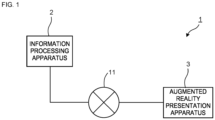
- FIG. 1 is a configuration diagram representing an information processing system 1 according to the present embodiment.
- the information processing system 1 includes an information processing apparatus 2 and an augmented reality presentation apparatus 3, and these are connected via a network 11. These components will be further described.
- a system exemplified by the information processing system 1 consists of one or more apparatuses or components. Therefore, even the information processing apparatus 2 or the augmented reality presentation apparatus 3 alone can be an example of a system.
- FIG. 2 is a block diagram illustrating a hardware configuration of the information processing apparatus 2 according to the present embodiment.
- the information processing apparatus 2 includes a communication unit 21, a storage unit 22, and a controller 23, and these components are electrically connected inside the information processing apparatus 2 via a communication bus 20. Each component will be further described.
- the communication unit 21 may be wired communication means such as USB, IEEE1394, Thunderbolt (registered trademark), wired LAN network communication, or the like, but may include wireless LAN network communication, mobile communication such as 3G/LTE/5G, Bluetooth (registered trademark) communication, or the like as needed. That is, the communication unit 21 may be implemented as a set of two or more of these communication means.
- the information processing apparatus 2 is configured to communicate various kinds of information with the augmented reality presentation apparatus 3 by the communication unit 21 via the network 11.
- the information processing apparatus 2 is connected to an image capture apparatus 211 via the communication unit 21.
- the image capture apparatus 211 is a so-called vision sensor (camera) configured to capture information on the external world.
- the image capture apparatus 211 is configured to capture an image of a medical maneuver performed by an information provider for a user. As data of chronologically ordered captured images IM1, a motion image file including the medical maneuver of the information provider may be recorded.
- a frame rate of the image capture apparatus 211 is not particularly limited, but may be, for example, 10 fps or higher, may be 30 fps or higher, or may be 60 fps or higher.
- a higher frame rate allows for higher temporal resolution of below-described reference information IF1.
- the storage unit 22 stores above-defined various kinds of information.
- the storage unit 22 may be implemented, for example, as a storage device such as a solid state drive (SSD) storing various programs, etc. pertaining to the information processing apparatus 2 and executed by the controller 23, or as a memory such as a random access memory (RAM) storing temporarily necessary information (arguments, sequences, etc.) pertaining to program operations.
- the storage unit 22 may also be a combination thereof.
- the controller 23 processes and controls overall operation pertaining to the information processing apparatus 2.
- the controller 23 is, for example, an unshown central processing unit (CPU).
- the controller 23 realizes various functions pertaining to the information processing apparatus 2 by reading a predetermined program stored in the storage unit 22.
- the controller 23 as an example of hardware is configured to concretely realize information processing of software stored in the storage unit 22.
- FIG. 3 is a block diagram illustrating a hardware configuration of the augmented reality presentation apparatus 3 according to the present embodiment.
- the augmented reality presentation apparatus 3 is an apparatus of providing augmented reality to the user.
- the augmented reality presentation apparatus 3 includes a communication unit 31, a storage unit 32, a controller 33, a display unit 34, an input unit 35, and an image capture unit 36, and these components are electrically connected inside the augmented reality presentation apparatus 3 via a communication bus 30. Each component will be further described below.
- the communication unit 31 may be wired communication means such as USB, IEEE 1394, Thunderbolt, wired LAN network communication, and the like, but may include wireless LAN network communication, mobile communication such as 3G/LTE/5G, Bluetooth (registered trademark) communication, or the like as needed. That is, the communication unit 21 may be implemented as a set of two or more of these communication means.
- the augmented reality presentation apparatus 3 is configured to communicate various kinds of information with the information processing apparatus 2 by the communication unit 31 via the network 11.
- the storage unit 32 stores above-defined various kinds of information.
- the storage unit 32 may be implemented, for example, as a storage device such as a solid state drive (SSD) storing various programs, etc. pertaining to the augmented reality presentation apparatus 3 and executed by the controller 33, or as a memory such as a random access memory (RAM) storing temporarily necessary information (arguments, sequences, etc.) pertaining to program operations.
- the storage unit 32 may also be a combination thereof.
- the storage unit 32 stores reference information IF1 received from the information processing apparatus 2.
- the storage unit 32 also stores various programs and the like pertaining to the augmented reality presentation apparatus 3 and executed by the controller 33.
- the controller 33 processes and controls overall operation pertaining to the augmented reality presentation apparatus 3.
- the controller 33 is, for example, an unshown central processing unit (CPU).
- the controller 33 realizes various functions pertaining to the augmented reality presentation apparatus 3 by reading a predetermined program stored in the storage unit 32.
- the controller 33 as an example of hardware concretely realizes information processing of software stored in the storage unit 32, and thereby the controller 33 includes each functional unit described below. These will be described in more detail in the next section.
- the controller 33 is not limited to being a single controller and may be implemented as two or more controllers 33 for each function or as a combination thereof.
- the display unit 34 is configured to display a graphical user interface (GUI) screen 5 that is visible and operable to the user (see FIG. 8 and FIG. 9 ).
- GUI graphical user interface
- the display unit 34 is described here as being included in a housing of the augmented reality presentation apparatus 3.
- the display unit 34 may be included in a wearable device wearable for the user.
- the augmented reality presentation apparatus 3 may be configured as a head-mounted display type apparatus that can be worn by the user in a manner such that the apparatus covers an area around user's eyes. By having such a configuration, the augmented reality presentation apparatus 3 can provide the user with improved immersion.
- the display unit 34 may be configured to transmit light from the external world in a direction toward the user. Such a configuration allows the user to directly view information from the external world optically, which improves usability.
- the input unit 35 is configured to receive operation input made by the user.
- the input unit 35 is, for example, a switch button provided on the augmented reality presentation apparatus 3.
- the input is transferred as an instruction signal to the controller 33 via the communication bus 30, and then the controller 33 may execute predetermined control or computation as necessary.
- the image capture unit 36 is a so-called vision sensor (camera) configured to capture information on the external world.
- the image capture unit 36 is described as being included in a housing of the augmented reality presentation apparatus 3.
- the image capture unit 36 is configured to track a desired track point by capturing, as a captured image IM2, an image of a medical maneuver performed by the user.
- the captured image IM2 may be implemented as data only temporarily stored for tracking in a memory, or may be implemented to be recorded as a motion image file.
- a frame rate of the image capture unit 36 is not particularly limited, but may be, for example, 10 fps or higher, may be 30 fps or higher, or may be 60 fps or higher.
- a higher frame rate allows for higher temporal resolution of tracking.
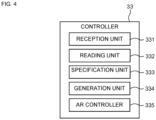
- FIG. 4 is a block diagram illustrating functions realized by the controller 33, etc. in the augmented reality presentation apparatus 3 according to the present embodiment.
- the augmented reality presentation apparatus 3 as an example of the information processing system 1 includes a reception unit 331, a reading unit 332, an specification unit 333, a generation unit 334, and an AR controller 335.
- the reception unit 331 is configured to receive various kinds of information.
- the reception unit 331 may receive the reference information IF1 transmitted from the information processing apparatus 2.
- the reading unit 332 is configured to read various kinds of information received by the reception unit 331 or stored in advance in the storage unit 32.
- the reading unit 332 may refer to the reference information IF1 stored in advance in the storage unit 32 so that AR information 6 is presented to the user. This will be described in more detail below.
- the specification unit 333 is configured to specify various kinds of information on the basis of the captured image IM 1 and the captured image IM2.
- the specification unit 333 is configured to specify a surgical field 53 visible to the user and a user maneuver that is a user's medical maneuver, on the basis of the captured image IM2. This will be described in more detail later.
- the generation unit 334 is configured to generate various kinds of display information IF2.
- the display information IF2 may be information itself such as a screen, an image, an icon, a message, etc. generated in an aspect visible to the user, or may be, for example, rendering information for displaying a screen, an image, an icon, a message, etc. on the display unit 34 of the augmented reality presentation apparatus 3.
- the above-mentioned display unit 34 displays the screen 5 on the basis of the display information IF2 generated by the generation unit 334 (see FIG. 8 and FIG. 9 ).
- the AR controller 335 is configured to control a content or an aspect of augmented reality to be presented to the user. This will be described in more detail later.
- This section will describe an information processing method of the above-mentioned information processing system 1.
- the information provider using the information processing apparatus 2 is a user's attending doctor, and the user is a resident doctor instructed in medical maneuvers by the attending doctor.
- the augmented reality presentation apparatus 3 is assumed to be the above-mentioned head-mounted display type apparatus worn by the user.
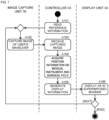
- FIG. 5 is an activity diagram illustrating a procedure of information processing executed by the information processing apparatus 2 according to the first embodiment.
- FIG. 6 is a schematic diagram illustrating an aspect of capturing, by the image capture apparatus 211, an image of a reference maneuver performed by the information provider.
- the information provider performs a reference maneuver, which is a medical maneuver, in front of the image capture apparatus 211 (Activity A001).
- the image capture apparatus 211 captures an image IM1 including the reference maneuver (Activity A002).
- the controller 23 in the information processing apparatus 2 reads a predetermined program stored in the storage unit 22 and thereby generates the reference information IF1 acquired by extracting a three-dimensional position of a track point from the captured image IM1 (Activity A003).
- the information processing apparatus 2 transmits the reference information IF1 by the communication unit 21 to the augmented reality presentation apparatus 3 used by the user (Activity A004).
- an image of the reference maneuver of the information provider is captured as the captured image IM1 by the image capture apparatus 211.
- the information provider uses a forceps 41 as an example of a medical instrument with the left hand 4L and uses a needle holder 42 as an example of a medical instrument with the right hand 4R.
- the image capture apparatus 211 captures a captured image IM 1 such that a three-dimensional position of a predetermined track point can be acquired.
- Such track point is set for a medical instrument such as the forceps 41, the needle holder 42, etc.
- the forceps 41, the needle holder 42, etc. may be marked with markers for tracking.
- medical instrument in the present embodiment refers to any instruments concerning medical care.
- the medical instrument includes, for example, medical appliances or instruments in accordance with the classification of the Pharmaceutical and Medical Device Act and medical supplies such as needle, suture, etc.
- the controller 23 executes image processing on the captured image IM1 by reading a predetermined program stored in advance.
- image processing extracts the three-dimensional position of at least part of the track points, e.g., the forceps 41 and the needle holder 42, with respect to the surgical field 43.
- the depth information may be acquired by estimating the relative sizes of the forceps 41 and the needle holder 42 with respect to the angle of view, may be acquired by the degree of focus, or may be more precisely acquired by stereo vision.
- the reference information IF1 may be in any form as long as including the above-mentioned three-dimensional position.
- the reference information may be information consisting of coordinates, or may be a binarized image such that the three-dimensional position can be acquired.
- the reference information IF1 generated in Activity A003 includes the three-dimensional position of the track point in the reference maneuver. More specifically, this three-dimensional position may be a relative position in the surgical field 43 of the reference maneuver. According to such an aspect, the subsequent information processing by the augmented reality presentation apparatus 3 can present augmented reality more easily understood by the user. This will be further described.
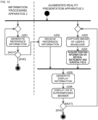
- FIG. 7 is an activity diagram illustrating a procedure of information processing executed by the augmented reality presentation apparatus 3 according to the present embodiment.
- FIG. 8 and FIG. 9 are diagrams each illustrating an example of an aspect of the screen 5 of the display unit 34 to be viewed by the user.
- the reading unit 332 as a functional unit of the controller 33 reads, as a reading step, reference information IF1 on a reference maneuver that is a medical maneuver to be referred to by the user (Activity A101).
- the reference information IF1 is generated in the information processing apparatus 2 and stored in advance in the storage unit 32 of the augmented reality presentation apparatus 3.
- the image capture unit 36 operates with the user wearing the augmented reality presentation apparatus 3 on the user's head and with user's gaze directed toward user's own medical maneuver (hereinafter referred to as user maneuver) so that the user maneuver is within the angle of view of the image capture unit 36.
- user maneuver user's own medical maneuver
- the image capture unit 36 captures a captured image IM2 including the external world and the user maneuver as viewed by the user (Activity A102).
- the reception unit 331 receives, as a first reception step, the captured image IM2 acquired by capturing an image of the external world as viewed by the user (Activity A 103).
- the controller 33 allows a memory as an example of the storage unit 32 to primarily store the captured image IM2.
- the specification unit 333 identifies, as a first specification step, a surgical field 53 visible to the user from the captured image IM2 and identifies, as a second specification step, the user maneuver that is a medical maneuver of the user from the captured image IM2.
- the controller 33 identifies, from the captured image IM2, forceps 51 and a needle holder 52 as examples of the medical instrument and the surgical field 53 by reading a predetermined program stored in the storage unit 32, and acquires position information thereon (Activity A104).
- the generation unit 334 generates, as a generation step, display information IF2 for presenting AR information 6 (augmented reality) on the reference maneuver to the user on the basis of the three-dimensional position of the track point included in the reference information IF1 and the user maneuver identified from the captured image IM2 (Activity A105).
- This display information IF2 is, for example, rendering information.
- the display unit 34 displays a screen 5 based on the display information IF2 so that the user can view a state where the reference maneuver from the AR information 6 is superimposed on the external world (Activity A106).
- the above activities A102 to A106 are repeatedly executed frame by frame, and thereby augmented reality is presented to the user.
- this information processing method includes the following steps.
- the reading step reads reference information IF1 on a reference maneuver that is a medical maneuver to be referred to by the user.
- the reference information IF1 includes a three-dimensional position of a track point in the reference maneuver.
- the first reception step receives a captured image IM2 acquired by capturing an image of the external world as viewed by the user.
- the generation step generates, based on the three-dimensional position of the track point and on the captured image IM2, display information IF2 for presenting AR information 6 (augmented reality) on the reference maneuver to the user.
- This augmented reality three-dimensionally reproduce an aspect of a medical instrument used in the reference maneuver or a hand manipulating this medical instrument.
- the user practices a surgical operation using a model 54 including the visible surgical field 53 with the left hand 5L using the forceps 51 as an example of a medical instrument and with the right hand 5R using the needle holder 52 as an example of a medical instrument.
- the forceps 51 has a marker 511
- the needle holder 52 has a marker 521
- the model 54 has a marker 541.
- the specification unit 333 identifies position information on the forceps 51 and the needle holder 52 with respect to the surgical field 53 in the captured image IM2.
- information on the marker 541 alone may be used.
- the generation unit 334 generates display information IF2 for presenting, to the user, the AR information 6 (augmented reality) including the medical instrument superimposed on the surgical field 53.
- the AR information 6 (augmented reality) three-dimensionally reproduces the aspect of the medical instrument used in the reference maneuver.
- the medical instrument reproduced in the AR information 6 is, for example, AR forceps 61 and an AR needle holder 62 corresponding to the forceps 41 and the needle holder 42 in the reference maneuver. Since, in particular, the AR information 6 is superimposed on the user's surgical field 53, it is possible to transmit more detailed and accurate information from the same perspective as the user's perspective.
- the generation unit 334 may generate the display information IF2 for presenting the AR information 6 (augmented reality) to the user, the display information IF2 being modified according to an aspect of the user maneuver.
- the AR controller 335 may control progression of the reference maneuver in the AR information 6 (augmented reality) according to the aspect of the user maneuver. It should be noted that in FIG. 8 , the positions of the forceps 51 and the needle holder 52 and the positions of the AR forceps 61 and the AR needle holder 62 are close to each other and postures thereof are substantially similar.
- the AR controller 335 executes control to estimate, based on the aspect of the user maneuver acquired from the captured image IM2 by the specification unit 333, a scene to be reproduced of the corresponding reference maneuver. According to such an aspect, the user can check the reference maneuver of the information provider at a pace preferable to the user, which will improve the usability.
- the augmented reality based on the AR information 6 may reproduce a reference maneuver representing a chronologically future step compared with the current aspect of the user maneuver.
- the positions of the forceps 51 and the needle holder 52 and the positions of the AR forceps 61 and the AR needle holder 62 are different and postures thereof are also different. This is because the AR forceps 61 and AR needle holder 62 are presented in a chronologically future scene compared with the scene assumed from the positions of the forceps 51 and the needle holder 52.
- the user can check the reference maneuver of the information provider while comparing it with the current aspect of the user's maneuver, which will further improve the usability.
- the augmented reality based on the AR information 6 may present, to the user, chronological changes in the aspect of the medical instrument, e.g., the AR forceps 61, the AR needle holder 62, etc., with the chronologically changed aspects superimposed on each other.
- Each of these changed aspects is based on, for example, discretely selected frames.
- FIG. 9 it can be seen that an afterimage-like effect is applied to the AR forceps 61 and the AR needle holder 62. Employing such an effect allows the user to more easily understand the chronological movements of the reference maneuver, which will further improve the usability.
- the information processing system 1 can realize transmission or sharing of information pertaining to a medical maneuver with others with improved accuracy and a higher volume of information.
- the information processing system 1 according to the second embodiment has the similar hardware configuration and functional configuration to those of the information processing system 1 according to the first embodiment illustrated in FIG. 1 through FIG. 4 . Therefore, descriptions thereof will be omitted.
- FIG. 10 is an activity diagram illustrating procedure of information processing executed by the information processing system 1 according to the second embodiment.
- reference information IF1 is generated for each frame unit of a captured image IM1 captured by the image capture apparatus 211 (Activity A201).
- the reference information IF1 here may be any information including, for example, position information on information provider's forceps 41 and needle holder 42 with respect to a surgical field 43 for each frame, or may be the captured image IM 1 itself that can be streamed on the augmented reality presentation apparatus 3 side.
- the communication unit 31 in the augmented reality presentation apparatus 3 continuously receives the reference information IF1 via the network 11 (Activity A202).
- the image capture unit 36 operates with the user wearing the augmented reality presentation apparatus 3 on the user's head and with user's gaze directed toward user's own medical maneuver (user maneuver) so that the user maneuver is within the angle of view of the image capture unit 36.
- the image capture unit 36 captures a captured image IM2 including the external world and the user maneuver as viewed by the user (Activity A203).
- the specification unit 333 identifies, from the captured image IM2, the forceps 51 and the needle holder 52 as examples of the medical instrument and the surgical field 53 and acquires position information thereon (Activity A204).
- the generation unit 334 generates display information IF2 for presenting AR information 6 (augmented reality) on the reference maneuver to the user, on the basis of the three-dimensional position of the track point included in the reference information IF1 and the user maneuver identified from the captured image IM2 (Activity A205).
- This display information IF2 is, for example, rendering information.
- the display unit 34 displays the screen 5 based on the display information IF2 so that the user can view a state where the reference maneuver by the AR information 6 is superimposed on the external world (Activity A206).
- Activities A201 and A202 and Activities A203 through A206 are repeatedly executed frame by frame, respectively, and thereby the augmented reality is presented to the user.
- the reception unit 331 receives, as the second reception step, reference information IF1 from outside, e.g., from the information processing apparatus 2, via the network 11.
- the reading unit 332 reads the reference information IF1 received from the information processing apparatus 2.
- the reception unit 331 may continuously receive, as the second reception step, the reference information IF1 on a reference maneuver in progress by an information provider who is a person different from the user.
- the reading unit 332 continuously reads the received reference information IF1.
- the generation unit 334 presents, to the user, the AR information 6 (augmented reality) on the reference maneuver in progress by the information provider.
- the information processing system 1 according to the second embodiment can realize, as with the information processing system 1 according to the first embodiment, transmission or sharing of information on a medical maneuver with others with improved accuracy and a higher volume of information.
- the information processing system 1 according to the second embodiment can present, to the user, the reference maneuver in progress by the information provider in substantially real time as the AR information 6. This makes it possible, for example, for the information provider to communicate directly with the user while sharing the reference maneuver with the user.
- the information processing system 1 may include the following aspects.
- the information processing system wherein: the track point is set on the medical instrument or the hand manipulating the medical instrument, and the three-dimensional position is a relative position with respect to a surgical field of the reference maneuver.
- controller configured to further execute: a first specification step of specifying, from the captured image, a surgical field visible to the user; and the generation step of generating display information for presenting, to the user, augmented reality where the medical instrument or the hand manipulating the medical instrument is superimposed on the surgical field.
- controller configured to further execute: a second specification step of specifying a user maneuver from the captured image, the user maneuver being a medical maneuver performed by the user; and the generation step of generating the display information for presenting the augmented reality to the user, the display information being modified according to an aspect of the user maneuver.
- the information processing system wherein, in the augmented reality, progression of the reference maneuver is controlled according to the aspect of the user maneuver.
- the information processing system wherein the augmented reality reproduces the reference maneuver representing a chronologically future step compared with a current aspect of the user maneuver.
- the information processing system wherein the augmented reality is configured to be such that a progression speed of the reference maneuver is variable.
- the information processing system wherein the augmented reality is configured to be such that transparency is variable of the medical instrument or the hand manipulating the medical instrument.
- the information processing system wherein the augmented reality presents, to the user, chronological changes in the aspect of the medical instrument or the hand manipulating the medical instrument, with chronologically changed aspects superimposed on each other.
- each of the changed aspects is based on a discretely selected frame.
- the information processing system wherein the reading step reads the reference information stored in advance.
- controller configured to further execute: a second reception step of receiving the reference information from outside via a network; and the reading step of reading the reference information received from outside.
- the information processing system wherein: the second reception step continuously receives reference information on the reference maneuver in progress by a person different from the user; the reading step continuously reads the received reference information; and the generation step presents augmented reality regarding the reference maneuver in progress to the user.
- the information processing system wherein the generation step further generates information to be perceived by the user with a sense other than sight.
- the information processing system further comprising a display unit configured to: transmit light from the external world in a direction toward the user; and display a screen based on the display information so that the user can view a state where the reference maneuver is superimposed on the external world.
- the information processing system wherein the display unit is included in a wearable device wearable for the user.
- An information processing method comprising each step of the information processing system according to any one of claims 1 to 16.
- a program configured to allow a computer to execute each step of the information processing system according to any one of claims 1 to 16.
Landscapes
- Engineering & Computer Science (AREA)
- Health & Medical Sciences (AREA)
- Medical Informatics (AREA)
- Biomedical Technology (AREA)
- Life Sciences & Earth Sciences (AREA)
- Surgery (AREA)
- Public Health (AREA)
- General Health & Medical Sciences (AREA)
- Animal Behavior & Ethology (AREA)
- Veterinary Medicine (AREA)
- Molecular Biology (AREA)
- Nuclear Medicine, Radiotherapy & Molecular Imaging (AREA)
- Heart & Thoracic Surgery (AREA)
- Pathology (AREA)
- Theoretical Computer Science (AREA)
- General Physics & Mathematics (AREA)
- Epidemiology (AREA)
- Physics & Mathematics (AREA)
- Primary Health Care (AREA)
- Oral & Maxillofacial Surgery (AREA)
- Robotics (AREA)
- Computer Hardware Design (AREA)
- General Engineering & Computer Science (AREA)
- General Business, Economics & Management (AREA)
- Computer Graphics (AREA)
- Business, Economics & Management (AREA)
- Software Systems (AREA)
- Multimedia (AREA)
- Computer Vision & Pattern Recognition (AREA)
- Medical Treatment And Welfare Office Work (AREA)
- Processing Or Creating Images (AREA)
- User Interface Of Digital Computer (AREA)
- Image Analysis (AREA)
Abstract
Description
- The present invention relates to an information processing system, an information processing method, and a program.
- There are situations where one wishes to share various kinds of information on medical care with others, especially with other doctors. For example,
Patent Document 1 discloses a medical support system for sharing patient information as an example of information on medical care. - [Patent Document 1]
Japanese Patent Application, Publication No. 2019-109763 - However, although it is possible to share objective information such as text, images, etc. as in the system disclosed in
Patent Document 1, it is difficult to communicate or share information on doctors' skill such as movements of hands or medical instruments during surgical operations. This applies, for example, to situations where a skilled doctor wants to demonstrate his/her maneuver to a resident doctor trying to improve his/her maneuver, or where specialists in a certain medical field want to share their respective skills with each other. In other words, in such situations, it is difficult to accurately communicate or share information on these medical maneuvers with others. - In view of the above circumstances, the present invention provides an information processing system, etc. for enabling more accurate communication or sharing of information on a medical maneuver.
- According to an aspect of the present invention, an information processing system is provided. This information processing system includes a controller. The controller is configured to execute each of following steps. A reading step reads reference information on a reference maneuver that is a medical maneuver to be referred to by a user. The reference information includes a three-dimensional position of a track point in the reference maneuver. A first reception step receives a captured image acquired by capturing an image of an external world as viewed by the user. A generation step generates, based on the three-dimensional position of the track point and the captured image, display information for presenting augmented reality regarding the reference maneuver to the user. The augmented reality three-dimensionally reproduces an aspect of a medical instrument used in the reference maneuver or a hand manipulating the medical instrument.
- According to such an aspect, it is possible to realize communication or sharing of information on a medical maneuver with others with improved accuracy and a higher volume of information.
-
-
FIG. 1 is a configuration diagram illustrating aninformation processing system 1 according to the first and second embodiments. -
FIG. 2 is a block diagram illustrating a hardware configuration of theinformation processing apparatus 2 according to the first and second embodiments. -
FIG. 3 is a block diagram illustrating a hardware configuration of an augmentedreality presentation apparatus 3 according to the first and second embodiments. -
FIG. 4 is a block diagram illustrating functions realized by acontroller 33, etc. in the augmentedreality presentation apparatus 3 according to the first and second embodiments. -
FIG. 5 is an activity diagram illustrating a procedure of information processing executed by theinformation processing apparatus 2 according to the first embodiment. -
FIG. 6 is a schematic diagram illustrating an aspect where animage capture apparatus 211 captures an image of a reference maneuver performed by an information provider. -
FIG. 7 is an activity diagram illustrating a procedure of information processing executed by the augmentedreality presentation apparatus 3 according to the first embodiment. -
FIG. 8 is a diagram illustrating an aspect example of ascreen 5 of adisplay unit 34 viewed by a user. -
FIG. 9 is a diagram illustrating an aspect example of thescreen 5 of thedisplay unit 34 viewed by a user. -
FIG. 10 is an activity diagram illustrating a procedure of information processing executed by theinformation processing system 1 according to the second embodiment. - A description will be given of the embodiments of the present invention with reference to drawings. Various features described in the following embodiments can be combined with each other.
- A program for realizing a software described in the present embodiment may be provided as a non-transitory computer-readable memory medium, may be provided to be downloaded via an external server, or may be provided so that the program is activated on an external computer and the program's function is realized on a client terminal (that is, the function is provided by so-called cloud computing).
- A term "unit" in the present embodiment may include, for example, a combination of a hardware resource implemented as circuits in a broad sense and information processing of software that can be concretely realized by the hardware resource. Furthermore, various kinds of information are described in the present embodiment, and such information may be represented by, for example, physical values of signal values representing voltage and current, high and low signal values as a set of binary bits consisting of 0 or 1, or quantum superposition (so-called qubits), and communication and computation may be executed on a circuit in a broad sense.
- The circuit in a broad sense is a circuit realized by properly combining at least a circuit, circuitry, a processor, a memory, and the like. In other words, a circuit includes an application specific integrated circuit (ASIC), a programmable logic device (e.g., simple programmable logic device (SPLD), a complex programmable logic device (CLPD), field programmable gate array (FPGA), and the like.
- This section will describe a hardware configuration according to the first embodiment.
-
FIG. 1 is a configuration diagram representing aninformation processing system 1 according to the present embodiment. Theinformation processing system 1 includes aninformation processing apparatus 2 and an augmentedreality presentation apparatus 3, and these are connected via anetwork 11. These components will be further described. A system exemplified by theinformation processing system 1 consists of one or more apparatuses or components. Therefore, even theinformation processing apparatus 2 or the augmentedreality presentation apparatus 3 alone can be an example of a system. -
FIG. 2 is a block diagram illustrating a hardware configuration of theinformation processing apparatus 2 according to the present embodiment. Theinformation processing apparatus 2 includes acommunication unit 21, astorage unit 22, and acontroller 23, and these components are electrically connected inside theinformation processing apparatus 2 via acommunication bus 20. Each component will be further described. - The
communication unit 21 may be wired communication means such as USB, IEEE1394, Thunderbolt (registered trademark), wired LAN network communication, or the like, but may include wireless LAN network communication, mobile communication such as 3G/LTE/5G, Bluetooth (registered trademark) communication, or the like as needed. That is, thecommunication unit 21 may be implemented as a set of two or more of these communication means. - In the present embodiment, the
information processing apparatus 2 is configured to communicate various kinds of information with the augmentedreality presentation apparatus 3 by thecommunication unit 21 via thenetwork 11. - In the present embodiment, the
information processing apparatus 2 is connected to animage capture apparatus 211 via thecommunication unit 21. Theimage capture apparatus 211 is a so-called vision sensor (camera) configured to capture information on the external world. Theimage capture apparatus 211 is configured to capture an image of a medical maneuver performed by an information provider for a user. As data of chronologically ordered captured images IM1, a motion image file including the medical maneuver of the information provider may be recorded. - A frame rate of the
image capture apparatus 211 is not particularly limited, but may be, for example, 10 fps or higher, may be 30 fps or higher, or may be 60 fps or higher. A higher frame rate allows for higher temporal resolution of below-described reference information IF1. - The
storage unit 22 stores above-defined various kinds of information. Thestorage unit 22 may be implemented, for example, as a storage device such as a solid state drive (SSD) storing various programs, etc. pertaining to theinformation processing apparatus 2 and executed by thecontroller 23, or as a memory such as a random access memory (RAM) storing temporarily necessary information (arguments, sequences, etc.) pertaining to program operations. Thestorage unit 22 may also be a combination thereof. - The
controller 23 processes and controls overall operation pertaining to theinformation processing apparatus 2. Thecontroller 23 is, for example, an unshown central processing unit (CPU). Thecontroller 23 realizes various functions pertaining to theinformation processing apparatus 2 by reading a predetermined program stored in thestorage unit 22. In other words, thecontroller 23 as an example of hardware is configured to concretely realize information processing of software stored in thestorage unit 22. -
FIG. 3 is a block diagram illustrating a hardware configuration of the augmentedreality presentation apparatus 3 according to the present embodiment. The augmentedreality presentation apparatus 3 is an apparatus of providing augmented reality to the user. The augmentedreality presentation apparatus 3 includes acommunication unit 31, astorage unit 32, acontroller 33, adisplay unit 34, aninput unit 35, and animage capture unit 36, and these components are electrically connected inside the augmentedreality presentation apparatus 3 via acommunication bus 30. Each component will be further described below. - The
communication unit 31 may be wired communication means such as USB, IEEE 1394, Thunderbolt, wired LAN network communication, and the like, but may include wireless LAN network communication, mobile communication such as 3G/LTE/5G, Bluetooth (registered trademark) communication, or the like as needed. That is, thecommunication unit 21 may be implemented as a set of two or more of these communication means. - In the present embodiment, the augmented
reality presentation apparatus 3 is configured to communicate various kinds of information with theinformation processing apparatus 2 by thecommunication unit 31 via thenetwork 11. - The
storage unit 32 stores above-defined various kinds of information. Thestorage unit 32 may be implemented, for example, as a storage device such as a solid state drive (SSD) storing various programs, etc. pertaining to the augmentedreality presentation apparatus 3 and executed by thecontroller 33, or as a memory such as a random access memory (RAM) storing temporarily necessary information (arguments, sequences, etc.) pertaining to program operations. Thestorage unit 32 may also be a combination thereof. - In particular, the
storage unit 32 stores reference information IF1 received from theinformation processing apparatus 2. In addition to this, thestorage unit 32 also stores various programs and the like pertaining to the augmentedreality presentation apparatus 3 and executed by thecontroller 33. - The
controller 33 processes and controls overall operation pertaining to the augmentedreality presentation apparatus 3. Thecontroller 33 is, for example, an unshown central processing unit (CPU). Thecontroller 33 realizes various functions pertaining to the augmentedreality presentation apparatus 3 by reading a predetermined program stored in thestorage unit 32. In other words, thecontroller 33 as an example of hardware concretely realizes information processing of software stored in thestorage unit 32, and thereby thecontroller 33 includes each functional unit described below. These will be described in more detail in the next section. Thecontroller 33 is not limited to being a single controller and may be implemented as two ormore controllers 33 for each function or as a combination thereof. - The
display unit 34 is configured to display a graphical user interface (GUI)screen 5 that is visible and operable to the user (seeFIG. 8 andFIG. 9 ). Thedisplay unit 34 is described here as being included in a housing of the augmentedreality presentation apparatus 3. Thedisplay unit 34 may be included in a wearable device wearable for the user. In other words, the augmentedreality presentation apparatus 3 may be configured as a head-mounted display type apparatus that can be worn by the user in a manner such that the apparatus covers an area around user's eyes. By having such a configuration, the augmentedreality presentation apparatus 3 can provide the user with improved immersion. Furthermore, thedisplay unit 34 may be configured to transmit light from the external world in a direction toward the user. Such a configuration allows the user to directly view information from the external world optically, which improves usability. - The
input unit 35 is configured to receive operation input made by the user. Theinput unit 35 is, for example, a switch button provided on the augmentedreality presentation apparatus 3. The input is transferred as an instruction signal to thecontroller 33 via thecommunication bus 30, and then thecontroller 33 may execute predetermined control or computation as necessary. - The
image capture unit 36 is a so-called vision sensor (camera) configured to capture information on the external world. Here, theimage capture unit 36 is described as being included in a housing of the augmentedreality presentation apparatus 3. Theimage capture unit 36 is configured to track a desired track point by capturing, as a captured image IM2, an image of a medical maneuver performed by the user. The captured image IM2 may be implemented as data only temporarily stored for tracking in a memory, or may be implemented to be recorded as a motion image file. - A frame rate of the
image capture unit 36 is not particularly limited, but may be, for example, 10 fps or higher, may be 30 fps or higher, or may be 60 fps or higher. A higher frame rate allows for higher temporal resolution of tracking. - This section will describe a functional structure according to the present embodiment. As mentioned above, information processing of software stored in the
storage unit 32 is concretely realized by thecontroller 33 as an example of hardware, and thereby may be executed as each functional unit included in thecontroller 33. -
FIG. 4 is a block diagram illustrating functions realized by thecontroller 33, etc. in the augmentedreality presentation apparatus 3 according to the present embodiment. Specifically, the augmentedreality presentation apparatus 3 as an example of theinformation processing system 1 includes areception unit 331, areading unit 332, anspecification unit 333, ageneration unit 334, and anAR controller 335. - The
reception unit 331 is configured to receive various kinds of information. For example, thereception unit 331 may receive the reference information IF1 transmitted from theinformation processing apparatus 2. - The
reading unit 332 is configured to read various kinds of information received by thereception unit 331 or stored in advance in thestorage unit 32. For example, thereading unit 332 may refer to the reference information IF1 stored in advance in thestorage unit 32 so thatAR information 6 is presented to the user. This will be described in more detail below. - The
specification unit 333 is configured to specify various kinds of information on the basis of the capturedimage IM 1 and the captured image IM2. For example, thespecification unit 333 is configured to specify asurgical field 53 visible to the user and a user maneuver that is a user's medical maneuver, on the basis of the captured image IM2. This will be described in more detail later. - The
generation unit 334 is configured to generate various kinds of display information IF2. The display information IF2 may be information itself such as a screen, an image, an icon, a message, etc. generated in an aspect visible to the user, or may be, for example, rendering information for displaying a screen, an image, an icon, a message, etc. on thedisplay unit 34 of the augmentedreality presentation apparatus 3. The above-mentioneddisplay unit 34 displays thescreen 5 on the basis of the display information IF2 generated by the generation unit 334 (seeFIG. 8 andFIG. 9 ). - The
AR controller 335 is configured to control a content or an aspect of augmented reality to be presented to the user. This will be described in more detail later. - This section will describe an information processing method of the above-mentioned
information processing system 1. Here, a description will be given of a case where the information provider using theinformation processing apparatus 2 is a user's attending doctor, and the user is a resident doctor instructed in medical maneuvers by the attending doctor. The augmentedreality presentation apparatus 3 is assumed to be the above-mentioned head-mounted display type apparatus worn by the user. - First, a description will be given of information processing by the
information processing apparatus 2.FIG. 5 is an activity diagram illustrating a procedure of information processing executed by theinformation processing apparatus 2 according to the first embodiment.FIG. 6 is a schematic diagram illustrating an aspect of capturing, by theimage capture apparatus 211, an image of a reference maneuver performed by the information provider. - First, a procedure of information processing will be outlined with reference to each activity in
FIG. 5 . First, the information provider performs a reference maneuver, which is a medical maneuver, in front of the image capture apparatus 211 (Activity A001). During this, theimage capture apparatus 211 captures an image IM1 including the reference maneuver (Activity A002). Subsequently, thecontroller 23 in theinformation processing apparatus 2 reads a predetermined program stored in thestorage unit 22 and thereby generates the reference information IF1 acquired by extracting a three-dimensional position of a track point from the captured image IM1 (Activity A003). Finally, via thenetwork 11, theinformation processing apparatus 2 transmits the reference information IF1 by thecommunication unit 21 to the augmentedreality presentation apparatus 3 used by the user (Activity A004). - Next, a detailed description will be given of the information processing outlined with reference to
FIG. 5 . In Activity A002, as illustrated inFIG. 6 , an image of the reference maneuver of the information provider is captured as the captured image IM1 by theimage capture apparatus 211. In the reference maneuver, the information provider uses aforceps 41 as an example of a medical instrument with theleft hand 4L and uses aneedle holder 42 as an example of a medical instrument with theright hand 4R. Preferably, theimage capture apparatus 211 captures a capturedimage IM 1 such that a three-dimensional position of a predetermined track point can be acquired. Such track point is set for a medical instrument such as theforceps 41, theneedle holder 42, etc. Although not illustrated inFIG. 6 , theforceps 41, theneedle holder 42, etc. may be marked with markers for tracking. - The term "medical instrument" in the present embodiment refers to any instruments concerning medical care. In other words, the medical instrument includes, for example, medical appliances or instruments in accordance with the classification of the Pharmaceutical and Medical Device Act and medical supplies such as needle, suture, etc.
- In Activity A003, the
controller 23 executes image processing on the captured image IM1 by reading a predetermined program stored in advance. Such image processing extracts the three-dimensional position of at least part of the track points, e.g., theforceps 41 and theneedle holder 42, with respect to thesurgical field 43. In particular, in acquiring depth information from a viewpoint of theimage capture apparatus 211, the depth information may be acquired by estimating the relative sizes of theforceps 41 and theneedle holder 42 with respect to the angle of view, may be acquired by the degree of focus, or may be more precisely acquired by stereo vision. The reference information IF1 may be in any form as long as including the above-mentioned three-dimensional position. For example, the reference information may be information consisting of coordinates, or may be a binarized image such that the three-dimensional position can be acquired. - With this configuration, the reference information IF1 generated in Activity A003 includes the three-dimensional position of the track point in the reference maneuver. More specifically, this three-dimensional position may be a relative position in the
surgical field 43 of the reference maneuver. According to such an aspect, the subsequent information processing by the augmentedreality presentation apparatus 3 can present augmented reality more easily understood by the user. This will be further described. - Next, a description will be given of information processing by the augmented
reality presentation apparatus 3.FIG. 7 is an activity diagram illustrating a procedure of information processing executed by the augmentedreality presentation apparatus 3 according to the present embodiment.FIG. 8 andFIG. 9 are diagrams each illustrating an example of an aspect of thescreen 5 of thedisplay unit 34 to be viewed by the user. - First, a procedure of information processing will be outlined with respect to each activity in
FIG. 7 . First, thereading unit 332 as a functional unit of thecontroller 33 reads, as a reading step, reference information IF1 on a reference maneuver that is a medical maneuver to be referred to by the user (Activity A101). The reference information IF1 is generated in theinformation processing apparatus 2 and stored in advance in thestorage unit 32 of the augmentedreality presentation apparatus 3. - Subsequently, the
image capture unit 36 operates with the user wearing the augmentedreality presentation apparatus 3 on the user's head and with user's gaze directed toward user's own medical maneuver (hereinafter referred to as user maneuver) so that the user maneuver is within the angle of view of theimage capture unit 36. In other words, theimage capture unit 36 captures a captured image IM2 including the external world and the user maneuver as viewed by the user (Activity A102). - Subsequently, the
reception unit 331 receives, as a first reception step, the captured image IM2 acquired by capturing an image of the external world as viewed by the user (Activity A 103). Specifically, thecontroller 33 allows a memory as an example of thestorage unit 32 to primarily store the captured image IM2. - Subsequently, the
specification unit 333 identifies, as a first specification step, asurgical field 53 visible to the user from the captured image IM2 and identifies, as a second specification step, the user maneuver that is a medical maneuver of the user from the captured image IM2. Specifically, thecontroller 33 identifies, from the captured image IM2,forceps 51 and aneedle holder 52 as examples of the medical instrument and thesurgical field 53 by reading a predetermined program stored in thestorage unit 32, and acquires position information thereon (Activity A104). - Subsequently, the
generation unit 334 generates, as a generation step, display information IF2 for presenting AR information 6 (augmented reality) on the reference maneuver to the user on the basis of the three-dimensional position of the track point included in the reference information IF1 and the user maneuver identified from the captured image IM2 (Activity A105). This display information IF2 is, for example, rendering information. - Subsequently, the
display unit 34 displays ascreen 5 based on the display information IF2 so that the user can view a state where the reference maneuver from theAR information 6 is superimposed on the external world (Activity A106). - The above activities A102 to A106 are repeatedly executed frame by frame, and thereby augmented reality is presented to the user.
- In summary, this information processing method includes the following steps. The reading step reads reference information IF1 on a reference maneuver that is a medical maneuver to be referred to by the user. Here, the reference information IF1 includes a three-dimensional position of a track point in the reference maneuver. The first reception step receives a captured image IM2 acquired by capturing an image of the external world as viewed by the user. The generation step generates, based on the three-dimensional position of the track point and on the captured image IM2, display information IF2 for presenting AR information 6 (augmented reality) on the reference maneuver to the user. This augmented reality three-dimensionally reproduce an aspect of a medical instrument used in the reference maneuver or a hand manipulating this medical instrument.
- A detailed description will be given of the information processing outlined with reference to
FIG. 7 . As represented inFIG. 8 , the user practices a surgical operation using amodel 54 including the visiblesurgical field 53 with theleft hand 5L using theforceps 51 as an example of a medical instrument and with theright hand 5R using theneedle holder 52 as an example of a medical instrument. - As represented in
FIG. 8 , theforceps 51 has amarker 511, theneedle holder 52 has amarker 521, and themodel 54 has amarker 541. By recognizing these, thespecification unit 333 identifies position information on theforceps 51 and theneedle holder 52 with respect to thesurgical field 53 in the captured image IM2. When it is sufficient to only superimpose information onto thesurgical field 53, information on themarker 541 alone may be used. Thereafter, thegeneration unit 334 generates display information IF2 for presenting, to the user, the AR information 6 (augmented reality) including the medical instrument superimposed on thesurgical field 53. - Specifically, the AR information 6 (augmented reality) three-dimensionally reproduces the aspect of the medical instrument used in the reference maneuver. The medical instrument reproduced in the
AR information 6 is, for example, AR forceps 61 and anAR needle holder 62 corresponding to theforceps 41 and theneedle holder 42 in the reference maneuver. Since, in particular, theAR information 6 is superimposed on the user'ssurgical field 53, it is possible to transmit more detailed and accurate information from the same perspective as the user's perspective. - As illustrated in
FIG. 8 , thegeneration unit 334 may generate the display information IF2 for presenting the AR information 6 (augmented reality) to the user, the display information IF2 being modified according to an aspect of the user maneuver. For example, theAR controller 335 may control progression of the reference maneuver in the AR information 6 (augmented reality) according to the aspect of the user maneuver. It should be noted that inFIG. 8 , the positions of theforceps 51 and theneedle holder 52 and the positions of theAR forceps 61 and theAR needle holder 62 are close to each other and postures thereof are substantially similar. Specifically, theAR controller 335 executes control to estimate, based on the aspect of the user maneuver acquired from the captured image IM2 by thespecification unit 333, a scene to be reproduced of the corresponding reference maneuver. According to such an aspect, the user can check the reference maneuver of the information provider at a pace preferable to the user, which will improve the usability. - Alternatively, as represented in
FIG. 9 , the augmented reality based on theAR information 6 may reproduce a reference maneuver representing a chronologically future step compared with the current aspect of the user maneuver. InFIG. 9 , it should be noted that the positions of theforceps 51 and theneedle holder 52 and the positions of theAR forceps 61 and theAR needle holder 62 are different and postures thereof are also different. This is because theAR forceps 61 andAR needle holder 62 are presented in a chronologically future scene compared with the scene assumed from the positions of theforceps 51 and theneedle holder 52. According to such an aspect, the user can check the reference maneuver of the information provider while comparing it with the current aspect of the user's maneuver, which will further improve the usability. - The augmented reality based on the
AR information 6 may present, to the user, chronological changes in the aspect of the medical instrument, e.g., theAR forceps 61, theAR needle holder 62, etc., with the chronologically changed aspects superimposed on each other. Each of these changed aspects is based on, for example, discretely selected frames. In other words, inFIG. 9 , it can be seen that an afterimage-like effect is applied to theAR forceps 61 and theAR needle holder 62. Employing such an effect allows the user to more easily understand the chronological movements of the reference maneuver, which will further improve the usability. - The
information processing system 1 according to the first embodiment can realize transmission or sharing of information pertaining to a medical maneuver with others with improved accuracy and a higher volume of information. - A description will be given of an
information processing system 1 according to the second embodiment. Theinformation processing system 1 according to the second embodiment has the similar hardware configuration and functional configuration to those of theinformation processing system 1 according to the first embodiment illustrated inFIG. 1 through FIG. 4 . Therefore, descriptions thereof will be omitted. -
FIG. 10 is an activity diagram illustrating procedure of information processing executed by theinformation processing system 1 according to the second embodiment. - A description is given of the procedure of the information processing with reference to each activity in
FIG. 10 . First, as a process on theinformation processing apparatus 2 side, reference information IF1 is generated for each frame unit of a captured image IM1 captured by the image capture apparatus 211 (Activity A201). The reference information IF1 here may be any information including, for example, position information on information provider'sforceps 41 andneedle holder 42 with respect to asurgical field 43 for each frame, or may be the capturedimage IM 1 itself that can be streamed on the augmentedreality presentation apparatus 3 side. Subsequently, thecommunication unit 31 in the augmentedreality presentation apparatus 3 continuously receives the reference information IF1 via the network 11 (Activity A202). - Next, as a process on the augmented
reality presentation apparatus 3 side, theimage capture unit 36 operates with the user wearing the augmentedreality presentation apparatus 3 on the user's head and with user's gaze directed toward user's own medical maneuver (user maneuver) so that the user maneuver is within the angle of view of theimage capture unit 36. In other words, theimage capture unit 36 captures a captured image IM2 including the external world and the user maneuver as viewed by the user (Activity A203). Subsequently, when thereception unit 331 receives the captured image IM2, thespecification unit 333 identifies, from the captured image IM2, theforceps 51 and theneedle holder 52 as examples of the medical instrument and thesurgical field 53 and acquires position information thereon (Activity A204). - Subsequently, as a generation step, the
generation unit 334 generates display information IF2 for presenting AR information 6 (augmented reality) on the reference maneuver to the user, on the basis of the three-dimensional position of the track point included in the reference information IF1 and the user maneuver identified from the captured image IM2 (Activity A205). This display information IF2 is, for example, rendering information. - Subsequently, the
display unit 34 displays thescreen 5 based on the display information IF2 so that the user can view a state where the reference maneuver by theAR information 6 is superimposed on the external world (Activity A206). - Activities A201 and A202 and Activities A203 through A206 are repeatedly executed frame by frame, respectively, and thereby the augmented reality is presented to the user.
- To summarize the above, in the second embodiment, the
reception unit 331 receives, as the second reception step, reference information IF1 from outside, e.g., from theinformation processing apparatus 2, via thenetwork 11. Thereading unit 332 reads the reference information IF1 received from theinformation processing apparatus 2. Thereception unit 331 may continuously receive, as the second reception step, the reference information IF1 on a reference maneuver in progress by an information provider who is a person different from the user. Thereading unit 332 continuously reads the received reference information IF1. Thegeneration unit 334 presents, to the user, the AR information 6 (augmented reality) on the reference maneuver in progress by the information provider. - The
information processing system 1 according to the second embodiment can realize, as with theinformation processing system 1 according to the first embodiment, transmission or sharing of information on a medical maneuver with others with improved accuracy and a higher volume of information. In particular, theinformation processing system 1 according to the second embodiment can present, to the user, the reference maneuver in progress by the information provider in substantially real time as theAR information 6. This makes it possible, for example, for the information provider to communicate directly with the user while sharing the reference maneuver with the user. - The
information processing system 1 according to the above-mentioned embodiments may include the following aspects. - (1) Although the information provider is described as using the
information processing apparatus 2, theinformation processing apparatus 2 may have the same configuration as the augmentedreality presentation apparatus 3. That is, the information provider may use the augmentedreality presentation apparatus 3 to capture a captured image IM1 including his/her medical maneuver, and reference information IF1 based on this image may be shared with the augmentedreality presentation apparatus 3 used by the user. - (2) The
information processing apparatus 2 and the augmentedreality presentation apparatus 3 according to the first embodiment may be respectively operated offline, without being connected to each other via thenetwork 11. In such a case, the reference information IF1 generated by theinformation processing apparatus 2 is shared with the augmentedreality presentation apparatus 3 via a communication method other than thenetwork 11, via a storage medium, or the like. - (3) In the above-mentioned embodiments, the reference information IF1 is described as being extracted from the captured
image IM 1 by image processing in theinformation processing apparatus 2, but the reference information IF1 may be the captured image IM1 itself. Furthermore, for example, thespecification unit 333 of the augmentedreality presentation apparatus 3 may be configured to specify the three-dimensional position of the track point in the reference maneuver on the basis of the captured image IM1, which is the reference information IF1. Thus, the aspects of the reference information IF1 has a wide variety and are not particularly limited. - (4) The
display unit 34 of the augmentedreality presentation apparatus 3 may not be configured to transmit light from the external world in the direction toward the user. In other words, thedisplay unit 34 may be implemented so that a captured image IM2 as information on the external world captured by theimage capture unit 36 is displayed on thedisplay unit 34 as part of thescreen 5, and theAR information 6 is superimposed thereon. - (5) The
marker 511, themarker 521, and themarker 541 attached to theforceps 51, theneedle holder 52, and themodel 54 as represented inFIGs. 8 and9 may not be employed. For example, implementation may be such that theforceps 51, the needle holder52, and thesurgical field 53 are recognized based on the shape, color information, or the like instead of the markers and the position information thereon are acquired. Instead of the recognition method, implementation may be such that posture information, optical information such as color information, or the like on the medical instrument may be acquired in addition to the position information. By taking these kinds of information into account, more accurate information sharing can be realized. - (6) The kind of medical instrument is not particularly limited, and further is not limited to an instrument for surgical operations. For example, the medical instrument may include needles and sutures, syringes, catheters, etc., and may also include medical instruments for pinching, sewing, cutting, stripping, etc. More specifically, the medical instrument may include non-toothed forceps, toothed forceps, a Mathieu needle holder, a Hegar needle holder with cemented carbide inserts, a straight micro needle holder with hook, a curved micro needle holder with hook, straight blunt scissors, curved blunt scissors, straight Mayo scissors, curved Mayo scissors, straight Metzenbaum scissors with cemented carbide inserts, non-toothed straight Pean hemostatic forceps, non-toothed curved Pean hemostatic forceps, Alice forceps, straight intestinal forceps, Kelly forceps, etc.
- (7) A relationship between the user and the information provider is not limited to the relationship between a resident doctor and an attending doctor, and may be, for example, the relationship between doctors with different specialties. In particular, use of the
information processing system 1 according to the second embodiment allows the information provider performing an actual surgical operation to share the scene with the user in substantially real time. - (8) The augmented reality based on the
AR information 6 may be configured to be such that a progression speed of the reference maneuver is variable. The user may be able to set a desired progression speed by operating theinput unit 35. According to such an aspect, the user can check the reference maneuver of the information provider at a pace preferable to the user, which will improve the usability. - (9) The augmented reality based on the
AR information 6 may be configured to be such that the transparency of the medical instrument, e.g., theAR forceps 61 and theAR needle holder 62, is variable. The user may be able to set desired transparency by operating theinput unit 35. According to such an aspect, the user can check the reference maneuver of the information provider while adjusting the visibility as preferred for the user, which will improve the usability. - (10) In generating the reference information IF1, instead of the medical instrument used by the information provider, the
left hand 4L or theright hand 4R manipulating the medical instrument may be set as the track point. Furthermore, the augmented reality based on theAR information 6 may reproduce, instead of the medical instruments such as theAR forceps 61 and theAR needle holder 62, the hands manipulating these medical instruments. In other words,AR information 6 may be generated that represents hands respectively corresponding to the information provider'sleft hand 4L andright hand 4R. In such a case, theAR controller 335 may also be able to control the contents of theAR information 6 as necessary. - (11) Various sensors may be used instead of or in combination with the
image capture apparatus 211. For example, not only a vision sensor, but also an infrared sensor, a laser rangefinder, LIDAR, etc. may be used as appropriate. Two or more image capture apparatuses may also be used. Such an aspect makes it possible to more accurately acquire three-dimensional information on the external world. - (12) Some of the activities in the activity diagram in
FIG. 7 may be omitted. For example, Activity A102, Activity A104, etc. may be omitted. - (13) In the second embodiment, in addition to the substantially real-time information sharing from the
information processing apparatus 2 to the augmentedreality presentation apparatus 3, substantially real-time information sharing from the augmentedreality presentation apparatus 3 to theinformation processing apparatus 2 may be executed. For example, the user maneuver performed by the user may be able to be further shared to the information provider in substantially real time. When such bi-directional and substantially real-time information sharing is realized, it is possible to realize transmission with more volume of information. - (14) In the above-mentioned embodiment, a description is given of a case where the
generation unit 334 generates the display information IF2 for presenting the AR information 6 (augmented reality) to the user, the display information IF2 being modified according to the aspect of the user maneuver, but the display information IF2 is not limited to information on theAR information 6 representing a maneuver as it is. For example, the display information IF2 may include a scoring result acquired by scoring the user maneuver as good or bad, warning, advice, etc. Furthermore, thegeneration unit 334 may further generate information to be perceived by the user with any sense other than sight. In other words, thegeneration unit 334 may generate various kinds of information other than the display information IF2, such as sound information, haptics information, olfactory information, etc. Implementation may be such that, when the information provider records the reference maneuver using theinformation processing apparatus 2, these various kinds of information are recorded at the same time. Such an aspect makes it possible to transmit the information to the user in a more easily understood manner. - (15) The present embodiment may be implemented as a distributable program. This program allows a computer to execute each step in the
information processing system 1. - (16) Moreover, the present invention may be provided in each of the following aspects.
- The information processing system, wherein: the track point is set on the medical instrument or the hand manipulating the medical instrument, and the three-dimensional position is a relative position with respect to a surgical field of the reference maneuver.
- The information processing system, wherein the controller is configured to further execute: a first specification step of specifying, from the captured image, a surgical field visible to the user; and the generation step of generating display information for presenting, to the user, augmented reality where the medical instrument or the hand manipulating the medical instrument is superimposed on the surgical field.
- The information processing system, wherein the controller is configured to further execute: a second specification step of specifying a user maneuver from the captured image, the user maneuver being a medical maneuver performed by the user; and the generation step of generating the display information for presenting the augmented reality to the user, the display information being modified according to an aspect of the user maneuver.
- The information processing system, wherein, in the augmented reality, progression of the reference maneuver is controlled according to the aspect of the user maneuver.
- The information processing system, wherein the augmented reality reproduces the reference maneuver representing a chronologically future step compared with a current aspect of the user maneuver.
- The information processing system, wherein the augmented reality is configured to be such that a progression speed of the reference maneuver is variable.
- The information processing system, wherein the augmented reality is configured to be such that transparency is variable of the medical instrument or the hand manipulating the medical instrument.
- The information processing system, wherein the augmented reality presents, to the user, chronological changes in the aspect of the medical instrument or the hand manipulating the medical instrument, with chronologically changed aspects superimposed on each other.
- The information processing system, wherein each of the changed aspects is based on a discretely selected frame.
- The information processing system, wherein the reading step reads the reference information stored in advance.
- The information processing system, wherein the controller is configured to further execute: a second reception step of receiving the reference information from outside via a network; and the reading step of reading the reference information received from outside.
- The information processing system, wherein: the second reception step continuously receives reference information on the reference maneuver in progress by a person different from the user; the reading step continuously reads the received reference information; and the generation step presents augmented reality regarding the reference maneuver in progress to the user.
- The information processing system, wherein the generation step further generates information to be perceived by the user with a sense other than sight.
- The information processing system, further comprising a display unit configured to: transmit light from the external world in a direction toward the user; and display a screen based on the display information so that the user can view a state where the reference maneuver is superimposed on the external world.
- The information processing system, wherein the display unit is included in a wearable device wearable for the user.
- An information processing method comprising each step of the information processing system according to any one of
claims 1 to 16. - A program configured to allow a computer to execute each step of the information processing system according to any one of
claims 1 to 16. - Finally, various embodiments of the present disclosure have been described, but these are presented as examples and are not intended to limit the scope of the disclosure. Novel embodiments can be implemented in various other forms, and various omissions, replacements, and modifications can be made within the scope of the spirit of the disclosure. The embodiments and its modifications are included in the scope and the spirit of the disclosure and are included in the scope of the invention described in claims and the equivalent scope thereof.
-
- 1
- Information Processing System
- 11
- Network
- 2
- Information processing apparatus
- 20
- Communication bus
- 21
- Communication unit
- 211
- Image capture apparatus
- 22
- Storage unit
- 23
- Controller
- 24
- Display unit
- 3
- Augmented reality presentation apparatus
- 30
- Communication bus
- 31
- Communication unit
- 32
- Storage unit
- 33
- Controller
- 331
- Reception unit
- 332
- Reading unit
- 333
- Specification unit
- 334
- Generation unit
- 335
- AR controller
- 34
- Display unit
- 35
- Input unit
- 36
- Image capture unit
- 4L
- Left hand
- 4R
- Right hand
- 41
- Forceps
- 42
- Needle holder
- 43
- Surgical field
- 5
- Screen
- 5L
- Left hand
- 5R
- Right hand
- 51
- Forceps
- 511
- Marker
- 52
- Needle holder
- 521
- Marker
- 53
- Surgical field
- 54
- Model
- 541
- Marker
- 6
- AR information
- 61
- AR forceps
- 62
- AR needle holder
- IF1
- Reference information
- IF2
- Display information
- IM1
- Captured image
- IM2
- Captured image
Claims (18)
- An information processing system comprising a controller configured to execute each of following steps including:a reading step of reading reference information on a reference maneuver that is a medical maneuver to be referred to by a user, the reference information including a three-dimensional position of a track point in the reference maneuver;a first reception step of receiving a captured image acquired by capturing an image of an external world as viewed by the user; anda generation step of generating, based on the three-dimensional position of the track point and the captured image, display information for presenting augmented reality regarding the reference maneuver to the user, the augmented reality three-dimensionally reproducing an aspect of a medical instrument used in the reference maneuver or a hand manipulating the medical instrument.
- The information processing system according to claim 1, wherein:the track point is set on the medical instrument or the hand manipulating the medical instrument, andthe three-dimensional position is a relative position with respect to a surgical field of the reference maneuver.
- The information processing system according to claim 1 or 2, wherein the controller is configured to further execute:a first specification step of specifying, from the captured image, a surgical field visible to the user; andthe generation step of generating display information for presenting, to the user, augmented reality where the medical instrument or the hand manipulating the medical instrument is superimposed on the surgical field.
- The information processing system according to any one of claims 1 to 3, wherein the controller is configured to further execute:a second specification step of specifying a user maneuver from the captured image, the user maneuver being a medical maneuver performed by the user; andthe generation step of generating the display information for presenting the augmented reality to the user, the display information being modified according to an aspect of the user maneuver.
- The information processing system according to claim 4, wherein, in the augmented reality, progression of the reference maneuver is controlled according to the aspect of the user maneuver.
- The information processing system according to claim 5, wherein the augmented reality reproduces the reference maneuver representing a chronologically future step compared with a current aspect of the user maneuver.
- The information processing system according to any one of claims 1 to 6, wherein the augmented reality is configured to be such that a progression speed of the reference maneuver is variable.
- The information processing system according to any one of claims 1 to 7, wherein the augmented reality is configured to be such that transparency is variable of the medical instrument or the hand manipulating the medical instrument.
- The information processing system according to any one of claims 1 to 8, wherein the augmented reality presents, to the user, chronological changes in the aspect of the medical instrument or the hand manipulating the medical instrument, with chronologically changed aspects superimposed on each other.
- The information processing system according to claim 9, wherein each of the changed aspects is based on a discretely selected frame.
- The information processing system according to any one of claims 1 to 10, wherein the reading step reads the reference information stored in advance.
- The information processing system according to any one of claims 1 to 10, wherein the controller is configured to further execute:a second reception step of receiving the reference information from outside via a network; andthe reading step of reading the reference information received from outside.
- The information processing system according to claim 12, wherein:the second reception step continuously receives reference information on the reference maneuver in progress by a person different from the user;the reading step continuously reads the received reference information; andthe generation step presents augmented reality regarding the reference maneuver in progress to the user.
- The information processing system according to any one of claims 1 to 13, wherein the generation step further generates information to be perceived by the user with a sense other than sight.
- The information processing system according to any one of claims 1 to 14, further comprising a display unit configured to:transmit light from the external world in a direction toward the user; anddisplay a screen based on the display information so that the user can view a state where the reference maneuver is superimposed on the external world.
- The information processing system according to claim 15, wherein the display unit is included in a wearable device wearable for the user.
- An information processing method comprising each step of the information processing system according to any one of claims 1 to 16.
- A program configured to allow a computer to execute each step of the information processing system according to any one of claims 1 to 16.
Applications Claiming Priority (2)
| Application Number | Priority Date | Filing Date | Title |
|---|---|---|---|
| JP2021048820A JP7345866B2 (en) | 2021-03-23 | 2021-03-23 | Information processing system, information processing method and program |
| PCT/JP2022/013346 WO2022202860A1 (en) | 2021-03-23 | 2022-03-23 | Information processing system, information processing method, and program |
Publications (2)
| Publication Number | Publication Date |
|---|---|
| EP4318408A1 true EP4318408A1 (en) | 2024-02-07 |
| EP4318408A4 EP4318408A4 (en) | 2024-09-04 |
Family
ID=83397287
Family Applications (1)
| Application Number | Title | Priority Date | Filing Date |
|---|---|---|---|
| EP22775642.6A Pending EP4318408A4 (en) | 2021-03-23 | 2022-03-23 | INFORMATION PROCESSING SYSTEM, INFORMATION PROCESSING METHOD AND PROGRAM |
Country Status (5)
| Country | Link |
|---|---|
| US (1) | US20240074818A1 (en) |
| EP (1) | EP4318408A4 (en) |
| JP (2) | JP7345866B2 (en) |
| CN (1) | CN116940995A (en) |
| WO (1) | WO2022202860A1 (en) |
Families Citing this family (4)
| Publication number | Priority date | Publication date | Assignee | Title |
|---|---|---|---|---|
| JPWO2025094762A1 (en) * | 2023-11-02 | 2025-05-08 | ||
| JP7633735B1 (en) | 2024-03-19 | 2025-02-20 | 株式会社Ollo | PROGRAM, INFORMATION PROCESSING METHOD, AND INFORMATION PROCESSING APPARATUS |
| WO2026094113A1 (en) * | 2024-10-28 | 2026-05-07 | Ntt株式会社 | Motion information analysis device, method, and program |
| JP7814080B1 (en) * | 2025-12-04 | 2026-02-16 | Quantum Nexus株式会社 | Program, information processing system and information processing method |
Family Cites Families (7)
| Publication number | Priority date | Publication date | Assignee | Title |
|---|---|---|---|---|
| US9710968B2 (en) | 2012-12-26 | 2017-07-18 | Help Lightning, Inc. | System and method for role-switching in multi-reality environments |
| JP6162259B2 (en) | 2013-12-26 | 2017-07-12 | 国立研究開発法人科学技術振興機構 | Motion learning support device and motion learning support method |
| CN111329554B (en) * | 2016-03-12 | 2021-01-05 | P·K·朗 | Devices and methods for surgery |
| KR102046214B1 (en) * | 2016-03-23 | 2019-12-04 | 주식회사 경동나비엔 | Air conditioner and the method thereof |
| KR102577634B1 (en) | 2016-07-25 | 2023-09-11 | 매직 립, 인코포레이티드 | Imaging modification, display and visualization using augmented and virtual reality eyewear |
| JP6560331B2 (en) | 2017-12-19 | 2019-08-14 | オリンパス株式会社 | Medical support system, file server, patient image data acquisition method, patient image data acquisition program |
| JP7116696B2 (en) | 2019-03-06 | 2022-08-10 | 株式会社日立製作所 | Learning support system and program |
-
2021
- 2021-03-23 JP JP2021048820A patent/JP7345866B2/en active Active
-
2022
- 2022-03-23 EP EP22775642.6A patent/EP4318408A4/en active Pending
- 2022-03-23 WO PCT/JP2022/013346 patent/WO2022202860A1/en not_active Ceased
- 2022-03-23 CN CN202280019485.1A patent/CN116940995A/en active Pending
- 2022-03-23 US US18/280,420 patent/US20240074818A1/en active Pending
-
2023
- 2023-08-30 JP JP2023139978A patent/JP7417337B2/en active Active
Also Published As
| Publication number | Publication date |
|---|---|
| US20240074818A1 (en) | 2024-03-07 |
| JP2023164901A (en) | 2023-11-14 |
| JP2022147538A (en) | 2022-10-06 |
| JP7417337B2 (en) | 2024-01-18 |
| EP4318408A4 (en) | 2024-09-04 |
| CN116940995A (en) | 2023-10-24 |
| JP7345866B2 (en) | 2023-09-19 |
| WO2022202860A1 (en) | 2022-09-29 |
Similar Documents
| Publication | Publication Date | Title |
|---|---|---|
| US20240074818A1 (en) | Information processing system, information processing method, and program | |
| US12505584B2 (en) | System and method for tracking a portion of the user as a proxy for non-monitored instrument | |
| AU2023214273B2 (en) | Imaging modification, display and visualization using augmented and virtual reality eyewear | |
| US20230395250A1 (en) | Customization, troubleshooting, and wireless pairing techniques for surgical instruments | |
| US11094283B2 (en) | Head-wearable presentation apparatus, method for operating the same, and medical-optical observation system | |
| García et al. | Health-5G: A mixed reality-based system for remote medical assistance in emergency situations | |
| CN107810535A (en) | Wear-type computing device, method and computer program product | |
| CN113768619A (en) | Path positioning method, information display device, storage medium and integrated circuit chip | |
| JP2022147538A5 (en) | ||
| JP2023504266A (en) | Augmented Reality Display for Surgical Imaging | |
| EP4143844B1 (en) | System and method for tracking a portion of the user as a proxy for non-monitored instrument | |
| US11771506B2 (en) | Method and system for controlling dental machines | |
| WO2023233323A1 (en) | Customization, troubleshooting, and wireless pairing techniques for surgical instruments | |
| JP2024513991A (en) | System and method for changing a surgical field display overlay based on a trigger event | |
| EP4136651B1 (en) | Mixing directly visualized with rendered elements to display blended elements and actions happening on-screen and off-screen | |
| CN119742032A (en) | MR equipment and medical imaging systems | |
| CN117480562A (en) | Selective and adjustable mixed reality overlays in the surgical field of view | |
| CN118160044A (en) | Customization of overlay data and configuration |
Legal Events
| Date | Code | Title | Description |
|---|---|---|---|
| STAA | Information on the status of an ep patent application or granted ep patent |
Free format text: STATUS: THE INTERNATIONAL PUBLICATION HAS BEEN MADE |
|
| PUAI | Public reference made under article 153(3) epc to a published international application that has entered the european phase |
Free format text: ORIGINAL CODE: 0009012 |
|
| STAA | Information on the status of an ep patent application or granted ep patent |
Free format text: STATUS: REQUEST FOR EXAMINATION WAS MADE |
|
| 17P | Request for examination filed |
Effective date: 20230913 |
|
| AK | Designated contracting states |
Kind code of ref document: A1 Designated state(s): AL AT BE BG CH CY CZ DE DK EE ES FI FR GB GR HR HU IE IS IT LI LT LU LV MC MK MT NL NO PL PT RO RS SE SI SK SM TR |
|
| DAV | Request for validation of the european patent (deleted) | ||
| DAX | Request for extension of the european patent (deleted) | ||
| REG | Reference to a national code |
Ref country code: DE Ref legal event code: R079 Free format text: PREVIOUS MAIN CLASS: G06T0019000000 Ipc: G16H0040630000 |
|
| A4 | Supplementary search report drawn up and despatched |
Effective date: 20240806 |
|
| RIC1 | Information provided on ipc code assigned before grant |
Ipc: G16H 80/00 20180101ALI20240731BHEP Ipc: G06T 7/20 20170101ALI20240731BHEP Ipc: G06T 19/00 20110101ALI20240731BHEP Ipc: G16H 40/63 20180101AFI20240731BHEP |