EP4318375A1 - Graph data processing method and apparatus, computer device, storage medium and computer program product - Google Patents
Graph data processing method and apparatus, computer device, storage medium and computer program product Download PDFInfo
- Publication number
- EP4318375A1 EP4318375A1 EP22874475.1A EP22874475A EP4318375A1 EP 4318375 A1 EP4318375 A1 EP 4318375A1 EP 22874475 A EP22874475 A EP 22874475A EP 4318375 A1 EP4318375 A1 EP 4318375A1
- Authority
- EP
- European Patent Office
- Prior art keywords
- nodes
- embedding features
- features
- embedding
- neighborhood
- Prior art date
- Legal status (The legal status is an assumption and is not a legal conclusion. Google has not performed a legal analysis and makes no representation as to the accuracy of the status listed.)
- Pending
Links
Images



Classifications
-
- G—PHYSICS
- G06—COMPUTING OR CALCULATING; COUNTING
- G06F—ELECTRIC DIGITAL DATA PROCESSING
- G06F16/00—Information retrieval; Database structures therefor; File system structures therefor
- G06F16/90—Details of database functions independent of the retrieved data types
- G06F16/901—Indexing; Data structures therefor; Storage structures
- G06F16/9024—Graphs; Linked lists
-
- G—PHYSICS
- G06—COMPUTING OR CALCULATING; COUNTING
- G06N—COMPUTING ARRANGEMENTS BASED ON SPECIFIC COMPUTATIONAL MODELS
- G06N5/00—Computing arrangements using knowledge-based models
- G06N5/02—Knowledge representation; Symbolic representation
- G06N5/022—Knowledge engineering; Knowledge acquisition
-
- G—PHYSICS
- G06—COMPUTING OR CALCULATING; COUNTING
- G06T—IMAGE DATA PROCESSING OR GENERATION, IN GENERAL
- G06T1/00—General purpose image data processing
- G06T1/20—Processor architectures; Processor configuration, e.g. pipelining
-
- G—PHYSICS
- G06—COMPUTING OR CALCULATING; COUNTING
- G06T—IMAGE DATA PROCESSING OR GENERATION, IN GENERAL
- G06T1/00—General purpose image data processing
- G06T1/60—Memory management
-
- G—PHYSICS
- G06—COMPUTING OR CALCULATING; COUNTING
- G06V—IMAGE OR VIDEO RECOGNITION OR UNDERSTANDING
- G06V40/00—Recognition of biometric, human-related or animal-related patterns in image or video data
- G06V40/10—Human or animal bodies, e.g. vehicle occupants or pedestrians; Body parts, e.g. hands
- G06V40/12—Fingerprints or palmprints
-
- Y—GENERAL TAGGING OF NEW TECHNOLOGICAL DEVELOPMENTS; GENERAL TAGGING OF CROSS-SECTIONAL TECHNOLOGIES SPANNING OVER SEVERAL SECTIONS OF THE IPC; TECHNICAL SUBJECTS COVERED BY FORMER USPC CROSS-REFERENCE ART COLLECTIONS [XRACs] AND DIGESTS
- Y02—TECHNOLOGIES OR APPLICATIONS FOR MITIGATION OR ADAPTATION AGAINST CLIMATE CHANGE
- Y02D—CLIMATE CHANGE MITIGATION TECHNOLOGIES IN INFORMATION AND COMMUNICATION TECHNOLOGIES [ICT], I.E. INFORMATION AND COMMUNICATION TECHNOLOGIES AIMING AT THE REDUCTION OF THEIR OWN ENERGY USE
- Y02D10/00—Energy efficient computing, e.g. low power processors, power management or thermal management
Definitions
- This application relates to the field of computer technology, and includes, but is not limited to, a graph data processing method and apparatus, a computer device, a storage medium, and a computer program product.
- Graph embedding technology has become an effective means for large-scale graph data mining.
- the main idea of graph embedding is to map sparse high-dimensional original graph data into dense low-dimensional vectors, i.e., embedding vectors of nodes in the graph, so as to preserve the topology information of the graph as much as possible in the embedding space. It is a research direction to find a way to perform graph embedding of graph data efficiently.
- the commonly used graph embedding techniques include DeepWalk, Node2Vec (Node-to-Vector), LINE (Large-scale Information Network Embedding), etc.
- DeepWalk Node2Vec (Node-to-Vector)
- LINE Large-scale Information Network Embedding
- a pair of nodes in the oriented graph represent an initiator and a receiver of a traffic relationship, separately, and the oriented edge between the pair of nodes points from the initiator to the receiver.
- all the three algorithms mentioned above finally obtain an encoding vector corresponding to each of the nodes in the graph, and it is difficult to fully express the entire data relationship of the nodes in the graph. Therefore, there is a problem of information loss in processing graph data.
- the embodiments of this application provide a graph data processing method and apparatus, a computer device, a storage medium, and a computer program product, which enable nodes to fully express information in graph data and ensure information integrity in the process of converting the graph data into a target graph.
- An embodiment of this application provides a graph data processing method executable by a computer device, the method including:
- An embodiment of this application provides a graph data processing apparatus, the apparatus including:
- An embodiment of this application provides a computer device including a processor and a memory, the memory being used for storing at least one computer program that is loaded and executed by the processor to implement the operations performed by the graph data processing method in the embodiments of this application.
- An embodiment of this application provides a computer-readable storage medium storing at least one computer program therein, the at least one computer program being loaded and executed by a processor to implement the operations as performed by the graph data processing method in the embodiments of this application.
- An embodiment of this application provides a computer program product including computer program code stored in a computer-readable storage medium, the computer program code, when read by a processor of a computer device from the computer-readable storage medium and executed by the processor, causing the computer device to perform the graph data processing method provided in various implementations of the aspects described above.
- An embodiment of this application provides a technical solution for graph data processing, including: acquiring N nodes from a target graph in each iteration, the N nodes being partial nodes in the target graph; and then determining, based on first embedding features of the N nodes, second embedding features of a plurality of first neighborhood nodes of the N nodes, and third embedding features of a plurality of second neighborhood nodes of the N nodes, fourth embedding features of the N nodes, so as to complete an iteration and update the embedding features of the N nodes. Since not all M nodes in the target graph are processed, the calculation amount can be greatly reduced.
- initiation embedding features of the M nodes serving as initiators as well as reception embedding features of the M nodes serving as receivers can be obtained, so that the embedding features of the nodes may retain information about the first neighborhoods and the second neighborhoods to a maximum extent, which enables the nodes to fully express information in graph data and ensures information integrity in the process of converting the graph data into a target graph.
- first”, second, and the like are used to distinguish the same or similar items with substantially the same effects and functions. It is to be understood that the terms “first”, “second”, and “n th " do not have a logical or chronological dependency, nor do they limit the number or execution order.
- the graph data processing method provided by an embodiment of this application is applicable to various scenarios, including but not limited to cloud technology, artificial intelligence, intelligent transportation, and aided driving.
- the implementation environment of the embodiments of this application is described below.
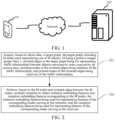
- FIG. 1 is a schematic diagram of an implementation environment of a graph data processing method according to an embodiment of this application. Referring to FIG. 1 , the implementation environment includes a terminal 101 and a server 102.
- the terminal 101 and the server 102 can be directly or indirectly connected through wired or wireless communication, which is not limited in the embodiments of this application.
- the terminal is preferably in the following forms.
- the terminal 101 may be a smart phone, a tablet computer, a notebook computer, a desktop computer, a smart speaker, a smart watch, a smart home appliance, a vehicle-mounted terminal, etc., but is not limited thereto.
- An application program is installed and running in the terminal 101.
- the application program may be a social program, a shopping program, a multimedia program, a game program, etc., which is not limited by the embodiments of this application.
- the terminal 101 may be a terminal used by a user, and the terminal 101 runs a social program into which a user account of the user logs. In all embodiments of the present disclosure, there may be more or fewer terminal(s) 101 described above. For example, there may be only one terminal 101 described above, or there may be dozens or hundreds of terminals 101 described above, or more. The number and device type of the terminal(s) 101 are not limited in the embodiments of this application.
- the server 102 is preferably in the following forms.
- the server 102 may be an independent physical server, a server cluster or distributed system formed by a plurality of physical servers, or a cloud server that provides basic cloud computing services, such as cloud services, cloud databases, cloud computing, cloud functions, cloud storage, network services, cloud communication, middleware services, domain name services, security services, CDN (Content Delivery Network), big data, and artificial intelligence platforms.
- the server 102 is used for providing background services for the above-mentioned application program run by the terminal 101.
- the server 102 can undertake the primary computing work, and the terminal 101 can undertake the secondary computing work.
- the server 102 can undertake the secondary computing work, and the terminal 101 can undertake the primary computing work.
- the server 102 and the terminal 101 can use a distributed computing architecture for collaborative computing.
- the application program installed in the terminal 101 is exemplified as a shopping program.
- a user account logs in the shopping program installed in the terminal 101.
- the server 102 uses the user account data and item data as object data, and constructs a target graph based on the object data, where nodes in the target graph represent the user account or items, and oriented edges in the target graph represent traffic relationships between the user account and the items.
- nodes in the target graph represent the user account or items
- oriented edges in the target graph represent traffic relationships between the user account and the items.
- an oriented edge between a node 3 representing the user account of the merchant and a node 2 representing the item represents a traffic relationship of addition, where the oriented edge points from the node 3 to the node 2, and the node 3 is an initiator of the addition, while the node 2 is a receiver of the addition.
- the server 102 is capable of acquiring embedding features of nodes in the target graph using the graph data processing method provided in the embodiments of this application.
- the embedding features are then executable by an item recommendation service, a social recommendation service, an advertising service, etc., which is not limited by the embodiments of this application.
- a pointing relationship of an oriented edge can be determined through an inner product calculation on embedding features of two nodes on the oriented edge, so that historical shopping information about a user account can be determined based on pointing relationships of a plurality of oriented edges, enabling item recommendation based on the historical shopping information, and improving recommendation accuracy.
- the computer device is exemplified as a terminal with a multimedia program installed thereon.
- the terminal After being authorized by a user, acquires historical data of songs listened by the user, including singer names, song names, song types, and the like.
- the terminal constructs a target graph using the historical data as object data, where nodes in the target graph represent the singer names, the song names, the song types, and the like, and oriented edges in the target graph represent traffic relationships between the objects.
- nodes in the target graph represent the singer names, the song names, the song types, and the like
- oriented edges in the target graph represent traffic relationships between the objects.
- the terminal 101 is capable of acquiring embedding features of nodes in the target graph using the graph data processing method provided in the embodiments of this application.
- the embedding features are then executable by an item recommendation service, a social recommendation service, an advertising service, etc., which is not limited by the embodiments of this application.
- the computer device is exemplified as a terminal with a Social Networking Services (SNS) APP installed thereon.
- SNS Social Networking Services
- the terminal After being authorized by a user, the terminal acquires the user's historical interaction data, including other user identifiers that are forwarded, commented, or liked.
- the terminal constructs a target graph using the historical interaction data as object data, where nodes in the target graph represent different users in the SNS, and oriented edges represent social relationships. For example, when a user 1 likes a user 2, an oriented edge between the user 1 and the user 2 points from a node A representing the user 1 to a node B representing the user 2.
- the terminal 101 is capable of determining embedding features of nodes in the target graph using the graph data processing method provided in the embodiments of this application, and then similarities between different users can be determined by using the embedding features of different nodes. Thus, it is possible to predict potential friends of a user based on the similarities between the different users and make recommendations, and to improve recommendation accuracy.
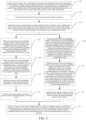
- FIG. 2 is a flowchart of a graph data processing method according to an embodiment of this application, which is illustrated as being performed by a server in the embodiments of this application, as shown in FIG. 2 .
- the graph data processing method includes the following steps:
- 201 Acquire, based on object data, a target graph, the target graph including M nodes each representing one of M objects, M being a positive integer greater than 1, oriented edges in the target graph being for representing traffic relationships between objects represented by nodes connected by the oriented edges, pointing nodes of the oriented edges being initiators of the traffic relationships, and pointed nodes of the oriented edges being receivers of the traffic relationships.
- the objects in the object data include user accounts, items, multimedia resources, virtual resources, virtual services, virtual live broadcast rooms, and the like, and the object data includes relationship information between the objects, including traffic relationships and association relationships between the objects.
- the server may construct different target graphs, such as social relationship graphs, shopping graphs, and virtual live broadcast graphs.
- the object data is data collected and used after being fully authorized.
- Oriented edges in a target graph can represent traffic relationships between objects.
- the traffic relationship represented by the oriented edge may be a transfer relationship, a following relationship, a like relationship, etc.
- a node from which the oriented edge points is an initiator of a traffic relationship represented by the oriented edge; and a node to which the oriented edge points is a receiver of the traffic relationship represented by the oriented edge.
- each object corresponds to a node.
- 202 Perform, based on the M nodes and oriented edges between the M nodes, multiple iterations to obtain initiation embedding features and reception embedding features corresponding to the M nodes, the initiation embedding features being used for representing features of the corresponding nodes serving as the initiators, and the reception embedding features being used for representing features of the corresponding nodes serving as the receivers.
- the server can determine, based on multiple iterations, an initiation embedding feature of each node of the M nodes serving as an initiator and a reception embedding feature of each node as a receiver.
- the server can acquire, based on the oriented edges between the nodes, a first neighborhood node taking the node as a receiver and a second neighborhood node taking the node as an initiator, and then gradually determine the initiation embedding feature and the reception embedding feature of the node in a gradient descent manner.
- a z th iteration is taken as an example, where z is a positive integer.
- the z th iteration includes the following steps.
- the server acquires N nodes from the M nodes described above, N being a positive integer.
- the server determines, based on oriented edges associated with the N nodes, a plurality of first neighborhood nodes of the N nodes and a plurality of second neighborhood nodes of the N nodes.
- the oriented edges pointing from the first neighborhood node point to the N nodes, and the oriented edges pointing from the N nodes point to the plurality of second neighborhood nodes.
- the server determines, based on first embedding features of the N nodes above, second embedding features of the plurality of first neighborhood nodes, and third embedding features of the plurality of second neighborhood nodes, fourth embedding features of the N nodes, and completes the iteration.
- the fourth embedding features of the N nodes represent the updated initiation embedding features and reception embedding features of the N nodes after the z th iteration.
- the first embedding features of the N nodes above, the second embedding features of the plurality of first neighborhood nodes, and the third embedding features of the plurality of second neighborhood nodes are obtained by the server performing a (z-1) th iteration, the first embedding features of the N nodes representing the updated initiation embedding features and reception embedding features of the N nodes obtained after the (z-1) th iteration.
- the embodiments of this application provides a graph data processing method, including: acquiring N nodes from a target graph in each iteration; and then determining, based on first embedding features of the N nodes, second embedding features of a plurality of first neighborhood nodes of the N nodes, and third embedding features of a plurality of second neighborhood nodes of the N nodes, fourth embedding features of the N nodes, so as to complete an iteration and update the embedding features of the N nodes. Since not all M nodes in the target graph are processed, the calculation amount can be greatly reduced.
- initiation embedding features of the M nodes serving as initiators as well as reception embedding features of the M nodes serving as receivers can be obtained, so that the embedding features of the nodes may retain information about the first neighborhoods and the second neighborhoods to a maximum extent, which enables the nodes to fully express information in graph data and eliminates information loss in the process of data conversion.
- the pointing relationship of an oriented edge can be determined based on the inner product between embedding features of two nodes connected by the oriented edge, so that both the dual identity of a node and the pointing relationship of an oriented edge can be expressed.
- FIG. 2 illustratively shows an implementation flow of a graph data processing method provided by an embodiment of this application, and the graph data processing method will be described based on an application scenario.
- FIG. 3 is a flowchart of another graph data processing method according to an embodiment of this application, which is illustrated as being performed by a server and executable by a social scenario, as shown in FIG. 3 .
- the graph data processing method includes the following steps:
- 301 Acquire, based on object data, a target graph, the target graph including M nodes each representing one of M objects, M being a positive integer greater than 1, oriented edges in the target graph being for representing traffic relationships between objects represented by nodes connected by the oriented edges, pointing nodes of the oriented edges being initiators of the traffic relationships, and pointed nodes of the oriented edges being receivers of the traffic relationships.
- the object data includes object information used for representing attributes of the objects and relationship information used for representing traffic relationships between the objects.
- the object data is user account data
- the user account data includes user account information and account relationship information.
- the user account information includes attributes of the user account, such as a user account identifier and a user account level.
- the account relationship information includes traffic relationships between the user account and other user accounts, and the like, and the contents included in the object data is not limited in the embodiments of this application.
- the server can construct, based on the object data above, a target graph including M nodes and oriented edges between the M nodes.
- the M nodes represent M different user accounts included in the object data, and M is a positive integer greater than 1.
- an oriented edge between any two of the nodes is used for representing presence of a traffic relationship between the user accounts corresponding to the two nodes, such as a friend relationship, a group relationship, a collection relationship, and a transfer relationship.
- a node from which the oriented edge points is an initiator of a traffic relationship represented by the oriented edge
- a node to which the oriented edge points is a receiver of the traffic relationship represented by the oriented edge.
- FIG. 4 is a schematic diagram of an oriented graph according to an embodiment of this application.
- the oriented graph illustratively shows six nodes A, B, C, D, E, and F that represent user accounts.
- the node C as an example, two oriented edges point from the node C (in this case, the node C is a pointing node, also referred to as a source node), and two oriented edges point to the node C (in this case, the node C is a pointed node C, also referred to as a target node).
- the node C acts as a receiver of traffic relationships with respect to the node A and the node B, and may also be referred to as a target role.
- the node C acts as an initiator of traffic relationships with respect to the node E and the node F, and may also be referred to as a source role. If the user accounts represented by the node A and the node B initiate transfer traffics to the user account represented by the node C, separately, the node A and the node B are initiators of the transfer traffics, and the node C is a receiver of the transfer traffics. If a group created by the user account represented by the node C includes the user account represented by the node E, the node C is an initiator of the group traffic, and the node E is a receiver of the group traffic. If the user account represented by the node C collects contents posted by the user account represented by the node F, the node C is an initiator of the collection traffic, and the node F is a receiver of the collection traffic.
- the target graph is preferably created in the following manners.
- the server may further send the object data above to a graph creation server which then creates a target graph based on the object data above.
- the server may also acquire, from a local database, the target graph that has been created based on the object data above.
- the source of the target graph is not limited in the embodiments of this application.
- the server can perform, based on the M nodes and oriented edges between the M nodes, multiple iterations to determine a feature of each node as an initiator of a traffic relationship and a feature of each node as a receiver of a traffic relationship.
- the server can separately process the M nodes, and can also separately process some of the M nodes based on a plurality of actuators in a distributed processing manner so as to improve the processing efficiency.
- the server can preferably partition the target graph as follows.
- the server can partition the target graph into at least one graph partition, each graph partition including a plurality of nodes and oriented edges between the plurality of nodes.
- the server stores nodes in the graph partition into a parameter server, and stores an edge table corresponding to the graph partition into an actuator corresponding to the graph partition.
- the nodes are stored in the parameter server in a distributed manner, so that the server can implement distributed computing based on a plurality of actuators, which significantly improves the efficiency of computing graph embedding.
- a plurality of actuators are provided in the server which are capable of synchronously performing graph data processing tasks.
- the actuator can determine embedding features of nodes in the graph partition using a small batch stochastic gradient descent method, and the actuator can acquire N nodes from the corresponding graph partition in each iteration, N being a positive integer.
- Steps 302-307 illustratively show one implementation of the z th iteration
- steps 302, 303, and 308-310 illustratively show another implementation of the z th iteration.
- the server can sample the M nodes above to obtain N nodes, where the N nodes are those to be processed in the z th iteration.
- N nodes are preferably acquired as follows.
- Each actuator can acquire N nodes for processing.
- the server uses, based on the edge table stored in the actuator, an Alias Table method to sample the target graph to obtain a plurality of sampled edges, where the plurality of sampled edges may be randomly sampled from the target graph, or sampled according to some rule. For example, a node can be sampled every pre-set number of nodes.
- the nodes connected by the plurality of sampled edges are the N nodes above.
- the server can determine, based on the plurality of sampled edges, N node identifiers, and then acquire N nodes corresponding to the N node identifiers from the parameter server.
- the server may also determine the sampled edges in other ways, or directly sample the nodes, which is not limited by the embodiments of this application.
- the neighborhood nodes are preferably determined as follows.
- the server can model a neighborhood of the node which is partitioned into a first neighborhood and a second neighborhood based on a dual identity of the node. Then at least one first neighborhood node associated with the node is acquired from the first neighborhood, and at least one second neighborhood node associated with the node is acquired from the second neighborhood. An oriented edge between a first neighborhood node in the first neighborhood and the node points to the node. An oriented edge between a second neighborhood node in the second neighborhood and the node points from the node.
- the neighborhood of a node is partitioned into order 1 to order R (also referred to as 1-hop neighbor to R-hop neighbor), where R is a positive integer.
- R also referred to as 1-hop neighbor to R-hop neighbor
- the first neighborhood may also be referred to as a source neighborhood and the second neighborhood may also be referred to as a target neighborhood.
- a traffic relationship being exemplified as a transfer relationship
- user accounts represented by the at least one first neighborhood node associated with the node all make transfers to the user account represented by the node.
- User accounts represented by the at least one second neighborhood node associated with the node all receive transfers from the user account represented by the node.
- N s v n N s 1 v n ⁇ N s 2 v n ... ⁇ N s R v n
- N s ( v n ) represents the first neighborhood within the order R of the node v n
- N s 1 ⁇ n represents a first-order first neighborhood of the node v n
- N s 2 ⁇ n represents a second-order first neighborhood of the node v n
- N s R ⁇ n represents an R-order first neighborhood of the node v n
- R is a positive integer.
- N t v n N t 1 v n ⁇ N t 2 v n ... ⁇ N t R v n
- N t ( v n ) represents the second neighborhood within the order R of the node v n
- N t 1 ⁇ n represents a first-order second neighborhood of the node v n
- N t 2 ⁇ n represents a second-order second neighborhood of the node v n
- N t R ⁇ n represents an R-order second neighborhood of the node v n
- R is a positive integer.
- FIG. 5 is a schematic diagram of neighborhood definition for an oriented graph according to an embodiment of this application.
- a first-order first neighborhood of a node A includes a node B, a node C, and a node D
- a second-order first neighborhood of the node A includes a node H and a node I
- a first-order second neighborhood of the node A includes a node E, a node F, and a node G
- a second-order second neighborhood of the node A includes a node J and a node K.
- An oriented edge between any node in the first-order first neighborhood and the node A points to the node A, and an oriented edge connected to any node in the second-order first neighborhood points to a node in the first-order first neighborhood.
- An oriented edge between any node in the first-order second neighborhood and the node A points from the node A, and an oriented edge connected to any node in the second-order second neighborhood points from a node in the first-order second neighborhood.
- the embodiments of this application provides two implementations, where the first implementation determines embedding features of a node based on probability information of determining first neighborhood nodes and second neighborhood nodes based on the node, as illustrated in steps 304-307; the second implementation determines embedding features of a node by a negative sampling on a first neighborhood and a second neighborhood of the node, as illustrated in steps 308-310.
- the node v n corresponds to an initiation embedding feature s n (also referred to as a source role characterization vector) and a reception embedding feature t n (also referred to as a target role characterization vector) in an embedding space. Therefore, the final target is to determine an initiation embedding matrix S ' formed by initiation embedding features of the M nodes and a reception embedding matrix T ' formed by reception embedding features of the M nodes in the target graph.
- the elements in the initiation embedding matrix S ' represent initiation embedding features of the nodes in the target graph
- the elements in the reception embedding matrix T ' represent reception embedding features of the nodes in the target graph.
- the first embedding features refer to embedding features of the N nodes, and for any node of the N nodes, the first embedding features of the node include an initiation embedding feature of the node and a reception embedding feature of the node.
- Each of the N nodes corresponds to at least one first neighborhood node.
- the second embedding features refer to embedding features of the plurality of first neighborhood nodes, and for any first neighborhood node, the second embedding features of the first neighborhood node include an initiation embedding feature of the first neighborhood node and a reception embedding feature of the first neighborhood node.
- a probability of the node v n determining the first neighborhood node v i in the whole target graph is defined based on a softmax function, so as to obtain the first probability information.
- the step of the server determining, based on the first embedding features of the N nodes and the second embedding features of the plurality of first neighborhood nodes, first probability information is preferably as follows.
- the server acquires N first intermediate embedding features from the first embedding features of the N nodes, the N first intermediate embedding features being used for representing features of the N nodes serving as the receivers, i.e., reception embedding features of the N nodes.
- the server acquires a plurality of second intermediate embedding features from the second embedding features of the plurality of first neighborhood nodes, the plurality of second intermediate embedding features being used for representing features of the plurality of first neighborhood nodes serving as the initiators, i.e., initiation embedding features of the plurality of first neighborhood nodes.
- the server acquires M seventh intermediate embedding features of the M nodes, the M seventh intermediate embedding features being used for representing features of the M nodes serving as the initiators, i.e., initiation embedding features of the M nodes.
- the first probability information is determined based on the N first intermediate embedding features, the plurality of second intermediate embedding features, and the M seventh intermediate embedding features.
- the calculation method for the first probability information is shown in Formula (3): p s v i
- v n ) represents the following probability in the first probability information: the probability of determining a first neighborhood node v i based on the node v n in the whole target graph; exp( ⁇ ) represents an exponential function with e as the base; t n represents a first intermediate embedding feature of the node v n ; T represents matrix transpose; s i represents a second intermediate embedding feature of the first neighborhood node v i ; M represents the total number of nodes in the target graph, and M is a positive integer; s m represents a seventh intermediate embedding feature of the node v m , and the node v m represents the m th node in the target graph.
- a probability of the node v n determining the second neighborhood node v j in the whole target graph is defined based on the softmax function, so as to obtain the second probability information.
- each of the N nodes corresponds to at least one second neighborhood node.
- the third embedding features refer to embedding features of the plurality of second neighborhood nodes, and for any second neighborhood node, the third embedding features of the second neighborhood node include an initiation embedding feature of the second neighborhood node and a reception embedding feature of the second neighborhood node.
- the step of the server determining, based on the first embedding features of the N nodes and the third embedding features of the plurality of second neighborhood nodes, second probability information is as follows.
- the server acquires N fourth intermediate embedding features from the first embedding features of the N nodes, the N fourth intermediate embedding features being used for representing features of the N nodes serving as the initiators, i.e., initiation embedding features of the N nodes.
- the server acquires a plurality of fifth intermediate embedding features from the third embedding features of the plurality of second neighborhood nodes, the plurality of fifth intermediate embedding features being used for representing features of the plurality of second neighborhood nodes serving as the receivers, i.e., reception embedding features of the plurality of second neighborhood nodes.
- the server acquires M eighth intermediate embedding features of the M nodes, the M eighth intermediate embedding features being used for representing features of the M nodes serving as the receivers, i.e., reception embedding features of the M nodes.
- the second probability information is determined based on the N fourth intermediate embedding features, the plurality of fifth intermediate embedding features, and the M eighth intermediate embedding features.
- the calculation method for the second probability information is shown in Formula (4): p t v j
- v n ) represents the following probability in the second probability information: the probability of determining a second neighborhood node v j based on the node v n in the whole target graph; exp( ⁇ ) represents an exponential function with e as the base; s n represents a fourth intermediate embedding feature of the node v n ; T represents matrix transpose; t j represents a fifth intermediate embedding feature of the second neighborhood node v j ; M represents the total number of nodes in the target graph, and M is a positive integer; t m represents an eighth intermediate embedding feature of the node v m , and the node v m represents the m th node in the target graph.
- the objective function in order to retain information in a first neighborhood and a second neighborhood of a node to a maximum extent, the objective function is constructed with an idea of maximum likelihood estimation. Therefore, for a given node v n , the purpose of multiple iterations is to maximize the likelihood function of determining neighborhood nodes of the node v n based on the node v n , the neighborhood nodes including the first neighborhood node and the second neighborhood node.
- the likelihood function is shown in Formula (5): max S ′ , T ′ p N s v n , N t v n
- v n max S ′ , T ′ ⁇ v i ⁇ N s v n p s v i
- v n max S ′ , T ′ p N s ⁇ n , N t ⁇ n
- ⁇ n T ' represents a maximum likelihood function
- S ' represents an initiation embedding matrix
- T ' represents a reception embedding matrix
- N s ( v n ) represents the first neighborhood within the order R of the node v n ; N t ( v n ) represents the second neighborhood within the order R of the node
- the server can convert the maximization problem in Formula (5) above into a minimization problem based on a negative log likelihood function, resulting in a second objective function, as shown in Formula (6):
- L likelihood represents a negative log likelihood function
- N s ( v n ) represents the first neighborhood within the order R of the node v n
- N t ( v n ) represents the second neighborhood within the order R of the node v n
- v i represents a first neighborhood node
- v j represents a second neighborhood node
- log( ⁇ ) represents a log function
- exp( ⁇ ) represents an exponential
- the server can perform iterations based on the second objective function to acquire the fourth embedding features of the N nodes.
- the fourth embedding features represent the updated initiation embedding features and reception embedding features of the N nodes after iterations. Since the optimization objective of the second objective function is minimization, the server performs multiple iterations based on a stochastic gradient descent method, so as to obtain the initiation embedding features and reception embedding features of the N nodes.
- the server may perform the optimization in a way of negative sampling contrast learning. Accordingly, the server can convert the problem of optimizing the second objective function into the problem of optimizing the first objective function by performing steps 308-310 instead of steps 304-307, the first objective function being detailed in steps 308-310.
- a first neighborhood and a second neighborhood of the node v n have different negative sample distributions, the first neighborhood including first neighborhood nodes v i of the node v n and the second neighborhood including second neighborhood nodes v j of the node v n .
- the negative sampling focuses on first neighborhood nodes v i from which oriented edges pointing to the node v n , so as to obtain node in-degree distribution information, i.e., representing a distribution of the number of oriented edges pointing to the current node v n .
- the negative sampling focuses on second neighborhood nodes v j to which oriented edges pointing from the node v n , so as to obtain node out-degree distribution information, i.e., representing a distribution of the number of oriented edges pointing from the current node v n .
- d n in represents the number of oriented edges pointing to the node v n ;
- M represents the total number of nodes in the target graph, and M is a positive integer;
- d m in represents the number of oriented edges pointing to the node v m , and the node v m represents the m th node in the target graph.
- the 308 Determine, based on the first embedding features of the N nodes, the second embedding features of the plurality of first neighborhood nodes, node in-degree distribution information, and fifth embedding features of a plurality of first nodes, a first function, the node in-degree distribution information being used for representing a node in-degree distribution of the N nodes, the plurality of first nodes being obtained based on a negative sampling on first neighborhoods of the N nodes, the first neighborhoods including the plurality of first neighborhood nodes.
- the server can acquire, from the parameter server, the first embedding features of the N nodes after the (z-1) th iteration, the second embedding features of the plurality of first neighborhood nodes, and the fifth embedding features of the plurality of first nodes, and then determine a first function based on the acquired features above.
- the node v n corresponds to an initiation embedding feature s n and a reception embedding feature t n in an embedding space.
- the final target is to determine an initiation embedding matrix S' formed by initiation embedding features of the M nodes and a reception embedding matrix T ' formed by reception embedding features of the M nodes in the target graph.
- the elements in the initiation embedding matrix S ' represent initiation embedding features of the nodes in the target graph
- the elements in the reception embedding matrix T ' represent reception embedding features of the nodes in the target graph.
- the fifth embedding features refer to embedding features of the plurality of first nodes, and for any first node, the fifth embedding features of the first node include an initiation embedding feature of the first node and a reception embedding feature of the first node.
- the node v n when determining a first neighborhood node v i of the node based on the node v n , the node v n is a receiver of a traffic relationship, and the first neighborhood node v i is an initiator of the traffic relationship.
- the traffic relationship is a transfer
- the user account represented by the first neighborhood node v i makes a transfer to the user account represented by the node v n .
- the first function can be determined based on the node in-degree distribution information obtained by the negative sampling.
- the step of the server determining, based on the first embedding features of the N nodes, the second embedding features of the plurality of first neighborhood nodes, node in-degree distribution information, and fifth embedding features of a plurality of first nodes, a first function is preferably as follows.
- the server can acquire N first intermediate embedding features from the first embedding features of the N nodes, the N first intermediate embedding features being used for representing features of the N nodes serving as the receivers, i.e., reception embedding features of the N nodes.
- the server can acquire a plurality of second intermediate embedding features from the second embedding features of the plurality of first neighborhood nodes, the plurality of second intermediate embedding features being used for representing features of the plurality of first neighborhood nodes serving as the initiators, i.e., initiation embedding features of the plurality of first neighborhood nodes.
- the server can determine, based on the node in-degree distribution information, first expectation information, the first expectation information being used for representing a mathematical expectation of the plurality of first nodes satisfying the node in-degree distribution information.
- the server can acquire a plurality of third intermediate embedding features from the fifth embedding features of the plurality of first nodes, the plurality of third intermediate embedding features being used for representing features of the plurality of first nodes serving as the initiators, i.e., initiation embedding features of the plurality of first nodes.
- the server can determine, based on the N first intermediate embedding features, the plurality of second intermediate embedding features, the first expectation information, and the plurality of third intermediate embedding features, the first function.
- the computational complexity can be significantly reduced as it is not necessary to calculate based on the embedding features of all nodes in the target graph, thereby improving the computational efficiency and saving computational resources.
- L 1 represents the first function
- N s ( v n ) represents the first neighborhood within the order R of the node v n
- v i represents a first neighborhood node
- log( ⁇ ) represents a log function
- ⁇ ( ⁇ ) represents a sigmoid function
- t n represents a first intermediate embedding feature of the node v n
- T represents matrix transpose
- s i represents a second intermediate embedding feature of the first neighborhood node v i
- K represents the number of first nodes obtained by a negative sampling on the first neighborhood, and K is a positive integer
- the node v n when determining a second neighborhood node v j of the node based on the node v n , the node v n is an initiator of a traffic relationship, and the second neighborhood node v j is a receiver of the traffic relationship.
- the traffic relationship is a transfer
- the user account represented by the second neighborhood node v j receives a transfer from the user account represented by the node v n .
- the second function can be determined based on the node out-degree distribution information obtained by the negative sampling.
- the sixth embedding features refer to embedding features of the plurality of second nodes, and for any second node, the sixth embedding features of the second node include an initiation embedding feature of the second node and a reception embedding feature of the second node.
- the step of the server determining, based on the first embedding features of the N nodes, the third embedding features of the plurality of second neighborhood nodes, node out-degree distribution information, and sixth embedding features of a plurality of second nodes, a second function is preferably as follows.
- the server can acquire N fourth intermediate embedding features from the first embedding features of the N nodes, the N fourth intermediate embedding features being used for representing features of the N nodes serving as the initiators, i.e., initiation embedding features of the N nodes.
- the server can acquire a plurality of fifth intermediate embedding features from the third embedding features of the plurality of second neighborhood nodes, the plurality of fifth intermediate embedding features being used for representing features of the plurality of second neighborhood nodes serving as the receivers, i.e., reception embedding features of the plurality of neighborhood nodes.
- the server can determine, based on the node out-degree distribution information, second expectation information, the second expectation information being used for representing a mathematical expectation of the plurality of second nodes satisfying the node out-degree distribution information.
- the server can acquire a plurality of sixth intermediate embedding features from the embedding features of the plurality of second nodes, the plurality of sixth intermediate embedding features being used for representing features of the plurality of second nodes serving as the receivers, i.e., reception embedding features of the plurality of second nodes.
- the server can determine, based on the N fourth intermediate embedding features, the plurality of fifth intermediate embedding features, the second expectation information, and the plurality of sixth intermediate embedding features, the second function.
- the computational complexity can be significantly reduced as it is not necessary to calculate based on the embedding features of all nodes in the target graph, thereby improving the computational efficiency and saving computational resources.
- N t ( v n ) represents the second neighborhood within the order R of the node v n
- v j represents a second neighborhood node
- log( ⁇ ) represents a log function
- ⁇ ( ⁇ ) represents a sigmoid function
- s n represents a fourth intermediate embedding features of the node v n
- T represents matrix transpose
- t j represents a fifth intermediate embedding feature of the second neighborhood node v j
- L represents the number of second nodes obtained by a negative sampling on the first neighborhood, and L is a positive integer
- E ⁇ l ⁇ p neg out ⁇ n represent second expectation information
- the server uses a small batch stochastic gradient descent method to optimize the first objective function based on multiple iterations so as to obtain the fourth embedding features of the N nodes above.
- the server can convert the first objective function into a third objective function.
- the third objective function is a function expressed in terms of edges, and for an oriented edge ( v x , v y ), a node v x is an initiator of a traffic relationship corresponding to the oriented edge, and a node v y is a receiver of the traffic relationship corresponding to the oriented edge, i.e., the node v x plays a source role, and the node v y plays a target role.
- L 3 represents the third objective function
- ( v x ,v y ) represents the oriented edge between the node v x and the node v y in the target graph, where the oriented edge points from the node v x and to the node v y
- E graph represents a set of oriented edges in the target graph
- log(o) represents a log function
- ⁇ ( ⁇ ) represents a sigmoid function
- s x represents an initiation embedding feature of the node v x
- T represents matrix transpose
- Step 311 may be performed by the server after multiple iterations based on the implementations shown in steps 302-307 above, or step 311 may be performed by the server after multiple iterations based on the implementations shown in steps 302, 303, and 308-310 above.
- 311 Obtain, in response to the end of multiple iterations, initiation embedding features and reception embedding features corresponding to the M nodes, the initiation embedding features being used for representing features of the corresponding nodes serving as the initiators, and the reception embedding features being used for representing features of the corresponding nodes serving as the receivers.
- the server ends the iterations after iterating for a target number of rounds to obtain an initiation embedding feature of each node as an initiator in the target graph and a reception embedding feature of each node as a receiver.
- the server can concatenate the initiation embedding feature and the reception embedding feature of the node with the account feature of the user account represented by the node, and then determine, based on the concatenated feature, whether there is a risk in traffic between the node and other nodes.
- the server can concatenate corresponding initiation embedding features and reception embedding features on the basis of the account features of the two user accounts above and input the concatenated feature into an anti-fraud model so as to determine whether the transfer request is a fraudulent traffic.
- the hit rate of the number of fraud transactions of the anti-fraud model is relatively improved from 14% to 21%, and the hit rate of the fraud amount is relatively improved from 27% to 47%.
- the graph data processing method provided in this application is 2-5 times as efficient as the solutions in the related art in acquiring embedding features of nodes, and the efficiency is significantly improved.
- FIG. 6 is a schematic diagram of a distributed computing architecture according to an embodiment of this application.
- the distributed computing architecture includes a plurality of actuators and a plurality of parameter servers.
- the server partitions a target graph, stores edge tables corresponding to the graph partitions in the actuators, and stores nodes corresponding to the graph partitions in corresponding parameter servers.
- Each node has two embedding features, one representing the embedding feature of the node as a source role and one representing the embedding feature of the node as a target role.
- the parameter servers initialize the embedding features of the nodes, and the actuators separately pulls first embedding features of N nodes, second embedding features of a plurality of first neighborhood nodes, and third embedding features of a plurality of second neighborhood nodes from the parameter servers in batches in corresponding graph partitions so as to determine N feature gradients of the N nodes.
- the N feature gradients are then uploaded to the parameter servers, and fourth embedding features of the N nodes are determined by the parameter servers based on the first embedding features and the N feature gradients of the N nodes so as to achieve an update of the embedding features of the nodes.
- iterations end after iterating for a target number of rounds.
- the graph data processing method provided by the embodiments of this application can also be combined with existing models to implement different traffics.
- initiation embedding features and reception embedding features of nodes obtained based on the graph data processing method provided by the embodiments of this application are introduced into a friend recommendation model, so that the recommendation model can recommend friends for users more accurately.
- initiation embedding features and reception embedding features of nodes obtained based on the graph data processing method provided by the embodiments of this application are introduced into an item recommendation model, so that the recommendation model can recommend items for users more accurately. It is not further detailed herein.
- the embodiments of this application illustrates that there is one type of traffic relationship between nodes.
- There may be multiple types of traffic relationships between objects in object data such as a transfer relationship and a following relationship between object A and object B, and a transfer relationship and a like relationship between object A and object C.
- the following relationship and the like relationship belong to the same type of traffic relationship as they generally occur in the same traffic scenario, such as watching a live broadcast.
- the transfer relationship and the two relationships above belong to different types of traffic relationships as they generally occur in different traffic scenarios.
- the transfer relationship may occur in a social scenario.
- the server can determine multiple target graphs based on graph data according to the relationship types between nodes, with oriented edges in the same target graph representing the same type of traffic relationship and oriented edges in different target graphs representing different types of traffic relationships. Based on the graph data processing method provided in the embodiments of this application, the server separately processes the multiple target graphs, and then performs concatenation or weighted fusion on initiation embedding features and reception embedding features obtained for the same node based on the different target graphs so as to obtain the final initiation embedding features and reception embedding features of the node. With processing according to different types of traffic relationships, embedding features of multiple identities can be determined for a node when the node has more than two identities, thereby facilitating the use of embedding features of corresponding identities for different traffic scenarios.
- the embodiments of this application provides a novel graph data processing method, including: acquiring N nodes from a target graph in each iteration; and then determining, based on first embedding features of the N nodes, second embedding features of a plurality of first neighborhood nodes of the N nodes, and third embedding features of a plurality of second neighborhood nodes of the N nodes, fourth embedding features of the N nodes, so as to complete an iteration and update the embedding features of the N nodes. Since not all M nodes in the target graph are processed, the calculation amount can be greatly reduced.
- initiation embedding features of the M nodes serving as initiators as well as reception embedding features of the M nodes serving as receivers can be obtained, so that the embedding features of the nodes may retain information about the first neighborhoods and the second neighborhoods to a maximum extent, so the pointing relationship of an oriented edge can be determined based on the inner product between embedding features of two nodes connected by the oriented edge, so that both the dual identity of a node and the pointing relationship of an oriented edge can be expressed.
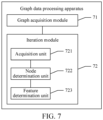
- FIG. 7 is a block diagram of a graph data processing apparatus according to an embodiment of this application.
- the apparatus is used for performing the steps in the graph data processing method described above, and with reference to FIG. 7 , the apparatus includes: a graph acquisition module 71 and an iteration module 72, where the iteration module 72 includes an acquisition unit 721, a node determination unit 722, and a feature determination unit 723.
- the graph acquisition module 71 is configured to acquire, based on object data, a target graph, the target graph including M nodes each representing one of M objects, M being a positive integer greater than 1, oriented edges in the target graph being for representing traffic relationships between objects represented by nodes connected by the oriented edges, pointing nodes of the oriented edges being initiators of the traffic relationships, and pointed nodes of the oriented edges being receivers of the traffic relationships.
- the iteration module 72 is configured to perform, based on the M nodes and oriented edges between the M nodes, multiple iterations to obtain initiation embedding features and reception embedding features corresponding to the M nodes, the initiation embedding features being used for representing features of the corresponding nodes serving as the initiators, and the reception embedding features being used for representing features of the corresponding nodes serving as the receivers.
- the iteration module 72 includes the following units.
- the acquisition unit 721 is configured to acquire N nodes from the M nodes, N being a positive integer less than M.
- the node determination unit 722 is configured to determine, based on oriented edges associated with the N nodes, a plurality of first neighborhood nodes of the N nodes and a plurality of second neighborhood nodes of the N nodes, the oriented edges pointing from the first neighborhood nodes pointing to the N nodes, and the oriented edges pointing from the N nodes pointing to the plurality of second neighborhood nodes.
- the feature determination unit 723 is configured to determine, based on first embedding features of the N nodes, second embedding features of the plurality of first neighborhood nodes, and third embedding features of the plurality of second neighborhood nodes, fourth embedding features of the N nodes, the fourth embedding features of the N nodes representing the updated initiation embedding features and reception embedding features of the N nodes after a z th iteration.
- FIG. 8 is a block diagram of another graph data processing apparatus according to an embodiment of this application.
- the feature determination unit 723 includes the following sub-units.
- a first determination sub-unit 7231 is configured to determine, based on the first embedding features of the N nodes, the second embedding features of the plurality of first neighborhood nodes, node in-degree distribution information, and fifth embedding features of a plurality of first nodes, a first function, the node in-degree distribution information being used for representing a node in-degree distribution of the N nodes, the plurality of first nodes being obtained based on a negative sampling on first neighborhoods of the N nodes, the first neighborhoods including the plurality of first neighborhood nodes, and the first embedding features of the N nodes, the second embedding features of the plurality of first neighborhood nodes, and the third embedding features of the plurality of second neighborhood nodes being obtained by performing a (z-1) th iteration.
- a second determination sub-unit 7232 is configured to determine, based on the first embedding features of the N nodes, the third embedding features of the plurality of second neighborhood nodes, node out-degree distribution information, and sixth embedding features of a plurality of second nodes, a second function, the node out-degree distribution information being used for representing a node out-degree distribution of the N nodes, the plurality of second nodes being obtained based on a negative sampling on second neighborhoods of the N nodes, the second neighborhoods including the plurality of second neighborhood nodes.
- a first optimization sub-unit 7233 is configured to optimize, based on a first objective function formed by the first function and the second function, the first objective function to obtain the fourth embedding features of the N nodes.
- the first determination sub-unit 7231 is preferably configured to: acquire N first intermediate embedding features from the first embedding features of the N nodes, the N first intermediate embedding features being used for representing features of the N nodes serving as the receivers; acquire a plurality of second intermediate embedding features from the second embedding features of the plurality of first neighborhood nodes, the plurality of second intermediate embedding features being used for representing features of the plurality of first neighborhood nodes serving as the initiators; determine, based on the node in-degree distribution information, first expectation information, the first expectation information being used for representing a mathematical expectation of the plurality of first nodes satisfying the node in-degree distribution information; acquire a plurality of third intermediate embedding features from the fifth embedding features of the plurality of first nodes, the plurality of third intermediate embedding features being used for representing features of the plurality of first nodes serving as the initiators; and determine, based on the N first intermediate embedding features,
- the second determination sub-unit 7232 is preferably configured to: acquire N fourth intermediate embedding features from the first embedding features of the N nodes, the N fourth intermediate embedding features being used for representing features of the N nodes serving as the initiators; acquire a plurality of fifth intermediate embedding features from the third embedding features of the plurality of second neighborhood nodes, the plurality of fifth intermediate embedding features being used for representing features of the plurality of second neighborhood nodes serving as the receivers; determine, based on the node out-degree distribution information, second expectation information, the second expectation information being used for representing a mathematical expectation of the plurality of second nodes satisfying the node out-degree distribution information; acquire a plurality of sixth intermediate embedding features from the embedding features of the plurality of second nodes, the plurality of sixth intermediate embedding features being used for representing features of the plurality of second nodes serving as the receivers; and determine, based on the N fourth intermediate embedding features, the plurality of fifth intermediate embedding
- the feature determination unit 723 can preferably include a third determination sub-unit 7234, a fourth determination sub-unit 7235, a fifth determination sub-unit 7236 and second optimization sub-unit 7237.
- the third determination sub-unit 7234 is configured to determine, based on the first embedding features of the N nodes and the second embedding features of the plurality of first neighborhood nodes, first probability information, the first probability information being used for indicating a probability of determining the plurality of first neighborhood nodes based on the N nodes.
- the fourth determination sub-unit 7235 is configured to determine, based on the first embedding features of the N nodes and the third embedding features of the plurality of second neighborhood nodes, second probability information, the second probability information being used for indicating a probability of determining the plurality of second neighborhood nodes based on the N nodes.
- the fifth determination sub-unit 7236 is configured to determine, based on the first probability information and the second probability information, a second objective function.
- the second optimization sub-unit 7237 is configured to optimize the second objective function to obtain the fourth embedding features of the N nodes.
- the third determination sub-unit 7234 is preferably configured to: acquire N first intermediate embedding features from the first embedding features of the N nodes, the N first intermediate embedding features being used for representing features of the N nodes serving as the receivers; acquire a plurality of second intermediate embedding features from the second embedding features of the plurality of first neighborhood nodes, the plurality of second intermediate embedding features being used for representing features of the plurality of first neighborhood nodes serving as the initiators; acquire M seventh intermediate embedding features of the M nodes, the M seventh intermediate embedding features being used for representing features of the M nodes serving as the initiators; and determine, based on the N first intermediate embedding features, the plurality of second intermediate embedding features, and the M seventh intermediate embedding features, the first probability information.
- the fourth determination sub-unit 7235 is preferably configured to: acquire N fourth intermediate embedding features from the first embedding features of the N nodes, the N fourth intermediate embedding features being used for representing features of the N nodes serving as the initiators; acquire a plurality of fifth intermediate embedding features from the third embedding features of the plurality of second neighborhood nodes, the plurality of fifth intermediate embedding features being used for representing features of the plurality of second neighborhood nodes serving as the receivers; acquire M eighth intermediate embedding features of the M nodes, the M eighth intermediate embedding features being used for representing features of the M nodes serving as the receivers; and determine, based on the N fourth intermediate embedding features, the plurality of fifth intermediate embedding features, and the M eighth intermediate embedding features, the second probability information.
- the apparatus can further include a partitioning module 73, a storage module 74, and a sampling module 75.
- the partitioning module 73 is configured to partition the target graph into at least one graph partition.
- the storage module 74 is configured to store, for any graph partition, nodes in the graph partition into a parameter server.
- the storage module 74 is further configured to store an edge table corresponding to the graph partition into an actuator corresponding to the graph partition.
- the sampling module 75 is configured to sample, for any actuator, the target graph based on the edge table stored in the actuator to obtain a plurality of sampled edges, nodes connected by the plurality of sampled edges being the N nodes.
- the acquisition unit 721 is configured to: determine, based on the plurality of sampled edges, N node identifiers; and acquire the N nodes corresponding to the N node identifiers from the parameter server.
- the feature determination unit 723 is preferably configured to: determine, based on the first embedding features of the N nodes, the second embedding features of the plurality of first neighborhood nodes, and the third embedding features of the plurality of second neighborhood nodes, N feature gradients of the N nodes; upload the N feature gradients to the parameter server, and determine, by the parameter server, the fourth embedding features of the N nodes based on the first embedding features and the N feature gradients of the N nodes.
- the embodiments of this application provides the graph data processing apparatus performing: acquiring N nodes from a target graph in each iteration; and then determining, based on first embedding features of the N nodes, second embedding features of a plurality of first neighborhood nodes of the N nodes, and third embedding features of a plurality of second neighborhood nodes of the N nodes, fourth embedding features of the N nodes, so as to complete an iteration and update the embedding features of the N nodes. Since not all M nodes in the target graph are processed, the calculation amount can be greatly reduced.
- initiation embedding features of the M nodes serving as initiators as well as reception embedding features of the M nodes serving as receivers can be obtained, so that the embedding features of the nodes may retain information about the first neighborhoods and the second neighborhoods to a maximum extent, so the pointing relationship of an oriented edge can be determined based on the inner product between embedding features of two nodes connected by the oriented edge, so that both the dual identity of a node and the pointing relationship of an oriented edge can be expressed.
- the graph data processing apparatus provided in the embodiment above when processing data, merely takes the above division of functional modules as an example for illustration.
- the above functionalities may be allocated to be completed by different functional modules according to requirements, i.e., the internal structure of the apparatus may be partitioned into different functional modules so as to complete all or part of the functionalities described above.
- the graph data processing apparatus provided in the embodiment above belongs to the same concept as the embodiment of the graph data processing method, and the embodiment of the method may be referred to for the implementation of the apparatus.
- the computer device may be configured as a terminal or a server.
- the technical solutions provided in the embodiments of this application can be implemented by the terminal which acts as an executive body.
- the technical solutions provided in the embodiments of this application can be implemented by the server which acts as an executive body.
- the technical solutions provided in the embodiments of this application can be implemented by the interaction between the terminal and the server, which is not limited by the embodiments of this application.
- FIG. 9 is a structural block diagram of a terminal 900 according to an embodiment of this application.
- the terminal 900 may be a portable mobile terminal, such as a smart phone, a tablet computer, an MP3 player (Moving Picture Experts Group Audio Layer III), an MP4 player (Moving Picture Experts Group Audio Layer IV), a notebook computer, or a desktop computer.
- the terminal 900 may also be referred to as another name such as user equipment, a portable terminal, a laptop terminal, or a desktop terminal.
- the terminal 900 includes: a processor 901 and a memory 902.
- the processor 901 may include one or more processing cores, such as a 4-core processor or an 8-core processor.
- the processor 901 may be implemented in at least one hardware form of DSP (Digital Signal Processing), FPGA (Field-Programmable Gate Array), and PLA (Programmable Logic Array).
- the processor 901 may also include a main processor and a co-processor, where the main processor is a processor for processing data in a wake-up state, also referred to as a CPU (Central Processing Unit), and the co-processor is a low-power processor for processing data in a standby state.
- the processor 901 may be integrated with a GPU (Graphics Processing Unit), the GPU being responsible for rendering and drawing the content to be displayed on the display screen.
- the processor 901 may further include an AI (Artificial Intelligence) processor.
- the AI processor is configured to process computing operations related to machine learning.
- the memory 902 may include one or more computer-readable storage media.
- the computer-readable storage media may be non-transitory.
- the memory 902 may further include a high-speed random access memory and a nonvolatile memory, such as one or more disk storage devices or flash storage devices.
- the non-transitory computer-readable storage media in the memory 902 are used for storing at least one computer program for execution by the processor 901 to implement the graph data processing method provided by the embodiment of the method in this application.
- the terminal 900 may further include: a peripheral interface 903 and at least one peripheral.
- the processor 901, the memory 902, and the peripheral interface 903 may be connected by a bus or a signal line.
- the peripherals may be connected to the peripheral interface 903 through a bus, a signal line, or a circuit board.
- the peripherals include: at least one of a radio frequency circuit 904, a display screen 905, a camera assembly 906, an audio circuit 907, a positioning assembly 908, and a power supply 909.
- the terminal 900 further includes one or more sensors 910.
- the one or more sensors 910 include, but are not limited to: an acceleration sensor 911, a gyroscope sensor 912, a pressure sensor 913, a fingerprint sensor 914, an optical sensor 915, and a proximity sensor 916.
- FIG. 9 constitutes no limitation on the terminal 900, and the terminal may include more or fewer components than shown, or some components may be combined, or a different component arrangement may be used.
- FIG. 10 is a schematic structural diagram of a server according to an embodiment of this application.
- the server 1000 may be largely different due to different configurations or performances, and may include one or more Central Processing Units (CPU) 1001 and one or more memories 1002. At least one computer program is stored in the memory 1002, and the at least one computer program is loaded and executed by the processor 1001 to implement the graph data processing method provided in the embodiments of the method described above.
- the server may also have wired or wireless network interfaces, keyboards, input/output interfaces, and other components for input and output, and the server may further include other components for implementing device functions.
- An embodiment of this application further provides a computer-readable storage medium storing at least one computer program therein, the at least one computer program being loaded and executed by a processor of a computer device to implement the operations performed by the computer device in the graph data processing method of the embodiment described above.
- the computer-readable storage medium may be a Read-Only Memory (ROM), a Random Access Memory (RAM), a Compact Disc Read-Only Memory (CD-ROM), a magnetic tape, a floppy disk, an optical data storage device, etc.
- the computer program involved in the embodiments of this application may be deployed to be executed on one computer device, or on a plurality of computer devices located at one site, or on a plurality of computer devices distributed at a plurality of sites and interconnected through a communication network, where the plurality of computer devices distributed at the plurality of sites and interconnected through the communication network may form a block chain system.
- An embodiment of this application provides a computer program product including computer program code stored in a computer-readable storage medium.
- the computer program code when read by a processor of a computer device from the computer-readable storage medium and executed by the processor, causes the computer device to perform the graph data processing method provided in various implementations described above.
- the program may be stored in a computer-readable storage medium.
- the storage medium described above may be a read-only memory, a magnetic disk, an optical disc, and the like.
Landscapes
- Engineering & Computer Science (AREA)
- Theoretical Computer Science (AREA)
- General Physics & Mathematics (AREA)
- Physics & Mathematics (AREA)
- Databases & Information Systems (AREA)
- General Engineering & Computer Science (AREA)
- Data Mining & Analysis (AREA)
- Software Systems (AREA)
- Human Computer Interaction (AREA)
- Multimedia (AREA)
- Artificial Intelligence (AREA)
- Computational Linguistics (AREA)
- Evolutionary Computation (AREA)
- Computing Systems (AREA)
- Mathematical Physics (AREA)
- Information Retrieval, Db Structures And Fs Structures Therefor (AREA)
Abstract
Description
- This application is provided on the basis of, and claims priority to
Chinese Patent Application No. 202111151811.8 filed on September 29, 2021 - This application relates to the field of computer technology, and includes, but is not limited to, a graph data processing method and apparatus, a computer device, a storage medium, and a computer program product.
- Graph embedding technology has become an effective means for large-scale graph data mining. The main idea of graph embedding is to map sparse high-dimensional original graph data into dense low-dimensional vectors, i.e., embedding vectors of nodes in the graph, so as to preserve the topology information of the graph as much as possible in the embedding space. It is a research direction to find a way to perform graph embedding of graph data efficiently.
- Currently, the commonly used graph embedding techniques include DeepWalk, Node2Vec (Node-to-Vector), LINE (Large-scale Information Network Embedding), etc. Based on the random walking algorithm, nodes in the graph data and the traffic relationships between the nodes are determined, and an encoding vector of each of the nodes is determined.
- However, with regard to an oriented graph, a pair of nodes in the oriented graph represent an initiator and a receiver of a traffic relationship, separately, and the oriented edge between the pair of nodes points from the initiator to the receiver. However, all the three algorithms mentioned above finally obtain an encoding vector corresponding to each of the nodes in the graph, and it is difficult to fully express the entire data relationship of the nodes in the graph. Therefore, there is a problem of information loss in processing graph data.
- The embodiments of this application provide a graph data processing method and apparatus, a computer device, a storage medium, and a computer program product, which enable nodes to fully express information in graph data and ensure information integrity in the process of converting the graph data into a target graph.
- An embodiment of this application provides a graph data processing method executable by a computer device, the method including:
- acquiring, based on object data, a target graph, the target graph including M nodes each representing one of M objects, M being a positive integer greater than 1, oriented edges in the target graph being for representing traffic relationships between objects represented by nodes connected by the oriented edges, pointing nodes of the oriented edges being initiators of the traffic relationships, and pointed nodes of the oriented edges being receivers of the traffic relationships; and
- performing, based on the M nodes and oriented edges between the M nodes, multiple iterations to obtain initiation embedding features and reception embedding features corresponding to the M nodes, the initiation embedding features being used for representing features of the corresponding nodes serving as the initiators, and the reception embedding features being used for representing features of the corresponding nodes serving as the receivers;
- a zth iteration including the following steps:
- acquiring N nodes from the M nodes, N being a positive integer less than M, and z being a positive integer;
- determining, based on oriented edges associated with the N nodes, a plurality of first neighborhood nodes of the N nodes and a plurality of second neighborhood nodes of the N nodes, the oriented edges pointing from the first neighborhood nodes pointing to the N nodes, and the oriented edges pointing from the N nodes pointing to the plurality of second neighborhood nodes; and
- determining, based on first embedding features of the N nodes, second embedding features of the plurality of first neighborhood nodes, and third embedding features of the plurality of second neighborhood nodes, fourth embedding features of the N nodes; the first embedding features of the N nodes, the second embedding features of the plurality of first neighborhood nodes, and the third embedding features of the plurality of second neighborhood nodes being obtained by performing a (z-1)th iteration; the fourth embedding features of the N nodes representing the updated initiation embedding features and reception embedding features of the N nodes after the zth iteration.
- An embodiment of this application provides a graph data processing apparatus, the apparatus including:
- a graph acquisition module, configured to acquire, based on object data, a target graph, the target graph including M nodes for representing objects, M being a positive integer, oriented edges in the target graph being for representing traffic relationships between objects represented by nodes connected by the oriented edges, pointing nodes of the oriented edges being initiators of the traffic relationships, and pointed nodes of the oriented edges being receivers of the traffic relationships; and
- an iteration module, configured to perform, based on the M nodes and oriented edges between the M nodes, multiple iterations to obtain initiation embedding features and reception embedding features corresponding to the M nodes, the initiation embedding features being used for representing features of the corresponding nodes serving as the initiators, and the reception embedding features being used for representing features of the corresponding nodes serving as the receivers;
- the iteration module being further configured to:
- acquire N nodes from the M nodes, N being a positive integer less than M;
- determine, based on oriented edges associated with the N nodes, a plurality of first neighborhood nodes of the N nodes and a plurality of second neighborhood nodes of the N nodes, the oriented edges pointing from the first neighborhood nodes pointing to the N nodes, and the oriented edges pointing from the N nodes pointing to the plurality of second neighborhood nodes; and
- determine, based on first embedding features of the N nodes, second embedding features of the plurality of first neighborhood nodes, and third embedding features of the plurality of second neighborhood nodes, fourth embedding features of the N nodes; the first embedding features of the N nodes, the second embedding features of the plurality of first neighborhood nodes, and the third embedding features of the plurality of second neighborhood nodes being obtained by performing a (z-1)th iteration; the fourth embedding features of the N nodes representing the updated initiation embedding features and reception embedding features of the N nodes after the zth iteration.
- An embodiment of this application provides a computer device including a processor and a memory, the memory being used for storing at least one computer program that is loaded and executed by the processor to implement the operations performed by the graph data processing method in the embodiments of this application.
- An embodiment of this application provides a computer-readable storage medium storing at least one computer program therein, the at least one computer program being loaded and executed by a processor to implement the operations as performed by the graph data processing method in the embodiments of this application.
- An embodiment of this application provides a computer program product including computer program code stored in a computer-readable storage medium, the computer program code, when read by a processor of a computer device from the computer-readable storage medium and executed by the processor, causing the computer device to perform the graph data processing method provided in various implementations of the aspects described above.
- The technical solutions provided in the embodiments of this application bring the following beneficial effects.
- An embodiment of this application provides a technical solution for graph data processing, including: acquiring N nodes from a target graph in each iteration, the N nodes being partial nodes in the target graph; and then determining, based on first embedding features of the N nodes, second embedding features of a plurality of first neighborhood nodes of the N nodes, and third embedding features of a plurality of second neighborhood nodes of the N nodes, fourth embedding features of the N nodes, so as to complete an iteration and update the embedding features of the N nodes. Since not all M nodes in the target graph are processed, the calculation amount can be greatly reduced. After multiple iterations, initiation embedding features of the M nodes serving as initiators as well as reception embedding features of the M nodes serving as receivers can be obtained, so that the embedding features of the nodes may retain information about the first neighborhoods and the second neighborhoods to a maximum extent, which enables the nodes to fully express information in graph data and ensures information integrity in the process of converting the graph data into a target graph.
- In order to illustrate the technical solutions in the embodiments of this application more clearly, the following briefly introduces the accompanying drawings required for describing the embodiments. Apparently, the accompanying drawings in the following description show only some embodiments of this application, and a person of ordinary skill in the art may still derive other drawings from these accompanying drawings without creative efforts.
-
FIG. 1 is a schematic diagram of an implementation environment of a graph data processing method according to an embodiment of this application. -
FIG. 2 is a flowchart of a graph data processing method according to an embodiment of this application. -
FIG. 3 is a flowchart of another graph data processing method according to an embodiment of this application. -
FIG. 4 is a schematic diagram of an oriented graph according to an embodiment of this application. -
FIG. 5 is a schematic diagram of neighborhood definition for an oriented graph according to an embodiment of this application. -
FIG. 6 is a schematic diagram of a distributed computing architecture according to an embodiment of this application. -
FIG. 7 is a block diagram of a graph data processing apparatus according to an embodiment of this application. -
FIG. 8 is a block diagram of another graph data processing apparatus according to an embodiment of this application. -
FIG. 9 is a structural block diagram of a terminal according to an embodiment of this application. -
FIG. 10 is a schematic structural diagram of a server according to an embodiment of this application. - In order to make the objectives, technical solutions, and advantages of this application clearer, the embodiments of this application will be described below with reference to the accompanying drawings.
- In the embodiments of this application, the terms "first", "second", and the like are used to distinguish the same or similar items with substantially the same effects and functions. It is to be understood that the terms "first", "second", and "nth" do not have a logical or chronological dependency, nor do they limit the number or execution order.
- The term "at least one" means one or more, and "a plurality of" means two or more.
- Hereinafter, technical terms related to the embodiments of this application are explained.
- 1). A graph, in mathematics, is a structure described for a group of objects in which certain pairs of objects are "related" in a sense. The objects correspond to mathematical abstractions called nodes (also referred to as vertices or points), and each related pair of nodes are connected by an edge (also referred to as a link or a line). In the embodiments of this application, the objects are user accounts, items, virtual resources, positions, virtual live broadcast rooms, and the like, which are not limited by the embodiments of this application. If the objects are user accounts, different nodes in the graph represent different user accounts, and edges in the graph represent traffic relationships between the user accounts, such as transfer and friend request.
- 2). An oriented graph is a graph formed entirely by oriented edges. A node in the oriented graph has two different identities or roles. For example, if oriented edges pointing from a
node 1 and a node 2 point to a node 3, the identity of the node 3 is a receiver (also referred to as a responder or a target role) with respect to thenode 1 and the node 2. If oriented edges pointing from the node 3 point to a node 4 and a node 5, the identity of the node 3 is an initiator (also referred to as a sender or a source role) with respect to the node 4 and the node 5. - 3). Asymmetry of oriented relationship: the edge relationship of a pair of nodes in an oriented graph is asymmetric. If there is an oriented edge pointing from the
node 1 to the node 3 and there is no oriented edge pointing from the node 3 to thenode 1 in the oriented graph, the relationship between thenode 1 and the node 3 is asymmetric. - 4). Graph embedding (also referred to as graph representation learning) is a process of mapping graph data (generally a dense high-dimensional matrix) into dense low-dimensional vectors, which can solve the problem that it is difficult to efficiently input graph data into machine learning algorithms.
- 5). An edge table, also called an edge set table, is one of the storage structures of graphs. An edge table includes header nodes and table nodes, and each vertex in the graph corresponds to a header node stored in an array.
- 6). Out-degree: the number of edges pointing from a node is called the out-degree of the node.
- 7). In-degree: the number of edges pointing to a node is called the in-degree of the node.
- The graph data processing method provided by an embodiment of this application is applicable to various scenarios, including but not limited to cloud technology, artificial intelligence, intelligent transportation, and aided driving. The implementation environment of the embodiments of this application is described below.
- The graph data processing method provided by the embodiments of this application can be performed by a computer device, which is a terminal or a server. The implementation environment of the graph data processing method provided by the embodiments of this application will first be described with the computer device being exemplified as a server.
FIG. 1 is a schematic diagram of an implementation environment of a graph data processing method according to an embodiment of this application. Referring toFIG. 1 , the implementation environment includes a terminal 101 and aserver 102. - The terminal 101 and the
server 102 can be directly or indirectly connected through wired or wireless communication, which is not limited in the embodiments of this application. - In the embodiments of the present disclosure, including the embodiments of both the claims and the specification (hereinafter referred to as "all embodiments of the present disclosure"), the terminal is preferably in the following forms. For example, the terminal 101 may be a smart phone, a tablet computer, a notebook computer, a desktop computer, a smart speaker, a smart watch, a smart home appliance, a vehicle-mounted terminal, etc., but is not limited thereto. An application program is installed and running in the
terminal 101. The application program may be a social program, a shopping program, a multimedia program, a game program, etc., which is not limited by the embodiments of this application. In all embodiments of the present disclosure, the terminal 101 may be a terminal used by a user, and the terminal 101 runs a social program into which a user account of the user logs. In all embodiments of the present disclosure, there may be more or fewer terminal(s) 101 described above. For example, there may be only oneterminal 101 described above, or there may be dozens or hundreds ofterminals 101 described above, or more. The number and device type of the terminal(s) 101 are not limited in the embodiments of this application. - In all embodiments of the present disclosure, the
server 102 is preferably in the following forms. For example, theserver 102 may be an independent physical server, a server cluster or distributed system formed by a plurality of physical servers, or a cloud server that provides basic cloud computing services, such as cloud services, cloud databases, cloud computing, cloud functions, cloud storage, network services, cloud communication, middleware services, domain name services, security services, CDN (Content Delivery Network), big data, and artificial intelligence platforms. Theserver 102 is used for providing background services for the above-mentioned application program run by theterminal 101. In all embodiments of the present disclosure, theserver 102 can undertake the primary computing work, and the terminal 101 can undertake the secondary computing work. Alternatively, theserver 102 can undertake the secondary computing work, and the terminal 101 can undertake the primary computing work. Alternatively, theserver 102 and the terminal 101 can use a distributed computing architecture for collaborative computing. - In the implementation environment, the application program installed in the terminal 101 is exemplified as a shopping program.
- For example, a user account logs in the shopping program installed in the
terminal 101. Theserver 102 uses the user account data and item data as object data, and constructs a target graph based on the object data, where nodes in the target graph represent the user account or items, and oriented edges in the target graph represent traffic relationships between the user account and the items. When a customer purchases an item using the user account, an oriented edge between anode 1 representing the user account of the customer and a node 2 representing the item represents a traffic relationship of purchase, where the oriented edge points from thenode 1 to the node 2, and thenode 1 is an initiator of the purchase, while the node 2 is a receiver of the purchase. Similarly, when a merchant uses a user account to add an item, an oriented edge between a node 3 representing the user account of the merchant and a node 2 representing the item represents a traffic relationship of addition, where the oriented edge points from the node 3 to the node 2, and the node 3 is an initiator of the addition, while the node 2 is a receiver of the addition. Theserver 102 is capable of acquiring embedding features of nodes in the target graph using the graph data processing method provided in the embodiments of this application. The embedding features are then executable by an item recommendation service, a social recommendation service, an advertising service, etc., which is not limited by the embodiments of this application. For example, in the shopping program, a pointing relationship of an oriented edge can be determined through an inner product calculation on embedding features of two nodes on the oriented edge, so that historical shopping information about a user account can be determined based on pointing relationships of a plurality of oriented edges, enabling item recommendation based on the historical shopping information, and improving recommendation accuracy. - In another embodiment, the computer device is exemplified as a terminal with a multimedia program installed thereon.
- For example, after being authorized by a user, the terminal acquires historical data of songs listened by the user, including singer names, song names, song types, and the like. The terminal constructs a target graph using the historical data as object data, where nodes in the target graph represent the singer names, the song names, the song types, and the like, and oriented edges in the target graph represent traffic relationships between the objects. When a singer sings a song and the song belongs to a type, an oriented edge between a node A representing the singer and a node B representing the song points from the node A to the node B, and an oriented edge between the node B representing the song and a node C representing the type points from the node B to the node C. The terminal 101 is capable of acquiring embedding features of nodes in the target graph using the graph data processing method provided in the embodiments of this application. The embedding features are then executable by an item recommendation service, a social recommendation service, an advertising service, etc., which is not limited by the embodiments of this application.
- In another embodiment, the computer device is exemplified as a terminal with a Social Networking Services (SNS) APP installed thereon.
- For example, after being authorized by a user, the terminal acquires the user's historical interaction data, including other user identifiers that are forwarded, commented, or liked. The terminal constructs a target graph using the historical interaction data as object data, where nodes in the target graph represent different users in the SNS, and oriented edges represent social relationships. For example, when a
user 1 likes a user 2, an oriented edge between theuser 1 and the user 2 points from a node A representing theuser 1 to a node B representing the user 2. The terminal 101 is capable of determining embedding features of nodes in the target graph using the graph data processing method provided in the embodiments of this application, and then similarities between different users can be determined by using the embedding features of different nodes. Thus, it is possible to predict potential friends of a user based on the similarities between the different users and make recommendations, and to improve recommendation accuracy. -
FIG. 2 is a flowchart of a graph data processing method according to an embodiment of this application, which is illustrated as being performed by a server in the embodiments of this application, as shown inFIG. 2 . The graph data processing method includes the following steps: - 201: Acquire, based on object data, a target graph, the target graph including M nodes each representing one of M objects, M being a positive integer greater than 1, oriented edges in the target graph being for representing traffic relationships between objects represented by nodes connected by the oriented edges, pointing nodes of the oriented edges being initiators of the traffic relationships, and pointed nodes of the oriented edges being receivers of the traffic relationships.
- In the embodiments of this application, the objects in the object data include user accounts, items, multimedia resources, virtual resources, virtual services, virtual live broadcast rooms, and the like, and the object data includes relationship information between the objects, including traffic relationships and association relationships between the objects. Based on different object data, the server may construct different target graphs, such as social relationship graphs, shopping graphs, and virtual live broadcast graphs. The object data is data collected and used after being fully authorized. Oriented edges in a target graph can represent traffic relationships between objects. When objects corresponding to two nodes connected by an oriented edge are two user accounts, the traffic relationship represented by the oriented edge may be a transfer relationship, a following relationship, a like relationship, etc. For any oriented edge, a node from which the oriented edge points is an initiator of a traffic relationship represented by the oriented edge; and a node to which the oriented edge points is a receiver of the traffic relationship represented by the oriented edge.
- In the embodiments of this application, each object corresponds to a node.
- 202: Perform, based on the M nodes and oriented edges between the M nodes, multiple iterations to obtain initiation embedding features and reception embedding features corresponding to the M nodes, the initiation embedding features being used for representing features of the corresponding nodes serving as the initiators, and the reception embedding features being used for representing features of the corresponding nodes serving as the receivers.
- In the embodiments of this application, the server can determine, based on multiple iterations, an initiation embedding feature of each node of the M nodes serving as an initiator and a reception embedding feature of each node as a receiver. In each iteration, for any node, the server can acquire, based on the oriented edges between the nodes, a first neighborhood node taking the node as a receiver and a second neighborhood node taking the node as an initiator, and then gradually determine the initiation embedding feature and the reception embedding feature of the node in a gradient descent manner.
- A zth iteration is taken as an example, where z is a positive integer. The zth iteration includes the following steps. The server acquires N nodes from the M nodes described above, N being a positive integer. The server then determines, based on oriented edges associated with the N nodes, a plurality of first neighborhood nodes of the N nodes and a plurality of second neighborhood nodes of the N nodes. The oriented edges pointing from the first neighborhood node point to the N nodes, and the oriented edges pointing from the N nodes point to the plurality of second neighborhood nodes. The server then determines, based on first embedding features of the N nodes above, second embedding features of the plurality of first neighborhood nodes, and third embedding features of the plurality of second neighborhood nodes, fourth embedding features of the N nodes, and completes the iteration. The fourth embedding features of the N nodes represent the updated initiation embedding features and reception embedding features of the N nodes after the zth iteration.
- The first embedding features of the N nodes above, the second embedding features of the plurality of first neighborhood nodes, and the third embedding features of the plurality of second neighborhood nodes are obtained by the server performing a (z-1)th iteration, the first embedding features of the N nodes representing the updated initiation embedding features and reception embedding features of the N nodes obtained after the (z-1)th iteration.
- The embodiments of this application provides a graph data processing method, including: acquiring N nodes from a target graph in each iteration; and then determining, based on first embedding features of the N nodes, second embedding features of a plurality of first neighborhood nodes of the N nodes, and third embedding features of a plurality of second neighborhood nodes of the N nodes, fourth embedding features of the N nodes, so as to complete an iteration and update the embedding features of the N nodes. Since not all M nodes in the target graph are processed, the calculation amount can be greatly reduced. After multiple iterations, initiation embedding features of the M nodes serving as initiators as well as reception embedding features of the M nodes serving as receivers can be obtained, so that the embedding features of the nodes may retain information about the first neighborhoods and the second neighborhoods to a maximum extent, which enables the nodes to fully express information in graph data and eliminates information loss in the process of data conversion. Furthermore, the pointing relationship of an oriented edge can be determined based on the inner product between embedding features of two nodes connected by the oriented edge, so that both the dual identity of a node and the pointing relationship of an oriented edge can be expressed.
-
FIG. 2 illustratively shows an implementation flow of a graph data processing method provided by an embodiment of this application, and the graph data processing method will be described based on an application scenario.FIG. 3 is a flowchart of another graph data processing method according to an embodiment of this application, which is illustrated as being performed by a server and executable by a social scenario, as shown inFIG. 3 . The graph data processing method includes the following steps: - 301: Acquire, based on object data, a target graph, the target graph including M nodes each representing one of M objects, M being a positive integer greater than 1, oriented edges in the target graph being for representing traffic relationships between objects represented by nodes connected by the oriented edges, pointing nodes of the oriented edges being initiators of the traffic relationships, and pointed nodes of the oriented edges being receivers of the traffic relationships.
- In the embodiments of this application, the object data includes object information used for representing attributes of the objects and relationship information used for representing traffic relationships between the objects. When the object data is user account data, the user account data includes user account information and account relationship information. The user account information includes attributes of the user account, such as a user account identifier and a user account level. The account relationship information includes traffic relationships between the user account and other user accounts, and the like, and the contents included in the object data is not limited in the embodiments of this application.
- In the embodiments of this application, the server can construct, based on the object data above, a target graph including M nodes and oriented edges between the M nodes. The M nodes represent M different user accounts included in the object data, and M is a positive integer greater than 1. In the M nodes, an oriented edge between any two of the nodes is used for representing presence of a traffic relationship between the user accounts corresponding to the two nodes, such as a friend relationship, a group relationship, a collection relationship, and a transfer relationship. For any oriented edge, a node from which the oriented edge points is an initiator of a traffic relationship represented by the oriented edge, and a node to which the oriented edge points is a receiver of the traffic relationship represented by the oriented edge.
- For example,
FIG. 4 is a schematic diagram of an oriented graph according to an embodiment of this application. Referring toFIG. 4 , the oriented graph illustratively shows six nodes A, B, C, D, E, and F that represent user accounts. With the node C as an example, two oriented edges point from the node C (in this case, the node C is a pointing node, also referred to as a source node), and two oriented edges point to the node C (in this case, the node C is a pointed node C, also referred to as a target node). The node C acts as a receiver of traffic relationships with respect to the node A and the node B, and may also be referred to as a target role. The node C acts as an initiator of traffic relationships with respect to the node E and the node F, and may also be referred to as a source role. If the user accounts represented by the node A and the node B initiate transfer traffics to the user account represented by the node C, separately, the node A and the node B are initiators of the transfer traffics, and the node C is a receiver of the transfer traffics. If a group created by the user account represented by the node C includes the user account represented by the node E, the node C is an initiator of the group traffic, and the node E is a receiver of the group traffic. If the user account represented by the node C collects contents posted by the user account represented by the node F, the node C is an initiator of the collection traffic, and the node F is a receiver of the collection traffic. - In all embodiments of the present disclosure, the target graph is preferably created in the following manners. For example, the server may further send the object data above to a graph creation server which then creates a target graph based on the object data above. Of course, the server may also acquire, from a local database, the target graph that has been created based on the object data above. The source of the target graph is not limited in the embodiments of this application.
- In all embodiments of present disclosure, the server can perform, based on the M nodes and oriented edges between the M nodes, multiple iterations to determine a feature of each node as an initiator of a traffic relationship and a feature of each node as a receiver of a traffic relationship. In each iteration, the server can separately process the M nodes, and can also separately process some of the M nodes based on a plurality of actuators in a distributed processing manner so as to improve the processing efficiency.
- In all embodiments of the present disclosure, the server can preferably partition the target graph as follows. The server can partition the target graph into at least one graph partition, each graph partition including a plurality of nodes and oriented edges between the plurality of nodes. For any graph partition, the server stores nodes in the graph partition into a parameter server, and stores an edge table corresponding to the graph partition into an actuator corresponding to the graph partition. By partitioning the target graph into graph partitions, the nodes are stored in the parameter server in a distributed manner, so that the server can implement distributed computing based on a plurality of actuators, which significantly improves the efficiency of computing graph embedding.
- A plurality of actuators are provided in the server which are capable of synchronously performing graph data processing tasks. With any actuator as an example, the actuator can determine embedding features of nodes in the graph partition using a small batch stochastic gradient descent method, and the actuator can acquire N nodes from the corresponding graph partition in each iteration, N being a positive integer.
- The zth iteration of any actuator is described as an example below, where z is a positive integer. Steps 302-307 illustratively show one implementation of the zth iteration, and steps 302, 303, and 308-310 illustratively show another implementation of the zth iteration.
- 302: Acquire N nodes from the M nodes, N being a positive integer less than M.
- In the embodiments of this application, the server can sample the M nodes above to obtain N nodes, where the N nodes are those to be processed in the zth iteration.
- In all embodiments of the present disclosure, N nodes are preferably acquired as follows. Each actuator can acquire N nodes for processing. For any actuator, the server uses, based on the edge table stored in the actuator, an Alias Table method to sample the target graph to obtain a plurality of sampled edges, where the plurality of sampled edges may be randomly sampled from the target graph, or sampled according to some rule. For example, a node can be sampled every pre-set number of nodes. The nodes connected by the plurality of sampled edges are the N nodes above. The server can determine, based on the plurality of sampled edges, N node identifiers, and then acquire N nodes corresponding to the N node identifiers from the parameter server. Of course, the server may also determine the sampled edges in other ways, or directly sample the nodes, which is not limited by the embodiments of this application.
- 303: Determine, based on oriented edges associated with the N nodes, a plurality of first neighborhood nodes of the N nodes and a plurality of second neighborhood nodes of the N nodes, the oriented edges pointing from the first neighborhood nodes pointing to the N nodes, and the oriented edges pointing from the N nodes pointing to the plurality of second neighborhood nodes.
- In all embodiments of present disclosure, the neighborhood nodes are preferably determined as follows. For any node, the server can model a neighborhood of the node which is partitioned into a first neighborhood and a second neighborhood based on a dual identity of the node. Then at least one first neighborhood node associated with the node is acquired from the first neighborhood, and at least one second neighborhood node associated with the node is acquired from the second neighborhood. An oriented edge between a first neighborhood node in the first neighborhood and the node points to the node. An oriented edge between a second neighborhood node in the second neighborhood and the node points from the node. Based on distances between nodes, the neighborhood of a node is partitioned into
order 1 to order R (also referred to as 1-hop neighbor to R-hop neighbor), where R is a positive integer. The first neighborhood may also be referred to as a source neighborhood and the second neighborhood may also be referred to as a target neighborhood. - For example, with a traffic relationship being exemplified as a transfer relationship, for any node, user accounts represented by the at least one first neighborhood node associated with the node all make transfers to the user account represented by the node. User accounts represented by the at least one second neighborhood node associated with the node all receive transfers from the user account represented by the node.
- For any node vn , the expressions of the first neighborhood and the second neighborhood within the order R of the node are shown in Formula (1) and Formula (2):

where Ns (vn ) represents the first neighborhood within the order R of the node vn ;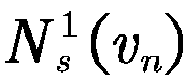


where Nt (v n) represents the second neighborhood within the order R of the node vn ;


- For example,
FIG. 5 is a schematic diagram of neighborhood definition for an oriented graph according to an embodiment of this application. Referring toFIG. 5 , a first-order first neighborhood of a node A includes a node B, a node C, and a node D, and a second-order first neighborhood of the node A includes a node H and a node I. A first-order second neighborhood of the node A includes a node E, a node F, and a node G, and a second-order second neighborhood of the node A includes a node J and a node K. An oriented edge between any node in the first-order first neighborhood and the node A points to the node A, and an oriented edge connected to any node in the second-order first neighborhood points to a node in the first-order first neighborhood. An oriented edge between any node in the first-order second neighborhood and the node A points from the node A, and an oriented edge connected to any node in the second-order second neighborhood points from a node in the first-order second neighborhood. - The embodiments of this application provides two implementations, where the first implementation determines embedding features of a node based on probability information of determining first neighborhood nodes and second neighborhood nodes based on the node, as illustrated in steps 304-307; the second implementation determines embedding features of a node by a negative sampling on a first neighborhood and a second neighborhood of the node, as illustrated in steps 308-310.
- 304: Determine, based on the first embedding features of the N nodes and the second embedding features of the plurality of first neighborhood nodes, first probability information, the first probability information being used for indicating a probability of determining the plurality of first neighborhood nodes based on the N nodes.
- In the embodiments of this application, for a node vn in a graph, the node vn corresponds to an initiation embedding feature sn (also referred to as a source role characterization vector) and a reception embedding feature tn (also referred to as a target role characterization vector) in an embedding space. Therefore, the final target is to determine an initiation embedding matrix S' formed by initiation embedding features of the M nodes and a reception embedding matrix T' formed by reception embedding features of the M nodes in the target graph. The elements in the initiation embedding matrix S' represent initiation embedding features of the nodes in the target graph, and the elements in the reception embedding matrix T' represent reception embedding features of the nodes in the target graph.
- In the embodiments of this application, the first embedding features refer to embedding features of the N nodes, and for any node of the N nodes, the first embedding features of the node include an initiation embedding feature of the node and a reception embedding feature of the node. Each of the N nodes corresponds to at least one first neighborhood node. The second embedding features refer to embedding features of the plurality of first neighborhood nodes, and for any first neighborhood node, the second embedding features of the first neighborhood node include an initiation embedding feature of the first neighborhood node and a reception embedding feature of the first neighborhood node.
- In all embodiments of the present disclosure, for a node vn , when determining a first neighborhood node vi of the node based on the node vn , the node vn is a receiver of a traffic relationship, and the first neighborhood node vi is an initiator of the traffic relationship. Therefore, a probability of the node vn determining the first neighborhood node vi in the whole target graph is defined based on a softmax function, so as to obtain the first probability information. The step of the server determining, based on the first embedding features of the N nodes and the second embedding features of the plurality of first neighborhood nodes, first probability information is preferably as follows. The server acquires N first intermediate embedding features from the first embedding features of the N nodes, the N first intermediate embedding features being used for representing features of the N nodes serving as the receivers, i.e., reception embedding features of the N nodes. The server acquires a plurality of second intermediate embedding features from the second embedding features of the plurality of first neighborhood nodes, the plurality of second intermediate embedding features being used for representing features of the plurality of first neighborhood nodes serving as the initiators, i.e., initiation embedding features of the plurality of first neighborhood nodes. The server acquires M seventh intermediate embedding features of the M nodes, the M seventh intermediate embedding features being used for representing features of the M nodes serving as the initiators, i.e., initiation embedding features of the M nodes. Finally, the first probability information is determined based on the N first intermediate embedding features, the plurality of second intermediate embedding features, and the M seventh intermediate embedding features. Accordingly, the calculation method for the first probability information is shown in Formula (3):

where ps (v i|vn ) represents the following probability in the first probability information: the probability of determining a first neighborhood node vi based on the node vn in the whole target graph; exp(·) represents an exponential function with e as the base; tn represents a first intermediate embedding feature of the node vn ; T represents matrix transpose; si represents a second intermediate embedding feature of the first neighborhood node vi ; M represents the total number of nodes in the target graph, and M is a positive integer; sm represents a seventh intermediate embedding feature of the node vm , and the node vm represents the mth node in the target graph. - 305: Determine, based on the first embedding features of the N nodes and the third embedding features of the plurality of second neighborhood nodes, second probability information, the second probability information being used for indicating a probability of determining the plurality of second neighborhood nodes based on the N nodes.
- In the embodiments of this application and similar to the
step 304, for a node vn , when determining a second neighborhood node vj of the node based on the node vn , the node vn is an initiator of a traffic relationship, and the second neighborhood node vj is a receiver of the traffic relationship. Therefore, a probability of the node vn determining the second neighborhood node vj in the whole target graph is defined based on the softmax function, so as to obtain the second probability information. - In the embodiments of this application, each of the N nodes corresponds to at least one second neighborhood node. The third embedding features refer to embedding features of the plurality of second neighborhood nodes, and for any second neighborhood node, the third embedding features of the second neighborhood node include an initiation embedding feature of the second neighborhood node and a reception embedding feature of the second neighborhood node.
- The step of the server determining, based on the first embedding features of the N nodes and the third embedding features of the plurality of second neighborhood nodes, second probability information is as follows. The server acquires N fourth intermediate embedding features from the first embedding features of the N nodes, the N fourth intermediate embedding features being used for representing features of the N nodes serving as the initiators, i.e., initiation embedding features of the N nodes. The server acquires a plurality of fifth intermediate embedding features from the third embedding features of the plurality of second neighborhood nodes, the plurality of fifth intermediate embedding features being used for representing features of the plurality of second neighborhood nodes serving as the receivers, i.e., reception embedding features of the plurality of second neighborhood nodes. The server acquires M eighth intermediate embedding features of the M nodes, the M eighth intermediate embedding features being used for representing features of the M nodes serving as the receivers, i.e., reception embedding features of the M nodes. Finally, the second probability information is determined based on the N fourth intermediate embedding features, the plurality of fifth intermediate embedding features, and the M eighth intermediate embedding features. Accordingly, the calculation method for the second probability information is shown in Formula (4):
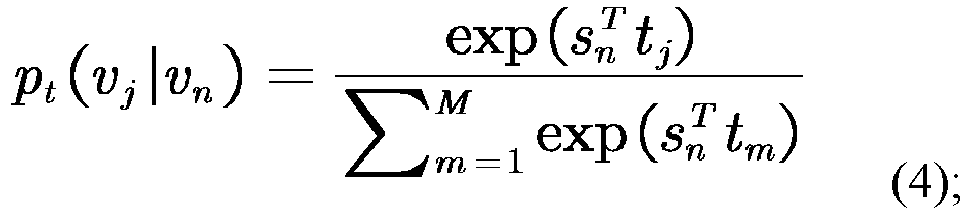
where pt (vj |vn ) represents the following probability in the second probability information: the probability of determining a second neighborhood node vj based on the node vn in the whole target graph; exp(·) represents an exponential function with e as the base; sn represents a fourth intermediate embedding feature of the node vn ; T represents matrix transpose; tj represents a fifth intermediate embedding feature of the second neighborhood node vj ; M represents the total number of nodes in the target graph, and M is a positive integer; tm represents an eighth intermediate embedding feature of the node vm , and the node vm represents the mth node in the target graph. - 306: Determine, based on the first probability information and the second probability information, a second objective function.
- In the embodiments of this application, in order to retain information in a first neighborhood and a second neighborhood of a node to a maximum extent, the objective function is constructed with an idea of maximum likelihood estimation. Therefore, for a given node vn , the purpose of multiple iterations is to maximize the likelihood function of determining neighborhood nodes of the node vn based on the node vn , the neighborhood nodes including the first neighborhood node and the second neighborhood node. Assuming that the probabilities of the node vn determining the neighborhood nodes are independent of each other, the likelihood function is shown in Formula (5):

where
- In all embodiments of the present disclosure, the server can convert the maximization problem in Formula (5) above into a minimization problem based on a negative log likelihood function, resulting in a second objective function, as shown in Formula (6):

where Llikelihood represents a negative log likelihood function; Ns (vn ) represents the first neighborhood within the order R of the node vn ; Nt (vn ) represents the second neighborhood within the order R of the node vn ; vi represents a first neighborhood node; vj represents a second neighborhood node; log(·) represents a log function; exp(·) represents an exponential function with e as the base; tn represents a first intermediate embedding feature of the node vn ; T represents matrix transpose; si represents a second intermediate embedding feature of the first neighborhood node vi ; M represents the total number of nodes in the target graph, and M is a positive integer; sm represents a seventh intermediate embedding feature of the node v m, and the node vm represents the mth node in the target graph; sn represents a fourth intermediate embedding feature of the node vn ; tj represents a fifth intermediate embedding feature of the second neighborhood node vj ; and tm represents an eighth intermediate embedding feature of the node vm . - 307: Optimize the second objective function to obtain the fourth embedding features of the N nodes.
- In the embodiments of this application, the server can perform iterations based on the second objective function to acquire the fourth embedding features of the N nodes. The fourth embedding features represent the updated initiation embedding features and reception embedding features of the N nodes after iterations. Since the optimization objective of the second objective function is minimization, the server performs multiple iterations based on a stochastic gradient descent method, so as to obtain the initiation embedding features and reception embedding features of the N nodes.
- In all embodiments of the present disclosure, since direct optimization of the second objective function described above may be complex, the server may perform the optimization in a way of negative sampling contrast learning. Accordingly, the server can convert the problem of optimizing the second objective function into the problem of optimizing the first objective function by performing steps 308-310 instead of steps 304-307, the first objective function being detailed in steps 308-310.
- For a node vn in the graph, a first neighborhood and a second neighborhood of the node vn have different negative sample distributions, the first neighborhood including first neighborhood nodes vi of the node vn and the second neighborhood including second neighborhood nodes vj of the node vn . When the first neighborhood of the node vn is negatively sampled, the negative sampling focuses on first neighborhood nodes vi from which oriented edges pointing to the node vn , so as to obtain node in-degree distribution information, i.e., representing a distribution of the number of oriented edges pointing to the current node vn . When the second neighborhood of the node vn is negatively sampled, the negative sampling focuses on second neighborhood nodes vj to which oriented edges pointing from the node vn, so as to obtain node out-degree distribution information, i.e., representing a distribution of the number of oriented edges pointing from the current node vn . The calculation methods for the node in-degree distribution information and the node out-degree distribution information are shown in Formula (7) and Formula (8):



- 308: Determine, based on the first embedding features of the N nodes, the second embedding features of the plurality of first neighborhood nodes, node in-degree distribution information, and fifth embedding features of a plurality of first nodes, a first function, the node in-degree distribution information being used for representing a node in-degree distribution of the N nodes, the plurality of first nodes being obtained based on a negative sampling on first neighborhoods of the N nodes, the first neighborhoods including the plurality of first neighborhood nodes.
- In the embodiments of this application, after obtaining the node in-degree distribution information, the server can acquire, from the parameter server, the first embedding features of the N nodes after the (z-1)th iteration, the second embedding features of the plurality of first neighborhood nodes, and the fifth embedding features of the plurality of first nodes, and then determine a first function based on the acquired features above. For a node vn in a graph, the node vn corresponds to an initiation embedding feature sn and a reception embedding feature tn in an embedding space. Therefore, the final target is to determine an initiation embedding matrix S' formed by initiation embedding features of the M nodes and a reception embedding matrix T' formed by reception embedding features of the M nodes in the target graph. The elements in the initiation embedding matrix S' represent initiation embedding features of the nodes in the target graph, and the elements in the reception embedding matrix T' represent reception embedding features of the nodes in the target graph.
- In the embodiments of this application, the fifth embedding features refer to embedding features of the plurality of first nodes, and for any first node, the fifth embedding features of the first node include an initiation embedding feature of the first node and a reception embedding feature of the first node.
- For a node vn , when determining a first neighborhood node vi of the node based on the node vn, the node vn is a receiver of a traffic relationship, and the first neighborhood node vi is an initiator of the traffic relationship. When the traffic relationship is a transfer, the user account represented by the first neighborhood node vi makes a transfer to the user account represented by the node vn . The first function can be determined based on the node in-degree distribution information obtained by the negative sampling.
- In all embodiments of the present disclosure, the step of the server determining, based on the first embedding features of the N nodes, the second embedding features of the plurality of first neighborhood nodes, node in-degree distribution information, and fifth embedding features of a plurality of first nodes, a first function is preferably as follows. The server can acquire N first intermediate embedding features from the first embedding features of the N nodes, the N first intermediate embedding features being used for representing features of the N nodes serving as the receivers, i.e., reception embedding features of the N nodes. The server can acquire a plurality of second intermediate embedding features from the second embedding features of the plurality of first neighborhood nodes, the plurality of second intermediate embedding features being used for representing features of the plurality of first neighborhood nodes serving as the initiators, i.e., initiation embedding features of the plurality of first neighborhood nodes. The server can determine, based on the node in-degree distribution information, first expectation information, the first expectation information being used for representing a mathematical expectation of the plurality of first nodes satisfying the node in-degree distribution information. The server can acquire a plurality of third intermediate embedding features from the fifth embedding features of the plurality of first nodes, the plurality of third intermediate embedding features being used for representing features of the plurality of first nodes serving as the initiators, i.e., initiation embedding features of the plurality of first nodes. Finally, the server can determine, based on the N first intermediate embedding features, the plurality of second intermediate embedding features, the first expectation information, and the plurality of third intermediate embedding features, the first function. By determining the first function based on the node in-degree distribution information obtained by negative sampling, the computational complexity can be significantly reduced as it is not necessary to calculate based on the embedding features of all nodes in the target graph, thereby improving the computational efficiency and saving computational resources.
- The first function is shown in Formula (9):

where L 1 represents the first function, and Ns (vn ) represents the first neighborhood within the order R of the node vn ; vi represents a first neighborhood node; log(·) represents a log function; σ(·) represents a sigmoid function, and tn represents a first intermediate embedding feature of the node vn ; T represents matrix transpose; si represents a second intermediate embedding feature of the first neighborhood node vi ; K represents the number of first nodes obtained by a negative sampling on the first neighborhood, and K is a positive integer;

- 309: Determine, based on the first embedding features of the N nodes, the third embedding features of the plurality of second neighborhood nodes, node out-degree distribution information, and sixth embedding features of a plurality of second nodes, a second function, the node out-degree distribution information being used for representing a node out-degree distribution of the N nodes, the plurality of second nodes being obtained based on a negative sampling on second neighborhoods of the N nodes, the second neighborhoods including the plurality of second neighborhood nodes.
- In the embodiments of this application and similar to the
step 308, for a node vn , when determining a second neighborhood node vj of the node based on the node vn , the node vn is an initiator of a traffic relationship, and the second neighborhood node vj is a receiver of the traffic relationship. When the traffic relationship is a transfer, the user account represented by the second neighborhood node vj receives a transfer from the user account represented by the node vn . The second function can be determined based on the node out-degree distribution information obtained by the negative sampling. - In the embodiments of this application, the sixth embedding features refer to embedding features of the plurality of second nodes, and for any second node, the sixth embedding features of the second node include an initiation embedding feature of the second node and a reception embedding feature of the second node.
- In all embodiments of the present disclosure, the step of the server determining, based on the first embedding features of the N nodes, the third embedding features of the plurality of second neighborhood nodes, node out-degree distribution information, and sixth embedding features of a plurality of second nodes, a second function is preferably as follows. The server can acquire N fourth intermediate embedding features from the first embedding features of the N nodes, the N fourth intermediate embedding features being used for representing features of the N nodes serving as the initiators, i.e., initiation embedding features of the N nodes. The server can acquire a plurality of fifth intermediate embedding features from the third embedding features of the plurality of second neighborhood nodes, the plurality of fifth intermediate embedding features being used for representing features of the plurality of second neighborhood nodes serving as the receivers, i.e., reception embedding features of the plurality of neighborhood nodes. The server can determine, based on the node out-degree distribution information, second expectation information, the second expectation information being used for representing a mathematical expectation of the plurality of second nodes satisfying the node out-degree distribution information. The server can acquire a plurality of sixth intermediate embedding features from the embedding features of the plurality of second nodes, the plurality of sixth intermediate embedding features being used for representing features of the plurality of second nodes serving as the receivers, i.e., reception embedding features of the plurality of second nodes. Finally, the server can determine, based on the N fourth intermediate embedding features, the plurality of fifth intermediate embedding features, the second expectation information, and the plurality of sixth intermediate embedding features, the second function. By determining the second function based on the node out-degree distribution information obtained by negative sampling, the computational complexity can be significantly reduced as it is not necessary to calculate based on the embedding features of all nodes in the target graph, thereby improving the computational efficiency and saving computational resources.
- The second function is shown in Formula (10):

where L 2 represents the second function, and Nt (vn ) represents the second neighborhood within the order R of the node vn ; vj represents a second neighborhood node; log(·) represents a log function; σ(·) represents a sigmoid function, and sn represents a fourth intermediate embedding features of the node vn ; T represents matrix transpose; tj represents a fifth intermediate embedding feature of the second neighborhood node vj ; L represents the number of second nodes obtained by a negative sampling on the first neighborhood, and L is a positive integer;

- 310: Optimize a first objective function formed based on the first function and the second function to obtain the fourth embedding features of the N nodes.
- In the embodiments of this application, the server can construct the first objective function based on the first function and the second function, the first objective function being shown in Formula (11):

where Lneg represents the first objective function; L 1 represents the first function; and L 2 represents the second function. - The server uses a small batch stochastic gradient descent method to optimize the first objective function based on multiple iterations so as to obtain the fourth embedding features of the N nodes above.
- In all embodiments of the present disclosure, in the case where first-order neighborhoods are preserved, the desired effect can be achieved on highly sparse graph data. Besides, in the case where first-order first neighborhoods and first-order second neighborhoods of nodes are preserved, the summation of the neighborhoods of the nodes in the first objective function is equivalent to the summation of all the edges in the graph. Therefore, the server can convert the first objective function into a third objective function.
- The third objective function is a function expressed in terms of edges, and for an oriented edge (vx ,vy ), a node vx is an initiator of a traffic relationship corresponding to the oriented edge, and a node vy is a receiver of the traffic relationship corresponding to the oriented edge, i.e., the node vx plays a source role, and the node vy plays a target role. When the oriented edge (vx,vy ) is observed in a forward direction, attention is paid to the probability of determining the node vy based on the node vx, and a negative sampling is performed on a first-order second neighborhood of the node vx to obtain negatively sampled nodes vf ; and when the oriented edge (vx,vy ) is observed in a reverse direction, attention is paid to the probability of determining the node vx based on the node vy, and a negative sampling is performed on a first-order first neighborhood of the node vy to obtain negatively sampled nodes vg, i.e., information about both the forward direction and the reverse direction is considered, so the algorithm corresponding to the third objective function can be referred to as a bidirectional graph embedding (BGE) algorithm.
- The third objective function is shown in Formula (12):

where L 3 represents the third objective function; (vx,vy ) represents the oriented edge between the node vx and the node vy in the target graph, where the oriented edge points from the node vx and to the node vy ; Egraph represents a set of oriented edges in the target graph; log(o) represents a log function; σ(·) represents a sigmoid function; sx represents an initiation embedding feature of the node vx ; T represents matrix transpose; ty represents a reception embedding feature of the node vy ; F represents the number of negatively sampled nodes vf obtained by a negative sampling on the first-order second neighborhood of the node vx, and F is a positive integer;

- Step 311 may be performed by the server after multiple iterations based on the implementations shown in steps 302-307 above, or step 311 may be performed by the server after multiple iterations based on the implementations shown in
steps - 311: Obtain, in response to the end of multiple iterations, initiation embedding features and reception embedding features corresponding to the M nodes, the initiation embedding features being used for representing features of the corresponding nodes serving as the initiators, and the reception embedding features being used for representing features of the corresponding nodes serving as the receivers.
- In the embodiments of this application, the server ends the iterations after iterating for a target number of rounds to obtain an initiation embedding feature of each node as an initiator in the target graph and a reception embedding feature of each node as a receiver.
- In all embodiments of the present disclosure, for any node, the server can concatenate the initiation embedding feature and the reception embedding feature of the node with the account feature of the user account represented by the node, and then determine, based on the concatenated feature, whether there is a risk in traffic between the node and other nodes. When the user account corresponding to the node initiates a transfer request to a user account corresponding to another node, the server can concatenate corresponding initiation embedding features and reception embedding features on the basis of the account features of the two user accounts above and input the concatenated feature into an anti-fraud model so as to determine whether the transfer request is a fraudulent traffic. By introducing the embedding features obtained based on the graph data processing method provided by the embodiments of this application into the anti-fraud model, the hit rate of the number of fraud transactions of the anti-fraud model is relatively improved from 14% to 21%, and the hit rate of the fraud amount is relatively improved from 27% to 47%. Furthermore, the graph data processing method provided in this application is 2-5 times as efficient as the solutions in the related art in acquiring embedding features of nodes, and the efficiency is significantly improved.
- In order to make one easily understand the flow of the graph data processing method provided by the embodiments of this application being performed by a server in a distributed manner, reference is made to
FIG. 6 , which is a schematic diagram of a distributed computing architecture according to an embodiment of this application. InFIG. 6 , the distributed computing architecture includes a plurality of actuators and a plurality of parameter servers. The server partitions a target graph, stores edge tables corresponding to the graph partitions in the actuators, and stores nodes corresponding to the graph partitions in corresponding parameter servers. Each node has two embedding features, one representing the embedding feature of the node as a source role and one representing the embedding feature of the node as a target role. The parameter servers initialize the embedding features of the nodes, and the actuators separately pulls first embedding features of N nodes, second embedding features of a plurality of first neighborhood nodes, and third embedding features of a plurality of second neighborhood nodes from the parameter servers in batches in corresponding graph partitions so as to determine N feature gradients of the N nodes. The N feature gradients are then uploaded to the parameter servers, and fourth embedding features of the N nodes are determined by the parameter servers based on the first embedding features and the N feature gradients of the N nodes so as to achieve an update of the embedding features of the nodes. Finally, iterations end after iterating for a target number of rounds. - The graph data processing method provided by the embodiments of this application can also be combined with existing models to implement different traffics. In combination with a recommendation model, for example, as executable by a social scenario, initiation embedding features and reception embedding features of nodes obtained based on the graph data processing method provided by the embodiments of this application are introduced into a friend recommendation model, so that the recommendation model can recommend friends for users more accurately. In addition, when executable by a shopping scenario, initiation embedding features and reception embedding features of nodes obtained based on the graph data processing method provided by the embodiments of this application are introduced into an item recommendation model, so that the recommendation model can recommend items for users more accurately. It is not further detailed herein.
- The embodiments of this application illustrates that there is one type of traffic relationship between nodes. There may be multiple types of traffic relationships between objects in object data, such as a transfer relationship and a following relationship between object A and object B, and a transfer relationship and a like relationship between object A and object C. The following relationship and the like relationship belong to the same type of traffic relationship as they generally occur in the same traffic scenario, such as watching a live broadcast. However, the transfer relationship and the two relationships above belong to different types of traffic relationships as they generally occur in different traffic scenarios. For example, the transfer relationship may occur in a social scenario. Therefore, the server can determine multiple target graphs based on graph data according to the relationship types between nodes, with oriented edges in the same target graph representing the same type of traffic relationship and oriented edges in different target graphs representing different types of traffic relationships. Based on the graph data processing method provided in the embodiments of this application, the server separately processes the multiple target graphs, and then performs concatenation or weighted fusion on initiation embedding features and reception embedding features obtained for the same node based on the different target graphs so as to obtain the final initiation embedding features and reception embedding features of the node. With processing according to different types of traffic relationships, embedding features of multiple identities can be determined for a node when the node has more than two identities, thereby facilitating the use of embedding features of corresponding identities for different traffic scenarios.
- The embodiments of this application provides a novel graph data processing method, including: acquiring N nodes from a target graph in each iteration; and then determining, based on first embedding features of the N nodes, second embedding features of a plurality of first neighborhood nodes of the N nodes, and third embedding features of a plurality of second neighborhood nodes of the N nodes, fourth embedding features of the N nodes, so as to complete an iteration and update the embedding features of the N nodes. Since not all M nodes in the target graph are processed, the calculation amount can be greatly reduced. After multiple iterations, initiation embedding features of the M nodes serving as initiators as well as reception embedding features of the M nodes serving as receivers can be obtained, so that the embedding features of the nodes may retain information about the first neighborhoods and the second neighborhoods to a maximum extent, so the pointing relationship of an oriented edge can be determined based on the inner product between embedding features of two nodes connected by the oriented edge, so that both the dual identity of a node and the pointing relationship of an oriented edge can be expressed.
-
FIG. 7 is a block diagram of a graph data processing apparatus according to an embodiment of this application. The apparatus is used for performing the steps in the graph data processing method described above, and with reference toFIG. 7 , the apparatus includes: agraph acquisition module 71 and aniteration module 72, where theiteration module 72 includes anacquisition unit 721, anode determination unit 722, and afeature determination unit 723. - The
graph acquisition module 71 is configured to acquire, based on object data, a target graph, the target graph including M nodes each representing one of M objects, M being a positive integer greater than 1, oriented edges in the target graph being for representing traffic relationships between objects represented by nodes connected by the oriented edges, pointing nodes of the oriented edges being initiators of the traffic relationships, and pointed nodes of the oriented edges being receivers of the traffic relationships. - The
iteration module 72 is configured to perform, based on the M nodes and oriented edges between the M nodes, multiple iterations to obtain initiation embedding features and reception embedding features corresponding to the M nodes, the initiation embedding features being used for representing features of the corresponding nodes serving as the initiators, and the reception embedding features being used for representing features of the corresponding nodes serving as the receivers. - The
iteration module 72 includes the following units. - The
acquisition unit 721 is configured to acquire N nodes from the M nodes, N being a positive integer less than M. - The
node determination unit 722 is configured to determine, based on oriented edges associated with the N nodes, a plurality of first neighborhood nodes of the N nodes and a plurality of second neighborhood nodes of the N nodes, the oriented edges pointing from the first neighborhood nodes pointing to the N nodes, and the oriented edges pointing from the N nodes pointing to the plurality of second neighborhood nodes. - The
feature determination unit 723 is configured to determine, based on first embedding features of the N nodes, second embedding features of the plurality of first neighborhood nodes, and third embedding features of the plurality of second neighborhood nodes, fourth embedding features of the N nodes, the fourth embedding features of the N nodes representing the updated initiation embedding features and reception embedding features of the N nodes after a zth iteration. -
FIG. 8 is a block diagram of another graph data processing apparatus according to an embodiment of this application. Referring toFIG. 8 , thefeature determination unit 723 includes the following sub-units. - A
first determination sub-unit 7231 is configured to determine, based on the first embedding features of the N nodes, the second embedding features of the plurality of first neighborhood nodes, node in-degree distribution information, and fifth embedding features of a plurality of first nodes, a first function, the node in-degree distribution information being used for representing a node in-degree distribution of the N nodes, the plurality of first nodes being obtained based on a negative sampling on first neighborhoods of the N nodes, the first neighborhoods including the plurality of first neighborhood nodes, and the first embedding features of the N nodes, the second embedding features of the plurality of first neighborhood nodes, and the third embedding features of the plurality of second neighborhood nodes being obtained by performing a (z-1)th iteration. - A
second determination sub-unit 7232 is configured to determine, based on the first embedding features of the N nodes, the third embedding features of the plurality of second neighborhood nodes, node out-degree distribution information, and sixth embedding features of a plurality of second nodes, a second function, the node out-degree distribution information being used for representing a node out-degree distribution of the N nodes, the plurality of second nodes being obtained based on a negative sampling on second neighborhoods of the N nodes, the second neighborhoods including the plurality of second neighborhood nodes. - A
first optimization sub-unit 7233 is configured to optimize, based on a first objective function formed by the first function and the second function, the first objective function to obtain the fourth embedding features of the N nodes. - In all embodiments of the present disclosure and with reference to
FIG. 8 , thefirst determination sub-unit 7231 is preferably configured to: acquire N first intermediate embedding features from the first embedding features of the N nodes, the N first intermediate embedding features being used for representing features of the N nodes serving as the receivers; acquire a plurality of second intermediate embedding features from the second embedding features of the plurality of first neighborhood nodes, the plurality of second intermediate embedding features being used for representing features of the plurality of first neighborhood nodes serving as the initiators; determine, based on the node in-degree distribution information, first expectation information, the first expectation information being used for representing a mathematical expectation of the plurality of first nodes satisfying the node in-degree distribution information; acquire a plurality of third intermediate embedding features from the fifth embedding features of the plurality of first nodes, the plurality of third intermediate embedding features being used for representing features of the plurality of first nodes serving as the initiators; and determine, based on the N first intermediate embedding features, the plurality of second intermediate embedding features, the first expectation information, and the plurality of third intermediate embedding features, the first function. - In all embodiments of the present disclosure, the
second determination sub-unit 7232 is preferably configured to: acquire N fourth intermediate embedding features from the first embedding features of the N nodes, the N fourth intermediate embedding features being used for representing features of the N nodes serving as the initiators; acquire a plurality of fifth intermediate embedding features from the third embedding features of the plurality of second neighborhood nodes, the plurality of fifth intermediate embedding features being used for representing features of the plurality of second neighborhood nodes serving as the receivers; determine, based on the node out-degree distribution information, second expectation information, the second expectation information being used for representing a mathematical expectation of the plurality of second nodes satisfying the node out-degree distribution information; acquire a plurality of sixth intermediate embedding features from the embedding features of the plurality of second nodes, the plurality of sixth intermediate embedding features being used for representing features of the plurality of second nodes serving as the receivers; and determine, based on the N fourth intermediate embedding features, the plurality of fifth intermediate embedding features, the second expectation information, and the plurality of sixth intermediate embedding features, the second function. - In all embodiments of the present disclosure, the
feature determination unit 723 can preferably include athird determination sub-unit 7234, afourth determination sub-unit 7235, afifth determination sub-unit 7236 andsecond optimization sub-unit 7237. - The
third determination sub-unit 7234 is configured to determine, based on the first embedding features of the N nodes and the second embedding features of the plurality of first neighborhood nodes, first probability information, the first probability information being used for indicating a probability of determining the plurality of first neighborhood nodes based on the N nodes. - The
fourth determination sub-unit 7235 is configured to determine, based on the first embedding features of the N nodes and the third embedding features of the plurality of second neighborhood nodes, second probability information, the second probability information being used for indicating a probability of determining the plurality of second neighborhood nodes based on the N nodes. - The
fifth determination sub-unit 7236 is configured to determine, based on the first probability information and the second probability information, a second objective function. - The
second optimization sub-unit 7237 is configured to optimize the second objective function to obtain the fourth embedding features of the N nodes. - In all embodiments of the present disclosure, the
third determination sub-unit 7234 is preferably configured to: acquire N first intermediate embedding features from the first embedding features of the N nodes, the N first intermediate embedding features being used for representing features of the N nodes serving as the receivers; acquire a plurality of second intermediate embedding features from the second embedding features of the plurality of first neighborhood nodes, the plurality of second intermediate embedding features being used for representing features of the plurality of first neighborhood nodes serving as the initiators; acquire M seventh intermediate embedding features of the M nodes, the M seventh intermediate embedding features being used for representing features of the M nodes serving as the initiators; and determine, based on the N first intermediate embedding features, the plurality of second intermediate embedding features, and the M seventh intermediate embedding features, the first probability information. - In all embodiments of the present disclosure, the
fourth determination sub-unit 7235 is preferably configured to: acquire N fourth intermediate embedding features from the first embedding features of the N nodes, the N fourth intermediate embedding features being used for representing features of the N nodes serving as the initiators; acquire a plurality of fifth intermediate embedding features from the third embedding features of the plurality of second neighborhood nodes, the plurality of fifth intermediate embedding features being used for representing features of the plurality of second neighborhood nodes serving as the receivers; acquire M eighth intermediate embedding features of the M nodes, the M eighth intermediate embedding features being used for representing features of the M nodes serving as the receivers; and determine, based on the N fourth intermediate embedding features, the plurality of fifth intermediate embedding features, and the M eighth intermediate embedding features, the second probability information. - In all embodiments of the present disclosure and with reference to
FIG. 8 , the apparatus can further include apartitioning module 73, astorage module 74, and asampling module 75. - The
partitioning module 73 is configured to partition the target graph into at least one graph partition. - The
storage module 74 is configured to store, for any graph partition, nodes in the graph partition into a parameter server. - The
storage module 74 is further configured to store an edge table corresponding to the graph partition into an actuator corresponding to the graph partition. - The
sampling module 75 is configured to sample, for any actuator, the target graph based on the edge table stored in the actuator to obtain a plurality of sampled edges, nodes connected by the plurality of sampled edges being the N nodes. - The
acquisition unit 721 is configured to: determine, based on the plurality of sampled edges, N node identifiers; and acquire the N nodes corresponding to the N node identifiers from the parameter server. - In all embodiments of the present disclosure, the
feature determination unit 723 is preferably configured to: determine, based on the first embedding features of the N nodes, the second embedding features of the plurality of first neighborhood nodes, and the third embedding features of the plurality of second neighborhood nodes, N feature gradients of the N nodes; upload the N feature gradients to the parameter server, and determine, by the parameter server, the fourth embedding features of the N nodes based on the first embedding features and the N feature gradients of the N nodes. - The embodiments of this application provides the graph data processing apparatus performing: acquiring N nodes from a target graph in each iteration; and then determining, based on first embedding features of the N nodes, second embedding features of a plurality of first neighborhood nodes of the N nodes, and third embedding features of a plurality of second neighborhood nodes of the N nodes, fourth embedding features of the N nodes, so as to complete an iteration and update the embedding features of the N nodes. Since not all M nodes in the target graph are processed, the calculation amount can be greatly reduced. After multiple iterations, initiation embedding features of the M nodes serving as initiators as well as reception embedding features of the M nodes serving as receivers can be obtained, so that the embedding features of the nodes may retain information about the first neighborhoods and the second neighborhoods to a maximum extent, so the pointing relationship of an oriented edge can be determined based on the inner product between embedding features of two nodes connected by the oriented edge, so that both the dual identity of a node and the pointing relationship of an oriented edge can be expressed.
- It is to be understood that the graph data processing apparatus provided in the embodiment above, when processing data, merely takes the above division of functional modules as an example for illustration. In practical application, the above functionalities may be allocated to be completed by different functional modules according to requirements, i.e., the internal structure of the apparatus may be partitioned into different functional modules so as to complete all or part of the functionalities described above. In addition, the graph data processing apparatus provided in the embodiment above belongs to the same concept as the embodiment of the graph data processing method, and the embodiment of the method may be referred to for the implementation of the apparatus.
- In the embodiments of this application, the computer device may be configured as a terminal or a server. When the computer device is configured as a terminal, the technical solutions provided in the embodiments of this application can be implemented by the terminal which acts as an executive body. When the computer device is configured as a server, the technical solutions provided in the embodiments of this application can be implemented by the server which acts as an executive body. Also, the technical solutions provided in the embodiments of this application can be implemented by the interaction between the terminal and the server, which is not limited by the embodiments of this application.
-
FIG. 9 is a structural block diagram of a terminal 900 according to an embodiment of this application. The terminal 900 may be a portable mobile terminal, such as a smart phone, a tablet computer, an MP3 player (Moving Picture Experts Group Audio Layer III), an MP4 player (Moving Picture Experts Group Audio Layer IV), a notebook computer, or a desktop computer. The terminal 900 may also be referred to as another name such as user equipment, a portable terminal, a laptop terminal, or a desktop terminal. - Generally, the terminal 900 includes: a
processor 901 and amemory 902. - The
processor 901 may include one or more processing cores, such as a 4-core processor or an 8-core processor. Theprocessor 901 may be implemented in at least one hardware form of DSP (Digital Signal Processing), FPGA (Field-Programmable Gate Array), and PLA (Programmable Logic Array). Theprocessor 901 may also include a main processor and a co-processor, where the main processor is a processor for processing data in a wake-up state, also referred to as a CPU (Central Processing Unit), and the co-processor is a low-power processor for processing data in a standby state. In all embodiments of the present disclosure, theprocessor 901 may be integrated with a GPU (Graphics Processing Unit), the GPU being responsible for rendering and drawing the content to be displayed on the display screen. In all embodiments of the present disclosure, theprocessor 901 may further include an AI (Artificial Intelligence) processor. The AI processor is configured to process computing operations related to machine learning. - The
memory 902 may include one or more computer-readable storage media. The computer-readable storage media may be non-transitory. Thememory 902 may further include a high-speed random access memory and a nonvolatile memory, such as one or more disk storage devices or flash storage devices. In all embodiments of the present disclosure, the non-transitory computer-readable storage media in thememory 902 are used for storing at least one computer program for execution by theprocessor 901 to implement the graph data processing method provided by the embodiment of the method in this application. - In all embodiments of the present disclosure, the terminal 900 may further include: a
peripheral interface 903 and at least one peripheral. Theprocessor 901, thememory 902, and theperipheral interface 903 may be connected by a bus or a signal line. The peripherals may be connected to theperipheral interface 903 through a bus, a signal line, or a circuit board. The peripherals include: at least one of aradio frequency circuit 904, adisplay screen 905, acamera assembly 906, anaudio circuit 907, apositioning assembly 908, and apower supply 909. - In all embodiments of the present disclosure, the terminal 900 further includes one or
more sensors 910. The one ormore sensors 910 include, but are not limited to: an acceleration sensor 911, agyroscope sensor 912, apressure sensor 913, afingerprint sensor 914, anoptical sensor 915, and aproximity sensor 916. - A person skilled in the art will understand that the structure shown in
FIG. 9 constitutes no limitation on the terminal 900, and the terminal may include more or fewer components than shown, or some components may be combined, or a different component arrangement may be used. -
FIG. 10 is a schematic structural diagram of a server according to an embodiment of this application. Theserver 1000 may be largely different due to different configurations or performances, and may include one or more Central Processing Units (CPU) 1001 and one ormore memories 1002. At least one computer program is stored in thememory 1002, and the at least one computer program is loaded and executed by theprocessor 1001 to implement the graph data processing method provided in the embodiments of the method described above. Of course, the server may also have wired or wireless network interfaces, keyboards, input/output interfaces, and other components for input and output, and the server may further include other components for implementing device functions. - An embodiment of this application further provides a computer-readable storage medium storing at least one computer program therein, the at least one computer program being loaded and executed by a processor of a computer device to implement the operations performed by the computer device in the graph data processing method of the embodiment described above. For example, the computer-readable storage medium may be a Read-Only Memory (ROM), a Random Access Memory (RAM), a Compact Disc Read-Only Memory (CD-ROM), a magnetic tape, a floppy disk, an optical data storage device, etc.
- In all embodiments of the present disclosure, the computer program involved in the embodiments of this application may be deployed to be executed on one computer device, or on a plurality of computer devices located at one site, or on a plurality of computer devices distributed at a plurality of sites and interconnected through a communication network, where the plurality of computer devices distributed at the plurality of sites and interconnected through the communication network may form a block chain system.
- An embodiment of this application provides a computer program product including computer program code stored in a computer-readable storage medium. The computer program code, when read by a processor of a computer device from the computer-readable storage medium and executed by the processor, causes the computer device to perform the graph data processing method provided in various implementations described above.
- A person of ordinary skill in the art will understand that all or some of the steps of the embodiments above may be implemented by hardware, or may be implemented by a program instructing relevant hardware. The program may be stored in a computer-readable storage medium. The storage medium described above may be a read-only memory, a magnetic disk, an optical disc, and the like.
- While the embodiments above are merely possible embodiments of this application, they are not intended to limit this application. Any modification, equivalent replacement, or improvement made within the principle of this application shall fall within the protection scope of this application.
Claims (13)
- A graph data processing method, executable by a computer device, comprising:acquiring, based on object data, a target graph, the target graph comprising M nodes each representing one of M objects, M being a positive integer greater than 1, oriented edges in the target graph being for representing traffic relationships between objects represented by nodes connected by the oriented edges, pointing nodes of the oriented edges being initiators of the traffic relationships, and pointed nodes of the oriented edges being receivers of the traffic relationships;performing, based on the M nodes and oriented edges between the M nodes, multiple iterations to obtain initiation embedding features and reception embedding features corresponding to the M nodes, the initiation embedding features being used for representing features of the nodes serving as the initiators, and the reception embedding features being used for representing features of the nodes serving as the receivers;wherein a zth iteration comprises the following operations:acquiring N nodes from the M nodes, N being a positive integer less than M, and z being a positive integer;determining, based on oriented edges associated with the N nodes, a plurality of first neighborhood nodes of the N nodes and a plurality of second neighborhood nodes of the N nodes, the oriented edges pointing from the first neighborhood nodes pointing to the N nodes, and the oriented edges pointing from the N nodes pointing to the plurality of second neighborhood nodes; anddetermining, based on first embedding features of the N nodes, second embedding features of the plurality of first neighborhood nodes, and third embedding features of the plurality of second neighborhood nodes, fourth embedding features of the N nodes, the fourth embedding features of the N nodes representing the updated initiation embedding features and reception embedding features of the N nodes after the zth iteration.
- The method according to claim 1, wherein the determining, based on first embedding features of the N nodes, second embedding features of the plurality of first neighborhood nodes, and third embedding features of the plurality of second neighborhood nodes, fourth embedding features of the N nodes comprises:determining, based on the first embedding features of the N nodes, the second embedding features of the plurality of first neighborhood nodes, node in-degree distribution information, and fifth embedding features of a plurality of first nodes, a first function, the node in-degree distribution information being used for representing a node in-degree distribution of the N nodes, the plurality of first nodes being obtained based on a negative sampling on first neighborhoods of the N nodes, the first neighborhoods comprising the plurality of first neighborhood nodes, and the first embedding features of the N nodes, the second embedding features of the plurality of first neighborhood nodes, and the third embedding features of the plurality of second neighborhood nodes being obtained by performing a (z-1)th iteration;determining, based on the first embedding features of the N nodes, the third embedding features of the plurality of second neighborhood nodes, node out-degree distribution information, and sixth embedding features of a plurality of second nodes, a second function, the node out-degree distribution information being used for representing a node out-degree distribution of the N nodes, the plurality of second nodes being obtained based on a negative sampling on second neighborhoods of the N nodes, the second neighborhood comprising the plurality of second neighborhood nodes; andoptimizing, based on a first objective function formed by the first function and the second function, the first objective function to obtain the fourth embedding features of the N nodes.
- The method according to claim 2, wherein the determining, based on the first embedding features of the N nodes, the second embedding features of the plurality of first neighborhood nodes, node in-degree distribution information, and fifth embedding features of a plurality of first nodes, a first function comprises:acquiring N first intermediate embedding features from the first embedding features of the N nodes, the N first intermediate embedding features being used for representing features of the N nodes serving as the receivers;acquiring a plurality of second intermediate embedding features from the second embedding features of the plurality of first neighborhood nodes, the plurality of second intermediate embedding features being used for representing features of the plurality of first neighborhood nodes serving as the initiators;determining, based on the node in-degree distribution information, first expectation information, the first expectation information being used for representing a mathematical expectation of the plurality of first nodes satisfying the node in-degree distribution information;acquiring a plurality of third intermediate embedding features from the fifth embedding features of the plurality of first nodes, the plurality of third intermediate embedding features being used for representing features of the plurality of first nodes serving as the initiators; anddetermining, based on the N first intermediate embedding features, the plurality of second intermediate embedding features, the first expectation information, and the plurality of third intermediate embedding features, the first function.
- The method according to claim 2, wherein the determining, based on the first embedding features of the N nodes, the third embedding features of the plurality of second neighborhood nodes, node out-degree distribution information, and sixth embedding features of a plurality of second nodes, a second function comprises:acquiring N fourth intermediate embedding features from the first embedding features of the N nodes, the N fourth intermediate embedding features being used for representing features of the N nodes serving as the initiators;acquiring a plurality of fifth intermediate embedding features from the third embedding features of the plurality of second neighborhood nodes, the plurality of fifth intermediate embedding features being used for representing features of the plurality of second neighborhood nodes serving as the receivers;determining, based on the node out-degree distribution information, second expectation information, the second expectation information being used for representing a mathematical expectation of the plurality of second nodes satisfying the node out-degree distribution information;acquiring a plurality of sixth intermediate embedding features from the embedding features of the plurality of second nodes, the plurality of sixth intermediate embedding features being used for representing features of the plurality of second nodes serving as the receivers; anddetermining, based on the N fourth intermediate embedding features, the plurality of fifth intermediate embedding features, the second expectation information, and the plurality of sixth intermediate embedding features, the second function.
- The method according to claim 1, wherein the determining, based on first embedding features of the N nodes, second embedding features of the plurality of first neighborhood nodes, and third embedding features of the plurality of second neighborhood nodes, fourth embedding features of the N nodes comprises:determining, based on the first embedding features of the N nodes and the second embedding features of the plurality of first neighborhood nodes, first probability information, the first probability information being used for indicating a probability of determining the plurality of first neighborhood nodes based on the N nodes;determining, based on the first embedding features of the N nodes and the third embedding features of the plurality of second neighborhood nodes, second probability information, the second probability information being used for indicating a probability of determining the plurality of second neighborhood nodes based on the N nodes;determining, based on the first probability information and the second probability information, a second objective function; andoptimizing the second objective function to obtain the fourth embedding features of the N nodes.
- The method according to claim 5, wherein the determining, based on the first embedding features of the N nodes and the second embedding features of the plurality of first neighborhood nodes, first probability information comprises:acquiring N first intermediate embedding features from the first embedding features of the N nodes, the N first intermediate embedding features being used for representing features of the N nodes serving as the receivers;acquiring a plurality of second intermediate embedding features from the second embedding features of the plurality of first neighborhood nodes, the plurality of second intermediate embedding features being used for representing features of the plurality of first neighborhood nodes serving as the initiators;acquiring M seventh intermediate embedding features of the M nodes, the M seventh intermediate embedding features being used for representing features of the M nodes serving as the initiators; anddetermining, based on the N first intermediate embedding features, the plurality of second intermediate embedding features, and the M seventh intermediate embedding features, the first probability information.
- The method according to claim 5, wherein the determining, based on the first embedding features of the N nodes and the third embedding features of the plurality of second neighborhood nodes, second probability information comprises:acquiring N fourth intermediate embedding features from the first embedding features of the N nodes, the N fourth intermediate embedding features being used for representing features of the N nodes serving as the initiators;acquiring a plurality of fifth intermediate embedding features from the third embedding features of the plurality of second neighborhood nodes, the plurality of fifth intermediate embedding features being used for representing features of the plurality of second neighborhood nodes serving as the receivers;acquiring M eighth intermediate embedding features of the M nodes, the M eighth intermediate embedding features being used for representing features of the M nodes serving as the receivers; anddetermining, based on the N fourth intermediate embedding features, the plurality of fifth intermediate embedding features, and the M eighth intermediate embedding features, the second probability information.
- The method according to any of claims 1 to 7, further comprising:partitioning the target graph into at least one graph partition;storing, for any graph partition, nodes in the graph partition into a parameter server;storing an edge table corresponding to the graph partition into an actuator corresponding to the graph partition;sampling, for any actuator, the target graph based on the edge table stored in the actuator to obtain a plurality of sampled edges, nodes connected by the plurality of sampled edges being the N nodes; andthe acquiring N nodes from the M nodes comprising:determining, based on the plurality of sampled edges, N node identifiers; andacquiring the N nodes corresponding to the N node identifiers from the parameter server.
- The method according to claim 8, wherein the determining, based on first embedding features of the N nodes, second embedding features of the plurality of first neighborhood nodes, and third embedding features of the plurality of second neighborhood nodes, fourth embedding features of the N nodes comprises:determining, based on the first embedding features of the N nodes, the second embedding features of the plurality of first neighborhood nodes, and the third embedding features of the plurality of second neighborhood nodes, N feature gradients of the N nodes; anduploading the N feature gradients to the parameter server, and determining, by the parameter server, the fourth embedding features of the N nodes based on the first embedding features and the N feature gradients of the N nodes.
- A graph data processing apparatus, comprising:a graph acquisition module, configured to acquire, based on object data, a target graph, the target graph comprising M nodes each representing one of M objects, M being a positive integer greater than 1, oriented edges in the target graph being for representing traffic relationships between objects represented by nodes connected by the oriented edges, pointing nodes of the oriented edges being initiators of the traffic relationships, and pointed nodes of the oriented edges being receivers of the traffic relationships; andan iteration module, configured to perform, based on the M nodes and oriented edges between the M nodes, multiple iterations to obtain initiation embedding features and reception embedding features corresponding to the M nodes, the initiation embedding features being used for representing features of the corresponding nodes serving as the initiators, and the reception embedding features being used for representing features of the corresponding nodes serving as the receivers;the iteration module comprising:an acquisition unit, configured to acquire N nodes from the M nodes, N being a positive integer less than M;a node determination unit, configured to determine, based on oriented edges associated with the N nodes, a plurality of first neighborhood nodes of the N nodes and a plurality of second neighborhood nodes of the N nodes, the oriented edges pointing from the first neighborhood nodes pointing to the N nodes, and the oriented edges pointing from the N nodes pointing to the plurality of second neighborhood nodes; anda feature determination unit, configured to determine, based on first embedding features of the N nodes, second embedding features of the plurality of first neighborhood nodes, and third embedding features of the plurality of second neighborhood nodes, fourth embedding features of the N nodes, the fourth embedding features of the N nodes representing the updated initiation embedding features and reception embedding features of the N nodes after a zth iteration.
- A computer device comprising a processor and a memory, the memory being used for storing at least one computer program that is loaded by the processor and performs the graph data processing method according to any of claims 1 to 9.
- A computer-readable storage medium for storing at least one computer program, the at least one computer program being used for performing the graph data processing method according to any of claims 1 to 9.
- A computer program product comprising computer program code stored in a computer-readable storage medium, the computer program code, when read by a processor of a computer device from the computer-readable storage medium and executed by the processor, causing the computer device to perform the graph data processing method according to any of claims 1 to 9.
Applications Claiming Priority (2)
| Application Number | Priority Date | Filing Date | Title |
|---|---|---|---|
| CN202111151811.8A CN115909419B (en) | 2021-09-29 | 2021-09-29 | Graph data processing method, device, computer equipment and storage medium |
| PCT/CN2022/113580 WO2023051080A1 (en) | 2021-09-29 | 2022-08-19 | Graph data processing method and apparatus, computer device, storage medium and computer program product |
Publications (2)
| Publication Number | Publication Date |
|---|---|
| EP4318375A1 true EP4318375A1 (en) | 2024-02-07 |
| EP4318375A4 EP4318375A4 (en) | 2024-10-09 |
Family
ID=85742981
Family Applications (1)
| Application Number | Title | Priority Date | Filing Date |
|---|---|---|---|
| EP22874475.1A Pending EP4318375A4 (en) | 2021-09-29 | 2022-08-19 | GRAPHIC DATA PROCESSING METHOD AND APPARATUS, COMPUTER DEVICE, STORAGE MEDIUM AND COMPUTER PROGRAM PRODUCT |
Country Status (4)
| Country | Link |
|---|---|
| US (1) | US12292929B2 (en) |
| EP (1) | EP4318375A4 (en) |
| CN (1) | CN115909419B (en) |
| WO (1) | WO2023051080A1 (en) |
Families Citing this family (3)
| Publication number | Priority date | Publication date | Assignee | Title |
|---|---|---|---|---|
| CN115408471A (en) * | 2022-09-02 | 2022-11-29 | 支付宝(杭州)信息技术有限公司 | Method and system for storing and calculating flow transition diagram |
| US20240143816A1 (en) * | 2022-10-28 | 2024-05-02 | Chanalytics Io, Llc | Information Acquisition, Filtering and Analyzing System and Method |
| CN119299757A (en) * | 2024-10-14 | 2025-01-10 | 江苏安生智联科技股份有限公司 | A video structured processing method, system, device and storage medium |
Family Cites Families (10)
| Publication number | Priority date | Publication date | Assignee | Title |
|---|---|---|---|---|
| US11797838B2 (en) * | 2018-03-13 | 2023-10-24 | Pinterest, Inc. | Efficient convolutional network for recommender systems |
| US20200265090A1 (en) * | 2019-02-20 | 2020-08-20 | Oracle International Corporation | Efficient graph query execution engine supporting graphs with multiple vertex and edge types |
| CN109918454B (en) * | 2019-02-22 | 2024-02-06 | 创新先进技术有限公司 | Method and device for embedding nodes into relational network graph |
| US11403700B2 (en) * | 2019-04-23 | 2022-08-02 | Target Brands, Inc. | Link prediction using Hebbian graph embeddings |
| CN112306468B (en) * | 2019-08-02 | 2024-12-20 | 伊姆西Ip控股有限责任公司 | Method, apparatus and computer program product for processing machine learning models |
| CN111460234B (en) * | 2020-03-26 | 2023-06-09 | 平安科技(深圳)有限公司 | Graph query method, device, electronic equipment and computer readable storage medium |
| CN111581442A (en) * | 2020-04-15 | 2020-08-25 | 上海明略人工智能(集团)有限公司 | Method and device for realizing graph embedding, computer storage medium and terminal |
| CN111507543B (en) * | 2020-05-28 | 2022-05-17 | 支付宝(杭州)信息技术有限公司 | Model training method and device for predicting business relationship between entities |
| CN112085172B (en) * | 2020-09-16 | 2022-09-16 | 支付宝(杭州)信息技术有限公司 | Method and device for training graph neural network |
| CN112541575B (en) * | 2020-12-06 | 2023-03-10 | 支付宝(杭州)信息技术有限公司 | Method and device for training graph neural network |
-
2021
- 2021-09-29 CN CN202111151811.8A patent/CN115909419B/en active Active
-
2022
- 2022-08-19 EP EP22874475.1A patent/EP4318375A4/en active Pending
- 2022-08-19 WO PCT/CN2022/113580 patent/WO2023051080A1/en not_active Ceased
-
2023
- 2023-06-12 US US18/333,530 patent/US12292929B2/en active Active
Also Published As
| Publication number | Publication date |
|---|---|
| EP4318375A4 (en) | 2024-10-09 |
| US12292929B2 (en) | 2025-05-06 |
| US20230334096A1 (en) | 2023-10-19 |
| WO2023051080A1 (en) | 2023-04-06 |
| CN115909419A (en) | 2023-04-04 |
| CN115909419B (en) | 2025-08-29 |
Similar Documents
| Publication | Publication Date | Title |
|---|---|---|
| CN110363449B (en) | Risk identification method, device and system | |
| US12544671B2 (en) | Method and apparatus for training recommendation model, computer device, and storage medium | |
| US12292929B2 (en) | Graph data processing method and apparatus, computer device, and storage medium | |
| CN110929162B (en) | Recommendation method and device based on interest points, computer equipment and storage medium | |
| US12361040B2 (en) | Question answering method for query information, and related apparatus | |
| CN107657015B (en) | A point of interest recommendation method, device, electronic device and storage medium | |
| CN114265979A (en) | Method for determining fusion parameters, information recommendation method and model training method | |
| CN114416900A (en) | Method and device for analyzing track stop point | |
| US11663282B2 (en) | Taxonomy-based system for discovering and annotating geofences from geo-referenced data | |
| CN106354856B (en) | Deep neural network enhanced search method and device based on artificial intelligence | |
| CN109886699A (en) | Behavior recognition method and device, electronic device, storage medium | |
| CN113516524B (en) | Method and device for pushing information | |
| WO2018040067A1 (en) | User guidance system and method | |
| CN113094602B (en) | Hotel recommended method, system, equipment and medium | |
| CN113450167A (en) | Commodity recommendation method and device | |
| CN111898033A (en) | Content push method, device and electronic device | |
| CN110020150B (en) | Information recommendation method and device | |
| CN113011911B (en) | Data prediction method and device based on artificial intelligence, medium and electronic equipment | |
| KR102457359B1 (en) | Marketing cost efficiency calculation method and electronic system for performing the method using neural networks | |
| Dwivedi et al. | A pervasive model to evaluate and ranking the best 5G mobile by cross‐entropy and TOPSIS method | |
| CN114638308A (en) | Method and device for acquiring object relationship, electronic equipment and storage medium | |
| CN112131484B (en) | A method, device, equipment and storage medium for establishing a multi-person session | |
| CN112764923B (en) | Computing resource allocation method, computing resource allocation device, computer equipment and storage medium | |
| Zhang et al. | Deploying GIS services into the edge: A study from performance evaluation and optimization viewpoint | |
| CN115809365A (en) | A resource recommendation method, device, electronic equipment and storage medium |
Legal Events
| Date | Code | Title | Description |
|---|---|---|---|
| STAA | Information on the status of an ep patent application or granted ep patent |
Free format text: STATUS: THE INTERNATIONAL PUBLICATION HAS BEEN MADE |
|
| PUAI | Public reference made under article 153(3) epc to a published international application that has entered the european phase |
Free format text: ORIGINAL CODE: 0009012 |
|
| STAA | Information on the status of an ep patent application or granted ep patent |
Free format text: STATUS: REQUEST FOR EXAMINATION WAS MADE |
|
| 17P | Request for examination filed |
Effective date: 20231030 |
|
| AK | Designated contracting states |
Kind code of ref document: A1 Designated state(s): AL AT BE BG CH CY CZ DE DK EE ES FI FR GB GR HR HU IE IS IT LI LT LU LV MC MK MT NL NO PL PT RO RS SE SI SK SM TR |
|
| A4 | Supplementary search report drawn up and despatched |
Effective date: 20240910 |
|
| RIC1 | Information provided on ipc code assigned before grant |
Ipc: G06V 40/12 20220101ALI20240904BHEP Ipc: G06T 1/20 20060101ALI20240904BHEP Ipc: G06N 5/022 20230101ALI20240904BHEP Ipc: G06F 16/901 20190101ALI20240904BHEP Ipc: G06T 1/60 20060101AFI20240904BHEP |
|
| DAV | Request for validation of the european patent (deleted) | ||
| DAX | Request for extension of the european patent (deleted) |