EP4318301A1 - Method and system for automated authoring of purposive models from natural language documents - Google Patents
Method and system for automated authoring of purposive models from natural language documents Download PDFInfo
- Publication number
- EP4318301A1 EP4318301A1 EP23183038.1A EP23183038A EP4318301A1 EP 4318301 A1 EP4318301 A1 EP 4318301A1 EP 23183038 A EP23183038 A EP 23183038A EP 4318301 A1 EP4318301 A1 EP 4318301A1
- Authority
- EP
- European Patent Office
- Prior art keywords
- pattern
- purposive
- metamodel
- styles
- model
- Prior art date
- Legal status (The legal status is an assumption and is not a legal conclusion. Google has not performed a legal analysis and makes no representation as to the accuracy of the status listed.)
- Withdrawn
Links
Images




Classifications
-
- G—PHYSICS
- G06—COMPUTING OR CALCULATING; COUNTING
- G06F—ELECTRIC DIGITAL DATA PROCESSING
- G06F40/00—Handling natural language data
- G06F40/40—Processing or translation of natural language
-
- G—PHYSICS
- G06—COMPUTING OR CALCULATING; COUNTING
- G06F—ELECTRIC DIGITAL DATA PROCESSING
- G06F40/00—Handling natural language data
- G06F40/30—Semantic analysis
-
- G—PHYSICS
- G06—COMPUTING OR CALCULATING; COUNTING
- G06F—ELECTRIC DIGITAL DATA PROCESSING
- G06F40/00—Handling natural language data
- G06F40/20—Natural language analysis
- G06F40/205—Parsing
- G06F40/211—Syntactic parsing, e.g. based on context-free grammar [CFG] or unification grammars
-
- G—PHYSICS
- G06—COMPUTING OR CALCULATING; COUNTING
- G06F—ELECTRIC DIGITAL DATA PROCESSING
- G06F40/00—Handling natural language data
- G06F40/20—Natural language analysis
- G06F40/205—Parsing
- G06F40/216—Parsing using statistical methods
-
- G—PHYSICS
- G06—COMPUTING OR CALCULATING; COUNTING
- G06F—ELECTRIC DIGITAL DATA PROCESSING
- G06F40/00—Handling natural language data
- G06F40/20—Natural language analysis
- G06F40/237—Lexical tools
- G06F40/242—Dictionaries
-
- G—PHYSICS
- G06—COMPUTING OR CALCULATING; COUNTING
- G06F—ELECTRIC DIGITAL DATA PROCESSING
- G06F40/00—Handling natural language data
- G06F40/20—Natural language analysis
- G06F40/279—Recognition of textual entities
- G06F40/289—Phrasal analysis, e.g. finite state techniques or chunking
- G06F40/295—Named entity recognition
-
- G—PHYSICS
- G06—COMPUTING OR CALCULATING; COUNTING
- G06F—ELECTRIC DIGITAL DATA PROCESSING
- G06F40/00—Handling natural language data
- G06F40/40—Processing or translation of natural language
- G06F40/42—Data-driven translation
- G06F40/44—Statistical methods, e.g. probability models
Definitions
- the disclosure herein generally relates to the field of Natural Language Processing (NLP) and, more particularly, to a method and system for automated authoring of purposive models from Natural Language (NL) documents.
- NLP Natural Language Processing
- Models in Model driven engineering can be used for variety of purposes such as generating code from model, analysis using model, modeling processes, automating processes etc.
- many software processes in industry are still not automated and follows document centric approach instead of model based approach.
- NL documents include requirements documents, design documents, proposal documents, solution knowledge documents, domain documents such as policy documents, medical writing documents etc.
- Document-centric approaches provide limited search capability and do not help in analysis.
- To transform manual document centric processes to automated model-based processes first step is to create models from documents. Manual creation of models from documents is a challenging task.
- model extractors to automatically extract models from NL documents are specific to a purpose.
- NLP Natural Language Processing
- some existing Natural Language Processing (NLP) based tools support automated model extraction of a specific metamodels such as UML models, BPMN model, UseCase models, Insurance domain model, and the like.
- different model extractors are created for extraction of different purposive models.
- existing NLP based model extraction approaches do not take into cognizance the document structure, style & sub-section headings as well as figures, tables, and other semi-structured forms in which the information is captured. Given the variety of purposes and information existing in NL documents, creation of multiple model extractors is a challenging task.
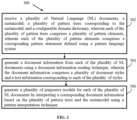
- a method for Automated authoring of purposive models from Natural Language (NL) documents includes receiving, by one or more hardware processors, a plurality of Natural Language (NL) documents, a metamodel, a plurality of pattern trees corresponding to the metamodel, and a configurable domain dictionary, wherein each of the plurality of pattern trees comprises a plurality of pattern elements, wherein each of the plurality of pattern elements comprises a corresponding pattern statement defined using a pattern language syntax.
- NL Natural Language
- the method includes generating, by the one or more hardware processors, a document information from each of the plurality of NL documents, using a document information reading technique, wherein the document information comprises a plurality of document styles and a text information corresponding to each of the plurality of document styles.
- the method includes generating, by the one or more hardware processors, a plurality of purposive models for each of the plurality of NL documents by interpreting the document information corresponding to each of the plurality of NL documents, based on the plurality of pattern trees and the metamodel using a pattern interpretation technique.
- a system for Automated authoring of purposive models from Natural Language (NL) documents includes at least one memory storing programmed instructions, one or more Input /Output (I/O) interfaces, and one or more hardware processors operatively coupled to the at least one memory, wherein the one or more hardware processors are configured by the programmed instructions to receive a plurality of Natural Language (NL) documents, a metamodel, a plurality of pattern trees corresponding to the metamodel, and a configurable domain dictionary, wherein each of the plurality of pattern trees comprises a plurality of pattern elements, wherein each of the plurality of pattern elements comprises a corresponding pattern statement defined using a pattern language syntax.
- NL Natural Language
- the one or more hardware processors are configured by the programmed instructions to generate a document information from each of the plurality of NL documents, using a document information reading technique, wherein the document information comprises a plurality of document styles and a text information corresponding to each of the plurality of document styles.
- the one or more hardware processors are configured by the programmed instructions to generate a plurality of purposive models for each of the plurality of NL documents by interpreting the document information corresponding to each of the plurality of NL documents, based on the plurality of pattern trees and the metamodel using a pattern interpretation technique.
- a computer program product including a non-transitory computer-readable medium having embodied therein a computer program for Automated authoring of purposive models from Natural Language (NL) documents.
- the computer readable program when executed on a computing device, causes the computing device to receive a plurality of Natural Language (NL) documents, a metamodel, a plurality of pattern trees corresponding to the metamodel, and a configurable domain dictionary, wherein each of the plurality of pattern trees comprises a plurality of pattern elements, wherein each of the plurality of pattern elements comprises a corresponding pattern statement defined using a pattern language syntax.
- the computer readable program when executed on a computing device, causes the computing device to generate a document information from each of the plurality of NL documents, using a document information reading technique, wherein the document information comprises a plurality of document styles and a text information corresponding to each of the plurality of document styles.
- the computer readable program when executed on a computing device, causes the computing device to generate a plurality of purposive models for each of the plurality of NL documents by interpreting the document information corresponding to each of the plurality of NL documents, based on the plurality of pattern trees and the metamodel using a pattern interpretation technique.
- Embodiments herein provide a method and system for automated authoring of purposive models from NL documents. Given the uniqueness of a solution development endeavor in terms of the metamodel and structure of the document, the present disclosure generates purposive models. For generating these models from NL text documents, purpose-specific model extractors need to be developed. The structure and organization of the information in document influence the information extraction thus necessitating development of purpose-specific model extractor for each type of document. To overcome this lacuna, the present disclosure provides a generic approach for automated authoring of purpose-specific models from NL text documents. Being parameterized on metamodel and document structure-based patterns, the approach is generic and amenable to easy repurposing. The approach has been validated on multiple use cases covering diverse document formats as well as on multiple metamodels.
- the system receives a plurality of Natural Language (NL) documents, a metamodel, a plurality of pattern trees corresponding to the metamodel, and a configurable domain dictionary.
- the metamodel includes a plurality of metamodel elements like class, property corresponding to each class and associations.
- Each of the plurality of pattern trees includes a plurality of pattern elements and each of the plurality of pattern elements includes a corresponding pattern statement defined using a pattern language syntax.
- a document information is generated from each of the plurality of NL documents using a document information reading technique.
- the document information includes a plurality of document styles and a text information corresponding to each of the plurality of styles.
- a plurality of purposive models are generated for each of the plurality of NL documents by interpreting a corresponding document information based on the plurality of pattern trees and the metamodel using a pattern interpretation technique.
- FIGS. 1 through 7 where similar reference characters denote corresponding features consistently throughout the figures, there are shown preferred embodiments and these embodiments are described in the context of the following exemplary system and/or method.
- FIG. 1 is a functional block diagram of an automated authoring of purposive models from NL documents, in accordance with some embodiments of the present disclosure.
- the system 100 includes or is otherwise in communication with hardware processors 102, at least one memory such as a memory 104, an I/O interface 112.
- the hardware processors 102, memory 104, and the Input /Output (I/O) interface 112 may be coupled by a system bus such as a system bus 108 or a similar mechanism.
- the hardware processors 102 can be one or more hardware processors.
- the I/O interface 112 may include a variety of software and hardware interfaces, for example, a web interface, a graphical user interface, and the like.
- the I/O interface 112 may include a variety of software and hardware interfaces, for example, interfaces for peripheral device(s), such as a keyboard, a mouse, an external memory, a printer and the like. Further, the I/O interface 112 may enable the system 100 to communicate with other devices, such as web servers, and external databases.
- the I/O interface 112 can facilitate multiple communications within a wide variety of networks and protocol types, including wired networks, for example, local area network (LAN), cable, etc., and wireless networks, such as Wireless LAN (WLAN), cellular, or satellite.
- the I/O interface 112 may include one or more ports for connecting several computing systems with one another or to another server computer.
- the I/O interface 112 may include one or more ports for connecting several devices to one another or to another server.
- the one or more hardware processors 102 may be implemented as one or more microprocessors, microcomputers, microcontrollers, digital signal processors, central processing units, node machines, logic circuitries, and/or any devices that manipulate signals based on operational instructions.
- the one or more hardware processors 102 is configured to fetch and execute computer-readable instructions stored in the memory 104.
- the memory 104 may include any computer-readable medium known in the art including, for example, volatile memory, such as static random access memory (SRAM) and dynamic random access memory (DRAM), and/or non-volatile memory, such as read only memory (ROM), erasable programmable ROM, flash memories, hard disks, optical disks, and magnetic tapes.
- volatile memory such as static random access memory (SRAM) and dynamic random access memory (DRAM)
- non-volatile memory such as read only memory (ROM), erasable programmable ROM, flash memories, hard disks, optical disks, and magnetic tapes.
- the memory 104 includes a plurality of modules 106.
- the memory 104 also includes a data repository (or repository) 110 for storing data processed, received, and generated by the plurality of modules 106.
- the plurality of modules 106 include programs or coded instructions that supplement applications or functions performed by the system 100 for automated authoring of purposive models from NL documents.
- the plurality of modules 106 can include routines, programs, objects, components, and data structures, which performs particular tasks or implement particular abstract data types.
- the plurality of modules 106 may also be used as, signal processor(s), node machine(s), logic circuitries, and/or any other device or component that manipulates signals based on operational instructions. Further, the plurality of modules 106 can be used by hardware, by computer-readable instructions executed by the one or more hardware processors 102, or by a combination thereof.
- the plurality of modules 106 can include various sub-modules (not shown).
- the plurality of modules 106 may include computer-readable instructions that supplement applications or functions performed by the system 100 for the semantic navigation using spatial graph and trajectory history.
- the modules 106 includes a document information reading module (shown in FIG. 2 ) and a pattern interpreter module (shown in FIG. 2 ).
- the pattern interpretation module includes an NLP engine, library functions and a pattern statement mapping module (shown in FIG. 2 ).
- FIG. 2 illustrates a functional architecture of the system of FIG. 1 , for automated authoring of purposive models from NL documents, in accordance with some embodiments of the present disclosure. Now referring to FIG. 2 , the NL documents are received by the document information reading module 202 and a document information corresponding to each NL document is generated.
- the document information includes a plurality of document styles and the corresponding text information.
- the document style includes "Heading1" and the text content associated with the "Heading 1" is the corresponding text information.
- a plurality of pattern trees, the metamodel and domain dictionary the purposive models are generated by the pattern interpretation module 204.
- the pattern statement mapping module 210 identifies object names, the corresponding property values and the corresponding associations, for generating the purposive model based on the NLP library functions, the metamodel and the pattern trees.
- the data repository (or repository) 110 may include a plurality of abstracted piece of code for refinement and data that is processed, received, or generated as a result of the execution of the plurality of modules in the module(s) 106.
- the data repository 110 is shown internal to the system 100, it will be noted that, in alternate embodiments, the data repository 110 can also be implemented external to the system 100, where the data repository 110 may be stored within a database (repository 110) communicatively coupled to the system 100.
- the data contained within such external database may be periodically updated. For example, new data may be added into the database (not shown in FIG. 1 ) and/or existing data may be modified and/or non-useful data may be deleted from the database.
- the data may be stored in an external system, such as a Lightweight Directory Access Protocol (LDAP) directory and a Relational Database Management System (RDBMS).
- LDAP Lightweight Directory Access Protocol
- RDBMS Relational Database Management System
- FIG. 3 is an exemplary flow diagram illustrating a method 300 for automated authoring of purposive models from NL documents implemented by the system of FIG. 1 according to some embodiments of the present disclosure.
- the system 100 includes one or more data storage devices or the memory 104 operatively coupled to the one or more hardware processor(s) 102 and is configured to store instructions for execution of steps of the method 300 by the one or more hardware processors 102.
- the steps of the method 300 of the present disclosure will now be explained with reference to the components or blocks of the system 100 as depicted in FIG. 1 and the steps of flow diagram as depicted in FIG. 3 .
- the method 300 may be described in the general context of computer executable instructions.
- computer executable instructions can include routines, programs, objects, components, data structures, procedures, modules, functions, etc., that perform particular functions or implement particular abstract data types.
- the method 300 may also be practiced in a distributed computing environment where functions are performed by remote processing devices that are linked through a communication network.
- the order in which the method 300 is described is not intended to be construed as a limitation, and any number of the described method blocks can be combined in any order to implement the method 300, or an alternative method.
- the method 300 can be implemented in any suitable hardware, software, firmware, or combination thereof.
- the one or more hardware processors 102 are configured by the programmed instructions to receive the plurality of Natural Language (NL) documents, the metamodel, the plurality of pattern trees corresponding to the metamodel, and the configurable domain dictionary.
- NL Natural Language
- An example NL document is shown in Table I.
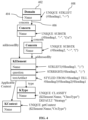
- each of the plurality of pattern trees includes a plurality of pattern elements as shown in FIG. 4 .
- the plurality of pattern elements includes a plurality of pattern nodes (for example, the node 402 of FIG. 4 ) in a plurality of levels, a plurality of pattern properties corresponding to each of the plurality of pattern nodes (for example, "name" 404 of the node 402), and a plurality of pattern edges (for example, edge 406 of FIG. 4 ).
- each of the plurality of pattern elements includes a corresponding pattern statement defined using a pattern language syntax, (for example, the pattern statement 408 shown in FIG. 4 ).
- each of the corresponding plurality of pattern language syntax includes a plurality of heading structures, a plurality of table value structures, a default value structure, a metamodel reference structure, a block structure, a condition checking structure, function invocation structures, a control flow structure, a plurality of looping structures and the like.
- HeadingExpr HeadExpr (Operator HeadExpr)*; StyleExpr: StyleValue(Operator StyleValue)*; StyleValue: (BOLD
- table_row_stmt TABLE_ROW QSTRING; table_nextrow_stmt: TABLE_NEXTROW QSTRING; table_column_stmt: TABLE_COLUMN QSTRING ; table_cell_stmt: TABLE_CELL CellExpr; CellExpr: NUMBER COMMA NUMBER; Default Value structure specifies assignment of default values.
- Block_stmt FROM (HeadingExpr) TILL (HeadingExpr
- grammar tokens are specified in capital letters. "?” represents the optional occurrence of expression, and "*" represents zero or more occurrences of expression.
- QSTRING is a constant string. Operators can be "&" (AND), "
- Table II illustrates some of the grammar rules for extracting text from various headings, the plurality of styles in documents, process the text, and what structure can be nested with other structures and the like.
- the heading structure syntax specifies that there may be one or more heading levels combined with "
- Various pattern syntax structures can be part of other pattern syntax structures.
- heading structure, table structure, metamodel structures can be specified in the block structure, condition structure and function invocation structure. Heading structure can also be specified inside control flow structure.
- Table III illustrates some examples of pattern language syntax.
- TABLE_COLUMN "Attribute
- NUMSTRING indicates text value can be extracted from text specified with style BULLET OR NUMEBED style.
- Pattern language syntax structures Pattern language syntax examples Heading structures • "#Heading1” • “#Heading2” • “#Heading3” • “BULLET” • "BULLET
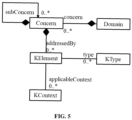
- FIG. 5 is an exemplary metamodel for the processor implemented method for automated authoring of purposive models from NL documents implemented by the system of FIG. 1 according to some embodiments of the present disclosure.
- the metamodel includes a plurality of metamodel classes and a corresponding plurality of associations.
- the plurality of metamodel classes are "Domain", “Concern”, “KElement”, “KType” and “KContext”.
- the class “Domain” can hold any object name and the class “Concern” holds a plurality of concerns associated with the "Domain”.
- the "KElement” indicates th e knowledge element
- the "KType” indicates the knowledge type
- the "KContext” indicates the knowledge context.
- Each class of the metamodel is associated with a corresponding "zero to many" associations.
- the document information reading module 202 executed by one or more hardware processors 102 is configured by the programmed instructions to generate a document information from each of the plurality of NL documents using a document information reading technique.
- the document information reading techniques includes "Docx4J" and the like.
- the document information includes a plurality of document styles and a text information corresponding to each of the plurality of styles.
- the pattern interpretation module 204 executed by the one or more hardware processors 102 is configured by the programmed instructions to generate a plurality of purposive models for each of the plurality of NL documents by interpreting a corresponding document information based on the plurality of pattern trees and the metamodel using a pattern interpretation technique.
- the method of generating a purposive model is explained in conjunction with FIGS. 6A and 6B .
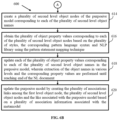
- FIGS. 6A and 6B are exemplary flow diagrams illustrating a processor implemented method 600 for pattern interpretation technique implemented by the system of FIG. 1 according to some embodiments of the present disclosure.
- the one or more hardware processors 102 are configured by the programming instructions to receive the plurality of pattern trees, the metamodel, the document information corresponding to a NL document.
- the one or more hardware processors 102 are configured by the programming instructions to obtain a first level object name corresponding to a first level pattern node of the pattern tree based on the plurality of styles, the corresponding pattern language syntax and NLP library using a pattern statement mapping technique.
- the pattern statement mapping technique to obtain an object name is implemented in two steps. Initially, the text information corresponding to a pattern element of the pattern tree is extracted by mapping the pattern language syntax of the corresponding pattern statement with the plurality of styles. Further, the extracted text information is processed based on the language syntax of the corresponding pattern statement and NLP library functions augmented with configurable domain dictionary to obtain the corresponding object name. For example, considering the example input NL document given in Table I and the pattern tree given in FIG. 4 , the pattern language syntax of the first node of the pattern tree is "UNIQUE STRLEFT (#Heading1, "->")". It is mapped with the Heading style, "Heading1" of the NL document "1.
- BCPDR -> BCP BCPDR -> BCP
- the corresponding text information "BCPDR- > BCP” is extracted. Further, the extracted text information "BCPDR-> BCP” is processed using the syntax (library function STRLEFT) and the corresponding object name "BCPDR” is obtained.
- the one or more hardware processors 102 are configured by the programming instructions to create a first level object node 702 of the purposive model shown in FIG. 7 , corresponding to the first level object name.
- the purposive model as shown in FIG. 7 includes a plurality of object elements.
- the plurality of object elements includes a plurality of object nodes in a plurality of levels, a plurality of object property values corresponding to each of the plurality of object nodes and a plurality of associations links between the plurality of object nodes.
- the first level is for "Domain” (702)
- the second level is for "Concern” (706A and 706B)
- the third level is for "K Element” (708A through 708D)
- the fourth level is for "Knowledge types" and for "Knowledge contexts" (710A through 710E).
- the number of levels is configurable and depends on the input NL document and the pattern trees.
- the link 712 is related to an association between the "Domain” and the "Concern”. Similarly, a plurality of associations are created among the plurality of object nodes based on the metamodel.
- the one or more hardware processors 102 are configured by the programming instructions to obtain the plurality of object property values corresponding to the first level object name based on the plurality of styles, the corresponding pattern language syntax and NLP library using the pattern statement mapping technique. For example, as shown in Fig 4 , pattern statement of property textArtifact of KElement syntax "STYLED FROM #Heading3 TILL #Heading3
- the one or more hardware processors 102 are configured by the programming instructions to update the plurality of object property values associated with the first level object name in the purposive model.
- the one or more hardware processors 102 are configured by the programming instructions to obtain a plurality of second level object names corresponding to a second level pattern node of the pattern tree based on the plurality of styles, the corresponding pattern language syntax and NLP library using the pattern statement mapping technique. For example, the object name "BCP" is obtained from the input NL document in this step.
- the one or more hardware processors 102 are configured by the programming instructions to create a plurality of second level object nodes of the purposive model corresponding to each of the plurality of second level object names. For example, node 704 of the FIG. 7 is created in this step.
- the one or more hardware processors 102 are configured by the programming instructions to obtain the plurality of object property values corresponding to each of the plurality of second level object nodes based on the plurality of styles, the corresponding pattern language syntax and NLP library using the pattern statement mapping technique.
- the one or more hardware processors 102 are configured by the programming instructions to update each of the plurality of object property values corresponding to each of the plurality of second level object names in the purposive model.
- the object name extraction in various levels and the corresponding property values extraction are performed until end of the NL document is reached.
- the plurality of third level object names like "BCPPlan” and “BCPAudit” are extracted further and updated in the purposive model by creating corresponding object nodes 706A and 706B.
- the fourth level object names like "BCP Certification”, “BCP-DRP Approach Overview”, “BCP-DRP Audit Approach” and “BCP Audit” are extracted and updated in the purposive model by creating the corresponding object nodes 708A through 708D.
- the fifth level object names like “Fact”, “RFI”, “Offering”, “RFP” and “Strategy” are extracted and updated in the purposive model by creating the corresponding object nodes 710A through 710E.
- the one or more hardware processors 102 are configured by the programming instructions to update the purposive model by creating the plurality of associations links among the first level object node, the plurality of second level object nodes and the like associated with the purposive model based on the plurality of association information associated with the metamodel shown in FIG. 5 .
- the Domain and Concern in the metamodel relates to zero to many associations.
- the purposive model given in FIG. 7 there is only one concern at level one and hence the association 712 between the domain "BCPDR" and the concern "BCP” is generated.
- the concern class of the metamodel is having zero to many associations among sub-concerns. Now referring to FIG.
- associations link between the level 3 object nodes "BCPPlan” and “BCPAudit” and the level 2 object nodes are created based on the corresponding associations between the concern and the sub-concerns in the metamodel. Similarly, all possible associations are generated in the purposive model based on the corresponding associations in the metamodel.
- a total 12 documents of different sizes having in total 2413 pages are validated. It was observed that each document specifies a set of features. Documents has a different structure and even within a document the structure was different based on the type of the feature. For automated authoring of model from the NL requirements specification documents one pattern per each feature type is defined. Table IV illustrates the output details of the above experimentation. Table IV Pattern for Feature Type ObjectNodeCount Property Value Count Link Count PFunction 6101 16777 6638 Query 1774 2591 1898 Interface 4124 15078 4513 Report 6462 10443 6962 Total 18461 44889 20011
- RFP Request for Proposals
- RFID Request for Information
- RFP applications deals with providing answers to commonly asked questions.
- RFP approximately has 30 to 50 questions, deciding on proposed solution by referring to boilerplate documents is a time-consuming manual activity.
- Purpose specific model was defined first to represent the information in RFP boilerplate word document files.
- FIG. 5 shows the simplified metamodel used for the information representation.
- FIG. 4 shows the pattern tree given as input to the tool for authoring purposive model. Total 38 documents of different sizes having in total 1102 pages are validated.
- Table V shows the authored model size.
- Table V ObjectNode Count Property Value Count Link Count 2345 4071 5355
- the accuracy of the present disclosure is evaluated using Precision, Recall, and F1 score metrics as per standard formulae given in corresponding equations 1 thorough 3.
- TP true positive
- FP false positive
- FN false negative
- Precision TP TP + FP
- the embodiments of present disclosure herein address the unresolved problem of automated authoring of purposive models from NL documents.
- the present disclosure provides a generic solution for automated authoring of purposive models that is easily amenable for any NL-based document-centered context.
- the automated authoring is performed using metamodel, pattern interpreter and a configurable, extensible, and scalable architecture.
- the present disclosure can generate a number of purposive models from an NL document based on the corresponding document structure, styles and the plurality of pattern trees.
- the hardware device can be any kind of device which can be programmed including e.g. any kind of computer like a server or a personal computer, or the like, or any combination thereof.
- the device may also include means which could be e.g. hardware means like e.g. an application-specific integrated circuit (ASIC), a field-programmable gate array (FPGA), or a combination of hardware and software means, e.g.
- ASIC application-specific integrated circuit
- FPGA field-programmable gate array
- the means can include both hardware means and software means.
- the method embodiments described herein could be implemented in hardware and software.
- the device may also include software means.
- the embodiments may be implemented on different hardware devices, e.g. using a plurality of CPUs, GPUs and edge computing devices.
- the embodiments herein can comprise hardware and software elements.
- the embodiments that are implemented in software include but are not limited to, firmware, resident software, microcode, etc.
- the functions performed by various modules described herein may be implemented in other modules or combinations of other modules.
- a computer-usable or computer readable medium can be any apparatus that can comprise, store, communicate, propagate, or transport the program for use by or in connection with the instruction execution system, apparatus, or device.
- the illustrated steps are set out to explain the exemplary embodiments shown, and it should be anticipated that ongoing technological development will change the manner in which particular functions are performed. These examples are presented herein for purposes of illustration, and not limitation. Further, the boundaries of the functional building blocks have been arbitrarily defined herein for the convenience of the description.
- a computer-readable storage medium refers to any type of physical memory on which information or data readable by a processor may be stored.
- a computer-readable storage medium may store instructions for execution by one or more processors, including instructions for causing the processor(s) to perform steps or stages consistent with the embodiments described herein.
- the term "computer-readable medium” should be understood to include tangible items and exclude carrier waves and transient signals, i.e. non-transitory. Examples include random access memory (RAM), read-only memory (ROM), volatile memory, nonvolatile memory, hard drives, CD ROMs, DVDs, flash drives, disks, and any other known physical storage media.
Landscapes
- Engineering & Computer Science (AREA)
- Theoretical Computer Science (AREA)
- Physics & Mathematics (AREA)
- Audiology, Speech & Language Pathology (AREA)
- Computational Linguistics (AREA)
- General Health & Medical Sciences (AREA)
- Health & Medical Sciences (AREA)
- General Engineering & Computer Science (AREA)
- General Physics & Mathematics (AREA)
- Artificial Intelligence (AREA)
- Probability & Statistics with Applications (AREA)
- Stored Programmes (AREA)
- Machine Translation (AREA)
Abstract
Description
- The present application claims priority from
Indian provisional patent application no. 202221044944, filed on August 5, 2022 - The disclosure herein generally relates to the field of Natural Language Processing (NLP) and, more particularly, to a method and system for automated authoring of purposive models from Natural Language (NL) documents.
- Models in Model driven engineering (MDE), can be used for variety of purposes such as generating code from model, analysis using model, modeling processes, automating processes etc. However, many software processes in industry are still not automated and follows document centric approach instead of model based approach. Typically, multiple formatted Natural Language (NL) text or documents are prepared and maintained. For example, NL documents include requirements documents, design documents, proposal documents, solution knowledge documents, domain documents such as policy documents, medical writing documents etc. Document-centric approaches provide limited search capability and do not help in analysis. To transform manual document centric processes to automated model-based processes first step is to create models from documents. Manual creation of models from documents is a challenging task.
- Conventional model extractors to automatically extract models from NL documents are specific to a purpose. For example, some existing Natural Language Processing (NLP) based tools support automated model extraction of a specific metamodels such as UML models, BPMN model, UseCase models, Insurance domain model, and the like. Here, different model extractors are created for extraction of different purposive models. Also, existing NLP based model extraction approaches do not take into cognizance the document structure, style & sub-section headings as well as figures, tables, and other semi-structured forms in which the information is captured. Given the variety of purposes and information existing in NL documents, creation of multiple model extractors is a challenging task. Hence, it is desirable to have a generic model extractor that can be configured for automated extraction of purposive models from any type of NL document.
- Embodiments of the present disclosure present technological improvements as solutions to one or more of the above-mentioned technical problems recognized by the inventors in conventional systems. For example, in one embodiment, a method for Automated authoring of purposive models from Natural Language (NL) documents is provided. The method includes receiving, by one or more hardware processors, a plurality of Natural Language (NL) documents, a metamodel, a plurality of pattern trees corresponding to the metamodel, and a configurable domain dictionary, wherein each of the plurality of pattern trees comprises a plurality of pattern elements, wherein each of the plurality of pattern elements comprises a corresponding pattern statement defined using a pattern language syntax. Further, the method includes generating, by the one or more hardware processors, a document information from each of the plurality of NL documents, using a document information reading technique, wherein the document information comprises a plurality of document styles and a text information corresponding to each of the plurality of document styles. Finally, the method includes generating, by the one or more hardware processors, a plurality of purposive models for each of the plurality of NL documents by interpreting the document information corresponding to each of the plurality of NL documents, based on the plurality of pattern trees and the metamodel using a pattern interpretation technique.
- In another aspect, a system for Automated authoring of purposive models from Natural Language (NL) documents is provided. The system includes at least one memory storing programmed instructions, one or more Input /Output (I/O) interfaces, and one or more hardware processors operatively coupled to the at least one memory, wherein the one or more hardware processors are configured by the programmed instructions to receive a plurality of Natural Language (NL) documents, a metamodel, a plurality of pattern trees corresponding to the metamodel, and a configurable domain dictionary, wherein each of the plurality of pattern trees comprises a plurality of pattern elements, wherein each of the plurality of pattern elements comprises a corresponding pattern statement defined using a pattern language syntax. Further, the one or more hardware processors are configured by the programmed instructions to generate a document information from each of the plurality of NL documents, using a document information reading technique, wherein the document information comprises a plurality of document styles and a text information corresponding to each of the plurality of document styles. Finally, the one or more hardware processors are configured by the programmed instructions to generate a plurality of purposive models for each of the plurality of NL documents by interpreting the document information corresponding to each of the plurality of NL documents, based on the plurality of pattern trees and the metamodel using a pattern interpretation technique.
- In yet another aspect, a computer program product including a non-transitory computer-readable medium having embodied therein a computer program for Automated authoring of purposive models from Natural Language (NL) documents is provided. The computer readable program, when executed on a computing device, causes the computing device to receive a plurality of Natural Language (NL) documents, a metamodel, a plurality of pattern trees corresponding to the metamodel, and a configurable domain dictionary, wherein each of the plurality of pattern trees comprises a plurality of pattern elements, wherein each of the plurality of pattern elements comprises a corresponding pattern statement defined using a pattern language syntax. Further, the computer readable program, when executed on a computing device, causes the computing device to generate a document information from each of the plurality of NL documents, using a document information reading technique, wherein the document information comprises a plurality of document styles and a text information corresponding to each of the plurality of document styles. Finally, the computer readable program, when executed on a computing device, causes the computing device to generate a plurality of purposive models for each of the plurality of NL documents by interpreting the document information corresponding to each of the plurality of NL documents, based on the plurality of pattern trees and the metamodel using a pattern interpretation technique.
- It is to be understood that both the foregoing general description and the following detailed description are exemplary and explanatory only and are not restrictive of the invention, as claimed.
- The accompanying drawings, which are incorporated in and constitute a part of this disclosure, illustrate exemplary embodiments and, together with the description, serve to explain the disclosed principles:
-
FIG. 1 is a functional block diagram of a system for automated authoring of purposive models from Natural Language (NL) documents, in accordance with some embodiments of the present disclosure. -
FIG. 2 illustrates a functional architecture of the system ofFIG. 1 , for automated authoring of purposive models from NL documents, in accordance with some embodiments of the present disclosure. -
FIG. 3 is an exemplary flow diagram illustrating a processor implementedmethod 300 for automated authoring of purposive models from NL documents implemented by the system ofFIG. 1 according to some embodiments of the present disclosure. -
FIG. 4 is an exemplary pattern tree for the processor implemented method for automated authoring of purposive models from NL documents implemented by the system ofFIG. 1 according to some embodiments of the present disclosure. -
FIG. 5 is an exemplary metamodel for the processor implemented method for automated authoring of purposive models from NL documents implemented by the system ofFIG. 1 according to some embodiments of the present disclosure. -
FIGS. 6A and6B are exemplary flow diagram illustrating a processor implementedmethod 600 for pattern interpretation technique implemented by the system ofFIG. 1 according to some embodiments of the present disclosure. -
FIG. 7 is an exemplary purposive model for the processor implementedmethod 300 for automated authoring of purposive models from NL documents implemented by the system ofFIG. 1 according to some embodiments of the present disclosure. - Exemplary embodiments are described with reference to the accompanying drawings. In the figures, the left-most digit(s) of a reference number identifies the figure in which the reference number first appears. Wherever convenient, the same reference numbers are used throughout the drawings to refer to the same or like parts. While examples and features of disclosed principles are described herein, modifications, adaptations, and other implementations are possible without departing from the scope of the disclosed embodiments.
- Document-centric approaches provide limited search capability and do not help in analysis. These processes are time-consuming and error prone as manual and SME dependent. Much of this difficulty can be overcome if the information is available in a structured model form that is amenable to automated processing.
- Embodiments herein provide a method and system for automated authoring of purposive models from NL documents. Given the uniqueness of a solution development endeavor in terms of the metamodel and structure of the document, the present disclosure generates purposive models. For generating these models from NL text documents, purpose-specific model extractors need to be developed. The structure and organization of the information in document influence the information extraction thus necessitating development of purpose-specific model extractor for each type of document. To overcome this lacuna, the present disclosure provides a generic approach for automated authoring of purpose-specific models from NL text documents. Being parameterized on metamodel and document structure-based patterns, the approach is generic and amenable to easy repurposing. The approach has been validated on multiple use cases covering diverse document formats as well as on multiple metamodels.
- Initially, the system receives a plurality of Natural Language (NL) documents, a metamodel, a plurality of pattern trees corresponding to the metamodel, and a configurable domain dictionary. The metamodel includes a plurality of metamodel elements like class, property corresponding to each class and associations. Each of the plurality of pattern trees includes a plurality of pattern elements and each of the plurality of pattern elements includes a corresponding pattern statement defined using a pattern language syntax. Further, a document information is generated from each of the plurality of NL documents using a document information reading technique. The document information includes a plurality of document styles and a text information corresponding to each of the plurality of styles. Finally, a plurality of purposive models are generated for each of the plurality of NL documents by interpreting a corresponding document information based on the plurality of pattern trees and the metamodel using a pattern interpretation technique.
- Referring now to the drawings, and more particularly to
FIGS. 1 through 7 , where similar reference characters denote corresponding features consistently throughout the figures, there are shown preferred embodiments and these embodiments are described in the context of the following exemplary system and/or method. -
FIG. 1 is a functional block diagram of an automated authoring of purposive models from NL documents, in accordance with some embodiments of the present disclosure. Thesystem 100 includes or is otherwise in communication withhardware processors 102, at least one memory such as amemory 104, an I/O interface 112. Thehardware processors 102,memory 104, and the Input /Output (I/O)interface 112 may be coupled by a system bus such as asystem bus 108 or a similar mechanism. In an embodiment, thehardware processors 102 can be one or more hardware processors. - The I/
O interface 112 may include a variety of software and hardware interfaces, for example, a web interface, a graphical user interface, and the like. The I/O interface 112 may include a variety of software and hardware interfaces, for example, interfaces for peripheral device(s), such as a keyboard, a mouse, an external memory, a printer and the like. Further, the I/O interface 112 may enable thesystem 100 to communicate with other devices, such as web servers, and external databases. - The I/
O interface 112 can facilitate multiple communications within a wide variety of networks and protocol types, including wired networks, for example, local area network (LAN), cable, etc., and wireless networks, such as Wireless LAN (WLAN), cellular, or satellite. For the purpose, the I/O interface 112 may include one or more ports for connecting several computing systems with one another or to another server computer. The I/O interface 112 may include one or more ports for connecting several devices to one another or to another server. - The one or
more hardware processors 102 may be implemented as one or more microprocessors, microcomputers, microcontrollers, digital signal processors, central processing units, node machines, logic circuitries, and/or any devices that manipulate signals based on operational instructions. Among other capabilities, the one ormore hardware processors 102 is configured to fetch and execute computer-readable instructions stored in thememory 104. - The
memory 104 may include any computer-readable medium known in the art including, for example, volatile memory, such as static random access memory (SRAM) and dynamic random access memory (DRAM), and/or non-volatile memory, such as read only memory (ROM), erasable programmable ROM, flash memories, hard disks, optical disks, and magnetic tapes. In an embodiment, thememory 104 includes a plurality ofmodules 106. Thememory 104 also includes a data repository (or repository) 110 for storing data processed, received, and generated by the plurality ofmodules 106. - The plurality of
modules 106 include programs or coded instructions that supplement applications or functions performed by thesystem 100 for automated authoring of purposive models from NL documents. The plurality ofmodules 106, amongst other things, can include routines, programs, objects, components, and data structures, which performs particular tasks or implement particular abstract data types. The plurality ofmodules 106 may also be used as, signal processor(s), node machine(s), logic circuitries, and/or any other device or component that manipulates signals based on operational instructions. Further, the plurality ofmodules 106 can be used by hardware, by computer-readable instructions executed by the one ormore hardware processors 102, or by a combination thereof. The plurality ofmodules 106 can include various sub-modules (not shown). The plurality ofmodules 106 may include computer-readable instructions that supplement applications or functions performed by thesystem 100 for the semantic navigation using spatial graph and trajectory history. In an embodiment, themodules 106 includes a document information reading module (shown inFIG. 2 ) and a pattern interpreter module (shown inFIG. 2 ). The pattern interpretation module includes an NLP engine, library functions and a pattern statement mapping module (shown inFIG. 2 ). In an embodiment,FIG. 2 illustrates a functional architecture of the system ofFIG. 1 , for automated authoring of purposive models from NL documents, in accordance with some embodiments of the present disclosure. Now referring toFIG. 2 , the NL documents are received by the documentinformation reading module 202 and a document information corresponding to each NL document is generated. The document information includes a plurality of document styles and the corresponding text information. For example, the document style includes "Heading1" and the text content associated with the "Heading 1" is the corresponding text information. Further, based on the corresponding document information, a plurality of pattern trees, the metamodel and domain dictionary, the purposive models are generated by thepattern interpretation module 204. The patternstatement mapping module 210 identifies object names, the corresponding property values and the corresponding associations, for generating the purposive model based on the NLP library functions, the metamodel and the pattern trees. - The data repository (or repository) 110 may include a plurality of abstracted piece of code for refinement and data that is processed, received, or generated as a result of the execution of the plurality of modules in the module(s) 106.
- Although the
data repository 110 is shown internal to thesystem 100, it will be noted that, in alternate embodiments, thedata repository 110 can also be implemented external to thesystem 100, where thedata repository 110 may be stored within a database (repository 110) communicatively coupled to thesystem 100. The data contained within such external database may be periodically updated. For example, new data may be added into the database (not shown inFIG. 1 ) and/or existing data may be modified and/or non-useful data may be deleted from the database. In one example, the data may be stored in an external system, such as a Lightweight Directory Access Protocol (LDAP) directory and a Relational Database Management System (RDBMS). Working of the components of thesystem 100 are explained with reference to the method steps depicted inFIG. 3 ,FIGS. 6A andFIG. 6B . -
FIG. 3 is an exemplary flow diagram illustrating amethod 300 for automated authoring of purposive models from NL documents implemented by the system ofFIG. 1 according to some embodiments of the present disclosure. In an embodiment, thesystem 100 includes one or more data storage devices or thememory 104 operatively coupled to the one or more hardware processor(s) 102 and is configured to store instructions for execution of steps of themethod 300 by the one ormore hardware processors 102. The steps of themethod 300 of the present disclosure will now be explained with reference to the components or blocks of thesystem 100 as depicted inFIG. 1 and the steps of flow diagram as depicted inFIG. 3 . Themethod 300 may be described in the general context of computer executable instructions. Generally, computer executable instructions can include routines, programs, objects, components, data structures, procedures, modules, functions, etc., that perform particular functions or implement particular abstract data types. Themethod 300 may also be practiced in a distributed computing environment where functions are performed by remote processing devices that are linked through a communication network. The order in which themethod 300 is described is not intended to be construed as a limitation, and any number of the described method blocks can be combined in any order to implement themethod 300, or an alternative method. Furthermore, themethod 300 can be implemented in any suitable hardware, software, firmware, or combination thereof. - At
step 302 of themethod 300, the one ormore hardware processors 102 are configured by the programmed instructions to receive the plurality of Natural Language (NL) documents, the metamodel, the plurality of pattern trees corresponding to the metamodel, and the configurable domain dictionary. An example NL document is shown in Table I. - In an embodiment, each of the plurality of pattern trees includes a plurality of pattern elements as shown in
FIG. 4 . The plurality of pattern elements includes a plurality of pattern nodes (for example, thenode 402 ofFIG. 4 ) in a plurality of levels, a plurality of pattern properties corresponding to each of the plurality of pattern nodes (for example, "name" 404 of the node 402), and a plurality of pattern edges (for example, edge 406 ofFIG. 4 ). - Now referring to
FIG. 4 , each of the plurality of pattern elements includes a corresponding pattern statement defined using a pattern language syntax, (for example, thepattern statement 408 shown inFIG. 4 ). - In an embodiment, each of the corresponding plurality of pattern language syntax includes a plurality of heading structures, a plurality of table value structures, a default value structure, a metamodel reference structure, a block structure, a condition checking structure, function invocation structures, a control flow structure, a plurality of looping structures and the like.

Table II Pattern language syntax structures Pattern Language Grammar Rules Heading structure HeadingExpr: HeadExpr (Operator HeadExpr)*; StyleExpr: StyleValue(Operator StyleValue)*; StyleValue: (BOLD | UNDERLINED | BULLET | NUMSTRING); HeadExpr: '#' HEADING Level Table structure specifies how to extract values from tables in documents using column, row headings or directly using table cell column and row number. table_row_stmt: TABLE_ROW QSTRING; table_nextrow_stmt: TABLE_NEXTROW QSTRING; table_column_stmt: TABLE_COLUMN QSTRING ; table_cell_stmt: TABLE_CELL CellExpr; CellExpr: NUMBER COMMA NUMBER; Default Value structure specifies assignment of default values. default_value_assign_stmt: DEFAULT (QSTRING | functionExpr); Metamodel Reference structure mMExpr: NameExpr DOT NameExpr; Block structure specifies boundaries to extract the block of lines. block_stmt: FROM (HeadingExpr) TILL (HeadingExpr | TABLE) Condition structure checks condition using extracted metamodel properties or function return values. if_stmt: IF mMExpr | functionExpr (EQUALS QSTRING)?; Function Invocation structures invokes library functions or external library functions with parameter values. functionExpr: NameExpr LEFTPAREN ParamExpr (',' ParamExpr)* RIGHTPAREN; ParamExpr: table_stmt | HeadingExpr | StyleExpr | table_stmt | mMExpr | QSTRING Control Flow structure specifies the document content navigation. goto_stmt: GOTO (QSTRING | HeadingExpr); - Now referring to Table II, grammar tokens are specified in capital letters. "?" represents the optional occurrence of expression, and "*" represents zero or more occurrences of expression. QSTRING is a constant string. Operators can be "&" (AND), "|" (OR). Table II illustrates some of the grammar rules for extracting text from various headings, the plurality of styles in documents, process the text, and what structure can be nested with other structures and the like. For example, the heading structure syntax specifies that there may be one or more heading levels combined with "|"and it can have one or more styles like BOLD, UNDERLINED etc. Various pattern syntax structures can be part of other pattern syntax structures. For example, heading structure, table structure, metamodel structures can be specified in the block structure, condition structure and function invocation structure. Heading structure can also be specified inside control flow structure.
- In an embodiment, Table III illustrates some examples of pattern language syntax. For example, using the table value structure syntax, TABLE_COLUMN "Attribute | Field Name" text value can be extracted from column of table with name "Attribute" OR "Field Name". Another example of heading structure syntax, "BULLET|NUMSTRING" indicates text value can be extracted from text specified with style BULLET OR NUMEBED style.
Table III Pattern language syntax structures Pattern language syntax examples Heading structures • "#Heading1" • "#Heading2" • "#Heading3" • "BULLET" • "BULLET|NUMSTRING" • "NUMSTYLE" Table value structures • TABLE_COLUMN "Attribute | Field Name" • TABLE_CELL 7,2 // row number 7 , column number 2 • TABLE_NEXTROW "Description" // next row of "Description" row in table Default value structure • GUNIQUE CLASSIFY(KElement.Name,"ClassType") DEFAULT "Other //Classify Name of KElement into predefined ClassType. if not classified, default class is "Other" Metamodel reference structure • Concern.Name //name reference of Concern • KElement.textArtifact // textArtifact property reference of KElement Block structure • STYLED FROM CURRENT_SECTION_NAME TILL #Heading3 |#Heading2|#Heading1 //extracts complete text from current section till next heading3 or heading2 or heading 1 along with styles • FROM NEXTOF #Heading1 TILL #Heading2 //extracts complete text between styles heading 1 and heading2 Condition checking structure • IF CLASSIFY(#Heading2,"FType")=="PFunction" //Checking whether heading2 text is classified as "PFunction" one of the predefined FType Looping structure • TABLE_ITER // iterates through all rows in extracted table, this is specified only for PatternNode, Interpreter creates Objectnode corresponding to each row text information Function invocation structure • STRCAT (Feature.Name, "Process") // In this STRCAT library function is invoked with Name of Feature and constant string "Process" • getPSetName (TABLE_COLUMN ("∗Attribute∗|∗Field∗")) // In this external library function getPSetName is called by passing each column values of table having either "Attribute" or "Field" string in column caption • SPLITSTRING(TABLE_CELL 7,1,"\n") • STRCAT(Query.Name, "Output ParamSet") • CLASSIFY (FILENAME, FHierarchy) Control flow structure • GOTO "Normal Flow|Process Flow" //This moves to the section either "Normal Flow" or "Process Flow" in document • GOTO #Heading2 -
FIG. 5 is an exemplary metamodel for the processor implemented method for automated authoring of purposive models from NL documents implemented by the system ofFIG. 1 according to some embodiments of the present disclosure. Now referring toFIG. 5 , the metamodel includes a plurality of metamodel classes and a corresponding plurality of associations. For example, considering the example shown inFIG. 5 , the plurality of metamodel classes are "Domain", "Concern", "KElement", "KType" and "KContext". Here the class "Domain" can hold any object name and the class "Concern" holds a plurality of concerns associated with the "Domain". The "KElement" indicates the knowledge element, the "KType" indicates the knowledge type and the "KContext" indicates the knowledge context. Each class of the metamodel is associated with a corresponding "zero to many" associations. - Now referring to
FIG. 3 , atstep 304 of themethod 300, the documentinformation reading module 202 executed by one ormore hardware processors 102 is configured by the programmed instructions to generate a document information from each of the plurality of NL documents using a document information reading technique. For example, the document information reading techniques includes "Docx4J" and the like. The document information includes a plurality of document styles and a text information corresponding to each of the plurality of styles. - At
step 306 of themethod 300, thepattern interpretation module 204 executed by the one ormore hardware processors 102 is configured by the programmed instructions to generate a plurality of purposive models for each of the plurality of NL documents by interpreting a corresponding document information based on the plurality of pattern trees and the metamodel using a pattern interpretation technique. In an embodiment, the method of generating a purposive model is explained in conjunction withFIGS. 6A and6B .FIGS. 6A and6B are exemplary flow diagrams illustrating a processor implementedmethod 600 for pattern interpretation technique implemented by the system ofFIG. 1 according to some embodiments of the present disclosure. - Now referring to
FIGS. 6A and6B , atstep 602 of themethod 600, the one ormore hardware processors 102 are configured by the programming instructions to receive the plurality of pattern trees, the metamodel, the document information corresponding to a NL document. - At
step 604 of themethod 600, the one ormore hardware processors 102 are configured by the programming instructions to obtain a first level object name corresponding to a first level pattern node of the pattern tree based on the plurality of styles, the corresponding pattern language syntax and NLP library using a pattern statement mapping technique. - In an embodiment, the pattern statement mapping technique to obtain an object name is implemented in two steps. Initially, the text information corresponding to a pattern element of the pattern tree is extracted by mapping the pattern language syntax of the corresponding pattern statement with the plurality of styles. Further, the extracted text information is processed based on the language syntax of the corresponding pattern statement and NLP library functions augmented with configurable domain dictionary to obtain the corresponding object name. For example, considering the example input NL document given in Table I and the pattern tree given in
FIG. 4 , the pattern language syntax of the first node of the pattern tree is "UNIQUE STRLEFT (#Heading1, "->")". It is mapped with the Heading style, "Heading1" of the NL document "1. BCPDR -> BCP" and the corresponding text information "BCPDR- > BCP" is extracted. Further, the extracted text information "BCPDR-> BCP" is processed using the syntax (library function STRLEFT) and the corresponding object name "BCPDR" is obtained. - At
step 606 of themethod 600, the one ormore hardware processors 102 are configured by the programming instructions to create a firstlevel object node 702 of the purposive model shown inFIG. 7 , corresponding to the first level object name. - In an embodiment, the purposive model as shown in
FIG. 7 includes a plurality of object elements. The plurality of object elements includes a plurality of object nodes in a plurality of levels, a plurality of object property values corresponding to each of the plurality of object nodes and a plurality of associations links between the plurality of object nodes. For example, considering the example purposive model shown inFIG. 7 , there are 5 different levels of object nodes. The first level is for "Domain" (702), the second level is for "Concern" (706A and 706B), the third level is for "KElement" (708A through 708D) and the fourth level is for "Knowledge types" and for "Knowledge contexts" (710A through 710E). The number of levels is configurable and depends on the input NL document and the pattern trees. Thelink 712 is related to an association between the "Domain" and the "Concern". Similarly, a plurality of associations are created among the plurality of object nodes based on the metamodel. - At
step 608 of themethod 600, the one ormore hardware processors 102 are configured by the programming instructions to obtain the plurality of object property values corresponding to the first level object name based on the plurality of styles, the corresponding pattern language syntax and NLP library using the pattern statement mapping technique. For example, as shown inFig 4 , pattern statement of property textArtifact of KElement syntax "STYLED FROM #Heading3 TILL #Heading3|#Heading2|#Heading1" extracts complete text from current heading3 till next heading3 or heading2 or heading 1 along with styles. - At
step 610 of themethod 600, the one ormore hardware processors 102 are configured by the programming instructions to update the plurality of object property values associated with the first level object name in the purposive model. - At
step 612 of themethod 600, the one ormore hardware processors 102 are configured by the programming instructions to obtain a plurality of second level object names corresponding to a second level pattern node of the pattern tree based on the plurality of styles, the corresponding pattern language syntax and NLP library using the pattern statement mapping technique. For example, the object name "BCP" is obtained from the input NL document in this step. - At
step 614 of themethod 600, the one ormore hardware processors 102 are configured by the programming instructions to create a plurality of second level object nodes of the purposive model corresponding to each of the plurality of second level object names. For example,node 704 of theFIG. 7 is created in this step. - At
step 616 of themethod 600, the one ormore hardware processors 102 are configured by the programming instructions to obtain the plurality of object property values corresponding to each of the plurality of second level object nodes based on the plurality of styles, the corresponding pattern language syntax and NLP library using the pattern statement mapping technique. - At
step 618 of themethod 600, the one ormore hardware processors 102 are configured by the programming instructions to update each of the plurality of object property values corresponding to each of the plurality of second level object names in the purposive model. - In an embodiment, the object name extraction in various levels and the corresponding property values extraction are performed until end of the NL document is reached. For example, the plurality of third level object names like "BCPPlan" and "BCPAudit" are extracted further and updated in the purposive model by creating
corresponding object nodes corresponding object nodes 708A through 708D. Further, the fifth level object names like "Fact", "RFI", "Offering", "RFP" and "Strategy" are extracted and updated in the purposive model by creating thecorresponding object nodes 710A through 710E. - At
step 620 of themethod 600, the one ormore hardware processors 102 are configured by the programming instructions to update the purposive model by creating the plurality of associations links among the first level object node, the plurality of second level object nodes and the like associated with the purposive model based on the plurality of association information associated with the metamodel shown inFIG. 5 . For example, the Domain and Concern in the metamodel relates to zero to many associations. In the purposive model given inFIG. 7 , there is only one concern at level one and hence theassociation 712 between the domain "BCPDR" and the concern "BCP" is generated. Similarly, the concern class of the metamodel is having zero to many associations among sub-concerns. Now referring toFIG. 7 , associations link between the level 3 object nodes "BCPPlan" and "BCPAudit" and the level 2 object nodes are created based on the corresponding associations between the concern and the sub-concerns in the metamodel. Similarly, all possible associations are generated in the purposive model based on the corresponding associations in the metamodel. - In an embodiment, a total 12 documents of different sizes having in total 2413 pages are validated. It was observed that each document specifies a set of features. Documents has a different structure and even within a document the structure was different based on the type of the feature. For automated authoring of model from the NL requirements specification documents one pattern per each feature type is defined. Table IV illustrates the output details of the above experimentation.
Table IV Pattern for Feature Type ObjectNodeCount Property Value Count Link Count PFunction 6101 16777 6638 Query 1774 2591 1898 Interface 4124 15078 4513 Report 6462 10443 6962 Total 18461 44889 20011 - In another embodiment, the present disclosure has been experimented for Request for Proposals (RFP)/ Request for Information (RFI) application. RFP applications deals with providing answers to commonly asked questions. RFP approximately has 30 to 50 questions, deciding on proposed solution by referring to boilerplate documents is a time-consuming manual activity. This manual process of creation of response to Request for Proposal is automated. Purpose specific model was defined first to represent the information in RFP boilerplate word document files.
FIG. 5 shows the simplified metamodel used for the information representation.FIG. 4 shows the pattern tree given as input to the tool for authoring purposive model. Total 38 documents of different sizes having in total 1102 pages are validated. Table V shows the authored model size.Table V ObjectNode Count Property Value Count Link Count 2345 4071 5355 - In an embodiment, the accuracy of the present disclosure is evaluated using Precision, Recall, and F1 score metrics as per standard formulae given in corresponding equations 1 thorough 3. Now referring to equation (1), TP is true positive, FP is false positive, and FN is false negative.


- In an embodiment, the pattern mapping language efficiency, the extent to which document can be authored using only the standard pattern syntax without using external functions is measured using the equation (4). It is observed that mapping efficiency of the present disclosure ranges from 83 to 100%. Property mapping efficiency of the present disclosure ranges from 73 to 100%. Association mapping efficiency of the present disclosure ranges from 77 to 100%.

- The written description describes the subject matter herein to enable any person skilled in the art to make and use the embodiments. The scope of the subject matter embodiments is defined by the claims and may include other modifications that occur to those skilled in the art. Such other modifications are intended to be within the scope of the claims if they have similar elements that do not differ from the literal language of the claims or if they include equivalent elements with insubstantial differences from the literal language of the claims.
- The embodiments of present disclosure herein address the unresolved problem of automated authoring of purposive models from NL documents. The present disclosure provides a generic solution for automated authoring of purposive models that is easily amenable for any NL-based document-centered context. The automated authoring is performed using metamodel, pattern interpreter and a configurable, extensible, and scalable architecture. Further, the present disclosure can generate a number of purposive models from an NL document based on the corresponding document structure, styles and the plurality of pattern trees.
- It is to be understood that the scope of the protection is extended to such a program and in addition to a computer-readable means having a message therein such computer-readable storage means contain program-code means for implementation of one or more steps of the method when the program runs on a server or mobile device or any suitable programmable device. The hardware device can be any kind of device which can be programmed including e.g. any kind of computer like a server or a personal computer, or the like, or any combination thereof. The device may also include means which could be e.g. hardware means like e.g. an application-specific integrated circuit (ASIC), a field-programmable gate array (FPGA), or a combination of hardware and software means, e.g. an ASIC and an FPGA, or at least one microprocessor and at least one memory with software modules located therein. Thus, the means can include both hardware means and software means. The method embodiments described herein could be implemented in hardware and software. The device may also include software means. Alternatively, the embodiments may be implemented on different hardware devices, e.g. using a plurality of CPUs, GPUs and edge computing devices.
- The embodiments herein can comprise hardware and software elements. The embodiments that are implemented in software include but are not limited to, firmware, resident software, microcode, etc. The functions performed by various modules described herein may be implemented in other modules or combinations of other modules. For the purposes of this description, a computer-usable or computer readable medium can be any apparatus that can comprise, store, communicate, propagate, or transport the program for use by or in connection with the instruction execution system, apparatus, or device. The illustrated steps are set out to explain the exemplary embodiments shown, and it should be anticipated that ongoing technological development will change the manner in which particular functions are performed. These examples are presented herein for purposes of illustration, and not limitation. Further, the boundaries of the functional building blocks have been arbitrarily defined herein for the convenience of the description. Alternative boundaries can be defined so long as the specified functions and relationships thereof are appropriately performed. Alternatives (including equivalents, extensions, variations, deviations, etc., of those described herein) will be apparent to persons skilled in the relevant art(s) based on the teachings contained herein. Such alternatives fall within the scope of the disclosed embodiments. Also, the words "comprising," "having," "containing," and "including," and other similar forms are intended to be equivalent in meaning and be open ended in that an item or items following any one of these words is not meant to be an exhaustive listing of such item or items, or meant to be limited to only the listed item or items. It must also be noted that as used herein and in the appended claims, the singular forms "a," "an," and "the" include plural references unless the context clearly dictates otherwise. Furthermore, one or more computer-readable storage media may be utilized in implementing embodiments consistent with the present disclosure. A computer-readable storage medium refers to any type of physical memory on which information or data readable by a processor may be stored. Thus, a computer-readable storage medium may store instructions for execution by one or more processors, including instructions for causing the processor(s) to perform steps or stages consistent with the embodiments described herein. The term "computer-readable medium" should be understood to include tangible items and exclude carrier waves and transient signals, i.e. non-transitory. Examples include random access memory (RAM), read-only memory (ROM), volatile memory, nonvolatile memory, hard drives, CD ROMs, DVDs, flash drives, disks, and any other known physical storage media.
- It is intended that the disclosure and examples be considered as exemplary only, with a true scope of disclosed embodiments being indicated by the following claims.
Claims (15)
- A processor implemented method (300), the method comprising:receiving (302), by one or more hardware processors, a plurality of Natural Language (NL) documents, a metamodel, a plurality of pattern trees corresponding to the metamodel, and a configurable domain dictionary, wherein each of the plurality of pattern trees comprises a plurality of pattern elements, wherein each of the plurality of pattern elements comprises a corresponding pattern statement defined using a pattern language syntax;generating (304), by the one or more hardware processors, a document information from each of the plurality of NL documents, using a document information reading technique, wherein the document information comprises a plurality of document styles and a text information corresponding to each of the plurality of document styles; andgenerating (306), by the one or more hardware processors, a plurality of purposive models for each of the plurality of NL documents by interpreting the document information corresponding to each of the plurality of NL documents, based on the plurality of pattern trees and the metamodel using a pattern interpretation technique.
- The processor implemented method of claim 1, wherein the pattern language syntax comprises a plurality of heading structures, a plurality of table value structures, a default value structure, a metamodel reference structure, a block structure, a condition checking structure, function invocation structures, a control flow structure, and a plurality of looping structures.
- The processor implemented method of 1, wherein the plurality of pattern elements comprises a plurality of pattern nodes in a plurality of levels, a plurality of pattern properties corresponding to each of the plurality of pattern nodes, and a plurality of pattern edges.
- The processor implemented method of claim 1, wherein the method of generating a purposive model by interpreting the document information corresponding to each of the plurality of NL documents, based on the plurality of pattern trees and the metamodel using the pattern interpretation technique comprises:receiving the plurality of pattern trees, the metamodel, the document information corresponding to a NL document;obtaining a first level object name corresponding to a first level pattern node of the pattern tree based on the plurality of styles, the corresponding pattern language syntax and NLP library using a pattern statement mapping technique;creating a first level object node of the purposive model corresponding to the first level object name, wherein the purposive model comprises a plurality of object elements, wherein the plurality of object elements comprises a plurality of object nodes in a plurality of levels, a plurality of object property values corresponding to each of the plurality of object nodes and a plurality of associations links between the plurality of object nodes;obtaining the plurality of object property values corresponding to the first level object name based on the plurality of styles, the corresponding pattern language syntax and NLP library using the pattern statement mapping technique;updating the plurality of object property values associated with the first level object name in the purposive model;obtaining a plurality of second level object names corresponding to a second level pattern node of the pattern tree based on the plurality of styles, the corresponding pattern language syntax and NLP library using the pattern statement mapping technique;creating a plurality of second level object nodes of the purposive model corresponding to each of the plurality of second level object names;obtaining the plurality of object property values corresponding to each of the plurality of second level object nodes based on the plurality of styles, the corresponding pattern language syntax and NLP library using the pattern statement mapping technique;updating each of the plurality of object property values corresponding to each of the plurality of second level object names in the purposive model, wherein extraction of the object names in various levels and the corresponding property values are performed until reaching end of the NL document; andupdating the purposive model by creating the plurality of associations links among the first level object node, the plurality of second level object nodes and the like associated with the purposive model based on a plurality of association information associated with the metamodel.
- The processor implemented method of claim 4, wherein the method of obtaining each of the plurality of object elements of the purposive model based on the plurality of styles, the corresponding pattern language syntax and NLP library using the pattern statement mapping technique comprises (i) extracting the text information corresponding to a pattern element of the pattern tree by mapping the pattern language syntax of the corresponding pattern statement with the plurality of styles, and (ii) processing the extracted text information based on the language syntax of the corresponding pattern statement and NLP library functions augmented with configurable domain dictionary to obtain the corresponding object name.
- A system (100), comprising:at least one memory (104) storing programmed instructions;one or more Input /Output (I/O) interfaces (112); andone or more hardware processors (102) operatively coupled to the at least one memory (104), wherein the one or more hardware processors (102) are configured by the programmed instructions to:receive a plurality of Natural Language (NL) documents, a metamodel, a plurality of pattern trees corresponding to the metamodel, and a configurable domain dictionary, wherein each of the plurality of pattern trees comprises a plurality of pattern elements, wherein each of the plurality of pattern elements comprises a corresponding pattern statement defined using a pattern language syntax;generate a document information from each of the plurality of NL documents, using a document information reading technique, wherein the document information comprises a plurality of document styles and a text information corresponding to each of the plurality of document styles; andgenerate a plurality of purposive models for each of the plurality of NL documents by interpreting the document information corresponding to each of the plurality of NL documents, based on the plurality of pattern trees and the metamodel using a pattern interpretation technique.
- The system of claim 6, wherein the pattern language syntax comprises a plurality of heading structures, a plurality of table value structures, a default value structure, a metamodel reference structure, a block structure, a condition checking structure, function invocation structures, a control flow structure, and a plurality of looping structures.
- The system of claim 6, wherein the plurality of pattern elements comprises a plurality of pattern nodes in a plurality of levels, a plurality of pattern properties corresponding to each of the plurality of pattern nodes, and a plurality of pattern edges.
- The system of claim 6, wherein the method of generating a purposive model by interpreting the document information corresponding to each of the plurality of NL documents, based on the plurality of pattern trees and the metamodel using the pattern interpretation technique comprises:receiving the plurality of pattern trees, the metamodel, the document information corresponding to a NL document;obtaining a first level object name corresponding to a first level pattern node of the pattern tree based on the plurality of styles, the corresponding pattern language syntax and NLP library using a pattern statement mapping technique;creating a first level object node of the purposive model corresponding to the first level object name, wherein the purposive model comprises a plurality of object elements, wherein the plurality of object elements comprises a plurality of object nodes in a plurality of levels, a plurality of object property values corresponding to each of the plurality of object nodes and a plurality of associations links between the plurality of object nodes;obtaining the plurality of object property values corresponding to the first level object name based on the plurality of styles, the corresponding pattern language syntax and NLP library using the pattern statement mapping technique;updating the plurality of object property values associated with the first level object name in the purposive model;obtaining a plurality of second level object names corresponding to a second level pattern node of the pattern tree based on the plurality of styles, the corresponding pattern language syntax and NLP library using the pattern statement mapping technique;creating a plurality of second level object nodes of the purposive model corresponding to each of the plurality of second level object names;obtaining the plurality of object property values corresponding to each of the plurality of second level object nodes based on the plurality of styles, the corresponding pattern language syntax and NLP library using the pattern statement mapping technique;updating each of the plurality of object property values corresponding to each of the plurality of second level object names in the purposive model, wherein extraction of the object names in various levels and the corresponding property values are performed until reaching end of the NL document; andupdating the purposive model by creating the plurality of associations links among the first level object node, the plurality of second level object nodes and the like associated with the purposive model based on a plurality of association information associated with the metamodel.
- The system of claim 9, wherein the method of obtaining each of the plurality of object elements of the purposive model based on the plurality of styles, the corresponding pattern language syntax and NLP library using the pattern statement mapping technique comprises (i) extracting the text information corresponding to a pattern element of the pattern tree by mapping the pattern language syntax of the corresponding pattern statement with the plurality of styles, and (ii) processing the extracted text information based on the language syntax of the corresponding pattern statement and NLP library functions augmented with configurable domain dictionary to obtain the corresponding object name.
- One or more non-transitory machine readable information storage mediums comprising one or more instructions which when executed by one or more hardware processors causes:receiving a plurality of Natural Language (NL) documents, a metamodel, a plurality of pattern trees corresponding to the metamodel, and a configurable domain dictionary, wherein each of the plurality of pattern trees comprises a plurality of pattern elements, wherein each of the plurality of pattern elements comprises a corresponding pattern statement defined using a pattern language syntax;generating a document information from each of the plurality of NL documents, using a document information reading technique, wherein the document information comprises a plurality of document styles and a text information corresponding to each of the plurality of document styles; andgenerating a plurality of purposive models for each of the plurality of NL documents by interpreting the document information corresponding to each of the plurality of NL documents, based on the plurality of pattern trees and the metamodel using a pattern interpretation technique.
- The one or more non-transitory machine readable information storage mediums of claim 11, wherein the pattern language syntax comprises a plurality of heading structures, a plurality of table value structures, a default value structure, a metamodel reference structure, a block structure, a condition checking structure, function invocation structures, a control flow structure, and a plurality of looping structures.
- The one or more non-transitory machine readable information storage mediums of claim 11, wherein the plurality of pattern elements comprises a plurality of pattern nodes in a plurality of levels, a plurality of pattern properties corresponding to each of the plurality of pattern nodes, and a plurality of pattern edges.
- The one or more non-transitory machine readable information storage mediums of claim 11, wherein the method of generating a purposive model by interpreting the document information corresponding to each of the plurality of NL documents, based on the plurality of pattern trees and the metamodel using the pattern interpretation technique comprises:receiving the plurality of pattern trees, the metamodel, the document information corresponding to a NL document;obtaining a first level object name corresponding to a first level pattern node of the pattern tree based on the plurality of styles, the corresponding pattern language syntax and NLP library using a pattern statement mapping technique;creating a first level object node of the purposive model corresponding to the first level object name, wherein the purposive model comprises a plurality of object elements, wherein the plurality of object elements comprises a plurality of object nodes in a plurality of levels, a plurality of object property values corresponding to each of the plurality of object nodes and a plurality of associations links between the plurality of object nodes;obtaining the plurality of object property values corresponding to the first level object name based on the plurality of styles, the corresponding pattern language syntax and NLP library using the pattern statement mapping technique;updating the plurality of object property values associated with the first level object name in the purposive model;obtaining a plurality of second level object names corresponding to a second level pattern node of the pattern tree based on the plurality of styles, the corresponding pattern language syntax and NLP library using the pattern statement mapping technique;creating a plurality of second level object nodes of the purposive model corresponding to each of the plurality of second level object names;obtaining the plurality of object property values corresponding to each of the plurality of second level object nodes based on the plurality of styles, the corresponding pattern language syntax and NLP library using the pattern statement mapping technique;updating each of the plurality of object property values corresponding to each of the plurality of second level object names in the purposive model, wherein extraction of the object names in various levels and the corresponding property values are performed until reaching end of the NL document; andupdating the purposive model by creating the plurality of associations links among the first level object node, the plurality of second level object nodes and the like associated with the purposive model based on a plurality of association information associated with the metamodel.
- The one or more non-transitory machine readable information storage mediums of claim 14, wherein the method of obtaining each of the plurality of object elements of the purposive model based on the plurality of styles, the corresponding pattern language syntax and NLP library using the pattern statement mapping technique comprises (i) extracting the text information corresponding to a pattern element of the pattern tree by mapping the pattern language syntax of the corresponding pattern statement with the plurality of styles, and (ii) processing the extracted text information based on the language syntax of the corresponding pattern statement and NLP library functions augmented with configurable domain dictionary to obtain the corresponding object name.
Applications Claiming Priority (1)
| Application Number | Priority Date | Filing Date | Title |
|---|---|---|---|
| IN202221044944 | 2022-08-05 |
Publications (1)
| Publication Number | Publication Date |
|---|---|
| EP4318301A1 true EP4318301A1 (en) | 2024-02-07 |
Family
ID=87074627
Family Applications (1)
| Application Number | Title | Priority Date | Filing Date |
|---|---|---|---|
| EP23183038.1A Withdrawn EP4318301A1 (en) | 2022-08-05 | 2023-07-03 | Method and system for automated authoring of purposive models from natural language documents |
Country Status (2)
| Country | Link |
|---|---|
| US (1) | US12462111B2 (en) |
| EP (1) | EP4318301A1 (en) |
Families Citing this family (2)
| Publication number | Priority date | Publication date | Assignee | Title |
|---|---|---|---|---|
| US12314646B2 (en) * | 2022-03-07 | 2025-05-27 | Jpmorgan Chase Bank, N.A. | Systems and methods for identifying and remediating architecture design defects |
| US12572739B2 (en) * | 2022-09-30 | 2026-03-10 | Raytheon Company | Generating machine interpretable decomposable models from requirements text |
Citations (1)
| Publication number | Priority date | Publication date | Assignee | Title |
|---|---|---|---|---|
| US20200126136A1 (en) * | 2018-10-23 | 2020-04-23 | Tata Consultancy Services Limited | Method and system for request for proposal (rfp) response generation |
Family Cites Families (13)
| Publication number | Priority date | Publication date | Assignee | Title |
|---|---|---|---|---|
| EP0280866A3 (en) | 1987-03-03 | 1992-07-08 | International Business Machines Corporation | Computer method for automatic extraction of commonly specified information from business correspondence |
| US6714939B2 (en) * | 2001-01-08 | 2004-03-30 | Softface, Inc. | Creation of structured data from plain text |
| US7895219B2 (en) * | 2005-05-23 | 2011-02-22 | International Business Machines Corporation | System and method for guided and assisted structuring of unstructured information |
| JP4314221B2 (en) | 2005-07-28 | 2009-08-12 | 株式会社東芝 | Structured document storage device, structured document search device, structured document system, method and program |
| JP5536518B2 (en) * | 2009-04-23 | 2014-07-02 | インターナショナル・ビジネス・マシーンズ・コーポレーション | Method, apparatus and computer for automatically extracting a system modeling metamodel language model for the system from the natural language specification of the system |
| WO2014132402A1 (en) * | 2013-02-28 | 2014-09-04 | 株式会社東芝 | Data processing device and method for constructing story model |
| US9171060B2 (en) * | 2013-03-15 | 2015-10-27 | Sap Se | Adjustable transformations from semantic web languages |
| US9158503B2 (en) * | 2013-10-08 | 2015-10-13 | King Fahd University Of Petroleum And Minerals | UML model integration and refactoring method |
| FI3296866T3 (en) * | 2015-05-13 | 2023-01-13 | Method implemented by a computer that presents software-type applications based on design specifications | |
| US10885282B2 (en) * | 2018-12-07 | 2021-01-05 | Microsoft Technology Licensing, Llc | Document heading detection |
| US11651079B2 (en) * | 2019-05-14 | 2023-05-16 | Raytheon Bbn Technologies Corp. | Systems and methods for automated system requirement analysis |
| US12038939B2 (en) * | 2019-08-07 | 2024-07-16 | Jurgen Ziemer | Configurable ontology to data model transformation |
| WO2021255910A1 (en) * | 2020-06-19 | 2021-12-23 | 三菱電機株式会社 | Development assistance device, program, and development assistance method |
-
2023
- 2023-07-03 EP EP23183038.1A patent/EP4318301A1/en not_active Withdrawn
- 2023-07-06 US US18/218,647 patent/US12462111B2/en active Active
Patent Citations (1)
| Publication number | Priority date | Publication date | Assignee | Title |
|---|---|---|---|---|
| US20200126136A1 (en) * | 2018-10-23 | 2020-04-23 | Tata Consultancy Services Limited | Method and system for request for proposal (rfp) response generation |
Non-Patent Citations (2)
| Title |
|---|
| RAJBHOJ ASHA ASHA RAJBHOJ@TCS COM ET AL: "A RFP System for Generating Response to a Request for Proposal", SOFTWARE ENGINEERING CONFERENCE (FORMERLY KNOWN AS INDIA SOFTWARE ENGINEERING CONFERENCE), ACM, 2 PENN PLAZA, SUITE 701NEW YORKNY10121-0701USA, 14 February 2019 (2019-02-14), pages 1 - 9, XP058457834, ISBN: 978-1-4503-6215-3, DOI: 10.1145/3299771.3299779 * |
| RAJBHOJ ASHA ET AL: "DocToModel: Automated Authoring of Models from Diverse Requirements Specification Documents", 2023 IEEE/ACM 45TH INTERNATIONAL CONFERENCE ON SOFTWARE ENGINEERING: SOFTWARE ENGINEERING IN PRACTICE (ICSE-SEIP), IEEE, 14 May 2023 (2023-05-14), pages 199 - 210, XP034375985, DOI: 10.1109/ICSE-SEIP58684.2023.00024 * |
Also Published As
| Publication number | Publication date |
|---|---|
| US20240046047A1 (en) | 2024-02-08 |
| US12462111B2 (en) | 2025-11-04 |
Similar Documents
| Publication | Publication Date | Title |
|---|---|---|
| EP3588279B1 (en) | Automated extraction of rules embedded in software application code using machine learning | |
| JP7641287B2 (en) | SYSTEM AND METHOD FOR ANALYZING AND IDENTIFYING RELATIONSHIPS FROM DIFFERENT DATA SOURCES - Patent application | |
| AU2017272243B2 (en) | Method and system for creating an instance model | |
| US7769704B2 (en) | Contextual pattern decoder engine | |
| US10210249B2 (en) | Method and system of text synthesis based on extracted information in the form of an RDF graph making use of templates | |
| WO2019075466A1 (en) | System and method for analysis of structured and unstructured data | |
| US20110271179A1 (en) | Methods and systems for graphically visualizing text documents | |
| CN110471694A (en) | Annotation information processing method, device, computer equipment and storage medium | |
| Galindo et al. | A Python framework for the automated analysis of feature models: A first step to integrate community efforts | |
| US20220335335A1 (en) | Method and system for identifying mislabeled data samples using adversarial attacks | |
| US20130339779A1 (en) | Systematic failure remediation | |
| US11048881B2 (en) | Method and system for identification of relation among rule intents from a document | |
| US12462111B2 (en) | Method and system for automated authoring of purposive models from natural language documents | |
| Gupta et al. | Natural language processing in mining unstructured data from software repositories: a review | |
| Haris et al. | Automated requirement sentences extraction from software requirement specification document | |
| Steenhuis et al. | Weaving pathways for justice with gpt: Llm-driven automated drafting of interactive legal applications | |
| JP2015028763A (en) | Language conversion apparatus, language conversion method and language conversion program | |
| KR102131423B1 (en) | Automatic compile method and apparatus of documents | |
| WO2016093839A1 (en) | Structuring of semi-structured log messages | |
| US12481483B2 (en) | Automated generation of web applications based on wireframe metadata generated from user requirements | |
| US20050154976A1 (en) | Method and system for automated metamodel system software code standardization | |
| US20230229867A1 (en) | Method and system for feature specification and dependency information extraction from requirement specification documents | |
| CN118796203A (en) | Code generation method, device, electronic device, product and storage medium | |
| Strüber et al. | Tool Support for Model Splitting using Information Retrieval and Model Crawling Techniques. | |
| US12561195B2 (en) | Log data condensation for interoperability with language models |
Legal Events
| Date | Code | Title | Description |
|---|---|---|---|
| PUAI | Public reference made under article 153(3) epc to a published international application that has entered the european phase |
Free format text: ORIGINAL CODE: 0009012 |
|
| STAA | Information on the status of an ep patent application or granted ep patent |
Free format text: STATUS: THE APPLICATION HAS BEEN PUBLISHED |
|
| AK | Designated contracting states |
Kind code of ref document: A1 Designated state(s): AL AT BE BG CH CY CZ DE DK EE ES FI FR GB GR HR HU IE IS IT LI LT LU LV MC ME MK MT NL NO PL PT RO RS SE SI SK SM TR |
|
| STAA | Information on the status of an ep patent application or granted ep patent |
Free format text: STATUS: REQUEST FOR EXAMINATION WAS MADE |
|
| 17P | Request for examination filed |
Effective date: 20240514 |
|
| RBV | Designated contracting states (corrected) |
Designated state(s): AL AT BE BG CH CY CZ DE DK EE ES FI FR GB GR HR HU IE IS IT LI LT LU LV MC ME MK MT NL NO PL PT RO RS SE SI SK SM TR |
|
| STAA | Information on the status of an ep patent application or granted ep patent |
Free format text: STATUS: EXAMINATION IS IN PROGRESS |
|
| 17Q | First examination report despatched |
Effective date: 20250204 |
|
| STAA | Information on the status of an ep patent application or granted ep patent |
Free format text: STATUS: THE APPLICATION HAS BEEN WITHDRAWN |
|
| 18W | Application withdrawn |
Effective date: 20250519 |