EP4317315A1 - Resin composition, molded article, and application thereof - Google Patents
Resin composition, molded article, and application thereof Download PDFInfo
- Publication number
- EP4317315A1 EP4317315A1 EP22775820.8A EP22775820A EP4317315A1 EP 4317315 A1 EP4317315 A1 EP 4317315A1 EP 22775820 A EP22775820 A EP 22775820A EP 4317315 A1 EP4317315 A1 EP 4317315A1
- Authority
- EP
- European Patent Office
- Prior art keywords
- laser
- mass
- resin
- resin composition
- parts
- Prior art date
- Legal status (The legal status is an assumption and is not a legal conclusion. Google has not performed a legal analysis and makes no representation as to the accuracy of the status listed.)
- Pending
Links
Images


Classifications
-
- C—CHEMISTRY; METALLURGY
- C08—ORGANIC MACROMOLECULAR COMPOUNDS; THEIR PREPARATION OR CHEMICAL WORKING-UP; COMPOSITIONS BASED THEREON
- C08K—Use of inorganic or non-macromolecular organic substances as compounding ingredients
- C08K13/00—Use of mixtures of ingredients not covered by one single of the preceding main groups, each of these compounds being essential
- C08K13/02—Organic and inorganic ingredients
-
- B—PERFORMING OPERATIONS; TRANSPORTING
- B23—MACHINE TOOLS; METAL-WORKING NOT OTHERWISE PROVIDED FOR
- B23K—SOLDERING OR UNSOLDERING; WELDING; CLADDING OR PLATING BY SOLDERING OR WELDING; CUTTING BY APPLYING HEAT LOCALLY, e.g. FLAME CUTTING; WORKING BY LASER BEAM
- B23K26/00—Working by laser beam, e.g. welding, cutting or boring
- B23K26/08—Devices involving relative movement between laser beam and workpiece
- B23K26/082—Scanning systems, i.e. devices involving movement of the laser beam relative to the laser head
-
- B—PERFORMING OPERATIONS; TRANSPORTING
- B23—MACHINE TOOLS; METAL-WORKING NOT OTHERWISE PROVIDED FOR
- B23K—SOLDERING OR UNSOLDERING; WELDING; CLADDING OR PLATING BY SOLDERING OR WELDING; CUTTING BY APPLYING HEAT LOCALLY, e.g. FLAME CUTTING; WORKING BY LASER BEAM
- B23K26/00—Working by laser beam, e.g. welding, cutting or boring
- B23K26/20—Bonding
- B23K26/21—Bonding by welding
-
- B—PERFORMING OPERATIONS; TRANSPORTING
- B23—MACHINE TOOLS; METAL-WORKING NOT OTHERWISE PROVIDED FOR
- B23K—SOLDERING OR UNSOLDERING; WELDING; CLADDING OR PLATING BY SOLDERING OR WELDING; CUTTING BY APPLYING HEAT LOCALLY, e.g. FLAME CUTTING; WORKING BY LASER BEAM
- B23K26/00—Working by laser beam, e.g. welding, cutting or boring
- B23K26/20—Bonding
- B23K26/21—Bonding by welding
- B23K26/24—Seam welding
- B23K26/242—Fillet welding, i.e. involving a weld of substantially triangular cross section joining two parts
-
- B—PERFORMING OPERATIONS; TRANSPORTING
- B23—MACHINE TOOLS; METAL-WORKING NOT OTHERWISE PROVIDED FOR
- B23K—SOLDERING OR UNSOLDERING; WELDING; CLADDING OR PLATING BY SOLDERING OR WELDING; CUTTING BY APPLYING HEAT LOCALLY, e.g. FLAME CUTTING; WORKING BY LASER BEAM
- B23K26/00—Working by laser beam, e.g. welding, cutting or boring
- B23K26/20—Bonding
- B23K26/21—Bonding by welding
- B23K26/24—Seam welding
- B23K26/28—Seam welding of curved planar seams
- B23K26/282—Seam welding of curved planar seams of tube sections
-
- B—PERFORMING OPERATIONS; TRANSPORTING
- B23—MACHINE TOOLS; METAL-WORKING NOT OTHERWISE PROVIDED FOR
- B23K—SOLDERING OR UNSOLDERING; WELDING; CLADDING OR PLATING BY SOLDERING OR WELDING; CUTTING BY APPLYING HEAT LOCALLY, e.g. FLAME CUTTING; WORKING BY LASER BEAM
- B23K26/00—Working by laser beam, e.g. welding, cutting or boring
- B23K26/20—Bonding
- B23K26/32—Bonding taking account of the properties of the material involved
- B23K26/324—Bonding taking account of the properties of the material involved involving non-metallic parts
-
- B—PERFORMING OPERATIONS; TRANSPORTING
- B23—MACHINE TOOLS; METAL-WORKING NOT OTHERWISE PROVIDED FOR
- B23K—SOLDERING OR UNSOLDERING; WELDING; CLADDING OR PLATING BY SOLDERING OR WELDING; CUTTING BY APPLYING HEAT LOCALLY, e.g. FLAME CUTTING; WORKING BY LASER BEAM
- B23K26/00—Working by laser beam, e.g. welding, cutting or boring
- B23K26/352—Working by laser beam, e.g. welding, cutting or boring for surface treatment
- B23K26/359—Working by laser beam, e.g. welding, cutting or boring for surface treatment by providing a line or line pattern, e.g. a dotted break initiation line
-
- B—PERFORMING OPERATIONS; TRANSPORTING
- B23—MACHINE TOOLS; METAL-WORKING NOT OTHERWISE PROVIDED FOR
- B23K—SOLDERING OR UNSOLDERING; WELDING; CLADDING OR PLATING BY SOLDERING OR WELDING; CUTTING BY APPLYING HEAT LOCALLY, e.g. FLAME CUTTING; WORKING BY LASER BEAM
- B23K26/00—Working by laser beam, e.g. welding, cutting or boring
- B23K26/36—Removing material
- B23K26/362—Laser etching
-
- B—PERFORMING OPERATIONS; TRANSPORTING
- B23—MACHINE TOOLS; METAL-WORKING NOT OTHERWISE PROVIDED FOR
- B23K—SOLDERING OR UNSOLDERING; WELDING; CLADDING OR PLATING BY SOLDERING OR WELDING; CUTTING BY APPLYING HEAT LOCALLY, e.g. FLAME CUTTING; WORKING BY LASER BEAM
- B23K26/00—Working by laser beam, e.g. welding, cutting or boring
- B23K26/36—Removing material
- B23K26/40—Removing material taking account of the properties of the material involved
- B23K26/402—Removing material taking account of the properties of the material involved involving non-metallic material, e.g. isolators
-
- B—PERFORMING OPERATIONS; TRANSPORTING
- B29—WORKING OF PLASTICS; WORKING OF SUBSTANCES IN A PLASTIC STATE IN GENERAL
- B29C—SHAPING OR JOINING OF PLASTICS; SHAPING OF MATERIAL IN A PLASTIC STATE, NOT OTHERWISE PROVIDED FOR; AFTER-TREATMENT OF THE SHAPED PRODUCTS, e.g. REPAIRING
- B29C65/00—Joining or sealing of preformed parts, e.g. welding of plastics materials; Apparatus therefor
- B29C65/02—Joining or sealing of preformed parts, e.g. welding of plastics materials; Apparatus therefor by heating, with or without pressure
- B29C65/14—Joining or sealing of preformed parts, e.g. welding of plastics materials; Apparatus therefor by heating, with or without pressure using wave energy, i.e. electromagnetic radiation, or particle radiation
- B29C65/16—Laser beams
- B29C65/1603—Laser beams characterised by the type of electromagnetic radiation
- B29C65/1612—Infrared [IR] radiation, e.g. by infrared lasers
- B29C65/1616—Near infrared radiation [NIR], e.g. by YAG lasers
-
- B—PERFORMING OPERATIONS; TRANSPORTING
- B29—WORKING OF PLASTICS; WORKING OF SUBSTANCES IN A PLASTIC STATE IN GENERAL
- B29C—SHAPING OR JOINING OF PLASTICS; SHAPING OF MATERIAL IN A PLASTIC STATE, NOT OTHERWISE PROVIDED FOR; AFTER-TREATMENT OF THE SHAPED PRODUCTS, e.g. REPAIRING
- B29C65/00—Joining or sealing of preformed parts, e.g. welding of plastics materials; Apparatus therefor
- B29C65/02—Joining or sealing of preformed parts, e.g. welding of plastics materials; Apparatus therefor by heating, with or without pressure
- B29C65/14—Joining or sealing of preformed parts, e.g. welding of plastics materials; Apparatus therefor by heating, with or without pressure using wave energy, i.e. electromagnetic radiation, or particle radiation
- B29C65/16—Laser beams
- B29C65/1629—Laser beams characterised by the way of heating the interface
- B29C65/1654—Laser beams characterised by the way of heating the interface scanning at least one of the parts to be joined
-
- B—PERFORMING OPERATIONS; TRANSPORTING
- B29—WORKING OF PLASTICS; WORKING OF SUBSTANCES IN A PLASTIC STATE IN GENERAL
- B29C—SHAPING OR JOINING OF PLASTICS; SHAPING OF MATERIAL IN A PLASTIC STATE, NOT OTHERWISE PROVIDED FOR; AFTER-TREATMENT OF THE SHAPED PRODUCTS, e.g. REPAIRING
- B29C65/00—Joining or sealing of preformed parts, e.g. welding of plastics materials; Apparatus therefor
- B29C65/02—Joining or sealing of preformed parts, e.g. welding of plastics materials; Apparatus therefor by heating, with or without pressure
- B29C65/14—Joining or sealing of preformed parts, e.g. welding of plastics materials; Apparatus therefor by heating, with or without pressure using wave energy, i.e. electromagnetic radiation, or particle radiation
- B29C65/16—Laser beams
- B29C65/1629—Laser beams characterised by the way of heating the interface
- B29C65/1674—Laser beams characterised by the way of heating the interface making use of laser diodes
-
- B—PERFORMING OPERATIONS; TRANSPORTING
- B29—WORKING OF PLASTICS; WORKING OF SUBSTANCES IN A PLASTIC STATE IN GENERAL
- B29C—SHAPING OR JOINING OF PLASTICS; SHAPING OF MATERIAL IN A PLASTIC STATE, NOT OTHERWISE PROVIDED FOR; AFTER-TREATMENT OF THE SHAPED PRODUCTS, e.g. REPAIRING
- B29C65/00—Joining or sealing of preformed parts, e.g. welding of plastics materials; Apparatus therefor
- B29C65/02—Joining or sealing of preformed parts, e.g. welding of plastics materials; Apparatus therefor by heating, with or without pressure
- B29C65/14—Joining or sealing of preformed parts, e.g. welding of plastics materials; Apparatus therefor by heating, with or without pressure using wave energy, i.e. electromagnetic radiation, or particle radiation
- B29C65/16—Laser beams
- B29C65/1677—Laser beams making use of an absorber or impact modifier
-
- B—PERFORMING OPERATIONS; TRANSPORTING
- B29—WORKING OF PLASTICS; WORKING OF SUBSTANCES IN A PLASTIC STATE IN GENERAL
- B29C—SHAPING OR JOINING OF PLASTICS; SHAPING OF MATERIAL IN A PLASTIC STATE, NOT OTHERWISE PROVIDED FOR; AFTER-TREATMENT OF THE SHAPED PRODUCTS, e.g. REPAIRING
- B29C65/00—Joining or sealing of preformed parts, e.g. welding of plastics materials; Apparatus therefor
- B29C65/82—Testing the joint
- B29C65/8207—Testing the joint by mechanical methods
- B29C65/8215—Tensile tests
-
- B—PERFORMING OPERATIONS; TRANSPORTING
- B29—WORKING OF PLASTICS; WORKING OF SUBSTANCES IN A PLASTIC STATE IN GENERAL
- B29C—SHAPING OR JOINING OF PLASTICS; SHAPING OF MATERIAL IN A PLASTIC STATE, NOT OTHERWISE PROVIDED FOR; AFTER-TREATMENT OF THE SHAPED PRODUCTS, e.g. REPAIRING
- B29C66/00—General aspects of processes or apparatus for joining preformed parts
- B29C66/01—General aspects dealing with the joint area or with the area to be joined
- B29C66/05—Particular design of joint configurations
- B29C66/10—Particular design of joint configurations particular design of the joint cross-sections
- B29C66/11—Joint cross-sections comprising a single joint-segment, i.e. one of the parts to be joined comprising a single joint-segment in the joint cross-section
- B29C66/112—Single lapped joints
-
- B—PERFORMING OPERATIONS; TRANSPORTING
- B29—WORKING OF PLASTICS; WORKING OF SUBSTANCES IN A PLASTIC STATE IN GENERAL
- B29C—SHAPING OR JOINING OF PLASTICS; SHAPING OF MATERIAL IN A PLASTIC STATE, NOT OTHERWISE PROVIDED FOR; AFTER-TREATMENT OF THE SHAPED PRODUCTS, e.g. REPAIRING
- B29C66/00—General aspects of processes or apparatus for joining preformed parts
- B29C66/01—General aspects dealing with the joint area or with the area to be joined
- B29C66/05—Particular design of joint configurations
- B29C66/10—Particular design of joint configurations particular design of the joint cross-sections
- B29C66/11—Joint cross-sections comprising a single joint-segment, i.e. one of the parts to be joined comprising a single joint-segment in the joint cross-section
- B29C66/114—Single butt joints
-
- B—PERFORMING OPERATIONS; TRANSPORTING
- B29—WORKING OF PLASTICS; WORKING OF SUBSTANCES IN A PLASTIC STATE IN GENERAL
- B29C—SHAPING OR JOINING OF PLASTICS; SHAPING OF MATERIAL IN A PLASTIC STATE, NOT OTHERWISE PROVIDED FOR; AFTER-TREATMENT OF THE SHAPED PRODUCTS, e.g. REPAIRING
- B29C66/00—General aspects of processes or apparatus for joining preformed parts
- B29C66/50—General aspects of joining tubular articles; General aspects of joining long products, i.e. bars or profiled elements; General aspects of joining single elements to tubular articles, hollow articles or bars; General aspects of joining several hollow-preforms to form hollow or tubular articles
- B29C66/51—Joining tubular articles, profiled elements or bars; Joining single elements to tubular articles, hollow articles or bars; Joining several hollow-preforms to form hollow or tubular articles
- B29C66/54—Joining several hollow-preforms, e.g. half-shells, to form hollow articles, e.g. for making balls, containers; Joining several hollow-preforms, e.g. half-cylinders, to form tubular articles
- B29C66/542—Joining several hollow-preforms, e.g. half-shells, to form hollow articles, e.g. for making balls, containers; Joining several hollow-preforms, e.g. half-cylinders, to form tubular articles joining hollow covers or hollow bottoms to open ends of container bodies
-
- B—PERFORMING OPERATIONS; TRANSPORTING
- B29—WORKING OF PLASTICS; WORKING OF SUBSTANCES IN A PLASTIC STATE IN GENERAL
- B29C—SHAPING OR JOINING OF PLASTICS; SHAPING OF MATERIAL IN A PLASTIC STATE, NOT OTHERWISE PROVIDED FOR; AFTER-TREATMENT OF THE SHAPED PRODUCTS, e.g. REPAIRING
- B29C66/00—General aspects of processes or apparatus for joining preformed parts
- B29C66/70—General aspects of processes or apparatus for joining preformed parts characterised by the composition, physical properties or the structure of the material of the parts to be joined; Joining with non-plastics material
- B29C66/71—General aspects of processes or apparatus for joining preformed parts characterised by the composition, physical properties or the structure of the material of the parts to be joined; Joining with non-plastics material characterised by the composition of the plastics material of the parts to be joined
-
- B—PERFORMING OPERATIONS; TRANSPORTING
- B29—WORKING OF PLASTICS; WORKING OF SUBSTANCES IN A PLASTIC STATE IN GENERAL
- B29C—SHAPING OR JOINING OF PLASTICS; SHAPING OF MATERIAL IN A PLASTIC STATE, NOT OTHERWISE PROVIDED FOR; AFTER-TREATMENT OF THE SHAPED PRODUCTS, e.g. REPAIRING
- B29C66/00—General aspects of processes or apparatus for joining preformed parts
- B29C66/70—General aspects of processes or apparatus for joining preformed parts characterised by the composition, physical properties or the structure of the material of the parts to be joined; Joining with non-plastics material
- B29C66/73—General aspects of processes or apparatus for joining preformed parts characterised by the composition, physical properties or the structure of the material of the parts to be joined; Joining with non-plastics material characterised by the intensive physical properties of the material of the parts to be joined, by the optical properties of the material of the parts to be joined, by the extensive physical properties of the parts to be joined, by the state of the material of the parts to be joined or by the material of the parts to be joined being a thermoplastic or a thermoset
- B29C66/739—General aspects of processes or apparatus for joining preformed parts characterised by the composition, physical properties or the structure of the material of the parts to be joined; Joining with non-plastics material characterised by the intensive physical properties of the material of the parts to be joined, by the optical properties of the material of the parts to be joined, by the extensive physical properties of the parts to be joined, by the state of the material of the parts to be joined or by the material of the parts to be joined being a thermoplastic or a thermoset characterised by the material of the parts to be joined being a thermoplastic or a thermoset
- B29C66/7392—General aspects of processes or apparatus for joining preformed parts characterised by the composition, physical properties or the structure of the material of the parts to be joined; Joining with non-plastics material characterised by the intensive physical properties of the material of the parts to be joined, by the optical properties of the material of the parts to be joined, by the extensive physical properties of the parts to be joined, by the state of the material of the parts to be joined or by the material of the parts to be joined being a thermoplastic or a thermoset characterised by the material of the parts to be joined being a thermoplastic or a thermoset characterised by the material of at least one of the parts being a thermoplastic
- B29C66/73921—General aspects of processes or apparatus for joining preformed parts characterised by the composition, physical properties or the structure of the material of the parts to be joined; Joining with non-plastics material characterised by the intensive physical properties of the material of the parts to be joined, by the optical properties of the material of the parts to be joined, by the extensive physical properties of the parts to be joined, by the state of the material of the parts to be joined or by the material of the parts to be joined being a thermoplastic or a thermoset characterised by the material of the parts to be joined being a thermoplastic or a thermoset characterised by the material of at least one of the parts being a thermoplastic characterised by the materials of both parts being thermoplastics
-
- B—PERFORMING OPERATIONS; TRANSPORTING
- B41—PRINTING; LINING MACHINES; TYPEWRITERS; STAMPS
- B41M—PRINTING, DUPLICATING, MARKING, OR COPYING PROCESSES; COLOUR PRINTING
- B41M5/00—Duplicating or marking methods; Sheet materials for use therein
- B41M5/26—Thermography ; Marking by high energetic means, e.g. laser otherwise than by burning, and characterised by the material used
- B41M5/267—Marking of plastic artifacts, e.g. with laser
-
- B—PERFORMING OPERATIONS; TRANSPORTING
- B41—PRINTING; LINING MACHINES; TYPEWRITERS; STAMPS
- B41M—PRINTING, DUPLICATING, MARKING, OR COPYING PROCESSES; COLOUR PRINTING
- B41M5/00—Duplicating or marking methods; Sheet materials for use therein
- B41M5/26—Thermography ; Marking by high energetic means, e.g. laser otherwise than by burning, and characterised by the material used
- B41M5/30—Thermography ; Marking by high energetic means, e.g. laser otherwise than by burning, and characterised by the material used using chemical colour formers
-
- C—CHEMISTRY; METALLURGY
- C08—ORGANIC MACROMOLECULAR COMPOUNDS; THEIR PREPARATION OR CHEMICAL WORKING-UP; COMPOSITIONS BASED THEREON
- C08J—WORKING-UP; GENERAL PROCESSES OF COMPOUNDING; AFTER-TREATMENT NOT COVERED BY SUBCLASSES C08B, C08C, C08F, C08G or C08H
- C08J3/00—Processes of treating or compounding macromolecular substances
- C08J3/20—Compounding polymers with additives, e.g. colouring
- C08J3/203—Solid polymers with solid and/or liquid additives
-
- C—CHEMISTRY; METALLURGY
- C08—ORGANIC MACROMOLECULAR COMPOUNDS; THEIR PREPARATION OR CHEMICAL WORKING-UP; COMPOSITIONS BASED THEREON
- C08K—Use of inorganic or non-macromolecular organic substances as compounding ingredients
- C08K5/00—Use of organic ingredients
- C08K5/0008—Organic ingredients according to more than one of the "one dot" groups of C08K5/01 - C08K5/59
- C08K5/0041—Optical brightening agents, organic pigments
-
- C—CHEMISTRY; METALLURGY
- C08—ORGANIC MACROMOLECULAR COMPOUNDS; THEIR PREPARATION OR CHEMICAL WORKING-UP; COMPOSITIONS BASED THEREON
- C08L—COMPOSITIONS OF MACROMOLECULAR COMPOUNDS
- C08L101/00—Compositions of unspecified macromolecular compounds
-
- C—CHEMISTRY; METALLURGY
- C08—ORGANIC MACROMOLECULAR COMPOUNDS; THEIR PREPARATION OR CHEMICAL WORKING-UP; COMPOSITIONS BASED THEREON
- C08L—COMPOSITIONS OF MACROMOLECULAR COMPOUNDS
- C08L67/00—Compositions of polyesters obtained by reactions forming a carboxylic ester link in the main chain; Compositions of derivatives of such polymers
- C08L67/02—Polyesters derived from dicarboxylic acids and dihydroxy compounds
-
- B—PERFORMING OPERATIONS; TRANSPORTING
- B23—MACHINE TOOLS; METAL-WORKING NOT OTHERWISE PROVIDED FOR
- B23K—SOLDERING OR UNSOLDERING; WELDING; CLADDING OR PLATING BY SOLDERING OR WELDING; CUTTING BY APPLYING HEAT LOCALLY, e.g. FLAME CUTTING; WORKING BY LASER BEAM
- B23K2103/00—Materials to be soldered, welded or cut
- B23K2103/30—Organic materials
- B23K2103/42—Plastics other than composite materials
-
- B—PERFORMING OPERATIONS; TRANSPORTING
- B29—WORKING OF PLASTICS; WORKING OF SUBSTANCES IN A PLASTIC STATE IN GENERAL
- B29C—SHAPING OR JOINING OF PLASTICS; SHAPING OF MATERIAL IN A PLASTIC STATE, NOT OTHERWISE PROVIDED FOR; AFTER-TREATMENT OF THE SHAPED PRODUCTS, e.g. REPAIRING
- B29C65/00—Joining or sealing of preformed parts, e.g. welding of plastics materials; Apparatus therefor
- B29C65/02—Joining or sealing of preformed parts, e.g. welding of plastics materials; Apparatus therefor by heating, with or without pressure
- B29C65/14—Joining or sealing of preformed parts, e.g. welding of plastics materials; Apparatus therefor by heating, with or without pressure using wave energy, i.e. electromagnetic radiation, or particle radiation
- B29C65/16—Laser beams
- B29C65/1629—Laser beams characterised by the way of heating the interface
- B29C65/1635—Laser beams characterised by the way of heating the interface at least passing through one of the parts to be joined, i.e. laser transmission welding
-
- B—PERFORMING OPERATIONS; TRANSPORTING
- B29—WORKING OF PLASTICS; WORKING OF SUBSTANCES IN A PLASTIC STATE IN GENERAL
- B29K—INDEXING SCHEME ASSOCIATED WITH SUBCLASSES B29B, B29C OR B29D, RELATING TO MOULDING MATERIALS OR TO MATERIALS FOR MOULDS, REINFORCEMENTS, FILLERS OR PREFORMED PARTS, e.g. INSERTS
- B29K2067/00—Use of polyesters or derivatives thereof, as moulding material
- B29K2067/006—PBT, i.e. polybutylene terephthalate
-
- B—PERFORMING OPERATIONS; TRANSPORTING
- B29—WORKING OF PLASTICS; WORKING OF SUBSTANCES IN A PLASTIC STATE IN GENERAL
- B29K—INDEXING SCHEME ASSOCIATED WITH SUBCLASSES B29B, B29C OR B29D, RELATING TO MOULDING MATERIALS OR TO MATERIALS FOR MOULDS, REINFORCEMENTS, FILLERS OR PREFORMED PARTS, e.g. INSERTS
- B29K2069/00—Use of PC, i.e. polycarbonates or derivatives thereof, as moulding material
-
- B—PERFORMING OPERATIONS; TRANSPORTING
- B29—WORKING OF PLASTICS; WORKING OF SUBSTANCES IN A PLASTIC STATE IN GENERAL
- B29K—INDEXING SCHEME ASSOCIATED WITH SUBCLASSES B29B, B29C OR B29D, RELATING TO MOULDING MATERIALS OR TO MATERIALS FOR MOULDS, REINFORCEMENTS, FILLERS OR PREFORMED PARTS, e.g. INSERTS
- B29K2105/00—Condition, form or state of moulded material or of the material to be shaped
- B29K2105/0005—Condition, form or state of moulded material or of the material to be shaped containing compounding ingredients
- B29K2105/0032—Pigments, colouring agents or opacifiyng agents
-
- C—CHEMISTRY; METALLURGY
- C08—ORGANIC MACROMOLECULAR COMPOUNDS; THEIR PREPARATION OR CHEMICAL WORKING-UP; COMPOSITIONS BASED THEREON
- C08J—WORKING-UP; GENERAL PROCESSES OF COMPOUNDING; AFTER-TREATMENT NOT COVERED BY SUBCLASSES C08B, C08C, C08F, C08G or C08H
- C08J2367/00—Characterised by the use of polyesters obtained by reactions forming a carboxylic ester link in the main chain; Derivatives of such polymers
- C08J2367/02—Polyesters derived from dicarboxylic acids and dihydroxy compounds
-
- C—CHEMISTRY; METALLURGY
- C08—ORGANIC MACROMOLECULAR COMPOUNDS; THEIR PREPARATION OR CHEMICAL WORKING-UP; COMPOSITIONS BASED THEREON
- C08J—WORKING-UP; GENERAL PROCESSES OF COMPOUNDING; AFTER-TREATMENT NOT COVERED BY SUBCLASSES C08B, C08C, C08F, C08G or C08H
- C08J2369/00—Characterised by the use of polycarbonates; Derivatives of polycarbonates
-
- C—CHEMISTRY; METALLURGY
- C08—ORGANIC MACROMOLECULAR COMPOUNDS; THEIR PREPARATION OR CHEMICAL WORKING-UP; COMPOSITIONS BASED THEREON
- C08K—Use of inorganic or non-macromolecular organic substances as compounding ingredients
- C08K3/00—Use of inorganic substances as compounding ingredients
- C08K3/10—Metal compounds
- C08K3/11—Compounds containing metals of Groups 4 to 10 or of Groups 14 to 16 of the Periodic Table
-
- C—CHEMISTRY; METALLURGY
- C08—ORGANIC MACROMOLECULAR COMPOUNDS; THEIR PREPARATION OR CHEMICAL WORKING-UP; COMPOSITIONS BASED THEREON
- C08K—Use of inorganic or non-macromolecular organic substances as compounding ingredients
- C08K3/00—Use of inorganic substances as compounding ingredients
- C08K3/18—Oxygen-containing compounds, e.g. metal carbonyls
- C08K3/20—Oxides; Hydroxides
- C08K3/22—Oxides; Hydroxides of metals
-
- C—CHEMISTRY; METALLURGY
- C08—ORGANIC MACROMOLECULAR COMPOUNDS; THEIR PREPARATION OR CHEMICAL WORKING-UP; COMPOSITIONS BASED THEREON
- C08K—Use of inorganic or non-macromolecular organic substances as compounding ingredients
- C08K5/00—Use of organic ingredients
- C08K5/16—Nitrogen-containing compounds
- C08K5/34—Heterocyclic compounds having nitrogen in the ring
- C08K5/3412—Heterocyclic compounds having nitrogen in the ring having one nitrogen atom in the ring
- C08K5/3432—Six-membered rings
- C08K5/3437—Six-membered rings condensed with carbocyclic rings
-
- C—CHEMISTRY; METALLURGY
- C08—ORGANIC MACROMOLECULAR COMPOUNDS; THEIR PREPARATION OR CHEMICAL WORKING-UP; COMPOSITIONS BASED THEREON
- C08K—Use of inorganic or non-macromolecular organic substances as compounding ingredients
- C08K5/00—Use of organic ingredients
- C08K5/16—Nitrogen-containing compounds
- C08K5/34—Heterocyclic compounds having nitrogen in the ring
- C08K5/3442—Heterocyclic compounds having nitrogen in the ring having two nitrogen atoms in the ring
- C08K5/3445—Five-membered rings
- C08K5/3447—Five-membered rings condensed with carbocyclic rings
-
- C—CHEMISTRY; METALLURGY
- C08—ORGANIC MACROMOLECULAR COMPOUNDS; THEIR PREPARATION OR CHEMICAL WORKING-UP; COMPOSITIONS BASED THEREON
- C08K—Use of inorganic or non-macromolecular organic substances as compounding ingredients
- C08K5/00—Use of organic ingredients
- C08K5/16—Nitrogen-containing compounds
- C08K5/34—Heterocyclic compounds having nitrogen in the ring
- C08K5/3467—Heterocyclic compounds having nitrogen in the ring having more than two nitrogen atoms in the ring
-
- C—CHEMISTRY; METALLURGY
- C08—ORGANIC MACROMOLECULAR COMPOUNDS; THEIR PREPARATION OR CHEMICAL WORKING-UP; COMPOSITIONS BASED THEREON
- C08K—Use of inorganic or non-macromolecular organic substances as compounding ingredients
- C08K7/00—Use of ingredients characterised by shape
- C08K7/02—Fibres or whiskers
- C08K7/04—Fibres or whiskers inorganic
- C08K7/14—Glass
-
- C—CHEMISTRY; METALLURGY
- C08—ORGANIC MACROMOLECULAR COMPOUNDS; THEIR PREPARATION OR CHEMICAL WORKING-UP; COMPOSITIONS BASED THEREON
- C08L—COMPOSITIONS OF MACROMOLECULAR COMPOUNDS
- C08L2203/00—Applications
- C08L2203/30—Applications used for thermoforming
-
- C—CHEMISTRY; METALLURGY
- C08—ORGANIC MACROMOLECULAR COMPOUNDS; THEIR PREPARATION OR CHEMICAL WORKING-UP; COMPOSITIONS BASED THEREON
- C08L—COMPOSITIONS OF MACROMOLECULAR COMPOUNDS
- C08L2205/00—Polymer mixtures characterised by other features
- C08L2205/02—Polymer mixtures characterised by other features containing two or more polymers of the same C08L -group
-
- C—CHEMISTRY; METALLURGY
- C08—ORGANIC MACROMOLECULAR COMPOUNDS; THEIR PREPARATION OR CHEMICAL WORKING-UP; COMPOSITIONS BASED THEREON
- C08L—COMPOSITIONS OF MACROMOLECULAR COMPOUNDS
- C08L2205/00—Polymer mixtures characterised by other features
- C08L2205/03—Polymer mixtures characterised by other features containing three or more polymers in a blend
-
- C—CHEMISTRY; METALLURGY
- C08—ORGANIC MACROMOLECULAR COMPOUNDS; THEIR PREPARATION OR CHEMICAL WORKING-UP; COMPOSITIONS BASED THEREON
- C08L—COMPOSITIONS OF MACROMOLECULAR COMPOUNDS
- C08L2205/00—Polymer mixtures characterised by other features
- C08L2205/03—Polymer mixtures characterised by other features containing three or more polymers in a blend
- C08L2205/035—Polymer mixtures characterised by other features containing three or more polymers in a blend containing four or more polymers in a blend
Definitions
- the present invention relates to a resin composition that can be used for laser welding and is capable of being laser-marked, and a molded article using the resin composition, a laser-transmitting resin member, a kit, a laser-welded article, and a method for producing a laser-welded article. Furthermore, the present invention relates to a method for inhibiting the light transmittance decrease of a resin composition, and a light transmittance decrease inhibitor.
- Thermoplastic polyester resins including polybutylene terephthalate resins are excellent in mechanical strength, chemical resistance, electrical insulating properties, and the like and also have excellent heat resistance, moldability, and recyclability, and they are therefore widely used for various equipment components.
- Patent Literature 1 Recently, the number of cases where welding processing is performed for productivity efficiency has increased, and especially laser welding, which has little influence on electronic components, has been frequently used (for example, Patent Literature 1).
- Laser welding is a technique in which a laser-transmitting resin member including a laser transmissive material (hereinafter sometimes referred to as a "transmitting resin member”), and a laser-absorbing resin member including a laser light-absorptive material(hereinafter sometimes referred to as an "absorbing resin member”) are superposed on each other and irradiated with laser light from the transmitting resin member side to allow the interface thereof with the absorbing resin member to generate heat for welding.
- Resin compositions applied to molded articles for such a use are required to have capability of being welded by irradiation with laser light (laser weldability).
- Patent Literature 2 a study has also been made of a resin composition that can be used as a laser-transmitting resin member in laser welding, the resin composition being capable of being laser-marked.
- the transmitting resin member has laser light transmittance as high as possible, and conversely the absorbing resin member is desirably colored with a colorant in order to increase the laser light absorptance.
- the transmitting resin member is also preferably colored with a color similar to that of the absorbing resin member, and, for example, the absorbing resin member and the transmitting resin member may be colored black.
- the transmitting resin member is colored with a pigment having high laser light absorptance, like the absorbing resin member, laser light is not transmitted, and laser welding is impossible. Therefore, for the transmitting resin member, using a dye so as to impede the transmission of laser light as little as possible is studied. However, when the transmitting resin member is subjected to laser marking, it cannot be laser-marked if laser light is transmitted. Accordingly, a resin composition also capable of being laser-marked, while transmitting laser light to some extent is required. In addition, when a dye is blended as a colorant, hydrolysis resistance may be a problem.
- the present invention aims to provide a resin composition capable of being laser-welded and laser-marked and excellent in hydrolysis resistance, and a molded article using the resin composition, a laser-transmitting resin member, a kit, a laser-welded article, and a method for producing a laser-welded article.
- the present invention aims to provide a method for inhibiting the light transmittance decrease of a resin composition, and a light transmittance decrease inhibitor.
- the present inventors discovered that a resin composition capable of being laser-welded and laser-marked and excellent in hydrolysis resistance is obtained by using a bismuth compound, and a predetermined aromatic ring-containing compound in a thermoplastic resin under the above problems.
- the present invention can provide a resin composition capable of being laser-welded and laser-marked and excellent in hydrolysis resistance, and a molded article using the resin composition, a laser-transmitting resin member, a kit, a laser-welded article, and a method for producing a laser-welded article. Furthermore, the present invention can provide a method for inhibiting the light transmittance decrease of a resin composition and a light transmittance decrease inhibitor.
- this embodiment A mode for carrying out the present invention (hereinafter simply referred to as "this embodiment") will be described in detail below.
- This embodiment below is an illustration for describing the present invention, and the present invention is not limited to only this embodiment.
- weight average molecular weight and number average molecular weight are polystyrene-equivalent values measured by a GPC (gel permeation chromatography) method.
- the resin composition of this embodiment is characterized by including 100 parts by mass of a thermoplastic resin, 0.002 to 10.000 parts by mass of a bismuth compound, 0.1 to 5.0 parts by mass of an organic dye, and 0.1 to 18 parts by mass of an aromatic ring-containing compound including a benzene ring and/or a benzo condensed ring, and being a resin composition for laser marking and for laser welding.
- a resin composition capable of being laser-welded and laser-marked and excellent in hydrolysis resistance is obtained.
- a colorant may be blended into a resin composition capable of being laser-marked and laser transmission, for coloration.
- a dye When a dye is used for coloration, the laser transmittance improves, and the laser transmittance can be improved, compared with a case where a pigment is used.
- a resin member including a dye may be poor in hydrolysis resistance.
- dye migration, movement of a dye to another member may also be caused.
- a bismuth compound that is, it is presumed that a bismuth compound improves the laser marking properties, and, for example, also achieves an effect as a nucleating agent, decreases the amorphous portions in the resin, can improve the hydrolysis resistance, and can inhibit dye migration.
- the transmittance of the resin composition decreases somewhat, but by blending a predetermined aromatic ring-containing compound, the decrease in transmittance is compensated for, and the laser marking properties improve.
- a dye can be blended into a resin composition (particularly a resin composition for a transmitting resin member) including a thermoplastic resin and a bismuth compound, the colors of a transmitting resin member and an absorbing resin member are matched, and the design appearance can be improved.
- the resin composition of this embodiment can also be used as a white molded article and a chromatic molded article in which chromatic coloring matter is blended, in addition to a case where the resin composition of this embodiment is colored black.
- the resin composition of this embodiment includes a thermoplastic resin.
- the thermoplastic resin may be a crystalline thermoplastic resin or a noncrystalline thermoplastic resin.
- the resin composition of this embodiment preferably includes at least a crystalline thermoplastic resin, and 30% by mass or more of the thermoplastic resin is preferably a crystalline thermoplastic resin.
- thermoplastic resin examples include thermoplastic polyester resins, polycarbonate resins, aromatic vinyl-based resins, acrylic resins, polyacetal resins, polyphenylene oxide resins, polyphenylene sulfide resins, polysulfone resins, polyethersulfone resins, polyetherimide resins, polyetherketone resins, polyolefin resins, and polyamide resins.
- thermoplastic polyester resins, polycarbonate resins, and aromatic vinyl-based resins are preferred, thermoplastic polyester resins and/or polycarbonate resins are more preferred, and thermoplastic polyester resins are further preferred.
- Part of the thermoplastic resin included in the resin composition of this embodiment may have the function of an elastomer.
- the thermoplastic resin includes a thermoplastic polyester resin.
- the thermoplastic polyester resin preferably includes a polybutylene terephthalate resin.
- the thermoplastic polyester resin includes a polybutylene terephthalate resin, there is a tendency that the effects of the present invention are more effectively exerted.
- the content of the thermoplastic polyester resin of the thermoplastic resin included in the resin composition is preferably 80% by mass or more, more preferably 85% by mass or more, further preferably 90% by mass or more, still more preferably 95% by mass or more, and still further preferably 97% by mass or more.
- the thermoplastic resin includes a thermoplastic polyester resin and further includes a polycarbonate resin.
- the thermoplastic polyester resin preferably includes a polybutylene terephthalate resin.
- the mass ratio between the thermoplastic polyester resin and the polycarbonate resin is preferably 51 to 99:49 to 1, more preferably 60 to 95:40 to 5, further preferably 70 to 90:30 to 10, and still more preferably 75 to 85:25 to 15.
- the total content of the thermoplastic polyester resin and the polycarbonate resin of the thermoplastic resin included in the resin composition is preferably 80% by mass or more, more preferably 85% by mass or more, further preferably 90% by mass or more, still more preferably 95% by mass or more, and still further preferably 97% by mass or more.
- the thermoplastic resin further includes an aromatic vinyl-based resin in the first example or second example.
- the thermoplastic resin includes 5 to 100 parts by mass of an aromatic vinyl-based resin (for example, a butadiene rubber-containing polystyrene resin) per 100 parts by mass of the thermoplastic polyester resin.
- the thermoplastic resin includes a polyamide resin.
- the content of the polyamide resin of the thermoplastic resin included in the resin composition is preferably 80% by mass or more, more preferably 85% by mass or more, further preferably 90% by mass or more, still more preferably 95% by mass or more, and still further preferably 97% by mass or more.
- the polyamide resin include nylon 6 and nylon 66.
- Semi-aromatic polyamides such as 6T/6I, 9T, polyamide MXD6, polyamide MXD10, and polyamide MP10 (a polyamide synthesized from meta-xylylenediamine, para-xylylenediamine, and sebacic acid) can also be used.
- the thermoplastic resin includes a polycarbonate resin.
- the content of the polycarbonate resin of the thermoplastic resin included in the resin composition is preferably 80% by mass or more, more preferably 85% by mass or more, further preferably 90% by mass or more, still more preferably 95% by mass or more, and still further preferably 97% by mass or more.
- thermoplastic resin The details of each thermoplastic resin will be described below.
- thermoplastic polyester resin used in this embodiment is not particularly limited. Examples thereof include polybutylene terephthalate resins and polyethylene terephthalate resins, and polybutylene terephthalate resins are preferred.
- a polybutylene terephthalate resin is a resin obtained by polycondensing terephthalic acid as the main component of an acid component and 1,4-butanediol as the main component of a diol component.
- the terephthalic acid as the main component of an acid component means that 50% by mass or more of the acid component is terephthalic acid.
- the 1,4-butanediol as the main component of a diol component means that 50% by mass or more of the diol component is 1,4-butanediol.
- polybutylene terephthalate resin when the polybutylene terephthalate resin includes another acid component, examples thereof include isophthalic acid and dimer acid.
- examples thereof include polyalkylene glycols such as polytetramethylene glycol (PTMG).
- the proportion of the tetramethylene glycol component in the copolymer is preferably 3 to 40% by mass, more preferably 5 to 30% by mass, and further preferably 10 to 25% by mass.
- the proportion of the dimer acid component in all carboxylic acid components is preferably 0.5 to 30 mol %, more preferably 1 to 20 mol %, and further preferably 3 to 15 mol % in terms of carboxylic acid groups.
- the proportion of the unit derived from isophthalic acid in all units derived from dicarboxylic acid components in the polybutylene terephthalate resin is preferably 0.5 mol % or more and 15 mol % or less.
- polybutylene terephthalate resin used in this embodiment, a resin in which 90% by mass or more of the acid component and 90% by mass or more of the diol component are terephthalic acid and 1,4-butanediol, respectively (polybutylene terephthalate homopolymer), or a copolymerized polybutylene terephthalate resin obtained by copolymerizing polytetramethylene glycol, or an isophthalic acid-copolymerized polybutylene terephthalate resin is preferred.
- the intrinsic viscosity of the polybutylene terephthalate resin is preferably 0.5 to 2 dL/g. In terms of moldability and mechanical characteristics, one having an intrinsic viscosity in the range of 0.6 to 1.5 dL/g is more preferred. By using one having an intrinsic viscosity of 0.5 dL/g or more, there is a tendency that the mechanical strength of the obtained molded article improves more. By using one having an intrinsic viscosity of 2 dL/g or less, there is a tendency that the fluidity of the polybutylene terephthalate resin improves to improve the moldability to thereby improve the laser weldability more.
- the intrinsic viscosity is a value measured at 30°C in a 1:1 (mass ratio) mixed solvent of tetrachloroethane and phenol.
- the intrinsic viscosity is the intrinsic viscosity of the mixture.
- the amount of the terminal carboxy groups of the polybutylene terephthalate resin can be appropriately selected and set, but is usually 60 eq/ton or less, preferably 50 eq/ton or less, and further preferably 30 eq/ton or less. By setting the amount of the terminal carboxy groups at 50 eq/ton or less, the generation of gas during the melting and molding of the polybutylene terephthalate resin can be more effectively suppressed.
- the lower limit value of the amount of the terminal carboxy groups is not particularly limited, but is usually 5 eq/ton.
- the amount of the terminal carboxy groups is the amount of the terminal carboxy groups of the mixture.
- the amount of the terminal carboxy groups of the polybutylene terephthalate resin is a value obtained by dissolving 0.5 g of the polybutylene terephthalate resin in 25 mL of benzyl alcohol and titrating with a 0.01 mol/L sodium hydroxide solution in benzyl alcohol.
- Examples of the method for adjusting the amount of the terminal carboxy groups include any conventionally known method, such as controlling polymerization conditions including the ratio between starting materials used, polymerization temperature, and pressure reduction method in polymerization, and reacting a terminal-blocking agent.
- the polyethylene terephthalate resin used in this embodiment is a resin obtained by polycondensing terephthalic acid as the main component of an acid component and ethylene glycol as the main component of a diol component.
- the terephthalic acid as the main component of an acid component means that 50% by mass or more of the acid component is terephthalic acid.
- Preferably 60% by mass or more, more preferably 70% by mass or more, of the acid component is terephthalic acid, and 80% by mass or more, 90% by mass or more, or 95% by mass or more of the acid component may be terephthalic acid.
- the ethylene glycol as the main component of a diol component means that 50% by mass or more of the diol component is ethylene glycol.
- the diol component is ethylene glycol, and 80% by mass or more, 90% by mass or more, or 95% by mass or more of the diol component may be ethylene glycol.
- examples of another acid component include dicarboxylic acids such as phthalic acid, isophthalic acid, naphthalenedicarboxylic acid, 4,4'-diphenyl sulfone dicarboxylic acid, 4,4'-biphenyldicarboxylic acid, 1,4-cyclohexanedicarboxylic acid, 1,3-phenylenedioxydiacetic acid, and structural isomers thereof, malonic acid, succinic acid, and adipic acid, and derivatives thereof, and oxyacids such as p-hydroxybenzoic acid and glycolic acid, or derivatives thereof.
- dicarboxylic acids such as phthalic acid, isophthalic acid, naphthalenedicarboxylic acid, 4,4'-diphenyl sulfone dicarboxylic acid, 4,4'-biphenyldicarboxylic acid, 1,4-cyclohexanedicarboxylic acid, 1,3-phenylenedioxydi
- examples of another diol component include aliphatic glycols such as 1,2-propanediol, 1,3-propanediol, 1,4-butanediol, pentamethylene glycol, hexamethylene glycol, and neopentyl glycol, alicyclic glycols such as cyclohexanedimethanol, and aromatic dihydroxy compound derivatives such as bisphenol A and bisphenol S.
- the polyethylene terephthalate resin may be one obtained by copolymerizing 1.0 mol % or less, preferably 0.5 mol % or less, and further preferably 0.3 mol % or less of a branched component, for example, a trifunctional acid having ester-forming ability such as tricarballylic acid, trimesic acid, or trimellitic acid, or a tetrafunctional acid having ester-forming ability such as pyromellitic acid, or a trifunctional or tetrafunctional alcohol having ester-forming ability such as glycerin, trimethylolpropane, or pentaerythritol.
- a trifunctional acid having ester-forming ability such as tricarballylic acid, trimesic acid, or trimellitic acid
- a tetrafunctional acid having ester-forming ability such as pyromellitic acid
- a trifunctional or tetrafunctional alcohol having ester-forming ability such as glycerin, trimethylolprop
- the intrinsic viscosity of the polyethylene terephthalate resin is preferably 0.3 to 1.5 dL/g, more preferably 0.3 to 1.2 dL/g, and further preferably 0.4 to 0.8 dL/g.
- the intrinsic viscosity of the polyethylene terephthalate resin is a value measured at 30°C in a 1:1 (mass ratio) mixed solvent of tetrachloroethane and phenol.
- the concentration of the terminal carboxy groups of the polyethylene terephthalate resin is preferably 3 to 60 eq/ton, more preferably 5 to 50 eq/ton, and further preferably 8 to 40 eq/ton.
- the concentration of the terminal carboxy group concentration is preferably 3 to 60 eq/ton, more preferably 5 to 50 eq/ton, and further preferably 8 to 40 eq/ton.
- the terminal carboxy group concentration of the polyethylene terephthalate resin is a value obtained by dissolving 0.5 g of the polyethylene terephthalate resin in 25 mL of benzyl alcohol and titrating with a 0.01 mol/L sodium hydroxide solution in benzyl alcohol.
- a polycarbonate resin is usually a thermoplastic polymer or copolymer that may be branched, obtained by reacting a dihydroxy compound or a dihydroxy compound and a small amount of a polyhydroxy compound with phosgene or a carbonic acid diester.
- the method for producing the polycarbonate resin is not particularly limited, and one produced by a conventionally known phosgene method (interfacial polymerization method) or melting method (transesterification method) can be used; however, a polycarbonate resin produced by a melt polymerization method is preferred in terms of laser transmission properties and laser weldability.
- an aromatic dihydroxy compound is preferred, and examples thereof include 2,2-bis(4-hydroxyphenyl)propane (that is, bisphenol A), tetramethyl bisphenol A, bis(4-hydroxyphenyl)-p-diisopropylbenzene, hydroquinone, resorcinol, and 4,4-dihydroxydiphenyl, preferably bisphenol A.
- a compound obtained by bonding one or more tetraalkylphosphonium sulfonates to the aromatic dihydroxy compound can also be used.
- an aromatic polycarbonate resin derived from 2,2-bis(4-hydroxyphenyl)propane, or an aromatic polycarbonate copolymer derived from 2,2-bis(4-hydroxyphenyl)propane and another aromatic dihydroxy compound is preferred as the polycarbonate resin.
- the polycarbonate resin may be a copolymer such as a copolymer with a polymer or an oligomer having a siloxane structure. Two or more of the above-described polycarbonate resins may be mixed and used.
- the viscosity average molecular weight of the polycarbonate resin is preferably 5,000 to 30,000, more preferably 10,000 to 28,000, and further preferably 14,000 to 24,000.
- the viscosity average molecular weight of 5,000 or more there is a tendency that the mechanical strength of the obtained molded article improves more.
- the viscosity average molecular weight of the polycarbonate resin is viscosity average molecular weight [Mv] converted from solution viscosity measured at a temperature of 25°C using methylene chloride as a solvent.
- a styrene-based resin is preferred.
- the styrene-based resin used in this embodiment is a polymer including as the main component a compound having a styrene skeleton.
- Including as the main component a compound having a styrene skeleton means that 50% by mass or more of the starting material monomer is a compound having a styrene skeleton.
- Preferably 60% by mass or more, more preferably 70% by mass or more, of the starting material monomer is a compound having a styrene skeleton, and 80% by mass or more, 90% by mass or more, or 95% by mass or more of the starting material monomer may be a compound having a styrene skeleton.
- Examples of the compound having a styrene skeleton include styrene, a-methylstyrene, para-methylstyrene, vinyltoluene, and vinylxylene, and styrene is preferred.
- polystyrene (PS) is typical.
- styrene-based resin a copolymer obtained by copolymerizing another monomer with a compound having a styrene skeleton can also be used.
- Typical examples include acrylonitrile-styrene copolymers (AS resins) obtained by copolymerizing styrene and acrylonitrile, and maleic anhydride-styrene copolymers (maleic anhydride-modified polystyrene resins) obtained by copolymerizing styrene and maleic anhydride.
- AS resins acrylonitrile-styrene copolymers
- maleic anhydride-styrene copolymers maleic anhydride-modified polystyrene resins
- styrene-based resin a rubber-containing styrene resin obtained by copolymerizing or blending a rubber component can also be preferably used.
- the rubber component include conjugated diene-based hydrocarbons such as butadiene, isoprene, and 1,3-pentadiene, and in this embodiment, a butadiene-based rubber (butadiene rubber-containing polystyrene resin) is preferably used.
- the amount of the rubber component is usually 1% by mass or more and less than 50% by mass, preferably 3 to 40% by mass, more preferably 5 to 30% by mass, and further preferably 5 to 20% by mass in all segments of the styrene-based resin.
- rubber-containing polystyrene is preferred, butadiene rubber-containing polystyrene is more preferred, and in terms of toughness, high impact polystyrene (HIPS) is particularly preferred.
- HIPS high impact polystyrene
- polystyrene-based resin polystyrene, acrylonitrile-styrene copolymers (AS resins), butadiene rubber-containing polystyrene, and maleic anhydride-modified polystyrene are preferred, and especially polystyrene and high impact polystyrene (HIPS) are preferred.
- AS resins acrylonitrile-styrene copolymers
- HIPS high impact polystyrene
- the aromatic vinyl-based resin preferably has a weight average molecular weight of 50000 to 500000, especially preferably 100000 to 400000, and particularly preferably 150000 to 300000 as measured by GPC.
- a weight average molecular weight of 50000 to 500000, especially preferably 100000 to 400000, and particularly preferably 150000 to 300000 as measured by GPC.
- the resin composition preferably includes 10 to 90% by mass of the thermoplastic resin.
- the content of the thermoplastic resin is preferably 20% by mass or more, more preferably 30% by mass or more, and may be 40% by mass or more, further 50% by mass or more, in the resin composition.
- the content of the thermoplastic resin in the resin composition is preferably 85% by mass or less and may be 80% by mass or less, 75% by mass or less, or 72% by mass or less.
- the resin composition may include only one thermoplastic resin or two or more thermoplastic resins.
- the total amount is preferably in the above range.
- the resin composition of this embodiment includes 0.002 to 10.000 parts by mass of a bismuth compound per 100 parts by mass of the thermoplastic resin.
- a resin composition capable of being laser-marked and also capable of being laser-welded is obtained.
- the bismuth compound serves a function as a light transmittance decrease inhibitor for the resin composition for laser marking and for laser welding including a thermoplastic resin and an organic dye.
- bismuth compound examples include bismuth oxide, bismuth subgallate, bismuthinite, bismuth chloride oxide, bismuth subnitrate, bismuth subsalicylate, bismuth carbonate oxide, bismuth sodium titanate, and mixtures of two or more thereof. Especially bismuth oxide is preferred in terms of stability.
- Bismuth oxide is usually represented by Bi 2 O 3 .
- the specific surface area is preferably a specific surface area of 10 to 35 m 2 /g.
- the average particle diameter of the bismuth compound is preferably 500 nm to 5 ⁇ m, more preferably 500 nm to 2 ⁇ m.
- a bismuth compound is usually aggregates of primary particles, and the number average particle of the aggregates is preferably in the range. By making the average particle diameter of the bismuth compound a particle diameter in the range, the laser transmittance can be more increased. It is presumed that the bismuth compound has low metal specific heat and therefore easily absorbs heat to increase the laser marking properties.
- the content of the bismuth compound of the resin composition of this embodiment is 0.002 parts by mass or more, preferably 0.010 parts by mass or more, further preferably 0.100 parts by mass or more, still more preferably 0.150 parts by mass or more, and even more preferably 0.200 parts by mass or more per 100 parts by mass of the thermoplastic resin.
- the content of the bismuth compound is 10.000 parts by mass or less, preferably 6.000 parts by mass or less, further preferably 2.000 parts by mass or less, still more preferably 1.500 parts by mass or less, and even more preferably 1.000 part by mass or less and may be 0.8 parts by mass or less or 0.5 parts by mass or less per 100 parts by mass of the thermoplastic resin.
- the resin composition of this embodiment may or may not include a laser-absorbing agent (particularly a laser-absorbing agent that is an inorganic compound) other than a bismuth compound.
- the resin composition of this embodiment preferably includes substantially no laser-absorbing agent other than a bismuth compound.
- the expression "include substantially no" means that the content of another laser-absorbing agent is 10% by mass or less based on the content of the bismuth compound.
- the content of another laser-absorbing agent is preferably 5% by mass or less, more preferably 3% by mass or less, and may be 1% by mass or less.
- the content of another laser-absorbing agent is preferably less than 0.01% by mass based on the resin composition and further may be less than 0.005% by mass.
- the laser-absorbing agent other than a bismuth compound include mica, iron oxide, titanium oxide, antimony-doped tin, tin oxide, indium oxide, neodymium trioxide, and oxides of at least one metal selected from gadolinium and neodymium.
- the amount of transmittance decrease can be preferably 5% or less, particularly 3% or less, 1% or less, or 0.5% or less.
- the amount of transmittance decrease is measured according to the description in Examples.
- the resin composition of this embodiment includes an organic dye.
- the resin composition of this embodiment includes an organic dye (preferably a light-transmissive dye), there is a tendency that the colors of a transmitting resin member formed from a light-transmissive resin composition and an absorbing resin member formed from a light-absorptive resin composition can be unified to improve the designability.
- an organic dye preferably a light-transmissive dye
- the organic dye used in this embodiment are preferably an organic dye (a light-transmissive dye) that transmit a certain proportion or more of a laser, when the resin composition of this embodiment is used as a light-transmissive resin composition for laser welding.
- the light-transmissive dye include, for example, such dye that give a transmittance of 20% or more in the following procedure: a polybutylene terephthalate resin (for example, NOVADURAN (R) 5008), 30% by mass of glass fibers (for example, trade name: T-127 manufactured by Nippon Electric Glass Co., Ltd.), and 0.2% by mass of dye (dye considered as light-transmissive dye) are blended so that the total is 100% by mass, and the light transmittance is measured by a measurement method (the measurement of the transmittance on the side opposite to the gate) described in Examples described later.
- a measurement method the measurement of the transmittance on the side opposite to the gate
- the organic dye used in this embodiment can be appropriately selected according to its use, and its color is not particularly limited either.
- the organic dye used in this embodiment may be one organic dye or a mixture of two or more organic dyes and is preferably a mixture of two or more organic dyes.
- the organic dye in this embodiment is preferably a black dye and/or a black dye composition.
- the black dye composition means a dye composition in which two or more chromatic organic dyes such as red, blue, and green organic dyes combine to exhibit a black color.
- the dye used in this embodiment is preferably a mixture of two or more non-black organic dyes.
- the mixture of two or more non-black organic dyes may be the black dye composition or a dye composition exhibiting a color other than black.
- the absorbance of the mixture of two or more non-black organic dyes at a wavelength of 1064 nm is 1.0 or less, and the absorbance at a wavelength of 500 nm is 1.0 or more. More preferably, the absorbance of the mixture of two or more non-black organic dyes at a wavelength of 1064 nm is 0.8 or less, and the absorbance at a wavelength of 500 nm is 1.2 or more.
- the resin composition of this embodiment includes a pigment
- the absorbance of the pigment and the mixture of two or more non-black organic dyes is preferably in the ranges.
- the mixture of two or more non-black organic dyes usually satisfies the preferred ranges of absorbance.
- dyes dissolve in water and/or organic solvents, but pigments do not dissolve in water and organic solvents.
- a first embodiment of the black dye composition is a mode in which the black dye composition includes a green organic dye and a red organic dye.
- a second embodiment of the black dye composition is a mode in which the black dye composition includes a red organic dye, a blue organic dye, and a yellow organic dye.
- organic dye examples include nigrosine, naphthalocyanine, aniline black, phthalocyanine, porphyrin, perinone, perylene, quaterrylene, azo, azomethine, anthraquinone, pyrazolone, squaric acid derivatives, perylene, chromium complexes, immonium, imidazole (particularly benzimidazole), and cyanine.
- Azomethine, anthraquinone, and perinone are preferred, and among them, anthraquinone, perinone, perylene, imidazole (particularly benzimidazole), and cyanine are more preferred.
- Examples of commercial products include e-BIND LTW-8731H and e-BIND LTW-8701H, which are organic dyes manufactured by ORIENT CHEMICAL INDUSTRIES CO., LTD., Plast Yellow 8000, Plast Red M 8315, Plast Red 8370, and Oil Green 5602, which are organic dyes manufactured by ARIMOTO CHEMICAL Co., Ltd., Macrolex Yellow 3G, Macrolex Red EG, and Macrolex Green 5B, which are organic dyes manufactured by LANXESS, KP Plast HK, KP Plast Red HG, KP Plast Red H2G, KP Plast Blue R, KP Plast Blue GR, and KP Plast Green G, which are manufactured by Kiwa Chemical Industry Co., Ltd., and the Lumogen series manufactured by BASF.
- the organic dyes described in Japanese Patent No. 4157300 and the organic dyes described in Japanese Patent No. 4040460 can also be used, and the contents of these are incorporated herein.
- the organic dye used in this embodiment may be a hydrophobic dye or a hydrophilic dye.
- An example of one mode of this embodiment includes using a hydrophilic organic dye and a release agent.
- the hydrophilic organic dye has poor compatibility with the release agent, and the bleedout of the organic dye can be effectively inhibited.
- the content of the organic dye in the resin composition of this embodiment is 0.1 to 5.0 parts by mass based on 100 parts by mass of the thermoplastic resin.
- the lower limit value of the content is preferably 0.2 parts by mass or more.
- the upper limit value of the content is preferably 3.0 parts by mass or less, more preferably 2.0 parts by mass or less, further preferably 1.0 part by mass or less, still more preferably 0.8 parts by mass or less, and even more preferably 0.7 parts by mass or less.
- the resin composition of this embodiment may include only one organic dye or two or more organic dyes.
- the total amount is preferably in the above range.
- the resin composition does not blacken and exhibits a white color, and therefore a chromatic dye and further a pigment can also be blended to produce molded articles having various colors.
- the resin composition of this embodiment may include a pigment other than a bismuth compound without departing from the spirit of the present invention.
- the pigment may be an organic pigment or an inorganic pigment, and particularly, the resin composition of this embodiment may include an organic pigment.
- black pigments, white pigments, yellow pigments, orange pigments, red pigments, blue pigments, green pigments, and the like are illustrated, and chromatic pigments such as yellow pigments, orange pigments, red pigments, blue pigments, and green pigments are preferred.
- the pigment may be a mixture of two or more, and the resin composition of this embodiment preferably includes two or more organic pigments.
- the resin composition does not blacken and exhibits a white color, and therefore a chromatic pigment can be blended to produce molded articles having various colors.
- the bismuth compound is less likely to decrease the transmittance of the resin composition, and therefore an organic pigment can be blended.
- the pigments described in the paragraph 0026 of Japanese Patent Laid-Open No. 2020-050822 can be used, and the contents of this are incorporated herein.
- the resin composition of this embodiment includes a pigment other than a bismuth compound
- its content is 0.001 to 1.000 parts by mass based on 100 parts by mass of the thermoplastic resin.
- the lower limit value of the content is preferably 0.005 parts by mass or more, more preferably 0.010 parts by mass or more.
- the upper limit value of the content is preferably 0.800 parts by mass or less, more preferably 0.600 parts by mass or less, further preferably 0.400 parts by mass or less, still more preferably 0.200 parts by mass or less, and even more preferably 0.100 parts by mass or less.
- the resin composition of this embodiment may include only one pigment other than a bismuth compound or two or more pigments other than a bismuth compound.
- the total amount is preferably in the above range.
- the resin composition of this embodiment may include substantially no pigment.
- substantially no for example, less than 0.001 parts by mass based on 100 parts by mass of the thermoplastic resins is illustrated.
- the resin composition of this embodiment includes an aromatic ring-containing compound including a benzene ring and/or a benzo condensed ring (hereinafter sometimes simply referred to as an "aromatic ring-containing compound") in a proportion of 0.1 to 18 parts by mass per 100 parts by mass of the thermoplastic resin.
- aromatic ring-containing compound has high laser-absorbing ability and therefore compensates for the decrease in transmittance due to the blending of the bismuth compound to allow laser welding and laser marking. Further, by using the aromatic ring-containing compound, the heat resistance characteristics can also be improved.
- the aromatic ring-containing compound examples include aromatic ring-containing compounds having a number average molecular weight of 8000 or less.
- the number average molecular weight of the aromatic ring-containing compound is preferably 5000 or less, further preferably 3000 or less, more preferably 2000 or less, and particularly preferably 1000 or less and may be 500 or less.
- the lower limit value is not particularly limited, but the number average molecular weight is preferably 100 or more, further preferably 300 or more, and particularly preferably 400 or more. By setting such a range, there is a tendency that the effect of this embodiment is more effectively exerted.
- the aromatic ring-containing compound preferably includes a benzene ring and/or a benzo condensed ring in an amount of preferably 15 to 75% by mass, more preferably 30% by mass or more, further preferably 35% by mass or more, and particularly preferably 50% by mass or more and more preferably 70% by mass or less, further preferably 65% by mass or less, and particularly preferably 60% by mass or less in terms of the molecular weight ratio.
- the molecular weight ratio is the proportion of the total molecular weight of the benzene ring and/or benzo condensed ring in the aromatic ring-containing compound to the molecular weight of the aromatic ring-containing compound.
- the benzo condensed ring refers to a condensed ring including a benzene ring, and examples thereof include an anthracene ring and a phenanthrene ring.
- the aromatic ring-containing compound is preferably a compound including a benzene ring in an amount of 15 to 75% by mass, more preferably 15 to 70% by mass, in terms of the molecular weight ratio.
- the aromatic ring-containing compound is a compound including a reactive group (preferably an epoxy group).
- a reactive group preferably an epoxy group.
- the aromatic ring-containing compound including a reactive group is preferably a compound that can chemically react with a carboxy group or a hydroxy group present at an end of the polybutylene terephthalate resin to cause a crosslinking reaction or chain length extension.
- the aromatic ring-containing compound including a reactive group specifically preferably includes one or more selected from the group consisting of epoxy compounds (compounds including an epoxy group), carbodiimide compounds, compounds including an oxazoline group (ring), compounds including an oxazine group (ring), compounds including a carboxy group, and compounds including an amide group, more preferably includes at least one selected from epoxy compounds and carbodiimide compounds, and further preferably includes an epoxy compound.
- 90% by mass or more, further 95% by mass or more, and particularly 99% by mass or more of the aromatic ring-containing compound is preferably an epoxy compound.
- the epoxy compound is not particularly limited as long as it is a compound including an aromatic ring in a predetermined proportion and including one or more epoxy groups in one molecule.
- Known epoxy compounds can be widely used.
- the resin composition of this embodiment includes the epoxy compound, there is a tendency that the range of laser irradiation conditions expands.
- aromatic ring-containing compound examples include bisphenol A type epoxy compounds (including bisphenol A diglycidyl ether), bisphenol F type epoxy compounds (including bisphenol F diglycidyl ether), biphenyl type epoxy compounds (including bis(glycidyloxy)biphenyl), resorcin type epoxy compounds (including resorcinol diglycidyl ether), novolac type epoxy compounds, glycidyl benzoate ester, diglycidyl terephthalate ester, and diglycidyl orthophthalate ester.
- bisphenol A type epoxy compounds novolac type epoxy compounds, bisphenol F type epoxy compounds, biphenyl type epoxy compounds, and the like are preferred, particularly orthocresol/novolac type epoxy compounds (polyglycidyl ether compounds of O-cresol-formaldehyde polycondensates) are more preferred, and novolac type epoxy compounds are further preferred.
- Examples of commercial products include “Joncryl ADR4368C” (trade name: manufactured by BASF), “YDCN704" (trade name: manufactured by NIPPON STEEL & SUMIKIN CHEMICAL CO., LTD.), “EP-17” (trade name: manufactured by ADEKA Corporation), “CNE220” (trade name: manufactured by Chang Chun), and “JER1003” (trade name: manufactured by Mitsubishi Chemical Corporation).
- the aromatic ring-containing compound is an epoxy compound
- its epoxy equivalent is preferably 100 g/eq or more, more preferably 150 g/eq or more.
- the epoxy equivalent is preferably 1500 g/eq or less, more preferably 900 g/eq or less, and further preferably 800 g/eq or less.
- the epoxy equivalent is a value obtained by dividing the molecular weight of the epoxy compound by the number of epoxy groups present in the epoxy compound.
- the content of the aromatic ring-containing compound is 0.1 parts by mass or more, preferably 0.2 parts by mass or more, and may be 0.4 parts by mass or more, 0.8 part by mass or more per 100 parts by mass of the thermoplastic resin.
- the content of the aromatic ring-containing compound is 18 parts by mass or less, preferably 15 parts by mass or less, and further preferably 10 parts by mass or less and further may be 5 parts by mass or less, 3 parts by mass or less, or 2 parts by mass or less per 100 parts by mass of the thermoplastic resin.
- the resin composition of this embodiment may include only one aromatic ring-containing compound or two or more aromatic ring-containing compounds.
- the total amount is preferably in the above range.
- the resin composition of this embodiment preferably further includes an inorganic filler.
- an inorganic filler particularly a fibrous inorganic filler, preferably glass fibers
- the mechanical strength and also the heat-resistant strength increases to improve the durability of the laser-welded article more.
- the inorganic filler that can be contained and used in the resin composition of this embodiment has the effect of improving the mechanical properties of a resin composition obtained by blending the inorganic filler into a resin, and commonly used inorganic fillers for plastics can be used.
- fibrous inorganic fillers such as glass fibers, carbon fibers, basalt fibers, wollastonite, and potassium titanate fibers can be used.
- Granular or amorphous fillers such as calcium carbonate, titanium oxide, feldspar-based minerals, clay, organoclay, and glass beads; plate-like fillers such as talc; and scale-like inorganic fillers such as glass flakes, mica, and graphite can also be used.
- fibrous fillers, particularly glass fibers are preferably used in terms of mechanical strength, rigidity, and heat resistance. Either glass fibers having a round cross-sectional shape or those having an irregular cross-sectional shape can be used.
- one surface-treated with a surface treatment agent such as a coupling agent is more preferably used.
- Glass fibers with a surface treatment agent adhered thereto are excellent in durability, moist heat resistance, hydrolysis resistance, and heat shock resistance and therefore preferred.
- silane coupling agents such as aminosilane-based, epoxysilane-based, allylsilane-based, and vinylsilane-based silane coupling agents.
- aminosilane-based surface treatment agents are preferred, and specific preferred examples include ⁇ -aminopropyltriethoxysilane, ⁇ -aminopropyltrimethoxysilane, and ⁇ -(2-aminoethyl)aminopropyltrimethoxysilane.
- Preferred examples of other surface treatment agents include epoxy resin-based surface treatment agents such as a novolac type, and bisphenol A type epoxy resin-based surface treatment agents, and particularly treatment with a novolac type epoxy resin-based surface treatment agent is preferred.
- the silane-based surface treatment agent or the epoxy resin-based surface treatment agent may be used alone, or a plurality of the silane-based surface treatment agents or a plurality of the epoxy resin-based surface treatment agents may be used. Both the silane-based surface treatment agent and the epoxy resin-based surface treatment agent are also preferably used in combination.
- the glass fibers in this embodiment mean a fibrous glass material, and more specifically glass fibers having a chopped shape obtained by bundling 1,000 to 10,000 glass fibers and cutting the bundled glass fibers to a predetermined length is preferred.
- the glass fibers in this embodiment those having a number average fiber length of 0.5 to 10 mm are preferred, and those having a number average fiber length of 1 to 5 mm are more preferred.
- the mechanical strength can be more improved.
- the number average fiber length glass fibers whose fiber lengths are to be measured are randomly extracted in an image obtained by observation under an optical microscope, their long sides are measured, and the number average fiber length is calculated from the found values. The observation magnification is 20X and the number of glass fibers to be measured is 1,000 or more.
- the number average fiber length generally corresponds to the cut length.
- the cross sections of the glass fibers may have any shape such as a circle, an ellipse, an oval, a rectangle, a shape of a rectangle with semicircles joined to both short sides thereof, or an eyebrow shape, but a circle is preferred.
- the circle here is intended to include a circle in a geometric sense and also those usually referred to as circles in the technical field of this embodiment.
- the number average fiber diameter of the glass fibers is preferably 4.0 ⁇ m or more, more preferably 4.5 ⁇ m or more, and further preferably 5.0 ⁇ m or more.
- the number average fiber diameter of the glass fibers is preferably 15.0 ⁇ m or less, more preferably 14.0 ⁇ m or less.
- the observation magnification is 1,000X and the number of glass fibers to be measured is 1,000 or more.
- the number average fiber diameter of glass fibers having a cross section other than a circular cross section is the number average fiber diameter when the shape of the cross section is converted into a circle having the same area as the area of the cross section.
- glass fibers obtained by melt-spinning glass such as generally supplied E glass (Electrical glass), C glass (Chemical glass), A glass (Alkali glass), S glass (High strength glass), D glass, R glass, and alkali-resistant glass are used. Any glass that can be formed into glass fibers can be used, and the glass is not particularly limited. In this embodiment, E glass is preferably included.
- the glass fibers used in this embodiment is preferably surface-treated with a surface treatment agent such as a silane coupling agent, for example, ⁇ -methacryloxypropyltrimethoxysilane, ⁇ -glycidoxypropyltrimethoxysilane, or ⁇ -aminopropyltriethoxysilane.
- a surface treatment agent such as a silane coupling agent, for example, ⁇ -methacryloxypropyltrimethoxysilane, ⁇ -glycidoxypropyltrimethoxysilane, or ⁇ -aminopropyltriethoxysilane.
- the amount of the surface treatment agent adhering is preferably 0.01 to 1% by mass of the glass fibers.
- a lubricant such as a fatty acid amide compound or a silicone oil
- an antistatic agent such as a quaternary ammonium salt
- a resin having film-forming ability such as an epoxy resin or a urethane resin, or a mixture of a resin having film-forming ability and a heat stabilizer, a flame retardant, and the like
- a lubricant such as a fatty acid amide compound or a silicone oil
- an antistatic agent such as a quaternary ammonium salt
- a resin having film-forming ability such as an epoxy resin or a urethane resin
- a mixture of a resin having film-forming ability and a heat stabilizer such as a flame retardant, and the like
- the glass fibers are available as a commercial product.
- Examples of the commercial product include T-286H, T-756H, T-127, and T-289H manufactured by Nippon Electric Glass Co., Ltd., DEFT2A manufactured by Owens Corning, HP3540 manufactured by PPG, and CSG3PA820 manufactured by Nitto Boseki Co., Ltd.
- the content of the inorganic filler (preferably the glass fibers) in the resin composition of this embodiment is preferably 10 parts by mass or more, more preferably 15 parts by mass or more, further preferably 20 parts by mass or more, still more preferably 25 parts by mass or more, and even more preferably 30 parts by mass or more per 100 parts by mass of the thermoplastic resin.
- the content of the inorganic filler is preferably 70 parts by mass or less, more preferably 60 parts by mass or less, and further preferably 50 parts by mass or less per 100 parts by mass of the thermoplastic resins.
- the content of the inorganic filler (preferably the glass fibers) in the resin composition of this embodiment is preferably 20% by mass or more, more preferably 25% by mass or more, of the resin composition.
- the content of the inorganic filler (preferably the glass fibers) is preferably 40% by mass or less, more preferably 35% by mass or less.
- the resin composition of this embodiment may include only one inorganic filler (preferably glass fibers) or two or more inorganic fillers (preferably glass fibers).
- the resin composition of this embodiment includes two or more inorganic fillers (preferably glass fibers)
- the total amount is preferably in the above ranges.
- the resin composition of this embodiment preferably contains a stabilizer, and as the stabilizer, a phosphorus-based stabilizer and a phenol-based stabilizer are preferred.
- phosphorus-based stabilizer any known one can be used. Specific examples include oxoacids of phosphorus such as phosphoric acid, phosphonic acid, phosphorous acid, phosphinic acid, and polyphosphoric acid; metal acid pyrophosphates such as sodium acid pyrophosphate, potassium acid pyrophosphate, and calcium acid pyrophosphate; phosphates of group 1 or group 2 metals such as potassium phosphate, sodium phosphate, cesium phosphate, and zinc phosphate; organophosphate compounds, organophosphite compounds, and organophosphonite compounds, and organophosphite compounds are particularly preferred.
- oxoacids of phosphorus such as phosphoric acid, phosphonic acid, phosphorous acid, phosphinic acid, and polyphosphoric acid
- metal acid pyrophosphates such as sodium acid pyrophosphate, potassium acid pyrophosphate, and calcium acid pyrophosphate
- phenol-based stabilizer examples include hindered phenol-based antioxidants.
- the content of the stabilizer is usually 0.001 parts by mass or more, preferably 0.01 parts by mass or more, and usually 2 parts by mass or less, preferably 1.0 part by mass or less, per 100 parts by mass of the thermoplastic resin.
- the resin composition of this embodiment may include only one stabilizer or two or more stabilizers.
- the total amount is preferably in the above range.
- the resin composition of this embodiment preferably contains a release agent (lubricant).
- a release agent include aliphatic carboxylic acids, esters of aliphatic carboxylic acids and alcohols, aliphatic hydrocarbon compounds having a number average molecular weight of 200 to 15000, waxes, and polysiloxane-based silicone oils.
- the content of the release agent is usually 0.001 parts by mass or more, preferably 0.01 parts by mass or more, and usually 2 parts by mass or less, preferably 1 part by mass or less, per 100 parts by mass of the thermoplastic resin.
- the resin composition of this embodiment may include only one release agent or two or more release agents.
- the total amount is preferably in the above range.
- the resin composition of this embodiment may contain other components as needed, in addition to those described above, as long as the desired various physical properties are not significantly impaired.
- examples of other components include various resin additives.
- One of other components may be contained, or two or more other components may be contained in any combination and ratio.
- Specific examples include a flame retardant, an ultraviolet-absorbing agent, an antistatic agent, an antifogging agent, an antiblocking agent, a fluidity-improving agent, a plasticizer, a dispersing agent, an antimicrobial agent, and a laser-marking agent.
- the total of the thermoplastic resin, the bismuth compound, the organic dye, the aromatic ring-containing compound, and the components (for example, the inorganic filler, the stabilizer, the release agent, and the pigment) blended as needed preferably accounts for 90% by mass or more, preferably 95% by mass or more, and further preferably 99% by mass or more of the thermoplastic resin component included in this embodiment.
- the upper limit is 100% by mass.
- the light-transmissive resin composition of this embodiment When the resin composition of this embodiment is used as a light-transmissive resin composition, it is preferably excellent in transmittance.
- the light-transmissive resin composition of this embodiment has a transmittance (wavelength: 1064 nm) of preferably more than 10.0% or more, more preferably 15.0% or more, when molded to a thickness of 1.5 mm.
- the upper limit value is not particularly limited, but is practically 90% or less, and even if the transmittance (wavelength: 1064 nm) is 50% or less, the performance requirement is sufficiently satisfied.
- the light-transmissive resin composition of this embodiment has a transmittance at wavelengths of 800 nm and 1900 nm of preferably 10.0% or less, more preferably 5.0% or less, when molded to a thickness of 1.5 mm.
- the resin composition of this embodiment When the resin composition of this embodiment is used for a black molded article, it has an L value in accordance with ISO 7724/1 of preferably 30 or less, further preferably 25 or less, and particularly preferably 20 or less when molded to a thickness of 1.5 mm. When the resin composition of this embodiment is used for a white molded article, it has an L value of preferably 75 or more, further preferably 80 or more, and particularly preferably 85 or more.
- the resin composition of this embodiment can be produced by an ordinary method for the preparation of a resin composition. Usually, components and a variety of additives added as desired are put together, well mixed, and then melted and kneaded by a single-screw or twin-screw extruder. It is also possible to supply components to an extruder using a feeder, without previously mixing them or after previously mixing only some of them, and melt and knead them to prepare the resin composition of this embodiment.
- an inorganic filler When used, it is also preferably supplied from a side feeder in the middle of the cylinder of an extruder.
- the heating temperature in melting and kneading can be usually appropriately selected from the range of 220 to 300°C.
- the temperature is too high, decomposition gas is easily generated, which may cause opacification. Therefore, it is desirable to select a screw configuration taking shear heat generation and the like into account.
- the use of an antioxidant and a heat stabilizer is desired.
- the resin composition in this embodiment is molded according to a known method.
- the method for producing a molded article is not particularly limited, and a molding method generally adopted for a resin composition can be arbitrarily adopted.
- a molding method generally adopted for a resin composition can be arbitrarily adopted.
- examples thereof include an injection molding method, an ultrahigh speed injection molding method, an injection compression molding method, a two-color molding method, a hollow molding method such as gas assist, a molding method involving use of a heat-insulating mold, a molding method involving use of a rapidly heated mold, foaming (also including a supercritical fluid), insert molding, an IMC (in-mold coating) molding method, an extrusion method, a sheet molding method, a thermoforming method, a rotational molding method, a laminate molding method, a press molding method, and a blow molding method, and especially injection molding is preferred.
- IMC in-mold coating
- the molded article of this embodiment is formed from the resin composition of this embodiment.
- the molded article of this embodiment may be used as a laser-transmitting resin member or a laser-absorbing resin member in laser welding, but is preferably used as a laser-transmitting resin member. Further, a resin member (particularly a laser-transmitting resin member) formed from the resin composition of this embodiment is capable of being laser-marked.
- a laser-welded article can be provided by laser-welding together a transmitting resin member and an absorbing resin member.
- the transmitting resin member and the absorbing resin member can be strongly welded together without using an adhesive.
- the transmitting resin member and the absorbing resin member may be laser-welded by any known laser welding method but is suitable for galvano-scanning laser welding.
- the galvano-scanning laser welding is also referred to as Quasi-simultaneous welding and is a method involving scanning laser light by a built-in galvano-mirror.
- the laser light source used for laser welding can be selected according to the light absorption wavelength of the light-absorptive coloring matter, and a laser having a wavelength in the range of 800 to 1100 nm is preferred, and a laser in the range of 940 to 1100 nm is more preferred.
- Examples of the type of the laser light to be radiated include solid-state lasers, fiber lasers, semiconductor lasers, gas lasers, and liquid lasers.
- YAG (yttrium-aluminum-garnet crystal) lasers (wavelength 1064 nm, 1070 nm), or LD (laser diode) lasers (wavelength 808 nm, 840 nm, 940 nm, 980 nm) can be preferably used.
- laser light having wavelengths of 940 nm, 980 nm, 1064 nm, and 1070 nm is preferred, and laser light having wavelengths of 1064 nm is more preferred.
- the laser focus diameter is preferably a diameter of 0.1 mm or more, more preferably a diameter of 0.2 mm or more, and still more preferably a diameter of 0.5 mm or more.
- the laser irradiation diameter is preferably a diameter of 30 mm or less, more preferably 10 mm or less, and still more preferably 3.0 mm or less.
- the laser light focus diameter can be selected according to the width and height of the welding surface.
- Laser light may be focused or defocused on the joining surface and is preferably appropriately selected according to the required welded article.
- the laser power is preferably 1 W or more, and more preferably 10 W or more. By setting the laser power at the lower limit value or more, more sufficient welding strength can be obtained even if the welding time is short.
- the laser power is preferably 1000 W or less, more preferably 500 W or less, further preferably 400 W or less, and still more preferably 300 W or less. By setting the laser power at the upper limit value or less, the cost for the laser welding facility can be effectively reduced.
- the laser irradiation speed is preferably 10 mm/s or more, more preferably 30 mm/s or more, further preferably 50 mm/s or more, and still more preferably 500 mm/s or more.
- the laser irradiation speed is preferably 20000 mm/s or less, more preferably 10000 mm/s or less, further preferably 5000 mm/s or less, and even more preferably 3000 mm/s or less.
- the power of the laser, the line to be welded, the scanning speed, and/or the scanning method are preferably adjusted according to the shape of the joining surface, in view of welding efficiency, welding strength, welding appearance, and apparatus load.
- the parts to be welded of both are usually brought into contact with each other.
- the welding parts may have flat surfaces, curved surfaces, or a combination of a flat surface and a curved surface.
- a transparent plate material such as a glass plate, a quartz plate, or an acrylic plate may be put on the transmitting resin member, that is, on the laser irradiation side, to thereby apply pressure.
- putting a glass plate or a quartz plate is suitable for promoting the dissipation of heat generated during laser welding and obtaining a good appearance.
- pressure may be applied by put metal plates so as to surround the periphery of the portion to be welded of the transmitting resin member.
- laser light is radiated from the transmitting resin member side.
- laser light may be condensed at the interface between both using a lens as needed.
- the condensed beam is transmitted through the transmitting resin member and absorbed in the vicinity of the surface of the absorbing resin member to cause heat generation and melting.
- the heat is also transferred to the transmitting resin member by heat transfer to cause melting to form a molten pool at the interface between both. After cooling, both are joined together.
- the laser-welded article of the transmitting resin member and the absorbing resin member has high welding strength.
- the laser-welded article in this embodiment are intended to encompass completed articles and components as well as members as parts of these.
- the kit of this embodiment has the resin composition of this embodiment and a light-absorptive resin composition including a thermoplastic resin and light-absorptive coloring matter.
- the resin composition of this embodiment plays a role as a light-transmissive resin composition.
- Such a kit is excellent in laser weldability and is preferably used as a kit for the production of a molded article obtained by laser welding (laser-welded article). Further, laser marking can also be performed.
- the resin composition of this embodiment included in the kit plays a role as a light-transmissive resin composition, and a molded article formed from such a light-transmissive resin composition serves as a transmitting resin member for laser light in laser welding.
- a molded article formed from a light-absorptive resin composition serves as an absorbing resin member for laser light in laser welding.
- the kit of this embodiment may be a kit having a laser-transmitting resin member formed from the resin composition of this embodiment, and a light-absorptive resin composition including a thermoplastic resin and light-absorptive coloring matter.
- the laser-welded article of this embodiment can be produced by a production method including irradiating a laser-transmitting resin member formed from the resin composition of this embodiment (or the laser-transmitting resin member of this embodiment) with a laser to laser-mark the laser-transmitting resin member, and laser-welding together the laser-transmitting resin member and a laser-absorbing resin member formed from a light-absorptive resin composition including a thermoplastic resin and light-absorptive coloring matter.
- the laser-welded article of this embodiment either laser welding or laser marking may be performed first, or they may be simultaneously performed.
- the transmitting resin member is capable of being laser-marked.
- the absorbing resin member may be capable of being laser-marked. Further, the resin composition of this embodiment may be used for each of the transmitting resin member and the absorbing resin member to allow each of the transmitting resin member and the absorbing resin member to have a configuration in which it is capable of being laser-marked.
- kits preferably 70% by mass or more, more preferably 80% by mass or more, and still more preferably 95 to 100% by mass of the components in the resin composition of this embodiment excluding the coloring matter and the inorganic filler, is the same as the components in the light-absorptive resin composition excluding the coloring matter and the inorganic filler.
- the molded article obtained by laser welding in this embodiment has good mechanical strength, has high welding strength, and also suffers little damage to the resin due to laser irradiation, and therefore can be applied to a variety of uses, for example, various storage containers, components of electrical and electronic equipment, components of office automation (OA) equipment, components of household electrical equipment, components of machine mechanism, components of vehicle mechanism, and the like.
- OA office automation
- the molded article can be suitably used for food containers, drug containers, containers for oil and fat product, hollow components of vehicle (various tanks, intake manifold components, and camera housings), electrical components of vehicle (various control units, ignition coil components, and the like), in-vehicle electronic components and sensor components (housings for millimeter wave radars, LiDARs, ECU cases, sonar sensors, and the like), electronically controlled throttle bodies, motor components, various sensor components, connector components, switch components, breaker components, relay components, coil components, transformer components, lamp components, and the like.
- the resin composition and kit of this embodiment are suitable for in-vehicle camera components and in-vehicle camera modules including in-vehicle camera components, millimeter wave radar modules, sensor modules, and electric parking brake (EPB) components.
- Solvent Red 179) manufactured by ARIMOTO CHEMICAL Co., Ltd., trade name: Plast Red 8370 DY2 Anthraquinone-based dye (C.I. Solvent Blue 97) manufactured by Kiwa Chemical Industry Co., Ltd., trade name: KP Plast Blue R DY3 Anthraquinone-based dye (C.I. Solvent yellow 163) , manufactured by Kiwa Chemical Industry Co., Ltd., trade name: KP Plast Yellow HK
- the organic dye was weighed and stirred for 5 hours before use.
- Components other than glass fibers as shown in Tables 3 to 8 were placed in a stainless steel tumbler, and stirred and mixed for 1 hr.
- the amounts of the components in Tables 3 to 8 are expressed in parts by mass.
- the obtained mixture was placed in the main hopper of a 30 mm, vent type twin-screw extruder (manufactured by The Japan Steel Works, Ltd., "TEX30 ⁇ "), and the glass fibers (GF) were supplied from the seventh side feeder from the hopper.
- the mixture was kneaded under the conditions of a screw rotation speed of 200 rpm and a discharge of 40 kg/hr with the extruder barrel set temperatures C1 to C15 at 260°C and the die at 250°C, and extruded in the form of strands to obtain pellets of a resin composition.
- Components other than glass fibers as shown in Table 9 were placed in a stainless steel tumbler and stirred and mixed for 1 hr.
- the amounts of the components in Table 9 are expressed in parts by mass.
- the obtained mixture was placed in the main hopper of a 30 mm, vent type twin-screw extruder (manufactured by The Japan Steel Works, Ltd., "TEX30 ⁇ "), and the glass fibers (GF) were supplied from the seventh side feeder from the hopper.
- the mixture was kneaded under the conditions of a screw rotation speed of 200 rpm and a discharge of 40 kg/hr with the extruder barrel set temperatures C1 to C15 at 260°C and the die at 250°C, and extruded in the form of strands to obtain pellets of a light-absorptive resin composition.
- the light-transmissive resin composition pellets obtained above were dried at 120°C for 7 hours, and then 60 mm ⁇ 60 mm ⁇ 1.5 mm thick plates for color tone measurement and transmittance measurement (transmitting resin members) were injection-molded using an injection molding machine ("NEX80-9E" manufactured by NISSEI PLASTIC INDUSTRIAL CO., LTD.) at a cylinder temperature of 260°C and a mold temperature of 60°C under the following injection conditions.
- NEX80-9E manufactured by NISSEI PLASTIC INDUSTRIAL CO., LTD.
- the visibility of the marked portion with respect to the non-marked portion was checked by visual observation and evaluated according to the following evaluation criteria.
- the evaluation was performed by five experts, and a determination was made by a majority vote.
- the color difference ⁇ E between the laser-marked portion and non-laser-marked portion of the plate obtained above was measured.
- the measurement was performed using a spectrophotometer in accordance with ISO 7724/1, at D65/10 (reflected illumination, 10° viewing angle) by SCE (specular component excluded) method with a target mask SAV ( ⁇ 4 mm).
- CM-3600d manufactured by KONICA MINOLTA OPTICS, INC. was used.
- the transmittance (%) at a wavelength of 1064 nm was determined using an ultraviolet-visible-near-infrared spectrophotometer.
- UV-3100PC For the ultraviolet-visible-near-infrared spectrophotometer, "UV-3100PC" with an integrating sphere manufactured by SHIMADZU CORPORATION was used.
- the amount of transmittance decrease due to the blending of a bismuth compound was evaluated as follows.
- the transmittance here is the value of the transmittance on the side opposite to the gate measured in the above ⁇ 1.5 mmt, Transmittance>. The unit is expressed in %.
- the color tone L*a*b* (SCE) of the central portion of the plate for color tone measurement (transmitting resin member) obtained above was measured.
- the measurement was performed using a spectrophotometer in accordance with ISO 7724/1, at D65/10 (reflected illumination, 10° viewing angle) by SCE (specular component excluded) method with a target mask SAV ( ⁇ 4 mm).
- CM-3600d manufactured by KONICA MINOLTA OPTICS, INC. was used.
- Polybutylene terephthalate pellets (manufactured by Mitsubishi Engineering-Plastics Corporation, NOVADURAN 5010G30 NA) were dried at 120°C for 7 hours, and then a 60 mm ⁇ 60 mm ⁇ 1.5 mm thick white PBT plate was injection-molded using an injection molding machine ("NEX80-9E" manufactured by NISSEI PLASTIC INDUSTRIAL CO., LTD.) at a cylinder temperature of 260°C and a mold temperature of 60°C under the following injection conditions.
- NEX80-9E manufactured by NISSEI PLASTIC INDUSTRIAL CO., LTD.
- the plate for evaluation (transmitting resin member) (60 mm ⁇ 60 mm ⁇ 1.5 mm thick) obtained above and the white PBT plate were used. Both plates were held by a clip and placed in a constant temperature oven set at 120°C for 12 hrs, and the color transfer (contamination properties) to the white PBT plate was examined according to the following evaluation criteria. The evaluation was performed by five experts, and a determination was made by a majority vote.
- the evaluation plate (transmitting resin member) 60 mm ⁇ 60 mm ⁇ 1.5 mm thick) obtained above and a white PBT plate were used. Both plates were held by a clip and placed in a constant temperature oven set at 120°C for 2 hr, and the color transfer (contamination properties) to the white PBT plate was examined by the following evaluation of ⁇ E. As a reference, a white PBT plate single body was also placed in the constant temperature oven and evaluated.
- the measurement was performed using a spectrocolorimetric color difference meter in accordance with ISO 7724/1, with D65/10 (reflected illumination-10° direction light reception) and SCE (specularly reflected light excluded) colorimetry, and using a target mask SAV ( ⁇ 4 mm).
- CM-3600d For the spectrocolorimetric color difference meter, CM-3600d) manufactured by KONICA MINOLTA OPTICS, INC. was used.
- the visual tint (black, dark gray, gray, light gray, or white) of the plate for evaluation (transmitting resin member) (60 mm ⁇ 60 mm ⁇ 1.5 mm thick) obtained above was evaluated.
- the evaluation was performed by five experts, and a determination was made by a majority vote.
- the light-transmissive resin composition (pellets) obtained above were dried at 120°C for 7 hours and then molded using an injection molding machine ("J55" manufactured by The Japan Steel Works, Ltd.) at a cylinder temperature of 260°C and a mold temperature of 60°C to fabricate a 1.5 mm thick molded article (transmitting resin member I) as shown in Figure 1 .
- the light-absorptive resin pellets obtained above were dried at 120°C for 7 hours and then molded using an injection molding machine ("J55" manufactured by The Japan Steel Works, Ltd.) at a cylinder temperature of 260°C and a mold temperature of 60°C to fabricate a molded article (absorbing resin member II) as shown in Figure 2 .
- the lid-like transmitting resin member I was superposed on the box-like absorbing resin member II, as shown in Figure 3 , and a laser light source was disposed at a position vertically above the flange portion that was the overlapping portion of the transmitting resin member I and the absorbing resin member II. While a pressing force (extrusion force during welding) of 4.92 N/mm was applied to the overlapping portion of the transmitting resin member I and the absorbing resin member II in inward directions from both sides in the thickness direction using glass plates, a laser was radiated under the following conditions to obtain a laser-welded article.
- the welding apparatus is as follows.
- Laser light was defocused so that the spot diameter radiated on the welding surface was a diameter of 2 mm. Thus, the position of the laser scanner was adjusted.
- holes 21 and 22 were made in the transmitting resin member I and the absorbing resin member II, respectively.
- Jigs 23 and 24 for measuring the welding force were placed inside, and a box composed of the transmitting resin member I and the absorbing resin member II in that state was fabricated.
- Measurement jigs 25 and 26 were respectively inserted from the upper surface and the lower surface of the box, bonded to the jigs 23 and 24 housed inside, and pulled upward and downward (tensile speed: 5 mm/min), and the strength at which the transmitting resin member I and the absorbing resin member II separate (welding strength) was measured.
- the unit is expressed in N.
- a 1 t TENSILON universal tester (load cell 10 kN) manufactured by ORIENTEC CO., LTD. was used.
- the resin composition pellets obtained above were dried at 120°C for 5 hr, and then a JIS K7139 multipurpose test piece (4 mm thick) was injection-molded by an injection molding machine (J-85AD-60H) under the conditions of a cylinder temperature of 250°C and a mold temperature of 80°C.
- the JIS K7139 multipurpose test piece (4 mm thick) molded as described above was treated under the conditions of a temperature of 121°C, a relative humidity of 100%, and a pressure of 2 atm for 50 hr using a pressure cooker tester, and the tensile strength (after 50 hr treatment) was measured (unit: MPa).
- the tensile strength retention rate was calculated (unit: %).
- tensile strength retention rate % tensile strength after PCT 50 hr treatment / initial tensile strength ⁇ 100
- the resin compositions of the present invention were capable of being laser-welded and excellent in laser marking properties. Further, they were excellent in hydrolysis resistance.
Landscapes
- Physics & Mathematics (AREA)
- Engineering & Computer Science (AREA)
- Optics & Photonics (AREA)
- Mechanical Engineering (AREA)
- Chemical & Material Sciences (AREA)
- Health & Medical Sciences (AREA)
- Chemical Kinetics & Catalysis (AREA)
- Toxicology (AREA)
- Plasma & Fusion (AREA)
- Organic Chemistry (AREA)
- Polymers & Plastics (AREA)
- Medicinal Chemistry (AREA)
- Electromagnetism (AREA)
- General Chemical & Material Sciences (AREA)
- Microelectronics & Electronic Packaging (AREA)
- Compositions Of Macromolecular Compounds (AREA)
- Lining Or Joining Of Plastics Or The Like (AREA)
Abstract

Description
- The present invention relates to a resin composition that can be used for laser welding and is capable of being laser-marked, and a molded article using the resin composition, a laser-transmitting resin member, a kit, a laser-welded article, and a method for producing a laser-welded article. Furthermore, the present invention relates to a method for inhibiting the light transmittance decrease of a resin composition, and a light transmittance decrease inhibitor.
- Thermoplastic polyester resins including polybutylene terephthalate resins are excellent in mechanical strength, chemical resistance, electrical insulating properties, and the like and also have excellent heat resistance, moldability, and recyclability, and they are therefore widely used for various equipment components.
- Recently, the number of cases where welding processing is performed for productivity efficiency has increased, and especially laser welding, which has little influence on electronic components, has been frequently used (for example, Patent Literature 1).
- Laser welding is a technique in which a laser-transmitting resin member including a laser transmissive material (hereinafter sometimes referred to as a "transmitting resin member"), and a laser-absorbing resin member including a laser light-absorptive material(hereinafter sometimes referred to as an "absorbing resin member") are superposed on each other and irradiated with laser light from the transmitting resin member side to allow the interface thereof with the absorbing resin member to generate heat for welding. Resin compositions applied to molded articles for such a use are required to have capability of being welded by irradiation with laser light (laser weldability).
- On the other hand, in molded articles, product information or others are often printed or drawn on the surfaces of molded articles, for design and the display of information for finished articles, and also distinguishability of the component at the time of assembly, for example. When they are required to maintain their visibility over a long period, laser marking may be used in view of reliability.
- Further, in recent years, a study has also been made of a resin composition that can be used as a laser-transmitting resin member in laser welding, the resin composition being capable of being laser-marked (Patent Literature 2).
-
- [Patent Literature 1]
Japanese Patent No. 6183822 - [Patent Literature 2]
Japanese Patent Laid-Open No. 2020-050822 - In laser welding, the transmitting resin member has laser light transmittance as high as possible, and conversely the absorbing resin member is desirably colored with a colorant in order to increase the laser light absorptance.
- On the other hand, in view of the designability of the laser-welded article that is to be laser-welded, the transmitting resin member is also preferably colored with a color similar to that of the absorbing resin member, and, for example, the absorbing resin member and the transmitting resin member may be colored black.
- However, when the transmitting resin member is colored with a pigment having high laser light absorptance, like the absorbing resin member, laser light is not transmitted, and laser welding is impossible. Therefore, for the transmitting resin member, using a dye so as to impede the transmission of laser light as little as possible is studied. However, when the transmitting resin member is subjected to laser marking, it cannot be laser-marked if laser light is transmitted. Accordingly, a resin composition also capable of being laser-marked, while transmitting laser light to some extent is required. In addition, when a dye is blended as a colorant, hydrolysis resistance may be a problem.
- Under such circumstances, the present invention aims to provide a resin composition capable of being laser-welded and laser-marked and excellent in hydrolysis resistance, and a molded article using the resin composition, a laser-transmitting resin member, a kit, a laser-welded article, and a method for producing a laser-welded article. In addition, the present invention aims to provide a method for inhibiting the light transmittance decrease of a resin composition, and a light transmittance decrease inhibitor.
- The present inventors discovered that a resin composition capable of being laser-welded and laser-marked and excellent in hydrolysis resistance is obtained by using a bismuth compound, and a predetermined aromatic ring-containing compound in a thermoplastic resin under the above problems.
- Specifically, the problems described above are solved by the following means.
- <1> A resin composition for laser marking and for laser welding comprising 100 parts by mass of a thermoplastic resin, 0.002 to 10.000 parts by mass of a bismuth compound, 0.1 to 5.0 parts by mass of organic dyes, and 0.1 to 18 parts by mass of an aromatic ring-containing compound comprising a benzene ring and/or a benzo condensed ring.
- <2> The resin composition according to <1>, wherein a content of the bismuth compound is 0.002 to 1.000 part by mass per 100 parts by mass of the thermoplastic resin.
- <3> The resin composition according to <1> or <2>, wherein the thermoplastic resin comprises a thermoplastic polyester resin.
- <4> The resin composition according to any one of <1> to <3>, wherein the thermoplastic resin comprises a polybutylene terephthalate resin.
- <5> The resin composition according to any one of <1> to <4>, wherein the thermoplastic resin comprises a polycarbonate resin.
- <6> The resin composition according to any one of <1> to <5>, wherein an amount of the benzene ring and/or the benzo condensed ring of the aromatic ring-containing compound is 15 to 75% by mass in terms of a molecular weight ratio of the benzene ring and/or the benzo condensed ring.
- <7> The resin composition according to any one of <1> to <6>, wherein the resin composition is for a laser-transmitting resin member.
- <8> The resin composition according to any one of <1> to <7>, wherein the aromatic ring-containing compound comprises compounds comprising an epoxy group.
- <9> The resin composition according to any one of <1> to <8>, wherein the aromatic ring-containing compound comprises novolac type epoxy compounds.
- <10> The resin composition according to any one of <1> to <9>, further comprising glass fibers, wherein the cross sections of the glass fibers are a circle.
- <11> A molded article formed from the resin composition according to any one of <1> to <10>.
- <12> A laser-transmitting resin member formed from the resin composition according to any one of <1> to <10>.
- <13> The molded article according to <11>, wherein the molded article is capable of being laser-marked.
- <14> The laser-transmitting resin member according to <12>, wherein the laser-transmitting resin member is capable of being laser-marked.
- <15> A kit comprising:
the resin composition according to any one of <1> to <10>; and a light-absorptive resin composition comprising a thermoplastic resin and light-absorptive coloring matter. - <16> A laser-welded article obtained by laser-welding together the laser-transmitting resin member according to <12> or <14>, and a laser-absorbing resin member formed from a light-absorptive resin composition comprising a thermoplastic resin and light-absorptive coloring matter.
- <17> A method for producing a laser-welded article, comprising:
- irradiating the laser-transmitting resin member according to <12> or <14> with a laser to laser-mark the laser-transmitting resin member, and
- laser-welding together the laser-transmitting resin member and a laser-absorbing resin member formed from a light-absorptive resin composition comprising a thermoplastic resin and light-absorptive coloring matter.
- <18> The method for producing a laser-welded article according to <17>, wherein the laser welding is performed by galvano-scanning laser welding.
- <19> A light transmittance decrease inhibitor for a resin composition for laser marking and for laser welding comprising a thermoplastic resin and two or more non-black organic dyes, the light transmittance decrease inhibitor comprising the bismuth compound and the aromatic ring-containing compound comprising the benzene ring and/or the benzo condensed ring.
- <20> The light transmittance decrease inhibitor according to <19>, wherein an amount of the benzene ring and/or the benzo condensed ring of the aromatic ring-containing compound is 15 to 75% by mass in terms of a molecular weight ratio of the benzene ring and/or the benzo condensed ring.
- <21> A method for inhibiting a light transmittance decrease of a resin composition for laser marking and for laser welding, comprising blending, into a resin composition for laser marking and for laser welding comprising a thermoplastic resin and two or more non-black organic dyes, 0.002 to 10.000 parts by mass of a bismuth compound and 0.1 to 18 parts by mass of an aromatic ring-containing compound comprising a benzene ring and/or a benzo condensed ring based on 100 parts by mass of the thermoplastic resin.
- <22> The method for inhibiting the light transmittance decrease according to <21>, wherein an amount of the benzene ring and/or the benzo condensed ring of the aromatic ring-containing compound is 15 to 75% by mass in terms of a molecular weight ratio of the benzene ring and/or the benzo condensed ring.
- The present invention can provide a resin composition capable of being laser-welded and laser-marked and excellent in hydrolysis resistance, and a molded article using the resin composition, a laser-transmitting resin member, a kit, a laser-welded article, and a method for producing a laser-welded article. Furthermore, the present invention can provide a method for inhibiting the light transmittance decrease of a resin composition and a light transmittance decrease inhibitor.
-
- [
Figure 1] Figure 1 shows schematic views showing a test piece (transmitting resin member I) for measuring laser welding strength in Examples. - [
Figure 2] Figure 2 shows schematic views showing a test piece (absorbing resin member II) for measuring laser welding strength in Examples. - [
Figure 3] Figure 3 shows schematic views showing a test piece (a combination of the transmitting resin member I and the absorbing resin member II) for measuring laser welding strength in Examples. - [
Figure 4] Figure 4 is a schematic view showing a method for measuring laser welding strength in Examples. - A mode for carrying out the present invention (hereinafter simply referred to as "this embodiment") will be described in detail below. This embodiment below is an illustration for describing the present invention, and the present invention is not limited to only this embodiment.
- As used herein, "to" is used in the sense of including the numerical values described before and after it as the lower limit value and the upper limit value, respectively.
- As used herein, various physical property values and characteristic values are at 23°C unless otherwise noted.
- As used herein, weight average molecular weight and number average molecular weight are polystyrene-equivalent values measured by a GPC (gel permeation chromatography) method.
- For the standards shown herein, when the measurement methods and the like differ depending on the year, they are based on the standards as of January 1, 2021, unless otherwise noted.
- The resin composition of this embodiment is characterized by including 100 parts by mass of a thermoplastic resin, 0.002 to 10.000 parts by mass of a bismuth compound, 0.1 to 5.0 parts by mass of an organic dye, and 0.1 to 18 parts by mass of an aromatic ring-containing compound including a benzene ring and/or a benzo condensed ring, and being a resin composition for laser marking and for laser welding. With the configuration of the present invention, a resin composition capable of being laser-welded and laser-marked and excellent in hydrolysis resistance is obtained.
- A colorant may be blended into a resin composition capable of being laser-marked and laser transmission, for coloration. When a dye is used for coloration, the laser transmittance improves, and the laser transmittance can be improved, compared with a case where a pigment is used. However, a resin member including a dye may be poor in hydrolysis resistance. In addition, dye migration, movement of a dye to another member, may also be caused. However, these are avoided in this embodiment by using a bismuth compound. That is, it is presumed that a bismuth compound improves the laser marking properties, and, for example, also achieves an effect as a nucleating agent, decreases the amorphous portions in the resin, can improve the hydrolysis resistance, and can inhibit dye migration.
- When a bismuth compound is blended, the transmittance of the resin composition decreases somewhat, but by blending a predetermined aromatic ring-containing compound, the decrease in transmittance is compensated for, and the laser marking properties improve.
- As a result, therefore, a dye can be blended into a resin composition (particularly a resin composition for a transmitting resin member) including a thermoplastic resin and a bismuth compound, the colors of a transmitting resin member and an absorbing resin member are matched, and the design appearance can be improved.
- Further, when bismuth oxide is used as the bismuth compound, the melted and kneaded material of the thermoplastic resin and bismuth oxide is white, and therefore the resin composition of this embodiment can also be used as a white molded article and a chromatic molded article in which chromatic coloring matter is blended, in addition to a case where the resin composition of this embodiment is colored black.
- The resin composition of this embodiment includes a thermoplastic resin. The thermoplastic resin may be a crystalline thermoplastic resin or a noncrystalline thermoplastic resin. In this embodiment, the resin composition of this embodiment preferably includes at least a crystalline thermoplastic resin, and 30% by mass or more of the thermoplastic resin is preferably a crystalline thermoplastic resin. By such a configuration, an effect as a nucleating agent when a bismuth compound is added is more effectively exerted.
- Examples of the thermoplastic resin include thermoplastic polyester resins, polycarbonate resins, aromatic vinyl-based resins, acrylic resins, polyacetal resins, polyphenylene oxide resins, polyphenylene sulfide resins, polysulfone resins, polyethersulfone resins, polyetherimide resins, polyetherketone resins, polyolefin resins, and polyamide resins. Thermoplastic polyester resins, polycarbonate resins, and aromatic vinyl-based resins are preferred, thermoplastic polyester resins and/or polycarbonate resins are more preferred, and thermoplastic polyester resins are further preferred.
- Part of the thermoplastic resin included in the resin composition of this embodiment may have the function of an elastomer.
- In a first example of the thermoplastic resin, the thermoplastic resin includes a thermoplastic polyester resin.
- Further, in the first example of the thermoplastic resin, the thermoplastic polyester resin preferably includes a polybutylene terephthalate resin. When the thermoplastic polyester resin includes a polybutylene terephthalate resin, there is a tendency that the effects of the present invention are more effectively exerted.
- In the first example, the content of the thermoplastic polyester resin of the thermoplastic resin included in the resin composition is preferably 80% by mass or more, more preferably 85% by mass or more, further preferably 90% by mass or more, still more preferably 95% by mass or more, and still further preferably 97% by mass or more.
- In a second example of the thermoplastic resin, the thermoplastic resin includes a thermoplastic polyester resin and further includes a polycarbonate resin. When the thermoplastic resin includes a polycarbonate resin, there is a tendency that the laser transmittance of the molded article increases. In the second example, further, the thermoplastic polyester resin preferably includes a polybutylene terephthalate resin. In the second example, the mass ratio between the thermoplastic polyester resin and the polycarbonate resin is preferably 51 to 99:49 to 1, more preferably 60 to 95:40 to 5, further preferably 70 to 90:30 to 10, and still more preferably 75 to 85:25 to 15.
- In the second example, the total content of the thermoplastic polyester resin and the polycarbonate resin of the thermoplastic resin included in the resin composition is preferably 80% by mass or more, more preferably 85% by mass or more, further preferably 90% by mass or more, still more preferably 95% by mass or more, and still further preferably 97% by mass or more.
- In a third example of the thermoplastic resin, the thermoplastic resin further includes an aromatic vinyl-based resin in the first example or second example. Particularly, the thermoplastic resin includes 5 to 100 parts by mass of an aromatic vinyl-based resin (for example, a butadiene rubber-containing polystyrene resin) per 100 parts by mass of the thermoplastic polyester resin.
- In a fourth example of the thermoplastic resin, the thermoplastic resin includes a polyamide resin.
- In the fourth example, the content of the polyamide resin of the thermoplastic resin included in the resin composition is preferably 80% by mass or more, more preferably 85% by mass or more, further preferably 90% by mass or more, still more preferably 95% by mass or more, and still further preferably 97% by mass or more. Examples of the polyamide resin include nylon 6 and nylon 66. Semi-aromatic polyamides such as 6T/6I, 9T, polyamide MXD6, polyamide MXD10, and polyamide MP10 (a polyamide synthesized from meta-xylylenediamine, para-xylylenediamine, and sebacic acid) can also be used.
- In a fifth example of the thermoplastic resin, the thermoplastic resin includes a polycarbonate resin.
- In the fourth example, the content of the polycarbonate resin of the thermoplastic resin included in the resin composition is preferably 80% by mass or more, more preferably 85% by mass or more, further preferably 90% by mass or more, still more preferably 95% by mass or more, and still further preferably 97% by mass or more.
- The details of each thermoplastic resin will be described below.
- The type of the thermoplastic polyester resin used in this embodiment is not particularly limited. Examples thereof include polybutylene terephthalate resins and polyethylene terephthalate resins, and polybutylene terephthalate resins are preferred.
- A polybutylene terephthalate resin is a resin obtained by polycondensing terephthalic acid as the main component of an acid component and 1,4-butanediol as the main component of a diol component. The terephthalic acid as the main component of an acid component means that 50% by mass or more of the acid component is terephthalic acid. Preferably 60% by mass or more, more preferably 70% by mass or more, of the acid component is terephthalic acid, and 80% by mass or more, 90% by mass or more, or 95% by mass or more of the acid component may be terephthalic acid. The 1,4-butanediol as the main component of a diol component means that 50% by mass or more of the diol component is 1,4-butanediol. Preferably 60% by mass or more, more preferably 70% by mass or more, of the diol component is 1,4-butanediol, and 80% by mass or more, 90% by mass or more, or 95% by mass or more of the diol component may be 1,4-butanediol.
- When the polybutylene terephthalate resin includes another acid component, examples thereof include isophthalic acid and dimer acid. When the polybutylene terephthalate resin includes another diol component, examples thereof include polyalkylene glycols such as polytetramethylene glycol (PTMG).
- When one obtained by copolymerizing polytetramethylene glycol is used as the polybutylene terephthalate resin, the proportion of the tetramethylene glycol component in the copolymer is preferably 3 to 40% by mass, more preferably 5 to 30% by mass, and further preferably 10 to 25% by mass. By setting such a copolymerization proportion, there is a tendency that the balance between laser weldability and heat resistance is better, which is preferred.
- When dimer acid-copolymerized polybutylene terephthalate is used as the polybutylene terephthalate resin, the proportion of the dimer acid component in all carboxylic acid components is preferably 0.5 to 30 mol %, more preferably 1 to 20 mol %, and further preferably 3 to 15 mol % in terms of carboxylic acid groups. By setting such a copolymerization proportion, there is a tendency that the balance of laser weldability, long-term heat resistance, and toughness is better, which is preferred.
- When the polybutylene terephthalate resin includes a unit derived from isophthalic acid, the proportion of the unit derived from isophthalic acid in all units derived from dicarboxylic acid components in the polybutylene terephthalate resin is preferably 0.5 mol % or more and 15 mol % or less. By setting such a copolymerization proportion, there is a tendency that the balance of laser weldability, heat resistance, injection moldability, and toughness is better, which is preferred.
- For the polybutylene terephthalate resin used in this embodiment, a resin in which 90% by mass or more of the acid component and 90% by mass or more of the diol component are terephthalic acid and 1,4-butanediol, respectively (polybutylene terephthalate homopolymer), or a copolymerized polybutylene terephthalate resin obtained by copolymerizing polytetramethylene glycol, or an isophthalic acid-copolymerized polybutylene terephthalate resin is preferred.
- The intrinsic viscosity of the polybutylene terephthalate resin is preferably 0.5 to 2 dL/g. In terms of moldability and mechanical characteristics, one having an intrinsic viscosity in the range of 0.6 to 1.5 dL/g is more preferred. By using one having an intrinsic viscosity of 0.5 dL/g or more, there is a tendency that the mechanical strength of the obtained molded article improves more. By using one having an intrinsic viscosity of 2 dL/g or less, there is a tendency that the fluidity of the polybutylene terephthalate resin improves to improve the moldability to thereby improve the laser weldability more.
- The intrinsic viscosity is a value measured at 30°C in a 1:1 (mass ratio) mixed solvent of tetrachloroethane and phenol.
- When two or more polybutylene terephthalate resins are included, the intrinsic viscosity is the intrinsic viscosity of the mixture.
- The amount of the terminal carboxy groups of the polybutylene terephthalate resin can be appropriately selected and set, but is usually 60 eq/ton or less, preferably 50 eq/ton or less, and further preferably 30 eq/ton or less. By setting the amount of the terminal carboxy groups at 50 eq/ton or less, the generation of gas during the melting and molding of the polybutylene terephthalate resin can be more effectively suppressed. The lower limit value of the amount of the terminal carboxy groups is not particularly limited, but is usually 5 eq/ton.
- When two or more polybutylene terephthalate resins are included, the amount of the terminal carboxy groups is the amount of the terminal carboxy groups of the mixture.
- The amount of the terminal carboxy groups of the polybutylene terephthalate resin is a value obtained by dissolving 0.5 g of the polybutylene terephthalate resin in 25 mL of benzyl alcohol and titrating with a 0.01 mol/L sodium hydroxide solution in benzyl alcohol. Examples of the method for adjusting the amount of the terminal carboxy groups include any conventionally known method, such as controlling polymerization conditions including the ratio between starting materials used, polymerization temperature, and pressure reduction method in polymerization, and reacting a terminal-blocking agent.
- The polyethylene terephthalate resin used in this embodiment is a resin obtained by polycondensing terephthalic acid as the main component of an acid component and ethylene glycol as the main component of a diol component. The terephthalic acid as the main component of an acid component means that 50% by mass or more of the acid component is terephthalic acid. Preferably 60% by mass or more, more preferably 70% by mass or more, of the acid component is terephthalic acid, and 80% by mass or more, 90% by mass or more, or 95% by mass or more of the acid component may be terephthalic acid. The ethylene glycol as the main component of a diol component means that 50% by mass or more of the diol component is ethylene glycol. Preferably 60% by mass or more, more preferably 70% by mass or more, of the diol component is ethylene glycol, and 80% by mass or more, 90% by mass or more, or 95% by mass or more of the diol component may be ethylene glycol.
- When the polyethylene terephthalate resin includes another acid component, examples of another acid component include dicarboxylic acids such as phthalic acid, isophthalic acid, naphthalenedicarboxylic acid, 4,4'-diphenyl sulfone dicarboxylic acid, 4,4'-biphenyldicarboxylic acid, 1,4-cyclohexanedicarboxylic acid, 1,3-phenylenedioxydiacetic acid, and structural isomers thereof, malonic acid, succinic acid, and adipic acid, and derivatives thereof, and oxyacids such as p-hydroxybenzoic acid and glycolic acid, or derivatives thereof.
- When the polyethylene terephthalate resin includes another acid component, examples of another diol component include aliphatic glycols such as 1,2-propanediol, 1,3-propanediol, 1,4-butanediol, pentamethylene glycol, hexamethylene glycol, and neopentyl glycol, alicyclic glycols such as cyclohexanedimethanol, and aromatic dihydroxy compound derivatives such as bisphenol A and bisphenol S.
- Further, the polyethylene terephthalate resin may be one obtained by copolymerizing 1.0 mol % or less, preferably 0.5 mol % or less, and further preferably 0.3 mol % or less of a branched component, for example, a trifunctional acid having ester-forming ability such as tricarballylic acid, trimesic acid, or trimellitic acid, or a tetrafunctional acid having ester-forming ability such as pyromellitic acid, or a trifunctional or tetrafunctional alcohol having ester-forming ability such as glycerin, trimethylolpropane, or pentaerythritol.
- The intrinsic viscosity of the polyethylene terephthalate resin is preferably 0.3 to 1.5 dL/g, more preferably 0.3 to 1.2 dL/g, and further preferably 0.4 to 0.8 dL/g.
- The intrinsic viscosity of the polyethylene terephthalate resin is a value measured at 30°C in a 1:1 (mass ratio) mixed solvent of tetrachloroethane and phenol.
- The concentration of the terminal carboxy groups of the polyethylene terephthalate resin is preferably 3 to 60 eq/ton, more preferably 5 to 50 eq/ton, and further preferably 8 to 40 eq/ton. By setting the terminal carboxy group concentration at 60 eq/ton or less, gas is not easily generated during the melting and molding of the resin material so that there is a tendency that the mechanical characteristics of the obtained molded article improve. Conversely, by setting the terminal carboxy group concentration at 3 eq/ton or more, there is a tendency that the heat resistance, residence heat stability, and hue of the obtained molded article improve, which is preferred.
- The terminal carboxy group concentration of the polyethylene terephthalate resin is a value obtained by dissolving 0.5 g of the polyethylene terephthalate resin in 25 mL of benzyl alcohol and titrating with a 0.01 mol/L sodium hydroxide solution in benzyl alcohol.
- For the polycarbonate resin used in this embodiment, a known polycarbonate resin can be used. A polycarbonate resin is usually a thermoplastic polymer or copolymer that may be branched, obtained by reacting a dihydroxy compound or a dihydroxy compound and a small amount of a polyhydroxy compound with phosgene or a carbonic acid diester. The method for producing the polycarbonate resin is not particularly limited, and one produced by a conventionally known phosgene method (interfacial polymerization method) or melting method (transesterification method) can be used; however, a polycarbonate resin produced by a melt polymerization method is preferred in terms of laser transmission properties and laser weldability.
- As the dihydroxy compound as a starting material, an aromatic dihydroxy compound is preferred, and examples thereof include 2,2-bis(4-hydroxyphenyl)propane (that is, bisphenol A), tetramethyl bisphenol A, bis(4-hydroxyphenyl)-p-diisopropylbenzene, hydroquinone, resorcinol, and 4,4-dihydroxydiphenyl, preferably bisphenol A. A compound obtained by bonding one or more tetraalkylphosphonium sulfonates to the aromatic dihydroxy compound can also be used.
- Among those described above, an aromatic polycarbonate resin derived from 2,2-bis(4-hydroxyphenyl)propane, or an aromatic polycarbonate copolymer derived from 2,2-bis(4-hydroxyphenyl)propane and another aromatic dihydroxy compound is preferred as the polycarbonate resin. The polycarbonate resin may be a copolymer such as a copolymer with a polymer or an oligomer having a siloxane structure. Two or more of the above-described polycarbonate resins may be mixed and used.
- The viscosity average molecular weight of the polycarbonate resin is preferably 5,000 to 30,000, more preferably 10,000 to 28,000, and further preferably 14,000 to 24,000. By using one having a viscosity average molecular weight of 5,000 or more, there is a tendency that the mechanical strength of the obtained molded article improves more. By using one having a viscosity average molecular weight of 30,000 or less, there is a tendency that the fluidity of the resin composition improves to improve the moldability and the laser weldability more.
- The viscosity average molecular weight of the polycarbonate resin is viscosity average molecular weight [Mv] converted from solution viscosity measured at a temperature of 25°C using methylene chloride as a solvent.
- For the aromatic vinyl-based resin used in this embodiment, a styrene-based resin is preferred.
- The styrene-based resin used in this embodiment is a polymer including as the main component a compound having a styrene skeleton. Including as the main component a compound having a styrene skeleton means that 50% by mass or more of the starting material monomer is a compound having a styrene skeleton. Preferably 60% by mass or more, more preferably 70% by mass or more, of the starting material monomer is a compound having a styrene skeleton, and 80% by mass or more, 90% by mass or more, or 95% by mass or more of the starting material monomer may be a compound having a styrene skeleton.
- Examples of the compound having a styrene skeleton include styrene, a-methylstyrene, para-methylstyrene, vinyltoluene, and vinylxylene, and styrene is preferred. As the compound having a styrene skeleton, polystyrene (PS) is typical.
- As the styrene-based resin, a copolymer obtained by copolymerizing another monomer with a compound having a styrene skeleton can also be used. Typical examples include acrylonitrile-styrene copolymers (AS resins) obtained by copolymerizing styrene and acrylonitrile, and maleic anhydride-styrene copolymers (maleic anhydride-modified polystyrene resins) obtained by copolymerizing styrene and maleic anhydride.
- As the styrene-based resin, a rubber-containing styrene resin obtained by copolymerizing or blending a rubber component can also be preferably used. Examples of the rubber component include conjugated diene-based hydrocarbons such as butadiene, isoprene, and 1,3-pentadiene, and in this embodiment, a butadiene-based rubber (butadiene rubber-containing polystyrene resin) is preferably used.
- When the rubber component is copolymerized or blended, the amount of the rubber component is usually 1% by mass or more and less than 50% by mass, preferably 3 to 40% by mass, more preferably 5 to 30% by mass, and further preferably 5 to 20% by mass in all segments of the styrene-based resin.
- As the rubber component-containing styrene-based resin, rubber-containing polystyrene is preferred, butadiene rubber-containing polystyrene is more preferred, and in terms of toughness, high impact polystyrene (HIPS) is particularly preferred.
- As the styrene-based resin, polystyrene, acrylonitrile-styrene copolymers (AS resins), butadiene rubber-containing polystyrene, and maleic anhydride-modified polystyrene are preferred, and especially polystyrene and high impact polystyrene (HIPS) are preferred.
- The aromatic vinyl-based resin preferably has a weight average molecular weight of 50000 to 500000, especially preferably 100000 to 400000, and particularly preferably 150000 to 300000 as measured by GPC. By setting the weight average molecular weight at 50000 or more, the bleedout of the molded article can be more effectively suppressed, and decomposition gas is not easily generated during molding so that there is a tendency that the welding strength increases. By setting the weight average molecular weight at 500000 or less, there is a tendency that the fluidity of the resin composition improves to improve the laser welding strength more.
- In this embodiment, the resin composition preferably includes 10 to 90% by mass of the thermoplastic resin. The content of the thermoplastic resin is preferably 20% by mass or more, more preferably 30% by mass or more, and may be 40% by mass or more, further 50% by mass or more, in the resin composition. The content of the thermoplastic resin in the resin composition is preferably 85% by mass or less and may be 80% by mass or less, 75% by mass or less, or 72% by mass or less.
- The resin composition may include only one thermoplastic resin or two or more thermoplastic resins. When the resin composition includes two or more thermoplastic resins, the total amount is preferably in the above range.
- The resin composition of this embodiment includes 0.002 to 10.000 parts by mass of a bismuth compound per 100 parts by mass of the thermoplastic resin. When the resin composition of this embodiment includes a bismuth compound, a resin composition capable of being laser-marked and also capable of being laser-welded is obtained. Particularly, the bismuth compound serves a function as a light transmittance decrease inhibitor for the resin composition for laser marking and for laser welding including a thermoplastic resin and an organic dye.
- Examples of the bismuth compound include bismuth oxide, bismuth subgallate, bismuthinite, bismuth chloride oxide, bismuth subnitrate, bismuth subsalicylate, bismuth carbonate oxide, bismuth sodium titanate, and mixtures of two or more thereof. Especially bismuth oxide is preferred in terms of stability.
- Bismuth oxide is usually represented by Bi2O3.
- In the bismuth compound, the specific surface area is preferably a specific surface area of 10 to 35 m2/g.
- The average particle diameter of the bismuth compound is preferably 500 nm to 5 µm, more preferably 500 nm to 2 µm. A bismuth compound is usually aggregates of primary particles, and the number average particle of the aggregates is preferably in the range. By making the average particle diameter of the bismuth compound a particle diameter in the range, the laser transmittance can be more increased. It is presumed that the bismuth compound has low metal specific heat and therefore easily absorbs heat to increase the laser marking properties.
- The content of the bismuth compound of the resin composition of this embodiment is 0.002 parts by mass or more, preferably 0.010 parts by mass or more, further preferably 0.100 parts by mass or more, still more preferably 0.150 parts by mass or more, and even more preferably 0.200 parts by mass or more per 100 parts by mass of the thermoplastic resin. By setting the content of the bismuth compound at the lower limit value or more, there is a tendency that the laser marking properties improve more. The content of the bismuth compound is 10.000 parts by mass or less, preferably 6.000 parts by mass or less, further preferably 2.000 parts by mass or less, still more preferably 1.500 parts by mass or less, and even more preferably 1.000 part by mass or less and may be 0.8 parts by mass or less or 0.5 parts by mass or less per 100 parts by mass of the thermoplastic resin. By setting the content of the bismuth compound at the upper limit value or less, there is a tendency that the laser transmittance of the obtained molded article improves more.
- The resin composition of this embodiment may or may not include a laser-absorbing agent (particularly a laser-absorbing agent that is an inorganic compound) other than a bismuth compound. When the resin composition of this embodiment is used as a light-transmissive resin composition (for a laser-transmitting resin member), the resin composition of this embodiment preferably includes substantially no laser-absorbing agent other than a bismuth compound. The expression "include substantially no..." means that the content of another laser-absorbing agent is 10% by mass or less based on the content of the bismuth compound. The content of another laser-absorbing agent is preferably 5% by mass or less, more preferably 3% by mass or less, and may be 1% by mass or less. The content of another laser-absorbing agent is preferably less than 0.01% by mass based on the resin composition and further may be less than 0.005% by mass. Examples of the laser-absorbing agent other than a bismuth compound include mica, iron oxide, titanium oxide, antimony-doped tin, tin oxide, indium oxide, neodymium trioxide, and oxides of at least one metal selected from gadolinium and neodymium.
- By the configuration in which the resin composition of this embodiment includes substantially no laser-absorbing agent other than a bismuth compound, the amount of transmittance decrease can be preferably 5% or less, particularly 3% or less, 1% or less, or 0.5% or less. The amount of transmittance decrease is measured according to the description in Examples.
- The resin composition of this embodiment includes an organic dye.
- When the resin composition of this embodiment includes an organic dye (preferably a light-transmissive dye), there is a tendency that the colors of a transmitting resin member formed from a light-transmissive resin composition and an absorbing resin member formed from a light-absorptive resin composition can be unified to improve the designability.
- The organic dye used in this embodiment are preferably an organic dye (a light-transmissive dye) that transmit a certain proportion or more of a laser, when the resin composition of this embodiment is used as a light-transmissive resin composition for laser welding.
- The light-transmissive dye include, for example, such dye that give a transmittance of 20% or more in the following procedure: a polybutylene terephthalate resin (for example, NOVADURAN (R) 5008), 30% by mass of glass fibers (for example, trade name: T-127 manufactured by Nippon Electric Glass Co., Ltd.), and 0.2% by mass of dye (dye considered as light-transmissive dye) are blended so that the total is 100% by mass, and the light transmittance is measured by a measurement method (the measurement of the transmittance on the side opposite to the gate) described in Examples described later. By blending the light-transmissive dye in this embodiment, the transmittance at a wavelength of 1064 nm can be 20% or more when the resin composition of this embodiment is molded to a thickness of 1.5 mm, for example.
- The organic dye used in this embodiment can be appropriately selected according to its use, and its color is not particularly limited either. The organic dye used in this embodiment may be one organic dye or a mixture of two or more organic dyes and is preferably a mixture of two or more organic dyes. Particularly, the organic dye in this embodiment is preferably a black dye and/or a black dye composition. The black dye composition means a dye composition in which two or more chromatic organic dyes such as red, blue, and green organic dyes combine to exhibit a black color.
- The dye used in this embodiment is preferably a mixture of two or more non-black organic dyes. The mixture of two or more non-black organic dyes may be the black dye composition or a dye composition exhibiting a color other than black.
- In this embodiment, it is preferred that the absorbance of the mixture of two or more non-black organic dyes at a wavelength of 1064 nm is 1.0 or less, and the absorbance at a wavelength of 500 nm is 1.0 or more. More preferably, the absorbance of the mixture of two or more non-black organic dyes at a wavelength of 1064 nm is 0.8 or less, and the absorbance at a wavelength of 500 nm is 1.2 or more. When the resin composition of this embodiment includes a pigment, the absorbance of the pigment and the mixture of two or more non-black organic dyes is preferably in the ranges. The mixture of two or more non-black organic dyes usually satisfies the preferred ranges of absorbance.
- Usually, dyes dissolve in water and/or organic solvents, but pigments do not dissolve in water and organic solvents.
- A first embodiment of the black dye composition is a mode in which the black dye composition includes a green organic dye and a red organic dye. A second embodiment of the black dye composition is a mode in which the black dye composition includes a red organic dye, a blue organic dye, and a yellow organic dye.
- Specific examples of the organic dye include nigrosine, naphthalocyanine, aniline black, phthalocyanine, porphyrin, perinone, perylene, quaterrylene, azo, azomethine, anthraquinone, pyrazolone, squaric acid derivatives, perylene, chromium complexes, immonium, imidazole (particularly benzimidazole), and cyanine. Azomethine, anthraquinone, and perinone are preferred, and among them, anthraquinone, perinone, perylene, imidazole (particularly benzimidazole), and cyanine are more preferred.
- Examples of commercial products include e-BIND LTW-8731H and e-BIND LTW-8701H, which are organic dyes manufactured by ORIENT CHEMICAL INDUSTRIES CO., LTD., Plast Yellow 8000, Plast Red M 8315, Plast Red 8370, and Oil Green 5602, which are organic dyes manufactured by ARIMOTO CHEMICAL Co., Ltd., Macrolex Yellow 3G, Macrolex Red EG, and Macrolex Green 5B, which are organic dyes manufactured by LANXESS, KP Plast HK, KP Plast Red HG, KP Plast Red H2G, KP Plast Blue R, KP Plast Blue GR, and KP Plast Green G, which are manufactured by Kiwa Chemical Industry Co., Ltd., and the Lumogen series manufactured by BASF. The organic dyes described in
Japanese Patent No. 4157300 Japanese Patent No. 4040460 - The organic dye used in this embodiment may be a hydrophobic dye or a hydrophilic dye. An example of one mode of this embodiment includes using a hydrophilic organic dye and a release agent. The hydrophilic organic dye has poor compatibility with the release agent, and the bleedout of the organic dye can be effectively inhibited.
- The content of the organic dye in the resin composition of this embodiment is 0.1 to 5.0 parts by mass based on 100 parts by mass of the thermoplastic resin. By setting the content of the organic dye at the lower limit value or more, the molded body is colored, and the designability increases. By setting the content of the organic dye at the upper limit value or less, the bleedout of the light-transmissive dye can be effectively inhibited. The lower limit value of the content is preferably 0.2 parts by mass or more. The upper limit value of the content is preferably 3.0 parts by mass or less, more preferably 2.0 parts by mass or less, further preferably 1.0 part by mass or less, still more preferably 0.8 parts by mass or less, and even more preferably 0.7 parts by mass or less.
- The resin composition of this embodiment may include only one organic dye or two or more organic dyes. When the resin composition of this embodiment includes two or more organic dyes, the total amount is preferably in the above range.
- In this embodiment, particularly the following blending ratio is preferred for the organic dye.
- (1) A resin composition including 0.1 to 5.0 parts by mass of organic dyes per 100 parts by mass of a thermoplastic resin, the resin composition including substantially no inorganic pigment other than a bismuth compound. The expression "including substantially no inorganic pigment other than a bismuth compound" means that the content of an inorganic pigment other than a bismuth compound is, for example, less than 10% by mass based on the content of the bismuth compound. The content of the inorganic pigment other than a bismuth compound is preferably 5% by mass or less, more preferably 3% by mass or less, and further preferably 1% by mass or less.
- (2) A resin composition including 0.1 to 5.0 parts by mass of an organic dye based on 100 parts by mass of a thermoplastic resin, and further including a pigment (preferably an organic pigment) other than a bismuth compound. For the mass ratio between the pigment (preferably the organic pigment) other than a bismuth compound and the organic dye, the pigment (preferably the organic pigment) other than a bismuth compound is preferably 10 to 90 parts by mass, more preferably 10 to 50 parts by mass, and further preferably 10 to 40 parts by mass to 100 parts by mass of the organic dye.
- In this embodiment, even if a bismuth compound is blended, the resin composition does not blacken and exhibits a white color, and therefore a chromatic dye and further a pigment can also be blended to produce molded articles having various colors.
- The resin composition of this embodiment may include a pigment other than a bismuth compound without departing from the spirit of the present invention. The pigment may be an organic pigment or an inorganic pigment, and particularly, the resin composition of this embodiment may include an organic pigment. As the pigment, black pigments, white pigments, yellow pigments, orange pigments, red pigments, blue pigments, green pigments, and the like are illustrated, and chromatic pigments such as yellow pigments, orange pigments, red pigments, blue pigments, and green pigments are preferred. The pigment may be a mixture of two or more, and the resin composition of this embodiment preferably includes two or more organic pigments.
- In this embodiment, even if a bismuth compound is blended, the resin composition does not blacken and exhibits a white color, and therefore a chromatic pigment can be blended to produce molded articles having various colors. In this embodiment, the bismuth compound is less likely to decrease the transmittance of the resin composition, and therefore an organic pigment can be blended.
- As the pigment, the pigments described in the paragraph 0026 of
Japanese Patent Laid-Open No. 2020-050822 - When the resin composition of this embodiment includes a pigment other than a bismuth compound, its content is 0.001 to 1.000 parts by mass based on 100 parts by mass of the thermoplastic resin. The lower limit value of the content is preferably 0.005 parts by mass or more, more preferably 0.010 parts by mass or more. By setting the content at the lower limit value or more, the molded body is colored, and the designability increases. The upper limit value of the content is preferably 0.800 parts by mass or less, more preferably 0.600 parts by mass or less, further preferably 0.400 parts by mass or less, still more preferably 0.200 parts by mass or less, and even more preferably 0.100 parts by mass or less. By setting the content at the upper limit value or less, the transmittance of the obtained molded article can be increased.
- The resin composition of this embodiment may include only one pigment other than a bismuth compound or two or more pigments other than a bismuth compound. When the resin composition of this embodiment includes two or more pigments other than a bismuth compound, the total amount is preferably in the above range.
- The resin composition of this embodiment may include substantially no pigment. For including substantially no, for example, less than 0.001 parts by mass based on 100 parts by mass of the thermoplastic resins is illustrated.
- The resin composition of this embodiment includes an aromatic ring-containing compound including a benzene ring and/or a benzo condensed ring (hereinafter sometimes simply referred to as an "aromatic ring-containing compound") in a proportion of 0.1 to 18 parts by mass per 100 parts by mass of the thermoplastic resin. The aromatic ring-containing compound has high laser-absorbing ability and therefore compensates for the decrease in transmittance due to the blending of the bismuth compound to allow laser welding and laser marking. Further, by using the aromatic ring-containing compound, the heat resistance characteristics can also be improved.
- Examples of the aromatic ring-containing compound include aromatic ring-containing compounds having a number average molecular weight of 8000 or less. The number average molecular weight of the aromatic ring-containing compound is preferably 5000 or less, further preferably 3000 or less, more preferably 2000 or less, and particularly preferably 1000 or less and may be 500 or less. The lower limit value is not particularly limited, but the number average molecular weight is preferably 100 or more, further preferably 300 or more, and particularly preferably 400 or more. By setting such a range, there is a tendency that the effect of this embodiment is more effectively exerted.
- The aromatic ring-containing compound preferably includes a benzene ring and/or a benzo condensed ring in an amount of preferably 15 to 75% by mass, more preferably 30% by mass or more, further preferably 35% by mass or more, and particularly preferably 50% by mass or more and more preferably 70% by mass or less, further preferably 65% by mass or less, and particularly preferably 60% by mass or less in terms of the molecular weight ratio. The molecular weight ratio is the proportion of the total molecular weight of the benzene ring and/or benzo condensed ring in the aromatic ring-containing compound to the molecular weight of the aromatic ring-containing compound.
- The benzo condensed ring refers to a condensed ring including a benzene ring, and examples thereof include an anthracene ring and a phenanthrene ring. In this embodiment, the aromatic ring-containing compound is preferably a compound including a benzene ring in an amount of 15 to 75% by mass, more preferably 15 to 70% by mass, in terms of the molecular weight ratio.
- The aromatic ring-containing compound is a compound including a reactive group (preferably an epoxy group). By using the aromatic ring-containing compound including a reactive group, there is a tendency that the welding strength in laser welding increases.
- The aromatic ring-containing compound including a reactive group is preferably a compound that can chemically react with a carboxy group or a hydroxy group present at an end of the polybutylene terephthalate resin to cause a crosslinking reaction or chain length extension. The aromatic ring-containing compound including a reactive group specifically preferably includes one or more selected from the group consisting of epoxy compounds (compounds including an epoxy group), carbodiimide compounds, compounds including an oxazoline group (ring), compounds including an oxazine group (ring), compounds including a carboxy group, and compounds including an amide group, more preferably includes at least one selected from epoxy compounds and carbodiimide compounds, and further preferably includes an epoxy compound. Particularly, in this embodiment, 90% by mass or more, further 95% by mass or more, and particularly 99% by mass or more of the aromatic ring-containing compound is preferably an epoxy compound.
- The epoxy compound is not particularly limited as long as it is a compound including an aromatic ring in a predetermined proportion and including one or more epoxy groups in one molecule. Known epoxy compounds can be widely used. When the resin composition of this embodiment includes the epoxy compound, there is a tendency that the range of laser irradiation conditions expands.
- Specific examples of the aromatic ring-containing compound include bisphenol A type epoxy compounds (including bisphenol A diglycidyl ether), bisphenol F type epoxy compounds (including bisphenol F diglycidyl ether), biphenyl type epoxy compounds (including bis(glycidyloxy)biphenyl), resorcin type epoxy compounds (including resorcinol diglycidyl ether), novolac type epoxy compounds, glycidyl benzoate ester, diglycidyl terephthalate ester, and diglycidyl orthophthalate ester.
- Especially, bisphenol A type epoxy compounds, novolac type epoxy compounds, bisphenol F type epoxy compounds, biphenyl type epoxy compounds, and the like are preferred, particularly orthocresol/novolac type epoxy compounds (polyglycidyl ether compounds of O-cresol-formaldehyde polycondensates) are more preferred, and novolac type epoxy compounds are further preferred.
- Examples of commercial products include "Joncryl ADR4368C" (trade name: manufactured by BASF), "YDCN704" (trade name: manufactured by NIPPON STEEL & SUMIKIN CHEMICAL CO., LTD.), "EP-17" (trade name: manufactured by ADEKA Corporation), "CNE220" (trade name: manufactured by Chang Chun), and "JER1003" (trade name: manufactured by Mitsubishi Chemical Corporation).
- When the aromatic ring-containing compound is an epoxy compound, its epoxy equivalent is preferably 100 g/eq or more, more preferably 150 g/eq or more. The epoxy equivalent is preferably 1500 g/eq or less, more preferably 900 g/eq or less, and further preferably 800 g/eq or less. The epoxy equivalent is a value obtained by dividing the molecular weight of the epoxy compound by the number of epoxy groups present in the epoxy compound.
- By setting the epoxy equivalent at the lower limit value or more, there is a tendency that the welding strength and the hydrolysis resistance of the welded article increase more. By setting the epoxy equivalent at the upper limit value or less, there is a tendency that the resin composition has increased fluidity and can be thus easily molded.
- The content of the aromatic ring-containing compound is 0.1 parts by mass or more, preferably 0.2 parts by mass or more, and may be 0.4 parts by mass or more, 0.8 part by mass or more per 100 parts by mass of the thermoplastic resin. By setting the content at the lower limit value or more, there is a tendency that the welding strength increases. In terms of the upper limit value, the content of the aromatic ring-containing compound is 18 parts by mass or less, preferably 15 parts by mass or less, and further preferably 10 parts by mass or less and further may be 5 parts by mass or less, 3 parts by mass or less, or 2 parts by mass or less per 100 parts by mass of the thermoplastic resin. By setting the content of the aromatic ring-containing compound at the upper limit value or less, there is a tendency that the fluidity increases more to improve the moldability.
- The resin composition of this embodiment may include only one aromatic ring-containing compound or two or more aromatic ring-containing compounds. When the resin composition of this embodiment includes two or more aromatic ring-containing compounds, the total amount is preferably in the above range.
- The resin composition of this embodiment preferably further includes an inorganic filler. When the resin composition of this embodiment includes an inorganic filler, particularly a fibrous inorganic filler, preferably glass fibers, there is a tendency that the mechanical strength and also the heat-resistant strength increases to improve the durability of the laser-welded article more.
- The inorganic filler that can be contained and used in the resin composition of this embodiment has the effect of improving the mechanical properties of a resin composition obtained by blending the inorganic filler into a resin, and commonly used inorganic fillers for plastics can be used. Preferably fibrous inorganic fillers such as glass fibers, carbon fibers, basalt fibers, wollastonite, and potassium titanate fibers can be used. Granular or amorphous fillers such as calcium carbonate, titanium oxide, feldspar-based minerals, clay, organoclay, and glass beads; plate-like fillers such as talc; and scale-like inorganic fillers such as glass flakes, mica, and graphite can also be used. Especially, fibrous fillers, particularly glass fibers, are preferably used in terms of mechanical strength, rigidity, and heat resistance. Either glass fibers having a round cross-sectional shape or those having an irregular cross-sectional shape can be used.
- For the inorganic filler, one surface-treated with a surface treatment agent such as a coupling agent is more preferably used. Glass fibers with a surface treatment agent adhered thereto are excellent in durability, moist heat resistance, hydrolysis resistance, and heat shock resistance and therefore preferred.
- As the surface treatment agent, any conventionally known one can be used, and specific preferred examples include silane coupling agents such as aminosilane-based, epoxysilane-based, allylsilane-based, and vinylsilane-based silane coupling agents. Among these, aminosilane-based surface treatment agents are preferred, and specific preferred examples include γ-aminopropyltriethoxysilane, γ-aminopropyltrimethoxysilane, and γ-(2-aminoethyl)aminopropyltrimethoxysilane.
- Preferred examples of other surface treatment agents include epoxy resin-based surface treatment agents such as a novolac type, and bisphenol A type epoxy resin-based surface treatment agents, and particularly treatment with a novolac type epoxy resin-based surface treatment agent is preferred.
- The silane-based surface treatment agent or the epoxy resin-based surface treatment agent may be used alone, or a plurality of the silane-based surface treatment agents or a plurality of the epoxy resin-based surface treatment agents may be used. Both the silane-based surface treatment agent and the epoxy resin-based surface treatment agent are also preferably used in combination. The glass fibers in this embodiment mean a fibrous glass material, and more specifically glass fibers having a chopped shape obtained by bundling 1,000 to 10,000 glass fibers and cutting the bundled glass fibers to a predetermined length is preferred.
- For the glass fibers in this embodiment, those having a number average fiber length of 0.5 to 10 mm are preferred, and those having a number average fiber length of 1 to 5 mm are more preferred. By using glass fibers having such a number average fiber length, the mechanical strength can be more improved. For the number average fiber length, glass fibers whose fiber lengths are to be measured are randomly extracted in an image obtained by observation under an optical microscope, their long sides are measured, and the number average fiber length is calculated from the found values. The observation magnification is 20X and the number of glass fibers to be measured is 1,000 or more. The number average fiber length generally corresponds to the cut length.
- The cross sections of the glass fibers may have any shape such as a circle, an ellipse, an oval, a rectangle, a shape of a rectangle with semicircles joined to both short sides thereof, or an eyebrow shape, but a circle is preferred. The circle here is intended to include a circle in a geometric sense and also those usually referred to as circles in the technical field of this embodiment. By using glass fibers having a circular cross section, there is a tendency that the decrease rate of laser transmittance can be decreased, though essentially the laser transmittance decreases by adding glass fibers.
- In terms of the lower limit, the number average fiber diameter of the glass fibers is preferably 4.0 µm or more, more preferably 4.5 µm or more, and further preferably 5.0 µm or more. In terms of the upper limit, the number average fiber diameter of the glass fibers is preferably 15.0 µm or less, more preferably 14.0 µm or less. By using glass fibers having a number average fiber diameter in such a range, there is a tendency that a molded article better in mechanical strength is obtained. The number average fiber diameter of the glass fibers is calculated from found values obtained by randomly extracting glass fibers whose fiber diameters are to be measured, in an image obtained by observation under an electron microscope, and measuring fiber diameters near the central portions. The observation magnification is 1,000X and the number of glass fibers to be measured is 1,000 or more. The number average fiber diameter of glass fibers having a cross section other than a circular cross section is the number average fiber diameter when the shape of the cross section is converted into a circle having the same area as the area of the cross section.
- For the glass fibers, fibers obtained by melt-spinning glass such as generally supplied E glass (Electrical glass), C glass (Chemical glass), A glass (Alkali glass), S glass (High strength glass), D glass, R glass, and alkali-resistant glass are used. Any glass that can be formed into glass fibers can be used, and the glass is not particularly limited. In this embodiment, E glass is preferably included.
- The glass fibers used in this embodiment is preferably surface-treated with a surface treatment agent such as a silane coupling agent, for example, γ-methacryloxypropyltrimethoxysilane, γ-glycidoxypropyltrimethoxysilane, or γ-aminopropyltriethoxysilane. The amount of the surface treatment agent adhering is preferably 0.01 to 1% by mass of the glass fibers. Those surface-treated with a lubricant such as a fatty acid amide compound or a silicone oil, an antistatic agent such as a quaternary ammonium salt, a resin having film-forming ability such as an epoxy resin or a urethane resin, or a mixture of a resin having film-forming ability and a heat stabilizer, a flame retardant, and the like can also be used as needed.
- The glass fibers are available as a commercial product. Examples of the commercial product include T-286H, T-756H, T-127, and T-289H manufactured by Nippon Electric Glass Co., Ltd., DEFT2A manufactured by Owens Corning, HP3540 manufactured by PPG, and CSG3PA820 manufactured by Nitto Boseki Co., Ltd.
- The content of the inorganic filler (preferably the glass fibers) in the resin composition of this embodiment is preferably 10 parts by mass or more, more preferably 15 parts by mass or more, further preferably 20 parts by mass or more, still more preferably 25 parts by mass or more, and even more preferably 30 parts by mass or more per 100 parts by mass of the thermoplastic resin. By setting the content of the inorganic filler (preferably the glass fibers) at the lower limit value or more, there is a tendency that the strength of the base material of the laser-welded article increases, and that the heat resistance of the laser-welded article increases. In terms of the upper limit value, the content of the inorganic filler is preferably 70 parts by mass or less, more preferably 60 parts by mass or less, and further preferably 50 parts by mass or less per 100 parts by mass of the thermoplastic resins. By setting the content of the inorganic filler at the upper limit value or less, there is a tendency that the welding strength of the interface portion increases.
- The content of the inorganic filler (preferably the glass fibers) in the resin composition of this embodiment is preferably 20% by mass or more, more preferably 25% by mass or more, of the resin composition. The content of the inorganic filler (preferably the glass fibers) is preferably 40% by mass or less, more preferably 35% by mass or less.
- The resin composition of this embodiment may include only one inorganic filler (preferably glass fibers) or two or more inorganic fillers (preferably glass fibers). When the resin composition of this embodiment includes two or more inorganic fillers (preferably glass fibers), the total amount is preferably in the above ranges.
- The resin composition of this embodiment preferably contains a stabilizer, and as the stabilizer, a phosphorus-based stabilizer and a phenol-based stabilizer are preferred.
- As the phosphorus-based stabilizer, any known one can be used. Specific examples include oxoacids of phosphorus such as phosphoric acid, phosphonic acid, phosphorous acid, phosphinic acid, and polyphosphoric acid; metal acid pyrophosphates such as sodium acid pyrophosphate, potassium acid pyrophosphate, and calcium acid pyrophosphate; phosphates of group 1 or group 2 metals such as potassium phosphate, sodium phosphate, cesium phosphate, and zinc phosphate; organophosphate compounds, organophosphite compounds, and organophosphonite compounds, and organophosphite compounds are particularly preferred.
- Examples of the phenol-based stabilizer include hindered phenol-based antioxidants.
- For the details of these, the description in the paragraphs 0105 to 0111 of International Publication No.
WO 2020/013127 can be referred to, and the contents of this are incorporated herein. - The content of the stabilizer is usually 0.001 parts by mass or more, preferably 0.01 parts by mass or more, and usually 2 parts by mass or less, preferably 1.0 part by mass or less, per 100 parts by mass of the thermoplastic resin. By setting the content of the stabilizer at the lower limit value of the range or more, the effect as the stabilizer can be more effectively obtained. By setting the content of the stabilizer at the upper limit value of the range or less, the effect does not peak, and such content is thus economical.
- The resin composition of this embodiment may include only one stabilizer or two or more stabilizers. When the resin composition of this embodiment includes two or more stabilizers, the total amount is preferably in the above range.
- The resin composition of this embodiment preferably contains a release agent (lubricant). Examples of the release agent include aliphatic carboxylic acids, esters of aliphatic carboxylic acids and alcohols, aliphatic hydrocarbon compounds having a number average molecular weight of 200 to 15000, waxes, and polysiloxane-based silicone oils.
- For the details of these, the description in the paragraphs 0112 to 0121 of
International Publication No. WO 2020/013127 can be referred to, and the contents of this are incorporated herein. - The content of the release agent is usually 0.001 parts by mass or more, preferably 0.01 parts by mass or more, and usually 2 parts by mass or less, preferably 1 part by mass or less, per 100 parts by mass of the thermoplastic resin. By setting the content of the release agent at the lower limit value of the range or more, the effect of releasability is easily sufficiently obtained. By setting the content of the release agent at the upper limit value of the range or less, sufficient hydrolysis resistance is obtained, and mold contamination during injection molding, and the like do not occur easily.
- The resin composition of this embodiment may include only one release agent or two or more release agents. When the resin composition of this embodiment includes two or more release agents, the total amount is preferably in the above range.
- The resin composition of this embodiment may contain other components as needed, in addition to those described above, as long as the desired various physical properties are not significantly impaired. Examples of other components include various resin additives. One of other components may be contained, or two or more other components may be contained in any combination and ratio.
- Specific examples include a flame retardant, an ultraviolet-absorbing agent, an antistatic agent, an antifogging agent, an antiblocking agent, a fluidity-improving agent, a plasticizer, a dispersing agent, an antimicrobial agent, and a laser-marking agent.
- In this embodiment, the total of the thermoplastic resin, the bismuth compound, the organic dye, the aromatic ring-containing compound, and the components (for example, the inorganic filler, the stabilizer, the release agent, and the pigment) blended as needed preferably accounts for 90% by mass or more, preferably 95% by mass or more, and further preferably 99% by mass or more of the thermoplastic resin component included in this embodiment. The upper limit is 100% by mass.
- When the resin composition of this embodiment is used as a light-transmissive resin composition, it is preferably excellent in transmittance. Specifically, the light-transmissive resin composition of this embodiment has a transmittance (wavelength: 1064 nm) of preferably more than 10.0% or more, more preferably 15.0% or more, when molded to a thickness of 1.5 mm. The upper limit value is not particularly limited, but is practically 90% or less, and even if the transmittance (wavelength: 1064 nm) is 50% or less, the performance requirement is sufficiently satisfied. The light-transmissive resin composition of this embodiment has a transmittance at wavelengths of 800 nm and 1900 nm of preferably 10.0% or less, more preferably 5.0% or less, when molded to a thickness of 1.5 mm.
- When the resin composition of this embodiment is used for a black molded article, it has an L value in accordance with ISO 7724/1 of preferably 30 or less, further preferably 25 or less, and particularly preferably 20 or less when molded to a thickness of 1.5 mm. When the resin composition of this embodiment is used for a white molded article, it has an L value of preferably 75 or more, further preferably 80 or more, and particularly preferably 85 or more.
- The resin composition of this embodiment can be produced by an ordinary method for the preparation of a resin composition. Usually, components and a variety of additives added as desired are put together, well mixed, and then melted and kneaded by a single-screw or twin-screw extruder. It is also possible to supply components to an extruder using a feeder, without previously mixing them or after previously mixing only some of them, and melt and knead them to prepare the resin composition of this embodiment.
- When an inorganic filler is used, it is also preferably supplied from a side feeder in the middle of the cylinder of an extruder.
- The heating temperature in melting and kneading can be usually appropriately selected from the range of 220 to 300°C. When the temperature is too high, decomposition gas is easily generated, which may cause opacification. Therefore, it is desirable to select a screw configuration taking shear heat generation and the like into account. In view of suppressing decomposition during kneading and during molding in a subsequent step, the use of an antioxidant and a heat stabilizer is desired.
- The resin composition in this embodiment is molded according to a known method.
- The method for producing a molded article is not particularly limited, and a molding method generally adopted for a resin composition can be arbitrarily adopted. Examples thereof include an injection molding method, an ultrahigh speed injection molding method, an injection compression molding method, a two-color molding method, a hollow molding method such as gas assist, a molding method involving use of a heat-insulating mold, a molding method involving use of a rapidly heated mold, foaming (also including a supercritical fluid), insert molding, an IMC (in-mold coating) molding method, an extrusion method, a sheet molding method, a thermoforming method, a rotational molding method, a laminate molding method, a press molding method, and a blow molding method, and especially injection molding is preferred.
- For the details of injection molding, the description in the paragraphs 0113 to 0116 of
Japanese Patent No. 6183822 - The molded article of this embodiment is formed from the resin composition of this embodiment. The molded article of this embodiment may be used as a laser-transmitting resin member or a laser-absorbing resin member in laser welding, but is preferably used as a laser-transmitting resin member. Further, a resin member (particularly a laser-transmitting resin member) formed from the resin composition of this embodiment is capable of being laser-marked.
- Next, a laser welding method will be described. In this embodiment, a laser-welded article can be provided by laser-welding together a transmitting resin member and an absorbing resin member. By performing laser welding, the transmitting resin member and the absorbing resin member can be strongly welded together without using an adhesive.
- The transmitting resin member and the absorbing resin member may be laser-welded by any known laser welding method but is suitable for galvano-scanning laser welding. The galvano-scanning laser welding is also referred to as Quasi-simultaneous welding and is a method involving scanning laser light by a built-in galvano-mirror. By using the galvano-scanning laser welding, the entire welding portion is substantially simultaneously heated, and therefore there is a tendency that the residual stress of the obtained laser-welded article decreases.
- The laser light source used for laser welding can be selected according to the light absorption wavelength of the light-absorptive coloring matter, and a laser having a wavelength in the range of 800 to 1100 nm is preferred, and a laser in the range of 940 to 1100 nm is more preferred. Examples of the type of the laser light to be radiated include solid-state lasers, fiber lasers, semiconductor lasers, gas lasers, and liquid lasers. For example, YAG (yttrium-aluminum-garnet crystal) lasers (wavelength 1064 nm, 1070 nm), or LD (laser diode) lasers (wavelength 808 nm, 840 nm, 940 nm, 980 nm) can be preferably used. Especially, laser light having wavelengths of 940 nm, 980 nm, 1064 nm, and 1070 nm is preferred, and laser light having wavelengths of 1064 nm is more preferred.
- The laser focus diameter is preferably a diameter of 0.1 mm or more, more preferably a diameter of 0.2 mm or more, and still more preferably a diameter of 0.5 mm or more. By setting the laser focus diameter at the upper limit value or less, the welding strength of the laser welding portion can be more increased. The laser irradiation diameter is preferably a diameter of 30 mm or less, more preferably 10 mm or less, and still more preferably 3.0 mm or less. By setting at the lower limit value or more, the welding width can be more effectively controlled.
- The laser light focus diameter can be selected according to the width and height of the welding surface.
- Laser light may be focused or defocused on the joining surface and is preferably appropriately selected according to the required welded article.
- The laser power is preferably 1 W or more, and more preferably 10 W or more. By setting the laser power at the lower limit value or more, more sufficient welding strength can be obtained even if the welding time is short. The laser power is preferably 1000 W or less, more preferably 500 W or less, further preferably 400 W or less, and still more preferably 300 W or less. By setting the laser power at the upper limit value or less, the cost for the laser welding facility can be effectively reduced.
- The laser irradiation speed is preferably 10 mm/s or more, more preferably 30 mm/s or more, further preferably 50 mm/s or more, and still more preferably 500 mm/s or more. By setting the laser irradiation speed at the lower limit value or more, the residual stress of the laser-welded article can be more effectively reduced. The laser irradiation speed is preferably 20000 mm/s or less, more preferably 10000 mm/s or less, further preferably 5000 mm/s or less, and even more preferably 3000 mm/s or less. By setting the laser irradiation speed at the upper limit value or less, more sufficient welding strength can be obtained for the welded article. Regarding the laser scanning method, the power of the laser, the line to be welded, the scanning speed, and/or the scanning method are preferably adjusted according to the shape of the joining surface, in view of welding efficiency, welding strength, welding appearance, and apparatus load.
- In the laser welding, more specifically, when the transmitting resin member and the absorbing resin member are welded together, the parts to be welded of both are usually brought into contact with each other. At this time, it is desirable to bring both parts to be welded into surface contact with each other, and the welding parts may have flat surfaces, curved surfaces, or a combination of a flat surface and a curved surface. When the superimposed state is maintained, a transparent plate material such as a glass plate, a quartz plate, or an acrylic plate may be put on the transmitting resin member, that is, on the laser irradiation side, to thereby apply pressure. Particularly, putting a glass plate or a quartz plate is suitable for promoting the dissipation of heat generated during laser welding and obtaining a good appearance. Alternatively, pressure may be applied by put metal plates so as to surround the periphery of the portion to be welded of the transmitting resin member.
- Then, laser light is radiated from the transmitting resin member side. At this time, laser light may be condensed at the interface between both using a lens as needed. The condensed beam is transmitted through the transmitting resin member and absorbed in the vicinity of the surface of the absorbing resin member to cause heat generation and melting. Then, the heat is also transferred to the transmitting resin member by heat transfer to cause melting to form a molten pool at the interface between both. After cooling, both are joined together.
- In this manner, the laser-welded article of the transmitting resin member and the absorbing resin member has high welding strength. The laser-welded article in this embodiment are intended to encompass completed articles and components as well as members as parts of these.
- The kit of this embodiment has the resin composition of this embodiment and a light-absorptive resin composition including a thermoplastic resin and light-absorptive coloring matter. In the kit, the resin composition of this embodiment plays a role as a light-transmissive resin composition. Such a kit is excellent in laser weldability and is preferably used as a kit for the production of a molded article obtained by laser welding (laser-welded article). Further, laser marking can also be performed.
- Thus, the resin composition of this embodiment included in the kit plays a role as a light-transmissive resin composition, and a molded article formed from such a light-transmissive resin composition serves as a transmitting resin member for laser light in laser welding. On the other hand, a molded article formed from a light-absorptive resin composition serves as an absorbing resin member for laser light in laser welding. The kit of this embodiment may be a kit having a laser-transmitting resin member formed from the resin composition of this embodiment, and a light-absorptive resin composition including a thermoplastic resin and light-absorptive coloring matter.
- The laser-welded article of this embodiment can be produced by a production method including irradiating a laser-transmitting resin member formed from the resin composition of this embodiment (or the laser-transmitting resin member of this embodiment) with a laser to laser-mark the laser-transmitting resin member, and laser-welding together the laser-transmitting resin member and a laser-absorbing resin member formed from a light-absorptive resin composition including a thermoplastic resin and light-absorptive coloring matter. When the laser-welded article of this embodiment is produced, either laser welding or laser marking may be performed first, or they may be simultaneously performed. Usually, the transmitting resin member is capable of being laser-marked. When the resin composition of this embodiment is a light-absorptive resin composition including light-absorptive coloring matter, the absorbing resin member may be capable of being laser-marked. Further, the resin composition of this embodiment may be used for each of the transmitting resin member and the absorbing resin member to allow each of the transmitting resin member and the absorbing resin member to have a configuration in which it is capable of being laser-marked.
- In the kit, preferably 70% by mass or more, more preferably 80% by mass or more, and still more preferably 95 to 100% by mass of the components in the resin composition of this embodiment excluding the coloring matter and the inorganic filler, is the same as the components in the light-absorptive resin composition excluding the coloring matter and the inorganic filler.
- The molded article obtained by laser welding in this embodiment has good mechanical strength, has high welding strength, and also suffers little damage to the resin due to laser irradiation, and therefore can be applied to a variety of uses, for example, various storage containers, components of electrical and electronic equipment, components of office automation (OA) equipment, components of household electrical equipment, components of machine mechanism, components of vehicle mechanism, and the like. Particularly, the molded article can be suitably used for food containers, drug containers, containers for oil and fat product, hollow components of vehicle (various tanks, intake manifold components, and camera housings), electrical components of vehicle (various control units, ignition coil components, and the like), in-vehicle electronic components and sensor components (housings for millimeter wave radars, LiDARs, ECU cases, sonar sensors, and the like), electronically controlled throttle bodies, motor components, various sensor components, connector components, switch components, breaker components, relay components, coil components, transformer components, lamp components, and the like. Particularly, the resin composition and kit of this embodiment are suitable for in-vehicle camera components and in-vehicle camera modules including in-vehicle camera components, millimeter wave radar modules, sensor modules, and electric parking brake (EPB) components.
- The present invention will be more specifically described below by giving Examples. The materials, amounts used, proportions, details of treatment, treatment procedures, and others shown in the following Examples can be appropriately changed without departing from the spirit of the present invention. Therefore, the scope of the present invention is not limited to the specific examples shown below.
- If the measurement equipment and the like used in the Examples are not available because of, for example, discontinued models, measurement can be performed using another equipment having equivalent performance.
- The materials shown in the following Table 1 and Table 2 were used.
[Table 1] Component Abbreviation Polybutylene terephthalate resin P B T Polybutylene terephthalate resin Manufactured by Mitsubishi Engineering-Plastics Corporation Trade name: NOVADURAN (registered trademark) 5008 Intrinsic viscosity: 0.85 dL/g Amount of terminal carboxyl groups: 20 eq/ton, Tg: 50°C Polycarbonate resin P C Manufactured by Mitsubishi Engineering-Plastics Corporation Trade name: lupilon (registered trademark) H4000 Viscosity average molecular weight: 16,000, Tg: 150°C Glass fibers GF Manufactured by Nippon Electric Glass Co., Ltd., trade name:T-127 Number average fiber diameter: 13 µm, Number average fiber length: 3 mm E P 1 Bisphenol A type epoxy compound, manufactured by ADEKA Corporation, EP-17 Molecular weight 370, Epoxy equivalent: 185 (g/eq), Molecular weight ratio of benzene ring and/or benzo condensed ring: (41%) Aromatic ring-containing compound E P 2 Orthocresol/novolac type epoxy compound (polyglycidyl ether compound of O-cresol-formaldehyde polycondensate) Manufactured by Chang Chun, trade name: CNE220 Epoxy equivalent: 207 (g/eq), Molecular weight 580, Molecular weight ratio of benzene ring and/or benzo condensed ring: (39%) EP3 JER1003 bisphenol A type epoxy compound Molecular weight 1300, Epoxy equivalent: 670-770 (g/eq), Molecular weight ratio of benzene ring and/or benzo condensed ring: (41%) [Table 2] Component Abbreviation Phenol-based stabilizer Pentaerythritol tetrakis[3-(3,5-di-tert-butyl-4-hydroxyphenyl) propionate] manufactured by ADEKA Corporation, trade name: ADK STAB A O - 6 0 Phosphorus-based stabilizer n = 1, 2 mixture of O=P(OH)n(OC13H37)3-n manufactured by ADEKA Corporation, trade name: ADK STAB-71 Release agent R1 Manufactured by Clariant, Licowax E Inorganic pigment I-PIG1 Bismuth trioxide (manufactured by Tokan Material Technology Co., Ltd., trade name: 42-920A) I-PIG2 Mica + iron oxide (manufactured by Merck Performance Materials, trade name: Iriotec 8835) I-PIG3 Mica + iron oxide + titanium oxide (manufactured by Merck Performance Materials, trade name: Iriotec8830) I-PIG4 Antimony-doped tin oxide (manufactured by Merck Performance Materials, trade name: Iriotec8817) I-PIG5 Manufactured by AMG Antimony SICA, SICABATCH 405001 Sb2O3 Organic pigment O-PIG1 Clariant Chemicals Ltd., trade name: PV Fast yellow HG O-PIG2 Manufactured by SUMIKA COLOR CO., LTD., trade name: SUMITONE CYANINE BLUE GH O-PIG3 Manufactured by BASF, trade name: Lumogen Black K0087 Dye DY1 Perinone-based dye (C.I. Solvent Red 179) manufactured by ARIMOTO CHEMICAL Co., Ltd., trade name: Plast Red 8370 DY2 Anthraquinone-based dye (C.I. Solvent Blue 97) manufactured by Kiwa Chemical Industry Co., Ltd., trade name: KP Plast Blue R DY3 Anthraquinone-based dye (C.I. Solvent yellow 163) , manufactured by Kiwa Chemical Industry Co., Ltd., trade name: KP Plast Yellow HK - The organic dye was weighed and stirred for 5 hours before use.
- Components other than glass fibers as shown in Tables 3 to 8 were placed in a stainless steel tumbler, and stirred and mixed for 1 hr. The amounts of the components in Tables 3 to 8 are expressed in parts by mass. The obtained mixture was placed in the main hopper of a 30 mm, vent type twin-screw extruder (manufactured by The Japan Steel Works, Ltd., "TEX30α"), and the glass fibers (GF) were supplied from the seventh side feeder from the hopper. The mixture was kneaded under the conditions of a screw rotation speed of 200 rpm and a discharge of 40 kg/hr with the extruder barrel set temperatures C1 to C15 at 260°C and the die at 250°C, and extruded in the form of strands to obtain pellets of a resin composition.
- Components other than glass fibers as shown in Table 9 were placed in a stainless steel tumbler and stirred and mixed for 1 hr. The amounts of the components in Table 9 are expressed in parts by mass. The obtained mixture was placed in the main hopper of a 30 mm, vent type twin-screw extruder (manufactured by The Japan Steel Works, Ltd., "TEX30α"), and the glass fibers (GF) were supplied from the seventh side feeder from the hopper. The mixture was kneaded under the conditions of a screw rotation speed of 200 rpm and a discharge of 40 kg/hr with the extruder barrel set temperatures C1 to C15 at 260°C and the die at 250°C, and extruded in the form of strands to obtain pellets of a light-absorptive resin composition.
- The light-transmissive resin composition pellets obtained above were dried at 120°C for 7 hours, and then 60 mm × 60 mm × 1.5 mm thick plates for color tone measurement and transmittance measurement (transmitting resin members) were injection-molded using an injection molding machine ("NEX80-9E" manufactured by NISSEI PLASTIC INDUSTRIAL CO., LTD.) at a cylinder temperature of 260°C and a mold temperature of 60°C under the following injection conditions.
-
- Pressure keeping time: 10 sec
- Cooling time: 10 sec
- Injection speed: 90 mm/sec
- Back pressure: 5 MPa
- Screw rotation speed: 100 rpm
- Laser-marking with a 10 mm × 10 mm square size was made on the central portion of the plate for color tone measurement (transmitting resin member) obtained above under the following conditions. Evaluation was performed on a four-point scale of A to D shown below.
- Laser marking apparatus: manufactured by Panasonic Corporation, LP-Z310
- Type of laser: Yb fiber laser (wavelength 1064 nm)
- Laser power: 30
- Scan speed: 600 mm/s
- Printing pulse period: 50 µs
- After the laser marking, the visibility of the marked portion with respect to the non-marked portion was checked by visual observation and evaluated according to the following evaluation criteria. The evaluation was performed by five experts, and a determination was made by a majority vote.
- A: particularly clear visibility is obtained
- B: visibility is obtained at a level at which the marked portion and the non-marked portion can be easily visually distinguished
- C: visibility is obtained at a level at which the marked portion and the non-marked portion can be visually distinguished
- D: visibility is not obtained
- The color difference ΔE between the laser-marked portion and non-laser-marked portion of the plate obtained above was measured. The measurement was performed using a spectrophotometer in accordance with ISO 7724/1, at D65/10 (reflected illumination, 10° viewing angle) by SCE (specular component excluded) method with a target mask SAV (ϕ 4 mm).
- For the spectrophotometer, CM-3600d) manufactured by KONICA MINOLTA OPTICS, INC. was used.
- At a point 45 mm from the gate side in the plate (60 mm × 60 mm × 1.5 mm thick) for transmittance measurement obtained above in the central portion of the width of the test plate (non-laser-marked portion), the transmittance (%) at a wavelength of 1064 nm was determined using an ultraviolet-visible-near-infrared spectrophotometer.
- For the ultraviolet-visible-near-infrared spectrophotometer, "UV-3100PC" with an integrating sphere manufactured by SHIMADZU CORPORATION was used.
- The amount of transmittance decrease due to the blending of a bismuth compound was evaluated as follows.
- The values when the transmittance of the transmittance measurement plates of Example 16 (0.007 parts by mass of bismuth oxide (I-PIG1) was blended into Comparative Example 4 based on 100 parts by mass of the resin) and Example 17 (0.014 parts by mass of bismuth oxide (I-PIG1) was blended into Comparative Example 4 based on 100 parts by mass of the resin) was subtracted, with respect to the transmittance of the transmittance measurement plate of Comparative Example 2 were evaluated as the amounts of transmittance decrease. The transmittance here is the value of the transmittance on the side opposite to the gate measured in the above <1.5 mmt, Transmittance>. The unit is expressed in %.
- For comparison, the amounts of transmittance decrease in the transmittance measurement plates of Comparative Example 6 to Comparative Example 11 in which inorganic pigments, I-PIG2 to I-PIG4, were blended instead of bismuth oxide (I-PIG1) were evaluated in the same manner.
- The color tone L*a*b* (SCE) of the central portion of the plate for color tone measurement (transmitting resin member) obtained above was measured. The measurement was performed using a spectrophotometer in accordance with ISO 7724/1, at D65/10 (reflected illumination, 10° viewing angle) by SCE (specular component excluded) method with a target mask SAV (ϕ 4 mm).
- For the spectrophotometer, CM-3600d) manufactured by KONICA MINOLTA OPTICS, INC. was used.
- Polybutylene terephthalate pellets (manufactured by Mitsubishi Engineering-Plastics Corporation, NOVADURAN 5010G30 NA) were dried at 120°C for 7 hours, and then a 60 mm × 60 mm × 1.5 mm thick white PBT plate was injection-molded using an injection molding machine ("NEX80-9E" manufactured by NISSEI PLASTIC INDUSTRIAL CO., LTD.) at a cylinder temperature of 260°C and a mold temperature of 60°C under the following injection conditions.
- The plate for evaluation (transmitting resin member) (60 mm × 60 mm × 1.5 mm thick) obtained above and the white PBT plate were used. Both plates were held by a clip and placed in a constant temperature oven set at 120°C for 12 hrs, and the color transfer (contamination properties) to the white PBT plate was examined according to the following evaluation criteria. The evaluation was performed by five experts, and a determination was made by a majority vote.
-
- A: no color transfer occurs at all
- B: a color transfer mark is slightly noted
- C: color transfer is clearly noted
- The evaluation plate (transmitting resin member) (60 mm × 60 mm × 1.5 mm thick) obtained above and a white PBT plate were used. Both plates were held by a clip and placed in a constant temperature oven set at 120°C for 2 hr, and the color transfer (contamination properties) to the white PBT plate was examined by the following evaluation of ΔE. As a reference, a white PBT plate single body was also placed in the constant temperature oven and evaluated.
- The color difference ΔE between the plate obtained above and a white PBT plate, which was a reference, was measured. The measurement was performed using a spectrocolorimetric color difference meter in accordance with ISO 7724/1, with D65/10 (reflected illumination-10° direction light reception) and SCE (specularly reflected light excluded) colorimetry, and using a target mask SAV (ϕ 4 mm).
- For the spectrocolorimetric color difference meter, CM-3600d) manufactured by KONICA MINOLTA OPTICS, INC. was used.
- The visual tint (black, dark gray, gray, light gray, or white) of the plate for evaluation (transmitting resin member) (60 mm × 60 mm × 1.5 mm thick) obtained above was evaluated. The evaluation was performed by five experts, and a determination was made by a majority vote.
- The light-transmissive resin composition (pellets) obtained above were dried at 120°C for 7 hours and then molded using an injection molding machine ("J55" manufactured by The Japan Steel Works, Ltd.) at a cylinder temperature of 260°C and a mold temperature of 60°C to fabricate a 1.5 mm thick molded article (transmitting resin member I) as shown in
Figure 1 . - The light-absorptive resin pellets obtained above were dried at 120°C for 7 hours and then molded using an injection molding machine ("J55" manufactured by The Japan Steel Works, Ltd.) at a cylinder temperature of 260°C and a mold temperature of 60°C to fabricate a molded article (absorbing resin member II) as shown in
Figure 2 . - For the transmitting resin member and the absorbing resin member, the lid-like transmitting resin member I was superposed on the box-like absorbing resin member II, as shown in
Figure 3 , and a laser light source was disposed at a position vertically above the flange portion that was the overlapping portion of the transmitting resin member I and the absorbing resin member II. While a pressing force (extrusion force during welding) of 4.92 N/mm was applied to the overlapping portion of the transmitting resin member I and the absorbing resin member II in inward directions from both sides in the thickness direction using glass plates, a laser was radiated under the following conditions to obtain a laser-welded article. - The welding apparatus is as follows.
-
- Laser apparatus: manufactured by IPG, YLR-300-AC-Y14
- Wavelength: 1070 nm
- Collimator: 7.5 mm
- Laser type: fiber
- Laser power: 150 W
- Galvano-scanner:
Fiber Elephants 21, manufactured by ARGES - Aperture: 21 mm
- Laser irradiation speed: 900 mm/s
- Number of laser irradiation laps: 30 laps
- Circumference of welding portion: 137 mm
- Laser light was defocused so that the spot diameter radiated on the welding surface was a diameter of 2 mm. Thus, the position of the laser scanner was adjusted.
- As shown in
Figure 4 , holes 21 and 22 were made in the transmitting resin member I and the absorbing resin member II, respectively.Jigs jigs - For the measuring apparatus, a 1 t TENSILON universal tester (load cell 10 kN) manufactured by ORIENTEC CO., LTD. was used.
- The resin composition pellets obtained above were dried at 120°C for 5 hr, and then a JIS K7139 multipurpose test piece (4 mm thick) was injection-molded by an injection molding machine (J-85AD-60H) under the conditions of a cylinder temperature of 250°C and a mold temperature of 80°C. The JIS K7139 multipurpose test piece (4 mm thick) molded as described above was treated under the conditions of a temperature of 121°C, a relative humidity of 100%, and a pressure of 2 atm for 50 hr using a pressure cooker tester, and the tensile strength (after 50 hr treatment) was measured (unit: MPa). In addition, the tensile strength retention rate was calculated (unit: %).

- For the pressure cooker tester, EH8-221M manufactured by ESPEC CORP. was used.


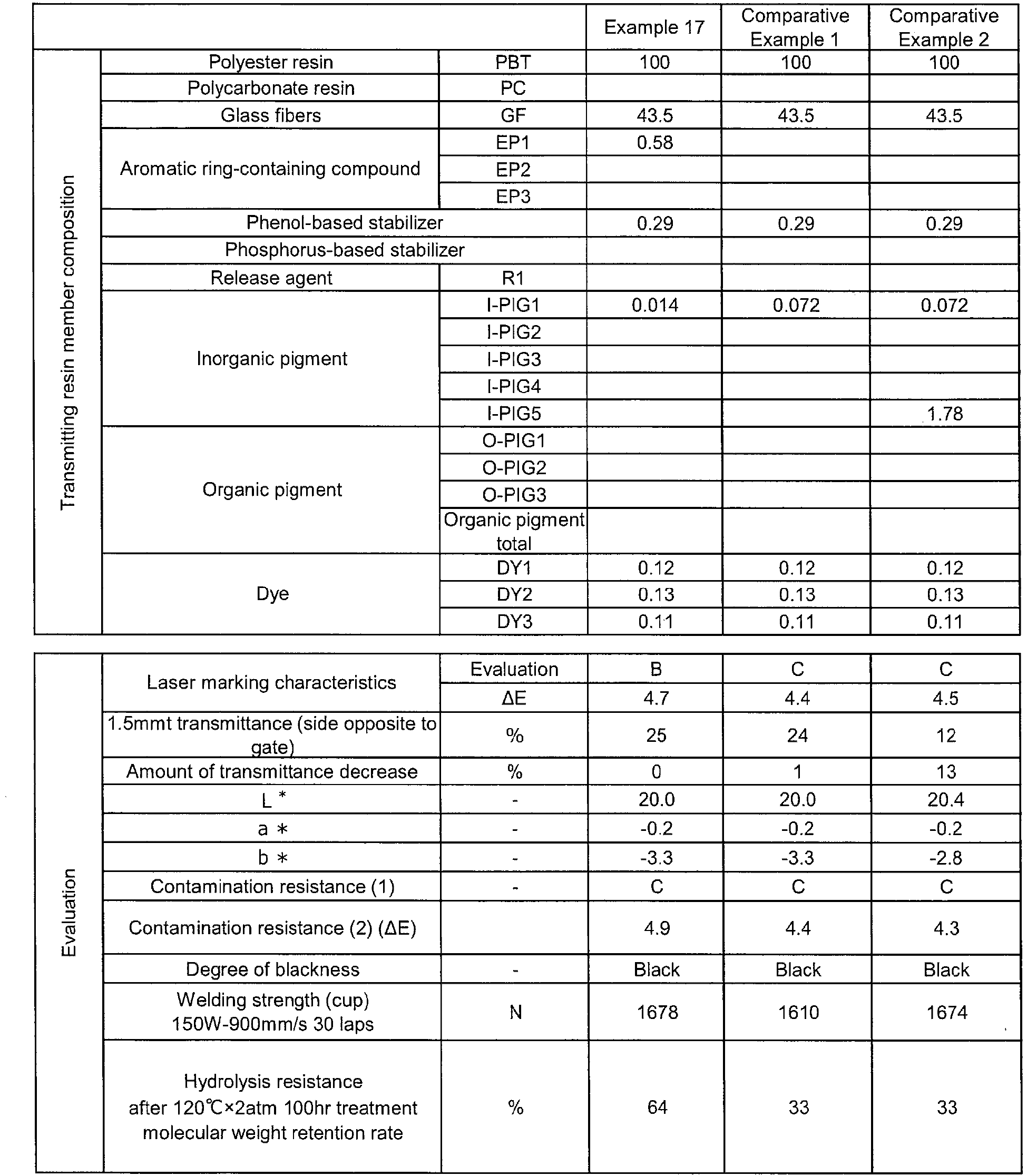


[Table 9] Absorbing material composition Absorbing resin member composition Polyester resin PBT 67 Glass fibers GF 30.00 Epoxy compound EPI 0.40 Phenol-based stabilizer 0.20 CB 2.00 - As is clear from the results, the resin compositions of the present invention were capable of being laser-welded and excellent in laser marking properties. Further, they were excellent in hydrolysis resistance.
- Further, it was found that even if bismuth oxide was blended, the molded articles did not blacken due to that, and therefore white molded articles and molded articles having a chromatic color were obtained.
-
- 21, 22 hole
- 23, 24 measurement jig
- 25, 26 measurement jig
Claims (22)
- A resin composition for laser marking and for laser welding comprising 100 parts by mass of a thermoplastic resin, 0.002 to 10.000 parts by mass of a bismuth compound, 0.1 to 5.0 parts by mass of organic dyes, and 0.1 to 18 parts by mass of an aromatic ring-containing compound comprising a benzene ring and/or a benzo condensed ring.
- The resin composition according to claim 1, wherein a content of the bismuth compound is 0.002 to 1.000 part by mass per 100 parts by mass of the thermoplastic resin.
- The resin composition according to claim 1 or 2, wherein the thermoplastic resin comprises a thermoplastic polyester resin.
- The resin composition according to any one of claims 1 to 3, wherein the thermoplastic resin comprises a polybutylene terephthalate resin.
- The resin composition according to any one of claims 1 to 4, wherein the thermoplastic resin comprises a polycarbonate resin.
- The resin composition according to any one of claims 1 to 5, wherein an amount of the benzene ring and/or the benzo condensed ring of the aromatic ring-containing compound is 15 to 75% by mass in terms of a molecular weight ratio of the benzene ring and/or the benzo condensed ring.
- The resin composition according to any one of claims 1 to 6, wherein the resin composition is for a laser-transmitting resin member.
- The resin composition according to any one of claims 1 to 7, wherein the aromatic ring-containing compound comprises compounds comprising an epoxy group.
- The resin composition according to any one of claims 1 to 8, wherein the aromatic ring-containing compound comprises novolac type epoxy compounds.
- The resin composition according to any one of claims 1 to 9, further comprising glass fibers, wherein the cross sections of the glass fibers are a circle.
- A molded article formed from the resin composition according to any one of claims 1 to 10.
- A laser-transmitting resin member formed from the resin composition according to any one of claims 1 to 10.
- The molded article according to claim 11, wherein the molded article is capable of being laser-marked.
- The laser-transmitting resin member according to claim 12, wherein the laser-transmitting resin member is capable of being laser-marked.
- A kit comprising:the resin composition according to any one of claims 1 to 10; anda light-absorptive resin composition comprising a thermoplastic resin and light-absorptive coloring matter.
- A laser-welded article obtained by laser-welding together the laser-transmitting resin member according to claim 12 or 14, and a laser-absorbing resin member formed from a light-absorptive resin composition comprising a thermoplastic resin and light-absorptive coloring matter.
- A method for producing a laser-welded article, comprising:irradiating the laser-transmitting resin member according to claim 12 or 14 with a laser to laser-mark the laser-transmitting resin member, andlaser-welding together the laser-transmitting resin member and a laser-absorbing resin member formed from a light-absorptive resin composition comprising a thermoplastic resin and light-absorptive coloring matter.
- The method for producing a laser-welded article according to claim 17, wherein the laser welding is performed by galvano-scanning laser welding.
- A light transmittance decrease inhibitor for a resin composition for laser marking and for laser welding comprising a thermoplastic resin and two or more non-black organic dyes, the light transmittance decrease inhibitor comprising the bismuth compound and the aromatic ring-containing compound comprising the benzene ring and/or the benzo condensed ring.
- The light transmittance decrease inhibitor according to claim 19, wherein an amount of the benzene ring and/or the benzo condensed ring of the aromatic ring-containing compound is 15 to 75% by mass in terms of a molecular weight ratio of the benzene ring and/or the benzo condensed ring.
- A method for inhibiting a light transmittance decrease of a resin composition for laser marking and for laser welding, comprising blending, into a resin composition for laser marking and for laser welding comprising a thermoplastic resin and two or more non-black organic dyes, 0.002 to 10.000 parts by mass of a bismuth compound and 0.1 to 18 parts by mass of an aromatic ring-containing compound comprising a benzene ring and/or a benzo condensed ring based on 100 parts by mass of the thermoplastic resin.
- The method for inhibiting the light transmittance decrease according to claim 21, wherein an amount of the benzene ring and/or the benzo condensed ring of the aromatic ring-containing compound is 15 to 75% by mass in terms of a molecular weight ratio of the benzene ring and/or the benzo condensed ring.
Applications Claiming Priority (2)
| Application Number | Priority Date | Filing Date | Title |
|---|---|---|---|
| JP2021053962 | 2021-03-26 | ||
| PCT/JP2022/014324 WO2022203039A1 (en) | 2021-03-26 | 2022-03-25 | Resin composition, molded article, and application thereof |
Publications (2)
| Publication Number | Publication Date |
|---|---|
| EP4317315A1 true EP4317315A1 (en) | 2024-02-07 |
| EP4317315A4 EP4317315A4 (en) | 2024-08-21 |
Family
ID=83397450
Family Applications (2)
| Application Number | Title | Priority Date | Filing Date |
|---|---|---|---|
| EP22775819.0A Pending EP4317314A4 (en) | 2021-03-26 | 2022-03-25 | RESIN COMPOSITION, MOLDED ARTICLE AND ITS USE |
| EP22775820.8A Pending EP4317315A4 (en) | 2021-03-26 | 2022-03-25 | RESIN COMPOSITION, MOLDED BODIES AND APPLICATION THEREOF |
Family Applications Before (1)
| Application Number | Title | Priority Date | Filing Date |
|---|---|---|---|
| EP22775819.0A Pending EP4317314A4 (en) | 2021-03-26 | 2022-03-25 | RESIN COMPOSITION, MOLDED ARTICLE AND ITS USE |
Country Status (5)
| Country | Link |
|---|---|
| US (2) | US20240018336A1 (en) |
| EP (2) | EP4317314A4 (en) |
| JP (2) | JP7192163B1 (en) |
| CN (2) | CN117425704A (en) |
| WO (2) | WO2022203038A1 (en) |
Cited By (1)
| Publication number | Priority date | Publication date | Assignee | Title |
|---|---|---|---|---|
| EP4148494A4 (en) * | 2020-05-07 | 2024-05-15 | Mitsubishi Chemical Corporation | RESIN COMPOSITION, MOLDED PRODUCT, KIT, VEHICLE ON-BOARD CAMERA COMPONENT, VEHICLE ON-BOARD CAMERA MODULE AND MOLDED PRODUCT MANUFACTURING PROCESS |
Families Citing this family (2)
| Publication number | Priority date | Publication date | Assignee | Title |
|---|---|---|---|---|
| WO2026100197A1 (en) * | 2024-11-07 | 2026-05-15 | 三菱エンジニアリングプラスチックス株式会社 | Polycarbonate resin composition |
| CN119219888B (en) * | 2024-11-28 | 2025-04-15 | 山东一诺威新材料有限公司 | Polyurethane super-hydrophobic foam composite material for packaging and preparation method thereof |
Family Cites Families (19)
| Publication number | Priority date | Publication date | Assignee | Title |
|---|---|---|---|---|
| JP2873249B2 (en) * | 1990-11-28 | 1999-03-24 | 日本ペルノックス株式会社 | Resin composition that can be marked black by laser beam irradiation |
| JPH05254252A (en) * | 1992-03-13 | 1993-10-05 | Nippon Kayaku Co Ltd | Laser marking composition |
| JPH0826211B2 (en) * | 1992-09-30 | 1996-03-13 | ソマール株式会社 | Laser beam marking material |
| DE19645940A1 (en) * | 1996-11-07 | 1998-05-14 | Bayer Ag | Laser-inscribable polymer molding compounds |
| DE19960104A1 (en) | 1999-12-14 | 2001-06-21 | Bayer Ag | Laser-weldable thermoplastic molding compounds |
| AU2002230839A1 (en) | 2000-11-13 | 2002-05-21 | E.I. Du Pont De Nemours And Company | Colored thermoplastic resin compositions for laser welding, specific neutral anthraquinone dyes as colorants therefor, and molded product therefrom |
| CN100398604C (en) * | 2003-12-02 | 2008-07-02 | 东丽株式会社 | Colored resin composition for laser welding and composite molded article using same |
| WO2006065611A1 (en) * | 2004-12-14 | 2006-06-22 | Polyone Corporation | Use of bismuth oxides for laser markings in thermoplastic polyurethane compounds |
| JP5500403B2 (en) * | 2009-10-29 | 2014-05-21 | ディーエスエム アイピー アセッツ ビー.ブイ. | Additive for laser marking |
| WO2014060099A2 (en) * | 2012-10-19 | 2014-04-24 | Merck Patent Gmbh | Microspheres |
| WO2014188828A1 (en) * | 2013-05-20 | 2014-11-27 | 東罐マテリアル・テクノロジー株式会社 | Bismuth oxide-based additive for laser marking |
| DE102014008962A1 (en) * | 2014-06-23 | 2016-01-07 | Merck Patent Gmbh | microspheres |
| JP6576075B2 (en) * | 2015-03-31 | 2019-09-18 | 日本カーバイド工業株式会社 | Laser label and laser marking method using the same |
| CN108699322B (en) * | 2016-02-25 | 2020-07-10 | 三菱工程塑料株式会社 | Resin composition for laser welding and welded body thereof |
| JP6872393B2 (en) * | 2017-03-16 | 2021-05-19 | 株式会社トッパンインフォメディア | Laser marking label |
| WO2019003607A1 (en) * | 2017-06-29 | 2019-01-03 | オリヱント化学工業株式会社 | Laser welded body and method for manufacturing same |
| JP7058114B2 (en) * | 2017-12-12 | 2022-04-21 | ポリプラスチックス株式会社 | Molded products capable of laser welding and laser marking |
| CN112399993B (en) | 2018-07-11 | 2024-03-12 | 三菱工程塑料株式会社 | Thermoplastic resin compositions and molded products |
| JP7079706B2 (en) | 2018-09-28 | 2022-06-02 | ポリプラスチックス株式会社 | Resin composition capable of laser welding and laser marking |
-
2022
- 2022-03-25 WO PCT/JP2022/014323 patent/WO2022203038A1/en not_active Ceased
- 2022-03-25 CN CN202280024566.0A patent/CN117425704A/en active Pending
- 2022-03-25 EP EP22775819.0A patent/EP4317314A4/en active Pending
- 2022-03-25 JP JP2022541867A patent/JP7192163B1/en active Active
- 2022-03-25 EP EP22775820.8A patent/EP4317315A4/en active Pending
- 2022-03-25 JP JP2022541868A patent/JP7192164B1/en active Active
- 2022-03-25 CN CN202280024489.9A patent/CN117425703A/en active Pending
- 2022-03-25 WO PCT/JP2022/014324 patent/WO2022203039A1/en not_active Ceased
-
2023
- 2023-09-22 US US18/472,388 patent/US20240018336A1/en active Pending
- 2023-09-22 US US18/472,384 patent/US20240010819A1/en active Pending
Cited By (1)
| Publication number | Priority date | Publication date | Assignee | Title |
|---|---|---|---|---|
| EP4148494A4 (en) * | 2020-05-07 | 2024-05-15 | Mitsubishi Chemical Corporation | RESIN COMPOSITION, MOLDED PRODUCT, KIT, VEHICLE ON-BOARD CAMERA COMPONENT, VEHICLE ON-BOARD CAMERA MODULE AND MOLDED PRODUCT MANUFACTURING PROCESS |
Also Published As
| Publication number | Publication date |
|---|---|
| WO2022203038A1 (en) | 2022-09-29 |
| JP7192163B1 (en) | 2022-12-19 |
| JPWO2022203038A1 (en) | 2022-09-29 |
| JP7192164B1 (en) | 2022-12-19 |
| CN117425703A (en) | 2024-01-19 |
| WO2022203039A1 (en) | 2022-09-29 |
| EP4317314A4 (en) | 2024-08-14 |
| JPWO2022203039A1 (en) | 2022-09-29 |
| EP4317314A1 (en) | 2024-02-07 |
| US20240018336A1 (en) | 2024-01-18 |
| CN117425704A (en) | 2024-01-19 |
| EP4317315A4 (en) | 2024-08-21 |
| US20240010819A1 (en) | 2024-01-11 |
Similar Documents
| Publication | Publication Date | Title |
|---|---|---|
| US20240018336A1 (en) | Resin composition, molded article, and applications thereof | |
| EP4148494A1 (en) | Resin composition, molded product, kit, vehicle on-board camera component, vehicle on-board camera module, and molded product manufacturing method | |
| JP5245265B2 (en) | Laser-welded polyester resin composition and composite molded body | |
| AU773611B2 (en) | Laser beam weldable thermoplastic molding materials | |
| US20240392127A1 (en) | Resin composition, molded body, pellets, and laser-welded body | |
| EP3705270B1 (en) | Laser welded body | |
| CN115427515B (en) | Resin composition for galvanometer laser welding, molded product, kit for galvanometer laser welding, vehicle camera component, vehicle camera module, ultraviolet exposure body, and method for producing molded product | |
| JP2007186584A (en) | Laser-welded polyester resin composition and molded article using the same | |
| JP2007169358A (en) | Laser-welded polyester resin composition and molded article using the same | |
| US20210170696A1 (en) | Laser-weldable and laser-markable molded article | |
| EP4234631A1 (en) | Resin composition, molded article, use of resin composition, kit, laser welded article, and method for manufacturing laser welded article | |
| JP2008133341A (en) | Black laser-welded polyester resin composition and molded article using the same | |
| US11597833B2 (en) | Thermoplastic resin composition for laser welding, molded article made of same, and composite molded article | |
| JP2024042437A (en) | Resin compositions, pellets, and molded products | |
| JP2007246716A (en) | Laser-welded polyester resin composition and molded article using the same | |
| JP2023114412A (en) | Resin composition, molded article, and laser welded article | |
| JP7487583B2 (en) | Resin composition, molded body, laser welding kit, vehicle-mounted camera module, and method for manufacturing molded body | |
| JP2009298947A (en) | Polyester resin composition for laser welding, and laser welding method | |
| JP2024145412A (en) | Resin composition, pellets, molded article, method for producing resin composition, kit, laser welded article, and method for producing laser welded article | |
| JP2026031253A (en) | Resin composition, pellet, molded article, method for producing resin composition, kit, laser-welded article, and method for producing laser-welded article | |
| CN118632898A (en) | Resin composition, molded body, pellets and laser welded body | |
| CN119173581A (en) | Laser-transmitting resin composition, molded article, and composite molded article | |
| JP2026002468A (en) | Masterbatch, resin composition, pellet, method for producing resin composition, molded article, and method for producing molded article |
Legal Events
| Date | Code | Title | Description |
|---|---|---|---|
| STAA | Information on the status of an ep patent application or granted ep patent |
Free format text: STATUS: THE INTERNATIONAL PUBLICATION HAS BEEN MADE |
|
| TPAC | Observations filed by third parties |
Free format text: ORIGINAL CODE: EPIDOSNTIPA |
|
| PUAI | Public reference made under article 153(3) epc to a published international application that has entered the european phase |
Free format text: ORIGINAL CODE: 0009012 |
|
| STAA | Information on the status of an ep patent application or granted ep patent |
Free format text: STATUS: REQUEST FOR EXAMINATION WAS MADE |
|
| 17P | Request for examination filed |
Effective date: 20231018 |
|
| AK | Designated contracting states |
Kind code of ref document: A1 Designated state(s): AL AT BE BG CH CY CZ DE DK EE ES FI FR GB GR HR HU IE IS IT LI LT LU LV MC MK MT NL NO PL PT RO RS SE SI SK SM TR |
|
| DAV | Request for validation of the european patent (deleted) | ||
| DAX | Request for extension of the european patent (deleted) | ||
| REG | Reference to a national code |
Ref country code: DE Ref legal event code: R079 Free format text: PREVIOUS MAIN CLASS: C08L0067000000 Ipc: C08K0003220000 |
|
| A4 | Supplementary search report drawn up and despatched |
Effective date: 20240722 |
|
| RIC1 | Information provided on ipc code assigned before grant |
Ipc: B29C 65/16 20060101ALI20240716BHEP Ipc: B23K 26/00 20140101ALI20240716BHEP Ipc: C08L 69/00 20060101ALI20240716BHEP Ipc: C08L 67/02 20060101ALI20240716BHEP Ipc: C08K 3/22 20060101AFI20240716BHEP |