EP4317282A1 - Organopolysiloxane composition - Google Patents
Organopolysiloxane composition Download PDFInfo
- Publication number
- EP4317282A1 EP4317282A1 EP22775667.3A EP22775667A EP4317282A1 EP 4317282 A1 EP4317282 A1 EP 4317282A1 EP 22775667 A EP22775667 A EP 22775667A EP 4317282 A1 EP4317282 A1 EP 4317282A1
- Authority
- EP
- European Patent Office
- Prior art keywords
- component
- organopolysiloxane
- sio
- groups
- compound
- Prior art date
- Legal status (The legal status is an assumption and is not a legal conclusion. Google has not performed a legal analysis and makes no representation as to the accuracy of the status listed.)
- Pending
Links
Classifications
-
- C—CHEMISTRY; METALLURGY
- C08—ORGANIC MACROMOLECULAR COMPOUNDS; THEIR PREPARATION OR CHEMICAL WORKING-UP; COMPOSITIONS BASED THEREON
- C08L—COMPOSITIONS OF MACROMOLECULAR COMPOUNDS
- C08L83/00—Compositions of macromolecular compounds obtained by reactions forming in the main chain of the macromolecule a linkage containing silicon with or without sulfur, nitrogen, oxygen or carbon only; Compositions of derivatives of such polymers
- C08L83/04—Polysiloxanes
-
- C—CHEMISTRY; METALLURGY
- C08—ORGANIC MACROMOLECULAR COMPOUNDS; THEIR PREPARATION OR CHEMICAL WORKING-UP; COMPOSITIONS BASED THEREON
- C08G—MACROMOLECULAR COMPOUNDS OBTAINED OTHERWISE THAN BY REACTIONS ONLY INVOLVING UNSATURATED CARBON-TO-CARBON BONDS
- C08G77/00—Macromolecular compounds obtained by reactions forming a linkage containing silicon with or without sulfur, nitrogen, oxygen or carbon in the main chain of the macromolecule
- C08G77/04—Polysiloxanes
- C08G77/12—Polysiloxanes containing silicon bound to hydrogen
-
- C—CHEMISTRY; METALLURGY
- C08—ORGANIC MACROMOLECULAR COMPOUNDS; THEIR PREPARATION OR CHEMICAL WORKING-UP; COMPOSITIONS BASED THEREON
- C08G—MACROMOLECULAR COMPOUNDS OBTAINED OTHERWISE THAN BY REACTIONS ONLY INVOLVING UNSATURATED CARBON-TO-CARBON BONDS
- C08G77/00—Macromolecular compounds obtained by reactions forming a linkage containing silicon with or without sulfur, nitrogen, oxygen or carbon in the main chain of the macromolecule
- C08G77/04—Polysiloxanes
- C08G77/14—Polysiloxanes containing silicon bound to oxygen-containing groups
- C08G77/18—Polysiloxanes containing silicon bound to oxygen-containing groups to alkoxy or aryloxy groups
-
- C—CHEMISTRY; METALLURGY
- C08—ORGANIC MACROMOLECULAR COMPOUNDS; THEIR PREPARATION OR CHEMICAL WORKING-UP; COMPOSITIONS BASED THEREON
- C08K—Use of inorganic or non-macromolecular organic substances as compounding ingredients
- C08K5/00—Use of organic ingredients
- C08K5/54—Silicon-containing compounds
- C08K5/541—Silicon-containing compounds containing oxygen
- C08K5/5415—Silicon-containing compounds containing oxygen containing at least one Si—O bond
- C08K5/5419—Silicon-containing compounds containing oxygen containing at least one Si—O bond containing at least one Si—C bond
-
- C—CHEMISTRY; METALLURGY
- C08—ORGANIC MACROMOLECULAR COMPOUNDS; THEIR PREPARATION OR CHEMICAL WORKING-UP; COMPOSITIONS BASED THEREON
- C08G—MACROMOLECULAR COMPOUNDS OBTAINED OTHERWISE THAN BY REACTIONS ONLY INVOLVING UNSATURATED CARBON-TO-CARBON BONDS
- C08G77/00—Macromolecular compounds obtained by reactions forming a linkage containing silicon with or without sulfur, nitrogen, oxygen or carbon in the main chain of the macromolecule
- C08G77/04—Polysiloxanes
- C08G77/14—Polysiloxanes containing silicon bound to oxygen-containing groups
- C08G77/16—Polysiloxanes containing silicon bound to oxygen-containing groups to hydroxy groups
-
- C—CHEMISTRY; METALLURGY
- C08—ORGANIC MACROMOLECULAR COMPOUNDS; THEIR PREPARATION OR CHEMICAL WORKING-UP; COMPOSITIONS BASED THEREON
- C08G—MACROMOLECULAR COMPOUNDS OBTAINED OTHERWISE THAN BY REACTIONS ONLY INVOLVING UNSATURATED CARBON-TO-CARBON BONDS
- C08G77/00—Macromolecular compounds obtained by reactions forming a linkage containing silicon with or without sulfur, nitrogen, oxygen or carbon in the main chain of the macromolecule
- C08G77/04—Polysiloxanes
- C08G77/20—Polysiloxanes containing silicon bound to unsaturated aliphatic groups
-
- C—CHEMISTRY; METALLURGY
- C08—ORGANIC MACROMOLECULAR COMPOUNDS; THEIR PREPARATION OR CHEMICAL WORKING-UP; COMPOSITIONS BASED THEREON
- C08G—MACROMOLECULAR COMPOUNDS OBTAINED OTHERWISE THAN BY REACTIONS ONLY INVOLVING UNSATURATED CARBON-TO-CARBON BONDS
- C08G77/00—Macromolecular compounds obtained by reactions forming a linkage containing silicon with or without sulfur, nitrogen, oxygen or carbon in the main chain of the macromolecule
- C08G77/70—Siloxanes defined by use of the MDTQ nomenclature
-
- C—CHEMISTRY; METALLURGY
- C08—ORGANIC MACROMOLECULAR COMPOUNDS; THEIR PREPARATION OR CHEMICAL WORKING-UP; COMPOSITIONS BASED THEREON
- C08G—MACROMOLECULAR COMPOUNDS OBTAINED OTHERWISE THAN BY REACTIONS ONLY INVOLVING UNSATURATED CARBON-TO-CARBON BONDS
- C08G77/00—Macromolecular compounds obtained by reactions forming a linkage containing silicon with or without sulfur, nitrogen, oxygen or carbon in the main chain of the macromolecule
- C08G77/80—Siloxanes having aromatic substituents, e.g. phenyl side groups
-
- C—CHEMISTRY; METALLURGY
- C08—ORGANIC MACROMOLECULAR COMPOUNDS; THEIR PREPARATION OR CHEMICAL WORKING-UP; COMPOSITIONS BASED THEREON
- C08L—COMPOSITIONS OF MACROMOLECULAR COMPOUNDS
- C08L2205/00—Polymer mixtures characterised by other features
- C08L2205/02—Polymer mixtures characterised by other features containing two or more polymers of the same C08L -group
- C08L2205/025—Polymer mixtures characterised by other features containing two or more polymers of the same C08L -group containing two or more polymers of the same hierarchy C08L, and differing only in parameters such as density, comonomer content, molecular weight, structure
Definitions
- the present invention relates to an organopolysiloxane composition having thixotropic properties.
- Organopolysiloxanes are used as a main agent in grease compositions and curing compositions based on heat resistance, electrical insulation, transparency, curability, and the like thereof. When used, for example, for screen printing, potting, or as coatings, the compositions preferably have thixotropic properties. Organopolysiloxanes generally do not have thixotropic properties; therefore, the following compositions are known:
- inorganic powders such as fumed silica, precipitated silica, alumina, titanium oxide, and the like have inferior affinity with regard to organopolysiloxanes, and thus transparency of the resulting compositions is low. Therefore, the use of hydrophobic inorganic powders, where the surface of the inorganic powder is treated with a silane compound such as hexamethylsilazane, dimethyldichlorosilane, or the like, to achieve hydrophobicity, results in a problem where thickening and thixotropic properties are reduced. Furthermore, there is a problem where optical properties of such compositions change with temperature due to differences in temperature variations of refractive indices of fumed silica and organopolysiloxane.
- compositions containing an epoxy group functional compound, (poly)ether group functional compound, (poly)ester group functional compound, or high molecular weight MQ resin and/or MDQ resin do not have sufficient thixotropic properties.
- An object of the present invention is to provide an organopolysiloxane composition having sufficient thixotropic properties, independent of inorganic powders such as fumed silica, precipitated silica, alumina, titanium oxide, and the like.
- the organopolysiloxane composition of the present invention at least contains:
- a viscosity ⁇ of the mixture of component (A) and component (B) at 25°C as measured by a rotational viscometer at a shear rate of 10/sec is preferably 0.01 to 10,000 Pa-s.
- component (C) is preferably a compound having at least two of the ether bonds in one molecule, a compound having at least two of the alkoxysilyl groups in one molecule, a compound having the ether bond and the alkoxysilyl group in one molecule, or a compound having the ester bond and the alkoxysilyl group in one molecule.
- component (B) in the present composition is an organopolysiloxane having an alkenyl group and an organopolysiloxane having a silicon-bonded hydrogen atom
- the present composition preferably further contains (D) a hydrosilylation reaction catalyst to obtain a curable composition.
- the organopolysiloxane composition of the present invention has sufficient thixotropic properties, independent of inorganic powders such as fumed silica, precipitated silica, alumina, titanium oxide, and the like.
- thixotropic properties refers to properties where the ratio of apparent viscosities at two different rotational speeds (shear rates), and specifically, the ratio of a viscosity ⁇ 1 at a lower rotational speed to a viscosity ⁇ 2 at a higher rotational speed, in other words, where n 1 /n 2 is higher than 1 and preferably 1.5 or more, is in accordance with JIS K7117, "Viscosity Testing Method for Liquid Resins Using a Rotational Viscometer". This ratio is expressed as the "thixotropy index".
- Component (B) is an organopolysiloxane expressed by the average unit formula: (R 2 3 SiO 1/2 ) f (R 2 2 SiO 2/2 ) g (R 2 SiO 3/2 ) h (SiO 4/2 ) i (HO 1/2 ) j
- each R 1 independently represents a hydrogen atom or a monovalent hydrocarbon group having 1 to 10 carbon atoms.
- the monovalent hydrocarbon group of R 1 include: methyl groups, ethyl groups, propyl groups, butyl groups, pentyl groups, hexyl groups, heptyl groups, and other alkyl groups having 1 to 10 carbon atoms; vinyl groups, allyl groups, butenyl groups, pentenyl groups, hexenyl groups, heptenyl groups, octenyl groups, and other alkenyl groups having 2 to 10 carbon atoms; phenyl groups, tolyl groups, xylyl groups, and other aryl groups having 6 to 10 carbon atoms; benzyl groups, phenethyl groups, and other aralkyl groups having 7 to 10 carbon atoms; 3,3,3-trifluoropropyl groups, 4,4,4,3,3-pentafluorobutyl groups, 5,
- Methyl groups, vinyl groups, phenyl groups, and 3,3,3-trifluoropropyl groups are preferred. If R 1 contains a hydrogen atom in the formula, the present composition can be cured by a hydrosilylation reaction using an alkenyl group-containing organopolysiloxane and a hydrosilylation reaction catalyst, and if R 1 contains an alkenyl group in the formula, the present composition can be cured by a hydrosilylation reaction using a silicon-bonded hydrogen atom-containing organopolysiloxane and a hydrosilylation reaction catalyst.
- e is a number satisfying 0.05 ⁇ e ⁇ 0.5, and preferably a number satisfying 0.05 ⁇ e ⁇ 0.45, or a number satisfying 0.05 ⁇ e ⁇ 0.4. This is because when e is at or above the lower limit of the range above, a resulting composition has favorable thixotropic properties, while when e is at or below the upper limit of the range above, compatibility with component (B) is improved and a resulting composition is uniform.
- Component (B) is an organopolysiloxane expressed by the average unit formula: (R 2 3 SiO 1/2 ) f (R 2 2 SiO 2/2 ) g (R 2 SiO 3/2 ) h (SiO 4/2 ) i (HO 1/2 ) j
- each R 2 independently represents a hydrogen atom or a monovalent hydrocarbon group having 1 to 10 carbon atoms.
- the monovalent hydrocarbon group of R 2 include the same alkyl groups, alkenyl groups, aryl groups, aralkyl groups, and fluoroalkyl groups as R 1 above. Methyl groups, vinyl groups, phenyl groups, and 3,3,3-trifluoropropyl groups are preferred.
- the present composition can be cured by a hydrosilylation reaction using an alkenyl group-containing organopolysiloxane and a hydrosilylation reaction catalyst, and if R 2 contains an alkenyl group in the formula, the present composition can be cured by a hydrosilylation reaction using a silicon-bonded hydrogen atom-containing organopolysiloxane and a hydrosilylation reaction catalyst.
- j is a number satisfying 0 ⁇ j ⁇ 0.05, and preferably a number 0 ⁇ j ⁇ 0.045, or a number satisfying 0 ⁇ j ⁇ 0.042. This is because when j is at or below the upper limit of the above, a resulting composition has favorable workable viscosity and favorable thixotropic properties.
- the properties of component (A) and component (B) at 25°C are not limited, but the viscosity ⁇ of the mixture of components (A) and (B) at 25°C as measured by a rotational viscometer at a shear rate of 10/sec is preferably within a range of 0.01 to 10,000 Pa-s or within a range of 0.05 to 1,000 Pa-s. This is because when the viscosity is at or above the lower limit of the range above, a resulting composition has favorable thixotropic properties, while when the viscosity is at or below the upper limit of the range above, a resulting composition has favorable workable viscosity.
- Component (C) is a compound having at least two functional groups selected from ether bonds, ester bonds, and alkoxysilyl groups expressed by the general formula: R 3 k (R 4 O) (3-k) Si-
- the ether bond can be a chain C-O-C bond or a cyclic C-O-C bond expressed by the formula: (where m represents an integer between 0 to 10).
- an epoxy group is included if m is 0, and a cyclic ether group is included if n is an integer between 1 and 10.
- ester bond refers to a C(O)-O bond, and may contain a carboxylic acid anhydride group expressed by the formula: and a carbonic acid ester group expressed by the formula:
- R 3 in the alkoxysilyl group represents a monovalent hydrocarbon group having 1 to 10 carbon atoms, and examples include the same alkyl groups, alkenyl groups, aryl groups, aralkyl groups, and fluoroalkyl groups as R 1 above. Methyl groups, vinyl groups, phenyl groups, and 3,3,3-trifluoropropyl groups are preferred.
- R 4 represents an alkyl group having 1 to 10 carbon atoms, and examples include the same alkyl groups as R 1 above. Methyl groups and ethyl groups are preferred.
- k represents 0, 1, or 2, and preferably 0.
- Examples of compounds having at least two ester bonds in one molecule include ethylene glycol diacetate, trimethylolpropane trimethacrylate, pentaerythritol tetramethacrylate, dimethylmalate, dimethylphthalate, maleic anhydride, phthalic anhydride, and dibutyl carbonate.
- Examples of compounds having at least two of the aforementioned alkoxysilyl groups in one molecule include 1,2-bis(trimethoxysilyl)ethane, 1,2-bis(triethoxysilyl)ethane, 1,2-bis(methyldimethoxysilyl)ethane, 1,6 1,6-bis(trimethoxysilyl)hexane, 1,6-bis(triethoxysilyl)hexane, and 1,4-bis(trimethoxysilyl)benzene.
- Examples of compounds having the aforementioned ether bond and ester bond in one molecule include 2-methoxyethyl acetate, diethylene glycol monoethyl ether acetate, diethylene glycol diacetate, glycidyl acetate, and glycidyl methacrylate.
- Examples of compounds having the aforementioned ether bond and alkoxysilyl group in one molecule include 3-glycidoxypropyltrimethoxysilane, 3-glycidoxypropylmethyldimethoxysilane, 2-(3,4-epoxycyclohexyl)ethyltrimethoxysilane, and 2-(3,4-epoxycyclohexyl)ethyldimethoxysilane.
- Examples of compounds having the aforementioned ester bond and alkoxysilyl group in one molecule include 3-methacryloxypropyltrimethoxysilane and 3-methacryloxypropylmethyldimethoxysilane.
- the amount of the aforementioned component (A) is within a range of 2 to 70 mass% of the sum of component (A) and component (B) above, and preferably within a range of 2 to 60 mass%, within a range of 2 to 50 mass%, or within a range of 2 to 45 mass%. This is because when the amount of component (A) is at or above the lower limit of the range above, the thixotropic properties of a resulting composition is favorable, while when the amount is at or below the upper limit of the range above, the viscosity of a resulting composition is favorable.
- the amount of component (C) is an amount where the sum of the functional groups in component (C) is 0.05 mols or more, and preferably 10 mols or less with regard to 1 mol of silicon-bonded hydroxyl groups in component (A). This is because when the amount of component (C) is at or above the lower limit of the range above, the thixotropic properties of a resulting composition is favorable, while when the amount is at or below the upper limit of the range above, the physical properties of a resulting composition and the physical properties of a cured product obtained by crosslinking the composition are not impaired.
- component (B) is an organopolysiloxane having an alkenyl group and an organopolysiloxane having a silicon-bonded hydrogen atom
- component (A) is an organopolysiloxane having a silicon-bonded hydrogen atom
- component (B) is an organopolysiloxane having an alkenyl group
- component (A) is an organopolysiloxane having an alkenyl group
- component (B) is an organopolysiloxane having a silicon-bonded hydrogen atom
- a (D) hydrosilylation reaction catalyst can be further added to the present composition to obtain a composition that is crosslinked by a hydrosilylation reaction.
- component (D) examples include platinum-based catalysts, palladium-based catalysts, and rhodium-based catalysts, and platinum-based catalysts are preferable.
- platinum-based catalysts include chloroplatinic acids, chloroplatinic acid hexahydrates, platinum dichlorides, alcoholic solutions of a chloroplatinic acid, olefin complexes of platinum, carbonyl complexes of platinum, alkenylsiloxane complexes of platinum, diketone complexes of platinum, olefin complexes of platinum, and other non-microcapsule hydrosilylation reaction catalysts, and microcapsule hydrosilylation reaction catalysts containing an acrylic resin, polycarbonate resin, silicone resin or other resin with a softening point of 40 to 170°C, in which these platinum-based catalysts are dispersed or included.
- alkenylsiloxanes in the alkenylsiloxane complex of platinum include 1,3-divinyltetramethyldisiloxane, 1,1,3,3-tetravinyldimethyl disiloxane, and methyl(3,3,3-trifluoropropyl)siloxane oligomers blocked with a dimethyvinylsiloxy group.
- the amount of component (D) is a catalytic amount for promoting a hydrosilylation reaction of the present composition, and specifically is an amount in which a catalytic metal in the present component is, in mass units, within a range of 0.1 to 1,000 ppm, within a range 0.1 to 500 ppm, or within a range of 0.1 to 250 ppm, with regard to the present composition. This is because, when the amount of component (D) is at or above the lower limit of the range above, curing of the present composition is sufficiently promoted, while when the amount is at or below the upper limit range of the range above, problems such as coloring and the like of a resulting cured product are less likely to occur.
- the present composition may also contain, along with component (D), a hydrosilylation reaction inhibitor for adjusting the curing rate of the present composition.
- a hydrosilylation reaction inhibitor for adjusting the curing rate of the present composition.
- the reaction inhibitor include alkyne alcohols such as 2-methyl-3-butyne-2-ol, 3,5-dimethyl-1-hexyne-3-ol, 3-methyl-1-pentyne-3-ol, 2-phenyl-3-butyne-2-ol, 1-ethynyl-1-cyclohexanol, 2-ethynylisopropanol, 2-ethynylbutane-2-ol, and the like; silylated acetylene alcohols such as trimethyl(3,5-dimethyl-1-hexyne-3-oxy)silane, dimethylbis(3-methyl-1-butynoxy)silane, methylvinylbis(3-methyl-1-butyne-3-oxy)s
- the amount of the hydrosilylation reaction inhibitor is not limited, but is preferably 5 parts by mass or less or 3 parts by mass or less, while a lower limit thereof is preferably 0.01 parts by mass or more or 0.1 parts by mass or more, with regard to a total of 100 parts by mass of component (A) and component (B).
- the present composition may contain: fumed silica and other dry silica fine powders; precipitated silica and other wet silica fine powders; and silica fine powders obtained by hydrophobically treating the surfaces of these silica fine powders with an organosilicon compound such as organosilane, hexaorganodisilazane, diorganopolysiloxane, diorganocyclopolysiloxane, and the like.
- organosilicon compound such as organosilane, hexaorganodisilazane, diorganopolysiloxane, diorganocyclopolysiloxane, and the like.
- Me, Ph, and Vi represent a methyl group, phenyl group, and vinyl group, respectively.
- the viscosity (Pa-s) of organopolysiloxane compositions at 25°C was measured using a rotational rheometer (Viscoelasticity measuring device AR500 manufactured by TA Instruments) in accordance with a method specified in JIS K7117-2:1999. Note that for the measurements, a 2° cone plate with a diameter of 20 mm was used to measure the viscosity ⁇ 1 at a shear rate of 1/s and viscosity ⁇ 2 at a shear rate of 10/s, respectively, and the ratio (n 1 /n 2 ) was expressed as the thixotropy index.
- a cured product was prepared by heating an organopolysiloxane composition at 150°C for 1 hour.
- the needle penetration of the cured product was measured in accordance with a test method specified in JIS K2207.
- a cured product was prepared by heating an organopolysiloxane composition at 150°C for 1 hour.
- the hardness of the cured product was measured in accordance with a test method using a type A hardness tester specified in JIS K6253.
- Organopolysiloxane compositions were prepared by uniformly mixing the following components to obtain the compositions shown in Tables 1 to 9. Note that "molar ratio” in the table indicates the molar ratio of the functional group in component (C) to the silicon-bonded hydroxyl group in component (A).
- component (A) The following component was used as component (A).
- component (A) The following components were used for comparisons of component (A).
- component (B) The following component was used as component (B).
- component (C) The following component was used as component (C).
- component (C) The following components were used for comparisons of component (C).
- component (d-1) 1,3-divinyltetramethyldisiloxane solution of a 1,3-divinyltetramethyldisiloxane complex of platinum (amount of platinum: 4,000 ppm)
- the organopolysiloxane composition of the present invention exhibits sufficient thixotropic properties independent of fumed silica, precipitated silica, alumina, titanium oxide, and other inorganic powders, and therefore can be used, for example, as a grease material, or by mixing with a crosslinking agent, as a potting agent, coating agent, or molding material.
Landscapes
- Chemical & Material Sciences (AREA)
- Health & Medical Sciences (AREA)
- Chemical Kinetics & Catalysis (AREA)
- Medicinal Chemistry (AREA)
- Polymers & Plastics (AREA)
- Organic Chemistry (AREA)
- Compositions Of Macromolecular Compounds (AREA)
Abstract
Description
- The present invention relates to an organopolysiloxane composition having thixotropic properties.
- Organopolysiloxanes are used as a main agent in grease compositions and curing compositions based on heat resistance, electrical insulation, transparency, curability, and the like thereof. When used, for example, for screen printing, potting, or as coatings, the compositions preferably have thixotropic properties. Organopolysiloxanes generally do not have thixotropic properties; therefore, the following compositions are known:
- compositions in which fumed silica and an organosiloxane oligomer having a silicon atom-bonded hydroxyl group (silanol group), organooxy group, or epoxy group are added to an organopolysiloxane (refer to Patent Documents 1 and 2);
- a composition in which fumed silica, precipitated silica, alumina, titanium oxide, or other inorganic powder, and a polyfunctional acrylate and/or polyfunctional methacrylate are added to an organopolysiloxane (refer to Patent Document 3);
- a composition in which fumed silica, precipitated silica, alumina, titanium oxide, or other inorganic powder, and an epoxy group-containing compound are added to an organopolysiloxane (refer to Document 4);
- a composition in which an epoxy group functional compound, a (poly)ether group functional compound, or a (poly)ester group functional compound is added to an organopolysiloxane (refer to Patent Document 5); and
- a composition in which a high molecular weight MQ resin and/or MDQ resin is added to an organopolysiloxane (refer to Document 6).
- However, there is a problem where inorganic powders such as fumed silica, precipitated silica, alumina, titanium oxide, and the like have inferior affinity with regard to organopolysiloxanes, and thus transparency of the resulting compositions is low. Therefore, the use of hydrophobic inorganic powders, where the surface of the inorganic powder is treated with a silane compound such as hexamethylsilazane, dimethyldichlorosilane, or the like, to achieve hydrophobicity, results in a problem where thickening and thixotropic properties are reduced. Furthermore, there is a problem where optical properties of such compositions change with temperature due to differences in temperature variations of refractive indices of fumed silica and organopolysiloxane.
- On the other hand, there is a problem where compositions containing an epoxy group functional compound, (poly)ether group functional compound, (poly)ester group functional compound, or high molecular weight MQ resin and/or MDQ resin do not have sufficient thixotropic properties.
-
- [Patent Document 1]
Japanese Unexamined Patent Application 2009-235265 - [Patent Document 2] International Publication
WO 2014/050318 Pamphlet - [Patent Document 3]
Japanese Unexamined Patent Application 2015-010131 - [Patent Document 4]
Japanese Unexamined Patent Application 2015-010132 - [Patent Document 5]
Japanese PCT Application 2018-512067 - [Patent Document 6]
Japanese Unexamined Patent Application 2014-237808 - An object of the present invention is to provide an organopolysiloxane composition having sufficient thixotropic properties, independent of inorganic powders such as fumed silica, precipitated silica, alumina, titanium oxide, and the like.
- The organopolysiloxane composition of the present invention at least contains:
- (A) an organopolysiloxane expressed by the average unit formula:
(R1 3SiO1/2)a(R1 2SiO2/2)b(R1SiO3/2)c(SiO4/2)d(HO1/2)e
(where R1 each independently represents a hydrogen atom or a monovalent hydrocarbon group having 1 to 10 carbon atoms, and a, b c and d each represent a number satisfying 0 ≤ a ≤ 0.8, 0 ≤ b ≤ 0.8, 0 ≤ c ≤ 0.8, and 0 ≤ d ≤ 0.8, and 0.2 ≤ a + b ≤ 0.8, 0.2 ≤ c + d ≤ 0.8, and a + b + c + d = 1, and e represents a number satisfying 0.05 ≤ e ≤ 0.5); - (B) an organopolysiloxane expressed by the average unit formula:
(R2 3SiO1/2)f(R2 2SiO2/2)g(R2SiO3/2)h(SiO4/2)i(HO1/2)j
(where R2 each independently represents a hydrogen atom or a monovalent hydrocarbon group having 1 to 10 carbon atoms, and f, g h, and i each represent a number satisfying 0 ≤ f ≤ 1, 0 ≤ g ≤ 1, 0 ≤ h ≤ 0.8, and 0 ≤ i ≤ 0.8, and 0.2 ≤ f + g ≤ 1, 0 ≤ h + i ≤ 0.8, and f + g + h + i = 1, and j represents a number satisfying 0 ≤ j < 0.05); and - (C) a compound having at least two functional groups selected from ether bonds, ester bonds, and alkoxysilyl groups expressed by the general formula:
R3 k(R4O)(3-k)Si-
- (where R3 represents a monovalent hydrocarbon group having 1 to 10 carbon atoms, R4 represents an alkyl group having 1 to 10 carbon atoms, and k represents 0, 1, or 2)
- in one molecule; where
- the amount of component (A) is 2 to 70 mass% of the sum of the aforementioned component (A) and component (B), and the amount of component (C) is an amount in which the sum of the functional groups in component (C) is 0.05 mol or more with regard to 1 mol of the silicon-bonded hydroxyl group in component (A).
- In the present composition, a viscosity η of the mixture of component (A) and component (B) at 25°C as measured by a rotational viscometer at a shear rate of 10/sec is preferably 0.01 to 10,000 Pa-s.
- In the present composition, component (C) is preferably a compound having at least two of the ether bonds in one molecule, a compound having at least two of the alkoxysilyl groups in one molecule, a compound having the ether bond and the alkoxysilyl group in one molecule, or a compound having the ester bond and the alkoxysilyl group in one molecule.
- If component (B) in the present composition is an organopolysiloxane having an alkenyl group and an organopolysiloxane having a silicon-bonded hydrogen atom, the present composition preferably further contains (D) a hydrosilylation reaction catalyst to obtain a curable composition.
- The organopolysiloxane composition of the present invention has sufficient thixotropic properties, independent of inorganic powders such as fumed silica, precipitated silica, alumina, titanium oxide, and the like.
- The term "thixotropic properties" as used herein refers to properties where the ratio of apparent viscosities at two different rotational speeds (shear rates), and specifically, the ratio of a viscosity η1 at a lower rotational speed to a viscosity η2 at a higher rotational speed, in other words, where n1/n2 is higher than 1 and preferably 1.5 or more, is in accordance with JIS K7117, "Viscosity Testing Method for Liquid Resins Using a Rotational Viscometer". This ratio is expressed as the "thixotropy index".
- Component (B) is an organopolysiloxane expressed by the average unit formula:
(R2 3SiO1/2)f(R2 2SiO2/2)g(R2SiO3/2)h(SiO4/2)i(HO1/2)j
- In the formula, each R1 independently represents a hydrogen atom or a monovalent hydrocarbon group having 1 to 10 carbon atoms. Examples of the monovalent hydrocarbon group of R1 include: methyl groups, ethyl groups, propyl groups, butyl groups, pentyl groups, hexyl groups, heptyl groups, and other alkyl groups having 1 to 10 carbon atoms; vinyl groups, allyl groups, butenyl groups, pentenyl groups, hexenyl groups, heptenyl groups, octenyl groups, and other alkenyl groups having 2 to 10 carbon atoms; phenyl groups, tolyl groups, xylyl groups, and other aryl groups having 6 to 10 carbon atoms; benzyl groups, phenethyl groups, and other aralkyl groups having 7 to 10 carbon atoms; 3,3,3-trifluoropropyl groups, 4,4,4,3,3-pentafluorobutyl groups, 5,5,5,4,4,3,3-heptafluoropentyl groups, 6,6,6,5,5,4,4,3,3-nanofluorohexyl groups, 7,7,7,6,6,5,5,4,4,3,3-undecafluoroheptyl groups, and other fluoroalkyl groups having 3 to 10 carbon atoms. Methyl groups, vinyl groups, phenyl groups, and 3,3,3-trifluoropropyl groups are preferred. If R1 contains a hydrogen atom in the formula, the present composition can be cured by a hydrosilylation reaction using an alkenyl group-containing organopolysiloxane and a hydrosilylation reaction catalyst, and if R1 contains an alkenyl group in the formula, the present composition can be cured by a hydrosilylation reaction using a silicon-bonded hydrogen atom-containing organopolysiloxane and a hydrosilylation reaction catalyst.
- Furthermore, in the formula, a, b, c, and d each represent numbers satisfying 0 ≤ a ≤ 0.8, 0 ≤ b ≤ 0.8, 0 ≤ c ≤ 0.8, and 0 ≤ d ≤ 0.8, and 0.2 ≤ a + b ≤ 0.8, 0.2 ≤ c + d ≤ 0.8 and a + b + c + d = 1, and preferably numbers satisfying 0 ≤ a ≤ 0.7, 0 ≤ b ≤ 0.7, 0 ≤ c ≤ 0.8, 0 ≤ d ≤ 0.8, and 0.2 ≤ a + b ≤ 0.7, 0.3 ≤ c + d ≤ 0.8, and a + b + c + d = 1, or numbers satisfying 0 ≤ a ≤ 0.6, 0 ≤ b ≤ 0.6, 0 ≤ c ≤ 0.8 and 0 ≤ d ≤ 0.8, and 0.2 ≤ a + b ≤ 0.6, 0.4 ≤ c + d ≤ 0.8, and a + b + c + d = 1. This is because when a, b, c, and d are numbers within the range above, a resulting composition has suitable viscosity and favorable thixotropic properties.
- Furthermore, in the formula, e is a number satisfying 0.05 ≤ e ≤ 0.5, and preferably a number satisfying 0.05 ≤ e ≤ 0.45, or a number satisfying 0.05 ≤ e ≤ 0.4. This is because when e is at or above the lower limit of the range above, a resulting composition has favorable thixotropic properties, while when e is at or below the upper limit of the range above, compatibility with component (B) is improved and a resulting composition is uniform.
- Component (B) is an organopolysiloxane expressed by the average unit formula:
(R2 3SiO1/2)f(R2 2SiO2/2)g(R2SiO3/2)h(SiO4/2)i(HO1/2)j
- In the formula, each R2 independently represents a hydrogen atom or a monovalent hydrocarbon group having 1 to 10 carbon atoms. Examples of the monovalent hydrocarbon group of R2 include the same alkyl groups, alkenyl groups, aryl groups, aralkyl groups, and fluoroalkyl groups as R1 above. Methyl groups, vinyl groups, phenyl groups, and 3,3,3-trifluoropropyl groups are preferred. If R2 contains a hydrogen atom in the formula, the present composition can be cured by a hydrosilylation reaction using an alkenyl group-containing organopolysiloxane and a hydrosilylation reaction catalyst, and if R2 contains an alkenyl group in the formula, the present composition can be cured by a hydrosilylation reaction using a silicon-bonded hydrogen atom-containing organopolysiloxane and a hydrosilylation reaction catalyst.
- Furthermore, in the formula, f, g, h, and i each represent numbers satisfying 0 ≤ f ≤ 1, 0 ≤ g ≤ 1, 0 ≤ h ≤ 0.8, and 0 ≤ i ≤ 0.8, and 0.2 ≤ f + g ≤ 1, 0 ≤ h + i ≤ 0.8 and f + g + h + i = 1, and preferably numbers satisfying 0 ≤ f ≤ 1, 0 ≤ g ≤ 1, 0 ≤ h ≤ 0.7, 0 ≤ i ≤ 0.7, 0.3 ≤ f + g ≤ 1, 0 ≤ h + i ≤ 0.7, and f + g + h + i = 1, or numbers satisfying 0 ≤ f ≤ 1, 0 ≤ g ≤ 1, 0 ≤ h ≤ 0.6, and 0 ≤ i ≤ 0.6, and 0.4 ≤ f + g ≤ 1, 0 ≤ h + i ≤ 0.6, and f + g + h + i = 1. This is because when f, g, h, and i are numbers within the range above, a resulting composition has favorable workable viscosity and favorable thixotropic properties.
- Furthermore, in the formula, j is a number satisfying 0 ≤ j ≤ 0.05, and preferably a number 0 ≤ j ≤ 0.045, or a number satisfying 0 ≤ j ≤ 0.042. This is because when j is at or below the upper limit of the above, a resulting composition has favorable workable viscosity and favorable thixotropic properties.
- In the present composition, the properties of component (A) and component (B) at 25°C are not limited, but the viscosity η of the mixture of components (A) and (B) at 25°C as measured by a rotational viscometer at a shear rate of 10/sec is preferably within a range of 0.01 to 10,000 Pa-s or within a range of 0.05 to 1,000 Pa-s. This is because when the viscosity is at or above the lower limit of the range above, a resulting composition has favorable thixotropic properties, while when the viscosity is at or below the upper limit of the range above, a resulting composition has favorable workable viscosity.
- Component (C) is a compound having at least two functional groups selected from ether bonds, ester bonds, and alkoxysilyl groups expressed by the general formula:
R3 k(R4O)(3-k)Si-
- The ether bond can be a chain C-O-C bond or a cyclic C-O-C bond expressed by the formula:

- In other words, an epoxy group is included if m is 0, and a cyclic ether group is included if n is an integer between 1 and 10.
- Furthermore, the ester bond refers to a C(O)-O bond, and may contain a carboxylic acid anhydride group expressed by the formula:

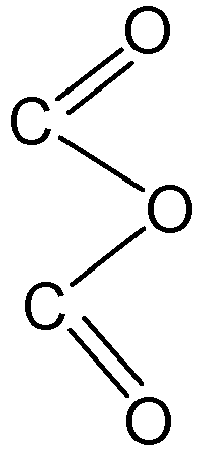
a carbonic acid ester group expressed by the formula:
- However, in the case of the aforementioned carboxylic acid anhydride group and carbonic acid ester group, two ester bonds can be considered.
- Furthermore, R3 in the alkoxysilyl group represents a monovalent hydrocarbon group having 1 to 10 carbon atoms, and examples include the same alkyl groups, alkenyl groups, aryl groups, aralkyl groups, and fluoroalkyl groups as R1 above. Methyl groups, vinyl groups, phenyl groups, and 3,3,3-trifluoropropyl groups are preferred.
- Furthermore, in the formula, R4 represents an alkyl group having 1 to 10 carbon atoms, and examples include the same alkyl groups as R1 above. Methyl groups and ethyl groups are preferred.
- Furthermore, in the formula, k represents 0, 1, or 2, and preferably 0.
- Examples of compounds containing at least two ether bonds in one molecule include 1,2-dimethoxyethane, diethylene glycol dimethoxy ether, trimethylolpropane diallyl ether, pentaerythritol tetraallyl ether, butyl glycidyl ether, ethylene glycol diglycidyl ether, furfuryl ethyl ether, and polyethers expressed by the formula:
CH2=CHCH2O(CH2CH2O)nCH3
(where n represents an integer between 1 to 10). - Examples of compounds having at least two ester bonds in one molecule include ethylene glycol diacetate, trimethylolpropane trimethacrylate, pentaerythritol tetramethacrylate, dimethylmalate, dimethylphthalate, maleic anhydride, phthalic anhydride, and dibutyl carbonate.
- Examples of compounds having at least two of the aforementioned alkoxysilyl groups in one molecule include 1,2-bis(trimethoxysilyl)ethane, 1,2-bis(triethoxysilyl)ethane, 1,2-bis(methyldimethoxysilyl)ethane, 1,6 1,6-bis(trimethoxysilyl)hexane, 1,6-bis(triethoxysilyl)hexane, and 1,4-bis(trimethoxysilyl)benzene.
- Examples of compounds having the aforementioned ether bond and ester bond in one molecule include 2-methoxyethyl acetate, diethylene glycol monoethyl ether acetate, diethylene glycol diacetate, glycidyl acetate, and glycidyl methacrylate.
- Examples of compounds having the aforementioned ether bond and alkoxysilyl group in one molecule include 3-glycidoxypropyltrimethoxysilane, 3-glycidoxypropylmethyldimethoxysilane, 2-(3,4-epoxycyclohexyl)ethyltrimethoxysilane, and 2-(3,4-epoxycyclohexyl)ethyldimethoxysilane.
- Examples of compounds having the aforementioned ester bond and alkoxysilyl group in one molecule include 3-methacryloxypropyltrimethoxysilane and 3-methacryloxypropylmethyldimethoxysilane.
- In the present composition, the amount of the aforementioned component (A) is within a range of 2 to 70 mass% of the sum of component (A) and component (B) above, and preferably within a range of 2 to 60 mass%, within a range of 2 to 50 mass%, or within a range of 2 to 45 mass%. This is because when the amount of component (A) is at or above the lower limit of the range above, the thixotropic properties of a resulting composition is favorable, while when the amount is at or below the upper limit of the range above, the viscosity of a resulting composition is favorable.
- In the present composition, the amount of component (C) is an amount where the sum of the functional groups in component (C) is 0.05 mols or more, and preferably 10 mols or less with regard to 1 mol of silicon-bonded hydroxyl groups in component (A). This is because when the amount of component (C) is at or above the lower limit of the range above, the thixotropic properties of a resulting composition is favorable, while when the amount is at or below the upper limit of the range above, the physical properties of a resulting composition and the physical properties of a cured product obtained by crosslinking the composition are not impaired.
- When component (B) is an organopolysiloxane having an alkenyl group and an organopolysiloxane having a silicon-bonded hydrogen atom, when component (A) is an organopolysiloxane having a silicon-bonded hydrogen atom, and component (B) is an organopolysiloxane having an alkenyl group, or when component (A) is an organopolysiloxane having an alkenyl group, and component (B) is an organopolysiloxane having a silicon-bonded hydrogen atom, a (D) hydrosilylation reaction catalyst can be further added to the present composition to obtain a composition that is crosslinked by a hydrosilylation reaction.
- Examples of component (D) include platinum-based catalysts, palladium-based catalysts, and rhodium-based catalysts, and platinum-based catalysts are preferable. Examples of the platinum-based catalysts include chloroplatinic acids, chloroplatinic acid hexahydrates, platinum dichlorides, alcoholic solutions of a chloroplatinic acid, olefin complexes of platinum, carbonyl complexes of platinum, alkenylsiloxane complexes of platinum, diketone complexes of platinum, olefin complexes of platinum, and other non-microcapsule hydrosilylation reaction catalysts, and microcapsule hydrosilylation reaction catalysts containing an acrylic resin, polycarbonate resin, silicone resin or other resin with a softening point of 40 to 170°C, in which these platinum-based catalysts are dispersed or included. Furthermore, examples of alkenylsiloxanes in the alkenylsiloxane complex of platinum include 1,3-divinyltetramethyldisiloxane, 1,1,3,3-tetravinyldimethyl disiloxane, and methyl(3,3,3-trifluoropropyl)siloxane oligomers blocked with a dimethyvinylsiloxy group.
- The amount of component (D) is a catalytic amount for promoting a hydrosilylation reaction of the present composition, and specifically is an amount in which a catalytic metal in the present component is, in mass units, within a range of 0.1 to 1,000 ppm, within a range 0.1 to 500 ppm, or within a range of 0.1 to 250 ppm, with regard to the present composition. This is because, when the amount of component (D) is at or above the lower limit of the range above, curing of the present composition is sufficiently promoted, while when the amount is at or below the upper limit range of the range above, problems such as coloring and the like of a resulting cured product are less likely to occur.
- Furthermore, the present composition may also contain, along with component (D), a hydrosilylation reaction inhibitor for adjusting the curing rate of the present composition. Examples of the reaction inhibitor include alkyne alcohols such as 2-methyl-3-butyne-2-ol, 3,5-dimethyl-1-hexyne-3-ol, 3-methyl-1-pentyne-3-ol, 2-phenyl-3-butyne-2-ol, 1-ethynyl-1-cyclohexanol, 2-ethynylisopropanol, 2-ethynylbutane-2-ol, and the like; silylated acetylene alcohols such as trimethyl(3,5-dimethyl-1-hexyne-3-oxy)silane, dimethylbis(3-methyl-1-butynoxy)silane, methylvinylbis(3-methyl-1-butyne-3-oxy)silane, [(1,1-dimethyl-2-propynyl)oxy]trimethylsilane, and the like; enyne compounds such as 2-isobutyl-1-butene-3-yne, 3,5-dimethyl-3-hexene-1-yne, 3-methyl-3-pentene-1-yne, 3-methyl-3-hexene-1-yne, 1-ethynylcyclohexene, 3-ethyl-3-butene-1-yne, 3-phenyl-3-butene-1-yne, and the like; unsaturated carboxylic acid esters such as diallyl maleate, dimethyl maleate, diethyl maleate, diallyl fumarate, bis-2-methoxy-1-methylethyl maleate, monooctyl maleate, monoisooctyl maleate, monoallyl maleate, monomethyl maleate, monoethyl maleate, monoallyl fumarate, 2-methoxy-1-methylethyl maleate, and the like; alkenylsiloxanes such as 1,3,5,7-tetramethyl-1,3,5,7-tetravinylcyclotetrasiloxane, 1,3,5,7-tetramethyl-1,3,5,7-tetrahexenylcyclotetrasiloxane, and the like; and benzotriazoles.
- The amount of the hydrosilylation reaction inhibitor is not limited, but is preferably 5 parts by mass or less or 3 parts by mass or less, while a lower limit thereof is preferably 0.01 parts by mass or more or 0.1 parts by mass or more, with regard to a total of 100 parts by mass of component (A) and component (B).
- Within a scope where an object of the present invention is not impaired, the present composition may contain: fumed silica and other dry silica fine powders; precipitated silica and other wet silica fine powders; and silica fine powders obtained by hydrophobically treating the surfaces of these silica fine powders with an organosilicon compound such as organosilane, hexaorganodisilazane, diorganopolysiloxane, diorganocyclopolysiloxane, and the like.
- An organopolysiloxane of the present invention will be described in detail based on examples. Note that in the formula, Me, Ph, and Vi represent a methyl group, phenyl group, and vinyl group, respectively.
- The viscosity (Pa-s) of organopolysiloxane compositions at 25°C was measured using a rotational rheometer (Viscoelasticity measuring device AR500 manufactured by TA Instruments) in accordance with a method specified in JIS K7117-2:1999. Note that for the measurements, a 2° cone plate with a diameter of 20 mm was used to measure the viscosity η1 at a shear rate of 1/s and viscosity η2 at a shear rate of 10/s, respectively, and the ratio (n1/n2) was expressed as the thixotropy index.
- A cured product was prepared by heating an organopolysiloxane composition at 150°C for 1 hour. The needle penetration of the cured product was measured in accordance with a test method specified in JIS K2207.
- A cured product was prepared by heating an organopolysiloxane composition at 150°C for 1 hour. The hardness of the cured product was measured in accordance with a test method using a type A hardness tester specified in JIS K6253.
- Organopolysiloxane compositions were prepared by uniformly mixing the following components to obtain the compositions shown in Tables 1 to 9. Note that "molar ratio" in the table indicates the molar ratio of the functional group in component (C) to the silicon-bonded hydroxyl group in component (A).
- The following component was used as component (A).
- (a-1): Organopolysiloxane expressed by the average unit formula:
(Me3SiO1/2)0.45(SiO4/2)0.55(HO1/2)0.13
- (a-2): Organopolysiloxane expressed by the average unit formula:
(Me3SiO1/2)0.47(SiO4/2)0.53(HO1/2)0.13
- (a-3): Organopolysiloxane expressed by average unit formula:
(Me3SiO1/2)0.44(SiO4/2)0.56(HO1/2)0.10
- (a-4): Organopolysiloxane expressed by average unit formula:
(Me3SiO1/2)0.19(Ph2SiO2/2)0.17(MeSiO3/2)0.26(PhSiO3/2)0.38(HO1/2)0.10
- (a-5): Organopolysiloxane expressed by the average unit formula:
(ViMe2SiO1/2)0.25(PhSiO3/2)0.75(HO1/2)0.38
- The following components were used for comparisons of component (A).
- (a-6): Organopolysiloxane expressed by average unit formula:
(Me3SiO1/2)0.48(SiO4/2)0.52(HO1/2)0.03
- (a-7): Organopolysiloxane expressed by average unit formula:
(Me3SiO1/2)0.50(SiO4/2)0.50(HO1/2)0.03
- (a-8): Organopolysiloxane expressed by average unit formula:
(ViMe2SiO1/2)0.25(PhSiO3/2)0.75(HO1/2)0.01
- (a-9): Organopolysiloxane expressed by average unit formula:
(Me2SiO2/2)0.05(MePhSiO2/2)0.47(Ph2SiO2/2)0.06(MeSiO3/2)0.6(PhSiO3/2)0.16(HO1/2 )004
- (a-10): Organopolysiloxane expressed by the average unit formula:
(Me2SiO2/2)1(HO1/2)0.17
- The following component was used as component (B).
- (b-1): Organopolysiloxane expressed by average unit formula:
(ViMe2SiO1/2)0.012(Me2SiO2/2)0.988
- (b-2): Organopolysiloxane expressed by average unit formula:
(ViMe2SiO1/2)0.033(Me2SiO2/2)0.967
- (b-3): Organopolysiloxane expressed by average unit formula:
(Me3SiO1/2)0.40(Me2ViSiO1/2)0.10(SiO4/2)0.50(HO1/2)0.01
- (b-4): Organopolysiloxane expressed by average unit formula:
(ViMe2SiO1/2)0.007(Me2SiO2/2)0.945(Ph2SiO2/2)0.048
- (b-5): Organopolysiloxane expressed by average unit formula:
(ViMe2SiO1/2)0.074(MePhSiO2/2)0.956
- (b-6): Organopolysiloxane expressed by average unit formula:
(ViMe2SiO1/2)0.25(PhSiO3/2)0.75(HO1/2)0.01
- (b-7): Organopolysiloxane expressed by average unit formula:
(HMe2SiO1/2)0.65(SiO4/2)0.35
- (b-8): Organopolysiloxane expressed by the average unit formula:
(HMe2SiO1/2)0.60(PhSiO3/2)0.40
- The following component was used as component (C).
- (c-1): 3-glycidoxypropyltrimethoxysilane
- (c-2): 3-methacryloxypropyltrimethoxysilane
- (c-3): 1,6-bis(trimethoxysilyl)hexane
- (c-4): 1,2-dimethoxyethane
- (c-5): Diethyleneglycol dimethoxy ether
- (c-6): Polyether expressed by the formula:
CH2=CHCH2O(CH2CH2O)7CH3
- The following components were used for comparisons of component (C).
- (c-7): Decyltrimethoxysilane
- (c-8): Ethyl orthosilicate
- (c-9): Butanol
- The following component was used as component (D).
(d-1): 1,3-divinyltetramethyldisiloxane solution of a 1,3-divinyltetramethyldisiloxane complex of platinum (amount of platinum: 4,000 ppm)
- From the results in Table 1, it was confirmed that the mixture of component (A) and component (B) itself does not have thixotropic properties, but adding a specific component (C) thereto provided significant thixotropic properties.


- From the results in Tables 2 and 3, it was confirmed that adding a specific component (A) with component (B) and component (C) provided significant thixotropic properties.
[Table 4-1] Examples 11 12 13 14 15 Composition (parts by mass) (A) (a-1) 3 5 10 20 40 (B) (b-1) 97 95 90 80 60 (C) (c-6) 1 1 1 1 1 Molar ratio 3.82 2.29 1.15 0.57 0.29 Mixture of component (A) and component (B) Viscosity (1/s) 0.493 0.533 0.59 0.518 8.22 Viscosity (1 0/s) 0.499 0.534 0.574 0.505 8.14 Thixotropy Index 0.99 1.00 1.03 1.03 1.01 Properties of composition Viscosity (1/s) 2.64 5.84 28 102 1950 Viscosity (1 0/s) 1.05 1.65 4.84 13.5 279 Thixotropy Index 2.51 3.54 5.79 7.56 6.99 [Table 4-2] Comparative Examples 13 Composition (parts by mass) (A) (a-1) 1 (B) (b-1) 99 (C) (c-6) 1 Molar ratio 11.46 Mixture of component (A) and component (B) Viscosity (1/s) 0.48 Viscosity (1 0/s) 0.484 Thixotropy Index 0.99 Properties of composition Viscosity (1/s) 0.888 Viscosity (1 0/s) 0.61 Thixotropy Index 1.46 
- From the results in Tables 4 and 5, it is confirmed that the component (A) and component (B) in specific added amounts and further adding to component (C) provided significant thixotropic properties. Furthermore, it was confirmed that the thixotropic properties were not so remarkable depending on the added amount of component (C).
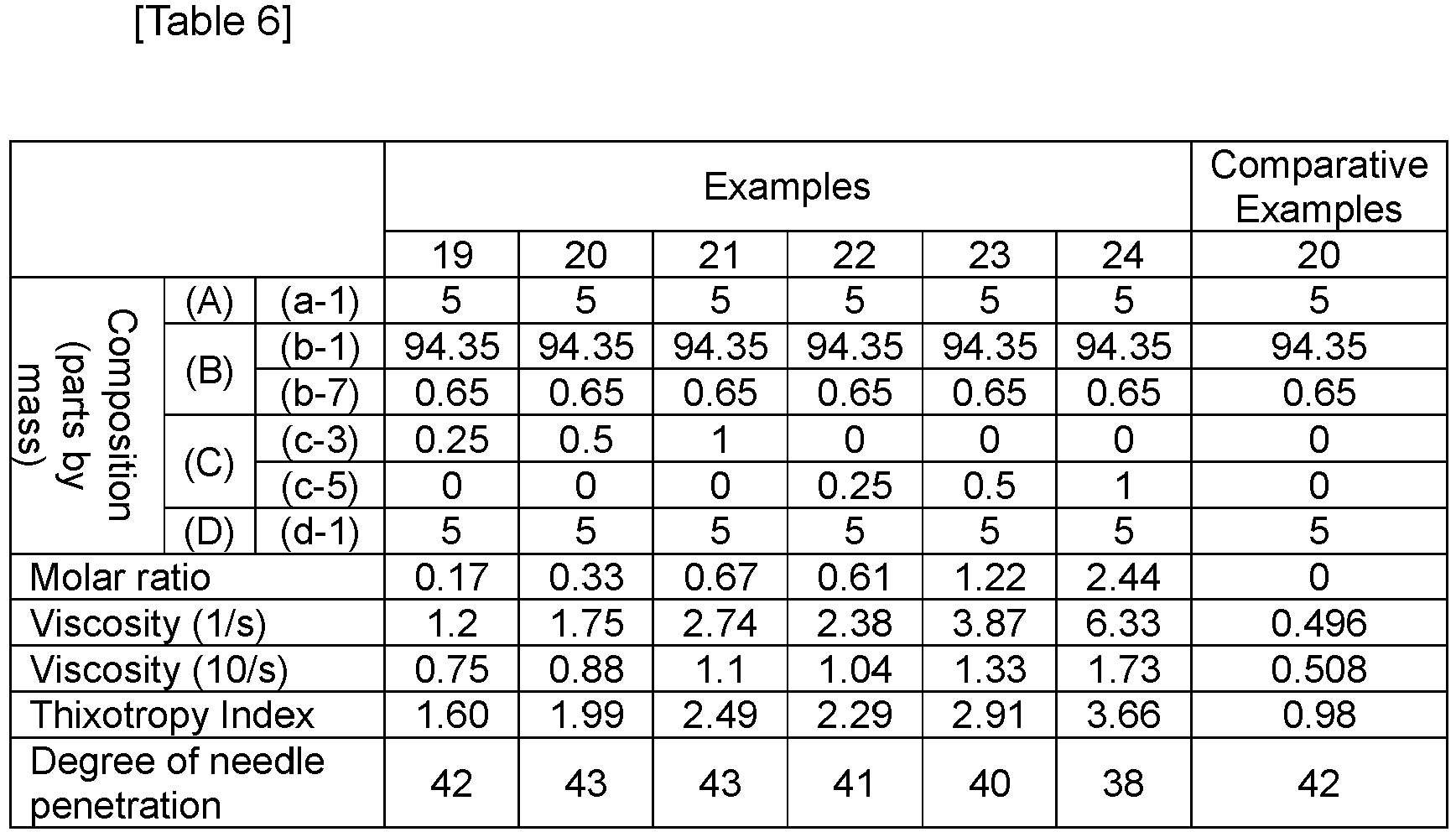


- From the results in Tables 6 to 9, it was confirmed that the type and amount of component (C) had little effect on the properties other than thixotropic properties, specifically on the hardness of a cured product.
- The organopolysiloxane composition of the present invention exhibits sufficient thixotropic properties independent of fumed silica, precipitated silica, alumina, titanium oxide, and other inorganic powders, and therefore can be used, for example, as a grease material, or by mixing with a crosslinking agent, as a potting agent, coating agent, or molding material.
Claims (7)
- An organopolysiloxane composition, at least comprising:(A) an organopolysiloxane expressed by the average unit formula:
(R1 3SiO1/2)a(R1 2SiO2/2)b(R1SiO3/2)c(SiO4/2)d(HO1/2)e
(where R1 each independently represents a hydrogen atom or a monovalent hydrocarbon group having 1 to 10 carbon atoms, and a, b c and d each represent a number satisfying 0 ≤ a ≤ 0.8, 0 ≤ b ≤ 0.8, 0 ≤ c ≤ 0.8, and 0 ≤ d ≤ 0.8, and 0.2 ≤ a + b ≤ 0.8, 0.2 ≤ c + d ≤ 0.8, and a + b + c + d = 1, and e represents a number satisfying 0.05 ≤ e ≤ 0.5);(B) an organopolysiloxane expressed by the average unit formula:
(R2 3SiO1/2)f(R2 2SiO2/2)g(R2SiO3/2)h(SiO4/2)i(HO1/2)j
(where R2 each independently represents a hydrogen atom or a monovalent hydrocarbon group having 1 to 10 carbon atoms, and f, g h, and i each represent a number satisfying 0 ≤ f ≤ 1, 0 ≤ g ≤ 1, 0 ≤ h ≤ 0.8, and 0 ≤ i ≤ 0.8, and 0.2 ≤ f + g ≤ 1, 0 ≤ h + i ≤ 0.8, and f + g + h + i = 1, and j represents a number satisfying 0 ≤ j < 0.05); and(C) a compound having at least two functional groups selected from ether bonds, ester bonds, and alkoxysilyl groups expressed by the general formula:in one molecule; wherein
R3 k(R4O)(3-k)Si-
(where R3 represents a monovalent hydrocarbon group having 1 to 10 carbon atoms, R4 represents an alkyl group having 1 to 10 carbon atoms, and k represents 0, 1, or 2)
the amount of component (A) is 2 to 70 mass% of the sum of the aforementioned component (A) and component (B), and the amount of component (C) is an amount in which the sum of the functional groups in component (C) is 0.05 mol or more with regard to 1 mol of the silicon-bonded hydroxyl group in component (A). - The organopolysiloxane composition according to claim 1, wherein a viscosity η of the mixture of component (A) and component (B) at 25°C as measured by a rotational viscometer at a shear rate of 10/sec is 0.01 to 10,000 Pa-s.
- The organopolysiloxane composition according to claim 1, wherein component (C) is a compound having at least two of the ether bonds in one molecule.
- The organopolysiloxane composition according to claim 1, wherein component (C) is a compound having at least two of the alkoxysilyl groups in one molecule.
- The organopolysiloxane composition according to claim 1, wherein component (C) is a compound having at least an ether bond and an alkoxysilyl group in one molecule.
- The organopolysiloxane composition according to claim 1, wherein component (C) is a compound having at least an ester bond and an alkoxysilyl group in one molecule.
- The organopolysiloxane composition according to claim 1, wherein component (B) is an organopolysiloxane having an alkenyl group and an organopolysiloxane having a silicon-bonded hydrogen atom, the organopolysiloxane composition further comprising:
(D) a hydrosilylation reaction catalyst.
Applications Claiming Priority (2)
| Application Number | Priority Date | Filing Date | Title |
|---|---|---|---|
| JP2021048055 | 2021-03-23 | ||
| PCT/JP2022/013421 WO2022202885A1 (en) | 2021-03-23 | 2022-03-23 | Organopolysiloxane composition |
Publications (2)
| Publication Number | Publication Date |
|---|---|
| EP4317282A1 true EP4317282A1 (en) | 2024-02-07 |
| EP4317282A4 EP4317282A4 (en) | 2025-04-09 |
Family
ID=83397328
Family Applications (1)
| Application Number | Title | Priority Date | Filing Date |
|---|---|---|---|
| EP22775667.3A Pending EP4317282A4 (en) | 2021-03-23 | 2022-03-23 | Organopolysiloxane composition |
Country Status (7)
| Country | Link |
|---|---|
| US (1) | US20240174815A1 (en) |
| EP (1) | EP4317282A4 (en) |
| JP (1) | JPWO2022202885A1 (en) |
| KR (1) | KR20230160857A (en) |
| CN (1) | CN117043275A (en) |
| TW (1) | TWI898121B (en) |
| WO (1) | WO2022202885A1 (en) |
Families Citing this family (2)
| Publication number | Priority date | Publication date | Assignee | Title |
|---|---|---|---|---|
| WO2026034290A1 (en) * | 2024-08-07 | 2026-02-12 | ダウ・東レ株式会社 | Polysiloxane composition and use thereof |
| CN119285956B (en) * | 2024-11-11 | 2025-12-26 | 广州硅芯材料科技有限公司 | A long-chain alkyl organosilicon resin and its preparation method, an organosilicon composition and its preparation method and application |
Family Cites Families (22)
| Publication number | Priority date | Publication date | Assignee | Title |
|---|---|---|---|---|
| FR2865223B1 (en) * | 2004-01-21 | 2007-11-16 | Rhodia Chimie Sa | USE OF A SILICONE FORMULATION FOR THE SUSTAINABLE FUNCTIONALIZATION OF TEXTILES FOR SPORTSWEAR |
| JP5000566B2 (en) | 2008-03-27 | 2012-08-15 | 信越化学工業株式会社 | Curable silicone rubber composition and optical semiconductor device using the same as sealing material |
| JP5534977B2 (en) * | 2010-06-29 | 2014-07-02 | 東レ・ダウコーニング株式会社 | Curable organopolysiloxane composition and optical semiconductor device |
| KR101790821B1 (en) * | 2010-12-22 | 2017-10-26 | 모멘티브 파포만스 마테리아루즈 쟈판 고도가이샤 | Ultraviolet-curable silicone resin composition and image display device using same |
| JP2013129733A (en) * | 2011-12-21 | 2013-07-04 | Yokohama Rubber Co Ltd:The | Thermosetting silicone resin composition for sealing optical semiconductor |
| JP5819787B2 (en) * | 2012-07-19 | 2015-11-24 | 信越化学工業株式会社 | Curable silicone resin composition |
| JP2014050318A (en) | 2012-09-04 | 2014-03-20 | Horiba Ltd | Pretreatment equipment and pretreatment method |
| KR102065203B1 (en) | 2012-09-27 | 2020-01-10 | 모멘티브 파포만스 마테리아루즈 쟈판 고도가이샤 | Silicone composition for sealing optical semiconductor element, and optical semiconductor device |
| JP5587520B1 (en) | 2013-05-08 | 2014-09-10 | モメンティブ・パフォーマンス・マテリアルズ・ジャパン合同会社 | Dam material composition for image display device and image display device using the same |
| JP6467125B2 (en) | 2013-06-27 | 2019-02-06 | 株式会社カネカ | Curable resin composition, cured product obtained by curing the composition |
| JP6338327B2 (en) | 2013-06-27 | 2018-06-06 | 株式会社カネカ | Curable resin composition, cured product obtained by curing the composition |
| JP6194853B2 (en) * | 2014-06-06 | 2017-09-13 | 信越化学工業株式会社 | White thermosetting silicone resin composition for optical semiconductor device and case for mounting optical semiconductor element |
| WO2017030128A1 (en) * | 2015-08-17 | 2017-02-23 | モメンティブ・パフォーマンス・マテリアルズ・ジャパン合同会社 | Room temperature curable polyorganosiloxane composition and method for preparing same |
| JP6347902B1 (en) * | 2015-10-19 | 2018-06-27 | 東レ・ダウコーニング株式会社 | Active energy ray-curable hot melt silicone composition, cured product thereof, and method for producing film |
| JPWO2018066572A1 (en) * | 2016-10-04 | 2019-08-15 | 東レ・ダウコーニング株式会社 | Novel resin-linear organopolysiloxane block copolymer, use thereof, and production method thereof |
| FR3061183B1 (en) * | 2016-12-23 | 2020-09-11 | Bluestar Silicones France | COBALT COMPOUNDS USEFUL AS A CATALYST FOR HYDROSILYLATION, DEHYDROGENANT SILYLATION AND CROSS-LINKING OF SILICON COMPOSITIONS |
| WO2018155131A1 (en) * | 2017-02-27 | 2018-08-30 | 東レ・ダウコーニング株式会社 | Curable organopolysiloxane composition and semiconductor device |
| WO2018159725A1 (en) * | 2017-03-02 | 2018-09-07 | 東レ・ダウコーニング株式会社 | Curable silicone composition, cured product of same, and optical display |
| KR102457711B1 (en) * | 2017-03-15 | 2022-10-24 | 신에쓰 가가꾸 고교 가부시끼가이샤 | Flame-retardant airbag, method for manufacturing flame-retardant airbag, and addition-curing liquid silicone rubber composition for flame-retardant airbag |
| JP7150702B2 (en) * | 2017-04-06 | 2022-10-11 | ダウ・東レ株式会社 | Liquid curable silicone adhesive composition, cured product thereof and use thereof |
| TWI791554B (en) * | 2017-07-31 | 2023-02-11 | 美商陶氏有機矽公司 | Curable organopolysiloxane composition and optical semiconductor device |
| WO2019045830A1 (en) * | 2017-08-31 | 2019-03-07 | Dow Silicones Corporation | Cosmetic compositions |
-
2022
- 2022-03-08 TW TW111108308A patent/TWI898121B/en active
- 2022-03-23 KR KR1020237035632A patent/KR20230160857A/en active Pending
- 2022-03-23 JP JP2023509239A patent/JPWO2022202885A1/ja active Pending
- 2022-03-23 EP EP22775667.3A patent/EP4317282A4/en active Pending
- 2022-03-23 WO PCT/JP2022/013421 patent/WO2022202885A1/en not_active Ceased
- 2022-03-23 CN CN202280018181.3A patent/CN117043275A/en active Pending
- 2022-03-23 US US18/282,948 patent/US20240174815A1/en active Pending
Also Published As
| Publication number | Publication date |
|---|---|
| TW202248351A (en) | 2022-12-16 |
| EP4317282A4 (en) | 2025-04-09 |
| JPWO2022202885A1 (en) | 2022-09-29 |
| CN117043275A (en) | 2023-11-10 |
| US20240174815A1 (en) | 2024-05-30 |
| KR20230160857A (en) | 2023-11-24 |
| TWI898121B (en) | 2025-09-21 |
| WO2022202885A1 (en) | 2022-09-29 |
Similar Documents
| Publication | Publication Date | Title |
|---|---|---|
| EP2271714B1 (en) | Curable organopolysiloxane composition and cured product thereof | |
| KR102065203B1 (en) | Silicone composition for sealing optical semiconductor element, and optical semiconductor device | |
| JP6532986B2 (en) | Curable silicone composition | |
| CN110291156B (en) | Curable silicone composition, cured product thereof, and optical display | |
| JPH07119366B2 (en) | Adhesive silicone composition | |
| EP2733160A1 (en) | Organo polysiloxane, and method for producing same | |
| CN101300305A (en) | curable silicone composition | |
| KR20180120594A (en) | Addition-curable silicone composition, method for producing the composition, cured silicone, and optical element | |
| US20240174815A1 (en) | Organopolysiloxane composition | |
| EP2271700B1 (en) | Organopolysiloxane, method of manufacturing thereof, curable silicone composition, and cured product thereof | |
| KR102886469B1 (en) | Silicone resin composition for die-bonding, cured product, and optical semiconductor device | |
| KR102679282B1 (en) | Thermally conductive silicone composition | |
| CN111138860B (en) | Addition-curable silicone resin composition, cured product thereof, and optical semiconductor device | |
| JP7581352B2 (en) | Anti-sulfuration coating material, cured product thereof, and electronic device | |
| US12479995B2 (en) | Curable liquid silicone composition, cured product of curable liquid silicone composition, optical filler including curable liquid silicone composition, and display device including layer comprising cured product of curable liquid silicone composition | |
| TWI837387B (en) | Addition-hardening polysilicone coating composition, polysilicone hardened material and optical semiconductor device | |
| JP7270574B2 (en) | Addition-curable silicone composition, cured silicone product, and optical element | |
| JP7736420B2 (en) | Curable fluorosilicone composition | |
| EP4370606B1 (en) | Thermal conductive silicone composition | |
| WO2024077435A1 (en) | Thermally conductive silicone composition | |
| CN111073297A (en) | Addition-curable silicone composition, silicone cured product, and optical element | |
| JP7721388B2 (en) | Curable silicone composition | |
| JP2020125430A (en) | Organic modified silicone resin composition for die bonding, and cured product thereof and optical semiconductor element | |
| KR20240137471A (en) | High thixotropic curable silicone composition and cured product thereof | |
| JP2025064157A (en) | Addition reaction curable silicone composition |
Legal Events
| Date | Code | Title | Description |
|---|---|---|---|
| STAA | Information on the status of an ep patent application or granted ep patent |
Free format text: STATUS: THE INTERNATIONAL PUBLICATION HAS BEEN MADE |
|
| PUAI | Public reference made under article 153(3) epc to a published international application that has entered the european phase |
Free format text: ORIGINAL CODE: 0009012 |
|
| STAA | Information on the status of an ep patent application or granted ep patent |
Free format text: STATUS: REQUEST FOR EXAMINATION WAS MADE |
|
| 17P | Request for examination filed |
Effective date: 20231003 |
|
| AK | Designated contracting states |
Kind code of ref document: A1 Designated state(s): AL AT BE BG CH CY CZ DE DK EE ES FI FR GB GR HR HU IE IS IT LI LT LU LV MC MK MT NL NO PL PT RO RS SE SI SK SM TR |
|
| DAV | Request for validation of the european patent (deleted) | ||
| DAX | Request for extension of the european patent (deleted) | ||
| A4 | Supplementary search report drawn up and despatched |
Effective date: 20250310 |
|
| RIC1 | Information provided on ipc code assigned before grant |
Ipc: C08L 83/07 20060101ALI20250304BHEP Ipc: C08L 83/05 20060101ALI20250304BHEP Ipc: C08L 83/04 20060101ALI20250304BHEP Ipc: C08K 5/5415 20060101ALI20250304BHEP Ipc: C08K 5/10 20060101ALI20250304BHEP Ipc: C08K 5/06 20060101AFI20250304BHEP |