EP4317242A1 - Fluorine-containing compound having sulfonic acid group and polymer electrolyte fuel cell - Google Patents
Fluorine-containing compound having sulfonic acid group and polymer electrolyte fuel cell Download PDFInfo
- Publication number
- EP4317242A1 EP4317242A1 EP22780852.4A EP22780852A EP4317242A1 EP 4317242 A1 EP4317242 A1 EP 4317242A1 EP 22780852 A EP22780852 A EP 22780852A EP 4317242 A1 EP4317242 A1 EP 4317242A1
- Authority
- EP
- European Patent Office
- Prior art keywords
- sulfonic acid
- acid group
- group
- general formula
- aromatic
- Prior art date
- Legal status (The legal status is an assumption and is not a legal conclusion. Google has not performed a legal analysis and makes no representation as to the accuracy of the status listed.)
- Pending
Links
Images

Classifications
-
- C—CHEMISTRY; METALLURGY
- C08—ORGANIC MACROMOLECULAR COMPOUNDS; THEIR PREPARATION OR CHEMICAL WORKING-UP; COMPOSITIONS BASED THEREON
- C08L—COMPOSITIONS OF MACROMOLECULAR COMPOUNDS
- C08L65/00—Compositions of macromolecular compounds obtained by reactions forming a carbon-to-carbon link in the main chain; Compositions of derivatives of such polymers
-
- H—ELECTRICITY
- H01—ELECTRIC ELEMENTS
- H01M—PROCESSES OR MEANS, e.g. BATTERIES, FOR THE DIRECT CONVERSION OF CHEMICAL ENERGY INTO ELECTRICAL ENERGY
- H01M8/00—Fuel cells; Manufacture thereof
- H01M8/10—Fuel cells with solid electrolytes
- H01M8/1016—Fuel cells with solid electrolytes characterised by the electrolyte material
- H01M8/1018—Polymeric electrolyte materials
- H01M8/1039—Polymeric electrolyte materials halogenated, e.g. sulfonated polyvinylidene fluorides
-
- C—CHEMISTRY; METALLURGY
- C08—ORGANIC MACROMOLECULAR COMPOUNDS; THEIR PREPARATION OR CHEMICAL WORKING-UP; COMPOSITIONS BASED THEREON
- C08G—MACROMOLECULAR COMPOUNDS OBTAINED OTHERWISE THAN BY REACTIONS ONLY INVOLVING UNSATURATED CARBON-TO-CARBON BONDS
- C08G61/00—Macromolecular compounds obtained by reactions forming a carbon-to-carbon link in the main chain of the macromolecule
- C08G61/02—Macromolecular compounds containing only carbon atoms in the main chain of the macromolecule, e.g. polyxylylenes
- C08G61/10—Macromolecular compounds containing only carbon atoms in the main chain of the macromolecule, e.g. polyxylylenes only aromatic carbon atoms, e.g. polyphenylenes
-
- C—CHEMISTRY; METALLURGY
- C08—ORGANIC MACROMOLECULAR COMPOUNDS; THEIR PREPARATION OR CHEMICAL WORKING-UP; COMPOSITIONS BASED THEREON
- C08G—MACROMOLECULAR COMPOUNDS OBTAINED OTHERWISE THAN BY REACTIONS ONLY INVOLVING UNSATURATED CARBON-TO-CARBON BONDS
- C08G61/00—Macromolecular compounds obtained by reactions forming a carbon-to-carbon link in the main chain of the macromolecule
- C08G61/12—Macromolecular compounds containing atoms other than carbon in the main chain of the macromolecule
-
- C—CHEMISTRY; METALLURGY
- C09—DYES; PAINTS; POLISHES; NATURAL RESINS; ADHESIVES; COMPOSITIONS NOT OTHERWISE PROVIDED FOR; APPLICATIONS OF MATERIALS NOT OTHERWISE PROVIDED FOR
- C09D—COATING COMPOSITIONS, e.g. PAINTS, VARNISHES OR LACQUERS; FILLING PASTES; CHEMICAL PAINT OR INK REMOVERS; INKS; CORRECTING FLUIDS; WOODSTAINS; PASTES OR SOLIDS FOR COLOURING OR PRINTING; USE OF MATERIALS THEREFOR
- C09D165/00—Coating compositions based on macromolecular compounds obtained by reactions forming a carbon-to-carbon link in the main chain; Coating compositions based on derivatives of such polymers
-
- H—ELECTRICITY
- H01—ELECTRIC ELEMENTS
- H01B—CABLES; CONDUCTORS; INSULATORS; SELECTION OF MATERIALS FOR THEIR CONDUCTIVE, INSULATING OR DIELECTRIC PROPERTIES
- H01B1/00—Conductors or conductive bodies characterised by the conductive materials; Selection of materials as conductors
- H01B1/06—Conductors or conductive bodies characterised by the conductive materials; Selection of materials as conductors mainly consisting of other non-metallic substances
- H01B1/12—Conductors or conductive bodies characterised by the conductive materials; Selection of materials as conductors mainly consisting of other non-metallic substances organic substances
- H01B1/122—Ionic conductors
-
- H—ELECTRICITY
- H01—ELECTRIC ELEMENTS
- H01M—PROCESSES OR MEANS, e.g. BATTERIES, FOR THE DIRECT CONVERSION OF CHEMICAL ENERGY INTO ELECTRICAL ENERGY
- H01M4/00—Electrodes
- H01M4/86—Inert electrodes with catalytic activity, e.g. for fuel cells
-
- H—ELECTRICITY
- H01—ELECTRIC ELEMENTS
- H01M—PROCESSES OR MEANS, e.g. BATTERIES, FOR THE DIRECT CONVERSION OF CHEMICAL ENERGY INTO ELECTRICAL ENERGY
- H01M4/00—Electrodes
- H01M4/86—Inert electrodes with catalytic activity, e.g. for fuel cells
- H01M4/8605—Porous electrodes
-
- H—ELECTRICITY
- H01—ELECTRIC ELEMENTS
- H01M—PROCESSES OR MEANS, e.g. BATTERIES, FOR THE DIRECT CONVERSION OF CHEMICAL ENERGY INTO ELECTRICAL ENERGY
- H01M4/00—Electrodes
- H01M4/86—Inert electrodes with catalytic activity, e.g. for fuel cells
- H01M4/90—Selection of catalytic material
-
- H—ELECTRICITY
- H01—ELECTRIC ELEMENTS
- H01M—PROCESSES OR MEANS, e.g. BATTERIES, FOR THE DIRECT CONVERSION OF CHEMICAL ENERGY INTO ELECTRICAL ENERGY
- H01M8/00—Fuel cells; Manufacture thereof
- H01M8/10—Fuel cells with solid electrolytes
-
- H—ELECTRICITY
- H01—ELECTRIC ELEMENTS
- H01M—PROCESSES OR MEANS, e.g. BATTERIES, FOR THE DIRECT CONVERSION OF CHEMICAL ENERGY INTO ELECTRICAL ENERGY
- H01M8/00—Fuel cells; Manufacture thereof
- H01M8/10—Fuel cells with solid electrolytes
- H01M8/1004—Fuel cells with solid electrolytes characterised by membrane-electrode assemblies [MEA]
-
- H—ELECTRICITY
- H01—ELECTRIC ELEMENTS
- H01M—PROCESSES OR MEANS, e.g. BATTERIES, FOR THE DIRECT CONVERSION OF CHEMICAL ENERGY INTO ELECTRICAL ENERGY
- H01M8/00—Fuel cells; Manufacture thereof
- H01M8/10—Fuel cells with solid electrolytes
- H01M8/1016—Fuel cells with solid electrolytes characterised by the electrolyte material
- H01M8/1018—Polymeric electrolyte materials
- H01M8/102—Polymeric electrolyte materials characterised by the chemical structure of the main chain of the ion-conducting polymer
- H01M8/1023—Polymeric electrolyte materials characterised by the chemical structure of the main chain of the ion-conducting polymer having only carbon, e.g. polyarylenes, polystyrenes or polybutadiene-styrenes
-
- H—ELECTRICITY
- H01—ELECTRIC ELEMENTS
- H01M—PROCESSES OR MEANS, e.g. BATTERIES, FOR THE DIRECT CONVERSION OF CHEMICAL ENERGY INTO ELECTRICAL ENERGY
- H01M8/00—Fuel cells; Manufacture thereof
- H01M8/10—Fuel cells with solid electrolytes
- H01M8/1016—Fuel cells with solid electrolytes characterised by the electrolyte material
- H01M8/1018—Polymeric electrolyte materials
- H01M8/102—Polymeric electrolyte materials characterised by the chemical structure of the main chain of the ion-conducting polymer
- H01M8/1025—Polymeric electrolyte materials characterised by the chemical structure of the main chain of the ion-conducting polymer having only carbon and oxygen, e.g. polyethers, sulfonated polyetheretherketones [S-PEEK], sulfonated polysaccharides, sulfonated celluloses or sulfonated polyesters
-
- H—ELECTRICITY
- H01—ELECTRIC ELEMENTS
- H01M—PROCESSES OR MEANS, e.g. BATTERIES, FOR THE DIRECT CONVERSION OF CHEMICAL ENERGY INTO ELECTRICAL ENERGY
- H01M8/00—Fuel cells; Manufacture thereof
- H01M8/10—Fuel cells with solid electrolytes
- H01M8/1016—Fuel cells with solid electrolytes characterised by the electrolyte material
- H01M8/1018—Polymeric electrolyte materials
- H01M8/102—Polymeric electrolyte materials characterised by the chemical structure of the main chain of the ion-conducting polymer
- H01M8/1032—Polymeric electrolyte materials characterised by the chemical structure of the main chain of the ion-conducting polymer having sulfur, e.g. sulfonated-polyethersulfones [S-PES]
-
- H—ELECTRICITY
- H01—ELECTRIC ELEMENTS
- H01M—PROCESSES OR MEANS, e.g. BATTERIES, FOR THE DIRECT CONVERSION OF CHEMICAL ENERGY INTO ELECTRICAL ENERGY
- H01M8/00—Fuel cells; Manufacture thereof
- H01M8/10—Fuel cells with solid electrolytes
- H01M8/1016—Fuel cells with solid electrolytes characterised by the electrolyte material
- H01M8/1018—Polymeric electrolyte materials
- H01M8/1069—Polymeric electrolyte materials characterised by the manufacturing processes
- H01M8/1086—After-treatment of the membrane other than by polymerisation
- H01M8/1088—Chemical modification, e.g. sulfonation
-
- C—CHEMISTRY; METALLURGY
- C08—ORGANIC MACROMOLECULAR COMPOUNDS; THEIR PREPARATION OR CHEMICAL WORKING-UP; COMPOSITIONS BASED THEREON
- C08G—MACROMOLECULAR COMPOUNDS OBTAINED OTHERWISE THAN BY REACTIONS ONLY INVOLVING UNSATURATED CARBON-TO-CARBON BONDS
- C08G2261/00—Macromolecular compounds obtained by reactions forming a carbon-to-carbon link in the main chain of the macromolecule
- C08G2261/10—Definition of the polymer structure
- C08G2261/12—Copolymers
- C08G2261/122—Copolymers statistical
-
- C—CHEMISTRY; METALLURGY
- C08—ORGANIC MACROMOLECULAR COMPOUNDS; THEIR PREPARATION OR CHEMICAL WORKING-UP; COMPOSITIONS BASED THEREON
- C08G—MACROMOLECULAR COMPOUNDS OBTAINED OTHERWISE THAN BY REACTIONS ONLY INVOLVING UNSATURATED CARBON-TO-CARBON BONDS
- C08G2261/00—Macromolecular compounds obtained by reactions forming a carbon-to-carbon link in the main chain of the macromolecule
- C08G2261/10—Definition of the polymer structure
- C08G2261/12—Copolymers
- C08G2261/124—Copolymers alternating
-
- C—CHEMISTRY; METALLURGY
- C08—ORGANIC MACROMOLECULAR COMPOUNDS; THEIR PREPARATION OR CHEMICAL WORKING-UP; COMPOSITIONS BASED THEREON
- C08G—MACROMOLECULAR COMPOUNDS OBTAINED OTHERWISE THAN BY REACTIONS ONLY INVOLVING UNSATURATED CARBON-TO-CARBON BONDS
- C08G2261/00—Macromolecular compounds obtained by reactions forming a carbon-to-carbon link in the main chain of the macromolecule
- C08G2261/10—Definition of the polymer structure
- C08G2261/14—Side-groups
- C08G2261/145—Side-chains containing sulfur
-
- C—CHEMISTRY; METALLURGY
- C08—ORGANIC MACROMOLECULAR COMPOUNDS; THEIR PREPARATION OR CHEMICAL WORKING-UP; COMPOSITIONS BASED THEREON
- C08G—MACROMOLECULAR COMPOUNDS OBTAINED OTHERWISE THAN BY REACTIONS ONLY INVOLVING UNSATURATED CARBON-TO-CARBON BONDS
- C08G2261/00—Macromolecular compounds obtained by reactions forming a carbon-to-carbon link in the main chain of the macromolecule
- C08G2261/10—Definition of the polymer structure
- C08G2261/14—Side-groups
- C08G2261/146—Side-chains containing halogens
-
- C—CHEMISTRY; METALLURGY
- C08—ORGANIC MACROMOLECULAR COMPOUNDS; THEIR PREPARATION OR CHEMICAL WORKING-UP; COMPOSITIONS BASED THEREON
- C08G—MACROMOLECULAR COMPOUNDS OBTAINED OTHERWISE THAN BY REACTIONS ONLY INVOLVING UNSATURATED CARBON-TO-CARBON BONDS
- C08G2261/00—Macromolecular compounds obtained by reactions forming a carbon-to-carbon link in the main chain of the macromolecule
- C08G2261/10—Definition of the polymer structure
- C08G2261/14—Side-groups
- C08G2261/148—Side-chains having aromatic units
-
- C—CHEMISTRY; METALLURGY
- C08—ORGANIC MACROMOLECULAR COMPOUNDS; THEIR PREPARATION OR CHEMICAL WORKING-UP; COMPOSITIONS BASED THEREON
- C08G—MACROMOLECULAR COMPOUNDS OBTAINED OTHERWISE THAN BY REACTIONS ONLY INVOLVING UNSATURATED CARBON-TO-CARBON BONDS
- C08G2261/00—Macromolecular compounds obtained by reactions forming a carbon-to-carbon link in the main chain of the macromolecule
- C08G2261/30—Monomer units or repeat units incorporating structural elements in the main chain
- C08G2261/31—Monomer units or repeat units incorporating structural elements in the main chain incorporating aromatic structural elements in the main chain
- C08G2261/312—Non-condensed aromatic systems, e.g. benzene
-
- C—CHEMISTRY; METALLURGY
- C08—ORGANIC MACROMOLECULAR COMPOUNDS; THEIR PREPARATION OR CHEMICAL WORKING-UP; COMPOSITIONS BASED THEREON
- C08G—MACROMOLECULAR COMPOUNDS OBTAINED OTHERWISE THAN BY REACTIONS ONLY INVOLVING UNSATURATED CARBON-TO-CARBON BONDS
- C08G2261/00—Macromolecular compounds obtained by reactions forming a carbon-to-carbon link in the main chain of the macromolecule
- C08G2261/30—Monomer units or repeat units incorporating structural elements in the main chain
- C08G2261/31—Monomer units or repeat units incorporating structural elements in the main chain incorporating aromatic structural elements in the main chain
- C08G2261/314—Condensed aromatic systems, e.g. perylene, anthracene or pyrene
- C08G2261/3142—Condensed aromatic systems, e.g. perylene, anthracene or pyrene fluorene-based, e.g. fluorene, indenofluorene, or spirobifluorene
-
- C—CHEMISTRY; METALLURGY
- C08—ORGANIC MACROMOLECULAR COMPOUNDS; THEIR PREPARATION OR CHEMICAL WORKING-UP; COMPOSITIONS BASED THEREON
- C08G—MACROMOLECULAR COMPOUNDS OBTAINED OTHERWISE THAN BY REACTIONS ONLY INVOLVING UNSATURATED CARBON-TO-CARBON BONDS
- C08G2261/00—Macromolecular compounds obtained by reactions forming a carbon-to-carbon link in the main chain of the macromolecule
- C08G2261/40—Polymerisation processes
- C08G2261/41—Organometallic coupling reactions
- C08G2261/412—Yamamoto reactions
-
- C—CHEMISTRY; METALLURGY
- C08—ORGANIC MACROMOLECULAR COMPOUNDS; THEIR PREPARATION OR CHEMICAL WORKING-UP; COMPOSITIONS BASED THEREON
- C08G—MACROMOLECULAR COMPOUNDS OBTAINED OTHERWISE THAN BY REACTIONS ONLY INVOLVING UNSATURATED CARBON-TO-CARBON BONDS
- C08G2261/00—Macromolecular compounds obtained by reactions forming a carbon-to-carbon link in the main chain of the macromolecule
- C08G2261/40—Polymerisation processes
- C08G2261/41—Organometallic coupling reactions
- C08G2261/413—Heck reactions
-
- C—CHEMISTRY; METALLURGY
- C08—ORGANIC MACROMOLECULAR COMPOUNDS; THEIR PREPARATION OR CHEMICAL WORKING-UP; COMPOSITIONS BASED THEREON
- C08G—MACROMOLECULAR COMPOUNDS OBTAINED OTHERWISE THAN BY REACTIONS ONLY INVOLVING UNSATURATED CARBON-TO-CARBON BONDS
- C08G2261/00—Macromolecular compounds obtained by reactions forming a carbon-to-carbon link in the main chain of the macromolecule
- C08G2261/50—Physical properties
- C08G2261/51—Charge transport
- C08G2261/514—Electron transport
-
- C—CHEMISTRY; METALLURGY
- C08—ORGANIC MACROMOLECULAR COMPOUNDS; THEIR PREPARATION OR CHEMICAL WORKING-UP; COMPOSITIONS BASED THEREON
- C08G—MACROMOLECULAR COMPOUNDS OBTAINED OTHERWISE THAN BY REACTIONS ONLY INVOLVING UNSATURATED CARBON-TO-CARBON BONDS
- C08G2261/00—Macromolecular compounds obtained by reactions forming a carbon-to-carbon link in the main chain of the macromolecule
- C08G2261/50—Physical properties
- C08G2261/51—Charge transport
- C08G2261/516—Charge transport ion-conductive
-
- C—CHEMISTRY; METALLURGY
- C08—ORGANIC MACROMOLECULAR COMPOUNDS; THEIR PREPARATION OR CHEMICAL WORKING-UP; COMPOSITIONS BASED THEREON
- C08G—MACROMOLECULAR COMPOUNDS OBTAINED OTHERWISE THAN BY REACTIONS ONLY INVOLVING UNSATURATED CARBON-TO-CARBON BONDS
- C08G2261/00—Macromolecular compounds obtained by reactions forming a carbon-to-carbon link in the main chain of the macromolecule
- C08G2261/70—Post-treatment
- C08G2261/72—Derivatisation
- C08G2261/722—Sulfonation
-
- C—CHEMISTRY; METALLURGY
- C08—ORGANIC MACROMOLECULAR COMPOUNDS; THEIR PREPARATION OR CHEMICAL WORKING-UP; COMPOSITIONS BASED THEREON
- C08G—MACROMOLECULAR COMPOUNDS OBTAINED OTHERWISE THAN BY REACTIONS ONLY INVOLVING UNSATURATED CARBON-TO-CARBON BONDS
- C08G2261/00—Macromolecular compounds obtained by reactions forming a carbon-to-carbon link in the main chain of the macromolecule
- C08G2261/90—Applications
-
- H—ELECTRICITY
- H01—ELECTRIC ELEMENTS
- H01M—PROCESSES OR MEANS, e.g. BATTERIES, FOR THE DIRECT CONVERSION OF CHEMICAL ENERGY INTO ELECTRICAL ENERGY
- H01M8/00—Fuel cells; Manufacture thereof
- H01M8/10—Fuel cells with solid electrolytes
- H01M2008/1095—Fuel cells with polymeric electrolytes
-
- H—ELECTRICITY
- H01—ELECTRIC ELEMENTS
- H01M—PROCESSES OR MEANS, e.g. BATTERIES, FOR THE DIRECT CONVERSION OF CHEMICAL ENERGY INTO ELECTRICAL ENERGY
- H01M2300/00—Electrolytes
- H01M2300/0017—Non-aqueous electrolytes
- H01M2300/0065—Solid electrolytes
- H01M2300/0082—Organic polymers
-
- Y—GENERAL TAGGING OF NEW TECHNOLOGICAL DEVELOPMENTS; GENERAL TAGGING OF CROSS-SECTIONAL TECHNOLOGIES SPANNING OVER SEVERAL SECTIONS OF THE IPC; TECHNICAL SUBJECTS COVERED BY FORMER USPC CROSS-REFERENCE ART COLLECTIONS [XRACs] AND DIGESTS
- Y02—TECHNOLOGIES OR APPLICATIONS FOR MITIGATION OR ADAPTATION AGAINST CLIMATE CHANGE
- Y02E—REDUCTION OF GREENHOUSE GAS [GHG] EMISSIONS, RELATED TO ENERGY GENERATION, TRANSMISSION OR DISTRIBUTION
- Y02E60/00—Enabling technologies; Technologies with a potential or indirect contribution to GHG emissions mitigation
- Y02E60/30—Hydrogen technology
- Y02E60/50—Fuel cells
Definitions
- the present invention relates to a fluorine-containing compound having a sulfonic acid group and a polymer electrolyte fuel cell using the compound.
- a polymer electrolyte fuel cell has an anode catalyst layer, a cathode catalyst layer and a polymer electrolyte membrane sandwiched between the both catalyst layers.
- composition used for the polymer electrolyte membrane a composition containing a fluorinated polymer having a sulfone group and a fluorinated aromatic compound having a functional group which is reactive with the sulfone group of the fluorinated polymer has been known (for example, see Patent Document 3).
- a catalyst layer is produced by coating a catalyst composition in which a catalyst, catalyst carrier and electrolyte are dispersed or dissolved in a solvent to a polymer electrolyte membrane and a substrate, etc.
- a solvent a polar solvent such as an alcohol, water, etc.
- gas permeability is required as well as electron conductivity. Therefore, when the electrolyte covers at least part of the catalyst carried on a catalyst carrier, these characteristics are likely to be exhibited, and the polymer electrolyte fuel cell can obtain good power generation characteristics.
- the catalyst composition it is desirable that at least part of the electrolyte is dissolved in a solvent, and that a ratio to be dissolved is high.
- Patent Document 3 its use is a solid electrolyte, so that there was no technical task to cover the catalyst, and a solubility of the compound in which the fluorinated polymer and the reactive fluorinated aromatic compound are reacted in a solvent has not been investigated.
- An object of the present invention is to provide a compound that has good solubility in a polar solvent and when it is used as an electrolyte in a catalyst layer of a polymer electrolyte fuel cell, the polymer electrolyte fuel cell exhibits good power generation characteristics.
- the present invention relates to, for example, the following [1] to [13].
- the compound of the present invention has good solubility in polar solvents, and when it is used as an electrolyte in the catalyst layer of a polymer electrolyte fuel cell, the polymer electrolyte fuel cell exhibits excellent power generation characteristics.
- Fig. 1 is a sectional view schematically showing the constitution of the polymer electrolyte fuel cell.
- the first embodiment of the present invention relates to a compound having a structure represented by the following general formula (I).
- Ar 1 is an aromatic structure optionally substituted by a sulfonic acid group(s),
- Ar 1 , Ar 2 , Ar 3 , R 1 , R 2 , R 3 , R 4 , R 5 , l, m, n and p in the general formula (I) are as mentioned below.
- Ar 1 is an aromatic structure, and optionally substituted by a sulfonic acid group(s). Ar 1 preferably has no substituents other than the sulfonic acid group.
- aromatic structure there may be mentioned monocyclic aromatics, polycyclic aromatics, fused aromatic rings and aromatic heterocycles, and preferably monocyclic aromatics and polycyclic aromatics.
- Ar 1 is more preferably one kind selected from the group consisting of the following (provided that Xs are each independently hydrogen, an alkyl group having 1 to 8 carbon atoms or a phenyl group) and optionally substituted by a sulfonic acid group(s), and further preferably one kind selected from the group consisting of the following, and optionally substituted by a sulfonic acid group(s).
- Ar 2 is an aromatic structure and optionally substituted by a sulfonic acid group(s). Ar 2 preferably has no substituents other than the sulfonic acid group.
- aromatic structure there may be mentioned monocyclic aromatics, polycyclic aromatics, fused aromatic rings and aromatic heterocycles, preferably monocyclic aromatics and polycyclic aromatics, and more preferably a benzene ring.
- the aromatic heterocycles are cyclic compounds containing one or more nitrogen, sulfur, and oxygen other than carbon.
- nitrogen there may be mentioned pyridine, pyrazine, pyrimidine, pyridazine, quinoline, isoquinoline, etc.
- sulfur there may be mentioned thiophene, benzothiophene, etc.
- oxygen there may be mentioned furan, benzofuran, etc.
- Ar 2 is a benzene ring, and optionally substituted by a sulfonic acid group(s).
- Ar 3 is an aromatic structure, and optionally substituted by a sulfonic acid group(s). Ar 3 preferably has no substituents other than the sulfonic acid group.
- R 1 to R 5 are each independently hydrogen, a sulfonic acid group or an aromatic group, wherein one of R 1 to R 5 is hydrogen or a sulfonic acid group, and four are aromatic groups.
- the aromatic groups may each independently and optionally have a sulfonic acid group(s).
- the aromatic groups preferably have no substituents other than the sulfonic acid group.
- R 1 to R 5 when they are aromatic groups, they are each independently one kind selected from the group consisting of and optionally have a sulfonic acid group(s), and more preferably they are and optionally have a sulfonic acid group(s).
- R 1 and R 4 are preferably the same, and R 2 and R 3 are preferably the same.
- R 5 is preferably hydrogen or a sulfonic acid group.
- One or more kinds selected from the group consisting of Ar 1 , Ar 2 , Ar 3 , R 1 , R 2 , R 3 , R 4 and R 5 when they are aromatic groups and a benzene ring A have one or more sulfonic acid groups.
- one or more kinds selected from the group consisting of R 1 , R 2 , R 3 , R 4 and R 5 when they are aromatic groups have one or more sulfonic acid groups.
- a number of the sulfonic acid group of the compound represented by the general formula (I) is preferably 1 to 8, more preferably 1 to 5, and further preferably 2 to 4.
- m is not 0, each constitutional unit where molar fractions are l and m is randomly copolymerized.
- the compound represented by the general formula (I) is produced by the following producing method.
- Ar 1 ', Ar 2 ', Ar 3 ', R 1 ', R 2 ', R 3 ', R 4 ' and R 5 ' are as defined in the general formula (I), except that they do not have a sulfonic acid group, unless otherwise specifically mentioned. That is, they are as defined in the general formula (pre-I) in the second embodiment of the present invention mentioned later. l, m, n and p are as defined in the general formula (I) unless otherwise specifically mentioned.
- Step 1 a bis-halogen monomer having a benzene skeleton which has substituents of R 1 ' to R 5 ' having no sulfonic acid group is produced by the following producing method.
- Step 1 a compound represented by the formula (i) and Ar 2 ' which is substituted by an ethynyl group and dihalogen and is not substituted by a sulfonic acid group are subjected to Diels-Alder reaction to obtain a compound represented by the formula (v) which is a bis-halogen monomer.
- a compound represented by the formula (i) and Ar 3 ' which is substituted by an ethynyl group and mono-halogen and is not substituted by a sulfonic acid group are subjected to Diels-Alder reaction, followed by conversion of the halogen group to a boronic acid group or a boronic acid ester group, and further subjected to Suzuki-Miyaura reaction to obtain a compound represented by the formula (iv) which is a bis-halogen monomer.
- the reaction temperature is usually 20 to 200°C.
- Step 2 using a palladium catalyst, the reaction of Scheme A or Scheme B is carried out to obtain a fluorine-containing compound represented by the following general formula (pre-I).
- the general formula (pre-I") is the case where m is not 0 in the general formula (pre-I).
- Ar 1' in the formula (viii) is not substituted by a sulfonic acid group.
- 0 ⁇ m' ⁇ 1.0 is not substituted by a sulfonic acid group.
- a number average molecular weight (Mn) of the compound represented by the general formula (pre-I) measured by the method described in Examples is preferably 5,000 to 100,000, more preferably 6,000 to 80,000, and further preferably 8,000 to 60,000.
- a polydispersity index (PDI) of the compound represented by the general formula (pre-I) measured by the method described in Examples is preferably 1 to 8, more preferably 1 to 6, and further preferably 1 to 4.
- Step 3 the compound represented by the general formula (pre-I) is reacted with a sulfonating agent to obtain a compound represented by the general formula (I) in which a sulfonic acid group(s) is/are introduced into the compound represented by the general formula (pre-I).
- the sulfonic acid group(s) is/are introduced into one or more kinds selected from the group consisting of Ar 1 ', Ar 2 ', Ar 3 ', R 1 ', R 2 ', R 3 ', R 4 ' and R 5 ' when they are an aromatic group and a benzene ring having substituents of R 1 ' to R 5 ' in the general formula (pre-I).
- the sulfonating agent there may be mentioned trimethylsilyl chloride sulfate, sulfonic acid chloride, fuming sulfuric acid, sulfuric acid, etc.
- the sulfonating agent is preferably reacted in an amount of 0.5 to 6-fold in terms of an equivalent ratio based on the molecular weight of the unit structure calculated using the molar fraction in the fluorine-containing polymer represented by the general formula (pre-I).
- a halogen-based solvent such as methylene chloride, chloroform, etc.
- the reaction temperature is generally 0 to 100°C.
- the second embodiment of the present invention relates to a compound obtained by reacting a sulfonating agent with a compound represented by the following general formula (pre-I).
- a compound represented by the following general formula (pre-I) Ar 1 ' is an aromatic structure
- Ar 1 ', Ar 2 ', Ar 3 ', R 1 ', R 2 ', R 3 ', R 4 ', R 5 ', l, m, n and p in the general formula (pre-I) are as mentioned below.
- Ar 1 ' is an aromatic structure. Ar 1 ' preferably has no substituent.
- As the aromatic structure there may be mentioned monocyclic aromatics, polycyclic aromatics, fused aromatic rings and aromatic heterocycles, and preferably monocyclic aromatics and polycyclic aromatics.
- Ar 1 ' is more preferably one kind selected from the group consisting of the following (provided that Xs are each independently hydrogen, an alkyl group having 1 to 8 carbon atoms or a phenyl group), and further preferably at least one kind selected from the following group.
- Ar 2 ' is an aromatic structure.
- aromatic structure there may be mentioned monocyclic aromatics, polycyclic aromatics, fused aromatic rings and aromatic heterocycles, preferably monocyclic aromatics and aromatic heterocycles, and more preferably a benzene ring. It is preferred that Ar 2 ' has no substituent.
- the aromatic heterocycles are cyclic compound containing one or more nitrogen, sulfur or oxygen other than carbon.
- nitrogen there may be mentioned pyridine, pyrazine, pyrimidine, pyridazine, quinoline, isoquinoline, etc.
- sulfur there may be mentioned thiophene, benzothiophene, etc.
- oxygen there may be mentioned furan, benzofuran, etc.
- Ar 2 ' is a benzene ring.
- Ar 3 ' is an aromatic structure. As the aromatic structure, the same as those exemplified in Ar 2 ' may be mentioned. It is preferred that Ar 3 ' has no substituent.
- R 1 ' to R 5 ' are each independently hydrogen or an aromatic group, and one of R 1 ' to R 5 ' is hydrogen, and four are aromatic groups. When R 1 ' to R 5 ' are aromatic groups, it is preferred that they have no substituent.
- R 1 ' to R 5 ' when they are aromatic groups, it is preferred that they are each independently one kind selected from the group consisting of and more preferably
- R 1 ' and R 4 ' are the same, and R 2 ' and R 3 ' are the same.
- R 5 ' is preferably a hydrogen.
- m is not 0, each constitutional unit of which molar fractions are l and m is randomly copolymerized.
- a number average molecular weight (Mn) of the compound represented by the general formula (pre-I) measured by the method described in Examples is preferably 5,000 to 100,000, more preferably 6,000 to 80,000, and further preferably 8,000 to 60,000.
- a polydispersity index (PDI) of the compound represented by the general formula (pre-I) measured by the method described in Examples is preferably 1 to 8, more preferably 1 to 6, and further preferably 1 to 4.
- the compound represented by the general formula (pre-I) can be obtained by the producing method containing Step 1 and Step 2 of the producing method of the first embodiment.
- sulfonating agent there may be mentioned trimethylsilyl chloride sulfate, sulfonic acid chloride, fuming sulfuric acid, sulfuric acid, etc.
- the compound of the second embodiment of the present invention can be obtained by the same reaction as Step 3 of the producing method of the first embodiment of the present invention.
- a sulfonic acid group(s) is/are introduced into at least one kind selected from the group consisting of Ar 1 ', Ar 2 ', Ar 3 ', R 1 ', R 2 ', R 3 ', R 4 ' and R 5 ' where they are aromatic groups and a benzene ring having substituents of R 1 ' to R 5 ' in the general formula (pre-I).
- Fig. 1 is a sectional view schematically showing the constitution of the polymer electrolyte fuel cell (hereinafter also referred to as "fuel cell”).
- the polymer electrolyte fuel cell 100 has an anode catalyst layer 103, a cathode catalyst layer 105 and a polymer electrolyte membrane 107 sandwiched between both catalyst layers, and each catalyst layer has a gas diffusion layer (Gas Diffusion Layer, hereinafter also referred to as "GDL”.) 101 at the outside.
- GDL gas diffusion layer
- This constitution is referred to as a membrane electrode assembly (Membrane Electrode Assembly, hereinafter also referred to as "MEA").
- MEA Membrane Electrode Assembly
- this membrane electrode assembly (MEA) is usually sandwiched between separators 109.
- the compound represented by the above-mentioned general formula (I) can be used for the anode catalyst layer 103, the cathode catalyst layer 105 and the polymer electrolyte membrane 107 of the fuel cell, preferably used for the anode catalyst layer 103 and the cathode catalyst layer 105 of the fuel cell, and from the viewpoint of suppressing overvoltage rise caused by decrease in oxygen gas diffusivity at the time of high current driving, more preferably used for at least the cathode catalyst layer 105.
- a catalyst carried on a catalyst carrier is called an electrocatalyst.
- the anode catalyst layer 103 and the cathode catalyst layer 105 are sometimes abbreviated to as catalyst layers.
- the catalyst layers 103 and 105 each include a catalyst, a catalyst carrier for carrying the catalyst, and an electrolyte.
- metal catalysts can be used without any particular limitation
- the catalyst in the cathode catalyst layer 105 known metal catalysts can be used without any particular limitation.
- Such metal catalysts used in the anode catalyst layer 103 and the cathode catalyst layer 105 may be mentioned, for example, metals such as platinum, gold, silver, ruthenium, iridium, rhodium, palladium, osmium, tungsten, lead, iron, chromium, cobalt, nickel, manganese, vanadium, molybdenum, gallium, aluminum, etc., an alloy of these metals, and core/shell of these metals and the like.
- the catalyst carrier there may be mentioned, for example, carbon materials including carbon blacks such as channel black, furnace black, thermal black, etc., activated carbon in which a material containing various carbon atoms has been carbonized and subjected to activation treatment, coke, natural graphite, artificial graphite, graphitized carbon, and the like, and carbon black is preferred since specific surface area is high and electronic conductivity is excellent.
- carbon blacks such as channel black, furnace black, thermal black, etc.
- activated carbon in which a material containing various carbon atoms has been carbonized and subjected to activation treatment
- coke natural graphite, artificial graphite, graphitized carbon, and the like
- carbon black is preferred since specific surface area is high and electronic conductivity is excellent.
- the compound represented by the above-mentioned general formula (I) is used.
- the electrolyte may be used the compound represented by the above-mentioned general formula (I) alone, or may be used the compound represented by the above-mentioned general formula (I) optionally in combination with at least one kind of other electrolyte(s) selected from the group consisting of fluorine-based sulfonic acid polymers such as, for example, Nafion (Registered Trademark, available from Du Pont de Nemours and Company), Aquivion (Registered Trademark, available from Solvay S.A.), FLEMION (Registered Trademark, available from AGC Inc.), Aciplex (Registered Trademark, available from Asahi Kasei Corporation), and the like, hydrocarbon-based sulfonic acid polymers, and partially fluorine-introduced hydrocarbon-based sulfonic acid polymers.
- fluorine-based sulfonic acid polymers such as, for example,
- a method of making the anode catalyst layer 103 and the cathode catalyst layer 105 will be explained.
- a metal catalyst and a catalyst carrier as a catalyst ink the catalyst ink is coated on a target substrate and dried to prepare a catalyst layer.
- the catalyst composition may contain, as an electrolyte, an electrolyte other than the compound represented by the above-mentioned general formula (I) in addition to the compound represented by the above-mentioned general formula (I).
- the target substrate there may be mentioned, for example, polyelectrolyte membrane, GDL, and sheets made of a fluorine resin, etc., and a catalyst layer can be prepared by a known producing method.
- catalyst ink is coated on a sheet comprising a fluorine resin
- the coated catalyst layer is transferred to the polymer electrolyte membrane.
- a sheet comprising a fluorine resin a sheet comprising polytetrafluoroethylene (PTFE) is generally mentioned.
- the compound represented by the above-mentioned general formula (I) can cover the metal catalyst carried on the metal carrier with a suitable thickness, so that while maintaining the function of the catalyst, diffusibility of gas and proton conductivity are good.
- An amount of the compound represented by the above-mentioned general formula (I) to be used to the metal catalyst is preferably 0.1 to 10-fold.
- the catalyst composition used as the catalyst ink may contain a binder and a solvent.
- the binder can be used as a component to bind the catalyst carriers together to suppress decrease in electronic conductivity in the electrode catalyst.
- the binder there may be mentioned, for example, fluorine-based sulfonic acid polymers such as polytetrafluoroethylene (PTFE), polyvinylidene fluoride (PVDF), ethylene-propylene-diene copolymer (EPDM), Nafion (Registered Trademark, available from Du Pont de Nemours and Company), Aquivion (Registered Trademark, available from Solvay S.A.), FLEMION (Registered Trademark, available from AGC Inc.), Aciplex (Registered Trademark, available from Asahi Kasei Corporation), and the like. These may be used one kind alone or may be used two or more kinds in combination.
- solvent there may be mentioned, for example, polar solvents such as water, methanol, ethanol, 1-propanol, 2-propanol, 1-butanol, 2-butanol, isobutyl alcohol, tert-butyl alcohol, pentanol, dimethylsulfoxide, N,N-dimethylformamide, etc.
- polar solvents such as water, methanol, ethanol, 1-propanol, 2-propanol, 1-butanol, 2-butanol and isobutyl alcohol are preferred. These may be used one kind alone or may be used two or more kinds in combination.
- a content of each component in the catalyst composition is optionally adjusted depending on the purpose, and in 100% by mass solid content of the catalyst composition excluding the weight of the solvent, the metal catalyst is preferably 10 to 60% by mass, and more preferably 30 to 50% by mass, the electrolyte containing the compound represented by the above-mentioned general formula (I) is preferably 5 to 50% by mass, and more preferably 10 to 30% by mass, the catalyst carrier is preferably 20 to 75% by mass, and more preferably 30 to 50% by mass, and the binder is preferably 0 to 5% by mass, and more preferably 0 to 3% by mass.
- the component mentioned as the electrolyte and also as the binder is contained in the electrolyte in the above-mentioned formulation amount.
- the solvent to be used in the catalyst composition is preferably 50 to 99% by mass, and more preferably 80 to 99% by mass per 100% by mass of the catalyst composition.
- the compound represented by the above-mentioned general formula (I) fluorine-based sulfonic acid polymers such as Nafion (Registered Trademark, available from Du Pont de Nemours and Company), Aquivion (Registered Trademark, available from Solvay S.A.), FLEMION (Registered Trademark, available from AGC Inc.), Aciplex (Registered Trademark, available from Asahi Kasei Corporation), etc., hydrocarbon-based sulfonic acid polymers, partially fluorine-introduced hydrocarbon-based sulfonic acid polymers, etc., and from the viewpoint of proton conductivity, there may be mentioned the compound represented by the above-mentioned general formula (I).
- fluorine-based sulfonic acid polymers such as Nafion (Registered Trademark, available from Du Pont de Nemours and Company), Aquivion (Registered Trademark, available from Solvay S.A.), FLEMION (Registered Trademark
- the thickness of the polymer electrolyte membrane 107 from the viewpoints of conductivity, durability, and cross leakage of gas, 10 to 100 ⁇ m is preferred, and 20 to 60 ⁇ m is more preferred.
- porous materials having conductivity are suitably used, and as such materials, there may be mentioned, for example, carbonaceous paper and non-woven fabrics, felts, non-woven fabrics, etc.
- GPC gel permeation chromatography
- the reaction mixture was added dropwise to a methanol-deionized water mixed solution and stirred. Filtration was carried out and the obtained filtrated product was dried to obtain the target P-10.
- the obtained P-10 had low solubility so that molecular weight measurement could not be done.
- the reaction mixture was added dropwise to a methanol-deionized water mixed solution and stirred. Filtration was carried out and the obtained filtrated product was dried to obtain the target P-11.
- the obtained P-11 had low solubility so that molecular weight measurement could not be done.
- a polymer was each added to the chloroform solvent in an amount to give a solution of 0.25% by mass, and was evaluated in accordance with the following criteria.
- a gas diffusion layer attached with a microporous layer (SIGRACET GDL28BC, manufactured by SGL carbon) was placed on a hot plate at 80°C, and the catalyst ink prepared by the above-mentioned method was coated on the microporous layer side by spray method to prepare a gas diffusion electrode in which a catalyst layer was formed on the microporous layer.
- Both sides of the electrolyte membrane (Nafion NR212, film thickness 50 ⁇ m, manufactured by Chemours) was sandwiched by a pair of the gas diffusion electrodes prepared as mentioned above, and hot press molding was carried out for 10 minutes under the conditions of 0.47 kN and 140°C to prepare a membrane-electrode assembly.
- the portion other than the electrode portion of the membrane-electrode assembly obtained above was covered by a pair of gaskets, and on both sides, a separator that also serves as a gas flow path, a current collector plate, an insulating sheet, and a clamping plate are arranged to prepare a polymer electrolyte fuel cell.
- a separator that also serves as a gas flow path, a current collector plate, an insulating sheet, and a clamping plate are arranged to prepare a polymer electrolyte fuel cell.
- one side was used as an oxygen electrode and air was supplied, and the other side was used as a fuel electrode and hydrogen was supplied to generate power.
- cell temperature was 80°C
- relative humidities at the air side and the fuel side were both 50%RH
- each gas was supplied so that utilization rates of the fuel and oxygen became 2%, and evaluation of power generation performance was carried out.
- Examples 1 to 8 have high solubility in polar solvents as compared with those of Comparative Examples 1 to 4, and they were possible to generate electricity with a cell so that it was confirmed that they could be used as an electrolyte.
Landscapes
- Chemical & Material Sciences (AREA)
- Chemical Kinetics & Catalysis (AREA)
- General Chemical & Material Sciences (AREA)
- Electrochemistry (AREA)
- Engineering & Computer Science (AREA)
- Life Sciences & Earth Sciences (AREA)
- Manufacturing & Machinery (AREA)
- Sustainable Development (AREA)
- Sustainable Energy (AREA)
- Organic Chemistry (AREA)
- Medicinal Chemistry (AREA)
- Polymers & Plastics (AREA)
- Health & Medical Sciences (AREA)
- Crystallography & Structural Chemistry (AREA)
- Materials Engineering (AREA)
- Wood Science & Technology (AREA)
- Physics & Mathematics (AREA)
- Spectroscopy & Molecular Physics (AREA)
- Polyoxymethylene Polymers And Polymers With Carbon-To-Carbon Bonds (AREA)
- Organic Low-Molecular-Weight Compounds And Preparation Thereof (AREA)
- Fuel Cell (AREA)
Abstract

Description
- The present invention relates to a fluorine-containing compound having a sulfonic acid group and a polymer electrolyte fuel cell using the compound.
- A polymer electrolyte fuel cell (PEFC) has an anode catalyst layer, a cathode catalyst layer and a polymer electrolyte membrane sandwiched between the both catalyst layers.
- For the electrolyte used in the polymer electrolyte membrane, proton conductivity, gas barrier property, electron insulating property and durability are required. As an electrolyte satisfying such characteristics, a fluorine-based ionomer has been used.
- As an electrolyte used in a polymer electrolyte membrane and a catalyst layer, a hydrocarbon-based ionomer having an aromatic as a skeleton and a sulfone group is introduced into the skeleton has been known (for example, see Patent Document 1 and Patent Document 2).
- As a composition used for the polymer electrolyte membrane, a composition containing a fluorinated polymer having a sulfone group and a fluorinated aromatic compound having a functional group which is reactive with the sulfone group of the fluorinated polymer has been known (for example, see Patent Document 3).
-
- Patent Document 1:
U.S. Patent No. 7,301,002 - Patent Document 2:
JP 2015-95424A - Patent Document 3:
JP 2014-522437A - A catalyst layer is produced by coating a catalyst composition in which a catalyst, catalyst carrier and electrolyte are dispersed or dissolved in a solvent to a polymer electrolyte membrane and a substrate, etc. As a solvent, a polar solvent such as an alcohol, water, etc., is usually used. On the other hand, for the electrolyte of the catalyst layer, in addition to proton conductivity, gas permeability is required as well as electron conductivity. Therefore, when the electrolyte covers at least part of the catalyst carried on a catalyst carrier, these characteristics are likely to be exhibited, and the polymer electrolyte fuel cell can obtain good power generation characteristics. For this purpose, in the catalyst composition, it is desirable that at least part of the electrolyte is dissolved in a solvent, and that a ratio to be dissolved is high.
- However, in the composition of Patent Document 3, its use is a solid electrolyte, so that there was no technical task to cover the catalyst, and a solubility of the compound in which the fluorinated polymer and the reactive fluorinated aromatic compound are reacted in a solvent has not been investigated.
- An object of the present invention is to provide a compound that has good solubility in a polar solvent and when it is used as an electrolyte in a catalyst layer of a polymer electrolyte fuel cell, the polymer electrolyte fuel cell exhibits good power generation characteristics.
- The present invention relates to, for example, the following [1] to [13].
- [1] A compound having a structure represented by the following general formula (I).

- Ar2 is an aromatic structure optionally substituted by a sulfonic acid group(s),
- Ar3 is an aromatic structure optionally substituted by a sulfonic acid group(s), provided that when p=1, Ar2 is a benzene ring optionally substituted by a sulfonic acid group(s),
- R1 to R5 are each independently hydrogen, a sulfonic acid group or an aromatic group, and the aromatic groups are each independently and optionally substituted by a sulfonic acid group(s),
- one of R1 to R5 is hydrogen or a sulfonic acid group, and four are aromatic groups,
- one or more kinds selected from the group consisting of Ar1, Ar2, Ar3, R1, R2, R3, R4 and R5 when they are aromatic groups and a benzene ring A has one or more sulfonic acid groups,
- l and m are molar fractions when l+m=1.0, where 0<1≦1.0 and 0≦m<1.0, and when m is not 0, each constitutional unit is randomly copolymerized,
- "n"s are each independently an integer of 1 to 3, and
- p is 0 or 1.)
- [2] A compound which is obtained by reacting a compound represented by the following general formula (pre-I):

- Ar2' is an aromatic structure,
- Ar3' is an aromatic structure,
- provided that when p=1, Ar2' is a benzene ring,
- R1' to R5' are each independently hydrogen or an aromatic group,
- one of R1' to R5' is hydrogen, and four are aromatic groups,
- l and m are molar fractions when l+m=1.0, where 0<1≦1.0 and 0≦m<1.0, and when m is not 0, each constitutional unit is randomly copolymerized,
- "n"s are each independently an integer of 1 to 3, and
- p is 0 or 1.)
- with a sulfonating agent.
- [3] The compound of [1], wherein, in the general formula (I), Ar1 is one kind selected from the group consisting of

- [4] The compound of [1], wherein, in the general formula (I), R1 to R5 when they are aromatics, are each independently one kind selected from the group consisting of

- [5] The compound of [2], wherein, in the general formula (pre-I), Ar1' is one kind selected from the group consisting of


- [6] The compound of [2], wherein, in the general formula (pre-I), R1' to R5' when they are aromatics, are each independently one kind selected from the group consisting of

- [7] The compound of any of [1] to [6], which is used as an electrolyte of an anode catalyst layer and/or a cathode catalyst layer of a polymer electrolyte fuel cell.
- [8] A catalyst layer of a polymer electrolyte fuel cell which comprises the compound of any of [1] to [6].
- [9] A catalyst composition which comprises the compound of any of [1] to [6], a metal catalyst and a catalyst carrier.
- [10] The catalyst composition of [9], which is for a polymer electrolyte fuel cell.
- [11] A catalyst layer of a polymer electrolyte fuel cell which comprises the catalyst composition of [10].
- [12] A membrane electrode assembly which comprises a polymer electrolyte membrane, a gas diffusion layer and the catalyst layer of [11].
- [13] A polymer electrolyte fuel cell which comprises the membrane electrode assembly of [12].
- The compound of the present invention has good solubility in polar solvents, and when it is used as an electrolyte in the catalyst layer of a polymer electrolyte fuel cell, the polymer electrolyte fuel cell exhibits excellent power generation characteristics.
-
Fig. 1 is a sectional view schematically showing the constitution of the polymer electrolyte fuel cell. - The first embodiment of the present invention relates to a compound having a structure represented by the following general formula (I).

- Ar2 is an aromatic structure optionally substituted by a sulfonic acid group(s),
- Ar3 is an aromatic structure optionally substituted by a sulfonic acid group(s), provided that when p=1, Ar2 is a benzene ring optionally substituted by a sulfonic acid group(s),
- R1 to R5 are each independently hydrogen, a sulfonic acid group or an aromatic group, and the aromatic groups are each independently and optionally substituted by a sulfonic acid group(s),
- one of R1 to R5 is hydrogen or a sulfonic acid group, and four are aromatic groups,
- one or more kinds selected from the group consisting of Ar1, Ar2, Ar3, R1, R2, R3, R4 and R5 when they are aromatic groups and a benzene ring A has one or more sulfonic acid groups,
- l and m are molar fractions when l+m=1.0, where 0<1≦1.0 and 0≦m<1.0, and when m is not 0, each constitutional unit is randomly copolymerized,
- "n"s are each independently an integer of 1 to 3, and
- p is 0 or 1.)
- Ar1, Ar2, Ar3, R1, R2, R3, R4, R5, l, m, n and p in the general formula (I) are as mentioned below.
- Ar1 is an aromatic structure, and optionally substituted by a sulfonic acid group(s). Ar1 preferably has no substituents other than the sulfonic acid group.
- As the aromatic structure, there may be mentioned monocyclic aromatics, polycyclic aromatics, fused aromatic rings and aromatic heterocycles, and preferably monocyclic aromatics and polycyclic aromatics.
- Ar1 is more preferably one kind selected from the group consisting of the following (provided that Xs are each independently hydrogen, an alkyl group having 1 to 8 carbon atoms or a phenyl group) and optionally substituted by a sulfonic acid group(s),

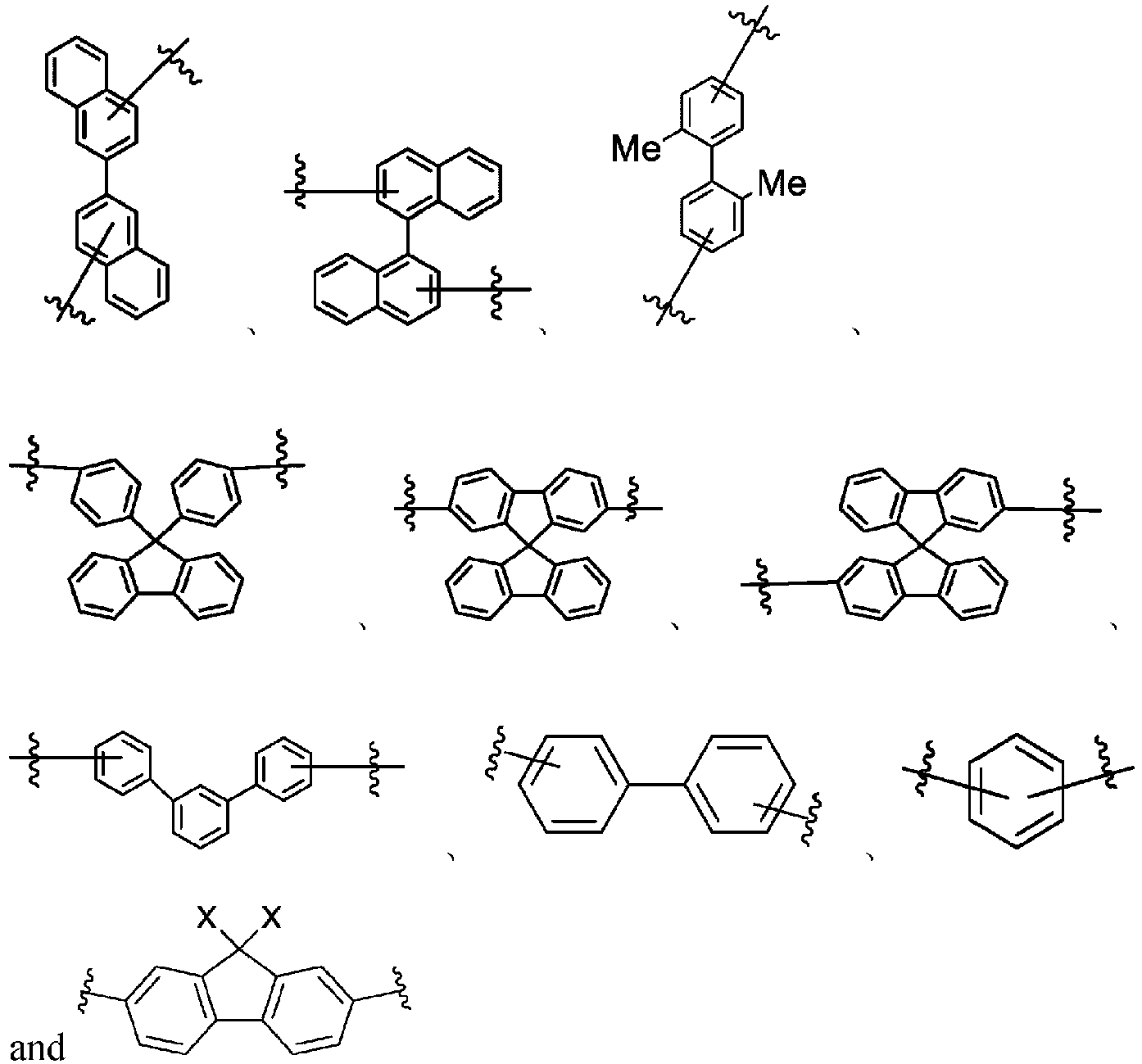

- Ar2 is an aromatic structure and optionally substituted by a sulfonic acid group(s). Ar2 preferably has no substituents other than the sulfonic acid group.
- As the aromatic structure, there may be mentioned monocyclic aromatics, polycyclic aromatics, fused aromatic rings and aromatic heterocycles, preferably monocyclic aromatics and polycyclic aromatics, and more preferably a benzene ring.
- The aromatic heterocycles are cyclic compounds containing one or more nitrogen, sulfur, and oxygen other than carbon. As the aromatic heterocycles containing nitrogen, there may be mentioned pyridine, pyrazine, pyrimidine, pyridazine, quinoline, isoquinoline, etc., as the aromatic heterocycles containing sulfur, there may be mentioned thiophene, benzothiophene, etc., and as the aromatic heterocycles containing oxygen, there may be mentioned furan, benzofuran, etc.
- When p=1, Ar2 is a benzene ring, and optionally substituted by a sulfonic acid group(s).
- Ar3 is an aromatic structure, and optionally substituted by a sulfonic acid group(s). Ar3 preferably has no substituents other than the sulfonic acid group.
- As the aromatic structure, the same as that exemplified for Ar2 may be mentioned.
- R1 to R5 are each independently hydrogen, a sulfonic acid group or an aromatic group, wherein one of R1 to R5 is hydrogen or a sulfonic acid group, and four are aromatic groups. The aromatic groups may each independently and optionally have a sulfonic acid group(s). The aromatic groups preferably have no substituents other than the sulfonic acid group.
- As R1 to R5 when they are aromatic groups, they are each independently one kind selected from the group consisting of


- R1 and R4 are preferably the same, and R2 and R3 are preferably the same. R5 is preferably hydrogen or a sulfonic acid group.
- One or more kinds selected from the group consisting of Ar1, Ar2, Ar3, R1, R2, R3, R4 and R5 when they are aromatic groups and a benzene ring A have one or more sulfonic acid groups.
- It is preferred that one or more kinds selected from the group consisting of R1, R2, R3, R4 and R5 when they are aromatic groups have one or more sulfonic acid groups.
- A number of the sulfonic acid group of the compound represented by the general formula (I) is preferably 1 to 8, more preferably 1 to 5, and further preferably 2 to 4.
- l and m are molar fractions when l+m=1.0, where 0<1≦1.0 and 0≦m<1.0, and 0.5<1≦1.0 and 0≦m<0.5 are preferred. When m is not 0, each constitutional unit where molar fractions are l and m is randomly copolymerized.
- "n"s are each independently an integer of 1 to 3, and 1 or 2 is preferred.
- p is 0 or 1, and 0 is preferred.
- As the compound represented by the above-mentioned general formula (I), there may be preferably mentioned the compound represented by the following general formula (Ia).

- The compound represented by the general formula (I) is produced by the following producing method.
- In the following producing method, Ar1', Ar2', Ar3', R1', R2', R3', R4' and R5' are as defined in the general formula (I), except that they do not have a sulfonic acid group, unless otherwise specifically mentioned. That is, they are as defined in the general formula (pre-I) in the second embodiment of the present invention mentioned later. l, m, n and p are as defined in the general formula (I) unless otherwise specifically mentioned.
- In Step 1, a bis-halogen monomer having a benzene skeleton which has substituents of R1' to R5' having no sulfonic acid group is produced by the following producing method.
- In Step 1, a compound represented by the formula (i) and Ar2' which is substituted by an ethynyl group and dihalogen and is not substituted by a sulfonic acid group are subjected to Diels-Alder reaction to obtain a compound represented by the formula (v) which is a bis-halogen monomer. Or a compound represented by the formula (i) and Ar3' which is substituted by an ethynyl group and mono-halogen and is not substituted by a sulfonic acid group are subjected to Diels-Alder reaction, followed by conversion of the halogen group to a boronic acid group or a boronic acid ester group, and further subjected to Suzuki-Miyaura reaction to obtain a compound represented by the formula (iv) which is a bis-halogen monomer. The reaction temperature is usually 20 to 200°C.

- In Step 2, using a palladium catalyst, the reaction of Scheme A or Scheme B is carried out to obtain a fluorine-containing compound represented by the following general formula (pre-I).


- Incidentally, the general formula (pre-I') is the case where m=0 in the general formula (pre-I), and the general formula (pre-I") is the case where m is not 0 in the general formula (pre-I).
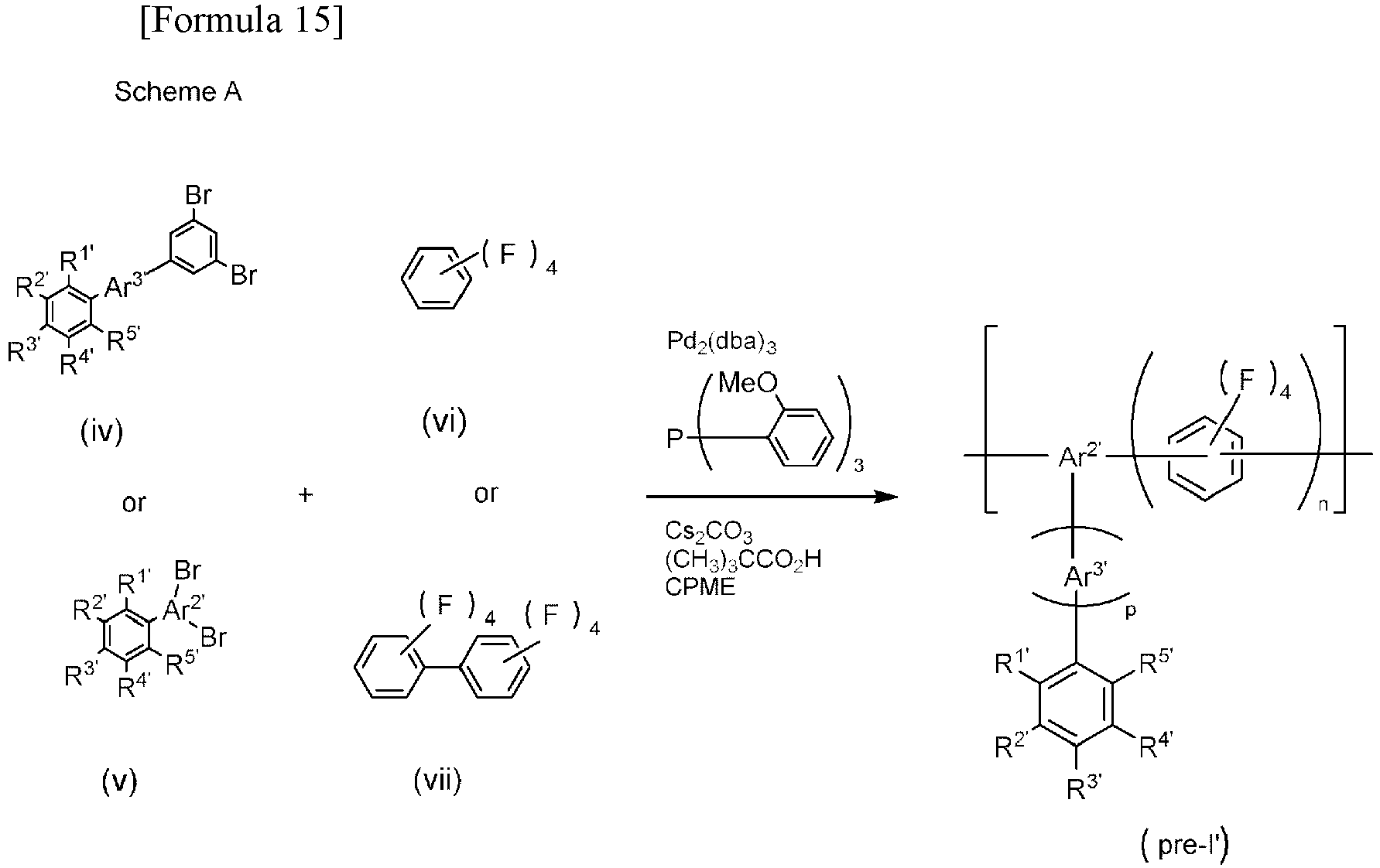


- A number average molecular weight (Mn) of the compound represented by the general formula (pre-I) measured by the method described in Examples is preferably 5,000 to 100,000, more preferably 6,000 to 80,000, and further preferably 8,000 to 60,000.
- A polydispersity index (PDI) of the compound represented by the general formula (pre-I) measured by the method described in Examples is preferably 1 to 8, more preferably 1 to 6, and further preferably 1 to 4.
- In Step 3, the compound represented by the general formula (pre-I) is reacted with a sulfonating agent to obtain a compound represented by the general formula (I) in which a sulfonic acid group(s) is/are introduced into the compound represented by the general formula (pre-I). The sulfonic acid group(s) is/are introduced into one or more kinds selected from the group consisting of Ar1', Ar2', Ar3', R1', R2', R3', R4' and R5' when they are an aromatic group and a benzene ring having substituents of R1' to R5' in the general formula (pre-I).
- As the sulfonating agent, there may be mentioned trimethylsilyl chloride sulfate, sulfonic acid chloride, fuming sulfuric acid, sulfuric acid, etc. The sulfonating agent is preferably reacted in an amount of 0.5 to 6-fold in terms of an equivalent ratio based on the molecular weight of the unit structure calculated using the molar fraction in the fluorine-containing polymer represented by the general formula (pre-I).
- As the solvent to be used in the reaction, there may be mentioned a halogen-based solvent such as methylene chloride, chloroform, etc.
- The reaction temperature is generally 0 to 100°C.
- The second embodiment of the present invention relates to a compound obtained by reacting a sulfonating agent with a compound represented by the following general formula (pre-I).

- Ar2' is an aromatic structure,
- Ar3' is an aromatic structure,
- provided that when p=1, Ar2' is a benzene ring,
- R1' to R5' are each independently hydrogen or an aromatic group, one of R1' to R5' is hydrogen, and four are aromatic groups, l and m are molar fractions when l+m=1.0, where 0<1≦1.0 and 0≦m<1.0, and when m is not 0, each constitutional unit is randomly copolymerized,
- "n"s are each independently an integer of 1 to 3,
- p is 0 or 1.)
- Ar1', Ar2', Ar3', R1', R2', R3', R4', R5', l, m, n and p in the general formula (pre-I) are as mentioned below.
- Ar1' is an aromatic structure. Ar1' preferably has no substituent.
As the aromatic structure, there may be mentioned monocyclic aromatics, polycyclic aromatics, fused aromatic rings and aromatic heterocycles, and preferably monocyclic aromatics and polycyclic aromatics. - Ar1' is more preferably one kind selected from the group consisting of the following (provided that Xs are each independently hydrogen, an alkyl group having 1 to 8 carbon atoms or a phenyl group),


- Ar2' is an aromatic structure. As the aromatic structure, there may be mentioned monocyclic aromatics, polycyclic aromatics, fused aromatic rings and aromatic heterocycles, preferably monocyclic aromatics and aromatic heterocycles, and more preferably a benzene ring. It is preferred that Ar2' has no substituent.
- The aromatic heterocycles are cyclic compound containing one or more nitrogen, sulfur or oxygen other than carbon. As the aromatic heterocycles containing nitrogen, there may be mentioned pyridine, pyrazine, pyrimidine, pyridazine, quinoline, isoquinoline, etc., as the aromatic heterocycles containing sulfur, there may be mentioned thiophene, benzothiophene, etc., the aromatic heterocycles containing oxygen, there may be mentioned furan, benzofuran, etc.
- When p=1, Ar2' is a benzene ring.
- Ar3' is an aromatic structure. As the aromatic structure, the same as those exemplified in Ar2' may be mentioned. It is preferred that Ar3' has no substituent.
- R1' to R5' are each independently hydrogen or an aromatic group, and one of R1' to R5' is hydrogen, and four are aromatic groups. When R1' to R5' are aromatic groups, it is preferred that they have no substituent.
- As R1' to R5' when they are aromatic groups, it is preferred that they are each independently one kind selected from the group consisting of


- It is preferred that R1' and R4' are the same, and R2' and R3' are the same.
- R5' is preferably a hydrogen.
- l and m are molar fractions when l+m=1.0, where 0<1≦1.0 and 0≦m<1.0, and 0.5<l≦1.0 and 0≦m<0.5 are preferred. When m is not 0, each constitutional unit of which molar fractions are l and m is randomly copolymerized.
- "n"s are each independently an integer of 1 to 3, and preferably 1 or 2.
- P is 0 or 1, and preferably 0.
- A number average molecular weight (Mn) of the compound represented by the general formula (pre-I) measured by the method described in Examples is preferably 5,000 to 100,000, more preferably 6,000 to 80,000, and further preferably 8,000 to 60,000.
- A polydispersity index (PDI) of the compound represented by the general formula (pre-I) measured by the method described in Examples is preferably 1 to 8, more preferably 1 to 6, and further preferably 1 to 4.
- The compound represented by the general formula (pre-I) can be obtained by the producing method containing Step 1 and Step 2 of the producing method of the first embodiment.
- As the sulfonating agent, there may be mentioned trimethylsilyl chloride sulfate, sulfonic acid chloride, fuming sulfuric acid, sulfuric acid, etc.
- Specifically, the compound of the second embodiment of the present invention can be obtained by the same reaction as Step 3 of the producing method of the first embodiment of the present invention.
- It is preferred that in the compound of the second embodiment of the present invention, by reacting a sulfonating agent with the compound represented by the general formula (pre-I), a sulfonic acid group(s) is/are introduced into at least one kind selected from the group consisting of Ar1', Ar2', Ar3', R1', R2', R3', R4' and R5' where they are aromatic groups and a benzene ring having substituents of R1' to R5' in the general formula (pre-I).
-
Fig. 1 is a sectional view schematically showing the constitution of the polymer electrolyte fuel cell (hereinafter also referred to as "fuel cell"). The polymerelectrolyte fuel cell 100 has ananode catalyst layer 103, acathode catalyst layer 105 and apolymer electrolyte membrane 107 sandwiched between both catalyst layers, and each catalyst layer has a gas diffusion layer (Gas Diffusion Layer, hereinafter also referred to as "GDL".) 101 at the outside. This constitution is referred to as a membrane electrode assembly (Membrane Electrode Assembly, hereinafter also referred to as "MEA"). In the polymer electrolyte fuel cell, this membrane electrode assembly (MEA) is usually sandwiched betweenseparators 109. - The compound represented by the above-mentioned general formula (I) can be used for the
anode catalyst layer 103, thecathode catalyst layer 105 and thepolymer electrolyte membrane 107 of the fuel cell, preferably used for theanode catalyst layer 103 and thecathode catalyst layer 105 of the fuel cell, and from the viewpoint of suppressing overvoltage rise caused by decrease in oxygen gas diffusivity at the time of high current driving, more preferably used for at least thecathode catalyst layer 105. - A catalyst carried on a catalyst carrier is called an electrocatalyst. In the present specification, the
anode catalyst layer 103 and thecathode catalyst layer 105 are sometimes abbreviated to as catalyst layers. - The catalyst layers 103 and 105 each include a catalyst, a catalyst carrier for carrying the catalyst, and an electrolyte.
- As the catalyst in the
anode catalyst layer 103, known metal catalysts can be used without any particular limitation, and as the catalyst in thecathode catalyst layer 105, known metal catalysts can be used without any particular limitation. Such metal catalysts used in theanode catalyst layer 103 and thecathode catalyst layer 105 may be mentioned, for example, metals such as platinum, gold, silver, ruthenium, iridium, rhodium, palladium, osmium, tungsten, lead, iron, chromium, cobalt, nickel, manganese, vanadium, molybdenum, gallium, aluminum, etc., an alloy of these metals, and core/shell of these metals and the like. - As the catalyst carrier, there may be mentioned, for example, carbon materials including carbon blacks such as channel black, furnace black, thermal black, etc., activated carbon in which a material containing various carbon atoms has been carbonized and subjected to activation treatment, coke, natural graphite, artificial graphite, graphitized carbon, and the like, and carbon black is preferred since specific surface area is high and electronic conductivity is excellent.
- As the electrolyte, the compound represented by the above-mentioned general formula (I) is used. The electrolyte may be used the compound represented by the above-mentioned general formula (I) alone, or may be used the compound represented by the above-mentioned general formula (I) optionally in combination with at least one kind of other electrolyte(s) selected from the group consisting of fluorine-based sulfonic acid polymers such as, for example, Nafion (Registered Trademark, available from Du Pont de Nemours and Company), Aquivion (Registered Trademark, available from Solvay S.A.), FLEMION (Registered Trademark, available from AGC Inc.), Aciplex (Registered Trademark, available from Asahi Kasei Corporation), and the like, hydrocarbon-based sulfonic acid polymers, and partially fluorine-introduced hydrocarbon-based sulfonic acid polymers.
- A method of making the
anode catalyst layer 103 and thecathode catalyst layer 105 will be explained. After preparing a catalyst composition containing the compound represented by the above-mentioned general formula (I), a metal catalyst and a catalyst carrier as a catalyst ink, the catalyst ink is coated on a target substrate and dried to prepare a catalyst layer. The catalyst composition may contain, as an electrolyte, an electrolyte other than the compound represented by the above-mentioned general formula (I) in addition to the compound represented by the above-mentioned general formula (I). - As the target substrate, there may be mentioned, for example, polyelectrolyte membrane, GDL, and sheets made of a fluorine resin, etc., and a catalyst layer can be prepared by a known producing method. When catalyst ink is coated on a sheet comprising a fluorine resin, the coated catalyst layer is transferred to the polymer electrolyte membrane. As the sheet comprising a fluorine resin, a sheet comprising polytetrafluoroethylene (PTFE) is generally mentioned.
- The compound represented by the above-mentioned general formula (I) can cover the metal catalyst carried on the metal carrier with a suitable thickness, so that while maintaining the function of the catalyst, diffusibility of gas and proton conductivity are good. An amount of the compound represented by the above-mentioned general formula (I) to be used to the metal catalyst is preferably 0.1 to 10-fold.
- The catalyst composition used as the catalyst ink may contain a binder and a solvent.
- The binder can be used as a component to bind the catalyst carriers together to suppress decrease in electronic conductivity in the electrode catalyst. As the binder, there may be mentioned, for example, fluorine-based sulfonic acid polymers such as polytetrafluoroethylene (PTFE), polyvinylidene fluoride (PVDF), ethylene-propylene-diene copolymer (EPDM), Nafion (Registered Trademark, available from Du Pont de Nemours and Company), Aquivion (Registered Trademark, available from Solvay S.A.), FLEMION (Registered Trademark, available from AGC Inc.), Aciplex (Registered Trademark, available from Asahi Kasei Corporation), and the like. These may be used one kind alone or may be used two or more kinds in combination.
- As the solvent, there may be mentioned, for example, polar solvents such as water, methanol, ethanol, 1-propanol, 2-propanol, 1-butanol, 2-butanol, isobutyl alcohol, tert-butyl alcohol, pentanol, dimethylsulfoxide, N,N-dimethylformamide, etc. As the above-mentioned solvents, water, methanol, ethanol, 1-propanol, 2-propanol, 1-butanol, 2-butanol and isobutyl alcohol are preferred. These may be used one kind alone or may be used two or more kinds in combination.
- A content of each component in the catalyst composition is optionally adjusted depending on the purpose, and in 100% by mass solid content of the catalyst composition excluding the weight of the solvent, the metal catalyst is preferably 10 to 60% by mass, and more preferably 30 to 50% by mass, the electrolyte containing the compound represented by the above-mentioned general formula (I) is preferably 5 to 50% by mass, and more preferably 10 to 30% by mass, the catalyst carrier is preferably 20 to 75% by mass, and more preferably 30 to 50% by mass, and the binder is preferably 0 to 5% by mass, and more preferably 0 to 3% by mass. The component mentioned as the electrolyte and also as the binder is contained in the electrolyte in the above-mentioned formulation amount.
- The solvent to be used in the catalyst composition is preferably 50 to 99% by mass, and more preferably 80 to 99% by mass per 100% by mass of the catalyst composition.
- As the materials of the
polymer electrolyte membrane 107, there may be mentioned the compound represented by the above-mentioned general formula (I), fluorine-based sulfonic acid polymers such as Nafion (Registered Trademark, available from Du Pont de Nemours and Company), Aquivion (Registered Trademark, available from Solvay S.A.), FLEMION (Registered Trademark, available from AGC Inc.), Aciplex (Registered Trademark, available from Asahi Kasei Corporation), etc., hydrocarbon-based sulfonic acid polymers, partially fluorine-introduced hydrocarbon-based sulfonic acid polymers, etc., and from the viewpoint of proton conductivity, there may be mentioned the compound represented by the above-mentioned general formula (I). - As for the thickness of the
polymer electrolyte membrane 107, from the viewpoints of conductivity, durability, and cross leakage of gas, 10 to 100 µm is preferred, and 20 to 60 µm is more preferred. - As the
gas diffusion layer 101, although there is no particular limitation, porous materials having conductivity are suitably used, and as such materials, there may be mentioned, for example, carbonaceous paper and non-woven fabrics, felts, non-woven fabrics, etc. - The above is described on the compound represented by the general formula (I) which is the first embodiment of the present invention, but the compound of the second embodiment of the present invention can be similarly used as in the compound represented by the general formula (I).
- Hereinafter, the present invention will be explained in more detail by referring to Examples and Comparative Examples, but the present invention is not limited to these Examples.
- It is the measurement results by gel permeation chromatography (hereinafter, it is abbreviated to as GPC). For the measurement, a GPC apparatus manufactured by TOSOH CORPORATION was used, and the measurement conditions, etc., are as follows.
- GPC column: TSKgel SuperHZM-N; TSKgel SuperHZ3000; TSKgel SuperHZ2000 (TOSOH CORPORATION)
- Column temperature: 40°C
- Solvent: Tetrahydrofuran (THF)
- Flow amount: 0.6 ml/min
- Standard sample: Polystyrene (TOSOH CORPORATION)
-

- Under nitrogen atmosphere, in a reaction apparatus were each charged 5.16 g of 2,2'-(1,4-phenylene)bis(1-phenylene-1,2-dione) and 6.66 g of 1,3-diphenylpropan-2-one, and 320 ml of ethanol was added thereto. The reaction mixture was heated and refluxed, then a solution prepared with 1.69 g of potassium hydroxide and 8 ml of ethanol was added dropwise, and the mixture was stirred under heat reflux conditions for 30 minutes. After cooling to room temperature, the mixture was further stirred for one hour while cooling in an ice bath, and then filtered. The obtained filtrated product was dried to obtain 8.94g (Yield 86%) of the target Int-1.
- 1H NMR (500MHz, DMSO-d6) δ (ppm): 7.21-7.24 (m, 12H), 7.15-7.18 (m, 4H), 6.92-6.93 (m, 4H).
- Under nitrogen atmosphere, in a reaction apparatus were each charged 12 g of Int-1 and 6.2 g of 1-bromo-4-ethynylbenzene, and 60 mL of nitrobenzene was added thereto. The reaction mixture was heated to 180°C and stirred for 7 hours. After cooling to room temperature, the mixture was added dropwise to methanol, and after stirring, filtration was carried out and the filtrated product was dried to obtain 15 g (Yield 91%) of the target Int-2.
- Under nitrogen atmosphere, in a reaction apparatus were charged 10 g of Int-2, 5.7 g of bis(pinacolato)diboron, 0.91 g of [1,1'-bis(diphenylphosphino)ferrocene]-dichloro-palladium(II) dichloromethane adduct, 5.5 g of potassium acetate and 70 mL of N,N-dimethylformamide. The reaction mixture was heated to 150°C and stirred for 18 hours. After cooling to room temperature, the mixture was added dropwise to deionized water, and after stirring, filtration was carried out and the filtrated product was dried. The filtrated product after drying was dissolved, then, separation and purification were carried out by column chromatography (chloroform/hexane=1/1) to obtain 7.4 g (Yield 68%) of the target Int-3.
1H NMR (500MHz, CDCl3) δ (ppm): 7.60 (d, J=8.0Hz, 2H), 7.55 (s, 1H), 7.18 (d, J=8.0Hz, 2H), 7.14-7.16 (m, 5H), 6.90-6.92 (m, 6H), 6.83-6.87 (m, 7H), 6.76-6.78 (m, 2H), 1.32 (s, 12H). - Under nitrogen atmosphere, in a reaction apparatus were charged 7.0 g of Int-3, 6.5 g of 1,3-dibromo-5-iodobenzene and 0.70 g of tetrakistriphenylphosphine palladium, and 100 mL of 2M aqueous potassium carbonate, 70 mL of ethanol and 175 mL of toluene were added to the mixture. The reaction mixture was heated to 80°C and stirred for 3.5 hours. After cooling to room temperature, liquid separation was carried out and the obtained organic layer was dried over sodium sulfate. Condensation was carried out and the obtained condensate was subjected to separation and purification by column chromatography (with gradient of chloroform/hexane=from 1/3 to 1/1) to obtain 7.4 g (Yield 89%) of the target M-1.
1H NMR (500MHz, CDCl3) δ (ppm): 7.61-7.62 (m, 2H), 7.59 (m, 2H), 7.34 (d, J=8.0Hz, 2H), 7.24 (d, J=8.0Hz, 2H), 7.16 (m, 5H), 6.93-6.96 (m, 6H), 6.84-6.88 (m, 7H), 6.78-6.80 (m, 2H). -

- Under nitrogen atmosphere, in a reaction apparatus were charged 5.0 g of 1,3-dibromo-5-iodobenzene, 0.29 g of bis(triphenylphosphine)palladium dichloride, 0.081 g of copper iodide, 0.11 g of triphenylphosphine and 1.5 g of trimethylsilylacetylene, and 5 mL of tetrahydrofuran and 10 mL of triethylamine were added to the mixture. The reaction mixture was heated to 50°C and stirred for 8.5 hours. After cooling the reaction mixture to room temperature, silica gel filtration was carried out, and the obtained filtrate was evaporated to dryness. The residue was dissolved by adding hexane, and separation and purification were carried out by column chromatography (hexane) to obtain 4.0 g (Yield 87%) of the target Int-4.
1H NMR (500MHz, CDCl3) δ (ppm): 7.61 (t, J=2.0Hz, 1H), 7.53 (d, J=2.0Hz, 2H), 0.24 (s, 9H). - In a reaction apparatus were charged 4.0 g of Int-4 and 5.0 g potassium carbonate, and 50 mL of methanol was added to the mixture. The reaction mixture was stirred at room temperature for 72 hours. The reaction mixture was filtered and the obtained filtrate was concentrated and evaporated to dryness. The residue was dissolved in chloroform, and deionized water was added thereto and liquid separation was carried out (twice). After drying the organic layer over sodium sulfate, concentration and drying were carried out to obtain 2.4 g (Yield 75%) of the target Int-5.
1H NMR (500MHz, CDCl3) δ (ppm): 7.66 (t, J=1.5Hz, 1H), 7.56 (d, J=1.5Hz, 2H), 3.16 (s, 1H). - Under nitrogen atmosphere, in a reaction apparatus were charged 3.4 g of Int-1 and of 2.3 g Int-5, and 20 mL of nitrobenzene was added to the mixture. The reaction mixture was heated to 180°C and stirred for 17 hours. After cooling to room temperature, the reaction mixture was added dropwise to methanol, and after stirring, filtration was carried out and the filtrated product was dried to obtain 4.1 g (Yield 76%) of the target M-2.
1H NMR (500MHz, CDCl3) δ (ppm): 7.49 (s, 1H), 7.43 (t, J=1.5Hz, 1H), 7.23 (d, J=1.5Hz, 2H), 7.13-7.18 (m, 5H), 7.00-7.01 (m, 3H), 6.92-6.94 (m, 3H), 6.82-6.88 (m, 7H), 6.76-6.78 (m, 2H). -

- Under nitrogen atmosphere, 25.0 g of 1,4-bisbenzyl and 32.3 g of 1,3-diphenylpropan-2-one were each charged, and 200 g of ethanol was added to the mixture. After the reaction mixture was heated and refluxed, a solution prepared from 8.23 g of potassium hydroxide and 50 g of ethanol was added dropwise thereto, and the mixture was stirred under heating and reflux conditions for 30 minutes. After cooling to room temperature, the mixture was further stirred for 1 hour and then filtration was carried out. The obtained filtrated product was dried to obtain 41.7 g (Yield 83%) of the target Int-6.
1H NMR (500MHz, CDCl3) δ (ppm): 7.59 (m, 4H), 7.28-7.21 (m, 22H), 7.19 (m, 4H), 7.05 (m, 4H), 6.94 (m, 4H). - Under nitrogen atmosphere, in a reaction apparatus were charged 20.0 g of Int-6 and 11.0 g of 1-bromo-4-ethynylbenzene, and 100 mL of nitrobenzene was added to the mixture. The reaction mixture was heated to 180°C and stirred for 19 hours. After cooling to room temperature, the reaction mixture was added dropwise to methanol, and after stirring, filtration was carried out and the filtrated product was dried to obtain 26.8 g (Yield 93%) of the target M-3.
1H NMR (500MHz, CDCl3)δ(ppm): 7.45 (m, 2H), 7.28-7.26 (m, 4H), 7.23-7.20 (m, 3H), 7.15-7.14 (m, 3H), 7.10-7.07 (m, 3H), 7.04-6.92 (m, 17H), 6.79-6.76 (m, 3H), 6.72-6.69 (m, 4H), 6.66-6.64 (m, 1H), 6.41 (m, 1H), 6.34 (m, 2H), 6.27 (s, 1H). -

- Under nitrogen atmosphere, in a reaction apparatus were charged 0.70 g of M-1, 0.30 g of 2,2',3,3',5,5',6,6'-octafluorobiphenyl, 0.0096 g of tris(dibenzylideneacetone)dipalladium, 0.015 g of tris(o-methoxyphenyl)phosphine, 1.1 g of cesium carbonate and 0.10 g of pivalic acid, and 8 mL of cyclopentyl methyl ether was added to the mixture. The reaction mixture was heated to 105°C and stirred for 9.5 hours. After cooling to room temperature, the reaction mixture was added dropwise to a methanol-deionized water mixed solution and stirred. Filtration was carried out, and after the obtained filtrated product was dried and dissolved in tetrahydrofuran, the solution was added dropwise to a 0.2% sodium N,N-diethyldithiocarbamate trihydrate methanol solution and stirred. Filtration was carried out and the obtained filtrated product was dried to obtain 0.54 g (Yield 65%) of the target P-1.
Mn 16,400 (PDI 1.69) - In a reaction apparatus were charged 0.30 g of P-1 and 15 mL of methylene chloride, and 0.79 g of trimethylsilyl chlorosulfonate was added to the mixture. After the reaction mixture was stirred at room temperature for 2 hours, ethanol was added thereto to stop the reaction. The reaction mixture was added dropwise to diethyl ether and after stirring, filtration was carried out and the obtained filtrated product was dried to obtain Electrolyte 1 in which a sulfonic acid group(s) was/were introduced into P-1.
-


- Under nitrogen atmosphere, in a reaction apparatus were charged 0.59 g of M-1, 0.036 g of 1,4-dibromobenzene, 0.30 g of 2,2',3,3',5,5',6,6'-octafluorobiphenyl, 0.0094 g of tris(dibenzylideneacetone)dipalladium, 0.014 g of tris(o-methoxyphenyl)-phosphine, 1.1 g of cesium carbonate and 0.10 g of pivalic acid, and 8 mL of cyclopentyl methyl ether was added to the mixture. The reaction mixture was heated to 105°C and stirred for 24 hours. After cooling to room temperature, the reaction mixture was added dropwise to a methanol-deionized water mixed solution and stirred. Filtration was carried out, and after the obtained filtrated product was dried and dissolved in tetrahydrofuran, the solution was added dropwise to a 0.3% sodium N,N-diethyldithiocarbamate trihydrate methanol solution and stirred. Filtration was carried out and the obtained filtrated product was dried to obtain 0.68 g (Yield 89%) of the target P-2.
Mn 32,600 (PDI 2.08) - In a reaction apparatus were charged 0.30 g of P-2 and 15 mL of methylene chloride, and 0.44 g of trimethylsilyl chlorosulfonate was added to the mixture. After the reaction mixture was stirred at room temperature for 14 hours, ethanol was added thereto to stop the reaction. The reaction mixture was added dropwise to diethyl ether and after stirring, filtration was carried out and the obtained filtrated product was dried to obtain 0.32 g of Electrolyte 2 in which a sulfonic acid group(s) was/were introduced into P-2.
-
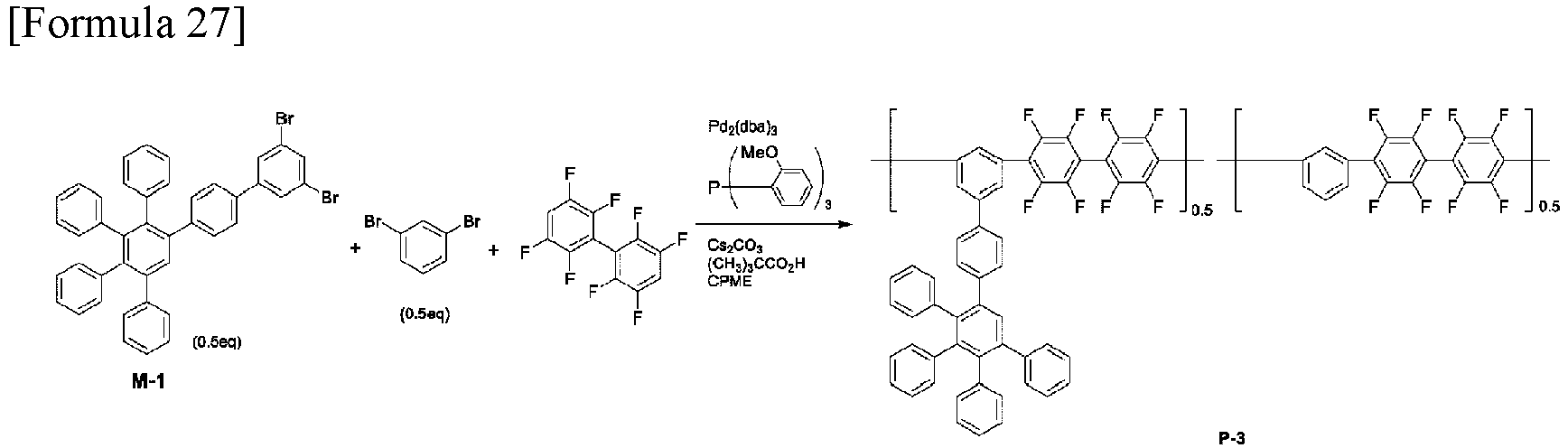
- Under nitrogen atmosphere, in a reaction apparatus were charged 0.35 g of M-1, 0.12 g of 1,3-dibromobenzene, 0.30 g of 2,2',3,3',5,5',6,6'-octafluorobiphenyl, 0.0096 g of tris(dibenzylideneacetone)dipalladium, 0.015 g of tris(o-methoxyphenyl)phosphine, 1.1 g of cesium carbonate and 0.10 g of pivalic acid, and 9 mL of cyclopentyl methyl ether was added to the mixture. The reaction mixture was heated to 105°C and stirred for 22 hours. After cooling to room temperature, the reaction mixture was added dropwise to a methanol-deionized water mixed solution and stirred. Filtration was carried out, and after the obtained filtrated product was dried and dissolved in tetrahydrofuran, the solution was added dropwise to a 0.4% sodium N,N-diethyldithiocarbamate trihydrate methanol solution and stirred. Filtration was carried out and the obtained filtrated product was dried to obtain 0.32 g (Yield 52%) of the target P-3.
Mn 21,600 (PDI 2.33) - In a reaction apparatus were charged 0.30 g of P-3 and 15 mL of methylene chloride, and 0.57 g of trimethylsilyl chlorosulfonate was added to the mixture. After the reaction mixture was stirred at room temperature for 19 hours, ethanol was added thereto to stop the reaction. The reaction mixture was added dropwise to diethyl ether and after stirring, filtration was carried out and the obtained filtrated product was dried to obtain 0.27 g of Electrolyte 3 in which a sulfonic acid group(s) was/were introduced into P-3.
-

- Under nitrogen atmosphere, in a reaction apparatus were charged 0.49 g of M-1, 0.071 g of 1,4-dibromobenzene, 0.15 g of 1,2,4,5-tetrafluorobenzene, 0.0093 g of tris(dibenzylideneacetone)dipalladium, 0.014 g of tris(o-methoxyphenyl)phosphine, 1.1 g of cesium carbonate and 0.10 g of pivalic acid, and 9 mL of cyclopentyl methyl ether was added to the mixture. The reaction mixture was heated to 105°C and stirred for 24 hours. After cooling to room temperature, the reaction mixture was added dropwise to a methanol-deionized water mixed solution and stirred. Filtration was carried out, and after the obtained filtrated product was dried and dissolved in tetrahydrofuran, the solution was added dropwise to a 0.3% sodium N,N-diethyldithiocarbamate trihydrate methanol solution and stirred. Filtration was carried out and the obtained filtrated product was dried to obtain 0.50 g (Yield 92%) of the target P-4.
Mn 20,300 (PDI 1.80) - In a reaction apparatus were charged 0.30 g of P-4 and 15 mL of methylene chloride, and 0.61 g of trimethylsilyl chlorosulfonate was added to the mixture. After the reaction mixture was stirred at room temperature for 15 hours, ethanol was added thereto to stop the reaction. The reaction mixture was added dropwise to diethyl ether and after stirring, filtration was carried out and the obtained filtrated product was dried to obtain 0.39 g of Electrolyte 4 in which a sulfonic acid group(s) was/were introduced into P-4.
-

- Under nitrogen atmosphere, in a reaction apparatus were charged 0.50 g of M-2, 0.083g of 1,4-dibromobenzene, 0.17 g of 1,2,4,5-tetrafluorobenzene, 0.011 g of tris(dibenzylideneacetone)dipalladium, 0.016 g of tris(o-methoxyphenyl)phosphine, 1.2 g of cesium carbonate and 0.12 g of pivalic acid, and 9 mL of cyclopentyl methyl ether was added to the mixture. The reaction mixture was heated to 105°C and stirred for 21.5 hours. After cooling to room temperature, the reaction mixture was added dropwise to a methanol-deionized water mixed solution and stirred. Filtration was carried out, and after the obtained filtrated product was dried and dissolved in tetrahydrofuran, the solution was added dropwise to a 0.3% sodium N,N-diethyl-dithiocarbamate trihydrate methanol solution and stirred. Filtration was carried out and the obtained filtrated product was dried to obtain 0.50 g (Yield 89%) of the target P-5.
Mn 23,700 (PDI 2.43) - In a reaction apparatus were charged 0.30 g of P-5 and 15 mL of methylene chloride, 0.66 g of trimethylsilyl chlorosulfonate was added to the mixture. After the reaction mixture was stirred at room temperature for 13 hours, ethanol was added thereto to stop the reaction. The reaction mixture was added dropwise to diethyl ether and after stirring, filtration was carried out and the obtained filtrated product was dried to obtain 0.26 g of Electrolyte 5 in which a sulfonic acid group(s) was/were introduced into P-5.
-

- Under nitrogen atmosphere, in a reaction apparatus were charged 0.50 g of M-2, 0.12 g of 1,2,4,5-tetrafluorobenzene, 0.0074 g of tris(dibenzylideneacetone)-dipalladium, 0.012 g of tris(o-methoxyphenyl)phosphine, 0.87 g of cesium carbonate and 0.084 g of pivalic acid, and 9 mL of cyclopentyl methyl ether was added to the mixture. The reaction mixture was heated to 105°C and stirred for 24 hours. After cooling to room temperature, the reaction mixture was added dropwise to a methanol-deionized water mixed solution and stirred. Filtration was carried out, and after the obtained filtrated product was dried and dissolved in tetrahydrofuran, the solution was added dropwise to a 0.2% sodium N,N-diethyldithiocarbamate trihydrate methanol solution and stirred. Filtration was carried out and the obtained filtrated product was dried to obtain 0.44 g (Yield 90%) of the target P-6.
Mn 8,400 (PDI 1.56) - In a reaction apparatus were charged 0.31 g of P-6 and 15 mL of methylene chloride, and 0.55 g of trimethylsilyl chlorosulfonate was added to the mixture. After the reaction mixture was stirred at room temperature for 12.5 hours, ethanol was added thereto to stop the reaction. The reaction mixture was added dropwise to diethyl ether and after stirring, filtration was carried out and the obtained filtrated product was dried to obtain 0.34 g of
Electrolyte 6 in which a sulfonic acid group(s) was/were introduced into P-6. -

- Under nitrogen atmosphere, in a reaction apparatus were charged 0.50 g of M-2, 0.16 g of 2,2'-dibromo-9,9'-spirobi[9H-fluorene], 0.17 g of 1,2,4,5-tetrafluorobenzene, 0.011 g of tris(dibenzylideneacetone)dipalladium, 0.016 g of tris(o-methoxyphenyl)phosphine, 1.2 g of cesium carbonate and 0.12 g of pivalic acid, and 9 mL of cyclopentyl methyl ether was added to the mixture. The reaction mixture was heated to 105°C and stirred for 24 hours. After cooling to room temperature, the reaction mixture was added dropwise to a methanol-deionized water mixed solution and stirred. Filtration was carried out, and after the obtained filtrated product was dried and dissolved in tetrahydrofuran, the solution was added dropwise to a 0.5% sodium N,N-diethyldithiocarbamate trihydrate methanol solution and stirred. Filtration was carried out and the obtained filtrated product was dried to obtain 0.54 g (Yield 84%) of the target P-7.
Mn 20,400 (PDI 2.25) - In a reaction apparatus were charged 0.30 g of P-7 and 15 mL of methylene chloride, and 0.57 g of trimethylsilyl chlorosulfonate was added to the mixture. After the reaction mixture was stirred at room temperature for 13.5 hours, ethanol was added thereto to stop the reaction. The reaction mixture was added dropwise to diethyl ether and after stirring, filtration was carried out and the obtained filtrated product was dried to obtain 0.30 g of Electrolyte 7 in which a sulfonic acid group(s) was/were introduced into P-7.
-


- Under nitrogen atmosphere, in a reaction apparatus were charged 0.58 g of M-2, 0.097 g of 1,3-dibromobenzene, 0.40 g of 2,2',3,3',5,5',6,6'-octafluorobiphenyl, 0.013 g of tris(dibenzylideneacetone)dipalladium, 0.019 g of tris(o-methoxyphenyl)-phosphine, 1.4 g of cesium carbonate and 0.14 g of pivalic acid, and 10 mL of cyclopentyl methyl ether was added to the mixture. The reaction mixture was heated to 105°C and stirred for 24 hours. After cooling to room temperature, the reaction mixture was added dropwise to a methanol-deionized water mixed solution and stirred. Filtration was carried out, and after the obtained filtrated product was dried and dissolved in tetrahydrofuran, the solution was added dropwise to a 1.0% sodium N,N-diethyldithiocarbamate trihydrate methanol solution and stirred. Filtration was carried out and the obtained filtrated product was dried to obtain 0.72 g (Yield 85%) of the target P-8.
Mn 18,200 (PDI 2.12) - In a reaction apparatus were charged 0.30 g of P-8 and 15 mL of methylene chloride, and 0.51 g of trimethylsilyl chlorosulfonate was added to the mixture. After the reaction mixture was stirred at room temperature for 14 hours, ethanol was added thereto to stop the reaction. The reaction mixture was added dropwise to diethyl ether and after stirring, filtration was carried out and the obtained filtrated product was dried to obtain 0.14 g of Electrolyte 8 in which a sulfonic acid group(s) was/were introduced into P-8.
-
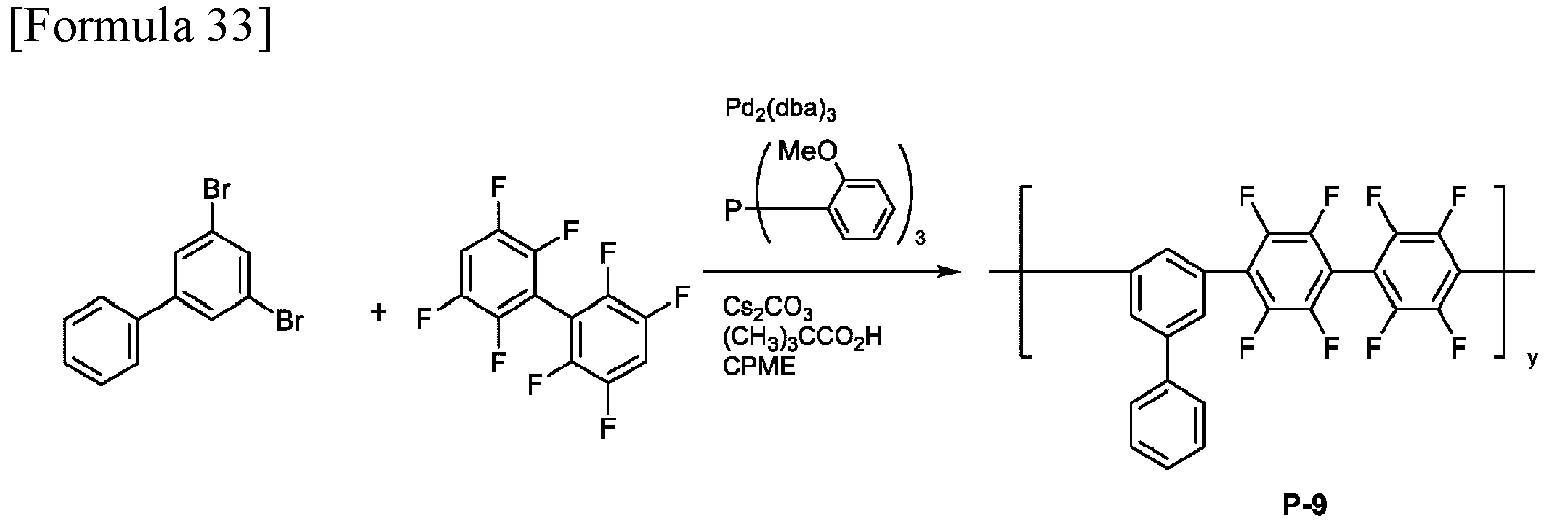
- Under nitrogen atmosphere, in a reaction apparatus were charged 0.32 g of 3,5-dibromobiphenyl, 0.30 g of 2,2',3,3',5,5',6,6'-octafluorobiphenyl, 0.0098 g of tris(dibenzylideneacetone) dipalladium, 0.014 g of tris(o-methoxyphenyl)phosphine, 1.1 g of cesium carbonate and 0.10 g of pivalic acid, and 6 mL of cyclopentyl methyl ether was added to the mixture. The reaction mixture was heated to 105°C and stirred for 23.5 hours. After cooling to room temperature, the reaction mixture was added dropwise to a methanol-deionized water mixed solution and stirred. Filtration was carried out, and after the obtained filtrated product was dried and dissolved in tetrahydrofuran, the solution was added dropwise to a 0.3% sodium N,N-diethyl-dithiocarbamate trihydrate methanol solution and stirred. Filtration was carried out and the obtained filtrated product was dried to obtain 0.36 g (Yield 80%) of the target P-9.
Mn 25,200 (PDI 2.36) - In a reaction apparatus were charged 0.30 g of P-9 and 15 mL of methylene chloride, and 0.37 g of trimethylsilyl chlorosulfonate was added to the mixture. After the reaction mixture was stirred at room temperature for 23 hours, ethanol was added thereto to stop the reaction. The reaction mixture was added dropwise to diethyl ether and after stirring, filtration was carried out and the obtained filtrated product was dried to obtain 0.30 g of Electrolyte 9 in which a sulfonic acid group(s) was/were introduced into P-9.
-
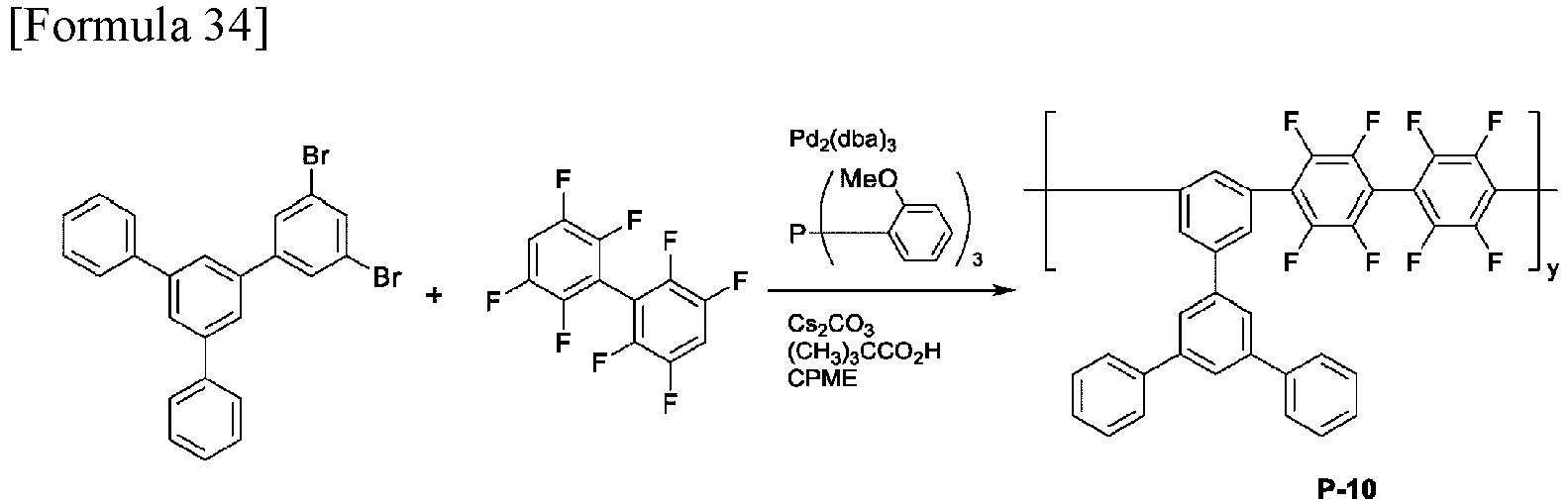
- Under nitrogen atmosphere, in a reaction apparatus were charged 0.47 g of 3,5-dibromo-5'-phenyl-1,1':3',1"-terphenyl, 0.30 g of 2,2',3,3',5,5',6,6'-octafluorobiphenyl, 0.0091 g of tris(dibenzylideneacetone)dipalladium, 0.014 g of tris(o-methoxyphenyl)phosphine, 1.1 g of cesium carbonate and 0.10 g of pivalic acid, and 6 mL of cyclopentyl methyl ether was added to the mixture. The reaction mixture was heated to 105°C and stirred for 24 hours. After cooling to room temperature, the reaction mixture was added dropwise to a methanol-deionized water mixed solution and stirred. Filtration was carried out and the obtained filtrated product was dried to obtain the target P-10. Incidentally, the obtained P-10 had low solubility so that molecular weight measurement could not be done.
-

- Under nitrogen atmosphere, in a reaction apparatus were charged 0.74 g of 3,5-dibromo-5'-phenyl-1,1':3',1"-terphenyl, 0.16 g of 1,4-dibromobenzene, 0.35 g of 1,2,4,5-tetrafluorobenzene, 0.021 g of tris(dibenzylideneacetone)dipalladium, 0.032 g of tris(o-methoxyphenyl)phosphine, 2.4 g of cesium carbonate and 0.23 g of pivalic acid, and 5 mL of cyclopentyl methyl ether was added to the mixture. The reaction mixture was heated to 105°C and stirred for 24 hours. After cooling to room temperature, the reaction mixture was added dropwise to a methanol-deionized water mixed solution and stirred. Filtration was carried out and the obtained filtrated product was dried to obtain the target P-11. Incidentally, the obtained P-11 had low solubility so that molecular weight measurement could not be done.
-

- Under nitrogen atmosphere, in a reaction apparatus were charged 1.50 g of M-3, 0.27 g of 1,2,3,5-tetrafluorobenzene, 0.014 g of tris(dibenzylideneacetone)-dipalladium, 0.022 g of tris(o-methoxyphenyl)phosphine, 1.62 g of cesium carbonate and 0.16 g of pivalic acid, and 17 mL of cyclopentyl methyl ether was added to the mixture. The reaction mixture was heated to 105°C and stirred for 19 hours. After cooling to room temperature, the reaction mixture was added dropwise to a methanol-deionized water mixed solution and stirred. Filtration was carried out, and after the obtained filtrated product was dried and dissolved in tetrahydrofuran, the solution was added dropwise to a 0.2% sodium N,N-diethyldithiocarbamate trihydrate methanol solution and stirred. Filtration was carried out and the obtained filtrated product was dried to obtain 1.26 g (Yield 85%) of the target P-12.
Mn 10,100 (PDI 1.90) - In a reaction apparatus were charged 0.30 g of P-12 and 15 mL of methylene chloride, and 1.66 g of trimethylsilyl chlorosulfonate was added to the mixture. After the reaction mixture was stirred at room temperature for 15.5 hours, ethanol was added thereto to stop the reaction. The reaction mixture was added dropwise to diethyl ether and after stirring, filtration was carried out and the obtained filtrated product was dried to obtain 0.39 g of Electrolyte 10 in which a sulfonic acid group(s) was/were introduced into P-12.
- In order to confirm solubility in the solvent used for the reaction of introducing the sulfonic acid group, a polymer was each added to the chloroform solvent in an amount to give a solution of 0.25% by mass, and was evaluated in accordance with the following criteria.
- ○: There was no undissolved polymer and a solution of 0.25% by mass was able to be prepared.
- ×: There was undissolved polymer and a solution of 0.25% by mass was not able to be prepared.
- In order to confirm the solubility in the polar solvent used as the solvent for the catalyst ink, an electrolyte was added to a 1-propanol/deionized water (1 part by mass/1 part by mass) mixed solvent in an amount to give a solution of 5% by mass, and was evaluated in accordance with the following criteria. The results are shown in Table 1.
- ○: There was no undissolved electrolyte and a solution of 5% by mass was able to be prepared.
- ×: There was undissolved electrolyte and a solution of 5% by mass was not able to be prepared.
- Into a glass container were added 0.25 g of platinum-carried carbon catalyst (TEC10E50E, manufactured by Tanaka Kikinzoku Kogyo), 4.5 g of deionized water, 4.5 g of 1-propanol and 1.3 g of 5% water/1-propanol (1 part by mass/1 part by mass) solution of the electrolyte synthesized in Examples 1 to 8 and Comparative Example 1, and subjected to ultrasonic irradiation for 20 minutes using a homogenizer to prepare a catalyst ink.
- A gas diffusion layer attached with a microporous layer (SIGRACET GDL28BC, manufactured by SGL carbon) was placed on a hot plate at 80°C, and the catalyst ink prepared by the above-mentioned method was coated on the microporous layer side by spray method to prepare a gas diffusion electrode in which a catalyst layer was formed on the microporous layer.
- Both sides of the electrolyte membrane (Nafion NR212, film thickness 50 µm, manufactured by Chemours) was sandwiched by a pair of the gas diffusion electrodes prepared as mentioned above, and hot press molding was carried out for 10 minutes under the conditions of 0.47 kN and 140°C to prepare a membrane-electrode assembly.
- The portion other than the electrode portion of the membrane-electrode assembly obtained above was covered by a pair of gaskets, and on both sides, a separator that also serves as a gas flow path, a current collector plate, an insulating sheet, and a clamping plate are arranged to prepare a polymer electrolyte fuel cell. Using this as a single cell, one side was used as an oxygen electrode and air was supplied, and the other side was used as a fuel electrode and hydrogen was supplied to generate power. As the power generation conditions, cell temperature was 80°C, relative humidities at the air side and the fuel side were both 50%RH, and each gas was supplied so that utilization rates of the fuel and oxygen became 2%, and evaluation of power generation performance was carried out. Output voltages at 0.8, 0.6 and 0.4 A/cm2 are shown in Table 1.
[Table 1] Solubility of polymer before introducing sulfonic acid group(s) Solubility of electrolyte after introducing sulfonic acid group(s) Cell voltage at each current density at 50% RH 0.8A/ cm2 0.6A/ cm2 0.4A/ cm2 Example 1 P1 ○ Electrolyte 1 ○ 0.36 0.43 0.51 Example 2 P2 ○ Electrolyte 2 ○ 0.42 0.49 0.56 Example 3 P3 ○ Electrolyte 3 ○ 0.39 0.46 0.54 Example 4 P4 ○ Electrolyte 4 ○ 0.43 0.51 0.58 Example 5 P5 ○ Electrolyte 5 ○ 0.40 0.47 0.55 Example 6 P6 ○ Electrolyte 6○ 0.41 0.48 0.54 Example 7 P7 ○ Electrolyte 7 ○ 0.44 0.51 0.58 Example 8 P8 ○ Electrolyte 8 ○ 0.33 0.41 0.49 Comparative Example 1 P9 ○ Electrolyte 9 × Comparative Example 2 P10 × Comparative Example 3 P11 × Comparative Example 4 P12 ○ Electrolyte 10 ○ 0.32 0.39 0.47 - As shown in Table 1, Examples 1 to 8 have high solubility in polar solvents as compared with those of Comparative Examples 1 to 4, and they were possible to generate electricity with a cell so that it was confirmed that they could be used as an electrolyte.
-
- 100 Polymer electrolyte fuel cell
- 101 Gas diffusion layer
- 103 Anode catalyst layer
- 105 Cathode catalyst layer
- 107 Polymer electrolyte membrane
- 109 Separator
Claims (13)
- A compound having a structure represented by the following general formula (I)
 Ar2 is an aromatic structure optionally substituted by a sulfonic acid group(s),Ar3 is an aromatic structure optionally substituted by a sulfonic acid group(s), provided that when p=1, Ar2 is a benzene ring optionally substituted by a sulfonic acid group(s),R1 to R5 are each independently hydrogen, a sulfonic acid group or an aromatic group, and the aromatic groups are each independently and optionally substituted by a sulfonic acid group(s),one of R1 to R5 is hydrogen or a sulfonic acid group, and four are aromatic groups,one or more kinds selected from the group consisting of Ar1, Ar2, Ar3, R1, R2, R3, R4 and R5 when they are aromatic groups and a benzene ring A has one or more sulfonic acid groups,l and m are molar fractions when l+m=1.0, where 0<1≦1.0 and 0≦m<1.0, and when m is not 0, each constitutional unit is randomly copolymerized,"n"s are each independently an integer of 1 to 3, andp is 0 or 1.
 - A compound which is obtained by reacting a compound represented by the following general formula (pre-I) with a sulfonating agent
 Ar2' is an aromatic structure,Ar3' is an aromatic structure,provided that when p=1, Ar2' is a benzene ring,R1' to R5' are each independently hydrogen or an aromatic group,one of R1' to R5' is hydrogen, and four are aromatic groups,l and m are molar fractions when l+m=1.0, where 0<1≦1.0 and 0≦m<1.0, and when m is not 0, each constitutional unit is randomly copolymerized,"n"s are each independently an integer of 1 to 3, andp is 0 or 1.
 - The compound according to Claim 1, wherein, in the general formula (I), Ar1 is one kind selected from the group consisting of
 provided that Xs are each independently hydrogen, an alkyl group having 1 to 8 carbon atoms or a phenyl group,and optionally substituted by a sulfonic acid group(s).
 - The compound according to Claim 1, wherein, in the general formula (I), R1 to R5 when they are aromatics, are each independently one kind selected from the group consisting of

- The compound according to Claim 2, wherein, in the general formula (pre-I), Ar1' is one kind selected from the group consisting of

- The compound according to Claim 2, wherein, in the general formula (pre-I), R1' to R5' when they are aromatics, are each independently one kind selected from the group consisting of
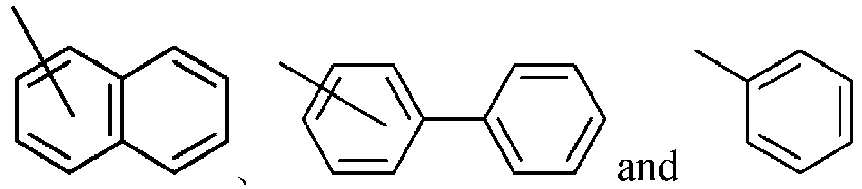
- The compound according to any one of Claims 1 to 6, which is used as an electrolyte of an anode catalyst layer and/or a cathode catalyst layer of a polymer electrolyte fuel cell.
- A catalyst layer of a polymer electrolyte fuel cell which comprises the compound according to any one of Claims 1 to 6.
- A catalyst composition which comprises the compound according to any one of Claims 1 to 6, a metal catalyst and a catalyst carrier.
- The catalyst composition according to Claim 9, which is for a polymer electrolyte fuel cell.
- A catalyst layer of a polymer electrolyte fuel cell which comprises the catalyst composition according to Claim 10.
- A membrane electrode assembly which comprises a polymer electrolyte membrane, a gas diffusion layer and the catalyst layer according to Claim 11.
- A polymer electrolyte fuel cell which comprises the membrane electrode assembly according to Claim 12.
Applications Claiming Priority (2)
| Application Number | Priority Date | Filing Date | Title |
|---|---|---|---|
| JP2021059380 | 2021-03-31 | ||
| PCT/JP2022/015280 WO2022210641A1 (en) | 2021-03-31 | 2022-03-29 | Fluorine-containing compound having sulfonic acid group and polymer electrolyte fuel cell |
Publications (2)
| Publication Number | Publication Date |
|---|---|
| EP4317242A1 true EP4317242A1 (en) | 2024-02-07 |
| EP4317242A4 EP4317242A4 (en) | 2024-11-20 |
Family
ID=83459386
Family Applications (1)
| Application Number | Title | Priority Date | Filing Date |
|---|---|---|---|
| EP22780852.4A Pending EP4317242A4 (en) | 2021-03-31 | 2022-03-29 | FLUORINE-CONTAINING COMPOUND WITH SULFONIC ACID GROUP AND POLYMER ELECTROLYTE FUEL CELL |
Country Status (5)
| Country | Link |
|---|---|
| US (1) | US20240213508A1 (en) |
| EP (1) | EP4317242A4 (en) |
| JP (1) | JP7845353B2 (en) |
| CN (1) | CN117098793A (en) |
| WO (1) | WO2022210641A1 (en) |
Families Citing this family (4)
| Publication number | Priority date | Publication date | Assignee | Title |
|---|---|---|---|---|
| JP2025169466A (en) * | 2022-10-05 | 2025-11-13 | 日産化学株式会社 | Catalyst composition containing hydrocarbon ionomer and fluororesin and polymer electrolyte fuel cell |
| WO2024181304A1 (en) * | 2023-02-28 | 2024-09-06 | 日産化学株式会社 | Catalyst composition and catalyst layer of solid polymer fuel cell |
| DE102023115989A1 (en) * | 2023-06-19 | 2024-12-19 | Forschungszentrum Jülich GmbH | Aromatic polymer, process for producing a polymer, membrane and use of a membrane |
| CN120365535B (en) * | 2025-04-30 | 2025-10-31 | 南昌航空大学 | A sterically hindered aryl polymer, anion exchange membrane, its preparation method and application |
Family Cites Families (10)
| Publication number | Priority date | Publication date | Assignee | Title |
|---|---|---|---|---|
| US4162947A (en) * | 1978-05-22 | 1979-07-31 | R. O. Hull & Company, Inc. | Acid zinc plating baths and methods for electrodepositing bright zinc deposits |
| US7301002B1 (en) | 2003-10-14 | 2007-11-27 | Sandia Corporation | Sulfonated polyphenylene polymers |
| US7060756B2 (en) * | 2003-11-24 | 2006-06-13 | 3M Innovative Properties Company | Polymer electrolyte with aromatic sulfone crosslinking |
| JP2007294408A (en) * | 2006-03-29 | 2007-11-08 | Toyota Central Res & Dev Lab Inc | PPP type hydrocarbon electrolyte and method for producing the same, PPP, and electrolyte membrane, catalyst layer, and solid polymer fuel cell using PPP type hydrocarbon electrolyte |
| JP5352128B2 (en) * | 2008-06-03 | 2013-11-27 | 本田技研工業株式会社 | Membrane-electrode structure for polymer electrolyte fuel cell |
| JP5736671B2 (en) * | 2009-06-19 | 2015-06-17 | 日産自動車株式会社 | Polyurea electrolyte and method for producing the same |
| KR20140035965A (en) | 2011-06-06 | 2014-03-24 | 솔베이 스페셜티 폴리머스 이태리 에스.피.에이. | Stable ion exchange fluorinated polymers and membranes obtained therefrom |
| DE102012020936A1 (en) * | 2011-10-28 | 2013-05-02 | Daimler Ag | SULPHONATED POLY (PHENYLENE) COPOLYMER ELECTROLYTES FOR FUEL CELLS |
| JP6278507B2 (en) | 2013-11-14 | 2018-02-14 | 学校法人上智学院 | Polymer electrolyte for fuel cell, catalyst electrode for fuel cell and fuel cell using the same |
| JP7173046B2 (en) * | 2017-12-28 | 2022-11-16 | 日産化学株式会社 | Polyphenylene compound |
-
2022
- 2022-03-29 EP EP22780852.4A patent/EP4317242A4/en active Pending
- 2022-03-29 CN CN202280023703.9A patent/CN117098793A/en active Pending
- 2022-03-29 JP JP2023511330A patent/JP7845353B2/en active Active
- 2022-03-29 US US18/285,101 patent/US20240213508A1/en active Pending
- 2022-03-29 WO PCT/JP2022/015280 patent/WO2022210641A1/en not_active Ceased
Also Published As
| Publication number | Publication date |
|---|---|
| WO2022210641A1 (en) | 2022-10-06 |
| JP7845353B2 (en) | 2026-04-14 |
| US20240213508A1 (en) | 2024-06-27 |
| EP4317242A4 (en) | 2024-11-20 |
| CN117098793A (en) | 2023-11-21 |
| JPWO2022210641A1 (en) | 2022-10-06 |
Similar Documents
| Publication | Publication Date | Title |
|---|---|---|
| EP2202261B1 (en) | Hyper-branched polymer, electrode for fuel cell including the hyper-branched polymer, electrolyte membrane for fuel cell including the hyper-branched polymer, and fuel cell including at least one of the electrode and the electrolyte membrane | |
| JP4116585B2 (en) | Polymer electrolyte fuel cell | |
| KR101375508B1 (en) | Polymer electrolyte membrane and fuel cell comprising the same | |
| JP7845353B2 (en) | Fluorine-containing compounds having sulfonic acid groups and polymer electrolyte fuel cells | |
| EP1906473B1 (en) | Electrode paste for use in solid polymer fuel cell | |
| EP2058321A1 (en) | Phosphorous containing monomer, polymer thereof, electrode for fuel cell including the polymer, electrolyte membrane for fuel cell including the polymer, and fuel cell using the electrode | |
| US20090075148A1 (en) | Benzoxazine-based monomer, polymer thereof, electrode for fuel cell including the same, electrolyte membrane for fuel cell including the same, and fuel cell using the same | |
| EP1420473B1 (en) | Electrode structure for polymer electrolyte fuel cells, and polymer electrolyte fuel cell using the same | |
| EP3021395A1 (en) | Electrolyte membrane, membrane-electrode assembly, and solid polymer fuel cell | |
| KR101821480B1 (en) | Compound including aromatic ring and polymer electrolyte membrane using the same | |
| US20080113227A1 (en) | Development and characterization of novel proton conducting aromatic polyether type copolymers bearing main and side chain pyridine groups | |
| Liu et al. | Homopolymer-like sulfonated phenyl-and diphenyl-poly (arylene ether ketone) s for fuel cell applications | |
| EP1619739B1 (en) | Membrane-electrode structure for solid polymer fuel cell and solid polymer fuel cell | |
| EP3733732B1 (en) | Polyphenylene compound | |
| JP2007280946A (en) | Membrane / electrode assembly and fuel cell | |
| US8795924B2 (en) | Crown ether containing PEM electrode | |
| EP4503206A1 (en) | Polymer compound having sulfonic acid group, catalyst composition that contains said compound, and polymer electrolyte fuel cell | |
| JP4245991B2 (en) | Solid polymer electrolyte, membrane using the same, catalyst electrode layer, membrane / electrode assembly, and fuel cell | |
| JP2015228292A (en) | Solid polymer electrolyte membrane, membrane-electrode assembly, fuel cell, water electrolysis cell and water electrolysis device | |
| EP3235809B1 (en) | Compound and polymer electrolyte membrane using same | |
| KR102010399B1 (en) | Compound including aromatic ring, polymer including the same and polymer electrolyte membrane using the same | |
| KR102055965B1 (en) | Compound, polymer electrolyte membrane comprising the same and method for preparing the same | |
| WO2024204021A1 (en) | Catalyst composition comprising hydrocarbon ionomer and hydrophilic polymer, and polymer electrolyte fuel cell | |
| JP2025169466A (en) | Catalyst composition containing hydrocarbon ionomer and fluororesin and polymer electrolyte fuel cell | |
| US7862922B2 (en) | Polymer electrolyte membrane for fuel cell and fuel cell system comprising same |
Legal Events
| Date | Code | Title | Description |
|---|---|---|---|
| STAA | Information on the status of an ep patent application or granted ep patent |
Free format text: STATUS: THE INTERNATIONAL PUBLICATION HAS BEEN MADE |
|
| PUAI | Public reference made under article 153(3) epc to a published international application that has entered the european phase |
Free format text: ORIGINAL CODE: 0009012 |
|
| STAA | Information on the status of an ep patent application or granted ep patent |
Free format text: STATUS: REQUEST FOR EXAMINATION WAS MADE |
|
| 17P | Request for examination filed |
Effective date: 20231018 |
|
| AK | Designated contracting states |
Kind code of ref document: A1 Designated state(s): AL AT BE BG CH CY CZ DE DK EE ES FI FR GB GR HR HU IE IS IT LI LT LU LV MC MK MT NL NO PL PT RO RS SE SI SK SM TR |
|
| DAV | Request for validation of the european patent (deleted) | ||
| DAX | Request for extension of the european patent (deleted) | ||
| STAA | Information on the status of an ep patent application or granted ep patent |
Free format text: STATUS: EXAMINATION IS IN PROGRESS |
|
| A4 | Supplementary search report drawn up and despatched |
Effective date: 20241023 |
|
| RIC1 | Information provided on ipc code assigned before grant |
Ipc: C08K 3/08 20060101ALI20241017BHEP Ipc: C08K 3/04 20060101ALI20241017BHEP Ipc: H01M 8/1088 20160101ALI20241017BHEP Ipc: H01M 8/1023 20160101ALI20241017BHEP Ipc: H01M 8/10 20160101ALI20241017BHEP Ipc: H01M 4/90 20060101ALI20241017BHEP Ipc: H01M 4/86 20060101ALI20241017BHEP Ipc: C08L 65/00 20060101ALI20241017BHEP Ipc: C08G 61/10 20060101AFI20241017BHEP |
|
| 17Q | First examination report despatched |
Effective date: 20241106 |