EP4317021A1 - Information processing device and program - Google Patents
Information processing device and program Download PDFInfo
- Publication number
- EP4317021A1 EP4317021A1 EP22774885.2A EP22774885A EP4317021A1 EP 4317021 A1 EP4317021 A1 EP 4317021A1 EP 22774885 A EP22774885 A EP 22774885A EP 4317021 A1 EP4317021 A1 EP 4317021A1
- Authority
- EP
- European Patent Office
- Prior art keywords
- chamber
- information
- stored
- item
- temperature
- Prior art date
- Legal status (The legal status is an assumption and is not a legal conclusion. Google has not performed a legal analysis and makes no representation as to the accuracy of the status listed.)
- Withdrawn
Links
Images



Classifications
-
- G—PHYSICS
- G06—COMPUTING OR CALCULATING; COUNTING
- G06Q—INFORMATION AND COMMUNICATION TECHNOLOGY [ICT] SPECIALLY ADAPTED FOR ADMINISTRATIVE, COMMERCIAL, FINANCIAL, MANAGERIAL OR SUPERVISORY PURPOSES; SYSTEMS OR METHODS SPECIALLY ADAPTED FOR ADMINISTRATIVE, COMMERCIAL, FINANCIAL, MANAGERIAL OR SUPERVISORY PURPOSES, NOT OTHERWISE PROVIDED FOR
- G06Q10/00—Administration; Management
- G06Q10/04—Forecasting or optimisation specially adapted for administrative or management purposes, e.g. linear programming or "cutting stock problem"
-
- F—MECHANICAL ENGINEERING; LIGHTING; HEATING; WEAPONS; BLASTING
- F25—REFRIGERATION OR COOLING; COMBINED HEATING AND REFRIGERATION SYSTEMS; HEAT PUMP SYSTEMS; MANUFACTURE OR STORAGE OF ICE; LIQUEFACTION SOLIDIFICATION OF GASES
- F25D—REFRIGERATORS; COLD ROOMS; ICE-BOXES; COOLING OR FREEZING APPARATUS NOT OTHERWISE PROVIDED FOR
- F25D29/00—Arrangement or mounting of control or safety devices
-
- G—PHYSICS
- G06—COMPUTING OR CALCULATING; COUNTING
- G06F—ELECTRIC DIGITAL DATA PROCESSING
- G06F3/00—Input arrangements for transferring data to be processed into a form capable of being handled by the computer; Output arrangements for transferring data from processing unit to output unit, e.g. interface arrangements
- G06F3/01—Input arrangements or combined input and output arrangements for interaction between user and computer
- G06F3/048—Interaction techniques based on graphical user interfaces [GUI]
- G06F3/0481—Interaction techniques based on graphical user interfaces [GUI] based on specific properties of the displayed interaction object or a metaphor-based environment, e.g. interaction with desktop elements like windows or icons, or assisted by a cursor's changing behaviour or appearance
- G06F3/0482—Interaction with lists of selectable items, e.g. menus
-
- G—PHYSICS
- G06—COMPUTING OR CALCULATING; COUNTING
- G06Q—INFORMATION AND COMMUNICATION TECHNOLOGY [ICT] SPECIALLY ADAPTED FOR ADMINISTRATIVE, COMMERCIAL, FINANCIAL, MANAGERIAL OR SUPERVISORY PURPOSES; SYSTEMS OR METHODS SPECIALLY ADAPTED FOR ADMINISTRATIVE, COMMERCIAL, FINANCIAL, MANAGERIAL OR SUPERVISORY PURPOSES, NOT OTHERWISE PROVIDED FOR
- G06Q10/00—Administration; Management
- G06Q10/08—Logistics, e.g. warehousing, loading or distribution; Inventory or stock management
- G06Q10/083—Shipping
- G06Q10/0832—Special goods or special handling procedures, e.g. handling of hazardous or fragile goods
-
- G—PHYSICS
- G06—COMPUTING OR CALCULATING; COUNTING
- G06Q—INFORMATION AND COMMUNICATION TECHNOLOGY [ICT] SPECIALLY ADAPTED FOR ADMINISTRATIVE, COMMERCIAL, FINANCIAL, MANAGERIAL OR SUPERVISORY PURPOSES; SYSTEMS OR METHODS SPECIALLY ADAPTED FOR ADMINISTRATIVE, COMMERCIAL, FINANCIAL, MANAGERIAL OR SUPERVISORY PURPOSES, NOT OTHERWISE PROVIDED FOR
- G06Q10/00—Administration; Management
- G06Q10/08—Logistics, e.g. warehousing, loading or distribution; Inventory or stock management
- G06Q10/087—Inventory or stock management, e.g. order filling, procurement or balancing against orders
-
- G—PHYSICS
- G06—COMPUTING OR CALCULATING; COUNTING
- G06Q—INFORMATION AND COMMUNICATION TECHNOLOGY [ICT] SPECIALLY ADAPTED FOR ADMINISTRATIVE, COMMERCIAL, FINANCIAL, MANAGERIAL OR SUPERVISORY PURPOSES; SYSTEMS OR METHODS SPECIALLY ADAPTED FOR ADMINISTRATIVE, COMMERCIAL, FINANCIAL, MANAGERIAL OR SUPERVISORY PURPOSES, NOT OTHERWISE PROVIDED FOR
- G06Q10/00—Administration; Management
- G06Q10/08—Logistics, e.g. warehousing, loading or distribution; Inventory or stock management
- G06Q10/087—Inventory or stock management, e.g. order filling, procurement or balancing against orders
- G06Q10/0872—Inventory or stock management, e.g. order filling, procurement or balancing against orders using inventory planning
-
- F—MECHANICAL ENGINEERING; LIGHTING; HEATING; WEAPONS; BLASTING
- F25—REFRIGERATION OR COOLING; COMBINED HEATING AND REFRIGERATION SYSTEMS; HEAT PUMP SYSTEMS; MANUFACTURE OR STORAGE OF ICE; LIQUEFACTION SOLIDIFICATION OF GASES
- F25D—REFRIGERATORS; COLD ROOMS; ICE-BOXES; COOLING OR FREEZING APPARATUS NOT OTHERWISE PROVIDED FOR
- F25D13/00—Stationary devices, e.g. cold-rooms
-
- F—MECHANICAL ENGINEERING; LIGHTING; HEATING; WEAPONS; BLASTING
- F25—REFRIGERATION OR COOLING; COMBINED HEATING AND REFRIGERATION SYSTEMS; HEAT PUMP SYSTEMS; MANUFACTURE OR STORAGE OF ICE; LIQUEFACTION SOLIDIFICATION OF GASES
- F25D—REFRIGERATORS; COLD ROOMS; ICE-BOXES; COOLING OR FREEZING APPARATUS NOT OTHERWISE PROVIDED FOR
- F25D2500/00—Problems to be solved
- F25D2500/04—Calculation of parameters
-
- F—MECHANICAL ENGINEERING; LIGHTING; HEATING; WEAPONS; BLASTING
- F25—REFRIGERATION OR COOLING; COMBINED HEATING AND REFRIGERATION SYSTEMS; HEAT PUMP SYSTEMS; MANUFACTURE OR STORAGE OF ICE; LIQUEFACTION SOLIDIFICATION OF GASES
- F25D—REFRIGERATORS; COLD ROOMS; ICE-BOXES; COOLING OR FREEZING APPARATUS NOT OTHERWISE PROVIDED FOR
- F25D2700/00—Means for sensing or measuring; Sensors therefor
- F25D2700/16—Sensors measuring the temperature of products
Definitions
- the present disclosure relates to an information processing device, and a program.
- Patent Document 1 describes, for example, the technology for proper storage management of goods, such as commodities, by placing the commodities, etc. in the vertical temperature distribution area within the space of the appropriate temperature for the goods.
- Patent Document 1 Japanese Patent Laid-Open No. 2010-112605
- An object of the present disclosure is to propose placement of items to be stored in a chamber performing freezing or refrigerating according to how the stored items are cooled.
- An information processing device of the present disclosure includes: a prediction section predicting how a stored item cools in a chamber performing freezing or refrigerating; and an output section outputting proposal information about placement of an item to be stored in the chamber based on how the stored item cools as predicted by the prediction section.
- placement of stored items can be proposed in accordance with how the items to be stored in a chamber performing freezing or refrigerating are cooled.
- the prediction section may predict how a stored item cools in the chamber using a thermal time constant of an item to be stored in the chamber.
- the prediction section may predict how a stored item cools in the chamber further using temperature information of an item to be stored in the chamber before being stored.
- the prediction section may predict how a stored item cools in the chamber further using target temperature information of an item to be stored in the chamber.
- the prediction section may predict how a stored item cools in the chamber using a physical model that models an item to be stored in the chamber.
- the prediction section may predict a temperature at each position in the chamber, and the output section may output the proposal information further based on the temperature at each position in the chamber predicted by the prediction section.
- the prediction section may predict the temperature at each position in the chamber using measurement information of a temperature measured at a predetermined position in the chamber.
- the prediction section may predict the temperature at each position in the chamber further using thermal characteristics inside the chamber.
- the prediction section may predict the temperature at each position in the chamber further using operation information of a cooling device performing freezing or refrigerating inside the chamber.
- the prediction section may predict the temperature at each position in the chamber further using information of heat emitted by a stored item already existing in the chamber.
- the prediction section may predict the temperature at each position in the chamber further using information of disturbance caused in the chamber.
- the prediction section may predict the temperature at each position in the chamber using a physical model that models an interior of the chamber.
- the prediction section may predict effect of heat emitted by an item to be stored in the chamber on the temperature at each position in the chamber, and the output section may output the proposal information further based on the effect on the temperature at each position in the chamber, the effect being predicted by the prediction section.
- the prediction section may predict the effect on the temperature at each position in the chamber using a physical model that models an item to be stored in the chamber.
- the output section may output the proposal information proposing placement of an item to be stored in the chamber, the placement cooling the item in a shorter time.
- the output section may output the proposal information including information on how to stack an item to be stored in the chamber.
- the output section may output the proposal information including information on a distance between an item to be stored in the chamber and another stored item.
- the output section may output the proposal information representing the placement using an object image corresponding to an item to be stored in the chamber.
- the output section may output the proposal information on setting of a cooling device performing freezing or refrigerating inside the chamber.
- a program of the present disclosure causes a computer to implement: a function of predicting how a stored item cools in a chamber performing freezing or refrigerating; and a function of outputting proposal information on placement of an item to be stored in the chamber based on how the stored item cools as predicted.
- FIG. 1 is a diagram showing an overall configuration example of a freezing/refrigerating system 10 to which the present embodiment is applied.
- the freezing/refrigerating system 10 performs freezing and refrigerating in a freezer/refrigerator warehouse 100, and includes a freezing/refrigerating device 200, a control device 300, a temperature sensor 400, an input/output device 500, and an information processing device 600.
- the freezer/refrigerator warehouse 100 is a warehouse for freezing or refrigerating items to be stored therein.
- the freezer/refrigerator warehouse 100 includes an insulation wall 110, an opening/closing door 120, and a storage space 130.
- the insulation wall 110 is a wall to increase heat-retaining characteristics of the freezer/refrigerator warehouse 100 by being covered with insulation panels.
- the opening/closing door 120 is a door that opens and closes when storing the items in the freezer/refrigerator warehouse 100.
- the opening/closing door 120 is filled with a heat insulating material to also increase the heat-retaining characteristics of the freezer/refrigerator warehouse 100 when being closed.
- the storage space 130 is a space for storing the items. In the storage space 130, though not illustrated, plural shelves for placing and storing the items may be installed on the insulation wall 110.
- the freezing/refrigerating device 200 is a device actually performing freezing and refrigerating for the freezer/refrigerator warehouse 100.
- the freezing/refrigerating device 200 includes indoor units 210a to 210c, an outdoor unit 220, and piping 230.
- the indoor units 210a to 210c are installed in the freezer/refrigerator warehouse 100 and absorb heat from the air in the freezer/refrigerator warehouse 100 by exchanging heat between the refrigerant coming through the piping 230 and the air in the freezer/refrigerator warehouse 100.
- the outdoor unit 220 is installed outside the freezer/refrigerator warehouse 100 and discharges heat to the outside of the freezer/refrigerator warehouse 100 by exchanging heat between the refrigerant coming through the piping 230 and the air outside the freezer/refrigerator warehouse 100.
- the piping 230 is a pipe connecting the indoor units 210a to 210c and the outdoor unit 220, through which the refrigerant passes. Note that the indoor units 210a to 210c are shown in the figure, but in the case where there is no need to distinguish the indoor units, the units are sometimes referred to as the indoor units 210.
- the figure shows three indoor units 210; however, one, two, or four or more indoor units 210 may be installed.
- the freezing/refrigerating device 200 is provided as an example of a cooling device for freezing or refrigerating inside the warehouse.
- the control device 300 is a device that controls the freezing/refrigerating device 200 to operate based on the set conditions.
- the temperature sensor 400 is installed at a predetermined position in the freezer/refrigerator warehouse 100, and measures the temperature at the predetermined position.
- the input/output device 500 is installed beside the opening/closing door 120 of the freezer/refrigerator warehouse 100, and accepts user operations to input information about the items to be stored in freezer/refrigerator warehouse 100, and outputs proposal information about the placement of the items to be stored in the freezer/refrigerator warehouse 100.
- the input/output device 500 may be a touch panel, for example.
- the information processing device 600 creates the proposal information about the placement of the items to be stored in the freezer/refrigerator warehouse 100, and outputs the information to the input/output device 500. Specifically, the information processing device 600 first acquires various pieces of information from the freezing/refrigerating device 200, the temperature sensor 400, the input/output device 500, etc. Next, the information processing device 600 uses the various pieces of information to determine the temperature distribution in the freezer/refrigerator warehouse 100 and how the items to be stored in the freezer/refrigerator warehouse 100 cool. Next, the information processing device 600 creates the proposal information based on the temperature distribution, how the items cool, etc. Then, the information processing device 600 outputs the proposal information to the input/output device 500.
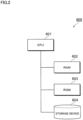
- FIG. 2 is a diagram showing a hardware configuration example of the information processing device 600 in the present embodiment.
- the information processing device 600 includes a CPU (Central Processing Unit) 601, which is an arithmetic unit, a RAM (Random Access Memory) 602, which is a storage unit, a ROM (Read Only Memory) 603, and a storage device 604.
- the RAM 602 is a main storage device (main memory), and used as a working memory when the CPU 601 performs arithmetic processing.
- the ROM 603 holds programs and data of setting values prepared in advance, etc., and the CPU 601 can execute processing by directly reading the programs and data from the ROM 603.
- the storage device 604 is a storing unit for programs and data.
- the storage device 604 stores the programs, and the CPU 601 reads the programs stored in the storage device 604 into the main storage device to execute thereof. In addition, the storage device 604 stores the processing results by the CPU 601 to preserve thereof.
- a magnetic disk device for example, a magnetic disk device, an SSD (Solid State Drive), etc. can be used.
- FIG. 3 is a block diagram showing a functional configuration example of the information processing device 600 in the present embodiment.
- the information processing device 600 in the present embodiment includes an acquisition section 610, a prediction section 620, and an output section 630.
- the acquisition section 610 acquires various pieces of information.
- the acquisition section 610 includes a measurement information acquisition section 611, a thermal characteristic information acquisition section 612, an operation information acquisition section 613, an existing stored item information acquisition section 614, and a newly stored item information acquisition section 615.
- the measurement information acquisition section 611 acquires information indicating the temperature measured by the temperature sensor 400 (hereinafter referred to as "measurement information").
- the measurement information is the information of the current temperature at the position where the temperature sensor 400 is installed.
- the thermal characteristic information acquisition section 612 acquires thermal characteristic information indicating the thermal characteristics in the freezer/refrigerator warehouse 100.
- the thermal characteristic information acquisition section 612 should acquire the thermal characteristic information that has been calculated and stored in advance from the storage device 604.
- the thermal characteristic information is a thermal diffusivity and a thermal conductivity from the position where the temperature sensor 400 is installed to a specific position.
- the operation information acquisition section 613 acquires information about the operation of the freezing/refrigerating device 200 (hereinafter referred to as "operation information"). For example, the operation information acquisition section 613 should acquire the operation information from the control device 300.
- the operation information includes the supply air temperature, the return air temperature, the wind speed, the wind direction, etc. in the freezing/refrigerating device 200.
- the existing stored item information acquisition section 614 acquires information about the existing stored items that are the items already existing in the freezer/refrigerator warehouse 100 (hereinafter referred to as "existing stored item information").
- the existing stored item information acquisition section 614 should acquire the existing stored item information from the storage device 604 that stored the existing stored item information when the existing stored items were stored.
- examples of the existing stored item information include information about heat emitted from the existing stored item. In the case where the existing stored items are foods that breathe (vegetables, fruits, etc.), heat is generated by breathing; therefore, the existing stored item information includes such heat information.
- examples of the existing stored item information include the placement positions, volumes, shapes, etc. of the existing stored items.
- the newly stored item information acquisition section 615 acquires information about the newly stored items that are the items to be newly stored in the freezer/refrigerator warehouse 100 (hereinafter referred to as "newly stored item information"). For example, the newly stored item information acquisition section 615 should acquire the newly stored item information from the input/output device 500 by the user inputting the newly stored item information into the input/output device 500. In addition, the newly stored item information acquisition section 615 may acquire the newly stored item information from the storage device 604, the newly stored item information being associated with information input by the user to the input/output device 500 in advance and stored in the storage device 604. Furthermore, the newly stored item information acquisition section 615 may acquire the newly stored item information calculated from the information input by the user to the input/output device 500.
- examples of the newly stored item information include the heat capacity, the heat transfer rate, the surface area, the current surface temperature, the current internal temperature, and the target temperature (storage temperature) of the newly stored items.
- examples of the newly stored item information also include information about heat emitted from the newly stored items. In the case where the newly stored items are foods that breathe (vegetables, fruits, etc.), heat is generated by breathing; therefore, the newly stored item information includes such heat information. Examples of the newly stored item information further include volumes, shapes, etc. of the newly stored items.
- the prediction section 620 makes various predictions.
- the prediction section 620 includes a disturbance estimation section 621, a temperature distribution calculation section 622, a cooling time calculation section 623, and an effect information calculation section 624.
- the disturbance estimation section 621 estimates disturbances that occur in the freezer/refrigerator warehouse 100 using the newly stored item information acquired by the newly stored item information acquisition section 615.
- the disturbance is the opening and closing of the opening/closing door 120, etc.
- the disturbance estimation section 621 estimates a large disturbance.
- the disturbance estimation section 621 estimates a small disturbance.
- the temperature distribution calculation section 622 first assumes a specific position p from among plural positions in the freezer/refrigerator warehouse 100, and calculates the temperature around the specific position. For this purpose, the temperature distribution calculation section 622 calculates the temperature difference ⁇ T, which is obtained by subtracting the temperature at the specific position p from the temperature Tm indicated by the measurement information acquired by the measurement information acquisition section 611, using a physical model that models the inside of the freezer/refrigerator warehouse 100.
- the physical model includes the following terms created using information acquired by the acquisition section 610 or estimated by the disturbance estimation section 621.
- the first term prescribes the thermal diffusivity ⁇ and the thermal conductivity ⁇ from the position where the temperature sensor 400 is installed to the specific position p.
- the thermal diffusivity ⁇ and the thermal conductivity ⁇ are acquired by the thermal characteristic information acquisition section 612. Assuming that the distance from the position n where the temperature sensor 400 is installed to the specific position p is k 1 (n, p), the term is denoted as f( ⁇ , ⁇ , k 1 (n, p)).
- the second term prescribes the effect on the temperature at the specific position p, the effects being determined from the supply air temperature Ts, the return air temperature Tr, the wind speed v, and the wind direction d of the indoor units 210 of the freezing/refrigerating device 200, and the interference i by the existing stored items.
- the supply air temperature Ts, the return air temperature Tr, the wind speed v, and the wind direction d are acquired by the operation information acquisition section 613.
- the interference i is information that changes depending on the position and stacking method, etc. of the existing stored items, and is acquired by the existing stored item information acquisition section 614.
- the term is denoted as g(T s , T r , v, d, i, k 2 (n, p)).
- the third term prescribes the effect of thermal information e exerted on the temperature at the specific position p by the existing stored item as a heating element.
- the thermal information e is acquired by the existing stored item information acquisition section 614. Assuming that the distance from the position n where the existing stored item is placed to the specific position p is k 3 (n, p), the term is denoted as h(e, k 3 (n, p)).
- the fourth term prescribes the disturbance ⁇ estimated by the disturbance estimation section 621. Assuming that the distance from the position n where the disturbance ⁇ occurs, such as the opening/closing door 120, etc. to the specific position p is k 4 (n, p), the term is denoted as j( ⁇ , k 4 (n, p)).
- the temperature distribution calculation section 622 then calculates the temperature at the specific position p by subtracting the temperature difference ⁇ T from the temperature Tm.
- the temperature distribution calculation section 622 calculates the temperature distribution in the freezer/refrigerator warehouse 100 by performing the same processing for all positions in the freezer/refrigerator warehouse 100 as the specific positions p.
- the temperature distribution calculation section 622 calculates the temperature distribution in the freezer/refrigerator warehouse 100 by soft sensing using the temperature measured by the temperature sensor 400 and the physical model, but the temperature distribution may be calculated by CFD (computational fluid dynamics). In addition, the temperature distribution calculation section 622 may calculate the temperature distribution using the outside temperature, information of the neighboring warehouse, etc.
- the temperature distribution calculation section 622 is provided as an example of the prediction section that predicts the temperature at each position in the warehouse.
- the cooling time calculation section 623 calculates the time required to cool the newly stored item to the inside thereof (hereinafter referred to as "internal cooling time") using a physical model that models the newly stored item.
- the cooling time calculation section 623 calculates the thermal time constant ⁇ of the newly stored item using the heat capacity C, the heat transfer rate h, and the surface area S of the newly stored item.
- the heat capacity C, the heat transfer rate h, and the surface area S of the newly stored item are acquired by the newly stored item information acquisition section 615.
- the cooling time calculation section 623 calculates the internal cooling time t(p) in the case where the newly stored item is placed at the specific position p.
- the current internal temperature T c and the target temperature (storage temperature) T t of the newly stored item are acquired by the newly stored item information acquisition section 615.
- the current internal temperature T c of the newly stored item is an example of temperature information of the item before being stored in the warehouse
- the target temperature (storage temperature) Tt of the newly stored item is an example of target temperature information of the item to be stored in the warehouse.
- the cooling time calculation section 623 does not need to calculate the exact internal cooling time if only the priority in cooling the newly stored items is to be determined; it is sufficient to determine the heat absorbing amount or the relative time required to cool each of the newly stored items to the inside. Consequently, the cooling time calculation section 623 may determine the priority from the difference between the current internal temperature of the newly stored item and the target temperature in addition to the thermal time constant, which is a rough indication of the time until the inside of the newly stored item cools.
- the cooling time calculation section 623 may use any physical model in consideration of information that correlates with the cooling method of the newly stored item, not limited to the above physical model.
- the physical model may be a model using conductivity in the case where the stored items are in intimate contact with each other, for example.
- the physical model may be a model showing how a newly stored item will cool in the case where the newly stored item at a certain temperature is placed at a position of a certain wind speed.
- the physical model may be a model taking into account the temperature, the flow rate, the way of hitting by the ambient wind, the temperature of the circumference that is in contact with, the surface shape, specific heat, weight, volume, packing style of the stored item, etc.
- the physical model may also be a model that outputs a physical quantity of how much heat the item has with respect to the ambient temperature.
- the cooling time calculation section 623 may determine the internal cooling time by an AI.
- the cooling time calculation section 623 uses, as training data, the weight before being stored, the surface area, the surface temperature, the internal temperature, target temperature (storage temperature), etc. for each type of the newly stored items. Then, the cooling time calculation section 623 should learn the thermal characteristics by machine learning the objective variable as the actual measurement value of the time until the internal temperature reaches the target temperature.
- the cooling time calculation section 623 is provided as an example of the prediction section that predicts how the item stored in the warehouse cools.
- the effect information calculation section 624 calculates the effect information indicating the effect of the thermal information e on the temperature of the specific position p of the newly stored item as a heating element in the case where the newly stored item is placed at the position n in the freezer/refrigerator warehouse 100 using a physical model that models the newly stored item.
- the thermal information e of a newly stored item is acquired by the newly stored item information acquisition section 615. Assuming that the distance from the position n where the newly stored item is placed to the specific position p is k 3 (n, p), the effect information is denoted as h(e, k 3 (n, p)).
- the effect information calculation section 624 calculates the effect information u(p), which indicates the effect on the temperature at the specific position p, by adding the effect information h(e, k 3 (n, p)) from plural newly stored items as in the following expression.
- u p ⁇ n h e , k 3 n , p
- the effect information calculation section 624 is provided as an example of the prediction section that predicts the effect of the heat emitted by the item to be stored in the warehouse exerted on the temperature at each position in the warehouse.
- the output section 630 outputs various pieces of information.
- the output section 630 includes a placement determination section 631, a placement information output section 632, and a setting information output section 633.
- the placement determination section 631 determines appropriate placement of plural newly stored items based on the temperature distribution calculated by the temperature distribution calculation section 622, the internal cooling time calculated by the cooling time calculation section 623, and the effect information calculated by the effect information calculation section 624.
- the placement determination section 631 first calculates an average value of the internal cooling time of the plural newly stored items in the case where the plural newly stored items are placed in a specific placement pattern. Specifically, the placement determination section 631 calculates the temperature T(p) at the specific position p, where each of the plural newly stored items is placed, by superimposing the effect information u(p) calculated by the effect information calculation section 624 on the temperature at the specific position p calculated by the temperature distribution calculation section 622. The placement determination section 631 then calculates the internal cooling time t(p) for each of the plural newly stored items by applying the calculated temperature T(p) to the internal cooling time t(p) calculated by the cooling time calculation section 623. Thereafter, the placement determination section 631 calculates the average value of the internal cooling time t(p) of the plural newly stored items.
- the placement determination section 631 also calculates the average value of the internal cooling time t(p) of the plural newly stored items in the case where the plural newly stored items are placed in another placement pattern by performing the same processing.
- the placement determination section 631 calculates a placement pattern that results in the shortest average value of the internal cooling time t(p) of the plural newly stored items as the appropriate placement.
- the placement determination section 631 may determine the placement position of the newly stored items by checking the priority against the degree of cooling in the temperature distribution calculated by the temperature distribution calculation section 622.
- the placement determination section 631 may also determine that the already cooled existing stored items are placed at positions in the freezer/refrigerator warehouse 100 where the temperature is relatively high. Furthermore, if it is assumed that a large number of newly stored items will be carried in and out, it may be determined that the newly stored items are placed away from the opening/closing door 120, which is highly affected by outside air entry.
- the placement information output section 632 creates the placement information indicating the appropriate placement determined by the placement determination section 631 and outputs thereof to the input/output device 500.
- the placement information proposes the placement of the stored items with which the items to be stored in the freezer/refrigerator warehouse 100 are cooled in a shorter time.
- the placement information may include information about the method of stacking the items to be stored in the freezer/refrigerator warehouse 100.
- the placement information may include instructions to place the items to be stored in the freezer/refrigerator warehouse 100 at predetermined intervals without placing the stored items in intimate contact with each other.
- the placement information may include information on the distances between the items to be stored in the freezer/refrigerator warehouse 100 and other stored items.
- the placement information may be a placement image, for example.
- the placement image may represent the placement using an object image corresponding to the stored items on an image corresponding to the freezer/refrigerator warehouse 100, for example.
- the image corresponding to the freezer/refrigerator warehouse 100 is three-dimensional representation of the freezer/refrigerator warehouse 100.
- the object image corresponding to the stored item should be an image such as a pin or an icon.
- the placement information output section 632 may create the placement information that proposes the placement positions of the newly stored items in accordance with the positions of the indoor units 210 of the freezing/refrigerating device 200.
- the placement information that proposes how to place other stored items may be created.
- the placement information output section 632 may create the placement information that proposes the placement of newly stored items.
- the placement information is used as an example of the proposal information about the placement of the items to be stored in the warehouse, and the placement information output section 632 is provided as an example of the output section that outputs such proposal information.
- the setting information output section 633 outputs the setting information about the setting of the freezing/refrigerating device 200 suitable for the placement determined by the placement determination section 631 to the input/output device 500. For example, suppose that the placement determination section 631 could not determine the appropriate placement of the stored items and determined placement close to the appropriate placement. In such a case, the setting information output section 633 informs the user of the setting information suitable for the determined placement by outputting thereof to the input/output device 500.
- the setting information is used as an example of the proposal information about the setting of the cooling device, and the setting information output section 633 is provided as an example of the output section that outputs such proposal information.
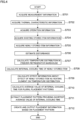
- FIG. 4 is a flowchart showing an operation example of the information processing device 600 in the present embodiment.
- the measurement information acquisition section 611 first acquires the measurement information indicating the temperature measured by the temperature sensor 400 (step 701).
- the thermal characteristic information acquisition section 612 acquires the thermal characteristic information indicating the thermal characteristics in the freezer/refrigerator warehouse 100 (step 702).
- the operation information acquisition section 613 acquires the operation information about the operation of the freezing/refrigerating device 200 (step 703).
- the existing stored item information acquisition section 614 acquires the existing stored item information about the existing stored items already existing in the freezer/refrigerator warehouse 100 (step 704).
- the newly stored item information acquisition section 615 acquires the newly stored item information about the newly stored items to be newly stored in the freezer/refrigerator warehouse 100 (step 705).
- the disturbance estimation section 621 estimates the disturbance based on the newly stored item information acquired in step 705 (step 706).
- the temperature distribution calculation section 622 calculates the temperature distribution in the freezer/refrigerator warehouse 100 based on the measurement information acquired in step 701, the thermal characteristic information acquired in step 702, the operation information acquired in step 703, the existing stored item information acquired in step 704, and the disturbance estimated in step 706 (step 707). Specifically, the temperature distribution calculation section 622 calculates the temperature difference between the measurement position by the temperature sensor 400 and the specific position based on the physical model using the thermal characteristic information, the operation information, the existing stored item information, and the disturbance. The temperature distribution calculation section 622 then calculates the temperature at the specific position by subtracting the temperature difference from the temperature indicated by the measurement information. After that, the temperature distribution calculation section 622 calculates the temperature distribution in the freezer/refrigerator warehouse 100 by performing the same processing for all positions in the freezer/refrigerator warehouse 100 as the specific positions.
- the cooling time calculation section 623 calculates the internal cooling time of the newly stored items based on the newly stored item information acquired in step 705 (step 708). Specifically, the cooling time calculation section 623 calculates the thermal time constant by the physical model using the heat capacity, the heat transfer rate, and the surface area of the newly stored item. Then, by the physical model using the thermal time constant, the current internal temperature and the target temperature (storage temperature) of the newly stored item, the internal cooling time in the case where the newly stored item is placed at the specific position is calculated.
- the effect information calculation section 624 calculates the effect information indicating the effect of the newly stored item as a heating element on the temperature distribution based on the newly stored item information acquired in step 705 (step 709). Specifically, the effect information calculation section 624 calculates the effect information indicating the effect on the temperature at a specific position in the case where plural newly stored items are placed at other positions by the physical model using information about the heat emitted by the newly stored items. The effect information calculation section 624 then calculates the effect information indicating the effect on the temperature distribution by adding the effect information from the plural newly stored items.
- the placement determination section 631 calculates the average value of the internal cooling time of the plural newly stored items for each of the plural placement patterns of the newly stored items based on the temperature distribution calculated in step 707, the internal cooling time calculated in step 708, and the effect information calculated in step 709 (step 710). Specifically, in the case where the plural newly stored items are placed in a specific placement pattern, the placement determination section 631 calculates the temperature at the specific positions where the plural newly stored items are placed by superimposing the effect information calculated by the effect information calculation section 624 on the temperature at the specific position calculated by the temperature distribution calculation section 622.
- the placement determination section 631 then calculates the internal cooling time for the plural newly stored items by applying the temperature at these specific positions to the internal cooling time calculated by the cooling time calculation section 623. Thereafter, the placement determination section 631 calculates the average value of the internal cooling time for the plural newly stored items.
- the placement determination section 631 extracts the placement pattern with the shortest average value of the internal cooling time calculated in step 710 from among the plural placement patterns for the newly stored items (step 711).
- the placement information output section 632 creates the placement information based on the placement pattern extracted in step 711 and outputs the placement information to the input/output device 500 (step 712).
- FIG. 5 is a diagram showing an example of an input screen 800 for inputting the newly stored item information acquired in step 705 shown in FIG. 4 .
- the input screen 800 includes a classification selection area 810 and an information input area 820.
- articles belonging to the fruits and vegetables are displayed in the article selection field 821 in the information input area 820.
- "tomatoes” that are to be stored is selected from these articles in the article selection field 821; accordingly, information about tomatoes is input in each input field in the information input area 820.
- “8cm” is input as the diameter in the diameter input field 822.
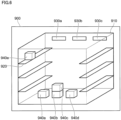
- FIG. 6 is a diagram showing an example of an output screen 900, to which the placement information is output in step 712 in FIG. 4 .
- the output screen 900 shows a warehouse object 910 that represents the freezer/refrigerator warehouse 100 in three dimensions.
- warehouse object 910 shelf objects 920 representing shelves of the freezer/refrigerator warehouse 100 and indoor unit objects 930a to 930c representing the indoor units 210a to 210c of the freezing/refrigerating device 200 are shown.
- the appropriate placement positions of the stored items are indicated by the positions of the stored item objects 940a to 940e on the warehouse object 910.
- the stored item represented by the stored item object 940c should be stacked on top of the stored item represented by the stored item object 940b.
- the stored item represented by the stored item object 940e should be placed on the shelf represented by the shelf object 920.
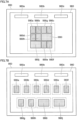
- FIGS. 7A and 7B are diagrams each illustrating the output screen to which another placement information is output.
- the output screen 950 proposes the placement positions of the stored items so that the inside of the stored items is cooled quickly. Note that, also in this case, in the freezer/refrigerator warehouse 100, it is assumed that the temperature around the stored item is predicted by soft sensing. In addition, it is assumed that the size and shape of the freezer/refrigerator warehouse 100 are known from the drawing information.
- the output screen 950 shows the warehouse object 960 that represents the freezer/refrigerator warehouse 100.
- the indoor unit objects 980a to 980c representing the indoor units 210a to 210c of the freezing/refrigerating device 200 are shown.
- the placement positions of the stored items are indicated by the positions of the stored item objects 990a to 990j on the warehouse object 960. It is assumed that, of these, the stored items represented by cross-hatched stored item objects 990a to 990f have high specific heat, heavy weight, medium volume, and a rectangular parallelepiped shape.
- the output screen 950 shown in FIG. 7A is displayed in the initial state.
- the output screen 950 shown in FIG. 7B proposes a placement change for the newly stored items to be stored.
- the stored items with high specific heat and heavy weight such as those represented by cross-hatched stored item objects 990a to 990f, should be moved to locations that are more likely to be hit by airflow.
- the placement with proper spacing cools the ten stored items quickly.
- the placement information in this output screen 950 is calculated based on the size of the freezer/refrigerator warehouse 100, the operation information of the freezing/refrigerating device 200, and the information of the stored items, etc.
- the processing performed by the information processing device 600 in the present embodiment is provided as, for example, a program such as application software.
- This program causes a computer to implement a function to predict how items cool in a chamber performing freezing or refrigerating, and a function to output proposal information about placement of items to be stored in the chamber, based on the predicted cooling of the items in the chamber.
Landscapes
- Engineering & Computer Science (AREA)
- Business, Economics & Management (AREA)
- Economics (AREA)
- Physics & Mathematics (AREA)
- Theoretical Computer Science (AREA)
- General Physics & Mathematics (AREA)
- Strategic Management (AREA)
- Human Resources & Organizations (AREA)
- General Engineering & Computer Science (AREA)
- Tourism & Hospitality (AREA)
- Quality & Reliability (AREA)
- Operations Research (AREA)
- Marketing (AREA)
- Entrepreneurship & Innovation (AREA)
- General Business, Economics & Management (AREA)
- Development Economics (AREA)
- Chemical & Material Sciences (AREA)
- Finance (AREA)
- Combustion & Propulsion (AREA)
- Mechanical Engineering (AREA)
- Thermal Sciences (AREA)
- Accounting & Taxation (AREA)
- Human Computer Interaction (AREA)
- Game Theory and Decision Science (AREA)
- Devices That Are Associated With Refrigeration Equipment (AREA)
- Cold Air Circulating Systems And Constructional Details In Refrigerators (AREA)
- Management, Administration, Business Operations System, And Electronic Commerce (AREA)
Abstract
Description
- The present disclosure relates to an information processing device, and a program.
-
Patent Document 1 describes, for example, the technology for proper storage management of goods, such as commodities, by placing the commodities, etc. in the vertical temperature distribution area within the space of the appropriate temperature for the goods. - Patent Document 1:
Japanese Patent Laid-Open No. 2010-112605 - The way in which items to be stored in a chamber are cooled depends on conditions. Therefore, it is difficult to cool the stored items efficiently by simply placing thereof in the chamber.
- An object of the present disclosure is to propose placement of items to be stored in a chamber performing freezing or refrigerating according to how the stored items are cooled. Solution to Problem
- An information processing device of the present disclosure includes: a prediction section predicting how a stored item cools in a chamber performing freezing or refrigerating; and an output section outputting proposal information about placement of an item to be stored in the chamber based on how the stored item cools as predicted by the prediction section.
- According to the information processing device, placement of stored items can be proposed in accordance with how the items to be stored in a chamber performing freezing or refrigerating are cooled.
- The prediction section may predict how a stored item cools in the chamber using a thermal time constant of an item to be stored in the chamber.
- With this, it is possible to predict how the stored item cools without complicated calculations.
- The prediction section may predict how a stored item cools in the chamber further using temperature information of an item to be stored in the chamber before being stored.
- With this, it is possible to predict how the stored item cools while taking into account the temperature information of the item to be stored in the chamber before being stored.
- The prediction section may predict how a stored item cools in the chamber further using target temperature information of an item to be stored in the chamber.
- With this, it is possible to predict how the stored item cools while taking into account the target temperature information of the item to be stored in the chamber.
- The prediction section may predict how a stored item cools in the chamber using a physical model that models an item to be stored in the chamber.
- With this, it is possible to predict how the stored item cools with less calculation amount compared to a case where the physical model is not used.
- The prediction section may predict a temperature at each position in the chamber, and the output section may output the proposal information further based on the temperature at each position in the chamber predicted by the prediction section.
- With this, it is possible to propose placement of stored items in accordance with the temperature at each position in a chamber performing freezing or refrigerating.
- The prediction section may predict the temperature at each position in the chamber using measurement information of a temperature measured at a predetermined position in the chamber.
- With this, it is possible to predict the temperature at each position in the chamber while reducing the number of devices measuring the temperature in the chamber.
- The prediction section may predict the temperature at each position in the chamber further using thermal characteristics inside the chamber.
- With this, it is possible to predict the temperature at each position in the chamber while taking into account the thermal characteristics inside the chamber.
- The prediction section may predict the temperature at each position in the chamber further using operation information of a cooling device performing freezing or refrigerating inside the chamber.
- With this, it is possible to predict the temperature at each position in the chamber while taking into account the operation information of the cooling device performing freezing or refrigerating inside the chamber.
- The prediction section may predict the temperature at each position in the chamber further using information of heat emitted by a stored item already existing in the chamber.
- With this, it is possible to predict the temperature at each position in the chamber while taking into account the information of heat emitted by the stored item already existing in the chamber.
- The prediction section may predict the temperature at each position in the chamber further using information of disturbance caused in the chamber.
- With this, it is possible to predict the temperature at each position in the chamber while taking into account the information of the disturbance caused in the chamber.
- The prediction section may predict the temperature at each position in the chamber using a physical model that models an interior of the chamber.
- With this, it is possible to predict the temperature at each position in the chamber with less calculation amount compared to a case where the physical model is not used.
- The prediction section may predict effect of heat emitted by an item to be stored in the chamber on the temperature at each position in the chamber, and the output section may output the proposal information further based on the effect on the temperature at each position in the chamber, the effect being predicted by the prediction section.
- With this, it is possible to propose placement of stored items in accordance with the effect of heat emitted by the item to be stored in the chamber on the temperature at each position in the chamber.
- The prediction section may predict the effect on the temperature at each position in the chamber using a physical model that models an item to be stored in the chamber.
- With this, it is possible to predict the effect of heat emitted by the stored item on the temperature at each position in the chamber with less calculation amount compared to a case where the physical model is not used.
- The output section may output the proposal information proposing placement of an item to be stored in the chamber, the placement cooling the item in a shorter time.
- With this, it is possible to propose the placement of the stored items in a freezing or refrigerating environment that cools in a shorter time.
- The output section may output the proposal information including information on how to stack an item to be stored in the chamber.
- With this, it is possible to propose the placement of the stored items with a favorable stacking method.
- The output section may output the proposal information including information on a distance between an item to be stored in the chamber and another stored item.
- With this, it is possible to propose the placement of the stored items with favorable distances.
- The output section may output the proposal information representing the placement using an object image corresponding to an item to be stored in the chamber.
- With this, it is possible to improve visualization of the placement of the stored items compared to a case where the object image is not used.
- The output section may output the proposal information on setting of a cooling device performing freezing or refrigerating inside the chamber.
- With this, it is possible to store the items in a favorable freezing or refrigerating environment even in the case where favorable placement is unavailable.
- In addition, a program of the present disclosure causes a computer to implement: a function of predicting how a stored item cools in a chamber performing freezing or refrigerating; and a function of outputting proposal information on placement of an item to be stored in the chamber based on how the stored item cools as predicted.
- According to a computer installing the program, it is possible to propose placement of stored items in accordance with how the items to be stored in a chamber performing freezing or refrigerating are cooled.
-
-
FIG. 1 is a diagram showing an overall configuration example of a freezing/refrigerating system to which the present embodiment is applied; -
FIG. 2 is a diagram showing a hardware configuration example of an information processing device in the present embodiment; -
FIG. 3 is a block diagram showing a functional configuration example of the information processing device in the present embodiment; -
FIG. 4 is a flowchart showing an operation example of the information processing device in the present embodiment; -
FIG. 5 is a diagram showing an example of an input screen for inputting newly stored item information obtained in the present embodiment; -
FIG. 6 is a diagram showing an example of an output screen of the present embodiment to which placement information is output; and -
FIGS. 7A and 7B are diagrams each illustrating the output screen of the present embodiment to which another placement information is output. - Hereinafter, an embodiment will be described in detail with reference to attached drawings.
-
FIG. 1 is a diagram showing an overall configuration example of a freezing/refrigeratingsystem 10 to which the present embodiment is applied. As shown in the figure, the freezing/refrigeratingsystem 10 performs freezing and refrigerating in a freezer/refrigerator warehouse 100, and includes a freezing/refrigeratingdevice 200, acontrol device 300, atemperature sensor 400, an input/output device 500, and aninformation processing device 600. - The freezer/
refrigerator warehouse 100 is a warehouse for freezing or refrigerating items to be stored therein. The freezer/refrigerator warehouse 100 includes aninsulation wall 110, an opening/closing door 120, and astorage space 130. Theinsulation wall 110 is a wall to increase heat-retaining characteristics of the freezer/refrigerator warehouse 100 by being covered with insulation panels. The opening/closing door 120 is a door that opens and closes when storing the items in the freezer/refrigerator warehouse 100. The opening/closing door 120 is filled with a heat insulating material to also increase the heat-retaining characteristics of the freezer/refrigerator warehouse 100 when being closed. Thestorage space 130 is a space for storing the items. In thestorage space 130, though not illustrated, plural shelves for placing and storing the items may be installed on theinsulation wall 110. - The freezing/
refrigerating device 200 is a device actually performing freezing and refrigerating for the freezer/refrigerator warehouse 100. The freezing/refrigerating device 200 includesindoor units 210a to 210c, anoutdoor unit 220, andpiping 230. Theindoor units 210a to 210c are installed in the freezer/refrigerator warehouse 100 and absorb heat from the air in the freezer/refrigerator warehouse 100 by exchanging heat between the refrigerant coming through the piping 230 and the air in the freezer/refrigerator warehouse 100. Theoutdoor unit 220 is installed outside the freezer/refrigerator warehouse 100 and discharges heat to the outside of the freezer/refrigerator warehouse 100 by exchanging heat between the refrigerant coming through the piping 230 and the air outside the freezer/refrigerator warehouse 100. The piping 230 is a pipe connecting theindoor units 210a to 210c and theoutdoor unit 220, through which the refrigerant passes. Note that theindoor units 210a to 210c are shown in the figure, but in the case where there is no need to distinguish the indoor units, the units are sometimes referred to as the indoor units 210. The figure shows three indoor units 210; however, one, two, or four or more indoor units 210 may be installed. In the present embodiment, the freezing/refrigerating device 200 is provided as an example of a cooling device for freezing or refrigerating inside the warehouse. - The
control device 300 is a device that controls the freezing/refrigerating device 200 to operate based on the set conditions. - The
temperature sensor 400 is installed at a predetermined position in the freezer/refrigerator warehouse 100, and measures the temperature at the predetermined position. - For example, the input/
output device 500 is installed beside the opening/closing door 120 of the freezer/refrigerator warehouse 100, and accepts user operations to input information about the items to be stored in freezer/refrigerator warehouse 100, and outputs proposal information about the placement of the items to be stored in the freezer/refrigerator warehouse 100. The input/output device 500 may be a touch panel, for example. - The
information processing device 600 creates the proposal information about the placement of the items to be stored in the freezer/refrigerator warehouse 100, and outputs the information to the input/output device 500. Specifically, theinformation processing device 600 first acquires various pieces of information from the freezing/refrigerating device 200, thetemperature sensor 400, the input/output device 500, etc. Next, theinformation processing device 600 uses the various pieces of information to determine the temperature distribution in the freezer/refrigerator warehouse 100 and how the items to be stored in the freezer/refrigerator warehouse 100 cool. Next, theinformation processing device 600 creates the proposal information based on the temperature distribution, how the items cool, etc. Then, theinformation processing device 600 outputs the proposal information to the input/output device 500. -
FIG. 2 is a diagram showing a hardware configuration example of theinformation processing device 600 in the present embodiment. As shown in the figure, theinformation processing device 600 includes a CPU (Central Processing Unit) 601, which is an arithmetic unit, a RAM (Random Access Memory) 602, which is a storage unit, a ROM (Read Only Memory) 603, and astorage device 604. TheRAM 602 is a main storage device (main memory), and used as a working memory when theCPU 601 performs arithmetic processing. TheROM 603 holds programs and data of setting values prepared in advance, etc., and theCPU 601 can execute processing by directly reading the programs and data from theROM 603. Thestorage device 604 is a storing unit for programs and data. Thestorage device 604 stores the programs, and theCPU 601 reads the programs stored in thestorage device 604 into the main storage device to execute thereof. In addition, thestorage device 604 stores the processing results by theCPU 601 to preserve thereof. As thestorage device 604, for example, a magnetic disk device, an SSD (Solid State Drive), etc. can be used. -
FIG. 3 is a block diagram showing a functional configuration example of theinformation processing device 600 in the present embodiment. As shown in the figure, theinformation processing device 600 in the present embodiment includes anacquisition section 610, aprediction section 620, and anoutput section 630. - The
acquisition section 610 acquires various pieces of information. Theacquisition section 610 includes a measurementinformation acquisition section 611, a thermal characteristicinformation acquisition section 612, an operationinformation acquisition section 613, an existing stored iteminformation acquisition section 614, and a newly stored iteminformation acquisition section 615. - The measurement
information acquisition section 611 acquires information indicating the temperature measured by the temperature sensor 400 (hereinafter referred to as "measurement information"). Here, the measurement information is the information of the current temperature at the position where thetemperature sensor 400 is installed. - The thermal characteristic
information acquisition section 612 acquires thermal characteristic information indicating the thermal characteristics in the freezer/refrigerator warehouse 100. For example, the thermal characteristicinformation acquisition section 612 should acquire the thermal characteristic information that has been calculated and stored in advance from thestorage device 604. Here, the thermal characteristic information is a thermal diffusivity and a thermal conductivity from the position where thetemperature sensor 400 is installed to a specific position. - The operation
information acquisition section 613 acquires information about the operation of the freezing/refrigerating device 200 (hereinafter referred to as "operation information"). For example, the operationinformation acquisition section 613 should acquire the operation information from thecontrol device 300. Here, the operation information includes the supply air temperature, the return air temperature, the wind speed, the wind direction, etc. in the freezing/refrigerating device 200. - The existing stored item
information acquisition section 614 acquires information about the existing stored items that are the items already existing in the freezer/refrigerator warehouse 100 (hereinafter referred to as "existing stored item information"). For example, the existing stored iteminformation acquisition section 614 should acquire the existing stored item information from thestorage device 604 that stored the existing stored item information when the existing stored items were stored. Here, examples of the existing stored item information include information about heat emitted from the existing stored item. In the case where the existing stored items are foods that breathe (vegetables, fruits, etc.), heat is generated by breathing; therefore, the existing stored item information includes such heat information. In addition, examples of the existing stored item information include the placement positions, volumes, shapes, etc. of the existing stored items. - The newly stored item
information acquisition section 615 acquires information about the newly stored items that are the items to be newly stored in the freezer/refrigerator warehouse 100 (hereinafter referred to as "newly stored item information"). For example, the newly stored iteminformation acquisition section 615 should acquire the newly stored item information from the input/output device 500 by the user inputting the newly stored item information into the input/output device 500. In addition, the newly stored iteminformation acquisition section 615 may acquire the newly stored item information from thestorage device 604, the newly stored item information being associated with information input by the user to the input/output device 500 in advance and stored in thestorage device 604. Furthermore, the newly stored iteminformation acquisition section 615 may acquire the newly stored item information calculated from the information input by the user to the input/output device 500. Here, examples of the newly stored item information include the heat capacity, the heat transfer rate, the surface area, the current surface temperature, the current internal temperature, and the target temperature (storage temperature) of the newly stored items. In addition, examples of the newly stored item information also include information about heat emitted from the newly stored items. In the case where the newly stored items are foods that breathe (vegetables, fruits, etc.), heat is generated by breathing; therefore, the newly stored item information includes such heat information. Examples of the newly stored item information further include volumes, shapes, etc. of the newly stored items. - The
prediction section 620 makes various predictions. Theprediction section 620 includes adisturbance estimation section 621, a temperaturedistribution calculation section 622, a coolingtime calculation section 623, and an effectinformation calculation section 624. - The
disturbance estimation section 621 estimates disturbances that occur in the freezer/refrigerator warehouse 100 using the newly stored item information acquired by the newly stored iteminformation acquisition section 615. Here, the disturbance is the opening and closing of the opening/closing door 120, etc. In this case, for example, if the number of newly stored items indicated by the newly stored item information is large, the time to open the opening/closing door 120 is considered to be longer; therefore, thedisturbance estimation section 621 estimates a large disturbance. On the other hand, if the number of newly stored items indicated by the newly stored item information is small, the time to open the opening/closing door 120 is considered to be shorter; therefore, thedisturbance estimation section 621 estimates a small disturbance. - The temperature
distribution calculation section 622 first assumes a specific position p from among plural positions in the freezer/refrigerator warehouse 100, and calculates the temperature around the specific position. For this purpose, the temperaturedistribution calculation section 622 calculates the temperature difference ΔT, which is obtained by subtracting the temperature at the specific position p from the temperature Tm indicated by the measurement information acquired by the measurementinformation acquisition section 611, using a physical model that models the inside of the freezer/refrigerator warehouse 100. The physical model includes the following terms created using information acquired by theacquisition section 610 or estimated by thedisturbance estimation section 621. - The first term prescribes the thermal diffusivity α and the thermal conductivity β from the position where the
temperature sensor 400 is installed to the specific position p. The thermal diffusivity α and the thermal conductivity β are acquired by the thermal characteristicinformation acquisition section 612. Assuming that the distance from the position n where thetemperature sensor 400 is installed to the specific position p is k1(n, p), the term is denoted as f(α, β, k1(n, p)). - The second term prescribes the effect on the temperature at the specific position p, the effects being determined from the supply air temperature Ts, the return air temperature Tr, the wind speed v, and the wind direction d of the indoor units 210 of the freezing/
refrigerating device 200, and the interference i by the existing stored items. The supply air temperature Ts, the return air temperature Tr, the wind speed v, and the wind direction d are acquired by the operationinformation acquisition section 613. The interference i is information that changes depending on the position and stacking method, etc. of the existing stored items, and is acquired by the existing stored iteminformation acquisition section 614. Assuming that the distance from the position n where the indoor unit 210 of the freezing/refrigerating device 200 is installed to the specific position p is k2(n, p), the term is denoted as g(Ts, Tr, v, d, i, k2(n, p)). - The third term prescribes the effect of thermal information e exerted on the temperature at the specific position p by the existing stored item as a heating element. The thermal information e is acquired by the existing stored item
information acquisition section 614. Assuming that the distance from the position n where the existing stored item is placed to the specific position p is k3(n, p), the term is denoted as h(e, k3(n, p)). - The fourth term prescribes the disturbance γ estimated by the
disturbance estimation section 621. Assuming that the distance from the position n where the disturbance γ occurs, such as the opening/closing door 120, etc. to the specific position p is k4(n, p), the term is denoted as j(γ, k4(n, p)). - The temperature
distribution calculation section 622 calculates the temperature difference ΔT by adding the above terms as in the following expression. However, in the following expression, the parentheses describing the parameters of the functions f, g, h, and j of the respective terms are omitted.
- The temperature
distribution calculation section 622 then calculates the temperature at the specific position p by subtracting the temperature difference ΔT from the temperature Tm. - After that, the temperature
distribution calculation section 622 calculates the temperature distribution in the freezer/refrigerator warehouse 100 by performing the same processing for all positions in the freezer/refrigerator warehouse 100 as the specific positions p. - In this way, it is preferable that the temperature
distribution calculation section 622 calculates the temperature distribution in the freezer/refrigerator warehouse 100 by soft sensing using the temperature measured by thetemperature sensor 400 and the physical model, but the temperature distribution may be calculated by CFD (computational fluid dynamics). In addition, the temperaturedistribution calculation section 622 may calculate the temperature distribution using the outside temperature, information of the neighboring warehouse, etc. - In the present embodiment, the temperature
distribution calculation section 622 is provided as an example of the prediction section that predicts the temperature at each position in the warehouse. - The cooling
time calculation section 623 calculates the time required to cool the newly stored item to the inside thereof (hereinafter referred to as "internal cooling time") using a physical model that models the newly stored item. - First, the cooling
time calculation section 623 calculates the thermal time constant τ of the newly stored item using the heat capacity C, the heat transfer rate h, and the surface area S of the newly stored item. The heat capacity C, the heat transfer rate h, and the surface area S of the newly stored item are acquired by the newly stored iteminformation acquisition section 615. The coolingtime calculation section 623 calculates the thermal time constant τ by the following expression.
- Next, using the thermal time constant τ, the temperature T(p) at a specific position p in the freezer/
refrigerator warehouse 100, the current internal temperature Tc of the newly stored item, and the target temperature (storage temperature) Tt, the coolingtime calculation section 623 calculates the internal cooling time t(p) in the case where the newly stored item is placed at the specific position p. The current internal temperature Tc and the target temperature (storage temperature) Tt of the newly stored item are acquired by the newly stored iteminformation acquisition section 615. The current internal temperature Tc of the newly stored item is an example of temperature information of the item before being stored in the warehouse, and the target temperature (storage temperature) Tt of the newly stored item is an example of target temperature information of the item to be stored in the warehouse. The coolingtime calculation section 623 calculates the internal cooling time t(p) by the following expression.
- Alternatively, the cooling
time calculation section 623 does not need to calculate the exact internal cooling time if only the priority in cooling the newly stored items is to be determined; it is sufficient to determine the heat absorbing amount or the relative time required to cool each of the newly stored items to the inside. Consequently, the coolingtime calculation section 623 may determine the priority from the difference between the current internal temperature of the newly stored item and the target temperature in addition to the thermal time constant, which is a rough indication of the time until the inside of the newly stored item cools. - In addition, the cooling
time calculation section 623 may use any physical model in consideration of information that correlates with the cooling method of the newly stored item, not limited to the above physical model. The physical model may be a model using conductivity in the case where the stored items are in intimate contact with each other, for example. The physical model may be a model showing how a newly stored item will cool in the case where the newly stored item at a certain temperature is placed at a position of a certain wind speed. The physical model may be a model taking into account the temperature, the flow rate, the way of hitting by the ambient wind, the temperature of the circumference that is in contact with, the surface shape, specific heat, weight, volume, packing style of the stored item, etc. The physical model may also be a model that outputs a physical quantity of how much heat the item has with respect to the ambient temperature. - Furthermore, the cooling
time calculation section 623 may determine the internal cooling time by an AI. In this case, the coolingtime calculation section 623 uses, as training data, the weight before being stored, the surface area, the surface temperature, the internal temperature, target temperature (storage temperature), etc. for each type of the newly stored items. Then, the coolingtime calculation section 623 should learn the thermal characteristics by machine learning the objective variable as the actual measurement value of the time until the internal temperature reaches the target temperature. - In the present embodiment, the cooling
time calculation section 623 is provided as an example of the prediction section that predicts how the item stored in the warehouse cools. - The effect
information calculation section 624 calculates the effect information indicating the effect of the thermal information e on the temperature of the specific position p of the newly stored item as a heating element in the case where the newly stored item is placed at the position n in the freezer/refrigerator warehouse 100 using a physical model that models the newly stored item. The thermal information e of a newly stored item is acquired by the newly stored iteminformation acquisition section 615. Assuming that the distance from the position n where the newly stored item is placed to the specific position p is k3(n, p), the effect information is denoted as h(e, k3(n, p)). The effectinformation calculation section 624 calculates the effect information u(p), which indicates the effect on the temperature at the specific position p, by adding the effect information h(e, k3(n, p)) from plural newly stored items as in the following expression.
- In the present embodiment, the effect
information calculation section 624 is provided as an example of the prediction section that predicts the effect of the heat emitted by the item to be stored in the warehouse exerted on the temperature at each position in the warehouse. - The
output section 630 outputs various pieces of information. Theoutput section 630 includes aplacement determination section 631, a placementinformation output section 632, and a settinginformation output section 633. - The
placement determination section 631 determines appropriate placement of plural newly stored items based on the temperature distribution calculated by the temperaturedistribution calculation section 622, the internal cooling time calculated by the coolingtime calculation section 623, and the effect information calculated by the effectinformation calculation section 624. - For example, the
placement determination section 631 first calculates an average value of the internal cooling time of the plural newly stored items in the case where the plural newly stored items are placed in a specific placement pattern. Specifically, theplacement determination section 631 calculates the temperature T(p) at the specific position p, where each of the plural newly stored items is placed, by superimposing the effect information u(p) calculated by the effectinformation calculation section 624 on the temperature at the specific position p calculated by the temperaturedistribution calculation section 622. Theplacement determination section 631 then calculates the internal cooling time t(p) for each of the plural newly stored items by applying the calculated temperature T(p) to the internal cooling time t(p) calculated by the coolingtime calculation section 623. Thereafter, theplacement determination section 631 calculates the average value of the internal cooling time t(p) of the plural newly stored items. - Next, the
placement determination section 631 also calculates the average value of the internal cooling time t(p) of the plural newly stored items in the case where the plural newly stored items are placed in another placement pattern by performing the same processing. - After that, the
placement determination section 631 calculates a placement pattern that results in the shortest average value of the internal cooling time t(p) of the plural newly stored items as the appropriate placement. - Alternatively, when a priority for cooling the newly stored items has been determined, the
placement determination section 631 may determine the placement position of the newly stored items by checking the priority against the degree of cooling in the temperature distribution calculated by the temperaturedistribution calculation section 622. - The
placement determination section 631 may also determine that the already cooled existing stored items are placed at positions in the freezer/refrigerator warehouse 100 where the temperature is relatively high. Furthermore, if it is assumed that a large number of newly stored items will be carried in and out, it may be determined that the newly stored items are placed away from the opening/closing door 120, which is highly affected by outside air entry. - The placement
information output section 632 creates the placement information indicating the appropriate placement determined by theplacement determination section 631 and outputs thereof to the input/output device 500. - By creating the placement information indicating the appropriate placement as determined above, the placement information proposes the placement of the stored items with which the items to be stored in the freezer/
refrigerator warehouse 100 are cooled in a shorter time. In addition, the placement information may include information about the method of stacking the items to be stored in the freezer/refrigerator warehouse 100. Furthermore, the placement information may include instructions to place the items to be stored in the freezer/refrigerator warehouse 100 at predetermined intervals without placing the stored items in intimate contact with each other. For example, the placement information may include information on the distances between the items to be stored in the freezer/refrigerator warehouse 100 and other stored items. - Moreover, the placement information may be a placement image, for example. In that case, the placement image may represent the placement using an object image corresponding to the stored items on an image corresponding to the freezer/
refrigerator warehouse 100, for example. Here, it is preferable that the image corresponding to the freezer/refrigerator warehouse 100 is three-dimensional representation of the freezer/refrigerator warehouse 100. The object image corresponding to the stored item should be an image such as a pin or an icon. - In addition, when placing the newly stored items in an empty freezer/
refrigerator warehouse 100, the placementinformation output section 632 may create the placement information that proposes the placement positions of the newly stored items in accordance with the positions of the indoor units 210 of the freezing/refrigerating device 200. On that occasion, for example, if a stored item is placed in front of an air outlet of the indoor unit 210, it is difficult to cool behind the item; therefore, the placement information that proposes how to place other stored items may be created. Alternatively, when there have already been existing stored items in the freezer/refrigerator warehouse 100, the placementinformation output section 632 may create the placement information that proposes the placement of newly stored items. - In the present embodiment, the placement information is used as an example of the proposal information about the placement of the items to be stored in the warehouse, and the placement
information output section 632 is provided as an example of the output section that outputs such proposal information. - The setting
information output section 633 outputs the setting information about the setting of the freezing/refrigerating device 200 suitable for the placement determined by theplacement determination section 631 to the input/output device 500. For example, suppose that theplacement determination section 631 could not determine the appropriate placement of the stored items and determined placement close to the appropriate placement. In such a case, the settinginformation output section 633 informs the user of the setting information suitable for the determined placement by outputting thereof to the input/output device 500. In the present embodiment, the setting information is used as an example of the proposal information about the setting of the cooling device, and the settinginformation output section 633 is provided as an example of the output section that outputs such proposal information. -
FIG. 4 is a flowchart showing an operation example of theinformation processing device 600 in the present embodiment. - As shown in the figure, in the
information processing device 600, the measurementinformation acquisition section 611 first acquires the measurement information indicating the temperature measured by the temperature sensor 400 (step 701). In addition, the thermal characteristicinformation acquisition section 612 acquires the thermal characteristic information indicating the thermal characteristics in the freezer/refrigerator warehouse 100 (step 702). The operationinformation acquisition section 613 acquires the operation information about the operation of the freezing/refrigerating device 200 (step 703). The existing stored iteminformation acquisition section 614 acquires the existing stored item information about the existing stored items already existing in the freezer/refrigerator warehouse 100 (step 704). The newly stored iteminformation acquisition section 615 acquires the newly stored item information about the newly stored items to be newly stored in the freezer/refrigerator warehouse 100 (step 705). - Next, in the
information processing device 600, thedisturbance estimation section 621 estimates the disturbance based on the newly stored item information acquired in step 705 (step 706). - Subsequently, the temperature
distribution calculation section 622 calculates the temperature distribution in the freezer/refrigerator warehouse 100 based on the measurement information acquired in step 701, the thermal characteristic information acquired in step 702, the operation information acquired in step 703, the existing stored item information acquired in step 704, and the disturbance estimated in step 706 (step 707). Specifically, the temperaturedistribution calculation section 622 calculates the temperature difference between the measurement position by thetemperature sensor 400 and the specific position based on the physical model using the thermal characteristic information, the operation information, the existing stored item information, and the disturbance. The temperaturedistribution calculation section 622 then calculates the temperature at the specific position by subtracting the temperature difference from the temperature indicated by the measurement information. After that, the temperaturedistribution calculation section 622 calculates the temperature distribution in the freezer/refrigerator warehouse 100 by performing the same processing for all positions in the freezer/refrigerator warehouse 100 as the specific positions. - In addition, the cooling
time calculation section 623 calculates the internal cooling time of the newly stored items based on the newly stored item information acquired in step 705 (step 708). Specifically, the coolingtime calculation section 623 calculates the thermal time constant by the physical model using the heat capacity, the heat transfer rate, and the surface area of the newly stored item. Then, by the physical model using the thermal time constant, the current internal temperature and the target temperature (storage temperature) of the newly stored item, the internal cooling time in the case where the newly stored item is placed at the specific position is calculated. - Furthermore, the effect
information calculation section 624 calculates the effect information indicating the effect of the newly stored item as a heating element on the temperature distribution based on the newly stored item information acquired in step 705 (step 709). Specifically, the effectinformation calculation section 624 calculates the effect information indicating the effect on the temperature at a specific position in the case where plural newly stored items are placed at other positions by the physical model using information about the heat emitted by the newly stored items. The effectinformation calculation section 624 then calculates the effect information indicating the effect on the temperature distribution by adding the effect information from the plural newly stored items. - Thereafter, in the
information processing device 600, theplacement determination section 631 calculates the average value of the internal cooling time of the plural newly stored items for each of the plural placement patterns of the newly stored items based on the temperature distribution calculated in step 707, the internal cooling time calculated in step 708, and the effect information calculated in step 709 (step 710). Specifically, in the case where the plural newly stored items are placed in a specific placement pattern, theplacement determination section 631 calculates the temperature at the specific positions where the plural newly stored items are placed by superimposing the effect information calculated by the effectinformation calculation section 624 on the temperature at the specific position calculated by the temperaturedistribution calculation section 622. Theplacement determination section 631 then calculates the internal cooling time for the plural newly stored items by applying the temperature at these specific positions to the internal cooling time calculated by the coolingtime calculation section 623. Thereafter, theplacement determination section 631 calculates the average value of the internal cooling time for the plural newly stored items. - Next, the
placement determination section 631 extracts the placement pattern with the shortest average value of the internal cooling time calculated in step 710 from among the plural placement patterns for the newly stored items (step 711). - Subsequently, the placement
information output section 632 creates the placement information based on the placement pattern extracted in step 711 and outputs the placement information to the input/output device 500 (step 712). -
FIG. 5 is a diagram showing an example of aninput screen 800 for inputting the newly stored item information acquired in step 705 shown inFIG. 4 . - As shown in the figure, the
input screen 800 includes aclassification selection area 810 and aninformation input area 820. In the figure, since "fruits and vegetables" is selected in theclassification selection area 810, articles belonging to the fruits and vegetables are displayed in thearticle selection field 821 in theinformation input area 820. In addition, in the figure, "tomatoes" that are to be stored is selected from these articles in thearticle selection field 821; accordingly, information about tomatoes is input in each input field in theinformation input area 820. Specifically, "8cm" is input as the diameter in thediameter input field 822. Then, "18°C" is input as the internal temperature in the internaltemperature input field 823, "16°C" is input as the surface temperature in the surfacetemperature input field 824, and "8°C" is input as the target temperature (storage temperature) in the targettemperature input field 825. Note that, as for the heat capacity and heat transfer rate of tomatoes, the preset values for tomatoes should be acquired by selecting "tomatoes" in thearticle selection field 821. In addition, for the surface area of the tomato, the value calculated from the diameter input in thediameter input field 822 should be acquired. -
FIG. 6 is a diagram showing an example of anoutput screen 900, to which the placement information is output in step 712 inFIG. 4 . - As shown in the figure, the
output screen 900 shows awarehouse object 910 that represents the freezer/refrigerator warehouse 100 in three dimensions. In addition, on thewarehouse object 910, shelf objects 920 representing shelves of the freezer/refrigerator warehouse 100 andindoor unit objects 930a to 930c representing theindoor units 210a to 210c of the freezing/refrigerating device 200 are shown. The appropriate placement positions of the stored items are indicated by the positions of the storeditem objects 940a to 940e on thewarehouse object 910. Here, in particular, it is indicated that the stored item represented by the storeditem object 940c should be stacked on top of the stored item represented by the storeditem object 940b. It is also indicated that the stored item represented by the storeditem object 940e should be placed on the shelf represented by theshelf object 920. -
FIGS. 7A and 7B are diagrams each illustrating the output screen to which another placement information is output. In the freezer/refrigerator warehouse 100, it is meaningless to cool only the surface of the stored items, and it is important to cool the inside of the stored items. Therefore, theoutput screen 950 proposes the placement positions of the stored items so that the inside of the stored items is cooled quickly. Note that, also in this case, in the freezer/refrigerator warehouse 100, it is assumed that the temperature around the stored item is predicted by soft sensing. In addition, it is assumed that the size and shape of the freezer/refrigerator warehouse 100 are known from the drawing information. - As shown in the figure, the
output screen 950 shows thewarehouse object 960 that represents the freezer/refrigerator warehouse 100. In addition, on thewarehouse object 960, theindoor unit objects 980a to 980c representing theindoor units 210a to 210c of the freezing/refrigerating device 200 are shown. Then, the placement positions of the stored items are indicated by the positions of the storeditem objects 990a to 990j on thewarehouse object 960. It is assumed that, of these, the stored items represented by cross-hatched storeditem objects 990a to 990f have high specific heat, heavy weight, medium volume, and a rectangular parallelepiped shape. In addition, it is assumed that the stored items represented by diagonally hatched stored item objects 990g and 990h have medium specific heat, light weight, medium volume, and a rectangular parallelepiped shape. Furthermore, it is assumed that the stored items represented by dot-hatched stored item objects 990i and 990j have low specific heat, light weight, large volume, and a rectangular parallelepiped shape. - Under such a premise, suppose that the
output screen 950 shown inFIG. 7A is displayed in the initial state. In this placement of the stored items, only the stored items at the periphery of the ten stored items are cooled, as indicated by the broken line. Therefore, theoutput screen 950 shown inFIG. 7B proposes a placement change for the newly stored items to be stored. This indicates that the stored items with high specific heat and heavy weight, such as those represented by cross-hatched storeditem objects 990a to 990f, should be moved to locations that are more likely to be hit by airflow. This also indicates that the placement with proper spacing cools the ten stored items quickly. Note that the placement information in thisoutput screen 950 is calculated based on the size of the freezer/refrigerator warehouse 100, the operation information of the freezing/refrigerating device 200, and the information of the stored items, etc. - The processing performed by the
information processing device 600 in the present embodiment is provided as, for example, a program such as application software. - This program causes a computer to implement a function to predict how items cool in a chamber performing freezing or refrigerating, and a function to output proposal information about placement of items to be stored in the chamber, based on the predicted cooling of the items in the chamber.
- Note that it is possible to provide the program that implements the present embodiment by a communication tool, of course, and it is also possible to store thereof in a storage medium, such as a CD-ROM, to be provided.
-
- 10 Freezing/refrigerating system
- 100 Freezer/refrigerator warehouse
- 200 Freezing/refrigerating device
- 300 Control device
- 400 Temperature sensor
- 500 Input/output device
- 600 Information processing device
- 610 Acquisition section
- 611 Measurement information acquisition section
- 612 Thermal characteristic information acquisition section
- 613 Operation information acquisition section
- 614 Existing stored item information acquisition section
- 615 Newly stored item information acquisition section
- 620 Prediction section
- 621 Disturbance estimation section
- 622 Temperature distribution calculation section
- 623 Cooling time calculation section
- 624 Effect information calculation section
- 630 Output section
- 631 Placement determination section
- 632 Placement information output section
- 633 Setting information output section
Claims (20)
- An information processing device comprising:a prediction section predicting how a stored item cools in a chamber performing freezing or refrigerating; andan output section outputting proposal information about placement of an item to be stored in the chamber based on how the stored item cools as predicted by the prediction section.
- The information processing device according to claim 1, wherein the prediction section predicts how a stored item cools in the chamber using a thermal time constant of an item to be stored in the chamber.
- The information processing device according to claim 2, wherein the prediction section predicts how a stored item cools in the chamber further using temperature information of an item to be stored in the chamber before being stored.
- The information processing device according to claim 2, wherein the prediction section predicts how a stored item cools in the chamber further using target temperature information of an item to be stored in the chamber.
- The information processing device according to claim 1, wherein the prediction section predicts how a stored item cools in the chamber using a physical model that models an item to be stored in the chamber.
- The information processing device according to claim 1, whereinthe prediction section predicts a temperature at each position in the chamber, andthe output section outputs the proposal information further based on the temperature at each position in the chamber predicted by the prediction section.
- The information processing device according to claim 6, wherein the prediction section predicts the temperature at each position in the chamber using measurement information of a temperature measured at a predetermined position in the chamber.
- The information processing device according to claim 7, wherein the prediction section predicts the temperature at each position in the chamber further using thermal characteristics inside the chamber.
- The information processing device according to claim 7, wherein the prediction section predicts the temperature at each position in the chamber further using operation information of a cooling device performing freezing or refrigerating inside the chamber.
- The information processing device according to claim 7, wherein the prediction section predicts the temperature at each position in the chamber further using information of heat emitted by a stored item already existing in the chamber.
- The information processing device according to claim 7, wherein the prediction section predicts the temperature at each position in the chamber further using information of disturbance caused in the chamber.
- The information processing device according to claim 6, wherein the prediction section predicts the temperature at each position in the chamber using a physical model that models an interior of the chamber.
- The information processing device according to claim 6, whereinthe prediction section predicts effect of heat emitted by an item to be stored in the chamber on the temperature at each position in the chamber, andthe output section outputs the proposal information further based on the effect on the temperature at each position in the chamber, the effect being predicted by the prediction section.
- The information processing device according to claim 13, wherein the prediction section predicts the effect on the temperature at each position in the chamber using a physical model that models an item to be stored in the chamber.
- The information processing device according to claim 1, wherein the output section outputs the proposal information proposing placement of an item to be stored in the chamber, the placement cooling the item in a shorter time.
- The information processing device according to claim 1, wherein the output section outputs the proposal information including information on how to stack an item to be stored in the chamber.
- The information processing device according to claim 1, wherein the output section outputs the proposal information including information on a distance between an item to be stored in the chamber and another stored item.
- The information processing device according to claim 1, wherein the output section outputs the proposal information representing the placement using an object image corresponding to an item to be stored in the chamber.
- The information processing device according to claim 1, wherein the output section outputs the proposal information on setting of a cooling device performing freezing or refrigerating inside the chamber.
- A program causing a computer to implement:a function of predicting how a stored item cools in a chamber performing freezing or refrigerating; anda function of outputting proposal information on placement of an item to be stored in the chamber based on how the stored item cools as predicted.
Applications Claiming Priority (2)
| Application Number | Priority Date | Filing Date | Title |
|---|---|---|---|
| JP2021052072A JP7386485B2 (en) | 2021-03-25 | 2021-03-25 | Information processing equipment and programs |
| PCT/JP2022/007770 WO2022202087A1 (en) | 2021-03-25 | 2022-02-25 | Information processing device and program |
Publications (2)
| Publication Number | Publication Date |
|---|---|
| EP4317021A1 true EP4317021A1 (en) | 2024-02-07 |
| EP4317021A4 EP4317021A4 (en) | 2024-09-04 |
Family
ID=83397110
Family Applications (1)
| Application Number | Title | Priority Date | Filing Date |
|---|---|---|---|
| EP22774885.2A Withdrawn EP4317021A4 (en) | 2021-03-25 | 2022-02-25 | INFORMATION PROCESSING DEVICE AND PROGRAM |
Country Status (5)
| Country | Link |
|---|---|
| US (1) | US20240167760A1 (en) |
| EP (1) | EP4317021A4 (en) |
| JP (1) | JP7386485B2 (en) |
| CN (1) | CN117043532A (en) |
| WO (1) | WO2022202087A1 (en) |
Families Citing this family (2)
| Publication number | Priority date | Publication date | Assignee | Title |
|---|---|---|---|---|
| KR20240048979A (en) * | 2022-10-07 | 2024-04-16 | 삼성전자주식회사 | Regrigerator and method for controlling thereof |
| JP7761023B2 (en) * | 2023-05-02 | 2025-10-28 | トヨタ自動車株式会社 | management device |
Family Cites Families (14)
| Publication number | Priority date | Publication date | Assignee | Title |
|---|---|---|---|---|
| JP3504180B2 (en) | 1999-03-10 | 2004-03-08 | 株式会社東芝 | Refrigerator food temperature measuring device |
| JP4457486B2 (en) | 2000-11-08 | 2010-04-28 | パナソニック株式会社 | Product temperature controlled freezer |
| CN100395495C (en) * | 2003-10-17 | 2008-06-18 | 星崎电机株式会社 | Cooling storage and cooling machines |
| US7673464B2 (en) * | 2006-08-25 | 2010-03-09 | International Business Machines Corporation | Method and apparatus for temperature based placement of an item within a storage unit |
| JP2009215007A (en) | 2008-03-11 | 2009-09-24 | Hitachi Ltd | Warehouse operation support system |
| JP5372470B2 (en) * | 2008-11-05 | 2013-12-18 | 株式会社フジタ | Room temperature warehouse, article storage method in room temperature warehouse, and method of grasping vertical temperature distribution |
| BR112012020452B8 (en) | 2010-03-09 | 2020-10-27 | Panasonic Corp | cooler. |
| KR20120116207A (en) * | 2011-04-12 | 2012-10-22 | 엘지전자 주식회사 | A display device and a refrigerator comprising the display device |
| JP6402353B2 (en) | 2013-03-29 | 2018-10-10 | パナソニックIpマネジメント株式会社 | Refrigerator and refrigerator system |
| SG11202007824YA (en) * | 2018-04-12 | 2020-09-29 | Mitsubishi Electric Corp | Air-conditioning system, air-conditioning management server, air-conditioning management method and air-conditioning management program |
| WO2019224916A1 (en) * | 2018-05-22 | 2019-11-28 | 三菱電機株式会社 | Air conditioning device and warehouse having same |
| JP6870155B2 (en) | 2018-05-29 | 2021-05-12 | 三菱電機株式会社 | Goods management device, goods management system, area selection method and program |
| US11506448B2 (en) * | 2018-11-14 | 2022-11-22 | Samsung Electronics Co.. Ltd. | Method and device for managing food in refrigerator |
| CN110909930B (en) * | 2019-11-20 | 2022-05-03 | 浙江工业大学 | Goods position distribution method of mobile goods shelf storage system for refrigeration house |
-
2021
- 2021-03-25 JP JP2021052072A patent/JP7386485B2/en active Active
-
2022
- 2022-02-25 CN CN202280022177.4A patent/CN117043532A/en active Pending
- 2022-02-25 US US18/283,027 patent/US20240167760A1/en active Pending
- 2022-02-25 WO PCT/JP2022/007770 patent/WO2022202087A1/en not_active Ceased
- 2022-02-25 EP EP22774885.2A patent/EP4317021A4/en not_active Withdrawn
Also Published As
| Publication number | Publication date |
|---|---|
| US20240167760A1 (en) | 2024-05-23 |
| WO2022202087A1 (en) | 2022-09-29 |
| JP7386485B2 (en) | 2023-11-27 |
| EP4317021A4 (en) | 2024-09-04 |
| JP2022149770A (en) | 2022-10-07 |
| CN117043532A (en) | 2023-11-10 |
Similar Documents
| Publication | Publication Date | Title |
|---|---|---|
| Laguerre et al. | Heat transfer by natural convection in domestic refrigerators | |
| Laguerre et al. | Experimental investigation and modelling in the food cold chain: Thermal and quality evolution | |
| Laguerre et al. | Temperature prediction in domestic refrigerators: Deterministic and stochastic approaches | |
| Nahor et al. | CFD model of the airflow, heat and mass transfer in cool stores | |
| Laguerre et al. | Experimental study of heat transfer and air flow in a refrigerated display cabinet | |
| Delele et al. | Investigating the effects of table grape package components and stacking on airflow, heat and mass transfer using 3-D CFD modelling | |
| Ho et al. | Numerical simulation of temperature and velocity in a refrigerated warehouse | |
| US20240167760A1 (en) | Information processing device and program | |
| US9857235B2 (en) | Real-time modeling of heat distributions | |
| Mirade et al. | Three-dimensional CFD calculations for designing large food chillers | |
| Bishnoi et al. | Experimental investigation of air flow field and cooling heterogeneity in a refrigerated room | |
| ES3006455T3 (en) | Food safety system for food items in cooled environments | |
| Flick et al. | Combined deterministic and stochastic approaches for modeling the evolution of food products along the cold chain. Part I: Methodology | |
| JP7357783B2 (en) | Air conditioning control device | |
| Bayer et al. | CFD simulations and reduced order modeling of a refrigerator compartment including radiation effects | |
| Tanner et al. | A generalised mathematical modelling methodology for the design of horticultural food packages exposed to refrigerated conditions Part 2. Heat transfer modelling and testing | |
| Zhang et al. | Conjugate heat transfer analysis using a simplified household refrigerator model | |
| Margeirsson et al. | Numerical modelling of temperature fluctuations of chilled and superchilled cod fillets packaged in expanded polystyrene boxes stored on pallets under dynamic temperature conditions | |
| Defraeye et al. | Is there a systematic hidden'hot spot'in refrigerated containers filled with fresh food in ventilated packaging? | |
| JP7080374B2 (en) | Goods management device, goods management system, area selection method and program | |
| Hammond et al. | Development of a stability model for a vertical single band recirculated air curtain sealing a refrigerated cavity | |
| Lee et al. | Analysis of thermal characteristics and operating parameters during the food cold chain delivery process | |
| Vengalis | Optimizing the performance of open-type refrigerated display cabinets: Block schemes and key tasks | |
| Mannapperuma et al. | Effective surface heat transfer coefficients encountered in air blast freezing of whole chicken and chicken parts, individually and in packages | |
| Margeirsson et al. | Temperature monitoring and CFD modelling of a cold storage |
Legal Events
| Date | Code | Title | Description |
|---|---|---|---|
| STAA | Information on the status of an ep patent application or granted ep patent |
Free format text: STATUS: THE INTERNATIONAL PUBLICATION HAS BEEN MADE |
|
| PUAI | Public reference made under article 153(3) epc to a published international application that has entered the european phase |
Free format text: ORIGINAL CODE: 0009012 |
|
| STAA | Information on the status of an ep patent application or granted ep patent |
Free format text: STATUS: REQUEST FOR EXAMINATION WAS MADE |
|
| 17P | Request for examination filed |
Effective date: 20230919 |
|
| AK | Designated contracting states |
Kind code of ref document: A1 Designated state(s): AL AT BE BG CH CY CZ DE DK EE ES FI FR GB GR HR HU IE IS IT LI LT LU LV MC MK MT NL NO PL PT RO RS SE SI SK SM TR |
|
| P01 | Opt-out of the competence of the unified patent court (upc) registered |
Effective date: 20240409 |
|
| DAV | Request for validation of the european patent (deleted) | ||
| DAX | Request for extension of the european patent (deleted) | ||
| A4 | Supplementary search report drawn up and despatched |
Effective date: 20240806 |
|
| RIC1 | Information provided on ipc code assigned before grant |
Ipc: G06Q 10/0832 20230101ALI20240731BHEP Ipc: F25D 29/00 20060101ALI20240731BHEP Ipc: F25D 13/00 20060101ALI20240731BHEP Ipc: G06Q 10/08 20240101ALI20240731BHEP Ipc: G06Q 10/04 20230101ALI20240731BHEP Ipc: F25D 23/00 20060101ALI20240731BHEP Ipc: B65G 1/00 20060101AFI20240731BHEP |
|
| STAA | Information on the status of an ep patent application or granted ep patent |
Free format text: STATUS: EXAMINATION IS IN PROGRESS |
|
| 17Q | First examination report despatched |
Effective date: 20250402 |
|
| STAA | Information on the status of an ep patent application or granted ep patent |
Free format text: STATUS: THE APPLICATION HAS BEEN WITHDRAWN |
|
| 18W | Application withdrawn |
Effective date: 20250801 |