EP4316912A1 - Vehicle camera, camera system, video processing method, software, and vehicle incorporating the same - Google Patents
Vehicle camera, camera system, video processing method, software, and vehicle incorporating the same Download PDFInfo
- Publication number
- EP4316912A1 EP4316912A1 EP22188616.1A EP22188616A EP4316912A1 EP 4316912 A1 EP4316912 A1 EP 4316912A1 EP 22188616 A EP22188616 A EP 22188616A EP 4316912 A1 EP4316912 A1 EP 4316912A1
- Authority
- EP
- European Patent Office
- Prior art keywords
- image
- interior
- vehicle
- exterior
- imager
- Prior art date
- Legal status (The legal status is an assumption and is not a legal conclusion. Google has not performed a legal analysis and makes no representation as to the accuracy of the status listed.)
- Pending
Links
Images

Classifications
-
- B—PERFORMING OPERATIONS; TRANSPORTING
- B60—VEHICLES IN GENERAL
- B60R—VEHICLES, VEHICLE FITTINGS, OR VEHICLE PARTS, NOT OTHERWISE PROVIDED FOR
- B60R1/00—Optical viewing arrangements; Real-time viewing arrangements for drivers or passengers using optical image capturing systems, e.g. cameras or video systems specially adapted for use in or on vehicles
- B60R1/20—Real-time viewing arrangements for drivers or passengers using optical image capturing systems, e.g. cameras or video systems specially adapted for use in or on vehicles
- B60R1/29—Real-time viewing arrangements for drivers or passengers using optical image capturing systems, e.g. cameras or video systems specially adapted for use in or on vehicles for viewing an area inside the vehicle, e.g. for viewing passengers or cargo
-
- B—PERFORMING OPERATIONS; TRANSPORTING
- B60—VEHICLES IN GENERAL
- B60R—VEHICLES, VEHICLE FITTINGS, OR VEHICLE PARTS, NOT OTHERWISE PROVIDED FOR
- B60R11/00—Arrangements for holding or mounting articles, not otherwise provided for
- B60R11/04—Mounting of cameras operative during drive; Arrangement of controls thereof relative to the vehicle
-
- B—PERFORMING OPERATIONS; TRANSPORTING
- B60—VEHICLES IN GENERAL
- B60R—VEHICLES, VEHICLE FITTINGS, OR VEHICLE PARTS, NOT OTHERWISE PROVIDED FOR
- B60R1/00—Optical viewing arrangements; Real-time viewing arrangements for drivers or passengers using optical image capturing systems, e.g. cameras or video systems specially adapted for use in or on vehicles
- B60R1/20—Real-time viewing arrangements for drivers or passengers using optical image capturing systems, e.g. cameras or video systems specially adapted for use in or on vehicles
- B60R1/22—Real-time viewing arrangements for drivers or passengers using optical image capturing systems, e.g. cameras or video systems specially adapted for use in or on vehicles for viewing an area outside the vehicle, e.g. the exterior of the vehicle
-
- G—PHYSICS
- G06—COMPUTING OR CALCULATING; COUNTING
- G06T—IMAGE DATA PROCESSING OR GENERATION, IN GENERAL
- G06T5/00—Image enhancement or restoration
- G06T5/80—Geometric correction
-
- G—PHYSICS
- G06—COMPUTING OR CALCULATING; COUNTING
- G06V—IMAGE OR VIDEO RECOGNITION OR UNDERSTANDING
- G06V20/00—Scenes; Scene-specific elements
- G06V20/50—Context or environment of the image
- G06V20/59—Context or environment of the image inside of a vehicle, e.g. relating to seat occupancy, driver state or inner lighting conditions
-
- H—ELECTRICITY
- H04—ELECTRIC COMMUNICATION TECHNIQUE
- H04N—PICTORIAL COMMUNICATION, e.g. TELEVISION
- H04N23/00—Cameras or camera modules comprising electronic image sensors; Control thereof
- H04N23/50—Constructional details
- H04N23/55—Optical parts specially adapted for electronic image sensors; Mounting thereof
-
- H—ELECTRICITY
- H04—ELECTRIC COMMUNICATION TECHNIQUE
- H04N—PICTORIAL COMMUNICATION, e.g. TELEVISION
- H04N23/00—Cameras or camera modules comprising electronic image sensors; Control thereof
- H04N23/60—Control of cameras or camera modules
- H04N23/698—Control of cameras or camera modules for achieving an enlarged field of view, e.g. panoramic image capture
-
- H—ELECTRICITY
- H04—ELECTRIC COMMUNICATION TECHNIQUE
- H04N—PICTORIAL COMMUNICATION, e.g. TELEVISION
- H04N23/00—Cameras or camera modules comprising electronic image sensors; Control thereof
- H04N23/80—Camera processing pipelines; Components thereof
-
- B—PERFORMING OPERATIONS; TRANSPORTING
- B60—VEHICLES IN GENERAL
- B60R—VEHICLES, VEHICLE FITTINGS, OR VEHICLE PARTS, NOT OTHERWISE PROVIDED FOR
- B60R11/00—Arrangements for holding or mounting articles, not otherwise provided for
- B60R2011/0001—Arrangements for holding or mounting articles, not otherwise provided for characterised by position
- B60R2011/0003—Arrangements for holding or mounting articles, not otherwise provided for characterised by position inside the vehicle
- B60R2011/0026—Windows, e.g. windscreen
-
- G—PHYSICS
- G06—COMPUTING OR CALCULATING; COUNTING
- G06T—IMAGE DATA PROCESSING OR GENERATION, IN GENERAL
- G06T2207/00—Indexing scheme for image analysis or image enhancement
- G06T2207/30—Subject of image; Context of image processing
- G06T2207/30248—Vehicle exterior or interior
- G06T2207/30268—Vehicle interior
Definitions
- the present disclosure relates to a vehicle camera, camera system including the same, video processing method and computer software product.
- the present disclosure is particularly relevant to vehicular camera systems for monitoring the interior and exterior of the vehicle.
- an interior camera system may be used to implement one or more of driver gaze tracking, hands-on-wheel detection, seatbelt compliance detection, drowsiness detection, and driver attention monitoring.
- an exterior camera system will often also be provided to implement functions such as pedestrian detection, traffic sign recognition, leading vehicle tracking, and autonomous emergency braking.
- vehicles are provided with at least two camera units with fields of view directed to the vehicle's interior and exterior, respectively.
- image capture and processing hardware along with the associated wiring, must be provided.
- the interior camera system will often have its own electronic control unit for processing the video feed provided thereby, with communication wiring provided between this and the camera unit itself, as well as power supply cabling to both units.
- each additional camera unit adds to costs and introduces additional manufacturing complexities.
- a vehicle camera including an imager; and an ultra-wide-angle lens assembly for focussing onto the imager an ultra-wide-angle image having a field of view, wherein the camera is configured to be mounted within the vehicle such that the field of view includes an interior portion representing part of the interior of the vehicle and an exterior portion representing part of the exterior of the vehicle.
- a single vehicle camera unit may be provided for imaging both the vehicle interior and exterior simultaneously. That is, by providing the vehicle camera with a lens assembly and imager having a field of view which is sufficiently wide that it can be mounted within the vehicle to view the relevant parts of the vehicle interior on one side, as well as an opposing view of the vehicle's exterior on the other side. Consequently, the need for two or more separate cameras to image parts of the interior and exterior of the vehicle is removed. In turn, the camera system allows for simplified manufacturing, installation, and lower component costs.
- the imager includes an interior region associated with the interior portion of the image and an exterior region associated with the exterior portion of the image. In this way, respective regions of the imager are used to generate images for the interior and exterior portions of the field of view. This may allow for simplified processing of the image regions, for instance, by directing data generated by the different regions to different processing pipelines.
- the field of view includes an excluded portion of the field of view between the interior portion and the exterior portion.
- the excluded region may be associated with the part of the field of view that is not of interest and hence may be minimised by the lens.
- the imager includes an excluded region associated with the excluded portion.
- the excluded region may be associated with the part of the field of view that is not of interest, and hence does not need to be imaged.
- data processing overhead may be reduced by limiting imaging to only the relevant parts of the field of view.
- the imager includes a plurality of pixels for generating image data from the interior region and the exterior region, and wherein the excluded region includes inactive pixels or non-processed pixels. In this way, cost may be reduced by limiting active or processed parts of the imager to only the regions associated with the relevant portions of the field of view.
- the imager includes a colour filter array, such as a Bayer filter.
- the imager comprises a first imager part for generating image data from the interior region and a second imager part for generating image data from the exterior region.
- the imager may be provided in two separate parts, each associated with a different portion of the field of view.
- two imager parts or units may be provided for separately imaging the interior and exterior views.
- the field of view is 120 degrees or more.
- the ultra-wide-angle lens assembly includes: a first focal region having a first set of optical characteristics for focussing the interior portion of the field of view onto the imager, and a second focal region having a second set of optical characteristics for focussing the exterior portion of the field of view onto the imager.
- the lens assembly may include one or more bifocal lens elements for focussing the interior and exterior views separately. This may thereby allow for optimisation of the image for each portion of the field of view.
- the vehicle camera further includes a mount for mounting the camera such that the field of view includes the interior and exterior portions.
- the mount for mounting the camera is one of a roof module mount or a base of the windshield mount. In this way, the camera may be conveniently mounted within the vehicle for visualising the interior and exterior portions of the field of view.
- a vehicle camera system including the above vehicle camera, and an image processor for processing ultra-wide-angle images formed on the imager, wherein the image processor includes an image splitter block for separating the interior and exterior portions of the image.
- the image processor includes an image splitter block for separating the interior and exterior portions of the image.
- the image processor further includes at least one de-warping block for processing at least a portion of the image to correct image distortions.
- the distortions arising from the ultra-wide-angle lens may be corrected to provide an normalised image for subsequent processing or human perception. Accordingly, for example, this may allow existing image processing machine learning models to be used for subsequent processing, thereby avoiding the need to retrain or reconfigure these existing systems.
- the image processor includes an interior de-warping block for processing the interior portion of the image to correct image distortions, and an exterior de-warping block for processing the exterior portion of the image to correct image distortions.
- each of the de-warping processes may be optimised for the particular characteristics of the interior or exterior portions of the image.
- the image processor further includes: an interior processing part for processing the interior portion of the image and outputting a corrected interior image feed for use in one or more interior sensing functions; and an exterior processing part for processing the exterior portion of the image and outputting a corrected exterior image feed for use in one or more exterior sensing functions.
- the processing of the interior and exterior portions of the field of view may be independently customised to optimise them for the particular characteristics of that image portion.
- each processing part may process light intensity differently based on the differing lighting conditions associated with the inside and outside of the vehicle.
- the interior sensing functions include at least one of driver gaze tracking, hands-on-wheel detection, seatbelt compliance detection, drowsiness detection, and driver attention monitoring
- the exterior sensing functions include at least one of pedestrian detection, traffic sign recognition, leading vehicle tracking, and autonomous emergency braking.
- a vehicle camera video processing method including the steps of: receiving image data from an imager of ultra-wide-angle images having a field of view which includes an interior portion representing part of the interior of the vehicle and an exterior portion representing part of the exterior of the vehicle; and processing the image data by separating the interior and exterior portions of each image using an image splitter block.
- the step of processing the image data further includes correcting image distortions using at least one de-warping block.
- a vehicle comprising: a vehicle camera having an imager; and an ultra-wide-angle lens assembly for focussing onto the imager an ultra-wide-angle image having a field of view, wherein the camera is mounted within the vehicle such that the field of view includes an interior portion representing part of the interior of the vehicle and an exterior portion representing part of the exterior of the vehicle.
- a non-transitory computer readable medium including instructions which, when executed by one or more processors, implement the above method.
- a computer software product including instructions which, when executed by one or more processors, implement the above method.
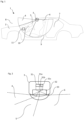
- Figure 1 shows a vehicle camera system 1 provided within a vehicle 2.
- the camera system 1 includes a vehicle camera 3 mounted into a rear-view mirror module 9 on the interior roof of the vehicle 2.
- the vehicle camera system 1 further includes a camera controller 11 for processing image data from the camera 3. It will be understood that the camera controller 3 may be integrated into an electronic control unit (ECU) within the vehicle 2.
- the camera controller 11 is communicatively connected to the camera 3 using the vehicles' communication network.
- the camera 3 has a field of view 9 that is greater than 180 degrees. Consequently, from the camera's mounted position, the field of view 9 encompasses part of both the exterior 8 and the interior 7 of the vehicle.
- the field of view 9 includes an exterior portion 4, which is forward-facing and observes part of the exterior 8 of the vehicle 2 through the front windscreen.
- the field of view 9 further includes an interior portion 6 which is rearward-facing and observes part of the interior 7 of the vehicle 2.
- the interior portion 6 allows for imaging of the vehicle's cabin to provide for sensing of the driver's upper body and face, as well as passenger occupancy.
- the field of view 9 includes an excluded portion 5 which would otherwise view the vehicle's dashboard 10. As this portion does not contain any pertinent visual information, it can therefore be ignored and is consequently excluded from image processing.
- Figure 2 shows a cross-sectional diagram of the vehicle camera 3, which includes an imager 31 and an ultra-wide-angle lens assembly including optical elements 32,33.
- the optical elements 32,33 are non-linear lenses for providing, in combination with the imager, the ultra-wide field of view greater than 180 degrees. This thereby allows both the exterior 4 and interior 6 portions of the field of view to be focussed onto the imager 31.
- the imager 31 includes regions 31a, 31b and 31c. These regions correspond to portions 6, 5 and 4 of the field of view 9, respectively.
- the regions 31a and 31c are active regions of the imager 31 and contain a plurality of pixels for generating image data from the focussed image projected thereon.
- Region 31a is an interior region associated with the interior portion 6 of the field of view
- region 31c is an exterior region, associated with the exterior portion 4 of the field of view.
- Region 31b is an excluded region associated with the excluded portion 5 of the field of view. As this portion is not of interest, the pixels in this region are not processed. In other embodiments, this excluded region 31b may be provided with inactive pixels or without pixels.
- the optical elements 32,33 are configured such that their optical properties act to minimise the size of the excluded region 31b. This allows the sizes of the interior and exterior regions 31a,c to be maximised and hence provides for a higher resolution image of these regions of interest.
- FIG 3 shows a block diagram of the parts of the vehicle camera system 1 shown in Figure 1 .
- the vehicle camera system 1 includes the vehicle camera 3 shown in Figure 2 , and the camera controller 11.
- the camera controller 11 includes processing blocks 12, 13 and 14 for processing the image data captured by the imager 31.
- an image splitter block 12 receives the ultra-wide-angle image formed on the imager 31 and separates it into two outputs corresponding to the interior and exterior portions of the field of view.
- the outputs of the image splitting block 12 are then fed into interior processing block 13 and exterior processing block 14 respectively.
- the interior processing block 13 includes a de-warping block 131, the output of which feeds into a interior processing part 132.
- the interior processing block 13 also includes an image signal processing (ISP) block 133, the output of which feeds into a visualisation block 134.
- the exterior processing block 14 includes a de-warping block 141, the output of which feeds into an exterior processing part 142.
- the de-warping blocks 132 and 141 are used to correct image distortions arising from the ultra-wide angled lens.
- the de-warping blocks 132 and 141 are associated with the interior and exterior portions respectively, they may also correct for the different lighting conditions and image needs associated with interior and exterior image processing.
- the interior processing part 132 and exterior processing part 142 are respectively used to process the interior and exterior image data for interior and exterior sensing and ADAS functions.
- the ISP block 133 and visualisation block 134 may be used for generating an interior video image of the interior of the vehicle, as described in further detail below.
- light passes through the lens elements 32, 33 and is focussed onto the imager 31 to form an ultra-wide-angle image.
- the field of view includes the exterior portion 4 projected onto exterior region 31c of the imager 31, and an interior portion 6 projected onto interior region 31a of the imager 31.
- the excluded portion 5 falls onto inactive region 31b of the imager 31.
- the image splitter block 12 separates the interior and exterior portions into separate streams for subsequent processing, with the interior portion being de-warped through de-warping block 131 to correct image distortions and output a corrected interior image. This may then be further processed by processing part 132 to provide interior sensing functions, such as for monitoring the driver's gaze, their seatbelt status, and their hand position on the steering wheel.
- the interior portion of the image may also be processed by the image signal processing block 133 in order to supress the infrared component of the image data and extract the RGB colour components for outputting an image to the visualisation block 134 for generating an image suitable for human vision.
- the generated image may be used for video calls and/or telepresence functions within the vehicle 2.
- the exterior portion of the image similarly undergoes de-warping via block 141 to correct distortions and output a corrected exterior image which is processed further by processing part 142 to provide exterior sensing functions such as ADAS functions for monitoring the external environment of the vehicle 2.
- Figure 4 shows a second embodiment, which is substantially the same as the first except that the camera 3 in this case is mounted to the base of the windshield or dashboard 10 of the vehicle 2.
- the field of view includes an interior portion 6 for observing part of the interior of the vehicle and an exterior portion 4 for observing part of the exterior of the vehicle, with the position of these portions being configured to account for the lower mounting position.
- this mounting position may provide a better viewpoint of the relevant parts of the interior and exterior of the vehicle.
- the camera controller may perform image processing on distorted images.
- an artificial intelligence model used for image processing may be trained on the ultra-wide field of view images to allow image data to be analysed directly.
- the imager may include two distinct parts for the interior and exterior portions of the field of view respectively.
- the camera may be mounted off-centre, for instance in either side pillar of the vehicle, or in the rear of the vehicle for providing a view of the rear seats and the exterior of the vehicle seen through the rear windshield.
Landscapes
- Engineering & Computer Science (AREA)
- Multimedia (AREA)
- Mechanical Engineering (AREA)
- Signal Processing (AREA)
- Physics & Mathematics (AREA)
- General Physics & Mathematics (AREA)
- Theoretical Computer Science (AREA)
- Studio Devices (AREA)
- Fittings On The Vehicle Exterior For Carrying Loads, And Devices For Holding Or Mounting Articles (AREA)
- Closed-Circuit Television Systems (AREA)
- Geometry (AREA)
Abstract
Description
- The present disclosure relates to a vehicle camera, camera system including the same, video processing method and computer software product. The present disclosure is particularly relevant to vehicular camera systems for monitoring the interior and exterior of the vehicle.
- In modern vehicles, camera systems have become increasingly important in implementing safety and driver assistance functionality. For example, an interior camera system may be used to implement one or more of driver gaze tracking, hands-on-wheel detection, seatbelt compliance detection, drowsiness detection, and driver attention monitoring. At the same time, an exterior camera system will often also be provided to implement functions such as pedestrian detection, traffic sign recognition, leading vehicle tracking, and autonomous emergency braking.
- To implement such vision-based sensing systems, vehicles are provided with at least two camera units with fields of view directed to the vehicle's interior and exterior, respectively. For each camera unit, image capture and processing hardware, along with the associated wiring, must be provided. For instance, the interior camera system will often have its own electronic control unit for processing the video feed provided thereby, with communication wiring provided between this and the camera unit itself, as well as power supply cabling to both units. As a consequence, each additional camera unit adds to costs and introduces additional manufacturing complexities.
- Accordingly, there remains a need to reduce costs associated with conventional vehicle camera systems.
- According to a first aspect, there is provided a vehicle camera including an imager; and an ultra-wide-angle lens assembly for focussing onto the imager an ultra-wide-angle image having a field of view, wherein the camera is configured to be mounted within the vehicle such that the field of view includes an interior portion representing part of the interior of the vehicle and an exterior portion representing part of the exterior of the vehicle.
- In this way, a single vehicle camera unit may be provided for imaging both the vehicle interior and exterior simultaneously. That is, by providing the vehicle camera with a lens assembly and imager having a field of view which is sufficiently wide that it can be mounted within the vehicle to view the relevant parts of the vehicle interior on one side, as well as an opposing view of the vehicle's exterior on the other side. Consequently, the need for two or more separate cameras to image parts of the interior and exterior of the vehicle is removed. In turn, the camera system allows for simplified manufacturing, installation, and lower component costs.
- In embodiments, the imager includes an interior region associated with the interior portion of the image and an exterior region associated with the exterior portion of the image. In this way, respective regions of the imager are used to generate images for the interior and exterior portions of the field of view. This may allow for simplified processing of the image regions, for instance, by directing data generated by the different regions to different processing pipelines.
- In embodiments, the field of view includes an excluded portion of the field of view between the interior portion and the exterior portion. In this way, the excluded region may be associated with the part of the field of view that is not of interest and hence may be minimised by the lens.
- In embodiments, the imager includes an excluded region associated with the excluded portion. In this way, the excluded region may be associated with the part of the field of view that is not of interest, and hence does not need to be imaged. As a result, data processing overhead may be reduced by limiting imaging to only the relevant parts of the field of view.
- In embodiments, the imager includes a plurality of pixels for generating image data from the interior region and the exterior region, and wherein the excluded region includes inactive pixels or non-processed pixels. In this way, cost may be reduced by limiting active or processed parts of the imager to only the regions associated with the relevant portions of the field of view. In embodiments, the imager includes a colour filter array, such as a Bayer filter.
- In embodiments, the imager comprises a first imager part for generating image data from the interior region and a second imager part for generating image data from the exterior region. In this way, the imager may be provided in two separate parts, each associated with a different portion of the field of view. As such, two imager parts or units may be provided for separately imaging the interior and exterior views.
- In embodiments, the field of view is 120 degrees or more.
- In embodiments, the ultra-wide-angle lens assembly includes: a first focal region having a first set of optical characteristics for focussing the interior portion of the field of view onto the imager, and a second focal region having a second set of optical characteristics for focussing the exterior portion of the field of view onto the imager. In this way, the lens assembly may include one or more bifocal lens elements for focussing the interior and exterior views separately. This may thereby allow for optimisation of the image for each portion of the field of view.
- In embodiments, the vehicle camera further includes a mount for mounting the camera such that the field of view includes the interior and exterior portions.
- In embodiments, the mount for mounting the camera is one of a roof module mount or a base of the windshield mount. In this way, the camera may be conveniently mounted within the vehicle for visualising the interior and exterior portions of the field of view.
- According to a second aspect, there is provided a vehicle camera system including the above vehicle camera, and an image processor for processing ultra-wide-angle images formed on the imager, wherein the image processor includes an image splitter block for separating the interior and exterior portions of the image. In this way, a system is provided for capturing and processing images of both the interior and exterior of a vehicle using a single camera.
- In embodiments, the image processor further includes at least one de-warping block for processing at least a portion of the image to correct image distortions. In this way, the distortions arising from the ultra-wide-angle lens may be corrected to provide an normalised image for subsequent processing or human perception. Accordingly, for example, this may allow existing image processing machine learning models to be used for subsequent processing, thereby avoiding the need to retrain or reconfigure these existing systems.
- In embodiments, the image processor includes an interior de-warping block for processing the interior portion of the image to correct image distortions, and an exterior de-warping block for processing the exterior portion of the image to correct image distortions. In this way, each of the de-warping processes may be optimised for the particular characteristics of the interior or exterior portions of the image.
- In embodiments, the image processor further includes: an interior processing part for processing the interior portion of the image and outputting a corrected interior image feed for use in one or more interior sensing functions; and an exterior processing part for processing the exterior portion of the image and outputting a corrected exterior image feed for use in one or more exterior sensing functions. In this way, the processing of the interior and exterior portions of the field of view may be independently customised to optimise them for the particular characteristics of that image portion. For example, each processing part may process light intensity differently based on the differing lighting conditions associated with the inside and outside of the vehicle.
- In embodiments, the interior sensing functions include at least one of driver gaze tracking, hands-on-wheel detection, seatbelt compliance detection, drowsiness detection, and driver attention monitoring, and the exterior sensing functions include at least one of pedestrian detection, traffic sign recognition, leading vehicle tracking, and autonomous emergency braking.
- According to a third aspect, there is provided a vehicle camera video processing method including the steps of: receiving image data from an imager of ultra-wide-angle images having a field of view which includes an interior portion representing part of the interior of the vehicle and an exterior portion representing part of the exterior of the vehicle; and processing the image data by separating the interior and exterior portions of each image using an image splitter block.
- In embodiments, the step of processing the image data further includes correcting image distortions using at least one de-warping block.
- According to a third aspect, there is provided a vehicle comprising: a vehicle camera having an imager; and an ultra-wide-angle lens assembly for focussing onto the imager an ultra-wide-angle image having a field of view, wherein the camera is mounted within the vehicle such that the field of view includes an interior portion representing part of the interior of the vehicle and an exterior portion representing part of the exterior of the vehicle.
- According to a fourth aspect, there is provided a non-transitory computer readable medium including instructions which, when executed by one or more processors, implement the above method. According to a further aspect, there is provided a computer software product including instructions which, when executed by one or more processors, implement the above method.
- Illustrative embodiments will now be described with reference to the accompanying drawings in which:
-
Figure 1 is a cross-sectional diagram of a vehicle camera system mounted within a vehicle according to a first embodiment; -
Figure 2 is a cross-sectional diagram of a vehicle camera forming part of the vehicle camera system shown inFigure 1 ; -
Figure 3 is a block diagram of the parts of the vehicle camera system shown inFigure 1 ; and -
Figure 4 is a cross-sectional diagram of a vehicle camera system mounted within a vehicle according to a second embodiment. -
Figure 1 shows avehicle camera system 1 provided within avehicle 2. Thecamera system 1 includes avehicle camera 3 mounted into a rear-view mirror module 9 on the interior roof of thevehicle 2. - The
vehicle camera system 1 further includes acamera controller 11 for processing image data from thecamera 3. It will be understood that thecamera controller 3 may be integrated into an electronic control unit (ECU) within thevehicle 2. Thecamera controller 11 is communicatively connected to thecamera 3 using the vehicles' communication network. - As is described in further detail below, the
camera 3 has a field ofview 9 that is greater than 180 degrees. Consequently, from the camera's mounted position, the field ofview 9 encompasses part of both theexterior 8 and theinterior 7 of the vehicle. In particular, the field ofview 9 includes anexterior portion 4, which is forward-facing and observes part of theexterior 8 of thevehicle 2 through the front windscreen. - The field of
view 9 further includes aninterior portion 6 which is rearward-facing and observes part of theinterior 7 of thevehicle 2. Theinterior portion 6 allows for imaging of the vehicle's cabin to provide for sensing of the driver's upper body and face, as well as passenger occupancy. - Between the
exterior 4 andinterior portions 6, the field ofview 9 includes an excludedportion 5 which would otherwise view the vehicle'sdashboard 10. As this portion does not contain any pertinent visual information, it can therefore be ignored and is consequently excluded from image processing. -
Figure 2 shows a cross-sectional diagram of thevehicle camera 3, which includes animager 31 and an ultra-wide-angle lens assembly includingoptical elements optical elements exterior 4 and interior 6 portions of the field of view to be focussed onto theimager 31. - The
imager 31 includesregions portions view 9, respectively. Theregions imager 31 and contain a plurality of pixels for generating image data from the focussed image projected thereon.Region 31a is an interior region associated with theinterior portion 6 of the field of view, andregion 31c is an exterior region, associated with theexterior portion 4 of the field of view. -
Region 31b is an excluded region associated with the excludedportion 5 of the field of view. As this portion is not of interest, the pixels in this region are not processed. In other embodiments, this excludedregion 31b may be provided with inactive pixels or without pixels. - The
optical elements region 31b. This allows the sizes of the interior andexterior regions 31a,c to be maximised and hence provides for a higher resolution image of these regions of interest. -
Figure 3 shows a block diagram of the parts of thevehicle camera system 1 shown inFigure 1 . As mentioned previously, thevehicle camera system 1 includes thevehicle camera 3 shown inFigure 2 , and thecamera controller 11. Thecamera controller 11 includes processing blocks 12, 13 and 14 for processing the image data captured by theimager 31. Firstly, animage splitter block 12 receives the ultra-wide-angle image formed on theimager 31 and separates it into two outputs corresponding to the interior and exterior portions of the field of view. The outputs of theimage splitting block 12 are then fed intointerior processing block 13 andexterior processing block 14 respectively. - The
interior processing block 13 includes ade-warping block 131, the output of which feeds into ainterior processing part 132. Theinterior processing block 13 also includes an image signal processing (ISP) block 133, the output of which feeds into avisualisation block 134. Theexterior processing block 14 includes ade-warping block 141, the output of which feeds into anexterior processing part 142. The de-warping blocks 132 and 141 are used to correct image distortions arising from the ultra-wide angled lens. At the same time, as the de-warping blocks 132 and 141 are associated with the interior and exterior portions respectively, they may also correct for the different lighting conditions and image needs associated with interior and exterior image processing. Theinterior processing part 132 andexterior processing part 142 are respectively used to process the interior and exterior image data for interior and exterior sensing and ADAS functions. TheISP block 133 andvisualisation block 134 may be used for generating an interior video image of the interior of the vehicle, as described in further detail below. - In use, light passes through the
lens elements imager 31 to form an ultra-wide-angle image. The field of view includes theexterior portion 4 projected ontoexterior region 31c of theimager 31, and aninterior portion 6 projected ontointerior region 31a of theimager 31. The excludedportion 5 falls ontoinactive region 31b of theimager 31. - The
image splitter block 12 separates the interior and exterior portions into separate streams for subsequent processing, with the interior portion being de-warped throughde-warping block 131 to correct image distortions and output a corrected interior image. This may then be further processed by processingpart 132 to provide interior sensing functions, such as for monitoring the driver's gaze, their seatbelt status, and their hand position on the steering wheel. - The interior portion of the image may also be processed by the image
signal processing block 133 in order to supress the infrared component of the image data and extract the RGB colour components for outputting an image to thevisualisation block 134 for generating an image suitable for human vision. For example, the generated image may be used for video calls and/or telepresence functions within thevehicle 2. - The exterior portion of the image similarly undergoes de-warping via
block 141 to correct distortions and output a corrected exterior image which is processed further by processingpart 142 to provide exterior sensing functions such as ADAS functions for monitoring the external environment of thevehicle 2. -
Figure 4 shows a second embodiment, which is substantially the same as the first except that thecamera 3 in this case is mounted to the base of the windshield ordashboard 10 of thevehicle 2. As with the first embodiment, the field of view includes aninterior portion 6 for observing part of the interior of the vehicle and anexterior portion 4 for observing part of the exterior of the vehicle, with the position of these portions being configured to account for the lower mounting position. Depending on the vehicle, this mounting position may provide a better viewpoint of the relevant parts of the interior and exterior of the vehicle. - Accordingly, it will be understood that the above arrangements allow for a single camera unit to be used to observe both the interior and exterior of the vehicle. This may thereby help to minimise costs and complexity as there is no need for separate interior and exterior camera units or the associated wiring and mounting parts.
- It will be understood that the embodiments illustrated above show applications only for the purposes of illustration. In practice, embodiments may be applied to many different configurations, the detailed embodiments being straightforward for those skilled in the art to implement.
- For example, it will be appreciated that whilst the above embodiments are described as including de-warping blocks, these may be omitted, and the camera controller may perform image processing on distorted images. For example, an artificial intelligence model used for image processing may be trained on the ultra-wide field of view images to allow image data to be analysed directly.
- Furthermore, rather than a single imager part, in embodiments, the imager may include two distinct parts for the interior and exterior portions of the field of view respectively.
- Finally, it will also be understood that although the above embodiments have been described in the context of mounting the camera centrally to provide a view of the exterior of the front of the vehicle and of the interior cabin simultaneously, alternate mounting positions are also envisaged. For example, in embodiments, the camera may be mounted off-centre, for instance in either side pillar of the vehicle, or in the rear of the vehicle for providing a view of the rear seats and the exterior of the vehicle seen through the rear windshield.
Claims (16)
Priority Applications (3)
| Application Number | Priority Date | Filing Date | Title |
|---|---|---|---|
| EP22188616.1A EP4316912A1 (en) | 2022-08-03 | 2022-08-03 | Vehicle camera, camera system, video processing method, software, and vehicle incorporating the same |
| CN202310961889.9A CN117528215A (en) | 2022-08-03 | 2023-08-01 | Vehicle camera, camera system, video processing method, software and vehicle comprising vehicle camera system |
| US18/364,278 US12441251B2 (en) | 2022-08-03 | 2023-08-02 | Vehicle camera, camera system, video processing method, software, and vehicle incorporating the same |
Applications Claiming Priority (1)
| Application Number | Priority Date | Filing Date | Title |
|---|---|---|---|
| EP22188616.1A EP4316912A1 (en) | 2022-08-03 | 2022-08-03 | Vehicle camera, camera system, video processing method, software, and vehicle incorporating the same |
Publications (1)
| Publication Number | Publication Date |
|---|---|
| EP4316912A1 true EP4316912A1 (en) | 2024-02-07 |
Family
ID=82839357
Family Applications (1)
| Application Number | Title | Priority Date | Filing Date |
|---|---|---|---|
| EP22188616.1A Pending EP4316912A1 (en) | 2022-08-03 | 2022-08-03 | Vehicle camera, camera system, video processing method, software, and vehicle incorporating the same |
Country Status (3)
| Country | Link |
|---|---|
| US (1) | US12441251B2 (en) |
| EP (1) | EP4316912A1 (en) |
| CN (1) | CN117528215A (en) |
Citations (7)
| Publication number | Priority date | Publication date | Assignee | Title |
|---|---|---|---|---|
| JPH11112968A (en) * | 1997-10-01 | 1999-04-23 | Harness Syst Tech Res Ltd | Environmental monitoring device inside and outside the vehicle |
| JP2008028606A (en) * | 2006-07-20 | 2008-02-07 | Opt Kk | Imaging device and imaging system for panoramically expanded image |
| JP2011124879A (en) * | 2009-12-11 | 2011-06-23 | Opt Kk | Imaging system for vehicle and in-vehicle imaging apparatus |
| JP5114101B2 (en) * | 2007-06-07 | 2013-01-09 | クラリオン株式会社 | In-vehicle camera system |
| JP5720400B2 (en) * | 2011-04-26 | 2015-05-20 | 日産自動車株式会社 | Image processing apparatus and image processing method |
| US20190061621A1 (en) * | 2017-08-29 | 2019-02-28 | Lg Electronics Inc. | Around view monitoring apparatus for vehicle, and vehicle |
| CN112216067A (en) * | 2020-09-07 | 2021-01-12 | 邢台林樾科技有限公司 | Image processing method based on vehicle-mounted wide-angle camera |
Family Cites Families (5)
| Publication number | Priority date | Publication date | Assignee | Title |
|---|---|---|---|---|
| US10099614B2 (en) * | 2011-11-28 | 2018-10-16 | Magna Electronics Inc. | Vision system for vehicle |
| US9656621B2 (en) * | 2015-09-14 | 2017-05-23 | Pearl Automation Inc. | System and method for sensor module power management |
| JP6658643B2 (en) * | 2017-03-24 | 2020-03-04 | トヨタ自動車株式会社 | Visual recognition device for vehicles |
| JP7334881B2 (en) * | 2017-05-10 | 2023-08-29 | モービルアイ ビジョン テクノロジーズ リミテッド | Cross-field of view for autonomous vehicle systems |
| US11498494B2 (en) * | 2019-11-27 | 2022-11-15 | Magna Electronics Inc. | Vehicular camera monitoring system |
-
2022
- 2022-08-03 EP EP22188616.1A patent/EP4316912A1/en active Pending
-
2023
- 2023-08-01 CN CN202310961889.9A patent/CN117528215A/en active Pending
- 2023-08-02 US US18/364,278 patent/US12441251B2/en active Active
Patent Citations (7)
| Publication number | Priority date | Publication date | Assignee | Title |
|---|---|---|---|---|
| JPH11112968A (en) * | 1997-10-01 | 1999-04-23 | Harness Syst Tech Res Ltd | Environmental monitoring device inside and outside the vehicle |
| JP2008028606A (en) * | 2006-07-20 | 2008-02-07 | Opt Kk | Imaging device and imaging system for panoramically expanded image |
| JP5114101B2 (en) * | 2007-06-07 | 2013-01-09 | クラリオン株式会社 | In-vehicle camera system |
| JP2011124879A (en) * | 2009-12-11 | 2011-06-23 | Opt Kk | Imaging system for vehicle and in-vehicle imaging apparatus |
| JP5720400B2 (en) * | 2011-04-26 | 2015-05-20 | 日産自動車株式会社 | Image processing apparatus and image processing method |
| US20190061621A1 (en) * | 2017-08-29 | 2019-02-28 | Lg Electronics Inc. | Around view monitoring apparatus for vehicle, and vehicle |
| CN112216067A (en) * | 2020-09-07 | 2021-01-12 | 邢台林樾科技有限公司 | Image processing method based on vehicle-mounted wide-angle camera |
Also Published As
| Publication number | Publication date |
|---|---|
| US12441251B2 (en) | 2025-10-14 |
| US20240042937A1 (en) | 2024-02-08 |
| CN117528215A (en) | 2024-02-06 |
Similar Documents
| Publication | Publication Date | Title |
|---|---|---|
| US12134316B2 (en) | State detection device, state detection system, and state detection method | |
| CN115593313B (en) | Vehicle driving assistance system | |
| CN107399275A (en) | Automotive occupant observing system and method | |
| US20200039448A1 (en) | Vehicular camera system with dual video outputs | |
| US11708025B2 (en) | Vehicle vision system with smart camera video output | |
| CN210781138U (en) | Solid-state imaging element and imaging device | |
| CN113826105A (en) | Image recognition device and image recognition method | |
| US20220166908A1 (en) | Image pickup control apparatus, image pickup apparatus, control method for image pickup control apparatus, and non-transitory computer readable medium | |
| US11025828B2 (en) | Imaging control apparatus, imaging control method, and electronic device | |
| US11475771B2 (en) | Image display system and riding device | |
| US10873732B2 (en) | Imaging device, imaging system, and method of controlling imaging device | |
| US12441251B2 (en) | Vehicle camera, camera system, video processing method, software, and vehicle incorporating the same | |
| US11924568B2 (en) | Signal processing device, signal processing method, and imaging apparatus | |
| US20210233217A1 (en) | Image restoration device and restoration model generation device | |
| EP4306363B1 (en) | System and method for providing a composite image of a vehicle and its surroundings | |
| US20220164958A1 (en) | Method Of Using Camera For Both Internal And External Monitoring Of A Vehicle | |
| US12088927B2 (en) | Imaging device and imaging method | |
| CN113170067B (en) | Camera device, camera system and fault detection method | |
| US20250171041A1 (en) | Vehicular driving assist system with enhanced data processing | |
| WO2020137503A1 (en) | Image processing device | |
| US20200099852A1 (en) | Solid-state imaging device, driving method, and electronic apparatus | |
| US12087049B2 (en) | Information processing device and information processing method | |
| US20230252798A1 (en) | Vehicular vision system with forward viewing camera with synchronized recording feature | |
| CN209949233U (en) | Image pickup apparatus and image pickup system | |
| WO2025028018A1 (en) | Defect detection device, imaging device, and defect detection method |
Legal Events
| Date | Code | Title | Description |
|---|---|---|---|
| PUAI | Public reference made under article 153(3) epc to a published international application that has entered the european phase |
Free format text: ORIGINAL CODE: 0009012 |
|
| STAA | Information on the status of an ep patent application or granted ep patent |
Free format text: STATUS: THE APPLICATION HAS BEEN PUBLISHED |
|
| AK | Designated contracting states |
Kind code of ref document: A1 Designated state(s): AL AT BE BG CH CY CZ DE DK EE ES FI FR GB GR HR HU IE IS IT LI LT LU LV MC MK MT NL NO PL PT RO RS SE SI SK SM TR |
|
| RAP1 | Party data changed (applicant data changed or rights of an application transferred) |
Owner name: APTIV TECHNOLOGIES AG |
|
| STAA | Information on the status of an ep patent application or granted ep patent |
Free format text: STATUS: REQUEST FOR EXAMINATION WAS MADE |
|
| 17P | Request for examination filed |
Effective date: 20240711 |
|
| RBV | Designated contracting states (corrected) |
Designated state(s): AL AT BE BG CH CY CZ DE DK EE ES FI FR GB GR HR HU IE IS IT LI LT LU LV MC MK MT NL NO PL PT RO RS SE SI SK SM TR |
|
| RAP3 | Party data changed (applicant data changed or rights of an application transferred) |
Owner name: APTIV TECHNOLOGIES AG |
|
| STAA | Information on the status of an ep patent application or granted ep patent |
Free format text: STATUS: EXAMINATION IS IN PROGRESS |
|
| 17Q | First examination report despatched |
Effective date: 20250902 |