EP4316611A1 - Method of operating a fitness bicycle - Google Patents
Method of operating a fitness bicycle Download PDFInfo
- Publication number
- EP4316611A1 EP4316611A1 EP22188313.5A EP22188313A EP4316611A1 EP 4316611 A1 EP4316611 A1 EP 4316611A1 EP 22188313 A EP22188313 A EP 22188313A EP 4316611 A1 EP4316611 A1 EP 4316611A1
- Authority
- EP
- European Patent Office
- Prior art keywords
- measure
- wheel
- pedals
- electric drive
- user
- Prior art date
- Legal status (The legal status is an assumption and is not a legal conclusion. Google has not performed a legal analysis and makes no representation as to the accuracy of the status listed.)
- Granted
Links
Images

Classifications
-
- A—HUMAN NECESSITIES
- A63—SPORTS; GAMES; AMUSEMENTS
- A63B—APPARATUS FOR PHYSICAL TRAINING, GYMNASTICS, SWIMMING, CLIMBING, OR FENCING; BALL GAMES; TRAINING EQUIPMENT
- A63B21/00—Exercising apparatus for developing or strengthening the muscles or joints of the body by working against a counterforce, with or without measuring devices
- A63B21/005—Exercising apparatus for developing or strengthening the muscles or joints of the body by working against a counterforce, with or without measuring devices using electromagnetic or electric force-resisters
- A63B21/0058—Exercising apparatus for developing or strengthening the muscles or joints of the body by working against a counterforce, with or without measuring devices using electromagnetic or electric force-resisters using motors
-
- A—HUMAN NECESSITIES
- A63—SPORTS; GAMES; AMUSEMENTS
- A63B—APPARATUS FOR PHYSICAL TRAINING, GYMNASTICS, SWIMMING, CLIMBING, OR FENCING; BALL GAMES; TRAINING EQUIPMENT
- A63B21/00—Exercising apparatus for developing or strengthening the muscles or joints of the body by working against a counterforce, with or without measuring devices
- A63B21/00181—Exercising apparatus for developing or strengthening the muscles or joints of the body by working against a counterforce, with or without measuring devices comprising additional means assisting the user to overcome part of the resisting force, i.e. assisted-active exercising
-
- A—HUMAN NECESSITIES
- A63—SPORTS; GAMES; AMUSEMENTS
- A63B—APPARATUS FOR PHYSICAL TRAINING, GYMNASTICS, SWIMMING, CLIMBING, OR FENCING; BALL GAMES; TRAINING EQUIPMENT
- A63B22/00—Exercising apparatus specially adapted for conditioning the cardio-vascular system, for training agility or co-ordination of movements
- A63B22/06—Exercising apparatus specially adapted for conditioning the cardio-vascular system, for training agility or co-ordination of movements with support elements performing a rotating cycling movement, i.e. a closed path movement
- A63B22/0605—Exercising apparatus specially adapted for conditioning the cardio-vascular system, for training agility or co-ordination of movements with support elements performing a rotating cycling movement, i.e. a closed path movement performing a circular movement, e.g. ergometers
-
- A—HUMAN NECESSITIES
- A63—SPORTS; GAMES; AMUSEMENTS
- A63B—APPARATUS FOR PHYSICAL TRAINING, GYMNASTICS, SWIMMING, CLIMBING, OR FENCING; BALL GAMES; TRAINING EQUIPMENT
- A63B24/00—Electric or electronic controls for exercising apparatus of preceding groups; Controlling or monitoring of exercises, sportive games, training or athletic performances
- A63B24/0087—Electric or electronic controls for exercising apparatus of groups A63B21/00 - A63B23/00, e.g. controlling load
-
- A—HUMAN NECESSITIES
- A63—SPORTS; GAMES; AMUSEMENTS
- A63B—APPARATUS FOR PHYSICAL TRAINING, GYMNASTICS, SWIMMING, CLIMBING, OR FENCING; BALL GAMES; TRAINING EQUIPMENT
- A63B71/00—Games or sports accessories not covered in groups A63B1/00 - A63B69/00
- A63B71/0009—Games or sports accessories not covered in groups A63B1/00 - A63B69/00 for handicapped persons
-
- A—HUMAN NECESSITIES
- A63—SPORTS; GAMES; AMUSEMENTS
- A63B—APPARATUS FOR PHYSICAL TRAINING, GYMNASTICS, SWIMMING, CLIMBING, OR FENCING; BALL GAMES; TRAINING EQUIPMENT
- A63B22/00—Exercising apparatus specially adapted for conditioning the cardio-vascular system, for training agility or co-ordination of movements
- A63B2022/0094—Exercising apparatus specially adapted for conditioning the cardio-vascular system, for training agility or co-ordination of movements for active rehabilitation, e.g. slow motion devices
-
- A—HUMAN NECESSITIES
- A63—SPORTS; GAMES; AMUSEMENTS
- A63B—APPARATUS FOR PHYSICAL TRAINING, GYMNASTICS, SWIMMING, CLIMBING, OR FENCING; BALL GAMES; TRAINING EQUIPMENT
- A63B24/00—Electric or electronic controls for exercising apparatus of preceding groups; Controlling or monitoring of exercises, sportive games, training or athletic performances
- A63B24/0087—Electric or electronic controls for exercising apparatus of groups A63B21/00 - A63B23/00, e.g. controlling load
- A63B2024/0093—Electric or electronic controls for exercising apparatus of groups A63B21/00 - A63B23/00, e.g. controlling load the load of the exercise apparatus being controlled by performance parameters, e.g. distance or speed
-
- A—HUMAN NECESSITIES
- A63—SPORTS; GAMES; AMUSEMENTS
- A63B—APPARATUS FOR PHYSICAL TRAINING, GYMNASTICS, SWIMMING, CLIMBING, OR FENCING; BALL GAMES; TRAINING EQUIPMENT
- A63B2220/00—Measuring of physical parameters relating to sporting activity
- A63B2220/10—Positions
- A63B2220/16—Angular positions
-
- A—HUMAN NECESSITIES
- A63—SPORTS; GAMES; AMUSEMENTS
- A63B—APPARATUS FOR PHYSICAL TRAINING, GYMNASTICS, SWIMMING, CLIMBING, OR FENCING; BALL GAMES; TRAINING EQUIPMENT
- A63B2220/00—Measuring of physical parameters relating to sporting activity
- A63B2220/17—Counting, e.g. counting periodical movements, revolutions or cycles, or including further data processing to determine distances or speed
-
- A—HUMAN NECESSITIES
- A63—SPORTS; GAMES; AMUSEMENTS
- A63B—APPARATUS FOR PHYSICAL TRAINING, GYMNASTICS, SWIMMING, CLIMBING, OR FENCING; BALL GAMES; TRAINING EQUIPMENT
- A63B2220/00—Measuring of physical parameters relating to sporting activity
- A63B2220/50—Force related parameters
- A63B2220/54—Torque
Definitions
- the invention relates to a method for operating a fitness bicycle having at least one wheel, comprising an electric drive and two pedals for electrically and mechanically driving the wheel, respectively, by a user having a physical impairment in at least one of his two lower extremities.
- the invention further relates to a fitness bicycle that is set up/programmed to perform this method.
- the method according to the invention serves for operating a fitness bicycle having at least one wheel, which has an electric drive and two pedals for electrically or mechanically driving the wheel, by a user with a physical impairment in one of his two lower extremities.
- the basic idea of the invention is to determine at least one measured variable characterizing this rotational movement during the rotational movement of the wheel, while the user of the fitness bicycle is pressing the pedal assigned to his unimpaired extremity.
- This information is taken into account when controlling an electric drive of the fitness bicycle to additionally drive the wheel - i.e. in addition to the drive by the mechanical pedal actuation of the user - while the pedal assigned to the impaired extremity is actuated by the user.
- the existing impairment in one of his two lower extremities can be compensated.
- a user with physical impairment can exercise effectively by means of a fitness bicycle.
- the two lower extremities include not only the user's pelvis and hip joint, but also his thigh, knee joint, lower leg with tibia and fibula, ankle joint, and also his foot with ankle, metatarsus and toes.
- the present invention also supports rehabilitation.
- the muscles of a person's legs after a fracture can partially ortrophy.
- the method according to the invention will help facilitate rehabilitation
- the method according to the invention comprises two measures a) and b).
- a) at least one measurement parameter characterizing the movement of the wheel is determined by means of the sensor system, while a first of the two pedals is actuated by the lower extremity of the user, which does not have said physical or functional impairment.
- the electric actuator is controlled as a function of the determined measurement parameter, while a second of the two pedals is actuated by the lower extremity of the user having said physical or functional impairment.
- the two measures a) and b) can be executed alternately one after the other iteratively, i.e. several times. By recording the measured variable, it is possible to simulate how the functionally impaired lower extremity would behave if there were no impairment. By controlling the electric drive accordingly, it can compensate for the impairment so that the bicycle moves as if a user without physical impairment in his two lower extremities were exercising on the fitness bike. This provides an improved training effect for a user with a physically or functionally impaired extremity.
- the following are determined in the course of measure a) at least the following three measured variables are determined: Pedal crank angle, pedal torque, cadence. Said measured variables, in particular a combination of two or even all three measured variables, allow the rotational movement of the wheel to be characterized particularly precisely during measure a), which has an advantageous effect on the control of the electric drive in measure b).
- the at least one measured variable is determined as a function of time in measure a). In this way, temporal changes in the at least one measured variable that occur during the rotation of the wheel or the pedals can also be taken into account for the control of the electric drive.
- a full rotation of the pedals about a predetermined axis of rotation corresponds to an angle of rotation of 360°
- the full rotation is composed of a first and a second partial rotation, each of which corresponds to an angle of rotation of 180°.
- measure a) is executed during the first partial rotation and measure b) during the second partial rotation. The procedure will thus adapt the control of the drive at each individual revolution to the actuation of the two pedals that occurred during the respective revolution.
- a drive power provided by the electric drive for driving the wheel is set or/and varied as a function of the at least one measurement parameter. If the user exerts a different amount of torque on the two pedals - due to the impairment of one of the two extremities - this can be compensated for by the drive torque provided by the electric drive during measure b).
- a control/regulation device of the fitness bicycle controls the electric drive in such a way that at least one measurement parameter determined in measure a) substantially maintains the parameter value determined in measure a) during measure b).
- the at least one measured parameter in measure a) can be determined over at least two, preferably from several, partial rotations.
- the measured data obtained in this way can then be taken into account for the control of the electric drive in measure b).
- the measurement data is evaluated by means of machine learning.
- the result of the evaluation is taken into account for the control of the electric actuator in measure b). In this way, the provision of additional drive torque by the electric drive can be optimized over time as a function of the amount of pedal actuation performed by the user.
- machine learning can be performed with the aid of a neural network.
- This neural network can be implemented in the control system, in particular as a computer program product. In this way, machine learning can be integrated into the control/regulation device and thus into the fitness bicycle in a cost-effective manner.
- the result of the evaluation can be stored so that it can or will be taken into account in a subsequent use of the fitness bicycle by the same user.
- the invention further relates to a fitness bicycle, in particular an exercise bike.
- the fitness bicycle according to the invention comprises a wheel which is drivable by means of two pedals of the fitness bicycle.
- the fitness bicycle comprises an electric drive for driving the fitness bicycle, in particular its wheel.
- the fitness bicycle comprises a sensor system for determining at least one measurement parameter characterizing the movement of the wheel.
- the fitness bicycle comprises a control/regulation device which is set up/programmed for carrying out the method according to the invention presented above.
- the advantages of the method according to the invention explained above are therefore transferred to the fitness bicycle according to the invention.
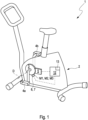
- FIG 1 illustrates an example of a fitness bicycle 1 according to the invention in the form of an exercise bike.
- the fitness bicycle 1 comprises a body 2, on which a wheel 3 is rotatably mounted about an axis of rotation D.
- the wheel 3 can be driven by the two lower extremities 11a, 11b - not shown in Figure 1 , cf.
- Figure 2 only - of a user 20 of the fitness bicycle 1 by actuating two pedals 4a, 4b of the fitness bicycle 1 which are drivingly connected to the wheel 2.
- the fitness bicycle 1 comprises an electric drive 5, also indicated only schematically in Figure 1 , for driving the wheel 3 of the fitness bicycle 1.
- a sensor system 6 arranged on the body 2 adjacent to the wheel 3 with sensors 7 not shown in more detail serves to determine three measured variables which characterize the movement of the wheel 2.
- the fitness bicycle 1 comprises a control/regulating device 12, which is operatively connected to the sensor system 6 or its sensors 7, for controlling the electric drive 5.
- the control/regulating device 12 is set up and programmed for carrying out the method according to the invention, which will be explained below by way of example using Figure 2 .
- the method according to the invention serves for operating the fitness bicycle 1 by a user 20 indicated in Figure 2 with a physical impairment in one of his two lower extremities 21a, 21b.
- a first, left lower extremity 21a including the left knee joint 22a of the user 20 operating the left pedal 4a does not exhibit any functional or physical impairment.
- a second lower right extremity 21b operating the second pedal 4b is impaired in the right knee joint 22b of the user 20.
- the exemplarily explained method comprises two measures a) and b).
- a first measure a three measured variables characterizing the rotational movement of the wheel 3 are determined as a function of time by means of the sensor system 6 (cf. Fig. 1 ) - purely exemplarily - during the rotational movement of the wheel 3.
- the three measured variables pedal crank angle M1, pedal torque M2 and cadence M3 are determined in the course of action with the aid of the sensors 7 of the sensor system 6. This is done while a first 4a of the two pedals 4a, 4b is operated by the left lower extremity 21a of the user 20, who has no physical or functional impairment.
- the electric actuator 5 is controlled as a function of the determined measured variables M1, M2, M3 (cf. figure 1 ), while a second 4b of the two pedals 4a, 4b is actuated by the right lower extremity 21b with the functionally impaired right knee joint 22b of the user 20.
- the measurement data obtained in measure a) by means of the sensor system 6 is taken into account for the control of the electric drive 5 in measure b).
- a drive power provided by the electric drive 5 for driving the wheel 3 can be adjusted and, if necessary, varied.
- control/regulation device 12 controls the electric drive 5 in such a way that at least one, preferably all, of the measurement parameters determined in measure a) substantially maintains value of the measurement parameter determined in measure a) during measure b).
- Said measurement data can preferably be evaluated by means of machine learning.
- the machine learning in turn can be done with the help of a neural network.
- the neural network may be integrated as a computer program product in the control/regulation device 12 of the fitness bicycle1.
- the result of said evaluation can be stored in a memory unit 13, for example present in the control/regulation device 12, so that it can be or is taken into account in a subsequent use of the fitness bicycle by the same user 20.
- the two measures a) and b) can be executed alternately one after the other iteratively, i.e. several times, over several 360°.
- said measured variable By recording said measured variable, it can be simulated, so to speak, how the functionally impaired lower extremity would behave if no impairment were present.
- the impairment By controlling the electric drive accordingly, the impairment can be compensated for by the latter, so that the bicycle moves as if a user without physical impairment in his two lower extremities 21a, 21b were exercising on the fitness bicycle 1. This provides an improved training effect for a user with a physically or functionally impaired extremity.
- Figure 2 illustrates the sequence of movements during a full 360° rotation of the wheel 3 or of the two pedals 4a, 4b about the axis of rotation D (cf. Figure 1 ) along a direction of rotation DR (cf. Figure 2 ) and shows for this purpose several snapshots of the user 20 or of his two lower extremities and shows for this purpose several snapshots I to VIII at different angles of rotation of the wheel 2 or of the pedals 4a, 4b.
- the full rotation about a 360° angle is divided in Figure 2 into two partial angles (marked in Figure 2 with " ⁇ 1" and with " ⁇ 2"), whereby the first partial angle ⁇ 1 can be smaller than 180° by up to 10° and the second partial angle ⁇ 2 can be smaller than 180° by up to 10°.
- the two partial angles ⁇ 1 and ⁇ 2 complement each other in any case to form the full angle of 360°.
- the snapshots I to IV correspond to a first partial rotation T1 of the wheel 3 or the pedals 4a, 4b corresponding to the first partial angle ⁇ 1.
- Measure b) with snapshots V to VIII of Figure 2 is performed during the second partial rotation T2 corresponding to the second partial angle ⁇ 2.
Landscapes
- Health & Medical Sciences (AREA)
- General Health & Medical Sciences (AREA)
- Physical Education & Sports Medicine (AREA)
- Life Sciences & Earth Sciences (AREA)
- Biophysics (AREA)
- Orthopedic Medicine & Surgery (AREA)
- Cardiology (AREA)
- Vascular Medicine (AREA)
- Physics & Mathematics (AREA)
- Electromagnetism (AREA)
- Automatic Cycles, And Cycles In General (AREA)
- Steering Devices For Bicycles And Motorcycles (AREA)
- Electric Propulsion And Braking For Vehicles (AREA)
Abstract
Description
- The invention relates to a method for operating a fitness bicycle having at least one wheel, comprising an electric drive and two pedals for electrically and mechanically driving the wheel, respectively, by a user having a physical impairment in at least one of his two lower extremities. The invention further relates to a fitness bicycle that is set up/programmed to perform this method.
- Fitness bicycles with two pedals for driving one wheel of the fitness bicycle and with additional electric drive can also be used by users with a physical impairment in one of their two lower extremities. This means that the two pedals for mechanically driving the wheel are usually operated asymmetrically by the user - due to the physical impairment - during a full rotation of the wheel, since by means of the physically and thus also functionally impaired lower extremity in comparison to the other, unimpaired extremity, typically only a reduced torque can be generated by the user to drive the wheel. The resulting asymmetrical motion sequence can complicate training on the fitness bicycle to a not inconsiderable extent and reduce the desired training effect.
- It is an object of the present invention to create an improved method for operating a fitness bicycle which addresses the problem explained above.
- This object is solved by the subject matter of the independent patent claims. Preferred embodiments are the subject matter of the dependent patent claims.
- The method according to the invention serves for operating a fitness bicycle having at least one wheel, which has an electric drive and two pedals for electrically or mechanically driving the wheel, by a user with a physical impairment in one of his two lower extremities.
- The basic idea of the invention is to determine at least one measured variable characterizing this rotational movement during the rotational movement of the wheel, while the user of the fitness bicycle is pressing the pedal assigned to his unimpaired extremity. This information is taken into account when controlling an electric drive of the fitness bicycle to additionally drive the wheel - i.e. in addition to the drive by the mechanical pedal actuation of the user - while the pedal assigned to the impaired extremity is actuated by the user. In this way - by appropriate control of the electric drive, in particular with regard to the drive line generated by the drive and supplied to the wheel or the drive torque generated by the drive and supplied to the wheel - the existing impairment in one of his two lower extremities can be compensated. In this way, a user with physical impairment can exercise effectively by means of a fitness bicycle. In connection with the present invention, the two lower extremities include not only the user's pelvis and hip joint, but also his thigh, knee joint, lower leg with tibia and fibula, ankle joint, and also his foot with ankle, metatarsus and toes.
- Moreover, the present invention also supports rehabilitation. For example, the muscles of a person's legs after a fracture can partially ortrophy. In this case, the method according to the invention will help facilitate rehabilitation
- In detail, the method according to the invention comprises two measures a) and b). In a first measure a) at least one measurement parameter characterizing the movement of the wheel is determined by means of the sensor system, while a first of the two pedals is actuated by the lower extremity of the user, which does not have said physical or functional impairment. In a second measure b), the electric actuator is controlled as a function of the determined measurement parameter, while a second of the two pedals is actuated by the lower extremity of the user having said physical or functional impairment. The two measures a) and b) can be executed alternately one after the other iteratively, i.e. several times. By recording the measured variable, it is possible to simulate how the functionally impaired lower extremity would behave if there were no impairment. By controlling the electric drive accordingly, it can compensate for the impairment so that the bicycle moves as if a user without physical impairment in his two lower extremities were exercising on the fitness bike. This provides an improved training effect for a user with a physically or functionally impaired extremity.
- In a preferred embodiment, the following are determined in the course of measure a) at least the following three measured variables are determined: Pedal crank angle, pedal torque, cadence. Said measured variables, in particular a combination of two or even all three measured variables, allow the rotational movement of the wheel to be characterized particularly precisely during measure a), which has an advantageous effect on the control of the electric drive in measure b).
- Particularly preferably, the at least one measured variable is determined as a function of time in measure a). In this way, temporal changes in the at least one measured variable that occur during the rotation of the wheel or the pedals can also be taken into account for the control of the electric drive.
- In an advantageous further development, in which a full rotation of the pedals about a predetermined axis of rotation corresponds to an angle of rotation of 360°, the full rotation is composed of a first and a second partial rotation, each of which corresponds to an angle of rotation of 180°. In this further development, measure a) is executed during the first partial rotation and measure b) during the second partial rotation. The procedure will thus adapt the control of the drive at each individual revolution to the actuation of the two pedals that occurred during the respective revolution.
- In a preferred embodiment, in measure b) a drive power provided by the electric drive for driving the wheel is set or/and varied as a function of the at least one measurement parameter. If the user exerts a different amount of torque on the two pedals - due to the impairment of one of the two extremities - this can be compensated for by the drive torque provided by the electric drive during measure b).
- According to an advantageous further development of the method according to the invention, a control/regulation device of the fitness bicycle controls the electric drive in such a way that at least one measurement parameter determined in measure a) substantially maintains the parameter value determined in measure a) during measure b).
- Particularly expediently, in measure a) the at least one measured parameter can be determined over at least two, preferably from several, partial rotations. The measured data obtained in this way can then be taken into account for the control of the electric drive in measure b).
- In another preferred embodiment, the measurement data is evaluated by means of machine learning. Here, the result of the evaluation is taken into account for the control of the electric actuator in measure b). In this way, the provision of additional drive torque by the electric drive can be optimized over time as a function of the amount of pedal actuation performed by the user.
- Particularly preferably, machine learning can be performed with the aid of a neural network. This neural network can be implemented in the control system, in particular as a computer program product. In this way, machine learning can be integrated into the control/regulation device and thus into the fitness bicycle in a cost-effective manner.
- In another preferred embodiment, the result of the evaluation can be stored so that it can or will be taken into account in a subsequent use of the fitness bicycle by the same user.
- The invention further relates to a fitness bicycle, in particular an exercise bike. The fitness bicycle according to the invention comprises a wheel which is drivable by means of two pedals of the fitness bicycle. Furthermore, the fitness bicycle comprises an electric drive for driving the fitness bicycle, in particular its wheel. Furthermore, the fitness bicycle comprises a sensor system for determining at least one measurement parameter characterizing the movement of the wheel.
- Furthermore, the fitness bicycle comprises a control/regulation device which is set up/programmed for carrying out the method according to the invention presented above. The advantages of the method according to the invention explained above are therefore transferred to the fitness bicycle according to the invention.
- Further important features and advantages of the invention will be apparent from the sub-claims, from the drawings and from the accompanying figure description based on the drawings.
- It is understood that the above-mentioned features and those still to be explained below can be used not only in the combination indicated in each case, but also in other combinations or on their own, without leaving the scope of the present invention.
- Preferred examples of embodiments of the invention are shown in the drawings and are explained in more detail in the following description, wherein the same reference signs refer to identical or similar or functionally identical components.
- They show, schematically in each case:
-
Fig. 1 an example of a fitness bicycle according to the invention, -
Fig. 2 a flow chart illustrating the method according to the invention with several snapshots illustrating the rotational movement of the wheel. -
Figure 1 illustrates an example of afitness bicycle 1 according to the invention in the form of an exercise bike. Thefitness bicycle 1 comprises abody 2, on which awheel 3 is rotatably mounted about an axis of rotation D. Thewheel 3 can be driven by the two lower extremities 11a, 11b - not shown inFigure 1 , cf.Figure 2 only - of auser 20 of thefitness bicycle 1 by actuating twopedals fitness bicycle 1 which are drivingly connected to thewheel 2. Furthermore, thefitness bicycle 1 comprises anelectric drive 5, also indicated only schematically inFigure 1 , for driving thewheel 3 of thefitness bicycle 1. - A sensor system 6 arranged on the
body 2 adjacent to thewheel 3 with sensors 7 not shown in more detail serves to determine three measured variables which characterize the movement of thewheel 2. - Furthermore, the
fitness bicycle 1 comprises a control/regulatingdevice 12, which is operatively connected to the sensor system 6 or its sensors 7, for controlling theelectric drive 5. In addition, the control/regulatingdevice 12 is set up and programmed for carrying out the method according to the invention, which will be explained below by way of example usingFigure 2 . - The method according to the invention serves for operating the
fitness bicycle 1 by auser 20 indicated inFigure 2 with a physical impairment in one of his twolower extremities lower extremity 21a including theleft knee joint 22a of theuser 20 operating theleft pedal 4a does not exhibit any functional or physical impairment. In contrast, a second lowerright extremity 21b operating thesecond pedal 4b is impaired in the right knee joint 22b of theuser 20. - The exemplarily explained method comprises two measures a) and b). In a first measure a), three measured variables characterizing the rotational movement of the
wheel 3 are determined as a function of time by means of the sensor system 6 (cf.Fig. 1 ) - purely exemplarily - during the rotational movement of thewheel 3. In the example scenario, the three measured variables pedal crank angle M1, pedal torque M2 and cadence M3 are determined in the course of action with the aid of the sensors 7 of the sensor system 6. This is done while a first 4a of the twopedals lower extremity 21a of theuser 20, who has no physical or functional impairment. - In a second measure b), the
electric actuator 5 is controlled as a function of the determined measured variables M1, M2, M3 (cf.figure 1 ), while a second 4b of the twopedals lower extremity 21b with the functionally impaired right knee joint 22b of theuser 20. - In this regard, the measurement data obtained in measure a) by means of the sensor system 6 is taken into account for the control of the
electric drive 5 in measure b). In particular, a drive power provided by theelectric drive 5 for driving thewheel 3 can be adjusted and, if necessary, varied. - In the example, the control/
regulation device 12 controls theelectric drive 5 in such a way that at least one, preferably all, of the measurement parameters determined in measure a) substantially maintains value of the measurement parameter determined in measure a) during measure b). Said measurement data can preferably be evaluated by means of machine learning. The machine learning in turn can be done with the help of a neural network. In this case, the neural network may be integrated as a computer program product in the control/regulation device 12 of the fitness bicycle1. The result of said evaluation can be stored in amemory unit 13, for example present in the control/regulation device 12, so that it can be or is taken into account in a subsequent use of the fitness bicycle by thesame user 20. - The two measures a) and b) can be executed alternately one after the other iteratively, i.e. several times, over several 360°. By recording said measured variable, it can be simulated, so to speak, how the functionally impaired lower extremity would behave if no impairment were present. By controlling the electric drive accordingly, the impairment can be compensated for by the latter, so that the bicycle moves as if a user without physical impairment in his two
lower extremities fitness bicycle 1. This provides an improved training effect for a user with a physically or functionally impaired extremity. -
Figure 2 illustrates the sequence of movements during a full 360° rotation of thewheel 3 or of the twopedals Figure 1 ) along a direction of rotation DR (cf.Figure 2 ) and shows for this purpose several snapshots of theuser 20 or of his two lower extremities and shows for this purpose several snapshots I to VIII at different angles of rotation of thewheel 2 or of thepedals Figure 2 into two partial angles (marked inFigure 2 with "α1" and with "α2"), whereby the first partial angle α1 can be smaller than 180° by up to 10° and the second partial angle α2 can be smaller than 180° by up to 10°. The two partial angles α1 and α2 complement each other in any case to form the full angle of 360°. The snapshots I to IV correspond to a first partial rotation T1 of thewheel 3 or thepedals Figure 2 , on the other hand, is performed during the second partial rotation T2 corresponding to the second partial angle α2.
Claims (10)
- Method for operating a fitness bicycle (1) having a wheel (3), which bicycle (1) has an electric drive (5) and two pedals (4a, 4b) for electrically and mechanically driving the wheel (3), by a user (20) with a physical impairment in one of his two lower extremities (21a, 21b),- according to which, in a measure a), at least one measurement parameter (M1, M2, M3) characterizing the movement of the wheel (3) is determined by means of a sensor system (6) while a first (4a) of the two pedals (4a, 4b) is actuated by the lower extremity (21a) of the user (20) which does not have the physical impairment,- according to which, in a measure b), the electric drive (5) is actuated by a control/regulating device (12) of the fitness bicycle (1) as a function of the at least one determined measured variable (M1, M2, M3), while a second (4b) of the two pedals (4a, 4b) is actuated by the lower extremity (21b) of the user (20) which has the physical impairment.
- Method according to claim 1,
characterized in that
in measure a) at least the following three measured variables (M1, M2 M3) are determined:1) pedal crank angle;2) pedal torque;3) cadence. - Method according to claim 1 or 2,
characterized in that
the at least one measurement parameter (M1, M2) in measure a) is determined as a function of time. - Method according to any one of claims 1 to 3,
characterized in that- a full 360° rotation of the two pedals (4a, 4b) about a predetermined axis of rotation (D) is composed of a first and a second partial rotation (T1, T2), each corresponding to an angle of rotation (α1, α2) of approximately 180°; and in that- the measure a) is carried out during the first partial rotation (T1) and the action b) is carried out during the second partial rotation (T2). - Method according to any one of the preceding claims,
characterized in that
in measure b), a drive power provided by the electric drive (5) for driving the wheel (3) is set or/and varied as a function of the at least one measurement parameter (M1, M2, M3). - Method according to one of the preceding claims,
characterized in that
the open-loop/closed-loop control device (12) controls the electric drive (5) in such a way that at least one measurement parameter (M1, M2, M3) determined in measure a) essentially maintains the parameter value determined in measure a) during measure b). - Method according to one of the preceding claims,
characterized in that
the at least one measurement parameter (M1, M2, M3) is evaluated by means of machine learning and the result of the evaluation is taken into account in the control of the electric drive (5) in measure b). - Method according to claim 7,
characterized in that
the machine learning is performed with the aid of a neural network. - Method according to claim 7 or 8,
characterized in that
the result of the evaluation is stored so that it can be or is taken into account in a subsequent use of the fitness bicycle (1) by the same user (20). - Fitness bicycle (1), in particular exercise bike,- with a rotatable wheel (2) which can be driven by means of two pedals (4a, 4b) of the fitness bicycle,- with an electric drive (5) for additionally driving the wheel (3),- with a sensor system (6) for determining at least one measured variable characterizing the movement of the wheel,- with a control device (12) cooperating with the sensor system (6), which is set up/programmed to carry out the method according to one of the preceding claims.
Priority Applications (2)
| Application Number | Priority Date | Filing Date | Title |
|---|---|---|---|
| ES22188313T ES3032956T3 (en) | 2022-08-02 | 2022-08-02 | Method of operating a fitness bicycle |
| EP22188313.5A EP4316611B1 (en) | 2022-08-02 | 2022-08-02 | Method of operating a fitness bicycle |
Applications Claiming Priority (1)
| Application Number | Priority Date | Filing Date | Title |
|---|---|---|---|
| EP22188313.5A EP4316611B1 (en) | 2022-08-02 | 2022-08-02 | Method of operating a fitness bicycle |
Publications (2)
| Publication Number | Publication Date |
|---|---|
| EP4316611A1 true EP4316611A1 (en) | 2024-02-07 |
| EP4316611B1 EP4316611B1 (en) | 2025-04-23 |
Family
ID=82786290
Family Applications (1)
| Application Number | Title | Priority Date | Filing Date |
|---|---|---|---|
| EP22188313.5A Active EP4316611B1 (en) | 2022-08-02 | 2022-08-02 | Method of operating a fitness bicycle |
Country Status (2)
| Country | Link |
|---|---|
| EP (1) | EP4316611B1 (en) |
| ES (1) | ES3032956T3 (en) |
Citations (4)
| Publication number | Priority date | Publication date | Assignee | Title |
|---|---|---|---|---|
| US20190001184A1 (en) * | 2017-06-30 | 2019-01-03 | Marquette University | Motor assisted split-crank pedaling device |
| US20190358483A1 (en) * | 2016-01-26 | 2019-11-28 | Swissmove Ag | Pedal Drive System |
| WO2020185769A1 (en) * | 2019-03-11 | 2020-09-17 | Rom Technologies, Inc. | System, method and apparatus for exercise or rehabilitation equipment |
| US20220105384A1 (en) * | 2019-03-11 | 2022-04-07 | Rom Technologies, Inc. | Bendable sensor device for monitoring joint extension and flexion |
-
2022
- 2022-08-02 ES ES22188313T patent/ES3032956T3/en active Active
- 2022-08-02 EP EP22188313.5A patent/EP4316611B1/en active Active
Patent Citations (4)
| Publication number | Priority date | Publication date | Assignee | Title |
|---|---|---|---|---|
| US20190358483A1 (en) * | 2016-01-26 | 2019-11-28 | Swissmove Ag | Pedal Drive System |
| US20190001184A1 (en) * | 2017-06-30 | 2019-01-03 | Marquette University | Motor assisted split-crank pedaling device |
| WO2020185769A1 (en) * | 2019-03-11 | 2020-09-17 | Rom Technologies, Inc. | System, method and apparatus for exercise or rehabilitation equipment |
| US20220105384A1 (en) * | 2019-03-11 | 2022-04-07 | Rom Technologies, Inc. | Bendable sensor device for monitoring joint extension and flexion |
Also Published As
| Publication number | Publication date |
|---|---|
| ES3032956T3 (en) | 2025-07-29 |
| EP4316611B1 (en) | 2025-04-23 |
Similar Documents
| Publication | Publication Date | Title |
|---|---|---|
| US9060914B2 (en) | Spasticity reducing closed-loop force-feedback control for post-stroke gait training | |
| EP3025262A1 (en) | Assembly for applying a force | |
| US5722915A (en) | Movement training device with a crank | |
| EP3159118B1 (en) | Motion reproducing system and motion reproducing apparatus | |
| CN113747950A (en) | Systems, methods, and apparatus for exercise or rehabilitation devices | |
| JP2017217039A (en) | Walking motion assist device | |
| US11759674B2 (en) | Kinoped lower extremity performance improvement, injury prevention, and rehabilitation system | |
| JP2014073222A (en) | Exercise assisting device, and exercise assisting method | |
| CN105853142A (en) | Training and motion state detection integrated ankle rehabilitation training device | |
| JP2003116822A (en) | Muscular action analyzer and training apparatus | |
| EP3285710B1 (en) | Motorized exercise device and methods of exercise learning | |
| EP4316611B1 (en) | Method of operating a fitness bicycle | |
| JP5263799B2 (en) | Somatosensory integrated assessment training system | |
| JP2005013442A (en) | Walking training device and control method for walking training device | |
| TW201317038A (en) | Virtual Reality Leg-Cycling apparatus and control method thereof | |
| JP2004167056A (en) | Walking training device | |
| JP2003062020A (en) | Body driving device for recovering walking function | |
| JP2005074063A (en) | Walking training device | |
| McFarlane | Sport-specific: A basic and advanced technical model for speed | |
| JP6264400B2 (en) | Multiple link mechanism and exercise assistance method | |
| Kim et al. | Development and evaluation of a hybrid walking rehabilitation robot, DDgo Pro | |
| Koceska et al. | Control architecture for a lower limbs rehabilitation robot system | |
| CN115778653B (en) | Knee-ankle joint integrated active prosthesis and control method thereof | |
| JP4735951B2 (en) | Somatosensory integrated assessment training system | |
| KR102675177B1 (en) | Assist control system |
Legal Events
| Date | Code | Title | Description |
|---|---|---|---|
| PUAI | Public reference made under article 153(3) epc to a published international application that has entered the european phase |
Free format text: ORIGINAL CODE: 0009012 |
|
| STAA | Information on the status of an ep patent application or granted ep patent |
Free format text: STATUS: THE APPLICATION HAS BEEN PUBLISHED |
|
| AK | Designated contracting states |
Kind code of ref document: A1 Designated state(s): AL AT BE BG CH CY CZ DE DK EE ES FI FR GB GR HR HU IE IS IT LI LT LU LV MC MK MT NL NO PL PT RO RS SE SI SK SM TR |
|
| STAA | Information on the status of an ep patent application or granted ep patent |
Free format text: STATUS: REQUEST FOR EXAMINATION WAS MADE |
|
| 17P | Request for examination filed |
Effective date: 20240807 |
|
| RBV | Designated contracting states (corrected) |
Designated state(s): AL AT BE BG CH CY CZ DE DK EE ES FI FR GB GR HR HU IE IS IT LI LT LU LV MC MK MT NL NO PL PT RO RS SE SI SK SM TR |
|
| GRAP | Despatch of communication of intention to grant a patent |
Free format text: ORIGINAL CODE: EPIDOSNIGR1 |
|
| STAA | Information on the status of an ep patent application or granted ep patent |
Free format text: STATUS: GRANT OF PATENT IS INTENDED |
|
| INTG | Intention to grant announced |
Effective date: 20241217 |
|
| GRAS | Grant fee paid |
Free format text: ORIGINAL CODE: EPIDOSNIGR3 |
|
| GRAA | (expected) grant |
Free format text: ORIGINAL CODE: 0009210 |
|
| STAA | Information on the status of an ep patent application or granted ep patent |
Free format text: STATUS: THE PATENT HAS BEEN GRANTED |
|
| AK | Designated contracting states |
Kind code of ref document: B1 Designated state(s): AL AT BE BG CH CY CZ DE DK EE ES FI FR GB GR HR HU IE IS IT LI LT LU LV MC MK MT NL NO PL PT RO RS SE SI SK SM TR |
|
| REG | Reference to a national code |
Ref country code: GB Ref legal event code: FG4D |
|
| REG | Reference to a national code |
Ref country code: CH Ref legal event code: EP |
|
| REG | Reference to a national code |
Ref country code: DE Ref legal event code: R096 Ref document number: 602022013446 Country of ref document: DE |
|
| REG | Reference to a national code |
Ref country code: IE Ref legal event code: FG4D |
|
| REG | Reference to a national code |
Ref country code: ES Ref legal event code: FG2A Ref document number: 3032956 Country of ref document: ES Kind code of ref document: T3 Effective date: 20250729 |
|
| REG | Reference to a national code |
Ref country code: NL Ref legal event code: MP Effective date: 20250423 |
|
| PG25 | Lapsed in a contracting state [announced via postgrant information from national office to epo] |
Ref country code: NL Free format text: LAPSE BECAUSE OF FAILURE TO SUBMIT A TRANSLATION OF THE DESCRIPTION OR TO PAY THE FEE WITHIN THE PRESCRIBED TIME-LIMIT Effective date: 20250423 |
|
| REG | Reference to a national code |
Ref country code: AT Ref legal event code: MK05 Ref document number: 1787247 Country of ref document: AT Kind code of ref document: T Effective date: 20250423 |
|
| PG25 | Lapsed in a contracting state [announced via postgrant information from national office to epo] |
Ref country code: FI Free format text: LAPSE BECAUSE OF FAILURE TO SUBMIT A TRANSLATION OF THE DESCRIPTION OR TO PAY THE FEE WITHIN THE PRESCRIBED TIME-LIMIT Effective date: 20250423 Ref country code: PT Free format text: LAPSE BECAUSE OF FAILURE TO SUBMIT A TRANSLATION OF THE DESCRIPTION OR TO PAY THE FEE WITHIN THE PRESCRIBED TIME-LIMIT Effective date: 20250825 |
|
| PGFP | Annual fee paid to national office [announced via postgrant information from national office to epo] |
Ref country code: ES Payment date: 20250926 Year of fee payment: 4 |
|
| PGFP | Annual fee paid to national office [announced via postgrant information from national office to epo] |
Ref country code: DE Payment date: 20250820 Year of fee payment: 4 |
|
| REG | Reference to a national code |
Ref country code: LT Ref legal event code: MG9D |
|
| PG25 | Lapsed in a contracting state [announced via postgrant information from national office to epo] |
Ref country code: NO Free format text: LAPSE BECAUSE OF FAILURE TO SUBMIT A TRANSLATION OF THE DESCRIPTION OR TO PAY THE FEE WITHIN THE PRESCRIBED TIME-LIMIT Effective date: 20250723 Ref country code: GR Free format text: LAPSE BECAUSE OF FAILURE TO SUBMIT A TRANSLATION OF THE DESCRIPTION OR TO PAY THE FEE WITHIN THE PRESCRIBED TIME-LIMIT Effective date: 20250724 |
|
| PG25 | Lapsed in a contracting state [announced via postgrant information from national office to epo] |
Ref country code: PL Free format text: LAPSE BECAUSE OF FAILURE TO SUBMIT A TRANSLATION OF THE DESCRIPTION OR TO PAY THE FEE WITHIN THE PRESCRIBED TIME-LIMIT Effective date: 20250423 |
|
| PGFP | Annual fee paid to national office [announced via postgrant information from national office to epo] |
Ref country code: IT Payment date: 20250901 Year of fee payment: 4 |
|
| PG25 | Lapsed in a contracting state [announced via postgrant information from national office to epo] |
Ref country code: BG Free format text: LAPSE BECAUSE OF FAILURE TO SUBMIT A TRANSLATION OF THE DESCRIPTION OR TO PAY THE FEE WITHIN THE PRESCRIBED TIME-LIMIT Effective date: 20250423 |
|
| PG25 | Lapsed in a contracting state [announced via postgrant information from national office to epo] |
Ref country code: HR Free format text: LAPSE BECAUSE OF FAILURE TO SUBMIT A TRANSLATION OF THE DESCRIPTION OR TO PAY THE FEE WITHIN THE PRESCRIBED TIME-LIMIT Effective date: 20250423 |
|
| PG25 | Lapsed in a contracting state [announced via postgrant information from national office to epo] |
Ref country code: AT Free format text: LAPSE BECAUSE OF FAILURE TO SUBMIT A TRANSLATION OF THE DESCRIPTION OR TO PAY THE FEE WITHIN THE PRESCRIBED TIME-LIMIT Effective date: 20250423 |
|
| PGFP | Annual fee paid to national office [announced via postgrant information from national office to epo] |
Ref country code: FR Payment date: 20250828 Year of fee payment: 4 |
|
| PG25 | Lapsed in a contracting state [announced via postgrant information from national office to epo] |
Ref country code: RS Free format text: LAPSE BECAUSE OF FAILURE TO SUBMIT A TRANSLATION OF THE DESCRIPTION OR TO PAY THE FEE WITHIN THE PRESCRIBED TIME-LIMIT Effective date: 20250723 |
|
| PG25 | Lapsed in a contracting state [announced via postgrant information from national office to epo] |
Ref country code: IS Free format text: LAPSE BECAUSE OF FAILURE TO SUBMIT A TRANSLATION OF THE DESCRIPTION OR TO PAY THE FEE WITHIN THE PRESCRIBED TIME-LIMIT Effective date: 20250823 |
|
| PG25 | Lapsed in a contracting state [announced via postgrant information from national office to epo] |
Ref country code: LV Free format text: LAPSE BECAUSE OF FAILURE TO SUBMIT A TRANSLATION OF THE DESCRIPTION OR TO PAY THE FEE WITHIN THE PRESCRIBED TIME-LIMIT Effective date: 20250423 |
|
| P01 | Opt-out of the competence of the unified patent court (upc) registered |
Free format text: CASE NUMBER: UPC_APP_8060_4316611/2025 Effective date: 20250926 |
|
| PG25 | Lapsed in a contracting state [announced via postgrant information from national office to epo] |
Ref country code: SM Free format text: LAPSE BECAUSE OF FAILURE TO SUBMIT A TRANSLATION OF THE DESCRIPTION OR TO PAY THE FEE WITHIN THE PRESCRIBED TIME-LIMIT Effective date: 20250423 Ref country code: DK Free format text: LAPSE BECAUSE OF FAILURE TO SUBMIT A TRANSLATION OF THE DESCRIPTION OR TO PAY THE FEE WITHIN THE PRESCRIBED TIME-LIMIT Effective date: 20250423 |
|
| PG25 | Lapsed in a contracting state [announced via postgrant information from national office to epo] |
Ref country code: CZ Free format text: LAPSE BECAUSE OF FAILURE TO SUBMIT A TRANSLATION OF THE DESCRIPTION OR TO PAY THE FEE WITHIN THE PRESCRIBED TIME-LIMIT Effective date: 20250423 |
|
| PG25 | Lapsed in a contracting state [announced via postgrant information from national office to epo] |
Ref country code: EE Free format text: LAPSE BECAUSE OF FAILURE TO SUBMIT A TRANSLATION OF THE DESCRIPTION OR TO PAY THE FEE WITHIN THE PRESCRIBED TIME-LIMIT Effective date: 20250423 |
|
| REG | Reference to a national code |
Ref country code: DE Ref legal event code: R097 Ref document number: 602022013446 Country of ref document: DE |
|
| PG25 | Lapsed in a contracting state [announced via postgrant information from national office to epo] |
Ref country code: SK Free format text: LAPSE BECAUSE OF FAILURE TO SUBMIT A TRANSLATION OF THE DESCRIPTION OR TO PAY THE FEE WITHIN THE PRESCRIBED TIME-LIMIT Effective date: 20250423 |
|
| PLBE | No opposition filed within time limit |
Free format text: ORIGINAL CODE: 0009261 |
|
| STAA | Information on the status of an ep patent application or granted ep patent |
Free format text: STATUS: NO OPPOSITION FILED WITHIN TIME LIMIT |
|
| REG | Reference to a national code |
Ref country code: CH Ref legal event code: L10 Free format text: ST27 STATUS EVENT CODE: U-0-0-L10-L00 (AS PROVIDED BY THE NATIONAL OFFICE) Effective date: 20260304 |
|
| PG25 | Lapsed in a contracting state [announced via postgrant information from national office to epo] |
Ref country code: RO Free format text: LAPSE BECAUSE OF FAILURE TO SUBMIT A TRANSLATION OF THE DESCRIPTION OR TO PAY THE FEE WITHIN THE PRESCRIBED TIME-LIMIT Effective date: 20250423 |
|
| REG | Reference to a national code |
Ref country code: CH Ref legal event code: H13 Free format text: ST27 STATUS EVENT CODE: U-0-0-H10-H13 (AS PROVIDED BY THE NATIONAL OFFICE) Effective date: 20260324 |
|
| PG25 | Lapsed in a contracting state [announced via postgrant information from national office to epo] |
Ref country code: MC Free format text: LAPSE BECAUSE OF FAILURE TO SUBMIT A TRANSLATION OF THE DESCRIPTION OR TO PAY THE FEE WITHIN THE PRESCRIBED TIME-LIMIT Effective date: 20250423 |
|
| 26N | No opposition filed |
Effective date: 20260126 |
|
| PG25 | Lapsed in a contracting state [announced via postgrant information from national office to epo] |
Ref country code: LU Free format text: LAPSE BECAUSE OF NON-PAYMENT OF DUE FEES Effective date: 20250802 |
|
| PG25 | Lapsed in a contracting state [announced via postgrant information from national office to epo] |
Ref country code: CH Free format text: LAPSE BECAUSE OF NON-PAYMENT OF DUE FEES Effective date: 20250831 |