EP4316533A1 - Deodorant composition and deodorant structure - Google Patents
Deodorant composition and deodorant structure Download PDFInfo
- Publication number
- EP4316533A1 EP4316533A1 EP22775765.5A EP22775765A EP4316533A1 EP 4316533 A1 EP4316533 A1 EP 4316533A1 EP 22775765 A EP22775765 A EP 22775765A EP 4316533 A1 EP4316533 A1 EP 4316533A1
- Authority
- EP
- European Patent Office
- Prior art keywords
- deodorant
- support
- deodorant composition
- group
- aldehyde
- Prior art date
- Legal status (The legal status is an assumption and is not a legal conclusion. Google has not performed a legal analysis and makes no representation as to the accuracy of the status listed.)
- Pending
Links
Classifications
-
- B—PERFORMING OPERATIONS; TRANSPORTING
- B01—PHYSICAL OR CHEMICAL PROCESSES OR APPARATUS IN GENERAL
- B01J—CHEMICAL OR PHYSICAL PROCESSES, e.g. CATALYSIS OR COLLOID CHEMISTRY; THEIR RELEVANT APPARATUS
- B01J20/00—Solid sorbent compositions or filter aid compositions; Sorbents for chromatography; Processes for preparing, regenerating or reactivating thereof
- B01J20/22—Solid sorbent compositions or filter aid compositions; Sorbents for chromatography; Processes for preparing, regenerating or reactivating thereof comprising organic material
-
- A—HUMAN NECESSITIES
- A61—MEDICAL OR VETERINARY SCIENCE; HYGIENE
- A61L—METHODS OR APPARATUS FOR STERILISING MATERIALS OR OBJECTS IN GENERAL; DISINFECTION, STERILISATION OR DEODORISATION OF AIR; CHEMICAL ASPECTS OF BANDAGES, DRESSINGS, ABSORBENT PADS OR SURGICAL ARTICLES; MATERIALS FOR BANDAGES, DRESSINGS, ABSORBENT PADS OR SURGICAL ARTICLES
- A61L9/00—Disinfection, sterilisation or deodorisation of air
- A61L9/01—Deodorant compositions
-
- A—HUMAN NECESSITIES
- A61—MEDICAL OR VETERINARY SCIENCE; HYGIENE
- A61L—METHODS OR APPARATUS FOR STERILISING MATERIALS OR OBJECTS IN GENERAL; DISINFECTION, STERILISATION OR DEODORISATION OF AIR; CHEMICAL ASPECTS OF BANDAGES, DRESSINGS, ABSORBENT PADS OR SURGICAL ARTICLES; MATERIALS FOR BANDAGES, DRESSINGS, ABSORBENT PADS OR SURGICAL ARTICLES
- A61L9/00—Disinfection, sterilisation or deodorisation of air
- A61L9/01—Deodorant compositions
- A61L9/014—Deodorant compositions containing sorbent material, e.g. activated carbon
-
- B—PERFORMING OPERATIONS; TRANSPORTING
- B01—PHYSICAL OR CHEMICAL PROCESSES OR APPARATUS IN GENERAL
- B01D—SEPARATION
- B01D53/00—Separation of gases or vapours; Recovering vapours of volatile solvents from gases; Chemical or biological purification of waste gases, e.g. engine exhaust gases, smoke, fumes, flue gases, aerosols
- B01D53/34—Chemical or biological purification of waste gases
- B01D53/46—Removing components of defined structure
- B01D53/72—Organic compounds not provided for in groups B01D53/48 - B01D53/70, e.g. hydrocarbons
-
- B—PERFORMING OPERATIONS; TRANSPORTING
- B01—PHYSICAL OR CHEMICAL PROCESSES OR APPARATUS IN GENERAL
- B01J—CHEMICAL OR PHYSICAL PROCESSES, e.g. CATALYSIS OR COLLOID CHEMISTRY; THEIR RELEVANT APPARATUS
- B01J20/00—Solid sorbent compositions or filter aid compositions; Sorbents for chromatography; Processes for preparing, regenerating or reactivating thereof
- B01J20/02—Solid sorbent compositions or filter aid compositions; Sorbents for chromatography; Processes for preparing, regenerating or reactivating thereof comprising inorganic material
- B01J20/10—Solid sorbent compositions or filter aid compositions; Sorbents for chromatography; Processes for preparing, regenerating or reactivating thereof comprising inorganic material comprising silica or silicate
- B01J20/103—Solid sorbent compositions or filter aid compositions; Sorbents for chromatography; Processes for preparing, regenerating or reactivating thereof comprising inorganic material comprising silica or silicate comprising silica
-
- B—PERFORMING OPERATIONS; TRANSPORTING
- B01—PHYSICAL OR CHEMICAL PROCESSES OR APPARATUS IN GENERAL
- B01J—CHEMICAL OR PHYSICAL PROCESSES, e.g. CATALYSIS OR COLLOID CHEMISTRY; THEIR RELEVANT APPARATUS
- B01J20/00—Solid sorbent compositions or filter aid compositions; Sorbents for chromatography; Processes for preparing, regenerating or reactivating thereof
- B01J20/28—Solid sorbent compositions or filter aid compositions; Sorbents for chromatography; Processes for preparing, regenerating or reactivating thereof characterised by their form or physical properties
- B01J20/28014—Solid sorbent compositions or filter aid compositions; Sorbents for chromatography; Processes for preparing, regenerating or reactivating thereof characterised by their form or physical properties characterised by their form
- B01J20/2803—Sorbents comprising a binder, e.g. for forming aggregated, agglomerated or granulated products
-
- B—PERFORMING OPERATIONS; TRANSPORTING
- B01—PHYSICAL OR CHEMICAL PROCESSES OR APPARATUS IN GENERAL
- B01J—CHEMICAL OR PHYSICAL PROCESSES, e.g. CATALYSIS OR COLLOID CHEMISTRY; THEIR RELEVANT APPARATUS
- B01J20/00—Solid sorbent compositions or filter aid compositions; Sorbents for chromatography; Processes for preparing, regenerating or reactivating thereof
- B01J20/30—Processes for preparing, regenerating, or reactivating
- B01J20/32—Impregnating or coating ; Solid sorbent compositions obtained from processes involving impregnating or coating
- B01J20/3202—Impregnating or coating ; Solid sorbent compositions obtained from processes involving impregnating or coating characterised by the carrier, support or substrate used for impregnation or coating
- B01J20/3204—Inorganic carriers, supports or substrates
-
- B—PERFORMING OPERATIONS; TRANSPORTING
- B01—PHYSICAL OR CHEMICAL PROCESSES OR APPARATUS IN GENERAL
- B01J—CHEMICAL OR PHYSICAL PROCESSES, e.g. CATALYSIS OR COLLOID CHEMISTRY; THEIR RELEVANT APPARATUS
- B01J20/00—Solid sorbent compositions or filter aid compositions; Sorbents for chromatography; Processes for preparing, regenerating or reactivating thereof
- B01J20/30—Processes for preparing, regenerating, or reactivating
- B01J20/32—Impregnating or coating ; Solid sorbent compositions obtained from processes involving impregnating or coating
- B01J20/3214—Impregnating or coating ; Solid sorbent compositions obtained from processes involving impregnating or coating characterised by the method for obtaining this coating or impregnating
- B01J20/3217—Resulting in a chemical bond between the coating or impregnating layer and the carrier, support or substrate, e.g. a covalent bond
- B01J20/3219—Resulting in a chemical bond between the coating or impregnating layer and the carrier, support or substrate, e.g. a covalent bond involving a particular spacer or linking group, e.g. for attaching an active group
-
- B—PERFORMING OPERATIONS; TRANSPORTING
- B01—PHYSICAL OR CHEMICAL PROCESSES OR APPARATUS IN GENERAL
- B01J—CHEMICAL OR PHYSICAL PROCESSES, e.g. CATALYSIS OR COLLOID CHEMISTRY; THEIR RELEVANT APPARATUS
- B01J20/00—Solid sorbent compositions or filter aid compositions; Sorbents for chromatography; Processes for preparing, regenerating or reactivating thereof
- B01J20/30—Processes for preparing, regenerating, or reactivating
- B01J20/32—Impregnating or coating ; Solid sorbent compositions obtained from processes involving impregnating or coating
- B01J20/3231—Impregnating or coating ; Solid sorbent compositions obtained from processes involving impregnating or coating characterised by the coating or impregnating layer
- B01J20/3242—Layers with a functional group, e.g. an affinity material, a ligand, a reactant or a complexing group
- B01J20/3244—Non-macromolecular compounds
- B01J20/3246—Non-macromolecular compounds having a well defined chemical structure
- B01J20/3257—Non-macromolecular compounds having a well defined chemical structure the functional group or the linking, spacer or anchoring group as a whole comprising at least one of the heteroatoms nitrogen, oxygen or sulfur together with at least one silicon atom, these atoms not being part of the carrier as such
-
- B—PERFORMING OPERATIONS; TRANSPORTING
- B01—PHYSICAL OR CHEMICAL PROCESSES OR APPARATUS IN GENERAL
- B01J—CHEMICAL OR PHYSICAL PROCESSES, e.g. CATALYSIS OR COLLOID CHEMISTRY; THEIR RELEVANT APPARATUS
- B01J20/00—Solid sorbent compositions or filter aid compositions; Sorbents for chromatography; Processes for preparing, regenerating or reactivating thereof
- B01J20/30—Processes for preparing, regenerating, or reactivating
- B01J20/32—Impregnating or coating ; Solid sorbent compositions obtained from processes involving impregnating or coating
- B01J20/3291—Characterised by the shape of the carrier, the coating or the obtained coated product
- B01J20/3293—Coatings on a core, the core being particle or fiber shaped, e.g. encapsulated particles, coated fibers
-
- A—HUMAN NECESSITIES
- A61—MEDICAL OR VETERINARY SCIENCE; HYGIENE
- A61L—METHODS OR APPARATUS FOR STERILISING MATERIALS OR OBJECTS IN GENERAL; DISINFECTION, STERILISATION OR DEODORISATION OF AIR; CHEMICAL ASPECTS OF BANDAGES, DRESSINGS, ABSORBENT PADS OR SURGICAL ARTICLES; MATERIALS FOR BANDAGES, DRESSINGS, ABSORBENT PADS OR SURGICAL ARTICLES
- A61L2101/00—Chemical composition of materials used in disinfecting, sterilising or deodorising
- A61L2101/02—Inorganic materials
- A61L2101/12—Inorganic materials containing silicon
-
- A—HUMAN NECESSITIES
- A61—MEDICAL OR VETERINARY SCIENCE; HYGIENE
- A61L—METHODS OR APPARATUS FOR STERILISING MATERIALS OR OBJECTS IN GENERAL; DISINFECTION, STERILISATION OR DEODORISATION OF AIR; CHEMICAL ASPECTS OF BANDAGES, DRESSINGS, ABSORBENT PADS OR SURGICAL ARTICLES; MATERIALS FOR BANDAGES, DRESSINGS, ABSORBENT PADS OR SURGICAL ARTICLES
- A61L2101/00—Chemical composition of materials used in disinfecting, sterilising or deodorising
- A61L2101/32—Organic compounds
-
- A—HUMAN NECESSITIES
- A61—MEDICAL OR VETERINARY SCIENCE; HYGIENE
- A61L—METHODS OR APPARATUS FOR STERILISING MATERIALS OR OBJECTS IN GENERAL; DISINFECTION, STERILISATION OR DEODORISATION OF AIR; CHEMICAL ASPECTS OF BANDAGES, DRESSINGS, ABSORBENT PADS OR SURGICAL ARTICLES; MATERIALS FOR BANDAGES, DRESSINGS, ABSORBENT PADS OR SURGICAL ARTICLES
- A61L2209/00—Aspects relating to disinfection, sterilisation or deodorisation of air
- A61L2209/20—Method-related aspects
- A61L2209/22—Treatment by sorption, e.g. absorption, adsorption, chemisorption, scrubbing, wet cleaning
-
- B—PERFORMING OPERATIONS; TRANSPORTING
- B01—PHYSICAL OR CHEMICAL PROCESSES OR APPARATUS IN GENERAL
- B01D—SEPARATION
- B01D2253/00—Adsorbents used in seperation treatment of gases and vapours
- B01D2253/10—Inorganic adsorbents
- B01D2253/102—Carbon
-
- B—PERFORMING OPERATIONS; TRANSPORTING
- B01—PHYSICAL OR CHEMICAL PROCESSES OR APPARATUS IN GENERAL
- B01D—SEPARATION
- B01D2253/00—Adsorbents used in seperation treatment of gases and vapours
- B01D2253/10—Inorganic adsorbents
- B01D2253/106—Silica or silicates
-
- B—PERFORMING OPERATIONS; TRANSPORTING
- B01—PHYSICAL OR CHEMICAL PROCESSES OR APPARATUS IN GENERAL
- B01D—SEPARATION
- B01D2253/00—Adsorbents used in seperation treatment of gases and vapours
- B01D2253/25—Coated, impregnated or composite adsorbents
-
- B—PERFORMING OPERATIONS; TRANSPORTING
- B01—PHYSICAL OR CHEMICAL PROCESSES OR APPARATUS IN GENERAL
- B01D—SEPARATION
- B01D2253/00—Adsorbents used in seperation treatment of gases and vapours
- B01D2253/30—Physical properties of adsorbents
- B01D2253/302—Dimensions
- B01D2253/304—Linear dimensions, e.g. particle shape, diameter
-
- B—PERFORMING OPERATIONS; TRANSPORTING
- B01—PHYSICAL OR CHEMICAL PROCESSES OR APPARATUS IN GENERAL
- B01D—SEPARATION
- B01D2253/00—Adsorbents used in seperation treatment of gases and vapours
- B01D2253/30—Physical properties of adsorbents
- B01D2253/302—Dimensions
- B01D2253/308—Pore size
-
- B—PERFORMING OPERATIONS; TRANSPORTING
- B01—PHYSICAL OR CHEMICAL PROCESSES OR APPARATUS IN GENERAL
- B01D—SEPARATION
- B01D2257/00—Components to be removed
- B01D2257/30—Sulfur compounds
- B01D2257/306—Organic sulfur compounds, e.g. mercaptans
-
- B—PERFORMING OPERATIONS; TRANSPORTING
- B01—PHYSICAL OR CHEMICAL PROCESSES OR APPARATUS IN GENERAL
- B01D—SEPARATION
- B01D2257/00—Components to be removed
- B01D2257/70—Organic compounds not provided for in groups B01D2257/00 - B01D2257/602
- B01D2257/708—Volatile organic compounds V.O.C.'s
-
- B—PERFORMING OPERATIONS; TRANSPORTING
- B01—PHYSICAL OR CHEMICAL PROCESSES OR APPARATUS IN GENERAL
- B01D—SEPARATION
- B01D2258/00—Sources of waste gases
- B01D2258/06—Polluted air
-
- B—PERFORMING OPERATIONS; TRANSPORTING
- B01—PHYSICAL OR CHEMICAL PROCESSES OR APPARATUS IN GENERAL
- B01D—SEPARATION
- B01D53/00—Separation of gases or vapours; Recovering vapours of volatile solvents from gases; Chemical or biological purification of waste gases, e.g. engine exhaust gases, smoke, fumes, flue gases, aerosols
- B01D53/02—Separation of gases or vapours; Recovering vapours of volatile solvents from gases; Chemical or biological purification of waste gases, e.g. engine exhaust gases, smoke, fumes, flue gases, aerosols by adsorption, e.g. preparative gas chromatography
Definitions
- the present invention relates to a deodorant composition and a deodorant article.
- Aldehydes such as acetaldehyde and formaldehyde are typical odorous substances in the living environment and can be a source of unpleasant odor even at low concentrations because of their very low detection thresholds. It is known that these aldehydes emitted from synthetic resins or plywood in buildings and automobiles or contained in cigarette smoke are responsible for sick building syndrome and sick car syndrome. Because these aldehydes are suspected to be carcinogenic, and everyday exposure to them is a risk to human health, the Ministry of Health, Labor and Welfare of Japan has set guideline values of concentration levels of acetaldehyde and formaldehyde in indoor air at 0.03 ppm and 0.08 ppm, respectively. Hence, there is a demand for means to remove aldehydes quickly and persistently.
- aldehyde scavengers comprising hydrazine derivatives, amines, amino acids or urea derivatives are proposed to remove aldehydes by chemical reaction with aldehydes (Patent Documents 1 to 3).
- the aldehyde scavengers disclosed in Patent Documents 1 to 3 cannot remove aldehydes efficiently enough and are not waterproof enough to withstand rinsing with water or washings without decrease in performance due to dissolution into water when applied onto resin or textile substrates.
- the present invention aims to provide a deodorant composition which can remove aldehydes more effectively than conventional aldehyde scavengers even after rinsing with water or washings.
- the present invention is embodied in the followings.
- the present invention can provide an aldehyde scavenger which is more waterproof than conventional ones and can remove an aldehyde effectively even after rinsing with water or washings.
- the deodorant composition of the present invention comprises a support having chemically bonded aminooxyalkyl groups and a binder resin.
- the support having chemically bonded aminooxyalkyl groups is not particularly restricted, but may, for example, be a support having one of the structures represented by the formula (2): (wherein R is a C 1-4 alkyl group, X is a C 1-4 alkoxy group, m' is an integer of from 0 to 2, and n is an integer of from 1 to 12).
- the C 1-4 alkyl group as R is not particularly restricted, but may, for example, be a methyl group, an ethyl group, a propyl group, an isopropyl group, a butyl group, a 2-methylpropyl group, a 1-methylpropyl group or a tert-butyl group.
- R is preferably a methyl group to facilitate the after-mentioned silane coupling reaction.
- the C 1-4 alkoxy group as X is not particularly restricted and may, for example, be a methoxy group, an ethoxy group, a propoxy group, an isopropoxy group, a butoxy group, a 2-methylpropyloxy group, a 1-methylpropyloxy group or a tert-butoxy group.
- X is preferably a methoxy group, an ethoxy group, a propoxy group or an isopropoxy group, more preferably a methoxy group or an ethoxy group, more preferably a methoxy group to facilitate the after-mentioned silane coupling reaction.
- m' is an integer of from 0 to 2 and is preferably 0 or 1 to facilitate the after-mentioned silane coupling reaction.
- n is an integer of from 1 to 12 and is preferably an integer of from 3 to 12, more preferably 3 or 11 for more efficient removal of aldehydes.
- the support having chemically bonded aminooxyalkyl groups is not particularly restricted but is preferably a product of a reaction (hereinafter referred to as a "silane coupling reaction") of a compound represented by the formula (1): (wherein R is a C 1-4 alkyl group, X is a C 1-4 alkoxy group, m is an integer of from 0 to 2, and n is an integer of from 1 to 12) (hereinafter referred to as a "silane coupling agent”) with a support having hydroxy groups on the surface.
- the support having chemically bonded aminooxyalkyl groups can be produced by reacting the silane coupling agent with a support having hydroxy groups on the surface.
- R, X and n in the silane coupling agent are the same as those of R, X and n in the formula (2).
- m is an integer of from 0 to 2 and is preferably 0 or 1 to facilitate the silane coupling reaction.
- the silane coupling agent may be a commercially available product, but can be synthesized as described in Organic Preparations and Procedures International, vol. 26, 1994, 111-113 , JP-A-H07-233132 or Tetrahedron Letters, Vol. 46(14), 2005, 7973-7975 .
- the deodorant composition of the present invention has aminooxyalkyl groups (represented as -(CH 2 ) n -ONH 2 in the formulae (1) and (2)) as mentioned above, which may be present partly or entirely in the form of a chemically acceptable salt with an inorganic acid or an organic acid.
- Such a salt is not particularly restricted but may be an inorganic salt such as a hydrochloride, a hydrobromide, a perchlorate, a silicate, a tetrafluoroborate, a hexafluorophosphate, a sulfate, a nitrate or a phosphate, or an organic salt such as acetate, citrate, fumarate, maleate, trifluoromethanesulfonate, trifluoroacetate, benzoate or p-toluene sulfonate.
- the salt is preferably an inorganic salt, more preferably hydrochloride in view of cost.
- the amount of amioxyalkyl groups in the support having chemically bonded amioxyalkyl groups can be adjusted arbitrarily in accordance with the intended use without any particular restrictions and is preferably from 0.01 to 10 mmol/g per unit weight of the support having chemically bonded aminooxyalkyl groups.
- the support is not particularly restricted and may, for example, be a polymer support or an inorganic support.
- the polymer support is not particularly restricted and may, for example, be a styrene polymer (such as polystyrene or a crosslinked polystyrene), a polyolefin (such as polyethylene or polypropylene), a poly(halogenated olefin) (such as polyvinyl chloride or polytetrafluoroethylene), a nitrile polymer (such as polyacrylonitrile), a (meth)acrylate polymer (such as polymethyl methacrylate or polyethyl acrylate) or a macromolecular polysaccharide (such as cellulose, agarose or dextran).
- a styrene polymer such as polystyrene or a crosslinked polystyrene
- a polyolefin such as polyethylene or polypropylene
- a poly(halogenated olefin) such as polyvinyl chloride or polytetrafluoroethylene
- the inorganic support is not particularly restricted and may, for example, be silica gel, alumina, zeolite, magnesia, titania, zirconia, ceria, diatomaceous earth, activated carbon, cellulose or hydroxyapatite.
- the support is preferably an inorganic support, more preferably silica gel, alumina, zeolite, magnesia, titania, zirconia, ceria, diatomaceous earth, activated carbon, cellulose or hydroxyapatite, further preferably silica gel to facilitate the silane coupling reaction.
- the support preferably has hydroxy groups on the surface.
- the support may be in any form without any particular restrictions and may be in the form of spheres, particles, fiber, granules, a monolithic column, hollow fiber or a membrane. It is preferably in the form of beads, a membrane, particles, granules or fiber, more preferably in the form of beads, particles or granules, for effective removal of aldehydes.
- the average diameter is preferably from 0.1 ⁇ m to 10 mm, more preferably from 1 ⁇ m to 100 ⁇ m, in view of dispersibility in a liquid.
- the support may be porous or non-porous and is preferably porous for effective removal of aldehydes.
- the average pore size is preferably from 1 nm to 1 ⁇ m, more preferably from 1 nm to 300 nm, for effective removal of aldehydes.
- the binder resin in the deodorant composition of the present invention is not particularly restricted and may, for example, be an acrylate resin, a silicone resin, a urethan resin, a polyester resin, a melamine resin, a polypropylene resin or a fluororesin.
- the binder resin is preferably an acrylate resin, a silicone resin or a urethan resin in view of adhesion to the support having chemically bonded aminooxyalkyl groups and water resistance.
- the weight ratio of the support having chemically bonded aminooxyalkyl groups and the binder resin in the deodorant composition can be adjusted arbitrarily in accordance with the intended use without any particular restrictions, and the ratio of the support having chemically bonded aminooxyalkyl groups (weight) : the binder resin (weight) is preferably from 1:1000 to 100:1, more preferably from 1:100 to 100:1, more preferably from 1:1.2 to 10:1.
- the deodorant composition of the present invention comprises a support having chemically bonded aminooxyalkyl groups and a binder resin and may be prepared by mixing the support having chemically bonded aminooxyalkyl groups and the binder resin or by drying a deodorant suspension, which will be described later, without any particular restrictions.
- the deodorant composition of the present invention may further comprise a solvent.
- the solvent is not particularly restricted and may, for example, be water, ethanol, methanol, propanol, acetonitrile or the like. Among them, water is preferred for effective removal of aldehydes.
- the deodorant composition of the present invention comprises a relatively large amount of a solvent (the deodorant composition of the present invention also covers such a mixture containing a solvent), it is in the form of a suspension.
- a suspension will be referred to as a deodorant suspension.
- the weight ratio of the sum of the support having chemically bonded aminooxyalkyl groups and the binder resin to the solvent can be adjusted arbitrarily in accordance with the intended use without any particular restrictions, and the ratio of the sum of the two (weight) : the solvent (weight) is preferably 1:1000 to 1:2, more preferably from 1:100 to 1:4, more preferably from 1:50 to 1:4.
- the deodorant suspension may be prepared by mixing the support having chemically bonded aminooxyalkyl groups, the binder resin and the solvent by stirring, without any particular restrictions.
- the deodorant composition or the deodorant suspension may be used in any ways with no particular restrictions, for example, by bringing the deodorant composition or the deodorant suspension into contact with an odor source (emitting an aldehyde), by spraying the composition or suspension directly onto the odor source, by exposing the deodorant composition or the deodorant suspension to an atmosphere containing a malodorous substance (such as an aldehyde) or by spraying the deodorant composition or the deodorant suspension into such an atmosphere.
- an odor source emitting an aldehyde
- a malodorous substance such as an aldehyde
- an adhesive containing an organic solvent, a building material in a new building, plywood or the like may, for example, be mentioned, though there are no particular restrictions.
- the deodorant composition or the deodorant suspension can decrease the odor from an odor source by capturing the malodorous substance when brought into contact with the odor source or sprayed directly onto the odor source.
- the deodorant composition or the deodorant suspension can decrease the odor of an atmosphere containing a malodorous substance by capturing the malodorous substance (such as an aldehyde) when exposed to the atmosphere or sprayed into the atmosphere.
- a malodorous substance such as an aldehyde
- malodorous substance formaldehyde, acetaldehyde, propionaldehyde, normalbutyraldehyde, isobutyraldehyde, normalvaleraldehyde, isovaleraldehyde, hexanal, hexenal, nonenal, methyl isobutyl ketone, diacetyl, ethyl acetate, acetic acid, propionic acid, n-butyric acid, n-valeric acid, isovaleric acid, methyl mercaptan, ethyl mercaptan or the like may, for example, be mentioned, though there are no particular restrictions.
- the deodorant composition or the deodorant suspension may be used in different ways with no particular restrictions, for example, as a coating on a substrate, to use the substrate having a coating of the deodorant composition or the deodorant suspension on the surface as a deodorant article.
- Such a deodorant article may be prepared by applying or spraying the deodorant composition or the deodorant suspension onto a substrate.
- the deodorant article can decrease the odor of an atmosphere containing a malodorous substance by capturing the malodorous substance (such as an aldehyde) when exposed to the atmosphere.
- a malodorous substance such as an aldehyde
- the substrate fiber, sheet, wallpaper, sponge, beads, wood, plywood or plasterboard may, for example, be mentioned, though there are no particular restrictions.
- polyester As the material of fiber, sheet, wallpaper or sponge, polyester, polyamide, polyacrylonitrile, polypropylene, polyethylene, polyvinyl chloride, a fluororesin, an aramid resin, a sulfone resin, rayon, acetate rayon, cotton, wool, silk, hemp, glass, carbon, ceramics, a silicone resin, a polyimide resin, natural rubber or polyurethan may, for example, be mentioned, though there are no particular restrictions.
- the deodorant article may, for example, clothing, a curtain, a carpet, a wall covering, an automobile interior part or furniture may, for example, be mentioned, though there are no particular restrictions.
- the amount of the deodorant composition on the substrate can be adjusted arbitrarily in accordance with the intended use without any particular restrictions, but is preferably from 0.1 to 200 g/m 2 , more preferably from 0.5 to 75 g/m 2 , per unit area of the substrate.
- the amount of the support having chemically bonded aminooxyalkyl groups on the substrate can be adjusted arbitrarily in accordance with the intended use without any particular restrictions, but is preferably from 0.09 to 180 g/m 2 , more preferably from 0.45 to 68 g/m 2 , per unit area of the substrate.
- a deodorant article was sealed in a 5 L Tedlar bag, and 3 L of nitrogen gas containing about 14 ppm acetaldehyde was injected. After 2 hours of standing at room temperature, the gas in the Tedlar bag was passed through a 2,4-dinitrophenylhydrazine (DNPH) cartridge column (Precep-C DNPH, manufactured by FUJIFILM Wako Pure Chemical Corporation) to adsorb the aldehyde in the gas on it. The DNPH-aldehyde condensate was eluted from the column with acetonitrile.
- DNPH 2,4-dinitrophenylhydrazine
- the eluate was analyzed with a liquid chromatograph (LC-2030C Plus, manufactured by Shimadzu Corporation) to quantify the DNPH-aldehyde condensate, and the concentration of the remaining acetaldehyde in the Tedlar bag was calculated.
- silica gel having an average particle diameter of 4 ⁇ m (NIPGEL BY-400, manufactured by Tosoh Silica Corporation) and 173.4 g of toluene
- 8.08 g of a silane coupling agent represented by the following chemical formula (1a) and 43.35 g of toluene was added dropwise in a nitrogen stream, and the resulting reaction solution was stirred at 25°C for 120 hours.
- the reaction solution was filtered, and the filter cake was dried at 120°C for 4 hours to obtain a support having chemically bonded amioxyalkyl groups (hereinafter referred to as an "aminooxy support").
- the aminooxy support was found to contain 1.4 mmol/g of aminooxyalkyl groups per unit weight of the aminooxy support, by elemental analysis.
- IR spectra Infrared spectra (hereinafter referred to as IR spectra) of untreated silica gel (NIPGEL BY-400, manufactured by Tosoh Silica Corporation) and the aminooxy support were measured.
- the spectrum of the aminooxy support lacked the Si-O bending vibration peak which appeared at around 970cm -1 in the spectrum of the untreated silica gel. This indicates the chemical modification of hydroxy groups on the surface of the silica gel with the silane coupling agent represented by the chemical formula (1a).
- silica gel having an average particle diameter of 14 ⁇ m (NIPGEL BY-001, manufactured by Tosoh Silica Corporation), 44.87 g of toluene and 16.88 g of distilled water, a mixture of 5.42 of the silane coupling agent represented by the chemical formula (1a) and 22.66 g of toluene was added dropwise in a nitrogen stream, and the resulting reaction solution was heated under reflux with stirring for 4 hours. The reaction solution was filtered, and the filter cake was dried at 120°C for 4 hours to obtain an aminooxy support.
- the aminooxy support was found to contain 1.5 mmol/g of aminooxyalkyl groups per unit weight of the aminooxy support, by elemental analysis.
- IR spectra of untreated silica gel (NIPGEL BY-001, manufactured by Tosoh Silica Corporation) and the aminooxy support were measured.
- the spectrum of the aminooxy support lacked the Si-O bending vibration peak which appeared at around 970cm -1 in the spectrum of the untreated silica gel. This indicates the chemical modification of hydroxy groups on the surface of the silica gel with the silane coupling agent represented by the chemical formula (1a).
- silica gel having an average particle diameter of 21 ⁇ m (NIPSIL NS-T, manufactured by Tosoh Silica Corporation), 45.00 g of toluene and 16.88 g of distilled water, a mixture of 5.40 g of the silane coupling agent represented by the chemical formula (1a) and 22.72 g of toluene was added dropwise in a nitrogen stream, and the resulting reaction solution was heated under reflux with stirring for 4 hours. The reaction solution was filtered, and the filter cake was dried at 120°C for 4 hours to obtain an aminooxy support.
- the aminooxy support was found to contain 1.4 mmol/g of aminooxyalkyl groups per unit weight of the aminooxy support, by elemental analysis.
- IR spectra of untreated silica gel (NIPSIL NS-T, manufactured by Tosoh Silica Corporation) and the aminooxy support were measured.
- the spectrum of the aminooxy support lacked the Si-O bending vibration peak which appeared at around 970cm -1 in the spectrum of the untreated silica gel. This indicates the chemical modification of hydroxy groups on the surface of the silica gel with the silane coupling agent represented by the chemical formula (1a).
- silica gel having an average particle diameter of 4 ⁇ m (NIPGEL BY-400, manufactured by Tosoh Silica Corporation), 12.22 g of toluene, 0.46 g of distilled water and 0.90 g of a silane coupling agent represented by the following chemical formula (1b) were mixed and heated under reflux in a nitrogen stream with stirring for 4 hours. The resulting reaction solution was filtered, and the filter cake was dried at 120°C for 4 hours to obtain an aminooxy support. The aminooxy support was found to contain 1.1 mmol/g of aminooxyalkyl groups per unit weight of the aminooxy support, by elemental analysis.
- IR spectra of untreated silica gel (NIPGEL BY-400, manufactured by Tosoh Silica Corporation) and the aminooxy support were measured.
- the spectrum of the aminooxy support lacked the Si-O bending vibration peak which appeared at around 970cm -1 in the spectrum of the untreated silica gel. This indicates the chemical modification of hydroxy groups on the surface of the silica gel with the silane coupling agent represented by the chemical formula (1b).
- silica gel having an average particle diameter of 4 ⁇ m (NIPGEL BY-400, manufactured by Tosoh Silica Corporation), 9.78 g of toluene, 0.37 g of distilled water and 0.95 g of a silane coupling agent represented by the following chemical formula (1c) were mixed and heated under reflux in a nitrogen stream with stirring for 4 hours. The resulting reaction solution was filtered, and the filter cake was dried at 120°C for 4 hours to obtain an aminooxy support. The aminooxy support was found to contain 0.9 mmol/g of aminooxyalkyl groups per unit weight of the aminooxy support, by elemental analysis.
- IR spectra of untreated silica gel (NIPGEL BY-400, manufactured by Tosoh Silica Corporation) and the aminooxy support were measured.
- the spectrum of the aminooxy support lacked the Si-O bending vibration peak which appeared at around 970cm -1 in the spectrum of the untreated silica gel. This indicates the chemical modification of hydroxy groups on the surface of the silica gel with the silane coupling agent represented by the chemical formula (1c).
- silica gel having an average particle diameter of 4 ⁇ m (NIPGEL BY-400, manufactured by Tosoh Silica Corporation), 7.32 g of toluene, 0.27 g of distilled water and 0.93 g of a silane coupling agent represented by the following chemical formula (1d) were mixed and heated under reflux in a nitrogen stream with stirring for 4 hours. The resulting reaction solution was filtered, and the filter cake was dried at 120°C for 4 hours to obtain an aminooxy support. The aminooxy support was found to contain 0.8 mmol/g of aminooxyalkyl groups per unit weight of the aminooxy support, by elemental analysis.
- IR spectra of untreated silica gel (NIPGEL BY-400, manufactured by Tosoh Silica Corporation) and the aminooxy support were measured.
- the spectrum of the aminooxy support lacked the Si-O bending vibration peak which appeared at around 970cm -1 in the spectrum of the untreated silica gel. This indicates the chemical modification of hydroxy groups on the surface of the silica gel with the silane coupling agent represented by the chemical formula (1d).
- deodorant composition (deodorant suspension) was applied onto a 10 cm ⁇ 10 cm 100 percent polyester cloth and dried in a hot-air dryer (DRJ433DA, manufactured by the ADVANTECH group) at 150°C for 3 minutes to obtain a deodorant article having a coating of the deodorant composition.
- DRJ433DA hot-air dryer
- the deodorant article was washed with water 5 times in accordance with the washing durability test (JIS L0217 103).
- the deodorant article was assessed by the aldehyde removal test before and after the washings.
- a deodorant composition (deodorant suspension) and a deodorant article were prepared and assessed in the same manner as in Example 1 except that 0.24 g of the acrylate binder resin (FICOAT 70K, manufactured by Daiwa Chemical Industries Co., Ltd.) was replaced by 0.24 g of a silicone binder resin (Bintex S-200L, manufactured by Daiwa Chemical Industries Co., Ltd.).
- acrylate binder resin FICOAT 70K, manufactured by Daiwa Chemical Industries Co., Ltd.
- a silicone binder resin Bointex S-200L, manufactured by Daiwa Chemical Industries Co., Ltd.
- a deodorant composition (deodorant suspension) and a deodorant article were prepared and assessed in the same manner as in Example 1 except that 0.24 g of the acrylate binder resin (FICOAT 70K, manufactured by Daiwa Chemical Industries Co., Ltd.) was replaced by 0.24 g of a urethan binder resin (U-30NP, manufactured by Daiwa Chemical Industries Co., Ltd.).
- 0.24 g of the acrylate binder resin FICOAT 70K, manufactured by Daiwa Chemical Industries Co., Ltd.
- U-30NP manufactured by Daiwa Chemical Industries Co., Ltd.
- a deodorant composition (deodorant suspension) and a deodorant article were prepared and assessed in the same manner as in Example 1 except that the 10 cm ⁇ 10 cm 100 percent polyester cloth was replaced by a 10 cm ⁇ 10 cm 100 percent cotton cloth.
- a deodorant composition (deodorant suspension) and a deodorant article were prepared and assessed in the same manner as in Example 1 except that the amount of the coating of the deodorant composition (deodorant suspension) was changed from 750 ⁇ L (0.75 g) to 250 ⁇ L (0.25 g).
- a deodorant composition (deodorant suspension) and a deodorant article were prepared and assessed in the same manner as in Example 1 except that the amount of the acrylate binder resin (FICOAT 70K, manufactured by Daiwa Chemical Industries Co., Ltd.) was changed from 0.24 g to 0.08 g, and the amount of distilled water was changed from 9.56 g to 9.72 g.
- FICOAT 70K acrylate binder resin
- a deodorant composition (deodorant suspension) and a deodorant article were prepared and assessed in the same manner as in Example 1 except that the amount of the acrylate binder resin (FICOAT 70K, manufactured by Daiwa Chemical Industries Co., Ltd.) was changed from 0.24 g to 0.02 g, and the amount of distilled water was changed from 9.56 g to 9.78 g.
- FICOAT 70K acrylate binder resin
- a deodorant composition (deodorant suspension) and a deodorant article were prepared and assessed in the same manner as in Example 1 except that 0.20 g of the aminooxy support obtained in Synthetic Example 1 was replaced by 0.20 g of the aminooxy support obtained in Synthetic Example 2.
- a deodorant composition (deodorant suspension) and a deodorant article were prepared and assessed in the same manner as in Example 1 except that 0.20 g of the aminooxy support obtained in Synthetic Example 1 was replaced by 0.20 g of the aminooxy support obtained in Synthetic Example 3.
- a deodorant composition (deodorant suspension) and a deodorant article were prepared and assessed in the same manner as in Example 1 except that 0.20 g of the aminooxy support obtained in Synthetic Example 1 was replaced by 0.20 g of the aminooxy support obtained in Synthetic Example 4.
- a deodorant composition (deodorant suspension) and a deodorant article were prepared and assessed in the same manner as in Example 1 except that 0.20 g of the aminooxy support obtained in Synthetic Example 1 was replaced by 0.20 g of the aminooxy support obtained in Synthetic Example 5.
- a deodorant composition (deodorant suspension) and a deodorant article were prepared and assessed in the same manner as in Example 1 except that 0.20 g of the aminooxy support obtained in Synthetic Example 1 was replaced by 0.20 g of the aminooxy support obtained in Synthetic Example 6.
- a deodorant composition (deodorant suspension) and a deodorant article were prepared and assessed in the same manner as in Example 1 except that 0.20 g of the aminooxy support obtained in Synthetic Example 1 was replaced by 0.20 g of the aminooxy support obtained in Synthetic Example 7.
- a deodorant composition (deodorant suspension) and a deodorant article were prepared and assessed in the same manner as in Example 1 except that 0.20 g of the aminooxy support obtained in Synthetic Example 1 was replaced by 0.20 g of the aminooxy support obtained in Synthetic Example 8.
- a deodorant composition (deodorant suspension) and a deodorant article were prepared and assessed in the same manner as in Example 4 except that 0.24 g of the acrylate binder resin (FICOAT 70K, manufactured by Daiwa Chemical Industries Co., Ltd.) was not added, and the amount of distilled water was changed from 9.56 g to 9.80 g.
- FICOAT 70K the acrylate binder resin
- a deodorant composition (deodorant suspension) and a deodorant article were prepared and assessed in the same manner as in Example 4 except that 0.20 g of the aminooxy support was not added, and the amount of distilled water was changed from 9.56 g to 9.76 g.
- a deodorant article was prepared and assessed in the same manner as in Example 4 except that 10.0 g of the deodorant composition (deodorant suspension) prepared by mixing 0.20 g of aminooxy support, 0.24 g of the acrylate binder resin (FICOAT 70K, manufactured by Daiwa Chemical Industries Co., Ltd.) and 9.56 g of distilled water was replaced by 10.0 g of 3 wt% aminooxyacetic acid aqueous solution.
- the deodorant composition deodorant suspension
- the acrylate binder resin FICOAT 70K, manufactured by Daiwa Chemical Industries Co., Ltd.
- a deodorant article was prepared and assessed in the same manner as in Example 4 except that 10.0 g of the deodorant composition (deodorant suspension) prepared by mixing 0.20 g of aminooxy support, 0.24 g of the acrylate binder resin (FICOAT 70K, manufactured by Daiwa Chemical Industries Co., Ltd.) and 9.56 g of distilled water was replaced by 10.0 g of 3 wt% adipic dihydrazide aqueous solution.
- the deodorant composition deodorant suspension
- the acrylate binder resin FICOAT 70K, manufactured by Daiwa Chemical Industries Co., Ltd.
- a deodorant composition (deodorant suspension) and a deodorant article were prepared and assessed in the same manner as in Example 1 except that 0.24 g of the acrylate binder resin (FICOAT 70K, manufactured by Daiwa Chemical Industries Co., Ltd.) was not added, and the amount of distilled water was changed from 9.56 g to 9.80 g.
- FICOAT 70K acrylate binder resin
- a deodorant article was prepared and assessed in the same manner as in Example 1 except that 10.0 g of the deodorant composition (deodorant suspension) prepared by mixing 0.20 g of an aminooxy support, 0.24 g of an acrylate binder resin (FICOAT 70K, manufactured by Daiwa Chemical Industries Co., Ltd.) and 9.56 g of distilled water was replaced by 10.0 g of a deodorant composition (deodorant suspension) prepared by mixing 0.20 g of a commercial inorganic aldehyde scavenger (KESMON NS750, manufactured by TOAGOSEI Co., LTD.), 0.24 g of an acrylate binder resin (FICOAT 70K, manufactured by Daiwa Chemical Industries Co., Ltd.) and 9.56 g of distilled water.
- a deodorant composition (deodorant suspension) prepared by mixing 0.20 g of a commercial inorganic aldehyde scavenger (KESMON NS750, manufactured by TOAGOSEI Co., LTD.
- a deodorant article was prepared and assessed in the same manner as in Comparative Example 6 except that 10.0 g of the deodorant composition (deodorant suspension) prepared in Example 1 by mixing 0.20 g of an aminooxy support, 0.24 g of an acrylate binder resin (FICOAT 70K, manufactured by Daiwa Chemical Industries Co., Ltd.) and 9.56 g of distilled water was replaced by 10.0 g of a deodorant composition (deodorant suspension) prepared by mixing 0.20 g of a commercial inorganic aldehyde scavenger (KESMON NS750, manufactured by TOAGOSEI Co., LTD.), 0.08 g of an acrylate binder resin (FICOAT 70K, manufactured by Daiwa Chemical Industries Co., Ltd.) and 9.72 g of distilled water.
- a deodorant composition (deodorant suspension) prepared in Example 1 by mixing 0.20 g of an aminooxy support, 0.24 g of an acrylate binder resin (FICOAT 70K, manufactured by Da
- a deodorant article was prepared and assessed in the same manner as in Example 6 except that 10.0 g of the deodorant composition (deodorant suspension) prepared by mixing 0.20 g of an aminooxy support, 0.24 g of an acrylate binder resin (FICOAT 70K, manufactured by Daiwa Chemical Industries Co., Ltd.) and 9.56 g of distilled water was replaced by a deodorant composition (deodorant suspension) prepared by mixing 0.20 g of unmodified silica gel (NIPSIL BY-400, manufactured by Tosoh Silica Corporation), 0.24 g of an acrylate binder resin (FICOAT 70K, manufactured by Daiwa Chemical Industries Co., Ltd.) and 9.56 g of distilled water.
- Polyester Synthetic Ex. 5 Compound (1c) 2 Acrylate 2.4 75 100 100 100 Ex. 12 Polyester Synthetic Ex. 6 Compound (1d) 2 Acrylate 2.4 75 100 100 33 Ex. 13 Polyester Synthetic Ex. 7 Compound (1a) 2 Acrylate 2.4 75 83 56 41 Ex. 14 Polyester Synthetic Ex. 8 Compound (1a) 2 Acrylate 2.4 75 100 75 73 [Table 2] Ex. Cloth Amiooxy support Binder resin Acetaldehyde removal rate [%] Kind Kind Amount [wt%] Kind Amount [wt%] Amount of coating [g/m 2 ] Before washings After one washing After 5 washings Comparative Ex. 1 Cotton Synthetic Ex. 1 Compound (1a) 2 None 0 75 100 0 0 Comparative Ex.
Landscapes
- Chemical & Material Sciences (AREA)
- Chemical Kinetics & Catalysis (AREA)
- Analytical Chemistry (AREA)
- Organic Chemistry (AREA)
- Health & Medical Sciences (AREA)
- Engineering & Computer Science (AREA)
- Inorganic Chemistry (AREA)
- Public Health (AREA)
- Epidemiology (AREA)
- Life Sciences & Earth Sciences (AREA)
- Animal Behavior & Ethology (AREA)
- General Health & Medical Sciences (AREA)
- Veterinary Medicine (AREA)
- Materials Engineering (AREA)
- General Chemical & Material Sciences (AREA)
- Environmental & Geological Engineering (AREA)
- Biomedical Technology (AREA)
- Oil, Petroleum & Natural Gas (AREA)
- Disinfection, Sterilisation Or Deodorisation Of Air (AREA)
- Solid-Sorbent Or Filter-Aiding Compositions (AREA)
Abstract
Description
- The present invention relates to a deodorant composition and a deodorant article.
- Aldehydes such as acetaldehyde and formaldehyde are typical odorous substances in the living environment and can be a source of unpleasant odor even at low concentrations because of their very low detection thresholds. It is known that these aldehydes emitted from synthetic resins or plywood in buildings and automobiles or contained in cigarette smoke are responsible for sick building syndrome and sick car syndrome. Because these aldehydes are suspected to be carcinogenic, and everyday exposure to them is a risk to human health, the Ministry of Health, Labor and Welfare of Japan has set guideline values of concentration levels of acetaldehyde and formaldehyde in indoor air at 0.03 ppm and 0.08 ppm, respectively. Hence, there is a demand for means to remove aldehydes quickly and persistently.
- Porous inorganic materials widely used as deodorants such as silica gel and activated carbon cannot remove lower aldehydes having low boiling points such as acetaldehyde and formaldehyde effectively. Therefore, aldehyde scavengers comprising hydrazine derivatives, amines, amino acids or urea derivatives are proposed to remove aldehydes by chemical reaction with aldehydes (Patent Documents 1 to 3).
-
- Patent Document 1:
JP-A-H04-358536 - Patent Document 2:
JP-A-H11-4879 - Patent Document 3:
JP-A-2018-108360 - The aldehyde scavengers disclosed in Patent Documents 1 to 3 cannot remove aldehydes efficiently enough and are not waterproof enough to withstand rinsing with water or washings without decrease in performance due to dissolution into water when applied onto resin or textile substrates.
- Considering the above-mentioned background art, the present invention aims to provide a deodorant composition which can remove aldehydes more effectively than conventional aldehyde scavengers even after rinsing with water or washings.
- As a result of their extensive research to solve the above-mentioned problem, the present inventors found a particular waterproof deodorant composition and accomplished the present invention.
- Namely, the present invention is embodied in the followings.
- [1] A deodorant composition comprising a support having chemically bonded aminooxyalkyl groups and a binder resin.
- [2] The deodorant composition according to [1], wherein the support having chemically bonded aminooxyalkyl groups has one of the structures represented by the following formula (2):

- [3] The deodorant composition according to [2], wherein R is a methyl group, and X is a methoxy group, an ethoxy group, a propoxy group or an isopropoxy group.
- [4] The deodorant composition according to [2], wherein n is 3 or 11.
- [5] The deodorant composition according to [1] or [2], wherein the support having chemically bonded aminooxyalkyl groups is a product of a reaction of a compound represented by the following formula (1) with an inorganic support or polymer support having hydroxy groups on the surface:

- [6] The deodorant composition according to [5], wherein R is a methyl group, and X is a methoxy group, an ethoxy group , a propoxy group or an isopropoxy group.
- [7] The deodorant composition according to [5], wherein n is 3 or 11.
- [8] The deodorant composition according to any one of [5] to [7], wherein the inorganic support is silica gel, alumina, zeolite, magnesia, titania, zirconia, ceria, diatomaceous earth, activated carbon, cellulose or hydroxyapatite.
- [9] The deodorant composition according to any one of [5] to [7], wherein the inorganic support is silica gel.
- [10] The deodorant composition according to any one of [1] to [9], wherein the binder resin is an acrylate resin, a silicone resin or a urethan resin.
- [11] A method for removing an aldehyde, which comprises exposing the deodorant composition as defined in any one of [1] to [10] to air containing an aldehyde to bring the aldehyde into contact with the deodorant composition.
- [12] A deodorant article comprising the deodorant composition as defined in any one of [1] to [10] and a substrate having the deodorant composition on the surface.
- [13] The deodorant article according to [12], wherein the substrate is fiber, sheet wallpaper, sponge, beads, wood, plywood or plasterboard.
- [14] A method for removing an aldehyde, which comprises exposing the deodorant article as defined in [12] or [13] to air containing an aldehyde to bring the aldehyde into contact with the deodorant article.
- The present invention can provide an aldehyde scavenger which is more waterproof than conventional ones and can remove an aldehyde effectively even after rinsing with water or washings.
- Now, the present invention will be described in detail.
- The deodorant composition of the present invention comprises a support having chemically bonded aminooxyalkyl groups and a binder resin.
- The support having chemically bonded aminooxyalkyl groups is not particularly restricted, but may, for example, be a support having one of the structures represented by the formula (2):
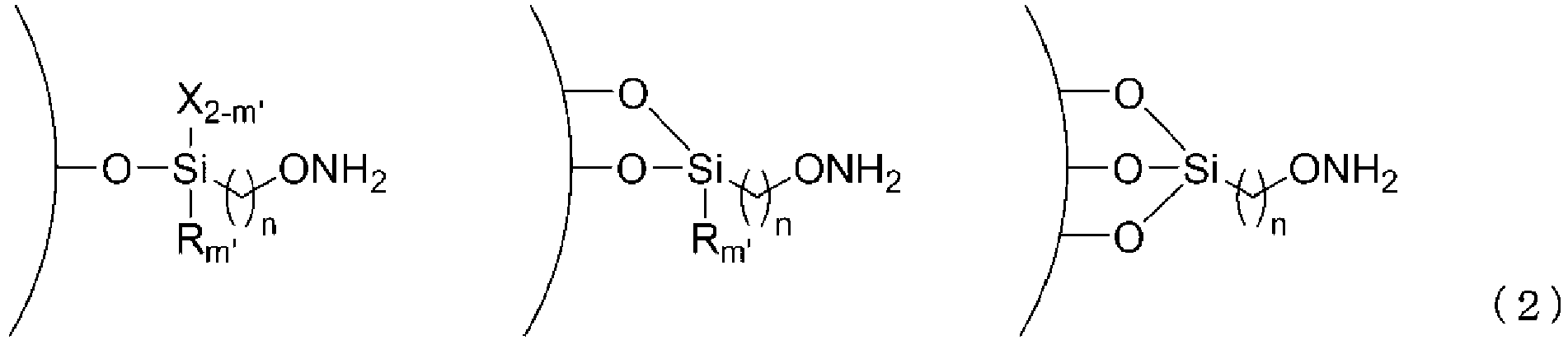
- The C1-4 alkyl group as R is not particularly restricted, but may, for example, be a methyl group, an ethyl group, a propyl group, an isopropyl group, a butyl group, a 2-methylpropyl group, a 1-methylpropyl group or a tert-butyl group.
- R is preferably a methyl group to facilitate the after-mentioned silane coupling reaction.
- The C1-4 alkoxy group as X is not particularly restricted and may, for example, be a methoxy group, an ethoxy group, a propoxy group, an isopropoxy group, a butoxy group, a 2-methylpropyloxy group, a 1-methylpropyloxy group or a tert-butoxy group.
- X is preferably a methoxy group, an ethoxy group, a propoxy group or an isopropoxy group, more preferably a methoxy group or an ethoxy group, more preferably a methoxy group to facilitate the after-mentioned silane coupling reaction.
- m' is an integer of from 0 to 2 and is preferably 0 or 1 to facilitate the after-mentioned silane coupling reaction.
- n is an integer of from 1 to 12 and is preferably an integer of from 3 to 12, more preferably 3 or 11 for more efficient removal of aldehydes.
- The support having chemically bonded aminooxyalkyl groups is not particularly restricted but is preferably a product of a reaction (hereinafter referred to as a "silane coupling reaction") of a compound represented by the formula (1):

- Namely, the support having chemically bonded aminooxyalkyl groups can be produced by reacting the silane coupling agent with a support having hydroxy groups on the surface.
- The definitions and preferred examples and range of R, X and n in the silane coupling agent are the same as those of R, X and n in the formula (2).
- In the silane coupling agent, m is an integer of from 0 to 2 and is preferably 0 or 1 to facilitate the silane coupling reaction.
- The silane coupling agent may be a commercially available product, but can be synthesized as described in Organic Preparations and Procedures International, vol. 26, 1994, 111-113,
JP-A-H07-233132 - The deodorant composition of the present invention has aminooxyalkyl groups (represented as -(CH2)n-ONH2 in the formulae (1) and (2)) as mentioned above, which may be present partly or entirely in the form of a chemically acceptable salt with an inorganic acid or an organic acid.
- Such a salt is not particularly restricted but may be an inorganic salt such as a hydrochloride, a hydrobromide, a perchlorate, a silicate, a tetrafluoroborate, a hexafluorophosphate, a sulfate, a nitrate or a phosphate, or an organic salt such as acetate, citrate, fumarate, maleate, trifluoromethanesulfonate, trifluoroacetate, benzoate or p-toluene sulfonate. The salt is preferably an inorganic salt, more preferably hydrochloride in view of cost.
- The amount of amioxyalkyl groups in the support having chemically bonded amioxyalkyl groups can be adjusted arbitrarily in accordance with the intended use without any particular restrictions and is preferably from 0.01 to 10 mmol/g per unit weight of the support having chemically bonded aminooxyalkyl groups.
- The support is not particularly restricted and may, for example, be a polymer support or an inorganic support.
- The polymer support is not particularly restricted and may, for example, be a styrene polymer (such as polystyrene or a crosslinked polystyrene), a polyolefin (such as polyethylene or polypropylene), a poly(halogenated olefin) (such as polyvinyl chloride or polytetrafluoroethylene), a nitrile polymer (such as polyacrylonitrile), a (meth)acrylate polymer (such as polymethyl methacrylate or polyethyl acrylate) or a macromolecular polysaccharide (such as cellulose, agarose or dextran).
- The inorganic support is not particularly restricted and may, for example, be silica gel, alumina, zeolite, magnesia, titania, zirconia, ceria, diatomaceous earth, activated carbon, cellulose or hydroxyapatite.
- The support is preferably an inorganic support, more preferably silica gel, alumina, zeolite, magnesia, titania, zirconia, ceria, diatomaceous earth, activated carbon, cellulose or hydroxyapatite, further preferably silica gel to facilitate the silane coupling reaction.
- The support preferably has hydroxy groups on the surface.
- The support may be in any form without any particular restrictions and may be in the form of spheres, particles, fiber, granules, a monolithic column, hollow fiber or a membrane. It is preferably in the form of beads, a membrane, particles, granules or fiber, more preferably in the form of beads, particles or granules, for effective removal of aldehydes.
- Regarding the size of the support in the form of beads, particles or granules, the average diameter is preferably from 0.1 µm to 10 mm, more preferably from 1 µm to 100 µm, in view of dispersibility in a liquid.
- The support may be porous or non-porous and is preferably porous for effective removal of aldehydes.
- When the support is porous, the average pore size is preferably from 1 nm to 1 µm, more preferably from 1 nm to 300 nm, for effective removal of aldehydes.
- The binder resin in the deodorant composition of the present invention is not particularly restricted and may, for example, be an acrylate resin, a silicone resin, a urethan resin, a polyester resin, a melamine resin, a polypropylene resin or a fluororesin.
- The binder resin is preferably an acrylate resin, a silicone resin or a urethan resin in view of adhesion to the support having chemically bonded aminooxyalkyl groups and water resistance.
- The weight ratio of the support having chemically bonded aminooxyalkyl groups and the binder resin in the deodorant composition can be adjusted arbitrarily in accordance with the intended use without any particular restrictions, and the ratio of the support having chemically bonded aminooxyalkyl groups (weight) : the binder resin (weight) is preferably from 1:1000 to 100:1, more preferably from 1:100 to 100:1, more preferably from 1:1.2 to 10:1.
- The deodorant composition of the present invention comprises a support having chemically bonded aminooxyalkyl groups and a binder resin and may be prepared by mixing the support having chemically bonded aminooxyalkyl groups and the binder resin or by drying a deodorant suspension, which will be described later, without any particular restrictions.
- The deodorant composition of the present invention may further comprise a solvent.
- The solvent is not particularly restricted and may, for example, be water, ethanol, methanol, propanol, acetonitrile or the like. Among them, water is preferred for effective removal of aldehydes.
- When the deodorant composition of the present invention comprises a relatively large amount of a solvent (the deodorant composition of the present invention also covers such a mixture containing a solvent), it is in the form of a suspension. Hereinafter, such a suspension will be referred to as a deodorant suspension.
- The weight ratio of the sum of the support having chemically bonded aminooxyalkyl groups and the binder resin to the solvent can be adjusted arbitrarily in accordance with the intended use without any particular restrictions, and the ratio of the sum of the two (weight) : the solvent (weight) is preferably 1:1000 to 1:2, more preferably from 1:100 to 1:4, more preferably from 1:50 to 1:4.
- The deodorant suspension may be prepared by mixing the support having chemically bonded aminooxyalkyl groups, the binder resin and the solvent by stirring, without any particular restrictions.
- The deodorant composition or the deodorant suspension may be used in any ways with no particular restrictions, for example, by bringing the deodorant composition or the deodorant suspension into contact with an odor source (emitting an aldehyde), by spraying the composition or suspension directly onto the odor source, by exposing the deodorant composition or the deodorant suspension to an atmosphere containing a malodorous substance (such as an aldehyde) or by spraying the deodorant composition or the deodorant suspension into such an atmosphere.
- As the odor source, an adhesive containing an organic solvent, a building material in a new building, plywood or the like may, for example, be mentioned, though there are no particular restrictions.
- The deodorant composition or the deodorant suspension can decrease the odor from an odor source by capturing the malodorous substance when brought into contact with the odor source or sprayed directly onto the odor source.
- The deodorant composition or the deodorant suspension can decrease the odor of an atmosphere containing a malodorous substance by capturing the malodorous substance (such as an aldehyde) when exposed to the atmosphere or sprayed into the atmosphere.
- As the malodorous substance, formaldehyde, acetaldehyde, propionaldehyde, normalbutyraldehyde, isobutyraldehyde, normalvaleraldehyde, isovaleraldehyde, hexanal, hexenal, nonenal, methyl isobutyl ketone, diacetyl, ethyl acetate, acetic acid, propionic acid, n-butyric acid, n-valeric acid, isovaleric acid, methyl mercaptan, ethyl mercaptan or the like may, for example, be mentioned, though there are no particular restrictions.
- The deodorant composition or the deodorant suspension may be used in different ways with no particular restrictions, for example, as a coating on a substrate, to use the substrate having a coating of the deodorant composition or the deodorant suspension on the surface as a deodorant article.
- Such a deodorant article may be prepared by applying or spraying the deodorant composition or the deodorant suspension onto a substrate.
- The deodorant article can decrease the odor of an atmosphere containing a malodorous substance by capturing the malodorous substance (such as an aldehyde) when exposed to the atmosphere.
- As the substrate, fiber, sheet, wallpaper, sponge, beads, wood, plywood or plasterboard may, for example, be mentioned, though there are no particular restrictions.
- As the material of fiber, sheet, wallpaper or sponge, polyester, polyamide, polyacrylonitrile, polypropylene, polyethylene, polyvinyl chloride, a fluororesin, an aramid resin, a sulfone resin, rayon, acetate rayon, cotton, wool, silk, hemp, glass, carbon, ceramics, a silicone resin, a polyimide resin, natural rubber or polyurethan may, for example, be mentioned, though there are no particular restrictions.
- The deodorant article may, for example, clothing, a curtain, a carpet, a wall covering, an automobile interior part or furniture may, for example, be mentioned, though there are no particular restrictions.
- The amount of the deodorant composition on the substrate can be adjusted arbitrarily in accordance with the intended use without any particular restrictions, but is preferably from 0.1 to 200 g/m2, more preferably from 0.5 to 75 g/m2, per unit area of the substrate.
- The amount of the support having chemically bonded aminooxyalkyl groups on the substrate can be adjusted arbitrarily in accordance with the intended use without any particular restrictions, but is preferably from 0.09 to 180 g/m2, more preferably from 0.45 to 68 g/m2, per unit area of the substrate.
- Now, the present invention will be described in further detail with reference to Examples. However, it should be understood that these Examples are intended to help understand the present invention, and the present invention is by no means restricted thereto. As the reagents, commercially available products were used unless otherwise noted.
- The evaluation procedure and the analytical instrument used in the Examples are described below.
- A deodorant article was sealed in a 5 L Tedlar bag, and 3 L of nitrogen gas containing about 14 ppm acetaldehyde was injected. After 2 hours of standing at room temperature, the gas in the Tedlar bag was passed through a 2,4-dinitrophenylhydrazine (DNPH) cartridge column (Precep-C DNPH, manufactured by FUJIFILM Wako Pure Chemical Corporation) to adsorb the aldehyde in the gas on it. The DNPH-aldehyde condensate was eluted from the column with acetonitrile. The eluate was analyzed with a liquid chromatograph (LC-2030C Plus, manufactured by Shimadzu Corporation) to quantify the DNPH-aldehyde condensate, and the concentration of the remaining acetaldehyde in the Tedlar bag was calculated. The aldehyde removal rate [%] was calculated from the following formula.

- To a mixture of 19.94 g of silica gel having an average particle diameter of 4 µm (NIPGEL BY-400, manufactured by Tosoh Silica Corporation) and 173.4 g of toluene, 8.08 g of a silane coupling agent represented by the following chemical formula (1a) and 43.35 g of toluene was added dropwise in a nitrogen stream, and the resulting reaction solution was stirred at 25°C for 120 hours. The reaction solution was filtered, and the filter cake was dried at 120°C for 4 hours to obtain a support having chemically bonded amioxyalkyl groups (hereinafter referred to as an "aminooxy support"). The aminooxy support was found to contain 1.4 mmol/g of aminooxyalkyl groups per unit weight of the aminooxy support, by elemental analysis.

- Infrared spectra (hereinafter referred to as IR spectra) of untreated silica gel (NIPGEL BY-400, manufactured by Tosoh Silica Corporation) and the aminooxy support were measured. The spectrum of the aminooxy support lacked the Si-O bending vibration peak which appeared at around 970cm-1 in the spectrum of the untreated silica gel. This indicates the chemical modification of hydroxy groups on the surface of the silica gel with the silane coupling agent represented by the chemical formula (1a).
- To a mixture of 16.88 g of silica gel having an average particle diameter of 14 µm (NIPGEL BY-001, manufactured by Tosoh Silica Corporation), 44.87 g of toluene and 16.88 g of distilled water, a mixture of 5.42 of the silane coupling agent represented by the chemical formula (1a) and 22.66 g of toluene was added dropwise in a nitrogen stream, and the resulting reaction solution was heated under reflux with stirring for 4 hours. The reaction solution was filtered, and the filter cake was dried at 120°C for 4 hours to obtain an aminooxy support. The aminooxy support was found to contain 1.5 mmol/g of aminooxyalkyl groups per unit weight of the aminooxy support, by elemental analysis.
- IR spectra of untreated silica gel (NIPGEL BY-001, manufactured by Tosoh Silica Corporation) and the aminooxy support were measured. The spectrum of the aminooxy support lacked the Si-O bending vibration peak which appeared at around 970cm-1 in the spectrum of the untreated silica gel. This indicates the chemical modification of hydroxy groups on the surface of the silica gel with the silane coupling agent represented by the chemical formula (1a).
- To a mixture of 16.88 g of silica gel having an average particle diameter of 21 µm (NIPSIL NS-T, manufactured by Tosoh Silica Corporation), 45.00 g of toluene and 16.88 g of distilled water, a mixture of 5.40 g of the silane coupling agent represented by the chemical formula (1a) and 22.72 g of toluene was added dropwise in a nitrogen stream, and the resulting reaction solution was heated under reflux with stirring for 4 hours. The reaction solution was filtered, and the filter cake was dried at 120°C for 4 hours to obtain an aminooxy support. The aminooxy support was found to contain 1.4 mmol/g of aminooxyalkyl groups per unit weight of the aminooxy support, by elemental analysis.
- IR spectra of untreated silica gel (NIPSIL NS-T, manufactured by Tosoh Silica Corporation) and the aminooxy support were measured. The spectrum of the aminooxy support lacked the Si-O bending vibration peak which appeared at around 970cm-1 in the spectrum of the untreated silica gel. This indicates the chemical modification of hydroxy groups on the surface of the silica gel with the silane coupling agent represented by the chemical formula (1a).
- 3.05 g of silica gel having an average particle diameter of 4 µm (NIPGEL BY-400, manufactured by Tosoh Silica Corporation), 12.22 g of toluene, 0.46 g of distilled water and 0.90 g of a silane coupling agent represented by the following chemical formula (1b) were mixed and heated under reflux in a nitrogen stream with stirring for 4 hours. The resulting reaction solution was filtered, and the filter cake was dried at 120°C for 4 hours to obtain an aminooxy support. The aminooxy support was found to contain 1.1 mmol/g of aminooxyalkyl groups per unit weight of the aminooxy support, by elemental analysis.

- IR spectra of untreated silica gel (NIPGEL BY-400, manufactured by Tosoh Silica Corporation) and the aminooxy support were measured. The spectrum of the aminooxy support lacked the Si-O bending vibration peak which appeared at around 970cm-1 in the spectrum of the untreated silica gel. This indicates the chemical modification of hydroxy groups on the surface of the silica gel with the silane coupling agent represented by the chemical formula (1b).
- 2.44 g of silica gel having an average particle diameter of 4 µm (NIPGEL BY-400, manufactured by Tosoh Silica Corporation), 9.78 g of toluene, 0.37 g of distilled water and 0.95 g of a silane coupling agent represented by the following chemical formula (1c) were mixed and heated under reflux in a nitrogen stream with stirring for 4 hours. The resulting reaction solution was filtered, and the filter cake was dried at 120°C for 4 hours to obtain an aminooxy support. The aminooxy support was found to contain 0.9 mmol/g of aminooxyalkyl groups per unit weight of the aminooxy support, by elemental analysis.

- IR spectra of untreated silica gel (NIPGEL BY-400, manufactured by Tosoh Silica Corporation) and the aminooxy support were measured. The spectrum of the aminooxy support lacked the Si-O bending vibration peak which appeared at around 970cm-1 in the spectrum of the untreated silica gel. This indicates the chemical modification of hydroxy groups on the surface of the silica gel with the silane coupling agent represented by the chemical formula (1c).
- 1.83 g of silica gel having an average particle diameter of 4 µm (NIPGEL BY-400, manufactured by Tosoh Silica Corporation), 7.32 g of toluene, 0.27 g of distilled water and 0.93 g of a silane coupling agent represented by the following chemical formula (1d) were mixed and heated under reflux in a nitrogen stream with stirring for 4 hours. The resulting reaction solution was filtered, and the filter cake was dried at 120°C for 4 hours to obtain an aminooxy support. The aminooxy support was found to contain 0.8 mmol/g of aminooxyalkyl groups per unit weight of the aminooxy support, by elemental analysis.

- IR spectra of untreated silica gel (NIPGEL BY-400, manufactured by Tosoh Silica Corporation) and the aminooxy support were measured. The spectrum of the aminooxy support lacked the Si-O bending vibration peak which appeared at around 970cm-1 in the spectrum of the untreated silica gel. This indicates the chemical modification of hydroxy groups on the surface of the silica gel with the silane coupling agent represented by the chemical formula (1d).
- 3.05 g of coconut shell activated carbon powder (Shirasagi M, manufactured by Osaka Gas Chemicals Co., Ltd.), 12.30 of toluene, 0.45 g of distilled water and 0.97 g of the silane coupling agent represented by the chemical formula (1a) were mixed and heated under reflux in a nitrogen stream with stirring for 4 hours. The resulting reaction solution was filtered, and the filter cake was dried at 120°C for 4 hours to obtain an aminooxy support. The aminooxy support was found to contain 1.4 mmol/g of aminooxyalkyl groups per unit weight of the aminooxy support, by elemental analysis.
- 3.05 g of wood activated powder (CARBORAFFIN, manufactured by Osaka Gas Chemicals Co., Ltd.), 12.24 of toluene, 0.46 g of distilled water and 0.98 g of the silane coupling agent represented by the chemical formula (1a) were mixed and heated under reflux in a nitrogen stream with stirring for 4 hours. The resulting reaction solution was filtered, and the filter cake was dried at 120°C for 4 hours to obtain an aminooxy support. The aminooxy support was found to contain 1.6 mmol/g of aminooxyalkyl groups per unit weight of the aminooxy support, by elemental analysis.
- 0.20 g of the aminooxy support obtained in Synthetic Example 1, 0.24 g of an acrylate binder resin (FICOAT 70K, manufactured by Daiwa Chemical Industries Co., Ltd.) and 9.56 g of distilled water were mixed in a polyethylene vessel to obtain a deodorant composition (a deodorant suspension).
- 750 µL (0.75 g) of the deodorant composition (deodorant suspension) was applied onto a 10 cm × 10 cm 100 percent polyester cloth and dried in a hot-air dryer (DRJ433DA, manufactured by the ADVANTECH group) at 150°C for 3 minutes to obtain a deodorant article having a coating of the deodorant composition.
- The deodorant article was washed with water 5 times in accordance with the washing durability test (JIS L0217 103).
- The deodorant article was assessed by the aldehyde removal test before and after the washings.
- A deodorant composition (deodorant suspension) and a deodorant article were prepared and assessed in the same manner as in Example 1 except that 0.24 g of the acrylate binder resin (FICOAT 70K, manufactured by Daiwa Chemical Industries Co., Ltd.) was replaced by 0.24 g of a silicone binder resin (Bintex S-200L, manufactured by Daiwa Chemical Industries Co., Ltd.).
- A deodorant composition (deodorant suspension) and a deodorant article were prepared and assessed in the same manner as in Example 1 except that 0.24 g of the acrylate binder resin (FICOAT 70K, manufactured by Daiwa Chemical Industries Co., Ltd.) was replaced by 0.24 g of a urethan binder resin (U-30NP, manufactured by Daiwa Chemical Industries Co., Ltd.).
- A deodorant composition (deodorant suspension) and a deodorant article were prepared and assessed in the same manner as in Example 1 except that the 10 cm × 10 cm 100 percent polyester cloth was replaced by a 10 cm × 10 cm 100 percent cotton cloth.
- A deodorant composition (deodorant suspension) and a deodorant article were prepared and assessed in the same manner as in Example 1 except that the amount of the coating of the deodorant composition (deodorant suspension) was changed from 750 µL (0.75 g) to 250 µL (0.25 g).
- A deodorant composition (deodorant suspension) and a deodorant article were prepared and assessed in the same manner as in Example 1 except that the amount of the acrylate binder resin (FICOAT 70K, manufactured by Daiwa Chemical Industries Co., Ltd.) was changed from 0.24 g to 0.08 g, and the amount of distilled water was changed from 9.56 g to 9.72 g.
- A deodorant composition (deodorant suspension) and a deodorant article were prepared and assessed in the same manner as in Example 1 except that the amount of the acrylate binder resin (FICOAT 70K, manufactured by Daiwa Chemical Industries Co., Ltd.) was changed from 0.24 g to 0.02 g, and the amount of distilled water was changed from 9.56 g to 9.78 g.
- A deodorant composition (deodorant suspension) and a deodorant article were prepared and assessed in the same manner as in Example 1 except that 0.20 g of the aminooxy support obtained in Synthetic Example 1 was replaced by 0.20 g of the aminooxy support obtained in Synthetic Example 2.
- A deodorant composition (deodorant suspension) and a deodorant article were prepared and assessed in the same manner as in Example 1 except that 0.20 g of the aminooxy support obtained in Synthetic Example 1 was replaced by 0.20 g of the aminooxy support obtained in Synthetic Example 3.
- A deodorant composition (deodorant suspension) and a deodorant article were prepared and assessed in the same manner as in Example 1 except that 0.20 g of the aminooxy support obtained in Synthetic Example 1 was replaced by 0.20 g of the aminooxy support obtained in Synthetic Example 4.
- A deodorant composition (deodorant suspension) and a deodorant article were prepared and assessed in the same manner as in Example 1 except that 0.20 g of the aminooxy support obtained in Synthetic Example 1 was replaced by 0.20 g of the aminooxy support obtained in Synthetic Example 5.
- A deodorant composition (deodorant suspension) and a deodorant article were prepared and assessed in the same manner as in Example 1 except that 0.20 g of the aminooxy support obtained in Synthetic Example 1 was replaced by 0.20 g of the aminooxy support obtained in Synthetic Example 6.
- A deodorant composition (deodorant suspension) and a deodorant article were prepared and assessed in the same manner as in Example 1 except that 0.20 g of the aminooxy support obtained in Synthetic Example 1 was replaced by 0.20 g of the aminooxy support obtained in Synthetic Example 7.
- A deodorant composition (deodorant suspension) and a deodorant article were prepared and assessed in the same manner as in Example 1 except that 0.20 g of the aminooxy support obtained in Synthetic Example 1 was replaced by 0.20 g of the aminooxy support obtained in Synthetic Example 8.
- A deodorant composition (deodorant suspension) and a deodorant article were prepared and assessed in the same manner as in Example 4 except that 0.24 g of the acrylate binder resin (FICOAT 70K, manufactured by Daiwa Chemical Industries Co., Ltd.) was not added, and the amount of distilled water was changed from 9.56 g to 9.80 g.
- A deodorant composition (deodorant suspension) and a deodorant article were prepared and assessed in the same manner as in Example 4 except that 0.20 g of the aminooxy support was not added, and the amount of distilled water was changed from 9.56 g to 9.76 g.
- A deodorant article was prepared and assessed in the same manner as in Example 4 except that 10.0 g of the deodorant composition (deodorant suspension) prepared by mixing 0.20 g of aminooxy support, 0.24 g of the acrylate binder resin (FICOAT 70K, manufactured by Daiwa Chemical Industries Co., Ltd.) and 9.56 g of distilled water was replaced by 10.0 g of 3 wt% aminooxyacetic acid aqueous solution.
- A deodorant article was prepared and assessed in the same manner as in Example 4 except that 10.0 g of the deodorant composition (deodorant suspension) prepared by mixing 0.20 g of aminooxy support, 0.24 g of the acrylate binder resin (FICOAT 70K, manufactured by Daiwa Chemical Industries Co., Ltd.) and 9.56 g of distilled water was replaced by 10.0 g of 3 wt% adipic dihydrazide aqueous solution.
- A deodorant composition (deodorant suspension) and a deodorant article were prepared and assessed in the same manner as in Example 1 except that 0.24 g of the acrylate binder resin (FICOAT 70K, manufactured by Daiwa Chemical Industries Co., Ltd.) was not added, and the amount of distilled water was changed from 9.56 g to 9.80 g.
- A deodorant article was prepared and assessed in the same manner as in Example 1 except that 10.0 g of the deodorant composition (deodorant suspension) prepared by mixing 0.20 g of an aminooxy support, 0.24 g of an acrylate binder resin (FICOAT 70K, manufactured by Daiwa Chemical Industries Co., Ltd.) and 9.56 g of distilled water was replaced by 10.0 g of a deodorant composition (deodorant suspension) prepared by mixing 0.20 g of a commercial inorganic aldehyde scavenger (KESMON NS750, manufactured by TOAGOSEI Co., LTD.), 0.24 g of an acrylate binder resin (FICOAT 70K, manufactured by Daiwa Chemical Industries Co., Ltd.) and 9.56 g of distilled water.
- A deodorant article was prepared and assessed in the same manner as in Comparative Example 6 except that 10.0 g of the deodorant composition (deodorant suspension) prepared in Example 1 by mixing 0.20 g of an aminooxy support, 0.24 g of an acrylate binder resin (FICOAT 70K, manufactured by Daiwa Chemical Industries Co., Ltd.) and 9.56 g of distilled water was replaced by 10.0 g of a deodorant composition (deodorant suspension) prepared by mixing 0.20 g of a commercial inorganic aldehyde scavenger (KESMON NS750, manufactured by TOAGOSEI Co., LTD.), 0.08 g of an acrylate binder resin (FICOAT 70K, manufactured by Daiwa Chemical Industries Co., Ltd.) and 9.72 g of distilled water.
- A deodorant article was prepared and assessed in the same manner as in Example 6 except that 10.0 g of the deodorant composition (deodorant suspension) prepared by mixing 0.20 g of an aminooxy support, 0.24 g of an acrylate binder resin (FICOAT 70K, manufactured by Daiwa Chemical Industries Co., Ltd.) and 9.56 g of distilled water was replaced by a deodorant composition (deodorant suspension) prepared by mixing 0.20 g of unmodified silica gel (NIPSIL BY-400, manufactured by Tosoh Silica Corporation), 0.24 g of an acrylate binder resin (FICOAT 70K, manufactured by Daiwa Chemical Industries Co., Ltd.) and 9.56 g of distilled water.
- The results of Examples 1 to 14 are shown in Table 1, and the results of Comparative Examples 1 to 8 are shown in Table 2. It is clear from Tables 1 and 2 that the deodorant compositions of the present invention were more waterproof than conventional deodorant compositions.
[Table 1] Ex. Cloth Amiooxy support Binder resin Acetaldehyde removal rate [%] Kind Kind Amount [wt%] Kind Amount [wt%] Amount of coating [g/m2] Before washings After one washing After 5 washings Ex. 1 Polyester Synthetic Ex. 1 Compound (1a) 2 Acrylate 2.4 75 100 100 100 Ex. 2 Polyester Synthetic Ex. 1 Compound (1a) 2 Silicone 2.4 75 100 100 100 Ex. 3 Polyester Synthetic Ex. 1 Compound (1a) 2 Urethan 2.4 75 100 100 100 Ex. 4 Cotton Synthetic Ex. 1 Compound (1a) 2 Acrylate 2.4 75 100 100 100 Ex. 5 Polyester Synthetic Ex. 1 Compound (1a) 2 Acrylate 2.4 25 100 69 27 Ex. 6 Polyester Synthetic Ex. 1 Compound (1a) 2 Acrylate 0.8 75 100 100 99 Ex. 7 Polyester Synthetic Ex. 1 Compound (1a) 2 Acrylate 0.2 75 100 100 88 Ex. 8 Polyester Synthetic Ex. 2 Compound (1a) 2 Acrylate 2.4 75 100 100 88 Ex. 9 Polyester Synthetic Ex. 3 Compound (1a) 2 Acrylate 2.4 75 100 82 50 Ex. 10 Polyester Synthetic Ex. 4 Compound (1b) 2 Acrylate 2.4 75 100 100 100 Ex. 11 Polyester Synthetic Ex. 5 Compound (1c) 2 Acrylate 2.4 75 100 100 100 Ex. 12 Polyester Synthetic Ex. 6 Compound (1d) 2 Acrylate 2.4 75 100 100 33 Ex. 13 Polyester Synthetic Ex. 7 Compound (1a) 2 Acrylate 2.4 75 83 56 41 Ex. 14 Polyester Synthetic Ex. 8 Compound (1a) 2 Acrylate 2.4 75 100 75 73 [Table 2] Ex. Cloth Amiooxy support Binder resin Acetaldehyde removal rate [%] Kind Kind Amount [wt%] Kind Amount [wt%] Amount of coating [g/m2] Before washings After one washing After 5 washings Comparative Ex. 1 Cotton Synthetic Ex. 1 Compound (1a) 2 None 0 75 100 0 0 Comparative Ex. 2 Cotton None 0 Acrylate 2.4 75 0 0 0 Comparative Ex. 3 Cotton Aminooxyacetic acid 3 None 0 75 100 0 0 Comparative Ex. 4 Cotton Adipic dihydrazide 3 None 0 75 55 0 0 Comparative Ex. 5 Polyester Synthetic Ex. 1 Compound (1a) 2 None 0 75 100 0 0 Comparative Ex. 6 Polyester KESMON NS750 2 Acrylate 2.4 75 80 34 13 Comparative Ex. 7 Polyester KESMON NS750 2 Acrylate 0.8 75 81 34 8 Comparative Ex. 8 Polyester Silica gel 2 Acrylate 2.4 75 7 6 5 - The entire disclosure of
Japanese Patent Application No. 2021-054339 filed on March 26, 2021
Claims (14)
- A deodorant composition comprising a support having chemically bonded aminooxyalkyl groups and a binder resin.
- The deodorant composition according to Claim 1, wherein the support having chemically bonded aminooxyalkyl groups has one of the structures represented by the following formula (2):
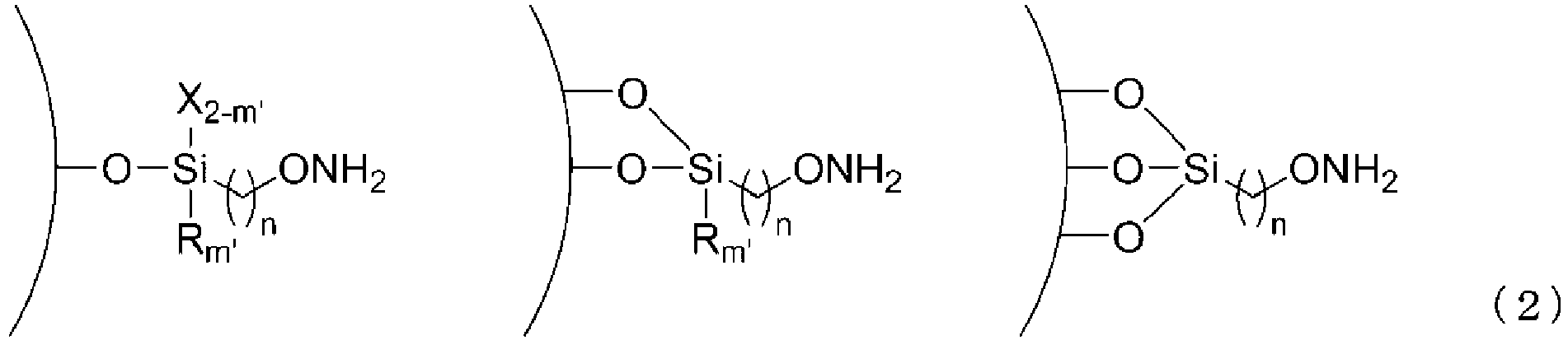
- The deodorant composition according to Claim 2, wherein R is a methyl group, and X is a methoxy group, an ethoxy group, a propoxy group or an isopropoxy group.
- The deodorant composition according to Claim 2, wherein n is 3 or 11.
- The deodorant composition according to Claim 1 or 2, wherein the support having chemically bonded aminooxyalkyl groups is a product of a reaction of a compound represented by the following formula (1) with an inorganic support or polymer support having hydroxy groups on the surface:

- The deodorant composition according to Claim 5, wherein R is a methyl group, and X is a methoxy group, an ethoxy group , a propoxy group or an isopropoxy group.
- The deodorant composition according to Claim 5, wherein n is 3 or 11.
- The deodorant composition according to any one of Claims 5 to 7, wherein the inorganic support is silica gel, alumina, zeolite, magnesia, titania, zirconia, ceria, diatomaceous earth, activated carbon, cellulose or hydroxyapatite.
- The deodorant composition according to any one of Claims 5 to 7, wherein the inorganic support is silica gel.
- The deodorant composition according to any one of Claims 1 to 9, wherein the binder resin is an acrylate resin, a silicone resin or a urethan resin.
- A method for removing an aldehyde, which comprises exposing the deodorant composition as defined in any one of Claims 1 to 10 to air containing an aldehyde to bring the aldehyde into contact with the deodorant composition.
- A deodorant article comprising the deodorant composition as defined in any one of Claims 1 to 10 and a substrate having the deodorant composition on the surface.
- The deodorant article according to Claim 12, wherein the substrate is fiber, sheet wallpaper, sponge, beads, wood, plywood or plasterboard.
- A method for removing an aldehyde, which comprises exposing the deodorant article as defined in Claim 12 or 13 to air containing an aldehyde to bring the aldehyde into contact with the deodorant article.
Applications Claiming Priority (2)
| Application Number | Priority Date | Filing Date | Title |
|---|---|---|---|
| JP2021054339 | 2021-03-26 | ||
| PCT/JP2022/013908 WO2022202984A1 (en) | 2021-03-26 | 2022-03-24 | Deodorant composition and deodorant structure |
Publications (2)
| Publication Number | Publication Date |
|---|---|
| EP4316533A1 true EP4316533A1 (en) | 2024-02-07 |
| EP4316533A4 EP4316533A4 (en) | 2025-03-19 |
Family
ID=83397363
Family Applications (1)
| Application Number | Title | Priority Date | Filing Date |
|---|---|---|---|
| EP22775765.5A Pending EP4316533A4 (en) | 2021-03-26 | 2022-03-24 | Deodorant composition and deodorant structure |
Country Status (5)
| Country | Link |
|---|---|
| US (1) | US20240198314A1 (en) |
| EP (1) | EP4316533A4 (en) |
| JP (2) | JPWO2022202984A1 (en) |
| CN (1) | CN117120104B (en) |
| WO (1) | WO2022202984A1 (en) |
Families Citing this family (6)
| Publication number | Priority date | Publication date | Assignee | Title |
|---|---|---|---|---|
| JPWO2022202984A1 (en) * | 2021-03-26 | 2022-09-29 | ||
| JP7774431B2 (en) * | 2021-12-07 | 2025-11-21 | 東ソー株式会社 | Polyurethane resin-forming composition, molded body, and coating material |
| JP7745449B2 (en) * | 2021-12-07 | 2025-09-29 | 東ソー株式会社 | Urethane foam-forming composition and urethane foam |
| WO2025041826A1 (en) * | 2023-08-23 | 2025-02-27 | 東ソー株式会社 | Polyolefin-based resin composition |
| CN121969403A (en) * | 2023-10-02 | 2026-05-01 | 东曹株式会社 | Deodorizing composition and deodorizing filter |
| CN119684495B (en) * | 2025-02-25 | 2025-05-27 | 浙江圣安化工股份有限公司 | A polymer containing oxygenated amine functional groups and a preparation method thereof, a reactive adsorbent and a preparation method, application and regeneration method thereof |
Family Cites Families (22)
| Publication number | Priority date | Publication date | Assignee | Title |
|---|---|---|---|---|
| JPS62191040A (en) * | 1986-02-17 | 1987-08-21 | Nippon Denso Co Ltd | Adsorbable carbon material and its production |
| JPH0722698B2 (en) * | 1990-11-16 | 1995-03-15 | 日本電装株式会社 | Deodorizing activated carbon and method for producing the same |
| JP3253323B2 (en) | 1990-11-30 | 2002-02-04 | 武田薬品工業株式会社 | Adsorbent for lower aldehydes |
| JP3821863B2 (en) | 1993-09-22 | 2006-09-13 | 靖雄 菊川 | Hydroxylamine compound |
| JP3012978B2 (en) | 1997-04-25 | 2000-02-28 | 大塚化学株式会社 | Deodorants |
| JP3700909B2 (en) * | 1998-10-01 | 2005-09-28 | 株式会社豊田中央研究所 | Deodorizing material and method for producing the same |
| JP3430955B2 (en) * | 1999-01-29 | 2003-07-28 | 株式会社豊田中央研究所 | Deodorant |
| US6229062B1 (en) * | 1999-04-29 | 2001-05-08 | Basf Aktiengesellschaft Corporation | Superabsorbent polymer containing odor controlling compounds and methods of making the same |
| JP2002306582A (en) * | 2001-04-17 | 2002-10-22 | Toyota Central Res & Dev Lab Inc | Liquid composition for deodorization and deodorizing article to which the composition is applied |
| JP2004262941A (en) * | 2003-02-13 | 2004-09-24 | Asahi Kasei Chemicals Corp | Deodorant / antibacterial / mold-proof coating composition |
| JP5112932B2 (en) * | 2008-04-02 | 2013-01-09 | 花王株式会社 | Deodorant filter |
| CN104254346B (en) * | 2012-02-09 | 2017-11-24 | 东亚合成株式会社 | Gaseous aldehyde deodorant and its manufacture method |
| JP2014114399A (en) * | 2012-12-11 | 2014-06-26 | Tosoh Corp | Porous body, and production method and use thereof |
| JP6735731B2 (en) * | 2015-03-31 | 2020-08-05 | 住江織物株式会社 | Deodorant composition, deodorant cloth, and textile product |
| CN109963922B (en) * | 2016-12-28 | 2022-09-23 | 东曹株式会社 | Aldehyde scavenger and method for removing aldehyde |
| JP7199807B2 (en) | 2016-12-28 | 2023-01-06 | 東ソー株式会社 | Aldehyde scavenger |
| JP7262321B2 (en) * | 2018-06-27 | 2023-04-21 | 東ソー株式会社 | Aldehyde scavenger |
| JP7334075B2 (en) * | 2018-06-27 | 2023-08-28 | 東ソー株式会社 | Aldehyde scavenger |
| CN110204638B (en) * | 2019-06-19 | 2020-05-05 | 青岛大学 | Polymer containing amino-oxy structure, formaldehyde adsorbent and preparation method of formaldehyde adsorbent |
| JP7316896B2 (en) | 2019-10-01 | 2023-07-28 | エムケー精工株式会社 | vehicle processing equipment |
| JP7725825B2 (en) * | 2020-02-05 | 2025-08-20 | 東ソー株式会社 | Deodorant |
| JPWO2022202984A1 (en) | 2021-03-26 | 2022-09-29 |
-
2022
- 2022-03-24 JP JP2023509294A patent/JPWO2022202984A1/ja active Pending
- 2022-03-24 US US18/551,344 patent/US20240198314A1/en active Pending
- 2022-03-24 CN CN202280024665.9A patent/CN117120104B/en active Active
- 2022-03-24 WO PCT/JP2022/013908 patent/WO2022202984A1/en not_active Ceased
- 2022-03-24 EP EP22775765.5A patent/EP4316533A4/en active Pending
-
2025
- 2025-07-02 JP JP2025112372A patent/JP7762331B2/en active Active
Also Published As
| Publication number | Publication date |
|---|---|
| WO2022202984A1 (en) | 2022-09-29 |
| US20240198314A1 (en) | 2024-06-20 |
| CN117120104B (en) | 2025-12-30 |
| CN117120104A (en) | 2023-11-24 |
| JPWO2022202984A1 (en) | 2022-09-29 |
| EP4316533A4 (en) | 2025-03-19 |
| JP7762331B2 (en) | 2025-10-29 |
| JP2025129308A (en) | 2025-09-04 |
Similar Documents
| Publication | Publication Date | Title |
|---|---|---|
| US20240198314A1 (en) | Deodorant composition and deodorant article | |
| US10898879B2 (en) | Visible light-activated photocatalytic coating composition and air purification filter | |
| US6540936B1 (en) | Aldehyde gas absorbent and process for absorbing aldehyde gas | |
| JP3526592B2 (en) | Method for producing deodorant | |
| CA1162904A (en) | Removal of gaseous formaldehyde with solid organic nitrogen compounds | |
| JPH1085585A (en) | Air purification agent, purification agent mixture and air purification device | |
| JP3469523B2 (en) | Process for producing deodorized products and deodorized products | |
| CA2022226A1 (en) | Deodorizing antibacterial composition | |
| JP2950683B2 (en) | Air purifier and air purifier | |
| JP4415417B2 (en) | Deodorant adhesive composition | |
| JPH1199194A (en) | Deodorizing composition, deodorizing apparatus and deodorizing method using the same | |
| JP2025090504A (en) | Scavenger | |
| JP2025086863A (en) | Carbonyl Compound Scavenger | |
| JP2002200149A (en) | Deodorant | |
| JP3455000B2 (en) | Method for producing adsorbent for deodorization | |
| JPH11206864A (en) | Aldehyde gas absorbent and its manufacture | |
| JP2002306582A (en) | Liquid composition for deodorization and deodorizing article to which the composition is applied | |
| JP2000140633A (en) | Gaseous aldehyde absorbing granular porous body | |
| JP3430955B2 (en) | Deodorant | |
| JPH05317703A (en) | Malodorous gas adsorptive agent | |
| JPH06196B2 (en) | Air purifier | |
| JP2009153670A (en) | Deodorant sheet | |
| JP2025072294A (en) | Ketone scavengers | |
| JP2004291468A (en) | Decorative board | |
| JP2002191967A (en) | Aldehyde gas absorbent |
Legal Events
| Date | Code | Title | Description |
|---|---|---|---|
| STAA | Information on the status of an ep patent application or granted ep patent |
Free format text: STATUS: THE INTERNATIONAL PUBLICATION HAS BEEN MADE |
|
| PUAI | Public reference made under article 153(3) epc to a published international application that has entered the european phase |
Free format text: ORIGINAL CODE: 0009012 |
|
| STAA | Information on the status of an ep patent application or granted ep patent |
Free format text: STATUS: REQUEST FOR EXAMINATION WAS MADE |
|
| 17P | Request for examination filed |
Effective date: 20231020 |
|
| AK | Designated contracting states |
Kind code of ref document: A1 Designated state(s): AL AT BE BG CH CY CZ DE DK EE ES FI FR GB GR HR HU IE IS IT LI LT LU LV MC MK MT NL NO PL PT RO RS SE SI SK SM TR |
|
| DAV | Request for validation of the european patent (deleted) | ||
| DAX | Request for extension of the european patent (deleted) | ||
| A4 | Supplementary search report drawn up and despatched |
Effective date: 20250219 |
|
| RIC1 | Information provided on ipc code assigned before grant |
Ipc: B01D 53/72 20060101ALI20250213BHEP Ipc: B01J 20/22 20060101ALI20250213BHEP Ipc: A61L 9/01 20060101AFI20250213BHEP |