EP4315547B1 - System for the storage of refrigeration energy - Google Patents
System for the storage of refrigeration energy Download PDFInfo
- Publication number
- EP4315547B1 EP4315547B1 EP22710436.1A EP22710436A EP4315547B1 EP 4315547 B1 EP4315547 B1 EP 4315547B1 EP 22710436 A EP22710436 A EP 22710436A EP 4315547 B1 EP4315547 B1 EP 4315547B1
- Authority
- EP
- European Patent Office
- Prior art keywords
- refrigeration
- values
- value
- difference
- apparatuses
- Prior art date
- Legal status (The legal status is an assumption and is not a legal conclusion. Google has not performed a legal analysis and makes no representation as to the accuracy of the status listed.)
- Active
Links
Images

Classifications
-
- H—ELECTRICITY
- H02—GENERATION; CONVERSION OR DISTRIBUTION OF ELECTRIC POWER
- H02J—ELECTRIC POWER NETWORKS; CIRCUIT ARRANGEMENTS OR SYSTEMS FOR SUPPLYING OR DISTRIBUTING ELECTRIC POWER; SYSTEMS FOR STORING ELECTRIC ENERGY
- H02J3/00—Circuit arrangements for AC mains or AC distribution networks
- H02J3/12—Arrangements for adjusting voltage in AC networks by changing a characteristic of the network load
- H02J3/14—Arrangements for adjusting voltage in AC networks by changing a characteristic of the network load by switching loads on to, or off from, the networks, e.g. progressively balanced loading
-
- H—ELECTRICITY
- H02—GENERATION; CONVERSION OR DISTRIBUTION OF ELECTRIC POWER
- H02J—ELECTRIC POWER NETWORKS; CIRCUIT ARRANGEMENTS OR SYSTEMS FOR SUPPLYING OR DISTRIBUTING ELECTRIC POWER; SYSTEMS FOR STORING ELECTRIC ENERGY
- H02J3/00—Circuit arrangements for AC mains or AC distribution networks
- H02J3/38—Arrangements for feeding a single network from two or more generators or sources in parallel; Arrangements for feeding already energised networks from additional generators or sources in parallel
- H02J3/381—Dispersed generators
-
- F—MECHANICAL ENGINEERING; LIGHTING; HEATING; WEAPONS; BLASTING
- F25—REFRIGERATION OR COOLING; COMBINED HEATING AND REFRIGERATION SYSTEMS; HEAT PUMP SYSTEMS; MANUFACTURE OR STORAGE OF ICE; LIQUEFACTION SOLIDIFICATION OF GASES
- F25B—REFRIGERATION MACHINES, PLANTS OR SYSTEMS; COMBINED HEATING AND REFRIGERATION SYSTEMS; HEAT PUMP SYSTEMS
- F25B2400/00—Component parts or details not otherwise provided for in this subclass
- F25B2400/06—Several compression cycles arranged in parallel
-
- F—MECHANICAL ENGINEERING; LIGHTING; HEATING; WEAPONS; BLASTING
- F25—REFRIGERATION OR COOLING; COMBINED HEATING AND REFRIGERATION SYSTEMS; HEAT PUMP SYSTEMS; MANUFACTURE OR STORAGE OF ICE; LIQUEFACTION SOLIDIFICATION OF GASES
- F25B—REFRIGERATION MACHINES, PLANTS OR SYSTEMS; COMBINED HEATING AND REFRIGERATION SYSTEMS; HEAT PUMP SYSTEMS
- F25B27/00—Machines, plants or systems, using particular sources of energy
-
- H—ELECTRICITY
- H02—GENERATION; CONVERSION OR DISTRIBUTION OF ELECTRIC POWER
- H02J—ELECTRIC POWER NETWORKS; CIRCUIT ARRANGEMENTS OR SYSTEMS FOR SUPPLYING OR DISTRIBUTING ELECTRIC POWER; SYSTEMS FOR STORING ELECTRIC ENERGY
- H02J2101/00—Supply or distribution of decentralised, dispersed or local electric power generation
- H02J2101/20—Dispersed power generation using renewable energy sources
- H02J2101/22—Solar energy
- H02J2101/24—Photovoltaics
-
- H—ELECTRICITY
- H02—GENERATION; CONVERSION OR DISTRIBUTION OF ELECTRIC POWER
- H02J—ELECTRIC POWER NETWORKS; CIRCUIT ARRANGEMENTS OR SYSTEMS FOR SUPPLYING OR DISTRIBUTING ELECTRIC POWER; SYSTEMS FOR STORING ELECTRIC ENERGY
- H02J2105/00—Networks for supplying or distributing electric power characterised by their spatial reach or by the load
- H02J2105/40—Networks for supplying or distributing electric power characterised by their spatial reach or by the load characterised by the loads connecting to the networks or being supplied by the networks
- H02J2105/42—Home appliances
-
- H—ELECTRICITY
- H02—GENERATION; CONVERSION OR DISTRIBUTION OF ELECTRIC POWER
- H02J—ELECTRIC POWER NETWORKS; CIRCUIT ARRANGEMENTS OR SYSTEMS FOR SUPPLYING OR DISTRIBUTING ELECTRIC POWER; SYSTEMS FOR STORING ELECTRIC ENERGY
- H02J2105/00—Networks for supplying or distributing electric power characterised by their spatial reach or by the load
- H02J2105/50—Networks for supplying or distributing electric power characterised by their spatial reach or by the load for selectively controlling the operation of the loads
- H02J2105/52—Networks for supplying or distributing electric power characterised by their spatial reach or by the load for selectively controlling the operation of the loads for limitation of the power consumption in the networks or in one section of the networks, e.g. load shedding or peak shaving
- H02J2105/53—Networks for supplying or distributing electric power characterised by their spatial reach or by the load for selectively controlling the operation of the loads for limitation of the power consumption in the networks or in one section of the networks, e.g. load shedding or peak shaving for partial power limitation, e.g. entering degraded or current limitation modes
Definitions
- the present invention relates to a system for the storage of refrigeration energy.
- the same storage process does not even have a particularly high efficiency and moreover the batteries have an extremely high cost, especially if they have large size.
- a problem which typically arises is that of the need for having to use the refrigerated apparatuses (storage cells, pools of freezing water and so on) even in the night hours, then without being able to use the energy produced by the photovoltaic panels, and then by collecting electric energy directly from the network.
- US2018/106510 discloses a refrigeration control system that determines when DC power is provided by a photovoltaic (PV) source or by a non-PV source: when DC power is provided by the PV source, power consumption by the refrigeration system is maximized such that cooling of a chamber of the refrigeration system is limited only by a refrigerant capacity of the refrigeration system; when DC power is provided by a non-PV source, power consumption is managed to maintain a temperature range in the chamber.
- PV photovoltaic
- the present invention proposes a system and a method for exploiting the energy produced in excess by the photovoltaic panels during the night hours, in case of users which have to use refrigerated apparatuses within 24 hours.
- the solution according to the present invention inserts in this context, the invention proposing to provide a system allowing to store the electric energy produced in excess by the photovoltaic panels under the form of refrigeration energy, directly inside the system itself, so that the use could burden as little as possible on the electric power supply in the not-production phases of the photovoltaic panels.
- the object of the present invention is then to solve the problems left unsolved by the known art, by providing a control device as defined in claim 1.
- the present invention further relates to a refrigeration system as defined in the independent claim 5.
- the present invention still further relates to a control method of a refrigeration system, as defined in claim 6.
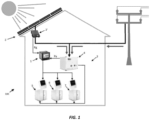
- figure 1 shows, by way of example, a system 100 according to the present invention.
- a refrigeration system 3 comprises a refrigeration unit 4 which can drive one or more refrigeration apparatuses 5, 6, 7 connected thereto.
- Each one of the refrigeration apparatuses 5, 6, 7 considered within the present invention is of the type having a configuration input for controlling from outside, through setting commands, some operation parameters, thereamong for example a temperature setpoint SPi.
- temperature setpoint the value of temperature at which a thermostat inside the apparatus is set and which one wishes to make the apparatus itself reaching during operation.
- each refrigeration apparatus 5, 6, 7 of course is characterized by a nominal absorbed power Pi.
- the refrigeration unit 4 is electrically powered with a mixed system, both through the mains, and through a photovoltaic panel power generator 2, adjusted by an inverter 2'.
- the system 100 provides a control device 1, for example a PLC, performing the role of interface between the photovoltaic panel generator 2 and the refrigeration system 3.
- a control device for example a PLC, performing the role of interface between the photovoltaic panel generator 2 and the refrigeration system 3.
- a control device 1 comprises means for measuring a first instantaneous value of power Pg produced by the generator 2.
- such measuring means can be represented by an input of the PLC dedicated to receive a signal from the inverter 2' of the generator, proportional to the instantaneous power Pg generated by the panels.
- the device 1 further comprises means for measuring a second instantaneous value of power Pa absorbed by the refrigeration unit 4.
- such means can comprise an amperometric detection device connected to an additional PLC input.
- the device comprises means for the acquisition of third values Pi identifying the nominal power absorbed by each one of the connected refrigeration apparatuses 5, 6, 7.
- values Pi can be acquired during the preliminary setting of the system, through a user interface system for the data input, and stored in a PLC memory.
- the device 1 further comprises a programmable unit, configured and programmed for processing the measured and acquired values.
- the programmable unit is programmed for using the first, second and third values Pg, Pa, Pi in order to determine temperature setpoint setting commands to be sent to one or more of said refrigeration apparatuses 5, 6, 7, according to a logic which will be described hereinafter.
- control device 1 will include even means for transmitting said setting commands to the refrigeration apparatuses 5, 6, 7.
- means for the transmission can be implemented through PLC outputs connected to respective configuration inputs of the refrigeration apparatuses 5, 6, 7, as even schematically illustrated in figure 1 .
- control and interface device 1 bases its control logic upon the determination of a state of photovoltaic power generator 2.
- a first state in which the generator 2 produces more energy than it is required, is discriminated from a second state, in which the generator 2 produces less energy than it is required.
- the programmable unit of the device 1 then is programmed so that when the difference ⁇ is greater than the smallest one of the third acquired and stored values Pi setting commands are determined (and consequently sent) to lower the temperature setpoint SPi of all refrigeration apparatuses 5, 6, 7 for which the difference ⁇ is greater than the respective third value Pi.
- a first apparatus 5 has absorbed nominal power P1 equal to 20kW
- a second apparatus 6 has absorbed nominal power P2 equal to 30kW
- a third apparatus 7 has absorbed nominal power P3 equal to 50kW.
- Each one of the three apparatuses provides a standard prefixed temperature setpoint and moreover the possibility of varying the temperature setpoint within a predetermined range. Let's assume for example that for such apparatuses the standard prefixed temperature setpoint is -20°, that is could assume the values - 20° and -30° and that, at first, they all have the setpoint set to -20°.
- ⁇ would be greater than P1 and lower than P2 and P3. Then, the programme of the device control unit will provide for determining a command for setting the temperature setpoint for the apparatus 5, so that the respective setpoint is lowered to the value of -30°.
- the setting command can be implemented for example in the form of an electric contact or through a digital port which, when closed by the control device, is interpreted by the refrigeration apparatus as a signal of low logic level and corresponding to the lowest setpoint value (-30°).
- the control device provides a setting command to bring the temperature setpoint to the highest level.
- the device would provide the setting of the respective setpoints to the highest value of -20°.
Landscapes
- Engineering & Computer Science (AREA)
- Power Engineering (AREA)
- Devices That Are Associated With Refrigeration Equipment (AREA)
- Separation By Low-Temperature Treatments (AREA)
- Physical Or Chemical Processes And Apparatus (AREA)
Description
- The present invention relates to a system for the storage of refrigeration energy.
- As it is known, the only way to perform a storage of the energy produced by the photovoltaic panels in excess of the need, is to transfer such exceeding energy in the recharge of bulky storage batteries. It follows that an operation having available photovoltaic panels stores the exceeding electric energy in huge batteries so as to use the same then in a second moment or to sell to the network operator the energy produced in excess (always with a lower economic return than the collection one).
- Typically, then, the users of photovoltaic solar panels do not succeed in exploiting wholly and in an efficient way the current produced in excess throughout the day.
- In fact, nowadays, the technology for the storage of electric energy does not currently provide batteries with capacity higher than 20 Kw. These can be sufficient for limited needs, for example domestic needs, but they cannot meet the needs of industrial users.
- Then, in particular for users which have to power electrically high-consumption apparatuses (for example refrigerated apparatuses), often requiring three-phase power supply, the storage of electric energy is not particularly helpful, on the contrary it results to be an anti-economic solution.
- In fact, the same storage process does not even have a particularly high efficiency and moreover the batteries have an extremely high cost, especially if they have large size.
- Then, particularly for industrial users of this type, the problem of the energy consumption linked to the use of the apparatuses, especially during the non-production periods of the photovoltaic panels, is particularly felt.
- A problem which typically arises is that of the need for having to use the refrigerated apparatuses (storage cells, pools of freezing water and so on) even in the night hours, then without being able to use the energy produced by the photovoltaic panels, and then by collecting electric energy directly from the network.
-
US2018/106510 discloses a refrigeration control system that determines when DC power is provided by a photovoltaic (PV) source or by a non-PV source: when DC power is provided by the PV source, power consumption by the refrigeration system is maximized such that cooling of a chamber of the refrigeration system is limited only by a refrigerant capacity of the refrigeration system; when DC power is provided by a non-PV source, power consumption is managed to maintain a temperature range in the chamber. - The present invention proposes a system and a method for exploiting the energy produced in excess by the photovoltaic panels during the night hours, in case of users which have to use refrigerated apparatuses within 24 hours.
- The solution according to the present invention inserts in this context, the invention proposing to provide a system allowing to store the electric energy produced in excess by the photovoltaic panels under the form of refrigeration energy, directly inside the system itself, so that the use could burden as little as possible on the electric power supply in the not-production phases of the photovoltaic panels.
- The object of the present invention is then to solve the problems left unsolved by the known art, by providing a control device as defined in claim 1.
- The present invention further relates to a refrigeration system as defined in the independent claim 5.
- The present invention still further relates to a control method of a refrigeration system, as defined in claim 6.
- Additional features of the present invention are defined in the corresponding depending claims.
- The advantages, together with the features and use modes of the present invention, will result evident from the following detailed description of preferred embodiments thereof, shown by way of example and not for limitative purposes.
- Hereinafter in this description reference will be made to the drawings shown in the enclosed figures, wherein:
-
figure 1 is an exemplifying scheme of a refrigeration system according to the present invention; and -
figure 2 is an exemplifying flow chart of a control method according to the present invention. - The present invention will be described hereinafter by making reference to the above-mentioned figures.
- In particular,
figure 1 shows, by way of example, a system 100 according to the present invention. - According to the present invention, a refrigeration system 3 comprises a refrigeration unit 4 which can drive one or more refrigeration apparatuses 5, 6, 7 connected thereto. Each one of the refrigeration apparatuses 5, 6, 7 considered within the present invention is of the type having a configuration input for controlling from outside, through setting commands, some operation parameters, thereamong for example a temperature setpoint SPi. Under the term temperature setpoint the value of temperature at which a thermostat inside the apparatus is set and which one wishes to make the apparatus itself reaching during operation. Moreover, each refrigeration apparatus 5, 6, 7 of course is characterized by a nominal absorbed power Pi.
- The refrigeration unit 4 is electrically powered with a mixed system, both through the mains, and through a photovoltaic panel power generator 2, adjusted by an inverter 2'.
- As it is known, depending upon the production of the photovoltaic panels, a more or less important collection of electric energy from the network will be made to meet the system requirement.
- According to an aspect of the present invention, the system 100 provides a control device 1, for example a PLC, performing the role of interface between the photovoltaic panel generator 2 and the refrigeration system 3.
- A control device 1 according to the invention, comprises means for measuring a first instantaneous value of power Pg produced by the generator 2. Advantageously, such measuring means can be represented by an input of the PLC dedicated to receive a signal from the inverter 2' of the generator, proportional to the instantaneous power Pg generated by the panels.
- Moreover, the device 1 further comprises means for measuring a second instantaneous value of power Pa absorbed by the refrigeration unit 4. For example, such means can comprise an amperometric detection device connected to an additional PLC input.
- Additionally, the device comprises means for the acquisition of third values Pi identifying the nominal power absorbed by each one of the connected refrigeration apparatuses 5, 6, 7. By way of example, such values can be acquired during the preliminary setting of the system, through a user interface system for the data input, and stored in a PLC memory.
- The device 1 further comprises a programmable unit, configured and programmed for processing the measured and acquired values. In particular the programmable unit is programmed for using the first, second and third values Pg, Pa, Pi in order to determine temperature setpoint setting commands to be sent to one or more of said refrigeration apparatuses 5, 6, 7, according to a logic which will be described hereinafter.
- Of course, the control device 1 will include even means for transmitting said setting commands to the refrigeration apparatuses 5, 6, 7. For example such means for the transmission can be implemented through PLC outputs connected to respective configuration inputs of the refrigeration apparatuses 5, 6, 7, as even schematically illustrated in
figure 1 . - Generally, the control and interface device 1 according to the present invention, bases its control logic upon the determination of a state of photovoltaic power generator 2.
- To this purpose, the first and second values of power Pg, Pa are processed by the programmable unit to calculate a difference Δ between said first value Pg and said second value Pa:

- Based upon the difference Δ a first state, in which the generator 2 produces more energy than it is required, is discriminated from a second state, in which the generator 2 produces less energy than it is required.
- The programmable unit of the device 1 then is programmed so that when the difference Δ is greater than the smallest one of the third acquired and stored values Pi setting commands are determined (and consequently sent) to lower the temperature setpoint SPi of all refrigeration apparatuses 5, 6, 7 for which the difference Δ is greater than the respective third value Pi.
- Let's consider for example a case wherein a first apparatus 5 has absorbed nominal power P1 equal to 20kW, a second apparatus 6 has absorbed nominal power P2 equal to 30kW, a third apparatus 7 has absorbed nominal power P3 equal to 50kW.
- Each one of the three apparatuses provides a standard prefixed temperature setpoint and moreover the possibility of varying the temperature setpoint within a predetermined range. Let's assume for example that for such apparatuses the standard prefixed temperature setpoint is -20°, that is could assume the values - 20° and -30° and that, at first, they all have the setpoint set to -20°.
- By assuming a measure of the instantaneous values of power Pg generated by the generator 2 and of power Pa absorbed by the unit 4, respectively equal to 40kW and 15kW, a difference Δ=40-15=25kW would be obtained.
- Under these circumstances, Δ would be greater than P1 and lower than P2 and P3. Then, the programme of the device control unit will provide for determining a command for setting the temperature setpoint for the apparatus 5, so that the respective setpoint is lowered to the value of -30°.
- In practice, the setting command can be implemented for example in the form of an electric contact or through a digital port which, when closed by the control device, is interpreted by the refrigeration apparatus as a signal of low logic level and corresponding to the lowest setpoint value (-30°).
- On the contrary, for all the connected apparatuses the nominal power value thereof is higher than the difference Δ, the control device provides a setting command to bring the temperature setpoint to the highest level. In the preceding example, for the apparatuses 6 and 7, respectively with P2=30kW and P3=50kW, the device would provide the setting of the respective setpoints to the highest value of -20°.
- When the generator 2 is in the second provided state, wherein the difference Δ is lower or equal to the smallest one of the third acquired and stored values Pi, all refrigeration apparatuses 5, 6, 7 connected to the unit will receive by the control device 1 a respective setting command so as to bring the respective setpoint to the prefixed standard operation value, for example -20°.
- The present invention has been sofar described with reference to preferred embodiments thereof. It is to be meant that each one of the technical solutions implemented in the preferred embodiments, herein described by way of example, can advantageously be combined, differently from what described, with the other ones, to create additional embodiments, belonging to the same inventive core and however all within the protective scope of the herebelow reported claims.
Claims (9)
- A control device (1) for interfacing a photovoltaic panel power generator (2) and a refrigeration system (3) comprising a refrigeration unit (4) configured to drive a plurality of refrigeration apparatuses (5, 6, 7) adapted to receive commands for setting respective temperature setpoints (SPi), said interface device (1) comprising:- means for measuring a first instantaneous value of power (Pg) produced by the generator (2);- means for measuring a second instantaneous value of power (Pa) absorbed by the refrigeration unit (4);- means for the acquisition of third values (Pi) identifying the nominal power of each one of the connected refrigeration apparatuses (5, 6, 7);- a programmable unit configured to process said first, second and third values (Pg, Pa, Pi) in order to determine temperature setpoint setting commands to be sent to one or more of said refrigeration apparatuses (5, 6, 7); and- means for transmitting said setting commands to said one or more refrigeration apparatuses (5, 6, 7).
- The device (1) according to claim 1, wherein said first and second values (Pg, Pa) are processed by the programmable unit (12) to calculate a difference (Δ) between said first value (Pg) and said second value (Pa).
- The device (1) according to claim 2, wherein said programmable unit is programmed in such a way that when the difference (Δ) is greater than the smallest one of said third values (Pi), setting commands are determined to lower the temperature setpoint (SPi) of all refrigeration apparatuses (5, 6, 7) for which the difference (Δ) is greater than the respective third value (Pi).
- The device (1) according to claim 2 or 3, wherein said programmable unit is configured in such a way that, when the difference (Δ) is greater than the smallest one of said third values (Pi), setting commands are determined to raise the temperature setpoint (SPi) of all refrigeration apparatuses (5, 6, 7) for which the difference (Δ) is less than or equal to the respective third value (Pi).
- A system (100) comprising a refrigeration unit (4) configured to drive a plurality of refrigeration apparatuses (5, 6, 7), a photovoltaic panel power generator (2) and a control device (1) according to one of the preceding claims.
- A method of controlling a system (100) according to claim 5, comprising the following steps of:- measuring a first instantaneous value of power (Pg) produced by the generator (2);- measuring a second instantaneous value of power (Pa) absorbed by the refrigeration unit (4);- acquiring third values (Pi) identifying the nominal power of each one of the connected refrigeration apparatuses (5, 6, 7);- processing said first, second and third values (Pg, Pa, Pi) in order to determine temperature setpoint setting commands to be sent to one or more of said refrigeration apparatuses (5, 6, 7); and- transmitting said setting commands to said one or more refrigeration apparatuses (5, 6, 7).
- The control method according to claim 6, wherein said first and second values (Pg, Pa) are processed to calculate a difference (Δ) between said first value (Pg) and said second value (Pa).
- The control method according to claim 7, wherein when the difference (Δ) is greater than the smallest one of said third values (Pi) setting commands are determined to lower the temperature setpoint (SPi) of all refrigeration apparatuses (5, 6, 7) for which the difference (Δ) is greater than the respective third value (Pi).
- The control method according to claim 7 or 8, wherein when the difference (Δ) is greater than the smallest one of said third values (Pi), setting commands are determined to raise the temperature setpoint (SPi) of all refrigeration apparatuses (5, 6, 7) for which the difference (Δ) is lower than or equal to the respective third value (Pi).
Priority Applications (1)
| Application Number | Priority Date | Filing Date | Title |
|---|---|---|---|
| MA63931A MA63931B1 (en) | 2021-03-30 | 2022-02-23 | System for the storage of refrigeration energy |
Applications Claiming Priority (2)
| Application Number | Priority Date | Filing Date | Title |
|---|---|---|---|
| IT102021000007727A IT202100007727A1 (en) | 2021-03-30 | 2021-03-30 | COOLING ENERGY STORAGE SYSTEM |
| PCT/IB2022/051569 WO2022208179A1 (en) | 2021-03-30 | 2022-02-23 | System for the storage of refrigeration energy |
Publications (3)
| Publication Number | Publication Date |
|---|---|
| EP4315547A1 EP4315547A1 (en) | 2024-02-07 |
| EP4315547C0 EP4315547C0 (en) | 2025-04-02 |
| EP4315547B1 true EP4315547B1 (en) | 2025-04-02 |
Family
ID=76523323
Family Applications (1)
| Application Number | Title | Priority Date | Filing Date |
|---|---|---|---|
| EP22710436.1A Active EP4315547B1 (en) | 2021-03-30 | 2022-02-23 | System for the storage of refrigeration energy |
Country Status (4)
| Country | Link |
|---|---|
| EP (1) | EP4315547B1 (en) |
| IT (1) | IT202100007727A1 (en) |
| MA (1) | MA63931B1 (en) |
| WO (1) | WO2022208179A1 (en) |
Family Cites Families (1)
| Publication number | Priority date | Publication date | Assignee | Title |
|---|---|---|---|---|
| US10648711B2 (en) * | 2016-10-17 | 2020-05-12 | SolarXWorks, LLC | DC refrigeration system controls |
-
2021
- 2021-03-30 IT IT102021000007727A patent/IT202100007727A1/en unknown
-
2022
- 2022-02-23 EP EP22710436.1A patent/EP4315547B1/en active Active
- 2022-02-23 WO PCT/IB2022/051569 patent/WO2022208179A1/en not_active Ceased
- 2022-02-23 MA MA63931A patent/MA63931B1/en unknown
Also Published As
| Publication number | Publication date |
|---|---|
| EP4315547C0 (en) | 2025-04-02 |
| EP4315547A1 (en) | 2024-02-07 |
| MA63931B1 (en) | 2025-05-30 |
| WO2022208179A1 (en) | 2022-10-06 |
| IT202100007727A1 (en) | 2022-09-30 |
Similar Documents
| Publication | Publication Date | Title |
|---|---|---|
| US20250164948A1 (en) | Air conditioning system with predictive control | |
| US20210108821A1 (en) | Building energy system with predictive control of battery and green energy resources | |
| CN108808711B (en) | Photovoltaic automatic phase-selecting parallel network used for three-phase load unbalance management system of low-voltage power network | |
| CN105067857B (en) | Electricity consumption information collection system and analysis method | |
| EP3967946B1 (en) | Photovoltaic air conditioner control method and apparatus and photovoltaic air conditioner | |
| EP4246751A1 (en) | Method of controlling of battery energy storage system of power system with high dynamic loads | |
| CN110137619A (en) | Energy storage device temprature control method and device | |
| US20150160671A1 (en) | Power supply for variable speed blowing devices with electrical energy management | |
| EP4315547B1 (en) | System for the storage of refrigeration energy | |
| CN109654887A (en) | A kind of circulating water cooling system and its autocontrol method | |
| CN104406306B (en) | Water heater system and control method thereof | |
| CN115663841A (en) | A multi-scenario intelligent inverter based on dual optimal control and its application method | |
| CN207350937U (en) | A kind of multiple-energy-source hot-water heating system based on Programmable logical controller | |
| EP3339653B1 (en) | Compressor control during power supply system disturbances | |
| US12392523B2 (en) | Systems and methods for operating a climate control system on a microgrid | |
| Li et al. | Energy management for induction motors based on nonintrusive efficiency estimation | |
| CN106300359B (en) | A bidirectional electric energy flow type smart socket and its operation method | |
| CN109189145A (en) | A kind of thermal hardware energy-saving control method | |
| US12123899B2 (en) | Component power draw detection for electric vehicle charging station | |
| CN221610158U (en) | Self-adaptive variable frequency control system of water pump | |
| CN115189384B (en) | A V2G-based microgrid energy storage charging and discharging management method | |
| CN104949363A (en) | Photovoltaic direct-drive compressor unit and control method thereof | |
| US20260124961A1 (en) | Alternating current battery heating | |
| CN109149642A (en) | A kind of photovoltaic power generation intelligent inverter control system | |
| US20240262234A1 (en) | Charging and discharging of electric vehicle (ev) charging station batteries |
Legal Events
| Date | Code | Title | Description |
|---|---|---|---|
| STAA | Information on the status of an ep patent application or granted ep patent |
Free format text: STATUS: UNKNOWN |
|
| STAA | Information on the status of an ep patent application or granted ep patent |
Free format text: STATUS: THE INTERNATIONAL PUBLICATION HAS BEEN MADE |
|
| PUAI | Public reference made under article 153(3) epc to a published international application that has entered the european phase |
Free format text: ORIGINAL CODE: 0009012 |
|
| STAA | Information on the status of an ep patent application or granted ep patent |
Free format text: STATUS: REQUEST FOR EXAMINATION WAS MADE |
|
| 17P | Request for examination filed |
Effective date: 20230925 |
|
| AK | Designated contracting states |
Kind code of ref document: A1 Designated state(s): AL AT BE BG CH CY CZ DE DK EE ES FI FR GB GR HR HU IE IS IT LI LT LU LV MC MK MT NL NO PL PT RO RS SE SI SK SM TR |
|
| DAX | Request for extension of the european patent (deleted) | ||
| RAV | Requested validation state of the european patent: fee paid |
Extension state: MA Effective date: 20230925 |
|
| GRAP | Despatch of communication of intention to grant a patent |
Free format text: ORIGINAL CODE: EPIDOSNIGR1 |
|
| STAA | Information on the status of an ep patent application or granted ep patent |
Free format text: STATUS: GRANT OF PATENT IS INTENDED |
|
| RIC1 | Information provided on ipc code assigned before grant |
Ipc: F25B 27/00 20060101ALN20240910BHEP Ipc: H02J 3/38 20060101ALI20240910BHEP Ipc: H02J 3/14 20060101AFI20240910BHEP |
|
| INTG | Intention to grant announced |
Effective date: 20241016 |
|
| GRAS | Grant fee paid |
Free format text: ORIGINAL CODE: EPIDOSNIGR3 |
|
| GRAA | (expected) grant |
Free format text: ORIGINAL CODE: 0009210 |
|
| STAA | Information on the status of an ep patent application or granted ep patent |
Free format text: STATUS: THE PATENT HAS BEEN GRANTED |
|
| AK | Designated contracting states |
Kind code of ref document: B1 Designated state(s): AL AT BE BG CH CY CZ DE DK EE ES FI FR GB GR HR HU IE IS IT LI LT LU LV MC MK MT NL NO PL PT RO RS SE SI SK SM TR |
|
| REG | Reference to a national code |
Ref country code: GB Ref legal event code: FG4D |
|
| REG | Reference to a national code |
Ref country code: CH Ref legal event code: EP |
|
| REG | Reference to a national code |
Ref country code: IE Ref legal event code: FG4D |
|
| REG | Reference to a national code |
Ref country code: DE Ref legal event code: R096 Ref document number: 602022012587 Country of ref document: DE |
|
| U01 | Request for unitary effect filed |
Effective date: 20250410 |
|
| U07 | Unitary effect registered |
Designated state(s): AT BE BG DE DK EE FI FR IT LT LU LV MT NL PT RO SE SI Effective date: 20250417 |
|
| REG | Reference to a national code |
Ref country code: MA Ref legal event code: VAGR Ref document number: 63931 Country of ref document: MA Kind code of ref document: B1 |
|
| PG25 | Lapsed in a contracting state [announced via postgrant information from national office to epo] |
Ref country code: ES Free format text: LAPSE BECAUSE OF FAILURE TO SUBMIT A TRANSLATION OF THE DESCRIPTION OR TO PAY THE FEE WITHIN THE PRESCRIBED TIME-LIMIT Effective date: 20250402 |
|
| PG25 | Lapsed in a contracting state [announced via postgrant information from national office to epo] |
Ref country code: GR Free format text: LAPSE BECAUSE OF FAILURE TO SUBMIT A TRANSLATION OF THE DESCRIPTION OR TO PAY THE FEE WITHIN THE PRESCRIBED TIME-LIMIT Effective date: 20250703 Ref country code: NO Free format text: LAPSE BECAUSE OF FAILURE TO SUBMIT A TRANSLATION OF THE DESCRIPTION OR TO PAY THE FEE WITHIN THE PRESCRIBED TIME-LIMIT Effective date: 20250702 |
|
| PG25 | Lapsed in a contracting state [announced via postgrant information from national office to epo] |
Ref country code: PL Free format text: LAPSE BECAUSE OF FAILURE TO SUBMIT A TRANSLATION OF THE DESCRIPTION OR TO PAY THE FEE WITHIN THE PRESCRIBED TIME-LIMIT Effective date: 20250402 |
|
| PG25 | Lapsed in a contracting state [announced via postgrant information from national office to epo] |
Ref country code: HR Free format text: LAPSE BECAUSE OF FAILURE TO SUBMIT A TRANSLATION OF THE DESCRIPTION OR TO PAY THE FEE WITHIN THE PRESCRIBED TIME-LIMIT Effective date: 20250402 |
|
| PG25 | Lapsed in a contracting state [announced via postgrant information from national office to epo] |
Ref country code: RS Free format text: LAPSE BECAUSE OF FAILURE TO SUBMIT A TRANSLATION OF THE DESCRIPTION OR TO PAY THE FEE WITHIN THE PRESCRIBED TIME-LIMIT Effective date: 20250702 |
|
| PG25 | Lapsed in a contracting state [announced via postgrant information from national office to epo] |
Ref country code: IS Free format text: LAPSE BECAUSE OF FAILURE TO SUBMIT A TRANSLATION OF THE DESCRIPTION OR TO PAY THE FEE WITHIN THE PRESCRIBED TIME-LIMIT Effective date: 20250802 |
|
| PG25 | Lapsed in a contracting state [announced via postgrant information from national office to epo] |
Ref country code: SM Free format text: LAPSE BECAUSE OF FAILURE TO SUBMIT A TRANSLATION OF THE DESCRIPTION OR TO PAY THE FEE WITHIN THE PRESCRIBED TIME-LIMIT Effective date: 20250402 |
|
| PG25 | Lapsed in a contracting state [announced via postgrant information from national office to epo] |
Ref country code: CZ Free format text: LAPSE BECAUSE OF FAILURE TO SUBMIT A TRANSLATION OF THE DESCRIPTION OR TO PAY THE FEE WITHIN THE PRESCRIBED TIME-LIMIT Effective date: 20250402 |
|
| PG25 | Lapsed in a contracting state [announced via postgrant information from national office to epo] |
Ref country code: SK Free format text: LAPSE BECAUSE OF FAILURE TO SUBMIT A TRANSLATION OF THE DESCRIPTION OR TO PAY THE FEE WITHIN THE PRESCRIBED TIME-LIMIT Effective date: 20250402 |
|
| PLBE | No opposition filed within time limit |
Free format text: ORIGINAL CODE: 0009261 |
|
| STAA | Information on the status of an ep patent application or granted ep patent |
Free format text: STATUS: NO OPPOSITION FILED WITHIN TIME LIMIT |
|
| REG | Reference to a national code |
Ref country code: CH Ref legal event code: L10 Free format text: ST27 STATUS EVENT CODE: U-0-0-L10-L00 (AS PROVIDED BY THE NATIONAL OFFICE) Effective date: 20260211 |
|
| U20 | Renewal fee for the european patent with unitary effect paid |
Year of fee payment: 5 Effective date: 20260129 |
|
| 26N | No opposition filed |
Effective date: 20260105 |
|
| VSFP | Annual fee paid to validation state [announced via postgrant information from national office to epo] |
Ref country code: MA Payment date: 20260223 Year of fee payment: 5 |