EP4315545B1 - Electromagnetic interference filter - Google Patents
Electromagnetic interference filter Download PDFInfo
- Publication number
- EP4315545B1 EP4315545B1 EP22835125.0A EP22835125A EP4315545B1 EP 4315545 B1 EP4315545 B1 EP 4315545B1 EP 22835125 A EP22835125 A EP 22835125A EP 4315545 B1 EP4315545 B1 EP 4315545B1
- Authority
- EP
- European Patent Office
- Prior art keywords
- emi filter
- load
- noise
- line
- mode
- Prior art date
- Legal status (The legal status is an assumption and is not a legal conclusion. Google has not performed a legal analysis and makes no representation as to the accuracy of the status listed.)
- Active
Links
Images

Classifications
-
- H—ELECTRICITY
- H02—GENERATION; CONVERSION OR DISTRIBUTION OF ELECTRIC POWER
- H02J—ELECTRIC POWER NETWORKS; CIRCUIT ARRANGEMENTS OR SYSTEMS FOR SUPPLYING OR DISTRIBUTING ELECTRIC POWER; SYSTEMS FOR STORING ELECTRIC ENERGY
- H02J3/00—Circuit arrangements for AC mains or AC distribution networks
- H02J3/01—Arrangements for reducing harmonics or ripples
-
- H—ELECTRICITY
- H03—ELECTRONIC CIRCUITRY
- H03H—IMPEDANCE NETWORKS, e.g. RESONANT CIRCUITS; RESONATORS
- H03H7/00—Multiple-port networks comprising only passive electrical elements as network components
- H03H7/01—Frequency selective two-port networks
- H03H7/0138—Electrical filters or coupling circuits
-
- H—ELECTRICITY
- H01—ELECTRIC ELEMENTS
- H01F—MAGNETS; INDUCTANCES; TRANSFORMERS; SELECTION OF MATERIALS FOR THEIR MAGNETIC PROPERTIES
- H01F27/00—Details of transformers or inductances, in general
- H01F27/24—Magnetic cores
-
- H—ELECTRICITY
- H01—ELECTRIC ELEMENTS
- H01F—MAGNETS; INDUCTANCES; TRANSFORMERS; SELECTION OF MATERIALS FOR THEIR MAGNETIC PROPERTIES
- H01F27/00—Details of transformers or inductances, in general
- H01F27/28—Coils; Windings; Conductive connections
-
- H—ELECTRICITY
- H01—ELECTRIC ELEMENTS
- H01F—MAGNETS; INDUCTANCES; TRANSFORMERS; SELECTION OF MATERIALS FOR THEIR MAGNETIC PROPERTIES
- H01F41/00—Apparatus or processes specially adapted for manufacturing or assembling magnets, inductances or transformers; Apparatus or processes specially adapted for manufacturing materials characterised by their magnetic properties
- H01F41/02—Apparatus or processes specially adapted for manufacturing or assembling magnets, inductances or transformers; Apparatus or processes specially adapted for manufacturing materials characterised by their magnetic properties for manufacturing cores, coils, or magnets
- H01F41/0206—Manufacturing of magnetic cores by mechanical means
-
- H—ELECTRICITY
- H02—GENERATION; CONVERSION OR DISTRIBUTION OF ELECTRIC POWER
- H02M—APPARATUS FOR CONVERSION BETWEEN AC AND AC, BETWEEN AC AND DC, OR BETWEEN DC AND DC, AND FOR USE WITH MAINS OR SIMILAR POWER SUPPLY SYSTEMS; CONVERSION OF DC OR AC INPUT POWER INTO SURGE OUTPUT POWER; CONTROL OR REGULATION THEREOF
- H02M1/00—Details of apparatus for conversion
- H02M1/12—Arrangements for reducing harmonics from AC input or output
-
- H—ELECTRICITY
- H02—GENERATION; CONVERSION OR DISTRIBUTION OF ELECTRIC POWER
- H02M—APPARATUS FOR CONVERSION BETWEEN AC AND AC, BETWEEN AC AND DC, OR BETWEEN DC AND DC, AND FOR USE WITH MAINS OR SIMILAR POWER SUPPLY SYSTEMS; CONVERSION OF DC OR AC INPUT POWER INTO SURGE OUTPUT POWER; CONTROL OR REGULATION THEREOF
- H02M1/00—Details of apparatus for conversion
- H02M1/12—Arrangements for reducing harmonics from AC input or output
- H02M1/123—Suppression of common mode voltage or current
-
- H—ELECTRICITY
- H02—GENERATION; CONVERSION OR DISTRIBUTION OF ELECTRIC POWER
- H02M—APPARATUS FOR CONVERSION BETWEEN AC AND AC, BETWEEN AC AND DC, OR BETWEEN DC AND DC, AND FOR USE WITH MAINS OR SIMILAR POWER SUPPLY SYSTEMS; CONVERSION OF DC OR AC INPUT POWER INTO SURGE OUTPUT POWER; CONTROL OR REGULATION THEREOF
- H02M1/00—Details of apparatus for conversion
- H02M1/44—Circuits or arrangements for compensating for electromagnetic interference in converters or inverters
-
- H—ELECTRICITY
- H03—ELECTRONIC CIRCUITRY
- H03G—CONTROL OF AMPLIFICATION
- H03G3/00—Gain control in amplifiers or frequency changers
- H03G3/20—Automatic control
- H03G3/30—Automatic control in amplifiers having semiconductor devices
- H03G3/3052—Automatic control in amplifiers having semiconductor devices in bandpass amplifiers (H.F. or I.F.) or in frequency-changers used in a (super)heterodyne receiver
-
- H—ELECTRICITY
- H03—ELECTRONIC CIRCUITRY
- H03H—IMPEDANCE NETWORKS, e.g. RESONANT CIRCUITS; RESONATORS
- H03H7/00—Multiple-port networks comprising only passive electrical elements as network components
- H03H7/01—Frequency selective two-port networks
- H03H7/0115—Frequency selective two-port networks comprising only inductors and capacitors
-
- H—ELECTRICITY
- H03—ELECTRONIC CIRCUITRY
- H03H—IMPEDANCE NETWORKS, e.g. RESONANT CIRCUITS; RESONATORS
- H03H7/00—Multiple-port networks comprising only passive electrical elements as network components
- H03H7/01—Frequency selective two-port networks
- H03H7/17—Structural details of sub-circuits of frequency selective networks
- H03H7/1708—Comprising bridging elements, i.e. elements in a series path without own reference to ground and spanning branching nodes of another series path
-
- H—ELECTRICITY
- H03—ELECTRONIC CIRCUITRY
- H03H—IMPEDANCE NETWORKS, e.g. RESONANT CIRCUITS; RESONATORS
- H03H7/00—Multiple-port networks comprising only passive electrical elements as network components
- H03H7/42—Networks for transforming balanced signals into unbalanced signals and vice versa, e.g. baluns
- H03H7/425—Balance-balance networks
- H03H7/427—Common-mode filters
-
- H—ELECTRICITY
- H02—GENERATION; CONVERSION OR DISTRIBUTION OF ELECTRIC POWER
- H02M—APPARATUS FOR CONVERSION BETWEEN AC AND AC, BETWEEN AC AND DC, OR BETWEEN DC AND DC, AND FOR USE WITH MAINS OR SIMILAR POWER SUPPLY SYSTEMS; CONVERSION OF DC OR AC INPUT POWER INTO SURGE OUTPUT POWER; CONTROL OR REGULATION THEREOF
- H02M1/00—Details of apparatus for conversion
- H02M1/12—Arrangements for reducing harmonics from AC input or output
- H02M1/126—Arrangements for reducing harmonics from AC input or output using passive filters
Definitions
- the present invention concerns an electromagnetic interference (EMI) filter for filtering common-mode and differential-mode noise.
- EMI electromagnetic interference
- the present invention concerns also a method for manufacturing the EMI filter.
- Electric systems in industrial applications are becoming ever more complex and include a multitude of components that generate, or are liable to be disturbed by, electromagnetic interferences.
- Electric motors for example, are often driven by electronic inverters that control the motor speed and torque by generating waveforms with variable frequency and amplitude. These systems provide high efficiency but generate powerful electromagnetic interferences.
- Switching power converters are used in electric and hybrid vehicles as well as in countless other applications such as driving stationary motors, battery chargers, photovoltaic systems, lighting control, computers, and other. In all these cases, the switching action of the converter is a source of electromagnetic interference that could, if it is not managed or attenuated, affect the functioning of other electrical systems, or exceed normative limits. Electromagnetic interferences are often indicated by the acronym EMI in the art and in the present disclosure. It is also frequent to use the expression “noise” to denote the electromagnetic interferences although these are not of stochastic nature. The present disclosure will use the expression “noise” in this way, too.
- electromagnetic interference filters used to attenuate these unwanted electromagnetic interferences, called electromagnetic interference filters or EMI filters in short, are used in all branches of electric engineering to improve reliability and respect existing norms.
- Well-designed filtering system are essential to the performance of many complex electric systems.
- a substantial reduction in size of high-value capacitors and inductances can be achieved by pairing EMI filters with active filter stages, so-called active EMI filters.
- active EMI filters The combination of these two different filter technologies can lead to significant reductions of size and cost.
- EMI filters combining passive and active filter stages that are known from literature, such as disclosed in EP2007009A2 , EP3255770A1 , or EP3553935A1 are either optimised for the attenuation of common-mode noise or differential-mode noise.
- Patent document US 10,476,464 discloses an EMI common-mode filter device with two serially connected LC-filters, two transformers and an active current control circuit.
- the transformers are dedicated to sensing a common-mode current and injecting compensation currents driven by the current control circuit.
- the common-mode filter is specifically designed to reduce common-mode noise.
- the structure of the common-mode filter is complex.
- the active current control circuit is designed to provide the attenuation only under specific operational conditions, where the LC-filters are configured to produce partial common-mode filter function even in case of failure of the current control circuit.
- This document discloses further at least one supply circuit which generates the power required for an active filter and at least one current amplifier circuit which transfers a signal generated by an active filter and having the same waveform with the noise to the line in the input of the current detection circuit.
- This filter in particular the passive filter stage, is bulky and may provide insufficient attenuation for common-mode noise signals.
- the invention refers to an electromagnetic, EMI, filter according to claim 1, and a method for manufacturing the EMI filter, according to claim 15. Preferred embodiments are defined in the dependent claims.
- One object of the invention is the provision of an EMI filter that is designed for filtering common-mode and differential-mode noise with a high attenuation for both noise modes, preferably at both the line side and the load side.
- Another object of the invention is the provision of an EMI filter that is arranged for filtering common-mode and differential-mode noise and is at the same time reduced in size, as lower values for the inductance and/or capacitance for passive components is. This results in a significant reduction of materials, such as iron, copper, etc., being used so that the design also is more stainable.
- the EMI filter furthermore is easy to manufacture compared to related conventional EMI filters known from the literature.
- a further object of the invention is the provision of an EMI filter that is configured for filtering common-mode and differential-mode noise and provides sufficient noise attenuation also at frequencies below 150kHz.
- an EMI filter having line-side terminals for connecting to an electric supply and load-side terminals for connecting to a load device, a load-side passive EMI filter stage connected to the load-side terminals and configured to suppress common-mode and differential-mode noise, a line-side active EMI filter stage connected to the line-side terminals and configured to suppress differential-mode noise.
- Dependent claims introduce important and useful, but not essential, features, such as an intermediate filter stage between the load-side EMI filter and the line-side one, configured to suppress common-mode noise, first and second inductive elements as well as a capacitive element in the load-side passive filter, a common-mode circuit sensor in the intermediate stage, for example a current transformer, driving a current amplifier that injects a compensation current in the supply line that cancels a common-mode noise current, and an actuation transformer in the line-side unit that is driven by a voltage amplifier to generate an electromotive force in the supply lines that cancels a measured EMI voltage on the lines.
- the actuation transformer can be driven to provide differential-mode noise cancellation and, if desired, common-mode noise cancellation.
- the actuation transformer mentioned above will have a structure coherent with the number of phases present in the power line.
- the actuation transformer will have three phases, respectively a single phase.
- the actuation transformer will have a single magnetic core.
- An air gap between the core elements was found to be beneficial to avoid material saturation.
- the intermediate-side active filter and the line-side active filter are preferably feedback filters, in that an error signal (a common-mode current, respectively a differential-mode voltage, for example) is sensed on the line, amplified by suitable amplifiers and injected as cancellation signal on the line before the measure point.
- the gain of the amplifiers is preferably variable and controlled automatically by a slow servo circuit, to maintain the output in a desired range without overdriving the circuit.
- the stages of the filter are preferably dimensioned such that the resonance frequency of the load-side passive EMI stage is smaller or greater than a fundamental frequency of the interference, for example two or five times higher.
- the stages of the filter are preferably such that the EMI filter has no self-resonance.
- the stages of the filter are designed such that the resonance frequency of the load-side passive EMI stage has no impact on switching frequency of load.
- the resonance frequency is determined by several factors, among them, important factors are the selection of the inductance and capacitance values and/or nonlinear elements of the load-side passive EMI stage
- the resonance frequency of the load-side passive EMI stage is smaller or greater than the resonance frequency of a passive EMI filter featuring an attenuation comparable to the attenuation of the hybrid filter, since the inductance and capacitance values are comparably smaller.
- the fundamental frequency may be taken as a carrier frequency of the converter.
- the EMI filter particularly the load-side passive EMI filter stage, can be configured to damp or suppress resonances.
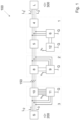
- an EMI filter 100 is inserted on a supply line 150 (in this case a three-phase line) between a load 300 and a supply source 200.
- the filter is inserted on the line by means of suitable conductive terminals or conductors L1, L2, L3 on the line side and L1', L2', L3' on the load side.
- the load 300 which may be a motor drive with cable and electric motor, generates common-mode and differential-mode noise.
- the electric supply S can be any kind of electrical source arranged to provide electric power at the line-side terminals L1, L2, L3.
- Line-side or “load-side” relates in the context of this disclosure to a physical location and/or electrical connection node of a device with respect to a location on the electric supply line 150.
- Line-side means a location or electrical connection node on the electric supply line 150 being closer to the electric supply S than to the load L, whereas load-side means a location or electrical connection node being closer to the load L than to the electric supply S.
- the electric supply S may provide DC power or AC power, single-phase or multiphase.
- the load device L on the other hand can be any kind of device that draws electrical energy and is arranged to conduct noise to the electric supply line 150 when being connected to the load-side terminals L1', L2', L3'.
- Devices that are known to generate conducted EMI are for example electric generators, power supplies, voltage regulators, oscillators and battery chargers.
- EMI are conducted along the supply line and are progressively mitigated or attenuated by the different filter stages 1, 2 ,3 travelling towards the electric energy source side 200.
- the filter 100 has first a load-side passive stage 1.
- the passive filter 1 is subject to the highest level of noise having the largest bandwidth.
- passive filter 1 attenuates the amplitude of the noise that will reach the following stages and reduces its bandwidth.
- the load-side passive EMI filter stage 1 is configured to suppress common-mode and differential-mode noise at the same time.
- Passive in the context of the disclosure leads to a configuration of capacitors, inductors and selectively resistors that forms the passive EMI filter stage 1. Passive filters do not depend upon external power sources and they do not contain active components, such as amplifier circuits.
- Active filter stages 2, 3 following the load-side passive EMI filter stage 1 do not need to cope with the full dynamics and bandwidth of the noise, since the passive filter stage 1 provides a significant attenuation, especially in the higher part of the frequency range. They can be designed for this reduced amplitude and bandwidth and, as a result, they may be smaller and have a lower costs.
- the attenuation introduced by the active stages 2, 3 adds to that of the passive filter 1.
- the passive filter is not required to introduce a very high attenuation, but it is enough that the noise, by traversing the passive filter 1 is reduced to a level that the active stages 2 and 3 can accept. This is mutually beneficial, because the passive filter stage 1 can be designed for a smaller attenuation, particularly at low frequency, and therefore without bulky inductors and capacitors.
- the passive filter stage 1 comprises, in this embodiment, a first inductive filtering element 4 and a second inductive filtering element 5 inductively coupled to the electric supply line 150.
- the first inductive filtering element 4 can be a common-mode inductor that is electrically connected to the electric supply line 150. More preferably the first filtering element 4 is provided by a single ferrite core element that is placed on the electric supply line 150, such that the ferrite core element provides a common-mode attenuation to the noise on the electric supply line 150, by providing a common-mode impedance.
- the second inductive filtering element 5 could have the same structure as the first inductive filtering element 4, possibly with higher or different inductance values. Typical values for the inductance of these components are between 10 ⁇ H and 50 ⁇ H, but these figures may vary according to the application.
- the passive stage 1 further comprises a capacitive filtering element 6, electrically connected to the electric supply line 150 between the first inductive filtering element 4 and the second inductive filtering element 5.
- the capacitive filtering element 6 can have connectors to arrange an electrical connection with the electric supply line 150 and the ground G.
- the capacitive filtering element 6 is configured to suppress common-mode and differential-mode noise on the electric supply line 150.
- the capacitive filtering element 6 can be arranged with multiple capacitors that are interconnected to provide a network of X-connected capacitors, to attenuate differential EMI, and Y capacitors bypassing common-mode EMI towards a common potential node G, as it is known in the art.
- Y capacitors are well known and typically connected to ground G.
- a network of X capacitors sometimes is referred to as delta capacitor network, whereas a network of Y capacitors is known as star capacitor network.
- Delta capacitor networks can be used to bypass differential-mode noise, whereas star capacitor networks can be used to bypass common-mode noise. Suitable configurations of capacitor networks are known from literature.
- Figure 1 also illustrates a low voltage power supply 12 connected to the capacitive filtering element 6.
- This element is used to provide a low-level power supply V+ needed by the active filter stages 2 and 3, particularly to the current amplifier circuit 9 and the voltage amplifier circuit 11.
- the power supply 12 may be conveniently connected to the capacitor bank 6, but this is not a requirement, and in fact it could be embodied by any suitable DC source of low voltage, for example ⁇ 10 V.
- the power supply 12 is not a functional part of the passive filter stage 1 and does not contribute to noise attenuation directly.
- Passive stage 1 is drawn as a low-pass "T" LC filter but could have other configurations and present low-pass, band-pass, or band-stop transfer function. As most passive LC filters, resonates at a specific frequency or at more than one resonance frequencies. The resonances may be damped by suitable dissipative elements, such as resistors or varistors.
- a line-side active EMI filter stage 3 is connected to the line-side terminals L1, L2, L3.
- the line-side active EMI filter stage 3 is arranged to suppress differential-mode noise on the electric supply line 150.
- the EMI filter 100 features an intermediate active EMI filter stage 2 on the electric supply line 150 between the passive stage 1 and the active line-side stage 3 that is configured to suppress common-mode noise on the electric supply line 150.
- Locating the intermediate active EMI filter stage 2 between the load-side EMI filter stage 1 and the line-side EMI filter stage 3 has the advantage that the line-side EMI filter stage 3 presents a high impedance to the electric supply S. In this manner, the EMI filter does not disturb other devices sharing the electric supply.
- the resonance frequency or the resonance frequencies mentioned above are dimensioned having regard to a fundamental frequency of the interferences generated by the load device L connectable or connected to the load-side terminals L1', L2', L3'.
- the expression "fundamental frequency" should be read in the context of this disclosure as the component of the noise with the lowest frequency and/or the highest amplitude, also when the noise is not strictly periodical, as it often happens.
- the fundamental frequency may be the switching frequency, also named carrier frequency, of the converter.
- the fundamental frequency might be a frequency in the range of 1 kHz to 200 kHz. In most applications, the frequency of the carrier might be in the range of 2 kHz to 20 kHz, or in the range of 50 kHz to 200 kHz.
- the load-side passive EMI filter stage 1 is configured such that it exhibits a resonance frequency that is smaller or greater than the fundamental frequency of the noise coming from the load L.
- the resonance frequency is at two times, or better five times, different from the fundamental frequency of the noise. Thanks to this, ringing and oscillations in EMI filter 100 are minimised, and resistors that are usually installed to dampen these oscillations can be omitted or dimensioned conservatively, with a significant gain in efficiency.
- a high resonance frequency can be achieved by choosing small values of L and C in the passive elements 4, 5, 6, and often comes with a reduced attenuation at low frequency. This is not a shortcoming since the attenuation at low frequency is boosted by active stages 2 and 3.
- the active stages 2 and 3, on the other hand, preferably are also dimensioned with a high resonance frequency.
- the EMI Filter 1 can be configurated in a further embodiment with a resonance frequency as explained before, but resonances stimulated by the emissions of the load L can be alternatively or in addition damped or suppressed using a related means preferably comprised in the load-side passive EMI stage 1. In total, can the EMI Filter 1 be configurated without showing resonance phenomena, as any stimulation would lead to sufficient damping or suppression of resonances.
- the means in combination with the specific design for the resonance frequency leads in combination to a robust and stable operation of the EMI Filter 1 even in an environment with high noise levels.
- the load-side passive EMI stage 1 can be designed to provide a "One size fits all solution" for all intended applications. Even when the load-side passive EMI stage 1 would be combined with a noise emitting load L emitting noise with a fundamental frequency close to the resonance frequency of the load-side passive EMI stage 1, would the damping means prohibit any resonance phenomena in the EMI Filter 1. Consequently, can the load-side passive EMI stage 1 be designed with a specific resonance frequency but for multiple applications.
- the presented example supposed an energy flow from the source S towards the load L, but this is not a requirement of the invention, which could apply also to generation systems or motors with regenerative braking, in which the electrical power delivered to the load L may be negative, momentarily or permanently.
- the switching power converter might be configured as unidirectional or bidirectional switching power converter.
- the intermediate active EMI filter stage 2 preferably includes a common-mode current sensor 8, for example a current transformer or a shunt resistor, that is arranged to provide a common-mode noise signal proportional to a common-mode noise current circulating in the electric supply line 150.
- a common-mode current sensor 8 for example a current transformer or a shunt resistor
- the current amplifier 9 is arranged to receive the common-mode noise signal and generate a noise cancellation current having the opposite sign as the noise current.
- the noise cancellation current is injected into the electric supply line 150 to attenuate the common-mode noise current circulating therein.
- the represented variant is in the feedback configuration: the cancellation current is injected before the sensor 8 (on the load side with respect to the sensor). Feed-forward filters are also possible and included in the scope of the invention.
- the line-side active EMI filter stage 3 includes a voltage amplifier circuit 11 whose input is connected to the electric supply line 150 and is sensitive to a voltage noise on the voltage line. Even if it is not represented in figure 1 , it is understood that the voltage present on the line will be brought to a level acceptable to the amplifier's input by a suitable divider or by a protection circuit.
- the line-side stage 3 is configured to suppress a differential-mode noise and works on multiphase signals if the supply line 150 is a multiphase one. Since the common-mode noise is taken care of by the intermediate stage, the line-side stage can deal with the differential-mode noise only. This is not an essential feature of the invention, however, and the filter stage 1 could be configured to attenuate a common-mode noise component as well.
- the output of voltage amplifier 11 generates a cancellation voltage that is superimposed to the voltages of the supply line, thereby attenuating the noise.
- the filter is also represented in the feedback configuration but, as for the intermediate stage, this is not essential.
- the output of the amplifier is preferably connected to the supply line 10 through an actuation transformer 10.
- the amplifier 11 injects current in a set of primary windings of the actuation transformer 10 and, by magnetic induction, the transformer 10 induces an electromotive force in the conductors of the supply line150, which are arranged as secondary windings.
- the voltage or voltage signal is induced having an opposite phase, with respect to noise components flowing in the electric supply line 150 to attenuate the voltage noise present thereupon.
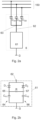
- Fig. 2a illustrates a possible configuration of the capacitive filtering element 6 relating to a further embodiment with a means for damping or suppressing oscillations namely, a capacitive discharge damping means 61 for damping or suppressing resonances.
- a capacitive discharge damping means 61 for damping or suppressing resonances.
- Three X capacitors C X1 ..C X3 are connected on one end to each phase of the electric supply line 150.
- the second end of the three X capacitors C X1 ..C X3 are interconnected to form a start point 63.
- the capacitive discharge damping means 61 is connected via a node 62 between the star point 63 and the ground G.
- Fig. 2b illustrates a possible configuration of the capacitive discharge damping means 61, which comprises a first branch 64 and a second branch 66 each connected between the node 62 and the ground G.
- the first branch 64 comprises a first one-way conductor D 1 and a first Y capacitor C Y1 connected in series.
- a first circuit point 65 is arranged between the first one-way conductor D 1 and a first Y capacitor C Y1 .
- the first one-way conductor D 1 is arranged between the node 62 and the first capacitor C Y1 .
- the forward direction of the first one way conductor D 1 is from the node 62 to the first capacitor C Y1 or toward the ground.
- the second branch 66 comprises a second one-way conductor D 2 and a second capacitor C Y2 connected in series.
- a second circuit point 67 is arranged between the second one-way conductor D 2 and the second capacitor C Y2 .
- the second one-way conductor D 2 is arranged between the node 62 and the second capacitor C 2 .
- the forward direction of the second one-way conductor D 2 is to the node 62 from the second capacitor C Y2 or away from the ground.
- the first capacitor C Y1 and the second capacitor C Y2 act as Y capacitors.
- a one-way conductor is defined as any component or group of components which has an asymmetric conductance, i.e. conducts the current in a forward direction better than in a reverse direction.
- the one-way conductor allows to pass substantially the full current in the forward direction and blocks substantially all the current in a reverse direction.
- the one-way conductor D 1 and D 2 is a Diode.
- a resistor R is connected between the first branch 64 and the second branch 66.
- the resistor R is connected between the first circuit point 65 and the second circuit point 67.
- the two one-way conductors D 1 and D 2 in the two branches 64 and 66 are configured such that the first capacitor C Y1 receives only the charges of a first polarity (here positive) and the second capacitor C Y2 only the charges of a second polarity (here negative). Due to the one-way conductor D 1 and D 2 , the charges from the capacitors C Y1 and C Y2 cannot flow back to the node 62.
- the capacitors C Y1 and C Y2 discharge over the resistor R and reduce such the voltage time integral and the common-mode current, which finally reduces or prevents oscillations in the EMI Filter 100, in particular in the load-side passive EMI filter stage 1 which can be stimulated by the emissions of the load device L with its fundamental frequency.
- the capacitive discharge damping means 61 shows a non-linear behaviour. In addition, due to its configuration, the capacitive discharge damping means 61, energy-efficient, compared to other solutions known in the prior art.
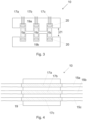
- Fig. 3 illustrates possible realisation of an actuation transformer 10 suitable for the invention
- the actuation transformer has a magnetic core split into two core elements 19a and 19b.
- the magnetic core elements 19a, 19b are preferably made of soft magnetic material, such as manganese-zinc ferrites, nickel-zinc ferrites or equivalents, with low coercivity and low hysteresis losses at the frequencies where the noise is expected.
- Each of the magnetic core elements 19a, 19b is provided with multiple recesses being able to accommodate electrical conductors 15a, 15b, 15c and insulation material 20.
- each of the magnetic core elements 19a, 19b is provided with three recesses, corresponding to the three phases of the supply line 150.
- the first magnetic core element 19a is provided with a first, second and third 17a, 17b, 17c coil element.
- Each of the coil elements 17a, 17b, 17c preferably is made with a wire that is wound multiple times around the first magnetic core element19a and is arranged in one of the recesses of the first magnetic core element 19a.
- the wire might be coated with a varnish, to electrically insulate the windings from each other.
- the coil elements 17a, 17b, 17c can be electrical insulated from the first magnetic core element 19a using insulating material (not shown). The insulating material might be placed between the coil elements 17a, 17b, 17c and a surface of the magnetic core element 19a.
- a first conductor 15a, a second conductor 15b and a third conductor 15c is arranged in each of the recesses.
- the conductors 15a, 15b, 15c can be a part of the electric supply line 150 and may be configured to carry the main current and the common-mode and/or current-mode noise, that flows between the electric supply S and the load device L, or vice versa.
- Each of the conductors 15a, 15b, 15c might be provided with an electrical insulation.
- the conductors 15a, 15b, 15c are electrically insulated from the magnetic core elements 19a, 19b using insulating material 20, as shown in Fig. 3 .
- the magnetic core elements 19a, 19b are arranged such that they enclose the conductors 15a, 15b, 15c of the electric supply line 150.
- the magnetic core elements 19a, 19b furthermore are arranged, such that they provide a closed magnetic circuit, meaning that the conductors 15a, 15b, 15c of the electric supply line 150 form a secondary winding.
- the coil elements 17a, 17b, 17c form a primary winding and the magnetic core elements 19a, 19b form a magnetic core 19, being part of a transformer, more specifically being part of the actuation transformer 10.
- the magnetic core 19 can be provided with an airgap 21 to linearise the inductance of the actuation transformer 10 and to avoid saturation, as the airgap 21 reduces the slope of the related B/H loop.
- Primary and secondary in the context of this disclosure relates to the side of the actuation transformer 10 where a varying magnetic flux in the magnetic core 19 is generated.
- Fig. 4 illustrates an actuation transformer 10, according to one embodiment of the EMI filter 100, with a magnetic core 19, three conductors 15a, 15b, 15c that are enclosed by the magnetic core 19 and three coil elements 17a, 17b, 17c that can be connected to the voltage amplifier circuit 11.
- the three conductors 15a, 15b, 15c are part of the electric supply line 150.
- Fig. 4 illustrates an actuation transformer 10, an electric supply line 150 and an EMI filter for a three-phase AC system.
- the electric supply line 150 alternatively can be a single-phase or a multiphase AC line, connecting the supply S to the load device L.
- the actuation transformer 10 alternatively might be a single-phase or a multiphase transformer with a single magnetic core 19 formed by the first and second magnetic core elements 19a, 19b.
- Arranging the magnetic core 19 of the actuation transformer 10 with two magnetic core elements 19a, 19b provides the advantage that the actuation transformer 10 can be easily installed on existing supply lines 150 having multiple conductors 15a, 15b, 15c. It is not necessary to disconnect or disassemble the electric supply line 150 as the actuation transformer 10 can be assembled around or clamped on an existing supply line 150. Thus, top hat rail mounting might be a typical application for the actuation transformer 10.
- Fig. 5 is a conceptual representation of an active filtering stage as those used in the invention, either in the intermediate stage 2 or in the line-side stage 3.
- the load L and the source S are connected by a supply line 150 that is represented as unifilar, being it understood that it may be a multiphase power line.
- the amplifier circuits 9, 11 receive a noise signal (that may be a voltage, current signal, common-mode or differential one) that is proportional to the noise sensed at point A on the electric supply line 150.
- the sensing point A is located at the electric energy source side 200.
- the active filtering stage is configured to inject a cancellation signal at the summing point B.
- the summing point B is located at the load device side 300.
- the intermediate active EMI filter stage 2 or the line-side active EMI filter stage 3 includes an amplifier circuit 9, 11 that produces an output that represented, conceptually, by a cascade of an ideal gain stage K, which can be variable and a transfer function T.
- the amplifier 11, 9 connected between A and B constitutes a first feedback control loop LC 1 that introduces an attenuation of the noise in known fashion.
- a second control loop LC 2 is a used to control the gain K adaptively.
- the control loop LC 2 is sensitive to the noise level and, when the noise exceeds a given range, such that the amplifier circuit 9,11 may be driven into saturation, intervenes to reduce the gain K. In normal conditions, when the noise level is below a predetermined threshold, the second control loop LC 2 is inactive, and the gain K has its nominal value.
- the gain control function in the embodiments may be a linear function clipped to a maximum value.
- the maximum value may be related to a maximum output of the amplifier circuit 9,11, or it could be set by an input variable P.
- the gain K may need to be reduced when the load device L needs to draw more power than specified for example in an overload operation mode.
- the filter on the invention operates consistently, avoiding saturations and oscillations and provides a measure of attenuation in all cases.
- the first control loop LC 1 and the second control loop LC 2 operate on different time scales.
- the transfer function T of the first control loop LC 1 determines the attenuation bandwidth of the stage and should be as extended as the noise requires.
- the second control loop LC 2 operates at slower speed and may have a time constant of several milliseconds.
- the first control loop LC 1 is configured to react very quickly with respect to a noise signal at the sensing point A, whereas the second control loop LC 2 with its negative feedback loop finds a suitable operating point for the loop gain.
- This arrangement with a fast control loop LC 1 to attenuate the noise, and a slower servo loop to change the feedback gain k based on the noise level is advantageous in that it improves the stability of the active EMI filter stages 2, 3, in particular when the intermediate active EMI filter stage 2 and the line-side active EMI filter stage 3 are each arranged with an amplifier circuit 9, 11 as explained before.
- the invention as set out before also relates to a method for manufacturing the EMI filter 100, in particular for manufacturing the actuation transformer 10.
- the method for manufacturing comprises the following steps:
- Uniting means to bring the first magnetic core element 19a and the second magnetic core element19b as close as necessary together. This does not exclude that there is a remaining airgap 21 between first magnetic core element 19a and the second magnetic core element 19b.
- the magnetic core elements 19a, 19b are arranged or placed such that they provide a closed magnetic circuit.
- the method further includes the step of:
- the core elements 19a, 19b might be secured using fixing material, such as glue or varnish. Other means such as clamping fixtures can be used in addition or alternatively to secure the core elements 19a, 19b and to hold them in place.
- the core elements 19a,19b might be arranged in a housing, after securing their position relative to each other.
- the method also comprises the step of:
- the steps preferably are processed in the order as set out before, but alternatively can be performed in any different order. It might be possible to connect in a first instance the conductors 15a, 15b, 15c to the load-side terminals L1', L2', L3' and to the line-side terminals L1, L2, L3 and then providing the remaining components and the closing the magnetic circuit in a subsequent step.
- the actuation transformer 10 is provided by two single core elements 19a, 19b, whereas only one of the two core elements 19a, 19b is provided with coil elements 17a, 17b, 17c.
Landscapes
- Engineering & Computer Science (AREA)
- Power Engineering (AREA)
- Physics & Mathematics (AREA)
- Electromagnetism (AREA)
- Manufacturing & Machinery (AREA)
- Filters And Equalizers (AREA)
- Coils Or Transformers For Communication (AREA)
Description
- The present invention concerns an electromagnetic interference (EMI) filter for filtering common-mode and differential-mode noise. The present invention concerns also a method for manufacturing the EMI filter.
- Electric systems in industrial applications are becoming ever more complex and include a multitude of components that generate, or are liable to be disturbed by, electromagnetic interferences. Electric motors, for example, are often driven by electronic inverters that control the motor speed and torque by generating waveforms with variable frequency and amplitude. These systems provide high efficiency but generate powerful electromagnetic interferences.
- Switching power converters are used in electric and hybrid vehicles as well as in countless other applications such as driving stationary motors, battery chargers, photovoltaic systems, lighting control, computers, and other. In all these cases, the switching action of the converter is a source of electromagnetic interference that could, if it is not managed or attenuated, affect the functioning of other electrical systems, or exceed normative limits. Electromagnetic interferences are often indicated by the acronym EMI in the art and in the present disclosure. It is also frequent to use the expression "noise" to denote the electromagnetic interferences although these are not of stochastic nature. The present disclosure will use the expression "noise" in this way, too.
- Electric or electronic filters used to attenuate these unwanted electromagnetic interferences, called electromagnetic interference filters or EMI filters in short, are used in all branches of electric engineering to improve reliability and respect existing norms. Well-designed filtering system are essential to the performance of many complex electric systems.
- It is known to use passive low-pass LC filters to attenuate EMI and such filters have been proven effective in a high number of applications. While passive solutions do offer substantial attenuation, they have their limits. One limit of passive EMI filters is the desired attenuation levels require high-value capacitors and inductances. The size and cost of the resulting filter are mainly determined by these large components. High-value capacitors also lead, in many applications, to high current levels in the earthing system (leakage currents) and reactive currents, both undesirable and detrimental to the system operation.
- A substantial reduction in size of high-value capacitors and inductances can be achieved by pairing EMI filters with active filter stages, so-called active EMI filters. The combination of these two different filter technologies can lead to significant reductions of size and cost.
- Most, if not all, EMI filters combining passive and active filter stages that are known from literature, such as disclosed in
EP2007009A2 ,EP3255770A1 , orEP3553935A1 are either optimised for the attenuation of common-mode noise or differential-mode noise. - Patent document
US 10,476,464 - The structure of the common-mode filter is complex. The active current control circuit is designed to provide the attenuation only under specific operational conditions, where the LC-filters are configured to produce partial common-mode filter function even in case of failure of the current control circuit.
- International patent application
WO 2015/177746 discloses an EMI active differential-mode line filter with at least one passive filter stage which enables the filter to filter high frequency common-mode noise and at least one current detection circuit which enables noise to be detected and at least one wave generator circuit which enables the voltage obtained through the current detection circuit to come to the same waveform with the noise. - This document discloses further at least one supply circuit which generates the power required for an active filter and at least one current amplifier circuit which transfers a signal generated by an active filter and having the same waveform with the noise to the line in the input of the current detection circuit. This filter, in particular the passive filter stage, is bulky and may provide insufficient attenuation for common-mode noise signals.
- The invention refers to an electromagnetic, EMI, filter according to
claim 1, and a method for manufacturing the EMI filter, according to claim 15. Preferred embodiments are defined in the dependent claims. One object of the invention is the provision of an EMI filter that is designed for filtering common-mode and differential-mode noise with a high attenuation for both noise modes, preferably at both the line side and the load side. - Another object of the invention is the provision of an EMI filter that is arranged for filtering common-mode and differential-mode noise and is at the same time reduced in size, as lower values for the inductance and/or capacitance for passive components is. This results in a significant reduction of materials, such as iron, copper, etc., being used so that the design also is more stainable. The EMI filter furthermore is easy to manufacture compared to related conventional EMI filters known from the literature. A further object of the invention is the provision of an EMI filter that is configured for filtering common-mode and differential-mode noise and provides sufficient noise attenuation also at frequencies below 150kHz.
- According to the invention, these aims are attained by the object of the attached claims and especially by an EMI filter, having line-side terminals for connecting to an electric supply and load-side terminals for connecting to a load device, a load-side passive EMI filter stage connected to the load-side terminals and configured to suppress common-mode and differential-mode noise, a line-side active EMI filter stage connected to the line-side terminals and configured to suppress differential-mode noise.
- Dependent claims introduce important and useful, but not essential, features, such as an intermediate filter stage between the load-side EMI filter and the line-side one, configured to suppress common-mode noise, first and second inductive elements as well as a capacitive element in the load-side passive filter, a common-mode circuit sensor in the intermediate stage, for example a current transformer, driving a current amplifier that injects a compensation current in the supply line that cancels a common-mode noise current, and an actuation transformer in the line-side unit that is driven by a voltage amplifier to generate an electromotive force in the supply lines that cancels a measured EMI voltage on the lines. The actuation transformer can be driven to provide differential-mode noise cancellation and, if desired, common-mode noise cancellation.
- The actuation transformer mentioned above will have a structure coherent with the number of phases present in the power line. In the important cases of three-phase and single-phase power lines the actuation transformer will have three phases, respectively a single phase. Preferably, the actuation transformer will have a single magnetic core. To simplify the assembly, it has been found advantageous to fashion the core of the actuation transformer with two juxtaposed magnetic elements that can be separated to concatenate the actuation transformer with the power line without cutting or moving the power conductors (which can be rigid busbars). An air gap between the core elements was found to be beneficial to avoid material saturation.
- The intermediate-side active filter and the line-side active filter are preferably feedback filters, in that an error signal (a common-mode current, respectively a differential-mode voltage, for example) is sensed on the line, amplified by suitable amplifiers and injected as cancellation signal on the line before the measure point. The gain of the amplifiers is preferably variable and controlled automatically by a slow servo circuit, to maintain the output in a desired range without overdriving the circuit.
- In relation with the interference source connected to the load terminals of the filter, the stages of the filter are preferably dimensioned such that the resonance frequency of the load-side passive EMI stage is smaller or greater than a fundamental frequency of the interference, for example two or five times higher. In addition, or alternatively, the stages of the filter are preferably such that the EMI filter has no self-resonance. In addition or alternatively the stages of the filter are designed such that the resonance frequency of the load-side passive EMI stage has no impact on switching frequency of load. The resonance frequency is determined by several factors, among them, important factors are the selection of the inductance and capacitance values and/or nonlinear elements of the load-side passive EMI stage On the other hand, the resonance frequency of the load-side passive EMI stage is smaller or greater than the resonance frequency of a passive EMI filter featuring an attenuation comparable to the attenuation of the hybrid filter, since the inductance and capacitance values are comparably smaller. In the important use case where the interference source is a switching power converter, the fundamental frequency may be taken as a carrier frequency of the converter.
- The EMI filter, particularly the load-side passive EMI filter stage, can be configured to damp or suppress resonances.
- Further advantages of the invention can be deducted from the disclosure that follows.
- Exemplar embodiments of the invention are disclosed in the description and illustrated by the drawings in which:
-
Figure 1 illustrates schematically an EMI filter according to a preferred embodiment. -
Figure 2a, 2b illustrate a possible configuration of the capacitive filtering element, with a means for damping or suppressing oscillations according to an embodiment. -
Figure 3 and Figure 4 illustrate an actuation transformer according to an embodiment. -
Figure 5 illustrates a control diagram of the current and/or voltage amplifier circuit according to a further embodiment. - Referring to
figure 1 , anEMI filter 100 according to the invention is inserted on a supply line 150 (in this case a three-phase line) between aload 300 and asupply source 200. The filter is inserted on the line by means of suitable conductive terminals or conductors L1, L2, L3 on the line side and L1', L2', L3' on the load side. Theload 300, which may be a motor drive with cable and electric motor, generates common-mode and differential-mode noise. - The electric supply S can be any kind of electrical source arranged to provide electric power at the line-side terminals L1, L2, L3. "Line-side" or "load-side" relates in the context of this disclosure to a physical location and/or electrical connection node of a device with respect to a location on the
electric supply line 150. Line-side means a location or electrical connection node on theelectric supply line 150 being closer to the electric supply S than to the load L, whereas load-side means a location or electrical connection node being closer to the load L than to the electric supply S. - The electric supply S may provide DC power or AC power, single-phase or multiphase. The load device L on the other hand can be any kind of device that draws electrical energy and is arranged to conduct noise to the
electric supply line 150 when being connected to the load-side terminals L1', L2', L3'. Devices that are known to generate conducted EMI are for example electric generators, power supplies, voltage regulators, oscillators and battery chargers. - EMI are conducted along the supply line and are progressively mitigated or attenuated by the
different filter stages energy source side 200. - Moving from the load side to the line side, the
filter 100 has first a load-sidepassive stage 1. Thepassive filter 1 is subject to the highest level of noise having the largest bandwidth.passive filter 1 attenuates the amplitude of the noise that will reach the following stages and reduces its bandwidth. Preferably, the load-side passiveEMI filter stage 1 is configured to suppress common-mode and differential-mode noise at the same time. - "Passive" in the context of the disclosure leads to a configuration of capacitors, inductors and selectively resistors that forms the passive
EMI filter stage 1. Passive filters do not depend upon external power sources and they do not contain active components, such as amplifier circuits. - Active filter stages 2, 3 following the load-side passive
EMI filter stage 1 do not need to cope with the full dynamics and bandwidth of the noise, since thepassive filter stage 1 provides a significant attenuation, especially in the higher part of the frequency range. They can be designed for this reduced amplitude and bandwidth and, as a result, they may be smaller and have a lower costs. - On the other hand, the attenuation introduced by the
active stages 2, 3 adds to that of thepassive filter 1. Advantageously, the passive filter is not required to introduce a very high attenuation, but it is enough that the noise, by traversing thepassive filter 1 is reduced to a level that theactive stages 2 and 3 can accept. This is mutually beneficial, because thepassive filter stage 1 can be designed for a smaller attenuation, particularly at low frequency, and therefore without bulky inductors and capacitors. - Returning to the
passive filter stage 1, it comprises, in this embodiment, a firstinductive filtering element 4 and a secondinductive filtering element 5 inductively coupled to theelectric supply line 150. - The first
inductive filtering element 4 can be a common-mode inductor that is electrically connected to theelectric supply line 150. More preferably thefirst filtering element 4 is provided by a single ferrite core element that is placed on theelectric supply line 150, such that the ferrite core element provides a common-mode attenuation to the noise on theelectric supply line 150, by providing a common-mode impedance. - The second
inductive filtering element 5 could have the same structure as the firstinductive filtering element 4, possibly with higher or different inductance values. Typical values for the inductance of these components are between 10 µH and 50 µH, but these figures may vary according to the application. - The
passive stage 1 further comprises a capacitive filtering element 6, electrically connected to theelectric supply line 150 between the firstinductive filtering element 4 and the secondinductive filtering element 5. The capacitive filtering element 6 can have connectors to arrange an electrical connection with theelectric supply line 150 and the ground G. - The capacitive filtering element 6 is configured to suppress common-mode and differential-mode noise on the
electric supply line 150. The capacitive filtering element 6 can be arranged with multiple capacitors that are interconnected to provide a network of X-connected capacitors, to attenuate differential EMI, and Y capacitors bypassing common-mode EMI towards a common potential node G, as it is known in the art. - Y capacitors are well known and typically connected to ground G. A network of X capacitors sometimes is referred to as delta capacitor network, whereas a network of Y capacitors is known as star capacitor network. Delta capacitor networks can be used to bypass differential-mode noise, whereas star capacitor networks can be used to bypass common-mode noise. Suitable configurations of capacitor networks are known from literature.
-
Figure 1 also illustrates a lowvoltage power supply 12 connected to the capacitive filtering element 6. This element is used to provide a low-level power supply V+ needed by the active filter stages 2 and 3, particularly to the current amplifier circuit 9 and thevoltage amplifier circuit 11. Thepower supply 12 may be conveniently connected to the capacitor bank 6, but this is not a requirement, and in fact it could be embodied by any suitable DC source of low voltage, for example ±10 V. Thepower supply 12 is not a functional part of thepassive filter stage 1 and does not contribute to noise attenuation directly. -
Passive stage 1 is drawn as a low-pass "T" LC filter but could have other configurations and present low-pass, band-pass, or band-stop transfer function. As most passive LC filters, resonates at a specific frequency or at more than one resonance frequencies. The resonances may be damped by suitable dissipative elements, such as resistors or varistors. - A line-side active
EMI filter stage 3 is connected to the line-side terminals L1, L2, L3. The line-side activeEMI filter stage 3 is arranged to suppress differential-mode noise on theelectric supply line 150. In the represented embodiment, theEMI filter 100 features an intermediate active EMI filter stage 2 on theelectric supply line 150 between thepassive stage 1 and the active line-side stage 3 that is configured to suppress common-mode noise on theelectric supply line 150. - Locating the intermediate active EMI filter stage 2 between the load-side
EMI filter stage 1 and the line-sideEMI filter stage 3 has the advantage that the line-sideEMI filter stage 3 presents a high impedance to the electric supply S. In this manner, the EMI filter does not disturb other devices sharing the electric supply. - In one aspect of the invention, the resonance frequency or the resonance frequencies mentioned above are dimensioned having regard to a fundamental frequency of the interferences generated by the load device L connectable or connected to the load-side terminals L1', L2', L3'. The expression "fundamental frequency" should be read in the context of this disclosure as the component of the noise with the lowest frequency and/or the highest amplitude, also when the noise is not strictly periodical, as it often happens. In the important use case where the load is a switching converter, the fundamental frequency may be the switching frequency, also named carrier frequency, of the converter.
- The fundamental frequency might be a frequency in the range of 1 kHz to 200 kHz. In most applications, the frequency of the carrier might be in the range of 2 kHz to 20 kHz, or in the range of 50 kHz to 200 kHz.
- The load-side passive
EMI filter stage 1 is configured such that it exhibits a resonance frequency that is smaller or greater than the fundamental frequency of the noise coming from the load L. Preferably, the resonance frequency is at two times, or better five times, different from the fundamental frequency of the noise. Thanks to this, ringing and oscillations inEMI filter 100 are minimised, and resistors that are usually installed to dampen these oscillations can be omitted or dimensioned conservatively, with a significant gain in efficiency. A high resonance frequency can be achieved by choosing small values of L and C in thepassive elements active stages 2 and 3. Theactive stages 2 and 3, on the other hand, preferably are also dimensioned with a high resonance frequency. - The
EMI Filter 1 can be configurated in a further embodiment with a resonance frequency as explained before, but resonances stimulated by the emissions of the load L can be alternatively or in addition damped or suppressed using a related means preferably comprised in the load-sidepassive EMI stage 1. In total, can theEMI Filter 1 be configurated without showing resonance phenomena, as any stimulation would lead to sufficient damping or suppression of resonances. The means in combination with the specific design for the resonance frequency leads in combination to a robust and stable operation of theEMI Filter 1 even in an environment with high noise levels. - Adding a means for damping improves the flexibility for designing the load-side
passive EMI stage 1 drastically. The load-sidepassive EMI stage 1 can be designed to provide a "One size fits all solution" for all intended applications. Even when the load-sidepassive EMI stage 1 would be combined with a noise emitting load L emitting noise with a fundamental frequency close to the resonance frequency of the load-sidepassive EMI stage 1, would the damping means prohibit any resonance phenomena in theEMI Filter 1. Consequently, can the load-sidepassive EMI stage 1 be designed with a specific resonance frequency but for multiple applications. - The presented example supposed an energy flow from the source S towards the load L, but this is not a requirement of the invention, which could apply also to generation systems or motors with regenerative braking, in which the electrical power delivered to the load L may be negative, momentarily or permanently. In other words, the switching power converter might be configured as unidirectional or bidirectional switching power converter.
- The intermediate active EMI filter stage 2 preferably includes a common-
mode current sensor 8, for example a current transformer or a shunt resistor, that is arranged to provide a common-mode noise signal proportional to a common-mode noise current circulating in theelectric supply line 150. - The current amplifier 9 is arranged to receive the common-mode noise signal and generate a noise cancellation current having the opposite sign as the noise current. The noise cancellation current is injected into the
electric supply line 150 to attenuate the common-mode noise current circulating therein. The represented variant is in the feedback configuration: the cancellation current is injected before the sensor 8 (on the load side with respect to the sensor). Feed-forward filters are also possible and included in the scope of the invention. - In this embodiment the line-side active
EMI filter stage 3 includes avoltage amplifier circuit 11 whose input is connected to theelectric supply line 150 and is sensitive to a voltage noise on the voltage line. Even if it is not represented infigure 1 , it is understood that the voltage present on the line will be brought to a level acceptable to the amplifier's input by a suitable divider or by a protection circuit. - In contrast to the intermediate stage that was configured to suppress a common-mode noise, the line-
side stage 3 is configured to suppress a differential-mode noise and works on multiphase signals if thesupply line 150 is a multiphase one. Since the common-mode noise is taken care of by the intermediate stage, the line-side stage can deal with the differential-mode noise only. This is not an essential feature of the invention, however, and thefilter stage 1 could be configured to attenuate a common-mode noise component as well. - The output of
voltage amplifier 11 generates a cancellation voltage that is superimposed to the voltages of the supply line, thereby attenuating the noise. The filter is also represented in the feedback configuration but, as for the intermediate stage, this is not essential. - As represented, the output of the amplifier is preferably connected to the
supply line 10 through anactuation transformer 10. Theamplifier 11 injects current in a set of primary windings of theactuation transformer 10 and, by magnetic induction, thetransformer 10 induces an electromotive force in the conductors of the supply line150, which are arranged as secondary windings. - The voltage or voltage signal is induced having an opposite phase, with respect to noise components flowing in the
electric supply line 150 to attenuate the voltage noise present thereupon. -
Fig. 2a illustrates a possible configuration of the capacitive filtering element 6 relating to a further embodiment with a means for damping or suppressing oscillations namely, a capacitive discharge damping means 61 for damping or suppressing resonances. Three X capacitors CX1..CX3 are connected on one end to each phase of theelectric supply line 150. The second end of the three X capacitors CX1..CX3 are interconnected to form astart point 63. The capacitive discharge damping means 61 is connected via anode 62 between thestar point 63 and the ground G. -
Fig. 2b illustrates a possible configuration of the capacitive discharge damping means 61, which comprises afirst branch 64 and asecond branch 66 each connected between thenode 62 and the ground G. - The
first branch 64 comprises a first one-way conductor D1 and a first Y capacitor CY1 connected in series. Afirst circuit point 65 is arranged between the first one-way conductor D1 and a first Y capacitor CY1. The first one-way conductor D1 is arranged between thenode 62 and the first capacitor CY1. The forward direction of the first one way conductor D1 is from thenode 62 to the first capacitor CY1 or toward the ground. - The
second branch 66 comprises a second one-way conductor D2 and a second capacitor CY2 connected in series. Asecond circuit point 67 is arranged between the second one-way conductor D2 and the second capacitor CY2. The second one-way conductor D2 is arranged between thenode 62 and the second capacitor C2. The forward direction of the second one-way conductor D2 is to thenode 62 from the second capacitor CY2 or away from the ground. - The first capacitor CY1 and the second capacitor CY2 act as Y capacitors.
- A one-way conductor is defined as any component or group of components which has an asymmetric conductance, i.e. conducts the current in a forward direction better than in a reverse direction. Preferably, the one-way conductor allows to pass substantially the full current in the forward direction and blocks substantially all the current in a reverse direction. Preferably, the one-way conductor D1 and D2 is a Diode.
- A resistor R is connected between the
first branch 64 and thesecond branch 66. Preferably, the resistor R is connected between thefirst circuit point 65 and thesecond circuit point 67. - The two one-way conductors D1 and D2 in the two
branches node 62. The capacitors CY1 and CY2 discharge over the resistor R and reduce such the voltage time integral and the common-mode current, which finally reduces or prevents oscillations in theEMI Filter 100, in particular in the load-side passiveEMI filter stage 1 which can be stimulated by the emissions of the load device L with its fundamental frequency. The capacitive discharge damping means 61 shows a non-linear behaviour. In addition, due to its configuration, the capacitive discharge damping means 61, energy-efficient, compared to other solutions known in the prior art. -
Fig. 3 illustrates possible realisation of anactuation transformer 10 suitable for the invention Preferably, the actuation transformer has a magnetic core split into twocore elements magnetic core elements - Each of the
magnetic core elements electrical conductors insulation material 20. In this example each of themagnetic core elements supply line 150. - The first
magnetic core element 19a is provided with a first, second and third 17a, 17b, 17c coil element. Each of thecoil elements magnetic core element 19a. - The wire might be coated with a varnish, to electrically insulate the windings from each other. The
coil elements magnetic core element 19a using insulating material (not shown). The insulating material might be placed between thecoil elements magnetic core element 19a. - A
first conductor 15a, asecond conductor 15b and athird conductor 15c is arranged in each of the recesses. Theconductors electric supply line 150 and may be configured to carry the main current and the common-mode and/or current-mode noise, that flows between the electric supply S and the load device L, or vice versa. Each of theconductors - In addition, or alternatively, the
conductors magnetic core elements material 20, as shown inFig. 3 . - The
magnetic core elements conductors electric supply line 150. Themagnetic core elements conductors electric supply line 150 form a secondary winding. - The
coil elements magnetic core elements actuation transformer 10. The magnetic core 19 can be provided with anairgap 21 to linearise the inductance of theactuation transformer 10 and to avoid saturation, as theairgap 21 reduces the slope of the related B/H loop. - Primary and secondary in the context of this disclosure relates to the side of the
actuation transformer 10 where a varying magnetic flux in the magnetic core 19 is generated. -
Fig. 4 illustrates anactuation transformer 10, according to one embodiment of theEMI filter 100, with a magnetic core 19, threeconductors coil elements voltage amplifier circuit 11. The threeconductors electric supply line 150. -
Fig. 4 illustrates anactuation transformer 10, anelectric supply line 150 and an EMI filter for a three-phase AC system. Theelectric supply line 150 alternatively can be a single-phase or a multiphase AC line, connecting the supply S to the load device L. Theactuation transformer 10 alternatively might be a single-phase or a multiphase transformer with a single magnetic core 19 formed by the first and secondmagnetic core elements - Arranging the magnetic core 19 of the
actuation transformer 10 with twomagnetic core elements actuation transformer 10 can be easily installed on existingsupply lines 150 havingmultiple conductors electric supply line 150 as theactuation transformer 10 can be assembled around or clamped on an existingsupply line 150. Thus, top hat rail mounting might be a typical application for theactuation transformer 10. -
Fig. 5 is a conceptual representation of an active filtering stage as those used in the invention, either in the intermediate stage 2 or in the line-side stage 3. The load L and the source S are connected by asupply line 150 that is represented as unifilar, being it understood that it may be a multiphase power line. - The
amplifier circuits 9, 11 receive a noise signal (that may be a voltage, current signal, common-mode or differential one) that is proportional to the noise sensed at point A on theelectric supply line 150. The sensing point A is located at the electricenergy source side 200. The active filtering stage is configured to inject a cancellation signal at the summing point B. The summing point B is located at theload device side 300. - The intermediate active EMI filter stage 2 or the line-side active
EMI filter stage 3 includes anamplifier circuit 9, 11 that produces an output that represented, conceptually, by a cascade of an ideal gain stage K, which can be variable and a transfer function T. Theamplifier 11, 9 connected between A and B constitutes a first feedback control loop LC1 that introduces an attenuation of the noise in known fashion. - A second control loop LC2 is a used to control the gain K adaptively. The control loop LC2 is sensitive to the noise level and, when the noise exceeds a given range, such that the
amplifier circuit 9,11 may be driven into saturation, intervenes to reduce the gain K. In normal conditions, when the noise level is below a predetermined threshold, the second control loop LC2 is inactive, and the gain K has its nominal value. - When the noise exceeds a given threshold, the gain K is progressively reduced, following a predetermined gain control function Kc. The gain control function, in the embodiments may be a linear function clipped to a maximum value. The maximum value may be related to a maximum output of the
amplifier circuit 9,11, or it could be set by an input variable P. - The gain K may need to be reduced when the load device L needs to draw more power than specified for example in an overload operation mode. In this case, the filter on the invention operates consistently, avoiding saturations and oscillations and provides a measure of attenuation in all cases.
- The first control loop LC1 and the second control loop LC2 operate on different time scales. The transfer function T of the first control loop LC1 determines the attenuation bandwidth of the stage and should be as extended as the noise requires. The second control loop LC2 operates at slower speed and may have a time constant of several milliseconds.
- This is advantageous as the first control loop LC1 is configured to react very quickly with respect to a noise signal at the sensing point A, whereas the second control loop LC2 with its negative feedback loop finds a suitable operating point for the loop gain.
- This arrangement with a fast control loop LC1 to attenuate the noise, and a slower servo loop to change the feedback gain k based on the noise level is advantageous in that it improves the stability of the active EMI filter stages 2, 3, in particular when the intermediate active EMI filter stage 2 and the line-side active
EMI filter stage 3 are each arranged with anamplifier circuit 9, 11 as explained before. - The invention as set out before also relates to a method for manufacturing the
EMI filter 100, in particular for manufacturing theactuation transformer 10. - The method for manufacturing comprises the following steps:
- providing a plurality of
conductors - providing the first
magnetic core element 19a and the secondmagnetic core element 19b, - placing the
conductors magnetic core element 19a and the secondmagnetic core element 19b, - uniting the first
magnetic core element 19a and the second magnetic core element19b. - Uniting means to bring the first
magnetic core element 19a and the second magnetic core element19b as close as necessary together. This does not exclude that there is a remainingairgap 21 between firstmagnetic core element 19a and the secondmagnetic core element 19b. Themagnetic core elements - The method further includes the step of:
- securing the
core elements - The
core elements core elements core elements - The method also comprises the step of:
- connecting the
conductors actuation transformer 10 and to the line-side terminals L1, L2, L3 on a second side of theactuation transformer 10 opposed the first side. - The steps preferably are processed in the order as set out before, but alternatively can be performed in any different order. It might be possible to connect in a first instance the
conductors - This is possible with reference to an embodiment disclosed before because the
actuation transformer 10 is provided by twosingle core elements core elements coil elements - This allows to equip an
electric supply line 150 supplementarily with theEMI filter 100 and makes the related manufacturing process easy. -
- 1
- load-side passive EMI filter stage
- 2
- intermediate active EMI filter stage
- 3
- line-side active EMI filter stage
- 4
- first inductive filtering element
- 5
- second inductive filtering element
- 6
- capacitive filtering element
- 8
- common-mode current sensor
- 9
- current amplifier circuit
- 10
- actuation transformer
- 11
- voltage amplifier circuit
- 12
- low voltage power supply
- 15a
- first conductor
- 15b
- second conductor
- 15c
- third conductor
- 17a
- first coil element
- 17b
- second coil element
- 17c
- third coil element
- 19
- magnetic core
- 19a
- first magnetic core element
- 19b
- second magnetic core element
- 20
- insulating material
- 21
- air gap
- 61
- capacitive discharge damping means
- 62
- node
- 63
- start point
- 64
- first branch
- 65
- first circuit point
- 66
- second branch
- 67
- second circuit point
- 100
- EMI filter
- 150
- electric supply line
- 200
- electric energy source side
- 300
- load device side
- A
- sensing point
- B
- summing point
- CX1...CX3
- X capacitor
- CY1, CY2
- Y capacitor
- G
- ground
- I5
- input signal
- K
- gain function
- KC
- gain control function
- L
- load or load device
- L1
- first line-side terminal
- L2
- second line-side terminal
- L3
- third line-side terminal
- L1'
- first load-side terminal
- L2'
- second load-side terminal
- L3'
- third load-side terminal
- LC1
- first control loop
- LC2
- second control loop
- P
- peak threshold value setpoint
- S
- electric supply
- T
- transfer function
- V+
- low voltage
Claims (15)
- Electromagnetic interference, EMI, filter (100), having line-side terminals (L1-L3) for a connection to an electric supply (S) and load-side terminals (L1'-L3') for a connection to a load device (L), the EMI filter (100) comprising:
a load-side passive EMI filter stage (1) connected to the load-side terminals (L1'-L3') and configured to suppress common-mode noise, a line-side EMI filter stage (3) connected to the line-side terminals (L1-L3), and configured to suppress differential-mode noise, characterised in that the load side passive EMI filter stage (1) is configured to suppress differential mode noise and the line-side EMI filter stage (3) is a line-side active EMI filter stage. - The EMI filter (100) of claim 1, comprising an intermediate active EMI filter stage (2) between the load-side EMI filter stage (1) and the line-side EMI filter stage (3), configured to suppress common-mode noise.
- The EMI filter (100) of claim 2, in combination with the load device (L) injecting noise with a fundamental frequency onto an electric supply line (150), wherein the load-side passive EMI filter stage (1) exhibits a resonance frequency that is smaller or greater than the fundamental frequency of the noise.
- The EMI filter (100) of claim 3, wherein the resonance frequency of the load-side passive EMI filter stage (1) is at least two times, preferably five times, smaller or greater than the fundamental frequency of the noise.
- The EMI filter (100) of claim 3 or 4, wherein the load-side passive EMI stage (1) comprises a first inductive filtering element (4) and a second inductive filtering element (5) each being inductively coupled to the electric supply line (150) and each of the inductive filtering elements (4, 5) being configured to suppress common-mode noise, and a capacitive filtering element (6), electrically connected to the electric supply line (150) and configured to suppress common-mode and differential-mode noise.
- The EMI filter (100) of claim 3, wherein the intermediate active EMI filter stage (2) includes a common-mode current sensor (8) for generating a common-mode signal in relation to a common-mode noise circulating in the electric supply line (150) and a current amplifier (9) receiving the common-mode noise signal and whereas the current amplifier (9) is configured to inject a noise cancellation current into the electric supply line (150).
- The EMI filter (100) of any one of the preceding claims 3 to 6, wherein the line-side active EMI filter stage (3) comprises a voltage amplifier circuit (11) connected to the electric supply line (150) and configured to receive a noise voltage and provide a noise cancellation voltage to the supply line (150) through an actuation transformer (10) inductively coupled to the electric supply line (150).
- The EMI filter (100) of claim 7, wherein the noise cancellation voltage comprises differential-mode and/or common-mode components.
- The EMI filter (100) of claim 7 or 8, wherein the actuation transformer (10) comprises:- a first and a second magnetic core element (19a, 19b), and- a plurality of separate coil elements (17a-17c) each being wound around at least one of the magnetic core elements (19a, 19b), wherein- the magnetic core elements (19a, 19b) are arranged to enclose a plurality of conductors (15a-15c) of the electric supply line (150) to form a closed magnetic circuit.
- The EMI filter (100) of claim 9, wherein the electric supply line (150) is a single-phase or three-phase or multiphase AC line, and the actuation transformer (10) is configured as a single-phase, respectively a three-phase, respectively multiphase transformer with a single magnetic core (19) formed by the first and second magnetic core elements (19a, 19b).
- The EMI filter (100) of any one of the claims 2 to 10, wherein- the intermediate active EMI filter stage (2) and/or the line-side active EMI filter stage (3) include an amplifier circuit (9, 11) with a first control loop (LC1) and a second control loop (LC2), wherein- the first control loop (LC1) comprises an amplifier module with a transfer function (T) and a gain function (K) for adjusting a gain of the amplifier module, wherein- the second control loop (LC2) comprises a gain control function (KC) configured to adjust the gain function (K) of the first control loop (LC1) in order to avoid saturation in the amplifier circuit (9,11), depending on an input signal (Is).
- The EMI filter (100) of claim 11, wherein the gain control function (KC) of the second control loop (LC2) adjusts the gain function (K) of the first control loop (LC1) following a linear function with an upper end.
- The EMI filter (100) of claim 12, wherein the upper end of the linear function corresponds to a peak threshold value setpoint (P) in the gain control function (KC).
- The EMI filter (100) of any one of claims 11 to 13, wherein the first control loop (LC1) and the second control loop (LC2) each is configured to have a time constant, wherein the time constant of the second control loop (LC2) is greater than the time constant of the first control loop (LC1).
- Method for manufacturing the EMI filter (100) of claim 9, the method comprising the steps of:- providing a plurality of conductors (15a-15c)- providing the first and the second magnetic core element (19a, 19b)- placing the conductors (15a-15c) between the first and the second magnetic core element (19a, 19b)- uniting the first and the second magnetic core element (19a, 19b) for providing a closed magnetic circuit- securing the core elements (19a, 19b)- connecting the conductors (15a-15c) to the load-side terminals (L1'-L3') on a first side of the actuation transformer (10) and to the line-side terminals (L1-L3) on a second side of the actuation transformer (10) opposed the first side.
Applications Claiming Priority (2)
| Application Number | Priority Date | Filing Date | Title |
|---|---|---|---|
| EP21216782.9A EP4203221A1 (en) | 2021-12-22 | 2021-12-22 | Electromagnetic interference filter |
| PCT/IB2022/061882 WO2023119036A1 (en) | 2021-12-22 | 2022-12-07 | Electromagnetic interference filter |
Publications (2)
| Publication Number | Publication Date |
|---|---|
| EP4315545A1 EP4315545A1 (en) | 2024-02-07 |
| EP4315545B1 true EP4315545B1 (en) | 2025-02-05 |
Family
ID=79164553
Family Applications (2)
| Application Number | Title | Priority Date | Filing Date |
|---|---|---|---|
| EP21216782.9A Pending EP4203221A1 (en) | 2021-12-22 | 2021-12-22 | Electromagnetic interference filter |
| EP22835125.0A Active EP4315545B1 (en) | 2021-12-22 | 2022-12-07 | Electromagnetic interference filter |
Family Applications Before (1)
| Application Number | Title | Priority Date | Filing Date |
|---|---|---|---|
| EP21216782.9A Pending EP4203221A1 (en) | 2021-12-22 | 2021-12-22 | Electromagnetic interference filter |
Country Status (9)
| Country | Link |
|---|---|
| US (1) | US20250055435A1 (en) |
| EP (2) | EP4203221A1 (en) |
| JP (1) | JP7794982B2 (en) |
| KR (1) | KR102950167B1 (en) |
| CN (1) | CN118476133A (en) |
| DK (1) | DK4315545T3 (en) |
| ES (1) | ES3030163T3 (en) |
| FI (1) | FI4315545T3 (en) |
| WO (1) | WO2023119036A1 (en) |
Families Citing this family (5)
| Publication number | Priority date | Publication date | Assignee | Title |
|---|---|---|---|---|
| CN117060873B (en) * | 2023-08-16 | 2024-07-12 | 上海凌世电磁技术有限公司 | Multistage common-differential mode hybrid filtering electric fast transient pulse group decoupling network |
| US12531473B2 (en) * | 2023-08-28 | 2026-01-20 | Luiz H Bueno | Compact multifunctional filter |
| CN118100842B (en) * | 2024-03-11 | 2024-08-27 | 东莞市晟鼎精密仪器有限公司 | An EMI filter based on remote plasma source |
| CN119420307B (en) * | 2024-10-17 | 2025-10-24 | 南京航空航天大学 | An EMI filter optimization method and system based on noise source impedance |
| CN120579500B (en) * | 2025-08-05 | 2025-10-10 | 南京航空航天大学 | Feedforward voltage sampling double compensation active electromagnetic interference filter based on impedance mismatch and its design method |
Family Cites Families (15)
| Publication number | Priority date | Publication date | Assignee | Title |
|---|---|---|---|---|
| JP3087784B2 (en) * | 1991-12-13 | 2000-09-11 | 横河電機株式会社 | Noise filter mounting structure |
| JP3044650B2 (en) * | 1996-03-27 | 2000-05-22 | 勲 高橋 | Power converter noise reduction device |
| US6898092B2 (en) * | 2003-06-25 | 2005-05-24 | Picor Corporation | EMI filter circuit |
| US7595687B2 (en) * | 2006-07-31 | 2009-09-29 | Wisconsin Alumni Research Foundation | Apparatus and method for reducing EMI generated by a power conversion device |
| US20080309431A1 (en) * | 2007-06-15 | 2008-12-18 | City University Of Hong Kong | Planar emi filter |
| US7999633B2 (en) * | 2007-11-08 | 2011-08-16 | Fuji Electric Systems Co., Ltd. | EMI filter with an integrated structure of common-mode inductors and differential-mode capacitors realized by flexible printed circuit board |
| JP2014241711A (en) * | 2013-04-19 | 2014-12-25 | シャフナー・エーエムファウ・アクチェンゲゼルシャフト | Active EMC filter |
| JP5993886B2 (en) * | 2014-03-04 | 2016-09-14 | 株式会社豊田中央研究所 | Noise filter |
| WO2015177746A1 (en) | 2014-05-21 | 2015-11-26 | Aselsan Elektronik Sanayi Ve Ticaret Anonim Şirketi | Active emi differential mode line filter |
| CN104868466B (en) * | 2015-04-27 | 2017-11-28 | 华为技术有限公司 | A kind of filter and electric supply system |
| EP3109987B1 (en) | 2015-06-26 | 2021-04-28 | Mitsubishi Electric R&D Centre Europe B.V. | Active common mode filter device |
| US10700625B2 (en) | 2016-12-12 | 2020-06-30 | Mitsubishi Electric Corporation | Power conversion device |
| US10778089B2 (en) * | 2017-04-07 | 2020-09-15 | Texas Instruments Incorporated | Cascaded active electro-magnetic interference filter |
| JP7347253B2 (en) | 2020-02-18 | 2023-09-20 | オムロン株式会社 | Noise filter |
| EP4044413A1 (en) * | 2021-02-15 | 2022-08-17 | Schaffner EMV AG | Multistage active filter for automotive applications |
-
2021
- 2021-12-22 EP EP21216782.9A patent/EP4203221A1/en active Pending
-
2022
- 2022-12-07 US US18/722,653 patent/US20250055435A1/en active Pending
- 2022-12-07 KR KR1020247023347A patent/KR102950167B1/en active Active
- 2022-12-07 FI FIEP22835125.0T patent/FI4315545T3/en active
- 2022-12-07 ES ES22835125T patent/ES3030163T3/en active Active
- 2022-12-07 JP JP2024537954A patent/JP7794982B2/en active Active
- 2022-12-07 CN CN202280085352.4A patent/CN118476133A/en active Pending
- 2022-12-07 WO PCT/IB2022/061882 patent/WO2023119036A1/en not_active Ceased
- 2022-12-07 DK DK22835125.0T patent/DK4315545T3/en active
- 2022-12-07 EP EP22835125.0A patent/EP4315545B1/en active Active
Also Published As
| Publication number | Publication date |
|---|---|
| FI4315545T3 (en) | 2025-04-26 |
| JP7794982B2 (en) | 2026-01-06 |
| WO2023119036A1 (en) | 2023-06-29 |
| CN118476133A (en) | 2024-08-09 |
| US20250055435A1 (en) | 2025-02-13 |
| EP4203221A1 (en) | 2023-06-28 |
| KR20240114774A (en) | 2024-07-24 |
| JP2025500421A (en) | 2025-01-09 |
| KR102950167B1 (en) | 2026-04-09 |
| DK4315545T3 (en) | 2025-04-14 |
| ES3030163T3 (en) | 2025-06-26 |
| EP4315545A1 (en) | 2024-02-07 |
Similar Documents
| Publication | Publication Date | Title |
|---|---|---|
| US20250055435A1 (en) | Electromagnetic interference filter | |
| CN102332808B (en) | Comprise the inverter filtering device of differential mode and common mode and comprise the system of this inverter filtering device | |
| US8212416B2 (en) | Device for filtering harmonics | |
| EP3553935B1 (en) | Power conversion device | |
| US7667988B2 (en) | Filter | |
| EP2876794B1 (en) | Input EMI filter and method for motor drive including an active rectifier | |
| CA2909163C (en) | Drive output harmonic mitigation devices and methods of use thereof | |
| EP2940701B1 (en) | Hybrid planar common-mode choke | |
| KR20150119106A (en) | Device and method for filtering electromagnetic interference | |
| KR20100054751A (en) | Resonance mitigation system and method | |
| JP2019080469A (en) | Noise reduction device | |
| JP2020103029A (en) | Motor drive with filter including three-phase differential mode reactor exhibiting common mode damping | |
| Zhou et al. | A new negative inductance based hybrid EMI filter with enhanced CM noise attenuation ability | |
| US12334848B2 (en) | Multilayer printed circuit board dVdT filter with powder core toroids | |
| Finlayson | Output filter considerations for pwm drives with induction motors | |
| EP3054465A1 (en) | Passive low-pass filter and current limiter with a passive low-pass filter | |
| HK1149858A1 (en) | A filter appliance for a multiphase electrical converter device | |
| HK1149858B (en) | A filter appliance for a multiphase electrical converter device |
Legal Events
| Date | Code | Title | Description |
|---|---|---|---|
| STAA | Information on the status of an ep patent application or granted ep patent |
Free format text: STATUS: UNKNOWN |
|
| STAA | Information on the status of an ep patent application or granted ep patent |
Free format text: STATUS: THE INTERNATIONAL PUBLICATION HAS BEEN MADE |
|
| PUAI | Public reference made under article 153(3) epc to a published international application that has entered the european phase |
Free format text: ORIGINAL CODE: 0009012 |
|
| STAA | Information on the status of an ep patent application or granted ep patent |
Free format text: STATUS: REQUEST FOR EXAMINATION WAS MADE |
|
| 17P | Request for examination filed |
Effective date: 20231030 |
|
| AK | Designated contracting states |
Kind code of ref document: A1 Designated state(s): AL AT BE BG CH CY CZ DE DK EE ES FI FR GB GR HR HU IE IS IT LI LT LU LV MC ME MK MT NL NO PL PT RO RS SE SI SK SM TR |
|
| GRAP | Despatch of communication of intention to grant a patent |
Free format text: ORIGINAL CODE: EPIDOSNIGR1 |
|
| STAA | Information on the status of an ep patent application or granted ep patent |
Free format text: STATUS: GRANT OF PATENT IS INTENDED |
|
| DAV | Request for validation of the european patent (deleted) | ||
| DAX | Request for extension of the european patent (deleted) | ||
| INTG | Intention to grant announced |
Effective date: 20240327 |
|
| GRAJ | Information related to disapproval of communication of intention to grant by the applicant or resumption of examination proceedings by the epo deleted |
Free format text: ORIGINAL CODE: EPIDOSDIGR1 |
|
| STAA | Information on the status of an ep patent application or granted ep patent |
Free format text: STATUS: REQUEST FOR EXAMINATION WAS MADE |
|
| GRAP | Despatch of communication of intention to grant a patent |
Free format text: ORIGINAL CODE: EPIDOSNIGR1 |
|
| STAA | Information on the status of an ep patent application or granted ep patent |
Free format text: STATUS: GRANT OF PATENT IS INTENDED |
|
| INTC | Intention to grant announced (deleted) | ||
| INTG | Intention to grant announced |
Effective date: 20240808 |
|
| GRAS | Grant fee paid |
Free format text: ORIGINAL CODE: EPIDOSNIGR3 |
|
| GRAA | (expected) grant |
Free format text: ORIGINAL CODE: 0009210 |
|
| STAA | Information on the status of an ep patent application or granted ep patent |
Free format text: STATUS: THE PATENT HAS BEEN GRANTED |
|
| AK | Designated contracting states |
Kind code of ref document: B1 Designated state(s): AL AT BE BG CH CY CZ DE DK EE ES FI FR GB GR HR HU IE IS IT LI LT LU LV MC ME MK MT NL NO PL PT RO RS SE SI SK SM TR |
|
| REG | Reference to a national code |
Ref country code: GB Ref legal event code: FG4D |
|
| REG | Reference to a national code |
Ref country code: CH Ref legal event code: EP |
|
| REG | Reference to a national code |
Ref country code: IE Ref legal event code: FG4D |
|
| REG | Reference to a national code |
Ref country code: DE Ref legal event code: R096 Ref document number: 602022010334 Country of ref document: DE |
|
| REG | Reference to a national code |
Ref country code: DK Ref legal event code: T3 Effective date: 20250410 |
|
| REG | Reference to a national code |
Ref country code: FI Ref legal event code: FGE |
|
| REG | Reference to a national code |
Ref country code: NL Ref legal event code: MP Effective date: 20250205 |
|
| REG | Reference to a national code |
Ref country code: ES Ref legal event code: FG2A Ref document number: 3030163 Country of ref document: ES Kind code of ref document: T3 Effective date: 20250626 |
|
| PG25 | Lapsed in a contracting state [announced via postgrant information from national office to epo] |
Ref country code: RS Free format text: LAPSE BECAUSE OF FAILURE TO SUBMIT A TRANSLATION OF THE DESCRIPTION OR TO PAY THE FEE WITHIN THE PRESCRIBED TIME-LIMIT Effective date: 20250505 |
|
| PG25 | Lapsed in a contracting state [announced via postgrant information from national office to epo] |
Ref country code: PL Free format text: LAPSE BECAUSE OF FAILURE TO SUBMIT A TRANSLATION OF THE DESCRIPTION OR TO PAY THE FEE WITHIN THE PRESCRIBED TIME-LIMIT Effective date: 20250205 |
|
| REG | Reference to a national code |
Ref country code: LT Ref legal event code: MG9D |
|
| PG25 | Lapsed in a contracting state [announced via postgrant information from national office to epo] |
Ref country code: IS Free format text: LAPSE BECAUSE OF FAILURE TO SUBMIT A TRANSLATION OF THE DESCRIPTION OR TO PAY THE FEE WITHIN THE PRESCRIBED TIME-LIMIT Effective date: 20250605 Ref country code: NO Free format text: LAPSE BECAUSE OF FAILURE TO SUBMIT A TRANSLATION OF THE DESCRIPTION OR TO PAY THE FEE WITHIN THE PRESCRIBED TIME-LIMIT Effective date: 20250505 |
|
| PG25 | Lapsed in a contracting state [announced via postgrant information from national office to epo] |
Ref country code: NL Free format text: LAPSE BECAUSE OF FAILURE TO SUBMIT A TRANSLATION OF THE DESCRIPTION OR TO PAY THE FEE WITHIN THE PRESCRIBED TIME-LIMIT Effective date: 20250205 |
|
| PG25 | Lapsed in a contracting state [announced via postgrant information from national office to epo] |
Ref country code: HR Free format text: LAPSE BECAUSE OF FAILURE TO SUBMIT A TRANSLATION OF THE DESCRIPTION OR TO PAY THE FEE WITHIN THE PRESCRIBED TIME-LIMIT Effective date: 20250205 |
|
| PG25 | Lapsed in a contracting state [announced via postgrant information from national office to epo] |
Ref country code: LV Free format text: LAPSE BECAUSE OF FAILURE TO SUBMIT A TRANSLATION OF THE DESCRIPTION OR TO PAY THE FEE WITHIN THE PRESCRIBED TIME-LIMIT Effective date: 20250205 Ref country code: PT Free format text: LAPSE BECAUSE OF FAILURE TO SUBMIT A TRANSLATION OF THE DESCRIPTION OR TO PAY THE FEE WITHIN THE PRESCRIBED TIME-LIMIT Effective date: 20250605 |
|
| PG25 | Lapsed in a contracting state [announced via postgrant information from national office to epo] |
Ref country code: BG Free format text: LAPSE BECAUSE OF FAILURE TO SUBMIT A TRANSLATION OF THE DESCRIPTION OR TO PAY THE FEE WITHIN THE PRESCRIBED TIME-LIMIT Effective date: 20250205 Ref country code: GR Free format text: LAPSE BECAUSE OF FAILURE TO SUBMIT A TRANSLATION OF THE DESCRIPTION OR TO PAY THE FEE WITHIN THE PRESCRIBED TIME-LIMIT Effective date: 20250506 |
|
| REG | Reference to a national code |
Ref country code: AT Ref legal event code: MK05 Ref document number: 1765065 Country of ref document: AT Kind code of ref document: T Effective date: 20250205 |
|
| PG25 | Lapsed in a contracting state [announced via postgrant information from national office to epo] |
Ref country code: SE Free format text: LAPSE BECAUSE OF FAILURE TO SUBMIT A TRANSLATION OF THE DESCRIPTION OR TO PAY THE FEE WITHIN THE PRESCRIBED TIME-LIMIT Effective date: 20250205 |
|
| PG25 | Lapsed in a contracting state [announced via postgrant information from national office to epo] |
Ref country code: SM Free format text: LAPSE BECAUSE OF FAILURE TO SUBMIT A TRANSLATION OF THE DESCRIPTION OR TO PAY THE FEE WITHIN THE PRESCRIBED TIME-LIMIT Effective date: 20250205 |
|
| PG25 | Lapsed in a contracting state [announced via postgrant information from national office to epo] |
Ref country code: AT Free format text: LAPSE BECAUSE OF FAILURE TO SUBMIT A TRANSLATION OF THE DESCRIPTION OR TO PAY THE FEE WITHIN THE PRESCRIBED TIME-LIMIT Effective date: 20250205 |
|
| PGFP | Annual fee paid to national office [announced via postgrant information from national office to epo] |
Ref country code: FR Payment date: 20250930 Year of fee payment: 4 |
|
| PG25 | Lapsed in a contracting state [announced via postgrant information from national office to epo] |
Ref country code: CZ Free format text: LAPSE BECAUSE OF FAILURE TO SUBMIT A TRANSLATION OF THE DESCRIPTION OR TO PAY THE FEE WITHIN THE PRESCRIBED TIME-LIMIT Effective date: 20250205 Ref country code: EE Free format text: LAPSE BECAUSE OF FAILURE TO SUBMIT A TRANSLATION OF THE DESCRIPTION OR TO PAY THE FEE WITHIN THE PRESCRIBED TIME-LIMIT Effective date: 20250205 |
|
| PG25 | Lapsed in a contracting state [announced via postgrant information from national office to epo] |
Ref country code: RO Free format text: LAPSE BECAUSE OF FAILURE TO SUBMIT A TRANSLATION OF THE DESCRIPTION OR TO PAY THE FEE WITHIN THE PRESCRIBED TIME-LIMIT Effective date: 20250205 |
|
| PG25 | Lapsed in a contracting state [announced via postgrant information from national office to epo] |
Ref country code: SK Free format text: LAPSE BECAUSE OF FAILURE TO SUBMIT A TRANSLATION OF THE DESCRIPTION OR TO PAY THE FEE WITHIN THE PRESCRIBED TIME-LIMIT Effective date: 20250205 |
|
| REG | Reference to a national code |
Ref country code: DE Ref legal event code: R097 Ref document number: 602022010334 Country of ref document: DE |
|
| PLBE | No opposition filed within time limit |
Free format text: ORIGINAL CODE: 0009261 |
|
| STAA | Information on the status of an ep patent application or granted ep patent |
Free format text: STATUS: NO OPPOSITION FILED WITHIN TIME LIMIT |
|
| REG | Reference to a national code |
Ref country code: CH Ref legal event code: L10 Free format text: ST27 STATUS EVENT CODE: U-0-0-L10-L00 (AS PROVIDED BY THE NATIONAL OFFICE) Effective date: 20251217 |
|
| REG | Reference to a national code |
Ref country code: CH Ref legal event code: U11 Free format text: ST27 STATUS EVENT CODE: U-0-0-U10-U11 (AS PROVIDED BY THE NATIONAL OFFICE) Effective date: 20260101 |
|
| PGFP | Annual fee paid to national office [announced via postgrant information from national office to epo] |
Ref country code: DE Payment date: 20250930 Year of fee payment: 4 |
|
| 26N | No opposition filed |
Effective date: 20251106 |
|
| PGFP | Annual fee paid to national office [announced via postgrant information from national office to epo] |
Ref country code: FI Payment date: 20251211 Year of fee payment: 4 Ref country code: DK Payment date: 20251212 Year of fee payment: 4 |
|
| PGFP | Annual fee paid to national office [announced via postgrant information from national office to epo] |
Ref country code: ES Payment date: 20260112 Year of fee payment: 4 |
|
| PGFP | Annual fee paid to national office [announced via postgrant information from national office to epo] |
Ref country code: IT Payment date: 20251231 Year of fee payment: 4 |
|
| REG | Reference to a national code |
Ref country code: CH Ref legal event code: R14 Free format text: ST27 STATUS EVENT CODE: U-0-0-R10-R14 (AS PROVIDED BY THE NATIONAL OFFICE) Effective date: 20260415 |
|
| PGFP | Annual fee paid to national office [announced via postgrant information from national office to epo] |
Ref country code: CH Payment date: 20260101 Year of fee payment: 4 |
|
| REG | Reference to a national code |
Ref country code: DE Ref legal event code: R081 Ref document number: 602022010334 Country of ref document: DE Owner name: TE CONNECTIVITY SOLUTIONS GMBH, CH Free format text: FORMER OWNER: SCHAFFNER EMV AG, LUTERBACH, CH |
|
| REG | Reference to a national code |
Ref country code: GB Ref legal event code: 732E Free format text: REGISTERED BETWEEN 20260409 AND 20260415 |