EP4313728B1 - Retractable steering wheel arrangement for a steer-by-wire steering system - Google Patents
Retractable steering wheel arrangement for a steer-by-wire steering system Download PDFInfo
- Publication number
- EP4313728B1 EP4313728B1 EP21742825.9A EP21742825A EP4313728B1 EP 4313728 B1 EP4313728 B1 EP 4313728B1 EP 21742825 A EP21742825 A EP 21742825A EP 4313728 B1 EP4313728 B1 EP 4313728B1
- Authority
- EP
- European Patent Office
- Prior art keywords
- steering wheel
- steering
- steering system
- arrangement
- vehicle
- Prior art date
- Legal status (The legal status is an assumption and is not a legal conclusion. Google has not performed a legal analysis and makes no representation as to the accuracy of the status listed.)
- Active
Links
Images






Classifications
-
- B—PERFORMING OPERATIONS; TRANSPORTING
- B62—LAND VEHICLES FOR TRAVELLING OTHERWISE THAN ON RAILS
- B62D—MOTOR VEHICLES; TRAILERS
- B62D1/00—Steering controls, i.e. means for initiating a change of direction of the vehicle
- B62D1/02—Steering controls, i.e. means for initiating a change of direction of the vehicle vehicle-mounted
- B62D1/04—Hand wheels
- B62D1/10—Hubs; Connecting hubs to steering columns, e.g. adjustable
- B62D1/105—Non-rotatable hubs, e.g. the central part of the steering wheel not rotating
-
- B—PERFORMING OPERATIONS; TRANSPORTING
- B60—VEHICLES IN GENERAL
- B60K—ARRANGEMENT OR MOUNTING OF PROPULSION UNITS OR OF TRANSMISSIONS IN VEHICLES; ARRANGEMENT OR MOUNTING OF PLURAL DIVERSE PRIME-MOVERS IN VEHICLES; AUXILIARY DRIVES FOR VEHICLES; INSTRUMENTATION OR DASHBOARDS FOR VEHICLES; ARRANGEMENTS IN CONNECTION WITH COOLING, AIR INTAKE, GAS EXHAUST OR FUEL SUPPLY OF PROPULSION UNITS IN VEHICLES
- B60K35/00—Instruments specially adapted for vehicles; Arrangement of instruments in or on vehicles
- B60K35/10—Input arrangements, i.e. from user to vehicle, associated with vehicle functions or specially adapted therefor
-
- B—PERFORMING OPERATIONS; TRANSPORTING
- B60—VEHICLES IN GENERAL
- B60K—ARRANGEMENT OR MOUNTING OF PROPULSION UNITS OR OF TRANSMISSIONS IN VEHICLES; ARRANGEMENT OR MOUNTING OF PLURAL DIVERSE PRIME-MOVERS IN VEHICLES; AUXILIARY DRIVES FOR VEHICLES; INSTRUMENTATION OR DASHBOARDS FOR VEHICLES; ARRANGEMENTS IN CONNECTION WITH COOLING, AIR INTAKE, GAS EXHAUST OR FUEL SUPPLY OF PROPULSION UNITS IN VEHICLES
- B60K35/00—Instruments specially adapted for vehicles; Arrangement of instruments in or on vehicles
- B60K35/20—Output arrangements, i.e. from vehicle to user, associated with vehicle functions or specially adapted therefor
- B60K35/21—Output arrangements, i.e. from vehicle to user, associated with vehicle functions or specially adapted therefor using visual output, e.g. blinking lights or matrix displays
- B60K35/22—Display screens
-
- B—PERFORMING OPERATIONS; TRANSPORTING
- B60—VEHICLES IN GENERAL
- B60K—ARRANGEMENT OR MOUNTING OF PROPULSION UNITS OR OF TRANSMISSIONS IN VEHICLES; ARRANGEMENT OR MOUNTING OF PLURAL DIVERSE PRIME-MOVERS IN VEHICLES; AUXILIARY DRIVES FOR VEHICLES; INSTRUMENTATION OR DASHBOARDS FOR VEHICLES; ARRANGEMENTS IN CONNECTION WITH COOLING, AIR INTAKE, GAS EXHAUST OR FUEL SUPPLY OF PROPULSION UNITS IN VEHICLES
- B60K35/00—Instruments specially adapted for vehicles; Arrangement of instruments in or on vehicles
- B60K35/50—Instruments characterised by their means of attachment to or integration in the vehicle
-
- B—PERFORMING OPERATIONS; TRANSPORTING
- B60—VEHICLES IN GENERAL
- B60K—ARRANGEMENT OR MOUNTING OF PROPULSION UNITS OR OF TRANSMISSIONS IN VEHICLES; ARRANGEMENT OR MOUNTING OF PLURAL DIVERSE PRIME-MOVERS IN VEHICLES; AUXILIARY DRIVES FOR VEHICLES; INSTRUMENTATION OR DASHBOARDS FOR VEHICLES; ARRANGEMENTS IN CONNECTION WITH COOLING, AIR INTAKE, GAS EXHAUST OR FUEL SUPPLY OF PROPULSION UNITS IN VEHICLES
- B60K35/00—Instruments specially adapted for vehicles; Arrangement of instruments in or on vehicles
- B60K35/60—Instruments characterised by their location or relative disposition in or on vehicles
-
- B—PERFORMING OPERATIONS; TRANSPORTING
- B60—VEHICLES IN GENERAL
- B60K—ARRANGEMENT OR MOUNTING OF PROPULSION UNITS OR OF TRANSMISSIONS IN VEHICLES; ARRANGEMENT OR MOUNTING OF PLURAL DIVERSE PRIME-MOVERS IN VEHICLES; AUXILIARY DRIVES FOR VEHICLES; INSTRUMENTATION OR DASHBOARDS FOR VEHICLES; ARRANGEMENTS IN CONNECTION WITH COOLING, AIR INTAKE, GAS EXHAUST OR FUEL SUPPLY OF PROPULSION UNITS IN VEHICLES
- B60K37/00—Dashboards
- B60K37/20—Dashboard panels
-
- B—PERFORMING OPERATIONS; TRANSPORTING
- B60—VEHICLES IN GENERAL
- B60R—VEHICLES, VEHICLE FITTINGS, OR VEHICLE PARTS, NOT OTHERWISE PROVIDED FOR
- B60R21/00—Arrangements or fittings on vehicles for protecting or preventing injuries to occupants or pedestrians in case of accidents or other traffic risks
- B60R21/02—Occupant safety arrangements or fittings, e.g. crash pads
- B60R21/16—Inflatable occupant restraints or confinements designed to inflate upon impact or impending impact, e.g. air bags
- B60R21/20—Arrangements for storing inflatable members in their non-use or deflated condition; Arrangement or mounting of air bag modules or components
- B60R21/203—Arrangements for storing inflatable members in their non-use or deflated condition; Arrangement or mounting of air bag modules or components in steering wheels or steering columns
-
- B—PERFORMING OPERATIONS; TRANSPORTING
- B62—LAND VEHICLES FOR TRAVELLING OTHERWISE THAN ON RAILS
- B62D—MOTOR VEHICLES; TRAILERS
- B62D1/00—Steering controls, i.e. means for initiating a change of direction of the vehicle
- B62D1/02—Steering controls, i.e. means for initiating a change of direction of the vehicle vehicle-mounted
- B62D1/04—Hand wheels
- B62D1/046—Adaptations on rotatable parts of the steering wheel for accommodation of switches
-
- B—PERFORMING OPERATIONS; TRANSPORTING
- B62—LAND VEHICLES FOR TRAVELLING OTHERWISE THAN ON RAILS
- B62D—MOTOR VEHICLES; TRAILERS
- B62D1/00—Steering controls, i.e. means for initiating a change of direction of the vehicle
- B62D1/02—Steering controls, i.e. means for initiating a change of direction of the vehicle vehicle-mounted
- B62D1/04—Hand wheels
- B62D1/10—Hubs; Connecting hubs to steering columns, e.g. adjustable
-
- B—PERFORMING OPERATIONS; TRANSPORTING
- B62—LAND VEHICLES FOR TRAVELLING OTHERWISE THAN ON RAILS
- B62D—MOTOR VEHICLES; TRAILERS
- B62D1/00—Steering controls, i.e. means for initiating a change of direction of the vehicle
- B62D1/02—Steering controls, i.e. means for initiating a change of direction of the vehicle vehicle-mounted
- B62D1/16—Steering columns
- B62D1/18—Steering columns yieldable or adjustable, e.g. tiltable
- B62D1/183—Steering columns yieldable or adjustable, e.g. tiltable adjustable between in-use and out-of-use positions, e.g. to improve access
-
- B—PERFORMING OPERATIONS; TRANSPORTING
- B62—LAND VEHICLES FOR TRAVELLING OTHERWISE THAN ON RAILS
- B62D—MOTOR VEHICLES; TRAILERS
- B62D5/00—Power-assisted or power-driven steering
- B62D5/001—Mechanical components or aspects of steer-by-wire systems, not otherwise provided for in this maingroup
- B62D5/005—Mechanical components or aspects of steer-by-wire systems, not otherwise provided for in this maingroup means for generating torque on steering wheel or input member, e.g. feedback
- B62D5/006—Mechanical components or aspects of steer-by-wire systems, not otherwise provided for in this maingroup means for generating torque on steering wheel or input member, e.g. feedback power actuated
-
- B—PERFORMING OPERATIONS; TRANSPORTING
- B60—VEHICLES IN GENERAL
- B60K—ARRANGEMENT OR MOUNTING OF PROPULSION UNITS OR OF TRANSMISSIONS IN VEHICLES; ARRANGEMENT OR MOUNTING OF PLURAL DIVERSE PRIME-MOVERS IN VEHICLES; AUXILIARY DRIVES FOR VEHICLES; INSTRUMENTATION OR DASHBOARDS FOR VEHICLES; ARRANGEMENTS IN CONNECTION WITH COOLING, AIR INTAKE, GAS EXHAUST OR FUEL SUPPLY OF PROPULSION UNITS IN VEHICLES
- B60K2360/00—Indexing scheme associated with groups B60K35/00 or B60K37/00 relating to details of instruments or dashboards
- B60K2360/128—Axially displaceable input devices for instruments
-
- B—PERFORMING OPERATIONS; TRANSPORTING
- B60—VEHICLES IN GENERAL
- B60K—ARRANGEMENT OR MOUNTING OF PROPULSION UNITS OR OF TRANSMISSIONS IN VEHICLES; ARRANGEMENT OR MOUNTING OF PLURAL DIVERSE PRIME-MOVERS IN VEHICLES; AUXILIARY DRIVES FOR VEHICLES; INSTRUMENTATION OR DASHBOARDS FOR VEHICLES; ARRANGEMENTS IN CONNECTION WITH COOLING, AIR INTAKE, GAS EXHAUST OR FUEL SUPPLY OF PROPULSION UNITS IN VEHICLES
- B60K2360/00—Indexing scheme associated with groups B60K35/00 or B60K37/00 relating to details of instruments or dashboards
- B60K2360/131—Pivotable input devices for instruments
-
- B—PERFORMING OPERATIONS; TRANSPORTING
- B60—VEHICLES IN GENERAL
- B60K—ARRANGEMENT OR MOUNTING OF PROPULSION UNITS OR OF TRANSMISSIONS IN VEHICLES; ARRANGEMENT OR MOUNTING OF PLURAL DIVERSE PRIME-MOVERS IN VEHICLES; AUXILIARY DRIVES FOR VEHICLES; INSTRUMENTATION OR DASHBOARDS FOR VEHICLES; ARRANGEMENTS IN CONNECTION WITH COOLING, AIR INTAKE, GAS EXHAUST OR FUEL SUPPLY OF PROPULSION UNITS IN VEHICLES
- B60K2360/00—Indexing scheme associated with groups B60K35/00 or B60K37/00 relating to details of instruments or dashboards
- B60K2360/143—Touch sensitive instrument input devices
-
- B—PERFORMING OPERATIONS; TRANSPORTING
- B60—VEHICLES IN GENERAL
- B60K—ARRANGEMENT OR MOUNTING OF PROPULSION UNITS OR OF TRANSMISSIONS IN VEHICLES; ARRANGEMENT OR MOUNTING OF PLURAL DIVERSE PRIME-MOVERS IN VEHICLES; AUXILIARY DRIVES FOR VEHICLES; INSTRUMENTATION OR DASHBOARDS FOR VEHICLES; ARRANGEMENTS IN CONNECTION WITH COOLING, AIR INTAKE, GAS EXHAUST OR FUEL SUPPLY OF PROPULSION UNITS IN VEHICLES
- B60K2360/00—Indexing scheme associated with groups B60K35/00 or B60K37/00 relating to details of instruments or dashboards
- B60K2360/77—Instrument locations other than the dashboard
- B60K2360/782—Instrument locations other than the dashboard on the steering wheel
-
- B—PERFORMING OPERATIONS; TRANSPORTING
- B62—LAND VEHICLES FOR TRAVELLING OTHERWISE THAN ON RAILS
- B62D—MOTOR VEHICLES; TRAILERS
- B62D1/00—Steering controls, i.e. means for initiating a change of direction of the vehicle
- B62D1/02—Steering controls, i.e. means for initiating a change of direction of the vehicle vehicle-mounted
- B62D1/16—Steering columns
- B62D1/18—Steering columns yieldable or adjustable, e.g. tiltable
- B62D1/181—Steering columns yieldable or adjustable, e.g. tiltable with power actuated adjustment, e.g. with position memory
-
- B—PERFORMING OPERATIONS; TRANSPORTING
- B62—LAND VEHICLES FOR TRAVELLING OTHERWISE THAN ON RAILS
- B62D—MOTOR VEHICLES; TRAILERS
- B62D5/00—Power-assisted or power-driven steering
- B62D5/001—Mechanical components or aspects of steer-by-wire systems, not otherwise provided for in this maingroup
Definitions
- the present invention relates to a retractable steering wheel arrangement for a steer-by-wire steering system of a vehicle, in particular an automotive vehicle.
- One specific aspect in this context relates to an adjustment of the steering wheel position during autonomous operation of the vehicle, when no steering inputs from the driver are necessary. Namely, there is an interest in temporarily relocating the vehicle for generating more interior space for other activities during the autonomous operation, such as reading, watching videos, and/or working on laptops or tablets. Several future visions known of how to adjust the steering wheel have been proposed, many of which rely on folding away the steering wheel.
- known solutions for adjusting the position of the steering wheel are often subject to complex structures and require considerable time to transition from a driving configuration to an autonomous configuration and back. Also, known solutions may risk leading to safety issues due to adverse operability.
- EP 3 476 692 A1 relates to a steer-by-wire road vehicle steering system provided with a telescopic support element for the steering wheel.
- US 2017/0072984 A1 relates to a steering wheel.
- DE 10 2020 100 016 A1 relates to a steering wheel and a trim element comprising such a steering wheel.
- the invention relates to a steering system for a vehicle, in particular for an autonomous or semi-autonomous vehicle.
- the steering system is preferably a steer-by-wire system.
- the steering wheel arrangement includes a steering wheel having a steering wheel rim and having at least one spoke.
- the steering wheel rim can be at least partially arc-shaped.
- the steering wheel rim can comprise at least one circular segment, more precisely at least one ring section or a fully closed ring.
- the steering wheel rim is substantially, i.e. to most parts, arc-shaped.
- the steering wheel rim can comprise a plurality of circular segments or ring sections.
- the steering wheel rim provides a grip portion to the vehicle driver.
- the steering wheel arrangement further includes a steering wheel hub fixedly connected with the steering wheel.
- Fixedly connected or attached can mean that the connected or attached components are not movable relative to each other, neither rotatably nor translationally.
- the steering wheel hub extends from the steering wheel in a direction towards a dashboard of the vehicle.
- the steering wheel hub and the steering wheel are rotatable together about the central axis of the steering wheel arrangement.
- the steering wheel arrangement comprises a torque feedback device including an electric machine having a rotor and a stator.
- the rotor is attached to the steering wheel hub and is rotatable together with the steering wheel hub (and the steering wheel) about the central axis.
- the stator is fixedly attached to the steering system support column, preferably to a section of the column that extends along the central axis, wherein the steering system support column is non-rotatable about the central axis.
- the steering system support column is rotationally stationary or rotationally fixed, i.e. is non-rotatable about any longitudinal axis.
- the steering wheel arrangement comprises a steering wheel center part including an airbag module arranged inside the steering wheel center part and being provided with a plurality of steering wheel controls.
- the steering wheel center part is fixedly connected with the rotationally stationary steering system support column or the stator, preferably with an end portion of the rotationally stationary steering system support column, so as to be non-rotatable about the central axis.
- the steering wheel center part stays stationary regarding its rotational orientation even in a condition in which the steering wheel is rotated.
- the steering wheel center part is completely rotationally stationary (i.e. non-rotatable).
- the controls and if applicable signs, displays, etc. of center part are always kept in the same rotational orientation so as to be readily available to the driver and thus allow a simple, intuitive and thus safe operation of the controls in any situation.
- the steering wheel center part can comprise a steering wheel center pad. More precisely, a component of the steering wheel center part, which faces the driver of the vehicle/faces away from the dashboard of the vehicle, can be formed as a steering wheel center pad.
- the steering wheel center part can be arranged coaxial to the steering wheel hub and to the steering wheel.
- column stalk control free means the steering wheel arrangement, i.e. both the steering wheel and steering wheel hub, has no column stalk controls or column-mounted stalk switches provided thereon.
- the steering system is configured moveable relative to the vehicle chassis and/or the vehicle dashboard, preferably at least translationally moveable, so that the steering wheel arrangement, i.e. the steering wheel, the steering wheel hub, the torque feedback device and the steering wheel center part, is reversibly retractable in a direction towards the dashboard of the vehicle and extendable in a direction away from the dashboard of the vehicle.
- the steering wheel arrangement i.e. the steering wheel, the steering wheel hub, the torque feedback device and the steering wheel center part
- column stalk controls/column-mounted stalk switches improves retractability, i.e. increases a maximum retractability of the steering wheel, as the retraction of the steering wheel is not limited by any column stalk controls/column-mounted stalk switches. This leads to space advantages within the driver cabin during autonomous driving, when the steering wheel is fully retracted.
- the disclosed steering system configuration assures continuous availability of all controls to the driver in an intuitive manner, and assures proper deployment of the airbag, regardless of whether the steering wheel is in the manual driving position, a retracted autonomous driving position, or an intermediate transition position. This can promote acceptability and increase safety of autonomous vehicles as especially the transition from manual driving to autonomous driving, and reverse, constitute key situations, relevant for the driver.
- an orientation of the center part in particular of the center pad, can be adjustable.
- the center part can be pivotably supported inside the steering system support column so as to be pivotable about an axis traverse to the central axis.
- the center part can be attached to the steering system support column or the stator by a joint or hinge arrangement.
- the center part while being non-rotatable (rotationally stationary) relative to the central axis, the center part can be pivotable, preferably up and down.
- the pivotable orientation (or up and down orientation) of the center part can be adjusted depending on or in accordance with the retraction/extension position of the steering wheel arrangement in order to keep the deployment direction of the airbag module and the steering wheel controls oriented towards the driver.
- the steering wheel controls can have different technical configurations depending on their respective function. Individual or all of the steering wheel controls can be formed as single click push buttons, multiple click push buttons, touch sensitive buttons, analogous rotary buttons, digital rotary buttons, monostable levers and/or multistable levers.
- the push buttons can be pressure force sensitive push buttons. For digital buttons, such as digital rotary buttons, the position of the button can be reset at key-on.
- Levers provided on the steering wheel center part can have a pivot axis at any position in space.
- At least one additional control and/or at least one display unit can be arranged on the steering wheel, preferably on the at least one spoke.
- controls (and display) can be provided both on the non-rotating and on the rotating part of the steering wheel.
- none of the controls are configured as column stalk switches and none of the controls are arranged on a circumferential surface of the steering wheel hub.
- all controls of the steering system are provided on a side of the steering system facing towards the driver, i.e. facing away from the dashboard of the vehicle.
- no controls are arranged on the steering wheel arrangement between the steering wheel and the dashboard of the vehicle.
- the steering system is axially moveable (and translationally movable) along the central axis so that the steering wheel arrangement is reversibly retractable in a direction towards the dashboard and extendable in a direction away from the dashboard of the vehicle.
- the steering wheel arrangement can have a retraction travel (and thus also a respective extension travel) between 50 mm and 150 mm, preferably between 60 mm and 120 mm, more preferably between 80 mm and 100 mm.
- the retraction travel can be a travel in addition to an adjustment travel for adjusting the vehicle position.
- the adjustment travel can be between 50 and 70 mm.
- a total axial travel can be between 100 mm and 220 mm. The total travel can even be 300 mm.
- the airbag module more precisely an airbag module central axis, can be located offset from the central axis of the steering wheel arrangement.
- the airbag module, more precisely the airbag module central axis is arranged coaxial to the central axis of the steering wheel arrangement or matches the central axis of the steering wheel arrangement.
- the position and orientation of the airbag module can be selected based on the size and shape of the other steering wheel components, such as the steering wheel rim, or based on the overall configuration of the steering wheel, in order to ensure proper deployment of the airbag.
- a rear surface of the steering wheel that faces the dashboard of the vehicle is formed at least partially complementary to a dashboard front surface facing the rear surface of the steering wheel.
- Such a configuration can further contribute to increasing the maximum retractability of the steering wheel arrangement and can contribute to a harmonious design of the driver's cabin.
- the rear surface can be formed such that in a completely retracted state of the steering wheel arrangement, at least 40 % of the rear surface of the steering wheel abuts the dashboard front surface, preferably at least 50 %, more preferably at least 60 %, still more preferably at least 70 %.
- the rotor can be an outer rotor and the stator can be an inner stator.
- the steering wheel hub is fixedly attached to an outer rotor, wherein the steering wheel rim is fixedly connected with the steering wheel hub via the at least one spoke.
- the steering wheel rim and the at least one spoke can be formed integrally.
- the at least one spoke and the steering wheel hub can be formed integrally.
- the steering system support column can form an inner member of a tubular telescope arrangement, wherein the inner member is translationally movable, non-rotatable and non-pivotable relative to an outer member of the tubular telescope arrangement.
- two, three or multiple piece telescope arrangement i.e. a telescope arrangement having at least two segments or members, namely one outer segment or member and one inner segment or member.
- the telescope arrangement provides a simple and stiff configuration.
- the tubular telescope arrangement can be a three piece telescope arrangement, i.e. a telescope arrangement having three segments or members, namely one outer segment or member, one intermediate segment or member, and one inner segment or member (which can be the steering system support column).
- the steering system support column can be formed by two or more fixedly connected members.
- the translational movement, i.e. the sliding, of the inner member relative to the outer member of the tubular telescope arrangement can be caused by an actuator in form of an electric motor that is configured to act upon the inner member.
- the outer member of the tubular telescope arrangement can be a vehicle support column via which the steering system support column is attached to a vehicle body.
- the vehicle support column - and with the vehicle support column the steering wheel support column and the steering wheel arrangement attached thereto - can be adjustable relative to the vehicle body by being pivotable and/or radially displaceable relative to the vehicle body.
- the steering wheel arrangement is individually adjustable to different drivers.
- the steering wheel rim can comprise at least one sensor, preferably a plurality of sensors, configured to detect contact of a driver's hand/fingers with the steering wheel.
- the steering system (or more precisely a control system of the steering system) can be configured to automatically stop retraction of the steering wheel arrangement when the retraction travel reaches a predetermined threshold value (e.g. a predefined minimal distance between the steering wheel and the dashboard) and when at the same time the at least one sensor detects that the driver's hand/fingers contacts the steering wheel.
- a predetermined threshold value e.g. a predefined minimal distance between the steering wheel and the dashboard
- the steering wheel rim can comprise at least one sensor, preferably a plurality of sensors, configured to detect contact of a driver's hand/fingers with the steering wheel.
- the at least one sensor can be configured to detect a predefined minimum contact of the driver's hand and/or fingers with the steering wheel that needs to be reached before the steering system (or more precisely a control system of the steering system) initiates or allows transition from autonomous driving to manual driving.
- the steering system or more precisely a control system of the steering system
- the sensor/sensors for detecting contact of a driver's hand/fingers with the steering wheel in order to prevent jamming of the driver's fingers can be the same or different sensor/sensors as/than the sensor/sensors for detecting contact of a driver's hand/fingers with the steering wheel in order to initiate or allow the transition from autonomous to manual driving.
- the steering wheel rim has a non-planar shape.
- non-planar can mean that at least a part of the steering wheel rim lies in or spans a first plane while at least another part of the steering wheel rim lies in or spans at least one second plane which at least one second plane intersects the first plane.
- At least one portion of the steering wheel rim is curved towards the dashboard of the vehicle.
- the at least one portion of the steering wheel rim is spaced further away from the driver compared to other non-curved parts of the steering wheel rim, which are arranged at comfortable hand positions for the driver.
- this at least one portion of the steering wheel rim can have an increased and preferably optimized focal distance, which is closer to the road focal distance compared the non-curved parts of the steering wheel rim.
- the steering wheel rim can have a non-planar configuration.
- a non-planar configuration can mean that the steering wheel rim comprises several sections or portions that do not lie in a common plane, more precisely in a reference plane normal to the central axis.
- the non-planar steering wheel rim can have a structure with several sections or portions, wherein at least one portion or section extends in each spatial direction (at least one section in x-direction, at least one section in y-direction, at least one section in z-direction).
- the non-planar steering wheel rim comprises at least two sections extending substantially in x-direction, at least two sections extending substantially in y-direction, and at least two sections extending substantially in z-direction.
- the non-planar steering wheel rim comprises several sections extending substantially in x-direction, several sections extending substantially in y-direction, and several sections extending substantially in z-direction.
- the non-planar configuration can also be described in that the steering wheel rim comprises sections adjacent to each other that are angled or inclined relative to each other in each spatial direction.
- non-planar can mean that at least a part of the steering wheel rim lies in or spans a first plane while at least another part of the steering wheel rim lies in or spans at least one second plane which at least one second plane intersects the first plane.
- the non-planar steering wheel rim can at least partially wrap around a dashboard curvature, which can lead to interior space gain.
- the interior space gain can be particularly recognizable in a retracted state of the steering wheel system.
- the non-planar steering wheel rim can be configured fully or partially complementary to an opposing part of the dashboard. Thus, in a fully retracted state, the non-planar steering wheel rim can at least partially or fully abut to one or more sections of a corresponding dashboard part.
- providing a non-planar steering wheel rim can lead to increased ergonomics for the driver.
- the steering wheel rim can have a total angle of rotation of less than 720°, preferably 580° or less, more preferably 570° or less, still more preferably 550° or less. This total angle of rotation constitutes a reduction compared to known steering wheel arrangements.
- the steering wheel rim can even have a total angle of rotation of 450° or less, preferably 400° or less, more preferably 360° or less. A reduced total angle of rotation can reduce steering effort.
- ready availability of the steering wheel during a transition from autonomous driving to manual driving when the autonomous vehicle hands the control of the vehicle back to the driver, i.e. during transition of the steering wheel from a fully retracted state to an extended state (and reverse) can be improved. Thus, it can be ensured that the driver can securely gain back control of the steering wheel in any situation, even if the transition takes place during cornering or turning.
- the rotation of the steering wheel rim about its central axis can be mechanically limited to the total angle of rotation.
- the rotation of the steering wheel rim about its central axis can be electrically limited to the total angle of rotation.
- the torque feedback device can be configured to provide torque feedback to a driver and/or can be configured to electrically limit the total angle of rotation of the steering wheel rim.
- the steering wheel system can be configured (in particular the torque feedback device can be controlled) so as to provide different total angles of rotation during manual driving and during autonomous driving.
- the total angle of rotation can be minimized during autonomous driving and the total angle of rotation can be maximized during manual driving.
- a ratio between a total angle of rotation during manual driving and a total angle of rotation during autonomous driving can be at least 3:2, preferably, at least 2:1, more preferably at least 5:2, still more preferably at least 3:1, still more preferably at least can be at least 10:3.
- the steering wheel rim can be mirror symmetrical.
- the steering wheel rim can be mirror symmetrical relative to a symmetry plane which comprises the central axis of the steering wheel rim and/or steering wheel arrangement. This can further contribute to a simple regaining of steering wheel control during a transition period, even during cornering or turning situations.
- the provided configuration optimally combines new and advantageous configurations with known structures which the driver is used to so as to ensure best possible driver safety.
- the steering wheel rim can comprise at least one upper portion that is inclined in a direction towards the vehicle dashboard relative to a middle portion of the steering wheel rim.
- the steering wheel rim can comprise at least one bottom portion that is inclined in a direction towards the vehicle dashboard relative to a middle portion of the steering wheel rim. This can provide further design freedom and can further increase interior space for the occupants.
- At least one portion of the steering wheel rim can be curved towards the dashboard of the vehicle.
- the at least one portion of the steering wheel rim is spaced further away from the driver compared to other non-curved parts of the steering wheel rim, which are arranged at comfortable hand positions for the driver.
- this at least one portion of the steering wheel rim can have an increased and preferably optimized focal distance, which is closer to the road focal distance compared the non-curved parts of the steering wheel rim.
- the steering system can have a maximum steering ratio between 10:1 and 12:1.
- the steering ratio can describe the ratio between the rotation or turn of the steering wheel arrangement (in degrees), in particular the steering wheel rim, relative to the rotation or turn of the steered wheels (in degrees).
- the maximum steering ratio can be between 8:1 and 10:1, more preferably between 6:1 and 8:1, still more preferably between 5:1 and 6:1.
- a maximum steering ratio of 5:1 means that operation of the vehicle would be possible without ever having to detach hands from the steering wheel, especially if switches and controls remain within reach from the steering wheel.
- the steering system can have a variable steering ratio.
- the steering ratio can be adjustable between from between 10:1 and 12:1 to between 5:1 and 6:1.
- the steering ration can be automatically adjustable during vehicle operation between from between 10:1 and 12:1 to between 5:1 and 6:1 depending on certain vehicle, driving and/or environmental conditions. In other words, the steering ratio can automatically adjust (by means of a control system) during vehicle operation.
- Conditions on which the adjustment depends can be current vehicle speed, current centrifugal forces, traffic volume, etc.
- Conditions on which the adjustment depends can be a vehicle operational state relating to an autonomous driving, a manual driving or a transitional state.
- the steering wheel ratio can be adjustable so that a greatest steering ratio can be between 20 % and 40 %, preferably between 25 % and 35 %, more preferably 30 %, higher that a lowest steering ratio.
- the omission of column stalk controls/column-mounted stalk switches improves design freedom with regard to non-planar steering wheel rim structures, while contributing to safe operability.
- the column stalk free control free configuration of the steering wheel arrangement avoids any collision or contact between parts of the non-planar steering wheel rim (e.g. an inclined portion) and column stalk controls during rotation of the steering wheel rim.
- unobstructed operation of the steering wheel can be realized both during autonomous driving and during manual driving.
- the steering wheel rim can be provided with at least one display unit mounted on the steering wheel rim.
- the non-planar structure of the steering wheel rim can provide sections that are suitable for display unit arrangement.
- the steering wheel rim can be provided with at least two display units. A plurality of display units allows displaying different information on different display units.
- the at least one display unit can be a touch screen. In this case, controls can be realized by the at least one display unit.
- the at least one display unit can be provided in an area of a front surface facing the driver, in particular in the at least one portion of the steering wheel rim that is inclined or curved towards the dashboard of the vehicle.
- the at least one display unit can have the shape of a circular segment. By this structural configuration, the at least one display unit can optimally integrated in an at least partially circular/ring shaped steering wheel rim.
- the steering wheel rim can be provided with an open top portion and/or an open bottom portion.
- the steering wheel rim can in these cases be configured in form of one or two open ring segment/s.
- the steering system support column can include an off-axis section having a first longitudinal axis that is off-set, and preferably parallel, to the central axis of the steering wheel arrangement and can include an aligned section having a second longitudinal axis that corresponds to the central axis of the steering wheel arrangement.
- Corresponding to the central axis of the steering wheel arrangement can also be described as being aligned with or coaxial to the axis of rotation.
- the off-axis section and the aligned section can be formed by separate but fixedly connected components.
- the off-axis section and the aligned section can be fixedly connected by a connection portion.
- the connection portion can be a further separate component or can be formed integrally with the off-axis section or the aligned section.
- the steering wheel hub is rotatably mounted on the aligned section and thus at least partially overlaps the aligned section in an axial direction.
- the off-axis section is axially spaced from the steering wheel hub.
- the stator of the torque feedback device can be non-rotatably fixed to the aligned section of the steering system support column.
- the aligned section can form a hub element that is stationary relative to the rotor and the steering wheel hub and that carries the inner stator of an outer rotor electric machine.
- This structural design of the steering system support column including an off-axis section and an aligned axis section in combination with the torque feedback device arranged on the aligned section provides optimized use of installation space, while allowing a simple retractability of the steering wheel arrangement and at the same time reducing friction and inertia due to the torque generation/transmission.
- the combination of the described steering system support column design and the torque feedback device contributes to a structurally optimized configuration.
- connection portion can extend transversally to both the first longitudinal axis and the second longitudinal axis.
- the off-axis section, the aligned section and/or the connection portion can be tubular.
- each of the off-axis section, the aligned section and the connection portion can be tubular.
- the off-axis section, the aligned section and/or the connection portion can at least partially have a substantially rectangular or circular cross-section.
- the off-axis section, the aligned section and/or the connection portion can have any other cross-sectional shape.
- the off-axis section, the aligned section and/or the connection portion can have an oval or polygon shaped cross-section.
- the steering system support column can comprise an opening, preferably arranged in the off-axis section or in the connection portion, which provides access to electric machine phase connections and/or steering wheel angle sensor connections which connect the electric machine and/or at least one sensor with the electronic control unit.
- the sensor can be the steering wheel angle sensor.
- the steering system can comprise an electronic control unit at least for controlling the torque feedback device and/or for receiving and transmitting sensor information, such as information from the steering wheel angle sensor.
- the electronic control unit can be arranged inside the off-axis section of the steering system support column, preferably in an area adjacent to or following the connection portion. In this case, the electronic control unit can be arranged close to the stator windings of the torque feedback electric machine and/or close to sensor/s, such as the rotation angle sensor for measuring rotation of the electric machine rotor.
- the steering wheel center part including the airbag module can be arranged at least partially inside and/or can be formed of the aligned section of the steering system support column and thus inside the stator of the torque feedback electric machine.
- the steering system can comprise additional auxiliary components which are arranged inside the aligned section of the steering system support column and thus inside the stator of the torque feedback electric machine.
- the additional auxiliary components can comprise switchgear controls, a driver display arrangement, and/or a wiring harness.
- the aligned section of the steering system support column can be provided with a protruding flange portion that provides a first bearing surface for a first bearing arrangement arranged between the steering system support column and the steering wheel hub.
- the protruding flange portion can be arranged in a transition region between the aligned section and the connection portion, i.e. an end portion of the aligned section facing away from a steering wheel connected or connectable with the steering system.
- the protruding flange portion provides a circular ring-shaped first bearing surface.
- the aligned section of the steering system support column can comprises a circular ring-shaped portion that provides a circular ring-shaped second bearing surface for a second bearing arrangement arranged between the steering system support column and the steering wheel hub.
- the circular ring-shaped portion can be arranged at least in a region following or adjacent to the steering wheel connected or connectable with the steering system, in other words at least in a region facing away from the off-axis section and the connection portion.
- the first and the second bearing arrangement can realize rotatable support of the steering wheel hub and a steering wheel connected therewith on the steering system support column.
- the steering system can comprise a steering wheel rotation limiting device for at least mechanically limiting rotation of the steering wheel hub in both circumferential directions about the axis of rotation.
- the steering wheel rotation limiting device can be attached to the off-axis section via a base of the steering wheel rotation limiting device and can engage the steering wheel hub via a sliding element.
- the base of the steering wheel rotation limiting device comprises two axially opposing end stop surfaces, and the sliding element is axially slidable parallel to the axis of rotation relative to the base and relative to the steering wheel hub between the two opposing end stop surfaces.
- the sliding element can comprise a projection, in particular a spiral ridge, that engages a spiral groove formed on an outer circumferential surface of the steering wheel hub so that rotation of the steering wheel hub causes axial movement of the sliding element, and so that abutment of the sliding element with one of the two end stop surfaces blocks further movement of the sliding element and thus further rotation of the steering wheel hub.
- the base of the steering wheel rotation limiting device can overlap the protruding flange portion, and thus the first bearing surface, in an axial direction with respect to the axis of rotation.
- the base can comprise a compartment formed therein that accommodates the sliding element and thereby inhibits radial movement of the sliding element in a direction away from the steering wheel hub and lateral movement of the sliding element transversal to a direction of its axial dis-placeability.
- the compartment can only allow axial movement of the sliding element between the two opposing end stop surfaces.
- the base can be arranged radially adjacent to the steering wheel hub such that the base and the outer circumferential surface of the steering wheel hub completely enclose the compartment.
- the steering system can be configured so that in a condition or position in which the sliding element abuts one of the two opposing end stop surfaces, the projection is still spaced from both end portions of the spiral groove, preferably by a defined distance or a defined section of the spiral groove.
- restriction of rotation of the steering wheel hub is not caused by an interaction of a portion of the projection with an end portion of the spiral groove, but instead by an abutment of a surface of the sliding element with one of the two end stop surfaces.
- the abutting surface area can be increased, compared to known solutions, which prevents damage of the steering system, in particular of the spiral groove and the projection, even under influence of strong external forces.
- the torque feedback device can be configured to increase the torque feedback level when a minimum distance between the sliding element and one of the two end stop surfaces falls below a predetermined threshold value.
- rotation of the steering wheel hub/steering wheel can be decelerated to some extend before abutment of the sliding element with one of the two end stop surfaces completely and abruptly blocks further rotation of the steering wheel hub/steering wheel.
- a threshold can be defined with respect to each of the two end stop surfaces.
- the steering wheel can be directly or indirectly mechanically attached to the steering wheel hub by fixing elements.
- the fixing elements can comprise bolts, screws, rivets, nuts, bonding and/or swaging (pressing and/or deforming).
- a total number of three to ten screws can be arranged in equal distances around an axis of rotation of the steering wheel and steering wheel hub.
- the fixing elements can be arranged at different radial positions, i.e. radial heights, than the stator windings.
- the fixing elements can be arranged at different radial heights compared to the stator windings when viewed with regard to the central axis of the steering wheel arrangement, i.e. the fixing elements can have different radial distances central axis of the steering wheel arrangement than the stator windings.
- a portion of the fixing elements can axially overlap a portion of the stator windings with respect to the central axis of the steering wheel arrangement.
- a portion of each of the fixing elements or a portion of only one or particular fixing elements can axially overlap a portion of the stator windings with respect to the central axis of the steering wheel arrangement.
- Such an arrangement is possible by means of the arrangement of the fixing elements at different radial positions than the stator windings.
- at least portions of the fixing elements can be arranged parallel to the stator windings, which further contributes to a compact structure of the steering system.
- the fixing elements can be arranged at different radial positions than the first bearing arrangement; and/or the fixing elements can be arranged at different radial positions than the second bearing arrangement.
- Such arrangements can also enable an overlapping/parallel arrangement of components of the steering system, which further contributes to a compact design and reduced installation space requirements of the steering system
- Another aspect relates to an arrangement comprising a steering system of the type described above and a dashboard for a vehicle.
- a front surface of the dashboard can be formed at least partially complementary to a rear surface of the steering wheel.
- opposing surfaces of the dashboard and of the steering wheel can be formed at least partially complementary.
- Such a configuration can further contribute to increasing the maximum retractability of the steering wheel arrangement and can contribute to a harmonious design of the driver's cabin.
- the steering wheel hub can be at least partially or completely retractable into a corresponding recess formed in the dashboard.
- FIGS 1A to 1C show schematic views of a steering system 10 for an autonomous road vehicle according to an example useful for understanding the invention.
- the steering system 10 is a steer-by-wire steering system that has no direct mechanical connection for transferring a driver's steering commands from a steering wheel 12 of the steering system 10 to the wheels (not shown) of the vehicle. Instead, the mechanical connections are replaced by an electro-mechanical arrangement.
- the steering system 10 comprises a steering wheel arrangement 11 with the steering wheel 12 and steering wheel hub 14 mechanically connected with the steering wheel 12.
- the steering wheel hub 14 and the steering wheel 12 are non-rotatable relative to each other, but can be rotated together about a central axis A of the steering wheel arrangement 11.
- steering wheel 12 comprises a ring-shaped rim 13 and, in the shown example, three spokes 15 that connect the steering wheel rim 13 with the steering wheel hub 14.
- the steering wheel arrangement 11 further includes a torque feedback device for generating torque feedback to the driver.
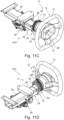
- the torque feedback device is housed inside the steering wheel hub 14 and is thus not shown in Fig. 1A to 1C (but shown and denoted with reference sign 44 in Fig. 11A ).
- the steering wheel arrangement 11 comprises a steering wheel center part 100 (shown in more detail in and described in connection with Figs. 2A and 2B ).
- the steering wheel center part 100 is rotationally stationary and is non-rotatably fixed to an end portion of the steering support column 24.
- the steering wheel center part 100 includes an airbag module integrated and housed therein, wherein the airbag module is configured to deploy the airbag, in case of a crash, in a direction towards the driver.
- the steering system 10 further comprises a steering system support column 24 that is configured to support the steering wheel arrangement 11.
- the steering system support column 24 can connect the steering wheel arrangement 11 with the chassis of the vehicle.
- the steering system support column 24 is a tubular member.
- the steering system support column 24 forms an inner member of a tubular telescope arrangement 80 and is translationally movable relative to a vehicle support column 82 which forms an outer member of the tubular telescope arrangement 80. Consequently, the steering system support column 24 and the steering wheel arrangement 11 supported thereon is translationally displaceable with respect to the central axis A independent of the vehicle support column 82, in order to enable retractability and extendability of the steering wheel arrangement 11.
- the vehicle support column 82 connects the steering system support column 24 to the vehicle body (not shown) i.a.
- adjustment elements 84 (brackets, axial adjustment elements and vertical adjustment elements).
- the steering system support column 24 and all components supported thereon are radially displaceable/pivotable relative to the vehicle body dependent on the vehicle support column 82, i.e. the adjustability/displaceability of the vehicle support column 82.
- FIGs 2A and 2B show the front view of the steering wheel arrangement 11 in more detail and with different rotational orientations. More precisely, the steering wheel 12 has different rotational orientations in Figures 2A and 2B .
- the steering wheel 12 is in a basic position in which the steering wheel 12 has not been rotated. This basic position constitutes a position in which the wheels of the vehicle are straight, i.e. have not been turned.
- Fig. 2B shows the steering wheel 12 in a certain rotated position in which the steering wheel 12 has been rotated about the central axis A in order to turn the wheels of the vehicle.
- Arrow R shows the rotation direction of the steering wheel 12.
- the center part 100 of the steering wheel arrangement 11 is rotationally stationary, i.e. is non-rotatable about the central axis A. Even if the steering wheel 12 is rotated, the center part 100 stays in its basic, non-rotated orientation. Therefore, regardless of a current driving situation and a current rotational orientation of the steering wheel 12, the controls arranged on the center part 100 are readily available of to the driver. This applies even for a transition phase from autonomous driving to manual driving when the autonomous vehicle hands the control of the vehicle back to the driver, which increases safety of autonomous vehicles.
- the center part 100 is provided with a plurality of steering wheel controls 104A to 110B.
- the steering wheel controls 104A to 110B comprise turn and light signal controls 104A and 104B arranged on left and right side flanges of the center pad 102.
- the turn and light signal controls 104A and 104B replace conventional turn and light signal column stalk control levers.
- the center pad 102 is further provided with driver aid and cruise controls 106 and wiper controls 108. Further, a horn control is provided on the center pad 102. In the shown embodiment, two alternative horn control positions 110A and 110B are shown.
- controls can also be arranged on the steering wheel rim 13.
- alternative horn control positions 210A and 210B are shown.
- the steering wheel controls 104A to 110B as well as the additional controls 210A, 210B, 300, 302 can have different technical configurations depending on their respective function. Individual or all of the controls can be formed as single click push buttons, multiple click push buttons, touch sensitive buttons, analogous rotary buttons, digital rotary buttons, monostable levers and/or multistable levers.
- the push buttons can be pressure force sensitive push buttons. For digital buttons, such as digital rotary buttons, the position of the button can be reset at key-on.
- Levers provided on the steering wheel center part can have a pivot axis at any position in space.
- Figures 3A to 3D show the steering system 10 in retracted positions ( Figs. 3C and 3D ) and in extended positions ( Figs. 3A and 3B ) according to an example not covered by the subject matter of the appended claims.
- the contour of a dashboard of the vehicle is schematically indicated by line 400.
- the contour of the dashboard is shown in comparison to a conventional dashboard design contour indicated by dashed line 402.
- the omission of column stalk levers in the present steering wheel arrangement 11 allows new dashboard design options. For example, as shown in Figs.
- FIGS 4A and 4B show the steering system 10 in retracted positions together with an alternative dashboard design.
- the alternative dashboard design further includes an additional extension part 404 so that in a retracted state of the steering wheel arrangement 11, the dashboard and the steering wheel 12 at least partially abut.
- the dashboard and the steering wheel 12 can be formed at least partially complementary so as to allow optimal abutment.
- FIG. 5 shows a schematic perspective view of the steering system 410 according to an embodiment of the invention.
- the embodiment shown in Figure 5 substantially corresponds to the embodiment shown in Figures 1A to 1C .
- the embodiment of Figure 5 comprises a steering wheel rim 413 having a non-planar structure relating to a planar reference plane RP.
- the steering wheel rim 413 is formed as a substantially circular, ring shaped, closed structure forming a grip portion to the vehicle driver.
- the non-planar steering wheel rim 413 comprises an upper portion 415 that is inclined in a direction towards the vehicle dashboard 400 relative to a middle portion 416 of the steering wheel rim 413.
- the steering wheel rim 413 comprises a bottom portion 417 that is inclined in a direction towards the vehicle dashboard 400 relative to the middle portion 416 of the steering wheel rim 413.
- the steering wheel rim 413 of Figure 5 can have a total angle of rotation of 550°.
- the total angle of rotation can be mechanically limited by a rotation limiting device 52 as shown in Figures 12A to 12C .
- FIGs 6A and 6B show the steering system 410 of Figure 5 in retracted positions together with a dashboard design.
- the dashboard design includes an additional extension part 405 so that in a retracted state of the steering wheel arrangement 11, the dashboard and the steering wheel 12 at least partially abut.
- the dashboard and the steering wheel 12 can be formed at least partially complementary so as to allow optimal abutment.
- the non-planar steering wheel rim 413 at least partially wraps around a dashboard curvature, which leads to interior space gain (indicated by arrows SG).
- the steering system 410 is configured completely column stalk control free.
- FIGS 7A to 7C show a steering system 510 according to another example not covered by the subject matter of the appended claims.
- Steering system 510 of Figures 7A to 7C substantially corresponds to steering system 410 of Figures 5 to 6B .
- Steering system 510 is provided with a display unit 530 mounted on the steering wheel rim 413. More precisely, the display unit 530 is arranged on the inclined upper portion 415 of the steering wheel rim 413. This increases a focal distance FD relating to the display unit 530, which contributes to optimal perceptibility of the display unit 530.
- FIG. 8 A further example of a steering system 610 not covered by the subject matter of the appended claims is shown in Figure 8 .
- the steering system 610 of Figure 8 is provided with an open top portion 630.
- the overall structure of the steering wheel rim 413 is mirror symmetrical in this and all other shown examples (this is not necessary but preferable).
- the steering wheel rim 413 in this example consequently comprises two inclined upper portions 415, one on each side of the open top portion 630.
- FIG. 9 A further example of a steering system 710 not covered by the subject matter of the appended claims is shown in Figure 9 .
- the steering system 710 of Figure 9 is provided with an open bottom portion 730.
- the overall structure of the steering wheel rim 413 is mirror symmetrical in this and all other shown examples (this is not necessary but preferable).
- the steering wheel rim 413 in this example consequently comprises two inclined bottom portions 417, one on each side of the open top portion 730.
- a display unit e.g. as shown in Figure 7
- a display unit could be provided on the steering wheel rim 413, in particular on the respective closed inclined upper or bottom portion.
- FIG 10 shows a further example of a steering system 810 not covered by the subject matter of the appended claims.
- the steering system 810 of Figure 10 is provided with an open top portion 630 and an open bottom portion 730.
- the overall structure of the steering wheel rim 413 is mirror symmetrical in this and all other shown examples (this is not necessary but preferable).
- the steering wheel rim 413 in this example consequently comprises two inclined upper portions 415, one on each side of the open top portion 630, and two inclined bottom portions 417, one on each side of the open top portion 730.
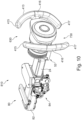
- FIGS 11A to 11F show schematic views of a steering system 910 with additional features according to an example not covered by the subject matter of the appended claims.
- the steering system 910 is a steer-by-wire steering system that has no direct mechanical connection for transferring a driver's steering commands from a steering wheel 12 of the steering system 10 to the wheels (not shown) of the vehicle. Instead, the mechanical connections are replaced by an electro-mechanical arrangement.
- a steering arrangement 11 of the steering system 910 comprises a steering wheel hub 14 mechanically connected with the steering wheel 12.
- the steering wheel hub 14 and the steering wheel 12 are non-rotatable relative to each other, but can be rotated together about a central axis A of the steering wheel arrangement 11.
- the steering wheel 12 is removably attached to the steering wheel hub 14 in a non-rotatable manner by fixing elements 16 in form of screws. More precisely, the steering wheel 12 is provided with an internal armature 18 inside the spoke 15, wherein the fixing elements 16 extend through through bores 20 of the internal armature 18 into internally threaded blind holes 22 provided in the steering wheel hub 14.
- the steering wheel hub 14 is rotatably supported on a rigid steering system support column 24 of the steering system 910, more precisely on an aligned section 26 of the steering system support column 24.
- the steering system support column 24 comprises an off-axis section 28.
- the off-axis section 28 is axially spaced from the aligned section 26 and from the steering wheel hub 14, while the steering wheel hub 14 overlaps and is located coaxial to the aligned section 26.
- the off-axis section 28 has a first longitudinal axis L1 that is off-set and parallel to the central axis A.
- the aligned section 26 has a second longitudinal axis L2.
- the aligned section 26 of the steering system support column 24 is aligned with or coaxial to the steering wheel hub 14 and to the steering wheel 12, i.e. the second longitudinal axis L2 corresponds to the central axis A.
- connection portion 30 extending transversally to both the first longitudinal axis L1 and the second longitudinal axis L2.
- the steering wheel hub 14 is rotatably mounted on the aligned section 26 of the steering system support column 24 by a first bearing arrangement 32 and a second bearing arrangement 34, the second bearing arrangement 34 being axially spaced from the first bearing arrangement 32.
- the first bearing arrangement 32 and/or the second bearing arrangement 34 can be a ball bearing or a roller bearing.
- the first bearing arrangement 32 is supported on a protruding flange portion 36 of the aligned section 26 of the steering system support column 24, which protrudes radially outward from the outer circumferential surface of the aligned section 26.
- the protruding flange portion 36 provides a circular ring-shaped first bearing surface for supporting the first bearing arrangement 32.
- the protruding flange portion 36 is arranged in the vicinity of the connection portion 30, i.e. in a transition region between the aligned section 26 and the connection portion 30. Consequently, the first bearing arrangement 32 is axially located at a first end portion of the aligned section 26 oriented towards the connection portion 30.
- the second bearing arrangement 34 is supported on a circular ring-shaped portion 38 of the aligned section 26 of the steering system support column 24.
- the circular ring-shaped portion 38 is formed in an area of the aligned section 26 following the steering wheel 12 and extending towards the protruding flange portion 36.
- the circular ring-shaped portion 38 provides a second bearing surface for the second bearing arrangement 34.
- the second bearing arrangement 34 is axially located at a second end portion of the aligned section 26 opposing the first end portion.
- the first bearing arrangement 32 is mounted between the protruding flange portion 36 of the aligned section 26 and the steering wheel hub 14 via a support bushing 40 arranged between the first bearing arrangement 32 and the inner circumferential surface of the steering wheel hub 14.
- the second bearing arrangement 34 is mounted directly between the circular ring-shaped portion 38 of the aligned section 26 and the steering wheel hub 14.
- the steering wheel hub 14 is provided with an inwardly protruding flange portion 42 that provides a counter bearing surface for the second bearing arrangement 34.
- the inwardly protruding flange portion 42 covers components located inside the steering wheel hub 14.
- the blind holes 22 for receiving the fixing elements 16 extend into or through the inwardly protruding flange portion 42.
- the electric machine is an outer rotor electric machine comprising an outer rotor 46 and an inner stator 48.
- the rotor 46 is fixed to an inner circumferential surface of the steering wheel hub 14.
- the stator 48 is fixed to the rotatably stationary (i.e. non-rotatable) aligned section 26 of the steering system support column 24.
- the steering wheel hub 14 and the rotor 46 can rotate together around the stator 48 and the aligned section 26.
- the electric machine of the torque feedback device 44 is arranged inside the steering wheel hub 14.
- the torque feedback device 44 is radially enclosed and thus covered by the steering wheel hub 14 (the inner circumferential surface of the steering wheel hub 14) and the aligned section 26 of the steering system support column 24 (the outer circumferential surface of the aligned section 26).
- the torque feedback device 44 is axially located between the protruding flange portion 36 of the aligned section 26 and the circular ring-shaped portion 38 of the aligned section 26.
- the torque feedback device 44 is axially enclosed and thus covered by the protruding flange portion 36 of the aligned section 26, the first bearing arrangement 32 and the support bushing 40 on one side and by the inwardly protruding flange portion 42 of the steering wheel hub 14 and the second bearing arrangement 34 on the other side.
- the fixing elements 16 are arranged at different radial positions, i.e. different radial heights, than the stator windings 50, with respect to the central axis A. Hence, the fixing elements 16 and the blind holes 22 at least partially overlap the stator windings 50 in the axial direction.
- the stator windings 50 can be arranged closer to the central axis A than the fixing elements 16.
- the second bearing arrangement 34 is arranged at a different radial position, i.e. a different radial height, than the stator windings 50 and at a different radial position, i.e. a different radial height, than the fixing elements 16, with respect to the central axis A.
- the fixing elements 16 overlap the second bearing arrangement 34 in the axial direction.
- the second bearing arrangement 34 can be arranged closer to the central axis A than the stator windings 50 and can be arranged closer to the central axis A than the fixing elements 16.
- the first bearing arrangement 32 is arranged at a different radial position, i.e. a different radial height, than the second bearing arrangement 34 and at a different radial position, i.e. a different radial height, than the fixing elements 16, with respect to the central axis A.
- the first bearing arrangement 32 is arranged at a similar radial position as the start windings 50, with respect to the central axis A.
- the first bearing arrangement 32 can be arranged closer to the central axis A than the stator fixing elements 16 and can be spaced farther from to the central axis A than the second bearing arrangement 34.
- the fixing elements 16 are arranged at similar radial positions as the outer rotor 46 of the torque feedback device 44, with respect to the central axis A. This limits the radial extension of the steering system 910 in the region of the torque feedback device 44.
- the steering system 910 further comprises a steering wheel rotation limiting device 52 for limiting rotation of the steering wheel hub 14 and the steering wheel 12.
- the steering wheel rotation limiting device 52 is fixed to the steering system support column 24 and is arranged radially off-set to the steering wheel hub 14, more precisely adjacent to the outer circumferential surface of the steering wheel hub 14.
- the steering wheel rotation limiting device 52 is non-rotatable relative to the steering system support column 24.
- the steering wheel rotation limiting device 52 comprises a base 54 and a sliding element 56 arranged inside a compartment 58 formed in the base 54.
- the sliding element 56 is axially slidable relative to the base 54 and relative to the steering wheel hub 14.
- the sliding element 56 can slide between the two opposing end stop surfaces 60, 62 (see Figures 12A to 12C ) of the steering wheel rotation limiting device 52.
- the sliding element 56 comprises a projection 64 that engages a spiral groove 66 formed on the outer circumferential surface of the steering wheel hub 14. By the interaction of the projection 64 and the spiral groove 66, rotation of the steering wheel hub 14 causes axial movement of the sliding element 56.
- the steering wheel rotation limiting device 52 is configured to restrict rotation of the steering wheel hub 14 and of the steering wheel 12 connected therewith.
- the base 54 of the steering wheel rotation limiting device 52 is fixed to the off-axis section 28 of the steering system support column 24 by screws 68 (see Figures 11A to 11F ).
- the steering wheel rotation limiting device 52 more precisely the base 54, extends in the axial direction from the off-axis section 28 of the steering system support column 24 to the steering wheel hub 14 so that the compartment 58 is arranged between and enclosed by the base 54 and the outer circumferential surface of the steering wheel hub 14.
- the base 54 of the steering wheel rotation limiting device 52 covers an opening 70 configured in the off-axis section 28 of the steering system support column 24. More precisely, the opening 70 is arranged in another transition region between the off-axis section 28 and the connection portion 30.
- the opening 70 provides access to electric machine phase connections 72 and to electric steering wheel angle sensor connections 74 for service and maintenance purposes.
- the electric machine phase connections 72 connect the electric machine of the torque feedback device 44 with a control unit/control electronics 76.
- the electric steering wheel angle sensor connections 74 connect a steering wheel angle sensor 78 with the control unit/control electronics 76.
- the control unit 76 is arranged inside the hollow tubular off-axis section 28 of the steering system support column 24. More precisely, the control unit 76 is arranged in a portion of the off-axis section 28 close to the connection portion 30 so as to locate the control unit 76 and the electric machine close to each other.
- the steering wheel angle sensor 78 is configured to measure a present steering angle and thus to detect the driver's steering command that is to be transmitted electronically to actuator/s for actuating/steering the wheels in line with this command.
- the steering wheel angle sensor 78 is arranged adjacent or lateral to the first bearing arrangement 32
- the steering system support column 24 forms an inner member of a tubular telescope arrangement 80.
- the outer member of the tubular telescope arrangement 80 is embodied by a vehicle support column 82.
- the off-axis section 28 is mounted axially slidable inside the outer member/vehicle support column 82 of the tubular telescope arrangement 80.
- the steering system support column 24 is translationally displaceable relative to the vehicle support column 82 and relative to a vehicle body, but is non-rotatable and non-pivotable relative to the vehicle support column 82.
- the steering system support column 24 is connected to the verhicle vehicle body (not shown) via the vehicle support column 82 by brackets, axial adjustment elements and vertical adjustment elements 84. Consequently, the steering system support column 24 and all components supported thereon are only translationally displaceable with respect to the first longitudinal axis L1 independent of the vehicle support column 82. Further, the steering system support column 24 and all components supported thereon are radially displaceable/pivotable relative to the vehicle body dependent on the vehicle support column 82, i.e. the adjustability/displaceability of the vehicle support column 82.
- the steering system support column 24 has a hollow tubular shape.
- the steering system support column 24 is formed as a rigid one-piece component and is preferably made of metal.
- at least the off-axis section 28 of the steering system support column 24 has a substantially rectangular cross-sectional area.
- Such a shape can be particularly advantageous for accommodating and attaching the control unit 76.
- the vehicle support column 82 that forms the tubular telescope arrangement 80 together with the off-axis section 28 has a substantially rectangular cross-sectional area.
- connection portion 30 of the steering system support column 24 forms a tapering transition that tapers from the off-axis section 28 towards the aligned section 26.
- the aligned section 26 has a smaller diameter than the off-axis section 28.
- the aligned section 26 has a substantially circular cross-sectional area.
- the steering wheel 12 is provided with an internal space 86 for accommodating the center part (not shown, but shown and denoted with reference sign 100 in Figs. 1A to 2B ).
- the center part as well as auxiliary components, such as a wiring harness, can extend into the hollow, tubular aligned section 26.
- the center part as well as the auxiliary components can thus be arranged in and/or attached to the inside of the aligned section 26 of the steering system support column 24.
- Figures 12A to 12C serve to disclose details concerning the function and configuration of the steering wheel rotation limiting device 52.
- Figure 12A shows the components of the steering wheel rotation limiting device 52 separately, i.e. in an exploded view.
- Figure 12B shows the components of the steering wheel rotation limiting device 52 in an assembled state.
- Figure 12C shows the steering wheel rotation limiting device 52 mounted to or in interaction with the steering wheel hub 14.
- the base 54 has a compartment 58 formed therein. Two axially opposing side surfaces of the compartment 58 constitute the end stop surfaces 60, 62.
- the compartment 58 is formed partially complementary to the sliding element 56 that can be arranged therein (see Figure 12B ).
- the compartment 58 more precisely the bottom and the lateral surfaces of the compartment 58, restricts movability of the sliding element 56 to an axial slidability between the two end stop surfaces 60, 62 (indicated by arrows AS).
- the two end stop surfaces 60, 62 limit the slidability of the sliding element 56 in the axial directions.
- a surface oriented towards the steering wheel hub 14, in a mounted state, is curved and substantially complementary to a corresponding part of the outer circumferential surface of the steering wheel hub 14.
- the sliding element 56 engages the spiral groove 66 formed in the outer circumferential surface of the steering wheel hub 14 via the projection 64.
- Projection 64 is formed as a spiral ridge, adapted to the shape and dimension of the spiral groove 66.
- the sliding element 56 interacts with the steering wheel hub 14 via the spiral groove 66.
- the sliding element 56 slides until the rotation of the steering wheel hub 14 stops or until a further movement is blocked by an abutment of the sliding element 56 with one of the two end stop surfaces 60, 62. Blocking of further axial movement of the sliding element 56 consequently blocks further rotation of the steering wheel hub 14 and thus of the steering wheel 12 in a direction of rotation that would cause a further axial movement of the sliding element 56 towards the currently blocking end stop surface 60, 62.
- the sliding element 56 has an axial width W.
- the axial width W of the sliding element 56 determines the free space inside the compartment 58 between the sliding element 56 and the end stop surfaces 60, 62.
- the maximum travel distance, i.e. the maximum axial movability, of the sliding element 56 between the two end stop surfaces 60, 62 is adjustable.
- the steering wheel rotation limiting device 56 can be used flexibly for different vehicle configurations.
- the axial width W can be chosen in accordance with one or more of the following parameters: a length of the spiral groove 66, a pitch of the spiral groove 66, a distance between the two opposing end stop surfaces 60, 62, and a circumferential length of the steering wheel hub 14.
Landscapes
- Engineering & Computer Science (AREA)
- Mechanical Engineering (AREA)
- Chemical & Material Sciences (AREA)
- Combustion & Propulsion (AREA)
- Transportation (AREA)
- Steering Controls (AREA)
Description
- The present invention relates to a retractable steering wheel arrangement for a steer-by-wire steering system of a vehicle, in particular an automotive vehicle.
- In the motor vehicle and truck industry there is a continuous development towards autonomous (self-driving) and semi-autonomous vehicles. This development as well as progresses towards fully electric vehicles and autonomous vehicles further promote developments of drive-by-wire steering systems and increase the need for inventive concepts.
- One specific aspect in this context relates to an adjustment of the steering wheel position during autonomous operation of the vehicle, when no steering inputs from the driver are necessary. Namely, there is an interest in temporarily relocating the vehicle for generating more interior space for other activities during the autonomous operation, such as reading, watching videos, and/or working on laptops or tablets. Several future visions known of how to adjust the steering wheel have been proposed, many of which rely on folding away the steering wheel.
- However, known solutions for adjusting the position of the steering wheel are often subject to complex structures and require considerable time to transition from a driving configuration to an autonomous configuration and back. Also, known solutions may risk leading to safety issues due to adverse operability.
-
EP 3 476 692 A1 relates to a steer-by-wire road vehicle steering system provided with a telescopic support element for the steering wheel.US 2017/0072984 A1 relates to a steering wheel.DE 10 2020 100 016 A1 - It is an object of the present invention to provide a steering system which has improved characteristics and overcomes at least some of the disadvantages of the prior art.
- In particular, it is an object of the present invention to provide a steer-by-wire steering system having a simple configuration.
- Preferably, it is an object of the present invention to provide a steer-by-wire steering system that promotes quick configuration transitions, simple and intuitive operation, reliability and/or low cost.
- These objects are achieved by the subject matter of the independent claims. Preferred embodiments and preferred features are specified in the dependent claims and the following description.
- The invention is as set out in the appended claims.
- The invention relates to a steering system for a vehicle, in particular for an autonomous or semi-autonomous vehicle. The steering system is preferably a steer-by-wire system.
- The steering system comprises a steering system support column and a steering wheel arrangement having a central axis. The steering wheel arrangement being connected with the steering system support column.
- The steering wheel arrangement includes a steering wheel having a steering wheel rim and having at least one spoke. The steering wheel rim can be at least partially arc-shaped. The steering wheel rim can comprise at least one circular segment, more precisely at least one ring section or a fully closed ring. Preferably, the steering wheel rim is substantially, i.e. to most parts, arc-shaped. The steering wheel rim can comprise a plurality of circular segments or ring sections. The steering wheel rim provides a grip portion to the vehicle driver.
- The steering wheel arrangement further includes a steering wheel hub fixedly connected with the steering wheel. Fixedly connected or attached can mean that the connected or attached components are not movable relative to each other, neither rotatably nor translationally. The steering wheel hub extends from the steering wheel in a direction towards a dashboard of the vehicle. The steering wheel hub and the steering wheel are rotatable together about the central axis of the steering wheel arrangement.
- The steering wheel arrangement comprises a torque feedback device including an electric machine having a rotor and a stator. The rotor is attached to the steering wheel hub and is rotatable together with the steering wheel hub (and the steering wheel) about the central axis. The stator is fixedly attached to the steering system support column, preferably to a section of the column that extends along the central axis, wherein the steering system support column is non-rotatable about the central axis. In other words, the steering system support column is rotationally stationary or rotationally fixed, i.e. is non-rotatable about any longitudinal axis.
- The steering wheel arrangement comprises a steering wheel center part including an airbag module arranged inside the steering wheel center part and being provided with a plurality of steering wheel controls. The steering wheel center part is fixedly connected with the rotationally stationary steering system support column or the stator, preferably with an end portion of the rotationally stationary steering system support column, so as to be non-rotatable about the central axis. By this configuration, the steering wheel center part stays stationary regarding its rotational orientation even in a condition in which the steering wheel is rotated. The steering wheel center part is completely rotationally stationary (i.e. non-rotatable). Thus, regardless of the rotational orientation of the steering wheel, the controls and if applicable signs, displays, etc. of center part are always kept in the same rotational orientation so as to be readily available to the driver and thus allow a simple, intuitive and thus safe operation of the controls in any situation.
- The steering wheel center part can comprise a steering wheel center pad. More precisely, a component of the steering wheel center part, which faces the driver of the vehicle/faces away from the dashboard of the vehicle, can be formed as a steering wheel center pad. The steering wheel center part can be arranged coaxial to the steering wheel hub and to the steering wheel.
- The steering wheel arrangement is column stalk control free. In other words, column stalk control free means the steering wheel arrangement, i.e. both the steering wheel and steering wheel hub, has no column stalk controls or column-mounted stalk switches provided thereon.
- The steering system is configured moveable relative to the vehicle chassis and/or the vehicle dashboard, preferably at least translationally moveable, so that the steering wheel arrangement, i.e. the steering wheel, the steering wheel hub, the torque feedback device and the steering wheel center part, is reversibly retractable in a direction towards the dashboard of the vehicle and extendable in a direction away from the dashboard of the vehicle. Upon transition from manual driving to autonomous driving the steering wheel arrangement can be retracted towards the dashboard, and upon transition from autonomous driving to manual driving the steering wheel arrangement can be extended towards the driver.
- The omission of column stalk controls/column-mounted stalk switches improves retractability, i.e. increases a maximum retractability of the steering wheel, as the retraction of the steering wheel is not limited by any column stalk controls/column-mounted stalk switches. This leads to space advantages within the driver cabin during autonomous driving, when the steering wheel is fully retracted.
- Even though, the maximum retractability and thus a maximum retraction travel is increased by the disclosed steering system configuration, safe operability of the system is not deteriorated but is even improved by ensuring that the center part including the airbag module is rotationally stationary and does not change its rotational orientation. Even during a transition from autonomous driving to manual driving when the autonomous vehicle hands the control of the vehicle back to the driver, i.e. during transition of the steering wheel from a fully retracted state to an extended state (and reverse), the center part is rotationally stationary. Thus, ready availability of the steering wheel controls to the driver can be ensured.
- Moreover, by ensuring that the center part including the airbag module is rotationally stationary and does not change its rotational orientation, effective and proper deployment of the airbag can be achieved. Thus, a steering wheel-mounted airbag can be provided and there is no need to relocate the driver-side airbag to unconventional positions, in which the airbag's effectiveness is unknown.
- Consequently, the disclosed steering system configuration assures continuous availability of all controls to the driver in an intuitive manner, and assures proper deployment of the airbag, regardless of whether the steering wheel is in the manual driving position, a retracted autonomous driving position, or an intermediate transition position. This can promote acceptability and increase safety of autonomous vehicles as especially the transition from manual driving to autonomous driving, and reverse, constitute key situations, relevant for the driver.
- In an embodiment, an orientation of the center part, in particular of the center pad, can be adjustable. To this, the center part can be pivotably supported inside the steering system support column so as to be pivotable about an axis traverse to the central axis. The center part can be attached to the steering system support column or the stator by a joint or hinge arrangement. Hence, while being non-rotatable (rotationally stationary) relative to the central axis, the center part can be pivotable, preferably up and down. Thus, the pivotable orientation (or up and down orientation) of the center part can be adjusted depending on or in accordance with the retraction/extension position of the steering wheel arrangement in order to keep the deployment direction of the airbag module and the steering wheel controls oriented towards the driver. The orientation of the center part, in particular of the center pad, can be automatically adjustable. The orientation of the center part, in particular of the center pad, can be passively or actively adjusta-ble. Passively adjustable can mean that the movement/pivoting of the center part is caused by an actuator that moves the steering system support column relative to the vehicle body. Actively adjustable can mean that the movement/pivoting of the center part is caused by an additional actuator that actively moves the center part mechanically independent of the movement of the steering system support column relative to the vehicle body.
- In an embodiment, the steering wheel controls can include at least one or a plurality of the following controls: turn signal control/s, light control/s, horn control/s, driver aid control/s, infotainment control/s, wiper control/s and/or cruise control/s. In particular, controls that are provided in the form of column stalk controls in conventional steering wheel assemblies can be provided as steering wheel controls on the steering wheel center part, namely on the steering wheel center pad.
- The steering wheel controls can have different technical configurations depending on their respective function. Individual or all of the steering wheel controls can be formed as single click push buttons, multiple click push buttons, touch sensitive buttons, analogous rotary buttons, digital rotary buttons, monostable levers and/or multistable levers. The push buttons can be pressure force sensitive push buttons. For digital buttons, such as digital rotary buttons, the position of the button can be reset at key-on. Levers provided on the steering wheel center part can have a pivot axis at any position in space.
- In an embodiment, at least one additional control and/or at least one display unit can be arranged on the steering wheel, preferably on the at least one spoke. In this case, controls (and display) can be provided both on the non-rotating and on the rotating part of the steering wheel.
- However, none of the controls are configured as column stalk switches and none of the controls are arranged on a circumferential surface of the steering wheel hub. Preferably, all controls of the steering system are provided on a side of the steering system facing towards the driver, i.e. facing away from the dashboard of the vehicle. Preferably, no controls are arranged on the steering wheel arrangement between the steering wheel and the dashboard of the vehicle.
- According to an embodiment, the steering system is axially moveable (and translationally movable) along the central axis so that the steering wheel arrangement is reversibly retractable in a direction towards the dashboard and extendable in a direction away from the dashboard of the vehicle. This constitutes a particularly simple configuration for enabling controlled and quick retractability of the steering system.
- The steering wheel arrangement can have a retraction travel (and thus also a respective extension travel) between 50 mm and 150 mm, preferably between 60 mm and 120 mm, more preferably between 80 mm and 100 mm. Thus, the steering system is optimally adjustable to different drivers and can provide adequate space inside the driver's cabin during autonomous driving. The retraction travel can be a travel in addition to an adjustment travel for adjusting the vehicle position. The adjustment travel can be between 50 and 70 mm. Thus, a total axial travel can be between 100 mm and 220 mm. The total travel can even be 300 mm.
- In an embodiment, the airbag module, more precisely an airbag module central axis, can be located offset from the central axis of the steering wheel arrangement. Alternatively, the airbag module, more precisely the airbag module central axis, is arranged coaxial to the central axis of the steering wheel arrangement or matches the central axis of the steering wheel arrangement.
- The airbag module can be arranged on or partially inside the steering wheel center part in such a way that an airbag module central axis is non-parallel to the central axis of the steering wheel arrangement. Alternatively, the airbag module, more precisely the airbag module central axis, is arranged parallel to the central axis of the steering wheel arrangement.
- The position and orientation of the airbag module can be selected based on the size and shape of the other steering wheel components, such as the steering wheel rim, or based on the overall configuration of the steering wheel, in order to ensure proper deployment of the airbag.
- A rear surface of the steering wheel that faces the dashboard of the vehicle is formed at least partially complementary to a dashboard front surface facing the rear surface of the steering wheel. Such a configuration can further contribute to increasing the maximum retractability of the steering wheel arrangement and can contribute to a harmonious design of the driver's cabin. Preferably, the rear surface can be formed such that in a completely retracted state of the steering wheel arrangement, at least 40 % of the rear surface of the steering wheel abuts the dashboard front surface, preferably at least 50 %, more preferably at least 60 %, still more preferably at least 70 %.
- According to an embodiment, the rotor can be an outer rotor and the stator can be an inner stator. Accordingly, in this embodiment the steering wheel hub is fixedly attached to an outer rotor, wherein the steering wheel rim is fixedly connected with the steering wheel hub via the at least one spoke. The steering wheel rim and the at least one spoke can be formed integrally. The at least one spoke and the steering wheel hub can be formed integrally.
- In an embodiment, the steering system support column can form an inner member of a tubular telescope arrangement, wherein the inner member is translationally movable, non-rotatable and non-pivotable relative to an outer member of the tubular telescope arrangement. two, three or multiple piece telescope arrangement, i.e. a telescope arrangement having at least two segments or members, namely one outer segment or member and one inner segment or member. The telescope arrangement provides a simple and stiff configuration. Preferably, the tubular telescope arrangement can be a three piece telescope arrangement, i.e. a telescope arrangement having three segments or members, namely one outer segment or member, one intermediate segment or member, and one inner segment or member (which can be the steering system support column). The steering system support column can be formed by two or more fixedly connected members.
- The translational movement, i.e. the sliding, of the inner member relative to the outer member of the tubular telescope arrangement can be caused by an actuator in form of an electric motor that is configured to act upon the inner member.
- Preferably, the outer member of the tubular telescope arrangement can be a vehicle support column via which the steering system support column is attached to a vehicle body. The vehicle support column - and with the vehicle support column the steering wheel support column and the steering wheel arrangement attached thereto - can be adjustable relative to the vehicle body by being pivotable and/or radially displaceable relative to the vehicle body. Thus, the steering wheel arrangement is individually adjustable to different drivers.
- According to an embodiment, the steering wheel rim can comprise at least one sensor, preferably a plurality of sensors, configured to detect contact of a driver's hand/fingers with the steering wheel. The steering system (or more precisely a control system of the steering system) can be configured to automatically stop retraction of the steering wheel arrangement when the retraction travel reaches a predetermined threshold value (e.g. a predefined minimal distance between the steering wheel and the dashboard) and when at the same time the at least one sensor detects that the driver's hand/fingers contacts the steering wheel. Thus, jamming of the fingers due to steering wheel retraction can be securely prevented.
- According to an embodiment, the steering wheel rim can comprise at least one sensor, preferably a plurality of sensors, configured to detect contact of a driver's hand/fingers with the steering wheel. The at least one sensor can be configured to detect a predefined minimum contact of the driver's hand and/or fingers with the steering wheel that needs to be reached before the steering system (or more precisely a control system of the steering system) initiates or allows transition from autonomous driving to manual driving. Thus, it can be ensured that the driver is ready and willing to regain control of the vehicle steering. This further contributes to driver safety.
- The sensor/sensors for detecting contact of a driver's hand/fingers with the steering wheel in order to prevent jamming of the driver's fingers can be the same or different sensor/sensors as/than the sensor/sensors for detecting contact of a driver's hand/fingers with the steering wheel in order to initiate or allow the transition from autonomous to manual driving.
- The steering wheel rim has a non-planar shape. In other words, non-planar can mean that at least a part of the steering wheel rim lies in or spans a first plane while at least another part of the steering wheel rim lies in or spans at least one second plane which at least one second plane intersects the first plane.
- At least one portion of the steering wheel rim is curved towards the dashboard of the vehicle. Thus, the at least one portion of the steering wheel rim is spaced further away from the driver compared to other non-curved parts of the steering wheel rim, which are arranged at comfortable hand positions for the driver. Hence, this at least one portion of the steering wheel rim can have an increased and preferably optimized focal distance, which is closer to the road focal distance compared the non-curved parts of the steering wheel rim.
- Providing a steering wheel rim with non-planar shape is possible as the steering wheel arrangement is configured column stalk control free. Thus, there is no risk of any adverse interference of column stalk controls with the curved parts of the steering wheel rim during rotation of the steering wheel.
- At least one display unit can be provided in an area of the steering wheel rim. The at least one display unit can be provided in an area of a front surface facing the driver, in particular in the at least one portion of the steering wheel rim that is curved towards the dashboard of the vehicle.
- The steering wheel rim can have a non-planar configuration. A non-planar configuration can mean that the steering wheel rim comprises several sections or portions that do not lie in a common plane, more precisely in a reference plane normal to the central axis. In other words, the non-planar steering wheel rim can have a structure with several sections or portions, wherein at least one portion or section extends in each spatial direction (at least one section in x-direction, at least one section in y-direction, at least one section in z-direction). Preferably, the non-planar steering wheel rim comprises at least two sections extending substantially in x-direction, at least two sections extending substantially in y-direction, and at least two sections extending substantially in z-direction. Preferably, the non-planar steering wheel rim comprises several sections extending substantially in x-direction, several sections extending substantially in y-direction, and several sections extending substantially in z-direction. The non-planar configuration can also be described in that the steering wheel rim comprises sections adjacent to each other that are angled or inclined relative to each other in each spatial direction In other words, non-planar can mean that at least a part of the steering wheel rim lies in or spans a first plane while at least another part of the steering wheel rim lies in or spans at least one second plane which at least one second plane intersects the first plane.
- The non-planar steering wheel rim can at least partially wrap around a dashboard curvature, which can lead to interior space gain. The interior space gain can be particularly recognizable in a retracted state of the steering wheel system. The non-planar steering wheel rim can be configured fully or partially complementary to an opposing part of the dashboard. Thus, in a fully retracted state, the non-planar steering wheel rim can at least partially or fully abut to one or more sections of a corresponding dashboard part.
- Further, providing a non-planar steering wheel rim can lead to increased ergonomics for the driver.
- The steering wheel rim can have a total angle of rotation of less than 720°, preferably 580° or less, more preferably 570° or less, still more preferably 550° or less. This total angle of rotation constitutes a reduction compared to known steering wheel arrangements. The steering wheel rim can even have a total angle of rotation of 450° or less, preferably 400° or less, more preferably 360° or less. A reduced total angle of rotation can reduce steering effort. Further, in combination with retractability of the steering wheel arrangement, ready availability of the steering wheel during a transition from autonomous driving to manual driving when the autonomous vehicle hands the control of the vehicle back to the driver, i.e. during transition of the steering wheel from a fully retracted state to an extended state (and reverse), can be improved. Thus, it can be ensured that the driver can securely gain back control of the steering wheel in any situation, even if the transition takes place during cornering or turning.
- The rotation of the steering wheel rim about its central axis can be mechanically limited to the total angle of rotation. The rotation of the steering wheel rim about its central axis can be electrically limited to the total angle of rotation.
- The steering system can comprise a steering wheel rotation limiting device for at least mechanically limiting the total angle of rotation of the steering wheel rim, i.e. the total rotation of the steering wheel hub in both circumferential directions about the axis of rotation.
- The torque feedback device can be configured to provide torque feedback to a driver and/or can be configured to electrically limit the total angle of rotation of the steering wheel rim.
- In an embodiment, the steering wheel system can be configured (in particular the torque feedback device can be controlled) so as to provide different total angles of rotation during manual driving and during autonomous driving. The total angle of rotation can be minimized during autonomous driving and the total angle of rotation can be maximized during manual driving. A ratio between a total angle of rotation during manual driving and a total angle of rotation during autonomous driving can be at least 3:2, preferably, at least 2:1, more preferably at least 5:2, still more preferably at least 3:1, still more preferably at least can be at least 10:3.
- The steering wheel rim can be mirror symmetrical. In particular, the steering wheel rim can be mirror symmetrical relative to a symmetry plane which comprises the central axis of the steering wheel rim and/or steering wheel arrangement. This can further contribute to a simple regaining of steering wheel control during a transition period, even during cornering or turning situations.
- The provided configuration optimally combines new and advantageous configurations with known structures which the driver is used to so as to ensure best possible driver safety.
- The steering wheel rim can comprise at least one upper portion that is inclined in a direction towards the vehicle dashboard relative to a middle portion of the steering wheel rim. The steering wheel rim can comprise at least one bottom portion that is inclined in a direction towards the vehicle dashboard relative to a middle portion of the steering wheel rim. This can provide further design freedom and can further increase interior space for the occupants.
- At least one portion of the steering wheel rim can be curved towards the dashboard of the vehicle. Thus, the at least one portion of the steering wheel rim is spaced further away from the driver compared to other non-curved parts of the steering wheel rim, which are arranged at comfortable hand positions for the driver. Hence, this at least one portion of the steering wheel rim can have an increased and preferably optimized focal distance, which is closer to the road focal distance compared the non-curved parts of the steering wheel rim.
- The steering system can have a maximum steering ratio between 10:1 and 12:1. The steering ratio can describe the ratio between the rotation or turn of the steering wheel arrangement (in degrees), in particular the steering wheel rim, relative to the rotation or turn of the steered wheels (in degrees). Preferably, the maximum steering ratio can be between 8:1 and 10:1, more preferably between 6:1 and 8:1, still more preferably between 5:1 and 6:1. A maximum steering ratio of 5:1 means that operation of the vehicle would be possible without ever having to detach hands from the steering wheel, especially if switches and controls remain within reach from the steering wheel.
- The steering system can have a variable steering ratio. In particular, the steering ratio can be adjustable between from between 10:1 and 12:1 to between 5:1 and 6:1. The steering ration can be automatically adjustable during vehicle operation between from between 10:1 and 12:1 to between 5:1 and 6:1 depending on certain vehicle, driving and/or environmental conditions. In other words, the steering ratio can automatically adjust (by means of a control system) during vehicle operation. Conditions on which the adjustment depends can be current vehicle speed, current centrifugal forces, traffic volume, etc. Conditions on which the adjustment depends can be a vehicle operational state relating to an autonomous driving, a manual driving or a transitional state. The steering wheel ratio can be adjustable so that a greatest steering ratio can be between 20 % and 40 %, preferably between 25 % and 35 %, more preferably 30 %, higher that a lowest steering ratio.
- The omission of column stalk controls/column-mounted stalk switches improves design freedom with regard to non-planar steering wheel rim structures, while contributing to safe operability. The column stalk free control free configuration of the steering wheel arrangement avoids any collision or contact between parts of the non-planar steering wheel rim (e.g. an inclined portion) and column stalk controls during rotation of the steering wheel rim. Thus, unobstructed operation of the steering wheel can be realized both during autonomous driving and during manual driving.
- The absence of stalk switches allows design integration of the steering wheel in the retracted position with more space for the occupants, while at the same time allowing full steering wheel rotation because the absence of stalks eliminates the possible interferences during rotation.
- According to an embodiment, the steering wheel rim can be provided with at least one display unit mounted on the steering wheel rim. In particular, the non-planar structure of the steering wheel rim can provide sections that are suitable for display unit arrangement. Preferably, the steering wheel rim can be provided with at least two display units. A plurality of display units allows displaying different information on different display units. The at least one display unit can be a touch screen. In this case, controls can be realized by the at least one display unit.
- The at least one display unit can be provided in an area of a front surface facing the driver, in particular in the at least one portion of the steering wheel rim that is inclined or curved towards the dashboard of the vehicle.
- In particular, the at least one display unit can be arranged on the inclined upper portion or the inclined bottom portion of the steering wheel rim. Mounting the at least one display unit on a portion inclined in a direction towards the dashboard, i.e. away from the driver, can increase the focal distance. This can contribute to optimal perceptibility of the at least one display unit, more precisely of the information and/or control displayed by the at least one display unit. Consequently, this can further increase overall passenger and driving safety.
- The at least one display unit can have the shape of a circular segment. By this structural configuration, the at least one display unit can optimally integrated in an at least partially circular/ring shaped steering wheel rim.
- In an embodiment, the steering wheel rim can be provided with an open top portion and/or an open bottom portion. The steering wheel rim can in these cases be configured in form of one or two open ring segment/s.
- According to an embodiment, the steering system support column can include an off-axis section having a first longitudinal axis that is off-set, and preferably parallel, to the central axis of the steering wheel arrangement and can include an aligned section having a second longitudinal axis that corresponds to the central axis of the steering wheel arrangement. Corresponding to the central axis of the steering wheel arrangement can also be described as being aligned with or coaxial to the axis of rotation. The off-axis section and the aligned section can be formed by separate but fixedly connected components. The off-axis section and the aligned section can be fixedly connected by a connection portion. The connection portion can be a further separate component or can be formed integrally with the off-axis section or the aligned section. The steering wheel hub is rotatably mounted on the aligned section and thus at least partially overlaps the aligned section in an axial direction. The off-axis section is axially spaced from the steering wheel hub.
- The stator of the torque feedback device can be non-rotatably fixed to the aligned section of the steering system support column.
- Preferably, the aligned section can form a hub element that is stationary relative to the rotor and the steering wheel hub and that carries the inner stator of an outer rotor electric machine.
- This structural design of the steering system support column including an off-axis section and an aligned axis section in combination with the torque feedback device arranged on the aligned section provides optimized use of installation space, while allowing a simple retractability of the steering wheel arrangement and at the same time reducing friction and inertia due to the torque generation/transmission.
- Thus, the combination of the described steering system support column design and the torque feedback device contributes to a structurally optimized configuration.
- The connection portion can extend transversally to both the first longitudinal axis and the second longitudinal axis.
- The off-axis section, the aligned section and/or the connection portion can be tubular. In particular, each of the off-axis section, the aligned section and the connection portion can be tubular. The off-axis section, the aligned section and/or the connection portion can at least partially have a substantially rectangular or circular cross-section. Alternatively, the off-axis section, the aligned section and/or the connection portion can have any other cross-sectional shape. For example, the off-axis section, the aligned section and/or the connection portion can have an oval or polygon shaped cross-section. A polygon shaped cross-section can be advantageous in view of providing some flat surfaces to provide angular reference between an axially sliding part and a fixed part of a telescope arrangement, so as to prevent rotation with respect to each other around a first longitudinal axis. The shape of the cross-section of the off-axis section, the aligned section and the connection portion can be the same or can be different.
- According to an embodiment, the steering system support column can comprise an opening, preferably arranged in the off-axis section or in the connection portion, which provides access to electric machine phase connections and/or steering wheel angle sensor connections which connect the electric machine and/or at least one sensor with the electronic control unit. The sensor can be the steering wheel angle sensor. Thus, a steering wheel rotation limiting device, in particular a removably attached steering wheel rotation limiting device, can enable accessibility to electrical connections for service and maintenance purposes and can at the same time securely protect the electrical connection and components from damaging environmental influences.
- According to an embodiment, the steering system can comprise an electronic control unit at least for controlling the torque feedback device and/or for receiving and transmitting sensor information, such as information from the steering wheel angle sensor. The electronic control unit can be arranged inside the off-axis section of the steering system support column, preferably in an area adjacent to or following the connection portion. In this case, the electronic control unit can be arranged close to the stator windings of the torque feedback electric machine and/or close to sensor/s, such as the rotation angle sensor for measuring rotation of the electric machine rotor.
- The steering wheel center part including the airbag module can be arranged at least partially inside and/or can be formed of the aligned section of the steering system support column and thus inside the stator of the torque feedback electric machine.
- In an embodiment, the steering system can comprise additional auxiliary components which are arranged inside the aligned section of the steering system support column and thus inside the stator of the torque feedback electric machine. The additional auxiliary components can comprise switchgear controls, a driver display arrangement, and/or a wiring harness. By arranging the auxiliary components inside the steering system support column, installation space can be efficiently used, i.e. required overall installation space for the steering system can be reduced.
- According to an embodiment, the aligned section of the steering system support column can be provided with a protruding flange portion that provides a first bearing surface for a first bearing arrangement arranged between the steering system support column and the steering wheel hub. Preferably, the protruding flange portion can be arranged in a transition region between the aligned section and the connection portion, i.e. an end portion of the aligned section facing away from a steering wheel connected or connectable with the steering system. The protruding flange portion provides a circular ring-shaped first bearing surface. By means of the protruding flange portion, the outer diameter of the main part of the aligned section can minimized, while still supporting the steering wheel hub having a substantially greater inner diameter.
- The aligned section of the steering system support column can comprises a circular ring-shaped portion that provides a circular ring-shaped second bearing surface for a second bearing arrangement arranged between the steering system support column and the steering wheel hub. Preferably, the circular ring-shaped portion can be arranged at least in a region following or adjacent to the steering wheel connected or connectable with the steering system, in other words at least in a region facing away from the off-axis section and the connection portion. By means of the circular ring-shaped portion, the outer shape/contour of the main part of the aligned section can be freely chosen, while still rotatably supporting the steering wheel.
- The first and the second bearing arrangement can realize rotatable support of the steering wheel hub and a steering wheel connected therewith on the steering system support column.
- In an embodiment, the steering system can comprise a steering wheel rotation limiting device for at least mechanically limiting rotation of the steering wheel hub in both circumferential directions about the axis of rotation. The steering wheel rotation limiting device can be attached to the off-axis section via a base of the steering wheel rotation limiting device and can engage the steering wheel hub via a sliding element.
- The base of the steering wheel rotation limiting device comprises two axially opposing end stop surfaces, and the sliding element is axially slidable parallel to the axis of rotation relative to the base and relative to the steering wheel hub between the two opposing end stop surfaces. The sliding element can comprise a projection, in particular a spiral ridge, that engages a spiral groove formed on an outer circumferential surface of the steering wheel hub so that rotation of the steering wheel hub causes axial movement of the sliding element, and so that abutment of the sliding element with one of the two end stop surfaces blocks further movement of the sliding element and thus further rotation of the steering wheel hub.
- The base of the steering wheel rotation limiting device can overlap the protruding flange portion, and thus the first bearing surface, in an axial direction with respect to the axis of rotation. Thus, an advantageous compact design of the steering system structure can be realized.
- The base can comprise a compartment formed therein that accommodates the sliding element and thereby inhibits radial movement of the sliding element in a direction away from the steering wheel hub and lateral movement of the sliding element transversal to a direction of its axial dis-placeability. The compartment can only allow axial movement of the sliding element between the two opposing end stop surfaces.
- The base can be arranged radially adjacent to the steering wheel hub such that the base and the outer circumferential surface of the steering wheel hub completely enclose the compartment.
- The steering system can be configured so that in a condition or position in which the sliding element abuts one of the two opposing end stop surfaces, the projection is still spaced from both end portions of the spiral groove, preferably by a defined distance or a defined section of the spiral groove. Hence, restriction of rotation of the steering wheel hub is not caused by an interaction of a portion of the projection with an end portion of the spiral groove, but instead by an abutment of a surface of the sliding element with one of the two end stop surfaces. Thus, the abutting surface area can be increased, compared to known solutions, which prevents damage of the steering system, in particular of the spiral groove and the projection, even under influence of strong external forces.
- In an embodiment, the torque feedback device can be configured to increase the torque feedback level when a minimum distance between the sliding element and one of the two end stop surfaces falls below a predetermined threshold value. In this case, rotation of the steering wheel hub/steering wheel can be decelerated to some extend before abutment of the sliding element with one of the two end stop surfaces completely and abruptly blocks further rotation of the steering wheel hub/steering wheel. A threshold can be defined with respect to each of the two end stop surfaces.
- The steering wheel can be directly or indirectly mechanically attached to the steering wheel hub by fixing elements. For example, the fixing elements can comprise bolts, screws, rivets, nuts, bonding and/or swaging (pressing and/or deforming). Preferably, a total number of three to ten screws can be arranged in equal distances around an axis of rotation of the steering wheel and steering wheel hub.
- With respect to the central axis of the steering wheel arrangement, the fixing elements can be arranged at different radial positions, i.e. radial heights, than the stator windings. In other words, the fixing elements can be arranged at different radial heights compared to the stator windings when viewed with regard to the central axis of the steering wheel arrangement, i.e. the fixing elements can have different radial distances central axis of the steering wheel arrangement than the stator windings.
- Providing an outer rotor electric machine for the torque feedback device and arranging the fixing elements at different radial positions than the stator windings allows for an advantageous compact design of the steer-by-wire steering system that reduces the required installation space.
- A portion of the fixing elements can axially overlap a portion of the stator windings with respect to the central axis of the steering wheel arrangement. In particular, a portion of each of the fixing elements or a portion of only one or particular fixing elements can axially overlap a portion of the stator windings with respect to the central axis of the steering wheel arrangement. Such an arrangement is possible by means of the arrangement of the fixing elements at different radial positions than the stator windings. Thus, at least portions of the fixing elements can be arranged parallel to the stator windings, which further contributes to a compact structure of the steering system.
- With respect to the central axis of the steering wheel arrangement, the fixing elements can be arranged at different radial positions than the first bearing arrangement; and/or the fixing elements can be arranged at different radial positions than the second bearing arrangement. Such arrangements can also enable an overlapping/parallel arrangement of components of the steering system, which further contributes to a compact design and reduced installation space requirements of the steering system
- Another aspect relates to an arrangement comprising a steering system of the type described above and a dashboard for a vehicle.
- A front surface of the dashboard can be formed at least partially complementary to a rear surface of the steering wheel. Thus, opposing surfaces of the dashboard and of the steering wheel can be formed at least partially complementary. Such a configuration can further contribute to increasing the maximum retractability of the steering wheel arrangement and can contribute to a harmonious design of the driver's cabin.
- In an embodiment, the steering wheel hub can be at least partially or completely retractable into a corresponding recess formed in the dashboard.
- Even though some of the features, functions, embodiments, technical effects and advantages have been described with regard to one aspect, it will be understood that these features, functions, embodiments, technical effects and advantages can be combined with one another also applying to other embodiments and aspects.
- For a better understanding of embodiments of the invention and to show how the same may be carried into effect, reference will now be made, purely by way of example, to the accompanying drawings in which like numerals designate corresponding elements or sections throughout.
- In the accompanying drawings:
- Figs. 1A to 1C
- show schematic front, side and top views of a steering system according to an example.
- Figs. 2A and 2B
- show the front view of
Fig. 1A in more detail and with different rotational orientations. - Figs. 3A to 3D
- show schematic side and top views of the steering system of
Figs. 1A to 1C together with a dashboard design according to an example. - Figs. 4A and 4B
- show schematic side and top views of the steering system of
Figs. 1A to 1C together with another dashboard design according to an example. - Fig. 5
- shows a schematic perspective view of the steering system according to another embodiment of the invention, according to an embodiment of the invention.
- Figs. 6A and 6B
- show schematic side and top views of the steering system of
Fig. 5 together with a dashboard design. - Figs. 7A to 7C
- show schematic views of the steering system according to another example.
- Fig. 8
- shows a schematic perspective view of the steering system according to another example.
- Fig. 9
- shows a schematic perspective view of the steering system according to another example.
- Fig. 10
- shows a schematic perspective view of the steering system according to another example.
- Figs. 11A to 11F
- show schematic views of a steering system according to an example.
- Figs. 12A to 12C
- show schematic views of the steering wheel rotation limiting device and the steering wheel hub for illustrating the functional principle of the steering wheel rotation limiting device.
- Various examples of embodiments of the present invention will be explained in more detail by virtue of the following embodiments and examples illustrated in the figures and/or described below.
-
Figures 1A to 1C show schematic views of asteering system 10 for an autonomous road vehicle according to an example useful for understanding the invention. As can be seen inFigures 1A to 1C , thesteering system 10 is a steer-by-wire steering system that has no direct mechanical connection for transferring a driver's steering commands from asteering wheel 12 of thesteering system 10 to the wheels (not shown) of the vehicle. Instead, the mechanical connections are replaced by an electro-mechanical arrangement. - The
steering system 10 comprises asteering wheel arrangement 11 with thesteering wheel 12 andsteering wheel hub 14 mechanically connected with thesteering wheel 12. Thesteering wheel hub 14 and thesteering wheel 12 are non-rotatable relative to each other, but can be rotated together about a central axis A of thesteering wheel arrangement 11. As can be seen,steering wheel 12 comprises a ring-shapedrim 13 and, in the shown example, threespokes 15 that connect the steering wheel rim 13 with thesteering wheel hub 14. - The
steering wheel arrangement 11 further includes a torque feedback device for generating torque feedback to the driver. The torque feedback device is housed inside thesteering wheel hub 14 and is thus not shown inFig. 1A to 1C (but shown and denoted with reference sign 44 inFig. 11A ). - The
steering wheel arrangement 11 comprises a steering wheel center part 100 (shown in more detail in and described in connection withFigs. 2A and 2B ). The steeringwheel center part 100 is rotationally stationary and is non-rotatably fixed to an end portion of thesteering support column 24. The steeringwheel center part 100 includes an airbag module integrated and housed therein, wherein the airbag module is configured to deploy the airbag, in case of a crash, in a direction towards the driver. - The
steering system 10 further comprises a steeringsystem support column 24 that is configured to support thesteering wheel arrangement 11. The steeringsystem support column 24 can connect thesteering wheel arrangement 11 with the chassis of the vehicle. In the shown embodiment, the steeringsystem support column 24 is a tubular member. The steeringsystem support column 24 forms an inner member of atubular telescope arrangement 80 and is translationally movable relative to avehicle support column 82 which forms an outer member of thetubular telescope arrangement 80. Consequently, the steeringsystem support column 24 and thesteering wheel arrangement 11 supported thereon is translationally displaceable with respect to the central axis A independent of thevehicle support column 82, in order to enable retractability and extendability of thesteering wheel arrangement 11. Thevehicle support column 82 connects the steeringsystem support column 24 to the vehicle body (not shown) i.a. by adjustment elements 84 (brackets, axial adjustment elements and vertical adjustment elements). Thus, the steeringsystem support column 24 and all components supported thereon are radially displaceable/pivotable relative to the vehicle body dependent on thevehicle support column 82, i.e. the adjustability/displaceability of thevehicle support column 82. - As can be seen in
Figs. 1B and 1C , thesteering wheel arrangement 11 is completely column stalk control free. In other words, thesteering wheel arrangement 11 has no column stalk switches or levers arranged thereon. More precisely, thesteering wheel hub 14 is completely column stalk control free. Thus, thesteering system 10 has no column stalk controls that could block or limit retractability of thesteering wheel arrangement 11. In the present embodiment, conventional column stalk controls are replaced by steering wheel controls (seeFigs. 2A and 2B ) arranged on the steeringwheel center part 100, more precisely on a surface of a steeringwheel center pad 102 facing the driver. In the steering system, no controls are arranged between a rear surface of thesteering wheel 12 and a front surface of the dashboard (this relates to controls of the steering wheel, however, controls can be provided on the front surface of the dashboard or other vehicle cabin components). -
Figures 2A and 2B show the front view of thesteering wheel arrangement 11 in more detail and with different rotational orientations. More precisely, thesteering wheel 12 has different rotational orientations inFigures 2A and 2B . InFig. 2A thesteering wheel 12 is in a basic position in which thesteering wheel 12 has not been rotated. This basic position constitutes a position in which the wheels of the vehicle are straight, i.e. have not been turned.Fig. 2B shows thesteering wheel 12 in a certain rotated position in which thesteering wheel 12 has been rotated about the central axis A in order to turn the wheels of the vehicle. Arrow R shows the rotation direction of thesteering wheel 12. - As can be seen in
Fig. 2B , thecenter part 100 of thesteering wheel arrangement 11 is rotationally stationary, i.e. is non-rotatable about the central axis A. Even if thesteering wheel 12 is rotated, thecenter part 100 stays in its basic, non-rotated orientation. Therefore, regardless of a current driving situation and a current rotational orientation of thesteering wheel 12, the controls arranged on thecenter part 100 are readily available of to the driver. This applies even for a transition phase from autonomous driving to manual driving when the autonomous vehicle hands the control of the vehicle back to the driver, which increases safety of autonomous vehicles. - The
center part 100, more precisely thecenter pad 102, is provided with a plurality of steering wheel controls 104A to 110B. The steering wheel controls 104A to 110B comprise turn and light signal controls 104A and 104B arranged on left and right side flanges of thecenter pad 102. The turn and light signal controls 104A and 104B replace conventional turn and light signal column stalk control levers. Thecenter pad 102 is further provided with driver aid andcruise controls 106 and wiper controls 108. Further, a horn control is provided on thecenter pad 102. In the shown embodiment, two alternativehorn control positions - Besides the steering wheel controls 104A to 110B arranged on the
center pad 102 of thecenter part 100, additional controls are provided onspokes 15 of thesteering wheel 12. In the present embodiment, further driver aid controls 300 and infotainment controls 302 are provided on thespokes 15. - Moreover, controls can also be arranged on the
steering wheel rim 13. In the shown embodiment, alternativehorn control positions - The steering wheel controls 104A to 110B as well as the
additional controls -
Figures 3A to 3D show thesteering system 10 in retracted positions (Figs. 3C and 3D ) and in extended positions (Figs. 3A and 3B ) according to an example not covered by the subject matter of the appended claims. Further, the contour of a dashboard of the vehicle is schematically indicated byline 400. The contour of the dashboard is shown in comparison to a conventional dashboard design contour indicated by dashedline 402. The omission of column stalk levers in the presentsteering wheel arrangement 11 allows new dashboard design options. For example, as shown inFigs. 3A to 3D , an extension of thedashboard 400 can be increased in direction towards the driver/in direction towards the steering wheel 12 - compared to conventional dashboards - while providing the same maximum steering arrangement travel D (retraction travel/extension travel) as a conventional steering system with column stalk levers. In conventional steering systems with column stalk levers, the maximum steering arrangement travel D can be limited due to an abutment of the column stalk levers with the dashboard. Thus, the dashboard extension towards the driver needs to be reduced in order to allow the shown maximum steering arrangement travel D. With the steering system of the shown example, such a limitation has been removed so that the dashboard extension can be increased. This can allow for an optimized dashboard design, e.g. with regard to knee airbag implementation. -
Figures 4A and 4B show thesteering system 10 in retracted positions together with an alternative dashboard design. The alternative dashboard design further includes anadditional extension part 404 so that in a retracted state of thesteering wheel arrangement 11, the dashboard and thesteering wheel 12 at least partially abut. Preferably, the dashboard and thesteering wheel 12 can be formed at least partially complementary so as to allow optimal abutment. -
Figure 5 shows a schematic perspective view of thesteering system 410 according to an embodiment of the invention. The embodiment shown inFigure 5 substantially corresponds to the embodiment shown inFigures 1A to 1C . Yet, unlike the embodiment ofFigures 1A to 1C , the embodiment ofFigure 5 comprises asteering wheel rim 413 having a non-planar structure relating to a planar reference plane RP. Thesteering wheel rim 413 is formed as a substantially circular, ring shaped, closed structure forming a grip portion to the vehicle driver. The non-planarsteering wheel rim 413 comprises anupper portion 415 that is inclined in a direction towards thevehicle dashboard 400 relative to amiddle portion 416 of thesteering wheel rim 413. Thesteering wheel rim 413 comprises abottom portion 417 that is inclined in a direction towards thevehicle dashboard 400 relative to themiddle portion 416 of thesteering wheel rim 413. - The
steering wheel rim 413 ofFigure 5 can have a total angle of rotation of 550°. The total angle of rotation can be mechanically limited by arotation limiting device 52 as shown inFigures 12A to 12C . -
Figures 6A and 6B show thesteering system 410 ofFigure 5 in retracted positions together with a dashboard design. The dashboard design includes anadditional extension part 405 so that in a retracted state of thesteering wheel arrangement 11, the dashboard and thesteering wheel 12 at least partially abut. Preferably, the dashboard and thesteering wheel 12 can be formed at least partially complementary so as to allow optimal abutment. As can be seen inFigures 6A and 6B , the non-planarsteering wheel rim 413 at least partially wraps around a dashboard curvature, which leads to interior space gain (indicated by arrows SG). - The
steering system 410 is configured completely column stalk control free. -
Figures 7A to 7C show asteering system 510 according to another example not covered by the subject matter of the appended claims.Steering system 510 ofFigures 7A to 7C substantially corresponds tosteering system 410 ofFigures 5 to 6B .Steering system 510 is provided with adisplay unit 530 mounted on thesteering wheel rim 413. More precisely, thedisplay unit 530 is arranged on the inclinedupper portion 415 of thesteering wheel rim 413. This increases a focal distance FD relating to thedisplay unit 530, which contributes to optimal perceptibility of thedisplay unit 530. - A further example of a
steering system 610 not covered by the subject matter of the appended claims is shown inFigure 8 . In contrast to the example ofFigures 7A to 7C , thesteering system 610 ofFigure 8 is provided with an opentop portion 630. Nonetheless, the overall structure of thesteering wheel rim 413 is mirror symmetrical in this and all other shown examples (this is not necessary but preferable). By providing thesteering wheel rim 413 with an opentop portion 630, thesteering wheel rim 413 in this example consequently comprises two inclinedupper portions 415, one on each side of the opentop portion 630. - A further example of a
steering system 710 not covered by the subject matter of the appended claims is shown inFigure 9 . In contrast to the example ofFigures 7A to 7C , thesteering system 710 ofFigure 9 is provided with anopen bottom portion 730. Nonetheless, the overall structure of thesteering wheel rim 413 is mirror symmetrical in this and all other shown examples (this is not necessary but preferable). By providing thesteering wheel rim 413 with anopen bottom portion 730, thesteering wheel rim 413 in this example consequently comprises twoinclined bottom portions 417, one on each side of the opentop portion 730. - Even though, no display unit is shown in the examples of
Figures 8 and 9 , a display unit (e.g. as shown inFigure 7 ) could be provided on thesteering wheel rim 413, in particular on the respective closed inclined upper or bottom portion. -
Figure 10 shows a further example of asteering system 810 not covered by the subject matter of the appended claims. In contrast to the example ofFigures 7A to 7C , thesteering system 810 ofFigure 10 is provided with an opentop portion 630 and anopen bottom portion 730. Nonetheless, the overall structure of thesteering wheel rim 413 is mirror symmetrical in this and all other shown examples (this is not necessary but preferable). By providing thesteering wheel rim 413 with an opentop portion 630 and anopen bottom portion 730, thesteering wheel rim 413 in this example consequently comprises two inclinedupper portions 415, one on each side of the opentop portion 630, and twoinclined bottom portions 417, one on each side of the opentop portion 730. -
Figures 11A to 11F show schematic views of asteering system 910 with additional features according to an example not covered by the subject matter of the appended claims. As can be seen inFigures 11A to 11F , thesteering system 910 is a steer-by-wire steering system that has no direct mechanical connection for transferring a driver's steering commands from asteering wheel 12 of thesteering system 10 to the wheels (not shown) of the vehicle. Instead, the mechanical connections are replaced by an electro-mechanical arrangement. - In addition to the
steering wheel 12 withsteering wheel rim 13 andspokes 15, asteering arrangement 11 of thesteering system 910 comprises asteering wheel hub 14 mechanically connected with thesteering wheel 12. Thesteering wheel hub 14 and thesteering wheel 12 are non-rotatable relative to each other, but can be rotated together about a central axis A of thesteering wheel arrangement 11. Thesteering wheel 12 is removably attached to thesteering wheel hub 14 in a non-rotatable manner by fixing elements 16 in form of screws. More precisely, thesteering wheel 12 is provided with aninternal armature 18 inside thespoke 15, wherein the fixing elements 16 extend through throughbores 20 of theinternal armature 18 into internally threadedblind holes 22 provided in thesteering wheel hub 14. - The
steering wheel hub 14 is rotatably supported on a rigid steeringsystem support column 24 of thesteering system 910, more precisely on an aligned section 26 of the steeringsystem support column 24. Besides the aligned section 26, the steeringsystem support column 24 comprises an off-axis section 28. The off-axis section 28 is axially spaced from the aligned section 26 and from thesteering wheel hub 14, while thesteering wheel hub 14 overlaps and is located coaxial to the aligned section 26. The off-axis section 28 has a first longitudinal axis L1 that is off-set and parallel to the central axis A. The aligned section 26 has a second longitudinal axis L2. The aligned section 26 of the steeringsystem support column 24 is aligned with or coaxial to thesteering wheel hub 14 and to thesteering wheel 12, i.e. the second longitudinal axis L2 corresponds to the central axis A. - The off-
axis section 28 and the aligned section 26 are fixedly connected by aconnection portion 30 extending transversally to both the first longitudinal axis L1 and the second longitudinal axis L2. - The
steering wheel hub 14 is rotatably mounted on the aligned section 26 of the steeringsystem support column 24 by afirst bearing arrangement 32 and asecond bearing arrangement 34, thesecond bearing arrangement 34 being axially spaced from thefirst bearing arrangement 32. For example, thefirst bearing arrangement 32 and/or thesecond bearing arrangement 34 can be a ball bearing or a roller bearing. - The
first bearing arrangement 32 is supported on a protrudingflange portion 36 of the aligned section 26 of the steeringsystem support column 24, which protrudes radially outward from the outer circumferential surface of the aligned section 26. The protrudingflange portion 36 provides a circular ring-shaped first bearing surface for supporting thefirst bearing arrangement 32. The protrudingflange portion 36 is arranged in the vicinity of theconnection portion 30, i.e. in a transition region between the aligned section 26 and theconnection portion 30. Consequently, thefirst bearing arrangement 32 is axially located at a first end portion of the aligned section 26 oriented towards theconnection portion 30. - The
second bearing arrangement 34 is supported on a circular ring-shapedportion 38 of the aligned section 26 of the steeringsystem support column 24. The circular ring-shapedportion 38 is formed in an area of the aligned section 26 following thesteering wheel 12 and extending towards the protrudingflange portion 36. The circular ring-shapedportion 38 provides a second bearing surface for thesecond bearing arrangement 34. Thus, thesecond bearing arrangement 34 is axially located at a second end portion of the aligned section 26 opposing the first end portion. - The
first bearing arrangement 32 is mounted between the protrudingflange portion 36 of the aligned section 26 and thesteering wheel hub 14 via asupport bushing 40 arranged between thefirst bearing arrangement 32 and the inner circumferential surface of thesteering wheel hub 14. - The
second bearing arrangement 34 is mounted directly between the circular ring-shapedportion 38 of the aligned section 26 and thesteering wheel hub 14. To this, thesteering wheel hub 14 is provided with an inwardly protrudingflange portion 42 that provides a counter bearing surface for thesecond bearing arrangement 34. At the same time, the inwardly protrudingflange portion 42 covers components located inside thesteering wheel hub 14. As can be seen inFigure 11A , theblind holes 22 for receiving the fixing elements 16 extend into or through the inwardly protrudingflange portion 42. - The
steering system 910 further comprises a torque feedback device 44 including an electric machine having a rotor 46 and a stator 48 withstator windings 50. The torque feedback device 44 can be operated to produce resistance torque to the rotation of thesteering wheel 12 so as to simulate the resistance torque present in conventional steering systems. In other words, the torque produced by the torque feedback device 44 can counteract the rotational force applied to thesteering wheel 12 by a driver. - In the shown embodiment, the electric machine is an outer rotor electric machine comprising an outer rotor 46 and an inner stator 48. The rotor 46 is fixed to an inner circumferential surface of the
steering wheel hub 14. Thus, the rotor 46 is rotatable together with thesteering wheel hub 14 about the central axis A. The rotor 46 is non-rotatable relative to thesteering wheel hub 14. The stator 48 is fixed to the rotatably stationary (i.e. non-rotatable) aligned section 26 of the steeringsystem support column 24. Thus, thesteering wheel hub 14 and the rotor 46 can rotate together around the stator 48 and the aligned section 26. - The electric machine of the torque feedback device 44 is arranged inside the
steering wheel hub 14. The torque feedback device 44 is radially enclosed and thus covered by the steering wheel hub 14 (the inner circumferential surface of the steering wheel hub 14) and the aligned section 26 of the steering system support column 24 (the outer circumferential surface of the aligned section 26). The torque feedback device 44 is axially located between the protrudingflange portion 36 of the aligned section 26 and the circular ring-shapedportion 38 of the aligned section 26. The torque feedback device 44 is axially enclosed and thus covered by the protrudingflange portion 36 of the aligned section 26, thefirst bearing arrangement 32 and thesupport bushing 40 on one side and by the inwardly protrudingflange portion 42 of thesteering wheel hub 14 and thesecond bearing arrangement 34 on the other side. - The arrangement, configuration and support of the
steering wheel hub 14, thesteering wheel 12, the torque feedback device 44 and the steeringsystem support column 24 provides a very compact structure. More precisely, as shown inFigure 11A , various components are arranged at least partially parallel to each other, with respect to their radial and/or axial arrangement. - Namely, the fixing elements 16 are arranged at different radial positions, i.e. different radial heights, than the
stator windings 50, with respect to the central axis A. Hence, the fixing elements 16 and theblind holes 22 at least partially overlap thestator windings 50 in the axial direction. Thestator windings 50 can be arranged closer to the central axis A than the fixing elements 16. - Further, the
second bearing arrangement 34 is arranged at a different radial position, i.e. a different radial height, than thestator windings 50 and at a different radial position, i.e. a different radial height, than the fixing elements 16, with respect to the central axis A. In the shown embodiment, the fixing elements 16 overlap thesecond bearing arrangement 34 in the axial direction. Thesecond bearing arrangement 34 can be arranged closer to the central axis A than thestator windings 50 and can be arranged closer to the central axis A than the fixing elements 16. - Further, the
first bearing arrangement 32 is arranged at a different radial position, i.e. a different radial height, than thesecond bearing arrangement 34 and at a different radial position, i.e. a different radial height, than the fixing elements 16, with respect to the central axis A. Thefirst bearing arrangement 32 is arranged at a similar radial position as the start windings 50, with respect to the central axis A. Thefirst bearing arrangement 32 can be arranged closer to the central axis A than the stator fixing elements 16 and can be spaced farther from to the central axis A than thesecond bearing arrangement 34. - The fixing elements 16 are arranged at similar radial positions as the outer rotor 46 of the torque feedback device 44, with respect to the central axis A. This limits the radial extension of the
steering system 910 in the region of the torque feedback device 44. - The
steering system 910 further comprises a steering wheelrotation limiting device 52 for limiting rotation of thesteering wheel hub 14 and thesteering wheel 12. The steering wheelrotation limiting device 52 is fixed to the steeringsystem support column 24 and is arranged radially off-set to thesteering wheel hub 14, more precisely adjacent to the outer circumferential surface of thesteering wheel hub 14. The steering wheelrotation limiting device 52 is non-rotatable relative to the steeringsystem support column 24. - The steering wheel
rotation limiting device 52 comprises abase 54 and a slidingelement 56 arranged inside acompartment 58 formed in thebase 54. The slidingelement 56 is axially slidable relative to thebase 54 and relative to thesteering wheel hub 14. The slidingelement 56 can slide between the two opposing end stop surfaces 60, 62 (seeFigures 12A to 12C ) of the steering wheelrotation limiting device 52. The slidingelement 56 comprises aprojection 64 that engages aspiral groove 66 formed on the outer circumferential surface of thesteering wheel hub 14. By the interaction of theprojection 64 and thespiral groove 66, rotation of thesteering wheel hub 14 causes axial movement of the slidingelement 56. Likewise, abutment of the slidingelement 56 with one of the two end stop surfaces 60, 62 blocks further movement of the slidingelement 56 in a certain direction and thus blocks further rotation of thesteering wheel hub 14 in a certain direction of rotation. Hence, the steering wheelrotation limiting device 52 is configured to restrict rotation of thesteering wheel hub 14 and of thesteering wheel 12 connected therewith. - The
base 54 of the steering wheelrotation limiting device 52 is fixed to the off-axis section 28 of the steeringsystem support column 24 by screws 68 (seeFigures 11A to 11F ). The steering wheelrotation limiting device 52, more precisely thebase 54, extends in the axial direction from the off-axis section 28 of the steeringsystem support column 24 to thesteering wheel hub 14 so that thecompartment 58 is arranged between and enclosed by thebase 54 and the outer circumferential surface of thesteering wheel hub 14. - Functions and further details of the steering wheel
rotation limiting device 52 will be described in the context ofFigures 12A to 12C . - The
base 54 of the steering wheelrotation limiting device 52 covers anopening 70 configured in the off-axis section 28 of the steeringsystem support column 24. More precisely, theopening 70 is arranged in another transition region between the off-axis section 28 and theconnection portion 30. Theopening 70 provides access to electricmachine phase connections 72 and to electric steering wheelangle sensor connections 74 for service and maintenance purposes. The electricmachine phase connections 72 connect the electric machine of the torque feedback device 44 with a control unit/control electronics 76. The electric steering wheelangle sensor connections 74 connect a steeringwheel angle sensor 78 with the control unit/control electronics 76. - The
control unit 76 is arranged inside the hollow tubular off-axis section 28 of the steeringsystem support column 24. More precisely, thecontrol unit 76 is arranged in a portion of the off-axis section 28 close to theconnection portion 30 so as to locate thecontrol unit 76 and the electric machine close to each other. - The steering
wheel angle sensor 78 is configured to measure a present steering angle and thus to detect the driver's steering command that is to be transmitted electronically to actuator/s for actuating/steering the wheels in line with this command. The steeringwheel angle sensor 78 is arranged adjacent or lateral to thefirst bearing arrangement 32 - The steering
system support column 24 forms an inner member of atubular telescope arrangement 80. The outer member of thetubular telescope arrangement 80 is embodied by avehicle support column 82. In particular, the off-axis section 28 is mounted axially slidable inside the outer member/vehicle support column 82 of thetubular telescope arrangement 80. Thus, the steeringsystem support column 24 is translationally displaceable relative to thevehicle support column 82 and relative to a vehicle body, but is non-rotatable and non-pivotable relative to thevehicle support column 82. - The steering
system support column 24 is connected to the verhicle vehicle body (not shown) via thevehicle support column 82 by brackets, axial adjustment elements andvertical adjustment elements 84. Consequently, the steeringsystem support column 24 and all components supported thereon are only translationally displaceable with respect to the first longitudinal axis L1 independent of thevehicle support column 82. Further, the steeringsystem support column 24 and all components supported thereon are radially displaceable/pivotable relative to the vehicle body dependent on thevehicle support column 82, i.e. the adjustability/displaceability of thevehicle support column 82. - The steering
system support column 24 has a hollow tubular shape. The steeringsystem support column 24 is formed as a rigid one-piece component and is preferably made of metal. As can be seen inFigures 11A to 11F , which show different perspective views of thesteering system 910, at least the off-axis section 28 of the steeringsystem support column 24 has a substantially rectangular cross-sectional area. Such a shape can be particularly advantageous for accommodating and attaching thecontrol unit 76. Similar to the off-axis section 28, thevehicle support column 82 that forms thetubular telescope arrangement 80 together with the off-axis section 28 has a substantially rectangular cross-sectional area. - The
connection portion 30 of the steeringsystem support column 24 forms a tapering transition that tapers from the off-axis section 28 towards the aligned section 26. The aligned section 26 has a smaller diameter than the off-axis section 28. The aligned section 26 has a substantially circular cross-sectional area. - As can be further seen, the
steering wheel 12 is provided with aninternal space 86 for accommodating the center part (not shown, but shown and denoted withreference sign 100 inFigs. 1A to 2B ). The center part as well as auxiliary components, such as a wiring harness, can extend into the hollow, tubular aligned section 26. The center part as well as the auxiliary components can thus be arranged in and/or attached to the inside of the aligned section 26 of the steeringsystem support column 24. -
Figures 12A to 12C serve to disclose details concerning the function and configuration of the steering wheelrotation limiting device 52.Figure 12A shows the components of the steering wheelrotation limiting device 52 separately, i.e. in an exploded view.Figure 12B shows the components of the steering wheelrotation limiting device 52 in an assembled state.Figure 12C shows the steering wheelrotation limiting device 52 mounted to or in interaction with thesteering wheel hub 14. - As can be seen in
Figures 12A to 12C , fourscrews 68 extend throughbase 54 so as to securely fix the steering wheelrotation limiting device 52 to the steeringsystem support column 24. Thebase 54 has acompartment 58 formed therein. Two axially opposing side surfaces of thecompartment 58 constitute the end stop surfaces 60, 62. Thecompartment 58 is formed partially complementary to the slidingelement 56 that can be arranged therein (seeFigure 12B ). Thus, thecompartment 58, more precisely the bottom and the lateral surfaces of thecompartment 58, restricts movability of the slidingelement 56 to an axial slidability between the two end stop surfaces 60, 62 (indicated by arrows AS). The two end stop surfaces 60, 62 limit the slidability of the slidingelement 56 in the axial directions. When the slidingelement 56 abuts one of the two end stop surfaces 60, 62, its further movement in the current direction is blocked and the slidingelement 56 can only move in an opposite axial direction, i.e. towards the respective opposingend stop surface steering wheel hub 14, in a mounted state, is curved and substantially complementary to a corresponding part of the outer circumferential surface of thesteering wheel hub 14. - The sliding
element 56 engages thespiral groove 66 formed in the outer circumferential surface of thesteering wheel hub 14 via theprojection 64.Projection 64 is formed as a spiral ridge, adapted to the shape and dimension of thespiral groove 66. The slidingelement 56 interacts with thesteering wheel hub 14 via thespiral groove 66. When thesteering wheel 12 and consequently thesteering wheel hub 14 rotate, the slidingelement 56 is dragged inside thecompartment 58 in an axial direction according to one of arrows AS. The slidingelement 56 slides until the rotation of thesteering wheel hub 14 stops or until a further movement is blocked by an abutment of the slidingelement 56 with one of the two end stop surfaces 60, 62. Blocking of further axial movement of the slidingelement 56 consequently blocks further rotation of thesteering wheel hub 14 and thus of thesteering wheel 12 in a direction of rotation that would cause a further axial movement of the slidingelement 56 towards the currently blockingend stop surface - As indicated in
Figure 12A , the slidingelement 56 has an axial width W. The axial width W of the slidingelement 56 determines the free space inside thecompartment 58 between the slidingelement 56 and the end stop surfaces 60, 62. Thus, by adapting or choosing the axial width W of the slidingelement 56, the maximum travel distance, i.e. the maximum axial movability, of the slidingelement 56 between the two end stop surfaces 60, 62 is adjustable. Thus, by merely replacing the slidingelement 56 and adapting its axial width W and the dimensions and geometry of theprojection 64, the steering wheelrotation limiting device 56 can be used flexibly for different vehicle configurations. In particular, the axial width W can be chosen in accordance with one or more of the following parameters: a length of thespiral groove 66, a pitch of thespiral groove 66, a distance between the two opposing end stop surfaces 60, 62, and a circumferential length of thesteering wheel hub 14.List of reference signs 10 steering system 44 torque feedback device 11 steering wheel arrangement 46 rotor 12 steering wheel 48 stator 13 steering wheel rim 50 stator windings 14 steering wheel hub 52 steering wheel rotation limiting device 15 spoke 54 base 16 fixing elements 56 sliding element 18 armature 58 compartment 20 through bores 60 end stop surface 22 blind holes 62 end stop surface 24 steering system support column 64 projection 26 aligned section 66 spiral groove 28 off-axis section 68 screws 30 connection portion 70 opening 32 first bearing arrangement 72 electric machine phase connections 34 second bearing arrangement 74 electric steering wheel angle sensor connections 36 protruding flange portion 76 control unit 38 circular ring-shaped portion 78 steering wheel angle sensor 40 support bushing 80 tubular telescope arrangement 42 inwardly protruding flange portion 82 vehicle support column 84 adjustment elements 530 display unit 86 internal space 610 further steering system 88 end portion 630 open top portion 100 center part 710 further steering system 102 center pad 730 open bottom portion 104A to 110B steering wheel controls 810 further steering system 210A, 210B alternative horn control positions 910 further steering system 300, 302 driver aid controls L1 first longitudinal axis 400 dashboard contour L2 second longitudinal axis 402 prior art dashboard contour W axial width 404 additional extension part A central axis 405 additional extension part AS axial direction 410 further steering system R rotation direction 413 further steering wheel rim RP reference plane 415 inclined upper portion SG space gain 416 middle portion FD focal distance 417 inclined bottom portion 510 further steering system
Claims (13)
- Steering system (10, 510, 610, 710, 810, 910) for a vehicle, in particular for an autonomous vehicle, the steering system (10, 510, 610, 710, 810, 910) comprising a steering system support column (24) and a steering wheel arrangement (11) having a central axis (A); wherein the steering wheel arrangement (11) includesa steering wheel (12) having a steering wheel rim (13, 413) and at least one spoke (15),a steering wheel hub (14) fixedly connected with the steering wheel (12) and extending from the steering wheel (12) towards a dashboard (400) of the vehicle, the steering wheel hub (14) and the steering wheel (12) being rotatable about the central axis (A),a torque feedback device (44) including an electric machine having a rotor (46) and a stator (48), the rotor (46) being attached to the steering wheel hub (14) and being rotatable about the central axis (A), and the stator (48) being fixedly attached to the steering system support column (24) which is non-rotatable about the central axis (A),a steering wheel center part (100) including an airbag module arranged inside the steering wheel center part (100) and being provided with a plurality of steering wheel controls (104A to 110B), the steering wheel center part (100) being fixedly connected with the steering system support column (24) or the stator so as to be non-rotatable about the central axis (A);
wherein the steering wheel arrangement (11) is column stalk control free, and wherein the steering system (10, 510, 610, 710, 810, 910) is moveable so that the steering wheel arrangement (11) is reversibly retractable in a direction towards the dashboard (400) of the vehicle and extendable in a direction away from the dashboard (400) of the vehicle,wherein a rear surface of the steering wheel (12) that faces the dashboard (400) of the vehicle is formed at least partially complementary to a dashboard front surface facing the rear surface of the steering wheel (12), and the steering wheel rim (13) has a non-planar shape, wherein at least one portion of the steering wheel rim (13) is curved towards the dashboard (40) of the vehicle. - Steering system (10, 510, 610, 710, 810, 910) according to claim 1, wherein the steering wheel controls (104A to 110B) include turn signal controls (104A, 104B), light controls (104A, 104B), at least one horn control (110A, 110B), driver aid controls (106), infotainment controls, wiper control/s (108) and/or cruise controls (106).
- Steering system (10, 510, 610, 710, 810, 910) according to claim 1 or 2, wherein the steering wheel controls (104A to 110B) can comprise single click push buttons, multiple click push buttons, touch sensitive buttons, analogous rotary buttons, digital rotary buttons, monostable levers and/or multistable levers.
- Steering system (10, 510, 610, 710, 810, 910) according to at least one of the preceding claims, wherein at least one additional control (300, 302) is arranged on the steering wheel (12), preferably on the at least one spoke (15).
- Steering system (10, 510, 610, 710, 810, 910) according to at least one of the preceding claims, wherein the steering system (10, 510, 610, 710, 810, 910) is axially moveable along the central axis (A).
- Steering system (10, 510, 610, 710, 810, 910) according to at least one of the preceding claims, wherein the steering wheel arrangement (11) has a retraction travel between 50 mm and 150 mm, preferably between 60 mm and 120 mm, more preferably between 80 mm and 100 mm.
- Steering system (10, 510, 610, 710, 810, 910) according to at least one of the preceding claims, wherein the airbag module is located offset from the central axis (A) of the steering wheel arrangement (11).
- Steering system (10, 510, 610, 710, 810, 910) according to at least one of the preceding claims, wherein the airbag module is arranged on the steering wheel center part (100) in such a way that an airbag module central axis is non-parallel to the central axis (A) of the steering wheel arrangement (11).
- Steering system (10, 510, 610, 710, 810, 910) according to claim 1, wherein in a completely retracted state of the steering wheel arrangement (11), at least 40 % of the rear surface of the steering wheel (12) abuts the dashboard front surface, preferably at least 50 %, more preferably at least 60 %, still more preferably at least 70 %.
- Steering system (10, 510, 610, 710, 810, 910) according to at least one of the preceding claims, wherein the rotor (46) is an outer rotor (46) and the stator (48) is an inner stator (48).
- Steering system (10, 510, 610, 710, 810, 910) according to at least one of the preceding claims, wherein the steering system support column (24) forms an inner member of a tubular telescope arrangement (80), wherein the inner member is translationally movable, non-rotatable and non-pivotable relative to an outer member of the tubular telescope arrangement (80).
- Steering system (10, 510, 610, 710, 810, 910) according to claim 11, wherein the outer member of the tubular telescope arrangement (80) is a vehicle support column (82) via which the steering system support column (24) is attached to a vehicle body, and wherein the vehicle support column (82) is adjustable relative to the vehicle body by being pivotable and/or radially displaceable relative to the vehicle body.
- Steering system (10, 510, 610, 710, 810, 910) according to at least one of the preceding claims, wherein at least one display unit (530) is provided in an area of the steering wheel rim (13, 413).
Applications Claiming Priority (1)
| Application Number | Priority Date | Filing Date | Title |
|---|---|---|---|
| PCT/EP2021/069482 WO2023284949A1 (en) | 2021-07-13 | 2021-07-13 | Retractable steering wheel arrangement for a steer-by-wire steering system |
Publications (3)
| Publication Number | Publication Date |
|---|---|
| EP4313728A1 EP4313728A1 (en) | 2024-02-07 |
| EP4313728B1 true EP4313728B1 (en) | 2025-04-09 |
| EP4313728C0 EP4313728C0 (en) | 2025-04-09 |
Family
ID=76958980
Family Applications (1)
| Application Number | Title | Priority Date | Filing Date |
|---|---|---|---|
| EP21742825.9A Active EP4313728B1 (en) | 2021-07-13 | 2021-07-13 | Retractable steering wheel arrangement for a steer-by-wire steering system |
Country Status (4)
| Country | Link |
|---|---|
| US (1) | US20240300569A1 (en) |
| EP (1) | EP4313728B1 (en) |
| CN (1) | CN117651673A (en) |
| WO (1) | WO2023284949A1 (en) |
Families Citing this family (1)
| Publication number | Priority date | Publication date | Assignee | Title |
|---|---|---|---|---|
| FR3153792A1 (en) | 2023-10-06 | 2025-04-11 | Psa Automobiles Sa | Passenger compartment of a motor vehicle and motor vehicle comprising such a passenger compartment |
Family Cites Families (27)
| Publication number | Priority date | Publication date | Assignee | Title |
|---|---|---|---|---|
| USD249499S (en) * | 1976-10-26 | 1978-09-19 | Lerose John T | Steering wheel |
| US5152358A (en) * | 1989-08-24 | 1992-10-06 | Mitsubishi Jidosha Kogyo Kabushiki Kaisha | Vehicle steering apparatus |
| US5465632A (en) * | 1994-05-05 | 1995-11-14 | Oki; T. Jack | Steering wheel having a stationary display |
| FR2776602B1 (en) * | 1998-03-31 | 2000-06-16 | Ecia Equip Composants Ind Auto | MOTOR VEHICLE STEERING SYSTEM |
| NL1015626C2 (en) * | 2000-05-18 | 2001-11-20 | Skf Eng & Res Centre Bv | Steering gear for an electrically controlled (drive-by-wire) vehicle. |
| US6892605B2 (en) * | 2002-03-04 | 2005-05-17 | Delphi Technologies, Inc. | Hand wheel actuator having stationary hub |
| JP4059194B2 (en) * | 2003-12-25 | 2008-03-12 | トヨタ自動車株式会社 | Integrated control system for vehicles |
| US9333983B2 (en) * | 2013-03-15 | 2016-05-10 | Volkswagen Ag | Dual-state steering wheel/input device |
| ES2772760T3 (en) * | 2014-03-11 | 2020-07-08 | Guangdong Huachan Research Institute Of Intelligent Transp System Co Ltd | Steering wheel |
| US9845103B2 (en) * | 2015-06-29 | 2017-12-19 | Steering Solutions Ip Holding Corporation | Steering arrangement |
| US10207697B2 (en) * | 2015-12-21 | 2019-02-19 | Ford Global Technologies, Llc | Movable steering wheel for autonomous vehicle |
| CN107416008A (en) * | 2016-04-13 | 2017-12-01 | 法拉第未来公司 | The system and method for making steering wheel for vehicle retract and stretch out automatically |
| US20180336329A1 (en) * | 2017-05-19 | 2018-11-22 | Lynn Walford | Vehicle Steering Assembly |
| US10556614B2 (en) * | 2017-07-11 | 2020-02-11 | Nio Usa, Inc. | Body mounted sliding steering column with offset feedback actuator |
| US10427705B2 (en) * | 2017-06-30 | 2019-10-01 | GM Global Technology Operations LLC | Steering wheel with fixed eccentric center hub |
| DE102017007841A1 (en) * | 2017-08-17 | 2019-02-21 | Leopold Kostal Gmbh & Co. Kg | motor vehicle |
| IT201700121876A1 (en) * | 2017-10-26 | 2019-04-26 | Ferrari Spa | "STEER BY WIRE" ROAD VEHICLE SYSTEM AND PROVIDED WITH A TELESCOPIC SUPPORTING ELEMENT FOR THE STEERING WHEEL " |
| DE102018120898A1 (en) * | 2018-08-27 | 2020-02-27 | Thyssenkrupp Ag | Steering column for a motor vehicle |
| JP7192362B2 (en) * | 2018-09-28 | 2022-12-20 | 株式会社ジェイテクト | steering device |
| US11072301B2 (en) * | 2018-12-03 | 2021-07-27 | Key Safety Systems, Inc. | Asymmetric airbag assembly for steering wheel assembly |
| FR3091511B1 (en) * | 2019-01-04 | 2020-12-11 | Faurecia Interieur Ind | Steering wheel and trim panel comprising such a steering wheel |
| US11827239B2 (en) * | 2019-04-22 | 2023-11-28 | Denso Corporation | Autonomous driving control apparatus |
| GB2588195B (en) * | 2019-10-14 | 2022-01-12 | Zf Automotive Uk Ltd | Torque feedback assembly for a vehicle steering column |
| DE102019134636A1 (en) * | 2019-12-17 | 2021-06-17 | Bayerische Motoren Werke Aktiengesellschaft | DRIVER ASSISTANCE SYSTEM AUTOMATED DRIVING |
| EP3960585B1 (en) * | 2020-08-28 | 2023-09-27 | Lotus Tech Innovation Centre GmbH | Steer-by-wire steering system comprising a steering wheel rotation limiting device |
| US11358625B2 (en) * | 2020-11-02 | 2022-06-14 | Ford Global Technologies, Llc | Disappearing steering wheel and pedals |
| WO2023284948A1 (en) * | 2021-07-13 | 2023-01-19 | Lotus Tech Innovation Centre Gmbh | Retractable steering wheel arrangement with non-planar steering wheel rim |
-
2021
- 2021-07-13 EP EP21742825.9A patent/EP4313728B1/en active Active
- 2021-07-13 WO PCT/EP2021/069482 patent/WO2023284949A1/en not_active Ceased
- 2021-07-13 US US18/578,282 patent/US20240300569A1/en active Pending
- 2021-07-13 CN CN202180100557.0A patent/CN117651673A/en active Pending
Also Published As
| Publication number | Publication date |
|---|---|
| WO2023284949A1 (en) | 2023-01-19 |
| CN117651673A (en) | 2024-03-05 |
| EP4313728A1 (en) | 2024-02-07 |
| EP4313728C0 (en) | 2025-04-09 |
| US20240300569A1 (en) | 2024-09-12 |
Similar Documents
| Publication | Publication Date | Title |
|---|---|---|
| EP4370402B1 (en) | Retractable steering wheel arrangement with non-planar steering wheel rim | |
| EP3960585B1 (en) | Steer-by-wire steering system comprising a steering wheel rotation limiting device | |
| EP3960583B1 (en) | Steer-by-wire steering system having an off-axis steering system support column | |
| US7159904B2 (en) | Steering column for a motor vehicle | |
| EP3960584B1 (en) | Steer-by-wire steering system having an off-axis steering system support column provided with a steering wheel rotation limiting device | |
| US7862079B2 (en) | Steering column device with knee airbag device | |
| EP3960582B1 (en) | Steer-by-wire steering system comprising an outer rotor torque feedback device | |
| US20110239809A1 (en) | Length-adjustable steering actuation unit for a motor vehicle with a support and a steering column | |
| EP4313728B1 (en) | Retractable steering wheel arrangement for a steer-by-wire steering system | |
| JP2008509043A (en) | Automotive steering wheel | |
| CN120773802A (en) | Steering-by-wire sheath axis deflection assembly |
Legal Events
| Date | Code | Title | Description |
|---|---|---|---|
| STAA | Information on the status of an ep patent application or granted ep patent |
Free format text: STATUS: UNKNOWN |
|
| STAA | Information on the status of an ep patent application or granted ep patent |
Free format text: STATUS: THE INTERNATIONAL PUBLICATION HAS BEEN MADE |
|
| PUAI | Public reference made under article 153(3) epc to a published international application that has entered the european phase |
Free format text: ORIGINAL CODE: 0009012 |
|
| STAA | Information on the status of an ep patent application or granted ep patent |
Free format text: STATUS: REQUEST FOR EXAMINATION WAS MADE |
|
| 17P | Request for examination filed |
Effective date: 20231101 |
|
| AK | Designated contracting states |
Kind code of ref document: A1 Designated state(s): AL AT BE BG CH CY CZ DE DK EE ES FI FR GB GR HR HU IE IS IT LI LT LU LV MC MK MT NL NO PL PT RO RS SE SI SK SM TR |
|
| RAP1 | Party data changed (applicant data changed or rights of an application transferred) |
Owner name: HANGZHOU KINGWAY TECHNOLOGY CO., LTD. |
|
| DAV | Request for validation of the european patent (deleted) | ||
| DAX | Request for extension of the european patent (deleted) | ||
| GRAP | Despatch of communication of intention to grant a patent |
Free format text: ORIGINAL CODE: EPIDOSNIGR1 |
|
| STAA | Information on the status of an ep patent application or granted ep patent |
Free format text: STATUS: GRANT OF PATENT IS INTENDED |
|
| INTG | Intention to grant announced |
Effective date: 20241106 |
|
| GRAS | Grant fee paid |
Free format text: ORIGINAL CODE: EPIDOSNIGR3 |
|
| GRAA | (expected) grant |
Free format text: ORIGINAL CODE: 0009210 |
|
| STAA | Information on the status of an ep patent application or granted ep patent |
Free format text: STATUS: THE PATENT HAS BEEN GRANTED |
|
| AK | Designated contracting states |
Kind code of ref document: B1 Designated state(s): AL AT BE BG CH CY CZ DE DK EE ES FI FR GB GR HR HU IE IS IT LI LT LU LV MC MK MT NL NO PL PT RO RS SE SI SK SM TR |
|
| REG | Reference to a national code |
Ref country code: GB Ref legal event code: FG4D |
|
| REG | Reference to a national code |
Ref country code: CH Ref legal event code: EP |
|
| REG | Reference to a national code |
Ref country code: DE Ref legal event code: R096 Ref document number: 602021028931 Country of ref document: DE |
|
| REG | Reference to a national code |
Ref country code: IE Ref legal event code: FG4D |
|
| U01 | Request for unitary effect filed |
Effective date: 20250505 |
|
| U07 | Unitary effect registered |
Designated state(s): AT BE BG DE DK EE FI FR IT LT LU LV MT NL PT RO SE SI Effective date: 20250512 |
|
| U20 | Renewal fee for the european patent with unitary effect paid |
Year of fee payment: 5 Effective date: 20250729 |
|
| PG25 | Lapsed in a contracting state [announced via postgrant information from national office to epo] |
Ref country code: ES Free format text: LAPSE BECAUSE OF FAILURE TO SUBMIT A TRANSLATION OF THE DESCRIPTION OR TO PAY THE FEE WITHIN THE PRESCRIBED TIME-LIMIT Effective date: 20250409 |
|
| PG25 | Lapsed in a contracting state [announced via postgrant information from national office to epo] |
Ref country code: GR Free format text: LAPSE BECAUSE OF FAILURE TO SUBMIT A TRANSLATION OF THE DESCRIPTION OR TO PAY THE FEE WITHIN THE PRESCRIBED TIME-LIMIT Effective date: 20250710 Ref country code: NO Free format text: LAPSE BECAUSE OF FAILURE TO SUBMIT A TRANSLATION OF THE DESCRIPTION OR TO PAY THE FEE WITHIN THE PRESCRIBED TIME-LIMIT Effective date: 20250709 |
|
| PG25 | Lapsed in a contracting state [announced via postgrant information from national office to epo] |
Ref country code: PL Free format text: LAPSE BECAUSE OF FAILURE TO SUBMIT A TRANSLATION OF THE DESCRIPTION OR TO PAY THE FEE WITHIN THE PRESCRIBED TIME-LIMIT Effective date: 20250409 |
|
| PGFP | Annual fee paid to national office [announced via postgrant information from national office to epo] |
Ref country code: GB Payment date: 20250724 Year of fee payment: 5 |
|
| PG25 | Lapsed in a contracting state [announced via postgrant information from national office to epo] |
Ref country code: HR Free format text: LAPSE BECAUSE OF FAILURE TO SUBMIT A TRANSLATION OF THE DESCRIPTION OR TO PAY THE FEE WITHIN THE PRESCRIBED TIME-LIMIT Effective date: 20250409 |
|
| PG25 | Lapsed in a contracting state [announced via postgrant information from national office to epo] |
Ref country code: RS Free format text: LAPSE BECAUSE OF FAILURE TO SUBMIT A TRANSLATION OF THE DESCRIPTION OR TO PAY THE FEE WITHIN THE PRESCRIBED TIME-LIMIT Effective date: 20250709 |
|
| REG | Reference to a national code |
Ref country code: CH Ref legal event code: W10 Free format text: ST27 STATUS EVENT CODE: U-0-0-W10-W00 (AS PROVIDED BY THE NATIONAL OFFICE) Effective date: 20251022 |
|
| PG25 | Lapsed in a contracting state [announced via postgrant information from national office to epo] |
Ref country code: IS Free format text: LAPSE BECAUSE OF FAILURE TO SUBMIT A TRANSLATION OF THE DESCRIPTION OR TO PAY THE FEE WITHIN THE PRESCRIBED TIME-LIMIT Effective date: 20250809 |
|
| RAP4 | Party data changed (patent owner data changed or rights of a patent transferred) |
Owner name: HANGZHOU TSINGWAYNE TECHNOLOGY CO., LTD. |
|
| U1H | Name or address of the proprietor changed after the registration of the unitary effect |
Owner name: HANGZHOU TSINGWAYNE TECHNOLOGY CO., LTD.; CN |
|
| PG25 | Lapsed in a contracting state [announced via postgrant information from national office to epo] |
Ref country code: SM Free format text: LAPSE BECAUSE OF FAILURE TO SUBMIT A TRANSLATION OF THE DESCRIPTION OR TO PAY THE FEE WITHIN THE PRESCRIBED TIME-LIMIT Effective date: 20250409 |
|
| PG25 | Lapsed in a contracting state [announced via postgrant information from national office to epo] |
Ref country code: CZ Free format text: LAPSE BECAUSE OF FAILURE TO SUBMIT A TRANSLATION OF THE DESCRIPTION OR TO PAY THE FEE WITHIN THE PRESCRIBED TIME-LIMIT Effective date: 20250409 |
|
| PG25 | Lapsed in a contracting state [announced via postgrant information from national office to epo] |
Ref country code: SK Free format text: LAPSE BECAUSE OF FAILURE TO SUBMIT A TRANSLATION OF THE DESCRIPTION OR TO PAY THE FEE WITHIN THE PRESCRIBED TIME-LIMIT Effective date: 20250409 |
|
| PLBE | No opposition filed within time limit |
Free format text: ORIGINAL CODE: 0009261 |
|
| STAA | Information on the status of an ep patent application or granted ep patent |
Free format text: STATUS: NO OPPOSITION FILED WITHIN TIME LIMIT |
|
| REG | Reference to a national code |
Ref country code: CH Ref legal event code: L10 Free format text: ST27 STATUS EVENT CODE: U-0-0-L10-L00 (AS PROVIDED BY THE NATIONAL OFFICE) Effective date: 20260218 |
|
| REG | Reference to a national code |
Ref country code: CH Ref legal event code: H13 Free format text: ST27 STATUS EVENT CODE: U-0-0-H10-H13 (AS PROVIDED BY THE NATIONAL OFFICE) Effective date: 20260224 |
|
| 26N | No opposition filed |
Effective date: 20260112 |
|
| PG25 | Lapsed in a contracting state [announced via postgrant information from national office to epo] |
Ref country code: CH Free format text: LAPSE BECAUSE OF NON-PAYMENT OF DUE FEES Effective date: 20250731 |